New Dawn – World's Most Unusual Magazine

Author: Dr Binoy Kampmark

  • Pine Gap: Mystery, Myth & Conspiracy

    Pine Gap: Mystery, Myth & Conspiracy

    From New Dawn 171 (Nov-Dec 2018)

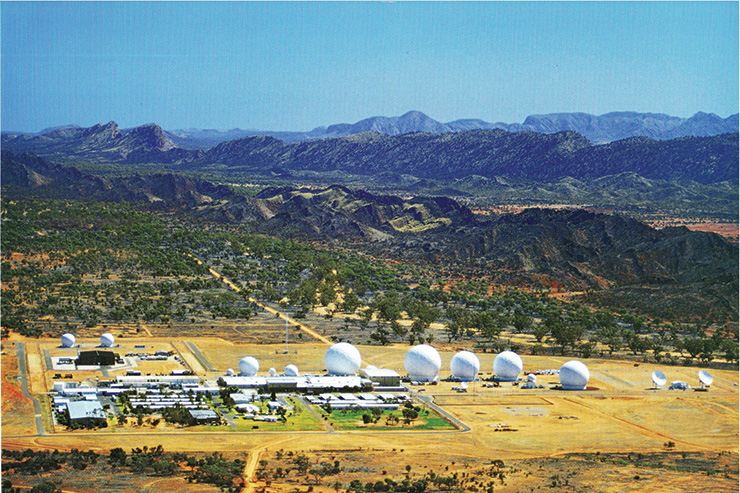
    The Joint Defence Facility at Pine Gap near Alice Springs has had a troubling, if discrete history in the Australian political landscape. It is, more than anything, a sign of the pressing inequalities of the Australian-US relationship, a salient reminder of Australia as a distant but valuable satrap to the ever stubborn imperium based in Washington. 

    “Joint” command is a teasingly deceptive misnomer, given that the facility in the Northern Territory is under US control. What persists is a certain errand boy element fronted by Australian personnel. They supply the territory, the space and the hospitality. The US, boasting its protective umbrella, does the rest.

    The Pine Gap facility, established in 1970 as one of the world’s largest satellite ground installations, has been responsible for feeding intelligence to American military missions for decades, with, or without the knowledge of the wallahs in Canberra. Over the years, revelations about what the facility is actually being used for have seeped into the media. 

    Pine Gap plays a crucial role in the United States military’s drone assassination program. The ‘collateral damage’ of the program in the form of hundreds of innocent civilian deaths has led to continued protests in countries such as Pakistan.

    The Australian revealed in April 2014 that two Australian citizens – Christopher Havard from Queensland and New Zealand dual national “Muslim bin John” (Darryl Jones) – had been killed in a drone strike in Yemen on 19 November 2013. Both men, supposedly members of the group al-Qa’ida in the Arabian Peninsula, were travelling in a convoy of vehicles with Abu Habib al Yemeni, a key AQAP figure. (The Australian did not bother with the term “alleged militants” in describing the fate of the slain.) 

    Australia’s then Foreign Minister, Julie Bishop, was only informed of the strike after it was revealed that Australian citizens might have been killed. A spokesman claimed that, “There was no Australian involvement in, or prior awareness of, the operation.” It certainly did not concern those at The Australian, who feel that pre-empting guilt by way of execution in an undeclared war without any suitable standard of evidence has “done much to stop the terrorists committing even more atrocities.” 

    This has not been the view of others. The late Professor Des Ball of the Australian National University, when asked about the strikes in May 2014, reiterated the claims to the same paper that Pine Gap was essentially being used to aid assassination. “I’ve no doubt that intercepts of phone calls and things like that are being intercepted at Pine Gap and used in drone operations.” According to Ball, intercepted signals obtained at Pine Gap were used in a strike against an al-Qa’ida target in Yemen on 3 November 2002. “It was one of the first uses of a drone against targets in Yemen.”

    Australian academic Desmond Ball (1947–2016).

    The Australian was a rather late arrival to the party, given that Philip Dorling of Fairfax Media was already reporting that intercepts obtained from Pine Gap were being used in conducting extra-judicial killings in the Middle East. The facility’s “primary function” was to identify radio signals throughout the “eastern hemisphere, from the Middle East across Asia and China, North Korea and the Russian far east.” As one former Pine Gap operator told Fairfax Media: “We track them [the combatants], we combine the signals intelligence with imagery, and once we’ve passed the geolocation intell[igence] on, our job is done. When drones do their job we don’t need to track that target anymore.” Such is the desensitised, amoral world of the signals tracker operating in remote locations.

    None of this was new to American investigative journalist Jeremy Scahill, who has been enlightening Australian and New Zealand audiences about the extent of knowledge and complicity in the dirty business of drone strikes. Pine Gap remains the remote sin of Washington’s reach. It also fundamentally inculpates Australia in the same mission, one that extends to its Trans-Tasman neighbour. On 17 May 2014 Scahill told New Zealand’s TV3’s The Nation that he had seen “dozens of top secret documents” provided by US authorities to the NZ government showing effectively “that New Zealand, through signal intercepts, is directly involved with what is effectively an American assassination program.” This barely troubled then New Zealand Prime Minister John Key, who openly suggested that the killings were “legitimate… given that three of the people killed were known al-Qai’da operatives.” 

    The Purpose of Pine Gap

    Robert Cooksey of the Australian National University was one of the first who took an interest in the nature of this “unlisted base” back in 1970. Writing for Dissent, he speculated whether the “weather station” in Alice Springs manned by Detachment 421 of the US Air Force might be powered by nuclear power. The Australian Minister for Supply had been rather oblique about the approval for a US research project at Alice Springs “to conduct long term geological and geophysical studies, including studies of earthquakes and attendant phenomena.” Northern Territory officials simply presumed it to monitor atomic tests, though Cooksey found it curious that this function should be shrouded in secrecy. 

    It was Desmond Ball who injected a note of unease in the discussion on the base, noting the multifarious military, scientific, intelligence and space facilities connected with Washington’s interests. “The precise number,” claimed Ball on the facilities, “is difficult to determine – there are problems of official obfuscation and of technical definition – but it is more than twenty.” Along with Richard Tanter, Ball did more work on the subject of drumming up awareness of the secret base’s role on Australian soil than most. A Suitable Piece of Real Estate: American Installations in Australia (1980) drove interest on how Australian territory had become an imperial domain for Washington’s strategic push. His assertion that Australia reclaim sovereignty was deemed “temper democratic, bias Australian.”

    The Nautilus Institute for Security and Instability has furthered Ball’s work, keeping a keen eye on the evolution of Pine Gap’s role in security. In an introductory overview on Pine Gap, the Nautilus Institute’s ongoing, updated report on the base notes the following: 

    “Pine Gap is perhaps the most important United States intelligence facility outside that country, playing a vital role in the collection of a very wide range of signals intelligence, providing early warning ballistic missile launches, targeting of nuclear weapons, providing battlefield intelligence data for United States armed forces operating in Afghanistan and elsewhere (including previously in Iraq), critically supporting United States and Japanese missile defence, supporting arms control verification, and contributing targeting data to United States drone attacks.”

    The report pegs Pine Gap’s role to three operational functions, with the original one still being primary: a station for geosynchronous signals intelligence (SIGINT) satellites developed under the auspices of the Central Intelligence Agency. Originally, these were intended to focus on the testing of Soviet missiles. One estimate puts the number of radomes and satellite dishes at Pine Gap at 38.

    The second features a function acquired in late 1999 when the base became a Relay Ground Station for detecting missile launches, including Overhead Persistent Infrared (OPIR) which now includes a Space-Based Infrared System (SBIRS).

    The third is its interception function (foreign satellite/communications satellite), acquired in the first decade of 2000. The Nautilus report notes that two 23-metre dishes appropriate for COMSAT SIGINT Development (Sigdev) were installed within the 30-metre radomes at the end of 1999 and early 2000.

    To Peter Cronau of ABC Radio National, the Nautilus Institute’s Richard Tanter was convinced about the ensconced nature of the base in the plans of US security:

    “Pine Gap literally hardwires us into the activities of the American military… So whether or not the Australian government thinks that an attack on North Korea is either justified, or a wise and sensible move, we will be part of that… We’ll be culpable in the terms of the consequences.”

    Other sources have added to the jigsaw. David Rosenberg, a US employee at the base, supplied a valuable portrait of the functions of the base in 2011. In 1990, Matthew Denholm subjected the strategic base argument to broader discussion.

    All this cut and dried material conveys the relevance of Australia’s continued geographical role as a dry goods merchant for Washington, its haberdasher of the Pacific. Not only does it supply the data required for drone strikes, it also served as a useful tool in directing US air operations over Vietnam and Cambodia. This troubled Prime Minister Gough Whitlam in the 1970s, who became a subject of deep distrust in Washington with his threat not to continue the lease connected with the base. This supplied an ample pretext for a flurry of communications between Washington and the opposition leader, Malcolm Fraser, who became the celebrated usurper in the fall of the Whitlam government in 1975. 

    Australia remains America’s glorified dogsbody and, in any future war, a conspicuous target. Enormous latitude is permitted for US personnel at Pine Gap. 
    Prosecution & Protest

    In 1952, when the Defence (Special Undertakings) Bill became law, it did so without opposition. There was, however, one note of warning from an otherwise unquestioning Dr Herbert Evatt of the Australian Labor Party. For one thing, the danger of legislative overreach was apparent: “the bill contains very important provisions which extend beyond that particular subject. They may be open to some criticism on analysis but, after consideration, the Opposition believes that the bill should be passed.”
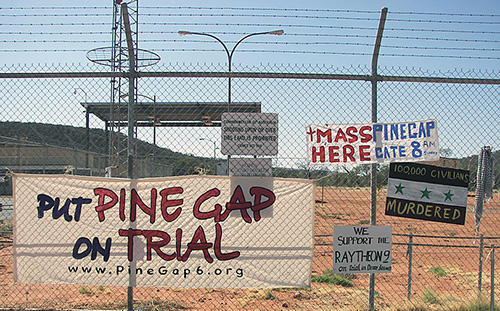
    There have been protests against Pine Gap since the 1970s. The above is from a 2006 protest.

    Protests and prosecutions have followed. A strong streak of feminist and female activism against the base has characterised dissent and an attempt to breach the veil of secrecy. On 11 November 1983, a Boston Tea Party style gathering was held on the green lawns on the Base. 111 women were arrested for trespass, all giving their name as Karen Silkwood, a renowned anti-nuclear protester. Some 700 women gathered, being described by the Alice Spring News as “Karen Silkwoods.” Support, albeit indirectly, was also offered by twelve female parliamentarians from the Labor Party, including Senator Susan Ryan, then Minister for Education.

    At various stages, prosecutions on charges of trespass under the Defence (Special Undertakings) Act 1952 have also been mounted, though the prosecution effort in 2007 against protestors was laughed out of court by the presiding judge, Daynor Trigg, who deemed the statute “a bit of nonsense.” The defendants were duly acquitted by the Northern Territory Criminal Appeals Court, who quashed attempts by prosecutors to seek a retrial. 
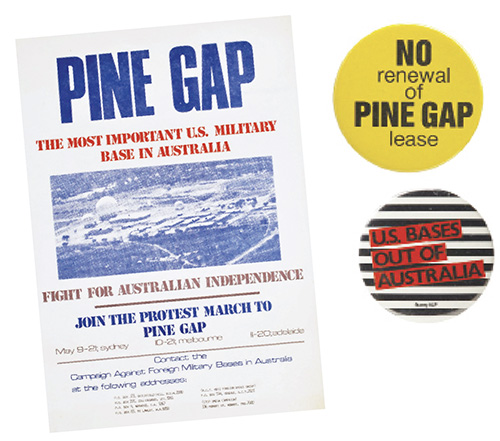
    Australians have a long history of protesting US military bases in Australia. Left:  Poster from 1976 campaign, and protest badges from the 1970s & 80s.

    As late as last year [2017], six self-proclaimed “peace pilgrims” received the attention of authorities for sporting musical instruments and pictures depicting war casualties onto the base. The prosecution of Margaret Pestorius, Paul Christie, Jim Dowling, Franz Dowling, Andy Paine and Tim Webb centred on their entering of the clandestine base in September 2016 had been obstinate and typical.

    The grounds advanced by Michael McHugh SC for the government made weak reference to the history of peaceful protest that had marked the practice of Australian democracy. He even drew a curious precedent from the archives about how the Suffragettes had, in their day, shown the way on civil disobedience. They, it should be noted, were deemed to have acted illegally, though ultimately successfully, in their cause. The defence argued that the Commonwealth Criminal Code legitimised their protest because it was necessary to prevent a loss of life. As Pine Gap supplied targeting information for drone strikes, its disruption would purportedly save lives.

    Justice John Reeves found no merit in the argument of extraordinary emergency, but nor did he prove entirely cooperative to the prosecutors. On 4 December 2017, the court refused to impose prison sentences, despite the guilty jury verdict. “I do not accept the Crown’s submission,” said the judge dismissively, “that your offences potentially struck at the heart of national security.” All six were fined for unlawful entry to the tune of $1,250 to $5,000, and Paine was found guilty of the additional charge of carrying a photographic device on the base.

    During the course of trial, testimony was elicited by various figures which formed the public record. Former Greens Senator Scott Ludlam spoke with conviction from the stand. “There are moral and ethical questions,” he charged; “there are also deep legal questions about the authorities relied upon by the United States Government to undertake drone assassinations in at least six countries that I am aware.” Ludlam’s points are sound in their logic: complicity expands rather than contracts, and Australian funding and hosting of the base invariably places risks to Australian citizens from the perspective of drone strikes, and, in another sense, the vantage point of future prosecutions for crimes against humanity.
    Get the issue this article appears in

    A Blot on Sovereignty

    Australia, for Ball, seemed gripped by a near infantile fear about its security, a requirement almost Freudian in its search for a protective paternal power. “There is a residual fear in Australia that we can’t defend this huge territory and only the Americans can really save us. We always have been a fearful country. We’ve always needed great and powerful friends.” 

    In a tone similar to the late Malcolm Fraser with his resentment of Australia’s “Star Spangled manner” (despite being an initial enthusiast of US power, Fraser did change his tune), Ball felt that the base over time exemplified the worst in the US-Australian alliance. As he told the ABC in 2014, he had reached a point where he could “no longer stand up and provide the verbal, conceptual justification for the facility that I was able to do in the past.”

    The joint US-Australian facility functions in a defiant administrative limbo, one resistant to Australian sovereignty, despite its proclaimed collaborative status. It remains hostile to the inquiries of Australian citizens on what role the base plays. Pine Gap has had a singularly corrosive effect on Australian public life. It has whittled away rights of protest and entrenched secrecy. It has attacked basic civil liberties, with US authorities co-opting Australian personnel to do the work of the US military. With each provocation by daring protesters, with each exposure of the ludicrousness of secrecy surrounding the base, crumbs are filling the gaps, data filling the files. 

    “Since our action,” claimed Paine, “more evidence has emerged detailing the role of Pine Gap in extrajudicial assassinations, in nuclear weapons targeting and in illegal mass surveillance.” The most troubling aspect of this is whether Australia’s general citizenry cares.

    [alert type=”general” dismiss=”no”]This article was published in New Dawn 171.[/alert]

    [alert type=”success” dismiss=”no”]If you appreciate this article, please consider subscribing to help maintain this website.[/alert]

    Footnotes

    1. www.theaustralian.com.au/opinion/editorials/heavy-price-of-jihad-hits-home/story-e6frg71x-1226887014723 
    2. www.theaustralian.com.au/national-affairs/policy/pine-gap-supports-us-drone-hits/story-e6frg8yo-1226923350422# 
    3. www.smh.com.au/national/pine-gap-drives-us-drone-kills-20130720-2qbsa.html
    4. www.smh.com.au/national/pine-gap-drives-us-drone-kills-20130720-2qbsa.html 
    5. www.abc.net.au/radionational/programs/breakfast/dirty-wars—the-world-is-a-battleground/5472612 
    6. www.wsws.org/en/articles/2014/05/24/dron-m24.html 
    7. Bruce Juddery, “Hint of Work at Pine Gap,” The Canberra Times, Sep 17, 1970, 14.
    8. Desmond Ball, A Suitable Piece of Real Estate, 19.
    9. http://nautilus.org/wp-content/uploads/2012/12/The-_Joint-Facilities_-
    revisited-1000-8-December-2012-2.pdf 
    10. http://nautilus.org/publications/books/australian-forces-abroad/defence-facilities/pine-gap/pine-gap-intro/
    11. www.abc.net.au/news/2017-08-20/leaked-documents-reveal-pine-gaps-crucial-role-in-us-drone-war/8815472 
    12. David Rosenberg, Inside Pine Gap: The Spy Who Came in From the Desert Hardie Grant Books, 2011.
    13. Matthew, Denholm, “The advantages and disadvantages of allowing United States military/strategic bases to be maintained in Australia,” Cabbages and Kings 18 (1990): 45-71.
    14. Women For Survival, founded during the Pine Gap Women’s Peace Camp in 1983. For more, see the record: https://trove.nla.gov.au/people/1477462 and www.womenaustralia.info/biogs/PR00097b.htm. See also Melbourne University Archives (Victorian Women’s Liberation and Lesbian Feminist Archive) and James Cook University Library (Trewern Collection). See Women for Survival, Pine Gap camp – 11 November 1983 (Haymarket, NSW, 1983).
    15. Noted by Bryan Law, “Entering the ‘gap’ between what’s right and what’s legal’,” Webdiary, Oct 17, 2005 and noted in Nautilus Institute for Security and Sustainability, “Pine Gap protests- historical,” https://nautilus.org/publications/books/australian-forces-abroad/defence-facilities/pine-gap/pine-gap-protests/protests-hist/
    16. https://closepinegap.org/media/
    17. www.smh.com.au/national/des-ball-the-man-who-saved-the-world-20121220-2bpdd.html
    18. www.abc.net.au/7.30/content/2014/s4066678.htm

    © New Dawn Magazine and the respective author.
    For our reproduction notice, click here.
  • Secrecy & Surveillance: The Australian National Security State

    Secrecy & Surveillance: The Australian National Security State

    From New Dawn 177 (Nov-Dec 2019)

    Australian society, as has been its wont for some time, relishes secrecy and surveillance. Forget the laid-back, relaxed demeanour that remains the great fiction of a confected identity; like all such forced assumptions, the slight trace should not be mistaken as the main tendency. The political culture of Australia remains shaped by penal paranoia and indifference to transparency. The citizen is not to be trusted; governments know best. The subject is to be policed and regulated into apathetic submission, convinced that such measures are for the broader good. 

    As Brian Toohey notes in his latest, sprawling book titled Secret, power has accrued to Australian officials and ministers incrementally through “a succession of new laws and policies” driven by the profane trinity of secrecy, ignorance and fear. These have served to “deprive Australians of basic liberties and increase the risk of being dragged into a devastating war that could escalate into a full-blown nuclear catastrophe.”1

    The statute books of the federal parliament are larded with provisions of secrecy that make doing credible journalism in the country, not to mention any of its cognates, nigh impossible. Journalists and scribblers are left to their own devices, inventive as these might be, assisted by the odd prized leak from a source who will, in time, be punished. This is particularly so regarding the public service and public servants, who do not fall within newly enacted laws covering the private sector; they remain the traditional targets of state regulation and punishment. 

    The leakers, in turn, are offered shallow protections. The public servant must, essentially, keep any whistleblowing confined to the narrowest of circles while following obscured hoops of process within regulated channels. Investigations must be permitted to take place, though these may not lead to any resolution. Patience must be exercised as the most taxing of virtues. This invariably endangers and compromises the whistleblower, rendering information confined that might have greater value in the public domain.

    The Australian National Security State has been particularly aggressive in this regard, emboldened by additions to its form since the 11 September 2001 attacks on the United States by the Al Qaeda terrorist group. As the head of the Home Affairs department, Mike Pezzullo, explained with sinister import to a gathering of the Trans-Tasman Circle in October 2017, “The state has to embed itself invisibly into global networks and supply chains, and the virtual realm, in a seamless and largely invisible fashion, intervening on the basis of intelligence and risk settings, increasingly over a super scale and very high volumes.” 

    Fitting words for the chief bureaucrat of Australia’s dangerously enlarged department that includes, as Toohey notes, ASIO, the Australian Federal Police, the Australian Criminal Intelligence Commission, and the Australian Transaction Reports and Analysis Centre.2 And while such a department flourishes in conspiratorial paranoia in assessing and responding to perceived threats, those monitoring potential abuses within the system, such as the Inspector-General of Intelligence and Security, have found themselves marginalised and relegated to minor importance. “This is not abracadabra,” lamented its current officeholder, Margaret Stone. “It’s not an incantation. It has to be real.”3 

    The national security state has taken several notable scalps over the years. Individuals such as former customs officer Allan Kessing, who authored two reports on lax airport security, faced a suspended sentence, convicted in 2007 under section 70(2) of the Crimes Act 1914 (Cth). The reason? Disclosing confidential material obtained in the course of his employment even if, in his words, it involved exposing “theft, smuggling and systematic criminality” at Sydney Airport.4 All efforts to either seek a public clearance of his name, or legal remedy, have failed. In a startling note of disingenuousness, Kessing became something of a poster boy for the Labor Party in the 2007 federal election, a figure of inspiration behind a change to the secret state that never took place. As he recalled to Alan Jones, then-leader Kevin Rudd “actually mentioned me by name and promised me there would be reform to whistleblower laws and a pardon would be considered. And neither of which happened.”5 

    In an even graver and more recent case, David McBride is facing prosecution for theft and three counts of breaching the Defence Act for being a person who, as a member of the defence force, allegedly communicated a plan, document or information to journalists Dan Oakes, Andrew Clarke and Chris Masters. The old official secrets provision of the Crimes Act 1914 has also come into play, meaning that any jail sentence is bound to be a lengthy one.

    The central part of McBride’s contribution to the latest flexing of muscle by the national security apparatus centres on the alleged war crimes by Australian special forces in Afghanistan. This came from material obtained by McBride in 2014 at the high-security joint operations headquarters in Bungendore. It led to the publication of “The Afghan Files,” an invaluable source of information on Australia’s flawed military effort in Afghanistan available via the ABC. 

    McBride fits the blueprint of the complicated, troubled whistleblower, a believer in institutions, yet disturbed by their atrophy and what he insists is an obsession by decision-makers with “opinion polls.”6 It was McBride who proved the figure of inspiration behind raids by the Australian Federal Police in June upon Australian journalists, raids which have revealed the extent the unwieldy security apparatus has grown.

    Raiding journalists

    On the morning of 4 June this year, News Corp political editor Annika Smethurst was readying to leave for work, only to witness Australian Federal Police bearing down on her home with a warrant. The warrant was broad, essentially limitless. A statement from the AFP subsequently confirmed that it had “executed a search warrant at a residence in the ACT suburb of Kingston today (4 June 2019)” on a matter relating “to an investigation into the alleged unauthorised disclosure of national security information that was referred to the AFP.”7 The AFP “will allege the unauthorised disclosure of these specific documents undermines Australia’s security.” The gravity of the allegations was affirmed in an update that soon followed: “This warrant relates to the alleged publishing of information classified as an official secret, which is an extremely serious matter with the potential to undermine Australia’s national security.”

    Within hours, radio 2GB Drive presenter and Sky News contributor Ben Fordham revealed that he was also the subject of an investigation after discussing the attempt of six asylum seeker boats to reach Australia. The story piqued the interest of a peeved Department of Home Affairs official, who proceeded to scold Fordham’s producer for discussing “highly confidential” material in a berating phone call. “In other words,” explained the broadcaster bluntly, “we weren’t supposed to know about it.”8 

    Over the course of the next morning, with no settling of dust in order, a second raid by the AFP was executed against the Sydney offices of the national broadcaster, the ABC. Those named in the warrant – investigative journalists Dan Oakes and Sam Clark, along with ABC director of news Gaven Morris – were linked to The Afghan Files.9 Australia’s national security state has gotten very busy indeed.

    Since Smethurst’s story titled “Let Us Spy on Aussies” broke last year, the security wallahs have been attempting to root out relevant sources, mobilising the AFP in the process. The account detailed information on discussions between the Home Affairs and Defence departments on the possibility of granting the Australian Signals Directorate powers to monitor the emails, bank records and text messages of Australian citizens. Letters between Secretary of Home Affairs Mike Pezzullo and Defence Secretary Greg Moriarty featured. The case with the ABC was even more dubious: as the source was already known to be McBride, the effort to raid the national broadcaster was a crude statement of state power. 

    Inadequate protections

    The modus operandi of any national security state is that any effort to open it up to scrutiny must be resisted. Concessions to openness are bound to be minimal and ineffectual. As a 2016 review by Philip Moss of the Public Disclosure Act 2013 noted, the Commonwealth statute supposedly meant to protect whistleblowers in the public sector has left its fair share of disappointments. “The experience of whistleblowers under the PID Act is not a happy one… The experience of agencies is that the PID Act is hard to apply.” In its application, surmises Stephen Easton writing in The Mandarin, “it is very difficult for a whistleblower to understand the precise sequence of actions they should take to qualify, and there is very little advice or support available to help them meet the criteria.”10

    Initial disclosures, for instance, must be made to supervisors, the authorised officer in the agency, the Commonwealth Ombudsman or the Inspector-General of Intelligence and Security. Avenues for external public interest disclosures are narrow and infuriatingly vague. Submissions made to Moss to assist his review were also sceptical about the illusory balance struck in the name of the public interest. “We believe the spirit and intent of the PID is appropriate,” went the submission from the Australian Tax Office, “however the legislation in its current form does not always strike the right balance to ensure serious matters in the public interest are addressed and other matters which are less serious are dealt with under alternate legislation.”11 Various other defects were also noted: how, for instance, to compel supervisors to give public interest disclosures (section 60A) made to them to an authorised officer, and what might be seen to be a serious disclosure as opposed to one not deemed such (section 29).

    Jurisprudence referring to the PID has also found it wanting. Federal Court judge John Griffiths called it “technical, obtuse and impracticable” in finding that the Act did not apply to a Parliament House security guard.

    Media organisations would like to see parliament shed its conservative skin in this regard, passing legislation that would enhance Freedom of Information provisions, arm press outlets with the means to contest warrants aimed at journalists, furnish whistleblowers with credible protections, and tilt the balance away from the national security grand inquisitor that seems to prevail in Canberra.

    This is a tall order indeed given the surveillance infrastructure that is already in place. The Telecommunications (Interception and Access) Amendment Act 2015, passed with bipartisan support, imposes a noxious data retention regime that risks compromising the respect of a journalist’s confidences. The grant of a Journalist Information Warrant permits some 21 government agencies access to the telecommunications data of journalists or those who employ them which are required to be retained for up to two years. This can be undertaken without their knowledge, is unimpeachable in a court of law and has a duration for up to six months. Such measures are political, not legal determinations, granted at the discretion of the Minister, rather than a judicial officer. The test is simple and expedient: warrants will be granted if the public interest in exposing the source outweighs that of keeping confidentiality. To leave such measures of calculation to a political agent is a dangerous gamble indeed.

    Those working to a Canberra drum beat might well point out that recent reforms have taken place in terms of protecting journalists. The Smethurst-ABC raids took place in the aftermath of amendments that were meant to ease the sting in what had been archaic official secrets provisions of the Crimes Act 1914 (Cth). These, including those provisions used to punish Kessing, were repealed on 29 June 2018, leaving the way for new regulations dealing with national security information. A public interest defence, found in the National Security Legislation Amendment (Espionage and Foreign) Interference Act 2018, protects those “engaged in the business of reporting news, presenting current affairs or expressing editorial or other content in news media.” A closer inspection of the provisions shows this to be inadequate for two crippling reasons: the sources remain unprotected, and journalism remains arbitrarily open-ended. (Will, for instance, the modern blogger or citizen journalist fall within such a defence?) 

    The Act makes the point of covering what is deemed “inherently harmful information”: security classified information; information obtained by, or made by or on behalf of, a domestic intelligence agency or a foreign intelligence agency in connection with the agency’s functions; or information on “the operations, capabilities or technologies of, or methods or sources used by, a domestic or foreign law enforcement agency.” A close reading of the legislation shows that leaking sources, and more broadly those informants who supply classified material, cannot avail themselves of any defence. The Law Council’s efforts to convince the federal government to extend the public interest defence to suppliers of the information was rejected, leaving the way open for such cases as Smethurst’s: spare the journalist but attack the source. According to Law Council president Arthur Moses, the protection is shabby, a mere “mirage because it does not cover a journalist’s source.”12 Conduct deemed a contravention of provisions regarding intelligence sources (the publication of names or identity of staff, for instance), does not satisfy the test, nor conduct deemed to assist, directly or indirectly, “a foreign intelligence agency or a foreign military organisation.” 

    Unchanging environments

    Understanding Canberra and the public service is to understand a form of studied stasis, an effort to stymy change. Ideas tend to go there to find cold storage if not expire altogether. The way to keep them in cold storage and throw away the key is to set up an inquiry, with all the baubles and tinsels of cheap accountability. This is the preferred approach of the Morrison government, knowing that such an inquiry will be guaranteed to kill off any reform drive. (Four months should do it: the inquiry is due to report on 17 October.) In his letter to the opposition leader Anthony Albanese, Prime Minister Scott Morrison informed his counterpart that, “The Government is committed to ensuring our democracy strikes the right balance between a free press and keeping Australians safe – two fundamental tenets of our democracy.”13 

    Knowing the hostility this government and its predecessors have had to the exposure of abuses of state and corporate power, limitations have already been inked. The mechanism being used to ensure only modest changes is to use the Parliamentary Joint Committee on Intelligence and Security (PJCIS), a body of approved politicians who can be trusted to do the right thing by the dictates of secrecy and security. Morrison claims the PJCIS is “well placed to conduct this inquiry given its responsibility for, and experience in, handling issues concerning national security information and legislation.” He would: independent MPs are excluded; contrarians are barred. Whatever qualifications the sitting members will have, their most valued pre-requisite is the capacity for premature adjudication of the problem, adjusted to satisfy the security apologists. 

    The PJCIS has been one of the most important entities behind approving the shabby Australian national security state, a clumsy creation that does nothing to improve security let alone preserve freedoms. Its members are terrified by the predations of technology and the wilder elements of the Internet. They see any effort to restrain such reach as necessary to protect Australians. Andrew Wilkie, the independent MP more qualified than most to sit on the committee given his background as an officer of the Office of National Assessments, makes the point starkly. “The Labor and Liberal-dominated PJCIS is part of the problem because it’s signed off on every unnecessary security reform in recent history.”14 

    Wilkie reminds us of the dubious resume of the PJCIS, which features reserve, acceptance of the surveillance rationale, and clay-footedness towards civil liberties. “Who could forget the controversial data retention bill of 2015 and just last year the encryption bill? In both cases the PJCIS recommended some tweaks around the edges, but… recommended the bills be passed, despite the serious concerns about both.”15 While the European Union makes strides against such inefficient and dangerous policies as data retention, Australian governments embrace them with a relish for anachronism, ears bent to the warnings of Duncan Lewis of the Australian Security Intelligence Organisation about the next foreign threat of interference. “It’s constant,” he is reported to have told The Weekend Australian (27 July 2019). “Every day there is a discovery. Some of them are more alarming than others.”16

    To permit the PJCIS the means and latitude to decide that balance on press freedom and security would be the equivalent of granting full powers of determination to a taxidermist over your favourite pet. Denis Muller of the Centre of Advancing Journalism at Melbourne University saw this move as appointing foxes the guards of henhouses or giving poachers the means to oversee game-keeping.17 

    The inquiry hopes to assess, in part, “Whether and in what circumstances there could be contested hearings in relation to warrants authorising investigative action in relation to journalists and media organisations; (and) the appropriateness of thresholds of law enforcement for law enforcement and intelligence agencies to access electronic data on devices used by… media organisations.” A full agenda for reform is guaranteed to be avoided.

    Labor, in turn, is trying to shore up its poor parliamentary performance of late in attempting to set up a second, separate inquiry free of the clutches of the PJCIS. That inquiry makes explicit reference to the “public’s right to know and press freedom.” Senator Kristina Keneally, shadow minister for home affairs, notes a prevailing “culture of secrecy and perverting the public’s right to know that has been making its way through this government for too long.”18 In unwittingly casting such stones in the glasshouse, she ignores the record of previous Labor governments with similar leanings towards the national security state. The bipartisan consensus remains unchallenged.

    The parliamentary committee has its Canberra compliment of defenders. This is hardly surprising: the national security state will always have its sponsors, ensuring that the narrative is not so much controlled as scotched. Jacinta Carroll, as director of national security policy at the National Security College at ANU, writing in The Strategist (8 July), sees the PJCIS as “the appropriate body to undertake this review, as it’s made up of elected representatives of the people in Australia, and it’s also an established and expert body in the matter at hand.”19 Carroll’s they-know-best tone is schoolmarmish, characteristic of the befuddlement shown by security hacks. She accepts, in tokenistic fashion, that, “A functioning and vibrant democracy is characterised by engaged civil society and informed debate.” As Australian democracy is not vibrant, lacking oxygen for a civil society struggling to fend off the overly keen regulators and over-committed spooks, her observation has little bearing on reality. 

    Given all that, she still insists, as the inquiry takes place, that all “maintain the focus on being informed about the complexities, nuances and competing interests at play, and not be lured into an oversimplified debate.” Read: let bought parliamentarians seduced by national security briefs and their promoters dictate the balance. The parents of the Australian Security State know best.

    [alert type=”general” dismiss=”no”]This article was published in New Dawn 177.[/alert]

    [alert type=”success” dismiss=”no”]If you appreciate this article, please consider subscribing to help maintain this website.[/alert]

    Footnotes

    1. Brian Toohey, Secret: The Making of Australia’s Security State, Melbourne University Press, 2019, xiii
    2. Toohey, Secret, 241
    3. Quoted in Toohey, Secret, 244
    4. Crikey, 14 Sep 2009
    5. 2GB, 6 Jun 2019
    6. www.smh.com.au/politics/federal/what-i-ve-done-makes-sense-to-me-the-complicated-colourful-life-of-david-mcbride-20190621-p5204h.html
    7. www.afp.gov.au/news-media/media-releases/afp-statement-search-warrant-kingston-act
    8. www.news.com.au/finance/business/media/radio-star-ben-fordham-targeted-after-australian-federal-police-raid-political-editor-annika-smethursts-home-over-spy-story/news-story/ee864fd6be6c84dfa108647565c7ee25
    9. www.abc.net.au/news/2017-07-11/killings-of-unarmed-afghans-by-australian-special-forces/8466642
    10. www.themandarin.com.au/110350-attorney-general-open-to-reforming-obtuse-federal-whistleblower-protection-law/
    11. www.pmc.gov.au/sites/default/files/public-submissions/pid/submission-ato.pdf
    12. www.theaustralian.com.au/commentary/actions-expose-risk-to-journalism-democracy/news-story/7f20ccaae6301d55b899b4f382b8c6ac
    13. https://theconversation.com/morrison-and-albanese-to-discuss-inquiry-into-press-freedom-119767
    14. www.theaustralian.com.au/nation/politics/alp-push-for-press-freedom-committee/news-story/314162de8da318ba97c829f80a098cbd
    15. Ibid.
    16. www.theaustralian.com.au/nation/defence/espionage-threats-unprecedented-says-spy-boss-duncan-lewis/news-story/e90c51bb103ffd1d536ae7b691671891
    17. https://theconversation.com/parliamentary-press-freedom-inquiry-letting-the-fox-guard-the-henhouse-119820
    18. www.theaustralian.com.au/nation/politics/alp-push-for-press-freedom-committee/news-story/314162de8da318ba97c829f80a098cbd
    19. www.aspistrategist.org.au/parliaments-joint-intelligence-committee-the-right-body-to-review-press-freedom/

    © New Dawn Magazine and the respective author.
    For our reproduction notice, click here.