New Dawn – World's Most Unusual Magazine

Author: Patrick Henningsen

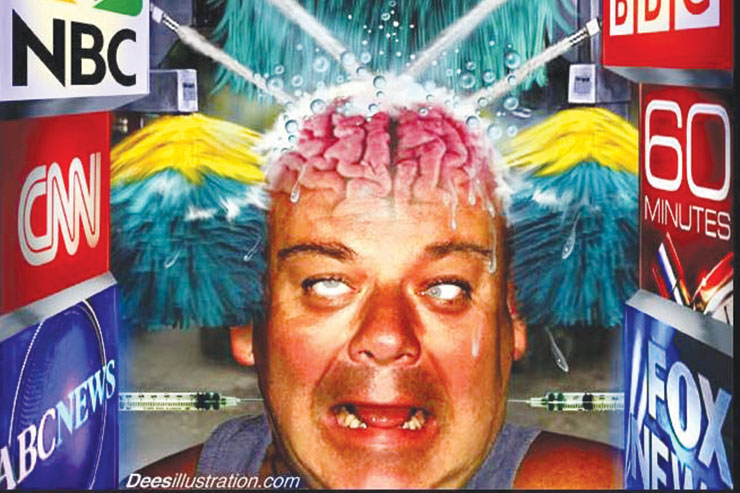
  • Free Your Mind from Mainstream Media Brainwashing

    Free Your Mind from Mainstream Media Brainwashing

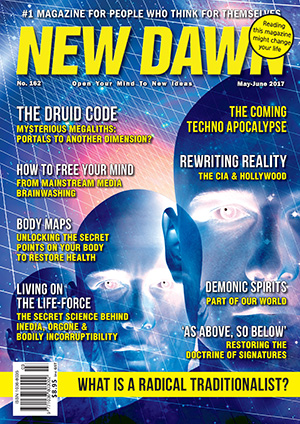
    From New Dawn 162 (May-June 2017)

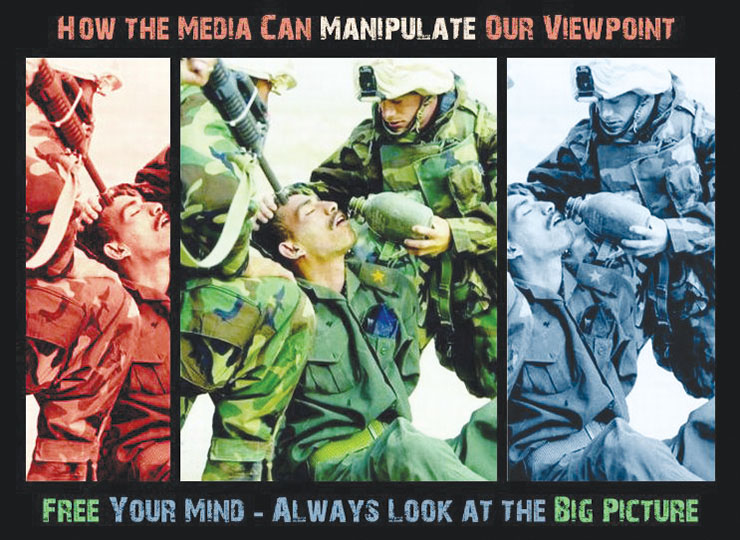
    Starting with Gutenberg’s printing press, then Thomas Edison’s motion picture camera and the introduction of celluloid and the silver screen, and later the cathode ray tube – a select few media institutions, and the men behind them, have enjoyed monolithic monopoly over the information we see and hear.

    Their machine is awesome and seemingly unstoppable, and reaches anywhere, anytime and into the minds of all it targets.

    How does one navigate, let alone make sense, of this 21st century matrix?

    If this transformation were truly an organic process, then most critical minds would be able to rationally deal with our total immersion in media. But the evolution of technology and how we interact with it is not so easy to articulate. As platforms and choice continue to proliferate, the situation is becoming more attuned to Chaos Theory than Darwinian Theory. The media and its modern marketing arms tell us it’s all progress. By now, their role is well defined – as the initial express vehicle on which all new ideas and advancements are delivered into the mainstream. In most cases, one could say the public are now fully preconditioned to accept new media on arrival.

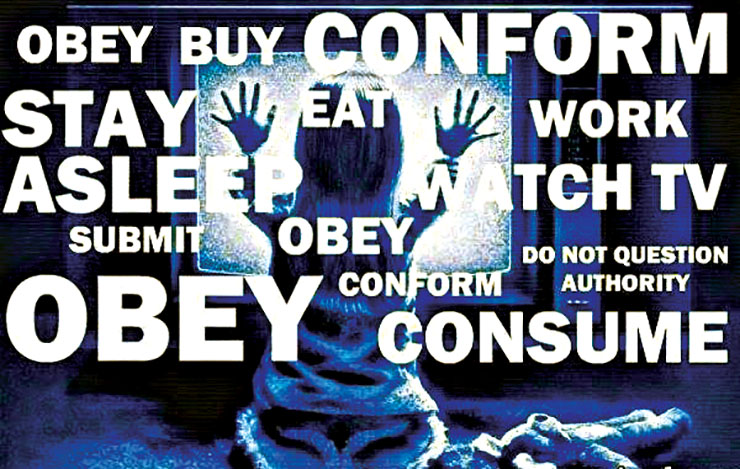
    Whether we care to admit it or not, there are varying degrees of brainwashing and behavioural conditioning with films and TV. That’s why they call it programming. How many of us find ourselves automatically using quotes from popular films or TV shows? And how many of us emulate the fashion or hairstyles of those we see on the screen?

    It happens much more than most people care to admit. Most of us are completely unaware of how much we mimic what we see, and repeat what we hear.

    In the 1976 classic, The Network, the film’s main character, a television prophet named Howard Beale, delivers an unforgettable sermon to his studio audience, perfectly describing the raw nature of mass media in a societal context:

    And why is that woe to us? Because you people and sixty-two million other Americans are listening to me right now. Because less than three percent of you people read books. Because less than fifteen percent of you read newspapers. Because the only truth you know is what you get over this tube. Right now, there is a whole, an entire generation that never knew anything that didn’t come out of this tube. This tube is the Gospel. The ultimate revelation! This tube can make or break Presidents, Popes, Prime Ministers. This tube is the most awesome, god-damn force in the whole godless world. And woe is us if it ever falls into the hands of the wrong people.

    Beale must have known it had already fallen into the hands of the wrong people, namely organised crime, the CIA, the Military Industrial Complex and the transnational global elite.

    The reality is that studio and record executives, and their media producers, are responsible for much of society’s behaviour, as well as the popular cultural archetypes that people adopt. For sure, this is a tremendous amount of power, and don’t think for a moment that executives do not know this. The same can be said for their CIA and Pentagon ‘advisors’ too.

    When in high gear, this culture machine commands any of the following behaviours en masse; foul language, profanity, sexual promiscuity, pre- and extra-marital affairs, drug use and abuse, dysfunctional relationships and families, racial tension, violence, defacing religious symbols, Satanic ritualism, undermining authority figures like fathers, teachers, clergy, and even the worship of the Orwellian security state. It’s all fair game for the media and entertainment industry.

    How is anyone expected to survive this psychological and spiritual onslaught?

    Media Survival 101

    The average person living in a technologically advanced first world society will watch an average of three hours of television per day, as well as another two to three hours spent on computerised electronic devices. If we want to survive with our minds and souls intact, at some point in our lives we have to muster the courage to turn off, and tune-out.

    The sheer volume of content now available means each person must be judicious about how they spend their time. The old binary option for ‘Generation X’, when you said to yourself, “Alright, I have three hours to myself. How am I going to spend that time? Do I watch TV, or do I read a book?” – may no longer apply.

    For Millennials (and others too), it’s more like, “Do I watch TV, YouTube, hangout on Periscope, Instagram, Facebook, or do I stream Hulu, Amazon Prime, iTunes or Roku, or do I read online, with my Kindle, or my Nook, or who knows, maybe a book?”

    The term binge watching also comes to mind. Seven seasons with 10 episodes each, with a continuous interconnected cliffhanger plot line – enough suspense and intrigue to trigger endorphins in the brain to keep you awake all night, enough to watch an entire season of 24… in 24 hours.

    If things are really that bad, or you are feeling anxious over an obsession with keeping up with content, then there is a high probability you are under some degree of media-driven mind control.

    The first step in liberation from the machine is to become a more active consumer of information and content, as opposed to being a passive sieve. That’s not to say you cannot enjoy a movie, or watch a good ball game now and again – everyone needs to step off the hampster wheel and indulge in entertainment from time to time.

    To defeat the linear, force-feeding tube of information and social conditioning by Hollywood and mainstream media… simply read more. Read whatever you can get your hands on – books, print journals, magazines, online articles, and newspapers. Your knowledge retention rate will be higher, and the experience of reading will hone your mental focus, self-reflection and clarity of thought.

    Rather than waste hours watching TV or sitting through a sub-par Hollywood cinema production that you know will be disappointing in the end, instead try listening to radio shows, or podcasts. Instead of drifting down rabbit holes on YouTube, visit websites like Soundcloud instead, and get immersed in their vast audio jungle.

    Another useful practice in liberating your mind from groupthink and staying less susceptible to mainstream brainwashing is to make a concerted effort to occasionally read, watch or listen to content from media outlets or sources that you do not like, or generally do not agree with. This is important for a number of reasons. If you are truly confident in your political beliefs, your worldview or your grasp of current and historical events, then it shouldn’t bother you to hear what ‘the other side’ has to say. If you really want to successfully defend your position, opinion, or ideology, or your side of the political spectrum – then it helps to know the contrarian arguments, and you should want to analyse them as much as possible. This type of open-minded information consumerism is exactly what the establishment culture-makers and matrix operatives do not want you to be involved with – because a confident, well-informed and objective voice is antithetical to the prevailing divide and rule, bipolar political paradigm program that social engineers are currently running on Western society.

    Also, should you ever find yourself growing tired of reading about it, then go and experience it.

    Learn How to Learn

    The American poet Robert Frost famously said, “We all proceed with insufficient knowledge.”

    In the education of the mind, everyone must submit (at least once a day) to the fact that no matter how smart or knowledgeable you think you are on any given topic or event, you actually know very little. You may know more than the person next to you, and you might even be an expert on one layer of a lattice, but more than likely would only have above average knowledge of one corner of the galaxy that is your area of expertise.

    Unfortunately, as far as social media is concerned, it remains a crude platform for human interaction and learning. Your 13.5 inch laptop screen doesn’t always deliver when it comes to human stimulation and speed of exchange that you’ll get through human conversation. The solution to this problem is a simple one – we need to talk more. Talk more, and talk about anything. The most powerful microprocessor on the planet is not in the basement of the NSA in Provo, Utah, or in Jeff Bezos’ server yards in Colorado – it’s between your ears.

    Also, rather than preaching to the choir, try and strike up conversations with people who are smarter or more experienced than you. This is one of the fastest ways to increase your knowledge base and gain valuable insights which you will never get from the mainstream media, or even find in the annals of the Ministry of Truth (Wikipedia).

    Remember: you’re not a robot, so stop acting like one.

    There’s a big world out there – and it’s much bigger than anything inside your TV or smart phone.

    [alert type=”general” dismiss=”no”]This article was published in New Dawn 162.[/alert]

    [alert type=”success” dismiss=”no”]If you appreciate this article, please consider subscribing to help maintain this website.[/alert]

    © New Dawn Magazine and the respective author.
    For our reproduction notice, click here.

  • Control 101: Creating Consensus Reality

    Control 101: Creating Consensus Reality

    From New Dawn 156 (May-June 2016)

    By carefully controlling mainstream media and educational institutions, elite social engineers are able to control the flow of public discourse in order to serve their own goals and interests. By doing this, they create something akin to ‘consensus reality’. In other words, by controlling the perception of public consensus on any particular issue or event, you effectively control the prevailing reality.

    A leading example of this social engineering phenomenon today is in the relentless promotion of war and global conflict throughout the media and education systems. Their carefully coordinated efforts can be boiled down to a simple concept: establishing legitimation and delegitimation in relation to the state or state institutions.

    In today’s formative education, school textbooks and assigned reading material are powerful tools used to shape students’ views. Often what is imprinted in one’s memory is not particular details and facts but rather an atmosphere, an impression, or a tone.1 It can be argued this impression may be more influential in forming a pupil’s contextual world or nationalist view.

    Professor of Education Dr. Michael H. Romanowski, explains: “The authority of textbooks coupled with the ‘objectivity’ of the technical knowledge that they communicate encourages students to accept unquestionably the impressions and worldview created by the language of textbooks.”

    “Although textbooks claim rhetorically not to promote a particular understanding of history and to be objective, they advance a value-laden perspective of reality. Because the selection and structure of knowledge affect our perception of the world, the language and context used to articulate knowledge are crucial. Textbook authors select particular language that creates impressions in the minds of students. These impressions have power and authority because they are presented in the printed and bound textbook with its aura of an authority that is beyond question and criticism. Although textbooks are used in many different ways, they are still dominant and powerful educational tools that shape students’ views.”

    In his study Romanowski goes on to describe how through the careful use of language, US school textbooks depicted Japanese internment camps in the United States during World War II in a manner that marginalised Japanese-Americans, while subtly mitigating any real criticism of the US government’s actions. Some might call this indoctrination, while others may call it brainwashing.

    Much of the ideological instruction for educational institutions is provided through the global governance system run and funded by multilateral institutions like the United Nations and the World Bank. The global management and cultural continuity of this European and North American-led ‘soviet’ is run by a myriad of Non-Governmental Organisations (NGOs), specifically through the UN’s “Agenda 2030”, a set of global directives for the next two decades. Previously these were the UN “Millennium Goals” which have since been overhauled and upgraded by the self-appointed culture experts and social engineers in New York City and Geneva. Through this globalised system, social engineers are able to streamline language and political thought internationally, while simultaneously preparing the next generation to accept a new sanitised political reality.

    In the last two decades, the corporate mainstream media’s efforts to spin endless war narratives on behalf of the state and its defence industry have become more pronounced. Despite numerous critiques and thousands of online articles and activist campaigns, the Establishment is simply doubling-down on their positions.

    Australian journalist and filmmaker John Pilger has emerged as one of the leading voices in recent generations exposing institutional Western war propaganda. He is also one of the few members of the media to challenge the carefully crafted “man of peace” US President Barack Obama.

    Pilger writes: “In 2009, President Obama stood before an adoring crowd in the centre of Prague, in the heart of Europe. He pledged himself to make ‘the world free from nuclear weapons’. People cheered and some cried. A torrent of platitudes flowed from the media. Obama was subsequently awarded the Nobel Peace Prize. It was all fake. He was lying. The Obama administration has built more nuclear weapons, more nuclear warheads, more nuclear delivery systems, more nuclear factories. Nuclear warhead spending alone rose higher under Obama than under any American president. The cost over thirty years is more than $1 trillion.”2

    Regarding the lack of due diligence and complicity by the mainstream media, Pilger adds: “Had journalists and broadcasters done their job and questioned the propaganda that Saddam Hussein possessed weapons of mass destruction; had the lies of George W. Bush and Tony Blair not been amplified and echoed by journalists, the 2003 invasion of Iraq might not have happened, and hundreds of thousands of men, women and children would be alive today.”

    From these examples, it’s easy to see how the state, the education system, and the media all compliment each other to manufacture Western public consent for the business of global military adventurism.

    Today, much less visible new means of control are being perfected. Digital monopolies are run by mega-corporations like Google whose vast informational and ‘smart’ data networks allow a relative handful of people to exert enormous influence over billions of people – without them ever knowing what is happening behind the curtain.

    From a social engineering perspective, this could be described as a form of mass mind control. By employing various strategies designed to manipulate search engines and their results, any cabal can influence public opinion on a range of subjects and issues – which in turn help determine which policies are implemented, political outcomes, and even what laws are passed. Once again, by controlling consensus reality, elites create the reality of their choosing.

    Writer Robert Epstein provides some insight into how something as simple as searching for information has been commoditised and modelled by the digital overlords at Google. He explains:

    “The Google search engine is so good and so popular that the company’s name is now a commonly used verb in languages around the world. To ‘Google’ something is to look it up on the Google search engine, and that, in fact, is how most computer users worldwide get most of their information about just about everything these days. They Google it. Google has become the main gateway to virtually all knowledge, mainly because the search engine is so good at giving us exactly the information we are looking for, almost instantly and almost always in the first position of the list it shows us after we launch our search – the list of ‘search results’.”3

    Another disturbing trend is the state’s increasing role in administrating intellectual tyranny in the 21st century. This idea goes much deeper than just state snooping on its own citizens when you consider the consequences of people becoming afraid or overly self-conscious about which web pages to visit or which search terms they input into Google.

    What happens when our private lives become public property? In the world’s premier police state, the UK, Home Secretary Theresa May recently announced a new bill, known as the “Snooper’s Charter,” which gives Orwellian powers to the state and its security services for tracking UK citizens’ Internet use and web browsing history dating back two years – without the need for any judicial check. Similar invasive measures have already been passed in Australia.

    Technocrat May was accused of rushing the new surveillance laws into place in order to avoid more public scrutiny from critics and civil liberties groups.

    When asked, one anonymous government source provided The Independent newspaper with the standard party line: “Terrorists and criminals are operating online and we need to ensure the police and security services can keep pace with the modern world and continue to protect the British public from the many serious threats we face.”4

    This sounds like a line straight out of Terry Gilliam’s film, Brazil.

    Scottish comedian Frankie Boyle tries to make light of this situation: “No more drunken Googling: all it takes is a misspelled search for ‘bong-making’ and suddenly you’ll be in an orange jumpsuit getting beaten with a pillowcase full of bibles.”

    He continues: “This law will create lots of new jobs, as the person charged with reading all our communications (who will see more unsolicited erections than customer services at Skype) will regularly feed their screaming face into a meatgrinder.”5

    Once again, governments continue to recycle the same tired old talking point by insisting the only people who need worry are those who have something to hide. If that’s the case, shouldn’t we be allowed to snoop on the state? They really shouldn’t mind. It is every citizen’s duty to know everything the state and its corporate partners are up to.

    [alert type=”general” dismiss=”no”]This article was published in New Dawn 156.[/alert]

    [alert type=”success” dismiss=”no”]If you appreciate this article, please consider subscribing to help maintain this website.[/alert]

    Footnotes

    1. ‘Problems of Bias in History Textbooks’ by Michael H. Romanowski, www.socialstudies.org/system/files/publications/se/6003/600310.html
    2. ‘A World War Has Begun’, http://21stcenturywire.com/2016/03/23/pilger-a-world-war-has-begun-now-break-the-silence/
    3. ‘The New Mind Control. “Subliminal Stimulation”, Controlling People without Their Knowledge’ by Robert Epstein, https://aeon.co/essays/how-the-internet-flips-elections-and-alters-our-thoughts
    4. ‘Snooper’s charter: Theresa May to present revised Investigatory Powers Bill with tougher privacy protections’ by Nigel Morris, The Independent, 1 Mar 2016
    5. ‘The snooper’s charter: one misspelled Google search for “bong-making” and you’ll be in an orange jumpsuit’ by Frankie Boyle, The Guardian, 11 Nov 2015

    © New Dawn Magazine and the respective author.
    For our reproduction notice, click here.

  • Technetronic Enslavement: Life Inside the Matrix of Control

    Technetronic Enslavement: Life Inside the Matrix of Control

    From New Dawn 156 (May-June 2016)

    The march of modern progress has brought forth many advances for humanity, and yet man is lost. Technology, automation, and miniaturisation, along with the micro-processing revolution, allow things to happen that were unimaginable only ten years ago, let alone a century before. These rapid advances have brought with them a number of complex problems, some of which challenge the very notion of progress.

    If you define the level of an advanced civilisation by how much freedom its citizens experience in their day to day lives – along with the protection of individual liberties as we have come to expect in the 21st century – then the march of the mass surveillance state over the last 15 years should be of serious concern. Despite public pleas from our leaders that, ‘if only we pass this next law or security measure’, or ‘if we can just launch one more month of airstrikes’, or ‘if the public will allow just a bit more access to their personal information…’ and so on, the state and its corporate partners have developed a firm grip on power over, and intrusions into, our personal lives that is only increasing.

    In the West, a type of cognitive dissonance has already set in regard to this and other related issues – partly due to the sheer dominance of the ‘war on terror’ and national security narratives that overtook society after 11 September 2001. Since then, it seems that every six months or so the narrative is revised; as one perceived threat subsides, another emerges in its place.

    What remains is a stark picture; a society where real time monitoring of every aspect of day to day home and work life is now expected, and where thought conformity is rampant. It’s a self-policing, self-perpetuating interdependent, paranoid system of globalised capitalism governed by the ruling class’s Thatcheresque trope known as the T.I.N.A. principle1 which stands for: There Is No Alternative. When challenged on the efficacy of this master default position, most bureaucrats, technocrats and neoliberal financiers will loyally cling to this mantra as if it were the only commandment etched in Moses’s stone tablets.

    Welcome to the technetronic age.

    Sleepwalking Into a Technetronic Nightmare

    Since its inception, the dream of technological progress was sold to the West as the new liberation, embodied by breathtaking advances in automation and increased consumer convenience.

    The trap has been sprung. The micro-processing revolution gave way to the Internet and the information technology revolution, but it didn’t take long for our most celebrated advances to turn on society.

    A primary exhibit would be the NSA-Snowden revelations of 2013. For the first time, the mainstream media and the public at large got a broad scope look at the actual scale and reach of the digital surveillance state. Instead of fighting back, or demanding reform, the public cowed instead, as people began self-policing their speech on social networks. The mass psychological ‘chilling effect’ that so many contemporary futurists and writers warned us about has finally come to pass. A century and a half later after his death it seems Jeremy Bentham was right – the Panopticon actually works.2 20th century prophets like Eric Blair aka George Orwell, Aldous Huxley and others all issued vivid warnings about this dark prospect, but in the end it seems the intense glimmer of technology has somehow blinded society to its inherent risks.

    It’s true that history often repeats itself but never in the exact same way. During the post-WWII Cold War era, Soviet citizens maintained a rigid hyper-socialised system because they feared an existential threat – in this case the possibility of nuclear attack from its ideological nemesis, the so-called ‘capitalist’ countries. North Americans and western Europeans backed a fifty year-long arms race because of a perceived existential threat from its ideological opposite commonly referred to as ‘Communist Russia’ or the Soviet Union. The United States also used this perceived threat to project power on every continent, and in nearly every country on the planet. This shaped America’s idea of itself, and also of its role in the world as a benevolent force for freedom and democracy.

    In today’s Western threat matrix, yesterday’s communists have been replaced by today’s Islamic terrorists. Who will it be tomorrow?

    How much of this was true or just public perception is beside the point because the systems of control erected during this long and dark era are with us today – a full spectrum of total information awareness, and a technetronic society driven by a highly mechanised military industrial complex economy.

    As technology advances the fundamental questions remain: are we smarter now than we used to be? Are we living longer and more fruitful lives? Is this true progress?

    What’s lost cannot easily be regained.

    Smart Machines, Obsolete Man

    It’s not as if philosophical and social critics didn’t see it coming. Many did in fact.

    Orwell and others recognised the potential power of applied behavioural science and its dystopian clinical applications. Should the state ever have the ability and technology to claim preeminent domain over the technosphere, then a social malaise might set in not unlike that depicted in the novel 1984, or in Philip K. Dick’s story The Minority Report. What Orwell and other futurist visionaries could not fully calculate, however, was the intimacy that has developed between technology and the ‘user’. So deep is the personal relationship between these two seemingly opposite parties that the user becomes one with the technology.

    The complete inversion of their relationship becomes apparent when technology is awarded a personality by society, as it’s widely celebrated for being ‘personalised’ and ‘smart’ (technological algorithms appear to predict what the user wants next). Conversely, the human is stripped of his or her individuality by being labelled a ‘user’. Here the human side of this transaction is characterised as a mechanised party, while the robotic or automated actor is celebrated as the ‘smart’ side of this interactive equation.

    As man becomes increasingly dependent on technology, the difference between man and machine will become narrower. As artificial intelligence, big data and algorithm modelling amplify inside the matrix, this fusion of man and machine will beg the question: Are humans interacting with technology, or is technology interacting with the ‘user’?

    This is an important fundamental point to consider because it means the difference between who is considered a superior form – man or machine. Already, today, many argue that machines have certain distinct advantages over their human creators. As technology advances, the machines become increasingly independent of man to perform certain basic functions and tasks. This can be as simple as turning itself ‘off’ and ‘on’, or as complicated as self-regulating its energy output, parsing out operational tasks, and processing and self-analysing data streams in real-time. All of these things were once considered the job of the human ‘operator’ of the machine who has been steadily replaced by programming instructions in the form of customised software ‘apps’.

    Considering this phenomenon of the changing relationship between man and technology in the context of the relationship between the state and its citizens, immediately we can see certain areas that cause concern.

    When a Bureaucracy Becomes a Technocracy

    It’s important to both understand and recognise the technocrat and his or her mindset.

    A bureaucrat can be characterised as a human administrator performing highly impersonal administrative processes. Bureaucrats will quietly celebrate delays and ‘red tape’ as proof of the primacy of ‘the process’.

    The technocrat takes this management concept level higher and proselytises about seemingly omnipotent abilities of technology in performing administrative tasks, all in real time. With these new ‘smart’ tools of the future in hand, the old bureaucrat will soon be obsolete. One form of bureaucratic tyranny is replaced by another.

    Here the technocrat engages in a kind of infatuation with his or her machines. For the technocrat, there is a certain beauty in the perfection and perception of infallibility of the machine. The bureaucrat’s archaic world of carbon copies, notaries and stamps seems almost organic in comparison.

    Once again, the machine is elevated to a higher station than human.

    Between Two Ages

    When viewed with a wider social and culture lens, a clearer, albeit more disturbing picture comes into focus. In this new world, be it a progressive or free market capitalist future (depending on which new religion you subscribe to), society’s values are clearly shifting away from past traditions that were underpinned by introspection and the inherent spiritual and organic aspects of individual experience. Regardless of your political or social position, it’s a near given that most people have become acutely aware of this phenomenon at some point. That something is happening is not in question, but rather what are we shifting towards is perhaps a much more profound question. The answer isn’t hard to find. In fact, it’s right at our finger tips – every hour of every day.

    In his book Between Two Ages: America’s Role in the Technetronic Era,3 globalist luminary and geostrategist Zbigniew Brzeziński described (back in 1970) the transition between the 20th and 21st centuries:

    “The technetronic era involves the gradual appearance of a more controlled society. Such a society would be dominated by an elite, unrestrained by traditional values. Soon it will be possible to assert almost continuous surveillance over every citizen and maintain up-to-date complete files containing even the most personal information about the citizen. These files will be subject to instantaneous retrieval by the authorities.”

    Arguably, Brzeziński’s vision was stunningly accurate, and some might argue this globalist architect was speaking with the certainty of a deep state insider. Indeed, recent state measures in both Australia and the United Kingdom are indicative of the very system outlined in Between Two Ages. In both instances, the technocrat state’s over-reliance on both signature and algorithmical data, coupled with an unhealthy fixation on computer modelling. Undoubtedly, this has resulted in some cold and brutal social applications.

    In Australia, odious counter-terrorism laws brought in under former PM Tony Abbott seem to be going from bad to worse – with the latest power grab being the extension of “control orders” for children as young as 14 years old.

    Writer Daniel Hurst of The Guardian describes Australia’s disturbing new legislation rolled out only this year.4 New draconian control order laws would allow the court to consider evidence that is hidden from the suspect – a reversal of the basic principles of habeas corpus and due process. This new regressive law would “provide the subject of a control order and their lawyer with a censored or summarised form of ‘national security information’ against them even if the court considers other, secret details when making its decision; or, Provide the subject and lawyer with none of the information in the source document, even if the court considers all of that information when making its decision.”

    In the UK, through a new scheme called ‘Prevent’, an obsessive security state has been attempting to indirectly draft secondary and high school level teachers into the role of spies in order to profile and report on any young students, namely Muslims, who “might be candidates for radicalisation.” The Guardian reports that:

    “Since last summer, Prevent has obliged teachers to refer to police pupils they suspect of engaging in some sort of terrorist activity or radical behaviour. The duty has been largely considered a failure by teaching leaders, partly because about 90% of referrals end without action being taken.”5

    In both examples, our freedoms are now being stripped by technocrats and their computer models.

    The Quantification of Everything

    In the 21st century, people have been reduced to numbers, literally. While in the recent past you may have often felt like a number, and you sometimes objected to being treated like a number, today you really are a number. As society moves along the Maglev track of progress and the hyper reality of computerisation, now at the very cusp of artificial intelligence (AI), those old traditional values and deeper human ethics have been replaced with one singular, all-encompassing, all-knowing and all-powerful principle of modernity: functionality.

    Writer and philosopher Jay Dyer describes this cultural chasm:

    “The trek of modernity from the Enlightenment has resulted in the mechanisation of society to such an extent, everything is viewed through that lens. This is the overriding Grand narrative now – that everything is a version of technology, including nature itself and so everything is there to be quantified and measured. This is what the philosopher René Girard talked about in his work – when you mechanise everything, everything becomes just merely some statistic or quantity and this is a reflection of the binary aspect of computers. So if everything is viewed as statistics or quantities within bureaucratic processes, then you have a kind of atomisation where everything is broken apart.”

    In this new world order, this is the primary principle for all value judgments and remains the only interest of any technocrat inquiry: is it functional? How well does it function? Can the outcome be measured? Can we model the data in order to profile the subject? Welcome to the brave world that is a world of mechanisation.

    Notice how most capital and wealth has flowed into areas of the economy where investors place the highest value: areas integral to functionality. Big data, digital apps, social networks and automated computerised trading and transactions. As the technology becomes faster and more advanced, less emphasis is placed on the human element, which also means less value is allocated there too.

    Dyer adds: “This is what the dominant mindset of Western imperialism has led to, where everything is broken apart and it’s then left to the power blocks – corporate, banking, security, media and social engineering, to take all the broken pieces and put them back together in a new form by design, and that results in the notion that you no longer have any collective belongings such as gender, or a tribe, or family, and by extension, you are no longer part of something called humanity, because there’s no such thing as human nature anymore.”

    Such is the unstoppable evolution of technology, and only a few visionaries have had the foresight to see it coming and pose some warning of the inevitable evolutionary tribulation which is already taking place.

    Humanity is in the process of transformation, from what it used to be – spiritual individuals part of a family, to what he or she eventually will become – a component part of a larger mechanised design.

    In this new technetronic age, humans reside below and are subservient to technology within the mechanised society’s social hierarchy.

    Technetronic End Game

    Who shoulders the blame in this dystopian scenario – humans or machines?

    One might argue that once the AI horizon is eclipsed, it’s simply too late to lament, much less analyse the merits of such advanced technology. The answer to this question may emerge from a careful psychological analysis of post-modern man.

    Author Jay Dyer explains the dangers that could result from the fetish or perversion characterised by the blind acceptance of technology as an omnipotent force in the world, where society and its leaders are unable to question the manifestation of a new technology. He explains:

    “This dovetails with the idea of techno fetishism, and the idea that technology can solve all our problems. The grand narrative that [Richard] Dawkins presents, this is the generic idea that we are all on this grand track of progress where technology fits into this scheme where everything is automatically progressive. This fetishism can be extended even to military applications. For instance, someone detonates a nuclear bomb and this is seen as high technology, and therefore progressive.”

    Dyer is not merely exaggerating by introducing the prospect of thermonuclear warfare. Partly due to a mainstream media that is either afraid or too ignorant to address this issue, the majority of the public are unaware of recent advances and increased stockpiles of next generation nuclear weaponry, held primarily by the United States. In all likelihood, these will be eventually sold and distributed to its strategic geopolitical partners.

    Enter the next generation of nuclear weapons, courtesy of the Pentagon. This year’s $8 billion upgrade includes the new guided B61-12 nuclear bomb which adds features such as the nuclear yield of the bomb can be adjusted before deployment. Previously, this fell under the banner of ‘tactical’ or ‘battlefield nukes’, but now under the heading of ‘smart’ bombs.

    Plans are already underway in Washington to spread these new weapons across the planet from the year 2024. The Guardian reports: “The issue has a particular significance for Europe where a stockpile of 180 B61’s is held in six bases in five countries. If there is no change in that deployment by the time the upgraded B61-12’s enter the stockpile in 2024, many of them will be flown out to the bases in Belgium, the Netherlands, Germany, Italy and Turkey.”12

    Former head of US Strategic Command, US Marine General James Cartwright, reveals what is perhaps the most insidious aspect of this new generation military tech:

    “If I can drive down the yield, drive down, therefore, the likelihood of fallout, etc, does that make it more usable in the eyes of some – some president or national security decision-making process? And the answer is, it likely could be more usable.”

    The Guardian article’s author Julian Borger concludes: “The great thing about nuclear weapons was that their use was supposed to be unthinkable and they were therefore a deterrent to contemplation of a new world war. Once they become ‘thinkable’ we are in a different, and much more dangerous, universe.”

    Imagine that. If you consider this ‘usability’ talking point within the context of the previously mentioned prophetic statements about artificial intelligence by an esteemed panel of innovators, philosophers and scientists, then any sane person might be concerned we are passing over a dangerous threshold in human history.

    It’s an epic tale, echoed in biblical lore and throughout ancient mythology. Mankind is now, again, in danger of falling prey to his own creation.

    Is jumping ship an option, at least out of North America or Europe, and other urban centres around the globe? While fleeing to the remains of the old ‘free world’ in places like South America, Asia or Africa may provide temporary respite from a pernicious globalised system, it is in no way a long term solution. The long arm of progress knows no borders and if left unimpeded, it will colonise even the most remote location.

    For those who truly value their freedom and want to pass on a positive legacy to their progeny, the final battle is unavoidable: standing up to, and confronting the machine.

    Nine out of ten experts agree: this very well could be mankind’s last stand.

    [alert type=”general” dismiss=”no”]This article was published in New Dawn 156.[/alert]

    [alert type=”success” dismiss=”no”]If you appreciate this article, please consider subscribing to help maintain this website.[/alert]

    Footnotes

    1. TINA Principle, https://en.wikipedia.org/wiki/There_is_no_alternative
    2. For more on the Panopticon, see Oceania Forever: Rise of the Global Police State by Patrick Henningsen, New Dawn 153 (Nov-Dec 2015)
    3. Between Two Ages: America’s Role in the Technetronic Era by Zbigniew K. Brzezinski, Praeger, 1970
    4. ‘Call for lawyers to speak up for terrorism suspects in closed courts’ by Daniel Hurst, The Guardian, 15 Feb 2016
    5. ‘Teachers back motion calling for Prevent strategy to be scrapped’ by Richard Adams, The Guardian, 28 Mar 2016
    6. ‘Flying the Flag, Faking the News’ by John Pilger, http://johnpilger.com/articles/flying-the-flag-faking-the-news
    7. Collectivization and Social Engineering by Zeev Levin, Brill 2015
    8. ‘Google’s Gods of Truth’, http://21stcenturywire.com/2015/05/06/behold-googles-new-gods-of-truth/
    9. ‘Apple co-founder on artificial intelligence: “The future is scary and very bad for people”’ by Peter Holley, The Washington Post, 24 Mar 2015
    10. ‘Stephen Hawking just got an artificial intelligence upgrade, but still thinks AI could bring an end to mankind’ by Peter Holley, The Washington Post, 2 Dec 2014
    11. ‘The 21st Century Matrix: Technocracy and the Rise of the Machines’, http://21stcenturywire.com/2010/08/02/what-is-the-21st-century-matrix/
    12. ‘America’s new, more “usable”, nuclear bomb in Europe’ by Julian Borger, The Guardian, 11 Nov 2015

    © New Dawn Magazine and the respective author.
    For our reproduction notice, click here.

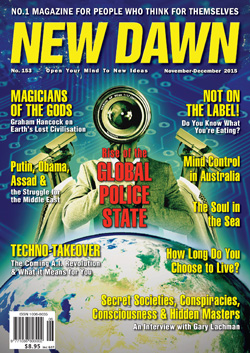
  • Oceania Forever: Rise of the Global Police State

    Oceania Forever: Rise of the Global Police State

    From New Dawn 153 (Nov-Dec 2015)

    Much has been written about the approaching Police State in alternative media. Commentary ranges from various warnings, to shock and outrage, and fear over an impending martial law takeover in North America and Western Europe. It’s hitting us from so many different angles, and yet the mainstream conversation continues to be woefully inadequate in both characterising the situation and offering a remedy.

    In order to really understand the modern Police State, we need to explore some very profound and difficult questions. Many people who consider themselves aware think Western society has already reached the tipping point and the deteriorating situation is simply inevitable. If you feel like Winston Smith right about now you aren’t alone.

    Prior to the mid 1990s, one might have described the militarisation of public law enforcement something of a creeping paradigm, but one that was still a long way off. Society explored many aspects of the Police State, both the physical and Orwellian psychological scenario, through literature and film. American science fiction writer Philip K. Dick penned some significant works like The Minority Report, and cinematic hits like Paul Verhoeven’s Robocop and Terry Gilliam’s Brazil also explored what this dystopic, future vision of fascist technocracy might look like. As it turned out, and far from fantasy, countless devices, systems and themes depicted in so many of these supposedly ‘fictional’ classics have since made their way into our day to day lives. The dark dream became real.

    Unfortunately, as humanity’s freshmen class of the early 21st century, we can no longer afford the intellectual distance enjoyed by previous generations between life today and that blurry, far-off spectre of something that might arrive sometime at some point in the future.

    Any modern globalised Police State requires a social engineering framework in order to provide its shape and scope of law enforcement. The latest social engineering blueprint for global technocratic management was unveiled at this year’s 70th United Nations General Assembly in New York City. Their ‘new’ agenda (newer than the old one) entitled, Agenda 2030,1 hopes to “transform our world for the better by 2030.” Author Michael Snyder from the blogEnd of The American Dream’ explains: “The entire planet is going to be committing to work toward 17 sustainable development goals and 169 specific sustainable development targets, and yet there has been almost a total media blackout about this…”2

    Within its 17 ‘universal goals’, the actual Police State provision for Agenda 2030 can be found within Goal 11, which states how the new global government will, “Make cities and human settlements inclusive, safe, resilient and sustainable.” Translated in technocracy terms, this means more Big Brother tech, smart grid tracking and big data surveillance states.

    The age of computerisation and database integration, along with advances in military and crowd control technology perfected overseas, have enabled a sharp advance toward the Police State. Trying to make sense of ‘it’ is a major challenge, to say the least. In its totality, the control system is both multifaceted and multilayered. It may have been possible to describe it, or even define it 20, 30, or 40 years ago, as Philip K. Dick and so many others did. Today, as society has already eclipsed the possible, we face a situation whereby the very thing we are trying to describe is woven through nearly every fabric of modern social, professional, family, religious and political life.

    If you happen to live in one of the technocratic nations, you can’t opt out, nor can you fully repeal the advances already made by the control system. What other options are available?

    Firstly, we have to try and understand, from an economic, cultural and political perspective at least, how this control system came to be.

    What are its strongest areas? Can we reform those areas? Where is it still emerging? Cannot those areas be slowed down? What was the political climate that enabled it?

    How to Build a Police State

    When you observe a modern Police State, the first things you might notice will not necessarily be the batons, shield, helmets or MRAPs. Think Switzerland or Singapore. A modern Police State will be neat, clean and efficient. Retail zones will be shiny and feature all the top designer brands. Many of the people you see in public will be well-groomed, well-healed and beautiful, but often with only one political party and a strict public code.

    Just like admirers of the modern Chinese State, Singapore’s proponents refer to the single party State as “a great argument for Authoritarianism.” Order and civility rule the day, so long as you don’t fall foul of the narrow perimeters set by the State.

    What has been accomplished in Southeast Asia since 1965, and what is possible in previously ‘free’ countries like the US, UK and Australia, are two very different social and political evolutions. Still, the modern Police State is advancing globally and it’s being driven primarily by three factors: technology, for-profit industry, and an age-old obsession by the ruling class to manage the masses.

    The first and easiest area to challenge is the physical realm of the control system. The most obvious of these are the gadgets and toys. They are easy to see. Look at your local police department and notice the difference between what officers looked like and what they wore in the 1970s, 1980s, 1990s and now in the 21st century. Notice the firearms and tasers, the ‘Bat-Belts’, and now the body cameras. Your average officer today looks like a cross between a soldier and an android. Dress them like robots and don’t be surprised when they act like machines (and it won’t be long until many of them are replaced by machines).

    If you’ve ever attended a street protest or witnessed some civil unrest, then you’ll have noticed the high-tech body armour, the riot and ‘crowd suppression’ equipment.

    My first intense experience where I felt the full force of the modern Police State was in 2009, at the G20 Protests in the City of London, England. It was early in the evening and approximately 4,000 demonstrators suddenly found themselves trapped at Bishopsgate. Several hundred police officers on foot and horseback had blocked all the entrances and egresses in and out of the main road. Even alleyways were manned by riot police. Then police began charging the crowds, and beating protesters with clubs. They alternated their ‘surge’ efforts, from different ends of the street, north to south, one brutal flurry after another. The worst part about it was there was no escape route away from the police. Many were beaten and trampled on that evening. It was as if police planners were playing a video game.

    Finally, at around 9pm, after being forced to stand, surrounded by police in a ‘Kettle’ for nearly three hours, along with 500 other demonstrators and press, who spent most of that time pressed up against police shields and not knowing what would happen next – I realised this is an impersonal, disinterested and totally uncompromising machine. It does not care who you are, what your views and opinions are, or whether you were innocent or guilty. The lesson was simple: “next time, stay home.” The only detail this machine is concerned with is that you comply with orders, and if no orders are given, then the machine demands you stay where you are until the machine decides what to do with you. If you complain too much, or become emotional, or heaven forbid act out in any way, then the machine will move in to subdue and detain you. That is all there is to it.

    Big Brother Reality

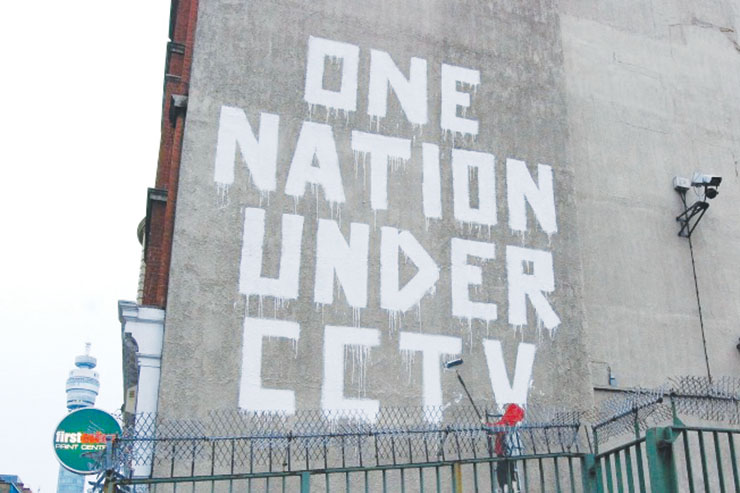
    It’s well-known that Great Britain is home of the world’s largest and most sophisticated physical Police State, including tens of millions of closed circuit television (CCTV) cameras, covering every conceivable inch of habitable space, both indoors and outdoors. The CCTV phenomenon in Britain was fuelled by an obsession with cameras that became increasingly popular with both government and corporate technocrats in the 1980s and 1990s. The psychology behind the exponential proliferation in cameras was mainly a fairly crude bit of criminology which held that the cameras would somehow act as a deterrent to criminal behaviour, and thus subdue the feral population into a more docile state. Industry used this line too, as sales persons were deployed en masse with endless flip charts and statistical models that claimed CCTV cameras would prevent the UK’s spiralling social malaise.

    The only problem is that more cameras don’t equal less crime. Canadian writer Cory Doctorow observed this reality back in 2011, explaining: “After all, that’s how we were sold on CCTV – not mere forensics after the fact, but deterrence. And although study after study has concluded that CCTVs don’t deter most crime (a famous San Francisco study showed that, at best, street crime shifted a few metres down the pavement when the CCTV went up), we’ve been told for years that we must all submit to being photographed all the time because it would keep the people around us from beating us, robbing us, burning our buildings and burglarising our homes.”3

    The CCTV is only one single aspect of Big Brother. It turns out that the real value of the CCTV camera grid is not so much the monitoring of crime per se, as it is in mass applied behavioural psychology.

    [alert type=”info” dismiss=”no”]If you appreciate this article, please consider a subscription to New Dawn magazine.[/alert]

    The Panopticon

    The physical Police State could not exist without some philosophical underpinning. Before Orwell, there was Bentham…

    In the mid 19th century Britain developed a new style of prison architecture known as the ‘Panopticon’ under the aegis of utilitarian philosopher Jeremy Bentham.4 The unique feature of this Panopticon concept was the transparent nature of each prisoner cell, visible to a central surveillance guard tower that could eye inmates at all times. The result of this psychological experiment, according to the pragmatic Benthamite philosophy, was to produce a regime of “self-policing” amongst the inmates, a kind of early behavioural conditioning. For technocrats and emerging utilitarian social managers of that era, this was seen as the most economic and efficient solution. Ultimately, this Benthamite concept is what underpinned phase one of the mass CCTV deployment throughout the UK. Sitting well above the security minions and the industry profiteers, elite scholars knew full well that CCTV cameras do not stop crime.

    The real power of the Panopticon is in convincing the general population they are under constant surveillance. After that point, through a long-term process of nudging, diversions and scare tactics, the State gradually moulds the behaviour and thoughts of its subjects.

    In order to keep citizens locked into this new conscious state of fear and trepidation, the State needs an enemy…

    The Long War & ‘The Extremist’

    One of the chief campaigns to nudge society towards a fully-functional Orwellian State is the War on Terror. Ever since September 11, 2001, the concept of an endless war against the ‘terrorists’ – a seemingly ubiquitous and constantly shape-shifting enemy – has been used to justify nearly every large new security expenditure and policy. Back in 2006, US President George W. Bush’s chief architect of the ‘long war’, Secretary of Defense Donald Rumsfeld, laid out the tea leaves for the next 100 years, stating: “It does not have to do with deployment of US military forces, necessarily. It has to do with the struggle that’s taking place within that faith between violent extremists – a small number of them, relatively – who are capable of going out and killing a great many people, as they’re doing, and the overwhelming majority of that religion that does not believe in violent extremism or terrorism.”5

    In George Orwell’s classic novel 1984, Winston Smith also grappled with the State’s endless war. “Oceania was at war with Eurasia: therefore Oceania had always been at war with Eurasia.”

    In Oceania, people eventually forgot what started the long war. The news was just one terrorist attack after another. The enemy was everywhere, but nowhere too. The population learned to acquiesce to the idea that war was the permanent state of affairs, and that questioning the provenance of this idea was futile.

    “Winston could not definitely remember a time when his country had not been at war, but it was evident that there had been a fairly long interval of peace during his childhood, because one of his early memories was of an air raid, which appeared to take everyone by surprise. Perhaps it was the time when the atomic bomb had fallen on Colchester. He did not remember the raid itself.”

    And so it was, in the early moments of the 21st century, Orwell’s dream suddenly became a waking reality. Social engineers are firm believers that if the Panopticon (married with the threat of an invisible enemy) can remain in place for a generation, then the State could fundamentally change a once free-thinking society into something noticeably different – a much more fearful and compliant populace.

    The Social Media Panopticon

    As terror scares and attacks become somewhat of a daily event in the West, identifying and quarantining the ‘extremist’ becomes a primary fetish of the Police State and its media arms. This is very much evident in how terrorists and ‘active shooters’ (dead or alive) are now profiled after the event. The mainstream media has integrated this into its work practice by crafting the post hoc guilty verdict of the accused, prior to a trial, with circumstantial or non sequitur accusations based on an individual’s “web history” that may have “radicalised” the suspect. In effect, the mainstream media’s function as an establishment propaganda arm results in trial by media – the bypassing of any trial by jury as the accused have already been implicitly or explicitly declared guilty by association or something as nebulous as “web history.”

    Such incidents, as they are portrayed in the media for psychological conditioning purposes, are intended to cause the public mind to dismiss outdated notions of fair and due process and rule of law in favour of fiat corporate news and government “official” pronouncements. The net effect of this trend is that social media users, ie. the majority of the population, are adopting self-policing habits in their communications online. According to the principals of applied behavioural psychology, if you change the language people use, then eventually you change the way they think and act.

    Like Bentham’s Panopticon, this new social media monitoring system works by utilising the digital web, which is arguably the most economic and efficient solution. The acceptance of self-policing and vague terms such as “radicalised” that are subject to the increasingly elastic definitions of the social engineering establishment.

    This leads to one of the most profound questions one might ask in the wake of Edward Snowden’s NSA spying revelations: Knowing what we know now, are people more outspoken or are they more self-policing because of the Snowden leaks?

    ‘The Daily Shooter’

    By extension, once the technocrat has regained some modicum of physical control, then the next domain to be conquered is the mind. In 1984, the technocracy was viewed through the eyes of the protagonist Winston Smith, who while remaining a physical prisoner of the Police State, could still retreat into his own mental state.

    In our day, the expansion of the surveillance State and vast spying by the likes of the NSA and GCHQ are precisely intended to achieve this same effect, with the justification for such intrusions being an endless series of terror spectacles and lone wolf public shooting events. In the US, these mass shootings and terror scares are happening on an almost daily basis, hence, ‘The Daily Shooter’. Media coverage is both chaotic and relentless. As a result, the pubic are left stupefied and completely unable to challenge whatever narrative the government-media complex is selling at that time. The Police State marches forward.

    A similar psychodrama also played out for 1984’s protagonist Winston Smith. As time progressed, however, maintaining some level of autonomy in one’s own thoughts became increasingly difficult for Winston. The final objective of the Police State, it seemed, was not only to fundamentally transform the way citizens act, but how they think too. The all-seeing and all-controlling “Big Brother” State was also the de facto social authority figure. The State’s law enforcement police force also became the “thought police.”

    We see this same exact narrative playing out today as the State’s political figureheads continue in their mission to widen their definition of “extremism” along with other State-issued euphemisms used to describe citizens who should be regarded with suspicion.

    Fall out of line and you might even be segregated or sent away to a special camp. Following the recent mass shooting in Chattanooga, Tennessee, retired US General and NATO Commander Wesley Clark proposed that any “disloyal Americans” should be sent to internment camps for the “duration of the conflict.” Notice the language: “for the duration of the conflict.” Indeed, it seems that Oceania is at war. He went even further, calling for the US government to identify people most likely to be “radicalised” so we can “cut this off at the beginning.”

    “At the beginning?” Here, it seems Clark might be alluding to pre-crime, which will be powered by A.I…

    Artificial Intelligence

    Post-September 11, UK society was still hooked on their CCTV matrix, and with millions of cameras already in place and crime continuing to rise, security ‘experts’ and politicians simply doubled down on their previous wager, insisting that what the country really needed was more cameras. They believed that once a certain CCTV saturation was reached, by default they would somehow reached their twisted utopia.

    It turned out that’s not humanly possible for security workers, most of whom are on a mere £7-10 (aud$14-20) per hour, to keep track, let alone analyse, a seemingly endless stream of footage. For the technocrat, the operative word here is ‘humanly’. Enter A.I…

    Once again, advanced technology enters the narrative and supplies the solution to this previous insurmountable problem. The age of Artificial Intelligence, or A.I., is nearly upon us, and this next step in technological development is certain to radically change the entire concept of the Police State.

    Laying down the framework an A.I. grid is not easy because the grid must be designed to cope with the application of A.I. As A.I.’s potential and practical applications have not yet been fully realised, designing the grid upon which it will be unleashed has been problematic up to this point. Sadly, society on the whole appears disinterested in questioning the social and unethical imperative currently driving the adoption of these new technologies.

    At present, the big money is on the Smart Grid. Technocrats and their corporate partners are hoping to usher in their new surveillance grid under the auspices of ‘smart’ technologies. With A.I. in play, technocrats will be able to utilise the smart grid – which includes your mobile phone – to detect and track multiple targets over a wide area.6 Add facial recognition and data profiling to the mix and it’s a recipe for a full-on A.I. Smart Grid future. The ultimate hands-free, ‘surveillance selfie’ – compliments of Big Brother.

    Just imagine, one day you’re simply walking down the street and pointing to something in the air. All of it is being captured on a 1.8 billion pixel video stream from the sky. They already know your identity and location with the phone in your pocket, and they already have your face logged and tracked.7

    At this point we introduce Philip K. Dick’s concept of “pre-crime” whereby an A.I. system can predict an action you are likely to take.8 The system will then close the ‘Big Data’ loop by storing the video footage alongside your profile into a massive data ‘mash-up’. It will then compare with other potentially ‘suspicious’ activity in the area. Great Britain’s national police force, the Metropolitan Police, are already using a type of pre-crime software that British technocrats believe will somehow ‘revolutionalise’ modern policing in the 21st century.9

    UK consumer advocate Pippa King explains how CCTV is already being phased out: “CCTV, closed circuit television, is not quite what is operating on our streets today. What we have now is IPTV, an internet protocol television network that can relay images to analytical software that uses algorithms to determine pre-crime area in real time.”

    “Currently this AI looks at areas that may be targeted for crimes such as burglaries or joyriding,10 with the predicted hotspot information being sent direct to law enforcement smart phones in the field. This analytical software is being used in Glasgow, hailed as Britain’s first ‘smart city’,11 where the Israeli security firm NICE Systems are running the CCTV/IPTV network, analysing data from the 442 fixed HD surveillance cameras and 30 mobile units under a project called ‘Community Safety Glasgow’,12 whose primary objectives are described as ‘delivering Glasgow a more efficient traffic management system, identifying crime in the city and tracking individuals’.”13
    This all can happen thanks to the US Defense Advanced Research Projects Agency’s (DARPA) latest creation – the ARGUS camera, Autonomous Real-Time Ground Ubiquitous Surveillance.14 According to its designers ARGUS, “melds together video from each of its 368 chips to create a 1.8 billion pixel video stream” all in real-time and archived. It’s just one of the many new toys used by the State to realise its Orwellian ambitions.

    Who’s Paying For It All?

    Aside from its ability to trample over the rights of law abiding citizens, the Police State has one other chief characteristic which may also be its Achilles heal: it’s bankrupting the State. Here’s how it works:

    The gravy chain is endless, but only with the help of taxpayers’ money, along with a series of bribes and favours between politicians and corporates. If you have ‘friends’ in government administration, then you are more likely to cash in on any number of lucrative ‘domestic defense’ contracts.

    Where you have constant crisis you also have constant business opportunity. In this dark paradigm, timing is everything. As US President Barack Obama’s sociopathic15 former chief of staff, now Mayor of Chicago, Rahm Emmanuel, once said: “You never let a serious crisis go to waste. And what I mean by that it’s an opportunity to do things you think you could not do before.”

    With that mantra in mind, in the wake of any shooting, terror scare, or crisis, industrial lobbyists and their elected political gophers will waste no time pushing for new federally-funded add-ons like training courses, workplace psychologists, regulators, specialist contractors, police cameras and other big-ticket items16 – anything to help “solve the crisis.” One such program in the US is known simply as the ‘1033’.

    Joseph Lemieux writes: “The 1033 program has flooded our local police forces with military equipment, and has turned them from Peace Officers, to a domestic army.”

    “Officers stopped looking like officers, and more like soldiers all kitted out with fully automatic weapons, armoured vehicles, body armour, grenades launchers, night vision, and even bayonets! Besides the cost of liberty, how much has this domestic army cost you the tax payer?”17

    In the US, no single entity embodies the Police State gravy train more than the Department of Homeland Security (DHS), where federal grants are used to bribe local law enforcement and absorb them into a larger framework of institutional dependency.

    At over $200 billion per year, the DHS is now America’s most expensive federal agency. As any sane local law enforcement chief will tell you, once you smoke from the federal crack pipe, you’re hooked for life. Remember that each federal Police State agenda item has a lucrative contract attached to it. With each move central government makes, a large amount of money is also made (by someone).

    By cutting off public money that is driving the runaway federal Police State in Western countries, the people have a chance to mitigate and potentially reform the current agenda.

    If we hope to preserve what is left of our hard fought democracy, then now is the time to put it to the test. The alternative is unthinkable.

    Patrick Henningsen is a regular contributor to New Dawn magazine. Check out his article “Technetronic Enslavement: Life Inside the Matrix of Control” in New Dawn 156 (May-June).

    [alert type=”general” dismiss=”no”]This article was published in New Dawn 153.[/alert]

    [alert type=”success” dismiss=”no”]If you appreciate this article, please consider subscribing to help maintain this website.[/alert]

    Footnotes

    1. ‘Transforming our world: the 2030 Agenda for Sustainable Development’, https://sustainabledevelopment.un.org/post2015/transforming
      ourworld
    2. ‘The 2030 Agenda: This Month The UN Launches A Blueprint For A New World Order With The Help Of The Pope’ by Michael Snyder, 2 Sept 2015, http://endoftheamericandream.com/archives/the-2030-agenda-this-month-the-un-launches-a-blueprint-for-a-new-world-order-with-the-help-of-the-pope
    3. ‘Why CCTV has failed to deter criminals’ by Cory Doctorow, The Guardian, 17 August 2011
    4. www.ucl.ac.uk/Bentham-Project/who/panopticon
    5. www.sourcewatch.org/index.php/The_Long_War
    6. ‘Bilderberg 2015: Implementation of the A.I. Grid’ by Jay Dyer, 21st Century Wire (www.21stcenturywire.com), 14 June 2015
    7. ‘Britain Launches “Big Brother” System, Uploads One Third of Population to Facial Recognition Database’, 21st Century Wire, 3 Feb 2015
    8. ‘Already Underway: Smart A.I. Running Our Police and Cities’ by Pippa King, 21st Century Wire, 13 Mar 2015
    9. ‘British Police Roll Out New “Precrime” Software to Catch Would-Be Criminals’, 21st Century Wire, 13 Mar 2015
    10. ‘Pre-crime software recruited to track gang of thieves’ by Chris Baraniuk, New Scientist, 11 Mar 2015
    11. ‘Glasgow wins “smart city” government cash’, BBC News, www.bbc.com/news/technology-21180007
    12. www.saferglasgow.com
    13. ‘Already Underway: Smart A.I. Running Our Police and Cities’, op.cit.
    14. www.darpa.mil/program/autonomous-real-time-ground-ubiquitous-surveillance-infrared
    15. ‘The Two Sides of Rahm Emanuel: Sociopathic Political Hitman and Puppy Lover’ by Foster Kamer, 16 Aug 2009, gawker.com
    16. ‘Mayor de Blasio Announces Retraining of New York Police’ by Marc Santoradec, The New York Times, 4 Dec 2014
    17. ‘How Much Money Have American Taxpayers Spent on Building a Domestic Police State?’ by Joseph Lemieux, 1 Dec 2014, http://theantimedia.org/taxpayers-police-state/

    © New Dawn Magazine and the respective author.
    For our reproduction notice, click here.
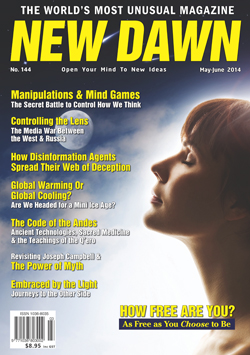
  • Celebrities & the Art of Distraction

    Celebrities & the Art of Distraction

    From New Dawn 144 (May-June 2014)

    When you flip through your daily newspaper, or watch the nightly news, chances are you have noticed a steady increase in celebrity news, fashion, and gossip filling up the column inches, and crowding out the news.

    This has been going on for centuries. In Latin it’s called panem et circenses. Translated, it means ‘bread and circuses’, a phrase made famous by the Roman poet Juvenal circa CE 100. In Roman terms, this phrase refers to the creation of public approval by the ruling class, not by any altruistic or progressive means, but through the use of wonderful distractions and entertainment.

    It’s a tried and tested template for keeping the commoners’ point of focus off politics and the economy, and onto the distraction de jour.

    Mainstream media has become incredibly adept at reporting the mindless, and the worthless, while completely ignoring the real news.

    Celebrity is now a commodity, which means it has some value as a means of exchange. In this case, what is being exchanged is your point of attention. On mass, it’s a fairly cheap commodity.

    There are different layers of 21st century celebrity. The new ‘stealth layer’ of celebrity is comprised of Politician, ex-Presidents and Royals, all of whom are permanently plastered on the news because they are unique hybrids – half politician, half celebrity. The Obamas, the Clintons, the Windsors, and the Sarkozys are all hybrids.

    Below the top ruling class echelon you find the garden variety celebrity. Pick your poison. Gwenyth Paltrow has broken up with Chris Martin, Kim Kardashian is pregnant with Kanye’s child, Kourtney Kardashian is partying in the Hamptons, Miley Cyrus is doing a striptease at the Grammys, Rihanna spotted wearing Timberland boots, Hunter Parish is baking brownies and David Beckham is getting his legs waxed again. If ‘A-listers’ aren’t your thing, you can spend your time following children of rock stars (rock ‘n roll royalty), children of wealthy people, or go down market and enjoy the steady stream of Reality TV quasi-celebrities, or young women who have slept with a footballer.

    What the public fail to realise is these people’s faces do not appear in newspapers, magazines and on news websites because they are unusually talented, or because they have something important to offer society. They appear constantly because their face is actually being used to sell something else, like a film, a new TV show, or a retail product. Their appearances are carefully stage-managed media segments, usually organised (for a fee) by PR companies, entertainment managers and agents.

    The saddest part about this PR merry-go-round is that many mainstream media outlets rely on it for a substantial portion of their income – so may feel they have to play the celebrity game simply to survive.

    The biggest victims in this game are the public, who, aside from important news being crowded out by celebs and professional athletes, believe they’re getting something authentic, when in fact it’s nothing near.

    23 January 2014 was an interesting day in world news – or at least it was supposed to be. Top of all major news outlets worldwide was pop star Justin Bieber, who we were told was arrested on DUI and drag racing charges. In addition to mainstream coverage of Bieber’s big day out, Hollywood’s premier gutter gossip outfit, TMZ, began to tweet intensely the arrest, coupled with the Twitter hashtag #FreeBieber. One can only wonder whether or not the event was completely staged. CNN also joined the party, airing a one hour-long special on the 19 year old, “live at ten.”

    The real tragedy of the Bieber PR event was what else happened in the world while Bieber dominated the headlines: Ukrainian protests took a violent turn in Kiev (a prelude to a major geopolitical standoff between the United States and Russia), crucial rounds of Syrian Peace Talks were due to begin in Switzerland, Israeli forces laid siege to Ramallah, and four were killed and 50 were injured as a car bomb ripped through government headquarters in Cairo.

    Still, CNN just couldn’t get enough of the Bieber story, coupling it alongside a full-page Toyota advert on CNN.com with a heart-felt message urging parents to “teach teenagers how to drive during their first years on the road.”

    In two years time it will be Bieber gets married, in 3 years, Bieber gets divorced, in 4 years, Bieber in rehab, and in 5 years – “Bieber finally comes out.” The publicity machine rolls on, while the public suffer the mushroom treatment.

    With celebrities come corporate products. Oscar presenter Ellen DeGeneres dominated global media after the awards ceremony because of her ‘celebrity-selfie’ packed full of Hollywood’s finest. It broke all records on Twitter and stayed on mainstream media heavy rotation for nearly a week. What was sold to the public as an authentic Kodak moment, one where celebrities appeared to be ‘just like us’ – was actually a planned corporate sponsorship stunt. Unknown to a naïve public, DeGeneres just happened to use a Samsung Galaxy Note 3, which she had handed to Bradley Cooper for the group selfie, which was nothing more than an extended commercial for Samsung. Indeed, Samsung has spent millions of dollars to sponsor the Oscars for the last five years.

    Back in the old days, less was more. Rare public appearances actually increased a star’s pulling power, and kept their intrinsic media value from suffering ‘over exposure’. The age of the Internet has flipped that equation on its head unfortunately.

    If a celeb is not trending on Twitter or Facebook, then their stock is dropping and everyone is losing – the celebrity, their manager, their publicist, and their agent – all losing. So the Internet pump must stay on 365 days per year, chronicling what time they left the gym, walking the dog, what they had for breakfast, who they met for lunch and which night club they stumbled out of at 3am. Going offline is not an option because the signal can never go dark – legions of fans and paid fans reside 24/7 on social networks, blogs, forums, in a crowd-sourced effort to disseminate an endless conveyor belt of vapid gossip, be it boring or salacious.

    Social network managers really believe they are offering “a deeper experience” for fans to engage with celebrities. In a 19 February 2012 article published in Forbes, this deeper engagement is explained as follows, “We’re looking for celebrities who will acknowledge their dependence on us and their engagement with us. We want celebrities in fact who will admit that they are like us and… will also show us how they are different, bolder, more outspoken, funnier but not distant.” Really? Like Ellen DeGeneres, her friends and their $1 million “one of us” moment at the Oscars?

    It’s no secret that online publications and social networks generate reams of data these days, and celebrity management have already invested vast sums of money in order to both monitor and analyse the number of hits each celebrity article or image gets. Publicity management then takes this data and presents it back to corporate sponsors in order to prove how many unique views, or millions of media impressions, their celebrity clients attract – thus proving their value as a bona fide media commodity.

    Navigating the alternative media landscape is itself a full-time job, and as enthusiastic and as driven as you might be in searching out and finding the truth, be cognizant of the fact there are celebrity sycophants out there who are even more determined to find out what brand of sunglasses Beyoncé wears. If you find that thought disturbing on a deep level, then that’s a good sign you care deeply about your neighbour indeed.

    Hollywood is the land of illusion, and this faux reality is now amplified through all media channels, not just through TVs and magazines, but in your web browsers and in your palm on your smart phone – all day, every day. Some are completely infatuated with celebrity culture, and sadly for society, some feel that celebrity news is more important than the real news. For these people, show them any real news and their natural self-defensive reaction is to dismiss it, or revert into a form of denial that psychologists commonly refer to as cognitive dissonance.

    If you see this condition present in your celebrity obsessed neighbour, it’s incumbent upon you as an enlightened and awakened soldier of the truth to reach out and try to help them engage with the important issues, and explain how these issues affect all of us, and most importantly – that we’re all in this fight together!

    [alert type=”general” dismiss=”no”]This article was published in New Dawn 144.[/alert]

    [alert type=”success” dismiss=”no”]If you appreciate this article, please consider subscribing to help maintain this website.[/alert]

    © New Dawn Magazine and the respective author.
    For our reproduction notice, click here.