New Dawn – World's Most Unusual Magazine

Tag: apocalypse

  • 2012, the Apocalypse  & the End of the Age

    2012, the Apocalypse & the End of the Age

    Cultures that view themselves as waning are usually those most likely to tap into doomsday scenarios, especially when the world’s end is followed by universal renewal.

    – Prof. Anthony Aveni, American anthropologist & astronomer

    An Apocalypse (Greek: ἀποκάλυψις apokálypsis; “lifting of the veil” or “revelation”) is a disclosure of something hidden from the majority of mankind in an era dominated by falsehood and misconception, i.e. the veil to be lifted…. By extension, apocalypse can refer to any End Time scenario, or to the end of the world in general.

    – Wikipedia (www.wikipedia.org)

    In 1997, a former reporter with the Wall Street Journal, Michael Dronin, wrote The Bible Code, based on the notion that hidden messages are embedded in the Bible. Not surprisingly, considering the uncertainty of the times, The Bible Code quickly became a best seller. Using a numerological system said to be derived from Jewish mysticism and facilitated by computer technology, Drosnin searched for signs of the ‘End Times’ and discovered the years 2006 and 2012 are of special importance. According to Dronin’s Bible Code system in 2012 the Earth will be hit by a devastating comet.

    In Dan Brown’s mega best-selling fictional tale, The Da Vinci Code, his lead character Robert Langdon, in answer to a question about ‘the end of the world’, explains:

    “Many religions speak of the End of Days. It refers not to the end of the world, but rather the end of our current age – Pisces, which began at the time of Christ’s birth, spanned two thousand years, and waned with the passing of the millennium. Now that we’ve passed into the Age of Aquarius, the End of Days has arrived.”

    For Dan Brown and many others we’re not talking about an ‘end of the world’ with all its connotations of the destruction of humanity or the planet, but the transition from one age to another. Bible scholars support this view pointing out that often when the Gospel writers mention the ‘world’, the original Greek word used is ‘aion’, meaning age, or system of things. The biblical ‘end of the world’ refers not to the destruction of all life on the planet but to the conclusion of an allotted period of time, or a system of things. The end of the zodiacal Age of Pisces and the transition to the new Age of Aquarius is marked by a change in consciousness.

    The Swiss psychologist C.G. Jung took an interest in the zodiacal ages and concluded we now live in an ‘End Time’ period, the transition from Pisces to Aquarius. Not long before his death in 1961, Jung experienced a series of visions of a future great catastrophe. His long-time associate, Marie-Louise von Franz, claimed Jung saw a worldwide conflagration occurring around the year 2010. Students of Mayan prophecy will be sure to note the close proximity of 2010 to the end date of the Mayan calendar.

    Michael Dronin, Dan Brown, and Carl G. Jung – three very different writers – but their speculations about the ‘End Times’ have gained considerable attention in the Western world.

    Less than a century ago, in the aftermath of the carnage and upheaval of the First World War, many of Europe’s most astute thinkers and writers concluded the Western world was in its death throes. They took the rationalism and materialism engulfing Europe in the first decades of the twentieth century as inevitable symptoms of the slow ‘decline of the West’. Many shared Oswald Spengler’s conviction, persuasively set forth in his 1918 book The Decline of the West, that Western civilisation was in an unstoppable process of spiritual and cultural disintegration.

    The great French writer and Noble Prize winner Romain Rolland was amongst those who believed Europe was dying and that the only hope for the world lay in Asia. The celebrated French novelist and adventurer André Malraux also looked to Asia for inspiration. After his first journey to South East Asia in 1923 he openly attacked the sterility of materialistic Western culture, and in the following years he devoted himself to the radical nationalist uprising against Western imperialism that was developing in Indo-China.

    A half a century earlier in 1888, the redoubtable Madame H.P. Blavatsky penned a controversial expose of the Catholic Jesuit order for an issue of her Theosophical journal Lucifer. After documenting the conspiratorial activities of the Jesuits, Madame Blavatsky left her reader in little doubt about the coming show down between the East and the West:

    “There is a prophecy in the heathen East about the Christian West, which, when rendered into comprehensible English, reads thus: ‘When the conquerors of all the ancient nations are in their turn conquered by an army of black dragons begotten by their sins and born of decay, then the hour of liberation for the former will strike’. Easy to see who are the ‘black dragons’. And these will in their turn see their power arrested and forcibly put to an end by the liberated legions. Then, perhaps, there will be a new invasion of an Atilla from the far East. One day the millions of China and Mongolia, heathen and Mussulman, furnished with every murderous weapon invented by civilisation, and forced upon the Celestial of the East, by the infernal spirit of trade and love of lucre of the West, drilled, moreover, to perfection by Christian man-slayers – will pour into and invade decaying Europe like an irrepressible torrent. This will be the result of the work of the Jesuits, who will be its first victims, let us hope.”

    One hundred years after Blavatsky penned these apocalyptic words, ‘decaying Europe’ which for centuries thanks to ‘the infernal spirit of trade and love of lucre’ had plundered the lands of Asia, Africa, and the Americas, found itself challenged by fast rising new global powers. The creation of the European Union and the absorption of the former socialist East European states were not enough to stop spiritual and cultural paralysis overtaking lands once identified as the ‘Christian West’.

    For much of the twentieth century the United States led the Western world. With the end of the British Empire after World War Two, American economic, social and cultural values steadily became almost synonymous with the ‘West’. Today in 2012 the United States desperately strives to maintain its ‘New World Order’ of global dominance. At home the United States is in major social and economic trouble. In a country where the wealthiest 5% control 60% of the nation’s wealth, many find themselves in agreement with the late American novelist Kurt Vonnegut who remarked just before his death, “Working people have no leverage whatsoever. I’m trying to write a novel about the end of the world. But the world is really ending!”

    The decline and fall of Europe and the USA may look like the end of the world. “This is going to be just like the Book of Revelation said it was going to be – the end of the world as we knew it,” the late Hunter S. Thompson wrote back in 2003.

    The Apocalypse and the ‘End Time’ loom menacingly on the horizon. But is it really the ‘end of the world’ or are we witnessing the end of a civilisation that long ago reached its high point and now is in rapid decline? The Piscean Age which dominated the world for roughly the last two thousand years, represented by the Christian West, is quickly fading as we experience the first influences of the coming Aquarian Age. These are tumultuous and challenging times, pregnant with great possibilities, both constructive and destructive. Though an atheist, André Malraux predicted that “the third millennium will be spiritual or there will be no third millennium.” In the end this remains the only guarantee of a future worth living.

    [alert type=”general” dismiss=”no”]This article was published in 2012 New Dawn Collector’s Edition.[/alert]

    [alert type=”success” dismiss=”no”]If you appreciate this article, please consider subscribing to help maintain this website.[/alert]

    © New Dawn Magazine and the respective author.
    For our reproduction notice, click here.
  • Apocalypse: The End Times and the Restoration of All Things

    Apocalypse: The End Times and the Restoration of All Things

    From New Dawn 135 (Nov-Dec 2012)

    “The earth abideth for ever,” says the Bible (Ecclesiastes 1:4). Whether this is literally true or not, it corresponds to the deepest core of human experience. The Earth was around long before the existence of human beings, and it will probably continue to exist long after we are extinct. Why, then, does the belief in the end of the world – not as a remote possibility but as an imminent event – persist so stubbornly in the mass consciousness?

    For we continue to believe – and even long for – the fabled Time of the End. The number of predicted dates for this event are astonishing,1 and the huge number of failures has not diminished our appetite for plenty of new dates to come.

    To understand how this mentality came about, it would be useful to look at the history of the genre known in theological jargon as apocalyptic (from the Greek apokalypsis, “revelation”). While apocalyptic has important predecessors in biblical literature (such as Ezekiel and parts of Isaiah), its origins are generally dated to the second century BCE. At the time the Jewish nation was living under the rule of the Hellenistic Seleucid monarchs, who were heirs to a portion of the empire of Alexander the Great. In 167 BCE, one of these rulers, Antiochus IV Epiphanes, embarked on a program of forced Hellenisation of the Jews, setting up an altar, and perhaps an image, of Olympian Zeus in the Temple in Jerusalem.

    The outrage of the Jews is reflected in the Book of Daniel, one of the earliest apocalyptic writings and the only one to make its way into the Hebrew Bible. Written during the ensuing revolt against the Seleucids, this book sets up Daniel, a legendary sage of the sixth century BCE, as the mouthpiece of a prophecy that would “foretell” events 400 years after his time. (The technical term for this practice is vaticinium ex eventu, “prediction after the event.”) Daniel refers to “a vile person” – Antiochus – who will “pollute the sanctuary of strength, and shall take away the daily sacrifice, and… shall place the abomination that maketh desolate” (Dan. 11:21, 31) – that is, the idol in the Temple (cf. 1 Macc. 1:54). The archangel Michael will come to Israel’s rescue; the dead will be raised, “some to everlasting life, and some to shame and everlasting contempt.” Antiochus “shall come to his end, and none shall help him” (Daniel 11:45, 12:1-2).

    What happened in fact was that the Jews rose up under the priestly family of the Maccabees and won back their independence, but this obviously did not begin the end of time. Antiochus himself did not perish as a result of any obvious divine wrath: he died of disease.

    Despite its failure as a prophecy, the Book of Daniel set up the basic structure of the apocalyptic genre. Arising during some crisis, a text of this kind predicts that this event is the harbinger of the Day of Judgment, when justice will be done and evildoers will receive their due. The Book of Revelation at the end of the New Testament is much the same: many scholars say that it is a response to the persecution of Christians by the Roman emperor Domitian in the last decade of the first century CE. (The Greek title of Revelation, apokalypsis, gave its name to the genre.)

    Even this very brief survey tells us something important about apocalypse and our attraction to it. There is a profound human hunger for justice – not only in the social arena but in the universe. And yet the forces of history often seem indifferent to justice: the righteous suffer while the wicked thrive. Every culture has made its own attempt to reconcile these facts. The traditions that arose out of India – Hinduism and Buddhism – posit the law of karma, played out across the backdrop of many lifetimes, as a way of explaining the apparent unfairness of the world. But reincarnation has always been very much a minority view in the West. Nor did the ancient Jews even have a very clear conception of the afterlife; reward in heaven and hell was only introduced later on, from Greek mystery religions.

    Thus the solution the Jewish prophets proposed was the “day of Yahweh” – a final point in history when malefactors would all be brought to justice and the good (inevitably identified with one’s own people or sect) would finally be given their due. This has been such a powerful perspective that it has left its stamp upon practically everyone in Western civilisation. Even twentieth-century distortions such as Hitler’s Thousand-Year Reich and the glorious utopia under the rule of the proletariat, as prophesied by communism, owe much of their inspiration to the apocalyptic genre.

    From all this it would seem that both the fears and the longings for the End Times are simply foolish. And yet it is not quite that simple. Deep down within the human heart lies the unshakable conviction that something is not right about the world we live in. We characterise the problem in different ways – politically, sociologically, psychologically, theologically – but the feeling is so pervasive that man can be defined as the animal that believes something is wrong. We can then ask ourselves, is there a chance that the cosmic order can be restored to its proper state?

    This idea has constantly resurfaced in human thought, and as more than a simplistic version of the Last Judgment. The Christian church father Origen (c.185-c.254 CE) speculated about what he called the apokatastasis or “restoration” of all things, citing such biblical passages as 1 Corinthians 15:28: “And when all things shall be subdued unto him [God], then shall the Son also himself be subject unto him that put all things under him, that God may be all in all.” Origen even dared to suggest that all beings had the possibility of redemption, including the devil himself.

    For bold theological moves such as this, Origen was eventually repudiated by the mainstream church, but his theology has continued as a source of inspiration up to the present. Even some orthodox church fathers, such as Gregory of Nyssa (c.335-c.395) and Maximus the Confessor (c.580-662), discussed universal redemption as a serious possibility. In the nineteenth-century United States, the Universalist Church was founded on the basis of this doctrine, and in the twentieth century the highly popular and influential text A Course in Miracles spoke of what it called the “Atonement,” in which all beings will eventually come to realise their fundamental unity with God. A parallel in Mahayana Buddhism is the hope for the ultimate enlightenment of all sentient beings.

    Get the issue this article appears in

    Underlying this idea is another, equally important theme. We constantly hear the saying “We are all one,” but what does that really mean? Certainly in ordinary life we are not all one; I am not you, and you are not me. But, the esoteric traditions tell us, this is only apparently so. In reality we are all cells in a much larger being – a cosmic human who has been known to the Kabbalists as Adam Kadmon, to the eighteenth-century Swedish mystic Emanuel Swedenborg as the maximus homo or universal human, and to A Course in Miracles as the Sonship. (In reply to the question of whether Jesus Christ is the Son of God, the Course replies, “O yes, along with you!”) The apokatasasis is the restoration of each individual to his or her rightful place in this cosmic human, which will then reveal the profound truth of the assertion that we are all one.

    This esoteric idea differs from the popular conception of the Last Judgment in two important ways. In the first place, it holds that ultimately no one will be condemned. While some will accept the truth of the Atonement sooner than others, eventually all will take part in it. In the second place, it is not posited as some kind of event that will occur next year or next decade. Instead the teaching says that the process of the Fall – the fragmentation of this cosmic human into the disharmonious, apparently separate entities that we now seem to be – took place over the span of unimaginable eons, and that the restoration will require a similarly immense amount of time to be realised.

    As such, this vision does not offer many of the consolations that the conventional picture of the apocalypse provides. It does not give the believer the satisfaction of contemplating the immolation of the wicked (who are usually imagined as one’s own enemies, however these are construed). It does not provide the sensational thrill one might get from thinking that the end of the world is just around the corner. But in acknowledging that the human race is part of an enormous cosmic process, on a scale that we can scarcely conceive of, and in reconciling divine justice with divine mercy, it is a vision that deserves our consideration as well as our respect.

    [alert type=”general” dismiss=”no”]This article was published in New Dawn 135.[/alert]

    [alert type=”success” dismiss=”no”]If you appreciate this article, please consider subscribing to help maintain this website.[/alert]

    Footnote

    1. For one list, see http://en.wikipedia.org/wiki/List_of_dates_predicted_for_apocalyptic_events

    © New Dawn Magazine and the respective author.
    For our reproduction notice, click here.
  • John Dee & the Enochian Apocalypse

    John Dee & the Enochian Apocalypse

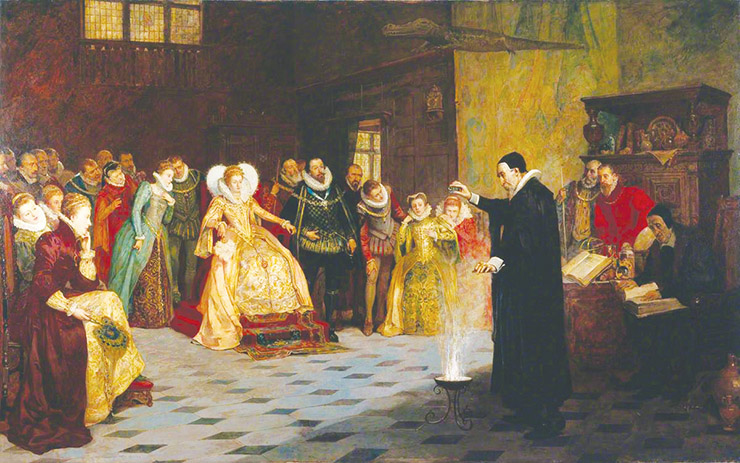
    Doctor John Dee (1527-1609) remains one of London’s most intriguing historical figures. Dee was a renaissance man; an occultist, mathematician, astronomer, astrologer and navigator. In addition to his prodigious skills, Dee was a confidant of Queen Elizabeth I, who guided the nation through one of its most challenging eras, partly based upon Dee’s unique blend of alchemy, divination and Hermetic philosophy. In fact, the Queen had so much faith in Dee’s calculations she had him choose her coronation date.

    By all accounts Dee was a distinctive looking gentleman, respected and admired by many, as John Aubrey describes: “Dee had a very cleare rosie complexion… a long beard as white as milke. A very handsome man… he was tall and slender. He wore a gowne like an artist’s gowne, with hanging sleeves, and a slitt. A mighty good man he was.”

    Dee lived in Mortlake, a West London village mentioned in the 1086 ’Domesday Book’. Here, his modest residence along the River Thames provided easy access for Elizabeth and other dignitaries, especially other occultists, for Dee had amassed what was arguably the grandest esoteric library of his day. Sadly, fashionable apartments now stand where Dee once lived, and a block of council flats across the street boasts his name.

    What is less known is that Dee was obsessed with the apocalypse, and believed he had opened a supernatural gateway leading to a powerful and disgruntled spirit world. But this came later. During the early part of his career Dee had little interest in the supernatural. He was a devoutly religious man and deeply ambitious. From the 1550s until the 1570s he honed his skills as a writer as well as a navigator with unique technical expertise. Few recall that he coined the phrase ‘British Empire’ and helped shape the emerging ideology of the nation.

    Dee became frustrated with his perceived inability to uncover more occult secrets than he already had obtained, and so began his fascination with the supernatural. During the 1580s he focused his attention on contacting angels in the spirit realm in order to obtain greater wisdom. Initially Dee tried his hand at using a ‘scrying’ mirror or crystal ball, each of which can be found in the British Museum.

    Dee struggled to achieve the results he was hoping for and thus reached out to someone who professed to have expertise in these matters. Enter the occultist and spirit medium Edward Kelley, who stumbled upon a ration of magical red powder, which he had received from an innkeeper in Glastonbury, who had acquired the powder from tomb robbers. In a different version of the story, Elias Ashmole, who wrote the first account of Kelley’s discovery, recounts how Kelley found a book containing the curious powder in the ruins of Glastonbury Abbey. Regardless, Kelley’s desire to learn as much as possible about the magical substance, which he believed could turn base metals into gold, led him to Dee, whose library attracted many such seekers.

    Like Dee, Kelley was a fascinating man; a seer whose ritual expertise in the black art of necromancy, combined with his passion for alchemy, and his quest for the Philosopher’s Stone in particular, so impressed Dee that the two soon became inseparable. Together they embarked on a journey that would transform their lives and quite possibly ours too.

    Dee and Kelley held various ‘spiritual conferences’; a quest that Dee believed would render immeasurable benefit to mankind. Kelley’s integrity, on the other hand, is the subject of continued debate and in fact before coming to London he was convicted of forging title deeds in Lancaster. Nevertheless, Kelley became Dee’s regular scryer and the two men appear to have achieved, if not exceeded, their goals, for Dee began to write truly remarkable, albeit sublime, works that he maintained were the product of angels who spoke in language known as Enochian.

    In 1583, Dee and Kelley embarked for Europe, seeking the patronage of Emperor Rudolf II in Prague and King Stefan of Poland in Kraków, amongst others. The two occultists continued their alchemical pursuits on the continent for a number of years. One incident in particular stands out, which stems from their involvement in necromancy. An inquisition by the Catholic Church proved messy, yet both men were acquitted in 1587. That same year the angels instructed Dee, through Kelley, that the two were to share everything, including their wives, which they did. Dee’s wife gave birth nine months later to what is now thought to be Kelley’s child.

    At the best of times the two men had what could be called a terse relationship, and the ‘sharing’ mandate of the angels angered Dee and led to his break up with Kelley, who later died in prison. Dee returned to his residence in Mortlake, only to find that his world had changed. Much of his library had been pillaged and his political stature fallen. What little that remained of his relationship with the Queen enabled him to assume the office of Warden at Christ’s College, Manchester in 1595. He returned to Mortlake in 1605, where he died in 1609 and was buried under the high altar of his parish church.

    In retrospect, we can glean that the essence of the Enochian dialogues centred upon a coming apocalypse, which Dee’s angels referred to as ‘the Harvest’. Dee and Kelley succeeded in manifesting the spiritual beings they had summoned, and what followed appears to have been the process of opening the gates to another dimension and obtaining the keys required to activate the angels’ agenda, an apocalypse of the mind – a poisoning of man’s spiritual essence and the rapid degeneration of society. In one instance the angel, Mapsama, instructs Dee as to his role in the whole affair:

    Mapsama: These Calls are the keyes into the Gates and Cities of wisdom. Which [Gates] are not able to be opened, but with visible apparition.

    Dee: And how shall that be come unto?

    Mapsama: Which is according to the former instructions: and to be had, by calling of every Table. You called for wisdom, God hath opened unto you, his Judgement: He hath delivered unto you the keyes, that you may enter; But be humble. Enter not of presumption, but of permission. Go not in rashly; But be brought in willingly: For, many have ascended, but few have entered. By Sunday you shall have all things that are necessary to be taught; then (as occasion serveth) you may practice at all times. But you being called by God, and to a good purpose.

    Dee: How shall we understand this Calling by God?

    Mapsama:  God stoppeth my mouth, I will answer thee no more.

    The exchange is intriguing and hints at the angels’ selection of Dee as the wick by which the fuse to ignite the end of days would be lit. Had Dee and Kelley unknowingly ushered in the Enochian Apocalypse?

    Three centuries later the Golden Dawn incorporated many of its teachings and one of their initiates, Aleister Crowley, picked up where Dee and Kelley had left off. He wrote: “Much of their work still defies explanation.” Crowley is known to have concentrated on Dee’s ‘Apocalypse Working’, although it is not known whether he accessed the elusive occult key necessary to usher in the apocalypse. Nevertheless, Crowley died in 1947, believing he had opened the gate of the apocalypse almost 45 years earlier, in 1904, when he spiritually ‘received’ The Book of the Law.

    Today, we are uncertain if Dee, Kelley or Crowley did in fact unlock the door of the apocalypse, for it is said the apocalypse is a slow-working mental transformation within the collective unconscious of the human race.

    The year is 2012. Now, as then, we contemplate the possibility we are living in an Enochian end of days. Doctor Dee influenced history at the highest levels of government. His legacy influenced perhaps the most notorious of occult groups, which in turn influenced the ‘New Age’ and modern occult movement. But was he also instrumental in the opening of a door in human consciousness that would allow the apocalypse to manifest?

    (For more on Dr. Dee, see Glyn Parry’s article John Dee & the Magical Origins of the British Empire in this same issue of New Dawn. Use link below to purchase.)
    [alert type=”general” dismiss=”no”]This article was published in New Dawn 133.[/alert]

    [alert type=”success” dismiss=”no”]If you appreciate this article, please consider subscribing to help maintain this website.[/alert]

    © New Dawn Magazine and the respective author.
    For our reproduction notice, click here.