From New Dawn 152 (Sept-Oct 2015)
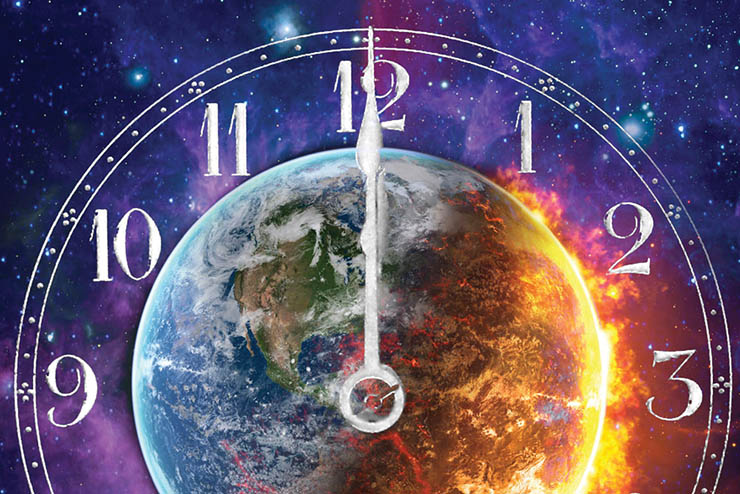
We may have entered a new epoch, or so some scientists are telling us. The Anthropocene is a geological epoch characterised by the noticeable impact of humanity on the surface of the Earth. The previous epoch was the interglacial Holocene, which began after the fourth ice age. The Anthropocene is said to have begun with the Industrial Revolution in the eighteenth century. Others argue that substantial human influence on the lithosphere began up to 15,000 BP (BP=Before Present, the scale used for large periods of time) when human activity left its first traces on the rock record. Others specify 1945 as a clear date, due to the sudden arrival of radioactive material in the rock strata from the explosion of atomic bombs.
As a term, Anthropocene reminds me of esoteric concepts of humanity’s ages and cycles, aeons and epochs. A belief in cosmic cycles has been specified as one of the typical characteristics of esotericism. This categorising of history and prehistory is one of several examples where religious and esoteric ideas exist in a symbiosis with scientific and secular ideas. Scientific concepts such as the ages of stone, bronze and iron owe their existence to myth; modern esoteric ideas of human development, of cosmic ages and cycles, draw on the scientific knowledge of the period.
The Anthropocene is partly a tool for highlighting the extent that humanity is currently influencing the global environment. Yet it is typical of materialist science that only mankind’s physical impact on the world is being assessed. Mankind appears in the geological picture mostly due to the damage we have done. In contrast to this, esoteric theories of aeons, epochs and cycles typically see in mankind a development towards an ever more spiritual form of consciousness, or a descent from a golden age into barbarism, or the repetition of cycles of a variety of divine or cosmic influences.
The difference between scientific systems of ages and esoteric-religious systems is this: scientific systems are based on measurement, esoteric systems on value. The best esotericism incorporates scientific and practical knowledge into a worldview that has a cosmic significance and acknowledges human psychological and spiritual development. The technologies of esotericism are those of personal transformation and sacred science. Esotericism is concerned with the inner meaning of whatever phenomena it touches upon, whether those of religion, myth or science.
It Was a Golden Age
Probably the most familiar Western system of ages is that of the classical world. We are so used to the gold, silver and bronze medals of the modern Olympics that the combination and order of these medals barely seems strange to us. It was Hesiod in the eighth century BCE who first wrote of the ages of development associated with metals, and he was surely drawing on existing tradition. Hesiod’s account follows on from the story of Prometheus bringing fire to mankind and Zeus punishing humanity by fashioning Pandora with the aid of the other gods, whose infamous box unleashed evils and sufferings on the world, with Hope as the only positive quality. Hesiod describes five ages – gold, silver, bronze, the heroes, and finally iron, the age in which he lived and we still live.
In the golden age, ruled by the titan Kronos, humanity was free from labour and ill-health, people lived long happy lives and died peacefully in their sleep. After death people lived on as good spirits of the earth who protect and bring wealth. The silver race was fashioned by and ruled by the Olympian gods. They were also long-lived as children but once they grew to adulthood they fought and were killed, forsaking the gods. These live on as spirits of the underworld.
People of the bronze age were strong and powerful but hard-hearted, dying in wars. Our age is that of iron, to which Hesiod apportions a series of woes mixed in with only a little good meted out by the gods. Hesiod tells us he would rather that he had not been born than live in our age of iron. Between the ages of bronze and iron was the heroic age. Its anomalous status, not being associated with a metal, suggests it was added to the scheme later. The heroic age was the age of the heroes and demi-gods of Greek myth, from the Seven at Thebes to participants of the Trojan War. They live on in the blessed isles.
Myths can encode social imperatives, taboos, justifications for ritual, and spiritual and psychological truths. They can also preserve ancient folk memories. Archaeological ages of materials technology, of course, show that bronze was used before iron was smelted. The modern scientific threefold scheme of stone, bronze and iron ages derives from Michele Mercati in the sixteenth century, with numerous subdivisions and refinements made as evidence accumulated and the scheme developed. The scientific understanding of archaeological ages of materials technology owes its inspiration to the Greek myth of the ages of metal.
In Book V of The Nature of the Universe, Lucretius, the first century BCE Roman writer, describes a progress in the human use of stone then copper (and hence its amalgam, bronze) and then to iron. Lucretius was an Epicurean and in many ways a precursor of modern rationalism. His method was not based on experimentation and measurement but on assigning natural materialistic explanations to phenomena. Hence, Lucretius ascribes mankind’s knowledge of the use of fire not to Prometheus but from seeing forest fires caused by lightning. He surmises that humanity learned to smelt metals from seeing the results of a forest fire on ore. Lucretius sees mankind as developing in phases from primitive technologies to the advanced civilisations of his time, from using stone to copper or bronze, and latterly to iron. It is the myth of progress.
Hesiod and Lucretius offer examples of the two opposing models of human development: a descent and an ascent, on the one hand a fall from grace and away from the perfection of the golden age and on the other a development from barbarism to civilisation.
[alert type=”info” dismiss=”no”]If you appreciate this article, please consider a subscription to New Dawn magazine.[/alert]
The Great Age & Yugas
In the Western mind the four (or five) Greek ages, or at least the concept of a golden age, are part of the common culture. Astrological ages and the Indian Yugas (Hindu, though there are Buddhist and Jain adaptations too) are probably the next well known, the latter chiefly among those with spiritual, New Age or esoteric leanings.
The Yugas, which are of course still current in Hindu culture, are the most ancient and massive cycles. The total length of a Great Age (Mahayuga) is 4,320,000 years. The four Yugas have durations of 4:3:2:1 proportions, running from the golden age Krita or Satya Yuga (Fortunate Age) at 4,000 divine years, amounting to 1,440,000 human years, on through Treta Yuga (Third Age, or of three parts, 3,000 divine years/1,080,000 human years), Dwapara Yuga (Second Age, or of two parts, 2,000/720,000) and our very own Kali Yuga (Age of Conflict, 1,000/360,000 years). There are additional periods that precede and follow each Yuga, each 1/10 of the length of the Yuga.
Joscelyn Godwin cites midnight February 17 or 18, 3102 BCE as the beginning of the current Kali Yuga, according to Indian astronomers, and calculates its end in 427,000 CE.1 The Kali Yuga thus covers the period from more or less the dawn of civilisation to the extremely remote future. These vast periods are difficult to find meaningful.
The vast time scale has prompted some more recent commentators to accommodate the lengths to a more human scale. René Guénon, the Traditionalist, suggested knocking off three zeros and multiplying by 15. The resulting periods mesh successfully with human affairs, with the current Kali Yuga conveniently ending in 1999. Despite Guénon’s erudition, this surely amounts to convenient adaptation of a difficult idea; on the other hand it is the duty of esotericism to concern itself with the meaningful. The best known resizing of the Yugas, possibly better known than the original periods, is that of Sri Yukteswar Giri, the guru of Paramahansa Yogananda, known widely for his Autobiography of a Yogi. In Yukteswar’s system of Yugas the Kali Yuga has already ended and we are now in an ascending era in which the Great Year runs in reverse. Thus the myths of descent and ascent are combined.
Consonant with their vast lengths, the Yugas are associated with very broad characteristics of human life. As with the golden age of the Greeks, in the Krita Yuga humans have long lives (4,000 years), have no diseases and don’t need to work. Kali Yuga is characterised by the greed of mankind, by irresponsible rulers, wide use of drugs and drink, and continual migration of peoples. A distinctive Hindu characteristic of the ages is that they each have different numbers of avatars of the Lord Vishnu, with the Kali Yuga having only one, Kalki, who will return on a white horse to fight against the demon Kali (not to be confused with the goddess Kali) who is the ruler of the age.
This is the dawning of the Age of Aquarius
The astrological ages are widely known. In the official history of science it was Hipparchus in the 2nd century BCE who, on the island of Rhodes, computed the precession of the equinoxes (see graphic on page 62 in magazine). In the 2nd century CE Ptolemy, the great astronomer/astrologer, worked out that precession was due to a wobble of the starry sphere. Heliocentric science eventually determined that the wobble was in Earth’s orbit.
The great year of astrological ages is computed at 25,770 years. This is usually rounded to 26,000 years although the figure has sometimes been lower and until the cycle was properly measured it was assumed that it matched Plato’s Great Year of 36,000 years. This number divided by 12 gives 2,147.5 years for an astrological age if the signs of the zodiac are equally spaced.
The sign in which the Sun rises on the vernal (spring) equinox is believed to influence humanity as a whole in a similar way to the effect of the 12 signs on a human being. The ages of Leo, Cancer and Gemini show mankind emerging from prehistory, with Gemini, ruled by Mercury, associated with the development of writing, Leo emphasising the importance of the Sun, and Cancer that of the mother goddess. The age of Taurus began around 4000-4500 BCE, depending on the method of computation, and is associated with bull god cults such as those found in Egypt, Assyria and Crete. Around 2000 BCE, give or take a couple of centuries, the spring equinox Sun moved into fiery and warlike Aries. This was a time of empire building and heroic ages, of martial conquest and the use of iron for weapons. It also included the development of monotheism.
From around 100 CE to the turn of the Christian era – about which, more in a moment – is the dawning of the age of Pisces. The fish associations of Christianity, the symbol of the vesica piscis, the fisherman disciples who become fishers of men, and several parables and miracles that include fish, are all consonant with Pisces. Pisces is also notable for its dreamy quality, hence the characterisation of the age of Pisces as a time of deception.
We look with hope to the age of Aquarius but there are many views as to when it will come. We may have already gone over the cusp. Those who calculate the astrological ages according to the constellation boundaries rather than the equally spaced 30 degree zodiacal constellations, compute that it may take another 600 or 700 years before we enter Aquarius.
Many fascinating investigations into archaeology and astronomy suggest that knowledge of the precession of the equinoxes is encoded in myths from a wide variety of sources and in the alignments of ancient sites all around the world. This would make the astrological ages the arbiters of epoch par excellence. In these ages the position of the zodiac at the spring equinox aligns with chronology, mathematics and a zeitgeist that lasts for two millennia. That zeitgeist manifests through large scale human endeavour such as empire, war and civilisation, through symbolism and religious forms.
For us, who now stand two millennia away from the beginning of our Christian calendar, the astrological ages are extensive enough to carry a significance beyond the length of a single civilisation, yet not so long that they are incomprehensible on human terms. Although there is plenty of argument over the specific beginning and ends of ages (though their length is not so controversial), the scheme is admirable. It is like a tool of the right size and weight that fits comfortably in the hand.
It also has a predictive value lacking in the Yugas and the metallic ages. The Greek system offers no development after the iron age. The Yugas offer an eventual return to the beginning of the cycle and a new golden age, which is a source of optimism. But the massive time scales and our place within the Kali Yuga can only allow us to sigh at the misery of mankind and its fall from grace. The astrological ages cycle through varying qualities but are not characterised by ascent or descent. When an age becomes tired and decadent, complementary qualities may be at hand in the influence of the forthcoming age.
From Adam to Christ
Astrology comes from Babylon and was formulated in its Western version in the pagan classical world. Although both Christianity and Judaism have at times had their own strong astrological traditions, astrology was vulnerable to criticism as a pagan science whose symbolism and terms of reference didn’t extol Yahweh or Christ as the foundation stones of the universe. According to the astrological ages, the bull and the fish are merely passing fads, albeit fads of 2,000 years duration. Thus it fell to Christians to come up with their own aeons and epochs that drew on their own mythologies and understanding of the world. From a Christian and Western standpoint, the Yugas and astrological ages are merely turning around in circles.
The Christian view of time follows a line not a circle. It runs from creation to destruction, from Genesis to Revelation, from Fall to Apocalypse. Yet the line can still be divided into sections, marked out by the character of the times, by the stage in the process of the redemption of humankind. The Christian schemes take us out of the ancient world and into the Middle Ages.
Our standard Western method of counting years is in fact a simple system of two epochs, BC, Before Christ, and AD, Anno Domini, the year of our Lord. The BC/AD system did not take root for several centuries after its invention in the 6th century. It reflected the basic Old Testament/New Testament divide of the Christian Bible but has no category for the Second Coming. It has no predictive quality built into it.
It was that giant of influence, St Augustine, who formulated the most influential Christian scheme of ages. Augustine’s scheme utilised the seven days of creation. Inspired by Psalm 90:4 (quoted in II Peter 3:8), in which “one day with the Lord is as a thousand years,” each day was literally a millennium. The seventh age corresponded to the seventh day, the Sabbath, on which day God rested from his labours, and was outside of history.
Each age of 1,000 years could approximately be matched with chronologies produced from the genealogies of the Bible. The six ages were:
- From Adam to Noah and the flood.
- From post-flood Noah to Abraham
- From Abraham to David
- From David to the captivity in Babylon
- From the return from Babylon to the birth of Jesus.
- From Jesus to the second coming.
Thus we are living in the sixth age, which will continue until the Apocalypse. The sixth age is clearly and uniquely Christian; all of the preceding ages are defined by Jewish figures yet are claimed for Christianity. There is no accommodation of, for instance, the Greek philosophers who would have lived in the fifth age, or for Homer in the fourth age, no room to allow for the Greek heroes or the Gods of Egypt, Greece, Rome and other Mediterranean countries.
What can this system of ages say about mankind and the world in general? The great civilisations of antiquity, the gods and goddesses and daemons, are all swept away in favour of the purloined traditions of a people (the Jews) who weren’t even included in the new religious dispensation unless they acknowledged Christ. There was little room for each age to have its own spiritual or psychological colouring or even for a straightforward cycle of progress or corruption.
Those six ages did allow for a coming transformation into the seventh age, but Augustine placed the Christian Apocalypse conveniently far enough in the future to be of no concern for a few centuries.
Augustine took over an existing Jewish scheme but may have been influenced by Gnostic ideas. In the Gnostic Second Treatise of the Great Seth, the history of the world is effectively divided into three stages. Barbelo, the divine feminine figure, visits Adam, then gives the seed to Seth, then later to the resurrected Christ. In the further reaches of Gnosticism we find similar demarcations of history based around important characters in the Bible. Bardaisan came up with a scheme that involved 6,000 year periods that made up a Great Year. The Manichaean religion is unusual in acknowledging both biblical figures from Adam and Seth down to Jesus and non-Abraham prophets including Zoroaster and Buddha.
Father, Son & the Holy Spirit
After the first Christian millennium ended, Augustine’s six ages still had some validity because the beginning of the sixth age and the literalness of the thousand year period could be disputed.
Joachim of Fiore (c.1132-1202) first proposed that history was ascending through three stages ruled by each separate member of the Trinity. Hence, the period from Adam to the birth of Jesus was the Age of the Father, characterised by the Law; from Christ onwards was the Age of the Son, which was the age of the gospel; at some date in the near future would be the advent of the Age of the Spirit or Holy Ghost. Abbott Joachim, who was a devout Catholic, believed the third age would bring the kingdom of God on Earth. This third age would no longer require the Church (which was just an artefact of the second age) but would consist of celibate monks in direct communion with the Holy Spirit. Joachim believed the third age would dawn in 1200-1260 and so must have died believing it was imminent. Joachim’s influence on the development of Christianity would be indirect but considerable. His concept of the replacement of the Church by saintly individuals would be picked up by various Protestant movements and lend itself to use by later antinomian Christian sects. There was no compulsion to accept Joachim’s own estimate of the dawning of the Age of the Spirit, therefore interest in his three ages would re-emerge in aspects of twentieth century esotericism.
Islam could take the same approach by delineating ages according to the six prophets mentioned in the Qur’an (Qur 19,21-22), while in Ismaili Islam a series of emanations from Allah determine the different characteristics of the ages. Minority Middle Eastern religions such as the Zoroastrians and the Yezidis also had their own schemes. That of the Druze is notable for a scheme of aeons that each last for an astonishing 343 million years. Other aspects of their little-known scheme include a series of 159 masters through history, in addition to the six prophets of Islam, with history deteriorating gradually until a final liberation takes place. These 159 masters are pre-existent but are somehow controlled by Christ and the four evangelists as cosmic figures. Outside of the scope of this article are the wide rage of mythic ages found around the world like the five Suns of the Aztec ages, or the Mayan calendar.
The True Religion of Noah
Isaac Newton (1642-1727) was the founder of modern science, but also a Christian, astrologer, alchemist and esotericist. He has sometimes been characterised as the last magician rather than the first modern scientist. Newton believed that the true religion was that of Noah. He also believed that the Sabaeans, Confucius, the Brahmins and Pythagoras all inherited this post-diluvian wisdom. As each of these figures and movements arose, the light of “true religion” renewed, only to decline steadily until the next renewal. Egypt, however, according to Newton, was responsible for much of the corruption and decline of this true religion, including the concept of the Christian Trinity, which Newton abhorred.
All this resembles the familiar Abrahamic scheme of a succession of prophets periodically bringing law or religion or gnosis to humanity. But Newton has integrated figures like Pythagoras (and Hyram of Tyre, of Masonic fame) into the scheme. Newton believed that Pythagoras gave mathematics to the Greeks with one hand and the “true religion” with the other.
It will become characteristic of esotericism to incorporate figures from many religions and cultures, not just Jewish and Christian ones, into the patterns of development. Esotericism is interested in the inner meaning and inner significance of traditions, usually sees religions and cultures as sharing fundamental principles (or often regarding as debased those that don’t fit in) and hence can accommodate almost any criteria. Given his scientific nature Newton saw these prophet figures as bringing sciences such as mathematics and astronomy with them. The purest and most ancient civilisation was that of Israel, from whom, with a hefty amount of chronological juggling, all others copied.
All graphics for this article are viewable in the digital or print version of this issue.
The second part of this article, published in New Dawn 153 (Nov-Dec 2015), looks at how the concept of race was related to esoteric history, as well as the cycle cosmology of Theosophy, the “gyres” of W.B. Yeats, Thelema aeons, spin offs from G.I. Gurdjieff including Rodney Collin & J.G. Bennett, and the work of Jean Gebser and Peter Carroll, plus more.
[alert type=”general” dismiss=”no”]This article was published in New Dawn 152.[/alert]
[alert type=”success” dismiss=”no”]If you appreciate this article, please consider subscribing to help maintain this website.[/alert]
Footnote
- ‘When Does the Kali Yuga End?’ by Joscelyn Godwin, New Dawn 138 (May-June 2013)
© New Dawn Magazine and the respective author.
For our reproduction notice, click here.
