From New Dawn 141 (Nov-Dec 2013)
The history of astrology is in many ways the history of a polemic. The question of whether astrology works, as crucial as it is, is soon buried under other issues, such as what this might have to say about human free will and whether the stars and planets that govern our fates are benign, malevolent, or neither. These issues have been debated for thousands of years.
Before we get into them, however, we should probably begin with why astrology is the way it is. To do this, we have to imagine what ancient people saw and how they explained it. In the first place, they would have found that there are seven bodies in the sky that move (or, as we would say today, appear to move) around the earth. These are the sun and the moon as well as five planets: Mercury, Venus, Mars, Jupiter, and Saturn. The rest of the planets are invisible (except for Uranus, under some circumstances) to the naked eye.
The number seven is significant: probably there is no other number that has so much lore and mystery about it. But the explanations for its importance are never very clear. Of all the reasons given for the prominence of seven, there is only one that makes a great deal of sense. In his magisterial History of Magic and Experimental Science, Lynn Thorndike writes, “The number seven was undoubtedly of frequent occurrence, of a sacred and mystic character, and virtue and perfection were ascribed to it. And no one has succeeded in giving any satisfactory explanation for this other than the rule of the seven planets over our world.”
So we have a system of seven planets, imagined as moving in concentric spheres around the earth. Of these, the most important is the sun; the second is the moon. Ancient humans observed that the sun appeared to move in a tight band of the sky, known as the ecliptic. By the time it made a full circuit, returning to the same point in the sky, somewhat more than twelve cycles of the moon had passed. (The solar year is 365.242 days long; the lunar year is 354.37 days.) Thus there were slightly more than twelve moons in a solar year, making the solar and lunar years extremely hard to reconcile. But twelve was the closest whole number to the truth, so it seemed reasonable to make a year with twelve months. It also made sense to divide the ecliptic into twelve parts. These were marked out by constellations, which were given specific names, mostly of animals. They are now the twelve signs of the zodiac.
The Evolution of Astrology in History
When did people start to make these calculations? When was this system set up? It appears that we owe to the Egyptians the schema of a twelve-month solar year (they added some intercalary days to the twelve lunar months to make up the full 365). But the most common and consistent traditions say that astrology itself came from Mesopotamia. The time is somewhat harder to fix, but one consideration might tell us something. Over the years the sun moves slightly in relation to the constellations of the zodiac, and every 2,150 years the sign in which the vernal (Spring) equinox appears will change. The full cycle, the time the sun takes to return to the same point in the zodiac (known as a Platonic year, because Plato was the first to mention it, in his dialogue the Timaeus) is approximately 25,800 years.
The starting point of the zodiac is placed at the vernal equinox – 0 degrees of Aries. But at the vernal equinox (from the perspective of the northern hemisphere, where astrology developed), the sun does not rise with 0 degrees of Aries behind it, and it has not done so for a long time – not, in fact, since around 2000 BCE. (Today it rises with either Pisces or Aquarius in the background, depending upon whom you ask). Since this is the natural starting-point of the zodiac, we can assume that whoever set up this system must have begun here. We can speculate that astrology as we know it arose in Mesopotamia around 2000 BCE.
And, in fact, the earliest evidence we have for astrology does indeed come from that part of the world. Although the Roman author Pliny the Elder cites a claim that the Babylonians were following and recording the stars for 490,000 years, the earliest astrological evidence we have is from the second millennium BCE. It consists of omen lists, which correlate various natural events, particularly the positions of the planets, with events on earth. Here is one example: “When the Moon occults Jupiter…, that year a king will die (or) an eclipse of the sun and moon will take place. A great king will die. When Jupiter enters the midst of the Moon there will be want in Abarrú” – and so on.
Notice two things about this prediction. In the first place, it focuses on great events, like a famine or the death of a king. There was not yet any personal astrology as we know it. In the second place, the reasoning was inductive: when one thing happened, another thing was going to happen. While this was not, strictly speaking, scientific reasoning, it was like scientific reasoning in that it attempted to correlate one thing – the relations of planets – with another thing – events on earth. There was probably very little theorising about causes, that is, about why one thing should affect the other. But then, as Western philosophy has found again and again, the concept of causation is an extremely problematic one to this day. (For more on this, see my book The Dice Game of Shiva, chapter 4.)
It was the Greeks who made astrology into what we know today. In his History of Western Astrology, Jim Tester contends that the twelve equal signs as we know them from Aries to Pisces was standardised in the fifth century BCE, at the time of Greece’s Golden Age. And it was definitely the Greeks who (at least in the West) first came up with the concept of natal (birth) astrology (or, to use the scholarly name, genethlialogy).
While looking at all this, it’s important to remember that the sciences were not distinguished as they are today. Astrology and astronomy were the same discipline, and two of the greatest Greek astronomers, Hipparchus of Nicaea and Claudius Ptolemy, were also astrologers. (Astronomers also tended to be astrologers up to the seventeenth century.) Meteorology was part of the same package, and the planets were used to predict the weather. Aristotle in his Politics tells of the Greek philosopher Thales, who “knew by his skill in the stars while it was yet winter that there would be a great harvest of olives in the coming year; so, having a little money, he gave deposits for the use of all the olive-presses in Chios and Miletus, which he hired at a low price because no one bid against him. When the harvest-time came, and many were wanted all at once and of a sudden, he let them out at any rate which he pleased, and made a quantity of money. Thus he showed the world that philosophers can easily be rich if they like, but that their ambition is of another sort.”
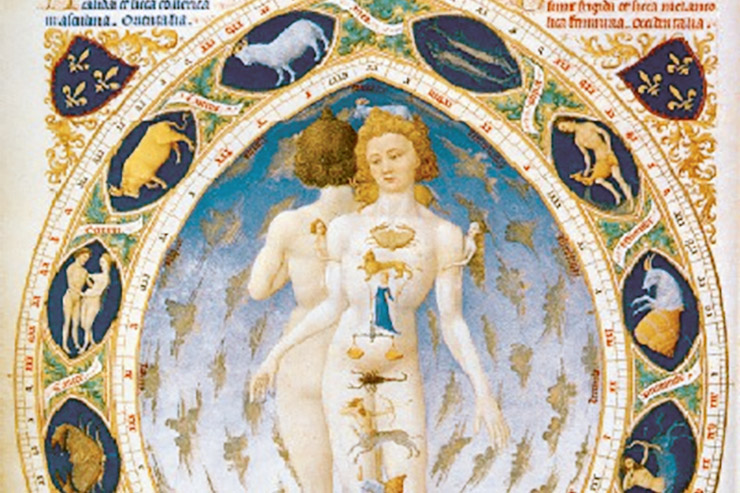
Medicine, too, had a link to astrology. The ancient and widespread idea that the human being, the microcosm, corresponds to the universe, the macrocosm, led the Greeks to assign the signs of the zodiac to different parts of the body. Aries, the first sign, was assigned the head; to Pisces, the last, were ascribed the feet. This enabled physicians to diagnose illnesses and prescribe treatments based on the patient’s horoscope and the positions of the planets. The connection between astrology and medicine lasted a long time, up until the eighteenth century. Before then, even sceptics admitted that it was useful to consult the stars for medical purposes. And astrologers who were attacked for the inaccuracy of their predictions retorted that the doctors did no better.
It was natal horoscopes that gained the most ground, and they became popular in the last centuries BCE and in the early centuries of the Common Era. This period, which saw the rise of Hellenistic civilisation in the Mediterranean world, was, like ours, a time of tremendous technical and intellectual progress. It was also a time of political consolidation: small, previously independent states were united, first under Alexander the Great and his heirs, and later under the Roman Empire. As in our age, the world became more integrated – and the individual occupied a smaller piece of it.
These facts may explain the tremendous rise in those centuries in devotion to the goddess Tyche or Fortuna – Fortune – whose caprices seemed to reflect a world where the individual was under the dominion of powers far away. It was also the time when personal astrology – particularly the natal horoscope – established its place in Western culture. People began to see their fates in more deterministic ways than they had done in previous centuries.
‘Gods’ & Planetary Spheres
In those days, as we’ve seen, the planets were believed to surround the earth in concentric spheres. The soul taking incarnation in a birth was thought to descend through each of these planetary spheres in turn, assuming characteristics of that sphere as it passed. The relations of the planets to one another, and their place in the zodiac, thus dictated individual fate and character.
Few modern astrologers would say this is why their art works, but on the other hand, there are also few other explanations that are much clearer or more sensible. We can take this idea of the soul’s descent as a metaphor for how one’s character may be fixed by the planets in the zodiac. Like most metaphors, it casts some light on what it portrays – and at the same time, it is only a metaphor.
The history of astrology, as I’ve suggested, is the history of polemic, and just from looking at what I’ve just said above, we can see one of the bases for this polemic. The soul descends through the realms of the planets, and in those days the planets were gods. Plato in his Timaeus said that it was the gods of the planets that formed human beings, not the true, high God above (who, according to Plato, is himself perfect and could not have formed imperfect things like humans). Plato’s pupil Aristotle also held that the planets were subordinate gods.
If this is true, then exactly who are these gods and how are they disposed toward us? Already in Plato the planetary gods are ambiguous figures, responsible for both the good and the evil in our natures. Later thinkers were to paint them in even more negative terms. The Hermetic texts – writings of late antiquity said to preserve the wisdom of the Egyptians – portrayed the keepers of these heavenly gates as the sources of vice in the human character. One Hermetic text describes the liberation of the soul at death as an ascent through the planetary spheres (as opposed to birth, when the soul descends): “Then the human being rushes up through the cosmic framework, at the first zone surrendering the energy of increase and decrease; at the second, evil machination, a device now inactive,” and so on through the seven spheres. Each sphere has a vice that is connected with its respective planet – “energy of increase and decrease” being connected with the moon, which waxes and wanes throughout the month, and “evil machination” with Mercury, the god of cleverness. The Gnostics, too, saw these intermediary planetary powers as inimical “archons” that imprisoned humankind spiritually.
This ambiguous, or inimical, nature of the planetary gods led some to criticise astrology. Plotinus, the Neoplatonic philosopher of the third century CE, argued that if the planets are gods, it is absurd to conclude they can do evil (as some planets, particularly Mars and Saturn, are said to do). As a matter of fact Plotinus did not reject astrology entirely, allowing that it was useful for divination, because the planets are part of the cosmos and serve to reflect its harmony as a whole. But then his critique was not directed at astrology as such; the section of his Enneads discussing this matter is entitled “Are the Stars Causes?”, indicating it was the causative aspect of the planets that he had problems with. (Again we see how problematic the idea of causation can be.)
Free Will Vs Fate
By contrast, Plotinus’s disciple Porphyry embraced astrology (he even wrote a three-volume work on the subject, now lost). Dealing with the issue of free will versus fate, Porphyry used some of Plato’s texts to argue for a kind of mix between the two: the soul chooses its fate before incarnation, but this fate, immutable once one is born on earth, is reflected in the horoscope.
Origen, a third-century church father, also focuses on free will. Like most Christian theologians, he is at pains to uphold the doctrine of free will and opposes anything that might challenge it. Yet he too stops short of rejecting astrology altogether, because if he did, he would have to reject natural philosophy as a whole (into which astrology was intricately interwoven at the time).
Origen also contends that astrologers, in order to make perfectly accurate predictions, would have to be able to calculate horoscopes very precisely – within four minutes or so. The technology of the time did not allow them to do this; time was kept by sundials and water-clocks, which were not precise enough. Nor were astronomical observations. Hence, Origen said, astrology could not work.
If we back away and look at this issue from a distance, we can actually see that, given what we know now, astrology should not have worked much of the time, given the limitations of the observations of the stars (there were no telescopes), and given the fact that the outer planets were unknown. To this we can add likely mathematical errors made by astrologers themselves, which must have been extremely common in all periods. In the sixteenth century, the celebrated prophet Nostradamus was derided by his astrological peers for his sloppiness in calculating charts.
In any event, Christianity has always had an ambivalent, and frequently critical, posture towards astrology. Astrology and its practitioners were condemned when they came too close to sorcery and when they seemed to be criticising the doctrines of free will and divine sovereignty. But the science of the stars remained an important part of the medieval curriculum, partly because it was an integral part of the system of the seven “liberal arts” that the Catholic Church inherited from classical antiquity. (There is a persistent rumour that the pope’s bathtub in the Vatican is adorned with the signs of the zodiac, but I have not been able to verify this.)
Although I could go into more detail about the history of astrology from late antiquity to the present, in fundamental ways the debate has not changed much. Some issues certainly have faded away. No one regards the planets as gods anymore, so we do not wonder about whether they are personally good or evil. And computers make it possible to calculate charts with extreme accuracy, either with one of the many dedicated software packages on the market or through many free sites on the Internet (astrodienst.com being one of the best-known). Finally, while the issue of free will versus determinism continues to haunt us, it does not have quite the theological weight that it once did. We no longer feel quite so obliged to justify the ways of God to man as people did a couple of centuries ago.
Scientific Efforts to Validate Astrology
Nonetheless, we are still forced to ask, does astrology work? Has there been any genuine scientific effort to test the validity of astrology? There haven’t been terribly many. Some studies have attempted to correlate astrological charts with the results of personality tests, without positive results (but of course that presupposes the personality tests themselves have anything more than a vague degree of accuracy). One famous study, designed by Shawn Carlson at the University of California at Berkeley and whose results were published in 1985 in the journal Nature, concluded from such indications that there was no validity to astrology. But a statistical reevaluation of Carlson’s findings by Suitbert Ertel, professor of psychology at the University of Gőttingen, that was published in the Journal of Scientific Exploration in 2009, reversed Carlson’s conclusions and argued the study validated astrology instead.
Another famous case involved the French researcher Michel Gauquelin, who attempted to correlate planetary positions in birth charts with success in certain professions. He calculated the charts of nearly 1,100 members of the French Academy of Medicine to see if any planetary aspects showed up beyond the range of statistical probability. And indeed Gauquelin found that physicians had Saturn in prominent positions in their charts far more than could be explained by chance. A study he conducted on athletes showed a similar “Mars effect” for them.
Gauquelin’s findings were vigorously – and viciously – attacked by the clique of “sceptical inquirers.” Some of these actually attempted to replicate Gauquelin’s findings – and corroborated them. But then these supposedly objective scientists changed the parameters of their own study to alter the results and make Gauquelin look wrong, causing great scandal even in the community of sceptics.
The heat and vitriol generated by these studies prove one thing and one thing only: that we are a long way from any true scientific evaluation of astrology. Astrologers – and a large section of the public – believe in it, while sceptics mock it at every chance. In order to have genuinely trustworthy results, those who actually want to find out the truth would have to outnumber those who are angling for their own pet conclusions – and I suspect that they do not.
Speaking for myself, I am not a scientist and have not done any scientific studies on this or any other subject, but I have often been struck by the validity of astrology, both for my personal life and for a perspective on larger events. To take one example, in 2001 I decided to cast a chart for the presidency of George W. Bush, based on the time of his inauguration in Washington. I noticed that Mars was badly aspected. “My God!” I thought. “It looks like we’re going to have a war.” (Mars is the planet of war.) Then I told myself, “That’s ridiculous. Who are we going to go to war with?” Events to come provided the details.
How Astrology is Supposed to Work
Another question remains. If astrology does work, how does it work? Tradition held that the planets send out certain vibratory influences that affect events on earth. Scoffers retort that the gravitational pull of the planets (apart from the sun and moon) is too small to have any influence whatsoever on us on earth. That may or may not be the case: the old occult theory did not talk about gravitational effects per se, and actually predated Newton’s theory of gravity. In any event, today it’s probably more common to explain astrology through C.G. Jung’s concept of synchronicity – which he defined as an “acausal connecting principle” between apparently unrelated events. In his essay “Synchronicity,” Jung discussed astrology. He conducted a study of several hundred married couples, and found that cases in which the husband’s sun or ascendant was conjunct the wife’s moon (classical markers for marriage) occurred three times more often than would be predicted by chance.
Nevertheless, Jung’s theory leaves a great deal to be desired. Synchronicity, as he describes it, is not strictly acausal; rather it posits a hidden cause – the psychic forces Jung called the archetypes – that underlies apparently unrelated but significant events. And so we return to that bane of sceptics – occult causes. But then Newton’s gravity, when it first appeared, was also derided by the sceptics of the day as an occult cause.
We are pushed toward one final, and highly disturbing, conclusion – one that I have already hinted at in this article. The notion of cause and effect is in itself extremely problematic. The classic critique came from the Scottish philosopher David Hume. He said that when looking at things that were said to be causes, he saw no property they had in common (as, say, red or round objects do). From this he concluded that causation was a relation, and this relation consisted of “constant conjunction.” One event follows another (sometimes after an interruption) on a regular basis, so we infer that the one caused the other. The German philosopher Immanuel Kant, who said he had been roused by Hume from his “dogmatic slumber,” went on to argue that causation does not exist in the world as it really is, but rather is an innate “category,” or feature, of the human mind that leads us to perceive reality this way.
No one has ever really refuted Hume’s and Kant’s conclusions. Science, it is true, is somewhat humbler and more furtive about asserting causal relations than it used to be: it tends to speak in terms of association rather than causation – “smoking was associated with lung cancer in X cases” rather than “smoking caused cancer in X cases” – but this only points up the strength of the philosophers’ criticisms. Whether it’s a matter of determining the causes of cancer or of asking whether the planets can presage a war, we are left with “constant conjunction.” In that respect, we haven’t gone far beyond the Babylonians.
[alert type=”general” dismiss=”no”]This article was published in New Dawn 141.[/alert]
[alert type=”success” dismiss=”no”]If you appreciate this article, please consider subscribing to help maintain this website.[/alert]
Sources
Aristotle, The Basic Works of Aristotle, Edited by Richard McKeon, Random House, 1941
Brian P. Copenhaver, ed. and trans., Hermetica: The Greek Corpus Hermeticum and the Latin Asclepius in a New English Translation with Notes and an Introduction, Cambridge University Press, 1992
Ken McRitchie, “Reappraisal of 1985 Carlson Study Shows Support for Astrology,” Center of the Universe at the Edge of the World website; theworldedge.blogspot.com/2009/07/reappraisal-of-1985-carlson-study-finds.html
Claudius Ptolemy, Tetrabiblos, Translated by F.E. Robbins, Loeb Classical Library, 1940
Jim Tester, A History of Western Astrology, Boydell, 1987
Lynn Thorndike, A History of Magic and Experimental Science, vol. 1, Columbia University Press, 1923
© New Dawn Magazine and the respective author.
For our reproduction notice, click here.