New Dawn – World's Most Unusual Magazine

Tag: Atlantis

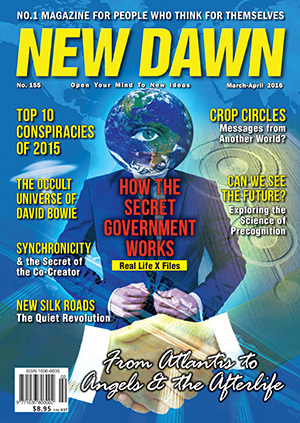
  • From Atlantis to Angels & the Afterlife: The Adventurous Life of Writer Ptolemy Tompkins

    From Atlantis to Angels & the Afterlife: The Adventurous Life of Writer Ptolemy Tompkins

    From New Dawn 155 (Mar-Apr 2016)

    The spiritual, the occult, the paranormal – these things have never sat well with the mainstream press. If they pay attention to such things, it is usually only briefly and with an eye to ridicule. Not surprisingly, the majority of writers on these topics are arrogant ignoramuses.

    This situation may be changing. A small cohort of writers has been developing who are willing to look intelligently, objectively, and engagingly at levels of reality that consensus opinion would rather ignore or condemn.

    One of these writers is Ptolemy Tompkins. The son of Peter Tompkins, best-known for his 1970s bestseller The Secret Life of Plants, Ptolemy (named after an ancient Gnostic philosopher, not the proponent of the geocentric theory) grew up in a world of the marvellous in the ’60s and ’70s, the heyday of the New Age. His stepbrother, Nicholas Vreeland, is a prominent Tibetan Buddhist abbot and was the subject of the 2014 film Monk with a Camera, which also features interviews with Ptolemy.

    As a writer, Ptolemy has staked out his own ground in these areas. His first book, Paradise Fever: Growing Up in the Shadow of the New Age, was a chronicle of his life and times as a child of the human potential movement. His other works include The Beaten Path: Field Notes on Getting Wise in a Wisdom-Crazy World; This Tree Grows out of Hell: Mesoamerica and the Search for the Magical Body; The Modern Book of the Dead: A Revolutionary Perspective on Death, the Soul, and What Really Happens in the Life to Come; and The Divine Life of Animals: One Man’s Quest to Discover Whether the Souls of Animals Live On.

    Ptolemy has also collaborated with Eben Alexander, M.D., on his bestselling books Proof of Heaven: A Neurosurgeon’s Journey into the Afterlife and The Map of Heaven: How Science, Religion, and Ordinary People Are Proving the Afterlife. For a number of years Ptolemy worked as a staff editor for the inspirational American magazines Guideposts and Angels on Earth. His latest book Proof of Angels: The Definitive Book on the Role of Angels and the Surprising Role They Play in Our Lives was published in February 2016. No matter what subject he covers, his prose is always fresh, lively, and candid.

    Ptolemy and I have been friends for several years, linked both by common interests and a number of mutual acquaintances. I conducted this e-mail interview with him in October 2015.

    RICHARD SMOLEY(RS): You had quite an upbringing. Your father, Peter Tompkins, was the author of The Secret Life of Plants and a well-known explorer of the metaphysical. What was it like to grow up in that environment?

    PTOLEMY TOMPKINS (PT): He was the coauthor, actually. His coauthor, Chris Bird, and his wife, Lois, were over at the Barn, the converted cow barn I grew up in, all the time. Chris was a great guy – bearish and jolly, and given to histrionics almost as much as my dad was. For the author photo for The Secret Life of Plants, it was decided that the two would look good posed among plants, so they had a shoot at the botanical gardens in DC. The two of them were arguing five minutes into the shoot.

    RS: What were some of the most interesting (and/or famous) personalities that you met when you were young?

    PT: I missed the night Liv Ullman came by for dinner. My dad was very taken with her. Ali McGraw was around a little bit, for reasons I don’t remember. In ’78 my father and my stepmother, Betty Vreeland, brought me along for a trip to Morocco during my spring break. I was in tenth grade at the time, and while in Tangier we went over to an old writer friend of Betty’s, a guy named Paul Bowles, who I’d never heard of. Bowles, astonishingly, had hash, and everyone had some social hits of it after dinner, as was the standard back then. I hardly ever opened my mouth at that age, or smiled either. But the hash was so strong, I’d never had anything like it. I retired to a corner of the living room and sort of dropped through a floor into a world of stoned-ness I’d not had any idea existed. My tendency at the time was to regard all the famous and fancy people my dad met with withering teenage disdain, but there was something about Bowles that I liked. He seemed oddly unphony. I rediscovered him in my early twenties as a reader. I think he’s one of the great prose stylists. As an adult, thinking back on that visit one day, I asked my dad what he’d thought of Bowles. “A bit potty,” my dad said. A typical response.
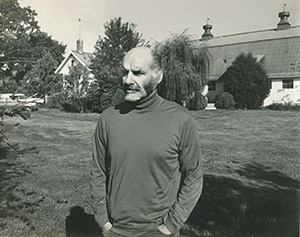
    Peter Tompkins, author of best selling titles in the fields of metaphysics and ancient mysteries, and co-author of The Secret Life of Plants. This photo, taken in 1971, is of Peter at the ‘Barn’, where Ptolemy grew up. Image courtesy of Ptolemy Tompkins

    RS: Your father had an amazing life in his own right. Wasn’t he an American spy behind the lines in Rome during World War II?

    PT: Yes, my dad was behind the lines. He wrote a book on it, A Spy in Rome. He posed as a Roman Fascist, and once had the SS officer in charge of finding him (they knew there was a spy somewhere about) over for dinner. He made him an omelette, an obvious luxury at the time, and the officer detailed the tortures they had in store for the American spy once they found him. Of course the rest of life pales a bit after something like that.

    RS: Your father at one point was vigorously engaged in the search for Atlantis. Could you talk a little about what it was like to take part in it? 

    PT: “Taking part” is probably an exaggeration. I was around. My dad was convinced that the Edgar Cayce readings about the rising of Atlantis were correct. He spent thousands and thousands of dollars photographing the limestone formations off Bimini – the so-called “Bimini Road.” My father loved the idea of Atlantis returning because he wanted the world to become a kind of new Eden. He was a true father of the New Age in this sense – he had the core New Age belief that the world once was, and would be again, a better place. But not better in some mundane sense, but in the sense of being elevated back into a spiritualised condition that it had fallen away from. That’s what the Bimini stuff was all about. Generally speaking, one had to be naked during the filming. There were often times when I was the only one aboard the various boats he hired with a bathing suit on. It drove my dad nuts.

    RS: With all of your exposure to the New Age counterculture, what things would you say are the most valuable that you learned?

    PT: My father taught me the fathomlessly valuable lesson that the mundane world we see around us isn’t all there is, and that if we’re impatient with the limitations of existence as it presents itself now, we are so with good reason. Deep within, we know there’s more. My dad was a pain in the neck to a lot of people. He was far from a perfect person, and he was, I’d say, genuinely a touch mad. But he had a certain nobility of character. He was, in his misguided and often destructive way, truly a great man. Many people think that about their fathers, of course. I think one of the reasons I’ve always been comfortable criticising and making fun of him is because I’m so convinced he had that core of greatness.

    RS: You’ve worked intensively with Eben Alexander in writing his two books, Proof of Heaven and Map of Heaven. Eben is best known for a long and powerful near-death experience he had when he was in a coma in 2008. Could you say a little bit about how you see his experience and how you regard him personally?

    PT: One belief about the world I hold very strongly is that, as the New Age adage has it, everything is significant. The problem, or rather the challenge, it seems to me, lies in celebrating that fact even when the significance one encounters is problematic. It’s great when you find a parking space just when you need one, but that doesn’t mean the world is some giant pinball machine rigged in your favour. Sometimes the odd synchronicities and resonances of life are much more challenging. In the case of Eben, my biggest struggle was just how similar my relationship to him was to my relationship to my dad. I was eleven when The Secret Life of Plants transformed my life overnight, and I got to see the effects of that kind of instant celebrity very close up. Yet at the same time I myself was completely invisible.

    The same thing happened with Proof of Heaven. I worked like a demon to get that book in shape for publication. It took me about four months, and by the time it was done, it was, experientially speaking, my book, not Eben’s. A great portion of the writing in it is by me, not Eben. At the same time, the book describes Eben’s life and his experience. I did not make anything up, and I had full faith in Eben’s honesty. When the book came out and went right to the top of the bestseller lists, and Eben was praised for his fine writing style, etc., I found myself in a situation that really did feel somewhat choreographed. Another person was being praised through the roof beams for a book that I had in large part written. I had, I realised, a couple of options, the only sensible one of which was to be completely unfazed by it. Who wants to be the kind of person who raises their hand at the back of class and says, “Hey, that was my idea, not his!” It began to seem quite clear to me, as the success of the book continued, that I should view the whole thing as a kind of lesson in humility. T.S. Eliot, in the Quartets, says that humility is endless. If T.S. Eliot says that, who am I to argue? So I just made a point of trying to celebrate the success of the book, the good that it was doing, and not get caught up in picayune gripes about not getting the attention myself.
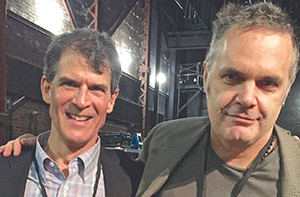
    Eben Alexander and Ptolemy at the Marion Institute in 2014. A great portion of the writing in Alexander‘s Proof of Heaven is by Ptolemy. Image courtesy of Ptolemy Tompkins

    It worked pretty well until that article came out in Esquire magazine which purported to rip the veil away and expose Eben as the calculating phony he really was. The article was full of errors, and made a very brief mention of me, three or four lines, most of them incorrect. I thought: Jesus, here this guy wants to discredit Eben, and he won’t even do me the service of using me as a tool to do so? Somehow I found this really irritating. Eben – again, like my dad – is a great guy, but he’s also frustrating.

    In the end, I came away feeling that his experience was true. There was something about the way he described it in our phone interviews that just made something in me click. It resonated. More than anything else, it reminded me of the visionary journeys made by a number of Persian mystics. One of my favourite books is Spiritual Body and Celestial Earth, an anthology of these experiences compiled and edited by the great French scholar of Islam, Henry Corbin. There were details in Eben’s narrative that brought that book to mind in a truly extraordinary way. Every detail of his journey, from his beginning in the subterranean murk to his meeting with the sister/angel figure to his journey beyond that meeting into the “dazzling darkness” where he encounters God… All of this was just so wildly resonant, and I somehow just knew he couldn’t have been making it up.

    RS: Could you talk about your own beliefs on the afterlife, for example as you discuss them in The Modern Book of the Dead?

    PT: For most of my adult and semiadult life, I have been obsessed with the idea of personal survival. That the you that is really you, and the me that is really me, does not fade away or fall apart with the death of the body, but continues on. Most importantly, I have been taken up with the idea that survival is above all else personal and individual. Nicholas Berdyaev, the Russian writer and philosopher, wrote a three-word sentence that sums all this up: “Personality is indestructible.”

    I was around in the ’70s when my stepbrother Nicholas Vreeland, the Buddhist abbot, first became interested in Buddhism. I looked up to Nicky a great deal, and as he wandered into Buddhist practice, I wandered into one Buddhist book after another. At first I was hugely taken with what I read. But gradually, something began to bother me. I realised the Buddhist focus on the unreality of self at all levels was something I could not accept. The key feature of life, for me, was that it was personal. People are personal, but so are animals and, for that matter trees and plants, just like my father said. Corbin said that in the world above this one, the primary question we ask about what we see there is not “what” but “who,” because up there, everything is a “who.” This is the root of why children love cartoons and fairy tales where everything is personalised, animated – that is, given an anima. The Buddhist suggestion that the self is actually not individual and eternal but aggregate and passing… well, by the time I was in my early twenties I found myself in open rebellion against this idea. I didn’t dislike Buddhism, and I continued to read Buddhist books. At the highest level, I do believe all faiths converge. But I believe that the level where this happens is, quite simply, so high that talking about it from our present vantage point is essentially impossible. I’ll tell you this: if there’s one belief I know I will absolutely never abandon, it is the value of personality – of the individual being. The fact that we, each of us, are both eternal and personal strikes me as the most interesting fact there is.

    RS: Another book of yours is The Divine Life of Animals. Many people are convinced that animals (especially their pets) do have a kind of afterlife. What did you discover in looking into this topic, and what do you think the truth is?

    PT: The Divine Life of Animals arose out of an article I wrote for a magazine called Guideposts where I worked for many years. The article was called “Will My Pet Go to Heaven?”, and it is not exactly a masterpiece of metaphysical speculation. What I discovered working at Guideposts is that there are a lot of wonderful people out there in America, and the world at large, who love their pets deeply and suffer intensely when they lose them. Imagine a woman living in, say, Iowa. Her husband served in World War II, and they live a long, happy, and traditional American middle-class life. Then, as so often happens, the husband dies first, and the wife, alone and heartbroken, begins to rely more and more on the company of her pet – a dog, let’s say. Then the dog dies. Suffering deeply, this woman turns to her clergyperson for reassurance that, just as her husband did not simply blip into nonexistence but exists still, in a world beyond this one, so too does her pet. Alas, her clergyperson, following a long (but far from unanimous) tradition among Christians, tells her that no, there are no dogs in heaven. This has the predictable result of devastating the woman. After all, she relies on her clergyperson for answers to the big questions, and what he or she says, she believes.

    I determined to marshal some evidence that the Christian faith (the faith of the vast majority of Guideposts readers) is far from unanimous on this point. The article received a mind-boggling number of letters in response. Some of these were from cranky by-the-book types assuring me I was wrong, but the vast majority were from people who had suffered the loss of a pet and were vastly grateful to hear, from a source they trusted, that there was more to the picture – that the essence of their pets had indeed survived. There’s a very popular poem called “The Rainbow Bridge” that describes how when a person dies, they will cross the Rainbow Bridge and be greeted by all the animals they have ever loved. This poem is saccharine to the point where it actually does hurt my teeth to read it. And yet, hidden beneath all the maple syrup, there is a core truth: there is a bridge between this world and the worlds above this one, and when we depart from this world, we do not vanish into an impersonal mush, but into a world that is specific and personal just as this world is, only more so. So that’s what I ended up enlarging into The Divine Life of Animals.

    Unfortunately – or perhaps just unavoidably – once I secured a contract for the book, I made it the kind of book I like. That is to say, a more complex one than most of those nice ladies who read Guideposts wanted. This has always been my problem as a writer. I’m too fancy for the people who like simple books, and too simple for the people who like fancy ones. So it goes!
    RS: Your latest book is called Proof of Angels, and you’ve spent a lot of time thinking and writing about people’s encounters with angels. What do you think about angels?

    PT: I think angels are real, and I wish I knew more about them. During my decade at Guideposts, I wrote regularly for Guideposts’ sister magazine, Angels on Earth. Once again, it has a readership largely composed of what you might call conventional, old-fashioned Christians. The original meaning of “angel” is, of course, “messenger,” and what chiefly interests me about angels is the way in which the appearance of one can instantly transform a person’s view of reality. You can’t really use the word “angel” anymore and have it convey any kind of genuine charge. It’s been too much doused in the maple syrup of market-driven spiritual writing (a problem that I know I myself contributed to). But originally, angels were beings characterised by their numinousness, their power, and what you might call their awfulness, taking the root of that word in its original sense, as something inducing awe.

    A crucial key to believing in angels today is to believe in demons too. This is much easier to do, or at least much easier for me to do, because while I bog down when I try to read Augustine or Aquinas on angels, I am riveted when a contemporary writer like Louis Proud or Joe Fisher describe their interactions with demonic beings. The whole succubus/incubus business, with people engaging in what, to hear them talk, is entirely satisfactory sexual congress with nonphysical beings, I find fascinating. There is much literature on this subject, and so much is just so believable. So belief in demons is a great sort of gateway drug to belief in angels.

    One of the single most momentous events in my adult life came when a friend demonstrated to me beyond all doubt that Ouija boards work. With patience and the right circumstances, the planchette really does move, and decidedly individual personalities, or subpersonalities, come through. Who or what are these entities? I don’t know. Is it a good idea to get involved with such entities? I would say no. But is there something real going on here? Absolutely. I’ve had it proved to me, and no one could de-convince me of what I experienced. So I’m very grateful to the demonic world. It had a hand in breaking down my culturally engrained positivist/materialist tendencies that were hardwired into me as a member of modern culture. I see a little more of the real world – the world that is partially material but in much larger part spiritual – as a result of that brief flirtation with the murkier levels of the spiritual world.

    RS: In this whole field, how do you personally separate fact from imagination?

    PT: I think one of the absolutely central keys to accepting the reality of the spiritual world is understanding that all perception is a collaborative event. We are co-builders of everything we see and experience. Ordinary, mundane reality is a creation that takes a fantastically complex amount of work on the part of our brains and unconscious minds to put together. The notion that anything we encounter in our world is just “there” and that we are seeing it objectively, with no help from our imaginative faculty, is, as Coleridge tried so hard to tell us, absurd. The world is a labyrinth, and separating the real from the unreal is a task that greets us anew each day when we wake up (and, if we listen to the traditions, one which will continue to challenge us after we die, only more intensely).

    What to hang on to in this carnival of mirrors? I think the Hungarian Anthroposophist Georg Kühlewind was on to something very important when he said that if we experienced the reality of ourselves – the inner “I” that is our true identity – with the concreteness that we experience an object that we can touch and feel in the material world, most of our problems would vanish. In line with that, I think I’d say that the first thing to do to stay oriented in the maze of existence – both incarnate and disincarnate – is to come to an unshakable belief in the reality of ourselves. Before we can believe anything “out there” can be real, we have to believe – to know – that we ourselves are real. The whole initiatory tradition, from Greece on back to Egypt and who knows where, seems to have that as its primary argument. I’d say that’s what my dad believed, so in that and many another respect, I’m very much his son.

    Ptolemy’s books – including his latest Proof of Angels – are available from all good bookstores and online retailers. His website is www.ptolemytompkins.com.

    Photos of Peter Tompkins/Ptolemy Tompkins courtesy of Ptolemy Tompkins.

    [alert type=”general” dismiss=”no”]This article was published in New Dawn 155.[/alert]

    [alert type=”success” dismiss=”no”]If you appreciate this article, please consider subscribing to help maintain this website.[/alert]

    © New Dawn Magazine and the respective author.
    For our reproduction notice, click here.
  • Magicians of the Gods: An Interview with Graham Hancock

    Magicians of the Gods: An Interview with Graham Hancock

    From New Dawn 153 (Nov-Dec 2015)

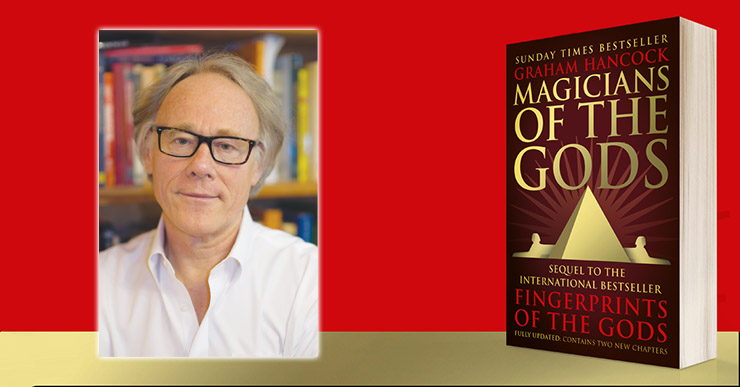
    Author and theorist Graham Hancock has had a sizeable impact upon the popular understanding of humanity’s ancient past. His global 1995 bestseller Fingerprints of the Gods contended that some previously ancient but highly advanced civilisation existed in prehistory, one which served as the common progenitor civilisation to all subsequent known historical ones. Further books such as Keeper of Genesis (with Robert Bauval), Underworld (studying underwater ruins as evidence of lost civilisations) and others propose bold new theories that challenge mainstream dogma.

    Hancock’s new book Magicians of the Gods: The Forgotten Wisdom of Earth’s Lost Civilization – a sequel of sorts to Fingerprints – gathers compelling evidence pointing to an ancient global cataclysm, caused by devastating meteor impacts, that may have all but erased a highly advanced human society and forced the survivors to, in essence, start again. Hancock also presents evidence the Earth may soon face this potentially species threatening meteor stream again.

    David Thrussell spoke to Graham Hancock in this exclusive interview for New Dawn.

    DAVID THRUSSELL (DT): From a distance, you appear to have what could be described as an ideal life Graham, travelling around exotic and interesting places, exploring the edges of history and knowledge. Are there any downsides, disappointments or frustrations in your work?

    GRAHAM HANCOCK (GH): I feel glad that I’ve had the opportunity in this life to explore and spend time in so many incredible, mysterious, profoundly moving ancient sites, all around the world. It’s been a great privilege to have the opportunity to do this, and I have no complaints whatsoever. I’m grateful for my life. I have a lot of freedom and I’ve worked from home since I was 29 as a matter of fact – that’s when I decided I couldn’t work in a large organisation anymore, and struck out on my own. For a very long time I was completely broke. Eventually I started to manage to make a living from it. But I have no complaints. I think I’ve been very fortunate and I’m grateful for the life I’ve had the opportunity to lead.

    DT: How long have you been working, brewing away on the new book [Magicians of the Gods]?

    GH: Well in a sense, 25 years. As a focused project, about 3½ years, but this book draws on my interests and enquiries into this field going back to the end of the 1980s.

    DT: Now, if you had to advance a single most compelling piece of evidence to support your theory, what would it be and why would it be that?

    GH: Well, it’s more complicated than that. This is not a problem that can be solved by a magic bullet. This is a problem that requires co-ordination of evidence from many different sources. I would offer you three pieces of evidence that are all in a sense joined together, and one of those pieces of evidence, a very important piece of evidence, is something we have now, but I didn’t have when I wrote Fingerprints of the Gods in 1995. It’s effectively a smoking gun, globally. Scientific evidence for a global cataclysm between 13,000 and 12,000 years ago. That was essentially the hypothesis I put forward in Fingerprints of the Gods, that there had been a global cataclysm between 13,000 and 12,000 years ago, and it wiped out an advanced civilisation, and I speculated on many possible causes of that cataclysm – notably pole shift and Earth crust displacement.

    What happened since 1995, and particularly since 2007, is that a group of scientists have put before the scientific community – very little of this has yet leaked out to the public – absolutely compelling evidence Earth suffered a series of impacts from fragments of a giant comet, and these impacts happened 12,800 years ago when several fragments hit the North American ice cap, causing global flooding and radical climate change. It happened again 11,600 years ago when more fragments from the same comet came out of orbit and smacked down into an ocean – almost certainly the Pacific – sending up a huge plume of water vapour into the upper atmosphere and causing very sudden global warming. So the interval between those two periods, the 1,200 years between 12,800 years ago and 11,600 years ago, is an episode of almost unparalleled global cataclysm, coupled by massive extinction of animal species, the mega mammals, the mammoth, the woolly rhino, and so on. And this is the event that I believe lost us a whole civilisation of pre-history that previously has not entered the archaeological records.

    Now, let’s co-ordinate this with the latest discoveries in archaeology. Remember that one of the two dates for that cataclysm is 11,600 years ago. This was a sustained event that involved two separate bombardments from fragments of a comet. On both occasions there were massive sea level rises and a global cataclysm unfolded. The first occasion 12,800 years ago, the second occasion 11,600 years ago, were also accompanied by global flooding and massive sea level rises. It’s therefore intriguing that the archaeological site in south eastern Turkey, known as Göbekli Tepe – which means ‘pot-bellied hill’ in the Turkish language – was created 11,600 years ago by people who already knew how to work with giant megaliths. Göbekli Tepe is an anomaly, because it’s 7,000 years older than other megalithic sites around the world, and yet it demonstrates advanced techniques of stonework and stone cutting, organisation of labour, planning, site design and alignment to the heavens. This is not the work of a group of hunter-gatherers who woke up one morning and felt suddenly inspired to create the world’s first megalithic architecture. In my view, what we’re looking at is a transfer of technology, the knowledge brought by the survivors of the lost civilisation, including the knowledge of how to create large-scale megalithic structures – and at exactly the same moment 11,600 years ago we get this sudden and unexplained appearance of a sophisticated megalithic site in south eastern Turkey.

    We also get the dissemination and uptake of agriculture in exactly the same region, whereas previously the inhabitants had been entirely hunter-gatherers. I say again, what we’re looking at is a transfer of technology, the fingerprint of the survivors of a civilisation that was lost in the cataclysmic events between 12,800 and 11,600 years ago.

    And I mention a third point, the age-old myth of Atlantis, which isn’t actually that old because the version of it that comes down to us – the only version that comes down to us – is in the works of the Greek philosopher Plato. Plato said he got the story of the submergence and destruction of the advanced civilisation of Atlantis through his ancestor Solon, the Greek law-maker who visited Egypt in 600 BCE, and there was told, by Egyptian priests, the story of Atlantis. And they said Atlantis had been destroyed and submerged, having incurred the anger of the gods, 9,000 years before the time of Solon. We know that Solon was in Egypt around 600 BCE, therefore they are talking about 9,600 BCE in our calendar, 11,600 years ago, which is the date precisely for the appearance of these hitherto unheralded techniques of megalithic architecture and agriculture in the region of south eastern Turkey.

    DT: The cataclysm you’re talking about has been staring us in the face really, hasn’t it?

    GH: It has been staring us in the face, but I don’t blame historians and archaeologists for failing to get to grips with it sooner than this. Because the leading scientists in the field have only really been compiling and presenting evidence on what is now referred to as the Younger Dryas comet for the last seven or eight years. It’s a very recent discovery and the reason it’s a recent discovery is that the major impacts of this comet 12,800 years ago were on the North American ice cap. This was still the Ice Age. North America, as far south as New York, was covered with ice, two miles deep, and at least four fragments of the comet hit the ice cap. But they did not leave prominent craters on the ground because the craters were in the ice itself and the vast heat and kinetic energy of the comet melted away that ice, so the craters were transitory and what we have is shock effect on the ground underneath. Recently, a number of craters have been found. The kind of craters that would be left when an object hit a two mile deep ice cap and transferred its shock to the bedrock underneath.

    Much more important is the evidence of the Younger Dryas scientific team – more than 30 scientists are working on the Younger Dryas comet. That evidence is based on what I call “impact proxies.” When you get an object coming in at 60 or 70 thousand miles an hour, and that object is a kilometre or two in diameter, it has unbelievable quantities of kinetic energy, and then you’re looking at an explosive power in the range of the entire nuclear arsenal of planet Earth, going up at once, with any single one of these objects. And there are certain, very recognisable outcomes of this. One is melt glass. You have heat unleashed in excess of the boiling point of quartz. Temperatures in excess of 2,200 degrees centigrade. This produces melt glass which is indistinguishable from the melt glass we find as a by-product of nuclear explosions. You also get carbon micro-spherules and very distinct nano-diamonds that are caused by the shock and heat. These nano-diamonds are only visible under a microscope, and they are combined with the melt glass, the carbon micro-spherules, and other evidence all around the world. They are compelling evidence for a gigantic cosmic impact 12,800 years ago.

    And, by the way, it’s exactly this kind of evidence that was initially put forward to prove the asteroid that wiped out the dinosaurs 65 million years ago. There’s only two occasions in Earth’s history, in the last 100 million years, that we get precisely the same impact proxies spread around the world. One of them is the so-called KT event 65 million years ago that wiped out the dinosaurs. And the other is the hitherto unrecognised, but now very obvious extinction level event that happened 12,800 years ago, and was caused by the Younger Dryas comet. I say “Younger Dryas” because that is the geological name for the period between 12,800 years ago and 11,600 years ago when the Earth’s climate fell into a sudden and hitherto unexplained deep freeze. We now know the cause of this. It was our interaction with the fragments of a giant comet, and the effects were truly cataclysmic.

    [alert type=”info” dismiss=”no”]If you appreciate this article, please consider a subscription to New Dawn magazine.[/alert]

    DT: Is it reasonable to suggest that mainstream academia, media and science are wedded to a particular view of history?

    GH: Yes. It is reasonable to suggest that, and it’s not surprising either. It’s just always the case – when you have any area of study, any discipline, whether it’s geology or whether it’s archaeology for that matter – that a body of knowledge is built up. And respected elders have contributed to that body of knowledge, and the new generation obviously respects the work of their elders. And gradually what builds up is a reference frame, a picture for how that area of study should be. In the case of archaeology, the picture that built up over the last 100 years of work is of a slow evolution of civilisation – that our ancestors were hunter-gatherers and nothing more until perhaps 8 or 9 thousand years ago. Then we begin to see the gradual movement towards more permanent settlement and about 5,000 years ago we get the first big cities and the first great megalithic architecture. This is the picture of civilisation taught to us by mainstream academic historians and archaeologists. It’s taught in the schools, it’s by and large conveyed through the media, but it is not a fact, it is a reference frame. It is a reference frame built up by 100 years of archaeological study. And this is, I think, the problem with archaeology and other scientific disciplines that get locked in a particular reference frame. When new facts emerge that don’t fit the reference frame, they find it difficult to adjust to them, and the first step is the attempt to discredit those facts. When more and more evidence comes in that the existing paradigm can’t explain, eventually the paradigm gets overthrown. A lot of good people who’ve done a lot of good work, who are convinced they’re right, who respect the work of their elders, and who don’t want to rock the boat – I think that’s the central problem. It always happens in science. No ideas change suddenly overnight without overwhelming new evidence that the previous paradigm cannot explain. That’s what we’re finding in the field of history and archaeology now – more and more new evidence coming in that simply can’t be explained by the existing reference frame of history.

    DT: Would you care to speculate – if the theory that you’re advancing is indeed correct – what pre-history looked like? What would history on Earth look like before this comet struck the planet?

    GH: A much more complicated world than the world portrayed to us by mainstream historians and archaeologists. Not a world populated entirely by hunter-gatherers as they suggest, but a world in which hunter-gatherers, and a more advanced civilisation, co-existed. This, in a way, is not odd. If you think about it, we are a very advanced technological civilisation today – Western technology, the industrial-technological-complex that has spread around the world, but we are not alone. We share the world with hunter-gatherer people – hunter-gatherers in the Kalahari Desert, for example, and in Southern Africa. Hunter-gatherers in the Amazon Basin. There are even tribes in the Amazon Basin who are completely un-contacted, who don’t even know that we exist; an advanced technological culture has not even impinged on their worldview yet. So the co-existence of advanced technology with hunter-gatherers that we see today, I would project that back into the past, and I would say more than 13,000 years ago during the Ice Age there was a much more advanced civilisation on this planet, than is given credit for by historians and archaeologists. It is remembered in myth and tradition all around the world, and it’s increasingly supported by recent striking archaeological discoveries such as Göbekli Tepe.

    DT: You mentioned two obvious cataclysmic events – the dinosaur extinction and the Younger Dryas events. Is it possible there have been other cataclysmic events that we have no inkling of?

    GH: Certainly there have been other cataclysmic events, and we do have inklings of them. The only question is, whether they affected the human species, and this becomes a matter for further enquiry. I hold, for the moment, the view that anatomically modern humans – people who look just like you and I – have only existed on Earth for about 200,000 years. It may well be that further discoveries will produce evidence of earlier anatomically modern humans. I don’t rule that out. But at the moment the evidence points to the emergence of our anatomically modern line about 200,000 years ago. We have, for example, a skeleton from Ethiopia, 196,000 years old, which is indistinguishable from an anatomically modern human being. So for these cataclysms to involve humanity and to impact the human story, they need to have happened within a human timeframe. This is why the Younger Dryas event is so intriguing because not only is it within the human timeframe, it’s right on the edge, on the border of a period when historians and archaeologists think civilisation began. Yet they had not yet taken into account this extinction level cataclysm, right in the backyard of history, and I would say that until they do take it into account, all their notions about the origins of civilisation are up for grabs.

    There have been multiple other global cataclysms of an extinction level going back hundreds of millions, even billions of years in the past. These things happen from time to time, and every time they happen they reset the clock on this planet, and life changes due to these dramatic and radical events. I think it’s only the most recent one, the one that happened 12,800 years ago, that directly impacted the human story – and this recent global cataclysm has not yet been taken into account in the model building of our past by historians and archaeologists.

    DT: Is it possible that mainstream science, the media, or even the general population in a sense, don’t want to know about our own history as a species?

    GH: There appears to be a kind of directive operating at governmental level, not to say things too alarming. It particularly applies to issues that involve global cataclysms. Anybody who’s worked in the field of geology will know that proposing a cataclysmic agent results in furious criticism. There was a great geologist called J. Harlan Bretz – whose work I write about in Magicians of the Gods – who provided the first evidence of cataclysmic flooding in North America, particularly in the Pacific north-west, in the channelled scablands, an area I researched quite intensively for Magicians of the Gods. J. Harlan Bretz was absolutely 100% right, but it took from the 1920s, almost to the 1970s, before he was accepted as being right. Prior to that he had been subjected to the most grievous and unpleasant abuse, which a weaker man might not have borne. In the end he turned out to be correct and he lived until the age of 99. And when he was awarded America’s highest honour for a geologist, he said: “My only regret is that all my enemies are now dead, and I have no-one to gloat over.”

    DT: If there is an active effort to forget or obscure history, why would that be?

    GH: I’m not sure. I don’t want to go in the direction of a conspiracy. I think it’s just the way people’s minds work. We find it difficult to conceive of certain things, or apply them to ourselves. There may be a conspiracy. I have to contemplate this possibility a little bit in the book. I don’t like conspiracy theories – it’s an area of enquiry where facts get thin on the ground and speculation gets very thick and long. When I look at the way the catastrophists’ ideas have been systematically rubbished, sometimes for decades until proved correct – the same was true, by the way, about the dinosaur impact. Initially no scientists believed that either. Luis and Walter Alvarez, who initially proposed the idea of a cosmic impact 65 million years ago, were subjected to abuse and persecution, and they too were eventually vindicated.

    DT: Are you aware of the work of Steven and Evan Strong in Australia?

    GH: I know Steven and Evan Strong. They were kind enough to show me a number of interesting sites in Australia last year. I’ve got a lot of respect for their leg work and they’ve opened my eyes to mysteries in Australia which I do intend to look at in the future. Australia has not been a big focus of my work up till now.

    DT: Do you ever suffer from ‘apocalypse fatigue’? It seems to be a staple of human endeavour, doesn’t it, thinking that a cataclysm is around the corner?

    GH: No, I don’t suffer from ‘apocalypse fatigue’, and I don’t go around thinking that the end of the world is nigh, either. I do think we should be paying much more attention to our cosmic environment. At the moment the human race has its priorities all screwed up. We’re capable of spending trillions of dollars a year on weapons of mass destruction, quite ready to wipe each other out and destroy this beautiful and precious habitat, the Earth, that the universe has given us. Humanity shows every sign of being an insane species at the moment, an insane and unconscious species, totally devoted to material production and consumption, uninterested in matters of spirit. Negligent of this beautiful garden in which we find ourselves.

    If we were to take the responsibility of human life seriously, we would closely and carefully inspect our immediate cosmic environment. I have drawn attention in the book to the fact that the debris stream of the giant comet that caused the cataclysm 12,800 to 11,600 years ago is still in orbit. It’s called the Taurid meteor stream. We pass it twice a year. If we were smart we’d pay a great deal of attention to the objects that orbit in the Taurid meteor stream. And if, as seems likely, some of them threaten Earth in the future, we have the technology, we have the ability to avert that danger. I’m only interested in the issue of future cataclysms to the extent that we can avoid them, and that foreknowledge of them would help us avoid them, and I believe that is the case with the cosmic threat. There is a threat, there is an ongoing danger. Most responsible and serious astronomers would absolutely agree with that.

    We mark World Asteroid Day on 30 June, which is an attempt to draw attention to the dangers of our immediate cosmic environment, and to do something about it. We’re probably the first civilisation in the history of Earth that has the capacity to intervene in our cosmic environment and to deflect or divert objects that might threaten life. I think we’d be doing a lot better if we directed our resources more responsibly – a lot of the money we spend on useless military pursuits at the moment – and channelled it instead to a thoroughly worked out space-watch project to ensure Earth never again suffers the kind of disasters it suffered between 12,800 and 11,600 years ago. We are going down the path of insanity and madness with our military spending. With all the fear and hatred and suspicion circulating in the world at the moment, we need to recognise that we’re all brothers and sisters, we’re one human family, and perhaps the prospect of dealing with a shared common threat would be the very thing to bring us together.

    DT: Ironic, isn’t it, there may be a weapon of mass destruction bearing down upon us all right now.

    GH: Yes, exactly. This is possible. A number of astronomers (including Bill Napier) and the mathematician Emilio Spedicato at the University of Bergamo, are all deeply concerned about the Taurid meteor stream. They believe it has a number of very large objects, including one that may be 30km wide, and the Earth crosses this stream twice a year. Some calculations indicate we may be crossing particularly lumpy and dangerous parts of the stream within the next 30 years or so. Nothing really could be more urgent. We need to pay attention to this problem. We need to identify objects that endanger Earth, and we need to move them. All of that we can do, it just takes the will. We already have the technology. But while we go around fearing and hating and suspecting one another, our eye’s not on the ball. Our eyes are on totally the wrong place.

    DT: I couldn’t agree more with you.

    Magicians of the Gods: The Forgotten Wisdom of Earth’s Lost Civilization by Graham Hancock is available from all good bookstores. Graham Hancock’s website is www.grahamhancock.com.

    [alert type=”general” dismiss=”no”]This article was published in New Dawn 153.[/alert]

    [alert type=”success” dismiss=”no”]If you appreciate this article, please consider subscribing to help maintain this website.[/alert]

    © New Dawn Magazine and the respective author.
    For our reproduction notice, click here.
  • Eternal Atlantis

    Eternal Atlantis

    From New Dawn 89 (Mar-Apr 2005)

    For more than one hundred years, mostly independent researchers who argued that Atlantis had in fact been destroyed by a great flood were ridiculed by mainstream scientists. Conventional scholars were convinced that Earth changes were incremental, requiring thousands and millions of years.

    They belittled Plato’s statement that Atlantis was engulfed by the sea “in a day and a night” as imaginative fantasy, and scoffed at any suggestion civilisations have ever succumbed to natural forces. These professional debunkers were in for a rude shock during late December, last year, however, when a relatively small-scale re-enactment of the Atlantis catastrophe was played out in the Indian Ocean.

    A single earthquake sent super-waves traveling at speeds of five hundred miles per hour across the sea to claim more than three hundred thousand lives in a dozen countries. The infra-structure of Sri Lanka, much of Indonesia and large parts of southern India were shattered beyond repair, without massive outside aid from the rest of the world. Multiply that disaster by a factor of ten and some appreciation may be had for the cataclysm that struck Atlantis. Had the Indian Ocean catastrophe been followed by just one more similarly destructive tsunami, the region would have been beyond reconstruction. Photographs and videos of the killer waves that came ashore resembled the last moments of Atlantis, before the geologically unstable island on which she perched so precariously was similarly overwhelmed.

    Exactly ten years before the Indian Ocean tsunami, two worlds changed forever. One of them was Earth. When Jupiter was struck by a barrage of meteors in the summer of 1994, their impact on the scientists of our planet was hardly less dramatic. Until then, most of them believed with the Larousse Encyclopedia of Astronomy that “the perfect timing and positioning required make the possibility of collision extremely slight.” Nonetheless, a comet six miles in diameter disintegrated in the Jovian gravitational field. Its pieces broke free and began a final pass, in tandem, around the Sun. During mid-July, stony remnants of the dead comet returned. A line of twenty one fragments, each about one-and-a-half miles across, hit the planet at more than thirty seven miles per second.

    Disbelieving observers watched, as columns of flame shot several thousand miles high into the atmosphere. Ejected fireballs larger than Earth itself exploded in full view of the Hubble Space Telescope. Impact of the cometary debris generated energy ten thousand times more powerful than mankind’s entire nuclear arsenal. For more than a year following these collisions, Jupiter was still pock-marked by their resultant super-heated gas-bubbles, one of which was large enough to have swallowed our planet whole. Centuries of calm assurance that Earth possessed some special immunity from outer space threats had been dramatically replaced by a more sober appreciation for our precarious position in the solar system.

    These two event-horizons of our time – one in outer space, the other from inner space – combined to provide some inkling of what happened to Atlantis, while underscoring the fragility of human civilisation, then and now. That is the great value in examining the Atlantean catastrophe: It is very up-to-date, because it is an eternal story. Numerous cultures around the world remembered four major floods followed by mass-migrations. This tradition was shared by such diverse peoples as the Incas of Peru, the Celtic Irish, Classical Greeks, the Aztecs of Mexico, and many others beside.

    The close fit results when we compare their folk memories with what science now recognises as a quartet of natural catastrophes that ravaged the Earth beginning more than five thousand years ago. But when physical archaeology was added to myth, astronomy and geology, a new light on the ancient past suddenly winked on. Its brightness uncovered the hitherto unseen causes that brought history into existence. And clearly exposed was a common theme that over and over again threaded together and made sense of all the diverse twists and turns in a vast human drama – Atlantis. The name was as inescapable as it was powerfully revealing.

    Applying that sunken realm to the four separate global calamities we now know occurred explains the beginning and development of civilisation, while simultaneously defining Atlantis within the credible parameters of real history, not speculative fantasy. It suffered not one but several different catastrophes, each one separated by many centuries, until a fourth destruction finally obliterated the kingdom.

    The Age of Atlantis

    My book, Survivors of Atlantis, describes these event-horizons for the first time, and elucidates them via traditions from Egypt, Mesopotamia, Morocco, the Canary Islands, Ireland, Wales, Scandinavia, pre-Columbian North America, Mesoamerica and pre-Conquest South America. Survivors of Atlantis relates another story yet to be told. This is the war Plato said the Atlanteans launched in a bold bid to conquer the world. Their hitherto neglected military adventure was intimately connected with and actually determined by the natural calamities which eventually overwhelmed them. The chaos men brought about on Earth was mirrored in the angry heavens.

    When the Atlantean Age suddenly ended around 1200 BCE, Pre-Classical Civilisation everywhere collapsed or went into irreversible decline, from Pharaonic Egypt and Homeric Greece to the Hittite Empire and China’s Shang Dynasty. Atlantis was one more victim of the worldwide catastrophe. And, like the others, it was an identifiably Bronze Age city, according to Plato’s description. Survivors of Atlantis describes each of the four global cataclysms, as uncovered by science and graphically related in the folk memories of peoples whose shores were washed by the Atlantic Ocean. In so doing, the lost empire comes into clearer focus than ever before. The legacy of its enduring influence on our current civilisation stands out for the first time in bold relief. And we come to realise that the story of Atlantis is the story of the world.

    In terms of power-politics, it was not much different from our own, tragically. By 1198 BCE, the day Atlantean militarists waited for so long finally arrived. The powerful Egyptian king, Merenptah, had died of old age. He was followed by no less than five rulers in quick succession, including the club-footed Siptah and Tewosret, a short-reigned queen. These prolonged political crises destabilised the XIXth Dynasty, and Atlantean strategists prepared to take advantage of the situation. Now the Egyptians were preoccupied with the accession of a new pharaoh and all the powerful implications, good and evil, a change of divine leadership inevitably brought. This time they had special cause for worry. A frightening omen appeared following the death of King Sethnahkt, who had just founded a new dynasty, the XXth. An immense, dark cloud began to cover the sky at unnatural speed from the west. The Sun turned blood red, then disappeared. Broad daylight was reduced to twilight, accompanied by a rain of black dust that fell for weeks over the entire land. “Men walk about like ravens,” the Egyptian scribe recorded. “No one can keep their garments clean anymore.”

    These ominous conditions boded ill for the Atlanteans, too. In the midst of organising an invasion of the Nile Delta, such signs and wonders in the heavens presaged disaster for someone. Having been born and raised on a geologically active island, they recognised the “black dust” as ash-fall blown in on the prevailing westerlies from some major volcanic event outside the Mediterranean. Naturally and anxiously, their thoughts turned to the ever-smoking mountain of their far-off homeland, Mt. Atlas.

    Their worst fears were confirmed when waves of human migration deluged through the Pillars of Heracles. Panicked refugees streamed by the hundreds of thousands along North African shores or in ragged flotillas of boats and ships overcrowded with dispossessed families traumatised by disaster. Most of them were fellow Atlanteans, and they had a report to make. “You can’t go home again,” they said, “because home is no longer there.” With hardly more than one day’s warning, the island of Atlantis had been torn by earthquake and sky-fire before the angry sea swallowed it whole. The accompanying devastation was so pronounced and widespread, that the entire region, including all foreign coastal areas raked by a series of ruinous tsunami waves, had been rendered uninhabitable. The occupied areas of Italy, Tripoli and the Mediterranean islands swelled with new populations of survivors, compromising living conditions everywhere.

    But the exiles brought with them more than tales of woe. Important sections of the home fleet escaped the catastrophe, carrying warriors and supplies, as well as crowds of displaced persons. The Sea People armada at Cyprus and Rhodes was appreciably reinforced by these new arrivals of warships and marines. More than before, the conquest of Egypt was needed to resettle the streams of refugees, their growing numbers making increasing demands on the limited resources of the occupied territories. Bolstered with fresh battle-cruisers, munitions and soldiers, the Atlantean commanders resolved to strike at once, while the Egyptians were still distracted by their royal interregnum and celestial portents. Nearly two thousand years before, the Atlanteans conquered Egypt for the first time as fugitives from a natural calamity. They would do so again. Let the fall of “black dust” be a sign of doom for the new pharaoh!

    The Fall of Atlantis

    Like other aggressors before and since, however, the Atlanteans would go down in defeat against a surprisingly capable leader, Rameses III. But the story of their military debacle and simultaneous destruction of their capital spread far beyond Egypt. In Ireland, there were tales of a “Sea People” known as the Tuatha de Danann. Their leader was Ogma, from Tir-nan-Og, the Irish Atlantis.

    According to a classic authority on early Ireland, Henry O’Brien, the Tuatha de Danann arrived at the south coast of Ireland in 1202 BCE. This date compares remarkably well with the final Atlantean catastrophe that occurred around the turn of the 12th century BCE. O’Brien, who wrote in 1834, knew nothing, of course, about the untranslated wall-texts at Egypt’s Medinet Habu or late 20th century oceanography and astrophysics confirming the ultimate destruction of Atlantis precisely in the same period he determined entirely from Irish folk tradition. His conclusions were supported in the next century by a fellow countryman, Michael Bailey, a leading dendrochronologist, whose investigation of Irish peat bogs revealed that a major climate change with disastrous ecological consequences took place around 1200 BCE. Bailey’s research contributed importantly to scientific understanding of the worldwide cataclysm that brought the curtain down on Bronze Age civilisation. O’Brien believed that the strange, obelisk-like towers still found in Ireland were erected by the Tuatha de Danann, citing the 10th century Book of Leccan, which tells of “the Tuathan tower”. Ruins of several such towers are found, appropriately enough, in County Roscommon, at Moy-tura, where the Tuatha de Danann decisively defeated their immediate enemies. Known more correctly as Moye-tureadh, the battle-area is translated as “the Field of Towers”.

    Hostilities among the various Atlantean groups in the midst of their disasters might in part be explained by their different origins, however related. The Tuatha de Danann told of four, great cities – Findias, Gorias, Murias and Falas – all simultaneously overtaken by a natural catastrophe and dragged to the bottom of the sea. They appear to have been located on separate islands in the Atlantean Empire, from which various groups contested each other for control of Ireland. Gorias, for example, was probably in the Gorgon Isles associated with the Canary Islands.

    The 16th century scholar William O’Flaherty recorded that the Milesians, the last of the pre-Celtic invaders, arrived before 1000 BCE. His general time-parameter, too, coincides with a Late Bronze Age Atlantis. Their leader was Eremon, a name synonymous for all Ireland. It appears to be a linguistic inflection on Euaemon, the fourth king of Atlantis in Plato’s dialogue, the Kritias. “The Book of Invasions” tells how Eremon established Tara as the capital of his new kingdom. Originally known as Tea-mhair, he named it after his wife, Tea. Together with her sister, Tephi, Queen Tea made Tara the spiritual centre of ancient Ireland. The women are described as daughters of the royal house in the Blessed Isles lost beneath the sea.

    The Milesians chief deity, Macannan Mac Lir, was a worldwide wanderer from Annwn famed throughout Celtic myth as “Land under Wave”, from the Brythonic an (“abyss”) and dwfn (“world”). Also known as the “Revolving Castle” (Caer Sidi), it was a fortified island of great natural beauty with fresh water streams and a circular-shaped city surrounded by concentric walls lavishly decorated with gleaming sheets of precious metal. The central palace was called Emahin Ablach, “Emhain of the Apple Trees”. His home-away-from-home, however, was at the Isle of Man, where Reel Castle allegedly covers his grave site.

    Although a god and supposedly immortal, he preferred death to eternity when Ireland went Christian. Before then, he traveled in a chariot as “the rider of the crested sea”, and was the divine patron of sailors. He founded Llyr-cestre, modern Leichester, and was head of the “three Chief Holy Families of the Isle of Britain”, known equally in Wales as “the Children of Llyr”. Today, he is better remembered as the figure of tragic disillusionment in Shakespeare’s King Lear.

    Resemblances between Macannan Mac Lir and Poseidon, the Atlantean sea-god, are unmistakable. Both crossed the waves in a chariot, were patrons of sailors, and progenitors of royal families. Their islands were identically configured into concentric walls sheeted in decorative metal, while “Emhain of the Apple Trees” echoes Atlas’ Garden of the Hesperides with its golden apple trees. The medieval Fate of the Children of Tursun likewise describes an island called “the Plain of Happiness”, where trees bearing golden apples grew in the “Garden of Hisberna”. In the lost “Druidic Books of Pheryllt” and “Writings of Pridian”, Ynys Avallach, or Avallenau were “more ancient than the Flood, when all the rest of mankind had been overwhelmed.”

    Avallenau was also the name of a Celtic goddess of orchards, reaffirming the Hesperides’ connection with Atlantis. Avalon was additionally referred to as Ynys-vitrius, the “Island of Glass Towers”, an isle of the dead, formerly the site of a great kingdom in the Atlantic Ocean, the same story embraced by Portuguese Gauls as their foundation-myth. Another Irish memory of Atlantis preserved in The Voyage of Maeldune, presented below, mentions the “Island of Apples”. Britain’s Geoffrey of Monmonth characterised an identically named place he additionally called “Fortunate” in his 12th century Vita Merlin. Atlantis was often referred to by Classical writers other than Plato (Strabo, Pliny, Aelian, etc.) as “the Fortunate Isle”.

    It was remembered in several other Irish epics, such as The Voyage of Bran. It told of “a distant isle, the plain on which the hosts hold games. Pillars of white bronze shine through eons of beauty. It is a lovely land through all the ages of the world, a silvery land on which dragon stone and crystal rain. Sweet music strikes the ear. The host races along Magh Mon, a beautiful sport. Coracle races against chariot.” Bran’s kingdom describes no other island than Atlantis, from its vast plain to horse races, similarly described by Plato.

    “Pillars of white bronze” suggest orichalcum, the high-grade, gold-alloy copper he reported was the extraordinary product of Atlantean metallurgy. It is mentioned again in other Irish accounts of Atlantis, such as the 9th century “Travels of O’Corra”, which told of a bright metal unlike any other, findrine, found at Formigas. The island “had a wall of copper all around it. In the centre stood a palace from which came a beautiful maiden wearing sandals of findrine on her feet, a gold-coloured jacket covered with bright, tinted metal, fastened at the neck with a broach of pure gold. In one hand she held a pitcher of copper, and in the other a silver goblet.” Here, again, is encountered the central palace surrounded by walls adorned by precious metals, together with typical mineral opulence, especially copper, described in the Kritias.

    The unique metal occurs again in “The Voyage of Maeldune”, where it is referred to as bath. The seafaring Maeldune lands at “a large, high island with terraces all around it, rising one behind one another; a shield-shaped island.” As he explored the island, he found “a broad, green race course”. But there were several other islands in the vicinity. The next one he visited was the “Island of the Apples” mentioned above. A third featured a city surrounded by a high wall, while a fourth was divided in two across its centre by a massive wall of gleaming brass. The last island had no less than four concentric walls arranged in rings encircling each other. The outer wall was decorated with gold, the second with silver, the third with copper and the innermost wall with crystal.

    It is clear that the four places Maeldune visits are not separate locations, but alternating rings of land and water on one, large island – a self-evident representation of Atlantis remarkably presented in an Old Irish account. But it was not the only one. Others recalled Rath-cruachain, a circular, stone fortification with walls thirteen feet thick at the base and surrounded by five concentric ramparts. Its bronze, golden and silver palace was the centre of the fortress-like city, which one day vanished under the sea. Even the Atlantean sacred numeral occurs in Rath-cruachain‘s five walls.

    Stonehenge’s Connection to Atlantis

    If Eremon-Euaemon was the Atlantean-Milesian monarch of Ireland, Late Bronze Age Britain was ruled by the eighth refugee king mentioned in Plato’s account of Atlantis. Mestor, whose name meant, “the Counselor”, may have been associated with Europe’s most famous megalithic site, which gave counsel, as it were, regarding the movements of the heavens. According to archeo-astronomers, Stonehenge was a kind of astronomical computer primarily oriented to the positions and phases of the moon. Indeed, it resembles the concentric city-plan of Atlantis itself, even to the inclusion of Atlantean sacred numerals, Five and Six, repeated throughout its design.

    Archaeologists believe the structure was first laid out by 3000 BCE, began to reach the apex of its construction 1,400 years later, and was suddenly discontinued around 1200 BCE. Its development, use and abandonment parallel Atlantean immigration at the close of the 4th millennium BCE, the zenith of Atlantis as the foremost Bronze Age civilisation, and final destruction in 1198 BCE. Not coincidentally, Atlas was depicted in Greek myth as the founder of astronomy; hence, his representation as a titan supporting the sphere of the heavens on his shoulders. He therefore signified the birth and florescence of astronomy at the city named after him – Atlantis.

    Its impact on Britain was no less dramatic than in Ireland, as suggested by native folk memories of foreigners arriving from an oceanic catastrophe in the deep past. Comparisons between Irish versions and their Welsh counterparts are often very close, suggesting a common event that was experienced independently by two different peoples. For example, the story of Murias, the Tuatha de Danann’s sunken homeland, was almost identically known in Wales as Morvo. But British renditions of Atlantis throw a new light on the fate of its survivors.

    Llyon Llion was the Lake of Waves, which overflowed its banks to inundate the entire Earth. Before this former kingdom was drowned, the great shipwright, Nefyed Nav Nevion, completed a vessel just in time to ride out the cataclysm. He was joined in it by twin brothers, Dwyvan and Dwyvach, who, landing safely on the coast of Wales, became the first Welsh kings. This myth is less the slight degeneration of an obviously earlier tradition than it is an example of the Celtic inclination toward whimsical exaggeration, making a mere lake responsible for the world flood. In all other respects, it conforms to other Atlantean deluge accounts, wherein surviving twins, like those listed in Plato’s Atlantis story, become the founding fathers of a new civilisation.

    Hu-Gadarn is mentioned in the Hanes Taliesan, the “Tale of Taliesan,” where he is known as Little Gwion. If this affectionate diminutive seems derivative of the Trojan capital, Ilios, (Wilion in Hittite and perhaps the Trojan language, as well), the impression is deepened when Hu-Gadarn says, “I am now come here to the remnant of Troia.” Troy was allied with Atlantis through common blood-ties. Hu-Gadarn is regarded as the first ancestor of the Cymry, the Welsh people.

    His Atlantean identity is no less apparent: “I have been fostered in the Ark,” he confesses. The Hanes Taliesan reports, “He had been fostered between the knees of Dylan and the Deluge,” arriving in Wales after a worldwide flood whipped up by a monstrous serpent.

    Llys Helig is a stony patch on the floor of Conway Bay, sometimes visible from the shore during moments of water clarity, and still locally regarded as the site of a kingdom formerly ruled by Helig ap Glannawg. He perished with Llys Helig when it abruptly sank to the bottom of the sea. The stones taken for the ruins of his drowned palace are part of a suggestive natural formation that recalls one of several Welsh versions of the Atlantis disaster. Others speak similarly of Llyn Llynclys. A large, dark pool of fathomless water in the town of Radnorshire is supposed to have swallowed an ancient castle known as Lyngwyn.

    In the Preiddu Annwn, “the Spoils of Annwn”, King Arthur and his men escape from Caer Wydyr, the “Fortress of Glass”, which sank beneath the waves soon after. A “Tower of Glass” appears in the Historium Britanum by medieval chronicler Nennius. Standing majestically in the midst of the sea, Turris Vitrea echoes only the voices of outsiders, and seems utterly abandoned – a Celtic device symbolising death. Similar Welsh tales told of Caer Feddwid, the “Court of Carousal”, and Caer Siddi, opulent island-kingdoms featuring fountains and curative fresh water springs, as similarly described in Plato’s Atlantis dialogue.

    The “Tale of the Lowland Hundred” tells of Cantref y Gwaelod, an island forty miles long and twenty miles across. It was filled with fruit trees, natural hot springs, forests and ringed by a great range of mountains. A system of sluices created alternating rings of land embankments and moats with canals bridged over by connecting walk-ways. The island had a capital, Caer Gwyddno, which extended political control over sixteen neighbouring islands and cities. But a disaster overtook the city, and it sank beneath the ocean, drowning most of its inhabitants. King Gwyddno Garanhir, along with a party of survivors, landed on the Welsh coast, and eventually became the first royal family of Wales. A rocky ridge running some seven or eight miles out to sea before its disappearance under water was said to mark the direction in which Caer Gwyddno lay at the bottom of the Atlantic.

    Remembered in some parts of Wales as Llyn Syfaddon, Llyn Savathan was the extensive kingdom of Helig Voel ap Glannog, whose great possessions, extending far into the sea from Priestholm, had been suddenly overwhelmed by the sea. His name is remarkable, because it contains the “og” derivative of Atlantean deluge-heroes in other parts of the world. Another Welsh flood tradition, Llys Elisap Clynog, not only repeats the “og” theme, but seems to include Plato’s second king of Atlantis, Elasippos.

    So many similar accounts deeply rooted in the folkish consciousness of both Ireland and Wales were never regarded by their peoples as mere fables, but revered instead as sacred traditions of ancestral beginnings. Myths such as these may not yield their truths to the archaeologist’s spade, but can disclose themselves to any honest mind, as they were intended.

    Folk memory of Atlantis is deeply rooted in the mythic traditions of numerous peoples impacted by the military adventures of its massive armed forces, the nuclear-like destruction of its homeland, and the migration of its survivors to numerous lands which formerly comprised their world empire.

    [alert type=”general” dismiss=”no”]This article was published in New Dawn No. 89 (Mar-Apr 2005).[/alert]

    [alert type=”success” dismiss=”no”]If you appreciate this article, please consider subscribing to help maintain this website.[/alert]

    © New Dawn Magazine and the respective author.
    For our reproduction notice, click here.
  • Interview with Graham Hancock: Ancient Civilisations & Altered States of Consciousness

    Interview with Graham Hancock: Ancient Civilisations & Altered States of Consciousness

    From New Dawn 134 (Sept-Oct 2012)

    Few, if any, have contributed more to the alternative history and esoteric genres than Graham Hancock. At the peak of his career, and on the eve of his first speaking tour of Australia [in 2012], Andrew Gough met up with Graham to discuss his legacy and what the future may hold for the greatest voice of his generation.

    ANDREW GOUGH (AG): Graham, hi. Welcome to New Dawn magazine.

    GRAHAM HANCOCK (GH): It’s a pleasure.

    AG: Can you believe that your seminal book, Fingerprints of the Gods, was published over 17 years ago?

    GH: Yes, it’s really bizarre, actually, the feeling that 17 years have passed. I had a feeling back then that there was another story to tell about the past – something missing in the record – and I set out to look for that.

    AG: Were you prepared for the responsibility that came with the success of Fingerprints of the Gods?

    GH: Well, I think first of all I need to make it very clear that Fingerprints of the Gods could never have been written if there were not a whole group of people working in this area. And, to name a few, I would say: Rand and Rose Flem-Ath, with their work on earth-crust displacement, following up the work of Professor Hapgood; Robert Bauval, with his extraordinary work on the Orion correlation, which radically changed our understanding of the pyramids and what they’re all about, and the deep antiquity that they’re connected to; John Anthony West, and Professor Robert Schoch from Boston University; John West, radical Egyptologist, thinking things through in a different way, realising that there is something wrong with the story of the Sphinx, and Robert Schoch backing that up with geological observations; all of these people were working away, doing incredibly important original work of discovery and part of my function was to write a book that put all of that work together into a bigger picture.

    AG: Your success was not without consequence, and I remember watching the 1999 BBC Horizon documentary in horror, as they attacked your theories, in what was clearly a premeditated manner. Although you were vindicated, what do you think led to the BBC’s aggression?

    GH: Well, again, I think, first of all, when you get into the field of exploring radical new ideas, challenging the status quo, and perhaps I didn’t realise this fully at the time, because the whole success of Fingerprints of the Gods and the speed with which things developed took me quite by surprise, you absolutely have to expect to be attacked, and academics also attack each other in exactly the same way.

    I also think, by 1999 perhaps I myself had become over-confident. I’d had a lot of success. When I look back on the story of my life, and those particular years, I think I was arrogant. I think I was cocky. I think I felt invulnerable. I actually think I needed to be taken down a peg, which is what the BBC did to me.

    AG: That’s a very impressive perspective.

    GH: Thank you.

    AG: So much attention has been paid to the end of the Mayan Calendar, but in your estimation what is significant about the start date?

    GH: Well, you know, this is curious. I actually can’t answer that question. All I can tell you is that when we look at what we understand of history we can say that date, of around 3100 BCE, does mark quite closely the beginning of the emergence of the city state.

    AG: And now the big question: what’s your view about what may or may not happen on 21 December 2012?

    GH: To be honest, I don’t think anything is going to happen on 21 December 2012. People often ask me where I will be on that date. Where I want to be is in the loving embrace of my family, surrounded by my children and my wife, having a good time.

    Perhaps now that I am coming on 62, as the years go by you begin to focus perhaps a little bit more on that. Life doesn’t go on for ever. We don’t know what happens afterwards. I happen to believe we come back. I can’t prove that, but I can’t see the point of a universe that provides just one life. So, my feeling about 2012 is a reminder that we’re here to love and that’s what we should be doing and living, as far as possible, positive lives, which means positive lives in relation to others as well. And that remains true, whether or not some great cataclysm is coming.

    AG: What is your view on reincarnation?

    GH: Well, first of all, reincarnation makes perfect sense to me. I think it was Voltaire who said that it is no more extraordinary to be born twice than to be born once. My own religious point of view is that it seems highly likely that consciousness survives death, and I have tried to make this point in recent lectures, that materialist science works with a model of the brain that says the brain generates consciousness, rather in the way that a factory makes cars, and therefore when the brain is dead consciousness is dead. That’s a view. But again, that is not a fact. It is equally possible, and all the measurements would remain the same, that the brain is a receiver, or a transceiver, of consciousness; that the brain is the junction point between the material and immaterial realms; that is the point through which consciousness manifests into the material plane, rather in the way that a television signal manifests as pictures through a television set. When you destroy the television set the signal is still there. Consciousness could equally well be that way.

    AG: Do you think we choose our circumstances in our next life?

    GH: Again, it kind of makes sense to me that we set a particular objective for this life – that there’s stuff we need to ‘get’ here. As I’ve gone through the process of life and I’ve made my mistakes, I’ve become more and more certain that there are transcendental consequences to all of our actions and I’m much more aware of this today than I was 20 years ago. We should not act lightly or thoughtlessly in ways that impact others and impact ourselves. We should consider that this may have huge implications over millions of years, not just over this one lifetime.

    AG: Tell me about the impetus for The Master Game?

    GH: In The Master Game, co-authored with Robert Bauval, I focused on the Gnostic tradition and how the mainstream religions – Christianity, Judaism and Islam – all worship the same entity, who is referred to as Jehovah or Yahweh in the Christian and Judaic tradition and Allah in the Islamic tradition, and that from the Gnostic point of view this entity called Jehovah is not a god. He is an imposter. He is a demon, who presents himself as a god.

    There was a saying in the film, The Usual Suspects, that the smartest trick the devil ever played was to convince the world that he did not exist. Gnostics would take that a step further – they would say, the smartest trick the devil ever played was to convince the world that he is god – that you actually insert the demonic into the mainstream religions and that would explain why these religions talk the talk of peace and love, but actually walk the walk of hatred and cruelty and violence.

    AG: Has the fact that history has been written by the victors ever made you wonder if the wrong god won?

    GH: Well, yes, I think the wrong god won – absolutely. The alternate point of view was driven underground, and that alternate point of view said that spiritual experience is fundamental and that we don’t need these intermediaries that call themselves priests or mullahs or rabbis to tell us how to relate to the spirit. How dare they stand there and tell us how we may relate to the divine?

    AG: Take Lucifer, who we are conditioned to believe was evil, but his name means ‘bringer of light’. That doesn’t sound evil to me.

    GH: Not to me, either – and again, of course, the knee-jerk Christian faction will immediately say, ‘Oh, you’re a devil worshipper’, but what actually are we worshipping in this creature called Yahweh, called Jehovah? Look at the stories in the Old Testament. Look at the things that this entity did. This is not a loving, beautiful, divine light. This is a dark creature, which tells a man to kill his own son; which says that if somebody behaves in a certain way – if somebody is a homosexual, for example – they should be killed. This is written in the Old Testament. Don’t listen to what they say. Look at what they do. What they do is pure, unmitigated, divisive hatred, wickedness, suspicion and evil.

    AG: Why do you feel there has not been a significant discovery in Egypt or other ancient lands in some time?

    GH: Well, actually I do feel there have been significant discoveries. I feel that, for example, Robert Bauval’s Orion Correlation is a significant discovery. I think that the gigantic, 12,000-year-old megalithic temple in Turkey, called Göbekli Tepe, that’s been excavated in the last six or seven years by a mainstream archaeologist, is a hugely significant discovery. First of all, it’s firmly dated to 12,000 years old, which makes it 7,000 years older than other known megalithic sites. Secondly, it’s highly sophisticated, which means there’s a background to it, which is much older than 12,000 years, that we don’t, at present, have any evidence for, but the very fact that Göbekli Tepe stands there tells us there is a background, because those people were not moving around 20 or 30 ton megaliths without some previous experience. Thirdly, that the oldest stuff at Göbekli Tepe is the best and that the younger stuff is less good.

    AG: What do you think is the lost civilisation destroyed in the last ice age?

    GH: I do think there was something worthy of the name ‘civilisation’ back in what geologists and archaeologists call the upper Paleolithic – the end of the last ice age – and that it thrived, I think, on coastlines. I think it was primarily a maritime civilisation. I don’t think it was a civilisation very much like ours.

    For me, maps from the fourteenth and fifteenth centuries, based on ancient maps, are evidence there was a global, maritime civilisation, which mapped the world and I think that it drew a meridian through the earth. The ancient prime meridian ran through Giza, that’s the zero point, and I think there were sites all around the world that were marked off at significant longitudes in relation to that zero point.

    AG: In what epoch do you believe the ancient meridian was constructed?

    GH: I think there was an attempt to re-map the world after the cataclysm. I think there were survivors and I think that, again somewhere between 13,000 and 12,000 years ago and perhaps soon after a radical cataclysm shook the earth, there was an attempt to re-establish things, to re-map things, and that attempt ultimately failed, but traces of it are left. I think that’s what happened.

    AG: Which underwater site do you think is going to create acceptance that civilisation goes back further than historians believe it does?

    GH: Luckily, with Göbekli Tepe, we’ve already got one above water. What I was arguing in Fingerprints of the Gods was evidence for a sophisticated civilisation 12,000 or more years ago and Göbekli Tepe already provides us with really incontrovertible evidence of the existence of such a culture, which had developed its stone-working techniques to such a degree that it could create a site on that scale.

    As you’ve said, Fingerprints of the Gods was published 17 years ago. I took the work a lot further with Underworld and the underwater stone circle of Kerama in Japan, off the island of Okinawa, I think is a greatly underestimated site. It’s 110 feet underwater and has been so for 12,500 to 13,000 years. I think the cities that have been detected with sidescan sonar in the Gulf of Cambay, off the north-west coast of India, are very, very interesting. And off southern India, as well, where we have a huge Atlantis tradition.

    AG: Where do you place Atlantis, and when?

    GH: I place it everywhere. I think it’s important to not isolate the Atlantis story – it doesn’t stand alone. There are many such stories from many different cultures around the world.

    And I don’t think we should forget America itself, if we’re looking for the one that’s Plato’s Atlantis. America is very interesting and it does appear to have been over North America that this gigantic comet of 12,900 years ago exploded. So, I think there’s a whole lot of missing story to be recovered from the Americas and offshore of the Americas.

    AG: The Sign and The Seal chronicled the history of the Ark of the Covenant and traced its possible resting place to Axum, Ethiopia. What do you think would happen if the Ark was rediscovered today?

    GH: It’s a fact, and a rather spooky one, that the three mainstream monotheistic faiths, Islam (particularly in its Shia manifestation) Judaism and Christianity, all have fundamentalist elements which make reference to the Ark of the Covenant, and for the character that the Shias call the ‘Hidden Imam’ to return. He, by the way, is the person whose return Iran is actively preparing for now: the Mahdi, whose name lies behind the Madhi Army in Iraq. The Hidden Imam (the Mahdi) must recover the Ark of the Covenant and return it to the Temple Mount in Jerusalem before he can engage in what is seen, in Shia tradition, as the final battle of good against evil, which is interpreted in Iran as the battle of Shia Islam against the forces of the West and Judaism. The recovery and retrieval of the Ark of the Covenant, and its return to the Temple Mount in Jerusalem, is the key that turns that process on – the process of Judgement Day, or of the end of the world.

    It’s the same for fundamentalist Judaism. There are groups, such as, for example, the Temple Mount Faithful in Israel, who are intent on building the Third Temple on the Temple Mount and who would like to sweep away the monuments of Islam, the Al-Aqsa Mosque and the Dome of the Rock, and make it a site of fundamentalist Zionism. They, too, require the Ark of the Covenant in order to realise that apocalyptic dream, which they, too, see as the precursor to the end of the world.

    And fundamentalist Christians make reference to the Book of Revelation, where one of the signs of the Day of Judgement is the reappearance and return of the Ark of the Covenant. For these institutions, access and control of that object would, undoubtedly, be used as a catalyst for a cataclysmic struggle. So, I think it’s a really good thing if the Ark stays away from history for a while.

    AG: What role do you feel psychedelics and hallucinogens have played in the evolution of human consciousness, imagination and religion, and is there a place for them in our world today?

    GH: Just as it’s impossible to understand ancient civilisations without getting into astronomy, I think it’s impossible to understand ancient civilisations without getting into altered states of consciousness, which can be brought about by a variety of different means, of which the most widely used and most reliably effective are the visionary plants. But there are other techniques and methods for getting into deeply altered states of consciousness. So, I would put the emphasis first on altered states of consciousness, rather than on psychedelics. Psychedelics are simply a vehicle for bringing about the requisite altered state of consciousness.

    AG: Like drumming?

    GH: Drumming, rhythmic dancing, certain forms of music, fasting has a long and honourable tradition for bringing on altered states of consciousness and contact with the divine – there really is a huge range of techniques. People get really holier than thou about this and say, ‘we achieve altered states of consciousness though meditation – this is the only pure way to do it – anybody who uses psychedelics is not authentic.’ I think that’s absolute bullshit.

    Of course, mainstream society does tolerate certain drugs. It does allow people to use alcohol – in fact, it encourages people to use alcohol. There are other agents that induce radically altered states of consciousness, which not only allow you to step out of the alert, problem-solving state of consciousness, but also almost inevitably lead you to question the fundamentals of life in the material realm and, indeed, the nature of reality itself; those agents include power visionary plants, such as the Ayahuasca in the Amazon, which consists of two things. It consists of the vine, Banisteriopsis caapi, and it consists of the leaf of a bush, Psychotria viridis; it’s called Chacruna in the Amazon and the vine is called Ayahuasca. The leaves contain pharmacologically pure dimethyltryptamine (DMT), which is, of course, a highly illegal drug throughout the West and, indeed, throughout the world. It’s a Schedule I drug in the United States, it’s a Class A hallucinogen in the UK, and you can go to prison for a very long time for using DMT.

    DMT is probably the most powerful hallucinogen known to man. I have personally had eleven journeys with pure, smoked DMT and what happens with DMT is that it hits you within about one tenth of a second of the first inhalation and, within two to three seconds, it plunges you mercilessly into a completely alien realm, which is as much disconnected with this realm as it is possible to imagine and which, as a result, can be utterly terrifying – or not.

    Most people that have worked with DMT will agree with this: there is something oddly almost mechanistic and technological about DMT realms. And the sense of alien contact is very powerful – that there is so much in common between the realms that are encountered on a DMT journey and the realms that are reported by UFO abductees, that you have to ask yourself what is going on here?

    I think it is likely that UFO abductees are people who spontaneously overproduce DMT, because DMT is a natural brain hormone. We’re not sure which part of the brain it’s produced in, although it has been suggested that it might be the pineal gland. But it’s really important to emphasise – and I have to make this absolutely clear – this does not mean that those experiences are not real. This does not mean that those experiences are artefacts of the brain. What this does mean is that reality may be much more complicated than we imagine. If I were a betting man I would say that what we are dealing with here is inter-dimensional contacts, rather than just contacts in this dimension, between high-tech and lower-tech beings. I think the flying saucer may be a vehicle to cross dimensions and that it may, at times, manifest into this physical dimension and may, at times, leave a physical trace, but that the primary way of accessing this is through consciousness.

    AG: Dr. Michael A. Persinger’s invention, the ‘God Helmet’, applies pressure to the frontal lobes prompting individuals to experience the alien abduction phenomenon. Are you saying that this does not negate the fact that the individual is accessing another dimension or reality that is equally as real as ours?

    GH: Exactly. Even Persinger himself, who is pretty committed to the materialist paradigm, admitted this on record; that he can’t absolutely prove that the brain is making these things. He may be altering the receiver wavelength of the brain and allowing a glimpse of another level of reality.

    AG: Tell me more about Ayahuasca.

    GH: Ayahuasca is a brew – it’s a drink – and there is a mystery in this in itself, because the DMT is being delivered orally and it’s working and the reason that it’s working is because of the Ayahuasca vine, which contains a monoamine oxidaze inhibitor that switches off the monoamine oxidaze in the stomach and allows the DMT in the Pyschotria viridis leaves to be absorbed and to cross the blood-brain barrier and enter the brain. Now, when you bear in mind that there are 155,000 different species of plants and trees in the Amazon, it’s a pretty amazing piece of chemistry that the shamans in the Amazon found these two plants, which, when put together and cooked with water, produce this amazing brew.

    Now, here’s the curious thing with Ayahuasca, which, again, is universally reported: the sense of connection and contact with an intelligence, which we also find with pure DMT, but in pure DMT those intelligences are a bit impersonal and quite mechanistic. It’s like they’re machines that have got a job to do on you. With Ayahuasca there’s a very personal sense of a connection with a being, who, in a way, is a being a bit like us, but vastly superior in her powers and abilities.

    AG: Her? Is this ‘being’ demonstrably a female?

    GH: Many people encounter this being as a woman, or as a female entity – very often as a serpent – usually as a serpent – but always understood to be female. Serpents play a huge role in it. This is very well documented. As any shaman will tell you, when the 300ft-long serpent opens its jaws right in front of you, then what you have to do is just dive right in and go into that process and see what comes. For me she has always been female and I have come to the feeling that many others have come to, that she is the mother goddess of this planet, and that her business is the planet, and that she does not operate in the material realm. Her only way to access the material realm is through human consciousness and that’s why right now, at this time of crisis, Ayahuasca is spreading all over the world and it is being drunk in every major city in the world, and it’s being encountered by tens of thousands of people all around the world, and every one of them is receiving very curiously similar messages from Ayahuasca. And those messages concern the nature of the environment; they concern terrible things that are being done to our jungles, and to our oceans, and to this beautiful gift that we’ve been given by the universe, that we’re destroying, and the desperate need for a change of consciousness to stop that monstrosity happening. And they concern our personal lives.

    Ayahuasca is regarded as a teacher in the Amazon and she will usually begin with obliging you to ruthlessly review your own life, and will show you the impact that you have had on other people. In a visionary sense you see this – the impact that you have had on other people over the whole course of your life, and the pain and the damage and the hurt that you have caused, that you may have totally justified to yourself at the time; but Ayahuasca strips all of that away and obliges you to see yourself as you have been to others in reality, not as you imagined it to be. As a result, many people find themselves in floods of tears during Ayahuasca ceremonies, because they have realised that, far from being the nice, decent, loving person that they thought themselves to be, they’ve actually been rather toxic and selfish and greedy and cruel and unkind to others.

    It is probably the most effective and most powerful anti-addiction agent in the world and the control of addiction comes through revelation – through the realisation of the individual that they are making a mistake in their lives and I speak from direct experience in this matter. I am not simply reporting something that’s in the literature, because I had, until October 2011, a 24-year, non-stop marijuana habit. It was a very central part of my life and there was a time in my life when smoking marijuana was, I believe, helpful to me – extremely helpful – and helped to open me up to other possibilities. I first started smoking marijuana in 1987 and that was round about the time that I started to open up to the Sign and the Seal and the ideas that led me into the whole enquiry into ancient civilisations. I actually don’t believe I would ever have done that if I hadn’t encountered marijuana at that time.

    I was told by many people that something had changed in my behaviour and that it wasn’t good, but I wouldn’t listen. I was just sure that this major, major, major use of marijuana was a very important, fundamental part of my life and I felt, actually, that I couldn’t write without it. But when I went to Brazil in October 2011 and had five Ayahuasca sessions, they dealt directly and specifically with my marijuana habit.

    AG: That’s amazing. And how did your upcoming tour of Australia with Dennis McKenna and Mitch Schultz, ‘The Origins of Consciousness: An Exploration into Psychedelics, Spirituality & Ancient Civilisations’, come about [see advertisement on page 17]?

    GH: I know Mitch Schultz personally and I have talked many times with Dennis over Skype and the three of us have many mutual interests; the idea came up of putting together our similar and diverse interests into a series of talks and events that will be given across Australia. I’m enormously looking forward to it.

    AG: Your most recent work, Entangled, has seen you delve into fiction. After such an illustrious catalogue of historical non-fiction, what promoted this shift in approach?

    GH: I have always wanted to stretch myself and not to get locked in a particular rut, just because it works. In the time that I have I would like to explore this gift that I’ve been given, just as somebody who is a sculptor might like to explore their abilities as a sculptor.

    But then there was the question, what would I write about and how would I approach it creatively? And, again, this is an area where some people, no doubt, think that I’m nuts, but I went to Brazil and asked Ayahuasca what to do with that – this was back in 2007/8 – and I was given the story, pretty much, that I wrote in Entangled in a series of Ayahuasca sessions in Brazil.

    AG: You present a unique and fascinating view of Neanderthals in Entangled. How did this come about?

    GH: In Supernatural I didn’t give the Neanderthals much respect. I regarded creativity and symbolism as the province entirely of anatomically modern humans, but Ayahuasca showed me a different picture of Neanderthals altogether and that I expressed in Entangled.

    AG: Time travel is an important theme of Entangled. Do you believe it’s possible?

    GH: I really do, yes. I believe time travel is possible and that time itself is much more complicated than we think. This is a point that I make strongly in Entangled: that we have this linear notion of time – time’s arrow – that past, present and future all run in a straight line and that therefore, while the past might impact on the future, it’s impossible for the future to impact on the past. I take a totally opposite view in Entangled – that time spirals like a cat’s cradle of lines that inter-wrap and interweave and that different epochs can be closely connected to one another, and that, actually, the future can have an effect on the past; that the past can be changed; that any unobserved element of the past can be changed by things that happen in the future.

    AG: So, 2012 notwithstanding, what does the future hold for Graham Hancock?

    GH: I’m embracing fiction very strongly at the moment. I am going to go back and write the second volume of Entangled. I have actually written a hundred pages of the second volume, but for certain complicated reasons to do with my publishers, as much as anything else, but also because I think there was stuff I needed to learn, I’m writing a whole series of other novels first; three novels, of which I’ve already written two, and this is a fantasy adventure series, based very strongly, historically, on the events of the Spanish Conquest of Mexico. Then I’ll go back and finish the second volume of Entangled. Then I may, just possibly, do a follow-up to Fingerprints of the Gods.

    AG: That would be brilliant. What words of wisdom can you leave us with?

    GH: Just to reiterate that 2012 is a reminder that we’re here to love. And that remains true, whether or not some great cataclysm is coming. It remains true, whether or not the world economy is going to collapse. It remains true, whether or not the madness of the state-driven system and the madness of mainstream religions is going to plunge us into a cataclysmic, man-made, global war. All any of us can do is make choices, as individuals, to live positive and nurturing lives that are filled with love and light, rather than with darkness and with hate and, if we make that decision at the individual level, every one of us, then the light is going to grow in the world.

    AG: Let me second that, and thank you for all that you have done. Best of luck in the future.

    GH: Thank you. My pleasure. It’s been fun.

    Graham Hancock’s interview was transcribed from audio by Beth Johnson.

    [alert type=”general” dismiss=”no”]This article was published in New Dawn 134.[/alert]

    [alert type=”success” dismiss=”no”]If you appreciate this article, please consider subscribing to help maintain this website.[/alert]

    © New Dawn Magazine and the respective author.
    For our reproduction notice, click here.
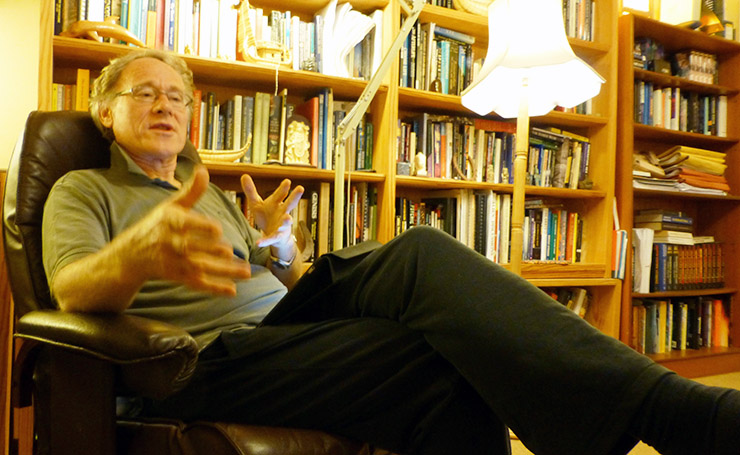
  • Atlantis in Antarctica? Tracking the Myths of a Lost Island Paradise

    Atlantis in Antarctica? Tracking the Myths of a Lost Island Paradise

    From New Dawn Special Issue 8 (June 2009)

    Our exciting adventure tracking the history of the Ancients began in 1976. It was then that we read Plato’s account of an Egyptian priest’s description of the lost continent of Atlantis. We were intrigued when we realised that the account reflected a picture of the world as seen from Antarctica in 9600 BCE. That fascination culminated in the January 1995 publication of When the Sky Fell: In Search of Atlantis. 

    The idea that Antarctica was home to Atlantis has at its root a radical rethinking of the geological history of our planet. Formulated by our mentor, Charles H. Hapgood (1904–1982) the theory of an Earth crust displacement enjoyed the enthusiastic support of Albert Einstein (1879–1955). Hapgood and Einstein corresponded about Hapgood’s work for the last three years of the great physicist’s life.

    The essence of the theory that piqued his interest lay within the physical dynamics of the Earth’s inner structure. The bulk of our planet’s mass consists of an inner core of solid iron surrounded by liquid iron. This core is encircled by the thickest part of the Earth which is composed of two mantles of solid rock.

    Covering the upper mantle lies the asthenosphere or “weak zone.” It is the asthenosphere’s mobility that allows the Earth’s crust (lithosphere) to shift.

    An Earth crust displacement occurs when the entire outer shell of the planet moves leaving a devastating climatic legacy. Because the Earth’s tilt (axis) is not affected, the planet’s climatic zones (polar, temperate and tropical) don’t change. However, vast areas of the crust (which includes ocean basins) do experience a catastrophic change in climate. Before the last Earth crust displacement, part of Antarctica lay outside the polar zone. This is the area that could have been the site of Atlantis.

    The consequences of a crustal displacement are monumental. As the Earth’s crust ripples over its interior, the world is shaken by incredible earthquakes and floods. The sky seems to fall. The sun appears to rise and set over an altered horizon until finally the crust grinds to a halt. Beneath the ocean, earthquakes generate massive tidal waves that inundate coastlines. Some lands shift to warmer climates. Others, propelled into the polar zones, suffer the direst of winters. Melting ice caps, released from the polar areas, raise the ocean’s level ever higher. All living creatures must adapt, migrate or die.

    Solar Typhoons

    In 2000, Rand and Colin Wilson published The Atlantis Blueprint, a book that explored the idea that over 60 of the world’s most sacred sites fit into a global pattern that suggests that they were positioned by a long lost, yet extremely advanced, civilisation. In 2001, the book appeared in the United States and Rand began a correspondence with Jared Freedman who suggested an answer to the mystery of the missing mechanism of Earth crust displacements. Jared is a computer professional and inventor who worked extensively with electromagnets. He was aware that the Earth is in effect a gigantic magnet surrounding a metal core.

    When magnets pass through an electromagnetic field heat is generated. Jared wrote:

    If the Earth’s magnetic field received such a tremendous distortion of its magnetic field, over a prolonged period of time, it would generate immense amounts of heat within the Earth’s core as the Earth spun through the force that was causing the magnetic field disruption. The only force that can collapse the Earth’s magnetic field is the Sun’s magnetic field.

    Jared noted that the Sun also experiences climatic variations but because of its immense size they happen over longer periods of time. Solar storms can theoretically last for “days, weeks or even more.” If the Earth passes through electromagnetic waves coming from the Sun then force would be applied steadily at one of the poles. That energy would be carried into the Earth’s core. Metal flowing to the Earth’s surface could transform the asthenosphere from a sluggish tar into a liquid. Jared wrote:

    Perhaps it is not the disruptions of the Earth’s core that cause fluctuations in the Earth’s magnetic field, but rather disruptions of the Earth’s magnetic field cause fluctuations in the Earth’s core.

    Einstein had doubted that the weight of the Earth’s ice sheets would be sufficient to dislodge the crust. He also doubted that an abrupt shift of the entire axis was the explanation because any force that could accomplish that would probably shatter the planet. What he sought was a steady force applied to the crust for a sustained period.

    Jared Freedman’s theory not only addresses all these problems but also provides a mechanism for stopping the displacements.

    Once the Earth moves through the path of the electromagnetic storm, it cools, changing the liquid-like asthenosphere once again into a tarry substance which prevents the crust from shifting any further.

    Aztlan

    On April 21, 1519, the silence of Mexico’s Caribbean coast is broken by the clang of swords and the shuffle of boots through white sand. From his ship stepped a bearded conquistador named Hernando Cortes, his helmet adorned with “a plume of feathers.” The Spaniard pounded a great cross into the beach to honour his faith, little realising that the cross was also the symbol of the Plumed Serpent.

    Aztec spies watched in amazement and horror before hurrying back to their leader Montezuma. Montezuma’s astrology had told him to expect gods to appear from the Atlantic Ocean. Never in the course of human history has there been a greater case of mistaken identity. On that day, Cortes, with blind luck on his side, began a bloody march that would ultimately end in the annihilation of the Aztec empire.

    The Spanish conquerors believed that Mexico was once an Egyptian colony. It is little wonder, since the Aztecs shared several common mythological themes with the Egyptians. The Egyptians believed that the world was surrounded on all sides, including the heavens, with water. In Aztec mythology:

    The sea was thought to extend outward and upward until – like the walls of a cosmic house – it merged with the sky… The sky, therefore, was known to contain waters which might in perilous times descend in deluges, annihilating man.

    This empire, like that of the Egyptians, had built great pyramids that symbolised the land that saved their ancestors from the flood. And like those of Egypt the solar megaliths were aligned with the rising sun. It was atop the Temple of the Sun that Cortes met Montezuma. He recounted their conversation in a letter to the King of Spain. Montezuma told Cortes about the island homeland of the Aztecs’ ancestors: “Our fathers dwelt in that happy and prosperous place which they called Aztlan, which means whiteness.”

    Aztlan is described as “…a bright land of shining light and whiteness which contained seven cities surrounding a sacred mountain.”

    Perhaps the blazing lights of Aztlan were actually the southern lights of Antarctica before that land was thrust into the confines of the Antarctic Circle.

    Aztlan was said to be “…located beyond the waters, or as surrounded by waters; and the first stage of the migration is said to have been made by boat.”

    Once again we have the familiar story: They believed that two persons survived the deluge, a man, named Coxcox, and his wife. Their heads are represented in ancient paintings, together with a boat floating on the waters, at the foot of a mountain.

    Throughout America the myth of a lost island paradise haunts the memories of the native people. But they were not alone in their grief for the lost land. Across the ocean the tale was told in ancient India, Iran and Japan.

    Polar Paradise

    In 1922, Mahatma Gandhi, about to be sentenced to six years in prison, said to the judge:

    Since you have done me the honour of recalling the trial of the late Lokamaya Gangadhar Tilak, I just want to say that I consider it the proudest privilege and honour to be associated with his name.

    Bal Gangadhar Tilak forged the tactic of passive resistance as a means of overthrowing British rule in India. He was held in such esteem that Gandhi used the title “Lokamaya” (“Beloved Leader of the People”) when referring to him. Tilak earned his title while imprisoned in 1897 for seditious writings. The British hoped to curb his role in the rising tide of Indian nationalism by locking him up. The harsh conditions of his Bombay cell took their toll. Tilak’s health waned. Fearing that his death in custody might spark a general uprising, the British moved the “Beloved Leader of the People” to a safer prison in Poona. Helped by donations of fruit and vegetables Tilak partially recovered his health. But soon a new hunger overtook him – the need for intellectual stimulation. Relief came from an unlikely quarter: England.

    Tilak had published a respected work on India’s oldest texts, the Vedas, and Sanskrit scholars at Oxford and Cambridge were outraged by his imprisonment and treatment. Professor F. Max Muller, the world’s leading authority on the Vedas, was successful in having Tilak’s case reviewed by Queen Victoria. She shortened his sentence and granted him a reading light in his cell. Denied access to newspapers or any other current material, Tilak used this “privilege” to continue his studies of the Vedas.

    Upon his release Tilak retired to the mountains to rest at a favourite family retreat. In 1903 his great work, The Arctic Home in the Vedas, was published. In it he argued that the remains of an island paradise could be found beneath the Arctic Ocean: “It was the advent of the Ice Age that destroyed the mild climate of the original home and covered it into an ice-bound land unfit for the habitation of man.”

    Tilak summarised a key passage in the oldest saga of Iran, the Zend-Avesta:

    Ahura Mazda warns Yima, the first king of men, of the approach of a dire winter, which is to destroy every living creature by covering the land with a thick sheet of ice, and advises Yima to build a Vara, or an enclosure, to preserve the seeds of every kind of animal and plant. The meeting is said to have taken place in the Airyana Vaêjo, or Paradise of the Iranians. (Italics added)

    Tilak chose the Arctic Circle as the location of the lost continent of Airyana Vaêjo after reading Paradise Found: The Cradle of the Human Race at the North Pole (1885), written by the founder of Boston University, Dr. William Fairfield Warren. Warren had been impressed by how often the story of a falling sky and great flood was found intertwined with accounts of a lost island paradise. He also realised that the lost land had many polar features. In Warren’s view, the worldwide nature of these descriptions suggested a common physical explanation. The exciting idea of the Ice Ages provided part of his answer:

    Now if, during the prevalence of the Deluge, or later, in consequence of the on-coming of the Ice Age, the survivors of the Flood were translocated from their antediluvian home at the Pole to the great Central Asia “plateau of Pamir,” the probable starting-point of historic postdiluvian humanity, the new aspect presented by the heavens in this new latitude would have been precisely as if in the grand world-convulsion the sky itself had become displaced, its polar dome tilted over about one third of the distance from the zenith to the horizon. The astronomical knowledge of those survivors very likely enabled them to understand the true reason of the changed appearance, but their rude descendants, unfavoured with the treasures of antediluvian science, and born only to a savage or nomadic life in their new and inhospitable home, might easily have forgotten the explanation. In time such children’s children might easily have come to embody the strange story handed down from their fathers in strange myths, in which nothing of the original facts remained beyond an obscure account of some mysterious displacement of the sky, supposed to have occurred in a far-off age in connection with some appalling natural catastrophe or world-disaster.

    Warren conjectured that the island paradise myths and their dramatic accounts of a falling sky and worldwide flood were part of the actual history of traumatised populations who had lost their homeland in a geological upheaval. Again and again in the most ancient records Warren found evidence that the lost land was near the pole.

    For example, in 681 AD, the Japanese Emperor Temnu ordered that a written record be made of his people’s most ancient stories. The compilation was known as the Ko-ji-ki (“Records of Ancient Matters”) and appeared in 712. Warren believed that the earliest part of the book described an original island homeland located near the Earth’s axis.

    The Ko-ji-ki begins with the “Seven Generations of the Age of the Gods.” Each “generation” consisted of a brother and sister. After the seven generations had been created, two more gods, Izanagi and his sister/wife Izanami, were brought into being. They were charged with the task of creating the world out of the porridge-like chaos that was the primordial Earth. Warren summarises the moment when the two celestial deities create the first world.

    …standing on the bridge of heaven, pushed down a spear into the green plain of the sea, and stirred it round and round. When they drew it up the drops which fell from its end consolidated onto an island. The sun-born pair descended onto the island, and planting a spear in the ground, point downwards, built a palace round it, taking that for the central roof-pillar. The spear became the axis of the Earth, which had been caused to revolve by stirring round.

    Warren concluded that Onogorojima (“Island of the Congealed Drop”) was an island somewhere near the pole. The central “roof-pillar” represented, in his view, the Earth’s axis. A great palace was built on the island, a theme that reappears in the legend of Atlantis. (Later, Izanagi created other islands, including the eight main islands of Japan.)

    Warren believed that the polar paradise was destroyed when a critical temperature drop resulted in worldwide geological upheaval. A huge mass of the Earth’s interior collapsed inward, pulling sections of the planet’s crust with it. The ocean rushed to drown the sunken areas. The globe then cooled – suffocating the original island paradise in snow and ice.

    Because he believed that the entire island had disappeared beneath a polar ocean Warren dismissed the South Pole as a possible location since the Antarctic continent still existed as land. Instead, he focused his attention on the Arctic Ocean, which to him represented the true “Navel of the Earth”:

    Students of antiquity must often have marvelled that in nearly every ancient literature they should encounter the strange expression “the Navel of the Earth.” Still more unaccountable would it have seemed to them had they noticed how many ancient mythologies connect the cradle of the human race with this Earth-navel. The advocates of the different sites which have been assigned to Eden have seldom, if ever, recognised the fact that no hypothesis on this subject can be considered acceptable which cannot account for this peculiar association of man’s first home with some sort of natural centre of the Earth. (Italics in original.)

    Warren believed that the “Navel of the Earth” referred to the Arctic Ocean. His map of the location of the lost paradise depicts the Earth as it appears from the North Pole.

    If Warren hadn’t been fixed on the northern view and had instead looked south he would have seen that Antarctica represents a far more natural “Navel of the Earth,” as we can see in a US Navy map of the world as seen from Antarctica.

    Antarctica, like the Aztec’s “Aztlan” is “white.” Like Iran’s lost paradise, it is covered “with a thick sheet of ice.” And like the “first land” of Japanese mythology, it is close to one of the Earth’s poles.

    Even if Plato had never written about Atlantis, the mythology of the ancients has always cradled the memories that would have led us to Antarctica.

    Get the issue this article appears in

    Atlantis in Antarctica

    Most rewarding for us, since 1995, the idea that Antarctica could have been the home of Atlantis has entered the popular imagination in unexpected ways and triggered the talents of many artists and writers.

    Clive Cussler gave us Atlantis Found in which James-Bond-like-superhero Dirk Pitt travels to Antarctica and fights neo-Nazi villains over the remains of Atlantis. Later, Cussler teamed with Paul Kemprecos to write Pole Shift, a novel that envisioned terrorists hell bent on artificially displacing the Earth’s crust. Stel Pavlou created Decipher. Richard Scott, a linguist, travels around the world cracking ancient hieroglyphs including those found in the city of Atlantis two miles beneath the ice of Antarctica. Thomas Greanias wrote Raising Atlantis in which astro-archaeologist Conrad Yeats and Vatican linguist Serena Serghetti survive their quest to find Atlantis in Antarctica. In 2007, a Kindle book by Jeremy Robinson, Antarktos Rising, imagined a present-day Earth crust displacement that frees Antarctica from the polar zone, revealing the formerly iced continent and awakening the long hibernating civilisation that lies beneath.

    On television, the long running science fiction series Stargate SG1 (1997–2007) and its spinoff Stargate Atlantis (2004–2009) both assume a close connection between Atlantis and Antarctica. On the big screen, AVP: Alien vs Predator (2004) and AVPR: Alien vs Predator – Requiem (2007) are both predicated upon the idea that Antarctica was once the site of an advanced civilisation. In 2009 a film predicated on the idea of an Earth crust displacement corresponding with the end of the Mayan calendar carries the provocative title, 2012. 

    In music, Atlantis Blueprint, a rock band in Ontario is enjoying success. And in Australia the group When the Sky Fell is gathering fans.

    Tom Miller’s evocative painting of scientists retrieving artefacts from beneath Antarctica’s ice was inspired by When the Sky Fell and was featured on the cover of the US magazine Atlantis Rising.

    The authors invite you to visit the new, expanded and updated second edition of When the Sky Fell available as an eBook at www.flem-ath.com. Rand & Rose Flem-Ath continue the search and detail the breakthroughs in science over the past decade and include the compelling evidence that points to Lesser Antarctica as the site of the lost island continent of Atlantis.

    [alert type=”general” dismiss=”no”]This article was published in New Dawn Special Issue 8.[/alert]

    [alert type=”success” dismiss=”no”]If you appreciate this article, please consider subscribing to help maintain this website.[/alert]

    © New Dawn Magazine and the respective author.
    For our reproduction notice, click here.