New Dawn – World's Most Unusual Magazine

Tag: Bible

  • Enoch & the Watchers: The Real Story of Angels & Demons

    Enoch & the Watchers: The Real Story of Angels & Demons

    From New Dawn Special Issue 8 (Winter 2009)

    Every visible thing in the world is put under the charge of an angel. 
    – St Augustine

    In 2002 the British newspaper The Sunday Telegraph reported that the Vatican had banned the veneration of those angels who do not appear in the authorised texts of the Bible. This was an attempt to counter the influence of unnamed New Age groups who were allegedly recruiting new members within the Roman Catholic Church. In future, prayers were only to be directed to the three archangels Michael, Gabriel and Raphael who are mentioned in the Bible. According to the apocryphal and banned Book of Enoch these were the angelic beings responsible for binding the wicked fallen angels or Watchers who had transgressed God’s law. The news report said that the early Church had excluded the book, attributed to the Old Testament prophet and patriarch Enoch, from the authorised version of the Bible because it described these fallen angels and their activities.

    Who are the Watchers or fallen angels and why was the early Church and the modern Vatican so concerned about them?

    Genesis 6:1-4 says: “When men began to multiply on the face of the Earth, and daughters were born to them, that the sons of God saw the daughters of men that they were fair; and took them wives of all which they chose.” Traditionally the Ben Eloha or ‘sons of God’ numbered several hundred and they descended to Earth on Mount Harmon. Significantly this was a sacred place to both the Canaanites and the Hebrews who invaded their land. In later times shrines to the gods Baal, Zeus, Helios and Pan and the goddess Astarte were built on its slopes.

    These Ben Elohim or ‘fallen angels’ were also known as the Watchers, the Grigori and the Irin. In Jewish mythology the Grigori were originally a superior order of angels who dwelt in the highest heaven with God and resembled human beings in their appearance.1 The title ‘Watcher’ simply means ‘one who watches’, ‘those who watch’, ‘those who are awake’ or ‘those who do not sleep’. These titles reflect the unique relationship between the Watchers and the human race since ancient times.

    In the esoteric Luciferian tradition they were a special elite order of angelic beings created by God to be earthly shepherds of the first primitive humans. It was their task to observe and watch over the emerging human species and report back on their progress. However they were confined by the divine prime directive not to interfere in human evolution. Unfortunately they decided to ignore God’s command and defy his orders and become teachers to the human race, with unfortunate repercussions for both themselves and humanity.

    Most of the information we have about the Watchers and their activities comes from the apocryphal Book of Enoch. In the orthodox Bible the prophet Enoch, from the Hebrew ‘hanokh’ or instructor, is a mysterious figure. In Genesis 4:16-23 he is described as the son of Cain, the “first murderer,” and the first city built by his father is named after him. Further on in Genesis 5:18-19, and several generations later, Enoch is named as the son of Jared, and it is during his lifetime that the Watchers either arrive or incarnate in human bodies.

    In the apocryphal Book of Jubilee, allegedly dictated by “an angel of the Lord” to Moses on Mount Sinai when he also received the Ten Commandments, it says that Enoch was “the first among men that are born on Earth [sic] who learn writing, knowledge and wisdom.” It says that Enoch wrote down “the signs of Heaven” (the zodiac signs) according to their months in a book. This was so human beings would know the seasons of the years in relation to the order of the months and their respective stellar and planetary influences. The indication is that Enoch received this information from extraterrestrial angelic sources, i.e. the Watchers, and therefore he was a cultural exemplar.
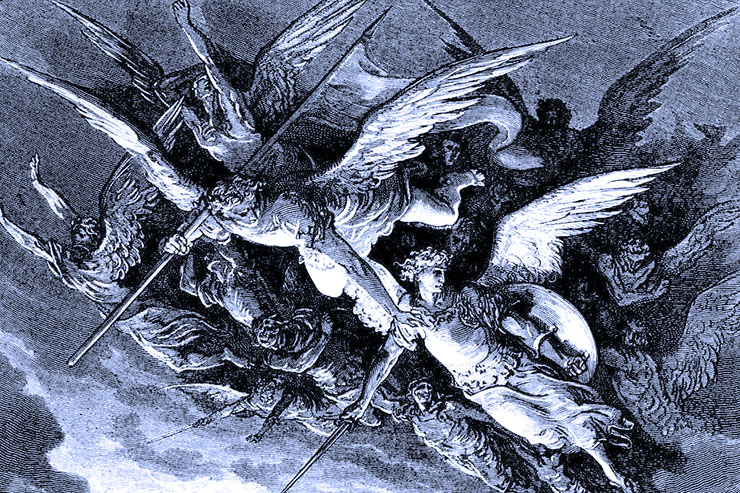
    The Fallen Angels Instruct Humanity

    Two hundred of the ‘fallen angels’ descended from the heavenly realm on to the summit of Mount Hermon and they were so smitten by the beauty of human women that, using their new material bodies, they had sex with them. This further incurred Yahweh’s wrath and, according to the Bible, the consequence of this miscegenation between the Fallen Ones and mortals led to the creation of half-angelic, half-human offspring (Genesis 6:4).

    These children were called the Nefelim or Nephilim and they were the giant race that once inhabited Old Earth. The fallen angels taught their wives and children a variety of new technological skills, magical knowledge and occult wisdom. This suggests that psychic abilities and magical powers were originally an ancient inheritance from the angelic realm given to early humans. In the Luciferian tradition this is known in spiritual and metaphorical terms as the ‘witch blood’, ‘elven blood’ or ‘faery blood’ that is possessed by witches and wizards.

    In the Book of Enoch it says that the leader of the fallen angels was called Azazel, and he is often identified with Lucifer (the Lightbringer) or Lumiel (‘the light of God’). He taught men to forge swords and make shields and breastplates (body armour). Azazel also taught them metallurgy and how to mine from the earth and use different metals. To the women he taught the art of making bracelets, ornaments, rings and necklaces from precious metals and stones. He also showed them how to ‘beautify their eyelids’ with kohl and the use of cosmetic tricks to attract and seduce the opposite sex. From these practices Enoch says there came much ‘godlessness’ and men and women committed fornication, were led astray and became corrupt in their ways.

    This was the basis for the early Church condemning the fallen angels for teaching women to make necklaces from pieces of gold and bracelets for their arms. St Paul said that women should cover their head in the synagogue (Corinthians: 11:5-6). This was because the fallen angels were supposed to be attracted to human females with long flowing hair. The custom of women covering their hair in churches is still found in Roman Catholicism and also in the customs of Islam.

    The fallen angel Shemyaza, another form of Azazel, is said by Enoch to have taught humans the use of root cuttings and the magical art of enchantment; the fallen angel Armaros taught the resolving (banishing) of enchantments; Baraqijal taught astrology; Kokabiel, the knowledge of the constellations (astronomy); Chazaqiel, the knowledge of the clouds and the sky (weather lore and divination); Shamsiel, the signs of the sun (the solar mysteries); Sariel the courses of the moon (the lunar cycles used in horticulture and agriculture and the esoteric lunar mysteries); Penemuel instructed humans in the art of writing and reading; and Kashdejan taught the diagnosis and healing of diseases and the science of medicine.

    It is obvious from these descriptions of the teaching abilities of the Watchers that they were cultural exemplars and the bringers of civilisation to the early human race. It is therefore strange that in orthodox Judeo-Christian religious texts they are misrepresented as evil corrupters of humanity.

    Some idea of the original exalted status and real nature of the ‘sons of God’ and ‘the angels of the Lord’ can be found hidden in the ancient annals of angelic lore. For instance, Kokabiel is described as “a great angelic prince who rules over the stars.”2 In the Sibylline Oracles, Araqiel is one of the fallen angels who guides the souls of the dead to judgement in the underworld.

    Shamsiel, possible originally a Babylonian sun god, was called “the prince of Paradise” because he was one of the guardian angels who watched over the gates to Eden. In this role he took Moses to see the heavenly garden and he also watched over the treasures of King David and his son Solomon the Wise. This reference may be to spiritual treasures rather than physical gold and jewels. In the Jewish Zohar he is named as the chief aide-de-camp to the mighty Archangel Uriel and bore his standard into battle.

    Sariel was an angel associated with fertility of the earth and the spring equinox (northern hemisphere) in March. He governed the martial zodiac sign of Aries the Ram and was invoked for protection against the malefic power of the Evil Eye.

    [alert type=”info” dismiss=”no”]If you appreciate this article, please consider a subscription to New Dawn magazine.[/alert]

    Azazel – Lucifer – Lumiel

    Azazel, the leader of the Watchers, as mentioned before, was identified with Lucifer or Lumiel. In the Quran it is said that Lucifer-Lumiel (Iblis) rebelled against Allah because he was told to bow down and worship the clay-born “man of earth” Adam and refused. He was forced to fight a battle in Heaven with the Archangel Mikael or Michael and his Army of the Lord. As a result Lumiel and his rebel angels were cast out of Heaven and fell down to Earth. Here Lumiel became the “Lord of the World” and in Christian mythology he was falsely identified with the bogeyman Satan. However, esoterically in the Luciferian tradition, Lumiel or Lumial is not an evil satanic figure luring humankind into temptation and acts of evil as the Church represents him. He is “the angel of God [who] rebelled against the static, established cosmic order and set in motion the forces of change and evolution…”3

    It is possible that Lumiel may have originated in Canaan as Shahar, the god of the morning star (Venus). He had a twin called Shalem, who was also symbolised by the planet Venus, but as the evening star. These divine bright and dark twins represented the solar light emerging from the darkness of night at dawn and descending into it at dusk. They were the children of the goddess Asherah, and there is archaeological evidence from the Middle East that the Hebrews adopted her worship when they settled in Canaan and practised it alongside reverence of the tribal storm god Yahweh. The Old Testament has several references to the continued worship of Asherah as “Queen of Heaven” by the allegedly monotheistic Hebrews. This took place at shrines in sacred groves on hills where they made offerings of cakes and incense to the goddess. In Canaanite mythology, Shahar, as the Lord of the Morning Star, was cast down from heaven for defying the high god El in the form of a lightning bolt. In that form he fertilised Mother Earth with his divine phallic force.

    Azazel is represented as a metal-smith and a fire-working sorcerer or magician. He has also been compared to the biblical first smith Tubal-Cain, a descendant of the half-human, half-angelic “first murderer” Cain. The actual name Azazel has variously been translated as ‘god of victory’, ‘the strength of God’, ‘the strong god’ and even ‘the goat god’. In the apocryphal Apocalypse of Abraham, he is called “the lord of heathens” suggesting he was originally a pagan god. He has also been identified with the serpent in the Edenic myth that seduced the first woman and “Mother of All Living,” Eve. In a Persian text known as the Urm al-Khibab or The Primordial Book, dating from the 8th century CE, the angel Azazil or Azazel is said to have refused to acknowledge the superiority of Adam over the angels. As a result Allah expelled him and his rebel angels from the heavenly realm to live on Earth. More generally in Islamic lore Azazel or Azrael is the angel of death and he acts as a guide for the souls of the dead.

    In Leviticus 16:8-10 and in the Dead Sea Scrolls a curious Hebrew ritual is recorded that features Azazel as the name for the ‘scapegoat’ that takes on the communal sins of Israel. It says that the high priest Aaron took two goats from the flock and cast lots (practised divination) to choose which one would be the scapegoat and sacrificed as a “sin offering.” The Scrolls say that the high priest confessed all the “impurities of the children of Israel” over the head of the Azazel goat. By this ritually symbolic act he transferred to the unfortunate animal all their guilt and sins so they could be absolved of them. The goat was then either cast out into the wilderness to die or thrown over a cliff to be dashed to pieces on the rocks below.

    This ancient and archetypal concept of the scapegoat sacrificed for the sins of the human race and abandoned in the wilderness is a powerful and potent motif that appears several times in biblical myths. It can be seen in the story of Cain who becomes an exiled wanderer on the Earth after being marked by God and banished “east of Eden” after killing his brother Abel. In one Jewish legend the wise King Solomon, a powerful magician who could summon and control demons, fell from grace because he “whored after foreign gods.” He was forced by God to leave Jerusalem and wander in the desert disguised as a beggar.

    Also after their exodus from slavery in Egypt, Moses and the Israelites were forced to spend forty years wandering in the desert before they were allowed to enter the Promised Land (Canaan). In Ancient Egyptian mythology, the dark god Set is represented as a divine outcast who dwells in the desert and, after she left Adam, his first wife Lilith or Liliya fled to the wilderness away from human habitation. In the New Testament Jesus wandered in the wilderness for forty days and nights. He was not accepted as a teacher in his own town of Nazareth and was rejected as the promised messiah by his people. When Jesus was crucified he symbolically took on the role of the sacrificial scapegoat who dies to cleanse the sins of the human race.

    It is possible that the account of the ritual of the goat-god Azazel may have been an autumn equinox or harvest rite of Syrian, Hittite or Canaanite origin adopted by the Hebrews. Originally a goat would have been selected by means of a divination ritual and then offered to a desert god or demon that had to be placated by the shedding of blood. Eventually the sacrifice was made to Yahweh as a petition to forgive the sins of his followers. Azazel was popularly believed to have a retinue of hairy he-goat demons known as the se’irim who, like the Watchers, lusted after human women. It cannot be a total coincidence that the Church imagined the Devil or Satan in the form of a hairy half-human he-goat with a massive erect phallus who had sexual intercourse with his female worshippers at the Witches Sabbath.

    Shemyaza is seen by some modern Luciferians as either the emissary of Lumiel or one of his avatars (an incarnated divine being in human form). He not only fell in love with human women, but also with the Babylonian deity Ishtar, the goddess of love and war. She promised to have sex with him if he would in return reveal to her the secret name of God. When Shemyaza told her, Ishtar used this forbidden knowledge to ascend to the stars and she reigned over the constellation of Pleiades or the Seven Sisters. While the other Watchers were rounded up by the archangels and punished by God, Shemyaza voluntarily repented his error and sentenced himself to hang upside down in the constellation of Orion the Hunter, with whom he is sometimes identified in the Luciferian tradition. In the Qabalistic tradition, Naamah, the sister of the biblical first smith Tubal-Cain, seduced Azazel and she has been associated with Ishtar.4

    “A race between Gods and men”

    As we have seen, the end result of the illicit relationships between the Watchers and “the daughters of men” was, according to Judeo-Christian propaganda, the spawning of a monstrous race of warlike, blood-drinking cannibalistic giants called the Nephilim. Genesis 6:4 less dramatically describes them as “the mighty men of old, men of renown.” At first they were fed manna (ambrosia or the food of the Gods?) by Yahweh to stop them consuming human flesh, but they rejected it. They slaughtered animals for food instead and then began to hunt down and eat human prey.

    It has been speculated that this legend is based on the culinary habits of the nomadic desert herdsmen in the Middle East, who were voracious meat-eaters. In the biblical myth of Cain and Abel the dispute between the two brothers that led to the first murder is over the nature of the offerings made to Yahweh. Abel, a “keeper of sheep” or nomadic herdsman offered the “firstlings of the flock…” and Cain, who was “a tiller of the ground” or farmer-gardener offered “the fruit of the ground” (Genesis 4:2-4). Abel’s burnt offerings of animal flesh and blood were pleasing to Yahweh, but he rejected the vegetables, cereal and fruit offered by his brother. On a purely material level, as opposed to a mythic and spiritual metaphor, this story may reflect the struggle for dominance between nomadic herdsmen and the early farmers of the Neolithic Age in the Middle East.

    The idea of semi-divine heroes was born from the ancient myths of unions between the Gods and mortals. The poet and writer Pindor (518-438 BCE) described the heroes of the past as “a race between Gods and men.” In the Dead Sea Scrolls the terrible human-eating Nephilim are in fact described as the guardians of arcane knowledge who “knew all the mysteries of nature and science.” There are also oblique references to the breeding techniques they taught that suggest they instructed early humans in the domestication and rearing of animals.

    Additional references also hint at experiments that led to the creation of ‘monsters’ by the interbreeding of animals with different and unrelated species. In modern theosophical occultism there are legends about the lost continent of Atlantis that claim its scientists bred half-human, half-animal hybrids as a slave race. In our own time scientists are experimenting with genetic research and animal cloning experiments. It is widely rumoured that in China there have recently been abortive attempts to create a new half-human, half-animal hybrid species. These unnatural experiments led to the cataclysmic disaster that destroyed Atlantis. This also relates to the destruction of the Nephilim and the early human race in the biblical Flood. Records of such an event can also be found in the mythology of ancient peoples worldwide and especially among the Babylonians in the Middle East. In fact, it is claimed that the story of Noah and the Flood in the Old Testament originated in Babylonian and Sumerian myths.

    10,000 BCE and the End of the Ice Age

    It is known that around 10,000 BCE there seems to have been a cultural explosion that transformed early humankind. At the end of the last Ice Age the first signs of agriculture appeared in the Middle East with a shift from a nomadic hunter-gatherer lifestyle to that of settled farming. This marked the beginning of civilisation in this area. As early as 9500 BCE barley, wheat and rye were being cultivated and oats, peas and lentils were being grown by our Neolithic ancestors in what is now modern Kurdistan, between Turkey and Iraq. At the same time dogs, goats and sheep were also domesticated. Within a thousand years copper and lead smelting was being practised in Anatolia (modern Turkey) and archaeologists believe this process was first discovered in Kurdistan, along with weaving and pottery making. The ancient Kurdish culture was also the first to develop a script and was one of the earliest literate societies in the Middle East.

    The Kurds claim to be the descendants of the ‘Children of the Djinn’ (spirits), the offspring of a mating between the djinns and mortal women. In some parts of Kurdistan, especially among the sect of Yezedis, who worship the Peacock Angel (Azazel, the leader of the fallen angels), can be found tall, fair-haired people with blue eyes. Although anthropologists believe they may be of ancient European ancestry, popular folk belief among the Kurds says they are descendants of the ‘Children of the Djinn’, who in ancient times brought civilisation to early humankind.

    In general the ancient Middle East was known as ‘the cradle of civilisation’ with the earliest city-states being founded in the Mesopotamian area (modern Iraq and Iran). The early indigenous people of the region, the Sumerians and Akkadians, developed the first written language, studied astronomy and created libraries. The Babylonians and Assyrians followed them and in the mythology of all these races are stories of how the Gods descended to Earth and taught them the arts of civilisation.

    In the Book of Enoch it says that when Yahweh saw the lawlessness, chaos, corruption and sexual immorality that had been caused by the interaction of the Watchers and humans he decided to intervene through the agency of the archangels Michael, Raphael, Gabriel and Uriel. He commanded Raphael to bind Azazel hand and foot like a sacrificial goat and cast him into a deep ravine in the desert. Gabriel was sent on a divine mission to destroy “the bastards and reprobates” and “the children of the Watchers amongst men.”5 The Archangel Michael, the commander of the Army of God, was sent to arrest Shemyaza and bind him “under the earth” until Judgement Day. As we have seen, the fallen angel repented his sins and sentenced himself to cosmic exile among the stars.

    The Book of Jubilee says that the archangels bound the Watchers “in the depths of the earth” and in Judaic lore they are imprisoned in a mysterious “second Heaven.” However, it is also said that some of these “mighty warriors” have a special place reserved for them in Sheol, the Jewish underworld. There they are said to lie in state “with shield and spear intact.”

    Christian O’Brien has suggested6 there is a connection between the biblical Watchers and the semi-divine, semi-mythical Tuatha De Danann (Children of the goddess Dana). This race of ancient magicians descended to Earth on the sacred hill of Tara in prehistoric Ireland. With the coming of Christianity, the Tuatha De Danann was banished into the ‘hollow hills’ and became the Sidhe (Shee) or ‘Shining Ones’, the elves and faeries of Irish folklore. There has always been a strong belief among the peasantry in Ireland that the Good People or faeries were originally the fallen angels who sided with Lucifer in the Battle of Heaven.

    In this article we have constantly referred to the Watchers as angelic beings with a spiritual form who incarnated in physical bodies to have sexual relations with mortal women. In recent years a considerable amount of speculative literature has been published suggesting that instead they were of earthly origin. Popular best-selling authors such as Andrew Collins,7 Graham Hancock and Ian Lawson have claimed that the biblical myth of the Watchers represents memories of a primeval ‘elder race’ of super-humans belonging to a lost civilisation who taught their technology to more primitive people. Lawson has claimed that this (unknown) ancient race may have been spiritually advanced souls who incarnated to help early humankind and were corrupted by them in the process. Collins has also recently launched a new project to investigate the magical aspects of the legend.

    Symbolism of the Myth of the Fallen Angels

    What is the esoteric significance behind the myth of the fallen angels, the expulsion of Lucifer from Heaven and the Fall of Man as represented by the Garden of Eden saga? In the Bible Lucifer is often depicted in the reptilian form of a dragon or serpent and in the West this creature is symbolic of evil and the powers of chaos. Babylonian, Hittite, Canaanite, Iranian, Egyptian, Greek and Norse myths all describe in various forms a struggle between a supreme father-god, representing cosmic order and harmony, and a younger rebellious god who challenges and tries to overthrow divine authority. Although these conflicts usually take place in a pre-human epoch, they are also sometimes depicted as occurring in world history and are often connected with the creation and early development of the human species and the rise of ancient civilisations.

    Symbolically, Lucifer or Lumiel is known as the Lord of Light as he is the first-born of creation. He represents the active cosmic energy of the universe and has been identified with fire, light, phallic power, independent thought, consciousness, progress, liberty and independence. The founder of the modern Theosophical Society, Madame Helena Blavatsky, described the Lightbringer as “the spirit of intellectual enlightenment and the freedom of thought” without whose influence humanity would be “no better than animals.”8

    In the Bible Lucifer (or Satan as he is mistakenly called) is often depicted in reptilian form as either a dragon or a serpent. In Western mythologies this creature is commonly misrepresented as a symbol of the powers of darkness, chaos and evil. In contrast, in Eastern mythology the dragon is a good omen representing fertility and good fortune. Lumiel-Lucifer is often identified with the serpent in the Edenic myth described in Genesis. In the Luciferian tradition, the biblical serpent is regarded as the personification of knowledge, wisdom and enlightenment who liberated the first humans from the spiritual ignorance imposed on them by Yahweh. The serpent is seen as the symbol of an outside liberating force that quite literally opened the eyes of Adam and Eve to the reality of the created universe and the wonders of the material world.

    The snake, serpent or dragon is an ancient mythical and archetypal image of the solar phallic power or life force that is associated with Lucifer and the explosion of light following the divine celestial event that created the universe (known by modern scientists as the Big Bang). When the first man and woman ate the forbidden fruit from the Tree of the Knowledge of Good and Evil in the astral or heavenly garden, they became consciously aware. Their first realisation was that their physical ‘cloaks of flesh’ were naked. They rushed to cover their genitals as they had become aware of the so-called ‘serpent power’ or kundalini that can be raised by sexual intercourse and non-reproductive sex acts. They also ate from the Tree of Life which initiated the cycle of birth, life, death and rebirth and of human souls incarnating in physical form.

    Interestingly, the anthropologist and shamanic teacher Dr. Michael Harner has described an experience he had in the jungle of the Peruvian Amazon after partaking of the hallucinogenic vine ayahuasca. He had a vision of a dragon-prowed ship with a crew of bird-headed humans. He then encountered an ancient race of reptilian entities that he believes exist within each human being in the brain stem at the base of the skull and the top of the spinal column. These reptilian life forms told Dr. Harner they had arrived on Earth aeons ago from the stars. Allegedly, they created life here so they had somewhere to hide and were the true masters of the planet. The anthropologist mentioned this to an old Indian shaman and he said he knew about these entities and called them the “Masters of the Outer Darkness.”9

    The myth of the Watchers, the Fall of Lucifer and the Fall of Man all represent the primeval Dreamtime or ‘Golden Age’ of cosmic and earthy harmony and primal innocence that may have existed on the material plane or on some kind of astral or pre-material plane. It is the symbolic or actual physical destruction of this heavenly or earthly paradise, where humans and animals lived together and communicated by a universal language, which is reflected in such myths and legends. In shamanic terms it is known as the Great Separation when humans no longer knew or understood the language of the animals. It was also a time when humans began to communicate together in different languages and this is represented by the biblical story of the Tower of Babel.

    The myth of the Golden Age or Paradise on Earth is closely linked with the fall of Lucifer from Heaven and the diminishing of his former status as the first-born of creation to become the Lord of the World. On a symbolic and metaphorical level, as well as a physical one, it is also connected to the separation of humans from nature and their natural environment that is manifesting in our modern times. It was the deliberate intervention of Lucifer and the fallen angels in human evolution, rather than any defiance of cosmic authority, which ultimately lead to their fall from heavenly grace. The Watchers’ only ‘crime’ was that they wanted to help the progress of their human flock. However, the refusal of Lucifer-Iblis to recognise the creation of human beings means that the Fall from heavenly grace was inevitable.

    In the Luciferian tradition Lumiel is promised redemption and the restoration of his former status in the cosmic plan. This can only come to pass when the human race spiritually evolves. So it is to the benefit of Lumiel and his teaching angels to help us achieve that end. The relationship between humanity and the leader of the Fallen Ones is therefore very much a symbiotic one, as they need each other.

    [alert type=”general” dismiss=”no”]This article was published in New Dawn Special Issue 8.[/alert]

    [alert type=”success” dismiss=”no”]If you appreciate this article, please consider subscribing to help maintain this website.[/alert]

    Footnotes

    1. G.A. Davidson, Dictionary of Angels, The Free Press, USA, 1971, p. 127.

    2. Ibid, p.164.

    3. Dr. Stephen Flowers, Fire and Ice, Llewellyn, USA, 1990, pp.43-44.

    4. Michael Howard and Nigel Jackson, The Pillars of Tubal Cain, Capall Bann, UK, 2000 and 2003, p.65; Michael Howard, The Book of Fallen Angels, Capall Bann, UK, 2004.

    5. R.H. Charles, The Book of Enoch, Society for the Promotion of Christian Knowledge, UK, 1912, p.37.

    6. Christian O’Brien, The Genius of the Few, Daintus, UK, 1985.

    7. Andrew Collins, From the Ashes of Angels, Michael Joseph, UK, 1996; Andrew Collins, The Gods of Eden, Headline, UK, 1998.

    8. Helena Blavatsky, The Secret Doctrine Vol: II, Theosophical Society, India, 1921, p. 171, 255, 539.

    9. Dr. Michael Harner, The Way of the Shaman, Harper & Row, USA, 1980

    © New Dawn Magazine and the respective author.
    For our reproduction notice, click here.
  • Christianity: The Ultimate Secret

    Christianity: The Ultimate Secret

    From New Dawn 84

    Today there is an unprecedented thirst for the innermost secrets of Christianity. The quest for these lost teachings drives the plots of best-sellers like The Da Vinci Code and Holy Blood, Holy Grail; it is discussed in major newsmagazines; and it is the subject of intense speculation and debate among believers and nonbelievers alike. What are these secrets? What difference might they make to our lives today?

    Sometimes the hidden truths of Christianity are described in terms of suppressed facts about Jesus’s life. One of the most popular at present is the idea that he was married to Mary Magdalene and even had children with her. Some say Joseph of Arimathea brought these children to Britain after Christ’s death.

    There are some intriguing hints of these ideas in the written texts. In one apocryphal Gospel, for example, Jesus is described as kissing Mary Magdalene frequently on the mouth. The other disciples become jealous and start to grumble, “Why don’t you love us as you love her?” Jesus turns to them and says, “Why don’t I love you as I love her?” – the answer, presumably, being obvious enough.

    But there is, of course, no real proof that Jesus was married to Mary Magdalene or that they had children. And even if it could be proven, what difference would it really make? What would it matter even if their descendants had survived to this day? The bloodline would have been so diluted over the course of two thousand years that the connection would be extremely tenuous in any event.

    Consequently, while speculations about Christ’s private life may fascinate us as we are fascinated by gossip about celebrities, in the end it can be little more than an entertainment. If these are the ultimate secrets of Christianity, they are rather disappointing.

    Sometimes, however, these hidden truths are portrayed in another light. In a recent article on Jesus and the lost Gospels, the American newsmagazine Time observed that, according to Gnostic teachings, Christ’s task was to transmit a “special wisdom” that confers spiritual liberation. Unfortunately, as the article goes on to say, this wisdom “is alluded to but not spelled out” in Gnostic texts.

    While the Time article is correct in saying that this wisdom is not spelled out in the Gnostic texts, the knowledge has by no means been lost. It has been preserved in the esoteric tradition of Christianity, which has survived in an unbroken line from Christ’s day to the present. It can be found in obscure texts, oral teachings – even in the canonical Gospels when they are read at a level beyond the merely literal.

    These truths have, it is true, become obscured and concealed, for a number of reasons, some good, some not so good. But before I can explain why they came to be hidden for so long, let me spell out briefly what, I believe, the essence of this wisdom is. It’s not particularly difficult to understand, although it will be somewhat easier to grasp if you have some meditative experience.

    Discovering the True “I”

    The best way to introduce it is by means of a simple exercise. Sit comfortably, in a relaxed but alert position. Have your back as straight as possible; you can prop yourself up with pillows against the back of a chair if you like. Let your attention settle down, and, to the best of your ability, allow the ordinary preoccupations of your day to subside.

    Look around the room you are sitting in. It may or may not be familiar; that does not matter. Only be sure to cultivate a sense of the presence of yourself as you sit in your chair. This is where you are; around you, outside you, is the visible and sensible world.

    Now close your eyes and bring your attention to your body. Be aware of your sensations – the breath, perhaps, or the beating of the heart, or the feelings in your back as it presses against the chair. If you pay attention, you can catch a glimpse of two things: an experience, a muscle sensation, say, and an “I” that is experiencing it.

    Go deeper still, to the river of thoughts, images, and emotions that are probably coursing in front of your mind. You may try to stop the flow of this stream of consciousness, as it has sometimes been called. Probably you will fail. The thoughts and images, memories, ideas, speculations, plans will most likely continue whether you want them to or not.

    In this realm also you can observe two things: an “I” that is experiencing and something that is experienced. As you continue, even your most intimate feelings and desires will pass before you like images on a screen. If you can remain both relaxed and alert (admittedly a difficult balance), you may have a sense of something very quiet and small in you. It seems to have no power, no volition of its own, yet it is that in you which is constantly awake and experiences all that passes for your life. In the strictest sense, you cannot even observe it, for it is actually that which observes. If you look for it, you find that it continually recedes further and further, for there is no limit to this “I” that experiences. You can follow this thread of consciousness back for as long as you like, but you may find this exercise to be of value even if you can only do it for a few seconds.

    What Is the Kingdom of Heaven?

    If you read the New Testament carefully, you will notice that the synoptic Gospels – Matthew, Mark, and Luke – often refer to a mysterious entity known as “the kingdom of heaven” or “the kingdom of God.” Christ describes it in parables, likening it to a mustard seed, to leaven, to a treasure hidden in a field. In John, on the other hand – long known to be the most “esoteric” of the Gospels – Christ does not speak in parables. Instead he describes the kingdom of heaven by using “I am” statements: “I am the door”; “I am the true vine”; “I am the way, the truth, and the life.” You will also remember from Exodus, when Moses encounters the Lord in the burning bush, that the highest name of God is “I am that I am.”

    These texts point to the same truth that you may have experienced while doing the exercise above. The kingdom of heaven is that in you which says “I.” This is not the ordinary ego, with its bundles of agendas, desires, and loathings. In its purest, most naked form, this true “I” is consciousness – a consciousness that we share with the entire universe, animate and inanimate. So when Christ says, “I am the way, the truth, and the life,” esoterically speaking, he is saying, “‘I am’ is the way, the truth, and the life.” “I am” is the door through which we must proceed to enter the kingdom – that is, to recognise and understand this truth experientially.

    The inner Christian tradition has a name for this experiential recognition: it is called gnosis, or “knowledge” in the true sense. Although gnosis is often regarded as something rather mysterious, as you can see, the fundamental insight behind it is comparatively simple. Understanding it doesn’t require vast amounts of learning or scholarship. But there are a number of things that interfere with this recognition, which suggests why this truth is so frequently lost and so frequently needs to be discovered anew.

    Remember Christ’s parable about the kingdom of heaven being “like unto a treasure hid in a field” (Matt. 13:44). In terms of the exercise above, the consciousness, the “I” that is fundamentally you, is buried in a “field.” This is the field of your own experience – your thoughts, emotions, feelings, your pleasures and pains. You become identified with this experience, forgetting that there is something beyond it – the experiencer, the “I” that is eternal and undying and immune to all destruction and decay. But if you remember the truth of what you are – or rather of what this “I” is – you unearth the treasure from the field. And as the parable goes on to say, that is worth the price of everything else put together.

    Death and Resurrection

    It is written that “God loved the world.” Like God, consciousness, this “I” that stands at the back of each of us, witnessing and experiencing our lives through us, loves the world it has made. It loves this world so much, in fact, that it rushes forth to unite with it, becoming lost in the process. In the Gnostic Gospels, this is likened to a pearl that is lost at the bottom of the sea. But the most famous metaphor for this process forms the central drama of Christianity: death and resurrection.

    When the “I” is submerged in and identified with its own experience, this is, esoterically, known as death. In Genesis God tells Adam that if he eats of the fruit of the Tree of Knowledge, he will surely die. This doesn’t refer to physical death, but to the “death” of consciousness in the darkness of its own experience. The passion, death, and resurrection of Christ portray this process allegorically. The God-man is crucified. He suffers all sorts of pain and indignities, and finally perishes in an ignominious fashion. But in the end it does not matter, because he rises again in a glorified form.

    This is Christ’s story. It is our story as well. We are crucified on a cross known as time and space. We pass through life, which often seems to offer no end of sorrow, pain, and humiliation. And in the end we die. But in fact nothing that is real or true about us dies. The true “I,” the consciousness that is the only real and eternal part of us, goes on to live in a new and different form.

    This is a universal truth, so it has always been known. The ancients before Christ expressed it in the form of mystery religions. While we don’t know exactly what went on in the Eleusinian or Dionysian mysteries, we do know that in essence they were about death and resurrection. Here the great mystery of the death and rebirth of consciousness was expressed in ritual form. As the great esoteric visionary Rudolf Steiner pointed out, with the coming of Christ, what had been conducted secretly, in the mystery religions, was now carried out publicly and in full view. And the “good news” of this truth was proclaimed to all nations.

    The Truth Hidden

    Ironically, as this truth was proclaimed far and wide, its essential meaning came to be submerged. Rites like the mass were instituted to commemorate the passion of Christ, but it was forgotten that Christ’s own passion was to remind us of our own situation.

    As the spiritual master G.I. Gurdjieff pointed out, “The Christian church is a school concerning which people have forgotten it is a school. Imagine a school where the teachers gives lectures and perform explanatory demonstrations without knowing that these are lectures and demonstrations; and where the pupils or simply the people who come to the school take these lectures and demonstrations for ceremonies, or rites, or ‘sacraments,’ i.e., magic. This would approximate to the Christian church of our times.”

    But why did this happen? How did the central message of Christianity come to be so thoroughly occluded for so long? This happened for several reasons. In the first place, the insight toward which this article has been pointing is not always that easy to grasp. It can be difficult for consciousness to look back upon itself, especially since, as I’ve suggested, this true “I” can never be seen, because it is always that which sees. As St. Francis of Assisi put it, “What you are looking for is what is looking.”

    Moreover, now as in the past, people by and large tend to want an external religion, an external God who controls their destinies and can damn them or, being duly appeased, save them from damnation. This is not really an accurate picture of the human condition, but people tend to fall back on it because it’s easy to grasp. It was even more so in the formative times of Christianity, when religions of all sorts – at least in the West – were preoccupied with coaxing the gods through sacrifice. When Christianity came onto the scene, it was almost immediately recast in the same terms. Christ’s passion, death, and resurrection were seen, not as a reminder of the deepest truth about ourselves, but as an appeasement of a petulant deity. Two thousand years later, it’s clear that this model does not make any sense, but people haven’t managed to find anything plausible in its stead. That’s why it’s time to reintroduce and restate these central truths.

    Another issue has to do with the social role of religion. Religion has two functions in society, which don’t always jibe well with each other.

    In the first place, it’s meant to help individuals make contact with the higher dimensions of their own being. In the second place, it serves as a guarantor of the social order. Since societies can’t afford to have policemen watching over everyone’s shoulder at every moment to make sure they behave, they have found it helpful to install an internalised policeman into the human psyche. This policeman usually takes the form of an all-seeing God who watches our every move and keeps an elaborate tally of our good and bad deeds, for which we will be recompensed accordingly in the afterlife.

    Unfortunately, the notion of an external God who rewards and punishes, while it is a convenient way to oil the wheels of the social order, tends to interfere with personal experience of the divine. People are led to feel guilty and unworthy. Like Cain after murdering Abel, they hide from the voice of God.

    Archons and Conspiracies

    These reflections have led some people to view the social and political order as a massive conspiracy whereby a privileged few manipulate the psyches of the masses in order to retain their position at the top. Although it’s certainly true that in many ways the social order is run by and for the benefit of comparatively few individuals, it has never seemed plausible to me that they manipulate these social mechanisms in the way they’re sometimes portrayed. Human beings, in their unenlightened condition, are simply social mammals – and mammalian societies have pecking orders. While those at the top may benefit from their position, it doesn’t follow that they’ve created the system or even understand it particularly well. They’re simply fighting to stay on top. This is no less true of the pope or the president of the United States than it is of an alpha male in a pack of wolves.

    Speaking of conspiracies, I might point out that certain esoteric Christian texts, notably those categorised as Gnostic, refer to a corrupt and wicked cosmic order. This evil system goes far beyond mere political and economic conspiracies. As the Epistle to the Ephesians puts it, “we struggle not against flesh and blood, but against principalities and powers, against the rulers of the darkness of this world, against spiritual wickedness in high places” (Eph. 6:12). The Gnostic texts speak of entities known as archons or “rulers.” These entities, which have peculiar names like “Oblivion” and “Deficiency,” are sometimes portrayed as inimical angels that bar the way to the paradise of union with God. Is there any truth to this concept?

    As sometimes happens, the truth may be both more and less terrifying than it seems at first glance. Certainly it would be disheartening to believe that evil archangels, with powers far surpassing those of mere humans, lurk over us to keep us incarcerated in our little pen in the cosmic order. It may be more dismaying still to realise these archons exist, not in the spiritual stratosphere, but within the very structure of our minds and brains.

    The archons of Gnostic mythology resemble what the philosopher Immanuel Kant called the “categories.” These are basic modalities – such as space, time, quantity, and causality – by which the human mind structures its own experience. These categories shape our experience of the world, because this is how our brains work. At the same time, the world isn’t really this way; it’s just the way we experience it. From this insight, Kant concluded that the world as it is in itself is unknowable: we will always be limited by the construction of our own minds.

    Esoteric traditions of both East and West would agree with Kant that our customary ways of seeing are limited and constrained. But they don’t agree that we are stuck here. By attaining gnosis, also known as enlightenment, we can free ourselves from the world our brains have made and see a higher reality.

    Some accomplish this realisation spontaneously: it comes unbidden and unsought, a gift from heaven. These events are real enough; you only need open a book like William James’s Varieties of Religious Experience to come across many examples of them. But this kind of instantaneous realisation doesn’t occur for most of us. We require systems of spiritual training and practice to liberate ourselves from that subtle and invidious master known as the human mind. Meditation is one of the most universal methods for achieving this end, because in most of its forms meditation stills the consciousness and helps it to cut loose, even if only for a few moments, from the constraints of ordinary experience.

    In this way, we can begin to make that most difficult journey, which leads us away from the world we know to the world as we can know it, and on which faith is only the first step toward knowledge.

    [alert type=”general” dismiss=”no”]This article was published in New Dawn 84.[/alert]

    [alert type=”success” dismiss=”no”]If you appreciate this article, please consider subscribing to help maintain this website.[/alert]

    © New Dawn Magazine and the respective author. For our reproduction notice, click here.
  • New (Reptilian) World Order

    New (Reptilian) World Order

    From New Dawn Special Issue 7 (Autumn 2009)

    What if Planet Earth was ostensibly run by a race of shape-shifting reptilians? Believe it or not, this outre’ political-science-fiction scenario has become a focus of historical researchers as well as spiritual visionaries. In fact, the resonance of corroborating evidence from science and metaphysics has a synchronicity that is nothing but astonishing.

    Serpents and flying dragons have, of course, been a staple of ancient myth and legends of indigenous people around the world. The assumption has always been, however, that they are metaphor or allegory – and not a literal description of actual beings.

    But what about the admonition of Jesus and John the Baptist when they chided the “generation of vipers” and “serpents? What if they saw these creatures with their spiritual vision – the overshadowing of humans by astral beings from another dimension? How would they communicate this vision to others?

    And what about the stories from the Book of Enoch and the Forbidden Books of the Bible which refer to the Nephilim – literally “Those Who Were Cast Down” – and the Watchers, the so-called “Fallen Angels”?

    Sumeria: The Cradle (Or Test Tube) of Civilisation

    Scholars and historians have been totally confounded by the abrupt rise of the Sumerian culture nearly 6,000 years ago in the Fertile Crescent of the Tigris and Euphrates Rivers. This “sudden civilisation” seemed to appear out of thin air and refused to conform to the popular historical theory of linear development in cultural evolution.

    Historian Professor Charles Hapgood squarely faces the issue when he writes that “today we find primitive cultures co-existing with advanced modem society on all continents… We shall now assume that 20,000 years ago while paleolithic peoples held out in Europe, more advanced cultures existed elsewhere on earth.”

    Likewise the rise of Sumeria has been a major puzzle. Joseph Campbell in The Masks of God writes, “With stunning abruptness… there appears in this little Sumerian mud garden… the whole cultural syndrome that has since constituted the germinal unit of all high civilisations of the world.”

    William Irwin Thompson puts it even more succinctly. “Sumer is a poor stoneless place for a neolithic culture to evolve from a peasant community into a full-blown civilisation,” he writes, “but it is a very good place to turn the plains and marshes into irrigated farmlands… In short, Sumer is an ideal place to locate a culture already having the technology necessary for urban life and irrigation agriculture.”

    A more stunning conclusion was reached by Professor Samuel N. Kramer, one of the greatest Sumerologists of our time. He reviewed the table of contents from the Tablets of Sumer and found that each one of the 25 chapters described a Sumerian, and in fact a world-first, type of achievement.

    The Sumerians had the world’s first medicine and pharmacopoeia. The world’s first brain surgery. The world’s first agriculture and farmer’s almanac. The world’s first cosmology and astronomy. The world’s first law codes. And they utilised a highly advanced technology capable of sophisticated metallurgy, smelting, refining and alloying as well as petroleum fuel refining. Most importantly, the Sumerians were responsible for the world’s first genetic engineering.

    Like a mystery without a suspect, the Sumerian story remained a riddle, until historian-archaeologist Zechariah Sitchin published a remarkable book called The 12th Planet (1979). In his subsequent series entitled “The Earth Chronicles,” Sitchin describes in great detail the crossbreeding program of the Sumerian “gods” through genetic manipulation.

    Having spent thirty years studying Sumerian, Assyrian, Babylonian and Hittite texts and the Old Testament in the original Hebrew, Sitchin deciphered the ancient scripts, transcribed them, transliterated them and, finally translated them.

    His conclusion? Sitchin writes that the Sumerian civilisation did indeed appear out of thin air. The forerunner of Greek and Roman civilisation was initiated by a highly advanced race of extra-planetary colonists who came to earth, established their settlements, and began their single-minded pursuit of wealth and power by mining gold and other minerals necessary to sustain their high-tech high-maintenance lifestyle.

    And who were these “colonists”? The Sumerians themselves described them as the “gods of heaven and earth.” They were also called “the ancient gods,” or the “olden gods,” and according to Sumerian lore, they had come down to earth from heaven. In the Hebrew text of the Old Testament, the Sumerian gods of heaven and earth are referred to as the Nephilim. The Sumerians themselves called the colonists the Anunnaki.

    The Bible and Strong’s Concordance does not mention the Nephilim specifically by name, but Nelson’s Concordance has several listings. Sitchin translates the biblical verses from Genesis 6:4 as:

    “The Nephilim were upon the Earth, in those days and thereafter too, when the sons of the gods cohabited with the daughters of Adam and they bore children unto them. They were the Mighty Ones of Eternity.”

    And what does “Nephilim” actually mean? Normally translated into English as “giants,” the word stems from the Semitic root NFL (‘to be cast down’). It means exactly what it says – “Those who were cast down upon Earth.”

    “Contemporary theologians and biblical scholars have tended to avoid the troublesome verses,” writes Sitchin, “but Jewish writings of the time of the Second Temple did recognise in these verses the echoes of ancient traditions of ‘fallen angels’.”

    Tracks of the Nephilim and the Watchers

    Apocryphal texts like the Book of Enoch, the Pseudepigrapha, and other politically incorrect so-called “Lost” Books of the Bible reflect a precise knowledge of fallen angels on Earth. In fact, scholars maintain that there were two accounts of separate “falls” of the angels. First, there was the archangel’s rebellion against God and his fall through pride, in which he was followed by other angels – the Nephilim. And second, there was the story of angels who “fell” (lowered their vibration and began their incarnations on Earth) through lusting after the daughters of men – the Watchers.

    According to the Book of Enoch, a band of angels led by Samyaza “became enamoured of the daughters of men” and decided to go after them, saying “come let us select for ourselves wives from the progeny of men, and let us beget children.” So they all took an oath, all two hundred of them, and descended to earth. “Then they took wives, each choosing for himself; who they began to approach, and with whom they cohabited; teaching them sorcery, incantations… Moreover Azazyel taught men to make swords, knives, shields… Then Michael and Gabriel, Raphael, Suryal and Uriel, looked down from heaven, and saw the quantity of blood which was shed on earth, and all the iniquity which was done upon it…”

    Indeed, bloodshed, including ritual abuse and human sacrifice through endless wars are the hallmarks of these creatures.

    Invasion of the Serpent “People”

    In a book called Flying Serpents and Dragons: The Story of Mankind’s Reptilian Past, R.A. Boulay, a former NSA cryptographer, writes that “from a combination of ancient secular and religious sources, it is possible to piece together the story of our ancestry which lies in the coming of the alien serpent-gods or astronauts who colonised earth many eons ago.”

    In fact, the evidence lies in a complete reappraisal of the legends, myths and “history” of the world. The Sumerian legend of Gilgamesh and Agga points to this interaction of “humans” and “serpents.” And of course, there are the well-known “serpent gods” of the Indus Valley, the Nagas or Serpent race of Ancient India, and the Hindu epics, “Ramayana” and “Mahabharata,” which also deal with the serpent- gods. In Chinese history, “Vih King” describes how man and dragon lived peacefully together and even intermarried. And the serpent gods in American mythology are described in the Mayan book “Chilam Balam” where Itzamna, the serpent god is revered by the “people of the serpent.”

    The story of St. George overcoming the “dragon” in England and St. Patrick driving the “serpents” out of Ireland are also part of Christian iconography.

    Too many “coincidences” point to a pattern which has been seemingly willfully ignored by ivory tower mainstream academics and historians.

    Before the Flood

    According to Boulay, the Anunnaki genetic engineering was done by “combining the characteristics of the native ape man or neanderthal with their own saurian nature” producing the so-called Adam of the Old Testament. “This Adam was half-human and half-reptile, however, and being a clone could not reproduce himself.”

    Berossus, the Babylonian priest writing in 3rd century BCE Athens, claimed that man’s ancestry and origin can be traced to “Oannes,” an amphibious creature that came out of the Persian Gulf to teach the arts of civilisation to man. “Berossus called them ‘annedoti’ which translate as the ‘repulsive ones’ in Greek. He also refers to them as ‘musarus,’ an abomination,” writes Boulay. “If the tradition had been invented, a more normal attitude would have been to glorify these creatures as splendid gods or heroes, yet the fact that they chose to describe their ancestors this way argues for the authenticity of the account.”

    “The Sumerian gods regarded Man as a convenience and nothing more,” says Boulay. “He supplied their wants, kept their cities, and provided cannon fodder for their various military ventures.” (Sound familiar?) “The gods could be cruel and unsympathetic masters. They considered humans merely as unruly children, not more important than pets, to be governed ruthlessly and without sentiment.”

    The ruthless “policies” of the New World Order reflects this ancient bias in the incessant propaganda that a population “crisis” exists on the planet and that the best way to remedy the situation is through wars to kill off the “cannon fodder” or through abortion to kill off future “useless eaters,” those who consume resources without the value-added productivity that the masters of Earth require.

    Boulay contends that the Old Testament begins at Sumer and there is a large body of religious literature besides the Book of Genesis which deals with the period before the Deluge. He cites sources such as the three Books of Enoch, the Book of Jubilees, Gnostic teachings, the Dead Sea scrolls, the Haggadah of the oral tradition of the Jews, the Rabbinical writings, the works of Josephus, and the Books of the Pseudepigrapha, especially the Book of Jubilees.

    [alert type=”info” dismiss=”no”]If you appreciate this article, please consider a subscription to New Dawn magazine.[/alert]

    What Was the Serpent of Eden?

    Carl Sagan cryptically titled one of his books The Dragons of Eden, but ancient Jewish legends describe the Serpent of Eden as manlike. In other words, he looked like a man and talked like a man. What does this mean?

    “The section of the Haggadah that deals with the Creation describes the Serpent who inhabited the Garden before the creation of Adam as an upright creature that stood on two feet and was equal in height to the camel,” writes Boulay. “The serpent was man-like in many ways. He was tall and stood upright on two legs. He did all the work of the gods particularly the mining and agricultural work. And above all the Serpent had an intellect superior to Man. These are all the attributes of the Anunnaki.”

    Boulay says that “according to the Haggadah, the bodies of Adam and Eve ‘had been overlaid with a horny skin’ and moreover of Adam’s skin, it was said that ‘it was as bright as daylight and covered his body like a luminous garment. Adam thus had the outward appearance of a reptile with its scaly and shiny skin. It was for this reason that Adam and Eve did not wear nor did they need clothing for protection or comfort.”

    “The reptilian appearance of the Biblical gods was a well-kept secret and only occasionally is it perceptible in the Old Testament,” writes Boulay. In a radical reinterpretation of scripture, he says that in the Haggadah, the source of Jewish legend and oral tradition, “it is revealed that Adam and Eve lost their ‘lustrous and horny hide’ as a result of eating the forbidden fruit. The Gnostics, rivals to the early Christians, relate that as a result of eating the fruit, Adam and Eve achieved knowledge, part of which was to realise that their creators were beastly forms.”

    The Haggadah also explains what happened in the Garden after Adam and Eve ate the forbidden fruit. “The first result was that Adam and Eve became naked. Before their bodies had been overlaid with a horny skin and enveloped with a cloud of glory. No sooner had they violated the command given them than the cloud of glory and the horny skin dropped from them and they stood there in their nakedness.”

    Even the bizarre ritual of circumcision may have a reptilian connection. “Just as the serpent achieves long life through sacrificing and leaving off part of himself, so man may also be saved by ritually sacrificing part of himself,” continues Boulay.

    “The rite of circumcision also served as a perpetual reminder to man that his true origins lay in the serpent-god creator and that he existed at the forbearance of these gods.”

    Why Cain Killed Abel

    In a fascinating reassessment of the well-known Bible story of Cain and Abel, Boulay proposes an alternative rationale. For instance, in the Apocalypse of Adam, a Gnostic document of the 1st century CE, Adam reveals to his son Seth “that the Lord who created us created a son from himself and Eve your mother.”

    “If the deity was the father of Cain, while Adam sired Abel,” writes Boulay, “it would explain further events – Cain would be semi-divine, part-reptilian and more ‘god’-like.” About the birth of Cain, this document observes that Eve “bore a son and he was lustrous” – a description of the shiny luminous hide of the reptile gods. The Apocalyptic version of this text also describes Eve’s dream. She tells Adam, ‘My Lord, I saw a dream last night, the blood of my son Amilabes, called Abel, being thrust into the mouth of Cain his brother and he drank it mercilessly… And it did not stay in his stomach but came out of his mouth.’ They got up to see what happened and found Abel killed Cain.’”

    The crime of Cain was apparently not only to commit fratricide but to eat the flesh and blood of his brother. “This behaviour seems more reptilian than human since Cain was sired by the deity unlike his brother who had Adam as his father,” concludes Boulay.

    The Serpent Gods

    What did the ancient ‘gods’ look like? “The coming of the Anunnaki coincided with the end of this period as the Earth began to dry out and the meat-eating dinosaurs and small mammals appeared,” says Boulay. “The reptile gods needed moisture and warmth and probably the reason why civilisations were founded at the mouth of great river systems – the Nile delta, the Indus River valley and the Tigris Euphrates system.”

    “In appearance the serpent gods were tall, at least 8 to 10 feet, and walked on two feet. They had a tail like a reptile and a tough hide somewhat like a lizard but with a large amount of horny or scaly skin. Their hide was generally lustrous and smooth, somewhat like a chameleon and probably varied in different hues of green and gray… They had short horns on their head which they considered to be a sign of divinity. Humans were repulsive to them because they were hairy, had soft skins and bony limbs.”

    “The sons of the Serpent gods, the Nephilim of the Bible, which descended before the Deluge and mated with human women also dabbled in genetic engineering,” concludes Boulay. “Eventually mankind will have to learn the truth about his origins and face the fact that his gods and ancestors were reptiles, truly monsters by any of our current definitions. There will be a great cultural shock as we have never seen before,” Boulay predicts.

    Reptilians Among Us

    “Researchers into the reptilian phenomenon conclude that at least some originate in the Draco star constellation,” writes David Icke in his book The Biggest Secret.

    “There are three suggested origins for the Anunnaki reptilian intervention in human affairs,” writes Icke. “1. They are extraterrestrials; 2. They are ‘inner’ terrestrials who live within the earth; 3. They manipulate humanity from another dimension by ‘possessing’ human bodies. I think they are all true.”

    Icke’s book is a repository of mind-bending, paradigm-shifting information which sounds like a grade-Z sci-fi movie – until you read the evidence. His premise is simple – what if the Global Power Elite are part of these reptilian bloodlines still controlling and ruling Planet Earth as their own private galactic fiefdom?

    “These bloodlines,” writes Icke, “became the British and European aristocracy and royal families and thanks to the ‘Great’ British Empire, they were exported across the world to rule the Americas, Africa, Asia, Australia, New Zealand and so on. These genetic lines are manipulated into the positions of political, military, media, banking and business power and thus these positions are held by lower fourth dimensional reptilians hiding behind a human form or by mind-puppets of these same creatures.”

    “These same reptilians have been occupying the bodies of all the main players in the conspiracy going back to ancient times,” continues Icke. “The obsession with interbreeding within the [Babylonian] Brotherhood bloodstreams comes from the need to hold the reptilian genetic inheritance and therefore maintain the vibrational connection between the human body on the third dimension and its controlling force on the lower fourth. It was to hide this truth that they arranged the destruction of ancient historical records, texts, and accounts over the centuries as they ravaged and raped the native societies of the world. The reptilians wanted to destroy all memory and records of their earlier open existence and control in the past. If they could do that, humanity would have no idea that they were being controlled through physical bodies that look human by a fourth dimensional force.”

    Incarnation of the Lizard-People

    With a background in Jungian psychology, author Barbara Hand Clow excels in shamanic cosmology, an intuitive storytelling technique that integrates history, legend and myth using her own internal guidance. In the third volume of her “Mind Chronicles Trilogy” called Signet of Atlantis, she also tackles the problem of the “lizard race” from her own perspective.

    Clow refers to the physical incarnation of this race on Earth. “They [the Anunnaki] nevertheless have received a measure of control over the planet’s surface,” she writes. “Most notably they have achieved the ability to incarnate. No longer will they have to persuade the people to build temples in order to link up to their own control centres; no longer will they require a channel to enter Earth; now they can become humans themselves.”

    “The various non-physical lizards creeping around the canals of Baalbek are considerably attracted to the idea of taking human form through incarnation,” she continues. “They look forward to creating fear more directly. These monsters are not content to lumber around as fourth dimensional reptiles, occasionally eating someone up. Much more appealing to them is the idea of actually entering the third dimension – in the twentieth century, for example, actually becoming an Adolf Hitler, a Charles Manson, a Stephen King, or making the twentieth century film that creates fear of the act of eating, the ‘Night of the Living Dead/ They will even baldly show themselves for who they really are by creating a movie called ‘V.’” 

    Other sci-fi movies with this theme of alien-reptilians on Earth include “The Arrival,” “They Live.” And “Alien Resurrection.”

    “You must realise that the Holy Land is a laboratory of stellar control patterns,” writes Clow. “In temple secrecy, we were taught everything about the visitors, but this information was taken out of the Bible. For 300,000 years, the central agenda by the Nibiruans [colonists from Nibiru, also called Marduk] has been to control the Earth and the use of its resources.”

    It is also a special time, the return of humanity’s spiritual powers and the choice of self-transcendence. “The return of these archetypal powers is also a result of your ability to perceive wider spans of the light spectrum,” she continues. “This expanding vision is your key to integrating all the dimensions into your awareness. This broader awareness is natural, but it was once taken from you by the ‘gods.’ The Nibiruans and other visitors – those demigods who felt disconnected from their Source – narrowed your perceptive abilities in order to help themselves materialise on Earth.”

    “The Nibiruan mind-set that has poisoned planet Earth has most recently manifested as the reptilian attitude that American political leaders call the ‘New World Order.’ This is a mind-set that believes in scarcity and limitation when the Earth is actually abundant and unlimited. This is the mind-set that would throw all the people into crocodile pits. The world’s power brokers are gluttons who control more resources than they need in order to protect themselves against the scarcity they fear.”

    Clow calls them the World Management Team, which she defines as “individuals in the third dimension who are controlled by the Anunnaki who impulse them to carry out plans that benefit Nibiru and not Earth. All individuals working in Team agencies – such as in the Vatican, secret societies, banks, governments, school systems, the medical system and many businesses – are agents of the Anunnaki, unless they are conscious of the Annunaki vibrations and do not carry out their plans. In recent days, the World Management Team has been calling itself the New World Order.”

    The Coming of Christ

    “Since the coming of Christos, the time has come to choose life over death,” writes Barbara Hand Clow in her book Heart of the Christos. “The death wish comes from the paralysing fear of the black place – Orion. In the wars with Orion, pain and separation were first experienced, and after that point many souls chose to cease to be. But all changed with Christos. A being of such love and compassion came to Earth that now all souls have access to the desire to be alive, to be alive just to experience the love of Christos.”

    “The fallen angels have sidetracked themselves by playing around with various experiments which have been creative but without wisdom. As the third dimension has become increasingly complex, especially during the last five thousand years, the angels have amused themselves by being voyeurs of the results of materialisations. Technology with no divine inspiration or wisdom has been the latest project of the [fallen] angels.”

    After all, Christ himself admonished his students, “Be ye wise as serpents.” What did he mean?

    The Rape of the Anunnaki

    According to many leading experts, sex has gotten a bad name ever since the trauma of the Anunnaki who came to this planet and raped the women of Earth. In The Pleiadian Agenda, Barbara Hand Clow writes that “the Anunnaki selected women to have sex with them so they could actually birth themselves into the incarnational cycles of Earth, and that was something that had never occurred before.”

    Prior to this time, she contends that “all sex was very natural. You easily merged electromagnetic fields and your physical bodies, and the vibrations of the Moon, Sun and planets flowed through your kundalini channels. You were drawn to each other by planetary affinities in your birth charts and merging was always easy and pleasurable. Sex with the Anunnaki was forced and unnatural in so many ways because there were few energy affinities. You became confused while the gods felt kundalini energy for the first time. They loved it. Male gods even had a lot of sex with each other and with the few female goddesses once they found out what sex felt like on Earth…”

    “All imbalances between men and women today come from energetic imprints of incompatible energy fusion from these ancient times,” writes Clow. “Your loathing for reptiles also comes from this phase of your evolution because the most embodied Anunnaki were very reptilian, and those Anunnaki were the ones who could mate with human females.”

    Serpents. Dragons. Reptilians. Coincidence or Conspiracy?

    Satan and the fallen angels are often pictured as serpent-reptilians themselves.

    In one of the seemingly uncensored passages in the scriptures, Jesus rebuked them saying, “Ye serpents! Ye generation of vipers, how can ye escape the damnation of hell? Wherefore behold, I send unto you prophets and wise men and scribes, and some of them ye shall kill and crucify, and some of them ye shall scourge in your synagogues and persecute them from city to city, that upon you may come all the righteous blood shed upon the earth, from the blood of righteous Zacharias, son of Barchias, whom ye slew between the temple and the altar.” (Matt. 23) The bloodlust and the modus operandi of the embodied Watchers has changed little in the two thousand years since.

    More references to the “generation of vipers” are in Matt. 3:7, Matt. 12:34-35 and Luke 3:7. They are also called “princes of this world.” Despite censoring, tampering and editing the Bible, code words or euphemisms for this reptilian race in the Old Testament include terms like “the wicked,” “mighty men,” “the giants,” and “evildoers.”

    ‘Lizzies’ and the Human Dilemma

    Barbara Marciniak, author of Bringers of the Dawn, Earth and Family of Light comes to a similar conclusion about Earth and the reptilian agenda.

    “The creator gods who have been ruling this planet have the ability to become physical, though mostly they exist in other dimensions,” she writes. “They keep energy at a certain vibrational frequency while they create emotional trauma to nourish themselves.”

    “You have only dealt with gods who have wanted to be admired and to confuse you and who have thought of Earth as a principality, a place that they own out in the galactic fringes of this free-will universe.”

    Marciniak semi-facetiously calls these hybrid part-human part-reptilian beings, ‘Lizzies.’ “These beings, who are neither spiritually informed nor learned in spiritual ways, deny the existence of a spiritual force,” she writes. “They have developed scientific principles and technologies that scatter the laws of spirituality… It is possible to become a brilliant master of manipulating matter and reality without understanding spiritual connections.”

    After all there’s nothing like a race of godless materialistic ‘Lizzies’ to diddle with your planet. And current world events reflect this reality every day.

    Transcending the Virus of Salvationist Religion

    Is “religion” itself then a virus insinuated into society by an alien extraterrestrial species for the purpose of societal control?

    In his inspired – and inspirational – book Not In His Image: Gnostic Vision, Sacred Ecology and the Future of Belief, John Lamb Lash deconstructs the “Belief Systems” (BS) of the Abrahamic religions – Christianity, Judaism and Islam, while explaining the metaphysical teachings of the so-called “Gnostics,” who have historically been disparaged as “pagans.”

    After all, even the word “Gnostic” itself means “know it all,” a pejorative invented by the Roman Church to put down their rivals, who called themselves the Children of Seth. Despite the anti-Gnostic propaganda for the last 2,000 years, the Gnostics’ enlightened and holistic worldview has now become increasingly relevant because it describes so precisely the spiritual conflicts of our day.

    The Gnostics taught that religion is the elaborate production of aliens who sold the concept of an off-planet Savior-Redeemer God (or an absentee landlord god, if you will) responsible for the patriarchal and fratricidal mindset endorsed by the Abrahamic religions.

    In his groundbreaking exposition of the Gnostic perspective on Abrahamic mythology/religion, Lash writes that the Gnostics understood the origin of redemptive religion – “‘Yaldabaoth himself chose a certain man named Abraham and made a covenant with him’ but proposed a different way to view it. Yaldabaoth is the Demiurge, a.k.a. Yahweh or Jehovah, a demented pseudo-deity who works against humanity… Salvation by superhuman powers, rather than through the divine potential innate to humanity is the hallmark of extraterrestrial religion.”

    Do the Abrahamic religions promote the reptilian-alien agenda? And are the “salvationist” dogmas and doctrines of the Abrahamic religions the work of “gods” working against the spiritual evolution of humanity?

    The Gnostics called this “god” Yaldabaoth, their name for the Demiurge, a “pseudo-deity who claims to be the creator of the natural world, identified with the biblical father god called Yahweh or Jehovah,” in Lash’s words. They taught that he is a “demented pretender who works against humanity as the leader of the Archons,” which have been variously described as soulless beings or astral-mental parasites that “exaggerate human error and intrude upon humanity by psychic stealth in order to propagate the ideological virus of redemptive religion.”

    Salvationist theology, writes Lash, promotes a belief system in “the Demiurge of the Old Testament, an arrogant demented pretender who claims that humans are ‘Made in His Image’. These four words are the corporate motto of patriarchy. Branded on the human soul, ‘Made in His Image’ signifies the total enslavement of humanity to an alien off-planet agenda. If the Gnostics were right, the rise of salvationism was a unique mistake for our species, not a new moral revelation. Nothing serves the hidden controllers for cover better than a message of cosmic love… a ruse to endorse and foster the victim-perpetrator bond. No matter how hard we try, we cannot derive a genuine message of love and goodness from divine paternalism. This is perhaps the hardest of all lessons that history can teach us.”

    Is “religion” then just another stumbling-block on the ever-winding road of spiritual evolution?

    The Gnostics’ perspective was that this alien belief system foisted upon humanity by the “Archons” was a primary cause of the spiritual stagnation that humanity endures into the 21st century.

    Lash, on his website Metahistory.org, notes that the Dead Sea Scrolls, discovered in 1947, contain explicit accounts of threatening encounters with reptilians. For instance, the Testament of Amram:

    “I saw Watchers in my vision, the dream-vision. Two of them were fighting over me, saying… and holding a great contest over me. I asked them, ‘Who are you, that you are thus empowered over me?’ They answered me, ‘We have been empowered and rule over mankind’. And they said to me, ‘Which one of us [will have you]?’ And I lifted my eyes, and looked at one of them directly. His appearance was dreadfully frightening, and his skin was multicoloured, darkly glittering scales.” (4Q542)

    “Gifted with powers of paranormal perception, such as remote viewing, Gnostic seers who had met and repelled Archons observed the persisting presence of reptilians among the Dead Sea cult of the Zaddikim,” writes Lash. The First Apocalypse of James (NHL V, 3), which contains descriptions of face-to-face encounters with the reptilian aliens, warns that “Jerusalem is a dwelling place of many Archons.”

    Is that the reason why the Middle East, and especially Palestine-Israel, are still the scene for such brutal warfare against the evolutions of Terra?

    It becomes quite evident that Gnostic-based empirical mysticism conflicts with Salvationist-based Abrahamic religions on many levels. The alien agenda of Salvationism asserts that humans are in error, flawed and sinful “by nature” and require redemption and rescue from this condition by an intermediary, a messiah or through the observance of strict ritual law, while empirical mysticism claims that divinity itself is a natural essence of humanity and can be revealed through Mystery School initiation which can be used to combat this alien ideology.

    Breaking the Spell

    So why does the spell continue? Obviously the shedding of blood through satanic ritual murders and wars replenishes the energies they feed on. Negative emotions like fear and hatred are another source of their so-called power.

    “The reptilians manipulate from the lower fourth dimension, the so-called lower astral frequency range,” writes Icke. “To control this planet they have to keep the mass of humanity at or below that level and disconnect them from anything higher. Crucial to maintaining the human psyche in disconnected ignorance is the manipulation of low vibrational emotion, fear, guilt, resentment, dislike of self and condemnation of others which in the end are all expressions of fear. These are the very emotions which resonate to the frequency range of the lower fourth dimension and once we succumb to domination by these emotions, we succumb to the control of the reptilian consciousness.”

    Icke says that “the more you open your heart, the more powerful this flow and the quicker you will synchronise with the rising vibrations and transform into a higher state of consciousness. If you close your heart and you close your mind, you will be resisting these changes and more and more of your energy will be spent fighting the very energies that will transform your life and set you free.”

    Marciniak writes that the “3-D world is headed for a collision of dimensions – not a collision of worlds, a collision of dimensions. Many dimensions are going to come crashing into each other. The test, the initiation [will come] – and initiation always means to move through another reality, to conquer it and transmute it.”

    “The battle of light and dark and good and evil is only between portions of yourself,” Marciniak continues. “These portions are multidimensional extensions or reincarnations of the same collective of energies that you are a part of as an individual… The avatars and masters have now permeated the gridwork of the world bringing with them their own tools for teaching … This hierarchy works with love, cherishes who you are and has been able to see through the time mechanisms that are keyed into the planet to know that consciousness is ready for the evolutionary leap.”

    It is an awesome choice then for the residents of Earth – to be or not to be the Christ. Especially in the face of tens of thousand of years of indoctrination. This includes lifetime after lifetime of hard-core programming that “sin” is our original legacy as well as continuous mind control through religion that guilt and fear are mankind’s “natural” estate.

    Sifting out the so-called “tares among the wheat” is an ongoing process – within oneself and the planet as a whole. On a personal level, each decision to act ethically and morally is crucial. If fear is the lock on the virtual prison of Planet Earth, then Love is the key to soul liberation. The victory over the Nephilim enslavement of humanity, however, is ineluctable. After all, we’re all playing for keeps…

    [alert type=”general” dismiss=”no”]This article was published in New Dawn Special Issue 7.[/alert]

    [alert type=”success” dismiss=”no”]If you appreciate this article, please consider subscribing to help maintain this website.[/alert]

    References

    Author interviews with David Icke, Barbara Hand Clow and Barbara Marciniak

    R.A. Boulay, Flying Serpents and Dragons: The Story of Mankind’s Reptilian Past (1990), The Book Tree, Escondido, CA, USA, www.thebooktree.com

    Gregg Braden, Awakening to Zero Point (1994), Walking-Between the Worlds (1998), Laura Lee Productions, Washington, USA, www.lauralee.com

    Barbara Hand Clow, Eye of the Centaur (1986), Heart of the Christos (1989), Signet of Atlantis (1992), The Pleiadian Agenda (1995).

    Lloyd deMause, Foundations of Psychohistory (1982), Institute of Psychohistory, New York, USA, www.psychohistory.com

    Samuel Noah Kramer, History Begins at Sumer (1959), Doubleday Anchor Books, New York, USA.

    John Lamb Lash, Not In His Image: Gnostic Vision, Sacred Ecology and the Future of Belief (2006), Chelsea Green Publishing, Vermont, USA.

    John Lamb Lash, www.metahistory.org

    Barbara Marciniak, Bringers of the Dawn (1992), Earth (1995), Family of Light (1998), Bear & Company, Vermont, USA.

    Elaine Pagels, The Gnostic Gospels (1979), The Origin of Satan (1995), Vintage Books, New York, USA.

    Zechariah Sitchin, The Twelfth Planet (1976), The Stairway to Heaven (1980), The Wars of Gods and Men (1985), When Time Began (1993), Genesis Revisited (1990), Divine Encounters (1995), The Cosmic Code (1998), Avon Books, New York, USA.

    William Irwin Thompson, At the Edge of History (1971), Harper Colophon Books, Islands in Time (1990), Bear & Co., Vermont, USA.

    © New Dawn Magazine and the respective author.
    For our reproduction notice, click here.
  • Rescuing the Bible from Literalism

    Rescuing the Bible from Literalism

    From New Dawn 110 (Sept-Oct 2008)

    “The world,” wrote the philosopher Ludwig Wittgenstein, “is the totality of facts, not of things.” So it is, but facts take many forms. The hard-edged events of ordinary reality are only one form, and not always the most important.

    This insight can be hard to accept in the positivist world of mainstream Western thought. In these terms, either an event took place or it did not. Truth and falsehood are judged by this criterion alone. And yet such a stance has only a limited value. It is indispensable in history and journalism and perhaps in science (although the anomalous discoveries of twentieth-century physics have blurred the picture somewhat). But in the spiritual dimension, even though there are facts here as well, they are not of this kind. To overlook this truth is to mistake one reality for another.

    Conventional Christianity has often made this mistake. Practically from the start, it has presented its case in literalistic terms: the Bible is true; moreover it is literally true. Its facts must be historical facts, and its record of the past must be a true one. At first these claims fostered Christianity’s rapid success in the ancient world. By the early centuries of the Common Era, Greco-Roman civilisation could no longer take its own myths seriously, so it was persuaded to adopt the Scriptures of the Jews and Christians on the grounds that these presented not only sacred truths but an accurate record of the past.

    Since the Enlightenment, such claims have been more of an embarrassment than an advertisement for the faith. Over the last 250 years, scholars in many fields have taken Christianity at its word and investigated in great depth just how much the Bible jibes with science and history. The findings have not exactly vindicated the Good Book. Indeed the trend over time has been to call more and more of the Bible into question as a historical record.

    From a scientific point of view, the tide began to turn in the early nineteenth century. In 1830–32, the British scientist Charles Lyell published his classic Principles of Geology, arguing that geological changes that are recorded in rocks could not possibly have taken place in the mere 6,000 years that Genesis assigned to the earth’s lifetime, but had occurred over a much longer period. A generation later, another, even more famous scientist, Charles Darwin, suggested that animal species had not been created by the Almighty on a single day of creation in 4004 BCE, but had evolved over much longer periods by what he called “natural selection.” (In fact, when Darwin had finished his magnum opus, The Origin of Species, he sent it to Lyell for comments.)

    Historicity of the Bible Questioned

    In recent decades, archaeology has cast doubt even on parts of the Bible that had seemed more or less factual, such as the history of Israel in the Old Testament. To take one example, a generation ago most scholars accepted the historicity of the Exodus from Egypt, believing at least that some migration of this kind happened, even if the narrative had to be stripped of its miraculous festoonings. Since then, the picture has changed considerably. Summarising recent findings in their 2001 book The Bible Unearthed, Israel Finkelstein and Neil Asher Silberman contend that the Exodus did not happen in any form that is recognisable from the archaeological record. The first mention of Israel in any known inscription, they note, dates from the reign of the Egyptian Pharaoh Merneptah in 1207 BCE. While this is around the time traditionally assigned to the Exodus, the inscription speaks not of a flight of Israelites (or even an expulsion), but of Merneptah’s successful incursion into Canaan, where Israel is reckoned among the peoples subdued. In any case, the Israelites could not have escaped to Canaan out of the hands of the Egyptians, because Canaan was part of Egyptian territory at the time; Merneptah’s invasion would have been to quiet a troublesome province.

    Instead, Finkelstein and Silberman suggest that the biblical account of the Exodus is a composite of folk memories of the Hyksos – a Semitic people who ruled Egypt from c.1670 to c.1570 BCE before being expelled by the Egyptians. The Exodus story as we know it was framed in the seventh century BCE, when the national ideology of Jerusalem and the nation of Judah was beginning to crystallise – and Egypt was a powerful and aggressive neighbour.

    Other scholars have come up with equally revolutionary insights. In her work The Great Angel, the British biblical scholar Margaret Barker points out that originally the Israelites worshipped a female goddess, known as Asherah (or sometimes as Hokhmah or “Wisdom”), as the consort of Yahweh, alongside El, the Most High God, and Yahweh himself, who was essentially a national deity allocated to Israel alone. Barker suggests that the famous Deuteronomic reform under the Judahite King Josiah – in which Josiah purges the Temple of these other gods and restores the worship of Yahweh alone (2 Kings 22-23) – was not a reform but an innovation, a purge of time-honoured traditions in an attempt to create a “Yahweh-alone movement.” This movement eventually took over Judaism after the Babylonian Exile and imposed its own agenda on the past.

    One could make similar points about much of the rest of the Bible. The “quest of the historical Jesus,” as Albert Schweitzer so famously dubbed it, has gone on for over two centuries now without any really conclusive results. Most scholars are convinced that there is some admixture of myth and legend in the life of Christ as portrayed in the New Testament, but they differ enormously about just what was legend and what was not. The panel of liberal New Testament scholars known as the Jesus Seminar has won some notoriety for contending that Jesus neither said nor did most of the things attributed to him in the Gospels. As shocking as some may find this claim, it is hardly new: an array of German New Testament scholars reached much the same conclusions in the nineteenth century. A still more radical view holds that Jesus never existed at all: his story was merely a Jewish equivalent of the numerous death-and-resurrection myths circulating in the ancient world. Since there is no archaeological evidence for Christ’s life, and the textual evidence is elusive (none of the Gospels, canonical or apocryphal, even claims to be an eyewitness account), this position, as extreme as it is, is hard to definitively refute.

    Biblical Stories as Allegory, Not History

    What, then, are we to do with the Bible as history? Some will no doubt cling to it. The literary critic Harold Bloom has noted that in evangelical Christianity, the “limp leather Bible,” waved at the audience by the preacher, has itself become a totem. But others are unlikely to find refuge in a simplistic bibliolatry. They may be drawn to another approach – one that is equally ancient, and possibly more profound. It is that the Bible is not, and never was, meant to be taken literally, but has deeper meanings that are to be unearthed by those are capable of doing so.

    This idea goes back to the very beginnings of Christianity and has always existed side by side with narrow literalism. Ironically, it was a major impetus for the creation of Christianity as a separate religion from Judaism. The nascent Christian movement often had to allegorise the Hebrew Scriptures to make use of them for its own purposes. The Apostle Paul writes about one biblical passage:

    It is written, that Abraham had two sons, the one by a bondmaid, the other by a freewoman.

    But he who was of the bondwoman was born after the flesh; but he of the freewoman was by promise.

    Which things are an allegory: for these are the two covenants; the one from the mount Sinai, which gendereth to bondage, which is Agar.

    For this Agar is mount Sinai in Arabia, and answereth to Jerusalem which now is, and is in bondage with her children.

    But Jerusalem which is above is free, which is the mother of us all (Gal. 4:22–26).

    Paul is saying that the real meaning of the story of Abraham and his two sons lies in the relationship of the Jews and the Christians. Ishmael, the older son, born to Hagar (or Agar), “the bondwoman,” is the Jews, who are in “bondage” to the Law of Moses. Isaac, the younger, born to Sarah, the “freewoman,” represents the Christians, who are freed from having to follow the Law. The story is an “allegory.”

    The first authority to use the word “allegory” in this sense (the Greek is allegoria) – and the first to expound the Hebrew Bible in this way – was a philosopher who lived at the same time as both Jesus and Paul: Philo of Alexandria (c.20 BCE–c.50 CE). Although there is no reference to Jesus or Paul in his works or to Philo in the New Testament, it would be hard to overstate Philo’s influence on Christianity. To take one example, it was he who first used the Greek word logos (often translated as “word”) to mean the creative, structuring element in consciousness and to contend that this principle had engendered the world. Philo’s view was prevalent in the Judaism of the first century CE, in which the logos was often seen as a kind of deuteros theos or “second god.” The Christians appropriated this theology, especially in the Gospel of John, whose prologue “In the beginning was the Word” etc. is almost a programmatic statement of Philo’s thought. Philo, of course, never equated this logos with Jesus, as the Christians did, and once the Christian view had spread throughout the ancient world, the Jews dropped the concept of the logos entirely.

    In any event, Philo viewed the Hebrew Bible through the lens of allegory. Here is Philo on Genesis:

    “And on the sixth day God finished his work which he made.” It would be a sign of great simplicity to think that the world was created in six days, or indeed all in time…. But… it would be correctly said that the world was not created in time, but that time had its existence as a consequence of the world….. When, therefore, Moses says, “God completed his works on the sixth day,” we must understand that he is speaking not of a number of days, but that he takes six as a perfect number.

    Philo goes on to explain what he means by a perfect number. Obviously this is a far richer and more sophisticated understanding of a sacred text than the simplistic idea that the world was made in six literal days.

    The Christian theologian who is most indebted to Philo was the third-century Church Father Origen. Origen went further than Philo, however, in being much more eager to discard the literal truth of passages that seemed contrary to reason. Here is Origen on Genesis:

    Who is so silly as to believe that God, after the manner of a farmer, “planted a paradise eastward in Eden,” and set in it a visible and palpable “tree of life,” of such a sort that anyone who tasted its fruit with his bodily teeth would gain life: and again that one could partake of “good and evil” by masticating the fruit taken from the tree of that name? And when God is said to “walk in the paradise in the cool of the day” and Adam to hide himself behind a tree, I do not think anyone will doubt that these are figurative expressions which indicate certain mysteries through a semblance of history and not through actual events.

    Origen does not spare the Gospels or the writings of the Apostles, “for,” he writes, “the history even of these is not everywhere pure, events being woven together in the bodily sense without having actually happened; nor do the law and the commandments contained therein entirely declare what is reasonable.”

    Such an attitude seems strikingly modern – and yet these are the words of a third-century Church Father. Origen spoke of three levels of meaning to Scripture (body, soul, and spirit, in accordance with the tripartite division of human nature accepted by early Christianity). This view would be tremendously influential. The scholar Beryl Smalley has written that “to write a history of Origenist influence on the West would be tantamount to writing a history of Western [biblical] exegesis.”

    By the Middle Ages, Origen’s three levels of meaning for Scripture would be expanded to four. They were called the literal, allegorical, moral, and “anagogical” or mystical senses. Dante, writing in the early fourteenth century, refers to them in his Letter to Can Grande, where he says of the Exodus:

    If we look at it from the letter alone it means to us the exit of the Children of Israel from Egypt at the time of Moses; if from allegory, it means for us our redemption done by Christ; if from the moral sense, it means to us the conversion of the soul from the struggle and misery of sin to the status of grace; if from the anagogical, it means the leavetaking of the blessed soul from the slavery of this corruption to the freedom of eternal glory. And though these mystical senses are called by various names, in general all can be called allegorical, because they are different from the literal or the historical.

    Origen, who is evasive about actually setting out the hidden meaning of Scripture (“it was the method of the Holy Spirit rather to conceal these truths and to hide them deeply,” he writes), makes reference to Egypt as well. He speaks of “the descent of the holy fathers into Egypt, that is, into this world.” For Origen as for Dante, then, the Exodus ultimately presents an allegory of spiritual liberation.

    Origen died around 253 CE, crippled by torture during the persecution of the Christians by the Roman Emperor Decius. Since then, Origen has had an ambiguous destiny in the mainstream church. Revered in his own day, in later centuries he fell into disrepute among the orthodox. This happened for a number of reasons, but it was largely because his views on the relationship between the Father and the Son did not jibe with the doctrine of the Trinity as it would evolve in the fourth and fifth centuries. Furthermore, later theologians did not feel entirely comfortable with Origen’s assertion that much of Scripture was not meant to be taken as literally true. Although the churchmen were generally content to accept his idea that there were other meanings in addition to the literal one, they did not like to think the literal sense was wrong or even (as we’ve seen Origen say about the myth of Eden) ridiculous.

    Protestantism and Literalism

    If the Catholic and Orthodox churches were always comfortable with a symbolic meaning to the Bible, where did today’s excruciating biblical literalism come from? Partly from Protestantism. Catholicism and Orthodoxy always regarded the Bible as an authority, but never as the authority: the teachings and practices of the Church itself were held to be of at least equal weight. The Catholic Church always insisted that the Bible could be easily misunderstood by those who lacked the proper training; this was why the Church discouraged Bible reading by laypeople until comparatively recently.

    By the early modern era, however, the Catholic Church had become so corrupt that some Christian leaders (and many of the ordinary faithful) realised that the church was keeping an exclusive monopoly on spiritual power largely to suit its own worldly ends. In breaking with the church, these leaders – the Protestant Reformers – decided to return to the Bible as the only proper authority: sola scriptura, “Scripture only,” as the formula had it.

    This in itself might not have been so problematic, but the Protestantism that reached the American frontier in the nineteenth century was dominated by men who had little education and little idea of any other literature than the Bible. Such people have always existed: Thomas Aquinas, the medieval Catholic theologian, was alluding to them when he said, “Timeo hominem unius libri”: “I fear a man of one book.” In the United States, and, I suspect, in much of the rest of the English-speaking world, evangelical Christianity has become co-opted by these “men of one book.” Today in many parts of the US, it is possible to go into people’s houses and see no other book than the Bible. It is this element in Christianity that has made its presence felt in the rise of fundamentalism.

    As a result, the Bible’s inner meaning has increasingly become the province of esotericism. Regarding the story of Christ, in her book Esoteric Christianity the Theosophist Annie Besant speaks of “the Christ of the human Spirit, the Christ who is in every one of us, is born and lives, is crucified, rises from the dead, and ascends into heaven, in every suffering and triumphant ‘Son of Man.’” The story of Christ is thus the story of each of us; the Incarnation symbolises our own descent into the world of materiality, where we pass across the stage for a short while before being crucified on the cross of time and space. But this suffering and death is only transitory or even illusory, since the Logos – the principle of consciousness – in ourselves cannot die. It will be resurrected again in other forms, recognisable or otherwise. (In the Gospels the risen Christ is sometimes recognised by his disciples, sometimes not.)

    Some may find themselves impatient with these ideas, insisting that they are nothing more than a way of skirting the issue of historical factuality that must supposedly serve as the bedrock of faith. But what, might one ask, is being dismissed as mere allegory? Viewed in the way sketched out above, the stories of the Exodus and the passion of Christ are not mere edifying tales of the past. Nor are they creeds for blind belief or flags around which to rally the faithful. Rather they are deep expressions of what is going on inside us now. To know from inner experience what it is to be spiritually in “the land of Egypt, the house of bondage,” to see the Logos in ourselves crucified on the cross of time and space, is not evasion but among the most profound insights a human being can have.

    I would even take the argument a step further. An allegorical reading of the Bible can actually be more demanding than merely dwelling on the meaning of the letter. Acknowledging “Pharaoh,” “Moses,” the “scribes and Pharisees,” even Christ as parts of ourselves can be unsettling. Few are eager to come to grips with their inner tyrants and hypocrites, and there are possibly even fewer who can bear to see their own higher natures. After all, to know that Moses the lawgiver exists in oneself is already a step out of the house of bondage. To see the Christ within is already to experience a resurrection. Such realisations confer a responsibility upon us that we are not always delighted to face.

    As a result, it is often easier to keep these things at the safe remove of antiquity – to follow the disputes about who was the Pharaoh of Exodus; to pore over accounts of recent excavations in Biblical Archaeology Review; to thrill over the latest news feature that breathlessly proffers some allegedly new fact about the historical Jesus. In such a way we can keep these issues alive, but at a comfortable distance: they remain ineluctably “other,” about people who lived long ago. I suspect that this dynamic helps explain the unshakable thirst for biblical archaeology among the American public.

    All this said, there is admittedly a problem with leaning too heavily on allegorical readings of Scripture. To be no longer able to take one’s own myths literally – even while accepting them in a figurative sense – does strip them of their power. This is due to the limits of our own understanding; we as a civilisation seem unable to hear the message “Blessed are they that have not seen, and yet believed” (John 20:29). This is not a call to blind, stupid faith; it is an appeal to recognise realities that do not present themselves to our physical eyes and hands – the “evidence of things unseen.” But, trusting as we do in the Gradgrindian world of cold, hard facts, we put more trust in texts than in our own inner experience. We discover that the texts are not telling the exact truth about history, and we lose our faith.

    Despite the noise (much of it overstated) about rising fundamentalism in the Western world, this loss of faith is likely to accelerate. What will happen when the news sinks in and we collectively understand that much, perhaps most, of the Bible is not literally true? We may continue to see their beauty and power as myths, just as we do with the tales of the Olympian gods, but they will have lost their numinous force for us. We will see the old gods mocked and derided, as they were in antiquity in the satyr plays of the classical Athenian stage and the satires of Lucian, and as we see today in films like Dogma and Jesus Christ Superstar.

    In such instances, new myths, new versions of eternal truths arise. What these will be in the future remains to be seen; it is hard to imagine that they will come from any religion now existing. Of the models of reality now available, it is above all the one provided by science that has most captured the imagination of the thinking public. Like Christianity in ancient times, it seems to offer truth in place of myth, actualities in place of legend. And then we are left with a question that, I suspect, will not be answered in the lifetime of anyone reading these pages now: what will happen when the facts of science, implacably hard and substantial as they now seem, are proved to be myths in turn?

    [alert type=”general” dismiss=”no”]This article was published in New Dawn 110.[/alert]

    [alert type=”success” dismiss=”no”]If you appreciate this article, please consider subscribing to help maintain this website.[/alert]

    Bibliography

    Dante Alighieri, Letter to Can Grande della Scala, Translated by James Marchand, http://medieval.ucdavis.edu/20B/Can.Grande.html

    Margaret Barker, The Great Angel: A Study of Israel’s Second God, Louisville, Ky.: Westminster/John Knox, 1992.

    Annie Besant, Esoteric Christianity, or the Lesser Mysteries, Reprint, Wheaton, Ill.: Quest, 2006.

    Harold Bloom, The American Religion, New York: Simon & Schuster, 1992.

    Israel Finkelstein and Neil Asher Silberman, The Bible Unearthed: Archaeology’s New Vision of Ancient Israel and the Origin of Its Sacred Texts, New York: Touchstone, 2001.

    Susan A. Handelman, The Slayers of Moses: The Emergence of Rabbinic Interpretation in Modern Literary Theory, Albany: State University of New York Press, 1982.

    Origen, On First Principles, Translated by G.W. Butterworth, Reprint, New York: Harper & Row, 1966.

    Philo, The Works of Philo, Translated by C.D. Yonge, Peabody, Mass.: Hendrickson, 1993.

    Albert Schweitzer, The Quest of the Historical Jesus: A Critical Study of Its Progress from Reimarus to Wrede, Translated by W. Montgomery, Reprint, New York: Macmillan, 1961.

    Ludwig Wittgenstein, Tractatus Logico-Philosophicus, Translated by D.F. Pears and B.F. McGuinness, 2nd edition, London: Routledge & Kegan Paul, 1971.

    © New Dawn Magazine and the respective author.
    For our reproduction notice, click here.
  • Who Was Moses?

    Who Was Moses?

    From New Dawn Special Issue 8 (June 2009)

    When people are spoken of constantly, we feel we know them. Christians and Jews have been talking about Moses for thousands of years, so they assume they know who he was. But is this an illusion? Is it possible that no one really knows who Moses was? That the evidence about him is contradictory and enigmatic? Is it even possible that he never existed except in fable?

    Even religious fundamentalists have an immediate problem with Moses, and the accounts of him in the biblical Book of Exodus. People who fanatically believe that every word written in the Bible or the Torah is somehow ‘the word of God’, ‘written by God’, or ‘inspired by God’ (these claims vary and are rarely defined with any degree of precision), are faced with serious contradictions in the biblical text itself.

    Near the beginning of Exodus, God speaks to Moses from a burning bush at Mount Horeb in Sinai and tells him to go back to Egypt. So Moses, not wishing to be impolite to an unknown entity who has spoken to him from a burning bush in no uncertain terms, duly begins to travel to Egypt as instructed. But what happens next? Suddenly we are told in Exodus, Chapter 4, 24-27:

    During the journey, while they were encamped for the night, the Lord met Moses, meaning to kill him, but Zipporah [the wife of Moses] picked up a sharp flint, cut off her son’s foreskin, and touched him with it, saying, “You are my blood-bridegroom.” So the Lord let Moses alone. Then she said, “Blood-bridegroom by circumcision.”

    Can anybody explain what is going on? Here the supposed ‘Word of God’, i.e., the Bible, says the entity calling himself God instructs Moses to drop everything and rush off to Egypt, and then the same entity meets him on the way with the intention of killing him. This homicidal impulse is however appeased by Moses’s wife grabbing a sharp flint and circumcising her son and claiming that he is her bridegroom. This all sounds more like an incident from a really bad Hollywood horror movie. And as for the actions of Zipporah, it is more like the kind of thing one might expect at a voodoo rite in Haiti than what one would expect from the wife of such a reputedly sober character as Moses, who is on a mission to Pharaoh to persuade him to “let My people go.”

    As for “the Lord” so-called, he seems capricious at best and a homicidal maniac at worst. There is no need for us to assume, as so many have uncritically done for millennia, that “the Lord” of Moses had anything whatever to do with God. The world is full of paranoid schizophrenics who hear voices and believe that ‘God has spoken’ to them. If all of these people were to be believed, there would be tens or hundreds of thousands of ‘Gods’.

    In order to try to figure out more about this puzzling episode from the Bible, I turned to a volume I have in my library which is a commentary on Exodus published by a biblical scholar named A.H. McNeile. He says:

    The narrative in these three verses appears, from its contents, to be one of the oldest portions of the Bible. Its antiquity is shewn [sic] by the use of the flint knife, and by the part circumcision plays according to the belief of the actors.1

    McNeile then goes on to add that the text really says of the foreskin that she “made it touch his feet,” but he says that is a conventional euphemism of the time which really means touching her “pudenda,” i.e. her genitals.

    If we are to believe this remarkable bit of information, we are faced with the undignified magical scene of the superstitious wife of Moses circumcising her son and pressing his bloody foreskin to her vagina and pronouncing him her bridegroom, or as McNeile translates her words: “A bridegroom of blood art thou, because of the circumcision.”

    For some reason not explained at all, Yahweh is appeased by this and decides not to murder Moses after all. I ask any rational person: is such a Yahweh to be identified with ‘God’? Do all the people who attend church and synagogues seriously believe that ‘God’ wanted to murder Moses on his way to Egypt but was appeased by this tawdry bit of superstitious magic?

    The confusion over the true nature of Moses probably reached its most extreme form at Petra. Many tourists have now visited the amazing enclosed city of Petra in modern Jordan, which is reached by passing through a narrow crevasse in a cliff face. It is one of the surviving archaeological wonders of the world. Epiphanius of Salamis (who lived circa 310/320 CE – 403 CE) recorded in his book The Panarion, sometimes known as his book Against Heresies:

    The profundities and glories of the sacred scripture, which are beyond human understanding, have confused many. The natives of Petra in Arabia [modern Jordan], which is called Rokom and Edom, were in awe of Moses because of his miracles, and at one time they made an image of him, and mistakenly undertook to worship it. They had no true cause for this, but in their ignorance their error drew an imaginary inference from something real.2

    I wonder how many tourists going to Petra realise that they are going to the only place in the world where Moses was worshipped as a god. That’s not something you would be told by your tourist guide!

    In the second century BCE, a Jewish playwright named Ezekiel lived at Alexandria in Egypt, and he wrote a drama in the Greek style called ‘The Exodus’, in which Moses was the leading character. This play survives only in extended fragments preserved by Eusebius (circa 263 CE – 339 CE) in his book The Preparation for the Gospel, which he took from an earlier historian named Alexander Polyhistor. The text of the play is largely lifted from the Bible, with flowery language and interpolations, as shown by this monologue by Moses:

    Ha! See! What sign is this from yonder bush?

    A marvel such as no man might believe.

    A sudden mighty fire flames round the bush,

    And yet its growth remains all green and fresh.

    What then? I will go forward, and behold

    This wondrous sign, that passes man’s belief.3

    From this, we can see that Ezekiel was no Shakespeare, and his task was a simple one, to dramatise the story of the Book of Exodus in a straightforward and rather unsubtle manner for the stage, so that the Gentiles of Alexandria could have the Jewish legends presented for them in an outdoor theatre. It was a bit like producing a soap opera for mass television, but it was two thousand years ago. One does not read anything about this play in the histories of the theatre, but it deserves a mention. It was probably much less corny than Cecil B. DeMille’s film about Jesus, ‘King of Kings’, which I had to sit through several times at the Roman Catholic school I attended as a child (an experience which helped put the finishing touches to my lack of affection for the Catholic Church).

    The Staff into Snake into Staff Trick

    Children who read the Bible always remember the vivid incident where Moses throws his staff on the ground before Pharaoh and it becomes a snake, and then he picks the snake up and it becomes a staff again. Actually, this is how we remember the tale but in fact the Bible says that Aaron, not Moses, does this before Pharaoh. In Exodus 4, “the Lord” and Moses have this dialogue:

    Moses answered, “But they will never believe me or listen to me; they will say, ‘The Lord did not appear to you.’” The Lord said, “What have you there in your hand?” “A staff,” Moses answered. The Lord said, “Throw it on the ground.” Moses threw it down and it turned into a snake. He ran away from it, but the Lord said, “Put your hand out and seize it by the tail.” He did so and gripped it firmly, and it turned back into a staff in his hand. “This is to convince the people that the Lord the God of their forefathers, the God of Abraham, the God of Isaac, the God of Jacob, has appeared to you.” (4:1-6)

    Later, the story of the snake continues in Book 7:

    The Lord said to Moses and Aaron, “If Pharaoh demands some portent from you, then you, Moses, must say to Aaron, ‘Take your staff and throw it down in front of Pharaoh, and it will turn into a serpent.’” When Moses and Aaron came to Pharaoh, they did as the Lord had told them. Aaron threw down his staff in front of Pharaoh and his courtiers, and it turned into a serpent. At this, Pharaoh summoned the wise men and the sorcerers, and the Egyptian magicians too did the same thing by their spells. Every man threw his staff down, and each staff turned into a serpent; but Aaron’s staff swallowed up theirs. (7:8-13)

    Even though this seems one of the most unbelievable stories in the Bible, it is curiously enough one of the most convincing (and hence, a source of encouragement regarding the veracity of some of Exodus), because this was a genuine trick of Egyptian magicians which was recreated in the twentieth century.

    The way this trick is done is by means of ‘animal hypnosis’, or animal catalepsy. I described the use of the trick by Moses in my book Open to Suggestion, which was published in 1989. However, the book was only published in Britain, and readers in the USA never saw it. My book was an extremely long survey of worldwide hypnosis research, compiled by me over a period of 15 years. It also contained a survey of 150 years of documented case histories of the criminal abuses of hypnosis. My book so alarmed the hypnosis community and various security agencies (especially my sections on mind control and mass hypnosis), that every effort was made to suppress the book.

    Eight American publishers to whom the book was submitted sent my agent identical letters from two referees (always the same two men in each case, whom I knew personally and strongly disliked) warning them that the book would be a public danger, and they must not publish it. The two referees were not distinguished clinicians or experimentalists, they were functionaries whose job it was to liaise between the security services and the hypnosis community.

    They succeeded admirably in their task, which was to prevent the American public from ever reading such things as this revelation which I made: more than fifty percent of the hypnosis experiments carried out in the United States have been carried out by the government and are classified as top secret. You can understand why my book was considered seriously ‘uncool’ by various grim persons.

    Dr. Franz Völgyesi & Animal Hypnotism

    The man who perfected the ‘snake-into staff-into snake’ trick in the 1930s was one of the most extraordinary characters of his time, a Hungarian psychologist named Dr. Franz Völgyesi. I discussed him in my book, and that was especially unpopular, for reasons which will be clear in a moment.

    In the 1930s, Völgyesi published a book in Hungarian entitled Ember és állat Hypnosis. I’m sorry I can’t translate that, for my Hungarian is rusty. This book appeared in a German translation in 1938, as Menschen- und Tierhypnose (Human and Animal Hypnosis).4 The book was so shocking and astounding that it inevitably came to the attention of the Nazis. I have a copy of this rare book, an item that various interested parties would not like any members of the public to have.

    Völgyesi became the hypnotist-in-chief to the Nazi regime, and considering that Hitler went into spontaneous auto-hypnotic trances nearly every day, it is more than likely that Völgyesi became Hitler’s personal, as well as official, hypnotist. (I have no evidence of that, and I am merely speculating, though I believe, soundly.)

    Völgyesi was given carte blanche by the Nazis to carry out experiments on human beings. During the years between 1938 and 1945, he hypnotised no less than sixty thousand individuals, most of them Jews, Slavs, Gypsies, and leftists who were interned in the concentration camps. He could perform any experiments he liked, without reference to anyone. Considering the detailed evidence which we have of his experiments with dozens of animals, it takes little imagination to visualise what he would have done with sixty thousand human beings to play with.

    There is no doubt whatsoever that Franz Völgyesi was the most experienced hypnosis researcher in the entire history of the world. His research notes on these 60,000 cases ‘vanished’. But he himself did not vanish. He was one of those Germans snatched by the Americans, like Werner von Braun, and taken off to the United States, as a consultant to the security services. His research files probably exist somewhere in a high security archive of the American security services, ‘snatched’ at the end of the war. Someone should make an attempt to have them released through the Freedom of Information Act. I have ceased to pursue this subject, so I leave this task to others.

    In 1963, Völgyesi was allowed to bring out a sanitised second edition of Menschen- und Tierhypnose, and in 1966 this appeared in London in an English translation as Hypnosis of Man and Animals.5 This time, the book appeared with his Hungarian first name of Ferenc rather than his German first name of Franz. (In America he was sometimes called Francis or Frank.) It is possible to purchase occasional copies of this book without too much difficulty.

    In both books, Völgyesi published photos of cataleptic snakes which are stretched straight as rods, and have gone stiff. In the 1938 book, one is seen in Figure 8 on page 16. In the 1966 book, another one (an adder) is seen in Figure 18 in the first plates section. Völgyesi hypnotised just about every kind of animal, bird, or reptile you can possibly imagine. He would enter zoo cages and put bears and lions and crocodiles into trances with the greatest of ease. Many photos of these cataleptic animals are reproduced in his books. I cannot go into this fascinating subject further, and must return to Moses.

    The fact is that any skilled animal cataleptist can turn a snake into a staff and a staff into a snake very easily. Such tricks were standard in ancient times. They were ways of calling attention to oneself as a wise man. And, frankly, if you couldn’t turn a snake into a staff no one would listen to you. So you might say Moses had little choice. And that is why I say that this incident is convincing evidence that there is genuine ancient material in Exodus, since later writers would not have been able to invent such a thing.

    Moses’ Sacred Mountain

    Moses is generally associated with Mount Sinai in the Sinai Peninsula. However, that is the wrong mountain. Although Mount Sinai was also important, it was Mount Horeb where Moses did most of his communing with his ‘Lord’, and where he saw the burning bush. But if you ask any biblical scholar where Mount Horeb is, they cannot tell you. It is officially unknown.

    I am certain that it was the great mountain at Serabit in southwest Sinai. There is specific evidence to support this idea in the writings of Philo Judaeus (20 BCE – 50 CE), also known as Philo the Jew or Philo of Alexandria, where he lived and wrote. He wrote in Greek a lengthy ‘Life of Moses’, which survives in its entirety. Near the beginning of the third book of this treatise, Philo tells us:

    For, having gone up into the loftiest and most sacred mountain in that district in accordance with the divine commands, a mountain which was very difficult of access and very hard to ascend, he is said to have remained there all that time without eating any of that food even which is necessary for life; and, as I said before, he descended again forty days afterwards, being much more beautiful in his face than when he went up, so that those who saw him wondered and were amazed, and could no longer endure to look upon him with their eyes, inasmuch as his countenance shone like the light of the sun.6

    Tourists often comment about how easy it is to ascend Mount Sinai, which goes completely against this evidence. On the other hand, the sacred mountain at Serabit in Sinai, much further south, which I believe to be the biblical Mount Horeb, is notoriously difficult to ascend. There is a great deal of crucial archaeological evidence about Serabit to support this hypothesis, but it is too lengthy and detailed to give here.

    A magnificent ruined Temple of Hathor survives at the top, which dates from the Middle Kingdom period. It is known that the site was shared between the Jews and the Egyptians. Excavations have uncovered beneath the floor of the temple extremely thick layers of ash from offerings made on the mount before the temple was built, and it was admitted by Sir Flinders Petrie and other Egyptologists that this was clearly the famous ‘High Place of Burning’ of the early Jews before the time of the ‘Lord’ of Moses, who came to be known as Yahweh, and when the Jews still worshipped the deity or deities whom they called El, Elyon (the Canaanite form of the name), or Elohim (Elohim being a plural form of the name).

    Apparently, during the period when Sinai was under Israeli occupation, General Moshe Dayan was so interested in Serabit that he had an entire Hathor column lifted out by helicopter and flown back to Israel, where he placed it in his private garden. That is not the correct way to behave! I hope that, since his death, it has at least gone to a museum somewhere.

    I have elsewhere written about the associations of Moses and the early Jews with Serabit, and cannot repeat all of that here. I also have suggested that Jesus spent his forty days in ‘the wilderness’ at this same spot, in emulation of Moses, who spent forty days on this very mountain.

    I think I should explain once again one other detail of the account in Exodus, which is the so-called ‘golden calf’. The explanation for this is that it was a Hathor-face, a wild cow’s face, and which to someone unfamiliar with Hathor traditions looks like the face of a calf. Philo specifically tells us that the misbehaving Jews who made the golden calf did so for this reason:

    …they made a golden calf in imitation of the Egyptian worship and folly and established dances and prepared an altar…7

    The only ‘calf’ worshipped by the Egyptians was the Hathor face, which looks like a calf to the uninitiated. Public dances were an integral part of Hathor worship at festival time, and were common at the Temple of Hathor at Denderah, so would have been common at Serabit as well. There were altars of Hathor at Serabit, and of course her huge temple, much of which remains, though it is never visited by tourists, and there is no road to it.

    As for the gold used to cast the golden calf (the Temple of Hathor must have been full of these), it is explained by the fact that Serabit was from Old Kingdom times a famous mining and metallurgical centre, where carvings of Pharaohs Cheops and Sneferu were engraved on the rocks. It was the main source of Egyptian copper for millennia. Gold was also processed and cast there, and the metallurgical workers were traditionally the Jews, who had a permanent settlement at the foot of the mountain. These Jews would have been respectful to Hathor because they were thoroughly Egyptianised. This was intolerable to the purist Moses, and with the aid of the Levites, he massacred 3,000 of them in the name of his ‘Lord’, Yahweh.8

    At other times he massacred other people, and so he was not a peaceful sort of fellow by any means. We don’t really know who he was, although he clearly was born in Egypt and grew up there. It is all very mysterious. But I, for one, am glad not to have met him, as he was not someone to mess with, and I would probably have said something sarcastic and been ‘massacred’. After all, Moses was into commandments. And some of us don’t like authority.

    [alert type=”general” dismiss=”no”]This article was published in New Dawn Special Issue 8.[/alert]

    [alert type=”success” dismiss=”no”]If you appreciate this article, please consider subscribing to help maintain this website.[/alert]

    Footnotes:

    1. A. H. McNeile, The Book of Exodus with Introduction and Notes, Westminster Commentaries, Methuen, London, 1908, p. 27 notes.

    2. Frank Williams, translator and introduction, The Panarion of Epiphanius of Salamis, Brill, Leiden, Netherlands, 1994, p. 78 (IV, 1, 9).

    3. Eusebius, Praeparatio Evangelica (Preparation for the Gospel), translated by Edward Hamilton Gifford, 2 vols., Oxford, 1903, Baker Book House, Grand Rapids, Michigan, USA, reprint of 1981; Vol. I, p. 470 (IX, 29, 440).

    4. Franz Völgyesi, Menschen- und Tierhypnose (Human and Animal Hypnosis), translated by L. Ofner, Orell Füssli Verlag, Zurich and Leipzig, 1938.

    5. Ferenc András Völgyesi, Hypnosis of Man and Animals, second edition revised in collaboration with the author by Gerhard Klumbies, Ballière, Tindall & Cassell, London, 1966.

    6. Philo, ‘On the Life of Moses’, in The Works of Philo Judaeus, translated from the Greek by C. D. Yonge, 4 vols., Henry G. Bohn, London, 1855; Vol. III, p. 89 (III, 2).

    7. Ibid., p. 132 (III, 37).

    8. Ibid., pp. 109-110 (III, 20).

    © New Dawn Magazine and the respective author.
    For our reproduction notice, click here.