New Dawn – World's Most Unusual Magazine

Tag: Big Brother

  • [Trapped] in The Net: What They Don’t Tell You About  the Internet & Social Media

    [Trapped] in The Net: What They Don’t Tell You About the Internet & Social Media

    This article was published in New Dawn 158 (Sept-Oct 2016)

    “Technological progress is carrying us to inevitable disaster.”
    – Theodore J. Kaczynski (a.k.a. ‘The Unabomber’)

    Flawed, to a depth unlike any other beast in the animal kingdom, human beings rapaciously despoil their own environment and continue to conduct activities that appear to threaten the very existence of the biosphere – our home, planet Earth.

    Through the latter half of the 20th century an insatiable technological race to develop weapons of mass annihilation resulted in nuclear standoff among a handful of belligerent nations and an incongruous co-operative policy of Mutually Assured Destruction (M.A.D.). That dire policy still stands today, a shadow cast unthinkingly over all human endeavour and indeed life itself.

    The very idea that humanity willingly chose to pursue a scientific course that delivered the capacity to destroy the world many times over should be breathtakingly troubling, yet inspires relatively little comment. From the very same tumultuous technological crucible that produced the enduring madness of nuclear weaponry came a more recent development – the Internet. The online world promises an ‘abundance of riches’ (as its techno-evangelists constantly assure) but it also has a profound (and profoundly under acknowledged) dark side.

    Birthed from the Pentagon’s desire to be able to maintain communications through the early stages of a nuclear assault (by spreading the electronic and telephonic communications load over a labyrinth of interconnected routes and servers), what we today call the Internet (which at one point was called ARPANET) was shepherded into existence by D.A.R.P.A. (the Pentagon’s Defense Advanced Research Projects Agency) in partnership with the scientific, academic and corporate communities.

    In these times of giddy techno-utopianism (sleekly designed Apple products are fetishized throughout our entire culture, social media is worshipped as the new frontier in community ‘cohesion’ and ‘inclusive’ communication – to name just a few examples) it would seem important to remember that the architecture of the Internet (and all the associated soft and hard-ware) was parented by a nexus of the Military Industrial Complex, the Secret State, the Corporate Leviathan and deliriously utopian elements of the scientific and academic worlds.

    Many have noted the deleterious relationship between humankind and technological development, where humanity acts as virtual slave to a misdirected and essentially unstoppable scientific progression.

    Though now used as a term of derision, the original Luddites rightly feared the impact of encroaching technology on their livelihoods and sought means to disable it. Thinkers from Karl Marx to Marshall McLuhan also addressed and questioned mankind’s enthralled relationship with technological innovation. For whom shall be the servant and whom shall be the master?

    The New Dark Age of Mediocrity & Narcissism

    Since the invention of Gutenberg’s printing press five centuries ago, the linear/literary mind has evolved and shaped prodigious developments in art, science and culture. We may now have entered an era of far more seismic – though not necessarily positive – changes. Acclaimed neuroscientists like Michael Merzenich and Eric Kandel suggest that the Digital Revolution’s hyper-stimulating and overtly transient landscape may be responsible for ‘re-wiring’ our neural circuitry to a more ‘efficient’ and industrialised state (producing more, more quickly) that also downgrades our capacity for concentration (the locus of education) and even wisdom.

    Writer Nicholas Carr warns in The Shallows: What The Internet Is Doing To Our Brains that “the seductions of technology are hard to resist” but, as German philosopher Martin Heidegger put it, the advance of technology dictates that a new, superficial “calculative thinking may someday come to be accepted and practised as the only way of thinking.”

    Carr also notes that a raft of recent research indicates that the “more distracted we become, the less able we are to experience the subtlest, most distinctively human forms of empathy, compassion and other emotions.” Bombarded by endless linked options and stimuli, we reduce our human qualities and become more machinelike – simply fleshy automata.

    Most online experiences are mediated by algorithms that expedite efficiency in searching the web, comparing products and offering connections to calculated similar content. They advance easy options, rarely subjecting us to the discomfort of a differing opinion or intellectual challenges (as may happen in the real world). If the World Wide Web is an infinite digital library, search algorithms are most likely to fill that library only with volumes chosen to please us. An endless feedback loop of gratifying, self-serving opinions and subtle reinforcement – a mirrored cubicle of refracting self-reflection, an echo-chamber of recycled automatic sound bites. An apocalypse for the enquiring soul.

    A cursory scan of Facebook, Instagram or Tumblr will produce mountainous evidence that we are enduring The Age Of The Ego. Current digital technologies have been designed by fevered armies of psychologists to appeal to the very weakest flaws in human nature – self-obsession and flagrant narcissism. Can there be a sadder, more alienating device than the ubiquitous ‘selfie-stick’? Surely the end is nigh.

    Another question posed by Carr was, “Is Google making us stupid?” Forever distracted by the digital avalanche, research and voluminous anecdotal evidence suggests that we are already drowning under the online tsunami – vast amounts of information at our fingertips, yet unable (or unwilling) to analyse, prioritise, sift and evaluate – we simply consume and regurgitate.

    Obesity of the Mind

    Richmond, Virginia author Matthew Crawford proposed in his book The World Beyond Your Head that we are seeing a social crisis as more and more people lose touch with physical reality and escape into the online matrix.

    According to Crawford: “Figuring out ways to capture and hold people’s attention is the centre of contemporary capitalism. There is this invisible and ubiquitous grabbing at something that’s the most intimate thing you have, because it determines what’s present to your consciousness.” In the clamour to advertise in every mental space (and monetise every social interaction), we are fast losing the room to think, be creative, be playful – to ponder. “Attention is a resource, convertible into actual money,” and we need to reclaim our own senses and resources, “because when you talk about attention, you’re talking about the faculty by which you encounter the world.”

    Crawford continues… “the media has become expert at making irresistible mental stimuli” and systems are designed to encourage “playing till extinction,” a cognitive science and “social engineering project” facilitated by “mind-bogglingly wealthy corporations.”

    Crawford has found respite, peace and fulfilment in discovering working with his hands again – between writing projects he restores vintage motorbikes in a local repair shop and eschews the seductive online experience.

    The Creeping Tide

    A creeping tide of evidence now suggests that the online experience itself (aside from the content) may also affect direct cognitive damage.

    Research conducted in 2012 at the Chinese Academy of Sciences (in Wulan, China) scanned the brains of 35 men and women (between the ages of 14 and 21). Those classed as suffering from Internet Addiction Disorder (IAD) were shown to have notable changes to the white matter of the brain (the nerve fibres/connections) compared to those that did not suffer from IAD. The researchers noted “abnormal white matter integrity in brain regions involving emotional generation and processing, executive attention, decision making and cognitive control.” The neurological damage observed shared “psychological and neural mechanisms with other types of substance addiction and impulse control disorders” and was comparable to the effects seen in alcoholics, drug addicts, video game addicts and those with other behavioural afflictions.

    As a multitude of libraries close (or partially divest their collections to make room for the ubiquitous computer terminals and Wi-Fi routers) scholars from University College London conducted a five-year research programme examining evolving reading and research habits. They logged the activity of visitors to two popular research sites (one a British Library site and one the portal of a UK educational group) that offered journal articles, e-books, and other information. The study found a notable “form of skimming activity” as students and researchers bounced from one source to another, rarely reading more than a page or two and almost never returning to an earlier source. As the study concluded: “It is clear that users are not reading online in the traditional sense; indeed there are signs that new forms of ‘reading’ are emerging as users ‘power browse’ horizontally through titles, contents pages and abstracts going for quick wins. It almost seems that they go online to avoid reading in the traditional sense.”

    What is suggested here is a ‘pancaking’ of intelligence, as cognition is spread wider, but also thinner, with a more superficial comprehension and understanding.

    The deluge of multitasking and ‘multi-screening’ (having numerous windows or devices open and active at once) is, according to scientists, shattering focus and rewiring our brains. Eyal Ophir, after stints in Israeli intelligence and the airforce, joined Stanford University in 2004. He sought to challenge (through research) the traditional view that the human brain can only competently process a single stream of information at any given moment. Devising tests involving the timed comprehension and filtering of patterns of red rectangles from patterns of blue rectangles, what Ophir and his colleagues found shocked them. Those who identified in the study as ‘multitaskers’ were significantly worse at sorting the shapes and thus filtering out what was deemed as irrelevant information. Also multitaskers were shown to be less efficient at juggling problems, taking longer to switch between simple tasks. It’s possible that technological overload may be confusing the brain’s systems for determining priorities, marking every form of digital stimulation as urgent, creating a haze of constant, buzzing panic and distraction.

    A study conducted at the University of California indicated that constant interruptions from email alerts and pinging phones contributed significantly to stress levels. Gary Small, a psychiatrist at the University, noted that stress hormones can affect short-term memory loss and promote debilitating mental ‘fog’. According to studies conducted at the University of Utah, only a fraction of people (possibly around 3%) are capable of operating calmly with regular digital disruption.

    Numerous studies by psychologists, neurobiologists, and educators now show that ‘hyper-texting’ (the ability to click highlighted sections of text linked to sources or further information) actually decreases comprehension significantly. Interestingly, even the appearance of a hypertext (whether clicked or not) erodes understanding by offering the disorientating opportunity for distraction. A 2001 Canadian study tasked subjects with reading the Elizabeth Bowden short story ‘The Demon Lover’. The control group read the story in traditional linear text, the test group read a version dotted with hyperlinks. It took the test group longer to read the story and they were an extraordinary seven times more likely to report ‘confusion’ in their comprehension of it. A further 2007 academic review of related experiments concluded that bouncing between digital documents and linked pages seriously undermined understanding. Today’s Internet landscape of pop-up ads, competing videos and flashing, bouncing images can only yield to more mental maelstrom.

    As pointed out by Nicholas Carr: “When we go online, we enter an environment that promotes cursory reading, hurried and distracted thinking, and superficial learning. Even as the Internet grants us easy access to vast amounts of information, it is turning us into shallower thinkers, literally changing the structure of our brain.”

    The available pool of information entering our working memory is referred to by psychologists as the ‘cognitive load’. The Internet turns this steady ‘drip’ of ideas into a ‘blast’, overwhelming our limited cognitive abilities and thence disabling vital components of them. As Carr noted, “The Internet is an interruption system. It seizes our attention only to scramble it.”

    The Long Shadow of the Surveillance State

    In June of 2013 the revelations of former NSA contractor Edward Snowden seized headlines around the world. Snowden confirmed what many have long suspected: built over decades, we now exist under a vast and omniscient surveillance infrastructure. Ostensibly constructed under the rubric of combatting ‘terrorism’, it doesn’t take much imagination to see that the real target is domestic dissent and any and all threats to capital and authority.

    Much like Jeremy Bentham’s 19th century design of the guard-less prison (the Panopticon), today’s admitted (and much publicised) Surveillance State leads directly and unequivocally to mass self-censorship and reflexive self-regulation.

    An Oxford University study conducted by Jonathon Penney reported a notable ‘chilling effect’ on the Internet habits of American adults directly related to the Snowden revelations. Monitoring Wikipedia searches after June of 2013 (the date Snowden surfaced) Penney noted “a 20 percent decline in page views on Wikipedia articles related to terrorism, including those that mentioned ‘al-Qaeda’, ‘car bomb’ or ‘Taliban’,” as compared to prior to that date. Page views continued to decline over a year, suggesting a “longer-term impact from the revelations.”

    “This is measuring regular people who are being spooked by the idea of government surveillance online,” Penney opined. “You want to have informed citizens. If people are spooked or deterred from learning about important policy matters like terrorism and national security, this is a real threat to proper democratic debate.”

    Other research from MIT indicated that “users were less likely to search using search terms that they believed might get them in trouble with the US government,” and a recent study conducted for the US Department of Congress noted that respondents reported that “29 percent of households concerned about government data collection said they did not express controversial or political opinions online due to privacy or security concerns.”

    The ‘chilling effect’ has also spread to the legal profession and substantially impinged on press freedoms. A 2014 report from the ACLU and Human Rights Watch was based on interviews with lawyers and journalists “covering intelligence, national security, and law enforcement for outlets including the New York Times, the Associated Press, ABC, and NPR.” According to the report, it has become apparent that lawyers, journalists and their sources are now considerably more fearful of surveillance and their ability to protect sources and attorney/client privilege. Examples cited include:

    “[Journalists’] techniques ranged from using encryption and air-gapped computers (which stay completely isolated from unsecured networks, including the Internet), to communicating with sources through disposable ‘burner’ phones, to abandoning electronic communications altogether… As with the journalists, lawyers increasingly feel pressure to adopt strategies to avoid leaving a digital trail that could be monitored. Some use burner phones, others seek out technologies designed to provide security, and still others reported travelling more for in-person meetings. Like journalists, some feel frustrated, and even offended, that they are in this situation. ‘I’ll be damned if I have to start acting like a drug dealer in order to protect my client’s confidentiality’, said one.”

    If the Snowden revelations were, perchance, designed to stun, cower and silence the general population (and perhaps even potentially problematic professions) for the advantage of the Security State, then one can only marvel at their resounding success.

    In April of 2014, speaking at a St. Petersburg media conference, Russian President Vladimir Putin described the Internet dubiously as a “CIA Project.” Despite the expected howls of denial from the dutiful Western press, it should be noted that Putin is a former KGB official and probably has some inkling of what he speaks.

    In a remarkable (and remarkably overlooked) piece for The Medium (entitled ‘How The CIA Made Google’) journalist Nafeez Ahmed charted the labyrinthine connections between the entire functional architecture of the Internet and the National Security State. Not only entwined through injections of start-up capital and seed funding, the ostensibly ‘private’ mega-corporations of the online experience (Google, Microsoft, Yahoo et. al.) boast an extraordinary overlap of board and executive personnel with the Security State (NSA, CIA, DIA, DoD etc.) but also a co-operative and synergistic culture that appears more like a corporate family structure than an adversarial private/public relationship. Likewise, the CIA’s capital investment arm (In-Q-Tel) has been there since the beginning for Facebook (a fact curiously absent from the Hollywood version) and the entire spectrum of social media appear to be nothing less than an extraordinarily enthusiastic data harvesting and social engineering project (data being delivered willingly and on an incredible, in fact, unimaginable scale).

    Theodore Kaczynski (the notorious ‘Unabomber’) wrote a remarkably prescient document circa 1995 called ‘Industrial Society and Its Future’. In it, the author (‘F.C’ – assumed to be the convict Kaczynski) decried the apparently endless march of scientific technology to dehumanise and demean humankind and separate us from the ‘power process’ and the fulfilling fundamentals of human survival.

    Kaczynski may have been a terrorist or murderer – but he was certainly no armchair hypocrite – calling in his manifesto for “a new revolutionary movement, dedicated to the elimination of technological society.” And he had admirers in unlikely places, famed Silicon Valley alumni Bill Joy allowing that, “As difficult as it is for me to acknowledge, I saw merit in the reasoning in (Kaczynski’s writing).”

    Indeed, perhaps it is time to turn our backs on giddy techno-utopianism and revolt against our fevered technological servitude (before we become too stupid, disempowered or lethargic to do so).

    Time to wind back, or even destroy, our Internet addictions, turn off the candy-coated Information Superhighway and reclaim some vestige of our flawed but fleshy independence before we are subsumed in a deluge of mediocrity and totalitarianism. Before we are Pokémon Go-ed into a virtual net of moribund surveillance capitalism.

    But who, dear friends, has the courage for that?

    [alert type=”general” dismiss=”no”]This article was published in New Dawn 158.[/alert]

    [alert type=”success” dismiss=”no”]If you appreciate this article, please consider subscribing to help maintain this website.[/alert]

    Sources/Recommended Reading

    Ted Kaczynski, Technological Slavery: The Collected Writings of Theodore J. Kaczynski, Feral House 2010

    Nicholas Carr, The Shallows: What The Internet Is Doing To Our Brains, Norton 2010

    A. Keen, The Internet Is Not The Answer, Atlantic Books 2015

    © New Dawn Magazine and the respective author.
    For our reproduction notice, click here.
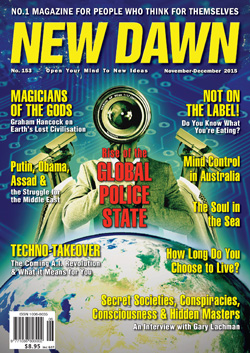
  • Oceania Forever: Rise of the Global Police State

    Oceania Forever: Rise of the Global Police State

    From New Dawn 153 (Nov-Dec 2015)

    Much has been written about the approaching Police State in alternative media. Commentary ranges from various warnings, to shock and outrage, and fear over an impending martial law takeover in North America and Western Europe. It’s hitting us from so many different angles, and yet the mainstream conversation continues to be woefully inadequate in both characterising the situation and offering a remedy.

    In order to really understand the modern Police State, we need to explore some very profound and difficult questions. Many people who consider themselves aware think Western society has already reached the tipping point and the deteriorating situation is simply inevitable. If you feel like Winston Smith right about now you aren’t alone.

    Prior to the mid 1990s, one might have described the militarisation of public law enforcement something of a creeping paradigm, but one that was still a long way off. Society explored many aspects of the Police State, both the physical and Orwellian psychological scenario, through literature and film. American science fiction writer Philip K. Dick penned some significant works like The Minority Report, and cinematic hits like Paul Verhoeven’s Robocop and Terry Gilliam’s Brazil also explored what this dystopic, future vision of fascist technocracy might look like. As it turned out, and far from fantasy, countless devices, systems and themes depicted in so many of these supposedly ‘fictional’ classics have since made their way into our day to day lives. The dark dream became real.

    Unfortunately, as humanity’s freshmen class of the early 21st century, we can no longer afford the intellectual distance enjoyed by previous generations between life today and that blurry, far-off spectre of something that might arrive sometime at some point in the future.

    Any modern globalised Police State requires a social engineering framework in order to provide its shape and scope of law enforcement. The latest social engineering blueprint for global technocratic management was unveiled at this year’s 70th United Nations General Assembly in New York City. Their ‘new’ agenda (newer than the old one) entitled, Agenda 2030,1 hopes to “transform our world for the better by 2030.” Author Michael Snyder from the blogEnd of The American Dream’ explains: “The entire planet is going to be committing to work toward 17 sustainable development goals and 169 specific sustainable development targets, and yet there has been almost a total media blackout about this…”2

    Within its 17 ‘universal goals’, the actual Police State provision for Agenda 2030 can be found within Goal 11, which states how the new global government will, “Make cities and human settlements inclusive, safe, resilient and sustainable.” Translated in technocracy terms, this means more Big Brother tech, smart grid tracking and big data surveillance states.

    The age of computerisation and database integration, along with advances in military and crowd control technology perfected overseas, have enabled a sharp advance toward the Police State. Trying to make sense of ‘it’ is a major challenge, to say the least. In its totality, the control system is both multifaceted and multilayered. It may have been possible to describe it, or even define it 20, 30, or 40 years ago, as Philip K. Dick and so many others did. Today, as society has already eclipsed the possible, we face a situation whereby the very thing we are trying to describe is woven through nearly every fabric of modern social, professional, family, religious and political life.

    If you happen to live in one of the technocratic nations, you can’t opt out, nor can you fully repeal the advances already made by the control system. What other options are available?

    Firstly, we have to try and understand, from an economic, cultural and political perspective at least, how this control system came to be.

    What are its strongest areas? Can we reform those areas? Where is it still emerging? Cannot those areas be slowed down? What was the political climate that enabled it?

    How to Build a Police State

    When you observe a modern Police State, the first things you might notice will not necessarily be the batons, shield, helmets or MRAPs. Think Switzerland or Singapore. A modern Police State will be neat, clean and efficient. Retail zones will be shiny and feature all the top designer brands. Many of the people you see in public will be well-groomed, well-healed and beautiful, but often with only one political party and a strict public code.

    Just like admirers of the modern Chinese State, Singapore’s proponents refer to the single party State as “a great argument for Authoritarianism.” Order and civility rule the day, so long as you don’t fall foul of the narrow perimeters set by the State.

    What has been accomplished in Southeast Asia since 1965, and what is possible in previously ‘free’ countries like the US, UK and Australia, are two very different social and political evolutions. Still, the modern Police State is advancing globally and it’s being driven primarily by three factors: technology, for-profit industry, and an age-old obsession by the ruling class to manage the masses.

    The first and easiest area to challenge is the physical realm of the control system. The most obvious of these are the gadgets and toys. They are easy to see. Look at your local police department and notice the difference between what officers looked like and what they wore in the 1970s, 1980s, 1990s and now in the 21st century. Notice the firearms and tasers, the ‘Bat-Belts’, and now the body cameras. Your average officer today looks like a cross between a soldier and an android. Dress them like robots and don’t be surprised when they act like machines (and it won’t be long until many of them are replaced by machines).

    If you’ve ever attended a street protest or witnessed some civil unrest, then you’ll have noticed the high-tech body armour, the riot and ‘crowd suppression’ equipment.

    My first intense experience where I felt the full force of the modern Police State was in 2009, at the G20 Protests in the City of London, England. It was early in the evening and approximately 4,000 demonstrators suddenly found themselves trapped at Bishopsgate. Several hundred police officers on foot and horseback had blocked all the entrances and egresses in and out of the main road. Even alleyways were manned by riot police. Then police began charging the crowds, and beating protesters with clubs. They alternated their ‘surge’ efforts, from different ends of the street, north to south, one brutal flurry after another. The worst part about it was there was no escape route away from the police. Many were beaten and trampled on that evening. It was as if police planners were playing a video game.

    Finally, at around 9pm, after being forced to stand, surrounded by police in a ‘Kettle’ for nearly three hours, along with 500 other demonstrators and press, who spent most of that time pressed up against police shields and not knowing what would happen next – I realised this is an impersonal, disinterested and totally uncompromising machine. It does not care who you are, what your views and opinions are, or whether you were innocent or guilty. The lesson was simple: “next time, stay home.” The only detail this machine is concerned with is that you comply with orders, and if no orders are given, then the machine demands you stay where you are until the machine decides what to do with you. If you complain too much, or become emotional, or heaven forbid act out in any way, then the machine will move in to subdue and detain you. That is all there is to it.

    Big Brother Reality

    It’s well-known that Great Britain is home of the world’s largest and most sophisticated physical Police State, including tens of millions of closed circuit television (CCTV) cameras, covering every conceivable inch of habitable space, both indoors and outdoors. The CCTV phenomenon in Britain was fuelled by an obsession with cameras that became increasingly popular with both government and corporate technocrats in the 1980s and 1990s. The psychology behind the exponential proliferation in cameras was mainly a fairly crude bit of criminology which held that the cameras would somehow act as a deterrent to criminal behaviour, and thus subdue the feral population into a more docile state. Industry used this line too, as sales persons were deployed en masse with endless flip charts and statistical models that claimed CCTV cameras would prevent the UK’s spiralling social malaise.

    The only problem is that more cameras don’t equal less crime. Canadian writer Cory Doctorow observed this reality back in 2011, explaining: “After all, that’s how we were sold on CCTV – not mere forensics after the fact, but deterrence. And although study after study has concluded that CCTVs don’t deter most crime (a famous San Francisco study showed that, at best, street crime shifted a few metres down the pavement when the CCTV went up), we’ve been told for years that we must all submit to being photographed all the time because it would keep the people around us from beating us, robbing us, burning our buildings and burglarising our homes.”3

    The CCTV is only one single aspect of Big Brother. It turns out that the real value of the CCTV camera grid is not so much the monitoring of crime per se, as it is in mass applied behavioural psychology.

    [alert type=”info” dismiss=”no”]If you appreciate this article, please consider a subscription to New Dawn magazine.[/alert]

    The Panopticon

    The physical Police State could not exist without some philosophical underpinning. Before Orwell, there was Bentham…

    In the mid 19th century Britain developed a new style of prison architecture known as the ‘Panopticon’ under the aegis of utilitarian philosopher Jeremy Bentham.4 The unique feature of this Panopticon concept was the transparent nature of each prisoner cell, visible to a central surveillance guard tower that could eye inmates at all times. The result of this psychological experiment, according to the pragmatic Benthamite philosophy, was to produce a regime of “self-policing” amongst the inmates, a kind of early behavioural conditioning. For technocrats and emerging utilitarian social managers of that era, this was seen as the most economic and efficient solution. Ultimately, this Benthamite concept is what underpinned phase one of the mass CCTV deployment throughout the UK. Sitting well above the security minions and the industry profiteers, elite scholars knew full well that CCTV cameras do not stop crime.

    The real power of the Panopticon is in convincing the general population they are under constant surveillance. After that point, through a long-term process of nudging, diversions and scare tactics, the State gradually moulds the behaviour and thoughts of its subjects.

    In order to keep citizens locked into this new conscious state of fear and trepidation, the State needs an enemy…

    The Long War & ‘The Extremist’

    One of the chief campaigns to nudge society towards a fully-functional Orwellian State is the War on Terror. Ever since September 11, 2001, the concept of an endless war against the ‘terrorists’ – a seemingly ubiquitous and constantly shape-shifting enemy – has been used to justify nearly every large new security expenditure and policy. Back in 2006, US President George W. Bush’s chief architect of the ‘long war’, Secretary of Defense Donald Rumsfeld, laid out the tea leaves for the next 100 years, stating: “It does not have to do with deployment of US military forces, necessarily. It has to do with the struggle that’s taking place within that faith between violent extremists – a small number of them, relatively – who are capable of going out and killing a great many people, as they’re doing, and the overwhelming majority of that religion that does not believe in violent extremism or terrorism.”5

    In George Orwell’s classic novel 1984, Winston Smith also grappled with the State’s endless war. “Oceania was at war with Eurasia: therefore Oceania had always been at war with Eurasia.”

    In Oceania, people eventually forgot what started the long war. The news was just one terrorist attack after another. The enemy was everywhere, but nowhere too. The population learned to acquiesce to the idea that war was the permanent state of affairs, and that questioning the provenance of this idea was futile.

    “Winston could not definitely remember a time when his country had not been at war, but it was evident that there had been a fairly long interval of peace during his childhood, because one of his early memories was of an air raid, which appeared to take everyone by surprise. Perhaps it was the time when the atomic bomb had fallen on Colchester. He did not remember the raid itself.”

    And so it was, in the early moments of the 21st century, Orwell’s dream suddenly became a waking reality. Social engineers are firm believers that if the Panopticon (married with the threat of an invisible enemy) can remain in place for a generation, then the State could fundamentally change a once free-thinking society into something noticeably different – a much more fearful and compliant populace.

    The Social Media Panopticon

    As terror scares and attacks become somewhat of a daily event in the West, identifying and quarantining the ‘extremist’ becomes a primary fetish of the Police State and its media arms. This is very much evident in how terrorists and ‘active shooters’ (dead or alive) are now profiled after the event. The mainstream media has integrated this into its work practice by crafting the post hoc guilty verdict of the accused, prior to a trial, with circumstantial or non sequitur accusations based on an individual’s “web history” that may have “radicalised” the suspect. In effect, the mainstream media’s function as an establishment propaganda arm results in trial by media – the bypassing of any trial by jury as the accused have already been implicitly or explicitly declared guilty by association or something as nebulous as “web history.”

    Such incidents, as they are portrayed in the media for psychological conditioning purposes, are intended to cause the public mind to dismiss outdated notions of fair and due process and rule of law in favour of fiat corporate news and government “official” pronouncements. The net effect of this trend is that social media users, ie. the majority of the population, are adopting self-policing habits in their communications online. According to the principals of applied behavioural psychology, if you change the language people use, then eventually you change the way they think and act.

    Like Bentham’s Panopticon, this new social media monitoring system works by utilising the digital web, which is arguably the most economic and efficient solution. The acceptance of self-policing and vague terms such as “radicalised” that are subject to the increasingly elastic definitions of the social engineering establishment.

    This leads to one of the most profound questions one might ask in the wake of Edward Snowden’s NSA spying revelations: Knowing what we know now, are people more outspoken or are they more self-policing because of the Snowden leaks?

    ‘The Daily Shooter’

    By extension, once the technocrat has regained some modicum of physical control, then the next domain to be conquered is the mind. In 1984, the technocracy was viewed through the eyes of the protagonist Winston Smith, who while remaining a physical prisoner of the Police State, could still retreat into his own mental state.

    In our day, the expansion of the surveillance State and vast spying by the likes of the NSA and GCHQ are precisely intended to achieve this same effect, with the justification for such intrusions being an endless series of terror spectacles and lone wolf public shooting events. In the US, these mass shootings and terror scares are happening on an almost daily basis, hence, ‘The Daily Shooter’. Media coverage is both chaotic and relentless. As a result, the pubic are left stupefied and completely unable to challenge whatever narrative the government-media complex is selling at that time. The Police State marches forward.

    A similar psychodrama also played out for 1984’s protagonist Winston Smith. As time progressed, however, maintaining some level of autonomy in one’s own thoughts became increasingly difficult for Winston. The final objective of the Police State, it seemed, was not only to fundamentally transform the way citizens act, but how they think too. The all-seeing and all-controlling “Big Brother” State was also the de facto social authority figure. The State’s law enforcement police force also became the “thought police.”

    We see this same exact narrative playing out today as the State’s political figureheads continue in their mission to widen their definition of “extremism” along with other State-issued euphemisms used to describe citizens who should be regarded with suspicion.

    Fall out of line and you might even be segregated or sent away to a special camp. Following the recent mass shooting in Chattanooga, Tennessee, retired US General and NATO Commander Wesley Clark proposed that any “disloyal Americans” should be sent to internment camps for the “duration of the conflict.” Notice the language: “for the duration of the conflict.” Indeed, it seems that Oceania is at war. He went even further, calling for the US government to identify people most likely to be “radicalised” so we can “cut this off at the beginning.”

    “At the beginning?” Here, it seems Clark might be alluding to pre-crime, which will be powered by A.I…

    Artificial Intelligence

    Post-September 11, UK society was still hooked on their CCTV matrix, and with millions of cameras already in place and crime continuing to rise, security ‘experts’ and politicians simply doubled down on their previous wager, insisting that what the country really needed was more cameras. They believed that once a certain CCTV saturation was reached, by default they would somehow reached their twisted utopia.

    It turned out that’s not humanly possible for security workers, most of whom are on a mere £7-10 (aud$14-20) per hour, to keep track, let alone analyse, a seemingly endless stream of footage. For the technocrat, the operative word here is ‘humanly’. Enter A.I…

    Once again, advanced technology enters the narrative and supplies the solution to this previous insurmountable problem. The age of Artificial Intelligence, or A.I., is nearly upon us, and this next step in technological development is certain to radically change the entire concept of the Police State.

    Laying down the framework an A.I. grid is not easy because the grid must be designed to cope with the application of A.I. As A.I.’s potential and practical applications have not yet been fully realised, designing the grid upon which it will be unleashed has been problematic up to this point. Sadly, society on the whole appears disinterested in questioning the social and unethical imperative currently driving the adoption of these new technologies.

    At present, the big money is on the Smart Grid. Technocrats and their corporate partners are hoping to usher in their new surveillance grid under the auspices of ‘smart’ technologies. With A.I. in play, technocrats will be able to utilise the smart grid – which includes your mobile phone – to detect and track multiple targets over a wide area.6 Add facial recognition and data profiling to the mix and it’s a recipe for a full-on A.I. Smart Grid future. The ultimate hands-free, ‘surveillance selfie’ – compliments of Big Brother.

    Just imagine, one day you’re simply walking down the street and pointing to something in the air. All of it is being captured on a 1.8 billion pixel video stream from the sky. They already know your identity and location with the phone in your pocket, and they already have your face logged and tracked.7

    At this point we introduce Philip K. Dick’s concept of “pre-crime” whereby an A.I. system can predict an action you are likely to take.8 The system will then close the ‘Big Data’ loop by storing the video footage alongside your profile into a massive data ‘mash-up’. It will then compare with other potentially ‘suspicious’ activity in the area. Great Britain’s national police force, the Metropolitan Police, are already using a type of pre-crime software that British technocrats believe will somehow ‘revolutionalise’ modern policing in the 21st century.9

    UK consumer advocate Pippa King explains how CCTV is already being phased out: “CCTV, closed circuit television, is not quite what is operating on our streets today. What we have now is IPTV, an internet protocol television network that can relay images to analytical software that uses algorithms to determine pre-crime area in real time.”

    “Currently this AI looks at areas that may be targeted for crimes such as burglaries or joyriding,10 with the predicted hotspot information being sent direct to law enforcement smart phones in the field. This analytical software is being used in Glasgow, hailed as Britain’s first ‘smart city’,11 where the Israeli security firm NICE Systems are running the CCTV/IPTV network, analysing data from the 442 fixed HD surveillance cameras and 30 mobile units under a project called ‘Community Safety Glasgow’,12 whose primary objectives are described as ‘delivering Glasgow a more efficient traffic management system, identifying crime in the city and tracking individuals’.”13
    This all can happen thanks to the US Defense Advanced Research Projects Agency’s (DARPA) latest creation – the ARGUS camera, Autonomous Real-Time Ground Ubiquitous Surveillance.14 According to its designers ARGUS, “melds together video from each of its 368 chips to create a 1.8 billion pixel video stream” all in real-time and archived. It’s just one of the many new toys used by the State to realise its Orwellian ambitions.

    Who’s Paying For It All?

    Aside from its ability to trample over the rights of law abiding citizens, the Police State has one other chief characteristic which may also be its Achilles heal: it’s bankrupting the State. Here’s how it works:

    The gravy chain is endless, but only with the help of taxpayers’ money, along with a series of bribes and favours between politicians and corporates. If you have ‘friends’ in government administration, then you are more likely to cash in on any number of lucrative ‘domestic defense’ contracts.

    Where you have constant crisis you also have constant business opportunity. In this dark paradigm, timing is everything. As US President Barack Obama’s sociopathic15 former chief of staff, now Mayor of Chicago, Rahm Emmanuel, once said: “You never let a serious crisis go to waste. And what I mean by that it’s an opportunity to do things you think you could not do before.”

    With that mantra in mind, in the wake of any shooting, terror scare, or crisis, industrial lobbyists and their elected political gophers will waste no time pushing for new federally-funded add-ons like training courses, workplace psychologists, regulators, specialist contractors, police cameras and other big-ticket items16 – anything to help “solve the crisis.” One such program in the US is known simply as the ‘1033’.

    Joseph Lemieux writes: “The 1033 program has flooded our local police forces with military equipment, and has turned them from Peace Officers, to a domestic army.”

    “Officers stopped looking like officers, and more like soldiers all kitted out with fully automatic weapons, armoured vehicles, body armour, grenades launchers, night vision, and even bayonets! Besides the cost of liberty, how much has this domestic army cost you the tax payer?”17

    In the US, no single entity embodies the Police State gravy train more than the Department of Homeland Security (DHS), where federal grants are used to bribe local law enforcement and absorb them into a larger framework of institutional dependency.

    At over $200 billion per year, the DHS is now America’s most expensive federal agency. As any sane local law enforcement chief will tell you, once you smoke from the federal crack pipe, you’re hooked for life. Remember that each federal Police State agenda item has a lucrative contract attached to it. With each move central government makes, a large amount of money is also made (by someone).

    By cutting off public money that is driving the runaway federal Police State in Western countries, the people have a chance to mitigate and potentially reform the current agenda.

    If we hope to preserve what is left of our hard fought democracy, then now is the time to put it to the test. The alternative is unthinkable.

    Patrick Henningsen is a regular contributor to New Dawn magazine. Check out his article “Technetronic Enslavement: Life Inside the Matrix of Control” in New Dawn 156 (May-June).

    [alert type=”general” dismiss=”no”]This article was published in New Dawn 153.[/alert]

    [alert type=”success” dismiss=”no”]If you appreciate this article, please consider subscribing to help maintain this website.[/alert]

    Footnotes

    1. ‘Transforming our world: the 2030 Agenda for Sustainable Development’, https://sustainabledevelopment.un.org/post2015/transforming
      ourworld
    2. ‘The 2030 Agenda: This Month The UN Launches A Blueprint For A New World Order With The Help Of The Pope’ by Michael Snyder, 2 Sept 2015, http://endoftheamericandream.com/archives/the-2030-agenda-this-month-the-un-launches-a-blueprint-for-a-new-world-order-with-the-help-of-the-pope
    3. ‘Why CCTV has failed to deter criminals’ by Cory Doctorow, The Guardian, 17 August 2011
    4. www.ucl.ac.uk/Bentham-Project/who/panopticon
    5. www.sourcewatch.org/index.php/The_Long_War
    6. ‘Bilderberg 2015: Implementation of the A.I. Grid’ by Jay Dyer, 21st Century Wire (www.21stcenturywire.com), 14 June 2015
    7. ‘Britain Launches “Big Brother” System, Uploads One Third of Population to Facial Recognition Database’, 21st Century Wire, 3 Feb 2015
    8. ‘Already Underway: Smart A.I. Running Our Police and Cities’ by Pippa King, 21st Century Wire, 13 Mar 2015
    9. ‘British Police Roll Out New “Precrime” Software to Catch Would-Be Criminals’, 21st Century Wire, 13 Mar 2015
    10. ‘Pre-crime software recruited to track gang of thieves’ by Chris Baraniuk, New Scientist, 11 Mar 2015
    11. ‘Glasgow wins “smart city” government cash’, BBC News, www.bbc.com/news/technology-21180007
    12. www.saferglasgow.com
    13. ‘Already Underway: Smart A.I. Running Our Police and Cities’, op.cit.
    14. www.darpa.mil/program/autonomous-real-time-ground-ubiquitous-surveillance-infrared
    15. ‘The Two Sides of Rahm Emanuel: Sociopathic Political Hitman and Puppy Lover’ by Foster Kamer, 16 Aug 2009, gawker.com
    16. ‘Mayor de Blasio Announces Retraining of New York Police’ by Marc Santoradec, The New York Times, 4 Dec 2014
    17. ‘How Much Money Have American Taxpayers Spent on Building a Domestic Police State?’ by Joseph Lemieux, 1 Dec 2014, http://theantimedia.org/taxpayers-police-state/

    © New Dawn Magazine and the respective author.
    For our reproduction notice, click here.
  • The Emerging ‘Mark of the Beast’ System: Sleepwalking into the Surveillance Society

    The Emerging ‘Mark of the Beast’ System: Sleepwalking into the Surveillance Society

    From New Dawn 145 (Jul-Aug 2014)

    Modern technology has created a brave new electronic and borderless world. Surveillance and biometric capturing technologies have advanced significantly in recent years. ID programs have modernised with the likes of ID smartcards linked to huge databases enabling fast and secure electronic authentication among other surveillance functions.

    Advances in digital technologies have made it possible now to construct an identification system capable of monitoring just about every human transaction. The surveillance society is no longer a future probability but a very present reality.

    As Martin Hirst, Associate Professor at Deakin University observes: “…we are clearly living in a well-established surveillance society.”1 This surveillance society has at least several disturbing implications as Hirst proceeds to explain:

    Everything you do is subject to surveillance… We are under constant watch, both physically and electronically. Surveillance is the new normal. It’s everywhere and this ubiquity makes us take it for granted.2

    That ubiquitous surveillance has achieved an almost imperceptible presence in our lives is captured in remarks by Julian Assange in an interview with Global:

    The web accelerated the network’s proliferation into every aspect of modern daily life in advanced societies. The speed of that transformation has left global society unaware of the political and societal implications of using a one-world network as the central nervous system of humanity. Foremost among those implications was the globalisation and totalisation of surveillance.3

    Indeed it’s a profound transformation unfolding as advanced surveillance technologies become smaller, faster and far more powerful and effective. But more, it reveals an eerie dimension to modern surveillance in that while it has become pervasive, it is also now largely invisible. Accordingly, the erosion of freedoms and privacy, and the impacts on social inclusion and exclusion go almost unquestioned. We’ve become preoccupied with the need for high-tech solutions to everything, whether it’s ensuring robust security and safety or prevention of identity fraud and crime.

    Few surveillance instruments are as effective for monitoring the movements of individuals as smart ID cards, particularly when empowered by modern technology and infrastructure. The Secretary General of Interpol and the EDAPS Consortium clearly know this when in an intriguing announcement in 2011, called for development of an electronic “Globally Verifiable Identity Card.” The card was envisaged to be embedded with a contactless microchip and integrated biometric technologies providing “automation of border and migration control at all levels” and verifiable “through national and international databases.”4

    Taking the globally verifiable identification card to a new level is this curious proposal by science fiction writer Elizabeth Moon, who told BBC in 2012 that to change the world everyone should be issued a unique ID barcode or implantable chip:

    … I would insist on every individual having a unique ID permanently attached – a barcode if you will; an implanted chip to provide an easy, fast inexpensive way to identify individuals…5

    Moving forward to 2014, is this chorus of calls for ubiquitous surveillance, global ID systems and universal human chip implants merely the paranoid fantasies of spirited imaginations?

    Renewed calls for the beefing up of the world’s surveillance systems appear to come on the heels of nearly every major breach of security. Malaysia’s missing airliner MH370 on 8 March 2014 is a good case in point. Given the frustration with the search for the missing aircraft, China announced at the end of March a curious plan involving “massively increasing its network of surveillance and observation satellites so it can monitor the entire planet.”6

    Audacious proposals for high-tech surveillance should give anyone pause for concern. However, it seldom does. As a UK public discussion report notes, the surveillance society is widely “seen as the stuff of science fiction, not everyday life.”7

    ‘Receive a Mark in Their Right Hand or in Their Foreheads…’

    It may seem like the stuff of science fiction but a world in transformation driven by the technology of the age also signals a biblical prediction coming into view. Referring to a mark embedded at the right hand or forehead of every individual, we turn to consider a fascinating verse from the New Testament that describes a centralised world financial order.

    Revelation 13:16-17 reads:

    He causes all, both small and great, rich and poor, free and slave, to receive a mark in their right hand or in their foreheads, and that no one may buy or sell except one who has the mark or the name of the beast, or the number of his name. (King James Version)

    These verses come from the book of Revelation written in the latter part of the first century CE. The author is traditionally known as John, the book’s original Greek title is ‘Apocalypse’ which means a prophetic disclosure or ‘Revelation’ from where the latter title of the book originated.

    While the ‘mark’ has been a topic of debate for many years, its concept remains to be seen. Will the mark be a symbolic representation or a functioning hardware device? Will it be a visible inscription or concealed subcutaneous implant? Could it be a hybrid of any of these? Current technologies and techniques already have potential to meet any one or more of these adaptations with variations of scannable tattoos, implantable chips and a growing range of innovative wearable devices.

    Looking at the passage more broadly, scholars of eschatology generally interpret the verses with view of a world dictator (“He”) who exercises global authority and control (“causes all to receive”) using a specialised instrument (“a mark”) to enforce a draconian compliance policy (“that no one may buy or sell except one who has the mark”).

    A crucially important detail in this passage is the mark embedded at the right hand or forehead, suggesting an indispensable device in a newly established opt-in economy in order to buy and sell, with profound implications for surveillance and control. Surveillance of one’s consumer activities was until recent times a cumbersome process, but with the explosion of a new generation of cashless payment technologies, that has all radically changed.

    Indeed, the shopper of today who prefers cashless methods of payment already leaves a trail of digital records that can be tracked and monitored with ease through their daily online and offline shopping activities. The reason for raising an alarm here is that we can already demonstrate the technical capacity to engineer a completely cashless and paperless economy, outfitted with a centralised global digital currency and embeddable device to replace all existing methods of payment. There would be no means or avenue of escape from this horrendous tightly controlled surveillance complex.

    This seems to be the economic model that the passage is describing, and the narrative this analysis will explore, as we look at a few samples among many emerging innovations and developments to affirm that this is the direction the world is heading. It is also important to consider what these technologies and innovations portend with regard to their possible precursor to the mark, and how they may be familiarising users to be more receptive of an embedded bodily device through exposure and usage.

    [alert type=”info” dismiss=”no”]If you appreciate this article, please consider a subscription to New Dawn magazine.[/alert]

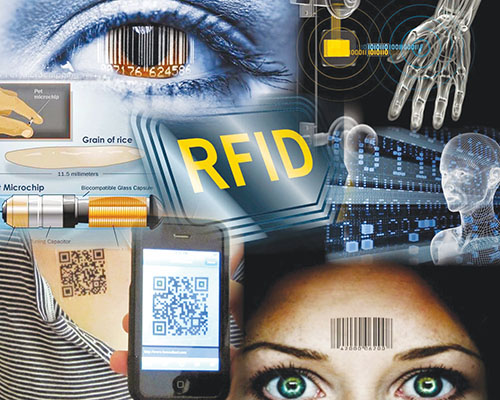
    RFID Technology & Chip Implants

    Radio Frequency Identification (RFID) chips have been the object of a great deal of sensationalist commentary over the years.

    So what are RFID chips? RFID chips are basically an automatic data capture technology that contains unique identification codes that are readable at varying distances with special reader devices. The tiny size of the chips, about that of a small grain of rice, and their widening deployment over the years, has generated broad publicised concerns about potential privacy invasion.

    These fears are not unfounded. It’s already a mandatory requirement in six states of Australia8 and other parts of the world that domestic animals be implanted with a microchip containing identity data linked to a microchip registry. What starts out voluntary often becomes mandatory.

    While deployment of human chip implants in the mainstream has not materialised, it has in no way dampened the spectre of what could be.

    As Time magazine opined back in 1998:

    Your daughter can store the money any way she wants – on her laptop, on a debit card, even (in the not too distant future) on a chip implanted under her skin.9

    Similarly, CNET News 2003, where we read about MasterCard testing RFID technology for the PayPass credit card to be fitted with a chip, states:

    It could be in a pen or a pair of earrings. Ultimately, it could be embedded in anything – someday, maybe even under the skin.10

    A more recent article on BBC sought to inform readers that “it’s the same exact technology as the card in your wallet” to allay fears of “surveillance and totalitarian control” toward microchip implants. Unlike cards that can be lost or stolen, “you’ll never lose the chip,” assured the advocate of the technology. In remarks that read like a glowing endorsement of microchip implant techniques:

    An implanted chip, by contrast, could act as our universal identity token for navigating the machine-regulated world. Yet to work, such a chip would need to be truly universal and account for potential obsolescence…. It marks the beginnings of a slow move toward a world where everything will be accessed from a single RFID microchip. If that day comes, I can’t think of a safer place to keep it than inside my own body.11

    Promoting mainstream use of human chip implants through the health care industry was a curious television commercial for VeriChip Corp in 2008. Featuring a sequence of patients holding forth a tiny microchip, the ad wastes no time enticing audiences with these apparent assurances:

    To think something so small can connect you to everything that matters. When your life and all you love are on the line, Health Link is always with you. When every second counts in the emergency room, providing immediate access to your medical records….12

    Cybernetics scientist Dr. Mark Gasson of the University of Reading in Britain foresees human chip implants becoming one of life’s necessities in the near future, according to citations in the Sydney Morning Herald in April 2014:

    It’s not possible to interact in society today in any meaningful way, without having a mobile phone. I think human implants will go along a similar route. It will be such a disadvantage not to have the implant that it will essentially not be optional.13

    Are these remarks the creative plot for a sci-fi thriller or do they foreshadow biblical mark realities?

    By contrast, it was fears of RFID chip implants “becoming widespread in humans” that prompt this warning in the same Sydney Morning Herald article, citing Dr. Katina Michael, an associate professor at the University of Wollongong:

    They point to an uber-surveillance society that is big brother on the inside looking out. Governments or large corporations would have the ability to track people’s actions and movements, categorise them into different socio-economic, political, racial, religious or consumer groups and ultimately even control them.14

    The spectre of human microchip implants looms.

    Smart Chips & Contactless Payments

    Contactless payment processes have opened a new chapter in fast, convenient and cost effective methods of payment. Many readers of New Dawn would be familiar with the contactless payment services available in many retail stores.

    MasterCard® PayPass™ and Visa payWave are two established contactless payment services on offer throughout Australia. These services provide contactless payment point-of-sale readers that utilise sophisticated smart chip technology to enable users to make payments with little more than a simple wave of a card. No swiping or inserting the card at the terminal, nor a PIN or signature required for purchases under $100.00.

    Unlike the standard RFID chip, the smart chips in cards contain an antenna loop embedded in the plastic. The far more sophisticated modern chip and their variations still use radio frequency technologies but incorporate a microprocessor and internal memory for read/write and secure data storage and management. Contactless smartcards exchange information with payment terminals using short-range wireless communications and conform to the international standard ISO/IEC 14443 that limits the ability to read and write to the contactless device at a distance less than 10 centimetres.

    The significance of these developments cannot be overstated considering the rapid deployment of converging contactless payments and chip card enabled payment innovations in recent years. It could be said that there’s little experiential difference between making a contactless payment with a wave of a card and a contactless payment with a wave of the right hand. If exposure and repetitive use breeds familiarity, then user sensitivities toward an embedded device-enabled payment paradigm are certainly being numbed.

    Quick Response (QR) Codes

    Could scannable tattoos become what is the mark that enables those who receive it to buy and sell?

    QR codes are two-dimensional machine-readable graphics which consist of a matrix of black modules arranged in a square on a white background. QR Codes are similar to standard barcodes except QR Codes can contain much more information than traditional barcodes.

    QR Codes link the physical with the digital world. They are often displayed on brochures, business cards, posters, clothing and other print advertising. When scanned by a smartphone or device, the QR Code directs the user to a website, phone number or other information.

    Incidentally, QR codes also enable payments by linking the user’s bank account or credit card information to their unique QR Code. Depending on the app, users can either pay by scanning a QR code, displayed on a bill for example, with their smartphone or merchants can accept a mobile payment by scanning a customer’s unique QR Code on their smartphone.15

    While QR codes have been around since the 1990s, it’s only with recent technology we see their extraordinary versatility with enabling a variety of mobile payment methods.16 There’s also been a strange twist to this technology with claims of scannable QR Code tattoos.17 It may be a futuristic and bizarre claim to make that one day such tattoos could enable payments much like the passage describes the mark, but it just goes to show the technology and technical capability is here.

    Wearables, Smartphones & Mobile Devices

    Software applications and near field communications (NFC) among other innovations are rapidly transforming payment processing ecosystems, creating a new era of convenient and fast payment services, with converting phones and other mobile devices into full digital wallets.

    It’s claimed the new digital wallet will soon eliminate any need to carry cash and cards, allowing users to link their debit and credit cards to conduct financial transactions all at the press of a few buttons on a device.18 Once the user has established an account, users can ‘tap’ their phone to pay for shopping at the checkout or pay a friend by transferring money from mobile to mobile.

    Enterprising Australian banks and financial service organisations are pressing onward with trials and roll outs of their infrastructure across the country.19 Trials are even being conducted on a payment microchip embedded in the sleeve of suits at the cuff for easy and convenient payments.20 There’s also digital payment bracelets, wristwatches and other wearable payment devices now commercially available.21

    It seems the acceleration toward a cashless society is becoming like one of an amusement arcade amid the range of novel payment devices coming onto the market. These innovative payment devices are yet another novelty enticing customers toward fully traceable and trackable digital transactions, indeed cultivating user familiarity with a variety of cashless and contactless methods of payment.

    Biometric Enabled Payment Devices

    Biometric payment innovations add yet another range of options for the customer to pay, with biometric scanning devices enabling methods of payment typically with finger, hand or face. A familiar range of benefits are advanced including simplicity, speed, convenience and security of payment.

    PayTouch22 and MyTouch23 are two services that allow users to link their payment cards to their fingerprint for method of payment.

    PayPal, a global payment company, has partnered with Samsung to launch a biometric fingerprint authentication payment option enabled by the Fast Identity Online (FIDO) Alliance ready software. The collaboration allows Samsung Galaxy S5 users to be able to login and shop at any merchant that accepts PayPal on mobile with their fingerprint.24

    If there exist any payment technique that could be said to simulate conducting payments with an embedded mark at the right hand or forehead, that would surely belong to emerging hand and face biometric methods of payment.

    Biyo is touted as a revolutionary biometric digital wallet that allows users to pay with their hand by scanning the unique vein patterns in the palm to create a secure password. The point-of-sale system requires users to register their palm and link it to a credit card of choice. Once registered, the user can make payments simply with their hand at any store where the Biyo terminal is available.25

    It’s trumpeted as the world’s first face recognition payment system and comes from a Finnish start-up company called Uniqul. Uniqul are developing real-time facial recognition payment technology to replace cash, cards and phones and aspire to “revolutionise the world of payments with new paradigms to create amazing payment experiences for users.”26

    There is little presence of biometric payments in Australia, however in a recent move toward this initiative, digital banking tech provider The Systems Work Group have taken on eye-print recognition technology for authenticating mobile banking app users.27

    Accelerating Social & Economic Transformation

    Africa and India offer compelling evidence of the radical transformative impacts of cashless technologies on societies and economies.

    The African experience is an amazing transformation, a continent exhibiting by far the fastest growth in mobile money economics in the world amid deep and broad social disadvantage. Mobile money enables users through payment schemes such as SnapScan and M-Pesa to make a variety of financial transactions with just their phone, even where conventional payment infrastructure is unavailable.28

    An extraordinary feature of Africa’s mobile money implementation is that they have leapfrogged over vital infrastructure otherwise necessary for consumers to engage a modern economy:

    The lack of financial and technology infrastructure could have been perceived as a massive barrier, but instead Africa has managed to leapfrog over a world of credit cards, ATMs, bank managers and branches.29

    Evidently the absence or lack of infrastructure is accelerating the transition to a viable cashless society in this instance.

    A similar technological marvel is unfolding in India with the ambitious rollout of a 12-digit unique ID number known as an Aadhaar to all 1.2 billion residents across the country.30

    The Aadhaar number is stored in a centralised database and links to the basic demographics and biometric information of each individual. It is the largest biometric database in the world. The mission is to empower all residents of the country with a unique identity and a digital platform to authenticate anytime and anywhere.

    The program enables millions of rural and poor people through financial inclusion to participate in the modern cashless economy.31 Of important note here is the aim of the ID, as with all sophisticated ID schemes around the world: To create a detailed digital record of everywhere the ID holder goes.

    It’s a fascinating spectacle of technological revolution and accelerating social and economic transformation on a scale seldom if ever seen. Interestingly, when we compare the systems of the mark and Aadhaar, we note a similar layout where both models utilise a unique ID mechanism to enable access to the financial system of the day. To restate in part:

    He causes all, both small and great, rich and poor, free and slave, to receive a mark….  and that no one may buy or sell except one who has the mark.

    En Route to the Global System of the Mark

    Global citizenship and mobility, international trade, global financial markets and high speed technologies have connected individuals and communities beyond our national borders. Increasingly we’re all part of a connected globalised economy in an era of normalising the digital way of life.

    It would have taken some penetrating foresight in decades past to have envisioned the role technology would play today with enabling almost the entire world’s population access to an advancing modern economy, including the world’s poor: “He causes all… rich and poor… to receive a mark…” Yet, here we witness today this incredible transformation unfolding in places such as Africa and India and elsewhere.

    In an interesting note, the Center for Financial Inclusion, citing a convergence of financial inclusion elements including convenient payment systems and the mobile money revolution, envisions global financial inclusion now within reach.32 Cashless technologies are seen contributing to this “profound demographic shift.”33

    Indeed, it’s these cashless technologies that signal an approaching mark-based enabled buy and sell system with each passing day. It wasn’t many years ago that a global cashless society was even technologically feasible, but we now have the computing capacity and power to make it all happen, and very quickly if need be.

    When we look carefully at what the passage is saying, we can actually see described in this ancient text today’s landscape of cashless and embeddable technologies, which is the system of the mark in its embryonic stage development. As such, the pace at which the world is approaching this prophecy may well be synced to the quickening technological progress taking place around us.

    Engineering the Global Surveillance Society

    The cashless society adds a vast new dimension to the surveillance society. Further to being tracked using conventional surveillance techniques, any user of the Internet, credit card or mobile device can now be monitored by their computer and consumer activities.

    As was earlier outlined, the surveillance society had already arrived with little public awareness of, and appreciation for, its pervasive presence in our lives. A similar phenomenon is confronting us today with the cashless society and fewer still are alert to its encroaching consequence.

    We now embrace surveillance like a dangerous liaison with our preoccupation for everything digital and mobile. As journalist and author Pratap Chatterjee observes:

    Today, the surveillance state is so deeply enmeshed in our data devices that we don’t even scream back because technology companies have convinced us that we need to be connected to them to be happy.34

    Exclusive use of cash in the new surveillance economy provides some level of anonymity but even these efforts will be futile when the day arrives that cash is made obsolete.

    What could it take to galvanise governments into establishing a purely closed digital economy incorporating a device embedded in every individual to buy and sell?

    ID cards, payment cards and mobile devices can be lost, stolen and broken. Accordingly, precursor technologies would converge to create the mark, reconstructed as a hybrid of a unique ID and digital wallet device, embedded in the right hand or forehead for a fully integrated security solution.

    How about a crisis of such consequence that threatens world security and social order? With looming global threats and ongoing instabilities, countries teetering on catastrophic financial collapse amid increasing terrorist activity and conflicts abroad, the shifting sands of the current fragile world order would seem to be signalling its systemic breakdown.

    Perhaps in the midst of such turmoil or following a worldwide economic meltdown, comes a momentous shift to a cashless society with an embedded device compulsory for every individual to participate in the new global financial order. However, the newly hatched revolutionary system will be one that ensnares humanity in a totalitarian global surveillance society unlike the modern world has ever seen given such advanced technology in place. We have already crossed the Rubicon.

    [alert type=”general” dismiss=”no”]This article was published in New Dawn 145.[/alert]

    [alert type=”success” dismiss=”no”]If you appreciate this article, please consider subscribing to help maintain this website.[/alert]

    Footnotes

    Note: All links and web pages accessible at time of publication

    1. M. Hirst, ‘Someone’s looking at you: welcome to the surveillance economy’, 26 July 2013, at http://theconversation.com/someones-looking-at-you-welcome-to-the-surveillance-economy-16357
    2. Ibid
    3. ‘Global mass surveillance should be discontinued immediately’, Global: the international briefing, 2014, at www.global-briefing.org/current-issue/
    4. Y. Shostak, ‘Global Identity Verification and Migration Mobility Control’, MRTDs, Biometrics and Security Standards (2011) Montreal ICAO, 12 September 2011 at www.icao.int/Security/mrtd/7th/Documents/12_am_edaps.pdf and ‘Interpol chief calls for global electronic identity card system’, 6 April 2011 at www.net-security.org/secworld.php?id=10860
    5. ‘Barcode everyone at birth’, BBC Future, 22 May 2012 at www.bbc.com/future/story/20120522-barcode-everyone-at-birth
    6. See S. Chen, ‘China mulls global satellite surveillance after flight 370 riddle’, 30 March 2014 at www.scmp.com/news/china/article/1460652/china-mulls-global-satellite-surveillance-after-flight-370-riddle
    7. D. Murakami & K. Ball, et al (Eds) ‘A Report on the Surveillance Society’, September 2006 at www.dataprotection.ie/docs/A-Report-on-the-Surveillance-Society-For-the-Information-Commissioner/386.htm
    8. ‘Is microchipping mandatory for cats and dogs?’ at http://kb.rspca.org.au/Is-microchipping-mandatory-for-cats-and-dogs_287.html
    9. J.C. Ramo, ‘The Big Bank Theory’, TIME, 27 April 1998 at http://content.time.com/time/magazine/article/0,9171,988228,00.html and for full published version see http://content.time.com/time/magazine/article/0,9171,139035,00.html
    10. D. McCullagh, ‘Chip implant gets cash under your skin’, CNET news, 25 November 2003 at http://news.cnet.com/2100-1041-5111637.html
    11. F. Swain, ‘Why I want a microchip implant’, BBC Future, 10 February 2014 at www.bbc.com/future/story/20140209-why-i-want-a-microchip-implant
    12. See www.youtube.com/watch?v=wW_eAQN7oks
    13. I. Gillespie, ‘Human microchipping: I’ve got you under my skin’, Sydney Morning Herald, 16 April 2014 at www.smh.com.au/digital-life/digital-life-news/human-microchipping-ive-got-you-under-my-skin-20140416-zqvho.html
    14. Ibid
    15. ‘Hot issues in payment: QR code and NFC payment’, Payworks, 30 September 2013 at http://payworksmobile.com/blog/2013/09/30/hot-issues-in-payment-qr-code-nfc-payment/ and ‘QR Codes for Marketing: A Unique Way to Bridge Offline and Online Media’, Human Service Solutions, at www.hswsolutions.com/services/mobile-web-development/qr-code-marketing/ and ‘QR Code’ at http://en.wikipedia.org/wiki/QR_code#cite_note-26
    16. See www.youtube.com/watch?v=dAywQ6spop4
    17. ‘Brave hipster gets animated tattoo using a QR code’, Relaxnews, 11 August 2011 at www.news.com.au/technology/brave-hipster-gets-animated-tattoo-using-a-qr-code/story-e6frfro0-1226113101876
    18. B. Voo, ‘Digital Wallets – 10 Mobile Payment Systems To Take You There’, Hongkiat at www.hongkiat.com/blog/digital-wallets/
    19. A. Bender, ‘Mobile payments in Australia: state of the banks’, Computerworld, 29 January 2014 at www.computerworld.com.au/article/536949/mobile_payments_australia_state_banks/
    20. S. Colqhoun, ‘The world’s first payWave suit’, The Age, 23 April 2014 at www.theage.com.au/executive-style/style/the-worlds-first-paywave-suit-20140422-371xp.html
    21. L. McQuarrie, ‘From Digital Payment Jewelry to Credit Card Timepieces’, 14 August 2013 at www.trendhunter.com/slideshow/payment-devices
    22. See www.pay-touch.com/en/home
    23. See www.mytouchpayments.com/default.aspx
    24. A. Vrankli, ‘PayPal and Samsung launch FIDO authentication and fingerprint payments for Samsung Galaxy S5’, Biometric Update, 25 February 2014 at www.biometricupdate.com/201402/paypal-and-samsung-launch-fido-authentication-and-fingerprint-payments-for-samsung-galaxy-s5
    25. See http://biyowallet.com/
    26. See http://uniqul.com/
    27. ‘Eyeprints To Protect Mobile Banking Transactions’, Find Biometrics, 28 April 2014 at http://findbiometrics.com/eyeprints-to-protect-mobile-banking-transactions/
    28. L. Erasmus, T. Kermeliotis, ‘No cash, no cards: Mobile app lets you pay with just your smartphone’, CNN Marketplace Africa, 20 February 2014 at http://edition.cnn.com/2014/02/20/business/no-cash-no-cards-just-smartphone/index.html?hpt=hp_bn1
    29. R. Botsman, ‘Mobile money: The African lesson we can learn’, Financial Review, 14 February 2014 at www.afr.com/p/boss/mobile_money_the_african_lesson_CwCeQ00CdCxlpFijNamvgM
    30. ‘AadHaar’ at http://en.wikipedia.org/wiki/Aadhaar
    31. Ibid and see ‘From Exclusion to Inclusion with Micropayments’, UIDAI Planning Commission, April 2010 at http://uidai.gov.in/UID_PDF/Front_Page_Articles/Strategy/Exclusion_to_Inclusion_with_Micropayments.pdf and ‘Aadhaar: Financial Inclusion through online authentication’, Aaadaarh UIDAI at www.youtube.com/watch?v=3aQJztNif94
    32. ‘Seizing the Moment: On the Road to Financial Inclusion’ by the Center for Financial Inclusion, October 2013 at http://centerforfinancialinclusionblog.files.wordpress.com/2013/11/seizing-the-moment-fi2020-synthesis-report.pdf
    33. E. Zuehlke, ‘Cashless Technology One Piece of the Financial Inclusion Puzzle’, MasterCard, 4 February 2013 at http://newsroom.mastercard.com/2013/02/04/cashless-technology-one-piece-of-the-financial-inclusion-puzzle/
    34. P. Chatterjee, ‘Mining your information for big brother’, Asia Times Online, 15 October 2013 at www.atimes.com/atimes/World/WOR-01-151013.html

    © New Dawn Magazine and the respective author.
    For our reproduction notice, click here.
  • ‘Chipping’ Humanity: The Global Power Elite’s ‘Product of the Future’

    ‘Chipping’ Humanity: The Global Power Elite’s ‘Product of the Future’

    From New Dawn 139 (Jul-Aug 2013)

    In recent years we have seen more and more science-fiction-like nanotechnologies integrated into incredibly tiny RFIDs (Radio Frequency Identification Devices). These devices can be embedded into a person’s body to serve as a Global Power Master controlling mechanism as they increasingly encroach on civil liberties, political freedom and peoples’ sovereignty everywhere.

    Many people relate this to historically recurrent ‘End-Times’ predictions, such as the ominous prophecy in the Christian Book of Revelation. Others more pragmatically point their fingers at the total political and economic control the Elite intends to impose upon all of mankind.

    Let’s do some mental Aikido and take a more Zen approach towards this problem. Yes, it is true that developments in these and many other types of technologies are moving at a highly dynamic, even frantic pace, making it harder to understand and cope with the changes they bring about and, more importantly, to identify the perils they entail in a correct and timely manner.

    Every day we learn of some new micro-electronic wunderapparat unimaginable until yesterday. Some RFIDs are so tiny they can be implanted in the human body without us being aware of them; thus, beware of pandemic-scare induced mass mandatory vaccinations that could serve to slip one into you! We also have retinal scanners and other ID gadgets, remote controlled drones as small as birds and insects, and a myriad of snooping devices of every shape and kind.

    I’ve Got You Under My Skin…

    Frankie Valli sang this song when I was a teenager in the sixties: who would have thought that half a century later a rash might not actually come from a girlfriend you like, but from some RFID chip that – like it or not – someone stuck under your skin?

    Luckily, the grave dangers of this are being understood by increasing numbers of people who rightfully perceive that RFIDs are not just technological wonders but tools for total control used by the Global Power Masters – and they need us to accept them ‘voluntarily’ even if with varying degrees of fear and misgivings. In other words, people must either be persuaded or forced into accepting them. Persuasion, of course, is the preferred road, but if that doesn’t work, well… we’d all better watch out!

    Their mass propaganda – through movies, advertising, TV – instils into the brains of millions of people the voluntary acceptance of Radio Frequency Identification chips. They use swarms of different arguments all designed to convince us that chipping will make life safer, easier and more secure.

    They tell us we won’t need to carry ‘stealable’ cash around with us anymore; that if we suddenly fall ill on the street or when travelling our full medical records will be right there on us for emergency medics to retrieve; and – think! – if your little child is late coming home from school, no need to panic: his electronic tag will identify his location for you…

    In a truly mature, just, morally solid and intellectually balanced society, the mass application of such technological advancements could represent a true blessing. But in today’s world, this is at best naïve and utopian. We all know that the problem is not the technology in itself, but rather the inevitable development and application of the technology by the power elites to serve their demented goals.

    Thankfully, people in every country are slowly waking up to the fact that over and above national governments – whether ‘democratically elected’ or not – there reigns a mostly unseen and immensely powerful global elite. It increasingly distorts the forces shaping society, mocks the genuine desires and expectations of decent people everywhere, and is bent on imposing its will upon all of us. They are, in fact, forging a veritable World Government right before our noses in which they and only they will call the shots.

    Call it ‘New World Order’ or ‘Global Power Masters’ or ‘Mega-banker Cartel’ or ‘Illuminati’ or any other conspiracy flavour you prefer. We can sense it and catch glimpses of its dark shadow passing over key world events. If we listen very closely, we can even hear it whispering ideas and orders hither and dither to corporate CEO’s, national presidents, prime ministers, cabinet and parliament members, media moguls, and public & private officers in an immense variety of organisations and institutions.

    Don’t Throw the Baby Out With the Bath Water

    Right now there are two basic actions we can take:

    (a) Resist implementation by the ruling power elites to enslave us, and

    (b) Design socially constructive awareness-generating applications of these technologies.

    We know the Global Power Masters would love to chip us all right here and now. Recently, a US Senate Republican High Tech Task Force praised RFID chip applications, describing them as “exciting new technologies… holding tremendous promise for our economy.” They vowed to “protect” RFIDs from regulation and legislation.1

    When confronted with such challenges, we must first of all properly grasp what the problem is really all about so that we don’t fight back in the wrong way and miss out on hidden opportunities. History shows that when revolutionary inventions appear, peoples’ first reactions are often of ‘fear and trembling’. As we all know, we get used to new technologies, just as we are familiarised with a million different new things in life: some better, some worse…

    Let’s understand how we can use these technologies to fight back. How we can fool their System; how we can mock their controls, checkpoints, scans, radars and surveillance cams. How we can understand the Matrix by taking a step back and looking at the Matrix from outside in order to understand what makes it tick.

    [alert type=”info” dismiss=”no”]If you appreciate this article, please consider a subscription to New Dawn magazine.[/alert]

    More is on the Way…

    The ‘next generation’ of technology is on its way, and as always is driven by the strategic logic of military application. The London-based Voice of Russia quoted Russian defence minister Anatoli Serdjukov stating in March 2012 that “the development of weaponry based on new physics principals – direct-energy weapons, geophysical weapons, wave-energy weapons,2 genetic weapons, psychotronic weapons, and so on – is part of the state arms procurement programme for 2011-2020.”3

    Britain’s Daily Mail newspaper explains that research in electromagnetic weaponry has been secretly carried out in the US and Russia since the 1950’s with “previous research showing that low-frequency radio waves or beams can affect brain cells, alter psychological states, making it possible to transmit suggestions and commands directly into people’s brains though processes with high doses of microwaves damaging the function of internal organs, controlling behaviour and even driving victims to suicide.”4

    Their target is clear: our physical brains and thereby our minds. What’s the antidote? Clearly, when confronted with increasingly dangerous mind games the one true antidote is lucidity and awareness. The power elites know only too well that it will be difficult to get people to accept RFIDs and similar technologies of control. This is why they are actively working on setting up a veritable ‘gate’ through which they hope billions of people will pass, even if they have to do so against their will and desire.

    This, unfortunately, is very dangerous because that Gate lies precisely where the Global Power Masters are strongest and where they wield the most control: FINANCE & MONEY.

    The Money Gate Threshold

    The Book of the Revelation says that in the ‘End-Times’ satanic forces will reign that “causeth all, both small and great, rich and poor, free and bond, to receive a mark in their right hand or in their foreheads; that no man might buy or sell, save he that hath the mark or the name of the beast, or the number of his name, 666.”5

    This might actually turn out to be a self-fulfilling prophecy, but nevertheless it is coming about. Literally. We are moving away from the use of real money – i.e., paper currency – and being pushed, coaxed, trapped and ensnared into using electronic-based money. It is happening fast and this change requires we all have ‘the mark of the Beast’…

    Sweden, for instance, is on the verge of outlawing real money and just having plastic and electronic funny money as the only way to buy and sell. Svenska Dagbladet – Sweden’s main conservative newspaper – recently reported that Swedbank informed its branch offices in the fashionable Stockholm neighbourhood of Ostermalm they will no longer operate with cash money for payments or withdrawal of funds. Only electronic money. Cash has been abolished at this branch with many more branches following suit. It has also been reported that Germany began to abolish cash transactions step by step from August 2012. And it’s happening all across the world, but particularly in Western countries dominated by the power elites.

    Financial institutions are selling the idea of cashless transactions by saying it makes life much easier for ‘customers’ and ‘users’. Marketing goes something like this: plastic and electronic funds transfers are forms of “intelligent money,” whilst good old currency bills in your pocket is “stupid money.” “Intelligent” electronic money allows the banking system to exert full control of all money, something they cannot do when money is in the form of “stupid” cash.

    The goal is clear: replace and annul the use of cash, meaning that anonymous operations are no longer possible. Every electronic transaction leaves a trail: if anyone is targeted by the Powers That Be for whatever reason, they will know what you bought, when, from whom and for how much, and will know or infer what you bought it for. If you are algorithmically or otherwise marked as a ‘rebel’ or – God forbid! – ‘terrorist’, then your chip ID will be cancelled and you’re dead! At least in economic and financial terms. Life will then become a very, very difficult challenge…

    The European Union is pushing the idea that full control over private transactions is a must. Their excuse: money laundering. Although the greatest money launderers in the world for many decades are the megabanks like HSBC, CitiCorp and Goldman Sachs. And not just in corrupt countries like Argentina, Mexico or Colombia, but in the US, UK and EU where corruption is rampant amongst top government and banking officers, albeit implemented with better PR image marketing.

    Controlling all assets – public and private – ensures that when banks really blow it, they will not only have recourse to be ‘bailed-out’ by governments using taxpayer money, but they will also be ‘bailed-in’ by their confiscation of clients’ bank account balances, as we recently saw happen in Cyprus with the Laiki Bank and the Bank of Cyprus.

    The ‘Chipping of Mankind’ is the Global Power Elite’s ‘product of the future’ with which they expect to impose full economic and financial control over people. It comes with a strong PsyOps module that for many decades has been telling and teaching us what money is and what money is not, all aligned of course to their convenience.

    However, when you study the power elites more closely and read between the lines, you realise they have identified a series of ‘public enemies’. First and foremost is the Sovereign Nation-State, a veritable wall that is their ‘Public Enemy No. 1’ so to speak. A truly sovereign State necessarily has two inalienable functions and goals: (a) to promote the Common Good of the majority of the population inside a country’s borders and (b) to defend the National Interest when confronted with the huge challenges and perils of today’s tremendously dangerous world ‘order’.

    Coming very close behind, the Elite’s ‘Public Enemy No. 2’ is Sovereign National Currencies. Just as Sovereign Nation-States in country after country have been purposely eroded into ‘colonial administrative entities’, the concept of Sovereign Currency has been eroded into funny ‘private money’ controlled by the megabankers themselves.

    Let’s take a closer look at this because understanding the true nature of money and currency can make all the difference in surviving what the Elite have in store for us.

    Public Money = Real Money / Private Money = Fraud

    There are basically two types of money, something the boys over at The Financial Times and Wall Street Journal will certainly never tell you: Public Money and Private Money. Public Money is the dollar, euro, peso and pound bills in your pocket that circulate in different countries and regions of the world. It is issued by public banking authorities, normally a national central bank having monopoly issuance rights. Any private citizen trying to print such money will, if caught, end up in jail. And rightly so, because counterfeiting currency adds money to the national and regional financial system, but adds no work to the Real Economy.

    Whilst decent people work to earn money (which means they give something of value to the Real Economy in exchange for their salary: build cars, roads, bake bread, render services), anyone who counterfeits currency is an antisocial private individual who enjoys the benefits of what money can buy without contributing anything of value in exchange.

    The message to people is clear: You want money? Work for it!

    Private Money, however, is created by private banks working together as a ‘system’ which thanks to Fractional Lending legally allows them to create loans for amounts 10, 20 or 50 times greater than the size of the actual currency deposits in their vaults. To add insult to injury, after creating money out of thin air, they then lend it out to individuals, companies, even government, charging interest for those loans!

    Private banking money, however, is just a figure on your bank statement or a blip on your ATM screen. Like all screens it can go blank ‘in a moment, in the twinkling of an eye…’ Because private banking money is a figment of your imagination. The message this System gives to the bankers is also clear: You want money? Create it out of nothing!

    Why are banks allowed to do this in country after country you might ask? Because they have grown so immensely rich and powerful, they operate as a cartel that finances and brings politicians and government officers into power who are aligned to their interests, and who will time and again do their bidding, sanctioning the laws, rules and regulations they need to do this.

    Doing away with cash transactions amongst people and organisations means doing away with ‘stupid’ Public Money, and replacing it with electronic and plastic ‘intelligent’ Private Bank Money. Music to bankers’ ears!

    When the system goes global – international or, should we say, supranational – then there is no limit to how much each bank can create out of nothing. And when Megabankers’ ponzi schemes periodically and predictably come crashing down like a castle of cards then, no sweat: the bankers either manoeuvre to get a government ‘bail-out’ using taxpayer money (because the megabanks are ‘too big to fail’, remember?), or they impose a ‘bail-in’ stealing their account-holders’ deposits.

    Isn’t it nice to be a banker in todays’ usury-based, parasite-controlled financial system which, in turn, controls the economy which, in turn, controls government through suitably aligned politicians and political parties which, in turn, drives the displacement of Public Money with Private Money which, in turn, irrecoverably indebts government to the Megabankers who, in turn, order governments to promote and impose the chipping of their populations…

    Simultaneously, for decades now the global mega-banking establishment has worked really hard through the media, universities and their own key players to blind us to a key factor that no one ever talks about: the huge difference that exists between Public Money (Sovereign Currency issued by the State that can generate interest-free loans) and Private Money (created by private banks out of almost nothing which can grow exponentially through compound interest).

    Sovereign-Debt Death Trap

    To ensure that all countries come neatly under the fold and carry out all these insidious plans, nations must themselves become artificially indebted to the Megabankers through Sovereign-Debt death traps.

    In order to achieve the goal of controlling each and every individual through government-imposed chipping, first you must control governments. Here’s how that works:

    The private Megabanker cabal uses their leverage/control over governments and politicians to ensure legislation is passed making sure the local central bank never provides the correct and proper amounts (volume) of Public Money that the real economy of goods, services and investment needs. This will invariably lead to a credit crunch or inflation (or even both).6

    Then, in come the private bankers, asking governments: “Do you need money to build highways, finance defence, education and health? No problem: we’ll lend all you want!”

    Governments start and keep borrowing and borrowing, way beyond their means, whereupon fiscal indiscipline and collapse kicks in…

    Bankers and successive politicians then refinance ‘sovereign-debt’ again and again until it balloons way beyond all repayment possibilities of the victim-nations. The politicians will merely dump that into the ‘public debt’ and leave it for future generations to pay; whilst the bankers cash in on the interest payments. Ah, the wonders of compound interest! And so whole nations fall under the grip of the Megabankers…

    Get the issue this article appears in

    Manchurian Candidate Managers

    Why does this happen again and again in many countries and regions? Bad luck? Inept management? Sheer stupidity? Corruption? Yes, of course. All of them are true, correct and we read about them in the papers every day. But there may also be another ‘missing factor’ well worth keeping in mind.

    Are we seeing a new generation of increasingly ‘chipped’ presidents, prime ministers, cabinet secretaries, senators, deputies, representatives, ambassadors, judges, that are wittingly or unwittingly doing their job as public ‘managers and CEO’s’ for the Megabankers?

    Are properly modulated and directed electromagnetic waves and other technologies and systems behind the political decisions and blunders of our political leaders?

    Perhaps studying, identifying and understanding them more closely will help unravel their global reach and huge power. It might even expose notorious Manchurian Candidates who – like an army of berserk, amok-running madmen – are occasionally triggered to suddenly go on shooting sprees and bombing attacks in schools, campuses, military facilities, shopping malls, movie houses, marathons, street corners, for no apparent reason as we see happen in the US and elsewhere…

    Or maybe there are very clear reasons… We’re just not looking in the right places. Time to start taking a second look at all these developments and facts and begin thinking more and more with our own minds and brains.

    [alert type=”general” dismiss=”no”]This article was published in New Dawn 139.[/alert]

    [alert type=”success” dismiss=”no”]If you appreciate this article, please consider subscribing to help maintain this website.[/alert]

    Footnotes

    1. “Smart Cards” in a Surveillance Society: The Implanted Radio-Frequency Identification Chip: RFID tags implanted in physical objects or human beings by Tom Burghardt, Global Research, www.globalresearch.ca/the-implanted-radio-frequency-identification-chip-smart-cards-in-a-surveillance-society/10097
    2. HAARP – High Frequency Active Auroral Research Program – has long been suspected of being able to trigger earthquakes in areas where tectonic plates are known to be unstable by getting them to vibrate at their resonant frequency. They might not be able to actually create an earthquake any place they wish, but they can certainly trigger one that is ripe to happen: in Iran, China, Russia, Japan, for example…
    3. “Putin targets foes with ‘zombie’ gun which attack victims’ central nervous system”, Daily Mail, 31 March 2012, www.dailymail.co.uk/news/article-2123415/Putin-targets-foes-zombie-gun-attack-victims-central-nervous-system.html
    4. Ibid.
    5. Revelation, 13:16-17
    6. The exact amount of currency a national economic system needs is absolutely calculable using proper metrics (i.e., velocity of circulation in each industrial sector, geographical area, demographics, social and strategic infrastructure needs, and a vast number of other identifiable and calculable factors).

    © New Dawn Magazine and the respective author.
    For our reproduction notice, click here.
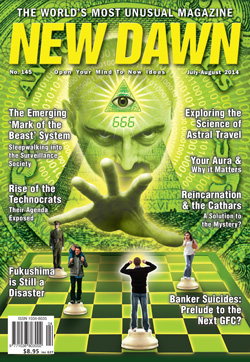
  • War for Total Control: Planning the Ultimate ‘Big Brother’ Surveillance Society

    War for Total Control: Planning the Ultimate ‘Big Brother’ Surveillance Society

    From New Dawn 129 (Nov-Dec 2011)

    It’s an old cliché to say that technology in itself is neither good nor bad, but that all depends on how you use it. In the case of Information and Communications Technologies, and their out-of-control problem child the Internet that has so revolutionised the world, today we seem to be at a key crossroads where all seems to hang on which path Mankind finally treads.

    Like a sharp two-edged sword, the Internet and the very rapidly evolving technologies surrounding it, are poised to either usher in a new era of intellectual, cultural and spiritual enlightenment, material well-being and true cooperation amongst nations bent on resolving common global problems; or we may be about to fall into a black abyss of absolute totalitarian control; intellectual, physical and spiritual violence; and mass slavery on an unprecedented scale.

    How to resolve this dilemma? We should certainly start by understanding three key issues: who really controls these technologies, what are their medium and long term objectives, why are they being used the way they are…

    The Invisible Man

    One of the greatest perils we face today is the difficulty in properly identifying and distinguishing friend from foe; it is increasingly difficult to understand who – even what – the enemy or adversary is which means that society’s key vulnerability stems from its incapacity to properly identify risk, peril and danger. If you cannot see a danger approaching, it will hit you by surprise as the look-out on the Titanic so painfully learned on that fateful night in April 1912.

    A vital factor for the survival and prosperity of individuals, families, communities, organisations – even entire nations – lies in properly identifying friends and enemies (or at least adversaries). There is always an “enemy” out there who either wants to have what we own, or wants to place us in his or her service, or may have a myriad of reasons for wanting to somehow weaken or get rid of us, mostly because they want to take for free something that is ours. Some will say this is basic human nature; others that it’s the Darwinian imperative of the survival of the fittest; still others will complain that it’s man’s criminal egotism. Whatever your view, the truth is that in one way or another we all live immersed in “self-protection or defense mode” which begins every morning when we close and lock our front door.

    What I mean to say is that self-protection or defense is easy when you can clearly identify and understand your enemy: whether thieves at large on our streets, or foreign powers bent on subduing or colonising us. Here is where modern European languages play us a bad trick, because we use the word “enemy” with far too wide a scope. In fact, we would do well to heed the recommendations of German Jurist Carl Schmitt (1888-1985) who, like the Romans, differentiated between Inimicus (i.e., your own personal enemy whom you might hate for having done you some wrong but who is your own private affair and problem) and Hostis (i.e., a public enemy of the community and State, whom we might not necessarily dislike but who poses a threat to all and must thus be combated).

    For example, two hundred years ago, it was easy for the thirteen original colonies of North America to identify as its Hostis the British Crown in London, or for the South American Viceroyalties to identify as their Hostis the Spanish Court in Madrid. A common, visible, credible enemy makes strategic planning that much simpler, for we know who he is, where he is, what he wants, and how he achieves his objectives.

    Today’s challenge, however, is far greater because Hostis – the common enemy is no longer easy to identify. We can no longer simply say “it’s the Brit’s over in London” or “it’s the Reds” or “the Nazis” or “the Japs.” Today, Mankind’s Hostis has become all too complex, often subtle and defying simple identification whether by nation, creed, race, geography, language, or any other easy-to-perceive characteristics. Today’s Hostis is everywhere and nowhere; which requires we refine our search, identifying him more by his tell-tale signs, fingerprints, “DNA” so-to-speak, than by directly perceiving him (or her).

    No longer can national leaders rally mass popular support to “fight the Soviets or the Germans, or the Japanese.” A decade ago, they had to resort to weaker abstractions like the Bushian “war on terrorism,” which is meaningless until you actually define what “terrorism” is.1

    What we have today is basically a public invisible enemy that is very difficult to specifically pinpoint, but the effects of whose actions we all increasingly suffer everywhere. Perhaps “Global Power Elite” is the closest we can come to describing this veritable global enemy whose planetary interests and objectives for the most part run counter to the common interests of “We the People” everywhere, and yet that too is still quite abstract and faceless.

    Nevertheless, and like all “invisible men,” whilst we cannot “see” the enemy we can certainly feel the effects of his actions and can thus certainly learn to trace his tracks, infer where he is now, where he’s going and what he plans to do.

    In this world war, all aware citizens need to become hunters of sorts: fighting the Global Power Elite is much like tracking down a dangerous wild tiger in the forest… An experienced, shrewd and watchful hunter does not need to actually see the tiger to know that he’s close by, if he knows how to identify and understand specific tell-tale ‘tiger marks’: here, some broken twigs on a forest path; there, a dead rodent; perhaps tiger droppings by a tree or paw marks on damp soil; a specific scent, or hushed growling echoing in the distance…

    A similar task faces us if we are to become free and independent: we must learn and understand who, where and what is the enemy and its weapons of war. We can certainly say that technological research, development and control are among its array of armaments. If we understand the enemy, it should not be all that hard to understand what he will do with the technology so “generously” given to Mankind.

    Putting on the Chains of Slavery

    A century ago, Soviet revolutionary Vladimir Lenin said capitalists would one day sell to the communists the very ropes with which communism would hang them. Well, not quite actually as it ended up being the other way around with communists hanging themselves with the invisible “ropes of capitalism,” enthralled as they became at the end of the Bi-Polar world with the West’s mass consumerism. An eloquent snapshot of which right after the Berlin Wall fell in 1989 was a little ticky-tacky East German “Trabant” next to a powerful West German Mercedes-Benz. Indeed, a picture that was worth 1,000 words!

    22 years later, something similar seems to be happening; only this time it’s the Global Power Elite enthralling us with invisible technological ropes with which millions of people are about to hang themselves, in a figurative sense, of course. Not that all of us are doing that yet, but when you look around at the growing mass population control, the noose is certainly being fitted snugly around our necks.

    Humans needs time to adapt and cope with major changes. Through tens of thousands of years of history, change took place very slowly, spanning entire generations so that with each new change, social structures slowly adapted. Today, however, with the explosive advent of information technologies, telecommunications and genetics to name but a few, we’re all mesmerised and desirous to become part of the Info Cybersphere. We’ve been persuaded that we really do need to have the latest cell phones, iPod, iPad, the Internet and cable/satellite TV, iPhone and Blackberry, which potentially is a good thing, but they must be approached with discriminating caution. For they represent a two-edged sword that can either help expand our consciousness and awareness of the world around us in every sense of the word, or they can chain us unwittingly into a macro-system that has grown into a Leviathan with huge capacity to control every detail of our lives.

    I am a layman so I won’t delve into the technicalities of today’s information technologies because others are far more qualified to do that, but I can tell you this: all these technologies are not as innocent as they would have us believe: i.e., so “innocent” that 5, 6 or 7 year olds can be set loose to play with video games and the Internet as if they were mere toys. Not so! These technologies must be approached with at least as much caution, prevention and awe as we do when we drive our car, knowing that just as it can safely take as wherever we want to go, if we thoughtlessly rev the engine up to 250 kmph, it can also get us and others killed.

    Similarly, this two-edged sword can serve to vanquish the Global Power Elite by making us aware of their intentions and their terrible medium and long-term consequences, or it can serve them to cut our throats. In fact, this Janus-headed monster lies equidistant between them and us. Objectively, either they win and we lose, which means the world will be run by machines that they control or, we use these technologies to rally the overwhelming power of We the People, to annihilate the Global Power Elite. Where does the difference lie? In our awareness. 

    The Global Power Elite know full well what they are doing whilst most people don’t, and they will do everything in their power to keep it that way. Here, then, are two global armies pitted against each other. “In this corner…” a tiny but extremely powerful elite controlling a huge machine to their benefit and our enslavement. “In that corner…”, gigantic masses of mostly unaware people using that same machine but without understanding it, nor realising what it’s really being used for.

    It is today so embedded into society that, increasingly, every aspect of our lives are controlled by it: whether it be work done on the Internet, Intranets, E-Trade, managing your bank account, reserving your next flight and printing your boarding pass, doing research and fact-finding, or just plain entertainment and whiling the time away. It’s a coin of which we are systematically shown only the “heads” side, i.e., all the benefits, magic, comfort and advantages of being hooked-in and on-line. “Life is so much easier now…” However, we’re not shown the “tail” side that poses a dark and lurking danger: Total Control. The Info Cybersphere represents a super-structure for total control against which individuals can do little to escape from, unless awareness dawns on them.

    The key weapon wielded against all peoples in every country is PsyWar – Psychological Warfare – that has successfully: (a) incorporated two, maybe three billion people into the IT Cybersphere allowing growing partial/total control over them, and (b) persuaded billions of people to willingly accept this. The rest of Mankind – the other 3 or 4 billion are “useless eaters” as David Rockefeller once called them – just don’t count because they’re too abjectly poor and are not part of any “market”; there’s literally nothing the Corporate Overworld can sell to them. Thus, they are implicitly earmarked for controlled extermination over the next generation through war, disease, starvation, urban violence, environmental contamination, artificially induced “natural” disasters, or by just plain letting them waste away.

    A quick look at some of the technological wonders they have in store for us might better illustrate this:

    Watch What You Say… and Do… (and Think..!)

    “Romas/COIN” is a super hi-tech military civilian mass surveillance and data gathering project supported by US private defense contractors (Northrop Gruman, notably), think tanks, and the US military and civilian intelligence community, with electronic capabilities to monitor and analyse millions and millions of conversations, sort key data and then re-build it to reflect specific behaviour patterns amongst individuals and groups of people, which enables projecting their future plans, whereabouts, goals and actions. This will make “preventive war” and “preventive arrests” that much easier. For now, much of this mass surveillance and data mining targets Arab speaking peoples, not just in the Middle East/North Africa but the world over, which ties in nicely with the endless “global war on terrorism.”

    This represents a quantum leap by the Global Power Elite in that until recently such global hi-tech spying was only done by the National Security Agency, CIA, FBI, MI6 or Mossad (which can always be demonised as modern Gestapo-like entities); now however, we have “friendly” household names like Apple, Google, Facebook, Twitter, Microsoft, Pixar/Disney, PointAbout, doing all the spying for the Elite. This private corporate network is part of the invisible noose we are putting around our necks.

    Big Brother is Watching You…

    Countries one normally believes are bastions of liberty and freedom – the UK, Canada, Australia or New Zealand – are prime examples of mass surveillance. Take a stroll through London and a vast and ubiquitous network of several million CCTV cameras will be watching your every move 24/7 in airports, underground and railway stations, street crossings, stores, bus stops, shopping malls, motorways, parks, bridges, condos, public buildings, private offices, utilities, public toilets, toll booths… Wherever you are in London, someone is watching you… very closely. Naturally, all this is done in the name of “national security” which has become a smokescreen for the political and corporate elites’ perception that growing public awareness does pose a real threat to their interests.

    In Australia Big Brother is hard at work, not surprising since Australia responded to September 11 with extraordinary law-making. In the ensuing decade, Australia’s Federal Parliament enacted 54 pieces of anti-terrorism legislation; 48 of which were passed under the Howard government, an average of one new anti-terrorism law every seven weeks.

    The numbers are striking: Canadian Professor Kent Roach found that “Australia has exceeded the United Kingdom, the United States, and Canada in the sheer number of new anti-terrorism laws it has enacted since September 11, 2001. Australia’s hyper-legislation strained the ability of the parliamentary opposition and civil society to keep up, let alone provide effective opposition to, the relentless legislative output.” All brought to you by the Australian Security Intelligence Organisation (ASIO).

    Australia’s legislation includes the Telecommunications Interception and Intelligence Services Legislation Amendment Act, and the Intelligence Services Legislation Amendment Bill 2011 that strengthens and increases ASIO’s powers to conduct offshore surveillance and reach such organisations as WikiLeaks, targeting anyone campaigning on political and social issues.

    “We know who you are…”

    New technologies may also soon make fingerprints a thing of the past. Vein recognition represents a far more precise method to identify you than traditional fingerprint scanners because of its low .001% false acceptance rate. Using light to penetrate a users’ finger to read vein patterns which are unique and thought to be impossible to replicate, this method is fully fool proof as vein structures change after death, which means severed fingers cannot be used to fool the readers.

    Then there’s face recognition where Toshiba recently unveiled a new range of LED-backlit televisions for 2011 including the model WL800A that uses facial recognition. Next time you’re surfing the Internet or speaking on Skype, hmmm… “we know who you are, where you are and what you’re doing…”

    Lost & Found: “M’am: We found your missing husband’s black box…”

    Microchip Implants for personal tracking and ID are getting smaller and smaller, and ever more injectable without you ever even realising it. Next time an Avian or Swine Flu “crisis” breaks, don’t let yourself be coaxed into mass vaccinating your family. Michael G Michael (University of Wollongong’s School of Information Systems and Technology, Australia), has coined the term “uberveillance” to describe the emerging trend of all-encompassing surveillance, explaining that “Uberveillance is not on the outside looking down, but on the inside looking out through a microchip that is embedded in our bodies.”

    The US’s private hi-tech company VeriChip (www.positiveidcorp.com) widely markets implantable nano-chips which store a 16-digit unique ID number on humans “for medical and security purposes, focusing on high-risk patients and the need to identify them and their medical records in an emergency.” To allay any fears they also explain they do not know when or if someone will develop an implantable microchip with GPS technology, but that “it is not an application we are pursuing.” Michael explains that such implantable chips will become like a “black box that will then be a witness to our actual movements, words – perhaps even our thoughts – and play a similar role to the black box placed in an aircraft.” He also predicts microchip implants and their infrastructure could eliminate the need for e-passports, e-tags, and secure ID cards, adding that “microchipping… will eventually become compulsory in the context of identification within the frame of national security.” For now, your mobile phone acts as a passive transponder for radio frequency identification (RFID) readers.

    Watch the Birdie…

    Not surprisingly, military applications are where trillions of ultra hi-tech dollars are going. We now have drones as tiny as bugs. In a recent piece published in The New York Times2 we learn that the US military’s Wright-Patterson Air Force Base in Ohio runs a flight lab dubbed a “microaviary” where drones designed to replicate flight mechanics of moths, hawks and other creatures are being developed. “‘We’re looking at how you can hide in plain sight’ said Greg Parker, an Aerospace engineer, as he held up a mechanical hawk that in the future might carry out espionage.” Today, the Pentagon has some 7,000 aerial drones explained Ashton B Carter, the Pentagon’s chief weapons buyer and a member of the New York-based Council on Foreign Relations (CFR).

    “In February 2011, researchers unveiled a hummingbird drone built by the firm AeroVironment for the secretive Defense Advanced Research Projects Agency (DARPA) which can fly at 11 mph and perch on a windowsill… one of the smallest drones in use on the battlefield is the three foot long Raven which troops in Afghanistan toss by hand like a model airplane to peer over the next hill.”

    Then we have new “Gorgon Stare” technology that can capture live videos of an entire city, but requires 2,000 analysts to process the data feeds from a single drone compared with 19 analysts per drone today. We can also expect massive growth of armies of military surveillance analysts representing “wonderful new job careers in national defense.”

    A Nation of Cowards

    That same New York Times piece goes on to say, “within the military, no one disputes that drones save American lives. Many see them as advanced versions of ‘stand-off weapons systems’, like tanks or bombs dropped from aircraft, that the US has used for decades. ‘There’s a kind of nostalgia for the way wars used to be,’ said Deane-Peter Baker, an ethics professor at the US Naval Academy, referring to noble notions of knight-on-knight conflict. Drones are part of a post-heroic age, he said, and in his view, it is not always a problem if they lower the threshold for war… Military ethicists concede that drones can turn war into a video game, inflict civilian casualties and with no Americans directly at risk, and thus more easily draw the US into conflicts.”

    This ties in with the Powell Doctrine, drafted by Gen. Colin Powell (CFR) after the First Gulf War which states, amongst other concepts, that the US should only engage in military conflict where its overwhelming military clout guarantees complete victory over carefully chosen weaker enemies. That explains why the US (and its staunch ally Britain) will unilaterally attack Afghanistan and Iraq, but not China or Russia; or why the US (and NATO) imposed “regime change” on Libya but not on North Korea (so intimate with China) or Iran (so close to Russia). This explains why America’s “heroic exploits” included invading tiny Grenada under the Reagan Administration in 1984, and unarmed Panama under Bush Senior in 1991, as well as its unflinching support of nuclear-armed-to-the-teeth Israel against rock-throwing Palestinians.

    Clearly, a more overt “doctrine” of abject and shameless cowardice has yet to be advanced by any nation. There, no doubt, lie the seeds of America’s coming demise and that of its key allies: they have become greedy and corrupt nations governed by cowardly rulers. 

    What are You Going to Do?

    Whatever happens from now on, Planet Earth depends on how large a portion of the two or three billion “lucky ones” who have voluntarily integrated themselves into the Cybersphere through PC’s, laptops, blackberries, websites, cell phones, etc., become aware of the grave dangers facing us all. How fast they begin taking defensive measures from inside the Cybersphere, especially by identifying and taking advantage of its myriad weak points.

    As a friend once said, “if globalisation can be compared to a balloon, then you only need the microscopic point of a sharp pin to blow it up…” Each of us must become such a “microscopic pin.”

    As I write, the surveillance and control infrastructure can read this article, plot my location from their satellites using the cell phone in my pocket as a GPS transponder, spy on what I read, write and navigate on my laptop, and God knows what more.

    Since 20 years or so, the National Security Agency’s Echelon Project can spy on our phones and emails, targeting specific words used in billions upon billions of messages and texts – “bomb,” “attack,” “Islam,” “Muslim,” “nuclear,” “chemical,” and “biological” are just some of the words and sequences Echelon can snoop into (they’re probably doing this right now as I write and as you read!). Whatever it is they can do today surely exceeds our wildest imagination.

    This is no longer just the “national intelligence infrastructure” spanning the CIA, FBI, FEMA, Homeland Security, DARPA, Army, Navy and Air Force Intelligence, and their counterparts in other countries. This now spans private corporations that gather data, organise it, seek and find specific patterns (behaviours, contacts, interests, intents, geographies and infinite others) through which they hope to eventually exert their long-sought dream of total control over populations forming part of their Global System (the rest are as good as dead).

    Microsoft, Facebook, Google, and a vast array of intelligence, security, IT, data gathering companies are all linking into increasingly large networks that pool data, findings and capabilities into complex arrays of self-sustaining and evolving structures, that lie outside the visual scope even of governments, for the simple reason that governments cannot even begin to fathom those capabilities, powers and future projections.

    Does anybody really believe that Barack Obama, David Cameron, the senators, representatives and MP’s of the US or UK governments have a real clue as to what the NSA, together with Google, together with Boeing, together with Northrop, together with Halliburton, together with Apple, together with Mossad, MI6 and CIA front companies, together with key universities and think tanks, together with…. are really developing?

    Can Congress or Parliament enact more laws to “control” something they themselves cannot understand and, even if they were to enact limiting legislation, by then technology will have evolved even further, easily wiggling its way out of any such laws.

    Who’s in Charge?

    That brings us to the key question: who’s in charge? Who really runs Australia, Britain, France and Germany? Japan, India and Brazil? The US and Canada? Argentina and South Africa? Even Israel??

    We see “elected leaders” accessing top government posts using 19th century “democratic” voting mechanisms, that are all controlled by a highly complex 21st century technocratic Over-world, embedded inside the US, UK, EU and most every other country. It operates from inside these countries – even using the military might of the US and NATO countries – but in no way does it heed, support or respond to the interests of these peoples. Was it really the US, Britain and France that invaded and destroyed Iraq, Afghanistan and now Libya? Or is it something far more elusive and powerful embedded inside them but controlled from way above today’s completely outdated, eroded, fatally weakened and – at this rate – soon to disappear “sovereign Nation-State”?

    It’s high time we make the necessary quantum leaps that will allow us to start joining the dots. We need to move away from silo mentality paradigms, and towards a much more holistic Weltanschauung. We have become too “specialised,” which leads to narrow-mindedness. We talk about finance but never join the dots on its geopolitical overtones. We talk about politics but are blind to underlying social forces. We think Hollywood is only about “entertainment,” not realising how they implant ideas and behaviour patterns into our collective psyche.

    Information and data overdrive generate confusion, as we become overwhelmed by trillions of bits of data that swamp our brains every day, hour, minute and second. A healthy tip: take your proper distance and perspective so that we all start to see the big picture. Only then can we move down to the finer detail, because the forest is far, far more important than the tree… at least in this stage where we all need to come to grips with a question that should be growing louder and louder in your mind no matter where you live or who you are: what on Earth is going on!?

    We had better find the answers quickly because we are fast coming to a fork of world historic proportions on the road of human destiny. We either climb up the high road leading to human evolution which will necessarily entail the painful but necessary destruction of the Global Power Elite and all who support, consolidate, empower and fuel its growth, or… we slip down the low road into a dark abyss of death, destruction, mass hypnosis and the end of the human spirit; a vision pretty close to what men throughout the ages have described as Hell…

    What road will you take? We can still make the right decision. There is not, however, much time left.

    [alert type=”general” dismiss=”no”]This article was published in New Dawn 129.[/alert]

    [alert type=”success” dismiss=”no”]If you appreciate this article, please consider subscribing to help maintain this website.[/alert]

    Footnotes

    1. Arab countries fighting back against US-UK-EU intervention in the Middle East and North Africa are branded “terrorists” or “rogue states,” whilst the very cause of the problem – i.e., long decades of violent US-UK-EU and Israeli terror interference in Arab countries is never branded “terrorism” (in fact, they call it “promoting democracy” or some such Newspeak). Militarised groups are thus branded either “terrorist” or “freedom fighters” depending on which side they stand vis-à-vis the Global Power Elite.

    2. See The New York Times, 19 June 2011, “War Evolves with Drones, some Tiny as Bugs”, by Elisabeth Bumiller and Tom Shankar.

    © New Dawn Magazine and the respective author.
    For our reproduction notice, click here.