New Dawn – World's Most Unusual Magazine

Tag: Britain

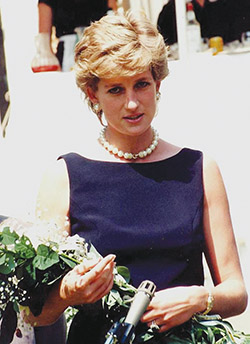
  • Assassination of the Humanitarian Princess: The Killing of Diana

    Assassination of the Humanitarian Princess: The Killing of Diana

    This article was published in New Dawn Special Issue Vol 9 No 1 (February 2015)

    1992 was the year that the relationship between Princess Diana and other senior British royals changed irreversibly. In June Diana collaborated with UK author Andrew Morton in a book which exposed Prince Charles’ relationship with his lover Camilla Parker-Bowles and Diana’s mistreatment by senior members of the royal family. The reaction was swift. Within 11 days of the book’s publication Diana received a bombshell letter from her father-in-law, Prince Philip. The letter alarmed her and Morton says that she sought out a solicitor to help draft a reply.1

    Within months the Queen had moved to set up the royal Way Ahead Group – a committee dedicated to helping the royal family deal with major issues and planning the way forward. Its first meeting was held in November 1992 and in the following month the Queen requested the formal separation between Charles and Diana. This was announced in the House of Commons on 9 December.

    In October 1995 Princess Diana penned a note in which she stated that she feared for her life and believed Prince Charles was “planning ‘an accident’ in my car.”2 She left the note with her butler, Paul Burrell, for safe-keeping. Later that month Diana met with her lawyer, Lord Victor Mishcon. He wrote the next morning that Diana had told him efforts could be made to “get rid of her… by some accident in her car such as pre-prepared brake failure.”3 Mishcon had this note typed up and kept it in his safe.

    Five days after that lawyer’s meeting Diana pre-recorded the famous ‘Panorama’ interview with BBC journalist Martin Bashir. In the program – which went to air on 20 November – Diana declared “there were three of us in this marriage,” that she doubted Charles could adapt to being King, recounted her mistreatment by the royals, and stated she was a “very strong person” who would “fight to the end.”4

    Diana also told several friends and family that she feared for her life and believed she could be killed in “an accident.”

    Later that month her fears were vindicated when the brakes in her regularly-serviced Audi failed as she drove through the streets of London. She wrote about it to her close friends. Simone Simmons said she received a letter that said: “The brakes on my car have been tampered with. If something does happen to me it will be MI5 or MI6.”5

    The month following the ‘Panorama’ interview, just seven days before Christmas, Diana received a hand-written letter from the Queen requesting her to divorce Prince Charles.

    The decree absolute came into effect on 28 August 1996, but it was much more than a marital divorce. The Queen also moved to strip the princess of her HRH title and effectively remove her from the royal family.

    Earlier, in March, Diana had been driving in London when she was hit by an out of control Fiat Uno. Her driver’s door was smashed in and witnesses said it was amazing she escaped unhurt. Although the police investigated this crash, their report has never been released.

    Diana Starts Campaigning to Eradicate Landmines

    Then around July 1996 Diana started taking an interest in the worldwide scourge of unexploded landmines and began collecting information and building a dossier on the industry. Her primary concern was humanitarian – to help the victims and to campaign for the eradication of all landmines.

    In January 1997, launching her involvement in the campaign, Diana made a highly-publicised visit to Angola – this was the nation with the highest number of victims. She was filmed walking through minefields and stated that she sought to “focus world attention on this… largely neglected issue.”6

    The following month she received a high-profile death threat. During a phone call from Nicholas Soames, Britain’s Minister of the Armed Forces, Diana was told to drop her anti-landmines campaign. Soames went on to say: “You never know when an accident is going to happen.”7

    Although shaken, Diana told her friend Simone Simmons – who witnessed the call – that she was undeterred: “We must do something. We cannot allow this slaughter to continue.”8

    Diana’s anti-landmine dossier grew in size to become several inches thick and she left copies with Simmons and another friend, Elsa Bowker. Her butler Paul Burrell said it contained “every fact of the landmine mission.”9

    On 12 June 1997, just under 12 weeks before she died, Diana delivered a landmark speech at the Royal Geographic Society in London. She outlined the nature and scope of the landmine problem, she talked about the “evil that men do” and spoke about her vision to “end this plague on Earth.”10

    Meeting the Al Fayeds

    It was around this time Princess Diana accepted an offer from long-time family friend and owner of Harrods, Mohamed Al Fayed, to holiday with his family at his St Tropez villa in mid-July. The offer extended to Diana and her two sons, William and Harry. At that time Al Fayed was viewed by the British Establishment as a person of ill-repute – he had recently been heavily involved in the “cash for questions” scandal that helped bring about the downfall of Britain’s Tory Government in May 1997.

    Both these actions – Diana’s increasingly public determination to eradicate the mines and taking William, the future King of England, on holiday with the Al Fayeds – were seen as a major challenge to the Establishment.

    In the following days two critical high-level decisions were made.

    First, senior royals called a special unscheduled meeting of the Way Ahead Group (WAG), chaired by the Queen. This meeting took place on 23 July and was preceded two weeks earlier by a special preparatory meeting attended by senior royal household officials, including the Queen’s private secretary, Robert Fellowes. The preparatory meeting was held on 8 July – three days before Diana and the princes left on the contentious Al Fayed holiday – and the full WAG meeting occurred on 23 July – three days after the holiday had concluded.

    The second decision was for an arrangement to be made for friend of Diana, Rosa Monckton, to organise a holiday with Princess Diana. Monckton was a person who had two very close connections to MI6 – her brother Anthony was a MI6 officer working in Zagreb and her husband Dominic Lawson was a MI6 agent who was editor of the Sunday Telegraph.

    Whilst in Hong Kong Monckton called Diana and arranged a one-on-one yachting holiday around the Greek islands, to take place in mid-August.

    Diana, William and Harry left for the St Tropez holiday on 11 July, amidst a storm of controversy. Following their return nine days later, a romance developed between Diana and Mohamed Al Fayed’s son, Dodi.

    On 30 July Diana broke off her nearly two year relationship with boyfriend Hasnat Khan and the following day left with Dodi on a week-long Mediterranean cruise.

    Their romance blossomed throughout August, interrupted only by two events – the pre-arranged Monckton cruise and Diana’s three-day anti-landmine visit to Bosnia on 8 August.
    [alert type=”info” dismiss=”no”]If you appreciate this article, please consider a subscription to New Dawn magazine.[/alert]

    Monckton Cruises with Diana for Intel

    Diana and Monckton left for the Greek islands on the 15th – “it was just the two of us” Monckton later told the inquest.11 What she didn’t say was that their hired 20 metre boat, the Della Grazia, was shadowed by three super-yachts chartered by MI6, the Marala, the Sunrise and the Sea Sedan. These were used as decoys to distract the media – who were not looking for a smaller vessel, and despite a massive search, never actually found the boat Monckton and Diana were on.12

    This strategy provided Monckton with five uninterrupted days on the ocean – time to seek inside information on Diana’s thoughts and intentions, to satisfy her intelligence masters.

    Diana and Monckton returned from that holiday on 20 August – and 11 days later Diana lay dead in a Paris hospital.

    On 22 August Diana and Dodi departed from Stansted airport headed for their final Mediterranean cruise. The two lovers would never see England again.

    The following day they visited Repossi’s jewellery store in Monte Carlo. Diana saw and liked an engagement ring from the “Tell Me Yes” range. Dodi later arranged for that same ring to be transferred to Repossi’s Paris – he purchased it from there just hours before the couple died.

    Diana and Dodi finished up their cruise in Sardinia and on the afternoon of Saturday, 30 August, they flew from Olbia to Paris, landing at Le Bourget airport at 3.20pm.

    They were met by French police who provided an escort for the initial part of the journey into the city.13 The police later denied they were aware of Diana’s presence in France, falsely claiming the first they knew she was there was when they heard about the crash that occurred later that night.14

    Threatened by Large, Dark Motorbikes

    During that journey and other travels through the streets of Paris that evening the couple’s Mercedes was threatened by large, dark motorbikes, some carrying pillions. Witnesses in the car and back-up Range Rover described these bikes as “behaving dangerously.”15 The Mercedes driver, Philippe Dourneau, said they were “coming from all angles, from front and behind – they were all over the place.”16 They took many flash photos on these trips – none of which have ever been published. The evidence indicates they were operating as fake paparazzi, helping to create an environment where later the real paparazzi could be falsely held culpable for the crash.

    Initially the couple travelled to Villa Windsor and then into the city, arriving at the Ritz Hotel – owned by Mohamed Al Fayed – at 4.35pm. Whilst there Diana made phone calls and had her hair done and Dodi visited Repossi’s and purchased the engagement ring.

    They left the hotel at 7pm, heading for Dodi’s apartment near the Arc de Triomphe. Once in the apartment – where their luggage had earlier been taken from the airport – the couple relaxed, showered and prepared to leave for dinner, which was to be back at the Ritz.

    They left for the hotel at 9.30pm. Didier Gamblin was on security at the apartment and said the fake paparazzi went “completely crazy” and “set off like lunatics to follow the car.”17

    Ritz CCTV records Diana and Dodi arriving at the front entrance of the hotel at 9.50pm. They initially went to the restaurant for dinner, but were stressed from the intimidating actions of the fake paparazzi and soon moved themselves upstairs to the sanctuary of the Imperial Suite.

    The Decoy Plan – But Who Planned It?

    It is after this that a decoy plan surfaced – a plan to leave for the return trip to the apartment from the rear of the hotel in a third car, whilst the primary Mercedes and the back-up Range Rover sat outside the front entrance, acting as decoys to divert the paparazzi.

    Dodi approved a plan for the use of a third car to leave from the rear – but he was not told there would be no back-up car, only one bodyguard and a driver who was not licensed to chauffeur.

    The evidence indicates the plan was devised by intelligence officers working from outside the hotel, employing two of the Ritz’s senior staff as agents – Henri Paul, the acting head of security and Claude Roulet, the vice-president of the hotel.

    Henri Paul was the designated chauffeur – but he was not a driver, had never driven any Ritz guests in his 11 years at the hotel, and did not possess the required chauffeur’s ‘Grande Remise’ licence. To top it off, his best friend, Claude Garrec, told the police Henri didn’t like driving and “If he could avoid [it] he would.”18

    Henri Paul had been receiving large sums of money from sources unknown in the months leading up to the crash. He had links to French and British intelligence agencies and on the night of his death was carrying 12,565FF ($2,500) on his person.

    The third car was the only other car available – a Mercedes S280 with untinted windows, whose regular driver was Olivier Lafaye. Every evening Lafaye would finish work, return to the Ritz and park his vehicle in the same section of the Vendôme car park. He told the police that the other chauffeurs took their vehicles home – he was the only one without a garage.19

    On that Saturday evening Lafaye parked his Mercedes S280 at 8.15pm. At 8.20 Claude Roulet is shown on CCTV leaving the Ritz Hotel. It is likely Roulet pointed out this Mercedes to other agents, who then had ample time to tamper with the vehicle prior to its final departure after midnight. Later evidence revealed that Diana – a person who many witnesses said always wore her seat belt – was sitting in the right rear seat with a jammed belt.20

    Henri Paul departed from the hotel at 7.01pm, but quickly returned at 10.06 following the couple’s arrival. After 11pm he made four separate visits to the paparazzi waiting out the front of the Ritz. Henri was providing regular updates on how long it would be before the couple appeared. It was essential to the MI6 plan that the paparazzi were still present when Diana and Dodi departed – they would try to follow the car and later be falsely blamed for the behaviour of the fake paparazzi, the assassins.

    Detailed Account of Diana’s Final Fatal Journey

    The Mercedes S280 departed from the rear of the Ritz Hotel at 12.18am – there was no back-up car, only one bodyguard, untinted windows and at least one jammed seat belt in the back.

    Some paparazzi were outside the rear and they immediately followed. Those out the front were quickly alerted and some of them joined the pursuit at the Place de la Concorde, where the Mercedes was held up by red lights.

    Large unidentified motorbikes also joined in from around the Concorde. The Mercedes was pressured by constant flashing of cameras – many photos were taken but they have never been published.

    The principal car left quickly from Concorde and witnesses on the riverside expressway saw a speeding Mercedes surrounded by several large, dark motorbikes. As the vehicle approached the exit it would take to head for Dodi’s apartment, a blocking motorbike was seen on its right.

    Failure to make the appropriate exit forced the Mercedes S280 towards the Alma Tunnel. As it neared the tunnel one witness saw the motorbikes “in a cluster, like a swarm around the Mercedes.”21 People saw photos being taken – again unpublished.

    Two separate witnesses saw the Mercedes – which was already in the left lane – overtaken on the left by one of the motorbikes carrying a pillion. At the same time, just as Henri entered the tunnel, he was confronted on the right by a slow-moving white Fiat Uno straddling the two lanes.

    As the motorbike got in front, a bright flash was seen and Henri immediately lost control of the Mercedes. A split-second later the Mercedes side-swiped the Uno and then zig-zagged left, right and left before crashing into the 13th central pillar of the tunnel, at around 100 kph.

    The car bounced back from the pillar, swung around 180 degrees and came to rest near the wall, facing the tunnel entrance.

    It was 12.23am on Sunday, 31 August 1997.

    Witnesses saw motorbikes and cars fleeing the tunnel – even though it is against the law in France to not stop and render assistance. None of the fleeing vehicles – including the white Fiat Uno – has ever officially been identified. And none of the drivers or riders have ever come forward.

    The two people on the driver’s side – Henri Paul and Dodi Fayed – died on impact, and the two on the passenger’s side – Princess Diana and bodyguard Trevor Rees-Jones – survived the crash.

    The French ambulance service (SAMU) immediately started receiving calls from passers-by. Dr. Arnaud Derossi was manning the phones and he allocated an ambulance carrying Dr. Jean-Marc Martino.

    That ambulance left the Necker Hospital base at 12.28am and arrived at the crash scene at 12.40am. It took 12 minutes to travel 2.3 km – Diana’s ambulance travelled to the scene at around 11½ kph.

    Upon arriving Martino straightaway phoned the base and spoke to Dr. Derossi, who then immediately left the base heading to the crash scene. It was left to an auxiliary to notify the base’s off-duty doctor, Marc Lejay, who was asleep at the time.22

    Death by Doctors?

    Princess Diana was heard talking by several witnesses, saying “Oh my God” and “what’s happened?”23 When the doctor performed the standard Glasgow Coma test to assess her condition in the car, she scored very well – 14 on a scale of 15.24

    However there was reason to suggest there could be an internal injury – Diana had been involved in a fatal, high speed crash and wasn’t wearing a seat belt. This possibility was confirmed after Diana was finally transferred into the ambulance, 43 minutes after the crash. The initial examination revealed there was thoracic trauma bruising.25

    From that point it became even more imperative that Diana was transferred immediately to a hospital – the thoracic trauma was a clear sign there could be a life-threatening internal injury.

    Instead though, these two doctors – Martino and Derossi – tarried. The ambulance remained in the Alma Tunnel until 1.41am, one hour and 18 minutes after the crash.

    And worse, they poured catecholamine into her to increase her blood pressure (BP), even though the BP was 70 and high enough to comfortably make the 5 km trip to the hospital.

    And on top of that, Dr. Derossi informed the base there was “nothing for the thorax,” twice, even though he already was aware of the thoracic trauma.26 This ensured the hospital would not have a thoracic specialist on hand when Diana arrived.

    After leaving the scene the ambulance travelled at what one witness described as “walking pace.”27 Then within sight of the hospital gates it stopped for five minutes. A journalist who followed the ambulance described it as “rocking” while stationary.28 He also witnessed a doctor transferring from the front to the back.29

    Whatever they were doing inside the ambulance, it required four people – Drs Martino, Derossi and two interns (Barbara Kapfer and a person called “Fadi”).

    There has never been a credible explanation for a stoppage so close to the hospital.

    Martino delivered Diana to the La Pitié Salpêtrière Hospital at 2.06am – it was now one hour and 43 minutes since the crash.

    Six minutes after arriving Princess Diana stopped breathing. She would never breathe again, despite the best efforts of the hospital’s doctors.

    Dr. Bruno Riou ticked the suspicious death box on the death certificate.30 The public prosecutor’s office was then forced to order an autopsy, which was conducted by Professor Dominique Lecomte. She found no suspicious circumstances.

    Dr. Riou was never asked why he was suspicious.

    Conflicting Evidence Points to the Cover-Up

    Later that morning Professor Lecomte carried out an autopsy on the driver, Henri Paul. Samples taken were tested early the following day – the results indicated the driver had a blood alcohol concentration (BAC) of 1.74, three times over the French limit.

    This conflicted with evidence in the hotel prior to the departure of the Mercedes. Many witnesses testified that Henri was not drunk and this was supported by the CCTV footage, which showed him walking and acting normally.

    Later testing revealed the blood had a carbon monoxide (CO) level of 20.7%. The combination of elevated BAC and CO meant Henri would have been incoherent, had a migraine headache and found it impossible to stay upright.

    Yet that is not what the CCTV and witnesses saw.

    A close analysis of Professor Lecomte’s autopsy of Henri Paul reveals she made at least 58 errors in her conduct and documentation.31 The police files reveal there were two lots of documentation for the one autopsy – each recording different samples taken and differing body measurements, weight and height.32

    The evidence points to two bodies being in the room at the time of the autopsy – one was Henri Paul’s and the other was a person who had died in a fire with smoke inhalation.

    Samples were taken from both bodies, but kept separate. The other person’s samples were used for the BAC testing and years later Henri’s true samples were used for DNA testing. The DNA-tested samples were never BAC tested and the BAC-tested samples were never DNA tested.

    The paparazzi and Henri Paul were fraudulently set up to take the blame for the death of Princess Diana.

    The truth is that the crash was orchestrated by MI6 (with assistance from the CIA and France’s DGSE and DST) on the orders of senior members of the British royal family, with the acquiescence of Tony Blair, Jacques Chirac and Bill Clinton – the leaders of the three leading Western arms-dealing nations.

    Diana Princess of Wales – our humanitarian princess – was murdered in one of the most shocking inter-governmental operations followed by one of the most extensive cover-ups of our time.

    The late John Morgan wrote two explosive books exposing the conspiracy to murder Princess Diana. Information on How They Murdered Princess Diana: The Shocking Truth, and Paris-London Connection: The Assassination of Princess Diana, can be found at princessdianadeaththeevidence.weebly.com. Both books can be purchased from Amazon.com.

    [alert type=”success” dismiss=”no”]If you appreciate this article, please consider subscribing to help maintain this website.[/alert]

    Footnotes

    1. Andrew Morton, Diana: In Pursuit of Love, Michael O’Mara Books, 2004, 76
    2. Inquest evidence: INQ0010117
    3. Inquest evidence: INQ0006335
    4. ‘The Panorama Interview’, BBC, 20 November 1995, www.bbc.co.uk/news/special/politics97/diana/panorama.html
    5. Simone Simmons with Ingrid Seward, Diana: The Last Word, St Martin’s Press, 2005, 179
    6. www.youtube.com/watch?v=rU0APrqxUxc
    7. Diana: The Last Word, 178-180
    8. Ibid., 180
    9. Inquest transcripts: 16 Jan 08: 27.11
    10. ‘Responding To Landmines: A Modern Tragedy And Its Consequences’ by Diana, Princess Of Wales. Keynote Address at a one day seminar co-hosted by the Mines Advisory Group and the Landmine Survivors Network, London, 12 June 1997, http://gos.sbc.edu/d/diana.html
    11. Inquest transcripts: 13 Dec 07: 139.18
    12. ‘The Media Swarm Greek Isles, In Search Of Diana’, Philadelphia Inquirer, 18 August 1997
    13. Rene Delorm, Diana & Dodi: A Love Story, Tallfellow Press, 1998, 154
    14. Inquest transcripts: 14 Nov 06 statement read out 21 Nov 07: 57.22
    15. Inquest transcripts: Kez Wingfield: 2 Sep 97 Statement read out 18 Dec 07: 145.9
    16. Inquest transcripts: 3 Sep 97 Statement read out 29 Oct 07: 67.17
    17. Inquest transcripts: 3 Oct 97 Statement read out 7 Mar 08: 103.14
    18. Paget Report, 14 December 2006, 162-3
    19. Paget Report, 14 December 2006, 244-5
    20. Paget Report, 14 December 2006, 421
    21. Paget Report, 14 December 2006, 439
    22. Inquest transcripts: 11 Dec 07: 7.13
    23. An example: Xavier Gourmelon: Paget Report, 14 December 2006, 513
    24. Inquest evidence: INQ0004774
    25. Inquest transcripts: 24 Jan 08:124.16; Inquest evidence: INQ0004774
    26. Inquest transcripts: 11 Dec 07: 14.9, 28.23
    27. Inquest transcripts: Pierre Suu: 28 Feb 06 Statement read out 11 Mar 08: 150.4
    28. Inquest transcripts: Thierry Orban: 23 Sep 97 Statement read out 17 Oct 07: 13.7
    29. Inquest transcripts: Thierry Orban: 23 Sep 97 Statement read out 17 Oct 07: 13.3; Pierre Suu:28 Feb 06 Statement read out 11 Mar 08: 150.22
    30. Prof. Bruno Riou, Witness Statement, 7 March 2006, reproduced in Diana Inquest: The Documents the Jury Never Saw, edited by John Morgan, 2010, 375-6
    31. John Morgan, Cover-Up of a Royal Murder: Hundreds of Errors in the Paget Report, 2007, 188-194
    32. John Morgan, Diana Inquest: The French Cover-Up, 2010, 50-68

    © New Dawn Magazine and the respective author.
    For our reproduction notice, click here.
  • The Secret Elite & the Origins of the New World Order

    The Secret Elite & the Origins of the New World Order

    From New Dawn Special Issue Vol 9 No 4 (Aug 2015)

    Secret societies, the unseen hands that steer national and international affairs from the shadows, go back to the dawn of Western civilisation. The individual most famously linked to these occult forces is Adam Weishaupt (1748-1830), a Jesuit trained philosopher and lay professor of canon law at the University of Ingolstadt in southern Germany. On 1 May 1776 Weishaupt founded a secret society called the ‘Perfectilibists’ (which soon became known as the ‘Order of the Illuminati’.) The Illuminati recruited over 2,000 influential followers, but apparently lasted only until March 1785 when the Bavarian Government uncovered the conspiracy, exiled Weishaupt and outlawed the Order.

    Some investigators suggest that rather than being wound up in 1785, the Illuminati (‘enlightened ones’) continued in existence to the present day. For the past 200 years controversy persisted over its role in influencing global affairs. In 1798 John Robison, professor of philosophy at the University of Edinburgh, published Proofs of Conspiracy, a book alleging an Illuminati/Freemasonry plot to conspire against all religions, kings and governments of Europe.1 According to Robison, the Illuminati had been instrumental in fomenting the worst excesses of the French Revolution. That same year the Jesuit Abbé Augustin de Barruel published Memoires pour Servir a lHistoire de Jacobinisme which supported Robison’s thesis.2 A century and a half later, Nesta Webster and William Guy Carr revived conspiracy theories about the Illuminati.

    Nesta Webster (1876-1960), who was linked to the British Union of Fascists, wrote that rather than being banished, the Illuminati remained active and within a few years had “multiplied its hotbeds all through the south of Germany, and as a consequence in Saxony, in Prussia, in Sweden, and even in Russia.”3 William Guy Carr, an English born Canadian naval officer and lay Christian preacher, supported this thesis, maintaining that Weishaupt had been retained by moneylenders, including the House of Rothschild. Carr claimed there was an evil force at the forefront of an international conspiracy to destroy religious institutions and national governments in order to bring about a “Satanic One World Government.”4

    According to Carr, the conspirators use a variety of methods to help them accomplish their aims, including:

    1) Monetary and sex bribes to obtain control of individuals already occupying important positions. Such recruits are then held in bondage through blackmail, threats of financial ruin, public exposure or physical harm or death of their loved ones.

    2) Illuminati in colleges and universities recruit students possessing exceptional mental ability.

    3) Individuals trapped into Illuminati control are placed behind the scenes of all governments as ‘experts’ and ‘specialists’ who advise adoption of policies which serve the secret plans for one world government.

    4) Control of the press and all other agencies which distribute information to the public.5

    However, Illuminati researcher Dr. Tony Page says that Webster and Carr totally misrepresented the situation and were anti-Semites indulging in madcap conspiracy theory. Page translated Weishaupt documents from the original German and presents him as a much maligned moral and virtuous man whose intentions were “assuredly high minded and benign.” A man who “strove for far nobler and morally exalted goals than are properly ascribed to him. In fact, his intention (naive perhaps) but in my view, sincere, was to promote and disseminate human virtue, equality and freedom, and the happiness and dignity that flow from them.”6

    Today, some see the Illuminati “as a major factor and influence in international power politics, allegedly fomenting wars, civil disorder and revolutions in their attempt to establish a one-world government.”7 It appears the jury is still out on whether the Illuminati is an ongoing occult force.

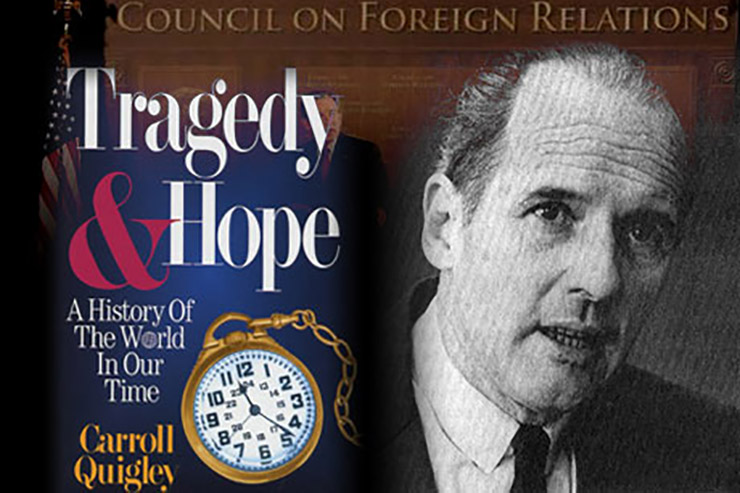
    What we can say is that in our own intensive research over the past 10 years on the true origins of the First World War, we found no direct connection whatsoever to Weishaupt’s creation. The secret society that we identify as responsible for the war employed similar tactics, but was a very different, very English creation. Furthermore, it remained concealed until exposed by the late Professor Carroll Quigley in the latter half of the 20th century. Quigley (1910-1977) was a highly esteemed American historian who moved in Establishment circles, lectured at top universities, including Harvard, Princeton and Georgetown, and was a trusted consultant to both the US Department of Defense and US Navy. He studied this secret network for 20 years and was permitted to examine its records. In 21st century parlance, Carroll Quigley was the whistle-blower par-excellence.

    THE QUIGLEY ENIGMA

    Professor Quigley wrote that the Rhodes secret society, or the ‘Milner Group’ as he called it after Cecil Rhodes’s death, was “one of the most important historical facts of the twentieth century” and of such significance that “evidence of its existence is not hard to find, if one knows where to look.”8 The ‘Milner Group’ exposed by Quigley is now widely recognised and variably named by others as the ‘Hidden Power’, the ‘Money Power’, the ‘Deep State’, or ‘the men behind the curtain’. All these labels are pertinent, but we call them, collectively, the Secret Elite.

    Without Quigley’s revelations, the lid on this secret society would still be closed today. By opening Pandora’s Box and revealing some of the evils therein, he enabled others to see the truth. His work exposing this powerful group has been enhanced and developed through years of careful research by other investigators into an explanation of how control of the civilised world has steadily been acquired through wars, economic manipulation and political chicanery by generations of privilege and money.

    Our own work, including the book Hidden History: The Secret Origins of The First World War, closely examines the men involved and reveals their nefarious global influence was greater even than Quigley believed. We garnered solid evidence that its members were directly responsible for taking the world to war in 1914 and deliberately prolonged the terrible carnage for over four long years while making massive fortunes from it. The immensely rich and powerful Secret Elite controlled the British and US governments from behind the scenes, then as now, and much of the global mayhem over the last century arose at their instigation.

    While Professor Quigley did mankind a great service, he remains an enigma. He exposed this ruthless, anti-democratic, totalitarian organisation and anguished over their determined attempts to suppress his writings, yet back-tracked on some of his original findings as if in fear of his life. He also side-stepped a number of key issues and failed to discuss the Secret Elite’s role in the genesis of the 1914-18 war, or their audacious coup d’etat in 1916 whereby they literally took over the British government. Rather bizarrely, Quigley stated that he agreed with their goals and aims.9 He did, however, disagree with their methods.

    Their tendency to place power and influence into hands chosen by friendship rather than merit, their oblivion to the consequences of their actions, their ignorance of the point of view of persons in other countries or of persons in other classes in their own country – these things, it seems to me, have brought many of the things which they and I hold dear close to disaster. In this Group were persons… who must command the admiration and affection of all who knew them. On the other hand, in this Group were persons whose lives have been a disaster to our way of life. Unfortunately, in the long run, both in the Group and in the world, the influence of the latter kind has been stronger than the influence of the former.… I feel that the truth has a right to be told, and, once told, can be an injury to no men of good will.10

    There is something deeply puzzling about Quigley’s assertion that while their methods brought much of what he held dear “close to disaster,” he agreed with their goals and aims for global control. These powerful men intended to replace democratically elected governments, arguing that their rule would be the rule of the best, whether or not the people wanted it.

    A few researchers raise the possibility that Quigley was at some stage an actual member of the secret society, but failed to admit it. We believe it far more likely his strange statements of support were down to self-preservation. In his major works – Tragedy and Hope and The Anglo-American Establishment – he narrated a history peopled by men who successfully concealed their power and influence, their connivance and common purpose. These individuals (and their descendants and agents ever since) conspired in secret towards the establishment of a world government that ultimately they, and they alone, would control.

    It is worth noting that Quigley’s histories have themselves been subject to suppression. Tragedy and Hope was removed from bookstore shelves by unknown persons and withdrawn from sale shortly after its release. His publisher, the Macmillan Company, destroyed the book’s original plates and lied to him for the next six years.11 Quigley believed that powerful people suppressed the book because it exposed matters they did not want known. In this instance, unlike his exposure of the British Establishment, he did not name his tormentors.

    IN THE BEGINNING

    The opening passage of Quigley’s The Anglo-American Establishment may read like a John le Carré thriller, but it is no spy fiction:

    One wintry afternoon in February 1891, three men were engaged in earnest conversation in London. From that conversation were to flow consequences of the greatest importance to the British Empire and to the world as a whole.

    The staunch British imperialists who met that day – Cecil Rhodes, William Stead and Lord Esher – were well-known public figures but it should be noted from the outset that each was linked to infinitely greater wealth and influence. They were joined weeks later by Lord Alfred Milner and Lord Nathaniel Rothschild, the international merchant banker and richest man in the world. He was inducted together with Lords Salisbury and Rosebery, whose families had for generations controlled the Conservative and Liberal parties in Britain and ruled the country as their personal fiefdom. Rothschild provided the financial clout while Salisbury and Rosebery provided the long-standing patronage and political networks.12

    Cecil Rhodes, in association with Rothschild, had made his fortune in the gold and diamond mines of South Africa. Stead was the most prominent English journalist of the day and a moral crusader of great standing. Esher represented the interests of the monarchy from Queen Victoria’s final years, through the exuberant excesses of King Edward VII, to the more sedate but pliable King George V. It was through Esher that the monarch was kept fully appraised of Secret Elite business.13

    Alfred Milner, a contemporary of Rhodes at Oxford University, was a self-made man of ability and ideas who began his working life as an aspiring lawyer, turned to journalism, led the political agitation against the Boer separatists in South Africa, and eventually emerged as an immensely powerful and successful power-broker. Milner was the master manipulator, the iron-willed assertive intellectual who offered that one essential factor: strong leadership. On Cecil Rhodes’s death in 1902, he became the undisputed leader of the world’s most powerful and far reaching secret society. These were the founding fathers of what we recognise today as the ‘New World Order’ movement.

    They met at private town houses and magnificent stately homes. These might be lavish weekend affairs or dinners in private clubs which provided suitable London bases for their intrigues. The heady mix of international finance, political manipulation and the control of government policy was at the heart of this small clique who set out to dominate the world. They drew up their plan for a secret society that would take political control in Britain and, later by extension, the United States of America. They renewed the Anglo-Saxon bond between the two countries – the ‘special relationship’ – expanding their power base to bring Anglophile Americans into the secret brotherhood; men who would go on to dominate the world through financial institutions, global corporations and dependent governments. Wars, revolutions and other major events of the last 100 years are directly attributable to these individuals. The Boer War and the destruction of Germany in 1914-18 were merely the first steps in their long-term strategy.

    The secret society comprised concentric circles with an inner core of trusted associates known as “The Society of the Elect” who unquestionably knew that they were members of an exclusive cabal devoted to taking and holding power worldwide. A second circle “The Association of Helpers” was larger and quite fluid in its membership. A third outer ring comprised members who may or may not have been aware they were either an integral part of, or inadvertently being used by, a secret society, though “it is more likely they knew it.”14

    The overlapping rings are themselves concealed, hidden behind formally organised groups of no obvious political significance. As Quigley put it, the group was able to “conceal its existence quite successfully, and many of its influential members, satisfied to possess the reality of power rather than the appearance of power, are unknown even to close students of British history.”15 In the early 20th century its tentacles spread throughout the British Empire to America, Russia, France, the Balkans and South Africa. Their targets were agents in the highest offices of foreign governments who were bought and nurtured for future use.

    What’s more, they had the power to control history, to turn history from enlightenment to deception. The Secret Elite dictated the writing and teaching of history from the ivory towers of academia down to the smallest of schools. They carefully controlled the publication of official government papers, the selection of documents for inclusion in the official version of history, and refused access to any evidence that might betray their covert existence. Incriminating documents were burned, removed from official records, shredded, falsified or deliberately rewritten, so that what remains for genuine researchers and historians is carefully selected material. Their ambitions overrode humanity and the consequences of their actions have been minimised, ignored or denied.

    [alert type=”info” dismiss=”no”]If you appreciate this article, please consider a subscription to New Dawn magazine.[/alert]

    SPREADING THEIR TENTACLES

    One of the problems facing anyone who turns to Quigley’s seminal The Anglo American Establishment is that it makes for a difficult read. Like several of the early chapters of the Christian Bible, his inter-connecting lists name many from the aristocracy, big business, high finance, politics and the press. Some were linked by matrimonial alliances while others by their gratitude for titles and positions of power.20 He devotes an entire chapter revealing how the Secret Elite controlled The Times (then Britain’s most influential newspaper) for more than 50 years with the exception of the period 1919-1922.21

    A list of Oxford graduates, especially those given fellowships at All Souls College, included Milner’s heir apparent, Lionel Curtis, and numerous others who later gained positions of great significance and power. Indeed, they all did, every single name listed by Quigley. Oxford gave the Secret Elite access to influential professorships, some of which they created and funded themselves, such as the Beit Chair of Colonial History, established in 1905. It remains a serious concern that Carroll Quigley was absolutely correct when pointing an accusing finger at those who monopolised “so completely the writing and the teaching of the history of their own period.”22 There is no ambivalence in his accusation. The Secret Elite controlled the writing and teaching of history through numerous avenues including the press, but none more effectively than at Oxford University where they held huge influence over Balliol, New College and All Souls, and largely dominated the intellectual life of Oxford in the field of history.23 They ensured we learn only those ‘facts’ that support their version of history. The influence was so powerful that they controlled the Dictionary of National Biography, meaning the Secret Elite wrote the biographies of its own members. They created their own official history of key members for public consumption, striking out any incriminating evidence and portraying the best public-spirited image that could be safely manufactured. Has anything changed?

    Oxford University was also the Secret Elite base for the Rhodes Scholarships, funded by the legacy left by Cecil Rhodes when he died in 1902. Rhodes’s wish was to create a “worldwide” secret group devoted to English ideals and to the Empire as the embodiment of these ideals,24 and the scholarships brought that international dimension to the society. They “were merely a facade to conceal the secret society, or, more accurately, they were to be one of the instruments by which members of the secret society could carry out his purpose.” Professor Quigley leaves us in no doubt that the secret society is the real power behind the scholarships.25 From its inception, Rhodes Scholarships favoured American students, with 100 places allocated, two for each of the 50 states and territories, whereas only 60 were made available for the entire British Empire and, strangely, several from Germany. The ‘best talents’ from the ‘best families’ were to be nurtured at Oxford University and imbued with an appreciation of ‘Englishness’ and the importance of the “retention of the unity of the Empire.”

    In The Anglo-American Establishment, Quigley concluded that the secret cabal advanced its power-base through a triple-front penetration in politics, the press and education.26 We would go further, and can but wonder why he omitted banking and the military-industrial complex from his analysis. Politicians will always be easy targets. Ambition, greed and sexual proclivity can be nurtured and harnessed. Sometimes men of real stature come to the fore and bring strong leadership to the cause. In the early years Alfred Milner assumed that mantle. Fired by a zeal forged by Ruskin at Oxford, he was consumed by the need to establish the primacy of upper-class Englishness at the pinnacle of world power. He believed in the need to bring the British Empire and the American ideal together to sweep aside any rival for world domination.

    Milner went to South Africa in 1897 to save it from falling to the Boers. He deliberately started the Boer War and saved the diamond and gold mines for fellow Secret Elites Rhodes, Rothschild, Beit and Bailey. He was idolised by Cecil Rhodes who placed his legacy in Milner’s safekeeping, and he was rewarded by the King with a knighthood and then a Viscountcy. Critically, in South Africa between 1897 and 1905, he built a personal following of young carefully chosen civil servants who loyally followed his every decision behind the scenes in British and world politics. Lord Alfred Milner was arguably the most important man living in the first decades of the 20th century, yet his name remains virtually unknown outside academic and political circles. Why?

    MILNER’S LEGACY

    To demonstrate the privileged path that the Secret Elite created in their quest to establish a ‘New World Order’, we have chosen to follow the trail that began with Alfred Milner, the undisputed leader for 23 years following Rhodes’s death in 1902. Critically, his most important achievement in South Africa was the creation of a network of extremely able acolytes to whom he entrusted the future direction of his cause: the domination of the world by the Anglo-Saxon race. His secretariat in South Africa comprised young men of “breeding, ability and conviction” from Oxford University, All Souls College in particular. Dubbed “Milner’s Kindergarten,” they absorbed his commitment to Ruskin’s philosophy, his disdain for career politicians and his concern that democracy as it had developed in the Western world was corrupt and untrustworthy. It was akin to “a religious brotherhood like the Jesuits, a church for the extension of the British Empire.”27

    From 1909 Milner began expanding the Kindergarten into a highly secretive organisation called the “Round Table,” with branches in South Africa, Canada, New Zealand, Australia and, crucially, the United States. (It is not to be confused with a benign charitable organisation of the same name.) The grand Arthurian title suggested equality of rank and importance, nobility of purpose and fairness in debate, but was nothing of the kind. Milner, and most of the Group, held democracy in contempt, and far inferior to rule by those who had an “intellectual capacity for judging the public interest” and “some moral capacity for treating it as paramount to their own.”28 Wealth, of course, also counted and “the key to all economics and prosperity was considered to rest with banking and finance”29 which the Secret Elite controlled. Alfred Milner acted as both elder statesman and father figure to the Round Table with his role described as “President of an Intellectual Republic.”

    The Round Table groups across the world kept in touch through regular correspondence and a quarterly journal called The Round Table that was controlled by the Secret Elite. They saw Britain as the defender of all that was fine or civilised in the modern world. Her “civilising mission” was to be carried out by force if necessary, for the “function of force is to give moral ideas time to take root.” Asians, for example, would be compelled to accept “civilisation” on the grounds they would be better off under British rule than that of fellow Asians. “To be sure, the blessings to be extended to the less fortunate peoples of the world did not include democracy.” They would simply be educated up to a level where they could appreciate and cherish “British ideals.”30 The ‘White Man’s Burden’ is indeed great.

    Milner, his Round Table, and the Secret Elite generally saw the new Germany with its economic, industrial and commercial strength as the great threat to their global ambitions. In The Round Table journal of August 1911, Lord Lothian, a member of the Secret Elite’s inner core, wrote: “There are at present two codes of international morality – the British or Anglo-Saxon and the continental or German. Both cannot prevail.”31 Alliances with France and Russia were created for the specific task of destroying Germany through a prolonged war.32 These men had no fear of war, though they rarely put themselves in the direct firing line.

    EXPANDING THE ANGLO-AMERICAN PRIMACY

    Cecil Rhodes had long dreamed of Anglo-American unity, and in 1891 actually discussed the possibility of achieving it by Britain joining the United States.33 On his death, the Secret Elite developed an even greater appreciation of America’s vast potential and the need for closer union. They adjusted the original concept of British race supremacy to Anglo-Saxon supremacy, so that Rhodes’s dream had only to be slightly modified. They created a common ideology and world outlook among the peoples of the United Kingdom and the United States, and the instruments and practices of cooperation in order to pursue parallel policies.34

    Alfred Milner believed these goals should be pursued by a secret political and economic elite influencing “journalistic, educational and propaganda agencies” behind the scenes. The flow of money into the United States during the 19th century advanced industrial development to the immense benefit of the millionaires it created: Rockefeller, Carnegie, Morgan, Vanderbilt and their associates. The Rothschilds represented British interests, either directly through front companies or indirectly through agencies they controlled. Small groups of massively rich individuals on both sides of the Atlantic knew one another well, and the Secret Elite in London initiated the very select and secretive dining club, the Pilgrims, that brought them together on a regular basis. On 11 July 1902, an inaugural meeting was held at the Carlton Hotel of what became known as the London Chapter of the Pilgrims Society. It was to have a select membership limited by individual scrutiny to 500. Ostensibly, The Pilgrims was created to “promote goodwill, good friendship and everlasting peace” between Britain and the United States, but its highly secretive and exclusive membership leaves little doubt as to its real purpose.35

    Seven months later the American chapter was formally created on similarly exclusive lines. This was the pool of wealth and talent that the Secret Elite drew together to promote its agenda in the years preceding the First World War. Behind an image of the Pilgrim Fathers, the persecuted pioneers of Christian values, this elite cabal advocated the idea that “Englishmen and Americans would promote international friendship through their pilgrimages to and fro across the Atlantic.” It presented itself as a spontaneous movement to promote democracy across the world, and most of the membership probably believed that. But the Pilgrims included a select collective of the wealthiest figures in both Britain and the United States who were deeply involved with the Secret Elite. They shared Rhodes’s dream and wanted to be party to it.36

    In Britain, at least 18 members of the Secret Elite, including Lords Rothschild, Curzon, Northcliffe and Esher, and Sir Edward Grey and Arthur Balfour, attended Pilgrims dinners, though the regularity of their attendance is difficult to establish. Such is the perennial problem with secret groups. We know something about the guests invited to dinner but not what was discussed between courses. In New York, members included both the Rockefeller and Morgan dynasties, and many men in senior government posts. The power elite in America was New York centred, carried great influence in domestic and international politics, and was heavily indulgent of Yale, Harvard and Princeton universities. Within a short period of time they created an American version of what Carroll Quigley termed the triple-front penetration of politics, the press and education. The Pilgrims Society brought together American money and British aristocracy, royalty, presidents and diplomatic representatives. It was indeed a special relationship.37

    Because closer ties with the United States were considered of such crucial importance, a Round Table group was also established in New York to further develop links between Westminster and Washington, and high finance in the City of London and Wall Street. It was supported by Rockefeller and Morgan, managed in secret, hidden from the electorate and the politicians, and normally its meetings went unreported in the press. Members aimed to gain political influence and set the political agenda in the US, but they were rarely willing to speak out in public. All was to be carried out in secret.38 How dangerous are those who believe they have the capacity to think and plan for the world’s good, impervious to the will of the people and disdainful of democracy itself?

    The first American to be directly associated with the Round Table was George Louis Beer, an outspoken Anglophile academic and writer who contributed reports and articles to their magazine for many years. Beer called Alfred Milner “the intellectual leader of the most progressive school of imperial thought throughout Europe,” and was one of the chief supporters of America’s intervention in the First World War. His link to the Secret Elite opened many associated doors and Beer became the recognised expert on colonial questions at the Paris Peace Conference in 1918-19. In the manner which typifies how these powerful men write their own histories, Beer and his Secret Elite compatriot, Lord Eustace Percy, later drew up the outline plan for the History of the Peace Conference. In other words, the Secret Elite made sure that the record for future generations was one they dictated. They supported Beer’s appointment to the head of the Mandate Group of the League of Nations and he was one of the creators of the Royal Institute of International Affairs in London (Chatham House), its American branch, The Council on Foreign Relations (CFR) and sister organisation the Institute of Pacific Relations.39 Lest there be any doubt, these were all Secret Elite creations. Milner’s Kindergarten had been expanded into the Round Table and that, in turn, had been expanded into the Royal Institute of International Affairs in London, the CFR in New York, and other Institutes across the globe.

    The dominant role of the CFR in controlling American policy and politics cannot be overstated because almost all of America’s leadership has stemmed from this elite group. That includes US presidents and their advisors, cabinet members, ambassadors, members of the board of the Federal Reserve, directors of the largest banks and financial houses, presidents of universities and heads of metropolitan newspapers, news services, and television networks. “It is not an exaggeration to describe this group as the hidden government of the United States.”40 It is no less than a carbon copy of how the Secret Elite took control of Britain in the 20th century. These organisations were direct extensions of the Round Table Groups and have helped drive the Secret Elite agenda through the 20th century and beyond.

    Carroll Quigley was the trailblazer in unmasking the Secret Elite, and it is plain to see they still dominate the British and American governments among others; still control banking and finance, politics, the press, the military-industrial complex, the universities and the key offices of state.

    Wherever you live, ask yourself this, “is it happening here?” The grotesque plan set in motion by Rhodes and Milner at the end of the 19th century rolls on. Can it be stopped from reaching its ultimate destination – totalitarian, elite-controlled one world government? The challenge is to reach beyond what Gore Vidal described as a conditioned response to the word ‘conspiracy’ where people react with a smirk and a chuckle; where historical analysis and contemporary evidence that demonstrates the power these people wield is dismissed as the product of ‘nuts and loners’ or fringe extremists.41 If we give up trying to educate the doubters, give up telling it as it really is, we the people are doomed to an Orwellian nightmare.

    Readers are encouraged to obtain a copy of the authors’ book Hidden History: The Secret Origins of the First World War and visit the authors’ blog at firstworldwarhiddenhistory.wordpress.com. Hidden History is available from all good bookstores and online retailers.

    [alert type=”general” dismiss=”no”]This article was published in New Dawn Special Issue Vol 9 No 4.[/alert]

    [alert type=”success” dismiss=”no”]If you appreciate this article, please consider subscribing to help maintain this website.[/alert]

    Footnotes

    1. E-book available at www.sacred-texts.com/sro/pc/pc03.htm
    2. E-book available at https://books.google.com.pe/books/about/M%C3%A9moires_pour_servir_a_l_histoire_du_ja.html?id=y8NWAAAAMAAJ
    3. Nesta H Webster, Secret Societies and Subversive Movements, HRP edition, 254
    4. William Guy Carr, Pawns in the Game, X
    5. Ibid., X-XI
    6. Tony Page, A Brief Justification of My Intentions by Adam Weishaupt, www.amazon.com/Brief-Justification-Intentions-Adam-Weishaupt-ebook/dp/B00M4TL9RS
    7. ‘The Enlightened Ones: The Illuminati and the New World Order’ by Michael Howard, New Dawn Special Issue 11
    8. Carroll Quigley, The Anglo-American Establishment, IX-X
    9. Ibid., XI
    10. Ibid., IX-X
    11. www.youtube.com/watch?v=JeuF8rYgJPk
    12. Gerry Docherty & Jim Macgregor, Hidden History: The Secret Origins of the First World War, 17-29
    13. Carroll Quigley, Tragedy and Hope: A History of the World in Our Time, 137
    14. Quigley, The Anglo-American Establishment, X
    15. Ibid., 4-5
    16. www.youtube.com/watch?v=JeuF8rYgJPk
    17. D. J. Markwell, ‘Zimmern, Sir Alfred Eckhard (1879–1957)’, Oxford Dictionary of National Biography, Oxford University Press, 2004, www.oxforddnb.com/view/article/37088
    18. Quigley, The Anglo-American Establishment, X
    19. Docherty & Macgregor, Hidden History, 14
    20. Quigley, The Anglo-American Establishment, 15
    21. Ibid., 101-116
    22. Ibid., 197
    23. Ibid., 84-100
    24. Ibid., 37
    25. Quigley, Tragedy and Hope, 131
    26. Quigley, The Anglo-American Establishment, 15
    27. Ibid., 34
    28. Ibid, 134
    29. Ibid., 122
    30. Ibid., 133-6
    31. Ibid., 329
    32. Docherty & Macgregor, Hidden History, 75-96
    33. Quigley, The Anglo-American Establishment, 38
    34. Ibid., 150
    35. Docherty & Macgregor, Hidden History, 210-224
    36. Ibid.
    37. Ibid.
    38. Ibid.
    39. Quigley, The Anglo-American Establishment, 168
    40. G. Edward Griffin, The Creature From Jekyll Island, 110
    41. Gore Vidal, Perpetual War for Perpetual Peace

    © New Dawn Magazine and the respective author.
    For our reproduction notice, click here.
  • The Secret Origins of the First World War

    The Secret Origins of the First World War

    From New Dawn Special Issue Vol 9 No 1 (Feb 2015)

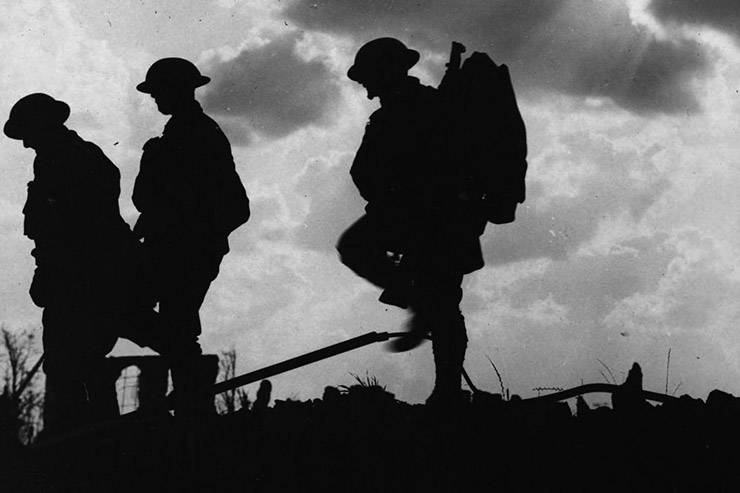
    The history of the First World War (1914–1918) is a deliberately concocted lie. Not the sacrifice, the heroism, the horrendous waste of life or the misery that followed. No, these were very real, but the truth of how it all began and how it was unnecessarily and deliberately prolonged beyond 1915 has been successfully covered up for a century. A carefully falsified history was created to conceal the fact that Britain, not Germany, was responsible for the war. Had the truth become widely known after 1918, the consequences for the British Establishment would have been cataclysmic.1

    To the victors go the spoils, and their judgment was reflected in the official accounts. At Versailles in 1919 Britain, France and the United States claimed that Germany had planned the war, deliberately started it, and rejected all Allied proposals for conciliation and mediation. Millions of documents were destroyed, concealed or falsified to justify that verdict. Germany rightly protested she had been forced into war by Russian aggression. German delegates at Versailles, under threat of occupation, dismemberment and starvation, were left with little choice but to accept the blame and agree to massive reparations. As The Economist put it, the Treaty of Versailles was the final crime whose harsh terms would ensure a second war.2

    Our research proves that the true origins of the war are to be found not in Germany, but in England. In the late nineteenth century a secret society of immensely rich and powerful men was established in London with the stated aim of expanding the British Empire across the entire world. They deliberately caused the South African War of 1899–1902 in order to grab the Transvaal’s gold from the Boers. Their responsibility for that war, and the horror of British concentration camps in which 20,000 children died,3 have been airbrushed from official histories. The second stage of their global plan was the destruction of the rapidly developing industrial and economic competitor, Germany.

    Carefully falsified history? Twenty thousand children dying in British concentration camps? A secret society taking control of the world? Britain responsible for the First World War? Should you jump immediately to the conclusion that this is some madcap conspiracy theory, please consider the work of Professor Carroll Quigley, one of the twentieth century’s most highly respected historians. Quigley’s greatest contribution to our understanding of modern history is presented in his book The Anglo-American Establishment. It carries explosive details of how the secret society of international bankers, aristocrats and other powerful men controlled the levers of politics and finance in Great Britain and the United States. Quigley explains that very few people knew about this because the society was able to conceal its existence and “many of its most influential members are unknown even to close students of British history.”4

    Plotting to Destroy the ‘Teutonic menace’

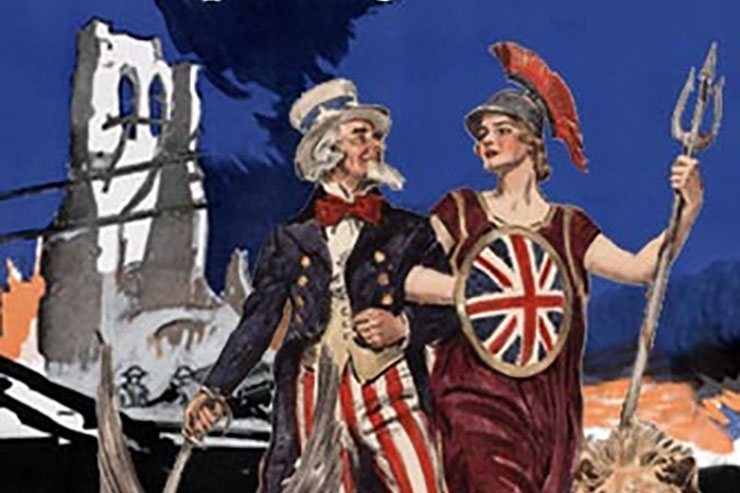
    Cecil Rhodes, the South African diamond millionaire, formed the secret society in London in February 1891.5 Its members aimed to renew the bond between Great Britain and the United States, spread all they considered worthy in English ruling-class values, and bring all habitable portions of the world under their influence and control. They believed that ruling-class men of Anglo-Saxon descent rightly sat at the top of a hierarchy built on predominance in trade, industry, banking and the exploitation of other races.

    Victorian England sat confidently at the pinnacle of international power, but could it stay there forever? That was the question exercising serious debate in the great country houses and smoke-filled parlours of influence. The elites harboured a deep rooted fear that unless they acted decisively, British power and influence across the world would be eroded and replaced by foreigners, foreign business, foreign customs and laws. The choice was stark. Either take drastic steps to protect and further expand the British Empire, or accept that the new, burgeoning Germany might reduce it to a minor player on the world’s stage. In the years immediately after the Boer War, the decision was reached. The ‘Teutonic menace’ had to be destroyed. Not defeated, destroyed.

    The plan began with a multi-pronged attack on the democratic process. They would: (a) Wield power in administration and politics through carefully selected and compliant politicians in each of the major political parties; (b) Control British foreign policy from behind the scenes, irrespective of any change of government; (c) Draw into their ranks the increasingly influential press-barons to exercise influence over the avenues of information that create public opinion, and (d) Control the funding of university chairs, and completely monopolise the writing and the teaching of the history of their own time.6

    Five principal players, Cecil Rhodes, William Stead, Lord Esher, Lord Nathaniel Rothschild and Alfred Milner, were the founding fathers, but the secret society developed rapidly in numbers, power and presence in the years before the war. Influential old aristocratic families that had long dominated Westminster were deeply involved, as was King Edward VII who operated within the inner core of the Secret Elite. The two great organs of imperial government, the Foreign Office and the Colonial Office, were infiltrated, and control established over their senior civil servants. They likewise took over the War Office and the Committee of Imperial Defence. Crucially, they also dominated the highest echelons of the armed forces through Field Marshall Lord Roberts7 in what we have termed the “Roberts Academy.”8 Party-political allegiance was not a given prerequisite for members; loyalty to the cause of Empire was. They have been referred to obliquely in speeches and books as ‘the money power’, the ‘hidden power’ or ‘the men behind the curtain’. All of these labels are pertinent, but we have called them, collectively, the Secret Elite.

    Leading Role Played by Alfred Milner

    The leading figure in the Secret Elite from around 1902 until 1925 was Alfred (later Viscount) Milner. Remarkably, few people have ever heard his name. Professor Quigley noted that all biographies of Milner had been written by members of the Secret Elite and concealed more than they revealed. In his view, this neglect of one of the most important figures of the twentieth century was part of a deliberate policy of secrecy. Milner became the undisputed leader of the Secret Elite. On his return from South Africa in 1905 he set about preparing the British Empire for war with Germany. Though not a member of parliament, he sat in the inner-circle of Lloyd George’s Imperial War Cabinet from 1916 onwards.9 What was so precious about Lord Alfred Milner that he has been virtually airbrushed from history?

    In goading the Boers into war, Milner displayed the cold objectivity that drove the cause. War was unfortunate but necessary. It had to be. The very future of the Secret Elite’s global ambitions depended on a victorious outcome. By May 1902, the Transvaal’s gold was in their hands at the cost of 32,000 deaths in the concentration camps. Though the Boer War finally ended in victory it came at a cost greater than the 45,000 Empire troops killed or wounded.10 Britain had fewer friends than ever. Up to that point, Britain didn’t care. Living in ‘splendid isolation’ and devoid of binding treaties with any other nation had not been viewed as a handicap as long as no other power on earth challenged the Empire.

    But in the early years of the twentieth century there was a serious challenger. If the Secret Elite were to achieve their dream of world domination, the first step had to be the removal of the upstart German competitor and destruction of her industrial and economic prowess. This presented considerable strategic difficulty. Friendless in her isolation, Britain could never destroy Germany on her own. As an island nation her strength lay in her all-powerful navy. Friendship and alliances were required. “It would have been impossible for Britain to have defeated Germany by itself. Therefore, it needed the large French army and the even larger Russian army to do most of the fighting on the continent.”11 Diplomatic channels had to be opened and overtures made to old enemies Russia and France. This was no mean task since Anglo-French bitterness had been rife over the previous decade and war between them a real possibility in 1895.12

    Step forward the Secret Elite’s most special weapon, Edward VII, whose greatest contribution lay in engineering the much-needed realignments, and addressing the Secret Elite’s prerequisite need to isolate Germany. Ultimate responsibility for British foreign policy lay, by precedent, with the elected government and not the sovereign, but it was the King who enticed both France and Russia into secret alliances within six short years. The great armies of France and Russia were integral to the mammoth task of stopping Germany in her tracks. Put simply, the Secret Elite required others to undertake much of their bloody business, for war against Germany would certainly be bloody.

    The treaty with France, the Entente Cordiale, was signed on 8 April 1904, marking the end of an era of conflict that had lasted nearly a thousand years. The talk was of peace and prosperity, but secret clauses signed that same day aligned the two against Germany. The Secret Elite then drew Russia into their web with a promise they never intended to deliver – Russian control of Constantinople and the Black Sea Straits following a successful war with Germany. This empty promise was the root cause of the Gallipoli disaster.

    Secret Elite Control Both Sides of Politics

    British democracy, with regular elections and changes of government, was portrayed as a reliable safety net against despotic rule. It has never been this. Both the Conservative and Liberal parties had been controlled since 1866 by the same small clique that consisted of no more than half a dozen chief families, their relatives and allies, reinforced by an occasional incomer with the ‘proper’ credentials.

    The Secret Elite made an art form out of identifying potential talent and putting promising young men, usually from Oxford University, into positions that served their future ambitions. With the demise of the Conservative government in 1905, the Secret Elite had already selected their natural successors in the Liberal Party: reliable and trusted men immersed in their imperial values. Herbert Asquith, Richard Haldane and Sir Edward Grey were Milner’s chosen men. Grey moved into the Foreign Office and Haldane the War Office, and within two years Asquith was Prime Minister. Continuity in foreign policy was assured. A complete root-and-branch reorganisation of the War Office began in preparation for the coming war with Germany. How the Secret Elite must have laughed in their champagne at the notion of parliamentary democracy.

    [alert type=”info” dismiss=”no”]If you appreciate this article, please consider a subscription to New Dawn magazine.[/alert]

    Secret Elite’s Propaganda Arm: The Press

    Control of politics had never been a problem, nor was control of the press. Lord Northcliffe, the most powerful press-baron, was a valuable contributor to the Secret Elite in their drive to vilify Germany and prepare the nation for eventual war. His ownership of The Times and Daily Mail allowed them to create the impression that Germany was the enemy. In story after story, the message of the German danger to the British Empire, to British products, to British national security, was constantly regurgitated. Not every newspaper followed suit, but the right-wing press was particularly virulent. A large and influential section of the British press worked to the rabid agenda of poisoning the minds of the nation. It was part of a propaganda drive sustained right up to, and throughout, the First World War. If The Times was their intellectual base, the popular dailies spread the gospel of anti-German hatred to the working classes. From 1905 to 1914, spy stories and anti-German articles bordered on lunacy in what was an outrageous attempt to generate fear and resentment.

    Tapping the Colonies for Cannon Fodder

    Sir Alfred Milner set himself the mammoth task of preparing the Empire for war. Britain had only a small, highly trained Expeditionary Force, but the Empire remained a vast untapped source with over six million men of military age. Milner knew that when war came he had to be sure Australia, New Zealand and Canada would stand shoulder to shoulder with Britain. A Colonial Conference was held in London in 1907 to wrap the Union Jack around the Empire. Australia’s Prime Minister Alfred Deakin was Milner’s prime target. They shared a platform at the Queen’s Hall on which Milner praised Deakin and Australia’s commitment to the Empire and stressed the links of race and loyalty that bound the two nations. They adopted a plan to organise the dominion military in line with the reorganised British army so that they could be integrated in “an emergency.” This led to the complete reorganisation of the Australian and New Zealand forces.13

    Canada, likewise, had a huge reserve of young men, and in 1908 Milner undertook a coast to coast rail tour praising Canadian spirit, patriotism and loyalty to the Empire.14 In June 1909 he threw his energies into an Imperial Press Conference in London that brought together over 60 newspaper owners, journalists and writers from across the Empire. Every effort was made to impress – indeed, overawe – the visitors, with lavish praise and hospitality. He was determined to rally the support of the Empire for the mother country in time of war. Travelling by private first class train, they visited armaments factories in Manchester and a shipyard in Glasgow where destroyers were being built for Australia. Honorary degrees were conferred on several leading newspapermen from Canada, Australia, India and South Africa. In the keynote address Lord Rosebery, a member of the Secret Elite, warned that never before in the history of the world was there “so threatening and overpowering a preparation for war.”15 Though Germany was not mentioned by name, the clear inference was that the Kaiser was preparing for war, and Britain and the Empire must quickly to be made ready. Lord Rosebery called on the delegates “to take back to your young dominions across the seas” the message that “the personal duty for national defence rests on every man and citizen of the Empire.”16 Milner later sent his most trusted acolytes to organise influential local groups throughout the Empire. Their message repeated the mantra of loyalty, duty, unity and the benefits of Empire… Empire… Empire. In the final analysis, Australia placed its navy under British command, and a total of 332,000 Australians went to war. New Zealand sent 112,000 men. The Empire did ‘its duty’, yet what have you ever heard about Lord Alfred Milner?

    A Convenient Assassination

    Two conditions had to be met before the Secret Elite could start their war. Firstly, Britain and the Empire had to be made ready. Secondly, in order to heap blame on Germany, she had to be goaded into making the first move. The assassination of the heir to the Austro-Hungarian throne, Arch-Duke Franz Ferdinand on 28 June 1914 provided the excuse for monstrous manipulation. It has often been cited as the cause of the First World War. What nonsense. On its own it was just one more political assassination in an era of such murders. The blame rested with a group of Serbian officials who trained, armed and aided the assassins, and Austrian retribution was generally accepted as a valid reaction. What we have demonstrated in our book, Hidden History, is that connections linked the Serbians, the Russian Ambassador in Belgrade, the Foreign Office in St. Petersburg and the Secret Elite in London.17 Austria demanded the Serbian government take specific action against the perpetrators and allow Austrian involvement in the investigation. Serbia refused. Russia, having assumed the spurious role of protector, voiced total support for Serbia.

    In London, the Secret Elite purposefully fanned the orchestrated antagonisms into a crisis. When Serbia and Austria squared up to each other in what should have been a localised conflict, Russia, with the full support of London and Paris, began in secret to mobilise her massive armies on Germany’s eastern border. Everyone was aware that once the general mobilisation of an army began, it meant war and there was no turning back. Germany faced invasion along her eastern front, and, as the French army mobilised to the west, the Kaiser repeatedly made valiant attempts to persuade his cousin the Tsar to stand down his armies. In the full knowledge that France had promised to join with her immediately, and that Britain, though not openly admitting her collusion, was secretly committed to war, the Tsar refused. Russia’s dream of taking Constantinople could at last be realised.

    Backed into a corner and forced into a defensive war, Germany was the last power in Europe to mobilise her army. In order to deal with the French who had secretly mobilised to the west, the Kaiser ordered the German army to advance into France through Belgium. He had little other option. Continental Europe was at war.

    The Secret Elite watched and waited. Though joint preparations for war had been ongoing since 1905, they had been kept so secret that only five out of twenty Cabinet ministers in the British government knew of Britain’s commitments. Sir Edward Grey addressed the House of Commons on 3 August and promised that no action would be taken without the approval of parliament, yet that approval was never put to a vote. The crux of his argument lay in Belgian neutrality though he knew full well that such neutrality was a grotesque charade. Among others, the American writer Albert J Nock later revealed that Belgium had been a secret, but solid ally of Britain, France and Russia long before August 1914.18 The fiction of Belgian neutrality provided the legal and popular excuse for Britain to declare war on Germany on 4 August 1914. Sir Edward Grey, loyal servant of the Secret Elite, lied the British Empire into war.

    Documentary Evidence Destroyed & History Falsified

    Over the last 100 years facts have been twisted and falsified by court historians. Members of the Secret Elite took exceptional care to remove traces of their conspiracy, and letters, telegrams, official reports and cabinet minutes which would have revealed the truth have disappeared. Letters to and from Alfred Milner were removed, burned or otherwise destroyed. Incriminating letters sent by King Edward were subject to an order that, on his death, they must be destroyed immediately.19 Lord Nathan Rothschild, a founder member of the Secret Elite, likewise ordered that his papers and correspondence be burned posthumously lest his political influence and connections became known. As his official biographer commented, one can but “wonder how much of the Rothschild’s political role remains irrevocably hidden from posterity.”20

    Professor Quigley pointed an accusatory finger at those who monopolised “so completely the writing and the teaching of the history of their own period.” There is no ambivalence in his damning accusation. The Secret Elite controlled the writing and teaching of history through numerous avenues but none more effectively than Oxford University. Milner’s men largely dominated Balliol College, New College and All Souls which, in turn, largely dominated the intellectual life of Oxford in the field of history. They controlled the Dictionary of National Biography which meant the Secret Elite wrote the biographies of its own members. They created their own official history of key members for public consumption, striking out any incriminating evidence and portraying the best public-spirited image that could be safely manufactured. They paid for new chairs of history, politics, economics and, ironically, peace studies.21

    There was a systematic conspiracy by the British government to cover all traces of its own devious machinations. Official memoirs covering the origins of the war were carefully scrutinised and censored before being released. Cabinet records for July 1914 relate almost exclusively to Ireland, with no mention of the impending global crisis. No effort has been made to explain why crucial records are missing. In the early 1970s, the Canadian historian Nicholas D’Ombrain noted that War Office records had been “weeded.” During his research he realised that as much as five-sixths of “sensitive” files were removed as he went about his business.22 Why? Where did they go? Who authorised their removal? Were they sent to Hanslope Park, the government repository behind whose barbed-wire fences over 1.2 million secret files, many relating to the First World War, remain concealed today?23 Incredibly, this was not the worst episode of theft and deception.

    Herbert Hoover, the man who fronted the Belgian Relief Commission and was later the 31st President of America, was closely linked to the Secret Elite. They gave him the important task of removing incriminating evidence from Europe, while dressing it in a cloak of academic respectability. Hoover persuaded General John Pershing to release 15 history professors and around 1,000 students serving with the American Forces in Europe and send them, in uniform, to the countries his agency was feeding. With food in one hand and reassurance in the other, these agents faced little resistance in their quest. They made the right contacts, “snooped” around for archives and found so many that Hoover “was soon shipping them back to the US as ballast in the empty food boats.” The removal of documents from Germany presented few problems. Fifteen carloads of material were taken, including “the complete secret minutes of the German Supreme War Council” – a “gift” from Friedrich Ebert, first president of the post-war German Republic.24 Hoover explained that Ebert was “a radical with no interest in the work of his predecessors,” but the starving man will exchange even his birthright for food. Where now is the vital evidence to prove Germany’s war guilt, had they been guilty? Had there been proof it would have been released immediately. There was none. What has been hidden or destroyed will never be known, and it is a startling fact that few if any war historians have ever written about this illicit theft of European documents: documents that relate to arguably the most crucially important event in European and world history. Why?

    Get the issue this article appears in

    Hidden History: The Secret Origins of the First World War

    The evidence for every statement in this article can be found in our book, Hidden History: The Secret Origins of the First World War. In addition, we have been blogging regular articles since June 2014 on what really happened 100 years ago, not the pre-packaged history on which the British government would like us to concentrate. Amongst the disturbing ‘history’ to be exposed as a lie is the disgraceful Gallipoli campaign, a sordid and unworthy ‘distraction’ which resulted in tragic consequences for so many Anzac lads. A few historians have questioned why the attack on the Straits was so badly mismanaged but we go further, much further. In our next article for New Dawn, we will prove that the Gallipoli disaster was not due to misjudgement in London or the incompetence of naval and military leaders on the spot. Young men from Britain, France, Australia and New Zealand were needlessly sacrificed on the damned beaches and slopes of the Dardanelles to serve a very different purpose. Gallipoli was deliberately designed to fail.

    After a century of propaganda, lies and brainwashing about the First World War, cognitive dissonance renders us too uncomfortable to bear the truth that it was a small, socially advantaged group of self-styled English race patriots, backed by powerful industrialists and financiers in Britain and the United States, who caused the First World War. The determination of this London-based Secret Elite to destroy Germany and take control of the world was ultimately responsible for the deaths of millions of honourable young men who were betrayed and sacrificed in a mindless, bloody slaughter to further a dishonourable cause.

    Today, tens of thousands of war memorials across the world bear witness to the great lie, the betrayal, that they died for ‘the greater glory of God’ and ‘that we might be free’. It is a lie that binds them to a myth. They were the victims. They are remembered in empty roll calls erected to conceal the war’s true purpose. What they deserve is the truth, and we must not fail them in that duty.

    To read exclusive extracts from their book Hidden History: The Secret Origins of the First World War and also their latest research, please visit the authors’ blog at firstworldwarhiddenhistory.wordpress.com. Hidden History is available from all good bookstores and online retailers.

    The authors contributed the article “Gallipoli: The Untold Story – ‘The first casualty of war is truth’” for New Dawn 149, March-April 2015.

    [alert type=”general” dismiss=”no”]This article was published in New Dawn Special Issue Vol 9 No 1.[/alert]

    [alert type=”success” dismiss=”no”]If you appreciate this article, please consider subscribing to help maintain this website.[/alert]

    Footnotes

    1. Gerry Docherty & Jim Macgregor, Hidden History: The Secret Origins of the First World War, Mainstream Publishing, 2013, 11
    2. The Economist, 31 December 1999
    3. www.sahistory.org.za, politics and society, 20th Century South Africa
    4. Carroll Quigley, The Anglo-American Establishment, G S G & Associates Pub, 1981, 4
    5. Ibid, 3
    6. Ibid, 197
    7. Nicholas D’Ombrain, War Machinery and High Policy, Oxford University Press, 1973, 143
    8. Docherty & Macgregor, Hidden History, 194-202
    9. A.M. Gollin, Proconsul in Politics: Study of Lord Milner, Blond, 1964, 390-441
    10. Will Podmore, British Foreign Policy since 1870, Xlibris Corporation, 2008, 29-30
    11. Pat Walsh, The Events of 1915 in Eastern Anatolia in the Context of Britain’s Great War on the Ottoman Empire: A Talk Given by Dr. Pat Walsh at the London School of Economics on February 15th 2013, 4
    12. Niall Ferguson, The Pity Of War: Explaining World War I, Basic Books, 1999, 41
    13. J. Lee Thompson, Forgotten Patriot: A Life of Alfred, Viscount Milner of St. James’s and Cape Town, FDU Press, 2007, 257
    14. Viscount Milner, Speeches delivered in Canada in the Autumn of 1908, 1-12, https://archive.org/details/cihm_72889
    15. J. Lee Thompson, Northcliffe: Press Baron in Politics 1865-1922, John Murray, 2000, 168
    16. Ibid, 169
    17. Docherty & Macgregor, Hidden History, 242-251
    18. Albert J Nock, The Myth of a Guilty Nation, B.W. Huebsch, 1922, 36-7
    19. Lord Arbuthnott Fisher, Memories and Records, Vol. 1, George H. Doran company, 1920, 21
    20. Niall Ferguson, The House of Rothschild: Volume 1: Money’s Prophets: 1798-1848, Penguin Books, 1999, 319
    21. An in-depth analysis of the extent of this control can be found in our blogs of 18-19 June 2014 at firstworldwarhiddenhistory.wordpress.com/2014/06/18/
    22. Nicholas D’Ombrain, War Machinery and High Policy, Oxford University Press, 1973, xiii
    23. firstworldwarhiddenhistory.wordpress.com/2014/08/25/
    24. http://whittakerchambers.org/articles/time-a/hoover-library/

    © New Dawn Magazine and the respective author.
    For our reproduction notice, click here.
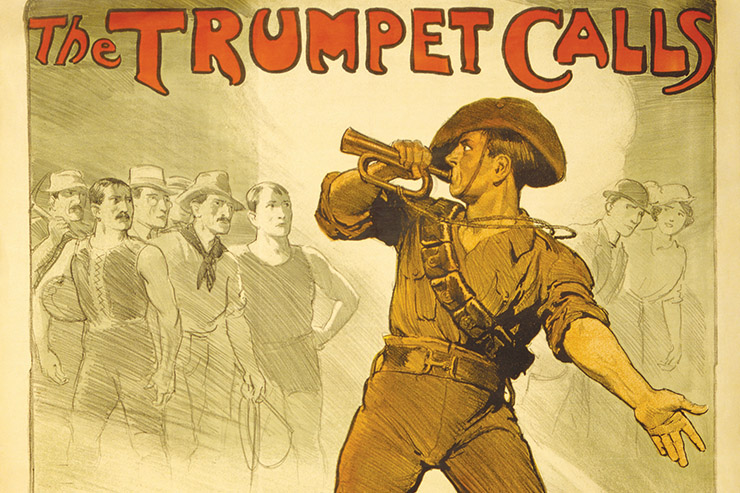
  • Gallipoli: The Untold Story – ‘The first casualty of war is truth’

    Gallipoli: The Untold Story – ‘The first casualty of war is truth’

    From New Dawn 149 (Mar-Apr 2015)

    The truth about Gallipoli has, unlike its victims, been buried deep. Historians like Peter Hart who describe it as “an idiocy generated by muddled thinking”1 are justified in their anger, but not their conclusions. The campaign was conceived in London as a grotesque, Machiavellian strategy to fool the Russians into believing that Britain was attempting to capture Constantinople for them. The paradox of its failure lay in its success. Gallipoli was purposefully designed to fail.

    A secret cabal of immensely rich and powerful men – the Secret Elite – was formed in England in 1891 with the explicit aim of expanding the British Empire across the entire globe. They planned a European war to destroy Germany as an economic, industrial and imperial competitor and, to that end, drew France then Russia into an alliance termed the Entente Cordiale. Their massive land armies were needed to crush Germany. France would be rewarded with Alsace and Lorraine, while Russia was conned into believing she would get Constantinople.2 Thereafter, seizing the Ottoman capital became a “widespread obsession, bordering on panic” in St Petersburg.3

    Had Britain encouraged the friendship of Turkey in 1914, the disaster of Gallipoli would never have happened.4 The Turks generally disliked the Germans and their growing influence,5 and made three separate attempts to ally with Britain. They were rebuffed on each occasion.6 They also pleaded in vain with the French to accept them as an ally,7 and protect them against their old enemy, Russia.8 Poor fools. The French and British alliance with Russia was at the expense of the Turks, not an alliance with the Turks to save them from Russia. Britain and France planned to carve up the oil rich Ottoman Empire. To that end, the Turks had to be pushed into the German camp and defeated.

    In July 1914 the majority of the Turkish cabinet was still well disposed towards Britain,9 but their faith was shattered by the seizure of two battleships being built for them in England. As an essay in provocation it was breathtaking.10 “If Britain wanted deliberately to incense the Turks and drive them into the Kaiser’s arms she could not have chosen more effective means.”11 Winston Churchill (a loyal servant of the Secret Elite) seized the dreadnoughts because they were “vital to Britain’s naval predominance.”12 The truth ran much deeper.

    Back in February, Russia laid plans for her Black Sea fleet to take Constantinople by landing 127,500 troops and heavy artillery from Odessa. Arrival of the dreadnoughts from England would destroy this plan.13 Russia’s Foreign Minister Sazonov issued a thinly veiled warning to London on 30 July: “It is a matter of the highest degree of importance that… these ships must be retained in England.”14 Fearful that Russia would renege on her commitment to war should the ships be released, the Secret Elite withheld them. It kept Russia on board and helped drive Turkey into the German camp (they signed a treaty on 2 August), but it created a major problem. How to prevent the Russian Black Sea fleet from seizing Constantinople? Two German warships provided the answer. On 4 August, while off the coast of Algeria, the battle cruiser Goeben and attendant light cruiser Breslau received orders to head for Constantinople.

    Vastly outnumbered (73 to 2) by French and British warships, the escape of the German cruisers to Constantinople, 1,200 miles away, is described as a “fiasco of tragic errors” by “fumbling” British Admirals.15 The British Admiralty supposedly had no idea where they were heading, but the reality was very different. On 3 August, Kaiser Wilhelm telegraphed King Constantine to say that both warships would be proceeding to Constantinople. This information was transmitted to London,16 and to the British naval mission in Athens.17 Naval Intelligence in London had intercepted and decrypted the actual encoded message from Berlin to Goeben: “Alliance concluded with Turkey. Goeben and Breslau proceed to Constantinople.” The Admiralty knew,18 but relayed information to the Mediterranean fleet that “was either useless or inaccurate.”19 Goeben and Breslau were allowed to escape in order to neutralise the Russian Black Sea fleet. Foreign Secretary Sazonov was outraged that the Royal Navy had failed to prevent it.20

    The Ottoman Ambassador in Berlin summed it up perfectly: “Considering the displeasure and complications which a Russian attack on Constantinople would produce in England, the British navy having enabled the German ships to take cover in the Sea of Marmora, has, with the Machiavellianism characteristic of the Foreign Office, foiled any possibility of action by the Russian Black Sea Fleet.”21 Safe arrival of the Goeben rendered a Russian amphibious operation well-nigh impossible,22 and the British Ambassador at Constantinople admitted that their presence served British interests, since “they protected the straits against Russia.”23

    On 9 September Admiral Arthur Limpus, head of the British naval mission in Turkey, was recalled. Turkey, although still neutral, closed and mined the Dardanelles. In late October Goeben and Breslau bombarded Sevastopol and other Black Sea ports. Infuriated, Tsar Nicholas insisted on war with Turkey and the seizure of Constantinople for Russia. British and French fears that he would make peace with Germany if Constantinople was denied him gave the Tsar overwhelming diplomatic leverage, and it was agreed that Turkey must now be brought into the war.24

    War Declared & the Secret Elites Initiate Gallipoli Campaign

    On 2 November Russia declared war on Turkey. Britain and France followed suit three days later. “November 1914 brought a kind of holy war fever to the Russian Foreign Ministry.”25 With over one million Russian casualties for no gain, anti-war protests and revolution stalked the streets of Petrograd. In London, fear of Russia signing a peace treaty with Germany loomed large. How was Russia to be kept in the war with the promise of Constantinople, without actually allowing it? The solution, an attack on Gallipoli, was fraught with pitfalls. The Tsar had to be tricked into believing Britain was generously responding in his hour of need by mounting an all-out effort to take Constantinople for Russia.

    The Gallipoli campaign supposedly arose from an urgent call for help from the Russian commander-in-chief Grand Duke Nikolay Nikolaevich on 31 December. Would Britain create a diversion to relieve pressure on Russian troops fighting in the Caucasus?26 This widely held view is wrong. The suggestion came not from Nikolaevich, but from the British military attaché at Petrograd, Sir John Hanbury-Williams. Intimately linked to the Secret Elite and their leader Lord Alfred Milner,27 Hanbury-Williams was frequently in close contact with Nikolaevich. He expressed anxiety about Russia’s domestic morale, but never even mentioned the Dardanelles. It was Hanbury-Williams who planted the idea of a British demonstration against the Ottoman Empire.28 Next day this was presented to the British War Council and magically transformed into a desperate plea for help from Russia.

    Having already decided their strategy to keep the Russians out of Constantinople, the Secret Elite now cleverly made it appear that the idea came from Russia. It was all pre-planned, “long before any kind of military imperative in the Ottoman theatre was apparent.”29 The Secretary of the Committee for Imperial Defence, Maurice Hankey, proposed a solution that met all requirements, and it is no coincidence that Hankey was himself a member of the Secret Elite.30 The Gallipoli campaign would be mounted as a sop to the Russians, but set up to fail.

    Days later the military dynamic changed. The Turkish 3rd Army was decimated in the Caucasus and, irrespective of whose suggestion it had been, there was no need whatsoever for any British intervention to help Russia. Nonetheless, on 20 January Britain informed Russia that she would undertake not just a demonstration, but a complete operation to penetrate the Dardanelles and Gallipoli. The Russians desperately wanted to take part, but were told to concentrate all efforts against Germany on the Eastern Front. The Secret Elite moved into top gear. An objective that required long months of careful preparation was rushed ahead at breakneck speed with disregard for the basic prerequisites for success.

    Churchill assumed command and chose men for their ineptitude rather than ability. He turned to Vice-Admiral Sackville Carden, recently appointed commander of the Mediterranean Squadron after years in a desk-bound job, as superintendent of the Malta dockyards. Slow and ineffective,31 Carden was tasked with drawing up a plan for a naval attack on the Dardanelles, and relaying it to Churchill within days for presentation to a War Council meeting.32 On 15 January Carden was informed that his plan had been accepted33 and that he would be in command. What had happened? The ‘plan’, rapidly cobbled together on the back of an envelope by a second rate officer, was to be used as the blueprint for the Gallipoli campaign. The reluctant Carden was given no option other than to get on with it,34 and was effectively set up to take the blame when it failed. For fail it must.

    Rear-Admiral Arthur Limpus, an eminently more experienced and knowledgeable man who had spent years in Turkey advising on all naval matters, including the defence of the Dardanelles, was overlooked.35 Here was the man “who knew the Turks and the Dardanelles intimately,”36 yet Churchill shunned him because “the Turks might be offended” and it would be “unfair and unduly provocative” to place in command a man with an inside knowledge of the Turkish fleet.37 Limpus “knew all their secrets,”38 and more about the Dardanelles and the Turkish navy than any other naval officer, yet we are asked to believe that he wasn’t given command because it was considered ungentlemanly – “not quite cricket.”39 Limpus had been sent to the Malta dockyards to sit at Carden’s old desk. Outrageous stupidity or cold calculation?

    Limpus was opposed to Churchill’s plan,40 stressing that the first stage must be an amphibious landing, not a naval attack.41 He was not alone in his opposition. In 1906, naval chiefs considered a naval assault too risky.42 Any attack on Gallipoli would “have to be undertaken by a joint naval and military expedition,”43 and Churchill himself stated in 1911 that it was “no longer possible to force the Dardanelles.”44 Rear-Admiral Carden was ignorant of the fact that any chance of success at Gallipoli was absolutely dependent on a combined naval and military operation. Without long, detailed joint planning, and a sufficient number of troops, it was impossible. Lord Kitchener, the British Secretary of State for War, refused to make troops available and Carden was ordered to proceed with a naval attack.

    The Russians were turning the screw. Pressure for immediate action influenced the War Council’s decision.45 On 14 February, Sazonov stated that the time for moderation had passed. Tsar Nicholas agreed, informing the French ambassador that his people were making terrible sacrifices in the war without reward. Constantinople must be incorporated into his empire.46 Sazonov implied to the British ambassador that he would resign, and be replaced by Sergei Witte, a pro-German sympathiser who would immediately seal a treaty with Germany.47 All warnings against a purely naval attack were ignored. The navy’s objective was to “bombard and take the Gallipoli peninsula with Constantinople as the objective.”48 After the disastrous failure the Dardanelles Commission asked, “How can a fleet take a peninsula? And how could it have Constantinople as its objective? If this meant… that the Fleet should capture and occupy the city, then it was absurd.”49 It was all absurd.

    Naval bombardment of the outer forts of the Dardanelles began on 19 February and ran for six days. It caused some damage but destroyed all hope of surprise and merely led the Turks to strengthen their defences.50 The main naval attack took place on 18 March. On the previous day Vice-Admiral De Robek had to take charge when Carden suffered a nervous breakdown. It was no surprise. He was never fitted for the task and felt completely undermined by the Admiralty’s refusal to provide custom-built minesweepers. They were utterly essential but he was given only North Sea trawlers that could barely make headway against the strong 5-6 knot current. Eight powerful destroyers, which could have been fitted with sweeps, remained idle that fateful day while the officers sat playing cards,51 and only two out of a total of 387 mines were cleared.52 A fleet of 16 British and French battleships bombarded the coast, but were unable to penetrate the minefield and six battleships were sunk or disabled by mines. The Bouvet sank within two minutes with over 600 men trapped inside. It was the disaster predicted as far back as 1906.

    [alert type=”info” dismiss=”no”]If you appreciate this article, please consider a subscription to New Dawn magazine.[/alert]

    A Campaign That Could Never Succeed

    Orchestrated chaos shrouded a campaign that could never succeed. Kitchener meantime had changed his mind and agreed to make troops available for a combined attack, but the naval assault had gone ahead before their arrival. Maurice Hankey, acting more as strategic adviser to the War Council than its Secretary,53 stated, “combined operations require more careful preparation than any other class of military enterprise. All through our history such attacks have failed when the preparations have been inadequate.”54 He listed ten points to be met if a joint attack was to succeed. Was he saying, “it will fail as long as we do not take the following measures”? According to the War Council minutes, Hankey’s plan was not even discussed.55 In the event, every point he made was studiously ignored.

    Military leadership, like naval, was barely functional. General Sir Ian Hamilton, a man in the twilight of his career who “knew little of the Dardanelles, the Turkish army or of modern warfare,” was chosen to command.56 Scared of Kitchener, and hamstrung by his long-subservience,57 he noted in his diary, “It is like going up to a tiger and asking for a small slice of venison.” During the Boer War he had witnessed Kitchener respond to an officer’s appeal for reinforcements by taking half his troops away.58 The genial Hamilton, like poor Carden, was a scapegoat made to order.

    Summoned by Kitchener on 12 March, Hamilton was brusquely informed, “We are sending a military force to support the fleet now at the Dardanelles and you are to have command.” Hamilton was stunned, later admitting, “My knowledge of the Dardanelles was nil, of the Turk nil, of the strength of my own forces next to nil.” When asked if a squadron of modern aircraft with experienced pilots and observers could be made available, Kitchener testily replied, “Not one.” 150,000 men was the minimum required strength for the task, but Kitchener insisted that “half that number” would do handsomely.59 No attempt was made to co-ordinate intelligence about the defences at Gallipoli, not even at strategic level.60 Hamilton was given a cursory briefing, two small tourist guidebooks and old, inaccurate maps.61 Detailed reports from Admiral Limpus and Lieutenant-Colonel Charles Cunnliffe-Owen, another officer with considerable knowledge of Gallipoli, were kept from him.62 Hamilton set off within 48 hours, together with some inexperienced members of staff who did not even know “how to put on their uniforms.”63 So much for detailed preparation.

    The chaos continued. There was no discussion, no plan, no naval/military coordination. Indeed, it was a worse situation than preceded the naval operation.64 Gallipoli was to be invaded with a mixed force of 80,000 men from Britain, France and the Empire. Raw Anzac troops and unseasoned French recruits were to be thrown into battle for the first time. Marshall Joffre, the French commander-in-chief, was profoundly opposed to the whole operation and initially refused to provide troops. Political expediency forced his hand.65 A French army Colonel who had spent years in Constantinople also opposed the attack, but like everyone else with intimate knowledge of the area, its topography and defences, he was dismissed.66 Lieutenant-Colonel Cunnliffe-Owen, the British military attaché at Constantinople in 1914, who had personally conducted a detailed survey of Gallipoli, was likewise deliberately overlooked. In London when staff were being scratched together for Hamilton’s team, Cunnliffe-Owen was passed over. His detailed reports on the peninsula were never shown to General Hamilton.67

    Kitchener agreed to the deployment of 18,000 men from the British army’s 29th Division. Its commander, Shaw, had served with distinction at Mons and was considered a highly competent and “impressively professional soldier.” Two days before leaving for Gallipoli, when continuity was all-important, Shaw was inexplicably replaced by Major-General Hunter-Weston. He immediately rejected his allocated ship because it lacked first class accommodation, and was transferred to the luxury liner Andania.68 Major-General Shaw suffered the same fate as Admiral Limpus. A competent, knowledgeable man was rejected in favour of Hunter-Weston, a laughing-stock in the British Army,69 spectacularly incompetent, and “one of the most brutal commanders of the First World War.”70 Ask yourself, what was going on?

    Hamilton arrived to find his army scattered in confusion over much of the Mediterranean. Some battalion commanders couldn’t trace their companies. Ships came from Britain with such poorly written orders that captains did not know their destination.71 On their arrival at Mudros, the ships were found to be loaded in a shambolic fashion, and had to be taken 700 miles to Egypt to be unloaded and repacked.72 Such was the lack of preparation that even the simplest questions could not be answered. “Was there drinking water on Gallipoli? What roads existed? Were troops to fight in trenches or the open? What sort of weapons were required? What was the depth of water off the beaches? What sort of boats were needed to get the men, the guns and stores ashore? What casualties were to be expected? How were they to be got off to the hospital ships? It was simply a case of taking whatever came to hand and hoping for the best.”73

    An “Amateurish, Do-It-Yourself Cock-Up”

    You couldn’t make it up. There was a shortage of guns, ammunition, aircraft and, above all, troops. Hamilton’s requests for additional supplies and reinforcements were either ignored or refused.74 Gallipoli veteran Charles Watkins described the campaign as an “amateurish, do-it-yourself cock-up.”75 It was designed to be exactly that. The quality of preparation and leadership guaranteed it. General Ian Hamilton was the Secret Elite’s Patsy-in-Chief, unwittingly abetted by the incompetent Admiral Carden. These were the men chosen to fail.

    The Gallipoli landings went ahead on 25 April 1915 with the terrible slaughter and wounding of many incredibly brave young men, dispensable pawns on Imperial Britain’s chessboard. Despite the fleet now having some thirty powerful destroyers equipped to sweep the mines, and many officers totally confident that the fleet could now get through, no further attempt was made to force the Dardanelles. The navy would play no further part other than ferrying the men ashore, taking off the wounded, and providing a safe haven off-shore for the likes of Hunter-Weston. Successful mine sweeping had always been the key to a successful naval assault, and with the new minesweepers and a clear run through to the Straits, the fleet could have greatly assisted the army with controlled bombardments of Turk positions from within the channel. It would, of course, also have been able to cripple Goeben and Breslau. For the above stated reasons, that would not be allowed to happen.

    For years knowledgeable men had insisted that a well planned and resourced combined naval and military attack was the only type of operation that might succeed, but never at any point in the entire Gallipoli campaign was a joint assault carried out. The elites in London ordered the shambolic attack by the navy when they knew it was bound to fail, and now ordered an equally shambolic attack by the army in the full knowledge that it too could never succeed.

    Gallipoli was a lie within the lie that was the First World War. The campaign ended in military defeat, but geo-strategic victory for the British Empire. By late 1915, with Russian forces pushed back on the eastern front and any likelihood of their intervention in Constantinople gone, the British government began planning withdrawal from the corpse strewn peninsula. The last Allied troops were taken off on 9 January 1916, leaving behind 62,266 of their comrades. The majority of the dead on both sides have no known graves. Many of the 11,410 Australians and New Zealanders who died76 suffered unspeakable deaths, deliberately sacrificed on the altar of British imperialism.

    Get the issue this article appears in

    A Myth Obscures the terrible Truth

    Over the last century, in both Britain and Australia, Gallipoli has been turned into a heroic-romantic myth,77 a myth promoted by court historians and pliant journalists in order to hide the stark truth. It was a ruse, a sop to the Russians to keep them in the war in the belief that allied forces would capture Constantinople on their behalf. Put into the hands of incompetent generals and admirals, starved of troops, determined leadership, ill-equipped, ill-advised and certain to fail, the attack on Gallipoli as an integral part of the imperial strategy was a stunning success.

    We are aware of at least one renowned Gallipoli historian and writer in Australia who agrees with our thesis. Like us, he proposes that “it was the intention of the British and French governments of 1915 to ensure that the Dardanelles and the Gallipoli campaign would not succeed” and was “conceived as a ruse to keep the Russians in the war…” He believes that while the proposition has circumstantial evidence to support it, there is “little or no documentary evidence.”78 He is very unlikely to find it. As revealed in our book Hidden History: The Secret Origins of the First World War, masses of crucial documents relating to the First World War were shredded or burned, or have been kept hidden away to this very day in a high security establishment at Hanslope Park in England. The individuals responsible for the war, responsible for Gallipoli, were many things, but they weren’t so stupid as to leave incriminating evidence lying around. Historians in Australia and New Zealand must stop protecting their comfortable careers and start acknowledging the terrible truth about Gallipoli. Peddling mythology as truth is an insult to the memory of those brave young men.

    Just as in Britain, the Government of Australia seeks to be the guardian of public memory, choreographing commemoration into celebration,79 ritually condemning war while the rhetoric gestures in the opposite direction.80 The War Memorial in Sydney’s Hyde Park proudly exhorts, “Let Silent Contemplation Be Your Offering,” yet the deafening prattle of political expediency mocks the valiant dead with empty words and lies. Don’t be fooled. Those young men died for the imperial dreams of wealthy manipulators, not for ‘freedom’ or ‘civilisation’. They died deceived, expendable, and in the eyes of the power-brokers, the detritus of strategic necessity. Remember that.

    To read exclusive extracts from their book Hidden History: The Secret Origins of the First World War, including their latest research on Gallipoli, please visit the authors’ blog at firstworldwarhiddenhistory.wordpress.com. Hidden History is available from all good bookstores and online retailers.

    The authors contributed the article “The Secret Origins of the First World War” to New Dawn Special Issue Vol 9 No 1.

    [alert type=”general” dismiss=”no”]This article was published in New Dawn 149.[/alert]

    [alert type=”success” dismiss=”no”]If you appreciate this article, please consider subscribing to help maintain this website.[/alert]

    Footnotes

    1. Peter Hart, Gallipoli, vii
    2. David Fromkin, A Peace to End All Peace, The Fall of the Ottoman Empire and the Creation of the Modern Middle East, 138; Niall Ferguson, The Pity Of War, 61
    3. Sean McMeekin, The Russian Origins of the First World War, p.28.
    4. J Laffin, The Agony of Gallipoli, 3
    5. Robert Rhodes James, Gallipoli, 8
    6. Hew Strachan, The First World War, 102
    7. Friedrich Stieve, Isvolsky and the World War, 177
    8. W W Gottlieb, Studies in Secret Diplomacy, 34
    9. Dan Van Der Vat, The Dardanelles Disaster, 28
    10. L A Carlyon, Gallipoli, 42
    11. Gottlieb, Studies, 42
    12. W.S. Churchill, The World Crisis, 221-2
    13. Sean McMeekin, The Russian Origins of the First World War, 30-34
    14. Ibid., 102
    15. Ulrich Trumpener, ‘The Escape of the Goeben and Breslau’, Canadian Journal of History, September 1971, 171
    16. Ibid., 178-9
    17. Geoffrey Miller, The Straits, ch. 16
    18. Alberto Santini, ‘The First Ultra Secret: The British Cryptanalysis in the Naval Operations of the First World War’, Revue Internationale d’Histoire Militaire, Vol. 63, 1985, 101
    19. Ulrich Trumpener, ‘The Escape of the Goeben and Breslau’, Canadian Journal of History, September 1971, 181-7
    20. Gottlieb, Studies, 45
    21. Ibid., 46
    22. McMeekin, The Russian Origins, 105-106
    23. Strachan, The First World War, Vol. 1, 674
    24. McMeekin, The Russian Origins, 96-97
    25. Ibid., 115
    26. Ronald P Bobroff, Roads to Glory, Late Imperial Russia and the Turkish Straits, 125
    27. Carroll Quigley, The Anglo-American Establishment, 56
    28. McMeekin, The Russian Origins, 129-30
    29. Ibid., 121
    30. Quigley, Anglo-American Establishment, 313
    31. Tim Travers, Gallipoli, 20-21
    32. Laffin, The Agony, 21-22
    33. Robin Prior, Gallipoli, The End of A Myth, 22
    34. Ibid., 52
    35. Rhodes James, Gallipoli, 63
    36. B. H. Liddell Hart, History of the First World War, 213
    37. Laffin, The Agony, 9
    38. Alan Moorehead, Gallipoli, 60
    39. Michael Hickey, Gallipoli, 27
    40. Harvey Broadbent, Gallipoli, The Fatal Shore, 21
    41. Laffin, The Agony, 9
    42. Memorandum by the General Staff, 19 December 1906, National Archives, PRO. CAB/4/2/92
    43. Hickey, Gallipoli, 28
    44. James, Gallipoli, 3-4
    45. Broadbent, Gallipoli, The Fatal Shore, 28
    46. Ronald P Bobroff, Roads to Glory, Late Imperial Russia and the Straits, 126-131
    47. McMeekin, The Russian Origins, 130-131
    48. Laffin, The Agony, 15-22
    49. Moorehead, Gallipoli 40
    50. Laffin, The Agony, 31
    51. Travers, Gallipoli, 29
    52. Prior, Gallipoli, 53
    53. Stephen Roskill, Hankey, Vol. 1, 156
    54. Ibid., 163
    55. War Council Minutes, 19 March, 1915, CAB 42/2
    56. Prior, Gallipoli, 67
    57. Peter Hart, Gallipoli, 63
    58. Laffin, The Agony, 39
    59. Ibid., 30
    60. Ibid., 19
    61. Ibid., 31
    62. Hickey, Gallipoli, 67
    63. Laffin, The Agony, 31
    64. Prior, Gallipoli, 70
    65. Laffin, The Agony, 35
    66. Edmond Delage, The Tragedy of the Dardanelles, 109
    67. Laffin, The Agony, 12-13
    68. Hickey, Gallipoli, 57-58
    69. Denis Winter, Haigs Command, 140
    70. Prior, Gallipoli, 80
    71. Laffin, The Agony, 31
    72. Moorehead, Gallipoli, 90
    73. Prior, Gallipoli, 242
    74. Moorehead, Gallipoli, 117
    75. Laffin, The Agony, 217
    76. Prior, Gallipoli, 242
    77. Jenny Macleod, Reconsidering Gallipoli, 7-14
    78. ‘Gallipoli: one great deception?’ by Harvey Broadbent, ABC, 29 Sep 2010, www.abc.net.au/news/2009-04-24/30630
    79. James Brown, Anzacs Long Shadow, 19-22
    80. Marilyn Lake and Henry Reynolds, What’s Wrong With Anzac? The Militarisation of Australian History, 8

    © New Dawn Magazine and the respective author.
    For our reproduction notice, click here.
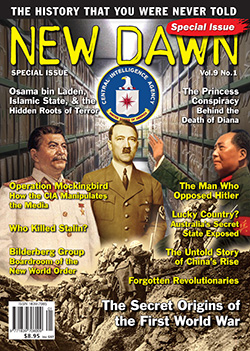
  • Perfidious Albion: An Introduction to the Secret History of the British Empire

    Perfidious Albion: An Introduction to the Secret History of the British Empire

    From New Dawn Special Issue 11 (Mar 2010)

    Perfidious Albion – “Treacherous England,” “Faithless England,” or, if you prefer, “Dirty, Low-down, Sneaky England” – is commonly assumed to derive from the French La Perfide Albion. The epithet’s best known appearance is in the 1793 poem “L’ere de Francais” by the Marquis de Ximenez. The year is not without significance. In February 1793, the increasingly radical and beleaguered French Republic declared war on Britain, and Ximenez exhorted his revolutionary countrymen to carry the fight to the enemy’s shores. One wonders what he would have made of the theory, advance many years later, that the very Revolution he praised was the clandestine handiwork of Perfide Albion.

    In any event, the good Marquis was hardly the first or the last to invoke the term. References to something of the kind date back to the late Middle Ages. In 1919, Canon Charles O’Neil enshrined it in the lyrics of “Foggy Dew,” which lauded Ireland’s Easter Rebellion. The Spanish, recalling the ill-fated Armada and the depredations of Sir Francis Drake, speak of Perfida Albion, the Italians of Perfida Albione, and the Germans of Perfides Albion. In any language, it boils down to the same thing: the English displayed a special knack for underhanded behaviour and more that they were damned good at it.

    Is such sniping just the reflexive bitterness of losers, or was the rise and success of the British Empire really abetted by dirty tricks and not just hardy seamen, stiff upper lips and the will of the Almighty? If so, much of the dirty work falls into that category loosely termed espionage or “secret service.” But the English did not invent spying, which if not the world’s second oldest profession, must be the third. Nor can it be that Britain’s alleged sin was simply putting its interests above that of any other nation, be it friend or foe. What other country can really claim to have done otherwise, and why should anyone expect them to?

    Of course, we are talking about more than mere intelligence gathering; suborning treason, inciting rebellion, even war, not to mention blackmail and assassination are neither the least nor the greatest crimes of which Perfidious Albion stands accused. Indeed, some might argue that the British Empire was born and maintained through a pact with the Devil himself. In any case, the likes of Stephen Dorril and Robin Ramsay argue that the long history of skulduggery manifests the hand of a British “Secret State” which continues to guide the policies and destiny of the United Kingdom.1

    The notion than England possessed a special talent for deceit and underhandedness may be a myth, but it has proved an effective and enduring one. After all, though the Empire is gone, the most famous secret agent in the world, James Bond, remains a Briton. The long list of historical figures who stand accused of being Albion’s tools (whether they knew it or not) includes Christopher Marlowe, Benjamin Franklin, Karl Marx, Leon Trotsky and Adolf Hitler. Those who, to one degree or another, definitely were, include Aleister Crowley, Harry Houdini, Benito Mussolini and Noel Coward. What follows will take a necessarily very selective look at some of the persons and events involved in Britain’s clandestine affairs from the era of Elizabeth I to the Second World War. Some may be familiar, others definitely obscure, but each played a part in the Secret History of the British Empire.

    Sir Francis Walsingham

    Credit for creating the first “regular” English secret service usually goes to Elizabeth I’s spymaster, Sir Francis Walsingham.2 He faced a predicament shared by many of his successors; the need to combat both external and internal threats and the collaboration of the two. In the case of the Protestant Walsingham and his Protestant Queen, the unifying factor among their enemies was devotion to Catholicism. Walsingham battled this menace by recruiting agents at home and abroad and waging an aggressive campaign of counter-subversion. His most successful weapon was the provocateur or “mole” who penetrated and compromised hostile conspiracies. He also followed the maxim that England’s enemy’s enemy was her friend, or at least an exploitable tool. In addition to Protestant sympathisers and dissident Catholics, he is also supposed to have enlisted the help of witches, sorcerers and atheists in Albion’s cause.3

    Little surprise that one of Walsingham’s better known operatives was an Elizabethan occultist whose interests included hermeticism, alchemy, astrology and conversing with “angels.” This was Dr. John Dee (1527–1608), a man whose encoded signature – a stylised representation of handled spectacles – was later appropriated by Ian Fleming for his “007.”4 Among other things, Dee was a prophet of England’s Manifest Destiny. He allegedly coined the term “Britannia” and conjured up the image of the small island kingdom as the centre of a world-girdling maritime empire.

    While Dee served Walsingham well, he was first and foremost a scholar and seems to have lacked the ruthless quality often required of a secret agent. Thus, it surely was Walsingham’s hand that in 1582 steered Edward Kelley into his path. Dee wished to commune with the spirits but lacked mediumistic powers. Kelley had them – or claimed to – and the pair formed a team which endured for some seven years. Kelley was a dubious character, a convicted forger and counterfeiter whose occult interests included necromancy and maybe outright diabolism.5 Since the angels “spoke” through Kelley, and Dee was inclined to do whatever they decreed, Kelley was ideally positioned to “manage” Dee. Kelley would have had no qualms about doing whatever Walsingham required. Little wonder that some three centuries later another English occultist-spy, Aleister Crowley, would proclaim himself the reincarnation of Edward Kelley.

    Dee and Kelley’s most important mission was their extended visit to Central Europe in the 1580s. This brought them to the court of Habsburg Emperor Rudolf II, nephew of England’s nemesis, Philip II of Spain, and host to a dangerous cabal of Catholic exiles. Kelley ultimately infiltrated and betrayed this group and their co-conspirators in England. Dee ingratiated himself (and by extension, Kelley) to Rudolf by providing the Emperor with rare tomes of esoterica. Dee is generally assumed to have sold Rudolf a very strange volume later dubbed the Voynich Manuscript after the book dealer who rediscovered it in the early 20th century.6 It is an illustrated manuscript depicting mysterious plants and rituals and written in an unknown and indecipherable alphabet. Among the multitude of theories about the book is one that holds Dee concocted it as cryptographic experiment based on the angelic or “Enochian” revelations received through Kelley.

    Britain’s Alliance with the Jews

    Half a century after Dee’s death, England was under a very different political regime but facing a remarkably similar security predicament. In the mid-1650s, power rested in the hands of a Puritan dictator, Lord Protector Oliver Cromwell. Cromwell’s principle enemies were the royalist partisans of the dethroned Stuarts who brewed sedition at home and plotted abroad with the Catholic kings of Spain and France.

    At this time there lived in London a wealthy Portuguese-Spanish merchant named Antonio Fernandez de Carvajal. In fact, Carvajal was a Marrano or crypto-Jew, a descendent of Iberian Jews compelled to accept Catholicism in the previous century. Like many of his secret co-religionists, Carvajal hated Spain and all it stood for. He also sought to legitimise his and other crypto-Jews’ status in England and permit other Sons of Judah to live there openly. The obstacle was Edward I’s 1290 Edict of Expulsion which forbade Jews to dwell in England. In 1655, Carvajal arranged for Rabbi Menasseh ben Israel to come from Amsterdam and make a personal appeal to Cromwell. The Lord Protector formally repealed the Edict two years later. Part of the quid pro quo was that Carvajal put Cromwell’s agents in contact with a far-flung network of “Jewish Intelligencers” who operated in the Netherlands, the Levant, Spanish America and inside Spain itself.7 As early as 1656 this secret alliance proved its value when Carvajal’s agents exposed royalist intrigues in Holland.

    Jump ahead 260 years and British agents in the Middle East, among them a certain T. E. Lawrence, were being aided by another network of Jewish spies, this one the Zionist NILI ring which worked against the Ottoman Turks.8 At the same time, Albion’s operatives spun visions of independence before the Arabs while quietly plotting to divide up the whole region with France. The leading light of the NILI ring, Aaron Aaronsohn perished in a mysterious plane crash over the English Channel in 1919. As in the later cases of the Duke of Kent (1942) and General Wladyslaw Sikorski (1943), suspicious minds saw the hidden hand of Perfidious Albion ridding itself of an “inconvenience.”9

    At the very least, had Edward I’s Edict remained in force, British history would have been very different. No Rothschilds would have lent their weight to London’s financial might, no Benjamin Disraeli would have become prime minister, nor would a Polish Jew named Shlomo Rozenblium have become Sidney Reilly, the Ace-of-Spies.

    The French Revolution has spawned its share of conspiracy theories. Perhaps the most resilient of these is the “Illuminati-Masonic Conspiracy” promoted by Abbe Augustin de Barruel in his Memoirs Illustrating the History of Jacobinism (1797–98) and John Robison’s Proofs of a Conspiracy against All Religions and Governments of Europe… (1797). Both writers point accusing fingers at the recently disbanded Bavarian Illuminati who, they allege, infiltrated French Freemasonry and spawned the head-chopping excesses of the Jacobins. It is worth noting that both Barruel and Robison wrote their books in Britain and that the government of Sir William Pitt the Younger embraced and promoted their ideas. At the very least, Pitt exploited the conspiracy theory to effectively discredit and demonise the French Revolution.

    In the 20th century, the doggedly anti-British researchers associated with Lyndon Larouche’s Executive Intelligence Review argue that the hidden hand of England both helped to get the Revolution rolling and steered it into the hands of the fanatical Jacobins. In modern parlance, it was all a “destabilisation” effort designed to cripple France economically and politically. Even the storming of the Bastille was part of the plot.10 In the “Bestial British Intelligence of Shelburne and Bentham,” Jeffrey Steinberg singles out Lord Shelburne (William Petty) the evil genius of the venture who used the monetary power of the East India Company to carry out a silent coup against weak King George III.11 According to this view, British intelligence ever since has been the tool of the same secret power. If so, were the works of Barruel and Robison sponsored disinformation designed to divert attention away from the real conspiracy to a manufactured one?

    Throughout the 19th and early 20th centuries, the British secret services had to negotiate a shifting landscape of alliances and real or potential enemies. In the 1850s, Britain joined traditional foe France in the Crimean War against Russia, but in the 1890’s France allied itself with Russia, a combination that was almost as troubling to Britain as it was to the rising power on the block, Germany. Up to the first years of the 20th century, Tsarist Russia remained the Empire’s #1 adversary, but when, after 1900, the Germans embarked on the creation of a big navy, British interests demanded an alliance with France (1904) and subsequently Russia (1907).

    Of course, just because you were allied to someone, didn’t mean you would or should stop spying on them. To better manage intelligence operations, a War Office Intelligence Division appeared in 1873. The Admiralty followed suit with a Foreign Intelligence Committee in 1882 which became the Naval Intelligence Department (NID) a few years later.

    William Melville

    Nevertheless, the man who was the closest thing to a British spymaster in the late 19th century, and who arguably laid the basis for British intelligence in the 20th, came from the London Metropolitan Police – Scotland Yard. His name was William Melville and he was, of all things, a Catholic Irishman from County Kerry. Originally a baker, Melville entered the Metropolitan Police in 1872 and ten years later joined its new Irish Branch. The latter was designed to combat Fenian conspiracies, particularly bomb attacks in London. Despite his background, Melville became an implacable enemy of the Irish rebels and a bitter foe of anarchists and radicals generally.

    In 1887, Melville was involved in ferreting out the so-called Jubilee Plot in which a Fenian cabal aimed to blow up Queen Victoria and most of her cabinet in Westminster Abbey.12 The key instigator turned out to be a British agent. Much the same emerged five years later when Melville masterminded the destruction of the Walsall Plot in which a group of anarchist workmen went to prison for scheming to build a bomb. Once again, the man at the centre of plot turned out to be one of Melville’s provocateurs.13

    Befitting a servant of Perfidious Albion, such deviousness did not go unrewarded. In 1893 Melville became Superintendent of Special Branch and earned an almost mythical reputation as the ever-watchful guardian of public order. Always on the lookout for new angles in trickery and deception, in 1900 Melville enlisted the talents of American magician Harry Houdini. He even inveigled Houdini to spy for him during his tours of Germany and Russia.14

    Still, this did not inhibit Melville from establishing cooperative arrangements with the secret services of those very same countries. In 1901, he worked with German agents to forestall an assassination attempt against Kaiser Wilhelm II at Queen Victoria’s funeral.15 He evolved a more elaborate relationship with Pyotr Rachkovsky, the equally cunning chief of the Russian Government’s Okhrana section in Paris. Melville’s men spied on Russian exiles in London, while Rachkovsky supplied Melville with intelligence gleaned from radical circles on the Continent. They even shared agents.

    A case in point is the Pilenas brothers, Casimir and Peter. They were Lithuanian subjects of the Russian Empire who fled to London in the 1890s and moved in revolutionary circles. Casimir became a spotter and informant for Scotland Yard around 1896 and he and his brother worked as London operatives for the Okhrana.16 Their recruiter was one of Melville’s officers, Michael Thorpe who also, with Melville’s approval, worked for Rachkovsky.

    The Okhrana came to doubt the Pilenas’ reliability and cut them loose in 1913. This may have had something to do with their peripheral involvement in a sensational robbery-murder in London in December 1910. The so-called Houndsditch Murders resulted from a botched burglary attempt by a group of Latvian-Russian anarchists.17 Three policemen were shot dead and not long after two of the suspects died in a fiery shoot-out in the East End’s Sidney Street. Despite what first appeared to be overwhelming evidence, the surviving robbers were all acquitted. One reason for the acquittals may have been that there was one or more police agents among the accused.

    The group’s shadowy ringleader, “Peter the Painter,” was never found, but among those suspected was Peter Pilenas who conveniently left England for America just days before the robbery went down. Peter soon was followed to the States by brother Casimir. When the First World War broke out, British intelligence in New York re-mobilised him as an agent, and he similarly returned to Albion’s service (if he ever left) in 1939.

    There is something fishy about the Houndsditch/Sidney Street business, and the suspicion that it involved State-inspired provocation is not unjustified. In that respect, a not insignificant detail is that the Home Secretary who personally oversaw the Sidney Street shoot-out was Winston Churchill, a man who some believe “had already sealed an indissoluble bond” with the Realm’s secret services.18

    Melville resigned his Scotland Yard post in October 1903 but immediately opened a private detective agency under the name William Morgan. In fact, Melville’s outfit was a cut-out for the War Office and served the Empire’s secret needs at home and abroad. Basically, Melville’s agents did the Empire’s dirty work under a cover of complete deniability. In 1909, most of his organisation was subsumed into two new agencies created to handle domestic and foreign intelligence (what would become MI5 and MI6) and Melville served as MI5’s Chief Detective until his real retirement in 1917.

    Sidney George Reilly

    One of Melville’s most notable recruits was the Russo-Polish Jew mentioned earlier, Shlomo, or Salomon, Rozenblium. He would be much better known as Sidney George Reilly. His career is too convoluted to summarise here, but among other things, he is frequently cited as the role model for James Bond.19 Like so many things about Reilly, it turns out to have no basis in fact. In reality, Reilly was more a confidence man than a spy, and his loyalty to Britain, or anything else, was doubtful. A report on his character in early 1918 concluded that he was “a shrewd businessman of undoubted ability, but without patriotism or principles and therefore not to be recommended for any position which requires loyalty….”20 Other terms applied to him included “untrustworthy” and “unscrupulous.” Among the few things said in his favour was that he had excellent sources of information and “connections in almost every country.”21 Reilly liked to hint of his connections to the “Occult Octopus,” his name for the more secretive aspects of international business and finance.22

    Nevertheless, despite his mercenary reputation, or maybe because of it, in the spring of 1918 the chief of London’s Secret Intelligence Service (SIS or MI6), chose Reilly to undertake an ultra-secret mission inside newly Bolshevised Russia. The main fruit of this venture was the so-called Lockhart or Ambassadors’ Plot which reached its crescendo in late August of that year. The plot centred on a plan, spearheaded by Reilly, to subvert the Latvian troops guarding the Kremlin and use them in a palace coup against Lenin’s government. The goal was less the total overthrow of the Red regime than a change in its leadership, and there is little doubt that an almost simultaneous, but botched, effort to kill Lenin was connected.23 The Latvian gambit abruptly fell apart with the result that all the Allied secret services in Russia were compromised. Reilly and his British colleagues escaped unscathed, but his American counterpart, the unlikely named Xenophon Kalamatiano, was not so lucky. He alone was tried, convicted and imprisoned by the Bolsheviks for three gruelling years. To his dying day Kalamatiano maintained that Reilly had deliberately betrayed him and other Allied agents.24 What he never seemed quite sure of was why.

    Sidney Reilly disappeared on another mission to Russia in the fall of 1925. According to contradictory Soviet accounts, either he was executed soon after his capture or almost two years later. In London there were routine denials and whispers of defection. In what purports to be an account of his interrogation, Reilly emphatically states that there had been no British agents in Russia since 1919.25 It may be that one purpose of Reilly’s mission was to convince his Soviet captors that this was true. Persons in London may have willingly sacrificed Reilly to make that point.

    It was vital that the Soviets believe him, because nothing could be further from the truth. As researcher Phil Tomaselli has unearthed, from the fall of 1919 through at least mid-1923, MI6 received scores of reports, many very detailed, from a source with access to the highest levels of the Soviet Government. The source was also particularly well-versed in the secret collaboration between the Russians and the German military. Codenamed D-57, the agent’s identity was carefully disguised; indeed, it is not clear whether D-57 was an individual or a network of informants. As far as can be determined, the information provided was reliable.

    D-57 was only a part of a much more extensive British intelligence operation in Red Russia. As a 1927 American military intelligence summary put it, “Just what agencies are maintained [by the British] in Russia, of course, cannot be found out, but according to recent Soviet claims, which are undoubtedly exaggerated, the British have an extensive system of espionage in that country.”26 Actually, the Soviets were not hallucinating. London had intelligence officers imbedded in its trade and diplomatic missions, and in the ranks of private firms operating in Russia. Through the 1920s, a super-secret MI6 station existed in Moscow, though, like D-57, it remains completely unacknowledged in that agency’s official history.27 Why? Why would such a seemingly outstanding success be covered-up? Could it be that to reveal the story of D-57 and related affairs would also reveal some darker secrets of the Empire, those that must forever remain in the file of Things That Never Happened?

    Dr. Cornelius Herz

    The Soviets were not the only ones who had to fret about the nefarious activities of English spies. The French had ample reason to maintain a healthy paranoia about L’Intelligence Service. Around 1877, a certain Dr. Cornelius Herz appeared in Paris. Although supposedly born in France, Herz claimed American citizenship, but his origins are, to say the least, obscure. He used his not inconsiderable wealth, the source of which was also a mystery, to dabble in finance and politics, initially to great success. He cultivated political figures in the Third Republic, most notably the sabre-rattling General Georges Ernest Boulanger, who almost staged a coup against the Republican regime at the end of the 1880s. Herz also befriended a rising politico named Georges Clemenceau, the future “Tiger of France.”

    However, Herz’s little empire came crashing down when, along with another wheeler-dealer, the Baron de Reinach, he became mixed-up in the Panama Canal Scandal that hit France at the beginning of the 1890s. The Scandal, which included charges of bribery and official malfeasance, rocked the Republic to its foundations. To avoid prosecution, Herz, like others implicated, fled aboard, but it was the place of refuge he chose that raised eyebrows. Herz decamped to England in 1892 where, despite vigorous French efforts to force his extradition, he remained safe and silent until his rather untimely (some might argue convenient) death six years later.28 In France it became an article of faith that Herz had been an “agent-of-influence” of Perfide Albion and that his aim all along was to destabilise the Third Republic any way he could. Some of his critics charged that Herz was nothing less than the “chief of the Intelligence Service in France.”29 Herz, naturally, denied any such thing.

    It was not lost on certain persons, among the outspoken anti-semite Eduoard Drumont, that Herz and Reinach were Jews, and this played into another scandal that hit the Republic in 1894 and raged for several years – the infamous Dreyfus Affair. By 1898–99, it had polarised France into pro- and anti-Dreyfusard camps and again brought the Third Republic to the brink of collapse. Britain’s secret services were not above fishing in these troubled waters. One man who thought the Republic’s crisis might be his opportunity was Victor Bonaparte, Prince Napoleon, or as die-hard Bonapartists referred to him, Napoleon V. From his exile in Belgium, he boasted of organising a march on Paris to seize control and restore order. Among the surviving records of War Office Intelligence, there is reference to the fact that in May 1901, British agents met with Prince Napoleon in Holland where they “sounded out” his views about affairs in France and elsewhere.30 So, the Empire’s agents now connived with the heir of the man they had worked so hard to bring down almost ninety years before.

    Basil Zaharoff

    Some thought it more than coincidence that just as Herz’s star began to fade, another foreigner of mysterious wealth and provenance popped up in Paris.31 This was Basil Zaharoff, who had already gone through half a dozen aliases and careers in places as far ranging as Constantinople, London, Cyprus and America.32 No one was certain, or ever would be, whether Zaharoff was of Greek, Jewish, or Russian origin. He established a special relationship with British interests in the 1870s and that endured, to one degree or another, until his death in Monte Carlo in 1936. In the interim, Sir Basil, as he was later known, earned infamy and vast wealth as the world’s paramount arms dealer or, as the less charitable termed him, the “Merchant of Death.” Zaharoff later spread his tentacles into ship-building, banking, radio communications and, perhaps most prescient of all, oil. The basis of his business success was what he called the “System.” In essence, this involved selling arms to both sides in a conflict and even instigating conflicts when need or opportunity arose.

    Zaharoff maintained an official residence in Paris and was rewarded by the French with enrolment in the Legion of Honor. But it was London which gave him an Order of the British Empire and a Knight Grand Cross of the Bath for his special services. Sir Basil was intimately connected with the British-owned Vickers firm and British politicians like future Prime Minister David Lloyd George.33 His influence reached its peak during the First World War. According to T. P. O’Connor, “Allied statesmen and leaders were obliged to consult with him before planning any great attack.”34 He was also rumoured to operate a private intelligence service which put the French Surete to shame.35 His legion of sub-agents allegedly included the above-mentioned Sidney Reilly and arch-schemer Ignatius Trebitsch-Lincoln.36 French investigative journalist Roger Menevee, the first to attempt a biography of Zaharoff, was convinced that not only was he a key British asset, but also was a kingpin in a shadowy “International Oligarchy” which dominated the world’s economy. One can only wonder how that connected to Reilly’s “Occult Octopus” or to the “High Cabal” alluded to by Winston Churchill.37 Was Zaharoff a manifestation of the link between British imperial interests and some sort of “Illuminati”? If so, who was running who?

    Yet another example of British spying on France, this one in the wake of the First World War, provides a little comic relief. In December 1925, the Surete arrested three male British subjects and two French female accomplices on charges of espionage. All were convicted in subsequent proceedings. The leading figure in the case, Capt. John Henry Leather, and his two colleagues, Ernest Phillips and William Fischer, were employees of the Paris office of the Burndept Wireless Co. They also all had recent backgrounds in British military intelligence. As of 1925, in fact, Leather was still attached to MI2(b), the War Office outfit handling intelligence in Western Europe.38

    The Foreign Office, Air Ministry and Admiralty ritually denied any connection to the men. Naturally, no one asked the “Agency That Didn’t Exist,” MI6. But there was no doubt about the guilt of Leather and his pals. Their undoing came about because he and Fischer had developed rival romantic interests in one of the French femmes, Marthe Moreuil, better known as “Mlle. Foxtrot,” whom they had used to coax information out of smitten French officers. For reasons never made clear, Moreuil tossed a packet of love letters out the window of a train, but managed to include a stash of compromising documents. These were retrieved by a curious farmer who dutifully turned them over to authorities. The main target of the Leather gang’s espionage was the French air force, then reckoned by London as the only air force that could pose a threat to Britain.39

    Sir William Wiseman

    British intrigues in France pale in comparison with those conducted in America during and between the two World Wars. In the fall of 1918 Sir William Wiseman, who for the past three years had headed the MI1c (MI6) station in New York, assured his Chief that “the details and extent of our organisation [the Americans] have never known, and don’t know to this day.”40 Sir William and his colleagues had conducted an aggressive, devious and very successful campaign against German operations in the US as well as the Irish and Indian nationalists with whom the Germans plotted. For instance, in 1917 San Francisco, British agents instigated a high-profile mass prosecution of Indians and Germans in the so-called “Hindu Conspiracy Trial.”41

    No small part of this success was due to the fact that Wiseman and friends were able to finesse or coerce the collaboration of ostensibly neutral Americans. A vital part of this network of influence was the financial alliance between the British Crown and the 500-lb. gorilla of American finance, J.P. Morgan & Co.42 With utter disregard for policies in Washington, the Morganites aligned themselves with London in 1914 and used their clout to compel other American firms to do likewise. In this regard, Wiseman’s pre- and postwar career as an investment banker is not insignificant. It again smacks of Reilly’s “Occult Octopus,” and that is fitting because Reilly, along with Aleister Crowley and Casimir Pilenas, was among Wiseman’s small army of agents and informants.

    By far Wiseman’s greatest achievement was his cultivation of the man who arguably was the second most powerful man in Washington, President Wilson’s confidential adviser and all-around eminence grise, Col. Edward Mandell House. The English-educated House was probably London’s man from start, and he had close ties to the Morgan interests. Wiseman credited House with making the President believe that Britain and America were joined in a “special relationship” to combat German militarism and that Wilson needed to consider British views and needs ahead of any others.43 Wiseman could credit himself and his organisation with achieving the Great Work of British imperial alchemy in the First World War – bringing America into the war.

    Some American officials, among them J. Edgar Hoover, were bothered by the fact that British intelligence operations on American shores did not cease on 11 Nov. 1918.44 Not only did British surveillance of Irish and others continue, but so did their meddling in US immigration matters and the blatant collection of commercial information. Wiseman’s replacements took a keen interest in the American radical scene and infiltrated agents into the nascent US Communist movement. Some British agents were even accused of funding radical activity.45 In 1920, then British Director of Intelligence Sir Basil Thomson admitted that his organisation had enticed one of the leaders of the Communist Party of America, Louis Fraina, into London’s employ.46

    William Wiseman returned to New York soon after the war and joined one of Wall Street’s biggest investment banks, Kuhn, Loeb & Co. In the 1930s, he became the firm’s point man in Hollywood and used his influence to encourage a favourable portrayal of the British Empire in American films. He never ceased to be Albion’s agent-of-influence. When war again broke out in 1939, Sir William was back in the saddle where he conducted back door negotiations with German and Japanese diplomats and helped set up the British Security Coordination (BSC) later headed by Sir William Stephenson.47 Following the pattern established by Wiseman in the last war, the BSC ran roughshod over American neutrality laws while it mounted a vast propaganda campaign aimed once again at bringing the US into the fray. Among those recruited for this effort was the influential press and radio columnist, Walter Winchell.48

    As noted, the above examples barely scratch the surface in exploring the exploits of British intelligence and the “secret history” of the Empire it served. However, they hopefully offer a little glimpse of the history, reasoning and methods of Perfidious Albion.

    [alert type=”general” dismiss=”no”]This article was published in New Dawn Special Issue 11.[/alert]

    [alert type=”success” dismiss=”no”]If you appreciate this article, please consider subscribing to help maintain this website.[/alert]

    Lead image courtesy of www.micahwright.com.

    Footnotes:

    1. See, for example, Dorril and Ramsay’s Smear: Wilson and the Secret State, London: HarperCollins, 1992 and, more broadly, Lobster: The Journal of Parapolitics.
    2. See Stephen Budiansky, Her Majesty’s Spymaster: Elizabeth I, Sir Francis Walsingham and the Birth of Modern Espionage, New York: Viking, 2005.
    3. Ellen Wilson, “Raleigh’s Secret Society: Sir Walter Raleigh’s ‘School of Night’ in Elizabethan England” (7 May 2008), www.tudorhistory.suite101.com/article.cfm/the_school_of_night.
    4. Richard Deacon, John Dee: Scientist, Geographer, Astrologer and Secret Agent to Elizabeth I, London: Frederick Muller, 1968, 5.
    5. Ibid., 123-125.
    6. For a good overview, see Rene Zandbergen, “The Voynich Manuscript,” www.voynich.nu. The dealer, a Pole named Wilfrid Voynich, also happened to be an early associate of Sidney Reilly.
    7. Lucien Wolf, “Cromwell’s Jewish Intelligencers,” in C. Roth (ed.), Essays in Jewish History, London: Jewish Historical Society of England, 1934, 93-112.
    8. Ronald Florence, Lawrence and Aaronsohn: T. E. Lawrence, Aaron Aaronsohn and the Seeds of the Arab-Israeli Conflict, New York: Viking (2008).
    9. Ben Cohen, “The Amazing Life of Aaron Aaronshon,” The Daily Banter (14 Aug. 2007), www.thedailybanter.com/tdb/palestine/.
    10. Pierre Boudry, “Jean-Sylvain Bailly: The Benjamin Franklin of the French Revolution,” www.schillerinstitute.org/educ/hist/bailly.html.
    11. Jeffrey Steinberg, “The Bestial British Intelligence of Shelburne and Bentham,“ www.hiddenmysteries.org/conspiracy/history/bestialbrits.shtml.
    12. Andrew Cook, M: MI5’s First Spymaster, Stroud, Gloucestershire: Tempus, 2004, 60-63.
    13. Ibid., 87-93.
    14. William Kalush and Larry Sloman, The Secret Life of Houdini: The Making of America’s First Superhero, New York: Atria, 2006, 99-101, 135.
    15. Cook, 134-135.
    16. Hoover Institution Archives, Stanford, CA, Okhrana Records, IIIf, Deep Cover Agents – Russian, (L-Z).
    17. See Donald Rumbelow, The Houndsditch Murders and the Siege of Sidney Street, London: MacMillan, 1973.
    18. Guido Preparata, Conjuring Hitler: How Britain and America Made the Third Reich, London: Pluto Press, 2005, 109.
    19. Donald McCormick, 17F: The Life of Ian Fleming. London: Peter Owen, 1993, 208.
    20. UK, Secret Intelligence Service (MI6), File CX 2616, CX 023100, 13 March 1918.
    21. Ibid., CX 023996, 20 March 1918.
    22. Gill Bennett, Churchill’s Man of Mystery: Desmond Morton and the World of Intelligence, London: Routledge, 2007, 61.
    23. Re the “Lockhart Plot,” see Richard B. Spence, Trust No One: The Secret World of Sidney Reilly, Los Angeles: Feral House, 2002, 200-229.
    24. Richard B. Spence, “The Tragic Fate of Kalamatiano: America’s Man in Moscow,” International Journal of Intelligence and CounterIntelligence, Vol. 12, #3 (Fall 1999), 354.
    25. Richard B. Spence, (ed.), “Sidney Reilly’s Lubianka ‘Diary’, 30 October – 4 November 1925,” Revolutionary Russia, Vol. 8, #2 (December 1995), 183.
    26. U.S. National Archives, Records of the Military Intelligence Division (MID), 9944-A-81, G-2 Report 6110, “England (military)”, 5 July 1927.
    27. Phil Tomaselli, “C’s Moscow Station – The Anglo-Russian Trade Mission as Cover for SIS in the Early 20s,” Intelligence and National Security, Vol. 17, #3 (Sept. 2002), 173-180, and Tomaselli to author.
    28. “Dr. Cornelius Herz Dead,” New York Times (7 July 1898), 7.
    29. Charles Rochat-Cenisse, Roi des Armes: La Vie Mysterieuse de Basile Zaharoff. Bienne: Editions du Chandlier, 1943, 77.
    30. U.K. National Archives, Intelligence Department Records, HD3/111, Pt. 1.
    31. Rochat-Cenisse, 76-77.
    32. Donald McCormick, Peddler of Death: The Life and Times of Sir Basil Zaharoff, New York: Holt, Rinehart, Winston, 1965, 22-47.
    33. Ibid., 98-99.
    34. Ibid., 150.
    35. George Tallas and Anthony Stephen, Peddler of Wars: The Sir Basil Zaharoff Story, Bloomington, IN: AuthorHouse, 2007, vii.
    36. Re Trebitsch, see: Richard B. Spence, “The Mysteries of Trebitsch-Lincoln: Con-Man, Spy, ‘Counter-Initiate’?”, New Dawn, #116 (Sept-Oct 2009).
    37. Moss David Posner, “The High Cabal,” The American Chronicle (15 Sept. 2005), www.americanchronicle.com/articles/view/2406.
    38. Phil Tomaselli, Tracing Your Secret Service Ancestors, Barnsley, S. Yorkshire: Penn & Sword, 2009, 123
    39. Ibid., 124.
    40. Yale University, Sterling Library Special Collections, Sir William Wiseman Papers, Box 6, File 174, Wiseman to Chief, 6 Sept. 1918, 2.
    41. Richard B. Spence, “Englishman in New York: the SIS American Station, 1915-21,” Intelligence and National Security, Vol. 19, #3 (Autumn 2004), 518-919.
    42. Richard B. Spence, “Sidney Reilly in America, 1914-1917,” Intelligence and National Security, Vol. 10, #1 (Jan. 1995), 95.
    43. Spence, “Englishman in New York,” 523.
    44. MID, 9944-A-178, “British Espionage in the United States,” 15 Feb. 1921, 1-2.
    45. U.S. Department of Justice, Bureau of Investigation Investigative Files, #8000-357986, “Emma Goldman, Alexander Berkman, Mina Lowensohn,” 29 December 1919, 16-17.
    46. MID, “British Espionage in the United States,” 6.
    47. William Stephenson, British Security Coordination: The Secret History of British Intelligence in America, 1940-45, New York: Fromm International, 1999, 233-235.
    48. Thomas E. Mahl, Desperate Deception: British Covert Operations in the United States, 1939-44, Dulles, VA: Brassey’s, 1998, 202.

    © New Dawn Magazine and the respective author.
    For our reproduction notice, click here.