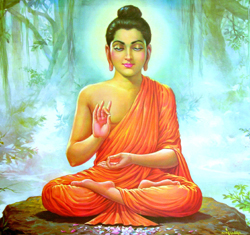
What we are today comes from our thoughts of yesterday, and our present thoughts build our life of tomorrow: Our life is the creation of our mind.
– Buddha
Those of us who grew up in the 1980s were, quite unknowingly, absorbing a healthy dose of Eastern mysticism when we watched the wonderful Japanese television series “Monkey” every weekday evening at 6.30pm. For all of the colour and movement and occasionally risqué language that appealed to my childish mind, I was also, perhaps, taking to heart the wonderful précis of Buddhist philosophy that made up the introduction to each episode: “With our thoughts, we make the world.”
This is a quote from “The Dhammapada,” that exquisitely brief text that provides the reader with all of the main ideas to be found across all of the schools of Buddhism. In fact, it is the very first verse of that most fundamental book. It is the construct that informs the Buddhist world-view – all of this, that we so keenly call “reality,” is a product of thought, and so it can be influenced by the shape of our thoughts, and we can begin to craft a new reality through disciplining our process of thought and directing it towards wiser outcomes.
Volition and free-will were the points of divergence between Buddhism and the other religious systems of the ancient world, which tended to favour notions of fate and pre-destination. The Buddha taught that karma provided us with conditions only. In every single moment we are free to choose a wise thought and do a wise action. Buddhism is brutal in its advocacy of personal responsibility. Such a point of view seems strikingly modern and rational, though perhaps slightly politically incorrect in this more feeling age.
It is the rigorous control of thought, its careful disciplining, that grew to become the central practice of Buddhist practitioners. Samantabhadra, the Universal Worthy Bodhisattva, is the patron saint of meticulous religious training in the world of Mahayana Buddhism. He imposed upon himself the almost-impossible task of honouring the Buddha in each and every thought. If his thoughts were filled with the Buddha, so must his actions and words be inhabited by the goodness of the Awakened One. Look after the thoughts, and the actions will take care of themselves.
In the Western tradition there emerged, as well, the notion that one’s actions reflected one’s spiritual wellbeing. The way a person looked and spoke was seen by Emanuel Swedenborg as evidence of habitual reflection: either on the beauties of heaven or the torments of the natural world. Much later, the great teachers of New Thought in the twentieth century saw the spiritual importance of thought control, teaching that the thoughts were our channels to God, and so should be as perfect, loving and happy as possible.
We perhaps fool ourselves that our thoughts can be allowed to stray and our lives will not be affected. Gossip, habitual negativity, judgement and constant criticism can seem fun when we are engaged in them. We can justify them, or elevate them, priding ourselves on our cynicism and critical capacities. But the Buddha was aware that all that we thought was, in fact, the sum total of our life’s experience – we cannot know goodness and happiness if we do not allow our thoughts to cultivate those qualities. He recognised that it requires discipline and the conscious application of energy to direct our minds into positive directions. Without such care we can slide into destructive patterns. To watch over the mind, he said, is conducive to happiness.
All that we are is the result of what we have thought. If a man speaks or acts with an evil thought, pain follows him. If a man speaks or acts with a pure thought, happiness follows him, like a shadow that never leaves him. – Buddha
[alert type=”general” dismiss=”no”]This article was published in New Dawn 131.[/alert]
[alert type=”success” dismiss=”no”]If you appreciate this article, please consider a contribution to help maintain this website.[/alert]
In August 2008 Bun Rany, the wife of the Cambodian Prime Minister Hun Sen, led Buddhist monks and soldiers to the site of the historic Hindu temple Preah Vihear to call upon their ancestors to protect the temple. The site of this temple is located on disputed land, perched atop a cliff on Cambodian soil but with the most accessible entrance to the site located on the Thai side of the border.
This 11th century temple is located on the border between the two countries, but the borderline itself has never been clearly demarcated because the area is littered with landmines left over from decades of war. Ownership of the temple was originally awarded to Cambodia, but dispute between the two countries flared up when Preah Vihear was granted United Nations World Heritage status.
Desperate to resolve the issue, both sides deployed military forces – but when they were unable to reach a solution to the conflict, Cambodia and Thailand resorted to supernatural means. Fearing that the magical abilities of Cambodia‘s Buddhist monks would weaken Thailand, residents throughout the province of Si Sa Ket wore yellow to help protect Thailand from Cambodian magic.
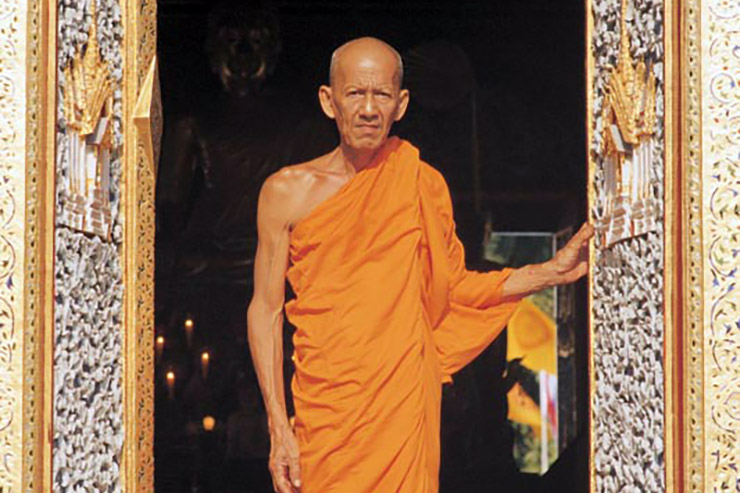
Though Buddhism is not often thought of as a religion that practices magic, in such communities as those found in Thailand and Cambodia, there can be no doubt that Buddhism shares common ground with belief systems that are primarily associated with the use of magic.
Both countries have a long history of engagement in spiritualist and animistic magical practices. When Buddhism first arrived in these areas it came into contact with pre-existent traditions that believed in spirits, both benevolent and malevolent, and a developed system of magic which was to be feared or revered, depending on whether or not it was used for good or ill.
For Buddhism to flourish under such conditions in Thailand, it was necessary to develop a complex system of interaction between Buddhism and what has been called the Spirit religions. Debate still exists as to whether or not the two systems have become completely integrated or not, although the interaction of the two systems is sometimes referred to as an example of syncretism. On the subject of interaction between Buddhism and the Spirit religions in Thailand, the academician B.J. Terwiel says the following:
When I interviewed villagers in Central Thailand on the relationship between Buddhist and non-Buddhist aspects of their religion, a variety of reactions were observed. The more sophisticated informants generally stated that the Lord Buddha had never forbidden rituals of ancient origin. Other persons hesitatingly made up their minds with regard to the orthodoxy of the ritual, but on subsequent occasions contradicted their own judgment. Many were at a loss to classify rituals or beliefs under rubrics such as ‘Buddhist’ and ‘non-Buddhist’.1
It would appear from this statement that the boundary between the use of magic by the indigenous tradition of Thailand and the practice of Buddhism is not apparent to many of the inhabitants of Thailand themselves. This is most likely due to the fact that the people of rural Thailand are raised in a society where the two systems are found closely entwined together.
The religious traditions of Thailand have always included the belief in spirits and the ability to manipulate them by means of magic. For example in Thailand preservation of the spirit of life (khwan) is considered to be of the utmost importance, as is ensuring that malevolent spirits (phii) do not enter the body. Control of these spirits is greatly emphasised in rural Thai culture, as the service of these spirits can be employed to improve the qualities of day to day existence.
Magic and the Sangha
In the lives of ordinary Thai people, more value is placed upon the improvement of their current existence than on transcending the cycle of rebirth, as is advocated by Buddhism. The relationship between the members of the Sangha (community of Buddhist monks) and the practitioners of magic in Thailand combine in a variety of ways, as one system (the Spirit religions) deals with the aspects of gain in this world (laukika), whilst the other (Buddhism) advocates the importance of salvation and ideas of transcendence (lokottara).
This relationship is complicated even further by the fact that in Thailand almost every adult male will become a member of the Sangha at some stage in his life, for in rural areas the taking of vows is considered to be an essential element in preparation for adult life. Given the wide range of magic and animistic beliefs which operate within rural Thailand, these men will carry a variety of beliefs and practices with them into the Sangha, not all compatible with the ethics of Buddhism.
In accordance with this, religious opinions are not questioned during ordination. As a direct result, villagers can be found entering the Sangha for a variety of reasons, as is reflected in the following Thai rhyme:
Ordination to fulfil a promise to the Gods,
Ordination to escape poverty,
Ordination to flee from a wife,
Ordination to save money,
Ordination to eat better food than at home,
Ordination to join one’s friends in the monastery.2
Thai belief does not only consist of beneficial Gods and spirits. It also abounds with belief in ferocious spirits of pure malevolence, from who the villagers seek magical protection. Amongst these classes of malevolent spirits are such beings as the preed (a giant, looming shape with a small head that emits a sharp, piercing sound, as a reflection of its past sins), the phii krasy (a type of parasite which inhabits human bodies, feeds on excrement, and is shaped like a human head with entrails protruding from beneath), and the phii baan (the ghosts of ancestors that hover around their previous home and watch their descendants with malignant jealousy).
Whilst it is possible for these spirits to be exorcised, Buddhism chooses to deal with their interfering presence in another way; the correct approach for a Buddhist to cause these spirits to cease meddling in the affairs of their human victims is to preach to them, thus converting the spirits involved to a more benign nature. There are certain canonical texts which serve this purpose of protection, which can also be recited at specific times in order to avert misfortune. These texts are known as the phraa parit. The source of the magical power of these texts has not yet been clearly identified, but Y. Ishii, author of Sangha, State & Society: Thai Buddhism in History, claims that whilst some possessed a magical content from the beginning, as modifications of Hindu rites, others such as the Mangalasutta originally had no magical connotations.3
Indeed, for most people, including some who chant them, the parit are incomprehensible, being in Pāli. Rather, I believe, the magic of the parit stems from three factors: the social recognition that parit should be chanted for certain purposes (e.g. blessing); the existence of an established formula for their chanting; and the sanctity attributed to the chanter.4
The use of parit is a means by which to ensure protection; it provides good luck and disperses misfortune whether caused by the presence of spirits or not. As is seen in the above passage the presence of magic being used by the Sangha is not overtly explicit in the parit texts, rather it is interpreted to be so by the lay audience. They do not understand the words the monks recite, but because of the respected state of the Sangha in Thailand, the lay community assumes that it must be not only beneficial, but also powerful.
Amulets
Another type of magic practiced by the Thai Sangha is the manufacture of amulets. These amulets are employed for a variety of reasons, including protection from diseases, black magic and accidents. Of these amulets the ones portraying the Buddha are the most popular, although some also are made in the likeness of famous monks and King Chulalongkorn (also known as Rama V, one of Thailand‘s most revered kings).
The sanctity of the subjects portrayed upon the amulets is a reflection of the beneficial powers they are thought to contain. The Buddha images vary in size, from anywhere between two and eight centimetres, and can be manufactured from wood, metal, ivory or resin, although frequently they are made from a selected combination of these elements, pressed into a mould and baked.5 To create a pressed or printed image (phraaphim), a monk needs not only a mould, recipe and the proper ingredients; he also requires an advanced knowledge of spells and sacred script.6
The inherent sanctity of the amulet is not always thought to be sufficient; hence its power needs to be enhanced by means of the correct recitation of spells and sacred scripts. The most simple of these sacralisation rites is known as plugseeg.7At the culmination of plugseeg the monk will either blow upon the Buddha image or draw over the amulet with the index finger of his right hand.8
During the manufacture of amulets the Sangha is also invited to perform a consecration rite known as phutthaphisek.9The use of magic within the phuttaphisek is illustrated by the fact that it is desirable for at least one of the monks participating in the phutthaphiseek to be either advanced in meditative technique or in the Brahmanic rites known as saiyasat.10
These rites are intimately entwined with another type of Thai ritual, namely the ceremony held to consecrate Buddha images which infuse the representation with the auspicious wisdom and power associated with Prince Siddhārtha’s victory over the demon Māra and the obtainment of enlightenment by Siddhārtha. During this ritual monks chant in Pāli or preach in Northern Thai several texts including the Buddha Abhiseka (Consecrating the Buddha [Image]).11 This text focuses on the powers of the mind attained by the Buddha that are associated with his enlightenment. Both the consecration of images and amulets draws their impetus from this core idea.
One specific example of a text dealing with the extraordinary supernatural powers of the Buddha that occupies a position of prominence in Thailand is Bimbās Lament. (Bimbā is the Buddha’s wife, who he left to pursue the life of an ascetic.)
By his magical power he created a crystal path in the sky from the eastern boundary of the city of Kapilavastu to its western perimeter. Then, ascending into the air, the Tathāgata, surrounded by many previous Buddha’s, walked on the sky-bridge he had miraculously created… he also preformed other miracles, such as appearing to walk above the heads of the Śākyans.12
Tattooing is another magical practice that is widespread throughout Thailand. At some stage in their adult life many Thai males will receive a tattoo of some description or another. This is of significance because in the culture of rural Thailand tattoos are representative of magical power. The magical power of these tattoos stems in part from the tattooist, for whilst both layman and monk may be a tattooist, there is vast difference in the scope of their work and the designs used.
The types which may be employed by the monk are restricted. As a monk, he is limited to tattooing the upper parts of the body, for not only would it be seen as sexual misconduct on the part of the monk to tattoo the lower areas, the upper parts of the body represent the higher, more spiritual aspects of humanity, whereas the lower regions represent mankind’s more base, animalistic attributes. The tattoos done by the monk are also limited in application. The monk may bestow tattoos that are of a beneficial or protective nature. Other tattoos, such as those which bestow things such as sexual virility, can only be performed by members of the lay community.
Another Thai rite involving magical skills of the members of the Sangha is the Wong Dai Sai (Encircling with Holy Thread).13 This is a type of consecration rite designed to protect a place from evil. It is believed that the consecrated place will be protected by the power of the Three Gems and the phraa parit.14 During this rite cotton is affixed to an image of the Buddha, stretched clockwise (as is the way of beneficial magic; anticlockwise is considered to be used for evil purposes) around the place to be consecrated, and finally wound back to its point of origin, at the Buddha image.15 If the thread should snap at any stage, it is considered to be an ill omen.
The main doctrinal link between Buddhism and the Spirit religions is found in the incidences where magic is employed by the Sangha as a transfer of merit. The theory of the transference of merit is based upon the concept that when a member of the lay community performs a virtuous deed, such as making a donation or feeding a monk, the Gods witness the act and empathise with the process. The Sangha themselves are referred to as being a ‘field for merit’ (na bun), as is found in the Sanghnussati-bhavana.
Well practiced is the Exalted One’s Order of Disciples, practiced in integrity, practiced in intellectual methods, in right lines of action – to wit the four pairs, the eight groups of persons – this is the Exalted One’s Order of Disciples, worthy of offerings, oblations, gifts, salutations, the world’s peerless field for merit.16
Monk’s Superior Magical Status
The greater the purity of the monk, the more magical power/merit he is said to generate. The sanctity of the monk himself is the source of belief in the efficacy of his magical power. The magical power that is generated by the monk is also classed as being superior to that of the layman, but by its very nature it is also more limited in its application. A monk is also deemed to be superior to a spirit, and thus a monk should never be seen to supplicate himself before a spirit. When a member of the Sangha addresses a spirit, he never raises his hands in supplication, in contrast to the layman who will raise his hands when requesting a favour from a spirit.
The superior magical status of the monk stems from his purity; the monk must not do anything to compromise his superior position. Part of the magical power which results from the monks’ purity is derived from celibacy. A monk should never touch a female (human or animal), and is forbidden to even receive an object that is directly given to him by a woman.17 In order to receive an object given by a woman, the monk must first take a piece of cloth and place it upon the floor, upon which the woman will then place the gift in whilst the monk holds the edges of the cloth.18 The cloth is used as a medium by which to transfer merit since there can be no direct contact between a monk and a woman. The merit flows from the fingers of the monk holding the cloth, to the woman who has donated the cloth. The medium of cloth must be used so as not to deprive the female donor of the merit she would otherwise not receive. One of the reasons for which a monk may not have contact with women is not only due to the temptation of sexual misconduct, but also because women are believed to be associated with a type of magical power said to be diametrically opposed to that of the monk.19 This is due to the fact that menstruation is associated with dangerous magical power, and is classed as being capable of destroying some of the beneficial power of the Sangha.20
Another aspect of magic in Thailand which needs to be considered is the import of magical systems via India. The branch of Buddhism found in Thailand is an older form known as Theravāda, and its links to Hinduism are much stronger than those of the later Buddhist schools. For example, in the book A Summary of the Seven Books of the Abhidhamma (Abhidhamma Chet Khamphi Ruam) there are elements of cosmology, cosmogony, buddhology, ethics, epistemology and language that are integrated into a yantric/mantric system.21 This system is very much similar to that found in Indian magic, and it is reasonable to assume that many of the formulas found within are directly based on the use of Hindu mantras. These are broken down into component syllables for recitation by the Buddhist practitioner. The mantra Namo Buddhāya (Homage to the Buddha), is correlated with the five vowels, symbolising the five elements (dhatū) – water, earth, fire, air and atmosphere.
Furthermore, in the following passage from the Seven Books of Abhidahamma, we also find a formula which contains correlations with the Hindu Tantric Yoga techniques, dividing the body into a solar right and lunar left, and creating what appears to be Buddhist chakra centres. This integration of the occult, Tantra and Buddhism is by no means unique for it is prolific in Tibetan Buddhist texts and practices.
One possible explanation of how this similarity between Thai Buddhist and Hindu occult techniques occurred can be found by examining the magical history of a third South East Asian country – namely Myanmar (Burma).
In the late eighteenth and early nineteenth centuries, Burmese kings imported large numbers of Sanskrit texts from India on topics such as medicine, alchemy, incantation and astrology.23 In Burma, these Buddhist wizards are practitioners of what is called the weikza-lam (path of occult knowledge). This tradition still exists today in Burma, and the largest of the groups practicing this occult path is based in the city of Pegy, and is called the Manosetopad Gaing. Like their Thai counterparts, this organisation bases an interest in the occult on the powers attained by the Buddha on the path to enlightenment. They also believe that the relics of the Buddha (Burmese dat-daw) (Pāli dhātu) are possessed of a kind of majestic power that he infused in them through the force of his samādhi.24 The similarity between this branch of Burmese magic with that of the Thai people is amply illustrated in the following extract from a magical treatise by the Manosetopad Gaing:
A person wishing to practice the path must first suffuse his mind with thoughts of the Three Jewels, and cultivate loving kindness toward the various grades of nats… the nats referred to here include powerful nature spirits dwelling in trees, the earth, and mountains, minor deities who preside over the use of magical incantations and diagrams, and medicine spirits whose domain includes the well-known herbs and minerals of alchemical lore.25
From this passage it is clear that the Manosetopad Gaing not only use Buddhist motifs, they are also drawing upon a much older tradition of Spirit religions and animistic world views. These Buddhist wizards, however, are also drawing upon Hindu texts on supernatural lore; and if such texts entered the Burmese magico-religious system then it is entirely possible that influences from India may help to explain what appears to be a yantric/mantric tradition within the Thai Seven Books of Abhidahamma.
With their magical prowess and the protection of the Sangha, why do the Thai people fear the magic of the Cambodians? Cambodia is also a country with a long history of occult practices. For instance, in the Khmer book The Tale of Ancient History there is a legend of Prince Chey Ahca who led a ghost army against the Siamese – Siam being an earlier name for Thailand. More recently, we also find record of Po Kambo, who in 1866 protested against French colonial rule and was alleged to know a magical formula that deflected bullets. Even as recently as the 1970s and 1990s, Khmer soldiers utilised magical tattoos, in a similar manner to that of their Thai enemies, and used mantras written in Pāli and Sanskrit, the holy languages of Buddhism and Hinduism, to protect them in battle.
All of the magic employed by the Sangha in Thailand is based on one important concept: the sanctity and purity of the Sangha themselves. The forms of magic the Sangha use is limited in scope by this fact, for they can use only what is generally referred to as ‘white’ magic: that which benefits another and causes no harm. Use of magic to harm another or for personal gain would result in expulsion from the Sangha. Similarly, a monk may not use magic that serves to improve the virility of a layman or create love charms, as this could severely impair the powers of the monk which stem from his sexual abstention. A monk may not request the spirit world for aid, for this would compromise the superior status of the monk who is deemed to be beyond the mundane affairs of this world.
Whilst the power of the Sangha is more limited in application than that of laymen, it is also deemed as stronger for it stems from other worldly sources, as opposed to the spirits who remain bound to this world. As such, villagers come to the monk knowing that when they treat the monk with a proper attitude of respect, the cosmic forces shall share their merit and transfer it to demonstrate approval. The transfer of merit thus benefits not only the Sangha, but the laity as well – even providing protection in times of conflict.
[alert type=”general” dismiss=”no”]This article was published in New Dawn Special Issue 7.[/alert]
[alert type=”success” dismiss=”no”]If you appreciate this article, please consider subscribing to help maintain this website.[/alert]
Footnotes:
1. B.J. Terwiel, Monks and Magic: An Analysis of Religious Ceremonies in Central Thailand (Curzon Press, 1975), 3. 2. Ibid., 20. 3. Y. Ishii, Sangha, State & Society: Thai Buddhism in History (University of Hawaii Press, 1986), 21. 4. Ibid., 21. 5. B.J. Terwiel, Monks and Magic: An Analysis of Religious Ceremonies in Central Thailand, 74. 6. Ibid., 75. 7. Ibid., 77. 8. Ibid., 78 9. Y. Ishii, Sangha, State & Society: Thai Buddhism in History, 23. 10. Ibid., 25. 11. D. K. Swearer, Consecrating the Buddha, in ed. D. S. Lopez, Jr., Buddhism in Practice (Princeton University Press, 1995), 50. 12. D. K. Swearer, Bimba’s Lament, in ed. D. S. Lopez, Jr., Buddhism in Practice (Princeton University Press, 1995), 543. 13. Y. Ishii, Sangha, State and Society: Thai Buddhism in History, 22. 14. Ibid., 22. 15. Ibid., 22. 16. Ibid., 14. 17. B.J. Terwiel, Monks and Magic: An Analysis of Religious Ceremonies in Central Thailand, 114. 18. Ibid., 114. 19. Ibid., 115. 20. Ibid., 115. 21. D. K. Swearer, A Summary of the Seven Books of Abhidamma, in ed. D. S. Lopez, Jr., Buddhism in Practice (Princeton University Press, 1995), 336-7. 22. Ibid., 340. 23. P. Pranke, On Becoming a Buddhist Wizard, in ed. D. S. Lopez, Jr., Buddhism in Practice (Princeton University Press, 1995), 343. 24. Ibid., 345. 25. Ibid., 351.
It is unfortunate that Buddhism’s most enduring (and universal) contribution to the world has been insufficiently translated as compassion. The original Sanskrit word is karuna, which holds within itself traces of the fragment ‘ru’, meaning to weep. While the Oxford dictionary describes compassion as pity bordering on the merciful, karuna is actually our ability to relate to another in so intense a measure that the plight of the other affects us as much as if it had been our own.
The term karuna is central to the entire Buddhist tradition. It is frequently described as a love for all beings, equal in intensity to a mother’s affection for her child. However, it is quite unlike conventional love (Sanskrit: priya, kama or trishna), which is rooted in dualistic thinking and is egoistic, possessive and exclusive, in contrast to the all-encompassing nature of compassion. The root meaning of karuna is said to be the anguished cry of deep sorrow and understanding that can only come from an unblemished sense of oneness with others.
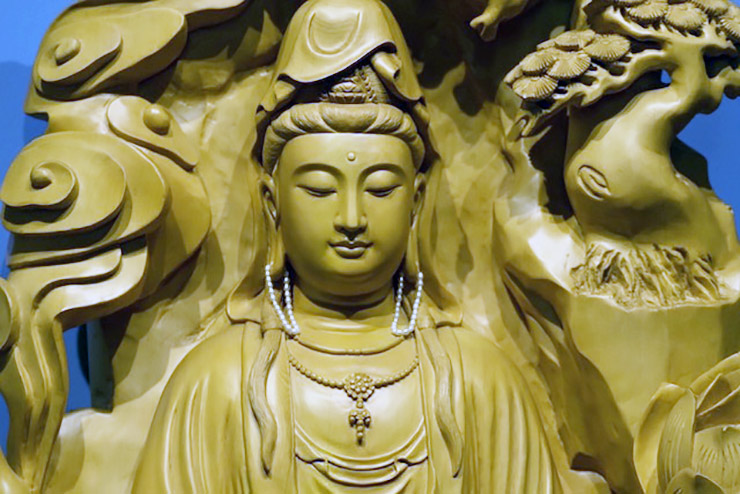
In fact, the evolution of Buddhism in Asia and its spread throughout the world is, from a spiritual point of view, none other than the unfolding of karuna in history. Nowhere is this more explicitly exemplified than in the Chinese assimilation of Buddhism. Few would deny that the defining symbol of this integration is the goddess, who with her sweet and merciful disposition, has won the hearts of not only the Chinese, but also profoundly affected even those who, belonging to a foreign tradition, have only had a fleeting interaction with her. This divine female is none other than Kuan Yin, beloved goddess of over a billion people the world over. Her name too signifies her compassionate nature, literally meaning ‘One who hears the cries of the world.’
It remains a historical fact that Kuan Yin is the Chinese version of the male god Avalokiteshvara, whom the ancient texts eulogise as the patron deity of compassion. It is fascinating, however, to observe that nowhere in India (where he originated) or Tibet (where he remains the most popular deity) is the latter ever deified as a female figure. In China too, his worship began as a male god, but over time, changed into a goddess and by the ninth century her popularity had prevailed over that of Avalokiteshvara’s.
There are many reasons why this gender transformation took place. As Avalokiteshvara evolved into the supreme personality of the Buddhist pantheon, with this heightened pedestal came the inevitable elitism. Karuna, however, cannot be and is not (as it has become today under the pseudonym of compassion), the exclusive preserve of a charmed circle, but rather a symphonic identification with the masses, sharing their suffering and pleasure alike. No wonder then that Avalokiteshvara shed streams of tears observing the plight of his people. Now, any emanation from a divine form is bound to hold a dynamic potential within itself and indeed Indian mythology is replete with examples where fluids emerging from deities have led to enormous consequences. Tears similarly are a spontaneous emotional response to external stimuli and represent the outward flow of Avalokiteshvara’s infinite karuna.
From these pearls emanated a beautiful female as attractive as she was compassionate. The goddess Tara, thus born, has continued her upward spiral of popularity and remains one of the most loved and widely recognised deities of the Buddhist pantheon today. Truly, even though Avalokiteshvara retains his foremost status in the gallery of Tibetan gods, in the popular imagination it is Tara, who with her supple charm, has come to symbolise the tenderness of karuna.
It is relevant here to observe that Kuan Yin is often depicted in art holding a leafy twig, derived from the ‘weeping willow’ tree, known so due to its trailing leafy branches that droop to the ground and along which raindrops trickle down like tears. One of its distinctive characteristics is remaining green throughout the year, pointing perhaps to the goddess’ fertility aspect, which is further echoed in images showing her with an infant.
The willow also has a deeper and direct connection with Chinese culture and it is believed that Lao Tzu, the author of Tao-te Ching, loved to meditate under its shade (6th century BCE). It was under the same tree that the younger Confucius had his famous interview with Lao Tzu, telling his disciples afterwards:
I know how birds fly, fishes swim and animals run. But there is the dragon – I cannot tell how he mounts on the winds through the clouds, and rises to heaven. Today, having seen Lao Tzu, I can only compare him to the dragon.
Over centuries, Kuan Yin’s visual depictions have highlighted her lithe, flowing form, much like the willow tree itself, which has the ability to bend during the most ferocious winds and then spring back into shape again. Indeed, who wants to stand rigid like the tall oak that cracks and collapses in a storm? Instead, one needs to be flexible like the willow, which survives the tempest.
Or perhaps, Kuan Yin merely uses the willow branch to sprinkle the divine nectar of life on her devotees, which is stored in the vase she holds in her other hand.
The Chinese (ever disposed to envisage friendly divinities in idealised human forms) seem to have been initially perplexed by Avalokiteshvara’s complex iconography. Not for them his thousand hands or even the seven eyes of Tara. Exposed for eons to the essentially humanistic philosophy of Confucianism, such images were alien and felt to be unsuitable for portraying the ‘soft’ emotion of karuna, the yearning passion a mother feels for her child.
The Tibetan mind solved the craving for a down to earth, visual embodiment of karuna by envisioning the goddess Tara; the Chinese genius did the same by enclosing this virtue in the graceful and beautiful Kuan Yin, who was eminently human in appearance and approachable by all. Indeed, she gradually became the favoured goddess of the peasants and fishermen of China, retaining her place in their hearts to the present day.
Additionally in China, not only had popular gods always been real people who had once lived in specific times and places, even mythical figures were turned into historical cultural heroes who were then venerated as the founding fathers of Chinese civilisation. Unlike Greece, where human heroes were transformed into Olympian gods, in China the reverse held true and if a god or goddess was not perhaps originally a human being, there was often an effort to turn her or him into one.
Kuan Yin thus again had to change from a goddess into a living woman, so that she could be worshipped as a Chinese goddess. Truly, the human character of Chinese deities is one of the most distinctive features of their religion, and like ordinary mortals they too have birthdays, ancestries, careers and titles. Therefore, even though Kuan Yin is not given a date of birth in any of the Buddhist sutras, her birthday is widely celebrated on the nineteenth day of the second month of the lunar calendar.
The legend describing how Kuan Yin was once a woman gives a fascinating insight into the working of the Chinese genius and the process by which she was given a distinctively local flavour and absorbed into their pantheon:
It is said that in the past, there once lived a king under whose rule the people led a peaceful existence governed by Confucian ethics. He had three daughters; the eldest two having already married the grooms of their father’s choice. The youngest offspring however, was unlike any other normal child. Firstly, when she was born, her body glowed with an almost unearthly light so much so that the palace seemed on fire. She was thus befittingly named Miao Shan (Wonderful Goodness).
Secondly, as she grew up, she wore only dirty clothes and never did display any urge to adorn herself. Further, she would subsist on only a single meal every day. In her conversations she would talk about the impermanence of material things and how human beings suffer because of their attachment to such objects. Naturally worried about their daughter’s detached inclinations, her parents proposed that (as per the Confucian ideals of filial piety) she too marry a husband of their choice. To this she replied:
“I would never, for the sake of one lifetime of enjoyment, plunge into aeons of misery. I have pondered on this matter and deeply detest this earthly union (marriage).” Nevertheless, when her parents insisted, she agreed to comply with their wishes if only her future mate would save her from the following three misfortunes:
1) When people are young, their face is as fair as the jade-like moon, but when they grow old, the hair turns white and faces become wrinkled; whether walking, resting, sitting, or lying down, they are in every way worse off than when they were young.
2) Similarly, when our limbs are strong and vigorous one may walk as if flying through air, but when we suddenly becomes sick, we are confined to the bed.
3) A person may have a large group of relatives and be surrounded by his flesh and blood, but when death comes, even such close kin as father and son cannot take the person’s place.
Finally she concluded: “If indeed my future husband can ensure my deliverance against these misfortunes, I will gladly marry him. Otherwise, I vow to remain a spinster all my life. People all over the world are mired in these kinds of suffering. If one desires to be free of them, the only option is to leave the secular world and enter the gate of Buddhism.”
This narrative of course, is parallel to one of the most significant episodes from the life of the Buddha when he encountered the three maladies of physical existence: sickness, old age and death.
Exasperated to no end, the king summoned an old and experienced nun of his kingdom. He asked her to take the princess under tutelage and expose her to as much hardship as possible in the nunnery, so that she realise the futility of her desired path. The instruction was tinged with a threat of annihilation if after seven days Miao Shan was not ‘reformed’.
Needless to say, all the travails she had to undergo at the monastery, including hard manual labor, were insufficient to deter her from the path of Dharma. However, Miao Shan did realise that she was being thus subjected because the inhabitants of the nunnery were under the threat of death. She addressed them, saying:
“Don’t you know the stories about the ancient prince Mahasattva, who plunged off the cliff in order to feed the hungry lions, or King Sivi’s cutting off his flesh to save a dove? Since you have already left the life of a householder, you should regard this material body as illusory and impermanent. Why do you fear death and love life? Don’t you know that attachment to this dirty and smelly leather bag (body) is an obstacle?”
At the end of the stipulated period, the monarch, in a mad and frenzied reaction, ordered that Miao Shan be beheaded. As her executioners approached the monastery gates, Miao Shan rushed out of the building, eager to embrace her impending death. No sooner had she kneeled at the stake and the deadly sword been raised, than a blinding thunder rose. Before the assailants could regain their composure, a tiger darted out of the darkness and carried away the swooning girl into the nearby hills. The king, now beyond the bounds of reason, ordered the hermitage to be burnt down with all its inhabitants.
It was not long before his karma caught up with him and he fell sick with kaamla (jaundice). He was restless for days on end, finding no rest even in sleep. The disease spread all over his body and the best doctors throughout the land were unable to cure him. One day, a holy mendicant came to his door and predicted: “If some person would willingly consent to give his or her arms or eyes without the slightest anger or resentment, the elixir made of these potent ingredients will surely relieve you from your suffering.”
“Where alas will I find such a compassionate being?” lamented the king. “In this very land,” said the monk. “Go southwest in your dominion, on top of the mountain there is a hermit who possesses all the characteristics which are necessary for your healing.”
No sooner had he heard this than the king ordered his envoys to hurry to the abode of the recluse. On being informed of his plight and its prescribed remedy, the hermit readily agreed to undergo the supreme sacrifice, requesting them to ask the suffering king to direct his mind to the three treasures of Buddhism and then very calmly proceeded to gauge out both the eyes and asked one of the men to sever the two arms. The three worlds shook under the impact of this terrible sacrifice.
When he had fully recovered, the king made haste with his wife to pay homage to the one who had so miraculously saved his life. After bowing low before the mutilated form, as soon as they raised their heads they let out a shriek of astonished horror; the hermit’s true identity lay bare before them. She was none other than their youngest daughter Miao Shan. Realising what she had done for him, despite all that he had done to her, the king fell prostrate upon the floor and asked for forgiveness. Overcome with emotion, the parents embraced her and the father said: “I am so evil that I have caused my own daughter terrible suffering.”
Miao Shan replied, “Father, I have suffered no pain. Having given up these human eyes, I shall see with diamond eyes. Having yielded the mortal arms, I shall receive golden arms. If my calling is true all this will follow.”
Much sobered by this intense experience, the king returned to his palace and ordered a statue to be made of her, which, emphasising her sacrifice was to be without eyes and hands. Now, in Chinese, the sound for ‘bereft’ or ‘deficient’ are virtually identical with ‘thousand.’ At some stage in the transmission of this message, the two words were confused and the sculptor toiled away, desperately seeking some way to capture the essence of the king’s wishes. He very imaginatively (or perhaps following Indian or Tibetan models) placed one eye on each palm, making the number of eyes equal to the arms, giving rise in the process to an awesome and complex image of breathtaking splendour.
Unable to relate to the thousand-armed Avalokiteshvara, the above legend provided a rational explanation to the bewildered viewer and helped integrate the goddess into the Chinese ethos.
The story of Miao Shan represents the fusion of the Buddhist theme of the gift of the body and the Confucian concept of filial piety. In the former tradition, giving is one of the six perfections performed by a bodhisattva (would be Buddha). Amongst the different forms of gifts, that of one’s own body is the best. The only difference is that while the bodhisattvas give up their bodies in order to feed or save sentient beings regardless of any formal relationship with them, the fact that Miao Shan does so for her father is where the Confucian model comes in.
In the former context, a tale is narrated of the Buddha, who in one of his previous births was a pigeon. He saw a man lose his way during a snowstorm, driven to the point of starvation. The pigeon gathered twigs and leaves, made a fire and threw himself wholeheartedly into it, to become food for the distressed soul. It is this lofty ideal that Kuan Yin was following, a self-sacrifice par excellence, motivated by pure (selfless) and indiscriminate compassion (karuna).
On the other hand, Kuan Yin as Miao Shan gives a bold and provocative message, challenging Confucian value systems as delineated in the ‘Classic of Filial Piety’ (published by the emperor Xuan in CE 722). Her life glorifies austerity, celibacy and renunciation, which, as per Buddhism, are highly valued (against the householder, who is necessary in Confucianism for creating offspring to perpetuate the lineage). In times of the Ming for example, one could achieve religious sanctification by performing one’s domestic obligations to the fullest degree. Eventually, Chinese of all social strata and both sexes came to know Kuan Yin as the strong-willed yet filial girl, who refused to get married and rebelled against stifling authority.
The goddess Kuan Yin is a symbol, not only of the Chinese assimilation of Buddhism, but also of the many hued flavour of karuna, expressed through the softer wisdom of a woman. She is a pointer to the re-emergence of the goddess and the gender transformation of Avalokiteshvara in China represents perhaps a universal imperative, which is similarly reflected in the emanation of the goddess Tara from the compassionate tears of the same bodhisattva. Though often images are encountered which show her sporting a moustache, emphasising masculinity, this is negated by the softness of her demeanour.
Can anything be more subtly female than her graceful poise – modest and inward looking, yet potent enough to generate and compassionately nourish the whole outside world? In the words of Martin Palmer: “The divine feminine cannot be suppressed for long. In China, it emerged by the transformation of the male into the female,” only god (or the goddess) knows how it will transpire in other cultures.
[alert type=”general” dismiss=”no”]This article was published in New Dawn 99.[/alert]
[alert type=”success” dismiss=”no”]If you appreciate this article, please consider subscribing to help maintain this website.[/alert]
References and Further Reading
Blofeld, John, Bodhisattva of Compassion The Mystical Tradition of Kuan Yin, 1988.
Boucher, Sandy, Discovering Kwan Yin, Buddhist Goddess of Compassion, 1999.
Cabezon, Jose Ignacio, Buddhism, Sexuality, and Gender, 1992.
Colin, Didier, Dictionary of Symbols, Myths and Legends, 2000.
Farrer-Halls, Gill, The Feminine Face of Buddhism, 2002.
Jones, Lindsay (ed), Encyclopedia of Religion (Previously Edited by Mircea Eliade) 15 volumes, 2005.
Keown, Damien, Oxford Dictionary of Buddhism, 2003.
Kinsley, David, The Goddesses’ Mirror Visions of the Divine from East and West, 1995.
Palmer, Martin and Jay Ramsay, with Man-Ho Kwok, Kuan Yin Myths and Prophecies of the Chinese Goddess of Compassion, 1995.
Phillips, Kathy J. (Photography by Joseph Singer), This Isn’t a Picture I’m Holding: Kuan Yin, 2004.
Watson, Burton (translator), The Lotus Sutra, 1999.
Wright, Arthur F, Buddhism in Chinese History, 1959.
Yu, Chun-Fang, Kuan Yin The Chinese Transformation of Avalokiteshvara, 2001.
Beneath the broad tide of human history there flow the stealthy undercurrents of the secret societies, which frequently determine in the depths the changes that take place upon the surface. – A.E. Waite1
Have secret societies and occult brotherhoods been active behind the scenes of world events for thousands of years? Do these guardians of secret wisdom shape the growth of human consciousness and influence the destiny of nations? Are hidden masters of occult knowledge empowering and infiltrating certain political, cultural, spiritual and economic movements, in fulfilment of an ancient plan? Could it be that man’s great upheavals, wars, and revolutions, as well as his pioneering discoveries in science, literature, philosophy and the arts, are the result of a ‘hidden hand’? Can we decode history and find the mysterious interface between politics and occultism, thereby uncovering the real movers and shakers in our modern world?
The German philosopher Oswald Spengler warned of a “mighty contest” between groups of men of “immense intellect” who the “simple citizen neither observes nor comprehends.” Back in 1930 Ralph Shirley, the editor of the London Occult Review, Britain’s leading journal of esoteric sciences, endorsed “the suspicion that the ranks of occultism are secretly working for disintegration and revolution. Positive proof in the shape of a group of occultists working with this objective in view recently came under the notice of the present writer.”
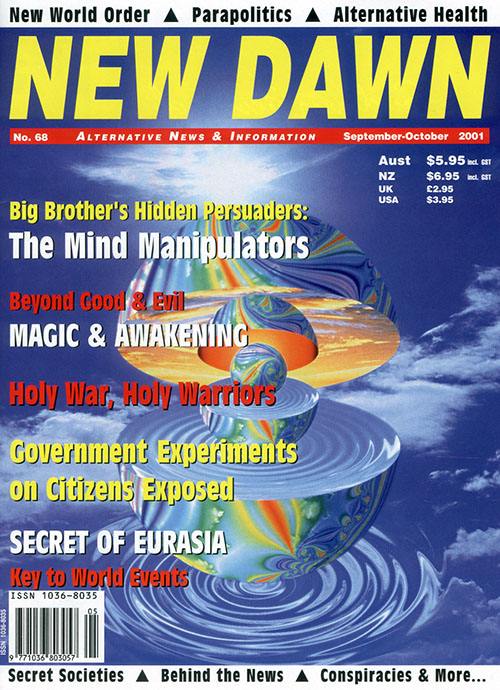
This article appeared in New Dawn 68 which significantly was released over the period Sept-Oct 2001.
Major-General Fuller, a former disciple of Aleister Crowley, who had links to British military intelligence, wrote about an insidious force using “Magic and Gold” striving “to gain world domination under an avenging Messiah as foretold by Talmud and Qabalah.” Fuller’s former chief Crowley worked as a secret agent for both Britain and Germany, although his British handlers noted his ‘unreliability’ warning he should only be used in espionage operations with the utmost care. During the First World War the German Foreign Office secretly requested the occultist Gustav Meyrink to write a novel blaming the Freemasons of France and Italy for the outbreak of war.
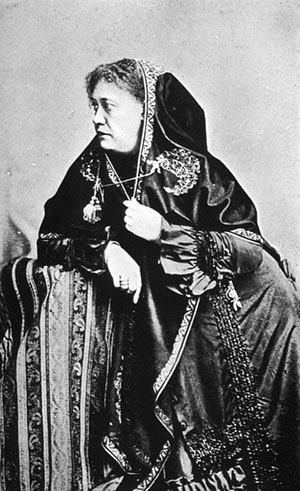
Madame Blavatsky believed the Catholic society of Jesuits had transferred their headquarters from the continent to England where they plotted to plunge man into passive ignorance and institute “Universal Despotism”. The founder of the Theosophical Society, a woman of immense intellect and first hand experience of secret societies, warned:
Students of Occultism should know that while the Jesuits have by their devices contrived to make the world in general, and Englishmen in particular think there is no such thing as Magic and laugh at Black Magic, these astute and wily schemers themselves hold magnetic circles and form magnetic chains by the concentration of theircollective WILL, and when they have any special object to effect or any particular and important person to influence.2
The French Revolution, one of Europe’s most important political upheavals, was largely the work of Masonic lodges dedicated to the overturning of the monarchy and an end of the established Catholic religion. In Proofs of a Conspiracy (1798), John Robison showed that the political clubs and correspondence committees during the revolution, including the famous Jacobin Club, sprang from these Masonic lodges.
The influence on history of mysticism, the occult and secret societies is generally dismissed by Western academics. Mainstream historians choose to ignore this aspect because they believe it has no real significance to world politics. In fact it is only through acknowledging the role and influence of the ‘occult underground’ that important world events can be fully understood and placed in their real historical perspective.
Atlantism Verses Eurasianism
Secret societies and the teachers of occult wisdom consistently trace their origins back to the very dawn of civilisation. Within Judeo-Christian culture, the secret schools speak of Adam, Seth, Moses and the Patriarchs as initiates of a divine wisdom carefully passed from one generation to the next. Other occult groups look back beyond ancient Egypt and the Mystery schools of Greece, to the lost continent of Atlantis. Still others trace their lineage to Sumeria or Babylon and the mysterious plains of Tartary.
Examining mankind’s myths, legends and arcane stories we encounter countless references to a vanished primordial civilisation. The brilliant French metaphysician Rene Guenon wrote of a great Hyperborean culture that flourished around the Arctic Circle and of its outposts Shambhala in the East and Atlantis in the West. Plato wrote of Atlantis, describing it as the heart of a great and powerful empire which, due to the indiscriminate mixing of “the sons of God” with “the children of men,” suffered “violent earthquakes and floods” and “disappeared beneath the sea”. According to occult tradition, Atlantis came to an end after a lengthy period of chaos and disaster brought about, in the words of Madame Blavatsky, because the “Atlantis-race became a nation of wicked magicians.” Atlantis was destroyed by a conspiracy of evil magicians who had seized control of the mighty continent.
Long before the final end of Atlantis, great migrations took place to different centres of the earth. In one legend we are told of a righteous remnant journeying from the Arctic Circle to Shambhala, in the remote fastness of Central Asia. Other legends suggest Atlantean survivors established the ancient Egyptian civilisation.
Victoria LePage, the author of one of the most comprehensive studies of Shambhala explains how Atlantis and Shambhala are more than mere geographic locations:
In folklore Atlantis and Shambhala are implicitly linked together as charismatic images of heart’s desire, two shining mirages that lie on the farthest horizon of human longing, unattainable, always receding as we reach for them; at best no more than ideal states of consciousness never realized. But their association seems to have a far more real and historically concrete basis than that. Initiatic tradition affirms they have both genuinely existed, one in the western sea, the other in the eastern mountains, as lynchpins of what was once a network of Wisdom centers located on a great power-grid extending around the globe. Further, Shambhala still exists within a framework that awaits reactivation.3
In order to identify the historical activities of secret societies we need to appreciate the origin of a most powerful idea. Occult lore speaks of Shambhala as the positive centre of the Brotherhood of Light, and Atlantis the negative centre of the evil magicians, the Brothers of the Shadow. Wherever we look we see the division of secret societies and occult endeavours into these two opposing ‘Orders’. All occult movements and teachings inevitably serve either the “Order of Eurasia” or the “Order of Atlantism”, with their respective symbolic centres of Shambhala and Atlantis. Concealed behind a multitude of different forms and represented by an array of unsuspecting agents of influence, these two centres – Shambhala and Atlantis – represent two different impulses in human evolution.
Viewed from the perspective of sacred geography, in our present historical cycle, Atlantism is the triumph of the most destructive and diabolical elements in the civilisation of the West. One modern authority on sacred geography and geopolitics observes:
Sacred geography on the basis of “space symbolism” traditionally considers the East as “the land of Spirit”, the paradise land, the land of a completeness, abundance, the Sacred “native land” in its fullest and most perfect kind. In particular, this idea is mirrored in the Bible text, where the eastern disposition of “Eden” is treated.
Precisely such understanding is peculiar also to other Abrahamic traditions (Islam and Judaism), and also to many non-Abrahamic traditions – Chinese, Hindu and Iranian. “East is the mansion of the gods”, states the sacred formula of the ancient Egyptians, and the same word “east” (“neter” in Egyptian) meant at the same time “god”. From the point of view of natural symbolism, East is the place where the sun rises, Light of the World, material symbol of Divinity and Spirit.
The West has the opposite symbolical meaning. It is the “country of death”, the “lifeless world”, the “green country” (as the ancient Egyptians called it). West is “the empire of exile”, “the pit of the rejected”, according to the expression of Islamic mystics. West is “anti-East”, the country of decay, degradation transition from the manifest to the non-manifest, from life to death, from completeness to need, etc. West is the place where the sun goes, where it “sinks down”.4
Russia & the Magical Universe
Russia, geographically the largest country on earth, occupies a unique position in the study of human history furnishing us with a window into the world of secret societies, occult teachers, and subterranean political currents.
Ideas and practices drawn from magic and the occult have always been a part of Russian life. In the sixteenth century Tsar Ivan IV consulted magicians and was aware of the occult significance of the precious stones set in his staff. His reign was the culmination of the dream of building a prophetic, religious civilisation in the Eastern Christian tradition of Byzantium. Surrounded by secret orders of apocalyptical monks, Ivan saw himself as heir to the Israelite kings and attempted to transform Russian life in accord with his magical view of reality. Ivan was convinced the Russian nation had a special mission to accomplish, nothing short of the redemption of the world.
In 1586, Tsar Boris Godunov offered the huge salary of 2000 English pounds a year, with a house and all provisions free, to John Dee, the English magus and spy master, to enter his service. Dee’s son Dr. Arthur Dee, who like his father was an alchemist and Rosicrucian, went to Moscow to work as a physician. Mikhail Romanov, the first Tsar of the Romanov dynasty, allegedly ascended the throne with the help of Dr. Arthur Dee and British agents. Before their rise to power the Romanovs were accused by their enemies of practising magic and possessing occult powers.
Saint Germain
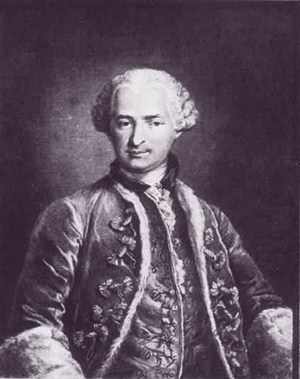
The legendary Count of Saint Germain, described as an alchemist, spy, industrialist, diplomat and Rosicrucian, became involved in several political intrigues in Russia and was, according Nicholas Roerich, “a member of the Himalayan brotherhood.” In 1755 he traveled throughout Eurasia to study occult teachings, and may even have visited Tibet. It is said that while studying occultism in Central Asia the Count was introduced to the secret rites of Tantric sex magic which provided him with a technique to prolong his youth. He also engaged in spying operations against the notorious British India Company. Saint Germain founded two secret societies called the Asiatic Brethren and the Knights of Light. As early as 1780 he warned Marie Antoinette that the French throne was in danger from an international conspiracy of ‘Brothers of the Shadow’. Rumours continued to circulate for many years after his alleged death that Saint Germain was still alive working behind the scenes in European politics or studying occult doctrines in Central Asia.
West Meets East
Occult powers seem to be a matter of national temperament… Russia tends to produce mages – men or women who impress by their spiritual authority; no other nation has a spiritual equivalent of Tolstoy and Dostoevsky, or even of Rozanov, Merezhkovsky, Soloviev, Fedorov, Berdaev, Shestov. Certainly no other nation has come near to producing anyone like Madame Blavatsky, Gregory Rasputin or George Gurdjieff. Each is completely unique. – Colin Wilson, The Occult
The process of synthesis of the occult traditions of East and West is seen in the work of Helena Petrovna Blavatsky, founder of the Theosophical Society and the author of the magnus opus The Secret Doctrine. Born Helena von Hahn, the daughter of a Russian military family and cousin to the future Russian Prime Minister Count Witte, she is a true emissary of the Eurasian Order. Nevill Drury says of the Russian occultist:
Her main contribution to mystical thought was the manner in which she sought to synthesise Eastern and Western philosophy and religion, thereby providing a framework for understanding universal occult teaching.5
Helena Petrovna Blavatsky
Madame Blavatsky traveled throughout Asia and Europe, joined Garibaldi’s national revolutionary militia, fighting in the battle of Mentana, in which she was severely wounded. In the late 1870s, shortly after the publication of her first book Isis Unveiled, a compelling indictment of contemporary Western religion as spiritually bankrupt, she moved from the United States to India where the headquarters of the Theosophical Society remains until this day.
In 1891 the future Tsar Nicholas II, in the company of the mystic Eurasian scholar Prince Ukhtomsky, visited the headquarters of the Theosophical headquarters at Adyar. Prince Ukhtomsky’s description of the society is revealing:
At the insistence of H.P. Blavatsky, a Russian lady who knew and had seen much, the idea sprang up of the possibility, and even the necessity, of founding a society of theosophists, of searchers for the truth in the broadest sense of the word, for the purpose of enlisting adepts of all creeds and races, of penetrating deeper into the most secret doctrines of oriental religions, of drawing Asiatics into true spiritual communion with educated foreigners in the West, of keeping up secret relations with different high priests, ascetics, magicians, and so on.6
Madame Blavatsky wanted to unite Central Asia, India, Mongolia, Tibet and China, in order – with the involvement of Russia – to create a grand Eurasian power able to oppose British ambitions. Traveling across India Blavatsky agitated against British rule and found herself accused by the colonial authorities of being a Russian spy. Prince Ukhtomsky saw support for Eurasia in the “readiness of the Indians to group themselves under the banner of the strange northern woman.” He believed Madame Blavatsky had been forced to leave India by “the suspiciousness of the English.”
As early as 1887 H.P. Blavatsky had become a topic of debate in “mystic Petersburg” and received the prestigious support of Ukhtomsky’s friend the mysterious Tibetan Dr. Badmaev, soon to become notorious for the favour he received at the Russian imperial court and his relationship with Rasputin. Madame Blavatsky’s sister insisted that the Russian Orthodox Metropolitan of Kiev had recognised the young Helena’s psychic gift, and admonished her to use her powers with discretion, as he felt sure they were given her for some higher purpose.
Dr. Stephan A. Hoeller, a scholar of comparative religion and a Gnostic Bishop, reminds us that Blavatsky,
was a true daughter of Mother Russia. Some feel that her life and character correspond strongly to the archetype of the traditional Russian wandering holy person, known as the staretz (literally ‘old one’), denoting a wandering, non-clerical ascetic, or pilgrim, who travels about the countryside, exhorting people concerning spiritual matters, sometimes in a decidedly unorthodox manner.7
After H.P. Blavatsky’s death in London in 1891, the Theosophical Society came under the firm control of the English occultists Annie Besant and C.W. Leadbeater, a confirmed British imperialist. The Eurasian orientation given to early Theosophy by H.P. Blavatsky was compromised by the influence of British Masonry and Leadbeater’s esoteric High Anglicanism. In the great struggle of the magicians the Eurasian impulse found new historical agents in the West, among them the celebrated French magus Papus.
Grand Battle of the Magicians
When the 19th century will have come to an end, one of the Brothers of Hermes will come from Asia to unite humanity again. – Nostradamus
Papus
Papus, together with Oswald Wirth and De Guaita, dreamed of uniting occultists everywhere into a revived Rosicrucian brotherhood, an international occult order in which they hoped the Russian Empire would play a leading role as the bridge between East and West.
Papus was the pseudonym of Dr. Gerard Encausse (1865-1916), a disciple of Joseph Saint-Yves d’Alveydre (1842-1910), an initiate of the French Gnostic Church and often the instigator of many of the occult groups of his time. One of the most famous turn-of-the century occultists, he was the founder of the Hermetic School in Paris, which attracted many Russian students, and directed the leading French occult review, L’Initiation. Papus was also the head of two secret societies, the L’Ordre du Martinisme and the L’Ordre Kabbalistique de la Rose-Croix.
When the Russian Tsar and Tsarina visited France in 1896, it was Papus who sent them a greeting on behalf of “the French Spiritualists,” hoping that the Tsar would “immortalise his Empire by its total union with Divine Providence.” This greeting was reminiscent of the hopes of mystics at the time of Tsar Alexander I’s Holy Alliance.
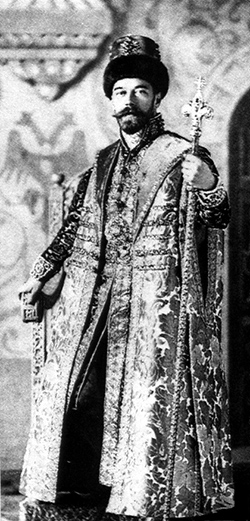
Tsar Nicholas II
Papus made his first visit to Russia in 1901 and was introduced to the Tsar. He quickly set up a lodge of his Martinist Order in St. Petersburg with the Tsar as the president of the “Unknown Superiors” who controlled it. The historian James Webb says Papus “was merely reviving a devotion to a philosophy that had flourished in Russia at the turn of the 18th and 19th centuries before being suppressed.”
As the foremost student of Saint-Yves d’Alveydre, Papus knew of the key role to be played by Russia in unifying Eurasia and her occult destiny as the Empire of the End, the outward manifestation of the enigmatic power of ‘Northern Shambhala’.
Through Papus the Imperial family became acquainted with his friend and spiritual mentor Master Philippe (Nizier Anthelme Philippe). A sincere Christian mystic, he was given rank and honours by the Russian Tsar, and maintained contact with the imperial court until his death in 1905.
Papus returned to St. Petersburg in 1905 where it was rumoured he, in the presence of the Imperial couple, evoked the spirit of the Tsar’s father, Alexander III, who offered practical advise on handling a political crisis.
Both Master Philippe and Papus played an important political role at the Russian court. They not only advised the Tsar on affairs of state but maintained contact with influential Russian initiates of the Martinist Order, among them two of the Tsar’s uncles and numerous relatives. The German occultist Rudolf Steiner, who had his own disciples among the German General Staff, followed the mission of the two Frenchmen, disturbed by Papus’ “extensive influence in Russia”. A strong advocate of the alliance between France and Russia, Papus warned the Tsar of an international conspiracy aimed at world domination.
He believed that the vast Russian Empire was the only power capable of thwarting the conspiracy of the ‘Shadow Brothers’. He also urged the Tsar to prepare for the coming war with Germany, then being engineered by sinister forces in Berlin. According to one account, he promised the imperial family that, the Romanov monarchy would be protected as long as he, Papus, was alive. When the news of his death reached Alexandra in 1916, she sent a note to her husband (at the time commanding the Russian armies at the front in World War I) containing the words ‘Papus is dead, we are doomed!’8
Papus promoted his Martinist Order as a counter to the Masonic lodges which, he believed, were in the service of British imperialism and the international financial syndicates. From his papers it is known that he furnished documentation to the Russian authorities about Masonic activities in Russia and Europe. Papus condemned Freemasonry as atheistic in contrast to the esoteric Christianity of the Martinist Order. He castigated “our epoch of scepticism, adoration of material forms, so vitally in need of a frankly Christian reaction, independent of all priesthoods.” Shortly after returning from his first visit to Russia in 1901, a series of articles appeared in the French press for which Papus was largely responsible. They warned of a “hidden conspiracy” the existence of which the public was totally unaware and of the machinations of a sinister financial syndicate trying to disrupt the Franco-Russian alliance. The public is blind to the real forces of history:
It does not see that in all conflicts whether arising within or between nations, there are at the side of the apparent actors hidden movers who by their self-interested calculations make these conflicts inevitable….
Everything which happens in the confused evolution of nations is thus prepared in secret with the goal of securing the supremacy of a few men; and it is these few men, sometimes famous, sometimes unknown, who must be sought behind all public events.
Now, today, supremacy is ensured by the possession of gold. It is the financial syndicates who hold at this moment the secret threads of European politics…
A few years ago there was thus founded in Europe a financial syndicate, today all-powerful, whose supreme aim is to monopolise all the markets of the world, and which in order to facilitate its activities has to acquire political influence.
The Papus inspired articles in Echo de Paris revealed the role of the British Secret Service, which was exposed as being behind British Freemasonry, to isolate and weaken Russia. In France British agents concentrated on anti-Russian propaganda, while in Russia they used “financial trickery” to infiltrate all levels of society. Every effort was required “to preserve the Russian Emperor – so loyal and so generous – from the evils… [of ] the syndicate of financiers… which at present controls the destinies of Europe and the world.”
The Mysterious Tibetan
St. Petersburg… in 1905 was probably the mystical centre of the world. – Colin Wilson, The Occult
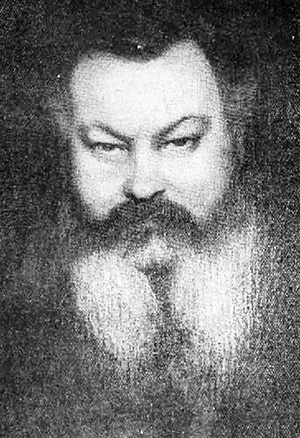
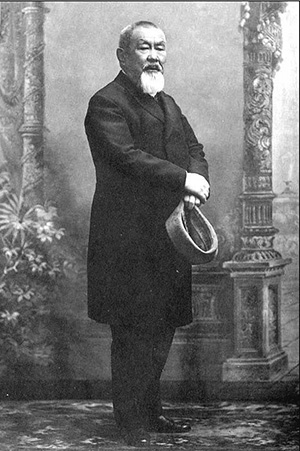
Shamzaran (Pyotr) Badmaev was a Buriat Mongol who had grown up in Siberia and converted to Russian Orthodoxy with Alexander III acting as his godfather. He gained considerable influence at the Ministry of Foreign Affairs and the Tsar granted him the title of Privy Councillor. Badmaev was renowned as a doctor of Tibetan medicine, herbalist, and healer, who treated high society patients at his fashionable ‘Oriental Medicine’ clinic in St. Petersburg. Described by a Russian historian as “one of the most mysteries personalities of the day,” and a “master of intrigue”, Badmaev enjoyed a close association with the mystic healer Rasputin.
Shamzaran (Pyotr) Badmaev
Known as ‘the Tibetan’, Badmaev dreamed of the unification of Russia with Mongolia and Tibet. He involved himself in endless projects aimed at the creation of a great Eurasian empire. Russia’s historic mission, he believed, lay in the East, where she was destined to unite the Buddhist and Muslim peoples, as a counter to Western colonialism. Badmaev outlined his vision in a 1893 report to Tsar Alexander III entitled ‘The Tasks of Russia in the Asiatic East’. His considerable political expertise secured the support of the Mongol tribes in the Russo-Japanese War.
In a letter of 19 December 1896, Badmaev wrote to Tsar Nicholas II: “…my activities have the aim that Russia should have greater influence than other powers upon the Mongolian-Tibetan-Chinese East.” Badmaev expressed particular concern over the influence of England in the East, stating in a special memorandum:
Tibet, which – as the highest plateau of Asia – rules over the Asiatic continent, must without doubt be in the hands of Russia. By commanding this point, Russia will surely be able to make England more compliant.
Badmaev knew of the legend, popular in Mongolia, China and Tibet, about the ‘White Tsar’ who would come from the North (from ‘Northern Shambhala’) and restore the now decadent traditions of true Buddhism. He reported to Tsar Nicholas II how “Buryats, Mongols and especially lamas… were always repeating that the time had come to extend the frontiers of the White Tsar in the east….”
Badmaev had a close association with a highly placed Tibetan, the lama Agvan Dordzhiyev, the tutor and confidant of the 13th Dalai Lama. Dordzhiyev equated Russia with the coming Kingdom of Shambhala anticipated in the Kalachakra texts of Tibetan Buddhism. The lama opened the first Buddhist temple in Europe, in St. Petersburg, significantly dedicated to the Kalachakrateaching. One of the Russian artists who worked on the St. Petersburg temple was Nicholas Roerich, who had been introduced to the legend of Shambhala and Eastern thought by lama Dordzhiyev. George Gurdjieff, another man of mystery who had an impact on Western mysticism, knew Prince Ukhtomsky, Badmaev, and lama Dordzhiyev. Was Gurdjieff, accused by the British of being a Russian spy in Central Asia, a pupil of the mysterious Tibetans?
“I am training young men in two capitals – Peking and Petersburg – for further activities,” Dr. Badmaev had written to Tsar Nicholas II.
Mystical Anarchism
The sway of ‘the Tibetan’ reached beyond the Imperial court into the Russian intelligentsia and further still to the subterranean world of espionage and revolutionary politics. One of the intellectual movements at the time of the 1905 political upheavals was called “Mystical Anarchism”. Two of its leading exponents were the poet and writer Viacheslav Ivanov and George Chulkov, both associates of Dr. Badmaev. Chulkov, like ‘the Tibetan’, is described as an unconscious medium transmitting mysterious forces.
A radical political doctrine aimed at reconciling individual freedom and social harmony, Mystical Anarchism drew on the ideas of Friedrick Nietzsche. This is not surprising when we consider Nietzsche’s positive view of Russia as the antithesis of the decadent West, and the German philosopher’s appreciation of Buddhism and Oriental culture.
According to the historian Bernice Glatzer Rosenthal, Mystical Anarchists, convinced “that unseen forces are guiding events here on earth, believed that political revolution reflected realignments in the cosmic sphere, and that a new world of freedom, beauty, and love was imminent.”
Advocating the abolition of all external authorities and all constraints on the individual – government, law, morality, social custom – they were indifferent to legal rights as merely “formal freedoms” and opposed constitutions and parliaments in favor of sobornost’. By sobornost’ they meant a free community united by love and faith whose members retain their individuality (as distinct from individualism, self-affirmation apart from or against the community)….
They grounded this ideal in their notion of the “mystical person,” the soul or the psyche, which seeks union with others and recognizes itself as a microcosm of the macrocosm, as distinct from the “empirical person,” the I or the ego, which asserts itself apart from or against others. Evoking and developing this “mystical person” would make feasible a “new organic society” united by invisible inner ties of love (eros, not agape), “mystical experience,” and sacrifice – the very opposite of liberal society, based on the social contract and mutual self-interest and characterized by rational discourse.9
Mystical Anarchism is a thoroughly Eurasian sociopolitical idea. Here we have a most arcane motif in a modern form: The great struggle of the empirical, plutocratic Western civilisation, against the mystical, sacrificial culture of Eurasia. In occult terms it is the conflict of the impulse of ‘Shambhala’ with the renegades of ‘Atlantean civilisation’. The Brotherhood of the Northern Light battling it out with the Brothers of the Shadow, external manifestation of the long war between the agents of Being and Non-Being.
Nicholas Berdyaev, Dmitri Merezhkovsky, Zenaida Hippius, Valerri Briusov, Mikhail Kuzmin, Alexandre Blok, Vasili Rozanov, along with a host of other Russian poets, writers and artists, transmitted different aspects of Mystical Anarchism and the Eurasian vision. When in the years before the Revolution the Sufi Master Inayat Khan visited Russia, he found much to commend in “the Eastern type of discipleship which is natural to the nation.”
Merezhkovsky saw the possibility of evolving a “new religious consciousness” from the two peculiarly Russian types represented by Tolstoy and Dostoievsky. Tolstoy stood for a pantheistic mysticism of the flesh, and Dostoievsky for the more ascetic spiritual values. “In this Russia the ‘Man-God’ shall be manifested to the Western world, and the ‘God-man’ for the first time to the Eastern, and shall be, for those whose thinking already reconciles both hemispheres the ‘One in Two.’”
After the Bolshevic Revolution, Blok contrasted the new Russia with the West. He called Russia the “Scythian,” i.e., the young, fresh nation whose destiny it was to challenge the decaying West:
We are the Scythians, we are the Asians… Centuries of your days are but an hour to us, Yet like obedient slaves, We’ve held a shield between two hostile races – Europe, and the Mongol hordes… From war and horror come to our open arms, The embrace of kin, Put the old sword away while there’s time, Hail us brothers… Ah, Old World, before you have perished, join our fraternal banquet.
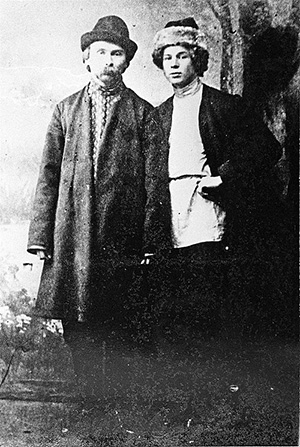
The poet Nikolai Kliuev and his young friend Sergei Esenin featured occult images and Eurasian themes in their work. At the end of 1917 Kliuev (1887-1937), a prophet and emissary of Eurasia, wrote:
We are the host of sunbearers. On the hub of the universe we will erect a hundred-story, fiery house. China and Europe, the North and the South Will come to the chamber in a round-dance of playmates to match together Abyss and Zenith. Their godfather is God Himself and their Mother is Russia.
Kliuev’s protege, Esenin (1895-1925), longed for the end of the old world and its replacement by a new one, and even proclaimed a new religious trend called “Aggelism,” with clear roots in Russian Gnosticism. He hailed both Christ and Gautama the Buddha as geniuses because they were men of “word and deed”. In a letter to a friend, Esenin wrote:
People, look at yourselves, did not Christs emerge from you, and can you not be Christs? Can I with will-power not be a Christ…? How absurd all our life is. It distorts us from the cradle, and instead of truly real people some kind of monster emerges.
Nikolai Kliuev (left) and Sergei Esenin in Petrograd. 1915
He warned the United States, to him the symbol of all non-Russian and rationalist sources, not to commit the mistake of “unbelief” and ignore the new “message” from Russia, as the way to the new life is only through Russia. A friend wrote how Esenin and his fellow ‘Scythian’ poets wanted a “deepening of the political revolution to the social” and came to regard Russian Marxism as “coarse”. Before his death Esenin became convinced ‘evil forces’ had usurped the Revolution and the Bolshevics betrayed Russia’s mission.
The famed poet Nikolai Kliuev knew both Dr. Badmaev and Grigory Rasputin, and like the latter had been initiated into a secret school of Christian sexual mysticism with similarities to Tibetan Tantra and Indian Shivaism. “They called me a Rasputin,” Kliuev wrote in a 1918 poem. Kliuev’s spirituality was deeply rooted in the tradition of the Russian religious dissidents like the Old Believers, the Khlysty and Skoptsy, who formed a veritable subterranean river among the common people. Kliuev admitted how challenged by a Khlyst elder to “become a Christ,” he was introduced to the secret community of “Dove brethren”. With the help of “various people of secret identity”, Kliuev traveled all over Russia participating in secret rituals and imbibing the occult traditions of the Russian East.
In his poems Kliuev sought to convey the mystic spirit of Eurasia. He was a prophet of Belovodia, the name given by Russian Old Believers to the awaited earthly paradise similar to Shambhala. Kliuev envisioned a radical transformation of Russia that would bring about a classless society where peasant culture would triumph over industrialism, capitalism, and the general mechanisation of life. He expressed his concern about the dangers of soulless Western civilisation in a 1914 letter to a friend:
Every day I go into the grove – and sit there by a little chapel – and the age-old pine tree, but an inch to the sky, I think about you… I kiss your eyes and your dear heart… O, mother wilderness! Paradise of the spirit… How hateful and black seems all the so-called civilised world and what I would give, what Golgotha I would bear – so that America should not encroach upon the blue-feathered dawn… upon the fairy tale hut.
Nicholas Berdyaev
The Russian philosopher Nicholas Berdyaev articulated the vision shared by pre-revolution Russian thinkers as well as the cultural elite, when he wrote of the end of Western rationalism and the birth of a new era of the spirit which would witness the struggle of Christ and Antichrist. He saw the popularity of mystical and occult doctrines as proof of the approach of this New Era, and called for a “new knighthood”. “Man is not a unit in the universe, forming part of an unrational machine, but a living member of an organic hierarchy, belonging to a real and living whole.” Berdyaev’s attacks on Western materialist values only reflected a view widely held by Russian society. Writing in exile in the early 1930s he observed:
Individualism, the ‘atomisation’ of society, the inordinate acquisitiveness of the world, indefinite over-population and the endlessness of people’s needs, the lack of faith, the weakening of the spiritual life, these and other are the causes which have contributed to build up that industrial capitalist system which has changed the face of human life and broken its rhythm with nature.
Journey to Shambhala
Nicholas Roerich was a man who brought glory to our [Russian] people; he is a representative of our civilisation and of its culture, one of its pillars. – Mikhail Gorbachev
Nikolai Roerich with a lama, 1933.
Nikolai Konstantinovitch Roerich (1874-1947) had been introduced to the idea of Shambhala while working on the construction of the first Buddhist temple ever to be built in Europe. Personally acquainted with Russia’s pre-revolution intelligentsia, Roerich became a highly respected and prolific artist. A student of Madame Blavatsky’s works, Roerich believed in the transcendent unity of religions – in the notion that one day the Buddhist, the Muslim, and the Christian would realise their separate dogmas were husks concealing the truth within. Between 1925 and 1928, Roerich undertook five remarkable expeditions through Central Asia, focusing on the mysterious region between the Urals and the Himalayas, the area regarded as the heart of Eurasia. The traditions and legends encountered by Roerich in his travels are described in the books Altai-Himalaya, Heart of Asia and Shambhala.
In the tradition of Tibetan Buddhism, Shambhala is the hidden land in which the teachings of the Kalachakra (‘Wheel of Time’) Tantric school are kept in their purest form. Roerich discovered that the Shambhala of Tibetan Buddhism is not too different from the legend of Belovodia preserved by Russian Christian mystics. An elder of the Old Believer sect confided to Roerich:
In distant lands, beyond the great lakes, beyond the highest mountains, is a sacred place where all truth flourishes. There one may find the supreme knowledge and the future salvation of mankind. And this place is called Belovodia, meaning the white waters.10
Nicholas Roerich wrote how on a visit to the Mongolian capital Ulan-Bator in the 1920s, he heard soldier-revolutionaries singing:
The war of Northern Shambhala. Let us die in this war To be reborn again As Knights of the Ruler of Shambhala.
By ‘Northern Shambhala’ is meant Russia-Eurasia. In his book Heart of Asia, Roerich defined Shambhala not so much as a coming kingdom but an event – a new epoch for humanity of which Shambhala and Belovodia are timeless symbols:
You have noted the concept of Shambhala corresponds to the aspirations of our most serious Western scientific research…. In their striving, the Eastern disciplines of Shambhala and the best minds of the West, which do not fear to look beyond the outworn methods, are uniting.
Roerich never doubted the crucial role Russia would play in bringing together the noblest wisdom of both the East and the West. In Russia a new synthesis would emerge and a new day dawn for humanity, neither exclusively Western nor wholly Eastern, but truly Eurasian. In 1940, as the world found itself plunged into war, Roerich discerned the first glimpses of a New Era and wrote:
The Russian people have piled together great stones. To the admiration of everyone they have built no tower of Babel but a Russian tower. A Kremlin of Sun-bearers with a hundred towers!… Listen – that is the future, and how radiant it is!”
A year later in 1941 he commented:
The whole world is rushing towards Armageddon. Everyone is confused. Everyone is unsure about the future. But the Russian people have found their course and with a mighty flood are streaming towards their radiant future.
‘You Must Pay Attention to Me, In Order to See Me’
Humanity’s radiant future, like Shambhala, stands at the threshold. An invisible college of men and women in every age and nation have glimpsed it and responded to the impulse. Living in the first years of a new millennium we are witnessing the unfolding of an ancient plan. Just as there is no day without night, so too there is no authentic New Era without its counterfeit. And as the darkness must give way to the new dawn, so our present Dark Era will pass away in the great light of ‘Northern Shambhala’.
Behind the tangle of present day events the ancient battle is being concluded. “In wartime,” said the emissary of Atlantism Winston Churchill, “truth is so precious that she should always be attended by a bodyguard of lies.” Empowered by the wicked Magicians of Atlantis, Western secret societies are in a state of occult warfare with the Order of Eurasia.
We await the arrival of the New Era of Shambhala, the casting out of the Brothers of the Shadow from the governmental and financial centres of the earth, and the end of the evil karma inherited from the darkness of Atlantis.
Alice Bailey, who described Shambhala as “the vital centre in the planetary consciousness” and related it to the Second Coming of the Christ, also prophesied Russia’s special role in bringing in the true New Era:
Out of Russia… will emerge that new and magical religion about which I have so often told you. It will be the product of the great and imminent Approach which will take place between Humanity and the Hierarchy. From these two centres of spiritual force, in which the light which ever shineth in and from the East will irradiate the West; the whole world will be flooded with the radiance of the Sun of Righteousness. I am not here referring, in connection with Russia, to the imposition of any political ideology, but to the appearance of a great and spiritual religion, which will justify the crucifixion of a great nation and which will demonstrate itself and be focused in a great and spiritual Light which will be held aloft by a vital Russian exponent of true religion – that man for whom many Russians have been looking, and who will be the justification of a most ancient prophecy.11
[alert type=”general” dismiss=”no”]This article was published in New Dawn 68.[/alert]
[alert type=”success” dismiss=”no”]If you appreciate this article, please consider subscribing to help maintain this website.[/alert]
Footnotes:
1. Arthur Waite, The Real History of the Rosicrucians 2. Letters of H. P. Blavatsky as quoted in The Occult Establishment by James Webb 3. Victoria Le Page, Shambhala: The Fascinating Truth Behind the Myth of Shangri-la 4. Alexander Dugin 5. Nevill Drury, Dictionary Of Mysticism And The Esoteric Traditions, 1992 6. As quoted in The Harmonious Circle by James Webb 7. Stephan A. Hoeller, “H.P. Blavatsky: Woman of Mystery and Hero of Consciousness,” The Quest, Autumn 1991 8. Stephan A. Hoeller, “Esoteric Russia”, Gnosis Magazine, No.31, Spring 1994 9. The Occult in Russian And Soviet Culture, edited by Bernice Glatzer Rosenthal 10. Nicholas Roerich, Heart of Asia 11. Alice Bailey, Prophecies by D.K.