New Dawn – World's Most Unusual Magazine

Tag: Cathars

  • The Bogomils: Europe’s Forgotten Gnostics

    The Bogomils: Europe’s Forgotten Gnostics

    From New Dawn 106 (Jan-Feb 2008)

    Few people in the modern world have heard of the Bogomils, who existed during a seven-century time span in and around Bulgaria. Although almost forgotten, they represent an important movement that should be studied by anyone interested in Gnosticism, spiritual freedom, the Cathars of France (who succeeded them), and the history of religions.

    For most of their existence, from the mid 900’s to the late 1400’s CE, the Bogomils sought to restore the earliest and purest form of Christianity. Since their beliefs were considered a threat to the Church they experienced intense persecution.

    Their original home was probably in Macedonia and from there they spread throughout the Byzantine Empire, ultimately flourishing in Bulgaria, Serbia, and Bosnia. Their spiritual descendants were the better-known Cathars, so the extent of their influence reached as far as Italy and into southern France.1 Attacked over the centuries with both fire and sword by Catholic and Orthodox Christians, they finally surrendered – but to Islam rather than Christianity.2

    Origins

    Bogomilism was named after its founder, Bogomil, whose name means “friend of God” or “beloved of God.” He was a village priest who lived in the Macedonian mountains during the reign of Peter (927-968), a fact confirmed by two early Bulgarian manuscripts that are still extant.3

    The Bogomils’ long history had actually begun in the previous century. When Khan Boris I accepted a Christian baptism in 864, Greek missionaries soon arrived. Christianity spread rapidly, but many resisted and dissent began to spread.

    The Byzantine Empire was familiar with large groups of dissenters and usually deported them. As historian Donald M. Nicol explains, “Where heresy was widespread in a district, State officials would come and forcibly remove the population of whole villages to other parts of the Empire, where they would be swamped, or, it was rather hoped, converted by their new neighbours.”4 Instead of deporting recalcitrant Bulgarians, however, the Byzantines chose to resettle a group of Armenian heretics known as Paulicians on the Bulgarian frontier in 872. This was a mistake. Instead of adopting Orthodoxy, the Paulicians spread their Manichaean doctrines, which espoused a dualistic struggle between the forces of good and evil in the cosmos. Their beliefs strongly influenced the formation of the Bogomils and by about 950 Bogomilism had been born.

    Rituals and Beliefs

    Instead of having priests a group of elders were chosen by lot to lead each Bogomil service. Therefore, all interested believers had the potential to lead. Their meetings were held in any home or structure, or even outside, as they believed that God did not confine Himself to stone buildings designated by humans. The spirit of God, indwelling in every human heart, could be brought anywhere and recognised as such. This was a clear threat to the Church. Its popularity was also a threat. Bogomilism spread rapidly because a portion of the brethren’s earnings went to the poor, the sick, and toward the support of those who travelled and spread the Gospel.

    The early Bogomils rejected the Old Testament, relying primarily on the New Testament. The later Byzantine Bogomils accepted the Psalms and the sixteen books of the Prophets. Their version of worship was an effort to exemplify the beliefs of the Primitive Church in its purest form, before Christianity added to it. The Trinity was considered to be an illusion and rejected (overwhelming scriptural evidence shows this is a false doctrine; the concept never appears in the earliest Christian teachings). The cross was considered evil, having been the instrument used to kill Christ. They asked, “If someone killed the king’s son with a piece of wood, do you think the king would regard the weapon as holy?” Using the Sign of the Cross was also rejected; they preferred the Lord’s Prayer because it fails to support or glorify the murder of a spiritual leader.

    They rejected beliefs in the Second Coming, the Last Judgment, and the resurrection of the dead. They all relate to the redemption of the material body, and the Bogomils viewed matter as the principle of evil. Like the older Gnostics before them, they believed that the godly “spark” or spirit of man has been trapped in this evil, material world. To be united with God, man must avoid contact with the world of flesh. Therefore the “elect” abstained from sexual intercourse, meat, and wine, a practice that was successfully maintained throughout the greater part of Bogomil history.

    While the elect practiced such austerities, they accused the Orthodox clergy of idleness, drinking, and robbery – which in large part was probably true. The Bogomils contended that the Orthodox had forfeited the right to be called Christians because of their behaviour, and saw themselves as the true Christians of the time.

    To become a Bogomil required a simple two-part initiation, known as “the Baptism of Christ through the Spirit” in contrast to the Orthodox baptism, which the Bogomils rejected as being of St. John and by water only.5 The candidate was prepared through prayer, fasting, and confession of sins. At the ceremony the presiding authority laid the Gospel of John on the candidate’s head; then they invoked the Holy Spirit and said the Lord’s Prayer together. A probationary period of abstinence from sex, wine, red meats, and food with blood (except for fish) followed. Once completed, the initiate returned for the second part of the process by coming before the assembly. He faced the east, at which point the Gospel of John and the hands of the brethren present were laid on his head and a hymn of thanksgiving was sung. According to at least one scholar, it is possible that an initiate was declared a Bogomil upon completion of the first part, and completing part two moved him up from the rank of “believer” to that of the “perfect” or “chosen.”

    One of the major differences between the Bogomils and the Orthodox concerned their views of evil:

    The church teaches that God is the source of all perfection and that the whole world, visible and invisible, is His creation. Yet one does not need to be a philosopher to observe that in this world of ours moral and physical evil – suffering, cruelty, decay, death – is abundantly present. How then can God, the Supreme Good, be the cause of suffering and evil? Must He be held responsible for wars, epidemics, the oppression of the poor by the rich?… The Bogomils had an answer which was at least logical and consistent: evil and pain are inherent in this world because this world is the creation of the Evil One.6

    [alert type=”info” dismiss=”no”]If you appreciate this article, please consider a subscription to New Dawn magazine.[/alert]

    History and Persecutions

    Constantinople

    By 1050 the Bogomils had spread to the Byzantine Empire. Euthymius Zigabenus, a favourite monk of the emperor, returned from a journey and found the heresy had infested his monastery. Euthymius set out to uncover the heresy.

    One captured Bogomil, Diblatius, revealed under torture the names of high-ranking Bogomils, including their supreme leader, Basil, who had taught for over 50 years. Basil was approached through underhanded means. The Emperor Alexius and his brother pretended to be interested in converting to Bogomilism. As Basil was questioned in the palace, a secretary hid behind a curtain and took notes, documenting all that was said. When a full confession had been made, Alexius threw back the curtain and arrested him.

    Basil’s core followers and twelve main disciples were caught. Many refused to recant, so Alexius announced that all Bogomils would be burnt alive, but had a choice between being burnt on a pyre with a cross or on a pyre without one. Those who chose the cross were released as having proven their orthodoxy. The others were returned to prison, where they were subjected to daily exhortations to convert. Those who persisted in their beliefs stayed imprisoned for life, but, Anna adds, “were amply supplied with food and clothing.”7

    Basil was arrested in 1111 and burnt in either 1118 or 1119. A huge pyre was built in the Hippodrome where large crowds attended events. He had the choice of walking to a large wooden cross instead of the fire. Refusing the cross, he was thrown into the fire. Basil’s death ended Bogomil influence in Constantinople.

    With all the years of conflict between the Bogomils and the Orthodox Byzantines, it is amazing that there was only one public execution of Bogomils in the Byzantine Empire. As Obolensky observes, “It is to Alexius’s everlasting credit that in his dealings with heretics he used the weapon of persuasion in preference to any other.”8

    Bosnia

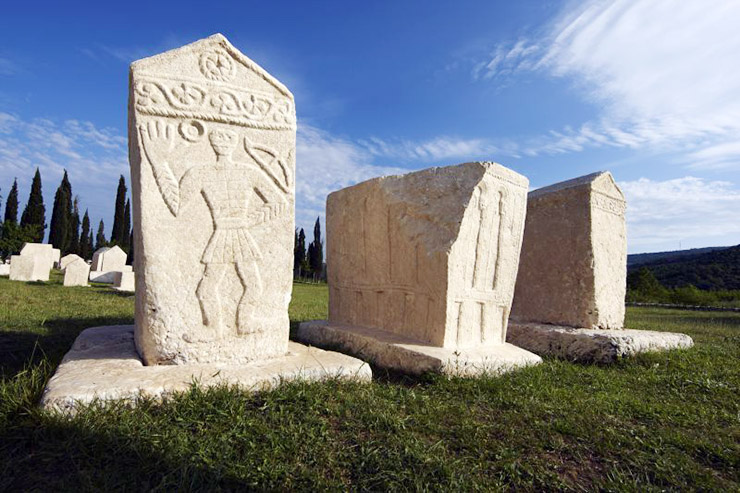
    In the late 1100’s the Bogomils were badly persecuted in Serbia, but Bosnia was a safe haven. The first great ruler in Bosnia was Kulin, the “Great Ban” (ban was the title given to local representatives of the Hungarian kings). His reign, from 1180 to 1204, was known for its prosperity. Bogomilism was hugely prevalent, involving many nobles and landowners. They formed a “Bosnian Church” of their own, headed by a “bishop” and served by a semi-monastic body of devotees who acted as missionaries.9 The biggest surprise was when Kulin himself and the Roman Catholic Bishop of Bosnia became Bogomils, shocking the Roman church. The papacy and the Catholic king of Hungary pressured Kulin to recant (under threat of war), which he did in 1203. In spite of Kulin’s “change of heart,” Bogomilism continued to grow and flourish.

    When Kulin died in 1204 the worried Pope appointed a Roman Catholic Ban. A group of missionaries arrived to convert the Bosnians. The result? The Roman Catholic Ban converted to Bogomilism and Bogomil churches spread like wildfire – not only in Bosnia, but in Slavonia, Croatia, Istria, Dalmatia and Carniola. As for the papal missionaries, by 1221 there were no other priests in Bosnia except for Bogomils.

    In 1222 Hungary invaded in what was to be the first of at least three crusades against the Bogomils, fashioned after the Albigensian Crusades in France. The Bosnians immediately threw the Roman Catholic Ban out of the country and appointed a Bogomil leader named Ninoslav. The war continued for years as a stalemate. Ninoslav received the same pressure to convert to Catholicism as Kulin did and complied, but the entire country saw through the same façade from before and continued being Bogomils without batting an eye. The warfare smashed up the countryside but whenever the invaders withdrew, the Bogomils went back to their faith, backed by the strength and prosperity of the people.

    By the late 1200’s, after more failed attempts, Hungary chose not to invade Bosnia. Frustrated voices in Rome began grumbling that Hungary herself should be the object of a crusade.

    In 1322, the powerful Subic family was toppled and Stephen Kotromanic, a Bogomil, was elected as ban. He successfully acquired the principality of Hum (later called Herzegovina) in 1326, foiling Serbian and Hungarian attempts and giving Bosnia access to the sea for the first time in its history. Its prosperous farms and mining operations now had a direct sea route for export. This was a hugely successful country, teeming with heretics. It was only a year earlier that the Pope had written to Kotromanic saying, “Knowing that thou art a faithful son of the Church, we therefore charge thee to exterminate the heretics in thy dominions,… their speech crawleth like a crab, and they creep in with humility, but in secret they kill, and are wolves in sheep’s clothing,” etc.

    Let’s read this again. Who was, in actuality, the one trying to “kill in secret,” by sending a letter to the king, asking that he “exterminate” his own people? A close study of the papacy and its history will expose almost as much corruption as the mafia. Those familiar with papal history will not find these tactics to be of any great surprise.
    Bulgaria

    The Bulgarian Tsar Boril, who ruled from 1207-1218, detested the Bogomils. He had usurped the throne, having driven the rightful heir, John Asen II, out of the country and into Russia. Anti-heretical laws were issued and carried out in 1211, making these events almost simultaneous with the Crusade against the Cathars in the West. 10 Many heretics were tried and went to prison.

    Followers of John Asen II dethroned Boril in 1218 and blinded him, restoring the rightful heir to the throne. Asen, who ruled from 1218-1241, is considered the greatest of all Bulgarian monarchs, and under his reign Bulgarian civilisation reached its peak.

    During Boril’s reign the Bogomils had supported the absent Asen, and John never forgot it. They now enjoyed complete protection and freedom under him, suggesting a link between Bulgaria’s greatness and the protection and support of the Bogomils. Pope Gregory IX complained to the king of Hungary (of which Bulgaria was a satellite) about the kind treatment the heretics were receiving. A crusade was attempted in 1235, but failed miserably.

    It was no coincidence that under the rule of John Asen II Bulgarian civilisation reached its peak. Bosnia achieved similar greatness while allowing the Bogomils to flourish. These were immensely successful nations that were Gnostic in character and belief. What gives any foreign country or pope the right to dictate what a certain nation’s beliefs should be when they are at the height of their civilisation and quite happy internally?

    The Cathar Legacy

    Bogomilism entered Russia, but its biggest influence was on the Cathars of southern France. Cathar origins have been traced to Bogomil missionaries who are believed to have passed through the Dalmatian coast and northern Italy to reach France in the tenth and eleventh centuries.11 Most serious researchers consider Catharism a direct legacy of the Bogomils. A lesser camp contends that the Cathars were formed independently by long-established Manichaean schools in France, then connected with the Bogomils at the end of the eleventh century.

    According to the late Romanian scholar Ioan Couliano, this difference stems from two distinct Cathar groups that existed, “…one that was simply Bogomil, and another one that preached a radical dualism of intellectual origin, made up of a concoction of Origenism and Manichaeism…. The two types of Catharism may not share common doctrines but they have similar ethics, stemming from Bogomilism.”12 Couliano reveals how this second Cathar group, in his view, also originated in the Balkans.

    Bogomilism directly influenced the Cathars by the twelfth century. In his book Aion, C.G. Jung mentions a heretical document that was found in the Archives of the Inquisition at Carcassonne, France. This work, he says, “concerns an alleged revelation which Christ’s favourite disciple John was vouchsafed as he ‘rested in the Lord’s bosom’.” Jung notes that this Latin text contained the Old Bulgarian word osob, which means something like “individuality” or “personality.” He also mentions how the Cathars, like the author of this text (hinting at two distinct persuasions), regarded the Devil as creator of this world and of man.13

    Jung’s account clearly resembles Obolensky’s description of the Cathar Secret Book, also known as the Liber Sancti Johannis or the Faux Evangile. It is “…a dialogue between Jesus Christ and His favourite disciple John the Evangelist. At the Last Supper St. John leans on the breast of his Master and questions Him on the origin of the world, the spiritual life, and the end of all things.”14 To the Bogomils, the books of John have always been the most revered. Moreover, on the Carcassonne manuscript the Inquisitors had written, “This is the Secret Book of the Heretics of Concoresso, brought from Bulgaria by Nazarius, their bishop, full of errors.”15

    The Cathar Secret Book thus is a Latin translation of a Slavonic work (only parts of which survive in the original) brought to the West by a high-ranking Bogomil named Nazarius. Hence the Bogomils, if not directly responsible for the Cathars’ teachings, at least provided a strong influence on them.

    This resemblance extends to similar initiatory prayer ceremonies and a number of doctrines, including an exclusive preference for the Lord’s Prayer, the disavowal of marriage, a rejection of the doctrine of the physical Incarnation, an emphasis on asceticism, opposition to the instituted church, and belief in the Devil as a son of God who is the unjust ruler of this world, and more.

    During the Albigensian crusades many Cathars reportedly found refuge in Bosnia. Reniero Sacconi, an Italian Inquisitor, stated that the Church of the Cathari extended from the Black Sea to the Atlantic. The Black Sea flanks the Balkans, where no official Cathar settlements had ever been established. He made this statement at least four years before the Cathar crusades began, so it reflects contact not only in time of need, but out of long-standing spiritual roots.

    The Cathars were brutally attacked in the Albigensian crusade starting 1208. By 1244 more than one million Cathars had been slaughtered in France. In 1209, for example, the Catholic bishop of Citeaux ordered the entire population of Beziers, a Cathar city of 20,000, put to death and their city destroyed. A minority of Catholics died because the papal legate ordered his soldiers, who wanted to save them, “Kill them all; God will sort them out.” In the Balkans murders did occur but the mass extermination of entire towns, including women and children, was not considered.

    The greatest time in the nations of Bosnia and Bulgaria was when this form of heresy was allowed to thrive, without outside interference. The Languedoc area of southern France, home of the Cathars, was equally prosperous before the Church launched its persecutions. This wealth and success may have been what drew their attention. Most of the nobles were Cathars, upper class children attended Cathar schools, literacy rates were the highest in Europe, citizens were the most educated in France, there was less class distinction, and Christians and Cathars lived peacefully together without considering themselves enemies before the Church cast its hawkish gaze upon them. This successful way of life was virtually the same blueprint, passed down from the Bogomils.

    Decline

    By the fourteenth century Bogomilism was in decline, partly because of what Obolensky calls the “general moral decline of the age,” partly because of the influence of Messalianism.16 The name comes from a Syriac word meaning “those who pray.” Their primary belief was that all are born with an indwelling demon that can be driven out only through prayer (rather than through baptism, as Orthodox Christians believed). For those who had expelled their demons, sin was no longer possible, so many Messalians indulged in sexual excesses that were frowned upon by their Orthodox opponents. They lived in strict poverty, did no manual labor, and women were allowed to teach among them.

    The Messalians entered Bulgaria during the eighth and ninth centuries and influenced Bogomilism strongly when it arose. The two sects existed separately up to and during the eleventh, but a fusion began to occur in the following century to the point where the two sects were fused completely together by the fourteenth century. The influence of the Messalians, with their extreme sexual indulgence, caused the Bogomils to lose their strongly puritanical streak.

    Hungary finally defeated Bosnia in 1408. 126 of Bosnia’s wealthiest and most influential noblemen were beheaded and thrown into the Bosna River from the rocks of Doboj. Remaining nobles like King Sigismund’s chief Bogomil opponent, Hrvoje, surrendered in early 1409.

    As a reward he was allowed to retain his former acquisitions, along with his title of Duke of Split, and he was appointed by Sigismund as his lieutenant in Bosnia. He also received possessions in Hungary, namely Pozega together with its county and its seigneury of Segesd in Somogy.17

    This arrangement didn’t last. In 1413 Hrvoje, whose outpost was in southern Bosnia, attacked Herzegovina, a neighbouring Hungarian protectorate. Sigismund immediately confiscated all of Hrvoje’s lands and declared him a rebel. The extensive lands of Hrvoje accepted their direct Hungarian seizure without a fuss, but Hrvoje did not. His protest to Hungarian barons went on deaf ears so Hrvoje, now an outcast, turned to the Turks.

    The Turks had made their first invasion into Bosnia in 1386 and from then on continued with raids and invasions. They took a permanent foothold in part of southern Bosnia around 1414, about the same time Hrvoje recruited them. In the winter of 1413-1414 combined forces of Bogomils and Turks took a number of castles back from the Hungarians. A larger merged force then went after the Hungarians. In 1415 they crushed the Hungarian army a few miles from the rocks of Dojob, in the battle of Usora. Most of the Hungarian soldiers were killed; those who survived were ransomed for a huge sum. This one battle devastated Hungary so badly that their influence in the region was reduced to almost nothing, and it took more than a decade for them to successfully return and restore some influence.

    Throughout the fifteenth century the Turks continued their expansion. Constantinople fell in 1453, Serbia, which had briefly regained its independence, was retaken in 1459, and a final invasion of Bosnia occurred in 1463. The last Bosnian king, Tomasevic, was the first and last to have been originally crowned with the approval of the Catholic Church. He was beheaded along with many of his supporting nobles in 1463.

    Many Bogomils welcomed the invasion. Having suffered continual persecution by both the Orthodox and Roman Catholic churches, “they preferred to be conquered by the Sultan than converted by the Pope.”18 The new rulers encouraged their subjects to convert to Islam; those who did were allowed to retain their land and feudal privileges. Some enjoyed even higher status: serfs who converted to Islam became free peasants. On the other hand, Christians who did not convert became serfs without rights of property or citizenship under Moslem law. As one source puts it, “In Bosnia and Herzegovina Christians were crushed and exploited both by Turks who became landowners and by their own converted upper classes.”19

    Who were these converted upper classes? Often they were Bogomil nobles. Retaining their own language, “they displayed the customary zeal of converts and out-Ottomaned the Ottomans in their religious fanaticism,” becoming, at times, “keener in the cause of Islam than the Commander of the Faithful himself.”20 By the end of the fifteenth century the Bogomils had merged into the general Muslim population.

    If the Church had made a deal with the Bogomils as had been done with Islam, allowing them spiritual freedom within the Christian fold, things might have been different. Hungary was continually manipulated as an invading force in Bosnia when everyone (Hungarians, Bosnians and Rome) could have fought against the Ottomans rather than fighting against each other. The spread of Islam could have been thwarted or diminished. Rebecca West summed it up well: “Had it not been for the intolerance of the Papacy we would not have had Turkey in Europe for five hundred years.”21

    Deunov and Aivanhov

    In more recent times we have had two Bulgarian-born mystics, Peter Deunov and his disciple Omraam Mikhael Aivanhov, who claim a spiritual descent from the Bogomils. They cannot be strictly classified as Bogomils, but could have been blood descendants, and their teachings clearly carry on in the same spirit.

    Peter Deunov (1864-1944) received a doctorate in theology in America before returning to Bulgaria, where he became a venerated saint. By the time of his death he had over 40,000 followers despite being accused by the Bulgarian clergy of corrupting the people. Deunov’s teachings are still practiced in at least 26 countries worldwide.

    Deunov’s student, Omraam Mikhael Aivanhov (1900-1986), left Bulgaria in 1938 to settle in France, but remained a devoted disciple for his entire life. Author Georg Feuerstein states, “Through Peter Deunov, who resuscitated the ancient gnostic heritage of his homeland, Aivanhov was in touch with a powerful lineage going back to the Bogomils of the tenth century A.D. and earlier gnostic schools.”22

    Aivanhov shared a similar interpretive style with the Bogomils, looking at the Bible in a deeper, more mystical sense. He spoke of many ancient truths, previously lost, that he felt were expressed in the Scriptures. Feuerstein calls him “a master at the task of interpreting the ancient esoteric lore to his contemporaries who have all but forgotten their own heritage of wisdom.”23

    The Bogomils are gone today. Their achievements have never been well known in the West, but remain an important part of Gnostic and religious history, showing us how one group with determination can not only survive, but flourish for hundreds of years in the midst of persecution.

    [alert type=”general” dismiss=”no”]This article was published in New Dawn 106.[/alert]

    [alert type=”success” dismiss=”no”]If you appreciate this article, please consider subscribing to help maintain this website.[/alert]

    Footnotes:

    1. Dmitri Obolensky, The Byzantine Commonwealth: Eastern Europe, 500-1453 (New York: Praeger, 1971), pp. 125-6.
    2. Will Durant, The Age of Faith (New York: Simon & Schuster, 1950), p. 769.
    3. James Hastings, ed., Encyclopedia of Religion and Ethics, vol. 1 (New York: Charles Scribner’s Sons, 1928), p. 784.
    4. Donald M. Nicol, Church and Society in the Last Centuries of Byzantium (London: Cambridge University Press, 1979), pp. 101-02.
    5. Dmitri Obolensky, The Bogomils (London: Cambridge University Press, 1948), p. 215.
    6. Obolensky, The Byzantine Commonwealth, p. 122.
    7. Quoted in Obolensky, The Bogomils, p. 203.
    8. Ibid., p. 205.
    9. H.C. Darby, R.W. Seton-Watson, et al., A Short History of Yugoslavia (London: Cambridge University Press, 1966), p. 59.
    10. Obolensky, The Bogomils, p. 234.
    11. Ioan P. Couliano, The Tree of Gnosis (New York: HarperCollins, 1992), p. 41.
    12. Ibid.
    13. C.G. Jung, Aion: Researches into the Phenomenology of the Self, trans. R.F.C. Hull (Princeton: Princeton University Press, 1959), pp. 145-48.
    14. Obolensky, The Bogomils, p. 227.
    15. Steven Runciman, The Medieval Manichee (Cambridge, England: Cambridge University Press, 1947), p. 108.
    16. The Bogomils, p. 264.
    17. Pal, Engel, The Realm of St. Stephen: A History of Medieval Hungary, 895-1526, trans. by Tamas Palosfalvi, (I.B. Tauris, Hungary, 2001), p. 234.
    18. Phyllis Auty, Yugoslavia (New York: Walker and Co., 1965), p. 50.
    19. Ibid.
    20. Darby, Seton-Watson, et al., p. 64.
    21. Rebecca West, Black Lamb and Grey Falcon: A Journey through Yugoslavia (MacMillan & Co., London, 1942), p. 301.
    22. Georg Feuerstein, The Mystery of Light: The Life and Teaching of Omraam Mikhael Aivanhov (Sandy, Utah: Passage Press, 1994), ms. p. 318.
    23. Ibid, p. 334.

    © New Dawn Magazine and the respective author.
    For our reproduction notice, click here.
  • Secret Mysteries of the Sun Revealed

    Secret Mysteries of the Sun Revealed

    From New Dawn 113 (Mar-Apr 2009)

    From 1209-1249 one of the worst genocides in history was conducted against the Cathars, a heretical sect in southern France. Pope Innocent III, promising gold and indulgences (the remission of punishment due for sins) in exchange for the blood of the Cathars, sent 30,000 crusaders into France to massacre the Cathars and their supporters. 

    The Cathars were hunted, tortured, burned at the stake and savagely murdered by the Church’s hired killers. Estimates place the total number of Cathars and sympathisers murdered between 300,000 and 1,000,000 men, women and children. Throughout this bloodbath, an amazing phenomenon was witnessed. The Cathars did not express fear, anger or pain, but only bliss, despite the most horrendous atrocities committed against them. What were they on?

    According to William Henry in Mary Magdalene: The Illuminator, it was a psychoactive substance produced by the brain – the Cathars had learned the techniques necessary to produce it from the secret teachings of Jesus. It was called Christos (anointing oil) by the Essenes, who passed on their secrets to Jesus from Moses, who had obtained them in Egypt from descendants of the banished Atonite priests of Akhenaton.

    These teachings involve the power of the sun and the power of the spoken word and constitute what I call “the mysteries of the sun.” They were part of the Egyptian, Babylonian and Greek mysteries, and the Gnostic teachings of the early Christians and secret societies. They have been given to every culture by great adepts as means of enlightening the minds of the people and freeing them from the darkness of ignorance and superstition.

    In this article, I will briefly examine the life and teachings of the founders of various mystery schools in the Middle East and Mediterranean area from the Pharaoh Thutmose III to Omraam Mikhail Aivanhov. There were other mystery schools in India, China, Peru and elsewhere, but the ones I have chosen represent a continuity that spanned millennia and formed the spiritual roots of the Judeo-Christian heritage.

    The story of the mysteries of the sun is as old as mankind and as new as the latest scientific breakthrough. In 1882, Ignatius Donnelly published Atlantis: The Antediluvian World. In this book, he argued convincingly that Atlantis had established colonies in Peru, Egypt and elsewhere and that the mythologies and mysteries of these peoples represented the original religion of the Atlanteans, which was a form of sun worship.

    He wrote, “The religion of the Atlanteans, as Plato tells us, was pure and simple; they made no regular sacrifices but fruits and flowers; they worshipped the sun. In Peru a single deity was worshipped, and the sun, his most glorious work, was honoured as his representative. Quetzalcoatl, the founder of the Aztecs, condemned all sacrifice but that of fruits and flowers. [We can see how far the Aztec religion degenerated over the centuries to the low point of human sacrifice by the time of the Conquest.] The first religion of Egypt also was pure and simple; its sacrifices were fruits and flowers; temples were erected to the sun, Ra, throughout Egypt. In Peru the great festival of the sun was called Ra-mi.”

    Between pre-dynastic Egypt and the eighteenth dynasty, the “pure and simple” solar religion of Egypt became very corrupt and complicated. There were several sun gods and a whole host of minor gods. The priesthood was rich and powerful and the people depended on them for magic amulets, praying to the gods on their behalf and giving them a proper elaborate send-off into the afterlife. Fruits and flowers were no longer fitting sacrifices; animals took their place.

    Enter Pharaoh Thutmose III. A younger son of Amenhotep I, he owed his rule to the intervention of the priesthood of Amen-Ra who, in a religious ritual invoking the will of Amen-Ra, appointed him pharaoh, even though he was not in line for the succession. Thutmose realised that the priesthood was becoming too powerful and sought to curb their power by outwardly paying obeisance to Amen-­Ra, but secretly worshipping Aton and supporting a separate priesthood of Aton at Heliopolis who were loyal to the throne.

    Under his rule, Thutmose III permitted the common people to indulge in all their fanciful beliefs and superstition such as magic amulets. He believed that a gradual change in the existing religious beliefs could be more easily and permanently accomplished by establishing a secret mystery school, the students of which would put into practice higher standards. He wanted to gradually infuse into Egyptian religion from the top down those mysteries, myths and rites that would raise the people to a higher understanding and morality.

    Thus, in 1489 BCE he founded a secret mystery school, the Order of the Rose Cross, which the Rosicrucians claim descent from and which still exists today. Members of this mystery school were called the Therapeutea, meaning “physicians of the soul.” The sungazing Essene sect of Alexandria later adopted this name and the rosy-cross symbol.

    William Henry, in The Healing Sun Code, linked the rosy-cross and the Rosicrucian secrets with the “rising of the Healing Sun, the source of life and wisdom.” I recently talked to a woman who studied Egyptology for 25 years and knew about Thutmose III and the Rosicrucians. She told me that she once knew a Rosicrucian lady, who every time she felt ill would face the sun and do a special breathing exercise in which she would breath in the fire of the sun to burn impurities in her body. She lived to be very old. This technique was part of the secret teachings of the Rosicrucians, which they were very careful not to reveal to the uninitiated.

    Another technique used by Thutmose III and members of his order was the use of healing rods while sungazing (see Figure 1). These were copper and zinc tubes that contained hardened coal and magnetite respectively. They were reintroduced to the world by the Russian mystic Count Stefan Colonn Walewski, who was a member of a sungazing mystery school in the Caucasian Mountains. They amplify the current that passes through the body between the sun and earth while sungazing, enhancing meditation and quickening healing and the development of psychic powers.

    Thutmose III’s son and grandson continued with the mystery school and the cult of Aton, but it wasn’t until his great grandson, Akhenaton, took the throne that things came to a head.

    The Revolution of Akhenaton

    In 1369 BCE, Amenhotep IV took over the reigns of Egypt from his ailing father Amenhotep III. During his upbringing, he was educated at the Temple of the Sun at On (Heliopolis) where the priests instilled in him a devotion to Aton. When he became pharaoh, he was given the secret mysteries of the sun handed down from his great grandfather. He learned that Aton was the one true, self-created, unmanifest God and that most of the other gods, including Amen-Ra, were man-made. Early in his reign, he changed his name to Akhenaton, meaning “the servant of Aton.” Unlike his great grandfather, he had no tolerance for spiritual ignorance.

    Akhenaton initiated a change in the religious climate from a fear-based polytheism with its death cult, magic amulets, numerous idols, animal sacrifice, and secretive rituals of a powerful priesthood to a more devotional religion, which was free of graven images, obsession with the afterlife, and magic; which emphasised reverence for sunlight and cleanliness, and simple burial; and which allowed ordinary citizens to freely worship in open-air temples with offerings of fruits, flowers and incense, as was done in the original solar religion of Egypt. Aton’s temples had no idols or graven images other than the one Akhenaton devised – a sun disk from which proceeded rays, the ends of which terminated in graceful hands. Some of these hands held the ankh, the symbol of life, to the nostrils of his sungazing worshippers.

    This symbolism shows that Akhenaton understood the relationship between sunlight, prana and breath. He knew that sunlight is the source of all life upon earth. This was not worship of the physical sun but worship of one God, a supreme deity, whose spirit was in heaven and whose physical manifestation was the sun – the symbol of life. It changed the worship of the sun as a god to the worship of God symbolised by the sun. Paintings and carvings of Aton were always accompanied with a sort of hieroglyphic footnote (seen at the top of Figure 4, page 56), stating that it was just a representation of the All-encompassing Creator.

    Thus, Akhenaton established the first monotheistic religion by elevating Aton over Amen-Ra and other gods. His mother, Tiya, did much to mediate and stem the tide of controversy caused by his bold opposition to the powerful priesthood of Amen-Ra. However, after she died, he took the offensive and ordered his army to disband the priesthood and deface their false gods.

    Akhenaton loved to officiate at ceremonies as the high priest of Aton. The following quote from a decree made by Akhenaton upon the founding of his capital city, Akhetaton, shows that morning sungazing was a daily ritual of Atonism:

    “Every eye beholds him without hindrance while he fills the land with his rays and makes everyone to live. With seeing whom my eyes are satisfied daily when he rises in this temple and fills it with his own self by means of his rays, beauteous with love, and embraces me with them in life and power forever and ever.”

    During these ceremonies, Akhenaton and his congregation would sing his Hymn to Aton. Although the vast majority of Egyptians did not give much credence to Atonism, and Akhenaton’s court followed the rituals of the outer religion out of a sense of duty, there existed an inner circle of about 300 initiates who learned from Akhenaton the mysteries of the sun. Among these were Joseph the son of Jacob, who Robert Feather, in The Mystery of the Copper Scroll of Qumran, claims was Akhenaton’s vizier Nakhte.

    The Bible records that Joseph married Asenath the daughter of Potiphera, a priest of Aton in Heliopolis, and archaeologists discovered a private chapel to Aton in the ruins of Nakhte’s home in Akhetaton. Robert Feather thinks that after Akhenaton’s death, some of these initiates went to the sun temple of Heliopolis and others, including Joseph and his family, went to Elephantine Island in the land of Cush (Ethiopia), where they built another sun temple and established a branch of Judaism that exists to this day.

    The Mysteries Formed the Basis of the Judeo-Christian Tradition

    After the death of Akhenaton, the teachings of Atonism, its rituals and precepts, were almost completely destroyed by fanatics of the established religion. This has been the fate of every mystery teaching involving the sun in the past. Most historians and religious writers think that Akhenaton’s monotheism was a brief aberration in a long tradition of Egyptian polytheism and that it died with him.

    But, buried in the pages of historical and scriptural texts are hints that his ideas survived in the Jewish faith. For example, Psalm 104 is almost identical to the Hymn to Aton. They also survived in the secret teachings of the Essene and Therapeut Brotherhoods, which were associated with early Christianity.

    In the History of Egypt, the Egyptian priest Manetho wrote, “Moses, a son of the tribe of Levi, educated in Egypt and initiated at Heliopolis, became a High Priest of the Brotherhood… He was elected by the Hebrews as their chief and he adapted to the ideas of his people the science and philosophy which he had obtained in the Egyptian mysteries when he established a branch of the Egyptian Brotherhood in his country, from which descended the Essenes. The dogma of an ‘only God’, which he taught, was the Egyptian Brotherhood interpretation and teaching of the Pharaoh who established the first monotheistic religion known to man [Akhenaton]. The traditions he established in this manner were known completely to only a few of them, and were preserved in the mysteries of the secret societies, the Therapeutea of Egypt and the Essenes.”

    After returning from Heliopolis, Moses became an annoyance to the priests of Amen-Ra and the court of Ramses II because of his Atonistic ideas. The historian Josephus records that Moses was sent on a military expedition to Cush in an effort by Pharaoh’s courtiers to get rid of the “dissident.” There he not only found a wife but another outpost of Atonism on Elephantine Island. Robert Feather thinks that it was in the wilderness of Cush that Moses saw the burning bush and received his mission.

    Flavia Anderson, in The Ancient Secret: Fire from the Sun claimed that the burning bush was actually a small golden tree with a crystal that reflected sunlight so brightly that it appeared to be on fire. A similar talisman, called a punchao, was used by the Incas to put worshippers in a trance so that they could see and communicate with beings of light.

    Anderson also relates this golden tree to the Urim and Thummin (perfect light) of the Jews, which was a crystal set in a golden stand, and by which the high priest communicated with God. Anderson thinks that Moses encountered this golden tree during an initiation in the sun temple of Heliopolis. But it’s more likely that he saw it in the sun temple of Elephantine Island right before he returned to Egypt. It’s also likely that some of the Atonite priests who were descendants of Joseph and his family joined Moses in his mission. The Bible records that there were two rival factions of priests during the Exodus. One faction had Egyptian names such as Korah, Dathan, Abiram and On.

    In The Secret Initiation of Jesus at Qumran, Robert Feather shows how the descendants of these Egyptian priests, originally appointed at the time of Akhenaton, could have maintained their cohesion down to the beginning of the Qumran Essenes (610 BCE). When they entered Canaan, they settled around Shiloh and so became known as Shilonite priests. They became prominent around the time of Ezekial (589 BCE), Onias IV (160 BCE) and Jesus (4 BCE). These were also times when the Essenes were active. The Qumran Essenes, based on the Shilonite priests, came to have a much purer Judaism that rejected animal sacrifice, idols, amulets and burial with worldly goods which crept into the Judaism of the rest of the Israelites. During the Exodus, these priests were pro-Moses and against the priests of Aaron. It is likely that the priests of Aaron, who backslid into idolatry of the golden calf (the Egyptian goddess Hathor) while Moses was on the mountain, may have been responsible for reintroducing another Egyptian practice of holocaust sacrifice, prohibited by Atonism. On Mount Sinai, God gave Moses the first set of tablets to present to the Hebrews. Figure 2 (page 55) is a detail from a painting by Beccafumi. It shows Moses receiving the tablets from the sun, which is depicted as an opening in the sky.

    However, when he came down the mountain and saw how the people had lapsed into idolatry, he realised they weren’t ready for what was on the tablets. So he smashed the tablets and went back up the mountain where God engraved ten simple commandments on a second set of tablets.

    What could have been on the first set? Perhaps the solar mysteries! In any case, the mysteries were handed down by word of mouth from Moses to the Shilonite priests to the Essenes.

    Archeologists found in the catacombs of Rome a drawing of Jesus holding a rod of power when raising Lazarus from the dead (Figure 3, page 55), showing that early Christians understood that the source of Jesus’ power came from the sun. The Bible records that just before Jesus raised Lazarus, he “lifted up his eyes” to the sun and prayed. The rod is a symbol of the life force, which every Egyptian sun god and sun gods from Babylonia, India and Peru are shown wielding in paintings and wall carvings, such as in Figure 5.

    Many scholars are now coming around to the realisation that Jesus was a member of the Qumran Essene movement and that many of his teachings are similar to the Essene teachings. The Essenes and Therapeuts considered themselves to be the children of light and so did the early Christians.

    According to Gene Savoy in his book The Essaei Document: Secret Teachings of an Eternal Race, Jesus received the Essenes’ secret teachings, which he calls the paradosis, meaning a divinisation process by which one became immortal. Savoy hints at sungazing being a key factor in this secret teaching.

    He writes: “That the Essaei [Essenes] faced the sun at these times [sunrise and sunset] suggests that the sun was used as an intermediary by which men of the earth were linked by ‘cords of light’ with heaven… and were nurtured on a divine food upon which the angels fed…”

    The Therapeuts believed that pure souls returned to the sun and that sunlight indeed is the heavenly, incorruptible food of the soul.

    Savoy’s “cords of light” linking everyone can be thought of as an energy grid. The sun is one part of this energy grid; the earth is the other. Savoy wrote elsewhere: “The followers of Mithra gathered on the summits or stood in the waters, lifting their hands in prayer before the rising sun…” Savoy also mentioned in Project X that sun worshippers in Peru would stand on the summits of mountains or sun temples. This made me think of the vortices and ley lines of the earth grid, which are focal points and lines of electromagnetic energy usually found on high points on the earth’s surface and in stream beds.

    Richard Leviton and Robert Coons, in “Ley Lines and the Meaning of Adam,” a chapter from Anti-Gravity and the World Grid, claimed that the electromagnetic system of our bodies, the entire biosphere and the earth grid are part of a much larger solar system grid and it’s all connected. And the energy that powers this grid is the Light of God. They wrote, “The landscape temple made of stones and crystal… linked Heaven and Earth through Man. The terrestrial temple also functioned as a Grid Door by which human consciousness… could actually exit this plane and enter ‘the realm of the Gods’ [what William Henry called ‘the dimension of the blessed’]. Through this Grid Door, the Gods could also channel their spiritual vibrations and messages.”

    Perhaps that’s how God channelled the mysteries of the sun and then the Ten Commandments to Moses on the terrestrial temple of Mt. Sinai, as depicted in Figure 2. It’s significant that key events in Jesus’ ministry occurred on the peaks of mountains and in streams (his baptism, his last temptation, the sermon on the mount, his transfiguration, his death, and his ascension).

    Jesus passed on the Essene secret teachings on the mysteries of the sun to his disciples, including Mary Magdalene. The early Christians, who were not privy to these teachings, at first worshipped the spirit of Christ in the sun, but around the third century they lapsed into a personality cult of Jesus worship, which has continued to this day.

    Fragments of these secret teachings can be found in the Dead Sea scrolls, in the apocryphal text known as the Pistis Sophia, and in the Essene Gospel of Peace, which was hidden in the Vatican library for centuries before Edmond Bordeux Szekely discovered it in 1928. In the Pistis Sophia, an ancient gospel suppressed for over a thousand years and ignored by the orthodox churches even after its publication in the last century, Jesus, after his resurrection, elaborates on the solar mysteries and how necessary they are for entering the kingdom of heaven:

    “Ye are to seek after the mysteries of the Light, which purify the body of matter and make it into refined light exceedingly purified. Amen I say unto you… I have torn myself asunder and brought unto them all the mysteries of the Light, that I may purify them… else would no soul of the total race of men have been saved, and they would not be able to inherit the Kingdom of the Light…”

    How this purification occurs is hinted at in this further passage: “Now, therefore, he who shall receive the mysteries of the baptisms, then they becometh a great, exceedingly violent, wise fire and it burneth up the sins and entereth into the soul secretly and consumeth all the sins which the counterfeiting spirit hath made fast on to it.”

    In the Essene Gospel of Peace, Jesus gives a teaching on the purifying role of sunlight in this baptism of fire. He tells the sick after instructing them on fasting, “And if afterward there remain within you aught of your past sins and uncleanness, seek the angel of sunlight… For I tell you truly, holy is the angel of sunlight who cleans out all impurities and makes all evil-smelling things of a sweet odour. None may come before the face of God, whom the angel of sunlight lets not pass. Truly, all must be born again of the sun and of truth, for your body basks in the sunlight of the Earthly Mother, and your spirit basks in the sunlight of the truth of the Heavenly Father.”

    The receiving of this fire through sungazing with arms upraised in a Y formation or bent at the elbow and hands spread out and facing the sun was called by the Greeks “fire blooming” because the radiance or essence of the sun thus channelled burned away impurities in the solar plexus, which, by the way, is associated with the sun and with fire. One can find wall carvings, paintings, statues, woodcuts and photographs of sun worshippers from all over the world – Hindus, Muslims, American Indians, ancient Egyptians, Medieval monks, Russians, Incas, and even aborigines in prehistoric petroglyphs – all with upraised arms. William Henry wrote in Mary Magdalene: The Illuminator that when Jesus taught his disciples the Lord’s Prayer, he also taught them this prayer position, which he learned from the Egyptians, who called it the Ka position (Figure 6, page 57). Moses also learned it from the Egyptians and used it to invoke the Light of God during the Israelites’ battle with the Amalekites. Significantly, the battle was won at sunset.

    This leads us to consider another part of the mysteries revealed by the Pistis Sophia, which is a certain power of the spoken word. The soul, in order to be cut free from the counterfeit spirit, must utter “the mystery of the undoing of the seals and of all the bonds.” This is the science of the spoken word, the uttering of sacred mantras, prayers and songs that remove or restrain the evil self, the “karmic records” of the individual.

    These spiritual sciences and techniques were not revealed to all the faithful. According to the Pistis Sophia, the mysteries were to be given only to those initiates who proved themselves worthy through years of testing. They were also kept secret because of the threat of persecution.

    The Mysteries Survive Persecution During the Dark Ages

    In Lost Light, Alvin Boyd Kuhn wrote that sun worship “was the heart’s core of all religion and philosophy everywhere before the Dark Ages obscured the vision of truth… The dreadful shadows of the Dark Age will not end until the bright glow of the solar wisdom is released once more to enlighten benighted modernity.”

    During the Dark Ages, the mysteries of the sun survived and were passed down through the Knights Templar, Cathars, Paulicians, Bogomils and other Gnostics. Many of these saints were brutally murdered by the Roman Catholic and Eastern Orthodox Churches in an attempt to suppress their teachings, which threatened the Churches’ established authority.

    One of the most inspired Gnostics was Saul of Tarsus. Saul experienced a sudden conversion and gnosis on the way to Damascus. Paintings of this experience usually show Saul being blinded by the noonday sun shining through a break in the clouds directly upon him.

    Gene Savoy, in The Essaei Document, claimed that Saul had learned that the Essenes sungazed in order to communicate with God. When Saul tried it, he received a powerful, life-transforming message, which left him blind and temporarily insane so that he could not eat or drink for three days. In 1840, Dr. Gustav Fechner, the father of psychophysics, experimented with gazing at the sun through coloured filters and liquids. He did it at noon and, as a result, became blind and insane. However, after much prayer and meditation in a dark room, he recovered his sight and sanity and more. He began seeing auras and angels, whom he called “beings from the sun.”

    Socrates taught in his academy that personal transformation was only possible through understanding the word of God, the Light, and that it was attained only through inner illumination absorbed from the sun. Apparently, Saul the persecutor was transformed by the sun into Paul the proselytiser.

    Clement of Alexandria recorded that Paul, before going to Rome, said that he would bring to the brethren the Gnosis, or tradition of the hidden mysteries, as the fulfilment of the blessings of Christ, who, Clement says, reveals the secret knowledge and trains the Gnostic by mysteries, that is, revelations made in the state of higher consciousness. Such a state can be attained through deep meditation, chanting and sungazing. Unfortunately, Paul was arrested in Rome and a few years later executed. His true teachings on the mysteries of the sun were lost for several centuries until they were resurrected in Armenia and Syria during the late seventh century by the Paulicians. This group was so named because their teachings were the Gnostic mysteries handed down from St. Paul when he brought them to the Balkans and Syria during his ministry.

    The Paulicians were persecuted and diminished in the ninth century, although until relatively recently there existed an Armenian sun cult whose adherents were known as Arevorti, “children of the sun.” In the tenth century, a new Gnostic movement, the Bogomils, arose in Bulgaria, which carried many of the same beliefs and practices of the Paulicians, including sun worship. However, their teachings were based on the Gospel of John.

    At the beginning of the 12th century, Byzantium started to persecute the Bogomils. Many were killed, but some fled to Italy, southern France and elsewhere. By the middle of the 12th century, Gnostic schools like the Knights Templars and Cathars had sprung up and spread throughout Western Europe. These were the Western European counterparts of the Eastern European Bogomils.

    The Cathars “pure ones” and the Knights Templars were concentrated in the Languedoc and Midi regions of Southern France. The Cathars claimed to possess the Book of Love (AMOK) the original initiatory version of the Book of John (the only gospel the Cathars, Knights Templars and Bogomils read) which likely contained the solar mysteries. It taught that a spark or tiny sun of the Christ Light dwelt in man’s heart and it revealed how to nurture it like a seed of divinity so that it blossomed into the rose of the original rosy-cross mystery school. This teaching, which reputedly could transform a human into a divine being, once belonged to Thutmose III, Akhenaton, Moses, Solomon, Jesus, and John the Beloved. It was reputed to be able to dissolve all hatred, anger and jealousy from the hearts of men.

    The Cathars believed that the key to this divine transformation was the correct understanding of the symbolism of the Eucharist, that is, the bread and wine and the Holy Grail. The light of the sun is the bread; its warmth is the wine. The Holy Grail is the brain’s third ventricle or cavity containing the pineal and pituitary glands (Figure 7, page 58).

    This secret, known to the Cathars as the consolamentum (“with the sun in the mind”), was kept hidden from the uninitiated. The Cathars believed man entered the kingdom of God through his soul, the seat of which was considered by Descartes to be the pineal gland. The Cathars believed that the solar elements of the Eucharist transubstantiated into the body and blood of Christ within themselves. The world transubstantiation comes from the Latin trans, across, and substantia, substance. This substance or glandular secretion, caught by the Holy Grail (the third ventricle), is what the Hindus call Amrita, “the elixir of immortality” and the Greeks called Ambrosia, “the nectar of the gods.”

    William Henry, in Mary Magdalene: The Illuminator, wrote, “All the occult mysteries speak of a key that is required to unlock mystical secrets of enlightenment. Specifically, the lost secret of the Templars… is about building a better human through the release of secretions from the astounding manufacturing plant of spiritual oils, the human brain. This oil or essence was the key secret of Mary Magdalene and the Essenes, recovered by the Templars from between the temples. The skull [specifically the third ventricle] is… the Cup of Life, the Grail, that catches these secretions from the brain… The Templars’ ultimate objective was to restore true Gnostic monotheism to the world, uniting Christianity, Judaism and Islam in a New Kingdom of Heaven on Earth. The ‘new’ humans that inhabited this New Jerusalem (or New Atlantis) would know and embody the secret of the Kingdom of Heaven within the brain and its capability of producing… the elixir of life, the Sacred Soma, the tonic of immortality, for these terms all refer to the cosmic essence or brain substance.” It was also called Christos (anointing oil) by the Essenes.

    Like their forerunners, the Bogomils, the Cathars engaged in chanting. This along with sungazing was the key to activating the pineal gland and producing the oil of Christos. The use of mantras and chanting can awaken the pineal because it sits above the mouth suspended in the third ventricle, a chamber filled with cerebrospinal fluid. Its location above the mouth in a fluid chamber makes the pineal gland quite uniquely positioned to respond to sonic vibrations. Manly P. Hall, in The Opening of the Third Eye, stated that the pineal gland “vibrating at a very high rate of speed, is the actual cause of true spiritual illumination.”

    The bliss that is experienced during sungazing and chanting is not just a natural high. According to William Henry, bliss is created by Christos and is a state of extreme happiness and freedom from attachment, conditioned responses and fear. It is the key required to enter the Kingdom of Heaven. Omraam Mikhael Aivanhov said that only those who are happy and carefree like children can enter the Kingdom of Heaven.

    The teachings of the Cathars posed quite a threat to the fledgling Catholic Church. Unlike the Cathars, the Church of Rome clearly did not produce a substance that gave people an experience of divine bliss. And if it did, it would keep it from the people. That’s why the Church had to exterminate them.

    Fortunately, today we live in an age of spiritual freedom and anyone can teach and learn the science of the spoken word and techniques of sungazing presented by sun yogi Hira Ratan Manek and others. Although the light of the Cathars was snuffed out in the 13th century, at the beginning of the 20th century, the teachings of the Bogomils were revived by the master Peter Deunov and his chief disciple, Omraam Mikhail Aivanhov.

    The Mysteries of the Sun Revealed

    On January 31, 1900, Mikhael Aivanhov was born into a poor family in Serbtzi, a small village of Macedonia. Throughout his childhood and adolescence, he was inspired by reading the Gospel of John, lives of the saints and books on yoga, which led him, at the age of fifteen, to an experience of illumination or samadhi.

    He went to the seashore to gaze at the sunrise. After meditating and sungazing for a little while, he sensed the presence of a heavenly being. Suddenly bathed in a cloud of brilliant light, he was plunged into a state of ecstasy. Later, he commented: “It was so beautiful that I was beside myself. To see such a being, with all those colours, all that light! He was almost invisible in the extraordinary luminosity that surrounded him. I found myself flooded with light. I was in a state of bliss, of ecstasy so immense, so powerful, that I no longer knew where I was. It was a delirious joy; it was heaven; it was the universe! Ever since then I have felt that if God were not all beauty I could not believe in him. It is beauty that remains in my mind as the one essential: neither power, nor knowledge, nor wealth, nor glory. Only beauty!”

    On the basis of his own spiritual experiences and of his reading of what he called the “Book of Nature,” he discovered the mysteries of the sun before being taught them by Peter Deunov. Mikhael and his master would go together to meditate in the pre-dawn stillness and watch the sun rise. Deunov also gave him the basic methods and exercises in mantra, prayer and sacred song: the mysteries of the spoken word.

    In 1959, he travelled to India, where he visited numerous ashrams and met several spiritual leaders. He was welcomed by several renowned Hindu sages as an accomplished master in his own right. One adept hailed him as a “solar rishi.” Another gave him his spiritual name, Omraam. One of the masters he met was the immortal bodhisattva, Babaji, who in 1992 and 1998 gave his blessings to another teacher of sungazing, sun yogi Hira Ratan Manek.

    Central to Omraam’s teaching is the concept of light. He saw in light the first emanation of the Divine, retaining the Divine’s qualities more than any other manifestation. As he insisted: “Light is a living spirit which comes from the sun and which establishes a direct relationship with our own spirit.” He explains how we can use light to transform ourselves and become radiant as the sun. In The Splendour of Tiphareth, he wrote, “Only the sun’s rays are capable of replacing all that is impure, worn out or obscure within you, and they can only do so if you learn to receive them. If you welcome them with your whole heart, they will begin their work of replacing the ‘old man’ in you, so that you will be wholly regenerated, renewed and resuscitated; your thoughts, feelings and acts will all be different. Only the sun’s rays are capable of working this transformation within you.”

    Omraam loved to talk about the Spirit of the sun. In this respect his philosophy coincided with the age-old mysteries of the sun, which taught that the true sun is not the star that is visible in the sky, but the invisible spiritual sun, the source of all life, light and love.

    He pointed out that, “On the physical, material level, the sun is the door, the link and the medium thanks to which we can make contact with the Lord… Through the sun, we work with God Himself. I can say that certain things that no human can teach me have been revealed to me by the sun. No book can give you what the sun gives you if you learn to have the proper relationship with him… If you want to create a bond between you [and the sun], you have to look at him in all consciousness. If you do that there will be a communication of vibrations between the sun and you in which forms and colours, a whole new world, will be born… The sun is an intelligence, a life, a living light. And when you understand that, all of a sudden he begins to speak to you… Try asking him a question and you will see that he will answer you.”

    Omraam died in 1986, but his teachings on the mysteries of the sun live on in numerous books. Over 90 books have been published in English, and there are enough notes from his hundreds of lectures to fill another 400 books. Of these books, the ones that are primarily concerned with the mysteries of the sun are The Splendour of Tiphareth: The Yoga of the Sun, Toward a Solar Civilization and Light is a Living Spirit. Louise-Marie Frenette’s newly-released biography of Omraam Mikhael Aivanhov, The Life of a Master in the West, has just been published in New Zealand by First Edition Press (to order call +64 (04) 586-1973). Today, his teachings and sungazing rituals are practiced by the I.D.E.A.L. Society, The Hearts Center and other spiritual communities around the world.

    The above article first appeared in World Explorer 37 Vol. 5 No. 1. 

    [alert type=”general” dismiss=”no”]This article was published in New Dawn 113.[/alert]

    [alert type=”success” dismiss=”no”]If you appreciate this article, please consider subscribing to help maintain this website.[/alert]

    © New Dawn Magazine and the respective author.
    For our reproduction notice, click here.
  • The War  on the Cathars

    The War on the Cathars

    From New Dawn 110 (Sept-Oct 2008)

    The “Cathar heresy” that struck Southern France in the 13th century, and was viciously persecuted by the Roman Catholic Church, remains a pool of interest and intrigue. What really happened, and what did the Cathars actually believe? 

    Wars between nations or faiths are commonplace. Sometimes, the leaders of nations turn against a minority resident within their own borders. But the Albigensian Crusade is unique in history, as the Pope on March 10, 1208 proclaimed a crusade against a ‘heresy’ that was present inside Catholic Europe itself. “These heretics are worse than the Saracens!” he proclaimed.

    In retrospect, the crusade was one of the bloodiest episodes in European history. Indeed, the decades-long persecution of simple folk has often been seen as the event that prepared the way for the birth of Protestantism, as it awakened ordinary Europeans to the realisation that something was not ‘quite’ right within the papal corridors.

    Today, the ‘heretics’ are most commonly known as Cathars, but historically they went under a number of guises for, in fact, they were not a uniform organisation at all.

    The main focus, however, has always been on the Cathars (from the Greek word meaning ‘pure’), a name that is normally reserved for the dissident Christians who lived in Southern France and Northern Spain.

    Catharism arrived in southern France and northern Italy in the 11th century. It was present in Orléans as early as 1022, when thirteen Parfaits – the name for the ascetic Cathar elders – were condemned to the stake. At the time, the south of France (the Languedoc) was not yet under the political control of Northern France. In the Languedoc, Catharism, endorsed by the local nobility, became a popular alternative to the Catholic Church. The likes of the Count of Toulouse – one of the most important rulers of Southern France – supported Catharism.

    Cathar Beginnings

    The first Cathar Synod was held between 1167 and 1176 at St. Felix-de-Caraman, near Toulouse. The event, attended by many local notables, was presided over by the Bogomil papa Nicetas of the Balkan dualist church (see ‘The Bogomils: Europe’s Forgotten Gnostics’ by Paul Tice, New Dawn No. 106, January-February 2008), assisted by the Cathar bishop of (Northern) France and a leader of the Cathars of Lombardy.

    The Synod marked the start of the real struggle between the Catholic Church and Catharism, as the Church now had an organised body to fight. Of course, it meant ‘the enemy’ now had a name, and could thus be more easily fought.

    As early as 1178, Louis VII of France asked for a forceful intervention to stamp out the New Church. In 1208, Pope Innocent III repeatedly tried to use diplomacy to stop the spread of Catharism, but in that year his papal legate Pierre de Castelnau was murdered (allegedly by an agent serving the Count of Toulouse). The event pushed him from diplomacy into military action. Some now consider the death of de Castelnau a false flag operation, engineered so that the crusade would be declared.

    Whichever scenario is true, the end remains the same: an estimated 200,000 to one million people died during the twenty year campaign, which began in earnest in Béziers in July 1209. Papal troops marched to Béziers where they ordered that 222 people, suspected of being Cathars, be handed over to them by the town’s citizens. When this was refused, the papal troops decided to attack. One of the crusaders asked their leader, the Papal Legate Arnaud-Amaury, how to distinguish between the 222 heretics and the thousands of faithful Catholics that lived in the city. “Kill them all,” was the abbot’s alleged reply. “God will recognise his own!” The number of dead that day was between 7,000 and 20,000, the latter figure being the one quoted when Arnaud-Amaury reported back to the Pope.

    With such carnage, the other towns (e.g. Narbonne and Carcassonne) offered no resistance and soon the Southern counts had lost their territories and powers to the King of France and his allies. For these Northern lords, attaining the lands of the Languedoc had always been paramount; their mission had been accomplished.

    Though the crusade was over, only the powerbrokers who supported the spread of Catharism had been removed from power, their lands confiscated. What about the people? It is a known fact that the more one hunts down a group, the more convinced it becomes in its ways. Hence, at the end of the Albigensian Crusade, Catharism wasn’t by any means eradicated.

    For this purpose, the Inquisition was established in Toulouse in 1229 to guarantee that any future resurgence of this ‘heresy’ was nipped in the bud – literally – but also that a new phase of the campaign could commence: individual manhunts to track down Parfaits (the Cathars elders) who were still hiding and preaching within the general population.

    From 1233 onwards, hunting down Catharism was no longer done via wide-sweeping crusades, but on an individual basis. This meant any Cathars caught were ferociously interrogated about the secret network they were part of, their hideouts, their clandestine financiers and supporters, etc.

    Faced with the incredible pains subjected to their bodies, and the Cathar oath not to lie, the Inquisition learned important secrets about the underground network. Despite this, René Weis, author of The Yellow Cross, states: “The Cathar movement in the late-thirteenth-century Sabartès was an underground organisation, and the Inquisition of Geoffroy d’Ablis never penetrated to its core in spite of the fact that it executed most of their leaders.”

    Many Cathar elders realised the lethal dangers they faced and began to take refuge in the fortresses at Fenouillèdes and Montségur, while others were able to incite uprisings, which forced the Inquisition out of Albi, Narbonne and Toulouse. Count Raymond-Roger de Trencavel even led a military campaign in 1240, but was defeated at Carcassonne, surrendered and was exiled to Aragon.

    The Church felt victory was near and only those Cathars hiding in the castles remained to be eradicated. A siege began of the castle of Montségur, where 300 soldiers and 200 Parfaits stood off an army of 10,000. Among the Cathars inside Montségur were the Cathar bishop of Toulouse and the Cathar bishop of the Razès, Raymond Aguilher, leading members of the ‘heresy’.

    After a ten month siege, in March 1244, the castle surrendered. Though their life would be spared if they recanted, the Cathars preferred to be burnt, rather than reject their faith – a true sign of their conviction, which is one of the key reasons why Catharism today has such a wide appeal with the local people of Southern France.

    Montségur. Photo courtesy of Andrew Gough, www.andrewgough.co.uk
    Montségur. Photo courtesy of Andrew Gough, www.andrewgough.co.uk

    The fall of a small, isolated but very idyllic fort, that of Quéribus, in August 1255, is often seen as the final demise of Catharism, but that is not true. In fact, in the following decades, there was something of a Cathar revival. The much hunted Cathar Parfait Pierre Authié even consoled the Count of Foix, Roger-Bernard III, in March 1302 in the hall of Tarascon castle, even though he was later buried by the Bishop of Carcassonne. It shows how many local lords still remained loyal to the Cathar cause.

    The underground survival of Catharism has become symbolised by the events that occurred in and to the small village of Montaillou, near Montségur, as it was the subject of Emmanuel Le Roy Ladurie’s pioneering book of the same name. From 1294 to 1324, the daily routines of Montaillou’s 250 inhabitants are known, as they survived in the records of Jacques Fournier, later to be Pope Benedict XII. It was Fournier, then the local Catholic bishop, who unleashed the Inquisition at Pamiers against the villagers, even resulting in the arrest of the entire village in 1308. One should, perhaps, be happy they weren’t all killed…

    Fournier also captured the last Cathar Parfait to be burnt at the stake: Guillaume Bélibaste, in 1321. Bélibaste’s bailiwick was the area between Rennes-le-Château – known for the mysterious 19th century priest Bérenger Saunière, who is at the core of the mystery of the so-called Priory of Sion and Dan Brown’s bestselling The Da Vinci Code – and the coastal city of Perpignan.

    Bélibaste was the son of a rich farmer from Cubières. He became a shepherd and a Parfait, the pupil of the Parfaits Pierre and Jacques Authié, whom had stayed with Bélibaste’s family in Cubières. As the Inquisition’s stranglehold tightened, Bélibaste settled across the border, in Catalonia, where the political regime did not persecute Cathars, and he was able to make baskets and carding combs, as well as become the mentor to a local Cathar community. He nevertheless decided to return to his homeland, but was caught, tried, and burnt at Villerouge-Termenès.

    Bélibaste’s death signalled the end of the official Occitan Cathar Church, which blossomed in the 11th century, organised in 1167, and perished in 1321. But though officially defeated in France, elsewhere, e.g. in Bosnia, Catharism continued to exist into the 15th century, when its adherents converted to Islam. Some, however, argue that Catharism in France may have disappeared as an organised Church in 1321, but that as a religion… it remains alive until today.

    Though it was the Inquisition – the accusers – that wrote down the life of Authié and Bélibaste, there is general consensus the insights the accounts provide into their lives and beliefs are credible. Indeed, what precisely the Cathars believed, remains somewhat of an enigma. Some have even used it as a blank canvas, to paint their own thoughts or convictions on. Hence, a lot of myths and falsehoods now exist about Catharism.

    The Cathar Revival

    At the core of the Cathar faith was the rejection of the material world, which was seen as a trap imprisoning the soul. All things material were seen as evil and to be opposed and rejected. Hence, they built no churches, were largely vegetarian and shared both common possessions and ate common meals. Though it is true that their doctrine had room for Jesus and the Bible, especially the Gospel of John, and that they proclaimed Christ had no real body (if he was the Son of God, how could he have a body of flesh, which was evil?) and hence also died no real death, all of these accommodations should be seen as educational tools so that they could explain to those that had been raised as Christians where both teachings differed.

    But in the end, their doctrine was appealing not so much for its core beliefs, but because the Catholic clergy were corrupt and as materialistic as one could be.

    Today, Catharism is largely seen as a dualist religion, like most Gnostic and oriental teachings. The man largely responsible for identifying Catharism as such was Déodat Roche (1877-1978), often referred to both as ‘the Cathar Bishop’, if not ‘the Cathar Pope’. However, outside of France, his name is relatively unknown, as is that of his friend and Professor of Sociology René Nelli of the University of Toulouse (and often referred to as ‘the vicar of Catharism’), who lectured on the subject all over France.

    Their fame has largely been eclipsed by the likes of Otto Rahn and Antonin Gadal, who saw the caves of the valley south of Foix as secret initiation centres for the Cathars – a theory that is now often widely accepted, but which has very little academic support.

    Gadal continued the work started by the local historian Adolphe Garrigou. From the 1930s onwards, circles were formed around Gadal and the already mentioned Roche and Nelli. Together, they formed “La Société du souvenir de Montségur et du Graal,” to promote the forgotten history of Catharism – but specifically tying it to the Holy Grail – and the promotion of Montségur, and the region as a whole. It is here that what is now known as ‘neo-Catharism’ was born, and it has little to do with the original belief.

    A second circle of Cathar enthusiasts had the countess Pujol-Murat as a key figure; she was one of Otto Rahn’s patrons. Rahn was a young German academic, whose books greatly advanced interest in Montségur and Catharism, both in the 1930s and now (see my article ‘The Strange Life of Otto Rahn: Author, Poet, Grail Seeker, SS Officer’, in New Dawn No. 109, July-August 2008). The countess claimed to be a descendent of Esclarmonde de Foix, who was seen (though historically inaccurately so) as one of the most esteemed Cathar Parfaits of the early 13th century and in some accounts held to be responsible for the rise of Montségur as the ‘Vatican’ of Catharism. It should be pointed out that these hilltop castles (like Montségur) were never ‘Cathar cathedrals’, as some would have it, but merely refuges for the Parfaits escaping the Inquisition.

    The Countess hoped to discover the lost treasure of the Cathars – and the Templars – which she believed was the Grail itself, supposedly hidden at Montségur by Esclarmonde, just before she threw herself off the mountain to escape from the papal troops. Some therefore believed the Grail was hidden there, whereas others felt the Grail had been secreted out of Montségur, days before its fall. It is said four Cathars descended down the steep slopes, carrying with them a ‘treasure’. Though the story of this escape is true, whether they carried anything is a matter of debate. Furthermore, as the descent was steep and arduous, whatever they carried must have been small.

    Amidst the wild speculation as to what they might have secured, some believe it was a holy book, containing the wisdom of the Cathar religion. It is indeed unlikely the Cathars secured a physical treasure, if only because it would have been too heavy, and in their eyes, unimportant: Catharism saw everything on this plane of existence as evil and despicable; money and wealth were chief amongst Earth’s – and Satan’s – vices.

    Authors such as Walter Birks and R.A. Gilbert, as well as Elizabeth van Buren, have suggested the Cathars guarded a manuscript, knowledge – a spiritual treasure. This manuscript is often said to be the ‘Book of Love’ and is linked with the Gospel of John, and is claimed to contain “sublime teachings, marvellous revelations, the most secret words confided by our Lord Jesus Christ to the beloved disciple [John the Evangelist]. Their power would be such that all hatred, all anger, all jealousy would vanish from the hearts of men. The Divine Love, like a new flood, would submerge all souls and never again would blood be shed on this earth.”

    It is known that books were very important to the Cathars, and some, such as “Stella,” by the Cathars of Desenzano, talk about the wars between God and Lucifer – underlining their dualist doctrine. But as Saint Dominic, founder of the Inquisition, is often depicted committing these books to the fire, it should come as little surprise that few have survived his ‘intervention’.

    However beautiful Montségur is, the ‘real’ Cathar heartland are somewhat gentler slopes where now desolate villages once thrived. One such village, Arques, near Rennes-le-Château, is where the hunted Parfait Pierre Authié preached and found refuge, and the modern Cathar researcher Déodat Roche was born and lived. Today there is a museum dedicated to him.

    Deodat Roche

    Though Roche was part of the modern Cathar Revival, he never focused too much on the promotion of Montségur or the ‘initiation caves’, which for him were distractions – tourist attractions. Roche focused on the true Cathar belief.  But the question needs to be asked whether he discovered this, or whether he knew so all along.

    For those who have studied and known Roche, there are hints that somehow Roche’s interest in Catharism was very fundamental – that he may have been one himself. He is known to have made solitary early morning walks to a hill just outside of Arques, where he was taken as a young child by his father. The site holds a statue of the Virgin Mary, and though this might appear typically Christian, the Cathars of the 14th century are known to have made similar pilgrimages to the nearby basilica of Notre-Dame-de-Marceille, which held a Black Madonna. As in Notre-Dame-de-Marceille, did the Virgin Mary in Arques have a secondary – dualist – meaning for Cathars – and Roche?

    As mentioned, his home town of Arques also had a strong connection with Authié. Roche once unearthed an image of Pierre Authié and both he and others who saw this noted how remarkably similar the two men looked. Roche was not only mayor of Arques; he had also held important positions within the French judicial system. He was also a very private individual. He never spoke about whether or not he felt that he was indeed the possible reincarnation of Authié. Roche must have understood that what he was doing was uncovering what had been buried with Authié. If he did feel that he was the incarnation of Authié, then it was clear that upon this Parfait’s death, he had after all not entered Heaven.

    So, what was Catharism? A dualist religion is primarily seen as a religion that believes in two competing forces, good versus evil, but it is much more than that. An insight into the Cathar cosmography comes from Authié himself. He preached that the Devil had sneaked into Paradise, after waiting 1,000 years at it doors. Once inside, he seduced the spirits, who all fell from a hole in Paradise for nine days and nine nights. After this Fall, they ended up on Earth. When Heaven had largely become depleted, God immediately plugged the hole. But the souls on Earth soon were saddened by their loss and the Devil offered them as comfort such overcoats that would make them forget the bliss of Heaven: the human body, which began a series of incarnations. It thus became Mankind’s mission to ascend back to Heaven, i.e. break the cycle of incarnations. By accepting this cosmography and performing the Consolamentum, one’s next death would end the soul’s odyssey and return it to Heaven.

    The two most important Cathar rituals were the Consolamentum and the Endura (see side bar on adjacent page).

    In conclusion, neo-Catharism had little to do with Catharism as such. The notion of Jesus as a man of flesh and blood was rejected by the Cathars, yet neo-Cathars underline how the Cathars believed that Mary Magdalene was the wife of Christ. Yuri Stoyanov has indeed confirmed that the Cathars claimed as such and that this belief had no counterpart in Bogomil doctrines, meaning that the Cathars were unique amongst the dualists to have this belief. Their religion was not at all based on the knowledge that Jesus and Mary Magdalene created a dynasty but that, instead, Cathars in Southern France, where Mary Magdalene was a popular saint, used her in their cosmography, to illustrate the feminine aspect of the divine duality.

    Cathars underlined the 1,000 years the Devil had to wait at the gates of Paradise before he entered it. Cathars saw it as their mission to have the soul repent for the sin of being seduced by the Devil, and once accomplished, it would return to Heaven. The Church, however, saw it differently, using especially Revelation 20:7, where it is said that after 1,000 years, Satan would be released from his prison. Seeing Catharism rose approximately one millennium after the death of Christ, chronicler Ralph the Bard and St Hildegard of Bingen – the latter who stated she had a vision in which she saw Satan released from his chains – said Catharism was in fact the return of Satan, there to destroy the Church. It was the very reason why it had to be destroyed; for many Christians, conquering Catharism meant slaying Satan. Thus, not only Catharism, but the Cathar Crusade itself, had an innate dualism to it too.

    [alert type=”general” dismiss=”no”]This article was published in New Dawn 110.[/alert]

    [alert type=”success” dismiss=”no”]If you appreciate this article, please consider subscribing to help maintain this website.[/alert]

    © New Dawn Magazine and the respective author.
    For our reproduction notice, click here.
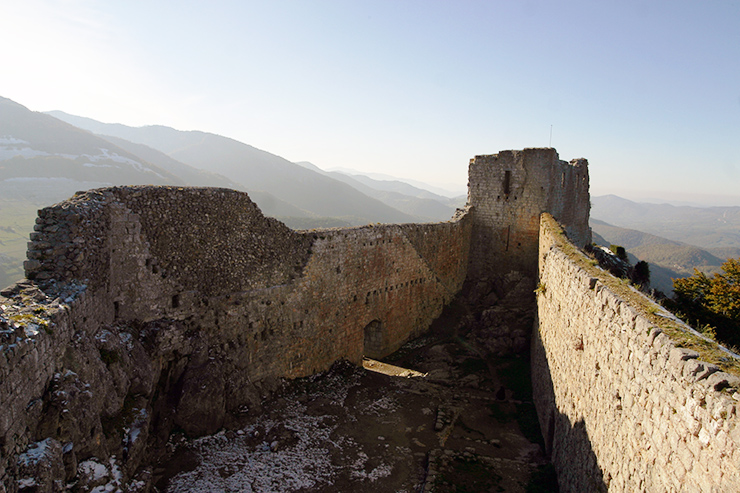
  • Otto Rahn & the Quest for the Holy Grail

    Otto Rahn & the Quest for the Holy Grail

    This article was published in New Dawn 43 (Jul-Aug 1997)

    Otto Rahn (1904-1939), described as a gifted young author and historian, was one of this century’s truly fascinating figures. Prior to his mysterious death, at age 35, he wrote two books about the Cathars of southern France: Kreuzzug gegen den Gral (“Crusade Against the Grail”) and Luzifers Hofgesind (“Lucifer’s Court”). Myth and legend continue to shroud both his life and tragic death. His books influenced such authors as Trevor Ravenscroft and Jean-Michel Angebert. In the 1982 best selling book Holy Blood, Holy Grail, Otto Rahn’s name appears in a small but intriguing footnote.

    Otto Rahn believed that he had found the location of the Holy Grail Mountain, the Montsalvat of legend, in the Cathar mountain fortress of Montsegur in the French Pyrenees. He was, says  Prof. Joscelyn Godwin, “largely responsible for the mythological complex that associated the Cathars and Montsegur with the Holy Grail and its Castle.”

    Norma Lorre Goodrich in her own highly acclaimed work The Holy Grail pays tribute to Otto Rahn’s Kreuzzug gegen den Gral (“Crusade Against the Grail”) describing it as “a wonderful book, a monument to this German idealist author, who died mysteriously during a descent in the Alps.”

    According to his French translator, Otto Rahn believed with absolute conviction that (1) the Cathars were the last owners of the Holy Grail, and (2) the Holy Grail “perished” when they died at the hands of the “pope and the King of France” at the beginning of the thirteenth century.

    Otto Rahn maintained that hidden within the Grail Romances was the essence of Catharism. The Quest for the Holy Grail was a symbolic presentation of Cathar initiation and the Grail itself (which in Wolfram von Eschenbach’s Parzival is a sacred stone) symbolised the Secret Tradition of the Cathars.

    The war of the Roman Catholic Church against the Cathars is variously described as a war where Roma and Amor stood opposite each other, in which the catholic (‘common’) idea triumphed with flame and sword over the catharic (‘pure’) idea.

    The Cathars or Cathari were members of a Gnostic Christian community which appeared in Western Europe in about 1050. They were also known as the Albigensians or men of Albi. This name derives from the city of Albi in southern France which was one of the Cathars’ chief centres. Perhaps as many as two million people belonged to the movement by the twelfth century and Catharism was beginning to become a serious rival of the Church of Rome.

    The Cathar claim to be the true church of Jesus Christ was a real threat to the authority of the Roman Church as Zoe Oldenbourg explains in Massacre at Montsegur:

    “The Cathars declared themselves the heirs of a tradition that was older than that held by the Church of Rome — and, by implication, both less contaminated and near in spirit to the Apostolic tradition. They claimed to be the only persons who had kept and cherished the Holy Spirit which Christ had bestowed upon His Church; and it looks as though this claim was at least partially justified….

    “Today we are better informed than they were concerning the practices of the Early Church, and have to admit that the Cathars merely followed a tradition somewhat more ancient than that of the [Roman] Church herself. It was with some appearance of reason that they claimed Rome as the party guilty of ‘heresy’ through her falling-out from the original purity which had characterized the Church of the Apostles.”

    The medieval Cathars believed in a cosmic battle between the principles of Light and Darkness on whose meetings and encounters everything in the universe was based. Darkness was for them dark matter, the unperfected, the transient. They identified all clerical and secular rulers, principally the Catholic Church as the personification of the Darkness. In their mythology the sun symbolised the primordial Light from which all life emerged. Miguel Serrano coined their doctrine: Solar Kristianity. For Otto Rahn, Montsegur was the “Lighthouse of Catharism.”

    Rahn’s Grail Quest

    Otto Rahn was born on 18 February, 1904 in Michelstadt in southern Germany. In secondary school he developed a fascination with the history of the medieval Cathars, their faith and revolt against king and pope. From 1922 to 1926 he studied jurisprudence, German philosophy and history. Rahn intended to write a dissertation on Guyot, the Provencal Troubadour on whose lost Grail poem Wolfram von Eschenbach claimed to have based his Parzival.

    The medieval Germanic tale of Parzival, revived in the 1800s by Wagnar’s popular mystical music dramas, fired Otto Rahn’s latter day quest for the Holy Grail. He soon pieced together a series of clues gleaned from a study of the history of the Cathars and the poem of Wolfram von Eschenbach, a Knight Templar of the thirteenth century.

    Driven by his deep interest in the Cathars and Grail legends, from 1928 to 1932 Rahn researched and travelled widely in France, Spain, Italy and Switzerland.

    Early in the summer of 1929 Otto Rahn made his first appearance in the Languedoc region of southern France. He quickly settled in the village of Lavelanet and over the next three months systematically explored the ruined Cathar temple-fortress on Montsegur as well as the surrounding mountain grottoes.

    It was in Languedoc that the city of Carcassonne, the holy mountain of the Cathars (Montsegur) and the mysterious church of Rennes-le-Chateau were located. All of these places were steeped in Cathar lore and it was here that all legends of the Holy Grail seemed to converge.

    At Montsegur, writes Nigel Pennick, “in 1244 the heretical Cathars had made their last heroic stand against a Catholic crusade which finally triumphed in their destruction. Here, tradition affirms that on the night before the final assault, three Cathars carrying the sacred relics of the faith slipped unnoticed over the wall. They carried away the magical regalia of the Merovingian King Dagobert II and a cup reputed to be the Holy Grail.

    “Possession of the Grail has always been the dream of chivalric orders. The Knights of King Arthur’s Round Table, the Templars, even the Teutonic Knights have sought the mystic vessel. But Otto Rahn believed that he could triumph where centuries of questing had failed. He had studied the sacred geometry of Montsegur, its sunrise orientations and its relationship with other sacred places, and had discovered secret underground passages, where he felt the treasure must be concealed.” (Hitler’s Secret Sciences)

    Nigel Pennick traces Otto Rahn’s knowledge of ‘sacred geography’ back to the Druids and Templars. The Cathars were also said to be familiar with this esoteric science.

    In many meetings with the local people (he spoke the local Provencal language fluently) Otto Rahn gathered everything concerning the Cathars and the Grail.

    In 1931 Rahn made an extensive exploration of the grottoes of the Sabarthes area south of Montsegur, notably Ornolac and the massive cavern of Lombrives. Here he explored a huge chamber called “the Cathedral” by the local people. Rahn later described this magnificent cavern as follows:

    “In time out of mind, in an epoch whose remoteness has been barely touched by modern historical science, it was used as a temple consecrated to the Iberian God Illhomber, God of the Sun. Between two monoliths one which had crumbled, the steep path leads into the giant vestibule of the cathedral of Lombrives. Between the stalagmites of white limestone, between walls of a deep brown colour and the brilliant rock crystal, the path leads down into the bowels of the mountain. A hall 260 feet in height served as a cathedral for the heretics.”

    Rahn tells how, “Deeply stirred I walked through the crystal halls and marble crypts. My hands put aside the bones of fallen pure ones and knights…”

    The local people called him a “seducer doubled with believer, an eternal adolescent with a superhuman passion for the Grail and the Hermetic Tradition”.

    Both Kreuzzug gegen den Gral (“Crusade Against the Grail”) and Luzifers Hofgesind (“Lucifer’s Court”) are full of remarkable insights and revelations of important historical links.

    Deep within the grottoes of Sabarthes Otto Rahn found chambers in which the walls were covered with symbols characteristic of the Knights Templar, side by side with emblems of the Cathars. This finding confirmed the notion, fostered by esoteric historians, that the Knights Templar and the Cathars were at one time closely associated. One intriguing image carved into the stone wall of a grotto was clearly a drawing of a lance. This depiction immediately suggests the bleeding lance that appears over and over again in the Arthurian legends.

    The legend of the Grail, explains the Chilean mystic Miguel Serrano, “reappears forcibly Christianised in the Middle Ages. The Templars disseminated it. It is centred on the legend of the court of King Arthur (who is the King of the Grail and is also called Amfortas). It is interesting to point out that Arthur is Arthos, Bear, that is to say Arctic. By which the exact geographical position of the lost continent of the first Solar Age is pinpointed: Hyperborea, seat of the Grail. In the Middle Ages, it became a cup, when the myth was Christianised, the one from which Christ was said to have drunk at the Last Supper, or else the one in which Joseph of Arimathea received the blood of Christ as it spurted from his side as he hung on the cross.”

    Otto Rahn believed it was possible to trace the Cathars, who guarded the Holy Grail in their castle at Montsegur, back to Druids who converted to Gnostic Manichaeism. The Druids in Britain were forerunners of the Celtic Christian Church. He saw in the culture of the medieval Cathar stronghold of Languedoc strong resemblances to the Druids. Their priests akin to the Cathar Parfaits. The Cathar secret wisdom being preserved by the later Troubadours, the travelling poets and singers of the medieval courts of France.

    Most Troubadours, according to Rahn, were secret Cathars. Their apparent yearning and longing songs only seldom dedicated to a special woman, their feminine symbolism referred to the Cathar community, the Sophia, the Wisdom of the Gnostics. Julius Evola explains in The Mystery of the Grail: “To make this doctrine inaccessible to the profane, it is hidden in an erotic symbolism, similar to the Grail cycle where it is represented by a heroic symbolism.”

    When Otto Rahn first studied Wolfram von Eschenbach’s Parzival he noticed remarkable similarities with names and places in southern France, and he suspected that Parzival’s Grail castle Munsalvaesche (Richard Wagnar called it Montsalvat) was none-other than the Cathar solar-fortress Montsegur. In Eschenbach’s work he discerned the influence of Cathar poetry. Otto Rahn adopted from the research of Cathar enthusiast Antonin Gadal the probably incorrect assumption that the persecuted Cathars had retreated under the earth and celebrated their mysteries in subterranean churches. Gadal gave Rahn the freedom of his library and private museum. In letters Rahn called him his “Trevrizent” (the uncle of Parsifal in Eschenbach’s work) and developed the propositions laid out in Gadal’s Au Chemin du Saint Graal.

    Antonin Gadal believed that the Cathars or ‘Good Christians’ derived from the original ‘Johannite’ form of Gnostic Christianity. ‘Johannite Christianity’ was based on the teachings of St John the Evangelist, the disciple whom Jesus loved and personally instructed in the Mysteries. The Cathars were said to possess the original version of John’s Gospel.

    The tale that Otto Rahn actually found the Grail and kept it until the end of World War II in the Wewelsburg, the SS castle near Paderborn, is easily disproved. There was a Grail in Wewelsburg but it was just a huge rock crystal. Rene Nelli, an important scholar of Catharism, maintains that existing Cathar texts do not mention the Grail, while Julius Evola did not think much of the Cathar Grail thesis.

    Return to Germany

    Otto Rahn left France in September 1932 and returned to Germany to devote himself to further studies of the Grail. In 1934, following on from his library research and his various expeditions, Rahn completed Kreuzzug gegen Gral (“Crusade Against the Grail”).

    Rahn showed that the heroes of Wolfram von Eschenbach’s Grail romances were modelled after real personalities. The pure knight Parzifal was a Carcassone Cathar, one of the foremost and heroic victims of the Crusade. The hermit Trevrizent was the Cathar Bishop Guilhabert de Castres; the King Anfortas, Raimon-Roger de Foix; and Montsegur was Montsalvage. Moreover, Montsalvage is protected by a Fountain “Salvage” in which Rahn believed he recognised the intermittent fountain of Fontestorbes, a few kilometres from the Pog, Montsegur’s promontory. Also, the forest around Montsalvage is called the “Briciljan” and close by Montsegur is Priscilien Wood. Rahn firmly concluded that the Fortress Castle of Montsegur was the Temple of the Grail.

    Rahn associates the Cathar Church with the Church of the Grail, with the mystical group Fideles d’Amour of Dante. He believed that the Templars after their enforced dissolution found refuge in the Pyrenean caverns. Rahn wrote of the many indications that the white tunic with octagonal red cross of the Templars was to be found with the black cassocks and yellow cross of the Cathars in the dark grottos of Sabarthes.

    Rahn believed that the Grail consisted of several tablets of stone engraved with runic or even pre-runic inscription. He believed that it was either one perfect emerald with 144 facets or 144 tablets of stone engraved in emerald. This emerald would have graced the Crown of Lucifer, symbolising his third eye, and which fell to earth, precisely on the Montsegur.

    Soon after its publication Kreuzzug gegen den Gral came to the attention of Nazi SS leader Heinrich Himmler. The SS hierarchy were eager for Otto Rahn’s collaboration in SS-sponsored research. After first joining the SS heritage bureau, the Ahnenerbe, as a civilian, his superiors quickly recognised his talents. Persuaded to formally join the SS in 1936, Otto Rahn became member 276 208 of the Allgemeine-SS.

    Paul Ladame, a friend of Rahn’s, insists that Otto joined the SS because there was no option. Ladame says Otto was no Nazi or racist. Himmler offered him a salary and the freedom to conduct his own academic research. To refuse may have resulted in Rahn’s eventual imprisonment anyway.

    In September 1935 Rahn was writing excitedly to the chief of the Ahnenerbe about the places he visited in his hunt for Grail traditions in Germany, requesting complete confidence in the matter with the exception of Himmler.

    Otto Rahn is even rumoured to have founded a neo-Catharist circle within the SS. In the summer of 1936 he undertook, by order of the SS, an expedition to Iceland. Intriguingly, the ship that sailed for Iceland flew a flag with a blue swastika on white background (in sharp contrast to the official standard of the Third Reich). Highlights of this journey formed part of some chapters in his second and final book Luzifers Hofgesind (“Lucifer’s Courtiers”), published in 1937.

    Rahn’s second book reads quite differently from his first. Arnaud d’Apremont writes in the preface to Luzifers Hofgesind that its style is more ideological, to all appearances ‘national-socialist’. However, more perceptive critics see Rahn in a quandary, having to toe the nationalist party line, negotiate the censor, and be able to write the full objective text he would have liked. He may even have indicated the irony of his position in the book’s title.

    But it is clear from Luzifers Hofgesind that Otto Rahn did not see Lucifer as synonymous with Satan, the Adversary, or the Devil. To Rahn, Lucifer was the Pyrenean Abellio, the Celtic Belenos, the Nordic Balder, the Greek Apollo. These are the Light-Bearers, an attribute Rahn, himself, wanted recognition for: a Lucifer.

    For Rahn the primordial Light came not from the East but from the North. He travelled around the ancient sacred places of Europe: Externsteine, the site of Irminsul, sacred symbol of the Saxons; Thingveillir, place of assembly of the ancient Icelanders, and Reykholt, birthplace of Sturlusson, the Nordic Homer and author of the Edda.

    One reviewer describes Luzifers Hofgesind as “an expedition through the ‘garden of roses,’ Rahn’s affectionate term for the Kingdom of the Asgardian Elfin, and a realm closed to non-believers or the uninitiated. Rahn dreams of a return to Thule, the primordial centre of the European Hyperboreans. He pines for a return to the Golden Age.”

    For Rahn the Holy Grail was an emblem set up in opposition to the Catholic Church — indeed it was a truly Luciferian [Light-Bearer] symbol. Lucifer stood in opposition to the god of Darkness, the god of the Church of Rome. Thus Otto Rahn wrote in his final book:

    “There is much more [Light] than in the houses of god — cathedrals and churches — where Lucifer neither is able nor wishes to enter due to all the sombre, stained glass windows whereon are painted the Jewish prophets and apostles, the Roman gods and saints. The forest, that, that was free!”

    During his time with the SS Rahn noticed that his telephone was tapped and that he was being spied upon.

    We know that Otto Rahn fell into disgrace with the Nazi hierarchy in late 1937 and for disciplinary reasons was assigned a tour of duty at the SS run Dachau concentration camp. In the winter of 1938/39 he wrote to the SS Reichsfuhrer requesting immediate dismissal from the SS. A few months later he was dead.

    Rumours abound concerning Otto Rahn’s departure from the Nazi SS. Some claim that he was a homosexual or of Jewish ancestry, but evidence is lacking. In a conversation Rahn claimed that he had been betrayed and that his life was in danger. In a letter to a friend he openly expressed his concern about the Third Reich:

    “I have much sorrow in my country. Fourteen days ago I was in Munich. Two days later I preferred to go into my mountains. Impossible for a tolerant, liberal man like me to live in the nation that my native country has become.”

    Col. Howard Buechner, the author of the Emerald Cup, says that Rahn “let it be known that he opposed the war for which Germany was obviously preparing in 1938. In place of war, he believed that Germany and then Europe, should be transformed into a community of ‘Pure Ones’ or Cathars. In other words, Rahn’s long association with the history of the Cathars and their unjust persecution by the church and the throne of France, had led to his conversion to the Cathar faith. He was also proposing a ‘New Order’ in which the states of Europe, and perhaps all other nations, would adopt the Cathar beliefs in the interest of world peace.”

    Otto Rahn gave his last public lecture — based on Luzifers Hofgesind — in January 1938. A local newspaper reported on his talk:

    “The Albigensians [Cathars] were exterminated. 205 leading followers of the Light-Bearer were burnt on a huge pyre by Dominicans in the South of France after a large-scale priestly Crusade in the name of Christian clemency. With fire and sword, the Lucifer doctrine of the Light-Bearer was persecuted along with its followers. The Albigensians are dead, but their spirit lives on and has an effect today through new devotion and rejuvenated enthusiasm. The Vicar of Christ could truly burn men; but he was mistaken if he believed that he burned along with them their spirit, devotion and longing. This spirit became alive again before many men yesterday, powerfully and visibly, in Otto Rahn, a descendant of the old Troubadours.”

    A little over one year later, on 13 March 1939 — almost on the anniversary of the fall of Montsegur — Otto Rahn died in the snow on the Tyrolean mountains. “In the manner of the Cathar heretics,” says Nigel Pennick, “Rahn voluntarily left a world he saw disintegrating.” A few years earlier Otto Rahn had written in Kreuzzug gegen den Gral (“Crusade Against the Grail”):

    “Their doctrine allowed suicide but demanded that one did not put an end to his life because of disgust, fear or pain, but in a perfect dissolution from matter. This kind of Endura was allowed when it took place in a moment of mystical sight of divine beauty and kindness…It is only one step from fasting to suicide. To fast requires courage but the final act of definitive ascesis requires heroism. The consequence is not as cruel as it may look.”

    The story of the enigmatic life and work of Otto Rahn, symbolising as it does a greater mystery, will always fascinate both students of the Holy Grail and seekers of the Cathar tradition. This mystery can be discerned in the following quote from Miguel Serrano’s Nos: Book of the Resurrection:

    “When we talk about the religion of love of the troubadours, of the initiated knights of the Grail, of the true Rosicrucians, we must try to discover what lies behind their language. In those days, love did not mean the same thing as it does in our day. The word Amor (Love) was a cipher, it was a code word. Amor spelt backwards is Roma. That is, the word indicated, in the way in which it was written, the opposite to Roma, to all that Rome represented. Also Amor broke down into ‘a’ and ‘mor’, meaning Without-Death. That is, to become immortal, eternal, thanks to the way of initiation of A-Mor. A way of initiation totally opposed to the way of Rome. An esoteric, solar Kristianity. The Gnostic Kristianity of Meister Eckhart. And mine. Because I have tried to teach western man to resurrect Kristos in his soul. Because Kristos is the Self for western man.

    “This is why Roma destroyed Amor, the Cathars, the Templars, the Lords of the Grail, the Minnesanger, everything which may have originated in the ‘Hyperborean Blood Memory’ and which may have had a polar, solar origin.

    “The love talked and written about so much in novels, poetry and magazines, the love of one’s neighbour, the universal love of the churches, love of humanity, has nothing whatsoever to do with ‘loveless love’ (A-Mor, Without-Death), which is a harsh discipline, as cold as ice, as cutting as a sword, and which aspires to overcome the human condition in order to reach the Kingdom of the Immortals, Ultima Thule.”

    This remains a fitting tribute to Otto Rahn.
    [alert type=”general” dismiss=”no”]This article was published in New Dawn 43.[/alert]

    [alert type=”success” dismiss=”no”]If you appreciate this article, please consider subscribing to help maintain this website.[/alert]

    © New Dawn Magazine and the respective author.
    For our reproduction notice, click here.