New Dawn – World's Most Unusual Magazine

Tag: consciousness

  • Consciousness: The Beginning & the End

    Consciousness: The Beginning & the End

    Nothing is more certain than the fact that we are conscious. And yet there is something very puzzling, even uncanny, about being conscious; and the learned talk of the mystery of consciousness. The mystery centres around the origin of consciousness; the prevailing scientific view is that consciousness is a property that emerges from complex brains. The problem is that we haven’t the foggiest idea of how the stuff of our minds could conceivably come forth from anything physical. Bits of electrified meat don’t easily translate into episodes of consciousness – we have it, we know it, in some sense we are it – but what it is and where it came from escapes us.

    There is also a mystery about the future of consciousness – I mean for each one of us there is the mystery of what comes after death. There’s no easy answer to the ‘after’ question, but I will offer my opinion, based on my own experience and research. We might begin by saying that the imagination of the human race is clearly in the affirmative about the ongoing journey after death. The mythic consensus is that consciousness continues after death, and does so in many forms and styles; accounts are recorded in the history of religion and poetry and more recently in the annals of psychical research. No doubt individuals have always had their private views and hunches on the great mystery. But a crucial turn of events took place in the seventeenth century; the scientific revolution began to overthrow the entire mythical worldview of humanity with its instinctive sense of gods and souls and spirits. The sky was disrobed of its divinity and turned into meaningless emptiness; according to Leopardi’s Story of the Human Race, all the illusions of the imagination were exposed and a great void of meaning settled down triumphantly in their place. Our consciousness, the new prophets of reductive materialism declared, will vanish with the brain’s entropic rot.

    Are we really forced into this worm’s-eye view of reality? People generally go along with the stories, rites, and customs for dealing with death that they inherit. But some break free and think for themselves. Some are exposed to modern scientific ideas (possessed by the conceits of reductive materialism) and the idea of another world starts to seem unreal. And yet, our views (apart from fashion) continually change in the face of new and unexpected experiences. So how we view death and the fate of our consciousness is sometimes based on the kinds and intensities of experience we have. For example, I am at least open to the idea of something going on after death because of some odd experiences I’ve had. (For an account of some of these, see my Soulmaking [1997] Hampton Roads: Charlottesville, VA.) A person who has had an unusual experience is likely to be more receptive to the idea of postmortem survival. Of course, one might have such a vivid encounter, and still in the end dismiss it as some seductive delusion. Others, on the other hand, may embrace great cosmic schemes on the basis of trivial coincidences.

    I have come to form my own view based on my experiences and my own thinking. My attitude toward this question of life after death is slightly odd. Three times I had encounters that were clear evidence for something smacking of survival, (including on one occasion being attacked and physically paralysed by a ghost), and yet I have doubts; I lack robust confidence that I will survive. Nevertheless, I would insist there are good reasons not to be cowed into premature disbelief.

    We can be silent about the dreaded subject or we can discuss and confront it. Moreover, it seems natural enough to yearn for more life, for infinite life, and there is no reason to suppress, condemn, or feel embarrassed about these yearnings. Let me explain one reason I resist the idea of survival. If indeed consciousness is an emergent property of the brain, it’s hard to suppose it could go on when the brain dies. In spite of being acquainted with ghosts and telepathy and precognition, the initial dependence on and emergence from the brain weighs against the idea of survival. But there is a way to move ahead on this. It is to drop the assumption that consciousness must be a product of the brain. Consciousness, after all, is utterly different in kind from anything physical we are acquainted with (barring certain abstract resemblances to quantum states). If one thinks carefully about it, the idea that consciousness grows out of our brains is more a verbal construct than an intelligible idea.

    Does the Brain DETECT OR Transmit Consciousness?

    Some scientists and philosophers have indeed argued that consciousness is not produced by the brain; rather, they hold that the brain is more like an organ that detects or transmits consciousness than produces it. According to this view, consciousness pre-exists and transcends body and brain, although it interacts with them. The important move is this: if we deny that consciousness is born from the brain, there is no reason to believe it must disappear with the death of the brain. (This is similar to an argument used by Plato in the dialogue Phaedo.) Now this shift toward the idea that we possess or are constituted by an irreducible mental factor has certain advantages. One of them William James noticed in his Ingersoll Lecture on Immortality of 1898: we are no longer obliged to try to figure out how the brain could create consciousness. If it’s so hard trying to explain consciousness as an emergent property of brains, it may be because it does not emerge from brains in the first place. Henri Bergson makes a similar point by suggesting that the mind by its nature continually overflows the boundaries of brain and body.

    This hypothesis of the irreducible nature of mind is consistent with the idea of postmortem survival. As pointed out, if the beginning of consciousness is not essentially tied to the brain, then death of the brain needn’t imply death of consciousness. This way of looking at consciousness as something basic in nature has other advantages. It is in tune with the great spiritual traditions that posit the primacy of some kind of greater mind. It also helps explain unusual mental functions like extrasensory perception. Consider something like telepathy, direct mind-to-mind contact. According to the view we have touched on, we are already mentally connected, it’s just that our minds generally cluttered with sensations and all kinds of distracting thoughts screen us (some would say protect us) from the mental life of others; if through some accident or discipline we could remove the clutter we would “see” things otherwise occluded.

    But there is something else. Our revision provides a basis for a type of experimentation that promises to induce experiences, impressions, and insights into the mystery of life after death. For this very personal question of life after death, there are things we can do; alter our life style, revise attitudes and values, and adopt specific practices. Reading about case histories and weighing all the arguments and interpretations are necessary and admirable. We need to supplement this indirect method by practice. And we need to experiment with the most fascinating subject we can readily find – ourselves.

    Break on Through to the Other Side

    Throughout history people have engaged in practices designed to help them “break on through to the other side” (The Doors). Certain kinds of people are more suited for this kind of venture: edgy, neurotic, strong-willed. These are the people who practice divination and shamanism; inspired poets, dancers and musicians; prophets and mystics; or ordinary people who find themselves in extraordinary, dangerous, life-threatening situations. By accident or by deliberate practice, human beings have and continue to have encounters with the transcendent. In terms of our practical hypothesis, they are either forced by circumstance or choose by discipline to remove the clutter of their ordinary mental life, so as to increase the likelihood of being struck by some form of transcendent lightning.

    There is nothing terribly strange about calling for this kind of self-experimentation. Traditions of the world are full of such practices. The native peoples of the Americas have always cherished their vision quest in highly individual ways. In the ancient world there were all sorts of mystery religions, which were group inductions into what Aristotle called pathe, experiences, not episteme, rational cognition. Like the native Americans, techniques of fasting, dance, chant, manipulation of symbols, etc., were used to induce contact with spirits, gods, and goddesses. Most famous were the Eleusinian Mysteries that lasted two thousand years in ancient Greece, an annual rite whose most notable effect was to create confidence in the soul’s immortality; after a nine day fast, the ingestion of a kykeon or “brew” of beer and psychoactive ergot, the rite culminated in the telesterion: the Goddess Persephone appeared in a blaze of glory. The experience was transformative as we know from testimonials of various notables, including Cicero and Sophocles and (indirectly) Plato. Different mystery rites used different gods to induce their encounter with the powers suggestive of immortality.

    With the rise of Christianity, a new mystery was invented called the Mass. As Carl Jung has explained, the Mass is a classic mystery rite in which the divine and immortal powers temporarily become present on the altar and the human becomes one with the God. And in the ancient world, even philosophy, especially as practiced by Platonists and neo-Platonists, was a kind of mystery rite designed to induce direct awareness of other worlds and higher dimensions of reality. Modern analytic philosophy would be at the antipodes of ancient philosophy, which was always about radical liberty and self-transformation. So, for Plato, philosophy was defined as the “practice of death” – in short, detachment of the psyche from the soma. To “practice death” is to quiet the distracted brain and open oneself to the greater consciousness.

    It is certainly an ironical fact that in this age of science and technology that seems to sponsor materialism, medical science is responsible for thousands of paradigm-challenging near-death experiences. NDEs and the Eleusinian rites have this in common: they produce feelings of confidence about the reality of another world. The near-death experience has become the equivalent of an ancient Greek mystery rite.

    In 2001, the Dutch cardiologist Pim van Lommel published a paper in the Lancet that described about a hundred and fifty cases of cardiac arrest in which individuals reported NDEs. This publication made headlines around the world. What is interesting is that these people had any experiences at all. The mainline view of neuroscience is that to have any conscious experience, certain specific parts of the brain (stem, frontal cortex, etc.) must be functionally interacting. But the moment the heart stops, blood stops flowing to those brain parts, so they can’t function. Nevertheless, in these cases, not only are there conscious experiences but experiences of an exalted character; brain quits working but consciousness doesn’t; on the contrary, it expands and intensifies in cognitive scope and richness of meaning. The NDE, instead of reflecting materialist views of mind, reflects the traditional view of mind as an independent reality – to be released not annihilated at death. In a near-death incident, the ‘filter’ on the full flood of consciousness is ripped away; the famous luminous bliss-drenched experience results. According to near-death research, deprived of a functioning brain, you may still have profound, conscious experience. This is an extraordinary scientific discovery.

    It would be a mistake to focus on one strand of evidence, however striking. What the diligent seeker of the mysteries must do is gain a sense of a whole family of pressure points on the belly of reductive materialism. We began by pointing to the sheer fact of consciousness, which is the basis of everything, and about which we know practically nothing. But there are specific features of consciousness that are suggestive for our purposes. Physicist Steven Weinberg, who thinks physics is inching toward a theory of everything, admits he would love to unpack the riddle of memory. Nobody even knows for sure if memory is even “stored” in the brain no less how.

    Memory Puzzles

    There are oddities of memory that compound the mystery of consciousness. A phenomenon only recently being studied is called ‘terminal lucidity’. These are cases widely reported of persons suffering from Alzheimer’s or other forms of brain disease unable to recognise even members of their own kin; then, at a time very near death these persons suddenly regain their memories, as if their conscious minds were starting to disengage from their brains in preparation for departure. Other puzzles about memory involve the stupendous mnemonic feats of some people afflicted-blessed with so-called ‘savant-syndrome’. And let me say that we fail to appreciate the astonishing creative power of the most common dream, in which an individual fashions for himself out of nothing a full-spectrum sensory world that one becomes completely immersed in – surely a phenomenon to give the earnest neuro-fundamentalist a headache. All these intellectually squishy spots we are palpating have something in common: the phenomena – dreams, terminal lucidity, and the enlarged mental faculties associated with arrested development – all these seem to be related to consciousness being forced back into itself. We attain to the omnipotence of dream, when (like the mystic) we cast aside reason and sense in sleep. The omnipotence of memory, whether with savant or near-death experiencer, seems to result from being robbed of the capacity to negotiate the external world. Again, the ‘filter’ is debilitated or entirely cast off.

    What I’m trying to say is this: Anyone who craves a more inwardly felt conviction not only concerning their survival but the qualitative value of that survival, should head for the green fields of personal experimentation. It would, however, help to know that behind us stands a mass of human experience that seems to say, “Yes, we found something – come on! Do not fear!” It would be useful to bear in mind the lush variety of tales, stories, and authenticated reports contending or implying that real people survive bodily death.

    It seems important there are many forms of experience that seem to reveal different people survived death. The manifold of breakthroughs seems to fit with the theory that has guided these reflections. The notion is that we – our individual mind-bodies – are immersed (so to speak) in a sea of consciousness. The pressure is constant on us, so to speak, and the slightest crack or fissure in our cognitive apparatus will cause a cascade into our consciousness.

    There is a well-known case of a man from North Carolina being visited by his father’s angry apparition during a series of dreams. The father proved himself by instructing his son as to the whereabouts of his hidden but final will and testament. He had hid it in an old Bible, and then died. The will was found and probated in court; it led to a more fair distribution of the father’s estate. Mr. Chaffin was dead for four years; no one knew the whereabouts of the will he had hidden in the old Bible until an apparition of the dead man revealed it to his living son. Actually, there is a parallel story about the last missing Cantos of Dante’s Divine Comedy. They were said to be missing until Dante’s son received intelligence from a dream of his illustrious father. Hidden in a secret compartment sequestered in a wall, the manuscript was found. In general, there are patterns of phenomena that are like words in a language that seems to want to speak to us. Such patterns cluster around the event of death. An interesting example would be the psychokinetic events often reported to occur at the moment of somebody’s death. Ernesto Bozzano collected cases of clocks stopping at the moment of death, paintings falling off walls, glassware shattering, pianos playing themselves, and in fact a huge variety of actual occasions. What appears to be happening is that a psychic factor at the moment of death is released and expresses itself in some meaning-bearing part of the environment. Again, the idea of death as a transition to enhanced power is indicated.

    As I said, the paths to post-mortem consciousness are manifold. One way is via reincarnation, and here I must mention the massive achievement of Ian Stevenson in collecting case histories all over the world. Thousands of carefully assessed cases – to use Stevenson’s word – suggest that memories, likes and dislikes, physical habits and even bodily marks may be identified usually among children no older than eight years old. Stevenson’s work has implications for understanding the depth and complexity of the human personality. These may shape our lives even if for the most part we are consciously out of touch with them. The Buddha once said that a person can see all his or her previous lives at the moment of enlightenment.

    Discarnate Intelligence

    Mediumship is another way that information about other worlds and discarnate intelligence may be obtained. Mediumship is found in the vicinity of ecstasy and possession. Mediums generally deploy ‘controls’, psychic constructs essential to make contact with the subliminal universe. A striking bit of evidence for life after death came about at the turn of the last century. The medium was the great Leonora Piper, under the careful investigation of the highly critical Richard Hodgson. It happened that Piper obtained a new control, called GP (for George Pelham); in life, he happened to be an acquaintance of Hodgson. The younger man was skeptical about survival, and promised offhandedly that should he die first, he would do his best to prove it to Hodgson. Soon after he fell off a horse in New York and was killed. Soon after that he was claiming to be speaking and writing through the body of Leonora Piper (as her new ‘control’). Hodgson wrote up the ensuing experiments in painstaking critical detail, and published the five hundred pages in the English Proceedings for Psychical Research. During “GP”’s tenure as control of Piper, “he” received one hundred and fifty people, thirty of whom GP in life personally knew. The personality that acted through the medium’s body behaved in a recognisably consistent manner, always in character and knowledgeable of precisely the thirty persons he knew in life, never confusing anyone he knew in life with any of the remaining strangers at the sittings. In short, the persona acting through Piper’s vocal chords and nervous system acted exactly like the real personality of a deceased person – a very difficult case to dismiss.

    So there is some robust evidence for life after death – as well as much that is tantalising and dubious. In the meantime, if you are impatient, you can try to launch your consciousness out of this world here and now and not hang on mincing proof, nor care about arguments or degrees of their weightiness. It might for all we know be very easy to gain an insight into the beginning and the end of consciousness. “Imagination is Eternity,” said William Blake who also said that death was just stepping from one room into another. It may not be possible to step all the way in, but you may be able to push open the door for a peek.
    [alert type=”general” dismiss=”no”]This article was published in New Dawn Special Issue Vol 6 No 2.[/alert]

    [alert type=”success” dismiss=”no”]If you appreciate this article, please consider subscribing to help maintain this website.[/alert]

    © New Dawn Magazine and the respective author.
    For our reproduction notice, click here.
  • Transcending Our Brain Created Reality: A New Call to Lift Nature’s Veil

    Transcending Our Brain Created Reality: A New Call to Lift Nature’s Veil

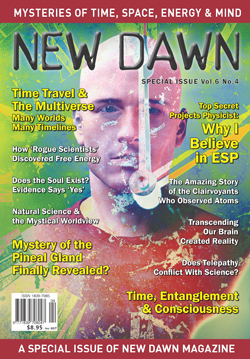
    From New Dawn Special Issue Vol 6 No 4 (Aug 2012)

    The study of non-ordinary states of consciousness is quickly becoming an established area of scientific and philosophical inquiry. Yet, all the enthusiasm about finding out what these non-ordinary states are somehow obfuscates much bigger, important, and urgent questions: What as-of-yet unknown aspects of reality do they give us access to? And what significance do those hold for the human adventure in space-time?

    In this article, I’d like to make a call-to-arms of sorts: A call for a structured, systematic, and rational inquiry into nature through non-ordinary states of consciousness, next to the now established investigation of non-ordinary states of consciousness.

    What Can We Really Know?

    Our Western civilisation is justifiably proud of its cultural, social, scientific, and technological achievements. Western values now pervade nearly all cultures on Earth, and Western-created technology has become an integral part of human activity. We look back at our historical past with the patronising attitude of an adult looking at a child: We have absolutely no doubt that we now know a lot more than we knew then and smile, full of hubris, at the naiveté of our ancestors. Unlike them, we now understand what nature is all about; we know who we are and what is going on; we even acquired a large measure of control, through our Faustian technology, of the forces and mechanisms underlying nature. The present is seen as the highest point ever reached in the historical mountain humanity has been climbing for about two hundred thousand years. Kings of the hill, we see ourselves.

    But are we, really? Do we really know what is going on? Or have we been caught in an invisible web of self-referential epistemic trappings?

    Allow me to explain what I mean here. The currently accepted view in neuroscience is that the ordinary, waking reality we experience every day is in fact a brain-constructed ‘hallucination’ analogous in nearly every way to a dream. Indeed, the same neuronal mechanisms underlie our experience of dreams and of waking reality.

    The difference between the waking hallucination you live your daily life in, on the one hand, and your dreamed-up hallucination during sleep, on the other hand, is merely this: The former is believed to be modulated by electromagnetic signals emanating from a supposed external reality that we can never have direct access to, for we’re irremediably locked into our brain-generated hallucination.1 It is this abstract, assumed external reality that, supposedly, explains why our waking experiences seem to be shared with other individuals, while our nightly dreams are highly individual and idiosyncratic.

    There is, in my view, a better hypothesis to explain this synchronisation of our experiences during waking states, without the need to postulate an entire, forever inaccessible, external universe.2 But this is beyond the scope of this article, whose conclusions should hold anyway, whichever hypothesis is true. What I want to stress here is that, whichever the case, what we experience in our lives every day is not reality as such, but a kind of brain-constructed ‘copy’ of reality. The original is supposedly an amorphous, colourless, soundless, tasteless realm of abstract energy fields.

    The question, of course, is whether we have any reason to believe that the copy is perfect. Assuming that Darwin’s theory of evolution is correct in its more essential aspects, we have to ask ourselves whether evolution would have favoured a brain that created a complete internal copy of reality, capturing in it all aspects of relevance for our understanding of the fundamental mechanisms of nature. Furthermore, we have to ask ourselves whether evolution would have favoured a brain that, whatever part of reality it did capture in its internal copy, copied them without significant distortions that could throw us completely off track as far as putting together an accurate worldview. The answer to both questions is no.

    Evolution favours physical survival, not per se the accuracy or completeness of internal representations. It is reasonable to think that some matching between our brain-generated copy of reality and reality itself is favourable for survival of the physical body: If a tiger is approaching you, it is useful to see the actual tiger, and not some other non-modulated, dream-like hallucination. But most people, scientists included, far overestimate the survival usefulness of accurate, complete internal representations.

    My own research on artificial neuronal networks shows that, very often, it is useful precisely to distort certain parts, and cut out other parts, of the external stimuli when creating an internal representation of reality in an artificial nervous system.3 Complete information is often confusing, drowning out the small parts that really matter. Undistorted information is often hard to act upon in a timely manner, due to the subtlety of its nuances. Therefore, these artificial nervous systems perform much more efficiently – and would stand a much better chance of survival if they had to compete in an ecosystem – when their own internal copy of reality is largely incomplete and distorted.

    As such, this is what evolution would have favoured and there is absolutely no reason to believe that the copy of reality you and I live in comes even close to what is really going on. We’re intrinsically limited to watching an edited and biased version of the film we’re trying to make sense of.

    Even the scientific instruments that broaden the scope of our sensory perception – like microscopes that allow us to see beyond the smallest features our eyes can discern, or infrared and ultraviolet light sensors that detect frequency ranges beyond the colours we can see – are fundamentally limited to our narrow and distorted window into reality: They are constructed with materials and methods that are themselves constrained to the edited copy of reality in our brains.

    As such, all Western science and philosophy, ancient and modern, from Greek atomism to quantum mechanics, from Democritus and Aristotle to Bohr and Popper, have been and are fundamentally limited to the partial and distorted copy of reality in our brains. Western science is thus, from a certain point-of-view, a house of cards built on shaky foundations: The scientific worldview is the result of an internal model of reality whose unreliability is an inescapable implication of that very model; a self-referential epistemic contradiction.

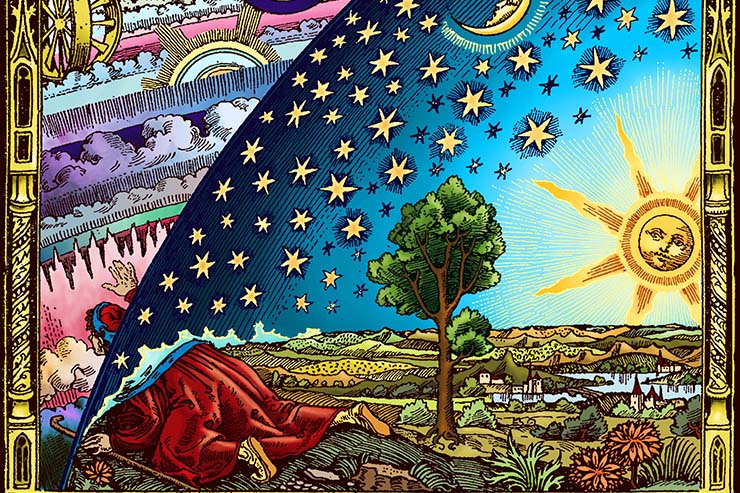
    For all we know, we may be locked in a small room trying to explain the entire universe outside by looking through a peephole on the door; availing ourselves only of its limited and distorted images. This, ironically enough, may be the situation we find ourselves in while naively celebrating our understanding of the cosmos and our place in it.

    Is there another alternative, or should we resign ourselves to the hopelessness of our ambition to understand reality? There is evidence to suggest that another alternative indeed exists. And, in that case, a new way to structure our inquiry into nature may offer unfathomable new possibilities.

    Looking Beyond the Veil

    Solid evidence has been accumulating that our minds cannot be explained solely by brain activity; the mind seems to transcend the brain.4 Yet, it is undeniable that the brain plays a significant role in our perceptions and behaviour, as, for instance, the effects of alcoholic drinks make plain and clear.

    In an earlier article in this magazine,5 I elaborated upon an alternative hypothesis for explaining the relationship between the mind and the brain; a hypothesis that, since the publication of that article, has gained increased scientific momentum: Consciousness is a fundamental aspect of nature, not depending on any material structure for its existence. The function of the body-brain system is to localise and restrict conscious perception to the space-time locus of the physical body. As such, the brain modulates and limits conscious perception, this being why, in ordinary states of consciousness, mental states correlate so well with brain states.

    As we’ve seen in the discussion above, such restriction and modulation of conscious perception – that is, the filtering and distortion of the copy of reality in our brains – can have a significant survival advantage, which explains why the brain evolved to perform such counterintuitive tasks.

    Now, because the brain works as a kind of filter of mind, restricting and distorting our view of reality for survival purposes, bypassing certain brain mechanisms could conceivably give one access to a broader, cleaner, crisper, and more reliable view of nature. Historically, most, if not all, methods for achieving non-ordinary states of consciousness seem to do precisely that: To enable expanded perception and understanding by reducing brain activity.

    The pattern here is so clear that it is surprising our culture seems to remain largely oblivious to it. For instance, many traditional Yogic breathing practices, as well as the more modern method of Holotropic Breathwork, reduce brain activity through the constriction of blood vessels that results from hyperventilation (which is precisely why you to get dizzy and ultimately faint when breathing too fast). Military pilots undergoing G-force induced loss of consciousness (G-LOC) – which forces blood out of the brain, thereby reducing its activity – are known to report transcendent narratives similar to near-death experiences. Teenagers worldwide play a dangerous, potentially fatal game involving partial strangulation in order to ‘trip’ without drugs.

    Even psychedelic substances, which have always been assumed to produce ‘hallucinations’ by stimulating brain activity, have recently been shown to actually reduce brain activity.6 At least two Nobel Prize laureates – Francis Crick and Kary Mullis – have attributed their prize-winning insights to such non-ordinary states of consciousness; a powerful corroboration for the notion that such states broaden understanding and increase insight, despite reduced brain activity. Even more subtle methods, like meditation, ritual prayer, and sensory deprivation (think of isolation tanks) are likely associated to decreased brain activity.

    The pattern here is as clear as it is ancient: Specific reductions in brain activity seem to consistently lead to a broadened and crisper perception and understanding of reality. The hypothesis that the brain is a mechanism to constrain and localise mind is entirely consistent with this: Reduction of brain activity impairs the filter/localisation mechanism, allowing one to temporarily and partially escape its entrapment and come closer to perceiving reality as it truly is.

    A tantalising possibility suggests itself, one that has been lost to Western culture perhaps since the extinction of the Eleusinian mysteries: An unfathomably broader and more authentic inquiry into the true nature of reality can be achieved through an expansion of the investigator’s own state of consciousness. That true inquiry involves not only the transcendence of physical limitations through the use of instrumentation, but – and more fundamentally – a transcendence of one’s own brain-based mental filters. To see and understand reality for what it truly is – to see the original, not the flawed copy – we need to temporarily escape the limitations imposed on us by biology and culture.

    A New Kind of Inquiry

    In my more hopeful moments, I envision the emergence of a ‘New Kind of Inquiry’ (NKI); one based fundamentally on the use of non-ordinary states of consciousness to access transcendent, yet natural ‘landscapes’ otherwise unavailable to our ordinarily filtered perceptions and cognition.

    Even though the use of such non-ordinary states is ancient, it has historically been restricted mostly to religious purposes and otherwise (semi-)dogmatic agendas. More recently – namely, in the 20th century – it has partly freed itself from such agendas, but become then a vehicle for purely personal, idiosyncratic insight. While valuable to the individual, the broader cultural impact of these personal insights has been extremely limited: Our culture is still dominated by the subjective belief-systems underlying the current scientific paradigm, which irrationally rejects the value of non-ordinary states.

    In the meantime, Western civilisation edges ever closer to a point of irreversible unsustainability, both environmentally and psychologically. To change the culture and safeguard a healthy and sane future, we need more than isolated, personal transcendence. Many of us, for fear of being foolish, need permission to allow our belief systems to change; permission that can only be gained through the institutionalised, collective validation of new hypotheses and worldviews.

    An effective NKI with contemporary appeal, capable of leading to a major paradigm shift in our modern relationship to reality, requires complete freedom from dogma and traditional symbolisms due to the baggage they carry. But such effective NKI must also entail more than personal, idiosyncratic excursions into transcendent landscapes if it is to have true cultural impact.

    As a first step in that direction, I envision an institutionalised NKI think-tank whose initial charter would be the study, creation, and refinement of methods for the achievement of non-ordinary states of consciousness. Even though countless such methods have traditionally been available, no systematic, structured, modern scientific study has been done for the very practical purpose of increasing their effectiveness (and safety). With modern scientific knowledge, we should be able to achieve a degree of success in enabling non-ordinary states of consciousness that traditional cultures could only dream of.

    For instance, while psychedelics have the advantage of nearly always delivering an unambiguous effect at sufficient doses, they are notoriously hard to control and the insights resulting from their use very difficult to interpret. In contrast, while meditation has historically proven to be the most fruitful method for the achievement of unfathomable but clear insights about the nature of reality, it is notoriously difficult to master to a point where truly transcendent, unambiguous experiences can be achieved. Could we synthesise the strengths of all these methods? Could new and more effective ones be invented, based on more modern technologies like, for instance, Transcranial Magnetic Stimulation (TMS)? The ultimate goal here would be the iterative refinement of a safe, reliable, effective, robust, best-in-class method for enabling any educated and healthy individual to pursue the exploration of landscapes otherwise unavailable to ordinary cognition.

    And here is where the second step of this vision comes in. Another, and more important, goal of the NKI think-tank would be to put the best-in-class method discussed above to practical and systematic use. Instead of adventurous individuals pursuing idiosyncratic exploration in isolation, without structure or suitable preparation, and unable to contribute their insights to a growing and coherent body of knowledge, the idea here is to organise structured and coordinated expeditions into transcendence involving various individuals; to have them collect data and compare notes upon returning; to build up and progressively refine compound maps based on reports from various explorers and their different perspectives; to find commonalities and consistencies, document them, and thereby reduce the unreliability of personal interpretations.

    The NKI think-tank would attempt to derive rational, coherent models for describing the underlying nature of reality; models that would take into account a broader set of data than that available to ordinary perception; models based on more than just the distorted and limited view through the peephole. Its explorers wouldn’t be random: They would be selected based on a broad skill-set. Like medieval explorers – who were selected based on their seamanship, as well as cartography, astronomy, and natural history skills – explorers in the staff of the NKI think-tank would be required to have a balanced skill-set encompassing knowledge of history, philosophy of science, epistemology, modern physics, neuroscience, psychology, mathematics, and, perhaps most fundamentally, the arts. Contemporary ‘renaissance men and women’, is what we’re talking about here.

    The think-tank would provide the entire infrastructure necessary for their voyages into transcendence: meditation spaces, isolation tanks, brain entrainment and TMS equipment, appropriate medical staff and facilities in case psychoactive substances would be used, etc. It would also host facilities required for journey preparation, as well as consolidation of results: Well-stocked libraries and network infrastructure for scholarly research; discussion rooms where explorers could debate and compare notes and ideas; conference facilities; data-processing facilities to enable the building of computer models inspired by transcendent insights; laboratory facilities for testing some of these models empirically; gardens for pondering, integration, and recuperation; etc.

    The NKI think-tank would also have its own publishing infrastructure: periodicals, book imprints, podcasts, video production facilities, websites, and all that is necessary for the dissemination of its results and ideas. Its independence from the currently established academic and commercial channels would initially be paramount, since the subjective values and belief systems underlying the current scientific paradigm, as discussed by Thomas Kuhn,7 would render these channels non-conducive to new, paradigm-breaking hypotheses.

    Through the respectability it would build up over time, the qualification of its staff, the quality of its results, as well as its communication and out-reach efforts, the NKI think-tank would insert itself powerfully into the collective mindset of the culture. It would give legitimacy to the New Kind of Inquiry it would embody and represent. It would broaden the horizons of civilisation through the generation of coherent, appealing hypotheses regarding the nature of reality and of our condition within it, free from tradition and dogma. It would give many intelligent, educated, and perhaps influential individuals permission – as well as a little more latitude – to seriously entertain worldviews that would otherwise be considered taboo. The NKI think-tank would become a significant catalyst for a shift of paradigm in the way our civilisation relates to reality and, as a bonus, re-introduce hope and meaning into the mainstream cultural dialogue.

    Get the issue this article appears in

    Concluding Remarks

    This is my dream for a New Kind of Inquiry. As a vision that aims at stimulating the imagination, it would be silly to restrict such a dream based on practical limitations or notions about what is ‘realistic’ to accomplish at this time. Therefore, I may have allowed myself to get a little carried away above. Still, I do believe that something along those lines is urgent and essential to the progress of our worldview as a civilisation. It may be essential even to our very physical or psychological survival.

    Our current materialistic worldview is self-contradictory, self-limiting, reduces humanity to a mere accident of probabilities, empties life of all meaning and telos, and manages to make no distinction between intellectual garbage and transcendent insight. Such is an unsustainable state of affairs; it translates itself into intellectual polarisation, alienation, and hysteria, all of which are plain to see in today’s society.

    A breakthrough is required, something I believe the collective unconscious is ‘cognizant’ of and which, therefore, becomes inevitable. With this article, I hope to have helped shape a mental image of how the breakthrough could begin to take place; a first of many steps required for the attainment of our true freedom.

    For more on this subject and related, see Bernardo Kastrup’s books Rationalist Spirituality (O-Books, 2011), Dreamed Up Reality (O-Books, 2011), and Meaning in Absurdity (Iff Books, 2011). 

    [alert type=”general” dismiss=”no”]This article was published in New Dawn Special Issue Vol 6 No 4.[/alert]

    [alert type=”success” dismiss=”no”]If you appreciate this article, please consider subscribing to help maintain this website.[/alert]

    Footnotes

    1. See, for instance: David Eagleman, Incognito: The Secret Lives of the Brain, Canongate, 2011, 44-51
    2. As elaborated upon in my books Dreamed Up Reality (O-Books, 2011) and Meaning in Absurdity (Iff Books, 2011), as well as in my YouTube video ‘Bernardo Kastrup – Real or Imagined? HD (Interview series, episode 3)’
    3. B. Kastrup and J. M. Seixas, ‘A Single-Neuron Weighting Technique for Classifiers,’ Proceedings of the ‘5th European Congress on Intelligent Techniques and Soft Computing,’ (EUFIT ‘97) Sept. 8-11, 1997, Vol. 1, 480-484. As well as: J. M. Seixas, L. P. Caloba, R. W. Santos, B. Kastrup, and F. S. Pereira, ‘Reducing Input Space Dimension for Real-Time Data Analysis in High-Event Rate Environment,’ Proceedings of the ‘International Conference on Artificial Neural Networks,’ (ICANN ‘95) Oct. 9-3, 1995, Paris, France, Vol. 2, 203-208
    4. Edward F. Kelly et al., Irreducible Mind: Toward a Psychology for the 21st Century, Rowman & Littlefield Publishers, 2007.
    5. Bernardo Kastrup, ‘Spirituality Is Not Flaky; Really,’ New Dawn, Nov-Dec 2011, 47-51.
    6. Robin L. Carhart-Harris et al., ‘Neural correlates of the psychedelic state as determined by fMRI studies with psilocybin’, Proceedings of the National Academy of Sciences of the United States of America, 17 January 2012, www.pnas.org/content/early/2012/01/17/1119598109
    7. Thomas Kuhn, The Structure of Scientific Revolutions, 3rd edition, The University of Chicago Press, 1996.

    © New Dawn Magazine and the respective author.
    For our reproduction notice, click here.

  • Reincarnation, the ‘Interlife’, Universal Consciousness & the Holographic Soul

    Reincarnation, the ‘Interlife’, Universal Consciousness & the Holographic Soul

    This article was published in New Dawn 116 (Sept-Oct 2009)

    Modern studies repeatedly suggest that a significant proportion of people in the Western world now believe in reincarnation. Although this phenomenon can be traced back to various esoteric movements that flourished from the second half of the 19th century, it gained significant ground with the explosion of popular interest in Eastern spiritual approaches in the 60s. And it was reinforced by a proliferation of therapists offering to regress people into their past lives.

    Yet now the tide seems to be turning again. For some years the emphasis has been moving more towards the idea that we are all part of the One, the All, the Source, the Absolute, the Ultimate, the Great Spirit or whatever we choose to call the ‘universal consciousness’. Of course this is not a new idea. But what is changing is that especially more intellectually minded spiritual seekers are tending towards the view that anything outside of the ‘One’ is mere ‘illusion’.

    In fact this word illusion is used a great deal in spiritual circles these days, although actually in quite different contexts, and it is perhaps worth considering what these are. Of course readers would all agree that the physical world itself is to some extent an illusion, at least inasmuch as it is underpinned by the nonphysical planes and states of being that science is increasingly pointing towards. But what about the idea that we only reincarnate for as long as we fail to see through the ‘illusion’, and that as soon as we gain ‘enlightenment’ we can ‘break the bonds of karma’ and ‘reunite with the Source’? More radical still, what about the idea that any notion of individuality is completely illusory on all levels, and that as soon as we die there is no sense of continuation of any sort of individual soul consciousness?

    Whether or not they make it explicitly clear, these latter two are the ‘illusion models’ supported by a significant proportion of our best-known spiritual commentators of modern times – be they proponents of, for example, the ‘power of now’, or of ‘cosmic ordering’, or of ‘quantum mysticism’. Yet to see the world in this way is entirely at odds with what we might call the ‘experience model’, which holds that we lead many lives in order to see all sides of every emotional coin, and to learn to deal with the manifest challenges that life on this planet provides. In other words, a model in which the emphasis is on an individual soul growing by experience over many lifetimes.

    If we are to adopt a rational approach then, rather than relying on ‘revealed wisdom’ ancient or modern, it is surely sensible to consider which of these models is best supported by logical analysis and the available evidence.

    We can start with the premise that there must exist some sort of ultimate force or energy that underlies the entire universe, both seen and unseen, which is the Origin or Source of everything in it. However ineffable it may be, this principle of a universal consciousness is almost a logical necessity, and it is certainly supported by scientific research at both the quantum and the macrocosmic level. The idea that ‘we are all one’ is also a common element of transcendental experiences, whether spontaneous, meditative or induced by hallucinogens. So our next step must be to investigate whether, at the same time, there is any real evidence to support the idea of an individual consciousness that exists or survives independent of the physical body.

    The most relevant area of research here is near-death experiences. In particular we are interested in cases that involve subjects returning with factual information that is subsequently verified, and yet so obscure that they could not reasonably have acquired it in any ‘normal’ way.

    Near-Death Experience & Reincarnation Cases

    One of the most fascinating cases on record took place in the early 70s, and involves a gifted young Russian scientist called George Rodonaia. His work on chemical brain transmitters was sufficiently valued by the KGB that they were not prepared to lose his expertise to the US by letting him take up an invite to further his research at Yale. On the day of his departure, as he stood on the pavement in Tbilisi waiting for a taxi to the airport, he was deliberately mown down by a car and pronounced dead at the scene. His body lay in a morgue for three days, but as the autopsy began his eyelids flickered and he was rushed to surgery.

    As a man of science George had never had any time for religion. So those close to him were bewildered when, three days into his lengthy recovery, he began to describe what had happened while he was ‘dead’. In fact his was a relatively non-typical and highly transcendental experience, but for our current purposes he also claimed he had also been able to travel anywhere he liked while ‘out of body’. In particular he was drawn to a newborn baby in the hospital adjoining the morgue because she would not stop crying, and doctors had been unable to diagnose the problem. Much to his surprise he found that he was able to communicate with her telepathically, and also to scan her body and establish that her hip had been broken, probably at birth. Incredibly, as soon as George was well enough to pass on this information, the doctors x-rayed the baby and found that she did indeed have a fractured hip.

    There are other, similar cases of near-death experiences involving obscure, factual information that combine to strongly suggest that our individual awareness or consciousness does indeed continue to exist even when the physical brain is absolutely non-functional. So far so good. But is there any evidence to support the further idea that individual souls have many lives?

    Here we encounter two important areas of research, the first involving children who have spontaneous memories of past lives. Although historically most of these cases have come from Asia, one of the finest involves a young American boy called James Leininger of Lafayette, Louisiana. Born in 1998, his fascination with toy planes from the earliest age took a more sinister turn as he approached his second birthday, when vivid nightmares began. He would thrash around in his sleep, kicking out with his legs up in the air and moaning: “Airplane crash, on fire, little man can’t get out.” His mother Andrea had no particular religious convictions but, when her mother suggested these might be memories of a past life, she began to encourage little James to talk about them. And he began to reveal startling details, such as that the pilot of the plane was also called James; that he had been shot down by the Japanese; that he had flown Corsairs; and that one of his fellow pilots went by the name of Jack Larsen. He also mysteriously mentioned the single word Natoma.

    His father Bruce remained dubious about any sort of spiritual explanation, but he knew that neither he nor any other member of their family had any particular interest in aircraft or the war. So he began to research, and quickly established that an aircraft carrier called the USS Natoma Bay had been stationed in the Pacific during World War II and had taken part in the notorious battle for the Japanese island of Iwo Jima early in 1945. He ordered a book about this, and was flicking through it one day when James pointed to the island of Chichi Jima on a map and exclaimed, “Daddy, that is where my plane was shot down.” He then made contact with the ‘Natoma Bay Association’, who confirmed that Jack Larsen had been one of the pilots, and also that only one pilot had been lost at Chichi Jima: 21-year-old Lt James M. Huston Jr.

    Bruce also knew that Huston had flown Wildcats, not Corsairs, on the Natoma Bay. But when he made contact with Huston’s elderly sister she kindly sent him some photos – including one of her brother standing proudly next to a Corsair. Military records then showed he had originally been part of an elite special squadron who test-flew these planes. But the real clincher involves three ‘GI Joe’ dolls. When Bruce asked his son why he called them Leon, Walter and Billie he replied, “Because they greeted me when I went to heaven.” Again military records confirmed that three of Huston’s fellow Natoma Bay pilots were Lt Leon S. Conner, Ensign Walter J. Devlin and Ensign Billie R. Peeler – and that all three had died before Huston on other engagements. None of this detailed information is available on the internet pages about the Natoma Bay even now, let alone in popular books and so on.

    Past Lives & Hypnotic Regression

    The second area of past-life research is hypnotic regression. With this we must first appreciate that the human brain appears to store a complete record of everything we have ever been exposed to, no matter how briefly or how long ago, and that although most of these memories remain inaccessible to our normal consciousness they can be accessed in trance. So apparently authentic and detailed past lives, even including strong emotions and strange accents and so on, have sometimes been proved to come from perfectly normal sources – not least historical fiction, which is often overlooked by spiritual researchers. Nevertheless, there remain some cases involving information so obscure that only a paranormal explanation seems appropriate.

    One of the finest involves a young woman dubbed Jane Evans, who was one of many subjects regressed by the Welsh hypnotherapist Arnall Bloxham. She first visited him in the late 60s and proved a responsive subject who, over the course of a number of sessions, regressed into six separate lives from Roman times onwards. She would go on to be the star of a 1976 documentary made by the initially sceptical BBC producer Jeffrey Iverson, entitled ‘The Bloxham Tapes’. Her most celebrated past life was that of a persecuted Jewess in 12th century York, but on close investigation this case is somewhat inconclusive. In fact her strongest life in terms of obscure evidence involved Alison, a young servant to the 15th century French financier and merchant, Jacques Coeur.

    Some of the historical information Jane came up with in trance was relatively obscure, and could only be verified by professional French historians. For example, she said that Charles VII’s nickname was “heron legs”; that his son Louis had poisoned his wife; that his mistress Agnes Sorel had two pet dogs clothed in “coats of white fur with jewelled collars”; and that Coeur was Jewish and his father was a goldsmith. Perhaps more impressive was her knowledge that Coeur was an avid collector of art, with paintings by Jean “Fouquet,” the court painter to the king and one of Coeur’s debtors; by Jan “van Eyck,” the court painter to the nearby Duke of Burgundy; by “Giotto,” an Italian master from the previous century; and by the little-known “John of Bruges” who, Iverson established only with great difficulty, was also known as John Bondolf and was a Flemish court painter for the king’s grandfather. More impressive again was her report that Coeur had a “body servant” called Abdul, who was “dressed differently from the others” – because it was only from obscure French court records of the time that Iverson was able to confirm that he did indeed have an Egyptian body slave.

    Impressive enough, yet the clincher in this case is Jane’s recall of a “beautiful golden apple with jewels in it” that she said had been given to Coeur by the Sultan of Turkey. All of Iverson’s initial attempts to verify the existence of such a piece drew a blank until his last night in Coeur’s home town of Bourges, when he returned to his hotel to find a message from a local historian. The latter reported that he had been searching through contemporary archives when he found “an obscure list of items confiscated by the Treasury from Jacques Coeur”; and in that list was a “grenade” of gold – a pomegranate. Of course this is so like an apple in shape and size that the English word contains the French root pomme. It is also worth noting that one sceptic’s supposed attempt to trace all these details to a historical novel is a complete travesty, because the novel has an entirely different plot and contains virtually none of these obscure details.

    Again there are other, similar cases of both childhood recall and regression that involve equally obscure yet verifiable information about past lives. But could all these merely result from subjects tapping into some sort of universal memory, or even from possession by the deceased? Probably the strongest evidence that these are indeed memories from the subjects’ own, individual, past lives comes from subjects also being regressed into the time between lives, or ‘interlife’.

    This stems from the research of a number of pioneering psychologists and psychiatrists around the world, who each stumbled on the interlife independently in the 70s and 80s. Their subjects’ reports are extremely consistent, so that the experience can be broken into five main elements: transition and healing, past-life review, soul group interaction, next-life planning and returning. This evidence from what now constitute thousands of subjects from diverse backgrounds suggests strongly that there is a continuity of individual soul identity across many lives.

    The Holographic Soul

    So how do we properly bring this evidence of individual soul survival and reincarnation together with the idea of a universal consciousness that underlies everything? Although the most profound spiritual sources have hinted at the truth throughout the ages, the most simple yet elegant solution has only become available to us in recent decades with the discovery of the hologram. And it involves applying this principle not to the brain, nor to memory, nor even to the universe as a whole, but instead to soul consciousness itself:

    Soul consciousness is holographic. We are both individual aspects of the Source, and full holographic representations of it, all at the same time. However this does not mean that soul individuality is in itself an illusion. The principle of the hologram is that the part contains the whole, and yet is clearly distinguishable from it.

    The other message that comes through loud and clear from interlife research, as well as from the most profound spiritual sources, is that free will and personal responsibility reign supreme. This is what allows us to learn from our mistakes, and to grow as souls. So any next-life previews seen between lives merely represent major probabilities and lesser possibilities, and there is no karmic punishment or predestiny. Indeed the idea of karma itself has arguably outlived its usefulness, because it is clear that the dynamics of how our attitudes, intentions and experiences feed into the futures we create for ourselves, both across and within lives, are far too complex to be reduced to simplistic ‘laws’.

    In conclusion it appears that there are no ‘flaws in the grand plan’. The physical world is not an abomination created by fallen angels. Nor is the reincarnation cycle something to be escaped from at all costs, either by suddenly gaining the enlightenment to see through the illusion, or by learning to give up all ‘attachment’ so as to generate no more karma. Although we would do well to aim for a degree of emotional detachment and balance, and regular meditation is absolutely invaluable in trying to bring our ‘higher selves’ to the fore, life is to be lived and experienced!

    So where does it all end? Interlife evidence, again backed by the most profound spiritual sources, suggests that we continue to reincarnate until we have exhausted all the possibilities for growth in the physical plane. And this is only the ‘end of the beginning’ of the soul’s journey, because there are many other opportunities for new experiences in other realms. As for the idea of ‘reuniting with the Source’, the concept of the Holographic Soul suggests that we never split off from It in the first place, and that It is always within us and us within It.

    What about the million dollar question from which ‘illusionists’ tend to shy away? What is the whole point of the universe in the first place, and how do we humans fit into the ‘big picture’?

    The Source’s primary aim, in diversifying into all the billions of holographic soul aspects of itself that operate in the various realms throughout the universe, is to experience all that is and can be. So as individualised aspects of the Source who have chosen to reincarnate on this planet, we are merely fulfilling a small part of that objective by gaining a balance of all the experiences available via this route.

    James Leininger’s amazing story is documented in the book Soul Survivor: The Reincarnation of a World War II Fighter Pilot

    [alert type=”success” dismiss=”no”]If you appreciate this article, please consider subscribing to help maintain this website.[/alert]

    © New Dawn Magazine and the respective author.
    For our reproduction notice, click here.
  • Waking From Sleep: The Causes of Higher States of Consciousness

    Waking From Sleep: The Causes of Higher States of Consciousness

    From New Dawn 120 (May-June 2010)

    Higher states of consciousness (HSCs) – or awakening experiences, as I prefer to call them – are moments of revelation, when we perceive reality at a heightened intensity. The world around us comes to life, and is filled with an atmosphere of harmony and meaning. A spirit-force seems to pervade all things, and the spaces between them, bringing everything into oneness.

    We experience ourselves as part of this oneness too, and feel ecstatic or serene. At the highest intensity of awakening, we might feel that we’ve become one with the universe, and attain a state of complete fullness and perfection. The whole material world may dissolve away, into an ocean of spiritual radiance.

    These experiences are sometimes associated with meditation, nature or psychedelic drugs, but what exactly is it that causes them? Why is it that the limits of our normal consciousness sometimes fall away, giving us access to a world of is-ness, beauty and meaning which is normally hidden from us?

    Neuroscientists generally believe that HSCs are caused by changes in brain activity. However, just because HSCs or awakening experiences appear to be associated with certain brain states, it doesn’t necessarily mean that the brain states produce the experiences. It could be the other way round – increased electrical activity in the frontal lobes, or less activity in the posterior superior parietal lobe, could just as easily be the result of higher states of consciousness rather than causes of them. These scientists may only be looking at the ‘footprints’ of the experiences, rather than the cause of them.

    My view is that there are two basic types of awakening experiences, which have two distinct causes. The first type are wild, ecstatic experiences that happen when the normal homeostasis of our brain and bodies is disrupted. This is a ‘loophole’ which human beings have made use of throughout history. This is why there has always been a link between fasting and spirituality, for example. A prolonged lack of food appears to make the hold which ordinary consciousness has over us looser, and bring us closer to an awakened vision of the world. Fasting puts us ‘out of homeostasis’ by causing physiological changes, such as a lower level of blood glucose, higher levels of insulin and a lower body temperature.

    Indigenous peoples often fast and deprive themselves of sleep as a preparation for rituals, dance and vision quests, using physical deprivation as a way of ‘purifying’ themselves. The Vision Quest was a spiritual exercise used by some Native American peoples as a way of building up spiritual power and communicating with spirits. The person would go to a solitary spot – often the top of a mountain – and stay there for up to four days, fasting and exposing themselves to the elements (usually wearing almost no clothes, even if the weather was cold). He or she would try to attain a state of complete attentiveness to their surroundings, since sacred powers might try to communicate with them at any moment. As a result, they might experience a higher state of consciousness (that is, higher than their normal low level higher state), with strong feelings of peace and a sense of connection to the natural world, and also be given special knowledge – such as a message or a new song or dance – from spirits.

    In ancient Greece and – at a later time – throughout the Middle East and the Roman Empire, a large number of esoteric cults existed outside conventional religions. These ‘mystery cults’ were usually centred around particular gods, but rather than just worshipping them, the participants aimed to become one with the gods, or to be possessed by them. They fasted and went without sleep before ceremonies, and used a variety of other methods of disrupting homeostasis during them: they would take drugs, beat themselves, and dance frenziedly, so that they might be – in the words of the ancient philosopher Proclus, who observed the mysteries at first hand – “filled with divine awe.”

    Pain can also be used as a way of inducing awakening experiences. We can see this in the long tradition of asceticism, for instance, which runs through all of the world’s religions and spiritual traditions. An ascetic is someone who deliberately denies his body’s needs, and inflicts pain and discomfort on himself, either through fasting, abstaining from sensual pleasures and comforts, or by physically beating or injuring himself. This sounds like sadism, and for some ascetics it probably was. It’s also likely that some ascetics were motivated by morbid self-hatred and neurotic feelings of guilt towards sex and other bodily processes, which made them want to punish themselves.

    It goes without saying that inflicting pain on yourself, or forcing yourself to go without sleep or food, are hardly ideal ways of transcending ordinary consciousness. Although some ascetics apparently managed to continue torturing themselves for years and even decades, there’s obviously a very high risk of seriously injuring yourself, or dying of self-neglect. Aside from the famous ascetics like St Simeon Stylites and Henry de Suso, there were probably many others who followed similar practices but didn’t live long enough to gain any recognition. As a short term spiritual technology asceticism is fairly futile anyway; you might gain a brief glimpse of a higher reality but this only lasts as long as the chemical changes that the pain and suffering have produced inside you. Your body always returns to homeostasis, and you always have to return your constricted normal consciousness.

    There must be easier ways of ‘disrupting the equilibrium’ than fasting, sleep deprivation or pain – and there are. If we know that all an ascetic is really doing by torturing himself is changing his normal chemistry, then surely, you might say, it’d be more sensible to just interfere with this chemistry directly – by taking drugs, for example, which would give us the same effect but wouldn’t involve any self-harm.

    Human beings have always used drugs as a means of intensifying or altering consciousness. The early Indo-European conquerors of India worshipped their drink Soma, which most scholars believe was made from magic mushrooms; while the initiates of the Greek Eleusinian mysteries used a psychoactive drink called kykeon. Indigenous peoples often use drugs for spiritual purposes too: Native Americans ingest sacred plants such as fly-agaric mushrooms and peyote, while the Australian Aborigines have a powerful form of tobacco called pituri. In the right circumstances – and the right state of mind – psychotropic drugs can, it seems, take our minds out of the ‘mould’ of ordinary consciousness, and give us access to wider and more intense realities.

    Intensifying Life-Energy

    The second type of awakening experiences are more serene and calm states which occur when our life-energy (or vitality) becomes more intensified. Normally there’s a continual outflow of our life-energy – it’s used up through mental activity (such as cognition, concentration and perception) and through our emotions and instincts. But sometimes, when we’re relaxed, fairly inactive and our minds are quiet, this outflow or energy decreases. Life-energy becomes concentrated inside us, which generates an awakening experience.

    This is why meditation often generates spiritual experiences. When we sit down to meditate, we take ourselves off the treadmill of daily tasks and activities for a while, and sit quietly and close our eyes, so that we don’t use up much life-energy through concentration and perception. Our ‘thought-chatter’ slows down too, and we normally become free of emotional activity and sexual desire. As a result, after meditation there is an inner concentration of our life-energy, it’s concentrated and intensified rather than dispersed and dissipated.

    We can see meditation is a conscious attempt to build up an intensification of life-energy and so generate awakening experiences, but there are many situations when this happens spontaneously. This is the reason why nature is such a powerful trigger for awakening experiences, for example. The beauty of nature may have a similar effect to a mantra in meditation, directing attention away from the chattering of the ego-mind. Cognitive activity may fade away, until life-energy intensifies, bringing a sense of inner peace and wholeness and heightened awareness of the phenomenal world.

    Sports can trigger awakening experiences too. This is particularly true of sports which involve long periods of monotonous rhythmic activity, such as long distance running or swimming. The activity itself serves as a focusing device, and quietens the chattering ego-mind. Similarly, the poet Ted Hughes often experienced a meditative state while fishing. He notes how poetry depends upon the ability to intensely focus the mind, and believes that he acquired this ability through fishing. He describes the effect of staring at a float for long periods: “All the nagging impulses that are normally distracting your mind dissolve… once they have dissolved, you enter one of the orders of bliss. Your whole being rests lightly on your float, but not drowsily, very alert.”

    This may also be part of the reason for connection between sex and spiritual states. The sheer pleasure of sex can shift our attention away from the ego-mind, which may fall silent as a result, bringing what D.H. Lawrence described as “the strange, soothing flood of peace which goes with true sex.” At the same time, sex may release new energy inside us, energy which is normally dormant but can arise and shoot through us like electricity.

    HD Versus ILE States

    As sources of awakening experiences, ILE (intensification of energy) states have certain advantages over HD (homeostasis disruption) states. The latter have more physical and psychological risks. Drug experiences (and other HD states) produce a powerful blast which immobilises the ego, and if this blast is regularly repeated the ego structure may dissolve, and never be able to re-form itself.

    In a sense, HD experiences are only really a shortcut too. It’s as if we’ve just stumbled on a defect in the mechanisms of consciousness, a kind of legal clause which gives us a quick and easy way of escaping ordinary consciousness, and are exploiting it. You could compare it to schoolchildren tricking their teacher into leaving the room so they can enjoy a few minutes of freedom while she’s away – but the teacher always comes back again, of course, and then everything goes back to normal. On the other hand, ILE states can bring about permanent change in a more organic and positive way. They can change the structure of the psyche without damaging it, and gradually create a new state of being, so that wakefulness becomes not just a temporary experience, but a permanent state.

    This isn’t to demean the importance of higher states of consciousness induced by drugs or other HD states. They can come as a bolt out of the blue, breaking through the familiar, taken-for-granted world and making us aware that higher realms of reality do exist. For some people, their first experiences of psychedelics might have the same effect as experiencing flashes of normal complete vision would have on a man who’s been partially blind all his life without realising it. The powerful transcendent reality they’ve been exposed to may also bring about a change in their personality, at least over the following months, and perhaps even years. It might make them more humble, less materialistic or egotistical, and give them a sense of security or hope, making them aware that the world is more meaningful and harmonious than they had believed.

    For many people, drug-induced awakening experiences have been the beginning of a spiritual journey, encouraging them to investigate Eastern spiritual traditions or more reliable and healthy consciousness-changing practices. This is what happened to the Harvard professor Richard Alpert, for example, who was one of the pioneers of research into psychedelics. He conducted experiments with psilocybin at Harvard University with Timothy Leary in 1962, and continued studying the effects of psychedelic even after he was expelled from the university. However, Alpert quickly became disillusioned with drugs, doubting that they could lead to permanent change, and travelled to India, where he learned yoga and meditation and took the name Ram Dass. He has spent the rest of his life exploring spiritual practices and teachings and spreading the wisdom he has found.

    On the other hand, using drugs as a spiritual technology may create a passive attitude, and a reluctance to make the long term disciplined effort which permanent transformation requires – as was the case with Ram Dass’ colleague Timothy Leary, whose pursuit of ‘chemical enlightenment’ degenerated into a life of self-indulgence. As the religious scholar Huston Smith put it, “Drugs appear to induce religious experiences: it is less evident that they can produce religious lives.”

    [alert type=”general” dismiss=”no”]This article was published in New Dawn 120.[/alert]

    [alert type=”success” dismiss=”no”]If you appreciate this article, please consider subscribing to help maintain this website.[/alert]

    © New Dawn Magazine and the respective author.
    For our reproduction notice, click here.
  • Consciousness, Resonance & the Paranormal: Synchronised Swimming in the Quantum Sea

    Consciousness, Resonance & the Paranormal: Synchronised Swimming in the Quantum Sea

    As a kid, watching the synchronised swimming competition of the summer Olympic games, I was always struck by how silly the sport seemed. Not to mention how it looked! Later, as a wise adult, I came to understand and appreciate both the degree of difficulty of getting human bodies to move in perfect unison, and the beauty that results when they do.

    Humans often operate in synch with others. I am reminded of groups of women who work or live together menstruating at the same times, as if their hormonal systems sought a certain resonance of unity and harmony, and adjusted the individual bodies accordingly.

    But bodies are not the only things that resonate. Quantum physics has taught us that there is no such thing as empty space, and that the so-called vacuum of space often called the Zero Point Field (ZPF), is teeming with quantum fluctuations that display a resonance, a vibration. Nothing does not vibrate. There is no such thing as zero, dead, still. Everything that exists gives off some vibration of a certain frequency.

    Every planet, every person, every particle.

    Musicians know that when a guitar string is plucked on one instrument in a music store, all the other guitars in the same room will vibrate to that tone. Healers refer to this as “entrainment,” when two objects (or people!) in close proximity, vibrating on different frequencies, begin altering their vibrations until they are vibrating at the same, or nearly the same, frequency. The Zero Point Field could act as a field of “entrainment” or resonance, where the vibrations of particles tune to specific frequencies, creating different forms of matter, energy and interactions. Other scientists believe this field has different names.

    In 1998, physicist Paul Steinhardt and his colleagues coined a term that would describe a mysterious field of what they believed to be dark energy, or a “fifth essence.” They called it “quintessence.” Based upon an earlier idea proposed by Fermilab physicist Chris Hill and colleague Josh Freeman, quintessence suggested that, like the cosmological constant of Einstein’s vision, this essence fills all of “empty” space with a form of matter-energy that is changeable in strength. Some parts of space might have a thicker quintessence, others a thin “layer,” creating a field of invisible essence that has no direction, like a vector field, only magnitude, like a scalar field.

    Described as kinetic energy by Tom Siegfried in Strange Matters, the strength of this field would be measured by how quickly it approaches the zero point. Because quintessence is believed to exert negative pressure, it is said to be a slow rolling scalar field, one that does not change too quickly over a period of time. Whether or not quintessence is the dark energy so eagerly sought by physicists will decide the fate of the universe itself, because of its relationship to expansion. The presence of a negative energy in space would possibly stop the expansion.

    Aside from the role quintessence plays in the outcome of our universe’s destiny, it may also play a role in the way matter and energy interacts, or resonates. Nature is filled with signs of the importance of resonance and the beauty of synchronicity. From the physical foundation of all musical composition to the intricate mathematical ratios of the natural world, there seems to be an element of “arrangement” that results in a visible pattern.

    Physicist David Bohm believed that underlying the physical, tangible world, there was a far more mysterious, deeper order of “undivided wholeness.” He called the visible world the explicate order, and that deeper world the implicate order, and used the analogy of a flowing stream to describe his realisation of unbroken unity.

    “On this stream, one may see an ever-changing pattern of vortices, ripples, waves, splashes, etc., which evidently have no independent existence as such. Rather, they are abstracted from the flowing movement, arising and vanishing in the total process of the flow. Such transitory subsistence as may be possessed by these abstracted forms implies only a relative independence or autonomy of behaviour, rather than absolutely independent existence as ultimate substances.”

    Those rather philosophical words came from Bohm’s Wholeness and the Implicate Order, which he wrote in 1980, and suggested the world of the implicate order was similar to a hologram, where the complex interference patterns appear to be chaotic and disordered to the naked eye, yet on a deeper level possess a pattern that is hidden or “enfolded” into the whole object. Bohm even suggested the universe itself was like a flowing hologram, or “holomovement,” that contained order on an implicate level. The explicate order would be the projection from higher dimensions of reality, and any apparent stability of objects and entities are really a sustained process of enfoldment and unfoldment. Nothing solid is really solid at the implicate level.

    Bohm also believed there was a superquantum potential, or a higher “superimplicate” order operating in the universe, and that life and consciousness were enfolded within, with matter appearing in varying degrees of “unfoldment.” He even stated that the separation of matter and spirit is nothing but an abstraction, that the “ground is always one.”

    All is Vibration

    The study of music (and the patterns of sacred geometry) suggests an invisible, “implicate” vibratory nature. Sympathetic Vibratory Physics is a term assigned to a “musical universe,” an interesting alternative theory of reality proposed by Walter Russell in A New Concept of the Universe. Russell believes that there exists nothing in nature other than vibration. He attempts to create a paradigm of reality using wave and vibration theory based upon the work of John W. Keely’s concepts of a sympathetic vibration that connects all things and energies, and that the harmony of these vibrations creates what we see.

    Russell and Keely suggest that music can be thought of as a model of the order found in the universe, with organised vibration or sound following principles of structure and behaviour that make sound into harmonies. These principles mimic those governing other vibratory patterns in the universe.

    Take the idea that everything is the result of a vibration, and even Zero Point Energy in the quantum vacuum has been shown to “jiggle” or vibrate. Everything has its “jiggle.” We can go on to say that different things have different “chords” or “vibration signatures,” and that is what makes one thing discernible from the next. Sounds a lot like superstring theory, with tiny, vibrating cosmic strings at the very heart of existence.

    Vibrations are dynamic, interacting with one another and their environment, creating different tones and chords and harmonics. In a sense, vibrations are more fundamental to reality than the tiniest subatomic particle, because in a sense, that is what the tiniest particle is… a vibration.

    The most exciting thing about this invisible vibratory field, no matter what form it might take, is the potentiality it contains. Potential as a source of all other sources. Potential as a pure energy field upon which all matter is created and thrown out into the explicate order. Potential even is a doorway to other dimensions or levels of reality, where things like ghosts, UFOs and psychic abilities are the norm.

    “Subquantum Kinetics” & “Morphogenetic Fields”

    Physicist Paul LaViolette writes extensively about “transmuting ether” in his book, Genesis of the Cosmos: The Ancient Science of Continuous Creation. This ether, which is the basis of LaViolette’s theory of “subquantum kinetics,” is described as an active substrate that differs from the mechanical ethers once considered in previous centuries. LaViolette states, “The concentrations of the substrate composing this ether are the energy potential fields that form the basis of all matter and energy in our universe.” The ether reactions cause wave-like field gradients that emerge and form the “observable quantum level structures and physical phenomena,” including the various particles, forces, fields and electromagnetic waves.

    Subquantum kinetics, which LaViolette proposes as a unified field theory that fills in the gaps conventional physics cannot, rests on the existence of this “primordial” transmuting ether present throughout space. “The transmuting ether is the wellspring of Creation,” he states, adding that were its activity to diminish, everything physical would cease to exist, coming to a state of “multi-dimensional consciousness” from which the physical universe is generated. A ground state, or Source of all Sources.

    Rupert Sheldrake, biologist and co-author of The Evolutionary Mind: Conversations on Science, Imagination and Spirit refers to this vibratory field as the “morphogenetic field.” This “M-field” (and there can be many M-fields) is an underlying energy field that acts as an organising principle to give form to various levels of reality. He also suggests there is “morphic resonance,” or the resonance of memories sort of like Edgar Cayce’s “Akashic field” or the “collective unconscious” of Carl Jung. These memories shape our minds today, but subconsciously. Sheldrake, who has experimented with psychic pets and animals, theorises that the existence of an invisible field of influence, although unproven, could be the link between humans and their pets. “Morphic fields also contain attractors, which draw organisms towards future states.” This could explain how a dog might pick up a change in the morphic field that lets it know its owner is only a half block away.”

    The morphogenetic field itself could be made up of “morphic wavelets” of resonating, vibratory energy that differ in scale and frequency. The wave could have a resonance that synchs up with the resonance of a pet, or a human, who then displays some “psychic” ability to predict a coming earthquake or disaster. And if they are tapping into a field that contains memories of past, present and future, a time landscape so to speak, they could access any event throughout the space/time continuum.

    Obviously, it’s not that simple, or we would all be seeing ghosts, aliens, strange creatures, having precognitive dreams, major déjà vu episodes, and reading each other’s minds. But if even one small percentage of the claims of the paranormal is true, someone somehow is figuring out just how to do it.

    Terence McKenna, psychedelic visionary and co-author of The Evolutionary Mind, points out: “Once non-locality is accepted, some of the things we’re interested in are permitted – telepathy, information from other worlds arriving by the morphogenetic field, and so on.” We know that experiments have proven non-locality to be a reality on the quantum level. Two particles continue to affect one another at extreme distances. The same actually happens on a macrocosmic level all the time.

    The Synchronised Universe

    Advanced physics tells us that an event at Point A in the universe does not cause an event in Point B to occur a little later. Actually, both events occur at the same time. Carl Jung used the term “synchronicity” to describe this same phenomenon on a human level. In his amazing book Power Vs. Force, Dr. David R. Hawkins states that a “question can’t be asked unless there’s already the potentiality of the answer… there can be no ‘up’ without an already existent ‘down’.” Synchronicities are evidence of an all-inclusive field that goes against the normal cause-and-effect rationale for events that occur that challenge our illusion of the line between subjective and objective reality.

    Perhaps, the universe itself is based upon principles of synchronisation. Physicist Claude Swanson, educated at M.I.T. and Princeton, believes it is. He even believes his “synchronised universe” theory leaves the door wide open for a variety of paranormal phenomena to exist in a reality where our own matter operates in synchronised fashion with everything else.

    In his book, The Synchronized Universe, Swanson points out that parallel universes superimposed upon our own can differ in phase or frequency of their synchronisation. Basically, people can only access their own universal “sheet” of existence, and thus believe that is the only one that exists. Same goes for anything moving around on all the other parallel “sheet” universes.

    But alter the phase or frequency just so, and an object can disappear from one reality, and appear in another. Like a ghost.

    The synchronised universe theory could explain how UFOs can appear and vanish instantly, as reported in hundreds of sightings, and how teleportation might be achieved. It could also explain the existence of “subtle energy,” which, Swanson theorises, arises from the motions coupled across the layers of parallel universes. Subtle energies, Swanson states, are the “coherent structure which crosses several of these parallel realities, and therefore is ‘higher dimensional’.”

    The interesting thing about synchronisation is that it allows every particle a fundamental frequency proportional to its mass, and also explains how particles can become synchronised, like those Olympic swimmers, at small scales. This “synchronising” of matter and energy would indeed allow for paranormal events to occur, and would no doubt explain why they might occur in transient, unpredictable ways. Ghosts, out-of-body experiences, remote viewing, psychokinesis and poltergeist activity all may be the result of the synching of particles and matter between various levels of existence, creating a literal means for moving between dimensions of reality.

    Swanson states, “Paranormal effects and ‘subtle energy’ cause a synchronisation across adjacent parallel universes. When this occurs, these adjacent universes become to a degree synchronised with ours. The interaction becomes more coherent, more in phase.”

    When there is no synchronisation, we experience the other universe or dimension as “random noise.”

    Even teleportation fits into the synchronised universe theory. Swanson points out, “The behaviour and position of matter is dependent on its radiation field, which keeps it in place, gives it inertia and allows it to interact with other matter in the universe. If we shift the phases of radiation coming into the particle and coming out of it from the past and the future, we may be able to shift its position.” This may be the key to a form of “hyperdrive” that causes teleportation.

    An Explanation for Ghosts?

    Physicist F. David Peat suggests that synchronicities are “flaws” in the fabric of reality, momentary fissures that offer those sensitive to them a brief peek into the implicate, underlying order of nature.

    We know from the Law of the Conservation of Energy that the total inflow of energy into a system must equal the total outflow of energy from the system, plus the change in the energy contained within the system. In other words, energy never dies. It is converted into another form. Ghosts, if they represent trapped energy, may move between parallel dimensions or universes by this process of synchronisation (possibly using the ZPF as a vehicle for moving between the dimensions) and become visible in our world because they are still energy. Many ghost sightings involve balls of plasma and changes in electromagnetic field measurements, as well as visible signs of energy manipulations. Lights flicker or pop, static appears on radios and televisions, and people report the feeling of their hair rising on their skin or the back of their head. These are also widely reported elements of UFO sightings (stalled car engines, black-outs, phone interference…). Obviously, energy is present, and affecting its environment.

    Again, one is reminded of music. When two or more notes are played together, they either create a beautiful harmony, or a noisy discord. The notes that work well together create a resonance. Those that don’t “make sweet music” together create a dissonance.

    If paranormal events can only occur when the “right two notes are struck,” then something in the brain, or the body, is responding to those notes and “tuning in” to the phenomena that is otherwise beyond perception. All of these frequencies exist in the field, and… even our brains seem to have access to this field of all possibility.

    The Brain Works Like a Hologram

    Neurosurgeon Karl Pribram spent decades pondering the secrets of the human brain and memory, and eventually discovered that the brain worked somewhat like a hologram, and that when you first see something, specific frequencies resonate in the brain’s neurons, which then send information about the frequencies to other sets of neurons, and the process continues until your neurons construct an image of what you are looking at. That the brain seems to process information in wave-frequency patterns suggested that human memory could hold amazing amounts of information “in storage,” and, using the same holographic model, be able to access and recall a memory as a three-dimensional image.

    The holographic model of the brain could allow for ESP and telepathy, then, by the same process, according to Swanson. “If the sender can cause energy or information to refocus at some other point in space-time using the 4-D holographic principle, then it can be received if a person is there to sense the thought-form.”

    Pribram’s brain research didn’t stop with the holographic model and its implications for a variety of interesting abilities. He also showed that the brain acted like a frequency analyser that literally filters out unlimited wave information from the Zero Point Field, where all the information possible existed. This allows the mind to take and use only what it needs, and not be overwhelmed with a bombardment of unnecessary frequencies trying to compete for some “brain time.”

    Think about the simple experience of déjà vu, which may be our ability to access, albeit in very small doses, glimpses of ourselves in a parallel universe or dimension, or even the ZPF. When you have déjà vu, you are remembering what is happening to you in the present moment. That doesn’t make sense. If it is happening in the present moment, how can you yet have a memory of it? But if there exist parallel universes that have “branched off” each time we made a different choice, then it makes sense that we would, in many of those universes, be doing the same exact things at the same exact time. Déjà vu may then be our successful attempts to find and synch up with another reality, even just for a minute or two. Or perhaps we are accessing the Zero Point Field, which, like Edgar Cayce’s Akashic Record, supposedly contains the memories of every thought, action or event that ever happened or will ever happen in the universe.

    If déjà vu, dreams and out of body experiences, including near death experiences, allow us to wander for a while in other realities, it begs the question – why can’t we easily access these other realities all the time, any time we please? I might suggest that it is because if we could, we would go insane. Information overload. Our brains operate as information sorting machines, only bringing into our perceptive fields what we need to see, hear and know to survive, and hopefully thrive.

    That does not prevent us from being able to, when we meditate or go into a trance or zone out at our computer, have a peek into other dimensions of existence.

    People do this all the time when they dream, when they know who is on the phone after only one ring, when they get a “bad vibe” about a person they’ve just met. Remote viewers may be tuning into a frequency upon which the information they are either sending or receiving is naturally “broadcasting,” as a psychic might pick up on similar frequencies when doing a reading or having their own clairvoyant episode.

    If paranormal elements operate on a different frequency, again we must think of the dog that hears a high-pitched whistle that is soundless to us. Many species of snake have organs that allow them to perceive the infrared range of the electromagnetic spectrum and “see” the heat of another living thing. Sharks and eels are ultra-sensitive to changes in electrical fields, and some insects can see ultraviolet light. These creatures are obviously observing things we humans simply aren’t built to observe.

    Yet somewhere there are humans who can hear these whistles, and sense EMF alterations, just as there are humans that can see auras and other forms of light energy the rest of us cannot. It could just be a matter, then, of the level of one’s consciousness or perception.

    Whether energy is synching up, or emerging in a coherent pattern from the ZPF, or moving along a morphogenetic field, or even floating in a sea of quintessence, there is definitely fertile, dynamic ground for the movement of that energy between our world and the world of the paranormal (which could in fact be our own world, or one parallel to ours).

    We are limited to our five senses: sight, smell, sound, touch and taste. But what about this sixth sense? Perhaps that is the sense, underdeveloped in most, yet present in all, which allows us to turn on and tune in to the frequencies that reveal the other layers of existence.

    I think of years ago, long before cell phones, when I owned a CB radio and loved to listen to motorists and truckers chatter. Occasionally, there would be some bandwidth cross talk from a nearby Ham radio operator. Ghosts, UFOs, and other paranormal events may be cross-talk cutting into our normal bandwidth; chatter from another dimension, or universe, or somewhere in between. We don’t normally hear it because it is usually operating on another frequency altogether, but sometimes signals get crossed. Consciousness may be the key to knowing exactly which frequency to tune into to perceive paranormal phenomena. Think about that the next time you listen to the radio.

    Tune into the right frequency and you may find yourself face to face with a ghost.

    Reprinted, with permission of the publisher, from Psience: How New Discoveries In Quantum Physics And New Science May Explain The Existence Of Paranormal Phenomena © 2007 Marie D. Jones. Published by New Page Books a division of Career Press, Pompton Plains, NJ, USA. 800-227-3371. All rights reserved.
    [alert type=”general” dismiss=”no”]This article was published in New Dawn Special Issue 15.[/alert]

    [alert type=”success” dismiss=”no”]If you appreciate this article, please consider a contribution to help maintain this website.[/alert]

    © New Dawn Magazine and the respective author.
    For our reproduction notice, click here.