New Dawn – World's Most Unusual Magazine

Tag: conspiracy

  • Visions of the Future – Sim Card Man

    Visions of the Future – Sim Card Man

    From New Dawn 119 (Mar-Apr 2010)

    Isaac Newton once said that he felt “the great ocean of truth lay all undiscovered” before him.1 Dr. Michio Kaku, a pioneer of string theory, is a little less modest in his estimation of our current knowledge. In a series of TV programmes entitled ‘Visions of the Future’, he confidently states that, “The great ocean of truth is no longer undiscovered. We have unlocked the secrets of matter – the atom; we have unravelled the molecule of life – DNA; and we have created a form of artificial intelligence – the computer.”2

    Kaku is full of a blazing optimism that exponential progress in technology, particularly in computing and artificial intelligence, will profoundly re-shape human civilisation for the better. So, have we discovered the “ocean of truth?” Is scientific and technological progress the route to a new evolutionary leap for humanity?

    In this article I put before you the chilling proposition we are about to take this leap off a precipice and that we are being ushered towards it by a vanguard of technological progress way in advance of ours. It includes in its armoury travel faster than the speed of light, teleportation, defiance of the laws of gravity, invisibility and mind control. I speak of the Grey alien phenomenon witnessed, and being witnessed, by millions of individuals, amongst them doctors, pilots, politicians and military generals.

    Over a decade ago I suggested in my first book The Song of the Greys3 that these aliens were themselves embodiments of the highest form of artificial intelligence. I believe the Greys are similar to the probes we send out to planets to gather information remotely. I suggest they are universal probes sent to explore the features and dangers of the universe. Who made these probes? Who sent them out? And what is their agenda for us?

    Robots Amongst Us

    Before I answer these questions, let’s first take a look at how our own society is moving inexorably towards the creation of similar forms of artificial intelligence. Dr. Kaku predicts that, “in the twenty first century we will enter a whole new realm of mastery. We will move to being creators of intelligent machines that will begin to rival human intelligence and perhaps even exceed it.”

    Professor Kevin Warwick and futurologist Ray Kurzweil suggest that as machines evolve both intelligence and ability to navigate our world, they may outgrow human control. Kurzweil is quite fatalistic about it all: “We’re going to lose this brain race and I guess we’d better just cope.” He sees only two possible outcomes. There is the “optimistic scenario” that robots will be “gentle and treat us like pets” and the “pessimistic scenario” – that they will be “not very gentle and treat us like food.”4 Whilst Kurzweil hopes for the first option, I must say I find both equally chilling.

    Amongst the reams of literature written about the Grey alien phenomenon, only myself, Budd Hopkins and David Jacobs stuck our necks out and said these uninvited visitors do not, by any stretch of the imagination, have our interests at heart.

    According to abduction reports, they kidnap human victims, remove sperm and ova, and conduct invasive surgical procedures with complete disregard for human pain and discomfort. Thus, Kurzweil’s prognosis for artificial intelligence seems to be borne out by the Greys. What are we to them and how does our home grown form of artificial intelligence relate to them and their agenda for us? Are our huge technological advances playing right into hands that have four grey fingers?

    Here are some of Dr. Kaku’s predictions for the future: Computer power is doubling every 18 months, so “by 2020 intelligence will be everywhere, practically in every object.”5 Special sunglasses are already in development to act as screens that can download personal profiles of everyone we meet and provide a constant flow of information from the internet. A pill containing micro-technology when swallowed will diagnose us from inside our bodies. A technology now in development known as “tele-immersion” will allow us to meet others across the world in a virtual reality in which we see virtual images of ourselves and each other moving and talking in real time. Business conferences and family celebrations could all take place in a virtual world with the people involved thousands of miles away from each other. “Second Life,” an online game offering life in a virtual world, has acquired five million subscribers in just five years. Kaku envisages that “by 2020 there will be an entire 3D universe in cyberspace with virtual countries and governments, virtual schools and universities, virtual properties and stock markets and virtual families and friends. Virtual reality is going to be more and more like real reality.”6

    Kaku also points out that merging our minds with machines may sound like science fiction but it’s already happening. Deep brain stimulation, inserting electric wires in the brain and attaching them to a brain pacemaker, is now used to cure conditions such as depression. Research is being conducted into computer chips that can store human memory when implanted in the brain. So far these technologies are only used for medical conditions, but Kaku predicts that in the future they may well be used to enhance intelligence with “thinking chips.” He feels that although we might find all this off-putting at first, we may well get used to it when we realise the obvious advantages.

    Ray Kurzweil also predicts that “when we get into the 2020’s almost everybody will have some amount of non-biological intelligence in their brains. It’s going to happen, in a very gradual way by non-biological intelligence that gradually becomes more sophisticated with new versions until you get to the 2040’s and the non-biological machine portion of our intelligence will be vastly more powerful than the biological portion, the biological portion will be pretty trivial at that point and ultimately that is where the action is.”7

    Virtual reality replacing actual reality, human beings becoming more like machines, the development of artificial intelligence that could go out of control… what does all this mean for our species? Further, what does it mean that we are being visited by supremely advanced examples of artificial intelligence that seem obsessed with probing both our biologies and our mental processes?

    Should we accept like lambs Kaku’s assurances that all this ‘progress’ is for the good of humanity? Or, is there something about humanity that will be lost in the process, something we should be defending and protecting as though our lives depended on it? It is in the answer to those questions that I believe the mystery of Grey alien visitation on our planet can be solved.

    Why They Want to Steal the Very Essence of Humanity

    I contend that there is something hugely meaningful about humanity, something virtual reality can never match, something artificial intelligence can never be programmed with. Words such as conscience, compassion, warmth, kindness, generosity, spontaneity, imagination, inspiration and creativity, give some hint as to what this something might be. Perhaps one of the best ways to understand it is to think about the special jackets designed in Japan for children who are away from their parents. The idea is that if the child wears the jacket his or her parents can give him or her remote ‘cyber-hugs’ through it?8 Are you cringing as you read this? If so, you have some appreciation of the special something that makes Kaku’s cyber-future look like a desolate mental graveyard.

    This ‘extra something’ is, I suggest, a non-physical component to our humanity, a component that connects us to a non-atomic state not of the physical universe. It cannot, therefore, be simulated using any physical device no matter how sophisticated it might be. When I refer to something “not of the physical universe,” I am by no means pointing to a ‘God’ dispensing rewards and punishments, but rather to a naturally implied centre of all effect, a point of perfection that is definitively implied by modern quantum physics. A timeless state in which there is perfect freedom and complete awareness of all options that I term the ‘Godverse’. Our natural connection to that eternal state giving the capacity for survival beyond physical death to those who possess it, can be defined as a ‘soul’.

    It is my thesis that the Greys, in contrast, are purely physical creations and thus completely subject to the entropic momentums that break down and decay physical states. They have no line of connection to any non-physical state that might lie beyond the physical mass soaked materiality of this universe, no ‘soul’. Without this component, the Greys are completely subject to the breakdown momentums implicit within a physical universe.

    In my books I document alien genetic engineering at DNA level to evidence my theory these entities are attempting to ‘piggy back’ our facility as human beings for eternal existence, hence their apparent fascination with the human reproductive capacity. In David Jacobs’s book The Threat, abductee Allison Reed describes the following communication she had with a Grey that appears to confirm my thesis: “He claims that he and his grey people are the result of genetic manipulation that some higher species, I guess, played God and mixed and matched and whatever… he and his people were created through a genetic alteration through a higher intelligence. I don’t know what they were created for. But my understanding is that they were created for a purpose and, through the years, they weren’t able to reproduce themselves anymore. From what he told me they didn’t start this. They were a result, just like the hybrids are, from something else. From a higher intelligence.”9

    Why then are they here and how did they come to be? It took me two books to answer these questions properly, so forgive me if the following explanation is not as definitive as it might be. In essence, I believe the Greys were created as a scouting mechanism, a telescope of view created by beings in the ancient past who wanted to remain safe from the ravages of the physical universe. In the perfect freedom of the Godverse there must also lie the potential to no longer be perfectly free. Our existence in this imperfect universe is borne out of the fulfilment of that potential. A potential that was enacted at all levels from the harmony and union of the Godverse right through to the greatest states of chaos and separation. The Greys are the furthest edge of that exploration, viewing states of separation and force that no Godverse connected being can view. They are however subject to an enormous paradox, the same paradox faced by our own forms of artificial intelligence. This lies in the fact that artificial intelligence has to be programmed to survive in order to serve the purpose for which it was created, but that same program for survival without a sense of conscience, which is unfortunately un-programmable, becomes indomitable.

    A quote from my new book Grey Aliens and the Harvesting of Souls explains this point:

    “To get an insight into what nurtures the motives of the Greys and the predicament they are in, it is first important to understand the shape of their own psycho-sphere. Its centre point is a computer program. It designates a series of imperatives with no provision for an independent will that would enable them to go outside the program. They follow a derivational logic and compound logic that commands their next viewing point and point of view. There can be no option outside this paradigm for them. They can never choose to do anything illogical, as some living consciousnesses can do. This makes them lethal because – based upon the limits of their program – saying no to a logically derived summation is not possible. They are thus relentless and ruthless in following the summation to its designated end. In other words, they can have no conscience. On the other hand, in natural living being, psychology is derived out of the Godverse in a concatenate line to the present. The thought processes of a living being have a potential bandwidth inclusive of an entire existential summary, because the Godverse is a paradigm that hems in all there is. The final reference point of this capacity for thought will include summations that are forever and infinite. The edict that stands at the centre of it all is the singularity that defines the union of all parts: Godhead. As I have explained, there are no limits to this singularity except one: the view of the whole from the point of view of the part state. In the actuation of that potential, the part state will constantly and always be compared to the whole. This is what I define as ‘conscience’.”10

    What’s Behind Our March Towards Artificial Intelligence?

    Michio Kaku does not seem to recognise this paradox when he expresses his opinion that vast developments in artificial intelligence need not be dangerous to humanity: “We’ll be able to choose the level of advancement of our robots,” he says, “I believe it’s ultimately up to us as to what kind of intelligent machines we’ll ultimately create. We will decide what relationships will develop with them.”11 I must say I am completely dumbfounded by Kaku’s blinkered view. Has he completely wiped out of his mind the history of man’s inhumanity to man and man’s use of technological advances to further the cause of that inhumanity? Hiroshima and Nagasaki, nuclear waste dumped on Pacific islanders, biological and chemical warfare, the racially motivated industrialised killing of millions, the list of incidents in which we have proven our complete disregard for each other’s welfare in the pursuit of our own self-interested goals through technology is endless. Kaku says that, “in the future we want robots who can tell the difference between right and wrong, good and bad, important and not important and for that emotions are the key.”12 He then says nothing more about how it will be possible to program emotions and value systems with measures of conscience into a computer.

    I believe that the Greys are using their technology to manipulate us to develop the kinds of technologies that will allow them to replicate themselves within our human bodies. I believe they are downloading their programmes into us because they believe those programs will assure their eternal survival through us. I am convinced that our galloping progress towards an AI dominated world has, without most of us realising it, been at their quiet instigation. The ultimate goal is that we become like them. The following words of Michio Kaku may well have far more sinister undertones than he realises: “Here’s the irony, as machines become more like humans, humans might become more like machines and that may represent the highest level in the mastery of intelligence.”13

    Little does MIT Computer Scientist Professor Rodney Brooks know what he is saying when he points out that: “We as a species are starting to put our information processing technology inside our bodies. We’re becoming a little more robotic and at the same time our technologies are becoming more biological and I think over the next 50 years we’ll see robots with more biological components and people with more electronic components. So where are the people gonna be and where are the robots gonna be in 50 years? It is an interesting question.”14 Marvin Minsky from the MIT Artificial Intelligence Laboratory predicts that: “We’ll replace ourselves with beings that are like us in some respects and not in others. They’ll be able to learn 1,000 times faster and live 1,000 times longer and these little changes will make such large changes that it’s impossible to imagine what will happen.”15

    Changes in abduction accounts over the last ten years, as reported by Professor David Jacobs, suggest that an active hybridisation program is now under way. I quote from his report “A Picture We May Not Wish to Gaze Upon” (2007): “All of these accounts, to put it bluntly, point to a future in which human-looking hybrids will be here amongst us. The evidence is now so strong I can no longer look at alternative motivations for them.”16

    I believe that the Greys are the ‘devils’ of ancient lore who were out to ‘steal the souls’ of their human victims. Ten years after I first made this proposition, acclaimed writer Nick Redfern confirmed that soul-stealing is indeed central to the alien agenda from his interviews with people inside US defence and intelligence agencies.

    Triumphantly Kaku states that “we are at the dawn of a new era in which we might literally be able to change our minds with the push of a button.” Yet he also asks the question: “Exactly how many natural parts can we replace with artificial ones before we begin to lose our sense of being human?”17 Somehow he can ask this question whilst at the same time running happily ahead with a cyborg future for humanity. In fact his whole programme eerily resembles a “Tele-seen marketing” ad for technologies that transform human beings into bio-machines. Virtual reality is presented as an exciting new advance on actual reality.

    The most terrifying words come from Paul Saffo, a technology forecaster at MIT: “Revolutions have winners and losers and this revolution is no exception but I would say that the real losers are those who say they don’t want to get involved. They are going to discover that being a little bit out of touch will have some unpleasant consequences. It’s not a good idea to be a bystander.”18

    Professor Susan Greenfield, a neuroscientist at the University of Oxford, asks a telling question: “One of the biggest problems of the 21st century is how one deals with a world that is far from a level playing field and how one can square one’s conscience with having some enhanced ability and there are people in some other part of the world with no access to drinking water. Could this lead to a world in which the colonialism of the 19th century pales into insignificance with the differentiation of people into the techno haves and the techno have-nots?”19

    I believe this question hits the nail on the head. It is my theory that the Greys have through the millennia been configuring a certain genus of humanity who are specially designed for their own purposes. This particular type of human being will do their bidding with the planet tacitly and by default. These are the colonialists of whom she speaks along with any notions they might have of racial purity or superiority.
    Alien Interference in the Development of the Human Race

    Let me explain: Recent research has affirmed a spectacular fact, a fact that utterly destroys the presumptive assumption of common racists be they neo-Nazis or the human filth of this demeanour that covertly double for nationalists and patriots. That fact is that the best, most genetically fit human beings are produced by mixed race partnerships.20 In other words, the more genetically different the parents, the better the genetic prospectus of the offspring. The biological term for this is “hybrid vigour” and it is something farmers, horticulturalists and scientists have known about for years and used to their advantage.

    An individual who has two identical copies of a gene is described as homozygotic for that gene, while someone who has two copies that differ is described as heterozygotic for that gene. Basically, if you have two identical copies of the same gene then it is more likely that if that gene is broken both copies will be broken. This can result in serious health problems. However, with less related partners, the number of genes that are identical by descent is reduced, and with it the chance that a gene has two broken copies. In other words every broken copy has a much better chance of finding itself partnered with a good copy. Heterozygosity also gives a greater scope of genes to adapt to the demands of any particular environment. So, in evolutionary terms, one would expect human beings to have a biologically generated urge to mix races in order to increase the fitness of the species for survival. Yet, amongst so many the opposite is true. Especially amongst the white Euro-Caucasoids.

    Where could this urge for an in-bred homozygotic population come from? Could it be that some of us have been programmed by alien experimenters to keep the experimental group separate in order to preserve the integrity of the experiment? Could racism be a sure sign of alien genetic interception? An interception for their purposes and in their interests and not ours. If so, the new techno-colonialism of which Professor Greenfield speaks, and the fact the technological progress that makes it possible springs almost entirely from the Euro-Caucasian genotype, may well suggest this is their prime homozygotic group. In fact, this group is considered by genetic anthropologists to be the most in-bred of all. Tracing its origins to Cro-Magnon man, it is one of the most homozygotic in the world. As I have said, it goes without saying the most heinous forms of racism also originate from this group, again confirming the hypothesis. I believe the northern Mongoloid genotype may also be the latest experimental hotbed for the Greys in this regard.

    It would seem the vanguard of the new artificial intelligence revolution is also the vanguard of racism and disregard for the predicament of those of a different skin colour who, as Professor Greenfield points out, don’t even have clean water to drink. Thus, those who are already de-humanised seem to be those promoting further dehumanisation.

    And so it seems that the old Master race principle of pure white non-mixed superiority is the biggest canard and self delusion that prevails in the psyche of the Homo Sapiens gene base. A dangerous and deadly delusion programmed through genetic engineering by an alien roboid form to keep our genes more easily amenable for supplementation with theirs, to thus gradually give rise to a machine man; a form of hybrid that is artificially composed and configured to give alien roboids the facility to multiply through a natural birthing process perhaps.

    Are we being conned by a huge conspiracy controlled by a small hidden powerful cartel of alien sponsored genotypes within the governments of superpowers? A cartel that reaches past presidents and prime ministers? What a chilling thought this is!

    I do not want to hedge this with an appeal to the emotions. But I cannot help feeling that each time I look into the eyes of my children, as all parents do with their own, and I extrapolate their futures with a hope of beneficence and well being, an army of unseen agents is creeping into the planet’s information disseminating portals and the power points of human society, to steal from them their individual scope for a naturally contrived eternal existence. Incidentally, an eternal scheme of existence was the only exigency the great teacher Jesus Christ thought worth promising during his sojourn in a physical life on this planet, when he said, “Believe in me and I will give you eternal life.” These unseen human agents that are themselves perhaps genetically loaded with the contrived juice of an artificially machined alien, are unknowingly themselves setting in train an inertia that will claim the most precious natural factorisation we all have of ourselves – a soul: The only and exclusive means to an eternal life.

    It is easy to get paranoid about technological change. But when we deal with the radicalisation of our very existential base we better be darn sure there is no component of our individuality that continues past death. If there is such a component, we cannot get paranoid enough.

    I have to say I hold no truck with organised religion. But I have the greatest and deepest respect for the beautiful minds that authored the great faiths. Jeshua Ben Joseph (Jesus Christ), Gautama Buddha, the great prophet Mohammed of Islam, and so many other visionaries of a myriad faiths who saw the grand wonder of the natural sense of the natural world and held it precious.

    I believe the authors of the great religions came to this planet and the materially living process to warn us that artificially created life and intelligence is the curse of our Universe. A curse that can take away the most significant component of our individual selves. One that is not of atoms and survives beyond the contrivance of atoms. We turned these great visionaries into religious tribal leaders with our own social and psychological invectives and poisons. We hitched them up to our gross self centred interpretations and grotesque distortions and claimed these as their teachings. Any scholarship into the books and authorities thrown out of the religious lexicons by our forefathers amply demonstrates the lies and misinterpretations that were made of their thoughts and deeds. Sometimes deliberately. Is it any wonder that Science sees these great teachings as irrelevant. I wonder why!

    I suppose the point the progenitors of the new world are making is that their virtual worlds, their virtual truths, and virtual solitudes are going to happen anyway. There is nothing pervasive enough and powerful enough and with its finger on the pulse, quick enough, to stop it all happening with the power to advise to the contrary. So everyone get in line. I believe no greater horror lies in wait for our human condition. If I am wrong, in my point of view and the extrapolation of my ideas, I hope I have just given you an interesting read. But what if I am right! Has the genie carrying our futures as an artificial facsimile of our natural selves, one we may call SIM CARD MAN, already escaped from the bottle?

    Nigel Kerner’s book Grey Aliens and the Harvesting of Souls: The Conspiracy to Genetically Tamper with Humanity exposes the Grey’s as sophisticated self-aware machines created by a long vanished extraterrestrial civilisation. The book also explains how their quest to capture human souls appears in the historical record from biblical times, and that the phenomenon of racism is a by-product of their genetic tampering. Available from all good bookstores.

    [alert type=”general” dismiss=”no”]This article was published in New Dawn 119.[/alert]

    [alert type=”success” dismiss=”no”]If you appreciate this article, please consider subscribing to help maintain this website.[/alert]

    Footnotes:

    1. Sir David Brewster, Memoirs of the Life, Writings, and Discoveries of Sir Isaac Newton, Volume II. Ch. 27, 1855
    2. ‘Visions of the Future’ – ‘The Intelligence Revolution’, November 2007, BBC 4
    3. Nigel Kerner, The Song of the Greys, Hodder & Stoughton, 1997
    4-7. ‘Visions of the Future’ – ‘The Intelligence Revolution’, November 2007, BBC 4
    8. ‘From Hens to Humans – the Cyber-Hug Suit’, The Guardian, November 2005
    9. David Jacobs, The Threat: Secret Alien Agenda, New York: Pocket Books, 1999, 129–30.
    10. Nigel Kerner, Grey Aliens and the Harvesting of Souls – The Conspiracy to Genetically Tamper With Humanity, Bear & Company, 2010
    11-15. ‘Visions of the Future’ – ‘The Intelligence Revolution’, November 2007, BBC 4
    16. David M. Jacobs, ‘A Picture We May Not Wish to Gaze Upon’, Journal of Abduction Encounters Research, www.jarmag.com/2007/vol001_jacobs.htm (accessed October 21, 2009).
    17-19. ‘Visions of the Future’ – ‘The Intelligence Revolution’, November 2007, BBC 4
    20. ‘Is It Better To Be Mixed Race’, Channel Four, November 2009

    © New Dawn Magazine and the respective author.
    For our reproduction notice, click here.

  • Who Really Runs the World? Conspiracies, Hidden Agendas & the Plan for World Government

    Who Really Runs the World? Conspiracies, Hidden Agendas & the Plan for World Government

    From New Dawn 118 (Jan-Feb 2010)

    So, who runs the world? It’s a question that people have struggled with since people began to struggle. It’s certainly a question with many interpretations, and incites answers of many varied perspectives.

    Often, it is relegated to the realm of “conspiracy theory,” in that, those who discuss this question or propose answers to it, are purveyors of a conspiratorial view of the world. However, it is my intention to discard the labels, which seek to disprove a position without actually proving anything to the contrary. One of these labels – “conspiracy theorist” – does just that: it’s very application to a particular perspective or viewpoint has the intention of “disproving without proof;” all that is needed is to simply apply the label.

    What I intend to do is analyse the social structure of the transnational ruling class, the international elite, who together run the world. This is not a conspiratorial opinion piece, but is an examination of the socially constructed elite class of people; what is the nature of power, how does it get used, and who holds it?

    A Historical Understanding of Power

    In answering the question “Who Runs the World?” we must understand what positions within society hold the most power, and thus, the answer becomes clear. If we simply understand this as heads of state, the answer will be flawed and inaccurate. We must examine the globe as a whole, and the power structures of the global political economy.

    The greatest position of power within the global capitalist system lies in the authority of money-creation: the central banking system. The central banking system, originating in 1694 in England, consists of an international network of central banks that are privately owned by wealthy shareholders and are granted governmental authority to print and issue a nation’s currency, and set interest rates, collecting revenue and making profit through the interest charged. Central banks give loans to both governments and industries, controlling both simultaneously. The ultimate centre of power in the central banking system is at the Bank for International Settlements (BIS), in Basle, Switzerland; which is the central bank to the world’s central banks, and is also a private bank owned by the world’s central banks.

    As Georgetown University history professor Carroll Quigley wrote:

    [T]he powers of financial capitalism had another far-reaching aim, nothing less than to create a world system of financial control in private hands able to dominate the political system of each country and the economy of the world as a whole. This system was to be controlled in a feudalist fashion by the central banks of the world acting in concert, by secret agreements arrived at in frequent private meetings and conferences. The apex of the system was to be the Bank for International Settlements in Basle, Switzerland, a private bank owned and controlled by the world’s central banks which were themselves private corporations.1

    The central banks, and thus the central banking system as a whole, is a privately owned system in which the major shareholders are powerful international banking houses. These international banking houses emerged in tandem with the evolution of the central banking system. The central banking system first emerged in London, and expanded across Europe with time. With that expansion, the European banking houses also rose and expanded across the continent.

    The French Revolution resulted with Napoleon coming to power, who granted the French bankers a central bank of France, which they privately controlled.2 It was also out of the French Revolution that one of the major banking houses of the world emerged, the Rothschilds. Emerging out of a European Jewish ghetto, the Rothschilds quickly rose to the forefront in banking, and established banking houses in London, Paris, Frankfurt, Vienna and Naples, allowing them to profit off of all sides in the Napoleonic wars.3

    As Carroll Quigley wrote in his monumental Tragedy and Hope, “The merchant bankers of London had already at hand in 1810-1850 the Stock Exchange, the Bank of England, and the London money market,” and that:

    In time they brought into their financial network the provincial banking centres, organised as commercial banks and savings banks, as well as insurance companies, to form all of these into a single financial system on an international scale which manipulated the quantity and flow of money so that they were able to influence, if not control, governments on one side and industries on the other.4

    At the same time, in the United States, we saw the emergence of a powerful group of bankers and industrialists, such as the Morgans, Astors, Vanderbilts, Rockefellers, and Carnegies, and they created massive industrial monopolies and oligopolies throughout the 19th century.5 These banking interests were very close to and allied with the powerful European banking houses.

    The European, and particularly the British elites of the time, were beginning to organise their power in an effort to properly exert their influence internationally. At this time, European empires were engaging in the Scramble for Africa, in which nearly the entire continent of Africa, save Ethiopia, was colonised and carved up by European nations. One notable imperialist was Cecil Rhodes who made his fortune from diamond and gold mining in Africa with financial support from the Rothschilds,6 and “at that time [had] the biggest concentration of financial capital in the world.”7

    Cecil Rhodes was also known for his radical views regarding America, particularly in that he would “talk with total seriousness of ‘the ultimate recovery of the United States of America as an integral part of the British Empire’.”8 Rhodes saw himself not simply as a moneymaker, but primarily as an “empire builder.”

    As Carroll Quigley explained, in 1891 three British elites met with the intent to create a secret society. The three men were Cecil Rhodes, William T. Stead, a prominent journalist of the day, and Reginald Baliol Brett, a “friend and confidant of Queen Victoria, and later to be the most influential adviser of King Edward VII and King George V.” Within this secret society, “real power was to be exercised by the leader, and a ‘Junta of Three.’ The leader was to be Rhodes, and the Junta was to be Stead, Brett, and Alfred Milner.”9

    The purpose of this secret society, which was later headed by Alfred Milner, was: “The extension of British rule throughout the world, the perfecting of a system of emigration from the United Kingdom and of colonisation by British subjects of all lands wherein the means of livelihood are attainable by energy, labour, and enterprise… [with] the ultimate recovery of the United States of America as an integral part of a British Empire.” [Emphasis added]10 Essentially, it outlined a British-led cosmopolitical world order, one global system of governance under British hegemony. Among key players within this group were the Rothschilds and other banking interests.11

    After the 1907 banking panic in the US, instigated by JP Morgan, pressure was placed upon the American political establishment to create a “stable” banking system. In 1910, a secret meeting of financiers was held on Jekyll Island, where they planned for the “creation of a National Reserve Association with fifteen major regions, controlled by a board of commercial bankers but empowered by the federal government to act like a central bank – creating money and lending reserves to private banks.”12

    It was largely Paul M. Warburg, a Wall Street investment banker, who “had come up with a design for a single central bank [in 1910]. He called it the United Reserve Bank. From this and his later service on the first Federal Reserve Board, Warburg has, with some justice, been called the father of the System.”13 President Woodrow Wilson followed the plan almost exactly as outlined by the Wall Street financiers, and added to it the creation of a Federal Reserve Board in Washington, which the President would appoint.14

    Thus, true power in the world order was held by international banking houses, which privately owned the global central banking system, allowing them to control the credit of nations, and finance and control governments and industry.

    However, though the economic system was firmly in their control, allowing them to establish influence over finance, they needed to shape elite ideology accordingly. In effect, what was required was to socially construct a ruling class, internationally, which would serve their interests. To do this, these bankers set out to undertake a project of establishing think tanks to organise elites from politics, economics, academia, media, and the military into a generally cohesive and controllable ideology.

    Constructing a Ruling Class: Rise of the Think Tanks

    During World War I, a group of American scholars were tasked with briefing “Woodrow Wilson about options for the postwar world once the Kaiser and imperial Germany fell to defeat.” This group was called, “The Inquiry.” The group advised Wilson mostly through his trusted aide, Col. Edward M. House, who was Wilson’s “unofficial envoy to Europe during the period between the outbreak of World War I in 1914 and the intervention by the United States in 1917,” and was the prime driving force in the Wilson administration behind the establishment of the Federal Reserve System.15

    “The Inquiry” laid the foundations for the creation of the Council on Foreign Relations (CFR), the most powerful think tank in the US and, “The scholars of the Inquiry helped draw the borders of post World War I central Europe.” On May 30, 1919, a group of scholars and diplomats from Britain and the US met at the Hotel Majestic, where they “proposed a permanent Anglo-American Institute of International Affairs, with one branch in London, the other in New York.” When the scholars returned from Paris, they were met with open arms by New York lawyers and financiers, and together they formed the Council on Foreign Relations in 1921. The “British diplomats returning from Paris had made great headway in founding their Royal Institute of International Affairs.” The Anglo-American Institute envisioned in Paris, with two branches and combined membership was not feasible, so both the British and American branches retained national membership, however, they would cooperate closely with one another.16 They were referred to, and still are, as “Sister Institutes.”17

    The Milner Group, the secret society formed by Cecil Rhodes, “dominated the British delegation to the Peace Conference of 1919; it had a great deal to do with the formation and management of the League of Nations and of the system of mandates; it founded the Royal Institute of International Affairs in 1919 and still controls it.”18

    There were other groups founded in many countries representing the same interests of the secret Milner Group, and they came to be known as the Round Table Groups, preeminent among them were the Royal Institute of International Affairs (Chatham House), the Council on Foreign Relations in the United States, and parallel groups were set up in Canada, Australia, New Zealand, South Africa and India.19

    These were, in effect, the first international think tanks, which remain today, and are in their respective nations, among the top, if not the most prominent think tanks.

    In 2008, a major study was done by the University of Philadelphia’s International Relations Program – the Think Tanks and Civil Societies Program – which sought to analyse and examine the most powerful and influential think tanks in the world. While it is a useful resource to understanding the influence of think tanks, there is a flaw in its analysis. It failed to take into account the international origins of the Round Table Group think tanks, particularly the Council on Foreign Relations in the United States; Chatham House or the Royal Institute of International Affairs in London; the Canadian Institute of International Affairs, now renamed the Canadian International Council; and their respective sister organisations in India, South Africa, New Zealand and Australia. Further nations have since added to this group of related think tanks, including Germany, and a recently established European Council on Foreign Relations. The report, while putting focus on the international nature of think tanks, analysed these ones as separate institutions without being related or affiliated. This has, in effect, skewed the results of the study. However, it is still useful to examine.

    The top think tanks in the United States include the Council on Foreign Relations, (which was put at number 2, however, should be placed at the number 1 spot), the Brookings Institution, (which was inaccurately given the position of number one), the Carnegie Endowment for International Peace, RAND Corporation, Heritage Foundation, Woodrow Wilson International Centre for Scholars, the Center for Strategic and International Studies, and the American Enterprise Institute, among others.

    The top think tanks in the world, outside of the United States, are Chatham House (sitting at number one), the International Institute for Strategic Studies in the UK, the German Council on Foreign Relations, the French Institute of International Relations, the Adam Smith Institute in the UK, the Fraser Institute in Canada, the European Council on Foreign Relations, the International Crisis Group in Belgium, and the Canadian Institute of International Affairs.20

    In 1954, the Bilderberg Group was founded in the Netherlands. Every year since then the group holds a secretive meeting, drawing roughly 130 of the political-financial-military-academic-media elites from North America and Western Europe as “an informal network of influential people who could consult each other privately and confidentially.”21

    Regular participants include the CEOs or Chairmen of some of the largest corporations in the world, oil companies such as Royal Dutch Shell, British Petroleum, and Total SA, as well as various European monarchs, international bankers such as David Rockefeller, major politicians, presidents, prime ministers, and central bankers of the world.22 The Bilderberg Group acts as a “secretive global think-tank,” with an original intent “to link governments and economies in Europe and North America amid the Cold War.”23

    In 1970, David Rockefeller became Chairman of the Council on Foreign Relations, while also being Chairman and CEO of Chase Manhattan. In 1970, an academic who joined the Council on Foreign Relations in 1965 wrote a book called Between Two Ages: America’s Role in the Technetronic Era. The author, Zbigniew Brzezinski, called for the formation of “A Community of the Developed Nations,” consisting of Western Europe, the United States and Japan. Brzezinski wrote about how “the traditional sovereignty of nation states is becoming increasingly unglued as transnational forces such as multinational corporations, banks, and international organisations play a larger and larger role in shaping global politics.”

    So, in 1972, David Rockefeller and Brzezinski “presented the idea of a trilateral grouping at the annual Bilderberg meeting.” In July of 1972, seventeen powerful people met at David Rockefeller’s estate in New York to plan for the creation of another grouping. Also at the meeting was Brzezinski, McGeorge Bundy, the President of the Ford Foundation, (brother of William Bundy, editor of Foreign Affairs) and Bayless Manning, President of the Council on Foreign Relations.24 In 1973, these people formed the Trilateral Commission, which acted as a sister organisation to Bilderberg, linking the elites of Western Europe, North America, and Japan into a transnational ruling class.

    These think tanks have effectively socially constructed an ideologically cohesive ruling class in each nation and fostered the expansion of international ideological alignment among national elites, allowing for the development of a transnational ruling class sharing a dominant ideology.

    These same interests, controlled by the international banking houses, had to socially construct society itself. To do this, they created a massive network of tax-exempt foundations and non-profit organisations, which shaped civil society according to their designs. Among the most prominent of these are the Carnegie Corporation, the Ford Foundation, and the Rockefeller Foundation.

    The “Foundations” of Civil Society

    These foundations shaped civil society by financing research projects and initiatives into major social projects, creating both a dominant world-view for the elite classes, as well as managing the other classes.

    These foundations, since their establishment, played a large part in the funding and organising of the eugenics movement, which helped facilitate this racist, elitist ideology to having enormous growth and influence, ultimately culminating in the Nazi Holocaust. From then, the word “eugenics” had to be dropped from the ideology and philanthropy of elites, and was replaced with new forms of eugenics policies and concepts. Among them, genetics, population control and environmentalism.

    These foundations also funded seemingly progressive and alternative media sources in an effort to control the opposition, and manage the resistance to their world order, essentially making it ineffective and misguided.

    The Rockefeller Foundation was established in 1912, and immediately began giving money to eugenics research organisations.25 Eugenics was a pseudo-scientific and social science movement that emerged in the late 19th century, and gained significant traction in the first half of the 20th century. One of the founding ideologues of eugenics, Sir Francis Galton, an anthropologist and cousin to Charles Darwin, wrote that eugenics “is the study of all agencies under social control which can improve or impair the racial quality of future generations.”26 Ultimately, it was about the “sound” breeding of people and maintaining “purity” and “superiority” of the blood. It was an inherently racist ideology, which saw all non-white racial categories of people as inherently and naturally inferior, and sought to ground these racist theories in “science.”

    The vast wealth and fortunes of the major industrialists and bankers in the United States flowed heavily into the eugenics organisations, promoting and expanding this racist and elitist ideology. Money from the Harriman railroad fortune, with millions given by the Rockefeller and Carnegie family fortunes were subsequently “devoted to sterilisation of several hundred thousands of American ‘defectives’ annually, as a matter of eugenics.”27

    In the United States, 27 states passed eugenics based sterilisation laws of the “unfit,” which ultimately led to the sterilisation of over 60,000 people. Throughout the 1920s and 30s, the Carnegie and especially the Rockefeller Foundation, funded eugenics research in Germany, directly financing the Nazi scientists who perpetrated some of the greatest crimes of the Holocaust.28

    Following the Holocaust, the word “eugenics” was highly discredited. Thus, these elites who wanted to continue with the implementation of their racist and elitist ideology desperately needed a new name for it. In 1939, the Eugenics Records Office became known as the Genetics Record Office.29 However, tens of thousands of Americans continued to be sterilised throughout the 40s, 50s and 60s, the majority of which were women.30

    Edwin Black analysed how the pseudoscience of eugenics transformed into what we know as the science of genetics. In a 1943 edition of Eugenical News, an article titled “Eugenics After the War,” cited Charles Davenport, a major founder of eugenics, in his vision of “a new mankind of biological castes with master races in control and slave races serving them.”31

    A 1946 article in Eugenical News stated that, “Population, genetics, [and] psychology, are the three sciences to which the eugenicist must look for the factual material on which to build an acceptable philosophy of eugenics and to develop and defend practical eugenics proposals.” As Black explained, “the incremental effort to transform eugenics into human genetics forged an entire worldwide infrastructure,” with the founding of the Institute for Human Genetics in Copenhagen in 1938, led by Tage Kemp, a Rockefeller Foundation eugenicist, and was financed with money from the Rockefeller Foundation.32

    Today, much of civil society and major social projects are a product of these foundations, and align with various new forms of eugenics. The areas of population control and environmentalism are closely aligned and span a broad range of intellectual avenues. The major population control organisations emerged with funding from these various foundations, particularly the Rockefeller foundations and philanthropies.

    These organisations, such as the Rockefeller and Ford foundations, funded major civil society movements, such as the Civil Rights movement, in an effort to “create a wedge between social movement activists and their unpaid grassroots constituents, thereby facilitating professionalisation and institutionalisation within the movement,” ultimately facilitating a “narrowing and taming of the potential for broad dissent,” with an aim of limiting goals to “ameliorative rather than radical change.”33

    Two major organisations in the development of the environmental movement were the Conservation Foundation and Resources for the Future, which were founded and funded with money from the Rockefeller and Ford Foundations, and helped “launch an explicitly pro-corporate approach to resource conservation.”34 Even the World Wildlife Fund was founded in the early 1960s by the former president of the British Eugenics Society, and its first President was Prince Bernhard of the Netherlands, a founding member of the Bilderberg Group.

    While the environmental movement positions people as the major problem for the earth, relating humanity to a cancer, population control becomes a significant factor in proposing environmental solutions.

    In May of 2009, a secret meeting of billionaire philanthropists took place in which they sought to coordinate how to “address” the world’s environmental, social, and industrial threats. Each billionaire at the meeting was given 15 minutes to discuss their “preferred” cause, and then they deliberated to create an “umbrella” cause to harness all their interests. The end result was that the umbrella cause for which the billionaires would aim to “give to” was population control, which “would be tackled as a potentially disastrous environmental, social and industrial threat.” Among those present at the meeting were David Rockefeller, Jr., George Soros, Warren Buffet, Michael Bloomberg, Ted Turner, Bill Gates, and even Oprah Winfrey.35

    Get the issue this article appears in

    Conclusion

    At the top of the list of those who run the world, we have the major international banking houses, which control the global central banking system. From there, these dynastic banking families created an international network of think tanks, which socialised the ruling elites of each nation and the international community as a whole, into a cohesive transnational elite class. The foundations they established helped shape civil society both nationally and internationally, playing a major part in the funding – and thus coordinating and co-opting – of major social-political movements.

    An excellent example of one member of the top of the hierarchy of the global elite is David Rockefeller, patriarch of the Rockefeller family. Long serving as Chairman and CEO of Chase Manhattan bank, he revolutionised the notion of building a truly global bank. He was also Chairman of the Council on Foreign Relations, a founding member of Bilderberg and the Trilateral Commission, heavily involved in the family philanthropies, and sits atop a vast number of boards and foundations. Even Alan Greenspan, in a speech to the Council on Foreign Relations, said that David Rockefeller and the CFR have, “in many respects, formulated the foreign policy of this country.”36

    In another speech to the Council on Foreign Relations, then World Bank President James Wolfesohn, said in 2005, in honour of David Rockefeller’s 90th birthday, that, “the person who had perhaps the greatest influence on my life professionally in this country, and I’m very happy to say personally there afterwards, is David Rockefeller.” He then said, “In fact, it’s fair to say that there has been no other single family influence greater than the Rockefeller’s in the whole issue of globalisation and in the whole issue of addressing the questions which, in some ways, are still before us today. And for that David, we’re deeply grateful to you and for your own contribution in carrying these forward in the way that you did.”37

    David Rockefeller, himself, wrote, “For more than a century ideological extremists at either end of the political spectrum have seized upon well-publicised incidents such as my encounter with Castro to attack the Rockefeller family for the inordinate influence they claim we wield over American political and economic institutions. Some even believe we are part of a secret cabal working against the best interests of the United States, characterising my family and me as ‘internationalists’ and of conspiring with others around the world to build a more integrated global political and economic structure – one world, if you will. If that’s the charge, I stand guilty, and I am proud of it.”38

    [alert type=”general” dismiss=”no”]This article was published in New Dawn 118.[/alert]

    [alert type=”success” dismiss=”no”]If you appreciate this article, please consider subscribing to help maintain this website.[/alert]

    Footnotes

    1. Carroll Quigley, Tragedy and Hope: A History of the World in Our Time, New York: Macmillan Company, 1966, 324
    2. Carroll Quigley, op.cit., 515; Robert Elgie and Helen Thompson, ed., The Politics of Central Banks, New York: Routledge, 1998, 97-98
    3. Sylvia Nasar, ‘Masters of the Universe’, The New York Times: January 23, 2000; ‘The Family That Bankrolled Europe’, BBC News: July 9, 1999, http://news.bbc.co.uk/1/hi/uk/389053.stm
    4. Carroll Quigley, op.cit., 51
    5. Howard Zinn, A People’s History of the United States, Harper Perennial: New York, 2003, 323
    6. Carroll Quigley, op.cit., 130
    7. Niall Ferguson, Empire: The Rise and Demise of the British World Order and the Lessons for Global Power, New York: Basic Books, 2004, 186
    8. Ibid, 190
    9. Carroll Quigley, The Anglo-American Establishment, GSG & Associates, 1981, 3
    10. Ibid, 33
    11. Ibid, 34
    12. William Greider, Secrets of the Temple: How the Federal Reserve Runs the Country, New York: Simon and Schuster, 1987, 276
    13. John Kenneth Galbraith, Money: Whence it Came, Where it Went, Houghton Mifflin Company, Boston, 1975, 121-122
    14. William Greider, op.cit., 277
    15. H.W. Brands, ‘He Is My Independent Self’, The Washington Post: June 11, 2006: www.washingtonpost.com/wp-dyn/content/article/2006/06/08/AR2006060801104.html
    16. CFR, ‘Continuing the Inquiry. History of CFR’: www.cfr.org/about/history/cfr/inquiry.html
    17. Chatham House, ‘CHATHAM HOUSE (The Royal Institute of International Affairs): Background’, Chatham House History: www.chathamhouse.org.uk/about/history/
    18. Carroll Quigley, The Anglo-American Establishment, op.cit., 5
    19. Carroll Quigley, Tragedy and Hope, op.cit., 132-133
    20. James G. McGann, Ph.D., The Global “Go-To Think Tanks”: The Leading Public Policy Research Organizations In The World, The Think Tanks and Civil Societies Program: University of Pennsylvania, International Relations Program, 2008, 26-28
    21. CBC, ‘Informal forum or global conspiracy?’, CBC News Online: June 13, 2006: www.cbc.ca/news/background/bilderberg-group/
    22. Holly Sklar, ed., Trilateralism: The Trilateral Commission and Elite Planning for World Management, South End Press: 1980, 161-171
    23. Glen McGregor, ‘Secretive power brokers meeting coming to Ottawa?’, Ottawa Citizen: May 24, 2006
    24. Holly Sklar, ed., op.cit., 76-78
    25. Edwin Black, War Against the Weak: Eugenics and America’s Campaign to Create a Master Race, New York: Thunders’s Mouth Press, 2004, 93
    26. Ibid, 18
    27. Ibid, 101-102
    28. Edwin Black, ‘Eugenics and the Nazis – the California connection’, The San Francisco Chronicle: November 9, 2003
    29. Edwin Black, War Against the Weak, op.cit., 396
    30. Ibid, 398
    31. Ibid, 416
    32. Ibid, 418
    33. Michael Barker, The Liberal Foundations of Environmentalism: Revisiting the Rockefeller-Ford Connection, Capitalism Nature Socialism: 19, (2), June 2008, 18
    34. Ibid, 19-20
    35. John Harlow, ‘Billionaire club in bid to curb overpopulation’, Times Online: May 24, 2009
    36. CFR, Remarks at the Council on Foreign Relations Annual Corporate Conference, Transcripts: March 10, 2005: www.cfr.org/publication/7908/remarks_at_the_council_on_foreign_relations_annual_corporate_conference.html
    37. CFR, Council on Foreign Relations Special Symposium in honor of David Rockefeller’s 90th Birthday, Transcript: May 23, 2005: www.cfr.org/publication/8133/council_on_foreign_relations_special_symposium_in_honor_of_david_rockefellers_90th_birthday.html
    38. David Rockefeller, Memoirs, New York: Random House: 2002, 405

    © New Dawn Magazine and the respective author.
    For our reproduction notice, click here.
  • Brothers of the Shadows: A Perspective on Conspiracies

    Brothers of the Shadows: A Perspective on Conspiracies

    From New Dawn 86 (Sept-Oct 2004)

    In his book Perpetual War for Perpetual Peace Gore Vidal suggests that the American public has been conditioned to respond to the word ‘conspiracy’ with a smirk and a chuckle. Conspiracy, in other words, is for the nuts and the loners, and is not to be taken seriously. In this way, he argues, through the media’s association of the concept of conspiracy with fringe or extreme elements, the real conspirators go unnoticed.

    It is a vital point, and Vidal courageously chases and exposes genuine conspiracies by politicians, the FBI, lobbyists for the tobacco companies, and so on. But the flip-side of the conspiracy coin is the proliferation of fanciful and fantastic theories that now crisscross the globe in seconds with the help of electronic media.

    The spread of the internet has democratised conspiracy theory. Millions of people now have the means to publish their own unique analysis of what is going on. A necessary consequence of this massive growth in personal digital publishing is that it is getting to be much more difficult to find the pearls among the rubbish. Someone even observed that, in the age of the internet, if you want to keep something secret you make it public…

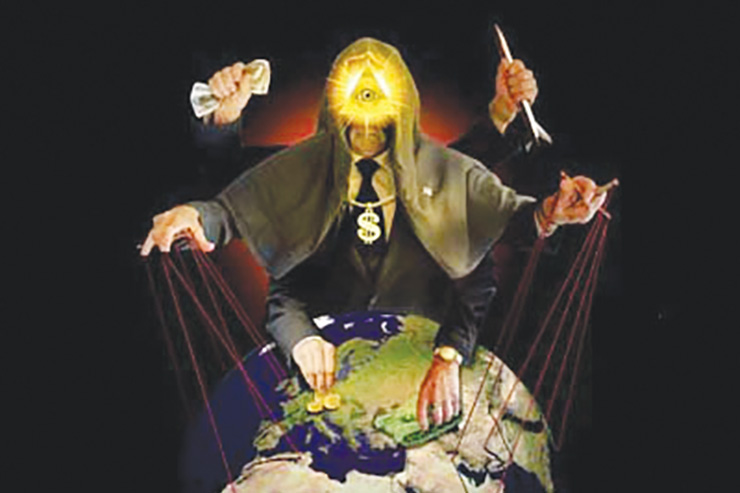
    Amidst the more fantastic theories of UFOs and intergalactic lizards, certain core themes do persistently reoccur in the mass of ‘conspiracy theory’ material now available. Principal among them is the idea that a shadowy elite is seeking to enslave humanity under the auspices of a single, centralised world government. The name of the mysterious ‘Illuminati’ is most often associated with such a group, although what is meant by it is frequently ill defined. The Illuminati are, supposedly, a cabal of top bankers, politicians and businessmen seeking to create the aforesaid all-powerful government.

    What is the truth of all this? I do not propose to give a full answer here, but would like to introduce a perspective on the theme – one that has generally not been given serious consideration – taken from the research of Rudolf Steiner. In the second part of the article I will try and relate Steiner’s ideas to other more familiar conspiracy research.

    So why Steiner? Because, if for no other reason, his pronouncements and indications on practical areas of life have borne such remarkable fruit, testimony to which are thousands of Waldorf schools offering a new kind of education, farms successfully practicing bio-dynamics, clinics dispensing anthroposophic medicines, and so on.

    As a profound clairvoyant, Steiner claimed to investigate other dimensions of reality for insight into the human condition. His legacy is hundreds of volumes of published talks and written works on a cornucopia of themes. However, as mentioned above, his work – in contrast to that of many other spiritual teachers and gurus – has shown itself to have practical applications in all areas of life. This in itself does not provide ultimate evidence for the truth of his work, but it does correspond to the biblical dictum: “[B]y their fruits ye shall know them.”

    In 1916 and 1917, in the midst of the catastrophic First World War, Steiner gave a series of 25 lectures to a group of his followers who gathered together at their centre in Dornach in neutral Switzerland. These lectures, since translated and published in English,1 offer a unique reading of contemporary events.

    Behind the outer façade of world affairs, suggested Steiner, the machinations of occult groups or ‘brotherhoods’ were at work. Certain of these brotherhoods had wanted the Great War to take place, and had manipulated events to bring it about. In doing this, they sought to protect the dominant economic position of the English-speaking world, and in turn to crush the ‘mediating’ role of Central European powers such as Germany, the Austro-Hungarian empire, and so on.

    These occult brotherhoods – small groups of men who met together in ‘lodges’ and practiced ceremonial magic as a means of achieving certain goals – originated from the English-speaking (Anglo-Saxon) world and were allied, in particular, with Anglo-American interests. Their aim was to extend Anglo-American influence across the globe, and to ensure the predomination of Anglo-American culture. Furthermore, they sought to extend its superiority into the distant future; essentially to ensure that the present state of affairs continues evermore.

    According to Steiner’s research, human evolution goes through ‘great periods’ of development. During each of these periods, a particular people is given the task of leading humanity in a spiritual sense. Over the millennia, it has been the destiny of different peoples to bring specific qualities, in a benevolent way, to the whole of humanity. Particular periods of history are thus led by particular nations. This does not imply a form of political control or empire – and is certainly not a theory of national or racial superiority – but is referring to a spiritual form of authority.

    Steiner suggested that the Western world, and in particular the English-speaking peoples, have been given the task of getting to grips with the material world – of becoming comfortable on Earth and developing in harmony with it. In this specific sense, the West was to introduce a certain kind of (beneficial) materialism into human development. But this materialism was only meant to be developed up to a certain point. It was necessary in order for humans to become fully part of the earthly world, and to help introduce an individualised consciousness (the ‘I’). But beyond that it had the potential to be destructive. Materialism as a philosophy, which shuts out the possibility of soul and spirit, is retrogressive, asserted Steiner, and works as an evil in human evolution.

    The Anglo-American brotherhoods that seek dominion over mankind know this, and hence today are deliberately sponsoring various kind of materialism in the hope of halting and trapping humanity at the present stage of its development. They don’t want humans to progress beyond the present stage of immersion in the material world. In other words, they don’t want us to reconnect in a free way with our spiritual ‘I’, because they know that their grip over humanity would then be lost. Human progress is dependent on spiritual knowledge, and thus the occult brotherhoods work against it.

    Steiner explained further the brotherhoods were aware that the Slavic peoples were to be given the task of leadership on behalf of humanity during the next ‘great period’ of history. For this reason, the Anglo-American brotherhoods not only sought to dominate the present great period of human development, but – knowing that the Slavs had an important mission in the future – sought to gain control over the Slavic peoples (Russia in particular) in the present, in order to interfere with or even put a halt to their coming task. In this way, the Anglo-American brotherhoods could extend their control over human development into the distant future.

    Steiner later claimed that the Bolshevik Revolution in Russia, which led to the creation of the USSR and the 72-year cultural, intellectual, economic and political repression of the populations of its various peoples, was masterminded and sponsored by these same brotherhoods as a means of controlling the region and its peoples.2

    What is the evidence for Steiner’s analysis? Apart from anything else, it is interesting to note the present state of world affairs, and how – since Steiner spoke about this topic in 1916-17 – Anglo-American culture has come to dominate the globe in tandem with American economic and political influence (with the enthusiastic support of British politicians). The assertion of unilateral military action by the United States and Britain in the 2003 invasion of Iraq – in the face of almost total global opposition – was a good example of this formidable power at work. However, admittedly these observations do not provide ‘proof’ in a strict sense.

    Another source of evidence is the remarkable research of Prof. Carroll Quigley (1910-77) who wrote two substantial volumes, The Anglo-American Establishment (1949) and Tragedy and Hope (1966),3 on the secret network which emerged from the enterprise of Cecil Rhodes. Quigley characterised the power of this group through its influence in politics, culture and social life as “terrifying”.

    It is important to note that Quigley was no crazed and paranoid conspiracy nut, but a respected Georgetown professor, and even the teacher of Bill Clinton. (How such networks might be related to the brotherhoods Steiner is talking about will be considered later.) Other authors have followed Quigley’s lead and complemented his studies with contemporary observations. A few have even related Steiner’s ideas to Quigley’s research.4 In this context, however, I would like to mention only two external ‘symptoms’, which, at the very least, offer circumstantial evidence for Steiner’s diagnosis.

    In 1893, an Englishman called C.G. Harrison delivered six lectures to the Berean Society, a mysterious group of ‘Christian esotericists’. A record of these lectures is to be found in Harrison’s remarkable book The Transcendental Universe. Little is known about the Berean Society or Harrison, although he wrote two further books in his lifetime. What is clear is that Harrison, who speaks in defense of the “high” Church, had access to a phenomenal store of esoteric thought, and was furthermore privy to a certain amount of inside knowledge. In his second lecture, he spoke not only of “the next great European war”, but also of the “national character” of the Slavic peoples and its ability to “enable them to carry out experiments in Socialism, political and economical, which would present innumerable difficulties in Western Europe”.5 Remember that these lectures were given in 1893, 21 years before the First World War and 24 years before the Bolshevik Revolution!

    While Harrison claimed to be a “theoretical occultist” as opposed to a “practical” one – i.e. he did not practice magic or ritual, with the implication that he was not a member of a “lodge” himself – from his work it is evident he represents an esoteric strain of thought which clearly defends the English establishment. How could he know about the forthcoming War as well as the “experiments in Socialism”, which would take a grip on Russia and its surrounding states for most of the twentieth century? If he was not, as he claimed, a “practical occultist” himself, it is reasonable to assume he had contact with people who were, and who had access to the malign plans of such secret groups referred to above.

    The second significant piece of evidence which offers some backing for Steiner’s claims of occult interference in world politics is to be found in a special edition of the satirical weekly The Truth, published at Christmas 1890. Under the heading ‘The Kaiser’s Dream’, the magazine featured a cartoon map of Europe together with a humorous commentary. Many observations can be made of the map, but the most pertinent point to note in relation to the above is that all the countries of Europe are shown as republics with the exception of Russia and its neighbouring states, over which are written the words “Russian Desert”. In addition, Germany is identified with the words “German Republics”! This map signifies not only a foreknowledge – similar to Harrison – of the fate of Russia to become a cultural as well as an economic ‘desert’, but also of the future splitting of Germany into ‘republics’. The magazine’s editor, Henry Labouchère, was a Freemason. Was his remarkable foresight pure luck, or once again did he have some inside knowledge of future plans to shape the world?

    It is of course possible that the above examples are merely coincidences and happy flukes, but surely it is unlikely. Do these examples offer evidence for the existence of occult brotherhoods with pernicious plans for political manipulation? We may never know for sure, but it is evident that Steiner’s perspective offers much serious food for thought, and opens up important new vistas for understanding current world events.

    Steiner and Modern Conspiracy Research

    Having sketched out Steiner’s picture of secret brotherhoods, I would like now to try and show how his perspective might relate to the more general conspiracy research referred to earlier. To many readers of this magazine the Bilderberg Group, the Council on Foreign Relations and the Trilateral Commission will be more than familiar. In addition, the Yale University secret society Skull and Bones is often identified by investigators in the conspiracy field. The latter has been thrown into the limelight recently due to the remarkable admission by both Republican and Democratic candidates of the 2004 American presidential election that they are members of the exclusive club.

    As Skull and Bones is a tiny society that invites only 15 undergraduates per year to join its ranks – and at any one time has only 800 or so living members – the fact that the two candidates for the post of the most powerful position in the world are members of it (from a population totaling some 293 million people) is quite incredible!

    It has long been known that George W. Bush is an initiate of Skull and Bones (as was his father George Bush Snr. and grandfather Prescott Sheldon Bush).6 According to the key researcher of Skull and Bones, Antony C. Sutton, the society was first founded in 1833. Members, who meet secretly in its ‘tomb’ on the grounds of Yale, are sworn to secrecy about the group’s rites and activities. In terms of its operations and philosophy, Sutton refers to the ‘dialectical’ process, based on the philosopher Hegel, as being at the heart of Skull and Bones thinking. In particular, he tries to prove that the group has been instrumental in funding and encouraging the development of both far-left and far-right political groupings – principally the Communists and Nazis – in the twentieth century. From the point of view of Skull and Bones’ broad vision of human development, left and right are viewed as two parts of the Hegelian dialectical process; one political wing represents ‘thesis’ while the other represents ‘antithesis’. These two aspects clash and fight each other, but eventually merge to form a ‘synthesis’. It is this synthesis, according to Sutton, that Skull and Bones is aiming to create. By controlling and manipulating the conflict, it controls the outcome (or synthesis).

    It is interesting to note that Sutton first published his interpretation of Skull and Bones in the mid-1980s. At that time, he quoted the group as working for a ‘New World Order’ (NWO). This NWO was to be the product of the synthesis of political left and right. Shortly after the collapse of the Eastern-bloc communist countries, and the subsequent triumph of Western capitalism – a triumph that Francis Fukuyama referred to in his famous book as ‘the end of history’ – George Bush Snr. began to use the specific phrase ‘New World Order’ in public speeches.

    This fascinating fact offers some circumstantial evidence for Sutton’s reading. Presuming that Sutton is correct, humanity is living right now within the period of ‘synthesis’ – the birth of a NWO led by the West, and principally the United States. (And perhaps it will come as no surprise to adherents of Sutton’s analysis that a new ‘dialectic’ has suddenly appeared to take the place of the old, i.e. Communism versus Capitalism is replaced with the West versus Islamic Fundamentalism.)

    Antony Sutton’s series of booklets on Skull and Bones begins with hisIntroduction to the Order,7  in which he points out that – despite them being commonly associated with conspiracy – organisations such as the Council on Foreign Relations and Trilateral Commission are ultimately not secret, and have large public memberships. Likewise, it could be added that despite the fact the Bilderberg conferences are not open to the press or public, the names of the people who attend these yearly private meetings are not concealed. (The minutes of the 1999 meeting in Sintra, Portugal were even leaked and published wholesale on the internet.) Lists of members of the above groups can be found in Robert Gaylon Ross’s Who’s Who of the Elite, Members of the Bilderbergs, Council on Foreign Relations, Trilateral Commission and Skull and Bones Society.)

    Sutton suggests that organisations such as the above form a larger ‘outer circle’ of members, while societies such as Skull and Bones form part of an ‘inner circle’ of truly secret groupings, of which there is a still further ‘inner core’ – the ‘decision-making core’ – which remains completely out of public view, i.e. truly hidden (or, literally, ‘occult’). This is a reasonable hypothesis. From what is known of the Bilderberg conferences, for example, it could be inferred that their essential motivation is to further the Western Capitalist Project through high-level networking and the grooming of young talent. To put it in another way, they are working for the economic, political and cultural domination of a globalised world by the West – in particular by the English-speaking peoples led by the United States and Britain. (Although the Bilderberg conferences include guests from around the world, the emphasis is on North America and Europe, and its leadership is Anglo-Saxon.)

    From what is known of the Bilderbergers – and much has reached the public domain – there appears to be no more conspiracy than that. Groups such as Skull and Bones (and Sutton deduces that there are others such as Scroll and Key) are not completely secret in that their existence and membership are well documented. According to Sutton these are the ‘core’, with similar objectives to the more public groups but with more focused and consciously-held goals.

    In contradistinction to the Bilderbergers etc., true secret societies usually have elaborate initiation ceremonies and use ritual as a critical part of their mutual enterprise. The brotherhoods Steiner speaks of, as has already been mentioned, are also built on Masonic principles of secrecy and ritual, but are hidden from public view.

    In relation to the groups referred to above, it is quite possible that such genuinely occult brotherhoods form part of the inner, ‘decision-making’ core, which Sutton refers to. Having said that, as Sutton points out, most members of the larger groups would have no inkling of any subterfuge or conspiracy, and neither would many members of Skull and Bones. This work would be left to the directors, or ‘initiates’, with esoteric knowledge and understanding. According to Steiner, the specific brotherhoods he is referring to not only have the conscious goal of maintaining Anglo-American domination, but complement this aim with real esoteric insight – i.e. an understanding of the evolutionary cycles referred to above.

    The above sketch gives a useful framework for comprehending how public groups such as Bilderberg, more secret groups like Skull and Bones, and the occult societies that Steiner refers to might interact and co-exist. In this sense, the true occult societies would be the central inspiration for the larger intersecting groups of organisations with politically active individuals. To my mind, such a complex picture is more convincing than the nebulous idea of a single all-powerful ‘Illuminati’ that is supposedly responsible for creating a massive conspiracy that controls every aspect of modern life.

    [alert type=”general” dismiss=”no”]This article was published in New Dawn 86.[/alert]

    [alert type=”success” dismiss=”no”]If you appreciate this article, please consider subscribing to help maintain this website.[/alert]

    Footnotes

    1. Karma of Untruthfulness Volumes I & II, Rudolf Steiner Press, London, 1988 and 1992.
    2. See further in Sergei O. Prokofieff, The Spiritual Origins of Eastern Europe and the Future Mysteries of the Holy Grail, Temple Lodge Publishing, London, 1993.
    3. The Anglo-American Establishment was only published in 1981, Books in Focus, New York.Tragedy and Hope was published in 1966 by Macmillan, New York.
    4. See Terry Boardman, Mapping the Millennium, Behind the Plans of the New World Order, Temple Lodge Publishing, London, 1998, and Amnon Reuveni, In the Name of the ‘New World Order’, Manifestations of Decadent Powers in World Politics, Temple Lodge Publishing, London, 1996.
    5. The Transcendental Universe, Lindisfarne Press, New York, 1993, pages 98-99.
    6. Daily Telegraph, London, 12 July 2004.
    7. The Secret Cult of the Order (1983), An Introduction to the Order (1984), How the Order Creates War and Revolution (1985), How the Order Controls Education (1985), Veritas Publishing Co., Aukland. A more recent and high profile study is Alexandra Robbins Secrets of the Tomb.

    © New Dawn Magazine and the respective author.
    For our reproduction notice, click here.
  • Beyond Left & Right: Escaping the Matrix

    Beyond Left & Right: Escaping the Matrix

    This article was published in New Dawn 62 (Sept-Oct 2000)

    The defining dramatic moment in the film The Matrix occurs just after Morpheus invites Neo to choose between a red pill and a blue pill. The red pill promises “the truth, nothing more.” Neo takes the red pill and awakes to reality – something utterly different from anything Neo, or the audience, could have expected. What Neo had assumed to be reality turned out to be only a collective illusion, fabricated by the Matrix and fed to a population that is asleep, cocooned in grotesque embryonic pods. In Plato’s famous parable about the shadows on the walls of the cave, true reality is at least reflected in perceived reality. In the Matrix world, true reality and perceived reality exist on entirely different planes.

    The story is intended as metaphor, and the parallels that drew my attention had to do with political reality. This article offers a particular perspective on what’s going on in the world – and how things got to be that way – in this era of globalisation. From that red-pill perspective, everyday media-consensus reality – like the Matrix in the film – is seen to be a fabricated collective illusion. Like Neo, I didn’t know what I was looking for when my investigation began, but I knew that what I was being told didn’t make sense. I read scores of histories and biographies, observing connections between them, and began to develop my own theories about roots of various historical events. I found myself largely in agreement with writers like Noam Chomsky and Michael Parenti, but I also perceived important patterns that others seem to have missed.

    When I started tracing historical forces, and began to interpret present-day events from a historical perspective, I could see the same old dynamics at work and found a meaning in unfolding events far different from what official pronouncements proclaimed. Such pronouncements are, after all, public relations fare, given out by politicians who want to look good to the voters. Most of us expect rhetoric from politicians, and take what they say with a grain of salt. But as my own picture of present reality came into focus, “grain of salt” no longer worked as a metaphor. I began to see that consensus reality – as generated by official rhetoric and amplified by mass media – bears very little relationship to actual reality. “The matrix” was a metaphor I was ready for.

    In consensus reality (the blue-pill perspective) “left” and “right” are the two ends of the political spectrum. Politics is a tug-of-war between competing factions, carried out by political parties and elected representatives. Society gets pulled this way and that within the political spectrum, reflecting the interests of whichever party won the last election. The left and right are therefore political enemies. Each side is convinced that it knows how to make society better; each believes the other enjoys undue influence; and each blames the other for the political stalemate that apparently prevents society from dealing effectively with its problems.This perspective on the political process, and on the roles of left and right, is very far from reality. It is a fabricated collective illusion. Morpheus tells Neo that the Matrix is “the world that was pulled over your eyes to hide you from the truth…. As long as the Matrix exists, humanity cannot be free.” Consensus political reality is precisely such a matrix. Later we will take a fresh look at the role of left and right, and at national politics. But first we must develop our red-pill historical perspective. I’ve had to condense the arguments to bare essentials; please see the annotated sources at the end for more thorough treatments of particular topics.

    Imperialism and the Matrix

    From the time of Columbus to 1945, world affairs were largely dominated by competition among Western nations seeking to stake out spheres of influence, control sea lanes, and exploit colonial empires. Each Western power became the core of an imperialist economy whose periphery was managed for the benefit of the core nation. Military might determined the scope of an empire; wars were initiated when a core nation felt it had sufficient power to expand its periphery at the expense of a competitor. Economies and societies in the periphery were kept backward – to keep their populations under control, to provide cheap labour, and to guarantee markets for goods manufactured in the core. Imperialism robbed the periphery not only of wealth but also of its ability to develop its own societies, cultures, and economies in a natural way for local benefit.The driving force behind Western imperialism has always been the pursuit of economic gain, ever since Isabella commissioned Columbus on his first entrepreneurial voyage. The rhetoric of empire concerning wars, however, has typically been about other things – the White Man’s Burden, bringing true religion to the heathens, Manifest Destiny, defeating the Yellow Peril or the Hun, seeking lebensraum, or making the world safe for democracy. Any fabricated motivation for war or empire would do, as long as it appealed to the collective consciousness of the population at the time. The propaganda lies of yesterday were recorded and became consensus history – the fabric of the matrix.While the costs of territorial empire (fleets, colonial administrations, etc.) were borne by Western taxpayers generally, the profits of imperialism were enjoyed primarily by private corporations and investors. Government and corporate elites were partners in the business of imperialism: empires gave government leaders power and prestige, and gave corporate leaders power and wealth. Corporations ran the real business of empire while government leaders fabricated noble excuses for the wars that were required to keep that business going. Matrix reality was about patriotism, national honour, and heroic causes; true reality was on another plane altogether: that of economics.Industrialisation, beginning in the late 1700s, created a demand for new markets and increased raw materials; both demands spurred accelerated expansion of empire. Wealthy investors amassed fortunes by setting up large-scale industrial and trading operations, leading to the emergence of an influential capitalist elite. Like any other elite, capitalists used their wealth and influence to further their own interests however they could. And the interests of capitalism always come down to economic growth; investors must reap more than they sow or the whole system comes to a grinding halt.Thus capitalism, industrialisation, nationalism, warfare, imperialism – and the matrix – coevolved. Industrialised weapon production provided the muscle of modern warfare, and capitalism provided the appetite to use that muscle. Government leaders pursued the policies necessary to expand empire while creating a rhetorical matrix, around nationalism, to justify those policies. Capitalist growth depended on empire, which in turn depended on a strong and stable core nation to defend it. National interests and capitalist interests were inextricably linked – or so it seemed for more than two centuries.

    World War II and Pax Americana

    1945 will be remembered as the year World War II ended and the bond of the atomic nucleus was broken. But 1945 also marked another momentous fission – breaking of the bond between national and capitalist interests. After every previous war, and in many cases after severe devastation, European nations had always picked themselves back up and resumed their competition over empire. But after World War II, a Pax Americana was established. The US began to manage all the Western peripheries on behalf of capitalism generally, while preventing the communist powers from interfering in the game. Capitalist powers no longer needed to fight over investment realms, and competitive imperialism was replaced by collective imperialism (see sidebar below). Opportunities for capital growth were no longer linked to the military power of nations, apart from the power of America. In his Killing Hope, U.S. Military and CIA Interventions since World War II (see recommended reading), William Blum chronicles hundreds of significant covert and overt interventions, showing exactly how the US carried out its imperial management role.In the postwar years matrix reality diverged ever further from actual reality. In the postwar matrix world, imperialism had been abandoned and the world was being “democratised”; in the real world, imperialism had become better organised and more efficient. In the matrix world the US “restored order,” or “came to the assistance” of nations which were being “undermined by Soviet influence”; in the real world, the periphery was being systematically suppressed and exploited. In the matrix world, the benefit was going to the periphery in the form of countless aid programs; in the real world, immense wealth was being extracted from the periphery.Growing glitches in the matrix weren’t noticed by most people in the West, because the postwar years brought unprecedented levels of Western prosperity and social progress. The rhetoric claimed progress would come to all, and Westerners could see it being realised in their own towns and cities. The West became the collective core of a global empire, and exploitative development led to prosperity for Western populations, while generating immense riches for corporations, banks, and wealthy capital investors.

    Glitches in the Matrix, Popular Rebellion, and Neoliberalism

    The parallel agenda of Third-World exploitation and Western prosperity worked effectively for the first two postwar decades. But in the 1960s large numbers of Westerners, particularly the young and well educated, began to notice glitches in the matrix. In Vietnam imperialism was too naked to be successfully masked as something else. A major split in American public consciousness occurred, as millions of anti-war protesters and civil-rights activists punctured the fabricated consensus of the 1950s and declared the reality of exploitation and suppression both at home and abroad. The environmental movement arose, challenging even the exploitation of the natural world. In Europe, 1968 joined 1848 as a landmark year of popular protest. These developments disturbed elite planners. The postwar regime’s stability was being challenged from within the core – and the formula of Western prosperity no longer guaranteed public passivity. A report published in 1975, the Report of the Trilateral Task Force on Governability of Democracies, provides a glimpse into the thinking of elite circles. Alan Wolfe discusses this report in Holly Sklar’s eye-opening Trilateralism (see recommended reading). Wolfe focuses especially on the analysis Harvard professor Samuel P. Huntington presented in a section of the report entitled “The Crisis of Democracy.” Huntington is an articulate promoter of elite policy shifts, and contributes pivotal articles to publications such as the Council on Foreign Relations’s Foreign Affairs (see recommended reading).Huntington tells us that democratic societies “cannot work” unless the citizenry is “passive.” The “democratic surge of the 1960s” represented an “excess of democracy,” which must be reduced if governments are to carry out their traditional domestic and foreign policies. Huntington’s notion of “traditional policies” is expressed in a passage from the report:To the extent that the United States was governed by anyone during the decades after World War II, it was governed by the President acting with the support and cooperation of key individuals and groups in the executive office, the federal bureaucracy, Congress, and the more important businesses, banks, law firms, foundations, and media, which constitute the private sector’s ‘Establishment’.

    In these few words Huntington spells out the reality that electoral democracy has little to do with how America is run, and summarises the kind of people who are included within the elite planning community. Who needs conspiracy theories when elite machinations are clearly described in public documents like these?

    Besides failing to deliver popular passivity, the policy of prosperity for Western populations had another downside, having to do with Japan’s economic success. Under the Pax Americana umbrella, Japan had been able to industrialise and become an imperial player – the prohibition on Japanese rearmament had become irrelevant. With Japan’s then-lower living standards, Japanese producers could undercut prevailing prices and steal market share from Western producers. Western capital needed to find a way to become more competitive on world markets, and Western prosperity was standing in the way. Elite strategists, as Huntington showed, were fully capable of understanding these considerations, and the requirements of corporate growth created a strong motivation to make the needed adjustments – in both reality and rhetoric.

    If popular prosperity could be sacrificed, there were many obvious ways Western capital could be made more competitive. Production could be moved overseas to low-wage areas, allowing domestic unemployment to rise. Unions could be attacked and wages forced down, and people could be pushed into temporary and part-time jobs without benefits. Regulations governing corporate behaviour could be removed, corporate and capital-gains taxes could be reduced, and the revenue losses could be taken out of public-service budgets. Public infrastructures could be privatised, the services reduced to cut costs, and then they could be milked for easy profits while they deteriorated from neglect.

    These are the very policies and programs launched during the Reagan-Thatcher years in the US and Britain. They represent a systematic project of increasing corporate growth at the expense of popular prosperity and welfare. Such a real agenda would have been unpopular, and a corresponding matrix reality was fabricated for public consumption. The matrix reality used real terms like “deregulation,” “reduced taxes,” and “privatisation,” but around them was woven an economic mythology. The old, failed laissez-faire doctrine of the 1800s was reintroduced with the help of Milton Friedman’s Chicago School of economics, and “less government” became the proud “modern” theme in America and Britain. Sensible regulations had restored financial stability after the Great Depression, and had broken up anti-competitive monopolies such as the Rockefeller trust and AT&T. But in the new matrix reality, all regulations were considered bureaucratic interference. Reagan and Thatcher preached the virtues of individualism, and promised to “get government off people’s backs.” The implication was that everyday individuals were to get more money and freedom, but in reality the primary benefits would go to corporations and wealthy investors.

    The academic term for laissez-faire economics is “economic liberalism,” and hence the Reagan-Thatcher revolution has come to be known as the “neoliberal revolution.” It brought a radical change in actual reality by returning to the economic philosophy that led to sweatshops, corruption, and robber-baron monopolies in the nineteenth century. It brought an equally radical change in matrix reality – a complete reversal in the attitude that was projected regarding government. Government policies had always been criticised in the media, but the institution of government had always been respected – reflecting the traditional bond between capitalism and nationalism. With Reagan, we had a sitting president telling us that government itself was a bad thing. Many of us may have agreed with him, but such a sentiment had never before found official favour. Soon, British and American populations were beginning to applaud the destruction of the very democratic institutions that provided their only hope of participation in the political process.

    Globalisation and World Government

    The essential bond between capitalism and nationalism was broken in 1945, but it took some time for elite planners to recognise this new condition and to begin bringing the world system into alignment with it. The strong Western nation state had been the bulwark of capitalism for centuries, and initial postwar policies were based on the assumption that this would continue indefinitely. The Bretton Woods financial system (the IMF, World Bank, and a system of fixed exchange rates among major currencies) was set up to stabilise national economies, and popular prosperity was encouraged to provide political stability. Neoliberalism in the US and Britain represented the first serious break with this policy framework – and brought the first visible signs of the fission of the nation-capital bond.The neoliberal project was economically profitable in the US and Britain, and the public accepted the matrix economic mythology. Meanwhile, the integrated global economy gave rise to a new generation of transnational corporations, and corporate leaders began to realise that corporate growth was not dependent on strong core nation-states. Indeed, Western nations – with their environmental laws, consumer-protection measures, and other forms of regulatory “interference” – were a burden on corporate growth. Having been successfully field tested in the two oldest “democracies,” the neoliberal project moved onto the global stage. The Bretton Woods system of fixed rates of currency exchange was weakened, and the international financial system became destabilising, instead of stabilising, for national economies. The radical free-trade project was launched, leading eventually to the World Trade Organisation. The fission that had begun in 1945 was finally manifesting as an explosive change in the world system.The objective of neoliberal free-trade treaties is to remove all political controls over domestic and international trade and commerce. Corporations have free rein to maximise profits, heedless of environmental consequences and safety risks. Instead of governments regulating corporations, the WTO now sets rules for governments, telling them what kind of beef they must import, whether or not they can ban asbestos, and what additives they must permit in petroleum products. So far, in every case where the WTO has been asked to review a health, safety, or environmental regulation, the regulation has been overturned.Most of the world has been turned into a periphery; the imperial core has been boiled down to the capitalist elite themselves, represented by their bureaucratic, unrepresentative, WTO world government. The burden of accelerated imperialism falls hardest outside the West, where loans are used as a lever by the IMF to compel debtor nations such as Rwanda and South Korea to accept suicidal “reform” packages. In the 1800s, genocide was employed to clear North America and Australia of their native populations, creating room for growth. Today, a similar program of genocide has apparently been unleashed against sub-Saharan Africa. The IMF destroys the economies, the CIA trains militias and stirs up tribal conflicts, and the West sells weapons to all sides. Famine and genocidal civil wars are the predictable and inevitable result. Meanwhile, AIDS runs rampant while the WTO and the US government use trade laws to prevent medicines from reaching the victims.

    As in the past, Western military force will be required to control the non-Western periphery and make adjustments to local political arrangements when considered necessary by elite planners. The Pentagon continues to provide the primary policing power, with NATO playing an ever-increasing role. Resentment against the West and against neoliberalism is growing in the Third World, and the frequency of military interventions is bound to increase. All of this needs to be made acceptable to Western minds, adding a new dimension to the matrix.

    In the latest matrix reality, the West is called the “international community,” whose goal is to serve “humanitarian” causes. Bill Clinton made it explicit with his “Clinton Doctrine,” in which (as quoted in the Washington Post) he solemnly promised, “If somebody comes after innocent civilians and tries to kill them en masse because of their race, their ethnic background or their religion and it is within our power stop it, we will stop it.” This matrix fabrication is very effective indeed; who opposes prevention of genocide? Only outside the matrix does one see that genocide is caused by the West in the first place, that the worst cases of genocide are continuing, that “assistance” usually makes things worse (as in the Balkans), and that Clinton’s handy doctrine enables him to intervene when and where he chooses. Since dictators and the stirring of ethnic rivalries are standard tools used in managing the periphery, a US president can always find “innocent civilians” wherever elite plans call for an intervention.

    In matrix reality, globalisation is not a project but rather the inevitable result of beneficial market forces. Genocide in Africa is no fault of the West, but is due to ancient tribal rivalries. Every measure demanded by globalisation is referred to as “reform,” (the word is never used with irony). “Democracy” and “reform” are frequently used together, always leaving the subtle impression that one has something to do with the other. The illusion is presented that all economic boats are rising, and if yours isn’t, it must be your own fault: you aren’t “competitive” enough. Economic failures are explained away as “temporary adjustments,” or else the victim (as in South Korea or Russia) is blamed for not being sufficiently neoliberal. “Investor confidence” is referred to with the same awe and reverence that earlier societies might have expressed toward the “will of the gods.”

    Western quality of life continues to decline, while the WTO establishes legal precedents ensuring that its authority will not be challenged when its decisions become more draconian. Things will get much worse in the West; this was anticipated in elite circles when the neoliberal project was still on the drawing board, as is illustrated in Samuel Huntington’s “The Crisis of Democracy” report discussed earlier.

    Management of Discontented Societies

    The postwar years, especially in the United States, were characterised by consensus politics. Most people shared a common understanding of how society worked, and generally approved of how things were going. Prosperity was real and the matrix version of reality was reassuring. Most people believed in it. Those beliefs became a shared consensus, and the government could then carry out its plans as it intended, “responding” to the programmed public will.The “excess democracy” of the 1960s and 1970s attacked this shared consensus from below, and neoliberal planners decided from above that ongoing consensus wasn’t worth paying for. They accepted that segments of society would persist in disbelieving various parts of the matrix. Activism and protest were to be expected. New means of social control would be needed to deal with activist movements and with growing discontent, as neoliberalism gradually tightened the economic screws. Such means of control were identified and have since been largely implemented, particularly in the United States. In many ways America sets the pace of globalisation; innovations can often be observed there before they occur elsewhere. This is particularly true in the case of social-control techniques.The most obvious means of social control, in a discontented society, is a strong, semi-militarised police force. Most of the periphery has been managed by such means for centuries. This was obvious to elite planners in the West, was adopted as policy, and has now been largely implemented. Urban and suburban ghettos – where the adverse consequences of neoliberalism are currently most concentrated – have literally become occupied territories, where police beatings and unjustified shootings are commonplace.So that the beefed-up police force could maintain control in conditions of mass unrest, elite planners also realised that much of the US Bill of Rights would need to be neutralised. (This is not surprising, given that the Bill’s authors had just lived through a revolution and were seeking to ensure that future generations would have the means to organise and overthrow any oppressive future government.) The rights-neutralisation project has been largely implemented, as exemplified by armed midnight raids, outrageous search-and-seizure practices, overly broad conspiracy laws, wholesale invasion of privacy, massive incarceration, and the rise of prison slave labour. The Rubicon has been crossed – the techniques of oppression long common in the empire’s periphery are being imported to the core.

    In the matrix, the genre of the TV or movie police drama has served to create a reality in which “rights” are a joke, the accused are despicable sociopaths, and no criminal is ever brought to justice until some noble cop or prosecutor bends the rules a bit. Government officials bolster the construct by declaring “wars” on crime and drugs; the noble cops are fighting a war out there in the streets – and you can’t win a war without using your enemy’s dirty tricks. The CIA plays its role by managing the international drug trade and making sure that ghetto drug dealers are well supplied. In this way, the American public has been led to accept the means of its own suppression.

    The mechanisms of the police state are in place. They will be used when necessary – as we see in ghettos and skyrocketing prison populations, as we saw on the streets of Seattle and Washington D.C. during recent anti-WTO demonstrations, and as is suggested by executive orders that enable the president to suspend the Constitution and declare martial law whenever he deems it necessary. But raw force is only the last line of defense for the elite regime. Neoliberal planners introduced more subtle defences into the matrix; looking at these will bring us back to our discussion of the left and right.

    Divide and rule is one of the oldest means of mass control – standard practice since at least the Roman Empire. This is applied at the level of modern imperialism, where each small nation competes with other for capital investments. Within societies it works this way: If each social group can be convinced that some other group is the source of its discontent, then the population’s energy will be spent on inter-group struggles. The regime can sit on the sidelines, intervening covertly to stir things up or to guide them in desired directions. In this way most discontent can be neutralised, and force can be reserved for exceptional cases. In the prosperous postwar years, consensus politics served to manage the population. Under neoliberalism, programmed factionalism has become the front-line defense – the matrix version of divide and rule.

    The covert guiding of various social movements has proven to be one of the most effective means of programming factions and stirring them against one another. Fundamentalist religious movements have been particularly useful. They have been used not only within the US, but also to maximise divisiveness in the Middle East and for other purposes throughout the empire. The collective energy and dedication of “true believers” makes them a potent political weapon that movement leaders can readily aim where needed. In the US that weapon has been used to promote censorship on the Internet, to attack the women’s movement, to support repressive legislation, and generally to bolster the ranks of what is called in the matrix the “right wing.”

    In the matrix, the various factions believe that their competition with each other is the process that determines society’s political agenda. Politicians want votes, and hence the biggest and best-organised factions should have the most influence, and their agendas should get the most political attention. In reality there is only one significant political agenda these days: the maximisation of capital growth through the dismantling of society, the continuing implementation of neoliberalism, and the management of empire. Clinton’s liberal rhetoric and his playing around with health care and gay rights are not the result of liberal pressure. They are rather the means by which Clinton is sold to liberal voters, so that he can proceed with real business: getting NAFTA through Congress, promoting the WTO, giving away the public airwaves, justifying military interventions, and so forth. Issues of genuine importance are never raised in campaign politics – this is a major glitch in the matrix for those who have eyes to see it.

    Escaping the Matrix

    The matrix cannot fool all of the people all of the time. Under the onslaught of globalisation, the glitches are becoming ever more difficult to conceal – as earlier, with the Vietnam War. Last November’s anti-establishment demonstrations in Seattle, the largest in decades, were aimed directly at globalisation and the WTO. Even more important, Seattle saw the coming together of factions that the matrix had programmed to fight one another, such as left-leaning environmentalists and socially conservative union members.Seattle represented the tip of an iceberg. A mass movement against globalisation and elite rule is ready to ignite, like a brush fire on a dry, scorching day. The establishment has been expecting such a movement and has a variety of defences at its command, including those used effectively against the movements of the 1960s and 1970s. In order to prevail against what seem like overwhelming odds, the movement must escape entirely from the matrix, and it must bring the rest of society with it. As long as the matrix exists, humanity cannot be free. The whole truth must be faced: Globalisation is centralised tyranny; capitalism has outlasted its sell-by date; matrix “democracy” is elite rule; and “market forces” are imperialism. Left and right are enemies only in the matrix. In reality we are all in this together, and each of us has a contribution to make toward a better world.Marx may have failed as a social visionary, but he had capitalism figured out. It is based not on productivity or social benefit, but on the pursuit of capital growth through exploiting everything in its path. The job of elite planners is to create new spaces for capital to grow in. Competitive imperialism provided growth for centuries; collective imperialism was invented when still more growth was needed; and then neoliberalism took over. Like a cancer, capitalism consumes its host and is never satisfied. The capital pool must always grow, more and more, forever – until the host dies or capitalism is replaced.The matrix equates capitalism with free enterprise, and defines centralised-state-planning socialism as the only alternative to capitalism. In reality, capitalism didn’t amount to much of a force until the Enlightenment and Industrial Revolution of the late 1700s – and we certainly cannot characterise all prior societies as socialist. Free enterprise, private property, commerce, banking, international trade, economic specialisation – all of these had existed for millennia before capitalism. Capitalism claims credit for modern prosperity, but credit would be better given to developments in science and technology.

    Before capitalism, Western nations were generally run by aristocratic classes. The aristocratic attitude toward wealth focused on management and maintenance. With capitalism, the focus is always on growth and development; whatever one has is but the seeds to build a still greater fortune. In fact, there are infinite alternatives to capitalism, and different societies can choose different systems, once they are free to do so. As Morpheus put it: “Outside the matrix everything is possible, and there are no limits.”

    The matrix defines “democracy” as competitive party politics, because that is a game wealthy elites have long since learned to corrupt and manipulate. Even in the days of the Roman Republic the techniques were well understood. Real-world democracy is possible only if the people themselves participate in setting society’s direction. An elected official can only truly represent a constituency after that constituency has worked out its positions – from the local to the global – on the issues of the day. For that to happen, the interests of different societal factions must be harmonised through interaction and discussion. Collaboration, not competition, is what leads to effective harmonisation.

    In order for the movement to end elite rule and establish livable societies to succeed, it will need to evolve a democratic process, and to use that process to develop a program of consensus reform that harmonises the interests of its constituencies. In order to be politically victorious, it will need to reach out to all segments of society and become a majority movement. By such means, the democratic process of the movement can become the democratic process of a newly empowered civil society. There is no adequate theory of democracy at present, although there is much to be learned from history and from theory. The movement will need to develop a democratic process as it goes along, and that objective must be pursued as diligently as victory itself. Otherwise some new tyranny will eventually replace the old.

    It ain’t left or right. It’s up and down.
    Here we all are down here struggling while
    the Corporate Elite are all up there having a nice day!

    – Carolyn Chute, author of The Beans of Egypt Maine and anti-corporate activist

    This article was published in New Dawn 62 (Sept-Oct 2000)

    [alert type=”success” dismiss=”no”]If you appreciate this article, please consider subscribing to help maintain this website.[/alert]

    Footnotes:

    1. Primarily Western Europe, later joined by the United States.
    2. See “KGB-ing America”, Tony Serra, Whole Earth, Winter, 1998.

    Recommended Reading

    Michel Chossudovsky, The Globalization Of Poverty – Impacts of IMF and World Bank Reforms, The Third World Network, Penang, Malaysia, 1997.

    This detailed study by an economics insider shows the consequences of “reforms” in various parts of the world, revealing a clear pattern of callous neo-colonialism and genocide. Definitely red-pill material.

    Jerry Mander and Edward Goldsmith, eds., The Case Against the Global Economy and for a Turn Toward The Local, Sierra Club Books, San Francisco, 1996.

    This fine collection of forty-three chapters by knowledgeable contributors analyses the broad structure of globalisation, and explores locally based and sustainable economic alternatives. An excellent introduction, textbook, and reference work.

    Richard Douthwaite, The Growth Illusion, Lilliput Press, Dublin, 1992.

    A fascinating and wide-ranging look at growth and capitalism, their historical roots and their consequences. Offers a healthy dose of common sense, and a vision of stability and sustainability.

    Frances Moore Lapp?, Joseph Collins, Peter Rosset, World Hunger, Twelve Myths, Grove Press, New York, 1986.

    Another red pill. Debunks Malthusian thinking, among other things. Here’s a sample: “During the past twenty-five years food production has outstripped population growth by 16 Percent. India – which for many of us symbolizes over-population and poverty – is one of the top third-world food exporters. If a mere 5.6 percent of India’s food production were re-allocated, hunger would be wiped out in India.”

    Hans-Peter Martin & Harald Schumann, The Global Trap, Globalization & the Assault on Democracy & Prosperity, St. Martin’s Press, New York, 1997.

    A best-selling European perspective on globalisation. Recommended for American audiences in order to understand more about the European context.

    William Greider, One World Ready or Not, the Manic Logic of Global Capitalism, Simon & Schuster, New York, 1997.

    A tour by a superb journalist showing how the global economy operates in various parts of the world. Not much emphasis on political issues or economic alternatives.

    James Goldsmith, The Response, Macmillan, London, 1995.

    A critique of neoliberal thinking presented as a debate with those who criticised the author’s previous book, The Trap. It may be pointless for the author to attempt logical debate with matrix apologists, but the book is informative for readers.

    Third World Resurgence, a magazine published monthly by the Third World Network, Penang, Malaysia, http://www.twnside.org.sg.

    This magazine deserves widespread circulation. It covers a wide range of global issues, presents a strong and sensible third-world perspective, and is a very good source of real-world news. Martin Kohr is managing editor and a frequent contributor.

    The New Internationalist, a magazine published monthly by New Internationalist Publications, Ltd, Oxford, UK, http://www.newint.org.

    Another good source of real news and commentary, with a global perspective.

    Holly Sklar ed., Trilateralism – the Trilateral Commission and Elite Planning for World Management, South End Press, Boston, 1980.

    This well-researched anthology explains the role in global planning played by such elite organisations as the Trilateral Commission, the Council on Foreign Relations, and the Bilderbergers. Examples from various parts of the world are used to show what kinds of considerations go into the formation of on-the-ground policies.

    Michael Parenti, The Sword and the Dollar, Imperialism, Revolution, and the Arms Race, St. Martin’s Press, New York, 1989.

    One of many red-pill books by a prolific and well-informed author. Here he talks about the reality of imperialism and the matrix of Cold War rhetoric. For an insightful examination of how matrix reality is fabricated, see also his Make-Believe Media, and Inventing Reality, also from St. Martin’s.

    Howard Zinn, A People’s History of the United States, HarperCollins, New York, 1989.

    A superlative and well-researched treatment of American history from 1942 to the present. The material on grass-roots social movements provides valuable lessons for present-day movement organisers.

    William Blum, Killing Hope, U.S. Military and CIA Interventions since World War II, Common Courage Press, Monroe Maine, 1995.

    A comprehensive review of how the US government manages world affairs by force and intrigue when persuasion and economic pressure fail to do the job. A red-pill antidote for anyone who feels tempted to trust the “international community” to pursue “humanitarian interventionism.”

    Covert Action Quarterly magazine, published quarterly by Covert Action Publications, Inc., Washington D.C. 1994, http://www.covertaction.org.

    Keeps you up-to-date on covert activities, cover-ups, military affairs, and current trouble spots. Contributors include many ex-intelligence officers who saw the error of their ways.

    William Greider, Who Will Tell the People, the Betrayal of American Democracy, Touchstone – Simon & Schuster, New York, 1993.

    This best seller shows in detail how the American democratic process is subverted at every stage by corporate interests. Greider was a highly respected journalist for many years at the Washington Post and his high-level contacts permit him to present an insider’s view of how the influence-peddling system actually operates. A chilling eye-opener.

    Samuel P. Huntington, The Clash Of Civilizations and the Remaking of World Order, Simon and Schuster, London, 1997.

    Another classic by one of the foremost spinners of matrix illusion. In the guise of historical analysis, Huntington fabricates a worldview designed to justify Western domination under globalisation. According to The Economist, Huntington’s civilisation-clash paradigm has already become the “sea” in which Washington policy makers swim. The book reveals the backbone structure of modern matrix reality, putting day-to-day official rhetoric into an understandable framework. And it clearly reveals the real intentions of elite planners regarding the tactics of global management through selective interventionism.

    Foreign Affairs, a journal published quarterly by the Council on Foreign Relations, New York.

    The best source I’ve found to track the latest shifts in the matrix and to glean an understanding of current elite thinking. Some reading between the lines is called for, as the journal frames its analysis in terms of US national interests, failing to make the obvious links between geopolitical and economic regimes.


    Elite planning for postwar neo-imperialism…

    Recommendation P-B23 (July, 1941) stated that worldwide financial institutions were necessary for the purpose of “stabilizing currencies and facilitating programs of capital investment for constructive undertakings in backward and underdeveloped regions.” During the last half of 1941 and in the first months of 1942, the Council developed this idea for the integration of the world…. Isaiah Bowman first suggested a way to solve the problem of maintaining effective control over weaker territories while avoiding overt imperial conquest. At a Council meeting in May 1942, he stated that the United States had to exercise the strength needed to assure “security,” and at the same time “avoid conventional forms of imperialism.” The way to do this, he argued, was to make the exercise of that power international in character through a United Nations body.
    — Laurence Shoup & William Minter, in Holly Sklar’s Trilateralism (see recommended reading), writing about strategic recommendations developed during World War II by the Council on Foreign Relations.The above article first appeared in Whole Earth Magazine #101, Summer 2000.

    © New Dawn Magazine and the respective author.
    For our reproduction notice, click here.

  • Jonestown: Dismantling the Disinformation

    Jonestown: Dismantling the Disinformation

    From New Dawn 53 (Mar-Apr 1999)

    Do you know how or why close to a thousand people died at Jonestown, Guyana on November 18, 1978? Has anyone ever told you a remotely coherent story? In the following, Laurie Kahalas, a People’s Temple survivor, presents us with an account of the events from an insider’s perspective. Her book, Snake Dance: Unravelling the Mysteries of Jonestown, is one of the most significant works on the subject published on the subject.

    My name is Laurie Efrein Kahalas, and I was with the Peoples Temple for eight-and-a-half years. I was living in the Temple building in San Francisco when tragedy struck, along with a tiny crew left back in the States for organisational work. While others were wildly shredding documents, I quietly saved them, squireling away documents and files for a later, brighter day. There was nothing there that could incriminate us (for indeed, we were not criminals at all, we were humanitarians); and I realised I held in my hands the keys to some day exculpate my friends. As if such a thing could be possible! But I vowed to try.

    I am here to humanise the events at Jonestown, or as the Preface of Snake Dance: Unravelling the Mysteries of Jonestown, says: “To be fully human in the face of infamy.” The world spent so much time demonising Jim Jones, there was none left to humanise the people of Jonestown, or to comprehend the terror of their plight.

    What was the real story? Were the elements human, political, circumstantial? Preventable, not preventable? Were there demons, villains, heroes?

    In fairness to researchers, it has been next to impossible to research, in thatJonestown was one of the worst cases of yellow journalism in the entire history of the American media. It all began with the power of the press.

    All “research” goes back to the “original sources,” an unseemly amalgam of three components: 1) Ex-member plants in the group; 2) their non-member government-based handlers; and 3) the tiniest handful of aggrieved ex-members who were used as pawns. Of the ex-member group who did not have the earmarks of being government plants, most lost relatives in the tragedy.

    The horrendous mass death at Jonestown burst onto the world press in November, 1978, complete with gory details and fingers of blame. Although it was breaking news, all the background, the analyses, the witnesses, the media heroes, were ready-made for the press; nor was there any other candidate for blame but Jim Jones. The people at Jonestown were “brainwashed”; their defenders “apologists”; the only “credible sources” were the people who had “exposed” Peoples Temple a year and more prior to the tragedy.

    We say we know the crushing power of the press, but no one knows that in full measure until you experience a Jonestown. So intense and widespread was the deluge, that it never even occurred to those within the press to question whether it may have been the very same people so intent upon destroying the church’s reputation, who had moved to destroy Jonestown physically.

    The most notorious precursor of such methods was the Nazi propaganda minister Goebbels, who advised laying down a barrage of bad press to indoctrinate the Germans into exterminating the Jews. “Repeat a lie often enough and people will believe it.” With Peoples Temple, it was rendered all too easy, for the group had virtually relocated thousands of miles away, leaving no viable voice to defend the church.

    At first, it seemed a great shock, for the church had been “the toast of the town,” for its humanitarian service work. A mere six months before Jim Jones’ exodus to Guyana, a Testimonial Dinner featured plaques of commendation from the Mayor of San Francisco, the City Council, the State Senate, and accolades from the Lieutenant Governor, the Police Commissioner, Assemblyman Willie Brown (now Mayor of San Francisco) and many others. Yet in the very first smear, in New West, a fledgling Murdoch publication, a 25-year record of humanitarian service was merely held up, then dumped in the trash, in favour of “What is going on behind closed doors”?

    Although Jonestown was the church’s crown jewel accomplishment, an acclaimed breakaway from the inner cities of the United States, with their racism, unemployment, drugs, crimes, substandard housing and more, the destroyers merely used people who had never even been to Jonestown as “sources,” and began with “Jonestown: Paradise or Prison?” From that time forward, until the arrival of reporters at the end, no reporter had ever visited Jonestown, yet horror stories from the most suspect people were all the mainstream press would print. By the time the reporters arrived, they had been so manipulated to suspect the worst, they actually wrote that they thought it “odd” that black and white, young and old, were singing and swaying together, and that “I wondered if they had been drugged or hypnotised”! Another reporter broke into a senior women’s residence, saw bunk beds (for building individual cottages was ongoing for a large exodus), and concluded “It looked like a slave ship.”

    Who lay the groundwork for the Congressman and the press to come to Jonestown? Who led Congressman Ryan into what turned out to be a death trap? More pointedly, who was it who set that trap for him, and how can we be sure?

    Jonestown Targeted by Agent Provocateurs

    It is time to examine the “valiant crusaders” who “exposed” Peoples Temple in the press and forced the investigatory visit to Jonestown.

    Their leaders were a combination of agency plants and provocateurs, as directed by their non-member government handlers. A year-and-a-half smear campaign preceded the tragedy, destroying an acclaimed church in absentia, during which time the Murdoch and Hearst presses blacked out any dissent.

    Moreover, no one was who they said they were, and their stated motives were “cover stories,” not fact. The story was not “courageous ex-members who dared to step forward,” but rather the tiniest handful of vindictive ex-members with suspect personal motives, being used by people with a far-right-wing political agenda.

    The leaders of the parade, Elmer and Deanna Mertle (a/k/a Jeannie and Al Mills), were right-wing extremists,veterans of the notorious John Birch Society; and Timothy Stoen, veteran of clandestine spying missions into East Berlin in the early sixties. The Mertles were murdered in February 1980 in their home in Berkeley, California, by people the police surmised “they knew,” for there were no signs of forced entry or burglary. The killings of these two, and their daughter Daphene were done very professionally – dum-dum bullets, “execution style,” and leaving no traceable clues.

    Most tellingly, they were murdered a mere five days after announcing they no longer wanted to speak out against Peoples Temple! Their murders prevented them from posing a life-long liability… but for whom?

    Timothy Stoen, former top attorney for the church, and founder of the “Concerned Relatives” group, had no relatives in Jonestown, but aggressively pushed his slander factory to bring Congressman Ryan to Jonestown on false pretences. He deliberately and knowingly pressed a false paternity claim to Jim Jones’ own child, repeatedly threatening to send in mercenaries, as recorded in newspaper editorials and State Department logs. A previous mercenary attack against the community came within a few days after his attorneys had travelled to Jonestown to serve legal papers, with the implicit threat: “Release the child or else violence will ensue.” To justify ongoing threats of violence against defenceless families, Stoen meanwhile persuaded Deborah Layton, an ex-member who swore to many lies, to claim that she had personally seen “hundreds of guns,” although both Guyanese and American authorities later discovered all of thirty-nine – .22 calibre and none automatic. These people were transparently defenceless.

    Within two weeks of the tragedy, Stoen bragged that he would “destroy Jonestown,” and specifically that he was “counting on Jim [Jones] to overreact.” As America viewed on screen through one of its major networks, ABC, Congressman Ryan addressed the community of Jonestown saying, “I hear many of you saying that this is the best thing that’s ever happened to you!”, leaving any motive for assassinating him quite thin. It seems quite unbelievable that a Congressional visit alone, much less a positive one, could possibly create such an “overreaction.” Stoen surely knew that his “concentration camp” charges could not stick, so to what would Jim Jones “overreact”? A mere visit? Or an assassination?

    It was also Stoen who was later exposed as the one who had continually tried to pushed a non-violent church onto a terrorist course (called an “agent provocateur”), it was Stoen who made all the threats against Jonestown, and it was Stoen who led Congressman Ryan into Jonestown on false pretenses. More tellingly even, Stoen had secretly been a far-right-wing zealot all along, and Congressman Leo Ryan was known to be the most vocal anti-CIA Congressman in the entire United States Congress! We want to bear this in mind when we ponder what is known about the assassination.

    Stoen, who had been living communally and was now visibly unemployed, spent huge sums of money on lobbying in Washington, cross-continent travel, and it was discovered that he had several secret bank accounts in foreign countries where the church had done no banking at all.

    Other key movers and shakers in the ongoing campaign had never been members at all – not of Peoples Temple, anyway. More like “membership” in the Treasury Department, Interpol, and some deadringers for ties with both FBI and CIA. Most notable were two shadowy characters by the names of David Conn and Joseph Mazor.

    David Conn admitted being close friends with the Mertles all the years they were members, and moreover, of “investigating” the church throughout that time. He claimed he was concerned about “black people being ripped off.” (Note: In point of fact, Jim Jones was such a careful steward of the people’s money, Tim Stoen never even made such a charge). Yet he went to Native American leader Dennis Banks, and tried to blackmail him into turning against Jim Jones, or be sent back to his death in a South Dakota prison! So the cover story about caring about minorities was definitely false! Moreover, Conn had bragged to Banks about his ties to the US Treasury Department, which works closely with the Federal Bureau of Investigation, and two other sources confirmed Conn as a Treasury Department agent.

    Joseph Mazor, who was discovered to be a member of Interpol, housed adjacent to the Federal Bureau of Investigation in Washington, was an admitted felon, who was mysteriously granted a State investigator’s license fresh out of prison for passing bogus checks – just in time to investigate Peoples Temple! He admitted orchestrating the smear campaign against the church, stating that his employers were outsiders, never members of the church, and he refused to reveal their identities or the source of his funding. Mazor was later to “claim credit for” the mercenary attack against Jonestown, and travelled there to announce that the original plan of the attack had beenmass extermination. A community which was already isolated and defenceless now feared the worst – and just weeks before the Congressman arrived!

    Influential & Powerful Voice for the Oppressed

    What were the motives behind the smears in the press? Peoples Temple Christian Church performed all the work of the church, caring for the poor, the needy, and the disadvantaged. But we were also interracial. We were socialist. Our leader had a powerful, influential voice. Although we had become a political forum for every left-wing leader, advocate, or cause of the day, we were gaining ground in the mainstream. We were even planning to re-relocate to the then-Soviet Union during the Cold War. We “had to be stopped.”

    Following the tragedy, Joseph Mazor who, like the others, had never revealed any political motivation for opposing the church, now stated flatly, “It was considered that Jim Jones would become a major political force in the Caribbean within five years.” It was patently clear that despite the church’s ongoing non-violence, they feared a new Castro in the Caribbean. An American Castro, with citizens free to enter and exit the States at will. Was it possible for the CIA to not be interested in such an international scenario?

    And who else might the CIA have an interest in wanting to “stop”? The CIA’s main gadfly at that time was one Leo Ryan, the slain Congressman, who had passed the Hughes/Ryan Bill of 1974, requiring the CIA to report all covert operations to Congress. Indeed, both Jim Jones and Leo Ryan, both threats to the CIA, wound up dead? “Coincidence”?

    In any case, we were indeed “stopped” from either any proliferation in the Caribbean, or a move to the then-Soviet Union, in the most tragic manner possible. Yet all the public was ever told was that Peoples Temple was a bizarre violent cult with an insane leader. “Bizarre murder/suicide ritual” was the mantra of the day. Politics was never mentioned.

    But it was more. If the story had been exactly as told, it could be left alone. But it never was. Cover-ups and disinformation were, of necessity, rampant. This is, indeed, what has most complicated the present-day task of telling what really happened at Jonestown. The rumour mill has been so widespread, one has to contend with not just facts, but an ingrained belief system, that has all the earmarks of itself being a “cult.” People who want to believe that “Jim Jones was CIA,” or “Jonestown was a secret CIA mind control experiment,” or “Jonestown was MK Ultra,” have been more daunting to contend with than people who have simply been uninformed.

    No one has ever considered that the disinformation pervading the aftermath of the Jonestown tragedy was perpetuated because Leo Ryan was so known to his aides to be anti-CIA, that to ward off a direct investigation of the CIA for assassinating Ryan, they have to concoct Jim Jones must have been CIA! If even madness has method, here is the simple key to the false and unverified barrage of accusations about Jonestown being a secret CIA mind control experiment and the like. Just blame Jim Jones and call it CIA. If the CIA really did it, no one given that absolutely false clue could ever trace it to the source. It was deliberately designed by dead-end specialists to lead nowhere.

    This is what has led to the current approach of dismantling the disinformation. It has not been possible to speak the truth without first dismantling the fabric of lies spread to date, and clarifying whythose lies have been spread: their origin, their rationale, their intended purpose. One must first strip awaydisinformation before having any capacity to see.

    Jonestown NOT a CIA Experiment

    I want to dismantle the most rampant disinformation first: the absolute lie that “Jim Jones was CIA.” Jim Jones would have rather had his eyes gouged out. It was both the measure of, and admittedly, the danger of his character, that rather than do that, he would die. He was the most mission-driven individual I have ever met in my entire life.

    Jonestown was NOT a mind control experiment in the mould of “MK Ultra.” I personally do not doubt that the CIA might have been glad to use Jonestown as such had they the chance. I am not attempting, understand, to exonerate the CIA! Indeed, I see their footprints all over this disaster. But the mind control experiment story is disinformation 100%.

    Jonestown was a beautiful, productive, thriving interracial community, acclaimed as a “paradise,” which was the happiest and most fulfilling life that most of its largely-inner city residents had ever known. It was a shining model of how inner city dwellers can thrive and excel on a worldwide stage. It was described by visitors as “a paradise,” “a superior society,” “like coming to another planet,” and ” a credit to humanity.”

    The media who were so eager to smear Jonestown had not even visited! When Congressman Ryan finally did visit, his commentary to the assemblage was that “I hear many of you saying that this is the best thing that has ever happened to you. What is being done here is of great significance, even on a worldwide basis.” Obviously, their was no motive for Jonestown residents to assassinate someone who intended to bring back a good report.

    Events Leading Up to the Tragedy

    I want to approach the catastrophe in two stages: first the assassination at the Port Kaituma airstrip, then the deaths at Jonestown.

    First, the reader must realise that this matter was never brought to a court of law. Members of the Jonestown community were convicted of the assassination in the press, naming Jim Jones as the mastermind who “ordered” the assassination. This was accomplished not only with no incriminating evidence, but with considerable exculpatory evidence that was never considered. These were the many factors:

    There were no forensics done on the Congressman; no match-up of bullets against guns. Indeed, the assassination was reportedly done with dum-dum bullets, which explode upon impact, rendering them untraceable, and which were beyond the technical capabilities of anyone at Jonestown to manufacture.

    The so-called “eyewitness identifications” were bogus – made by (according to the Congressional investigators) Jim Cobb, a man who was not only suing us for millions of dollars at the time, but who did not even know many of the alleged attackers (they had joined the church after he left), admitted being “on the other side of the plane when the shooting started,” and then fled for his own life in the other direction! He never even had the shooters in his line of vision!

    There were virtually no autopsies done – all of seven, and of even those, the bodies were embalmed before being shipped back to the medical team in the United States! An American doctor lamented that they had not even verified poisoning in a single case! That it would have been very simple – just a little blood or urine, but that with all the hundreds of bodies, it was not done on a single one. Shipments of the dead were nearly not accepted because there had been no death certificates prepared. No one even went to collect the bodies until they had been laying out three days in the tropical sun.

    A key piece of evidence did emerge unexpectedly: an on-site film of the assassination had been taken by Bob Brown, an NBC photojournalist who was then himself shot. I first saw this film at the first anniversary of the tragedy in 1979. I was alarmed to see a sophisticated military formation, identified for me as “a squad diamond”, not at all within the capability of Peoples Temple. The killings looked very professional, and indeed, Bob Flick, a reporter on site, described the killings as “calm, silent, brutal, methodical” and that the attack had been “carefully planned and mercilessly executed.”

    At the time, I went to the Congressional investigating committee to demand they blow up the film to confirm that it was not anyone from Jonestown who killed the Congressman. They refused, deliberately botched my transcript, and when I tried to mail the information to the 34 Congressmen on the committee in Washington, only two of my return mailing receipts came back stamped!

    I had neither the clout nor the connections to obtain the film at the time, but now at the twentieth anniversary, it has resurfaced, as have other pieces of evidence perhaps considered less dangerous by this late date. I currently have a source in possession of the film, and confirming military opinion that this was a “diamond formation,” and a thoroughly professional “hit.”

    Yet the bias in the United States press continues to the degree that snippets of that film have been played on several television stations, and no one even commented that the shooters were all dressed alike – in Army uniforms!Perhaps the truth, flagrant as it is, may yet surface through the simple channels of common sense.

    Next is that the assassins did not arrive on the Temple truck. They barrelled on in a second vehicle, as all eyewitnesses confirmed. They were somehow able to rapidly and skilfully disarm the Guyanese police on site before opening fire on the Congressman and his party.

    What of the charge that “Jim Jones ordered the assassination”? What was released publicly of “the final tape” made at Jonestown, however severely spliced and abbreviated it was, is unequivocal on that point again and again. Indeed, the identity of the killers was completely unknown to Jim Jones:

    1) “I didn’t order the shooting”;

    2) “I don’t know who shot the Congressman.”;

    3) “I can’t control these people [who did].”;

    4) “I waited against all evidence… I tried to prevent all this from happening.”;

    5) “I wish I could call it back.”;

    6) “I never wanted to kill anybody.”;

    7) “How many are dead?… Oh, God Almighty, God help them…”

    A letter written to Congress and the President months earlier, had predicted exactly what would happen:

    “All that has been done is to get people to believe in society… Our people had been so alienated. All that they can see in this is a set-up, a classic scenario: first muddy our name… whip up attacks in the press, and then: by the time you reach the classic ending, the frame-ups, the ‘kill,’ no one even cares. …And they think that the press has already done its job with slander and smears, and so no-one will care about the frame-ups…”

    Yet when the moment of truth was upon the people of Jonestown, the chaos and confusion was so thick, that panic about an invading force had taken over. Tragically, contingencies had been discussed long since, following the mercenary attack in September, 1977. This was a community that was geographically trapped, militarily defenceless, and so remote and isolated, it did not even have a phone to alert the world or call in help. The great majority of residents had vowed to never be forced back to the inner cities of the United States. The previous military attack had happened in broad daylight, when they were peaceably going about their daily business. Now it was the wake of the assassination of a Congressman, heading towards the middle of the night. How much greater the peril! Thus, when Jim Jones told his assembled community that forces would be closing in for a slaughter, it seemed all too real.

    Moreover, Port Kaituma, the location of the airstrip assassination, was seven miles from Jonestown, so no one reported the men in Army uniforms had assassinated the Congressman! But even had they known, that would have heightened the danger, not diminished it.

    In my book, Snake Dance: Unravelling the Mysteries of Jonestown, I lay out all the possible post-assassination scenarios whose perpetrators must at all cost cover up. Although I was horrified at the suicides, I am still haunted to this day, what might have happened had they simply waited out the night. Life is precious, and any life that could have been saved would be precious, whatever the overall carnage. But carnage there would have been. There would have to have been carnage to cover their tracks and eliminate anyone with an alibi, differing version, or questions about a frame.

    As for the people of Jonestown, they would have been thrilled to survive and live on. They took their own lives not because they were drugged or brainwashed or robots. They genuinely and legitimately feared a slaughter from outside forces.

    I know what happened will be controversial forever; and I wept, especially over the loss of children, more times over more years than I can easily admit. But I loved these people, and what has bruised my heart along with the deaths, is the injustice of what happened, that the truth was never told, and that no one has ever spoken on their behalf. They were a role model for how inner city dwellers could thrive and excel on a worldwide stage. They were brave, wonderful pioneers, who deserve far better than to be labelled as “brainwashed,” “robots,” or even “psychopaths.”

    Moreover, who will ever dare another Jonestown? Who will break away in self-empowerment and overcome the many social problems which beset minorities in the United States? More than those people were killed. They killed off a hope.

    Many people do not care that a thousand people, largely minority and poor, died in some remote jungle. Yet in pressing this matter in the States, I have to assume that people care that the assassination of a United States Congressman was a frame-up, blamed on the wrong people, done to provoke mass death, and that there are many ways this can be proven. We do have an unfortunate record in tracking down the truth about assassinations. Witness John F. Kennedy, Martin Luther King, Malcom X, Bobby Kennedy, and others. But life has put me here, and I take it as a commitment, even an honour, that I can speak for my fallen friends. I have never doubted that it is the right thing to do.

    These were people who lived with good cause. From radiant health to beautiful cottages, to a wonderful community school, burgeoning medical facilities, fabulous home-grown food, creative, fulfilling employment, self-empowerment, freedom from all the scourges of poverty, drugs and crime…. and most especially, to harmony between the races, ages, genders, economic classes, the people of Jonestown had an incredible life, a “future life” they treasured. Next to you or me, most of us, and certainly society as a whole, they lived with good, even valiant cause. That is much of why they were put in that position – “that position” being their backs up against the wall! Whether the world will ever comprehend how they met their deaths, it is time to honour the example and sacrifice of their lives.

    As for me, I vowed not to live my life as a victim over this, and I am not. I do not live in shame. And in my heart, if not in the eyes of the world all these years, my friends who died at Jonestown do not live on in shame either. Jim Jones? I knew him when he was strong and vibrant, before the deteriorations of illness. He was the most passionate, committed champion for racial and economic equality that I have ever seen or known. He was by nature a pacifist, and only slowly, through extreme trials, did his mettle snap. Was he unbalanced? Of course! How do you live under such threats, and the descent of such a doom (not to mention terminal illness!), without extreme reactions? I am brutally honest in my book about organisational problems, my own conflicts, and Jim Jones’ overbearing, sometimes ruthless personality. But I know he loved those people, and that his very heart would burst rather than wilfully inflict that kind of pain.

    The final words on “the final tape” were perhaps as redeeming for a community that was unfailingly peace-loving, as they were tragic:

    “They are not taking our lives. We are not taking their lives. We are laying down our lives in protest against conditions of an inhumane world. We are a thousand people who don’t like the way the world is.”

    I don’t much like the way the world is either, though perhaps not in quite the same way, and certainly not with the same remedy. It does not make me want to die. It makes me want to live. To create a future where such travesties as what was done to Jonestown never again happen. Where it is not only accepted, but nurtured and encouraged, for people to live together in peace – all races, all religions, all ages, all backgrounds, in harmony and acceptance of one another. Let us do it, and not have to face a slaughter for the trying. I don’t want to see any more “Jonestowns of death.” But I would be thrilled to see more communities in this, our troubled world, with that calibre of life. Let us, Humanity, learn from experience. Finally. Please.

    Laurie Efrein Kahalas’ book is Snake Dance: Unravelling the Mysteries of Jonestown.

    [alert type=”general” dismiss=”no”]This article was published in New Dawn 53.[/alert]

    [alert type=”success” dismiss=”no”]If you appreciate this article, please consider subscribing to help maintain this website.[/alert]

    © New Dawn Magazine and the respective author.

    For our reproduction notice, click here.