New Dawn – World's Most Unusual Magazine

Tag: Crowley

  • The Great Beast on Politics: Aleister Crowley’s Thelemic State Revealed

    The Great Beast on Politics: Aleister Crowley’s Thelemic State Revealed

    From New Dawn Special Issue Vol 10 No 3 (June 2016)

    For those who believe the spiritual realm intersects with the mundane, there are a multitude of references across time and place that warn of a spiritual ‘combat’. Saint Paul and John of Patmos spoke of such things, as did Hopi elders, Jeremiah, the Hindu holy texts, the Voluspa of the Norse, the Muslim historical philosopher Ibn Khaldun, and our Western counterparts Oswald Spengler and Julius Evola, as well as René Guénon who wrote of the present era as the ‘reign of quantity’. Many thinkers such as Evola, Guénon and Rudolf Steiner, speaking from first-hand experiences, identified a conspiracy by ‘Black Adepts’ to enslave humanity to matter (the physical realm), detached from the cosmos and separated from the Divine.

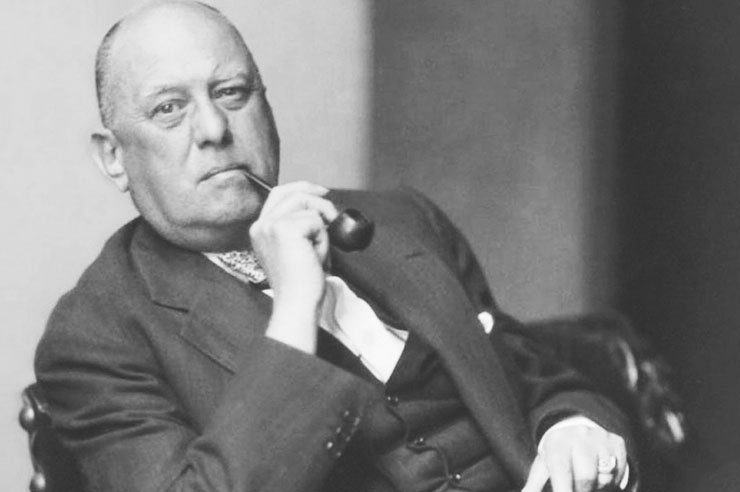
    Among those who warned of this increasing dehumanisation was the ‘infamous’ British occultist Aleister Crowley, scourge of respectable English society during the 1920s, portrayed by the tabloid press as a ‘Satanist’ and ‘the wickedest man in the world’, but also an operative for the British secret service in both the major 20th century world wars.1 Far from being a ‘Black Magician’, Crowley sought to oppose the ‘Black Adepts’ in what he, along with Steiner, Evola and Guénon, et al, saw as an occult war. Crowley’s doctrine, when applied to the political, social and economic spheres, is contrary to that of the Anti-Traditionalist and Counter-Traditionalist currents addressed by Evola and Guénon. Thelema is aristocratic rather than communistic, despite incongruous allusions by Crowley to Adam Weishaupt and the Illuminati.2 Thelema is the antithesis of Illuminism, Jacobinism, secular humanism and other such currents that emerged from Freemasonry.

    Crowley explained that while the Yellow School “stands aloof,” “the Black School and the White are always more or less in active conflict.”3 He wrote of the nexus between the Black School and Freemasonry, and how Masonry had been taken over and redirected by the Black Masters and their adepts. According to Crowley:

    The meaning of masonry has either been completely forgotten or has never existed, except insofar as any particular rite might be a cloak for political or even worse intrigue.4

    Crowley also referred to English Masons “in official relationship with certain masonic bodies whole sole raison d’etre is anti-clericalism, political intrigue and trade benefit,” despite English Masonry supposedly eschewing such motives.5

    Thelema & Nietzsche

    To the mass movements and doctrines that were sprouting in the name of ‘the people’ but can only result in tyranny, Crowley offered what he intended to be the religion of a new Aeon, Thelema, the Greek word for Will.

    “There is no law but do what thou wilt”6 is the dictum of Thelema, misunderstood precisely for what it is not: anarchism and ego-driven individualism of the type promoted by the ‘Black Adepts’ in the name of democracy, liberalism, human rights and other popular clichés designed to fracture and deconstruct society as a dialectical process for reconstructing a ‘new world order’. Crowley unequivocally stated that “do what thou wilt” “must not be regarded as individualism run wild.”7

    The essence of Thelema is the philosophy of Friedrich Nietzsche. Crowley lists Nietzsche as one of the ‘saints’ of Thelema in the Gnostic Catholic Mass.8 It is Nietzsche dressed up with mysticism and religious garb. But Nietzsche also presented his doctrines in quasi-religious and mystical ways, calling his most well-known book after the name of the founder of Zoroastrianism, Zarathustra, and writing Thus Spoke Zarathustra in the style of an Old Testament prophet. The dictum of Nietzsche’s Zarathustra is Will. The means of achieving one’s will is through “self-overcoming”9 that requires the sternest discipline upon oneself. Nietzsche wrote in opposition to Darwinian evolution,10 stating that human evolution would be willed, not the result of random genetic mutations. This next step of human evolution would result – if able to ‘cross the abyss’ of self-destruction – in the Over-Man. In this – misconceptions to the contrary – one is most brutal towards oneself, not others.

    True Self

    Schooled in the occult by the Hermetic Order of the Golden Dawn, where Egyptian mythology was in vogue, Crowley coated Thelema with a largely Egyptian façade. His ‘bible’, ‘The Book of the Law’, Liber Legis, an automatic writing scripted in Cairo by Crowley in 1904, is said to be a transmission from “the Gods” through an entity named Aiwass, or Aiwaz, depending on the numerological significance, which Crowley on other occasions referred to as his own ‘Holy Guardian Angel’, or ‘Higher Self’.

    In Thelema this is the ‘True Self’. The only purpose in life is to discover one’s True Self and follow that path regardless of the hardships; equivalent to Nietzsche’s self-overcoming, the individual’s battle against his or her own weaknesses and all obstacles that stand in the way of following one’s path. This requires, states Crowley, the harshest self-discipline, and is far removed from hedonism and self-indulgence. It is what the Muslims call the ‘greater Jihad’, the fight within oneself. It does not justify any sociopathic disregard for others.

    Thelema’s other primary dictum is “Every man and every woman is a star.”11 Since every star has its own orbit, the course of one’s star should not, if the law of Thelema is correctly applied, conflict with another’s orbit or the path of a True Self. Again Crowley was clear: “The highest are those who have mastered and transcended accidental environment… There is a good deal of the Nietzschean standpoint in this verse.”12

    Thelema, in recognising that everyone has a True Self, does not recognise that the brightness of all stars is equal. Hence, Thelema eschews socialist and other neo-Jacobin – and New Age – ideologies that demand universal equality. Again, Crowley is clear when describing Thelema as a stellar religion, “reflecting the highly organised structure of the universe,” which includes “stars that are of greater magnitude and brilliance than the rest.”13 Equality is rejected: “The is no creature on earth the same. All the members, let them be different in their qualities, and let there be no creature equal with another.”14

    Thelema was intended for the creation of a new aristocracy, one neither blood nor money based, but the merit of one’s own struggle. Crowley advocated the Nietzschean revival of a “master morality and a slave morality,”15 meaning that the great mass of people would always have servile characteristics, hence, “the slaves shall serve”:16 their characteristics are to follow those who are innately aristocratic and capable of fulfilling their True Will to the fullest extent. The masses are “that canting, whining, servile breed of whipped dogs which refuses to admit its deity”; “the natural enemy of good government.”17 The new aristocracy would be able to pursue long-range goals without the encumbrances of pandering to democratic whims.18 This aversion to mass politics shuns the democratic vote, “the principle of popular election [being] a fatal folly,” resulting in the election of “mediocrity”: “the safe man, the sound man, and therefore never the genius, the man of progress and illumination.”19

    [alert type=”info” dismiss=”no”]If you appreciate this article, please consider a subscription to New Dawn magazine.[/alert]

    Thelemic State

    That is not to say any Thelemic state would be a crushing tyranny as per socialism. To the contrary, Crowley eschewed all levelling doctrines. He shared the views of other creative types of the time, including his arch rival in the Golden Dawn, W.B. Yeats, and the Italian philosopher Julius Evola, that all arising mass movements including Bolshevism, Fascism, and the emerging consumer society with its cultural levelling, were very much negative developments.

    Thelema was also intended as a fighting creed or more aptly, a knightly creed, to wage a Thelemic holy war against creeds that aim to suppress freedom. The ‘new Aeon’ is, after all, one of ‘force and fire’, presided over by the hawk-headed god Horus. Crowley saw an era of conflict preceding the new Aeon, in which the new “aristocrats” would be in conflict with the masses: “and when the trouble begins, we aristocrats of freedom, from castle to the cottage, the tower or the tenement, shall have the slave mob against us.”20 Again one sees the focus for the new aristocracy on character rather than either wealth or birth; a new aristocracy that, like Nietzsche’s Over-Man, emerges through struggle.

    Crowley described a government following a Thelemic course as one in which, far from a hedonistic free-for-all, “set[s] limits to individual freedom. For each man in this state which I propose is fulfilling his own True Will by his eager Acquiescence in the Order necessary to the Welfare of all, and therefore of himself also.”21

    Crowley advocated the organic state, or what was in his time known as corporatism, of which Fascism was an effort. The doctrine of the organic or corporate state (as in corpus, or body) was a broad movement across the world, often influenced by Catholic social doctrine as a vestige of Tradition, contending with both capitalism and Bolshevism. In the organic state, as the term implies, society is regarded as analogous to a living organism: the government is the brain co-ordinating each organ (classes, professions), while the body is composed of cells (individuals). This organic conception of society parallels Traditional societies, as explained by Evola,22 in which the socio-economic structure was a pyramidal hierarchy with the guilds at its foundation. Again, Crowley was specific, describing the organic state very cogently:

    In the body every cell is subordinated to the general physiological Control, and we who will that Control do not ask whether each individual Unit of that Structure be consciously happy. But we do care that each shall fulfil its Function, with Contentment, respecting his own task as necessary and holy, not envious of another’s. For only mayst thou build up a Free State, whose directing will shall be to the Welfare of all.23

    In fulfilling one’s True Will the individual (cell) contributes to the social organism. This is a Traditional view of society where every individual’s calling is a reflection of his character as part of the cosmos. Anything subverting this order, such as class struggle – “not envious of another’s” task as Crowley put it – could be described as a cancer in the social organism, disrupting the correct function of the cells and organs of society.

    The socio-economic structure of a Thelemic state would return to the guilds as in Medieval society, in which work is not economic drudgery but one’s divine calling. There was no class struggle in the Medieval world, whether of a capitalist or Marxist nature. Economic competition was alien to the Medieval mind. In the European Medieval period, guilds were the fundamental organs of society. Crowley alluded to the guilds when describing the structure of his magickal order, Ordo Templi Orientis (OTO):

    Before the face of the Areopagus24 stands an independent Parliament of Guilds. Within the Order, irrespective of Grade, the members of each craft, trade, science, or profession form themselves into a Guild, making their own laws, and prosecute their own good, in all matters pertaining to their labour and means of livelihood. Each Guild chooses the man most eminent in it to represent it before the Areopagus of the eighth Degree, and all disputes between the various guilds are argued before that Body, which will decide according to the grand principles of the Order.25

    Crowley’s OTO is here seen as a society in microcosm. Crowley’s ideas on the organic state, and the role of the arts, are most closely reflected in the very brief time of the Free State of Fiume, created by Italian war hero and eminent man of letters, Gabrielle D’Annunzio. The Free State of Fiume attracted idealists from all over Italy – Anarchists, Fascists, Futurists and Traditionalists – into a remarkable experiment,26 albeit one that seems to have been oddly unmentioned by Crowley, despite existing when he was present in Italy (1920).
    Economics of Leisure & Art

    Crowley said that once obligations to the social order are met, there should be “a surplus of leisure and energy” that can be spent “in pursuit of individual satisfaction.”27 Again, we hark back to the pre-industrial epoch of Europe, when the artisan and peasant in a village-based economy, worked according to his social obligations, but had an abundance of leisure that today seems utopian.

    Such a renewed social order would include a realistic approach to money as a means of exchange rather than as the commodity it became over the course of centuries. As mentioned in New Dawn,28 Crowley addressed the issue:

    What is money? A means of exchange devised to facilitate the transactions of business. Oil in the engine. Very good then: if instead of letting to flow as smoothly and freely as possible, you baulk its very nature, you prevent it from doing its True Will. So every “restriction” on the exchange of wealth is a direct violation of the Law of Thelema.29

    It seems likely that Crowley was introduced to new economic theories through A. R. Orage, editor of The New Age, from whence T.S. Eliot, Ezra Pound and the New Zealand poet Rex Fairburn also learned about economics.30

    In a Thelemic state, one might envisage usurers being dragged through the streets and pilloried in stocks, if not worse, and then declared a literal outlaw.

    Once the material needs of the people are met there would be leisure to pursue higher callings in life. It suggests the ‘self-realisation’ and ‘hierarchy of human needs’ model of the humanistic psychology of Maslow et al, if one seeks a current theory.

    Again, this returns to a bygone era where the peasantry and townsfolk had an abundance of holy-days. The work week was five and a half days.

    People also rested on the day of the patron saint of their guild and of their parish, and there was, of course, a complete holiday on Sundays and on holy days of obligation. These were very numerous in the Middle Ages – 30 to 33 a year, according to the province.31

    The work day was based on sun-rise and sun-set, which meant fewer working hours during winter, and a few hours longer in summer. Popular theatre was lively, and actors were widely drawn from the village folk. Not only religious themes but burlesque, satire, romance and history were themes.

    Crowley proposes a state in which people are free to pursue higher cultural attainments.

    These things being first secured, thou mayst afterward lead them to the Heavens of Poesy and Tale, of Music, Painting and Sculpture, and into the love of the mind itself, with its insatiable Joy of all Knowledge.32

    Realising that ‘stars’ are of unequal brilliance, Crowley condemned “the cant of democracy,” stating it was “useless to pretend that men are equal,” and that most are content to “stay dull.”33 Given every opportunity, most would be content satisfying their material needs, with no horizons beyond “ease and animal happiness.” Those whose True Wills are to ascend the social hierarchy would form “a class of morally and intellectually superior men and women.”34

    Crowley addressed the problems of the machine age, relevant to the present technocratic era, where man is becoming an economic cog. What Crowley said about industrialisation is prescient in light of the modern technological age, with its ongoing dehumanisation and life increasingly virtual and detached from interpersonal bonds, whether individual, family, or community. Paradoxically, the oligarchic interests promoting all this do so behind catchcries of ‘brotherhood’ and a ‘new world order’. Hence Crowley, like Oscar Wilde,35 W.B. Yeats, et al, lamented the destruction of craftsmanship that proceeded apace after the Industrial Revolution. One might say prior to that since the mercantile spirit of the Reformation made economics the master, again in the name of ‘freedom’. Crowley wrote:

    Machines have already nearly completed the destruction of craftsmanship. A man is no longer a worker but a machine-feeder. The product is standardised; the result mediocrity… Instead of every man and every woman being a star, we have an amorphous population of vermin.36

    Today, in place of the machine-feeder there is the data-feeder, while products remain standardised, including the arts, aggravated by mass techno-entertainment.

    Crowley’s vision was that of the Thelemite as Knight fighting every tyranny that suppressed the human will:

    We have to fight for freedom against oppressors, religious, social or industrial, and we are utterly opposed to compromise, every fight is to be a fight to the finish; each one of us for himself, to do his own will, and all of us for all, to establish the law of Liberty… Let every man bear arms, swift to resent oppression… generous and ardent to draw sword in any cause, if justice or freedom summon him.37

    It seems we still await the emergence of such Knights of Thelema, although one suspects that like Yukio Mishima, the modern age Samurai, these Knights would be quickly liquidated by the weapons of mass destruction in the hands of religious lunatics, whether in the name of Jesus, Allah or YHWH, leaving little scope for chivalric combat.

    [alert type=”general” dismiss=”no”]This article was published in New Dawn Special Issue Vol 10 No 3.[/alert]

    [alert type=”success” dismiss=”no”]If you appreciate this article, please consider subscribing to help maintain this website.[/alert]

    Footnotes

    1. Richard Spence, ‘The Magus was a Spy: Aleister Crowley and the Curious Connections Between Intelligence and the Occult’, New Dawn 105, November-December 2007, 25-30
    2. Weishaupt is listed as a ‘saint’ in Crowley’s Gnostic Catholic mass. Magick in Theory and Practice, Samuel Weiser, 1984, 430
    3. Aleister Crowley, Magick Without Tears, Falcon Press, 1983, 66
    4. Crowley, 1986, 68-69. Crowley also writes here of Masonic ‘Christian’ degrees being changed in the USA to enable the initiation of ‘Jewish bankers’.
    5. Crowley, The Confessions of Aleister Crowley, Routledge & Kegan Paul, 1986, 697. Rudolf Steiner was also similarly critical of English Masonry.
    6. Crowley, Liber Legis, Samuel Weiser, 1976, 3:60
    7. Crowley, The Law is for All, Falcon Press, 1985, 321
    8. Crowley, Magick, 430
    9. Friedrich Nietzsche, Thus Spoke Zarathustra, Penguin Books, 1969, 136-138
    10. KR Bolton, ‘Nietzsche Contra Darwin’, in Southgate, ed., Nietzsche: Thoughts & Perspectives, Vol. 3, Black Front Press, 2011, 5-19
    11. Liber Legis, 1: 3
    12. Crowley, The Law is for All, 175
    13. Crowley, The Law is for All, 143-145
    14. Crowley, The Law is for All, 228
    15. Friedrich Nietzsche, Beyond Good & Evil, Penguin, 1984, 175
    16. Liber Legis, 2: 58
    17. Crowley, The Law is for All, 192
    18. Crowley, The Law is for All, 193
    19. Crowley, Liber CXCIV, ‘OTO. An intimation with references to the Constitution of the Order’, para. 10, The Equinox, Vol. III, No. 1, 1919
    20. Crowley, The Law is for All, 192
    21. Crowley, The Book of Wisdom or Folly, Samuel Weiser, 1991, Liber Aleph Vel CXI, De Ordine Rerum, clause 39
    22. Julius Evola, Men Above the Ruins, Inner Traditions, 2002, 224-234
    23. Crowley, The Law is for All, 251-252
    24. Supreme court.
    25. Crowley, ‘OTO. An intimation with references to the Constitution of the Order’, para. 21
    26. Bolton, Artists of the Right, Counter-Currents Publishing, 2012, 27-30
    27. Crowley, The Law is for All, 230
    28. Bolton, ‘A Secret History of Money Power’, New Dawn Special Issue Vol. 10, No. 2, 55, 58
    29. Crowley, Magick Without Tears, Falcon Press, 1983, 346
    30. Bolton, New Dawn, 58
    31. Hugh O’Reilly, ‘Medieval Work and Leisure’,
      www.traditioninaction.org/History/A_021_Festivals.htm
    32. Crowley, The Law is for All, 251
    33. Crowley, The Law is for All, 192
    34. Crowley, The Law is for All, 227
    35. Oscar Wilde, The Soul of Man Under Socialism, Black House Publishing, 2012
    36. Crowley, The Law is for All, 281
    37. Crowley, The Law is for All, 317

    © New Dawn Magazine and the respective author.
    For our reproduction notice, click here.
  • The New World Order Vs. The New Age: Separating Truth from Falsehood

    The New World Order Vs. The New Age: Separating Truth from Falsehood

    From New Dawn Special Issue Vol 6 No 6 (Dec 2012)

    There are numerous difficulties in trying to discern what among the proliferation of new or revived faiths might be regarded as working to usher forth a New Age based on eternal values, and those that work to establish the rule of malignant, matter-bound forces. The problem is that there are often superficial resemblances that occur between them. Even within the same occult orders, such as Freemasonry, there are a range of views that might be in opposition but are mistaken as being part of a single, all-embracing conspiracy. There is a tangle of terminology, groups, personalities, ‘Hidden Masters’, accusations and counter-accusations of black magic, and so forth. This article considers ways in which the positive and negative currents within the ‘New Age’ might be identified.

    The Cycles of Rise and Fall

    The school of Perennial Tradition regards traditional cultures, religions and spiritualities as sharing core beliefs, values of an eternal nature, on which are founded Civilisations and societies in their cycles of health. Hence, in the analogous cycles of cultures as far removed geographically and ethnically as the Japanese, Hindu, Norse, and Arabian, all will possess analogous beliefs in regard to social hierarchy, chivalric ethos, and a nexus that exists between the Divine and the temporal. In such a society one’s highest calling, whether as peasant or prince, is to work in accord with one’s cosmic duty, or what the Hindus call dharma. In such a society castes reflect the Divine order on earth: ‘as above, so below’, and degenerate into contending economic classes in the cycle of decline.1

    This cyclical view of history2 is another shared featured of various Traditional cultures, expressed in the Norse,3 Hindu,4 Hopi oral lore,5 and many others. In our own era the German historian-philosopher Oswald Spengler provided empirical evidence for the cyclicity of cultures.6 The two primary Traditionalist exponents of cultural cyclicity in our era are Rene Guenon7 and Julius Evola.8 Esoterically, it is the cycle of life expressed in ‘The Wheel’ of the ‘Major Arcana’ of the Tarot, which is derived from the Medieval ‘Wheel of Fortune’ or Rota Fortuna depicted in Gothic Churches.9 

    Tradition, Anti-Tradition & Counter-Tradition

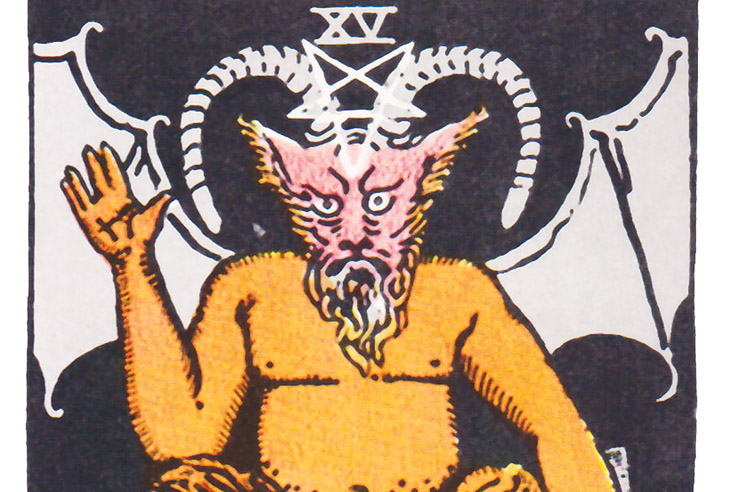
    A glance at cultural cycles is necessary to identify the occult forces that work in the context of Tradition for a return to eternal values based on a reconnection with the Divine, and those that want to enslave humanity to matter. Again, recourse to Tarot symbolism is instructive. Here we see that the Counter-Tradition that stands behind Anti-Tradition, is in the esoteric sense, literally satanic. Paul Foster Case10 provides a meaning for ‘The Devil’ trump that is particularly relevant:

    In its most general meanings, it signifies Mammon and thus big business, the conventions of society, the injustice and cruelty of a social order in which money takes the place of God, in which humanity is bestialised, in which war is engineered by greed masquerading as patriotism, in which fear is dominant. Students of astrology will have no difficulty in seeing how this corresponds to Capricorn, the sign of big business, and the sign of world fame.11

    In this one paragraph Case says much. He cogently differentiates the Traditionalist from the Anti-Traditionalist in what is an occult war. Case identifies the Counter-Tradition that controls Anti-Tradition as ‘Mammon’. Mammon infers something more than simply plutocracy; it is the spirit behind plutocracy. Plutocracy controls the present era. Oswald Spengler pointed out that Money rules in the epoch of decline of a Civilisation. It is not merely the temporal influence of Money which Spengler is referring to, but the spirit behind Money, or what Case calls Mammon. “The dictature of money marches on, tending to its material peak in the Faustian [Western] Civilisation as in every other.”12 

    The other significant point raised by Case is the ‘bestialisation’ of humanity. In this trump ‘The Devil’ is depicted enchaining the human pair to matter. Like the ‘Devil’, the human pair is depicted with tail and horns. This is suggestive of the esoteric belief in cyclic regression rather than lineal progression, when humanity regresses from a higher state of Being, of a spiritual mode, descending ever more into a baser, material existence. Anti-Tradition is the agency for this decline and enslavement. The modern world is therefore, according to the Traditionalist perspective, not ascending upward toward the Godhead, nor toward manifesting the God within; but is in a downward spiral towards – metaphorically – ‘The Devil’ – the master of our base drives.

    A problem of identifying who belongs to what arises because forces work behind the guise of Tradition, while they are in reality the initiates of Anti-Tradition and Counter Tradition, or what Aleister Crowley called the ‘Black Magick School’. The purpose of Anti-Tradition is that of subversion and the sowing of confusion to pave the way for Counter-Tradition. ‘Anti-Tradition’ was stated by Perennial Traditionalist scholar and initiate Rene Guenon to be “pure negation and nothing more.”13 In regard to Counter-Tradition there is a “counter-initiation,”14 representing a satanic current of those who seek the severing of the nexus between the terrestrial and the divine. Guenon wrote of this:

    After having worked always in the shadows, to inspire and to direct invisibly all modern movements, it will in the end contrive to ‘exteriorise’, if that is the right word, something that will be as it were, the counterpart of a true tradition, at least as completely and as exactly as it can be so within the limitations necessarily inherent in all possible counterfeits as such.15

    To Guenon the Counter-Traditionalist movements are void of spiritual content. This can be seen in the many movements and ‘orders’ professing a ‘tradition’ and having a mystical or spiritual façade, yet who expound a materialistic universal republic. This is why various esoteric orders can be seen to be promoting materialistic doctrines such as Marxism, and such Anti-Traditional dogmas as those expressed in slogans like “liberty, equality, fraternity,” to usher in the “reign of quantity.”16 Anti-Traditionalist movements and ideologies are only a means, and not the end. Guenon aptly uses the term “satanic”17 to describe these currents.

    Of these Counter-Traditions, Guenon states that they can never be anything other that a “parody,” an “inverted spirituality” involving organisations of “counter-initiation.”18 Guenon regarded these movements as being of supernatural origin, as satanic and believed that a figure analogous to the “The Anti-Christ” will manifest at the head of a world order.19

    Guenon described the order which Counter-Tradition tries to impose by at first using the doctrine of “egalitarianism” as a means of overthrowing the remnants of Tradition and spirituality, after which will be erected in place of the divine hierarchies a “counter-hierarchy,” atop which sits an individual that seems analogous to “The Anti-Christ,” Guenon describing him as “nearest to the very bottom of the ‘pit of hell’.”20

    Of the numerous orders that were emerging, especially in France during the 19th century, Guenon referred to them, regardless of their pretensions, as “anti-tradition.” One might say that they reflect the zeitgeist21 of the present epoch of Western decline. Guenon refers to the numerous orders that claimed to be “Rosicrucian.”22 Of these, the primary order is that of Freemasonry, from which much of the current “occult revival” derives, including cults purporting to represent a “New Age.” They are, in Guenon’s term, “counterfeits,” and as counterfeits are intended to be, often difficult to detect.

    Profanation of Tradition

    Eliphas Levi23 was one of the primary theoreticians of the modern occult revival. Among Levi’s books, The History of Magic provides insights into the history, nature and influence of Anti-Traditional, Counter-Traditional and counter-initiatory currents. Levi was well-placed to offer informed opinion. He had been a prominent socialist propagandist, having been jailed for his views24 and seems to have been a highly initiated Freemason.25 However, Levi rejected socialism in favour of a conservative, monarchical position, and came to see Freemasonry as having had a noble tradition that had been “profaned” by Anti-Tradition. Having defended what he regarded as the genuine traditional and spiritual legacy of Masonry, Levi then posed and answered the question:

    Now if Masonry is thus holy and thus sublime, we may be asked how it came to be proscribed and condemned so often by the Church?… Masonry is the Gnosis and the false Gnostics caused the condemnation of the true.26

    Levi contends that the Traditionalists were driven underground for fear of being associated with the “sacrilege” of the “false interpreters… the enemies of all belief and all morality”:

    Masonry has not merely been profaned but has served as the veil and pretext of anarchic conspiracies descending from the secret influence of the vindicators of Jacques de Molay,27 and of those who continued the schismatic work of the Temple. In place of avenging the death of Hiram28 they have that of his assassins. The anarchists have resumed the rule, square and mallet, writing upon them the words Liberty, Equality, Fraternity – Liberty, that is to say, for all the lusts, Equality in degradation and Fraternity in the work of destruction. Such are the men whom the Church has condemned justly and will condemn forever.29

    Levi states that during the 18th century,

    A schism took place in illuminism:30 on the one hand, the wardens of the traditions concerning Nature and science wished to restore the hierarchy; there were others, on the contrary, who desired to level all things by disclosing the Great Arcanum, thus rendering the royalty and priesthood alike impossible in the world. Among the latter, some were ambitious and unscrupulous, seeking to erect a throne for themselves over the ruins of the world. Others were dupes and zanies. The true initiates held with dismay the launching of society toward the abyss, and they foresaw all the terrors of anarchy.31

    Levi is here referring to the Order of the Illuminati, founded in Bavaria in 1776 by Adam Weishaupt, with the purpose of inaugurating a communistic universal republic; and similar cabals generally emanating from Freemasonry, including the French revolutionary Jacobin Club and Lodges that formed after the French revolutionary tumult from whence came the subversive creeds, including that of Karl Marx.

    The revolutionary atheists, rationalists and humanists flocked to the Lodges during the 18th and 19th centuries, where they “worked the degrees” of the ancient Mysteries for their own counter-initiatory purposes. Of the type of profanation Levi referred to, we can state the following.

    Philippe Buonarroti, the Italian exponent of the French Revolution, was initiated into Masonry in 1786. In 1808 he formed Les Sublimes Maîtres Parfaits. Buonarroti had a major influence on revolutionist Auguste Blanqui, and through his book Conspiration pour l’Egalité dite de Babeuf, suivie du procès auquel elle donna lieu he was also a seminal influence on the revolutions that erupted throughout Europe in 1848. Buonarroti also advised Mazzini and other revolutionaries in Italy.32

    Buonarroti had co-founded with Francois Babeuf, another significant revolutionist, the Society of the Pantheon, one of the first of the revolutionary secret societies to emerge from the French Revolution, believing the Revolution had failed; and he organised a group of ‘Philadelphe’ Masonry within the Lodge ‘Amis Sincères’. Dr. J M Roberts states:

    What may be termed the first international political secret society, the Sublimes Maîtres Parfaits, was founded by Buonarroti, perhaps in 1808. Only freemasons were admitted to it. The Elect were aware that they were to work for a republican form of government; only the Areopagites knew that the final aim of the society was social egalitarianism, and the means to it the abolition of private property.33

    Marxism was the 19th century culmination of this Anti-Traditional current of a long line of secret societies. Although numerous conspiratologists have written of the alleged role of the Illuminati in ‘hiring’ Marx to write the Communist Manifesto, via the League of the Just, reliable documentation is infrequent. However, there is scholarly evidence that Marx was part of the Anti-Traditionalist current. Blanqui organised the League of the Just, which was called the League of Outlaws by German exiles in Paris. This became the Communist League, and in 1847 this cabal asked Marx to write the Communist Manifesto. It is from Blanqui that the dictum now credited to Marx, the “dictatorship of the proletariat,” originated.34 Marx was initiated into the Mysteries of Memphis-Mizraim Masonry. Prof. Mark Lause, a scholar of labour history,35 writes:

    …Certainly, the tangled history of freemasonry has largely mirrored the political and social views of those drawn to the craft, and some of those drawn to the more peculiar pseudo-Egyptian forms of the order reflected views that were accordingly distinctive.36

    The 18th century Cabalistic mystic Cagliostro founded the Rite of Memphis in 1779. He insinuated himself into the French Court, like Philippe de Lyon insinuated his way into the Court of the ill-fated Czar Nicholas II.37

    Lause cites I Nicolaevsky38 as an authoritative source in stating “that the nineteenth century Order of Memphis actually did mask the ongoing revolutionary activism of French radicals both at home and abroad, strikingly so in the case of émigré circles at London.”39 This confirms the statement by occult historian Lewis Spence, who in a laudatory entry on Cagliostro writes that the Mizraim Rite included the communistic doctrines of the Illuminati.

    In 1785 Cagliostro was implicated in a scandal in the French Royal Court and exiled himself to England where he wrote revolutionary propaganda against the monarchy and declared that the French Throne would be overthrown. His 1786 ‘Letter to the French People’ declared prophetically that the Bastille would be stormed and the governor killed.40 

    Spence states that Mizraim had been set up to subvert the traditional society of Europe and, significantly, received large financial backing:

    There is a small question that the various Masonic lodges which he [Cagliostro] founded and which were patronised by persons of ample means, provided him with extensive funds, and it is a known fact that he was subsidised by several extremely wealthy men, who, themselves dissatisfied with the state of affairs in Europe, did not hesitate to place their riches at his disposal for the purpose of undermining the tyrannic powers which then wielded sway.41

    London was the centre of revolutionary intrigue where political refugees from throughout Europe sought refuge and, with the help of English Masons, founded the Internationale.42 Masonry provided acceptance for diverse and radical views, and a model for a secret revolutionary structure. Lause writes of this:

    In any event, if your declared purpose was something as radical as that of the Philalethes, the perfection of the human race, it helped legitimise the goal by describing oneself as an “Ancient and Primitive Rite of Masonry.”43

    Lodges were established in England and elsewhere, the most important being La Grand Loge des Philadelphes at London in 1851. Lause states that the Order of Memphis “fostered what became the International Association in March 1855 [and] provided almost all of the French members of the General Council of the later International Workingmen’s Association.”44 Another prominent socialist historian, Dr. Bob James, identifies as Masons Garibaldi, Mazzini,45 Charles Bradlaugh46 and Karl Marx, stating this was “neither an accident nor an aberration.”47

    Crowley on the Schools of Black and White Magick

    Aleister Crowley is perhaps the best example of how unclear can be the identification of Traditional, Anti-Traditional and Counter-Traditional currents.48 Crowley claimed Adam Weishaupt, the founder of the Illuminati, among the “saints” of his religion, Thelema.49 However, the doctrines of Thelema and the Illuminati are polar opposites. Crowley, in contrast to the communistic doctrines of Illuminism, sought the establishment of a neo-aristocratic society: the revival of hierarchy.50 It is notable that the German philosopher Friedrich Nietzsche, the antithesis of communistic and liberalistic doctrines, is also a “Saint” of Thelema.51

    Evola acknowledged Crowley as a genuine initiate of Tradition. Evola also regarded the Hermetic Order of the Golden Dawn, under which Crowley served his magickal apprenticeship and which was a seminal influence on the modern occult revival as, “to some extent,” a successor “to those of an initiatic character.”52 Evola granted that Crowley’s system of Magick was drawn from Traditional initiatic practices: “It is certain that in Crowleyism the inoculation of magico-initiatic applications is precise, and the references or orientations of ancient traditions are evident.”53

    Why then did Crowley identify with Adam Weishaupt and the Illuminati, whose doctrines are antithetical to Thelema? Perhaps the reason is that Crowley took on a certain role when assuming the mantle of leadership of the Ordo Templi Orientis (OTO) founded by Theodor Reuss, who was in the employ of the German secret service. Reuss is said to have revived the Order of the Illuminati by virtue of what he claimed to be family connections with the 18th century cabal.54 He was an initiate of Martinist and Mizraim Masonry headed by ‘Papus’.55 He was also in contact in 1902 with Dr. William Wynn Westcott, a high initiate of Grand Lodge Masonry, head of the Societas Rosicrucia in Anglia and founder of the Golden Dawn.56 Reuss had influential international connections.57 As Dr. Richard Spence of the University of Idaho has shown, Crowley was involved with the British secret service at least from 1913, when he was acting for British interests in Moscow,58 and was called on during both World Wars.59 Reuss was obviously a valuable asset to the Germans, and Crowley was ideally placed to track him.60 

    At any rate, Crowley’s identification of the White, Yellow and Black Schools of Magick show that the Illuminati and Freemasonry can be identified with the Black School or what Guenon called the Counter-Tradition and Anti-Tradition. Crowley explained that each School has its own “Hidden Masters.” While the Yellow School “stands aloof,” “the Black School and the White are always more or less in active conflict.”61 The Yellow School regards the universe as “neutral.” The Black regards it as a curse and a sorrow.62 Hence we might summarise the three Schools of Magick in regard to their philosophy of life as being: Yellow: Neutral, Black: Negative, White: Positive.

    Crowley, like Eliphas Levi and Guenon, saw Masonry as having been subverted by the ‘Black School’ and referred to English Masons as being “in official relationship with certain masonic bodies whose sole raison d’etre is anti-clericalism, political intrigue and trade benefit,” despite English Masonry supposedly eschewing such motives.63 These critical sentiments towards the subversion of English Masonry are not consistent with anyone who would be an adherent of Weishaupt and Illuminism, whose raison d’etre was anti-clericalism and political intrigue.

    Crowley saw anarchism sweeping the world of the type that had been initiated by the Illuminati and other forms of Masonry during the 18th and 19th centuries. Again, it can be seen that Crowley’s attitude was anything but Illuminist. “The last quarter of a century had swamped”64 the monarchies, and for Crowley the world was poorer for it:

    The world is seething from the dissatisfaction that springs from insecurity. Men can adapt themselves to pretty well any conditions, but when they do not know from one day to another where some fundamental principle may not be abolished in the interests of progress, they no longer know where they are. They tend to adopt the principles of the man who flits from one place to another… Civilisation has become a hysterical scramble for momentary material advantage…65

    Syncretic Religion and the Perennial Tradition

    The centuries of subversion of Tradition by Black adepts and their dupes has caused a confusion of cults, religions, and spiritualities, most of which claim to offer humanity the path to peace and happiness, and even to Godhood. As has been indicated throughout this article, it is not an easy matter to determine the real motives of many claiming the mantle of the Ageless Wisdom.

    There is an abysmic gulf between adherents of the Perennial Tradition and the Anti- and Counter-Traditions, yet they will often appear similar, because of the ‘counterfeit’ nature of the latter. The Perennial Traditionalist sees a commonality between faiths over expanses of time and space, the assumption generally being that they all derived from a primordial source and differ in so far as they reflect differences of ethnos, geography and historical circumstances. The Perennial Traditionalist will seek to maintain the distinctiveness of these faiths.

    The Black adept, while masquerading as a Traditionalist, aims to amalgamate the world’s faiths into one new syncretic faith, the altar to which all humanity will be chained under the guise of ‘universal brotherhood’, preludes of which were the bloody Reigns of Terror in Jacobin France and Bolshevik Russia. Therefore, when a State’s secular politicians, who also happen to be adherents of the aim of a ‘new world order’, start talking about ‘inter-faith dialogue’, under the guise of ‘representing all religions’, and of ‘tolerance’, one should be suspicious.

    Those who adhere to the Ageless Wisdom of many faiths eschew materialistic agendas. The World Forum of Spiritual Culture, formed on the initiative of the President of Kazakhstan, Nursultan Nazarbayev, brings together those who seek a new civilisation, in the aftermath of what they regard as a technical civilisation that is “anti-cultural.”66 Significantly, Nazarbayev is also a champion of a Eurasian geopolitical bloc67 that would challenge the very possibility of a ‘New World Order’. Such a bloc could serve as the axis for a New Age founded on spiritual and cultural principles, and freed from the bonds of matter.

    [alert type=”general” dismiss=”no”]This article was published in New Dawn Special Issue Vol 6 No 6.[/alert]

    [alert type=”success” dismiss=”no”]If you appreciate this article, please consider subscribing to help maintain this website.[/alert]

    Footnotes

    1. J Evola, Revolt Against the Modern World, Inner Traditions International, 1995.

    2. In contrast to the progressive-lineal, darwinistic view of history as a straight line running from primitive to modern.

    3. Voluspa, reprinted in The Masks of Odin: Wisdom of the Ancient Norse, Elsa-Brita Titchenell, Theosophical University Press, 1985.

    4. Bhagavad-Gita, Ch.9:8.

    5. G Hancock, Fingerprints of the Gods: A Quest for the Beginning and the End, Mandarin, 1996, 532-533.

    6. Oswald Spengler, The Decline of The West, George Allen & Unwin, 1971.

    7. Rene Guenon, The Reign of Quantity and the Signs of the Times, Sophia Perennis, 2001.

    8. J Evola, Revolt Against the Modern World, op. cit.

    9. D Phillips, ‘Wheel’, Man, Myth & Magic, Purnell, 1970, Vol. 7, 3014-3015.

    10. Case can be regarded as an adept of Tradition. He was initiated into the Golden Dawn, Crowley’s OTO, and in 1926 into 3º Masonry, and founded the Builders of the Adytum. His adherence was to the ‘Ageless Wisdom’. Lee Moffitt, Case Timeline, 26 September 1997, http://kcbventures.com/pfc/documents/timeline.pdf

    11. John Foster Case, Oracle of The Tarot: A Course on Tarot Divination, Chapter 6, ‘The Major Trumps: 15. Le Diable’, http://tarotinstitute.com/free/Oracle2.pdf

    12. However, Spengler also points out that at the cycle of decline – Kali Yuga, etc. – Money exhausts its possibilities and is met by a Traditional resurgence which he called “blood”: “the conflict between money and blood.” Oswald Spengler, op. cit., Vol. II, 506.

    13. Rene Guenon, The Reign of Quantity and the Signs of the Times, Sophia Perennis, 2001, 260.

    14. Ibid., 261.

    15. Ibid., 261.

    16. Ibid., 271.

    17. Ibid., 261.

    18. Ibid., 267.

    19. Ibid., 271-273. Guenon draws on both Islamic and Christian traditions here.

    20. Ibid., 271.

    21. ‘Spirit of the Age’ which, as Spengler, Evola and Guenon showed is, in the epoch of Western decline, materialism and the rule of money. This ‘spirit’ will be reflected even in movements intended to be in opposition to it. Hence as Oswald Spengler pointed out, Marxism is the mirror image of capitalism, both being doctrines of the materialistic zeitgeist. Oswald Spengler, op. cit. Vol. 2, 402, 464.

    22. Rene Guenon, op. cit., 251.

    23. The pseudonym of Alphonse Louis Constant (1810-1875).

    24. J W Revak, ‘Eliphas Levi: Clergyman, Radical, Magus’, www.villarevak.org/bio/levi_1.html

    25. Levi’s Masonic initiation can be construed from a comment he makes in The History of Magic (1860), indicating that he was an initiate of the 18º of Knight of the Pelican & Eagle & Sovereign Prince Rose Croix of Heredom. Levi writing: “Having attained by our efforts to a grade of knowledge which imposes silence, we regard ourselves as pledged by our convictions even more than by an oath… and we shall in no wise fail to deserve the princely crown of the Rosy Cross….” The History of Magic, Rider, 1982, 286.

    26. Eliphas Levi, Ibid., 286.

    27. Last Grand Master of the Knights Templar, executed for heresy.

    28. Hiram Abif, one of mythical architects of the Temple of Solomon whose murder Masons are sworn to avenge; a central motif of Masonic ritual.

    29. Eliphas Levi, op. cit., 286.

    30. By which Levi here means adepts of Gnosis; not the Order of Illuminati, the ‘schism’ among the adepts resulting in the formation of the Illuminati by “the ambitious and unscrupulous.”

    31. Eliphas Levi, op. cit., 305.

    32. Dr. John M Roberts, The Mythology of the Secret Societies, Secker & Warburg, 1972, 230.

    33. Ibid., 266.

    34. D Conway, A Farewell to Marx, Penguin Books, 1987, 146.

    35. Lause specialises in the history of the labour movement. An associate professor of history at McMicken College of Arts & Sciences, University of Cincinnati, his faculty biography states that he “teaches specialised courses in American Labor History, Comparative Labor History, and the Age of Jackson… For years, he has presented his work or participated in panels at the Annual North American Labor History Conference at Detroit… and the centennial conferences on Eugene V. Debs and Henry George.”

    36. M A Lause, ‘Walking Like an Egyptian: The American Destinies of a Revolutionary French Secret Society’; http://archives.econ.utah.edu/archives/marxism/2004w23/msg00109.html

    37. Philippe de Lyon was the protégé of Gerard Encausse, alias Papus, 33º Mason, who became Grand Master of Memphis-Mizraim, and the Grand Master of the Supreme Council of Martinist Masonry. Martinism had been founded in 1754 by Martinez de Pasquales who was, according to Bernard Lazare, an Illuminist who established Lodges of the Order in France. B Lazare (1894) Antisemitism: Its History & Causes, Britons, 1967, 153. Hence, there is a line of descent from the Illuminati to Memphis-Mizraim and Martinist Masonry. It is from this milieu, incidentally, that the Protocols of Zion might have emerged, rather than either as ‘Zionist’ records or a Czarist forgery.

    38. According to Lause, I Nicolaevsky based his work on the origins of the Internationale on the records of the organisation: “Clearly, when Nicolaevsky found the manuscript records on this society a century later, he opened a window into a genuine revolutionary conspiracy with far-reaching influences.”

    39. I Nicolaevsky, Secret Societies and the First International, The Revolutionary Internationals, 1864-1943, ed. Milorad M. Drachkovitch, Stanford University Press for the Hoover Institution on War, Revolution, and Peace, 1966, 37.

    40. L Spence (1920), An Encyclopaedia of Occultism, Citadel Press, 1960, ‘Cagliostro’, 90.

    41. Ibid., 92.

    42. International Workingmen’s Association, which included the rival followers of Karl Marx and of the anarchist Bakunin.

    43. M A Lause, op. cit.

    44. Ibid.

    45. The Italian revolutionaries.

    46. With Charles Braudlaugh there is another intriguing example of England’s leading atheist professing the arcane Mysteries as a Freemason. Annie Besant, who assumed the presidency of the Theosophical Society and leadership of Co-Masonry, was a close colleague. J J Lewis, ‘Annie Besant – Heretic’, http://womenshistory.about.com/od/freethought/a/annie_besant.htm

    47. Dr. Bob James is the Convenor and Co-ordinator of the Australian Centre for Fraternal Studies. He states of himself: “I make these claims on the basis of 25 years of research, of ten years or so as Secretary of the Hunter Labor History Society, and as organiser of a National Labor History Conference.”

    48. Nicholas Roerich, the Russian mystic, is another significant example of a Traditionalist initiate with anti-Traditionalist connections, which included US President F D Roosevelt and Vice President Henry Wallace and Soviet luminaries Maxim Gorky, Education Minister Lunarchsky, and Foreign Minister Chicherin. Roerich aimed to create a pan-Buddhist geopolitical and spiritual bloc that would embrace parts of the USSR. He seems to have been a genuine initiate of the Perennial Tradition trying to resist those of the Counter-Tradition through his own high level diplomacy. See: M Pashkovsky, ‘Nicholas Roerich: Secret Agent of Hidden Masters’, New Dawn Special Issue No. 3, Winter 2007, 9-14.

    49. A Crowley (1911), ‘Liber XV OTO Ecclesiae Gnosticae Catholicae Canon Missae’, Magick, Samuel Weiser, 1984, 430. Appendix VI, ‘The Saints’.

    50. K R Bolton, ‘Aleister Crowley as Political Theorist’, Crowley: Thoughts & Perspectives Vol. II, ed. T Southgate, Black Front Press, 2011, 5-28. Also: K Preston, ‘The Whole of the Law: The Political Dimensions of Crowley’s Thought’, ibid., 68-85.

    51. A Crowley (1911), op. cit.

    52. J Evola, ‘Aleister Crowley’, Crowley: Thoughts & Perspectives Volume 2, op. cit., 208.

    53. Ibid., 212.

    54. Reuss claimed in 1914 in his magazine Oriflamme to have ‘revived’ the Illuminati in 1880. It had been founded in Munich and called the Ludwig Lodge. It was from these origins that the OTO emerged.

    55. Lady Queenborough, Edith Starr Miller (1933), Occult Theocracy, California: 1980, Appendix IV, 42-43.

    56. Letters between Reuss and Westcott reproduced in: Lady Queenborough, ibid., Appendix IV, 8-35.

    57. According to testimonials for Reuss reproduced by Lady Queenborough, he was commended by the Military attaché to the US Embassy in Germany, and in 1896 was recommend by the First Secretary of the Embassy in Berlin to be Berlin correspondent for the NY Herald. Central News Ltd. (London), United Press and many others accredited him as a journalist. Lady Queenborough, ibid., Appendix IV, 2-5.

    58. Dr. R Spence, ‘The Magus Was A Spy: Aleister Crowley & the Curious Connections Between Intelligence and the Occult’, New Dawn 105, November-December 2007, 26.

    59. Crowley, masquerading as an Irish republican, served British Intelligence during World War I by infiltrating a German propaganda coterie in the USA. That the OTO under Crowley’s leadership served as a means of keeping tabs on esoterically inclined German agents is indicated by the involvement of Hanns Heinz Ewers, a German agent in New York. R Spence, ibid., 27. As for Reuss, Spence states that this association may have enhanced Crowley’s credibility among German agents. Reuss had worked for the German secret service since the 1880s, when he infiltrated the Socialist League in London. Crowley maintained contact with Ruess during World War I. Interestingly Reuss went to Switzerland where he attempted to recruit exiled radicals via another occult order, the Anational Lodge and Mystic Temple, where Crowley’s Gnostic Mass was among the ceremonies (Spence, ibid., 28). Again we see an example of a crypto-Masonic order being used for political purposes. Crowley meanwhile denounced Reuss to New York authorities as a German agent.

    60. Dr. Spence replies in this regard: “Basically, yes, I think your supposition about Crowley and Reuss is correct though the spying went both ways. The nagging question to me is Reuss’s exact connection to German Intelligence. He fits the profile of a spotter/recruiter and Crowley, with his connections… would have been a useful asset. From that vantage, Crowley could then funnel information back to his British handlers. The man who likely held the strings in all this was the eminence grise of pre-war British Intelligence, William Melville. In the 1880s and 90s, Melville had led Scotland Yard’s efforts against the anarchists, many of whom were German. He had informants among the German anarchists and it’s not inconceivable that Reuss was one of them. German and British Intelligence were generally very cooperative prior to 1900.” R Spence to K R Bolton, e-mail 10 September 2011. It could therefore be that both Reuss and Crowley were working against the anti-Traditional current, and that the crypto-masonic societies founded by Reuss were a means of subverting the subverters.

    61. A Crowley, Magic Without Tears, Falcon Press, 1983, 66.

    62. Ibid., 72-73.

    63. A Crowley, The Confessions of Aleister Crowley, Routledge and Kegan Paul, 1986, 697.

    64. Ibid., 284

    65. Ibid.

    66. ‘World Forum of Spiritual Cultures’, New Dawn 126, May-June 2011, 7-8.

    67. Régis Genté, ‘Kazakhstan or Eurasian geopolitics’, Le Monde Diplomatique, 18 November 2010, http://mondediplo.com/2010/11/18osce

    © New Dawn Magazine and the respective author.
    For our reproduction notice, click here.