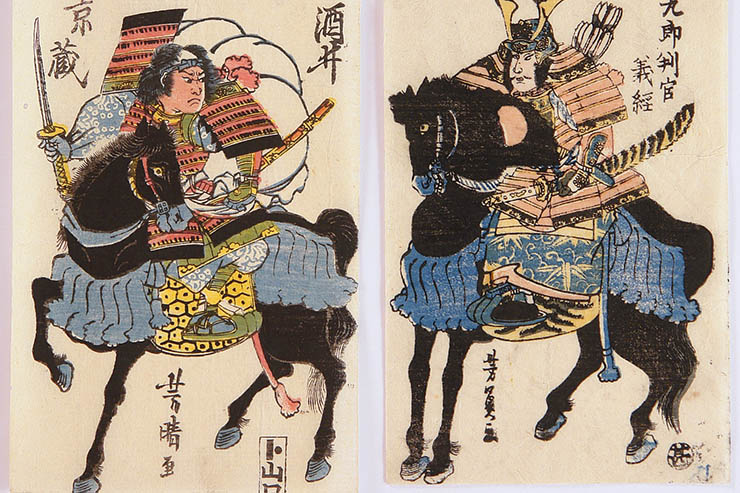
In the West and the Near East the game of Chess is regarded as a war game, and its adepts as masters of strategy. In Japan, however, among the Samurai, this game was perceived as vulgar, a diversion for traders and merchants. The Samurai had a very different idea of conflict from that in the West.Victory in chess is obtained by calculation, by trading off your own pieces in exchange for success. Winning is through deception, and always taking advantage of the other’s mistakes. Megalomaniacal in its grasp of conflict, cruel, mechanical, hierarchical, and heartless in its application, and deluded in its victory, chess was, for the Samurai, hollow and meaningless as a game of strategy. It was a clever device, a game without honour.
Honour is an unexamined concept in our contemporary culture, a frozen medieval ideal, a moral or social artefact. Nevertheless honour is a vital aesthetic with immense relevance to our situation.
Never written down, Bushido, the code of honour in Japan, the ‘chivalry’ of the Samurai, was nonetheless the most important consideration in their life. There are very good reasons for this. To stop viewing the world as right or wrong and to examine it sincerely as honourable or dishonourable is a way to distinguish the world in quite a different light.
When a Samurai boy was 5 years, 5 months, and 5 days old, he was given his first sword in a sacred ritual, dressed as a warrior, and placed on a Go board, just like a Go stone. Go is the true game of warriors and philosophers among the Samurai, who didn’t make the two arenas distinct from each other. It is the beautiful game of territory, where the highest excellence was not through wiping the opponent off the board, but by the understated beauty of winning by only one stone.
Power emanates from our perception of the true nature of our position and possibilities. It is better to know you are a sheep than imagine you are a tiger. The Samurai ethic gives us a perspective.
We are placed on the planet just like a Go stone on a board. We are all the same. We cannot control the game, and we cannot change our location. We may be placed in a pivotal time and position, or we may not. We may have a lifetime of peace, or of disturbance. We can be wiped off the board at any time. We have no control over the patterns of the higher game.
The best we can attain in the great game of life, the Samurai considered, is to be a very good stone; to be present, to have integrity, and to endure. Then we may serve the higher strategy well. This would be revealed in the future peace and prosperity of society. To be a good stone is also to rule absolutely over the tiny area actually allotted to us, to realise that we are the god of our own tiny domain.
The Samurai ethic is very much misunderstood in the West, and what little is known often derives from the later Edo period, when a rich merchant could purchase the right to wear two swords and be a knight for prestige and vanity.
“Death before Dishonour” is probably the most penetrating Samurai image, yet the least understood. It gives us the idea of the Samurai as a paragon of stoicism and righteousness, willing to die, rather than have his or her reputation besmirched, or dignity abased. The ritual act of suicide seems to epitomise this maxim. However, this is far from the truth.
Central to the Samurai ethic was the realisation that every human death has dignity, regardless of the circumstances surrounding it. Every death weakens us all, and we cannot conceptualise a useless death without demeaning life itself.
Whether it is an AIDS-ridden infant, a sick old pensioner, a suicide bomber, a death row inmate, an elderly statesman, a crime or traffic victim, an overdosing junkie, all death has the same dignity. To see it otherwise is to peer through the mesmerising fog of life.
The Samurai existed to preserve and make apparent this realisation, not to hold themselves apart from it. No death is in vain. They were not there to look after themselves; they were there to look after others. As warriors, they were even committed to dying for one purpose, to help others. Their ultimate power and protest was only to remove themselves from the board, a potent act affecting the higher game. This was power exercised at the highest level of ahimsa, harmlessness. The ritual suicide essential to their culture was an exercise in courage and humility, not in pride and arrogance.
Only from courage and humility does true honour arise. When we fail to perceive this we make an enormous mistake, for the clever mind cannot do anything but assess the usefulness of death, and by default, that of life itself.
This is the slipperiest slope of all human reasoning and it is a fundamental cause of war and violence, poverty and oppression. It allows us to kill the ‘baddies’ and starve children for a just cause. It lets us have mega-death wars and plagues, trade embargoes, the militarisation of space, yet remain “honourable,” engaged in just pursuit. It lets us lie, vacillate, and deceive others, and yet think we’re cool, compassionate, that we’re doing it for them. If the situation were not so tragic, it would be hilarious. It is certainly farcical.
True versus False Honour
“Killing is not Heaven’s way,” emphasised Musashi, “yet Heaven must employ the sword.” It is never right to kill; the finest sword is seldom drawn. But in life killing happens, and mindless, endless, pointless slaughter is everywhere, ritual sacrifices to atone for our greed and ignorance. There will always be psychopaths, greedy righteous madmen without compassion, for whom violence is an option, who take profit and pleasure in the slavery and oppression of others. To protect ourselves without enslaving ourselves we need many individuals rigorously engaged on a path of honour.
In Scotland there is a saying that honour is the sun of the mind, and one thing that must be recognised about honour is that it varies in intensity. It may be a candle or a flaming torch. Even what we consider ‘honourable’ people today are hardly honourable in the presence of such a diseased, enslaved, starved, alienated, oppressed, violent, and war-torn world.
Honourable human beings are as rare as hen’s teeth. The shrewd mind eradicates the presence of honour. The idea, the formula of a honourable person is commonplace. “Honourable” people, all doing the ‘right thing’, often act out the worst fears and prejudice of humanity. We fill our governments, courts and institutions with ‘honourable’ people. This is like filling the fire service with arsonists. Easily offended, mistaking moral outlook, learning, pride, irreproachability, and cultural predilection for honour, they are rigid, selfish, superior, self-important, lying, and judgemental, and keep our world full of dissonance so they can justify their bigotry and righteousness.
Often too, they are scurrilous criminals. The concept of honour has slipped so far from view that being seen not to be dishonourable is regarded as being unquestioningly honourable, and no one will exploit this fact more than the thoroughly disreputable.
Almost everyone considers that they are honourable, yet if one death seems to you more justified than another, there is no space for real honour within. There is only pride, and self-importance.
Honour has no place in the calculating mind of contemporary humanity. It is now an idea for living people to estimate and capitalise on their imagined worth, a means to trade for esteem. “On my Honour,” has become a vocal invoice, fly-buy points for trade deals. It keeps politicians and powerbrokers unassailable and litigious. This is not Honour.
Honour depends on your next move, not your last move. It is an intense and potent means to examine and refine self, life and relationship to others. It is a means of moving into the future with respect and intent. Honour forms the intent, the motive behind an action, and imbues that act with a higher order of significance. A good action is not necessarily a honourable act and a wrong act is not necessarily dishonourable. Honour is a new level of relationship to the world, a way of looking at our domain that allows us to examine the components of life in quite a different fashion. Now let us examine a few of these components through the lens of Bushido.
Dictatorship of ‘Calculating Men’
In the dominant culture of today, education is highly valued. The Samurai, too, held education with the awe and fervour of a dark ages scholar, they idealised a life of the higher senses, a life of learning. But they were contemptuous of all bookish erudition and regarded intellectualism as a child’s game. They were extremely dismissive of what was known as ‘calculating men.’
This does not mean sly or deceitful, but any endeavour or profession where calculation was intrinsic. Scientists, doctors, academics, lawyers, musicians, engineers, intellectuals, economists, and psychologists are all ‘calculating men’ – technicians – and they were all viewed in quite a different light from today.
In today’s society, where science has become a religion, ‘calculating men’ have a position of much greater importance than the Samurai would ever have allowed them. We have faith in their spreadsheets, hope for their discoveries, we rely on their research. We presently live in a technocracy, a world dictated and managed by experts, by specialists. Academia has cloistered all centres of power. Like infants in a gigantic school, we have learned to do what “teacher” says without question.
The cramming in of information and the capacity to manipulate and regurgitate it was regarded in the Samurai worldview as an abuse of the spirit, the reduction of a person to a function. It was certainly not education.
The Samurai had a different view of education, a vast, profound, and certain insight. True intelligence arrives as realisation. What we learn is only what we consider our life depends on. Learning is a survival mechanism, almost identical to bladder control, calming the existential panic of our true ignorance. It is essential, as it is with bladder control, that we learn. Yet to take refuge in our learning is like treating our urine as wine. We are far more than what we’ve learned as we are also far more than what we have drunk.
In life there is only one true teacher, and that is Death, the sword. Only the continuous awareness of death gives us the sobriety we require to assess the circumstances of life, to truly know anything for its own sake. This is a distinction of true knowledge that we find in many great traditions from Don Juan to Gurdjieff.
Gurdjieff, who declared that the purpose of his work was that people would not “die like dogs,” dramatised the situation succinctly. In Gurdjieff’s All and Everything, Beelzebub’s Tales To His Grandson, Hassein asks Beelzebub how humanity could be saved. Beelzebub replied that Man would only be saved by implanting an organ that continually reminded him that everything and everyone passing in front of his eyes would, one day, die.
The warrior implants this organ, “teaches his body strategy,” and lives in an environment of sincerity and compassion.
If we could do each thing as if it was our last act on earth, say each sentence as though it was the final thing we would ever say, know always of the transience of every moment, then we would live a life worthy of our humanity. Unless we are present to death as our teacher, we have no context to think in, no perspective; we cannot see what is important about what we are doing.
Instead, the calculating mind of the ‘expert’ tries to survive, to live forever, to be right, to win, and always has an added argument, more evidence, a new theory, another angle. They are dishonest, irresponsible, selfish and cowardly, only interested to prove and support their own notions, to remain intact. They take refuge in their cleverness, yet as humans they must be worthless, as they have made themselves this way, subservient to their own lists and statistics, trapped in the webs they weave. Indeed, the greatest stupidity of the intellectual is that ultimately they deceive themselves. They restrict themselves to their own thinking, and fail to examine their own ambition.
Education in the West is now a scratching of the itch of our vanities. Any information can be invalidated by different information. We can choose our speciality to suit our personality. It is a lyrical, coffee table learning, vain and capricious, pretentious, reckless and pusillanimous. It does not transform us. It does not humble us, make us more aware of our ignorance, deepen our experience of the great mystery, or make us more modest and compassionate, as any real education must.
Instead, it makes us an ‘authority,’ gives us power over others. Experts exert more power over our freedom than a medieval archbishop over his flock, within a reality even more bizarre. We live in a tyranny, nebulous and unassailable, masterminded by the cowardice, violence and cleverness of people with lists. Education is now a career ticket. We are proud of our acquired information with which we strut and pose, demand respect, and claim a superior position.
The calculating mind confuses subjectivity and philosophy. “I know, therefore It Is.” The objectivity of science is an illusion. What the thinker thinks, the prover proves. Masquerading as truth, the expert displays the lie of a world as dead as a clock.
The quandary is that these same intellectuals are engaged in serious pursuit. They have been trained to be cunning, cowardly, factional, irresponsible, and narcissistic, the last kind of people who should be destroying atoms, playing with genes, or designing home or foreign policy. Any expert who has got the answer, who knows what’s best, is from a Samurai perspective either a lunatic or a liar. Nobody knows the best thing to do.
Intellectuals are dangerous little creatures to the ethic of the Samurai. Why? Scholars are not intellectual enough. Inflated by an infantile self-importance, the fuel for their achievements, there is one thing they do not know, and without that there is only the cowardliness, selfishness and deceit of logic and calculation, the empty arrogance and selective broadcasting of acquired information. They must be right in order to exist. They have information without enlightenment, without commitment, without responsibility, and without perspective.
According to the Samurai ethic, they are irredeemably timid and stupid, institutionalised in a dishonourable way of being, and thoroughly dangerous in their selfish approach to conflict. They are not free to think, or even able to be free to think. They are slaves to the information they have, without which they’d be nothing at all. Any specialist or expert has sold their birthright, become a function rather than a being.
“A skill or art leads to a debasement of awareness. Anyone especially accomplished in a particular ability is a technician, not a Samurai,” declared Jocho. For the Samurai, knowledge had a vast palette and broadening our vision rather than narrowing it was the way to increase and refine our realisation.
Art and Science
In the East, traditional education was an ancient and very different phenomenon. One of the major differences that convinced the early Chinese of the barbarity of Western culture is that we have no language for our arts and sciences to communicate. In Western education, which is now also extant in the East, each science invents its own terminology. The word ‘stress’, for example, means one thing to an engineer, another to a doctor, yet something else to a musician, a geologist, a priest or an ecologist.
This was probably unnoticed as Latin, the lingua franca of Church and University, gave the illusion of a shared terminology. Now, even this has degenerated to a ‘fitting’ system for the sciences.
The result of this failure of our arts and sciences to communicate and cooperate has led to an explosion of chaos. For example, in the Eastern tradition, medicine and cookery share a language. The most delicious food and the healthiest food must ultimately be the same. In the West, however, the most delicious inventions of Escoffier are, from a medical perspective, a nutritional disaster, and our nutritional ideals are often inedible.
Our arts and sciences do not communicate. They contradict and invalidate each other. Subjectivity, the great demon of the ‘scientific method’, must encroach when there is no means for communication between areas of expertise. There is no holism; each science is discrete, each has a separate agenda, hidden to the other.
The East had two major tools for cognition. There was the Eight Conditions/Yin Yang theory, one of the best known and least comprehended doctrines of Oriental science. Nevertheless, in the hands of ‘calculating men,’ it becomes almost identical to Greek Logic. There are many who think they know all about yin and yang, but those who actually do are rare, East or West. The eight conditions is not logical, and is actually more similar in its nature to Quantum physics, a peerless tool of relativity.
The other pillar of Oriental science is the Five Elements, a tool for what cannot be measured by physics, a means to determine quality, not quantity.
In the East communication was intrinsic between all arts and sciences. The five Rings of Musashi’s treatise, the five elements of medicine, the five flavours of cookery, the five tones of music, the five spies of the Art of War – they are all part of the same web, singing a harmonious song, allowing each to examine the other. These two tools allow a much greater accessibility, transparency and connectedness between disciplines.
In this paradigm, the most sublime knowledge, the most occult, the most difficult to learn and to realise, was the sword. The sword is the ultimate in intellectual attainment, transcending calculating mentality, the forging and polishing of the soul, the release of the spirit into the world, freed from the bondage of thought, and it imbued a knowledge that was sublime, inviolate, eternal, unalterable, profound and wise as a basis, a context for knowing everything else.
It is the education and empowerment of our spirit, the embodiment of knowledge, the blending of everything known into a perfect action. It supplies a keystone of knowledge, which is the foundation of education, without which nothing else can be truly known.
The sword is the art of the Universe, the unique expression, not of what we know, but an expression of who we are, who we can possibly be. Swordplay is not a function, something we can do, it is something we embody. It requires the totality of our existence.
The Samurai ethic is not a political theory, nor is it some moral standard for policing countries, or the justification of some “Might is Right” reasoning. Instead, it is a living philosophy in action, a perennial flower for humanity to cherish, a means to the highest intellect enlightened. Its insight is more valid today than ever before.
The Samurai ethic is intimately connected to others, to the peace of society. The health, strength, and power of the individual is without meaning outside society.
Spiritual illumination is not derived from a personal relationship with God, although many schools claimed a divine inspiration, but from relationship and service both to others and to the “way of the Bushi.” The word Samurai means servant, and as Dylan noted, “You’ve got to serve somebody.”
Feminisation of Men
Before we can look at the spiritual realm of the Samurai, it is useful to see the contemporary situation through their eyes. Where is a honourable life to be found? If we look at the modern ideal of human beings, what do we find? Who are the good guys?
The ideal man of today is gentle, diffident, sincere, thoughtful, and pleasant. He is well educated or trained, and is quietly or overtly ambitious. Oleaginous, adaptable and amorphous, he lies mellifluously and unabashedly to keep the peace, presents an agreeable façade to everyone, keeps his hostility covert, and unhesitatingly hands over his injustices to the authorities. He tries to entertain everyone, and never raises his voice, except perhaps occasionally and politely in righteous indignation, for correct causes. He is, as the great Japanese poet Mishima damningly observed, a “cool opportunist.”
The ideal woman is, in addition, a little more aggressive, self interested, untrammelled by children, and, if we accept the current paradigm, smarter, more sober, and in charge.
Unfortunately, our ideal individuals don’t appear to help us create a harmonious society. We have male suicide rates that have gone through the roof. We have wife, husband, and child beatings, as frustrated angry people, like animals in cages, turn on their dearest. We have packs of alienated youth, violent and criminal, directionless and confused by the world they find themselves in, caught between struggle and submission. We have an epidemic of drug addiction, as people resort to chemistry to escape an empty, unfulfilling life that brings them little but pain. Even without any obvious drama, there are millions of lives filled with hubris, waiting around to catch cancer.
On a larger scale we have a pandemic of war, oppression, poverty, slavery and violence that no country escapes. We presently live in a society that is far from ideal, a sort of Samurai worst-case scenario. A world ruled by traders, executed by technicians, must inexorably become vicious and nasty. From the Samurai point of view, we have great chaos in society, deep sickness in people’s hearts, a world without honour.
One of the greatest tragedies of recorded history has been the feminisation of the male. Men have been increasingly trained in a fashion that is alien to their nature. De-fanged and emasculated by a cowardly society terrified of virility, men have been brainwashed into a position of benign subservience to all, or else.
They are cuddly and accessible, pleasant, self-effacing, hard working, fashion conscious consumers, problem fixers, and maintenance men. They are deodorant splashed, designer-labelled, mummy pleasing, keep fitters and sport players, thoughtful and inoffensive, snaggy, sincere and reasonable. They are concerned to portray themselves in an attractive light. They keep their hostility covert. They try to look good, to “do the right thing,” whatever that may be. They also consider this to be virile behaviour. At best the highest accolade is to be “really nice.” An evening watching television is enough to adequately examine this nauseating ideal from every angle.
Jocho Yamamoto, a Samurai who became a Buddhist priest when forbidden by the Emperor to end his existence, emphasised the fragility of masculinity. He said, “Contemporary Samurai set their sights very low. They have the furtive glance of thieves. They consider only themselves, act flamboyantly, and think they are smart. Although they appear to have nerves of iron, they are all front, worthless braggarts. That attitude will never do.”
We have mislaid our models for male behaviour. We have even enthusiastically buried them. For example, the Latin concept of honourable masculine behaviour, to be ‘macho,’ has completely reversed its meaning and come to signify misogynistic, aggressive, and insensitive idiots who fart, belch and boast loudly.
Some men today are acutely aware of this emptiness in their being, and attempt to recover their vital male temperament through success or seduction, through “men’s groups,” initiations or such, anything to try to feel like a man. Drumming, ‘relating,’ blaming and hugging, tend to reinforce this alienation. It is a symptom, not a cure.
We know more about what a Silverback Gorilla is like than what a man is like, and there are even fewer places nowadays where we may hope to get a glimpse of a fully developed man. But one thing people are not is “really nice.” Chocolate is really nice, people are more complex.
Tamed, virtually gelded, trained like donkeys, and counted like cattle, men are hardly allowed to exist, not encouraged to live a responsible life. This feminisation of men turns all humans into slaves. It is very hazardous.
Society now greatly disapproves of what it labels male “boastfulness,” “arrogance,” and “immaturity,” yet perhaps it is only these unpredictable qualities that may currently prevent our total enslavement. “Stupid” and “aggressive” men are perhaps a bulwark against a world that the greasy speech of merchants and technicians would fashion to their whim.
The problem is that violence works, it is the bottom line of any negotiation, and any government or institution wishes to control who gets violated, where and when. All governments reserve the power to violate, and rule only through fear and violence, with police and army, even if a silk glove adorns the iron fist.
Authority in our world equates with the capacity to destroy, to oppress, to incarcerate, and invalidate. It requires everyone to be quiet, keep off the streets, to protest only in an impotent fashion.
Only institutions, entertainment, salesmen, cowards, thieves and bullies need a foggy calm to spin their webs, and require a dazed and receptive audience. The rest of us can be vastly entertained, informed, and brought into communication by any sincere person who doesn’t mind rocking a leaky boat. Wildness and outrageousness are freedoms granted by courage and humility, ruffling only the feathers of the fearful.
To accomplish great things one must be extreme, push the comfort zones a little. I am not entering any debate on sexuality here. The Samurai expected women and men to be at full potential. Rather, I am indicating a peculiarity of the male that I’m sure we can all agree on. Men are impulsive, boastful, idiotic, immature and reckless, even violent.
This is intolerable to all institutions. No establishment can factor it into any of the equations they develop for our ideal society, except as cannon fodder. The world unites to abolish the reality of men. We shouldn’t be like that. All science, all politics, all statecraft, all education, all government, claims “this is not impulsive, immature, reckless, boastful, idiotic or violent.” But it is often just like that. Men are exactly like that.
What it is very important to discern is that this unattractive aspect of male conduct is not inevitably dishonourable behaviour. It is quite possible to be impulsive and hot-blooded, stupid, immature, even violent, yet still be honourable. It is possible even to ascend to a honourable position by being this way. Great change is brought about through enormous energy, by standing against the tide.
The Samurai recognised that beyond all our personal judgements there was a way to view others with more acceptance, more reality. Only dishonourable, selfish and ignorant behaviour truly damages society, and behaviour like that is not necessarily visible, improper or unreasonable.
Rather than viewing others from the rights and wrongs of our assessments, we can see them for their humanity, their will, their unselfishness, and their contribution. Beyond our personal notions of how people should behave, there is the recognition of a honourable existence that eclipses our assessment.
This puts men in a more precarious position than women, a position that requires a particular restraint. As men are more reckless, boastful and impetuous, honour is a more essential component of Manhood. Only honour supplies the compassion, dignity, generosity, humility and unselfishness to polish the impetuosity and recklessness that is a wonderful part of being a man. Only a honourable existence redeems and completes a man.
This feminisation has an innocuous and innocent genesis. A man only is truly a man to the extent that he does not act to be attractive. This is the Black Hole of male consciousness from which masculinity can never emerge.
When a man does something, even a good thing, in order to be attractive, he creates the invisible antagonist to a honourable existence that intrinsically must be selfless. He instantly becomes dishonourable, living in a lower domain. It sucks the life out of him like salt on a snail. It is acting from the outside rather than the inside.
The inner sincerity of masculine behaviour is paramount. No one else is there to see his intent but himself, and only the intent gives the action meaning. It is the most terrible empty perversion of power when it is employed in trying to look good, which is looking after yourself, rather than doing good, looking after others.
This is not so for a woman. Being much more level headed, they are free to sometimes act to be attractive.
While the Samurai ethic and spirituality is particularly unconcerned with sexuality, it is certainly concerned with having both sexes at maximum potential. At full strength, men and woman would be more distinct. The androgynous and self-absorbed nature of society with its ‘pleasing men and plucky women’ is only a sign of a great weakness and danger in society.
Life is Now a Show Performed by Actors
In contemporary life we also have massive amounts of entertainment. Everyone wants to be famous. We give great attention to movie stars, swimmers, singers and footballers. Yet famous people, like technicians, have become a function. They are famous not for who they are, but for being involved in something that fascinates an audience. They sacrifice their ideal of humanness for the adoration of the masses and hide behind their skill. They have great power and wealth. They form dynasties and expect adulation. They are the royalty of the new millennium. The ‘Willow World’ now permeates every aspect of life.
Stars dictate fashions and trends, advertise products and participate in performances. But they are mere puppets, saying lines they were told to say, playing tunes, jumping and posing to order. Because someone can, for example, run fast or wiggle their bottom in an attractive fashion, they are accredited with special insight and access to social situations or politics. Suppressing freedom through distraction, fascination and suggestion, they are the inedible part of the government of Bread and Circuses.
Scientists, experts, technicians, stars and virtuosos, are now running the world. They are all, from the Samurai ethic, identical. They are all Performing Artists.
Jocho Yamamoto recognised the bizarre and nihilistic certainty that the world was now a show performed by actors, a Heyokah, a contrary world of puppets, where everything is the wrong way round.
The difference we see between a prime minister and a cute pop singer, a genetic scientist and a juggler, is an illusion. There is no difference. They are all technicians. They have all learned a skill; all become identified with it, and use it for their own profit, while professing it to be for someone else’s benefit.
Life is now truly a mad house where a real human being now has no place or function whatsoever. It is a useless quality for society to be a human. Society needs machines. Those who are less courageous, those who have surrendered to being their job, to exploiting their function, have displaced essential humanity. The world has been spirited out from under the feet of honourable humans. They are disenfranchised from a society that now requires functions, not complete people.
There are many refugees of the spirit, displaced in this borderless, theory-driven world.
Technology Blinding Us From Our Devolution
We tend to assume that we are evolving. This is not necessarily a well-examined assumption. In fact, we can gather evidence that we are getting more dimwitted, that we are actually devolving.
P.D. Ouspensky uses the Australian bull ant as an example of these forces of devolution. This primitive ant lives in a small simple community of about 20 to 40. They cooperate to defend their nest. Unlike modern ants, bull ants have a highly developed sense of self-preservation. While they will defend their nest fiercely, they will abandon it if that is more expedient. They will not give up their life for their nest.
The modern ant is much more predictable. Fine technicians, they build great cities. Many thousands live there. But they will die relentlessly for their nest if it is attacked. The community is preserved at the expense of the individual. A house is more important than the creatures that build it.
Modern ants have lost the instinct for self-preservation, the capacity for self-reliance, and have therefore become less intelligent than ‘primitive ants,’ although their cities appear more evolved. They have devolved from a self-responsible creature, to a mere function of the nest.
The modern ant has devolved, has become less intelligent. “But look at our city”, the modern ant would say, if we suggested it was getting dumber. So, too, does our technology blind modern humans who imagine that we are more intelligent today than in the past.
Now here’s the difference between the bull ant and the modern ant. When I encounter them, the modern ant can see of me only my finger, and that is only if I stick my finger in front of it.
The bull ant, however, even from some distance can see all of me. It watches and responds to my entire body. The bull ant sees more than my finger, more than what is in front of its nose.
Intelligence changes what we can perceive within our environment. True intelligence is not about knowing more stuff. It does not transform our thinking; it alters our perception, what we can see in every situation.
True education is not learning about things. Real education increases our intelligence, and this changes what we are able to notice.
We, too, have fine cities and an immensely complex social structure. In the process we are destroying our capacity to see what is around us unless, and only when, a piece of it is stuck in front of our face.
By devolving into a social matrix where every move is pre-ordained, suggested to us, we blind ourselves to an unimaginably larger view of life that is our right and within our nature to behold. We remove an entire domain of intelligence from our being. Like moles, we shuffle through the dark little tunnels of our life, seeing nothing.
The feminisation of men, and the ascendance of technocracy and entertainment, is a part of this devolution.
So, too, is the pursuit of wealth. Greed is not good. It is a cowardly, insane response to the world. The Samurai code of honour emphasised an indifference to wealth, to not acting for profit, an aesthetic of shibumi, understatement, frugality and poverty. On his sword he carried a toothpick that he would pull out and use when invited to eat, demonstrating his unbending intent, his unwillingness to exploit others, his self-reliance, and incorruptibility.
Wealth is the tooth decay of honour, a blasphemy of our real abundance, stashing away for old age, for more stuff to fill the inner emptiness, quiet the anxious spirit.
Again Yamamoto says,
“A man with a mercenary spirit is a coward. The reason being he is always thinking about gain or loss. To him, dying is loss, and living is gain. He becomes a coward because he does not want to die. He camouflages with eloquence his real character of timidity and greed. People often fail to recognise this type of man.”
Greed and cowardliness are inseparable components of the clever mind, intent on calculation and control.
Our Perception of the World is the Greatest Gift
Since the very earliest days of our history we have recognised the concept of a “fair fight”. It is a simple notion, the ‘Rules of Engagement,’ for dealing with conflict. Even as a child, we recognise that there must be convention.
“No kicking or biting, no ganging up, and no hitting girls, even when they’re asking for it,” can allow a child to retain honour in playground disagreements. Honour is still essential to peace keeping.
Now getting around the rules of engagement is the major concern of most conflicts, from street riots to United Nations peacekeeping forces. Today, the nature of conflict is not quite the same as only a few years ago, when a war went on in a field, when oppression was regional, where running away was an option.
Now, in the culture of cowardice and calculation which we have developed, that ironically we refer too as free, peace loving, and fair, conflict is more pernicious, more insidious. In our technocratic society, there is no means for a ‘fair fight’ against issues important to us. You are only free to do what you are told. Your opinion, like your vote, is a joke.
What you think, for example, about scientists messing with the genetic makeup of the food you eat doesn’t make any difference. We must conform to what the “experts” think, even though it is perfectly clear that an informed opinion or a “proof” is no less subjective, self-interested, or prejudiced than an uninformed opinion, or belief.
Indeed, Bushido indicates that expertise and specialisation is the last refuge of the coward and scoundrel, and they are more able and more likely to exercise selfishness, subjectivity and deceit. Like rats in the wainscotings they scurry through the halls of power, debasing the foundations of truth and justice that genuine authority requires.
Today we fail to examine the divergence between subjectivity and philosophy. This is a grave mistake. Just because an expert thinks so does not make it a more correct opinion, only a more ‘expert’ opinion. Yet we run to the specialist. No one has courage any more. Everyone wants a ‘consultant’ to justify their own attitude, to back up their prejudice, to do it for them. We invent, encourage and employ our own thought police.
To the Native American warrior we come into this world with only one gift that we can present to the world. That gift is how we perceive the world.
No one sees things as you do. Your view is unique, irreplaceable, and when and if you can communicate it, you give to the world the greatest gift, indeed the only gift a human can; the gift of how you see it. Only you can be you. This is a most wonderful aspect of a Human Being.
We are creative creatures. A human being is the only place in our universe from where novelty may emit. We can be the creative force of the universe.
Einstein communicated exactly how he saw it, and for humanity, the universe changed, the planet changed, new substances and forces were created, our past, present, and future was rewritten. Not bad for a patent clerk.
What you think has equal value to what anyone else thinks. Your thoughts and feelings cannot be ‘wrong’ or ‘right.’ How you feel cannot be taken from you, and is not for others to evaluate.
It is how you see it, and for that fact alone it demands respect. You think this, but I think that. What lies between is the affair of strategy.
Expert opinion or calculation can only reduce the world to formulae, reduce a human to cipher. The world is not a machine, does not conform itself to equations. It is unpredictable and wild. Quality cannot equate to quantity. Only honour lets us touch the pulse of life directly.
The warrior finds a great beauty in pride. Not in false pride, the arrogance of imagined or certificated superiority, but the genuine, acquired, sensitive, pride (Haragei) of being a spirit materialised into this time and place for a purpose. A pride in our own thoughts, feelings and sensations is required to engage with another mind powerfully and respectfully. It is not courteous to daydream, to be impressionable when others speak. It is important to be sincere and brave in speech as well as action.
Much of life’s communication is presently full of expert opinions, persuasive advertisements, chitchat, justifications, exaggerations, omissions, explanations, and propaganda, which, like mosquitoes, disturb the tranquillity of our atmosphere. People have become immunised to this assault, yet it is not being treated in a honourable fashion. If we had a little more honour we wouldn’t find having our eyes, minds and ears filled with other people’s disrespectful nonsense so harmless. Perhaps we would even be offended by institutions trying to win us over, to persuade, to tell us what’s important, to allude, to suggest, treating us as idiots, aiming below the belt at our signal responses. No one likes being treated like a fool, yet every advertisement and news broadcast does just that.
We currently live in a world where deceit, greed, expediency and self-interest have become normal, even commendable. As a result, our view of human ideals has become twisted. In contemporary society how you see it is up for grabs by any advertiser politician, or social architect.
To die for what you think or believe, in our greedy and cowardly age, is seen as a useless death. However, there is no such thing as a useless death. The essential thing to realise is that to die for how you see it is not a dishonourable end.
To live your life willing to die for how you see it, however, is to live an energetic unpredictable, hearty, magical, joyous and even a honourable life. It is after all the only thing you have. Examine the compromises, the deceit, the greed and self-interest of your own life. Have they not made you a little less? How fluidly we lie, hint, omit, assume and exaggerate. Normal conversation requires it. We go with the flow, certain we never lie, hint, omit, assume or exaggerate, which allows us to do just that. Yet it is cowardly. To lie is to say to the other, “You are stronger than me. You have the power to make me lie.”
Doing nothing only assists evil. Honour acknowledges an imperative to repair what we find wrong. If you don’t fix it, who will? Be courageous! It is in the last analysis very simple. Are you a human or a mouse?
As Jocho advised, “Bushido is realised in the presence of death. Given a choice between life and death, choose death. Just brace yourself and proceed.”
Life is risk. When we choose death we choose to fully live. A counterfeit life, predicated by the fears and ambitions, the clever arguments, the compromises, the calculations and ignorance of specialists, experts, and authorities is the sad alternative.
Choosing death is not easy, and does not come naturally. It requires long and intense training, a steeling of the nerves, to be ready for that moment. We may imagine when we are sitting around drinking coffee that we could and would choose death, but when we are required to take the plunge, these considerations are absent. We have been deeply trained to be scared and cowardly, and in a risky situation we play safe, reduce our options, we become a little less, dying in spirit to survive the onslaught of life.
The ethic of the Samurai is pro-active towards the healing of society. It is an extremely tolerant and respectful principle which, lived to its fullest extent, dissolves all the restrictions of our world into an existentialist’s paradise, our life into a voyage of serendipitous delights.
“To treat your enemy like a honoured guest,” was for Miyamoto Musashi simultaneously the highest level of realisation into the nature of conflict, and the most potent certain method of dispatching an enemy, where the highest strategy becomes “no strategy.”
Nothing defines your spiritual stature in life more than the stature of your enemy. Even God first had to make the Devil. Like the Tango, it takes two to have an enemy.
Some people make their neighbours, the weather, their old car, the new world order or their backache an enemy. We make up most of our enemies and then suffer under their tyranny. What can defeat us, defines our stature. Like paper tiger masks, these petty demons must be cut through.
We trivialise and demean our enemies, and in the process we make ourselves even lower than that, conquered by mean trivia. Enemies may be transformed or defeated, but they must first be revered. Putting others down does not elevate us. We must exalt our enemies, because they represent our limits in breaking through to the formless freedom of the warrior’s path. If it weren’t for the great enemy, the great warrior would have no purpose or means to existence. The enemy is a gift directly from God, and if we are sincere, the door to go beyond ourselves.
Miyamoto Musashi discovered in his lifelong examination of conflict that truly, deep down in our very being, when we energetically follow a path of honour to its conclusion, “Love conquers all.”
The Samurai ethic is committed to ecstasy. We all have a right to feel wonderful, to continually sense our power. Indeed, it is only when we feel wonderful that we view the world aright. We should be healthy and strong for others.
It is committed to energy. If we don’t feel wonderful we must do something about that. It is committed to transformation. A conflict revealed in its true nature becomes a source of energy and ecstasy. The only way to transform our sad society is when each of us starts to grow, when we individually “shatter this box of our un-enlightenment.”
There are many essentially brave and courageous people, but in our present society they are taught to fear, to doubt, to be cowardly. They have no means to become truly courageous. Much has to be unlearned.
The sword, like the sculptor’s knife, like the words that come out of our mouth, shapes the future to come. We need to form society from our soul and spirit, not from our cleverness and evidence. A healthy honourable society will not make sense, and will not be predictable. It will make experts cringe. It will be, for the self-reliant, a joyous, mysterious and abundant adventure.
Perhaps the great Musashi gave the most revealing insight for action. Just the day before he died, Musashi wrote for his pupils a guide for this adventure. The first instruction was, “Do nothing that will oppose your Splendid Future.”
[alert type=”general” dismiss=”no”]This article was published in New Dawn 69.[/alert]
[alert type=”success” dismiss=”no”]If you appreciate this article, please consider subscribing to help maintain this website.[/alert]
© New Dawn Magazine and the respective author.
For our reproduction notice, click here.