New Dawn – World's Most Unusual Magazine

Tag: dreams

  • The Ancient Art of Memory & the Modern Science of Dreaming

    The Ancient Art of Memory & the Modern Science of Dreaming

    From New Dawn Special Issue Vol 10 No 4 (Aug 2016)

    I’m old enough to remember a time before we knew that birds were just a modern form of dinosaurs. Like many children in the 1970s, I thought dinosaurs were the coolest things ever, partly because they were so remote in time, so very extinct. But to later find out what palaeontologists were just then realising, that these ancient monsters were still around us everywhere, always audible outside the window, was mind-blowing and inspiring in a whole new way.

    Something similar is true of much ‘ancient wisdom’. Lore that we may assume has been long forgotten often turns out to have just morphed into something different. In some cases, it still survives in places, or in disguises, that we might least suspect. This is true of my favourite piece of ancient knowhow, one that has been centrally important in my life and learning for three decades: the astonishingly effective memorisation method practiced by scholars and orators in pre-literate, pre-Gutenberg times.

    Few know about this technique anymore, but I was lucky to read about it when I was in college at the University of Colorado in the 1980s. A lecturer recommended I read a book called The Art of Memory by Frances Yates,1 saying it was literally the most interesting book he’d ever read. That sounded like a pretty good recommendation – so I headed over to the university bookstore and picked up a copy. Reading it that evening at home, I felt like I was being initiated into a whole new way of thinking, not only about the mind and history, but also about film, visual arts, literature, psychology. It felt like an initiation, and was really one of those life-changing reading experiences.

    We speak today of the ‘reading experience’, but for people in the ancient world and Middle Ages – the time period of Yates’ study – texts were precious, rare objects, and the aim of reading, if you could read, was not to have a fleeting and diverting experience with a book before moving on to the next one. A travelling scholar studying a rare volume in the library of some wealthy patron may never get another chance to look at that book. Even a monk or priest would have very limited opportunities to read the Bible. But amazingly, learned men in ancient Greece or Rome, or in the Middle Ages, actually knew many books by heart; their minds were well-organised libraries of texts that, in their studies and travels, they had the good fortune to hold and read and study. In debates, they could assemble and arrange evidence, quoting long passages by heart, without a scrap of paper in front of them.

    The method was actually easy: If you wanted to remember an idea or fact, you just needed to break the fact down into its parts, substitute each part with some other thing it called to mind for you, and then assemble those things together into an arresting little tableau or scene. To remember a whole speech or sermon, you just ‘placed’ a sequence of those images, in your imagination, along a route through a familiar or well-memorised environment like your home or public plaza. Then, when the time came to deliver your discourse, you took a mental stroll through the same space, visiting each vivid image in sequence, ‘retrieving’ the facts or ideas you had planted there.

    Here’s an example: A college student needs to learn a long list of major milestones in European history for an exam. The study handout lists names and dates and facts that might be on the test like “The Normans invaded England in 1066.” On their own, the bare facts, Normans, England, 1066, may mean little or nothing to the student – she doesn’t know what a Norman invader looks like; like most numbers, the date 1066 might as well be a random string of digits; and she has never been to England, although she has a lot of impressions from TV and magazines constantly showing Prince William and his wife and children. If she is lucky, though, our hypothetical student may have been taught the basic tricks of the art of memory by a teacher or adviser at some point: The idea is to use all her random, stupid, personal associations and make a mental picture from them.

    So, say our student is a maven of 60s rock trivia and knows the years of every Bob Dylan album like the back of her hand. The year 1066 thus might immediately call to her mind 1966, the year Blonde on Blonde was released. And while she may not know what an actual historical Norman looked like, she does have an uncle named Norman. Instead of repressing such absurd and irrelevant connections as they occur to her while she’s staring at her study handout, a clever, mnemonically-trained student will actually allow her naturally playful mind to make and even embellish those associations on the fly – allowing, perhaps, a mental image of a weirdly blond-haired version of her uncle (who in real life has black hair), wearing a cheap Darth Vader cloak and mask (i.e., ‘in Vader’; the ‘cheap mask’ instead of a full helmet allows us to see his blond hair) slicing Prince William in half with a stroke of his light sabre. For all the other events and dates on the study sheet, she creates a similarly bizarre and, yes, idiotic image, using the same principles, and then mentally plants these little dioramas at intervals along some familiar route, such as the path from her dorm to her history class.

    She will, I promise you, ace the test.

    When Yates first wrote her book (also in 1966), she took a somewhat sceptical attitude: Although there was clearly something magical about this technique, and while its famous practitioners like the Hermetic freethinker Giordano Bruno boasted amazing feats with it, it didn’t make sense to her. She assumed creating new images to remember facts would actually require more effort at memorisation, not less. But the psychological study of memory over the last half century has revealed why the ancient methods really did work a lot better than cramming stuff into our heads by rote repetition.

    Memory works by association – the linking of information not by logic but by how things look or sound alike (for instance puns and rhymes); where they fit in some arbitrary sequence like a list or a song; or even what we were doing, where we were, or how we felt when we learned about them. When searching our mental archive for information, we find what we need by quickly following trains of very personal and idiosyncratic links – like what we were eating for breakfast when we heard a particularly interesting piece of news on the radio. It’s that associative illogic that, counterintuitively, makes our memories strong, because it enables us to quickly access needed information by many alternative paths. Your cortex is a vast multidimensional net of illogical interconnections, spanning the length and breadth of your experience on earth.

    When that college student is creating an image of her uncle in a Darth Vader costume killing Prince William, she isn’t really creating anything new she needs to remember along with the historical fact of the Norman invasion; she is taking stuff already in her memory, the first associations that just naturally and effortlessly pop to mind, and hooking them to each other by slightly distorting them, the way you might attach two lengths of wire by bending the ends. It’s like a little playful mental art project. It takes little effort to concoct such images, and it takes zero effort to remember them. Because of their absurdity, they stick in mind automatically.

    The biographies of modern geniuses like Einstein show that, even when they don’t know they are doing it, they are essentially using the art of memory, treating information as toys or materials to be creatively transformed, not intimidating data to be crammed into the head by brute force.

    [alert type=”info” dismiss=”no”]If you appreciate this article, please consider a subscription to New Dawn magazine.[/alert]

    The Royal Road

    Like I said, it is always exciting to learn about the wisdom of the ancients – I’ve been practicing the art of memory for decades and it has paid off in countless ways, along with the thrill of feeling like I’m privy to an ages-old secret. It is even more exciting, though, to realise this ancient wisdom is still alive in the most unexpected places. What if we are all memory wizards like Giordano Bruno, and don’t even know it? Consider: Uncle Norman attacking Prince William while wearing a Darth Vader costume is just the sort of surreal image we might encounter at night in our dreams. Is there some connection between dreaming and the art of memory?

    The strangely sensible bizarreness of dreams has led reasonable people at all times and in all cultures to assume that these nightly visions and visitations have some kind of important role to play in our lives. In 1900, Sigmund Freud famously wed the folk wisdom that dreams are symbolically meaningful with the then-new scientific study of mental process in his masterpiece The Interpretation of Dreams.2 He argued that dreams are symbolic tableaux staging the fulfilment of our repressed wishes. It was the keystone of his big idea that the unconscious mind contains secrets that can make us ill, or at least make us confused and unhappy, until they are brought out into the light of day. Dreams, he said, were the ‘royal road’ to the unconscious.

    Freud’s theory is hard to test scientifically, though, and with the assumption that there is some secret desire being expressed, it is easy to twist Freudian dream interpretations to mean whatever the patient, or doctor, wants them to mean. The ‘wish fulfilment’ idea is also a bit of a stretch, which even Freud began to realise later in his life, when studying the dreams of war veterans: Some dreams are thoroughly unpleasant – definitely not showing us our deep desires. For these and other reasons, psychologists and brain scientists in the second half of the 20th century mostly rejected Freud and went in a totally different direction, searching for a biological basis of dreaming. In doing so, they tried hard to discredit the mystical-sounding idea that dreams contained symbolic meanings that you could interpret like a poem, or decode the way a spy might extract the hidden meaning from a cipher.

    Over the decades, brain scientists have produced many, usually pretty dull theories about why we dream – for instance, they are just random brain noise, or they somehow prepare us to deal with threats. But circumstantial evidence has accumulated gradually, from lots of different sources, that there may be an inner logic in dreams after all, and that logic has something to do with reinforcing old memories and making new ones.

    In laboratory experiments, people who have been exposed to new information remember it better after ‘sleeping on it’ than if they don’t; and studies also show that during sleep, complex material learned during the day is simplified, made easier to understand. Animal species most dependent on their parents at birth, like birds and humans and many other mammals, show much more REM sleep than species born fully able to function, like reptiles. (In other words, the more an animal needs to learn in order to survive in the world, the more its brain is active at night, and the more it dreams.) Rodent studies have shown that brain areas activated during daytime exploration and learning are reactivated during sleep. We additionally know that the hippocampus, long recognised to play a key role in making new memories, is extremely active while we slumber.

    There is also growing evidence that important episodes and upheavals in our day are metabolised at night, specifically during the roughly two and a half hours we spend during REM sleep, when we are dreaming most vividly. It thus makes sense that the vividly bizarre images in dreams could directly reflect this nightly process of memory-making. Yet, the fact that dreams are bizarre and usually don’t realistically relate to events in our daily life has been a sticking point in figuring out what their exact connection to memory might be.

    A big part of the problem is that scientists are usually too busy (and science-minded) to venture out of the science stacks in their library. It was only in 2013 that a psychologist named Sue Llewellyn at Manchester Business School realised that the ancient art of memory, well known to cultural historians, might be the missing piece of the puzzle of dreams.3 She saw that the bizarre content in dreams seems to bear the same relationship to real-life events in our lives that a scene of Uncle Norman in a Darth Vader costume attacking Prince William bears to the fact of the Norman Invasion in 1066. Dreams, she suggested, are basically just the ancient art of memory operating automatically while we sleep. They don’t literally re-present events that happened in our day; instead they show us our private associations to those events. Those associations are the new connecting material being formed nightly in our brains, linking those recent events to older, deeper priorities and older memories.

    Getting Ahead

    The new mnemonic theory of dreaming makes brilliant sense of several old commonplaces about dreams, such as why they so often involve sex, why they so often contain clever witticisms and puns, and why they are usually so hard to remember.

    Because dreams have so much sex and suggestive genital symbolism in them, Freud thought they must be basically about our repressed sexual desires. But if dreams actually serve a mnemonic function, then we might expect sexual motifs to be so prevalent simply because exciting emotions make things more memorable. This is a well-known fact about memory; in fact, sex was an important part of the ancient art of memory for exactly that reason. Most of the teachers kept quiet on this aspect of it, but one Renaissance memory teacher, Peter of Ravenna, admitted that sexy imagery was one of his trade secrets: “I usually fill my memory-places with the images of beautiful women, which excite my memory,” he said. “If you wish to remember quickly, dispose the images of the most beautiful virgins into memory places; the memory is marvellously excited by images of women…”4

    In our more enlightened day, you can of course substitute ‘whatever turns your crank’ for Peter’s “beautiful virgins.” The point is not that women are sex objects, but that whatever for you is a sex object is also an ideal memory hook.

    Another common feature in dreams is brilliant wordplay, especially puns. For instance, a friend of mine once told me a disturbing dream in which she attended a dinner party thrown by her older sister, where she was horrified to see her sister’s head resting on an appetiser tray. I knew my friend was annoyed by her sister’s recent accomplishments, such as getting married and purchasing a home (neither of which my friend was close to doing), so there was nothing really mysterious about my friend’s dream image: Her sister was ahead. Her jaw dropped when I pointed this out.

    The puns in dreams often link multiple associations and enlist all our senses, not just the sounds of words. There are sight gags, as well as emotional and multisensory puns and situations that ‘rhyme’ with those in real life. Of course, witty wordplay is central to the consciously applied arts of memory too: Using Uncle Norman to stand for the Norman invaders is a kind of pun, as is putting Norman in a Darth Vader costume to make him an invader.

    Freud thought that multilayered puns helped dreams say a lot with a little – the same principle in jokes – and here the mnemonic theory is in complete agreement. Freud might have suggested that my friend’s dream image brilliantly stated the case that her sister was ‘ahead’ along with the hope that the sister’s accomplishments were nothing but a trivial prelude (an appetiser) to my friend’s own later achievements – and maybe there was a little sibling ‘death wish’ thrown in as well. The multiple trains of association radiating out from a single dream image represent multiple paths in the brain’s associative network, which keep some idea – in this case, ‘I kind of hate my sister because she’s ahead of me’ – alive and available in the dreamer’s thoughts.

    But why, if dreams’ purpose is memory, are they among hardest of our experiences to remember? We dream for about two and a half hours each night but are lucky to recall just one or two brief dreams every morning, if any. Unless you write them down, even those have usually faded by breakfast. It’s not so strange if you think about it: The thing we are supposed to remember is our memories of yesterday. Dreams make yesterday, the same way the stomach digests our meals and transforms it into the stuff of our bodies. Yesterday is more vivid to me today than it was before I slept, because of that activity of dreaming, which created and solidified the pathways in my brain that lead to those memories. Nature may not really mean us to see or remember our dreams per se, any more than it means us to see the contents of our stomach… and when we do, something may be wrong.

    I like to think of dreams as the scaffolding and cranes at a construction site: They quickly dismantle themselves – they just vanish – once the building they are constructing is finished. The same is true of the images created in the art of memory: I can rattle off my debit card number over the phone without looking at my card, and I no longer even remember the weird sequence of images I used to remember it a few years ago – something about a sailboat and a big tongue, I believe. I think there were also some naked people. (For a guide to the art of memory, including a simple system to remember strings of numbers, see my online article, “The Art of Memory: Why It Is the Coolest Thing Ever and Why You Should Learn It Today” at http://thenightshirt.com/?page_id=186).
    Childhood’s Beginning

    Get in touch with your inner dreamer. Write down your dreams in detail as soon as you can in the morning – every person, object, and situation, and every noteworthy or odd detail you notice. Then for every noticed element, take a moment to note the first one or two things or situations that pop into mind that it reminds you of. Be honest and don’t force it. With a moment’s free association, a dream element that may seem bizarre at first glance will usually point surprisingly to a recent situation or current preoccupation in your life, and going through this process for an entire dream will reveal astonishing connections to more distant memories, popular culture, and all kinds of forgotten stuff in your mental attic. You can fill pages and pages of journal on a single dream.

    Dream-thought is so wild and brilliant, so beyond our daily button-down intelligence, that people unused to observing their dreams have a hard time accepting that their own ordinary minds could be responsible for creating these Shakespeare-worthy stories. This probably accounts for why dreams have often been felt to have divine origins, and why today many people don’t remember their dreams at all – that kind of playfulness and genius simply doesn’t fit into who we think we are or who we think we should be. But there’s no reason not to own it; it’s our brains doing it, and it is who we are.

    And don’t limit your dreamwork to dreaming. Get in the habit of making your own dreams, by practicing the art of memory. It builds flexibility and creativity and can quickly turn you into an amazing storehouse of knowledge. People will wonder how you know so much, and more importantly it coaxes that childlike brilliance of dream thought into your daily life so you can apply it creatively to situations. With just a little practice, anybody can re-learn this playful attitude toward knowledge, becoming a memory wizard in the process.

    Childhood didn’t really end, just like the dinosaurs didn’t really go extinct. It just went underground. Through dreamwork and the art of memory you can coax it to the surface very easily.

    [alert type=”general” dismiss=”no”]This article was published in New Dawn Special Issue Vol 10 No 4.[/alert]

    [alert type=”success” dismiss=”no”]If you appreciate this article, please consider subscribing to help maintain this website.[/alert]

    Footnotes

    1. Frances A. Yates, The Art of Memory, Pimlico, 1996 (1966)
    2. Sigmund Freud, The Interpretation of Dreams, Avon Books, 1965 (1900)
    3. Sue Llewellyn, “Such stuff as dreams are made on? Elaborative encoding, the ancient art of memory, and the hippocampus,” Behavioral and Brain Sciences, Volume 36, Issue 06, December 2013, 589-607
    4. In Paolo Rossi, Logic and the Art of Memory, University of Chicago Press, 2000, 22

    © New Dawn Magazine and the respective author.
    For our reproduction notice, click here.
  • A Western Book of the Dead

    A Western Book of the Dead

    I have known since I was a very small boy in Australia that there are worlds beyond physical reality, and that we can journey to those worlds and gain first-hand knowledge of the multidimensional universe and about what actually happens after death.

    When I was nine years old, I was woken up to these possibilities during a crisis of illness. I was rushed to hospital in Melbourne after complaining of a pain in my lower right abdomen. The medical staff found that my appendix was about to burst and I was wheeled into an operating room in short order for an emergency appendectomy.

    Under anesthesia on the operating table, I found myself hovering above my body, somewhere up near the ceiling. I decided I didn’t want to watch the bloody work with the scalpel and flowed through the door and along the corridor to where my mother sat hunched and weeping. I couldn’t stand her pain, so I drifted off to a window, to the brightness outside, to the colours of spring and the laughter of young lovers seated at a sidewalk table, drinking each other’s smiles. I felt the pull of the ocean. I could not see the beach from the hospital window, so I floated through the glass and out onto a ledge where a blackbird squalled at me and shot straight up into the air. I followed the bird and sailed over the rooftops.

    I saw a huge moon-round face, its mouth opened wide to form the gateway to Luna Park. I swooped down through the moon-gate – and plunged into darkness. I tried to reverse direction, but something sucked me downwards. It was like tumbling down a mineshaft, mile after mile beneath the surface of the earth.

    I fell into a different world. It was hard to make out anything clearly in the smoke of a huge fire pit. A giant with skin the colour of fine white ash lifted me high above the ground, singing. The people of this world welcomed me. They were tall and elongated and very pale, and did not look like anyone I had seen in my nine years in the surface world. They told me they had dreamed my coming, and raised me as their own. For the greater part of my schooling, I was required to dream – to dream alone, in an incubation cave, or to dream with others, lying in a cartwheel around the banked ashes of the fire in the council house.

    Years passed. As I grew older, my recollection of my life in the surface world faded and flickered out. I became a father and grandfather, a teacher and elder. When my body was played out, the people placed it on a funeral pyre. As the smoke rose from the pyre, I travelled with it, looking for the path among the stars where the fires of the galaxies flow together like milk.

    As I spiralled upward, I seemed to burst through the Earth’s crust into a world of hot asphalt and cars and trams – and found myself shooting back into the body of a nine-year-old boy in a Melbourne hospital bed.

    It was a little hard to discuss these experiences with the adults around me at that time, and we did not yet have Raymond Moody’s useful phrase “near-death experience” to describe an episode of this kind. One of the doctors said simply, “Robert died and came back” – with memories that made me quite certain of the existence of worlds beyond the obvious one, and of the fact that consciousness survives physical death.

    There is great contemporary interest in the NDE in Western society, and this is a very healthy thing, because to know about the afterlife, we require first-hand experience, and need to be ready to update our geographies and itineraries frequently in the light of the latest reliable travel reports. In ancient and traditional cultures where there is a real practice of dying, near-death experiencers – who may be called shamans or initiates – have always been heard with the deepest attention and respect.

    There is a Tibetan name for such a person, delog, pronounced “day-loak”. It means someone who has gone beyond death and returned. The famous Tibetan Book of the Dead, with its detailed account of the possible transits of spirit after death, emerged from the experiences of such travellers.

    But to have first-hand knowledge of what lies beyond death, we do not have to go through the physical extremity of an NDE. We can learn through our dreams, the dreams in which we receive visitations from departed loved ones and others who are at home on the Other Side, and the dreams in which we travel beyond the body and into their realms.

    Our dreams open portals into the multidimensional universe, including the places we may travel after physical death. As we become active dreamers, we come to realise that dreaming is not so much about sleeping as about waking up – to a deeper reality and a deeper meaning in life, and death.

    The Departed are Dreaming with Us

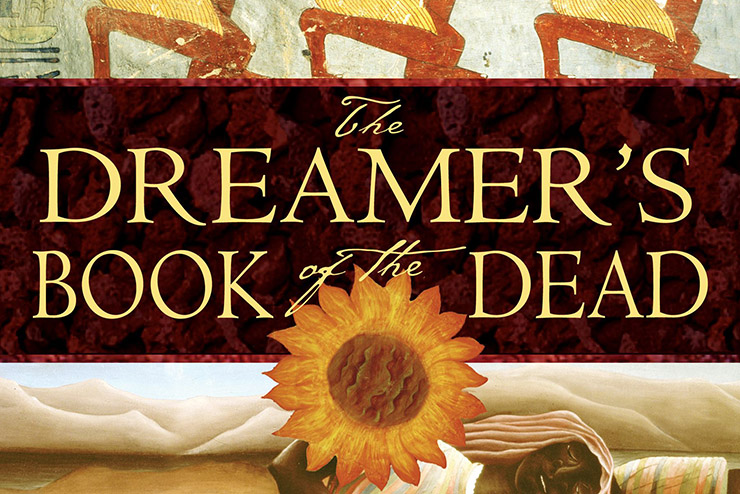
    One of my driving purposes in writing The Dreamer’s Book of the Dead was to help some of the many people in our society who are hungry for confirmation that communication with the departed is not “weird” or “unnatural”, let alone impossible, and that it is possible to extend love and forgiveness and healing across the apparent barrier of death. We encounter our departed, especially in dreams, because they are still around (sometimes because they have unfinished business or are not actually aware they are dead); or because they come visiting; or because we travel, in dreams or visions, into astral realms where the departed are entirely at home.

    It’s not just that we dream of the dead; our departed are dreaming of us, and trying to reach us through dreams. Sometimes our departed return as counsellors or “family angels”, as my father returned to me, many times, in the year after his death in Australia in 1987, with loving messages and practical guidance for the family. Sometimes our departed need us to play guides, because they are confused or stuck between the worlds, clinging to old appetites and attachments – which can be extremely unhealthy for the living, who may pick up the feelings and addictions and even the past physical symptoms of the dead.

    One of the cruelest things that mainstream Western culture has done is to suggest that communication with the departed is either impossible or unnatural.  There is nothing spooky or “supernatural” involved, though these experiences take us into realms beyond physical reality. It is especially easy to meet our departed in dreams (if we are willing to listen to our dreams) for three reasons:

    Our Departed are Still With Us

    Quite frequently dreams reveal that the departed are present because, quite simply, they never left. The departed may linger because they have unfinished business, or wish to act as guide and protector to the family, or are attached to people and places they loved in waking life, and this may be a perfectly happy situation for a year or two.

    But there comes a time when our departed need to move on, for their own growth, and so they do not become a psychic burden to the living. Because our society does a poor job in preparing people for the afterlife, many people who have passed on do not know they are dead, and hover in a limbo close to familiar people and places on this Earth. After death, we continue to be driven by our ruling interests, appetites and addictions. Some of those who have died but not truly “passed on” continue to try to feed their cravings via the living. When the departed remain earthbound, the effects are unhealthy both for those who have died and those among the living to whom they are connected. When the dead are enmeshed with the living, the result is mutual confusion, loss of energy, and the transfer of addictions, obsessions and even physical ailments from the departed to the person whose energy field he or she is sharing.

    Helping the departed may involve a loving dialogue, a simple ritual of honouring and farewell, and invoking spiritual helpers. As we become active dreamers, familiar with the geography of the afterlife, we may find we are called on to provide personal escort services and help to instruct some of our departed on their options on the other side. William Butler Yeats noted, with a poet’s insight, that “the living can assist the imaginations of the dead.”

    Our Departed Come Calling

    Most people who remember dreams can recall one in which someone on the other side made a phone call, sent a letter, or simply turned up at the door or the bedside. Our departed return to us in dreams for all the reasons they might have called on us in physical life – including the simple desire to tell us how they are doing and see how we are coping – and for larger reasons: to bring emotional healing, to bring us helpful information, to instruct us on life beyond death and the reality of worlds beyond the physical.

    Our departed may come visiting to offer or receive forgiveness. They may come to show us how they are doing on the other side.

    Our departed can be excellent psychic advisers when they achieve clarity on the other side and are aware that they are not confined to the rules of space and time.

    Our departed may come as health advisors and family counsellors. My friend Wanda Burch had received many dreams containing possible health advisories, but was finally driven to seek medical attention when her deceased father turned up in her dreams in a doctor’s white coat and yelled at her, “You have breast cancer!” Her father’s dream intervention helped put her on the path of healing and recovery.

    Our departed may visit us in dreams to help us prepare for our own deaths and reassure us that we have friends on the other side.

    In Dreams, We Travel to Realms of the Departed

    In our dreams, we are released from the laws of physical reality, and travel into other dimensions, including environments where the departed may be living. Through dreams of this kind, we can begin to develop a personal geography of the afterlife, which will be vastly enriched when we learn the art of conscious dream travel, which is at the heart of my own teaching and practice.

    In my workshops, I often invite participants to focus on a dream or memory of a departed person and make it their intention to journey – with the help of shamanic drumming – to seek timely and helpful communication with that person and to learn about the environment where that person is now living. From these journeys, we have collected multifarious and fascinating details of reception centres, transition zones, places of recovery and further education and communications arrangements on the other side. We have learned that more than one vehicle of soul survives physical death, and each has a different destiny. We have explored many afterlife locales shaped by human imaginations and collective belief systems.

    Dreaming is the Best Preparation for Dying

    A second reason I wrote The Dreamer’s Book of the Dead is that I believe that dreaming is the best preparation for dying, and that through dreams we can gain first-hand knowledge of the transitions of spirit after death. Active dreamers have no doubt there is life after death. We become familiar with many alternative neighbourhoods and transition zones on the Other Side. We may develop the understanding – again through direct experience – that consciousness survives the body in more than one energy body, and that different vehicles of consciousness have different fates.

    By helping someone who is approaching death to open to their dreams, we help them to find their way home, and approach the last stage of physical life with greater courage and clarity, as a time of growth and awakening.

    All we need do, to begin with, is to suggest to the dying person that if he or she happens to remember a dream, we would love to hear it, and to cherish the moment of sharing.

    Open a safe space for dreaming, and beautiful things can happen. Katy’s octogenarian father Ed moved into hospice care after a debilitating series of strokes. His doctors thought he would probably succumb to kidney failure within a month. In fact, he survived for another six months, a time of deepening pain and frustration over the failures of the flesh that was nonetheless a period of immense learning and high adventure thanks to his discovery of dreaming. In each of her frequent visits, Katy gently encouraged him to share any dreams he remembered.

    As dream sharing became daily practice for Katy’s father, many varied gifts came through. Some of his dreams rehearsed him for physical adjustments he needed to make as his body declined, easing these passages for a proud and once strong man. Dreams of broken plumbing and laying pipes, for example, prepared Ed for the catheterization that was eventually required.

    In an intriguing series of dreams, he was excited to find himself doing new work and feeling really good about it – an unlikely scenario, in ordinary reality, for a sick man in his 80s. In one of these dreams, he was working on an “angel machine.” When Katy asked him what that was, he explained, “I’m supposed to comb out the feathers on the angel wings” and giggled like a happy child, full of wonder.

    Towards the end, Katy’s father often slipped into waking dreams, moving between the worlds with increasing fluency, learning the art of re-entering a sleep dream to gather more insight and energy effortlessly, without any formal instruction.

    One of his big dreams seemed to promise a happy landing on the other side and opened a fascinating personal locale in the possible afterlife. He dreamed that on a day of heavy snow, he attended a magnificent banquet in a beautiful mansion. Everyone was dressed to the nines, and an elegant, distinguished man wearing an ambassador’s sash with his dinner jacket showed Ed around and poured him a delicious drink “like white champagne” but beyond anything available in ordinary reality. Delighted by his welcome, Katy’s father had the feeling he would be going back to the mansion of the dream ambassador. On the day he passed, it was snowing heavily for the first time in months, as in the dream.

    Through their days and nights of dream sharing, father and daughter deepened their loving connection. Katy confirmed and validated her father’s experiences as he opened to realities beyond the physical, an inspiring example of how we can help each other on the roads of dying (and living). Katy believes that dreaming provided her father with a vehicle in which he could travel to the other side. “He was fearful of leaving this life that he loved so much, but with the dreaming he grasped that perhaps there really is a life ‘over there’ that is just as much fun.” His fear of death gave way to a willingness to let go.

    The story of Ed’s dreaming does not end with his passing. Within days, he started turning up in the dreams of his loved ones. He appeared to the one family member who had not been able to visit him in the hospice, sat with her under a tree for what seemed like hours, and made her laugh. He returned Katy’s visits in the dreamtime. In Katy’s dreams, he often appeared doing things (like skiing) that he had failed to do, or to master, in the life he had left.

    This moving episode confirms the wisdom of the Lakota Indian saying that “the path of the soul after death is the same as the path of the soul in dreams.” This is why dreaming is the best preparation for dying.

    The Poet as Guide to the Other Side

    I had another reason for undertaking The Dreamer’s Book of the Death. I have noticed that most of us tend to live with more courage and clarity – and cope with the challenges of everyday life with better grace – when we have looked Death in the face.

    As we do this, we may enlist the support of personal guides who are quite familiar with conditions on the Other Side.

    I was well advanced on my work, a little after Samhain/Halloween in 2004, when I learned that I had drawn a most interesting helper. On a raw day on the Connecticut coast, I was leading a visionary journey for a circle of my advanced students. We had made it our shared intention to travel to a location in nonordinary reality that I call the House of Time, a place from which onward journeys to other times and other life experiences are usually easy, and where encounters with master teachers sometimes take place. I was drumming for the group and watching over them while – at the same time – I let part of my consciousness travel into the Library of the House of Time.

    I found Yeats waiting for me, on an upper level. He asked me, “What better guide to the Other Side than a poet?” The answer that came to me was: none. I remembered how Virgil appears as Dante’s guide through the Inferno, drawn by Dante’s “love and long study” of his poetry. Whether the Yeats who was appearing to me now was a projection of a part of myself, or some essence of his life and work, or the individual spirit of the dead poet, I could hardly refuse his offer to guide me.

    So my work took on a further dimension. This, of course, was not my first encounter with Yeats. He had appeared in my dreams many times. In one series of dreams, he demonstrated experiments in “mutual visioning” that he had conducted with Florence Farr, and attempts to build his Celtic Castle of the Heroes on the astral plane with his great (but forever lost) love Maud Gonne.

    But after that post-Halloween encounter in 2004, things picked up. While I immersed myself in fresh study of the books and papers in which Yeats had recorded his efforts to communication with the dead and to monitor the soul’s journey between death and rebirth, the play of dreams and visions and synchronicity in my own life became intense and wonderful. That benign entity that Koestler called “the Library Angel” worked overtime, arranging bookish discoveries at the most unlikely times and places. In a screened and protected psychic environment, I was introduced to many “dead” people who described their experiences of afterlife transitions in vivid and fascinating detail. Sometimes I felt that the dead were holding a séance for the living – specifically myself.

    I gained a new depth of understanding of what Yeats had laboured to convey about death and dreaming in the two versions of his fascinating, difficult book A Vision. He concluded that the main difference between the dream state during physical life and the dream state after death is that prior to death the soul remains in “exclusive association with one body.”

    In the 1925 edition of A Vision, Yeats made his simplest and most important observation about the connection between death and dreaming: “In sleep we enter upon the same life as that we enter between death and birth.” He explains that in dreaming, the spirit may travel through some of the levels of being that are accessible after death. In rare cases, moving beyond the astral plane, the spirit may discover “a new centre of coherence” in the celestial body. So dreaming may be an exact rehearsal for the progression of the spirit after death as it gradually disentangles itself from lower energy bodies to move to higher planes.

    In the 1937 edition of A Vision, Yeats develops the provocative thesis that our dreams of the departed are frequently the result of the departed reaching for us. Yeats describes an early phase in the after-death transition that he calls “Dreaming Back,” through which the departed seek to review, understand and resolve the issues of the life experience that has ended. With the help of “teaching spirits” a soul in this phase “may not merely dream through the consequences of its acts but amend them, bringing this or that to the attention of the living.” During this phase the dead often appear to the living in dreams.

    Yeats wrote that “the souls of enlightened men return to be schoolmasters of the living, who influence them unseen.” I believe this has been my experience, and that it is an experience open to all of us, which will unfold according to our interests and affections, and our willingness to do the work.

    In The Dreamer’s Book of the Dead I have sought to honour Yeats’s grand design of producing a Western Book of the Dead that shows a little of what happens in the soul’s journey between death and rebirth. At its heart, the message of my Book of the Dead is as simple, and as urgent, as this: We don’t need to wait for death to remember what the soul knows: how and why we came into our present bodies, and where we will go when we leave them.
    [alert type=”general” dismiss=”no”]This article was published in New Dawn 96.[/alert]

    [alert type=”success” dismiss=”no”]If you appreciate this article, please consider subscribing to help maintain this website.[/alert]

    © New Dawn Magazine and the respective author.
    For our reproduction notice, click here.

  • Cheating the Ferryman: A New Paradigm of Existence?

    Cheating the Ferryman: A New Paradigm of Existence?

    From New Dawn Special Issue 14 (Dec 2010)

    What happens when we die? This is the ultimate question and one that we still have no real answer. From the first few moments that man became a self-aware being he has pondered upon this mystery.

    Every culture has attempted an explanation, and it is reasonable to conclude that all religions exist to give an account of what happens at that moment and, more importantly, where does the person go after their body dies.

    One of the most enduring myths is that of the Ancient Greeks. They believed that the recently dead would find themselves at the banks of a vast river, the River Styx. Out of the mists would appear Charon, the Ferryman. It was his job to ferry the soul, termed a “Shade,” across to the other side…. To the Land of the Dead.

    But he did not do this for free. He needed a payment. The relatives of the recently dead person made sure the Shade could pay the ferryman. This payment was usually a small coin called an obolus. Depending upon the tradition, either this would be placed under the tongue of the corpse or two oboli would be placed over each eye.

    This well known myth still resonates over three thousand years later. “To Pay The Ferryman” can still be heard today. However, there is a lesser known myth that suggests a deeper truth: The myth of the River Lethe.

    The Greeks believed that before getting to the banks of the Styx the Shade would encounter a much smaller tributary of the great river. This could be crossed with ease by wading from bank to bank. This small river was called the Lethe, and its waters contained a profoundly important quality.

    If the Shade or newly deceased soul drank of this water all their memories would evaporate. They would forget who they are and the events of their life. Their memories would become like those of a new born baby. Of course by doing so the Shade also forgot all of the lessons learned during that life.

    But before doing this the Shade had the option of drinking from a small pool next to the Lethe. This was the Spring of Mnemosyne. By drinking here the Shade’s past-life memories became sharp and distinct. Each action and its subsequent effects became crystal clear. Life’s lessons became precise and understood.

    If the Shade drank of the Spring of Mnemosyne they were allowed to pay the ferryman, board the boat, and sail across the Styx to the Elysian Fields.

    But if a drop of the waters of the Lethe was drunk by the Shade, then they were sent back to be reborn again with no memories of their previous life. Now this was not a form of reincarnation as it is understood by most people. It was a re-birth process in which the same life was lived again. The Shade found itself back in its mother’s womb waiting to start all over again.

    This concept is called “The Eternal Recurrence” and has been a long held alternative belief to that of the linear life found in most religions, even those who have reincarnation as their central belief.

    However, those who have long held this belief never shared it with the masses. Such a belief has always been found in the secret – esoteric – groups within most of the major religions. This is the great secret carried through the ages by the groups loosely termed as “Gnostics.”

    The Gnostic tradition can be found behind the great mystery traditions of the Middle East and Europe. From the Manicheans of Persia to the Cathari of Southern France, and from the Cabbalists of Southern Spanish Judaism to the Sufi’s of Arabia, this hidden knowledge is the real Holy Grail in whose defence the Knights Templar and the Albigenesians died in their thousands to protect.

    In my books I present evidence for this belief system, that at the moment of death we are catapulted back to our moment of birth. The theory is supported by a good deal of evidence from modern science, particularly quantum physics, neurology, psychiatry and consciousness studies.

    I call this theory “Cheating the Ferryman” because I suggest many of us never make it across the River Styx. We never step into Charon’s boat and we never pay him his obolus. We cheat the ferryman out of his fare and return to live our lives again.

    On what evidence do I base such a totally weird idea?

    Dreams & Precognitive Déjà Vus

    Well, for me, the whole theory started with one very peculiar dream. In this dream I experienced a déjà vu… yes a dream that contained the sensation that I was experiencing an event that I had dreamed before, if that makes sense.

    In the dream I had an inner dialogue with another me and this being stated that a déjà vu is a memory of an event that you have lived before in a different life. I then woke up with this idea echoing round my mind.

    I had for some time wanted to write a book and now it seemed that my dream self, or more accurately a part of my dream self, had given me both the theme and the incentive.

    I was surprised to discover that déjà vu is not only the most common anomalous psychological perception (70% of people will experience the sensation at least once in their lives) but also that experts have no real idea what causes it. Various suggestions have been made but none have been shown to be correct.

    As an example, for many years a proposal made by the psychiatrist Paul Efron was considered to have nailed the mystery. Efron suggested that one part of the brain processes information before the other. In this way we have the feeling of experiencing an event twice. This occurs because each hemisphere of the brain receives signals from the right and left visual fields of each eye. As such the non-dominant hemisphere processes the incoming images a split second before the dominant hemisphere. So, in effect, the consciousness receives the signal twice with a short time delay. As one signal is immediately, but not fully, over-written by another we feel as if we have experienced the images twice. But this curious message transferal only works for the eyes. It has recently been shown that congenitally blind individuals experience aural déjà vu sensations. As the brain processes sound in a totally different way to sight, the Efron thesis simply cannot explain this form of déjà vu.

    I wondered if déjà vu may not be simply what it feels it is: a curious sensation that suggests the observer has lived this moment before. The Seattle based psychiatrist Dr. Vernon Neppe has defined déjà vu as, “any subjectively inappropriate impression of familiarity of the present experience with an undefined past.”

    So the “undefined past” could be part of this life or a past life. However this ‘past life’ for me did not imply reincarnation for one simple reason: for a déjà vu sensation to be effective it has to be a memory of the exact circumstances, not a circumstance that is similar. For example, if my “subjectively inappropriate impression” consisted of me remembering being in this place in Victorian times, the two images would be quite different. The location may be the same but my clothing, my companions and the décor would be totally different. It would feel more like a time-slip than a doubling of consciousness. For a déjà vu to be a déjà vu the two impressions have to be identical, in all ways. My memory of the event is identical to my experiencing of the event. I am literally re-living an event from my own past, but a past that is, for the moment, the future.

    Indeed, I have now interviewed many people who experience precognitive déjà vu’s. The ‘memory’ includes a remembrance of what happens/happened next. The subject suddenly has very short-term clairvoyance.

    I found that these precognitive déjà vu sensations are usually reported by individuals who experience three brain-states: migraine, temporal lobe epilepsy (TLE) and schizophrenia. I was intrigued as to why this was the case and began researching what may link these three ‘illnesses’.

    Much to my delight I found there is one common factor, a neurotransmitter called glutamate.

    Perception and Time Distortion

    In a curious coincidence that was to have great significance to me later, I learned that neurotransmitters were first discovered by an Austrian scientist called Otto Loewi. Just like me, Loewi had a dream guider. On Easter Sunday 1920 he awoke in the middle of the night having experienced a really vivid dream. He wrote down what he had experienced and went back to sleep. The next morning he excitedly looked at his notes to find them to be illegible scrawl. He knew that he had dreamed something of profound importance so he went to bed early the next night. The dream came again and when he awoke he reproduced his dream experiment exactly as he experienced it that night. In doing so he isolated a substance that was to eventually be called acetylcholine. Such was the importance of this discovery that in 1936 Dr. Loewi and his English associate Sir Henry Dale were awarded the Nobel Prize.

    What Loewi’s dream had helped find was the first example of the chemicals that were later to be called neurotransmitters. These are internally-generated substances that facilitate the transmission of messages from cell to cell within the body. The most important group is found in the brain and glutamate is the most important of the brain neurotransmitters.

    Glutamate is directly responsible for the peculiar feelings described by migrainers, temporal lobe epileptics and schizophrenics, specifically a sensation that is technically known as “the aura.”

    The aura is a form of early warning system. It is triggered by over-production of glutamate and usually takes place a short time before an attack of migraine or a temporal-lobe seizure. (Glutamate’s role in schizophrenia is different but the overall outcome is similar). Experiencers report sensations of time slowing down, of hyper-sensitivity, of visual or aural hallucinations and profound déjà vu sensations. Déjà vu had been linked with both migraine and TLE for years before Loewi’s serendipitous discovery.

    Here was the link I had been looking for. Déjà vu has, as one of its causes, a flood of glutamate in the brain. It was then that I made my first big step to “Cheating the Ferryman.”

    Quite by chance I was reading an old book I had on Near-Death Experience (NDE). One of the more technical articles discussed the neurochemical causes of the NDE. Much to my surprise I found that glutamate was also connected to this well-reported experience. Another, and quite unrelated, article in the same book discussed one of the most commonly reported elements of the NDE, what is technically known as the “panoramic life review.”

    “My life flashed before my eyes” is a quotation recorded time and time again by people who have close encounters with death. Some report the experience as being a series of snapshots, others that they literally re-live every experience of their life but in super-speed. One person reported that it was as if somebody had recorded a movie of his life and was running it in fast-forward.

    I was fascinated by this link. Both déjà vu and the Panoramic Life-Review were linked by a specific brain-chemical, glutamate. After doing some subsequent research, I found that Dr. Karl Jansen of the Maudsley Hospital in London had been able to reproduce a full near-death experience in volunteers when he had them take small doses of the drug ketamine. Now ketamine is chemically almost identical to glutamate so here again we had an amazing link.

    I was later to find that ketamine, and by implication glutamate, also brings about another curious subjective sensation in the brain: time slows down or almost stops for the experiencer.

    In another fortuitous event I was to be given a first-hand description of a glutamate effect by a person who experienced TLE seizures.

    Temporal Lobe Epilepsy Breakthrough

    I received a phone call one afternoon. It was a lady from a recruitment agency who was wishing to discuss with me a vacancy she was handling. “Margaret” asked me whether I was working and I explained that I was driven to write a book. “What about?” she asked, “I don’t really know at the moment,” I truthfully responded. I then explained that I was reading a good deal about temporal lobe epilepsy and was making some fascinating links.

    She went very quiet and suggested that we should meet up to discuss the vacancy. Three days later I met her at a coffee shop nearby. As soon as she had sat down she explained to me that she had to meet me because she wished to discuss with me something she could not mention in her office where she would have been overheard.

    “Margaret” informed me that she had recently been diagnosed as a having temporal lobe epilepsy. She described to me how she had first discovered that something unusual was happening in her brain.

    She had been having lunch with a work associate in a crowded café. As her associate started to pour a cup of tea from a teapot she suddenly felt a snap over her right ear. Surprised by this she looked at her associate assuming that she too would have heard the noise. One look told her that her lunch companion had heard nothing. This was because she had stopped moving. The stunned recruitment consultant looked round the café and every person was frozen in time and space. It was as if she had suddenly found herself in a three-dimensional photograph. She could hear a low humming sound that seemed all around her. She then looked back at her companion to notice that she was not frozen at all, she was moving incredibly slowly.

    Margaret then realised that the low hum she could hear was, in fact, people’s voices! Her metabolic rate had increased to such an extent that time had slowed down to a crawl. She watched in amazement as the tea slowly appeared from the spout of the teapot and slowly fell into the cup. Margaret assured me that this took hours to take place in her mind.

    At that point she made a fascinating comment. She said that she could have been in this state for days, months, years, “even a lifetime.” Then, after what seemed like many hours, Margaret felt another snap over her right ear and her associate finished pouring the tea and sat back. “Are you okay,” she asked. “I am not sure,” replied Margaret. Her friend then explained that Margaret had suddenly stopped moving and had stared into space… for about twenty seconds! As Margaret explained to me, those twenty seconds had been hours for her. She went on to tell me that she feared she had a brain tumour but after a series of scans she was told that she had TLE.

    I was amazed at this story. Here was evidence that glutamate, when it floods the brain, does, indeed, slow subjective time to an absolute crawl. For some reason I then asked Margaret if she experienced déjà vu. “I get déjà vu’s to kill for” was her reply. “Not only that but when I am in this pre-seizure aura state I know what is going to happen next. I really do see the future!”

    My meeting with Margaret presented me with the final piece of a jigsaw puzzle that I had not known, until that moment, I was trying to complete. I knew then what the book would be about – not an explanation for déjà vu but something much bigger, an explanation as to what happens to human consciousness at the point of death!

    My theory was both simple but stunning. Déjà vu sensations are exactly what they seem to be: they are recollections of past events, otherwise known as lost memories.

    So how can we “remember” the future? Simple, because the future is also the past. Confused? Well the best way to explain this is to give a fictitious example based upon an amalgamation of many NDE reports.

    Get the issue this article appears in

    The Physics of the NDE – Cheating the Ferryman

    Our hero is a skydiver. He is a very unlucky skydiver because his parachute has refused to open and he forgot to pack his back-up ‘shute’. As he plummets to the ground there will be a point where the stress levels will be so high that glutamate floods the brain. In doing so it brings about the subjective slowing down of time. Indeed, for the skydiver the duration of time slows down to a virtual standstill. But his brain remains completely active.

    Just as he is about to hit the ground his motion through space is slowed by the fact that his motion through time has similarly been changed. As we know from the theories of Albert Einstein, time and space are the same thing and they are “relative” to the observer. This is where the word “Relativity” comes from.

    So “relative” to the skydiver, time duration has slowed down to a crawl. For him a split second can last days, weeks, years, even a lifetime. This is exactly what Margaret experienced in the canteen.

    What happens then? Well something very strange. Recall that many people who report Near-Death Experiences explain they see their lives “flash before my eyes.” This is a Near Death Experience. Our skydiver is in a Real Death Experience. There is no way he will survive the impact with the ground. In this case his life does not “flash” before his eyes but he experiences it in a literal, minute by minute, recreation of his life from the moment of his birth. In effect he lives his whole life again. And at the end of the second life it happens again, and again and again. It is like the movie “Groundhog Day,” but it is not a “day” but a “life” – and all this takes place in the split second before he hits the ground.

    This is how he “Cheats The Ferryman.” In his subjective time-frame he never reaches the point of death because it is always in his future.

    But there is more – and this where things get very interesting. I suggest each life-rerun is not like a pre-recorded movie that cannot be changed but more like a video game in which all consequences of all decisions are already programmed in. By applying the latest findings of quantum physics I present a model whereby the implications of something called the “Many-Worlds Interpretation” can be shown to allow such a scenario.

    Put simply, according to the MWI hypothesis there are literally billions of versions of each person and each one of these versions have the capacity to live out – and lay down re-playable memories – the outcomes of every decision made in a lifetime. There is available to each person a recording of every possible life they could live. I call this recording the “Bohmian IMAX.” Others may recognise it as the “Akashic Record” or the “Akashic Field” of Professor Ervin Laszlo.

    I further suggest that at the point of death consciousness splits into two elements. I term these the Eidolon and the Daemon. The Eidolon is the everyday being that calls itself “I” or “me” and it has no knowledge of its previous lives. The Daemon is different. It carries all the memories of the past life (or lives) and as such it acts as a form of “Higher Self” or “Guardian Angel.” In my books I present evidence from modern neurological research to suggest this may be the case.

    The “changes” that bring about a new “life-path” are instigated by the Daemon when it warns the Eidolon of potential dangers lying waiting in the future. These can be conveyed through dreams, precognitions, inklings, voices and many other subtle methods – possibly even a deja sensation.

    We don’t just “Cheat The Ferryman,” we are also given opportunities to change things and possibly put right the wrongs we do.

    I agree that on first encountering this hypothesis it is both bizarre and incredible. But the science does seem to work. Could this be the paradigm changer that we have all been waiting for?

    [alert type=”general” dismiss=”no”]This article was published in New Dawn Special Issue 14.[/alert]

    [alert type=”success” dismiss=”no”]If you appreciate this article, please consider subscribing to help maintain this website.[/alert]

    © New Dawn Magazine and the respective author.
    For our reproduction notice, click here.