New Dawn – World's Most Unusual Magazine

Tag: Egypt

  • Magic in Mind

    Magic in Mind

    From New Dawn 98 (Sept-Oct 2006)

    A question frequently put to me by newcomers to magical practice is whether there is a reliable way of distinguishing subjective experience from what exists independently of their perception of it. In other words, how can they be sure that what they witness during a particular ritual, even when it impinges on their surroundings, is something other than the product of their own – or the group’s – creative imagination.

    It is a question some magical orders are reluctant to answer or at times even deign to consider. In them may lurk the fear that once they acknowledge the subjective nature of any phenomena associated with their work, that immediately devalues it. And the new recruit, persuaded it’s all in the mind, may then drift away.

    After all, if you’re after mental magic, it’s far less hassle (and a lot more fun!) to watch Derren Brown strut his stuff than spend hours in an airless, incense-filled room, sporting fancy dress and mouthing incantations.

    Or perhaps the question is avoided because it can never be satisfactorily answered, if only because, as with much else in occultism, there is no clear-cut answer to be had.

    For even if the imposing figure of, let us suppose, a venerable Druid were to turn up during a rite associated with the Celtic mysteries, his appearance, while seeming to be objectively real, might nevertheless be the projection of an image inside the leading celebrant’s head and telepathically conveyed to everyone else.

    On the other hand the selfsame figure might well be the real thing, an inhabitant not (or no longer) of our three-dimensional world but briefly granted access to it thanks to our magical efforts. So not surprisingly, when asked by a student how to distinguish which of the two he is, I’ve often been hard put to answer.

    A further complication is that entities – and let’s stick to these for now, though ritual can generate a variety of other phenomena – which are the constructs of the human mind can, once created, assume a life of their own. Well, perhaps ‘life’ is not the right word for what they enjoy is, strictly speaking, only a similitude of life, since they are of synthetic origin and, as such, animated by the vital energy they draw from living beings. To that extent theirs is what might be called a vampiric existence.

    Dion Fortune spoke of such entities several times, having by her own, perhaps obsessive, account been the unwilling recipient of their attentions. And by coincidence it was her husband, T. Penry Evans, then married to his second (and not at all occult minded) wife, Anne, who first talked to me about them.1

    Not yet in my teens, I had been introduced to magic and encountered – the details are unimportant – an entity whose nature and intentions he thought it prudent to investigate. For him there were two questions to be answered: had the entity been visualised beforehand by me (or suggested to me by my then mentor, a friend of both Dr. Evans and my father); and would it return permanently to where it had come from after being ritually banished. The answer to the first was no and the second, happily, turned out to be yes.

    To Dr. Evans this demonstrated that the entity was not mentally connected to me in any integral way. It had, in other words, an independent life of its own and so, to return to where we started, was objectively real and not the product of human imagining.

    Contrast this with the tulku created by the well-known explorer Mme. Alexandra David-Neel. In her book, With Mystics and Magicians in Tibet she describes how during her time in that country she set about creating from her thoughts a fat and jolly monk who, initially at least, was content to do her bidding. Others in her group could see him and he even performed small chores when requested.

    But over time his appearance coarsened and his demeanour became less benign, so much so that his alarmed creator resolved to put an end to the experiment. It was no good attempting to banish him, as was successfully done in my case, because the creature had emerged from – and been sustained by – her own self.

    She had no choice but to re-absorb it into her ethero-astral bodies, exactly as Dion Fortune claimed to have done on one occasion when she involuntarily created a version of Fenris, the wolf–fiend of Norse mythology. According to both women the process is extremely distressing.2

    These induced thought forms are, I suspect, the correct explanation for those materialised spirits – a contradiction in terms but never mind – that used to be a feature of spiritualist seances. Or at least of those seances where the apparitions on display were not fabricated from regurgitated cheese-cloth or masticated lavatory paper. (It is noteworthy that the sudden decline in this kind of seance coincided with the invention of infra-red equipment and miniature cameras capable of taking pictures in the dark.)

    That genuine materialisation did occur from time to time is, however, likely. One of my compatriots, Jack Webber, was especially prolific, as was – on those occasions when she didn’t cheat – the eminent Scottish medium, Helen Duncan. (I attended one of her seances as a small boy while staying with an eccentric aunt in South Wales but that story belongs elsewhere.)

    I am satisfied that in seances of this kind, the phantoms that used to turn up and, it must be said, were identified as true likenesses of their dear departed by those attending the performance, were in fact their own thoughts exteriorised in a way similar to what occurs in magical operations.3

    The difference, however, is that in the latter everything is structured and deliberate, as well as under strict control. And the forms themselves are more subtly built, requiring nothing so crude as the ectoplasm extruded by mediums from their bodies. (Only in a rarely attempted and extremely intimate operation, one I have been privileged to witness, might a substance resembling ectoplasm be involved. I refer here to the creation of a so-called magical child.)4

    Anyway the point I am making is that in trying to decide what is objectively real per se and what, though apparently real, is mind-generated and essentially dependent on its creator, the Penry Evans test seems to me valid. And since first learning of it many years ago, I have come across another of my own which, though less reliable, is not without merit.

    I discovered it in the 1980s when asked to participate in an attempt to save the life of a man desperately ill in New York. The order to which he belonged followed an Egyptian tradition with which I was familiar. Indeed, they had come across it from hints contained in a book I had previously written.5

    You will not expect me to disclose further details, but I can reveal – and many of you will understand why – that the rite reached its climax with a dramatic (and, I still recall, extremely beautiful) psycho-sexual conjunction involving the lower and higher realities present that afternoon.

    The operation over, I undertook to keep vigil at the sick man’s bedside – only to fall asleep, I regret to say, before scarcely an hour had passed. When I woke up, it was to find the room infused with a pale green luminosity, strangely iridescent yet at the same time curiously still. And at the end of the bed, arms folded, stood two dark-skinned Egyptians who, to my huge disappointment, resembled nothing other than extras in one of those technicolour epics, set along the Nile, that used to star Burt Lancaster (or was it Charlton Heston?). They just didn’t look right. Not right at all. Small wonder that I closed my eyes and fell asleep again.

    I am pleased to report that the patient survived. Indeed by the next morning all vestiges of what had purportedly been a terminal illness were gone. Only later, did he tell me how, in a state of what he took to be delirium, he had watched two Egyptian hierophants bestow a blessing on him.

    And that’s how I came to realise that the Egyptians I took to be fake were for that very reason something other than the product of my imagination. For had I simply imagined them, I’d have come up with something far more plausible, at least in my eyes, than the pair I’d observed. (To me, as I said, these looked as if they’d just stepped out of central casting.)

    And that’s how I came to realise that if one is unsure whether something one has seen is imagined or objectively real, the more its appearance diverges from what you would have expected, the more likely it is to be independent of you. It may not work every time. But it’s worth remembering.

    Does any of this help the newcomer I mentioned at the beginning? Perhaps just a little. The separation between the subjective and objective in magical practice is in any case always slightly blurred. So, too, is the division between a “higher” reality and that “lower” (or vibrationally more limited) one we currently occupy.

    Our supreme task as occultists is to reconcile the two. Initiates know beyond doubt that only when that happens will duality beget the One whose conquest of Time is destined to bring about the apotheosis of our race. And, with it, the ultimate redemption of the world.

    But that heady prospect carries us far beyond our starting point. Naturally, we should never lose sight of it but neither should we neglect the basics of our craft. Above all, questions put to us by newcomers, however naive or irritating, should on no account be side-lined or dismissed, even if, as with the one discussed here, we can offer no hard and fast answers.

    Of late I have become increasingly concerned about the tendency among some contemporary esoteric orders (fortunately a minority) with high-falutin names and grandiose pretensions, to lose themselves in lofty speculation or indulge in ceremonial which, like that of Freemasonry, looks hugely impressive but is bereft of magical vitality.

    Magic requires a lot of hard graft. And it requires answers, even if only provisional ones, to a lot of awkward questions. Let us not forget it.

    This article first appeared in Mandrake Speaks Ezine. Sign up to their mailing list here: http://mandrake.uk.net/blog/ Mandrake Publishers web site located at www.mandrake.uk.net.

    [alert type=”general” dismiss=”no”]This article was published in New Dawn 98.[/alert]

    [alert type=”success” dismiss=”no”]If you appreciate this article, please consider subscribing to help maintain this website.[/alert]

    Footnotes

    1. Dr. Evans came from Llanelli in South Wales and had married Dion Fortune in 1927. (He died, I think, in 1958 or 1959.) He was acquainted with a friend of my father’s, a magician – about whom I have spoken elsewhere – who subsequently introduced the two men to each other. Both shared an interest in springer spaniels and, of all things, the commercial potential of soya beans. Strangely enough, Dion Fortune or, as she then was, Violet Mary Firth, had been born in Llandudno, my mother’s birthplace, and the two sets of parents had been on friendly terms. Out of consideration for the second Mrs. Evans, however, this coincidence was not mentioned, at least not to my knowledge, when she and her husband called on us during a stay in Aberystwyrh.
    2. Dion Fortune’s ordeal is described in her book Psychic Self-Defence (1930). Mme. David-Neel’s account is calmer. In it she describes how her little monk resisted all attempts to remove him. “My mind-creature,” she writes, “was tenacious of life” (With Mystics and Magicians in Tibet, Penguin, London, 1936, pp. 283-4, re-issued by the same publisher as Magic and Mystery in Tibet, 1971). In total she spent fourteen years in Tibet, enduring great hardship but fortified by the practice of magic which, as she would reveal years later, included Tantric sexual rites. She died, aged 101, in 1969.
    3. The materialised forms are said to not only resemble the deceased but to speak like them as well, referring to matters known only to them and whichever sitter they’re addressing. (In the case of Mrs. Duncan’s revenants, the conversation was sometimes conducted in a variety of languages.) In all such cases, however, little that is new or original is said, as one would expect if these are merely thought projections or, as Mme. Blavatsky and others maintain, “astral shells.”)
    4. It will be recalled that Aleister Crowley claimed to have performed the same operation. So, apparently, did Alex Sanders, though he also stated that the infant immediately took up residence on the Inner Planes, later communicating in the manner of a spirit guide. Mrs. Duncan – never one to be outdone – likewise had her spirit babies. By all accounts her entranced self would frequently stroll about the seance room with a small white bundle – yelling its heart out – clasped against her bosom. Sometimes she even carried a baby on each arm! There was also a parrot (named Bronco) that put in a guest appearance from time to time.
    5. David Conway, Magic: An Occult Primer (Cape, London 1972, subsequently The Complete Magician, Aquarian Press, various editions). There is also some background information in Secret Wisdom: The Occult Universe Explored (Cape, 1984, new edition – Secret Wisdom: The Occult Universe Revealed, Vega/Chrysalis, London 2002).

    © New Dawn Magazine and the respective author.
    For our reproduction notice, click here.
  • Mr West, the Sphinx & Gurdjieff: “Only a gentleman fights for lost causes”

    Mr West, the Sphinx & Gurdjieff: “Only a gentleman fights for lost causes”

    From New Dawn Special Issue Vol 8 No 6 (Dec 2014)

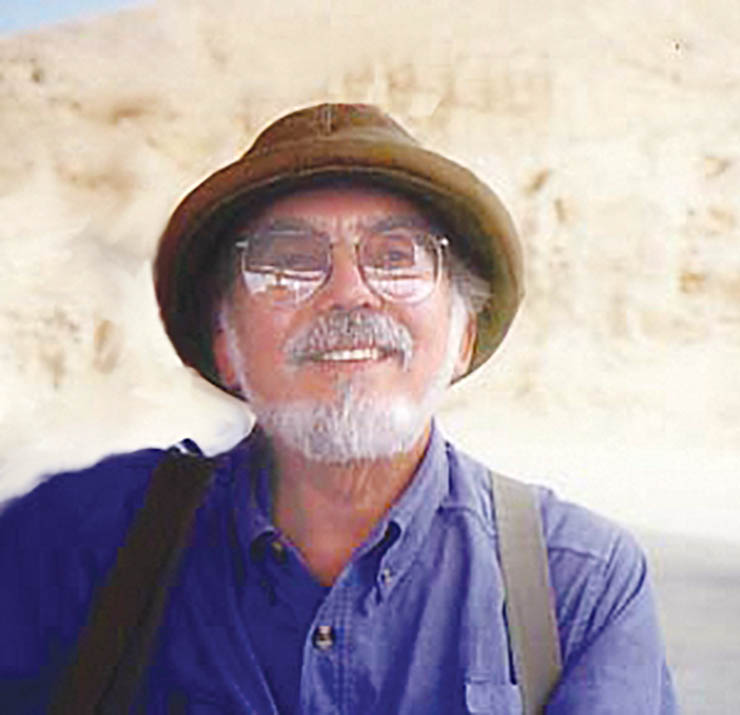
    It has been thirty-five years since the first publication of John Anthony West’s revolutionary book Serpent in the Sky: The High Wisdom of Ancient Egypt. It was a courageous challenge to the academic blindness of mainstream Egyptology. Much has transpired since then and although the mainstream still desperately clings to its outdated attitudes toward the wisdom of the ancients, the knowledge that the real truth of our history and its origins have been denied to us is gaining a much greater acceptance.

    In this exclusive interview for New Dawn magazine [conducted in 2014], Darren Carville spoke to John about where he is currently at and what motivates him at the age of 82 to continue taking on the Establishment [Editor’s note: John Anthony West died in 2018]. The following are some highlights from that interview.

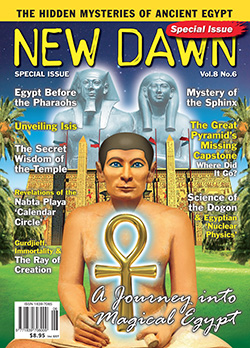
    DARREN CARVILLE (DC): John, Serpent in the Sky was originally published back in 1979 when the Internet was just a pipe dream. It’s amazing how many of these ideas are so widely disseminated online now. Just one example is this curious image of the ‘Sitting Scribe’ [see the front cover of this magazine] that in your book was originally in black & white, but now there are dozens of vivid colour copies of it online from every angle as people visiting Egypt take digital shots and upload the images themselves.

    JOHN ANTHONY WEST (JAW): Yes that’s true, and that particular image is also a great example of Egyptian technology going backwards, because those inlaid eyes, they’re made of four different kinds of quartz crystal and as R.A. Schwaller de Lubicz points out, not only is quartz a very difficult stone to work with, but in order to make a realistic eye that looks back at you, means having to understand the refractive and reflective indexes of the eye. So this is a very advanced knowledge of anatomy. By the New Kingdom, a thousand years later, they had lost the ability to be able do it anymore.

    DC: As an artist, even to paint something like that, is a very, very difficult thing to do.

    JAW: In terms of high art, once you’ve seen these Old Kingdom statues with the inlaid eyes, all other sculpture, including Michelangelo and Donatello and all the others, fade in comparison. They look blind, they don’t see, that’s the big difference.

    DC: You can read a saying that the ‘eyes are the window to the soul’, and here they have produced art where you can actually sense that. On the topic of lost knowledge, my son recently showed me a book that had a chart of all the different Egyptian crowns and headgear. It’s something that’s never spoken about is it? That famous picture of Yul Brynner in ‘Moses and the Ten Commandments’. He has that crown on his head that looks like a giant bowling pin, but they never actually found any of these hats in Egypt?

    JAW: No, that’s right. We have so much stuff out of Egypt now, that if it really was a crown, you’d have some instance of it and there’s not a sausage, they’ve never found any physical manifestations of them. Nobody up till now has been able to satisfactorily explain them. So this has always been a big mystery. Intuitively, I reckon that since it’s on their heads, which is the seat of consciousness, that in some way or another, symbolically it represents the consciousness of that particular principle. But that’s a ballpark observation, it doesn’t mean I can explain why one crown has a ram’s horn and the other kind of crown has a sheep’s horn. Or why one has a solar disc and the other one has a lunar disc. Well, okay, that’s sort of obvious. One is solar, and one is the lunar principle. But why this combination, I don’t know.

    DC: John it’s been over 20 years since your award-winning bombshell documentary about the Sphinx [‘The Mystery of the Sphinx’] with its ancient rainfall erosion and hence its age having to be thousands of years older than the ‘official’ date. The archaeologists produced their own documentary supposedly ‘debunking’ your claims, but it seems they were too late to sway the general public, and nothing has really been the same since has it?

    JAW: Right, well I love it. I have a certain advantage over most of my colleagues. Graham Hancock is a very good journalist but he’s not a satirist. I’m a scholar by default, but I see myself as more of a writer than a scholar. When we get attacked I have the tools to deal with them, so the harder they come at me, the more I enjoy it, particularly now we’ve got the Internet. Because before that you couldn’t retaliate.

    DC: What’s been your best achievment so far?

    JAW: People often ask me, “What do you think your legacy will be?” Well, I know this Sphinx theory – whatever the fate of symbolism – it isn’t going to go away and it’s all there. It’s not going to be long before the Establishment is obliged to accept it or get marginalised themselves. It’s really a lot like Galileo’s story actually, because I didn’t invent this Sphinx theory, I got it from a single line from Schwaller [de Lubicz] and he just glossed over it. He didn’t see it himself. Yet, it’s the key to the whole lost civilisation hypothesis… it’s quite clear from the way he talks about it. In English the book is called Sacred Science: The King of the Pharaonic Theocracy. That’s going to be around forever. Nobody’s going to get rid of that.

    Then it was Robert Schoch, my colleague, who stuck his tenured neck out to defend the whole water erosion hypothesis and it was his triple Ph.D in Geology, Geophysics and Palaeontology that did it. Nobody would have given me the time of day, even though I’d actually done my research pretty well. Schoch is very cautious and quite respectable – less so than he used to be. He’s an interesting guy, and very intelligent.

    The other thing I would like to be remembered for is being the one who drove the final nail into the coffin of Darwinian evolution. Robert Schoch and I have a book planned called ‘Darwin Debunked, Darwin De-clawed, Darwin Dethroned’, sub-titled, ‘A Scientist and a Scholar Deconstruct the Cargo Cult of the West’. We want to write the definitive anti-Darwin book, and it’s funny because there are lots of so called ‘definitive’ books that never managed to do it. Maybe the time wasn’t right or they’ve just not been written in a way to fire the public imagination. We think we can do that between us.

    DC: It may well be the right time because even five years ago if you tried to explain to most people that the world was run by a few private corporations they just laughed. But now because of what’s happening, and how it affects people personally, the attitude is changing and I think all of that global control couldn’t exist without this Darwinist world view – that there’s no greater purpose to living than being a consumer.

    JAW: Yes, it’s the foundation for it, if not explicitly, implicitly. It supports the whole rotten structure.

    DC: Is there anything else you’re currently working on that’s in the pipeline John?

    JAW: At the moment Schoch and I are working on another book called ‘Dancing Down the Bridge of Sirah’. It comes from Sufi literature and it’s described as this bridge that’s narrow as the razor’s edge, and on one side is the Chasm of Credulity and on the other is the Abyss of Scepticism. So the trick is to get down that bridge and this is not so easy. Schoch and I intend to do a really comprehensive account basically of the Sphinx theory – not going into the Symbolist realm so much – and now that we’ve got Göbekli Tepe, we’ve got a smoking gun [for more on Göbekli Tepe, see Robert Schoch’s articles in New Dawn Special Issue Vol.7 No.1 & New Dawn 122]. So not too long from now it’s going to be impossible for these jackasses to keep on insisting their old paradigm is right, and they will go under. The subtitle is ‘A Scholar and a Scientist Fend Off the Air-brushed Unicorns and Take on the Paradigm Police’. That’s an image coined by my composer step-son. He was once talking about the covers of New Age music and he complained that, “It’s all a bunch of air-brushed unicorns.” That’s a perfect totem for the woo-woo segment of the New Age movement. The paradigm police are of course the debunkers.

    The other thing we are trying to do is a ‘Magical Egypt 2.0’ documentary but we’ve got to figure out how we intend to make money from it. We didn’t make a bean out of all the work that went into the first ‘Magical Egypt’ series because people just pirated it in the end.

    [alert type=”info” dismiss=”no”]If you appreciate this article, please consider a subscription to New Dawn magazine.[/alert]

    DC: Great, we will certainly be looking forward to seeing this! One of the things I love most about Serpent in the Sky and the ‘Magical Egypt’ series is that you layout all these ideas and encourage people to follow them up and verify for themselves. I find they are something I keep coming back to, and each time it sparks me off into new research. This seems to be the way of the Egyptian Sacred Science – it makes you work for the understanding, you can’t just get it through a bunch of memorised facts in the way of academic learning. As you mentioned with Gurdjieff’s book Beelzebub’s Tales to his Grandson – it’s like Egypt makes you work for it and there is no start or finish, it’s about how far you can penetrate into the enigma.

    JAW: Yeah, sure.

    DC: A good example is the division of the head at the crown of the skull in the temple reliefs. Clearly it is a clue inviting people to have a look at this specific portion of the head as there is a deeper message hinted at. Schwaller and his team do all the research, look at the anatomy of the brain, look at all the esoteric traditions to do with that part of the head etc. He has to do a lot of research to be able to get to the truth or the understanding of what that is actually revealing. He had to work for it.

    JAW: It is impenetrable to 99% of people, even people who are highly literate and highly philosophical. There’s just something about the density of his thinking that people can’t or won’t go to the trouble to penetrate. For me it was not easy, and some of the things I didn’t have the maths to be able to follow him in certain instances. But otherwise I had a good grounding in Gurdjieff and a lot of esoteric studies so I could read it without too much trouble. It’s certainly not for everyone so it’s good to have something like Serpent in the Sky to help you open it up.

    DC: I really wanted to ask you about that Gurdjieff connection John, because I heard you on another interview say that if it hadn’t been for your understanding and experience with the Gurdjieff work, you would have never twigged to what Schwaller was on about in the first place.

    JAW: Well, I would never have even found him, for that matter.

    DC: Right, and I do wonder John – in what you’ve just said about the nature of Schwaller’s work and the level of his mind – do you think that’s really a factor of this whole idea that one’s level of ‘being’ determines what level of higher knowledge one can actually gain access to?

    JAW: That’s a good question. Well yes and no. Working on being – you’re thoroughly familiar with the Gurdjieff work?

    DC: Yes.

    JAW: Well, I would say in terms of levels of being, it’s impenetrable unless you’ve acquired what Gurdjieff calls the ‘Magnetic Centre’. That’s what opens you – it makes these kinds of things accessible. It’s one of the things that a lot of people don’t understand who haven’t been involved in this kind of work themselves, and are mostly working with their heads. They just can’t get it at all. As my Sensi used to say, “Don’t talk about moonbeams to the blind or about music to the deaf, and especially do not talk about sex to eunuchs – they will just get angry!” So once you understand that and stop getting frustrated by, let’s call it, the intolerable obduracy of the quackademic, because it looks as though it’s deliberate, but it isn’t. They just don’t get it.

    However, when they call their terrible disability ‘reason’ and take over the palace, the empire is doomed. This is what you’re dealing with. They’re basically wildly uncreative people. I mean, Schwaller appeals not necessarily to the intellectuals, although you have to be quite intellectual in order to penetrate it. You need more than intellect to be able to think in a certain way. The people who get it instantly, or at least they get the basic premise, are the artists and the architects, and sometimes the engineers, oddly enough. Rarely the hard-nosed scientist, never the sceptics of course, they’re totally out of it.

    So it’s going back to the magnetic centre, and the magnetic centre automatically means that you’ve done some sort of work on your own level of being. Some sort, even if it’s not been formal, otherwise you don’t have that magnetic centre that gets you to Gurdjieff and Schwaller in the first place.

    DC: Yes, and in relation to this battle with the academics, Gurdjieff also pointed out very clearly that this kind of ‘work’ is not for everyone. A person has to be genuinely seeking for the truth in the first place. Reading your argument with the Egyptologists in your open letter to Archaeology magazine [see www.jawest.net/anupadeshi.html], I get the sense that you have these different compartments at work in your life, because at one level you deal with the public, you do interviews, respond to all sorts of criticisms and arguments, but obviously at a deeper level you know that the issue for the human race’s future is a much deeper thing. It’s not really just about Egypt is it? Because no-one with any kind of awe and wonder about how difficult it is to make anything can ever look at the Darwinist idea that these chemicals get together accidentally and produce life. It’s a dead, non-resonating kind of thing. You could never swallow it. Yet millions do, quite happily, 24/7.

    JAW: More than millions. I mean, it’s the belief system that’s at the core of all science and all education.

    DC: Yes, I do wonder how long it’s actually going to take to replace that world view with something better. I did notice with your documentary series, ‘Magical Egypt’, looking at any of those episodes, the number of hits they have had, it’s in the hundreds of thousands. It’s quite extraordinary the popularity your work has gained since Serpent in the Sky – the message is getting out there. Of course the other side of the coin is that with the Internet all sorts of ideas have become popular and their popularity makes them seem like fact. For example, this whole Anunnaki/aliens making human slaves mine gold kind of thing – you don’t go for any of that do you John?

    JAW: No, and in our book ‘Dancing Down the Bridge of Sirah’ there will be a section in there called Zecharia and his Sitchininnies. Some of the other stuff, some of the ‘Airbrushed Unicorn’ stuff, is fairly harmless, but his work is seriously malignant.

    DC: It’s even turning up in romantic novels now.

    JAW: I always left the door open to Sitchin because his work was based upon his own translations of the Sumerian texts. No Assyriologist would look at his stuff. That’s not Sitchin’s fault. So I thought he could well be right about certain things. Who was I to argue those points? However, recently, a really solid biblical scholar who doesn’t have an axe to grind called Michael Heiser put up a website called ‘Sitchin is Wrong’ [www.sitchiniswrong.com]. This guy really knows what he’s talking about and goes through Sitchin line by line, and none of it tallies with the dictionaries created by the Sumerian scribes themselves. As far as I’m concerned, it’s completely false.

    DC: You have often given the analogy that where we are in the Kali Yuga cycle is very much like being in the ‘Winter’ stage of the four Seasons.

    JAW: Yes, that’s right. However, the big problem with these very long cycles is that you don’t have a Spring Equinox to set your clock by. You just can’t really know exactly. There’s a lot of very informed, interesting work done on the Yuga cycle, but they all have different ideas of where it starts and how it starts, and unfortunately there’s nothing scholarly or scientific that you can actually depend upon that is more plausible or less plausible analyses. There’s simply not enough history, it’s too short to tell. I mean real history only goes back about 2,500 years. In other words, history that you can document. It’s really not much more than that. Even the Egyptian history is, half the time, symbolism of some sort or another. There are very few ‘facts’. So we’re talking about cycles, at least precessional cycles, and maybe more than that, we just don’t know. You look around us today and intuition tells me that we’re in the thick of the Kali Yuga and it’s going to get a lot worse before it gets better.

    DC: John, how was it that you originally got involved in the Gurdjieff work?

    JAW: When I look back on my life I see I was psychologically precocious. Not a genius, but at the age of 12 or 13 I actually knew that I was living in a lunatic asylum, that the whole thing was insane, and it was very lonely living back then. Now lots of people sort of understand that. By the time I was 19 I knew what I wanted to do. I wanted to be the little boy who said, ‘The Emperor Has No Clothes!’

    It took another 20 years. I had published a lot of stuff by then, and the scholarship was starting with my The Case for Astrology book. There were also plays, a novel and stories. I was well published but not very well paid for it, and I realised I was now playing out my role as the little boy who said, ‘The Emperor Has No Clothes’. I finally came across the Gurdjieff work when I was living in a thriving artists colony at Ibiza in Spain during the late 50s and early 60s.

    Through a weird series of circumstances – again it’s the magnetic centre at work – one of the guys that I knew gave me a book called The Theory of Celestial Influence by Rodney Collin, a student of Ouspensky. I read it and that really interested me, and my friend, a very good painter, who had been in the Gurdjieff work himself, started feeding me Gurdjieff in very limited doses. He was right on course because I would have said, “Ah, what do I need this stuff for?” So one day he finally said, “Well, okay, here’s Beelzebub’s Tales to His Grandson.” He gives me a little fat book and I take it back and I read the first paragraph which is something to the effect of “Everything you know is completely wrong, and this book will make you understand that you don’t know anything.” I was furious. “Fuck you! who are you to tell me that, what have you ever written?”, but then I calmed down and thought, “Well I’ve had a lot published myself, and and I know how difficult it is to make your audience feel – not even think – but feel what you want them to feel.” Here was this guy, in one paragraph, getting me so angry that I was ready to throw his book against the wall. Suddenly I realised, “Oh… that’s not easy to do!”

    What Gurdjieff was doing, he was obliging me to work. You didn’t know what was true or false or even if he was pulling your leg. Could you follow those paragraphs? Those sentences that are two pages long with a thousand parentheses in the middle… he was forcing you to use your head in a way that you never dreamt of using it before.

    That was my introduction to Gurdjieff and I eventually left Ibiza to move to England to get into the Gurdjieff work, which was really important. Without that I would have spun off the rails long ago. Everything else stopped. Because at a certain point you can’t just read about these ideas anymore, you have to do them, and this is where the problem comes in because it’s not easy to do and it’s not fun.

    DC: The Gurdjieff work, no it isn’t.

    JAW: It’s not like rubbing crystals or hugging trees, it’s hard work. Gurdjieff was almost the only person I’d ever come across who was as contemptuous of all of Western civilisation as I was, but the difference was that he knew how to live in it and I didn’t. So after nine years of living in Ibiza, I finally moved to England to get into the ‘work’.

    What distinguishes Gurdjieff from anybody else is that it’s the ancient doctrine but put into a format designed to be practised in the middle of the lunatic asylum, not isolated from it in some monastery or whatever. It’s how to become sane when everybody around you is crazy, without removing yourself from ordinary life. You can’t practise Schwaller. It’s not a discipline. But Gurdjieff is.

    DC: Yes, I can certainly appreciate that.

    JAW: Without a return to the kind of principles that kept Egypt going, and other ancient cultures going, without this ancient doctrine being understood and taken up, the Church of Progress always wins, or everyone loses one way or another, so it’s very difficult. This is why Egypt is special because there’s so much of it left. You can’t go to China or India or anywhere else and have this thunder of esoteric wisdom coming at you all day long like you can in Egypt.

    Of course there’s a lot of bullshit out there as well, but at least in theory the work is designed for people to practise inside their daily lives. Not that many are doing it and I don’t really know why. On the other hand, if you just extract yourself from the world, it’s like you’re shirking your duty somehow or another. I mean, Tiger Woods’ mistresses don’t matter, and most of that stuff doesn’t matter. But some of it does matter. You watch the Scorpions of Wall Street raping our lives and these disgusting billionaires absolutely destroying the planet. That’s the sort of thing you have to keep on top of, it seems to me.

    Get the issue this article appears in

    DC: As you’ve said, the Egyptians lived their life in preparation for the next life, and of course some people say, “oh, morbid buggers, they’re obsessed with death.” But no, I think, as you’ve written about and as Schwaller pointed out, clearly they knew, unlike the Darwinists, that they were here for a reason. Something had gone to a lot of trouble to put them together, to put this planet together, and I can really relate to that balancing act you’re talking about… Because on the one hand, as far as we know, we only have the one chance to do what we need to do here and move on, and yet at the same time you would not be human to not feel a concern and want to do something to make the situation here better. Especially being that the dice is so loaded – to programme people from the time they are born – that there is no purpose to life except consumerism, that it doesn’t matter if we destroy the planet because it’s a giant chemical accident anyway.

    JAW: Well, you can only do your best. The Gurdjieff work got me understanding things pretty well and Gurdjieff has a lesson for everyone and everyone’s lesson is a bit different. But it was Gurdjieff who taught me – and this is a riff on what he says – that whoever and whatever presses your buttons is your master, and if you let your buttons get pressed, you’re a slave. I didn’t like that, so I worked pretty hard, reasonably successfully, to not get my buttons pressed most of the time. So enough people have to start doing their homework. If somebody asked me, which they probably won’t do, who I think are the most important people of the 20th century? I would put Gurdjieff first and Schwaller second. Certainly the last word has not yet been said about Gurdjieff.

    Anyway, I’m figuring on being here for a while yet. A friend of mine recently had the honour of briefly being the oldest man in the world. He was 110, and he really had his marbles together up until the last year or two. He did research into the paranormal. So if he could get to 110, there’s no reason why I can’t!

    There’s a wonderful author, the Argentinian writer Jorge Luis Borges. He wrote a short story book called Ficciones – magical Cabalistic stuff – and in one of the stories the last line is, “A gentleman only fights for lost causes.” It’s a great line. I don’t necessarily consider myself a gentleman, but it’s hard to do this – it’s hard not to get affected by the sort of stuff that’s happening around us every day.

    Books by John Anthony West – including Serpent in the Sky: The High Wisdom of Ancient Egypt and The Traveler’s Key to Ancient Egypt, as well as The Mystery of the Sphinx DVD, are available direct from John Anthony West’s website at www.jawest.net/books_vids.htm.

    [alert type=”general” dismiss=”no”]This article was published in New Dawn Special Issue Vol 8 No 6.[/alert]

    [alert type=”success” dismiss=”no”]If you appreciate this article, please consider subscribing to help maintain this website.[/alert]

    © New Dawn Magazine and the respective author.
    For our reproduction notice, click here.
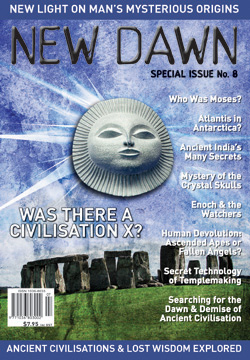
  • Searching for the  Dawn & Demise of Ancient Civilisation

    Searching for the Dawn & Demise of Ancient Civilisation

    From New Dawn Special Issue 8 (June 2009)

    When and where did civilisation begin? How far back in time does high culture go? Indeed, what do we mean by such terms as civilisation, or sophisticated and high culture?

    When I was in college, more years ago than I perhaps care to remember, I learned the standard story which still holds sway in many circles: Civilisation and high culture date back to, at most, perhaps five or six thousand years ago. A handy marker for recognising a true civilisation was written language, and it was generally agreed that the earliest true writing could be dated to the late fourth millennium BCE (that is, circa 3500 to 3000 BCE).

    The Sumerians are generally credited with developing writing about 3300 to 3200 BCE, although the earliest Egyptian hieroglyphics may date back to the same period, or even a century or so earlier, and there is also evidence of writing possibly from as far back as 3500 BCE found at Harappa, the Indus Civilisation, in what is now modern Pakistan.1

    But then there are reports of much earlier possible writing from Henan Province, China, dated to 6600 to 6200 BCE, inscribed on tortoise shells.2 I recollect a book I read while still an undergraduate, The Roots of Civilization by Alexander Marshack, which argued that various lines, notches, and “scratchings” on ancient bone artefacts dating to 10,000 BCE and earlier, before the end of the last Ice Age, were in fact symbolic systems, including lunar calendar notations. Maybe our ancestors were not so primitive and stupid after all.

    Maybe defining civilisation and high culture in terms of a written language (or more accurately our knowledge of a recorded language; we can easily miss things in the archaeological record) simply is not a fruitful approach. This is the conclusion I have come to while pursuing my own research.

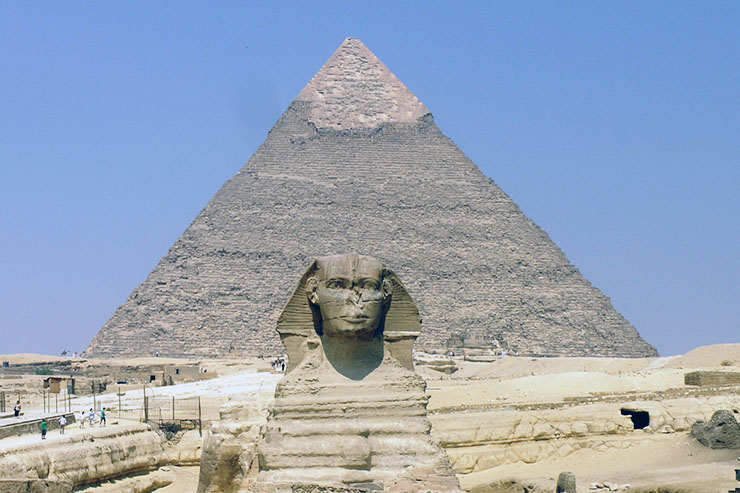
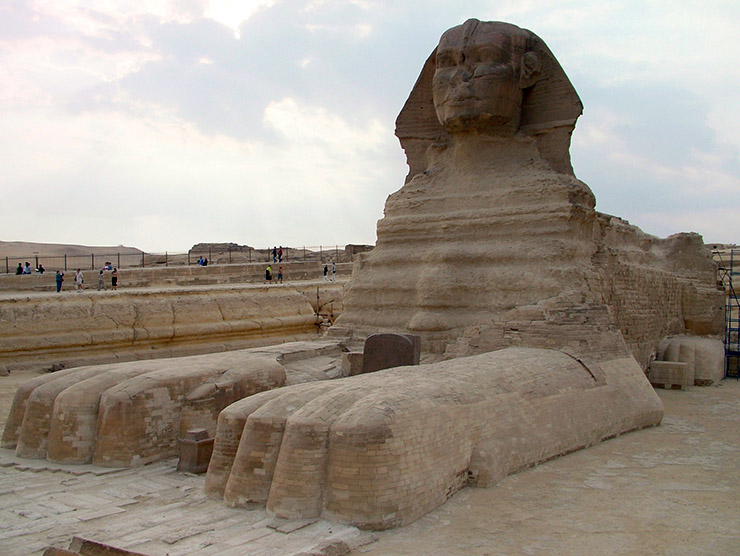
    Re-Dating the Great Sphinx of Egypt

    I first came to the problem of the origin of civilisation through my studies of the Great Sphinx of Giza, Egypt. Combining a Ph.D. in geology and geophysics from Yale University (1983) with a lifelong enthusiasm for ancient cultures, on my first trip to Egypt in 1990 I was primed to take a careful look at the Sphinx.

    As I have recounted elsewhere,3 my colleague and friend John Anthony West had suggested to me various silly notions that the Great Sphinx might be older than the standard Egyptological attribution of circa 2500 BCE. I figured that through a careful analysis of the geology, I could show the error in such thinking. Surely all those professional Egyptologists could not be wrong. It turns out they were.

    Based on my geological and seismic analyses, utilising the weathering and erosion patterns correlated with the palaeoclimatology and subsurface features,4 I concluded that the oldest portions of the Great Sphinx date back to at least the period of 7000 BCE to 5000 BCE, and perhaps back to 9000 BCE or earlier. To oversimplify a bit, the core body of the Great Sphinx shows features that place it well back before the onset of the current arid regime (the Giza Plateau is on the edge of the Sahara Desert) some 5,000 years ago.

    Such a conclusion has deep implications, suggesting that high culture and civilisation dates back much earlier than previously believed. I have been told on more than one occasion that my conclusions cannot be true because if they are, then “history must be rewritten.” Certainly, we cannot have that, can we? Vested interests run high, and I have been attacked from many sides, both by orthodox Egyptologists and historians, and by various people not as closely associated with mainstream academia.

    Through it all over the last two decades, I have looked at the alternative theories suggested to explain the data, and I continue to maintain that the evidence clearly points to the origins of the Great Sphinx being much older than 2500 BCE. Indeed, the attacks and criticisms, forcing me to carefully scrutinise and enlarge my dataset, have served only to reaffirm my conclusions.

    The Sphinx Under Water, or Under Fire?

    Recently my work on the Great Sphinx has come under fire from a self-described anti-Establishmentarian. Given the number of people who have been asking me about this latest “Sphinx theory,” I feel it is imperative that I briefly address it here.

    Robert Temple5 has proposed a moat theory (that is, the Sphinx Enclosure was purposefully filled with water such that the body of the Sphinx was submerged and sat as a statue in a small artificial lake) to explain the clear signs of water weathering and erosion on the body of the Great Sphinx and on the walls of the Sphinx Enclosure.

    Temple contends that the moat theory explains the data adequately without hypothesising that the Great Sphinx dates back to a much earlier period during which there was more rainfall than at present. (Here I will not address his hypotheses, which I do not find persuasive, that the Sphinx was the jackal [wild dog] Anubis and the face seen on the Sphinx is that of the Middle Kingdom pharaoh Amenemhet II, though I would point out that the original Sphinx has been reworked and the head has been re-carved, perhaps more than once.)

    The body of the Sphinx, carved from the bedrock, sits largely below ground level, and various moat, pool, or artificial fountain hypotheses have been suggested for the Sphinx from time to time. I considered such notions carefully as far back as my early analyses of the geology of the Sphinx, starting in 1990. In summary, such moat and related theories do not hold water (to use a bad pun) and are not compatible with the features of the actual Great Sphinx, the Sphinx Enclosure, and the general geology and palaeohydrology of the Giza Plateau.

    Scrutinising the Sphinx

    While in Egypt recently (March 2009) I made it a point to look at the Great Sphinx and Sphinx Enclosure with fresh eyes to see if there could be anything to the moat class of theories. I will summarise briefly a half dozen points.6

    1) Based on my observations and analyses, the Sphinx Temple (built out of blocks removed from the Sphinx Enclosure when the body of the Sphinx was initially carved) and the so-called Valley Temple to the south of the Sphinx Temple show clear signs of heavy precipitation-induced weathering on the limestone core blocks. These limestone temples were subsequently refurbished with Aswan granite ashlars during the Old Kingdom (as evidenced by an Old Kingdom inscription still found on a block located at the Valley Temple). The moat theory cannot explain the nature of the very ancient weathering seen under the Old Kingdom granite veneer.

    2) There is much heavier surface erosion on the western end of the Sphinx Enclosure, and the surface erosion tapers off dramatically toward the eastern end of the enclosure. This is exactly what is to be expected based on the palaeohydrology of the Giza Plateau and is incompatible with a moat theory where it is hypothesised that water was brought in from the Nile to the east. Furthermore, the nature of the surface erosion throughout the enclosure and on the body of the Sphinx is as expected if there were water running over or raining down on the rock layers. The erosion actually observed is not compatible with pooled water in the enclosure.

    3) The highest levels of the middle member strata, as seen in the Sphinx Enclosure on the western end, are most severely eroded, which is compatible with the agency of precipitation. If the moat theory were true, then the lower strata on the eastern end of the Sphinx Enclosure would be most heavily eroded (caused by water being brought in via canals from the Nile), but the opposite is seen in reality.

    4) The subsurface seismic data demonstrating the depth of weathering below the floor of the Sphinx Enclosure, based on my analyses (using areas excavated during the Old Kingdom for comparison), even when calibrated very conservatively, gives an age of initial carving for the core body of the Great Sphinx of at least 5000 BCE. More than one geological colleague has suggested to me that a more realistic calibration gives a date thousands of years earlier. And no, standing water in the Sphinx Enclosure would not accelerate the depth of weathering below the floor of the enclosure.

    5) The vertical fissures observed in the walls of the Sphinx Enclosure show diagnostic signs of having been formed by precipitation and water runoff. In my opinion, they do not show any characteristics that are diagnostic or even suggestive of having been formed by artificial dredging of the Sphinx Enclosure, as some have suggested.

    6) If the Great Sphinx actually had sat in an artificial pool or lake, either the water level around the Sphinx would have had to have been the same as that of the surrounding water table, or the walls and floor of the pool in which the Sphinx sat would have had to have been sealed up and watertight (and any artificial walls, such as on the eastern end, would have had to have been strong enough to withstand the pressure of the water). Clearly, the ancient water table was well below the level of the floor of the Sphinx Enclosure (or else the Sphinx Temple, for instance, would have been flooded). The Sphinx Enclosure, if simply carved from the bedrock (as all the evidence suggests) would not have held a deep pool of standing water. The bedrock in the enclosure is highly faulted, and characterised by a karst morphology that would leak like a sieve (another bad pun, perhaps). The enclosure would have had to have been fully sealed up (with some kind of mortar or cement, perhaps), and there is no evidence of such sealing. Furthermore, if the enclosure had been sealed in such a manner, this would not be compatible with the dredging theory for the vertical fissures mentioned in the previous point. I would also note that the chambers and tunnels under the Great Sphinx would have been flooded from above if the Great Sphinx had been sitting in a pool of water, unless the Sphinx Enclosure had been watertight; yet the evidence suggests the enclosure was not watertight.

    Could the Sphinx be Hundreds of Thousands of Years Old?

    Even as my re-dating of the Great Sphinx has been attacked as impossible by some authorities, other serious researchers have suggested that I have underestimated the true age of the oldest portions of the Great Sphinx by a factor of ten or more!

    For instance, two members of the National Academy of Sciences of Ukraine, Vjacheslav I. Manichev and Alexander G. Parkhomenko,7 citing my work, have reinterpreted the geology and erosional features on the Great Sphinx to mean that the core body of the statue could date back as far as 800,000 years ago. And they are not referring to simply a natural outcropping that may have existed 800,000 years ago that was later shaped into a statue. (Remember, too, that to carve the core body of the Sphinx huge multi-ton blocks were removed from the Sphinx Enclosure and assembled as the Sphinx Temple, so the original Sphinx Temple is as old as the core body of the Great Sphinx).

    The dating of Manichev and Parkhomenko could push the age of the Great Sphinx into a very remote time period, one that has been suggested for possible, but ambiguous, ancient structures, sculptures, or simulacra that are found in many parts of the world, such as Markawasi in Peru,8 the Romanian Sphinx,9 or a possible stone circle dubbed Adam’s Calendar by researchers Johan Heine and Michael Tellinger with a claimed date of 75,000 years ago.10 Personally, I am not convinced that the Great Sphinx is anywhere close to the age postulated by Manichev and Parkhomenko, or that various claimed very ancient, very eroded statues are anything more than natural formations, but the prospects are intriguing. Without going off on such limbs, there is clear evidence for early high culture at a remote period beyond just that of the Great Sphinx.

    Nabta Playa

    In the Sahara Desert of southern Egypt, west of Aswan, is an area known as Nabta Playa. Here an ancient stone calendar circle, as well as many other megalithic erections and structures, was identified by archaeologist Fred Wendorf (Southern Methodist University) and his team and dated to circa 4000 BCE and earlier.11 

    Thomas Brophy12 has carried out extensive analyses of Nabta. According to Brophy, three stones inside the Nabta calendar circle represent the belt of Orion (just as the three pyramids of Giza represent the belt of Orion according the research of Robert Bauval13). The stones on the Playa and the corresponding stars in the sky aligned on summer solstice nights between about 6400 BCE and 4900 BCE. Brophy found even more correlations, however. Three other stones in the Nabta calendar circle correspond to the configuration of Orion’s head and shoulders as they appeared in circa 16,500 BCE, about half a precessional cycle earlier than the previously mentioned alignment. Based on these and other analyses of monoliths in the area, Brophy concludes that the early inhabitants of Nabta Playa possessed incredibly sophisticated knowledge, the type of knowledge we associate with high culture and civilisation. Furthermore, the dates of the Nabta structures are in line with my dating of the oldest portions of the Great Sphinx, and at both Giza and Nabta the constellation of Orion (which represented the god Osiris during dynastic times) was of prime importance.

    Göbekli Tepe

    If the dating of the Great Sphinx remains controversial (after all, old ideas die hard), and the analyses of Nabta Playa are questionable in the eyes of some researchers, there is one site that even the most ensconced conventional archaeologists cannot ignore.

    In modern Turkey, just north of the border with Syria, is a site known as Göbekli Tepe that has yielded dozens of carved limestone megaliths, many of which date back to the extraordinarily early period of 9000 BCE to 10,000 BCE.14 Klaus Schmidt, of the German Archaeological Institute, has been heading an excavation team there since 1994, and there is no doubt as to the importance, authenticity, and dating (based in part on radiocarbon) of Göbekli Tepe. This is a discovery made by mainstream academics.

    Göbekli Tepe boggles the imagination on many accounts. The date is incredibly early, even earlier than my “conservative” estimate for the date of the Great Sphinx. Göbekli Tepe dates back to the end of the last Ice Age. The monolithic megaliths are in the range of two to seven metres high (the latter is the height of an unfinished megalith left where it was being quarried). Sculpted onto the surfaces of the monoliths are a variety of animals, including snakes, boars, foxes, vultures, spiders, scorpions, a centipede, and a three-dimensional figure that has been interpreted as a lion. The megaliths excavated thus far had been erected into four distinct stone circles, ranging from ten to thirty metres in diameter. Based on geophysical surveys, the entire site may cover three dozen hectares (about 90 acres) and contains another twenty or so stone circles.

    Although very different from the Great Sphinx and the Sphinx Temple, in my estimation, taking the entire Göbekli Tepe site as a whole into account, just as much effort, social organisation, and sophisticated or high culture must have been required to construct the Göbekli Tepe complex as the Sphinx complex. When I first presented my findings on the age of the Great Sphinx, I was told over and over again by mainstream archaeologists and historians that my dating was simply impossible because it was well known that nothing so elaborate and sophisticated, requiring an advanced level of social organisation, could occur so early. Göbekli Tepe proves these assertions false and helps place the Great Sphinx in a larger context.

    The work at Göbekli Tepe has literally just begun. Most of the site has yet to be excavated and who can predict what surprises might be in store for us? Who were the people that built the site, and why did they build it? So far there is no evidence that the site was inhabited; no living areas have been excavated, though the thousands of animal bones found (the most common animal represented is the aurochs, a type of extinct ox) are evidence of feasting at the site. Was it a holy, sacred site? An area for religious pilgrimages? Or perhaps an ancient centre of knowledge? My instinct is that the positions of the monoliths, and the specific carvings on their surfaces, probably encode information… but what? And what happened to the people who built and used Göbekli Tepe? Curiously, the site did not simply fall into disuse and gradually decay. It was intentionally buried somewhere around 8000 BCE. Why? The mystery only deepens.

    The Origin and Demise of Early High Culture

    There has been space here to mention only a few examples of archaeological sites that challenge the conventional view of when high culture, advanced knowledge, and civilisation arose. Admittedly, I have dwelt on those that most interest me, including the Great Sphinx with which I have become entwined. Put all the evidence together and there is no doubt in my mind that what we can term high culture existed at least 11,000 years ago (and possibly much earlier).

    Where did early civilisation originate? And what happened to it? Is there a lost primordial ancient civilisation, one that was destroyed in some cataclysmic natural catastrophe? Could the legend of Atlantis have some truth to it? These are questions I have pondered long and hard for many years.

    Being a geologist, I view Earth and our environment as unstable, full of unexpected surprises, at least over the long term. Climates change, sea levels rise and fall, volcanoes erupt, earthquakes rock the land and sea, and objects fall from the sky. I have discussed how such natural cataclysms may have influenced the history of ancient civilisations,15 and in particular I have pointed out that Earth has experienced a series of encounters with comets during historical and prehistoric times.16

    Depending on the severity of the encounter (size of the comet, whether it actually touched the surface of Earth or perhaps resulted in a mid-atmosphere explosion, and so forth), dramatic climatic changes could be affected on Earth, which in turn could affect sea levels, and weather extremes can wreck havoc on animal and human populations, causing famines.17

    In 2003 I suggested that the end of the last Ice Age may have been brought about in part by comets bombarding Earth,18 and this hypothesis has received dramatic support with physical evidence for an impact around 10,900 BCE.19 There is also evidence for impacts around 7600 BCE, 4400 BCE, 3150 BCE, 2345 BCE, 1628 BCE, 1159 BCE, 207 BCE, 536 CE, and 1178 CE.20 

    Bottom line, based on all the evidence, there is no doubt in my mind that these incidents, these cosmic catastrophes, had a profound influence on ancient civilisations. In some cases migrations were sparked, in other cases entire cultures may have been wiped out.

    At the end of the last Ice Age, from before around 18,000 BCE to perhaps 11,000 BCE or later (dates at such a far remove are approximate), when sea levels were significantly lower (by seventy-five to a hundred and twenty metres), a sub-continental expanse of land was exposed in Southeast Asia where there is now only water in the area bounded by Indochina, the Malay Archipelago, the islands of Indonesia, and Borneo. To geologists this drowned region is known as Sundaland, and there is a variety of evidence that here an early civilisation was located; they fled as the waters rose and the comets came down.21 Could this be the primordial lost civilisation that so many of us suspect once existed?

    And what about that intentional burial of the structures at Göbekli Tepe? Did they see their fate in the skies? As the comets rained down did those ancient builders do their best to cover and preserve that which they had so carefully created, perhaps hoping to return one day to uncover their monuments? Or did they leave them for us to recover?

    [alert type=”general” dismiss=”no”]This article was published in New Dawn Special Issue 8.[/alert]

    [alert type=”success” dismiss=”no”]If you appreciate this article, please consider subscribing to help maintain this website.[/alert]

    FOOTNOTES

    1. David Whitehouse, “‘Earliest Writing’ Found”, BBC News Online, 4 May 1999; John Nobel Wilford, “Who Began Writing? Many Theories, Few Answers”, The New York Times on the Web, Science, 6 April 1999.

    2. Paul Rincon, “‘Earliest Writing’ found in China”, BBC Science.

    3. Robert M. Schoch with Robert Aquinas McNally, Voices of the Rocks: A Scientist Looks at Catastrophes and Ancient Civilizations, New York: Harmony Books, 1999.

    4. Robert M. Schoch, “Redating the Great Sphinx of Giza”, KMT, A Modern Journal of Ancient Egypt, vol. 3, no. 2, pp. 52-59, 66-70 (Summer 1992); Robert M. Schoch with Robert Aquinas McNally, Voyages of the Pyramid Builders: The True Origins of the Pyramids from Lost Egypt to Ancient America, New York: Jeremy P. Tarcher/Penguin, 2003; Robert M. Schoch & Robert Aquinas McNally, Pyramid Quest: Secrets of the Great Pyramid and the Dawn of Civilization, New York: Jeremy P. Tarcher/Penguin, 2005; T.L. Dobecki & R.M. Schoch, “Seismic Investigations in the Vicinity of the Great Sphinx of Giza, Egypt”, Geoarchaeology, vol. 7, no. 6, pp. 527-544 (1992); Robert M. Schoch, “Life with the Great Sphinx: Some Personal Reflections”, Darklore, vol. 1, pp. 38-55, 291 (2007).

    5. Robert Temple, “What was the Sphinx?”, New Dawn, no. 112, pp. 47-52 (January-February 2009); Robert Temple with Olivia Temple, The Sphinx Mystery: The Forgotten Origins of the Sanctuary of Anubis, Rochester, Vermont: Inner Traditions, 2009.

    6. For more details pertaining to some of these points, as well as various comments on the criticisms of K. Lal Gauri and his colleagues as cited by Temple with Temple [2009], see Robert M. Schoch, “Geological Evidence Pertaining to the Age of the Great Sphinx”, in New Scenarios on the Evolution of the Solar System and Consequences on History of Earth and Man (Eds. Emilio Spedicato and Adalberto Notarpietro), 2002. Proceedings of the Conference, Milano and Bergamo, June 7-9th, 1999, Università degli Studi di Bergamo, Quaderni del Dipartmento di Matematica, Statistica, Informatica ed Applicazion, Serie Miscellanea, Anno 2002, N. 3, pp. 171-203.

    7. Vjacheslav I. Manichev & Alexander G. Parkhomenko, “Geological Aspect of the Problem of Dating the Great Egyptian Sphinx Construction”, in Geoarchaeology and Archaeomineralogy (Eds. R. I. Kostov, B. Gaydarska, and M. Gurova) 2008. Proceedings of the International Conference, 29-30 October 2008, Sofia, Publishing House, “St. Ivan Rilski”, Sofia, pp.308-311.

    8. Robert M. Schoch, “Introduction”, in Markawasi: Peru’s Inexplicable Stone Forest (Ed. and Author, Kathy Doore, with a foreword by Peter E. Schneider), Surprise, Arizona: Kathy Doore, 2006, pp. 14-20.

    9. Anonymous, “THE BUCEGI – Sphinx,” article dated 10 October 2002 and posted at: www.ici.ro/romania/en/turism/c_sfinx.html. Accessed 4 April 2009.

    10. Angelique Serrao, “‘Oldest Man-Made Structure’ Unearthed”, Article dated 14 July 2008 and posted at: www.iol.co.za/index.php?from=rss_South%20Africa&set_id=1&click_id=13&art_id=vn20080714062546858C113827. Accessed 4 April 2009.

    11. J. McKim Malville, “Oldest Astronomical Megalith Alignment Discovered in Southern Egypt by Science Team”, Press release dated 31 March 1998 and posted at: www.colorado.edu/news/releases/1998/101.html. Accessed 5 April 2009.

    12. Thomas G. Brophy, The Origin Map: Discovery of a Prehistoric, Megalithic, Astrophysical Map and Sculpture of the Universe (Foreword by Robert M. Schoch and Afterword by John Anthony West), New York: Writers Club Press (iUniverse), 2002; Mark H. Gaffney, “The Astronomers of Nabta Playa: New Discoveries Reveal Astonishing Pre-Historic Knowledge”, Atlantis Rising, no. 56, pp. 42-43, 68-70 (March/April 2006).

    13. Robert Bauval & Adrian Gilbert, The Orion Mystery: Unlocking the Secrets of the Pyramids, New York: Crown Trade Paperbacks, 1994.

    14. Graham Chandler (photographs by Ergun Çağatay), “The Beginning of the End for Hunter-Gatherers”, Saudi ARAMCO World, vol. 60, no. 2, pp. 2-9 (March/April 2009); Andrew Curry (photographs by Berthold Steinhilber), “The World’s First Temple? Predating Stonehenge by 6,000 years, Turkey’s Stunning Gobekli Tepe Upends the Conventional View of the Rise of Civilization”, Smithsonian, vol. 39, no. 8, pp. 54-58, 60 (November 2008).

    15. Schoch with McNally, 1999.

    16. Schoch with McNally, 2003.

    17. For a discussion of the effects of a sixth century CE cometary event, see Ker Than, “Comet smashes triggered ancient famine”, New Scientist, issue 2689, p.9 (7 January 2009).

    18. Schoch with McNally, 2003.

    19. R.B. Firestone, A. West, J.P. Kennett, L. Becker, T.E. Bunch, Z.S. Revay, P.H. Schultz, T. Belgya, D.J. Kennett, J.M. Erlandson, O.J. Dickenson, A.C. Goodyear, R.S. Harris, G.A. Howard, J.B. Kloosterman, P. Lechler, P.A. Mayewski, J. Montgomery, R. Poreda, T. Darrah, S.S. Que Hee, A.R. Smith, A. Stich, W. Topping, J.H. Wittke, and W.S. Wolbach, “Evidence for an extraterrestrial impact 12,900 years ago that contributed to the megafaunal extinctions and the Younger Dryas cooling”, Proceedings of the National Academy of Sciences, vol. 104, no. 41, pp. 16016-16021 (9 October 2007).

    20. Schoch with McNally, 2003; Undoubtedly this list is incomplete, especially for the period between 10,900 BCE and 3150 BCE.

    21. Schoch with McNally, 2003.

    © New Dawn Magazine and the respective author.
    For our reproduction notice, click here.
  • Ancient Egyptians in Australia! Could Mysterious Engravings Rewrite our History?

    Ancient Egyptians in Australia! Could Mysterious Engravings Rewrite our History?

    Until receiving a phone call from Nina Angelo (OAM), I knew nothing of neither the struggles involved in protecting the land around Kariong (near Gosford) nor that part of this land was now on the market. When on-site I had seen a lot of tagged trees, and a for sale sign somewhere along a main road, but being unfamiliar with the whole region, nothing registered.

    The land for sale contains the Gosford Glyphs, located near Kariong, about 60 km north of Sydney. This site features little known carved ‘ancient Egyptian’ hieroglyphs that were brought to light by various researchers in past decades.

    We are convinced that close to this site, and never before seen by non-Aboriginals until discovered very recently, is a rock platform covered with a set of sacred engravings of considerable significance. On this large platform we saw a fish, serpent, massive dolphin or whale, circles and a variety of shapes and symbols.

    Without doubt, it is an impressive gallery of ancient Aboriginal rock art deserving of protection. There is one life-sized engraving of Durramullan (son of Creation Spirit Biamie) that is so unique, utterly unexpected, and obviously sacred, decisions had to be made as to how it can be publicly described.

    There is nothing remotely like it anywhere in Australia. And that’s it. That is all we have agreed to reveal. The photographs taken late in the afternoon on this site, and in particular those of Durramullan, should never be reproduced or published through any form of the media but…

    Owing to the real possibility this land, irrespective of the credentials for or against the Gosford Glyphs, could be sold then developed, a different approach is compulsory. It has been our agreed stance to categorise all the sites/relics we are sharing as being ‘found within 2 hours of Sydney’, but that generalised approach doesn’t apply in this location. Those engravings, and other related platforms (one is actually located within this block) are now directly under threat.

    The distance between this unique site and that of the Gosford Glyphs is far too close for coincidence or comfort. As to determining the bona fides of this supposed Egyptian site, we have one advantage. According to Dr. Hans-Dieter von Senff, who has produced a draft paper on the site:

    These Hieroglyphs are real and have existed for some 4,500 years in Australia. In order to prove that these Proto-Egyptian glyphs are not graffiti, as claimed by various “Experts” and “Egyptologists,” but are the written record left by pre-historic man, written in a coherent and understandable language that makes sense even 4,500 years later. This site is no hoax, but a genuine archaeological discovery; as is proven by the newly discovered second set of glyphs.

    The critics who dispute the origin of these engravings numbering over 300 are not sensitive to the bigger picture, and if proven to be engraved by Egyptians, these glyphs form a pivotal and historic epitaph to an Australian history very few suspect. The engravings were first properly translated by Ray Johnson, claimed to be proto-Egyptian and accepted “as correct by the General Director of Cairo Museum, Dr. Dia’ Abou-Ghazi.”1 However, despite the endorsement of the resident expert in Cairo, Australian academics with less impressive credentials are adamant this is an elaborate hoax.

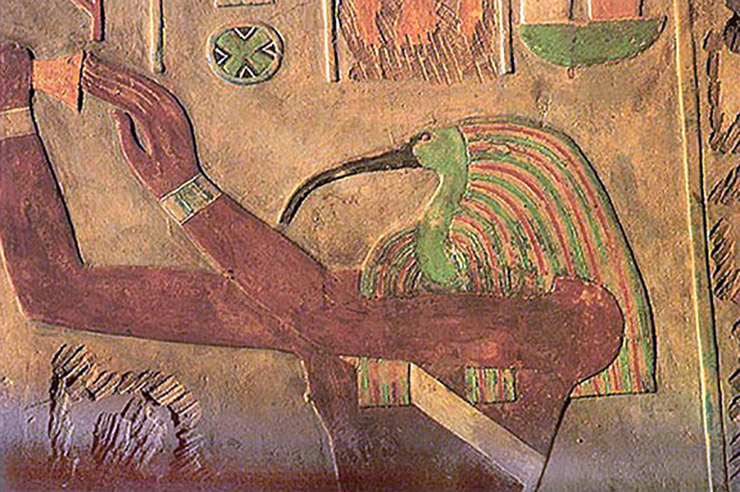
    The site includes an engraved Ankh (see image above courtesy of Steve Strong), an essential accompaniment to Thoth, placed alongside an Ibis footprint (Thoth’s recent animal counterpart) and what we believe to be the ‘River of Life’. Two Ibis-men engraved into rock, both in profile with the head of an ibis and body of a human, seem to resonate to the same ancient Egyptian theme. What really surprised us was that not only are the ibis and Thoth synonymous, but originally Thoth was depicted in ape-form. And it is this more ancient representation that is found twice in Australia, extending the horizons considerably. A statue found at Gympie, said to act as one of five sentries guarding the controversial seven-stepped pyramid at Gympie, is a depiction of Thoth in his more primal ape-like form and has been argued over and often ridiculed.

    The recent discovery of an engraving of Durramullan, again in profile, is less open to debate. The pronounced long forehead and protruding lips is reminiscent of a baboon or one of the larger apes, and so out of context when carved into a continent lacking ape or monkey. The engraving is ancient, carved by an artist aware of an African animal and Egyptian deity supposedly unknown until the British invasion. In what only adds to the quality and quantity of this cross-cultural partnership, there are two sets of Aboriginal engravings, one containing 31 separate and distinct human characters and the other five figures, of which three have human bodies and what appears to be crocodile heads.

    It is for these reasons, and many others, we are in complete agreement with Robert Lawlor, author of the highly regarded Voices of the First Day, when noting the same origin and sequence. “The Egyptian religious practices, zoomorphic pantheon of gods, concepts of death and rebirth, sorcery, magic and medicine all have their origins in the primal culture of the First Day.”2

    We see the presence of Egyptians in Australia beginning at around 5,000 years ago, entirely in keeping with a global history that saw, for a variety of reasons too complex to discuss now, the Australian Aboriginal mariners and explorers finally return to Australia at around the same time. We believe the glyphs and other Egyptian remains found ‘within two hours of Sydney’ bear testimony to a spiritual sabbatical to the place where Egyptian religion and culture began.

    That the Gosford Glyphs are so close to the sacred Durramullan site suggests an agreement between the first Australians and people from a distant continent. The Durramullan platform is undeniably special, and the Glyphs are an integral part of this arrangement, unique not only in Australia but the world. The Egyptian crypt and engravings, dedicated to the memory of the son of a Pharaoh, was constructed close to the Durramullan rock platform and could only be created with the consent of the local Aboriginals.

    Of course, if Australian Aboriginals did sail the globe in ancient times this journey is dependent upon ocean-going boats being constructed in Australia. Up at the Top End there are many engravings and paintings of boats which are mistakenly claimed to be inspired by Maccassan boats fishing for trepan. No such claims can be made for the engraving of an ocean-going boat found in the northern section of the Gosford site. The boat’s design, with a steep prow and stern, has one primary function: to sail through large waves. It would be a waste of time, effort and resources to construct a boat according to the shape and proportions engraved into the rock, if the vessel sailed in stiller waters. More importantly, this engraving goes a long way towards establishing the claims made by Ramindjeri Elders. If indeed, as they insist, their ancestors circumnavigated the globe in a figure eight then this sophisticated design would serve that purpose.

    That engraving and the Ramindjeri account provide answers to a series of unresolved questions that mainstream academia are unable to appreciate. The presence of Australian Aboriginal people in America was the focus of Issue 35 of the highly respected science magazine Cosmos. The front cover carried the following caption: “Did Aborigines discover America? Startling new finds suggest Australia’s first people made it all the way to South America more than 11,000 years ago.”3

    Of course, America was merely one port-of-call when the First Australians set sail. “Dr. Raghavendra and researchers from the Indian-government backed Anthropological Survey of India project found unique genetic mutations were shared between modern-day Indians and Aborigines.”4 They “identified seven people from central Dravidian and Austro-Asiatic tribes who shared genetic traits only found in Aborigines.”5 These facts, along with newly discovered Australian genetic links to a hominid in Siberia referred to as Denosovan, necessitate the same means of transport: a boat.

    However, the plan of a boat is insufficient. Also required are both the tools needed to construct such a vessel and navigational skills before sailing to India, America, Asia, Egypt or any other destination. An axe is an essential prerequisite if building a vessel capable of sailing across oceans. In keeping with all other firsts, it should come as no surprise that the oldest axes yet found are located within Sahul (the greater Australian continent which includes PNG, Tasmania, etc). The oldest axe was found at Huon Terrace (PNG) and is dated at 40,000 years, followed by an axe found in Jawoyn land (N.T.) claimed to be 35,500 years old. Remaining within Australia, an axe was discovered at Sandy Creek (QLD 32,000 years) and another at Malangangerr (N.T. 23,000 years). In what confirms the antiquity of Australian axe technology, and by association boats, Angel John Gallard has in his possession a hand-held chopper (the precursor to the axe) which he believes to be no less than 60,000 years old, with the real possibility it is over 100,000 years old. The oldest axe discovered outside Australia was found at Niah Cave (Sarawak) and is thought to be 15,500 years old.

    For such an epic journey to succeed, especially if circumnavigating the world in a figure eight, Aboriginal mariners must have navigated by the stars. Once again it all begins here. As announced by a team of scientists from the CSIRO, the oldest astronomical construction was found at Wurdi Youang (Victoria). “The strange stone arrangement”6 has “two points set in perfect alignment with the setting sun on a midsummer’s day.”7 CSIRO experts are of the opinion the “ancient Aboriginal sundial could be upwards of 10,000 years old.”8 Nor do these rocks stand in isolation – there are two sets of walls recently found in the Snowy Mountains, the first is aligned east-west, marking out the conjunction of planets and contains no less than 10,000 rocks. The second is at least four times bigger and runs down an extremely steep slope.

    Within ‘two hours from Sydney’ is a perfectly aligned five-rocked compass and another construction that is far more enigmatic, which for obvious reasons, we call ‘mini-Stonehenge’. It is made up of 46 stones in the inner circle and 18 rocks forming what we feel are clusters of stars. The four directions are marked out by arches with a horizontal stone supported by stone pillars. All four constructions, although separated by hundreds of kilometres, serve the same purpose: charting the heavens.

    There is one pattern exhibited by these sites that seems to openly contradict an artistic maxim we assumed held fast throughout Australia. It was our belief that traditional Aboriginal art was region specific. Within this area we have found over 25 styles/techniques, many of which are claimed to be created in one tribal estate. We found evidence of the following Aboriginal artistic styles: Panaramitee; X-Ray; Figurative; Mimi; Lightning Brothers; Wandjina; Papunya; Hand stencils (two types); Representational; Rock engraving; Rock Pecking; Stone Arrangements; Bands across the body; Egyptian symbols; Bird prints; Engraved shield design (found throughout Australia); Profiled spirits; and others we could not identify.

    Where does that leave us? Relying on textbooks and academics ‘dazed and confused’… Or there is an alternative route. We are convinced the First Australians are completely separate to the Africans and were the first homo sapien sapiens. It was from Australia, not Africa, the first migration originated, and it is from Australia that religion, gender equality, astronomy, burials, sailing, music, art, democracy and all the nobler pursuits began. And it is in Australia, in particular the area ‘within 2 hours from Sydney’, that proof of this global legacy can still be found.

    Steve Strong has contributed an article on the ancient Egyptian connection to Australia in New Dawn Special Issue 19.
    [alert type=”general” dismiss=”no”]This article was published in New Dawn 130.[/alert]

    [alert type=”success” dismiss=”no”]If you appreciate this article, please consider a contribution to help maintain this website.[/alert]

    Footnotes

    1. “The Kariong Glyphs and the Prohibited Egyptians: Research Proves the Kariong Glyphs to Be Genuine and Exposes the Critics as Hoaxters” by Hans-Dieter von Senff, 2011, 99.

    2. Voices of the First Day: Awakening in the Aboriginal Dreamtime by Robert Lawlor, Inner Traditions International, Ltd., 1991, 75.

    3. “Ancient Odyssey” by Jacqui Hayes, Cosmos, 2010, Front Cover.

    4. “First Australians Were Indian: Research,” Sydney Morning Herald, 23 July 2009, 16.

    5. Ibid.

    6. “Wurdi Youang Rocks Could Prove Aborigines Were First Astronomers,” 5 February 2011, www.news.com.au/technology/sci-tech/ancient-aboriginal-eyes-were-on-the-skies/story-fn5fsgyc-1226000523978

    7. Ibid.

    8. Ibid.

    © New Dawn Magazine and the respective author.
    For our reproduction notice, click here.
  • A New Theory for the Great Pyramid: How Science is Changing Our View of the Past

    A New Theory for the Great Pyramid: How Science is Changing Our View of the Past

    This article was published in New Dawn Special Issue 13 (Sept 2010)

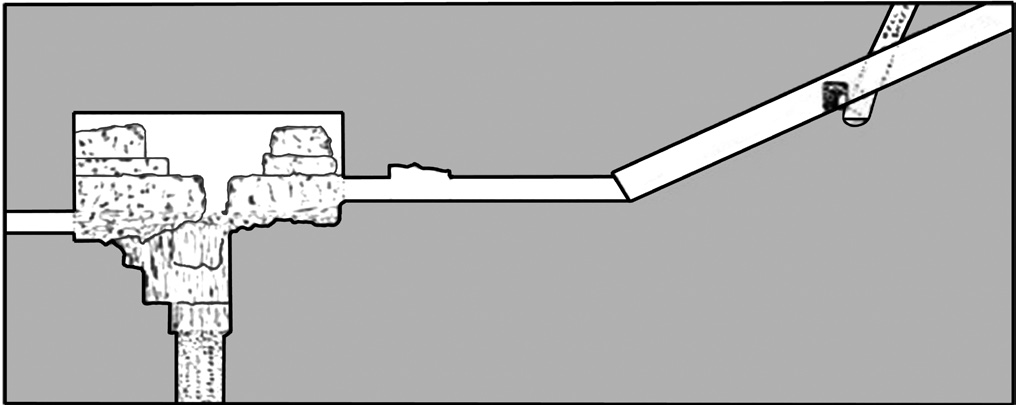
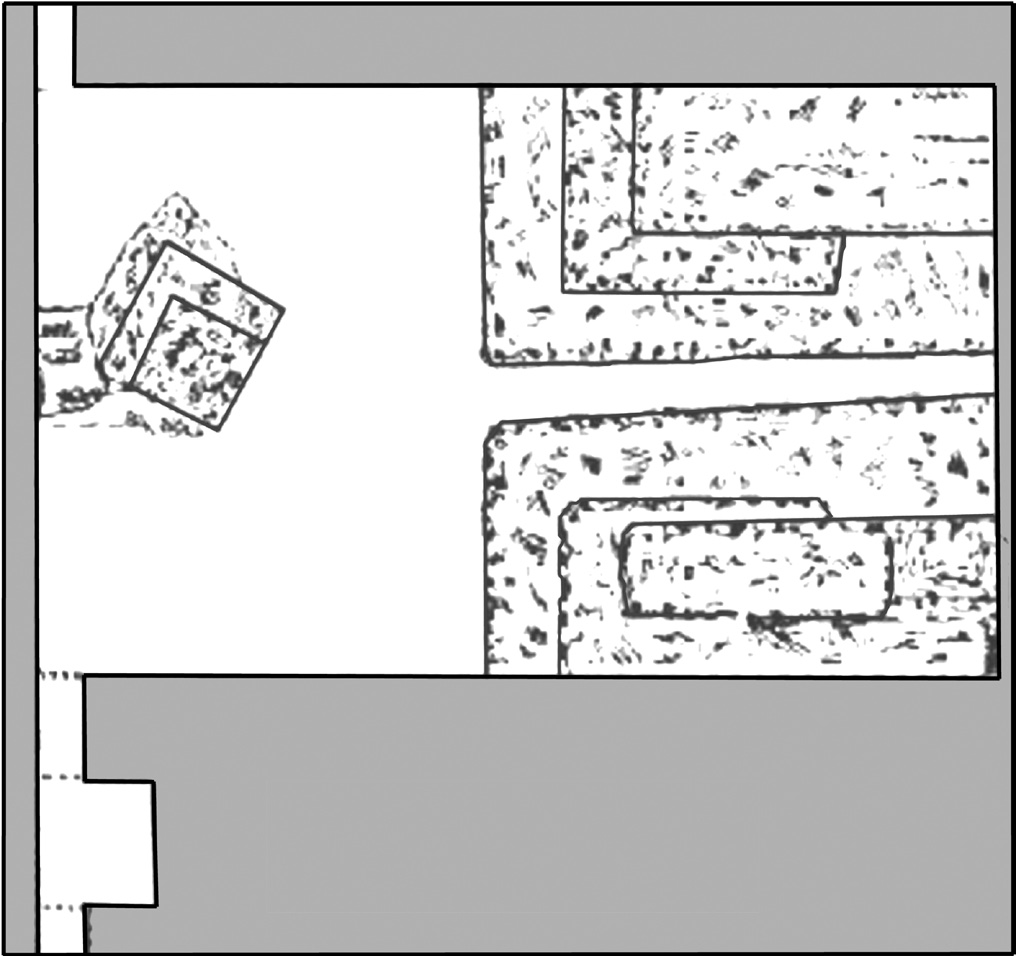
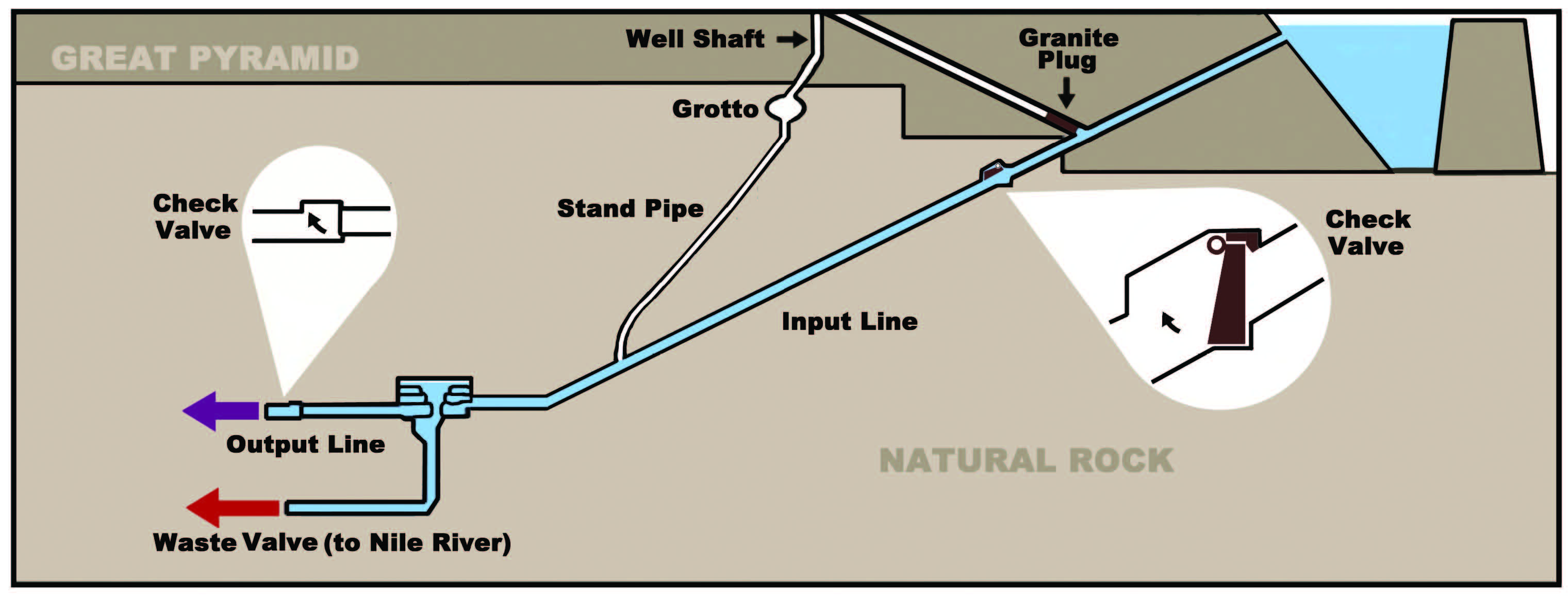
    Of all the chambers in the Great Pyramid, the subterranean chamber is the largest, as well as the most mysterious. It is 46 feet long, 27 feet wide, hewn into the limestone bedrock, and difficult to describe. The descending passageway’s entrance to the subterranean chamber is near the floor at the northeast corner. A six-foot-wide square pit shaped like a funnel has been tunnelled in the middle of the floor, near the east wall. This square-shaped pit is actually the mouth of a shaft that is eleven feet deep, although in 1816 the Italian explorer Count Caviglia drilled into the pit another thirty feet.

    The western half of the chamber has been carved nearly six feet higher than the eastern half and sculpted into several large finlike protrusions. All these finlike protrusions are situated east to west and are nearly as tall as the ceiling. Between the large protrusions, a stepped channel starts at the floor and flows toward the back of the chamber. In its centre there is a channel leading to the western wall. In the southeastern corner, a tunnel known as the “dead end shaft,” thirty inches in height and width, runs south fifty-seven feet, then ends at a wall. There are two other features in the design of the Great Pyramid that appear to be part of the work performed in the bedrock, the well shaft and the “grotto” (see figures 1 & 2)

    Figure 1. © Edward Malkowski
    Figure 2. © Edward Malkowski

    If the subterranean chamber was nothing more than a mistake, and was originally designed to be a burial vault, an enormous amount of resources was wasted. On the other hand, if the chamber was an integral part of the overall design of the Great Pyramid and performed a function, then what could that function possibly be?

    Everything from a tomb to temple of initiation to a device of some kind, there’s never been a lack of theories over the years describing what the Great Pyramid of Giza and the other pyramids was originally designed for. What has been lacking, though, is a theory describing why all the ancient Egypt pyramids were built. More importantly, what’s been lacking in any theory is scientific experimentation.

    To the best of my knowledge no one has built a scale model of the Great Pyramid. However, without any idea of what the Great Pyramid was, assuming it was a device, there would be no theory to test. Marine engineer, John Cadman, saw something that had been passed over for decades. In 1962, in a book entitled The Pharaoh’s Pump, a man named Edward Kunkel put forth the theory that the Great Pyramid was in its entirety a water pump. Cadman ran across the book one day browsing titles in a used bookstore. Intrigued, he purchased Kunkel’s book and after reading it realised that Kunkel was not far off the mark with his water pump theory. Being familiar with hydraulics and machines that rely on hydraulics, Cadman noticed that the design of the Great Pyramid’s subterranean chamber and its associated tunnels looked familiar.

    Cadman’s Experiment

    Figure 3. © Edward Malkowski

    Before the invention of the electric water pump the ram pump was used to move water from a reservoir to another location through a simple system that had only two moving parts, a weight loaded waste valve and check valve. Under the force of gravity, water in a reservoir flows down the input pipe and forces the waste value closed (see figure 3). With the waste valve closed, water continues to flow down the input pipe increasing the pressure inside the pump. The increased pressure opens the delivery valve forcing water into the output pipe. Since the water is being forced to a higher elevation faster than the water flowing down the input pipe the flow of water reverses which closes the check valve and the process begins again.

    Inspired by Kunkel’s work, Cadman learned as much as he could about the Great Pyramid’s subterranean chamber and associated tunnels, and in June of 1999 he made his first model. It leaked then cracked, neither would it function. Several months later he began work on a second model and connected a new line to the bottom of the pit shaft, believing this new line had to be the pressurised output. But the pump still didn’t operate the way he thought it should so he began building a third model which he completed on April 3, 2000, and it worked flawlessly.

    What Cadman discovered was that the subterranean chamber absorbed much of the reverse pulse. He also observed that without the subterranean chamber, the reverse pulse was large and the output flow was more erratic, confirming for him that the output in the Great Pyramid’s subterranean chamber travelled through what is called the dead end shaft. It also confirmed his suspicion that the ancient oral tradition that a tunnel exists connecting the subterranean chamber’s pit to the Nile River.

    A few weeks later Cadman moved the model to a seasonal creek with a pond serving as a reservoir, and experimented further. To simulate the effect of being underground he encased the pump assembly in concrete (see figures 4 and 5). Interestingly, the action of the pump, which was now embedded in concrete, created a vertical compression wave. This, according to Cadman, meant that the Great Pyramid’s subterranean ram pump also had an acoustical element. So, he built two more models to study the acoustics and fluid dynamics.

    The acoustic model, which was made of fibreglass and epoxy and encased in concrete, weighed five hundred pounds. When operating, the characteristic heartbeat-like thump of the pump could be felt through the ground twenty feet away and heard nearly a hundred feet away. Because of the powerful pulses it generated, Cadman named it the “pulse generator.”

    Figure 4. © Edward Malkowski
    Figure 5. © Edward Malkowski

    Cadman constructed a fourth model to study how water moved through the subterranean chamber and could operate in two different modes. This model was fitted with twenty-five individual ink injection locations and a glass top (see figure 6). It had a glass wall on its east side to view water flow, although Cadman discovered that the glass top quickly shattered when the model was operating in pump/pulse mode. Nevertheless, when not in pump/pulse mode, it was clear by studying the movement of water within the modelled subterranean chamber that the flow was complex and precise.

    What he discovered was that the sound wave striking the perpendicular surface reflects the majority of the pulse back toward the source. He also discovered that when the fluid jet strikes a perpendicular surface, it spreads in a 360° pattern perpendicular to the jet. Thus, he concluded that the design of the subterranean chamber incorporated fluid dynamics as well as acoustical dynamics. In his own words, “The dynamics are on par with that of computerised storm analysis: somewhere between hurricane dynamics and tornado dynamics.”

    Cadman’s model also revealed some performance issues that were built into the Great Pyramid’s subterranean pump. An additional “assist” line, from the compression chamber to a secondary location, speeds the movement of water through the output pipe. It also focuses the shock wave in the line leading to the compression chamber. The result is that a pulse is transmitted through the ceiling of the compression chamber. Thus, the line that connects the waste valve to the compression chamber acts as a waveguide, forcing the shock wave into a pulse. Therefore, the pulse is transmitted vertically (through the ceiling) as well as down the waste-valve line.

    Figure 6. © Edward Malkowski

    Cadman’s modelling of the subterranean chamber and its tunnels provides a better understanding of the Great Pyramid, as well as the Giza Plateau. In its completed state the Great Pyramid required a moat, which was fed by a system of aqueducts from the Western Nile (the Ur Nile); an ideal source for a gravity-fed water system, since the Western Nile was at a higher elevation than the plateau. It also explains the remains of a retaining wall that once surrounded the pyramid. The wall served as an embankment for an onsite reservoir, which in appearance was a moat. Tunnels, such as the “well” at the pyramid’s entrance, connected the Great Pyramid complex to an ancient lake, Lake Moeris, and the Western Nile.

    Lake Moeris (Egyptian Mer-Wer, meaning “Great Lake”) was an ancient lake fifty miles southwest of Cairo. At one time it was very large and occupied the entire Faiyum depression. It was also called the Pure Lake and the Lake of Osiris by the ancient Egyptians. During prehistoric times the waters of Lake Moeris stood nearly 120 feet above sea level, but by 10,000 BCE they had dropped to nearly twenty-five feet below sea level, possibly as a result of the Nile channel being naturally diverted. With increases from rain, between 9000 BCE and 4000 BCE the lake rose again, but gradually subsided. And as the climate became increasingly more arid, a canal connected Lake Moeris to the Nile; over the years it slowly silted. During the Middle Kingdom, 2000 BCE to 1600 BCE, dynastic Egyptians widened and deepened the channel, thereby restoring its flow. At that time the lake was believed to be fifty-five feet above sea level.

    There is little doubt that the lake served as a means of flood control as well as a reservoir for irrigation. Egypt’s Ptolemaic kings of the third century BCE partially drained Lake Moeris to make available 450 square miles of rich alluvial soil, which was irrigated by canals and extensive cultivation. Since then the water level of Lake Moeris has continually declined, and it is now the small, shallow saltwater Lake Qārūn.

    When the Great Pyramid pulse pump was functioning, the descending passage, subterranean chamber, dead end shaft, pit, well shaft, and grotto made up the components (see figure 7). According to Cadman, it could be operational today if all the tunnels associated with the pyramid could be cleared. Besides the well shaft that connects the descending passage to the middle chamber of the pyramid, there are two other tunnels that would need to be cleared. Clearing the pit associated with the dead end shaft (where the check-valve exists) would expose the horizontal shaft. If these shafts were cleared, the moat reservoir was in place, and the well in front of the pyramid connected to a Lake Moeris substitute, the pump could be operational.

    Figure 7. © Edward Malkowski

    One of the most important results from Cadman’s experiments was discovering the significance of the well shaft and its effect on the pump’s pulse rate. This specific design issue leads to the intent of the Great Pyramid’s designer. The well shaft begins near the bottom of the descending passageway and extends upward 170 feet. In the water-pump assembly, the well shaft functions as a standpipe, providing a shortcut for the reverse shock wave to reach air. In essence, it maximises the pulse rate of the pump.

    Although standpipes are typically twice the diameter of the input (drive) pipe, in the Giza assembly the standpipe (well shaft) is actually 25 percent smaller than the input pipe (descending passageway), which has a peculiar effect on the system. It lowers the elevation of the pulsing water below the water level of the moat reservoir. Interestingly, this specific elevation correlates to the height of the grotto, which serves as a reservoir, allowing for stabilisation and regulation of the reverse pulse. A block of granite, existing within the grotto that fits within the pipe, is believed to function as some type of choke or regulator.

    According to Cadman, the well shaft was part of the original design of the pyramid, and as a standpipe in the pump assembly, it served to maximise the pulse rate of the pump. The standpipe also reduced the reverse surge out of the descending passage, as well as reduced pumping efficiency and pulse intensity.

    The Importance of Pump Efficiency

    Cadman tested four different pump configurations, two circulating and two elevating, to gauge the well shaft’s affect efficiency. When in a circulating-pump mode, the well shaft reduced the efficiency by 29 percent. And, in an elevating-pump mode, the well shaft reduced the efficiency by 68 percent. The increase in efficiency of the well shaft provided an extra twenty pulses per minute, from sixty to eighty. Since the Giza configuration of the subterranean chamber included a well shaft, for the builders of the pyramid, pumping efficiency did not appear to be of primary importance. So if pumping efficiency was not of primary importance then what was?

    One way to approach this question is to review the general layout of the subterranean chamber. The subterranean chamber pit is offset by 45° in relation to the general configuration of the chamber and is aligned northwest to southeast. According to Cadman, this is so because a plane placed at a 45° angle will maintain the unidirectionality and consistency of the compression wave. In other words, this reflective elbow ensures the consistency of the compression wave. Any other type of elbow at the pit’s bottom would diffract (scatter) the compression wave. So the pit’s alignment is strictly for acoustical dynamics and for creating a standing wave in the waste line and subterranean chamber.

    Figure 8. © Edward Malkowski

    To create the standing wave in the waste gate line and subterranean chamber, it would be imperative to have the reflective elbow. The pit’s offset is exactly aligned with the tunnel (see figure 8, right; the red arrow is aligned with the exit tunnel). Not only does the reflective elbow completely explain the pit’s diagonal offset, but it also confirms that the compression wave is a major design consideration. The designers thoroughly understood complex fluid dynamics as well as complex acoustics (see figure 8, right; the red arrow shows the direction of the tunnel at the bottom of the pit; the ink injection photo shows some of the flows in the step area).

    Another way to approach the question is to review the engineering significance of the dead end shaft. It allows for a pressure change, which in turn changes the frequency of the compression wave. A gate valve at the end of the dead end shaft provides a means for accomplishing this. Adjusting the back pressure by adjusting the gate valve allows for changes in timing. In essence, this is a simple method to compensate for different water temperatures and atmospheric pressure, which are factors that affect the velocity of the compression wave.

    Cadman’s testing demonstrated that the pulse rate can be altered by at least 30 percent, between sixty and eighty pulses per minute. He also discovered that adjusting the back pressure changed the water’s density and, as a consequence, altered the compression wave’s velocity and frequency. In essence, such an assembly allows for easy fine tuning of the lower portion of the Great Pyramid to create the standing wave in the subterranean chamber and waste gate shaft.

    These experimental results confirm that the compression wave was a major design consideration. Also, according to Cadman, the square pit carved into the subterranean chamber created a whirlpool as water moved through the system of tunnels – apparently another design feature to efficiently move water to the chamber and out the waste line.

    If pump efficiency – in other words, pumping water – was not of prime importance to the ancient Egyptians, then what was? According to the experimental evidence, the answer is a compression wave, which, of course, creates another question. Why was a compression wave of primary interest to the Great Pyramid’s builders?

    A New Theory

    The question I have always had in the back of my mind concerning the pyramids is one of economics. Resources are resources whether a construction project occurs today or thousands of years ago. Man-hours and tools are required, so is pay for the management team, supervisors, and workers. If it cost 35 billion dollars to build a large structure today it would also cost that much in resources to build the same structure many thousands of years ago, the only difference being the nominal value of money used. In the case of the Great Pyramid that’s 380 billion dollars, according to engineer Markus Schulte of the global design and business consulting firm Arup.1 The limestone blocks for the Great Pyramid, alone, would cost today 18 billion dollars. With such a high dollar amount for a single pyramid, and more than ten were built comparable in size, then there had to be a very good reason why the Great Pyramid and the other pyramids were built, a reason that would benefit the whole of society.

    If the Great Pyramid was exclusively a water pump as John Cadman demonstrated in his experiments, then there wouldn’t be a need for another chamber located in the middle of the pyramid and a third chamber located in its upper regions. These chambers as well as the shafts in these two chambers need to be explained.

    Assuming Cadman is correct that the compression wave was what the pump was designed for, then the middle and upper chamber would likely have been designed to somehow react with the vibrations emanating from the pump. The upper chamber, known as the King’s Chamber, in its entirety was built from slabs of granite – the floor, walls, and ceiling – and located just above the chamber the builders of the Great Pyramid placed five rows of granite beams. So, it is obvious that granite was of primary importance in the uppermost chamber. The question is why.

    The high-fidelity stereo industry uses granite not only to provide a stable base for equipment but also because of its resonance qualities. All materials have a natural resonance frequency meaning that all materials will vibrate at certain frequencies. In the world of high-fidelity, the resonance of other materials in a room distorts the stereo’s sound, including the rack where the components of the sound system are housed. However, with granite as a base for stereo components not only are extraneous sounds dampened, but full sound is produced through the granite’s resonance. And by further isolating the granite base from the stereo rack with rubber washers or other polymer fixtures, the granite’s resonance properties can be further controlled. With this in mind, it might be the case that the purpose of building a granite chamber in the Great Pyramid was to create resonance.

    According to Tom Danley, the sound engineer featured in the documentary film The Mystery of the Sphinx, the Great Pyramid makes strange sounds because the granite chamber resonates from the rigidity of the stone. What he also discovered was that a number of low-frequency components existed even without a test signal present in the pyramid implying that the chamber was constructed for its resonance, and that it naturally creates a frequency. Most likely, he added, the low frequencies were a result of “Helmholtz resonances caused by the wind blowing across the entry tunnel.”2

    However, a compression wave emanating from the subterranean chamber would likely have a marginal effect on the granite in the upper chamber. What would be needed to localise the granite is a way to transform the compression wave into sound. This would create enough vibration to activate the granite beams and create a standing wave of resonance. With devices such as Helmholtz resonators built into the Grand Gallery those vibrations would become sound and cause the granite to resonate or ‘sing’. The question is ‘why’, to what effect? With shafts leading to the Great Pyramid’s exterior, the ‘singing’ granite would project its sound into the atmosphere. This, in turn, would create an electrical field in the atmosphere according to physics research.

    Again, we are left with the question ‘why’? The subtle electrical field created by the Great Pyramid would be of little use for means of powering equipment. However, such a field would deflect very low frequencies (VLF) and extremely low frequencies (ELF), frequencies that exist at all times in the atmosphere as a result of thunderstorms around the world. In agricultural experiments, VLF and ELF have been shown to promote plant growth. With the Great Pyramid operating as the engine, all of the pyramids could be connected by a subtle electrical field to create a canopy of sorts thereby deflecting VLF and ELF into the surrounding fields.

    In might sound mundane that the pyramids were agricultural devices, but it provides the best of reasoning for a civilisation to spend an immense amount of resources on any given project. Without food society would gradually fall into anarchy and civilisation would cease to exist.

    Illustrations courtesy of © Edward Malkowski. Further information on the above theory and a whole lot more can be found in Edward Malkowski’s new book Ancient Egypt 39,000 BCE: The History, Technology, and Philosophy of Civilization X (Bear & Company, 2010), available from all good bookstores.

    [alert type=”general” dismiss=”no”]This article was published in New Dawn Special Issue 13.[/alert]

    [alert type=”success” dismiss=”no”]If you appreciate this article, please consider subscribing to help maintain this website.[/alert]

    Footnotes

    1. ‘Where Did It Come From? Ancient Egypt: Iconic Structures’, Popular Arts Entertainment, The History Channel, September 21, 2006.

    2. “ProSoundWeb Live Chat with Tom Danley,” March 12, 2002, transcript, at www.prosoundweb.com/chat_psw/transcripts/danley3.shtml (Accessed September 29, 2009).

    © New Dawn Magazine and the respective author.
    For our reproduction notice, click here.