New Dawn – World's Most Unusual Magazine

Tag: esoteric

  • Quest for Hidden Wisdom: An Interview with Richard Smoley

    Quest for Hidden Wisdom: An Interview with Richard Smoley

    This article was published in New Dawn 98 (Sept-Oct 2006)

    Richard Smoley and Jay Kinney need no introduction to New Dawn readers. After successful careers as editors of Gnosis (1985-1999), the highly respected US journal of esoteric knowledge, in 1999 Richard and Jay published Hidden Wisdom: A Guide to the Western Inner Traditions to much acclaim (in May 2006, a revised edition of Hidden Wisdom incorporating new material and insights, was released).

    Richard Smoley has contributed numerous articles to New Dawn magazine, many of which can be found on the New Dawn website.

    In the following interview, Richard Smoley talks about Hidden Wisdom, spirituality, and the esoteric traditions….

    There seems to be a huge resurgence in interest in the hidden side of the Western tradition lately. There’s so much talk about Gnosticism, the Masons, the Templars, the hidden teachings of Jesus. What’s behind it all?

    Well, until fairly recently the story of Western religion was pretty much taken for granted. The Bible was seen as an accurate historical record, and the story the churches told about themselves was taken as the truth. But more and more people have come to see that isn’t the whole story.

    Over the last 200 years paleontologists came to realise that the earth really hadn’t been created 6,000 years ago. New Testament scholars took a closer look at the Gospels and decided that the life of Jesus they portrayed contains a lot of myth. Today archaeologists are saying that Moses couldn’t have led the children of Israel to freedom from Egypt in the land of Canaan, because Canaan was an Egyptian province at that time. The supposedly magnificent Jerusalem of King Solomon was probably a hill village with maybe 200 or 300 people. And so on.

    Much of this is not exactly news. “The quest for the historical Jesus,” as Albert Schweitzer famously called it, goes back to the 19th century. But it’s only in the last generation or so that this knowledge has begun to reach a widespread public. It’s led people to ask what was really going on back then. And it’s fueled a lot of speculation about the religious history of the West. Much of this speculation is pretty wild, but it shows that people are eager – maybe desperate – for some answers about their past that isn’t mostly propaganda.

    So what is this hidden truth? Was it true, for example, that Jesus was married to Mary Magdalene and that they had children?

    I’ve never seen any proof of this that seemed even remotely conclusive. There is a strange, fragmentary passage in a text called the Gospel of Philip saying that Jesus was very fond of Mary Magdalene and used to kiss her often on the mouth. The other disciples got jealous and said, “Why don’t you love us the way you love her?” And Jesus replies, “Why don’t I love you the way I love her?” The answer presumably being obvious.

    But the Gospel of Philip is very late. Most scholars date it to the third century CE. As such, it can’t be trusted as a terribly accurate historical source. All I can say is that there are legends, and it’s known that legends naturally accumulate around powerful figures. You only need look at the strange hagiography that’s congealed around Elvis Presley to see how this happened in very recent years. So the story of Jesus being married to Mary Magdalene is not something I personally would put any faith in.

    We may never know what happened in the time of Christ, how much of our information is factual, how much of it is suspect. For example, the Gospel in the Bible that is considered to be the most historically accurate is the Gospel of Mark. Strangely enough, the last page of this Gospel is missing. It was lost in antiquity, probably soon after it was written. What you find in the Bible – and most versions have these – are several different endings, all of them supplied later. This missing part of Mark would have told what happened after the Resurrection. Was this lost accidentally, or did somebody tear out the page and replace it with something more politically convenient? We may never know. And yet ultimately the hidden truth about our past is not some collection of buried facts.

    Then what’s the point of your work? 

    I do think there are buried truths, what in the title of our book Jay Kinney and I have called “hidden wisdom.” But it’s not factual knowledge as such. One of the key concepts in our book is gnosis, which is a term that’s bandied about a lot these days. Gnosis is knowledge, but knowledge of a very special kind. It’s not factual knowledge, not knowledge of something, but rather an inner awakening, an inner illumination. It’s quite similar, I would say, to what Eastern traditions often call enlightenment.

    Viewed in this way, the Bible becomes a story, not about people who lived in an increasingly remote past, but about our own inner awakening. In this way it becomes much more interesting and much more immediate. The story of Exodus is not about the liberation of several tribes of people from literal slavery, but about liberation from inner slavery. The story of Christ is not so much about a man, however remarkable, who lived 2,000 years ago, but about a process that begins in us as we awaken.

    But this just sounds like allegorising to me. People have been doing this for centuries. And it’s all very nice and good, but it doesn’t seem to have much to do with hard, cold facts.

    And what would facts prove? For example, the conventional Christian view is that Jesus literally rose from the dead. Not so long ago, I read a book about witchcraft in southern Africa, written by a very prosaic and down-to-earth British doctor who practiced there in the days of colonialism. He told this story of a chieftain who was dead and buried – and whose death he himself as a physician had verified. And he witnessed a ceremony in which this same chieftain was resurrected, sat on his throne, and ate a meal.

    Of course you can play the skeptic and doubt that this really happened. But beyond a certain point, what difference does it make? Would you believe something like that even if you saw it? Or would you laugh it off and tell yourself you just imagined it? People do this all the time with experiences that go past their concepts of reality. It’s that much harder to either accept or reject miracles that may or may not have happened thousands of years ago.

    Speaking of witchcraft, do you cover that topic in Hidden Wisdom?

    Yes, as a matter of fact we do.

    What is witchcraft about?

    Most people who call themselves witches are not Satanists. They are not cranky old ladies in black who live at the edge of town; nor are they playing at being Sabrina or Samantha Stevens. They are laying claim to what they call the “Old Religion” – the pagan tradition that thrived in Europe before Christianity.

    Witchcraft, Wicca, Neopaganism – these are all terms that loosely encompass a number of highly individualistic groups and people, not all of whom see things in the same way. In fact, they take many different forms. But one key thing they have in common is a reverence for the forces of nature, conceived as spiritual powers in their own right, and the belief that we can work with these powers consciously and creatively. Similarly with the powers of the mind.

    What you’re talking about is magic – not the sleight-of-hand type but the occult type. In your experience, does this kind of magic work?

    Not always, and not usually very well. But not for the reasons you might expect. From my experience, I’m convinced that these forces are real. But they’re difficult to master. It’s very hard to do anything like that that somehow doesn’t backfire or simply fail.

    Why?

    It’s not like a scientific experiment. In a scientific experiment, if you’re going into a lab to bombard subatomic particles or inject substances into some rat, your state of mind has very little to do with the results. In fact, it shouldn’t. A scientific experiment has to be replicable. Your report has to be like a cookbook recipe that a scientist on the other side of the earth can follow.

    Magical work is exactly the opposite. The state of mind you’re in, your concentration and your will – not only at the conscious but at the subconscious levels ­are the all-important factors, far more than whatever procedures you might use. And very few have the will and concentration to accomplish results anything like what they want.

    So is magic dangerous?

    Well, take the typical teenager who starts to dabble in such things. Either nothing happens, or the kid starts to get some results. He or she then usually gets scared and drops it right away. Very few are going to take magic to the point where they are going to get any effective results at all. If you do – and for some it is a true spiritual path – then your motivation becomes the question. Are you doing this for disinterested reasons – to form a link between heaven and earth, so to speak? Or are you just trying to find a shortcut to wealth and power? If it’s the latter, you may as well drop magic and take up stock brokering or politics or something that’s much more likely to achieve your aims. And if you’re doing anything for purely selfish motives, whether it’s magic or trading stocks, you will probably regret it eventually.

    What about the Kabbalah? That’s something we’re hearing a lot about lately.

    We have a chapter on it in Hidden Wisdom. Essentially the Kabbalah is the mystical tradition behind Judaism. It goes back to antiquity, but it took its present form in medieval times, in the twelfth and thirteenth centuries. By the time of the Renaissance, Christian intellectuals became interested in it, and after about 1500 it became incorporated into the general esoteric heritage of the West.

    Just now I mentioned serving as a link between heaven and earth. For many Kabbalists, this is the essential point of the enterprise. We are the only beings – at least the only ones we know of – who are capable of being aware of both the visible and invisible realms, and some Kabbalists say that this is our function here on Earth, to serve as a link between the two.

    By the way, “Kabbalah” comes from a Hebrew verb meaning “to receive.” And it means receiving in two ways. One is receiving the teachings as handed down over time, which is why Kabbalah is sometimes translated as “tradition.” But it’s also a matter of receiving spiritual impulses and translating them into action in this world. Apparently kabbalah is the word used in modern Hebrew for TV reception.

    What do you think of the pop versions of Kabbalah that are out there now?

    I don’t have a lot of direct experience of them. But generally speaking, you can say that the pop versions of any spiritual tradition are likely to be pretty watered-down. Zen and yoga, for example, were originally very intense and austere disciplines, but in the form in which they’ve made it to the public, they’re very bland and trite.

    It’d be easy to jump to conclusions about this fact, to deride all these things as mere vulgarisations. So they may be. But they do serve an important function. In the first place, they communicate some key ideas to the general public that aren’t likely to make it any other way. To take one fairly obvious example, it’s become almost a cliche to talk about living in the present, “the power of now,” and so on. But to be aware in the present is actually a very profound (and quite difficult) practice. It’s interesting, and I think, beneficial, to have these ideas out there, even if they’re often in rather a cliched form.

    You keep using the word “esoteric,” and that seems to be a central concept in your book. What does “esoteric” really mean?

    It comes from a Greek root that means “further in.” To really understand what these teachings are about, you have to go further into yourself. You have to look past the surface of your social identify, your bodily desires, and see what’s beneath. This may take you very deeply into yourself, and at some point you realise that what you really are is something very small and silent. It is nothing you can see, because it’s always what sees. St. Francis said, “What you are looking for is what is looking.” If you understand this point, a lot of highly cryptic mystical texts become remarkably clear.

    There is no end point to this process of going “further in” – none that I’ve ever seen in my own experience or from what I can tell of others’ experience. There’s always further to go.

    Where do you see these traditions going in the 21st century?

    That’s a very difficult question. There is a long, intricate, and poorly understood process by which esoteric ideas eventually make themselves public property. Things that were communicated only under the strictest secrecy 50 or 100 years ago can now be found in self-help bestsellers – for example, the simple truth that you are not your conditioning. It sounds obvious to say this now, but in the past it would have been a piece of knowledge that would have been communicated privately, often obliquely, possibly through some sacred rite of initiation.

    Some may decry this popularisation as a profanation of sacred knowledge. I don’t see it that way. Rather I see that over a very long period of time, humanity begins to accept certain truths and makes them its own. These are first known only to an extremely small vanguard – an elite, if you like, although I know that’s a dirty word these days. Gradually these ideas are disseminated and become common knowledge.

    Now if this so-called elite is doing its job, it won’t try to squirrel away its discoveries and keep them for itself. Rather, it will keep disseminating its discoveries in whatever form that makes most sense in the context of the times. It will also keep moving forward and trying to make new discoveries.

    If much of what was previously hidden is now in the public domain, where do these traditions have to go?

    I don’t have a clear answer to that at present. Much of it will depend on how much the mainstream religions will digest these insights. At this point esoteric teachings are often used as little more than marketing techniques. The rabbi talks about Kabbalah to get people back to the synagogue, or the Christian churches try to unearth some half ­forgotten contemplative tradition as a way of presenting an alternative to, say, Buddhist meditation.

    Will it go past this point? Possibly; possibly people will go on soon to the next new thing. Even so, out of all those numbers, a few actually do see beyond the surface and decide to go “further in” themselves. They become the esotericists of the next generation, and the chain continues.

    [alert type=”general” dismiss=”no”]This article was published in New Dawn 98.[/alert]

    [alert type=”success” dismiss=”no”]If you appreciate this article, please consider subscribing to help maintain this website.[/alert]

    Interview courtesy of Quest Books and copyright 2005 by Richard Smoley. Hidden Wisdom: A Guide to the Western Inner Traditions is available from all good bookstores & online retailers. Richard’s website is http://www.innerchristianity.com.

    © New Dawn Magazine and the respective author.
    For our reproduction notice, click here.
  • Esoteric Australia

    Esoteric Australia

    From New Dawn Special Issue 3 (June 2007)

    In 2001 as Australians celebrated the centenary of federation, no attention was paid to the role of mystic thinkers and esoteric ideas in Australian history. The vast majority of Australians know nothing of the “inner side” of their country’s political, cultural and religious evolution.

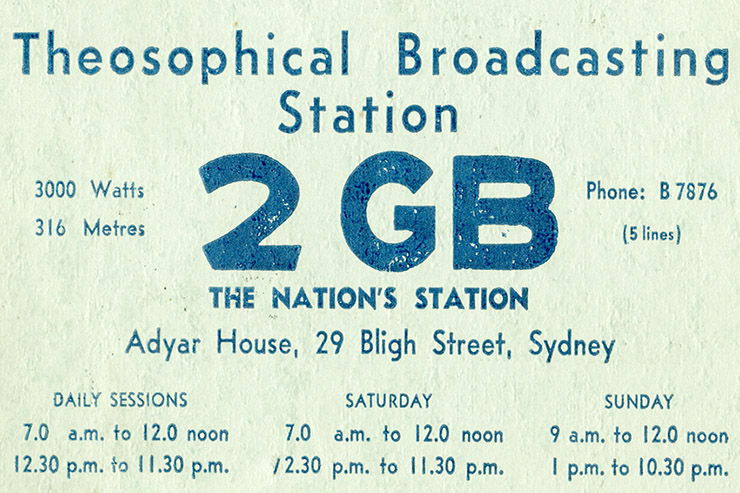
    How many people are aware, for example, that the call sign of Sydney’s pioneering radio station 2GB stands for the martyred sixteenth century mage Giordano Bruno (GB)? Or that Prime Minister Alfred Deakin, a major force in the foundation of the Australian Commonwealth, was heavily involved in spiritualism and an enthusiastic student of Madame Blavatsky’s writings? Who knows of Walter Burley Griffin’s use of occult principles in the design of Canberra, the national capital? Who today remembers the Star Amphitheatre built at Sydney’s Balmoral Beach to welcome the “World Teacher, when He Comes”? Or that in the 1920s Sydney was proclaimed a “great theosophical centre”, home of the renowned and controversial occult teacher, the Bishop Charles Webster Leadbeater. A prolific writer on metaphysics and one of the world’s greatest clairvoyants, Leadbeater predicted the “emergence of the new ‘sub-race’ in Australia and New Zealand.”

    In Other Temples, Other Gods, Nevill Drury and Gregory Tillett observe that, “despite its relative youth as a modern nation,” Australia, “has had a colourful and active history of occultists and occult movements.”1

    Some of the leaders of progressive politics in Australian were also students of esoteric wisdom. In 1892 the labour organiser William Lane’s political novel The Workingman’s Paradise was published in Sydney. In it the working girl Nellie says scornfully, “There is no God. How can there be?” But the mysterious socialist Geisner rebukes her in words straight from Madame Blavatsky’s Secret Doctrine. There is at least “the imperishable breath of the universe”. For Geisner explains, “the Purpose of Life is self-consciousness…. God seeking to know God. Eternal Force one immeasurable Thought. Humanity the developing consciousness of the little fragment of the universe within our ken.”2

    Disillusioned with the socialist movement in Australia, William Lane (1861-1917) established a communalist settlement in South America. A non-smoker and non-drinker, Lane was also a vegetarian who recognised the importance of a healthier attitude to diet. Inspired by Lane’s vision and example, hundreds of Australian workers sailed with him in 1893 to the “New Australia” colony in Paraguay.

    The first Gnostic study circle was established in Melbourne in 1886. A year earlier the Reverend Charles Strong led most of his congregation out of Victorian Presbyterianism to found a native, ethical church, the “Australian Church”. Strong’s Australian Church sponsored the Religious Science Club, a forum for all manner of independent thought and spiritual enquiry.

    AUSTRALIA & THE THEOSOPHICAL SOCIETY

    Such was the interest in mysticism and spiritualism at the turn of the century that Australia came to prominence in the largest international occult movement of the day – the Theosophical Society.

    “The occult movement which achieved the greatest publicity in Australian history,” explain Drury and Tillett, “and for which Australia was an international focus for many years, was the Theosophical Society.”3

    In the early 1890s study circles devoted to Theosophy as presented in the texts of Madame Blavatsky had formed around Australia, leading to the founding of the Australasian Section of the Theosophical Society in 1895.

    As Drury and Tillett explain:

    The progress of the T.S. [Theosophical Society] was steady; lectures given, meetings held, leaflets and publicity material produced, and journals published. Lodges were established throughout Australia…. But it was the lecture tours of one man which established Theosophy as a movement of public interest in Australia: Charles Webster Leadbeater toured the country in 1905, following a lecture tour of several years in the U.S.A. during which he attracted thousands of enthusiastic listeners, and in 1914 he settled in Sydney, remaining there more or less permanently until his death in 1934.4

    By the 1920s there were more paid-up members of the Theosophical Society than members of the Communist Party of Australia. The twenties witnessed a surge of Theosophical activism as Australian Theosophists sort to present a vibrant alternative to the mainstream, including the growing political ideologies of bolshevism and fascism. In addition to the public lectures, lodge meetings, and libraries, there was the Society owned Sydney Radio station 2GB as well as a successful publishing enterprise. Journals with titles like Advance! Australia and Theosophy in Australia, presented the society’s views and analysis of turbulent world events. Writing in Advance! Australia, one of the society’s leaders called for:

    purified patriotism, the promotion of a noble type of Australian citizenship, vitally Australian, eagerly conscious of Australia’s specific place and part in the building of the future, no less eagerly conscious of the wider and equally vital citizenship involved in Australia’s membership of the British Commonwealth, and recognising too… there is a World citizenship, the obligations of which may no longer be ignored.5

    Walter Burley Griffin wrote of “Building for Nature” and the “outdoor arts in Australia” in the pages of Advance! Australia. Together with Marion Mahoney Griffin, he set up an “organic” community at Castlecrag, Sydney. Griffin hoped for the awakening of “disused powers of the universal mind” and social renewal as people turned inward to reconnect with “the possibilities of co-operation between head and mind in social service and creative effort.”6

    Adyar Hall, the Theosophical Society’s impressive Sydney centre, served as the meeting place for many original social, political and spiritual groups, among them “The Australia First Movement”. Founded by P.R. Stephensen, a one time associate of Aleister Crowley, Australia First campaigned against Australian involvement in the Second World War.

    A.R. Mills, a Melbourne solicitor active in Australia First, had been on the fringe of the Theosophical Society. During the 1920s and 1930s, Mills formed the world’s first Odinist religion, a mixture of Nordic mythology and occultism.

    A persistent notion running through all the organisations and individuals concerned with esoteric wisdom is the conviction Australia has a special role to play in the dawn of a new Golden Age. Although popularised mainly by the Theosophists, the idea of Australia’s secret occult destiny surfaces in various mystical circles. In the early decades of the twentieth century the tireless Veni Cooper-Mathieson who founded – among other orders and institutions – the Home of Truth Esoteric College, the Church Universal, the Universal Truth Publication Company, taught that Australia was the “land of the dawning.”

    AUSTRALIA: HOME OF A NEW HUMANITY

    Madame Blavatsky, co-founder of the Theosophical Society, is credited with developing the theory that humanity evolves through a sequence of Seven Root Races, “four of which have already lived their day, the fifth still exists, and two are to appear in the future.”7

    In a series of lectures delivered in Sydney in August 1915, Bishop Leadbeater proclaimed “Australia and New Zealand as the home of a new sub-race.” He had detected in Australia “children and young people of a distinctly new type.” A new antipodean human type characterised by intuition and the powers of synthesis. Jill Roe in her book on Theosophy in Australia writes:

    Leadbeater urged his audience to align themselves with evolutionary law, assuring them that present confusions were merely transitional. He held that, despite distance and a small population, the Antipodes provided a favourable site for inauguration of a new era of brotherhood and cooperation, being neither decadent like Britain nor overblown by capitalist pride like America, and not yet delivered into unworkably democratic systems by ‘too young souls’. There was crudity, and reverse class legislation, but the wholesome environment held promise.8

    In Leadbeater’s view, however: “It would be important to purify child-rearing practices, by abstinence from alcohol, meat and tobacco, and to educate the next generation correctly…. The reward would be the coincidence of a new sub-race and the World Teacher in fifteen or twenty years’ time.”9

    By embracing techniques of physical and mental purification, Leadbeater believed in a couple of generations the whole of Australia would be controlled by a new people, who would constitute “what in Europe we should call the aristocracy of the country; that is to say, the best types”.10

    Of course the Bishop’s message was not taken up by the Australian people and no new “aristocracy” emerged to lead the Antipodes into a new Golden Age. Was there any truth in Leadbeater’s predictions?

    Nations, like individuals, have choices that eventually determine outcomes far beyond what can be recognised in the immediate. A collective – a group soul – like the individual soul must decide with which impulses to align. Nations can choose either the forces of materialism leading to decay and atrophy, or the higher influences of the spirit capable of leading to a New Beginning. In the case of Australia and New Zealand, the birth of the ‘new people’ was limited and distorted due to the infection of Mammonism. By concentrating on the search for outer happiness, following the path of the kingdoms of this world, the Australian nation stifled the quest for inner transcendence and the Kingdom of God.

    By taking the way of materialism Australians cut themselves off from the subtle influences of the spirit and cosmic destiny. Manning Clark, Australia’s greatest historian, expressed the spiritual crisis of modern Australia when he said:

    The decline of faith begat nihilism, and nihilism begat hedonism. It looked as though in the contest between Mammon and ‘millennial Eden’ Mammon had won. The dreams of all those who had migrated to the great south land had evaporated. The Aborigine had been corrupted and debased by contact with the white man. The voices of the Catholic who had spoken of a land dedicated to the Holy Spirit, the Dutch Protestants who had called for the discovery of a land that would yield ‘uncommonly large profit’, and the pleas of the followers of the Enlightenment with their faith in human perfectibility, had all dropped from a roar to a whisper, Mammon had won: Mammon had infected the ancient continent of Australia. The dreams of humanity had ended in an age of ruins.11

    Yet in every generation, and in every nation, there is always a remnant of men and women who have not succumbed fully to negative earthly bonds. They are the silent ones who stand among the ruins of the modern era, living testimonies to the higher world of the spirit. The ability of any nation or people to realise their spiritual potential and partake in the dawn of a new Golden Age depends on the vitality of this remnant.

    Have Australia and New Zealand forfeited their occult birthright?

    Certainly some of the ‘new people’ characterised by intuition and the powers of synthesis are found today in Australia, as well as in many other places throughout the world. The future depends on the ability of this remnant to impact the greater society and become a new Noah’s Ark capable of surviving the coming times of tribulation and transition. True, nearly every nation has a myth promising them a leading role in the dawn of a New Age. The universality of this myth in no way detracts from the responsibility it places on a people with ‘ears to hear’ the message of the times. Every people are called to turn within and align with the New Era. And Australasia is not impervious to this call, to this great Thought.

    Over a century ago, in 1892, the Australian socialist and mystic William Lane wrote:

    The brute-mother who would not be comforted because her young was taken gave birth in the end to the Christs who have surrendered all because the world sorrows. And we, in our yearning and our aspirations, in our longings and our strugglings and our miseries, may engender even in these later days a Christ whom the world will not crucify….12

    The earth still awaits the revelation of the Christ people, the new humanity destined to carry out the great work in which we all have a part to play. At the end of his book, William Lane challenged his readers with words that speak to us today:

    Let us not be deceived! It is in ourselves that the weakness is. It is in ourselves that the real fight must take place between the Old and the New. It is because we ourselves value our miserable lives, because we ourselves cling to the old fears and kneel still before the old idols, that the Thought still remains a thought only, that it does not create the New Order which will make of this weary world a Paradise indeed.13

    [alert type=”general” dismiss=”no”]This article was published in New Dawn Special Issue 3.[/alert]

    [alert type=”success” dismiss=”no”]If you appreciate this article, please consider subscribing to help maintain this website.[/alert]

    .

    Footnotes:

    1. Nevill Drury and Gregory Tillet, Other Temples, Other Gods
    2. As quoted in Jill Roe, Beyond Belief, Theosophy in Australia 1879-1939
    3. Nevill Drury and Gregory Tillett, Other Temples, Other Gods
    4. Ibid.
    5. As quoted in Jill Roe, Beyond Belief, Theosophy in Australia 1879-1939
    6. Ibid.
    7. H.P. Blavatsky, The Secret Doctrine
    8. Jill Roe, Beyond Belief, Theosophy in Australia 1879-1939
    9. As quoted in Jill Roe, Beyond Belief, Theosophy in Australia 1879-1939
    10. As quoted in Gregory Tillett, The Elder Brother: A Biography of Charles Webster Leadbeater
    11. Professor Manning Clark, A Short History of Australia
    12. ‘John Miller’ (William Lane), The Workingman’s Paradise
    13. Ibid.

    © New Dawn Magazine and the respective author.
    For our reproduction notice, click here.
  • Men of Mystery: Raymond Abellio & Jean Parvulesco – Their Vision of a New Europe

    Men of Mystery: Raymond Abellio & Jean Parvulesco – Their Vision of a New Europe

    From New Dawn 111 (Nov-Dec 2008)

    Raymond Abellio and Jean Parvulesco are two prominent French esotericists who have visualised and tried to implement a roadmap for what Europe – and the Western world as a whole – should become. It is a future where the real role of the Priory of Sion comes into its own.

    Raymond Abellio claimed that the Flemish occultist S.U. Zanne, pseudonym of Auguste Van de Kerckhove (1838-1923), was amongst the greatest initiates of the modern era. But hardly anyone knows who he is. Some have placed Abellio in the same category – he too is a great unknown for most. And those that have looked at Abellio largely conclude that he was a French fascist politician with an interest in esotericism.

    Was he? Part of the problem is that Abellio’s writings – like that of so many alchemists – need a key. So much of their material is coded text, and Abellio himself used to laugh that most people’s keys “only opened their own doors” – not his. Who was he really, and what were his true political aims?

    Raymond Abellio is the pseudonym of Georges Soulès (1907-1986), who rose to fame in France during World War II when he became the secretary general of the MSR (Mouvement Social Révolutionnaire) in 1942. The invitation to join the organisation had come from none other than Eugène Schueller, owner of the cosmetics giant L’Oréal. As the British researcher Guy Patton, author of Masters of Deception, points out: “This group had evolved out of the sinister Comité Secret d’Action Revolutionaire (CSAR), also known as the Cagoule. Soules was now to become acquainted with Eugène Deloncle, head of the political wing, dedicated to secret, direct, and violent action.”

    Later, Patton adds: “So here we have a Socialist turned Fascist, deeply involved in political movements, who actively collaborated with the Vichy government. In the course of his political activities, he was to work closely with Eugène Deloncle, who […] was closely acquainted with a fellow engineer, François Plantard, and whose niece married [French President François] Mitterrand’s brother, Robert.”

    Though never confirmed, it is claimed that Abellio was involved with Bélisane publishing, founded in 1973. Bélisane published several books on Rennes-le-Château, the village so intimately connected with the Priory of Sion. In his book Arktos, Joscelyn Godwin refers to Raymond Abellio as another ‘Bélisane’ pseudonym. For Guy Patton, Abellio is part of a network that tried to create a New Europe, ruled by a priest-king, whereby various modern myths, like the Priory of Sion, are meant to provide the modern Westerner with a longing of sacred traditions and rule, very much like the myths of King Arthur that gave a surreal dimension to European politics in medieval times.

    Abellio’s political views have therefore been described as very utopian, and he has been suspected of synarchist leanings – the belief that the real leaders of the world are hidden from view, politicians being merely their puppets. But in truth, Abellio had a well-defined vision for social change. When the battle lines of the Cold War were drawn after World War II, he tried to find the best of both camps and hoped he could unite them. Why? To create a type of Eurasian Empire, stretching from the Atlantic to Japan, an idea later taken up by the novelist and theoreticist, his friend Jean Parvulesco.

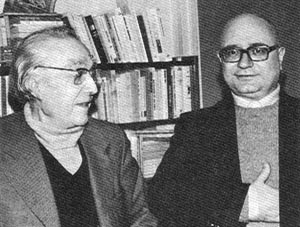
    French Esotericist Jean Parvulesco

    “Parvu” is largely responsible for acquainting at least some with the visions of Abellio – though whether it was the real Abellio or a character created by Parvulesco remains open to debate. Guy Patton sums up Abellio’s view as being “typical of an extreme right-wing esotericism, the aim of which is to ‘renew the tradition of the West’. He wanted to replace the famous Republican slogan, ‘Liberty, Equality, Fraternity’, with ‘Prayer, War, Work’, to represent a new society built on an absolute hierarchy led by a king-priest.”

    The implication, however, is that several of the people involved were not truly devoted to esoteric spirituality and merely used it as a mask for making money, acquiring more power, and pushing an extreme right wing agenda. Though that is the case for some of those involved, within the mix of powerful and/or money-hungry people most agreed that Abellio was truly a ‘spiritual’ man. And it was Professor Pierre de Combas who is credited with Abellio’s transformation from politician Georges Soulès into the visionary Abellio (the Pyrenean Apollo), making him not merely a “man of power,” but also a “man of knowledge” – an initiate?

    To understand his vision, we need to acknowledge that Abellio’s system, as mentioned, needs a key, and without a key there is no understanding – hence, no doubt, why he is often misunderstood. Secondly, his system is complex and difficult to summarise in a few words and is best described by listing some examples.

    He wanted to “de-occultise” the occult (e.g. his book “The End of Esotericism,” 1973), whereby he hoped this would help science. His knowledge of science – acquired as a polytechnic student – meant that he could build bridges between the two subjects, for example between the 64 hexagrams of the Yi-Ching and 64 codons of DNA, or the correspondences between the numbers of the Hebrew alphabet and the polygons that could be inscribed in a circle.

    The most famous of his works is “The Absolute Structure” (1965) which led to him being regarded as an heir to phenomenological philosopher Husserl. Such topics, of course, hardly make for bestsellers, but are the type of study one expects from a genuine alchemist.

    His drive for an “absolute structure” is a vital ingredient in his idea of the “Assumption of Europe,” i.e. what he sees as the destiny of Europe: “the Occident appears to us not to be only as an interval separating the opposing masses of the East and the West, but is the most advanced carrier of the dialectic of the present time.” Abellio did not believe in the subject-object duality that continues to drive most politicians into fear-mongering and the other usual tactics employed by their ilk, but instead preferred a more complex model, centred on Conscience (the zero point), which evolved along the base towards Quantity (science) and upwards to Quality (knowledge), which gave him a six-armed cross. This is the “hypercubic” cross, to use Salvador Dali’s words, a man who also spoke of the “Assumption of Europe” in some of his paintings. The “hypercubic cross” allowed Abellio to express all ontological and spiritual problems in dynamic terms – and it is clear that he used complex wording, making his thinking difficult to understand, which is no doubt why he is easily misunderstood, was thought to be writing mumbo-jumbo, or simply neglected.

    First of all, to get our heads around his terminology, we need to know that the Bible was one of Abellio’s most often consulted books and he described the stages of the evolution of a civilisation in Christian terms: birth, baptism, communion, etc. This is why he said that the next stage in Europe’s development mimicked Assumption, which is specifically linked with the Virgin Mary – the Saint deemed to play a pivotal part in Europe’s future. She is, of course, a supernatural being who is said to have appeared on numerous occasions to counsel Christian Europe on which direction to take, such as in the politically charged “secrets” of Fatima in 1917.

    In 1947, in his book “Towards a New Form of Prophecy, an essay on the political notion of the sacred and the situation of Lucifer in the modern world,” he notes, “not more than any other being, man is but an addition, a juxtaposition of Spirit and Matter, but an accumulator and an energy transformer, of variable power according to the individual, and capable of passing his energetic quantity from one qualitative level to another, higher, or lower.” Thus, we see a mixture of Christian eschatology, prophecy, as well as Gnostic doctrines on what it is to be truly human.

    The visionary Abellio was also an astrologer. He predicted the fall of the Soviet Union in 1989, as well as the ascent of China. He qualified its Marxism as “Luciferian,” which he did not suggest should be interpreted in a moral sense, but that Chinese materialism had to be integrated in terms of the Absolute Structure, in opposition to the individual and “Satanic” materialism of the United States.

    In the West, it was the task of freedom fighters – terrorists? – to bring about this change. These “heroic” battles were brought to life in his novels. In retrospect, he said that his first three novels were indeed “apprenticeships,” where his heroes evolved, while his final novel – published 24 years after “The Pit of Babel” (1962) – “Motionless Faces” (1986) was for him “that of the companion who is trying to become master.”

    However, many consider “The Pit of Babel” to be his best work and it is here that he plots intellectuals that are disengaged from all forms of ideology and scruples engaging in widespread terrorism. It is a theme he revisited in “Motionless Faces,” where the primary character attempts to poison the population of New York, not by any straightforward means but by using the creation of an illuminated architect who had built a type of “counter-structure” underneath Manhattan, which was reserved for an elite – a type of urban Agarttha.

    The heroine of his last novel is named Helen, also – not coincidentally – the name of the companion of Simon Magus. In the end, she perishes, taken to the centre of the earth by a subterranean stream underneath Manhattan. In the case of the historical Simon Magus, Helen was the personification of Light held prisoner by matter. Abellio specifically chose his name because he identified himself with Apollo, another deity connected with light, and Raymond Abellio’s initials – RA – were of course those of the Egyptian sun god.

    Abellio himself never met his “ultimate woman,” even though he searched for her. She may have been Sunsiaré de Larcone, herself a writer of fantasies as well as a model, who died at the age of 27 in a car crash in 1962. She called herself his disciple. Other equally beautiful women had gone before, and would go after, but no-one was apparently worthy of being “his” woman. Hence, his tomb contains an empty space for his “Lady.”

    It is “Motionless Faces” that Jean Parvulesco studied in detail in his essay, “The Red Sun of Raymond Abellio,” published in 1987. Parvu is a novelist who was both close and far removed from Abellio. Close, because they shared a similar vision of the “Great Eurasian Empire of the End.” He, too, had his initiators, and he saw himself heir to the “Traditional School,” represented by authors such as René Guénon and Julius Evola, whom he met in the 1960s. Parvu was preoccupied with “non-being,” the forces of chaos, which make him into something of a dualist, i.e. a Gnostic. With Evola he shared the idea that there is a need for a final battle against the counter-initiatory and subversive forces (the non-being). Like Evola, he had an interest in Tantrism.

    Parvulesco often uses the term “Polar” in reference to the “polar fraternities” with which Guénon had once associated. He sees these as important instruments in the creation of modern Europe. He also used the term to refer to the Hyperborean origins of the present cycle of humanity, which he argued would soon end with a polar reversal. Here he is close to Guénon, but far from Abellio’s thinking, who had an altogether more optimistic vision of the future. So despite their kinship and a common goal, they were not agreed on how exactly the New Europe would be accomplished.

    Parvulesco has often been cited by extreme right-wing European authors. Some of them have claimed him as one of their own, but it is clear that no single writer is in charge of who and where his name is used.

    In the early 1960s, Parvu was close to the OAS, the “Organisation Armée Secrète,” a terrorist group opposed to Algerian independence from France. This put him in opposition to De Gaulle, yet he is known to have claimed to be a strong supporter of De Gaulle. Incidents such as this make it difficult to place him on the political spectrum, and it’s best simply not to try and put him into one category. Indeed, what sets him and Abellio apart is largely that they had an independent vision of the future – and the role of politics. They realised that the world was radically changing, and though their models might in the end prove not to work or be unrealisable, it does not negate the fact that they were innovative thinkers.

    It is Parvulesco who provides further details as to what this New Europe would be and why, specifically, a priest-king is needed as its ruler. In ancient times, these rulers were primarily seen as a denizen of both worlds, a mediator between this reality and the divine realm. Parvulesco makes it clear that “the beyond” is guiding us towards Europe’s destiny, whereby the role of European leaders is first and foremost to correctly interpret the signs, rather than invent new goals and targets.

    Interdimensional Gateways

    A few constant themes run through Parvu’s writings, one of them being that of gateways to other dimensions. Whenever historical people (most often politicians) make appearances in his novels, they are not the politicians we know but their doubles who evolve in our and another dimension. The novels of Parvulesco are hence often seen as those of the “eternal present,” or the “ninth day.”

    In “Rendez-vous au manoir du Lac,” the setting is a strange site where there is a gateway to heaven – Venus in particular – from where, according to Parvulesco, some chosen ones have to transit. In “En attendant la junction de Vénus,” he repeats this claim, but links it with French president François Mitterrand and specifically the Axe Majeur of Cergy-Pontoise, near Paris. This axis is the creation of artist Dani Karavan and is the “soul” of this new town. It stretches for three kilometres and if ever archaeologists stumbled upon its remains in future centuries, it would be classified as a leyline. Though the project commenced before Mitterrand’s presidency, it was during his term in office that the line became properly defined and executed. Today, it is seen – in France – as an enigmatic work, far superior to the Louvre Pyramid or Arche de la Défense, which has set the likes of Dan Brown and Robert Bauval questioning the reasons behind these projects. The Axe, however, is a far more ambitious, greater and more enigmatic project. When we note that Abellio was closely associated with the Mitterrand family, we can merely ponder whether he had a hand in the project.

    With the Axe Majeure, it is clear that we are in a strange world where politics and esoterica mingle, partly in this dimension and partly in a divine realm. Well, Abellio hoped that from this mixture a new form of politics and a New Europe would arise. And it is here where we need to see the role of the Priory of Sion, not so much – as Dan Brown and others would like it – as the preservers of a sacred, old bloodline, but a new priesthood – a mixture of politician and esotericist, i.e. like Abellio himself – that can rule a New Europe.

    So even though Abellio and Parvulesco are often described as synarchists, they repeatedly referred to themselves as freedom fighters laying the foundation for this New World. The new powerbrokers would not always remain hidden puppet masters, but would clearly one day step to the forefront to take up the role of priest-king. And for such thinkers, it was a given that France had come closest to attaining this ideal under De Gaulle, whereby the “Great Work” of Mitterrand was seen along the same lines, though clearly not to the same extent.

    Abellio and Parvulesco were therefore New Agers building “An Age of Aquarius.” However, they did not focus on personal transformation, but on social transformation. As an author one might argue that Parvulesco operates within the domain of the “esoteric thriller,” which in Hollywood is seen in Roman Polanski’s ‘The Ninth Gate’ or Umberto Eco’s Foucault’s Pendulum. But both works have great difficulty in convincingly integrating the “passage to another world” within their storyline, often leaving the reader/viewer unsatisfied, or – alternatively – unconvinced of the end goal. Lovecraft has a better reputation and others argue that Parvulesco, thanks to the influence of both Abellio and Dominique de Roux, has gone further, and done better. But the main point is that his esoteric thrillers were to make this step through this “interdimensional passage” not as an individual, but as a society – as Europe.

    De Roux (1935-1977) greatly inspired those authors who evoked what is known as “novels of the End” – however they saw the transformation of Europe. Parvulesco actually began his literary career in the magazine Exil published by de Roux. De Roux travelled widely, and in 1974 wrote “The Fifth Empire,” about the struggle for independence in Portugal’s colonies, which brings up the same struggle for a country’s new future. The title “The Fifth Empire” is an allusion to a popular Portuguese myth, namely that of the lost king. Like King Arthur, the Portuguese king Dom Sebastian was said to one day return to lead his people to a fabulous destiny – which, as can be expected in light of Abellio and Parvulesco’s ideology, was not necessarily of this plane. To quote the Portuguese poet and occultist Fernando Pessoa (a friend of Aleister Crowley): “We have already conquered the sea, there only remains for us to conquer the sky and leave the earth for others.”

    Russia, Putin and the New Europe

    What Algeria and De Gaulle had been for Abellio, what Portugal was for De Roux, Putin’s Russia is for Parvulesco. But it is in Abellio’s preface to “The Fifth Empire” that we find an interesting note explaining the true context and “key” that unlocks their works: “Those who attach a profound meaning to coincidences cannot be but stricken by the fact that the last message of Fatima was delivered in October 1917, at the moment when the Bolshevik Revolution began. What subtle link of the invisible history was thus established between the two extremities of Europe?”

    For esotericists who saw our dimension as being infiltrated by the other plane of existence, the coincidences of the apparitions of the Virgin Mary at Fatima and her clearly political messages to do with the future of Russia and how it should embrace the Virgin Mary, are part and parcel of this Great Empire. Not merely a political ambition, but part of their vision as to how “real politicians” work together in league with the “denizens of the otherworld” so as to accomplish the Assumption. Hence why Parvulesco believes Putin’s Russia to be so important. This is why, no doubt, Abellio tried to make contact with the Soviets to enable this New Europe, which indeed has come about largely under Putin’s presidency.

    As mentioned, for British author Guy Patton, Abellio and Parvulesco are French fascists who abused newly created myths like that of the Priory of Sion to increase their influence, power and wealth. But this, of course, is merely one interpretation. Take the literature of the Priory and its creator Pierre Plantard and we discover he was close to De Gaulle’s regime. Plantard in fact ran part of De Gaulle’s “terrorist cells” in Paris when De Gaulle was struggling for power. Then, Plantard used the Priory to create an ideology that saw a unified Europe, from the East to the West, and it is obvious those involved in the promotion of the Priory later spoke of the importance of François Mitterrand.

    The Priory is indeed a fabricated myth, a non-existent secret society. But it is equally clear the individuals involved (Plantard) and those linked to it (Abellio, and to some extent Parvulesco), had genuine convictions of what a future Europe should be. Their interest in Marian apparitions was genuine, and they saw them as divine guides along the path that Europe had to walk to its future and its next stage, its Assumption. As Parvulesco pointed out, it depends whether you believe in coincidences or not. If not, then you will argue the major political events of the past century are but tangentially related to the messages received from these apparitions. If you do believe coincidences have meaning, then it is clear this New Europe is slowly emerging.

    In the 1980s, Parvulesco reviewed a strange novel, “La boucane contre l’Ordre Noir, ou le renversement,” by one “Father Martin,” who had already published “livre des Compagnons secrets. L’enseignement secret du Général de Gaulle.” For an avowed Gaullist, Parvu was obviously in his element. The novel itself has certain common points with one volume of the tetralogy of Robert Chotard, “Le grand test secret de Jules Verne.” Both books speak of a “reserved region” in Canada from where there is a conspiracy directed to change the world’s climate. The base is controlled by the sinister “Black Order” and aims to create a pole reversal – a theme also explored by Jules Verne. We can only wonder whether the stories of HAARP – set in nearby Alaska – might be inspired, or reflective, of this. But it is here that we see the final framework of their political ambition: they saw their quest not so much as a desire, a longing, but as a genuine struggle of good versus evil – if a New Europe did not come, the “Black Order” would have won. And in the end, perhaps Abellio and Parvulesco should thus be seen as modern knights, fighting for Europe – a new Europe.

    The above is connected to this article in the same issue of New Dawn: Vladimir Vladimirovich Putin & the Eurasian Empire of the End Times

    [alert type=”general” dismiss=”no”]This article was published in New Dawn 111.[/alert]

    [alert type=”success” dismiss=”no”]If you appreciate this article, please consider subscribing to help maintain this website.[/alert]

    © New Dawn Magazine and the respective author.
    For our reproduction notice, click here.