New Dawn – World's Most Unusual Magazine

Tag: Europe

  • Brothers of the Shadows: Overlords of Chaos

    Brothers of the Shadows: Overlords of Chaos

    From New Dawn Special Issue Vol 9 No 4 (Aug 2015)

    Who controls the past controls the future. Who controls the present controls the past.
    – George Orwell, 1984

    Back in 1893, an elusive Englishman named Charles George Harrison (b.1855) delivered a series of six lectures to the Berean Society, a London based association of Christian esotericists. Harrison, described as a “mysterious and unknown figure,” was an English occultist and Anglican Christian. A record of his lectures can found in the book The Transcendental Universe. What is clear is that C.G. Harrison had access to highly sensitive information and a good deal of inside knowledge of world changes then being engineered by certain circles in England.

    In his second lecture Harrison spoke of “the next great European war” and of how the “national character” of the Slavic peoples would “enable them to carry out experiments in Socialism, political and economical, which would present innumerable difficulties in Western Europe.” The “next great European war” points to what would be the First World War of 1914-18, while the “experiments in Socialism” predict the 1917 Bolshevik Revolution which brought about the Soviet Union, one of the boldest and bloodiest politico-economic experiments in human history. Harrison said the plan of a particular secret elite, which he doesn’t mention by name, was that “the Russian Empire must die that the Russian people may live.” It is amazing to consider these truly prescient words were spoken in 1893, 21 years before the First World War and 24 years before the Russian Revolution. Today we know that in 1917 Bolshevik leader Vladimir Lenin was transported from Zurich, then the banking capital of the world, to Russia in a train loaded with gold and weapons to start the revolution.

    Discussing C.G. Harrison’s extraordinary foreknowledge, Sevak Gulbekian asks:

    How could he [Harrison] know about the forthcoming War as well as the “experiments in Socialism,” which would take a grip on Russia and its surrounding states for most of the twentieth century? If he was not, as he claimed, a “practical occultist” himself, it is reasonable to assume he had contact with people who were, and who had access to the malign plans…1

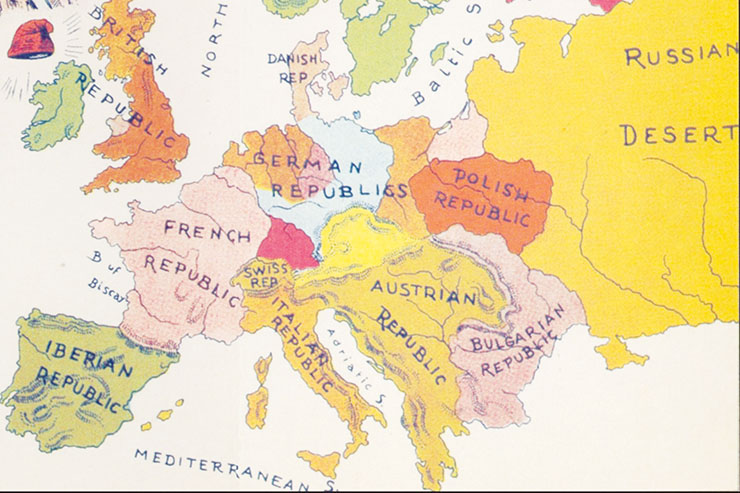
    Another significant piece of information coinciding with Harrison’s insights into the future is a cartoon map of Europe printed in the Christmas 1890 edition of the satirical English weekly, The Truth. Over the map is written: “The Kaiser’s Dream.” It showed wherever monarchies had been up to that time, there were going to be republics. The Austro-Hungarian Empire of the venerable Hapsburg monarchy had disappeared, as had the centuries old Russian Empire. Over the territory of Russia we read the words “Russian Desert.” In addition, Germany is identified with the words “German Republics”! Commenting on this map from 1890, Sevak Gulbekian notes:

    This map signifies not only a foreknowledge – similar to Harrison – of the fate of Russia to become a cultural as well as an economic ‘desert’, but also of the future splitting of Germany into ‘republics’. The magazine’s editor, Henry LabouchEre, was a Freemason. Was his remarkable foresight pure luck, or once again did he have some inside knowledge of future plans to shape the world?

    Why destroy the Hapsburg Empire? The influence of the Catholic Hapsburgs, as heirs of the Holy Roman Empire, was felt through all Europe. As Catholic Europe’s most important royal house they posed a particular obstacle to Britain’s plans for the Continent. Austria-Hungary, along with the ruling Hapsburg dynasty, had to be wiped off the map in order to create a patchwork of small states in Eastern Europe. These could be easily manipulated by London. Count Arthur Polzer Hoditz, director of the cabinet of the last Austro-Hungarian emperor stated in his memoirs that, “the destruction of the Hapsburg Empire was carefully prepared.” Late 20th century research reveals the suicide in 1889 of Crown Prince Rudolf, the Hapsburg Emperor Franz Joseph’s only son and heir, was a planned political assassination. Less than a decade later in 1898 the Empress Elizabeth was brutally murdered by a secret society member in Geneva. And the killing in 1914 of Emperor Franz Joseph’s nephew Franz Ferdinand in Sarajevo by a member of the Serbian secret society of the Black Hand, had as its immediate consequence the outbreak of the First World War.

    The occultist Rudolf Steiner (1861-1925), who knew a great deal about the mysterious nexus of politics and the occult, mentioned the above map in a talk given in Switzerland at the height of the First World War. He said the map, as a secret document, was in existence since the last decades of the 19th century. This is the same time as the British imperialist Cecil Rhodes was laying the foundations for “a secret society with but one object, the furtherance of the British Empire, and the bringing of the whole uncivilised world under British rule…” According to the American historian Carrol Quigley in his book Tragedy and Hope, Cecil Rhodes set up such a secret society known as the “Society of the Elect” in 1889.

    Sevak Gulbekian explains Rudolf Steiner’s perspective thus:

    Behind the outer façade of world affairs, suggested Steiner, the machinations of occult groups or ‘brotherhoods’ were at work. Certain of these brotherhoods had wanted the Great War to take place, and had manipulated events to bring it about. In doing this, they sought to protect the dominant economic position of the English-speaking world, and in turn to crush the ‘mediating’ role of Central European powers such as Germany, the Austro-Hungarian empire, and so on.

    These occult brotherhoods – small groups of men who met together in ‘lodges’ and practiced ceremonial magic as a means of achieving certain goals – originated from the English-speaking (Anglo-Saxon) world and were allied, in particular, with Anglo-American interests. Their aim was to extend Anglo-American influence across the globe, and to ensure the predomination of Anglo-American culture. Furthermore, they sought to extend its superiority into the distant future; essentially to ensure that the present state of affairs continues evermore.

    Rudolf Steiner in one of his lectures about the influence of secret societies on politics says that in the Slavic peoples there lies a “special future.” He believed at some point in the future a cultural-spiritual highpoint would be reached in the Slavic countries, principally Russia. This is apparently known to the Anglo-Saxon occult brotherhoods which seek to manipulate these powers and bring them directly under British domination. Steiner’s revelations, based in part on his intimate involvement with Europe’s leading secret societies, help explain the major events of the 20th century. Two world wars, the partition of Europe into the Anglo-American dominated West and the Soviet controlled East, the decades long ‘stand-off’ between Eastern communism and Western capitalism in the ‘Cold War’, the collapse of the USSR and the declaration of an Anglo-American dominated unipolar world, can all be traced to the dark intrigues of the Brothers of the Shadows.

    [alert type=”general” dismiss=”no”]This article was published in New Dawn Special Issue Vol 9 No 4.[/alert]

    [alert type=”success” dismiss=”no”]If you appreciate this article, please consider subscribing to help maintain this website.[/alert]

    Footnote

    1. ‘Brothers of the Shadows: A Perspective on Conspiracies’ by Sevak Gulbekian, New Dawn 86 (September-October 2004)

    © New Dawn Magazine and the respective author.
    For our reproduction notice, click here.

  • Synarchy: The Hidden Hand Behind the European Union

    Synarchy: The Hidden Hand Behind the European Union

    From New Dawn Special Issue 18 (Dec 2011)

    While questions remain about the existence of a single global elite with an agenda that goes beyond simply keeping itself very, very rich, there are certainly groups that want to run the world for quite other reasons. And with the increasing globalisation of political and economic institutions, it has become easier for a relatively small group to inveigle itself into quite staggeringly influential positions. One cabal in particular reveals – alarmingly – what a small group, driven by a fanatical belief system, can achieve from the shadows. And writing as we are in the United Kingdom, this group is on our doorstep, and has been for over a century. And although perhaps small in number, its reach is big.

    Our research into this subject – detailed in The Stargate Conspiracy (1999) and The Sion Revelation (2006) – demonstrated that every major step in the development of the European Union from a simple trading body to a borderline superstate can be traced back to a very specific ideology, which upholds rule by an elite from behind the scenes. But this isn’t just about politics. Astonishingly, this ideology is also about mysticism and magic.

    This shadowy politico-occult movement is synarchy, which was developed by the Frenchman Joseph Alexandre Saint-Yves, the Marquis d’Alveydre, in opposition to the rise of anarchy in the second half of the nineteenth century. To him the ideal synarchist state would be a rigid social hierarchy topped by an elite that is predestined to rule – absolutely at odds with the then emerging concepts of democracy, individual liberty and social mobility.

    Central to Saint-Yves was the creation of a united Europe, a call for which appears on the first page of his first book on synarchy, Keys to the East (1877). He believed that his perfectly balanced society reflected deep cosmic laws, with which his elite perfectly resonated. They are also directly guided by the powers that rule the universe – as he believed himself to be.

    Saint-Yves claimed that in the ancient past an advanced civilisation – based, of course, on synarchic principles – had governed the whole world. This golden age lasted from 7500 to 4000 BCE, before imploding due to a global catastrophe, remembered in legends such as Atlantis. Since then the occult powers-that-be have periodically reintroduced the revelation of synarchy, sending or inspiring figures such as Moses and Jesus – and, naturally, Saint-Yves himself.

    He adopted the idea, popular in nineteenth-century esoteric and theosophical circles, that spiritually advanced masters – to him preservers of the synarchic revelation – existed in Agartha, a hidden realm in the Himalayas. He confided in his closest associates that he had been visited by its emissaries.

    Another significant aspect of his version of history was that clandestine societies had transmitted the secret of synarchy throughout the ages. It comes as no surprise to discover that his ‘spiritual fathers of synarchy’ were the usual suspects – the Knights Templar.

    For a time in the 1880s and 90s Saint-Yves’ ideas were seriously discussed in political circles in France and elsewhere in Europe. In 1886 he formed the Syndicate of the Professional and Economic Press to promote synarchy to political and business leaders. Several members of the French Parliament joined, including government minister François Césaire Demahy – later a founder of the influential nationalist movement Action Française – and Paul Deschanel, who became President of France in 1920. Saint-Yves was made a chévalier of the Légion d’honneur in 1893.

    In the end, however, Saint-Yves’ followers realised things would have to change radically. After his death in 1909, and particularly in the uncertain aftermath of the First World War, they knew they could never achieve their ambitions through conventional means – and turned to stealth. They decided on inveigling their members into key positions in political and economic institutions intending on creating, in the words of Richard F. Kuisel, a specialist in twentieth-century French political history, “a world government by an initiated elite.”1 Synarchy came to stand for ‘rule by secret society’, which in practice makes it difficult to distinguish between card-carrying synarchists and those merely under their influence.

    Towards Europe’s ‘United States’

    The most high-profile late nineteenth-century devotee of Saint-Yves was the physician Gérard Encausse (‘Papus’), a leading light among French esoteric societies. He blended the teachings of his ‘spiritual master’, the eighteenth century occult philosopher Louis-Claude de Saint-Martin, and his ‘intellectual master’ Saint-Yves. Encausse founded the Martinist Order, into which he absorbed synarchist principles – so that, unusually, it had political ambitions, including the formation of ‘a United States of Europe’. Delusions of grandeur, one might have thought…

    Encausse’s death in 1916 resulted in a schism in the Martinist Order over its involvement in politics. The activists, under Victor Blanchard – head of the secretariat of the Chamber of Deputies of the French Parliament – formed the breakaway Martinist and Synarchic Order, which established the Synarchic Central Committee in 1922, designed to pull in promising young civil servants and “younger members of great business families.”2 The Committee soon became the Synarchic Empire Movement, or MSE (Mouvement Synarchique d’Empire) in 1930, under dedicated firebrands Jeanne Canudo and Vivien Postel du Mas.

    Canudo is best remembered today as an energetic campaigner for European unity and founder of several youth organisations in the 1930s, select members of which were inducted into the esoteric synarchist orders that she led together with Postel du Mas.

    An important witness to these events was the celebrated Parisian litterateur Maurice Girodias (publisher of scandalous sensations such as The Story of O, Lolita, Henry Miller’s Sexus and William S. Burrough’s The Naked Lunch). As a teenager in the 1930s he was involved both with Canudo’s European groups and an esoteric society that met at Postel du Mas’ luxurious apartment to hear the ‘secret masters’ speaking through teenage trance medium Laurette. Girodias said of Postel du Mas’ magical salons: “I saw at his feet men of science, company directors, and bankers.”3

    Beyond Top Secret

    The MSE produced an important but beyond Top Secret document – its very existence unknown to outsiders until 1941 – entitled The Synarchist Revolutionary Pact for the French Empire, usually known simply as the Synarchist Pact. The exact authorship is uncertain but the main candidates are Postel du Mas and the businessman Jean Coutrot. It was only as a result of Coutrot’s apparent suicide under the Nazi Occupation, when copies were found among his possessions, that anyone knew the Pact existed.4

    This highly scary document set out a programme for “invisible revolution” or “revolution from above”: that is, taking over a state from within by infiltrating into high office. The first step was to take control of France, before creating the “European Union” – then, tomorrow…

    Saint-Yves did not invent the concept of a federal Europe. For example, Victor Hugo is credited with first using the term ‘United States of Europe’, although – probably not coincidentally – he was a close friend of Saint-Yves in the French ex-pat community in the Channel Islands in the 1860s.

    But it became a serious political force when the Pan-European movement was established in 1923 by the Austrian Count Richard Coudenhove-Kalergi, described by Otto von Habsburg – in rather telling terms – as the “guide and prophet” of a united Europe. He famously won over Winston Churchill, who began espousing European unity from 1930 and wrote a foreword to the Count’s 1953 book An Idea Conquers the World. The Count was a committed believer that cosmic forces shape events, giving him at least the profile of a synarchist. (Sadly we have no information about Churchill’s views on the more occult aspects.) But there is evidence of a closer connection with the French synarchists.

    In their 1968 Synarchy and Power, André Ulmann and Henri Azeau interviewed one of the inter-war members of the MSE, who claimed it had “inspired the action of Coudenhove-Kalergi and his pan-Europeanism.”5 Coudenhove-Kalergi also lent his support to pro-Europe groups formed by the MSE’s Jeanne Canudo.

    Maurice Girodias’ involvement with the synarchists began as a 16-year-old when, at a Theosophical Society lecture in 1935, he was intrigued by a group in flamboyant Templar garb led by Postel du Mas and Canudo. He was told they were “schismatic theosophists with political designs, and they are linked to Count Coudenhove-Kalergi… who is a champion of the United States of Europe… Their aim is to launch a pan-European political party and to institute in the entire world, commencing with Europe, a society obedient to a spiritualist idea.”6 In conversation with Girodias Postel du Mas named Coudenhove-Kalergi as one of the two major promoters of his and Canudo’s plans.

    The Hood and the Illuminati

    In the tumultuous aftermath of the First World War, like the rest of Europe France became polarised between communism and fascism. The mid-1930s saw the creation of several clandestine far-right groups, both civilian and military, which were integrated into a single network under the control of a three-man Superior Council. Although it gave itself no particular name, the press dubbed it the Cagoule – or the sinister-sounding ‘Hood’.

    Indeed, the Chicago Tribune’s correspondent in Paris, William Shirer, summed up the Cagoule as “deliberately terrorist, resorting to murder and dynamiting, and its aim was to overthrow the Republic and set up an authoritarian régime on the model of the Fascist state of Mussolini.”7 Italy supplied the Cagoule with funds and arms and, in return, the Cagoule assassinated anti-fascist Italian refugees in Paris.

    The Cagoule was led by chévalier of the Légion d’honneur Eugène Deloncle, with the other Council members being Dr Henri Martin and Colonel Georges Groussard, who oversaw cabals within the military. It was funded by wealthy industrialists, including Eugène Schueller, founder of L’Oréal – who obviously thought synarchy was “worth it” – in whose company’s headquarters the group met.

    Although most of the Cagoule were simply anti-communist extremists, who had probably never heard of synarchy, there’s no doubt that there was a strong connection between the MSE and Superior Council, particularly Deloncle. The connection was acknowledged by Shirer8 and by Richard Kuisel, who writes: “Strangely enough, although the Cagoule was an archenemy of Freemasonry, it imitated Masonic ritual, symbolism, and method of recruitment. The head of the Cagoule, Eugène Deloncle, even likened its recruiting procedures to the ‘chain method’ of the Illuminati.”9 

    Basically, through the Cagoule, the synarchists had taken over terrorist groups for their own ends, planning to precipitate a state of emergency that would enable its chosen man to step in as a strong leader to restore order “in the interests of public safety.” And their chosen man was Marshal Philippe Pétain.

    In September 1937 a series of bomb explosions rocked Paris, intended to kick-start a wave of armed attacks to spread chaos and confusion. But a lucky break led the police to caches of arms and ammunition around the city and Deloncle was arrested.

    An official report pointed to the MSE, noting “affiliates of the Synarchic Movement were very numerous and already in place within, and at the head of, the major organs of the state, ready to take charge.”10

    It is hard to overestimate the influence of the synarchists. They were – and no doubt still are – hardly a bunch of nobodies. A major player in this story was none other than François Mitterrand, later France’s longest-serving President. Although he was to reinvent himself as a socialist, before and during the Second World War he was very much of the extreme right.

    Even at the time it was rumoured that Mitterrand was a member of the Cagoule. But more sensationally, Henri Martin’s family claimed he had actually planted the 1937 bombs.11 But while no firm evidence exists to support Mitterrand being a cagoulard, and he strenuously denied it when confronted with his shady past in the 1990s, he certainly had the connections, besides the relevant political – and indeed, esoteric – views.

    Mitterrand believed in rule by an elite – preferably an elite of one: himself. Although from a relatively modest background, he always had an unshakeable belief in his personal superiority, even seeing significance in his family’s origins in the town of Bourges, where a field called the Champs de Mitterrand marks the exact centre of France. ‘Mitterrand’ means ‘middle of the land’.

    When the ultra-ambitious Mitterrand finally achieved power he notoriously governed through his ‘clan’ of friends and relatives, famously remarking that he needed only “fifty well-placed friends to run the country.”12 And he began building the clan during those pre-war days, around leading cagoulards, particularly those close to Deloncle.

    Mitterrand was a close friend of conspirator in the assassination of the Italian anti-fascist Rosselli brothers, Jean Bouyver, and of François Méténier, Deloncle’s assistant who was sentenced to 20 years for his part in the 1937 bombings. But the closest family connection was with Deloncle: Mitterrand’s brother Robert married Deloncle’s sister-in-law just before the outbreak of war. It is inconceivable that Mitterrand never met the Cagoule’s mastermind and top synarchist. Also, as we will see, like Deloncle Mitterrand was deeply fascinated by esoteric and mystical matters.

    Secrets of the Hitler-friendly State

    Although the Cagoule’s plans to create a state of emergency to bring Pétain to power failed, of course this was achieved three years later by an even greater crisis. In June 1940 France fell to Nazi Germany, Pétain emerging as the leader of the new Hitler-friendly French State, based in Vichy.

    Almost immediately after France’s ignominious surrender some claimed elements in the military had connived in the defeat, believing that jumping into bed with the Nazis would enable Pétain to achieve his cherished national reorganisation.

    So it is all the more disturbing that one of Ulmann and Azeau’s ex-MSE informants told them that a senior figure behind the group and “one of the mentors” of the young men being groomed for future greatness in the 1920s and 30s was none other than General Maxime Weygand.13 No doubt not coincidentally married to Saint-Yves’ great-niece, he was Supreme Commander of French and British forces at the outbreak of the Second World War, and in June 1940 it was he who advised the French government to ask Hitler for terms.

    French researcher Roger Mennevée argued that Vichy represented the climax of the first phase of the plan outlined in the Synarchist Pact – taking power in France in preparation to extend it to Europe – using the Germans to do what the Cagoule had failed to three years earlier.14 Ulmann and Azeau note that, coincidence or not, Vichy was organised precisely on synarchist lines.

    Both the Occupation and Vichy were seen as an opportunity by the synarchists. In Paris, Postel du Mas and Canudo positively welcomed the German overlords. One investigator into synarchy notes of one of her pro-Europe organisations, “the majority were found, after 1940, either in the corridors of power in Vichy, or in the collaborationist circles in Paris.”15

    In Vichy, unsurprisingly, former cagoulards rose to the top, particularly in the dreaded Milice, Vichy’s equivalent of the Gestapo. Deloncle was freed from prison – and formed a political party to build a ‘new Europe’, while Henri Martin and Colonel Groussard enjoyed high-level roles in the intelligence and surveillance network. Historian John Hellman states bluntly that former cagoulards were behind the “manipulation, control, and orientation of Pétainist France.”16

    Although a one-to-one connection between the Cagoule and the synarchs may sometimes be something of a leap, the latter were undoubtedly active in Vichy. Shirer declares there is “no doubt” that synarchists “infiltrated the highest posts in business and finance and in the government bureaucracy.”17 Certainly many of the young hopefuls groomed by the MSE rose to Vichy’s upper echelons – including Yves Bouthillier, Minister of Finance from 1940 to 1942.

    What about Mitterrand? Imprisoned in June 1940, he escaped from the Occupied territory in December 1941 to the Vichy zone. He was welcomed by ex-cagoulards who got him various government jobs (his main sponsor was the father-in-law of both his brother and Deloncle) and was even awarded Vichy’s highest honour for services to the state, the Francisque Gallique, in 1943.

    Soon afterwards Mitterrand hastily changed sides, joining the Resistance and making his way to London to ally himself with the Free French – the only episode allowed to be remembered after the war. He wasn’t the only Vichyite to jump ship. Many French synarchists began cosying up to the Allies, as it was increasingly obvious that the tide had turned against Hitler. Henri Martin joined the American covert organisation, the OSS, and Deloncle established contact with the British SOE, although he was killed in a gun battle with the Gestapo in January 1944.

    In November 1943 a group of Free French analysts drew up a report explicitly examining synarchists in Vichy and, lately, in the Resistance, acknowledging the reality of synarchy and its considerable influence.18

    Unbelievably, Mitterrand emerged from the conflict a Resistance hero and a left-wing politician, his connections with Vichy and his far-right background assigned to the collective amnesia that conveniently gripped France after the war.

    But as he clearly had cagoulard sympathies and connections, he must have shared their aims – despite his later bluster to the contrary. And with his interests, associations and chameleon-like changing of political colours in order to achieve his goals he certainly looks like the perfect synarchist. But most suspicious by far are his extraordinary efforts to create the European Union…

    The EU: An Alternative History

    The ‘European project’ began on 9 May 1950 with French Foreign Minister Robert Schuman’s announcement that France and West Germany had agreed to co-ordinate their coal and steel industries. Italy, Belgium, the Netherlands and Luxembourg took up his offer to join in, leading seven years later to the Treaty of Rome that established the European Economic Community (EEC).

    Schuman was only the front man. The prime mover was actually Jean Monnet, the most influential businessman and economist in post-war Europe. Period. The massive international power base he had built up before and during the war gave him immense political influence while keeping out of the public eye. It was Monnet who had secured the Allies’ backing for General de Gaulle against Roosevelt’s opposition, and in return, de Gaulle gave him responsibility for rebuilding the French economy and industry – a position he used to achieve his great dream, laying the foundations for the EEC.

    The ‘Schuman Declaration’ was the result of intrigue, trickery and subterfuge by Monnet,19 his most audacious trick being to get French and West German governments to set up a supranational organisation to co-ordinate their industries without realising exactly what they had signed up to. This radical new concept, of an organisation with control over individual nations’ industries but with its own, outside autonomy, laid the foundation for all that came after. Unsurprisingly, Monnet became president of the new body, called – with a chillingly Orwellian tone – the High Authority. Shuman became the first president of the European Parliament in 1958.

    What was really going on? A rather large clue lies in the fact that Monnet was another pre-war protégé of the Synarchist Empire Movement. In 1936, Vivien Postel du Mas told Maurice Girodias that, alongside Coudenhove-Kalergi, Monnet was an influential promoter of the synarchist agenda. He certainly publicly supported Canudo’s pro-Europe groups. And one of Ulmann and Azeau’s ex-MSE informants went so far as to describe Monnet as a “true synarch… whose membership of the movement was never in doubt for the true initiates.”20 (Note the occult-sounding “initiates.”)

    Schuman, too, had pre-war synarchist connections, although not as direct: he had worked closely on political reform in France and European integration with the professor of law Louis Le Fur, a synarchy activist.

    Power for Power’s Sake

    The Single European Act of 1986, which established free trade and movement between EEC states, was the culmination of the process set in motion by the Schuman Declaration. Over the years the EEC had come to include the UK and Ireland, among others, but the original idea had gone as far as it could.

    It was Mitterrand who went beyond the original concept by proposing not just closer economic, but also political, union. The 1992 European Union (‘Maastricht’) Treaty not only turned the EEC into the EU, but for the first time gave the European Parliament powers over member nations (until then it had only an advisory role). Was this the beginning of a European superstate? It also agreed on a single currency, establishing the ‘eurozone’ and the European Central Bank – now terrifyingly beleaguered. All this was Mitterrand’s initiative (aided by German Chancellor Helmut Kohl), including changing the name to the ‘European Union’. Straight out of the Synarchist Pact.

    Mitterrand made his second bid for the presidency in 1981 – but unlike the first sixteen years before, backed by Jean Monnet, this one was successful. He held the office for two seven-year terms, only being prevented from a third term by the onset of the cancer of which he was to die in 1996. His presidency is remembered for its corruption and the blatant nepotism of his ‘clan’ being rewarded with positions of power.

    Political historians accept that Mitterrand was purely interested in power for power’s sake, and for the enrichment of himself and his clan, with no real political agenda or vision – except when it came to the ‘European project’. There, he was driven by the desire to see a fully integrated Europe, which he declared “takes precedence over everything.”

    But was Mitterrand a card-carrying synarchist? He moved in the right circles, through his pre-war associations with the Cagoule’s leadership. His pursuit of closer European integration certainly fits the synarchists’ core objective. And his interest in esoteric matters also fits the profile – which tends to be downplayed by Mitterrand’s biographers, although it is explored in Nicolas Bonnal’s Mitterrand, the Great Initiate (2001). He employed astrologers – even for major foreign policy decisions – believed in reincarnation, and was interested in UFOs.

    Even more intriguing to Dan Brown fans – and indeed, our own – is the fact that he had a special veneration for Mary Magdalene, focused on her cult centre at Vézelay. And much has been made of him visiting the celebrated ‘village of mystery’ of Rennes-le-Château (actually only the most high-profile of several visits) during his 1981 election campaign.

    Nicknamed ‘the Sphinx’, Mitterrand was also fascinated by ancient civilisations: as President he oversaw a great accumulation of Egyptian antiquities by French museums and universities, believing there was some connection between that civilisation and ancient France. Saint-Yves would have agreed.

    As President, Mitterrand also spent some 30 billion francs on a major programme of public building, mostly in Paris. Like all egomaniacs he was driven to leave his solid, tangible mark on history. But apparently, there was more to it than that. His monuments’ esoteric symbolism is acknowledged even by mainstream writers, such as Marie Delarue in her 1999 study, tellingly entitled A Republican Pharaoh. She refers to the Parisian buildings as “a journey for initiates,” noting they “seem to relate more to personal destiny and François Mitterrand’s pronounced taste for hermeticism and the Sacred Science, than to the politics of socialist governments.”21

    The most famous of his monuments is the great glass pyramid outside the Louvre, unveiled in 1993 to mark the bicentenary of the French Revolution, and clearly reflecting a link between ancient Egypt and France. But the most imposing public work is the Grande Arche de la Fraternité in the La Défence area of Paris, completed in 1989 and designed by the Danish architect Otto von Spreckelsen. Bizarrely – and rather ambitiously – it represents a three-dimensional ‘shadow’ of a hyperdimensional cube that he called a “porte cosmique”: ‘cosmic gateway’ or perhaps even ‘stargate’…

    But “the most beautiful, most esoteric and least known of the Mitterrandian Great Works”22 – and his personal favourite – is the 1989 Monument to the Rights of Man and the Citizen in the Parc du Champs-de-Mars, in the shadow of the Eiffel Tower. Modelled on an Egyptian funerary temple and aligned to the Sun on the summer solstice, it is literally covered in esoteric symbolism, much of it obviously Masonic. After Mitterrand’s death his staff revealed that he often visited it at night, silently meditating.

    In both action and belief Mitterrand certainly fits the profile of the synarchist. But remember that synarchy’s elite believed itself to be in direct contact with powerful non-human intelligences who effectively pulled the strings of those in power. Or perhaps Mitterrand was simply under the synarchist elite.

    So…

    Nobody can pretend the journey from the Schuman Declaration to today’s EU has been untroubled. It has been repeatedly obstructed by those opposed to a federal Europe, and diverted by vested interests – political, economic and even criminal – seeking to turn it to their advantage. The whole thing simply can’t have been planned and directed exclusively by the synarchist elite. But on the other hand, it is undeniable that things have turned out how Saint-Yves and his followers would have wanted. And given that all the major steps along the way were the initiative of individuals with direct synarchist connections, it would equally be wrong to dismiss their influence on the EU’s creation.

    Of course, Saint-Yves’ vision did not end with the creation of the EU and the eurozone. They merely marked the beginning of the ultimate synarchist dream of a true United States of Europe. Building on those foundations, and bringing about even closer integration, depends on overcoming the individual nations’ interests, which has always presented a problem – unless the situation changes drastically.

    [alert type=”general” dismiss=”no”]This article was published in New Dawn Special Issue 18.[/alert]

    [alert type=”success” dismiss=”no”]If you appreciate this article, please consider subscribing to help maintain this website.[/alert]

    Footnotes

    1. Richard F. Kuisel, ‘The Legend of the Vichy Synarchy’, in French Historical Studies, spring 1970, 378.

    2. André Ulmann and Henri Azeau, Synarchie et pouvoir (Julliard, 1968), 63.

    3. Maurice Girodias, Une journée sur le terre (Éditions de la Différence, 1990), vol. I, 411.

    4. The Pact was finally published in 1946 by Raoul Hussan, writing under the pseudonym Geoffrey de Charnay, in Synarchie: Panorama de 25 années d’activité occulte (Médicis).

    5. Ulmann and Azeau, 64.

    6. Girodias, vol. I, 149.

    7. William L. Shirer, The Collapse of the Third Republic: An Enquiry into the Fall of France in 1940 (William Heinemann, 1970), 209.

    8. See Shirer, 217-20.

    9. Kuisel, 385.

    10. Quoted in Jean-Raymond Tournoux, L’Histoire secrète (Plon, 1962), 173.

    11. The allegation was made to journalist Pierre Péan, during his research for Une jeunesse française: François Mitterrand 1934-1947 (Fayard, 1994), see page 109.

    12. Quoted in John Laughland, The Death of Politics: France under Mitterrand (Michael Joseph, 1994), 60.

    13. Ulmann and Azeau, 116.

    14. Writing in Action, 2 November 1945.

    15. De Charnay, 69.

    16. John Hellman, The Knight-Monks of Vichy France: Uriage, 1940-1945 (Liverpool University Press, 1997), 331.

    17. Shirer, 218.

    18. The report is reproduced in Ulmann and Azeau, pages 293-310. Ulmann was one of the Free French analysts, who worked alongside Mitterrand after his ‘defection’.

    19. See, for example, Merry and Serge Bromberger, Jean Monnet and the United States of Europe (Coward-McCann, 1969).

    20. Ulmann and Azeau, 63.

    21. Marie Delarue, Un pharaon républicain (Jacques Grancher, 1999), 8.

    22. Delarue, 50.

    © New Dawn Magazine and the respective author.
    For our reproduction notice, click here.
  • Men of Mystery: Raymond Abellio & Jean Parvulesco – Their Vision of a New Europe

    Men of Mystery: Raymond Abellio & Jean Parvulesco – Their Vision of a New Europe

    From New Dawn 111 (Nov-Dec 2008)

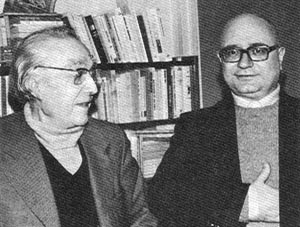
    Raymond Abellio and Jean Parvulesco are two prominent French esotericists who have visualised and tried to implement a roadmap for what Europe – and the Western world as a whole – should become. It is a future where the real role of the Priory of Sion comes into its own.

    Raymond Abellio claimed that the Flemish occultist S.U. Zanne, pseudonym of Auguste Van de Kerckhove (1838-1923), was amongst the greatest initiates of the modern era. But hardly anyone knows who he is. Some have placed Abellio in the same category – he too is a great unknown for most. And those that have looked at Abellio largely conclude that he was a French fascist politician with an interest in esotericism.

    Was he? Part of the problem is that Abellio’s writings – like that of so many alchemists – need a key. So much of their material is coded text, and Abellio himself used to laugh that most people’s keys “only opened their own doors” – not his. Who was he really, and what were his true political aims?

    Raymond Abellio is the pseudonym of Georges Soulès (1907-1986), who rose to fame in France during World War II when he became the secretary general of the MSR (Mouvement Social Révolutionnaire) in 1942. The invitation to join the organisation had come from none other than Eugène Schueller, owner of the cosmetics giant L’Oréal. As the British researcher Guy Patton, author of Masters of Deception, points out: “This group had evolved out of the sinister Comité Secret d’Action Revolutionaire (CSAR), also known as the Cagoule. Soules was now to become acquainted with Eugène Deloncle, head of the political wing, dedicated to secret, direct, and violent action.”

    Later, Patton adds: “So here we have a Socialist turned Fascist, deeply involved in political movements, who actively collaborated with the Vichy government. In the course of his political activities, he was to work closely with Eugène Deloncle, who […] was closely acquainted with a fellow engineer, François Plantard, and whose niece married [French President François] Mitterrand’s brother, Robert.”

    Though never confirmed, it is claimed that Abellio was involved with Bélisane publishing, founded in 1973. Bélisane published several books on Rennes-le-Château, the village so intimately connected with the Priory of Sion. In his book Arktos, Joscelyn Godwin refers to Raymond Abellio as another ‘Bélisane’ pseudonym. For Guy Patton, Abellio is part of a network that tried to create a New Europe, ruled by a priest-king, whereby various modern myths, like the Priory of Sion, are meant to provide the modern Westerner with a longing of sacred traditions and rule, very much like the myths of King Arthur that gave a surreal dimension to European politics in medieval times.

    Abellio’s political views have therefore been described as very utopian, and he has been suspected of synarchist leanings – the belief that the real leaders of the world are hidden from view, politicians being merely their puppets. But in truth, Abellio had a well-defined vision for social change. When the battle lines of the Cold War were drawn after World War II, he tried to find the best of both camps and hoped he could unite them. Why? To create a type of Eurasian Empire, stretching from the Atlantic to Japan, an idea later taken up by the novelist and theoreticist, his friend Jean Parvulesco.

    French Esotericist Jean Parvulesco

    “Parvu” is largely responsible for acquainting at least some with the visions of Abellio – though whether it was the real Abellio or a character created by Parvulesco remains open to debate. Guy Patton sums up Abellio’s view as being “typical of an extreme right-wing esotericism, the aim of which is to ‘renew the tradition of the West’. He wanted to replace the famous Republican slogan, ‘Liberty, Equality, Fraternity’, with ‘Prayer, War, Work’, to represent a new society built on an absolute hierarchy led by a king-priest.”

    The implication, however, is that several of the people involved were not truly devoted to esoteric spirituality and merely used it as a mask for making money, acquiring more power, and pushing an extreme right wing agenda. Though that is the case for some of those involved, within the mix of powerful and/or money-hungry people most agreed that Abellio was truly a ‘spiritual’ man. And it was Professor Pierre de Combas who is credited with Abellio’s transformation from politician Georges Soulès into the visionary Abellio (the Pyrenean Apollo), making him not merely a “man of power,” but also a “man of knowledge” – an initiate?

    To understand his vision, we need to acknowledge that Abellio’s system, as mentioned, needs a key, and without a key there is no understanding – hence, no doubt, why he is often misunderstood. Secondly, his system is complex and difficult to summarise in a few words and is best described by listing some examples.

    He wanted to “de-occultise” the occult (e.g. his book “The End of Esotericism,” 1973), whereby he hoped this would help science. His knowledge of science – acquired as a polytechnic student – meant that he could build bridges between the two subjects, for example between the 64 hexagrams of the Yi-Ching and 64 codons of DNA, or the correspondences between the numbers of the Hebrew alphabet and the polygons that could be inscribed in a circle.

    The most famous of his works is “The Absolute Structure” (1965) which led to him being regarded as an heir to phenomenological philosopher Husserl. Such topics, of course, hardly make for bestsellers, but are the type of study one expects from a genuine alchemist.

    His drive for an “absolute structure” is a vital ingredient in his idea of the “Assumption of Europe,” i.e. what he sees as the destiny of Europe: “the Occident appears to us not to be only as an interval separating the opposing masses of the East and the West, but is the most advanced carrier of the dialectic of the present time.” Abellio did not believe in the subject-object duality that continues to drive most politicians into fear-mongering and the other usual tactics employed by their ilk, but instead preferred a more complex model, centred on Conscience (the zero point), which evolved along the base towards Quantity (science) and upwards to Quality (knowledge), which gave him a six-armed cross. This is the “hypercubic” cross, to use Salvador Dali’s words, a man who also spoke of the “Assumption of Europe” in some of his paintings. The “hypercubic cross” allowed Abellio to express all ontological and spiritual problems in dynamic terms – and it is clear that he used complex wording, making his thinking difficult to understand, which is no doubt why he is easily misunderstood, was thought to be writing mumbo-jumbo, or simply neglected.

    First of all, to get our heads around his terminology, we need to know that the Bible was one of Abellio’s most often consulted books and he described the stages of the evolution of a civilisation in Christian terms: birth, baptism, communion, etc. This is why he said that the next stage in Europe’s development mimicked Assumption, which is specifically linked with the Virgin Mary – the Saint deemed to play a pivotal part in Europe’s future. She is, of course, a supernatural being who is said to have appeared on numerous occasions to counsel Christian Europe on which direction to take, such as in the politically charged “secrets” of Fatima in 1917.

    In 1947, in his book “Towards a New Form of Prophecy, an essay on the political notion of the sacred and the situation of Lucifer in the modern world,” he notes, “not more than any other being, man is but an addition, a juxtaposition of Spirit and Matter, but an accumulator and an energy transformer, of variable power according to the individual, and capable of passing his energetic quantity from one qualitative level to another, higher, or lower.” Thus, we see a mixture of Christian eschatology, prophecy, as well as Gnostic doctrines on what it is to be truly human.

    The visionary Abellio was also an astrologer. He predicted the fall of the Soviet Union in 1989, as well as the ascent of China. He qualified its Marxism as “Luciferian,” which he did not suggest should be interpreted in a moral sense, but that Chinese materialism had to be integrated in terms of the Absolute Structure, in opposition to the individual and “Satanic” materialism of the United States.

    In the West, it was the task of freedom fighters – terrorists? – to bring about this change. These “heroic” battles were brought to life in his novels. In retrospect, he said that his first three novels were indeed “apprenticeships,” where his heroes evolved, while his final novel – published 24 years after “The Pit of Babel” (1962) – “Motionless Faces” (1986) was for him “that of the companion who is trying to become master.”

    However, many consider “The Pit of Babel” to be his best work and it is here that he plots intellectuals that are disengaged from all forms of ideology and scruples engaging in widespread terrorism. It is a theme he revisited in “Motionless Faces,” where the primary character attempts to poison the population of New York, not by any straightforward means but by using the creation of an illuminated architect who had built a type of “counter-structure” underneath Manhattan, which was reserved for an elite – a type of urban Agarttha.

    The heroine of his last novel is named Helen, also – not coincidentally – the name of the companion of Simon Magus. In the end, she perishes, taken to the centre of the earth by a subterranean stream underneath Manhattan. In the case of the historical Simon Magus, Helen was the personification of Light held prisoner by matter. Abellio specifically chose his name because he identified himself with Apollo, another deity connected with light, and Raymond Abellio’s initials – RA – were of course those of the Egyptian sun god.

    Abellio himself never met his “ultimate woman,” even though he searched for her. She may have been Sunsiaré de Larcone, herself a writer of fantasies as well as a model, who died at the age of 27 in a car crash in 1962. She called herself his disciple. Other equally beautiful women had gone before, and would go after, but no-one was apparently worthy of being “his” woman. Hence, his tomb contains an empty space for his “Lady.”

    It is “Motionless Faces” that Jean Parvulesco studied in detail in his essay, “The Red Sun of Raymond Abellio,” published in 1987. Parvu is a novelist who was both close and far removed from Abellio. Close, because they shared a similar vision of the “Great Eurasian Empire of the End.” He, too, had his initiators, and he saw himself heir to the “Traditional School,” represented by authors such as René Guénon and Julius Evola, whom he met in the 1960s. Parvu was preoccupied with “non-being,” the forces of chaos, which make him into something of a dualist, i.e. a Gnostic. With Evola he shared the idea that there is a need for a final battle against the counter-initiatory and subversive forces (the non-being). Like Evola, he had an interest in Tantrism.

    Parvulesco often uses the term “Polar” in reference to the “polar fraternities” with which Guénon had once associated. He sees these as important instruments in the creation of modern Europe. He also used the term to refer to the Hyperborean origins of the present cycle of humanity, which he argued would soon end with a polar reversal. Here he is close to Guénon, but far from Abellio’s thinking, who had an altogether more optimistic vision of the future. So despite their kinship and a common goal, they were not agreed on how exactly the New Europe would be accomplished.

    Parvulesco has often been cited by extreme right-wing European authors. Some of them have claimed him as one of their own, but it is clear that no single writer is in charge of who and where his name is used.

    In the early 1960s, Parvu was close to the OAS, the “Organisation Armée Secrète,” a terrorist group opposed to Algerian independence from France. This put him in opposition to De Gaulle, yet he is known to have claimed to be a strong supporter of De Gaulle. Incidents such as this make it difficult to place him on the political spectrum, and it’s best simply not to try and put him into one category. Indeed, what sets him and Abellio apart is largely that they had an independent vision of the future – and the role of politics. They realised that the world was radically changing, and though their models might in the end prove not to work or be unrealisable, it does not negate the fact that they were innovative thinkers.

    It is Parvulesco who provides further details as to what this New Europe would be and why, specifically, a priest-king is needed as its ruler. In ancient times, these rulers were primarily seen as a denizen of both worlds, a mediator between this reality and the divine realm. Parvulesco makes it clear that “the beyond” is guiding us towards Europe’s destiny, whereby the role of European leaders is first and foremost to correctly interpret the signs, rather than invent new goals and targets.

    Interdimensional Gateways

    A few constant themes run through Parvu’s writings, one of them being that of gateways to other dimensions. Whenever historical people (most often politicians) make appearances in his novels, they are not the politicians we know but their doubles who evolve in our and another dimension. The novels of Parvulesco are hence often seen as those of the “eternal present,” or the “ninth day.”

    In “Rendez-vous au manoir du Lac,” the setting is a strange site where there is a gateway to heaven – Venus in particular – from where, according to Parvulesco, some chosen ones have to transit. In “En attendant la junction de Vénus,” he repeats this claim, but links it with French president François Mitterrand and specifically the Axe Majeur of Cergy-Pontoise, near Paris. This axis is the creation of artist Dani Karavan and is the “soul” of this new town. It stretches for three kilometres and if ever archaeologists stumbled upon its remains in future centuries, it would be classified as a leyline. Though the project commenced before Mitterrand’s presidency, it was during his term in office that the line became properly defined and executed. Today, it is seen – in France – as an enigmatic work, far superior to the Louvre Pyramid or Arche de la Défense, which has set the likes of Dan Brown and Robert Bauval questioning the reasons behind these projects. The Axe, however, is a far more ambitious, greater and more enigmatic project. When we note that Abellio was closely associated with the Mitterrand family, we can merely ponder whether he had a hand in the project.

    With the Axe Majeure, it is clear that we are in a strange world where politics and esoterica mingle, partly in this dimension and partly in a divine realm. Well, Abellio hoped that from this mixture a new form of politics and a New Europe would arise. And it is here where we need to see the role of the Priory of Sion, not so much – as Dan Brown and others would like it – as the preservers of a sacred, old bloodline, but a new priesthood – a mixture of politician and esotericist, i.e. like Abellio himself – that can rule a New Europe.

    So even though Abellio and Parvulesco are often described as synarchists, they repeatedly referred to themselves as freedom fighters laying the foundation for this New World. The new powerbrokers would not always remain hidden puppet masters, but would clearly one day step to the forefront to take up the role of priest-king. And for such thinkers, it was a given that France had come closest to attaining this ideal under De Gaulle, whereby the “Great Work” of Mitterrand was seen along the same lines, though clearly not to the same extent.

    Abellio and Parvulesco were therefore New Agers building “An Age of Aquarius.” However, they did not focus on personal transformation, but on social transformation. As an author one might argue that Parvulesco operates within the domain of the “esoteric thriller,” which in Hollywood is seen in Roman Polanski’s ‘The Ninth Gate’ or Umberto Eco’s Foucault’s Pendulum. But both works have great difficulty in convincingly integrating the “passage to another world” within their storyline, often leaving the reader/viewer unsatisfied, or – alternatively – unconvinced of the end goal. Lovecraft has a better reputation and others argue that Parvulesco, thanks to the influence of both Abellio and Dominique de Roux, has gone further, and done better. But the main point is that his esoteric thrillers were to make this step through this “interdimensional passage” not as an individual, but as a society – as Europe.

    De Roux (1935-1977) greatly inspired those authors who evoked what is known as “novels of the End” – however they saw the transformation of Europe. Parvulesco actually began his literary career in the magazine Exil published by de Roux. De Roux travelled widely, and in 1974 wrote “The Fifth Empire,” about the struggle for independence in Portugal’s colonies, which brings up the same struggle for a country’s new future. The title “The Fifth Empire” is an allusion to a popular Portuguese myth, namely that of the lost king. Like King Arthur, the Portuguese king Dom Sebastian was said to one day return to lead his people to a fabulous destiny – which, as can be expected in light of Abellio and Parvulesco’s ideology, was not necessarily of this plane. To quote the Portuguese poet and occultist Fernando Pessoa (a friend of Aleister Crowley): “We have already conquered the sea, there only remains for us to conquer the sky and leave the earth for others.”

    Russia, Putin and the New Europe

    What Algeria and De Gaulle had been for Abellio, what Portugal was for De Roux, Putin’s Russia is for Parvulesco. But it is in Abellio’s preface to “The Fifth Empire” that we find an interesting note explaining the true context and “key” that unlocks their works: “Those who attach a profound meaning to coincidences cannot be but stricken by the fact that the last message of Fatima was delivered in October 1917, at the moment when the Bolshevik Revolution began. What subtle link of the invisible history was thus established between the two extremities of Europe?”

    For esotericists who saw our dimension as being infiltrated by the other plane of existence, the coincidences of the apparitions of the Virgin Mary at Fatima and her clearly political messages to do with the future of Russia and how it should embrace the Virgin Mary, are part and parcel of this Great Empire. Not merely a political ambition, but part of their vision as to how “real politicians” work together in league with the “denizens of the otherworld” so as to accomplish the Assumption. Hence why Parvulesco believes Putin’s Russia to be so important. This is why, no doubt, Abellio tried to make contact with the Soviets to enable this New Europe, which indeed has come about largely under Putin’s presidency.

    As mentioned, for British author Guy Patton, Abellio and Parvulesco are French fascists who abused newly created myths like that of the Priory of Sion to increase their influence, power and wealth. But this, of course, is merely one interpretation. Take the literature of the Priory and its creator Pierre Plantard and we discover he was close to De Gaulle’s regime. Plantard in fact ran part of De Gaulle’s “terrorist cells” in Paris when De Gaulle was struggling for power. Then, Plantard used the Priory to create an ideology that saw a unified Europe, from the East to the West, and it is obvious those involved in the promotion of the Priory later spoke of the importance of François Mitterrand.

    The Priory is indeed a fabricated myth, a non-existent secret society. But it is equally clear the individuals involved (Plantard) and those linked to it (Abellio, and to some extent Parvulesco), had genuine convictions of what a future Europe should be. Their interest in Marian apparitions was genuine, and they saw them as divine guides along the path that Europe had to walk to its future and its next stage, its Assumption. As Parvulesco pointed out, it depends whether you believe in coincidences or not. If not, then you will argue the major political events of the past century are but tangentially related to the messages received from these apparitions. If you do believe coincidences have meaning, then it is clear this New Europe is slowly emerging.

    In the 1980s, Parvulesco reviewed a strange novel, “La boucane contre l’Ordre Noir, ou le renversement,” by one “Father Martin,” who had already published “livre des Compagnons secrets. L’enseignement secret du Général de Gaulle.” For an avowed Gaullist, Parvu was obviously in his element. The novel itself has certain common points with one volume of the tetralogy of Robert Chotard, “Le grand test secret de Jules Verne.” Both books speak of a “reserved region” in Canada from where there is a conspiracy directed to change the world’s climate. The base is controlled by the sinister “Black Order” and aims to create a pole reversal – a theme also explored by Jules Verne. We can only wonder whether the stories of HAARP – set in nearby Alaska – might be inspired, or reflective, of this. But it is here that we see the final framework of their political ambition: they saw their quest not so much as a desire, a longing, but as a genuine struggle of good versus evil – if a New Europe did not come, the “Black Order” would have won. And in the end, perhaps Abellio and Parvulesco should thus be seen as modern knights, fighting for Europe – a new Europe.

    The above is connected to this article in the same issue of New Dawn: Vladimir Vladimirovich Putin & the Eurasian Empire of the End Times

    [alert type=”general” dismiss=”no”]This article was published in New Dawn 111.[/alert]

    [alert type=”success” dismiss=”no”]If you appreciate this article, please consider subscribing to help maintain this website.[/alert]

    © New Dawn Magazine and the respective author.
    For our reproduction notice, click here.