New Dawn – World's Most Unusual Magazine

Tag: Freemasons

  • The Compass & The Crescent: Secret Societies of the Muslim Freemasons

    The Compass & The Crescent: Secret Societies of the Muslim Freemasons

    From New Dawn Special Issue Vol 9 No 4 (Aug 2015)

    Freemasonry burst onto the world stage early in the 18th century, spreading across the globe with remarkable speed. With Lodges established everywhere from London to India, and from America to the West Indies, Freemasons established the first truly global network by the end of the century.

    Although English-speaking Freemasons considered themselves loyal subjects of their respective nations, they also saw themselves as part of a great brotherhood that transcended national borders, class, race, ethnicity, and even religion. This contradiction guaranteed that conflict eventually arose within Freemasonry’s ranks over its role in the world, and who could, and who could not, be made a member.

    The first recorded initiation of a Jew into a Masonic Lodge is that of Edward Rose in 1732. Members of non-monotheistic faiths (such as Hinduism) faced more resistance, and the issue was not resolved until the 19th century.

    Masonic Lodges were sometimes used, unofficially, by colonial powers (especially Britain and France) as part of diplomatic efforts. Initiating foreign dignitaries and even members of monarchies into Freemasonry helped cement relations between the two negotiating countries.

    The Shah of Persia’s ambassador, Askeri-Khan, was initiated into Freemasonry in Paris in November 1808. He was impressed enough to have discussed the possibility of founding a Lodge in Isphahan, Persia (Iran). Two years later, in London, Mirza Abul Hassan Khan, Minister to the Court of Persia, was made a Freemason.

    Things could be more difficult abroad, however, and the issue finally came to a head in 1865. Prosonno Coomar Dutt, a Hindu, had petitioned Lodge Courage with Humanity for initiation into the fraternity. In turn, the Master of the Lodge sought permission from the Provincial Grand Master, Hugh David Sandeman, who refused, citing “social considerations.” Around the same time, Said-ud-Dowlah, a Muslim prince, had been initiated into a Lodge of British Freemasons in Kanpur, India. Sandeman had officially refused permission for the initiation to take place, and, on learning about it, suspended two leaders of the Lodge for insubordination.

    The exclusion of the two men, on the basis of race and religion, became a heated issue inside Freemasonry in India. Before the end of 1864 the news reached the United Grand Lodge of England, which subsequently decreed that Hindus and Muslims could be admitted into the fraternity to foster “brotherhood between man and man.” And they would also be exposed to “true religion and enlightenment.”

    Despite the snobbery, and even revulsion, expressed by some Freemasons, Masonic intellectuals had long been interested in ancient and non-Western religion and its symbolism. During the 18th century, Freemasons developed a vast number of rituals, many of them esoteric or alchemical in nature. A century later, many of these ceased to be performed, or “worked,” and they faded into history. Others were compiled into Rites, some of which competed for prestige, or to be regarded as the most authentic. Notably, one 19th century Masonic Degree interpreted the Christian acronym I.N.R.I. as “India, Nature, Regeneration, Ignorance.” The Freemason had to overcome ignorance, and the “source of knowledge,” according to the Degree, was India.

    Late in the same century a new force emerged in the East: anti-colonialism and national independence. There is a certain irony in the fact that two of the early figures in the push for Indian independence from Britain and for the revival of Buddhism in Sri Lanka had also been involved with Freemasonry, at least to some extent. The enigmatic Madame Helena Blavatsky, head of the Theosophical Society, had been granted a charter for a co-Masonic Order by British esoteric Freemason John Yarker. Colonel Henry Steel Olcott, the Theosophical Society’s number two, had also entered Freemasonry as a young man.

    We will return to Yarker later, but here it is worth mentioning that Blavatsky and Olcott felt profound respect for the cultures they encountered in Asia, and were at the forefront of the independence movements in India and Sri Lanka. Although largely forgotten today, Olcott helped establish a Buddhist school system in Sri Lanka, and petitioned for greater rights for the country’s Buddhists (who were being culturally ‘cleansed’ so that Christian missionaries could proselytise more effectively). He also wrote a Buddhist catechism and helped design the international Buddhist flag, both of which are still in use.

    Abd al-Qadir & Anti-Colonial Politics

    Even before Blavatsky reached India, Freemasonry had already been intertwined with anti-colonial politics in the Middle East. Abd al-Qadir al-Jazairi (1808-1883), Sufi, resistance fighter, and Emir of Mascara in northwest Algeria, joined a Masonic Lodge in Egypt in 1864 after striking up a correspondence with a French Lodge. Other important figures to join the Masonic fraternity included the founding father of pan-Islamic anti-colonial politics, Sayyid Jamal ad-Din al-Afghani, the Grand Mufti of Egypt Muhammad ‘Abduh, and Shaykh Abdullah Quilliam, a convert to Islam and advocate for the rights of Muslims under the British Empire. Why would Muslim activists join Freemasonry during this period?

    Abd al-Qadir, a descendent (sharif) of the Prophet of Islam, was born into a family of prominence in the Qadiriyya Order of Sufism. His father, the head of the Order, seems to have been keen that his son be well travelled and educated in the faith. During 1826-27, the two men journeyed to Mecca for the hajj, visiting Cairo, Damascus and Baghdad along the way. This afforded Abd al-Qadir the opportunity to meet and discuss with scholars of different Sufi traditions, and to gain a deeper understanding of the esoteric and philosophical traditions within Islam.

    This relatively idyllic time was cut short in 1830, with the French invasion of Algeria. Abd al-Qadir’s father initially led the resistance against the colonial power, but when he was too old to continue al-Qadir took over his responsibilities. Despite all efforts, tens of thousands of Algerians were killed, many due to the scorched earth policy of the French who destroyed orchards and crops, causing many to starve.

    Abd al-Qadir was forced to sue for peace in 1847. Taken to France and placed under house arrest, he devoted himself to the study of the works of Sufi master Ibn al-Arabi. In 1855 he was given permission to resettle in Damascus. There, with a small Algerian entourage, al-Qadir established a salon for discussing Sufi writings. He also began teaching the Qura’n and Sunnah at the Umayyad mosque. In 1860 anti-Christian riots broke out in the city. Abd al-Qadir sheltered a number of Christians at his home, and used his armed entourage to protect them. Already respected abroad (Paris’s Asiatic Society registered Abd al-Qadir as a Fellow prior to his departure from France), his actions won the Algerian Sufi new accolades. Among those now taking an interest in Abd al-Qadir was Henry IV, a Masonic Lodge under the jurisdiction of the French Grand Orient.

    The Lodge wrote to Abd al-Qadir, telling him Freemasons believed both in God and the immortality of the soul, and implored him to affiliate. Before this, the Sufi had thought Freemasons were mischief-makers. After the introduction, al-Qadir corresponded with the Lodge and four years later, in 1864, he visited Alexandria, Egypt, where he was initiated into the Lodge of the Pyramids, which acted on behalf of the French Lodge. The relationship ended the following year, however, when he visited Henry IV in Paris. Al-Qadir was troubled to discover that instead of wanting to learn from Islamic spirituality, the brethren were only interested in convincing the Sufi to act as an ambassador for Grand Orient Freemasonry, which was becoming increasingly secular.

    Al-Afghani’s Secret Society

    A few years later, founding father of pan-Islamic, anti-colonial politics Sayyid Jamal al-Din al-Afghani would join the Masonic ‘Craft’ in Egypt. Born in Shia-majority Persia, al-Afghani, as his name suggests, presented himself as an Afghan, and, by implication, an adherent of Sunni Islam, the largest branch of the religion. Despite his lifelong pan-Islamic activism, al-Afghani associated with Babis, Christians, Jews, and secularists, including the Reverend Louis Sabunji, publisher of the London-based al-Nahlah (“The Bee”) newspaper. (It may be worth noting that G.I. Gurdjieff claimed the existence of a Sufi Brotherhood called Sarmoung, often translated as “Bee.”) Another of al-Afghani’s collaborators was Muhammad ‘Abduh (1849-1905), who would go on to become the Grand Mufti of Egypt.

    Al-Afghani became a Freemason in May 1875, and began attending different Lodges, including three Italian Lodges in Cairo. He seems to have held a favourable impression of the fraternity, believing it a revolutionary influence in the world, and a brotherhood bound by the ideal of liberty. Al-Afghani convinced many of his collaborators to join, but apparently to his surprise and dismay attempts to discuss politics inside the Lodges were brushed aside. When the Prince of Wales – Grand Master for England – visited Cairo and was addressed at one Lodge meeting as “Crown Prince,” Al-Afghani was unimpressed. Inside the Lodge, Brothers were regarded as compatriots and equals, “on the level,” but not the Prince of Wales.

    Al-Afghani formed his own National Lodge, affiliating it with the Grand Orient of France. One of the most liberal Masonic jurisdictions, the Grand Orient dropped the requirement of belief in God in 1877. (This remains a requirement in “regular” Lodges of the English-speaking world, though men of all different faiths, and agnostics and Deists, are eligible for admission.) A number of al-Afghani’s students, as well as intellectuals, journalists, army officers, and members of the ulema (Islamic scholars) joined up.

    The National Lodge created several committees to approach Egypt’s ministries, to agitate for better treatment of Egyptian civil servants and officers (who earned a fraction of the Europeans employed in the same capacity). The political agitation alarmed the authorities, and on 24 August 1879, charged with heading a secret society aimed at ‘corrupting’ religion and the world, al-Afghani was seized by the police and put on a ship bound for India. Remarkably, he was undeterred, and spent subsequent years living in different countries (including France), agitating against the colonial powers. He called for Muslims to unite behind a Caliph, and published his journal al-‘Urwat al-wuthqa’. During the following decade, al-Afghani also inserted himself into the politics of Persia.

    Between 1888 and 1889, the Shah of Persia granted a number of concessions to the British. In particular, the tobacco concession that gave the colonial power the right to produce, sell, and export the country’s entire tobacco crop for a period of fifty years. The Shah received a quarter of the tobacco profit, annually, plus a five percent dividend, but the arrangement caused problems for small traders, and even for the ulema, some of whom owned land on which tobacco was grown. Al-Afghani denounced the agreement, and the open hostility from various quarters eventually led the Shah to cancel the concession. Ever the revolutionary, al-Afghani published a pamphlet in 1891 accusing the Shah of selling Persia to the “infidel” and he was once again exiled.

    This was not the end of the pan-Islamic activist’s involvement in Persia. Although now resident in Istanbul, al-Afghani controlled a secret society in Tehran. Two of its members were charged with sedition and given each an 18th month sentence. After his release, one of these two men, Mirza Riza Kirmani, visited al-Afghani in Istanbul. Returning to his home country in disguise, Kirmani assassinated the Shah, Nasir al-Din, on 30 April 1896.

    This wasn’t the first secret society in Persia. Mirza Malkam Khan, an Armenian associate of al-Afghani’s, and a nominal convert to Islam, founded the Faramushkhana (House of Forgetting) in Tehran in 1858.

    Khan had been initiated into the Grand Orient Lodge Sincere Amitie in Paris, in a mass induction of Persian ambassadors a year earlier. The Faramushkhana was modelled on Freemasonry, but it had an explicit political agenda: to marry the political understanding of the West with the religious faith of the East. In order to convince Muslims, it would be claimed that Islam was the originator of modern Western ideas, and this fact had been forgotten over time. Unsurprisingly, the Faramushkhana provoked fierce objections from the religious scholars, though Khan’s aim was, again, to empower Muslims to stand up to the West, not to Westernise Islam.
    Islamising Freemasonry

    Interest in pre-Christian and non-Western cultures, religions, Gnosticism, and symbolism proliferated early on in Freemasonry. During the 18th century, as it spread across Europe, Freemasonry incorporated Hermeticism, Rosicrucianism, Egyptology and chivalry, into various rituals. Before the end of the 19th century, the premier British Masonic journal Ars Quatuor Coronatorum had published articles on Hindu “Brahminical Initiation,” the swastika (a Hindu, Buddhist, and pre-Christian European symbol), the Qabala, and “West African Secret Tribal Societies,” among many other articles on similar themes.

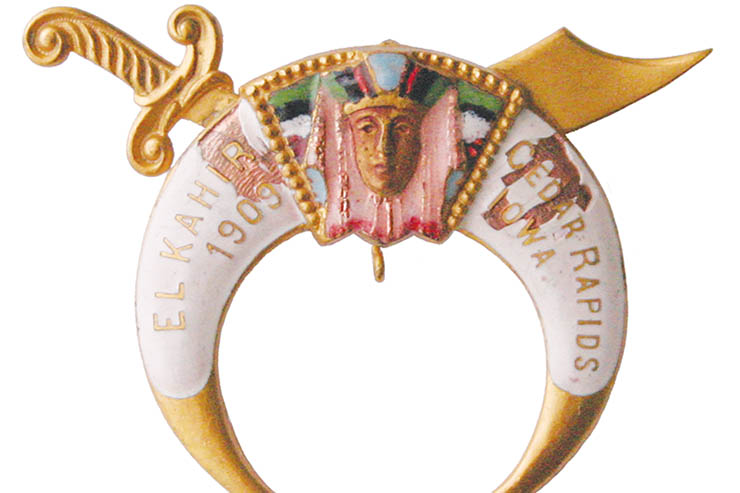
    Already by this time Islam had left its impression on several societies tied to Freemasonry. The Ancient Arabic Order of the Nobles Mystic of the Shrine (better known as the Shriners or the Shrine) had been founded in New York, as had a rival group called the Mystic Order of the Veiled Prophets of the Enchanted Realm (better known as the Grotto). Both required members to be Freemasons. Both adopted the fez as part of its official dress – in the former case, a red one with an Islamic-inspired crescent and the name of the Shriner temple on it, and in the latter case a black one bearing the image of a turbaned figure.

    The Grotto’s nomenclature, ritual, and symbolism was based on the poem “The Veiled Prophet of Khorassan” by Thomas Moore (1779-1852). It focuses on al-Mokanna, the Veiled Prophet Hakem ben Haschem, who lived between the 7th and 8th centuries, and blended Islam with the pre-Islamic Persian religion of Zoroastrianism.

    The Shrine was created by Dr. Walter M. Fleming, with the assistance of Charles T. McClenachan and some other Freemasons, in or around 1870, and its first temple – Mecca Temple – was established in New York. Although long known for its intentionally clownish parades through small suburban towns, some early histories of the Shrine claim a more esoteric origin: the Bektashi Order of Sufi Islam.

    There were more serious attempts to introduce Islamic mysticism to Freemasons and spiritual adventurers in the West. After his failed attempt to scale Kanchenjunga, the world’s third largest mountain, in 1905, Freemason and magus Aleister Crowley (1875-1947) left the Himalayas and headed to Calcutta where he prepared to return to his native England via Persia. Part of Crowley’s preparation was to immerse himself in Sufi literature and to begin writing his “Ghazals of Ishtar,” imitating the style of the Sufis though instead focused on the ancient Babylonian and Assyrian goddess.

    The project turned into The Scented Garden of Abdullah The Satirist of Shiraz. Though his least known work, Crowley, never a shrinking violet, claimed it transcended the Bhagavad Gita and the Tao Te Ching. The work had to be published pseudonymously since it included homoerotic and Gnostic content. The English magus chose the name ‘Abdullah al Haji’ who he claimed was active during the 17th century. Despite the ruse, most copies of The Scented Garden were seized and destroyed by customs during import to Britain from Crowley’s printer in Paris.

    Notably, Crowley says in the text that he cannot discuss the inner working of Sufism, “if only because I am a Freemason.” The implication is, of course, that the two are in some way connected or at least kindred.

    Crowley wasn’t the first English Freemason to see similarity between the Craft and Islam. In 1872, Kenneth MacKenzie founded the Order of Ishmael, on the authority of an Arab in Paris. In theory, at least, Christians (excluding Catholics), Hindus, Zoroastrians, Muslims, and others could be initiated, though the highest of its 36 Degrees was titled “Submission,” the literal translation of Islam (submission to the Will of Allah). John Yarker, a very active and influential figure in the underground esoteric Masonic scene, appears to have been involved in the project – which may have existed more on paper than in practice. Yarker played a role in the ‘fringe’ Masonic life of William Henry Quilliam (1856-1932), better known as Shaykh Abdullah Quilliam.

    Shaykh Abdullah Quilliam & Freemasonry

    Quilliam converted to Islam as a young man, and went on to become an influential figure in Muslim political life in Britain. Believing in the creation of an international Muslim brotherhood, Quilliam agitated for the rights of Muslims under the British Empire, and attempted to expel prejudice against Islam – which had a bad image in Britain during his lifetime. Besides this, the shaykh founded the first mosque in Britain, as well as an Islamic education centre and publishing house to disseminate literature on Islam.

    His activities won him the attention of the Ottoman Empire, which appointed him Shaykh ul-Islam for the British Isles, and funded some of his work. At the same time, Quilliam was active in both regular Freemasonry and the ‘fringe’ Masonic societies of the Sat Bhai (which was influenced by Hindu mysticism) and the Swedenborgian Rite. More significantly, Quilliam was undoubtedly the founder of the Ancient Order of Zuzimites, which adopted the structure of the Masonic Craft Ritual and the symbolism of pharaonic Egypt.

    Quilliam seems to have understood that Freemasonry was more sympathetic to Islam than mainstream society in the English-speaking world. Indeed, some important Masonic journals, which he wrote for, noted his Islamic credentials. It is highly likely that, like Abd al-Qadir and many other Muslims who joined Masonic Lodges, he saw the fraternity as offering the possibility of a transcending of religious and ethnic boundaries – and as a Muslim in a Christian country he would have been all too aware. Perhaps, like Crowley, he saw some manifestations of Islam and Freemasonry as compatible.

    Whatever the case, it is extremely significant that some of the more important and radical Muslim activists sought initiation into Freemasonry during the 19th century, and that some Freemasons and societies linked to Freemasonry were, in turn, influenced by Islam. These historical episodes may have been almost entirely forgotten, but whether we like it or not, these influential individuals and groups helped shape the world we live in today.

    [alert type=”general” dismiss=”no”]This article was published in New Dawn Special Issue Vol 9 No 4.[/alert]

    [alert type=”success” dismiss=”no”]If you appreciate this article, please consider subscribing to help maintain this website.[/alert]

    © New Dawn Magazine and the respective author.
    For our reproduction notice, click here.
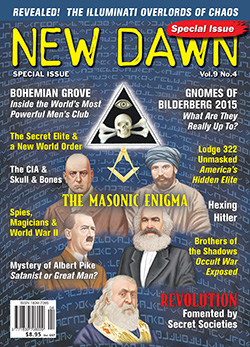
  • Brothers of the Shadows: Overlords of Chaos

    Brothers of the Shadows: Overlords of Chaos

    From New Dawn Special Issue Vol 9 No 4 (Aug 2015)

    Who controls the past controls the future. Who controls the present controls the past.
    – George Orwell, 1984

    Back in 1893, an elusive Englishman named Charles George Harrison (b.1855) delivered a series of six lectures to the Berean Society, a London based association of Christian esotericists. Harrison, described as a “mysterious and unknown figure,” was an English occultist and Anglican Christian. A record of his lectures can found in the book The Transcendental Universe. What is clear is that C.G. Harrison had access to highly sensitive information and a good deal of inside knowledge of world changes then being engineered by certain circles in England.

    In his second lecture Harrison spoke of “the next great European war” and of how the “national character” of the Slavic peoples would “enable them to carry out experiments in Socialism, political and economical, which would present innumerable difficulties in Western Europe.” The “next great European war” points to what would be the First World War of 1914-18, while the “experiments in Socialism” predict the 1917 Bolshevik Revolution which brought about the Soviet Union, one of the boldest and bloodiest politico-economic experiments in human history. Harrison said the plan of a particular secret elite, which he doesn’t mention by name, was that “the Russian Empire must die that the Russian people may live.” It is amazing to consider these truly prescient words were spoken in 1893, 21 years before the First World War and 24 years before the Russian Revolution. Today we know that in 1917 Bolshevik leader Vladimir Lenin was transported from Zurich, then the banking capital of the world, to Russia in a train loaded with gold and weapons to start the revolution.

    Discussing C.G. Harrison’s extraordinary foreknowledge, Sevak Gulbekian asks:

    How could he [Harrison] know about the forthcoming War as well as the “experiments in Socialism,” which would take a grip on Russia and its surrounding states for most of the twentieth century? If he was not, as he claimed, a “practical occultist” himself, it is reasonable to assume he had contact with people who were, and who had access to the malign plans…1

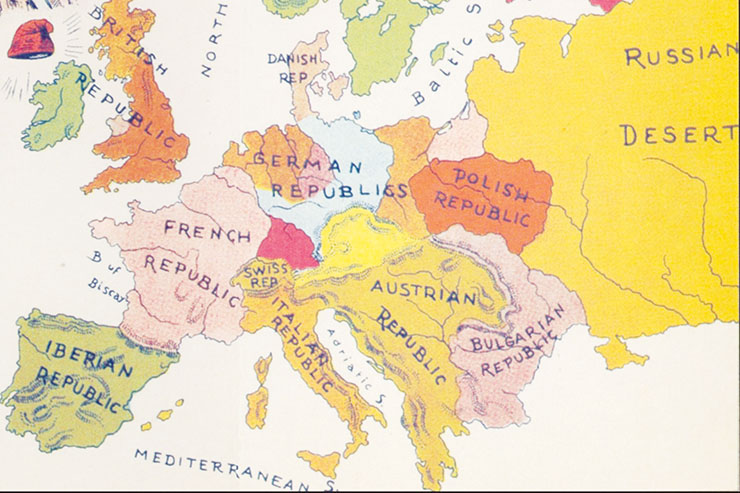
    Another significant piece of information coinciding with Harrison’s insights into the future is a cartoon map of Europe printed in the Christmas 1890 edition of the satirical English weekly, The Truth. Over the map is written: “The Kaiser’s Dream.” It showed wherever monarchies had been up to that time, there were going to be republics. The Austro-Hungarian Empire of the venerable Hapsburg monarchy had disappeared, as had the centuries old Russian Empire. Over the territory of Russia we read the words “Russian Desert.” In addition, Germany is identified with the words “German Republics”! Commenting on this map from 1890, Sevak Gulbekian notes:

    This map signifies not only a foreknowledge – similar to Harrison – of the fate of Russia to become a cultural as well as an economic ‘desert’, but also of the future splitting of Germany into ‘republics’. The magazine’s editor, Henry LabouchEre, was a Freemason. Was his remarkable foresight pure luck, or once again did he have some inside knowledge of future plans to shape the world?

    Why destroy the Hapsburg Empire? The influence of the Catholic Hapsburgs, as heirs of the Holy Roman Empire, was felt through all Europe. As Catholic Europe’s most important royal house they posed a particular obstacle to Britain’s plans for the Continent. Austria-Hungary, along with the ruling Hapsburg dynasty, had to be wiped off the map in order to create a patchwork of small states in Eastern Europe. These could be easily manipulated by London. Count Arthur Polzer Hoditz, director of the cabinet of the last Austro-Hungarian emperor stated in his memoirs that, “the destruction of the Hapsburg Empire was carefully prepared.” Late 20th century research reveals the suicide in 1889 of Crown Prince Rudolf, the Hapsburg Emperor Franz Joseph’s only son and heir, was a planned political assassination. Less than a decade later in 1898 the Empress Elizabeth was brutally murdered by a secret society member in Geneva. And the killing in 1914 of Emperor Franz Joseph’s nephew Franz Ferdinand in Sarajevo by a member of the Serbian secret society of the Black Hand, had as its immediate consequence the outbreak of the First World War.

    The occultist Rudolf Steiner (1861-1925), who knew a great deal about the mysterious nexus of politics and the occult, mentioned the above map in a talk given in Switzerland at the height of the First World War. He said the map, as a secret document, was in existence since the last decades of the 19th century. This is the same time as the British imperialist Cecil Rhodes was laying the foundations for “a secret society with but one object, the furtherance of the British Empire, and the bringing of the whole uncivilised world under British rule…” According to the American historian Carrol Quigley in his book Tragedy and Hope, Cecil Rhodes set up such a secret society known as the “Society of the Elect” in 1889.

    Sevak Gulbekian explains Rudolf Steiner’s perspective thus:

    Behind the outer façade of world affairs, suggested Steiner, the machinations of occult groups or ‘brotherhoods’ were at work. Certain of these brotherhoods had wanted the Great War to take place, and had manipulated events to bring it about. In doing this, they sought to protect the dominant economic position of the English-speaking world, and in turn to crush the ‘mediating’ role of Central European powers such as Germany, the Austro-Hungarian empire, and so on.

    These occult brotherhoods – small groups of men who met together in ‘lodges’ and practiced ceremonial magic as a means of achieving certain goals – originated from the English-speaking (Anglo-Saxon) world and were allied, in particular, with Anglo-American interests. Their aim was to extend Anglo-American influence across the globe, and to ensure the predomination of Anglo-American culture. Furthermore, they sought to extend its superiority into the distant future; essentially to ensure that the present state of affairs continues evermore.

    Rudolf Steiner in one of his lectures about the influence of secret societies on politics says that in the Slavic peoples there lies a “special future.” He believed at some point in the future a cultural-spiritual highpoint would be reached in the Slavic countries, principally Russia. This is apparently known to the Anglo-Saxon occult brotherhoods which seek to manipulate these powers and bring them directly under British domination. Steiner’s revelations, based in part on his intimate involvement with Europe’s leading secret societies, help explain the major events of the 20th century. Two world wars, the partition of Europe into the Anglo-American dominated West and the Soviet controlled East, the decades long ‘stand-off’ between Eastern communism and Western capitalism in the ‘Cold War’, the collapse of the USSR and the declaration of an Anglo-American dominated unipolar world, can all be traced to the dark intrigues of the Brothers of the Shadows.

    [alert type=”general” dismiss=”no”]This article was published in New Dawn Special Issue Vol 9 No 4.[/alert]

    [alert type=”success” dismiss=”no”]If you appreciate this article, please consider subscribing to help maintain this website.[/alert]

    Footnote

    1. ‘Brothers of the Shadows: A Perspective on Conspiracies’ by Sevak Gulbekian, New Dawn 86 (September-October 2004)

    © New Dawn Magazine and the respective author.
    For our reproduction notice, click here.
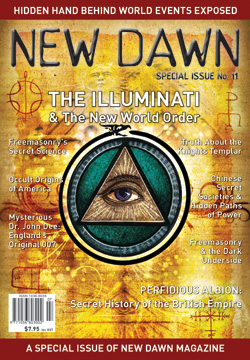
  • The Enlightened Ones: The Illuminati and the New World Order

    The Enlightened Ones: The Illuminati and the New World Order

    From New Dawn Special Issue 11 (Autumn 2010)

    The world is governed by far different personages from what is imagined by those who are not behind the scenes.
    – Benjamin Disraeli, nineteenth century British prime minister, in a speech to Parliament

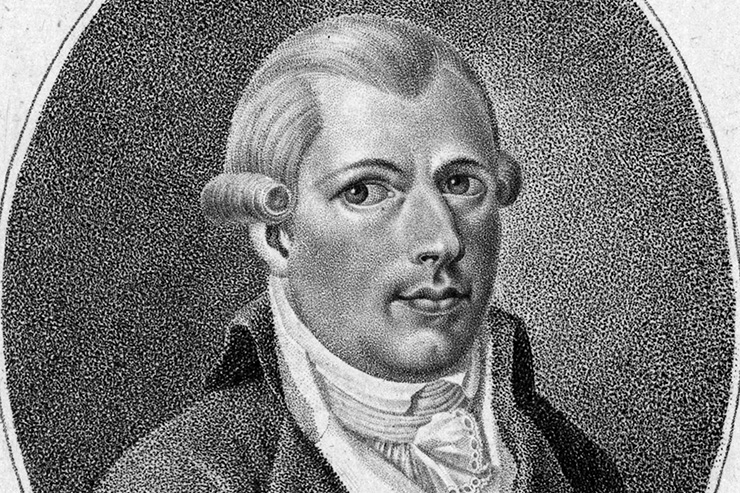
    On 1 May 1776, the year of the beginning of the American revolution against British colonial rule, a young university professor, Adam Weishaupt (1748–1830), from Bavaria, founded the Order of Perfectibilists, later to become world famous as the Illuminati or ‘Enlightened Ones’.

    Weishaupt’s family had Jewish ancestry, but he was brought up in the Roman Catholic faith and educated by the Jesuits. His father died when he was seven and he was fostered by his godfather, a German aristocrat called Baron Ickstett. Although schooled by priests from the Society of Jesus, the young boy spent hours in his godfather’s extensive library reading learned works on philosophy and science. As an undergraduate at university, Weishaupt studied the ancient Greek Eleusian Mysteries and the mystical doctrines of the Greek philosopher Pythagoras. Even at this young age he was thinking about forming a secret society based on the pagan mystery schools. He later wrote:

    At a time, however, when there was no end of making game of and abusing secret societies, I planned to make use of this human foible for a real and worthy goal, for the benefit of people. I wished to do what the heads of the ecclesiastical and secular authorities ought to have done by virtue of their offices.

    Adam Weishaupt became a lay professor in canon law at the Jesuit-run University of Ingoldstat near Munich while still a young man. His sudden rise to prominence in the university and his radical views caused consternation among the Jesuit priests. This led him to become involved in many bitter disputes with them about matters pertaining to religion.

    In 1774 in either Hanover or Munich Weishaupt became interested in Freemasonry. However, he was disappointed in what he found, believing the Freemasons did not understand Masonry’s occult significance, and refused to accept its roots in the ancient pagan religions. In 1777, he finally joined the Masonic Lodge of the Strict Observance Rite in Munich, which practised a form of neo-Templar-Masonry.

    At this time the Order of Perfectibilists also became known as the Order of Illuminists or the Order of the Illuminati, sometimes known to its members as the Society of the Hidden Hand. Illuminati was the plural of the Latin Illuminatus, from illumino meaning lighten or enlighten, or ‘enlightened one’, a term used to describe the initiates of the pagan Mysteries. At first the Order had only five members who were radical freethinkers, but they soon attracted the attention of Bavarian society and within ten years of its foundation there were over 2,000 members.

    Illuminism spread from Ingoldstat all over Bavaria and then to other German regions such as Saxony, Westphalia and Franconia that were at the time ruled by feudal princes. It was also exported abroad to the Austria-Hungarian Empire, France and Italy. The Illuminati’s membership was largely drawn from the middle and upper classes and in this respect it is ironic that revolutionary movements are seldom started by the working-class. Instead, they are usually led by intellectuals and disenchanted members of the ruling power elite. Members of the Illuminati allegedly included doctors, teachers, lawyer, judges, university professors, priests, police and military officers, and aristocrats such as Duke Ferdinand of Brunswick, Duke Ernst of Gotha, Duke Karl of Saxe-Weiner, Prince Augustus of Saxe-Gotha, Prince Carl of Hesse, and Baron Dalberg.

    The inclusion of these aristocratic and royal rulers in its membership roll seems strange considering the aims of the Illuminati. Adam Weishaupt’s personal vision was a utopian pacifist society without monarchy, private property, social inequality, national identity and religious affiliation. In this new state people would live together in harmony in a universal brotherhood based on peace, free love, spiritual wisdom, intellectual and scientific knowledge, and equality. According to Weishaupt’s doctrine in his own words:

    Salvation does not lie where strong theories are defended by swords, where the smoke of censers ascends to heaven, or where thousands of strong men pace the rich fields of harvest. The revolution which is about to break [the French Revolution] will be sterile. It is not complete.

    The Illuminati’s main targets for criticism were the rule of the European royal families, the power of the Roman Catholic Church and the rich landowners who kept the peasants in a feudal state of servitude and poverty. According to its enemies, this doctrine was represented in the oath of allegiance taken by new members when they joined the Order. They allegedly promised to hate and resist, “The altar [the Church] and the throne [monarchy] and to crush the God of the Christians and utterly extirpate the kings of Earth.”

    Initiation into the Illuminati

    The anti-royalist and anti-clerical nature of the Illuminati was also reflected in its initiation ceremony. The candidate was led into a small room where, in front of an empty throne, a table stood with the traditional symbols of kingship – a sceptre, sword and crown – on it. The candidate was invited to pick up these objects, but if he did then he would be refused entry into the Order. Having passed this test, he was led into a second room with a table draped in black cloth. On this table were a plain wooden cross and a red Phrygian cap as worn by initiates of the ancient Mithraic Mysteries. The cap was given to the initiate and he was told to wear it proudly as it was worth far more than the crown of any king.

    New members were called Minervals, from the pagan goddess of wisdom Minerva, and the Order’s primary symbol was a wreath of oak leaves surrounding an owl sitting on an open book. This represented the essential combination of wisdom and knowledge, and the owl was also the sacred bird of Minerva. This symbol was made into a pendant that the Illuminati could wear secretly under their ordinary everyday clothes. It is tempting to see a connection between this emblem and the giant statue of an owl that features in the modern rituals at Bohemian Grove in California. At this private estate an annual gathering of male politicians, businessmen and media executives takes place, and it is claimed by some conspiracy theorists to be an Illuminati front.

    Adam Weishaupt believed in the eventual redemption of humanity and the restoration of human beings to the state of perfection that is supposed to have existed before the Fall and the expulsion of Adam and Eve from the Garden of Eden. He also believed this redemption was only obtainable by following the esoteric teachings preserved by the pagan mystery schools who were the guardians of the Ancient Wisdom. Both men and women could become members of the Illuminati and they were taught religious freedom, and the choice to follow any or no religious belief. To live without the moral straitjacket of the sexually puritanical and corrupt Church was their birthright as human beings.

    How the Illuminati Recruited and Expanded Across Europe

    The new member was expected to recruit others into the Order like a modern form of pyramid selling. Because of Weishaupt’s involvement with Freemasonry, it was decided to use the movement to spread the Illuminati message and members were encouraged to join Masonic lodges. In 1780 Baron Adolf Franz Freidrich Knigge (1752–1796), a German diplomat, was initiated as an Illuminist. He was already a Freemason and under his direction Illuminism spread throughout the Masonic lodges of Europe. He also introduced several degrees or grades of initiation into the Order. These grades were Novice, Minerval, Illuminatus Minor, Illuminatus Major, Knight, Priest, and Magus. A Priest for instance was a person who taught the other members the occult sciences, philosophy, history, politics and the arts and crafts.

    Weishaupt established a network of Illuminist agents throughout Europe with access to prominent politicians, priests and cardinals, nobility and royalty. They reported back to the Grand Master of the Illuminati supplying him with intelligence and gossip collected and used for his own personal purpose. It is possible the aim was to blackmail people in powerful positions and thereby control them. By this time his enemies were claiming Weishaupt had decided his utopian anarcho-libertarian society could not be achieved peacefully. Allegedly he began plotting to overthrow the monarchies and governments of Europe using force if necessary.

    In 1784 Baron Knigge and Adam Weishaupt quarrelled about the direction of the Order and this coincided with the exposure by police spies of an alleged Illuminist plot to overthrow the ruling Habsburg dynasty of the Austro-Hungarian Empire. In the same year a royal edict was issued by Duke Karl Theodor, the ruling elector of Bavaria and a prince of the Holy Roman Empire, banning membership of all secret societies not officially recognised by the state. This edict specifically mentioned the Order of Perfectibilists, which was described as a renegade branch of Freemasonry.

    Soldiers, police officers, judges, university professors, schoolteachers and anyone working for the civil service were forced to admit to their membership of secret societies and had to either leave or be dismissed from their posts. In 1785 Adam Weishaupt was removed from his own position at the University of Ingoldstat and banished from the city of Munich to live in the countryside on a state pension. He moved to Regensburg where he was protected by Duke Ernst of Saxe-Gotha, an ancestor of the present British royal family who are of German descent. In World War I they changed their family name from Saxe-Gotha-Coburg to the House of Windsor after anti-German protests.

    In October 1786 the Bavarian authorities seized a cache of Illuminati secret documents from the home of a member of the diplomatic corp, Xavier Zwack, in Landstut and the castle of Sondersdorf belonging to Baron Bassus, both prominent members of the Illuminati. These were published in Munich in 1787 under the title Einige Originalschiften des Illuminaton Ordens. They revealed the full extent of the Illuminati’s alleged plans to destroy Christianity, topple the monarchy, overthrow the civil governments of Europe and eventually extend their influence worldwide. Even though it was claimed these documents were blatant forgeries, as a result of their publication the Order was legally prohibited and membership of it could result in the death penalty.

    Many critics of the Illuminati saw its ‘hidden hand’ behind both the French and American Revolutions in the eighteenth century and believed it survived underground after its prohibition. The fact that Adam Weishaupt lived for another forty-three years in apparent obscurity led to speculation the Illuminati also survived. One of the founders of the French Revolution, the Comte de Mirabeau, was rumoured to have been a secret Illuminist. Some claim the plan for the original uprising to storm the Bastille prison in Paris that sparked the Revolution was discussed and agreed at a closed session of the Grand Masonic Convention in 1782. Count Mirabeau is supposed to have addressed the delegates and said his aim was to destroy the French monarchy and the Roman Catholic Church in France. In its place he said a “religion of love” would be established to replace it. In fact, during the French Revolution religious observance was temporally replaced with the secular worship of the Goddess of Liberty.

    Groups Claiming to Inherit the Mantle of the Illuminati

    Following the prohibition of the Order of Perfectibilists, several occult secret societies claimed to have inherited its mantle and to be carrying on its work. These included the Society of Illuminists founded in Avignon in the late 1780s by the unlikely partnership of an excommunicated Catholic priest and a Polish count. It later changed its name to the Academy of True Free Masons when it moved its headquarters from Avignon to Montpelier. Although it is rumoured the group still existed in 1812, it actually stopped functioning during the French Revolution and the Reign of Terror that followed it.

    The Concordists were a Russian secret society founded around 1790 as the alleged successor of the Bavarian Illuminati. They were suppressed in turn in the early 1800s by the Russian government who outlawed them as a subversive political organisation. In the early 1900s a journalist and spy for the Prussian secret police called Albert Karl Theodor Reuss (1855–1923) used a charter of authority supplied by the English Freemason John Yarker to establish a new Academy of Masonry. The Academy was later amalgamated into the Ordo Templi Orientis, the Order of the Eastern Temple or Order of Oriental Templars founded by high-ranking German Freemason Karl Kellner.

    The OTO was connected with John Yarker’s Masonic Ancient and Primitive Rite of Memphis and Mizraim and was supposed to possess the key to all the Masonic-Hermetic mysteries. Kellner claimed to have been taught these ‘secrets’ by three Eastern adepts. Theodor Reuss is mostly remembered today for initiating the notorious twentieth century occultist and magician Aleister Crowley into the OTO in 1912. The Great Beast 666, as he called himself, and known to the sensational newspapers as ‘The Wickedest Man in the World’ (surely not compared with his contemporaries Stalin and Hitler?) became the head of the Order in Britain and Europe. He claimed that the OTO was a Rosicrucian-Illuminatist group descended from the Bavarian Illuminati. Crowley was also a long-term secret agent working for MI6 or the British Secret Intelligence Service.

    In the twentieth century the alleged surviving Illuminati in its various clandestine forms was seen as the eminence gris behind World Wars I & II, the Bolshevik Revolution and fall of the Romanovs in Russia in 1917, and the rise of both communism and fascism in Europe in the 1920s and 1930s. It was widely believed by conspiracy theorists that the organisation would back any political group or doctrine or social movement and indulge in left and right-wing politics to achieve its age-old aims. Because Adam Weishaupt was of Jewish descent, the Illuminati became connected with Zionism, the international banking system, and even the entertainment industry and Hollywood where Jews are prominent.

    In the modern world the Illuminati have been seen as a major factor and influence in international power politics, allegedly fomenting wars, civil disorder and revolutions in their attempt to establish a one-world government. They have variously been seen behind the contrasting ideologies of globalism and neo-conservatism, multiculturism, environmentalism and ‘green’ politics, the 1960s ‘permissive society’, and the New Age spiritual movement. The Illuminati have also been held responsible for the fall of the Soviet Union (which paradoxically they are supposed to have created) and the military policing actions by the United Nations, the Anglo-American alliance and NATO since the end of World War II.

    It is claimed the draconian anti-terrorism laws introduced by Western governments in the wake of 9/11 and the emergence in recent years of a ‘Big Brother’ electronic surveillance society, where human rights and freedoms are restricted or infringed, is the work of the Illuminati from behind the scenes. Organisations such as the European Union (EU), the proposed North American Union (NAU) of the USA, Canada and Mexico, the UN, and the World Bank, are seen as Illuminati projects.

    Secret ‘Shadow Government’ Groups

    So-called ‘shadow government’ groups such as the Council on Foreign Relations (CFR), the Bilderberg Group and the Trilateral Commission set up after World War II, are also said to be fronts for the modern manifestation of the Illuminati. The CFR was founded in 1921 by Colonel Edward House, a political advisor to President Woodrow Wilson and financed by wealthy international bankers. Colonel House was denounced by his political enemies as a Marxist seeking to establish a socialist government in the USA leading to a one-world government. Paradoxically before World War II the CFR was accused of supporting and financing the rise of Hitler and the Nazi party in Germany. After the war it was labelled a populariser of international socialism through the UN. The CFR’s apparently contradictory political aims were explained by conspiracy buffs as typical of the Illuminati fronts that use both left and right politics. That is why the organisation recruited its US members from both the Democrat and Republican parties.

    Allegedly, another sinister arm of the modern ‘shadow government’ and the Illuminati is said to be the Bilderberg Group. Founded in May 1954, it held its first meeting at the Bilderberg Hotel in Osterbeck near Arnhem in the Netherlands. The Bilderberg Group was organised with the support of the CIA by Dr. Joseph Retinger, a mysterious figure involved in international Freemasonry and secret intelligence work, and Prince Bernard of the Dutch royal family. In 1946 Retinger told a meeting of the CFR in London that his personal political vision was a united Europe as a bulwark against anti-Americanism and communism. His plans took a step forward eight years later when the Bilderberg Group began its annual meetings attended by representatives of the business world, international banking, the media, the military-industrial complex and politics.

    Few people attending Bilderberg meetings have ever talked publicly about what happened or what was discussed. However, Denis Healey, a larger-than-life character who was Chancellor of the Exchequer in the Labour government of the 1970s, once let the proverbial cat out of the bag in a television interview. Asked what the Bilderberg Group was, Healey admitted its ultimate political aim was “a single community throughout the world” or a one-world government.

    The 2009 Bilderberg Conference was held from 14-17 April at a hotel in a town near Athens, Greece. Among the participants were the queen of the Netherlands, former prime ministers and prominent government ministers from the host country Greece, the USA, the United Kingdom, Turkey, Belgium, the Netherlands and France, representatives of NATO, the UN, the American National Security Agency (NSA), directors of international banks, and the World Trade organisation, and the editors of national and international financial newspapers and magazines.

    According to conspiracy theorists and professional Bilderberg watchers, those who attended this meeting apparently agreed to produce a false picture for the public of imminent economic recovery from the global recession and banking crisis. The attendees were to encourage banks and private investors to put their money back into the stock markets. The plan is apparently to create a new financial crisis in 2010 that will plunge the world into a deeper and more serious recession than we have so far experienced. This would cause high levels of unemployment and civil disorder and pave the way for more draconian laws to control the population. Eventually the situation would get so bad that martial law would have to be declared and there would be calls for a one-world government to be set up to restore global order. The meeting also allegedly backed the Lisbon treaty, which will eventually create a European federal super-state or United States of Europe with a single currency, the Euro.

    In his State of the Union address in January 1991, President George H. Bush told US Congress the impending Gulf War to liberate the oil-state of Kuwait from Iraqi occupation was part of a new “big idea” he called the New World Order. He described it as bringing together diverse nations in a common cause to achieve “the universal aspirations of humankind, peace and security, freedom and the rule of law.” Many of those who heard or read the address interpreted President Bush’s remarks as a coded reference to the Illuminati’s aim of a global government.

    With the election of the first black president in American history, Barack Obama, in November 2008, it seemed as if the neo-con forces with their New World Order agenda had been defeated. It was widely predicted by media commentators and political experts that America was entering a new stage in its development, a time of hope and change when the discredited right-wing policies of the neo-cons would be consigned to the garbage can of history. This was illustrated by postcards on sale in the UK showing the new president as a shining knight on a white horse. The picture was simply captioned ‘Hope’.

    It has been pointed out that for the first time in a generation there appeared to be no known links between President Obama and ‘shadow government’ groups such as the Bilderbergers. However, rumours of a secret tryst between Senator Hilary Clinton and Senator Obama in Virginia during the Bilderberg Group meeting of 2008 held in that state raised suspicions. It was suggested both politicians may have secretly attended the meeting. Also several prominent members of the Obama administration have been identified as Bilderberg attendees and members of the CFR and Trilateral Commission, which as its name suggests brings together leading past and present politicians from Europe, the United States and Japan. This is not surprising considering that, Illuminati front or not, the so-called ‘shadow government’ acts as a training and recruiting agency for the Western world’s aspiring politicians.

    This ongoing story of the Illuminati, and the secret societies claiming to succeed it, is one of a conflict between opposing forces seeking ultimate power for different reasons. It exposes a sinister agenda on those who have hijacked democracy and the idealistic concept of a utopian form of government guaranteeing real freedom to all its citizens. It is a noble concept corrupted for selfish political purposes using xenophobia, religious intolerance and fear as its weapons of choice.

    The modern heirs of the Illuminati, if that is what they really are, are hardly ‘enlightened ones’ as they are only interested in the acquisition of personal power, the suppression of knowledge, and the control of the masses who they want to keep in a state of ignorance. However, there is still hope that genuine initiates of the Ancient Wisdom are working secretly behind the scenes of international politics to improve our modern world and lead it to a brighter future.

    [alert type=”general” dismiss=”no”]This article was published in New Dawn Special Issue 11.[/alert]

    [alert type=”success” dismiss=”no”]If you appreciate this article, please consider subscribing to help maintain this website.[/alert]

    © New Dawn Magazine and the respective author.
    For our reproduction notice, click here.