New Dawn – World's Most Unusual Magazine

Tag: Göbekli Tepe

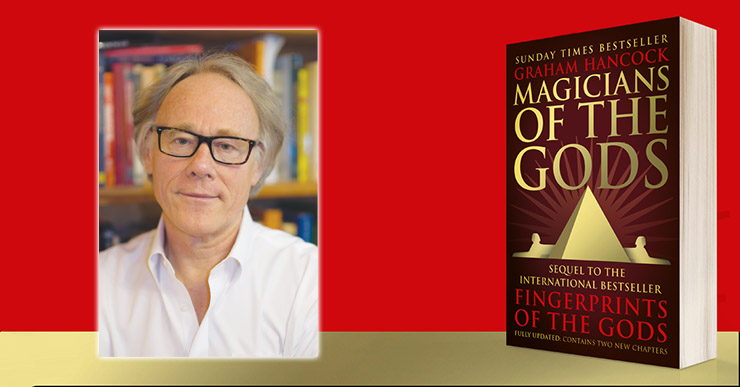
  • Magicians of the Gods: An Interview with Graham Hancock

    Magicians of the Gods: An Interview with Graham Hancock

    From New Dawn 153 (Nov-Dec 2015)

    Author and theorist Graham Hancock has had a sizeable impact upon the popular understanding of humanity’s ancient past. His global 1995 bestseller Fingerprints of the Gods contended that some previously ancient but highly advanced civilisation existed in prehistory, one which served as the common progenitor civilisation to all subsequent known historical ones. Further books such as Keeper of Genesis (with Robert Bauval), Underworld (studying underwater ruins as evidence of lost civilisations) and others propose bold new theories that challenge mainstream dogma.

    Hancock’s new book Magicians of the Gods: The Forgotten Wisdom of Earth’s Lost Civilization – a sequel of sorts to Fingerprints – gathers compelling evidence pointing to an ancient global cataclysm, caused by devastating meteor impacts, that may have all but erased a highly advanced human society and forced the survivors to, in essence, start again. Hancock also presents evidence the Earth may soon face this potentially species threatening meteor stream again.

    David Thrussell spoke to Graham Hancock in this exclusive interview for New Dawn.

    DAVID THRUSSELL (DT): From a distance, you appear to have what could be described as an ideal life Graham, travelling around exotic and interesting places, exploring the edges of history and knowledge. Are there any downsides, disappointments or frustrations in your work?

    GRAHAM HANCOCK (GH): I feel glad that I’ve had the opportunity in this life to explore and spend time in so many incredible, mysterious, profoundly moving ancient sites, all around the world. It’s been a great privilege to have the opportunity to do this, and I have no complaints whatsoever. I’m grateful for my life. I have a lot of freedom and I’ve worked from home since I was 29 as a matter of fact – that’s when I decided I couldn’t work in a large organisation anymore, and struck out on my own. For a very long time I was completely broke. Eventually I started to manage to make a living from it. But I have no complaints. I think I’ve been very fortunate and I’m grateful for the life I’ve had the opportunity to lead.

    DT: How long have you been working, brewing away on the new book [Magicians of the Gods]?

    GH: Well in a sense, 25 years. As a focused project, about 3½ years, but this book draws on my interests and enquiries into this field going back to the end of the 1980s.

    DT: Now, if you had to advance a single most compelling piece of evidence to support your theory, what would it be and why would it be that?

    GH: Well, it’s more complicated than that. This is not a problem that can be solved by a magic bullet. This is a problem that requires co-ordination of evidence from many different sources. I would offer you three pieces of evidence that are all in a sense joined together, and one of those pieces of evidence, a very important piece of evidence, is something we have now, but I didn’t have when I wrote Fingerprints of the Gods in 1995. It’s effectively a smoking gun, globally. Scientific evidence for a global cataclysm between 13,000 and 12,000 years ago. That was essentially the hypothesis I put forward in Fingerprints of the Gods, that there had been a global cataclysm between 13,000 and 12,000 years ago, and it wiped out an advanced civilisation, and I speculated on many possible causes of that cataclysm – notably pole shift and Earth crust displacement.

    What happened since 1995, and particularly since 2007, is that a group of scientists have put before the scientific community – very little of this has yet leaked out to the public – absolutely compelling evidence Earth suffered a series of impacts from fragments of a giant comet, and these impacts happened 12,800 years ago when several fragments hit the North American ice cap, causing global flooding and radical climate change. It happened again 11,600 years ago when more fragments from the same comet came out of orbit and smacked down into an ocean – almost certainly the Pacific – sending up a huge plume of water vapour into the upper atmosphere and causing very sudden global warming. So the interval between those two periods, the 1,200 years between 12,800 years ago and 11,600 years ago, is an episode of almost unparalleled global cataclysm, coupled by massive extinction of animal species, the mega mammals, the mammoth, the woolly rhino, and so on. And this is the event that I believe lost us a whole civilisation of pre-history that previously has not entered the archaeological records.

    Now, let’s co-ordinate this with the latest discoveries in archaeology. Remember that one of the two dates for that cataclysm is 11,600 years ago. This was a sustained event that involved two separate bombardments from fragments of a comet. On both occasions there were massive sea level rises and a global cataclysm unfolded. The first occasion 12,800 years ago, the second occasion 11,600 years ago, were also accompanied by global flooding and massive sea level rises. It’s therefore intriguing that the archaeological site in south eastern Turkey, known as Göbekli Tepe – which means ‘pot-bellied hill’ in the Turkish language – was created 11,600 years ago by people who already knew how to work with giant megaliths. Göbekli Tepe is an anomaly, because it’s 7,000 years older than other megalithic sites around the world, and yet it demonstrates advanced techniques of stonework and stone cutting, organisation of labour, planning, site design and alignment to the heavens. This is not the work of a group of hunter-gatherers who woke up one morning and felt suddenly inspired to create the world’s first megalithic architecture. In my view, what we’re looking at is a transfer of technology, the knowledge brought by the survivors of the lost civilisation, including the knowledge of how to create large-scale megalithic structures – and at exactly the same moment 11,600 years ago we get this sudden and unexplained appearance of a sophisticated megalithic site in south eastern Turkey.

    We also get the dissemination and uptake of agriculture in exactly the same region, whereas previously the inhabitants had been entirely hunter-gatherers. I say again, what we’re looking at is a transfer of technology, the fingerprint of the survivors of a civilisation that was lost in the cataclysmic events between 12,800 and 11,600 years ago.

    And I mention a third point, the age-old myth of Atlantis, which isn’t actually that old because the version of it that comes down to us – the only version that comes down to us – is in the works of the Greek philosopher Plato. Plato said he got the story of the submergence and destruction of the advanced civilisation of Atlantis through his ancestor Solon, the Greek law-maker who visited Egypt in 600 BCE, and there was told, by Egyptian priests, the story of Atlantis. And they said Atlantis had been destroyed and submerged, having incurred the anger of the gods, 9,000 years before the time of Solon. We know that Solon was in Egypt around 600 BCE, therefore they are talking about 9,600 BCE in our calendar, 11,600 years ago, which is the date precisely for the appearance of these hitherto unheralded techniques of megalithic architecture and agriculture in the region of south eastern Turkey.

    DT: The cataclysm you’re talking about has been staring us in the face really, hasn’t it?

    GH: It has been staring us in the face, but I don’t blame historians and archaeologists for failing to get to grips with it sooner than this. Because the leading scientists in the field have only really been compiling and presenting evidence on what is now referred to as the Younger Dryas comet for the last seven or eight years. It’s a very recent discovery and the reason it’s a recent discovery is that the major impacts of this comet 12,800 years ago were on the North American ice cap. This was still the Ice Age. North America, as far south as New York, was covered with ice, two miles deep, and at least four fragments of the comet hit the ice cap. But they did not leave prominent craters on the ground because the craters were in the ice itself and the vast heat and kinetic energy of the comet melted away that ice, so the craters were transitory and what we have is shock effect on the ground underneath. Recently, a number of craters have been found. The kind of craters that would be left when an object hit a two mile deep ice cap and transferred its shock to the bedrock underneath.

    Much more important is the evidence of the Younger Dryas scientific team – more than 30 scientists are working on the Younger Dryas comet. That evidence is based on what I call “impact proxies.” When you get an object coming in at 60 or 70 thousand miles an hour, and that object is a kilometre or two in diameter, it has unbelievable quantities of kinetic energy, and then you’re looking at an explosive power in the range of the entire nuclear arsenal of planet Earth, going up at once, with any single one of these objects. And there are certain, very recognisable outcomes of this. One is melt glass. You have heat unleashed in excess of the boiling point of quartz. Temperatures in excess of 2,200 degrees centigrade. This produces melt glass which is indistinguishable from the melt glass we find as a by-product of nuclear explosions. You also get carbon micro-spherules and very distinct nano-diamonds that are caused by the shock and heat. These nano-diamonds are only visible under a microscope, and they are combined with the melt glass, the carbon micro-spherules, and other evidence all around the world. They are compelling evidence for a gigantic cosmic impact 12,800 years ago.

    And, by the way, it’s exactly this kind of evidence that was initially put forward to prove the asteroid that wiped out the dinosaurs 65 million years ago. There’s only two occasions in Earth’s history, in the last 100 million years, that we get precisely the same impact proxies spread around the world. One of them is the so-called KT event 65 million years ago that wiped out the dinosaurs. And the other is the hitherto unrecognised, but now very obvious extinction level event that happened 12,800 years ago, and was caused by the Younger Dryas comet. I say “Younger Dryas” because that is the geological name for the period between 12,800 years ago and 11,600 years ago when the Earth’s climate fell into a sudden and hitherto unexplained deep freeze. We now know the cause of this. It was our interaction with the fragments of a giant comet, and the effects were truly cataclysmic.

    [alert type=”info” dismiss=”no”]If you appreciate this article, please consider a subscription to New Dawn magazine.[/alert]

    DT: Is it reasonable to suggest that mainstream academia, media and science are wedded to a particular view of history?

    GH: Yes. It is reasonable to suggest that, and it’s not surprising either. It’s just always the case – when you have any area of study, any discipline, whether it’s geology or whether it’s archaeology for that matter – that a body of knowledge is built up. And respected elders have contributed to that body of knowledge, and the new generation obviously respects the work of their elders. And gradually what builds up is a reference frame, a picture for how that area of study should be. In the case of archaeology, the picture that built up over the last 100 years of work is of a slow evolution of civilisation – that our ancestors were hunter-gatherers and nothing more until perhaps 8 or 9 thousand years ago. Then we begin to see the gradual movement towards more permanent settlement and about 5,000 years ago we get the first big cities and the first great megalithic architecture. This is the picture of civilisation taught to us by mainstream academic historians and archaeologists. It’s taught in the schools, it’s by and large conveyed through the media, but it is not a fact, it is a reference frame. It is a reference frame built up by 100 years of archaeological study. And this is, I think, the problem with archaeology and other scientific disciplines that get locked in a particular reference frame. When new facts emerge that don’t fit the reference frame, they find it difficult to adjust to them, and the first step is the attempt to discredit those facts. When more and more evidence comes in that the existing paradigm can’t explain, eventually the paradigm gets overthrown. A lot of good people who’ve done a lot of good work, who are convinced they’re right, who respect the work of their elders, and who don’t want to rock the boat – I think that’s the central problem. It always happens in science. No ideas change suddenly overnight without overwhelming new evidence that the previous paradigm cannot explain. That’s what we’re finding in the field of history and archaeology now – more and more new evidence coming in that simply can’t be explained by the existing reference frame of history.

    DT: Would you care to speculate – if the theory that you’re advancing is indeed correct – what pre-history looked like? What would history on Earth look like before this comet struck the planet?

    GH: A much more complicated world than the world portrayed to us by mainstream historians and archaeologists. Not a world populated entirely by hunter-gatherers as they suggest, but a world in which hunter-gatherers, and a more advanced civilisation, co-existed. This, in a way, is not odd. If you think about it, we are a very advanced technological civilisation today – Western technology, the industrial-technological-complex that has spread around the world, but we are not alone. We share the world with hunter-gatherer people – hunter-gatherers in the Kalahari Desert, for example, and in Southern Africa. Hunter-gatherers in the Amazon Basin. There are even tribes in the Amazon Basin who are completely un-contacted, who don’t even know that we exist; an advanced technological culture has not even impinged on their worldview yet. So the co-existence of advanced technology with hunter-gatherers that we see today, I would project that back into the past, and I would say more than 13,000 years ago during the Ice Age there was a much more advanced civilisation on this planet, than is given credit for by historians and archaeologists. It is remembered in myth and tradition all around the world, and it’s increasingly supported by recent striking archaeological discoveries such as Göbekli Tepe.

    DT: You mentioned two obvious cataclysmic events – the dinosaur extinction and the Younger Dryas events. Is it possible there have been other cataclysmic events that we have no inkling of?

    GH: Certainly there have been other cataclysmic events, and we do have inklings of them. The only question is, whether they affected the human species, and this becomes a matter for further enquiry. I hold, for the moment, the view that anatomically modern humans – people who look just like you and I – have only existed on Earth for about 200,000 years. It may well be that further discoveries will produce evidence of earlier anatomically modern humans. I don’t rule that out. But at the moment the evidence points to the emergence of our anatomically modern line about 200,000 years ago. We have, for example, a skeleton from Ethiopia, 196,000 years old, which is indistinguishable from an anatomically modern human being. So for these cataclysms to involve humanity and to impact the human story, they need to have happened within a human timeframe. This is why the Younger Dryas event is so intriguing because not only is it within the human timeframe, it’s right on the edge, on the border of a period when historians and archaeologists think civilisation began. Yet they had not yet taken into account this extinction level cataclysm, right in the backyard of history, and I would say that until they do take it into account, all their notions about the origins of civilisation are up for grabs.

    There have been multiple other global cataclysms of an extinction level going back hundreds of millions, even billions of years in the past. These things happen from time to time, and every time they happen they reset the clock on this planet, and life changes due to these dramatic and radical events. I think it’s only the most recent one, the one that happened 12,800 years ago, that directly impacted the human story – and this recent global cataclysm has not yet been taken into account in the model building of our past by historians and archaeologists.

    DT: Is it possible that mainstream science, the media, or even the general population in a sense, don’t want to know about our own history as a species?

    GH: There appears to be a kind of directive operating at governmental level, not to say things too alarming. It particularly applies to issues that involve global cataclysms. Anybody who’s worked in the field of geology will know that proposing a cataclysmic agent results in furious criticism. There was a great geologist called J. Harlan Bretz – whose work I write about in Magicians of the Gods – who provided the first evidence of cataclysmic flooding in North America, particularly in the Pacific north-west, in the channelled scablands, an area I researched quite intensively for Magicians of the Gods. J. Harlan Bretz was absolutely 100% right, but it took from the 1920s, almost to the 1970s, before he was accepted as being right. Prior to that he had been subjected to the most grievous and unpleasant abuse, which a weaker man might not have borne. In the end he turned out to be correct and he lived until the age of 99. And when he was awarded America’s highest honour for a geologist, he said: “My only regret is that all my enemies are now dead, and I have no-one to gloat over.”

    DT: If there is an active effort to forget or obscure history, why would that be?

    GH: I’m not sure. I don’t want to go in the direction of a conspiracy. I think it’s just the way people’s minds work. We find it difficult to conceive of certain things, or apply them to ourselves. There may be a conspiracy. I have to contemplate this possibility a little bit in the book. I don’t like conspiracy theories – it’s an area of enquiry where facts get thin on the ground and speculation gets very thick and long. When I look at the way the catastrophists’ ideas have been systematically rubbished, sometimes for decades until proved correct – the same was true, by the way, about the dinosaur impact. Initially no scientists believed that either. Luis and Walter Alvarez, who initially proposed the idea of a cosmic impact 65 million years ago, were subjected to abuse and persecution, and they too were eventually vindicated.

    DT: Are you aware of the work of Steven and Evan Strong in Australia?

    GH: I know Steven and Evan Strong. They were kind enough to show me a number of interesting sites in Australia last year. I’ve got a lot of respect for their leg work and they’ve opened my eyes to mysteries in Australia which I do intend to look at in the future. Australia has not been a big focus of my work up till now.

    DT: Do you ever suffer from ‘apocalypse fatigue’? It seems to be a staple of human endeavour, doesn’t it, thinking that a cataclysm is around the corner?

    GH: No, I don’t suffer from ‘apocalypse fatigue’, and I don’t go around thinking that the end of the world is nigh, either. I do think we should be paying much more attention to our cosmic environment. At the moment the human race has its priorities all screwed up. We’re capable of spending trillions of dollars a year on weapons of mass destruction, quite ready to wipe each other out and destroy this beautiful and precious habitat, the Earth, that the universe has given us. Humanity shows every sign of being an insane species at the moment, an insane and unconscious species, totally devoted to material production and consumption, uninterested in matters of spirit. Negligent of this beautiful garden in which we find ourselves.

    If we were to take the responsibility of human life seriously, we would closely and carefully inspect our immediate cosmic environment. I have drawn attention in the book to the fact that the debris stream of the giant comet that caused the cataclysm 12,800 to 11,600 years ago is still in orbit. It’s called the Taurid meteor stream. We pass it twice a year. If we were smart we’d pay a great deal of attention to the objects that orbit in the Taurid meteor stream. And if, as seems likely, some of them threaten Earth in the future, we have the technology, we have the ability to avert that danger. I’m only interested in the issue of future cataclysms to the extent that we can avoid them, and that foreknowledge of them would help us avoid them, and I believe that is the case with the cosmic threat. There is a threat, there is an ongoing danger. Most responsible and serious astronomers would absolutely agree with that.

    We mark World Asteroid Day on 30 June, which is an attempt to draw attention to the dangers of our immediate cosmic environment, and to do something about it. We’re probably the first civilisation in the history of Earth that has the capacity to intervene in our cosmic environment and to deflect or divert objects that might threaten life. I think we’d be doing a lot better if we directed our resources more responsibly – a lot of the money we spend on useless military pursuits at the moment – and channelled it instead to a thoroughly worked out space-watch project to ensure Earth never again suffers the kind of disasters it suffered between 12,800 and 11,600 years ago. We are going down the path of insanity and madness with our military spending. With all the fear and hatred and suspicion circulating in the world at the moment, we need to recognise that we’re all brothers and sisters, we’re one human family, and perhaps the prospect of dealing with a shared common threat would be the very thing to bring us together.

    DT: Ironic, isn’t it, there may be a weapon of mass destruction bearing down upon us all right now.

    GH: Yes, exactly. This is possible. A number of astronomers (including Bill Napier) and the mathematician Emilio Spedicato at the University of Bergamo, are all deeply concerned about the Taurid meteor stream. They believe it has a number of very large objects, including one that may be 30km wide, and the Earth crosses this stream twice a year. Some calculations indicate we may be crossing particularly lumpy and dangerous parts of the stream within the next 30 years or so. Nothing really could be more urgent. We need to pay attention to this problem. We need to identify objects that endanger Earth, and we need to move them. All of that we can do, it just takes the will. We already have the technology. But while we go around fearing and hating and suspecting one another, our eye’s not on the ball. Our eyes are on totally the wrong place.

    DT: I couldn’t agree more with you.

    Magicians of the Gods: The Forgotten Wisdom of Earth’s Lost Civilization by Graham Hancock is available from all good bookstores. Graham Hancock’s website is www.grahamhancock.com.

    [alert type=”general” dismiss=”no”]This article was published in New Dawn 153.[/alert]

    [alert type=”success” dismiss=”no”]If you appreciate this article, please consider subscribing to help maintain this website.[/alert]

    © New Dawn Magazine and the respective author.
    For our reproduction notice, click here.
  • Searching for the  Dawn & Demise of Ancient Civilisation

    Searching for the Dawn & Demise of Ancient Civilisation

    From New Dawn Special Issue 8 (June 2009)

    When and where did civilisation begin? How far back in time does high culture go? Indeed, what do we mean by such terms as civilisation, or sophisticated and high culture?

    When I was in college, more years ago than I perhaps care to remember, I learned the standard story which still holds sway in many circles: Civilisation and high culture date back to, at most, perhaps five or six thousand years ago. A handy marker for recognising a true civilisation was written language, and it was generally agreed that the earliest true writing could be dated to the late fourth millennium BCE (that is, circa 3500 to 3000 BCE).

    The Sumerians are generally credited with developing writing about 3300 to 3200 BCE, although the earliest Egyptian hieroglyphics may date back to the same period, or even a century or so earlier, and there is also evidence of writing possibly from as far back as 3500 BCE found at Harappa, the Indus Civilisation, in what is now modern Pakistan.1

    But then there are reports of much earlier possible writing from Henan Province, China, dated to 6600 to 6200 BCE, inscribed on tortoise shells.2 I recollect a book I read while still an undergraduate, The Roots of Civilization by Alexander Marshack, which argued that various lines, notches, and “scratchings” on ancient bone artefacts dating to 10,000 BCE and earlier, before the end of the last Ice Age, were in fact symbolic systems, including lunar calendar notations. Maybe our ancestors were not so primitive and stupid after all.

    Maybe defining civilisation and high culture in terms of a written language (or more accurately our knowledge of a recorded language; we can easily miss things in the archaeological record) simply is not a fruitful approach. This is the conclusion I have come to while pursuing my own research.

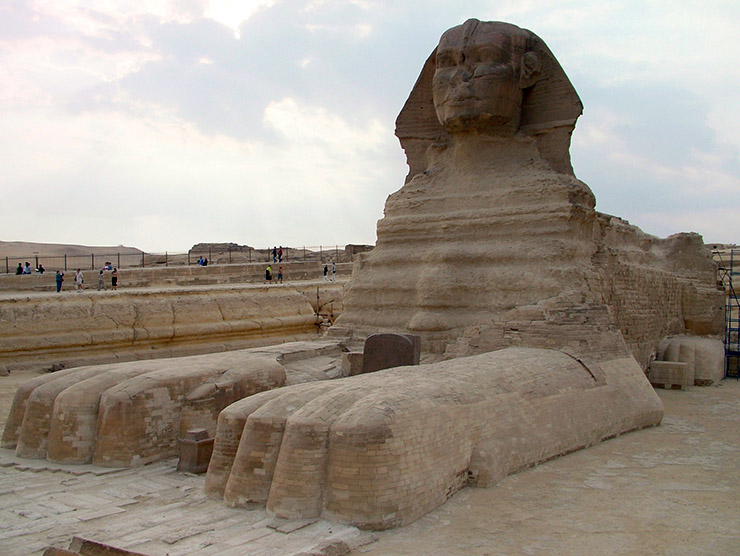
    Re-Dating the Great Sphinx of Egypt

    I first came to the problem of the origin of civilisation through my studies of the Great Sphinx of Giza, Egypt. Combining a Ph.D. in geology and geophysics from Yale University (1983) with a lifelong enthusiasm for ancient cultures, on my first trip to Egypt in 1990 I was primed to take a careful look at the Sphinx.

    As I have recounted elsewhere,3 my colleague and friend John Anthony West had suggested to me various silly notions that the Great Sphinx might be older than the standard Egyptological attribution of circa 2500 BCE. I figured that through a careful analysis of the geology, I could show the error in such thinking. Surely all those professional Egyptologists could not be wrong. It turns out they were.

    Based on my geological and seismic analyses, utilising the weathering and erosion patterns correlated with the palaeoclimatology and subsurface features,4 I concluded that the oldest portions of the Great Sphinx date back to at least the period of 7000 BCE to 5000 BCE, and perhaps back to 9000 BCE or earlier. To oversimplify a bit, the core body of the Great Sphinx shows features that place it well back before the onset of the current arid regime (the Giza Plateau is on the edge of the Sahara Desert) some 5,000 years ago.

    Such a conclusion has deep implications, suggesting that high culture and civilisation dates back much earlier than previously believed. I have been told on more than one occasion that my conclusions cannot be true because if they are, then “history must be rewritten.” Certainly, we cannot have that, can we? Vested interests run high, and I have been attacked from many sides, both by orthodox Egyptologists and historians, and by various people not as closely associated with mainstream academia.

    Through it all over the last two decades, I have looked at the alternative theories suggested to explain the data, and I continue to maintain that the evidence clearly points to the origins of the Great Sphinx being much older than 2500 BCE. Indeed, the attacks and criticisms, forcing me to carefully scrutinise and enlarge my dataset, have served only to reaffirm my conclusions.

    The Sphinx Under Water, or Under Fire?

    Recently my work on the Great Sphinx has come under fire from a self-described anti-Establishmentarian. Given the number of people who have been asking me about this latest “Sphinx theory,” I feel it is imperative that I briefly address it here.

    Robert Temple5 has proposed a moat theory (that is, the Sphinx Enclosure was purposefully filled with water such that the body of the Sphinx was submerged and sat as a statue in a small artificial lake) to explain the clear signs of water weathering and erosion on the body of the Great Sphinx and on the walls of the Sphinx Enclosure.

    Temple contends that the moat theory explains the data adequately without hypothesising that the Great Sphinx dates back to a much earlier period during which there was more rainfall than at present. (Here I will not address his hypotheses, which I do not find persuasive, that the Sphinx was the jackal [wild dog] Anubis and the face seen on the Sphinx is that of the Middle Kingdom pharaoh Amenemhet II, though I would point out that the original Sphinx has been reworked and the head has been re-carved, perhaps more than once.)

    The body of the Sphinx, carved from the bedrock, sits largely below ground level, and various moat, pool, or artificial fountain hypotheses have been suggested for the Sphinx from time to time. I considered such notions carefully as far back as my early analyses of the geology of the Sphinx, starting in 1990. In summary, such moat and related theories do not hold water (to use a bad pun) and are not compatible with the features of the actual Great Sphinx, the Sphinx Enclosure, and the general geology and palaeohydrology of the Giza Plateau.

    Scrutinising the Sphinx

    While in Egypt recently (March 2009) I made it a point to look at the Great Sphinx and Sphinx Enclosure with fresh eyes to see if there could be anything to the moat class of theories. I will summarise briefly a half dozen points.6

    1) Based on my observations and analyses, the Sphinx Temple (built out of blocks removed from the Sphinx Enclosure when the body of the Sphinx was initially carved) and the so-called Valley Temple to the south of the Sphinx Temple show clear signs of heavy precipitation-induced weathering on the limestone core blocks. These limestone temples were subsequently refurbished with Aswan granite ashlars during the Old Kingdom (as evidenced by an Old Kingdom inscription still found on a block located at the Valley Temple). The moat theory cannot explain the nature of the very ancient weathering seen under the Old Kingdom granite veneer.

    2) There is much heavier surface erosion on the western end of the Sphinx Enclosure, and the surface erosion tapers off dramatically toward the eastern end of the enclosure. This is exactly what is to be expected based on the palaeohydrology of the Giza Plateau and is incompatible with a moat theory where it is hypothesised that water was brought in from the Nile to the east. Furthermore, the nature of the surface erosion throughout the enclosure and on the body of the Sphinx is as expected if there were water running over or raining down on the rock layers. The erosion actually observed is not compatible with pooled water in the enclosure.

    3) The highest levels of the middle member strata, as seen in the Sphinx Enclosure on the western end, are most severely eroded, which is compatible with the agency of precipitation. If the moat theory were true, then the lower strata on the eastern end of the Sphinx Enclosure would be most heavily eroded (caused by water being brought in via canals from the Nile), but the opposite is seen in reality.

    4) The subsurface seismic data demonstrating the depth of weathering below the floor of the Sphinx Enclosure, based on my analyses (using areas excavated during the Old Kingdom for comparison), even when calibrated very conservatively, gives an age of initial carving for the core body of the Great Sphinx of at least 5000 BCE. More than one geological colleague has suggested to me that a more realistic calibration gives a date thousands of years earlier. And no, standing water in the Sphinx Enclosure would not accelerate the depth of weathering below the floor of the enclosure.

    5) The vertical fissures observed in the walls of the Sphinx Enclosure show diagnostic signs of having been formed by precipitation and water runoff. In my opinion, they do not show any characteristics that are diagnostic or even suggestive of having been formed by artificial dredging of the Sphinx Enclosure, as some have suggested.

    6) If the Great Sphinx actually had sat in an artificial pool or lake, either the water level around the Sphinx would have had to have been the same as that of the surrounding water table, or the walls and floor of the pool in which the Sphinx sat would have had to have been sealed up and watertight (and any artificial walls, such as on the eastern end, would have had to have been strong enough to withstand the pressure of the water). Clearly, the ancient water table was well below the level of the floor of the Sphinx Enclosure (or else the Sphinx Temple, for instance, would have been flooded). The Sphinx Enclosure, if simply carved from the bedrock (as all the evidence suggests) would not have held a deep pool of standing water. The bedrock in the enclosure is highly faulted, and characterised by a karst morphology that would leak like a sieve (another bad pun, perhaps). The enclosure would have had to have been fully sealed up (with some kind of mortar or cement, perhaps), and there is no evidence of such sealing. Furthermore, if the enclosure had been sealed in such a manner, this would not be compatible with the dredging theory for the vertical fissures mentioned in the previous point. I would also note that the chambers and tunnels under the Great Sphinx would have been flooded from above if the Great Sphinx had been sitting in a pool of water, unless the Sphinx Enclosure had been watertight; yet the evidence suggests the enclosure was not watertight.

    Could the Sphinx be Hundreds of Thousands of Years Old?

    Even as my re-dating of the Great Sphinx has been attacked as impossible by some authorities, other serious researchers have suggested that I have underestimated the true age of the oldest portions of the Great Sphinx by a factor of ten or more!

    For instance, two members of the National Academy of Sciences of Ukraine, Vjacheslav I. Manichev and Alexander G. Parkhomenko,7 citing my work, have reinterpreted the geology and erosional features on the Great Sphinx to mean that the core body of the statue could date back as far as 800,000 years ago. And they are not referring to simply a natural outcropping that may have existed 800,000 years ago that was later shaped into a statue. (Remember, too, that to carve the core body of the Sphinx huge multi-ton blocks were removed from the Sphinx Enclosure and assembled as the Sphinx Temple, so the original Sphinx Temple is as old as the core body of the Great Sphinx).

    The dating of Manichev and Parkhomenko could push the age of the Great Sphinx into a very remote time period, one that has been suggested for possible, but ambiguous, ancient structures, sculptures, or simulacra that are found in many parts of the world, such as Markawasi in Peru,8 the Romanian Sphinx,9 or a possible stone circle dubbed Adam’s Calendar by researchers Johan Heine and Michael Tellinger with a claimed date of 75,000 years ago.10 Personally, I am not convinced that the Great Sphinx is anywhere close to the age postulated by Manichev and Parkhomenko, or that various claimed very ancient, very eroded statues are anything more than natural formations, but the prospects are intriguing. Without going off on such limbs, there is clear evidence for early high culture at a remote period beyond just that of the Great Sphinx.

    Nabta Playa

    In the Sahara Desert of southern Egypt, west of Aswan, is an area known as Nabta Playa. Here an ancient stone calendar circle, as well as many other megalithic erections and structures, was identified by archaeologist Fred Wendorf (Southern Methodist University) and his team and dated to circa 4000 BCE and earlier.11 

    Thomas Brophy12 has carried out extensive analyses of Nabta. According to Brophy, three stones inside the Nabta calendar circle represent the belt of Orion (just as the three pyramids of Giza represent the belt of Orion according the research of Robert Bauval13). The stones on the Playa and the corresponding stars in the sky aligned on summer solstice nights between about 6400 BCE and 4900 BCE. Brophy found even more correlations, however. Three other stones in the Nabta calendar circle correspond to the configuration of Orion’s head and shoulders as they appeared in circa 16,500 BCE, about half a precessional cycle earlier than the previously mentioned alignment. Based on these and other analyses of monoliths in the area, Brophy concludes that the early inhabitants of Nabta Playa possessed incredibly sophisticated knowledge, the type of knowledge we associate with high culture and civilisation. Furthermore, the dates of the Nabta structures are in line with my dating of the oldest portions of the Great Sphinx, and at both Giza and Nabta the constellation of Orion (which represented the god Osiris during dynastic times) was of prime importance.

    Göbekli Tepe

    If the dating of the Great Sphinx remains controversial (after all, old ideas die hard), and the analyses of Nabta Playa are questionable in the eyes of some researchers, there is one site that even the most ensconced conventional archaeologists cannot ignore.

    In modern Turkey, just north of the border with Syria, is a site known as Göbekli Tepe that has yielded dozens of carved limestone megaliths, many of which date back to the extraordinarily early period of 9000 BCE to 10,000 BCE.14 Klaus Schmidt, of the German Archaeological Institute, has been heading an excavation team there since 1994, and there is no doubt as to the importance, authenticity, and dating (based in part on radiocarbon) of Göbekli Tepe. This is a discovery made by mainstream academics.

    Göbekli Tepe boggles the imagination on many accounts. The date is incredibly early, even earlier than my “conservative” estimate for the date of the Great Sphinx. Göbekli Tepe dates back to the end of the last Ice Age. The monolithic megaliths are in the range of two to seven metres high (the latter is the height of an unfinished megalith left where it was being quarried). Sculpted onto the surfaces of the monoliths are a variety of animals, including snakes, boars, foxes, vultures, spiders, scorpions, a centipede, and a three-dimensional figure that has been interpreted as a lion. The megaliths excavated thus far had been erected into four distinct stone circles, ranging from ten to thirty metres in diameter. Based on geophysical surveys, the entire site may cover three dozen hectares (about 90 acres) and contains another twenty or so stone circles.

    Although very different from the Great Sphinx and the Sphinx Temple, in my estimation, taking the entire Göbekli Tepe site as a whole into account, just as much effort, social organisation, and sophisticated or high culture must have been required to construct the Göbekli Tepe complex as the Sphinx complex. When I first presented my findings on the age of the Great Sphinx, I was told over and over again by mainstream archaeologists and historians that my dating was simply impossible because it was well known that nothing so elaborate and sophisticated, requiring an advanced level of social organisation, could occur so early. Göbekli Tepe proves these assertions false and helps place the Great Sphinx in a larger context.

    The work at Göbekli Tepe has literally just begun. Most of the site has yet to be excavated and who can predict what surprises might be in store for us? Who were the people that built the site, and why did they build it? So far there is no evidence that the site was inhabited; no living areas have been excavated, though the thousands of animal bones found (the most common animal represented is the aurochs, a type of extinct ox) are evidence of feasting at the site. Was it a holy, sacred site? An area for religious pilgrimages? Or perhaps an ancient centre of knowledge? My instinct is that the positions of the monoliths, and the specific carvings on their surfaces, probably encode information… but what? And what happened to the people who built and used Göbekli Tepe? Curiously, the site did not simply fall into disuse and gradually decay. It was intentionally buried somewhere around 8000 BCE. Why? The mystery only deepens.

    The Origin and Demise of Early High Culture

    There has been space here to mention only a few examples of archaeological sites that challenge the conventional view of when high culture, advanced knowledge, and civilisation arose. Admittedly, I have dwelt on those that most interest me, including the Great Sphinx with which I have become entwined. Put all the evidence together and there is no doubt in my mind that what we can term high culture existed at least 11,000 years ago (and possibly much earlier).

    Where did early civilisation originate? And what happened to it? Is there a lost primordial ancient civilisation, one that was destroyed in some cataclysmic natural catastrophe? Could the legend of Atlantis have some truth to it? These are questions I have pondered long and hard for many years.

    Being a geologist, I view Earth and our environment as unstable, full of unexpected surprises, at least over the long term. Climates change, sea levels rise and fall, volcanoes erupt, earthquakes rock the land and sea, and objects fall from the sky. I have discussed how such natural cataclysms may have influenced the history of ancient civilisations,15 and in particular I have pointed out that Earth has experienced a series of encounters with comets during historical and prehistoric times.16

    Depending on the severity of the encounter (size of the comet, whether it actually touched the surface of Earth or perhaps resulted in a mid-atmosphere explosion, and so forth), dramatic climatic changes could be affected on Earth, which in turn could affect sea levels, and weather extremes can wreck havoc on animal and human populations, causing famines.17

    In 2003 I suggested that the end of the last Ice Age may have been brought about in part by comets bombarding Earth,18 and this hypothesis has received dramatic support with physical evidence for an impact around 10,900 BCE.19 There is also evidence for impacts around 7600 BCE, 4400 BCE, 3150 BCE, 2345 BCE, 1628 BCE, 1159 BCE, 207 BCE, 536 CE, and 1178 CE.20 

    Bottom line, based on all the evidence, there is no doubt in my mind that these incidents, these cosmic catastrophes, had a profound influence on ancient civilisations. In some cases migrations were sparked, in other cases entire cultures may have been wiped out.

    At the end of the last Ice Age, from before around 18,000 BCE to perhaps 11,000 BCE or later (dates at such a far remove are approximate), when sea levels were significantly lower (by seventy-five to a hundred and twenty metres), a sub-continental expanse of land was exposed in Southeast Asia where there is now only water in the area bounded by Indochina, the Malay Archipelago, the islands of Indonesia, and Borneo. To geologists this drowned region is known as Sundaland, and there is a variety of evidence that here an early civilisation was located; they fled as the waters rose and the comets came down.21 Could this be the primordial lost civilisation that so many of us suspect once existed?

    And what about that intentional burial of the structures at Göbekli Tepe? Did they see their fate in the skies? As the comets rained down did those ancient builders do their best to cover and preserve that which they had so carefully created, perhaps hoping to return one day to uncover their monuments? Or did they leave them for us to recover?

    [alert type=”general” dismiss=”no”]This article was published in New Dawn Special Issue 8.[/alert]

    [alert type=”success” dismiss=”no”]If you appreciate this article, please consider subscribing to help maintain this website.[/alert]

    FOOTNOTES

    1. David Whitehouse, “‘Earliest Writing’ Found”, BBC News Online, 4 May 1999; John Nobel Wilford, “Who Began Writing? Many Theories, Few Answers”, The New York Times on the Web, Science, 6 April 1999.

    2. Paul Rincon, “‘Earliest Writing’ found in China”, BBC Science.

    3. Robert M. Schoch with Robert Aquinas McNally, Voices of the Rocks: A Scientist Looks at Catastrophes and Ancient Civilizations, New York: Harmony Books, 1999.

    4. Robert M. Schoch, “Redating the Great Sphinx of Giza”, KMT, A Modern Journal of Ancient Egypt, vol. 3, no. 2, pp. 52-59, 66-70 (Summer 1992); Robert M. Schoch with Robert Aquinas McNally, Voyages of the Pyramid Builders: The True Origins of the Pyramids from Lost Egypt to Ancient America, New York: Jeremy P. Tarcher/Penguin, 2003; Robert M. Schoch & Robert Aquinas McNally, Pyramid Quest: Secrets of the Great Pyramid and the Dawn of Civilization, New York: Jeremy P. Tarcher/Penguin, 2005; T.L. Dobecki & R.M. Schoch, “Seismic Investigations in the Vicinity of the Great Sphinx of Giza, Egypt”, Geoarchaeology, vol. 7, no. 6, pp. 527-544 (1992); Robert M. Schoch, “Life with the Great Sphinx: Some Personal Reflections”, Darklore, vol. 1, pp. 38-55, 291 (2007).

    5. Robert Temple, “What was the Sphinx?”, New Dawn, no. 112, pp. 47-52 (January-February 2009); Robert Temple with Olivia Temple, The Sphinx Mystery: The Forgotten Origins of the Sanctuary of Anubis, Rochester, Vermont: Inner Traditions, 2009.

    6. For more details pertaining to some of these points, as well as various comments on the criticisms of K. Lal Gauri and his colleagues as cited by Temple with Temple [2009], see Robert M. Schoch, “Geological Evidence Pertaining to the Age of the Great Sphinx”, in New Scenarios on the Evolution of the Solar System and Consequences on History of Earth and Man (Eds. Emilio Spedicato and Adalberto Notarpietro), 2002. Proceedings of the Conference, Milano and Bergamo, June 7-9th, 1999, Università degli Studi di Bergamo, Quaderni del Dipartmento di Matematica, Statistica, Informatica ed Applicazion, Serie Miscellanea, Anno 2002, N. 3, pp. 171-203.

    7. Vjacheslav I. Manichev & Alexander G. Parkhomenko, “Geological Aspect of the Problem of Dating the Great Egyptian Sphinx Construction”, in Geoarchaeology and Archaeomineralogy (Eds. R. I. Kostov, B. Gaydarska, and M. Gurova) 2008. Proceedings of the International Conference, 29-30 October 2008, Sofia, Publishing House, “St. Ivan Rilski”, Sofia, pp.308-311.

    8. Robert M. Schoch, “Introduction”, in Markawasi: Peru’s Inexplicable Stone Forest (Ed. and Author, Kathy Doore, with a foreword by Peter E. Schneider), Surprise, Arizona: Kathy Doore, 2006, pp. 14-20.

    9. Anonymous, “THE BUCEGI – Sphinx,” article dated 10 October 2002 and posted at: www.ici.ro/romania/en/turism/c_sfinx.html. Accessed 4 April 2009.

    10. Angelique Serrao, “‘Oldest Man-Made Structure’ Unearthed”, Article dated 14 July 2008 and posted at: www.iol.co.za/index.php?from=rss_South%20Africa&set_id=1&click_id=13&art_id=vn20080714062546858C113827. Accessed 4 April 2009.

    11. J. McKim Malville, “Oldest Astronomical Megalith Alignment Discovered in Southern Egypt by Science Team”, Press release dated 31 March 1998 and posted at: www.colorado.edu/news/releases/1998/101.html. Accessed 5 April 2009.

    12. Thomas G. Brophy, The Origin Map: Discovery of a Prehistoric, Megalithic, Astrophysical Map and Sculpture of the Universe (Foreword by Robert M. Schoch and Afterword by John Anthony West), New York: Writers Club Press (iUniverse), 2002; Mark H. Gaffney, “The Astronomers of Nabta Playa: New Discoveries Reveal Astonishing Pre-Historic Knowledge”, Atlantis Rising, no. 56, pp. 42-43, 68-70 (March/April 2006).

    13. Robert Bauval & Adrian Gilbert, The Orion Mystery: Unlocking the Secrets of the Pyramids, New York: Crown Trade Paperbacks, 1994.

    14. Graham Chandler (photographs by Ergun Çağatay), “The Beginning of the End for Hunter-Gatherers”, Saudi ARAMCO World, vol. 60, no. 2, pp. 2-9 (March/April 2009); Andrew Curry (photographs by Berthold Steinhilber), “The World’s First Temple? Predating Stonehenge by 6,000 years, Turkey’s Stunning Gobekli Tepe Upends the Conventional View of the Rise of Civilization”, Smithsonian, vol. 39, no. 8, pp. 54-58, 60 (November 2008).

    15. Schoch with McNally, 1999.

    16. Schoch with McNally, 2003.

    17. For a discussion of the effects of a sixth century CE cometary event, see Ker Than, “Comet smashes triggered ancient famine”, New Scientist, issue 2689, p.9 (7 January 2009).

    18. Schoch with McNally, 2003.

    19. R.B. Firestone, A. West, J.P. Kennett, L. Becker, T.E. Bunch, Z.S. Revay, P.H. Schultz, T. Belgya, D.J. Kennett, J.M. Erlandson, O.J. Dickenson, A.C. Goodyear, R.S. Harris, G.A. Howard, J.B. Kloosterman, P. Lechler, P.A. Mayewski, J. Montgomery, R. Poreda, T. Darrah, S.S. Que Hee, A.R. Smith, A. Stich, W. Topping, J.H. Wittke, and W.S. Wolbach, “Evidence for an extraterrestrial impact 12,900 years ago that contributed to the megafaunal extinctions and the Younger Dryas cooling”, Proceedings of the National Academy of Sciences, vol. 104, no. 41, pp. 16016-16021 (9 October 2007).

    20. Schoch with McNally, 2003; Undoubtedly this list is incomplete, especially for the period between 10,900 BCE and 3150 BCE.

    21. Schoch with McNally, 2003.

    © New Dawn Magazine and the respective author.
    For our reproduction notice, click here.
  • The Mystery of Göbekli Tepe and Its Message to Us

    The Mystery of Göbekli Tepe and Its Message to Us

    From New Dawn 122 (Sept-Oct 2010)

    What were our ancestors like 10,000 or more years ago? The most common image is one of small nomadic bands endlessly in pursuit of the next meal. Men hunted game while women and children gathered fruits, seeds, roots, shoots, insects, and other edibles.

    The height of technology was a finely worked stone knife blade or spear point; nets, baskets, and cordage were also put to good use. Permanent structures were superfluous, for the group never stayed in one place very long. Material goods were sparse as possessions had to be limited to those easily carried. Jewellery (perhaps beads, animal teeth, or shells strung on a cord) and personal decoration (body paint, tattoos) were prized. In colder climates appropriate clothing was fashioned from animal skins. Social institutions were minimal. Not until the Neolithic Revolution, beginning about 10,000 years ago, did agriculture and domestication appear. This in turn allowed permanent settlement, leading to specialisation of labour, the development of crafts (including pottery and metalworking), the building of substantial structures, long-distance trade, and the slow and gradual evolution of complex societies.

    None of this happened overnight. It took thousands of years, and it was not until around 4000 to 3000 BCE that true signs of high culture first appeared, such as fine artistry in decorative crafts, written records, scientific observations of the heavens, complex political organisations, and megalithic building projects. This level of achievement was reached in Mesopotamia, the Nile Valley, and the Indus Valley by the beginning of the third millennium BCE. A well-known example is the rise of dynastic Egypt about 3200 to 3100 BCE and the building of the Djoser pyramid circa 2630 BCE. Stonehenge in England dates from the same period.

    Although accepted as dogma by many, this nice neat scenario may be completely wrong.

    Questioning Accepted History

    Back in 1991, I had the temerity to announce that the Great Sphinx of Egypt, conventionally dated to 2500 BCE (the reign of Pharaoh Khafre), actually has its origins in the 7000 to 5000 BCE range, or possibly earlier.

    My announcement was done via a presentation at the October 1991 annual meeting of the Geological Society of America (this was allowed only after a formal abstract, submitted with my colleague John Anthony West, was accepted based on positive professional peer review).1 I made my case utilising scientific analyses, comparing erosion and weathering profiles around the Sphinx to the ancient climatic history of Egypt.

    In brief, the Sphinx sits on the edge of the Sahara Desert, a hyper-arid region for the past 5,000 years; yet the statue shows substantial rain-induced erosion. The original structure must date back thousands of years prior to 3000 BCE (the head was re-carved in dynastic times).

    I had pushed the Great Sphinx, arguably the grandest and most recognisable statue in the world, back into a period when humanity was supposedly just transitioning from a hunter-gatherer economy to a sedentary life. People 7,000 or more years ago were still brutish and unsavoury, at least by modern civilised standards. Certainly they were not carving giant statues (the Sphinx is about 20 meters tall by over 70 meters long) out of solid limestone bedrock. Immediately after my announcement of an older Sphinx, I was under attack. Archaeologist Carol Redmount (University of California, Berkeley) was quoted in the media, “There’s just no way that could be true.” The article continued, “The people of that region would not have had the technology, the governing institutions or even the will to build such a structure thousands of years before Khafre’s reign, she said.”2

    The initial hoopla peaked in February 1992 at a “debate” on the age of the Great Sphinx held at the Chicago meeting of the American Association for the Advancement of Science.3 As the New York Times put it, “The exchange was to last an hour, but it spilled over to a news conference and then a hallway confrontation in which voices were raised and words skated on the icy edge of scientific politeness.” Egyptologist Mark Lehner could not accept the notion of an older Sphinx, personally attacking me by labelling my research “pseudoscience.” Lehner argued, “If the Sphinx was built by an earlier culture, where is the evidence of that civilisation? Where are the pottery shards? People during that age were hunters and gatherers. They didn’t build cities.”4 

    At the time I lacked any pottery shards. But I was sure of my science, and I persisted. Two decades later, we have something better than pottery shards, and even earlier than my conservative Sphinx date of circa 5000 BCE to 7000 BCE (I now currently favour the older end of this range, or an even earlier date for the original Sphinx). Göbekli Tepe dates from over 10,000 years ago.

    Pages from ndmain122
    Pages from ndmain122-2

    (Article Continues Below)

    Better than Pot Shards

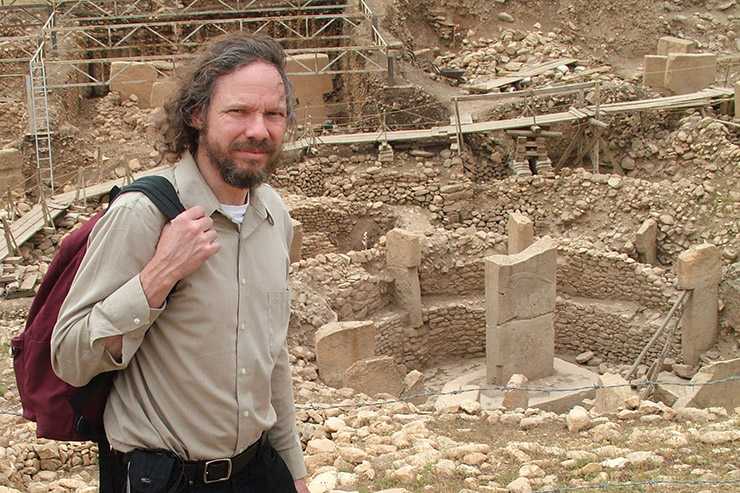
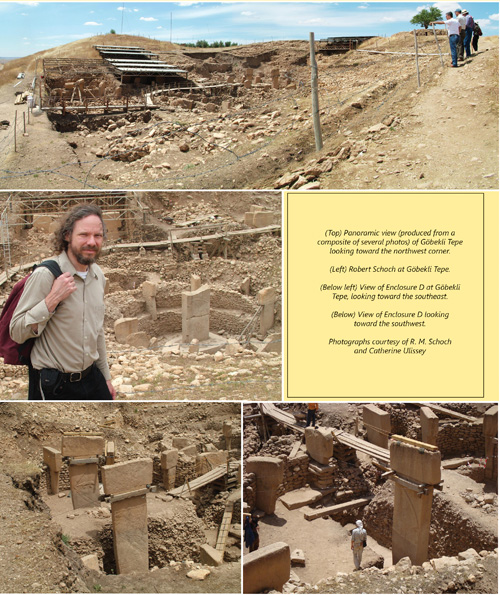
    A short drive from Urfa (alternatively Sanlıurfa), southeastern Turkey, atop a mountain north of the Harran Plain, sits Göbekli Tepe. Since 1995 Prof. Dr. Klaus Schmidt of the German Archaeological Institute has been excavating the site.5 Recently I visited it for myself. I was amazed.

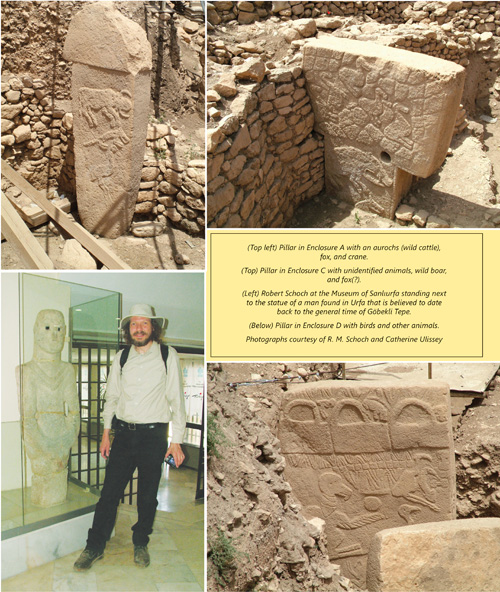
    At Göbekli Tepe immense finely carved and decorated T-shaped limestone pillars, many in the range of two to five and a half meters tall and weighing up to an estimated 10 to 15 tons, stand in Stonehenge-like circles. The workmanship is extraordinary, with clear sharp edges that would do any modern mason proud. It may be a cliché, but I cannot help but think of the opening scene of the classic 1968 movie 2001: A Space Odyssey. A group of ape-like proto-humans discovers a giant monolith; influenced by it, they learn to use tools, leading to civilisation.6 

    Various pillars at Göbekli Tepe are decorated with bas-reliefs of animals, including foxes, boars, snakes, aurochs (wild cattle), Asiatic wild asses, wild sheep, birds (cranes, a vulture), a gazelle, and arthropods (scorpion, ants). The carvings are refined, sophisticated, and beautifully executed. Not only are there bas-reliefs, but also carvings in the round, including a carnivorous beast, possibly a lion or other feline, working its way down a column, apparently in pursuit of a boar carved in relief below. In the round, carvings of lions and boars have been uncovered, now housed in the Museum of Sanlıurfa, as is a life-sized statue of a man, which, though from Urfa, apparently dates to the Göbekli Tepe era.

    Also from Göbekli Tepe are perfectly drilled stone beads. And, according to Prof. Schmidt, while some of the stone pillars were set in the local bedrock, others were set into a concrete- or terrazzo-like floor. Looking only at style and quality of workmanship, one might easily suggest that Göbekli Tepe dates between 3000 and 1000 BCE. How wrong one would be. Based on radiocarbon analyses, the site goes back to the period of 9000 to 10,000 BCE, and was intentionally buried circa 8000 BCE.7 That is, the site dates back an astounding 10,000 to 12,000 years ago!

    This was supposedly the time of the brutish, nomadic, hunters and gatherers who, according to many academics, did not have the technology, governing institutions, or will to build structures such as those found at Göbekli Tepe. Clearly there is a disconnect between what conventional historians and archaeologists have been teaching all these years and the clear evidence on the ground.

    As Stanford University archaeologist Ian Hodder commented, Göbekli Tepe is “unbelievably big and amazing, at a ridiculously early date… huge great stones and fantastic, highly refined art… Many people think that it changes everythingIt overturns the whole apple cart. All our theories were wrong.”8 Like my redating of the Great Sphinx, Göbekli Tepe forces us to reconsider our antiquity.

    And like my work on the Sphinx, the specialists are perplexed by Göbekli Tepe. Patrick Symmes wrote in Newsweek, “But the real reason the ruins at Göbekli remain almost unknown, not yet incorporated in textbooks, is that the evidence is too strong, not too weak. ‘The problem with this discovery’, as [Glenn] Schwartz of Johns Hopkins puts it, ‘is that it is unique’. No other monumental sites from the era have been found. Before Göbekli, humans drew stick figures on cave walls, shaped clay into tiny dolls, and perhaps piled up small stones for shelter or worship. Even after Göbekli, there is little evidence of sophisticated building.”9

    In a nutshell, we have evidence of high culture and civilisation circa 10,000 to 8000 BCE, but then an apparent decline or hiatus for thousands of years, until the “rise” of civilisation once again in Mesopotamia, Egypt, and elsewhere. What happened?

    A Record of Precession at Göbekli Tepe

    A hallmark of civilisation is precise scientific observation. Astronomy is often considered the earliest yet most sophisticated of the sciences. A particularly subtle astronomical phenomenon, the discovery of which is generally credited to Hipparchus of Rhodes in the second century BCE,10 is the slow movement of the stars relative to the equatorial coordinate system. This is commonly referred to as the precession of the equinoxes. The entire cycle, with stars returning to their “starting points,” takes somewhat under 26,000 years. Some researchers suggest that precession was known to the ancient Egyptians and other early civilisations, and is reflected in myths worldwide.11 Others dispute such assertions. I found evidence of precession at Göbekli Tepe, adding another layer of sophistication to this remarkable site.

    The excavated portions of Göbekli Tepe lie on the southern slope of a hill looking out to the southern skies. Thus far, the better part of four stone circles (enclosures) has been excavated in an area measuring about 40 by 40 meters square. Additional, later and smaller, pillars and structures have been partially uncovered both 20 to 30 meters north and about 80 meters west of the major area of circles,12 and eighteen or more stone circles still under the earth have been identified. Enclosure D is located furthest north. To the southeast lies Enclosure C, and to the south of Enclosure D lies Enclosure B and finally A. The enclosures are very close to each other, almost abutting. Each enclosure possesses a pair of tall central parallel pillars ringed by a circle of shorter pillars with later stonewalls between the pillars. If at some point the enclosures were covered over, they may have been entered from above; indeed, possible carved stone “portals” have been found that may have been set in a roof.

    The central pairs of pillars are oriented generally toward the southeast, as if forming sighting tubes toward the sky. The central pillars of Enclosure D include arms and hands, with the hands holding the belly or navel area, and it is clear that the anthropomorphic pillars are facing south. The orientations vary from enclosure to enclosure, however. For Enclosure D the central pillars are oriented approximately 7º east of south. Those for Enclosures C, B, and A are approximately 13º east of south, 20º east of south, and 35º east of south respectively.13 These varying angles suggest the builders were observing stars and building new enclosures oriented progressively toward the east as they followed particular stars or star clusters over hundreds of years.

    What were the builders observing? This is a difficult question to answer, but we can hypothesise. On the morning of the Vernal Equinox of circa 10,000 BCE, before the Sun rose due east at Göbekli Tepe, the Pleiades, Taurus, and the top of Orion were in view in the direction indicated by the central stones of Enclosure D, with Orion’s belt not far above the horizon (as seen from the best vantage points in the area) as dawn broke.14 A similar scenario played out for the orientation of the central stones of Enclosure C in circa 9500 BCE and for Enclosure B in circa 9000 BCE. Enclosure A is oriented toward the Pleiades, Taurus, and Orion on the morning of the Vernal Equinox circa 8500 BCE, but due to precessional changes, the entire belt of Orion no longer rose above the horizon before dawn broke. By about 8150 BCE the belt of Orion remained below the horizon at dawn on the morning of the Vernal Equinox. These dates fit well the timeframe established for Göbekli Tepe on the basis of radiocarbon dating.

    The Vernal Equinox is easily observed and noted, and since the beginning of recorded history has been an important marker, celebrated with festivities. It marks the first day of the year in numerous calendars, and is tied to cosmological creation stories. I suspect that these traditions go back to Göbekli Tepe times, and even earlier.

    The Orion-Taurus region of the sky has been a focus of ancient humans for tens of thousands of years in Europe and the Middle East. Here are located the asterisms of Orion’s belt and the Hyades, as well as the Pleiades. Researchers such as Michael Rappenglueck, Frank Edge, and Luz Antequera Congregado have identified the constellation Taurus and the Pleiades among the paintings of Lascaux cave, France, dating back 16,500 years ago.15 Additionally, Rappenglueck asserts that a tiny tablet from Germany, carved of mammoth ivory and dating back at least 32,500 years, depicts the constellation Orion in the familiar guise of a narrow-waist male with outstretched arms and legs.16 

    Given such evidence, it is reasonable that the Göbekli Tepe people recognised Orion as a human figure, even as a hunter. The mammal remains found while excavating Göbekli Tepe (including numerous gazelle, aurochs or wild cattle, wild ass, fox, wild sheep/goat species, and boars), as well as the reliefs on the pillars, can be taken to indicate a hunting society. Indeed, studying the anthropomorphic pillars of Enclosure D, they may represent, in stylised form, Orion. Not only do they have arms (which could be interpreted as the arms of Orion brought down to the body), but also prominent belts (the belt stars of Orion) and fox pelt loincloths that may represent the Orion Nebula and associated features.

    My suggestion that the Göbekli Tepe people were observing the Orion-Taurus-Pleiades region of the sky on the morning of the Vernal Equinox is simply a hypothesis. If they were observing stars (versus the Sun, for instance), then they needed to readjust their observations over the centuries due to precessional changes. And maybe they were observing something more than just the Sun, Moon, planets, and stars.

    Göbekli Tepe, Easter Island, and the Plasma Connection

    Having returned from Easter Island (January 2010) not long before visiting Göbekli Tepe (May 2010), I was surprised to see numerous iconographic similarities between the two. I believe these similarities are real, but I might have missed them if I had not been to both sites in succession. Furthermore, both Easter Island and Göbekli Tepe may relate to powerful plasma events in the skies at the end of the last ice age.

    The outstanding feature of Easter Island is the moai, those huge stone heads and torsos that dot the island. In the case of Göbekli Tepe, stone pillars dominate the scene. Amazingly, both the moai and the anthropomorphic central pillars of Enclosure D at Göbekli Tepe have arms and hands positioned similarly against the body, with hands and fingers extended over the belly and navel region. The moai are looking up at the skies, and I believe the Göbekli Tepe pillars are also looking towards the skies. Are they looking to identical phenomena?

    As I have discussed elsewhere,17 the indigenous Easter Island rongorongo script may record a major plasma event in the skies thousands of years ago, at the end of the last ice age. Plasma consists of electrically charged particles. Familiar plasma phenomena on Earth today include lightning and auroras, the northern and southern lights. In the past, much more powerful plasma events may have taken place, perhaps due to coronal mass ejections from the Sun or emissions from other celestial objects. Powerful plasma phenomena could cause strong electrical discharges to hit Earth, burning and incinerating materials on the planet’s surface.

    Los Alamos plasma physicist Anthony L. Peratt and his associates have established that petroglyphs found worldwide record an intense plasma event (or events) in prehistory.18 Peratt has determined that powerful plasma phenomena observed in the skies would take on characteristic shapes resembling humanoid figures, humans with bird heads, sets of rings or donut shapes, and writhing snakes or serpents – shapes reflected in the ancient petroglyphs. Plasma events may be a dominant theme found among the ancient remains of Easter Island. Likewise, plasma may be important to understanding Göbekli Tepe.

    One of the strange and perplexing aspects of Göbekli Tepe is that it was not simply abandoned and left to oblivion, but intentionally buried around 8000 BCE. Furthermore, before its final burial, stonewalls were built between the finely wrought pillars. These walls are, in my opinion, clearly secondary as in many cases they cover over the fine relief carvings on the pillars. They are also much cruder than the pillars. Additionally, some pillars appear to have fallen over and broken, and were subsequently repaired or re-erected when the walls were built. In several cases the bases of the broken pillars are missing or lying horizontally under the tops of the broken pillars that were set to the correct height on a pile of stones. At this late stage the walls and pillars may have been roofed over.

    Among the oddities of Easter Island are the low-lying, solid, thick-walled stone buildings with narrow entrances that look like bunkers or fallout shelters. These stone “houses” of Easter Island are similar to the structures formed by the walls and pillars of Göbekli Tepe. Could they, in both cases, have been protection from some type of phenomena emanating from the skies, such as plasma strikes?

    Some might criticise comparisons between Easter Island and Göbekli Tepe not only on the basis that they are on opposite sides of the globe, but are also ostensibly separated by thousands of years (Göbekli Tepe dating from 8000 BCE and before, whereas according to standard chronologies Easter Island was not inhabited until a mere millennium and a half ago). In counterargument, I question whether we really know when Easter Island was first colonised. Even if surviving Easter Island antiquities and structures are from a relatively late period, they may reflect earlier traditions and styles, perhaps brought by settlers from elsewhere, that date back to a time of intense plasma outbursts. The rongorongo tablets may carefully preserve ancient texts that were copied over and over.

    Just as I have argued that the Easter Island rongorongo script records plasma events in the ancient skies, so too might certain carved motifs found at Göbekli Tepe. Peratt has made the connection between birdman petroglyphs and plasma phenomena around the world. On Easter Island we find birdman petroglyphs as well as birdmen and bird symbols among the rongorongo hieroglyphs. At Göbekli Tepe a very similar bird form was carved into one of the pillars. Peratt records many plasma phenomena that can be interpreted as having the appearance of snakes. An abundance of snakes are found on the pillars of Göbekli Tepe, slithering vertically up and down the ends of some of the columns. Could these represent huge bolts of plasma?

    Buried for Posterity

    Based on the evidence slowly being pieced together, it appears there may have been a major plasma event, or events, in antiquity. In a previous article (see New Dawn 121)19 I posited that a major plasma event, circa 9700 BCE, helped bring about the end of the last ice age. If the radiocarbon dating of Göbekli Tepe, to circa 10,000 to 8000 BCE is correct, perhaps the first-built stone circle was initiated in response to this plasma event of circa 9700 BCE.

    The plasma phenomena were observed originating from the south, the direction toward which the Göbekli Tepe complex is oriented. Plasma events may have continued for centuries, and they may correlate with the additions and elaborations – stonewalls and more stone circles – seen at Göbekli Tepe. Perhaps ultimately the plasma was too much for the Göbekli Tepe people to bear, and they abandoned the site, but not before carefully covering it over. Whether their intention was to return once the skies calmed down, or to preserve their work for posterity, we do not know.

    What happened at Göbekli Tepe? What were the people of that time doing? What were they experiencing? Why did they bury their creation and leave? Where did they go? These may be more than simple academic questions.  I suspect that the Göbekli Tepe people experienced something dramatic, something so important they felt compelled to memorialise it in a record of stone that could last for over ten thousand years. They expended enormous resources to leave a message, possibly a warning, for us. Now it is time to fully uncover it and decipher what they had to say.

    [alert type=”general” dismiss=”no”]This article was published in New Dawn 122.[/alert]

    [alert type=”success” dismiss=”no”]If you appreciate this article, please consider subscribing to help maintain this website.[/alert]

    Footnotes

    1. Robert M. Schoch and John Anthony West, “Redating the Great Sphinx of Giza, Egypt”, Geological Society of America abstracts with programs, vol. 23, no. 5, A253 (1991). For further discussion of the date of the Great Sphinx, see: Robert M. Schoch. “Redating the Great Sphinx of Giza”, KMT, A Modern Journal of Ancient Egypt, vol. 3, no. 2, 52-59, 66-70 (Summer 1992); Robert M. Schoch, “Geological Evidence Pertaining to the Age of the Great Sphinx”, in New Scenarios on the Evolution of the Solar System and Consequences on History of Earth and Man (Eds. Emilio Spedicato and Adalberto Notarpietro), Proceedings of the Conference, Milano and Bergamo, June 7-9th, 1999, Università degli Studi di Bergamo, Quaderni del Dipartmento di Matematica, Statistica, Informatica ed Applicazion, Serie Miscellanea, Anno 2002, N. 3, 171-203 (2002); Robert M. Schoch, “Life with the Great Sphinx: Some Personal Reflections”, Darklore, vol. 1, 38-55, 291 (2007); Robert M. Schoch with Robert Aquinas McNally, Voices of the Rocks: A Scientist Looks at Catastrophes and Ancient Civilizations, New York: Harmony Books, 1999; Robert M. Schoch with Robert Aquinas McNally, Voyages of the Pyramid Builders: The True Origins of the Pyramids from Lost Egypt to Ancient America, New York: Jeremy P. Tarcher/Penguin, 2003; Robert M. Schoch and Robert Aquinas McNally, Pyramid Quest: Secrets of the Great Pyramid and the Dawn of Civilization, New York: Jeremy P. Tarcher/Penguin, 2005; Robert M. Schoch and John Anthony West, “Further Evidence Supporting a Pre-2500 B.C. Date for the Great Sphinx of Giza, Egypt”, Geological Society of America abstracts with programs, v. 32, no. 7, A276 (2000); T. L. Dobecki and R. M. Schoch, “Seismic Investigations in the Vicinity of the Great Sphinx of Giza, Egypt”, Geoarchaeology, vol. 7, no. 6, 527-544 (1992).

    2. Lee Dye, “Sphinx’s New Riddle–Is It Older Than Experts Say? Archeology: Geologists cite study of weathering patterns. But Egyptologists say findings can’t be right”, Los Angeles Times, October 23, 1991. Posted at: http://articles.latimes.com/1991-10-23/news/mn-183_1_great-sphinx (Accessed 14 June 2010).

    3. Robert M. Schoch, “How old is the Sphinx?”, Abstracts for the 1992 Annual Meeting of the American Association for the Advancement of Science, Chicago, 202 (1992).

    4. Anonymous, “Scholars Dispute Claim That Sphinx Is Much Older”, New York Times, February 9, 1992. Posted at: www.nytimes.com/1992/02/09/us/scholars-dispute-claim-that-sphinx-is-much-older.html (Accessed 14 June 2010).

    5. Klaus Schmidt, Sie bauten die ersten Tempel: Das rätselhafte Heiligtum der Steinzeijäger, Die archäologische Entdeckung am Göbekli Tepe, München: Deutscher Taschenbuch Verlag, 2006/2008; Klaus Schmidt, Tas Çagi Avcılarının Gizemli Kutsal Alanı Göbekli Tepe En Eski Tapınagı Yapanlar, Istanbul: Arkeolojí ve Sanat Yayınları, 2007; K. Schmidt, “Göbekli Tepe, Southeastern Turkey: A Preliminary Report on the 1995-1999 Excavations,” Paléorient, vol. 26, no. 1, 45-54 (2001); Joris Peters and Klaus Schmidt, “Animals in the symbolic world of Pre-Pottery Neolithic Göbekli Tepe, south-eastern Turkey: a preliminary assessment”, Anthropozoologica, vol. 39, no. 1, 179-218 (2004). For popular discussions of Göbekli Tepe, see: Graham Chandler (photographs by Ergun Çagatay), “The Beginning of the End for Hunter-Gatherers”, Saudi ARAMCO World, vol. 60, no. 2, 2-9 (March/April 2009); Andrew Curry (photographs by Berthold Steinhilber), “The World’s First Temple? Predating Stonehenge by 6,000 years, Turkey’s Stunning Gobekli Tepe Upends the Conventional View of the Rise of Civilization”, Smithsonian, vol. 39, no. 8, 54-58, 60 (November 2008); Patrick Symmes, “History in the Remaking: A temple complex in Turkey that predates even the pyramids is rewriting the story of human evolution”, Newsweek, 1 March 2010, article published online 19 February 2010 at: www.newsweek.com/id/233844 (Accessed 29 April 2010).

    6. Stanley Kubrick and Arthur C. Clarke, directed by Stanley Kubrick, 2001: A Space Odyssey (film), Metro-Goldwyn-Mayer, 1968.

    7. I briefly discussed the dating of Göbekli Tepe on site with Prof. Schmidt. It is based not only on calibrated radiocarbon dates of circa 9000 BCE or earlier on organic remains found in the material used to fill the site (these dates would be later than the actual occupation of the site), but also dates of circa 8000-7500 BCE on pedogenic carbonate coatings and micro-stalactites on wall stones (see Peters and Schmidt, 2004, 182 [note 5.]). These carbonate coatings and micro-stalactites would have formed only after the burial of the site and after soil formation began, thus indicating that the site itself was buried by circa 8000 BCE. Taken together, I am convinced that the evidence indicates that the site was actively used in the tenth and ninth millennia BCE and intentionally buried (as indicated by the systematic layers of the fill material and the material the fill contains, including flint tools and waste, animal and plant remains) circa 8000 BCE. The older Enclosures (A, B, C, and D) belong to Schmidt’s “Layer III.” Overlying Layer III is the younger Layer II, which contains smaller pillars and structures, and may date to the same period as the Neolithic site of Nevali Çori, an area northwest of Göbekli Tepe and similar in many respects to the Layer II period at Göbekli Tepe. Nevali Çori was excavated in the 1990s, but has since been flooded as a result of the Atatürk Dam built on the Euphrates River. Nevali Çori and Layer II of Göbekli Tepe may date to the second half of the ninth millennium BCE. In the catalog to accompany a 2007 exhibit at the Badisches Landesmuseum Karlsruhe (Die ältesten Monumente der Menschheit. Vor 12.000 Jahren in Anatolien, Stuttgart: Konrad Theiss, 2007), the earlier material at Göbekli Tepe, that of Layer III, is referred to 9500-8800 BCE whereas the material from Layer II is referred to 8800-8000 BCE and material from Nevali Çori is dated to circa 8500-7900 BCE. Prof. Schmidt suggested that some of the carved depressions and gouges, for instance on the tops of pillars, may date to a time when the site was buried but still remembered as an important or holy site, and people came to partake of the energy of the site. As Veysí Yildiz, son of the local landowner, explained, even before the archaeological remains were discovered at Göbekli Tepe, the area was held in reverence (stone-covered graves are found on the top of the mound to this day).

    8. Quoted by Patrick Symmes in Newsweek [see note 5.].

    9. Patrick Symmes [see note 5.]

    10. Giulio Magli, “On the possible discovery of precessional effects in ancient astronomy,” article from 2004 posted at: http://arxiv.org/ftp/physics/papers/0407/0407108.pdf (Accessed 17 June 2010); Giulio Magli, Mysteries and Discoveries of Archaeoastronomy: From Giza to Easter Island, New York: Copernicus Books, 2009.

    11. See for instance, J. Norman Lockyer, The Dawn of Astronomy, New York: Macmillan, 1894 (reprinted, with a preface by Giorgio de Santillana, Cambridge, Mass.: MIT Press, 1964); Giorgio de Santillana and Hertha von Dechend, Hamlet’s Mill: An Essay on Myth and the Frame of Time, Boston: Gambit, 1969.

    12. The main, and older, portion of Göbekli Tepe under discussion in this article belongs to Schmidt’s Layer III; the younger and smaller pillars and structures belong to Schmidt’s Layer II [see note 7.].

    13. These measurements are only approximate, and are based on the plan of Göbekli Tepe on page 186 of Peters and Schmidt, 2004 [note 5.].

    14. Alignments discussed here were determined using the computer program “Starry Night Pro 4.5” (Toronto: Space Holding Company, 2003).

    15. Christopher Seddon, “Ice Age Star Maps?” article dated 1 January 2008, posted at www.christopherseddon.com/2008/01/ice-age-star-maps.html (Accessed 5 June 2010); Gary D. Thompson, “Paleolithic European Constellations – star maps in Lascaux cave in France 16,500-13,000 B.C.”, article dated 2001-2007, posted at: www.mazzaroth.com/ChapterOne/LascauxCave.htm (Accessed 5 June 2010); David Whitehouse, “Ice Age star map discovered”, article dated 9 August 2000, posted at: http://news.bbc.co.uk/2/hi/871930.stm (Accessed 5 June 2010).

    16. David Whitehouse, “ ‘Oldest star chart’ found”, article dated 21 January 2003, posted at: http://news.bbc.co.uk/2/hi/science/nature/2679675.stm (Accessed 5 June 2010).

    17. Robert M. Schoch, “An Ancient Warning, A Global Message, From the End of the Last Ice Age”, New Dawn 121, 15-22 (July-August 2010).

    18. Anthony L. Peratt, “Characteristics for the Occurrence of a High-Current, Z-Pinch Aurora as Recorded in Antiquity”, Institute of Electrical and Electronics Engineers Transactions on Plasma Science, vol. 31, no. 6, 1192-1214 (December 2003); Anthony L. Peratt, John McGovern, Alfred H. Qöyawayma, Marinus Anthony Van der Sluijs, and Mathias G. Peratt, “Characteristics for the Occurrence of a High-Current, Z-Pinch Aurora as Recorded in Antiquity Part II: Directionality and Source”, Institute of Electrical and Electronics Engineers Transactions on Plasma Science, vol. 35, no. 4, 778-807 (August 2007); A. L. Peratt and W. F. Yao, “Evidence for an Intense Solar Outburst in Prehistory”, Physica Scripta (The Royal Swedish Academy of Sciences), 13 pages (December 2008).

    19. See note 17.

    © New Dawn Magazine and the respective author.
    For our reproduction notice, click here.