New Dawn – World's Most Unusual Magazine

Tag: Golden Age

  • Epoch & Aeon: Understanding Cosmic Cycles (Part 1)

    Epoch & Aeon: Understanding Cosmic Cycles (Part 1)

    From New Dawn 152 (Sept-Oct 2015)

    We may have entered a new epoch, or so some scientists are telling us. The Anthropocene is a geological epoch characterised by the noticeable impact of humanity on the surface of the Earth. The previous epoch was the interglacial Holocene, which began after the fourth ice age. The Anthropocene is said to have begun with the Industrial Revolution in the eighteenth century. Others argue that substantial human influence on the lithosphere began up to 15,000 BP (BP=Before Present, the scale used for large periods of time) when human activity left its first traces on the rock record. Others specify 1945 as a clear date, due to the sudden arrival of radioactive material in the rock strata from the explosion of atomic bombs.

    As a term, Anthropocene reminds me of esoteric concepts of humanity’s ages and cycles, aeons and epochs. A belief in cosmic cycles has been specified as one of the typical characteristics of esotericism. This categorising of history and prehistory is one of several examples where religious and esoteric ideas exist in a symbiosis with scientific and secular ideas. Scientific concepts such as the ages of stone, bronze and iron owe their existence to myth; modern esoteric ideas of human development, of cosmic ages and cycles, draw on the scientific knowledge of the period.

    The Anthropocene is partly a tool for highlighting the extent that humanity is currently influencing the global environment. Yet it is typical of materialist science that only mankind’s physical impact on the world is being assessed. Mankind appears in the geological picture mostly due to the damage we have done. In contrast to this, esoteric theories of aeons, epochs and cycles typically see in mankind a development towards an ever more spiritual form of consciousness, or a descent from a golden age into barbarism, or the repetition of cycles of a variety of divine or cosmic influences.

    The difference between scientific systems of ages and esoteric-religious systems is this: scientific systems are based on measurement, esoteric systems on value. The best esotericism incorporates scientific and practical knowledge into a worldview that has a cosmic significance and acknowledges human psychological and spiritual development. The technologies of esotericism are those of personal transformation and sacred science. Esotericism is concerned with the inner meaning of whatever phenomena it touches upon, whether those of religion, myth or science.

    It Was a Golden Age

    Probably the most familiar Western system of ages is that of the classical world. We are so used to the gold, silver and bronze medals of the modern Olympics that the combination and order of these medals barely seems strange to us. It was Hesiod in the eighth century BCE who first wrote of the ages of development associated with metals, and he was surely drawing on existing tradition. Hesiod’s account follows on from the story of Prometheus bringing fire to mankind and Zeus punishing humanity by fashioning Pandora with the aid of the other gods, whose infamous box unleashed evils and sufferings on the world, with Hope as the only positive quality. Hesiod describes five ages – gold, silver, bronze, the heroes, and finally iron, the age in which he lived and we still live.

    In the golden age, ruled by the titan Kronos, humanity was free from labour and ill-health, people lived long happy lives and died peacefully in their sleep. After death people lived on as good spirits of the earth who protect and bring wealth. The silver race was fashioned by and ruled by the Olympian gods. They were also long-lived as children but once they grew to adulthood they fought and were killed, forsaking the gods. These live on as spirits of the underworld.

    People of the bronze age were strong and powerful but hard-hearted, dying in wars. Our age is that of iron, to which Hesiod apportions a series of woes mixed in with only a little good meted out by the gods. Hesiod tells us he would rather that he had not been born than live in our age of iron. Between the ages of bronze and iron was the heroic age. Its anomalous status, not being associated with a metal, suggests it was added to the scheme later. The heroic age was the age of the heroes and demi-gods of Greek myth, from the Seven at Thebes to participants of the Trojan War. They live on in the blessed isles.

    Myths can encode social imperatives, taboos, justifications for ritual, and spiritual and psychological truths. They can also preserve ancient folk memories. Archaeological ages of materials technology, of course, show that bronze was used before iron was smelted. The modern scientific threefold scheme of stone, bronze and iron ages derives from Michele Mercati in the sixteenth century, with numerous subdivisions and refinements made as evidence accumulated and the scheme developed. The scientific understanding of archaeological ages of materials technology owes its inspiration to the Greek myth of the ages of metal.

    In Book V of The Nature of the Universe, Lucretius, the first century BCE Roman writer, describes a progress in the human use of stone then copper (and hence its amalgam, bronze) and then to iron. Lucretius was an Epicurean and in many ways a precursor of modern rationalism. His method was not based on experimentation and measurement but on assigning natural materialistic explanations to phenomena. Hence, Lucretius ascribes mankind’s knowledge of the use of fire not to Prometheus but from seeing forest fires caused by lightning. He surmises that humanity learned to smelt metals from seeing the results of a forest fire on ore. Lucretius sees mankind as developing in phases from primitive technologies to the advanced civilisations of his time, from using stone to copper or bronze, and latterly to iron. It is the myth of progress.

    Hesiod and Lucretius offer examples of the two opposing models of human development: a descent and an ascent, on the one hand a fall from grace and away from the perfection of the golden age and on the other a development from barbarism to civilisation.

    [alert type=”info” dismiss=”no”]If you appreciate this article, please consider a subscription to New Dawn magazine.[/alert]

    The Great Age & Yugas

    In the Western mind the four (or five) Greek ages, or at least the concept of a golden age, are part of the common culture. Astrological ages and the Indian Yugas (Hindu, though there are Buddhist and Jain adaptations too) are probably the next well known, the latter chiefly among those with spiritual, New Age or esoteric leanings.

    The Yugas, which are of course still current in Hindu culture, are the most ancient and massive cycles. The total length of a Great Age (Mahayuga) is 4,320,000 years. The four Yugas have durations of 4:3:2:1 proportions, running from the golden age Krita or Satya Yuga (Fortunate Age) at 4,000 divine years, amounting to 1,440,000 human years, on through Treta Yuga (Third Age, or of three parts, 3,000 divine years/1,080,000 human years), Dwapara Yuga (Second Age, or of two parts, 2,000/720,000) and our very own Kali Yuga (Age of Conflict, 1,000/360,000 years). There are additional periods that precede and follow each Yuga, each 1/10 of the length of the Yuga.

    Joscelyn Godwin cites midnight February 17 or 18, 3102 BCE as the beginning of the current Kali Yuga, according to Indian astronomers, and calculates its end in 427,000 CE.1 The Kali Yuga thus covers the period from more or less the dawn of civilisation to the extremely remote future. These vast periods are difficult to find meaningful.

    The vast time scale has prompted some more recent commentators to accommodate the lengths to a more human scale. René Guénon, the Traditionalist, suggested knocking off three zeros and multiplying by 15. The resulting periods mesh successfully with human affairs, with the current Kali Yuga conveniently ending in 1999. Despite Guénon’s erudition, this surely amounts to convenient adaptation of a difficult idea; on the other hand it is the duty of esotericism to concern itself with the meaningful. The best known resizing of the Yugas, possibly better known than the original periods, is that of Sri Yukteswar Giri, the guru of Paramahansa Yogananda, known widely for his Autobiography of a Yogi. In Yukteswar’s system of Yugas the Kali Yuga has already ended and we are now in an ascending era in which the Great Year runs in reverse. Thus the myths of descent and ascent are combined.

    Consonant with their vast lengths, the Yugas are associated with very broad characteristics of human life. As with the golden age of the Greeks, in the Krita Yuga humans have long lives (4,000 years), have no diseases and don’t need to work. Kali Yuga is characterised by the greed of mankind, by irresponsible rulers, wide use of drugs and drink, and continual migration of peoples. A distinctive Hindu characteristic of the ages is that they each have different numbers of avatars of the Lord Vishnu, with the Kali Yuga having only one, Kalki, who will return on a white horse to fight against the demon Kali (not to be confused with the goddess Kali) who is the ruler of the age.
    This is the dawning of the Age of Aquarius

    The astrological ages are widely known. In the official history of science it was Hipparchus in the 2nd century BCE who, on the island of Rhodes, computed the precession of the equinoxes (see graphic on page 62 in magazine). In the 2nd century CE Ptolemy, the great astronomer/astrologer, worked out that precession was due to a wobble of the starry sphere. Heliocentric science eventually determined that the wobble was in Earth’s orbit.

    The great year of astrological ages is computed at 25,770 years. This is usually rounded to 26,000 years although the figure has sometimes been lower and until the cycle was properly measured it was assumed that it matched Plato’s Great Year of 36,000 years. This number divided by 12 gives 2,147.5 years for an astrological age if the signs of the zodiac are equally spaced.

    The sign in which the Sun rises on the vernal (spring) equinox is believed to influence humanity as a whole in a similar way to the effect of the 12 signs on a human being. The ages of Leo, Cancer and Gemini show mankind emerging from prehistory, with Gemini, ruled by Mercury, associated with the development of writing, Leo emphasising the importance of the Sun, and Cancer that of the mother goddess. The age of Taurus began around 4000-4500 BCE, depending on the method of computation, and is associated with bull god cults such as those found in Egypt, Assyria and Crete. Around 2000 BCE, give or take a couple of centuries, the spring equinox Sun moved into fiery and warlike Aries. This was a time of empire building and heroic ages, of martial conquest and the use of iron for weapons. It also included the development of monotheism.

    From around 100 CE to the turn of the Christian era – about which, more in a moment – is the dawning of the age of Pisces. The fish associations of Christianity, the symbol of the vesica piscis, the fisherman disciples who become fishers of men, and several parables and miracles that include fish, are all consonant with Pisces. Pisces is also notable for its dreamy quality, hence the characterisation of the age of Pisces as a time of deception.

    We look with hope to the age of Aquarius but there are many views as to when it will come. We may have already gone over the cusp. Those who calculate the astrological ages according to the constellation boundaries rather than the equally spaced 30 degree zodiacal constellations, compute that it may take another 600 or 700 years before we enter Aquarius.

    Many fascinating investigations into archaeology and astronomy suggest that knowledge of the precession of the equinoxes is encoded in myths from a wide variety of sources and in the alignments of ancient sites all around the world. This would make the astrological ages the arbiters of epoch par excellence. In these ages the position of the zodiac at the spring equinox aligns with chronology, mathematics and a zeitgeist that lasts for two millennia. That zeitgeist manifests through large scale human endeavour such as empire, war and civilisation, through symbolism and religious forms.

    For us, who now stand two millennia away from the beginning of our Christian calendar, the astrological ages are extensive enough to carry a significance beyond the length of a single civilisation, yet not so long that they are incomprehensible on human terms. Although there is plenty of argument over the specific beginning and ends of ages (though their length is not so controversial), the scheme is admirable. It is like a tool of the right size and weight that fits comfortably in the hand.

    It also has a predictive value lacking in the Yugas and the metallic ages. The Greek system offers no development after the iron age. The Yugas offer an eventual return to the beginning of the cycle and a new golden age, which is a source of optimism. But the massive time scales and our place within the Kali Yuga can only allow us to sigh at the misery of mankind and its fall from grace. The astrological ages cycle through varying qualities but are not characterised by ascent or descent. When an age becomes tired and decadent, complementary qualities may be at hand in the influence of the forthcoming age.

    From Adam to Christ

    Astrology comes from Babylon and was formulated in its Western version in the pagan classical world. Although both Christianity and Judaism have at times had their own strong astrological traditions, astrology was vulnerable to criticism as a pagan science whose symbolism and terms of reference didn’t extol Yahweh or Christ as the foundation stones of the universe. According to the astrological ages, the bull and the fish are merely passing fads, albeit fads of 2,000 years duration. Thus it fell to Christians to come up with their own aeons and epochs that drew on their own mythologies and understanding of the world. From a Christian and Western standpoint, the Yugas and astrological ages are merely turning around in circles.

    The Christian view of time follows a line not a circle. It runs from creation to destruction, from Genesis to Revelation, from Fall to Apocalypse. Yet the line can still be divided into sections, marked out by the character of the times, by the stage in the process of the redemption of humankind. The Christian schemes take us out of the ancient world and into the Middle Ages.

    Our standard Western method of counting years is in fact a simple system of two epochs, BC, Before Christ, and AD, Anno Domini, the year of our Lord. The BC/AD system did not take root for several centuries after its invention in the 6th century. It reflected the basic Old Testament/New Testament divide of the Christian Bible but has no category for the Second Coming. It has no predictive quality built into it.

    It was that giant of influence, St Augustine, who formulated the most influential Christian scheme of ages. Augustine’s scheme utilised the seven days of creation. Inspired by Psalm 90:4 (quoted in II Peter 3:8), in which “one day with the Lord is as a thousand years,” each day was literally a millennium. The seventh age corresponded to the seventh day, the Sabbath, on which day God rested from his labours, and was outside of history.

    Each age of 1,000 years could approximately be matched with chronologies produced from the genealogies of the Bible. The six ages were:

    1. From Adam to Noah and the flood.
    2. From post-flood Noah to Abraham
    3. From Abraham to David
    4. From David to the captivity in Babylon
    5. From the return from Babylon to the birth of Jesus.
    6. From Jesus to the second coming.

    Thus we are living in the sixth age, which will continue until the Apocalypse. The sixth age is clearly and uniquely Christian; all of the preceding ages are defined by Jewish figures yet are claimed for Christianity. There is no accommodation of, for instance, the Greek philosophers who would have lived in the fifth age, or for Homer in the fourth age, no room to allow for the Greek heroes or the Gods of Egypt, Greece, Rome and other Mediterranean countries.

    What can this system of ages say about mankind and the world in general? The great civilisations of antiquity, the gods and goddesses and daemons, are all swept away in favour of the purloined traditions of a people (the Jews) who weren’t even included in the new religious dispensation unless they acknowledged Christ. There was little room for each age to have its own spiritual or psychological colouring or even for a straightforward cycle of progress or corruption.

    Those six ages did allow for a coming transformation into the seventh age, but Augustine placed the Christian Apocalypse conveniently far enough in the future to be of no concern for a few centuries.

    Augustine took over an existing Jewish scheme but may have been influenced by Gnostic ideas. In the Gnostic Second Treatise of the Great Seth, the history of the world is effectively divided into three stages. Barbelo, the divine feminine figure, visits Adam, then gives the seed to Seth, then later to the resurrected Christ. In the further reaches of Gnosticism we find similar demarcations of history based around important characters in the Bible. Bardaisan came up with a scheme that involved 6,000 year periods that made up a Great Year. The Manichaean religion is unusual in acknowledging both biblical figures from Adam and Seth down to Jesus and non-Abraham prophets including Zoroaster and Buddha.

    Father, Son & the Holy Spirit

    After the first Christian millennium ended, Augustine’s six ages still had some validity because the beginning of the sixth age and the literalness of the thousand year period could be disputed.

    Joachim of Fiore (c.1132-1202) first proposed that history was ascending through three stages ruled by each separate member of the Trinity. Hence, the period from Adam to the birth of Jesus was the Age of the Father, characterised by the Law; from Christ onwards was the Age of the Son, which was the age of the gospel; at some date in the near future would be the advent of the Age of the Spirit or Holy Ghost. Abbott Joachim, who was a devout Catholic, believed the third age would bring the kingdom of God on Earth. This third age would no longer require the Church (which was just an artefact of the second age) but would consist of celibate monks in direct communion with the Holy Spirit. Joachim believed the third age would dawn in 1200-1260 and so must have died believing it was imminent. Joachim’s influence on the development of Christianity would be indirect but considerable. His concept of the replacement of the Church by saintly individuals would be picked up by various Protestant movements and lend itself to use by later antinomian Christian sects. There was no compulsion to accept Joachim’s own estimate of the dawning of the Age of the Spirit, therefore interest in his three ages would re-emerge in aspects of twentieth century esotericism.

    Islam could take the same approach by delineating ages according to the six prophets mentioned in the Qur’an (Qur 19,21-22), while in Ismaili Islam a series of emanations from Allah determine the different characteristics of the ages. Minority Middle Eastern religions such as the Zoroastrians and the Yezidis also had their own schemes. That of the Druze is notable for a scheme of aeons that each last for an astonishing 343 million years. Other aspects of their little-known scheme include a series of 159 masters through history, in addition to the six prophets of Islam, with history deteriorating gradually until a final liberation takes place. These 159 masters are pre-existent but are somehow controlled by Christ and the four evangelists as cosmic figures. Outside of the scope of this article are the wide rage of mythic ages found around the world like the five Suns of the Aztec ages, or the Mayan calendar.

    The True Religion of Noah

    Isaac Newton (1642-1727) was the founder of modern science, but also a Christian, astrologer, alchemist and esotericist. He has sometimes been characterised as the last magician rather than the first modern scientist. Newton believed that the true religion was that of Noah. He also believed that the Sabaeans, Confucius, the Brahmins and Pythagoras all inherited this post-diluvian wisdom. As each of these figures and movements arose, the light of “true religion” renewed, only to decline steadily until the next renewal. Egypt, however, according to Newton, was responsible for much of the corruption and decline of this true religion, including the concept of the Christian Trinity, which Newton abhorred.

    All this resembles the familiar Abrahamic scheme of a succession of prophets periodically bringing law or religion or gnosis to humanity. But Newton has integrated figures like Pythagoras (and Hyram of Tyre, of Masonic fame) into the scheme. Newton believed that Pythagoras gave mathematics to the Greeks with one hand and the “true religion” with the other.

    It will become characteristic of esotericism to incorporate figures from many religions and cultures, not just Jewish and Christian ones, into the patterns of development. Esotericism is interested in the inner meaning and inner significance of traditions, usually sees religions and cultures as sharing fundamental principles (or often regarding as debased those that don’t fit in) and hence can accommodate almost any criteria. Given his scientific nature Newton saw these prophet figures as bringing sciences such as mathematics and astronomy with them. The purest and most ancient civilisation was that of Israel, from whom, with a hefty amount of chronological juggling, all others copied.

    All graphics for this article are viewable in the digital or print version of this issue.

    The second part of this article, published in New Dawn 153 (Nov-Dec 2015), looks at how the concept of race was related to esoteric history, as well as the cycle cosmology of Theosophy, the “gyres” of W.B. Yeats, Thelema aeons, spin offs from G.I. Gurdjieff including Rodney Collin & J.G. Bennett, and the work of Jean Gebser and Peter Carroll, plus more.

    [alert type=”general” dismiss=”no”]This article was published in New Dawn 152.[/alert]

    [alert type=”success” dismiss=”no”]If you appreciate this article, please consider subscribing to help maintain this website.[/alert]

    Footnote

    1. ‘When Does the Kali Yuga End?’ by Joscelyn Godwin, New Dawn 138 (May-June 2013)

    © New Dawn Magazine and the respective author.
    For our reproduction notice, click here.
  • The Alchemy of Time: Understanding the Great Year & the Cycles of Existence

    The Alchemy of Time: Understanding the Great Year & the Cycles of Existence

    From New Dawn 92 (Sept-Oct 2005)

    The age of iron has no other seal than that of Death. Its hieroglyph is the skeleton, bearing the attributes of Saturn: the empty hourglass, symbol of time run out…
    – Fulcanelli

    The inspiration for this article comes from my almost nineteen years of research into the Great Cross of Hendaye and the French alchemist Fulcanelli. The unknown, anonymous, alchemist Fulcanelli in his masterpieceThe Mysteries of the Cathedrals first brought the cross at Hendaye, France to the world’s attention.

    While the details of this research can be found in other articles written by myself and in the two books I co-authored,1 it can be stated that the Great Cross at Hendaye appears to be describing not only the end of the great four ages of the Hindu Yuga system but also the four ages of alchemical chronological time keeping. According to the cross at Hendaye, the Iron Age, or the Kali Yuga, will be coming to an end with the galactic alignment on the winter solstice of December 21st, 2012.

    According to the mythology of the Yuga system, there are four ages of life and time on our planet. It is important to remember there are many cycles within cycles in the Hindu Yuga system so the years mentioned next may have to do with a larger cycle than the one addressed in this article. Perhaps the huge number of years referred to below is the cycle of the solar system as it circles another star, or perhaps it is a portion of the great cycle of one revolution around the galactic centre.

    The first age is the Satya Yuga or the Golden Age, according to Fulcanelli. The Hindu texts tell us that this age lasts 1,728,000 years. This is an age of extreme splendour when the beings on our planet appear to live much longer than they do now. In this age there are no wars, famines, strife or evil.

    The second age is called the Treta Yuga, or the Silver Age. As in the second law of thermodynamics, or entropy, things begin to slip in this age and the beings on Earth begin to deteriorate. This slippage, at least during this second age, is the beginning of corruption, and evil is introduced into the planetary sphere. This age lasts 1,296,000 years according to the Vedic texts of India.

    The third age of this cycle is called the Dvapara Age, or the Bronze Age. This is the beginning of the ‘fall’ of humanity. In this age corruption comes on more fully, evil begins to spread, and things start to fall into disharmony. This age lasts 864,000 years.

    The last age is called the Kali Yuga, or the Iron Age. This age is the age we are in right now. Evil and corruption become the driving force as greed, wars, famine and disease spread across the planet like a tidal wave of death and destruction. This age lasts, according to the Hindu texts for 432,000 years.2

    What is important to understand while discussing these huge numbers found in the Hindu texts is they are describing the four ages within a context of understanding that each successive age is shorter than the previous age. The Satya Yuga, or the Golden Age, is one quarter longer than the Treta Yuga, or the Silver Age. The Treta Yuga is one quarter longer than the Dvapara Yuga, or the Bronze Age. Understanding these differences in the lengths of the ages becomes important to the following discussion.

    According to Fulcanelli and the cross at Hendaye, the alchemical Four Ages comprise the four quadrants of a 25,920 year-long cycle called the precession of the equinoxes. Essentially, the precession of the equinoxes can be explained by the fact that our Earth has a wobble. Like a top spinning on the floor, as it begins to lose momentum this wobble of the Earth takes nearly 26,000 years to unfold. The strange engraving of the four ‘A’s’ (see Figure 5) on the cross of Hendaye is a “hieroglyph of the universe”, according to Fulcanelli. It is “comprised of the conventional signs of heaven and earth, the spiritual and the temporal, the macrocosm and the microcosm, in which major emblems of the redemption (cross) and the world (circle) are found in association.”

    The Precession of the Equinoxes

    What Fulcanelli appears to be saying here is that the precession of the equinoxes is to be divided into four distinct ages of 6,480 years each (4 divided into 25,920) or, to round off the figures to approximately 6,500 years each. This is also interesting because the zodiacal cycle, which lasts 25,920 years, has four fixed signs. These are the signs of Aquarius, Taurus, Leo and Scorpio. These four signs are separated by 6,500 years each. Also in the Book of Ezekiel and in the Book of Revelation we are told of the angel with four faces. This angel has the face of a Lion (Leo), a Bull (Taurus), a Man (the angel) and an Eagle (in older times Scorpio was represented by an eagle instead of a scorpion). Apparently, according to Fulcanelli, both of these books in the Bible are warnings and messages about the four quadrants of the precession of the equinoxes and appear to be telling us that there is some kind of great change whenever we arrive at one of these four signs.

    Of course it is well known that we are currently entering the Age of Aquarius. The Cross at Hendaye and Fulcanelli are telling us there are tremendous changes to be found here on Earth when we enter into one of the four fixed signs. Apparently these changes can be cataclysmic.

    Obviously this 6,500 year long dating of the four alchemical ages disagrees with the Hindu Yuga system, which insists that each Yuga is of varying time lengths. It is in trying to iron out the dissimilarities in these two time periods that the hyperdimensional aspects of time can be best revealed.

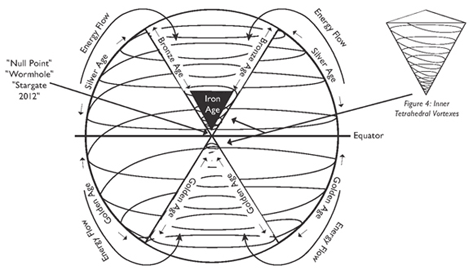
    It is well known in modern physics that four dimensional space, of which time is an aspect, is in the shape of a hypersphere (see Figure 3). This hypersphere appears similar to the shape of a donut, or a bagel. The energy, or the flow of the energy stream, within this hypersphere works like this: As shown in the illustration, the flow comes out of the bottom of the sphere, winds its way up around the outside edge, crosses the outside equator of the torus sphere and moves towards the hole in the top of this torus. The energy flow then begins to fall through the top of the hole and begins to spin in a vortex. This energy flow continues until it comes out of the bottom side of the torus where the energy flow begins its outward expansion again. This flow is continuous and, in a sense, infinite.

    The Four Dimensional Hypersphere torus is also represented by the hypercube. A hypercube is a cube within a cube according to physicists. Essentially this cube, also called ‘The Cube of Space’ or the ‘Tetragrammatron’ by the alchemists, is a straight edged version of the donut shaped hypersphere (see Figure 2).

    Scientists love to be able to construct objects using straight lines, so they have created the hypercube to help them better understand the hyperdimensional universe that surrounds us. Alchemists, however, like to use the curved lines of nature, so the donut shaped torus or hypersphere, is a better, more natural visual description of hyperdimensional space and will be the one I use in this article.

    The alchemists believe there is a hyperdimensional ‘body’ around every living thing on Earth. This hyperdimensional ‘body’ or sphere known to mystics as the luminous energy body, also surrounds every planet and star as well. Each object in the three dimensional world is an affectation of four-dimensional space. Humans, animals, plants, planets and stars are the solid inside of the fourth dimensional energy flow. As you will see, time also travels in this fashion.3

    In order to begin to comprehend the topographical nature of time, it is very important to understand the guts of this hyperdimensional sphere. By the ‘guts’ I am referring to the vortexes that make up the energy flow running through the centre of the hypersphere. As the energy flow begins to fall into the vortex that runs through the centre of the sphere, it takes on the shape of a tetrahedron.

    A tetrahedron, as shown in Figure 4, is the building block of three-dimensional space and is the founding member of the Platonic Solids. The tetrahedron is the simplest object that can be created in three dimensions. The only object with just four sides, the tetrahedron is also shaped like a vortex.

    Let us digress for a moment and discuss vortexes. Back in the Midwest of the United States, where I come from, there is a place called Tornado Alley. This is the flat Great Plains that stretches from Texas to the Dakotas. Each year this area is visited by numerous tornados, which wreak havoc on the farms and towns of this area. These tornados usually start in May and last until early August. Having witnessed several tornados in my early years I became fascinated by them and was once even a ‘storm chaser’. In my young and foolish days I used to chase after tornados with my Bolex 16mm camera in order to capture them on film. I became very familiar with these lethal vortexes.

    But understanding tornados also helps us understand vortexes and the density of forces in the hypersphere. Tornados (and also hurricanes) are made up of air like that which surrounds us all the time. But as the air begins spinning it takes on a strange solidity. While the swirling air at the top of a tornado is somewhat dangerous, it is the spinning air near the surface of the ground that is really dangerous. Near the tip of a tornado, where it is in contact with the ground, the air takes on the quality of solid iron. The tips of tornados can rip buildings apart, throw cars and trucks thousands of feet, and punch chaffs of wheat into the very centre of trees like a bullet. As the air spins more violently, the tip of the tornado vortex becomes as strong as 50 locomotives engines and possesses the density of the hardest of metals. Yet it is just comprised of air molecules. But these molecules are spinning so quickly they create a mass that is extremely powerful. It is the spin of the air that causes it to densify and take on the solidity of metals.

    Getting back to the central core of our hyperdimensional torus, we can understand the vortexes inside this sphere and how time unfolds by using the tornado analogy. As the energy flow begins to dip down into the top of the tetrahedral shaped vortex, it begins to spin. As the energy flow descends, its spin becomes more rapid and compressed. Like a tornado, as it reaches further down, the tip of the vortex ‘hardens’. It could be said that his hardening of vorticular forces is what makes up the solidity of our three dimensional space. Each human, plant, animal and indeed every planet and star alike are the hardened tips of hyperdimensional vortexes, which are flowing all around us constantly.

    Like air, these hyperdimensional forces are pretty much invisible to us. It is only when these forces coagulate into a spinning vortex that they can be seen and felt. It is through the rapid spinning of four-dimensional space that the solidity of the third dimension is actually created. The mystics from all great traditions know this and they realised these inner dynamics of the fourth dimension as it interacts with the third dimension. The fourth dimension is the surrounding sphere and the third dimension are the tetrahedral vortexes that make up the central core of the sphere. To the ancients, four-dimensional space was called ‘spirit’ and three-dimensional space was called ‘matter’.

    So what does this have to do with time and the topography of time? Remember the dilemma we face in trying to make the four ages of the precession match up with the Ages or Yugas from the Hindu system? By attempting to make the two into one we can not only understand the topology of time, but also we can map time like the ancients and we can know where we are in the river of time.

    As shown in illustration Figure 3, imagine that we are coming through the very centre of where the two tetrahedral tornado vortexes intersect at the very centre of the inner hyperdimensional sphere. Moving down the bottom vortex towards the outside surface of the sphere, each spin in the vortex takes longer and is wider and slower than the previous spin in the vortex. In other words, the energy flow expands after it passes the ‘null’ point in the very centre of the hyperdimensional sphere, or torus, where the tips of the two tetrahedral vortexes touch.

    This energy flow continues its expansion as it climbs over the lip of the bottom edge of the sphere where the vortex meets the outside edge of the sphere. The energy flow continues to expand until it reaches the outside equator area of the sphere. Once it gets past the equator, the energy flow begins to condense, the flow begins to move faster and the spin density increases. This flow continues until the energy flow reaches the upper lip of the outside of the hyperdimensional sphere where it begins to ‘fall’ into the top of the tornado tetrahedral vortex.

    Now as the flow of energy falls down the vortex towards the null point at the very centre of the sphere it begins to harden as it spins faster and faster. This goes on and on until the vortex is so hard it is like iron. This is how the fourth dimensional forces create three-dimensional reality. As the vortex spins faster and faster eventually it compresses down to the point where it has nowhere to go but outwards again. This occurs at the null point in the centre of the sphere and the energy flow now begins to once again expand.

    The Golden Age is the time period that starts at the null point in the centre of the sphere and continues through the bottom vortex. As the energy flow expands outwards time appears to slow down. The entire period of the Satya Yuga, or the Golden Age, continues as the energy flow goes down the bottom vortex and rounds across the top of the sphere. It continues expanding until it arrives at the equator.

    The equator of the outside of the hyperdimensional sphere is the borderline between the Satya Yuga and Treta Yuga, or the Golden Age and the Silver Age. Now the energy flow begins to contract as it flows upwards towards the north pole of the hypersphere.

    The Silver Age, or the Treta Yuga, continues until the energy flow rounds the top lip of the hyperdimensional sphere and begins to fall into the upper tetrahedral vortex. This then is the borderline between the Treta Yuga and the Dvapara Yuga, or the border between the Silver Age and the Bronze Age.

    About two thirds down in the upper vortex, where the energy flow is spinning so fast that it becomes as solid as iron, is the beginning of the last Age, the Kali Yuga, or the Iron Age. This spinning continues to gain density, compression and speed as it races towards the central null point in the very centre of the sphere. As it approaches this null point the forces become unbelievably fast, violent and dense. It is only when these forces achieve maximum density and they can no longer compress any further that they begin to suddenly flip and begin the expansion of the flow. This happens in an instant. This is the shift from the Iron Age, or the Kali Yuga to the Golden Age, or the Satya Yuga. The borderline between the Iron Age and the Golden Age is the most distinct border in this topographical illustration of hyperdimensional time. It is the most jarring and is instantaneous.

    Take notice of the hourglass shape of the two tetrahedral vortexes inside the hyperdimensional sphere. Is this why Fulcanelli tells us about the hourglass in the quote at the beginning of this article? In Hindu mythology the God Shiva dances the world into and out of existence playing his dhamaru which is a two sided drum shaped like an hourglass.

    Notice that, like the number of years in the Hindu Yuga system, the distance travelled through our ages in the hypersphere is similar; the Golden Age, which is the distance between the null point in the centre and the outside equator is twice the distance as that travelled through the Silver Age which is the distance from the equator to the top of the lip of the upper vortex. Equally, the distance travelled from the top of the vortex to two thirds down, which is the Bronze Age, is half the length of the Silver Age. Finally, the tip of the vortex is half the length of the Bronze Age.

    This part, called the Iron Age, is the Age in which we live. This is also why, in the Iron Age, each second feels shorter than the second before. This is why each day, each month and year appear to be going faster than they did previously. In the topology of time this effect can be easily understood and explained.

    Also remember, even though the distance travelled is much further in the Golden Age than it is in the Iron Age, the number of years it takes is the same. It takes 6,480 years to go through the Golden Age just as it takes 6,480 years to go through the Iron Age, but it feels much different. In the Golden Age each second, each day, each month and year appear to be longer than the previous day, month and year. Time is expanding in the Golden Age and with that expansion the anxiety and tension of the Iron Age disappears. It is a paradise, especially to those who may have survived the passing through the wormhole, or the null point at the centre of the hyperdimensional sphere.

    Therefore, the years listed within the Yuga system are actually symbolic times that explain the lengths of time as it is felt not as it is lived. So the Golden Age or the Satya Yuga feels like it is much longer than the Kali Yuga, or the Iron Age.

    The shamans in Peru tell us that we are approaching the Pacha Cuti, which means literally ‘the world turned upside down’. They say that it will arrive in the year 2012. This is also the year when the great Mayan calendar reaches its end point. The cross of Hendaye is quite explicit in saying we are reaching the very end of the Iron Age. I would suggest that the null point, or the wormhole at the very centre of the hypersphere, is very likely the 2012 date. Our hypersphere appears to be regulated by the periodic alignment of the galactic centre with the Sun. This also matches the four fixed signs of the zodiac and explains why the Christian tradition is preparing for the endtimes.

    Oddly enough, it also appears that Stanley Kubrick is trying to tell us about the end of our Age in his masterpiece film 2001: A Space Odyssey. The Starchild at the end of the film has passed through the Star Gate of the black monolith and is returning to Earth to create a new world or a new Age.4

    It is through our understanding of the Four Ages, the fixed signs of the zodiac, and the Yuga system that we can finally appreciate the message our ancestors have handed down to us. We are about to pass through the Star Gate, the wormhole, and the null point of hyperdimensional space.

    The Cross of Hendaye reveals the most important knowledge of all, which is the end of time and the beginning of the Golden Age. Awareness of this knowledge helps us all to more fully comprehend the nature of the times in which we reside and the destiny of the human race.

    The Quality of Time

    At the very core of all the great spiritual traditions to be found across the planet from the ancient Egyptian to the Incan and Mayan, Indo-Tibetan, Alchemical Europe and even the Hebrew Kabbalah lies the knowledge of the secret of the alchemy of time. Unencumbered by the excessive demands, stresses and speed of the modern age, our ancestors spent lifetimes in contemplation of the essential mysteries of our world.

    One of the great mysteries they discovered was that time is not stagnant or linear but flows in great transformative cycles. In fact, it is only recently modern historians have begun arguing that time travels in a straight line. Within the limited period of historical examination these modern historians are viewing a snap shot of history and believe this snapshot represents the entire picture. But does it?

    The alchemists of Egypt and Medieval Europe knew that time moved in great elongated cycles, and that each part of the cycle had a ‘quality’. This quality shaped and reformed the world. Just as sunrise has a different quality from midnight, so too does each aspect of the great cycle possess a quality that distinguishes it from other parts of the cycle. When the cycle of time changes, so too do events change here on Earth.

    These sacred scientists and alchemists of our past used various devices and practices to mark the changes in the quality of time. Astrology, divination and prophecy are some of the more obvious processes that our ancestors used to understand the mysterious process of time.

    At the heart of the secrets traditions of the Egyptian and Greek mystery schools they knew that a process, which they called the precession of the equinoxes, measured the Great Cycle or the Great Year. What they understood was that the stars in the night sky are not fixed. Through their long observation and meditation upon the heavens they came to realise that the stars and the constellations were slowly changing their place in the sky above us. Creating the zodiac to assist them in these huge measurements of time they used the twelve signs to act as a giant time clock. Through this they began to understand the Great Cycle. They realised that it took 2,160 years to move through each sign of the zodiac and that it took 25,920 years for the equinoxes to move through all 12 signs. The creation of the Great Year of nearly 26,000 years gave them a clock that allowed them to measure time.

    They then came to understand that each of the signs, or places on the clock appeared to bring forth changes in the quality of life here on Earth. So they came to realise that every 2,160 years the quality of time changed. They also began to understand that the four quadrants of this great chronological clock appeared to bring forth even sharper changes in the quality of time. The four signs associated with these four quadrants are the signs of Aquarius, Taurus, Leo and Scorpio. There does seem to be some historical linkage between this idea that passing through the edges of these four signs brings great changes here on Earth. About 6,500 years ago we passed through the sign of Taurus. Coincidentally, the human race began domesticating cattle, building walled cities, developing agriculture, fighting wars and beginning the city-states that would evolve into governments and monarchies. Thirteen thousand years ago, as we passed through the Age of Leo, great changes occurred including a dramatic climate shift as the ice ages began to end. The extinction of many animals including the Woolly Mammoth, the Saber Tooth Tiger, the Giant Tree Sloth, and many other species happened at about this time. Interestingly, according to anthropologists, the emergence of Cro-Magnon Man appears to have occurred about 26,000 years ago, the last time we passed through Aquarius.

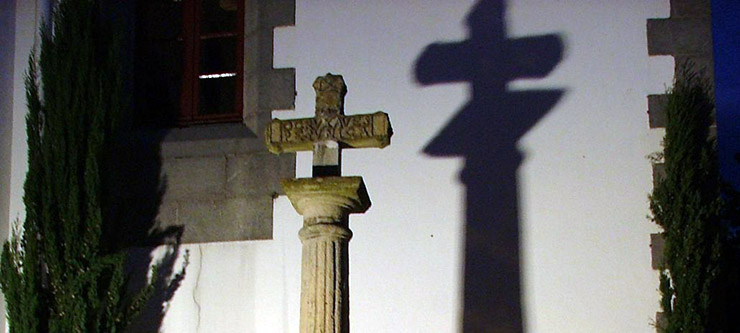
    The Great Cross at Hendaye is a 350-year-old alchemical monument to the end of time. It sits in a churchyard in Hendaye, France. The Great Cross at Hendaye appears to be a symbolical construct that explains this science of the cycles of time. The Cross at Hendaye describes the extraordinary changes that are about to occur in our present era. It speaks of the end of our current Age of Iron and the creation of a coming Golden Age.

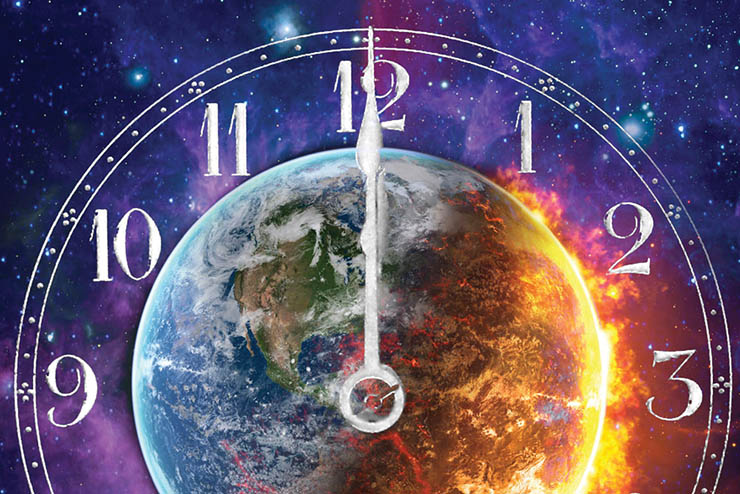
    The great cosmic time clock in the sky is changing. We are now entering the quadrant of Aquarius. From what the alchemical Cross at Hendaye is saying, this change is sure to have a dramatic effect on our species and on our planet.

    What these changes are, or will be, is anybody’s guess. But they are sure to be spectacular and remarkable. The end of time, the end of this age and the great transformation of humanity is at hand. This change in the quality of time will govern and dictate the changes here on our fragile planet. The changes in the quality of time cannot be forestalled. The fundamentalist revival taking place all over the world reveals more about the quality of time from which we are emerging than it does reveal anything about the quality of time for that which is coming.

    The Peruvian shamans living high up in the Andes Mountains have come down to tell us that a new species of human being is about to appear. They call this being ‘Homo Luminous’. They tell us that forerunners of Homo Luminous are already among us right now. Like Cro-Magnon Man of 26,000 years ago, the last time we passed through the cusp of Aquarius, so too now a new human is emerging.

    This new human will possess entirely new qualities that we do not have. The great Avatars, Jesus Christ, Krishna and many others may have been early arrivals for this newly emerging species. Aquarius is the only one of the four quadrant signs that is symbolically represented by a human, and this human carries a container of water. This symbology is interesting as DNA can only be activated in water. So even the symbolic nature of the sign of Aquarius seems to suggest a change in the genetic structure of the human race.

    Our spiritual existence is really a unique combination of free will and predestination. While we possess the ability to act freely within the moment, there is little we can do about the larger cycles of time and the qualities that emerge at the cusp of each of the four great signs. So as the hand on the great cosmic time clock passes into Aquarius one can expect massive changes to occur. While the ancient art of alchemy is concerned with many aspects of our existence including the extraction of light from plants and minerals, the transformation of the dark lead of our physical being into the pure gold of enlightenment and much more, alchemy also is a symbolic ontology concerned with the observation in the changes of the ‘quality’ of time through the 25,920 years-long duration of the Great Year.

    The world is changing. The past will disappear and history will become legend and finally myth. Our destination is unknown. The only thing we know for sure is that it will change.

    [alert type=”general” dismiss=”no”]This article was published in New Dawn 92.[/alert]

    [alert type=”success” dismiss=”no”]If you appreciate this article, please consider subscribing to help maintain this website.[/alert]

    Footnotes:

    1.  See www.jayweidner.com; The books A Monument to the End of Time: Alchemy, Fulcanelli and the Great Cross and Mysteries of the Great Cross of Hendaye: Alchemy at the End of Time are authored by Jay Weidner and Vincent Bridges.
    2. For more information, see ‘Tolkien at the End of Time: Alchemical Secrets of the Lord of the Rings’ by Jay Weidner and Sharron Rose in New Dawn No. 82 (January-February 2004), and ‘Reflections on the Cycle of the Great Yuga’ by Sharron Rose at www.sharronrose.com.
    3. For more information on the luminous energy body, see my films Healing the Luminous Bodywith Dr. Alberto Villoldo, ArtMind with Alex Grey and Yoga of Light with Sharron Rose.
    4. See ‘Alchemical Kubrick: 2001: The Great Work on Film’at www.jayweidner.com.

    © New Dawn Magazine and the respective author.
    For our reproduction notice, click here.
  • Hyperborea & the Quest for Mystical Enlightenment

    Hyperborea & the Quest for Mystical Enlightenment

    From New Dawn 58 (Jan-Feb 2000)

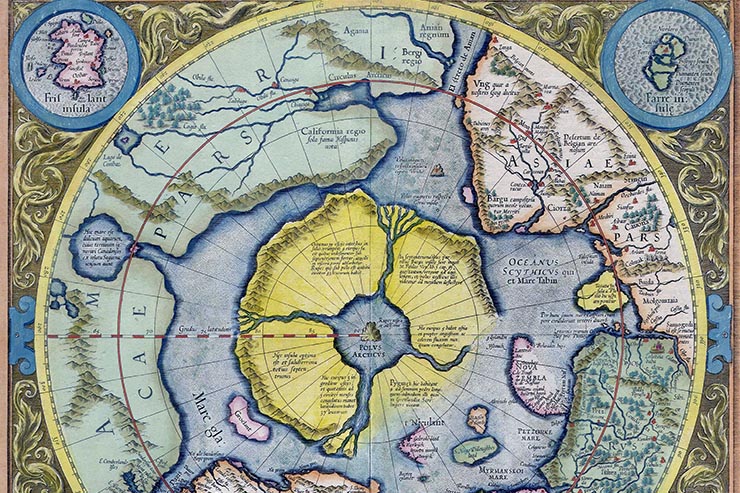
    Far north, somewhere near the icy regions of the North Pole, legend speaks of an ancient and mostly forgotten civilisation. Mythical in character, the Hyperborean civilisation is said to have flourished in the northern most region of planet Earth at a time when the area was suitable for human habitation.

    According to certain esoteric systems and spiritual traditions, Hyperborea was the terrestrial and celestial beginning of civilisation. The home of original Man. Some theories postulate Hyperborea was the original Garden of Eden, the point where the earthly and heavenly planes meet. And it is said Man transgressed Divine Law in this Golden Age civilisation, the ultimate price being his banishment to the outside world. Man ventured into other regions of Earth, establishing new civilisations, bringing to an end this great and glorious Golden Age.

    The Golden Age is central to manifold ancient traditions and myths. Significantly, the Golden Age appears most frequent in the traditions of cultures stretching from India to Northern Europe — the area directly beneath the Polar regions. Joscelyn Godwin, in Arktos, The Polar Myth in Science, Symbolism and Nazi Survival, says:

    The memory or imagination of a Golden Age seems to be a particularity of the cultures that cover the area from India to Northern Europe… But in the ancient Middle East there is an obvious relic of the Golden Age in Genesis, as the Garden of Eden where humanity walked with the gods before the Fall. The Egyptians spoke of past epochs ruled by god-kings. Babylonian mythology… had a scheme of three ages, each lasting while the vernal [Spring] equinox precessed through four signs of the zodiac; the first of these, under the dominion of Anu, as a Golden Age, ended by the Flood. The Iranian Avesta texts tell of the thousand-year Golden Reign of Yima, the first man and the first king, under whose rule cold and heat, old age, death and sickness were unknown.1

    The most fully developed theory of this kind, and probably the oldest one, is the Hindu doctrine of the Four Yugas. The four ages in this system are the Krita or Satya Yuga (four units), Treta Yuga (three), Dvapara Yuga (two), and Kali Yuga (one), the whole tenfold period making up one Mayayuga. The Kritayuga corresponds to the Golden Age, the Kali Yuga to the current period of time.

    Every description of the Golden Age period relates how the ‘gods’ walked with men in a perfect and harmonious environment balanced between the terrestrial and celestial. Humanity suffered no sickness and no aging in this timeless paradise. After the Fall, man ‘fell’ into Time and suffering, forfeiting the gift of immortality.

    Madame Blavatsky, the founder of Theosophical Society, claimed the ‘second root race’ originated in Hyperborea, before the later races of Lemuria and Atlantis. The Russian metaphysician Alexandre Dugin says that it was the home of the “solar people”, connected to what is now northern Russia. “Solar people,” Alexandre Dugin explains, are a “cultural-spiritual type” who are creative, energetic and spiritual. They are the opposite of “lunar people”, a psycho-spiritual type who are materialistic, conservative and wary of change.

    The ancient Greeks had a legend of Hyperborea, a land of perpetual sun beyond the “north wind”. Hecataeus (circa 500 BC) says that the holy place of the Hyperboreans, which was built “after the pattern of the spheres”, lay “in the regions beyond the land of the Celts” on “an island in the ocean.” According to popular accounts, the God Apollo’s temple at Delphi was founded by individuals from Hyperborea. The Greek lyric poet Alcaeus (600 BC) sang of the actual or mystical journey of Apollo to the land of the Hyperboreans:

    O King Apollo, son of great Zeus, whom thy father did furnish forth at thy birth with golden headband and lyre of shell, and giving thee moreover a swan-drawn chariot to drive, would have thee go to Delphi… But nevertheless, once mounted, thou badest thy swans fly to the land of the Hyperboreans.

    The wearing of a star-embroidered robe by the King and ‘Ruler of the World’ — the heavenly sphere serving as a symbol of the earthly one — is a custom that can be traced to the Hyperboreans. Embroidered in gold on blue silk were the figures of the sun, moon and stars. Such robes were worn by the kings of Ancient Rome and Julius Ceasar, as well as Augustus and the Roman Emperors.

    Earthenware statuettes found in a grave in Yugoslavia show the ‘Hyperborean Apollo’ in a chariot drawn by swans. The god wears, on his neck and breast, yellow figures of the sun and stars; on his head is a rayed crown with a headband that has a zigzag pattern. His robe, which reaches to the ground, is dark blue with yellow designs.

    Collapse of Hyperborea

    One of the most popular theories for the collapse of Hyperborea was a physical inclination (catastrophe) of the Earth’s axis. Man’s transgression of Divine Law caused a shift in the metaphysical balance, the effect of which was catastrophic on the Earth plane. Julius Evola, the noted Italian metaphysician, explains that at this point the first cycle of history closed, and that of the second, the Atlantean, began:

    The memory of this Arctic seat is the patrimony of the traditions of many people, in the form either of real geographic allusions, or of symbols of its function and original significance, often transferred to a super-historical significance, or else applied to other centres that may be considered as copies of the original one… Above all, one will notice the interplay of the Arctic theme with the Atlantic theme… It is known that the astrophysical phenomenon of the inclination of the earth’s axis causes a change of climate from one epoch to another. Moreover, as tradition tells, this inclination took place at a given moment, and in fact through the alignment of a physical and a metaphysical fact, as if a disorder in nature were reflecting a certain situation of a spiritual order… At any rate, it was only at a certain moment that ice and eternal night descended on the polar region. Then, with the enforced emigration from that seat, the first cycle closed and the second opened, initiating the second great era, the Atlantean Cycle.2

    The memory of a Golden Age, although rendered in an archetypal or mythological form, serves a super-historical purpose. This is why the remembrance of the ancient civilisation of Atlantis is sometimes enmeshed with that of Hyperborea. We cannot expect to ‘prove’ the physical existence of these civilisations. All myths are known to have a historical basis. Transmitted primarily by oral tradition, they are wrapped in a catchy and simple tale that ensures their survival and transmittal down through the ages. Myth serves an extremely vital function — a recollection of our beginnings, a knowledge of where we are heading, and what we are supposed to do. It is only now in the Kali Yuga that we have disconnected from tradition, losing the ability to correctly interpret and understand myths with historical kernels of truth.

    Hyperborea Revived

    The legend of Hyperborea revived during the 18th and 19th centuries when a flurry of books were published dealing with the idea that civilisation had first appeared not in the Middle East, but somewhere else.

    The popular theory of the day postulated that the so-called ‘Aryans’ (Europeans) were superior and more intelligent than Semites (Middle East peoples). Therefore, logically, civilisation could not have originated in the Middle East and Hebrew was probably not the first language.

    The Frenchmen of the Enlightenment were in no doubt that “Eden” was situated on higher ground. The Germans similarly, who were looking for their Aufklarung, also sought to be free of a history tied to the Mediterranean and Middle East regions. British and German scholars studied ancient Indian (Vedic) civilisation and leant the Sanskrit language. Many believed Sanskrit the original language of the ‘Aryans’.

    With new sources of knowledge from ancient Egypt, Chaldea, China and India, researchers were treading on dangerous ground as far as questioning Man’s origins. Biblical history was still strictly upheld and moving too far from this historical boundary could have you silenced.

    Writers such as Jean-Sylvain Bailly (1736-1793), the Rev. Dr. William Warren (1800s), Bal Gangadhar Tilak (1856-1929) and H.S. Spencer (1900s), developed out theories, often borrowing from earlier sources, attempting to prove man’s origins in the Polar region.

    Tilak’s book Arctic Home (published 1903) begins by stating the well known fact that warm weather remains in the Arctic regions, which shows the climate was far different during the interglacial period. According to Tilak, scientists do concede the existence, in the past, of a warm circumpolar continent, and the circumstances there would not have been nearly unfavourable as imagined.

    Tilak was convinced the ancient Indian Vedic texts point unmistakably to a “realm of the gods” where the sun rises and sets once a year, showing that their writers could understand the astronomical conditions at the North Pole.

    Tilak, who had a perfect mastery of Vedic language, placed the original Arctic home existing around circa 10,000 BC, just prior to its destruction and the beginning of the last Ice Age.

    His book had little impact in the West but was popular in India. When the learned Zoroastrian H.S. Spencer wrote his book The Aryan Ecliptic Cycle (1965), a development of Tilak’s work, he was able to obtain endorsements from Sir S. Radhakrishna, then President of India. As well as from dignitaries of the Theosophical Society in Adyar and the Sri Aurobindo Ashram in Pondichary.

    Spencer’s approach commenced not with the Vedic but the Zoroastrian scriptures, going further than Tilak in tracing the progress of the ‘Aryans’ from the North to their new homes, and the schisms that beset them on the way.

    Spencer’s ‘Aryans’ made their presence felt after they travelled far and wide. They moulded the religions and cultures of Egypt, Sumeria, Babylon, and of the Semites, hitherto worshippers of feminine lunar deities.

    However, the search for a terrestrial ‘Hyperborea’ by many researchers and the movement of an original ‘race’ has been extremely difficult and presumptuous. Proving human habitation possible at the North Pole somewhere between 8000 and 10,000 BC is no mean feat, particularly if you were living in the 18th century. The numerous theories posited offering contradictory or tendentious ‘evidence’ has served only to discredit the whole notion of Hyperborea. The same could be said of theories attempting to prove the existence of the ‘lost continent of Atlantis’. The drive to prove the actuality of a terrestrial Hyperborea has overshadowed its occult and symbolic importance.

    The Spiritual Pole

    In the quest to discover the ‘physical’ location of Hyperborea, most writers overlooked the possibility that the mythology served a special symbolic and spiritual purpose. What if the truth behind the legend was esoteric, and not exoteric as some even today still maintain?

    Many traditions speak of a supreme spiritual centre or ‘supreme country’. The ‘supreme country’ that does not necessarily lay at a specific earthly point, but exists in a primordial state, unaffected by terrestrial cataclysms.

    The ‘supreme country’, commonly regarded as ‘polar’ in orientation, symbolically is always represented as being at the ‘Axis of the world’ — and in most cases is referred to as a ‘Sacred Mountain’. Rene Guenon in his book The Lord of the World says:

    Almost every tradition has its name for this mountain, such as the Hindu Meru, the Persian Alborj, and the Montsalvat of Western Grail legend. There is also the Arab mountain Qaf and the Greek Olympus, which has in many ways the same significance. This consists of a region that, like the Terrestrial Paradise, has become inaccessible to ordinary humanity, and that is beyond the reach of those cataclysms which upset the human world at the end of certain cyclic periods. This region is the authentic ‘supreme country’ which, according to certain Vedic and Avestan texts, was originally sited towards the North Pole, even in the literal sense of the word. Although it may change its localisation according to the different phases of human history, it still remains polar in a symbolic sense because essentially it represents the fixed axis around which everything revolves.3

    The Vedic texts say the ‘supreme country’ is known as Paradesha, also called the ‘Heart of the World’. It is the word from which the Chaldeans formed Pardes, and Westerners Paradise.

    There is notably another name for it probably even older than Paradesha. This name is Tula, called by the Greeks Thule. Common to regions from Russia to Central America, Tula represented the primordial state from which spiritual power emanated.

    It is known that the Mexican Tula owes its origin to the Toltecs who came, it is said, from Aztlan, the ‘land in the middle of the water’, which is evidently Atlantis. They brought the name Tula from their country of origin and gave it to a centre which consequently must have replaced, to a certain extent, that of the lost continent. On the other hand, the Atlantean Tula must be distinguished from the Hyperborean Tula, which latter represents the first and supreme centre….4

    In this case — Tula — representing a centre of spiritual authority — does not remain fixed in a geographical location. Guenon states that the Atlantean cycle, successor to the Hyperborean cycle, is associated with Tula. The Atlantean Tula is an image of the original primordial state situated in a northern or Polar location. As world cycles progress onward, the supreme seat of spiritual power regresses further and further into hiding and obscurity. This, of course, is deliberate and predictable as humanity descends into the end of the age (Kali Yuga), progressively enmeshing itself in the material plane until the reversal of established world order is imposed.

    It should be emphasised here that Tula, or the centre of spiritual authority, constitutes the fixed point known symbolically to all traditions as the ‘pole’ or axis around which the world rotates. Metaphysically speaking, the world rotates around this seat of power even if it’s not geographically North or South.

    In the Buddhist tradition ‘Chakravarti’ literally means “He who makes the wheel turn”, which is to say the one who, being at the centre of all things, directs all movement without himself participating, or who is, to use Aristotle’s words, the “unmoving mover”.

    The turning of the world, the ‘Pole’ and axis, combine to depict a wheel in the Celtic, Chaldean and Hindu traditions. Such is the true significance of the swastika, seen worldwide from the Far East to the Far West, which is intrinsically the ‘sign of the Pole’.

    The Pole and Mystical Enlightenment

    It is in medieval Iran that we find extant literature on the Spiritual Pole and the experience of mystical ascent to it. The Iranian Sufis, drawing not only on Islam but on the Mazdean, Manichean, Hermetic, Gnostic and Platonic traditions, blended a sacred knowledge said to be ‘scientific’, mystical and philosophically practical.

    Esoterically… the Persian theosophers situated their “Orient” neither to the East, nor to the South, wither they faced in prayer towards the Ka’ba. “The Orient sought by the mystic, the Orient that cannot be located on our maps, is in the direction of the north, beyond the north.” [The Man of Light in Iranian Sufism by Henry Corbin, 1978] About this Pole reigns a perpetual Darkness, says the Recital of Hayy ibn Yaqzan, one of the visionary recitals of Avicenna (Ibn Sina). “Each year the rising sun shines upon it at a fixed time. He who confronts that Darkness and does not hesitate to plunge into to it for fear of difficulties will come to a vast space, boundless and filled with light.” [Ibid] This Darkness, says Corbin, is the ignorance of the natural man. “To pass through it is a terrifying and painful experience, for it ruins and destroys all the patencies and norms on which the natural man lived and depended…” [Ibid] But it must be faced consciously before one can acquire the saving gnosis of the light beyond.

    The Darkness around the Pole, annually pierced by the sun’s rays, is at once terrestrial and symbolic. On the one hand, this is the situation at the North Pole, where there are six months of night and six of day. It is characteristic of esoteric tradition that the same image is valid on two or more levels. But as Corbin and Guenon never tired of pointing out, the symbolic level is not a fanciful construct on the basis of hard terrestrial fact: it is quite the other way round. In the present case, the mystical experience of penetrating the Darkness at the Pole is the fundamental reality and the authentic experience of the individual. The fact that the set-up of the material world reflects the celestial geography is what is contingent. In brief, in this teaching as in Platonism, it is the supersensible realm that is real, and the material realm that is a shadow of it.5

    The seeker, through deep meditation on spiritual matters, succeeds in entering a world of mystical experience, and makes a pilgrimage to Hyperborea that can not be discovered from maps. Aristeas, the Greek poet, in shamanic rapture, is said to have travelled to Hyperborea while “possessed by Apollo”. Mystical soul-travel to Hyperborea is common in ancient Greek literature.

    The journey to this Pole is sometimes illustrated as the ascent of a column of light, extending from the depths of hell to the lucid paradise in the cosmic North.

    As previously mentioned, the Pole is also a Mountain, called Mount Qaf in Islamic tradition, whose ascent, like Dante’s climbing of the Mountain of Purgatory, represents the pilgrims progress through spiritual states.

    Guenon, in The Lord of the World, explains “the idea evoking the representation under discussion is essentially one of ‘stability’, that is itself a characteristic of the Pole.” The Mountain, referred to as an ‘Island’, “remains immovable amidst the ceaseless agitation of the waves, a disturbance that reflects that of the external world. Accordingly, it is necessary to cross the ‘sea of passions’ in order to reach the ‘Mount of Salvation’, the ‘Sanctuary of Peace’.”

    Our search for Hyperborea is our desire to return to Paradesha or Paradise — the primordial spring of Man’s original existence. The importance of knowing the terrestrial location of a lost civilisation at the northern regions is thus overshadowed by its symbolic relevance.

    To seek Hyperborea is to quest for spiritual enlightenment. The Mountain, the Island, the immovable Rock, fixed in a Polar orientation, relays a symbolic representation of our search for Ultimate Reality. Its immovability anchors us to this important task.

    [alert type=”general” dismiss=”no”]This article was published in New Dawn 58.[/alert]

    [alert type=”success” dismiss=”no”]If you appreciate this article, please consider subscribing to help maintain this website.[/alert]

    Footnotes:

    1. Arktos, The Polar Myth in Science, Symbolism and Nazi Survival by Joscelyn Godwin, p. 16.
    2. Quoted in Arktos, The Polar Myth in Science, Symbolism and Nazi Survival, p. 58-9, original source Revolt Against the Modern World by Julius Evola, 1951.
    3. The Lord of the World by Rene Guenon, p. 50.
    4. Ibid, p. 56
    5. Arktos, The Polar Myth in Science, Symbolism and Nazi Survival by Joscelyn Godwin, p. 167-8.

    © New Dawn Magazine and the respective author.

    For our reproduction notice, click here.