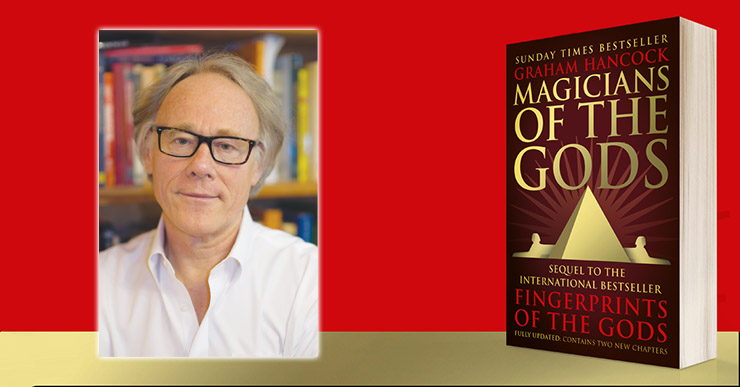
New Dawn – World's Most Unusual Magazine

Tag: Graham Hancock

  • Magicians of the Gods: An Interview with Graham Hancock

    Magicians of the Gods: An Interview with Graham Hancock

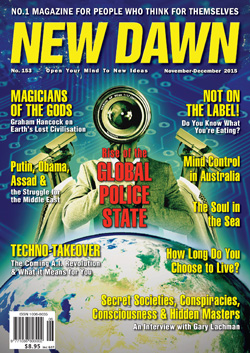
    From New Dawn 153 (Nov-Dec 2015)

    Author and theorist Graham Hancock has had a sizeable impact upon the popular understanding of humanity’s ancient past. His global 1995 bestseller Fingerprints of the Gods contended that some previously ancient but highly advanced civilisation existed in prehistory, one which served as the common progenitor civilisation to all subsequent known historical ones. Further books such as Keeper of Genesis (with Robert Bauval), Underworld (studying underwater ruins as evidence of lost civilisations) and others propose bold new theories that challenge mainstream dogma.

    Hancock’s new book Magicians of the Gods: The Forgotten Wisdom of Earth’s Lost Civilization – a sequel of sorts to Fingerprints – gathers compelling evidence pointing to an ancient global cataclysm, caused by devastating meteor impacts, that may have all but erased a highly advanced human society and forced the survivors to, in essence, start again. Hancock also presents evidence the Earth may soon face this potentially species threatening meteor stream again.

    David Thrussell spoke to Graham Hancock in this exclusive interview for New Dawn.

    DAVID THRUSSELL (DT): From a distance, you appear to have what could be described as an ideal life Graham, travelling around exotic and interesting places, exploring the edges of history and knowledge. Are there any downsides, disappointments or frustrations in your work?

    GRAHAM HANCOCK (GH): I feel glad that I’ve had the opportunity in this life to explore and spend time in so many incredible, mysterious, profoundly moving ancient sites, all around the world. It’s been a great privilege to have the opportunity to do this, and I have no complaints whatsoever. I’m grateful for my life. I have a lot of freedom and I’ve worked from home since I was 29 as a matter of fact – that’s when I decided I couldn’t work in a large organisation anymore, and struck out on my own. For a very long time I was completely broke. Eventually I started to manage to make a living from it. But I have no complaints. I think I’ve been very fortunate and I’m grateful for the life I’ve had the opportunity to lead.

    DT: How long have you been working, brewing away on the new book [Magicians of the Gods]?

    GH: Well in a sense, 25 years. As a focused project, about 3½ years, but this book draws on my interests and enquiries into this field going back to the end of the 1980s.

    DT: Now, if you had to advance a single most compelling piece of evidence to support your theory, what would it be and why would it be that?

    GH: Well, it’s more complicated than that. This is not a problem that can be solved by a magic bullet. This is a problem that requires co-ordination of evidence from many different sources. I would offer you three pieces of evidence that are all in a sense joined together, and one of those pieces of evidence, a very important piece of evidence, is something we have now, but I didn’t have when I wrote Fingerprints of the Gods in 1995. It’s effectively a smoking gun, globally. Scientific evidence for a global cataclysm between 13,000 and 12,000 years ago. That was essentially the hypothesis I put forward in Fingerprints of the Gods, that there had been a global cataclysm between 13,000 and 12,000 years ago, and it wiped out an advanced civilisation, and I speculated on many possible causes of that cataclysm – notably pole shift and Earth crust displacement.

    What happened since 1995, and particularly since 2007, is that a group of scientists have put before the scientific community – very little of this has yet leaked out to the public – absolutely compelling evidence Earth suffered a series of impacts from fragments of a giant comet, and these impacts happened 12,800 years ago when several fragments hit the North American ice cap, causing global flooding and radical climate change. It happened again 11,600 years ago when more fragments from the same comet came out of orbit and smacked down into an ocean – almost certainly the Pacific – sending up a huge plume of water vapour into the upper atmosphere and causing very sudden global warming. So the interval between those two periods, the 1,200 years between 12,800 years ago and 11,600 years ago, is an episode of almost unparalleled global cataclysm, coupled by massive extinction of animal species, the mega mammals, the mammoth, the woolly rhino, and so on. And this is the event that I believe lost us a whole civilisation of pre-history that previously has not entered the archaeological records.

    Now, let’s co-ordinate this with the latest discoveries in archaeology. Remember that one of the two dates for that cataclysm is 11,600 years ago. This was a sustained event that involved two separate bombardments from fragments of a comet. On both occasions there were massive sea level rises and a global cataclysm unfolded. The first occasion 12,800 years ago, the second occasion 11,600 years ago, were also accompanied by global flooding and massive sea level rises. It’s therefore intriguing that the archaeological site in south eastern Turkey, known as Göbekli Tepe – which means ‘pot-bellied hill’ in the Turkish language – was created 11,600 years ago by people who already knew how to work with giant megaliths. Göbekli Tepe is an anomaly, because it’s 7,000 years older than other megalithic sites around the world, and yet it demonstrates advanced techniques of stonework and stone cutting, organisation of labour, planning, site design and alignment to the heavens. This is not the work of a group of hunter-gatherers who woke up one morning and felt suddenly inspired to create the world’s first megalithic architecture. In my view, what we’re looking at is a transfer of technology, the knowledge brought by the survivors of the lost civilisation, including the knowledge of how to create large-scale megalithic structures – and at exactly the same moment 11,600 years ago we get this sudden and unexplained appearance of a sophisticated megalithic site in south eastern Turkey.

    We also get the dissemination and uptake of agriculture in exactly the same region, whereas previously the inhabitants had been entirely hunter-gatherers. I say again, what we’re looking at is a transfer of technology, the fingerprint of the survivors of a civilisation that was lost in the cataclysmic events between 12,800 and 11,600 years ago.

    And I mention a third point, the age-old myth of Atlantis, which isn’t actually that old because the version of it that comes down to us – the only version that comes down to us – is in the works of the Greek philosopher Plato. Plato said he got the story of the submergence and destruction of the advanced civilisation of Atlantis through his ancestor Solon, the Greek law-maker who visited Egypt in 600 BCE, and there was told, by Egyptian priests, the story of Atlantis. And they said Atlantis had been destroyed and submerged, having incurred the anger of the gods, 9,000 years before the time of Solon. We know that Solon was in Egypt around 600 BCE, therefore they are talking about 9,600 BCE in our calendar, 11,600 years ago, which is the date precisely for the appearance of these hitherto unheralded techniques of megalithic architecture and agriculture in the region of south eastern Turkey.

    DT: The cataclysm you’re talking about has been staring us in the face really, hasn’t it?

    GH: It has been staring us in the face, but I don’t blame historians and archaeologists for failing to get to grips with it sooner than this. Because the leading scientists in the field have only really been compiling and presenting evidence on what is now referred to as the Younger Dryas comet for the last seven or eight years. It’s a very recent discovery and the reason it’s a recent discovery is that the major impacts of this comet 12,800 years ago were on the North American ice cap. This was still the Ice Age. North America, as far south as New York, was covered with ice, two miles deep, and at least four fragments of the comet hit the ice cap. But they did not leave prominent craters on the ground because the craters were in the ice itself and the vast heat and kinetic energy of the comet melted away that ice, so the craters were transitory and what we have is shock effect on the ground underneath. Recently, a number of craters have been found. The kind of craters that would be left when an object hit a two mile deep ice cap and transferred its shock to the bedrock underneath.

    Much more important is the evidence of the Younger Dryas scientific team – more than 30 scientists are working on the Younger Dryas comet. That evidence is based on what I call “impact proxies.” When you get an object coming in at 60 or 70 thousand miles an hour, and that object is a kilometre or two in diameter, it has unbelievable quantities of kinetic energy, and then you’re looking at an explosive power in the range of the entire nuclear arsenal of planet Earth, going up at once, with any single one of these objects. And there are certain, very recognisable outcomes of this. One is melt glass. You have heat unleashed in excess of the boiling point of quartz. Temperatures in excess of 2,200 degrees centigrade. This produces melt glass which is indistinguishable from the melt glass we find as a by-product of nuclear explosions. You also get carbon micro-spherules and very distinct nano-diamonds that are caused by the shock and heat. These nano-diamonds are only visible under a microscope, and they are combined with the melt glass, the carbon micro-spherules, and other evidence all around the world. They are compelling evidence for a gigantic cosmic impact 12,800 years ago.

    And, by the way, it’s exactly this kind of evidence that was initially put forward to prove the asteroid that wiped out the dinosaurs 65 million years ago. There’s only two occasions in Earth’s history, in the last 100 million years, that we get precisely the same impact proxies spread around the world. One of them is the so-called KT event 65 million years ago that wiped out the dinosaurs. And the other is the hitherto unrecognised, but now very obvious extinction level event that happened 12,800 years ago, and was caused by the Younger Dryas comet. I say “Younger Dryas” because that is the geological name for the period between 12,800 years ago and 11,600 years ago when the Earth’s climate fell into a sudden and hitherto unexplained deep freeze. We now know the cause of this. It was our interaction with the fragments of a giant comet, and the effects were truly cataclysmic.

    [alert type=”info” dismiss=”no”]If you appreciate this article, please consider a subscription to New Dawn magazine.[/alert]

    DT: Is it reasonable to suggest that mainstream academia, media and science are wedded to a particular view of history?

    GH: Yes. It is reasonable to suggest that, and it’s not surprising either. It’s just always the case – when you have any area of study, any discipline, whether it’s geology or whether it’s archaeology for that matter – that a body of knowledge is built up. And respected elders have contributed to that body of knowledge, and the new generation obviously respects the work of their elders. And gradually what builds up is a reference frame, a picture for how that area of study should be. In the case of archaeology, the picture that built up over the last 100 years of work is of a slow evolution of civilisation – that our ancestors were hunter-gatherers and nothing more until perhaps 8 or 9 thousand years ago. Then we begin to see the gradual movement towards more permanent settlement and about 5,000 years ago we get the first big cities and the first great megalithic architecture. This is the picture of civilisation taught to us by mainstream academic historians and archaeologists. It’s taught in the schools, it’s by and large conveyed through the media, but it is not a fact, it is a reference frame. It is a reference frame built up by 100 years of archaeological study. And this is, I think, the problem with archaeology and other scientific disciplines that get locked in a particular reference frame. When new facts emerge that don’t fit the reference frame, they find it difficult to adjust to them, and the first step is the attempt to discredit those facts. When more and more evidence comes in that the existing paradigm can’t explain, eventually the paradigm gets overthrown. A lot of good people who’ve done a lot of good work, who are convinced they’re right, who respect the work of their elders, and who don’t want to rock the boat – I think that’s the central problem. It always happens in science. No ideas change suddenly overnight without overwhelming new evidence that the previous paradigm cannot explain. That’s what we’re finding in the field of history and archaeology now – more and more new evidence coming in that simply can’t be explained by the existing reference frame of history.

    DT: Would you care to speculate – if the theory that you’re advancing is indeed correct – what pre-history looked like? What would history on Earth look like before this comet struck the planet?

    GH: A much more complicated world than the world portrayed to us by mainstream historians and archaeologists. Not a world populated entirely by hunter-gatherers as they suggest, but a world in which hunter-gatherers, and a more advanced civilisation, co-existed. This, in a way, is not odd. If you think about it, we are a very advanced technological civilisation today – Western technology, the industrial-technological-complex that has spread around the world, but we are not alone. We share the world with hunter-gatherer people – hunter-gatherers in the Kalahari Desert, for example, and in Southern Africa. Hunter-gatherers in the Amazon Basin. There are even tribes in the Amazon Basin who are completely un-contacted, who don’t even know that we exist; an advanced technological culture has not even impinged on their worldview yet. So the co-existence of advanced technology with hunter-gatherers that we see today, I would project that back into the past, and I would say more than 13,000 years ago during the Ice Age there was a much more advanced civilisation on this planet, than is given credit for by historians and archaeologists. It is remembered in myth and tradition all around the world, and it’s increasingly supported by recent striking archaeological discoveries such as Göbekli Tepe.

    DT: You mentioned two obvious cataclysmic events – the dinosaur extinction and the Younger Dryas events. Is it possible there have been other cataclysmic events that we have no inkling of?

    GH: Certainly there have been other cataclysmic events, and we do have inklings of them. The only question is, whether they affected the human species, and this becomes a matter for further enquiry. I hold, for the moment, the view that anatomically modern humans – people who look just like you and I – have only existed on Earth for about 200,000 years. It may well be that further discoveries will produce evidence of earlier anatomically modern humans. I don’t rule that out. But at the moment the evidence points to the emergence of our anatomically modern line about 200,000 years ago. We have, for example, a skeleton from Ethiopia, 196,000 years old, which is indistinguishable from an anatomically modern human being. So for these cataclysms to involve humanity and to impact the human story, they need to have happened within a human timeframe. This is why the Younger Dryas event is so intriguing because not only is it within the human timeframe, it’s right on the edge, on the border of a period when historians and archaeologists think civilisation began. Yet they had not yet taken into account this extinction level cataclysm, right in the backyard of history, and I would say that until they do take it into account, all their notions about the origins of civilisation are up for grabs.

    There have been multiple other global cataclysms of an extinction level going back hundreds of millions, even billions of years in the past. These things happen from time to time, and every time they happen they reset the clock on this planet, and life changes due to these dramatic and radical events. I think it’s only the most recent one, the one that happened 12,800 years ago, that directly impacted the human story – and this recent global cataclysm has not yet been taken into account in the model building of our past by historians and archaeologists.

    DT: Is it possible that mainstream science, the media, or even the general population in a sense, don’t want to know about our own history as a species?

    GH: There appears to be a kind of directive operating at governmental level, not to say things too alarming. It particularly applies to issues that involve global cataclysms. Anybody who’s worked in the field of geology will know that proposing a cataclysmic agent results in furious criticism. There was a great geologist called J. Harlan Bretz – whose work I write about in Magicians of the Gods – who provided the first evidence of cataclysmic flooding in North America, particularly in the Pacific north-west, in the channelled scablands, an area I researched quite intensively for Magicians of the Gods. J. Harlan Bretz was absolutely 100% right, but it took from the 1920s, almost to the 1970s, before he was accepted as being right. Prior to that he had been subjected to the most grievous and unpleasant abuse, which a weaker man might not have borne. In the end he turned out to be correct and he lived until the age of 99. And when he was awarded America’s highest honour for a geologist, he said: “My only regret is that all my enemies are now dead, and I have no-one to gloat over.”

    DT: If there is an active effort to forget or obscure history, why would that be?

    GH: I’m not sure. I don’t want to go in the direction of a conspiracy. I think it’s just the way people’s minds work. We find it difficult to conceive of certain things, or apply them to ourselves. There may be a conspiracy. I have to contemplate this possibility a little bit in the book. I don’t like conspiracy theories – it’s an area of enquiry where facts get thin on the ground and speculation gets very thick and long. When I look at the way the catastrophists’ ideas have been systematically rubbished, sometimes for decades until proved correct – the same was true, by the way, about the dinosaur impact. Initially no scientists believed that either. Luis and Walter Alvarez, who initially proposed the idea of a cosmic impact 65 million years ago, were subjected to abuse and persecution, and they too were eventually vindicated.
    DT: Are you aware of the work of Steven and Evan Strong in Australia?

    GH: I know Steven and Evan Strong. They were kind enough to show me a number of interesting sites in Australia last year. I’ve got a lot of respect for their leg work and they’ve opened my eyes to mysteries in Australia which I do intend to look at in the future. Australia has not been a big focus of my work up till now.

    DT: Do you ever suffer from ‘apocalypse fatigue’? It seems to be a staple of human endeavour, doesn’t it, thinking that a cataclysm is around the corner?

    GH: No, I don’t suffer from ‘apocalypse fatigue’, and I don’t go around thinking that the end of the world is nigh, either. I do think we should be paying much more attention to our cosmic environment. At the moment the human race has its priorities all screwed up. We’re capable of spending trillions of dollars a year on weapons of mass destruction, quite ready to wipe each other out and destroy this beautiful and precious habitat, the Earth, that the universe has given us. Humanity shows every sign of being an insane species at the moment, an insane and unconscious species, totally devoted to material production and consumption, uninterested in matters of spirit. Negligent of this beautiful garden in which we find ourselves.

    If we were to take the responsibility of human life seriously, we would closely and carefully inspect our immediate cosmic environment. I have drawn attention in the book to the fact that the debris stream of the giant comet that caused the cataclysm 12,800 to 11,600 years ago is still in orbit. It’s called the Taurid meteor stream. We pass it twice a year. If we were smart we’d pay a great deal of attention to the objects that orbit in the Taurid meteor stream. And if, as seems likely, some of them threaten Earth in the future, we have the technology, we have the ability to avert that danger. I’m only interested in the issue of future cataclysms to the extent that we can avoid them, and that foreknowledge of them would help us avoid them, and I believe that is the case with the cosmic threat. There is a threat, there is an ongoing danger. Most responsible and serious astronomers would absolutely agree with that.

    We mark World Asteroid Day on 30 June, which is an attempt to draw attention to the dangers of our immediate cosmic environment, and to do something about it. We’re probably the first civilisation in the history of Earth that has the capacity to intervene in our cosmic environment and to deflect or divert objects that might threaten life. I think we’d be doing a lot better if we directed our resources more responsibly – a lot of the money we spend on useless military pursuits at the moment – and channelled it instead to a thoroughly worked out space-watch project to ensure Earth never again suffers the kind of disasters it suffered between 12,800 and 11,600 years ago. We are going down the path of insanity and madness with our military spending. With all the fear and hatred and suspicion circulating in the world at the moment, we need to recognise that we’re all brothers and sisters, we’re one human family, and perhaps the prospect of dealing with a shared common threat would be the very thing to bring us together.

    DT: Ironic, isn’t it, there may be a weapon of mass destruction bearing down upon us all right now.

    GH: Yes, exactly. This is possible. A number of astronomers (including Bill Napier) and the mathematician Emilio Spedicato at the University of Bergamo, are all deeply concerned about the Taurid meteor stream. They believe it has a number of very large objects, including one that may be 30km wide, and the Earth crosses this stream twice a year. Some calculations indicate we may be crossing particularly lumpy and dangerous parts of the stream within the next 30 years or so. Nothing really could be more urgent. We need to pay attention to this problem. We need to identify objects that endanger Earth, and we need to move them. All of that we can do, it just takes the will. We already have the technology. But while we go around fearing and hating and suspecting one another, our eye’s not on the ball. Our eyes are on totally the wrong place.

    DT: I couldn’t agree more with you.

    Magicians of the Gods: The Forgotten Wisdom of Earth’s Lost Civilization by Graham Hancock is available from all good bookstores. Graham Hancock’s website is www.grahamhancock.com.

    [alert type=”general” dismiss=”no”]This article was published in New Dawn 153.[/alert]

    [alert type=”success” dismiss=”no”]If you appreciate this article, please consider subscribing to help maintain this website.[/alert]

    © New Dawn Magazine and the respective author.
    For our reproduction notice, click here.
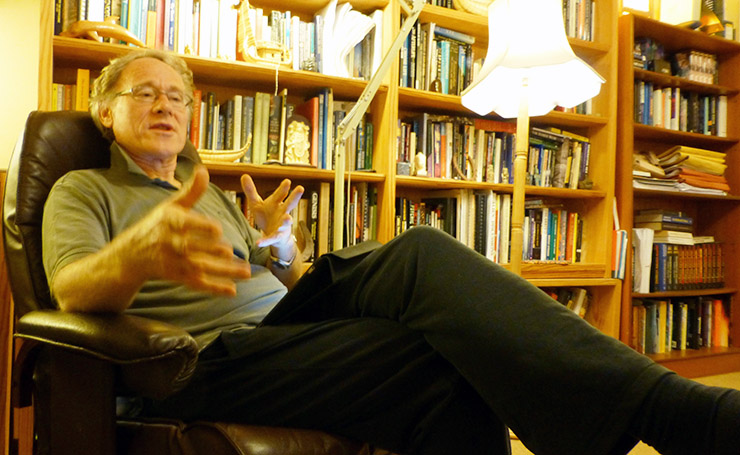
  • Interview with Graham Hancock: Ancient Civilisations & Altered States of Consciousness

    Interview with Graham Hancock: Ancient Civilisations & Altered States of Consciousness

    From New Dawn 134 (Sept-Oct 2012)

    Few, if any, have contributed more to the alternative history and esoteric genres than Graham Hancock. At the peak of his career, and on the eve of his first speaking tour of Australia [in 2012], Andrew Gough met up with Graham to discuss his legacy and what the future may hold for the greatest voice of his generation.

    ANDREW GOUGH (AG): Graham, hi. Welcome to New Dawn magazine.

    GRAHAM HANCOCK (GH): It’s a pleasure.

    AG: Can you believe that your seminal book, Fingerprints of the Gods, was published over 17 years ago?

    GH: Yes, it’s really bizarre, actually, the feeling that 17 years have passed. I had a feeling back then that there was another story to tell about the past – something missing in the record – and I set out to look for that.

    AG: Were you prepared for the responsibility that came with the success of Fingerprints of the Gods?

    GH: Well, I think first of all I need to make it very clear that Fingerprints of the Gods could never have been written if there were not a whole group of people working in this area. And, to name a few, I would say: Rand and Rose Flem-Ath, with their work on earth-crust displacement, following up the work of Professor Hapgood; Robert Bauval, with his extraordinary work on the Orion correlation, which radically changed our understanding of the pyramids and what they’re all about, and the deep antiquity that they’re connected to; John Anthony West, and Professor Robert Schoch from Boston University; John West, radical Egyptologist, thinking things through in a different way, realising that there is something wrong with the story of the Sphinx, and Robert Schoch backing that up with geological observations; all of these people were working away, doing incredibly important original work of discovery and part of my function was to write a book that put all of that work together into a bigger picture.

    AG: Your success was not without consequence, and I remember watching the 1999 BBC Horizon documentary in horror, as they attacked your theories, in what was clearly a premeditated manner. Although you were vindicated, what do you think led to the BBC’s aggression?

    GH: Well, again, I think, first of all, when you get into the field of exploring radical new ideas, challenging the status quo, and perhaps I didn’t realise this fully at the time, because the whole success of Fingerprints of the Gods and the speed with which things developed took me quite by surprise, you absolutely have to expect to be attacked, and academics also attack each other in exactly the same way.

    I also think, by 1999 perhaps I myself had become over-confident. I’d had a lot of success. When I look back on the story of my life, and those particular years, I think I was arrogant. I think I was cocky. I think I felt invulnerable. I actually think I needed to be taken down a peg, which is what the BBC did to me.

    AG: That’s a very impressive perspective.

    GH: Thank you.

    AG: So much attention has been paid to the end of the Mayan Calendar, but in your estimation what is significant about the start date?

    GH: Well, you know, this is curious. I actually can’t answer that question. All I can tell you is that when we look at what we understand of history we can say that date, of around 3100 BCE, does mark quite closely the beginning of the emergence of the city state.

    AG: And now the big question: what’s your view about what may or may not happen on 21 December 2012?

    GH: To be honest, I don’t think anything is going to happen on 21 December 2012. People often ask me where I will be on that date. Where I want to be is in the loving embrace of my family, surrounded by my children and my wife, having a good time.

    Perhaps now that I am coming on 62, as the years go by you begin to focus perhaps a little bit more on that. Life doesn’t go on for ever. We don’t know what happens afterwards. I happen to believe we come back. I can’t prove that, but I can’t see the point of a universe that provides just one life. So, my feeling about 2012 is a reminder that we’re here to love and that’s what we should be doing and living, as far as possible, positive lives, which means positive lives in relation to others as well. And that remains true, whether or not some great cataclysm is coming.

    AG: What is your view on reincarnation?

    GH: Well, first of all, reincarnation makes perfect sense to me. I think it was Voltaire who said that it is no more extraordinary to be born twice than to be born once. My own religious point of view is that it seems highly likely that consciousness survives death, and I have tried to make this point in recent lectures, that materialist science works with a model of the brain that says the brain generates consciousness, rather in the way that a factory makes cars, and therefore when the brain is dead consciousness is dead. That’s a view. But again, that is not a fact. It is equally possible, and all the measurements would remain the same, that the brain is a receiver, or a transceiver, of consciousness; that the brain is the junction point between the material and immaterial realms; that is the point through which consciousness manifests into the material plane, rather in the way that a television signal manifests as pictures through a television set. When you destroy the television set the signal is still there. Consciousness could equally well be that way.

    AG: Do you think we choose our circumstances in our next life?

    GH: Again, it kind of makes sense to me that we set a particular objective for this life – that there’s stuff we need to ‘get’ here. As I’ve gone through the process of life and I’ve made my mistakes, I’ve become more and more certain that there are transcendental consequences to all of our actions and I’m much more aware of this today than I was 20 years ago. We should not act lightly or thoughtlessly in ways that impact others and impact ourselves. We should consider that this may have huge implications over millions of years, not just over this one lifetime.

    AG: Tell me about the impetus for The Master Game?

    GH: In The Master Game, co-authored with Robert Bauval, I focused on the Gnostic tradition and how the mainstream religions – Christianity, Judaism and Islam – all worship the same entity, who is referred to as Jehovah or Yahweh in the Christian and Judaic tradition and Allah in the Islamic tradition, and that from the Gnostic point of view this entity called Jehovah is not a god. He is an imposter. He is a demon, who presents himself as a god.

    There was a saying in the film, The Usual Suspects, that the smartest trick the devil ever played was to convince the world that he did not exist. Gnostics would take that a step further – they would say, the smartest trick the devil ever played was to convince the world that he is god – that you actually insert the demonic into the mainstream religions and that would explain why these religions talk the talk of peace and love, but actually walk the walk of hatred and cruelty and violence.

    AG: Has the fact that history has been written by the victors ever made you wonder if the wrong god won?

    GH: Well, yes, I think the wrong god won – absolutely. The alternate point of view was driven underground, and that alternate point of view said that spiritual experience is fundamental and that we don’t need these intermediaries that call themselves priests or mullahs or rabbis to tell us how to relate to the spirit. How dare they stand there and tell us how we may relate to the divine?

    AG: Take Lucifer, who we are conditioned to believe was evil, but his name means ‘bringer of light’. That doesn’t sound evil to me.

    GH: Not to me, either – and again, of course, the knee-jerk Christian faction will immediately say, ‘Oh, you’re a devil worshipper’, but what actually are we worshipping in this creature called Yahweh, called Jehovah? Look at the stories in the Old Testament. Look at the things that this entity did. This is not a loving, beautiful, divine light. This is a dark creature, which tells a man to kill his own son; which says that if somebody behaves in a certain way – if somebody is a homosexual, for example – they should be killed. This is written in the Old Testament. Don’t listen to what they say. Look at what they do. What they do is pure, unmitigated, divisive hatred, wickedness, suspicion and evil.

    AG: Why do you feel there has not been a significant discovery in Egypt or other ancient lands in some time?

    GH: Well, actually I do feel there have been significant discoveries. I feel that, for example, Robert Bauval’s Orion Correlation is a significant discovery. I think that the gigantic, 12,000-year-old megalithic temple in Turkey, called Göbekli Tepe, that’s been excavated in the last six or seven years by a mainstream archaeologist, is a hugely significant discovery. First of all, it’s firmly dated to 12,000 years old, which makes it 7,000 years older than other known megalithic sites. Secondly, it’s highly sophisticated, which means there’s a background to it, which is much older than 12,000 years, that we don’t, at present, have any evidence for, but the very fact that Göbekli Tepe stands there tells us there is a background, because those people were not moving around 20 or 30 ton megaliths without some previous experience. Thirdly, that the oldest stuff at Göbekli Tepe is the best and that the younger stuff is less good.

    AG: What do you think is the lost civilisation destroyed in the last ice age?

    GH: I do think there was something worthy of the name ‘civilisation’ back in what geologists and archaeologists call the upper Paleolithic – the end of the last ice age – and that it thrived, I think, on coastlines. I think it was primarily a maritime civilisation. I don’t think it was a civilisation very much like ours.

    For me, maps from the fourteenth and fifteenth centuries, based on ancient maps, are evidence there was a global, maritime civilisation, which mapped the world and I think that it drew a meridian through the earth. The ancient prime meridian ran through Giza, that’s the zero point, and I think there were sites all around the world that were marked off at significant longitudes in relation to that zero point.

    AG: In what epoch do you believe the ancient meridian was constructed?

    GH: I think there was an attempt to re-map the world after the cataclysm. I think there were survivors and I think that, again somewhere between 13,000 and 12,000 years ago and perhaps soon after a radical cataclysm shook the earth, there was an attempt to re-establish things, to re-map things, and that attempt ultimately failed, but traces of it are left. I think that’s what happened.

    AG: Which underwater site do you think is going to create acceptance that civilisation goes back further than historians believe it does?

    GH: Luckily, with Göbekli Tepe, we’ve already got one above water. What I was arguing in Fingerprints of the Gods was evidence for a sophisticated civilisation 12,000 or more years ago and Göbekli Tepe already provides us with really incontrovertible evidence of the existence of such a culture, which had developed its stone-working techniques to such a degree that it could create a site on that scale.

    As you’ve said, Fingerprints of the Gods was published 17 years ago. I took the work a lot further with Underworld and the underwater stone circle of Kerama in Japan, off the island of Okinawa, I think is a greatly underestimated site. It’s 110 feet underwater and has been so for 12,500 to 13,000 years. I think the cities that have been detected with sidescan sonar in the Gulf of Cambay, off the north-west coast of India, are very, very interesting. And off southern India, as well, where we have a huge Atlantis tradition.

    AG: Where do you place Atlantis, and when?

    GH: I place it everywhere. I think it’s important to not isolate the Atlantis story – it doesn’t stand alone. There are many such stories from many different cultures around the world.

    And I don’t think we should forget America itself, if we’re looking for the one that’s Plato’s Atlantis. America is very interesting and it does appear to have been over North America that this gigantic comet of 12,900 years ago exploded. So, I think there’s a whole lot of missing story to be recovered from the Americas and offshore of the Americas.

    AG: The Sign and The Seal chronicled the history of the Ark of the Covenant and traced its possible resting place to Axum, Ethiopia. What do you think would happen if the Ark was rediscovered today?

    GH: It’s a fact, and a rather spooky one, that the three mainstream monotheistic faiths, Islam (particularly in its Shia manifestation) Judaism and Christianity, all have fundamentalist elements which make reference to the Ark of the Covenant, and for the character that the Shias call the ‘Hidden Imam’ to return. He, by the way, is the person whose return Iran is actively preparing for now: the Mahdi, whose name lies behind the Madhi Army in Iraq. The Hidden Imam (the Mahdi) must recover the Ark of the Covenant and return it to the Temple Mount in Jerusalem before he can engage in what is seen, in Shia tradition, as the final battle of good against evil, which is interpreted in Iran as the battle of Shia Islam against the forces of the West and Judaism. The recovery and retrieval of the Ark of the Covenant, and its return to the Temple Mount in Jerusalem, is the key that turns that process on – the process of Judgement Day, or of the end of the world.

    It’s the same for fundamentalist Judaism. There are groups, such as, for example, the Temple Mount Faithful in Israel, who are intent on building the Third Temple on the Temple Mount and who would like to sweep away the monuments of Islam, the Al-Aqsa Mosque and the Dome of the Rock, and make it a site of fundamentalist Zionism. They, too, require the Ark of the Covenant in order to realise that apocalyptic dream, which they, too, see as the precursor to the end of the world.

    And fundamentalist Christians make reference to the Book of Revelation, where one of the signs of the Day of Judgement is the reappearance and return of the Ark of the Covenant. For these institutions, access and control of that object would, undoubtedly, be used as a catalyst for a cataclysmic struggle. So, I think it’s a really good thing if the Ark stays away from history for a while.

    AG: What role do you feel psychedelics and hallucinogens have played in the evolution of human consciousness, imagination and religion, and is there a place for them in our world today?

    GH: Just as it’s impossible to understand ancient civilisations without getting into astronomy, I think it’s impossible to understand ancient civilisations without getting into altered states of consciousness, which can be brought about by a variety of different means, of which the most widely used and most reliably effective are the visionary plants. But there are other techniques and methods for getting into deeply altered states of consciousness. So, I would put the emphasis first on altered states of consciousness, rather than on psychedelics. Psychedelics are simply a vehicle for bringing about the requisite altered state of consciousness.

    AG: Like drumming?

    GH: Drumming, rhythmic dancing, certain forms of music, fasting has a long and honourable tradition for bringing on altered states of consciousness and contact with the divine – there really is a huge range of techniques. People get really holier than thou about this and say, ‘we achieve altered states of consciousness though meditation – this is the only pure way to do it – anybody who uses psychedelics is not authentic.’ I think that’s absolute bullshit.

    Of course, mainstream society does tolerate certain drugs. It does allow people to use alcohol – in fact, it encourages people to use alcohol. There are other agents that induce radically altered states of consciousness, which not only allow you to step out of the alert, problem-solving state of consciousness, but also almost inevitably lead you to question the fundamentals of life in the material realm and, indeed, the nature of reality itself; those agents include power visionary plants, such as the Ayahuasca in the Amazon, which consists of two things. It consists of the vine, Banisteriopsis caapi, and it consists of the leaf of a bush, Psychotria viridis; it’s called Chacruna in the Amazon and the vine is called Ayahuasca. The leaves contain pharmacologically pure dimethyltryptamine (DMT), which is, of course, a highly illegal drug throughout the West and, indeed, throughout the world. It’s a Schedule I drug in the United States, it’s a Class A hallucinogen in the UK, and you can go to prison for a very long time for using DMT.

    DMT is probably the most powerful hallucinogen known to man. I have personally had eleven journeys with pure, smoked DMT and what happens with DMT is that it hits you within about one tenth of a second of the first inhalation and, within two to three seconds, it plunges you mercilessly into a completely alien realm, which is as much disconnected with this realm as it is possible to imagine and which, as a result, can be utterly terrifying – or not.

    Most people that have worked with DMT will agree with this: there is something oddly almost mechanistic and technological about DMT realms. And the sense of alien contact is very powerful – that there is so much in common between the realms that are encountered on a DMT journey and the realms that are reported by UFO abductees, that you have to ask yourself what is going on here?

    I think it is likely that UFO abductees are people who spontaneously overproduce DMT, because DMT is a natural brain hormone. We’re not sure which part of the brain it’s produced in, although it has been suggested that it might be the pineal gland. But it’s really important to emphasise – and I have to make this absolutely clear – this does not mean that those experiences are not real. This does not mean that those experiences are artefacts of the brain. What this does mean is that reality may be much more complicated than we imagine. If I were a betting man I would say that what we are dealing with here is inter-dimensional contacts, rather than just contacts in this dimension, between high-tech and lower-tech beings. I think the flying saucer may be a vehicle to cross dimensions and that it may, at times, manifest into this physical dimension and may, at times, leave a physical trace, but that the primary way of accessing this is through consciousness.

    AG: Dr. Michael A. Persinger’s invention, the ‘God Helmet’, applies pressure to the frontal lobes prompting individuals to experience the alien abduction phenomenon. Are you saying that this does not negate the fact that the individual is accessing another dimension or reality that is equally as real as ours?

    GH: Exactly. Even Persinger himself, who is pretty committed to the materialist paradigm, admitted this on record; that he can’t absolutely prove that the brain is making these things. He may be altering the receiver wavelength of the brain and allowing a glimpse of another level of reality.

    AG: Tell me more about Ayahuasca.

    GH: Ayahuasca is a brew – it’s a drink – and there is a mystery in this in itself, because the DMT is being delivered orally and it’s working and the reason that it’s working is because of the Ayahuasca vine, which contains a monoamine oxidaze inhibitor that switches off the monoamine oxidaze in the stomach and allows the DMT in the Pyschotria viridis leaves to be absorbed and to cross the blood-brain barrier and enter the brain. Now, when you bear in mind that there are 155,000 different species of plants and trees in the Amazon, it’s a pretty amazing piece of chemistry that the shamans in the Amazon found these two plants, which, when put together and cooked with water, produce this amazing brew.

    Now, here’s the curious thing with Ayahuasca, which, again, is universally reported: the sense of connection and contact with an intelligence, which we also find with pure DMT, but in pure DMT those intelligences are a bit impersonal and quite mechanistic. It’s like they’re machines that have got a job to do on you. With Ayahuasca there’s a very personal sense of a connection with a being, who, in a way, is a being a bit like us, but vastly superior in her powers and abilities.

    AG: Her? Is this ‘being’ demonstrably a female?

    GH: Many people encounter this being as a woman, or as a female entity – very often as a serpent – usually as a serpent – but always understood to be female. Serpents play a huge role in it. This is very well documented. As any shaman will tell you, when the 300ft-long serpent opens its jaws right in front of you, then what you have to do is just dive right in and go into that process and see what comes. For me she has always been female and I have come to the feeling that many others have come to, that she is the mother goddess of this planet, and that her business is the planet, and that she does not operate in the material realm. Her only way to access the material realm is through human consciousness and that’s why right now, at this time of crisis, Ayahuasca is spreading all over the world and it is being drunk in every major city in the world, and it’s being encountered by tens of thousands of people all around the world, and every one of them is receiving very curiously similar messages from Ayahuasca. And those messages concern the nature of the environment; they concern terrible things that are being done to our jungles, and to our oceans, and to this beautiful gift that we’ve been given by the universe, that we’re destroying, and the desperate need for a change of consciousness to stop that monstrosity happening. And they concern our personal lives.

    Ayahuasca is regarded as a teacher in the Amazon and she will usually begin with obliging you to ruthlessly review your own life, and will show you the impact that you have had on other people. In a visionary sense you see this – the impact that you have had on other people over the whole course of your life, and the pain and the damage and the hurt that you have caused, that you may have totally justified to yourself at the time; but Ayahuasca strips all of that away and obliges you to see yourself as you have been to others in reality, not as you imagined it to be. As a result, many people find themselves in floods of tears during Ayahuasca ceremonies, because they have realised that, far from being the nice, decent, loving person that they thought themselves to be, they’ve actually been rather toxic and selfish and greedy and cruel and unkind to others.

    It is probably the most effective and most powerful anti-addiction agent in the world and the control of addiction comes through revelation – through the realisation of the individual that they are making a mistake in their lives and I speak from direct experience in this matter. I am not simply reporting something that’s in the literature, because I had, until October 2011, a 24-year, non-stop marijuana habit. It was a very central part of my life and there was a time in my life when smoking marijuana was, I believe, helpful to me – extremely helpful – and helped to open me up to other possibilities. I first started smoking marijuana in 1987 and that was round about the time that I started to open up to the Sign and the Seal and the ideas that led me into the whole enquiry into ancient civilisations. I actually don’t believe I would ever have done that if I hadn’t encountered marijuana at that time.

    I was told by many people that something had changed in my behaviour and that it wasn’t good, but I wouldn’t listen. I was just sure that this major, major, major use of marijuana was a very important, fundamental part of my life and I felt, actually, that I couldn’t write without it. But when I went to Brazil in October 2011 and had five Ayahuasca sessions, they dealt directly and specifically with my marijuana habit.

    AG: That’s amazing. And how did your upcoming tour of Australia with Dennis McKenna and Mitch Schultz, ‘The Origins of Consciousness: An Exploration into Psychedelics, Spirituality & Ancient Civilisations’, come about [see advertisement on page 17]?

    GH: I know Mitch Schultz personally and I have talked many times with Dennis over Skype and the three of us have many mutual interests; the idea came up of putting together our similar and diverse interests into a series of talks and events that will be given across Australia. I’m enormously looking forward to it.

    AG: Your most recent work, Entangled, has seen you delve into fiction. After such an illustrious catalogue of historical non-fiction, what promoted this shift in approach?

    GH: I have always wanted to stretch myself and not to get locked in a particular rut, just because it works. In the time that I have I would like to explore this gift that I’ve been given, just as somebody who is a sculptor might like to explore their abilities as a sculptor.

    But then there was the question, what would I write about and how would I approach it creatively? And, again, this is an area where some people, no doubt, think that I’m nuts, but I went to Brazil and asked Ayahuasca what to do with that – this was back in 2007/8 – and I was given the story, pretty much, that I wrote in Entangled in a series of Ayahuasca sessions in Brazil.

    AG: You present a unique and fascinating view of Neanderthals in Entangled. How did this come about?

    GH: In Supernatural I didn’t give the Neanderthals much respect. I regarded creativity and symbolism as the province entirely of anatomically modern humans, but Ayahuasca showed me a different picture of Neanderthals altogether and that I expressed in Entangled.

    AG: Time travel is an important theme of Entangled. Do you believe it’s possible?

    GH: I really do, yes. I believe time travel is possible and that time itself is much more complicated than we think. This is a point that I make strongly in Entangled: that we have this linear notion of time – time’s arrow – that past, present and future all run in a straight line and that therefore, while the past might impact on the future, it’s impossible for the future to impact on the past. I take a totally opposite view in Entangled – that time spirals like a cat’s cradle of lines that inter-wrap and interweave and that different epochs can be closely connected to one another, and that, actually, the future can have an effect on the past; that the past can be changed; that any unobserved element of the past can be changed by things that happen in the future.

    AG: So, 2012 notwithstanding, what does the future hold for Graham Hancock?

    GH: I’m embracing fiction very strongly at the moment. I am going to go back and write the second volume of Entangled. I have actually written a hundred pages of the second volume, but for certain complicated reasons to do with my publishers, as much as anything else, but also because I think there was stuff I needed to learn, I’m writing a whole series of other novels first; three novels, of which I’ve already written two, and this is a fantasy adventure series, based very strongly, historically, on the events of the Spanish Conquest of Mexico. Then I’ll go back and finish the second volume of Entangled. Then I may, just possibly, do a follow-up to Fingerprints of the Gods.

    AG: That would be brilliant. What words of wisdom can you leave us with?

    GH: Just to reiterate that 2012 is a reminder that we’re here to love. And that remains true, whether or not some great cataclysm is coming. It remains true, whether or not the world economy is going to collapse. It remains true, whether or not the madness of the state-driven system and the madness of mainstream religions is going to plunge us into a cataclysmic, man-made, global war. All any of us can do is make choices, as individuals, to live positive and nurturing lives that are filled with love and light, rather than with darkness and with hate and, if we make that decision at the individual level, every one of us, then the light is going to grow in the world.

    AG: Let me second that, and thank you for all that you have done. Best of luck in the future.

    GH: Thank you. My pleasure. It’s been fun.

    Graham Hancock’s interview was transcribed from audio by Beth Johnson.

    [alert type=”general” dismiss=”no”]This article was published in New Dawn 134.[/alert]

    [alert type=”success” dismiss=”no”]If you appreciate this article, please consider subscribing to help maintain this website.[/alert]

    © New Dawn Magazine and the respective author.
    For our reproduction notice, click here.