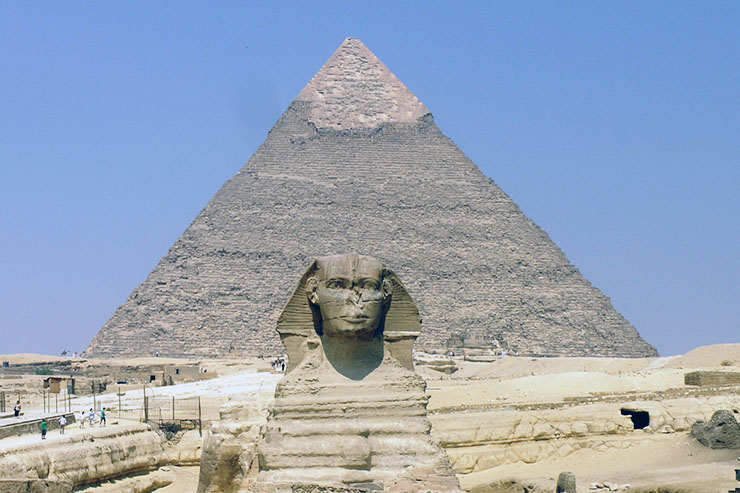
New Dawn – World's Most Unusual Magazine

Tag: Great Pyramid

  • A New Theory for the Great Pyramid: How Science is Changing Our View of the Past

    A New Theory for the Great Pyramid: How Science is Changing Our View of the Past

    This article was published in New Dawn Special Issue 13 (Sept 2010)

    Of all the chambers in the Great Pyramid, the subterranean chamber is the largest, as well as the most mysterious. It is 46 feet long, 27 feet wide, hewn into the limestone bedrock, and difficult to describe. The descending passageway’s entrance to the subterranean chamber is near the floor at the northeast corner. A six-foot-wide square pit shaped like a funnel has been tunnelled in the middle of the floor, near the east wall. This square-shaped pit is actually the mouth of a shaft that is eleven feet deep, although in 1816 the Italian explorer Count Caviglia drilled into the pit another thirty feet.

    The western half of the chamber has been carved nearly six feet higher than the eastern half and sculpted into several large finlike protrusions. All these finlike protrusions are situated east to west and are nearly as tall as the ceiling. Between the large protrusions, a stepped channel starts at the floor and flows toward the back of the chamber. In its centre there is a channel leading to the western wall. In the southeastern corner, a tunnel known as the “dead end shaft,” thirty inches in height and width, runs south fifty-seven feet, then ends at a wall. There are two other features in the design of the Great Pyramid that appear to be part of the work performed in the bedrock, the well shaft and the “grotto” (see figures 1 & 2)
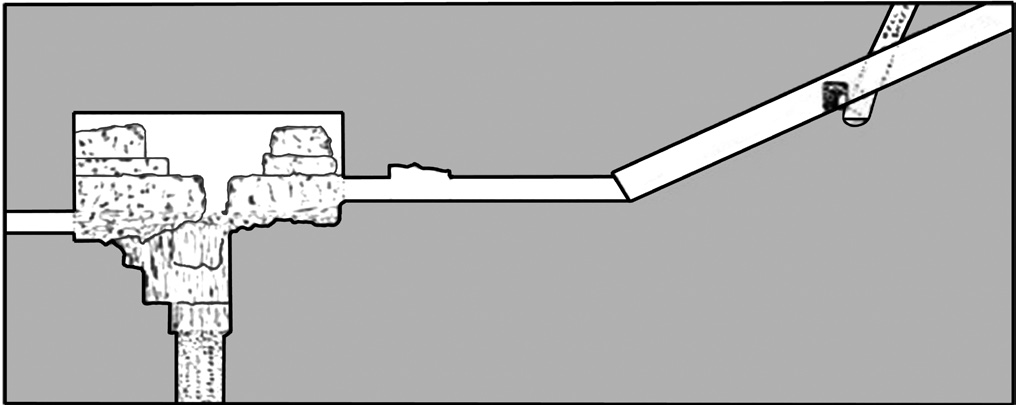
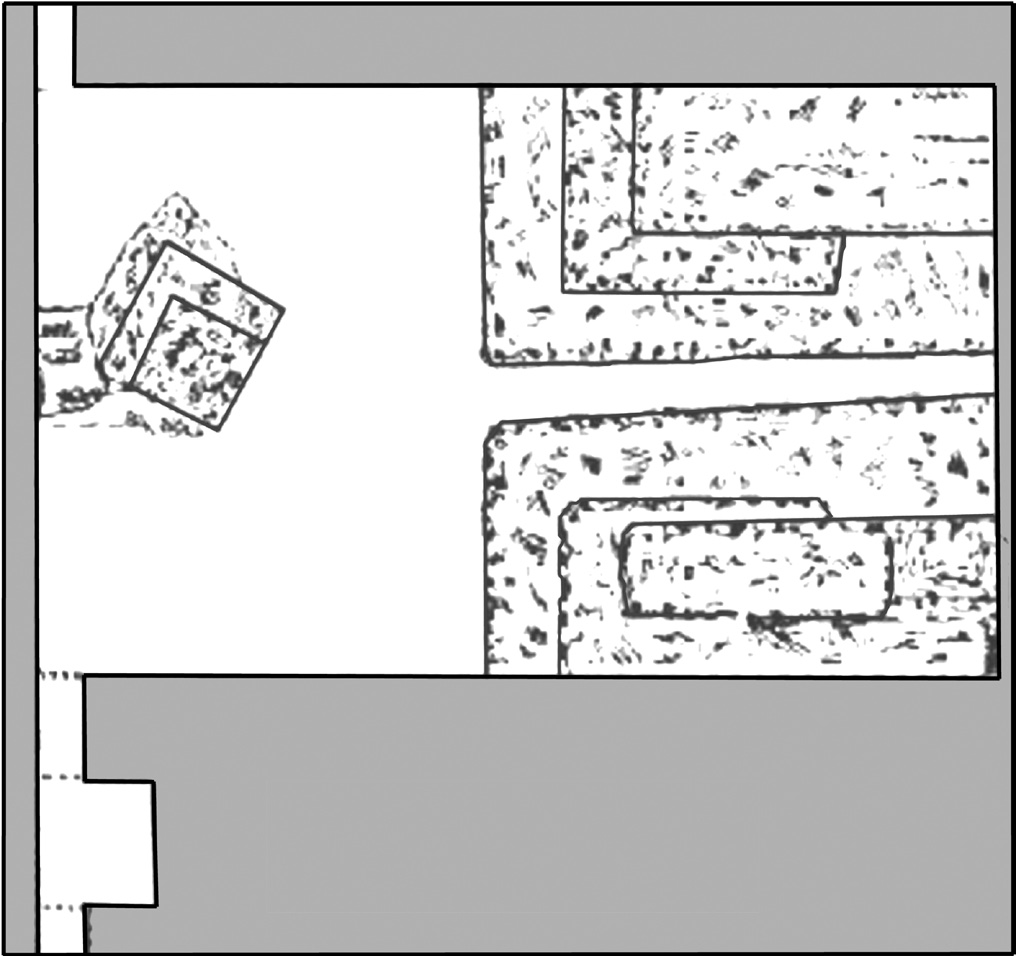
    Figure 1. © Edward Malkowski
    Figure 2. © Edward Malkowski

    If the subterranean chamber was nothing more than a mistake, and was originally designed to be a burial vault, an enormous amount of resources was wasted. On the other hand, if the chamber was an integral part of the overall design of the Great Pyramid and performed a function, then what could that function possibly be?

    Everything from a tomb to temple of initiation to a device of some kind, there’s never been a lack of theories over the years describing what the Great Pyramid of Giza and the other pyramids was originally designed for. What has been lacking, though, is a theory describing why all the ancient Egypt pyramids were built. More importantly, what’s been lacking in any theory is scientific experimentation.

    To the best of my knowledge no one has built a scale model of the Great Pyramid. However, without any idea of what the Great Pyramid was, assuming it was a device, there would be no theory to test. Marine engineer, John Cadman, saw something that had been passed over for decades. In 1962, in a book entitled The Pharaoh’s Pump, a man named Edward Kunkel put forth the theory that the Great Pyramid was in its entirety a water pump. Cadman ran across the book one day browsing titles in a used bookstore. Intrigued, he purchased Kunkel’s book and after reading it realised that Kunkel was not far off the mark with his water pump theory. Being familiar with hydraulics and machines that rely on hydraulics, Cadman noticed that the design of the Great Pyramid’s subterranean chamber and its associated tunnels looked familiar.

    Cadman’s Experiment
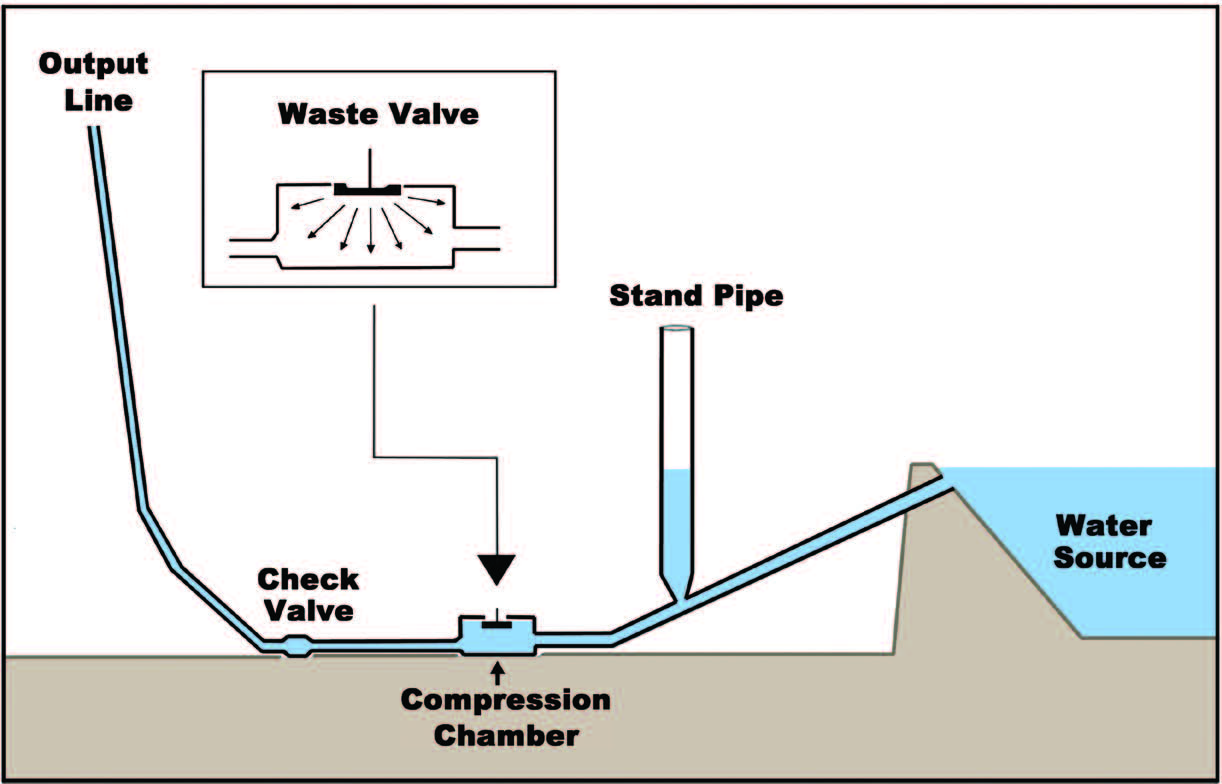
    Figure 3. © Edward Malkowski

    Before the invention of the electric water pump the ram pump was used to move water from a reservoir to another location through a simple system that had only two moving parts, a weight loaded waste valve and check valve. Under the force of gravity, water in a reservoir flows down the input pipe and forces the waste value closed (see figure 3). With the waste valve closed, water continues to flow down the input pipe increasing the pressure inside the pump. The increased pressure opens the delivery valve forcing water into the output pipe. Since the water is being forced to a higher elevation faster than the water flowing down the input pipe the flow of water reverses which closes the check valve and the process begins again.

    Inspired by Kunkel’s work, Cadman learned as much as he could about the Great Pyramid’s subterranean chamber and associated tunnels, and in June of 1999 he made his first model. It leaked then cracked, neither would it function. Several months later he began work on a second model and connected a new line to the bottom of the pit shaft, believing this new line had to be the pressurised output. But the pump still didn’t operate the way he thought it should so he began building a third model which he completed on April 3, 2000, and it worked flawlessly.

    What Cadman discovered was that the subterranean chamber absorbed much of the reverse pulse. He also observed that without the subterranean chamber, the reverse pulse was large and the output flow was more erratic, confirming for him that the output in the Great Pyramid’s subterranean chamber travelled through what is called the dead end shaft. It also confirmed his suspicion that the ancient oral tradition that a tunnel exists connecting the subterranean chamber’s pit to the Nile River.

    A few weeks later Cadman moved the model to a seasonal creek with a pond serving as a reservoir, and experimented further. To simulate the effect of being underground he encased the pump assembly in concrete (see figures 4 and 5). Interestingly, the action of the pump, which was now embedded in concrete, created a vertical compression wave. This, according to Cadman, meant that the Great Pyramid’s subterranean ram pump also had an acoustical element. So, he built two more models to study the acoustics and fluid dynamics.

    The acoustic model, which was made of fibreglass and epoxy and encased in concrete, weighed five hundred pounds. When operating, the characteristic heartbeat-like thump of the pump could be felt through the ground twenty feet away and heard nearly a hundred feet away. Because of the powerful pulses it generated, Cadman named it the “pulse generator.”
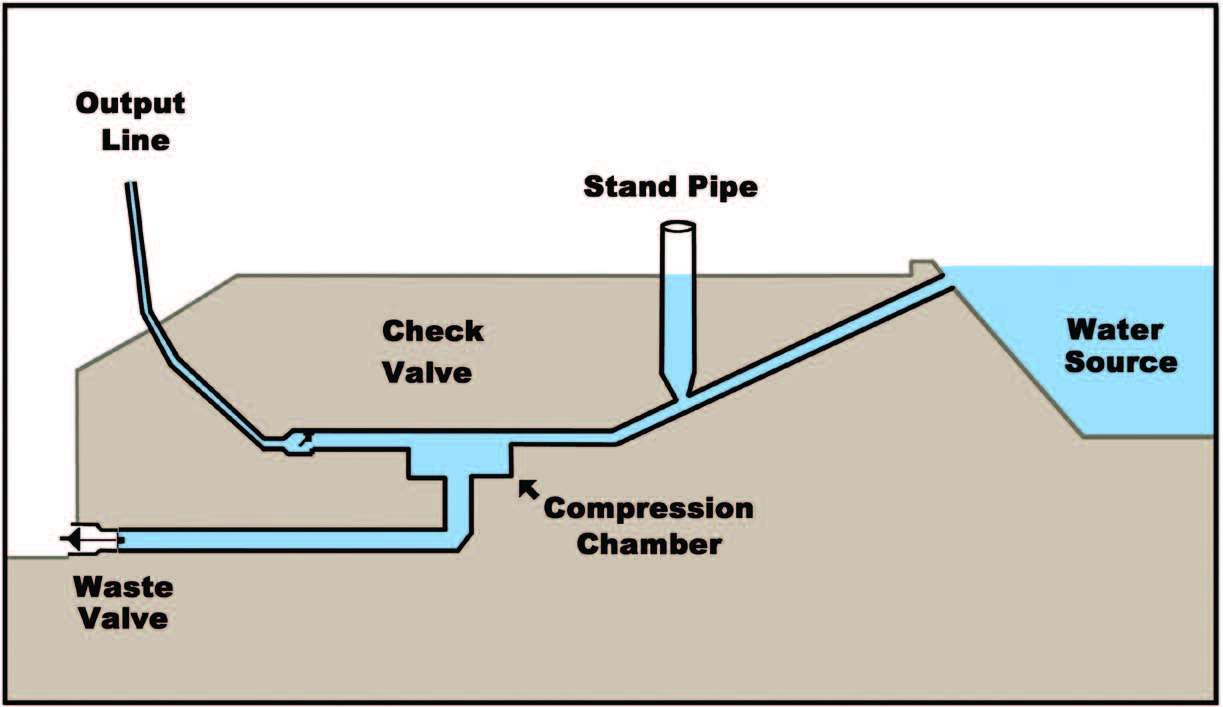
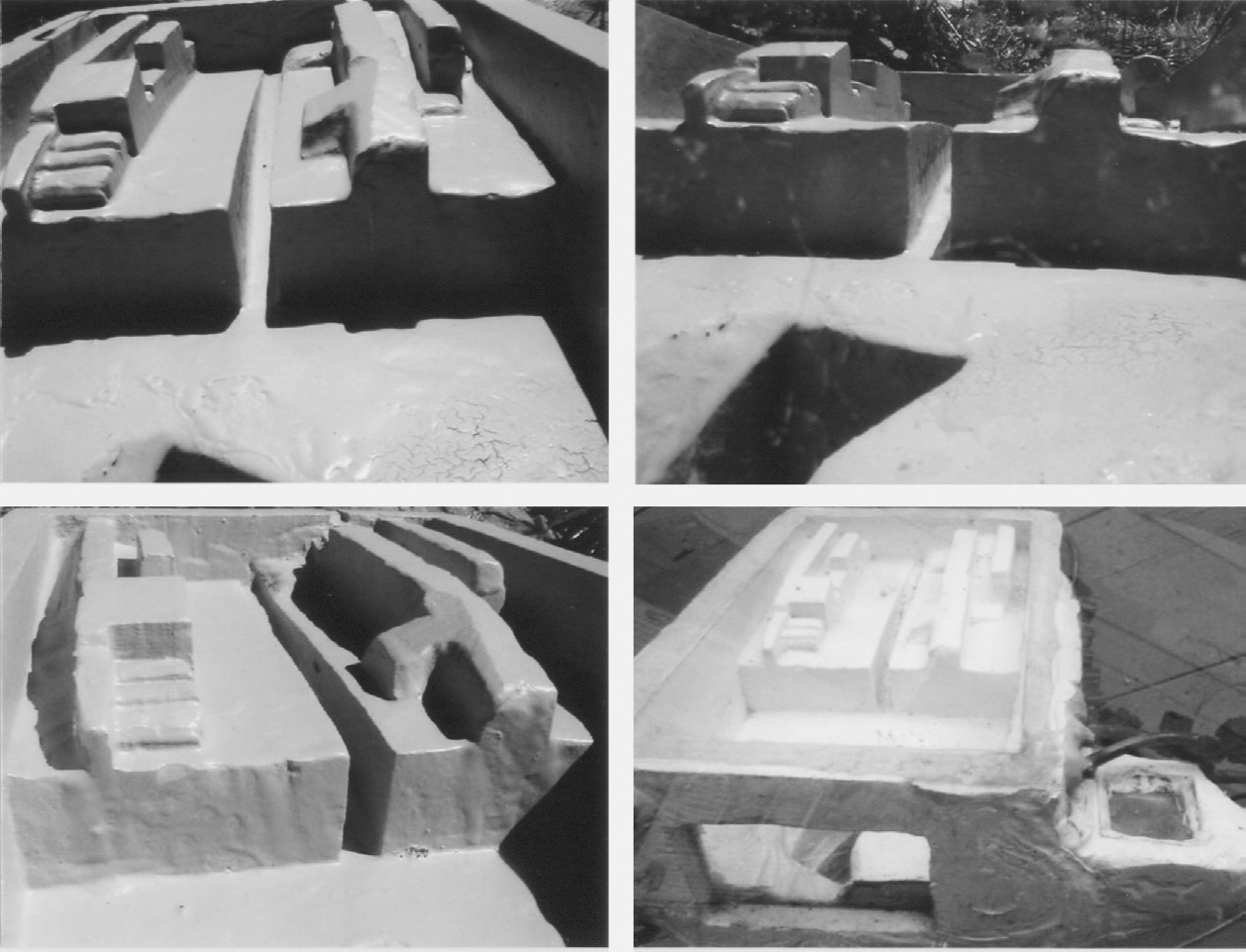
    Figure 4. © Edward Malkowski
    Figure 5. © Edward Malkowski

    Cadman constructed a fourth model to study how water moved through the subterranean chamber and could operate in two different modes. This model was fitted with twenty-five individual ink injection locations and a glass top (see figure 6). It had a glass wall on its east side to view water flow, although Cadman discovered that the glass top quickly shattered when the model was operating in pump/pulse mode. Nevertheless, when not in pump/pulse mode, it was clear by studying the movement of water within the modelled subterranean chamber that the flow was complex and precise.

    What he discovered was that the sound wave striking the perpendicular surface reflects the majority of the pulse back toward the source. He also discovered that when the fluid jet strikes a perpendicular surface, it spreads in a 360° pattern perpendicular to the jet. Thus, he concluded that the design of the subterranean chamber incorporated fluid dynamics as well as acoustical dynamics. In his own words, “The dynamics are on par with that of computerised storm analysis: somewhere between hurricane dynamics and tornado dynamics.”

    Cadman’s model also revealed some performance issues that were built into the Great Pyramid’s subterranean pump. An additional “assist” line, from the compression chamber to a secondary location, speeds the movement of water through the output pipe. It also focuses the shock wave in the line leading to the compression chamber. The result is that a pulse is transmitted through the ceiling of the compression chamber. Thus, the line that connects the waste valve to the compression chamber acts as a waveguide, forcing the shock wave into a pulse. Therefore, the pulse is transmitted vertically (through the ceiling) as well as down the waste-valve line.
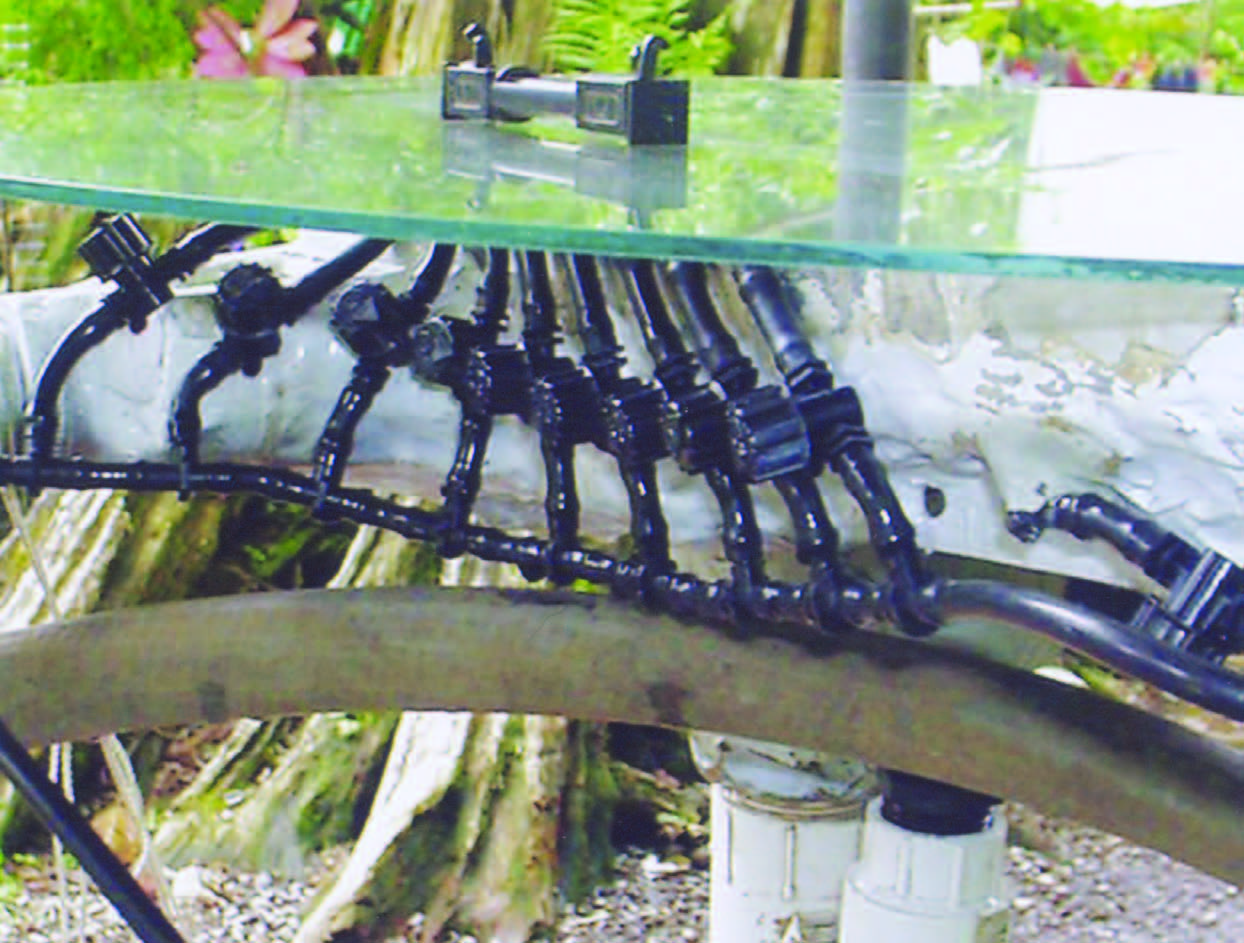
    Figure 6. © Edward Malkowski

    Cadman’s modelling of the subterranean chamber and its tunnels provides a better understanding of the Great Pyramid, as well as the Giza Plateau. In its completed state the Great Pyramid required a moat, which was fed by a system of aqueducts from the Western Nile (the Ur Nile); an ideal source for a gravity-fed water system, since the Western Nile was at a higher elevation than the plateau. It also explains the remains of a retaining wall that once surrounded the pyramid. The wall served as an embankment for an onsite reservoir, which in appearance was a moat. Tunnels, such as the “well” at the pyramid’s entrance, connected the Great Pyramid complex to an ancient lake, Lake Moeris, and the Western Nile.

    Lake Moeris (Egyptian Mer-Wer, meaning “Great Lake”) was an ancient lake fifty miles southwest of Cairo. At one time it was very large and occupied the entire Faiyum depression. It was also called the Pure Lake and the Lake of Osiris by the ancient Egyptians. During prehistoric times the waters of Lake Moeris stood nearly 120 feet above sea level, but by 10,000 BCE they had dropped to nearly twenty-five feet below sea level, possibly as a result of the Nile channel being naturally diverted. With increases from rain, between 9000 BCE and 4000 BCE the lake rose again, but gradually subsided. And as the climate became increasingly more arid, a canal connected Lake Moeris to the Nile; over the years it slowly silted. During the Middle Kingdom, 2000 BCE to 1600 BCE, dynastic Egyptians widened and deepened the channel, thereby restoring its flow. At that time the lake was believed to be fifty-five feet above sea level.

    There is little doubt that the lake served as a means of flood control as well as a reservoir for irrigation. Egypt’s Ptolemaic kings of the third century BCE partially drained Lake Moeris to make available 450 square miles of rich alluvial soil, which was irrigated by canals and extensive cultivation. Since then the water level of Lake Moeris has continually declined, and it is now the small, shallow saltwater Lake Qārūn.

    When the Great Pyramid pulse pump was functioning, the descending passage, subterranean chamber, dead end shaft, pit, well shaft, and grotto made up the components (see figure 7). According to Cadman, it could be operational today if all the tunnels associated with the pyramid could be cleared. Besides the well shaft that connects the descending passage to the middle chamber of the pyramid, there are two other tunnels that would need to be cleared. Clearing the pit associated with the dead end shaft (where the check-valve exists) would expose the horizontal shaft. If these shafts were cleared, the moat reservoir was in place, and the well in front of the pyramid connected to a Lake Moeris substitute, the pump could be operational.
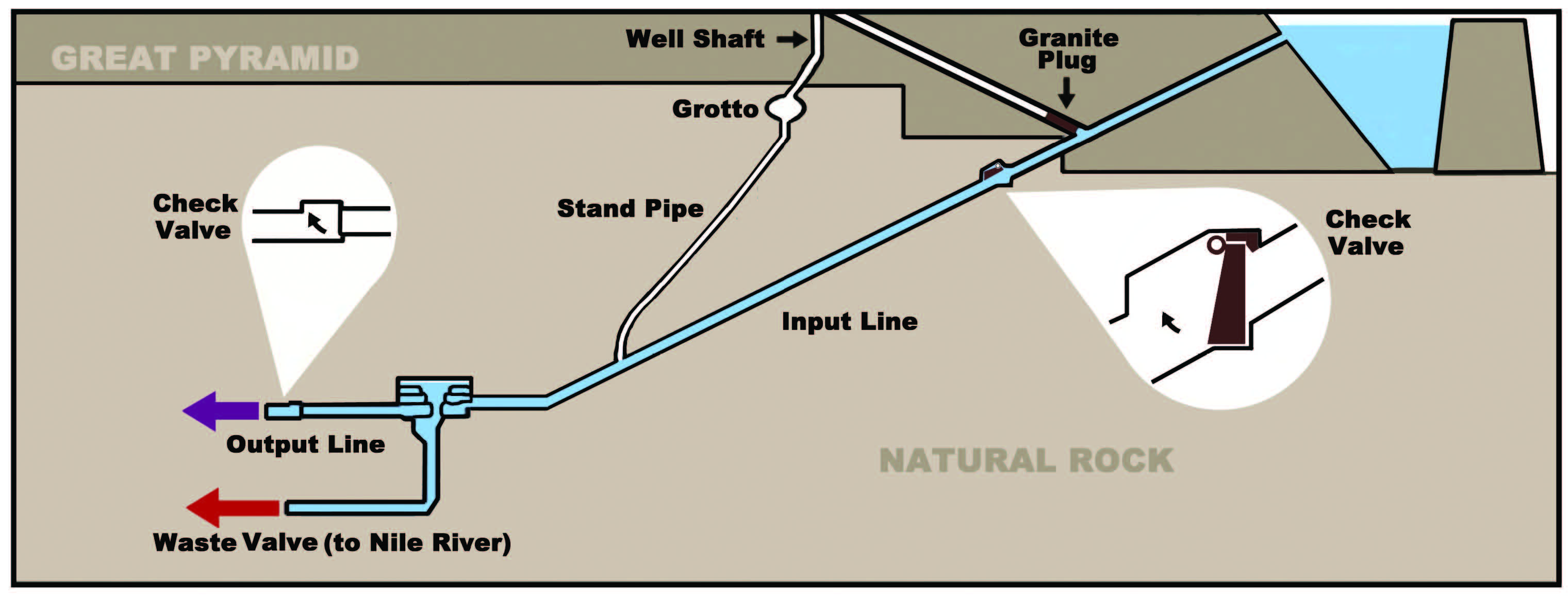
    Figure 7. © Edward Malkowski

    One of the most important results from Cadman’s experiments was discovering the significance of the well shaft and its effect on the pump’s pulse rate. This specific design issue leads to the intent of the Great Pyramid’s designer. The well shaft begins near the bottom of the descending passageway and extends upward 170 feet. In the water-pump assembly, the well shaft functions as a standpipe, providing a shortcut for the reverse shock wave to reach air. In essence, it maximises the pulse rate of the pump.

    Although standpipes are typically twice the diameter of the input (drive) pipe, in the Giza assembly the standpipe (well shaft) is actually 25 percent smaller than the input pipe (descending passageway), which has a peculiar effect on the system. It lowers the elevation of the pulsing water below the water level of the moat reservoir. Interestingly, this specific elevation correlates to the height of the grotto, which serves as a reservoir, allowing for stabilisation and regulation of the reverse pulse. A block of granite, existing within the grotto that fits within the pipe, is believed to function as some type of choke or regulator.

    According to Cadman, the well shaft was part of the original design of the pyramid, and as a standpipe in the pump assembly, it served to maximise the pulse rate of the pump. The standpipe also reduced the reverse surge out of the descending passage, as well as reduced pumping efficiency and pulse intensity.

    The Importance of Pump Efficiency

    Cadman tested four different pump configurations, two circulating and two elevating, to gauge the well shaft’s affect efficiency. When in a circulating-pump mode, the well shaft reduced the efficiency by 29 percent. And, in an elevating-pump mode, the well shaft reduced the efficiency by 68 percent. The increase in efficiency of the well shaft provided an extra twenty pulses per minute, from sixty to eighty. Since the Giza configuration of the subterranean chamber included a well shaft, for the builders of the pyramid, pumping efficiency did not appear to be of primary importance. So if pumping efficiency was not of primary importance then what was?

    One way to approach this question is to review the general layout of the subterranean chamber. The subterranean chamber pit is offset by 45° in relation to the general configuration of the chamber and is aligned northwest to southeast. According to Cadman, this is so because a plane placed at a 45° angle will maintain the unidirectionality and consistency of the compression wave. In other words, this reflective elbow ensures the consistency of the compression wave. Any other type of elbow at the pit’s bottom would diffract (scatter) the compression wave. So the pit’s alignment is strictly for acoustical dynamics and for creating a standing wave in the waste line and subterranean chamber.
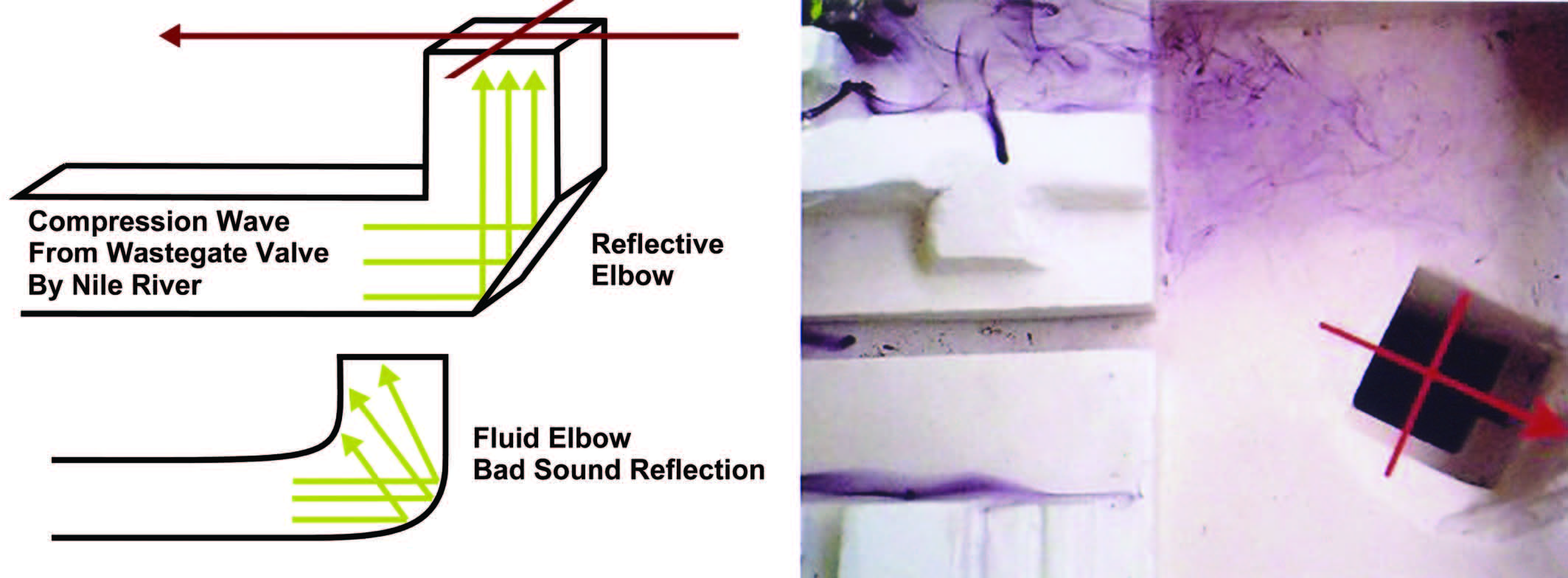
    Figure 8. © Edward Malkowski

    To create the standing wave in the waste gate line and subterranean chamber, it would be imperative to have the reflective elbow. The pit’s offset is exactly aligned with the tunnel (see figure 8, right; the red arrow is aligned with the exit tunnel). Not only does the reflective elbow completely explain the pit’s diagonal offset, but it also confirms that the compression wave is a major design consideration. The designers thoroughly understood complex fluid dynamics as well as complex acoustics (see figure 8, right; the red arrow shows the direction of the tunnel at the bottom of the pit; the ink injection photo shows some of the flows in the step area).

    Another way to approach the question is to review the engineering significance of the dead end shaft. It allows for a pressure change, which in turn changes the frequency of the compression wave. A gate valve at the end of the dead end shaft provides a means for accomplishing this. Adjusting the back pressure by adjusting the gate valve allows for changes in timing. In essence, this is a simple method to compensate for different water temperatures and atmospheric pressure, which are factors that affect the velocity of the compression wave.

    Cadman’s testing demonstrated that the pulse rate can be altered by at least 30 percent, between sixty and eighty pulses per minute. He also discovered that adjusting the back pressure changed the water’s density and, as a consequence, altered the compression wave’s velocity and frequency. In essence, such an assembly allows for easy fine tuning of the lower portion of the Great Pyramid to create the standing wave in the subterranean chamber and waste gate shaft.

    These experimental results confirm that the compression wave was a major design consideration. Also, according to Cadman, the square pit carved into the subterranean chamber created a whirlpool as water moved through the system of tunnels – apparently another design feature to efficiently move water to the chamber and out the waste line.

    If pump efficiency – in other words, pumping water – was not of prime importance to the ancient Egyptians, then what was? According to the experimental evidence, the answer is a compression wave, which, of course, creates another question. Why was a compression wave of primary interest to the Great Pyramid’s builders?

    A New Theory

    The question I have always had in the back of my mind concerning the pyramids is one of economics. Resources are resources whether a construction project occurs today or thousands of years ago. Man-hours and tools are required, so is pay for the management team, supervisors, and workers. If it cost 35 billion dollars to build a large structure today it would also cost that much in resources to build the same structure many thousands of years ago, the only difference being the nominal value of money used. In the case of the Great Pyramid that’s 380 billion dollars, according to engineer Markus Schulte of the global design and business consulting firm Arup.1 The limestone blocks for the Great Pyramid, alone, would cost today 18 billion dollars. With such a high dollar amount for a single pyramid, and more than ten were built comparable in size, then there had to be a very good reason why the Great Pyramid and the other pyramids were built, a reason that would benefit the whole of society.

    If the Great Pyramid was exclusively a water pump as John Cadman demonstrated in his experiments, then there wouldn’t be a need for another chamber located in the middle of the pyramid and a third chamber located in its upper regions. These chambers as well as the shafts in these two chambers need to be explained.

    Assuming Cadman is correct that the compression wave was what the pump was designed for, then the middle and upper chamber would likely have been designed to somehow react with the vibrations emanating from the pump. The upper chamber, known as the King’s Chamber, in its entirety was built from slabs of granite – the floor, walls, and ceiling – and located just above the chamber the builders of the Great Pyramid placed five rows of granite beams. So, it is obvious that granite was of primary importance in the uppermost chamber. The question is why.

    The high-fidelity stereo industry uses granite not only to provide a stable base for equipment but also because of its resonance qualities. All materials have a natural resonance frequency meaning that all materials will vibrate at certain frequencies. In the world of high-fidelity, the resonance of other materials in a room distorts the stereo’s sound, including the rack where the components of the sound system are housed. However, with granite as a base for stereo components not only are extraneous sounds dampened, but full sound is produced through the granite’s resonance. And by further isolating the granite base from the stereo rack with rubber washers or other polymer fixtures, the granite’s resonance properties can be further controlled. With this in mind, it might be the case that the purpose of building a granite chamber in the Great Pyramid was to create resonance.

    According to Tom Danley, the sound engineer featured in the documentary film The Mystery of the Sphinx, the Great Pyramid makes strange sounds because the granite chamber resonates from the rigidity of the stone. What he also discovered was that a number of low-frequency components existed even without a test signal present in the pyramid implying that the chamber was constructed for its resonance, and that it naturally creates a frequency. Most likely, he added, the low frequencies were a result of “Helmholtz resonances caused by the wind blowing across the entry tunnel.”2

    However, a compression wave emanating from the subterranean chamber would likely have a marginal effect on the granite in the upper chamber. What would be needed to localise the granite is a way to transform the compression wave into sound. This would create enough vibration to activate the granite beams and create a standing wave of resonance. With devices such as Helmholtz resonators built into the Grand Gallery those vibrations would become sound and cause the granite to resonate or ‘sing’. The question is ‘why’, to what effect? With shafts leading to the Great Pyramid’s exterior, the ‘singing’ granite would project its sound into the atmosphere. This, in turn, would create an electrical field in the atmosphere according to physics research.

    Again, we are left with the question ‘why’? The subtle electrical field created by the Great Pyramid would be of little use for means of powering equipment. However, such a field would deflect very low frequencies (VLF) and extremely low frequencies (ELF), frequencies that exist at all times in the atmosphere as a result of thunderstorms around the world. In agricultural experiments, VLF and ELF have been shown to promote plant growth. With the Great Pyramid operating as the engine, all of the pyramids could be connected by a subtle electrical field to create a canopy of sorts thereby deflecting VLF and ELF into the surrounding fields.

    In might sound mundane that the pyramids were agricultural devices, but it provides the best of reasoning for a civilisation to spend an immense amount of resources on any given project. Without food society would gradually fall into anarchy and civilisation would cease to exist.

    Illustrations courtesy of © Edward Malkowski. Further information on the above theory and a whole lot more can be found in Edward Malkowski’s new book Ancient Egypt 39,000 BCE: The History, Technology, and Philosophy of Civilization X (Bear & Company, 2010), available from all good bookstores.

    [alert type=”general” dismiss=”no”]This article was published in New Dawn Special Issue 13.[/alert]

    [alert type=”success” dismiss=”no”]If you appreciate this article, please consider subscribing to help maintain this website.[/alert]

    Footnotes

    1. ‘Where Did It Come From? Ancient Egypt: Iconic Structures’, Popular Arts Entertainment, The History Channel, September 21, 2006.

    2. “ProSoundWeb Live Chat with Tom Danley,” March 12, 2002, transcript, at www.prosoundweb.com/chat_psw/transcripts/danley3.shtml (Accessed September 29, 2009).

    © New Dawn Magazine and the respective author.
    For our reproduction notice, click here.
  • How the Great Pyramid Was Built

    How the Great Pyramid Was Built

    From New Dawn 54 (May-June 1999

    No one in the world really knows how the Great Pyramid of Giza was built – that is, of course, except for myself! Such is how I start a lecture or speech on this controversial subject. As an attention grabber, it works well, but it is nothing compared to the subject matter at hand.

    There are about as many proposed methods of construction as there are people who propose theories on the subject, with the informed reader aware of most. The following brief and condensed explanation of the Great Pyramid’s construction is one of the most fantastic and unconventional methods ever proposed. With some consideration, this is possibly the method that makes the most sense.

    The following narrative of the Great Pyramid’s construction is based on a privately published and very rare book called Pharaoh’s Pump written by the late independent researcher, Edward J. Kunkel. This is the book that is so highly regarded in the recent best selling book, 5/5/2000: Ice, the Ultimate Disasterby Richard W. Noone.

    Pharaoh’s Water Pump

    Traditional Egyptologists explain the subterranean passages and the chamber deep below the Great Pyramid as a change in design. Egyptologists tell us after working so long and hard on this part of construction the Pharaoh decided he wanted to be entombed in a chamber up in the pyramid. Pyramidologists tell us the passages are designed and built as Man’s prophetic chronology set in stone. Others say the descending passage and subterranean room were used to view the stars.

    The Pharaoh’s Pump Foundation and the book Pharaoh’s Pump maintain that these passages cut into solid bedrock are a colossal and enormous hydraulic ram pump! This hydraulic ram pump is built on a gigantic scale never duplicated in the ancient or modern world. Massive amounts of pumped water was used to supply a series of water locks, up to the Great Pyramid, transporting barges with stones to the building site. With its own pumped water and a series of water locks as a lifting medium, the Great Pyramid supplied its own water power to build itself!

    Before the Great Pyramid’s construction, the site was not flat but a granite outcropping. The shape and size of this outcropping is unknown. In the finished pyramid the granite outcropping protrudes up to a height near the bottom of the Grand Gallery. The site is on a gradual sloping hillside. Uphill from the Great Pyramid is the Libyan Desert.

    Almost all agree that the two subterranean shafts and the subterranean room were excavated before the pyramid was built. Herodotus, the famous Greek historian, tells us ten years were spent in preparation. The subterranean excavations at the construction site were the preparatory work needed before construction started.

    At this stage of construction, there was only one mechanical element needed to create the largest, most colossal, hydraulic ram water pump ever created! That one single mechanical element being a drain and valve. The dead end shaft, cut in the south-eastern corner of the Subterranean Chamber is 2 feet 7 inches wide, 2 feet 5 inches high and 52 feet 9 inches long. Its direction is from true north to south. Its position is horizontal and it lies at the lowest corner of the lowest chamber. This suggests that it functioned as a drain, but it dead ends in the rock. Even though it is 105 feet below the base of the building, it is still high enough from the outside to function as a drain.

    The cutting of this shaft must have been an awful job. It is so small – only 29 inches high and 31 inches wide with a length of 52 feet, leaving very little elbow room. Maybe a midget crew cut it. I’ll never believe that its existence is due to over-sight or gross error. I’ll never shrug it off as a miscalculation. I have too much respect for the ancient engineers for that. Why is there so much interest in the lowest shaft of the Subterranean Chamber? The answer lies in this simple fact: a waste duct in this particular area would be definite proof that the engineers had cut a simple water ram in the solid rock!

    Around the base of the Great Pyramid and in its immediate vicinity are a number of unusual and hard to explain cuttings in the solid rock. Among these cuttings are the “crypts” that contain the so-called “sunships.” Traditional Egyptologists maintain these ships were entombed at the same time as the Pharaoh and the ships were used during the funereal precession. The location of the sun ship pit and other features indicate that they were created at the same time as the Great Pyramid and were part of a drain system with a valve that would complete the greatest water ram pump in the world. The dead end shaft that leads south from the Subterranean Chamber heads directly towards the sunship pit. This water drain system of the pump was unnecessary after the Great Pyramid was completed. Later the ancients used the pit for ceremonial purposes after the functional purpose of this cutting was no longer needed. Our current understanding of the passage from the Subterranean Chamber towards the sunship pit is that the passage is a dead end.

    Apparently this dead end has never been examined with the idea in mind that it may be a drain duct. In 1954, two sun ships were discovered in the rock hewn cavity at the very southern base of the pyramid. It is reasonable to assume that the size and shape of this cavity has been surveyed and recorded. Such data is hard to come by. It would be interesting to examine the north wall and ascertain the distance from it to the terminus of the dead end. The terminus of the dead end is about 83 feet south of dead centre of the building. This leaves a space of about 300 feet to its southern base. In short, I believe there exists a connecting duct, between the dead end and the sun ship cavity. Explorers might hit pay-dirt if they take a good hard look at the end of the dead end and the north wall of the sun ship’s crypt.

    This pump was a simple water ram of monstrous proportions. A ram that pumps far more water than it wastes. My guestimate? At least 4 tons for one ton of wastage to a height of 60 feet during a time cycle of one minute. The sun ship cavity itself may be part of it. My line of reasoning follows this pattern. Originally, the cavity was cut for use as part of the drain for the water pump. When the Great Pyramid was completed the pit was no longer needed. Only after the construction of the Great Pyramid were the sun ships installed in their pits. Why not decorate and touch up these pits with some regal trappings?

    I have believed from the very beginning that this tube is part of a drain and that its outlet is sealed in as clever a fashion as the ancients managed to conceal other openings. It is utterly fantastic to believe that the ancient engineers overlooked this common device – a drain that can be opened and closed at will and thus employ the same mechanics of the common ram. I predict that one or more baffle walls will be found in the horizontal tube leading south from the subterranean chamber, the function of which is to slow down the high velocity of water discharge and ease the shock exerted on the waste valve.

    What will the drain valve look like? It will be a “door with pivots.” We call them butter-fly valves. They are easy to open and close and are operated by a handle. Pairs of holes with granite seats to fit this type of valve are found in the passage near the top of the lower diagonal. No one, for a moment, doubt that these seats and holes are for this type of “door.”

    There are two other check valves in the subterranean cuttings. A short distance down in the solid rock of the lower diagonal is an offset “wherein,” says Sir Flinders Petrie (The Pyramids and Temples of Giza), “hung a door that swung inward.” A pair of eight inch round holes are found here, one in the east wall and the other in the west wall. Adjacent to these round holes is granite masonry. This mechanical element, given a hydraulic interpretation, is a check-valve. The holes support a round shaft and the granite masonry is the valve seat. Halfway up the passage leading from the Subterranean Chamber to the lower part of the Grand Gallery is the Grotto. Detailed research indicates it too in ancient times housed a check valve.

    How the Water Was Pumped

    The Ancients were doing what every engineer does before he undertakes a massive construction project. The machine comes first, and in this case it was a water pump. These subterranean cuttings formed a hydraulic ram pump. The lower diagonal holds about 88 tons of water! When the valve in the drain is opened the water in the lower diagonal moves down. Then the drain valve is closed. The water in the lower diagonal continues to move down compressing the air in the Subterranean Chamber. This chamber has an air capacity of 7000 cubic feet! Once this moving water has compressed the air to the maximum, the water stops moving. At that point, the check valve in the upper end of the lower diagonal closes. The highly compressed air in the Subterranean Chamber pushes water up through the “grotto” and onto the rocky knoll. Research including computer modelling shows that the water ram pump would easily pump water to a height of the top of the completed Great Pyramid.

    Water ram pumps are a very interesting device and are still being built and sold to this day. Water ram pumps work and work well. When you shut a water faucet off and the pipes rattle, think about the ancient engineers who used the same force in a colossal scale to move and lift the blocks in constructing the Great Pyramid.

    What existed at this point is a mound of rock with a passage in the centre that leads up from the Subterranean Chamber and the descending passage down to the Subterranean Chamber. All of the subterranean passages and subterranean valves were finished and the colossal hydraulic ram was ready to go. The source of water for the pump was the ancient lake of Moeris. This lake was huge, about the size of Lake Erie. Its elevation was above the base of the Great Pyramid. Water for the pump was brought to the site and channelled into the lower diagonal from this lake.

    If the hydraulic ram pump pushes water up the central shaft it will be wasted because the water will just flow down the granite outcropping. At this stage, parabulious walls were built around the building site. This created a catch basin for the water. Near the base of the Great Pyramid to this day can be seen these same “parabolus walls” made of earth, which surround the building. The walls form a rectangular basin and look like the remains of an ancient catch basin or reservoir. The 14 foot vein of river silt found inside is mighty convincing evidence that in ancient times this rectangular enclosure held water, and formed a pond 180 acres in area. And the little rocky knoll, upon which the pyramid stands, became a little rocky island.

    The Construction Process

    Try to envision, if you will, the rocky knoll high above the Nile before a single block was set. It must have been a bleak, bare, gray mound of limestone. It was not flat. The perimeter had to be levelled off to create a base for the first row of casing stones. To use the water, it must be caught. The simplest device to catch it is a ditch. Once a ditch was cut in the location of the first row of casing stones and filled with water, it formed a perfect device for a levelling operation. Water would pour from the ditch at the lowest contour of the rock. This lowest contour determined the elevation of the base. Five hundred chisellers could be put to work at one time and whack the perimeter of the base down to a uniform level. The still water in the ditch would be their gauge, and simplify surveying operations.

    The next step would be to move the casing stones from the quarry across the river up to the base of the prepared building site of the Great Pyramid. How would you bring 16 ton stones from across the river, that are already on barges, up to the site of the Great Pyramid? A site with subterranean cuttings that are a hydraulic ram pump. Evidence indicates that a series of water locks from the Nile to the building site were created to move the stones up from the river to the building site. The locks worked just as the water locks work in the Panama Canal. The subterranean cuttings that are a colossal hydraulic ram pump supplied the needed water to operate the locks.

    Comparatively recent excavations have exposed the cutting of a giant rock-hewn stairway with huge risers, ascending from the basin near the Nile River to the top of the knoll. This cutting has the basic characteristics of the remains of a series of water-locks, although every relic that would indicate water-locks is gone. The accepted explanation for this cutting was to extract blocks for structural use in the pyramids. I never believed this explanation because the cutting is too precise, too neat, and too regular. If the ancients were quarrying blocks alone, the sides, the treads, and the risers would have been left rough and uneven.

    As they are today, these stairs are too wide to be of practical use as water-locks, but if a wall were built in the centre of the steps, dividing the stairway in two, the result would be two narrower sets of stairs. If appropriate masonry were placed in this divided stairway with pairs of water-gates made of wooden planks, the locks would be complete. When water was pumped into the locks they would have been ready to take stone laden barges up one set of locks, while the empty barges came down through the other. I believe that this stairway of locks is part of the 60 foot roadway described by Herodotus.

    The completion of the first course of casing stones formed a rectangular enclosure in which water could be impounded, forming a pool or artificial pond. Once this pool was created, barges with the rough interior stones were brought up the locks into the pool and put in place with remarkable ease. The block was moved into place by workers wading waist high in a pool of water. When the block was in position, the water level was lowered, which set the stone gently down on the floor of the pool. When this pool was filled with the rough interior stones, the next course of casing stones were brought up and placed above the previous course of casing stones. This created a higher pool of water. Barges with rough interior stones were brought up the locks and put in place with remarkable ease, until that pool was filled. A 16 ton casing stone or even a large 40 ton monolithic block could be moved and set as gently as a mother lays her sleeping babe in a crib. This simple process continued, step by step, course by course, level by level, until the Great Pyramid was completed!

    The workers moved the stones into the correct position on special barges. Then the water in the pool was lowered, gently lowering the stone in place. The barges were such that when the stone was lowered into place the barge could be removed from the stone, similar to a modern day forklift. With the use of water as a powerful and easily controlled lifting medium, the massive weight and size of the stones created no problems. Using the largest casing stones possible is a measure of economy. Large stones mean less quarrying work and finishing of the faces. The same is true for the rough cut stones one sees now that the casing stones have been removed. Since moving the stones to the building site is the least labour intensive part of the construction, the use of very large stones makes the job easier.

    It is interesting to note that the sides of the Great Pyramid “bend inward.” Or to put it another way, the sides of the Great Pyramid have a concave crease from the apex down to the centre of the base of each side. The Great Pyramid of Giza actually has eight sides. This was vital because of the hydrostatic pressure of the water inside the pyramid during construction. The Great Pyramid is the only pyramid in the world with this characteristic. This feature must have made the design and construction more difficult, but it was a must. Each side bends inward against the pressure of the water inside of the pyramid just as a dam like Hoover Dam bends towards the force of the water it holds back. The casing stones have precision joints that are cemented together to make the exterior of the Great Pyramid water tight. This was not to keep the pesky Egyptian rain out, but to hold water in during construction.

    According to Herodotus: “… they raised the remaining stones to their places by means of machines formed of short wooden planks. The first machine raised them from the ground to the top of the first step, on this there was another machine, which received the stone on its arrival, and conveyed it to the second step, whence a third machine advanced it still higher.” Another translator of Herodotus offers this translation: “They made it first in the shape of stairs, and lifted up the stones that remained with engines made of short timbers. From the ground they raised them to the first range of stairs; when the stone came up to this, it was set in another engine that stood on the first range, and drawn up from this to the second range; and thence by another engine to the third, for there were as many engines as there were ranges of stairs . . .” In the first, the word “machine” is used, while in the second, the word, “engine.” But the gist of the translations are identical.

    In modern usage, the words ‘engine’ and ‘machine’ are often used synonymously. And it may be here that in the translation of the ancient Greek the meaning of these two words are even more closely allied. For example, the dictionary defines the word catapult as “an ancient engine of war.” By a physicist’s definition, a catapult is not an engine of war, but a machine of war. An engine uses fuel directly to make it go. More than a hundred years ago, the US state of Ohio built an elaborate system of canals. Even today, in the vicinity of Akron, Ohio, century old water-locks are in operation. Nowadays, pleasure craft pass through them. The lock-gates are made of wooden planks about eight feet long. These locks are truly machines. They are water elevators and a floating body can be raised or lowered in them. They are made of stone andshort wooden planks. I believe that the machines Herodotus described were a series of water-locks. Elsewhere in the same volume he tells of seeing an old dry-dock that was used by King Necos to repair damaged war vessels. Think of this: How can anyone build a dry-dock and not use a water-lock? It cannot be done.

    The construction of the Great Pyramid continues. Upon the completion of each level, the next level above was assembled on the level before it. But how are the massive blocks moved up to ever greater heights as the construction progresses? As each level was completed, a water lock was built to move the blocks up to the next level. These series of locks moved blocks up the north face of the pyramid, one lock per level, all the way to the top. When the top of the pyramid was completed, the top lock was not needed. That lock was removed and the casing stones put in place. Small stones and rubble were placed in the area of the removed lock by hand. If solid close fitting stones were used then the water from the pump could not supply water to the rest of the locks below the top lock. Each lock was removed and replaced with casing stones from the top to the bottom with small stones and rubble placed in the area of the locks. Herodotus says he was told the pyramid was finished from the top, downward. To this day one can see along the north face where small stones and rubble fill the location of the series of locks.

    Most have heard the legends and myths that tell the stones were levitated into place by some unknown force. Some fables speak of the stones being somehow floated to their destination. These stories from distant past, lacking detail, do speak great truth. Even though this description is brief and abbreviated, you now know the answer to the riddle of the ages! You know how the Great Pyramid was built! No massive ramps almost the size of the pyramid itself. No sweated brow or tortured back. No multitudes of slaves harnessed like animals heaving to the crack of the whip. No aliens from distant worlds. Just workers wading waist deep in cool pools of water. Men moving barges, operating valves, locks and pumps under the watchful eye of talented Ancient Engineers.

    Building the Great Pyramid was not an exercise of oppression by a ruthless Pharaoh. Building the Great Pyramid was a snap! Its construction was an orderly, systematic, inventive and wondrous, piece of cake. But why build it? WHY? What was its purpose? Was it a tomb to be used once by an all powerful ruler? Was it built as a sacred place for those initiated in secret societies of higher wisdom to perform unknown rites? Was it somehow an observatory to view the stars? Was it built as prophecy in stone to confirm Biblical prophecies? What is the meaning of the mysterious interior chambers and passages? Is it a power source that we do not understand? Is it a temple, tomb or machine? The answer to why the Great Pyramid was built is the subject of the second half of this series to be published in the next issue of New Dawn.
    [alert type=”general” dismiss=”no”]This article was published in New Dawn 54.[/alert]

    [alert type=”success” dismiss=”no”]If you appreciate this article, please consider a contribution to help maintain this website.[/alert]

    © New Dawn Magazine and the respective author.

    For our reproduction notice, click here.
  • Wonders of the Great Pyramid Revealed

    Wonders of the Great Pyramid Revealed

    From New Dawn 39 (Nov-Dec 1996)

    The Pharaohs themselves are now but phantasms, thin vaporous spirits who dwell in Amenti, the Hidden Land, but the Pyramids are with us still; solid, bulky memorials which have become an enduring part of the rocky stone plateau upon which they were built. Ancient Egypt continues to hold the attention and to grip the interest of the modern world, chiefly because it has left us these stupendous testimonies to its existence, testimonies which are more tangible and more visible than any which have been left by other dead empires of the East.

    Alongside the famous Sphinx lies Egypt’s other famous monument – the Great Pyramid of Giza – the most distinct and massive structure of Egypt’s hazy landscape. The Great Pyramid of Giza, unrivalled by the achievements of later builders and architects, stands today a monumental testimony to a past and great civilisation.

    The mathematical and astronomical precision of the Great Pyramid – “discovered” recently by the modern world – has fascinated and intrigued scholars and travellers alike. People ask: “How can this pyramid be explained in the light of modern thought? Modern thought tells us that history is the development of cave-man to modern-man. How, then, could primitive men build this fabulous super-structure, unmatched in its precision and vastness; this impervious testimony to their existence?” Modern “thought” and “history” may tell it very simply, but in essence, the very opposite is probably true; civilisation is not a new phenomena, it has existed at various times throughout mankind’s long past.

    The Great Pyramid’s Position and Age

    The Great Pyramid of Giza is situated about ten miles to the south-west of Cairo, the capital of Egypt. Known as the Pyramid of Cheops (Khufu), it stands on the northern edge of the Giza Plateau, 198 feet above sea level, in the eastern extremity of the Libyan section of the Great Sahara Desert. The Great Pyramid is the most northerly of a group of nine pyramids compromising the “Giza Complex”. To the south-east of the Great Pyramid lies the Sphinx, carved out of the rock, with its gaze directed towards the rising sun.

    While archeologists generally contend that the Great Pyramid was built during the reign of Pharaoh Cheops (Khufu) of the IVth dynasty (erection period circa 2623 B.C.), this is questioned by various written accounts and recent discoveries.

    The Egyptian Copts, who claim to be the descendants of ancient Egyptian stock, hold a tradition that declares the Great Pyramid was there for many centuries before Khufu, thereby inferring that Khufu may have repaired it and then took credit for its construction.

    According to a history of ancient Egypt written by Masoudi, a medieval Coptic historian, the two greatest pyramids (Cheops and Chephren) were built by Surid, one of the kings of Egypt. The king is reported to have had a prophetic dream where “the sky came down and the stars fell upon the earth.”

    The king’s interpreter of dreams consequently predicted a great flood and fire that would burn up the world. The king then ordered the construction of the two pyramids so that all the secret sciences together with knowledge of the stars as well as all they knew of geometry and mathematics could be stored within. All their collected knowledge would thus survive and be available for future generations.

    Other accounts of who built the Great Pyramid have also been brought down to us by Church historians.

    Archbishop Ussher, the noted Church historian, in his Biblical chronology, refers to the migration of the Shepherd Kings from Arabia into Egypt. Ussher believed that some “Shepherd-Prince coming from Arabia or Palestine was enabled to exert such an amount of mental control over King Cheops as to induce the King to shut up the idolatrous temples and compel his subjects to labor in the erection of the Great Pyramid.”

    The famous Greek historian, Herodotus, who conversed with Egyptian priests regarding the builders of the Great Pyramid, was also told the builders were strangers to Egypt.

    Such theories telling of strangers and foreigners that came to build the Great Pyramid were taken up by several Biblical scholars. One theory had it that the prophet Enoch and Job built the Great Pyramid long before the flood of Noah, which would mean that it was constructed well before the modern date of 2623 B.C., probably during Enoch’s believed life-span circa 4300 B.C. to 4000 B.C.

    Other Bible scholars, while accepting the modern date of construction, contend that it was built by either Shem (or his immediate descendants). They proclaim that the Great Pyramid is the “Bible in Stone,” embodying a prophetic chronology, listing all events of history, from the beginning to the end. They saw scriptural basis for this in the Prophet Isaiah’s statement that “In that day shall there be a alter to Yahweh in the midst of the land of Egypt, and a pillar at the border thereof to Yahweh.” (Isaiah 19:19)

    Not a Tomb

    In the face of available evidence, it does appear to be the case that the Great Pyramid is a unique structure in the context of that period in Egypt. It is plausible that it may have been built by outsiders or strangers to the land of Egypt. But why and what for? One thing is certain, it was not built to be a tomb as all later pyramids were.

    Three clear reasons why the Great Pyramid was not built to be a tomb are:

    1) Nothing whatsoever was found in the Great Pyramid when it was opened for the first time in 820 A.D. – not even the smallest resemblance of anything pertaining to the dead.

    2) The departed need no air for breathing or any other purpose. The Great Pyramid, however, has ventilating tubes in both the Queen’s and King’s Chambers.

    3) Most convincing of all, is the tightly fitting granite plug, fifteen feet long, at the entrance of the Ascending passage. All engineers agree that it was placed in its present position when construction had reached that level – not after. Thus, with the Ascending passage sealed when built, no mummy or coffin could have been taken into the upper chambers.

    Amazing Features

    A review of the extraordinary discoveries made concerning the Great Pyramid of Giza is appropriate in the light of this modern age of ‘enlightenment’; our so-called ‘great achievements’ of contemporary times fall into the background when one appreciates the marvellous design and spiritual aurora of the Great Pyramid. The Great Pyramid is an eternal structure and storehouse of valuable knowledge and wisdom. The grand purpose behind the creation of the Great Pyramid is in stark contrast to the current period of gross selfishness and rampant materialism.

    The Great Pyramid’s position is central to all the land area of the earth. The men who placed this ancient monument must have had the worldwide knowledge of a skilled surveyor, for lines drawn through the pyramid to the four cardinal points of the compass divide equally the earth’s terrain. It is therefore the logical and geographical zero of longitude, rather than Greenwich, England. Since the Earth has enough land area to provide three billion possible building sites for the Pyramid, the odds of it having been built where it is are 1 in 3 billion.

    Today, seen at a distance, the Great Pyramid looks like a great pile of rock. Nearer at hand, it is seen that the stones, composing the structure, are roughly cut and laid in even courses, one upon another. These courses, or layers, form a series of gigantic steps, sloping back from the base on all four sides, to a level platform on top. Because it is the oldest building of its kind in the world and because of its immense size, the ancients conferred upon it the predominant distinction of being the first of the Seven Wonders of the World.

    Modern scientific investigations have shown, with the exception of the comparatively small space occupied by the passages and chambers, the Great Pyramid is a solid mass of stone blocks having a square base and four tapering sides that rise 454 and a half feet to a small platform on top. Its original designed height is 484 feet, equal to a modern 48 story skyscraper. The length of each side of the Pyramid’s base is 755? feet and the entire structure covers slightly over 13 acres. In sheer bulk, the Great Pyramid is the largest man-made building in the world.

    The yellow limestone (nummulitic) blocks making up the bulk of the Pyramid average two and a half tons each and are estimated to number about 2,300,000. This equals nearly 90,000,000 cubic feet of masonry and enough to build 30 Empire State buildings.

    In its original state, each of the four sides of the Great Pyramid had an area of five and a half acres, thus totalling 22 acres of highly polished limestone blocks. In the brilliant sunshine of Egypt, the sides acted as gigantic mirrors, reflecting the sun’s rays and could be seen for many miles around. Seen from the moon, the Great Pyramid would have been seen as a bright star on earth. Appropriately, the ancient Egyptians called the Great Pyramid “Ikhet,” meaning the “Glorious Light.”

    Amazingly, the outside surface stones were cut within 0.01 (1/100th) inch of perfectly straight and at nearly perfect right angles for all six sides. They were placed together with an intentional gap between them of 0.02 inch, a feat difficult to duplicate with modern technology. The 0.02-inch gap allowed space for glue to seal and hold the stones together. A white cement that connected the casing stones and made them watertight is still intact and stronger than the blocks that it joins.

    By means of its reflections and shadows, the Great Pyramid became the great sundial of Egypt, not only for the days and hours, but for the seasons of the year. Exactly as a modern chronometer gives the hours, say, of midnight, 6 a.m., noon, and 6 p.m., so the reflections from the Pyramid gave accurately the days upon which the Winter Solstice, the Spring Equinox, the Summer Solstice and the Autumnal Equinox occurred. This precisely defined the Solar Astronomical Year.

    The orientation of the Great Pyramid in relationship to true north is such as to cause it to be declared the “most accurately oriented edifice on earth.” That is to say, its four sides are directed to the four cardinal points of the compass with less than 3 minutes of one degree off true north. By comparison, the Paris Observatory is 6 minutes of one degree off true north. It is possible that originally the Great Pyramid was absolutely perfectly orientated and the slight error measured today is the result of centuries of contraction or expansion of the earth’s crust or from earthquakes, which seismography records as not being infrequent in the territory contiguous to the Great Pyramid.

    Such nearly perfect orientation is exceedingly hard to secure, even with modern astronomical equipment, and seemingly impossible without it. If the knowledge of the magnetic needle was known, it would have been of little value. It points to the magnetic north, not to the true north. The magnetic north is also constantly moving. The celestial pole (true north) is a point, usually defined by a star, through which the polar axis of the earth would pass were it projected to the star sphere.

    From its physical appearance, the Great Pyramid stands at the head of the world in vastness of dimensions. For over forty centuries it has been enshrouded in the deepest mystery but now it is beginning to yield up its secrets. Modern research is finding it to have been constructed in perfection of workmanship and in the practical mastery of problems that would tax the ingenuity of modern engineers. It was built for permanence and for surviving all the commotions of nature and all the vandalism of men.

    Historical Record

    The earliest record of the Great Pyramid is found in the writings of the Greek historian, Herodotus, who is often referred to as the “Father of History.” He was born around 484 B.C. at Halicarnassus, a Greek colony on the coast of Asia Minor, and died around 425 B.C. Herodotus visited Egypt to gather information from the scholar-priests for his books. From an Egyptian priest, through an interpreter, Herodotus gathered traditional accounts of the erection of the Great Pyramid. Although evidence goes to show he accurately recorded what he saw and heard, he did believe some things that were not true. In Herodotus’s day, the Pyramid was already very ancient so it is not surprising, therefore, that all sorts of legends and fanciful theories had grown up around the Great Pyramid.

    Like Herodotus, Diodorus Silculus, who lived during the first century before Christ, wrote that the Great Pyramid was not used for burial purposes as was the case for the later pyramids. Cheops (the pharaoh believed responsible for the construction of the Great Pyramid) and Chephren (the pharaoh believed responsible for the construction of the Second Pyramid of Giza adjacent to the Great Pyramid) were not buried in these two pyramids. In fact, the sarcophagi in these two Pyramids are both undecorated and uninscribed, thus indicating that no royalty was ever placed in them. There are indications, however, that at some time later, someone else used Chephren’s sarcophagus, for the lid shows that it had been fixed down and then forced off.

    No record has been found to indicate the upper chambers of the Great Pyramid were penetrated before 820 A.D., when Caliph Al Mamoun of Baghdad came to Egypt to seek the wealth reportedly hidden within its secret recesses.

    Al Mamoun directed Arab workmen to excavate near the base of the middle of the north side of the pyramid. After much laborious work, and on the point of giving up, the workers broke through to the descending passage that started from the original entrance. To their great disappointment, they didn’t find any treasure. Such records of this forced entrance are extant today.

    Shortly before the thirteenth century A.D., the Arab physician, philosopher and traveller Abdul Latif, whose work, On the Human Body, became a classic in the Arab world for centuries, wrote that engraved on the white casing stones were strange hieroglyphs.

    “The stones were inscribed with ancient characters, now unintelligible. I never met with a person in all of Egypt who understood them. The inscriptions are so numerous that copies of those alone which may be seen upon the surface of the two Pyramids would occupy above six thousand pages.”

    Two years after Abdul Latif’s visit a great earthquake hit this area, dislodging many of the white casing stones that covered the surface of the Great Pyramid and made it shine so brightly. These events subsequently led to the stripping of the beautiful casing stones for use in other buildings in the Middle East.

    John Greaves (Professor of Astronomy at the University of Oxford, England) was the earliest Western scholar to make a thorough study of the Great Pyramid. He visited Egypt in 1637 in order to explore the pyramids. He afterwards wrote the first book devoted entirely to the Great Pyramid. The publication of his book triggered major interest in the pyramids and in the following years many travellers went to Egypt in search of treasure and hidden secrets.

    Science of the Pyramid

    Sir Isaac Newton (1642-1727) is credited with the discovery that the Great Pyramid was constructed on two different units of measurements called cubits. One he called the “profane” and the other he called “sacred.” His original cubit measurements were slightly in error, being based on inaccurate measurements of the base of the pyramid by John Greaves due to insufficient clearance of rubble.

    Further research did find that Newton’s “profane” cubit was equal to 20.6284 British inches and is now known as the “Egyptian Royal Cubit.” This Royal Cubit was the unit of measurement employed by the designers of the Great Pyramid. The other and longer “sacred” cubit was found to be equal to 25.0265 British inches and is called today the “Sacred Cubit.” This cubit predominates in the design of the Great Pyramid and through its application the pyramid reveals its scientific features.

    The Sacred Cubit is designated in the form of a horseshoe projection, known as the “Boss” on the face of the Granite Leaf in the Ante-Chamber of the Great Pyramid. By application of this unit of measurement it was discovered to be subdivided into 25 equal parts, the subdivisions being known as “Pyramid inches.” (P. inches) One Pyramid inch equals 1.00106 British (and American) inches.

    In 1859 John Taylor, author of The Great Pyramid: Why was it built?, proposed that the Pyramid inch was also a Polar Diameter inch. The theory was adopted by Piazzi Smyth in 1864-5. Subsequent scientific calculations confirmed that the Pyramid inch is a 500,000,000 part of the earth’s Polar Diameter.

    Surely, at the time the Great Pyramid was built, no man on earth knew the precise dimensions of the spheroid called the Earth. So the question is naturally raised, how was that knowledge incorporated in the measure of the Sacred Cubit?

    Geometric Construction

    In geometric form, the Great Pyramid is what is called a true pyramid. Its base is a perfect square. Each of its four sides form perfect equilateral triangles. These triangles slant evenly inward and upward from the base, until they meet at an apex situated perpendicularly over the centre of its base where the two base-diagonals intersect. The last stone (the apex stone) laid in place is also a true pyramid in form. This unique feature of a cornerstone is found in no other form of a building.

    It is noteworthy that the Great Pyramid is completely geometric – internally and externally – in its design and conception. A close examination of the Great Pyramid may reveal absolutely nothing unless a knowledge of geometry and mathematics is employed. Valuable insights into the purpose of the Great Pyramid is possible from an independent non-biased viewpoint. Therefore, the secrets of the Great Pyramid, its symbol, measure and angle, can be more appreciated by an engineer than an Egyptologist.

    Scientific directed surveys have furnished the actual geometric measurements of the Pyramid. From these measurements calculated data has been obtained which reveal the Great Pyramid to constitute a geometric representation, on a vast scale, of mathematical and astronomical knowledge not to be known, again, for over 4500 years. The remarkable manner in which this knowledge is geometrically expressed, relative to certain simple mathematical formulae, surpasses in every way, any similar undertaking of man.

    It is worthy of special note that the entire geometric structure of the Great Pyramid is designed on the basis of Pi – 3.14159 – the mathematical ratio upon which the whole physical universe is designed, (Archimedes 287-212 B.C., the Greek mathematician, never came closer than 3.1428) and the value of “y” – 365.242 – the number of days in the earth’s solar year (the time interval in days between two successive vernal equinoxes in the earth’s journey around the sun).

    In mathematics, Pi is the ratio between the circumference of a circle and its diameter (the straight line through its centre). That is to say, the circumference of any size circle is always 3.14159 +, times its diameter. This sign has been adopted because of the fact that the ratio in question has never been ascertained to its finality. It has, however, been calculated to an exceedingly high degree of precision, namely, to over 5,000 decimal places.

    The amazing fact that this geometric ratio Pi, which pervades the whole universe, from the vast solar systems to the tiniest atoms, and is incorporated in the Great Pyramid, was first revealed by the angle of the slope of the Pyramid’s sides. This angle results in the Pyramid’s vertical height bearing the same ratio to the perimeter of its base that the radius of a circle bears to the circumference.

    In other words, if the height of the Pyramid to its apex is taken as the radius of a circle, the distance around the base of the Pyramid is found to be exactly equal to the circumference of that circle. The required angle of the slope of the Pyramid’s sides to produce this result is consequently known as the pyramidic Pi angle and is 51? 51′ 14.3″. No other pyramid in the world is built at this exact angle.

    Nearly all of the dimensions of the interior (King and Queens Chambers, Grand Gallery, etc.), and the Architect’s design of the exterior are expressible in terms of the length of the solar year. Some examples are:

    (1) The square base of the Pyramid (four sides) equals 36,524,235 P. inches.

    (2) Take the length of the King’s Chamber as the diameter of a circle, then compute, by the best methods of modern science, the area of that circle. Throw that circle into a square shape the length of a side of that square will be 365.2423 P. inches.

    (3) Twice the length of the King’s Chamber, (in P. inches) taken in conjunction with the angle of the passages which lead up to it, also indicates the period of the earth’s revolution around the sun. In other words, if the length of the King’s Chamber (412.132 P. inches x 2) is marked off on the floor of the First Ascending Passage, and a right-angled triangle be formed drawing a perpendicular and base-line from the upper and lower extremities respectively of this portion of the floor, the perpendicular will be found to measure exactly the number of days in a solar year, or 365.2423 P. inches.

    Also, we should not forget that the King’s Chamber is covered by five layers of large, 70-ton stone beams, each one the equivalent weight of a modern railroad locomotive!

    The dimensions of the Ante-Chamber also relate to the solar year. Some examples are:

    (1) The length of the Ante-Chamber (116.2603 P. inches) is equal to the diameter of a circle whose circumference is 365.24235 P. inches.

    (2) From the centre of the Ante-Chamber to the end wall of the King’s Chamber is 365.242353 P. inches.

    (3) From the same plane to the far end of the Coffer in the King’s Chamber is 365.2423 P. inches.

    (4) From the front wall of the Ante-Chamber to the back face of the Granite Leaf is 36.524 P. inches.

    These few examples should suffice to indicate representational functions of the solar year. The scientific facts monumentalised in the Great Pyramid did not emerge accidentally; a superior knowledge of geometry, mathematics and astronomy would have been essential notwithstanding the means and will-power to express them in structural form.

    Mathematical Proportions

    Ever since the Great Pyramid was first constructed, using a proportionate mathematical system of numbers, all other subsequent pyramids, with a perfect model before them, showed a marked deterioration in standard of construction.

    An example of the symmetry of mathematical proportions in the Great Pyramid is found in the measurements of the King’s Chamber and Ante-Chamber. Their dimensions show that:

    (1) The width of the King’s Chamber equals half of its length.

    (2) The height of the King’s Chamber, equals half of the diagonal of its floor.

    (3) If the length of the granite portion of the Ante-Chamber is multiplied by an even 100, and this length is taken to express the diameter of a circle, the arc of that circle will be found to equal the arc of the square base of the Pyramid.

    (4) The height of the Ante-Chamber, multiplied by an even 100, equals the base side length, plus the vertical height, of the Pyramid.

    (5) The Ante-Chamber length, multiplied by 50, equals the vertical height of the Pyramid.

    Astronomical Significance

    Through the work of Sir Flinders Petrie, author of The Pyramids and Temples of Gizeh (1883), the remarkable discovery was made that the base circuit of the Great Pyramid was constructed in such a manner as to represent the Earth’s three separate lengths of years: The solar tropical year, the sidereal year, and the anomalistic year. These different cycles relate directly to the Earth’s relationship with the sun and the stars.

    It also appears that the Great Pyramid was placed as near as possible to latitude 30 degrees. Star observations from this placement would have simplified the pyramid’s geometrical construction.

    That the Great Pyramid was built according to extremely accurate astronomical observations is a tribute to the great architects who used this knowledge over 4500 years ago. Clearly, the creators of the Great Pyramid were no ordinary men.

    Distances, Weights & Measures

    All of the evidence in the Great Pyramid shows that thousands of years ago someone knew a great deal about the Earth:

    1) The sun’s distance from the Earth: Modern astronomical distance – 92,900,000 miles. The four lines from the corner sockets of the Great Pyramid to it’s apex slopes inward 10 feet for every 9 feet of elevation. This suggests an equation: Multiplying the height of the Pyramid by 10, nine times, and reduce to miles, gives the astonishing result of 91,856,060 miles.

    2) The weight of the Earth: Modern estimate – (53+20 noughts) tons. The pyramid’s weight of approximately 5,300,000 tons happens to be (1 + 15 noughts, or one thousand trillionth) the weight of the Earth. Therefore it can safely be assumed that the architects used this proportion to indicate the weight of the Earth.

    3) The mean temperature of the Earth: Modern scientific figure: 68 degrees Fahrenheit. When the air channels were cleaned of sand, the King’s Chamber was found to be at 68 degrees Fahrenheit permanently and unvaryingly.

    The Pyramid’s Greatness

    The above selection of geometrical and astronomical relationships represent only a portion of the scientific data contained in the Great Pyramid; much more could be told if space permitted. Of course, individual discoveries taken alone could be labelled coincidence. The use of Pi and Copernican astronomy in the Great Pyramid over and over again cannot be simply brushed off as coincidence. The facts are such that important scientific and mathematical information was expressed in the solid and enduring form of the Great Pyramid for reasons unbeknownst to us now.

    Modern science does not, and indeed cannot, deal with the mysteries of the Great Pyramid. The basic tenets of modern science are based on materialism. Foolish arguments that the Great Pyramid was a tomb, a grand monument to a ruler, or a water-pump, are the product of the gross and materialistic interpretation of history. And we know from the small amount of evidence examined so far that this colossal monument could not have been embarked upon for mere material gain or selfish glorification.

    Our spiritually dead ‘modern world’ is not the crowning point of the evolutionary curve, but the end of a cycle of decay and putrification. The Great Pyramid stands aloof as a symbol of a glorious past and a higher spiritual reality.

    Another theme that must be examined is the symbolism of the Great Pyramid – the missing capstone, the inner chambers and their meanings, it’s spiritual significance; symbology is another study in itself.

    Manley P. Hall in The Secret Teaching of All Ages concludes his chapter on the pyramids:

    “As the passing sands bury civilisation upon civilisation beneath their weight, the Great Pyramid shall remain as the visible covenant between the Eternal Wisdom and the world…”

    The Grand Plan at Giza

    For many years classical Egyptologists maintained that the Pyramids were merely grandiose tombs to commemorate dead Pharaohs, built by slave labour and laid out in a relatively unstructured manner. However, recent work by Robert Bauval has shed an intriguing new light on the issue.

    He realised that the relative sizes, and detailed positioning of the Giza pyramids and the river Nile were a faithful mimicry of the stars forming the ‘belt’ in the constellation of Orion and the Milky Way. In addition, it transpired that the supposed ‘air shafts’ in the pyramids actually pointed directly towards Orion, apparently with the aim of projecting the soul of the deceased king out towards the constellation. A special religious ceremony called the ‘Opening of the Mouth’ was conducted in the Great Pyramid on the body of the dead Pharoah that sought to release the soul and bring about his astral rebirth as an actual star in Orion. Therefore, the Great Pyramid is more rightly called a Temple, rather than a tomb.

    These momentous discoveries, fraught with implications for both Egyptologists and ancient astronaut theorists alike, indicates a grand plan at Giza far beyond even the Egyptian dynasties.

    Robert Bauval in his book The Orion Mystery (co-authored by Adrian Gilbert) demonstrates that the best fit for the Giza Pyramids/Nile pattern with the Orion’s belt/Milky Way pattern occurred when the sky was pushed back in time (i.e. precessed) to the epoch of 10,500 BC.

    Bauval writes in AA&ES magazine (August 1996), “The ancient Egyptians, for example, constantly refer to a remote golden age they called Zep Tepi, ‘The First Time’ of Osiris, which they believed had long predated the Pyramid Age. Osiris was Orion, and the Great Pyramid had a shaft directed to Orion at the meridian…”

    Bauval found that by reading through the allegorical ‘language’ of the ancients via symbolic architecture and the related Pyramid Texts, new light was shed on the real purpose of the Giza complex.

    It can be shown the ancient Egyptians knew of the astronomical phenomenon of Precession. The two tips of the Earth’s axis wobble slightly over a period of approximately 26,000 years (or one precessional cycle) causing them to perfectly aim at the same points in the celestial sphere as when they began.

    Bauval found that the stars of Orion can be said to have a starting point or ‘beginning’ at the nadir of their precessional cycle. Simple calculations show that this occurred in 10,500 BC. Therefore, Bauval proposes, “Could the ancient astronomers of the Pyramid Age have used their very clever ‘silent language’ combined with Precession to freeze the ‘First Time’ of Osiris – somewhat like the gifted architects of gothic cathedral froze in its allegorical stonework the ‘time of Christ’?”

    These discoveries alone are re-writing our understanding of the motivations for building the pyramids and the state of technological advance of ancient cultures.

    [alert type=”general” dismiss=”no”]This article was published in New Dawn 39.[/alert]

    [alert type=”success” dismiss=”no”]If you appreciate this article, please consider a contribution to help maintain this website.[/alert]

    © New Dawn Magazine and the respective author.

    For our reproduction notice, click here.