New Dawn – World's Most Unusual Magazine

Tag: Guénon

  • Understanding the Traditionalists

    Understanding the Traditionalists

    From New Dawn 147 (Nov-Dec 2014)

    Traditionalists, for present purposes, means the loosely-constituted group inspired by René Guénon (1886-1951). Many of them also revere Ananda K. Coomaraswamy (1877-1947). Later Frithjof Schuon (1907-1998) became central to the group, while the work of Julius Evola (1898-1974) partly overlapped with the others. Any one of these four can serve as a gateway to the movement and its quest for the esoteric truth that transcends religious differences. That is their first mission. Secondarily, they invite one to realise this truth in oneself, and thirdly, they identify what furthers the process and what hinders it.

    The Traditionalist mission rests on the belief that in some prehistoric time, a “primordial tradition” was revealed to mankind. It taught in symbols the nature of the universe and of the human being, and the way to realise our divine potential. The different religious traditions sprung like branches from the primordial trunk, each one revealed at the appropriate time and place for a certain people or region. Each one contains a facet of the “perennial philosophy,” accommodating both simple believers and those who pursue an esoteric and initiatic path. However, owing to spiritual degeneration over time, some traditions have been lost, others polluted, and false religions have sprung up in their place. The third object is to discriminate between the true and the false.

    Given these principles, Guénon could write with equal authority on Hinduism, Taoism, Judaism, Christianity, Islam, Hermeticism, Druidism, and even Freemasonry, “believing” in all of them because he was able to discern their transcendent unity. He demonstrated this through what he called metaphysics, meaning the study of ultimate realities, beyond cosmology and beyond theology. Theologies differ (are there many gods, as in Hinduism, or only one, as in the Abrahamic religions?), but metaphysical principles do not. Eventually one hopes to know these principles directly, because we are microcosms and they are our own ultimate realities. Mystical experience and religious devotion may be intrinsic to the spiritual path, but the quest begins and ends with knowledge. Those who wish to follow Guénon into these rarefied realms will read Man and His Becoming According to the Vedanta, The Symbolism of the Cross, and The Multiple States of the Being.1

    Guénon cleared the way for his doctrinal work with two polemical books. Theosophy: History of a Pseudo-Religion (first published 1921), whose title says it all, and The Spiritist Fallacy (1923), which shows that whatever is contacted in séances, it is not the spirits of the dead. After settling in Egypt in 1930, Guénon made a scanty living by writing hundreds of articles and book reviews for his French publishers. Now collected by themes such as Freemasonry, initiation, Christianity, time cycles, symbolism, etc., they make excellent reading for their insights, their curious facts, and global purview. Guénon may pontificate and annoy, but he is never a pious bore. However, it is his books that remain the core of his work, for they set out the metaphysical and cosmological framework that needs to be kept in mind through all his digressions.

    One assumption, which goes entirely against modernist and scientific opinion, is a cyclical view of history. The cycle starts with the long Golden Age (Satya Yuga) and thence degrades in the quality of life and spirituality of mankind. Even the earth becomes more densely materialised until the low point of the Iron Age (Kali Yuga) is reached. Then the cycle ends in cataclysm, and above its ruins a new golden age dawns.2 Surveying the post-medieval period, Guénon sees the sacred giving way to the secular on every front: in religion, with the fragmentation of the Christian tradition, the driving of esoteric knowledge underground and its replacement by pseudo-traditions; in philosophy, with its denial of true metaphysics; in society, with the lower elements usurping the priestly and noble castes; and in the arts, a sure barometer of a civilisation’s soul. Ever since the Greeks, the West has been the leader in this process, but by now it has infected the entire earth.

    Guénon’s The Crisis of the Modern World and The Reign of Quantity and the Signs of the Times are the testament of his devolutionary theory and probably the best entry-point to his work. The latter title is his description of the tail-end of the cycle, in which quantity usurps quality in every walk of life. After a metaphysical introduction (better skipped and read later), he offers memorable examples and images such as the “Degeneration of the Coinage” and the “Cracks in the Great Wall.” Overshadowing the whole work is the notion of a “Counter-initiation,” a conspiracy of false or inverted spirituality whose goal is to block humanity’s path to authentic initiation.

    Some find Guénon’s approach too intellectual and even inhuman, but they cannot deny that it cuts like a razor through the sloppy thinking and sentimentality prevalent in religious and New Age types alike. It sets standards of integrity against which other spiritual teachings either stand or fall. It assumes that truth has always been there for the finding, so it has no use for the language-games of Western philosophy, nor for a science that thinks it is on track to discover the “God particle.” It also rejects cherished notions such as individualism, equality, and evolution. Instead, it teaches the impersonal Self, the hierarchy of beings (including humans), and the cyclic nature of time. In short, it turns the received world-view upside-down.

    [alert type=”info” dismiss=”no”]If you appreciate this article, please consider a subscription to New Dawn magazine.[/alert]

    Beyond Guénon: Traditionalism’s Founding Fathers

    Such was evidently the experience of those who were later grouped under the Traditionalist banner. Ananda Kentish Coomaraswamy (1877-1947) was an art historian whose writings on comparative religion, symbolism, and the critique of modernity paralleled Guénon’s own, though in a more scholarly style. Frithjof Schuon (1907-1998), a German convert to Sufism, made a stir with his first book, The Transcendent Unity of Religions,3 its English translation helped by a promotional blurb by T.S. Eliot – himself a Christian Traditionalist of sorts. In 1962 Schuon’s English friends took over a parapsychology magazine called Tomorrow and later retitled it Studies in Comparative Religion.4 The collaborators included Titus Burckhardt (1908-1984), a Swiss publisher; Marco Pallis (1895-1989), a musician and traveller to Tibet; Martin Lings (1909-2005), an English scholar who assisted Guénon in his last years; Whitall Perry (1920-2005), a Bostonian who compiled a global bible of traditional sources;5 and many others who are now easy to find and research.6 Schuon settled in Bloomington, Indiana, heading a community that combined his personal devotion to “Maryam” (the Virgin Mary, as revered in Islam) with Native American traditions. His most eminent admirer was Seyyed Hossein Nasr (1933-), a highly-placed Iranian academic forced out by Khomeini’s revolution. Nasr became the movement’s most visible representative in the US and, beside his authority on all things Islamic, tried to give a more spiritual direction to the environmental movement.7

    In order to put Guénon’s principles into practice, most of the Traditionalists joined one of the recognised religions, interpreting his critique as requiring an orthodox exoteric practice. Only that, they say, can provide a firm foundation for the higher flights of esotericism that many desire, but for which few are qualified. According to Federico González, the most faithful interpreter of Guénon in the Spanish language, Schuon’s influence betrayed the Perennial Philosophy by turning it into a Perennial Religion.8 Be that as it may, Schuon, Burckhardt, and Lings followed Guénon’s example by becoming Muslims. Those who remained within Christianity chose the Russian or Greek Orthodox churches, or isolated themselves on the extreme wing of traditional Catholicism. Protestantism was not an option, being by definition anti-traditional, though with the example of Eliot’s high-church Anglicanism, a chance was missed there. Orthodox Judaism would seem the obvious choice for Jews, but Leo Schaya, the only identifiable Jew in the group and author of a superb work on Kabbalah, converted to Islam.9 A fourth and last possibility was Buddhism, though Guénon considered it more as a heresy within Hinduism. Hinduism was excluded for Westerners on the grounds that one cannot be a traditional Hindu unless one was born into one of the castes and can follow its prescriptions. The traditions of Native Americans, Africa, and the Far East (Taoism, Shinto), though respected, were impracticable since living esoteric masters are almost impossible to find there. Moreover, in all cases only the most ancient and integral streams were acceptable: not the Sufism of Hazrat Inayat Khan, or the Hinduism of Vivekananda or Aurobindo. So the choice of an exoteric tradition was extremely limited.

    There are of course degrees of leniency among Traditionalists, but to the stricter variety, the vast majority of Christians are schismatics and heretics, cut off – maybe for no fault of their own – from any authentic tradition. Some, like Rama Coomaraswamy (son of Ananda) accuse the Catholic Church of having disqualified itself through the innovations of the Second Vatican Council. Consequently the current pope is an impostor, priestly ordinations invalid, and the sacraments ineffectual. I find this a strange and constrictive view. It is generous enough in allowing that God has revealed himself through different religions, yet it imagines him as only willing to funnel his grace through a very narrow channel in each case.

    Can one have the Traditionalist cake, as it were, without eating it? To judge by the careers of the founding fathers, the answer is yes. Not one of them practiced what the orthodox now preach. Guénon was supposedly initiated by Hindus, entered Islam secretly as a young man, and married a Catholic wife, but was not known as a devout practitioner of any religion until he moved to Cairo in middle age. Coomaraswamy, as the child of a Hindu (Tamil) father and an English mother was strictly speaking an “untouchable” within the Hindu tradition, which of course bothered no one during his life in England and the United States. Buddhism and Neoplatonism seem to have been closest to his heart, but if he had any orthodox practice, no one remarked on it. Schuon, nominally a Muslim, made up his own syncretic rituals, which greatly embarrassed his more orthodox admirers when they were made known.10 In short, they all enjoyed the latitude that Traditionalism allows to independent geniuses, but not to the rest of us.

    A broader concept of Traditionalism would recognise the value of some outsiders to the club. They include Alain Daniélou (1907-1994), who did convert to Hinduism (he was a Shaivite initiate) and lived for many years in Calcutta, corresponding with Guénon and writing fundamental works on Hindu polytheism and music. He also foresaw, and calculated, the inevitable end of the age.11 But this brilliant and charming scholar despised the monotheistic religions and was openly homosexual, so he does not figure on the approved roster. The absence of Henry Corbin (1903-1978) is more surprising, since he alerted the West to the richness of the Iranian philosophic tradition and its concept of the “imaginal world” as the locus of mysticism, symbolism, and art.12 Nasr recognised him as a great scholar and edited his Festschrift,13 but Corbin was a Protestant. Whether Julius Evola (1898-1974) should be included is a matter of dispute. He had a friendly correspondence with Guénon (though they never met), and wrote from a Traditionalist point of view on Taoism, Buddhism, Hermeticism, the Grail, paganism, esoteric sexology, metahistory, mountaineering, and to his lasting detriment, politics. But he rated the Kshatriya (warrior) caste superior to the priestly Brahmins, and had no time for exoteric religion. His work probably finds a wider readership than any other Traditionalist.14 To many he is the intellectual equal of Guénon and Coomaraswamy, and much more helpful with his practical advice on self-realisation in a hostile world.

    In the 1980s the poet and Blake scholar Kathleen Raine (1908-2003) set an example of “broad-church” Traditionalism with her London-based Temenos Academy. It presented lectures, concerts, occasional conferences, and published a journal, benefiting from the patronage of the Prince of Wales – another liberal Traditionalist. Raine had been a member of an occultist order descended from the Golden Dawn. She loved the Neoplatonists, the Renaissance, and Romanticism, was not averse to Theosophy, and greatly admired Corbin. Her mission was to promote the “arts of the Imagination” as against the ugliness, soullessness, and commercialism of modern life and art. I believe she was the only woman to have contributed to Studies in Comparative Religion, and that, too is telling. Women are conspicuously absent from Traditionalism, no doubt because they know how badly the orthodox religions have treated their sex.

    Traditionalism & Post-Modernity

    After the death of Schuon, widely revered as an enlightened master, the movement lost its magnetic pole. Its chief enemy, modernity, was also moribund. But instead of a return to Tradition, the post-modern wave, beginning in France and flooding the whole intellectual world, had extinguished any presumption of metaphysical certainty. Guénon and Evola were less newsworthy than the right-wing extremists reputedly inspired by reading them. The spread of Islamic fundamentalism cast Muslim conversion in an unfavourable light. Most of those who sought a spiritual path outside their Christian, Jewish, or agnostic heritage preferred Zen or Tibetan Buddhism. And the New Age was the exoteric haven for all the rest.

    As the post-Guénonian generation passed away, Traditionalism became ripe for the historians. The academic study of Western Esotericism, a relatively new discipline, took notice of it, though only as one current among many others. Mark Sedgwick’s Against the Modern World was the first attempt to encompass the whole Traditionalist phenomenon, and the first many academics had heard of it.15 Another is Setareh Houman’s From Philosophia Perennis to American Perennialism.16 (In the United States, home of the political euphemism, Traditionalists became “Perennialists.”) Houman explains how Guénon and his successors adapted the Renaissance concept of a perennial philosophy and a prisca theologia (primordial theology) as old as the human race, and supplies a wealth of historical details found nowhere else. Both books are essential to the dispassionate student of the movement.

    Needless to say, the blogosphere swarms with passionate opinions on both sides. It is much less demanding to hang out there, or shoot one’s mouth off, than to read Guénon’s or Coomaraswamy’s books from cover to cover. At the serious end of the spectrum, Mark Sedgwick maintains a website (www.traditionalists.org) with a moderated discussion board. So does James Wetmore (www.sophiaperennis.com), the heroic publisher of Guénon’s Collected Works. James Cutsinger is gradually doing the same for Schuon’s works (www.cutsinger.net). Charles Upton, an ex-beat poet turned Sufi, brings the Traditionalists’ critique up to date with a series of books on the Reign of Quantity’s further products, such as UFO cults, drug mysticism, postmodernism, neopaganism, and the New Age.

    Since the world failed to end or transmogrify in December 2012, the New Age dragons are hardly worth slaying, but Traditionalists are drawing on some of the apocalyptic energies that still hang in the air. One who claims, or is claimed, to be a Traditionalist is the Russian philosopher Alexander Dugin (b.1962). Is he the secret link through whom Guénon is influencing the political chess-game of Vladimir Putin?17 Some think so. Duginian geopolitics sees the Atlanticist hegemony as the tool of the Counter-initiation, and a united Eurasia under Holy Russia as the great hope of the future. Others, such as the Islamic eschatologist Imran Hosein, view the world situation through the myth of the Antichrist, whether they assign that role to the current pope, the US President, the State of Israel, radical Islam, or “Dajjal.” Like Jean Robin, author of “René Guénon, the Last Chance of the West”18 and many other books of occult history, they may actually cheer on the Counter-initiation for speeding the arrival of a post-apocalyptic golden age. Another French writer of Romanian origin, Jean Parvulesco (1929-2010), was apparently Dugin’s inspiration. Parvulesco’s books are like something imagined by Umberto Eco: convoluted, learned, hysterical, and infatuated with Guénon, necromancy, fascism, the cosmic destiny of France, and a collective death-wish.19

    Lastly I must mention the longest book yet written about Guénon.20 The author, who goes by the name of Louis de Maistre, admires him tremendously but suspects that he was partly under Counter-initiation control. That movement, in de Maistre’s view, stemmed from the Manichean heresy that gave an independent and equal existence to the evil power, and the temptation to ally oneself with it. Its main agents in the modern world were the Sabbatian and Frankist movements, to whose infiltrations Guénon himself was not immune. Hence his early involvement with mediumship and his embrace of the sinister myth of Agarttha. In the view of this earnest and erudite author, even Guénon needs to be purified from anti-traditional tendencies.
    Traditionalism for Seekers

    Apart from these extremes, what does Traditionalism have to offer? First, it puts our spiritual destiny first and foremost. We are on earth to fulfil it, though we may do so in very earthly ways (Traditionalists love the crafts!). In looking for guidance, we have the option of joining one of the authentic traditions and regulating our lives through it. For the esoterically-inclined, each tradition has symbols that give access to a metaphysical teaching. Lacking effective mystery-schools, to penetrate to this level is the best initiation we can hope for. To take examples from the Abrahamic traditions, one can recite the Nicene Creed, read the Quran or the Torah, and understand them in an esoteric sense that would be incomprehensible to one’s fellow believers. This is of course what Kabbalists and Sufis do, though Christianity has lost the structures that once facilitated it.

    But what if one has no attraction to religions which have so often brought out the worst in people, and continue to do so? There are, after all, other paths open. One might become a Bahai or a Mormon; join the A.M.O.R.C. or another Rosicrucian order; take up yoga and meditation, “transcendental” or otherwise; join an Anthroposophical (Rudolf Steiner) community or a Gurdjieff group; assert one’s ethnic roots in neopaganism; find a temple of the Hermetic Order of the Golden Dawn, or become a wiccan; join the OTO or some other group under Aleister Crowley’s influence; practice alchemy, physical or spiritual; try Chaos Magick; take an Ayahuasca vacation. The spiritual smorgasbord becomes so long that it is hard to choose from it.

    Traditionalism rejects the lot. One of the characteristics of the Kali Yuga is the psychic influences which, in Guénon’s picturesque image, sneak through the cracks in the Great Wall that once protected traditional civilisations. Hence the proliferation of phony sects, channelled teachings, exploitative cults, and other spiritual dead ends. These include fundamentalism, a modern phenomenon distinct from regular exoterism because its agenda, hidden or overt, is always political. One does well to ask: (1) Do these purported spiritual paths have any roots in an authentic revelation, or are they personal inventions? (2) Do they give access to metaphysical realisation? (3) Are claims of filiation from some extinct tradition, such as Egyptian or Celtic, believable? (4) Do they exist to benefit their members, or to benefit themselves and their leaders? I am not saying that this disqualifies all the offerings mentioned above, but it certainly shortens the list.

    After taking due notice of this negative and purgative side of Traditionalism, there remains the greater, positive side. It is the realisation through knowledge, which can come about without any institutional support, simply through reading and meditation. The Traditionalists’ books are themselves initiatic. If you are ripe for them, they hit like a bombshell. Part of you is blown out of the normal world, though other parts still have human feelings, desires, and faults. You pick up the newspaper the next day, and see everything in a different light, realising that a collective insanity has grasped the human race. Yet you are no longer entirely in its clutches, and there are allies across the centuries in those who have resisted the current. Art, poetry, literature, and music take on new meanings as gifts from an unpolluted source, and they may mean more to you than any religion. As you read on, you may discover the Hermetic, Gnostic, and Neoplatonic treasures hidden in the Abrahamic religions, and the philosophic teachings of the Far East (Vedanta, Taoism, Buddhism), interpreted with unprecedented clarity. If you are temperamentally suited to them, they bring an ineffable joy. In short, this is an adventure second to none, and also, as Plato promised, the ultimate love affair, for philosophy means the “love of wisdom.”

    Minor parts of this article appeared in “Facing the Traditionalists” in Gnosis Magazine no. 7 (Spring 1988), 23-28, reprinted in Jay Kinney, ed., The Inner West (New York: Tarcher/Penguin, 2004), 292-302.

    [alert type=”general” dismiss=”no”]This article was published in New Dawn 147.[/alert]

    [alert type=”success” dismiss=”no”]If you appreciate this article, please consider subscribing to help maintain this website.[/alert]

    Footnotes

    1. These and the rest of Guénon’s Collected Works are published in English translation by Sophia Perennis. See www.sophiaperennis.com
    2. See Joscelyn Godwin, “When Does the Kali Yuga End?” New Dawn 138 (May-June 2013).
    3. Frithjof Schuon, The Transcendent Unity of Religions, Faber & Faber, 1953.
    4. Just as Guénon had taken over an occultist journal, Le Voile d’Isis, and given it an academic-sounding title, Études traditionnelles.
    5. Whitall N. Perry, ed., A Treasury of Traditional Wisdom, George Allen & Unwin, 1971.
    6. Studies in Comparative Religion is now online at www.studiesincomparativereligion.com. A select anthology of articles from the journal, out of print but well worth finding, is Jacob Needleman, ed., The Sword of Gnosis, Penguin, 1974.
    7. See Seyyed Hossein Nasr, Religion and the Order of Nature, Oxford University Press, 1996.
    8. See Federico González Frías, Diccionario Simbólico-Iniciático y de Temas Misteriosos, Thot, 2013, and the special Guénon number of Symbolos: Revista Internacional de Arte, Cultura, Gnosis, nos. 9-10 (1995).
    9. See Leo Schaya, The Universal Meaning of the Kabbalah, tr. Nancy Pearson, George Allen & Unwin, 1971. Information on Schaya’s conversion is from www.sophiaperennis.com/frequently-asked-questions/.
    10. See Mark Sedgwick, Against the Modern World. Traditionalism and the Secret Intellectual History of the Twentieth Century, Oxford University Press, 2004, 170-77.
    11. See Alain Daniélou, While the Gods Play: Shiva Oracles and Predictions on the Cycles of History and the Destiny of Mankind, tr. Barbara Baker, Michael Baker, and Deborah Lawlor, Inner Traditions, 1987.
    12. See especially Henry Corbin, Spiritual Body and Celestial Earth from Mazdean Iran to Shi’ite Iran, tr. Nancy Pearson, Princeton University Press, 1977.
    13. S.H. Nasr, ed. Mélanges offerts à Henry Corbin, Teheran, Institute of Islamic Studies/Montreal: McGill University, 1977.
    14. See especially Julius Evola, Revolt against the Modern World, tr. Guido Stucco, Inner Traditions, 1995, and many other works from the same publisher.
    15. See note 11.
    16. Setareh Houman, From the Philosophia Perennis to American Perennialism, tr. Edin Lohja, Kazi, 2014
    17. See several articles in New Dawn 111 (Sep-Oct 2008).
    18. Jean Robin, René Guénon, la dernière chance de l’occident, Trédaniel, 1983. Also René Guénon, témoin de la Tradition, Trédaniel, 1986.
    19. See Jean Parvulesco, La spirale prophétique (Trédaniel, 1986), which was dedicated to Jean Robin. Also L’Étoile de l’empire invisible, Trédaniel, 1993.
    20. Louis de Maistre, René Guénon et les “Supérieurs Inconnus”: Contribution à l’étude de l’histoire mondiale “souterraine”, Arché, 2004. See my forthcoming review in Theosophical History.

    © New Dawn Magazine and the respective author.
    For our reproduction notice, click here.
  • The Return of the Elder Race & Opening the Gateway of the Fifth Kingdom

    The Return of the Elder Race & Opening the Gateway of the Fifth Kingdom

    René Guénon’s assertion, culled from ancient esoteric sources, that in the remote past humanity’s first civilisation arose in the ice-free Arctic zone is not without geological support. According to the well-known researcher J.S. Gordon, “there is no scientific doubt that the polar ice caps have melted and reformed many, many times over and that this has always affected human society (plus animal and plant species), often catastrophically.”1 

    He points out that the great Ice Age that lasted about two million years, ending about twelve thousand years ago, was made up of thirty or so minor Ice Ages, with warm intervals of polar deglaciation in between them, each creating periods of thousands of years of temperate conditions at the poles. Any one of these warm intervals would have been hospitable to a circumpolar civilisation.

    Charles Hapgood, who in the mid-sixties was the Professor of the History of Science at Keene University in New Hampshire, USA, became convinced that humanity did indeed enjoy a sophisticated civilisation a hundred thousand years or more ago, and that it must have been at least partly in a polar location. He derived his theory from cartographic research conducted on ancient portolans or seafaring maps, one of which had been in the possession of a l6th-century Turkish admiral, Piri Re’is.2

    “This map (and others also researched),” Gordon comments, summarising Hapgood’s conclusions, “clearly showed… that the polar regions had been cartographically surveyed when no ice cap existed,”3 and that in the case of the Antarctic Circle, rivers and mountains had been mapped in such detail that the land must have been inhabited – and by a people who understood spherical trigonometry.

    Other researchers, sifting and re-examining existing archaeological data from the past 150 years, have concluded from the evidence of human artefacts and fossil bones found under deep geological layers that anatomically modern humans with a modern intellectual capacity have existed from the beginning of the Quaternary period, some 1.65 million years ago – and that they were taller than modern man and with a brain capacity 15 – 20 per cent larger. Such findings reinforce the growing opinion of many people today that Hapgood’s theory, initially rejected by scientists of the day, has serious merit.

    In The Secret Doctrine, Helena Blavatsky said that in primeval times the earth had still not densified fully and was therefore larger than at present. All body forms would have been considerably lighter in weight and of a more plastic nature, the skeleton still not having hardened by then; and accordingly human beings could have been less affected by gravity and as much as sixty feet or more taller than they are today. She believed that over vast ages there have been several violent changes in earth’s climatic conditions, with corresponding diminutions of human stature, accompanied by many variations in human civilisation and culture.4

    Mainstream science has no real conception of how long modern homo sapiens has been in existence, or under what physical conditions, but certainly archaeologists are aware that homo sapiens skulls of an entirely modern type have been found that are over a hundred thousand years old. Swanscombe man from England is a quarter of a million years old, while Vertesszollos man from Hungary, equally modern in type, dates to an amazing four hundred thousand to seven hundred thousand years old.5 Such dates leave ample room in our human record for many modifications of climate and variations in the physical stature, cultural development and living conditions of human beings.

    The Hebrew Bible tells us:

    There were giants in the earth in those days; and also after that, when the Sons of God came in unto the daughters of men, and they bare children to them, the same became mighty men which were of old, men of renown. (Genesis 6:4)

    The information given in the Book of Genesis regarding the Sons of God, the giant-sized Elders who once lived on earth – “mighty men of old, men of renown” – was derived by Hebrew scribes from the scriptures of older surrounding races, such as the Indian Vedic texts, the Vedas and Puranas, and the Sumerian Epic of Gilgamesh.

    In the Sumerian illustrations of the doings of the gods it can readily be seen that the relative height of the Elders and ordinary humans was that of adult and child: in one such instance, a god is holding a human on his lap as though nursing an infant. The Egyptians also created statues of god-kings of enormous height juxtaposed to little figures of normal human stature; and while these statements in stone may have been intended symbolically, the alternative possibility exists that an entirely realistic rendition was intended, as more than one researcher has suggested.

    Helena Blavatsky, for example, contended that not only were the polar regions the cradle of humanity millions of years ago, but that due to a decrease of velocity in the Earth’s rotation conditions at the poles changed, and the size and weight of all the organisms living there was accordingly modified.

    The axle of the Wheel tilted… People [for the first time] knew snow, ice and frost, and men, plants and animals were dwarfed in their growth. Those that did not perish remained as half-grown babes in size and intellect. 6

    The other outstanding characteristic imputed to the Elders, whom Blavatsky called the Kumaras, was their huge skulls. Although there is less evidence in the ancient texts to support this legend, it is an astonishing fact that several such enormous skulls, relative to the size of the face, have been unearthed in Peru: one is on display in the museum in Lima.7 According to reports, others of similar immensity have been found in and around Egypt and Tibet, suggesting a correspondingly massive intelligence.8

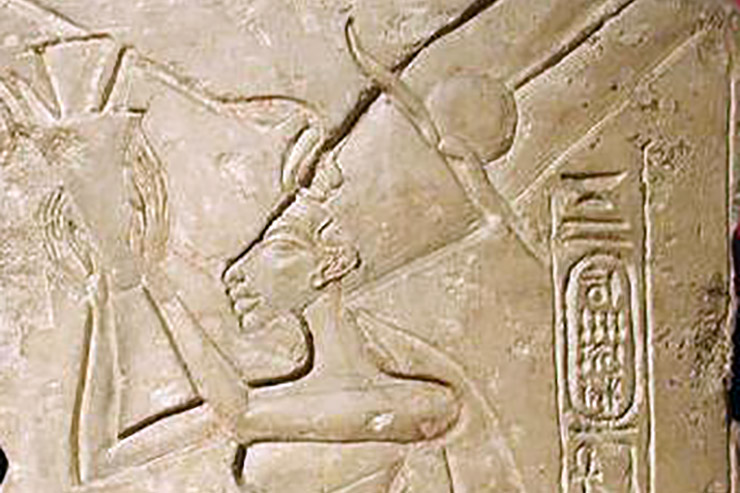
    Furthermore, carved busts of the family members belonging to the Egyptian pharaoh Akhenaton of the eighteenth dynasty demonstrate the same anomalous feature, including equally huge ears. Found in the underground desert ruins of Tel el Amarna in Egypt, little known statues of this strange family, which included Nefertiti, Akhenaton’s wife, and their daughters, exhibit other unusual features, including great body height. The body of a statue of Nefertiti is described below:

    She’s not wearing clothes because they didn’t believe in that at the time. She has a huge head, large ears, a long, skinny neck and a high waist. She also has a kind of bulging tummy. And… she has skinny legs and wide thighs.9

    This in fact is an equally good description of her husband’s famously strange appearance. The carved or painted likenesses of Nefertiti’s daughters, down to the youngest, a mere toddler, show exactly the same peculiar characteristics of enormous hairless skulls, high waists, skinny calves and huge ears.

    Could this Egyptian royal family, then, have been a throwback to the ancestral offspring of the Elders? And more pertinently, could its anomalous physical features support the idea of an intellectually advanced race alien to ours, either from another stellar system or a previous racial cycle?

    These Elders, also known as the beni ha-elohim, the Sons of God or Sons of the Fire Mist whom the Sumerians claimed had brought civilisation to humanity, are a perennial mystery. G.I. Gurdjieff regarded them as palaeolithic shaman adepts, men and women who in the remote past practised their mysteries in the underground caves along the Syr Darya, in Central Asia, and whose evolution due to their superior spiritual practices put them far in advance of their fellows.10

    But occult tradition goes a great deal further, contending the Elders were a wise and powerful race that came from the stars – possibly, say some, from the giant star Sirius. In the ancient Egyptian tradition they are called the “Watchers of Pe,” divine Intelligences who watch over and guide humanity, their progeny, from celestial heights. Alternatively, could they have been, as the noted Theosophist G. de Purucker suggests, the left-over remnant of an earlier human race that had incarnated on Earth but had originally come from the Pleiades system, and which had ended its racial cycle perhaps millions of years ago?

    Until recently such questions about the Elders could not profitably be asked except in the context of a closed initiatory society. Even stranger, until recently the rest of the world was not even aware that such questions entailed proscribed temple material that had been forbidden to the outside world for thousands of years. As already mentioned in the first part of this article (see New Dawn No. 112, January-February 2009), René Guénon, one of the foremost esotericists of the late nineteenth and early twentieth centuries, struggled as far as he dared against this occult embargo, believing that the time was fast approaching when humanity would be in need of a higher level of anthropological, cosmological and metaphysical understanding than was possible in his day.

    “This study,” he wrote, concerning the advanced Elder race that, according to Theosophical lore, had migrated from the Arctic zone to Central Asia many hundreds of thousands or perhaps millions of years ago, “has gone deeper than any preceding it, inviting reproach, perhaps, from some. We do, however, believe we have not said too much, nor anything that should not be disclosed…”11 Yet much knowledge regarded as too arcane or too dangerous for the profane populace would, Guénon was convinced, soon have to be released into the public domain. And it would seem he was right.

    A new order is dawning in this post-millennial era in which a great deal of the once proscribed sacred knowledge is being made available to all. Among many of yesterday’s underground secrets now freely emerging into the light of day are the secrets of human evolution and its tandem relationship to the evolution of earth and cosmos. These secrets have a direct relevance to the mysterious Elders, gods whom they suggest are actually human beings and members of a fifth kingdom in Nature.

    Thus the removal of the occult embargo, allied to an explosion of new scientific discoveries and hypotheses, is making it possible to approach the subject in an entirely new way.
    [alert type=”info” dismiss=”no”]If you appreciate this article, please consider a subscription to New Dawn magazine.[/alert]

    The Fifth Kingdom

    The medieval classification of Nature into four universal kingdoms, mineral, vegetable, animal and human, has been rendered obsolete by modern science, which has inductively evolved its own hierarchical system of subatomic particles, atoms and molecules before the mineral, and combined the animal and human in one category. Nevertheless, the old system of four kingdoms, based on an intuitive deductive vision of the truth and seen as an example of the Perennial Philosophy, is still entrenched in most of the Western esoteric schools that have emerged since medieval times: Theosophy, Anthroposophy, Rosicrucianism, modern Sufism, various New Age channellings, the Sri Aurobindo school and others.

    Four-kingdom proponents from these schools see the progression in Nature as a succession from inert mineral to the plant, that is alive but not apparently conscious, to the animal that has a limited reasoning power but is not self-aware, and to the human being who alone has self-awareness and conscious free will. To these four definitive classifications a fifth is occasionally added by medieval philosophers under variously named, rather obscure and even misleading headings; but whatever the designation, in esoteric circles any natural classification beyond the fourth is either nonexistent or only vaguely delineated, lacking the emphasis or clarity it requires.

    The ancient Egyptians made the matter a great deal clearer. They understood the goal of human evolution to be a transition or resurrection into a higher state, a higher natural kingdom, and illustrated the transition with admirable precision on the ceilings of certain very old tombs.12 In their depiction of the neters or gods undergoing spiritual resurrection, they show a row of animal-headed human figures marching along a horizontal base line, a red oval – the “egg of metamorphosis” – above each head, until suddenly the base line turns by 90 degrees to the vertical and one figure swings into ascension along it. Achieving what may be a rapid biological change into a new life form, he transforms into the royal fifth kingdom. Armed with what appears to be the staff of spiritual authority and lacking the oval over his head, which has presumably been absorbed into his being, he has metamorphosed into a king.13 In other words, from being a collective being of a lower order, he has become a royal singularity, a ruler of all kingdoms lower than the fifth.

    Ancient petroglyphs of sun-headed men found in various parts of the world, but especially in Central Asia, tell the same story.

    Because of the occult secrecy that has enshrouded the subject of the fifth kingdom over the past 2,000 years at least, we have failed to understand its crucial significance as our true evolutionary goal and our key to all those questions we have never been able to answer. The inclusion of a fifth kingdom in the natural order turns the fourth kingdom that we humans presently inhabit into a mere corridor of becoming, a transitional episode in which we are driven forward in a process of transformation from the animal state behind us to that of the true human ahead, as indeed Gautama Buddha recognised. Life, human life, he said, is never-ending change and the suffering of change – and indeed it is viewed as a journey of relentless development of intelligence and consciousness into the truly human kingdom, the fifth, wherein alone lies repose well earned.

    The idea of a potential fifth kingdom, a state of spiritual felicity and repose we may hope to enjoy some time in the future, is not new to us. But what the ancient mystery temples through to modern esoteric teachers like Guénon have been reluctant to disclose is that the fifth kingdom is not a future potential but a presently existing reality, a supremely enlightened human state coexisting with our own. Like the other four kingdoms of nature, it has extended and always will extend back into the illimitable past and forward into an equally illimitable future, with its own archetypal place in the cosmos.

    Indeed, it is esoterically acknowledged that beyond the fifth kingdom others also exist. Gordon speaks of the fourth, fifth, sixth and even the seventh kingdom of our planetary Nature. “All of these kingdoms exist together (even if we are unaware of the fact),” he says, “and all of them together comprise the evolving nature of Man. Hence humankind is but one partial expression of Man in general.”14 Given such a perspective, many possibilities open up that were not previously viable in our worldview.

    According to this perspective, the Elders of Akkadian-Sumerian legend and the gods of the Babylonians and the Assyrians were the higher-level final flowering of a previous human cycle many millions of years old, their privilege being to guide the evolution of the next cycle – our own. Freed by their advanced development from the limiting conditions of transitional fourth-level humanity, the universe was open to them, for fifth-kingdom space-time is said to possess multiple dimensions incomprehensible and inaccessible to the lower kingdoms. These so-called gods could travel between the stars on supramundane energy currents unknown to us, incarnating on other stellar bodies or on planet Earth as the need arose, and withdrawing as they chose into dimensions invisible to their charges on Earth.

    In the above scenario, not only is our past implicated in this new perspective; our future is equally involved. As we ascend with increasing rapidity into higher states of consciousness and hence into proximity with the fifth kingdom, we are finding the Elders in their various otherworld guises descending to meet us. As a part of the great human order, they are our future as well as our past. We shall find in fact that humanity is at home everywhere in the universe and its life has no beginning and no ending; it is co-eternal with the cosmos.

    Therefore, perhaps, it is time we gathered together all our ideas of aliens, extraterrestrials, Sirian cosmonauts and angelic visitors and categorise them all as members of our own human species who, along with their advanced technologies, have arrived in the fifth kingdom before us – our own kin already established in majesty and power; already, like the Egyptian priest-kings of old, free to traverse the cosmic pathways at will as the Sons of God – the lords of the universe.

    According to the Solar teachings of the ancient Pillar religion, the royal road to the fifth kingdom lies in an ascension up the World Tree, through its successive gateways, to the starry heavens. Kingly authority and the power to rule wisely rests on the royal initiate’s ability to ascend the axis mundi or World Tree to the divine centre of creation at the zenith of the heavens. There, and only there, he will find deification; there he will be able to access the heavenly powers from which all impulses of rulership, creativity and wisdom emanate; there he will find the freedom of the spiritual world.

    This idea of returning home to the stars is implicit in all the tribal totem systems found in early shamanic societies around the world, but was more fully realised in its religious form when the idea of kingship – of hierarchical rule from above – seized neolithic societies at the end of the last Ice Age. John Major Jenkins, a leading researcher of ancient cosmology, says:

    Sacred knowledge is won or achieved by undertaking visionary journeys up the World Axis to the cosmic centre. A ruler, having thus become fused with the divine source and emanating power of life and wisdom, constellates the beings and objects of lesser degrees.15

    Such a monarch stands as far more than an exemplary figurehead or an administrative symbol at the heart of his kingdom; he has become, by virtue of his conquest of the World Tree, a way-shower into a new order of being for the whole of his society. In the same way, so Jenkins believes, at certain critical junctures of the Earth’s history, this odyssey of transformation up the cosmic Pillar to the divine Centre at the zenith is possible for the race as a whole, which thereby advances further towards its next evolutionary goal – the supernal kingdom, the fifth.

    Revisiting the Pillar Religion

    The secret teachings of the very earliest sages of which we have cognisance claimed that all life, all wisdom and creative power is transmitted to the earth plane via a spiritual energy flowing down from the highest Source, and that it is by reascending the sacred current, symbolised as a Pillar or a World Tree connecting earth to heaven, that humanity comes to its most sublime perfection.

    A traditional symbol of this occult energy stream has been retained in the Qabalistic Tree of Life defined astrologically.The well-known British author Trevor Ravenscroft likens the Tree of Life to “the Yggdrasil tree of Norse mythology, the world-Ash which binds together heaven, earth and hell.” The crown of the tree, he says, “comprises the twelve constellations of the Zodiac, the spiralling branches symbolise the planets and the roots of the trunk dig deeply into the elements of the earth.”16 The Tree is thus a metaphor for the archetypal processes of the cosmos that are believed to underlie all evolutionary activity.

    From the earliest times, the World Tree was central to the shamanism of the nomadic tribes of the Central Asian steppes, as it was to the later Solar religion of the settled Aryan communities of that region. Indeed, if we are to believe Plato, in the days before the Great Flood and the sinking of Atlantis, the World Tree featured also in the primeval Atlantean religion with its monarchic system, its warlike bull cult and its concentric city planning; and according to Blavatsky, it was this Solar system that was eventually transplanted by great migrations into Central Asia.

    From west to east and from north to south, then, the Pillar religion in its various guises appears to have reigned universally as the earth’s primordial belief-system, the destiny of man being seen as the ultimate return of his soul via the World Tree to the power-realms of the stars.

    Where then on the planet is this World Tree that the Hebrews called Jacob’s Ladder? Although it would be natural to assume it is synonymous with the earth’s north-south axis of rotation, such is not the case. According to Guénon, there have been several successive locations of the World Axis on the surface of the globe that distinguish it from either the north-south axis of rotation or the magnetic axis. Opening up the secret metaphysical tradition, he asserts that basically nothing less than a new model of the world is needed if we are to understand the true nature of the World Axis.

    The esoteric reality, expressed long ago in the Pillar teachings, is that the earth incorporates a principle that connects it at all times to a greater spiritual world in the same way that a mirrored reflection is intrinsically connected to the reality. By virtue of this fact, the earth is multi-dimensional in structure – as indeed the physicist David Bohm has proposed in his theory of an implicate universal order lying behind the explicate physical order as its energetic template – and this radically modifies everything we can say about the planet, in the way we measure and describe it.

    The Pillar religion projected a worldview very different from our own. The planet was regarded as a living organism with its own hierarchy of elemental intelligences, plus a hierarchy of solar intelligences or devas, at work in the manifold organisation and running of the whole, and which we call today the work of Nature. The World Tree, in India known as Mt. Meru, was believed to be at the very heart of this great dynamic complex, a channel of evolutionary energy running through the centre of the planet, a path of psychospiritual transformation of the same order as the seven-fold spinal path of consciousness running through the human body.

    In fact, the name Meru is connected to the Sanskrit word merudanda, meaning a backbone, and hence the World Tree can be further qualified as the backbone of the planet, a chakric system analogous to that of the human spinal system, with seven or nine nodes of increasing psychospiritual awareness culminating in the Cosmic Centre at the summit. These nodes were clairvoyantly perceived as a succession of gateways up the trunk of the Tree leading into higher planes of existence, and the final entrance to the Cosmic Centre was therefore called the North Gate.

    Guénon’s Neoplatonic thesis contains the concept of a universal ether, renamed “the quantum fluid” by modern science, and states that behind the physical body of the earth lies its spiritual template, a permanent prephysical or etheric web of forces delineating the planetary structure in its essential form. In this inner light body – or, as Vedic cosmology calls it, the vajra body – is located the World Axis, the etheric source and intelligent regulator of all the energies of the planet. At the beginning of each great temporal cycle – and by that Guénon means at the very least one round of the Zodiac, one Sidereal Year of 25,920 years – the two bodies are in virtually perfect alignment, but as the cycle proceeds a separation occurs and the physical body falls increasingly out of alignment with its spiritual template.

    This non-alignment or tilting away of the planetary body from its inner template is the result of their differentiation from each other, which has the effect of creating all the earthly stresses and vicissitudes of time and change that we know so well, yet is the necessary precondition for evolutionary growth. From this circumstance comes all the suffering of becoming, all the so-called evils of our earthly existence.

    In such a spiritual cosmology the universe is the expression of a great Intelligence within which are the unchanging ideas or templates of form, the whole being in a state of ideal harmony and order. But although the spiritual world of pure Being is changeless, the natural state of its reflection, holographically projected onto a lower plane and thus an object of differentiation, is to become off-centre in relation to it and therefore in perpetual compensatory motion. This is the biblical “fall” of mankind without which there would be no evolutionary process. With the separating out of the physical plane, motion is created and the suffering of change begins; for the process of increasing differentiation of the physical body from its spiritual background inflicts on the planet and all its life-forms a local disturbance, the angst of movement, of disequilibrium, of continual adjustment to new conditions and new evolutionary demands – but also to the possibility of attaining a greater state of being.

    We can sum up this occult cosmology thus: At the beginning of the great precessional cycles, the north-south axis and the magnetic axis are in virtually perfect alignment with the World Axis and with each other. All three stand at that time apparently united at true North, so that the supreme spiritual centre is in a literally polar location; but as the cycles proceed, the poles fall progressively out of alignment with the World Axis and terrestrial changes develop. Today this mysterious noumenon known variously as the Sampo, the axis mundi and the Tree of Life has apparently shifted southward. Clairvoyantly visible, it has its locale in the Inner Asian region delineated by the Tarim Basin and its surrounding ring of great mountain ranges.

    Within the boundaries of this vast mountain encirclement, the World Axis is believed to have varied its location from time to time. But wherever it is found, it always remains functionally polar; it is always the central origin point – or as ancient peoples called it, the omphalos of the planet, the place of the first creation – from whence grand waves of acculturation have periodically issued.

    In Galactic Alignment Jenkins presents a similar cosmological picture. He calls the World Axis the evolutionary axis, by implication a third terrestrial axis presently unknown to science. Psychically accessible, this great current of psychospiritual conscious energy that runs through the centre of the earth is thought today to emerge somewhere north of Kashmir, soaring high into interstellar space above the Pamirs.17 It is in that vicinity, at the foot of the World Tree, that the peoples of Central Asia have traditionally located the hidden kingdom of the Elders known as Shambhala, an initiatory centre accessible on both a physical, an etheric and an astral plane.

    The North Gate, Jenkins contends, can be viewed as analogous at a cosmic level to the pineal gland in the human system, which is the most interior and creative centre in man and “the point from which spiritual gifts are given.”18 He sees the Cosmic Centre at the head of the World Axis as fulfilling the same function in a planetary context. However, while René Guénon has postulated a major polar-to-solar shift of the Cosmic Centre in man’s worship at some remote time in antiquity, Jenkins has argued that this shift would be better understood as a polar-to-galactic one.

    Thousands of years ago, he says, priest-astronomers realised that approximately every 6,450 years the North Gate was aligned with the galactic centre, and that such times offered a priceless evolutionary opportunity for the whole race. It is an astronomical fact, says Jenkins,

    that alignments of the solstices and equinoxes with the plane of our Milky Way galaxy occur periodically over the 26,000-year precession cycle. Such alignments, in fact, occur every 6,450 years. Joseph Campbell pointed out that knowledge of the precessional cycle is implied by the importance given the number 25,920 in Hindu, Nordic and Babylonian doctrines.19

    Jenkins equates the spiritual evolution of humanity with this periodic alignment of the Earth with the galactic plane and the Galactic Centre. The idea that the latter stimulates consciousness on this planet is, he says, “an intriguing and profound concept” that finds echoes in Mayan, Vedic and Egyptian cosmology. Gordon too observes that the earth is subject to celestial seasons of about 6,480 years, “which have a dramatic effect upon both the climate… and also upon the many and varied cultures and civilisations which exist at the time.”20

    The Tree is thus regarded as a planetary chakric system analogous to that of the individual tantrica in the practice of kundalini yoga. Even as the yogic consciousness ascends the spinal system, so activating a sequence of seven hierarchically ordered chakras or psychospiritual energy vortices which alter in subtle ways the entire spectrum of consciousness, so the ascension of the racial soul up the World Tree at certain precessional intervals of c.6,450 (or c.6,480) years corresponds with the opening up of a succession of celestial gateways for humanity as a whole.

    At each open gateway the flooding down of divine creative energies precipitates certain psychological and cultural modifications in society; the human body typology changes; new deities, new mores appear; the material technology advances or changes its base, a new world-civilisation is launched founded on newly imperative truths. It is a moment of supreme evolutionary importance, a collective initiation perhaps best conveyed by the teachings of the Mithraic mystery religion.

    This important Greco-Roman cult flourished until the fourth century CE, when it was extinguished by Christianity. Seven planetary spheres were opened up to the seeker through the seven grades of Mithraic initiation, allowing him ultimately to ascend to the highest, the Father (Saturn). However, beyond the seventh level was a secret teaching revealing an eighth and ninth level or “house” where the Hypercosmic Sun was located. This hypercosmic luminary, this “Star of Stars” as the first century philosopher Philo Judaeus of Alexandria called it, was identified with the Galactic Centre, to which access was gained only through the eighth and ninth celestial “doorway” above that of Saturn.21 This secret means of escape from Earth’s gravity into the freedom of the Universe has been closely guarded by occult tradition and is still not fully unveiled.

    The doctrine of the Hypercosmic Sun, according to Jenkins, is “fundamentally about the soul’s passage through the galactic gateways that open during eras of galactic alignment,” when the divine light of the Milky Way Centre pours down through the opened valves of the World Axis and irradiates the earth and all its inhabitants for a certain interval of time. It is in that critical interval that the great evolutionary mutations take place, civilisations are overthrown and reinstated in radically new forms and the potential exists for the fifth kingdom to be realised by at least some members of fourth-kingdom humanity.

    Jenkins is only one of countless observers who believe such a historic time has once again come around. Indeed, by now millions of people are watching and waiting for the end-of-the-world Mayan date of 2012 CE, believing it to be the beginning of a new World Age… a further stage in the journey towards the fifth kingdom.

    Eurasia Awakes

    In February of 1962 astrological pundits announced a major planetary conjunction that occurs only once in every c.6,500 (or 6,480) years – the previous one therefore having taken place in c.4500 BCE, and the one before that in c.11000 BCE, both of which occasions were prophetic of great earth changes.22 I remember well the report in the media, because immediately a cry of distress and foreboding went up right across India; for it was known by most Hindu astrologers that this rare stellar event, occurring only four times in the precessional cycle of 26,000 years, does indeed foreshadow great floods and catastrophic climatic changes.

    In response, the dawning New Age movement of the time predicted the return of the Elder race, the possibility of a pole shift, the birth of a new race of clairvoyants. To esotericists generally the conjunction signified a new World Age and an impending psychospiritual initiation of collective humanity, with all the social and ideological turmoil such an event implied. And confirming John Major Jenkins’ later theory to the hilt, the conjunction was seen by some star-gazers as the first sign of a coming revolution in geopolitical world affairs, with the rise of Asia and the decline of the western Anglo-American hegemony.

    At the time all these predictions were regarded as amazing and pretty farfetched. But nearly fifty years on, the events presaged in 1962 are now crystallising as post-millennial realities. Ominously, the ice caps and glaciers are melting, the seas rising, earth’s resources shrinking; the Anglo-American world order, built on predatory economic corporations, is unravelling, Asiatic power inexorably rising. A transformation in human consciousness is well underway; and there is increasing evidence that the vast natural, socio-political and consciousness changes we are seeing are now irreversible, for good or ill.

    Perhaps the most significant sign of the times is to be found in the growing vision of a unified Eurasia among the major Asian nations such as China, Mongolia, India, Iran (and also Brazil), as well as Kazakhstan and many other of the Central Asian Muslim states. Included in this growing Eastern bloc is Russia which, since the collapse of the Soviet regime, is increasingly turning away from Western Europe and towards Asia in its quest for identity. Geographically the largest nation on the earth, it extends right across northern Asia from Eastern Europe to the Bering Sea.

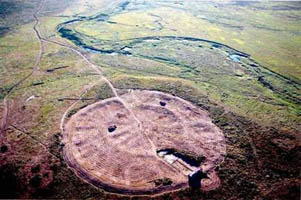
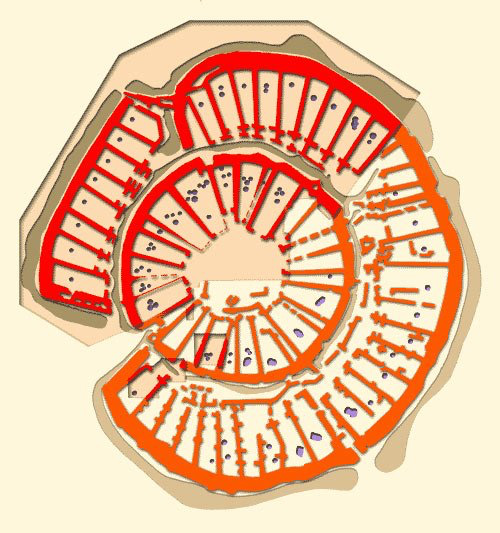
    Russia is rediscovering its Slavic roots; and especially since the discovery of Arkaim and the Land of Cities in the southern Urals, it is also exploring its Aryan past and its more recent connections to the Mongol Empire of Genghis Khan, who subjugated the whole of the Eurasian corridor as far as eastern Europe in the thirteenth century. Indeed, for many of Russia’s intellectuals the universal tolerance and freedom from dogma of the ancient Pillar religion of the Mongol/Turkic peoples has great valence and is displacing Christianity and Islam in the popular esteem. “Out of Russia,” says Alice Bailey, channelling the prophecies of her Tibetan guru, DK, “will emerge the new and magical religion about which I have so often told you.”23

    There have been a number of famous prophecies regarding Russia’s future pivotal role in world affairs generally, notably those of Rudolf Steiner and Edgar Cayce, as well as those of Gerard Encausse, the highly respected French occult master who went under the pseudonym of Papus (1865 – 1916). The author Mehmet Sabeheddin notes that “Papus knew of the key role to be played by Russia in unifying Eurasia and her occult destiny as the Empire of the End, the outward manifestation of the enigmatic power of ‘Northern Shambhala’.”24 Many others have seen Russia as destined to continue the work of Genghis Khan, who transformed the nomad tribal conglomerates of the Eurasian steppes into a unified and superbly organised political system that revolutionised international life for centuries to come.

    Across the steppes, where for countless centuries a melting pot of peoples, religions and empires from every quarter have traded and warred and sunk with their cities beneath the desert sands, a spirit of renaissance, of ecumenical reform, is undoubtedly taking hold. From the Far East to Moscow and from the Altai to Iran, a countervailing force, identifiable with the invisible spiritual powerhouse of Shambhala, is stirring throughout the region. Muslim, Buddhist, Zoroastrian, Christian, Jew, Taoist and shaman are finding common ground in a unitive vision of the future. Responding to the militaristic Anglo-American colonisation that has long dominated the Asian hemisphere, this new regional climate bodes well for the rebalancing of the globe’s spiritual, cultural and economic forces.

    The move to turn the tenuous Eurasian concept into a geopolitical reality composed of numerous independent but strongly affiliated nations committed to East-West amity must be regarded as a force for renewal, for the healing of the Atlantean/Hyperborean rupture that long ago shattered the primal unity of the life of the planet. The present thrust seeks instead to recapture the unity of the ancient Arctic accord and to set forth new terms for a viable future for humankind.

    What is truly remarkable is that we are witnessing all this happening in Central Asia at the very time of great astrological significance, when the stars again portend extreme danger and extreme opportunity for the life of Earth. Are we then seeing once again a mysterious intervention from the East, a salvific influence arising in the heart of Asia that seeks to sow the seeds of a new global order and a new type of civilisation in the face of apocalyptic geophysical change? Can the Elder race be coming to our aid yet again?
    [alert type=”general” dismiss=”no”]This article was published in New Dawn 113.[/alert]

    [alert type=”success” dismiss=”no”]If you appreciate this article, please consider subscribing to help maintain this website.[/alert]

    Footnotes:

    1. J.S. Gordon, The Rise and Fall of Atlantis, and the Mysterious Origins of Human Civilization, Watkins Publishing, London, 2008, 131.

    2. Charles Hapgood, Maps of the Ancient Sea Kings, Turnstone Press, London, 1979.

    3. Gordon, op. cit., 131.

    4. Ibid., 159.

    5. William Fix, Lake of Memory Rising, Council Oaks Books, LLC, San Francisco, 2000, 203.

    6. H.P. Blavatsky, The Secret Doctrine, Vol. 2., Theosophical Publishing House, Los Angeles, 1947, 324.

    7. Drunvalo Melchizedek, The Ancient Secret of the Flower of Life, Light Technology Publishing House, Flagstaff, AZ, 1990 – 8, 143.

    8. Ibid., 143.

    9. Ibid., 139.

    10. J.G. Bennett, Gurdjieff: Making a New World, Turnstone Books, London, 1976.

    11. René Guénon, The Lord of the World, Coombe Springs Press, U.K., 1983, 66.

    12. Melchizedek, op. cit., 43.

    13. Ibid., 43.

    14. J.S. Gordon, op. cit., 85.

    15. John Major Jenkins, Galactic Alignment, Bear & Co., Rochester, Vermont, 2002, 150.

    16. Trevor Ravenscroft & T. Wallace-Murphy, The Mark of the Beast, Vol. 3, Sphere Books, U.K., 1990, 67.

    17. Victoria LePage, Shambhala, Quest Books, Illinois, 1996, 180.

    18. Jenkins, op. cit., 140, citing Valentinia Straiton, The Celestial Ship of the North, 1927.

    19. Ibid., 42.

    20. J.S. Gordon, op. cit., 130.

    21. Jenkins, op. cit., 107.

    22. Sky and Telescope Magazine, December 1961, 320. On February 5, 1962, Mercury, Venus, Mars, Jupiter and Saturn were all within 13 degrees of the eclipsed Sun.

    23. Cited by Mehmet Sabeheddin, The Secret of Eurasia: The Key to Hidden History and World Events, New Dawn No. 68 (September-October 2001).

    24. Ibid. 

    © New Dawn Magazine and the respective author.
    For our reproduction notice, click here.
  • Waiting for the End of the World: René Guénon and the Kali Yuga

    Waiting for the End of the World: René Guénon and the Kali Yuga

    From New Dawn 122 (Sept-Oct 2010)

    Currently the fear – or hope – of the closing of the age pervades the air like a thick vapour. Sometimes this end is envisaged as an environmental calamity, sometimes as the second coming of Christ, sometimes as the return of the space brothers to claim their own.

    Figures including Jose Argüelles, the prophet of the 1987 Harmonic Convergence; Terence McKenna, the late pope of psychedelia; and the channelled entity known as Kryon have fastened onto 2012 as the turning point.

    A less well known, though in a way equally influential, figure was the French esoteric philosopher René Guénon, whose writings often speak of the end of a cycle that he equated with the Kali Yuga, the “dark age” of Hindu cosmology. While he did not point to 2012 or any other specific date, his ideas do resonate with some of these expectations for the dawning age to come.

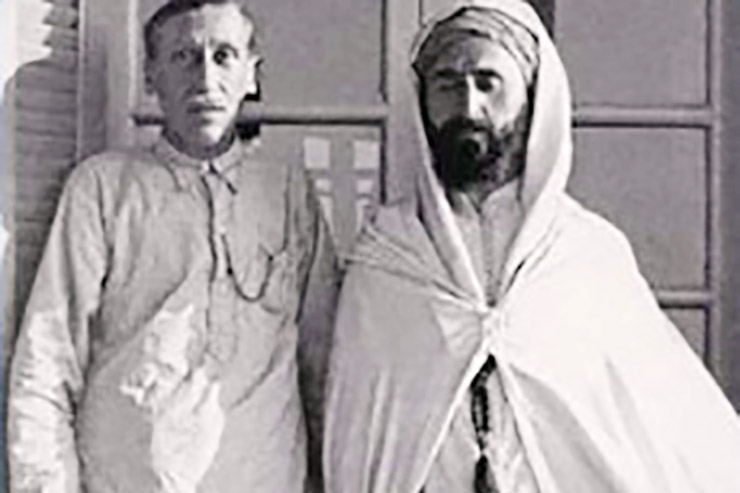
    Born in Blois, France, in 1886, Guénon had a conventional education in mathematics. In his youth he began to explore occult currents in Paris and was initiated into esoteric groups connected with Freemasonry, Martinism, Taoism, and Advaita Vedanta. In 1911, he was initiated into a Sufi tariqah (order) under the leadership of an Egyptian sheikh, Abder Rahman Elish El-Kebir. In 1930, he moved to Egypt, where he converted to Islam and lived until his death in 1951. In the meantime, he published a wide range of books, articles, and reviews espousing what he said was the universal and primordial tradition underlying all religions.

    For Guénon, tradition is the ne plus ultra of human life. He conceives of tradition as a hierarchy: higher knowledge emanates from a now-hidden spiritual centre to all of humankind through the “orthodox” traditions, among whom he includes (with many caveats and qualifications) the great world religions as well as certain other lines such as Freemasonry. Or to put it more accurately, this tradition is preserved in certain initiatic lineages that lie embedded in these faiths, such as the Kabbalah in Judaism, Taoism in Chinese religion, and Sufism in Islam. The esoteric dimension of Christianity had, he believed, practically disappeared by the late Middle Ages and was now preserved (if at all) by small initiatic groups that he apparently regarded as inaccessible. Indeed Guénon’s conversion to Islam was motivated in part by his belief that these Western lineages had almost completely died out by the twentieth century.

    In fact, according to Guénon, this transmission of traditional knowledge – the “doctrine,” as he often styles it – has become almost completely blocked in our era. This, he argued, is the result of a long cosmic cycle, which is called a Manvantara in Hindu cosmology, and which is divided into four yugas or ages: the Satya Yuga, the Treta Yuga, the Dvapara Yuga, and the present Kali Yuga. The problems and anxieties of the current era are the result of this age. It’s worth exploring why he believed this and what he thought it meant.

    The Reign of Quantity & the End of an Age

    Guénon was first and foremost a metaphysician – indeed, he was one of the greatest and most lucid thinkers who have delved into this arcane subject. And for him, metaphysics concerns universal principles; the details of circumstance are of value only insofar as they illustrate these. At the beginning of his best-known work, The Reign of Quantity and the Signs of the Times (first published in 1945), he writes that “considerations of that order” – namely, factual details – “are worth nothing except in so far as they represent an application of principles to certain particular circumstances.”1

    Thus Guénon said that he not a prophet in any conventional sense of the term. He was not a visionary and believed that the visionary prophecy of the current age was nothing more than a cloud of lies emitted by sinister “counterinitiatic” forces. If he spoke of an outlook that made it possible “to foresee, at least in its broad outlines, what will be the shape of a future world,” he insisted that “previsions of this kind have not really any ‘divinatory’ character whatever, but are founded entirely on… the qualitative determinations of time.”2

    The use of the word “qualitative” may seem peculiar here, but for Guénon, the polarity between “quality” and “quantity” was central to understanding the dynamics at play. In his 1931 book The Symbolism of the Cross, he depicted reality in the form of a three-dimensional cross – one that has the dimension of height and depth in addition to the familiar two of length and breadth. At the top of this cross is what he called “absolute quality” – an abstract state that is impossible for us to conceive, because it has no element of quantity whatsoever. (An interesting mind game: try to conceive of a universe in which there is no number or quantity of any sort. It’s almost impossible to do.) At the bottom of this cross is “absolute quantity” – another abstract state that is impossible to conceive. (Again, try to imagine a universe where there is only number, in which there is nothing that has any particular qualities such as colour, shape, or anything else of the kind.)

    Hence it’s not possible in this relative level of existence to reach the absolute end of each pole, but in a given age one of the two will be more pronounced and the other less pronounced to an exactly inverse degree. According to Guénon, the Manvantara proceeds in an ages-long cycle from an era where quality is emphasised – the legendary time known to the Hindus as the Satya Yuga and to the ancient Greeks as the Golden Age – to one in which quantity comes more and more to dominate. This is our present era, the Kali Yuga or what the Greeks called the Iron Age. That’s why Guénon speaks of the present era as one of “the reign of quantity.” He goes on to argue that all the primary characteristics of our time are the result of this reign of quantity.

    Guénon produces modern philosophy and science as evidence for his argument. Modern Western philosophy to all intents and purposes begins with René Descartes (1596-1650), who divided the world into what he called res cogitans (literally, “the thing that thinks”) and res extensa (literally, “the extended thing”). That is to say, the world is divided into that which experiencesres cogitans – and that which is experienced: res extensa. According to Descartes (at least as interpreted by Guénon), everything material is characterised by – and only by – extension, by what can be measured and quantified.

    While this all may sound extremely abstract, Guénon argued – rightly, I believe – that this attitude has profoundly shaped Western thought over the last few centuries. Essentially, he is saying, materialistic science focuses exclusively on quantity: “The more specifically ‘scientific’ point of view as the modern world understands it… seeks to bring everything down to quantity, anything that cannot be so treated is not taken into account, and is regarded as more or less non-existent.”3 Unfortunately, as Guénon goes on to say, this creates any number of logical contradictions. Science conceived purely in terms of quantity argues that the same causes produce the same effects, but as Guénon points out, this is absurd, as no two events are ever completely identical. He also criticises “the delusion which consists in thinking a large number of facts can be of use in itself as ‘proof’ of a theory; …even a little thought will make it evident that facts of the same kind are always indefinite in multitude, so that they can never all be taken into account.”4

    This is precisely the problem that contemporary philosophers call “the justification of induction.” You base a theory on any number of similar events that have happened in the past; but how can you account for the ones that you have not seen, and how can you be sure that future facts will yield the same results? Bertrand Russell put the point wittily when he wrote, “The man who has fed the chicken every day throughout its life at last wrings its neck instead, showing that more refined views as to the uniformity of nature would have been useful to the chicken.”5 The notion of causation is at least as problematic.6 These facts place a ceiling on the degree to which science can understand and explain the universe.

    The Real Meaning of “Value”

    As even this short discussion suggests, Guénon raises profound philosophical issues, and contemporary thought has not done a terribly impressive job of coping with them. But, he contends, the problems go further still. In a chapter of The Reign of Quantity entitled “The Degeneration of Coinage,” he explores the economic aspects of the issue. At first glance, one might think that nothing was more purely quantitative than money. But that, Guénon argues, is an illusion fostered by the degenerate age we live in: “The ‘economic’ point of view…, and the exclusively quantitative conception of money which is inherent in it, are but the products of a degeneration which is on the whole fairly recent,… money possessed at its origin, and retained for a long time, quite a different character and a truly qualitative value, remarkable as this may appear to the majority of our contemporaries.”7

    In traditional societies, Guénon says, money had a sacred character. Not only were the coins stamped with the images of gods and other sacred symbols, but the currency was controlled by the spiritual authorities rather than by the secular powers. Money was meant to be a reminder of “value” in the qualitative as well as the quantitative sense. Today, however, “nobody is able any longer to conceive that money can represent anything other than a simple quantity.”8 Even such words as “value” and “estimate” have been deprived of their qualitative character, and today, when we ask how much a man is worth, we are almost always thinking in terms of cash and equities rather than moral or spiritual calibre.

    This quantitative approach extends to every object we use. “In a traditional civilisation,” Guénon writes, “each object was at the same time as perfectly fitted as possible for the use for which it was immediately destined and also made so that it could at any moment, and owing to the very fact that real use was being made of it (instead of its being treated more or less as a dead thing as the moderns do with everything that they consider to be a ‘work of art’), serve as a ‘support’ for meditation,… thus helping everyone to elevate himself to a superior state according to the measure of his capacities.”9 One obvious example are the tools of Masonry, such as the square, compass, and plumb line, each of which was intended to convey a spiritual and ethical meaning in the days when Masonry was limited to practicing stonemasons. Manufactured goods have no such meaning or value.

    It is not possible here to go further into Guénon’s critique, but even this short discussion reveals that his insights into the woes of the current era were remarkably perceptive and prescient. In The Crisis of the Modern World, published in 1927, he said, “It is… to be expected that discoveries, or rather mechanical and industrial inventions, will go on developing and multiplying more and more rapidly until the end of the present age; and who knows if, given the dangers of destruction they bear in themselves, they will not be one of the chief agents in the ultimate catastrophe, if things reach a point at which this cannot be averted?”10

    Guénon’s charge that the modern world has no use for anything apart from quantity could be substantiated by cases from every conceivable source. Writing about the BP oil spill in the Gulf of Mexico, in early July 2010 a front-page article in The Wall Street Journal reported, “BP PLC is pushing to fix its runaway Gulf oil well by July 27, possibly weeks before the deadline the company is discussing publicly, in a bid to show investors it has capped its ballooning financial liabilities.” Why did BP choose this date? “The July 27 target date is the day the company is expected to report second-quarter earnings and speak to investors.”11 In other words, the fact that the BP spill, one of the greatest environmental disasters in history, fouled a large portion of the Gulf of Mexico, killed innumerable creatures, and devastated the lives of people all along the Gulf Coast was not reason enough for the company to hurry: it needed a second-quarter earnings report to goad itself into action. Nothing could illustrate the reign of quantity more clearly.

    The Kali Yuga

    All this said, when it comes to Guénon’s discussion of the Kali Yuga as a traditional Hindu doctrine, he stands on much shakier ground. He says that the Kali Yuga began some six thousand years ago.12 He also says this era is close to its end. In The Crisis of the Modern World he writes: “We have in fact entered upon the last phase of the Kali-Yuga, the darkest period of the ‘dark age’, the state of dissolution from which it is impossible to emerge otherwise than by a cataclysm.”13

    Not all traditional sources agree about this point. The Hindu sage Sri Yukteswar, best-known as the master of the celebrated yogi Paramahansa Yogananda, discusses the matter in his book The Holy Science. Sri Yukteswar says that the Kali Yuga is actually over, although this has not been recognised even by many Hindu authorities. Ironically in light of Guénon’s claims, it was the very occlusion of the sacred centre that made it impossible to calculate the yugas correctly.

    Traditional dating for the beginning of the Kali Yuga starts from the death of Krishna, the avatar of Vishnu, at the end of the war between the Pandava and Kaurava clans chronicled in the Hindu epic the Mahabharata. Some sources date this to 3012 BCE, others to 1400 BCE.14 As the Kali Yuga began to dawn, Yudhisthira – the victorious Pandava king – gave his throne over to his grandson, Raja Parikshit. “Together with all the wise men of his court,” according to Sri Yukteswar, Yudhisthira “retired to the Himalayan Mountains, the paradise of the world. Thus there was none in the court of Raja Parikshit who could understand the principle of correctly calculating the ages of the several Yugas.”15

    Sri Yukteswar maintains that the Kali Yuga actually ended in 1699 CE. While his views may have been imbued with a belief in progress by his own British education and do not necessarily correspond with those of the majority of Hindus,16 at any rate his claim to being a source of “traditional” knowledge is much higher than Guénon’s. David Frawley, an American Vedic astrologer, agrees with Sri Yukteswar in saying that the Kali Yuga ended in 1699.17 In any event, the dating is far from clear-cut. In fact, many traditional sources reckon on a much larger scale for the duration of the Kali Yuga, placing its length at 432,000 years. If this were the case, it would render any imminent end to this epoch highly improbable.18

    One of the sources that come closest to Guénon’s view of the Kali Yuga is H.P. Blavatsky (1831-91), founder of the Theosophical Society. In her magnum opus, The Secret Doctrine, Blavatsky writes, “The Kali-yuga reigns now supreme in India, and it seems to coincide with the Western age.”19 Blavatsky, writing around 1888, dates the beginning of this epoch to “4,989 years ago” – close to the traditional date of 3012 BCE – and places its end roughly at the close of the nineteenth century: “We have not long to wait, and many of us will witness the Dawn of the New Cycle.”20

    This resemblance is peculiar, because Guénon loathed Blavatsky and Theosophy and criticised them in his first published book, Theosophy: History of a Pseudo-Religion. For Guénon, Theosophy was the ultimate counterinitiatic force, distorting and perverting the truth of traditional knowledge. He especially detested the Theosophical doctrine of evolution, which teaches that each living thing – indeed each atom – is progressing on a cycle of devolution into matter followed by evolution into higher consciousness. The Theosophical view is similar to Guénon’s in saying that the present era is the one in which materiality is most dominant and that it is coming to an end, but it generally portrays the progress of the human race in far more positive terms than Guénon.

    The connections between Guénon and Theosophy are intricate. One of his first spiritual teachers was the occultist Papus (Gérard Encausse), who was head of the French branch of the Theosophical Society, and the scholar Mark Sedgwick, whose book Against the Modern World is the best introduction to the impact of Guénon’s thought, sees Theosophy as one of Guénon’s chief influences.21 While it is impossible to go into this controversy here, it is at least clear that both Blavatsky and Guénon believed the end of the Kali Yuga was at hand. Another central figure in the esotericism of the twentieth century, C.G. Jung, did not deal at length with the Kali Yuga, but in Aeon, his compendious analysis of the symbolism of the astrological ages, he suggests 1997 as the starting point of the New Age, for intricate astronomical reasons.22

    Waiting for the End of the World

    Are we, then, at the end of a cycle? In one sense, yes, of course we are. There are many cycles in nature: every year, every day, is the end of a cycle. But whether we are at the end of the Kali Yuga is, at the very least, moot. My own impression is that the more genuinely traditional Hindus tend to see the Kali Yuga in terms of the much longer time frame of 432,000 years. While Guénon reviled the West and its attempt to erode the traditional values of Asian civilisation, ironically his view that the end is at hand comes far closer to the spirit of Christianity, the ultimate Western religion – which for 2,000 years has been predicting the imminent return of Jesus – than it does to Hindu thought.

    What does this mean in practical terms for us today? Waiting for the end of the world (or of the age) is a kind of narcotic. It enables the human mind to accommodate its own notion of cosmic justice to the realities at hand (because the wicked – who are always, of course, the others – will be brought low, while the good – oneself and whatever group one identifies with – will be exalted). It also serves as what psychology calls a displacement of the fear of death. For each of us individually, the end of the world is certainly coming, in a few decades at the very longest. But human beings dislike contemplating the certainty of death. They find it easier to deal with it by casting it in the remote and highly improbable form of whatever cataclysm happens to suit the fashions of the moment. (For a fuller treatment of this dynamic, see the chapter “Nostradamus and the Uses of Prophecy” in my book The Essential Nostradamus.)

    Unfortunately, we cannot stand around waiting for the end of the world to solve our problems for us. If we genuinely are at a threshold of a new era, we will be able to cross it only if we discard the contrived apocalypticism that suffuses mass culture and to which Guénon, as powerful a thinker as he was, was not immune.

    Nevertheless, Guénon’s claim that we are living under the reign of quantity is hard to refute. One has only to read prominent journals such as The Wall Street Journal and The Economist to see that the real protagonist in all their stories is money – money in the abstract, as a kind of hypostatised entity that stipulates all value and dictates all morality. What is good, we are being told, is what is good for money. Whether or not the Kali Yuga is about to end, we can bring the end of the reign of quantity a few steps closer by looking into ourselves and making sure that the values by which we guide our lives are more than merely economic ones.

    [alert type=”general” dismiss=”no”]This article was published in New Dawn 122.[/alert]

    [alert type=”success” dismiss=”no”]If you appreciate this article, please consider subscribing to help maintain this website.[/alert]

    Footnotes

    1. René Guénon, The Reign of Quantity and the Signs of the Times, trans. Lord Northbourne (Harmondsworth, Middlesex, UK: Penguin, 1972), 7.

    2. Guénon, The Reign of Quantity, 57.

    3. Guénon, The Reign of Quantity, 85.

    4. Guénon, The Reign of Quantity, 87.

    5. Bertrand Russell, The Problems of Philosophy (New York: Barnes & Noble, 2002 [1912], 42.

    6. For a more complete discussion of these issues, see my book The Dice Game of Shiva: How Consciousness Creates the Universe (Novato, Calif.: New World Library, 2009), chs. 4 and 5.

    7. Guénon, The Reign of Quantity, 133.

    8. Guénon, The Reign of Quantity, 136.

    9. Guénon, The Reign of Quantity, 137.

    10. René Guénon, The Crisis of the Modern World, trans. Arthur Osborne et al. (Ghent, N.Y.: Sophia Perennis et Universalis, 1996), 39.

    11. Monica Langley, “BP Sets New Spill Target,” The Wall Street Journal, July 8, 2010, A1.

    12. René Guénon, The King of the World, trans. Henry D. Fohr (Hillsdale, N.Y.: Sophia Perennis et Universalis, 2001), 49.

    13. Guénon, The Crisis of the Modern World, 17.

    14. See Klaus R. Kostermaier, A Survey of Hinduism, 3d ed. (Albany: State University of New York Press, 2007), 97.

    15. Jnananavatar Swami Sri Yukteswar, The Holy Science (Los Angeles: Self-Realization Fellowship, 1990), 16-17.

    16. See the forthcoming work by Joscelyn Godwin, Atlantis of the Occultists and the Cycles of Time.

    17. David Frawley, Astrology of the Seers: A Guide to Vedic/Hindu Astrology (Twin Lakes, Wis.: Lotus, 2000), 36-39.

    18. For a helpful summary of the various views, see Joseph Morales, “The Hindu Theory of World Cycles in the Light of Modern Science”; http://baharna.com/karma/yuga.htm (accessed January 14, 2010).

    19. H.P. Blavatsky, The Secret Doctrine (Wheaton, Ill.: Quest, 1993 [1888]), 1:377.

    20. Blavatsky, Secret Doctrine, 1:xliii-xliv.

    21. Mark Sedgwick, Against the Modern World: Traditionalism and the Secret Intellectual History of the Twentieth Century (Oxford: Oxford University Press, 2004), 40-44.

    22. C.G. Jung, Aion: Researches into the Phenomenology of the Self, trans. R.F.C. Hull (Princeton: Princeton/Bollingen, 1959), 94.

    © New Dawn Magazine and the respective author.
    For our reproduction notice, click here.
  • Arkaim: Russia’s Ancient City & the Arctic Origin of Civilisation

    Arkaim: Russia’s Ancient City & the Arctic Origin of Civilisation

    From New Dawn 111 (Nov-Dec 2008)

    Vast shadowy forces are moving in Central Asia – or rather in the greater region we call Eurasia – which may change the face of our global society and civilisation forever.

    Even as the balance of geopolitical forces is shifting inexorably in favour of the Eurasian superpowers – principally Russia, China, the Central Asian states and India – a new spiritual wind is blowing out of Inner Asia and its many hidden mystical schools, promising to sweep the new entente into unprecedented heights of international power, politically and culturally. The immensity of the coming turbulence occasioned by this shift from West to East is incalculable, the outer symptom of a global revolution of consciousness.

    Already the transformation of consciousness accompanying this hemispheric shift is creating both exaltation and unease in all people sensitive to evolutionary change. As the West moves through increasing economic and geopolitical tumult towards what many regard as a birthing into a new World Age, pressing questions are being asked. What are we mutating into and what kind of social realities will replace those we know? The mystery and the terror is not so much the speed of change as its unknown destination. Where are we heading? To what precipice sheer and awful, or to what blessed landfall?

    Striving to answer such questions, many leading esotericists today have turned to certain very ancient traditions to throw light on the crisis of our times. Increasingly heeding the overwhelming evidence for their thesis, they suggest that the key to humanity’s future lies in its distant past, in the heritage of an unknown antediluvian race that lived in a time so remote that its existence has been erased from racial memory.1

    A Forgotten Race

    Perhaps 100,000 years ago or more, so the hypothesis runs, a great star-gazing Ice Age people lived in the Arctic region, at that time a temperate zone, before migrating south to Inner Asia as conditions changed and the great ice sheets melted. There, in a fertile, paradisaical land, these unknown sages became the core of a Ural-Altaic race that continued to evolve over the millennia, improving the stock of primitive humanity by intermarriage, developing cosmological sciences and political structures that sowed the seeds of our present civilised state, migrating across the earth and then disappearing, leaving immortal legends about itself behind.

    The British author John Michell cites the massive evidence for such a civilisation, which he regards as essentially magical, and still faintly visible across the earth for those who care to look:

    The entire surface of the earth is marked with the traces of a gigantic work of prehistoric engineering, the remains of a once universal system of natural magic, involving the use of polar magnetism together with another positive force related to solar energy. Of the various human and superhuman races that have occupied the earth in the past, we have only the dreamlike accounts of the earliest myths. All we can suppose is that some overwhelming disaster… destroyed a system whose maintenance depended upon its control of certain natural forces across the entire earth.2

    Michell is one voice among many claiming that in the archives of prehistoric peoples a forgotten race has left traces of an advanced body of knowledge, seemingly both spiritual and technological, which can guide us, if we will, into a viable future.

    Despite being ignored by mainstream historians and anthropologists, this theory is being ever more insistently put forward by highly accredited researchers as evidence for the enormous age of our species continues to be found not only in the legends of races in every part of the planet but also in the thousands of technological anomalies being unearthed in unlikely geological strata.

    The ancient Greek historians had much to say on this subject, especially concerning the legends of Asia Minor which told of the descent thereto, in the depths of the Ice Ages, of the Hyperboreans, a mysterious race of superior beings from polar regions whose Pillar works on earth sought to mirror the starry heavens above. Yet it is Central and Inner Asia further to the east, a vast land of steppes, mountains and sandy deserts, whose people preserve the most significant memories of a time beyond telling when cities populated the deserts and an Elder race walked tall on the earth. And it is these Ural-Altaic regions that are now taking centre stage as the search continues for the roots of homo sapiens and the path into a viable future.

    Arkaim: A Bronze Age Town in the Southern Urals

    In 1987, in the middle of the Russian steppe, a team of Russian archaeologists unearthed the ruins of a fortified town called Arkaim, causing great excitement in scientific ranks and a surge of neo-pagan and nationalist enthusiasm among Russian intellectuals. The region was known to have preserved landmarks of the most diverse cultures, ranging from every epoch and every direction of the compass, but Arkaim was the first clear evidence of an ancient advanced culture flourishing on Russian soil.

    Constructed on a circular principle around a central square, with about sixty semi-dugout houses built within its ramparts, the settlement was situated in the southern Urals, near the Russian city of Chelyabinsk. It was defended by two concentric ramparts of clay and adobe blocks on a wooden frame, and could only be entered via four intricately constructed passageways that would have made the entrance of enemies extremely difficult. The inhabitants and the common central square were thus well protected by Arkaim’s defensive, inward-turned ground plan. The town was found to be closely aligned to several celestial reference points, and is therefore believed to have been an observatory as well as a fortress, an administrative and a religious centre.

    A layout map of Arkaim in Arkaim: 1987-1998 by D. G. Zdanowich, published by Chelyabinsk State University, pg 18

    Dubbed “the Russian Stonehenge,” this Bronze age settlement was about 3,600 years old and was contemporaneous with the Cretan-Mycenaean civilisation, with the Egyptian Middle Kingdom and with the Mesopotamian and Indus valley civilisations, and older by several centuries than Homer’s fabled Troy, whose circular layout it so closely resembled. Arkaim was inhabited for 200 years and was then mysteriously burned down and deserted.

    The Russian team’s explorations showed that Arkaim enjoyed an advanced technology for its time. It was equipped with a drainage gutter and storm sewage system and had actually been protected from fire: the timbered flooring of the houses and the houses themselves were imbued with a fireproof substance – a strong compound the remnants of which can still be found in the ruins. Each house gave onto an inner ring road paved with wooden blocks; and in each house there was a hearth, a well, cellars, an oven and provision for a cooled food storage system. The oven was such that it may have been possible to smelt bronze in it, as well as to fire pottery.

    Subsequent to this exciting excavation, more than another twenty fortified settlements and necropolises were unearthed in the Arkaim Valley, some stone-built, larger and more impressive than Arkaim. With Arkaim possibly its capital, the complex came to be called the Land of Cities and presented scientists with many mysteries. It was the first concrete evidence of a lost neolithic civilisation in southern Russia, confirming what had long been believed, that the southern Urals and northern Kazakhstan, situated at the junction of Asia and Europe, was an important region in the formation of a complex Aryan society.

    Russia’s president Vladimir Putin visited the site in 2005, meeting in person with the chief archaeologist Gennady Zdanovich.

    A possible light was thrown for the first time on the development, nature and wide migratory pattern of early Indo-European culture, and stimulated all sorts of theories in Russian circles about the Aryan roots of the Slavic people.3

    This, however, has been only the beginning of the quest for a new ethnic, cultural and religious identity in a small but influential Russian minority since the demise of the Soviet Union. Increasingly rejecting the American and European vision of a global hegemony rooted in Western Christianity, Russians, besides their interest in their Indo-European roots, are turning eastwards to find a connection with the Turkic/Mongol ethnic strain. Many, especially among the young, are already embracing the mystique of a united Eurasian people and community cemented by spiritual bonds far older than those of Christianity or Islam. Arkaim has become a ready focus for these ideals, a symbol of the future basis for world peace.

    Ar-ka means sky, and Im means earth, says Alex Sparkey, a Russian writer. He explains that this means Arkaim is a place where the Sky touches the Earth. Here the material and the spiritual are inseparable.

    The East and the West are fused here. Today, in Russia, we feel that Mankind is faced by the necessity to choose Oneness. Western culture must come into unity with Eastern wisdom. If this can happen, the harmony that once reigned supreme in the Land of Cities will be restored.4

    In fact, it is doubtful whether peace and harmony existed in the period of Arkaim, since it and the surrounding fortified settlements were obviously geared to warfare or at least to heavy defensive measures in a hostile environment. It is noteworthy that the cult of Tengri, the Mongol/Turkic Sky God who plays a prominent part in Central Asian religion, fosters a fierce competitive nationalism rather than peaceful relations with neighbours. However, Sparkey is right to emphasise the principle of harmonious accord implicit in the Arkaim ideology, pointing as it does to the settlement’s inheritance of a once more peaceful culture.

    The head of the archaeological team observed:

    A flight above Arkaim on board a helicopter gives you an incredible impression. The huge concentric circles on the valley are clearly visible. The town and its outskirts are all enclosed in the circles. We still do not know what point the gigantic circles have, whether they were made for defensive, scientific, educational or ritual purposes. Some researchers say that the circles were actually used as the runway for an ancient spaceport.5

    The truth is that Arkaim was a troy town, so-called after the city in Asia Minor that the Greek king Agammenon destroyed during the Trojan Wars. Built on the same circular principle as Troy, as described in Homer’s Iliad, but at least six hundred years older, Arkaim finds its prototype in Plato’s Atlantis with its three concentric circles of canals; in legendary Electris, the Hyperborean city some said was built under the Pole Star by the sea-god Poseidon; and in Asgard, the sacred city dedicated to the Norse god Odin that is described in the Icelandic saga, the Edda. All these legendary troy towns have the same circular ground plan. They have gone down in history as neolithic Wisdom centres and the seats of ancient god-kings, and this undoubtedly throws light on the cultic function of Arkaim in its day, as we shall see.

    In Russia’s more mystical quarters there is intense interest in the ancient town, seeing it as the city temple built by the legendary King Yama, ruler of the Aryans in the Golden Age, which will once again become the centre of the world.6 However, the discovery of the settlement has opened a historical aperture onto far more than the battles and conquests of an aggressive Indo-European people waged across Eurasia and south into the Mediterranean lands, where their war chariots shattered the peace of Old Europe. What the Land of Cities has revealed in its very structure and history is above all the still earlier past of the Ural-Altaic peoples – a past of such enormous antiquity that it presents more mysteries than it solves.

    Built in the unique architectural mould of nordic Asgard, the most sacred shrine of the Aesir of which the Prose Edda relates that “men call it Troy,” Arkaim may have been a shrine dedicated to the Aryan Sun religion, yet the roots of its dedication would have lain ultimately in the far older cult of the Pole star. Essentially, this was the religion of the shaman, the wizard, the medicine-man and other wonder-workers in touch with the spirits of nature.

    Thus the swastika, thought to be the exclusively Aryan symbol of sun-worship misappropriated by the Nazis,7 and found depicted on many of the clay pots unearthed in Arkaim, is an older religious and metaphysical symbol than that attached to the Aryan Sun God, its roots lying in totemic shamanism. René Guénon, the eminent French esotericist, points out that the swastika, symbolising eternal motion around a motionless centre, is a polar rather than a solar symbol, and as such was a symbol central to the Pole star cult, originally dedicated to a planetary deity connected to Ursa Major, the Great Bear. This centre, Guénon stresses, “constitutes the fixed point known symbolically to all traditions as the ‘pole’ or axis around which the world rotates…” The swastika is therefore known world-wide as the ‘sign of the pole.’8

    In short, it would be a mistake for Russian ethnic pride to train too narrow a focus on Arkaim’s Aryan background, for the town was heir to a great civilising force that existed in the Eurasian corridor long before there were Indo-Europeans. One universal feature of troy towns is missing in Arkaim – presumably because it has been destroyed over the centuries – and that is the altar pillar in the central square. Undoubtedly, in Arkaim we see a late expression of a megalithic Pillar religion that once reigned universally in every corner of the globe, among nearly all peoples, whatever their ethnic type, and which became associated with troy towns. It is the oldest religion known to us and goes back to the most remote antiquity when men saw the heavens as revolving around the axis of the Pole Star.

    Only later did the Sun, as the centre of the revolving stellar system, replace the Pole Star as the supreme deity of the Pillar cult and lead to the elevation of the Sun God of the Indo-European peoples. It led to their greater intellectual development, to complex civilisations, to advanced arts and sciences and the transcendence of nature.

    Troy towns like Electris – and Arkaim – were built as stellar observatories. Their function was to unite earth to the starry cosmos above according to the principle of “as above so below” by means of a central axis symbolised by a stone pillar. Thus Diodorus Siculus of the first century BCE, quoting the historian Hecataeus, described the sanctuary of Electris as a troy town after the pattern of the spheres, by which he meant an astronomical design similar to that of Stonehenge and other ancient sun temples, in which the scheme of the heavenly spheres or astral shells surrounding the earth was represented diagrammatically by a series of concentric circles marked by walls, ditches or moats around a central pillar-stone.9

    These enclosed and heavily guarded sanctuaries sacred to the gods of the greater cosmos were inhabited only by initiated priests and their families, and were forbidden to the wandering nomads beyond the ramparts. The mystery to archaeologists is how such an advanced astronomical science can have been pursued at a time when hunter-gatherers still roamed the land. Colin Wilson, a highly accredited investigator, in answer takes us back to the Sumerians of ancient Mesopotamia, a people who almost certainly had their origin in Central Asia, as the Bible states: “As men migrated from the east, they found a plain in the land of Shinar [Sumer] and settled there.” Sumer is regarded as the site of one of the first true civilisations in human history.

    Wilson points out that the Sumerians were accomplished astronomers who had compiled tables of the motions of all the planets, including Uranus and Neptune, as early as five thousand years ago, long before the existence of Arkaim. He adds that according to the library of clay tablets compiled by the Assyrian King Assurbanipal (669 – 626 BCE) and unearthed during the nineteenth century, the Sumerians had also understood the precession of the equinoxes, and therefore knew about the zodiac.10

    Further revelations of the Sumerians’ sophisticated astronomical science convinced Wilson that the Chaldaean astronomers understood our solar system as well as Isaac Newton did.11 Indeed Wilson came to believe that a scientific knowledge of the universe existed on earth as far back as 64,000 years ago, if not far longer.

    Evidently Arkaim was a Wisdom Centre in a network of such Centres that once related all the prehistoric peoples of the earth to each other under the spiritual aegis of the Pillar religion and its priestly elites. The remains of countless similar stone circles, menhirs and troy towns are scattered throughout Europe, the Americas, Eurasia and the Pacific lands, memorials to great crisscrossing migrations of peoples, all loyal to the same axial principle that relates earth to the heavens.

    As to the cradle of this great diaspora, the mystical Russian painter and explorer Nicholas Roerich saw thousands of such megalithic pillar-works in the highlands of Tibet and believed them to be older than any found elsewhere. He suggested they had strong links to the works of the Celts and the Scythian tribes, as also to the megaliths of Carnac in Brittany, and that they represented a Pillar cult that had its beginnings long ago in the Trans-Himalayas of Inner Asia.12

    This proposed Eurasian cradle of the troy town phenomenon is reinforced by the researches of one Jacob Bryant in 1776. Bryant, a noted expert in Homeric Troy, published an encyclopaedia of ancient mythology in which he claimed the Trojans were descended from a very old “Atlantean” race that had long ago settled across the whole of Eurasia.13 If the first troy towns were built in Central Asia, could the universal Pillar religion also have had its beginning there?

    As I have said, various versions of the cult of the World Pillar as it spread around the world were once known from the Americas to northern Africa, where the blond Tamahu worshipped the Magna Mater and her spouse the Heaven-Bearer, as did their cousins in Brittany and Spain. In Hindu India the World Axis, Mt. Meru, ascended into the revolving heavens above through the centre of the three worlds, and in the Canary Islands the Cro-Magnon Guanches, now extinct, worshipped with sacrifices the god of the World Pillar whom they called “the God who Holds the Heavens,” and who thus prevented the collapse of the foundations of the world.”14 A remnant of this belief-system survives in the legend of Jacob’s Ladder in the Hebrew Book of Exodus, in which we learn that on this Ladder angels ascend and descend between heaven and earth.

    Each race has considered a certain tree as symbolic of the World Pillar and therefore sacred. In the Voluspa, the song of the Old Norse prophetess, the tree on which the god Odin hung in order to receive the sacred runes was called Yggdrasil, the heaven-pole or world axis. The World Ash Yggdrasil was declared to be the greatest of all trees and the best; its limbs spread over the world and above the heavens, its shaft the pivot of the ever-revolving sky. At the foot of that tree the laws were first brought into being by the Aesir, the Norse gods, and Yggdrasil was worshipped as the source of all higher knowledge.15

    To the inhabitants of Sumer, whose language is unknown – being neither Indo-European nor Semitic – the Pillar was a dominant religious feature: thus Nippur, one of Sumer’s chief cities, as long ago as 3800 BCE had the meaning of “Bond of Heaven-Earth.” A prominent researcher on this subject says that in the text of the Sumerian ‘Enuma Elish’, “clues to the purpose of Nippur were found in references to a heavenward tall pillar reaching to the sky.”16 In ancient Egypt, the land of the Hamitic peoples, the city of An or Anu, which was renamed Heliopolis by the Greeks, originally meant Pillar City.17 As a commentator has pointed out, this fact may shed light on the mysterious djed pillar, the “backbone of Osiris,” often associated with Heliopolis.18

    Like others of the Pillar fraternities, the totemic shaman too dedicated his life and calling to the vision of the marriage of heaven and earth achieved by means of a heaven-bearing Tree of Life. In ancient Crete he was a familiar adjunct to the temple rituals of the Great Mother Demeter; in Siberia, Mongolia and the Americas, he was the magician and wise man of his tribe. Beating his drum and climbing the central pole of his yurt, the symbolic pillar by which he communed with the sky spirits above, the shaman thus brought down healings, prophecies and advice from the ancestors to the people of his community. The Mongol-Turkic shamanic tradition with its Sky God Tengri and its World Tree still survives over a vast area of the planet, although its roots are lost far back in the mists of the palaeolithic age.

    The mystery of Arkaim is indeed the mystery of the Pillar religion. Who brought to all the primitive peoples of earth this knowledge of the Polar Axis, uniting them for many thousands of years in a common planetary culture? Who taught them the astronomical secrets of the solar system, the zodiac and precession of the equinoxes at a time in prehistory when human intelligence was not supposed to be evolved enough to have developed that knowledge alone? And what part did Arkaim play in that dissemination?

    [alert type=”info” dismiss=”no”]If you appreciate this article, please consider a subscription to New Dawn magazine.[/alert]

    Tracing the Arctic Origins of Civilisation

    The Babylonians believed in a mysterious paradise in “the far north” where a race of great sages lived; and the ancient Greeks too extolled a northern Elysium in which they believed the Hyperboreans, a wise, peaceful and long-lived race, lived in great splendour and prosperity. Even though Delphi was regarded as the centre of the Greek world, its god Apollo and his sister, the goddess Artemis, were acknowledged to be originally deities of this secret land far to the north, where stood the cosmic axle that the Greeks called Helice, “That Which Turns.” Many Greek historians as well as later scholars located this northern paradise in Scythia or the Altai, and as having its source in the shamanism that grew up around the semi-mythical magicians and pole-lords of Altai. But research and sacred tradition both suggest its origins go further back still to northeastern Asia within the Arctic Circle, to a society that flourished on the shores of the Siberian Sea.

    How long ago, or for how long, this circumpolar culture may have existed no-one knows: possibly 200,000 years or more. In The Interpretation of Radium, the acclaimed physicist Frederick Soddy stated that some of the beliefs and legends which have come down to us from antiquity may be “evidence of a wholly unknown and unsuspected ancient civilisation of which all other relic has disappeared.”19 There may have been, he suggested, previous cycles in the unrecorded history of the world when civilised men lived “in a past possibly so remote that even the very atoms of civilisation literally have had time to disintegrate.”20

    On the basis of years of investigation, Charles Hapgood, a New England professor of history, in 1982 declared that possibly as long ago as 100,000 years BCE the hub of a worldwide maritime civilisation with a highly developed level of scientific knowledge must have been in existence in the Arctic Circle.21 Until lately Hapgood’s finds, presented in Earth’s Shifting Crust (1958) and Maps of the Ancient Sea Kings (1966), have been largely ignored in scientific circles, even though they elicited support from the great physicist Albert Einstein; but today interest in them is mushrooming among a growing number of highly accredited investigators.

    René Guénon appeals to the oldest and most authentic esoteric traditions in claiming that long before the Indo-European races arose, at a time when a hunter-gatherer humanity was still at a primitive stage of development, the tropics were differently distributed and a great Hyperborean culture flourished around the Arctic Circle, “in the Islands of the Blest on the shores of the Ocean where the great maelstrom whirls.”22

    Only later, after a catastrophic change in geological conditions, did this senior race migrate southward, some to Central Asia, others, possibly crossing the Bering Strait, to Atlantis to the west. The latter has been located by some researchers in the Antilles, two large islands beyond the Gulf of Mexico widely regarded as the remains of what was once a great sunken landmass.23 (In support of this theory, the Caribs and the tribes of Hispaniola have long had a tradition that many of the islands of the Antilles, a well-known earthquake zone, were once connected by a single landmass, before a great cataclysm about 15,000 years ago submerged the connection and left only the known island fragments.)24

    Leaving aside Guénon’s oblique reference to the two southern refuges of the Hyperboreans being in Russia and Central America, he suggests that in both cases the two groups brought with them advanced mathematical and astronomical knowledge and the seeds of arts and sciences that would eventually be passed on to our brute ancestors to become the basis, about eight thousand years ago, for our own civilisations.

    Both Sumer in the Middle East and Central America have flood stories written down long before the biblical account of Noah’s flood, and in all these stories the salvific activity of the Elder race is pivotal. There is the Sumerian story of Utnapishtim and his wife, who, helped by the gods, survived a flood and were made immortal; and likewise early American accounts tell how the god Viracocha, who “came from the east,” destroyed the earth in a great flood. Later, after a man and a woman survived by taking refuge in a floating box, “Virachocha recreated the peoples of the earth, and gave each one his own language and songs.”25 Wilson cites many such instances in which flood stories about the Hyperboreans and their salvation of our race are to be found in both the Old World and the New.

    Guénon is emphatic, however, that of the two primary locations, both of which have at times borne the name of Tula (known to the Greeks as Thule), that of Central Asia was the elder. The Atlantean Tula, says Guénon, must be distinguished from the Hyperborean Tula, the supreme Holy Land, which latter represents the first and supreme centre for the entire current Manvantara, and is the archetypal “sacred isle.”

    All the other “sacred isles,” although everywhere bearing names of equivalent meaning, are still only images of the original. This even applies to the spiritual centre of Atlantean tradition, which only governed a secondary historical cycle, subordinate to the Manvantara.26

    Plato himself notes this hierarchical distribution: the Atlantean empire, he said, was only one nexus established by the gods in a greater network of Centres whose capital was elsewhere “at the centre of the Universe.”27 Thus the Eurasian heartland, Guénon says in his brief but ground-breaking work, The Lord of the World, has indeed become that “centre of the Universe,” the authentic “supreme country” which,

    According to certain Vedic and Avestan texts, was originally situated towards the North Pole, even in the literal sense of the word. Although it may change its localisation according to the different phases of human history, it still remains polar in a symbolic sense because essentially it represents the fixed axis around which everything revolves.28

    However, this still does not tell us why the location in Central Asia was chosen as the Hyperboreans’ primary destination? Guénon’s response to this question is cryptic in the extreme. He admits he is dealing with proscripted material he is not permitted to divulge, but goes so far as to reveal that Mt. Meru, the “polar mountain” stands in the centre of the “supreme country” – and Mt. Meru, as is now generally understood, symbolises the mysterious World Axis or World Tree of esoteric tradition. In other words, Central Asia was chosen because the World Axis was there; that was the real goal of the migration. The World Axis was, and is, the “centre of the Universe”; it is the World Axis that renders its geographical location a Holy Land – a fact which is only now being elucidated in para-scientific circles.

    As we shall see in the second part of this article, the earth’s esoteric structure is a subject that has been veiled in secrecy for thousands of years, and this applies especially to the mystic’s Mt. Meru or World Axis. John Major Jenkins, in his book Galactic Alignment, is one of the first modern researchers to throw light on the meaning of this and much other Hyperborean lore that Guénon was unwilling or unable to discuss. Beyond referring to the senior race as “the guardians of Earth’s sacred mysteries,” Guénon’s initiatory vows kept him silent.

    Who, then, were these mysterious Hyperboreans – or as we might perhaps better call them, these Elders, these early Masters of Wisdom who understood the importance of the World Axis? The records of most of the Bronze age nations have a legend that an unknown race of Elders gave us kingship and civilisation and that they came from the gods and understood the most powerful secrets of our planet – secrets that have since been lost.

    The Elders have been known as the Nephilim, the Sons of God, the Anunnaki, the Watchers and many other appellations; G.I. Gurdjieff spoke of them as agents of the divine Demiurge from a previous cycle of humanity. But beyond being credited with great wisdom and magical powers as well as having giant stature and extremely high craniums, little more is known about them. Did they really exist? All that can be said with certainty is that they remain a benign shadowy presence moving inscrutably in the background of virtually all the prehistoric traditions of our race.

    These souls from Sirius, say the ancient texts, descended down the World Axis and incarnated on earth long ago in order to aid our fledgling species. When a great catastrophe towards the end of the Ice Age, around the twelfth millennium BCE, threatened us with extinction, these sons and daughters of the gods instituted the hieros gamos, a genetic science that mingled their genes with ours and so bred a superior human stock with a greater survival potential that spread gradually from the heart of Asia on one hand, and Atlantis on the other, to the rest of the world.29

    The climate changed again around the ninth millennium BCE, which is widely regarded as the date of the demise of Atlantis and the enforced dispersal of its people both westward to Central America and eastwards to Europe. Bringing catastrophic earthquakes and coastal flooding to vast areas of the globe30 and a severe threat to the survival of our species, it was a racial crisis that brought another response from the senior race.

    Although the Elders had gone, their dynastic descendants, a long line of neolithic priest-kings, began a new evolutionary programme. In their migrations from Central Asia, the Ural-Altaic race is credited with establishing in every corner of the earth its Pillar religion, which Plato’s Critias vividly describes as also the religion of the Atlanteans. Stone pillar altars have survived in Malta from c. 5000 BCE, also from Catal Huyuk, in Anatolia, c. 5800 BCE.31 The Pillar religion is the earliest known vehicle of a comprehensive body of wisdom originally centred on the Pole Star, in which the moon is the primary image of the mysteries of birth, generation and death. It is the fundamental root of all the religions and esoteric traditions we know today, as well as all our higher learning. Its spread heralded the dawn of peaceful, egalitarian, Goddess-loving societies clustered in neolithic towns and villages around the world wherein the feminine principle was dominant and strife little known.32

    Arkaim and the Sun Gods

    Modern historians have found that three great floods seem to have occurred in the known span of human history. According to Stephen Oppenheimer in Eden in the East, the third of these, around the fifth millennium BCE, corresponded to Noah’s Flood and was the greatest of the three, peaking during the fourth millennium.33 It caused catastrophic coastal flooding, tsunamis and severe earthquakes, and also desertification of the interior of the land masses, and civilisation disappeared. Once again the species was threatened with a reversion to savagery, and once again salvation appeared from Inner Asia.

    In the third millennium BCE, so the Chinese Celestial records tell us, the Sons of the Sun – also known as the Sons of Heaven – fanned out across the world from their homeland in the Karakorum Range at the western end of the Trans-Himalayas, bearing with them the higher revelation of the Sun religion.34 It was a patriarchal and hierarchical belief-system that disclosed new depths of metaphysical and technological knowledge inducive to civilisation. Everywhere the stone circles whose central axis was dedicated to the Pole Star, like Stonehenge in ancient Britain, evolved over a further thousand years into more sophisticated observatories focused instead on the Sun and its circling planets, and human culture once more blossomed.

    This innovation, however, was not without inter-faith warfare, since many ethnic groups, such as the Mongol/Turkic peoples of the eastern steppes, remained loyal to the Pole Star cult. At the same time, pyramids as well as defensive troy towns like Arkaim sprang up in dedication to the Sun Gods, whose mystique became more and more occulted as enmity grew for the powerful new faith. Indeed Arkaim may have been the seat of one of the Solar mystery religions of that period, and the fiery holocaust that destroyed the settlement after two hundred years of operation may well have been caused by that same internecine conflict between the old order and the new.

    The pictorial evidence contained in the ‘Enuma Elish’ shows that the Sumerians understood full well that the Elders they revered so much were “from the gods” – not gods themselves but human beings, though far more advanced in consciousness. According to the murals they have left us, the early Egyptians too knew in some sense that their deities were really high shaman masters, each masked in the official headdress of his animal totem. But that understanding was to be occluded with the increasingly aggressive dominance of the Solar religion, when a kind of darkness of amnesia fell over the collective consciousness of our race. The Solar priesthoods withdrew behind barricades, and a spiritual division opened up in society that had never before existed.

    As the historian Giorgio de Santillana has pointed out in Hamlet’s Mill, from then on the enlightened understanding of our forbears began to descend into mythology and superstition as small pockets of secret wisdom called temples shone out in a sea of darkness, and a mystique of gods replaced the cosmological knowledge of an earlier age.35 While bands of initiate culture-bearers spread out across the globe to sow the seeds of civilisation once more, a nucleus of the senior race withdrew deep into the mountain ranges of High Asia that surround the Takla Makan desert and severed all direct contact with the outside world.

    Ever since, the whole Eurasian heartland, from the Urals to the Gobi and including southern Siberia, has borne the stamp of a special sanctity. High Asia in particular has been called by a succession of peoples and religions Paradesha, the Forbidden Land, the Land of the Living Gods, Thule, Djong, Uttarakuru, Olmolungring, Shambhala, the Holy Land and the Land of White Waters. Whatever its current name, almost all esoteric traditions in the Old World have related this vast, mysterious Inner Eurasian region, so rich in higher knowledge, to the legendary Elder race and revered it as the home of the Ancient Wisdom for the present World Age.

    The legend of the Sons and Daughters of God has thus never died, though it has gone underground. Inner Asia, thought to be the immemorial cradle of shamanism as well as of all yogic and religious systems, is believed by many to be still spiritually efficacious, still a holy land which, under a single governing Hierarchy, nurtures without fear or favour arcane schools and brotherhoods persecuted elsewhere. Sufis, Buddhists, Nestorian Christians, Taoists, Zoroastrians, Jews, Neo-Platonists and others who have been hidden from the profane world by long chains of initiatic transmission have never failed to find sanctuary in that specially blessed protectorate, where everything began.

    From being hidden in shadows for thousands of years, today the region is being illuminated by an intense spotlight from every possible angle. The discovery of Arkaim is only one such angle. The highly publicised row between China and Tibet is another; the ever-worsening struggle between the US and Russia for military dominance over the oil- and gas-rich provinces of Central Asia; the increasing commitment of Russia, China, Iran and India to a Eurasian geopolitical bloc, in tacit opposition to the Western powers; and at the same time the awakening of interest in the West to the mysterious spiritual wealth that can be glimpsed in the place, are yet other factors bringing the heart of Asia to the very centre of world attention. Yet the questions they pose remain unanswered.

    What is the secret of the Holy Land? Who really were the Elders who gave us civilisation? Are they still guiding our evolution in discarnate form? What is the secret of the World Axis? Do we as yet understand the archetypal principles that shape our planet? And why are we only now beginning to ask such questions?

    [alert type=”general” dismiss=”no”]This article was published in New Dawn 111.[/alert]

    [alert type=”success” dismiss=”no”]If you appreciate this article, please consider subscribing to help maintain this website.[/alert]

    Footnotes:

    1. Colin Wilson, Atlantis and the Kingdom of the Neanderthals, Bear & Co., Vermont, 2006.
    2. John Michell, The View Over Atlantis, Sphere Books, London, 1975, 117.
    3. V.A. Shnirelman, Archaeology and Ethnic Politics: the Discovery of Arkaim, Unesco, 1998.
    4. Alex Sparkey, The Ancient Land of Arkaim, from Spirit of Ma’at: Russia: Land of Living Mysticism, Vol. 3, No. 9, 3.
    5. Pravda.Ru, An Ancient Aryan Civilisation, 16/07/2005.
    6. Shnirelman, op. cit., 38.
    7. Louis Pauwels & Jacques Bergier, The Morning of the Magicians, Souvenir Press, London, 1960, 188.
    8. René Guénon, The Lord of the World, Octagon Press, U.K., 1983, 9.
    9. Victoria LePage, Shambhala, Quest Books, Illinois, USA, 1996, 197, citing Diodorus Siculus, The Library of History, Loeb Classical Library, London, 1936 – 67.
    10. Colin Wilson, op. cit., 32.
    11. Ibid., 32.
    12. Nicholas Roerich, Shambhala: In Search of the New Era, Inner Traditions International, 1930, 221.
    13. Jacob Bryant, A New System or An Analysis of Ancient Mythology, T. Payne, P. Elmsly, B. White and J. Walter, publishers, London, 1776.
    14. Jurgen Spanuth, Atlantis of the North, Sidgwick & Jackson, 1979, 123 – 24.
    15. Joseph Campbell, The Masks of God, Vol. 1, Penguin, Harmondsworth, 1984, 121.
    16. Alan F. Alford, Gods of the New Millennium, Hodder & Stoughton, London, 1996, 261.
    17. Ibid., 261
    18. Ibid., 261
    19. Frederick Soddy, The Interpretation of Radium and the Structure of the Atom, Putnam, New York, 1922, quoted by Colin Wilson, op. cit., 292.
    20. Ibid., 292.
    21. Colin Wilson, op. cit., 2.
    22. Hesiod [Works], R. Lattimore, trans., University of Michigan Press, Ann Arbor, 1959, 172 – 3.
    23. Lewis Spence, The History of Atlantis, Rider, London, 1926; cited by Geoffrey Ashe, Atlantis, Thames & Hudson, London, 1992, 21.
    24. Eberhard Zangger, The Flood from Heaven, Sidgwick & Jackson, London, 1992, 66.
    25. Colin Wilson, op. cit., 91.
    26. René Guénon, op. cit., 56.
    27. Plato, Timaeus and Critius, Desmond Lee, trans., Penguin, Harmondsworth, 1983, 145.
    28. René Guénon, op. cit., 50.
    29. Ibid, 56.
    30. Stephen Oppenheimer, Eden in the East, Weidenfeld & Nicolson, London, 1998, 30 – 41.
    31. Anne Baring & Jules Cashford, The Myth of the Goddess, Penguin, 1993.
    32. Ibid., 50 –56.
    33. Oppenheimer, op. cit., 35.
    34. Andrew Tomas, Shambhala: Oasis of Light, Sphere Books, London, 1976, 26.
    35. G. Santillana & H. Von Deschend, Hamlet’s Mill, Gambit International, Boston, 1969.

    © New Dawn Magazine and the respective author.
    For our reproduction notice, click here.