New Dawn – World's Most Unusual Magazine

Tag: Gurdjieff

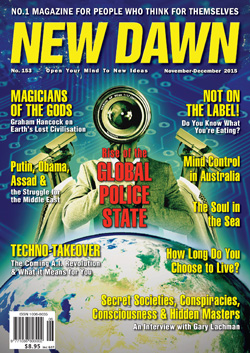
  • Freemasons, Secret Societies, Conspiracies, Consciousness & the Hidden Masters: An Interview with Gary Lachman

    Freemasons, Secret Societies, Conspiracies, Consciousness & the Hidden Masters: An Interview with Gary Lachman

    From New Dawn 153 (Nov-Dec 2015)

    An overlooked but powerful current is flowing in our time. It’s found in a small group of writers and thinkers who are trying to overcome the materialism and rationalism of the present age and rediscover the perennial truths that lie behind all religion. These writers are grappling with the occult and esoteric paths of the past and present. They’re trying to explore these movements without falling into either credulity or blinkered scepticism. They include Jay Kinney, founder of Gnosis magazine and author of The Masonic Myth; Mitch Horowitz, a New York book editor whose own works include Occult America and One Simple Idea: How Positive Thinking Reshaped Modern Life; and Erik Davis, author of TechGnosis and Nomad Codes: Adventures in Modern Esoterica.

    In this small but distinguished company is Gary Lachman. He started out in the 1970s in the New York rock scene as one of the original members of the groundbreaking New Wave band Blondie. In 1996 he moved to London, where he established himself as a full-time writer, contributing to publications such as Fortean Times, The Guardian, and The Times Literary Supplement.

    Since 2001 Gary has produced a steady stream of books, including Turn Off Your Mind: The Mystic Sixties and the Dark Side of the Age of Aquarius; The Secret History of Consciousness; A Dark Muse: A History of the Occult; and Politics and the Occult: The Right, the Left, and the Radically Unseen. In recent years he has published biographies of major esoteric figures including P.D. Ouspensky, Emanuel Swedenborg, Rudolf Steiner, Carl Jung, and H.P. Blavatsky (see his interview in New Dawn 137).

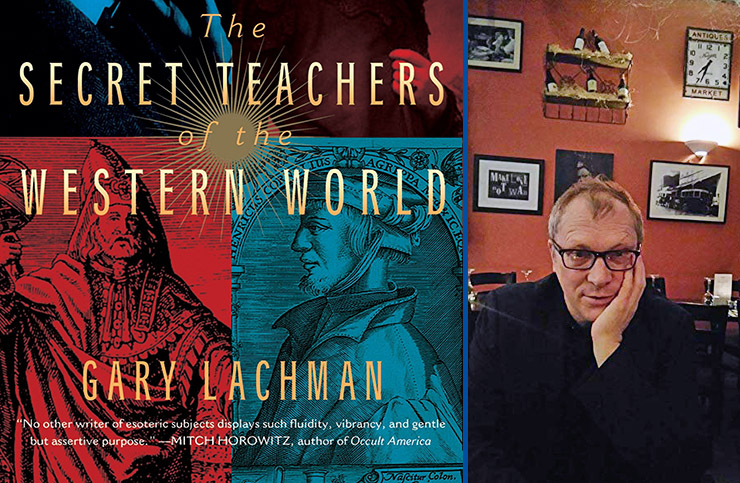
    Gary’s latest work, published in December 2015 by Tarcher/Penguin, is The Secret Teachers of the Western World, a monumental work that unveils the esoteric masters who have shaped the intellectual development of the West, from Pythagoras and Zoroaster to little-known twentieth-century figures such as Jean Gebser and René Schwaller de Lubicz.

    In June 2015 I conducted an e-mail interview with Gary about secret currents in the Western tradition.

    RICHARD SMOLEY (RS): Many people have a sense, however dim, that what is going on in the news is only the thinnest skin upon a sea of struggles and forces that we can barely conceive of. Would you agree with this assessment?

    GARY LACHMAN (GL): I suspect that at most times what we are aware of is only a selection of what is actually taking place. I mean this in the broadest sense possible. In terms of the media, it’s reasonable to assume there are a variety of filters in place that result in an edited version of things getting to us. But then there are people who devote their energies to ‘uncovering’ the truth and ‘revealing’ the facts about this or that event. It does strike me that one could get lost in attempting to track down the ‘truth’ about things, in terms of the political, economic, social situation. I mean conspiracy theorists who pursue an elusive solution to the mystery of who ‘really’ is in power and what ‘really’ happened in this or that situation.

    I think it is important to be discriminating about what we accept from our sources and to be aware that every source has its bias. Personally, I am more interested in the kind of things that are outside this kind of ‘hermeneutics of suspicion’, in the philosopher Paul Ricoeur’s phrase. I mean philosophy, thought, etc. I think it’s always a good time to pursue the good, the true, and the beautiful, whoever is running the show. I also think there is less covert control than some people believe, but it seems de rigueur nowadays to feel that everything we see on the news is false. The show itself is ultimately unimportant. It is an unavoidable nuisance that we nevertheless need to be aware of in order to pursue our aims.

    RS: Novelist Ishmael Reed wrote, “Beneath or behind all political and cultural warfare lies a struggle between secret societies.” How much truth do you think there is in this statement?

    GL: Well, I don’t know. I first came across it, as many people did, in Robert Anton Wilson and Bob Shea’s conspiracy fantasy Illuminatus. Are there really secret societies at work, manipulating events and controlling the world? If there are, they don’t seem to be doing a particular good job of it.

    I think that at different times there have been societies or groups of people who have worked together to effect some change or introduce some idea into the societies of their time. I talk about some of them in my new book, The Secret Teachers of the Western World. But these were relatively small groups who were active at a certain time, and when you look at what they were doing, the aura of mystery and sensation around them being ‘secret’ dissolves. That isn’t what is important about them. Take the Fedeli d’Amore of Dante’s time and of whom Dante was a member. They weren’t secret in the way that we think of Skull and Bones or that kind of thing (and I should say here that my book isn’t about that kind of secret group). But they were a relatively private group of poets who wanted to introduce ideas about the divine feminine or Sophia into the consciousness of their time. They were more like what G.I. Gurdjieff and P.D. Ouspensky mean when they talk about the ‘inner circle of humanity’ or ‘esoteric school’. I’m not saying the Fedeli d’Amore were agents of esoteric schools, but that their objectives and practice were like theirs, rather than some cabal of powerful individuals directing events from behind the scenes, which is how secret societies are popularly imagined to be.

    In one sense I think conspiracy consciousness is a good sign, in the way that Jung said neuroses were, as an attempt by the psyche to deal with a problem. It shows that we have a hunger for meaning. We prefer feeling that someone is in charge, even if we don’t know who that is, to feeling that no one is and that everything is chance and arbitrary. The hunger for meaning is good; it’s the means of satisfying it that I find questionable. We are purposive beings who seek out patterns and meanings. The mainstream narratives – religion, progress – no longer satisfy our appetite for meaning, and so we seek it elsewhere. One of the ideas of the book is that the meaning is there, but we won’t find it by looking for it outside ourselves.

    RS: One period in which occult orders were especially influential was the eighteenth century, in which lodges like the Freemasons played a crucial role in transforming the old feudal and ecclesiastical order into the modern world. Do you have any thoughts or insights about this development?

    GL: Freemasonry was a very important means for some fundamental ideas about modernity to be disseminated. I mean ideas about tolerance, social justice, democracy, individual worth regardless of social or economic rank. It was the spread of these ideas through different lodges that helped prepare the eighteenth-century zeitgeist for the radical changes that happened with the American and French revolutions. It is a mistake, though, to think, with Abbé Barruel and more recent writers on the Masonic influence on these events, that Freemasonry arranged or stage-managed them. There were Masons on both sides of the American Revolution, and the Illuminati – the real society, not the popular romanticised idea of it that’s present on the Internet – wasn’t ‘responsible’ for the French Revolution. The ideas that informed Adam Weishaupt’s short-lived and ineffective Masonic offshoot certainly were active forces in the revolution, and they were spread through Masonic lodges. But I think we have to credit the zeitgeist more than Weishaupt and Co. for the storming of the Bastille. In fact in one sense we could say Freemasonry itself was a product of the shift in consciousness that began around that time.
    RS: Your new book is entitled The Secret Teachers of the Western World. If they were secret, how have they been able to have such influence?

    GL: Well, again, my secret teachers aren’t necessarily secret in the sense that no one knows about them. I mean, if they were that secret, how could I know about them? One can be a secret teacher by teaching secrets, or one can be a secret teacher in the sense that the influence and importance of your ideas haven’t been recognised or have been misunderstood. Or you can be secret in another sense, as with several important thinkers who have been marginalised or don’t fit into the standard model of Western consciousness. It’s a broad term referring to a variable status rather than specific group of people. Jesus Christ, for example, is one of my secret teachers, and most people know about him. But there is a whole school of thought that argues that what we have accepted as Christianity really has little to do with the original teachings associated with Jesus. The Gnostics, for example, are thought to be more in line with what Jesus actually taught then the Petrine church of Rome.

    Or take Madame Blavatsky. If people know about her at all, she is chalked up to be an entertaining but fraudulent nineteenth-century spiritualist with a lot of chutzpah. But she was enormously influential on the modern world, in everything from art, religion, and science to what became known as the ‘counterculture’. I am not saying that everything she said about science or religion is ‘true’. That’s not the point. True or not – and she is more often on the ball than you might think – her ideas were tremendously influential, and I am amazed that feminists haven’t appropriated her. I suspect the occult connotations put them off. She isn’t secret, but her influence is not generally recognised.

    I should say the central idea of my book is that the whole Hermetic, esoteric tradition is the victim of a war going on inside our heads. I mean the rivalry between our two cerebral hemispheres. One of the inspirations for the book came from reading Iain McGilchrist’s very important work The Master and His Emissary, which is about the left and right brain and the differences between them. Briefly put, McGilchrist revamps the left/right brain discussion by showing that the difference between them is not in what they do – as was originally believed – but in how they do it. They respond to the world in very different ways, and the way they present the world is also very different. In the simplest sense, the right brain presents a total picture of the world. Its mode of consciousness is relational, connective, holistic. It presents what McGilchrist calls the ‘big picture’, the overall pattern, but its picture is fuzzy, vague. It works with metaphor, symbols, and is focused on the living character of being. It is aware of implicit meanings, meanings that we know and feel but cannot express explicitly. (Think of our appreciation of music: we know a Beethoven string quartet means something, but we’d be hard pressed to say exactly what.)

    The left brain is aimed at breaking up the big picture into smaller bits and pieces that it can manipulate. Its main function, as Henri Bergson said long ago, is to help us survive. It reduces the living, flowing whole presented by the right brain to a kind of map that allows us to manoeuvre through the world effectively. It’s interested in the trees; the right brain is interested in the forest. One looks through a microscope, the other at a panorama.

    Both are necessary, and for the most part each gets along with the other in a system of checks and balances, each inhibiting the other’s excesses. But McGilchrist argues – convincingly, I believe – that in the last few centuries the left has increasingly gained an upper hand against the right and has, in a sense, gone on a smear campaign against it. One expression of right brain thinking that the left brain targeted was the Hermetic, esoteric tradition, which was cast into disrepute with the rise of mechanical science – itself an exemplar of left brain thinking. With the dismissal of the esoteric tradition it was transformed into what the historian James Webb called ‘rejected knowledge.’ What my secret teachers teach is this rejected knowledge.

    [alert type=”info” dismiss=”no”]If you appreciate this article, please consider a subscription to New Dawn magazine.[/alert]

    RS: Of the figures that you would include among these secret teachers, which do you consider the most influential?

    GL: That’s difficult to say, and I should point out that the book isn’t a ‘top ten’ or ‘ten best’ list or something like that. Plato is certainly one of the most influential; in many ways the esoteric, Hermetic roads all lead to him. He is believed to have ‘gone to school’ in Egypt, and whatever he learned there is supposed to inform his philosophy. But whether Plato studied in Egypt or not, his ideas about the Forms, the ideal essences of which the physical realities of time and space are merely shadows, is certainly at the heart of the esoteric tradition. And Platonism informed Christianity, Hermeticism, Gnosticism, and other esoteric teachings. We can argue with and reject or accept different aspects or elements of his philosophy, but I would say that for the West, Plato is certainly one of, if not the most, significant source of esoteric thought, or thought in general. Alfred North Whitehead said long ago that all Western philosophy is but a series of footnotes to Plato.

    In saying this I’m not saying I think Plato is the ‘best’. My own philosophical background is more in Nietzsche, Bergson, Whitehead, William James, and existentialism. But Plato is still there too.

    RS: Which of these figures do you admire the most?

    GL: I’m not quite sure how to answer that. There are plenty of admirable figures in the book, as well as more questionable ones, and also some martyrs, like Hypatia the Neoplatonist, and the Persian theosopher Suhrawardi, both of whom fell victim to religious persecution, as well as truly secret teachers like the so-called Dionysius the Areopagite who welded Neoplatonism to Christianity. We do not know who he really was, just as we have no names for the Hermeticists of ancient Alexandria.

    I can say who has been an influence on me. One of first writers on esotericism that I read was P.D. Ouspensky. His books Tertium Organum and A New Model of the Universe made a big impact on me, even before I read In Search of the Miraculous and became interested in Gurdjieff. I first read these books forty years ago, and Ouspensky seemed a model of the kind of thinker I wanted to be: he combined a romantic openness to ideas, and poetry and art with a rigorous critical mind and he remains the best writer from what I call the ‘golden age of modern esotericism’, which took place during the 1920s, when people like Ouspensky, Gurdjieff, Rudolf Steiner, Jung, Crowley, and others were all active. Again, I’m not saying Ouspensky is the ‘best’ – that’s as pointless as arguing about who’s the best guitarist. But reading his books excited me and made me want to learn more. I tend to like figures that combine imagination with critical thinking, which we can see as the right and left brain working together, which is another theme running through the book.

    RS: One theme that you advance in your new book is that the cosmos is a living, conscious being, and that we need to rediscover that fact. To what extent do you think this rediscovery is actually happening in the world today?

    GL: It seems some form of that idea has been revived and presented in a variety of different ways throughout the last century and into our own. Bergson argued a form of it as did Whitehead. In the nineteenth century we have Gustav Fechner, who wrote about the Earth as a living being well in advance of James Lovelock. The philosopher David Chalmers has argued for a kind of panpsychism, meaning that in some sense, the entire universe is conscious. What headway this idea has made in altering our ‘standard model’ of the cosmos is unclear. We’d have to interview lots of scientists, I guess, and go through the numbers. I think more people today have some sense of it than, say, in the nineteenth century – at least the kind of mechanistic picture of the world popular then is less so now. Of course, any scientist who takes the idea literally and talks about it is subject to the scorn of his peers. But that too is an expression of the rivalry between the two modes of thinking. The ‘hard’ left brain makes fun of the ‘soft’ right brain’s ‘need’ to see a nice, cozy universe that cares about him, while he shows how ‘tough’ he is by saying that he doesn’t need that and prefers the ‘truth’ about the cold, indifferent cosmos. I write about this in an earlier book, The Caretakers of the Cosmos, where the idea of a living cosmos is a central theme.

    RS: Thirty or forty years ago, it seemed possible to believe that we were on the verge of a new age of rising consciousness and compassion. It’s a little harder to believe this now. How do you personally respond to hopes and dreams of a coming new age (however imagined)?

    GL: I’m not that keen on predicting a new age. Western history is littered with them. I think the current pessimism, or, more accurately, nihilism is a kind of ‘sound barrier’ that our culture, our civilisation, has to break through. Nietzsche predicted it at the end of the nineteenth century. I think we have somewhat naïve ideas about a new age. I believe there are shifts in consciousness. One of the thinkers I refer to in the book and in others is the little-known German philosopher Jean Gebser, who talks about different ‘mutations’ of consciousness happening throughout history. But these come about through our own participation in them; I mean we are active players, not passive recipients of something happening in the stars or according to some ancient teachings.

    The real new age will come round when we learn how to master our own consciousness. This means coming to understand it. This takes hard, determined work. I don’t think the new age will come about because of nice thoughts or fun raves or because of a conference or a festival. It will start to appear in individuals who have an obscure hunger for some purpose higher or more demanding than what our ordinary life can provide. These types embody in embryonic form a new consciousness that demands a new kind of inner freedom.

    We tend to think of freedom as liberation, as being free from something. The new types want a more significant freedom, the freedom for some purpose greater than just fulfilling their individual needs. In The Caretakers of the Cosmos I borrow a term from the Russian existential philosopher Nikolai Berdyaev and talk of a ‘creative minority’. These are the individuals who quietly and solitarily confront the demands of the new consciousness emerging within them. We tend to think that a new form of consciousness will be lots of fun and full of ecstasy. But more often people experiencing a different kind of consciousness, with different needs and appetites, tend to feel like misfits and have to go through a long struggle to actualise their possibilities. I have a very evolutionary way of thinking. I feel that any important development at first makes life more difficult for those in whom it occurs. Those who can get through the initial difficulties develop a strength that will help them impose the new vision on the world around them.

    RS: Which living people do you consider to be most important and impressive in fostering this higher awareness?

    GL: The most important one for me has been Colin Wilson, who sadly died at the end of 2013 at the age of eighty-two. I have been a dedicated Wilson reader since 1975, when I first read The Occult. After that I tracked down and read as many of his books as I could find. I am in fact preparing to write a book about his work and ideas, which more or less form the basis for much of my own writing. Wilson spent a lifetime in a determined analysis of consciousness and developed what I find to be a very convincing argument for why our consciousness is how it is and what we can do to intensify it. It isn’t for everyone, but I personally have got the most out of following his leads.

    Gary Lachman’s The Secret Teachers of the Western World (Tarcher/Penguin) is available from all good bookstores and online retailers.

    [alert type=”general” dismiss=”no”]This article was published in New Dawn 153.[/alert]

    [alert type=”success” dismiss=”no”]If you appreciate this article, please consider subscribing to help maintain this website.[/alert]

    © New Dawn Magazine and the respective author.
    For our reproduction notice, click here.
  • Mr West, the Sphinx & Gurdjieff: “Only a gentleman fights for lost causes”

    Mr West, the Sphinx & Gurdjieff: “Only a gentleman fights for lost causes”

    From New Dawn Special Issue Vol 8 No 6 (Dec 2014)

    It has been thirty-five years since the first publication of John Anthony West’s revolutionary book Serpent in the Sky: The High Wisdom of Ancient Egypt. It was a courageous challenge to the academic blindness of mainstream Egyptology. Much has transpired since then and although the mainstream still desperately clings to its outdated attitudes toward the wisdom of the ancients, the knowledge that the real truth of our history and its origins have been denied to us is gaining a much greater acceptance.

    In this exclusive interview for New Dawn magazine [conducted in 2014], Darren Carville spoke to John about where he is currently at and what motivates him at the age of 82 to continue taking on the Establishment [Editor’s note: John Anthony West died in 2018]. The following are some highlights from that interview.

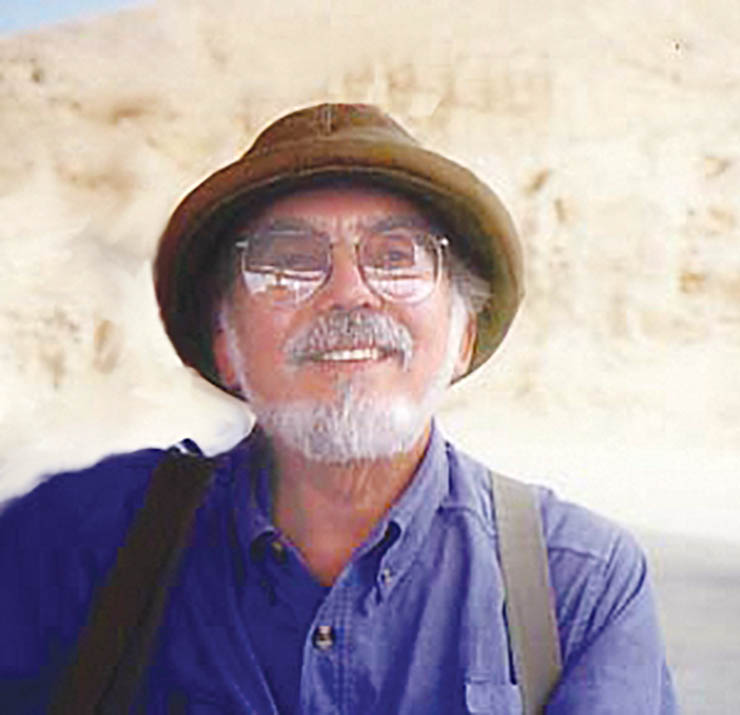
    DARREN CARVILLE (DC): John, Serpent in the Sky was originally published back in 1979 when the Internet was just a pipe dream. It’s amazing how many of these ideas are so widely disseminated online now. Just one example is this curious image of the ‘Sitting Scribe’ [see the front cover of this magazine] that in your book was originally in black & white, but now there are dozens of vivid colour copies of it online from every angle as people visiting Egypt take digital shots and upload the images themselves.

    JOHN ANTHONY WEST (JAW): Yes that’s true, and that particular image is also a great example of Egyptian technology going backwards, because those inlaid eyes, they’re made of four different kinds of quartz crystal and as R.A. Schwaller de Lubicz points out, not only is quartz a very difficult stone to work with, but in order to make a realistic eye that looks back at you, means having to understand the refractive and reflective indexes of the eye. So this is a very advanced knowledge of anatomy. By the New Kingdom, a thousand years later, they had lost the ability to be able do it anymore.

    DC: As an artist, even to paint something like that, is a very, very difficult thing to do.

    JAW: In terms of high art, once you’ve seen these Old Kingdom statues with the inlaid eyes, all other sculpture, including Michelangelo and Donatello and all the others, fade in comparison. They look blind, they don’t see, that’s the big difference.

    DC: You can read a saying that the ‘eyes are the window to the soul’, and here they have produced art where you can actually sense that. On the topic of lost knowledge, my son recently showed me a book that had a chart of all the different Egyptian crowns and headgear. It’s something that’s never spoken about is it? That famous picture of Yul Brynner in ‘Moses and the Ten Commandments’. He has that crown on his head that looks like a giant bowling pin, but they never actually found any of these hats in Egypt?

    JAW: No, that’s right. We have so much stuff out of Egypt now, that if it really was a crown, you’d have some instance of it and there’s not a sausage, they’ve never found any physical manifestations of them. Nobody up till now has been able to satisfactorily explain them. So this has always been a big mystery. Intuitively, I reckon that since it’s on their heads, which is the seat of consciousness, that in some way or another, symbolically it represents the consciousness of that particular principle. But that’s a ballpark observation, it doesn’t mean I can explain why one crown has a ram’s horn and the other kind of crown has a sheep’s horn. Or why one has a solar disc and the other one has a lunar disc. Well, okay, that’s sort of obvious. One is solar, and one is the lunar principle. But why this combination, I don’t know.

    DC: John it’s been over 20 years since your award-winning bombshell documentary about the Sphinx [‘The Mystery of the Sphinx’] with its ancient rainfall erosion and hence its age having to be thousands of years older than the ‘official’ date. The archaeologists produced their own documentary supposedly ‘debunking’ your claims, but it seems they were too late to sway the general public, and nothing has really been the same since has it?

    JAW: Right, well I love it. I have a certain advantage over most of my colleagues. Graham Hancock is a very good journalist but he’s not a satirist. I’m a scholar by default, but I see myself as more of a writer than a scholar. When we get attacked I have the tools to deal with them, so the harder they come at me, the more I enjoy it, particularly now we’ve got the Internet. Because before that you couldn’t retaliate.

    DC: What’s been your best achievment so far?

    JAW: People often ask me, “What do you think your legacy will be?” Well, I know this Sphinx theory – whatever the fate of symbolism – it isn’t going to go away and it’s all there. It’s not going to be long before the Establishment is obliged to accept it or get marginalised themselves. It’s really a lot like Galileo’s story actually, because I didn’t invent this Sphinx theory, I got it from a single line from Schwaller [de Lubicz] and he just glossed over it. He didn’t see it himself. Yet, it’s the key to the whole lost civilisation hypothesis… it’s quite clear from the way he talks about it. In English the book is called Sacred Science: The King of the Pharaonic Theocracy. That’s going to be around forever. Nobody’s going to get rid of that.

    Then it was Robert Schoch, my colleague, who stuck his tenured neck out to defend the whole water erosion hypothesis and it was his triple Ph.D in Geology, Geophysics and Palaeontology that did it. Nobody would have given me the time of day, even though I’d actually done my research pretty well. Schoch is very cautious and quite respectable – less so than he used to be. He’s an interesting guy, and very intelligent.

    The other thing I would like to be remembered for is being the one who drove the final nail into the coffin of Darwinian evolution. Robert Schoch and I have a book planned called ‘Darwin Debunked, Darwin De-clawed, Darwin Dethroned’, sub-titled, ‘A Scientist and a Scholar Deconstruct the Cargo Cult of the West’. We want to write the definitive anti-Darwin book, and it’s funny because there are lots of so called ‘definitive’ books that never managed to do it. Maybe the time wasn’t right or they’ve just not been written in a way to fire the public imagination. We think we can do that between us.

    DC: It may well be the right time because even five years ago if you tried to explain to most people that the world was run by a few private corporations they just laughed. But now because of what’s happening, and how it affects people personally, the attitude is changing and I think all of that global control couldn’t exist without this Darwinist world view – that there’s no greater purpose to living than being a consumer.

    JAW: Yes, it’s the foundation for it, if not explicitly, implicitly. It supports the whole rotten structure.

    DC: Is there anything else you’re currently working on that’s in the pipeline John?

    JAW: At the moment Schoch and I are working on another book called ‘Dancing Down the Bridge of Sirah’. It comes from Sufi literature and it’s described as this bridge that’s narrow as the razor’s edge, and on one side is the Chasm of Credulity and on the other is the Abyss of Scepticism. So the trick is to get down that bridge and this is not so easy. Schoch and I intend to do a really comprehensive account basically of the Sphinx theory – not going into the Symbolist realm so much – and now that we’ve got Göbekli Tepe, we’ve got a smoking gun [for more on Göbekli Tepe, see Robert Schoch’s articles in New Dawn Special Issue Vol.7 No.1 & New Dawn 122]. So not too long from now it’s going to be impossible for these jackasses to keep on insisting their old paradigm is right, and they will go under. The subtitle is ‘A Scholar and a Scientist Fend Off the Air-brushed Unicorns and Take on the Paradigm Police’. That’s an image coined by my composer step-son. He was once talking about the covers of New Age music and he complained that, “It’s all a bunch of air-brushed unicorns.” That’s a perfect totem for the woo-woo segment of the New Age movement. The paradigm police are of course the debunkers.

    The other thing we are trying to do is a ‘Magical Egypt 2.0’ documentary but we’ve got to figure out how we intend to make money from it. We didn’t make a bean out of all the work that went into the first ‘Magical Egypt’ series because people just pirated it in the end.

    [alert type=”info” dismiss=”no”]If you appreciate this article, please consider a subscription to New Dawn magazine.[/alert]

    DC: Great, we will certainly be looking forward to seeing this! One of the things I love most about Serpent in the Sky and the ‘Magical Egypt’ series is that you layout all these ideas and encourage people to follow them up and verify for themselves. I find they are something I keep coming back to, and each time it sparks me off into new research. This seems to be the way of the Egyptian Sacred Science – it makes you work for the understanding, you can’t just get it through a bunch of memorised facts in the way of academic learning. As you mentioned with Gurdjieff’s book Beelzebub’s Tales to his Grandson – it’s like Egypt makes you work for it and there is no start or finish, it’s about how far you can penetrate into the enigma.

    JAW: Yeah, sure.

    DC: A good example is the division of the head at the crown of the skull in the temple reliefs. Clearly it is a clue inviting people to have a look at this specific portion of the head as there is a deeper message hinted at. Schwaller and his team do all the research, look at the anatomy of the brain, look at all the esoteric traditions to do with that part of the head etc. He has to do a lot of research to be able to get to the truth or the understanding of what that is actually revealing. He had to work for it.

    JAW: It is impenetrable to 99% of people, even people who are highly literate and highly philosophical. There’s just something about the density of his thinking that people can’t or won’t go to the trouble to penetrate. For me it was not easy, and some of the things I didn’t have the maths to be able to follow him in certain instances. But otherwise I had a good grounding in Gurdjieff and a lot of esoteric studies so I could read it without too much trouble. It’s certainly not for everyone so it’s good to have something like Serpent in the Sky to help you open it up.

    DC: I really wanted to ask you about that Gurdjieff connection John, because I heard you on another interview say that if it hadn’t been for your understanding and experience with the Gurdjieff work, you would have never twigged to what Schwaller was on about in the first place.

    JAW: Well, I would never have even found him, for that matter.

    DC: Right, and I do wonder John – in what you’ve just said about the nature of Schwaller’s work and the level of his mind – do you think that’s really a factor of this whole idea that one’s level of ‘being’ determines what level of higher knowledge one can actually gain access to?

    JAW: That’s a good question. Well yes and no. Working on being – you’re thoroughly familiar with the Gurdjieff work?

    DC: Yes.

    JAW: Well, I would say in terms of levels of being, it’s impenetrable unless you’ve acquired what Gurdjieff calls the ‘Magnetic Centre’. That’s what opens you – it makes these kinds of things accessible. It’s one of the things that a lot of people don’t understand who haven’t been involved in this kind of work themselves, and are mostly working with their heads. They just can’t get it at all. As my Sensi used to say, “Don’t talk about moonbeams to the blind or about music to the deaf, and especially do not talk about sex to eunuchs – they will just get angry!” So once you understand that and stop getting frustrated by, let’s call it, the intolerable obduracy of the quackademic, because it looks as though it’s deliberate, but it isn’t. They just don’t get it.

    However, when they call their terrible disability ‘reason’ and take over the palace, the empire is doomed. This is what you’re dealing with. They’re basically wildly uncreative people. I mean, Schwaller appeals not necessarily to the intellectuals, although you have to be quite intellectual in order to penetrate it. You need more than intellect to be able to think in a certain way. The people who get it instantly, or at least they get the basic premise, are the artists and the architects, and sometimes the engineers, oddly enough. Rarely the hard-nosed scientist, never the sceptics of course, they’re totally out of it.

    So it’s going back to the magnetic centre, and the magnetic centre automatically means that you’ve done some sort of work on your own level of being. Some sort, even if it’s not been formal, otherwise you don’t have that magnetic centre that gets you to Gurdjieff and Schwaller in the first place.

    DC: Yes, and in relation to this battle with the academics, Gurdjieff also pointed out very clearly that this kind of ‘work’ is not for everyone. A person has to be genuinely seeking for the truth in the first place. Reading your argument with the Egyptologists in your open letter to Archaeology magazine [see www.jawest.net/anupadeshi.html], I get the sense that you have these different compartments at work in your life, because at one level you deal with the public, you do interviews, respond to all sorts of criticisms and arguments, but obviously at a deeper level you know that the issue for the human race’s future is a much deeper thing. It’s not really just about Egypt is it? Because no-one with any kind of awe and wonder about how difficult it is to make anything can ever look at the Darwinist idea that these chemicals get together accidentally and produce life. It’s a dead, non-resonating kind of thing. You could never swallow it. Yet millions do, quite happily, 24/7.

    JAW: More than millions. I mean, it’s the belief system that’s at the core of all science and all education.

    DC: Yes, I do wonder how long it’s actually going to take to replace that world view with something better. I did notice with your documentary series, ‘Magical Egypt’, looking at any of those episodes, the number of hits they have had, it’s in the hundreds of thousands. It’s quite extraordinary the popularity your work has gained since Serpent in the Sky – the message is getting out there. Of course the other side of the coin is that with the Internet all sorts of ideas have become popular and their popularity makes them seem like fact. For example, this whole Anunnaki/aliens making human slaves mine gold kind of thing – you don’t go for any of that do you John?

    JAW: No, and in our book ‘Dancing Down the Bridge of Sirah’ there will be a section in there called Zecharia and his Sitchininnies. Some of the other stuff, some of the ‘Airbrushed Unicorn’ stuff, is fairly harmless, but his work is seriously malignant.

    DC: It’s even turning up in romantic novels now.

    JAW: I always left the door open to Sitchin because his work was based upon his own translations of the Sumerian texts. No Assyriologist would look at his stuff. That’s not Sitchin’s fault. So I thought he could well be right about certain things. Who was I to argue those points? However, recently, a really solid biblical scholar who doesn’t have an axe to grind called Michael Heiser put up a website called ‘Sitchin is Wrong’ [www.sitchiniswrong.com]. This guy really knows what he’s talking about and goes through Sitchin line by line, and none of it tallies with the dictionaries created by the Sumerian scribes themselves. As far as I’m concerned, it’s completely false.

    DC: You have often given the analogy that where we are in the Kali Yuga cycle is very much like being in the ‘Winter’ stage of the four Seasons.

    JAW: Yes, that’s right. However, the big problem with these very long cycles is that you don’t have a Spring Equinox to set your clock by. You just can’t really know exactly. There’s a lot of very informed, interesting work done on the Yuga cycle, but they all have different ideas of where it starts and how it starts, and unfortunately there’s nothing scholarly or scientific that you can actually depend upon that is more plausible or less plausible analyses. There’s simply not enough history, it’s too short to tell. I mean real history only goes back about 2,500 years. In other words, history that you can document. It’s really not much more than that. Even the Egyptian history is, half the time, symbolism of some sort or another. There are very few ‘facts’. So we’re talking about cycles, at least precessional cycles, and maybe more than that, we just don’t know. You look around us today and intuition tells me that we’re in the thick of the Kali Yuga and it’s going to get a lot worse before it gets better.

    DC: John, how was it that you originally got involved in the Gurdjieff work?

    JAW: When I look back on my life I see I was psychologically precocious. Not a genius, but at the age of 12 or 13 I actually knew that I was living in a lunatic asylum, that the whole thing was insane, and it was very lonely living back then. Now lots of people sort of understand that. By the time I was 19 I knew what I wanted to do. I wanted to be the little boy who said, ‘The Emperor Has No Clothes!’

    It took another 20 years. I had published a lot of stuff by then, and the scholarship was starting with my The Case for Astrology book. There were also plays, a novel and stories. I was well published but not very well paid for it, and I realised I was now playing out my role as the little boy who said, ‘The Emperor Has No Clothes’. I finally came across the Gurdjieff work when I was living in a thriving artists colony at Ibiza in Spain during the late 50s and early 60s.

    Through a weird series of circumstances – again it’s the magnetic centre at work – one of the guys that I knew gave me a book called The Theory of Celestial Influence by Rodney Collin, a student of Ouspensky. I read it and that really interested me, and my friend, a very good painter, who had been in the Gurdjieff work himself, started feeding me Gurdjieff in very limited doses. He was right on course because I would have said, “Ah, what do I need this stuff for?” So one day he finally said, “Well, okay, here’s Beelzebub’s Tales to His Grandson.” He gives me a little fat book and I take it back and I read the first paragraph which is something to the effect of “Everything you know is completely wrong, and this book will make you understand that you don’t know anything.” I was furious. “Fuck you! who are you to tell me that, what have you ever written?”, but then I calmed down and thought, “Well I’ve had a lot published myself, and and I know how difficult it is to make your audience feel – not even think – but feel what you want them to feel.” Here was this guy, in one paragraph, getting me so angry that I was ready to throw his book against the wall. Suddenly I realised, “Oh… that’s not easy to do!”

    What Gurdjieff was doing, he was obliging me to work. You didn’t know what was true or false or even if he was pulling your leg. Could you follow those paragraphs? Those sentences that are two pages long with a thousand parentheses in the middle… he was forcing you to use your head in a way that you never dreamt of using it before.

    That was my introduction to Gurdjieff and I eventually left Ibiza to move to England to get into the Gurdjieff work, which was really important. Without that I would have spun off the rails long ago. Everything else stopped. Because at a certain point you can’t just read about these ideas anymore, you have to do them, and this is where the problem comes in because it’s not easy to do and it’s not fun.

    DC: The Gurdjieff work, no it isn’t.

    JAW: It’s not like rubbing crystals or hugging trees, it’s hard work. Gurdjieff was almost the only person I’d ever come across who was as contemptuous of all of Western civilisation as I was, but the difference was that he knew how to live in it and I didn’t. So after nine years of living in Ibiza, I finally moved to England to get into the ‘work’.

    What distinguishes Gurdjieff from anybody else is that it’s the ancient doctrine but put into a format designed to be practised in the middle of the lunatic asylum, not isolated from it in some monastery or whatever. It’s how to become sane when everybody around you is crazy, without removing yourself from ordinary life. You can’t practise Schwaller. It’s not a discipline. But Gurdjieff is.

    DC: Yes, I can certainly appreciate that.

    JAW: Without a return to the kind of principles that kept Egypt going, and other ancient cultures going, without this ancient doctrine being understood and taken up, the Church of Progress always wins, or everyone loses one way or another, so it’s very difficult. This is why Egypt is special because there’s so much of it left. You can’t go to China or India or anywhere else and have this thunder of esoteric wisdom coming at you all day long like you can in Egypt.

    Of course there’s a lot of bullshit out there as well, but at least in theory the work is designed for people to practise inside their daily lives. Not that many are doing it and I don’t really know why. On the other hand, if you just extract yourself from the world, it’s like you’re shirking your duty somehow or another. I mean, Tiger Woods’ mistresses don’t matter, and most of that stuff doesn’t matter. But some of it does matter. You watch the Scorpions of Wall Street raping our lives and these disgusting billionaires absolutely destroying the planet. That’s the sort of thing you have to keep on top of, it seems to me.

    Get the issue this article appears in

    DC: As you’ve said, the Egyptians lived their life in preparation for the next life, and of course some people say, “oh, morbid buggers, they’re obsessed with death.” But no, I think, as you’ve written about and as Schwaller pointed out, clearly they knew, unlike the Darwinists, that they were here for a reason. Something had gone to a lot of trouble to put them together, to put this planet together, and I can really relate to that balancing act you’re talking about… Because on the one hand, as far as we know, we only have the one chance to do what we need to do here and move on, and yet at the same time you would not be human to not feel a concern and want to do something to make the situation here better. Especially being that the dice is so loaded – to programme people from the time they are born – that there is no purpose to life except consumerism, that it doesn’t matter if we destroy the planet because it’s a giant chemical accident anyway.

    JAW: Well, you can only do your best. The Gurdjieff work got me understanding things pretty well and Gurdjieff has a lesson for everyone and everyone’s lesson is a bit different. But it was Gurdjieff who taught me – and this is a riff on what he says – that whoever and whatever presses your buttons is your master, and if you let your buttons get pressed, you’re a slave. I didn’t like that, so I worked pretty hard, reasonably successfully, to not get my buttons pressed most of the time. So enough people have to start doing their homework. If somebody asked me, which they probably won’t do, who I think are the most important people of the 20th century? I would put Gurdjieff first and Schwaller second. Certainly the last word has not yet been said about Gurdjieff.

    Anyway, I’m figuring on being here for a while yet. A friend of mine recently had the honour of briefly being the oldest man in the world. He was 110, and he really had his marbles together up until the last year or two. He did research into the paranormal. So if he could get to 110, there’s no reason why I can’t!

    There’s a wonderful author, the Argentinian writer Jorge Luis Borges. He wrote a short story book called Ficciones – magical Cabalistic stuff – and in one of the stories the last line is, “A gentleman only fights for lost causes.” It’s a great line. I don’t necessarily consider myself a gentleman, but it’s hard to do this – it’s hard not to get affected by the sort of stuff that’s happening around us every day.

    Books by John Anthony West – including Serpent in the Sky: The High Wisdom of Ancient Egypt and The Traveler’s Key to Ancient Egypt, as well as The Mystery of the Sphinx DVD, are available direct from John Anthony West’s website at www.jawest.net/books_vids.htm.

    [alert type=”general” dismiss=”no”]This article was published in New Dawn Special Issue Vol 8 No 6.[/alert]

    [alert type=”success” dismiss=”no”]If you appreciate this article, please consider subscribing to help maintain this website.[/alert]

    © New Dawn Magazine and the respective author.
    For our reproduction notice, click here.
  • Are We Food for the Moon?

    Are We Food for the Moon?

    From New Dawn 96 (May-June 2006)

    If man is not affected in some way by the Moon, he is the only thing on Earth that isn’t.
    – Robert Millikan (1868-1953), US physicist & 1923 Nobel Prize winner

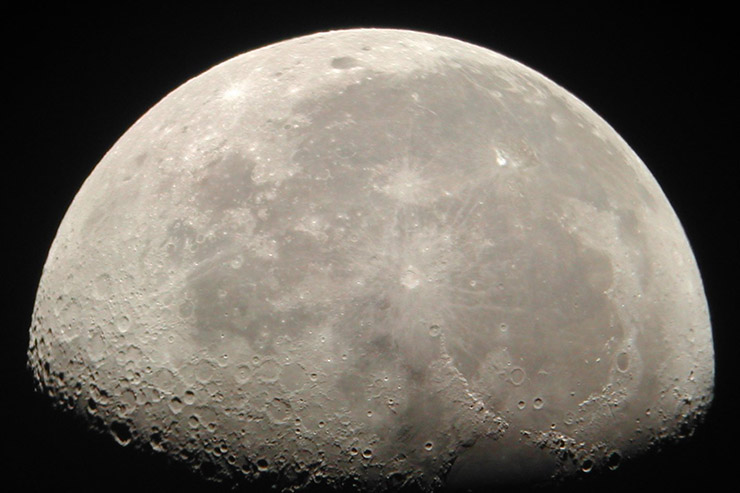
    Probably no heavenly body has received as much attention down through the ages as our Moon. The causes of this fascination are obvious: the Moon enlightens the night and appears as a remarkable and large object in the sky. As a regulator of Earth’s tides and life’s biological cycles, the Moon’s importance to our physical existence is second only to that of the Sun.

    Sacred scriptures, ancient myths, and even modern day pagans, all exalt the Moon in one way or another. Omens, spells, wishes, oracles, divination, and calendars cluster around it throughout history. Moon magic, the belief that working rituals at the time of different phases of the Moon brings about physical or psychological changes, is essential to various pagan and witchcraft systems. Witches in Greek and Roman literature were regularly accused of ‘drawing down the Moon’ by use of a magic spell.

    Nevill Drury, a respected authority on mystical and occult traditions, says “traditionally… the Moon has been regarded as a ‘funnel’ drawing on the light of the stars and constellations and transmitting their energies to the Earth.”1

    In Western astrology the Moon is said to represent the feeling intuitive nature of the individual as well our deepest personal needs, our basic habits and reactions, and our unconscious. In esoteric astrology the Moon represents attachment to form, and under certain circumstances a variety of limiting conditions are related to the Moon, ranging from blatant materialism to subtler forms of limitation such as debilitating nostalgia, sentiment and regret.

    The word “lunacy” – which derives from the Latin for Moon, “luna” – denotes the traditional link made in folklore between madness and the phases of the Moon. Several studies have tried to get to the bottom of this age-old belief. A 1976 report compared 34,318 crimes against lunar cycles. It found offences occurred more frequently during a full Moon. Other research, however, failed to find any firm link between the cycles of the Moon and irrational behaviour.

    England’s Lunacy Act of 1842 gave allowances for uncharacteristic crimes committed during the full and new Moon. This law distinguished between the chronically insane and the lunatic. It was argued the lunatic became deranged at these times because of the Moon’s power and thus could not be held accountable for his or her actions.

    Interestingly, a study of the Moon’s effect on mental health patients, conducted by the University of Liverpool in 2000, found a significant change at the time of the full Moon, but only in subjects with a diagnosis of schizophrenia.

    Whether we are conscious of it or not, the Moon exerts some sort of influence upon our biological and psychological states. But does it go any deeper than this?

    Gurdjieff and Ouspensky

    The Fourth Way philosophy claims to help individuals cease to be slaves of external and internal influences by building up a core of heightened consciousness. Its ultimate goal is the realisation of the full potential of human evolutionary possibilities. Its founder, George Gurdjieff (1872-1949), frequently spoke of the thoughtless mechanical behaviour of humanity, and was fond of commenting humans are “food for the Moon.”

    What did Gurdjieff mean by this phrase? Many interpreted “food for the Moon” as a figure of speech – perhaps Gurdjieff meant we are slave to our mechanical conditioning and feed our baser impulses. But while it can be interpreted in this fashion, Gurdjieff was primarily being literal.

    Peter Ouspensky, Gurdjieff’s most famous disciple, lectured at length concerning the Moon’s role in human affairs and its place in the cosmological scheme of things.

    Ouspensky said the Moon drives the individual’s mechanical aspects like a pendulum moves the gears of a clock. The degree to which one’s actions are driven by the Moon is proportional to one’s level of contact with higher influences. For people incapable of moving themselves through life by nobler spiritual impulses, the Moon provides a propulsive force. Without this force, mechanical individuals would be passive as puppets without a puppeteer.

    In the cosmological scheme proposed by Gurdjieff and Ouspensky, Earth is like a mother to the Moon which is still a fetus in the sense it cannot yet “breathe” on its own, hold an atmosphere, or support life. Someday, the Earth will evolve into a being like the Sun, while the Moon will transform into a second Earth. Humanity was simply a stage in this process.

    “The Moon is actually a fragment of this Earth, which must now constantly maintain the Moon’s existence,” Gurdjieff said.2 In that sense, the Moon is like a parasitic thought form. Nevertheless, the equation is balanced because in exchange for the Moon propelling our mechanical movement, we feed the Moon so that it may grow and one day be born as a living planet.

    As to how organic life feeds the Moon, Gurdjieff taught that most human beings are mere “slugs” with no souls and that following death their remaining psychic energy is “food for the Moon.” Like a magnet, the Moon draws the fine matter of human souls into it: “Everything living on the Earth, people, animals, plants, is food for the Moon. The Moon is a huge living being feeding upon all that lives and grows on the Earth.”

    Only through an intensive effort of conscious evolution – what he called “self-remembering” – was it possible for an individual to escape being eaten by the Moon. “The liberation that comes with the growth of mental powers and faculties is liberation from the Moon.” Gurdjieff always maintained Man is not truly conscious, and his actions are entirely mechanical: “Everything ‘happens,’ he cannot ‘do’ anything. He is a machine controlled by accidental shocks from outside.”

    To escape these deleterious lunar influences, Ouspensky said we must “create Moon within ourselves.”3 By this he meant we must develop within a driving mechanism that takes the place of the external lunar influence; in this way we can break free of the puppeteer.

    Boris Mouravieff, who was an associate of both Gurdjieff and Ouspensky, formulated an esoteric system for spiritual evolution founded upon the inner traditions of Eastern Orthodoxy and Fourth Way principles. His extensive three volume work, Gnosis, deals extensively with the question of lunar influences and spiritual development.

    He concurs with Gurdjieff and Ouspensky on the role of the Moon, but also warns “that organic life functions as a transmitter station sending refined energy to the Moon to assist its growth. Despite increases in the human population and thus an increase in quantity of energy transferred, times of peace do not produce sufficient energy and so catalysts for suffering such as wars and catastrophes arise to sustain the process.”4

    Mouravieff and Ouspensky emphasise that despite the hypnotic nature of the Moon and the urgent necessity for individuals to overcome its influence, there is still an important cosmological reason for its existence. If nothing else, the Moon’s unique position in relation to the Earth was paramount in making physical ‘conscious’ life possible.

    Theosophy

    Together with Henry Steel Olcott, Madame H.P. Blavatsky founded the Theosophical Society in 1875. Theosophy, the “grandmother” of today’s “New Age” movement, tells us the Moon was home to an earlier “life wave” which has since migrated to Earth.

    In The Secret Doctrine, Madame Blavatsky states the Moon served a dual purpose in religious rites: “Personified as a female goddess for exoteric purposes, or as a male god in allegory and symbol, in occult philosophy our satellite was regarded as a sexless Potency to be well studied, because it was to be dreaded… But whether male or female…, the Moon is the Occult mystery of mysteries, and more a symbol of evil than of good.”

    Perhaps the Moon is identified with evil rather than good because it is now what Madame Blavatsky calls “a dead planet.”

    How did this occur? An article by William Quan Judge elaborates: “in a remote period, when there was no Earth, the Moon existed as an inhabited globe, died, and at once threw out into space all her energies leaving nothing but the physical vehicle. Those energies revolved and condensed that matter in space nearby and produced our Earth; the Moon, its parent, proceeding towards disintegration but compelled to revolve around her child, this Earth.”5

    To fully appreciate why all this happened, a study of Theosophical cosmology is required, but space does not permit a full explanation here.

    Elsewhere in The Secret Doctrine, Madame Blavatsky’s view of the Moon’s relationship to the Earth is similar to Fourth Way thinking:

    “The moon is now the cold residual quantity, the shadow dragged after the new body, into which her living powers are transfused. She now is doomed for long ages to be ever pursuing the Earth, to be attracted by and to attract her progeny. Constantly vampirised by her child, she revenges herself on it, by soaking it through and through with the nefarious, invisible and poisonous influence which emanates from the occult side of her nature. For she is a dead, yet a living body. The particles of her decaying corpse are full of active and destructive life, although the body which they had formed, is soulless and lifeless.”

    Theosophy differs from the Fourth Way which holds the Moon is not yet ready to sustain life. But they both agree the Moon is vampirising the life forms of Earth.

    Are we food for the Moon, or are these warnings the ravings of lunatics? Although modern science tells us we have nothing to worry about, ancient wisdom and folklore paint a very different picture. Ignoring these dangers has perhaps left us wide open, more so when we do not recognise the signs or symptoms of the Moon’s ‘drawing up’ effect.

    Whatever the reality, the Fourth Way, Theosophy and all schools of esoteric philosophy have the solution. By overcoming our mechanical tendencies, we strengthen our resistance to the lunar effect, and for that matter all planetary influences. And by “creating Moon” within ourselves – that is, building up our essential self – we not only gain victory over the negative lunar influence, but awaken to a higher level of consciousness.

    [alert type=”general” dismiss=”no”]This article was published in New Dawn 96.[/alert]

    [alert type=”success” dismiss=”no”]If you appreciate this article, please consider subscribing to help maintain this website.[/alert]

    Footnotes

    1.  The Dictionary of the Esoteric by Nevill Drury, Watkins Publishing, London 2002
    2.  In Search of the Miraculous by P. Ouspensky, 1949
    3. The Fourth Way by P. Ouspensky, 1957
    4.  Gnosis II: Study And Commentaries On The Esoteric Tradition Of Eastern Orthodoxy, Book Two, Mesoteric Cycle, by Boris Mouravieff, Praxis Institute, 1992
    5.  “Moon’s Mystery and Fate”, Path, June, 1894

    © New Dawn Magazine and the respective author.
    For our reproduction notice, click here.

  • Awakening Our True Potential

    Awakening Our True Potential

    From New Dawn 129 (Nov-Dec 2011)

    Man is born an unfinished creature. He cannot walk or talk or feed himself. Long years of care are required to bring him to even the most minimal levels of self-sufficiency.

    And yet even after the typical person has reached the stage of functioning that we call adulthood, something still seems to be missing. In a sense, of course, something will always be missing; there are always new horizons to discover and new skills to attain. But the lack may go further. There is a sense in which even the mature human being is incomplete. The Freemasons allude to this when they speak of the candidate for initiation as a “rough ashlar.” An ashlar is a block of stone; in its rough state it fits only approximately into its intended setting. Some kind of process is needed to adjust and polish it so that it is perfectly suited to its function.

    Some may balk at this description – are we, after all, nothing more than raw materials to be sent down some assembly line to be made into identical pieces of manufactured goods? That is the kind of transformation society as a whole seems to envisage. And we would do well to mistrust it. The process to which the Masonic initiations allude has something more than mere conformity as its goal; it is not a matter of circus horses trying to break themselves in. It is the opposite: it is a matter of having access to our own potential, developing it, and offering to the service of higher aims.

    This process has been discussed often, sometimes (as in Masonry) allegorically, sometimes in more straightforward terms. But even so it has rarely been presented in a reasonably honest and lucid way. Most of the time, developing human potential is portrayed as a kind of hypertrophy – the exaggerated development of certain functions at the expense of others.

    Recently I read a magazine profile of a prominent Oxford philosopher. He had written a fourteen-hundred-page treatise on moral philosophy, in which he had examined and refuted all possible criticisms and objections to his thesis. Yet the article said he wore the same clothes each day (white shirt, black trousers) and did not like to look at any building that was not adorned with columns. His capacity for human interaction sounded rather primitive. In the end I was left with the impression of a gigantic cerebrum attached to a vestigial body.

    Is this what is meant by developing our human potential? For many people it is. The abstracted philosopher is only one specimen. Others are the athlete who is nothing more than his sport, the painter who can do nothing more than paint. Some of the greatest achievements of the human race have been attained by such people. But the overdevelopment of talents can and does turn into a Faustian bargain. Breakdowns, crises, and collapses seem to dog these individuals. We may envy their achievements, but their fragility warns us against imitating them.

    The same holds true for abilities that are considered paranormal. Although science does not care to admit it, it is possible to develop psychic powers such as telepathy, clairvoyance, and telekinesis. Indeed, in his forthcoming book The Reality of ESP: A Physicist’s Proof of Psychic Abilities, Russell Targ, one of the leading parapsychologists in the US, argues that anyone with a certain amount of (not very difficult) training can develop these skills. Nevertheless, overemphasis on these abilities, no matter how miraculous they may seem, creates problems as well. Psychics, clairvoyants, visionaries, and healers frequently seem imbalanced, having developed one skill or power at the expense of the whole.

    That is why I would like to suggest a slightly different model of developing human potential, one that is not designed to serve the interests of society (or business or political powers) at the individual’s own expense, but also one that avoids the trap of hypertrophy of a single area. Hence it begins with the crucial need for balance.

    There are many models of the human mind, all of them insightful to a certain degree and all of them to a certain degree incomplete. One of the oldest and simplest sees the human makeup in terms of the body, the emotions, and the mind. We have already seen how some people are underdeveloped in one way or another. Even if we set aside extreme cases, esoteric teachings suggest that this is basically true of everyone. While it’s often easy enough to see someone else’s imbalances, it may not be so easy to see one’s own.

    Gurdjieff’s Three Types of Humanity

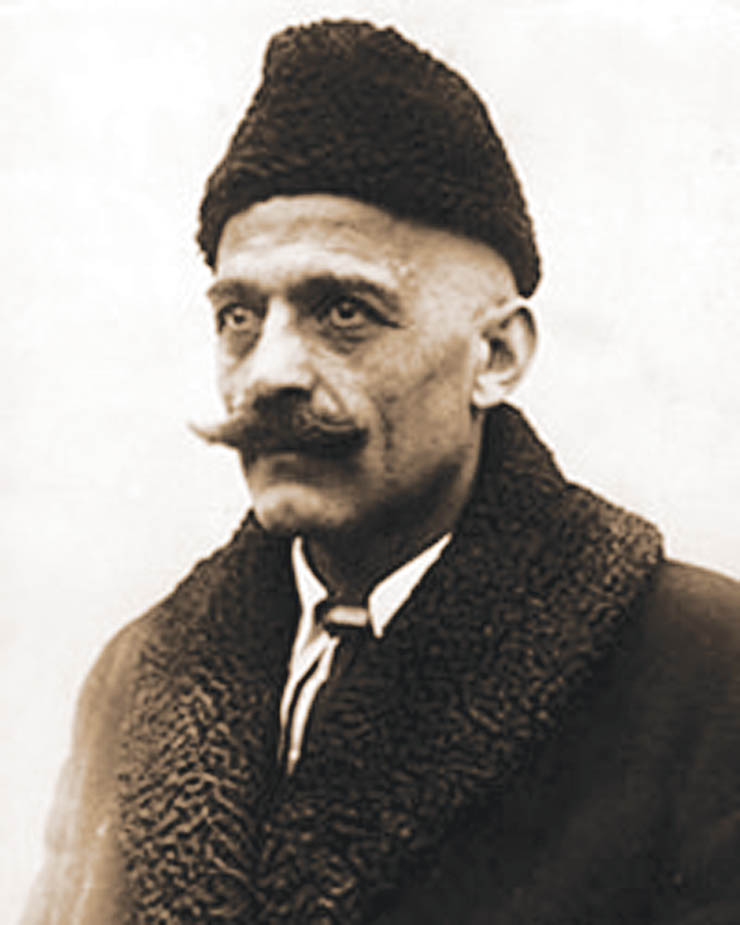
    The great twentieth-century spiritual teacher G.I. Gurdjieff (pictured below) divided the ordinary run of humanity into three types: man number 1, who is orientated toward the body; man number 2, who is centred in his emotions; and man number 3, who sees the world through the intellect. Moreover, Gurdjieff contended, human beings pass their lives in a kind of waking sleep – a low-grade trance populated by illusions and daydreams. These facts are all connected. Our sleep in ordinary life is characterised by the fact that we are overbalanced in one or another of these directions and fail to use the intelligence of the other parts of the mind.

    This, then, is the first step toward awakening human potential: to see what type of individual you are, because this shapes how you conceive of the world. Man number 1 is often of a highly practical turn; he can fix anything but may not have the dimmest idea of how to express his emotions, and may not even know what emotions he is having. Man number 2, by contrast, sees everything through his feelings. Artistic types (whether or not they have any real artistic talent) are a prime example; everything is emotion, everything is drama. Man number 3 sees life as a series of intellectual problems. He may be able to discuss philosophical issues brilliantly or add up long rows of figures in his head, but may, as James Joyce remarked of one of his characters, live a short distance from his body. (The Oxford philosopher I have mentioned would be an example of man number 3.)

    In all probability you are one of these three types. The first task in awakening human potential is, as the ancient motto said, to “know thyself,” and in a very fundamental sense this means knowing what type you are. One way of exploring this question is by looking at your leisure activities: what do you do with your free time? Are you compulsively active, running from sport to sport or task to task? Do you enjoy spending your time in pleasant fantasies of happier times past or present? Or would you rather curl up with a good book? Leisure activities are important cues because they are not compulsory; you are doing these things because you like them. Of course, work life offers its own share of data. Your profession is often based on type, even in cases where you are not doing the kind of work you want to do. You may think you are really an artist or writer but somehow you have found work as a plumber, and the work comes as second nature to you. You keep at it not because you like it but because it comes easily to you. Despite what he may think about himself, a person like this is probably man number 1.

    Very few people are pure examples of any given type; we tend to be admixtures, with bundles of strengths and weaknesses, with skills and affinities that harmonise or conflict in any number of ways. Consequently it is not a matter of simply typing yourself as you might do when taking a test out of a magazine. Knowing yourself is a lifelong course of study.

    Furthermore, self-knowledge is not a static process. There is a type of individual who is self-conscious to an extreme degree and can see her strengths and faults with remarkable clarity but is utterly unable to do anything about them. Consequently the next step in developing human potential is trying to consciously balance ourselves, strengthening the weaker aspects of our natures and making sure the stronger ones do not overpower the others. This is one meaning of Christ’s parable of the “evil servant,” who, when his master is away, “shall begin to smite his fellowservants, and to eat and drink with the drunken” (Matt. 24:45-49).

    Balancing the Different Aspects of Yourself

    Strengthening your weaker functions is never a pleasant task. Inevitably it involves giving time and energy to things you do not like. The intellectual must take up Tai Chi or learn carpentry; the artist must manage financial accounts; the athlete needs to paint pictures or write poetry. Because these are the things we do not like to do, we often find them unpleasant and humiliating, and it is a rare person who has the discipline to persist on his own.

    Speaking personally, when I was a high-school student, I realised that my connection to my body was not all that it could be, so I took the somewhat extreme step of attempting ballet. But the rigorous discipline ballet demands of the body was too much for me; I lost interest in it and dropped it after two or three classes. Only years later, as a result of involvement with esoteric disciplines, was I able to work on a more conscious connection with the body through various movements and exercises. But I never took up ballet again.

    Another one of my experiences, at an esoteric school in the north of England, casts further light on the sort of work required. The school was moving into a new centre, and a great deal of remodelling was needed. I was there for a residential course, and I was given the job of cutting wall-to-wall carpeting for one of the rooms. I was utterly hopeless at this task. I could not cut the carpet straight; I kept hacking at it and making a mess of it until I was relieved and someone was given the job who was able to carry it out in short order.

    Why was the job given to me first? Not because anyone was under any illusions about my skills at laying carpet. Rather it was to show me something about myself, so that, by struggling with an unfamiliar task, I could see where some of my limitations lay. And in fact to this day as a homeowner, I find it a challenge to do the types of household repairs that other men do without trouble and sometimes with pleasure.

    As this story suggests, it’s comparatively rare to even out one’s own imbalances completely. If you were really to do so, it would probably take a life’s work, and a life’s work cannot consist entirely of remedying imbalances. Nor is that the ultimate goal. Becoming a well-rounded person is a worthwhile aim, but from a spiritual point of view it still falls short of fulfilling the true potential that every human being possesses. What is this potential?

    The student becomes aware of it little by little in the course of struggling with his imbalances. In the first place, he learns to become free from the roles he has identified with in the past. A man thinks, “I’m not a handyman,” but if he has to carry out some task of repair he learns that this is a limitation. His identification with whatever roles he has traditionally clung to – thinker or artist – impedes him in other areas of life. In this way he learns to become free of roles – or at any rate he is a little bit more suspicious of his own tendency to identify with them. This seemingly small step actually marks a crucial point of transition, because it frees up an initially tiny amount of will and attention that had been completely fixed in identification. In short, the student learns that there is an “I” that is separate from, and free from, all the things he has identified with up to this point.

    I have spoken of this development taking place in the context of an esoteric school, and while there are not a huge number of these in the world, there are still a fair number. The ones I have encountered range across traditions: Gurdjieffian, Buddhist, Sufi, Qabalistic. Each has its own peculiar orientation, but the general type of training is the same – and in the beginning consists of the kind of work I have been talking about here. The question then arises, is a school necessary? Can you do this work all on your own?

    Generally speaking, no. You did not learn how to speak English alone; you did not learn math or cooking or carpentry or whatever life skills you have on your own. Almost always there was some instruction, and usually some instructor, behind your training. You can teach yourself how to do some things, but these are the exceptions in life. Human beings need each other for many reasons, and one of them is learning. While it’s true that people can and do undergo spontaneous moments of awakening that illuminate their being past all previous limitations and preconceptions, these are rare cases, and you can’t count on being one of them. If it has happened to you, you are fortunate. Even so, such moments of awakening are, for many people, mere glimpses intended to motivate them to undertake the hard, slogging work that I have been talking about here.

    In any event, at some point in one’s development, something starts to crystallise. And this something consists precisely of the small amount of will and attention that I spoke about earlier. An aspect of the mind begins to awaken and can see that it is not its roles, its tasks, or even its thoughts and feelings and emotions, but can step back and look at them almost as if they belonged to someone else. This is the true “I,” or at any rate the seed of the true “I.”

    Ultimate Key to Human Potential: The True “I”

    Remember that Christ in the Gospels often speaks of the kingdom of heaven as a seed. The metaphor is apt on more than one level. As the parable says, the sower sows seeds on all kinds of ground. That is, everyone has this seed of the true “I” – somewhere inside of you there is a Self that stands back and can witness, impartially but compassionately, all the doings of your life like a film. But most people take this for granted. They do not see it as important and they do not bother to develop it. To use the language of the parable again, the seeds fall on stony ground or the birds of the air eat them up.

    But this Self, this true “I,” is the ultimate key to human potential. Almost all of the parables in the Gospels speak of it in one way or another. It is the pearl of great price; it is the treasure buried in a field that a man sells all he has to buy; it is the light “that lighteth every man that cometh into the world.” Everyone has this and can never lose it; it is immortal and indestructible; indeed it is the only thing about us that is genuinely immortal – everything else will pass away. But you can make contact with it and make it develop and grow or you can neglect it, as the majority of people do and have done throughout the course of history.

    The choice is yours – now. Up to this point in your life you may not have been aware that you had this “I” within you or had the chance to develop it. You may have had the dim sense of something missing, or you may have had a vague longing of a journey that you have wanted to take without knowing where or why. This is the journey that you have wanted to take. If you were not aware of it before you read this article, you are aware of it now. And like the man in Christ’s parable of the treasure hidden in the field, you will either go out and sell all you have to buy it (figuratively speaking), or you will ignore it and return to the sleep of ordinary life.

    “Seek ye first the kingdom of heaven, and all else will be added unto you.” This true “I” is what the Gospels call the “kingdom of heaven.” If you have it – that is, if you are aware that you have it – the rest of life begins to fall into place, naturally and as it were spontaneously. This does not, of course, mean that life automatically becomes easy. It does mean that you become increasingly able to value things rightly. Money, possessions, status become progressively less important. You don’t need to become an ascetic and cast all these things away. You do need to put them in perspective and see that while they have instrumental value, they do not have ultimate value.

    This teaching of the true “I” extends far beyond even esoteric Christianity. The sacred Hindu texts known as the Upanishads speak of it frequently. Here is one example: “Verily… that Imperishable is the unseen Seer, the unheard Hearer, the unthought Thinker, the ununderstood Understander. Other than It there is naught that sees. Other than It there is naught that hears. Other than It there is naught that thinks. Other than It there is naught that understands. Across this Imperishable… is space woven, warp and woof” (Brihadaranyaka Upanishad, 3.8.10).

    The Gospels speak of this “unseen Seer,” also known as “the kingdom of heaven,” as a seed. A seed is not a fully developed plant. Similarly, this sense of “I” above and apart from our ordinary thoughts and feelings is also undeveloped when we first come across it. It is developed by further work, and even at a fairly early stage it becomes obvious what this work is. I’m tempted to use words here such as love and compassion, but what I am getting at goes far beyond even these characteristics. To put it as simply as possible, it involves a further insight: that this “I” that exists at the core of my being also exists at the core of all other beings, human and nonhuman, animate and inanimate. It is very hard in ordinary language to express the idea that what is most essentially myself is precisely that which I have in common with all others, but this is exactly the case.

    Most spiritual traditions speak of a dual path that they characterise as wisdom and compassion or of knowledge and love. While these two potencies may appear at first to be separate, in fact as a student progresses they seem more and more to converge. There is a first level of awakening – to become conscious of the true “I.” The second level is to understand how vast and all-pervasive it is and that so far from cutting us off from others, it is precisely what unites us with them. In this way individual consciousness becomes universal consciousness.

    Earlier in this article I mentioned that psychic powers are comparatively easy to develop. So they are. But if they are developed independently of the greater growth that I am speaking of here, they risk becoming a trap. (Practically all the great spiritual traditions warn of this.) By contrast, if we work to grow the seed of the individual consciousness into the greater consciousness that embraces all of us, paranormal powers come more or less naturally. You will not necessarily find that you can read minds or predict the future at will, but you probably will find that you know what you need to know when you need to know it – sometimes in ordinary ways, sometimes in ways that are quite startling.

    I have tried, in an extremely brief way, to sketch out some of the key aspects of developing human potential. Of necessity this description will seem somewhat linear. You start as a novice; you experience certain types of insight or awakening; and gradually these insights become more stable and present in your day-to-day life. In a sense this is all true. But the path – if it is right to call it a path – is more circuitous than this. Doubts come after awakening; fear closes in again after times of great opening. More than once it will seem as if all the gains of years of effort have suddenly evaporated. I do not know how to avoid this problem – if it can be avoided. I do know that when one picks up again, after however long a time, the knowledge and faith that one had before reasserts itself, and the long, laborious work of transformation can recommence. As one of Gurdjieff’s pupils once observed, “No conscious effort is ever lost.”

    [alert type=”general” dismiss=”no”]This article was published in New Dawn 129.[/alert]

    [alert type=”success” dismiss=”no”]If you appreciate this article, please consider subscribing to help maintain this website.[/alert]

    © New Dawn Magazine and the respective author.
    For our reproduction notice, click here.
  • G.I. Gurdjieff & the Hidden History of the Sufis

    G.I. Gurdjieff & the Hidden History of the Sufis

    From New Dawn 107 (Mar-Apr 2008)

    Sufism belongs in spirit to the modern age. It has an affinity with it; it is in tune with secularism, with the modern thirst for objective knowledge. Yet the Sufi tradition is immensely old. In some quarters a belief still persists that it is a mystical offshoot of Islam, but most reliable sources claim it is far older than the Muslim religion.

    Evidence is emerging that suggests the tentacles of the brotherhood reach out to many religions and cultures and extend thousands of years into the past, and that its members were once better known as the Friends of Truth, the Builders, the Masters, the People of the Way and numerous other appellations that had been circulating for far longer than the lifetime of Islam. The Friends, it is said, were already present in Medina during Muhammad’s lifetime and adopted the name Sufi after taking an oath of fidelity to the Muslim cause.1

    A number of derivations of the word Sufi have been put forward, including Ain Soph, the Kabbalistic term for the unknowable, and Sophos, meaning Wisdom. This is in line with the view held by many students of Sufism who claim that it corresponds with the hidden esoteric wisdom-dimension that underlies all religions. Thus the British Sufi fellow-traveller and author Ernest Scott believes the Sufi tradition has impregnated Western culture to a degree we rarely realise, leading him indeed to call it the Invisible Tradition. Its covert influence, he says, has been strong in Manichaeism and the Cathar faith, in the Troubadour and Jester traditions of medieval Europe, in the evolution of Jewish Kabbalah, in alchemy and in Christianity itself. Scott quotes the Afghan Sufi teacher Idris Shah as saying that “there is evidence that at the deepest levels of Sufi secrecy, there is a mutual communication with the mystics of the Christian West.”2

    Scott further quotes Hakim Jami, a twelfth-century Sufi master, as implicitly denying Sufism’s Islamic origin by declaring that Plato, Hippocrates, Pythagoras and Hermes lay on an unbroken line of Sufi transmission, thus making a causal connection between Sufism and the Greek Mystery schools of antiquity.3 The British esotericist J.G. Bennett goes further, claiming that the Sufis are the descendants and spiritual heirs of the old master magicians of Altai, and that Central Asia has been their heartland for forty thousand years or more. He says that it was from the Altaic shamans that the Sufis inherited the religious tolerance, supremely practical expertise and democratic ideals that are their hallmark today. And it was from the Siberian schools of wisdom that they learned their unique way of surrender, the way of total obedience to a higher principle than man which has earned them the soubriquet “the slaves of God.”4

    Bennett gained much of this knowledge of Sufism’s hidden history from his mentor George Ivanovitch Gurdjieff (1877 – 1949), the Armenian-Greek mystic and spiritual teacher who travelled extensively in the Caucasus and Central Asia and who received Sufi training in the dervish schools he encountered there. In The Masters of Wisdom, Bennett recounts:

    Gurdjieff told me that he had learned about these ancient schools of wisdom from researches he himself had made in caves in the Caucasian mountains and in the great limestone caverns of the Syr Darya in Turkestan. I have since learned that there is a Sufi tradition in Central Asia that claims to go back forty thousand years.5

    Gurdjieff also told Bennett that the paintings in the Lascaux caves in the Dordogne, France, which the great authority on parietal art, the Abbé Breuil, has dated to about thirty thousand years BCE, were the work of later Sufi descendants of the shamans.6 Gurdjieff took the story of Atlantis literally. He associated it with pre-sand Egypt and believed the Lascaux artists were members of a brotherhood that survived after Atlantis sank seven or eight thousand years ago.7 They were highly evolved Masters of Wisdom, “‘psychoteleios’ who had learned the secret of immortality,” and whose centres of initiation on the now submerged Atlantic continental shelf have left us, in their paintings of deer, bison and auroch, a magical message of prehistoric spirituality that lay undeciphered for many thousands of years.

    In that palaeolithic age art and religion were still one; secular and religious consciousness had not yet separated out, and spirit and matter were not yet in opposition; nor was evil an absolute force seeking the overthrow of good. All things and all attitudes to things were filled with the magnetic, synthesising radiance of hypercosmic energy, which Gurdjieff called conscious energy. In such a unified world the great Initiates developed the unique type of spirituality that still distinguishes Sufism today, wherein the polarising activity of mind is submissive to the over-riding Spirit that ever seeks a return to the One. Only in the later more alienated religious systems, Gurdjieff believed, do we find the divisive seeds of philosophical dualism.

    The Sarmoun Society

    At the apogee of the Sumerian civilisation, Bennett continues, the Sufis are believed to have founded a brotherhood called the Sarman or Sarmoun Society, which, according to Gurdjieff, met in Babylon as far back as c. 2500 BCE and was responsible for preserving the inner teachings and initiations of the Aryan tradition in a period of religious decline. Sarmoun is a word meaning bee in Old Persian, and refers symbolically to the practice of the brotherhood of storing the “honey” of both the traditional wisdom and the supernatural energy or baraka enabling it to be understood, and sending this double “nectar” out into the world in times of great need.8 The word Sarmoun can also mean “those who are enlightened.” The Sarmouni are believed to have secret training centres hidden to this day in the most remote regions of Central Asia.

    In Gurdjieff: Making a New World, Bennett conjectures that around 500 BCE the Sarmoun Society migrated from ancient Chaldaea to Mosul in Mesopotamia, moving north into the upper valley of the Tigris, into the mountains of Kurdistan and the Caucasus. There it became active in the rise of Zoroastrianism under the Persian monarch Cambyses I. According to Gurdjieff, the Society later moved eastward to Central Asia, twenty days’ journey from Kabul and twelve days’ journey from Bokhara. “He [Gurdjieff] refers,” says Bennett, “to the valleys of the Pyandje and the Syr Darya, which suggest an area in the mountains south-east of Tashkent.”9 Although Gurdjieff was never explicit about his relationship to the Sarmouni or the precise locality of the monasteries in which he trained towards the end of his travels, he provides many hints in such autobiographical writings as Meetings With Remarkable Men that this Sarmoun brotherhood, whose monasteries were situated on the northern slopes of the Himalayas, was the custodian of the most ancient wisdom known and the primary source of his extraordinary esoteric knowledge and powers.

    Gurdjieff came to the West as a man with a mission. He had journeyed extensively in the Caucasus, where it is thought he first entered the tekkes of the Yesevi dervishes of Sheikh Adi in the Kurdish foothills and later those of the Sarmouni in Afghanistan, receiving a number of initiations by the remarkable age of twenty two. Those closest to him maintain that he remained in touch with hidden Sufi sources throughout his life and received help and support from them. He clearly believed that he acted on their authority in setting up schools in the West that transmitted the cosmological and psychological teachings he himself had learned during his travels. Yet while freely recounting his many Central Asian adventures in his search for wisdom, Gurdjieff managed to draw a permanent veil of secrecy and ambiguity over all details of these intimate encounters with the dervish tradition. This of course is in line with the extreme reticence of the Sufi orders themselves.

    Gurdjieff and the Masters of Wisdom

    A charismatic hypnotist, carpet trader, Russian spy and mystic extraordinaire, George Gurdjieff was the son of a Greek-Armenian bard and was deeply impressed by his father’s songs concerning the great spiritual luminaries of a vanished past. The boy apparently began his search for the lost wisdom of the ancients at the early age of fifteen, and maintained it at huge cost to his health and material resources until he emerged, nearly thirty years later, a magus of mysterious yet undeniably charismatic authority. Possessed of enormous personal courage, during World War I Gurdjieff led a large posse of Russian followers across Eastern Europe to safety, through the raging battle lines of Bolsheviks and Cossacks in turn, eventually establishing a school in Fontainbleu, outside Paris, for the study and practice of methods of spiritual self-transformation. These methods, revolutionary in their day, are believed to have included the sacred dance and music exercises of the shamanistic Yesevi dervishes of Kurdistan, a community in which Gurdjieff seems to have received his initial training in Sufi techniques of “soul-making.”

    The Yezidis, a secretive Kurdish religious sect from which the Sufi Bektashi order has sprung, live to this day in the foothills north of Mosul in Iraqi Kurdistan pursuing a cult of angels. According to the British baroness E.S. Drower, who in 1940 published a detailed paper on the sect, the chief Yezidi angel is Malek Taus, the Peacock Angel who has some likeness to Lucifer, the fallen angel of Christian fame. A black serpent is also held in special reverence in the Yezidi religion as a symbol of magical potency – no doubt ultimately a symbol of kundalini and the spinal system of energies elaborated in spiritual physiology. While paying lip service to the Muslim faith, the Yezidi have their own unique cosmogony, mythology and ritual practices, which have more commonality with the Magian or Gnostic belief-systems than with either Islam or Christianity. Ceaselessly persecuted and destroyed by Kurdish Muslims and Ottoman Turks as well as Islamic armies of both Iraq and Iran, the once powerful Yezidi tribes have been almost wiped out as heretics of the first order. Only isolated groups are now left. These include small pockets in Central Kurdistan, the Russian Caucasus and in satellite communities in Syria, Lebanon, Anatolia and Iran.

    Sheikh Adi, a noted mystic of the thirteenth or fourteenth century, was a Median Magi, and although he is regarded as the founder of the Yezidi faith and an incarnation of the Peacock Angel, both the religion and the tribe are ascribed a far earlier date of origin. They are believed to be heirs to an ancient ancestral tradition going back to Noah. Adrian G. Gilbert comments:

    It is my belief that they [the Yezidis] are descended from the ancient Chaldaeans. Their own tradition is that they migrated from the South, and they may well be the lost remnants of the Babylonian Magi who disappeared after the time of Alexander of Macedon.10

    This is certainly in line with Gurdjieff’s belief that the roots of Sufism lie in a spiritual tradition of extreme antiquity such as is found in the Yezidi faith, and that it was probably centred in the Caucasus and Central Asia. Nevertheless, there is much evidence that Sufism continually developed beyond its initial form and amplified its teachings over the ages.

    The late Hugh Schonfield, a noted Jewish scholar and author, says that by the third century CE Sufi schools were well established in the Middle East, particularly in Mosul, the heart of the old Assyrian kingdom, under the auspices of the Zoroastrian Magi. There the Sufis were joined by many Jewish refugees from Egypt fleeing Roman persecution. Among these were the Therapeutae, members of an Essene Order of contemplatives strongly imbued with a revolutionary New Covenant with God. The covenant involved a Judaic reformation that forbad militarism and animal sacrifice and embraced the principles of gender equality and an equitable distribution of wealth. The Therapeutae brought to the Sufi tradition not only these enlightened social ideals which were actually already enshrined in its own constitution, but much of the new Hermetic and Kabbalistic mysticism fermenting in Alexandria. Thus, says Schonfield, throughout Egypt and the Middle East

    there were religious fusions and amalgamations, and the emergence of spiritual hybrids… Zoroastrianism and Mithraism lent their characteristics to Jewish Essene teaching, and found a Greek expression in the Hermetic and Christian Gnostic. The coverage of the Roman empire right round the Mediterranean carried the cults with it, and opened the way to new blendings.11

    In this way Sufism was continually invigorated by new trends and in turn invigorated others. Then, when in the seventh century CE civilisation was in danger of total collapse through the ravages of global pestilence, war, earthquakes and the suppression of all Greek learning by Byzantine Christianity, the Sufi masters transferred their allegiance from Zoroastrianism to Islam, the latter offering the greater hope of rehabilitation for humanity. Thus the wisdom and science of Persia, with its great heritage of Greek learning, passed into the Muslim culture and was carried by Muslim sages into every quarter of the globe. The Dark Ages were halted and Islam, supported by the Sufis, brought about a brilliant revival of the Graeco-Roman arts and sciences.12

    The conquest of Spain by the Muslim Moors meant Jews, Muslims and Christians were able to live there harmoniously until the fifteenth century, creating a culture of superb beauty and intelligence which lasted until the Jews and Muslims were banished to Byzantium, and which gave Sufism entrance into the rest of backward Europe. During the same centuries Crusaders such as the Templars encountered the rich Saracen culture in the Holy Land and secretly brought back the cream of Sufi thought to Europe to enrich Christian theological scholarship, art and sciences.

    Himalayan Withdrawal

    With the Mongol invasions, however, came difficult days for European civilisation as many sources of Sufi wisdom withdrew. The Sufi Masters of Wisdom known in Central Asia as the Khwajagan lineage withdrew at this time to the Trans-Himalayas, where their schools still persist. The Khwajagan were neither savants nor mystical ecstatics. They were practical men who assiduously practiced the breathing and mantric exercise of the zikr, fought their own weaknesses by means of trials based on humiliation and abasement, and during the Mongol depredations of the conquered western cities built new schools, hospitals and mosques. Some say these Masters, who may be synonymous with the Sarmouni, have continued to this day to head the Sufi hierarchy – which Bennett has called the Hidden Directorate – from its hidden Trans-Himalayan headquarters. Meanwhile, the Sufi orders left behind continued to strengthen their ties with other esoteric systems, such as the Magian secret societies in Persia and the Copts in Egypt, and to extend their formidable influence across the world into South-East Asia.

    In the Sunda Islands they amalgamated successfully with the indigenous shamans, Hindu-Buddhists and Taoists and were instrumental in establishing in Java one of the most influential schools of Tibetan Kalachakra Tantra in the world. The result was a chain of hybrid secret societies around the globe whose roots were buried deep in a freedom-loving soil compounded of Sufism, Magian wisdom and the Solomonic and Hermetic wisdom of the Egyptian Essenes. It was these pan-religious amalgamations that produced over the centuries initiatic schools like the Templars, the Chartres masters, the Rosicrucians, the Illuminati, the Freemasons and the Theosophists, all dedicated to working for the religious and scientific dawning of a new age free from religious intolerance.

    Throughout the long Sufi saga, the West had been unaware of intervention in its affairs, or indeed of the very existence of a powerful organisation in its midst that was monitoring the course of history and at the same time maintaining its own hierarchy, objectives and worldview independently of the visible political and religious structures of society. But the Sufi masters knew that this unconscious condition, mainly imposed on the people by repressive forces outside their control, must end, and that the time of awakening was drawing near.

    Sufi Masters and Rosicrucianism

    The two Rosicrucian manifestos pseudonymously published in Germany in the early years of the seventeenth century marked the first Sufi venture into the public domain and caused a sensation. The manifestos purported to advertise a mysterious order called the Fraternity of the Rosey Cross which had been founded, it was claimed, by one Christian Rosencreutz; and a third publication called The Alchemical Wedding of Christian Rosencreutz, written in high Dutch, came out soon after. The manifestos declared that Fr. Rosencreutz had obtained the inspiration for his brotherhood from Arabia, Fez (the home of Sufic alchemy since the eighth century) and Egypt, all centres of Sufi activity. And Rosicrucian tradition has it that Fr. Rosencreutz was initiated in Palestine by an Arabic sect. Observes Ernest Scott:

    When it is realised that the Sufi teacher Suhrawardi of Aleppo had a teaching method called the Path of the Rose and that the Sufic word for a dervish exercise has the same consonantal root as the word for a rose, the Sufic origin of the Rosicrucians may be inferred with some confidence.13

    As we now know, the series of Rosicrucian publications with their visionary and reforming talk of an invisible college, a “winged academy” dedicated to a commonwealth of man, created a furore in Europe. Some saw the publications as a hoax, others as a God-given sign of the millennium. As ever, the Sufis were not directly mentioned: but, sweeping like a rejuvenating wind through Protestant and Catholic lands alike, the movement stirred up by the mysterious manifestos became a potent though short-lived catalyst for change. It instigated a religious and intellectual uprising that sought reform in education, religion and science, promising a coming utopia in which the dignity and worth of every man and woman would be recognised.

    Frances A. Yates, a foremost Renaissance scholar, believes this period in the seventeenth century can rightly be called the Rosicrucian Enlightenment and that out of its “great reservoir of spiritual and intellectual power, of moral and reforming vision”14 came the Royal Society and the age of scientific revolution.

    Full of Christian mysticism yet also permeated with Hermetic-Kabbalistic angelology and alchemical religious philosophy, the Rosicrucian teachings proclaimed that this age of enlightenment, in which religion and science would no longer be antithetical, was at hand. Great advances were to be made and a reformation of the whole wide world would presage “a great influx of truth and light” into fallen society such as shone on Adam in paradise. For a time large factions of the Church espoused these ideas, and the Jesuits, themselves of occult and hermetic origin, took over much of the Rosicrucian symbolism and emblematics.

    Yet in the event the whole programme was aborted by the fiercely reactionary response of the Spanish Inquisition and its political ally, the Hapsburg dynasty, which instigated the Thirty Years’ War, forcing thousands of religious dissidents to flee with the seeds of the new vision to the New World. The Sufi programme had to incubate in secret for several more centuries.

    Sufis Re-emerge in Twentieth Century

    Not until the twentieth century, in a more tolerant and receptive age, were the Sufis finally able to reveal themselves openly. In 1921 Gurdjieff, the emigré and entrepreneur from Armenia, was the first to make this possible. He came with a crucial message for the twentieth century and, as we shall see, for our own era in the third millennium. Of great personal magnetism, drive and unusual psychic powers, Gurdjieff burst upon the Western scene with his programme for spiritual development, bringing to the European cognoscenti for the first time an awareness of the sacred ritual dances and dervish exercises of the East. These, he said, had strong links with Altaic shamanism and Tibetan and Chinese Tantra.

    But Sufis have never regarded spiritual exercises alone as adequate. Generally speaking, little is said in Sufi literature about baraka, the effective grace that makes spiritual development on this path possible, yet its importance is primary. Baraka, as transmitted from teacher to pupil, is said to be a high emotional energy associated with the heart centre, and according to Bennett, enables the pupil to do what would be quite beyond his unaided strength.15 It is this inner infusion of conscious energy – energy of a high spiritual nature – that enables the zikhr, the Sufi invocatory exercise, to be fruitful. Discipline, austerity and voluntary suffering, which Gurdjieff translated as conscious labour and intentional suffering, were also needed. By intentional suffering he meant exposing oneself to painful situations in order to help others.

    While the southern Sufi orders embraced the mystical doctrine of love and union with God, these northern Sufis were strongly influenced by Buddhism and, like the Khwajagan, were concerned with a total liberation from self and the world of appearances. They were regarded by the more conservative southern Sufis as unorthodox, even being accused of magical practices learned from the Siberian shamans to the north. Nevertheless, Gurdjieff saw great benefit for the West in the dervish practices, disapproved though they were by the more purist brotherhoods such as the Nach’shbandi and the Qadiri, and made his unique programme available to all those wishing to develop their human potential.

    At his Institute for the Harmonious Development of Man in Fontainbleu, Gurdjieff trained his students in group dance movements set to dervish rhythms that demanded of them intense physical effort and coordination and which raised the body to a “high state of consciousness” conducive to a transformation of energies. He also encouraged his pupils to observe intensively their own psychic centres of thinking, feeling and instinct as a means of achieving a degree of self-government that man at present entirely lacks – but without which, Gurdjieff insisted, it is impossible for him to govern and maintain the planet. Public performances of Gurdjieff’s dervish dances were put on at various theatres, even in the prestigious Carnegie Hall in New York, and Europe and America marvelled: nothing like it had ever been known. Sacred dances, Gurdjieff said,

    have always been one of the vital subjects taught in esoteric schools of the East… Such gymnastics have a double aim: they contain and express a certain form of knowledge and at the same time serve as a means to acquire a harmonious state of being.

    At one time it was his intention to use the movements in the traditional way for which they were principally intended in the ancient temples of initiation – that is, as a means of transmitting knowledge directly to the higher centres without passing through the mind, which is the way of Tantra. But a car accident in which Gurdjieff’s physical health was severely damaged put an end to his wider plans for the movements and turned his attention to writing and training selected people to carry on his work at a more intellectual level.

    Sufi prescience, Sufi aptitude for the right teaching in the right time and place, is well attested. In many respects, Gurdjieff’s writings contributed enormously to the familiarisation of the West to the radical idea of the psyche or soul – the dynamic centre that mediates between the spiritual and the sensory functions – which at that time Sigmund Freud was also bringing to Western notice. Recognition of this unifying centre of relativity, which modifies the traditional absolutes of philosophy and religion on one hand and the physical sciences on the other, was just then opening up, and Gurdjieff’s psychological brand of theosophy, which became the vogue at the same time as Freudian and socialist theory, made a very great impact.

    The Gurdjieff schools of self-development spread to numerous countries and his ideas became common coinage in the new enlightenment of the sixties. Through the interest aroused in his methods and teachings, in which the centrality of individuation was paramount, Gurdjieff was able to give out for the first time a certain amount of information about the Sufi tarekats hidden in Eurasia. And in his train came a school of eminent Sufi writers like Guénon, Bennett, Ouspensky, Schuon, Hazrat Inayat Khan and Idris Shah, all of whom further opened up the world of Sufism to a vast reading public.

    One of the central strands in Gurdjieff’s belief-system was the principle of world-creation and world-maintenance, which he said was derived from “an old Sumerian manuscript” discovered by a great Kurdish philosopher. The doctrine can be summed up very simply: “Everything that exists maintains and is maintained by other existences.” Peculiar to Sufism and appearing in no other religion, it states that the whole of the universe is a web of mutually supporting systems, “apparatuses for transforming energy,” each one of which produces the means of sustenance for others.

    This law of reciprocal maintenance governs all of life and applies to man as well as in his relation to Mother Nature. The world is not made for man, as we have been taught; both are made for each other. Man’s destiny and the destiny of the earth are interdependent. The evolution of the one depends on the evolution of the other, the survival of one on the survival of the other. Man is not separate from the cosmic process; he is himself part of the ecosystem he observes out there, and he must serve the evolution of the world as well as his own. That is the law of the cosmos, even as the palaeolithic shaman defined it many millennia ago.

    From the Sarmounis, Gurdjieff learned that man is at present an automaton, a mere mechanism driven by the blind forces of action and reaction, his sense of identity fragmented, his will almost non-existent. Yet even work on himself will not redeem him without an acceptance that he is here to serve the world. Through Gurdjieff, therefore, the Sufis gave out to the twentieth century a new teaching, a new outlook on life that was revolutionary seventy years ago: man cannot advance spiritually unless he fulfils his obligation to planet earth, and through planet earth to the solar system. He must “pay the debt of his existence” by nurturing that which nurtured him.

    For man’s cross is a twofold spiritual destiny; to evolve as an individual, but also to serve the evolution of kingdoms other than his own, lives other than his own. Out of the friction these opposed drives generate, said Gurdjieff, there comes a transcendental third, the birth of conscience. This suffering of the tension between the opposites is the law of true religion and is alleviated only by the awakening of the mediating force inherent in the soul; that is, conscience or love. The Sufi theory of world-creation and world-maintenance – “a new master idea for the coming age,” as Bennett called it – has become increasingly relevant as the planet’s ecological crisis has worsened over the decades; and now, looking back from our vantage point in the new millennium, we see how it has indeed become the hallmark of our time, perhaps the key to its essential meaning. Wherever the next civilisation is centred it must be where the third and reconciling power can operate; where conscience can find a home. That is the prime Sufi message for our generation, as it was Gurdjieff’s.

    [alert type=”general” dismiss=”no”]This article was published in New Dawn 107.[/alert]

    [alert type=”success” dismiss=”no”]If you appreciate this article, please consider subscribing to help maintain this website.[/alert]

    Footnotes:

    1. Ernest Scott, The People of the Secret, Octagon Press, London, 1985, p.45.
    2. Ibid., p.118.
    3. Ibid., p.45.
    4. J.G. Bennett, Gurdjieff: Making a New World, Turnstone Books, London, 1973, p.94.
    5. J.G. Bennett, The Masters of Wisdom, Turnstone Books, London, 1977, p.40.
    6. J.G. Bennett, Gurdjieff: Making a New World, p.86.
    7. Ibid., p.86.
    8. Ibid., p.57.
    9. Ibid., p.64.
    10. Adrian G. Gilbert, The Magi, Bloomsbury, London, 1996, p.49.
    11. Hugh Schonfield, The Essene Odyssey, Element Book, UK, 1984, p.166.
    12. J.G. Bennett, The Masters of Wisdom, Ch. 6.
    13. Scott, op. cit., p.176.
    14. Frances A. Yates, The Rosicrucian Enlightenment, Routledge & Kegan Paul, London, 1986.
    15. J.G. Bennett, Gurdjieff: Making a New World, p.278.

    © New Dawn Magazine and the respective author.
    For our reproduction notice, click here.