New Dawn – World's Most Unusual Magazine

Tag: Hermetic

  • Freemasons, Secret Societies, Conspiracies, Consciousness & the Hidden Masters: An Interview with Gary Lachman

    Freemasons, Secret Societies, Conspiracies, Consciousness & the Hidden Masters: An Interview with Gary Lachman

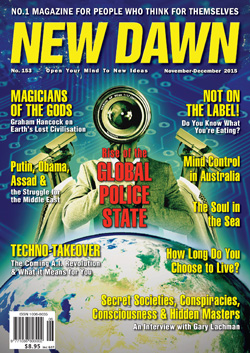
    From New Dawn 153 (Nov-Dec 2015)

    An overlooked but powerful current is flowing in our time. It’s found in a small group of writers and thinkers who are trying to overcome the materialism and rationalism of the present age and rediscover the perennial truths that lie behind all religion. These writers are grappling with the occult and esoteric paths of the past and present. They’re trying to explore these movements without falling into either credulity or blinkered scepticism. They include Jay Kinney, founder of Gnosis magazine and author of The Masonic Myth; Mitch Horowitz, a New York book editor whose own works include Occult America and One Simple Idea: How Positive Thinking Reshaped Modern Life; and Erik Davis, author of TechGnosis and Nomad Codes: Adventures in Modern Esoterica.

    In this small but distinguished company is Gary Lachman. He started out in the 1970s in the New York rock scene as one of the original members of the groundbreaking New Wave band Blondie. In 1996 he moved to London, where he established himself as a full-time writer, contributing to publications such as Fortean Times, The Guardian, and The Times Literary Supplement.

    Since 2001 Gary has produced a steady stream of books, including Turn Off Your Mind: The Mystic Sixties and the Dark Side of the Age of Aquarius; The Secret History of Consciousness; A Dark Muse: A History of the Occult; and Politics and the Occult: The Right, the Left, and the Radically Unseen. In recent years he has published biographies of major esoteric figures including P.D. Ouspensky, Emanuel Swedenborg, Rudolf Steiner, Carl Jung, and H.P. Blavatsky (see his interview in New Dawn 137).

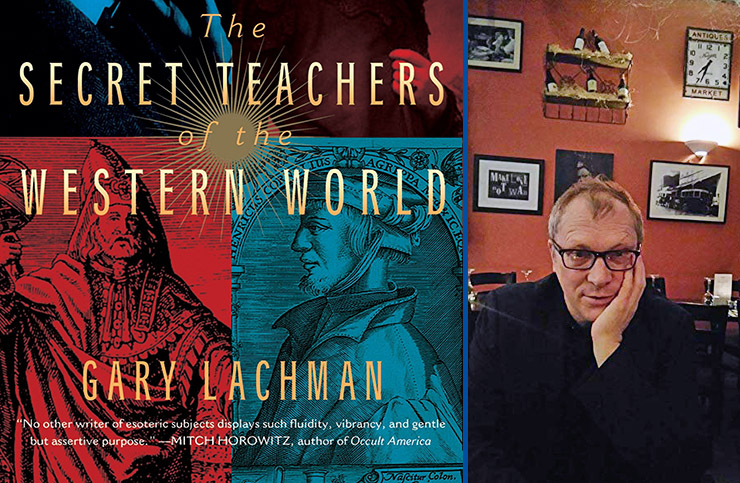
    Gary’s latest work, published in December 2015 by Tarcher/Penguin, is The Secret Teachers of the Western World, a monumental work that unveils the esoteric masters who have shaped the intellectual development of the West, from Pythagoras and Zoroaster to little-known twentieth-century figures such as Jean Gebser and René Schwaller de Lubicz.

    In June 2015 I conducted an e-mail interview with Gary about secret currents in the Western tradition.

    RICHARD SMOLEY (RS): Many people have a sense, however dim, that what is going on in the news is only the thinnest skin upon a sea of struggles and forces that we can barely conceive of. Would you agree with this assessment?

    GARY LACHMAN (GL): I suspect that at most times what we are aware of is only a selection of what is actually taking place. I mean this in the broadest sense possible. In terms of the media, it’s reasonable to assume there are a variety of filters in place that result in an edited version of things getting to us. But then there are people who devote their energies to ‘uncovering’ the truth and ‘revealing’ the facts about this or that event. It does strike me that one could get lost in attempting to track down the ‘truth’ about things, in terms of the political, economic, social situation. I mean conspiracy theorists who pursue an elusive solution to the mystery of who ‘really’ is in power and what ‘really’ happened in this or that situation.

    I think it is important to be discriminating about what we accept from our sources and to be aware that every source has its bias. Personally, I am more interested in the kind of things that are outside this kind of ‘hermeneutics of suspicion’, in the philosopher Paul Ricoeur’s phrase. I mean philosophy, thought, etc. I think it’s always a good time to pursue the good, the true, and the beautiful, whoever is running the show. I also think there is less covert control than some people believe, but it seems de rigueur nowadays to feel that everything we see on the news is false. The show itself is ultimately unimportant. It is an unavoidable nuisance that we nevertheless need to be aware of in order to pursue our aims.

    RS: Novelist Ishmael Reed wrote, “Beneath or behind all political and cultural warfare lies a struggle between secret societies.” How much truth do you think there is in this statement?

    GL: Well, I don’t know. I first came across it, as many people did, in Robert Anton Wilson and Bob Shea’s conspiracy fantasy Illuminatus. Are there really secret societies at work, manipulating events and controlling the world? If there are, they don’t seem to be doing a particular good job of it.

    I think that at different times there have been societies or groups of people who have worked together to effect some change or introduce some idea into the societies of their time. I talk about some of them in my new book, The Secret Teachers of the Western World. But these were relatively small groups who were active at a certain time, and when you look at what they were doing, the aura of mystery and sensation around them being ‘secret’ dissolves. That isn’t what is important about them. Take the Fedeli d’Amore of Dante’s time and of whom Dante was a member. They weren’t secret in the way that we think of Skull and Bones or that kind of thing (and I should say here that my book isn’t about that kind of secret group). But they were a relatively private group of poets who wanted to introduce ideas about the divine feminine or Sophia into the consciousness of their time. They were more like what G.I. Gurdjieff and P.D. Ouspensky mean when they talk about the ‘inner circle of humanity’ or ‘esoteric school’. I’m not saying the Fedeli d’Amore were agents of esoteric schools, but that their objectives and practice were like theirs, rather than some cabal of powerful individuals directing events from behind the scenes, which is how secret societies are popularly imagined to be.

    In one sense I think conspiracy consciousness is a good sign, in the way that Jung said neuroses were, as an attempt by the psyche to deal with a problem. It shows that we have a hunger for meaning. We prefer feeling that someone is in charge, even if we don’t know who that is, to feeling that no one is and that everything is chance and arbitrary. The hunger for meaning is good; it’s the means of satisfying it that I find questionable. We are purposive beings who seek out patterns and meanings. The mainstream narratives – religion, progress – no longer satisfy our appetite for meaning, and so we seek it elsewhere. One of the ideas of the book is that the meaning is there, but we won’t find it by looking for it outside ourselves.

    RS: One period in which occult orders were especially influential was the eighteenth century, in which lodges like the Freemasons played a crucial role in transforming the old feudal and ecclesiastical order into the modern world. Do you have any thoughts or insights about this development?

    GL: Freemasonry was a very important means for some fundamental ideas about modernity to be disseminated. I mean ideas about tolerance, social justice, democracy, individual worth regardless of social or economic rank. It was the spread of these ideas through different lodges that helped prepare the eighteenth-century zeitgeist for the radical changes that happened with the American and French revolutions. It is a mistake, though, to think, with Abbé Barruel and more recent writers on the Masonic influence on these events, that Freemasonry arranged or stage-managed them. There were Masons on both sides of the American Revolution, and the Illuminati – the real society, not the popular romanticised idea of it that’s present on the Internet – wasn’t ‘responsible’ for the French Revolution. The ideas that informed Adam Weishaupt’s short-lived and ineffective Masonic offshoot certainly were active forces in the revolution, and they were spread through Masonic lodges. But I think we have to credit the zeitgeist more than Weishaupt and Co. for the storming of the Bastille. In fact in one sense we could say Freemasonry itself was a product of the shift in consciousness that began around that time.
    RS: Your new book is entitled The Secret Teachers of the Western World. If they were secret, how have they been able to have such influence?

    GL: Well, again, my secret teachers aren’t necessarily secret in the sense that no one knows about them. I mean, if they were that secret, how could I know about them? One can be a secret teacher by teaching secrets, or one can be a secret teacher in the sense that the influence and importance of your ideas haven’t been recognised or have been misunderstood. Or you can be secret in another sense, as with several important thinkers who have been marginalised or don’t fit into the standard model of Western consciousness. It’s a broad term referring to a variable status rather than specific group of people. Jesus Christ, for example, is one of my secret teachers, and most people know about him. But there is a whole school of thought that argues that what we have accepted as Christianity really has little to do with the original teachings associated with Jesus. The Gnostics, for example, are thought to be more in line with what Jesus actually taught then the Petrine church of Rome.

    Or take Madame Blavatsky. If people know about her at all, she is chalked up to be an entertaining but fraudulent nineteenth-century spiritualist with a lot of chutzpah. But she was enormously influential on the modern world, in everything from art, religion, and science to what became known as the ‘counterculture’. I am not saying that everything she said about science or religion is ‘true’. That’s not the point. True or not – and she is more often on the ball than you might think – her ideas were tremendously influential, and I am amazed that feminists haven’t appropriated her. I suspect the occult connotations put them off. She isn’t secret, but her influence is not generally recognised.

    I should say the central idea of my book is that the whole Hermetic, esoteric tradition is the victim of a war going on inside our heads. I mean the rivalry between our two cerebral hemispheres. One of the inspirations for the book came from reading Iain McGilchrist’s very important work The Master and His Emissary, which is about the left and right brain and the differences between them. Briefly put, McGilchrist revamps the left/right brain discussion by showing that the difference between them is not in what they do – as was originally believed – but in how they do it. They respond to the world in very different ways, and the way they present the world is also very different. In the simplest sense, the right brain presents a total picture of the world. Its mode of consciousness is relational, connective, holistic. It presents what McGilchrist calls the ‘big picture’, the overall pattern, but its picture is fuzzy, vague. It works with metaphor, symbols, and is focused on the living character of being. It is aware of implicit meanings, meanings that we know and feel but cannot express explicitly. (Think of our appreciation of music: we know a Beethoven string quartet means something, but we’d be hard pressed to say exactly what.)

    The left brain is aimed at breaking up the big picture into smaller bits and pieces that it can manipulate. Its main function, as Henri Bergson said long ago, is to help us survive. It reduces the living, flowing whole presented by the right brain to a kind of map that allows us to manoeuvre through the world effectively. It’s interested in the trees; the right brain is interested in the forest. One looks through a microscope, the other at a panorama.

    Both are necessary, and for the most part each gets along with the other in a system of checks and balances, each inhibiting the other’s excesses. But McGilchrist argues – convincingly, I believe – that in the last few centuries the left has increasingly gained an upper hand against the right and has, in a sense, gone on a smear campaign against it. One expression of right brain thinking that the left brain targeted was the Hermetic, esoteric tradition, which was cast into disrepute with the rise of mechanical science – itself an exemplar of left brain thinking. With the dismissal of the esoteric tradition it was transformed into what the historian James Webb called ‘rejected knowledge.’ What my secret teachers teach is this rejected knowledge.

    [alert type=”info” dismiss=”no”]If you appreciate this article, please consider a subscription to New Dawn magazine.[/alert]

    RS: Of the figures that you would include among these secret teachers, which do you consider the most influential?

    GL: That’s difficult to say, and I should point out that the book isn’t a ‘top ten’ or ‘ten best’ list or something like that. Plato is certainly one of the most influential; in many ways the esoteric, Hermetic roads all lead to him. He is believed to have ‘gone to school’ in Egypt, and whatever he learned there is supposed to inform his philosophy. But whether Plato studied in Egypt or not, his ideas about the Forms, the ideal essences of which the physical realities of time and space are merely shadows, is certainly at the heart of the esoteric tradition. And Platonism informed Christianity, Hermeticism, Gnosticism, and other esoteric teachings. We can argue with and reject or accept different aspects or elements of his philosophy, but I would say that for the West, Plato is certainly one of, if not the most, significant source of esoteric thought, or thought in general. Alfred North Whitehead said long ago that all Western philosophy is but a series of footnotes to Plato.

    In saying this I’m not saying I think Plato is the ‘best’. My own philosophical background is more in Nietzsche, Bergson, Whitehead, William James, and existentialism. But Plato is still there too.

    RS: Which of these figures do you admire the most?

    GL: I’m not quite sure how to answer that. There are plenty of admirable figures in the book, as well as more questionable ones, and also some martyrs, like Hypatia the Neoplatonist, and the Persian theosopher Suhrawardi, both of whom fell victim to religious persecution, as well as truly secret teachers like the so-called Dionysius the Areopagite who welded Neoplatonism to Christianity. We do not know who he really was, just as we have no names for the Hermeticists of ancient Alexandria.

    I can say who has been an influence on me. One of first writers on esotericism that I read was P.D. Ouspensky. His books Tertium Organum and A New Model of the Universe made a big impact on me, even before I read In Search of the Miraculous and became interested in Gurdjieff. I first read these books forty years ago, and Ouspensky seemed a model of the kind of thinker I wanted to be: he combined a romantic openness to ideas, and poetry and art with a rigorous critical mind and he remains the best writer from what I call the ‘golden age of modern esotericism’, which took place during the 1920s, when people like Ouspensky, Gurdjieff, Rudolf Steiner, Jung, Crowley, and others were all active. Again, I’m not saying Ouspensky is the ‘best’ – that’s as pointless as arguing about who’s the best guitarist. But reading his books excited me and made me want to learn more. I tend to like figures that combine imagination with critical thinking, which we can see as the right and left brain working together, which is another theme running through the book.

    RS: One theme that you advance in your new book is that the cosmos is a living, conscious being, and that we need to rediscover that fact. To what extent do you think this rediscovery is actually happening in the world today?

    GL: It seems some form of that idea has been revived and presented in a variety of different ways throughout the last century and into our own. Bergson argued a form of it as did Whitehead. In the nineteenth century we have Gustav Fechner, who wrote about the Earth as a living being well in advance of James Lovelock. The philosopher David Chalmers has argued for a kind of panpsychism, meaning that in some sense, the entire universe is conscious. What headway this idea has made in altering our ‘standard model’ of the cosmos is unclear. We’d have to interview lots of scientists, I guess, and go through the numbers. I think more people today have some sense of it than, say, in the nineteenth century – at least the kind of mechanistic picture of the world popular then is less so now. Of course, any scientist who takes the idea literally and talks about it is subject to the scorn of his peers. But that too is an expression of the rivalry between the two modes of thinking. The ‘hard’ left brain makes fun of the ‘soft’ right brain’s ‘need’ to see a nice, cozy universe that cares about him, while he shows how ‘tough’ he is by saying that he doesn’t need that and prefers the ‘truth’ about the cold, indifferent cosmos. I write about this in an earlier book, The Caretakers of the Cosmos, where the idea of a living cosmos is a central theme.

    RS: Thirty or forty years ago, it seemed possible to believe that we were on the verge of a new age of rising consciousness and compassion. It’s a little harder to believe this now. How do you personally respond to hopes and dreams of a coming new age (however imagined)?

    GL: I’m not that keen on predicting a new age. Western history is littered with them. I think the current pessimism, or, more accurately, nihilism is a kind of ‘sound barrier’ that our culture, our civilisation, has to break through. Nietzsche predicted it at the end of the nineteenth century. I think we have somewhat naïve ideas about a new age. I believe there are shifts in consciousness. One of the thinkers I refer to in the book and in others is the little-known German philosopher Jean Gebser, who talks about different ‘mutations’ of consciousness happening throughout history. But these come about through our own participation in them; I mean we are active players, not passive recipients of something happening in the stars or according to some ancient teachings.

    The real new age will come round when we learn how to master our own consciousness. This means coming to understand it. This takes hard, determined work. I don’t think the new age will come about because of nice thoughts or fun raves or because of a conference or a festival. It will start to appear in individuals who have an obscure hunger for some purpose higher or more demanding than what our ordinary life can provide. These types embody in embryonic form a new consciousness that demands a new kind of inner freedom.

    We tend to think of freedom as liberation, as being free from something. The new types want a more significant freedom, the freedom for some purpose greater than just fulfilling their individual needs. In The Caretakers of the Cosmos I borrow a term from the Russian existential philosopher Nikolai Berdyaev and talk of a ‘creative minority’. These are the individuals who quietly and solitarily confront the demands of the new consciousness emerging within them. We tend to think that a new form of consciousness will be lots of fun and full of ecstasy. But more often people experiencing a different kind of consciousness, with different needs and appetites, tend to feel like misfits and have to go through a long struggle to actualise their possibilities. I have a very evolutionary way of thinking. I feel that any important development at first makes life more difficult for those in whom it occurs. Those who can get through the initial difficulties develop a strength that will help them impose the new vision on the world around them.

    RS: Which living people do you consider to be most important and impressive in fostering this higher awareness?

    GL: The most important one for me has been Colin Wilson, who sadly died at the end of 2013 at the age of eighty-two. I have been a dedicated Wilson reader since 1975, when I first read The Occult. After that I tracked down and read as many of his books as I could find. I am in fact preparing to write a book about his work and ideas, which more or less form the basis for much of my own writing. Wilson spent a lifetime in a determined analysis of consciousness and developed what I find to be a very convincing argument for why our consciousness is how it is and what we can do to intensify it. It isn’t for everyone, but I personally have got the most out of following his leads.

    Gary Lachman’s The Secret Teachers of the Western World (Tarcher/Penguin) is available from all good bookstores and online retailers.

    [alert type=”general” dismiss=”no”]This article was published in New Dawn 153.[/alert]

    [alert type=”success” dismiss=”no”]If you appreciate this article, please consider subscribing to help maintain this website.[/alert]

    © New Dawn Magazine and the respective author.
    For our reproduction notice, click here.
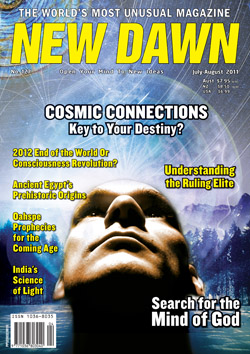
  • Search for the Mind of God

    Search for the Mind of God

    From New Dawn 127 (Jul-Aug 2011)

    Stephen Hawking famously ended his 1988 bestseller A Brief History of Time with the statement that, if and when physics finds its long-sought grand unified field theory “we would know the mind of God.”1 Although since then he has reportedly regretted the phrase, and famously announced in 2010 that “God did not create the universe,” his original statement was – knowingly or not – in fact simply a repetition of the underlying quest of the historical scientific revolution.

    All its great pioneers, from Copernicus to Newton, were motivated by the passionate belief that by discovering the way the universe works they were not only uncovering God’s design, but also taking humankind closer to the divine. Science was for them primarily a spiritual quest. And, given the evidence, that’s precisely what it should be now.

    Despite rather desperately cowering behind the wall of strident rationalism most of them are famous for, the startling truth is that cosmologists and quantum physicists themselves have revealed that the mind of God may be much nearer than we think. Science itself has effectively proven that ours is not a random universe. Science itself has demonstrated it was literally designed for life, which implies a designer… But as science itself – in general – is rather backward in coming forward about this, permit us to explain.

    The sensational conclusion that the universe appears to be meant began to be formulated with the famous ‘anthropic principle’ brought to the attention of the scientific community at the end of the 1970s by the seminal Nature paper by British cosmologists Bernard Carr and Martin Rees. The latter, now Lord Rees – Astronomer Royal and President of the Royal Society until 2010 – recently attracted the disdain of many colleagues by accepting the annual million-pound Templeton Foundation prize awarded for an “outstanding contribution to affirming life’s spiritual dimension.” Quite something for a mainstream scientist – and of course hugely controversial.

    The Designer Universe

    At its most basic, the anthropic principle states that all the cosmological data shows the laws of physics are, to an uncanny degree, exactly the ones needed for a bio-friendly universe. According to Paul Davies’ book The Goldilocks Enigma (2006) conditions are, like her porridge, “just right” for organic life. It needs precisely our kind of universe: relatively stable, with galaxies and stars – and this was by no means inevitable: if things were even slightly different matter could never have coalesced, or the universe would be riddled with black holes, preventing the formation of heavenly bodies. Life requires certain chemical elements, primarily carbon, which need stars to manufacture them and disperse them in their supernovae explosions. It also needs planets where the building blocks can be assembled for living beings to develop.

    All this requires not only fundamental particles and energies to possess particular values, but the relationships between them must be very precise. Carr and Rees noted that for almost every variation of the physical laws, a bio-friendly universe would be impossible. Yet as Hawking writes, “a series of startling coincidences” make the laws of physics “a system that is extremely fine-tuned” to produce conditions propitious for life.2 Freeman Dyson, the British-born American physicist, writes that there are “numerical accidents that seem to conspire to make the universe habitable,”3 while Paul Davies notes the “ingenious and seemingly contrived ways”4 the laws of physics allow the creation and dispersal of the elements necessary for life – and that we appear to live in a “designer universe.”

    More astoundingly, as all the values were ‘set’ by the big bang – if the conditions at the start of the universe had been say, bigger and bangier or smaller and less bangy (sorry for the technical terms), the physical laws would also be different – then life seems to have been an integral part of the design from the very beginning.

    One of the first examples of the fine-tuning to be recognised, back in the 1950s, is the formation of carbon – quintessential to organic life – which like all except the simplest three elements is forged in the centre of stars. However, scientists had long realised that according to conventional wisdom, carbon shouldn’t exist at all (or if it did it should be extremely rare). Even the vast temperatures and pressure in stars shouldn’t produce enough energy for stable atoms to form. But we now know there is a lucky fluke – a quantum effect known as resonance – which produces a ‘spike’ that enormously amplifies the energy to exactly the right value. This only happens for carbon.

    The scientist who worked out the process, the maverick British astronomer and mathematician Fred Hoyle, was so astonished by the coincidence that he famously described it as a “put-up job.” In a 1957 lecture he observed:

    If this was a purely scientific problem and not one that touched on the religious problem, I do not believe that any scientist who examined the evidence would fail to draw the inference that the laws of nuclear physics have been deliberately designed with regard to the consequences they produce inside the stars. If this is so, then my apparently random quirks have become part of a deep-laid scheme. If not then we are back again at a monstrous sequence of accidents.5

    The most recently-discovered example of fine tuning is perhaps the most compelling. This relates to ‘vacuum energy,’ a force arising from ‘virtual particles’ that fill even empty interstellar space, and which has a profound effect on the universe, since it determines its rate of expansion and this in turn determines how life-friendly it is. If the universe was expanding too quickly, then gravity would be unable to build galaxies, planets and stars; if too slowly, then all matter would be pulled back to the ‘big crunch’ before life had time to evolve. Obviously, our universe is expanding within that critically narrow range that allows it to be bio-friendly. But only recently has it been discovered how narrow – indeed, wafer-thin – that range is.

    It all hangs on the rate of expansion, determined by the balance between the negative and positive energy of the virtual particles. In the mid-1990s, based on new improved data from the Hubble Space Telescope and other sources, cosmologists were finally able to calculate the balance. It turns out that the negative energy cancels out all but an infinitesimal amount of the positive – all but 10120 (that’s 119 zeroes after the decimal point and before the 1).

    But the scary thing is that if this number was just one decimal place shorter – 10119 – then the universe would be expanding too quickly: there would be no stars and no planets. That tiny decimal place is the difference between life and no-life. The leading American theoretical physicist Leonard Susskind wrote: “This seems like an absurd accident and we have no idea why it should happen. There is no fine-tuning quite like this in the rest of physics.”6 Nobel prize-winning theoretical physicist Steven Weinberg commented in 1993 that if the extraordinary balancing act of the vacuum energy was confirmed then, “it will be reasonable to infer that our own existence plays an important part in explaining why the universe is the way it is,” but went on, “For what it is worth, I hope that this is not the case.”7 Unfortunately for Weinberg, it has since been confirmed. It is the case.

    It’s rather like winning the lottery (we assume). If our numbers come up we might think we’re clever or destined to win but of course it would be just chance. Not so long ago astrophysicists assumed that’s how it was with life: the right conditions just happened by accident. But the anthropic principle has shown that the game appears to have been fixed – as if only our numbers went into the machine. We couldn’t lose. In fact, the ‘coincidences’ involved in the universal fine tuning are so vast it’s more like winning the lottery week after week for several years.

    Of course this was unthinkable for most scientists – after all, design implies a designer – so they desperately searched for a get-out clause. Susskind duly came up with the now-ubiquitous multiverse as a way out of the anthropic conundrum: the theory that there are really billions – perhaps an infinity – of universes, each with its own physical laws (since conditions at the big bang were different for each one). The vast majority don’t possess life, but because we live in one of the few that does, we are mistakenly over-impressed by the coincidence that it is spot on for us.

    The multiverse hypothesis turns the virtually improbable into the inevitable. This time it’s like entering our lottery numbers into several billion games simultaneously. We’re bound to scoop the jackpot at least once. The multiverse allowed scientists uncomfortable with the implications of the anthropic principle to breathe a sigh of relief.

    There is, however, a major problem with the multiverse – and its exotic brother theories, string and M. There’s not a shred of evidence for any of it. Ironically it’s a fundamental aspect of the multiverse that there can never be any, since interaction between universes is by definition impossible. Which also conveniently makes the theory impossible to disprove. As Carr wrote in 2007, the multiverse “is highly speculative and… currently untestable. Indeed, it may always remain so…”8

    It gets worse. Being untestable means it violates one of science’s cardinal rules – that any hypotheses should be capable of being tested by experiment or observation. At best the multiverse is an interesting speculation, a possible but unprovable answer to the conundrum of the anthropic principle. But the majority of physicists take it as the answer to their prayers. If indeed they ever admit to praying.

    It’s easy to understand why. Hawking, for example, has acknowledged it’s a straight choice between intelligent design (begging the awkward question of the designer) and the multiverse.9 Naturally he champions the latter, as do most of his colleagues, keen to look cool and cutting-edge, and beguiled by the seduction of endless equations – even if by definition they can never lead anywhere or prove anything.

    The Anti-Science of the Multiverse

    One of the key principles of every other area of science is that it is contingent, the consensus at any time being based on the best data, but with the underlying acknowledgement that future discoveries may lead to major revisions. But here we have hard data pointing directly to a designer universe – and yet the overwhelming majority of scientists prefer to accept the entirely speculative and untestable multiverse, just because one day they might find a way of proving it. In other words, they accept it on faith, their belief in a non-designed universe blinding them to the overwhelming evidence for one that is obviously designed, and that science itself now points to.

    The anthropic principle has been conceptually divided between the ‘weak’ version (the universe appears to be designed for intelligent life, but this is an illusion) and the ‘strong’ version (the universe appears to be designed for us because it is). Enter the American John Archibald Wheeler (1926-2008), one of the most eminent modern theoretical physicists, discoverer of black holes and originator of the concept of space-time wormholes, who came up with a new spin: the “participatory anthropic principle.”

    Wheeler developed the concept as the logical extrapolation of another weird aspect of quantum physics, the implications of which few other physicists have dared explore. It is accepted that by observing events at the quantum level they will inevitably be changed by the act of observation. The outcome of a particular experiment often depends on how the experimenter chooses to make the observation – in effect they assign particular values to a subatomic particle.

    This is seen most famously in the ‘double slit experiment’, where the experimenter can ‘choose’ whether a beam of light behaves as a particle or a wave even when only a single photon is involved. Bizarre though it might seem, a fundamental principle of quantum theory is that the photon does not take a single path, but takes every possible path simultaneously. They exist as a series of probabilities (‘wave functions’), and only when an observation is made does the wave function ‘collapse’ and the photon take a specific position. As Wheeler declared (his emphasis): “Each photon is governed by laws of probability and behaves like a cloud until it is detected… The act of measurement is the transforming act that collapses uncertainty into certainty.”10 On a much wider scale, every particle in the universe exists as a wave function, ‘waiting’ to be given specific values by being observed.

    Wheeler showed that it wasn’t just a question of the experimenter determining through observation how a particle behaves now. In the double-slit experiment choosing how the photon is observed after it has passed through the slit produces the same effect. The observer effectively chooses how the particle behaved in the past – maybe only microseconds ago, but in the past nevertheless (‘backward causation’).

    Initially Wheeler’s proposal could only be a thought experiment as the technology allowing a choice to be made in the infinitesimally small period while a photon is in ‘flight’ wasn’t available. But in 2006 a French team devised a method of experimenting for real. Wheeler was proved right.

    He then realised the same effect could be obtained if light from a distant star was involved, but the observer on Earth would be ‘choosing’ how a photon behaved when it set out on its journey thousands, maybe millions, of light years ago. The observer effect must be truly cosmic in scale. He then developed the notion of the “participatory universe” – by observing the universe, we are actually creating it, not just now but in the past. In short, we are determining the initial conditions set by the big bang. Physicists aren’t discovering the laws of physics – they are creating them. As he noted: “The past history of the universe has no more validity then is assigned by the measurements we make – now!”11 And in a somewhat Star Trekky soundbite he declared: “We are participators in bringing into being not only the near and here but the far away and long ago.”12

    In Wheeler’s vision, human consciousness (and that of any other sentient beings out there) is an integral part of cosmic evolution. The big bang creates the subatomic particles from which galaxies, stars and planets are built. Life forms on planets and evolves to produce intelligent, conscious beings, who through their active observation actually manifest the big bang itself, “the mechanism of genesis.”13 (Wheeler pointed out that this disposes of the multiverse: if consciousness is needed to make the universe, then only a universe such as ours, with its conscious living beings, can exist.)

    In other words, there is a circular relationship between mind and the universe – human consciousness is in some way necessary for its completion: the universe is evolving from a starting point towards some end, and mind plays a key part in that process. As Bernard Carr commented: “Wheeler has suggested a more radical interpretation [of the anthropic principle] in which the universe does not even come into being in a well-defined way until an observer is produced who can perceive it. In this case, the very existence of the universe depends on life.”14

    Although to the casual reader this might seem somewhat off the wall, Wheeler’s logic holds up – and, unlike the multiverse, its predictions have been tested experimentally – winning acceptance from other prominent physicists. Among them is Stephen Hawking, who writes in The Grand Design: “We create history by our observation, rather than history creating us.”15 If Wheeler is right, then we play a part in the grand design implied by the anthropic principle. And if for ‘designer’ we read ‘God’, then we are, at least in part, God, or have a share in God’s mind.

    Back to the Future

    Perhaps the oddest – and most satisfying – aspect of this is how Wheeler’s participatory universe dovetails with the beliefs of the ancients, as Austrian astrophysicist Erich Jantsch (1929-80) noted. Based on the mass of evidence for cosmic purpose, he developed the concept of the ‘self-organising universe’, very similar to Wheeler’s. To him, the universe, through its components – including conscious beings – determines its own evolution. He wrote, “God is not the creator, but the mind of the universe.”16 But although acknowledging that the self-organising universe was prefigured in many mystical religious systems, Jantsch singled out one in particular: “the oldest recorded world view, Hermetic philosophy.”17

    Bingo! In fact we had pinpointed the very same tradition while researching our latest book, The Forbidden Universe, as the inspiration for all the great heroes of the scientific revolution: Copernicus, Kepler, Galileo, William Harvey, William Gilbert, Isaac Newton – even the allegedly arch-rationalist Francis Bacon.

    The Hermetic system is a metaphysical and magical philosophy and cosmology contained in a collection of texts known as the Hermetica, ascribed to a legendary Egyptian teacher, Hermes Trismegistus (‘Thrice-Great Hermes’). These writings, of which around twenty survive out of a much larger body, were set down in Egypt during the period of Greek domination, some time after the third century BCE.

    They were largely lost to Europe after the crackdown on pagan scholarship when Christianity became the state religion of the Roman Empire in the fourth century CE. But they survived in the Middle East (where they actually laid the foundations of medieval Arab science), and were rediscovered by Europe in the mid-fifteenth century by an agent working for the great patron of learning, Cosimo de’ Medici – the event that actually triggered the Renaissance.

    As we show in The Forbidden Universe, not only did the Hermetica go on to be the driving force behind the scientific revolution of the sixteenth and seventeenth centuries, but it also – somewhat spookily – outlines a cosmology that fits very neatly with Wheeler’s and Jantsch’s. (This may not be entirely coincidental, as Wheeler’s great philosophical hero was Gottfried Wilhelm Leibniz [1646-1716], the extraordinary intellect and contemporary of Newton, who, like him, was steeped in the Hermetic tradition – although it was expedient to downplay his interest in matters esoteric.)

    The Hermetica, too, celebrated the universe as an emanation of the mind of God, declaring: “… you must think of god in this way, as having everything – the cosmos, himself, the universe – like thoughts within himself.”18 American historian of science Ernest Lee Tuveson sums up the fundamental Hermetic principle: “the world emanates from the divine intelligence, and, as a whole in which each part is an essential component member, expresses the great Mind.”19 And modern Hermetic specialist, American philosopher Glenn Alexander Magee, writes: “Hermeticists not only hold that God requires creation, they make a specific creature, man, play a crucial role in God’s self-actualisation. Hermeticism holds that man can know God, and that man’s knowledge of God is necessary for God’s own completion.”20 Back to Wheeler’s participatory universe…

    In the Hermetic cosmology, the universe is God, everything in it is an emanation of God’s mind, and human beings play a necessary part in God’s self-actualisation. In Wheeler’s, consciousness plays a fundamental role in actualising the universe.

    But where did the writers of the Hermetic treatises get their ideas? Renaissance devotees of their philosophy believed it encapsulated the highest wisdom of the ancient Egyptian civilisation, that of the pyramid builders themselves. In later centuries there was a more critical view: the texts might have been written in Egypt, but owed more to Greek ideas. However, recent research shows that – while written for a Greek audience – the Hermetic books do indeed contain traditional Egyptian religious and cosmological ideas. In fact, there a compelling case that they came from the most ancient known Egyptian cult: the religion of Heliopolis, as set out in the Pyramid Texts, the oldest magical writings in the world. And as it was indeed the religion of the builders of the great pyramids of Giza, this would vindicate the beliefs of the Renaissance Hermeticists.

    In their complex and highly symbolic system, the Pyramid Texts too reveal many parallels with Wheeler’s participatory universe. According to the Heliopolitan theology the cosmos is an emanation flowing out from the creator-god, Atum, expanding from a single point of origin outward to the material world. But it, too, involves a flow from ourselves back to the moment of creation. As specialist in the Heliopolitan religion, American anthropologist Karl Luckert puts it, the universe not only “exhales” from Atum but “inhales.” We might need Atum/God, but he needs us.

    So perhaps instead of tying themselves in the knots of string theory and abandoning themselves to the siren seduction of the non-existent multiverse, scientists would be better advised to read the Hermetica. After all, they would only be following in the footsteps of intellectual giants. But they should be warned: there is a creative consciousness involved, as science itself shows. It is a fact: face it. But we must stress that while this ‘god’ bears no resemblance whatsoever to the petty tyrant of the Old Testament, he/she/it is not too hard to find. Simply start the quest with a mirror.

    Lynn Picknett & Clive Prince are the authors of the book The Forbidden Universe: The Occult Origins Of Science And The Search For The Mind Of God (Constable, 2011), available from all good bookstores.

    [alert type=”general” dismiss=”no”]This article was published in New Dawn 127.[/alert]

    [alert type=”success” dismiss=”no”]If you appreciate this article, please consider subscribing to help maintain this website.[/alert]

    Footnotes

    1. Stephen Hawking, A Brief History of Time, Bantam Press, London, 1988, 175.

    2. Stephen Hawking and Leonard Mlodinow, The Grand Design, Bantam Press, London, 161.

    3. Freeman J. Dyson, A Many Colored Glass: Reflections on the Place of Life in the Universe, University of Virginia Press, Charlottesville, 2007, 44.

    4. Paul Davies, The Mind of God: Science and the Search for Ultimate Meaning, Penguin, London, 1993, 197.

    5. In Mervyn Stockwood (ed.), Religion and the Scientists, SCM Press, London, 1959, 64.

    6. Leonard Susskind, ‘A Universe Like No Other’, New Scientist, no. 2419, 2003, 37.

    7. Steven Weinberg, Dreams of a Final Theory, Hutchinson, London, 1993, 182.

    8. Bernard Carr, Universe of Multiverse?, Cambridge University Press, Cambridge, 2007, 14.

    9. In the Sunday Times’ Eureka magazine, September 2010.

    10. John Archibald Wheeler and Kenneth Ford, Geons, Black Holes, and Quantum Foam: A Life in Physics, W.W. Norton & Co., New York, 1998, 334.

    11. Ibid., 337.

    12. On ‘The Anthropic Universe’, The Science Show, ABC National Radio, 18 February 2006.

    13. John Archibald Wheeler, ‘Genesis and Observership’, in Robert E. Butts and Jaakko Hintikka (eds.), Foundational Problems in the Special Sciences, D. Reidel, Dordrecht, 1977.

    14. B.J. Carr, ‘On the Origin, Evolution and Purpose of the Physical Universe’, in John Leslie (ed.), Physical Cosmology and Philosophy, Macmillan, New York, 1990, 152.

    15. Hawking and Mlodinow, op. cit., 140.

    16. Erich Jantsch, The Self-Organizing Universe: Scientific and Human Implications of the Emerging Paradigm of Evolution, Pergamon Press, Oxford, 1980, 308.

    17. Ibid., 308.

    18. Brian P. Copenhaver, Hermetica: The Greek Corpus Hermeticum and the Latin Asclepius in a New English Translation, Cambridge University Press, Cambridge, 1992, 41.

    19. Ernest Lee Tuveson, The Avatars of Thrice Great Hermes, Bucknell University Press, London, 1982, xi.

    20. Glenn Alexander Magee, Hegel and the Hermetic Tradition, Cornell University Press, Ithaca, 2001, 9.

    © New Dawn Magazine and the respective author.
    For our reproduction notice, click here.
  • The Hermetic Universe

    The Hermetic Universe

    Ever since my formative years, when I first began to think in concepts, I have always been confounded by the mystery of human existence. By and large we all tend to take this consciousness of ours for granted, but for me it has always been a source of wonder. Equally perplexing is that ultimate question in life: death – that future happening looming over the horizon of all of our lives like some conceptual black hole. What, one wonders, is the purpose in the unending cycle of the genesis and inevitable destruction of all of us? Why are millions of sentient beings all over our planet created, only to starve or be slaughtered wholesale, many without ever having been given the opportunity to fulfil themselves?

    On the wider scale of evolution, we see evidence in palaeontological and fossil records, of the emergence and subsequent violent extinction of whole races of people and species of animal. These entities come and go with alarming regularity. But to what avail?

    In the greater universe also, existence is no less capricious, with the continuous formation and devastating destruction of planets, stars – even entire galaxies. And who knows what countless other life-forms out there are being indiscriminately annihilated in this way? Just normal, everyday occurrences – but these inviolable and often disturbingly violent events have persistently gnawed at my reason. Why, I ask myself, would the theologians all-wise and all-knowing Benefactor – if he exists – create such a myriad of wonderful forms and then turn round and simply destroy them? These endless cycles of life and death, creation and destruction – what kind of devilment is this?

    The ongoing debate over the possible existence and modus operendi of a conscious, all-knowing creator proceeds unabated, with contributors from all disciplines lining up to have their say. However, owing to a specific sequence of events which led me on a solitary quest which was to last nearly fifteen years, I believe I have found a way of understanding what might really be going on in and around us. And ultimately, if I am right, the future looks not all bad. What is more, in this particular scheme of things, God is tangible, very much alive, and undeniably omnipresent.

    Strange as this may seem, this whole scenario can all be explained with numbers.

    Introducing the Hermetic Code

    The theory in question centres on a familiar numerical symbol: 22/7. This is pi of course, a unique mathematical convention whose discovery is generally attributed to the Greeks, but which in fact expresses a symmetry that was recognised as far back as the time of the Egyptians of the Old Kingdom.

    It is now generally accepted by all but the most hardened sceptic that the classical pi ratio – 22/7, or 3.142857 etc. – is incorporated in the dimensions and proportions of the Great Pyramid. That the Egyptians knew of this value is further substantiated by a key piece of non-pyramidal evidence. This appears in the form of a royal decree, one of the most important administrative documents of the Old Kingdom, which appoints the high priest and Grand Vizier Shemaj Director of Upper Egypt. This document officially places all twenty-two nomes (districts) under his authority, enumerating them from first to last. Some time later the pharaoh appoints to the post of deputy the overseer vizier j, who seems to be the son of the same Shemaj. But then comes the most interesting part of this ancient decree, which states that the son’s jurisdiction, as deputy, extends to only seven nomes. The symbolism is obvious: father over son, twenty-two over seven: pi.

    Most people are aware that pi is the ratio of the circumference of a circle to its diameter. However this ratio exists separate from circles as well. It resonates in and around us and is the answer to innumerable maths puzzles. It is intrinsic to the solutions of probability and statistical questions; and it is part of how we interpret phenomena as varied as the structure of atoms to the motion of stars. Is it not remarkable, therefore, given its uniqueness and sophistication, that the ancient Egyptians incorporated this symmetry, not only in the proportions and dimensions of what is undoubtedly one of the most impressive pieces of architecture of the ancient world, but also as a basic model for the conduct and interactions of their high priests?

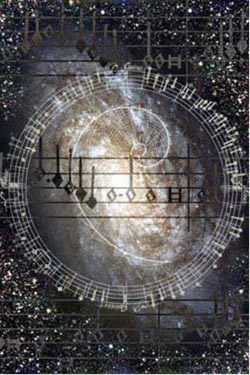
    Now, apart from geometry and the solving of probability and statistical questions, there is another, much more important aspect of the pi convention. This is its musical conformity. 22/7 is in fact an expression of three consecutive octaves of resonance. An octave, as everyone knows, comprises seven fundamental notes: Do-re-mi-fa-sol-la-ti. The eighth note, Do, a repeat of the first but with double the pitch frequency, is the first note of the second octave. Accordingly the eighth note of the second octave – again, Do – is the first note of the third. Taken together these three octaves contain twenty-two notes.

    What we have here, in fact, is a symbolic embodiment of the two most fundamental laws of nature, namely, the ubiquitous law of three forces (active-passive-neutral), and the lesser-known but equally all-embracing law of octaves. The law of three forces, as we shall see, is the absolute mainstay of all creative processes, whose influence manifests practically everywhere. The second law, the law of octaves, tells us that all phenomena generated by these three primordial forces are essentially musically structured. To sensibly visualise this concept, we need to look at the formula pi when expressed musically, like so:

    Do-re-mi-fa-sol-la-ti-Do-re-mi-fa-sol-la-ti-Do-re-mi-fa-sol-la-ti-Do.

    This configuration expresses in exact scientific terms everything you need to know to understand the General Theory of just about Everything. All one need do to appreciate this is to remember the key musical numbers incorporated within it. These are: 3, 4, 7, 8, 22, and 64. Three, the number of the Trinity, is the number of octaves encoded in pi. Four is the number of base-notes (Dos) in three consecutive octaves. Seven is the number of intervals between the notes of the major scale. Eight is the number of individual notes in the major scale. Twenty-two is the number of notes in three consecutive scales or octaves. And, according to the law of three forces, the three octaves incorporated in pi are each sub-divisible into three octaves apiece, giving an inner formula of nine octaves, or sixty-four notes. So eight is the constant, and sixty-four, is the square of it.

    So much for the maths. You don’t need to be an Einstein to venture further, although it is worth noting the most famous scientific equation of all time – e=mc2 – was formulated to verify this great scientist’s Special Theory of Relativity, which states that e, the latent nuclear energy contained in any given element, is equal to m, the mass of the thing, multiplied by c2, the square of the constant speed of light. As we shall see, the square of the constant occurs time and again throughout the whole of nature.

    I have called this musical pattern of symmetry the Hermetic Code, after the Greek god of wisdom and patron of alchemy Hermes Trismegistus, known as the god Thoth, in Old Kingdom Egypt. As noted previously, it was in ancient Egypt where the pi symmetry first came to light, both in its most famous piece of architecture the Great Pyramid – and also in extant administrative documents of the Old Kingdom.

    The law of three expressed in the Hermetic Code can be recognised by anyone. Nothing in this universe can be created without the combined action of the three forces described by it: active, passive and neutral. The three main constituents of atoms – protons, electrons and neutrons – the triplet-codon templates of the genetic code, the three pin plug, two opposing teams and a neutral referee, the three primary colours of the spectrum of light, the tripart social and political arenas, two chemical compounds and an intermediary catalyst – all of these trinities exist and interact as a direct result of the three fundamental forces described by the first law of nature. Whenever and wherever something is created, these three forces will inevitably be there.

    The second law – the law of octaves – also operates throughout the entire universe. For example, the atomic scale of matter described by the periodic table of elements in chemistry conforms to this law precisely. Based on the atomic weight of a given substance, the table begins at its apex with hydrogen, the lightest of all elements, which has just one electron tracing a specific orbit, or period, around the nucleus. The heavier the element, the more electrons it hosts, and the more periods are needed to accommodate them. The table culminates with substances like curium, one of the densest of radioactive elements. The curium atom consists of ninety-six electrons, which between them trace a total of seven periods around the nucleus precisely the number of periods, or intervals, between the fundamental notes of the major musical scale. The eighth, transcendental note of this atomic scale is the whole phenomenon, all atoms combined.

    There is also a current method of classification in nuclear physics called the theory of quantum chromodynamics, which indicates that, beneath the atomic scale, in the world of subatomic quanta, there are also distinct musical symmetries. The American physicist Murray Gell-Man noted that the categories of particle-molecules known as baryons, mesons and pions always combine together in families of eight, which he called octets – hence his name for the system: the eightfold way. Further, each of the eight particles in an octet is a triplet made up of three smaller particles, which Gell-Man called quarks. Three quarks to each particle, eight particles to each octet – an altogether familiar pattern. And then we have the hermetic structure of light, with its three primary colours, the seven fundamental colours of the spectrum and the final eighth note, the product of all seven colours when spun together – the white ray.

    Whilst still on the subject of theoretical physics, significantly the number sixty-four, the square of the musical constant, has surfaced in superstring theory, which describes all particles in the universe as infinitesimally small strings made of a kind of vibrational energy. You really cannot get more conceptually obscure than superstring theory, with its eleven different dimensions (three spacial, one temporal, and seven others of increasingly acute curvature), and a system of higher mathematics guaranteed to give the layman a form of intellectual vertigo. But no matter, all we need to know here is that this incredibly complicated system holds that there are eight degrees of manifestation or modes of movement inherent within the string itself. Moreover, in order to account for the four-dimensional structure of classical space-time geometry, the superstring theory is further developed through calculating the formulation of the string in four dimensions, the mathematics of which apparently produces precisely sixty-four specific degrees of movement associated with it. The detailed mechanics of this theory involves a language all of its own, inaccessible to the general reader, myself included. The point is – and any lay observer can see this – even the most complex and advanced mathematical formulae of present-day scientific thought, taken as symbols, reflect virtually every aspect, every nuance, of the original Hermetic Code.

    As well as the microcosmic music of the underworld, there is also a cosmic aspect of the Hermetic Code. This is dramatically reflected, not only in the musical symmetry of light itself, but also in the movements of major planets in relation to the Sun, many of which, as I explain in my book High Priests, Quantum Genes, beat out endlessly repeating intervals developing in time, which exactly conform to the relative values of the fundamental notes of the major scale. Ergo, the music of the spheres is not simply legend, but fact.

    Perhaps most crucial of all aspects of the Hermetic Code is that it actually resonates throughout the entire organic world. Probably most of you will have heard of the genetic code, a chemical arrangement used by the DNA in the cells of your body to manufacture amino acids, the building blocks of all organic life. In the genetic code there are four kinds of fundamental chemical bases: adenine, thymine, guanine and cytosine. In this respect it is significant there are exactly four base-notes, four Dos, in the triple-octave of resonance described by pi. It takes three of these bases to make what is known as a triplet-codon, an amino acid template, of which there are precisely sixty-four variations. Each of these codons correspond to one or another of twenty-two more complex components, namely, the twenty amino acids and two further coded instructions for starting and stopping the process of protein synthesis.

    All this, therefore, is crystallised music, composed by nature from units and sub-units of the constant number eight and its natural multiple, the square of the constant, sixty four. This same universal harmony is also reflected in the ever present number seven of course, which again, as we see from the periodic table, is prevalent throughout the whole of nature. This is simply because it, too, is an expression of the law of octaves, which describes eight fundamental notes, but with seven intervals between.

    So the General Theory of just about Everything is described in its entirety by the Hermetic Code, an exact blueprint, not only of the underlying structure of the physical universe, but also of the genetic code, of the DNA molecule, of life itself. This unique evolutionary concept has been in existence at least since the time of Old Kingdom Egypt. And, remarkably, the symmetry it describes is currently resonating through the entire spectrum of modern scientific enquiry. How strange is that? Well, not quite so strange, for the seeds of science were sown long ago, as we shall see when we go back in time. Consider this:

    In the symbolism of every major religion and belief system in history, the key numbers of the Hermetic Code are paramount. Without exception, these immensely powerful religious doctrines are all exact copies of the original blueprint. To briefly illustrate this, we need only to focus on the two key numbers of the octave: eight (the notes) and seven (the intervals between).

    In ancient Egypt, where the Hermetic Code first came to light, the people revered a pantheon of eight principal gods. There were three main theologies in the Old Kingdom: Hermopolitan, Memphite and Heliopolitan, and in all of them the octave format formed the basic blueprint.

    In China, in the third millennium BCE, the legendary sage Fu Hsi introduced a belief-system which was subsequently condensed into a book we today know as the I-Ching, whose chapters were numbered using a combination of eight three line symbols called trigrams. Confucius, who later added commentaries to this enigmatic book, subsequently introduced a system of instruction known as the Eight Steps of Learning.

    The body of writings known as the Vedas of Indian tradition described the nature of reality as being supported by a system of proofs, of which there were considered to be eight fundamental types. Reminiscent of this also are the systems of the Buddha, with his Eightfold Path, and the Persian Zoroaster, with his pantheon of eight Bounteous Immortals. Pythagoras, as we know, reinvented his own take on this oldest of sciences by working out the precise mathematics of the octave. In the Book of Genesis of Mosaic tradition, we read that God worked for six days, rested on the seventh, presumably starting over again on the eighth. Later still, Jesus Christ acted out possibly the greatest musical performance of all time through the Passion, which began on Palm Sunday and ended, seven days later, on the Sunday of the Resurrection. Finally we have Mohammad, last of the great revelationists, whose famous night journey began at the sacred site of the furthest mosque (The Dome of the Rock Temple in Jerusalem – the first note), and continued up through the seven heavens.

    The number seven, or the septenary principle, is equally ubiquitous in the annals of human tradition.

    It first appears in the customs of the Neanderthal race as far back as 75,000 BCE. In a cave at Drachenloch in the Swiss Alps, a known bear-hunter site, there was discovered an altar in which were enshrined seven bear skulls, each with their muzzles pointing toward the entrance.

    The Hindus regarded the constellation of the Great Bear (our Plough), as the heavenly home of the Septarishi, an embodiment of the seven Rishis (properties) applicable to the whole of nature. Their land had seven peninsulas, seven islands, seven rivers, seven seas and seven mountains.

    Another key number of the Hermetic Code, as noted earlier, is the number sixty-four, the square of the constant. This, too, is a vital component of many major religious and esoteric traditions. We have already noted this number is intrinsic to the pi convention, whose encoded triple-octave is further subdivisible into nine inner octaves – sixty-four notes. The Greeks recognised an Egyptian number system known as the Magic Square of Mercury, defined by the number 2080, which is the sum of all the numbers from one to sixty-four. Mercury, of course, is a Romanised version of Hermes/Thoth, the Egyptian messenger of the gods.

    In the time of the Buddha it was customary for the nobility to consult a council of sixty-four Brahmins on matters of supreme importance. The ancient game of chess, whose true origins are the subject of endless debate and whose strategic possibilities are seemingly endless, is played on a board comprising sixty-four squares. The Tarot pack, with its fifty-six minor arcana cards also includes a major arcana of twenty-two cards. This major arcana, a triple-octave on one scale, must also, according to the law of three forces, be a single octave on another scale. If we add this greater single octave onto the minor arcana figure, we end up with a total of sixty-four notes. And again, in the Koran, there is a crucial chapter on the sacred light of Allah – chapter sixty-four.

    So, what does all this mean? It means many things, whose separate conceptual strands all lead us back to the same hermetic blueprint. It means that the Hermetic Code, the design plan for everything existing – particles, cosmic concentrations, living cells – is applicable literally everywhere, not only in the wider universe, but also, as we see from esoteric traditions going back over centuries and millennia, in the ephemeral realms of the collective human psyche. It tells us that, if everything is music, then everything is hermetic, genetic, alive. There is an ancient dictum attributed to the Egyptian god Thoth which sums up this idea perfectly: As above, so below. The message is clear: man below and the universe above, as stated so emphatically in Genesis, are made in the same image. Everyone, quite literally, is a miniature universe. And expansion is the natural course of things.

    And so, if hermetic is genetic, this means the whole universe itself is alive, it is a living organism of infinite size. So if you are looking for a god, we have here a candidate that outshines all of the ill-defined, abstract deities alluded to by clueless clerics – an all-powerful, omnipresent deity that actually does exist.

    If we assume, therefore, that the universe is itself an organism, a living entity, and that we are all copies of it, then this would imply that the more advanced products of an organic brain – ideas, theories, concepts – are also in their own way alive, they are metaphysical genes, as organic as the brain from which they originate. The ancients of the remote past, in my view, seem somehow to have understood this, which is why they devised a musical mode of existence in the form of prescribed disciplines and rituals which enabled them to psychologically conform to the laws and forces controlling evolution. This is precisely why religion was first invented – to instil into the collective consciousness of humanity the necessity of harmonising one’s inner faculties according to the principles of the Hermetic Code.

    The aim was quite straightforward, it was an attempt to complete the natural course of one’s evolutionary and psychological development by living-out a harmonious existence and ultimately transcending on to a higher plane, a greater musical scale above. This greater scale, a wholly scientific concept describing a higher dimension of existence accessible to the trained mind, is the heaven expressed in all religions.
    [alert type=”general” dismiss=”no”]This article was published in New Dawn 87.[/alert]

    [alert type=”success” dismiss=”no”]If you appreciate this article, please consider a contribution to help maintain this website.[/alert]

    © New Dawn Magazine and the respective author.

    For our reproduction notice, click here.