New Dawn – World's Most Unusual Magazine

Tag: Kali Yuga

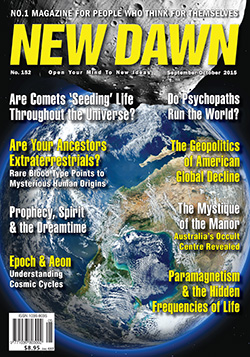
  • Epoch & Aeon: Understanding Cosmic Cycles (Part 1)

    Epoch & Aeon: Understanding Cosmic Cycles (Part 1)

    From New Dawn 152 (Sept-Oct 2015)

    We may have entered a new epoch, or so some scientists are telling us. The Anthropocene is a geological epoch characterised by the noticeable impact of humanity on the surface of the Earth. The previous epoch was the interglacial Holocene, which began after the fourth ice age. The Anthropocene is said to have begun with the Industrial Revolution in the eighteenth century. Others argue that substantial human influence on the lithosphere began up to 15,000 BP (BP=Before Present, the scale used for large periods of time) when human activity left its first traces on the rock record. Others specify 1945 as a clear date, due to the sudden arrival of radioactive material in the rock strata from the explosion of atomic bombs.

    As a term, Anthropocene reminds me of esoteric concepts of humanity’s ages and cycles, aeons and epochs. A belief in cosmic cycles has been specified as one of the typical characteristics of esotericism. This categorising of history and prehistory is one of several examples where religious and esoteric ideas exist in a symbiosis with scientific and secular ideas. Scientific concepts such as the ages of stone, bronze and iron owe their existence to myth; modern esoteric ideas of human development, of cosmic ages and cycles, draw on the scientific knowledge of the period.

    The Anthropocene is partly a tool for highlighting the extent that humanity is currently influencing the global environment. Yet it is typical of materialist science that only mankind’s physical impact on the world is being assessed. Mankind appears in the geological picture mostly due to the damage we have done. In contrast to this, esoteric theories of aeons, epochs and cycles typically see in mankind a development towards an ever more spiritual form of consciousness, or a descent from a golden age into barbarism, or the repetition of cycles of a variety of divine or cosmic influences.

    The difference between scientific systems of ages and esoteric-religious systems is this: scientific systems are based on measurement, esoteric systems on value. The best esotericism incorporates scientific and practical knowledge into a worldview that has a cosmic significance and acknowledges human psychological and spiritual development. The technologies of esotericism are those of personal transformation and sacred science. Esotericism is concerned with the inner meaning of whatever phenomena it touches upon, whether those of religion, myth or science.

    It Was a Golden Age

    Probably the most familiar Western system of ages is that of the classical world. We are so used to the gold, silver and bronze medals of the modern Olympics that the combination and order of these medals barely seems strange to us. It was Hesiod in the eighth century BCE who first wrote of the ages of development associated with metals, and he was surely drawing on existing tradition. Hesiod’s account follows on from the story of Prometheus bringing fire to mankind and Zeus punishing humanity by fashioning Pandora with the aid of the other gods, whose infamous box unleashed evils and sufferings on the world, with Hope as the only positive quality. Hesiod describes five ages – gold, silver, bronze, the heroes, and finally iron, the age in which he lived and we still live.

    In the golden age, ruled by the titan Kronos, humanity was free from labour and ill-health, people lived long happy lives and died peacefully in their sleep. After death people lived on as good spirits of the earth who protect and bring wealth. The silver race was fashioned by and ruled by the Olympian gods. They were also long-lived as children but once they grew to adulthood they fought and were killed, forsaking the gods. These live on as spirits of the underworld.

    People of the bronze age were strong and powerful but hard-hearted, dying in wars. Our age is that of iron, to which Hesiod apportions a series of woes mixed in with only a little good meted out by the gods. Hesiod tells us he would rather that he had not been born than live in our age of iron. Between the ages of bronze and iron was the heroic age. Its anomalous status, not being associated with a metal, suggests it was added to the scheme later. The heroic age was the age of the heroes and demi-gods of Greek myth, from the Seven at Thebes to participants of the Trojan War. They live on in the blessed isles.

    Myths can encode social imperatives, taboos, justifications for ritual, and spiritual and psychological truths. They can also preserve ancient folk memories. Archaeological ages of materials technology, of course, show that bronze was used before iron was smelted. The modern scientific threefold scheme of stone, bronze and iron ages derives from Michele Mercati in the sixteenth century, with numerous subdivisions and refinements made as evidence accumulated and the scheme developed. The scientific understanding of archaeological ages of materials technology owes its inspiration to the Greek myth of the ages of metal.

    In Book V of The Nature of the Universe, Lucretius, the first century BCE Roman writer, describes a progress in the human use of stone then copper (and hence its amalgam, bronze) and then to iron. Lucretius was an Epicurean and in many ways a precursor of modern rationalism. His method was not based on experimentation and measurement but on assigning natural materialistic explanations to phenomena. Hence, Lucretius ascribes mankind’s knowledge of the use of fire not to Prometheus but from seeing forest fires caused by lightning. He surmises that humanity learned to smelt metals from seeing the results of a forest fire on ore. Lucretius sees mankind as developing in phases from primitive technologies to the advanced civilisations of his time, from using stone to copper or bronze, and latterly to iron. It is the myth of progress.

    Hesiod and Lucretius offer examples of the two opposing models of human development: a descent and an ascent, on the one hand a fall from grace and away from the perfection of the golden age and on the other a development from barbarism to civilisation.

    [alert type=”info” dismiss=”no”]If you appreciate this article, please consider a subscription to New Dawn magazine.[/alert]

    The Great Age & Yugas

    In the Western mind the four (or five) Greek ages, or at least the concept of a golden age, are part of the common culture. Astrological ages and the Indian Yugas (Hindu, though there are Buddhist and Jain adaptations too) are probably the next well known, the latter chiefly among those with spiritual, New Age or esoteric leanings.

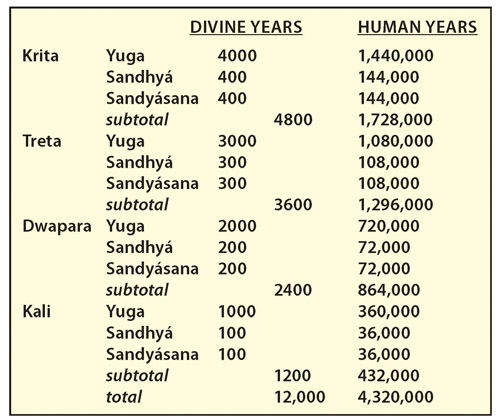
    The Yugas, which are of course still current in Hindu culture, are the most ancient and massive cycles. The total length of a Great Age (Mahayuga) is 4,320,000 years. The four Yugas have durations of 4:3:2:1 proportions, running from the golden age Krita or Satya Yuga (Fortunate Age) at 4,000 divine years, amounting to 1,440,000 human years, on through Treta Yuga (Third Age, or of three parts, 3,000 divine years/1,080,000 human years), Dwapara Yuga (Second Age, or of two parts, 2,000/720,000) and our very own Kali Yuga (Age of Conflict, 1,000/360,000 years). There are additional periods that precede and follow each Yuga, each 1/10 of the length of the Yuga.

    Joscelyn Godwin cites midnight February 17 or 18, 3102 BCE as the beginning of the current Kali Yuga, according to Indian astronomers, and calculates its end in 427,000 CE.1 The Kali Yuga thus covers the period from more or less the dawn of civilisation to the extremely remote future. These vast periods are difficult to find meaningful.

    The vast time scale has prompted some more recent commentators to accommodate the lengths to a more human scale. René Guénon, the Traditionalist, suggested knocking off three zeros and multiplying by 15. The resulting periods mesh successfully with human affairs, with the current Kali Yuga conveniently ending in 1999. Despite Guénon’s erudition, this surely amounts to convenient adaptation of a difficult idea; on the other hand it is the duty of esotericism to concern itself with the meaningful. The best known resizing of the Yugas, possibly better known than the original periods, is that of Sri Yukteswar Giri, the guru of Paramahansa Yogananda, known widely for his Autobiography of a Yogi. In Yukteswar’s system of Yugas the Kali Yuga has already ended and we are now in an ascending era in which the Great Year runs in reverse. Thus the myths of descent and ascent are combined.

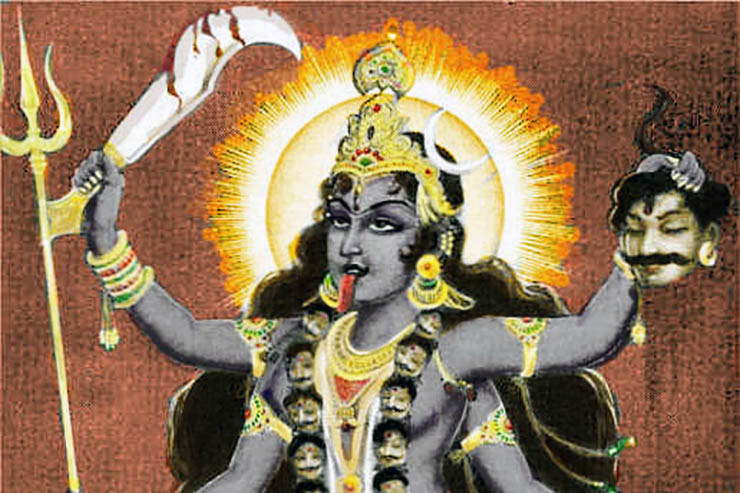
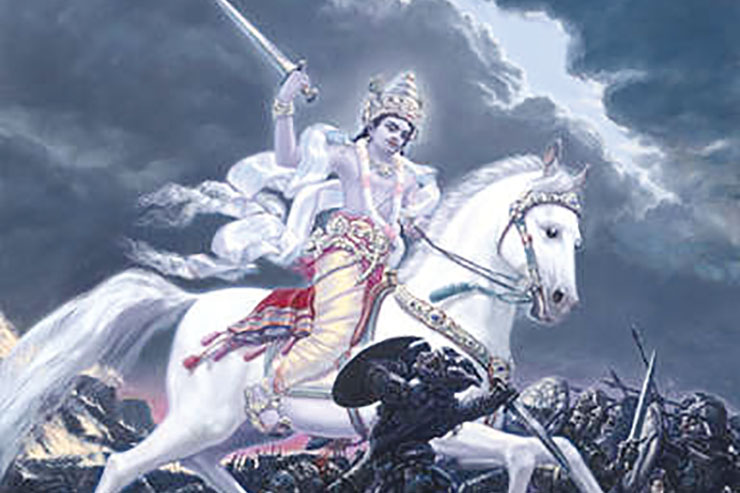
    Consonant with their vast lengths, the Yugas are associated with very broad characteristics of human life. As with the golden age of the Greeks, in the Krita Yuga humans have long lives (4,000 years), have no diseases and don’t need to work. Kali Yuga is characterised by the greed of mankind, by irresponsible rulers, wide use of drugs and drink, and continual migration of peoples. A distinctive Hindu characteristic of the ages is that they each have different numbers of avatars of the Lord Vishnu, with the Kali Yuga having only one, Kalki, who will return on a white horse to fight against the demon Kali (not to be confused with the goddess Kali) who is the ruler of the age.
    This is the dawning of the Age of Aquarius

    The astrological ages are widely known. In the official history of science it was Hipparchus in the 2nd century BCE who, on the island of Rhodes, computed the precession of the equinoxes (see graphic on page 62 in magazine). In the 2nd century CE Ptolemy, the great astronomer/astrologer, worked out that precession was due to a wobble of the starry sphere. Heliocentric science eventually determined that the wobble was in Earth’s orbit.

    The great year of astrological ages is computed at 25,770 years. This is usually rounded to 26,000 years although the figure has sometimes been lower and until the cycle was properly measured it was assumed that it matched Plato’s Great Year of 36,000 years. This number divided by 12 gives 2,147.5 years for an astrological age if the signs of the zodiac are equally spaced.

    The sign in which the Sun rises on the vernal (spring) equinox is believed to influence humanity as a whole in a similar way to the effect of the 12 signs on a human being. The ages of Leo, Cancer and Gemini show mankind emerging from prehistory, with Gemini, ruled by Mercury, associated with the development of writing, Leo emphasising the importance of the Sun, and Cancer that of the mother goddess. The age of Taurus began around 4000-4500 BCE, depending on the method of computation, and is associated with bull god cults such as those found in Egypt, Assyria and Crete. Around 2000 BCE, give or take a couple of centuries, the spring equinox Sun moved into fiery and warlike Aries. This was a time of empire building and heroic ages, of martial conquest and the use of iron for weapons. It also included the development of monotheism.

    From around 100 CE to the turn of the Christian era – about which, more in a moment – is the dawning of the age of Pisces. The fish associations of Christianity, the symbol of the vesica piscis, the fisherman disciples who become fishers of men, and several parables and miracles that include fish, are all consonant with Pisces. Pisces is also notable for its dreamy quality, hence the characterisation of the age of Pisces as a time of deception.

    We look with hope to the age of Aquarius but there are many views as to when it will come. We may have already gone over the cusp. Those who calculate the astrological ages according to the constellation boundaries rather than the equally spaced 30 degree zodiacal constellations, compute that it may take another 600 or 700 years before we enter Aquarius.

    Many fascinating investigations into archaeology and astronomy suggest that knowledge of the precession of the equinoxes is encoded in myths from a wide variety of sources and in the alignments of ancient sites all around the world. This would make the astrological ages the arbiters of epoch par excellence. In these ages the position of the zodiac at the spring equinox aligns with chronology, mathematics and a zeitgeist that lasts for two millennia. That zeitgeist manifests through large scale human endeavour such as empire, war and civilisation, through symbolism and religious forms.

    For us, who now stand two millennia away from the beginning of our Christian calendar, the astrological ages are extensive enough to carry a significance beyond the length of a single civilisation, yet not so long that they are incomprehensible on human terms. Although there is plenty of argument over the specific beginning and ends of ages (though their length is not so controversial), the scheme is admirable. It is like a tool of the right size and weight that fits comfortably in the hand.

    It also has a predictive value lacking in the Yugas and the metallic ages. The Greek system offers no development after the iron age. The Yugas offer an eventual return to the beginning of the cycle and a new golden age, which is a source of optimism. But the massive time scales and our place within the Kali Yuga can only allow us to sigh at the misery of mankind and its fall from grace. The astrological ages cycle through varying qualities but are not characterised by ascent or descent. When an age becomes tired and decadent, complementary qualities may be at hand in the influence of the forthcoming age.

    From Adam to Christ

    Astrology comes from Babylon and was formulated in its Western version in the pagan classical world. Although both Christianity and Judaism have at times had their own strong astrological traditions, astrology was vulnerable to criticism as a pagan science whose symbolism and terms of reference didn’t extol Yahweh or Christ as the foundation stones of the universe. According to the astrological ages, the bull and the fish are merely passing fads, albeit fads of 2,000 years duration. Thus it fell to Christians to come up with their own aeons and epochs that drew on their own mythologies and understanding of the world. From a Christian and Western standpoint, the Yugas and astrological ages are merely turning around in circles.

    The Christian view of time follows a line not a circle. It runs from creation to destruction, from Genesis to Revelation, from Fall to Apocalypse. Yet the line can still be divided into sections, marked out by the character of the times, by the stage in the process of the redemption of humankind. The Christian schemes take us out of the ancient world and into the Middle Ages.

    Our standard Western method of counting years is in fact a simple system of two epochs, BC, Before Christ, and AD, Anno Domini, the year of our Lord. The BC/AD system did not take root for several centuries after its invention in the 6th century. It reflected the basic Old Testament/New Testament divide of the Christian Bible but has no category for the Second Coming. It has no predictive quality built into it.

    It was that giant of influence, St Augustine, who formulated the most influential Christian scheme of ages. Augustine’s scheme utilised the seven days of creation. Inspired by Psalm 90:4 (quoted in II Peter 3:8), in which “one day with the Lord is as a thousand years,” each day was literally a millennium. The seventh age corresponded to the seventh day, the Sabbath, on which day God rested from his labours, and was outside of history.

    Each age of 1,000 years could approximately be matched with chronologies produced from the genealogies of the Bible. The six ages were:

    1. From Adam to Noah and the flood.
    2. From post-flood Noah to Abraham
    3. From Abraham to David
    4. From David to the captivity in Babylon
    5. From the return from Babylon to the birth of Jesus.
    6. From Jesus to the second coming.

    Thus we are living in the sixth age, which will continue until the Apocalypse. The sixth age is clearly and uniquely Christian; all of the preceding ages are defined by Jewish figures yet are claimed for Christianity. There is no accommodation of, for instance, the Greek philosophers who would have lived in the fifth age, or for Homer in the fourth age, no room to allow for the Greek heroes or the Gods of Egypt, Greece, Rome and other Mediterranean countries.

    What can this system of ages say about mankind and the world in general? The great civilisations of antiquity, the gods and goddesses and daemons, are all swept away in favour of the purloined traditions of a people (the Jews) who weren’t even included in the new religious dispensation unless they acknowledged Christ. There was little room for each age to have its own spiritual or psychological colouring or even for a straightforward cycle of progress or corruption.

    Those six ages did allow for a coming transformation into the seventh age, but Augustine placed the Christian Apocalypse conveniently far enough in the future to be of no concern for a few centuries.

    Augustine took over an existing Jewish scheme but may have been influenced by Gnostic ideas. In the Gnostic Second Treatise of the Great Seth, the history of the world is effectively divided into three stages. Barbelo, the divine feminine figure, visits Adam, then gives the seed to Seth, then later to the resurrected Christ. In the further reaches of Gnosticism we find similar demarcations of history based around important characters in the Bible. Bardaisan came up with a scheme that involved 6,000 year periods that made up a Great Year. The Manichaean religion is unusual in acknowledging both biblical figures from Adam and Seth down to Jesus and non-Abraham prophets including Zoroaster and Buddha.

    Father, Son & the Holy Spirit

    After the first Christian millennium ended, Augustine’s six ages still had some validity because the beginning of the sixth age and the literalness of the thousand year period could be disputed.

    Joachim of Fiore (c.1132-1202) first proposed that history was ascending through three stages ruled by each separate member of the Trinity. Hence, the period from Adam to the birth of Jesus was the Age of the Father, characterised by the Law; from Christ onwards was the Age of the Son, which was the age of the gospel; at some date in the near future would be the advent of the Age of the Spirit or Holy Ghost. Abbott Joachim, who was a devout Catholic, believed the third age would bring the kingdom of God on Earth. This third age would no longer require the Church (which was just an artefact of the second age) but would consist of celibate monks in direct communion with the Holy Spirit. Joachim believed the third age would dawn in 1200-1260 and so must have died believing it was imminent. Joachim’s influence on the development of Christianity would be indirect but considerable. His concept of the replacement of the Church by saintly individuals would be picked up by various Protestant movements and lend itself to use by later antinomian Christian sects. There was no compulsion to accept Joachim’s own estimate of the dawning of the Age of the Spirit, therefore interest in his three ages would re-emerge in aspects of twentieth century esotericism.

    Islam could take the same approach by delineating ages according to the six prophets mentioned in the Qur’an (Qur 19,21-22), while in Ismaili Islam a series of emanations from Allah determine the different characteristics of the ages. Minority Middle Eastern religions such as the Zoroastrians and the Yezidis also had their own schemes. That of the Druze is notable for a scheme of aeons that each last for an astonishing 343 million years. Other aspects of their little-known scheme include a series of 159 masters through history, in addition to the six prophets of Islam, with history deteriorating gradually until a final liberation takes place. These 159 masters are pre-existent but are somehow controlled by Christ and the four evangelists as cosmic figures. Outside of the scope of this article are the wide rage of mythic ages found around the world like the five Suns of the Aztec ages, or the Mayan calendar.

    The True Religion of Noah

    Isaac Newton (1642-1727) was the founder of modern science, but also a Christian, astrologer, alchemist and esotericist. He has sometimes been characterised as the last magician rather than the first modern scientist. Newton believed that the true religion was that of Noah. He also believed that the Sabaeans, Confucius, the Brahmins and Pythagoras all inherited this post-diluvian wisdom. As each of these figures and movements arose, the light of “true religion” renewed, only to decline steadily until the next renewal. Egypt, however, according to Newton, was responsible for much of the corruption and decline of this true religion, including the concept of the Christian Trinity, which Newton abhorred.

    All this resembles the familiar Abrahamic scheme of a succession of prophets periodically bringing law or religion or gnosis to humanity. But Newton has integrated figures like Pythagoras (and Hyram of Tyre, of Masonic fame) into the scheme. Newton believed that Pythagoras gave mathematics to the Greeks with one hand and the “true religion” with the other.

    It will become characteristic of esotericism to incorporate figures from many religions and cultures, not just Jewish and Christian ones, into the patterns of development. Esotericism is interested in the inner meaning and inner significance of traditions, usually sees religions and cultures as sharing fundamental principles (or often regarding as debased those that don’t fit in) and hence can accommodate almost any criteria. Given his scientific nature Newton saw these prophet figures as bringing sciences such as mathematics and astronomy with them. The purest and most ancient civilisation was that of Israel, from whom, with a hefty amount of chronological juggling, all others copied.

    All graphics for this article are viewable in the digital or print version of this issue.

    The second part of this article, published in New Dawn 153 (Nov-Dec 2015), looks at how the concept of race was related to esoteric history, as well as the cycle cosmology of Theosophy, the “gyres” of W.B. Yeats, Thelema aeons, spin offs from G.I. Gurdjieff including Rodney Collin & J.G. Bennett, and the work of Jean Gebser and Peter Carroll, plus more.

    [alert type=”general” dismiss=”no”]This article was published in New Dawn 152.[/alert]

    [alert type=”success” dismiss=”no”]If you appreciate this article, please consider subscribing to help maintain this website.[/alert]

    Footnote

    1. ‘When Does the Kali Yuga End?’ by Joscelyn Godwin, New Dawn 138 (May-June 2013)

    © New Dawn Magazine and the respective author.
    For our reproduction notice, click here.
  • When Does the Kali Yuga End?

    When Does the Kali Yuga End?

    From New Dawn 138 (May-June 2013)

    The widespread belief that an age is ending and a new one dawning is part of a cyclical concept of time common to most philosophical cultures. The best known versions are the Four Ages of Greek mythology and the Hindu myth of the Four Yugas. The purpose of this article is to clarify some of the confusion that exists around them, to set out the actual figures as given by Eastern and Western authorities, and to discourage unthinking acceptance of a currently popular theory.1

    The earliest European source of the myth is Hesiod, a Greek poet of the eighth century BCE. In his Works and Days (lines 109-21) he describes the ages as a cycle of decline, from Golden to Silver, Bronze, and Iron. He adds the interesting idea that these ages do not only change the quality of life, but the after-death state of humans. The people of the Golden and Silver Ages, when they died, became spirits who watch over and benefit the human race. The people of the Bronze Age were not immortal in that sense, but went down to a twilight existence in Hades. Perhaps influenced by the Trojan War, Hesiod here inserts an “Age of Heroes” of whom a few crossed the ocean to enjoy a private Golden Age under its ruler Cronos (Saturn). But this did not stem the degeneration for the rest of mankind, which hurtled down to the nadir of the Iron Age. For Hesiod it was too soon to tell their after-death fate, but things were not looking good for them.

    Post-classical culture learned of the Four Ages mainly through Virgil and Ovid. In the first book of his Metamorphoses (I, 89-261) Ovid describes them and their races as declining in happiness and virtue until the universal Deluge. After that a new order of humans, animals, and plants was raised up from the earth. Christians saw a similarity with the biblical story of Noah’s Flood, but even more so in Virgil’s prophecy of a new Golden Age in his own time. It may have been intended to flatter the Emperor Augustus, who had brought peace after Rome’s civil war, but the mention of the Virgin made it applicable to Christ:

    Now comes the last age, sung by the Cumaean Sibyl:
    The great order of ages starts anew.
    The Virgin returns and Saturn’s reign resumes:
    A new race of men is sent from heaven.
    (Eclogue IV, 5-8)

    The Abrahamic religions (Judaism, Christianity, Islam) do not share the pagan concept of multiple cycles of creation and destruction. Monotheisms have room only for one cycle, with the Garden of Eden before the Fall as equivalent to the Golden Age. To continue the parallel, the Silver Age might be that of the biblical patriarchs who were still intimate with God; the Bronze Age that of the prophets and sacred kings; the Iron Age, from the Babylonian exile up to the present day. The cycle will end with Judgment, after which the Christian elect enter the New Jerusalem and Muslims the Garden of Paradise. Jews have their corresponding Messianic expectation. All three religions promise that in the end God will set things right, or in pagan language, that the reign of Cronos will return.

    Incidentally, one of the recurrent themes of the Golden Age is that during it, the earth’s axis was perpendicular to the ecliptic (a topic treated in my book Arktos2). If this were so there would be no seasons, but equal day and night throughout the year. Plants and trees would fruit continuously, and the years would pass uncounted. Eternity could well describe the human experience of time under such conditions, which ceased when the axis was knocked off kilter. It will be restored at the next Golden Age, when the earth resumes its proper axial position. Whether or not there is any scientific basis to this myth makes no difference to its power and the “thought experiment” that goes along with it.

    The Four Ages (Yugas) of Hinduism

    Hindu tradition has its own version of the Four Ages, and it was probably from there that it reached the Greeks and other Indo-European peoples. The Puranas and Laws of Manu agree that the four Yugas are in the proportion 4:3:2:1. Their names are Krita Yuga (fortunate age; also called Satya Yuga), Treta Yuga (age of three parts), Dwapara Yuga (age of two parts), and Kali Yuga (age of conflict), the four together constituting a Maha Yuga or Great Age.

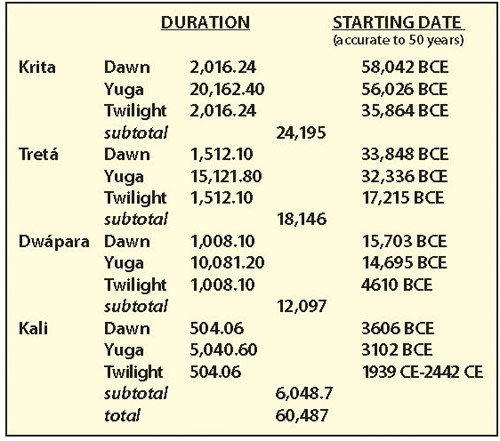
    Each Yuga has a dawn and a twilight period, each a tenth of its length, called respectively Sandhyá and Sandyásana. The Vishnu Purana gives their durations in divine years, each counting for 360 human years, as follows:3

    ndmain138 64

    To relate these durations to history we need an actual date, and this is supplied by the Hindu astronomers. They agree that the Kali Yuga began at midnight between February 17 and 18, 3102 BCE. From that we can calculate that the transition to the Golden Age will occur around 427,000 CE. It hardly seems worth bothering about something so far outside the time-scale of human experience. But before we dismiss these figures as pure fantasy, we should know that they are not peculiar to Hinduism. Some of them appear in very different contexts, with such precision that there is no question of chance coincidence.

    Berossus, who records the Babylonian chronology, was a priest of Bel and had a school of astronomy on the island of Kos in the third century BCE. He gives the figures for the reigns of the ten Assyrian kings who preceded the Flood: they total 420,000 years.4

    In China, according to the early missionary researcher Père Prémare, the early dynasties were respectively of 13 and 11 kings, each of whom ruled or lived 18,000 years. Prémare understandably doubted this, but if we do the arithmetic, (13 + 11) x 18,000 comes to 432,000 years.5

    The Icelandic saga called the Poetic Edda describes the preparations for the apocalyptic battle at the end of time, when Valhalla’s warriors issue forth against the Fenris Wolf:

    Five hundred doors | and forty there are,
    I ween, in Valhall’s walls;
    Eight hundred fighters | through one door fare
    When to war with the wolf they go.6

    800 fighters going through each of 540 doors totals 432,000. So the number of warriors gathered in Valhalla on the last day is again the number of years in the Kali Yuga, the last age of the Maha Yuga cycle.

    The authors of Hamlet’s Mill, Giorgio de Santillana and Hertha von Dechend, called this a “remarkable and disturbing coincidence.”7 This is because the theory of an archaic worldwide culture with cosmological knowledge is anathema to official prehistory. One breach in the conventional view is due to Ernest McClain, one of the most original and ingenious researchers of our time. He has uncovered evidence of a kind of multidisciplinary game played with these self-same numbers which hinges on musical tuning systems. Those in the know included the Babylonians, the Vedic poets, Plato, the compilers of the Hebrew scriptures, the earliest Christians and Gnostics, and whoever gave the Quran its present form. For example, McClain interprets the Arks of Babylonian and Hebrew legend as multi-story diagrams that enclose, or “save” from the flood all possible numbers, the ones needed for calculating the calendar and the musical scale. In the case of Noah’s Ark, the significant number is none other than 432,000.8

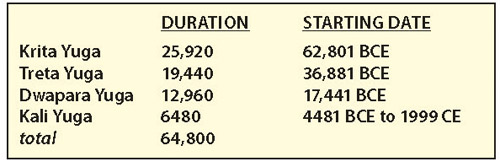
    McClain is a radical with regard to the history of ideas, but even more so are the Traditionalists, who take the numbers not as a philosophical game but as encoding precise knowledge of cosmic and historical time-cycles. René Guénon (1886-1951), one of the few great thinkers to have worked from this assumption, accepted that the four Yugas are in the proportion of 4:3:2:1, but questioned the Puranic figures. The zeros were put there simply to mislead, he says,9 and for good reason. If people knew the real dates, they would try to predict the future, which is unwise “because in practice, such knowledge brings many more problems than advantages.”10 The essential thing is the number 4320, which Guénon takes as representing the Maha Yuga: the set of four Yugas that embraces the entire history of present humanity. But 4320 years is obviously too short a period, just as the 4,320,000 years of the Puranas is too long. There were two basic problems: first, to find the correct multiplier of 4320 in order to arrive at the true length of the Maha Yuga, and second, to find the anchor in known chronology. Guénon seems to have worked backwards from knowledge of another cycle, that of the precession of the equinoxes which is traditionally given as 25,920 years (4320 x 6). Assuming that the Krita Yuga or the “timeless” Golden Age lasted for a whole precessional cycle, this gives the following durations for the four Yugas in human years, with a total of 64,800 years or 4320 x 15:

    Krita, 25,920
    Treta, 19,440
    Dwapara, 12,960
    Kali, 6480

    For all his warnings about attempts to predict the future, Guénon planted straightforward clues, mostly in footnotes, to show how he connected these durations to known chronology. Writing about Atlantis, he says:

    We think that the duration of the Atlantean civilisation must be equal to a “Great Year,” understood as half the period of the Precession of the Equinoxes. As for the cataclysm that brought it to an end, certain concordant data seem to indicate that it took place 7200 years before the year 720 of the Kali Yuga: a year which is itself the departure point of a familiar era, but one whose origin and significance are no longer known to those who currently use it.11

    Guénon typically does not reveal the “concordant data,” but his commentator Jean Robin explains:

    If one knows that the era in question is none other than the Jewish one, whose beginning is traditionally placed 3761 years before the Christian era, it is easy to deduce… the “theoretical” end-date of the cycle. The beginning of the Kali Yuga would thus be in the year 4481 BCE (3761 + 720), and its end would have to come 6480 years later, i.e. in the year 1999 (6480 – 4481).12

    We can now reconstruct Guénon’s chronology as follows:

    ndmain138 65

    Robin was writing in the early 1980s. He reminds us that 1999 is the one date specifically mentioned by Nostradamus as when “a great King of Terror will come from the sky.” But like every other world-ending date, it has come and gone.
    [alert type=”info” dismiss=”no”]If you appreciate this article, please consider a subscription to New Dawn magazine.[/alert]

    The orientalist and musicologist Alain Daniélou (1907-1994) knew the Hindu tradition from the inside and was a correspondent of Guénon’s. He too could not accept the extremely large figures given in the Puranas, and reduced them in a different way. There are some problems with his method (explained in my book Atlantis and the Cycles of Time), but it is enough here to give his figures for comparison. Daniélou’s historical peg is the traditional date for the beginning of the Kali Yuga, 3102 BCE, which he says “represents a cosmological reality linked with an alternation in influx from the planetary spheres; it is not an arbitrary date.”13

    ndmain138 66

    By these calculations, the Kali Yuga’s final phase began with World War II. Daniélou, although a much more cheerful type than the saturnine Guénon, was a complete cultural pessimist. He writes that, “the final catastrophe will take place during this twilight. The last traces of this present humanity will have disappeared in 2442.”14 I can imagine him adding, with a smile, “et bon débarras!” [and good riddance!].

    Guénon also corresponded with Gaston Georgel (1899-?), an independent scholar of whom almost nothing is known. He had found that historical events tend to replicate each other at certain rhythmical intervals. Some of his parallels are impressive, such as that of the medieval kings of France with Louis XIV-XVI, at an interval of 539 years (77 × 7), or that of the English and French revolutions, 144 years apart. Georgel first published his cyclical theories in 1937 as Les rythmes dans l’histoire (Rhythms in history).15 He was as yet unaware of Hindu traditions, and his large-scale cycle was one of 2160 years. This is the traditional duration of an astrological age, twelve of which make up the precessional cycle of 25,920 years. Georgel renames the Age of Aries the “Cycle of Abraham,” and the Age of Pisces the “Cycle of Caesar,” which he dates from 130 BCE. He arrived at that date, he says, from “a deep study of the Christic cycle” and the fact that “according to Virgil’s Fourth Eclogue, the sun at autumn equinox then entered the sign of Virgo.”16 That sounds authoritative, but as anyone who has studied the astrological ages should know, the borders of the constellations are not fixed (unlike the regular, fictive constellations counting from the spring point as 0° Aries). Consequently the time when the equinoctial sun moves from one to the next is debatable. For instance, the dates given by various authorities for the beginning of the Aquarian Age range from 1760 (Godfrey Higgins) to 2160 (Paul Le Cour).17 

    Guénon agreed that many of Georgel’s coincidences were extraordinary. The next year he wrote his own contribution to the subject, “Some Remarks on the Doctrine of Cosmic Cycles” (1938), in which he interpreted the Puranic numbers as given above. After World War II their correspondence resumed. Georgel returned the compliment by adopting Guénon’s Yuga chronology but stuck to his own dating, saying that “to facilitate our research, we will here adopt the date of AD 2030 that was proposed as a working hypothesis in our first book, for the end of the Manvantara” (i.e. the Maha Yuga of 64,800 years).18

    Georgel found corroboration of the 2030 end-date in a book to which Guénon himself lent much credence: Beasts, Men and Gods by Ferdinand Ossendowski. This best-selling book published in 1922 plays a large role in the myth of Agarttha, which I have treated elsewhere.19 It culminated with a prophecy that the King of the World is supposed to have made in Mongolia in 1891:

    In the fiftieth year only three great kingdoms will appear, which will exist happily seventy-one years. Afterwards there will be eighteen years of war and destruction. Then the peoples of Agharti will come up from their subterranean caverns to the surface of the earth.20

    The fiftieth year from 1891 is 1941. The happy period of 71 years under three great kingdoms lasts from 1941 till 2012. Then 18 more years bring us exactly to 2030.21

    We now have four suggested dates for the end of the Kali Yuga, and with it the end of the present set of four ages. The Puranic figures, taken literally, place it about 427,000 years in the future. Jean Robin, following Guénon, reckoned that it would end in 1999. Daniélou calculated that the Kali Yuga entered twilight phase in 1939 and will end completely in 2442. Georgel’s multiple cycles converge on the year 2030. After that a new Krita/Satya Yuga initiates the next cycle.

    Sri Yukteswar’s Hindu Yuga system

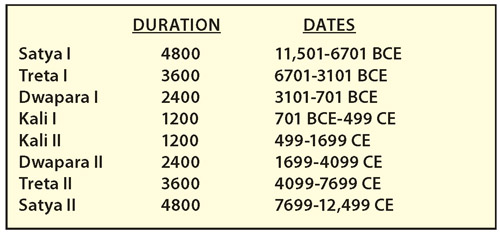
    Many readers will be familiar with the system proposed by Sri Yukteswar Giri (1855-1936). It has had such favourable publicity in recent years that it is widely believed to be the authoritative Hindu Yuga system.22 Sri Yukteswar adopts as his Maha Yuga a 24,000 year period, supposedly that of the precession of the equinoxes. He assigns half these years to a set of descending Yugas in the traditional proportion 4:3:2:1. By taking the “divine years” of the Puranas (see the first table, page 64) as human ones, they total 12,000 years. Then comes his real innovation: the cycle does not repeat, but starts a new set of four Yugas in reverse order. The link to historical chronology seems to be the traditional Kali Yuga starting-date of 3102 BCE, but moved to 3101 and to a different place in the Yuga sequence. From this it is easy to construct a table of Yuketeswar’s system:

    ndmain138 67

    As in the Puranic system, each age is framed by sandhis or periods of mutation at its beginning and end, each worth 1/10 of the Yuga. Thus a Kali Yuga proper lasts 1000 years, with periods of 200 years preceding and following it. In 1894 Yukteswar wrote:

    In 1899, on completion of the period of 200 years of Dwapara Sandhi, the time of mutation, the True Dwapara Yuga of 2000 years will commence and will give to mankind in general a thorough understanding of the electricities and their attributes.23

    The essence of Yukteswar’s system is that it places present-day humanity in an ascending, rather than a descending curve. This is so contrary to all traditions that we must look for its source elsewhere. Upper-caste Indians like Yukteswar may have resented being colonised by the British, but they had bought into the European myth of progress through science. Yukteswar believed that around 1700 the world had entered an “electrical” age. The discovery of electricity and its uses signified to him that man was attaining a finer perception than in the purely materialistic age that had preceded it. Before that, in the dual Kali Yuga, “the intellectual part of man was so much diminished that it could no longer comprehend anything beyond the gross material of creation.”24

    Only historical ignorance can excuse such a statement. The period in question, from 701 BCE to 1699 CE, saw the birth of Buddhism, Zoroastrianism, Taoism, Jainism, and Vedanta; of the Orphic and Pythagorean movements, the mysteries of Isis, Serapis, and Mithras, the birth of post-exilic Judaism, Druidry, Christianity, Manicheanism, Gnosticism, Catharism, and Islam. On the esoteric side it witnessed Zen and Vajrayana Buddhism, Sankhya philosophy, Kabbalah, Sufism, theosophy both Neoplatonic and Christian, Rosicrucianism, and the arts of magic, alchemy, and astrology. Reports of miracles were commonplace, and belief in non-material realities such as oracles, curses, the Will of God, the Devil, transubstantiation, or witchcraft was so intense as to cause major wars and persecutions. Finally around 1700, with the scientific revolution and the Enlightenment, came a rising tide of disbelief in anything spiritual, leading to the atheism and scientific materialism of today’s elites.

    The Jains and some Buddhist sects also had an up-and down cyclical system, which may have been one of Sri Yukteswar’s inspirations, though their time-scale far exceeds his. His other ingredient was a rough approximation of the precessional cycle to 24,000 years instead of the astronomers’ 25,770 or the traditional 25,920. He anchored it in historical chronology with a clearly political motive, for, along with another future guru, Sri Aurobindo Ghose, he belonged to a secret anti-colonial movement called precisely Yugantar, meaning “New Age” or “Transition of an Epoch.”25 There was a strategic purpose behind the announcement in 1894 that the Kali Yuga was over and the Dwapara Yuga, a better age, already in progress; also behind the emphasis on 1899, only five years away, as the year that the new epoch would come into its own. In the early years of the twentieth century, the movement’s propaganda announced that the “sinful Iron Age was over” and urged insurrection. This is not an attack on Sri Yukteswar and those who respect him and his disciple Yogananda, but simply a reminder that even sages have their agendas. Guénon said as much about the authors of the Puranas!

    What is at stake here is more than allegiance to one authority or another. It is whether one’s world-view allows (1) that humanity as a whole passes through predetermined cycles, and (2) that these are fixed chronologically, hence predictable if one can find the key. For what it is worth, I lean towards the first but not the second, because I trust the microcosm as a guide to understanding the macrocosm, and vice versa. Every one of us is passing through a predetermined cycle whose dates are unpredictable. Barring accidents, we are making our way from the Golden Age of childhood, through the bitter-sweet Silver Age of adolescence and the combative Bronze Age of maturity, to the Iron Age of decline and death. Then we may start afresh, but we certainly don’t repeat the process in reverse! Just as one can estimate someone’s life expectancy by their age, state of health, habits, etc., so one can make a guess at that of civilisations and maybe the entire human race.

    The traditional descriptions of the Kali Yuga, and especially of what Guénon in 1944 called the “Reign of Quantity,” fit the modern world perfectly, and that may give us an idea of our position in the cycle. But like an old person recovering from one close call after another, we seem to be holding on and must be grateful for each new day.

    More information and extensive research on this subject matter can be found in Joselyn Godwin’s book Atlantis and the Cycles of Time (Inner Traditions, 2011).

    [alert type=”general” dismiss=”no”]This article was published in New Dawn 138.[/alert]

    [alert type=”success” dismiss=”no”]If you appreciate this article, please consider subscribing to help maintain this website.[/alert]

    Footnotes

    1. This article quotes and adapts material explained more fully in my book Atlantis and the Cycles of Time (Rochester, Vt.: Inner Traditions, 2011).

    2. J. Godwin, Arktos, The Polar Myth in Science, Symbolism, and Nazi Survival (Kempton: Adventures Unlimited, 1996), 13-18.

    3. Compiled from Vishnu Purana, 1:3; see also Linga Purana, 4:24-35; Laws of Manu, 1:68-82.

    4. Eusebius, Chaldaean Chronicle, 1:8.

    5. Joseph Henri Marie de Prémare, Discours préliminaire, in Joseph de Guignes, ed., Le Chou-King, un des livres sacrés des Chinois (Paris: Tilliard, 1770), li.

    6. The Poetic Edda, Grimnismol, 23, trans. Henry Adams Bellows.

    7. Giorgio de Santillana and Hertha von Dechend, Hamlet’s Mill: An Essay on Myth and the Frame of Time (Boston: Gambit, 1969), 162.

    8. Ernest G. McClain, The Myth of Invariance: The Origin of the Gods, Mathematics and Music from the Rig Veda to Plato (New York: Nicolas Hays, 1976), 149.

    9. What follows is summarised from René Guénon, “Quelques remarques sur la doctrine des cycles cosmiques,” in Formes traditionnelles et cycles cosmiques (Paris: Gallimard, 1970), 22-24.

    10. Ibid., 21.

    11. Ibid., 48n.

    12. Jean Robin, Les sociétés secrètes au rendez-vous de l’apocalypse (Paris: Guy Trédaniel, 1985), 67.

    13. Alain Daniélou, While the Gods Play: Shaiva Oracles and Predictions on the Cycles of History and the Destiny of Mankind, trans. Barbara Bailey et al. (Rochester, Vt.: Inner Traditions, 1987), 193.

    14. Daniélou, While the Gods Play, 197.

    15. Gaston Georgel, Les rythmes dans l’histoire, 3rd ed. (Milan: Archè, 1981; 1st ed. 1937).

    16. Ibid., 164.

    17. See Atlantis and the Cycles of Time, 346-48.

    18. Gaston Georgel, Les quatre âges de l’humanité (Exposé de la doctrine traditionnelle des cycles cosmiques) (Milan: Archè, 1976; 1st ed. 1949), 87.

    19. See J. Godwin, “Agarttha: Taking the Lid Off the Underground Kingdom,” New Dawn 109 (2008), 59-62; also the investigations by Marco Baistrocchi, “Agarttha: A Guénonian Manipulation?” trans. J. Godwin (Fullerton, Ca.: Theosophical History, 2011) and Louis de Maistre, Dans les coulisses de l’Agartha l’extraordinaire mission de Ferdinand Anton Ossendowski en Mongolie. (Paris: Arché, 2010).

    20. Ferdinand Ossendowski, Beasts, Men and Gods (New York: Dutton, 1922), 314.

    21. Gaston Georgel, Le cycle Judéo-Chrétien, sceau et couronnement de l’histoire humaine (Milan: Archè, 1983), 34.

    22. This system is explained in Jnanavatar Swami Sri Yukteswar Giri, The Holy Science (Los Angeles: Self-Realization Fellowship, 1990; 1st ed. 1949), 7-18.

    23. Ibid., 15.

    24. Ibid., 13.

    25. See Terrorism in Bengal: A Collection of Documents on Terrorist Activities from 1905 to 1939, ed. Amiya K. Samanta (Calcutta: Government of West Bengal, 1995), 1:155. Accessed through Wikipedia article “Mokshadacharan Samadhyayi.”

    © New Dawn Magazine and the respective author.
    For our reproduction notice, click here.
  • Waiting for the End of the World: René Guénon and the Kali Yuga

    Waiting for the End of the World: René Guénon and the Kali Yuga

    From New Dawn 122 (Sept-Oct 2010)

    Currently the fear – or hope – of the closing of the age pervades the air like a thick vapour. Sometimes this end is envisaged as an environmental calamity, sometimes as the second coming of Christ, sometimes as the return of the space brothers to claim their own.

    Figures including Jose Argüelles, the prophet of the 1987 Harmonic Convergence; Terence McKenna, the late pope of psychedelia; and the channelled entity known as Kryon have fastened onto 2012 as the turning point.

    A less well known, though in a way equally influential, figure was the French esoteric philosopher René Guénon, whose writings often speak of the end of a cycle that he equated with the Kali Yuga, the “dark age” of Hindu cosmology. While he did not point to 2012 or any other specific date, his ideas do resonate with some of these expectations for the dawning age to come.

    Born in Blois, France, in 1886, Guénon had a conventional education in mathematics. In his youth he began to explore occult currents in Paris and was initiated into esoteric groups connected with Freemasonry, Martinism, Taoism, and Advaita Vedanta. In 1911, he was initiated into a Sufi tariqah (order) under the leadership of an Egyptian sheikh, Abder Rahman Elish El-Kebir. In 1930, he moved to Egypt, where he converted to Islam and lived until his death in 1951. In the meantime, he published a wide range of books, articles, and reviews espousing what he said was the universal and primordial tradition underlying all religions.

    For Guénon, tradition is the ne plus ultra of human life. He conceives of tradition as a hierarchy: higher knowledge emanates from a now-hidden spiritual centre to all of humankind through the “orthodox” traditions, among whom he includes (with many caveats and qualifications) the great world religions as well as certain other lines such as Freemasonry. Or to put it more accurately, this tradition is preserved in certain initiatic lineages that lie embedded in these faiths, such as the Kabbalah in Judaism, Taoism in Chinese religion, and Sufism in Islam. The esoteric dimension of Christianity had, he believed, practically disappeared by the late Middle Ages and was now preserved (if at all) by small initiatic groups that he apparently regarded as inaccessible. Indeed Guénon’s conversion to Islam was motivated in part by his belief that these Western lineages had almost completely died out by the twentieth century.

    In fact, according to Guénon, this transmission of traditional knowledge – the “doctrine,” as he often styles it – has become almost completely blocked in our era. This, he argued, is the result of a long cosmic cycle, which is called a Manvantara in Hindu cosmology, and which is divided into four yugas or ages: the Satya Yuga, the Treta Yuga, the Dvapara Yuga, and the present Kali Yuga. The problems and anxieties of the current era are the result of this age. It’s worth exploring why he believed this and what he thought it meant.

    The Reign of Quantity & the End of an Age

    Guénon was first and foremost a metaphysician – indeed, he was one of the greatest and most lucid thinkers who have delved into this arcane subject. And for him, metaphysics concerns universal principles; the details of circumstance are of value only insofar as they illustrate these. At the beginning of his best-known work, The Reign of Quantity and the Signs of the Times (first published in 1945), he writes that “considerations of that order” – namely, factual details – “are worth nothing except in so far as they represent an application of principles to certain particular circumstances.”1

    Thus Guénon said that he not a prophet in any conventional sense of the term. He was not a visionary and believed that the visionary prophecy of the current age was nothing more than a cloud of lies emitted by sinister “counterinitiatic” forces. If he spoke of an outlook that made it possible “to foresee, at least in its broad outlines, what will be the shape of a future world,” he insisted that “previsions of this kind have not really any ‘divinatory’ character whatever, but are founded entirely on… the qualitative determinations of time.”2

    The use of the word “qualitative” may seem peculiar here, but for Guénon, the polarity between “quality” and “quantity” was central to understanding the dynamics at play. In his 1931 book The Symbolism of the Cross, he depicted reality in the form of a three-dimensional cross – one that has the dimension of height and depth in addition to the familiar two of length and breadth. At the top of this cross is what he called “absolute quality” – an abstract state that is impossible for us to conceive, because it has no element of quantity whatsoever. (An interesting mind game: try to conceive of a universe in which there is no number or quantity of any sort. It’s almost impossible to do.) At the bottom of this cross is “absolute quantity” – another abstract state that is impossible to conceive. (Again, try to imagine a universe where there is only number, in which there is nothing that has any particular qualities such as colour, shape, or anything else of the kind.)

    Hence it’s not possible in this relative level of existence to reach the absolute end of each pole, but in a given age one of the two will be more pronounced and the other less pronounced to an exactly inverse degree. According to Guénon, the Manvantara proceeds in an ages-long cycle from an era where quality is emphasised – the legendary time known to the Hindus as the Satya Yuga and to the ancient Greeks as the Golden Age – to one in which quantity comes more and more to dominate. This is our present era, the Kali Yuga or what the Greeks called the Iron Age. That’s why Guénon speaks of the present era as one of “the reign of quantity.” He goes on to argue that all the primary characteristics of our time are the result of this reign of quantity.

    Guénon produces modern philosophy and science as evidence for his argument. Modern Western philosophy to all intents and purposes begins with René Descartes (1596-1650), who divided the world into what he called res cogitans (literally, “the thing that thinks”) and res extensa (literally, “the extended thing”). That is to say, the world is divided into that which experiencesres cogitans – and that which is experienced: res extensa. According to Descartes (at least as interpreted by Guénon), everything material is characterised by – and only by – extension, by what can be measured and quantified.

    While this all may sound extremely abstract, Guénon argued – rightly, I believe – that this attitude has profoundly shaped Western thought over the last few centuries. Essentially, he is saying, materialistic science focuses exclusively on quantity: “The more specifically ‘scientific’ point of view as the modern world understands it… seeks to bring everything down to quantity, anything that cannot be so treated is not taken into account, and is regarded as more or less non-existent.”3 Unfortunately, as Guénon goes on to say, this creates any number of logical contradictions. Science conceived purely in terms of quantity argues that the same causes produce the same effects, but as Guénon points out, this is absurd, as no two events are ever completely identical. He also criticises “the delusion which consists in thinking a large number of facts can be of use in itself as ‘proof’ of a theory; …even a little thought will make it evident that facts of the same kind are always indefinite in multitude, so that they can never all be taken into account.”4

    This is precisely the problem that contemporary philosophers call “the justification of induction.” You base a theory on any number of similar events that have happened in the past; but how can you account for the ones that you have not seen, and how can you be sure that future facts will yield the same results? Bertrand Russell put the point wittily when he wrote, “The man who has fed the chicken every day throughout its life at last wrings its neck instead, showing that more refined views as to the uniformity of nature would have been useful to the chicken.”5 The notion of causation is at least as problematic.6 These facts place a ceiling on the degree to which science can understand and explain the universe.

    The Real Meaning of “Value”

    As even this short discussion suggests, Guénon raises profound philosophical issues, and contemporary thought has not done a terribly impressive job of coping with them. But, he contends, the problems go further still. In a chapter of The Reign of Quantity entitled “The Degeneration of Coinage,” he explores the economic aspects of the issue. At first glance, one might think that nothing was more purely quantitative than money. But that, Guénon argues, is an illusion fostered by the degenerate age we live in: “The ‘economic’ point of view…, and the exclusively quantitative conception of money which is inherent in it, are but the products of a degeneration which is on the whole fairly recent,… money possessed at its origin, and retained for a long time, quite a different character and a truly qualitative value, remarkable as this may appear to the majority of our contemporaries.”7

    In traditional societies, Guénon says, money had a sacred character. Not only were the coins stamped with the images of gods and other sacred symbols, but the currency was controlled by the spiritual authorities rather than by the secular powers. Money was meant to be a reminder of “value” in the qualitative as well as the quantitative sense. Today, however, “nobody is able any longer to conceive that money can represent anything other than a simple quantity.”8 Even such words as “value” and “estimate” have been deprived of their qualitative character, and today, when we ask how much a man is worth, we are almost always thinking in terms of cash and equities rather than moral or spiritual calibre.

    This quantitative approach extends to every object we use. “In a traditional civilisation,” Guénon writes, “each object was at the same time as perfectly fitted as possible for the use for which it was immediately destined and also made so that it could at any moment, and owing to the very fact that real use was being made of it (instead of its being treated more or less as a dead thing as the moderns do with everything that they consider to be a ‘work of art’), serve as a ‘support’ for meditation,… thus helping everyone to elevate himself to a superior state according to the measure of his capacities.”9 One obvious example are the tools of Masonry, such as the square, compass, and plumb line, each of which was intended to convey a spiritual and ethical meaning in the days when Masonry was limited to practicing stonemasons. Manufactured goods have no such meaning or value.

    It is not possible here to go further into Guénon’s critique, but even this short discussion reveals that his insights into the woes of the current era were remarkably perceptive and prescient. In The Crisis of the Modern World, published in 1927, he said, “It is… to be expected that discoveries, or rather mechanical and industrial inventions, will go on developing and multiplying more and more rapidly until the end of the present age; and who knows if, given the dangers of destruction they bear in themselves, they will not be one of the chief agents in the ultimate catastrophe, if things reach a point at which this cannot be averted?”10

    Guénon’s charge that the modern world has no use for anything apart from quantity could be substantiated by cases from every conceivable source. Writing about the BP oil spill in the Gulf of Mexico, in early July 2010 a front-page article in The Wall Street Journal reported, “BP PLC is pushing to fix its runaway Gulf oil well by July 27, possibly weeks before the deadline the company is discussing publicly, in a bid to show investors it has capped its ballooning financial liabilities.” Why did BP choose this date? “The July 27 target date is the day the company is expected to report second-quarter earnings and speak to investors.”11 In other words, the fact that the BP spill, one of the greatest environmental disasters in history, fouled a large portion of the Gulf of Mexico, killed innumerable creatures, and devastated the lives of people all along the Gulf Coast was not reason enough for the company to hurry: it needed a second-quarter earnings report to goad itself into action. Nothing could illustrate the reign of quantity more clearly.

    The Kali Yuga

    All this said, when it comes to Guénon’s discussion of the Kali Yuga as a traditional Hindu doctrine, he stands on much shakier ground. He says that the Kali Yuga began some six thousand years ago.12 He also says this era is close to its end. In The Crisis of the Modern World he writes: “We have in fact entered upon the last phase of the Kali-Yuga, the darkest period of the ‘dark age’, the state of dissolution from which it is impossible to emerge otherwise than by a cataclysm.”13

    Not all traditional sources agree about this point. The Hindu sage Sri Yukteswar, best-known as the master of the celebrated yogi Paramahansa Yogananda, discusses the matter in his book The Holy Science. Sri Yukteswar says that the Kali Yuga is actually over, although this has not been recognised even by many Hindu authorities. Ironically in light of Guénon’s claims, it was the very occlusion of the sacred centre that made it impossible to calculate the yugas correctly.

    Traditional dating for the beginning of the Kali Yuga starts from the death of Krishna, the avatar of Vishnu, at the end of the war between the Pandava and Kaurava clans chronicled in the Hindu epic the Mahabharata. Some sources date this to 3012 BCE, others to 1400 BCE.14 As the Kali Yuga began to dawn, Yudhisthira – the victorious Pandava king – gave his throne over to his grandson, Raja Parikshit. “Together with all the wise men of his court,” according to Sri Yukteswar, Yudhisthira “retired to the Himalayan Mountains, the paradise of the world. Thus there was none in the court of Raja Parikshit who could understand the principle of correctly calculating the ages of the several Yugas.”15

    Sri Yukteswar maintains that the Kali Yuga actually ended in 1699 CE. While his views may have been imbued with a belief in progress by his own British education and do not necessarily correspond with those of the majority of Hindus,16 at any rate his claim to being a source of “traditional” knowledge is much higher than Guénon’s. David Frawley, an American Vedic astrologer, agrees with Sri Yukteswar in saying that the Kali Yuga ended in 1699.17 In any event, the dating is far from clear-cut. In fact, many traditional sources reckon on a much larger scale for the duration of the Kali Yuga, placing its length at 432,000 years. If this were the case, it would render any imminent end to this epoch highly improbable.18

    One of the sources that come closest to Guénon’s view of the Kali Yuga is H.P. Blavatsky (1831-91), founder of the Theosophical Society. In her magnum opus, The Secret Doctrine, Blavatsky writes, “The Kali-yuga reigns now supreme in India, and it seems to coincide with the Western age.”19 Blavatsky, writing around 1888, dates the beginning of this epoch to “4,989 years ago” – close to the traditional date of 3012 BCE – and places its end roughly at the close of the nineteenth century: “We have not long to wait, and many of us will witness the Dawn of the New Cycle.”20

    This resemblance is peculiar, because Guénon loathed Blavatsky and Theosophy and criticised them in his first published book, Theosophy: History of a Pseudo-Religion. For Guénon, Theosophy was the ultimate counterinitiatic force, distorting and perverting the truth of traditional knowledge. He especially detested the Theosophical doctrine of evolution, which teaches that each living thing – indeed each atom – is progressing on a cycle of devolution into matter followed by evolution into higher consciousness. The Theosophical view is similar to Guénon’s in saying that the present era is the one in which materiality is most dominant and that it is coming to an end, but it generally portrays the progress of the human race in far more positive terms than Guénon.

    The connections between Guénon and Theosophy are intricate. One of his first spiritual teachers was the occultist Papus (Gérard Encausse), who was head of the French branch of the Theosophical Society, and the scholar Mark Sedgwick, whose book Against the Modern World is the best introduction to the impact of Guénon’s thought, sees Theosophy as one of Guénon’s chief influences.21 While it is impossible to go into this controversy here, it is at least clear that both Blavatsky and Guénon believed the end of the Kali Yuga was at hand. Another central figure in the esotericism of the twentieth century, C.G. Jung, did not deal at length with the Kali Yuga, but in Aeon, his compendious analysis of the symbolism of the astrological ages, he suggests 1997 as the starting point of the New Age, for intricate astronomical reasons.22

    Waiting for the End of the World

    Are we, then, at the end of a cycle? In one sense, yes, of course we are. There are many cycles in nature: every year, every day, is the end of a cycle. But whether we are at the end of the Kali Yuga is, at the very least, moot. My own impression is that the more genuinely traditional Hindus tend to see the Kali Yuga in terms of the much longer time frame of 432,000 years. While Guénon reviled the West and its attempt to erode the traditional values of Asian civilisation, ironically his view that the end is at hand comes far closer to the spirit of Christianity, the ultimate Western religion – which for 2,000 years has been predicting the imminent return of Jesus – than it does to Hindu thought.

    What does this mean in practical terms for us today? Waiting for the end of the world (or of the age) is a kind of narcotic. It enables the human mind to accommodate its own notion of cosmic justice to the realities at hand (because the wicked – who are always, of course, the others – will be brought low, while the good – oneself and whatever group one identifies with – will be exalted). It also serves as what psychology calls a displacement of the fear of death. For each of us individually, the end of the world is certainly coming, in a few decades at the very longest. But human beings dislike contemplating the certainty of death. They find it easier to deal with it by casting it in the remote and highly improbable form of whatever cataclysm happens to suit the fashions of the moment. (For a fuller treatment of this dynamic, see the chapter “Nostradamus and the Uses of Prophecy” in my book The Essential Nostradamus.)

    Unfortunately, we cannot stand around waiting for the end of the world to solve our problems for us. If we genuinely are at a threshold of a new era, we will be able to cross it only if we discard the contrived apocalypticism that suffuses mass culture and to which Guénon, as powerful a thinker as he was, was not immune.

    Nevertheless, Guénon’s claim that we are living under the reign of quantity is hard to refute. One has only to read prominent journals such as The Wall Street Journal and The Economist to see that the real protagonist in all their stories is money – money in the abstract, as a kind of hypostatised entity that stipulates all value and dictates all morality. What is good, we are being told, is what is good for money. Whether or not the Kali Yuga is about to end, we can bring the end of the reign of quantity a few steps closer by looking into ourselves and making sure that the values by which we guide our lives are more than merely economic ones.

    [alert type=”general” dismiss=”no”]This article was published in New Dawn 122.[/alert]

    [alert type=”success” dismiss=”no”]If you appreciate this article, please consider subscribing to help maintain this website.[/alert]

    Footnotes

    1. René Guénon, The Reign of Quantity and the Signs of the Times, trans. Lord Northbourne (Harmondsworth, Middlesex, UK: Penguin, 1972), 7.

    2. Guénon, The Reign of Quantity, 57.

    3. Guénon, The Reign of Quantity, 85.

    4. Guénon, The Reign of Quantity, 87.

    5. Bertrand Russell, The Problems of Philosophy (New York: Barnes & Noble, 2002 [1912], 42.

    6. For a more complete discussion of these issues, see my book The Dice Game of Shiva: How Consciousness Creates the Universe (Novato, Calif.: New World Library, 2009), chs. 4 and 5.

    7. Guénon, The Reign of Quantity, 133.

    8. Guénon, The Reign of Quantity, 136.

    9. Guénon, The Reign of Quantity, 137.

    10. René Guénon, The Crisis of the Modern World, trans. Arthur Osborne et al. (Ghent, N.Y.: Sophia Perennis et Universalis, 1996), 39.

    11. Monica Langley, “BP Sets New Spill Target,” The Wall Street Journal, July 8, 2010, A1.

    12. René Guénon, The King of the World, trans. Henry D. Fohr (Hillsdale, N.Y.: Sophia Perennis et Universalis, 2001), 49.

    13. Guénon, The Crisis of the Modern World, 17.

    14. See Klaus R. Kostermaier, A Survey of Hinduism, 3d ed. (Albany: State University of New York Press, 2007), 97.

    15. Jnananavatar Swami Sri Yukteswar, The Holy Science (Los Angeles: Self-Realization Fellowship, 1990), 16-17.

    16. See the forthcoming work by Joscelyn Godwin, Atlantis of the Occultists and the Cycles of Time.

    17. David Frawley, Astrology of the Seers: A Guide to Vedic/Hindu Astrology (Twin Lakes, Wis.: Lotus, 2000), 36-39.

    18. For a helpful summary of the various views, see Joseph Morales, “The Hindu Theory of World Cycles in the Light of Modern Science”; http://baharna.com/karma/yuga.htm (accessed January 14, 2010).

    19. H.P. Blavatsky, The Secret Doctrine (Wheaton, Ill.: Quest, 1993 [1888]), 1:377.

    20. Blavatsky, Secret Doctrine, 1:xliii-xliv.

    21. Mark Sedgwick, Against the Modern World: Traditionalism and the Secret Intellectual History of the Twentieth Century (Oxford: Oxford University Press, 2004), 40-44.

    22. C.G. Jung, Aion: Researches into the Phenomenology of the Self, trans. R.F.C. Hull (Princeton: Princeton/Bollingen, 1959), 94.

    © New Dawn Magazine and the respective author.
    For our reproduction notice, click here.
  • The Alchemy of Time: Understanding the Great Year & the Cycles of Existence

    The Alchemy of Time: Understanding the Great Year & the Cycles of Existence

    From New Dawn 92 (Sept-Oct 2005)

    The age of iron has no other seal than that of Death. Its hieroglyph is the skeleton, bearing the attributes of Saturn: the empty hourglass, symbol of time run out…
    – Fulcanelli

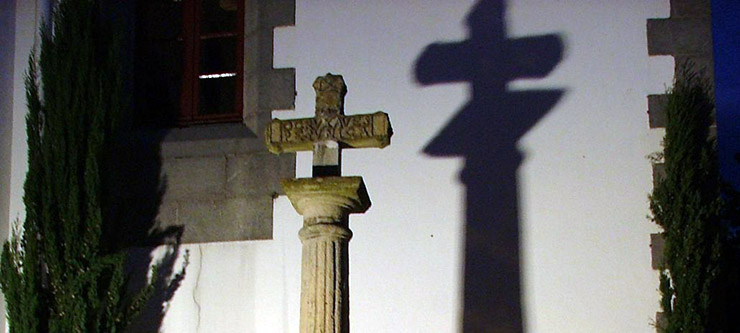
    The inspiration for this article comes from my almost nineteen years of research into the Great Cross of Hendaye and the French alchemist Fulcanelli. The unknown, anonymous, alchemist Fulcanelli in his masterpieceThe Mysteries of the Cathedrals first brought the cross at Hendaye, France to the world’s attention.

    While the details of this research can be found in other articles written by myself and in the two books I co-authored,1 it can be stated that the Great Cross at Hendaye appears to be describing not only the end of the great four ages of the Hindu Yuga system but also the four ages of alchemical chronological time keeping. According to the cross at Hendaye, the Iron Age, or the Kali Yuga, will be coming to an end with the galactic alignment on the winter solstice of December 21st, 2012.

    According to the mythology of the Yuga system, there are four ages of life and time on our planet. It is important to remember there are many cycles within cycles in the Hindu Yuga system so the years mentioned next may have to do with a larger cycle than the one addressed in this article. Perhaps the huge number of years referred to below is the cycle of the solar system as it circles another star, or perhaps it is a portion of the great cycle of one revolution around the galactic centre.

    The first age is the Satya Yuga or the Golden Age, according to Fulcanelli. The Hindu texts tell us that this age lasts 1,728,000 years. This is an age of extreme splendour when the beings on our planet appear to live much longer than they do now. In this age there are no wars, famines, strife or evil.

    The second age is called the Treta Yuga, or the Silver Age. As in the second law of thermodynamics, or entropy, things begin to slip in this age and the beings on Earth begin to deteriorate. This slippage, at least during this second age, is the beginning of corruption, and evil is introduced into the planetary sphere. This age lasts 1,296,000 years according to the Vedic texts of India.

    The third age of this cycle is called the Dvapara Age, or the Bronze Age. This is the beginning of the ‘fall’ of humanity. In this age corruption comes on more fully, evil begins to spread, and things start to fall into disharmony. This age lasts 864,000 years.

    The last age is called the Kali Yuga, or the Iron Age. This age is the age we are in right now. Evil and corruption become the driving force as greed, wars, famine and disease spread across the planet like a tidal wave of death and destruction. This age lasts, according to the Hindu texts for 432,000 years.2

    What is important to understand while discussing these huge numbers found in the Hindu texts is they are describing the four ages within a context of understanding that each successive age is shorter than the previous age. The Satya Yuga, or the Golden Age, is one quarter longer than the Treta Yuga, or the Silver Age. The Treta Yuga is one quarter longer than the Dvapara Yuga, or the Bronze Age. Understanding these differences in the lengths of the ages becomes important to the following discussion.

    According to Fulcanelli and the cross at Hendaye, the alchemical Four Ages comprise the four quadrants of a 25,920 year-long cycle called the precession of the equinoxes. Essentially, the precession of the equinoxes can be explained by the fact that our Earth has a wobble. Like a top spinning on the floor, as it begins to lose momentum this wobble of the Earth takes nearly 26,000 years to unfold. The strange engraving of the four ‘A’s’ (see Figure 5) on the cross of Hendaye is a “hieroglyph of the universe”, according to Fulcanelli. It is “comprised of the conventional signs of heaven and earth, the spiritual and the temporal, the macrocosm and the microcosm, in which major emblems of the redemption (cross) and the world (circle) are found in association.”

    The Precession of the Equinoxes

    What Fulcanelli appears to be saying here is that the precession of the equinoxes is to be divided into four distinct ages of 6,480 years each (4 divided into 25,920) or, to round off the figures to approximately 6,500 years each. This is also interesting because the zodiacal cycle, which lasts 25,920 years, has four fixed signs. These are the signs of Aquarius, Taurus, Leo and Scorpio. These four signs are separated by 6,500 years each. Also in the Book of Ezekiel and in the Book of Revelation we are told of the angel with four faces. This angel has the face of a Lion (Leo), a Bull (Taurus), a Man (the angel) and an Eagle (in older times Scorpio was represented by an eagle instead of a scorpion). Apparently, according to Fulcanelli, both of these books in the Bible are warnings and messages about the four quadrants of the precession of the equinoxes and appear to be telling us that there is some kind of great change whenever we arrive at one of these four signs.

    Of course it is well known that we are currently entering the Age of Aquarius. The Cross at Hendaye and Fulcanelli are telling us there are tremendous changes to be found here on Earth when we enter into one of the four fixed signs. Apparently these changes can be cataclysmic.

    Obviously this 6,500 year long dating of the four alchemical ages disagrees with the Hindu Yuga system, which insists that each Yuga is of varying time lengths. It is in trying to iron out the dissimilarities in these two time periods that the hyperdimensional aspects of time can be best revealed.

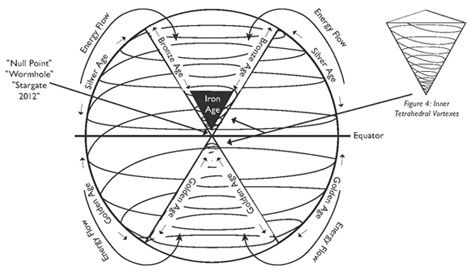
    It is well known in modern physics that four dimensional space, of which time is an aspect, is in the shape of a hypersphere (see Figure 3). This hypersphere appears similar to the shape of a donut, or a bagel. The energy, or the flow of the energy stream, within this hypersphere works like this: As shown in the illustration, the flow comes out of the bottom of the sphere, winds its way up around the outside edge, crosses the outside equator of the torus sphere and moves towards the hole in the top of this torus. The energy flow then begins to fall through the top of the hole and begins to spin in a vortex. This energy flow continues until it comes out of the bottom side of the torus where the energy flow begins its outward expansion again. This flow is continuous and, in a sense, infinite.

    The Four Dimensional Hypersphere torus is also represented by the hypercube. A hypercube is a cube within a cube according to physicists. Essentially this cube, also called ‘The Cube of Space’ or the ‘Tetragrammatron’ by the alchemists, is a straight edged version of the donut shaped hypersphere (see Figure 2).

    Scientists love to be able to construct objects using straight lines, so they have created the hypercube to help them better understand the hyperdimensional universe that surrounds us. Alchemists, however, like to use the curved lines of nature, so the donut shaped torus or hypersphere, is a better, more natural visual description of hyperdimensional space and will be the one I use in this article.

    The alchemists believe there is a hyperdimensional ‘body’ around every living thing on Earth. This hyperdimensional ‘body’ or sphere known to mystics as the luminous energy body, also surrounds every planet and star as well. Each object in the three dimensional world is an affectation of four-dimensional space. Humans, animals, plants, planets and stars are the solid inside of the fourth dimensional energy flow. As you will see, time also travels in this fashion.3

    In order to begin to comprehend the topographical nature of time, it is very important to understand the guts of this hyperdimensional sphere. By the ‘guts’ I am referring to the vortexes that make up the energy flow running through the centre of the hypersphere. As the energy flow begins to fall into the vortex that runs through the centre of the sphere, it takes on the shape of a tetrahedron.

    A tetrahedron, as shown in Figure 4, is the building block of three-dimensional space and is the founding member of the Platonic Solids. The tetrahedron is the simplest object that can be created in three dimensions. The only object with just four sides, the tetrahedron is also shaped like a vortex.

    Let us digress for a moment and discuss vortexes. Back in the Midwest of the United States, where I come from, there is a place called Tornado Alley. This is the flat Great Plains that stretches from Texas to the Dakotas. Each year this area is visited by numerous tornados, which wreak havoc on the farms and towns of this area. These tornados usually start in May and last until early August. Having witnessed several tornados in my early years I became fascinated by them and was once even a ‘storm chaser’. In my young and foolish days I used to chase after tornados with my Bolex 16mm camera in order to capture them on film. I became very familiar with these lethal vortexes.

    But understanding tornados also helps us understand vortexes and the density of forces in the hypersphere. Tornados (and also hurricanes) are made up of air like that which surrounds us all the time. But as the air begins spinning it takes on a strange solidity. While the swirling air at the top of a tornado is somewhat dangerous, it is the spinning air near the surface of the ground that is really dangerous. Near the tip of a tornado, where it is in contact with the ground, the air takes on the quality of solid iron. The tips of tornados can rip buildings apart, throw cars and trucks thousands of feet, and punch chaffs of wheat into the very centre of trees like a bullet. As the air spins more violently, the tip of the tornado vortex becomes as strong as 50 locomotives engines and possesses the density of the hardest of metals. Yet it is just comprised of air molecules. But these molecules are spinning so quickly they create a mass that is extremely powerful. It is the spin of the air that causes it to densify and take on the solidity of metals.

    Getting back to the central core of our hyperdimensional torus, we can understand the vortexes inside this sphere and how time unfolds by using the tornado analogy. As the energy flow begins to dip down into the top of the tetrahedral shaped vortex, it begins to spin. As the energy flow descends, its spin becomes more rapid and compressed. Like a tornado, as it reaches further down, the tip of the vortex ‘hardens’. It could be said that his hardening of vorticular forces is what makes up the solidity of our three dimensional space. Each human, plant, animal and indeed every planet and star alike are the hardened tips of hyperdimensional vortexes, which are flowing all around us constantly.

    Like air, these hyperdimensional forces are pretty much invisible to us. It is only when these forces coagulate into a spinning vortex that they can be seen and felt. It is through the rapid spinning of four-dimensional space that the solidity of the third dimension is actually created. The mystics from all great traditions know this and they realised these inner dynamics of the fourth dimension as it interacts with the third dimension. The fourth dimension is the surrounding sphere and the third dimension are the tetrahedral vortexes that make up the central core of the sphere. To the ancients, four-dimensional space was called ‘spirit’ and three-dimensional space was called ‘matter’.

    So what does this have to do with time and the topography of time? Remember the dilemma we face in trying to make the four ages of the precession match up with the Ages or Yugas from the Hindu system? By attempting to make the two into one we can not only understand the topology of time, but also we can map time like the ancients and we can know where we are in the river of time.

    As shown in illustration Figure 3, imagine that we are coming through the very centre of where the two tetrahedral tornado vortexes intersect at the very centre of the inner hyperdimensional sphere. Moving down the bottom vortex towards the outside surface of the sphere, each spin in the vortex takes longer and is wider and slower than the previous spin in the vortex. In other words, the energy flow expands after it passes the ‘null’ point in the very centre of the hyperdimensional sphere, or torus, where the tips of the two tetrahedral vortexes touch.

    This energy flow continues its expansion as it climbs over the lip of the bottom edge of the sphere where the vortex meets the outside edge of the sphere. The energy flow continues to expand until it reaches the outside equator area of the sphere. Once it gets past the equator, the energy flow begins to condense, the flow begins to move faster and the spin density increases. This flow continues until the energy flow reaches the upper lip of the outside of the hyperdimensional sphere where it begins to ‘fall’ into the top of the tornado tetrahedral vortex.

    Now as the flow of energy falls down the vortex towards the null point at the very centre of the sphere it begins to harden as it spins faster and faster. This goes on and on until the vortex is so hard it is like iron. This is how the fourth dimensional forces create three-dimensional reality. As the vortex spins faster and faster eventually it compresses down to the point where it has nowhere to go but outwards again. This occurs at the null point in the centre of the sphere and the energy flow now begins to once again expand.

    The Golden Age is the time period that starts at the null point in the centre of the sphere and continues through the bottom vortex. As the energy flow expands outwards time appears to slow down. The entire period of the Satya Yuga, or the Golden Age, continues as the energy flow goes down the bottom vortex and rounds across the top of the sphere. It continues expanding until it arrives at the equator.

    The equator of the outside of the hyperdimensional sphere is the borderline between the Satya Yuga and Treta Yuga, or the Golden Age and the Silver Age. Now the energy flow begins to contract as it flows upwards towards the north pole of the hypersphere.

    The Silver Age, or the Treta Yuga, continues until the energy flow rounds the top lip of the hyperdimensional sphere and begins to fall into the upper tetrahedral vortex. This then is the borderline between the Treta Yuga and the Dvapara Yuga, or the border between the Silver Age and the Bronze Age.

    About two thirds down in the upper vortex, where the energy flow is spinning so fast that it becomes as solid as iron, is the beginning of the last Age, the Kali Yuga, or the Iron Age. This spinning continues to gain density, compression and speed as it races towards the central null point in the very centre of the sphere. As it approaches this null point the forces become unbelievably fast, violent and dense. It is only when these forces achieve maximum density and they can no longer compress any further that they begin to suddenly flip and begin the expansion of the flow. This happens in an instant. This is the shift from the Iron Age, or the Kali Yuga to the Golden Age, or the Satya Yuga. The borderline between the Iron Age and the Golden Age is the most distinct border in this topographical illustration of hyperdimensional time. It is the most jarring and is instantaneous.

    Take notice of the hourglass shape of the two tetrahedral vortexes inside the hyperdimensional sphere. Is this why Fulcanelli tells us about the hourglass in the quote at the beginning of this article? In Hindu mythology the God Shiva dances the world into and out of existence playing his dhamaru which is a two sided drum shaped like an hourglass.

    Notice that, like the number of years in the Hindu Yuga system, the distance travelled through our ages in the hypersphere is similar; the Golden Age, which is the distance between the null point in the centre and the outside equator is twice the distance as that travelled through the Silver Age which is the distance from the equator to the top of the lip of the upper vortex. Equally, the distance travelled from the top of the vortex to two thirds down, which is the Bronze Age, is half the length of the Silver Age. Finally, the tip of the vortex is half the length of the Bronze Age.

    This part, called the Iron Age, is the Age in which we live. This is also why, in the Iron Age, each second feels shorter than the second before. This is why each day, each month and year appear to be going faster than they did previously. In the topology of time this effect can be easily understood and explained.

    Also remember, even though the distance travelled is much further in the Golden Age than it is in the Iron Age, the number of years it takes is the same. It takes 6,480 years to go through the Golden Age just as it takes 6,480 years to go through the Iron Age, but it feels much different. In the Golden Age each second, each day, each month and year appear to be longer than the previous day, month and year. Time is expanding in the Golden Age and with that expansion the anxiety and tension of the Iron Age disappears. It is a paradise, especially to those who may have survived the passing through the wormhole, or the null point at the centre of the hyperdimensional sphere.

    Therefore, the years listed within the Yuga system are actually symbolic times that explain the lengths of time as it is felt not as it is lived. So the Golden Age or the Satya Yuga feels like it is much longer than the Kali Yuga, or the Iron Age.

    The shamans in Peru tell us that we are approaching the Pacha Cuti, which means literally ‘the world turned upside down’. They say that it will arrive in the year 2012. This is also the year when the great Mayan calendar reaches its end point. The cross of Hendaye is quite explicit in saying we are reaching the very end of the Iron Age. I would suggest that the null point, or the wormhole at the very centre of the hypersphere, is very likely the 2012 date. Our hypersphere appears to be regulated by the periodic alignment of the galactic centre with the Sun. This also matches the four fixed signs of the zodiac and explains why the Christian tradition is preparing for the endtimes.

    Oddly enough, it also appears that Stanley Kubrick is trying to tell us about the end of our Age in his masterpiece film 2001: A Space Odyssey. The Starchild at the end of the film has passed through the Star Gate of the black monolith and is returning to Earth to create a new world or a new Age.4

    It is through our understanding of the Four Ages, the fixed signs of the zodiac, and the Yuga system that we can finally appreciate the message our ancestors have handed down to us. We are about to pass through the Star Gate, the wormhole, and the null point of hyperdimensional space.

    The Cross of Hendaye reveals the most important knowledge of all, which is the end of time and the beginning of the Golden Age. Awareness of this knowledge helps us all to more fully comprehend the nature of the times in which we reside and the destiny of the human race.

    The Quality of Time

    At the very core of all the great spiritual traditions to be found across the planet from the ancient Egyptian to the Incan and Mayan, Indo-Tibetan, Alchemical Europe and even the Hebrew Kabbalah lies the knowledge of the secret of the alchemy of time. Unencumbered by the excessive demands, stresses and speed of the modern age, our ancestors spent lifetimes in contemplation of the essential mysteries of our world.

    One of the great mysteries they discovered was that time is not stagnant or linear but flows in great transformative cycles. In fact, it is only recently modern historians have begun arguing that time travels in a straight line. Within the limited period of historical examination these modern historians are viewing a snap shot of history and believe this snapshot represents the entire picture. But does it?

    The alchemists of Egypt and Medieval Europe knew that time moved in great elongated cycles, and that each part of the cycle had a ‘quality’. This quality shaped and reformed the world. Just as sunrise has a different quality from midnight, so too does each aspect of the great cycle possess a quality that distinguishes it from other parts of the cycle. When the cycle of time changes, so too do events change here on Earth.

    These sacred scientists and alchemists of our past used various devices and practices to mark the changes in the quality of time. Astrology, divination and prophecy are some of the more obvious processes that our ancestors used to understand the mysterious process of time.

    At the heart of the secrets traditions of the Egyptian and Greek mystery schools they knew that a process, which they called the precession of the equinoxes, measured the Great Cycle or the Great Year. What they understood was that the stars in the night sky are not fixed. Through their long observation and meditation upon the heavens they came to realise that the stars and the constellations were slowly changing their place in the sky above us. Creating the zodiac to assist them in these huge measurements of time they used the twelve signs to act as a giant time clock. Through this they began to understand the Great Cycle. They realised that it took 2,160 years to move through each sign of the zodiac and that it took 25,920 years for the equinoxes to move through all 12 signs. The creation of the Great Year of nearly 26,000 years gave them a clock that allowed them to measure time.

    They then came to understand that each of the signs, or places on the clock appeared to bring forth changes in the quality of life here on Earth. So they came to realise that every 2,160 years the quality of time changed. They also began to understand that the four quadrants of this great chronological clock appeared to bring forth even sharper changes in the quality of time. The four signs associated with these four quadrants are the signs of Aquarius, Taurus, Leo and Scorpio. There does seem to be some historical linkage between this idea that passing through the edges of these four signs brings great changes here on Earth. About 6,500 years ago we passed through the sign of Taurus. Coincidentally, the human race began domesticating cattle, building walled cities, developing agriculture, fighting wars and beginning the city-states that would evolve into governments and monarchies. Thirteen thousand years ago, as we passed through the Age of Leo, great changes occurred including a dramatic climate shift as the ice ages began to end. The extinction of many animals including the Woolly Mammoth, the Saber Tooth Tiger, the Giant Tree Sloth, and many other species happened at about this time. Interestingly, according to anthropologists, the emergence of Cro-Magnon Man appears to have occurred about 26,000 years ago, the last time we passed through Aquarius.

    The Great Cross at Hendaye is a 350-year-old alchemical monument to the end of time. It sits in a churchyard in Hendaye, France. The Great Cross at Hendaye appears to be a symbolical construct that explains this science of the cycles of time. The Cross at Hendaye describes the extraordinary changes that are about to occur in our present era. It speaks of the end of our current Age of Iron and the creation of a coming Golden Age.

    The great cosmic time clock in the sky is changing. We are now entering the quadrant of Aquarius. From what the alchemical Cross at Hendaye is saying, this change is sure to have a dramatic effect on our species and on our planet.

    What these changes are, or will be, is anybody’s guess. But they are sure to be spectacular and remarkable. The end of time, the end of this age and the great transformation of humanity is at hand. This change in the quality of time will govern and dictate the changes here on our fragile planet. The changes in the quality of time cannot be forestalled. The fundamentalist revival taking place all over the world reveals more about the quality of time from which we are emerging than it does reveal anything about the quality of time for that which is coming.

    The Peruvian shamans living high up in the Andes Mountains have come down to tell us that a new species of human being is about to appear. They call this being ‘Homo Luminous’. They tell us that forerunners of Homo Luminous are already among us right now. Like Cro-Magnon Man of 26,000 years ago, the last time we passed through the cusp of Aquarius, so too now a new human is emerging.

    This new human will possess entirely new qualities that we do not have. The great Avatars, Jesus Christ, Krishna and many others may have been early arrivals for this newly emerging species. Aquarius is the only one of the four quadrant signs that is symbolically represented by a human, and this human carries a container of water. This symbology is interesting as DNA can only be activated in water. So even the symbolic nature of the sign of Aquarius seems to suggest a change in the genetic structure of the human race.

    Our spiritual existence is really a unique combination of free will and predestination. While we possess the ability to act freely within the moment, there is little we can do about the larger cycles of time and the qualities that emerge at the cusp of each of the four great signs. So as the hand on the great cosmic time clock passes into Aquarius one can expect massive changes to occur. While the ancient art of alchemy is concerned with many aspects of our existence including the extraction of light from plants and minerals, the transformation of the dark lead of our physical being into the pure gold of enlightenment and much more, alchemy also is a symbolic ontology concerned with the observation in the changes of the ‘quality’ of time through the 25,920 years-long duration of the Great Year.

    The world is changing. The past will disappear and history will become legend and finally myth. Our destination is unknown. The only thing we know for sure is that it will change.

    [alert type=”general” dismiss=”no”]This article was published in New Dawn 92.[/alert]

    [alert type=”success” dismiss=”no”]If you appreciate this article, please consider subscribing to help maintain this website.[/alert]

    Footnotes:

    1.  See www.jayweidner.com; The books A Monument to the End of Time: Alchemy, Fulcanelli and the Great Cross and Mysteries of the Great Cross of Hendaye: Alchemy at the End of Time are authored by Jay Weidner and Vincent Bridges.
    2. For more information, see ‘Tolkien at the End of Time: Alchemical Secrets of the Lord of the Rings’ by Jay Weidner and Sharron Rose in New Dawn No. 82 (January-February 2004), and ‘Reflections on the Cycle of the Great Yuga’ by Sharron Rose at www.sharronrose.com.
    3. For more information on the luminous energy body, see my films Healing the Luminous Bodywith Dr. Alberto Villoldo, ArtMind with Alex Grey and Yoga of Light with Sharron Rose.
    4. See ‘Alchemical Kubrick: 2001: The Great Work on Film’at www.jayweidner.com.

    © New Dawn Magazine and the respective author.
    For our reproduction notice, click here.