New Dawn – World's Most Unusual Magazine

Tag: matrix

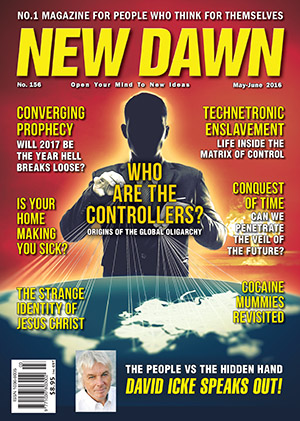
  • The People vs. the Hidden Hand: David Icke Speaks Out (Part 2)

    The People vs. the Hidden Hand: David Icke Speaks Out (Part 2)

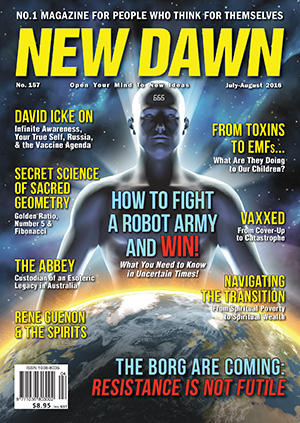
    From New Dawn 157 (July-Aug 2016)

    The May-June 2016 issue of New Dawn featured the first part of David Icke’s interview with Marc Star. Here we present the second part of his interview (David’s surname is pronounced “ike”).

    MARC STAR (MS): You’ve noted that the current state of the world is only a reflection of the inner state of the individual. Humanity is at a spiritual roadblock reflected by a lack of awareness and the cutting off of our own spiritual essence. One might say we’ve gone mad, a chronic case of PTSD. Perhaps we never recovered from World War II. We’ve certainly never stopped being at war. Can this patient be cured?

    DAVID ICKE (DI): What is the patient? The patient is incarnate awareness disconnected from its infinite self – disconnected from inspiration, knowing, insight and intuition from its greater self operating at frequencies outside of this fake reality we call the world. As I’ll explain at the events, I say that what we call the universe is actually a quantum computer. It’s a fake reality. It’s a vast equivalent of, if you like, a computer game. It’s the same principle – which is why the physics of computer games and the physics of our world are basically the same.

    The patient is a patient in that term because people are disconnected from their true selves. What we call awakening is simply awakening from the program to tap into greater swathes of our true self. If you do it at first, and you just start to tap into some of the greater self, then you start to see that 9/11 was set up to create an excuse for what has followed – the war on terrorism, etc. You see that the banking system is basically that, the banking system, and individual banks are just agencies of that overall system controlled by a few people. And so it goes on. You start to understand the five-sense level of connection because you’re now looking at things from a more expanded state of awareness.

    Some stop at that point. And that’s where most of the alternative media is, frankly. When you move on and continue to expand your awareness, then everything is questioned. Everything comes under questioning in terms of what’s real and what’s true. You start to realise that the physical world is not physical at all. There is no physical, as quantum physics has shown. There is only the illusion of physical. Just like the computer in front of me decodes information in the tower and puts on the screen pictures, moving pictures, text, graphics because it’s decoded that information from the tower in that state, so we are decoding through what I call the biological computer – the body. We are decoding information from the unseen – what I call a cosmic wireless internet – into the reality we think is so real, so solid.

    The patients cure themselves by breaking out of the perception prison of the program and allowing their true self, infinite awareness, to enter the game, and enter the perception process – allowing people to tap into their true power, as opposed to their suppressed power of ‘phantom self’ [see Part 1]. More and more people are doing this. This is what the awakening is. And the more people awaken, the more people question things they took for absolute granted before – like the desk in front of me is solid. No it’s not. It appears to be but it’s not.

    This is a massive part of what I’m talking about in the events and in my new book Phantom Self, because there is no other way of bringing an end to all this nonsense that doesn’t involve people expanding their awareness out of the program and into their true self. Let’s think about it – this whole structure of human society, which is specifically designed to disconnect incarnate self from infinite self, is not done for a laugh. It’s not done for a bit of fun. It’s absolutely fundamental to the success of what they’re trying to achieve. So it must make basic common sense that the way to address that is to reverse what they want, and what they’re doing – i.e., reconnect incarnate self to infinite self.

    Much of the alternative media is focused on the five-sense world because it’s been through the program too, and thus can only see five-sense solutions to what it perceives to be five-sense problems and five-sense situations. Stockpile weapons, stockpile food, fight the system. The system depends in its entirety on the existence of phantom self. Without it, there is no system.

    I’m not saying sit cross-legged on a mountain, meditate for the rest of your life, do nothing and everything will be fine because you’re on a higher frequency now. No, no. Absolutely not. A lot of what is called ‘new age’ falls into that illusion because that means it doesn’t have to do anything that it actually doesn’t want to do – i.e., get its hands dirty and look this situation in the face, in the eye.

    By all means, meditate if you like, go into deeper levels of self, get insight, get inspiration, but then express that inspiration towards changing the world, or else there’s no point. I hear people say, “knowledge is power.” No it’s not. Knowledge is not power at all. The use of knowledge is power. Knowledge that you don’t use you might as well not have it at all.

    But everything, in terms of playing this out and doing what is necessary, comes from an expanded perception of self and the world. Then you’ll know what your individual unique contribution should be.

    All these things are connected. The awakening to a different view of the world and self is happening because those people are expanding their perception out of the program. If they weren’t, they wouldn’t be re-evaluating the world of self. All this is moving in the right direction. It’s just a case of numbers.

    On the subject of the alternative media, I have enormous respect for people worldwide who take the trouble and often dedicate their lives to communicating this information. So much of the alternative media is itself stuck in phantom self – not all the alternative media, by any means. No. But vast chunks of it. Vast swathes of it are just like the mainstream media in a mindset of “here and no further” because they literally can’t get their head around going any further. It doesn’t make any sense to them. They can’t process it because phantom self has still got you.

    There is an incredible amount of ego in the alternative media and among people that follow the alternative media, which you see in the extraordinary levels of abuse on social media, the forums, the comment columns and all that stuff. Along with abuse between different researchers and what have you. It’s extraordinary. I’ve had as much abuse from the alternative media as I have from the mainstream media – which, given the scale of the abuse from the mainstream media, is saying something. Because the alternative media – again, not all of it, but a great chunk of it – is also an expression of the sheep and the sheepdog that I mentioned earlier [see Part 1]. Sheep keeping sheeple in line.

    I think the alternative media has to look at itself – that part of it that I’m talking about – and ask, too, if it’s not caught in the same conspiracy, the same perception deception that those which it targets are caught in. Once you think, “I know what’s going on” in the sense of its entirety, you’re kidding yourself and you’re kidding others because in the end there’s an infinity of awareness/knowledge/perception that never gets to the conscious mind.

    I’ve always done my work on the basis of a certain recurring theme. Socrates has a version of it. Confucius has a version of it. There are many versions of it. Basically the theme is: Wisdom is knowing how little we know. When you hold that then your mind is open to all possibility all the time, instead of closed off to possibility that doesn’t suit your current belief system. And the alternative media needs to be aware of that because much of it gets caught in that trap of “here and no further.” The rabbit hole is so deep, far deeper than almost anyone can imagine.

    MS: With Russia propagandised by the West as the aggressor in Ukraine, and Russia’s success against ISIL in Syria, it seems Vladimir Putin has become the leading face of global resistance against Empire. What are your thoughts on Putin and the role he is playing – knowingly or unknowingly – in the larger drama?

    DI: Obviously, if you look at Putin’s history, he’s not a nice man. But when I look at people like Obama, and of course his predecessor Bush, when I look at David Cameron, when I look at Hollande in France, and all these characters, one thing that shouts out about Putin is that he is phenomenally more intelligent than all of them put together. And Putin is clearly aware of what the agenda is for Russia.

    When I played on a football team managed by a guy named Jimmy Hill, a well-known guy in this country [UK], back in the 1960s, he used to say, when you start a match, get your retaliation in early. What he meant by that was take physical control of the game early. What Putin has been doing is getting his retaliation in early.

    He has, to an extent, thrown a spanner in the works – although there are other deeper levels of this. It depends on what level you’re actually looking at and talking about at the time. But he’s fully aware of the Western coup, the American coup in the Ukraine, where this puppet Poroshenko was put into power. And, of course, Wikileaks documents have come to light that talk many years ago, long before anyone heard of it in the Western public, that Poroshenko is a United States asset in Ukraine, and this asset of long years suddenly becomes president in a coup that was a classic George Soros colour revolution – what they call regime change. The idea was to create antagonism between Ukraine and Russia to try to justify the demonisation of Russia. In Syria, of course, the American/British/NATO-created terrorist groups – whether it be the so-called Free Syrian Army, or ISIL/ISIS, or whatever name is given – they were created as proxy armies for the West to take over country after country.

    And, of course, they have long wished to dethrone Assad, going back at least to documents in the pre-9/11 world, which listed the countries they wanted to take over – regime change. These countries have been ticked off – Iraq, Libya, Syria and so on.

    The idea was to let loose these proxy armies, funded and trained by the West, to remove Assad and tear Syria asunder. This is why, despite having the biggest military on Earth by a vast, vast distance, despite having European countries involved in the fight against ISIL, in the bombing of ISIL… actually ISIL were just expanding and expanding because they were being allowed to. The idea was not to stop them but just to give the illusion of trying to stop them. Assad reached the point where he was in imminent danger of losing control, including Damascus. Putin could see what was going on and got his retaliation in early, if you like. He went in there to turn that around and blatantly showed, by the success of pushing ISIL back, how the West has been systematically allowing ISIL to expand – because that’s just what they want. They’re a proxy army for the West.

    I’m sure that threw a spanner in the works of where they wanted to go. Assad is not gone. They thought Assad would go as quickly as Qadhafi, and he hasn’t. Largely that is because of Putin. So from here on in it’s going to be interesting to see where this goes in terms of Russia because Putin has been playing these other idiots, like Obama and Cameron and Hollande, etc., like a stringed instrument. It’s like a chess match and he’s been putting them in check all over the place. Interesting to see where it goes because the plan all along has been to create, at some point, a third world war with the West against Russia and China. I’ve been talking about that since the 1990s.

    Whether they can pull that off is another thing given that Putin will be absolutely aware of that agenda.
    MS: What about Brexit and the European Union?

    DI: The European Union is the forerunner for what they want around the world. The EU, as it’s become – a fascist/communist/bureaucratic dictatorship controlled by dark suit appointees in Brussels – was created originally as a free trade area because people back then would not have accepted the EU that it’s become now. What has happened is a classic and perfect example of what I call the totalitarian tiptoe.

    That free trade area has evolved through the incessant centralisation of more and more power in Brussels with the dark suits. It has been transformed from a free trade area – which is “good for jobs, mate” they said – into this bureaucratic prison state, in effect, where national laws are overridden by anything these dark suits come up with.

    Other trade areas around the world including Australia and New Zealand are planned to become their version of the European Union, because the structure of the ‘hunger games society’ is designed to be a world government, a world central bank, with a cashless world currency, dictating to all people everywhere – imposed by a world army which is what NATO is designed to evolve into. I mean, look how fast that’s coming in now. In books in the 1990s I was saying watch for NATO to start operating outside of its designated area of the North Atlantic region. Now, of course, NATO turns up in the Middle East, and all over the bloody place. It’s the evolving world army.

    Under that structure, at the global level, it’s designed to be versions of the European Union all over the world – in the Australia/New Zealand part of the world, in the Americas, in the Middle East. We’ve already got the African Union, and so on.

    The plan for the EU is to continue to absorb more and more countries. Goodness knows, when you see the European Union there are still countries that want to join. I’ve said before – wanting to join the EU and the European monetary system, having seen it for what it is now – which has been a disaster – wanting to join that is equivalent to looking up at a blazing apartment block and asking when you can move in. It’s insane.

    But the hidden hand, of course, is behind these countries, pushing them in. So the last thing they want are for countries to start to leave because that’s starting to reverse where they want to go.

    What’s happened in Britain is this moronic man, David Cameron, the prime minister, was coming up to an election last year, and opinion polls were showing big support for a party here called UKIP, the UK Independence Party, which was specifically created to campaign to leave the European Union.

    What they call here middle England invariably votes for Cameron’s Conservative Party over the decades. They are sick of the European Union and its impositions, and the incredible red tape it imposes upon small and medium size businesses – red tape which is simply designed to destroy them so the corporations can take over everything.

    Therefore, UKIP’s campaign to leave the European Union was getting more and more support in the polls from these otherwise natural conservative voters. And so Cameron panicked and said if he got elected again as prime minister he would have a referendum on giving people the opportunity to vote in or out of the EU.

    The polls also strongly suggested the Conservative Party would not win outright, but again, like the administration before, would have to share power with a second party in a coalition. The Liberal Democrats coalition was with the conservatives in the government before the election. And the Liberal Democrats are EU fanatics. Cameron obviously thought that in this coalition he’d have the excuse of saying the Liberal Democrats are blocking the referendum. In other words, he thought he could promise the referendum without any consequences.

    But unfortunately – unfortunate in one way, but in this way, fortunately – he got power without needing to be in a coalition, and thus he was stuck with a promise of the referendum. And this referendum coincides with this vast influx of migrants and refugees into Europe. The fear of the consequences of this influx of refugees has turned more and more people against EU membership – so they say Britain can control its own borders rather than having them dictated by the dark suits in Brussels.

    MS: In 2009, you began your Melbourne talk with a story of being held up by immigration officials at Melbourne airport who compelled you to sign a “character test” agreement. What aspects of Australia’s role in the hidden hand’s agenda most concern you?

    DI: Actually I had to sign something that said I read something. Bizarre. “Just sign and say you’ve read this.” Well okay, I’ve read it.

    Australia is a very obvious example of the fact that this agenda is global, and therefore globally coordinated. The things that are happening in Australia – more and more surveillance, even the exposure of elite paedophilia rings, etc. – they’re everywhere. I won’t get into it now, but paedophilia among the elite is everywhere, all over the world, for reasons I explain. Thus for it to come up in Australia as it’s come up in Britain – and they’re trying to desperately put the lid on it in Britain and other places – is because it’s a global phenomenon. So is this increasing surveillance that Australians are being put under. The same is happening here, the same is happening in America, the same is happening in Europe – because it’s a global agenda.

    The thing that stands out for me, in recent times, in Australia – and should send alarm bells and big red flashing lights everywhere – is the law that says you can’t get benefits if your children aren’t vaccinated. This is another global phenomenon – mandatory vaccinations. This Australian law, in effect, targets people who survive because of those benefits. It is a stepping stone – and only a stepping stone – to a fully fledged mandatory program of vaccinations for everybody.

    In California, and in other parts of America, there is this theme coming of mandatory vaccinations because this awakening, even on that level, is causing more and more people to look, for instance, at what’s in vaccines and the evidence of their effect. The fact is vaccines are demolishing developing immune systems in kids less than 2 who are being subjected to this tidal wave of toxic shite – called vaccines – which is ensuring their immune systems will never be the same as they could be. And they’re adding more and more all the time. But because of the awakening, people, in greater and greater numbers, are rejecting vaccinations.

    There are two things they plan to do. First of all – and this is happening more and more – they have to outlaw, censor and block information that exposes what’s going on and that helps people awaken to what’s going on. Where people are awakening and saying, “we’re not having this,” then they introduce laws that say, “you are having it and you’ve got no choice.”

    The scale of fascism, the scale of arrogance, that believes it can dictate what human beings put into their own bodies and what is allowed into their children’s bodies is so unspeakable, almost unimaginable to anyone with a sense of decency, a sense of fairness and a sense of justice.

    From what I read, there’s been a big vaccination take-up as people have been forced into it, otherwise lose benefits. The people of Australia need to open their minds to what’s going on and what the connections are because the vaccine agenda is just part of the larger agenda. It’s one strand in the web, and a very important one.

    Because Australia has such a small population, comparatively, to so many other countries, it has the opportunity to take back control of the country from that which hijacked it – going back to the British empire. You look at excess of 300 million people in America – well that takes some turning around. But you look at the population of Australia. You’ve got a great chance there, if enough people say enough, realise what’s going on and respond to it with unity. And I hope that going to Perth, Brisbane, Sydney, Melbourne and onto Auckland will stimulate awareness of not just the nature of what’s happening, but the scale of it and how all these apparent unconnected dots connect to show a very clear picture.

    I hope – and this is the whole idea – that when I leave, this information is in greater circulation and being talked about more than when I arrived. That’s the whole point of doing it. And I do pay great tribute to the work that New Dawn and everyone involved in it has done because it’s great more and more people are getting involved, more and more people are becoming researchers, more and more people are starting websites to circulate this information.

    But it was a lonely road some time ago, trying to make heard what people were dismissing and being called every name you can think of. And New Dawn was there. I’ve got enormous respect for what that publication has done when, as you well know, there weren’t a lot of people compared with now that were interested in hearing it. It’s the pioneers that start the change. New Dawn in Australia has absolutely been one of the pioneers.

    David Icke’s book Phantom Self (and how to find the real one) is available through https://shop.davidicke.com.

    The first part of this interview appears in New Dawn 156 (May-June 2016)..

    [alert type=”general” dismiss=”no”]This article was published in New Dawn 157.[/alert]

    [alert type=”success” dismiss=”no”]If you appreciate this article, please consider subscribing to help maintain this website.[/alert]

    © New Dawn Magazine and the respective author.
    For our reproduction notice, click here.

  • [Trapped] in The Net: What They Don’t Tell You About  the Internet & Social Media

    [Trapped] in The Net: What They Don’t Tell You About the Internet & Social Media

    This article was published in New Dawn 158 (Sept-Oct 2016)

    “Technological progress is carrying us to inevitable disaster.”
    – Theodore J. Kaczynski (a.k.a. ‘The Unabomber’)

    Flawed, to a depth unlike any other beast in the animal kingdom, human beings rapaciously despoil their own environment and continue to conduct activities that appear to threaten the very existence of the biosphere – our home, planet Earth.

    Through the latter half of the 20th century an insatiable technological race to develop weapons of mass annihilation resulted in nuclear standoff among a handful of belligerent nations and an incongruous co-operative policy of Mutually Assured Destruction (M.A.D.). That dire policy still stands today, a shadow cast unthinkingly over all human endeavour and indeed life itself.

    The very idea that humanity willingly chose to pursue a scientific course that delivered the capacity to destroy the world many times over should be breathtakingly troubling, yet inspires relatively little comment. From the very same tumultuous technological crucible that produced the enduring madness of nuclear weaponry came a more recent development – the Internet. The online world promises an ‘abundance of riches’ (as its techno-evangelists constantly assure) but it also has a profound (and profoundly under acknowledged) dark side.

    Birthed from the Pentagon’s desire to be able to maintain communications through the early stages of a nuclear assault (by spreading the electronic and telephonic communications load over a labyrinth of interconnected routes and servers), what we today call the Internet (which at one point was called ARPANET) was shepherded into existence by D.A.R.P.A. (the Pentagon’s Defense Advanced Research Projects Agency) in partnership with the scientific, academic and corporate communities.

    In these times of giddy techno-utopianism (sleekly designed Apple products are fetishized throughout our entire culture, social media is worshipped as the new frontier in community ‘cohesion’ and ‘inclusive’ communication – to name just a few examples) it would seem important to remember that the architecture of the Internet (and all the associated soft and hard-ware) was parented by a nexus of the Military Industrial Complex, the Secret State, the Corporate Leviathan and deliriously utopian elements of the scientific and academic worlds.

    Many have noted the deleterious relationship between humankind and technological development, where humanity acts as virtual slave to a misdirected and essentially unstoppable scientific progression.

    Though now used as a term of derision, the original Luddites rightly feared the impact of encroaching technology on their livelihoods and sought means to disable it. Thinkers from Karl Marx to Marshall McLuhan also addressed and questioned mankind’s enthralled relationship with technological innovation. For whom shall be the servant and whom shall be the master?

    The New Dark Age of Mediocrity & Narcissism

    Since the invention of Gutenberg’s printing press five centuries ago, the linear/literary mind has evolved and shaped prodigious developments in art, science and culture. We may now have entered an era of far more seismic – though not necessarily positive – changes. Acclaimed neuroscientists like Michael Merzenich and Eric Kandel suggest that the Digital Revolution’s hyper-stimulating and overtly transient landscape may be responsible for ‘re-wiring’ our neural circuitry to a more ‘efficient’ and industrialised state (producing more, more quickly) that also downgrades our capacity for concentration (the locus of education) and even wisdom.

    Writer Nicholas Carr warns in The Shallows: What The Internet Is Doing To Our Brains that “the seductions of technology are hard to resist” but, as German philosopher Martin Heidegger put it, the advance of technology dictates that a new, superficial “calculative thinking may someday come to be accepted and practised as the only way of thinking.”

    Carr also notes that a raft of recent research indicates that the “more distracted we become, the less able we are to experience the subtlest, most distinctively human forms of empathy, compassion and other emotions.” Bombarded by endless linked options and stimuli, we reduce our human qualities and become more machinelike – simply fleshy automata.

    Most online experiences are mediated by algorithms that expedite efficiency in searching the web, comparing products and offering connections to calculated similar content. They advance easy options, rarely subjecting us to the discomfort of a differing opinion or intellectual challenges (as may happen in the real world). If the World Wide Web is an infinite digital library, search algorithms are most likely to fill that library only with volumes chosen to please us. An endless feedback loop of gratifying, self-serving opinions and subtle reinforcement – a mirrored cubicle of refracting self-reflection, an echo-chamber of recycled automatic sound bites. An apocalypse for the enquiring soul.

    A cursory scan of Facebook, Instagram or Tumblr will produce mountainous evidence that we are enduring The Age Of The Ego. Current digital technologies have been designed by fevered armies of psychologists to appeal to the very weakest flaws in human nature – self-obsession and flagrant narcissism. Can there be a sadder, more alienating device than the ubiquitous ‘selfie-stick’? Surely the end is nigh.

    Another question posed by Carr was, “Is Google making us stupid?” Forever distracted by the digital avalanche, research and voluminous anecdotal evidence suggests that we are already drowning under the online tsunami – vast amounts of information at our fingertips, yet unable (or unwilling) to analyse, prioritise, sift and evaluate – we simply consume and regurgitate.

    Obesity of the Mind

    Richmond, Virginia author Matthew Crawford proposed in his book The World Beyond Your Head that we are seeing a social crisis as more and more people lose touch with physical reality and escape into the online matrix.

    According to Crawford: “Figuring out ways to capture and hold people’s attention is the centre of contemporary capitalism. There is this invisible and ubiquitous grabbing at something that’s the most intimate thing you have, because it determines what’s present to your consciousness.” In the clamour to advertise in every mental space (and monetise every social interaction), we are fast losing the room to think, be creative, be playful – to ponder. “Attention is a resource, convertible into actual money,” and we need to reclaim our own senses and resources, “because when you talk about attention, you’re talking about the faculty by which you encounter the world.”

    Crawford continues… “the media has become expert at making irresistible mental stimuli” and systems are designed to encourage “playing till extinction,” a cognitive science and “social engineering project” facilitated by “mind-bogglingly wealthy corporations.”

    Crawford has found respite, peace and fulfilment in discovering working with his hands again – between writing projects he restores vintage motorbikes in a local repair shop and eschews the seductive online experience.

    The Creeping Tide

    A creeping tide of evidence now suggests that the online experience itself (aside from the content) may also affect direct cognitive damage.

    Research conducted in 2012 at the Chinese Academy of Sciences (in Wulan, China) scanned the brains of 35 men and women (between the ages of 14 and 21). Those classed as suffering from Internet Addiction Disorder (IAD) were shown to have notable changes to the white matter of the brain (the nerve fibres/connections) compared to those that did not suffer from IAD. The researchers noted “abnormal white matter integrity in brain regions involving emotional generation and processing, executive attention, decision making and cognitive control.” The neurological damage observed shared “psychological and neural mechanisms with other types of substance addiction and impulse control disorders” and was comparable to the effects seen in alcoholics, drug addicts, video game addicts and those with other behavioural afflictions.

    As a multitude of libraries close (or partially divest their collections to make room for the ubiquitous computer terminals and Wi-Fi routers) scholars from University College London conducted a five-year research programme examining evolving reading and research habits. They logged the activity of visitors to two popular research sites (one a British Library site and one the portal of a UK educational group) that offered journal articles, e-books, and other information. The study found a notable “form of skimming activity” as students and researchers bounced from one source to another, rarely reading more than a page or two and almost never returning to an earlier source. As the study concluded: “It is clear that users are not reading online in the traditional sense; indeed there are signs that new forms of ‘reading’ are emerging as users ‘power browse’ horizontally through titles, contents pages and abstracts going for quick wins. It almost seems that they go online to avoid reading in the traditional sense.”

    What is suggested here is a ‘pancaking’ of intelligence, as cognition is spread wider, but also thinner, with a more superficial comprehension and understanding.

    The deluge of multitasking and ‘multi-screening’ (having numerous windows or devices open and active at once) is, according to scientists, shattering focus and rewiring our brains. Eyal Ophir, after stints in Israeli intelligence and the airforce, joined Stanford University in 2004. He sought to challenge (through research) the traditional view that the human brain can only competently process a single stream of information at any given moment. Devising tests involving the timed comprehension and filtering of patterns of red rectangles from patterns of blue rectangles, what Ophir and his colleagues found shocked them. Those who identified in the study as ‘multitaskers’ were significantly worse at sorting the shapes and thus filtering out what was deemed as irrelevant information. Also multitaskers were shown to be less efficient at juggling problems, taking longer to switch between simple tasks. It’s possible that technological overload may be confusing the brain’s systems for determining priorities, marking every form of digital stimulation as urgent, creating a haze of constant, buzzing panic and distraction.

    A study conducted at the University of California indicated that constant interruptions from email alerts and pinging phones contributed significantly to stress levels. Gary Small, a psychiatrist at the University, noted that stress hormones can affect short-term memory loss and promote debilitating mental ‘fog’. According to studies conducted at the University of Utah, only a fraction of people (possibly around 3%) are capable of operating calmly with regular digital disruption.

    Numerous studies by psychologists, neurobiologists, and educators now show that ‘hyper-texting’ (the ability to click highlighted sections of text linked to sources or further information) actually decreases comprehension significantly. Interestingly, even the appearance of a hypertext (whether clicked or not) erodes understanding by offering the disorientating opportunity for distraction. A 2001 Canadian study tasked subjects with reading the Elizabeth Bowden short story ‘The Demon Lover’. The control group read the story in traditional linear text, the test group read a version dotted with hyperlinks. It took the test group longer to read the story and they were an extraordinary seven times more likely to report ‘confusion’ in their comprehension of it. A further 2007 academic review of related experiments concluded that bouncing between digital documents and linked pages seriously undermined understanding. Today’s Internet landscape of pop-up ads, competing videos and flashing, bouncing images can only yield to more mental maelstrom.

    As pointed out by Nicholas Carr: “When we go online, we enter an environment that promotes cursory reading, hurried and distracted thinking, and superficial learning. Even as the Internet grants us easy access to vast amounts of information, it is turning us into shallower thinkers, literally changing the structure of our brain.”

    The available pool of information entering our working memory is referred to by psychologists as the ‘cognitive load’. The Internet turns this steady ‘drip’ of ideas into a ‘blast’, overwhelming our limited cognitive abilities and thence disabling vital components of them. As Carr noted, “The Internet is an interruption system. It seizes our attention only to scramble it.”

    The Long Shadow of the Surveillance State

    In June of 2013 the revelations of former NSA contractor Edward Snowden seized headlines around the world. Snowden confirmed what many have long suspected: built over decades, we now exist under a vast and omniscient surveillance infrastructure. Ostensibly constructed under the rubric of combatting ‘terrorism’, it doesn’t take much imagination to see that the real target is domestic dissent and any and all threats to capital and authority.

    Much like Jeremy Bentham’s 19th century design of the guard-less prison (the Panopticon), today’s admitted (and much publicised) Surveillance State leads directly and unequivocally to mass self-censorship and reflexive self-regulation.

    An Oxford University study conducted by Jonathon Penney reported a notable ‘chilling effect’ on the Internet habits of American adults directly related to the Snowden revelations. Monitoring Wikipedia searches after June of 2013 (the date Snowden surfaced) Penney noted “a 20 percent decline in page views on Wikipedia articles related to terrorism, including those that mentioned ‘al-Qaeda’, ‘car bomb’ or ‘Taliban’,” as compared to prior to that date. Page views continued to decline over a year, suggesting a “longer-term impact from the revelations.”

    “This is measuring regular people who are being spooked by the idea of government surveillance online,” Penney opined. “You want to have informed citizens. If people are spooked or deterred from learning about important policy matters like terrorism and national security, this is a real threat to proper democratic debate.”

    Other research from MIT indicated that “users were less likely to search using search terms that they believed might get them in trouble with the US government,” and a recent study conducted for the US Department of Congress noted that respondents reported that “29 percent of households concerned about government data collection said they did not express controversial or political opinions online due to privacy or security concerns.”

    The ‘chilling effect’ has also spread to the legal profession and substantially impinged on press freedoms. A 2014 report from the ACLU and Human Rights Watch was based on interviews with lawyers and journalists “covering intelligence, national security, and law enforcement for outlets including the New York Times, the Associated Press, ABC, and NPR.” According to the report, it has become apparent that lawyers, journalists and their sources are now considerably more fearful of surveillance and their ability to protect sources and attorney/client privilege. Examples cited include:

    “[Journalists’] techniques ranged from using encryption and air-gapped computers (which stay completely isolated from unsecured networks, including the Internet), to communicating with sources through disposable ‘burner’ phones, to abandoning electronic communications altogether… As with the journalists, lawyers increasingly feel pressure to adopt strategies to avoid leaving a digital trail that could be monitored. Some use burner phones, others seek out technologies designed to provide security, and still others reported travelling more for in-person meetings. Like journalists, some feel frustrated, and even offended, that they are in this situation. ‘I’ll be damned if I have to start acting like a drug dealer in order to protect my client’s confidentiality’, said one.”

    If the Snowden revelations were, perchance, designed to stun, cower and silence the general population (and perhaps even potentially problematic professions) for the advantage of the Security State, then one can only marvel at their resounding success.

    In April of 2014, speaking at a St. Petersburg media conference, Russian President Vladimir Putin described the Internet dubiously as a “CIA Project.” Despite the expected howls of denial from the dutiful Western press, it should be noted that Putin is a former KGB official and probably has some inkling of what he speaks.

    In a remarkable (and remarkably overlooked) piece for The Medium (entitled ‘How The CIA Made Google’) journalist Nafeez Ahmed charted the labyrinthine connections between the entire functional architecture of the Internet and the National Security State. Not only entwined through injections of start-up capital and seed funding, the ostensibly ‘private’ mega-corporations of the online experience (Google, Microsoft, Yahoo et. al.) boast an extraordinary overlap of board and executive personnel with the Security State (NSA, CIA, DIA, DoD etc.) but also a co-operative and synergistic culture that appears more like a corporate family structure than an adversarial private/public relationship. Likewise, the CIA’s capital investment arm (In-Q-Tel) has been there since the beginning for Facebook (a fact curiously absent from the Hollywood version) and the entire spectrum of social media appear to be nothing less than an extraordinarily enthusiastic data harvesting and social engineering project (data being delivered willingly and on an incredible, in fact, unimaginable scale).

    Theodore Kaczynski (the notorious ‘Unabomber’) wrote a remarkably prescient document circa 1995 called ‘Industrial Society and Its Future’. In it, the author (‘F.C’ – assumed to be the convict Kaczynski) decried the apparently endless march of scientific technology to dehumanise and demean humankind and separate us from the ‘power process’ and the fulfilling fundamentals of human survival.

    Kaczynski may have been a terrorist or murderer – but he was certainly no armchair hypocrite – calling in his manifesto for “a new revolutionary movement, dedicated to the elimination of technological society.” And he had admirers in unlikely places, famed Silicon Valley alumni Bill Joy allowing that, “As difficult as it is for me to acknowledge, I saw merit in the reasoning in (Kaczynski’s writing).”

    Indeed, perhaps it is time to turn our backs on giddy techno-utopianism and revolt against our fevered technological servitude (before we become too stupid, disempowered or lethargic to do so).

    Time to wind back, or even destroy, our Internet addictions, turn off the candy-coated Information Superhighway and reclaim some vestige of our flawed but fleshy independence before we are subsumed in a deluge of mediocrity and totalitarianism. Before we are Pokémon Go-ed into a virtual net of moribund surveillance capitalism.

    But who, dear friends, has the courage for that?

    [alert type=”general” dismiss=”no”]This article was published in New Dawn 158.[/alert]

    [alert type=”success” dismiss=”no”]If you appreciate this article, please consider subscribing to help maintain this website.[/alert]

    Sources/Recommended Reading

    Ted Kaczynski, Technological Slavery: The Collected Writings of Theodore J. Kaczynski, Feral House 2010

    Nicholas Carr, The Shallows: What The Internet Is Doing To Our Brains, Norton 2010

    A. Keen, The Internet Is Not The Answer, Atlantic Books 2015

    © New Dawn Magazine and the respective author.
    For our reproduction notice, click here.

  • The People vs. the Hidden Hand: David Icke Speaks Out (Part 1)

    The People vs. the Hidden Hand: David Icke Speaks Out (Part 1)

    From New Dawn 156 (May-June 2016)

    Among those who’ve chosen to question mainstream belief systems, David Icke is an icon, a one-man alarm clock who has probably woken up more people to the global conspiracy than any other individual. He is a natural orator with a compelling and engaging style of both writing and speaking who has managed – in ways unlike any before him – to connect a vast web of seemingly disparate dots into a single, unified picture. It is a picture that, when he explains it to a freshly opened mind, enables that mind to see a single image in a fog of pixels. He has probably been the cause of more “ah-ha!” moments than any other researcher in his field.

    David Icke certainly had that effect on this writer, who, after watching his 2009 Melbourne presentation, finally understood how the events of 9/11 fit into a much larger paradigm – how 9/11 was simply a turning point in a complex, yet at the same time, rather straightforward narrative. It is a narrative of increasingly consolidating global power – a power that David Icke has researched and tracked for the past 26 years. But unlike many other researchers who pieced together the history of this global conspiracy, David Icke is not only able to join the dots, he sees where this agenda leads. His books and speeches foretold many aspects of the global conspiracy that have since come true or been exposed – the ‘war on terror’, global financial collapse, elite paedophile rings, emerging police states, the cashless society, implantable microchips, and the West’s brinkmanship against Russia and China with intent to ignite a third world war.

    David Icke began speaking truth to power 26 years ago, following a set of mighty synchronicities and epiphanies that prophesied the path to the world stage on which he currently stands. At that time, the world was far from ready to have its cherished beliefs dismantled, and David found himself the target of both ridicule and professional disgrace. But he persevered. He continued to research, to write and to speak. Perhaps if it hadn’t have been for 9/11, he might still have remained a cult hero. Amidst the confusion and dust of the world’s most influential terrorist attack, no one was better positioned and better prepared to make sense of the absolute insanity that followed. And make sense of it he did, exposing in clear and succinct terms the much larger agenda that the 9/11 attack served.

    New Dawn has been a longtime supporter of David Icke, and with the release of his newest book, Phantom Self (and how to find the real one), we are eager to welcome him back to Australia on his latest speaking tour. This magazine has been on somewhat of a similar journey in its 25 years of publishing, growing from humble beginnings to be one of the few reliable bastions of truth that dare strike at the heart of the matter – the gathering storm of the global conspiracy. It’s a stance that has won this magazine its share of attacks from the mainstream press. But as David Icke noted before the interview began, “That’s just confirmation you’re on the right track.”

    – Marc Star

    MARC STAR (MS): For over two decades, you’ve exposed a hidden agenda to enslave humanity via a fascist world government that intends to rule over all via centralised banking, a one world army and a vast surveillance infrastructure. In that time, you’ve been a major voice empowering and waking up people across the entire planet. At this point, the global elites are openly and brazenly devising new ways to protect and increase their power by ‘false flag’ incidents and the legal destruction of hard-won freedoms – and this is all happening as we stand on the verge of the inevitable – mass awakening. We are racing to the finish line: the people vs. the hidden hand. Who’s winning?

    DAVID ICKE (DI): If you just looked at the world through the eyes of world events and the mainstream media, then you would likely say that the hidden hand is continuing its vast and long planned agenda of creating a globally centralised fascist/communist dictatorship designed to impose itself on the fine detail of everybody’s life.

    I started this journey 26 years ago this month. I think it was the 31st of March 1990. That was the day that I walked into a psychic’s front room and was told I was going to go out onto the world stage, reveal great secrets that would eventually make me world famous, and I would face enormous opposition. But “they” would always be there to protect me.

    So that happened 26 years ago this month, and when I started out, well it was a very lonely place. Obviously I faced fantastic – historic in Britain – levels of ridicule and abuse. If you talked to people then – and I did, or tried to – about the kind of information that’s circulating today through what is called the alternative media, then there were very few who wanted to listen, and very few that weren’t instantly, reflex-action, dismissing the whole idea. But over these 26 years I’ve seen an extraordinary change in vast numbers of people. It’s a change that is going on and on – and is expanding all the time.

    Through the 90s the expansion was small, comparatively. But after 9/11 and after weapons of mass destruction were not found in Iraq – despite all the devastation that was justified by that lie – people did start, in a more obvious way in terms of numbers, to question the world they’d been told to believe in. What is happening now – in my experience anyway – is we’re moving in this expansion of awareness, this expansion of re-evaluating what people think of the world and how they see the world. It’s going into another level.

    Now of course it’s not the majority. It’s nothing like the majority, yet. But compared with 26 years ago, for people like me, it’s dreamland, not just in terms of the numbers of people who are looking at this information, but in terms of the kind of people who are doing it. What I’m seeing now are people that would have dismissed me and all this information with a wave of the hand 26 years ago – 20 years ago, 15 years ago, even 10 years ago – people who are, if you like, of the system, people in the system, people in the structure of the system, people who have up to this point believed in the system and think that anyone who questions or challenges the system must be some kind of anarchist or communist or whatever. These are the kind of people more and more who are looking at the world and saying, “Hold on a minute. Maybe it’s not like I thought it was” – in a number of different ways.

    For reasons I explain in the book Phantom Self, and will explain at length at the events in Australia and New Zealand, the middle classes, as they’re called, are being targeted by this hidden hand, because the idea – and it has been the plan along – is to create a global structure in which eventually less than one percent will control everything. And the rest of the population – that which survives – will be in servitude, poverty and deprivation. The idea behind this blatantly gathering global police state is to create the structure that holds in place that status quo of control by the less-than-one percent. I’ve dubbed it the Hunger Games Society, because the structure in that movie series, the structure of that society – never-mind the hunger games themselves – is very much along the lines of what this plan is seeking to impose.

    You have to get to the people who currently consider themselves pretty well off, many who would consider themselves even very wealthy, who think that austerity programs and attacks on the poor have nothing to do with them, not their business, doesn’t affect them. What I have been seeking to get across is that it does affect them, because in this hunger games society structure, they are part of the poverty stricken masses as well. Now to do that you have to remove the current wealth, and to a certain extent, the independence of these people.

    You are having this targeting of the middle strata of society – and higher. If you’re not in the one percent, they want your money too. They want your wealth. They want your independence too if you’re not in that, well, less-than-one percent, eventually. The United States’ version of the middle class, for instance, has been targeted massively with the outsourcing of jobs overseas. But the key, for me, of parting these people from their money, wealth and independence is what is called the “bail-in.”

    We had the outrageous bailouts after the engineered banking crash of 2008. Phenomenal, breathtaking amounts of what is called money were transferred from the people, via governments, to this less-than-one-percent elite – via bailouts of the so-called too-big-to-fail banks. That transfer of wealth was by government funds, or government borrowing, which the people are stuck with paying back. It was a transfer of wealth from the people through governments to the banking elite. And this has created an extraordinary situation in which governments, which are ultimately controlled by the same web, have justified austerity programs upon so many of the population – justified by the lack of money resulting from the banking bailout.

    Even with that you have this big strata of people who are still okay – many of them doing very well, certainly by comparison. But the hidden hand wants them too. And so we’ve had this move since the collapse of the banks in Cyprus, in which they’ve moved from a policy of bank bailouts to bail-ins, as they’re called. Instead of governments and institutions of government bailing out banks when they get into trouble, the bail-in goes straight to the bank accounts of those in the banks.

    People think that because they’ve got money in the bank it’s safe. But when you put money in a bank, all you are is an unsecured creditor. That’s all you are. And so the idea is to have, at some point – it may be in 2016, it may be in 2017, but at some point in this cycle of imposition and control – they’re planning a massive financial crash, bigger than 2008, which will give them the excuse to have the mass bail-in, which will simply use money that people have in their bank accounts to bailout the bank in question.

    If you look at the Cyprus example, which basically kicked this off, there were people – not in the least Russian people – with a lot of money in those Cyprus banks and they lost virtually all of it because the European Union, the European Central Bank, etc., put this so-called deal together – all manipulation – to bailout the banks by taking the people’s money.

    Now, more and more people in this middle strata of society – in my experience, anyway – are starting to see that all is not well and that actually they’re not as safe and above it all as they thought they were. Of course it’s not all of them. But now significant numbers of them are starting to look at my information, for instance, because it’s starting to make sense of the world that they see. And that’s the point.

    I said many years ago there was going to come a time when what had been hidden would have to break the surface and enter the scene, for a simple reason. If your covert plan is to transform global society via a global centralisation of power and police state imposition, then you can only do it completely covertly up to a point. At some point what you’re doing has to break the surface – in terms of changes to society that people see and experience – because otherwise you’re not going to transform society. You have to bring it into the scene to change the scene in the way that you want.

    So we have entered this period now where what is happening in terms of people’s daily experience, what they see on the news, is that a plan, which has been up to this point hidden, is being put in their faces. This is a dangerous and crucial time for the hidden hand because it can’t hide what it’s doing anymore.

    I hear people say, “Oh they’re just putting it in your face, now. They don’t care if you know.” There is some truth in that, but only some truth. I think the bigger truth is they don’t have any choice. They have to put it in our faces so that the world that our faces see is transformed into the world they want. Otherwise there’s no point in what they’re doing.

    It’s a dangerous time for the global agenda because now people can see more blatantly what’s happening, and they can start to see the patterns. One of the things I focus on, and I certainly will do so during my talks in Australia and New Zealand, is to connect the dots between a vast spectrum of world events so that the pixels become the picture and people see that it’s all connected.

    People say, “Oh, you see conspiracies everywhere.” No I don’t. I see one conspiracy, with many endless facets and faces. And that’s what I do in the talks. I connect those dots. And I’ll do it on a scale this time around that I’ve never done before – because as you move on, of course, you know more, things become clearer, and that clarity makes it much simpler to explain. But obviously I’ll also be talking about the nature of reality and the transhumanist agenda.

    I’m extremely encouraged by the numbers of people now who are opening their minds to this information, as well as the kind of people – the kind of people who still have influence within the system, who still have influence at those levels of society that can impact upon society in general.

    People say, “Oh, it’s not enough, there aren’t enough people awakening to this.” Well for those that can see what’s going on, or at least some of it, it will never be enough, because they know the scale of what’s unfolding and what’s behind it. But because I’ve been doing this for so long – over a quarter of a century – my point of reference is not the numbers that are awakening now, it’s how many were awakened 26 years ago. Because I have this reference point, coming from personal experience, I am extremely encouraged at the difference in numbers between 26 years ago and now. The more people awaken, the more people that talk about it, the more people point things out, the more people hear it, and so the whole thing expands.

    The reason that I’m going on this open-ended world tour – which goes into 2017, and will continue for as long as people want me to speak – is because, as I’ve been saying for many years, 2016, 2017 and 2018 are crucial years in deciding which direction human society takes. If we go on as we are, by 2018/2019, when this three–year period is complete, this world will be in serious lockdown in terms of freedom, freedom of speech, freedom of expression, and even freedom of movement in many areas. It will be much more difficult then to communicate what’s going on and turn this around than it is now. So I’m giving it everything I can in the next three years to make sure that the awareness of the world as it really is will be put before as many people as possible so this outcome can be headed off.

    In the end, of course, we have billions having their lives dictated and manipulated by a ludicrous few, in full knowledge of what they’re doing. And they can only do that while the billions are in ignorance and in apathy.

    MS: Your new book is titled Phantom Self. What is the Phantom Self?

    DI: I coined the term “phantom self” in the title and the text of my latest book to describe the fake self that people are manipulated into believing is who they are throughout a human life. Phantom self is the self we give a name to, we give a life history to, we give a family history to, we give a race to, and all these labels that people give themselves. Phantom self is a download, basically – a download from the system. We, in our true infinite state, are simply awareness – the state of being aware. Forget the body, forget form. These are all vehicles for this awareness to experience different realities. But the core doesn’t have two legs, two arms, a head and a body. It’s pure awareness. The system, appropriately, systematically has created a structure that we call human life to isolate incarnate awareness from the rest of our infinite awareness. It does this by so focusing attention on the five-sense world of physical illusion that nothing else can get in – i.e., the infinite wisdom, knowledge, and knowing of our true self.

    If you look at the system and human life, it’s virtually all focused on the five senses, stimulating the five senses, enticing the five senses, pulling in the five senses. We have this process where we come into this world and immediately we are under the influence of parents, in terms of our sense of reality, our sense of self. And the parents have been through the same system that you are about to go through, and they’ve downloaded the program – not every time, but the vast overwhelming majority of the time. And so you’re immediately influenced in your sense of reality by parents who have downloaded their sense of reality from the system. We accept normals that are completely insane, and we think they’re sane because they’re normal – normal being simply what we experience as what normally happens.

    Extraordinarily, within three or four years this incarnate awareness finds itself sitting at a desk with an authority figure representing the system telling the three-, four- or five-year-old when they have to be there, when they can leave, when they can eat, when they can talk, when they can go to the toilet, and so on. It tells them what’s right, what’s wrong, what’s true, what’s not true. And it gives them the system’s version of everything. This goes on year after year after year after year – right into the teenage years as adulthood approaches. At least five days a week, this newly arrived awareness incarnate is downloading the system’s version of everything.

    Now they even have this scam when you go from school into college/university education, you actually now have to take out vast loans to pay for your own programming. And so you come out at the end of this long time of downloading the system’s version of life and the world, you come out and you go off into politics, journalism, law, medicine, corporate jobs and positions, and you take with you into all those areas this core programming which everyone goes through. Some reject it because they can see through it. But the vast majority accepts it.

    There is a consensus on reality. Some people might call them left wing. Some people might call them right wing. But there is a consensus reality on all the basic things. This is why you get people of the left in politics and people of the right condemning alternative explanations of the world and life, when in every other way they are at loggerheads with each other, because that core programming is there. So a journalist who’s been through that core programming, when there is a health story, they won’t go to someone who has spent, say, 25 years studying other ways of treating people for various ailments. They won’t go to them to get information on the story. They’ll go to a doctor, because the programming says doctors are the only people that know anything about the body. But they’re often the last people that know anything about the body in terms of its real holographic nature. If they want to do a story about reality, they won’t go to someone like me who has spent 26 years studying reality with an open mind. They’ll go to a scientist who’ll give them the sum sheet from the system.

    What happens is, once you’ve been through this download, you then become an agent of the system without even realising that’s what you’re doing, because you’re passing on your programming to others. It’s called peer pressure. That’s another level of it. Then you’ve got the mainstream media that’s constantly pouring out the system’s version of everything – which you’ve been told is real through the education system. And so it’s no surprise that people in enormous numbers – billions and billions – go through their entire life believing in a version of self and a version of the world that’s complete crap. But the fact they believe in it means they perceive in a certain way. And thus they behave in a certain way. Thus they oppose things and support things on the basis of their perception of reality.

    When you put all of these elements together – the labels people give themselves, the life story, the family history, the racial history and all this programming – what that forms is what I call phantom self. It’s a self identity that believes that what we are is what we see in the mirror, what job we have, what colour we are, what income bracket we are, and so on. But that belief, that sense of self, is a belief in nothing more than a construct, a fake you who has been persuaded that this construct is you. Though there are endless elements of it that I talk about in the books, what overwhelmingly infects the whole perception is a sense of limitation, a sense of “I can’t,” a myopic sense of the possible.

    We have a situation then where phantom self, having taken the download, then polices other phantom selves. I use the following analogy in some of my books: We laugh at sheep because they follow the one in front and just run away from the sheep dog. But humans have out-sheeped the sheep, because we don’t need the sheep dog. Humans police each other. It’s like prisoners sitting in a cell, and one prisoner goes to open the door to get out, and the other prisoners run to stop him. That’s how the world of phantom self polices other phantom selves, and keeps them in line.

    What we need to do – and again, all this stuff will be talked about in the events in Australia and New Zealand – we need to break out of phantom self by seeing that phantom self is phantom self.

    MS: In the book you’ve coined the word transphantomism, as a counterpoint to the transhumanist agenda. What is transphantomism, and what does the world need to know about the transhumanist agenda?

    DI: I have a chapter in the book called transphantomism. Transphantomism is a term, obviously, related to transhumanism. The reason I call it transphantomism is because it is the next stage – even beyond phantom self – of isolating awareness in the tiny, tiny, microscopic world of the five senses.

    The idea of transhumanism is to get technology, most of it nanotechnology, into the body and connect us in mind/body/perception to what PR men for Frankenstein, like Google’s Ray Kurzweil, call the cloud. He is at the forefront of selling transhumanism as a means of creating the so-called super human. What he is really selling, and Kurzweil will know that, is the sub-human. Kurzweil, for instance, has said he expects that by 2030 most human thinking will not come through the human mind but will come from the cloud, because the human mind/brain will be connected to this cloud just as the computer in front of me now connects to the Internet.

    I’ve been writing in the books for a long time about the plan for what I’ve called the technological sub-reality. This is precisely what Kurzweil and his ilk call the cloud. The idea is that we will be technologically attached to, in effect, a version of the Internet and it will do our thinking for us. He is saying that more and more in this process human thinking and perception will come from the cloud, and less and less from what we call human, until there is no human – only the cloud.

    Like I say, they are trying to sell this outrageous, blatant, almost ultimate control mechanism as people becoming super human.

    I would ask this question: Why would people, representatives of this hidden, global network, that have spent, if you look at it, thousands of years through the generations, who seek to completely control and dictate to humanity, right down to their very thoughts and emotional responses, why on earth does anyone believe they would want to make humans super human. That is the last thing they want.

    What we’re seeing is what I call totalitarian tiptoe, where you start at “a” and you know you’re going to “zed,” but you go in steps so the direction you’re actually heading is not obvious to the vast majority of people. But if you track it every day as I do, then you see it. You see the direction it’s going. So the idea first of all was to get people addicted to technology. I say to anyone, “look around you.” Go on a train station, go through an airport, go through any public place where there are a lot people. Look around you. The addiction to technology is extraordinary – usually technology which has “smart” in its name, which is very significant as I explain in the book and explain in the events. So you get people addicted; that’s a step on the totalitarian tiptoe. Then you go to the next stage, which of course is well underway now, and you go to what are termed “wearables.” These are the smart watches, Google Glass, the Bluetooth thing on your ear, burning your brain, etc. There are more and more versions of these so-called wearables.

    The next stage after that are what they call “implantables.” And the implantables are getting this technology in the body. The implantables are the level that you can see, but much of this, for reasons I explain at length, is actually being done through nanotechnology and something they call smart dust, which are microscopic robot-type technology that can replicate themselves, that can build systems, that can transform the body into something that is synthetic rather than what we call natural. That is what’s happening. Our world is being turned into a synthetic version of what was before, for reasons I explain.

    Once people are technologically attached to this so-called cloud – this technological sub-reality, this fake reality – then the disconnection between incarnate awareness and infinite awareness will be extended, expanded, and made infinitely more extreme than it is even now, through the vehicle of phantom self. This is what we need to alert people to, because if we don’t, then three or four years from now, this transhumanism agenda will be far ahead of where it is now. You’ve only got to look around to see the way technological change is increasingly replacing humans with robots, with machines – straight out of the Matrix that is.

    The technology has been known for a long time; they’re just putting it into society in line with their agenda. And this technological “advancement” is getting quicker and quicker. Three years from now, this thing is going to be further along the road. Big time.

    In fact, I read an article in Forbes magazine a few months ago when I was writing Phantom Self that talked about implantables being commonplace in three or four years from now. Of course, the rest of the system – like the cashless society, etc. – is moving in the direction of making it harder and harder to function in society without this technology. It’s all part of the plan.

    We have a massive job in the next three years or so to expose this transhumanist agenda for what it really is: the assimilation of what we call human into the technological prison cell of artificial intelligence. And what is this artificial intelligence? No one seems to ask that. What is this artificial intelligence that will be dictating to human minds through the cloud? I say that this artificial intelligence is actually the force that’s been and is behind all this – as I explain in Phantom Self and will explain in the events.

     The second part of this interview appears in New Dawn 157 (July-August 2016) and can be read online here https://newdawnmagazine.dreamsites.io/articles/the-people-vs-the-hidden-hand-david-icke-speaks-out-part-2

    [alert type=”general” dismiss=”no”]This article was published in New Dawn 156.[/alert]

    [alert type=”success” dismiss=”no”]If you appreciate this article, please consider subscribing to help maintain this website.[/alert]

    © New Dawn Magazine and the respective author.
    For our reproduction notice, click here.

  • It’s Time to Unplug from the Matrix Before Our Brains are Totally Rewired

    It’s Time to Unplug from the Matrix Before Our Brains are Totally Rewired

    From New Dawn 146 (Sept-Oct 2014)

    Within 20 years, according to top Artificial Intelligence (AI) researchers, nearly half of all jobs currently occupied by humans will be automated by computers or robots. What purpose will these formerly employed individuals fulfil?

    The elite of society have been discussing this epic moment for decades.

    In April of 2000, Bill Joy, co-founder of Sun Microsystems, wrote an article for Wired magazine called “Why the future doesn’t need us.” The premise of the article revolves around the potential for humans to become obsolete. Joy’s work begins by describing his experience of reading a portion of Unabomber Theodore Kaczynski’s manifesto.

    Kaczynski targeted and injured computer scientist David Gelernter, one of Bill Joy’s friends. To his dismay, Joy had to agree with Kaczynski in his outlook.

    Kaczynski’s manifesto describes a dystopic future in which a ruthless elite eradicate useless humans in the wake of the technological revolution. In an alternate scenario the elite are “good shepherds” that make sure “…everyone’s physical needs are satisfied, that all children are raised under psychologically hygienic conditions, that everyone has a wholesome hobby to keep him busy… These engineered human beings may be happy in such a society, but they will most certainly not be free. They will have been reduced to the status of domestic animals,” writes Kaczynski.

    In the interim between the robotic takeover and our potential extinction, our lives as human beings will be greatly impacted. The industrial revolution triggered similar apprehension with the threat of mechanical automation. This new revolution is altering the very genetic code of humanity, re-wiring our brains, and creating new forms of life unknown to history. Technology has enabled our world to be digitally connected 24/7. Tele-medicine will allow doctors to remotely monitor patients health at home using a system of sensors, including your toilet. But what of the human element? We are in an age of seeming connection, but are we actually entering an age of disconnection?

    Recent news headlines seem to suggest this may be the case. Our social interactions are changing dramatically due to the prevalence of technology. Our brains are being literally re-wired. Human instincts are being twisted. Our drive to connect with others still exists, but it is directed into artificial settings. Technology is augmenting – and may eventually replace – parts of our humanity that have helped us to survive and thrive for ages. Will we be fully domesticated by our technology? One thing is certain: The idea of being human is about to change dramatically in the digital hybrid age we are entering.

    Social Media: Not So Social?

    Social media is a great way to stay connected with your friends online. But how do our digital lives impact our real ones? Researchers at the University of Benedictine at Mesa, Arizona found that Facebook users exhibited signs of anxiety in face-to-face meetings with people they “met” online. The Daily Mail reported recently,

    “The current tendency for people to use Facebook to ‘lurk’ or ‘creep’ on other people’s profiles raised the question of what such activities do to change later face-to-face interactions, particularly among the socially anxious,” explained the researchers.

    To test this theory, researchers from the University of Benedictine at Mesa, led by Shannon Rauch, fitted 26 female students with electrodes that measure galvanic skin response (GSR). These electrodes are used to measure changes in physiological arousal.

    Individuals who “lurked” on the person they later physically met recorded a higher amount of anxiety.

    How else are we being impacted by “social” media? We usually associate 16th birthdays with driver’s licenses and sneaking off for a drive. For newer generations, this is no longer the case. In the United States, the number of teens with driver’s licenses is dropping dramatically. In 1983, 69% of 17 year olds had a license. In 2010, only 46% of 17 year olds had one [Editor’s Note: A similar statistic in Australia’s largest state NSW: in 1991, 79% of young people aged 20-24 held a license; by 2008 the figure had dropped to 51%].

    A 19 year old told the Washington Post that, “If I couldn’t get a ride to see my friend who lives a town over… I could talk on IM or Skype.”

    New York public radio reported on the dropping number of teen drivers in 2012. Young listeners responded to the question of why they are not driving, or driving less. Poor economic conditions were cited. Some said they are simply “going green” in response to global warming. One said, “I drive less because I have become a couch potato. The Internet takes me anywhere I want to go. And services like Netflix provide entertainment at the touch of a button. It’s also a lot more affordable.”

    Krystine Batcho, a professor of psychology at Lemoyne College, told CBS news recently that social media is causing a “distancing phenomenon” among users. “The greater the social media use over time, the life satisfaction decreases,” Batcho said.

    Batcho also pointed out that young people are not developing the language of face-to-face communication.

    Outside of the impact on their personal lives, Facebook users are in fact helping to create artificial intelligence systems when they share their information online. These self-learning systems are expanding more every day as more information is posted. The CEO of Digital Sky Technologies, a Russian venture capital company, invested heavily in Facebook in 2010, saying that it would be “…one of the early platforms for artificial intelligence sometime in the next 10 years.”

    Your life and vitality are literally being used up to create a real life matrix. As James Bamford reported for NOVA in 2009, the US National Security Agency (NSA) has been developing – and are likely now actively using – what whistleblowers have called “HAL.” It is an artificial intelligence that taps into phone calls, cell phone geolocation, emails, and you guessed it, Facebook. A former researcher for the project says “Think of 2001: A Space Odyssey and the most memorable character, HAL 9000. We are building HAL.”

    The “Digital Now”

    The self as we once knew it has ceased to exist. An abstract digital universe is now a part of our identity.
    – Abha Dawesar

    As the world around us crumbles, will we be trapped in a state of complacency so long as we are still “connected”? The perception of contentment and the feeling that “everything is O.K.” is more and more tied to the ability to log on to the web, browse our Facebook feeds, and keep up to date on a never ending stream of data.

    Digital technology and social media have altered our identities and our perception of the world. Indian novelist Abha Dawesar discussed this issue in a 2013 TED Talk. The digital now “…isn’t the now of a shooting pain in your foot or the second you bite into a pastry or the three hours you lose yourself in a great book. This now bears very little physical or psychological reference to our own state,” said Dawesar.

    The Internet has expanded our awareness of global issues, and allowed millions of like-minded people to communicate. This is undoubtedly a positive consequence of technology. This same technology can also be profoundly disconnecting.

    The digital world has created another layer on top of our existing reality. It has mapped our streets, profiled our tastes, and wired everyday objects into the Internet cloud. Google Glass and augmented reality technology allow individuals to interface with this digital reality layered on top of the physical world. Eventually an artificial lens will allow us to view this augmented reality right before our eyes.

    Are we fully present when we are absorbed in our smart phones? Many of us have seen people walking obliviously while texting on their phones. How many moments of potential connection with other people are we missing? More and more people are investing more time in creating and managing online identities while real-world ones are neglected. There are numerous companies that offer “online identity management” services. For those who want to remain anonymous, other services offer to erase you from the web.

    In this age of disconnection, the “digital now” is disconnected from our present lives. It is a distraction, but an especially enticing one. It calls us back even when part of us resists. As we are finding out, the devices that deliver digital content may be altering our brains.

    Digital Dementia: Outsourcing Human Memory

    Our smart devices capture the moment for us. Researchers are finding that due to the dependence on electronic gadgets, we are no longer remembering things themselves. Instead, we remember where to find them. We use Google to find the answer. Our phone has the information we need. Human memory is in fact being outsourced. Will our brains adapt to this new technology in a way that we no longer need to remember people, places and things like we used to?

    This phenomenon has become a recognised issue by scientists in South Korea, who have named it “digital dementia.” South Koreans are heavy technology users who are quick to pick up new gadgets. This makes the population a “canary in the coalmine” for detecting hazards to humanity posed by technology.

    In 2011 scientists from Columbia University, Harvard, and Wisconsin University conducted a study on how human memory is impacted by Internet use. Two groups were given information to type into a computer. One was told that the information would be saved into the computer. The other group believed the information would be erased. As the New York Times reports, “The subjects were significantly more likely to remember information if they thought they would not be able to find it later. ‘Participants did not make the effort to remember when they thought they could later look up the trivia statement they had read’, the authors write.”

    Wearable technology like Google Glass will record our lives in every detail. Sleep patterns, eating habits, social connections and more will be recorded. Will our entire lives be outsourced? Our ‘friends’ are floating in the Internet cloud. What happens when the grid goes down and the technology we have become dependent on to manage our lives is no longer there? Will we still know who we are? Our internal lives are intimately connected with vivid memories. Increasingly, our online identities are taking precedence over our real-world ones.

    According to Ray Kurzweil, Google’s top technology engineer, this problem could eventually be “solved” by connecting our brains to the Internet cloud. This could be accomplished using devices “…the size of blood cells… we’ll be able to send them inside our brain through the capillaries, and basically connect up our brain to the cloud,” Kurzweil says.

    Unplug From The Matrix

    Just as power vacuums develop when super-powers collapse, there is a power vacuum that forms when you leave the helm of your mind, body and spirit. You will be filled by other people’s agendas and fall victim to circumstance. In this state you will function as an unknowing, unconscious biological android living out someone else’s scripts. Unplug from the matrix and take back your consciousness.

    In an age of rising tyranny we need to be alert, discerning and clear-eyed. The technological grid that is infiltrating our lives has the potential to cut us off from ourselves and the wider world, while at the same time giving the illusion of connection. Paradoxically, technology is assisting in the process of becoming aware of this situation.

    The Washington Post published a startling article in 2008 titled “Washington’s Future, a History.” The article looked into the future of America, with a focus on Washington D.C. Multiple experts in the fields of economics, technology and politics contributed to the piece. It described a high tech society in which “small scale” terror attacks and angry rioters plague the streets while implantable ID chips allow government workers to pass through checkpoints.

    As the outside world crumbles, “Google LifeServices” replace big box stores and malls long abandoned. They provide people with prepackaged experiences of outdoor activities and life experiences.

    The Post article speculates that ultimately there will be a revolution against these trends. They foresee a “paper nostalgia movement” that encourages people to write letters and neighbourhood newsletters after the postal service is disbanded. The fictional characters in the piece reflect on the old days of “…simple pleasures of lingering over meals or discovering some new path through the woods.” The individuals engaging in this revolution of true connection are seen as “political or religious extremists” because of their desire to unplug.

    In 2010 the United Kingdom’s Ministry of Defense released a document titled Global Strategic Trends – Out to 2040. By 2040 – and likely before then – many futurists and scientists are projecting that technology will have advanced exponentially, bringing the much anticipated ‘singularity’ closer to reality. The Ministry of Defense hints at some of these possible developments, including the emergence of an “Internet of things,” radical life extension technology, and surveillance of personnel via wireless mood-sensing devices. Ultimately, due to pervasive technology in the environment, it may become difficult to “turn the outside world off.” The document states: “…Even amongst those who make an explicit lifestyle choice to remain detached [from the technology grid], choosing to be disconnected may be considered suspicious behaviour.”

    We need a revolution of true connection before we get to the point of no return.

    Daniel Taylor is the author of The Age Of Disconnection – We Are More Wired Than Ever. But Are We Truly Connected? His book explores the new social phenomena associated with our addiction to technology, and is available from Amazon.com, BarnesandNoble.com, Lulu.com and in E-book form.

    [alert type=”general” dismiss=”no”]This article was published in New Dawn 146.[/alert]

    [alert type=”success” dismiss=”no”]If you appreciate this article, please consider subscribing to help maintain this website.[/alert]

    © New Dawn Magazine and the respective author.
    For our reproduction notice, click here.

  • Transcending Our Brain Created Reality: A New Call to Lift Nature’s Veil

    Transcending Our Brain Created Reality: A New Call to Lift Nature’s Veil

    From New Dawn Special Issue Vol 6 No 4 (Aug 2012)

    The study of non-ordinary states of consciousness is quickly becoming an established area of scientific and philosophical inquiry. Yet, all the enthusiasm about finding out what these non-ordinary states are somehow obfuscates much bigger, important, and urgent questions: What as-of-yet unknown aspects of reality do they give us access to? And what significance do those hold for the human adventure in space-time?

    In this article, I’d like to make a call-to-arms of sorts: A call for a structured, systematic, and rational inquiry into nature through non-ordinary states of consciousness, next to the now established investigation of non-ordinary states of consciousness.

    What Can We Really Know?

    Our Western civilisation is justifiably proud of its cultural, social, scientific, and technological achievements. Western values now pervade nearly all cultures on Earth, and Western-created technology has become an integral part of human activity. We look back at our historical past with the patronising attitude of an adult looking at a child: We have absolutely no doubt that we now know a lot more than we knew then and smile, full of hubris, at the naiveté of our ancestors. Unlike them, we now understand what nature is all about; we know who we are and what is going on; we even acquired a large measure of control, through our Faustian technology, of the forces and mechanisms underlying nature. The present is seen as the highest point ever reached in the historical mountain humanity has been climbing for about two hundred thousand years. Kings of the hill, we see ourselves.

    But are we, really? Do we really know what is going on? Or have we been caught in an invisible web of self-referential epistemic trappings?

    Allow me to explain what I mean here. The currently accepted view in neuroscience is that the ordinary, waking reality we experience every day is in fact a brain-constructed ‘hallucination’ analogous in nearly every way to a dream. Indeed, the same neuronal mechanisms underlie our experience of dreams and of waking reality.

    The difference between the waking hallucination you live your daily life in, on the one hand, and your dreamed-up hallucination during sleep, on the other hand, is merely this: The former is believed to be modulated by electromagnetic signals emanating from a supposed external reality that we can never have direct access to, for we’re irremediably locked into our brain-generated hallucination.1 It is this abstract, assumed external reality that, supposedly, explains why our waking experiences seem to be shared with other individuals, while our nightly dreams are highly individual and idiosyncratic.

    There is, in my view, a better hypothesis to explain this synchronisation of our experiences during waking states, without the need to postulate an entire, forever inaccessible, external universe.2 But this is beyond the scope of this article, whose conclusions should hold anyway, whichever hypothesis is true. What I want to stress here is that, whichever the case, what we experience in our lives every day is not reality as such, but a kind of brain-constructed ‘copy’ of reality. The original is supposedly an amorphous, colourless, soundless, tasteless realm of abstract energy fields.

    The question, of course, is whether we have any reason to believe that the copy is perfect. Assuming that Darwin’s theory of evolution is correct in its more essential aspects, we have to ask ourselves whether evolution would have favoured a brain that created a complete internal copy of reality, capturing in it all aspects of relevance for our understanding of the fundamental mechanisms of nature. Furthermore, we have to ask ourselves whether evolution would have favoured a brain that, whatever part of reality it did capture in its internal copy, copied them without significant distortions that could throw us completely off track as far as putting together an accurate worldview. The answer to both questions is no.

    Evolution favours physical survival, not per se the accuracy or completeness of internal representations. It is reasonable to think that some matching between our brain-generated copy of reality and reality itself is favourable for survival of the physical body: If a tiger is approaching you, it is useful to see the actual tiger, and not some other non-modulated, dream-like hallucination. But most people, scientists included, far overestimate the survival usefulness of accurate, complete internal representations.

    My own research on artificial neuronal networks shows that, very often, it is useful precisely to distort certain parts, and cut out other parts, of the external stimuli when creating an internal representation of reality in an artificial nervous system.3 Complete information is often confusing, drowning out the small parts that really matter. Undistorted information is often hard to act upon in a timely manner, due to the subtlety of its nuances. Therefore, these artificial nervous systems perform much more efficiently – and would stand a much better chance of survival if they had to compete in an ecosystem – when their own internal copy of reality is largely incomplete and distorted.

    As such, this is what evolution would have favoured and there is absolutely no reason to believe that the copy of reality you and I live in comes even close to what is really going on. We’re intrinsically limited to watching an edited and biased version of the film we’re trying to make sense of.

    Even the scientific instruments that broaden the scope of our sensory perception – like microscopes that allow us to see beyond the smallest features our eyes can discern, or infrared and ultraviolet light sensors that detect frequency ranges beyond the colours we can see – are fundamentally limited to our narrow and distorted window into reality: They are constructed with materials and methods that are themselves constrained to the edited copy of reality in our brains.

    As such, all Western science and philosophy, ancient and modern, from Greek atomism to quantum mechanics, from Democritus and Aristotle to Bohr and Popper, have been and are fundamentally limited to the partial and distorted copy of reality in our brains. Western science is thus, from a certain point-of-view, a house of cards built on shaky foundations: The scientific worldview is the result of an internal model of reality whose unreliability is an inescapable implication of that very model; a self-referential epistemic contradiction.

    For all we know, we may be locked in a small room trying to explain the entire universe outside by looking through a peephole on the door; availing ourselves only of its limited and distorted images. This, ironically enough, may be the situation we find ourselves in while naively celebrating our understanding of the cosmos and our place in it.

    Is there another alternative, or should we resign ourselves to the hopelessness of our ambition to understand reality? There is evidence to suggest that another alternative indeed exists. And, in that case, a new way to structure our inquiry into nature may offer unfathomable new possibilities.

    Looking Beyond the Veil

    Solid evidence has been accumulating that our minds cannot be explained solely by brain activity; the mind seems to transcend the brain.4 Yet, it is undeniable that the brain plays a significant role in our perceptions and behaviour, as, for instance, the effects of alcoholic drinks make plain and clear.

    In an earlier article in this magazine,5 I elaborated upon an alternative hypothesis for explaining the relationship between the mind and the brain; a hypothesis that, since the publication of that article, has gained increased scientific momentum: Consciousness is a fundamental aspect of nature, not depending on any material structure for its existence. The function of the body-brain system is to localise and restrict conscious perception to the space-time locus of the physical body. As such, the brain modulates and limits conscious perception, this being why, in ordinary states of consciousness, mental states correlate so well with brain states.

    As we’ve seen in the discussion above, such restriction and modulation of conscious perception – that is, the filtering and distortion of the copy of reality in our brains – can have a significant survival advantage, which explains why the brain evolved to perform such counterintuitive tasks.

    Now, because the brain works as a kind of filter of mind, restricting and distorting our view of reality for survival purposes, bypassing certain brain mechanisms could conceivably give one access to a broader, cleaner, crisper, and more reliable view of nature. Historically, most, if not all, methods for achieving non-ordinary states of consciousness seem to do precisely that: To enable expanded perception and understanding by reducing brain activity.

    The pattern here is so clear that it is surprising our culture seems to remain largely oblivious to it. For instance, many traditional Yogic breathing practices, as well as the more modern method of Holotropic Breathwork, reduce brain activity through the constriction of blood vessels that results from hyperventilation (which is precisely why you to get dizzy and ultimately faint when breathing too fast). Military pilots undergoing G-force induced loss of consciousness (G-LOC) – which forces blood out of the brain, thereby reducing its activity – are known to report transcendent narratives similar to near-death experiences. Teenagers worldwide play a dangerous, potentially fatal game involving partial strangulation in order to ‘trip’ without drugs.

    Even psychedelic substances, which have always been assumed to produce ‘hallucinations’ by stimulating brain activity, have recently been shown to actually reduce brain activity.6 At least two Nobel Prize laureates – Francis Crick and Kary Mullis – have attributed their prize-winning insights to such non-ordinary states of consciousness; a powerful corroboration for the notion that such states broaden understanding and increase insight, despite reduced brain activity. Even more subtle methods, like meditation, ritual prayer, and sensory deprivation (think of isolation tanks) are likely associated to decreased brain activity.

    The pattern here is as clear as it is ancient: Specific reductions in brain activity seem to consistently lead to a broadened and crisper perception and understanding of reality. The hypothesis that the brain is a mechanism to constrain and localise mind is entirely consistent with this: Reduction of brain activity impairs the filter/localisation mechanism, allowing one to temporarily and partially escape its entrapment and come closer to perceiving reality as it truly is.

    A tantalising possibility suggests itself, one that has been lost to Western culture perhaps since the extinction of the Eleusinian mysteries: An unfathomably broader and more authentic inquiry into the true nature of reality can be achieved through an expansion of the investigator’s own state of consciousness. That true inquiry involves not only the transcendence of physical limitations through the use of instrumentation, but – and more fundamentally – a transcendence of one’s own brain-based mental filters. To see and understand reality for what it truly is – to see the original, not the flawed copy – we need to temporarily escape the limitations imposed on us by biology and culture.

    A New Kind of Inquiry

    In my more hopeful moments, I envision the emergence of a ‘New Kind of Inquiry’ (NKI); one based fundamentally on the use of non-ordinary states of consciousness to access transcendent, yet natural ‘landscapes’ otherwise unavailable to our ordinarily filtered perceptions and cognition.

    Even though the use of such non-ordinary states is ancient, it has historically been restricted mostly to religious purposes and otherwise (semi-)dogmatic agendas. More recently – namely, in the 20th century – it has partly freed itself from such agendas, but become then a vehicle for purely personal, idiosyncratic insight. While valuable to the individual, the broader cultural impact of these personal insights has been extremely limited: Our culture is still dominated by the subjective belief-systems underlying the current scientific paradigm, which irrationally rejects the value of non-ordinary states.

    In the meantime, Western civilisation edges ever closer to a point of irreversible unsustainability, both environmentally and psychologically. To change the culture and safeguard a healthy and sane future, we need more than isolated, personal transcendence. Many of us, for fear of being foolish, need permission to allow our belief systems to change; permission that can only be gained through the institutionalised, collective validation of new hypotheses and worldviews.

    An effective NKI with contemporary appeal, capable of leading to a major paradigm shift in our modern relationship to reality, requires complete freedom from dogma and traditional symbolisms due to the baggage they carry. But such effective NKI must also entail more than personal, idiosyncratic excursions into transcendent landscapes if it is to have true cultural impact.

    As a first step in that direction, I envision an institutionalised NKI think-tank whose initial charter would be the study, creation, and refinement of methods for the achievement of non-ordinary states of consciousness. Even though countless such methods have traditionally been available, no systematic, structured, modern scientific study has been done for the very practical purpose of increasing their effectiveness (and safety). With modern scientific knowledge, we should be able to achieve a degree of success in enabling non-ordinary states of consciousness that traditional cultures could only dream of.

    For instance, while psychedelics have the advantage of nearly always delivering an unambiguous effect at sufficient doses, they are notoriously hard to control and the insights resulting from their use very difficult to interpret. In contrast, while meditation has historically proven to be the most fruitful method for the achievement of unfathomable but clear insights about the nature of reality, it is notoriously difficult to master to a point where truly transcendent, unambiguous experiences can be achieved. Could we synthesise the strengths of all these methods? Could new and more effective ones be invented, based on more modern technologies like, for instance, Transcranial Magnetic Stimulation (TMS)? The ultimate goal here would be the iterative refinement of a safe, reliable, effective, robust, best-in-class method for enabling any educated and healthy individual to pursue the exploration of landscapes otherwise unavailable to ordinary cognition.

    And here is where the second step of this vision comes in. Another, and more important, goal of the NKI think-tank would be to put the best-in-class method discussed above to practical and systematic use. Instead of adventurous individuals pursuing idiosyncratic exploration in isolation, without structure or suitable preparation, and unable to contribute their insights to a growing and coherent body of knowledge, the idea here is to organise structured and coordinated expeditions into transcendence involving various individuals; to have them collect data and compare notes upon returning; to build up and progressively refine compound maps based on reports from various explorers and their different perspectives; to find commonalities and consistencies, document them, and thereby reduce the unreliability of personal interpretations.

    The NKI think-tank would attempt to derive rational, coherent models for describing the underlying nature of reality; models that would take into account a broader set of data than that available to ordinary perception; models based on more than just the distorted and limited view through the peephole. Its explorers wouldn’t be random: They would be selected based on a broad skill-set. Like medieval explorers – who were selected based on their seamanship, as well as cartography, astronomy, and natural history skills – explorers in the staff of the NKI think-tank would be required to have a balanced skill-set encompassing knowledge of history, philosophy of science, epistemology, modern physics, neuroscience, psychology, mathematics, and, perhaps most fundamentally, the arts. Contemporary ‘renaissance men and women’, is what we’re talking about here.

    The think-tank would provide the entire infrastructure necessary for their voyages into transcendence: meditation spaces, isolation tanks, brain entrainment and TMS equipment, appropriate medical staff and facilities in case psychoactive substances would be used, etc. It would also host facilities required for journey preparation, as well as consolidation of results: Well-stocked libraries and network infrastructure for scholarly research; discussion rooms where explorers could debate and compare notes and ideas; conference facilities; data-processing facilities to enable the building of computer models inspired by transcendent insights; laboratory facilities for testing some of these models empirically; gardens for pondering, integration, and recuperation; etc.

    The NKI think-tank would also have its own publishing infrastructure: periodicals, book imprints, podcasts, video production facilities, websites, and all that is necessary for the dissemination of its results and ideas. Its independence from the currently established academic and commercial channels would initially be paramount, since the subjective values and belief systems underlying the current scientific paradigm, as discussed by Thomas Kuhn,7 would render these channels non-conducive to new, paradigm-breaking hypotheses.

    Through the respectability it would build up over time, the qualification of its staff, the quality of its results, as well as its communication and out-reach efforts, the NKI think-tank would insert itself powerfully into the collective mindset of the culture. It would give legitimacy to the New Kind of Inquiry it would embody and represent. It would broaden the horizons of civilisation through the generation of coherent, appealing hypotheses regarding the nature of reality and of our condition within it, free from tradition and dogma. It would give many intelligent, educated, and perhaps influential individuals permission – as well as a little more latitude – to seriously entertain worldviews that would otherwise be considered taboo. The NKI think-tank would become a significant catalyst for a shift of paradigm in the way our civilisation relates to reality and, as a bonus, re-introduce hope and meaning into the mainstream cultural dialogue.

    Get the issue this article appears in

    Concluding Remarks

    This is my dream for a New Kind of Inquiry. As a vision that aims at stimulating the imagination, it would be silly to restrict such a dream based on practical limitations or notions about what is ‘realistic’ to accomplish at this time. Therefore, I may have allowed myself to get a little carried away above. Still, I do believe that something along those lines is urgent and essential to the progress of our worldview as a civilisation. It may be essential even to our very physical or psychological survival.

    Our current materialistic worldview is self-contradictory, self-limiting, reduces humanity to a mere accident of probabilities, empties life of all meaning and telos, and manages to make no distinction between intellectual garbage and transcendent insight. Such is an unsustainable state of affairs; it translates itself into intellectual polarisation, alienation, and hysteria, all of which are plain to see in today’s society.

    A breakthrough is required, something I believe the collective unconscious is ‘cognizant’ of and which, therefore, becomes inevitable. With this article, I hope to have helped shape a mental image of how the breakthrough could begin to take place; a first of many steps required for the attainment of our true freedom.

    For more on this subject and related, see Bernardo Kastrup’s books Rationalist Spirituality (O-Books, 2011), Dreamed Up Reality (O-Books, 2011), and Meaning in Absurdity (Iff Books, 2011). 

    [alert type=”general” dismiss=”no”]This article was published in New Dawn Special Issue Vol 6 No 4.[/alert]

    [alert type=”success” dismiss=”no”]If you appreciate this article, please consider subscribing to help maintain this website.[/alert]

    Footnotes

    1. See, for instance: David Eagleman, Incognito: The Secret Lives of the Brain, Canongate, 2011, 44-51
    2. As elaborated upon in my books Dreamed Up Reality (O-Books, 2011) and Meaning in Absurdity (Iff Books, 2011), as well as in my YouTube video ‘Bernardo Kastrup – Real or Imagined? HD (Interview series, episode 3)’
    3. B. Kastrup and J. M. Seixas, ‘A Single-Neuron Weighting Technique for Classifiers,’ Proceedings of the ‘5th European Congress on Intelligent Techniques and Soft Computing,’ (EUFIT ‘97) Sept. 8-11, 1997, Vol. 1, 480-484. As well as: J. M. Seixas, L. P. Caloba, R. W. Santos, B. Kastrup, and F. S. Pereira, ‘Reducing Input Space Dimension for Real-Time Data Analysis in High-Event Rate Environment,’ Proceedings of the ‘International Conference on Artificial Neural Networks,’ (ICANN ‘95) Oct. 9-3, 1995, Paris, France, Vol. 2, 203-208
    4. Edward F. Kelly et al., Irreducible Mind: Toward a Psychology for the 21st Century, Rowman & Littlefield Publishers, 2007.
    5. Bernardo Kastrup, ‘Spirituality Is Not Flaky; Really,’ New Dawn, Nov-Dec 2011, 47-51.
    6. Robin L. Carhart-Harris et al., ‘Neural correlates of the psychedelic state as determined by fMRI studies with psilocybin’, Proceedings of the National Academy of Sciences of the United States of America, 17 January 2012, www.pnas.org/content/early/2012/01/17/1119598109
    7. Thomas Kuhn, The Structure of Scientific Revolutions, 3rd edition, The University of Chicago Press, 1996.

    © New Dawn Magazine and the respective author.
    For our reproduction notice, click here.