
New Dawn – World's Most Unusual Magazine

Tag: mind control

  • Mind Control in Australia

    Mind Control in Australia

    This article was published in New Dawn 153 (Nov-Dec 2015)

    Philosophers and pundits have long discussed the nature of ‘reality’ itself. For convenience and simplicity we might consider two parallel ‘realities’: one a ‘physical reality’ (the limitations of the body, the physical environment, the mechanical activities and necessities of day-to-day survival) and another ‘mental’ or ‘psychic reality’: the lens through which your mind organises, filters and constructs both an internal and external landscape – a worldview (or supposition of ‘how things are’) both tactile and emotional.

    It seems reasonable to suggest that while ‘physical reality’ (the acquisition of food, shelter, relationships, physical movement etc.) is doubtlessly of primal immediacy, the role of ‘psychic reality’ cannot be overstated in the human experience. We act (alone or in concert with others) according to our interpretation of events, information and stimuli: we move or react in concordance with a framework subtly (or overtly) instilled (or reinforced) by peers, family, media, social mores and the fabric of ‘history’ (as transmitted to us) – a collection of instincts, prejudices, short-cuts and assumptions navigating the approximation of a world our senses deliver to us each waking moment.

    Though somewhat falsely lionised as ‘individuals’ (through a century of aggressive marketing and social engineering), we are actually in essence herd animals – guided by the pack, we take verbal, non-verbal and visual cues from those around us – tribalised into class, socio-economic and other strata through myriad signals, feedback loops and pervasive (yet somehow ostensibly invisible) patterns.

    The herd instinct (in humans as in other creatures) is an invaluable tool for the study and organisation of large populations.

    Positioned in distant southern climes, far from the perceived centres of human civilisation – the thin coastal belt, broad plains and scorched deserts of Australia offer an enticing laboratory for the sciences of experimentation and herd manipulation.

    Wrenched from the hands of its native population through a bloody series of wars and oppression, the modern nation of Australia was established as a British penal colony in 1788. Doubtlessly much has changed and developed since then, but still it’s difficult to shake the image of Australia as contiguous and eternal penal colony.

    Since federation in 1901, examples of Australia as anything but felicitous imperial servant are few and far between. The nation cheerfully delivered its young to be blood sacrifices in the imperial territorial jousts of the twentieth century and various Anglo-American imperial intrigues throughout the latter twentieth century and early twenty-first.

    Beginning in the 1950s, Australia had the dubious pleasure of being Great Britain’s nuclear sandpit. All manner of outrageous and unforgivable atomic ‘experiments’ were conducted across West and South Australia, as unrelenting clouds of nuclear fallout drifted over the largest populations centres on the eastern Australian seaboard (the effects of which were covertly studied by the ‘mother country’ for decades thereafter). Like a serially abused child, this nation of ‘Larrikins’ and ‘Eureka Rebels’ barely raised a mute whimper.

    Among a mere handful of momentary blips (on an otherwise placid radar), one may have been the 1972 Whitlam government’s tepid resistance to the enormous, malevolent and largely secret US military base network that speckles the Australian landscape (like the first signs of approaching disease). Whitlam and his unruly gang were swiftly dispatched in a bloodless coup, and no Australian politician of note has dared rock the boat since.

    Another lonely blip may have been the 1985 ‘Australia Card’ – a national identity card that would have linked and collated personal information and mandatory identifying biometrics. A brazen totalitarian gesture (with a patriotic ‘green and gold’ branding and dazzling press launch), the confused populace felt a bovine unease around the proposal and, lest it spook the cattle, the card stumbled onto a slow oblivion two years later. Interestingly, every salient objective of the ‘Australia Card’ has since come to pass through one gladly received ‘initiative/convenience’ or another (many subsumed by the Medicare Card and Centrelink).

    While certainly queasily deferential to authority, perhaps the most instructional recent historical trait in the Australian experience has been that half-hearted rejection of the ‘Australia Card’ – a proposal so clumsily introduced as to resemble a deliberate provocation, designed to test the waters (and ultimately perhaps to fail – so as to set a line in the sand, demarcating exactly how far the gullible can ultimately be stretched).

    Australia is also a popular testing ground for corporate and consumer technologies. Politely referred to in marketing literature as “early adopters,” most Australians are guileless and enthusiastic proponents of convenient (but potentially sinister) technological innovations. From ATMs, EFTPOS payment systems and microchipped credit cards to mobile phones and wireless networks, Australia has reliably led the world in trialling and adopting these peerless developments in consumer profiling and data capture. Mastercard, Visa, Vodaphone and numerous other corporate behemoths consistently utilise Australia to trial new technologies and techniques.

    Unsurprisingly, Australia was an early and enthusiastic member of the Five-Eyes-Network, a globe-straddling post-WWII domestic and international surveillance co-operative that deployed nascent technologies (like ‘Echelon’) to monitor all electronic communications while ostensibly outsourcing the bulk of domestic spying to international partners (thus lending a [largely unnecessary] air of plausible deniability lest accidental public or journalistic exposure occur).

    Unmistakably fashioned around the twin primary aims of curbing domestic dissent and international commercial espionage, the Five-Eyes-Network would haughtily justify its existence – on the exceedingly rare occasion it had to – with a casual application of Bogey-Man-Of-The-Week™ lotion (Communism®, Terrorism® or whatnot).

    As befits a ‘former’ penal colony, Australia is over-governed and over-regulated (ironically, even a recent government audit decried the overwhelming saturation of legislation and registration). Australian adults are infantilised to the point where they are apparently untrustworthy enough to drink in public places, are sanctioned for riding pushbikes through public parks and must be locked into nightclubs during prescribed ‘volatile’ hours. Supposed private property is regulated behind a wall of incomprehensible bureaucracy, and membership of perfectly legal (but government proscribed) organisations becomes instantly and unquestionably illegal. Physical space in Australia is entirely over-regulated and captured, a timid populace cowered by an unrestrained police force (now empowered to force random fingerprinting), an unchallenged legislature (the Northern Territory has begun ‘paperless’ and therefore incontestable arrests), invincible intelligence agencies (endowed with gargantuan budgets and unaccountable powers) and unassailable rampant corporations.

    When it comes to the mental, political, philosophical and psychic landscape – things are even worse.

    Public discourse in Australia is incredibly narrow, bewilderingly staid, tediously predictable and heavily media-sedated. It’s essentially impossible to hear a publicly expressed homegrown opinion outside of the stultifying confines of mainstream ‘debate’. Some cleave to the ersatz alternatives of the ABC and SBS (both government funded) where a rigidly controlled and astoundingly toothless ‘opposition’ simply refines the mainstream dialogue through the lens of bourgeois political correctness.

    Examples are innumerable, but developments in recent memory will suffice.

    Tabloid flagship of the Police State, Melbourne’s Herald Sun, has for many years been a hysterical advocate for the Western imperial adventure branded as the ‘War On Terror’. Megaphoning a procession of serially unsubstantiated jingoisms (probably directly minted from Australia’s historically sinister intelligence agencies), headlines like “Beheading Plot Smashed,” “Evil Within,” “Thirty Jihadis Return Home” and “Lessons In How To Spot A Jihadi” are loud on volume, long on anonymous ‘official sources’ and forever short on facts.

    A massive police and security agency ‘anti-terror’ operation on 17 September 2014 (involving over 800 police officers, helicopters, bomb sniffing dogs etc. etc.) produced exactly two charges (both of tenuous value) and a firestorm of unquestioning, fevered media coverage (all photos, video and information helpfully supplied by the Australian Federal Police Media Liaison Unit). In Australia, ‘reporters’ no longer ‘report’, they simply cut and paste official media releases.

    With a handful of further ‘terrorist threats’, ‘incidents’ and ‘sieges’ successfully completed, and the herd now appropriately fearful, the then Abbott government introduced a raft of outrageous ‘national security’ laws – each a mortal assault on the limited range of ‘freedoms’ Australians already ‘enjoyed’. Perhaps the most onerous of the morbid bunch was a series of laws known as the ‘mandatory data retention laws’. These provisions stealthily legalised and normalised mass surveillance of the entire (and entirely) clueless Australian population. Not one officially sanctioned pundit bothered to mention that the laws are possibly in breach of at least three articles of the Universal Declaration Of Human Rights and commit Australia to being an official Police State.

    So Machiavellian is the sunburnt landscape, that droves of Australians casually promulgate and disseminate unhinged anti-Islamic diatribes and disinformation – fearful of a chimeric yet apparently approaching ‘Sharia Law’ and ‘Halal’ dictatorship. Egged on by shock-jocks and other media Svengali, the herd quiver at the sight of Mosques, hoax pederastic ‘mass-weddings’ and ‘alien’ attire.

    It would be laughable were it not so ugly.

    Manipulated, like so many head of cattle, by their media, corporate and government masters, Australians have allowed Islam to become the lightning rod for all their fears, prejudices and hatreds – a hoary old trick of tyrants – but forever a successful one to legitimise wars and domestic control.

    Philosophically and psychically manipulated against all their own best interests, Australians are simply unable to think, express themselves or even comprehend outside of the narrow officially designated allowable thought corridor.

    Recently returned from the US, tech entrepreneur Nick Holmes à Court derided Australians as gullible and apathetic, noting that “we as the people, have sat back and snoozed whilst the government passed Orwellian internet censorship laws.” Holmes à Court continued that “no one in Australia gives a f*ck. The lucky country? More like the lazy country.”

    If ever Australians needed a reminder that they labour under government by goon squad, they surely received it on 28 August 2015 when the ‘Australian Border Force’ warned they would be randomly checking people’s papers on the streets of Melbourne. The action was eventually cancelled in a snowstorm of farce, but the fact that it was even considered (and announced) speaks troubling volumes to the decayed corpse of Australian ‘freedom’.

    Docile, compliant and forever fawningly agreeable to its imperial and domestic ‘betters’, the Australian population is often incapable of even the most feeble acts of mental self-defence. Unconscious to the point of comatose, the ‘body politic’ knows nothing, couldn’t care less and drives blind – headlong into an unforgiving future. A slave-nation of idiot infants bewitched by shock-jock tirades and pop-culture baubles, unable to discern the psychic plantation walls that dwarf and surround it.

    Twenty-four million lost souls trapped in the penal mind, prisoners of push-polling, perfidious punditry and permanent war-footing propaganda.

    [alert type=”general” dismiss=”no”]This article was published in New Dawn 153.[/alert]

    [alert type=”success” dismiss=”no”]If you appreciate this article, please consider subscribing to help maintain this website.[/alert]

    © New Dawn Magazine and the respective author.
    For our reproduction notice, click here.
  • Weapons of Mass Distraction: The Media, Advertising & Social Programming

    Weapons of Mass Distraction: The Media, Advertising & Social Programming

    From New Dawn 151 (Jul-Aug 2015)

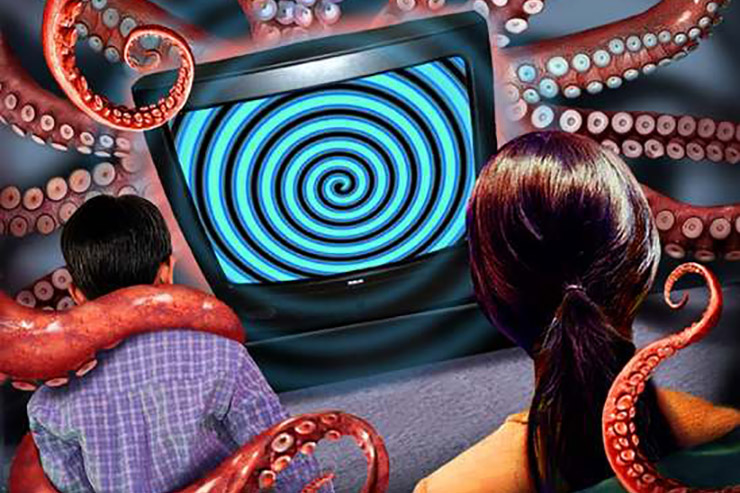
    The mass media is the biggest remote control ever built, and we all exist within the four-walled idiot box it controls. Manipulation of thought and behaviour is a part of our accepted daily lives. Each time we lock eyes on a news story, whether on the tube, the screen, the tablet or the old fashioned way, via a newspaper, we are buying into a perspective that may or may not be our own. We read stuff, and readily accept it as reality, often without ever bothering to source the information or take the time to perform due diligence and research the subject more deeply. We then pass on some of that information to others, and the viral effect can now, with the Internet and cell phones, travel on a global scale in a matter of minutes.

    If you wanted to truly control the minds of the masses, what better way than buying time on the media outlets the masses most visit? And the most effective types of media most able to manipulate our behaviour and change how we think… and even consume? News media, advertising… and now, social networking.

    Get ready to have your channel changed, because with the sheer amount of social programming faced on a daily basis, you are no longer in control of your own remote.

    Media Manipulation

    It’s all bad news, all the time. The stories that bombard us on television, radio and even social networking often tend to be depressing, fearful and anxiety provoking… and they spread like wildfire. But we all know that good things happen in the world. Why then does the media love to focus on the blood, gore and violence? Because we respond to it, that’s why.

    Negative news stories dominate the news because we are hard-wired to respond more to them. It’s simple brain science, really, and harkens back to our days of needing every bit of news we could find in order to guarantee our survival. And much of that news involved FEAR. Predators, lack of food and water, bad weather, other nasty humans… our primitive brain responds to bad news because at one time we needed to know it all. Who cared about the good stuff when there was a chance of death around every corner?

    In his book Secret Societies and Psychological Warfare, author Michael A. Hoffman brings up a strong point for the hypocrisy and mixed messages the media sends, especially when it comes to two of the viewing audience’s favourite things – sex and violence.

    “Have you ever noticed how television and print media will scream themselves hoarse in news documentaries, editorials and heavy analytical pieces about ‘rising pornography, crime, violence, gunplay’, etc? And yet in the same TV Guide announcing the latest special on ‘The Crisis of Sex and Violence’ will appear an advertisement for Miami Vice, the ‘show that brings you the action and excitement you’ve come to expect’, etc. Or your newspaper will condemn sex and violence in the loftiest terms but there in the entertainment section is a half-page advertisement for a new ‘action’ movie accompanied by a photo of women in string bikinis and high heels fondling automatic pistols and machine-guns.”

    Hoffman calls this the Double-Mind of mass media, and we are all guilty of buying out of, and right back into, each of the two minds… the one that repels and the one that accepts. The use of images to alter our emotions is an age-old way of manipulating behavioural responses, and the media excels at imagery that shocks us, terrifies us, and titillates us.

    Misinformation vs Disinformation

    Yet much of the information we are bombarded with via a variety of media sources is not corroborated or fact-checked. Many of the news ‘outlets’ people are getting their news on are satire sites, or blog sites, or websites that allow anyone to post a story without having to prove their points or source their material. It’s become standard business to spread and take viral the most shoddy reporting, which would never hold up to journalism standards of old, even without bothering to find out who funded the story, who owns the website it first appeared on, the source of the information, and whether or not any other news source has reported on it.

    If it’s in print, or on the Internet, or the TV… we buy it. Who has time to find out if it’s true or not? Besides, if you see it in the media then it must be true, right?

    Misinformation abounds. This is information that has no basis in fact, or is the result of poor journalistic skills or shoddy reporting. This is information that mistakenly is called fact and gets spread from person to person, network-to-network, and often goes global before someone decides to finally do a bit of fact checking. By then, it’s often too late, as the populace has already accepted the information as valid and real. Even when later presented with facts, it rarely changes the minds of those already entrenched in the falsities, especially if those falsities support their ideologies and worldviews.

    Disinformation is planted on purpose, like seeds that will grow into accepted facts. Propaganda, rumour, gossip, news, and fear-mongering all spread with an agenda, usually to provoke fear and paranoia and cause people to react in a specific manner.

    Sometimes it’s hard to tell misinformation from disinformation, and often the manipulation occurs in a subtle manner on a subconscious level, which makes it harder to pinpoint, and therefore refute. One of the main reasons why we allow this is because we are so willingly distracted by the media’s idea of what we should know. We would rather spend our time and energy on these distractions than have to face our own truths.

    This could easily explain the power of social networking to create its own form of mind control, as more people spend more time on sites that allow for every possible form of distraction.

    Facebook & Social Networking

    In 2012, the megalith known as Facebook did something quite nasty to its followers. 700,000 unwitting users were basically utilised as guinea pigs in a gigantic social experiment that allowed Facebook to manipulate emotions and emotional responses, without telling anyone it was doing so. Facebook data scientists set out to see if they could influence the emotional state of site users and prompt them to post more positive or more negative content. Using an algorithm that automatically omitted certain content that was either positive or negative, Facebook researchers manipulated users for one week, later publishing their data in the March issue of the Proceedings of the National Academy of Sciences. But once the secret experiment got out, people screamed about the blatant invasion of privacy and manipulative, deceitful tactics of the experiment, even causing some of the scientists behind the study to apologise for their less than ethical methodology. Privacy lawyers and organisations came forward, admonishing Facebook for violating the rights of the users, who were never told about the research.

    Problem is, Facebook had been doing these kinds of things for years, changing the functions and looks of the site to better serve their users, and give them more access to personal information at the same time. Users just didn’t know they were being manipulated until this particular study got attention. The forces behind Facebook understood how easy it was to influence the emotions of users with very little work, and all of it under the radar of the users. Subconsciously, these users were being swayed, even if they weren’t consciously aware of anything different on the site during the week of the study.

    Social Programming

    Are we being ‘programmed’ in the same way we program our DVRs to record our favourite shows? Also known as ‘social engineering’, this tactic of politics, religion and corporate consumerism, even education and academia, involves literally engineering the behaviour, attitudes and desires of large groups of people. Real social engineering is done using specific scientific methods of analysis and decision-making, often for more academic purposes. But social programming goes on every day in ways that are not necessarily meant for the greater understanding of humanity.

    Similar to propaganda, social programming is a type of public relations that sways large groups to accept, deny, support, resist, or anything in between. One of the pioneers of public propaganda, known as the ‘father of public relations’, was an Austrian-American nephew of Sigmund Freud, Edward Bernays. Even though he had a degree in agriculture, he was fascinated by the use of propaganda during wartime, and wondered if the same rules and methods could be applied in peacetime as well. He dove headfirst into the world of psychology and public relations, linking the two to design his own concepts of public persuasion and what he called, “the engineering of consent.”

    By understanding how “group mind” worked, Bernays believed the masses could be controlled and manipulated without being aware of it. He used a lot of his famous uncle’s theories in his quest to shift public perception and promote specific behaviours, including his own desire to help out big business by treating the mass distribution of ideas the same way a company would treat the mass production of materials. His 1928 book Propaganda remains a highly influential examination of his work documenting the relationship between what he called an “invisible government, the true ruling power of the country” and the public that was ruled over, something Bernays saw as necessary to keep order over the chaotic masses.

    This kind of social control is really about regulating the behaviour of both individuals and groups of people in a society, with the influence of propaganda as one of the tools of control.

    Media Methods

    Some of the methods used by the mass media to control the viewers and influence the populace are obvious. Others fly under the radar. All are insidious and are motivated by the desire to reach, and in some way control the largest audience possible.

    Framing is a means of changing public perception about a subject or concern by imposing a ‘frame’ or base of information around the subject. This frame doesn’t necessarily present false information, but rather accentuates specific positives or negatives of the image presented within the frame. Think of a piece of art that may be very straightforward, at least on the surface, yet changes in the eye of the beholder when surrounded by an ornate frame, opposed to a plain plastic one. The media and politicians use framing as a way of getting people to accept a specific party line of thought surrounding a news story or issue.

    To frame an idea is not necessarily mind control, but it is a way to influence thought and behaviour. Two completely different groups of people, representing extremes on an issue, can find a way to frame their points of view on the issue that might actually appeal to those in the middle of the road. Framing can make an extreme concept less intolerable, and a tolerable concept more extreme, depending on how it is used.

    Language is yet another great method of swaying public thought and perception. Use of specific words and phrases can literally shape a society’s political and religious direction, and create a mentality that is as submissive as the elite in control could hope for. Look at the whole ‘us vs. them’ media assault with stories of ‘those blacks’ or ‘immigrants’ or ‘feminists’ or ‘the dirty poor’ or ‘the lazy homeless’ or ‘those terrorist Muslims’ and it’s easy to see how countries can be prodded into accepting violence, aggression, intolerance, bigotry, sexism and even war. By making someone else the threat, the enemy, the reason behind our problems and the thing to be feared, we can shrug off our own responsibilities and dysfunctions and blame the ‘other guy’.

    False accreditation is another way of getting people on board an issue or eager to buy a product or serve a purpose. By mentioning ‘scientific studies’ or some vague ‘ten doctors out of eleven’, an advertiser or news agency can get plenty of people to blindly accept that a new product is worthy of their hard earned dollars, or that such-and-such doesn’t really cause cancer. Giving credit to science, even when it’s false credit, carries a ton of weight with consumers and news audiences, who are too busy and distracted to actually go and research the claims themselves to see if they hold water.

    People have been dumbed down to the point where anything presented as fact, news or science is accepted without a second thought. It’s that second thought that is so critical, but it doesn’t happen often, leaving us reeling, wondering how we got collectively duped again and again.

    [alert type=”info” dismiss=”no”]If you appreciate this article, please consider a subscription to New Dawn magazine.[/alert]

    If You Can’t Beat ‘Em, Distract ‘Em

    Attention is everything, and there are numerous ways to distract a person, and a group of persons. Some of the methods of distraction used by corporations, advertisers, news outlets, politicians and others include:

    • Promoting nationalism – When something happens that threatens our nation, we jump on the patriotic bandwagon, to the point of supporting wars that we cannot afford or getting behind political and religious movements that promote intolerance.
    • Wagging the Dog – How do you get people to stop focusing on a critical issue? By presenting them with an issue that gets more news time, even if it’s trivial and sensationalistic. Someone having an affair? Political scandal? High-powered divorce? Distract them with dirty laundry!
    • Scapegoating – Look for the weakest opponent and focus on him or her. The weak link in the chain is enough to break the chain, and is a surefire way to get public eyes off the chain itself.
    • Misinformation and misleading – When you want the truth to stay hidden, reframe it with a little bit of falsehood, repeat it often enough until it sticks, and sit back while it goes viral.
    • Demonise the other guy – When we want to take the attention off our own sins, what better way than to focus the public lens on the demons in the other guy? Remember McCarthyism in the USA, when people who were against the government’s actions were labelled “Commies” and “America-haters?”
    • Fear mongering – The big one, for what better weapon against common sense and sanity is there than fear, especially hysteria-driven fear? We saw this played out recently with the panic over a few Ebola cases in America that sent the country into a media-driven frenzy of terror and anti-African sentiment.

    Subliminals & Under the Radar Mind Control

    The use of subliminal imagery and words in advertising is well known by now, and with the advent of the Internet, social networking, and technology that allows you to make a fake photo that looks real, anyone can create a subliminal meme or message.

    Back in 1957, a market researcher named James Vicary decided to see what would happen if you inserted words or phrases into a motion picture. Words such as ‘eat popcorn’ and ‘drink Coke’ were inserted into the frames of a movie, just for a single frame and therefore not even long enough to register consciously, and resulted in an increase of sales afterwards. Those results were later called a hoax, but the concept stood strong and the age of subliminals was born, with all kinds of studies, including one at Harvard in 1999 looking at the power of flashing words and images over the subconscious, often with intriguing results. Could you make someone buy a product just by showing a single frame image of a half naked woman holding the product, even if the person buying it didn’t LIKE or NEED the product? Could you implant ideas and images directly onto the pliant and impressionable subconscious so easily?

    The answer was a definitive yes, and controversial, subliminal imagery has been used in product advertising, politics and even in motion pictures and television shows. One of the most interesting uses of subliminal imagery occurred in the movie The Exorcist, where an image of a white-faced demon named Captain Howdy flashes on the screen now and then, despite author William Peter Blatty’s outrage against the use of the image in his film. Another involved the 1943 animated Warner Bros. movie Wise Quacking Duck where Daffy Duck spins a shield. On one frame the words “Buy Bonds” appear on the shield. In one of the most blatant attempts at corporate advertising, an episode of “Parks and Recreation” titled “Community” contained a scene with a Microsoft logo and stickers. Microsoft just so happened to sponsor that particular episode to promote its new Bing search site.

    The technology to not just insert these images into movie frames or paper adverts, but to literally implant them directly into the brain, does exist. An actual United States Patent, 6,506,148, submitted in January of 2003, titled “Nervous system manipulation by electromagnetic fields from monitors,” documents the highly detailed technology available by which, as the Abstract reads, “it is possible to manipulate the nervous system of a subject by pulsing images displayed on a nearby computer monitor or TV set. For the latter, the image pulsing may be imbedded in the program material, or it may be overlaid by modulating a video stream, either as an RF signal or as a video signal.”

    In other words, the manipulation is no longer just done via a single frame here and there, but by actual modulation of the feed or signal and coming right at you via your home computer, cell phone, or television set… even your DVD player. And the manipulation occurs at a remote source.

    “For a TV monitor, the image pulsing may be inherent in the video stream as it flows from the video source, or else the stream can be modulated such as to overlay the pulsing. In the first case, a live TV broadcast can be arranged to have the feature imbedded simply by slightly pulsing the illumination of the scene that is being broadcast. This method can of course also be used in making movies and recording video tapes and DVDs.”

    Desensitise the Masses

    Perhaps it’s all a means of desensitising the masses to the violence, hatred and intolerance in the world. Perhaps it’s a means of numbing the populace to the realities that they have no power, no wealth and really, no say in how the world around them works. By using constant violence, whether on the news or in entertainment shows, and by exposing certain themes of misogyny, racism, and subjugation, eventually the viewing audience comes to accept it all as normal. Desensitisation is a powerful way to get someone to go along to get along, even if it means going along to his or her own death and destruction. Break down the inhibitions, expose the brain to constant images that would otherwise be repellant, and hammer the spirit with darkness and death and fear… and you have the perfect consumer, the perfect citizen, numbed to choices and rebellion.

    In his seminal work Mind Control in America, Steven Jacobson writes: “The techniques of psychotherapy, widely practiced and accepted as a means of curing psychological disorders, are also methods of controlling people. They can be used systematically to influence attitudes and behaviour. Systematic desensitisation is a method used to dissolve anxiety so the patient is no longer troubled by a specific fear, a fear of violence for example.” Jacobson explains how this process serves to allow the patient, or in this case, the public, to adapt to situations and ideas that once terrified them, if they are exposed to them enough.

    Zbigniew Brzezinski, when he was US National Security Advisor, once said: “In the technotronic society the trend would seem towards the aggregation of the individual support of millions of uncoordinated citizens, easily within the reach of magnetic and attractive personalities effectively exploiting the latest communication techniques to manipulate emotions and control reason.”

    Ultimately, we can control what we look at and listen to. We can find better outlets for getting information, maybe even use our own discernment and source the material that is presented to us as fact. Our minds can only be controlled to the extent that we remain numb, unaware and distracted.

    Once we wake up, take back the remote control of our lives, and begin to program our own minds the way we prefer and according to our own ethics and goals and values, it gets an awful lot more complicated for anyone else to take up residence there.

    Reprinted, with permission of the publisher, from MIND WARS © 2015 Marie D. Jones and Larry Flaxman. Published by New Page Books a division of Career Press, Wayne, NJ. 800-227-3371. All rights reserved.

    [alert type=”general” dismiss=”no”]This article was published in New Dawn 151.[/alert]

    [alert type=”success” dismiss=”no”]If you appreciate this article, please consider subscribing to help maintain this website.[/alert]

    © New Dawn Magazine and the respective author.
    For our reproduction notice, click here.

  • Poisoned Mind: Social Media in the 21st Century

    Poisoned Mind: Social Media in the 21st Century

    From New Dawn 150 (May-June 2015)

    According to an article on the website of ‘Radio Free Europe’, a nondescript modern 4-storey building on Savushkina Street, St. Petersburg, houses the innocuously titled ‘Internet Research Centre’.

    Inside the building operate government controlled and tasked teams of professional ‘trolls’. Spread across approximately 40 rooms, the trolls prowl the Internet in 12 hour shifts, generating pro-Kremlin comments and ‘gaming’ Internet forums and online conversations.

    St. Petersburg blogger Marat Burkhard recently came forward to describe the apparent covert activities in detail. Burkhard describes his co-workers as “politically illiterate young people” who must be briefed on current topics at the beginning of each shift and continually supervised.

    At this point it would be pertinent to note the source of the article – Radio Free Europe – notoriously a CIA funded propaganda outlet for decades (now financed, more obtrusively, through the State Department and ‘private donors’). While only the congenitally naive would doubt the veracity of the article’s basic claims, what is (unsurprisingly) lacking is context. Whether financed and operated by Russia’s intelligence agency FSB, or some other shadowy enclave, it is estimated that the entire Russian security establishment currently operates with just one twentieth (1/20) of the US equivalent (not even including the UK and other close Western allies).

    What that means, in a nutshell, is that for every Internet Research Centre in Russia, the CIA/NSA/GCHQ/private contractor nexus would be operating the equivalent of (at least) 20 such centres. Flooding the social media networks, news and other sites of their domestic populations with thousands upon thousands of comments, posts, disruption, disinformation and propaganda bullets every day. Salvos in an escalating, but largely unseen, ‘Information War’.

    Furthermore, recent reports cite the development of software that actually scours the web, automatically switching between user names/identities and generating propaganda, provocations and automated comments as it goes. Coupled with Google’s recent announcement of A.I. software that can discern (Google’s version of) ‘the truth’, it doesn’t take much imagination to envisage any online expression of ‘untruth’, ‘heresy’ or ‘dissent’ being automatically swamped beneath a torrent of managed obscurity, cyber-troll bile, distraction and chicanery.

    Seismically underreported, similar allegations about the ‘troll farms’ or ‘web brigades’ of the West (such as GCHQ’s ‘77th Brigade’) have barely surfaced in the blinding mass of ‘Snowden Revelations’. Chilling images (reportedly leaked from internal GCHQ presentations) document operations in ‘virtual communities’, ‘social identity theory’, ‘herding’, ‘mimicry’ and the ‘psychology of deception’. Much of the language used seems best suited to neutralising dissent and activism in the ‘target’ (domestic) populations (and not the lame-duck excuse of ‘fighting terrorism’).

    As an astounding amount of human activity and intercourse migrates online, public spaces empty and forums/social media fill with a new species – homo digitalis – a being safely cubicled and shepherded into approved opinions, paradigms and navel gazing.

    Accordingly, corporations now view social media and online social networks as their plaything and happy-hunting-ground – each ‘like’, ‘trend’, ‘tweet’ and online action the precious raw material to map, direct and monetise consumer behaviour. Edward Bernays (pioneer marketeer, nephew of Sigmund Freud and author of the seminal text Propaganda) could hardly have dreamed of the marketing, perception management and social engineering possibilities now available at the press of a few attractive and endorphin-stimulating keystrokes. Today’s brave new keyboard-warrior looks an awful lot like yesterday’s plantation indentured servant or herd of cattle (in sleek, Apple designed ergonomic garb).

    A plethora of research (let alone common sense) suggests that our reliance/addiction to social media and its associated devices is already having a profoundly deleterious effect on basic cognitive skills, human interaction, attention spans and functional intelligence. Factor in a cocktail of narcissistic personality disorders and body dysmorphic disorders (with a chaser of smartphones and other hand-held devices) and humankind looks at last set to plunge over the precipice of unfathomable stupidity.

    Doubtlessly technologists (and the teams of psychologists who work for them), minutely design every latest gadget to further exploit the very human weaknesses of vanity and the desperate need to be endlessly and pointlessly distracted. A chronically self-obsessed, trivialised generation (like no other generation before it) of ‘selfie’ snappers and banal ‘tweeters’ is the technocrat’s utopia.

    Disinterested, disenfranchised and disengaged from the outside world, ‘Generation Now’ (the iGeneration) have become tyranny’s best enablers – politically, philosophically and spiritually ineffective – vapid consumers and mindless infants. Delivering themselves up ‘freely’ to the corporate-military-complex – their every mood, ‘status’, location, relationship and conversation accessible in real time or stored in vast information vaults secreted away in distant desert bunkers.

    The very architecture of social media seems intrinsically designed to be nothing more than a gargantuan electronic trap to collect as much data, biometric and psychological information as possible about the population.

    Facebook’s notorious ‘experiments’ in ‘emotional contagion’ and political herding become even more sinister when placed in their rightful context. Despite Facebook’s chummy image and branding, ostensible founder Mark Zuckerberg has made it clear in numerous interviews his desire to mould a future of what can only be described as pure techno-totalitarianism. A consumer’s/user’s every action and thought mediated through the ‘safe’ interface of Facebook – always surveilled, always stalked and tabulated – available to corporations and intelligence agencies at all times. ‘Dangerous’ physical interactions minimised and discouraged.

    Whilst Facebook may have a hidden nativity story, its birth secretly shepherded by funds channelled through In-Q-Tel (the CIA’s venture capital arm), the same in fact may also apply to the very foundational platforms of the Internet itself. Recent research by journalist Nafeez Ahmed has revealed the cosy (symbiotic even) relationship between (‘Don’t Be Evil’) Google and the entire American intelligence apparatus. Mediated through a decades-old shadowy group known as the ‘Highlands Forum’ – leading technologists, corporate heads and intelligence chiefs have met privately innumerable times to cross-pollinate innovations, strategies and policy.

    Ahmed makes it clear that the entire contemporary surveillance landscape may well have been seeded through the Highlands Forum, as business and the secret state pursue their (remarkably similar) aims. Much like the unspoken ‘revolving door’ that operates between the Pentagon and the armaments industries – the board members and senior officials of Google, Facebook and alike have the striking habit of being familiar faces from the recesses of the Pentagon, CIA, NSA and so on. So ubiquitous is this limited personnel pool, that ultimately the question must be asked whether Google and Facebook are simply not just clandestine arms of the national security state.

    No matter how earnestly we may choose to look the other way, even the bedrock technology of the Internet itself (developed apparently to protect communications in case of a devastating nuclear conflict at the height of the Cold War) are naturally products of ARPA (the predecessor of today’s DARPA) the research and development arm of the Pentagon.

    Does it take the mind of a paranoiac to wonder whether decades of social engineering research, think-tank profiling and Rand Corporation policy directives, coupled with the natural desires of bureaucrats, tyrants and salesmen (control of a captive market), has finally produced the perfect homogenised and pasteurised Panopticon Supermarket? An online, and global, Stepford village.

    The only rational reaction to such a possibility is disconnection. To remove oneself from the insidious web of trivia, celebrity inanities, prefabricated media events and puerile conversation. Escape from the moronic matrix. But who has the courage to do that?

    And anyway, I’ve got to check on the status update of my friend’s friend’s friend of a friend’s friend…

    [alert type=”general” dismiss=”no”]This article was published in New Dawn 150.[/alert]

    [alert type=”success” dismiss=”no”]If you appreciate this article, please consider subscribing to help maintain this website.[/alert]

    © New Dawn Magazine and the respective author.
    For our reproduction notice, click here.

  • Manipulations & Mind Games: The Secret Battle to Control How We Think

    Manipulations & Mind Games: The Secret Battle to Control How We Think

    This article was published in New Dawn 144 (May-June 2014)

    Throughout history the mechanisms of persuasion and influence have always been manipulated by those in power as a means to maintain authority and legitimacy. In more recent times the overall manipulation of the mass public mind has become less about overt spectacles of fear and obedience, and more about subtle forms of media propaganda. The manufacturing of consent1 is endemic and has become a pervasive presence within modern societies.

    Edward Bernays,2 who has been called ‘the father of public relations’, was a nephew of Sigmund Freud and introduced psychological and psychoanalytical methods into modern propaganda. Bernays considered media propaganda essential for manipulating public opinion because society, in his regard, was composed of too many irrational elements (the people) which could be dangerous to the efficient mechanisms of power (‘democracy’). Within the context of our modern mass societies, propaganda has morphed into a mechanism for not only engineering public opinion but also as a means for consolidating social control.

    Modern programs of social influence could not exist without recent developments in mass media. Today, it exists as a combination of expertise and knowledge from technology; sociology; social behaviourism; psychology; communications; and other scientific techniques. Almost every nation state has made use of a controlled mainstream media, to various degrees, for the regulation and influence of its citizenry.

    By way of mainstream media, a nation’s controlling authority is able to exert psychological influence upon people’s perception of reality. This capacity works hand-in-hand with the more physical components, such as enforcing the legal system and national security laws (surveillance and monitoring). State control, acting as a ‘psychological machine’, instigates specific psychological manipulations in order to achieve desired goals within its national borders (and often beyond).

    Examples of these psychological manipulations include the deliberate use of specific cultural symbols and embedded signifiers that catalyse conditioned reflexes in the populace. These triggers have included ‘Red’ and ‘Communist’ during the US’s 1950s McCarthyism; or ‘Muslim Terrorist’ during the recent media-hyped ‘War on Terror’. Targeted reactions can thus be achieved making the populace open to further manipulation in this state. This is a process of psychic re-formation that works repeatedly to soften up the people through continued and extensive exposure to particular stimuli. These are often the subconscious symbols we live by – artificial signifiers in order to create a compliant society.

    Today’s media, which includes the dominant presence of advertising, extensively uses the notion of ‘attractors’ and ‘attractor patterns’ to target audience consciousness. This type of symbol-manipulation is often referred to in the business as neuro-marketing. Mainstream media corporations are using the huge growth in global communications to further shape their science of targeting human consciousness.

    In the case of neuro-marketing, many advertisers first audience-test their commercials using brain-scanning techniques in order to know which part of a person’s brain is being activated by specific strong attractors. For example, it has been discovered that specific attractors can bypass the logical part of the brain and impact directly the emotional part. In such cases, as in the film industry, the advertisers place an award symbol (such as an Oscar or Golden Globe) which has proven to be an effective ‘strong attractor’ that influences the emotional part of the brain. The philosophy here is to adjust the level of consciousness of an advertisement in relation to the measurable level of consciousness of the consumer.3

    Advertisers are aware that a person’s consciousness passes on messages indirectly to the body in the form of galvanic skin response, pupil response, electrical nerve response, etc, and so every element of the screen promotion must elucidate the correct conscious reception. In order to achieve this correct set of attractor patterns, all elements are deliberately worked on: the music, the visuals, the script, the voice. Interesting, symbolic strong attractors that have the most impact to persuade the audience include visuals such as smiley faces and cute animals (dogs wagging their tails and kittens purring). In terms of voice, they include words such as ‘honesty’; ‘integrity’; ‘freedom’; ‘hope and change’; ‘friendship’, etc. For this reason it can be seen how politicians use a great deal of these attractor-patterns in their speeches and promotional material.4

    Other methods of blatant media coercion include the use of so-called ‘expertism’; that is, using the expert in the white lab-coat tactic for creating simulacra of truth. For such propaganda to be effective it cannot be too far off the truth; in other words, it must have the appearance of reality. Trade, employment, and financial figures are an example of this when the media discusses statistics as if they represented the truth. And which members of the general public have the knowledge or the resources to check and confirm such figures? Those people that do know are usually those that have a vested interest in maintaining the illusion, such as traders and financiers. As a norm, statistics of a negative connotation are usually drawn from the smallest possible pile. And once a false (or ‘doctored’) claim is disseminated and accepted by the public, it becomes established and hard to deconstruct or invalidate (unless persuasive anti-propaganda is just as effective).

    Accepted Forms of ‘Individualism’

    Modern societies are set-up to accommodate and appeal to not only the mass collective but also to individualism. But the forms that accepted ‘individualism’ takes are often a sheath to hide the workings of a mass psyche. It is the ‘allowed liberty’ that is provided to the modern person in pursuit of material gains as long as they remain within the parameters of their established society. Liberty, then, is an expression of mobility within a pre-described system: it does not denote liberty external to the system. Examples are the rock clichés that the mainstream media love to promote and adorn their front pages. Notables are the raging antics of destroying hotel rooms and throwing televisions out of the window, behaviour that later morphed into copycat corporate rock PR. In essence, such ‘rebels’ are allowed, and even encouraged, because their antics sell records. Rebelliousness in these forms is thus another contribution to a consumerist society, albeit through a different manner. And today there are many forms in which individualism is allowed to manifest as long as it plays within a pre-described system.

    Another form of individualism is corporate-media centralisation masquerading as diversity and choice. The display of diversity in the information coming from the mainstream media gives the illusion of independent reportage and news. Yet mainstream media, if it is not government owned, is likely to be owned by a corporate conglomerate, often with high-level state relations. An individual is generally attracted to a particular newspaper that reflects their views, beliefs, lifestyles, etc, without suspecting these are all diversified patterned behaviour within the system. The mainstream media caters for these needs by operating a variety of newspapers that support these mythical standpoints, whether they be politically left, right, left/right of centre, liberal, independent, this, that, or any other of the positions available for the ‘diversity within the unity’ of the mass mind.

    Concentration of Media Ownership

    It is somewhat worrying to learn that most Western media organisations are owned by only a handful of giant corporations: News Corp; Viacom; Time-Warner; Disney; Vivendi Universal, and Bertelsmann. For example, Disney (The Walt Disney Company) is the largest entertainment and media multinational in the world. Disney owns the TV networks ABC (USA), Disney Channel, ESPN, A&E, and the History Channel, as well as publishing, merchandising, and theatre subsidiaries. They also own Walt Disney Pictures, Touchstone Pictures, Hollywood Pictures, Miramax Film Corp., Dimension, and Buena Vista International, as well as 11 theme parks around the world.

    News Corp comes in next as the world’s second largest media multinational with an incredible range of TV and satellite channels, magazine and newspaper holdings, record companies and publishing companies based worldwide, with a strong presence in Asian markets. Similarly, Time-Warner owns more than 50 magazines; a film studio as well as various film distributers; more than 40 music labels (including Warner Bros, Atlantic, and Elektra); and several TV networks (such as HBO, Cartoon Network, and CNN).

    Viacom owns TV networks CBS, MTV, VH1, Nickelodeon, Comedy Central, Paramount Pictures, and nearly 2,000 cinema screens, as part of their media empire. Likewise, Vivendi Universal owns 27% of US music sales via labels such as Interscope, Geffen, A&M, Island, Def Jam, MCA, Mercury, Motown and Universal. They also own Universal Studios, Studio Canal, Polygram Films, Canal+, and numerous Internet and mobile phone companies. Then there is Bertelsmann which, as a global media corporation, runs Europe’s second largest TV, radio and production company (the RTL Group) with 45 TV stations and 32 radio channels; Europe’s largest printing and publishing firm (Gruner & Jahr); the world’s largest English-language general trade book publisher (Random House); the world’s largest book and music club group (Direct Group); and an international media and communications service provider (Arvato AG).

    In terms of mainstream news reporting it is always important to check the source when reading a news item, i.e. is it of an independent source or is it ‘according to a government source’, etc. The mainstream media is largely fed via global news wire services, the two largest being Reuters (now Thomson Reuters) and Associated Press. The Rothschild banking family bought Reuters around 1895 and in 1988 Reuters bought 44% of Associated Press. This again constitutes a centralisation of news information, as well as the various well-established political press offices. When such sources (especially PR offices) disseminate information as ‘truthful news’, it is doing nothing more than was parodied in Orwell’s 1984 as Newspeak.

    Each day the mainstream media offers a kaleidoscopic view of the world – tragedies, disasters, coups, and politics flash before the eyes like a glitterball. As a result the viewer rarely has the chance to focus on one issue, and generally remembers very little. Nor is there the need to remember a specific event as the next day it is likely to be replaced by the next item of news. In this way the average viewer is granted their ‘nourishment’ and feeling of ‘open news’ whilst at the same time being denied any real depth of knowledge. In such media-saturated environments people are provided with a conversation space or talking point amongst friends and work colleagues; or as a buffer zone to cover up the embarrassment of a non-communicative family. And if all hell breaks loose at work, at least you have Breaking Bad or The Walking Dead waiting for you on the home screen!

    The mainstream media and entertainment industry also manipulate viewers’ emotions through the continual images of sexual arousal to the point whereby many of us are desensitised and more accepting of sexual misconduct. The media of escapism allows us to live out our fantasies in what is considered a less harmful way. It provides us with an external platform on which to project our wishful desires. It is supposed to placate us, to make us forget the drudgery of our humdrum lives. There are also those few who are motivated to mimic the acts seen in the media, whether through violence or sexual perversion. No doubt the few who do indulge are considered worth the trade-off against the millions who are mollified and happily passive in front of the screen.

    The creative capacity of human imagination is being substituted for a ready-made set of imaginative programming. We don’t need to imagine for ourselves when the whole stage-show is presented to us in magnificent Technicolour and computer-generated imagery (CGI). We have our tickets into the ‘flight into unreality’.

    Arrested Development

    Another more worrying possibility is that television can act as a factor in causing arrested development within younger children, thus resulting in a later generation of less neurologically developed adults. Child researcher Joseph Chilton Pearce has published findings that indicate how television prevents the higher brain in children from developing as television engages solely with the lower (aka reptilian) brain. If the higher brain is not activated sufficiently through external stimulation – which it rarely is via child institutions – then at age 11 the brain begins to destroy many of its unused neurons. This can lead to a permanent condition of arrested development, according to Chilton Pearce. What this points to is a serious lack of proper stimulants for many children in overly institutionalised and controlled social environments. Also, our brains do not fully mature until we are around age twenty-five, which explains the early targeting of children through advertisers and conditioning institutions.

    Recent disclosures have described how large food corporations are targeting children through what has now been dubbed ‘advergames’ – free games to download onto smartphones and tablets that contain subtle advertisements for high-sugar products.5 A report commissioned by the Family and Parenting Institute, published in 2012, suggested that children’s brains process advergames in a different way from how they would process traditional adverts; that is, on a more subconscious and emotional level. In this context many children do not understand that such games are actually very sophisticated adverts and so have no conscious ‘cognitive defence’ to the food product marketing.

    This is no longer a one-way game, and the media landscape is undergoing a significant transition. What has changed the playing field of the media over recent years has been the rise of distributed and decentralised global communications between individuals. The Internet in particular, as well as other forms of social and community media, has spurred the growth of individuals seeking to verify information for their own selves. Independent media, such as is now coming of age via the Internet, has served to counter-neutralise some of the overwhelming persuasive power of mainstream media. This has helped to shift some people away from the propaganda that was previously virtually unchallenged. This bottom-up media revolution has seriously compromised the conditioning techniques used by governments and corporations alike. A major example of this citizen media revolution was seen during the Arab Spring, circa 2011, where civil resistance was effectively organised through social media networks. There are, as would be expected, now concerted efforts underway to censor the Internet and other social media networks in various nation states, as well as on a global level.

    It is therefore imperative that our independent media be protected; our social networks of free speech preserved; and our right to seek and speak the truth defended. Manipulating and messing with our minds has no place in a truly democratic and egalitarian future.

    You can explore these subjects further by reading Kingsley Dennis’s book The Struggle for Your Mind: Conscious Evolution and the Battle to Control How We Think (Inner Traditions, 2012), a revolutionary call to overthrow society’s mental controls and expand consciousness for the greater good of humanity. Available from all good bookstores and online retailers.

    Check out Kingsley Dennis’s follow up article “Winning the War of Minds & the Battle to Control How We Think” in New Dawn 145.  

    [alert type=”general” dismiss=”no”]This article was published in New Dawn 144.[/alert]

    [alert type=”success” dismiss=”no”]If you appreciate this article, please consider subscribing to help maintain this website.[/alert]

    Footnotes

    1. http://en.wikipedia.org/wiki/Manufacturing_Consent:_The_Political_Economy_of_the_Mass_Media

    2. http://en.wikipedia.org/wiki/Edward_Bernays

    3. This idea, as well as neuro-marketing, was given to me in personal correspondence by Darryl Howard, who sent me his research ‘Advertising in the New Paradigm’ (Darryl Howard & Associates).

    4. Anyone wishing to know more on this subject should investigate Neuro-Linguistic Programming (NLP).

    5. ‘Food giants target children with addictive “advergames”,’ www.independent.co.uk/news/uk/home-news/food-giants-target-children-with-addictive-advergames-9222302.html

    © New Dawn Magazine and the respective author.
    For our reproduction notice, click here.
  • Subconscious Manipulators: Take Your Life Off Autopilot

    Subconscious Manipulators: Take Your Life Off Autopilot

    From New Dawn 139 (Jul-Aug 2013)

    The idea of someone or something controlling our every thought and action is so 1980s. Let’s face it, we live out our modern, technological lives with access to instant communication and information that allows us to enjoy greater control and freedoms of thought and expression than at any point in recorded human history; right?

    Each of us draws comfort from the decisions we make, sure in the knowledge that we are individuals, masters of our own destiny. We mock those that aren’t as under the thumb, as easily lead, or weak. Underlying this attitude is the principle that no person or system has the right to influence or determine the free will of another. This may be true, but what if this truth was naive; that even the strong-minded could not trust the direction their thoughts were taking them?

    A Fabric of Lies?

    Why for instance do we accept laws that govern conduct and shunt every aspect of human experience into a narrow band of monotonous conformity? What if we were to strip society of its rules and regulations governing conduct; what then? Would we fall into anarchy? This social consensus maybe misplaced.

    Consider road signs and signals. Substantial reductions in traffic incidents and fatalities have been recorded in communities that have adopted a rather novel approach to road safety by removing street clutter. If this idea of so-called ‘naked roads’ seems counter-intuitive to you, just ask the resident exhibitionists of Christiansfeld, Denmark.

    In 2004, local libertarians stripped traffic lights and other road markings from a notorious crossroads in a bid to improve road safety. Surprisingly this simple act of faith saved Danish bacon, reducing the death toll to zero on a road which throughout the previous decade had claimed three lives every year. It is believed the fall in casualty figures was due to uncertainty over who had right-of-way.

    The late Dutch traffic engineer Hans Monderman did much to inspire this rethink. He devised schemes in the Netherlands that removed all traffic lights, signs and markings, and other driver instructions from the small villages of Drachten, Makkinga and town of Oosterwolde; all with great effect. Perhaps unsurprisingly removing red lights from a particular district in Amsterdam has yet to catch on.

    Interestingly, naked road studies like those in Christiansfeld suggest a re-think; that road signs, in some instances, offer about as much protection to the elements as the Emperor’s new clothes. Of course the Danish subjects in Hans Christian Andersen’s tale who saw through the head of state’s veiled attempt at modesty were considered subversive. So are road signs as useful as non-existent clothing? Does that make me subversive?

    Laws operate as a strong arm of social conditioning, in so much as they slowly undermine the ability of the individual to assess situations and make judgements based on past experiences. Laws make us passive; we look out to authority for answers rather than to ourselves within. The danger is we become easily manipulated and no longer able to question authority; not only because we have been conditioned to, but because we are being slowly stripped of the tools and acuity with which to do so.

    This point is telling when put under the microscope with other basic freedoms that have been removed on the back of trumped up, often unfounded fears over public safety.

    If this study asks us anything, it questions the extent to which we walk through life with little conscious free will at all. And that is not as stupid as it sounds according to some experts.

    ‘I’ is the One Per Cent

    Dr. Bruce Lipton is a stem cell biologist and bestselling author who believes that the conscious mind governs less than it would like to think it does. “The major problem is that people are aware of their conscious beliefs and behaviours, but not of that belonging to the subconscious,” says Lipton.

    The conscious I might take credit for decisions, computations, realisations and reactions, but in reality credit must go to the subconscious. Neurological experiments carried out by the late pioneering scientist Benjamin Libet suggest that conscious recognition of a pain event, in this case a pinprick to the finger, lags up to half a second behind the prick itself. It takes half a second for us to become conscious of stimulation of the sensory cortex. In other words our conscious experience of pain at the moment in time that the prick occurs is a temporal fraud. Essentially we feel a prick after the event.

    In his bestseller The User Illusion, Tor Nørretranders compares this fraud: that conscious experience is projected back in time in exactly the same way as a direct stimulation of the sensory cortex can be shown to project out onto the body. There is a good reason for this, he suggests: what we need to know is when our skin was pricked, not when we became conscious of it.

    Of course, in reality we can’t be half a second behind the eight ball and expect to stay in the moment, let alone in the game. Take, for example, the football midfielder that whips in a free-kick; he does not consciously calculate the angular projection and speed; he just whips, period. Pythagoras he is not. To perform, successful sports stars rely on instinct, automatic reactions based on subconscious programs ingrained by hours dedicated to practice and training. Conscious thought here is the bane of instinct, which experts say is not just left on the sports field.

    “Most people don’t even acknowledge their subconscious mind, that it is at play, when in fact this mind is a million times more powerful,” says Lipton. “We operate up to 99 per cent of our lives from subconscious programs.”

    In short, your conscious I, the ego, might not like it, but it’s under the thumb. Truth is it’s only let out to play when time permits. And even then our thoughts and actions are often simply the result of consciousness fielding thoughts and ideas pitched from the infinite depths of the subconscious mind. Slip of the tongue? Ah, that would be a curve ball. More often than not consciousness doesn’t even get to use what Nørretranders (and Libet) term as its veto, to otherwise accept or reject a choice or urge that the subconscious mind has already made. Many decisions and actions bypass our conscious mind altogether.

    Should we give up on the idea of conscious free will? It has its veto, but on the whole the numbers are not encouraging. According to Nørretranders, every second our senses pass on and process about 11 million bits of information to our brain. The vast majority, 10,999,984 or so bits of information, we remain unaware of, processed as it is by our unconscious, or what I refer to herein as subconscious mind. Such events are disconcerting for an ego; it likes to think of itself as solely in charge. But how can it be? It has no eye for a ball and can’t even hold down a job as a bouncer.

    Truth is our subconscious is open to suggestion. Subliminal messages easily bypass conscious perception. During the 1920s when radio first aired in the UK it was unpopular and seen by many as a sinister intrusion. To persuade would-be listeners the BBC planted a backward message in its jingles. The message when played forward was hidden, but when reversed could clearly be heard to say, “This is not a noose, no really it’s not.” In normal play the subconscious picks up on what the conscious cannot. Audible messages can also be played beyond the normal frequency range of human hearing. In both instances the subconscious mind may be programmed beyond conscious perception or approval.

    And it’s not just on radio.

    Remote Control

    Typically television and film footage runs at 25 frames per second. As it turns out subliminal images of a single frame can be slipped into a sequence that avoid conscious detection. Who knew? Baby (George W) Bush apparently. One reported incident occurred during the 2000 US presidential race when a TV advertisement focusing on who should pay for prescription drugs for the elderly included the slogan “bureaucrats decide”; the slogan preceded for a split second by the word “rats” accompanied by an image of Al Gore.

    “Television is a ‘dream come true’ for an authoritarian society,” explains clinical psychologist Dr. Bruce Levine. “Those with the most money own most of what people see.” Subliminal messaging is officially frowned on by most companies that operate in the public domain. Some companies have a code of ethics. Where there’s a profit to be made however, there are always those that don’t. Their behaviour is often modified simply by a fear of being found out. After all, technology today allows consumers to hit rewind, pause and dissect footage frame by frame.

    And why expose yourself to bad publicity, when you can make fear work for you openly. The control industry even has a name for it: television programming. “Fear-based TV programming makes people more afraid and distrustful of one another, which is good for an authoritarian society adopting a ‘divide and conquer’ strategy,” says Levine.

    For example, fear-based broadcasts are the lifeblood of the corporate mainstream media and don’t even pretend to hide from the conscious mind. The fact that large sections of society fail to see their underlying purpose could be argued is evidence of this affect. To such an extent, Lipton says, that people have been programmed to believe that they’re victims. “We’re programmed from childhood with beliefs. Sincesubconscious programs operate outside the range of consciousness, we don’t experience ourselves playing out these behaviours that can sabotage our own lives.” As a result, says Lipton, we don’t take responsibility for the lives we lead. We see ourselves as victims of forces outside of our control.

    “For instance, when we get sick, we were told that we must go to the doctor because the doctor is the authority concerning our health.” Thus we learn in our formative years that we are victims of bodily forces beyond our ability to control. “The joke, however, is that people often get better while on the way to the doctor,” says Lipton. “That’s when the innate ability for self-healing kicks in, a perfect example of the placebo effect.”

    According to Lipton, medical institutions operate on fear. “The funding and regulatory elements know that within each of us is the power to heal,” he explains. “For example, it is a proven fact that one-third of all healings are due to the placebo effect, which is controlled by the subconscious mind, but medical-related corporations based on making a profit don’t want us to know this.”

    Have You Seen My Watch?

    The effect of all this forces us to look outside for answers and guidance, rather than within – into the hands of those who program us further.

    Reality TV is a perfect example. Money and fame is the panacea we are sold. When the ‘I’ buys into this culture, it allows the outside world to define it. I reflect its values, and buy into its marketing of me. And what happens with most marketing? Scratch the surface and there is nothing of substance beneath. When we buy into these outward distractions, our conscious mind rejects the subconscious, the part of ourselves that we unknowingly value the most. Here is the modern malaise, and why in those moments of quiet solitude, the ‘I’ feels so empty.

    The idea of ego, of an independent me is empowering. But we are being sold a pup. The ‘I’, the conscious me, is not nearly all that I am. This is THE distraction. The ‘I’ is all of me, all of my subconscious urges, not just the conscious imposter that catches a reflective glimpse every so often of what the political class and its corporate masters will not even acknowledge to me exists. Thanks to this distraction one’s connection is stolen, one’s true voice. The sense of who I really am. The corporate elite is the pickpocket that distracts its victim before stealing his watch. And then how do you find out the time? That’s obvious, says Levine: “When you’re isolated and watching TV it interferes with the connection to one’s own humanity, which makes it easier to accept an authority’s version of society and life.”

    Authority has my voice and chances are I don’t even know it. According to Levine television achieves this by putting the viewer in a brain state that makes it difficult to think critically. It’s all those alpha brain waves, now just relax and let your eyes follow my watch. Alpha brain waves, some experts claim, are the bridge between the conscious and subconscious; a highly suggestive meditative state. Problem is the viewer’s focus is outward rather than within.

    Television offers no quality time to quietly reflect on what makes us unique, the very same spark that unites us, beyond the tired old dividing lines of class, politics and creed. “Television isolates people so they are not joining together to govern themselves,” says Levine. So we not only feel separated from ourselves, but from each other. Just what the doctor ordered. Now if we can just get back to erecting those religious divides, I’ve got a war to fight.

    Do laws, rules and the governing norms of behaviour really cause more problems than they solve? According to Levine this is a question that will take people, at least those who take it seriously, on an acid trip. “If you spend a lot of time thinking about how unnecessary laws are, and then don’t comply with these laws, eventually, logically, you will end up in jail,” says Levine. “Or if you obey laws that you think are bullshit, you will lose self-respect, integrity, wholeness, and feel like a pathetic hypocrite and potentially have a nervous breakdown and end up in a mental hospital. And jail and mental hospitals have lots of television.”

    Talk about coming full circle.

    Get the issue this article appears in

    Did You Look Inside?

    OK, so jail is a relative term; so too madness. Some might argue that by giving in to outside pressures to conform we locked up our innate subconscious many moons ago. And it is that which has us howling like some insane wolfman at every full moon that passes.

    Einstein once said that you can’t solve problems with the same level of consciousness that created them. The conscious mind cannot solve problems that its separation from the subconscious created. If we value peace and harmony and only focus on fear, is it not surprising when we access the same old negative programs? Einstein was equally specific when he described what he believed was the only truly valuable thing: intuition.

    According to bestselling author and intuitionist Laura Day, intuition is a faculty, like one of our five senses. In the same way that muscles waste when they are not used, education largely trains us to consider only what the system considers logical; what passes as the social consensus. As a result we do not take seriously and often throw away our best ideas, what make us different and potentially successful, because they come from flashes of insight.

    Intuition is all possibility, all knowing, and is at the heart of human discovery. Insight often has us asking: where did that voice come from? Or who found my watch?

    Scottish physicist James Clerk Maxwell not only summarised in four short equations all that was known about electricity and magnetism, but his equations succeeded in predicting phenomena that weren’t considered anything to do with these fields of study until after his death. How was this possible? In a sense, Nørretranders writes, Maxwell gave his own answer saying, “What is done by what is called myself is, I feel, done by something greater than myself in me.”

    What Maxwell was suggesting is common to many great advances, in that they arise somewhere in the mind that is beyond the control of consciousness. Intuition is responsible for the arts and the sciences as we know them, and across the whole range of human advancement and endeavour, if only we’d see it.

    The subconscious mind throws up answers that our conscious cannot even predict. The lesson here is to make informed choices; we must zone out from instructions, turn off the TV and tune in to within. Will this help us steer clear of acid trips? Maybe, maybe not. Intuition makes us resilient. It is our greatest teacher. It may trip us up, but it dusts us down. That comes from the freedom to choose. It does not do prisons or make prisoners of others. If that’s acid, then it surely beats neutral, which we are conditioned to believe is the only reality that should concern us.

    The author would like to thank Tor Nørretranders, Dr. Bruce Levine, Dr. Bruce Lipton, Dr. Kerry Crofton and Laura Day.

    Be sure to check out Nick Parkins’ article “Rise of the Technocrats” in New Dawn 145. 

    [alert type=”general” dismiss=”no”]This article was published in New Dawn 139.[/alert]

    [alert type=”success” dismiss=”no”]If you appreciate this article, please consider subscribing to help maintain this website.[/alert]

    © New Dawn Magazine and the respective author.
    For our reproduction notice, click here.