New Dawn – World's Most Unusual Magazine

Tag: new age

  • American Gurus & the Search for Enlightenment: An Interview with Arthur Versluis

    American Gurus & the Search for Enlightenment: An Interview with Arthur Versluis

    From New Dawn 154 (Jan-Feb 2016)

    Until recently the academic world paid almost no attention to the Western mystical and esoteric traditions. If any scholars strayed into these areas, they did so gingerly and apologetically, often feeling the need to sneer at these currents as a way of safeguarding their reputations.

    This situation began to change in the 1980s. A small group of academic scholars in mainstream universities began to pay serious attention to esotericism as a formative part of the Western spiritual and intellectual culture.

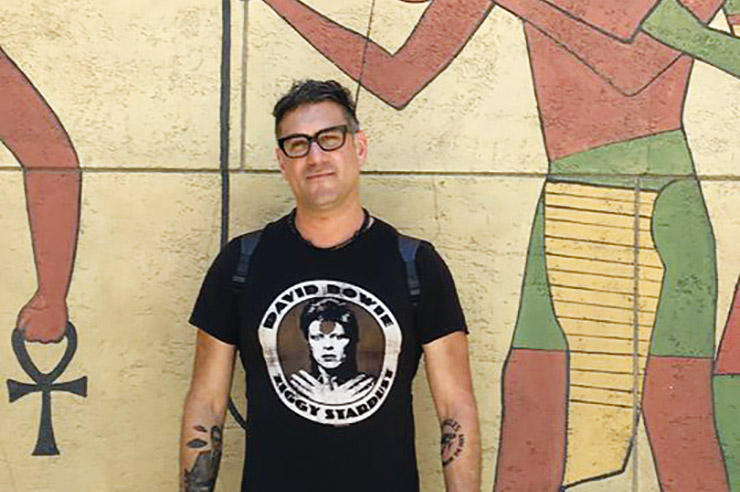
    Arthur Versluis (left) is one of the central figures in this development. Chairman of the department of religious studies at Michigan State University in the US, he has helped form a community of academics that share these interests. He is the founding president of the Association for Esoteric Studies, the leading academic research group in the US in this field, and founder of the online journal Esoterica.

    Versluis’s books include The Secret History of Western Sexual Mysticism: Sacred Practices and Spiritual Marriage (2008), Magic and Mysticism: An Introduction to Western Esotericism (2007); The New Inquisitions: Heretic-Hunting and the Intellectual Origins of Modern Totalitarianism (2006); Restoring Paradise: Esoteric Transmission through Literature and Art (2004); The Esoteric Origins of the American Renaissance (2001); Wisdom’s Book: The Sophia Anthology (2000); Wisdom’s Children: A Christian Esoteric Tradition (1999); and American Transcendentalism and Asian Religions (1993).

    His 2014 book, American Gurus: From Transcendentalism to New Age Religion, traces the rise of spiritual teachers outside the folds of religious traditions. Many of them claim to teach various forms of instant or immediate enlightenment.

    In October 2015, I conducted an e-mail interview with Versluis to discuss American Gurus.

    RICHARD SMOLEY (RS): One of the main themes of American Gurus is a phenomenon called immediatism. Could you talk a little bit about that?

    ARTHUR VERSLUIS (AV): Immediatism refers to a religious assertion of spontaneous, direct, unmediated spiritual insight into reality (typically with little or no prior training), which some claim is enlightenment. It refers to a claim of a “pathless path” to religious enlightenment, because the immediatist says “away with all ritual and practices!” and claims that direct spiritual awakening or enlightenment is possible at once, without meditation or years of guided praxis. In American Gurus, I show that an immediatist approach to enlightenment is deeply embedded in the contemporary religious scene, and is fundamentally a modern New Age phenomenon with some historical antecedents.

    RS: How has this quality of immediatism played itself out in the America of the last 150 years?

    AV: As I said, immediatism as discussed in the book is really a phenomenon of the last several decades. Of course, some antecedents are visible in Anglo-European American literature in much earlier authors. I argue that if contemporary American immediatism has a single ancestor to whom it owes the most, that figure is Ralph Waldo Emerson. In the book, I show that Emerson is much more deeply influenced by Platonism than is usually acknowledged today, and further, I discuss his work in terms of Emerson’s own gnostic experience. Literary critic Harold Bloom was right when he said that in American literature, the titanic figure is Emerson, and one can measure American literature as being before and after Emerson. Of course, Bloom wants to cordon off the term Gnostic to refer to the world-rejecting perspective attributed to it by Hans Jonas and those who follow his existentialist, early-twentieth-century interpretation of “Gnosticism” in late antiquity. However, in my usage, gnosis and gnostic have only their generic implications of one who claims direct spiritual insight, a “gnostic” being someone who experiences gnosis, or illumination. Emerson is the archetypal American figure in this regard.

    But strictly, speaking, Emerson is best described as a Platonist, whereas immediatism discussed in the latter half of the book is a contemporary or relatively recent New Age phenomenon based to a considerable extent, though by no means exclusively, in Neo-Advaitic Hinduism, or what is known as the “satsang movement.”

    RS: You contrast immediatism with Platonism. What are some of the main differences between the two?

    AV: Platonism, like Buddhism and Hinduism, includes contemplative practices and rituals. As I show in my new book Perennial Philosophy [see excerpt, ‘Leaving the Cave’, on page 60], Platonism centres on the contemplative ascent and illumination, and although it does not exclude the possibility of immediate illumination without praxis, it also certainly is not based in that. Immediatism, on the other hand, typically represents a claim that one does not need practices or ritual, but simply needs to be in the presence of a guru, or, sometimes, that one needs to do nothing at all. Immediatism is quite attractive in a New Age consumerist marketplace because it doesn’t ask anything in particular of us, but tells us that we’re “always already” “enlightened.”

    RS: Which of these do you feel more in sympathy with?

    AV: My admiration for and understanding of Platonism continues to grow. Plotinus is an extraordinary figure, whose work Enneads should be read by everyone in the West who feels called to an inner life. But Platonism is not like Buddhism, which has so many available teachers and gurus, as well as a wide range of practices and traditions.

    RS: One figure that you discuss at length is Robert Anton Wilson. Both in Wilson and the Discordian movement there’s obviously a great deal of spoofing going on. Where do you think the joking stops and the serious message begins? Could you comment on Wilson’s work a little and say why it’s significant?

    AV: Robert Anton Wilson is an entertaining figure, and of course Discordianism and variants of or like it are often quite funny. I think one of the more interesting connections mentioned in the book are the links between Wilson and various magical practitioners, authors, and groups, including Christopher Hyatt, Lon Milo DuQuette, and others who might be grouped roughly in the category of “left-hand” magic. In fact, one of the other authors in a volume Wilson contributed to says directly “We are Black Magicians.” I think Wilson’s work needs to be understood in the context of overcoming monotheistic and other forms of what he would call “programming” as well as in the context of going beyond dualities, but as an individualist and a spiritual anarchist. He specialises in semantic disorientation toward those ends.

    RS: Could you comment about William S. Burroughs and his relation to this tradition?

    AV: Burroughs is quite different from many of the other figures discussed in the book. He rejects traditional religions, and offers instead what he calls a “Magical Universe” full of gods and demons in conflict. His magical world is harsh, demonic, characterised by paranoia, and could be described as a kind of cosmic confidence game. He is a somewhat sinister and fascinating figure. I’d suggest readers take a listen to the Bill Laswell album that includes Burroughs reading passages from his novel The Western Lands to get a sense of his unmistakable voice. Critical accounts of his work have not fully taken into account his occultism, for the most part. But his work represents more of a reference point in the book, not a main subject.

    RS: Could you talk a little bit about the Traditionalist Frithjof Schuon and the kind of Sufism that he came to embrace?

    AV: The book really doesn’t focus on Schuon or Traditionalism, but rather mentions them in passing as a reference point. Broadly speaking, I think Traditionalists would dismiss many of the more recent figures discussed in the book as spiritually harmful and deluded. I think it’s pretty clear that Schuon and his circle emphasise spiritual practices and thus aren’t immediatist in the way that, say, Andrew Cohen might be.

    RS: Another figure you discuss is Peter Lamborn Wilson, who has embraced what he regards as a radical, heretical Islam. What would you say are some of the most significant things about Wilson and his work?

    AV: I know Peter – we published my conversation with him in JSR: Journal for the Study of Radicalism a few years back. I talk to him from time to time. He is one of the liveliest intellects I know, a voracious reader, and full of interesting and surprising ideas. I think the radical, antinomian aspects of some offshoots of Sufism both influenced and appeal to him. He is fundamentally what I call a spiritual anarchist, and a real American character.

    RS: At the end of your book you discuss a number of self-styled enlightened masters ranging from Andrew Cohen to Franklin Jones (Adi Da) to Ken Wilber. You mention that teachings of love and compassion seem more or less absent from their discourse. Could you say a little bit about why?

    AV: In the last chapter, I quote Georg Feuerstein’s critique of some of the guru figures you mention. He argues, as do a number of others, that it’s possible to believe one has reached the end of a spiritual path when one actually has only gone partially down it, for instance. It might well be that some people who claim enlightenment have realised something, but have not gone through all the stages as described, for instance, in Buddhist descriptions of the stages leading to enlightenment. Lama Surya Das refers to such claims, cleverly, as “premature immaculation.” One can’t discount the possibility of less charitable interpretations as well, of course.
    Get the issue this article appears in

    RS: One of the most striking conclusions in your book is that the whole immediatist strain in American spirituality could be viewed as part of the absorption of Asian religions, notably Hinduism and Buddhism, in American culture. Many of the self-styled enlightened masters seem to have an affinity for the Hindu Advaita tradition in particular. Could you suggest why this might be?

    AV: One of two epigraphs for the book as a whole is a remark by pollster George Gallup, Jr., who observed, “Americans want the fruit of religion, but not its obligations.” I think there’s a lot of truth to that, and it does help explain why what’s called “Neo-Advaita” Vedanta is popular; it tends to require only that one show up for satsang, or an audience with a Neo-Advaitic guru. But there’s a larger frame, which is the emergence of the New Age movement more generally. The basic idea of a “New Age” is that it just happens to you; it is fundamentally more passive and consumerist than based in traditional practices. It lends itself to spiritual consumerism.

    RS: How do you believe these impulses – notably the influence of Asian religions – will develop in our civilisation in the time to come?

    AV: This is really an interesting question to explore. Asian religions in America, in particular Buddhism and Hinduism, but also Taoism and others, are becoming acclimated, but also are beginning to be Americanised and, more broadly, Westernised. Thus there are a number of practitioners and teachers who see themselves as maintaining the essence of the religious tradition, but at the same time adapting it to the modern American or Western context. Of course, one argument is that some of them, for instance, many Neo-Advaitin teachers, have so essentialised the tradition as to have created something else, which critics argue is diminished into a variant of New Age consumerism. And that is the argument that may often be wielded. But one also has to recognise that as Asian religions become rooted in the West, especially the gnostic initiatory lineages, it is inevitable they also adapt and are adapted to new and very different cultural contexts. An example of this would be the German teacher of Zen Buddhism and mysticism, Willigis Jäger. Another would be B. Alan Wallace, who has a Ph.D. in religious studies and is also a teacher of Tibetan Buddhism. And there are many others, in different traditions. This phenomenon will continue to develop, I’m sure – it is arguably the most important religious development in the West since the emergence of Protestantism.

    American Gurus: From Transcendentalism to New Age Religion (Oxford University Press, 2014) is available from all good bookstores and online sellers. Professor Arthur Versluis has a website at www.arthurversluis.com.

    [alert type=”general” dismiss=”no”]This article was published in New Dawn 154.[/alert]

    [alert type=”success” dismiss=”no”]If you appreciate this article, please consider subscribing to help maintain this website.[/alert]

    © New Dawn Magazine and the respective author.
    For our reproduction notice, click here.
  • The Mystique of the Manor: Australia’s Occult Centre Revealed

    The Mystique of the Manor: Australia’s Occult Centre Revealed

    From New Dawn 152 (Sept-Oct 2015)

    Pilgrims have been drawn to the other-worldly auras of hallowed sites, both natural and man-made, all around the globe since antiquity. One such sanctuary sits right in the heart of Sydney and, although it has slipped from prominence today, it played a significant role in Australia’s spiritual and esoteric history.

    While its narrative has primarily been expressed through the descriptions of the characters who have occupied it, the magnetism of the building and the ground it stands on are worthy of examination in their own right. Today it has become less visibly conspicuous, surrounded as it is by so many other grand dwellings. However, a century ago the world was a different place and it was quite the topic of conversation in Sydney society.

    The late nineteenth century saw a surge of spiritual and metaphysical pursuits in the Western world, springing from Europe and Britain and streaming into the United States, Canada, Australia and New Zealand. While the British Victorian era is generally associated with industrial and scientific advances, not to mention Darwinism, many Victorians (including the Queen herself) embraced Spiritualism, séances and other forms of mysticism. At what is now considered the birth of the New Age movement, independent thinkers in England freed themselves from centuries of religious dogma and placed their faith in the powers of ESP, experimenting in telepathy and clairvoyance. Many enthusiastically explored new branches of knowledge with exotic names like mesmerism, electro-biology and crystal-gazing.

    On the other side of the Atlantic, Americans felt no sense of conflict in having a Ouija board on their desk alongside the Bible. Spiritualism seemed quite compatible with Christianity inasmuch as it provided reassurance on the existence of souls and the afterlife. Madame Helena Petrovna Blavatsky (HPB) was the daughter of a White Russian princess and had been involved in the Spiritualist movement early on.1 On moving to the USA she befriended Henry Steel Olcott and together they founded the Theosophical Society (TS) in 1875. In the early twentieth century, as Americans were becoming fascinated with psychic phenomena, Harvey Spencer Lewis was initiated into a Rosicrucian order during a visit to France, thereby enabling him to establish the order known as AMORC on his return to the USA.

    Australia was not impervious to the ground-swell of New Age beliefs and Sydney became a focal point for their proponents – some of them more colourful than saintly – along with their mystical doctrines, which concocted a curious blend of Christianity with the occult. The popularity of Spiritualism soared, counting among its adherents such notables as Prime Minister Alfred Deakin and the newly arrived American architect Walter Burley Griffin. A hundred years ago, while James Wedgwood was founding the Liberal Catholic Church (LCC) back in Britain, his friend Charles Webster Leadbeater had already decided to settle in Sydney and would, in the succeeding years, establish the Australian headquarters of both the LCC and Theosophy, together with various other societies, at Mosman in Sydney. A number of theosophists first rented, then purchased under trust deed, the capacious 55-room mansion and its grounds at Clifton Gardens that was to be known as The Manor.

    Gateway to Heaven or Simply a Grand Old Mansion?

    While The Manor became the focal point for Theosophy and associated societies almost a century ago, it had originally been built by wealthy businessman William Bakewell and was known to the locals as ‘Bakewell’s Folly’. He purchased six building blocks of what is now prime real estate at Clifton Gardens. The entire district of Mosman is rich with Aboriginal heritage, with over a hundred known sites found across the municipality, particularly along the foreshore area. After the North Shore population of several thousand original inhabitants witnessed the arrival of the first British colonisers, their numbers were decimated by the smallpox epidemic of 1789.

    Was this grand and mysterious building at Mosman, which had been described by a TS member almost eight decades ago as a “specially selected Centre of the power of the Masters of the Wisdom,”2 really a kind of cosmic portal and, if so, should it be revered as a sacred site today? Perhaps we should consider the possibility that an other-worldly force guided even William Bakewell from the outset when he selected the location for his construction. Quoting Nicholas Van Gelder:

    He began with a simple purpose: to build an eight-room house. What passed through his mind over the next 8 years is not known. Suffice that by 1913 the house had become a rambling 55-room mansion with many rooms lined with copper. Perhaps he foresaw the days when the Australian security service could listen in on conversations by using laser or microwave devices.3

    The fact that most rooms have pressed metal ceilings, as well as copper lined walls, is claimed by some occultists to serve the purpose of conserving magnetism. Following his death in 1917, William’s family declined to live there and the house stood vacant for five years, until it was acquired by TS members.

    In 1922 the imposing building would become home to a commune of fifty-plus people. As explained by Theosophy Forward on their website:

    It was Theosophist Lucius Van Gelder who had the idea for an experimental community to make life more “reasonable, cheaper, and more useful” for the families and individuals concerned.… Leadbeater, who became the focus for the community, invited Van Gelder to assume the task of managing it; and the residence became known as “The Manor”…. A trust was formed, whose purposes were “the formation of a spiritual centre where people may be trained in religious matters and the formation of a community based on Theosophical ideals.” The appointment of trustees was placed in the hands of Annie Besant, then the International President of the Theosophical Society, and her successors.4

    According to the authoritative booklet The Manor: A Short History5, The Manor became an important centre for the Society and was regarded as a great “occult forcing-house.” Curuppumullage Jinarājadāsa (known simply as Raja), the Theosophical Society’s international vice-president, asserted that Leadbeater was directed to the house by command of the King of Shamballa, and promptly settled in it, declaring, “In June 1922, the Great White Brotherhood established in the City of Sydney an occult Centre, charged directly from Shamballa.” “Thus was born the notion that The Manor was the occult nexus for the Southern Hemisphere.” And writer C.V. Williams added: “In 1922 Theosophist families began to move in with him (Leadbeater), feeling secure in the idea that they were close to heaven.”

    What marks The Manor as a keystone in Australia’s alternative spiritual heritage is that it served as a passageway, like the neck of an hourglass, by which so many doctrines and societies were funnelled into this country, before being disseminated throughout the land. The sheer number of activities including Theosophy, Co-Freemasonry, the LCC and other less well-known societal offshoots anchored to this geographical location at Mosman, poses the question: was it, and is it still, an occult centre of power? Had it always been, as the commune’s founders believed, a kind of heavenly gateway, or did it really derive its power from the “égrégore”6 of its human participants?

    The following are some of the principal known organisations, alongside their commonly used acronyms:

    TS         The Theosophical Society
    OSE      Order of the Star in the East
    LCC      The Liberal Catholic Church
    ES         The Esoteric Section; also The Eastern School
    Co-M   Co-Masonry

    According to a biographical study of Charles Webster Leadbeater (CWL) by Gregory Tillett:

    The arrangement of a weekly schedule posed no small difficulty, since it involved regular meetings of the TS, both those for members only and those open to the public, and of the OSE, together with the ES and Co-Masonry, and now the Liberal-Catholic Church. The considerable overlap between the TS, the LCC and Co-Masonry can be seen from examining lists of Co-Masonic Lodge officers around this time: the officers of Sydney Lodge No.404 in 1918 included Mr and Mrs Kollerstrom, Leadbeater, Hazel, and L.W. Burt, all of them (as they were by then being described) TS, ES, OSE, LCC and Co-M.7

    Gregory Tillett adds, in a book co-written with Nevill Drury:

    Another ceremonial movement which he (CWL) established, the Egyptian Rite of Ancient Freemasonry, also meets there (The Manor); in this rite Leadbeater hoped to bring together the angels of Freemasonry and of the Church, and it was regarded as “the most powerful occult rite in the world.”8

    One newspaper article reports that, in the 1920s,

    The Manor had its own theatre company performing Shakespearean plays on the gently sloping lawns. Painters, writers and poets congregated in its meeting rooms to discuss modernism, materialism and the importance of patriotism in nation building. There were Greek garden fetes, fairy dances, light operas and musicals.9

    In keeping with the times, TS launched radio station 2GB in 1926, using The Manor and two outlying cottages on the property. The initials GB stood for sixteenth century philosopher Giordano Bruno, whom they believed was a former incarnation of Annie Besant. The station is still a household name in Sydney radio ninety years on. Alfred Edward ‘A.E.’ Bennett (not to be confused with Frank Bennett) was appointed general manager and the first broadcast took place on Armistice Day, 1926. Bennett wrote, “The intention is to conduct the station on ideal principles and solely with the object of uplifting our Australian people.”10 Raja, however, was concerned this sacred ground was being disturbed by the psychically enervating signals emanating from the antennae.

    A Hidden Fraternity

    What unseen guiding hand drew this array of key personalities together and why at this particular location? Was the torch being lit for an ‘Antipodean Utopia’ and, if so, did the flame fizzle out, or does it continue to flicker away from the public eye in preparation of a new Golden Age? Those confraternities we dub ‘secret societies’ always have twin facets: the overt aspect, consisting of their beliefs and philosophies, which these days can be readily researched in books and online; then their practical agenda which forms the basis of their secrecy – the initiation rites, rituals and techniques that are intended to raise consciousness, quicken one’s psychic abilities and ultimately allow communion with higher intelligence, sometimes including ‘invisible Masters’.

    Who are these ‘Masters’ that are said to have appeared to, and spoken with, the likes of Madame Blavatsky, Annie Besant, Alice Bailey and Charles Leadbeater? They are called by various names, including The Ascended Masters, The Great White Brotherhood, The Elder Brothers or The Secret College. They form a Hierarchy, which Phillip Lindsay defines as a “Group of spiritual beings on the inner planes of the solar system who are the intelligent forces of nature and who control the evolutionary processes. Divided into twelve hierarchies. The Occult Hierarchy or Masters of Wisdom, of which disciples and initiates are a reflection.”11 They exist on subtle planes known as the Etheric or the Astral, transparent to normal physical sight. In addition to Masters there are angelic, devic and elemental entities.

    [alert type=”info” dismiss=”no”]If you appreciate this article, please consider a subscription to New Dawn magazine.[/alert]

    Also known as Mahatmas, the Masters of Ancient Wisdom are those who once lived as human beings. The enlightened ones who most often imparted their teachings to Theosophists and other occultists from the late nineteenth century are identified as Morya, Kuthumi (or Koot Hoomi), Djwal Kul (usually just known by the initials DK), and Count Saint Germain – although there are many more. While many of these Masters dwell on a non-physical plane, some do take corporeal form and they often attach themselves to specific earthly retreats, the most well-known being in and around the Himalayas.

    Author Edmund Harold states:

    There are momentous periods in our evolution, times when we recommence the age-old search for self-purpose. At such times we re-acquire awareness of the existence of a spiritual hierarchy, one that is represented by highly evolved beings. These are known as The Great White Brotherhood, or the Brotherhood of the Light.12

    The voices of the masters have been silent at The Manor for a long time, but perhaps another one of these ‘times’ approaches again.

    The Pioneering Spirit

    The modern Theosophical movement first reached Australia in 1879 when Gilbert Elliot of Melbourne joined the TS. By 1891 when Henry Steel Olcott, as the Society’s international president, came for a brief tour, there were enough branches to form what was called “a Section.” While in Sydney, Olcott also chartered the Sydney Lodge. The Australian Section was given a further boost in 1894 when Annie Besant, a persuasive orator, arrived to give a series of lectures on Theosophical topics. In 1905 Charles Leadbeater toured the country to wide acclaim and then, three years later, membership skyrocketed on Besant’s return.

    The LCC and the Co-Freemasonry movement that developed alongside the TS in Sydney can be traced to one man: James Ingall Wedgwood (JIW). In 1915 Wedgwood, who first met Leadbeater in 1906, arrived in Sydney. As a gay clergyman, JIW suffered an ongoing inner turmoil between “the angel and the beast within” – a dilemma that haunts some clerics to this day. He swung between alternating extremes of spiritual fervour and the temptations of the flesh. Eminent British Theosophist E.L. Gardner said of him privately, “JIW was a ‘dual’ – at times skilled, able and impressive. Then, a bout of sensualism of the worst grade, sexual perversion.”13

    In 1909 Leadbeater identified the 14 year-old Jiddu Krishnamurti as a vehicle for the coming World Teacher, the Bodhisattva Maitreya, by way of clairvoyant perception of his aura. From then on Krishnamurti was groomed by both CWL and Annie Besant, eventually coming to Sydney in 1925. He did not stay at The Manor, but lived at a nearby house in Mosman with his brother, Nitya, with whom he was very close. The OSE’s raison d’être was to prepare the way for the arrival of this new messiah. With this advent in mind, CWL and Besant guided the construction of the ambitiously conceived Star Amphitheatre at nearby Balmoral Beach.14

    Built in ancient Greek style and completed in 1924, the Amphitheatre had seating accommodation for 2,500 people and was intended as a venue for lectures by the expected World Teacher, embodied by Krishnamurti. Just as The Manor earned the reputation of being a folly, surely the Amphitheatre is to be remembered as an extravagance – perhaps even an eccentric one at that. Stories circulated that it was located for the best view of the expected ‘second coming’ that would see “Jesus Christ come through the Heads of Sydney Harbour.”15 Clearly this never eventuated and, a quarter of a century later, the Star Amphitheatre was demolished. These days a rather ordinary looking apartment block stands on the site.

    In the same year The Manor was first occupied by TS members, Krishnamurti and Nitya travelled from Sydney to Ojai in California, where they experienced a new sense of freedom accompanied by a fresh perspective on worldly matters. A big upheaval for Krishnamurti came when he was asked to attend a function in India marking the golden anniversary of TS in 1925, while his brother stayed in Ojai. Nitya had been in poor health, but George Arundale (more about him shortly) had assured Krishna that he would not die, promising that the Masters would protect him. But Nitya did die, causing Krishnamurti’s dedication to the TS to wane, until finally in 1929 he dissolved the Order of the Star in the East (OSE) and stated he was not going to be the new messiah, with the famous words, “The moment you follow someone you cease to follow Truth.” He did not renounce public life, however, continuing on his own path with the Krishnamurti Foundation. His mentors at the TS felt sadly let down and distanced themselves from him over the years.

    The Momentum of The Arundale Years

    George Sydney Arundale joined the TS in England during 1895 and, seven years later, followed Annie Besant to India where he became principal of her Central Hindu College. Life there revolved around Krishnamurti, who had become Besant’s adopted son. Arundale instituted the OSE in Europe and also took on the role as regional bishop for LCC in India. Soon after, he claimed himself to be clairvoyant and then, late in 1925, began openly expressing doubts about Krishnamurti’s intended role as the earthly vehicle for Maitreya. This caused a slight rift with Besant, after which he transferred to Sydney to join Charles Leadbeater at Mosman.

    He launched himself so enthusiastically into the affairs of The Manor that the ensuing period is remembered as ‘The Arundale Years’. In quick succession he became general secretary, chairman of 2GB, editor of the Australian Theosophist, and co-editor of the Australian Star News. An able preacher and experienced publicist, he competently formulated political commentary and supported advanced causes, from a Theosophical angle. Together with his wife Shrimati Rukmini Devi, a well-known Indian dancer, he stayed at The Manor until 1931. It seems George Arundale’s assessment of Krishnamurti was correct and in fact the 1930s was the last great decade for the TS at The Manor.

    Attention Wanes

    The defection of Krishnamurti along with the deaths of Annie Besant and Charles Leadbeater led to a period of decline for the TS in the 1930s, from which it never fully recovered. It appears the Society, like many temporal vehicles on this material plane, carried at its nucleus the elements of its own decline. Author Nicholas Van Gelder portrays the Esoteric Section as the cause of the eventual downturn in the fortunes of the TS, although today’s Manorites deny there has ever been a schism in Theosophical ranks. HPB formed the ES as an inner group back in 1888, consisting of students who were members of the Society, but separate from it and controlled solely by her. Unfortunately it came to be seen by some non-members as an elitist group. It remains a separate entity today.

    Perhaps the reason that a number of the groups that put down roots at The Manor failed to endure is that Charles Webster Leadbeater held no clear vision for their future nurturing and growth. As noted by author Frank Joseph, he “departed for Australia, settling in Sydney in 1914, where he felt particularly called to fulfil some as yet ill-defined mission (italics added). His instinct was correct, judging from the profound public success he enjoyed there.”16 CWL left Australia for India in 1929, to take over the leadership of the TS from Annie Besant, whose health was failing. He returned to Sydney for short periods but died during a stopover in Perth in 1934.

    James Wedgwood left Australia and in the late 1920s resumed his activities with the TS in Holland, allegedly with increasingly frequent visions and meetings with masters, angels, archangels and denizens of the higher realms. He would eventually return to England in poor health and battling dementia, dying in 1951 after a heavy fall.

    George Arundale ended up returning to India where he died in 1945. The ‘Arundale Years’ had helped stabilise the TS and perhaps presented a more acceptable, scandal-free image to the Australian public.

    There is a conviction held by organisations and individuals concerned with esotericism that Australia has a special role to play in the dawn of a new Golden Age. In a series of lectures delivered in Sydney in August 1915, CWL had proclaimed “Australia and New Zealand as the home of a new sub-race.” He detected in Australia “children and young people of a distinctly new type.” A new antipodean human type characterised by intuition and the powers of synthesis.17 This is consistent with the New Age concept of ‘Indigo Children’. In the last years of his life, CWL claimed to have been instructed by the ‘World Mother’ to establish a ministry for her worship, including an apostolic succession to be passed on through women and for the foundation of a feminine religion to parallel the masculine-dominated Christianity. To date this has not made any public appearance, but the tradition is said to be perpetuated within Theosophical circles privately.

    Guarding its Secrets and its Grandeur, A Century On

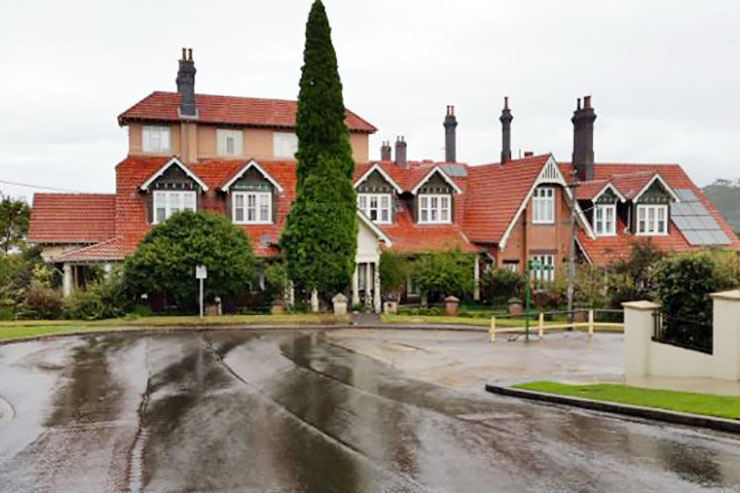
    Today, as one approaches The Manor from the road above, its sprawling grandeur first reveals itself by way of the dormers and gables of the red tiled roof, including the impressive 18-metre long studio perched atop the eastern wing. Most first-time visitors can’t resist trying to count the host of chimney pots that crown it. The very ground that The Manor stands on exudes a palpable magnetism and benign spiritual presence. One does not have to be psychic to experience the peaceful calm emanating from the mansion’s walls, and it is not hard to see why many have claimed to feel closer to the divine here.

    Whether or not Australia fulfils its secret occult destiny and hosts a new Golden Age remains to be seen. So long as the Manorites maintain the high energy levels through their esoteric rites, this site will remain sacred and, should the Masters decide the time is right to publicise their messages once again and guide the populace, surely this will be the prime spot for their transmission.

    This article’s graphics are viewable in the print or digital version of New Dawn 152.

    [alert type=”general” dismiss=”no”]This article was published in New Dawn 152.[/alert]

    [alert type=”success” dismiss=”no”]If you appreciate this article, please consider subscribing to help maintain this website.[/alert]

    Footnotes

    1. It should be noted that Madame Blavatsky (and Theosophy) rejected Spiritualism, however: “By the early 1870s, Blavatsky was involved in the Spiritualist movement; although defending the genuine existence of Spiritualist phenomena, she argued against the mainstream Spiritualist idea that the entities contacted were the spirits of the dead.” (https://en.wikipedia.org/wiki/Helena_Blavatsky)
    2. ‘The Manor Family: Australia’s oldest urban commune’ by Bill Metcalf, JRAHS Vol 100, 9
    3. ‘The Manor: A Short History’ by Nicolas Van Gelder, Theosophical History Occasional Papers, Vol XIV, 1
    4. www.theosophyforward.com/theosophical-encyclopedia/521-manor-the
    5. Nicolas Van Gelder, 14-15
    6. An egregore is a ‘group thought form’ or ‘collective group mind.’ See: http://en.wikipedia.org/wiki/Egregore
    7. ‘Charles Webster Leadbeater 1854-1934: A Biographical Study’ by Gregory John Tillett, http://leadbeater.org/tillettcwlchap17.htm
    8. Other Temples Other Gods by Nevill Drury & Gregory Tillett, Hodder & Stoughton, 1982, 32-33
    9. ‘Age of reason’ by John Zubrzycki, Sydney Morning Herald, Good Weekend supplement, 29 Nov 2014
    10. Nicolas Van Gelder, 24
    11. Masters of the Seven Rays by Phillip Lindsay, Apollo Publishing, 2000, 119
    12. The Ascended Masters of The Great White Brotherhood by Edmund Harold, Grail Publications, 2002, 13
    13. http://en.wikipedia.org/wiki/J._I._Wedgwood
    14. “Mary Rocke, a retired doctor, member of the Theosophical Society, secretary and physician to Leadbeater, purchased three adjacent blocks of land sloping from Wyargine Street, Balmoral to the beach. With a loan of 4,000 pounds and the rest of the cost raised by selling subscription seats, the Star Amphitheatre was built on this site.” (www.mosman.nsw.gov.au/file_download/1865/The-Star-Amphitheatre-Balmoral.pdf)
    15. “Leadbeater, Charles” by Garry Wotherspoon, http://dictionaryofsydney.org/entry/leadbeater_charles
    16. ‘C.W. Leadbeater: Saint or Sinner?’ by Frank Joseph, New Dawn 96 (May-June 2006)
    17. ‘Esoteric Australia’ by Mehmet Sabeheddin, New Dawn Special Issue 3

    © New Dawn Magazine and the respective author.
    For our reproduction notice, click here.

  • What Happened to the New Age? Sorting Truth from Nonsense

    What Happened to the New Age? Sorting Truth from Nonsense

    This article was published in New Dawn 147 (Nov-Dec 2014).

    Not long ago I was walking through the aisles of a New Age fair in the suburbs of Chicago. All the usual suspects were there: booths for Baha’i and Eckankar; ladies selling essences and fragrances; bodyworkers offering ten minutes of chair massage; psychics inspecting the etheric fields of their subjects. Like most New Age events I have gone to over the past decade, the fair had a tired quality to it.

    I could simply be jaded. I’ve been going to such gatherings for over thirty years now, and at this point they hardly impress me with their novelty. But I may not be alone. One has the sense that for many, the energy that gave rise to the New Age has ebbed.

    Even the term “New Age” has come to sound stale, harking back to the ’80s and the Harmonic Convergence, and, still further, to the spirituality of the 1960s counterculture. Commercial interests have backed away from the name, preferring the term “mind-body-spirit” or “MBS.” In January 2012, New Age Retailer, the primary trade magazine for this field in the US, changed its name to Retailing Insight.

    Was the New Age a fad? Was it a noble but misguided hope that the world was ready for an enlightenment to which it now seems indifferent or hostile? Probably neither. More likely this is the case: much of what the New Age pioneered, including yoga, meditation, and organic foods, has become mainstream. Thus you could say the New Age won out in many ways – but at the cost of seeming fresh.

    What about its ideas? Many of them too entered the mainstream and have even become clichés. At this point it may be useful to step back and look at some of the clichés of the New Age and see how well they stand up.

    The New Age

    Let’s start with the phrase “New Age” itself. It goes back far beyond the ’60s, even beyond the turn of the twentieth century. It first started being used in 1864, when an American clergyman, Warren Felt Evans, published a book entitled The New Age and Its Messenger.

    Evans was propounding the ideas of the great Swedish visionary Emanuel Swedenborg (1688-1772). In the 1740s Swedenborg underwent a series of spiritual awakenings that, he said, gave him access to the invisible realms and to the hidden meanings of Scripture. One of his most remarkable claims was that the Last Judgment of the Bible had no resemblance to the way it was seen by conventional Christianity. It was never meant to mean Christ’s second coming on earth. In fact it took place entirely in the world of spirits, a realm which, in Swedenborg’s theology, occupies a middle place between heaven and hell and serves as a clearinghouse for the newly deceased. This spirit realm had accumulated a great deal of debris, such as base and mean entities, and it needed a housecleaning. The Lord accomplished this in the year 1757.

    This Last Judgment, according to Swedenborg, had no immediate consequences for life on earth. Its only effect would be to weaken the power of spiritual tyranny and oppression (notably on the part of the Catholic Church, but also among the Protestants). New horizons on the spiritual world would therefore open. This was the New Age that Evans proclaimed, and Swedenborg was its messenger.

    In his way Swedenborg was right. Many of the religious shackles that seemed solid in the eighteenth century have been broken. There is still a great deal of nonsense, deception, and crime in religion, but there is also much more freedom of inquiry – even the freedom not to believe if you don’t want to.

    Since the nineteenth century, Swedenborg has faded into comparative obscurity, and Evans, once a best-selling author, has been almost completely forgotten. But the term “New Age” was given new life in the twentieth century by figures such as the British esotericist Alice Bailey, and, as we have seen, the New Age as an ideal reached its own peak in the late twentieth century.

    To go back to the initial question: how much truth is there in this idea of a New Age?

    In a trivial sense, every age is a new age. Today we face unprecedented dangers and opportunities. So did our fathers; so did our grandfathers. So will our children and grandchildren. Thus it has been since the beginning of history.

    But I don’t believe the human condition is going to change in any radical way in the future. Whatever wonders and disasters we may engender, we will still be born, love, experience pleasure and pain, and die as humans have since the beginning of time. As Anton Chekhov said in his play Three Sisters, written in 1900: “When we’re dead people will fly around in balloons, there will be a new style in men’s jackets and a sixth sense may be discovered and developed, but life itself won’t change, it will still be as difficult and full of mystery and happiness as it is now.”

    Paradigm Shift

    This phrase is often connected to the idea of the New Age. “Paradigm” means a scientific model. The Ptolemaic view of the solar system, which put the earth at the centre, was one such paradigm. It was replaced by another: the Copernican paradigm, which puts the sun at the centre.

    How did the new view replace the old one? The historian of science Thomas Kuhn asked this question in his influential book The Structure of Scientific Revolutions. His answer goes something like this: A scientific model inevitably has some flaws. It explains the data, but not quite perfectly. There are anomalies. For a long time these are set aside and either explained away or simply ignored. But after a certain point too many anomalies accumulate and can no longer be set aside. Science must then find another model – another paradigm.

    In the case of astronomy, the Ptolemaic view explained the movements of the planets quite well in light of the observations that could be made at the time (up to the sixteenth century). This even included the retrograde motion of the planets. If the planets moved around the earth, why did they sometimes move backwards in the sky? The Ptolemaic theory replied by positing epicycles – meaning that the planets not only revolved around the earth, but moved in small cyclical orbits as they did.

    Eventually the epicycle theory, which still did not match the data entirely, began to break down. Astronomers responded by positing epicycles within epicycles, but there was a point when this model seemed implausible. Another one had to be found. The theory of Copernicus, modified by Kepler, accounted for the planets’ motion much better. This was a scientific revolution, also known as a paradigm shift.

    The paradigm shift that the New Age speaks of is more vague. To some degree it has to do with another scientific revolution – from Newtonian to quantum physics. Newtonian physics is mechanistic and materialistic: it is a universe of ricocheting billiard balls. The quantum universe is much stranger, and some of its most brilliant theorists have stressed how bizarre and counterintuitive it is. But one idea from quantum theory has captured the public imagination: the observer affects the results of an experiment simply by the process of observation. This theory seems to place consciousness, rather than matter, at the centre of the universe.

    This idea fascinates people who dislike the meaningless, materialistic Newtonian universe. Some physicists, such as Amit Goswami, author of The Visionary Window and other works, say quantum theory proves that consciousness is the ground of all being. This is a step many other scientists are not willing to take, largely because quantum theory talks about the behaviour of submolecular particles; they are very reluctant to say quantum effects occur on greater scales. Quantum physics is sometimes defined, in fact, as “the science of the very small.”

    What does this all amount to? There is certainly a new scientific paradigm (although it is well to remember that much of quantum theory was in place by 1930, making it nearly a hundred years old). But this new paradigm, as understood and applied by physicists themselves, does not prove consciousness is the ground of all existence. Nor is it leading toward a more holistic and satisfying view of the universe. In fact the trend is going in the opposite direction.

    A generation ago there was much excitement, at least in the popular mind, about the connections between quantum physics and mysticism. But the majority of scientists, rightly or wrongly, have never bought it. They remain firmly materialistic in their outlook.

    Other disciplines have also moved backward. The psychology of the ’60s and ’70s embraced humanistic and transpersonal perspectives, but to all appearances this process has been turned around. Neuroscience has had so much luck modifying behaviour through pharmaceuticals that now scientists seem to assume more or less universally that consciousness is a mere side-effect of brain states. (Never mind that this claim has never been proved or even explained in any kind of coherent way.) Computer science, for its part, has made such progress in simulating brain processes that some people now believe it will soon be possible to download your consciousness into a computer, allowing cognition to go on through the operation of a machine rather than a brain. You will no longer need your body to be you. Minds are machines, whether they are made of carbon-based protein or silicon.

    In short, the paradigm that was so fondly expected to bring about a new, satisfying, and holistic view of man’s place in the universe failed to arrive. Conventional science, for all its accomplishments, is as drearily materialistic as it was in the days of Queen Victoria.

    That is not to say change will never come. Trends reverse themselves without warning, and fashions in science come and go almost as arbitrarily as the ones in couture. But that is how it looks now.
    [alert type=”info” dismiss=”no”]If you appreciate this article, please consider a subscription to New Dawn magazine.[/alert]

    You Create Your Own Reality

    In a trivial sense, this is certainly true. Your senses and nerves and brain filter the data from the outside world (whatever this “outside world” ultimately is) and create a picture of reality that enables you to function.

    But some New Agers go further. They say that all you have to do is change your thinking and the world will change automatically.

    To some degree this is true as well. Say you are having money trouble. Try this mental experiment. Believe, as fully as you can, that a cheque for a million dollars is coming to you next week. Suddenly your problems will seem to vanish. You will have no worries.

    Your thinking certainly changes the way you feel. But the claim that you create your own reality is a little stronger than this. It is saying that if you believe hard enough that this cheque will be coming, it will come: the universe will manifest it for you. And this idea is harder to swallow. At best, it can motivate you to strive to bring more money into your life; at worst, it is nothing more than daydreaming.

    Some people practice creative visualisation. By this method you formulate a vivid mental picture, and you concentrate on it so that the energy you are directing will make it appear in the physical world. This can and sometimes does work. But it very often brings unwanted consequences in its wake. You can visualise a cheque for a million dollars, and the cheque may appear. But you didn’t count on the fact that you would get into a crippling accident, and the cheque is to compensate you for the fact that you will never walk again. Granted, this is an extreme example. Another more likely outcome is that you will find that you really didn’t want what you were asking for and were disappointed when you got it.

    A few weeks ago, for no reason that I can discern, a file suddenly opened up on my computer. It said, “Please, God, protect me from everything I have been praying for.” I wrote it several years earlier and had completely forgotten about it. Evidently I needed to hear it again.

    Another thing is often overlooked: You are not the only one creating your own reality. There are others like you. All of them have the same power over reality that you do. And you are part of their reality as well.

    This fact raises a large but unexamined question: if we create our own reality, it must be a collective creation. And what is the effect of all these minds creating and cocreating together? How do the thoughts of your neighbours, your countrymen, your fellow humans as a whole, affect you? How do the minds of many engender a collective reality?

    This is, I believe, one of the most important questions facing humanity today. There is a collective imagination – psychologist Charles Tart called it “consensus trance” – that shapes our reality as much as, and probably more than, our own private thoughts do.

    As far as I can tell, psychology has not dealt with this question or even acknowledged it. It is true that the psychiatrist C.G. Jung spoke of the collective unconscious. He touched upon collective mentalities in some of his articles, such as “Wotan,” which discussed the resurgence of an old Germanic archetype in the Nazi ideology, and “The Complications of American Psychology,” which related the American psyche to the nature of the land in which it found itself. From another angle, the Russian psychologist V.M. Bekhterev explored mass and mob behaviour in his book Collective Reflexology. Bekhterev, who saw the Russian Revolution firsthand, had plenty of observations to work from. Even so, the science of collective psychology is embryonic.

    Thus up to a point it is true you create your own reality. But so does everyone else, and you are part of that reality too. The question for the twenty-first century is how we create our reality.

    Be Here Now

    Let’s turn to one of the most famous artefacts of the New Age. A squarish, large-format paperback book, with a purple cover, its contents printed on rough brown paper that looks like wrapping material. Its title: Be Here Now. Its creator: the beloved American guru Richard Alpert, best known as Ram Dass. The words, pasted down clumsily with letterpress as if to simulate the visual distortions caused by LSD, urge you to awaken:

    What are you doing?

    Planning for the future?

    Well

    IT’s ALL RIGHT NOW

    But later?… Forget it baby

    That’s later

    Now is

    NOW

    Are you going to

    BE HERE or not?

    IT’S AS SIMPLE AS THAT!…

    If you get so efficient…

    If you’ve got to turn off all the vibrations of the scene…
    because you’re so busy

    about the future

    or the past

    or time has caught you…

    IT COSTS TOO MUCH!

    No message from the New Age has burned itself into the collective mind as deeply as this command: Be here now. The past is an artificial construct. The future is an equally artificial construct. There is only the present moment. There is always only the present moment. This is the way to liberation.

    The idea still reverberates. Just as its effect was starting to fade, Eckhart Tolle came out with a booster shot: the best-selling Power of Now, published in 2004.

    No one could possibly refute this idea. It is always now, and, it would seem, the atomic moments felt through meditative awareness – an endless chain of nows, each one inexorably strung upon its predecessor – bring us as close to ultimate reality as we are likely to come in this world.

    As a mental discipline, what has sometimes been called “the doctrine of the present” has no peer. Every moment – or, rather, every moment you are aware of it – you bring your attention to the present; you sense your feet on the floor and feel the breath go in and out. The welterings of your mind subside. You are centred and at peace.

    How could anyone question this?

    In essence, I could not hope to. But in practice, another view arises.

    There is the sensation of my foot on the floor. This is direct, immediate, real. There are, on the other hand, the thoughts and fantasies and daydreams in my head, flowing before my mesmerised eyes like the scenes of a thriller. By contrast, they seem unreal.

    But maybe this is not the whole picture. Am I not, after all, experiencing all these supposedly delusory thoughts in the present as well? Why should one experience be held up as real and genuine, while the other is despised as false?

    Someone who goes to a few of the innumerable talks given by Tibetan lamas in the West will sometimes hear them denigrate the conceptual mind – the ‘monkey mind’ that must be suppressed, or even killed, if enlightenment is to occur. But I once heard the Dalai Lama speak, and he criticised this point of view. Although I don’t remember his exact words, I do remember that he said this contempt for the conceptual mind was unjustified, that this part of the mind too has its place, and one must not try to uproot or kill it.

    And sometimes this conceptual mind will take you out of the present.

    The present, then, that magic moment that discloses God, is only one of innumerable types of experience. It is well, of course, to be able to recognise and rest in it. But it may not be wise, and it certainly seems impossible, to stay there all the time.

    R.H. Blyth, in his celebrated collection of essays Zen and Zen Classics, writes: “Where Buddhism makes its great mistake is in asking for eternity without time. As Blake said, ‘Eternity is in love with the productions of time’.”

    Peace

    Peace. If there is one word that encapsulates the New Age, it is this one. In its day, it was more than a word. It was a gesture (the fingers forming a V, the palm facing out in an exact reversal of Churchill’s ‘V for victory’ gesture). It was an ideograph, the circle bisected vertically, with two other lines extended down from the centre – a combination of two letters in semaphore code standing for ND or “nuclear disarmament.”

    But peace – a cliché? That is a harsh verdict. And if it is, you will say, we need more of such clichés. And badly.

    In the ’60s the peace movement was the result of a genuine collective impulse. It was not only the recent memory of the horrors of the Second World War. It was also an aftershock from the Cuban missile crisis of 1962, when the world came the closest it has ever come to nuclear war. In the US, the peace movement was also a response to the Vietnam conflict and to the real likelihood that, like the states in Orwell’s 1984, the superpowers would maintain a permanent state of war.

    Events turned out differently from the expectations, as events always do. The threats to world peace that seemed so menacing during the Cold War are gone, but they have been replaced by others, and when these are gone, there will be others still.

    Do we need a peace movement to turn ourselves around? I think we do, but I also think we have never had a genuine peace movement. What we have had are antiwar movements. And to be against war is not the same thing as to be for peace.

    Earlier in this article I talked about the possibility that thoughts play a part – a major part – in shaping reality. And I think this is the case. In this light what are we to make of today’s mentality, which projects so much hatred toward its leaders? Do they deserve it? Maybe – but you are not making them any better or their work any easier by directing hatred and vituperation at them. Not if there is the dimmest bit of truth to the idea that your thoughts create reality. And of course this goes double for any collective feelings of hatred.

    In this light I find myself thinking about the possibility of a peace march – a genuine peace march. Such an event would be aimed not at stopping the latest war but at offering peace and blessings to the leadership of the nation, of any and all ideologies, without any agenda whatsoever. This would be a real peace march, because it would be offering peace rather than opposition, blessings rather than grievances. I wonder what effect it would have.

    A cliché, of course, could never become a cliché unless it is widely disseminated. And it would never become widely disseminated if it did not have much truth, and even wisdom, in it. So it is with the clichés of the New Age. Many of them are rooted in ancient and indeed perennial truths. That these truths need to be recast and restated in the language of a particular time and place is hardly a flaw; it is a way of adapting them to the needs of a generation. They will be restated and recast in many ways in the generations to come.

    [alert type=”general” dismiss=”no”]This article was published in New Dawn 147.[/alert]

    [alert type=”success” dismiss=”no”]If you appreciate this article, please consider subscribing to help maintain this website.[/alert]

    Sources

    V.M. Bekhterev, Collective Reflexology: The Complete Edition, translated by Eugenia & Alissa Lockwood, Transaction, 2001

    R.H. Blyth, Zen and Zen Classics, vol. 5, Hokuseido, 1962

    Amit Goswami, The Visionary Window: A Quantum Physicist’s Guide to Enlightenment, Quest, 2006

    Ram Dass, Be Here Now, Lama Foundation, 1971

    C.G. Jung, Civilizations in Transition: Collected Works, vol. 10, 2d ed., translated by Gerhard Adler & R.F.C. Hull, Princeton/Bollingen, 1970

    Emanuel Swedenborg, True Christianity, translated by Jonathan S. Rose, 2 vols, Swedenborg Foundation 2006-2012

    © New Dawn Magazine and the respective author.
    For our reproduction notice, click here.

  • Will Thinking Make It So? An Interview With Mitch Horowitz

    Will Thinking Make It So? An Interview With Mitch Horowitz

    This article was published in New Dawn 142 (Jan-Feb 2014)

    Much of today’s writing about spirituality is loaded with nonsense. Often it consists of little more than wild speculation, shoddy reasoning, and the repetition of a few stale truisms.

    A very small number of writers and editors have climbed above this morass to combine spiritual depth with intellectual acumen and literary polish. Mitch Horowitz is one of them. A writer and publisher of many years’ experience with a lifelong interest in man’s search for meaning, he is vice-president and editor-in-chief at Tarcher/Penguin in New York and the author of the acclaimed book Occult America: White House Séances, Ouija Circles, Masons, and the Secret Mystic History of Our Nation. His website is mitchhorowitz.com.

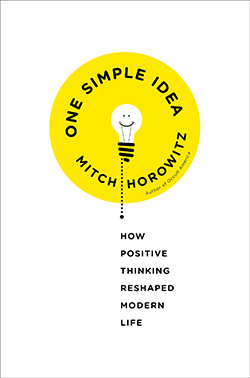
    Horowitz’s latest work, published in January 2014, is One Simple Idea: How Positive Thinking Reshaped Modern Life. It is a wide-reaching and insightful history of the mind power movement and how it has changed contemporary society. In November 2013, I conducted an interview with him by e-mail about this book.

     __________________

    Richard Smoley (RS): Your book is entitled One Simple Idea. Could you tell us what this one idea is?

    Mitch Horowitz (MH): The idea is the very American concept that thoughts are causative – which later came to be called “the power of positive thinking.” This notion has appeared, with varying degrees of orthodoxy and literalism, at different times throughout human history. New Englanders in the 1830s and 1840s used this idea to launch a vibrant culture in “mental healing,” in which trances, prayer, and affirmations were seen as a means to heal the body.

    During much of the nineteenth century allopathic or mainstream medicine in America was in an abysmal state. The traditional medicine of the day often relied on painful and dangerous regimens of bloodletting, weeping wounds, draining of bodily fluids, and ingestion of toxins and harmful narcotics. Mental healing was seen as a gentler alternative.

    By the late nineteenth century, experimenters in mental healing began asking what other powers the mind might possess. The mental healing culture came to believe that our thoughts could influence or shape our personal experiences, extending to matters of wellbeing, success, and, finally, money. This principle of mind power has traversed the cultural landscape, reshaping much of our religion, therapy, and ideas of self-help.

    RS: The story of positive thinking, as you describe it, begins in the eighteenth and nineteenth centuries. Do you see any precedents for this approach in earlier forms of philosophy or occultism?

    MH: You can find threads of the mind-power thesis within Egyptian-Greek Hermeticism, within certain strands of Neoplatonism, within elements of Idealism, Transcendentalism, and Swedenborgianism – and, significantly, within some of the experiments launched by students of the eighteenth century Viennese occult healer Franz Anton Mesmer. Mesmer believed that all of life was suffused with an invisible energy called “animal magnetism.” He theorised that if you placed a subject into a trance state – in a practice later called hypnotism – the patient’s “animal magnetism” could be manipulated to produce bodily cures. Mesmer’s students in Paris refined the master’s ideas: They edged away from Mesmer’s theory of an ethereal bodily fluid and believed that it was the mind itself that was bringing about the cures. Mesmer’s best students formed our earliest conceptions of the subconscious mind, which they believed not only could produce healing but, under certain conditions, could bring on displays of clairvoyance, telepathy, and even astral travel. The tumult of the French Revolution cut short many of these experiments – but the ideas of mesmerism began travelling to the United States. In the early decades of the nineteenth century, Americans – who love remaking ideas and finding new and broader ways of using them – took the mind-power thesis even further. American experimenters came to see the mind as a tool of metaphysical power that could be used for attracting and influencing circumstances.

    RS: One of the central figures in your story is Phineas P. Quimby. Could you tell us about who he was and why he was so important?

    MH: Quimby was one of the earliest and most impactful founders of New England’s mental cure scene. He was a nineteenth century clockmaker who spent most of his adult life in Maine. In the early 1830s Quimby suffered from tuberculosis, which was worsened by the side effects from harmful treatments, such as mercury ingestion. One day Quimby took a raucous horse-and-buggy ride in the Maine countryside and unexpectedly found that the excitement of the ride lifted the symptoms of his tuberculosis. Quimby marvelled at the effects of his mood on his body. He believed that this private insight revealed a mind-body connection – and searched for a theoretical model to confirm it. That confirmation arrived for him in 1836 when lecturers began visiting Maine extolling the ideas of mesmerism. Quimby believed that mesmerism revealed the connection between mind and body. He worked the rest of his life as a mental healer, refining and applying various methods, especially arousing the confidence of a patient in his ability to recover. Quimby was extremely influential on the New England scene until his death in 1866.

    RS: One of Quimby’s disciples, Warren Felt Evans, introduced the concept of the New Age in a book of his called The New Age and Its Messenger, published in 1864. Could you talk a little bit about how the positive-thinking movement shaped the New Age?

    MH: Evans was among a circle of Americans who were dedicated to the ideas of the eighteenth century Swedish mystic and scientist Emanuel Swedenborg. Swedenborg believed that earthly events mirrored and were controlled by laws and events in the spirit world. In Swedenborg’s view, the material and spirit worlds formed a continuum. When figures such as Quimby and Evans began experimenting with mental healing, they believed they were, in effect, channelling and applying cosmic laws. The early mental healers did not possess a psychological vocabulary – they often spoke and thought in religious terms. Hence the ideas of Swedenborg – who described a universe of spiritual laws and influences – made innate sense to mental healers. Evans believed that humanity stood on the brink of a New Age of therapeutic spirituality – of whom the “messenger” was Swedenborg. The founding idea of New Age spirituality, as articulated by Evans and his contemporaries, was the philosophy of mind power. This later came to be called positive thinking and New Thought.

    RS: In the early generations, the positive-thinking movement centred on healing. Around the turn of the twentieth century, it shifted toward “prosperity thinking” and the attainment of material success. Why did this change come about?

    MH: The early twentieth century French hypnotherapist Émile Coué observed that the, “French mind prefers first to discuss and argue on the fundamentals of a principle before inquiring into its practical adaptability to every-day life. The American mind, on the contrary, immediately sees the possibilities of it, and seeks… to carry the idea further even than the author of it may have conceived.” This was the pattern for most of America’s spiritual experiments, and it highlights the transformation of mental healing into the prosperity gospel. American enthusiasts came to believe that the mind could improve health – and they began seeking ever-greater ways of applying the mind’s power.

    The person who first hit upon the idea of using mind-power methods to attract money was actually an English writer and political activist, Frances Lord. She visited America in the late 1880s to take part in the suffragist movement. But Lord also grew interested in mental healing – and she proposed expanding its boundaries to prosperity. Lord wasn’t a “think and grow rich” exponent; rather she believed that if labourers and working people could alter their thought patterns they could balance out economic inequality.

    Critics rarely see that the prosperity gospel had its earliest roots in the ideals of the Progressive Era. Lord and her American contemporaries – who included Wallace D. Wattles, a socialist activist and the author of The Science of Getting Rich, and suffragist Elizabeth Towne – believed that the mind could serve as a force for social equity. As the twentieth century opened, the industrial economy produced a mass wave of consumer goods; and at the same time the state of American medicine greatly improved. Hence, money, rather than health, moved to the front of the American mind – and became the focus of the positive-thinking movement.

    RS: The positive-thinking movement sometimes seems indifferent to social issues: poor people are poor and sick people are sick because of their own wrong attitudes. Has there been any response to this problem from within the movement itself?

    MH: In the positive-thinking movement’s early days, from the late nineteenth to the turn of the twentieth century, it showed deep concern for social issues. Surprising figures adopted the positive-thinking gospel, including black nationalist Marcus Garvey, suffragist Elizabeth Cady Stanton, and many figures that identified themselves as socialists or radicals, such as Ralph Waldo Trine and Wallace D. Wattles. These people believed that the patterns of the mind were one element – and certainly not the only one – in alleviating social oppression; they believed that working people, women, and minorities needed to claim a dramatic new sense of self-worth. That tendency faded as the movement became more geared toward a philosophy of individual advancement. Within today’s New Thought churches you continue to find large numbers of very liberal people. Attendees at New Thought churches include actors, artists, experimenters, gay and lesbian congregants, and many people who work to create social openings. So the core movement has remained liberal in its makeup. However, the popular mainstream literature to emerge from the positive-thinking movement, by authors such as Napoleon Hill, Norman Vincent Peale (pictured above), and Dale Carnegie, evinces almost none of its earliest reformist aims.

    RS: The positive-thinking movement is also sometimes criticised for its callousness: since you create your reality with your thoughts, it must be your fault if bad things happen to you. Is this a valid criticism? If so, is there any valid response to it?

    MH: It is a valid criticism – and it is one of the problems that I try to deal with in the book, especially in the final chapter, “Does It Work?”, where I explore the failings and efficacy of the movement. In short, I believe that the positive-thinking movement’s embrace of what is called the Law of Attraction was both a theological and ethical mistake, and it overshadowed the movement’s greater promise. I believe that no one should endeavour to frame life as the product of one overarching mental super law. That simply doesn’t square with the personal experience of most sensitive people. We all encounter a mixture of joys and tragedies in life, and these experiences are attributable to myriad and sometimes inscrutable factors – not solely to tendencies or accidents of thought. We live under many laws, influences, and events. However, if the positive-thinking movement can move away from this “mind is all” concept, then we can newly appreciate the movement’s very powerful insights. As has been borne out in many reaches of the sciences, the mind provides a little-understood but persistent and traceable impact across various aspects of existence, from health to relationships to addiction recovery. The impact of the mind can also be seen – most controversially – in the findings of quantum physics. This last point is very contentious, and I try to explore it in an accurate and non-sensationalistic manner in the book.

    RS: One little-known figure that you highlight toward the end of your book is Vernon Howard. Could you tell us about him and why you find him interesting?

    MH: Vernon Howard was a late-twentieth century spiritual philosopher who I see as probably the most remarkable and unclassifiable figure to emerge from America’s recent metaphysical culture. Howard was loosely a part of the positive-thinking movement insofar as his books of the 1950s and early 1960s were in the mould of typical New Thought literature in which you were counselled to use your mind to attain influence, prosperity, and power. But in the mid-1960s, Howard underwent a remarkable spiritual maturation. From that point until his death in 1992 he produced an extraordinary output of writings and talks that distilled the core principles of the world’s ethical and religious philosophies. Howard taught that we live from a false, conditioned nature, which prods us to seek conventional modes of success, which, in turn, prop up our ego and self-image. This puts us on a constant cycle of seeking recognition from a world filled with people who are themselves frightened and desperately seeking approval, and who often lash out in hostility to cover their fears.

    If we can see through this painful predicament, Howard wrote, we can experience a sense of our true nature, which emanates from what we call God. We experience this true self when we reach the limits of our conditioned responses to life. No other figure that I have encountered possessed a voice as practical and vivid – or an intellect as piercing of human foibles – as Howard’s.

    RS: In your book, you posit Ronald Reagan as a kind of culmination of the positive-thinking movement, in both good and bad ways. Could you talk a little about how Reagan fits in with this movement, how it shaped his politics, and how the movement has shaped American politics today?

    MH: Reagan is a continual mystery to journalists and biographers because he seems to them to possess no internal barometer or motivating influence. Many observers have wondered about his inner nature, about what made him tick psychologically. My contention in the book is that Reagan, to be fully understood, must be seen as a product of the positive-thinking culture. The core assumptions and phraseology of positive thinking are at the back of much of his personal philosophy. Reagan also reflects many of the movement’s strengths and weakness: He was capable of continually reconceiving of himself at different times in life to meet the challenges that he faced, and it gave him a surprising resilience and adaptability when climbing out of near-poverty as a young man and when confronting the new realities of US-Soviet relations during the Gorbachev era, during which Reagan dramatically shifted from flinty cold warrior to global peacemaker. Yet it could also contribute to an unnerving blindness in matters of policy, when Reagan would emotionally fixate on a single fact, story, or anecdote and use it to buttress sweeping political convictions, such as the belief in widespread welfare fraud or in the efficacy of the Star Wars missile defence system.

    In the political realm, Reagan ushered in an age where presidents had to sing praises to the limitless potential of the American public. In President Obama’s 2011 State of the Union address he declared, “This is a country where anything is possible.” That was a direct echo of Reagan, who routinely described America as a nation where “nothing is impossible.”

    RS: Even if you grant that the mind has the power to shape reality, it’s also true the mind has many facets that are not accessible to the conscious ego. What level of mind is actually shaping reality, and how can we have access to it?

    MH: That’s a very intriguing question. We have a strange habit of putting a name on concepts – such as “ego” or “unconscious mind” – and then thinking we have identified a clearly definable thing and can proceed to talk about it as though we all agree upon it, as if it were an apple tree. Yet we know very little about the mind and its agencies. We can’t even agree on what produces the so-called placebo effect and how it works, though for more than a century medical researchers have tracked the persistence of some kind of physical relief related to mental expectancy. One of the things I argue in the book is that we do seem to be able to enter an exquisitely sensitive and suggestible state where mental properties are heightened. This is sometimes called the hypnagogic state, experienced in the period just before drifting off to sleep or awakening, or in times of deep relaxation or comfortable sensory deprivation. Émile Coué, and others who worked with affirmations to recondition the mind, believed this hypnogogic state possessed unique potential for autosuggestion or self-hypnosis. I won’t go into the data here, but serious psychical researchers have also detected what appear to be heightened instances of clairvoyant perception and telepathic conveyance in subjects during this state.

    One Simple Idea coverIt’s difficult to place precise labels on what is occurring at such times but there does seem to be a state of relaxation from which the mind is unusually receptive – and which may point to the mental-emotive condition from which we can produce or revise self-conceptions, and maybe do something more.

    RS: All things considered, how much truth do you see in the “one simple idea” of positive thinking?

    MH: As I’ve suggested above, and as I explore in the book, I am convinced that the mind harbours some shade of influence, not only in matters of self-worth but also in circumstances of outer life, as well. I believe that our repeated thoughts – when held with determination and emotional conviction – can evince a shade of influence on external events. This is a very delicate claim, which presents more questions than answers. But I believe that if we look historically across broad disciplines – from psychology to medicine to the physical sciences – and if we consider, with care and discretion, the empiricism of personal experience, we find ourselves facing an ever-broadening conception of the mind’s influence.

    Historically, the modern assessment of the mind’s reach continually broadens and never recedes. The mind is, of course, one factor among many under which we live. We are affected by environment, chance, physiology, economy, and accident. But grappling with this idea – that the mind, like other factors, produces a shade of practical impact on our experience – can help deepen and expand our sense of ourselves, and our questions about what it means to be human.

    „For further discussion of New Thought and its history, see New Dawn 142

    One Simple Idea: How Positive Thinking Reshaped Modern Life by Mitch Horowitz (Crown 2014) is available from all good bookstores and online retailers in hardback and on Kindle.

    [alert type=”general” dismiss=”no”]This article was published in New Dawn 142.[/alert]

    [alert type=”success” dismiss=”no”]If you appreciate this article, please consider subscribing to help maintain this website.[/alert]

    © New Dawn Magazine and the respective author.
    For our reproduction notice, click here.
  • Ritual Magic in Theory & Practice

    Ritual Magic in Theory & Practice

    Several years ago I decided to do an evening-long introduction to ritual magic at the New York Open Center, one of the city’s best-known gathering places for mind, body, and spirit activities. Soon before it was about to start I told myself, with some surprise, “My God! I’m about to do ritual magic with a bunch of people who have walked in off the streets of New York!”

    Despite my apprehensions, the evening went off well. Power was raised, channelled in a certain direction, and then the ritual was closed. The only negative result was a comment I got back on a feedback sheet from a participant, who said she was shocked that I did not begin the ritual by invoking the holy archangels of the four directions (usually given as Michael, Gabriel, Raphael, and Uriel).

    The person who complained was both right and wrong. In ritual magic, it is essential to create a sacred space to work in. But it is not essential to do this by invoking the four archangels specifically. In fact there are many ways to do it. Invoking the archangels is part of the Western tradition of high magic, particularly as handed down by the extremely influential Victorian occult society known as the Hermetic Order of the Golden Dawn. Here is another, quite different way to create a sacred space, from the Native American medicine man Rolling Thunder (known as “RT” to his friends), as described by one of his students:

    We started a fire in the fire pit and formed a circle around it, warming ourselves in the chilly weather. RT pulled out a pouch of Five Brothers Tobacco, pure tobacco with no artificial ingredients. He passed the pouch around, each of us taking a little bit of tobacco in our hands. RT then led us in a prayer, starting out with Father Sun, Mother Earth, Grandmother Moon, and All Our Relations. He would include “the East where the Sun rises, to the South where the heat comes from, to the North where the cold comes from, and to the West where the sun sets.” RT would vary the order and the wording from time to time, just to maintain our attention.1

    This is somewhat simpler than a lengthy invocation and visualisation of archangels. The version I used in the ritual in New York was simpler still; at the outset I simply asked the participants to visualise a pillar of light in each corner of the room.

    This anecdote illustrates two basic concepts of ritual magic: (1) it is important to create a sacred space in which to work; and (2) there are many methods for accomplishing the same purpose. While many people associate the word “ritual” with something rigid and formalised, ritual magic, practiced at its best, is neither. Rather it’s a flexible system, with enough structure to give form to one’s intention, and with enough pliability to give the practitioner a great deal of leeway in actual practice.

    In my brief description of the New York ritual, I mentioned another important part about ritual magic – raising power. No one knows what power is (used in this sense), and at the same time everyone knows what it is. We cannot say whether it is a form of electromagnetic energy, the life force known as chi, or something quite different from either of these. But all of us have experienced its effects, and, moreover, all of us have raised it ourselves, usually without knowing what we are doing.

    Remember the last time you entered a room in which an argument was about to break out. Although probably nothing was different about the air or the lighting or any of the physical aspects of the room, you undoubtedly noticed a feeling of tension and perhaps danger in the atmosphere. This tension becomes even more palpable if the room is silent, and the pressure that you feel to dispel it becomes extremely intense. One way of dispelling it is to express it somehow, and if the tension is not too strong, it can be broken when someone simply speaks. At other times, it erupts in an argument or even a physical fight.

    Another example is the classic situation of the teenage dance. At the outset the boys are ranged at one end of the hall, the girls at the other. Everybody is too shy to begin dancing, and again an extreme amount of tension accumulates in the room. Finally one courageous couple breaks the tension and begins to dance. The energy starts to flow. It is expressed through dancing (and perhaps later on, sexually).

    Most of the time this raising of power is completely unintentional and undesired. Its presence causes a great deal of discomfort, and depending upon an individual’s personality type, he may try to get rid of it by giving in, arguing, or simply leaving. The magician, by contrast, wants to raise this power. But he (or she) chooses to do it only in certain circumstances and for specific results.

    The raising of power partially explains another feature we have seen in ritual magic – the creation of a sacred space of some kind. It can be done, as we have seen, by marking out the four directions; traditional magicians have also done it by drawing a geometric figure, such as a circle or a pentagram, with the point of a wand or a sword in the space around them. The actual shape does not matter as much as building an invisible sanctuary where certain forces are kept in and stray influences are kept out.

    I’ve said that the magician raises power for specific intention, and in this context it’s important to note that power in this sense, like the Force in the Star Wars films, is morally neutral. It can be used for good or evil or for that matter mixed ends. Using it for good purposes – such as healing or blessing or cleansing – is known as white magic. Using it for harmful purposes, such as cursing or coercion, is black magic. These terms are well-known; a less familiar one is grey magic, which is done for mixed motives. In all likelihood few magicians probably practice grey magic intentionally, although most have probably done so without entirely realising it. I personally would characterise doing a magical ritual to find a lover as grey magic; doing a ritual to make a specific person fall in love with you would be closer to black magic, since it intentionally interferes with the free will of another person.

    All these reflections lead to some questions: Does ritual magic work? If so, how? And since practicing magic for selfish ends is at best morally ambiguous, why do it at all?

    The Astral Light

    To look at how magic works, it’s helpful to understand a concept that has fallen into disuse in recent years but still occupies a central place in Western magic: the astral light. Esoteric texts from the Renaissance and early modern era often refer to it as the anima mundi, or “the soul of the world.”

    “God is light,” the Bible tells us (1 John 1:5). Esotericism regards this image as a specific and accurate picture of reality. This light pervades the universe; there is nowhere and nothing it is not, but it is modified, its purity and intensity are filtered and diluted, as it proceeds through various levels of manifestation. Esoteric theory holds that this light reaches us on earth only after passing through the zones of the stars and planets, whose influences it absorbs; hence its name.

    Astral light must not be confused with physical starlight. It is a subtle matter, imperceptible to the five senses and to the implements of science. “It is the common mirror of all thoughts and forms,” writes the nineteenth-century French magus Éliphas Lévi, “the images of all that has been are preserved therein and sketches of things to come, for which reason it is the instrument of thaumaturgy and divination.”2

    To form a more or less accurate picture of this light, one need only ask, what is the substance of a thought? Neurochemical responses, a scientist may say. While that may be true up to a point, we don’t experience these images as neurochemical events; we experience them subjectively as images and forms. In this latter form, they can be said to be made up of astral light.

    A more topical analogy comes from the world of computers. Hardware, software, and networks together form cyberspace, a dimension that, while in no way separate from the workings of computers, seems to obey its own laws and possess its own reality. This resemblance between the apparently outmoded world of the occult and the sophisticated ideas of cutting-edge science has not gone unnoticed: Silicon Valley is a hotbed of interest in the esoteric, and computer aficionados sometimes speak of cyberspace as a kind of bardo – a term used in The Tibetan Book of the Dead to designate the astral plane.

    The fine matter of the astral light is also believed to form the subtle or “astral body” of humans, giving literal force to the words of Shakespeare’s Prospero: we are indeed “such stuff as dreams are made on.” Shakespeare probably meant these words metaphorically; he was saying that we are frail, transitory, ephemeral. But then so are dreams and mental images.

    This is not to say that the astral light is itself a frail substance; occultists consider it indestructible. But this subtle matter does not hold shapes well. Dream figures constantly shift form, and even before our waking eyes mental images rise and fall like waves. For this reason some esoteric teachings figuratively refer to this substance as “water.” Under most circumstances, practically none of the thoughts or images formed in this “water” ever come into physical manifestation; there is not enough force behind them to make that happen. Hence, the central aspects of occult magic has to do with forming, holding, and energising a shape composed of astral light. If enough power and skill are used in its creation, the image will sooner or later manifest in the physical world.
    [alert type=”info” dismiss=”no”]If you appreciate this article, please consider a subscription to New Dawn magazine.[/alert]

    Manifestation

    In theory the process sounds simple enough, and in a way it is, but it is not so easy to accomplish. To begin with, in order to manifest in the physical world, an image must have a steady, consistent form in the mind’s eye. In practice, however, few things are more difficult to achieve, since it is notoriously hard to hold an image in one’s mind for all but the briefest time. This may be partly due to a lack of mental discipline, but it also reflects the nature of the astral light itself. It is fluid and slippery; trying to hold it is like trying to grab water with one’s bare hands. Much of magical practice consists of moulding this elusive substance. Hence magical training emphasises, above all else, mental concentration and will.

    Look at some object near you. Now close your eyes and try to visualise it. Then open your eyes again, and compare your mental picture of the object with the object itself.

    If you’re like most people, you’ll find some discrepancy between the object and your picture of it. You may find that you were able to imagine some parts of it better than others, or that you could imagine it as seen from one angle but not from another. You’ll probably find not only that it’s hard to keep your mind on the same picture, but that it’s difficult to create an entirely accurate image even of an everyday object right in front of you.

    One part of magical training is intended to hone the skill of visualisation. The magician may begin by taking extremely simple objects or forms – geometric shapes, for example, like triangles and circles – and attempting to visualise them. Later on, the aspirant may be able to proceed to more complicated things like three-dimensional objects. A piece of fruit, an orange, for example, is a good thing to use, since one can imagine not only its appearance, but also its taste, smell, and texture.

    Visualisation and imagination form only one aspect of the discipline. The second and equally important part is the conditioning of the will. The mind is not likely to enjoy concentrated imagination at first; it will probably rebel and drift on to its ordinary worries and fantasies. The only way to train it is to constantly bring it back to the object.

    Such work is often tedious, and the beginner may be able to practice for only a few minutes a day before concentration gives out. Gradually, however, these practices will achieve their end. The act of constantly bringing the mind back to the object, despite boredom or frustration, begins to form a small core around which the will can constellate. And the will is the magician’s principal tool.

    So far this procedure resembles the “creative visualisation” described in many books. Creative visualisation, however, generally doesn’t go past this point. Nothing more may be needed: sometimes the greatest hurdle lies in simply formulating a clear goal. But often the enterprise requires some sacrifice: an additional investment of vital energy to literally give life to the desired image.

    This brings us back to the need to raise power. For a process of ritual magic to be complete, it must have a clear and specific form in the mind of the practitioner – and enough power must be directed toward it to ensure it manifests.

    This does not always happen. To cite another personal experience, about fifteen years ago I was on a retreat with a group holed up in a country house in Derbyshire, England, learning to practice magical techniques. One of the chief things taught was raising power, which was done by having the group (of about a dozen people) channel mental energy in a certain direction. Throughout most of the retreat this power was directed to an actual sink – a drain in the floor of one of the utility rooms. The reason for doing this was quite clear. We were learning to raise power, but this power could not be allowed to float around in the atmosphere. It would create enormous tension (and there was tension enough anyway); given enough momentum, it would start to cause mayhem. So for training purposes the power was directed to the ground – it was literally “earthed.”

    Such was the practice for most of the retreat, but toward the end each of us was allowed to raise power and direct it toward whatever we wished. We all took turns: we sat in a room on our own while the other members of the group directed power toward us. When it came to be my turn, I decided to channel this power toward realising a particular project I had in mind at the time.

    But it was no good. I could not focus the power in the direction I wanted; it felt as if it kept slipping and sliding away from me. I tried to recoup my efforts more than once, but soon the time was up. The whole experience had the depressing quality of a premature ejaculation.

    Where did the failure lie? I certainly felt power being sent in my direction; that was not the problem. And the project I was developing was clear enough in purpose and intent. Rather the failure came from my own will. Although I did my best to work with the power through the exercise, there was some level at which I was not interested enough in this project to make it manifest.

    It was, as a matter of fact, a book project, and it came as no surprise to me a few weeks later when I learned that all the publishers to whom my agent had submitted the project rejected it. None of this was especially tragic; all writers have projects that they come up with and never manage to materialise; in fact, these generally far outnumber the successful ones. But the whole experience taught me something about the nature of will.

    Will, as I’ve said, is a chief characteristic of the ritual magician, and from my experience, I would say that the will is in many ways as subtle and elusive as the astral light itself. Where exactly is my will? In my superficial wishes and desires? In my gut? In the deep and inaccessible reaches of my heart? I would say that for the will to be truly effective, it must lie in, and encompass, all these parts of one’s being; if one is conflicted or ambivalent, the results will be nil.

    All this helps to answer a question that was posed earlier: Does ritual magic work? It does work, but it is a subtle and difficult process that requires a great deal of training and mastery – and especially self-knowledge – in order to succeed.

    The Importance of Ritual

    Ritual magic, as practiced in the West, is an elaborate and somewhat cumbersome discipline. Fully devoted practitioners devote an enormous amount of effort to making and obtaining robes, wands, swords, cups, talismans, incense, and other appurtenances of the magician’s craft. Are these necessary? They are – nearly every ritual of any kind requires some kind of paraphernalia – but the complexity and elaborateness of these things can vary greatly. Purists among magicians tend to say that tools that the practitioner makes himself, from scratch, are the ones that have most power. And from what we’ve already seen in this article, we can understand why. Power follows attention. And something that has had a great deal of effort and attention directed toward it, even if it is crudely executed, is likely to have more power than a more polished object that has been manufactured.

    Is ritual necessary in order to make one’s will manifest? After all, if it’s simply a matter of raising power and focusing it on an image, what need is there for a ritual at all? Can’t it be done by thought power alone?

    In fact, it can; and that is the theory behind creative visualisation and what some portions of the New Age world call “manifesting.” In these techniques it’s enough to work exclusively through thought power – if the will is strong enough. These practices differ from prayer in that they don’t necessarily invoke the favour of God or a god in order to operate; rather it is a matter of simply using certain universal (though little-known) occult laws. They differ from ritual magic in that no physical operation is necessary.

    Given all this, the reason for practicing ritual magic is twofold: in the first place, ritual magicians are drawn to this kind of activity. For them the more inward and sedentary acts of prayer and meditation may seem a little bloodless. There is a certain satisfaction to be gained from making and wielding magical implements in a way that’s perhaps not very different from the reasons people sometimes prefer to build their own bookcases or brew their own beer. This may seem fairly obvious, but it is not trivial. There is a part of the mind that will not take anything seriously that it cannot see or touch, and ritual magic is meant to address – and involve – this part of the mind.

    The second reason is both grander and more abstract. Man, it is said, is a bridge between worlds. He is the only creature that we know of who is capable both of extending his mind to sublime and mystical levels of experience and of doing and acting in physical reality. Some esoteric teachings would go so far as to say that this is our function as human beings, and that many of our sufferings and discontents occur because we have forgotten it. In light of this idea, we can see how ritual magic can be valuable and effective in its own right, quite apart from whatever apparent results it might achieve. It enables the magician to serve as a conduit between the higher and lower worlds, and to assist in the work of unifying them.

    There is a great deal about ritual magic that I haven’t been able to discuss in an article of this length – divination, for example, which in its many forms attempts to take a kind of reading of the patterns in the astral light in order to find out what is likely to happen in the physical world. (The Tarot and the I Ching are two common methods used by magicians today to do this.) Nor have I been able to explore the issue of raising and interacting with spirits – invisible entities that, under the right circumstances, can communicate with us and can also have an effect in the physical world. These are large and important subjects in their own right, and serve to indicate that ritual magic, practiced in the West for centuries, retains its fascination and its power.
    [alert type=”general” dismiss=”no”]This article was published in New Dawn Special Issue Vol 7 No 2.[/alert]

    [alert type=”success” dismiss=”no”]If you appreciate this article, please consider subscribing to help maintain this website.[/alert]

    Footnotes

    1. Sidian Morning Star Jones and Stanley Krippner, Ph.D., The Voice of Rolling Thunder: A Medicine Man’s Wisdom for Walking the Red Road, Bear & Co., 2012, 6.
    2. Éliphas Lévi, Transcendental Magic: Its Doctrine and Ritual, trans. A.E. Waite, 1896; repr., Bracken Books, 1995, 15.

    © New Dawn Magazine and the respective author.
    For our reproduction notice, click here.