From New Dawn 74 (Sept-Oct 2002)
In the midst of the Cold War both the Soviets and the Americans employed psychics to spy on each other’s activities. These were the so-called remote viewers.
Both the CIA and the US Army conducted remote viewing intelligence programs. The US Army’s program, known by the code name Star Gate, was initiated in the late 1970’s by the gifted natural psychic, Skip Atwater. For ten years Skip was the Operations and Training Officer during which time he recruited and trained an elite group of professional remote viewers, through whom he conducted thousands of intelligence-collection missions.
Skip inevitably came into contact with Robert Monroe, the founder of The Monroe Institute. The Monroe Institute dedicates itself to the transformation of human consciousness. A major constituent of this transformation process is in part accomplished through the application of Hemi-Sync technology. The Hemi-Sync is perhaps best known for its capacity to induce an OOBE (Out Of Body Experience), otherwise known as astral projection. More information on the Monroe Institute can be found at www.monroeinstitute.org.
Upon retiring from the Army, Skip became Research Director at The Monroe Institute and then President of the Institute. He has continued with the pioneering work of Robert Monroe, but is now retired from the presidency of the Institute. He has authored the inspiring Captain of My Ship, Master of My Soul which in many ways continues on from Robert Monroe’s books. His website is http://www.skipatwater.com.
Skip also lectures extensively around the world. It was during Skip’s Sydney lectures in late May 2002 that the following interview took place with Tony Mierzwicki.
Tony: Skip, for the sake of this interview, we might start defining our terms. Would you be able to define the term OOBE, or Astral Projection as it’s known in classical occult literature?
Skip: I think we need to have a reference point to describe the experience that people have called the OOBE. In starting with the reference point of what are we as human beings right now. We might think of ourselves as separate personalities. We seemingly are bodies walking around on this Earth, trying to accomplish things, have families, jobs, make a living, survive. And yet there is more to us than just our physical bodies, so we try to get an idea about this Earth life situation that we’re involved in. We can think about it in a much larger perspective, thinking that we are partly physical, partly emotional mental beings, and partly spiritual beings. All those things coming together when we are in our awake state, like you and I are now, talking to each other, we perceive ourselves to be in the physical body as it were.
As a matter of fact we usually only perceive ourselves to be only our physical body. And yet at night, in unconscious sleep, we separate from our physical bodies and travel to, and around, this world in a different manner in what’s called an Astral Body. Many people don’t recall those trips away from the body because their sense organs are not awake, their astral sense organs are not awake, where there isn’t enough impression left on memory to remember those things. Beyond the astral body is a spiritual realm. So if you think about it in those big three chunks, then you asked me to define what is an OOBE. It could be a spiritual experience which is beyond the astral, or astral travel limiting to that emotional mental body we know as our astral body, and visiting the realm in that way.
Tony: You mentioned before that people tend to not remember their astral experiences because their senses aren’t optimally sensitised. Are there any techniques that you could recommend for sensitising the senses?
Skip: Experience. There’s a psychological theory involving our senses called Sensory Integration, meaning that I know who I am, what I am doing, and I how I feel about myself based on the concept of integrating my senses. And yet when I sleep at night, or am in deep meditation, my physical senses are shut off. And if the theory of Sensory Integration is correct, then we have an unconscious experience. We have nothing to tell us who am I, what am I doing, how do I feel about myself, because our senses are shut down. Ahh, but those are only the physical senses. For in our astral bodies we have equivalent senses, which we don’t necessarily pay attention to, because we only think that we are physical bodies. But through practise, and through exercises, you can learn to pay attention to these realms so that in the natural process of drifting out of your body every night you then become aware of these. We call it turning on our internal perceptual processes but what we’re really saying is turning on our astral senses.
Tony: OK, so what are these astral senses?
Skip: Well let’s define first, in order to understand what the astral senses are, the worlds in which we’re exploring, one being the physical world, one being not the physical world, and think about what constitutes those worlds and how our senses work. First of all in the physical world, as we look around the physical world, we’re not actually getting an accurate view or understanding of what the physical world is. It’s as though we were in a shopping centre in the security office and we’re just watching the monitor. Maybe this monitor is only a black and white monitor, and maybe it’s only pointed in the one direction. And when there’s poor lighting, you don’t see very much, when there’s good lighting there is some. We aren’t actually seeing the shopping centre, we’re seeing our monitor with a pictorial display of the shopping centre. And that’s actually what’s happening to us, we are living behind our eyes and our senses looking at monitors.
What our eyes tell us is a very narrow narrow spectrum of reality. If an animal, a bat, were to come in this room and fly around they would perceive a different world than we’re perceiving. If a dog were to come in here with its hyper sense of smell, this would be an entirely different reality than what we sense. So what’s the real reality? Well, that’s my point – we never really know what the real reality is, because we’re just monitoring our little sense organs out there. In the same way, in the astral realm we have equivalent sense organs, the idea of sight, smell, touch, sound, taste, and we also have additional senses, that of telepathy and of intuition.
In the realm of the physical however, our perceptions are governed by what we know as a common set of realities. We agree that we’re sitting in these things called chairs, and there are plants behind us. We strive then to interpret our physical senses based on an agreement that we’ve grown up learning. Our parents taught us what all these things were called, and we’ve agreed to it so we have a basis of memory, and our sense organs go out and say, “OK, this is a signal coming in, what does it look like?” Well it goes up to our forebrain and our forebrain says, “have we ever seen anything like this before?” If the answer’s yes, then it goes into the Limbic System of the brain, and the Limbic System of the brain says, “how do we feel about this?” And if it says, “this is OK, this isn’t dangerous,” then it comes through the executive consciousness and says, “I see a tree.” But if it goes up to the forebrain and we don’t know what a tree is, and the answer is, “no, we don’t know what this is,” you never get to experience consciously perceiving that tree. The same kind of process is happening in an equivalent way to all our senses. We can only experience and weigh that which we have some experience with and that which is comfortable for us psychologically, emotionally, and makes sense to our egos. If something goes floating through the air, our ego might say, “this makes no sense, let’s not tell him about it.” So you actually don’t have that experience because it’s an uncomfortable thing to become aware of. That’s the rules then of the physical world and how our five physical senses work.
Understand that in the astral world, the rules of the astral world are different. There is not a consensus reality, there’s no striving to have common realities, and there are no personalities as we know them. So it’s simply the mental and emotional realms, our subtle bodies in a mental and emotional world, and our realities there are very compartmented. Your belief systems and emotional feelings create your own unique reality, and I have my own unique reality. So the senses pertain to our own beliefs and are controlled not by Sensory Integration as we know physical senses work, but by our beliefs, our emotional feelings about things and our thinking processes.
To think something is to create something in the astral world. Here although it’s working in God’s eye in the same way, we seemingly did not create this chair; we discovered the chair as we walked in the room and decided to sit in it. In the astral realm, you perceive a chair and it becomes real. So the exercising of these physical senses and the awareness of how the rules work within the astral realm is an important thing to understand.
You’re asking how can I exercise these senses so that I might learn to do this. You need to have a progressive learning process to attempt to experience visualisation in the astral world, attempt to experience intuition in the astral world, and attempt to experience telepathy in the astral world. Much like if someone were to teach you how to swim for the first time. In a swimming pool for our physical bodies it’s a strange and unusual environment, and the first time you’re in the water it’s like, “I don’t know how to move from this place to next, I don’t know how to keep from sinking and drowning.” So you gradually introduce yourself to this and walk in a little bit, and then walk back out, and walk in further and then maybe hold onto the side of the pool and maybe stick your head in the water. And now as adults, we can just go right in and it’s an atmosphere, an entirely strange world, that we now know how to swim. We know how to behave, how to manoeuver, and to define ourselves as swimmers. It’s the same way in learning how to wake up your astral senses, a gradual introduction to this until you become aware of what’s going on and become comfortable in that realm.
Tony: You mentioned before that it’s possible to make things manifest in the astral plane. Once something is manifested in the astral plane, could it then be possible to make it manifest in the physical?
Skip: Yes, and understand that it’s only people who are very savvy who know that they are manifesting in the astral plane. The astral plane emerges out of our subconscious and so it appears to us as though things are real, but they have emerged from our subconscious. As you become more aware, you understand how you might create things. A very interesting illustration of this is in the recent movie, “The Matrix,” where they learn that inside the matrix you could actually change the rules of reality and create things that you wanted to be there. Normally it emerged from the old patterns of the culture that just kept getting reinforced. But the people that understood the matrix were able to then change the reality of their own free will.
Now, you’re asking whether or not we could manifest things in what we think is the physical world. And the answer is yes, because those two worlds that we’re talking about, the physical and the astral, are actually the same world. The Tibetans call it the Bardo. It’s actually the same world, it’s just that we perceive it with our physical senses versus perceiving with our astral senses, and the experience is that it’s two different worlds, but it’s actually the same world.
Tony: How important are environmental considerations to experiencing astral projection? For example, would it be easier to astral project out in a woodland setting rather than a city setting?
Skip: That’s a really good question. In any experience involving expanded states of consciousness and the personal experience one has, there is not an action agent, LSD, Ahayuasca, Ecstasy, DMT. People say, here try this medication and have a wonderful experience. And the initial thought is that drug gives me the experience. But that’s not really what’s happening, and the scientists that have studied that, they saying that the drug is freeing you, chemically freeing you, from locked in perceptions. But what creates the experience are simple terms called , “Set” and “Setting.” And the Set refers to your itinerary that you bring with you to the experience, your background, your own personal exploration experience, and what your intent is. The Setting, is exactly what you’re talking about, the environmental setting. So many people who have explored Ecstasy or LSD, for example, will choose a very calm, peaceful, or country-like setting so that they’re not bombarded with extra input to process.
Tony: You mentioned that those particular drugs can facilitate astral projection. Are we talking about a one-off facilitation in which case the person becomes dependent on those drugs in order to experience astral projection, or do they have long reaching effects?
Skip: Well let’s kind of level the playing field first. For thousands of years, mankind has been trying to figure out how to generate altered state experiences, and they’re often referred to as the 4 D’s: Drugs, Dreaming, Dance and Drumming. Well those 4 D’s are chasing after altered states of consciousness; you don’t become dependent upon on those to experience the astral realm or the Bardo as seen through your astral senses. What they do is open the door to perception.
In our physical waking state, we are occupying so much of our awareness on the seeming physical world that we pay little attention to the other senses. Although occasionally we do have glimpses of telepathy, we have glimpses of intuition. “Gee whizz, I knew they were calling me on the phone, I knew that’s who it was.” Those are little glimpses of our astral selves, our souls speaking to us, as opposed to the physical world senses. The use of the 4 D’s is a use of what we call in America, training wheels on a bicycle, as though it’s teaching you how to balance a little bit, but then it can become very limiting once you know what these areas are like, once you awakened this part of you, once you’ve become aware that you are more than your physical body, then you are free to explore beyond those steps that you take at first.
Tony: You mentioned Ahayuasca a couple of minutes ago. I can’t help noticing that many people claim very similar experiences after having taken Ahayuasca, which seems to indicate an objective kernel to their experiences. How do you feel about that?
Skip: Well, it’s an interesting word objective. Because we tend to run after, “Oh that’s physical world,” it’s real, it’s objective, we could put some instruments on it and measure it, as it were. And the weight of the word objective has all that power. And yet all of our experiences are objective if you accept the fact that what we’re all involved in the Bardo, and different realms of the Bardo. So what you’re looking at with Ahayuasca is people visiting a common neighbourhood in the Bardo. And that same analysis could be applied to near-death experiences. Regardless of any cultural or religious background there are a set of commonalities that people experience with a near-death experience. Does that make it objective? Well maybe it does. In the same way with Ahayuasca people seem to have the same style or type of experience. And yet it’s commonly said even here in the physical world, the problem with eyewitness testimony, you could have seven people who witness a car accident, you’ll have eight versions of what happened. And so what’s the objective answer there? And so I think the Ahayuasca commonality is a very interesting one, much like the near-death experience one is very interesting. It makes us believe more firmly that there probably is a very common experience. UFO abductions the same thing. Regardless of cultural bias or religious upbringing, or ever even thought of UFO’s before, you get abductee experiences that have similar components to them, which makes us tend to believe there might be something to this if they’re all telling us the same story.
Tony: Near-death experiences seem to be accompanied by increased secretion of DMT by the Pineal Gland, and I’ve also read accounts that indicate that alien abduction scenarios have been experienced by people upon administration of DMT. Would you care to comment on that?
Skip: DMT is a very interesting chemical substance, and the fact that it’s associated with the Pineal Gland I think is going to lead to a lot of interesting research. I’d like to see some real time brain scan kind of research watching these things happen, which we haven’t got yet, we had a very small amount of data relating to that. But the idea that this chemical is in some way related to freeing up our locking into the physical realm and allowing us to become aware of these other worlds simultaneously while we’re in our body, it’s much like what we teach in remote viewing, the idea while you’re in your physical body, start describing these other things to me using your astral senses and not your physical senses.
Tony: You were actually involved in Remote Viewing as part of the Stargate Program prior to joining the Monroe Institute.
Skip: That’s correct, and in my book I kind of explain the idea that I seem to have been guided through life and to several different paths. And one of those paths some 25 years ago was to get involved in the military Stargate Program and using the psychic ability of remote viewing for military intelligence and surveillance techniques. And then went from there to the Monroe Institute where I’ve been for the past 15 years or so.
Tony: Skip, you mentioned that remote viewing was used by the US military. Could you briefly explain what remote viewing is, and perhaps give us an example?
Skip: Yeah sure. Remote viewing seems to be the ability of a person (this is a sort of an official description) to psychically or mentally describe locations, activities that are somehow distant from them, or remote from them, like in the next room, or across the world, or even distant in time. Our five physical senses can’t see things in the past or things in the future, or things in the next room, or on the other side of the world. But with the psychic ability, and I don’t mean psychic being spooky or strange, I mean just the mental ability to do that, is the process of remote viewing.
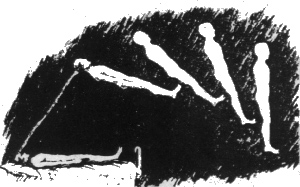
And it usually involves someone getting into a relaxed receptive state and then an interviewer working with that person asking them to describe a location designated in a sealed envelope, describe the location of the sealed envelope, or there is a series of letters or numbers assigned to a target, Target ABC123. And so then your interviewer would say to you ABC123. When you first get a remote viewer relaxed, and then ask him to describe the target in the envelope, they might take a while to describe it, they might not instantly come back and talk in a loud voice like I’m doing now, they might say, “well I don’t know, I seem to be perceiving something very strange, I can’t explain it.” “Well just describe the best you can.” They come back and say, “I see these boxes, underground storage of some kind, some of them are vertical and some of them are horizontal. Doesn’t make any sense to me, this a green area with rolling hills and these boxes that are underground. I don’t know what that could be.” And after this sort of interview in this meditative kind of phase, then you might say, “well OK, sit up now and draw for me what you’re trying to describe.” And so here is a drawing that might be provided here.
You see that he has a symbol here and thinks that’s some sort of a religious target involved here, a flat area with some trees in the area, green rolling hills, and he feels like it’s a kind of place that people might come to visit, and these boxes or crates made of heavy wood, some of them horizontal and some of them vertical, and yet in looking at that we can’t really tell what that is or what that means. And so you might ask him to concentrate again, “try concentrating again, and see if you can’t put the elements (what we call gestalt, major gestalts), put these elements together in a recognisable form.”
And so on a second drawing he might come back and say, “well there is an area over here where these boxes are underground, and then there’s trees, and some sort of religious symbol over here, maybe a church in the distance, mountains in the background”, and he comes and says, “this is actually underground storage of some kind.” Interestingly, in remote viewing they don’t have the same overprint of physical world descriptions that we have, so they don’t try to label the things that we label. They wouldn’t say that this chair is a chair. They would say, “well there’s a flat surface with four legs on it and I see people sitting in it,” rather than saying, “oh, I see a chair.” So we’re seeing the same kind of thing here without the physical world overlay. What is the astral information available here?
It turns out this site is actually a graveyard. And so we have rolling hills in the background, underground storage of boxes, and trees, a place that people come to visit. But notice the remote viewer didn’t have the description. He did not come back and say, “oh, this is a graveyard.” If you and I were to drive by a graveyard in our cars we would turn and look and say, “oh, look it’s a graveyard.” In a remote viewing sense though, he doesn’t have that same kind of physical world labelling that we do. However, this technique proved very useful in military surveillance.
Tony: I can just imagine the frustration of the commanding officer after that exercise!
Skip: Yes, and the question too in many of these things, if you were looking for, in a police instance, where did the bank robber hide the money? And you ask a remote viewer to describe where did the bank robber hide the money. If you gave the descriptions of, “I see lots of boxes stored underground in an open park like area”, they might say, “well that doesn’t mean anything, how are we supposed to find that?” But if you take those sketches to all the policemen, to the firemen, to the building inspectors, the county supervisors, somebody’s going to look at those drawings and say, “you know what that is, that’s the graveyard.” So you need to use this tool of remote viewing in conjunction with normal investigative aids. It doesn’t give you all of the answers instantly, because it’s a different form of perception. It’s a perception of the Bardo reality, the astral reality of it, and not necessarily equipped with our physical labels.
Tony: Could astral projection be used to enhance the abilities of remote viewers?
Skip: Ah, excellent question. As it turns out, the best remote viewers first acquire the target while their souls are in their body, sitting here just like you and I are, monitoring the input from our physical senses. And they close their eyes or they simply turn their attention to those inner senses, those astral senses, and begin to acquire the target. And as they begin to get information and we know that they are locked on to describing the right thing, they are not always right on, some of the best, best, best remote viewers only get locked onto the right target maybe 50, 60, 70% of the time, they aren’t always locked on good. When they begin to get locked on good, then you can say to them, “OK, seems like you’re doing well. I want you to relax now and get really deep, and I want you to visit the target and describe it to me.” And then they rest back and they actually do perceive themselves first stepping aside from their body and then waking up at the site. So the idea of surveillance, non-physical surveillance, in its most ideal application is the expansion first of what we might call classical remote viewing and then extending that into an OOBE. If you don’t do the classical remote viewing first, however, many out of body travellers escape the physical world and are off in other dimensions of the Bardo. It’s much more attractive with a lot of other places to go.
Tony: I just wanted to ask you a controversial question. Apparently the Monroe Institute has accepted a number of military contracts.
Skip: It’s an interesting word you use, “apparently.” Lots of people can write anything, freedom of speech and the Internet. I have intimate knowledge of all of that, I mean I’ve worked there and I’ve been associated with the Institute since 1977. There was one classified government contract with Mr Monroe, not the Monroe Institute, and that was to train their famous remote viewer, Joe McMoneagle. There was also training done by the military when they came down in groups of staff members to go through the Gateway Voyage. But there wasn’t anything classified or military or secret about that, it was just three classes they did where there were members of the military staff who came down as though they were doing some sort of advanced seminar, a communications seminar. Those are the only governmental connections. There’s another rumour that Mr Monroe’s father was a CIA operative, which is totally false. I’m sure somewhere there is some guy named Monroe, who was in the CIA at one time, but it didn’t have anything to do with Mr Monroe at all. It makes an interesting rumour.
Tony: In your extensive experience, what do you feel is the best way of inducing astral projection or an OOBE?
Skip: Well first of all, understand that every night when you go into slow wave sleep, slow wave unconscious sleep, you are in fact out of the body. The very definition of being unconscious means that you’re not conscious here, because you are elsewhere as it were. And with that in mind, what you’re really asking me is what is the best way I can become aware of being out of body? I think that’s what your real question is, because everyone gets out of body, it’s a perfectly natural thing to do.
How does one become aware of their OOBE, and we talked about that earlier on [see part one]. It has to do with practise and there are probably five general rules that I talk about in this. First is physical relaxation, just relax, calm down physically and mentally. And then get connected, have a specific target or specific topic. Connect to with that, and then listen. Quietly listen. What you’re trying to do is tune into your astral senses, away from the physical into the astral senses. And you’ll find that there will be a moment of dissociation like you lose your sense of who you are. And that’s the first stage of becoming aware.
So you’ve got to relax, you’re going to get connected, and you’re going to listen. And then you’re going to become aware. And then there’s objectify, or bring the memory of that experience back into the physical world. Journaling is a wonderful way to do that, immediately after an experience, to journal and to write down or to say into a tape recorder or else it will just escape and go away quickly into memory. So how do you do this? There are many meditative practices available that allow this, but more than that you need an institutionalised structure that will support those steps. That’s one of the things that Robert Monroe the famous “out of body guy” left with the Monroe Institute. He left an institutionalised structure designed to support and facilitate the exploration of consciousness. And left a technology called “Hemi-Sync,” a sound technology that can alter your brainwave state and open the door, just like the 4 D’s we talked about.
You might say that Hemi-Sync is the technical form of drumming, of rhythmic stimulation to alter the brainwave state. More than that there are the exercises that are pre-recorded on the audiotapes and CD’s, and it’s these exercises that give you the swimming pool practice. The immersion and the backing out, the immersion deeper and the backing out, and exercises to wake up your astral senses, so that you become consciously aware of what’s going on. And at the senior courses, in for example the Lifelines Course, you are out performing mission in the realm where people go when they die. And so you might not have an awareness of drifting out of your body, and drifting up, and floating away, but later on when you examine the information you recorded, and you ask “well, how did you get that?” “Oh, I must have been out of my body to get that information.”
Tony: So how exactly does the Hemi-Sync work?
Skip: The short answer to that is it works very well! It is a consciousness altering technology using sound. Now consciousness itself is a component of first of all the brainwaves arousal state in conjunction with our own personal experience and mental agility. The Hemi-Sync patterns themselves have to do with altering the arousal side, of calming down the brainwave state, getting it down to a Theta and Delta state that is the normal state of brainwave arousal for the OOBE. They do this by changing the neuro-chemistry of the brain through the reticular activating system.
When we listen to these Hemi-Sync sounds a slightly out of phase signal from one ear to the other establishes a rhythmic pattern that alters the neuro-transmitters on the brain. The arousal level of our brain is based on the balance of neuro-chemistry. The 3 principle regulating neuro-transmitters are acetylcholine, serotonin and noradrenaline. When we listen to the Hemi-Sync sounds it changes the levels of acetylcholine at the cortex and thereby changes the arousal level of the brain. We can use Hemi-Sync to stimulate the brain, for kids studying their books or wanting to learn more from their books, or we can calm the brain down for deep meditative states, conducive to the OOBE and deep meditative exploration.
Now consciousness itself is a balance between this arousal state and your own personal upbringing and agenda, your personal emotions, fears and worries. So even though I could get you into a conducive state of consciousness, that doesn’t guarantee that you’ll have a conscious OOBE. Now remember we talked that the OOBE is perfectly natural and it happens to everybody in their unconscious sleep, the situation you asked about is how can you become aware of that time. Now there are lots of defensive mechanisms that might keep you from being aware. If you have a horrible fear of dying, the minute you begin to drift out of your body, the light switch goes out and says “we’re not going to tell him about this, he’s too afraid of dying, we’re not going to tell him about that.” But you can overcome that by gently trying, just like the swimming pool exercise. Gently trying again and again, to desensitise you.
Tony: Given that you’re playing around with the chemistry of the brain with the Hemi-Sync, how safe is the Hemi-Sync for long term use?
Skip: Well again, like we talked about with the 4 D’s, it isn’t the Hemi-Sync itself that creates the experience, it makes a conducive environment. Bob Monroe explained it to me in the simplest of terms it was very easy, he said it’s just like music. Imagine yourself going out for dinner and drinks to a night club, and suddenly the band strikes up a tune and you’re there with your date. You don’t suddenly robotically get up and start to dance as though the music had some power over you. You might tap your foot, or you might hum to the music, but if you do decide to get up and dance of your own free will, if they’re playing a cha-cha, you’ll probably dance the cha-cha. If they’re doing a waltz, you’ll probably wind up doing the waltz.
And Hemi-Sync is the same way, it’s depending upon you willingly participating with it. And it is not something on which you become dependent. It is only getting back to the training wheels, a way of showing you a way of waking up your astral senses through personal experience. This is a personal exploration, an experiential learning. But you don’t need to use the Hemi-Sync once you know how these things work.
Tony: So you’re saying that once you’ve mastered the art of astral projection, you can then put the Hemi-Sync aside.
Skip: That’s correct, absolutely.
Tony: Recent studies have shown that Ecstasy use over the long term, increases the production of serotonin. However, once Ecstasy is withdrawn, the subjects find that their brain no longer produces as much serotonin as it did prior to the administration of Ecstasy leading to depression. Could the Hemi-Sync possibly lead to similar problems in the brain, given that it does alter brain chemistry?
Skip: Interesting question and we need to understand what’s going on here and the difference. You’re talking about raising the body’s production of serotonin with Ecstasy. And so the body like a fly wheel says “we’ve got it, we’ve got it, we’ve got it” and then you take the Ecstasy away, and there’s this crash of no serotonin. But with Hemi-Sync we aren’t regulating the quantities of neuro-chemistry, we don’t in any way boost the quantity. What we’re doing is changing the permeability of the cells within the reticular activating system and simply allowing the change of flow of not serotonin, but acetylcholine.
So we don’t tell the body to produce more acetylcholine, we’re just changing the cell wall permeability, which is the natural way that our reticular activating system regulates the arousal. When you’re walking along the street and you’re wondering about crossing the street, you step off the curb, and here comes the truck! Well immediately it kicks in, changes the balance of noradrenaline, serotonin and you jump back from the curb. That’s a perfectly natural reaction to that. It’s not changing the amount of production in the body, but the ratio by changing cell wall permeability.
It’s a very good question. People sometimes ask about other kinds of drugs, that are psychedelic producing drugs, and they have to do with changing things at the cortical level, changing the absorption neuro-chemistry and the cortical level. And the effect of regulating the reticular is not the same as that. So there is no dependency factor, and there is no harmful effect because it’s the perfectly natural way we react.
Tony: A number of shamans are able to alter their brainwaves at will, for instance dropping to Theta state. Would the Hemi-Sync device affect their ability to modify their brainwaves?
Skip: OK, that’s a really good question. It would not modify, it would actually be a reinforcement or a confirmation of what they’re already doing. We’ve had trained Buddhist monks come in and say “this is great, it took me ten years to learn how to do this.” But in further answer to your question, I’d like you to think about Hemi-Sync not as a gunshot or a hammer hitting you. But think about the Hemi-Sync and Monroe world, and the seminars that we have as being a total package, a Hemi-Sync process. Because it isn’t just the sound patterns, but the exercises that you do, and the gathering together in a group of twenty like-minded people in a specialised setting for the exploration of consciousness. Remember you asked me if set and setting were appropriate. So think of the Hemi-Sync not as just a sound but as this whole process of set and setting creating your experience.
Tony: Apparently Ed Wilson, a research scientist at the Monroe Institute discovered that Phi Fibonnacci earphone cascades were particularly effective at inducing astral projection, and yet he wasn’t permitted to continue on with that research. Why was that the case?
Skip: Well that’s an interesting statement mixed with lots of different facts. But Ed Wilson and I were good friends, he’s dead now, been dead for a number of years. Ed came as a consultant to us to help us with our brain-mapping machine and learning to use the brain-mapping machine and actually helped write a sleep study for us. And we experimented with different combinations of sound, ways to put sound together, and especially the Fibonnacci situation. And so the question of “Oh, this was specifically effective,” and “why wasn’t he allowed to continue with it” is a falsehood. I mean we thoroughly investigated that. We actually brain-mapped people using the different frequency combinations and it wasn’t effective, and we didn’t incorporate it.
There was no ill will between Ed and me, as research director there, or any parts of the Institute. The idea of using Fibonnacci as a natural ascension in sound was something we explored and we didn’t find particularly effective. Remember that what the bottom line is here is it isn’t the Hemi-Sync that does it to you, just like it isn’t the DMT that does it to you, the LSD or the Ecstasy that does it to you. It simply opens and facilitates, but the experience is in you, not in the Hemi-Sync, not in the DMT, not in the Ecstasy, not in the LSD, the experience is in you.
Tony: You mentioned brain-mapping. Would you be able to briefly outline in layman’s terms what brain-mapping is and how you go about it?
Skip: Certainly. We’ve been monitoring on the scalp changing electrical potentials for nearly 50 years now. We call it the EEG, or Electroencephalogram, and it’s simply the electrical residue of the neuro-chemical interactions happening in our brain. And throughout time we have been trying to understand whether or not this can be used as a diagnostic tool, or in some way of explaining how the brain works. But remember the electrical activity measured at the scalp is simply sort of left-over residue.
In the mid-1980’s computers came on line and where we used to look at just squiggly lines on a polygraph chart in monitoring brainwaves, now we can put these signals into a computer, make the computer organise these in a way so it would look like the oval, or look like the top of your head. And the name brain-mapping came about as that. And so there’s different colour schemes and different patterns that come about to be able to analyse the flowing activity, the electrical activity of the brain, in a map style form. Makes it easier to recognise, easier to look at, than a bunch of squiggly lines going across a page.
Tony: A number of authors have stated that astral projection is dangerous because the consciousness leaves the physical body, and hence the physical body could then be vulnerable to oppression or possession by various spirit entities. What do you say to that?
Skip: I’ve read similar accounts myself, and I have to say that in my 10 years experience in the Stargate Program working with dozens of remote viewers and literally thousands of remote viewings, working 15 years for the Monroe Institute and assisting many thousands with OOBE’s that it has never happened in my experience. We have never had that as being a problem.
Now, I’d understand why people might be fearful of that, but there is a concept that when you are projecting in the evening when you are asleep, or you have a deliberate OOBE, that you are always tied back to physical. Now some people think of that as being this silver cord, others have never seen a silver cord, but there is certainly a link.
People have a fear of “how can I find my body again, what if I can’t find my body again?” And that’s an interesting ego fear coming up. My answer is thousands upon thousands of people have had these experiences and that has never happened. Now there are people that have interesting experiences, where they are approached by unfriendly or frisky beings, and yet there are others who don’t have that as part of their experience at all. Apparently there is a protective energy involved here. Something from the spiritual realm which is above the astral that protects, unless there is some lesson to be learned, unless there is some advantage to you to stubbing your toe that you might learn from the experience, that you are protected from these peculiar experiences by the beings of light from the spiritual realm. So I can, although in my own experiential world I cannot say I’ve had personal experience with that, phenomenologically I can understand how that phenomena may occur. And yet, it’s driven, it’s self driven by people’s own fears. Remember when we said thoughts are things? So you move out into the astral, and you think “monster,” you can create a monster right there, and it’s a living real being to you.
Tony: You spoke about us being protected when we go out to the astral plane. Can that protection perhaps be enhanced by either projecting within a sacred space which we create for ourselves through some sort of protection ritual, or through prayer?
Skip: Yes, and I think the ideal word for that is invocation, to evoke the power of spiritual protection. Now in my experience, I grew up in a metaphysical family and I’ve done all these things over these years, and in my book I actually have a CD in the back of my book with my OOBE’s where I’m narrating while they’re ongoing. I have never had a problem of protection, but that’s because I believe in my heart I have always been and always will be protected. But invoking that power, using an affirmation to state that power, that I realise and affirm and invoke the protection of spirit in this adventure is a very powerful thing, for thoughts are things in the astral realm.
Tony: You mentioned seemingly unfriendly entities. Robert Monroe wrote about advanced entities milking human beings for a substance that he called “Loosh.” Loosh appears to be human emotional energy. This seems to tie in quite well with Gnostic writings where humans are milked for Dew, and Sanskrit writings which depict humans feeding Devas or god forms. How literally should writings like that be taken?
Skip: Well I think that literally speaking there are such entities. Astral beings can be created out of our own thought forms. We are in fact creators as is God a creator, and in the astral world we create these beings, self-sustaining beings that want to maintain their vitality. The subtle matter, the stuff out of which they’re made, is emotional and mental matter. We actually create them ourselves, and if we deify them, or if we worship them, they become stronger and stronger. But in order to sustain their existence, which they want to do, just like you and I want to protect our bodies and not get damaged and sustain our existence, they too want to sustain their existence. And they seem to be doing that by milking, or farming, the emotional energy generated by us in the earth Bardo. And some of them purportedly are creating this. When the supply of this energy, when supply of these emotions get down they attempt to stir things up, create wars, create conflicts in order that they might be able to reap more benefit from this. But it’s all part of the bigger spiritual plan, it’s nothing to be afraid of.
Tony: What are the advantages of having regular astral projection experiences?
Skip: Oh, that’s good. And again, I’m going to turn your words a little bit, we all have regular astral projection experiences. But the advantage to becoming aware of those experiences, have to do with learning to navigate the Bardo. In this process of making heaven on earth, the thing that we’re about here is creating heaven on earth. When we move past the death window, the physical body, we move into our soul, our temporary residence in the Bardo, and move from there to rejoin spirit. The advantage learning OOBE’s and learning that awareness teaches you to navigate and be aware of the Bardo. So that after death is the natural process, you are not entrapped in belief systems and spiraling again and again to earth, but can move directly into Spirit.
Tony: Is there one message you’d like to get out?
Skip: Well I think that we should realise that our purposes here in life, what we’re doing as human beings here is creating heaven on earth. That’s what it’s all about. And so each day, in every way, we should concern ourselves about that activity. Are we treating our fellow man as we would expect him to treat us? Are we part of the process of creating heaven on earth? So I’d advise everybody to put a smile on your face, carry love in your heart, and let everybody know who you really are.
[alert type=”general” dismiss=”no”]This article was published in New Dawn 74.[/alert]
[alert type=”success” dismiss=”no”]If you appreciate this article, please consider subscribing to help maintain this website.[/alert]
© New Dawn Magazine and the respective author.
For our reproduction notice, click here.