We think of prophecy as a revealing of information that can include warnings or spiritual insights. In the Old Testament, prophets were revered and the wisdom they imparted considered of the highest authority. They acted as a conduit to divine revelation as the will of God was revealed to them through communication with the Holy Spirit.
Christianity was built upon a Messianic figure whose coming was prophesied in the Old Testament books of Daniel and Isaiah. Yet in recent times, prophecy has fallen out of favour within the Church. Respect is still given to the biblical prophets such as Isaiah and St John of Patmos, to who is attributed the Book of Revelation, but the Catholic Church has refused to condone any post-biblical prophetic utterance as being true regardless of the source.
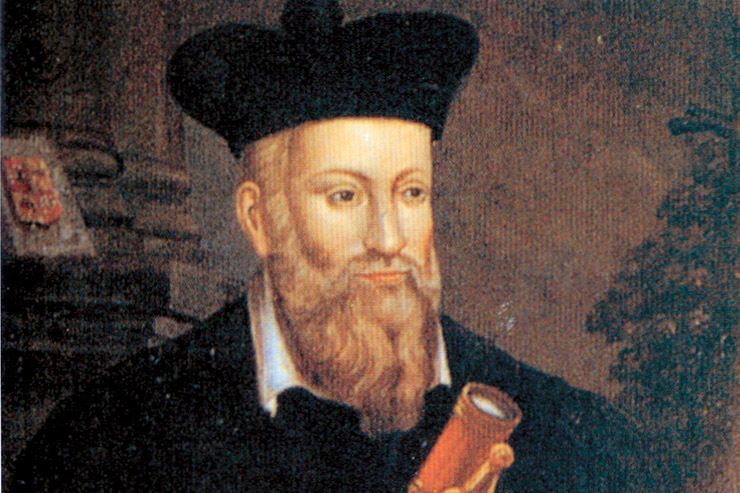
In spite of this, seers continued to add to the great body of prophetic work throughout history. Hildegard von Bingen, Nostradamus, numerous saints and even some of the popes were compelled to share their visions of the future. The accuracy of some of their prophecies cannot be denied.
An example was Mother Shipton, a 16th century English prophetess who appeared to have a clear vision of the 20th century and the Second World War. Her writings include: “Carriages without horses shall go. Around the world thoughts shall fly, in the twinkling of an eye. Underwater men shall walk, women will dress like men and trousers wear, and cut off all their locks of hair. When pictures look alive with movements free. When ships, like fishes, swim beneath the sea. When men, outstripping birds, can soar the sky, then half the world, deep-drenched in blood, shall die.”
Shipton’s writings have an apocalyptic feel and like many prophecies, biblical or otherwise, share a common theme in describing the End Times. This is known to Christians as eschatology.
Another widely accepted example of prophecy concerns the Great Fire of London. Three famous seers, Nostradamus, Mother Shipton and the astrologer William Lilly, all predicted a fire would engulf London in 1666. Astrologer Lilly was so accurate in his divination that he was able to name the actual day the fire would start, and as a result he was arrested and dragged before Parliament accused of having caused it himself. He managed to prove otherwise and was set free.
The above examples were not a matter of coincidence or luck, nor were the seers attempting to gain fame or credibility. They were simply communicating these foresights as inevitable facts of what had been revealed to them through divination or vision.
Members of the Catholic Church also continued to produce prophecies by those blessed with visions and among these stood St Malachy of Armagh, a devout Catholic bishop who helped to reform Ireland during the dark days of the 12th century.
St Malachy
According to the historian Cucherat, Malachy received a vision during a visit to Rome wherein he had witnessed every pope from that day to the Last Judgement. Known as the ‘Prophecies of the Popes’, these were recorded as 112 brief Latin descriptions, which were clues to the identities of the popes from medieval times to present day. The prophecies conclude with the last pope whom Malachy predicted would oversee the end of the papacy and the fall of the Roman Catholic Church.
It is said that Malachy bestowed these prophecies upon the then current pope after which they were deposited in the Vatican and remained hidden for nearly 400 years.
The Release
The prophecies were rediscovered in the Vatican archive in 1590, and published in 1595 by Arnold Wion in his publication Lignum Vitae. Wion claimed these were the authentic prophecies as had been penned in the 12th century by St Malachy.
The sudden ‘rediscovery’ of the prophecies in the 16th century allowed them to be used as propaganda in the campaign to promote Pope Gregory XIV to the throne. Since that time, debate has raged over whether the prophecies were a fabrication purely invented for this purpose. However, when studying the accuracy of the prophecies from both before and after publication, it seems unlikely they are complete fakes.
Accuracy
When the prophecies were published in 1595, the corresponding pope for each prophecy up to that date was known and could easily be identified. In the centuries since then, many have poured over these sayings seeking evidence of a connection in the lives of subsequent popes. The brevity of the text in the Latin phrases allows for some room for interpretation, but many are very specific and in no way as vague as one might expect. For a document that is at least 400 years old, there has always been a certain degree of accuracy.
A possible explanation for this would have been if the papal elections were somehow influenced by the prophecies, but there are many examples that refute this.
The prophecy for Pope Pius VII could not have been contrived. His reign coincided with the rise of Napoleon whose fame and power overshadowed the pope considerably. The prophecy for the time of Pius was “rapacious eagle,” and the eagle was the symbol by which Napoleon was identified.
Another important example of the accuracy of the prophecies is the reign of Pope Benedict XV (1914-1922) in which he witnessed the Bolshevik Revolution outlaw Catholicism in Russia, the 1918 Spanish Flu pandemic that ravaged Europe and the outbreak of the First World War which killed a further 20 million people. His correlating prophecy was “religion depopulated.” It must be noted these world events could not have been averted so it would not have mattered which pope reigned during this time. The prophecy is linked to the timing of historic events and not to the man, but it is clear the link to the pope could not have been contrived in any way.
Other prophecies were also based upon external factors such as the location of the conclave, historic events or feast days that coincide with the election. Clement IX (1667-1669) was prophesied as the “Swan constellation.” He was elected in the ‘Chamber of Swans’ within the Vatican, but any cardinal could have been elected in that place and would have fitted the prophecy. This does not invalidate the prediction, but it changes the focus from the identity of the individual to the environment.
Further evidence for the sustained accuracy of the prophecies can be seen in Pope Clement XIII (1758-1769), whose prophecy was “Rose of Umbria.” Clement was a former governor in Umbria which has a rose for its state emblem. Pope John XXIII (1958-1963), whose prophecy described him as “priest and mariner,” was previously the Cardinal of Venice, and Pope Leo XIII (1878-1903) is described in the prophecies as “Light in the heavens.” His coat of arms shows a shooting star. This example and numerous others are accurate 700 years after the time of being inscribed, and 400 years following publication.
Pope Innocent XII (1691-1700), whose prophecy translates as “Rake in the door” had the surname Rastrello, Italian for rake, and originally had a rake on his family coat of arms. This has to be the most accurate and one of the hardest to contrive. Innocent’s election came at the end of a very difficult five-month-long conclave, so it is unlikely his selection was a simple attempt to fulfil prophecy.
The Final Pope
The ‘Prophecies of the Popes’ join that long tradition of apocalyptic prophecy by concluding with a final pope, “Peter the Roman” who is destined to witness the destruction of Rome and the Last Judgement.
In the final persecution, the seat of the Holy Roman Church will be occupied by Peter the Roman, who will feed the sheep through many tribulations, and when these things are finished, the city of seven hills will be destroyed, and the formidable Judge will judge His people. The End.
According the ‘Prophecies of the Popes’, the time of the last pope is finally upon us.
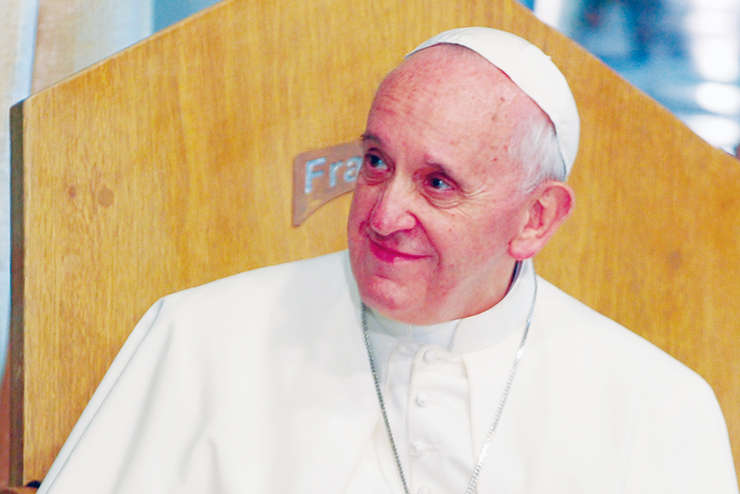
On 13 March 2013 Jorge Mario Bergoglio, hailing from Argentina, became the first non-European pope for 1,300 years. As Pope Francis, he is proving popular, as his displays of humility and focus on poverty are fast becoming the stuff of legend.
The identification of Pope Francis as Peter the Roman requires no great leap of deduction. Members of the Curia are automatically referred to as being Roman, having held a position in the Vatican administration. Bergoglio previously held five such positions in the Roman Curia. The links to the ‘Peter’ aspect of the prophecy were less clear until Bergoglio chose his papal name from Saint Francis of Assisi, whose full name was Francesco di Pietro di Bernardone – Pietro meaning Peter.
There is a precedent for this with Pope Paul IV who was elected in 1555. The prophecy described him as “from the faith of Peter.” Paul’s middle name was Peter.
Challenging Times
The timing of the ‘many tribulations’ of the prophecy may also seem apposite as there are many challenges on the horizon that threaten to unseat the new pope and bring to an end one of the oldest institutions in the world. For nearly 2,000 years the Catholic Church has been besieged by persecution and threats of invasion, but in recent years those armies have receded and been replaced by the judgments of the press and public opinion.
The three main challenges facing the Catholic Church today are the exodus of members from both the priesthood and congregation, corruption within the Vatican bank and the scandal of child abuse.
In terms of addressing the loss of the faithful, Pope Francis can speak directly to the wider audience of disillusioned priests and parishioners. His Argentinian birth and Jesuit background is well suited to stemming the exodus from Catholicism sweeping through South America where over 75 million Christians have converted to Pentecostalism.
Poverty is a huge issue between the clergy of South America and the Vatican as there is so much wealth in Rome, and yet, so many Catholics worldwide are mired in destitution. Pope Francis is devoted to alleviating the suffering caused by poverty, and as Archbishop of Argentina, he refused to live in the palace assigned to that role and would travel on public transport to visit the poorest people in slums and prisons.
He may have good intentions for mitigating poverty, but first he will need to put the Vatican finances in order in the wake of the banking scandals that dogged his predecessor, Pope Benedict XVI. There is also a possibility that in terms of financial fluidity, Pope Francis may find the Vatican coffers are already empty, and he cannot easily sell off the family silver.
Pope Francis is well suited to address the challenges facing the Catholic Church, but in the shadow of a 700-year-old prophecy, he may find that fate has other plans for him. Christianity is an apocalyptic religion and it might be within reach of its conclusion: the Rapture clothed in death and destruction.
We can only wonder if the Roman Curia will truly embrace that of prophecy, or if they are hoping to maintain the status quo.
In the end, they might not have a choice.
Rob Howells is the author of The Last Pope: Francis and the Fall of the Vatican (Watkins, 2013), available from all good bookstores and online retailers. He sheds new light on the prophecies of St. Malachy to reveal that Francis will be the final pope of the Catholic Church.
[alert type=”general” dismiss=”no”]This article was published in New Dawn 142.[/alert]
[alert type=”success” dismiss=”no”]If you appreciate this article, please consider subscribing to help maintain this website.[/alert]
This year [2011] is the 700th anniversary of the birth of Liu Ji (1311-1375), military commander of Chinese forces both on land and on sea and long-time advisor to the first Ming emperor Zhu Yuanzhang, whom he helped bring to power.
Liu Ji, who eventually became grand chancellor at the imperial court, was a man of protean interests and the author or co-author of books on warfare including comprehensive treatises on the use of gunpowder in firearms (Huolongjing), and, in particular, on the use of the medieval Chinese firearm known as the fire lance. Liu Ji (who is at least as well-known by his honorific or “courtesy” name of Liu Bowen) also wrote works on astronomy, the calendar, magnetism, geomancy, feng-shui, and other subjects skirting the supernatural.
In this latter category, he wrote one book that holds the same fascination for us today as it did for Liu Ji’s contemporaries. This is the Shaobing ge (The Baked Cake Ballad), a collection of prophecies of future events. The predictions are cloaked in a welter of abstract, allusive and arcane language. They seem to be stunningly accurate in their prediction of future events (such as the coming of Sun Yat Sen, founder of the Chinese Republic, in 1911). They bid fair to being compared to the prophetic Centuries of Michel de Nostradamus, the French prognosticator who wrote 200 years in Liu Ji’s future.
Basing his calculations on knowledge of cycles covering 50-year periods, this Chinese Nostradamus prophesied that the 50-year period from 1860-1910 would unfold as follows:
Strong nations will seek to subdue weak ones while oppressed nations and people will rise in strife to throw off their unvirtuous rulers. The people in China, likewise, will agitate and revolt against their foreign rulers from the North. The country will be weak and divided as it will be suffering from all these conflicts and other calamities.1
In a discussion of Liu Ji and his prophecies, in Occult magazine, Sybil Leek writes that,
In more specific terms, Liu Ji pointed out that his people would see great floods in the years of the swine (1873), the snake (1887) and the goat (1893) and 1911, another year of the swine. He indicated that within twenty-four years after the greatest flood, the existing rulership of the country would meet with great difficulties and dangers of an overwhelming nature, and the Wise Man in the name of the Moon would arise as the new sage and statesman to act for the cause and destiny of the country. The ‘Wise Man in the Name of the Moon’ is the birth name of Sun Yat Sen, the founder of the Chinese Republic.
Leek goes on to explain:
China was weakened by the Taiping Rebellion and the actions of the revolutionaries from 1860 onwards. The great flood took place in 1877, the year of the swine. There were wars with France, England and Japan in 1865, 1884 and 1895, each of which brought humiliation and losses of territory to the Manchu dynasty. The final crisis took place in 1911 when the Chinese revolution broke out to overthrow the once great and long Manchu regime, exactly 24 years after the great flood of the Yellow River. Other important historic events in this 50-year era were: the Russo-Japanese War of 1904-1905; the Japanese conquest of Korea in 1911; the Spanish-American War of 1898-1899; and the French annexation of Indochina in 1883.2
Does the warrior, politician, prognosticator of the future and explorer of ancient “New Age” lore known as Liu Ji or Liu Bowen have the right to be called “the Chinese Nostradamus?”
There are those who think so. Others contend that, while Liu Ji genuinely was a figure of great power and importance amidst the clashing ideologies, peoples, and life styles of fourteenth-century China, much of Shaobing ge was composed hundreds of years later, after many of the events it “predicts” had taken place, and was fraudulently credited with Liu Ji’s name in order to bestow divine legitimacy on those events. This school of thought traces the inception of the Shaobing ge not to the Ming or even the Qing era, but to the work of fiction writers and the propagandists of anti-Manchu sectarian organisations and secret societies that flourished in the early eighteenth century.3
Some hold there really was a Shaobing ge, composed by Liu Ji and consisting of prophetic messages – but it was greatly adumbrated, added to, and revised in later centuries, becoming the centrepiece of a number of Chinese messianic documents built on, in the words of Barend J. ter Haar, “the concrete expectation that one or more saviours will descend to earth to rescue a select group of human beings from imminent or currently raging apocalyptic disasters.”4
What really happened may be a complex mixture of all the above – including the exciting if uncomfortable fact that Liu Ji may really have produced predictions for the future, some of which have come true in stunning fashion.
The Chinese World of the 14th-15th Centuries
A brief look at the tumultuous times in which Liu Ji lived and left his mark may provide the beginnings of an answer.
Late fourteenth-century and early fifteenth-century China under the Ming dynasty saw the last great flowering of Chinese culture before a lengthy period of stagnation that ended only at the beginning of the twentieth century. Paper (100 BCE), the seismograph (132 CE), gunpowder (220 CE), and printing (movable wooden blocks by the sixth century CE, movable type by the eleventh) – all these were only a few of the inventions that China had developed centuries before the West, and it had pioneered such devices as the compass, the stirrup, suspension bridges, canal locks, iron chains, and water-powered mills and looms as well.
Under the Ming, China brought these advanced technologies to the height of efficiency. Art (particularly pottery), printed texts of every sort (a preponderance of them being scholarly), and architecture (both sacred and profane), flourished as never before. Defences, paved highways, bridges, temples and shrines, stupas, tombs, memorial arches and rock gardens were built in profusion. The walls of some five hundred cities were reconstructed. According to a legend that has followed him up to modern times along with that of his prowess as a prognosticator, Liu Ji himself was “an ingenious builder of imperial cities.”5
From 1405 to 1433, the eunuch admiral Zheng He, born four years before Liu Ji died, would lead at least one expedition of 200 (perhaps even 371) ships, some of them the tallest in the world, on a diplomatic and exploratory mission to South-east Asia, Africa, the Indian subcontinent, the Persian Gulf, the Arab states and the Red Sea. Gavin Menzies speculates, in 1421: The Year China Discovered America, that this fleet, captained by its Chinese Vasco da Gama and carrying a crew of 28,000, even penetrated as far as the west coast of North America.6 To cap the achievements of this era in a literary mode: in 1403-1408 three thousand scholars laboured to compile and copy what is still the longest encyclopaedia ever produced, the Yung-Lo Ta Tien (Grand Encyclopedia of the Yung-Lo Ta Tien Reign-Period) – an astonishing 11,095 volumes, containing 50 million Chinese characters. (Only 370 volumes have survived, scattered in libraries around the world.)7
Who Was Liu Ji (Liu Bowen)?
Liu Bowen was an exemplar of, and helped to mould, this world of vibrant and many-faceted activity. He was born in Qingtian County (modern-day Wencheng County, Zhejiang Province) in 1311. Tall, wiry, eager and precocious, he rose swiftly in the imperial civil service, acquiring the skills of engineer, writer, soldier and administrator, and others. When one of the leaders of the Red Turban secret society, a former travelling monk, grotesque in appearance but highly capable, Zhu Yuanzhang (1328-1398), seized Nanking from the Mongols in 1356, Liu Ji was at his side. Twelve years later, Zhu drove the descendants of the Great Khan out of Beijing and became the first Ming emperor.8 Liu served in many administrative posts under Zhu Yuanzhang. He was a commanding officer in sea and land battles. He studied and wrote on a wider range of topics than any other man of his time, particularly in the fields of warfare and divination.
Joseph Needham writes of him, in Science and Civilization in China (Volume Five, Part Seven), that, “Liu Chi [Ji]… was a striking personality, of remarkable qualities both civil and military. In philosophy he was a skeptical naturalist, interested in all kinds of science and proto-science – astronomy, the calendar, magnetism and geomancy – and a friend of the eminent mathematician and alchemist Chao Yu-Chin. But he was also concerned with administration, and for long an advisor to the first Ming emperor. In war he commanded at battles both on land and afloat, having in one instance (+1363) his flagship destroyed by a ‘flying shot’ (fei phao) just after he had transferred to another vessel.” Needham sums up Liu’s unique abilities: “Liu Chi was the sort of man who could successfully conjure a change in the wind just when the commander-in-chief needed it.”9
Needham’s vivid description of Liu Ji brings out the adventurous side of his life, as no account of this remarkable man can fail to do. This action-oriented dimension of the prognosticator-warrior was exploited in full by Taiwanese TV in a 404-episode mega-series, Shen Ji Miao Suan Liu Bo Wen (The Amazing Strategist Liu Bowen), that aired five nights a week from August 23, 2006, to March 12, 2008. This TV spectacular tells how Liu Bowen’s amazing ability to predict the future helped Zhu Yuanzhang overthrow the Yuan emperor and establish the Ming empire. In actual fact, Liu Bowen’s death in 1375 is shrouded in mystery: his multifarious talents may have incurred the jealousy of Zhu, who, increasingly perceiving his lieutenant as a threat, harassed Liu Bowen so much that he died of sorrow and indignation; the emperor then erased much evidence of the warrior-seer’s accomplishments. The TV mega-series takes advantage of these blank spaces, writing in a passionate love affair between Bowen and Princess Nanfeng, daughter of the deposed Mongol emperor. (Did this high-powered liaison really take place? The best that can be said is that there is no strong reason to suppose that it did not.)
In the early stages of the story, Princess Nanfeng tries to assassinate Emperor Yuanzhang, is blinded for her failed attempt, and seeks refuge in the shop of A Tian, who turns out to be Bowen’s best friend. There she meets Liu and his sister, A Xiu, who is training in the martial arts. When Liu discovers who this refugee is, he tries to restore her sight and keep her from trying to assassinate Emperor Yuanzhang again; Bowen wants to promote good relations between the present Ming emperor and the former Mongol emperor.
A treacherous Ming official, Hu Weiyong, tries, for personal gain, to persuade the Ming emperor to have Nanfeng killed. A battle of wits ensues that pits the noble Liu Bowen against the evil Hu Weiyong. It’s this battle, filled with bloody combat, sizzling romance, and the wrenching encounters of Bowen with the gods from whom he channels searing images of the future, that kept millions of Taiwanese glued to their TV sets for more than eighteen months. At the end of 404 episodes, when the contest is decided in favour of the Ming dynasty, the aid of Liu and his paranormal powers has been indispensable.10
How much truth is there in this TV production, and the depiction of Liu Ji as a man of magical clairvoyant power? Did he really “channel” future-event predictions that, gathered into a volume called Shaobing ge, rival those of Nostradamus in their beguiling obscurity and – when they can be interpreted – their occasional striking accuracy?
Liu Bowen’s Specially Encoded “Moon Cakes”
Many modern scholars, as we’ve seen, tend to think not. Ter Haar writes that in the nineteenth century,
One of the first paragraphs of the 1811 initiation manual [put together by secret societies plotting the downfall of the Manchu dynasty and the resurrection of the Ming in a series of divinely-ordained, messiah-led, apocalyptic battles] states that in 1643 an ‘Inscription by Liu Bowen’ was spit out by the (Yellow) River in Kaifeng… It predicted the return of the Ming under the Zhu family, bringing peace.11
Perhaps not conscious fraud as much as powerful, self-deluding, emotional need – it must have seemed to the members of the society as if they were channelling the document! – wafted Liu Ji’s imprimatur into the ritualised agendas of these anti-Manchu secret societies. Nevertheless, there is a story, with some claim to historical truth, that suggests just how cryptic messages in baked cakes, prophesying China’s future, might have come to be associated with Liu Ji.
The Chinese have a custom, said to date from the end of the Yuan Dynasty (1271-1368) of eating baked “moon cakes” at yearly mid-autumn festivals. The custom had its origins in the revolutionary times preceding the fall of the Yuan, when the general populace, lashed into fury by the oppressive regime, rose up again and again against their Yuan masters. The messages had to be transmitted in secret so that the insurrectionists could meet at the right time and the right place. Zhu Yuanzhang and Liu Bowen had the idea – or so the story goes – of spreading the rumour among the peasants that a deadly plague was afoot in the land and the only way to prevent it was by eating specially-prepared mooncakes. These special cakes were to be quickly distributed – each containing an encoded message coordinating the Han Chinese revolt for the fifteenth day of the eighth lunar month.
The messages were in the form of a simple puzzle or mosaic printed on the surface of the cake. To read it, you had to cut the four mooncakes per package into four pieces each. The sixteen parts would then be put together in the right order to reveal the message. The evidence would be destroyed by eating.
But Yuan government officials were everywhere, and it was almost impossible to send the messages without their being detected.
Liu Bowen devised a new plan: the messages, particularly the critical one of “Uprising on August 15,” would be baked inside the mooncakes. This was done, and the buried-message cakes were successfully distributed. The insurrectionary armies converged on Beijing on August 15, and soon the city fell to Zhu Yuanzhang.
The memory of this conspirators’ device, enhanced by legend and the life story of the charismatic Liu Bowen, could have been transformed into a legend of cryptic prophetic messages from the gods “hidden” inside a book called The Baked Cake Ballad.12
According to legend, the Shaobing Song, as it is also known, predicted the future of China including the 1449 Mongol invasion, the 1911 founding of the Republic of China and much, much more.
To further quote Sybil Leek:
The next era of Liu Ji’s visions was the 50-year period from 1911 to 1960. Liu Ji predicted the Chinese-Japanese war which would come in the year of the ox (1937) and would last for 1,085 days. He did not see the end of the war as a lasting peace. But he foresaw that around 1947 a great statesman would arise to lead the Chinese into an era of peace.
Among other major predictions he made were that a world war would involve every country and that 1917, the year of the snake, would be one of the most ominous dates in the period. He predicted an earthquake in Japan in 1923, the year of the swine; the great world depression in 1931, the year of the snake; and the European war in 1939, the year of the rabbit.
Other interpreters believe that the Shaobing ge contains cryptic allusions to the rise of the great eunuch admiral of Ming times, Zheng He, the establishment of the Quin dynasty, the Opium Wars, and the first Sino-Japanese War, along with the founding of the Republic of China in 1911.13
Liu Ji was not the first Chinese prognosticator of the future to be spoken of in the same breath as Nostradamus. In the reign of Emperor Tang Taizong (599-649 CE), Li Chun-feng and Yuan Tian-gang wrote a book that seems to contain a startlingly accurate forecast of China’s struggle against Japan in World War Two.
This strange and ancient text, called Tui bei tu (“Back-Pushing Sketch,” apparently an allusion to the sixtieth, final, and farthest-in-the-future prophecy in the book), has never been translated into English. Dr. Yow Yit Seng writes in Chinese Dimensions: Their Roots, Mindset and Psyche that this prophetic work consists of
sixty illustrated diagrams [called ‘surreal drawings’ by other commentators], each with lyrics and descriptions in a cryptic style. Each scenario uses a ‘Celestial Stem and Terrestrial Branch’ used in [the] Chinese calendar, as well as a scenario from the I Ching. Each scenario seems to have accurately predicted events in Chinese history from the Táng dynasty onwards. It accurately predicted that there would be twenty-one emperors in the [Tang] dynasty from the [Li] family, with one of them from outside the family. It also foretold the rise of Empress Wu Zetian, the only ruling empress in the history of China.
To illustrate the difficulty of translating the Tui bei tu into English – or any language – in intelligible fashion, Dr. Yow provides a rough translation of Scenario 39, which depicts a bird standing on top of a mountain, with the rising sun at the bottom of the picture.
The lyrics run somewhat as follows:
Bird without leg, moon in the mountain.
The sun rises, everyone cries.
Disharmony in mid-December.
Sparrows to the south of the mountain, traps to the north.
One morning cries from metal rooster is heard.
The sea is lifeless, the day is over.
Dr. Yow writes that,
the Chinese character of a legless bird with a mountain is the character ‘Island’. Hence the event refers to an island nation. The island nation is linked to the rising sun; hence, Japan. When a million soldiers invade China with unprecedented cruelty and inhumanity, everyone cries.
In December of 1941, the Japanese talked peace in the United States, while secretly attacking Pearl Harbour. [This] fits the description ‘Disharmony in December’.
There are sparrows (small birds) south of the mountain, referring to small nations in South East Asia being captured. In the picture there is certainly an eagle that could trap it, coming from in the North, symbolising the United States. (Incidentally, the word luo is also the first word of the Chinese name for President Roosevelt, the US president who subdued Japan.)
Japan surrendered in August 1945. This corresponds to the Chinese calendar year of [the] rooster. The month of surrender was August, a ‘metal’ month.
The sea is lifeless when Japanese troops surrender unconditionally. Ri refers either to the day, or in this case to Japan (riben).
Dr. Yow concludes: “While the earlier scenarios depict events from the various dynasties, the later scenarios could probably describe events outside China.”14
The Tui bei tu, like the Shaobing ge (though in its vastly expanded form as the youthful adventures of Liu Bowen), had its moment in the television sun. From April 16, 2007, to May 11, 2007, Chinese TV aired in twenty instalments a serial called A Change of Destiny about two young men who hope to change their destiny by making use of the scenario-diagrams of the Tui bei tu. One tricks the other into buying a fake set of diagrams. This is straightened out; but the hopes of the two for an extraordinary future are dashed when they see that, every which way they interpret the scenarios, courting the future with the help of the Tui bei tu is always to court disaster. The future is our own responsibility, and not thatof sixty predictive drawings. The 20-episode Change of Destiny series was extremely popular all across China, and shows the hold that divinatory practices still have on this country now embracing cut-throat capitalism.15
So odd and cryptic are the predictions of Shaobing ge that there are no translations, into any language, that are not to some extent creations of the translator almost as much as they are creations of Liu Ji and whatever gods, if any, communicated his predictions to him.
Below are a few lines of text from the Baked Cake Ballad, in a translation so rough, so raw, and obscure, that it is virtually impenetrable. To try to interpret it is to be left fending for yourself in a forbidding if provocative jungle of words that are seemingly stand-alone because they seem to be completely unconnected.
Yet a translation like this is so rough that it can never really mislead, even while it illuminates only with the greatest difficulty. Perhaps these words are worth trying to interpret, though, if only to catch a mention of what’s going to happen in 2012, in China and in the world.
World hunger and cold are strange, the pillars of Germany by the baby dragon.
Wu Zi Ji-Chou tangled everywhere, people are not at home, occasional famine bandits hair, safe guarding the good sweet-scented osmanthus.
Chaos to the former pro-Western thief, no one dared to Zhongliang admonition, glad to see descendants of shame see the day, recession gas transported back to heaven, lack of ears on Kyrgyzstan in the middle and a Machine made to go West, East.
Red Head Boy and Girl are bleeding, upside-down triple the total before I go, shall be synthesized Sichuan pages, (predicted emperor) eighteen wins between the fire and water.
[alert type=”general” dismiss=”no”]This article was published in New Dawn 129.[/alert]
[alert type=”success” dismiss=”no”]If you appreciate this article, please consider subscribing to help maintain this website.[/alert]
Footnotes
1. Leek, 42; 2. Ibid; 3. ter Haar, 154; 4. Ibid, 163; 5. Needham, Vol. 1, 144; 6. Seng, 100; 7. Needham, Vol. 1, 145; 8. Roberts, 444; 9. Needham et al, Vol. 5, Part 7, 25, 232; 10. Wikipedia: Addicts, http://wiki.d-addicts.com/Shen_Ji_Miao_Suan_Liu_Bo_Wen; 11. ter Haar, 158; 12. Liu Bowen and the Moon Cakes, http://history.cultural-china.com/en/47H2345H11800.html; 13. Leek, 43; 14. Seng, 252-254; 15. Wikipedia: Change of Destiny, http://en.wikipedia.org/wiki/A_Change_of_Destiny
Works Consulted
Sybil Leek, “Sybil Leek’s Psychic Notebook,” Occult: New Dimensions of Life in the Field of Psychic Phenomena 5 (3) (October 1974): 42-45+.
Liu Bowen and the Moon Cakes on Mid-Autumn Festival, http://history.cultural-china.com/en/47H2345H11800.html
Gavin Menzies, 1421: The Year China Discovered America, New York: HarperCollins/Harper Perennial, 2008.
Joseph Needham, Science and Civilization in China, Vol. 1, Introductory Orientations. Cambridge: Cambridge University Press, 1954.
Joseph Needham, Gwei-Djen, Lu; Ping-Yi, Ho; and Ling, Wang. Science and Civilization in China. Vol. 5, Chemistry and Chemical Technology, Part 7, Military Technology: The Gunpowder Epic. Cambridge: Cambridge University Press, 1986.
J.M. Roberts, The Penguin History of the World, London: Penguin Books, 1980.
Yow Yit Seng, Chinese Dimensions: Their Roots, Mindset and Psyche, Selangor Darul Ehsan, Malaysia: Pelanduk, 2006.
Barend J. Ter Haar, “Messianism and the Heaven and Earth Society: Approaches to Heaven and Earth Society Texts,” David Ownby en Mary Somers Heidhues, Eds., “Secret Societies”Reconsidered, New York: M.E. Sharpe, 1993, 153-176.
Coming events cast their shadows forward.
– Johann W. von Goethe
This is the story of a most unassuming modern prophet – Benjamín Solari Parravicini (BSP) – who was born in Buenos Aires, Argentina in 1898, and died in 1974 at the age of 76. He was a painter and sculptor, and came from a traditional and well-to-do family. He held various posts with the Buenos Aires Municipal Arts Department; nothing particularly memorable nor exceptional about his social and professional life. He was a quiet, discrete and kindly person. Leading a low-profile life, he would have remained almost totally unknown to the world were it not for the fact that he had the uncanny gift of being able to peer into the future.
With time, Benjamín Solari Parravicini – ‘Pelón’ as his friends nicknamed him – has become widely known both inside and outside his native Argentina because of the “messages,” as he called them, he received from his “Guardian Angel” about coming events.
Contrary to what some in Argentina and elsewhere would have us believe, true to his unassuming style BSP never said he had “mystic visions” nor that the future appeared to him as a burning bush of divine inspiration. Nothing of the sort: he would suddenly become inspired by a feeling, and his Guardian Angel would send him one of many “messages” that he felt compelled to draw in pencil or charcoal in the simplest of forms; mostly as just one continuous line producing an image often rather naïve, to which he would add his written “explanation.”
In this way, BSP fashioned and shaped more than 700 prophetic “messages” that mostly relate to transcendental and dramatic events affecting the world of his time and after his time, many of which are centred on his native Argentina.
Most of these messages were revealed to him in the 1940s and 1950s, but he continued to receive them until just before his death in the 1970s. As with most prophetic lore, both the images and the prose are, for the most part, enigmatic. That is until passing events make them become clearer – often crystal clear.
[PLEASE NOTE: Images for this article (drawn by BSP) can be viewed in the downloadable version of this issue of New Dawn magazine.]
Such is also the case with other prophetic literature as the quadrants of Nostradamus, the papal prophecies of St. Malachy of Armagh in Ireland, and of other more modern sages from Edgar Cayce to Jean Dixon.
The interesting thing about BSP is that each message carries both a visual symbolic sketched drawing that speaks primarily to our emotions and intuition, whilst the written prose – normally set down by him afterwards when fully awake – speaks more to our intellect. No doubt, a good combination for today’s mindset where our worldview of reality is so heavily biased towards the intellectual. BSP gives us a more balanced appraisal of these messages both in their unconscious content – perhaps messages from the Collective Unconscious – and how he felt they could be intellectually “aligned” to make sense in today’s “real world.”
Thus, with time his “psychographies” – as he called these images and texts – were found to predict many highly dramatic events of the modern world: the fall of Hitler and Mussolini after World War II, the rise of Castro in Cuba, satellite communications, the destruction of the World Trade Center Twin Towers in New York City, artificial heart transplants, the atomic bomb…
Many of BSP’s messages refer to Argentina for which in 1971 he envisioned miseries and mishaps at a national level; he saw a great falling down and went so far as to warn that Argentina would suffer its own bloody “French Revolution” that may sink it into severe turmoil unless Argentineans recognise and accept “The Grey Man” who will someday hopefully place Argentina back on the right track from which it has strayed so very far. If that does finally happen, then he envisions Argentina and South America in general as a “beacon for the whole world” after the coming catastrophes of artificial and natural origins envisioned by so many.
Much has been written about what he meant by “The Grey Man” – el Hombre Gris. An unknown social or political reformer? A metaphor for the middle class? The common working man and woman? No one knows although in today’s decadent Argentina one thing is sure: this reforming political figure has definitely not shown up yet!
The Collection of Psychographies
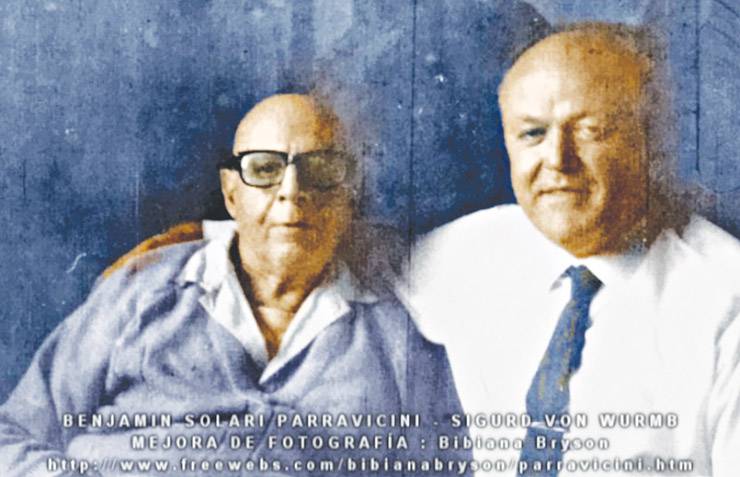
The author of this article was lucky to have been a friend of Sigurd von Wurmb and his kindly wife, Ana María, who were long acquainted with BSP from his early years. After BSP’s death they received a good part of his psychographies, many of which von Wurmb catalogued and then published in four volumes released through the local Kier Publishing House in Buenos Aires. Regrettably, Sigurd von Wurmb passed away in January 2007, however he left a very good and sequential account of what BSP’s work was all about; a website dedicated to him (in Spanish) can be accessed at http://sigurdvonwurmb.com.
Today, Ms Bibiana Bryson, with whom the author is acquainted, continues that work and is also custodian to another sizeable portion of BSP’s psychographies. She manages an excellent and authoritative website (www.freewebs.com/bibianabryson/parravicini.htm) on BSP in which she publishes information and research done on his work, as well as new interpretations based on major world events as they unfold.
The Cross Symbol
As to the source of his knowledge, BSP spoke of “superior beings” who made known to him their grave concern over the future of mankind. Notably, he spoke of José de Aragón, a monk-like figure he considered his Guardian Angel, who egged him on to draw and speak to future generations. He even told him to draw a symbol to inspire the “New Humanity” that, even now, is being born and will carry Man to superior levels of consciousness, a wholesome life, and harmonious alignment with constructive cosmic forces. He called that symbol “Cruz Orlada,” i.e., the “Trimmed Cross,” whose mystic symbolism Brother Aragón one night dictated to BSP as follows:
“Very simply, dear son, because God is the Universe and the universe is circular, thus we have that God is a Circle; thus God is Universal. The cross inside the Circle which can be plain or “trimmed” with flames, symbol of the Sun, and also of God – i.e., the God-Christ – shall be Love, Faith, Light; it is carried the heart of union… Send it to our brother Sigurd (von Wurmb) who can spread it through his pen in the press here and abroad…. Tell him the time of the Trimmed Cross has come.”
What Do the Psychographies Mean?
On her website, Ms Bryson admonishes all to be cautious regarding alleged “meanings” and “interpretations” of BSP’s messages. She points out one such case making the rounds on the Internet that some say may refer to a catastrophic event about to take place during the up-coming London Olympic Games which we will refer to in this article.
As Sigurd von Wurmb and Ms Bryson aptly point out, “BSP did not go into any trance, and all interpretations of his drawings are the sole responsibility of the persons making them, and should not be ascribed to BSP himself.” Von Wurmb said that BSP considered himself “a messenger, a channel of higher voices,” bent on warning man of impending perils and guiding him upwards. “BSP must not be forced into a circle of sensationalism, especially since there are serious and respected researchers into his life’s work.” These researchers include Ana María von Wurmb, Pedro Romaniuk, and Ms Bryson herself amongst others.
One of the most striking examples is a “psychography” that clearly references the World Trade Center attacks of 2001, both regarding the image and the text which says, “North America’s Light of Liberty shall lose its shine; its torch shall not illuminate as it did yesterday, and the monument shall be twice attacked.” This psychography is dated 1939, almost thirty years before the Twin Towers were even built.
Others from the 1930s carry texts announcing the coming Atomic Age:
“The atom shall come and reign supreme” (1938), and how that relates to the increasing chaos after World War II, “The atom shall dominate the world; the world shall be atomised and will be blinded. There will be storms caused by man’s excursions into the atmosphere, new illnesses, the sexes shall be perverted and confused; collective madness, total chaos. The world shall become dark” (1934).
About today’s mixed-up world he further stated back then, “The man-woman shall be a reality and will have two phases, by bisexual birth and through ancestry…. Medical doctors will operate and successfully, but the man-woman shall not be until 1970” (1937).
“All goodness shall disappear from the World. Robbery and crime shall take over. The purity of creatures shall be corrupted by evil example in denaturalised homes. Marriages shall wane; lovers shall be admired all the same. Men shall cease seduction; women shall seduce” (1934). An undated message believed to be from the thirties says, “666. BLIND WORLD. The world seduced by evil shall fall.” On a more political stance, “A power race between Yankees and Russians shall take place. They shall race for space and land. It might not seem so, but America will prevail” (1941).
Another message dated 1938, that many interpret as referring to the fall of Paris to the Germans in June 1940, reads as follows: “The Heart of the World shall fall in 1940; and shall be German until 1944.”
A more poignant one from 1938 – as the world watched a seemingly unstoppable Hitler and his ally Mussolini grow in power – reads: “Hitler – Mussolini. With the same ends; the same ending.” It shows a defeated Mussolini tied to Hitler’s back.
Then, there’s one from 1937 that seems to refer to Cuba’s Fidel Castro: “Bearded Head; that will seem holy but shall not be so and will inflame the Antilles.”
Regarding the decadence of the Catholic Church, he issued several warnings of bad things to come: “The Church shall err in its steps and its own leaders will falsify things” (late 1930s).
Alluding to the Vatican Council II, BSP warned, “The papacy shall have new norms. What was evil until yesterday shall cease to be so. Mass shall be protestant, without specifically saying so. Protestants shall be Catholics, without saying so.”
In a clear reference to the last popes of our times, notably John Paul II, BSP said, “The Pope shall leave the Vatican in his travels and reach America whilst mankind falls” (1938).
Another message from 1938 with a different kind of theme reads, “The heart shall be artificial in 1966.” In part, this tallies very closely in time to South African surgeon Dr. Christian Barnard’s first successful heart transplant in history.
The 2012 London Olympics
Then there are two psychographies which some claim point to the 2012 Olympics. The first has a series of images that not only relate to the Olympics but also bear similarities to a map of the main Olympic site in London when its image is superimposed upon it.
This message set down in 1972 shows the 114.5-metre tall spiralling sculpture designed by Indian artist Anish Kapoor and called the “ArcelorMittal Orbit.” It lies in Olympic Park and according to the BBC is 22-metres higher than New York’s Statue of Liberty.
There is also the 27-ton Olympic Bell that is much bigger than Big Ben’s as well as the Olympic Torch. Alarmingly, it shows a scythe, traditionally a Saturnian symbol of the Reaper of Death. The associated text in the message says, “Fire, Hunger, Plague, Death are rung by the bell nearing the world; but the world does not yet see or hear. The darkness of the dragon which seemed asleep, draws nigh. The terror of the bear that mocked love and brotherhood. The hour of the humble democrat who never was humble, and with him comes poverty, homelessness and, with them, all the explosions of dissolution. Darkness comes and, after that, Light from the South. And the Cross!”
The dragon is widely used as a symbol of England and Wales. Might the bear refer to Russia and the Slavs? The hypocrisy of “democrats” is a global phenomenon nowadays.
The other psychography that might point to the London Olympics was composed in 1938 and comes from Ms Bryson’s private archive. It seems to show a series of symbols and images of London, Britain and the Olympics, and carries an ominous message: “The Hour of Great Tribulation has Come!”
It too seems to show Big Ben, a jagged outline of the Olympic Stadium, English flags (a cross) and even the one-eyed Olympic mascot.
Still to Come?
Below is a small sample of Benjamín Solari Parravicini’s other prophecies that have not come to pass yet, and if proven true will have unprecedented impact on Mankind…
“The ugliness and deformity with which ‘extra-terrestrials’ are shown is human fantasy. That does not exist” (1972).
“Obelisks on the moon shall one day speak and shall destroy the voice of man” (1972).
“The seven-circular-step lunar crater shall reveal its secret to mankind” (late thirties).
“Interplanetary vessels come to earth in PEACE” (1960).
“Earthbound civilisation includes a lost civilisation that was far superior to the ones that followed it…” (1960).
“The interplanetary amphibious vessels shall show us the existence of inhabitable Canals inside the Earth. They shall submerge in the South Pole only to reappear in the North Pole in a matter of seconds!!” (1960).
“In view of the many visits from extra-terrestrial vessels, science will first deny, then doubt, and finally shall say ‘It is true!’ And our wisdom shall stay behind. They have been watching and contemplating us for centuries” (1940).
“There shall appear flying high above in circles of light, bringing alien beings from other planets. Yes, they are the ones who came to populate Earth and it shall be well told. Yes! Those called angels in the Old Testament, or the voice of Jehovah, shall again appear and they shall be seen and Heard” (1938).
Argentina
Many predictions refer to BSP’s native Argentina and have so far proven grimly accurate:
“RA. Argentine Republic must ready itself to suffer. They shall have some thugs that will reduce the country to a fascist-style communism. Death shall run through streets and roads” (1938). To many, the author included, a reflection of today’s Argentina under the corrupt Kirchner government and the increasing violence of all sorts that their erred policies have triggered throughout the country.
“On its new Constitution, breaking with prior norms, a tall mountain of evil figures shall arise. All of them will cover their hidden agendas behind their make-believe masks” (1940). In 1994, Argentina sanctioned a new Constitution with dire results as it has given the corrupt political party system a veritable monopoly over political power.
Since then, successive administrations have gone from bad to worse, starting with the corrupt Carlos Menem government (1994-1999), followed by the grossly failed Fernando De la Rúa government that dumped the country into an abyss of chaos (1999-2001), the ignorant interim administration of Eduardo Duhalde (2002-2003) and finally today’s grossly corrupt and perverse Néstor and Cristina Kirchner administrations (2003 to date).
In more general terms, he foresaw that, “Argentina shall suffer on a small scale, what shall later hit the World. It shall set an example!” (1938).
There is much truth to the first part of this message, as the unprecedented financial and social collapse Argentina went through in 2001/2004, triggered by its Sovereign Debt default, gave the global banking money masters a practical opportunity on how to macro-manage a full-fledged collapse and not only get away with it, but also make a huge profit out of it.
Argentina was used as a sort of “leading case” and ten years later the banksters are now applying those lessons they learned from Argentina in countries like Greece, Ireland, Iceland, Spain, Italy and others.
When times are troubled as they are today, we would do well to lend an ear to what the very few prophets still left are saying. Their messages might be hard to unravel but they hold warnings and guidelines that we would certainly do well to heed.
It’s certainly worth listening to Benjamín Solari Parravicini as many of his hundreds of prophetic messages are yet to be fulfilled. Interestingly for those of us living in the Southern Hemisphere, an idea that runs through many of BSP’s messages is his belief that Salvation shall come from the South. In a similar tone wrote Chilean diplomat Miguel Serrano, in line with many Europeans and North Americans who, despairing at today’s materialistic world that is falling apart at the seams, have also looked Southwards for a true renewal.
[PLEASE NOTE: Images for this article (drawn by BSP) can be viewed in the downloadable version of this issue of New Dawn magazine.]
[alert type=”general” dismiss=”no”]This article was published in New Dawn 133.[/alert]
[alert type=”success” dismiss=”no”]If you appreciate this article, please consider subscribing to help maintain this website.[/alert]
The jury is still out on the millennial prophecies of Michel Nostradamus, the French master physician, astrologer and Kabbalist of the sixteenth century. Many regard him as the greatest prophet in Western history, while others find his predictions, especially those concerned with our own era around the second millennium, irrelevant or simply too deep or too equivocal to interpret successfully.
Did he predict war or peace for our time? Did he foresee a coming Utopia or a descent into a Dark Age? The end of the world or a Golden Age a thousand years long? The appearance of a great spiritual Teacher or an Anti-Christ? These are the confronting questions that inevitably arise when considering the work of this famous Renaissance seer.
I believe the key to Nostradamus’ undoubted genius and equally undoubted capacity for paradox lies in the breadth of his religious affiliations, which, astonishingly, embraced all three Semitic religions: Judaism, Christianity and Islam. Without acknowledging this secret propensity for religious syncretism, regarded as heretical even in our own free thinking day, it is difficult to throw any light on the contradictions inherent in Nostradamus’ work. His religious beliefs simply cannot be left out of any in-depth evaluation of his prophetic legacy: they made him what he was, a mirror laid to the very heart of our polarised, suffering civilisation.
A true child of medieval Provence, the home of chivalric poetry and mysticism, Nostradamus was born in 1503 in Saint-Rémy-en-Provence of Christianised Jewish parents, was brought up as a committed Christian and died as one in 1566 in the small town of Salon-en-Provence.
At an early age his two grandfathers, who preserved in secret their Hebrew religious and cultural traditions, gave him a comprehensive classical education in literature, history, herbal medicines, Greek philosophy and a range of languages, as well as the ‘celestial science’ – astrology – in which he took a deep and abiding interest. As well, his two Jewish mentors clandestinely introduced the boy to the Judaic esoteric culture. He learned the occult arts and sciences forbidden by the Church, and acquired a knowledge of alchemy and the Jewish Kabbalah, the latter a mystical initiatic system of ten levels of consciousness akin to Hindu Kundalini Yoga. Yet he is believed to have remained at the same time a loyal son of the Christian Church.
Later, for fear of the Inquisition, Nostradamus burned the old Jewish family books on Kabbalistic magic that he had acquired from his grandfathers, along with other occult texts on alchemy, hermeticism and Chaldaean and Assyrian magic. But his most secret religious affiliation linked him to a belief-system that at that time was virtually unknown in Europe and its presence in his life was therefore to remain safe from discovery for almost five hundred years.
Not until the most recent decades has modern Western research discovered that this remarkable Jewish doctor and occultist, trained in Hebrew wisdom, was not only deeply committed to both Judaic and Christian principles but was also a member of a Sicilian Sufi brotherhood loyal to Islam. A true man of the Renaissance, Nostradamus secretly believed in the underlying unity of the three religions, and his prophecies yield their deepest meaning only on this basis.
Nostradamus’ Prophetic Genius
Nostradamus’ life has been chronicled from a variety of different perspectives by a great number of commentators. What emerges most clearly from these studies is confirmation that his prophetic genius owed much to this hidden background of wide-ranging religious connections. The principle of syncretism lies at the very heart of Sufism and was evidently espoused by the doctor. He was the very embodiment of a universal theosopher, a prophet without dogmatic or theological boundaries who would foreshadow and greatly influence the coming explosion of Renaissance universalist thinking. Nostradamus’ academic training was to reinforce this unusual spiritual breadth.
In Europe at the end of the Middle Ages, plague, famine and superstition were rife, men of enlightenment few. Nostradamus was one of those few. He attended the prestigious universities of Avignon and Montpellier where he qualified with high honours as a doctor of medicine and philosophy, and became renowned as a ‘plague’ doctor who effected amazing cures in times of severe pestilence. He was also an adviser to royalty and a deeply learned writer of philosophical works, as well as writing a book on food and cosmetics.
During his wanderings through Europe after the death of his wife and two children from the plague, Nostradamus came into contact with an underground network of ex-Jewish occultists practising Hermetic and Kabbalistic magic, and gained training from them. This, allied to natural clairvoyant abilities, led to his dedication to the prophetic art. His cryptic book of prognostications, Prophéties, has vied with the Bible for being continuously in print since it was first published in complete form by Benoit Rigaud in 1568.
In the first part of the book, which was called Centuries and written in 1555, Nostradamus attempts to describe his method of divination. It is that of the fourth-century neo-Platonist Iamblichus, whose reprinted book was published in Lyons only a few years before Centuries was written, and had no doubt been perused by Nostradamus. A bowl of steaming water is laid on a tripod placed in the prophet’s study at the top of his house. He works at his magic practices while the household sleeps.
Sitting alone at night in secret study, it rests solitary on the brass tripod. A slight flame comes out of the emptiness… (Century 1 Q1) The wand in the hand is placed in the middle of the legs of the tripod. He sprinkles with water both the hem of his garment and his foot. Fear, a voice runs trembling through the sleeves. Divine splendour; the God sits nearby. (Century 1 Q11).
Nostradamus notes that fear, dread, accompanied the parting of the veil that revealed daemonic powers; but tells us that when the God came and sat invisibly beside him, fear departed. In this picture of divine collaboration in a herculaean human task there is something very moving. The God has often been interpreted as the magician’s own god-given gift, but it is more likely to have been the invisible presence of a higher being who accompanied him in order to give comfort, reassurance and guidance. For there is no doubt Nostradamus was treading a wild, uncharted path outside tradition, and an emissary from higher realms might well have been sent to companion him… as he himself apparently believed.
20th Century a Key Period
In the preface to Centuries, written in the form of rhymed quatrains grouped in hundreds, Nostradamus discusses his clairvoyant visions of the future in revolutionary terms. In them he foresees “great events, sad and prodigious and calamitous adventures approaching in due time,” events that would, however, precede, or perhaps accompany, a great transformation in humanity’s level of consciousness and spiritual understanding. His apocalyptic intimations clustered around the twentieth century, “the Century of the Sun,” and predicted the rise of new mystical teachings leading to radical changes in our traditional religious beliefs before 1999 – as indeed we are surely now seeing.
Nostradamus saw the twentieth century as humanity’s rubicon, a pivotal moment in history yielding a unique crisis of choice, of decision – a century of paradox in which enlightenment would spring from the deepest tribulation. He is often accused of being a prophet of doom, but if his prophecies are contemplated from a spiritual perspective, Nostradamus brings us a message of sublime hope. In biblical times seers like the doom-laden prophet Jeremiah were often killed for their pains, their messages rejected; but today the essentially ethical and optimistic philosophy at the core of Nostradamus’ predictions can strike a deeply positive chord in his readers. Right choices bring blessings, he is saying, out of pain comes spiritual regeneration.
After many wanderings after the death of his family, Nostradamus became a successful doctor of the plague in Marseilles and was rewarded with large sums of money by the government of the city. He then remarried and set up a medical practice in Salon, where he lived and worked for the rest of his life. When many of his published predictions came true, Nostradamus became famous in his own lifetime and won the patronage of France’s then Medici royal family, Henri II and his consort, Queen Catherine de Medicis. At the Queen’s behest the prophet travelled to Paris to cast the horoscopes of her six Valois children.
Yet as an ex-Jew and a radical thinker suspected of dubious supernatural practices, he lived all his life as a stranger in society and in danger of the displeasure of the Church of Rome. Surviving by various stratagems in a violent and unforgiving century, he worked against a background of forbidden Jewish and Islamic mysticism and the threat of Inquisitorial persecution. It is in this context of religious tyranny and repression that Nostradamus’ enigmatic visions must be understood. At first he determined not to publish them for fear of a public backlash, but later understood that the Church’s hold on the minds and hearts of its people would one day give way to a new climate of religious freedom, and this gave him the heart to go public.
Because of foreseeing the advent of the common people, I decided… [to declare] in dark and cryptic sentences the causes of the future changes of mankind.
So the seer wrote in the preface to Centuries dedicated to his son César, in celebration of a coming age of democracy – an age of freedom from the tyranny of the Inquisition. His words were an expression of the longing Nostradamus felt for a future time of intellectual and moral liberty in which advanced views like his own would be vindicated.
Because if the present kingdoms, sects and religions were to see the future kingdoms, sects and religions to come, and see how diametrically opposed they are to their pet fantasies, they would condemn that which future centuries will know to be true…
Although the prophet was forced to mix up his verses and present them out of their proper order as a means of obscuring their message, so avoiding the attention of the Inquisition, they have nevertheless time and again been found to present uncannily accurate forecasts of historical events over the ensuing centuries, and never more so than in those of the climactic twentieth century that would usher in a new millennium.
Interpreting Nostradamus’ Predictions
Some of the Centuries have proved to be indecipherable as predictions, but Erica Cheetham, one of Nostradamus’ most respected modern translators and interpreters, notes how fascinating she found it to be, while reading the Prophéties for the first time, to come across so many familiar names and historical events. “Names such as Hitler, Napoleon, Franco, Pasteur sprang to the eye. There were many dates too…”1 The prophet accurately predicted that the city of London would be destroyed by fire in 1666, he foretold the violent end of the French monarchy and the assassination of the two Kennedy brothers in recent times, and many more famous historical events.
Subscribing to the Chaldaean astrological tradition fashionable in his era, Nostradamus’ prophecies were concerned with a time frame of seven thousand years, spanning what he called the Age of Man. Jean-Charles de Fontbrune, a modern authority on the prophet, believes that by counting five thousand years from Adam to Christ, the seer arrived at 1999 as the end of the seventh millennium and the climax of a great evolutionary cycle.2 Actually, says Fontbrune, according to biblical chronology the prophecies end with the conclusion of the Piscean age, approximately CE 2000. And according to Cheetham, there are indeed many indications in the text that Nostradamus seemed to see the period around the second millennium as the possible date of Armageddon in the form of a Third World War, and perhaps the end of the world, although he sometimes contradicts this. In any case, projected throughout the prophecies in shadowy outline, Cheetham glimpses the idea of a great polarisation of good and evil at the beginning of the third millennium, and a stark choice for humanity.
In common with the Book of Revelation and with the mystical ideas of the Renaissance then incubating in Europe, Nostradamus foresaw in the twentieth century the advent of democracy and the resultant transformation of consciousness that would bring in sweeping new religious reforms and a new, more enlightened dispensation for humanity. At the same time, the seer was not blind to the terrible downside of the twentieth century and acknowledged that it would be a most fateful and afflicted century in which to be born. The historian Barbara Tuchman notes its phenomenal parallels to the calamitous fourteenth century with its plagues and famines, which she qualifies as a “violent, tormented, bewildered, suffering and disintegrating age… when there was no sense of an assured future.”3 In the sixteenth century Nostradamus predicted of the twentieth “evil century” that its final quarter would be “filthy, pestilent and violent,” and would culminate in unprecedented catastrophes.
Cheetham, like many other researchers, has exclusively focused on these negative aspects of the prophecies: our great plagues such as the AIDS epidemic, famines and floods, appallingly destructive wars, the decline of the Catholic church and the resurgence of militant Islam. She sees little light penetrating this gloomy picture of a civilisation on the edge of destruction, and links it to the coming of the series of Anti-Christs predicted by the seer. With the increasing incidence of earthquake activity, spreading deserts and political malfeasance, it will be a time of great calamity for humanity and even for the planet itself, a time of death – and yet, in the view of Fontbrune, of new life from the East. For according to his interpretation of the prophecies, many spiritual leaders would arise at the threshold of the second millennium to give warning of the disasters to come and would simultaneously bring hope to the world with their new religious teachings.
Before these [apocalyptic] events, many rare birds will cry in the air, ‘Now! Now! And some time later will vanish.
According to this prediction, then, a window of spiritual opportunity will open in the millennial era, but for a time only.
Fontbrune notes that a full two-thirds of Nostradamus’ prophecies are devoted to this millennial theme of apocalypse and spiritual rebirth. In fact, he believes that the great French magus and doctor of medicine wrote his quatrains in the sixteenth century for the express purpose of depicting the twentieth, knowing that “his text would be expounded and understood only in the century which was the focus of his vision” – the century of the common people. Nostradamus shared the hopes rife in Renaissance circles of the time, of an end to feudalism and religious bigotry, hopes that were closely bound up with the spiritual Solar principles from the past which still dominated the worldview of Europe’s esoteric luminaries.
In the symbology of the old Sun temples whose influence had once dominated the entire planet, the sun, birth, life and the brilliant energies of the daytime were identified with the East, while twilight, the moon, death and the shadows of the afterworld were identified with the West. In Minoan Crete new life was brought into the temples by the eastern gate, while the dead were carried out through a western portal and ferried across a stream to the necropolis built on the western side of the city; and these principles reigned throughout pagan times and passed in secret into Christendom, largely through Gnostic channels.
The same esoteric symbolism played its part in the conviction held by Renaissance astrologers that, however dark the end of the millennium might be, a new and wondrous epoch surely shone on the eastern horizon, promising the rise of new nations, new democratic and utopian principles and a new spirit of religious liberty. It is significant therefore that in Nostradamus’ prognosticative scheme the Solar sign should have fallen precisely to that century that has seen the burgeoning in the Pacific region of new civilisations and ideologies, and that in some of these cultures we are witnessing the birth of the most creative concentration of clairvoyance and spirituality, of egalitarian idealism – however distorted in form – to be found at any time in history. The Pacific lands – China, eastern Siberia and Russia, North and South America, Japan, Indonesia, Malaysia, New Zealand, Australia – while by no means immune to geological disasters, may well represent the most viable cradles of new life, new acculturation, in the millennia to come.
Nostradamus prophesied that the twentieth century would see developments in keeping with its Solar sign, which signifies material expansion and power but as well wisdom, the Christ as Logos, the Solar Word; the whole body of Hermetic-Kabbalistic knowledge inherited from the ancient world; inner harmony and integration. Another authority on Nostradamus, John Hogue, suggests in his first book on the subject that this spiritual knowledge foreseen by Nostradamus shows similarities to Hindu Tantra.
[Nostradamus’] Hermetic mysticism… has many parallels with the Eastern school of Tantra or Shivaic Hinduism, which saw the universe as a divine play or dance of paradoxes.4
The Teacher from the East
Hogue notes further that in the midst of world cataclysms and wars, Nostradamus predicted that a great spiritual teacher, a man from the East, would be born who would become the scourge of outworn religions and the revelator of spiritual mysteries the world over. The quatrains dealing with the “long-awaited one,” the sage from the East mentioned in C10 Q 75, Hogue believed might possibly refer to the coming of Maitreya, the fifth Buddha.5 The quatrain says: “He will appear from Asia, [and be] at home in Europe, one who is issued from great Hermes.” “He will fly through the sky, the rains and the snows and strike everyone with his rod [of Hermes, of enlightenment]. (C10 Q 75, C2 Q29)
As has been said, while at the same time professing Christian beliefs, Nostradamus’ Sufic initiation was one of the most important keys to his genius. Hogue tells us that, like so many of the Renaissance scholars and mystics who never disclosed the source of their exceptional talents, the Provencal prophet succeeded in keeping secret his membership in a Sufi brotherhood. Although he was familiar with all the occult systems of magic and self-transformation then known and with the writings of Iamblichus, the alchemists Paracelsus and Cornelius Agrippa, Pythagoras and the Kabbalistic Keys of Solomon, the main source of the seer’s grasp of Tantra and the trance techniques that underlay his prophetic visions was the Sufis he met during his travels in Sicily.
The island of Sicily had been a strong centre of Islamic mystical activity since the thirteenth century, when the Templar Crusaders brought back to it much of the Saracens’ wisdom acquired in the East. It was in Sicily that Nostradamus would have learned the secrets of ‘magic and alchymia’ and the ‘ministry of angels’ on which his visions depended, and would have understood the correspondence between the sephirothic ‘rays’ of the Kabbalah and the human chakras. Proficient in Sufic alchemy, few would have been more familiar than he with the Sufi-inspired ‘Rose garden of the philosophers’, the alchemical-tantric work that gave symbolic instructions for the union and transformation of inner energies. By uniting the two opposing archetypes of the psyche, the Solar king and the Lunar queen (the mind and the heart), the practitioner, so it was said, was led to the ultimate goal, the birth of the ‘divine child’ of enlightenment.
“The flame of a sect shall spread the world over…” So Nostradamus foresees in a letter to Henry II of France. He speaks of a new religious consciousness which culminates in a new religion during the final decade of the twentieth century, and of “the rose [appearing] upon the middle of the world… Then at the time of need the awaited one will come late.” (C5 Q96). Fontbrune has identified the rose symbol with socialism, a valid enough interpretation; but a mystical association for the rose is contextually also probable. As we shall see, in the Sufi terminology with which Nostradamus was familiar the rose is the symbol of Tantra and the fire of kundalini, of spiritual love. The rose was an important chivalric icon in the Sufi-inspired occult societies of the time, as it was later to be in Rosicrucianism.
One of the most influential and widespread of the Sufi Orders was the Qadiri Order, probably a vital influence in Nostradamus’ life. Founded by the followers of the so-called Rose of Baghdad, an eleventh-century Sufi from Central Asia named Abdul Qadir el-Gilani, it taught a dervish technique leading to ecstatic trance states and specialised in the science of psychic states. It invested its initiates with extraordinary psychospiritual powers that were said to put them in touch with angels. In the Qadiri Order, as in Rosicrucianism, the rose symbol figured prominently.
The rose, lily and lotus are traditional symbols of the chakras, and in the Qadiri Order the rose (ward in Arabic) was an emblem and symbol of the rhyming word wird, which referred to the ecstatogenic dervish method practised by its members to open the heart chakra.6 The rose symbol also had a sexual connotation much employed in the chivalric romances of the time, linking it with the love energy of the heart awakened by initiation, and many illustrations in Rosicrucian literature were to feature angels, roses and lions, the latter the Solar animal of the zodiac.
The rose symbol entered the Christian mystical stream with the cult of chivalry, whose secret message of initiation, dedication and metamorphosis informed every aspect of medieval culture. It would appear in England in the red cross of St. George, in the Order of the Garter, in the rose windows of European cathedrals and in a certain grade or set of Masonic rituals. In alchemical parlance it symbolised the fiery spiritual energy released during the transmutations of the magus’s laboratory. The symbol of the rose may therefore be seen as virtually synonymous with Sufism, as with Rosicrucianism also. And so when Nostradamus refers to the rose taking the centre of the world stage, he may well be making a highly significant statement about the new role of Sufism in modern times as the bearer of a specifically mystical and esoteric type of spiritual awakening.
Not all researchers agree on this point, however.
The Riddle of the Three Anti-Christs
Nostradamus mentions three negative influences or Anti-Christs in the course of his work, the third to be expected before the millennium (C8 Q77); and some writers, Erica Cheetham among them, identify this definitive figure of evil with the man from the East, “the long-awaited one” who will visit the Western nations by air. For Hogue the man from the East is a spiritual avatar, whereas for Cheetham he is the third Anti-Christ, bearing with him to the West what she sees as “dangerous” and “pernicious” cults that have broken away from the mainstream religious traditions. Coupling this evil guru figure with the current rise of occultism and the spread of esoteric New Age cults, she regards many of “these so-called covens… as worshipping Satan as their God.”7
Cheetham is not the only scholar to take a negative view of the New Age counter-culture that deviates from traditional religious teachings, whatever their hue. Frithjof Schuon, a Sufi metaphysician who belongs to the austere modern school of Neo-Traditionalists, gives little comfort to those looking forward to a new spiritual paradigm as part of the reforming agenda of the future. Sacred tradition, Schuon insists, belongs to an immutable, everlasting, incorruptible and unchanging order. If it is abandoned today in the hope of better things to come, it is not because it has outlived its usefulness or because people no longer understand its language, but because they don’t wish to understand.8
Cheetham would agree with this traditionalist viewpoint. There is, she contends, a demonic aspect to our present era, “a malevolent side to all these [psychic] happenings, very often desired by those who dabble in them.”9 Unlike Hogue, she therefore interprets Nostradamus’ twentieth-century predictions as giving biblical warning that many evil cults, offspring of the Anti-Christ, will undermine civilisation and its traditional religions around the time of the millennium.
Here we encounter once again the extreme polarisation that seems to accompany everything to do with Nostradamus’ forecasts centring on the second millennium – yet another instance of the many symptoms of terminal social crisis and transformation that are today clustering around the Mayan calendar end date in 2012. The Quechua shamans of Peru refer to the time period between 2002 and 2012 as “Pachacuti,” “the time when everything is turned upside down and reality is restructured.”10 At such a time, and it is now upon us, humanity is confronted with the paradox that “the path toward extinction is very likely also the path toward a more enlightened state.” Nostradamus seemed to be well aware of this paradox.
Yet neither the text of his Renaissance prophecies with their emphasis on Hermes, the Greek god of wisdom, nor his reverence for his family’s magical and occult background which furnishes the basis for his prophetic gifts, offer likely grounds for Cheetham’s interpretation of C10 Q75 as a warning about the satanic nature of the cults arising in the Century of the Sun and beyond. Indeed, as a closet Sufi Nostradamus was the least likely of all the occultists of his day to denigrate in his prophetic writings the very sects he was helping to bring into being. Rather, there is much in the Centuries to suggest that he may have had access to the ancient star charts preserved by the Arab scholars of Cairo and known to the medieval poet Dante, and that as a Sufi astrologer as well as a Judaic and Christian philosopher he was aware of the very positive spiritual trends that would flower in our epoch.
Alberto Villoldo, a long-time student of Quechuan shamanism, speaks of another Quechuan belief, one that may throw light on the strange paradoxes of the present time. The shamans say that at the time of Pachacuti there may be a break between Homo sapiens and what Villoldo refers to as an emerging new species, Homo luminous. We are reminded here of today’s ‘Indigo Children’.
As a species begins to collectively realise that it is dying out, an inner mechanism, possibly built into the blueprint of the DNA, begins to create the next level of being, a new species.11
Are we, then, undergoing, or about to undergo, a mutation of the race? And was Nostradamus aware of this possibility nearly five hundred years ago? If so, it would explain why his more enigmatic utterances clustered around the second millennium continue to baffle commentators with their profoundly prescient and yet ultimately elusive significance. Was the prophet unwilling to reveal the full extent of the transformation that may await our species?
[alert type=”general” dismiss=”no”]This article was published in New Dawn Special Issue 4.[/alert]
[alert type=”success” dismiss=”no”]If you appreciate this article, please consider subscribing to help maintain this website.[/alert]
Footnotes:
1. Erica Cheetham, The Final Prophecies of Nostradamus, Macdonald & Co., London, 1989, p.7.
2. Jean-Charles de Fontbrune, Nostradamus: Countdown to Apocalypse, Pan Books, London, 1983.
3. Barbara Tuchman, A Distant Mirror, Macmillan, London, 1979.
4. John Hogue, Nostradamus and the Millennium, Bloomsbury, London, 1987.
5. John Hogue, Nostradamus: New Revelations, Element, Shaftesbury, Dorset, 1993.
6. Ernest Scott, The People of the Secret, Octagon Press, London, 1983, p.257.
7. Cheetham, op. cit., p.38.
8. Frithjof Schuon, “No Activity Without Truth” from The Sword of Gnosis, ed. Jacob Needleman, Routledge & Kegan Paul, London, 1986.
9. Cheetham, op. cit., p.38.
10. Jay Weidner and Vincent Bridges, The Mysteries of the Great Cross of Hendaye, Destiny Books, Rochester, 1999, 2003, p.392.
Anyone who knows anything about the subject of UFOs and alien abduction would have heard of Louis Whitley Strieber, the successful horror novelist, who, in 1987, published a book called Communion which still stands as one of the most terrifying, factual and powerful accounts of alien abduction ever written.
But far from being just an abductee and author, Strieber is also something of an undeclared mystic and prophet. It seems he has much to say about humanity’s spiritual, political and environmental future. Is he, as some have claimed, nothing but a prophet of doom, or do his words contain genuine wisdom and an important message?
Now a host of the online radio program Dreamland, which covers the latest news in paranormal phenomena, Strieber continues to write about the mysterious non-human beings he calls the ‘visitors’, and has recently been doing so in a fictional way. Within the last two years Strieber has published two new novels, The Grays and 2012: The War for Souls, both of which are soon to be made into big budget films.
The grays, says Strieber, are just one of the many different types of non-human being, or visitor, that he has been in close contact with. “These people were not androids or robots. They were complex, richly alive beings who were obviously incredibly and totally different from us,” he says. The grays feature commonly in accounts of alien abduction, and are believed to be behind much of the UFO phenomena witnessed in our skies. Strieber says he decided to write The Grays because the truth about these beings “is too elusive to bring to genuinely sharp focus in factual narrative.”
Strieber came up with the term ‘visitor’ to replace ‘alien’ because he does not necessarily believe that aliens, in the true sense of the word, are behind the close encounter phenomenon, preferring instead to leave the question of their origin open until further evidence comes to light. Plus, he considers the word ‘alien’ to have a negative connotation. The word ‘visitor’, on the other hand, could not be more neutral, and was chosen for this very reason.
Strieber was already a successful author before he decided to risk his reputation by publishing Communion. His previous books, of which there are many, deal with issues like nuclear war and environmental catastrophe. Along with childhood friend James Kunetka, Strieber wrote the 1984 New York Times bestselling novel Warday, which concerns the subject of nuclear holocaust. He also wrote a number of highly acclaimed horror novels, such as The Hunger and The Wolfen, both of which were adapted into films.
When Communion was first published, it quickly shot to number 1 on the New York Times non-fiction bestseller list. It then went on to become an international bestseller. Although Strieber allegedly received six figures from publishing company William Morrow (now an imprint of HarperCollins), it seems unlikely that Communion was a hoax, and that he wrote it for the money – which is what some critics have claimed. In a 1987 interview for the San Francisco Examiner, Strieber said: “I didn’t need to write it. I could have written another novel… Why would I hold myself up to the ridicule that a book like Communion brings? I felt that I had to write this book.”
POST-COMMUNION
Following the publication of Communion, Strieber went on to write four additional books about his intimate contact experiences, each one (with the exception of Confirmation) far more ‘spiritual’, and a little more ‘out there’, than the last. First came Transformation, then Breakthrough, then The Secret School and, lastly, Confirmation. Along the way, Strieber lost a few members of his readership – those who wanted to read about his bloodcurdling abduction experiences, rather than the spiritual significance of the contact phenomenon.
Referring to these books in a recent interview, Communion and Transformation in particular, Strieber described them as “texts about the articulation of certain questions.” What is important about these books, he said, “is the way they lead you to thinking about questions about the nature of perception and what exactly the physical world is.”
Considering that Strieber was a student of the Gurdjieff Foundation for more than fifteen years, it is perhaps not surprising that his work revolves around such matters. “Gradually I branched out from the readings from Gurdjieff himself and the people around him to much deeper studies,” he says. Speaking about his spiritual orientation in a recent interview, Strieber remarked that he was brought up a Roman Catholic, and has always considered himself one.
Those familiar with the deeper meaning of Strieber’s work would realise that each and every one of his non-fiction books, including some of his novels, are all connected in some way, and on a very deep and obscure level. One could describe them as pieces of a puzzle that make up a message – a message about mankind’s future. There can be little doubt, moreover, that all of his books about the visitors have been trying to push an agenda, beginning, of course, with Communion, which was largely responsible for catapulting the alien abduction phenomenon into public consciousness. According to journalist Randall Fitzgerald, Communion, along with Budd Hopkin’s Intruders (also published in 1987), “heralded, or helped initiate, a major wave of abduction stories continuing through the remainder of the 20th century.”
Given the nature of his writing, Strieber is a highly controversial figure, who’s been criticised by just about everyone, even by those in the UFO community. In his book Architects of the Underworld, UFO researcher Bruce Rux points out that Strieber’s numerous books about the visitors have earned him “well-timed millions of dollars,” having been published at very ‘suspicious’ times, when he desperately needed to be pulled out of debt. Rux even goes so far as to suggest that Strieber may be a member of the intelligence community, “a cat set among the pigeons by interested parties to keep a close tab on abductees, not to mention researchers.”
That Strieber is somehow a part of the secret government – possibly a CIA agent – is a rumour that’s persisted for some time. Budd Hopkins has implied as such many times in his lectures, saying that Strieber probably knows a great deal about what goes on inside the government. Referring to this accusation, Strieber said he “loathes the whole concept of insiders,” and considers “official secrecy a crime against the constitution.”
Although it’s highly questionable as to whether or not Strieber is a member of the intelligence community, the same cannot be said of his now deceased uncle, Colonel Edward Strieber. An Air Force officer, Edward Strieber spent much of his career at Wright-Patterson Air Force Base, which, incidentally, is where the debris from the alleged Roswell UFO crash is supposed to have been sent. Edward Strieber was a close friend of General Arthur Exon’s, and a member of his command. Exon was the commanding officer at Wright-Patterson from 1964 – 1966.
According to what Strieber was told by Exon and his uncle, the Roswell incident was indeed caused by a crashed alien spacecraft. Furthermore, both men claimed to have first-hand knowledge of the incident. Among other things, Strieber was told by his uncle that “alien materials, artefacts and biological remains” had been delivered to Wright Field from the Roswell Army Air Base.
When asked about his uncle in a recent interview, Strieber had very little to say, beyond “mostly his career remains classified.”
THE SECRET SCHOOL
By far the most ambiguous of Strieber’s books about the visitors would have to be The Secret School. Strieber claims to have been contacted by the visitors from a very early age, and it is in this book that he explores some of those childhood memories, many of which, he says, remained repressed for a very long time.
As a child growing up in San Antonio, Texas, in the 1940s and 1950s, Strieber says he lived a kind of double life, in which he and numerous other ‘child abductees’ belonged to a ‘secret school’, run by the visitors. While a member of this school, Strieber was taught nine important lessons, presented in three triads. The first lesson involved an apparently non-physical journey to Mars, where Strieber caught a glimpse of the so called ‘Face’, many decades before the first satellite photos of the Cydonia region were taken in 1976 by the Viking Orbiter.
In 1986 Strieber was shown a photo of the ‘Face on Mars’ by scientist friend Dr. John Gliedman, “an enormous event in my life, far larger than I could ever have imagined or even – until recently – understood.” He even suggests that the event may have triggered his first conscious meeting with the visitors on December 26, 1985, which eventually led to the writing of Communion. “The mystery of Mars and the secret school, it would turn out, were deeply bound together,” writes Strieber.
In Breakthrough, Strieber mentions having been acquainted with Richard C. Hoagland, whom he met through Gliedman in 1984, three years before the publication of Communion. Hoagland, of course, was involved in a group known as the Mars Anomalies Research Society (MARS), and has written several books claiming that ancient civilisations once existed on the Moon, Mars and on some of the moons of Jupiter and Saturn.
Hoagland believes that evidence of these civilisations, such as the ‘Face on Mars’, have been kept secret by NASA and the US government. Strieber donated money to Hoagland’s group, and soon became a member. The aim of the group was to conduct further research on the ‘Face on Mars’ photograph – which they succeeded in doing. Among those involved in the group were Dr. David C. Webb, a former member of Reagan’s National Commission on Space, astronaut and planetologist Dr. Brian O’Leary, physicist John Brandenburg, and an imagining specialist named Dr. Mark Carlotta, who, according to Strieber, was a contractor for an intelligence agency.
“It should be remembered,” insists Strieber, “that my encounters started after I became interested in the face, not before.”
TIME TRAVEL
The Secret School is primarily concerned with the subject of time-travel, and how this relates to prophecy. “The nine lessons,” writes Strieber, “involved the manipulation of time, because learning how to use time as a tool is the key to reaching higher consciousness…” Unbelievable though it sounds, Strieber claims to have physically journeyed through time on a number of occasions. According to him, the ninth lesson of the secret school involved such an experience, whereby, in the summer of 1954, at age nine, he found himself suddenly transported into the future.
During the experience, Strieber saw a flat-screen TV, obviously unlike any kind of TV available in 1954. The TV was switched to a news channel, and on the screen he saw a number of scenes that have “remained in my mind all of my life – not exactly as a conscious memory, but rather as a reservoir of visual images that I have come to draw on in my work.” Some of the scenes were of catastrophic events that appear to have since come true, such as the Great Malibu Fire of 1993.
The other scenes that he witnessed – most of them also catastrophic – were of events that have not materialised, but which, according to Strieber, could materialise in the not-so-distant future. Images from these scenes, says Strieber, feature in his 1986 book Nature’s End, written in collaboration with James Kunetka. Set in the year 2025, Nature’s End concerns the subject of environmental destruction and overpopulation.
Strieber says that he and Kunetka “prophesied effectively” during the writing of Nature’s End, “not because we were special, but because we tried.” Apparently, in 1985, Kunetka wrote a description of a nuclear accident that unfolded in exactly the same way as the one at Chernobyl in 1986, and which also took place in a similar reactor. But because the event was deemed too improbable at the time, this description was edited out of the published version of the book. As further proof of the book’s prophetic nature, Strieber cites the name of a Korean-made car that features in the book, called the Hunyadi, which he came up with long before the Hyundai was introduced.
At the end of The Secret School is a tenth lesson, involving another time travel experience, which Strieber says took place in late 1995. The significance of the way the book is structured, with nine lessons in three groups of three, followed by a tenth lesson, can be found in Transformation. In it, Strieber describes a visitor experience that occurred in 1986, in which he was sitting downstairs late at night reading a book on quantum physics, when suddenly there came, on the side of the cabin, nine loud knocks, “in three groups of three, followed by a tenth lighter double knock that communicated an impression of finality.” Strieber says the knocks could not have been produced by ordinary human means, but formed a cryptic message from the visitors.
Although Strieber makes no reference to it in his work, the nine lessons – or nine knocks – seem to be related to the Kabbalistic Tree of Life, with its ten holy Sephiroth. The first nine Sephiroth exist in groups of three, as equilibrated triangles. But the final Sephirah, Malkuth, the kingdom of the earth, does not. In The Mystical Qabalah, Dion Fortune describes it as a “fallen Sephirah, for it was cut off from the rest of the Tree by the Fall…” Considering that Strieber is very much a student of Western esotericism, it’s fair to assume that he’s familiar with the Kabbalah, and has probably studied it.
As for Strieber’s 1995 time travel experience, this involved a journey into the future, to the year 2036. Regarding the question of whether or not the experience was physically real, Strieber says it seemed to be, but that it “also bore some reference to dream.” He adds: “I would argue just as vehemently that it was no conventional dream and that we have not even begun to understand this state.”
Strieber was shocked to find his surroundings in almost total ruins. Because, he says, he was able to gain access to some of the memories of his future-self – the one living in 2036 – Strieber was aware of what had caused the destruction. Apparently it was due to an atomic bomb planted by terrorists. The bomb had been detonated in Washington, D.C., effectively destroying the government. As a result, the US had become a corrupt military dictatorship. Strieber offers few more details than this.
But no matter how bleak the future may seem, says Strieber, there is still hope, because one day time will “come to be a tool, and travel in time will become practical.” This, by the way, is just one of the many prophecies that Strieber has included at the end of The Secret School. In an interview concerning the subject of the book, Strieber said: “The purpose of prophecy is to warn us against negative events that will transpire if we continue on the path that we’re on at the time that the prophecy is made…” He explains this further:
“We need to unlearn the assumption that the future is in front of us, the present is where we are, and the past is behind us. That is a false view of time. The visitors offer a much better idea of time. They say the future is to the right, and it’s like water. The present is here and now, and it’s like a compressor. And the past is like ice. The water has now been turned into ice because the present has decided the shape the water will take, the shape the past will take. And this leaves room for entry into many different possible futures. We can change that water into any number of different shapes simply by the way we address it… What we have to learn to do – and this is as much an inner movement as an artefact of some potential technology – is to learn to move out of the time stream so that we can examine it more carefully and come to understand its real meaning.”
THE ‘MASTER OF THE KEY’
In his book The Uninvited, British UFO expert Nick Pope gives a humorous description of the time he met Strieber in London, in 1996. Pope mentions that Strieber “seemed so casual about the most bizarre experiences. Here was a man, I suspected, who would describe these [visitor] encounters in the same sentence as an account of a trip to the shops, and might well use the same tone of voice.” Slightly critical though these words sound, Pope says he did not find Strieber to be “a crank and an eccentric,” as he is commonly reputed to be.
It would be easy to dismiss Strieber’s paranormal experiences – particularly those that involve travelling through time – as nothing more than the delusions of someone with an over-active imagination. He is, after all, a horror/sci-fi novelist, and a highly acclaimed one at that. Strieber has even admitted publicly that some of his claims are rather difficult to swallow, and that he is not asking anyone to believe the things he says. In a 1998 journal entry, he wrote: “Who knows what a mind like mine might dream up? All I can say is this: I believe myself. But I don’t want that to convince YOU. You weren’t there, you didn’t see. So don’t believe me. Listen, observe, and keep the question.”
Provided Strieber is telling the truth about his experiences, it would not be a stretch to classify him as a kind of shaman, an intermediary between this world and the world of the gods – the gods being the visitors. In an interview with Sean Casteel, Strieber made a comment that seems to support this view. “You know, Sean, I wonder who the hell I am. I wonder who I am… There are many things that have happened that I’ve never even put into books. Just incredible. It’s like I live with my two feet in two different worlds. And they’re both equally real.” In the introduction to his book The Key, Strieber makes a similar statement: “I have had the incredible privilege of living between the worlds, in the sense that I have actually spent a substantial amount of time in my life with people who were not physical in the way that we know the physical.”
If Strieber is indeed a shaman of sorts, it might help explain an alleged incident that occurred in the pre-dawn hours of June 6, 1998, in which Strieber met an apparent human who claimed to “belong to many worlds.” Strieber says he was awoken by the man knocking on his hotel room door. As soon as he opened the door, the man burst into the room. They then proceeded to have a “remarkable” conversation about spiritual matters, with Strieber taking notes. Strieber describes the man, whom he has come to refer to as the ‘Master of the Key’, as he did not give a name, as someone “in possession of the most incredible knowledge that I’ve ever encountered in my life about the meaning of mankind. Where we came from, where we’re going, what’s happening to us and why.”
Strieber’s 2001 self-published book The Key is a transcript of this discussion, though not an exact transcript, because Strieber says his notes did not cover the entire conversation word for word. Some of it he committed to memory. Interestingly, he says the notes “had a strange quality to them, as if each word was capable of causing a whole spring to flow in my mind,” and that they “unlocked something in my mind.”
Among other things, the ‘Master of the Key’ spoke about sudden environmental change, and the ending of this current age. There is, he said, a great cycle of climate change, involving “sudden shifts back and forth from ice ages to temperate periods.” Although this cycle is natural, it has been sped up by human activity, and we are about to enter a new ice age, “that will lead to the extinction of mankind, or to a massive reduction in population.” To avoid this, he said, we must find a way to expand off the planet.
Strieber says that this information served as an inspiration for his 1999 book The Coming Global Superstorm, written in collaboration with Art Bell. It’s a little-known fact that the 2004 science-fiction blockbuster The Day After Tomorrow is a rough adaptation of this book. That Strieber’s work has had a significant impact on public thinking cannot be denied.
As regards the Mayan calendar end date of December 21, 2012, a topic that has received much attention of late, Strieber says he’s not sure if anything particularly special will occur on this specific date, but sees it more as a general marker for global and spiritual transformation. The Mayan 2012 end date seems to tie in with the information given by the ‘Master of the Key’ – which is something that Strieber acknowledges. In a 2007 journal entry, he wrote: “Just as the Maya predicted, an age is indeed ending now. No matter what happens, in 50 years, this world is going to be a radically different place…”
Strieber’s latest novel, 2012: The War for Souls, is an imaginative exploration of what might occur in 2012, when the Mayan Long Count calendar finally completes its cycle, and a new age is believed to begin. In the novel there are three parallel earths, one positive, one negative, and the other a balance between the two. As 2012 approaches, the barriers between these universes begin to collapse, and those from the positive side of the triad begin to attack those on the negative side of the triad, attempting to take over their world. “The harmonising side of the triangle becomes involved, when a man there has to balance between dark and light in order to take the whole species to a new level,” explains Strieber. Interestingly, the character in the story referred to by Strieber is a sci-fi author named Wiley Dale, and the only difference between the names ‘Whitley’ and ‘Wiley’ is the exclusion of two letters…
Throughout Strieber’s work there are countless references to triads. The visitors, he says, often present themselves in groups of three, while there have been numerous sightings over the years of triangular UFO formations, often appearing over large crowds. In Communion, Strieber devotes a whole chapter to the importance of triads, and how this relates to mankind’s relationship with the visitors. He writes: “We could be part of a triad that includes the visitors. They might be the aggressive force, entering us, enforcing our passivity, seeking to draw from the relationship some new creation.”
The importance of triads in Strieber’s work can be better understood when one considers the Kabbalistic Tree of Life with its two side pillars – the pillar of mercy and the pillar of severity, and, balancing these, the pillar of equilibrium. The two side pillars are opposite in polarity, “each of which is evil when carried to success, both of which give rise to evil if insufficient for equipoise,” explains Fortune. This proves, once again, that Strieber’s work is heavily encoded with rich esoteric significance.
Regular listeners of Dreamland radio would have heard the much talked about argument between Strieber and Daniel Pinchbeck, who appeared on the show in September 2007. A journalist, author and ‘psychedelic advocate’, Pinchbeck recently published a new book entitled 2012: The Return of Quetzalcoatl. It was the subject of this book that Strieber and Pinchbeck’s discussion centred around.
Pinchbeck’s view of the alleged transformation that will occur on, or around, the year 2012 is almost the complete opposite to Strieber’s, being unrealistically optimistic. This very marked difference of opinion is what caused the argument, especially after Strieber said that the supposed 2012 transition will lead to “a tremendous decline and dieback of the human species…”
Pinchbeck told Strieber that he “has a tendency to harp on the negative perspective.” And perhaps this statement contains a grain of truth. He even accused Strieber of being “in league with dark alien forces that do not have the best interests of the human species at heart.” He was, of course, referring to the grays. Pinchbeck writes: “On a subliminal or subconscious level, Strieber appears to have made a Faustian pact with these Mephistophelean entities, and unfortunately he is helping disseminate their negative and destructive frequency into human culture and consciousness, at this point in time.”
Having been told that his mind was being manipulated by so called evil entities, Strieber was rather offended – and understandably so. He responded by saying that Pinchbeck doesn’t know “jack shit about those entities, because you’ve never had any contact with them at all.” Later in the ‘discussion’, after much shouting back and forth, Strieber said: “Nature is numbers. There is nothing mysterious about it… There are too many human beings on the planet now. There will not be this many in 50 to 100 years… The environment cannot sustain the number of human beings who are here, living as they do now.”
Whoever ‘won’ the argument is simply a matter of opinion, and is probably of little importance. It should be borne in mind, however, that if Pinchbeck had come on the show with a much deeper understanding of Strieber’s work, the argument would probably not have occurred, because Strieber’s perspective of the alleged transition that is about to take place is far from pessimistic. Proof of this can be found in the following quote, taken from the final chapter of The Secret School: “Our moment in time, when population reaches its limit and the world as we know it ends, is not about death at all. It is about ascending into a new kind of life. Such is the message of the secret school, secret no more.”
These words can be better understood when linked to another quote of Strieber’s, taken from Transformation, which reads: “Perhaps our fate is eventually to leave the physical world altogether and join them [the visitors] in that strange hyper-reality from which they seem to emerge.”
[alert type=”general” dismiss=”no”]This article was published in New Dawn Special Issue 4.[/alert]
[alert type=”success” dismiss=”no”]If you appreciate this article, please consider subscribing to help maintain this website.[/alert]
REFERENCES
Dion Fortune, The Mystical Qabalah, Williams and Norgate, Ltd., UK, 1935
Jim Marrs, Alien Agenda, HarperCollins, USA, 1997
Nick Pope, The Uninvited, Simon & Schuster, UK, 1997
Bruce Rux, Architects of the Underworld, Frog Ltd., USA, 1996