New Dawn – World's Most Unusual Magazine

Tag: Putin

  • Russian President Steers a Straight Course

    Russian President Steers a Straight Course

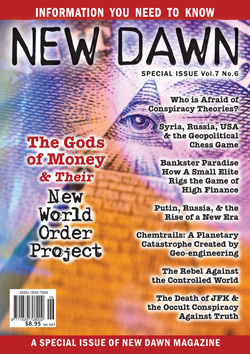
    From New Dawn Special Issue Vol 7 No 6 (Dec 2013)

    Today we need new strategies to preserve our identity in a rapidly changing world, a world that has become more open, transparent and interdependent. This fact confronts virtually all countries and all peoples in one form or another: Russian, European, Chinese and American – the societies of virtually all countries.
    – V. V. Putin, Valdai Club, 19 September 2013

    Vladimir V. Putin has maintained his ideological position, and reiterated Russia’s determination to maintain her sovereignty and identity in the face of globalisation. Putin’s course for Russia was unequivocally stated in a September 2013 speech at a plenary session of the Valdai Club, which included foreign dignitaries and Russian luminaries from politics, academia and media. (https://valdaiclub.com/a/highlights/vladimir_putin_meets_with_members_the_valdai_international_discussion_club_transcript_of_the_speech_/)

    Putin stated that while every nation needs its technical strength, at the basis of all is “spiritual, cultural and national self-determination” without which “it is impossible to move forward.” “[T]he main thing that will determine success is the quality of citizens, the quality of society: their intellectual, spiritual and moral strength.” Putin rejects the economic determinism of the modern era, stating:

    After all, in the end economic growth, prosperity and geopolitical influence are all derived from societal conditions. They depend on whether the citizens of a given country consider themselves a nation, to what extent they identify with their own history, values and traditions, and whether they are united by common goals and responsibilities. In this sense, the question of finding and strengthening national identity really is fundamental for Russia.

    Putin pointed to the threat posed to Russian identity by “objective pressures stemming from globalisation,” as well as the blows to Russia inflicted by the attempts to erect a market economy, which it might be added, was sought by internal oligarchs and outside plutocrats; attempts that are ongoing. Putin moreover points to the lack of national identity serving these interests:

    In addition, the lack of a national idea stemming from a national identity profited the quasi-colonial element of the elite – those determined to steal and remove capital, and who did not link their future to that of the country, the place where they earned their money.

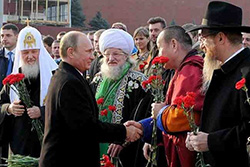
    President Putin meets Russia's religious leaders
    President Putin meets Russia’s religious leaders

    What the globalists and oligarchs wish to impose on Russia from the outside cannot form an identity, which must arise from Russian roots, and not as a foreign import in the interests of commerce:

    Practice has shown that a new national idea does not simply appear, nor does it develop according to market rules. A spontaneously constructed state and society does not work, and neither does mechanically copying other countries’ experiences. Such primitive borrowing and attempts to civilise Russia from abroad were not accepted by an absolute majority of our people. This is because the desire for independence and sovereignty in spiritual, ideological and foreign policy spheres is an integral part of our national character. Incidentally, such approaches have often failed in other nations too. The time when ready-made lifestyle models could be installed in foreign states like computer programmes has passed.

    “Russia’s sovereignty, independence and territorial integrity are unconditional,” states Putin. He has called for unity among all factions, above ethnic separatism and urges an ideological dialogue among political factions.

    Putin also recognises that what is today called the “West,” with the USA as the “leader of the Western world,” as the media and US State Department constantly remind us, shows little evidence of any vestige of its traditional foundations:

    Another serious challenge to Russia’s identity is linked to events taking place in the world. Here there are both foreign policy and moral aspects. We can see how many of the Euro-Atlantic countries are actually rejecting their roots, including the Christian values that constitute the basis of Western civilisation. They are denying moral principles and all traditional identities: national, cultural, religious and even sexual.

    In this demise of Western values, Putin attacks “political correctness,” where religion has become an embarrassment, and Christian holidays are, for example, changed or eliminated. This nihilism is being exported over the world and will result in a “profound demographic and moral crisis,” resulting in the “degradation” of humanity. While multiculturalism is problematic for many states in Europe, Russia has always been multiethnic and this diversity should be encouraged in forging local identities, but within the context of a Russian state-civilisation.

    Simultaneous with the moral and religious decline is the attempt to impose a “standardised, unipolar world” where nations become defunct, rejecting the “God-given diversity” of the world in favour of “vassals.” Above this, Putin is promoting a “Eurasian Union,” a geopolitical bloc that will enable the states of the region to withstand globalisation.

    Putin’s Valdai speech shows that he has a fully developed world-view on which to base Russia’s future course. It also indicates that while Putin might have his faults (and I can’t think of what they might be offhand) he is the only actual statesman in the world today, and has established Russia as the most likely axis of a new civilisation and a new era.

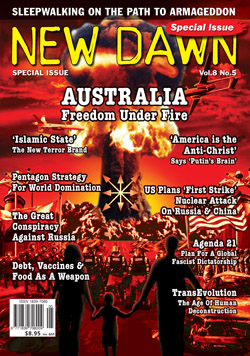
    Gain a deeper understanding of the conflict between Putin's Russia and the West. Check out New Dawn Special Issue Vol 8 No 5, with an article by KR Bolton entitled "The Great Conspiracy Against Russia: What is Really Behind the Campaign Against Putin". 

    [alert type=”general” dismiss=”no”]This article was published in New Dawn Special Issue Vol 7 No 6.[/alert]

    [alert type=”success” dismiss=”no”]If you appreciate this article, please consider subscribing to help maintain this website.[/alert]

    © New Dawn Magazine and the respective author.
    For our reproduction notice, click here.

  • The Great Conspiracy Against Russia: What is Really Behind the Campaign Against Putin?

    The Great Conspiracy Against Russia: What is Really Behind the Campaign Against Putin?

    From New Dawn Special Issue Vol 8 No 5 (Oct 2014)

    When the war-drums start beating in Washington against a state or statesman, one is entitled to wonder what transgression might have been made against the ‘New World Order’. Over the past few decades we have seen one nation after another succumb to either financial blandishments, or when those fail, long-planned, well-funded ‘spontaneous’ colour revolutions, and as a last resort bombs. The states of the ex-Soviet bloc largely succumbed to ‘colour revolutions’ orchestrated by the Soros network, aligned with the National Endowment for Democracy (NED), USAID and a host of other funds and NGOs.

    Milosevic’s Serbia, Qadhafi’s Libya and Saddam’s Iraq were bombed into submission, with ground support for jihadists. The globalists have no objection to jihadists when they serve to keep the world in a state of ‘constant conflict’, in accordance with globalist aims. The USA will use ‘Islamists’ where they can, both as dupes and bogeymen.

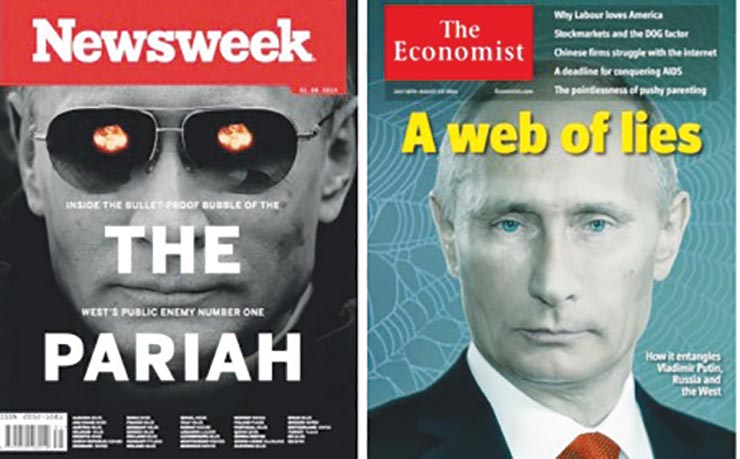
    There is one major spanner in the world: Russia – again. Russian President Vladimir Putin has been vilified relentlessly from the start of his leadership of Russia. A second ‘Cold War’ followed so soon in the aftermath of the first that the two can be regarded as one.

    Russia Stymied World State

    There was a fleeting interregnum when it looked as though Russia would finally succumb to globalisation. This encompassed the Yeltsin years, however it was prepared while the Communist Party still held power, during the Gorbachev era. The sudden implosion of the mighty Soviet edifice, seemingly overnight, was long prepared by a combination of US-based subversion, backing ‘dissidents’ such as Solidarity in Poland, coupled with a planned scuttle by Gorbachev, who envisioned himself as an internationally-feted globalist celebrity.

    Russia had succumbed to the nexus of money and revolution in 1917. The revolutionary movement had been well funded since 1905 when the anti-Tsarist journalist George Kennan was sent over to Japan to propagandise Russian POWs, with funds from Jacob Schiff of Kuhn, Loeb & Co., Wall Street. Kennan remarked that 50,000 revolutionary cadres were sent back to Tsarist Russia. Schiff’s contribution to the overthrow of the Tsar was lauded in New York in March 1917.1 There quickly followed the Bolshevik coup led by Lenin and Trotsky. Lenin was backed by the Germans to get Russia out of the war, and Trotsky was backed by the Americans and British to keep Russia in the war. Trotsky was in close association with R. H. Bruce Lockhart, British War Cabinet special agent in Russia, to such an extent that Lockhart’s wife commented that many of his colleagues quipped he was turning Bolshevik. The lines were drawn when Trotsky resigned as minister of foreign affairs because of Lenin’s insistence that Russia sign an armistice with Germany.2

    After the war, there was a scramble by international finance to get concessions from the Soviets, at a time when their existence was very precarious at best, and the American ‘intervention’ under General Graves was doing its best to backstab the White Armies in favour of the Reds.3 H. Wickham Steed, editor of The London Times, observed at the Paris Peace Conference that it was the international financiers such as Schiff who were pushing for worldwide recognition of the Bolsheviks.4 Matters proceeded well for international capitalism under the regime of Lenin and Trotsky. Russia opened up to foreign capital and technology. With Lenin’s death and the resulting power struggle, Stalin eliminated the influence of Trotsky and his coterie in 1928.

    The common fight against the Axis in the Second World War opened up a further opportunity for the USSR to be brought into a world order. The USA proposed such a world state via the United Nations General Assembly as a world parliament. The USSR recognised that the USA would control any such parliamentary vote, and insisted that authority be vested in the Security Council with the right of veto for permanent members. The second premise for a post-war new world order rested with the US proposal to ‘internationalise’ atomic energy under United Nations aegis, outlined in the ‘Baruch Plan’, named after Bernard M. Baruch, so-called ‘elder statesman’ of the USA. Again, the USSR said no.5

    The USSR alone prevented the creation of a world state. The conservative Right remains confused about Russia till today, and much of it continues the old Cold War anti-Russia line against Putin who, to them, is the new Stalin.

    How the Soviet Bloc Imploded

    While the globalists opportunity to erect a world state in the name of ‘world peace’ after the defeat of the Axis was scuttled by the USSR, the implosion of the Soviet bloc provided another opportunity. The oligarchs in the West are so conceited that they assume the whole world yearns for the ‘freedom’ of their ‘Brave New World’, in a narcosis of production and consumption. They assumed that with the demise of the Soviet Union they would be linking with their counterparts in Russia to form an international exploitative regime. Mikhail Gorbachev was their man, as Lenin and Trotsky had been.

    Gorbachev has indeed become part of the globalist elite, as indicated by the 2011 celebration of his 80th birthday at the Royal Albert Hall, London, where “movie stars, singers and politicians showed up, underlining the celebrity status Mr Gorbachev enjoys in the West where he is widely perceived as the man who freed Eastern European from Soviet rule and ended the Cold War.”6 Guests included Lech Walesa, father of post-Soviet Poland, whose Solidarity movement received largesse from the National Endowment for Democracy (NED), CNN founders Ted Turner, Israeli President Shimon Peres, and unnamed “oligarchs.”

    On his birthday, Gorbachev warned Putin not to seek a third presidential term and menacingly referred to the revolts in the Arab world.

    Back in 1988 Gorbachev openly invited revolt in the Soviet states by declaring before the United Nations that the USSR would not defend their Eastern bloc colleagues. This was the year that the Soviets pulled out of Afghanistan, ‘Russia’s Vietnam’. He also announced there would be a massive reduction of Soviet armed forces from the Eastern bloc states.7 Gorbachev stated to his advisors his commitment to a “new world” under the auspices of the United Nations Organisation.8 The groundwork had been laid previously, with the sponsoring of Solidarity in Poland, which Carl Gershman, head of the National Endowment for Democracy (NED), stated set in motion the “velvet revolutions” that toppled the Warsaw Pact bloc.9 The NED contrived Polish-Czech-Slovak Solidarity Foundation supported dissident publishing in the Czech Republic, Slovakia, the Ukraine, Belarus, Russia, Moldova, the Caucasus and Central Asia. The Foundation for Education for Democracy, an outgrowth of the Solidarity Teachers Union, trained teachers and NGO leaders throughout the former Soviet Union, and the East European Democratic Center created dissident media in the Ukraine and Central Asia.10 The destruction of the Soviet bloc was orchestrated by a combination of Gorbachev’s treachery, globalist funded subversion, and the US sponsored Afghanistan imbroglio.

    In 1991 Gorbachev established the International Foundation for Socio-Economic and Political Studies to add his input to the dazzling array of interconnected globalist NGOs, foundations and think tanks. The North American branch founded in 1997 states the purpose is to spread “economic liberalisation.”11

    “Wrong Direction”

    Throughout the 1990s things seemed to be going well for the globalists. Russia had at last been deconstructed, and was ready for bringing into the ‘New World Order’. Gorbachev gave the green light for the dismantling of the Eastern bloc, and paved the way for idiot democracies of the Westminster style. Appropriately a drunken buffoon, Boris Yeltsin, who started his climb to power under Gorbachev in 1985 as a member of the Politburo, Mayor of Moscow and other senior posts, was offered up to usher in the new democratic Russia that could take her place in the world as another colony of finance-capitalism. He had earned his credentials as a liberal when criticising the lack of haste in reform in 1987. The first democratically elected president of Russia, he lasted from 1991-1999. Under Yeltsin Russian assets were sold off at knock down prices to oligarchs in the name of economic liberalisation. From the start of his presidency Yeltsin brought in advisors from the IMF, World Bank and US Treasury. His 1996 presidential campaign was funded by the oligarchy and promoted by their controlled media. Boris Berezovsky was described by a Council on Foreign Relations (CFR) analyst, Daniel Treisman (who served in a 1997 US team in Russia on tax reform), as the “godfather of godfathers,” the oligarch who sat at the top of the dung-heap.12

    Having devastated Russia, Yeltsin resigned, begging Russians for forgiveness for the ruin he had brought. The presidency was assumed by Prime Minister Vladimir Putin in December 1999. It was anticipated that Putin would continue to allow Russia to be vampirised, but he took what the globalists have ever since been calling a “wrong direction,” the title of a Council on Foreign Relations position paper “Russia’s wrong direction.” Written in 2006, the CFR paper recommended increased funding for the Freedom Support Act, in this instance referring specifically to the 2007-2008 presidential elections. Authors of the CFR report included Jack Kemp, Republican Party politico; Mark F. Brzezinski, who served on the National Security Council as an advisor on Russian and Eurasian affairs under President Clinton, as his father Zbigniew had served in the Carter Administration; Antonia W. Bouis, founding executive director of the Soros Foundations; James A. Harmon, senior advisor to the Rothschild Group, et al.13

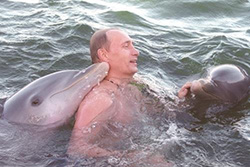
    President Putin relaxing
    President Putin relaxing

    While Putin has been criticised for associating with a coterie of oligarchs of his own, these businessmen have been incorporated into the strengthening of the Russian state, not its undermining for globalist interests. Those who acted otherwise have been purged, and are celebrated as ‘dissidents’ and champions of ‘human rights’ by anti-Russia interests. These include the ‘godfather of oligarchy’ Berezovsky, who was living in exile in England where he was found hung,14 and Mikhail Khodorkovsky (hailed as a hero in the West), onetime owner of Yukos, jailed for ten years, while his oil empire was taken back for Russia. His son Pavel heads the Institute of Modern Russia to continue the work of his father’s Open Russia Foundation to promote “Russia’s integration into the community of democracies,”15 which is to say, Russia’s subordination to international finance.

    In particular, Putin has challenged the notion of “the New American Century” as one prominent think tank optimistically termed the 21st century. Putin has moved to limit the influence of the same subversive networks that undermined the Eastern bloc via ‘velvet revolutions’ by obliging employees of NGOs to register as ‘foreign agents’, and the state started an investigation of these subversives in March 2013. In that year NED provided $8,226,487 to NGOs, programmes and seminars in Russia for the undermining of the state in the name of “human rights.”16 NED receives funding from US Congress. Imagine the outrage of ‘world opinion’ if Russia funded groups to undermine the US government. Added to this are the millions that have poured in to undermine Russia by the George Soros network, USAID, and a host of others. In 2012 Putin expelled USAID, a governmental agency, stating that it was undermining Russia’s sovereignty.

    IMG_1047

    Geopolitically, the globalists aim to encircle Russia. The alliances created by Putin in central Asia and further afield have meant this has not entirely succeeded, with the Shanghai Cooperation Organisation including China, Kazakhstan, Kyrgyzstan, Tajikistan and Uzbekistan; and with India, Iran, Mongolia and Pakistan having observer status. Belarus and Sri Lanka are dialogue partners, and Turkmenistan has guest attendance.

    However, states such as Georgia and the Ukraine are targeted for takeover as important elements in this strategy. NED avidly sponsored young cadres in various sectors of Ukrainian society, including ‘educating’ electorates on how to vote in the October 2012 elections. The 2012 NED financial report lists the NGOs in the Ukraine that received $3,380,834 during that year.17 The amount represents the upper end of funds sent by NED throughout the world.

    Pro-Moscow separatists in eastern Ukraine who would in other circumstances be lauded by the world media and politicians as ‘freedom fighters’, have been characterised as ‘terrorists’. The enemies of Russia have through the most illogical of rhetoric charged the Russian president with being personally responsible for the downing of a Malaysian airliner. The only thing known for sure as this is written is that Russian interests were in no way served by the targeting of the airliner, but it serves as grist for the anti-Russian agenda. Russia in turn is being pushed further from Europe, and into the embrace of China.

    The Russians remain one of the few residues of a tough people still relatively uncorrupted by the moral, cultural and spiritual rot of a West in its epoch of death. With Russia there are still at least possibilities. “The Russian people are the people of the future,” wrote the philosopher Nikolai Berdyaev. “They will decide questions which the people of the West has not yet the strength to decide, which it does not even pose in their full depth.”18 

    Gain a deeper understanding of the conflict between Putin’s Russia and the West. Check out all the articles in New Dawn Special Issue Vol 8 No 5.

    [alert type=”general” dismiss=”no”]This article was published in New Dawn Special Issue Vol 8 No 5.[/alert]

    [alert type=”success” dismiss=”no”]If you appreciate this article, please consider subscribing to help maintain this website.[/alert]

    FOOTNOTES

    1. K. R. Bolton, Revolution from Above, Arktos Media Ltd., 2011, 57-58

    2, K. R. Bolton, Stalin: The Enduring Legacy, Black House Publishing, 2012, 104-106

    3. K. R. Bolton, Revolution from Above, op. cit., 66-97

    4. Ibid., 61-62

    5. K. R. Bolton, Stalin, op. cit., 125-134

    6. Reuters, ABC News, ‘Stars honour Gorbachev at gala birthday bash’, 31 March 2011, www.abc.net.au/news/stories/2011/03/31/3178823.htm

    7. Dr. Svetlana Savranskaya and Thomas Blanton (ed.), ‘Previously Secret Documents from Soviet and U.S. Files n the 1988 Summit in New York, 20 Years Later’, National Security Archive Electronic Briefing Book No. 261, 8 December 2008

    8. M. Gorbachev, ‘What are we going to take to the United Nations?’, Conference with advisors, 31 October 1988, Attended: Shevardnadze, Yakovlev, Dobrynin, Falin, Chernyaev, Archive of the Gorbachev Foundation. Fond 2. Notes of A.S. Chernyaev. On file at the National Security Archive. Translated by Svetlana Savranskaya. www.gwu.edu/~nsarchiv/NSAEBB/NSAEBB261/sov03.pdf

    9. C. Gershman, ‘Giving Solidarity to the world’, Georgetown University, 19 May 2009, www.ned.org/about/board/meet-our-president/archived-remarks-and-presentations/051909

    10. C. Gershman, ‘Giving Solidarity to the world’, Ibid

    11. The Gorbachev Foundation of North America, ‘Mission’, www.gfna.net/staff.php

    12. Daniel Treisman, ‘Blaming Russia First’, Foreign Affairs, Council on Foreign Relations, November/December 2000, www.foreignaffairs.com/articles/56649/daniel-treisman/blaming-russia-first

    13. Jack Kemp, et al, ‘Russia’s Wrong Direction: What the United States Can and Should Do’, Independent Task Force Report no. 57, Council on Foreign Relations, 2006, xi. The entire publication can be downloaded at: www.cfr.org/publication/9997/

    14. Ian Cobain, ‘Boris Berezovsky inquest returns open verdict on death’, The Guardian, 27 March 2014, www.theguardian.com/world/2014/mar/27/boris-berezovsky-inquest-open-verdict-death

    15. ‘Russia : A Postmodern Dictatorship?’, NED forum, 2013, www.ned.org/events/russia-a-postmodern-dictatorship

    16. ‘Russia’, 2013 NED Annual Report, www.ned.org/where-we-work/eurasia/russia

    17. National Endowment for Democracy, NED 2012 Annual report, www.ned.org/where-we-work/eurasia/ukraine

    18. Nikolai Berdyaev, The Russian Idea, Macmillan, 1948, 70

    © New Dawn Magazine and the respective author.
    For our reproduction notice, click here.

  • V. V. Putin & Eastern Wisdom

    V. V. Putin & Eastern Wisdom

    From New Dawn Special Issue Vol 7 No 6 (Dec 2013)

    Back in October 2000, the newly elected President of the Russian Federation, Vladimir V. Putin, granted a revealing interview to the editors of India Today and The Russian Journal. President Putin paid special tribute to Nicholas Roerich, the Russian artist, explorer and mystic, stating:

    “Roerich’s life was an amazing life, a marvel of creativity and astonishing example of spiritual closeness that, perhaps doesn’t lie on the surface, but is nevertheless the spiritual closeness that binds all peoples.”

    In December 2002, President Putin’s wife Lyudmila opened an exhibition of Nicholas Roerich’s work at the National Museum of India in Delhi.

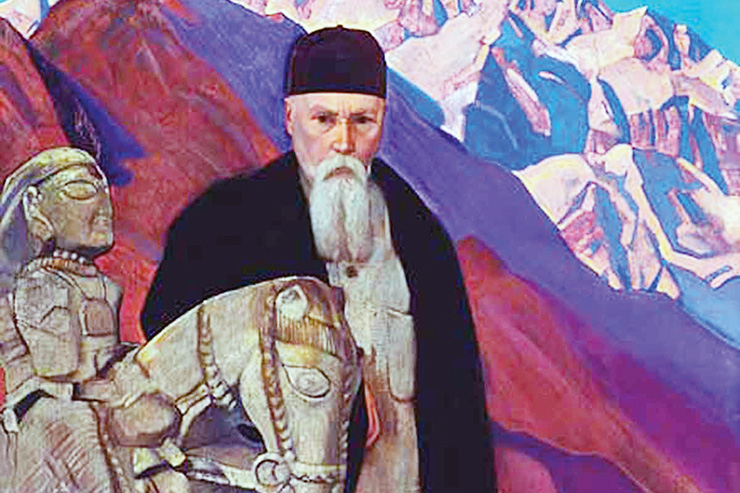
    Nicholas Roerich (1874-1947) is remembered today as a celebrated Russian painter and occultist, whose intrepid journeys through Central Asia captured the attention of the Western public in the 1920s and 1930s. But Nicholas Roerich was also a master of ‘spiritual geopolitics’ who sought to establish a pan-Buddhist, transnational ‘New Country’ stretching from Tibet to southern Siberia, including territory that was governed by China, Mongolia, Tibet, and the Soviet Union. This ‘New Country’ was conceived by Roerich as the manifest, earthly expression of the invisible Kingdom of Shambhala, “the Holy Place, where the earthly world links with the highest states of consciousness.”1 This Shambhala Project was to establish the Sacred Union of the East.

    The American scholar John McCannon, who is writing a biography of Roerich, points out that in today’s Russia Roerich’s ideas are discussed at the highest echelons:

    Roerich’s name has appeared with surprising frequency in civic and academic discussion of international relations and new directions in foreign policy. Mainly, he has been cited by political scientists and strategic thinkers in Russia looking for models of ‘multipolarity’ and ‘global pluralism’ to counter U.S. hegemony and seemingly triumphalist or confrontational political theories from the West…2

    Since the earliest days of his first presidency, Vladimir Putin has worked tirelessly to lay the foundations of a Eurasian alliance. Just weeks after paying tribute to Nicholas Roerich, Putin told an international forum that “Russia has always perceived of itself as a Eurasian country.” Then in 2001, Russia and China, along with the states of Central Asia, founded the Eurasian political, economic and military organisation known today as the Shanghai Cooperation Organisation. Mongolia, Pakistan, Iran and India, have all expressed interest in joining the group.

    In the lead up to his election for a third term as Russian president, Putin set out his grand Eurasian vision in a series of widely published articles.

    Nicholas Roerich was introduced to the Buddhist legend of Shambhala while working on the first Buddhist temple ever constructed in Europe, in St. Petersburg the imperial capital of the vast Russian Empire. The Russian Tsar Nicholas II, although a devout Orthodox Christian and head of the Russian Church, had a deep interest in mysticism and Eastern wisdom. On several occasions the Tsar received the Buddhist monk Dorzhiev, assuring him that, “Buddhists in Russia may feel as if under the wing of a mighty eagle.” Construction of the St Petersburg Buddhist temple commenced in 1913 to coincide with the 300th anniversary of the Romanov dynasty. That same year Lama Dorzhiev, a friend of Nicholas Roerich and George Gurdjieff, wrote that Russia was about to fulfil the old Buddhist messianic myth of Shambhala by founding a great Buddhist empire in the East.

    One hundred years later in 2013, President Putin, himself a native of St. Petersburg, promised “100-percent support” for Russia’s Buddhists. Speaking during a visit to Russia’s Buryatia republic, Putin said he was proud that Russia is the only country in Europe where Buddhism is officially recognised as a traditional religion. The Russian President emphasised that “Buddhism plays a significant role in Russia… It has always been that way. It is well known that the Buddhists helped during both world wars.” Putin described Buddhism as a “kind, humanist learning based on love for others and love for one’s country,” and said he, the federal government and regional authorities were “always at [the Buddhists’] disposal and ready to support them.”3

    Like Tsar Nicholas II, President Vladimir Putin is known to be a devout Russian Orthodox believer with a strong interest in Eastern wisdom. A master of both sambo and judo, Putin has often spoken of how the martial arts – imbued with Asian philosophy – are intended to train the body and the mind. Though an Orthodox Christian, he is conscious of the spiritual authenticity of other traditional religions. And like Nicholas Roerich, who was born Orthodox Christian but later became steeped in Buddhism, Vladimir Putin may well sympathise with the view that the highest forms of all the world’s religions point to the same ultimate reality.

    For more about Russian President Putin, check out New Dawn Special Issue Vol 8 No 5. 

    [alert type=”general” dismiss=”no”]This article was published in New Dawn Special Issue Vol 7 No 6.[/alert]

    [alert type=”success” dismiss=”no”]If you appreciate this article, please consider subscribing to help maintain this website.[/alert]

    Footnotes

    1. See ‘From Synarchy to Shambhala, The Role of Political Occultism and Social Messianism in the Activities of Nicholas Roerich’ by Markus Osterrieder, www.scribd.com/doc/119329670/From-Synarchy-to-Shambhala

    2. ‘By the shores of white waters: the Altai and its place in the spiritual geopolitics of Nicholas Roerich’ by John McCannon, www.roerichmongolia.org/files/sibirica%20full%20text%20article.pdf

    3. ‘Putin Promises 100% Support for Buddhists’, RIA Novosti, 11 April 2013, http://en.ria.ru/russia/20130411/180578136.html

    © New Dawn Magazine and the respective author.
    For our reproduction notice, click here.

  • Putin, Russia, & the Rise of a New Era

    Putin, Russia, & the Rise of a New Era

    From New Dawn Special Issue Vol 7 No 6 (Dec 2013)

    The Asia-Pacific region has become the focus for the USA, China and Russia. Australia and New Zealand have sought to create an alignment with both the USA and China, while recently there have been trade overtures between Russia and New Zealand. Antipodeans might find themselves caught between super-power rivalries while our political and business elite cannot see beyond trade and economic relations, which are always secondary forces in the playing out of history.

    Perceptive Australians and New Zealanders are fortunate they have New Dawn magazine, a medium that looks at history with breadth and depth. Hence, New Dawn has long viewed Russia as the place where great historical forces will unfold.

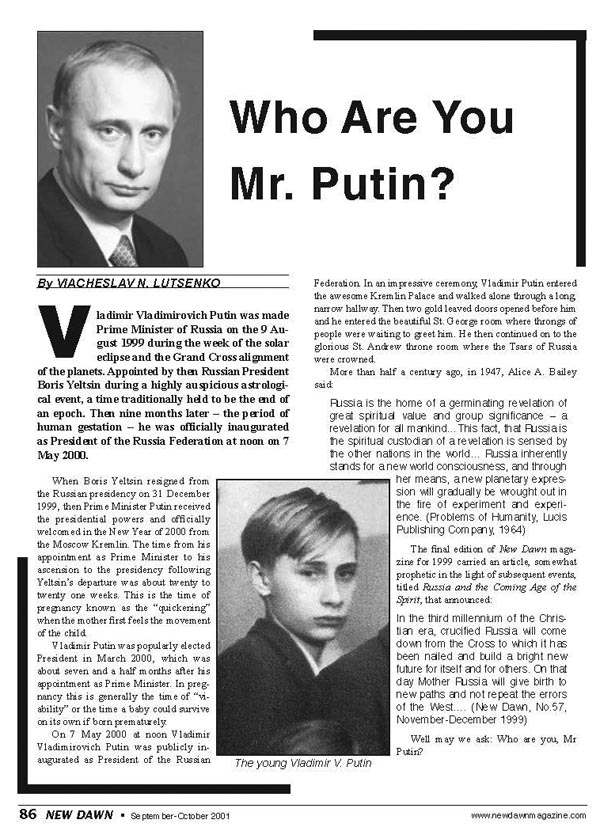
    Despite the misgivings of some Russian patriots, Vladimir Putin has emerged as a new Russian strong-man. New Dawn saw the possibilities for Russia under Putin at the earliest days of his political ascent. For one New Dawn commentator, the rise of Putin had mystical implications that could impact on the world in an epochal way: Putin’s inauguration as Prime Minister on 9 August 1999 occurred during the week of the solar eclipse and the planetary alignment of the Grand Cross, “a highly auspicious astrological event… traditionally held to be the end of an epoch.”1

    Multipolar vs. Unipolar World

    In 2001 a story in New Dawn entitled ‘Russia vs. the New World Order’ reported Venezuelan President Hugo Chavez predicting the 21st century would give rise to a multipolar world. What some important elements in US governing circles call the “new American century”2 would be nothing of the kind, despite their increasingly aggressive efforts. Chavez, a leader of rare statesmanship, believed this would be a century of power blocs.3 Vladimir Putin’s Russia has pursued the building of a ‘multipolar’ world.

    Multipolarity is a doctrine that permeates much of the academic and ruling elite of Russia. Its most well-known proponent is Dr. Alexander Dugin, who heads the Centre for Conservative Studies, Sociology Department, at Moscow State University.4 What Chavez was referring to as unified continental power blocs, Dugin refers to as “vectors.”5

    As for Dugin’s influence in Russia, two antagonistic academics lament of him: “The growing interest among political scientists and other observers in Dugin and his activities is the result of his recent evolution from a little-known marginal radical right-winger to a notable and seemingly influential figure within Russia’s mainstream.”6

    Dugin calls his geopolitical concept “Eurasianism,” writing of this:

    In the broad sense the Eurasian Idea and even the Eurasian concept do not strictly correspond to the geopolitical boundaries of the Eurasian continent. The Eurasian Idea is a global-scale strategy that acknowledges the objectivity of globalisation and the termination of nation-states, but at the same time offers a different scenario of globalisation, which entails no unipolar world or united global government. Instead it offers several global zones (poles). The Eurasian Idea is an alternative or multipolar version of globalisation, but globalisation is the currently fundamental world process that is deciding the main vector of modern history.7

    Hence, Dugin agrees that the days of petty states are numbered and were a manifestation of a phase of history. Dugin postulates therefore something beyond petty-statism, imperialism or globalism, power blocs based on organic geopolitical realties, although details should remain open to question. Such geopolitical thinking is very much to the fore in Russia, among the highest echelons of academia and politics.

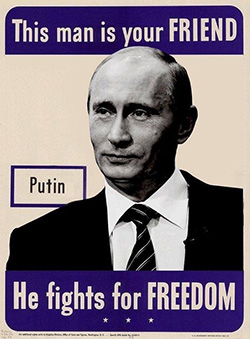
    Vladimir V. Putin

    One of the numerous globalist NGOs directed at Russia, The Jamestown Foundation,8 offered several opinions in regard to the direction of Russia with Putin’s re-election in 2012. A major concern is whether Putin’s anti-American expressions during the elections were based on electoral rhetoric in drumming up Russians against an external enemy, or a genuinely held perception of the USA as intrinsically inimical to Russia. Certainly Putin would be naïve if he regards the USA as anything other than being committed to the subordination of Russia to economic predation and cultural decay. The USA has been the home-base for the destruction of Russia as a world power since Stalin’s rejection of the USA’s vision of the post-war world in 1945,9 inaugurating the ‘Cold War’.

    Citing a report from Chatham House by James Nixey, entitled “Russia’s Geopolitical Compass,” Nixey points to four “geostrategic axes for Russia: the West, Russia’s many ‘souths’ – the Black Sea region and the Islamic world – Russia’s Far East and the Arctic North.” Nixey states that Russia no longer views the “West”10 as all-powerful, and that Obama’s post-Bush so-called “Reset” policy for rapprochement with Russia is “losing direction.” What is particularly interesting is that Nixey agrees with Sinologist Bobo Lo, Senior Research Fellow at the Centre for European Reform in London, who states “that Russia’s relations with China are nothing more than an ‘alliance of convenience’ by which Russia seeks to leverage influence with the West to gain acceptance. In this context, China is only a ‘geopolitical counterweight to the West’.”11

    There are those both on the ‘fringes’ of politics and in influential positions who see Russia as an ally rather than as a threat to Europe, a united Europe. France having more than the usual number of geopolitical realists, has a strong Russophile element that looks to Russia, including during its Soviet days, as a counterweight to US hegemony contrary to the propaganda of the Soviet bogeyman poised to ravish the Occident. It reminds one of President Charles de Gaulle’s call for a united Europe “from the Atlantic to the Urals.” The Jamestown Foundation’s article cites a view offered by Marc Rousset, a French historian and political analyst and author of La nouvelle Europe: Paris-Berlin-Moscou [The New Europe: Paris-Berlin-Moscow] (2009):

    According to Rousset, Putin would bring “bravery, foresight and pragmatism” to Russian policy in the interest of creating a geopolitical order from the Atlantic to Vladivostok. Rousset emphasised that Putin is a European from St. Petersburg working toward closer ties among Russia, Ukraine and Belarus. His conception of a Eurasian union had the possibility of creating an imperial order to rival that of the American empire and the emerging new orders in China and India12 (Rossiiskaia Gazeta, 6 March). Rousset was quoted in November of last year as seeing the emergence of an axis of Paris, Berlin and Moscow being the answer to the present crisis in the Eurozone and the means to restore Europe’s position as a major player in the international system (Rossiiskaia Gazeta, 17 November 2011). Sergei Karganov answered that line of thought in December of last year by calling on Russia to turn away from Europe and make its future with a dynamic Asia-Pacific region led by China (Rossiiskaia Gazeta, 18 December 2011).13

    Rousset’s ideal is in my opinion the preferred. While Sergei Karganov14 is in accord with the Dugin conception of “Eurasianism” vis-à-vis Russia’s place with China in Asia, Dugin also sees Russia in alliance with united Europe, and her historical relationship with “Hindustan.”15

    Dugin’s Analysis

    Indicating the seriousness with which Alexander Dugin is taken by Russia’s friends and enemies alike, Jacob W. Kipp of the Jamestown Foundation comments on Dugin’s reaction to the re-election of Putin:

    In the aftermath of Putin’s election, Aleksandr Dugin, the chief ideologue of anti-Western Eurasianism, stated that Putin stood at a moment of strategic choice: embrace the liberalism and Westernism of Russia’s bourgeois elite or the nationalism of the Russian common folk – historically the victims of the corruption of Russia’s liberal elite, which champions Russia’s subservience to the West. Dugin wrote that by promoting a Eurasian Union, Putin had already spoken the word that defined his choice. This was the path to national revival and to an economy based upon the reconstruction of Russia’s defence sector. Dugin states: “Both sides want reforms from Putin but they desire direct opposites. The elites want democratisation, modernisation, liberalisation and growing closer to the West. The people want the national idea, a firm hand, a strengthening of sovereignty, a great power state, paternalism and social justice.” This choice for Putin comes at a particularly critical moment, according to Dugin. The hegemony of the US and its allies is being tested in an emerging multipolar world. The immediate challengers are Syria and Iran. But once those two states have been defeated by military intervention, Russia itself will have to face the threat of such intervention. “…after the prepared attacks on Syria and Iran, the logical next target will be Russia. Of course, Russia will not survive such a confrontation with the West alone.”16

    However, China remains the thorny question among those who seek a revived Russia, with Dugin and his movement seeing China as a crucial ally,17 while others see China as a future rival.18

    US actions against Putin’s Russia remain as determined as those against the USSR during the Cold War. Dr. Paul Craig Roberts, US Assistant Secretary of the Treasury under the Reagan Administration, has written of the subversion of Russia:

    The Russian government has finally caught on that its political opposition is being financed by the US taxpayer-funded National Endowment for Democracy and other CIA/State Department fronts in an attempt to subvert the Russian government and install an American puppet state in the geographically largest country on earth, the one country with a nuclear arsenal sufficient to deter Washington’s aggression.19

    Roberts was referring to an Act passed by the Russian Duma (parliament) requiring the registration of NGOs receiving foreign funds, similar to the requirements of US laws that have long been in place. Roberts continued:

    The Washington-funded Russian political opposition masquerades behind “human rights” and says it works to “open Russia.” What the disloyal and treasonous Washington-funded Russian “political opposition” means by “open Russia” is to open Russia for brainwashing by Western propaganda, to open Russia to economic plunder by the West, and to open Russia to having its domestic and foreign policies determined by Washington.20

    Globalists are aiming to deconstruct Russia as they did the USSR. Fortunately, Putin is no Gorbachev. His ambition seems to be that of leading a strong Russia, as distinct from Mikhail Gorbachev’s ambition to become a globalist celebrity posturing on the world stage. When on his 80th birthday in 2011 Hollywood stars hosted a ‘gala celebration’ at the Royal Albert Hall, London, ABC News commented that the “movie stars, singers and politicians” who turned out for the show, “underlined the celebrity status Mr Gorbachev enjoys in the West, where he is widely perceived as the man who freed Eastern Europe from Soviet rule and ended the Cold War.”21 On the occasion of his birthday Gorbachev delivered what might be construed as an ultimatum to Putin on behalf of the globalist elite, “advising” him “against running for a third term as president and warning about the dangers of Arab-style social revolt.”22 As is now clear, those “Arab social revolts,” like the “colour revolutions” in the former Soviet states, were stage-managed by the globalist NGOs.

    The globalist think tanks are blatant in their intentions. The Council on Foreign Relations (CFR) opines that “Russia is heading in the wrong direction.”23 One of the CFR recommendations is to interfere with the Russian political process, urging US Congress to fund opposition movements by increased funding for the Freedom Support Act, in this instance referring specifically to the 2007-2008 presidential elections.24 Authors of the CFR report include Mark F Brzezinski, who served on the National Security Council as an adviser on Russian and Eurasian affairs under Clinton, as his father Zbigniew served in the Carter Administration; Antonia W Bouis, founding executive director of the Soros Foundations; James A Harmon, senior advisor to the Rothschild Group, et al.

    US ruling circles have a messianic mission to create a world revolution, and it is no surprise that the ideological foundations of the US ‘world revolution’ were developed by Russophobic Trotskyites during the Cold War.25 The task of publicly announcing the post-Soviet world revolution was allotted to President George W. Bush. Speaking before the National Endowment for Democracy in 2003, Bush stated that the war on Iraq was a continuation of a “world democratic revolution” that started in the Soviet bloc: “The revolution under former president Ronald Reagan freed the people of Soviet-dominated Europe, he declared, and is destined now to liberate the Middle East as well.”26

    Russia and the New World Order

    Putin has embraced “Eurasianism” as the alternative to a “new world order” based around US hegemony. In a major foreign policy article in 2012, Putin outlined the main premises. He stated that Russian would be guided by her own interests first, based on Russia’s strength, and would not be dictated to by outsiders. While Putin uses the term “new world order,” it is one that is antithetical to the globalist version. He questions the US missiles being placed on Russia’s borders, and the continuing belligerence of NATO, stating that, “The Americans have become obsessed with the idea of becoming absolutely invulnerable.”27 Importantly, Putin is fully aware that globalist agendas are being imposed behind the facade of “human rights,” and criticises the selectivity by which this morality is applied:

    The recent series of armed conflicts started under the pretext of humanitarian aims is undermining the time-honoured principle of state sovereignty, creating a moral and legal void in the practice of international relations.28

    Putin refers to the “Arab Spring,” noting outside interference in a “domestic conflict.” “The revolting slaughter of Muammar Gaddafi… was primeval,” Putin states, and the Libyan scenario should not be permitted in Syria. He adds of the “regime changes,”

    It appears that with the Arab Spring countries, as with Iraq, Russian companies are losing their decades-long positions in local commercial markets and are being deprived of large commercial contracts. The niches thus vacated are being filled by the economic operatives of the states that had a hand in the change of the ruling regime. One could reasonably conclude that tragic events have been encouraged to a certain extent by someone’s interest in a re-division of the commercial market rather than a concern for human rights.29

    Putin sees Russia developing her historic relations with the Arab states, despite the “regime changes.” He also points out the political uses that are being made of social media which played such a significant role in mobilising and agitating masses during the “Arab Spring,” and indeed in the “colour revolutions” on Russia’s doorstep.30 Putin also acknowledges the subversive role of the NGOs not least of whose actions are being directed against Russia, stating, “…the activities of ‘pseudo-NGOs’ and other agencies that try to destabilise other countries with outside support are unacceptable.” He remarks on the failure of US and NATO intervention in Afghanistan and mentions Russia’s historic relationship with that country.31

    While Russia is seen as having an important role in the Asia-Pacific region, and Putin puts stress on alignment with a strong China, he also declares:

    Russia is an inalienable and organic part of Greater Europe and European civilisation. Our citizens think of themselves as Europeans. We are by no means indifferent to developments in united Europe. That is why Russia proposes moving toward the creation of a common economic and human space from the Atlantic to the Pacific Ocean – a community referred by Russian experts to as ‘the Union of Europe’, which will strengthen Russia’s potential and position in its economic pivot toward the ‘new Asia’.32

    Putin refers to an exciting new vision of a bloc expanding from “Lisbon to Vladivostok.” He sees Russia’s acceptance to membership of the World Trade Organisation as “symbolic,” while having defended Russian’s interests. With Russia looking at the Asia-Pacific region, will she be a nexus between this region and Europe, or will she enter the region as a junior partner with China? Some geopolitical analysts are referring to a new geopolitical bloc, challenging both the USA and China, as Eurosiberia33 rather than Eurasia.

    In an act of statesmanship, Putin pre-empted President Obama’s determination to bomb Syria by suggesting Syria place its chemical weapons stockpiles for disposal with the United Nations – a plan Syria accepted.

    Putin sees the offensive against Syria in world historical terms in determining what type of world is being moulded. While Russian ships face US and some French and British ships, he has rebuked Obama’s statements – like those of US presidents before him – that the USA has “an exceptional role.” In his appeal to the American people published in the New York Times, Putin questions the USA’s strategy stating that, “It is alarming that military intervention in internal conflicts in foreign countries has become commonplace for the United States.” Condemning the basis of the “new world order” that is being imposed with US weaponry, Putin writes that having studied Obama’s recent address:

    …I would rather disagree with a case he made on American exceptionalism, stating that the United States’ policy is ‘what makes America different. It’s what makes us exceptional’. It is extremely dangerous to encourage people to see themselves as exceptional, whatever the motivation. There are big countries and small countries, rich and poor, those with long democratic traditions and those still finding their way to democracy. Their policies differ, too. We are all different, but when we ask for the Lord’s blessings, we must not forget that God created us equal.34

    Gain a deeper understanding of the conflict between Putin’s Russia and the West. Check out New Dawn Special Issue Vol 8 No 5, with an article by KR Bolton entitled “The Great Conspiracy Against Russia: What is Really Behind the Campaign Against Putin”. 

    [alert type=”general” dismiss=”no”]This article was published in New Dawn Special Issue Vol 7 No 6.[/alert]

    [alert type=”success” dismiss=”no”]If you appreciate this article, please consider subscribing to help maintain this website.[/alert]

    Footnotes

    1. Viacheslav N Lutsenko, ‘Who are you Mr Putin?’, New Dawn, September-October 2001, 86.

    2. For example, as in the name of the neocon globalist think-tank, ‘Project for a New American Century’, www.newamericancentury.org

    3. Susan Bryce, ‘Russia vs. the New World Order’, New Dawn, January-February 2001, 25.

    4. www.konservatizm.org

    5. K R Bolton, ‘An ANZAC-Indo-Russian Alliance? Geopolitical Alternatives for New Zealand and Australian’, India Quarterly, Vol. 66, No. 2 (2010), 183-201. Also: K R Bolton, Geopolitics of the Indo-Pacific: Emerging Conflicts, New Alliances (London: Black House Publishing, 2013). I do not see why Australia (and presumably New Zealand) should come under a ‘vector’ that is focused either on the USA or China, and believe that Dugin is being overly generous towards those two hegemonistic powers.

    6. Anton Shekhovtsov, and Andreas Umland, ‘Is Aleksandr Dugin a Traditionalist? ‘Neo-Eurasianism’ and Perennial Philosophy’, The Russian Review, October, 2009, 662–78.

    7. A Dugin, The Eurasian Idea, 2009.

    8. The Jamestown Foundation, ‘Mission’, www.jamestown.org/aboutus/

    9. K R Bolton, ‘Origins of the Cold War: How Stalin Foiled a New World Order’, 31 May 2010, www.foreignpolicyjournal.com/2010/05/31/origins-of-the-cold-war-how-stalin-foild-a-new-world-order Also see: K R Bolton, Stalin: the Enduring Legacy (London: Black House Publishing, 2012), 125-139.

    10. ‘The West’ is a misnomer, more accurately termed the ‘post-West’ under plutocratic control, as any notion of Western Culture has long since been smothered by Mammon.

    11. Jacob W Kipp, ‘The Elections are over and Putin won: whither Russia?’, 30 March 2012, www.jamestown.org/programs/edm/single/?tx_ttnews[tt_news]=39215&cHash=5bc45dc36c8f713aa6f5e393e5eae5b4

    12. There need be no rivalry between Russia and India, but rather the continuation of the historical alignment between them.

    13. Jacob W Kipp. op. cit.

    14. Interestingly, Sergei Karganov, founder of think tank Council for Foreign and Defense Policy, has been a member of the Rockefeller-founded globalist think tank The Trilateral Commission since 1998, and a member of the International Advisory Board of the Council on Foreign Relations, 1995-2005; http://karaganov.ru/en/pages/biography

    15. K R Bolton, ‘An ANZAC-Indo-Russian Alliance’, op. cit.

    16. Jacob W Kipp, op. cit.

    17. Aleksandr Dugin, Argumenty i Fakty, March 14, 2012, cited by Kipp. Ibid.

    18. See: K R Bolton, ‘Russia and China: an approaching conflict?’, op. cit.

    19. Paul Craig Roberts, ‘War on all fronts’, Foreign Policy Journal, 19 July 2012, www.foreignpolicyjournal.com/2012/07/19/war-on-all-fronts/

    20. Ibid.

    21. Reuters, ABC News, ‘Stars honour Gorbachev at gala birthday bash’, 31 March 2011, www.abc.net.au/news/stories/2011/03/31/3178823.htm).

    22. H Klaiman, “Peres attends Gorbachev’s birthday bash in London,” 31 March 2011, www.ynetnews.com/articles/0,7340,L-4050192,00.html

    23. Jack Kemp, et al, Russia’s Wrong Direction: What the United States Can and Should Do, Independent Task Force Report no. 57 (New York: Council on Foreign Relations, 2006) xi. The publication can be downloaded at www.cfr.org/publication/9997/

    24. Ibid.

    25. K R Bolton, ‘America’s “World Revolution”: Neo-Trotskyist Foundations of US foreign policy’, Foreign Policy Journal, 3 May 2010, www.foreignpolicyjournal.com/2010/05/03/americas-world-revolution-neo-trotskyist-foundations-of-u-s-foreign-policy/

    26. Fred Barbash, ‘Bush: Iraq Part of “Global Democratic Revolution”: Liberation of Middle East Portrayed as Continuation of Reagan’s Policies’, Washington Post, 6 November 2003.

    27. Vladimir Putin, ‘Russia and the changing world’, RiaNovosti, 27 February 2012, http://en.rian.ru/world/20120227/171547818.html

    28. Ibid.

    29. Ibid.

    30. K R Bolton, ‘Twitters of the World Revolution: The Digital New-New Left’, Foreign Policy Journal, 28 February 2011, www.foreignpolicyjournal.com/2011/02/28/twitterers-of-the-world-revolution-the-digital-new-new-left/ Also: K R Bolton, Revolution from Above, op. cit., 235-240.

    31. V Putin, op. cit.

    32. Ibid.

    33. Guillaume Faye, ‘The New Concept of “Eurosiberia”’, Counter-Currents Publishing, www.counter-currents.com/2010/08/faye-on-eurosiberia/

    34. Vladimir V Putin, ‘A Plea for Caution from Russia’, New York Times, 11 September 2013, www.nytimes.com/2013/09/12/opinion/putin-plea-for-caution-from-russia-on-syria.html?_r=0

    © New Dawn Magazine and the respective author.
    For our reproduction notice, click here.
  • Vladimir Vladimirovich Putin & the Eurasian Empire of the End Times

    Vladimir Vladimirovich Putin & the Eurasian Empire of the End Times

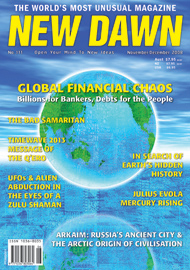
    From New Dawn 111 (Nov-Dec 2008)

    Russia has always perceived of itself as a Eurasian country.
    – President V.V. Putin, November 2000

    …an epochal, grandiose revolutionary admission, which, in general, changes everything. The prophecy of [French conspiratologist] Jean Parvulesco has come to pass… There will be a Eurasian millennium.
    – Alexandre Dugin, Russian thinker and author

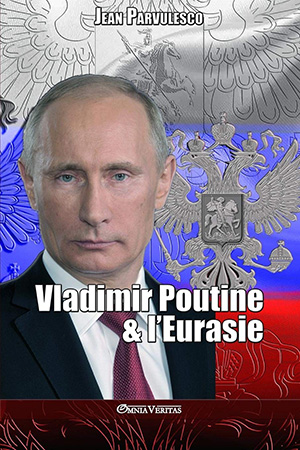
    The French visionary writer Jean Parvulesco’s main agent – if not hope – for world change rests with Vladimir Putin. Parvulesco argues that – whether we are aware of it or not – we find ourselves at the crossroads of “great history,” where a totally new era is about to be born.

    For such a new period to begin, the old needs to die first. For Parvulesco, this is the old “democratic system” of political correctness, which he feels has now reached its limits and is no longer supportable. It has become “a permanent and total nightmare.” Many will wonder how the “new world” is to come about. The best example of what appeared to be a sudden, almost instantaneous collapse is seen in the fall of the Soviet Union, two decades ago. It illustrates that powerful empires can, from one day to the next, completely disappear, requiring a new society and structure to be built from the ground upwards.

    When news of the collapse of the Soviet Union appeared on television screens, the system had already imploded. It was just the public revelation of its death; the disintegration of the communist system had already occurred. According to Parvulesco, the collapse of “democratic Europe” has already taken place too, and we are now in the years between its collapse and the public acceptance of its demise – and the start of a new Europe.

    For Parvulesco, the evidence of the collapse of this system is apparent in the recent political history of Italy and Germany, and to some extent that of France and Great Britain. But in each case he feels the same dire situation has transpired: an “immense empty desert,” the wasteland of “social democracy.” A local version of what he sees as a “worldwide conspiracy,” but one that has failed and will soon be sent back to the “black hole” from where it came.

    Parvulesco knows what to write on the death certificate; but he also feels he knows what the New Europe will be: the “Eurasian Empire of the End Times.” He labels our timeframe an interregnum where what happened to Russia is actually evidence that dramatic political change is possible. The Soviet Union was the first domino to fall, with the others in Europe soon to follow.

    Could he be right? In 1976, Parvulesco published “La ligne géopolitique de l’URSS et le ‘projet océanique fondamental’ de l’Amiral G.S. Gorchkov” (The geopolitical line of the USSR and the ‘fundamental oceanographic project’ of Admiral G.S. Gorchkov), which he labelled “political-revolutionary research.” In it he wrote that the Soviet Union would end up changing the course of history. And changing the course of history is, for Parvulesco, the only true goal politics should have.

    Parvulesco therefore provides an interesting type of prophecy. Whereas most prophets predict the end of the world at a given time, his type of prophecy brings more detail about the type of change and how. As to its timeframe, it is very much like “when the time is right.”

    So, what is meant to happen? Parvulesco argues that across Europe there are geopolitical groups at work – often clandestinely – laying the groundwork for the Eurasian agenda. Like the Project for a New American Century, there are other think tanks hard at work – and judging from the amount of newspaper headlines they don’t get, much more secretly – to bring about a new Eurasia. Despite their secrecy, Parvulesco was able to lay his hands on one article titled “The Imperial Eurasian Pact.” Similar to the idea put into action by the Neocons after 9/11 (an agenda that claimed to want to bring peace to the world by using the power of America’s military might), this group states that, “It is the confrontation of our imperial and catholic [universal] doctrines with the current political-historical reality […] which will see the final emergence of the catholic Great Empire which constitutes our ultimate objective, the Imperium Ultimum, the Regnum Sanctum, which should comport, in principle, three operational stages […].”

    The first stage is the creation of a Paris-Berlin-Moscow axis, that is considered to be the axis along which this major change will occur. This axis will tie together the destiny of three nations (France, Germany and Russia).

    The second stage is the integration of what was traditionally known as West and East Europe, together with Russia, Siberia, India and Japan.

    The final stage involves what is termed the destruction of the “global democratic conspiracy,” led by the United States, including a revolutionary liberation of its people, after which America as a whole (North and South) will become one entity. We can only wonder whether the present drive by the US to expand NAFTA and create a North American Union are steps in this direction.

    The end of the planetary superpower that is the United States is forecast to be an act of self-destruction, a continental civil war very much on par with the first Civil War. The extreme dissatisfaction within the United States, the extreme disparity between the archconservative religious community and the more liberal, means that being elected as president on a genuine agenda (rather than one of total style but no substance) is almost impossible. For Parvulesco, it will be primarily America’s Catholic, ex-European community that will lead America towards its new destiny – and cause the demise of the current “global conspiracy.” There will be a new Europe, but also a new America.

    In the end change is a social process, but it often needs a symbol. Hitler became the face of World War II, Lenin – more than Marx – that of communism, etc. So who is the new face of Europe, and who is the creator of this new Eurasian Empire? For Parvulesco, that “messiah” is already here: Vladimir Putin. Even though Putin is no longer president, his influence as Russian prime minister remains virtually omnipresent.

    Vladimir Putin remains the face of the New Russia, a country with a vast territory and natural resources that is able to hold Europe to ransom, energy-wise, should it ever want to.

    Who is Vladimir Vladimirovich Putin? This is a question that many in a non-Parvulesco universe have also asked. Seen as a pawn of the KGB’s successor, in Parvulesco’s world, Putin is the direct emanation of the secret revolutionary groups of the Armed Forces of the Soviet Union. These, he believes, are trying to make their decades-long secret battle open and public, moving from a type of synarchic, behind the scenes government, into a more open type of rule.

    Whereas some conspiracy theorists claim the CIA and various secret societies like Skull & Bones are the real puppet masters of American politics, Parvulesco says the situation in the Soviet Union was not much different. Ruled for a long time by secret powerbrokers whose agents are now stepping out into the open taking the course of Russian politics into the direction they have been trying to steer it from behind the veil for a number of decades.

    Unlike in the US where the “conspiracy” is often faceless, Parvulesco lists two people as Russia’s master conspirators. One was the chief of the Soviet security service (GRU) and one time Commander in Chief of the former Warsaw Pact, General S.M. Stemenko (died 1976), the other was Marshall N.V. Ogarkov, a former head of the Soviet military. Marshall Ogarkov, who died in 1994, is rumoured to have been behind a failed coup attempt which in turn led to a kind of counter-conspiracy that brought Mikhail Gorbachev to power.

    Parvulesco is convinced that if this counter-conspiracy had not succeeded, the end of the Soviet Union would have occurred several years earlier, with a transition from the Soviet Union to the New Russia that would have been much harsher. Indeed, it underlines that years before the actual demise of the Soviet Union, the regime was comatose, ready for the taking, just like – in Parvulesco’s eyes – Western Europe (and the United States of America) is now.

    Parvulesco is not alone in his assessment of these two men. French intelligence expert Pierre de Villemarest who wrote the history of the GRU, labelled “the Soviet’s most secret service,” says Gen. Sergei Matveevich Stemenko was “one of the first geopoliticians of the Soviet Union, perhaps even the first.” Though de Villemarest calls Stemenko a Soviet, he considered himself to be truly a “Great Russian.” “For this caste,“ writes de Villemarest, “the Soviet Union was an Empire that was called to dominate the Eurasian continent, not only from the Ural to Brest, but also from the Ural to Mongolia, from Central Asia to the Mediterranean.”

    The “dream” of Russia à la Stemenko may be seen as merely returning back to the days when Russia was a true empire, before the days of the Bolshevic Revolution. But for Parvulesco, that in itself is part of a larger, and most intriguing puzzle – a mission.

    The above is connected to this article in the same issue of New Dawn: Men of Mystery: Raymond Abellio & Jean Parvulesco – Their Vision of a New Europe

    [alert type=”general” dismiss=”no”]This article was published in New Dawn 111.[/alert]

    [alert type=”success” dismiss=”no”]If you appreciate this article, please consider subscribing to help maintain this website.[/alert]

    Vladimir Putin was the subject of an article in the Sept-Oct 2001 issue of New Dawn that prophetically discussed the symbolic significance of his ascension to power and the important role he was destined to play in the future of not only Russia, but the world.

    © New Dawn Magazine and the respective author.
    For our reproduction notice, click here.