New Dawn – World's Most Unusual Magazine

Tag: quantum physics

  • The Next Big Bang: Human Consciousness & the Universe’s Ultimate Secret

    The Next Big Bang: Human Consciousness & the Universe’s Ultimate Secret

    This article was published in New Dawn 160 (Jan-Feb 2017)

    The stream of human knowledge is heading toward a non-physical reality. The universe begins to look more like a great thought than a great machine.
    – Sir James Jeans

    For at least two hundred years science has been telling us that any ideas of spirituality we might hold dear are little more than ignorant leftovers of a superstitious past – foolish relics. But the truth is, physics itself, that most foundational of all sciences, has now progressed far beyond that initial, dismissive assessment, to a conceptual worldview far more accepting of spirituality than ever before. To grasp the nuts and bolts of this new science, then, is to understand the nuts and bolts that support a new, evolving and far more sophisticated grasp of spirit than has ever before been available to us.

    This new conceptual framework is absolutely critical to our grasp of spirit, and, frankly, for those previously unfamiliar with the discoveries of modern physics, this new framework may at first seem nothing short of “other worldly” itself – as the old saying goes, the truth can at times be far stranger than fiction. So let’s start by taking a close look at what the new physics has to tell us.

    In 1964 the scientific world was literally turned on its head by a new theorem, but very few at the time understood just what had taken place. Indeed, so astounding were the material, philosophical, and spiritual implications of this assertion that it would soon be referred to as “the most profound discovery in science.”1 Yet even today, few beyond a small community of physicists have come to grips with its meaning. The conceptual implications for particle physics were so extreme that for decades after its announcement many within the scientific community resisted its implications, as do some resist them to this day.

    The theoretical contentions offered in 1964 have been confirmed and replicated in laboratories across the globe on numerous occasions, and today there is no question that the original assertion was correct. This monumental insight is called Bell’s theorem, and the sea change it caused in physics is still being digested as I write. So central is Bell’s theorem to our understanding of the physical universe, how it functions, and what that means for us as human beings, that to grasp its implications is crucial for anyone interested in the science that today enables us to envision universal processes as far more than simply material phenomena. Yet, simultaneously, to truly grasp the new reality Bell’s theorem implies, it is essential that we first understand the old reality it so violently overturned.

    Today many within the scientific community believe that our modern science – that is, the science of observation and testing, of the scientific method – was inaugurated in the seventeenth century when Galileo Galilei first pointed his homemade telescope toward the heavens and started poking around. How did this new science differ from previous approaches to the study of physical phenomena? Dr. Dean Radin, Laboratory Director at the Institute of Noetic Sciences in Petaluma, California explains:

    “Classical physics began in the seventeenth century when pioneers such as Italian mathematician Galileo Galilei, French philosopher Rene Decartes, German astronomer Johannes Kepler, and English mathematician (and alchemist) Isaac Newton advanced a new idea. The idea was that through experiments one could learn about Nature, and with mathematics, describe and predict it. Thus rational empiricism was born. Classical physics was extended and substantially refined in the nineteenth and twentieth centuries by luminaries like James Clerk Maxwell, Albert Einstein, and hundreds of other scientists.”2

    This physics – called classical, or Newtonian, or material physics – has made an enormous contribution to our understanding of the universe we inhabit, and as a result has had a profoundly positive effect upon the overall human condition. Food production, health services, economics, education, transportation, etc., etc., have all been vastly improved as a result of scientific applications made available through analysis and testing. No doubt, material science has been a boon to human kind.

    Initially, this new science looked outward as had Galileo toward the planets and stars for answers regarding how the universe worked and the matter by which it was constructed. Larger and better telescopes were developed in order to augment this process, and today, of course, spacecraft have been constructed that fly to points distant enough to inspect and photograph distant terrestrial bodies. As a result, a great deal has been learned.

    In the eighteenth and nineteenth centuries enormous strides were made in terms of our understanding, not only of the greater cosmos, but also of the physics by which it functions. Most of the planets, their orbits, and their relationship with the sun were established early on. The mathematical calculations for all of this fit nicely within the prevailing understanding, or model, of the universe, and all of these findings both confirmed and augmented our grasp of Newtonian physics.

    The Emergence of Quantum Physics

    Still, despite all the advances, there were some oddities that did not quite fit. In 1801, for instance, British physicist Thomas Young conducted a “double-slit” experiment in an attempt to deduce the true nature of light. Prior to that, it was assumed that light was composed of small particles of matter, but the result of Young’s experiment seemed clearly to indicate that light was in fact a wave. It was presumed, as a consequence, that light waves would require some sort of medium in order to propagate (conceptualised as a luminiferous ether or ether “wind”), and the search for this medium was promptly initiated. Physics soldiered on essentially unruffled by all of this, however, still confident in its overall grasp of the universe. But this subtle medium, despite numerous attempts at detection, remained elusive.

    As a result, light continued to be a thorn in the side of Newtonian physics, thus it was naturally toward the study of light that much attention became focused. In 1900, for instance, American physicist Max Planck developed a mathematical model that demonstrated that light appeared to exist as distinct bursts or “packets” of matter. Planck named these packets “quanta” after the Latin quantus, which translates as essentially “how much.” Planck’s discovery proved the birth of what we today call quantum physics – that is, the study of that group of infinitely small particles that ultimately comprise all matter. Then, in 1905, Albert Einstein, an unknown physicist at the time working as a patent clerk in Switzerland, clearly demonstrated the validity of Plank’s quanta, but it was a proof that also allowed that light had to have both wave and particle characteristics – a perplexing side issue.

    Quantum understanding snowballed rapidly. Dean Radin tells us that, “Danish physicist Niels Bohr showed how the quantum concept could explain the structure of the atom (1922 Nobel Prize). In 1924, Louis de Broglie proposed that matter also has wavelike properties (1929 Nobel Prize). In 1926, Erwin Schrodinger developed a wave-equation formulation of quantum theory (1933 Nobel Prize).”3 Our insight into quantum mechanics was accelerating rapidly, but, despite all the progress, the seemingly dual nature of light remained a vexing problem. Was light comprised of particles or waves? No one could say.
    [alert type=”info” dismiss=”no”]If you appreciate this article, please consider a subscription to New Dawn magazine.[/alert]

    The Big Bang Theory

    Meanwhile, additional progress was being made at the observatory by looking in the opposite direction – far out into the depths of the universe. In 1929, as an example, by carefully analysing the red shifts (observed light frequencies) of distant galaxies, American astronomer Edwin Hubble demonstrated that the universe was expanding. An expanding universe was evidence contrary to the Steady State theory of the universe, or a universe that was essentially constant and eternal. Hubble’s finding also suggested that our universe, since it was now seen to be expanding, may naturally have had a beginning; that is, a moment when all that matter had been consolidated in a single point before it started to expand.

    Over time this “beginning” became conceptualised as what we today call the Big Bang theory of the universe, or a moment when the material universe emerged from a background of utter nothingness in an enormous burst of heat, light, and matter. The name actually came from British astronomer Fred Hoyle, who quipped one day on British radio that the theory sounded like little more than a “Big Bang,” and while this was stated in jest, the term stuck, nevertheless. The Big Bang theory postulates that the universe emerged from a “singularity” (a point of infinite density, which remains, frankly, beyond our current physics to explain or, as humourist Terry Pratchett once quipped, “In the beginning there was nothing, which exploded”) some 13.8 billion years ago as an incredibly small and incredibly hot point of matter. According to the theory, this material then inflated, expanded then cooled over time allowing for the formation of light elements like hydrogen and helium. Due to a slightly uneven distribution of matter throughout the universe, gravitational attraction then began to consolidate these elements into clouds which over eons formed the stars, planets and galaxies that comprise the celestial panorama we observe today in our night time sky.

    Evidence supporting the Big Bang theory of creation then began to accumulate. This evidence included the original “red shift” Hubble discovered, the discovery of cosmic microwave background radiation (which had been predicted as a residual product from the heat of the initial inflation), and more recent red shift observations of distant supernovae indicating that the expansion of the universe is actually accelerating (and which suggest the existence of dark matter in substantial quantities as the driving force behind this acceleration).

    This explanation of the Big Bang is, to say the least, a very brief and general summary of a vast and complex event, but it serves our purposes by bringing us forward conceptually to the year 1964, and the model of the universe that was prevalent at the time Bell’s Theorem made its shocking appearance (minus the dark matter, which was theorised later).

    The truth of the matter is, however, while the Big Bang theory provided the universe with both a beginning and a direction, it did not alter the assumption that the universe was fundamentally a material phenomena; a belief central to modern science ever since Galileo had peered through his telescope. History tells us, as an example, that when asked by Napoleon Bonaparte in the early years of the nineteenth century as to why his most recent treatise did not mention the existence of God, the great French scientist Pierre-Simon Laplace was said to have remarked, “I had no need of that hypothesis.” Later, and likewise, Laplace explained to an admiring audience that, “We may regard the present state of the universe as the affect of its past, and the cause of the future.” In other words, Laplace, along with almost all other scientists at the time, believed that the universe was little more than a vast, material machine, driven by physical forces, and nothing more. If, for instance, you could determine the position and direction of every particle in the universe at any given point in time, it would be possible, at least theoretically, to crank that picture forward or backward, observing as you did every event that had taken place in the past while accurately predicting every event that would take place in the future. This view therefore supported the notion of a deterministic universe, and a universe that was devoid of either free will or human consciousness as a result.

    Importantly, this understanding, or model, of the universe rested on certain suppositions that were accepted as true and universal by material physics down through the years simply because the universe appeared to function in accordance with them. The Big Bang was conceptualised as the beginning of an entirely material process that had evolved over eons in accordance with the known parameters of Newtonian (or classical, reductionist, or material) physics. In that sense, the universe was still perceived essentially as a vast, physical mechanism, a machine that was now understood to be a bit more complex than it had been conceived during the earlier days of, say, Pierre-Simon Laplace one hundred and fifty years before, but differing now only in terms of its sophistication, not its fundamental nature. Thus Laplace’s statements regarding the absence of God and the predictive power of the original conditions still held true as far as modern physics was concerned.

    The universe was also considered to be a true, functioning reality, and a reality that, having been put in motion by a natural (although inexplicable) occurrence, remained utterly deterministic, events formed and driven forward in time, no longer by the unseen hand of God, but by random particle collisions alone. All events occurred due only to the action of physical forces in contact or proximity with one another, and no force, field, or matter could – according to Einstein’s calculations – ever travel faster than the speed of light. But the wave/particle nature of light still remained an intellectual conundrum that, much like one rotten apple, threatened to subvert the entire structure of physics if not sensibly accounted for.

    ‘Uncertainty Principle’ Neuters Newtonian Physics

    Still, as far as the quantum theory was concerned, great new strides were being made. Physicist Nick Herbert tells us, for instance, that, “By the late [nineteen] twenties physicists had constructed a quantum theory adequate to their needs: they possessed, thanks to the work of Heisenberg, Schrodinger, and Dirac, rough mathematical tools that organised their quantum facts to a remarkably accurate degree. At this point Hungarian-born world-class mathematician John von Neumann entered the picture. Von Neumann put physicists’ crude theory into more rigorous form, settling quantum theory into an elegant mathematical home called ‘Hilbert space’, where it resides to this day, and awarded the mathematician’s seal of approval to the physicists brand-new theory of matter.”4

    But the enigma of light continued to plague quantum theory, and it is precisely here where the old physics of determinism and cause and effect began to unravel. In 1927, for instance, German physicist Werner Heisenberg authored his now famous uncertainty principle, the intellectual consequences of which did great mischief to Newtonian physics. Heisenberg was at the time attempting to measure the precise speed and position of a particle in order to predict its future position – a process that should have been entirely within the accepted parameters of Newtonian physics. But Heisenberg discovered that this could not be done. British physicist Stephen Hawking tells us that Heisenberg’s uncertainty principle indicated unequivocally that “the more accurately you try to measure the position of the particle, the less accurately you can measure its speed, and vice versa.” This finding sent shock waves rippling through physics. “Moreover,” Hawking tells us, “this limit does not depend on the way in which one tries to measure the position or velocity of the particle, or on the type of particle: Heisenberg’s uncertainty principle is a fundamental, inescapable property of the world.”5

    In a very real sense, Heisenberg’s principle delivered a body blow to Newtonian physics. Because, if the precise state of the universe was impossible to measure at any given moment, then any state either before or after was also impossible to calculate. It was as simple as that. Laplace had been wrong. Determinism, material cause and effect, even the forward moving arrow of time surely appeared to be “on the ropes.” Suddenly, many of the underlying presumptions upon which classical physics rested had seemingly evaporated into thin air due to Heisenberg’s principle. What was going to replace them? Moreover, what did Heisenberg’s findings actually mean? How could it be that aspects of the material universe were, had always been, and would always be, utterly beyond our ability to measure?

    And there was still more damage as a result of Heisenberg’s new principle. Because, if particles could not be clearly defined in terms of their position and movement, then particles could no longer be clearly defined as material objects anymore. If, after all, the position and movement of a particle could not be described with precision, then in a sense a particle could only be described with imprecision – a mathematical approximation. A photon, for instance, could no longer be considered a discrete particle, but rather a combination – part particle, part wave – or a mathematical description now called a wave function. Even more importantly, if the manner by which a particle was measured (or observed) altered the resultant observation (a fact Heisenberg had demonstrated), then it followed logically that observation itself had to be a fundamental aspect of reality. Physics had been thrown for a loop.

    A World of Pure Possibility… Magic

    Indeed, some physicists, Heisenberg included, began to interpret the wave part of the particle/wave aspect of light as meaning that particles became particles only when observed, and remained waves (that is, in a state of material potential) when not observed. This, of course, was an extraordinary claim, something that many physicists thought sounded disturbingly akin to ancient superstition, like magic or voodoo. What Heisenberg and his colleagues were suggesting, in essence, was that the unseen world of quantum mechanics was not a material realm at all, but a realm rather of pure potential. That’s right: quantum researchers like Heisenberg argued that the fountainhead of the physical universe appeared to be utterly immaterial. And as damaging as all of this was to classical physics, even more shocking news was on the way. Because if the foundation of our physical reality arose from a source of pure potential (was not material at all), then what, exactly, was this non-physical stuff? Could it even be called stuff? At this point in time many scientists became dizzy just trying to get a handle on the facts, and who could blame them?

    Nick Herbert explains the next leap in logic that took place. “If we take quantum theory seriously, it seems to demand that the world before an observation is made up of pure possibility. But if everything around us is only possible not actual, then out of what solid stuff do we construct the device that will make our first observation? Either there are some physical systems whose operations unaccountably evade the quantum rules or there are nonphysical systems not made of multivalued possibility, but of single-valued actuality – systems that exist in definite states capable of interacting in an observational capacity on indefinite quantum-style matter.” Yet it was clear that all material systems consisted of particles, and that these particles always obeyed the rules of quantum mechanics (not individually, but in statistical aggregates), because these rules had been tested and verified throughout countless experiments. “On the other hand,” Herbert continues, “we are aware of at least one nonphysical system that not only can make observations but actually does so as part of its function in the world – the psychological system we call human consciousness.”6

    This assertion, while sound mathematically and entirely logical, was so startling that it literally turned classical physics on its head. A science that had accepted as utterly valid a universe constructed of, and driven by, material particle movement was told suddenly that it had had it all wrong from the very beginning. And make no mistake about it, that’s exactly what was being said. “The general idea of von Neumann and his followers,” Herbert explains, “is that the material world by itself is hardly material, consisting of nothing but relentlessly unrealised vibratory possibilities. From outside this purely possible world, mind steps in to render some of these possibilities actual and to confer on the resultant phenomenal world those properties of solidity, single-valuedness, and dependability traditionally associated with matter. This kind of general explanation may be enough for philosophers, but physicists want more. They want to know exactly how it all works, in every detail.”7

    Indeed, the notion that our material reality was not real after all was simply too much for many physicists, and their response at the time was entirely reasonable. No determinism, cause and effect, or arrow of time? What was happening to the foundational principles of classical physics? Many physicists tossed up their hands in dismay, others in disgust. One of those physicists was the extraordinary Albert Einstein himself, the very father of relativity theory, and the most respected physicist in the world. All of this sounded crazy to Einstein. As to the notion that the universe was the construct of little more than the capricious whims of human observation, he supposedly responded with the now famous quote that, “God does not play dice with the universe.” Obviously, he did not agree with the newest speculations of quantum physics.

    Einstein bristled at these new interpretations of quantum theory to the point that in 1935 he along with Boris Podolsky and Nathan Rosen issued a thought provoking analysis now known as the EPR (Einstein, Podolsky, Rosen) paper. This analysis was meant to be a clear-headed challenge to the wave function description of matter that had been adopted by many quantum physicists, and described above. The EPR paper insisted that the position and momentum of any given particle had to be able to be measured far more accurately than Heisenberg’s principle allowed for, or else information between certain “entangled” particles (Erwin Schrodinger had previously demonstrated that when quantum systems interact their wave functions become entangled, and they will remain entangled even when no longer interacting) would be theoretically transferred faster than the speed of light, instantaneously in fact, which was a fundamental violation of Einstein’s theory of relativity. According to the EPR paper, hybrid particles like wave functions, and instantaneous transmissions (what Einstein called “spooky action at a distance”) were inelegant solutions clearly out of line with relativity theory, which was the accepted gospel of physics at the time. In that sense, then, the EPR paper was issued as a direct challenge to quantum theory as it was currently being developed.

    Bell’s Theorem & a Nonlocal Universe

    This was more or less the state of affairs in 1964 when John Stewart Bell entered the picture. Without going into great detail, suffice it to say that Bell demonstrated in his theorem that the EPR analysis was right, but that its conclusions were wrong, and that superluminal (faster than light) entanglements were not only possible, but required if quantum theory was to make sense. Prior to this, physics had always assumed the universe to be local in nature, that is, interactions between physical systems had of necessity to involve a signal transferred by force at a rate below the speed of light. Bell’s theorem, on the other hand, demonstrated that the universe was in fact nonlocal (“a nonlocal effect is an interaction that does not involve force, nor does it involve the transfer of signals, and it happens instantaneously regardless of the distance between objects”8), and as a consequence the “spooky action at a distance” Einstein had argued against, was, in fact, a foundational aspect of the universe. Not only that, but within a few years, and repeatedly, Bell’s theorem was tested in the laboratory, and found to be accurate. The science was now clear: we live in a universe that is nonlocal. As Columbia University physicist, Brian Greene, noted, “This is an earth-shattering result. This is the kind of result that should take your breath away.”9 The fact is, this finding has taken a good many people’s breath away.

    And if all of this is not weird enough for you, Philippe Eberhard, then working at Berkeley, soon demonstrated that “no quantum calculation will ever result in an observable superluminal connection between the patterns of individual quantum events.”10 Nonlocal interactions are thus built into the fabric of the universe, but in such a way that we can never actually observe them. But that does not mean we cannot observe their effects. For as Herbert explains, “The present situation seems to be as follows: quantum theory is superluminal [faster than the speed of light], quantum reality is superluminal, but quantum appearances are not… Since quantum theories of consciousness assume that the cause of individual quantum events lies in the mental world and Bell’s theorem proves that the causes of some quantum events must be superluminally connected, then we should expect to find some mental events that behave like the Bell connection, that is, human experiences that are unmediated, unmitigated, et cetera.”11

    In the span of approximately seventy-five years the world of particle physics had been turned upside down, and the philosophical and spiritual implications of this have yet to be fully digested by either science or the public in general. Indeed, the implications are mind-boggling. Our conceptual understanding of the universe (of which we are all material manifestations) changed from one that might be characterised as a vast, relentless, grinding particle machine, to one that seems almost, well… magical. What other word will do? As physicist Richard Feynman noted, “What I am going to tell you about is what we teach our physics students in the third or fourth year of graduate school… It is my task to convince you not to turn away because you don’t understand it. You see my physics students don’t understand it… That is because I don’t understand it. Nobody does.”12

    Yet to this day many scientists continue to scoff at any understanding of physics beyond the material boundaries of the classical interpretation, as if all the advancements in quantum theory had never really taken place. We are often lectured that any sort of spiritual or religious belief we may hold are the products of faith alone, discredited convictions rooted in either medieval dogma or rank superstition; that they are simply not scientific. But today the truth of the matter is actually the polar opposite, for it has been clearly demonstrated that those individuals making these charges are the ones trafficking in faith, in fact clinging to material dogmas that physics has left behind in the dust. Laplace’s material cosmos is now an intellectual relic of the past, overturned, not by faith, but by science.

    All is One in the Entangled Universe

    It seems to me, for a moment, then, that the seemingly limitless world of the observatory and the minute world of quantum mechanics are far more than even light years apart; that this universe of colossal, spinning galaxies, numbered now to be in the hundreds of billions, and the world of the particle wave function are so intellectually incompatible that today they seem almost alien to one another. Then again, maybe they are not. For if the Big Bang began with a singularity, as we are told, and a singularity that was infinitely dense, then every particle that has ever emerged was initially contained within this extraordinary particle of infinite density, merged or forged or crushed in some magical way into this one tiny something. The seeds of our entire universe were fused into that one, and if all were once one then is it not reasonable to speculate that all were entangled at that moment – if indeed it can even be described as a “moment” – and thus quite possibly remain entangled to this day. Suddenly, then, from this perspective, the universe no longer appears to be an alien landscape of far distant, whirling bodies at all, but rather a vast masterpiece of infinite and instantaneous communication – of instant knowing.

    As Feynman suggests, what, precisely, the world of quantum mechanics might ultimately be determined to be remains a mystery, and may well remain a mystery some time to come, but what has already been established is surely enough to reformulate our ideas about what the universe is and how it functions. For, while quantum interactions cannot be observed, their effects can nonetheless be experienced, and those experiences can be demonstrated scientifically.

    But for now the most important concept for us all to hold onto is that of a vast and connected universe of instantaneous communication and knowing, of a universe that begins to look far more like a conscious organism than it does a grinding material mechanism, and this is far more than mere layman’s interpretation.

    Indeed, it was the great British physicist Sir James Jeans who penned the quote heading this article: “The stream of human knowledge is heading toward a non-physical reality. The universe begins to look more like a great thought than a great machine.” This a view of reality shared today by many physicists. In all probability we will not have all the answers to the true nature of the universe in our lifetimes, but one thing does seem abundantly clear – the old dogmas of material science have been proven relics of the past, and a new concept of a foundationally conscious universe appears clearly to be arising to take its place. And there, in simple terms, rests the case for human consciousness, for our compassion, and the spirit that binds us all.

    [alert type=”general” dismiss=”no”]This article was published in New Dawn 160.[/alert]

    [alert type=”success” dismiss=”no”]If you appreciate this article, please consider subscribing to help maintain this website.[/alert]

    Footnotes

    1. Dean Radin, Entangled Minds, Simon & Schuster, 2006, statement from Henry Stapp as quoted, 226
    2. Ibid, 209–210
    3. Ibid., 213
    4. Nick Herbert, Elemental Mind, Plume Books, 1993, 248
    5. Stephen Hawking, A Brief History Of Time: From The Big Bang To Black Holes, Bantam Books, 1988, 55
    6. Herbert, 249–250
    7. Ibid., 250
    8. Dean Radin, Supernormal: Science, Yoga, and the Evidence for Extraordinary Psychic Abilities, Deepak Chopra Books, 2013, 209
    9. Radin, Entangled Minds, as quoted, 231
    10. Herbert, 238
    11. Herbert, 238–239
    12. Radin, Elemental Mind, as quoted, 215

    © New Dawn Magazine and the respective author.
    For our reproduction notice, click here.
  • The Amazing Story of the Clairvoyants Who Observed Atoms

    The Amazing Story of the Clairvoyants Who Observed Atoms

    From New Dawn Special Issue Vol 6 No 4 (Aug 2012)

    In few, if any, science textbooks or records of Nobel laureates will you find the name of a bona fide and publicly acknowledged occultist or clairvoyant. This, however, is not because such individuals never contributed anything to the history of science. On the contrary, it is due to a profound hubris and acute myopia within the institution of Science that talented metaphysical pioneers have not been credited with scientific discoveries and insights that were ahead of their time. In this material, excerpted from Chapter 6 of my book The Grand Illusion (Vol. 1), we hone in on the startling work of two such metaphysicists in particular.

    Occult Chemistry: Leadbeater and Besant

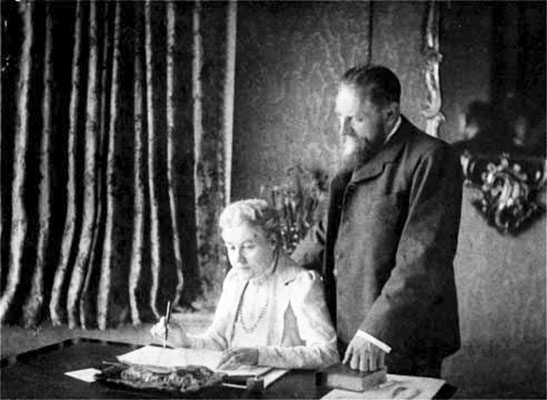
    From 1895 to 1933, Annie Besant (1847-1933) and Charles Leadbeater (1854-1934), two of the best known theosophists and metaphysicians of the 20th century, conducted clairvoyant investigations into all of the then known elements and certain compounds in order to observe the so-called “fundamental building blocks” that composed them, as well as their general structure. This involved the apprehension of visual information at sub-microscopic levels far beyond the ability of the eyes to perceive. The term for this kind of clairvoyant perception today is micro-psi (Besant and Leadbeater referred to it as “magnifying clairvoyance”).

    The initial investigations were collected and published in the first edition of Occult Chemistry in 1908 (the book was subtitled Investigations by Clairvoyant Magnification into the Structure of the Atoms of the Periodic Table and Some Compounds). A second edition of the 1908 material was issued in 1919. The sum total of Besant and Leadbeater’s clairvoyant observations of the chemical elements were collected and published posthumously in a third edition of Occult Chemistry in 1951.

    An article entitled “Occult Chemistry” appeared in the Theosophical publication Lucifer in 1895 (the year Leadbeater and Besant began their collaboration) and was reprinted as a separate pamphlet in 1905. In it, three chemical elements, hydrogen, nitrogen, and oxygen, were clairvoyantly examined and their analyses presented tentatively to the public by Besant and Leadbeater.

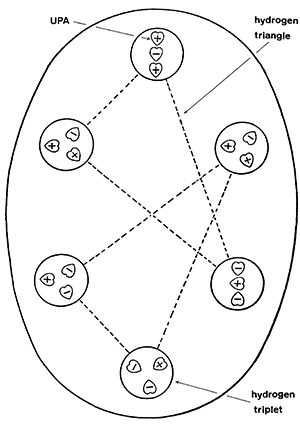
    Hydrogen, the first chemical atom selected for analysis, and possessing the lowest atomic weight, was found to be composed of eighteen smaller entities. Clairvoyantly it was seen to consist of six small bodies, contained in an egg-like form. According to Leadbeater/Besant, it rotated with great rapidity on its own axis, vibrating at the same time, and the internal bodies performed similar gyrations. “The whole atom spins and quivers, and has to be steadied before exact observation is possible,” they wrote.

    The six little bodies are arranged in two sets of three, forming two triangles that are not interchangeable. Further, the six bodies are not all alike; they each contain three smaller bodies – each of these being an ultimate physical atom – but in two of them the three atoms are arranged in a line, while in the remaining four they are arranged in a triangle.1

    The Ultimate Physical Atom (UPA)

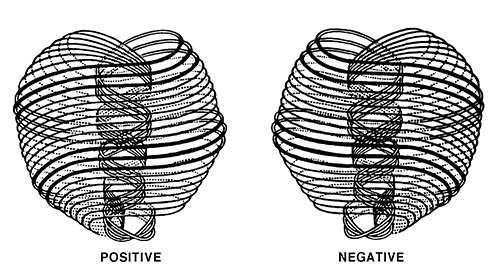
    Figure 1. The hydrogen “micro-psi atom.” The UPAs are the heart-shaped objects designated a plus or minus sign denoting either an inflow (minus) or outflow (plus) of energy. Stephen M. Phillips argues that each triangle is a single hydrogen nuclei and that the micro-psi observation has somehow bonded two together. The mid-sized circles are therefore quarks, and the heart-shaped entities sub-quarks. (Source: Occult Chemistry by Annie Besant and C.W. Leadbeater.)
    Figure 1. The hydrogen “micro-psi atom.” The UPAs are the heart-shaped objects designated a plus or minus sign denoting either an inflow (minus) or outflow (plus) of energy. Stephen M. Phillips argues that each triangle is a single hydrogen nuclei and that the micro-psi observation has somehow bonded two together. The mid-sized circles are therefore quarks, and the heart-shaped entities sub-quarks. (Source: Occult Chemistry by Annie Besant and C.W. Leadbeater.)

    As noted, in 1895 – when physical atoms were still thought to be the most basic unit of matter – Leadbeater and Besant observed in the early stages of their investigation that hydrogen was not a unity but was composed of eighteen smaller units. These smaller units they dubbed an “ultimate physical atom” (UPA), and later took to referring to them as “Anu” (singular and plural) – the Sanskrit term for this new entity. They had no way to determine the exact size of the UPA but they found it existed in two varieties: positive and negative (or Yin and Yang). The positive and negative aspects wound around each other in opposite directions (somewhat like the snakes on the caduceus, or the helical structure of DNA), forming the UPA.2

    According to Besant and Leadbeater, the UPA was a very complex entity, with only its main characteristics provided in their diagram. “It is composed entirely of spirals, the spiral being in its turn composed of spirillae, and these again of minuter spirillae.”3 In addition to this reference to the subatomic fractality of “matter,” they correctly declared that the Anu was definitely not the electron. The spirals composing the UPA, if unwound, would actually be found to be circles or strings – twisted around on themselves many times to create the helical form depicted.

    Oxygen was found to consist of 290 minor atoms and nitrogen of 261. Now, this is where it gets even more interesting. When Besant and Leadbeater divided the number of UPAs in oxygen by the number of UPAs comprising hydrogen (18), they arrived at 16.11, almost exactly the atomic weight of the oxygen atom (16). This procedure yielded the same precision with nitrogen, an even more complex structure than oxygen, and therefore much more challenging to apprehend clairvoyantly for the occultists. In fact, this uncanny precision continued right through the entire table of known elements of the time (minor human counting errors notwithstanding).

    Although science had not identified such a thing as the ultimate physical atom, Besant and Leadbeater had identified this tiny entity as comprising physical atoms. Moreover, by using hydrogen as the standard (being the first element in the periodic table – itself being composed of eighteen UPA), they were able to ascertain the atomic weight of the elements by dividing the number of UPA they observed by eighteen. Should Besant and Leadbeater have been merely “delusional cranks,” we should not expect this kind of amazing result.

    As a matter of fact, this ability to deduce the accepted atomic weights of the elements from the number of UPAs they observed was the only thing Occult Chemistry had in common with the chemistry of 1895.4

    Noteworthy is the way the UPA was depicted by Leadbeater/Besant as being created by an upwelling of force from a higher-dimensional source – just as in the hyperdimensional physics advocated by Paul LaViolette, David Wilcock, Richard Hoagland, and others researching aether physics. (Those readers interested in the notion of an aetheric medium and its false elimination from mainstream science are referred to in my The Grand Illusion 1.) The models of physics on the cutting edge have been left with no choice but to incorporate other dimensions or ‘levels’ of reality to account for today’s scientifically observable phenomena. Furthermore, Leadbeater and Besant’s clairvoyant analysis provides intimate and detailed verification of the hyperdimensional torsion and/or spin forces embedded in the ‘aether’, which I write about extensively in The Grand Illusion 1.
    [alert type=”info” dismiss=”no”]If you appreciate this article, please consider a subscription to New Dawn magazine.[/alert]

    How They Arrived at the UPA

    Leadbeater and Besant explained: “Any gaseous chemical atom may be dissociated into less complicated bodies; these, again, into still less complicated… [T]he fourth dissociation gives the ultimate physical atom. This may vanish from the physical plane, but it can undergo no further dissociation on it.”5 (emphasis added)

    Note that in their description of the UPA is a hint of multidimensional behaviour (this becomes relevant shortly). Interestingly, in 1888, the co-founder of Theosophy (it was founded in 1875), Helena P. Blavatsky, pre-empting Leadbeater and Besant by at least seven years, explained in The Secret Doctrine that on the next higher plane (etheric), what then-current science considered an undecomposable unity would – to higher perception – prove very complex. Water, for example would feature “many other constituents” besides just hydrogen and oxygen.

    As theosophists, Leadbeater and Besant would have anticipated the composition of the elements they clairvoyantly inspected (having obtained some hard-to-get samples via Sir William Crookes) to be much more complex than scientists of their time believed. They were right.

    Believe it or not, there appears to have been another earlier clairvoyant ahead of the game. At a time when Isaac Newton (a Hermeticist, though not clairvoyant) was arguing that matter was composed of impenetrable atoms given motion by outside forces, Emmanuel Swedenborg taught that matter was made up of a series of particles in ascending order of size, each of which was composed of a closed vortex of energy which spiralled at infinite speeds to give the appearance of solidity.6

    Two types of UPAs were observed by Besant and Leadbeater (see Figure 2), and they were identical in every way except “the direction of their whorls and of the force which pours through them. In the one case force pours in from the ‘outside,’ from fourth-dimensional space, and passing through the atom, pours into the physical world [‘male’]. In the second, it pours in from the physical world, and out through the atom into the ‘outside’ again, i.e., vanishes from the physical world.”7 (This was the “female” UPA.)

    Figure 2: The Two Types of Ultimate Physical Atoms, Male and Female (Source: Occult Chemistry by Annie Besant and C.W. Leadbeater)
    Figure 2: The Two Types of Ultimate Physical Atoms, Male and Female (Source: Occult Chemistry by Annie Besant and C.W. Leadbeater)

    In agreement with present-day aether researcher Paul LaViolette, David Yurth states in Seeing Past the Edge that these two opposite or mirror image particles constitute what we now refer to as matter and anti-matter states.8 This makes sense in light of Leadbeater and Besant’s comments that the positive/male UPA flows its creative energy outwards into our reality while the negative/female (anti-matter) counterpart transmutes energy from our reality back into the aether.

    Leadbeater and Besant said that if the higher-dimensional energy flow was stopped even momentarily, the whole manifest universe would disappear, “as a cloud melts away in the empyrean. It is only the persistence of that flow which maintains the physical basis of the universe.”9 LaViolette (among many others) has vindicated our two eminent occultists on this point, agreeing that without this constant flow,

    the subatomic particles and energy waves composing our physical universe would gradually dissipate, disolving [sic] into a state of uniformity. What would remain would be the ever-present, vast, and unfathomable multi-dimensional consciousness, of which we are a part, and whose now featureless calm “surface” had once generated our beautiful physical universe.10

    Physicist Nassim Haramein also supports this view, stating that, “without spin, none of reality can come to exist. All things spin!” Haramein agrees that “spin is fundamental to creation and objects that appear to be inanimate exist solely because spinning atoms within allow the objects to radiate, and hence, appear in our reality.”11 How did Leadbeater and Besant (and Swedenborg) know with such certainty so far in advance of science that our “physical” world’s source of origin is the aetheric medium’s spin dynamics?

    Besant and Leadbeater described the ultimate physical atom as a sphere, slightly flattened, with a depression at the point where the force flows in, causing a “heart-like” form. “Each atom is surrounded by a field,” they wrote, “formed of the atoms of the four higher planes, which surround and interpenetrate it.”12 If this is accurate, then etheric, astral and mental particles are of increasingly large size (physicists are searching for these “super particles” without realising they have already been quietly discovered).

    Leadbeater and Besant’s depiction of the UPA was fundamentally toroidal and way ahead of their time: “It turns incessantly upon its own axis, spinning like a top; it describes a small circle with its axis, as though the axis of the spinning top moved in a small circle; it has a regular pulsation, a contraction and expansion, like the pulsation of the heart.”13 Spin was first proposed in physics thirty years later by Goudsmit and Uhlenbeck in 1925 and was confirmed in electrons by Phipps and Taylor in 1927. The circular precessional motion described by the axis of the spinning UPA would later become known in physics as Larmor precession. Though the expansion and contraction (radial pulsation) described by Leadbeater and Besant is still unknown to physicists today, LaViolette points out that this description is quite plausible in the context of the ancient aether physics.14

    The UPA’s spinning motion is common to globules in complex plasmas,15 and as we see in Chapter 9 of The Grand Illusion, many of Leadbeaters’ and other metaphysicists’ clairvoyant observations can be accounted for in light of plasma dynamics. For instance, when exposed to an electric current the UPAs, as depicted by Besant and Leadbeater in 1919, arranged themselves in physical rows of “particle chains” – just like globules in complex plasma, as illustrated by A. Piel et al.16 In this UPA formation the depression of one UPA receives the aetheric flow of its neighbouring particle and then passes it out through its own apex, and so on.

    In Occult Chemistry Leadbeater refers to the UPA as having a certain level of apparent consciousness, and our best occultists and mystics (and scientists) all seem to agree that the universe is indeed conscious at all levels. It is interesting, as Jay Alfred points out, that David Bohm’s research into plasmas yielded the observation that electrons in a plasma configuration began to act as if they were part of a larger, interconnected whole, so much so that he frequently had the impression that the electron sea was “alive.” Mircea Sanduloviciu and colleagues have even created plasma spheres that can grow, replicate and communicate, fulfilling most traditional requirements for biological/living cells.17

    The links between consciousness and the spiralling energy inherent in the multidimensional fabric of the cosmos are increasingly being elaborated on by modern science. It is interesting to note some of the parallels between modern toroidal models and the fundamentally toroidal model Besant and Leadbeater described during their clairvoyant investigations. While Wilcock states that the aether’s substance naturally forms itself into a spherical formation because of the near-uniformity of the aetheric pressure on all sides, as well as the fact that it is the most ‘harmonic’ shape, he acknowledges that changing energy densities in the aether can cause these spheres to warp to some extent. For instance, they may stretch and flatten to create a donut-like shape, otherwise known as the torus, a model employed by Wilcock, Haramein18 and string theory.

    Occultists’ Vindication Arrives Via Dr. Phillips

    In the late 1970s Stephen Phillips, then a physics graduate student at the University of California, happened across some of the diagrams from Occult Chemistry. Contrary to what we might expect of most physicists, he took a serious interest in the material, and the end result was a major technical validation of the data obtained by Leadbeater and Besant.

    Dr. Phillips discovered that “Besant and Leadbeater’s clairvoyant descriptions of the chemical elements are completely consistent with the Quark, Quantum Chromodynamic and Super-String theories of modern subatomic physics.”19 This he detailed in depth in his 1980 book The Extra-Sensory Perception of Quarks, in which Phillips reconciled Occult Chemistry with modern physics. Because of his work, “Occult Chemistry now stands as a glittering testimony to the validity of Besant and Leadbeater’s claims.”20

    To clarify, a UPA’s ‘whorls’ are the ‘strings’ of modern string theory. Phillips suggests, based on comparisons between the occultists’ whorls and the ‘strings’ of string theory, that “[a] whorl is a closed, 26-dimensional, bosonic string (the reported presence of spherical ‘bubbles in koilon’ in 7th-order spirillae imply that whorls extend beyond the sixth, compactified dimension, so that they must be 26-, not 10-, dimensional strings,)” and also that “[t]he UPA is a subquark state of a superstring composed of ten strings, i.e. the superstring is itself a composite object.”21

    Thus, Phillips has reinterpreted Besant and Leadbeater’s observations to be not those of atoms, but of subquarks and quarks. The notion of quarks was only introduced into modern physics decades later in 1964 by Gell-Mann and Zweig.22 Quarks are the building blocks of so-called ‘elementary’ particles, and are generally accepted as existing by the scientific community today.

    However, Phillips’ model is actually a subquark (or composite quark) model. In it subquarks make up quarks, quarks make up elementary particles (protons, etc.), elementary particles make up atoms, and so on. Thus, Phillips has identified the UPAs as subquarks, and, as Donald DeGracia reports in Beyond the Physical: A Synthesis of Science and Occultism, he calls his subquarks “omegons” to indicate they are the final and smallest form of physical matter (omega is the final letter of the Greek alphabet). Phillips shows, through rigorous quantitative procedures, that “the sub-quark combinations predicted by his model are almost in exact agreement with the detailed structures presented by Besant and Leadbeater.”23 He has successfully correlated the structure of the UPA with superstring models: the UPA itself is the ‘superstring’ of modern subatomic physics.

    However, please note: the only way Phillips could get the numbers generated by his theory to match the actual observations of Besant and Leadbeater was to infer that when they were observing the subquark structure of an atom, they were not observing one atom but two atoms that had somehow fused together – as a result of their interference with and observations of these entities – to create a diatomic arrangement. This might have resulted from the spreading of the particles’ wave packets/de Broglie waves caused by the mental stabilisation of the particles by the theosophists, removing the uncertainty in their momentum, therefore increasing the uncertainty of their spatial locations.

    From a slightly different angle, the procedure, in effect, may have ‘teased out’ some of the inherent non-locality of the particles’ de Broglie waves/wave packets in time-space or ‘reciprocal space’ so as to influence their locations in space-time:

    [E]ach particle would become so delocalised that there would now be just as much chance of finding it near an adjacent atomic nucleus as there was in finding it in the much smaller space occupied by the nucleus prior to its coming under observation… their wave functions would eventually overlap significantly, leading to a non-vanishing probability of their mutual strong interaction.24

    The clairvoyantly observed structure of micro-psi atoms (MPAs) consisted of two overlapping triangular formations, with each triangle containing nine UPAs, while the contemporary view of hydrogen is of a lone electron orbiting a nucleus of one proton. However, from the viewpoint of modern quark theory, that lone proton is actually an arrangement consisting of three quarks. Phillips further claims that each quark is in turn made up of three subquarks, meaning the hydrogen atom consists of nine subquarks. Because in Besant and Leadbeater’s hydrogen there were two triangles each of nine UPAs, Phillips’ conclusion is that each triangle must correspond to an atom of hydrogen as understood by modern science, meaning that the hydrogen structure observed by Besant and Leadbeater was actually made up of two atoms of hydrogen.

    In the end, there are far too many correspondences between what Besant and Leadbeater observed and what is now scientifically known about subatomic behaviour, to dismiss their work.

    The shapes they described, the fact that they observed isotopes… before isotopes were widely recognised in science… and a host of other relevant observations; all of these are ideas that were completely unknown to the science of their day.25

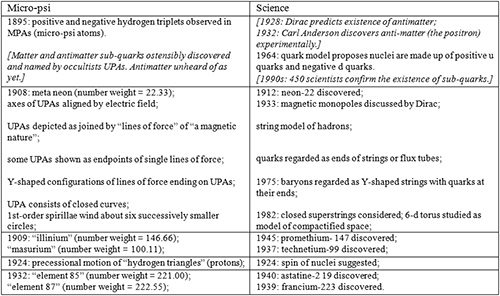
    The table on page 62 provides a partial overview of Leadbeater and Besant’s clairvoyant observations as compared with subsequent scientific discoveries.

    “Some micro-psi anticipations of scientific discoveries and ideas.” Note: Brendan Murphy’s comments in italicised brackets. (Source: Stephen Phillips, Extrasensory Perception of Subatomic Particles, Journal of Scientific Exploration, 9(4), 489–525, 1995.)
    “Some micro-psi anticipations of scientific discoveries and ideas.” Note: Brendan Murphy’s comments in italicised brackets. (Source: Stephen Phillips, Extrasensory Perception of Subatomic Particles, Journal of Scientific Exploration, 9(4), 489–525, 1995.)

    As DeGracia points out, Phillips has shown that to comprehend the finer points of Occult Chemistry one requires an advanced understanding of modern physics. Besant and Leadbeater described the quantum nature of physical matter in 1895, exactly as science would thirty years later and more. How did they know about quarks and subquarks so far in advance of their official scientific discovery?

    To gain some comprehension of how controversial the terrain we tread here, the existence of sub-quarks was only recently scientifically accepted, and even then not unanimously. Yurth reports that in the 1990s an armada of 450 scientists confirmed the existence of sub-quarks with an “unprecedented” level of scrutiny, and still physicists at the American Physical Society, MIT, Princeton and Columbia University succeeded in suppressing the publication of the research data in such mainstream publications as Scientific American, Physics Letters, Physics Review and Nature.26 Thank goodness for free scientific enquiry, eh?

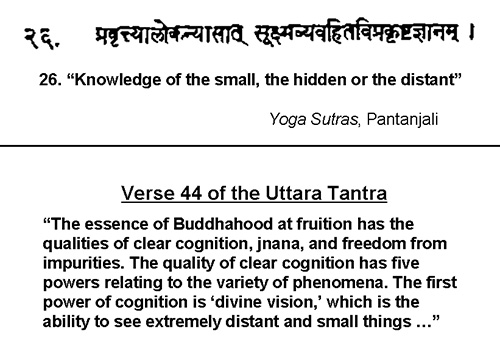
    Regardless, Besant and Leadbeater were obviously capable of perceiving the fundamental nature of matter using occult means, the siddhis. According to Leadbeater, there is a tube-like structure that protrudes from the Ajna, or third-eye chakra of the etheric body, and it is by means of utilising this tube as an organ of vision that one can exercise micro-psi. As we can see, there is good reason to believe him. This psi faculty/ability is one of the siddhis Patanjali wrote about in his Yoga Sutras circa 400 BCE.

    In Aphorism 3.26 of the Yoga Sutras (c. 400 BCE), the earliest known treatise on yoga, its author Patanjali refers to a particular siddhi in which a yogi can gain “knowledge of the small, the hidden or the distant by directing the light of a superphysical faculty.”
    In Aphorism 3.26 of the Yoga Sutras (c. 400 BCE), the earliest known treatise on yoga, its author Patanjali refers to a particular siddhi in which a yogi can gain “knowledge of the small, the hidden or the distant by directing the light of a superphysical faculty.”

    One more interesting thing about sub-quarks highly pertinent to our occult leitmotif: the sub-quark’s track looks the way it does because in our space-time continuum the particle exists and then does not exist, exists and then does not exist. The discovery of the sub-quark constituted the very first scientifically verified instance of multi-dimensional behaviour in a measurable physical entity: “…in the rarified environment of the particle accelerator, the sub-quark exists-disappears-exists-disappears with a consistent, repeated, predictable frequency pattern…”27

    Leadbeater and Besant stated that the UPA – like the sub-quark today – could vanish from its plane but could undergo no further subdivision. It is truly the most fundamental aspect of physical matter at our density level. The scientific verification of Leadbeater and Besant’s observations clearly indicates the human ability to peer into domains non-existent to our ordinary senses and science’s conventional equipment – domains our most fundamental known ‘particles’ (standing wave structures) venture rhythmically in and out of. Yurth comments that this brings us “literally to the Edge of creation.”28 Do pause and let all of that sink in for a moment.

    Conclusions

    Our occultists are quantitatively and qualitatively vindicated from almost every conceivable angle. (I cover more angles than we have space for here in The Grand Illusion 1.) If we accept Phillips’ conclusion that ultimate physical atoms (UPAs) are sub-quarks rather than atoms, as Leadbeater/Besant once thought, then it is from dedicated occultists that we have obtained the first and possibly most accurate and detailed depictions of them and the aetheric medium that spawns them. On top of that, we must credit the initial discoveries of several isotopes to Leadbeater and Besant.

    Overall, the interrelated combination of clairvoyant observations, string theory, and ‘anomalous’ research findings that the Standard Model cannot explain – but which aether models easily incorporate – is too powerful to ignore.

    Brendan D. Murphy’s website is http://www.brendandmurphy.net.

    [alert type=”general” dismiss=”no”]This article was published in New Dawn Special Issue Vol 6 No 4.[/alert]

    [alert type=”success” dismiss=”no”]If you appreciate this article, please consider subscribing to help maintain this website.[/alert]

    Footnotes:

    1. Annie Besant & Charles W. Leadbeater, Occult Chemistry: Clairvoyant Observations on the Chemical Elements, 1919
    2. Annie Besant & Charles W. Leadbeater, Occult Chemistry, 1950
    3. Ibid
    4. Donald DeGracia, Beyond the Physical, 109
    5. Besant & Leadbeater, 1919
    6. See Victor Zammit, A Lawyer Presents the Case for the Afterlife, Ch. 2, www.victorzammit.com
    7. Besant & Leadbeater, 1919
    8. David Yurth, Seeing Past the Edge, 252
    9. Besant & Leadbeater, 1919
    10. Paul LaViolette, Subquantum Kinetics: A Systems Approach to Physics and Cosmology
    11. Nassim Haramein, What is the Origin of Spin?, www.theresonanceproject.org/pdf/origin_of_spin.pdf
    12. Besant & Leadbeater, 1919
    13. Ibid
    14. Paul A. LaViolette, Genesis of the Cosmos, 238-9
    15. Jay Alfred, Our Invisible Bodies, 49
    16. Ibid., 50
    17. Ibid., 65-8, 133-4
    18. See www.theresonanceproject.org/research.html for Haramein’s model
    19. DeGracia, 110
    20. Ibid. See also Phillips
    21. Stephen Phillips, Extrasensory Perception of Subatomic Particles, Journal of Scientific Exploration, Vol. 9, No. 4, 1995, 489-525
    22. Ibid., 110-11
    23. Ibid., 111
    24. Phillips, 1995
    25. DeGracia, 113-5
    26. Yurth, 255
    27. Ibid, 54-5
    28. Ibid, 55

    © New Dawn Magazine and the respective author.
    For our reproduction notice, click here.
  • Time, Entanglement & Consciousness

    Time, Entanglement & Consciousness

    From New Dawn Special Issue Vol 6 No 4 (Aug 2012)

    Over the past year [2011-2012] a number of new, potentially momentous, discoveries have been made in the realms of quantum and particle physics. On the one hand, they stand to rock the very foundations of modern physics and the common-sense reality that most people live their everyday lives by. On the other hand, these same discoveries lend further support to the reality of both paranormal phenomena and the literal veracity of ancient wisdom. In particular, I am here referring to three recent announcements:

    1) In late April 2012 a research team from the US National Institute of Standards and Technology reported on an experiment involving the generation of light pulses travelling faster than the speed of light in a vacuum. This work involved forcing a wave peak on a pulse of light to move from back to front along the light beam as the light itself was travelling at the standard speed of light, such that the pulse travelled faster than the speed of light in a vacuum.1 If refined, such a technique could possibly allow information to be sent faster than the speed of light. This work follows on the heels of a major brouhaha over another alleged instance of faster than light speeds.

    A consortium of scientists reported in September and November 2011 that subatomic particles known as neutrinos had been measured travelling faster than the speed of light while passing through 730 kilometres of rock from the CERN (European Organization for Nuclear Research, formerly known as the Conseil Européen pour la Recherche Nucléaire) particle physics laboratory in Geneva, Switzerland, to the OPERA (Oscillation Project with Emulsion-tRacking Apparatus) particle detector in the Laboratori Nazionali del Gran Sasso, Italy.2

    Standard modern mainstream physics theories, many based in large part on Albert Einstein’s special theory of relativity (first proposed in 1905), have long assumed that the speed of light in a vacuum is the upper limit of how fast anything can travel, and therefore if these experimental results are correct, some of the most basic assumptions in modern physics will need to be reevaluated.

    For months the debate raged over whether the neutrinos really were travelling faster than the speed of light; the consensus view held that there was some flaw in the apparatus, calculations, and/or analysis. Ultimately, based on carrying out further experiments, including at other labs, it was announced that “the original OPERA measurement can be attributed to a faulty element of the experiment’s fibre optic timing system.”3 Still, given the apparently solid work on light pulses mentioned above, I personally wonder if, just perhaps, OPERA did indeed capture some superluminal (faster than the speed of light) neutrinos, even if not all neutrinos travel so fast.

    A major objection to the possibility of superluminal travel of any form is that it will upset cherished notions of time and temporal ordering (conventional thinking asserts that the past must occur before the present which must occur before the future). From our perspective, particles (including particles of light, or ‘particles’ of information) travelling faster than light might be viewed as travelling backwards in time (arriving one place before they depart from another place), or through other dimensions, and open the possibility of effects occurring before causes (although exactly what ‘before’ means in this new notion of time is open to debate). That is, the concept of retrocausality (the future influencing the present and the past), which many people (including many theoretical physicists) instinctively reject, would have to be taken seriously.

    2) In quantum mechanics the concept of entanglement occurs when particles interact and are then separated, but they are still somehow correlated (or more accurately, anti-correlated) in terms of their characteristics. Acting on one particle will result in an effect or outcome on the other particle, even if a considerable distance physically separates the particles and there is no direct conventional physical or energetic link between them. To use a crude analogy, if two different roulette wheels in two different casinos are entangled in a quantum mechanical sense, whenever one roulette wheel comes up red the other will come up black.

    Einstein referred to quantum entanglement as “spukhafte Fernwirkung” (spooky action at a distance), but it has been demonstrated experimentally numerous times, and the effects of entanglement seem to propagate either instantaneously or at a speed thousands of times faster than the speed of light (which is highly perplexing). Up until now quantum entanglement has generally been limited to very small microscopic objects, such as subatomic particles, atoms, isolated molecules, and microscopic crystalline structures. In December 2011 a group of physicists from the University of Oxford, the National Research Council of Canada, and the National University of Singapore announced the successful quantum entanglement of two macroscopic (approximately 3 mm in size) diamonds at room temperature and separated by a distance of about 15 cm.4

    3) The wave function in quantum mechanics can be viewed as a mathematical or statistical way to describe the probabilities that certain properties will occur in a system of quantum particles (and ultimately, one can argue, everything – all of the known universe – can be reduced to a system or systems of quantum particles). And ‘quantum collapse’ (collapse of the state vector) can be viewed as the ‘freezing’ of this set of probabilities into one possibility or outcome, the one observed or measured, in the ‘real world’. But is the wave function simply, or truly, just a mathematical and statistical convention describing our limited knowledge of reality (perhaps with some currently unknown ‘reality’ underlying it)? Is the wave function to be understood as a description of the state of our knowledge? Or is the wave function itself a ‘real’ entity, a distinct state of reality – that is, is there a tangible, physically real, wave? Is the quantum state a real physical property of a system and not just a statistical description of our knowledge, and does ‘quantum collapse’ correspond to a real physical process?

    In November 2011 researchers M. F. Pusey, J. Barrett, and T. Rudolph (MFP and TR are in the Department of Physics at the Imperial College London, and JB is in the Department of Mathematics at the University of London) presented a new analysis and theorem as to the meaning of the wave function in quantum mechanics.5 According to their analysis, given some basic assumptions, the wave function must have a physical reality. However, in my opinion, they have not ultimately ‘proven’ that the wave function is objectively real. Rather, they have logically limited the possible interpretations of the wave function. By my view, their analysis appears to demonstrate that unless all quantum particles (that is, in effect, all entities in the universe) are somehow related or connected to each other through both space and time, then the wave function must be a real physical object. They seem to reject the notion that everything in the universe could be connected in some manner, for it is generally assumed that although quantum entanglement occurs in some cases, not everything is entangled with everything else. Furthermore, it appears to me that one of the assumptions underlying the analysis of Pusey, Barrett, and Rudolph is that retrocausality (the possibility of the future affecting the past) is impossible.

    Each of these three developments in physics is important, and fundamentally paradigm shattering. The least controversial of the three is the quantum entanglement of the diamonds, for the experimental results are clear and definitive. But the entanglement of macroscopic diamonds at ordinary room temperature under ordinary conditions demonstrates, I believe, that those who have long argued that quantum entanglement (and other ‘mysterious’ quantum effects as well) is limited to the microscopic world and can have no real consequences in our everyday lives are wrong.

    Quantum Entanglement & Telepathy

    Indeed, in a general (and, I would add, rather unconvincing) way, there has long been talk in some circles that certain psychic or paranormal phenomena such as telepathy (direct mind-to-mind communication) could be due to quantum entanglement.6 Now the entangled diamonds appear to provide strong evidence that such entanglement and correlation of information is possible. In my experience telepathy tends to work best when one is in a mental state decoupled from the immediate surrounding environment, which allows the mind of one individual to couple or entangle with the mind of another individual (or individuals). Like minds in telepathic rapport, diamonds best maintain their quantum entanglement when they can be decoupled from ‘distractions’ or the entanglement is stronger than the ‘distractions’ (in the case of the diamonds, ‘distractions’ might include such phenomena as being ‘excited’ by environmental changes, like temperature or physical movement). Of course most hardcore physicists tend to dismiss telepathy as nonsense even though they accept the quantum entanglement of diamonds.

    Solid Support for Retrocausality

    The issue of anything with the ability to carry information travelling faster than the speed of light, be it particles or light pulses, is highly controversial. As the edifice of modern physics has been constructed, with so many fundamental equations dependent on the speed of light as a constant and upper limit for temporal relationships, superluminal transfer of information breaks down the conventional concept of time, the future and past become confused, and the spectre of retrocausality raises its ugly head (well, ugly for status quo thinkers!).

    Yet there is solid support for retrocausality on several fronts. A group centred in Vienna, Austria, headed by Anton Zeilinger, has experimentally demonstrated that the decision as to whether or not two particles at a quantum level are entangled or in separate quantum states can be made after the particles have been measured (and may no longer exist).7 This means that at a quantum level actions in the present or future can reach back into the past!

    However, actions reaching back into the past are not limited to a quantum level. There is now strong parapsychological support for retroactive influences on the human mind. As I briefly mentioned in a previous edition of New Dawn,8 Dr. Daryl J. Bem of Cornell University has carried out a successful series of “retroactive facilitation of recall” experiments demonstrating that the future can influence the present and the past (in the case of the studies by Dr. Bem, students studying for a test after the fact improved their performances on a test already taken – that is, classic retrocausality, or effects occurring before their causes, was demonstrated).9

    As in the case of the entangled diamonds, the experimental physical evidence – in this case light pulses travelling at superluminal speeds and actions at a quantum level reaching back into the past – helps supply a theoretical foundation for psychic or paranormal phenomena that, although well attested to by competent researchers, are generally dismissed by mainstream scientists.

    The theoretical work on the wave function of quantum mechanics dovetails, in my assessment, with that which many mystics and psychics have been espousing since ancient times: In a fundamental way we, the entire universe, all entities, are interconnected at some level (the level of interconnectedness differing among various entities) and time is not what it superficially appears to be. In my opinion the work of Pusey, Barrett, and Rudolph opens, at the level of quantum mechanics, the age-old argument between the ‘physicalists-materialists’ who fundamentally believe there is nothing more to reality than matter and energy, and those who believe ‘ultimate reality’ involves something more and beyond matter-like and energy-like entities as generally construed by classical physics.

    Consciousness is Fundamental

    But what could be beyond matter and energy? One possibility is consciousness, and I believe that consciousness can be equated with thought, mind, mental constructs, information, and ultimately knowledge. And rather than being a secondary phenomenon that arises from matter and energy, at the most fundamental level consciousness may be independent of matter and energy. Max Planck (1858-1947), the originator of quantum theory and winner of the 1918 Nobel Prize in Physics, stated in a 1931 interview:

    I regard consciousness as fundamental. I regard matter as derivative from consciousness. We cannot get behind consciousness. Everything that we talk about, everything that we regard as existing, postulates consciousness.10

    This is a very interesting, and powerful, statement. In these terms, the statistical or probabilistic interpretation of the quantum wave function can be viewed as a genuine description of a system in a ‘pre-matter’ and ‘pre-energy’ state that only takes on a physical reality when affected by consciousness (and simple observation will affect any quantum system).

    Returning to the analysis of Pusey, Barrett, and Rudolph, I believe they conclude that the quantum state and wave function are ‘real’ in a physical-material-energy sense based on several assumptions. They assume that a quantum system can be isolated from the rest of the universe, both spatially and temporally – and in particular they assume that the future will not influence the past, so an apparatus or system separated by “a sufficient time period” will not affect an earlier apparatus or system. They also assume that measuring devices respond only to the physical properties of the entities that they are measuring. If the assumptions of Pusey, Barrett, and Rudolph can be shown to be wrong, their work can then be interpreted to demonstrate that rather than the wave function and quantum state being physically real, there must be something more to the universe and cosmos beyond simple matter and energy.

    I interpret various lines of experimental evidence, ranging from modern physics (such as the work on faster-than-light particles and quantum effects that may be interpreted as going backwards in time) to parapsychological studies (demonstrating that the future can influence the past), as clearly falsifying the assumptions of Pusey, Barrett, and Rudolph. At a most fundamental level it appears there are connections throughout space and time. Just as diamonds can be entangled, nothing is truly isolated. Ultimate reality lies beyond the physical and material. What is this ultimate reality? Our best conception may be encoded in what we think of as consciousness. The mystics and sages of the ages, as well as Max Planck, were right. Consciousness is fundamental. Consciousness underlies and is the source of everything else, including all that we regard as the material universe.

    [alert type=”general” dismiss=”no”]This article was published in New Dawn Special Issue Vol 6 No 4.[/alert]

    [alert type=”success” dismiss=”no”]If you appreciate this article, please consider subscribing to help maintain this website.[/alert]

    Footnotes:

    1. Ryan T. Glasser, Ulrich Vogl, and Paul D. Lett, “Stimulated Generation of Superluminal Light Pulses via Four-Wave Mixing”, Physical Review Letters, PRL 108, 173902, 5 pages, 26 April 2012.
    2. T. Adam, N. Agafonova, A. Aleksandrov, O. Altinok, P. Alvarez Sanchez, A. Anokhina, S. Aoki, A. Ariga, et al, “Measurement of the neutrino velocity with the OPERA detector in the CNGS beam”, article dated 17 November 2011, available from http://arxiv.org/abs/1109.4897 and http://arxiv.org/ftp/arxiv/papers/1109/1109.4897.pdf (Accessed 18 November 2011). See also: Adrian Cho, “Where Does the Time Go? One experiment sees neutrinos traveling faster than light. If the result can’t be replicated, it may never be explained away”, Science, vol. 334, 1200-1201 (2 December 2011); Alex Knapp, “New Evidence Casts Doubt On Faster-Than-Light Neutrinos”, article dated 28 December 2011, available from www.forbes.com/sites/alexknapp/2011/12/28/new-evidence-casts-doubt-on-faster-than-light-neutrinos/ (Accessed 20 January 2012); Clara Moskowitz, “Warped Physics: 10 Effects of Faster-Than-Light Discovery”, article dated 24 September 2011, available from www.livescience.com/16214-implications-faster-light-neutrinos.html (Accessed 20 November 2011); Jason Palmer, “Light speed: Flying into fantasy”, article dated 23 September 2011, available from www.bbc.co.uk/news/science-environment-15034414 (Accessed 18 November 2011); Jason Palmer, “Neutrino experiment repeat at Cern finds same result”, article dated 18 November 2011, available from www.bbc.co.uk/news/science-environment-15791236 (Accessed 18 November 2011); Jason Palmer, “Speed-of-light results under scrutiny at Cern finds same result”, article dated 23 September 2011, available from www.bbc.co.uk/news/science-environment-15017484 (Accessed 18 November 2011); Natalie Wolchover, “What Would It Be Like to Travel Faster than the Speed of Light?”, article dated 23 September 2011, available from www.lifeslittlemysteries.com/neutrinos-faster-speed-light-2044/ (Accessed 20 November 2011).
    3. Sergio Bertolucci, “Neutrinos sent from CERN to Gran Sasso respect the cosmic speed limit”, article dated 8 June 2012, available from http://press.web.cern.ch/Press/PressReleases/Releases2011/PR19.11E.html (Accessed 19 June 2012).
    4. K. C. Lee, M. R. Sprague, B. J. Sussman, J. Nunn, N. K. Langford, X.-M. Jin, T. Champion, P. Michelberger, K. F. Reim, D. England, D. Jaksch, and I. A. Walmsley. “Entangling Macroscopic Diamonds at Room Temperature”, Science, vol. 334 no. 6060, 1253-1256 (2 December 2011).
    5. Matthew F. Pusey, Jonathan Barrett, and Terry Rudolph, “The quantum state cannot be interpreted statistically”, article dated 14 Nov 2011, available from http://arxiv.org/abs/1111.3328 and http://arxiv.org/PS_cache/arxiv/pdf/1111/1111.3328v1.pdf (Accessed 19 January 20120).
    6. Note that phenomena generally regarded as “telepathic” may include a mixture of phenomena due to different causal mechanisms; thus some forms of telepathy may be the result of quantum entanglement and other forms of telepathy may be due to electromagnetic radiation, particularly in the extremely long wavelength and extremely low frequency range.
    7. Xiao-song Ma, Stefan Zotter, Johannes Kofler, Rupert Ursin, Thomas Jennewein, Caslav Brukner, and Anton Zeilinger, “Experimental delayed-choice entanglement swapping”, Nature Physics, www.nature.com/naturephysics, DOI: 10.1038/NPHYS2294, 6 pages, published online 22 April 2012; Caslav Brukner, “Quantum physics mimics spooky action into the past”, press release date 23 April 2012, available from www.eurekalert.org/pub_releases/2012-04/uov-qpm042312.php (Accessed 8 May 2012).
    8. Robert M. Schoch, “Thoughts Have Wings”, New Dawn, January-February 2011, 11.
    9. Daryl J. Bem, “Feeling the Future: Experimental Evidence for Anomalous Retroactive Influences on Cognition and Affect”, Journal of Personality and Social Psychology, vol. 100, no. 3, 407-425 (March 2011); abstract available from http://psycnet.apa.org/journals/psp/100/3/407/ (Accessed 20 August 2011); author’s typescript version of the paper available from http://dbem.ws/FeelingFuture.pdf (Accessed 20 August 2011).
    10. Max Planck, [Interview comments] The Observer (London), 25 January 1931; quoted in Joseph H. Fussell, “Review and Comment” on the book Where is Science Going? by Max Planck (1933), The Theosophical Path, vol. 43, no. 2, 198-213 (October 1933).

    © New Dawn Magazine and the respective author.
    For our reproduction notice, click here.