New Dawn – World's Most Unusual Magazine

Tag: reincarnation

  • Interview with Graham Hancock: Ancient Civilisations & Altered States of Consciousness

    Interview with Graham Hancock: Ancient Civilisations & Altered States of Consciousness

    From New Dawn 134 (Sept-Oct 2012)

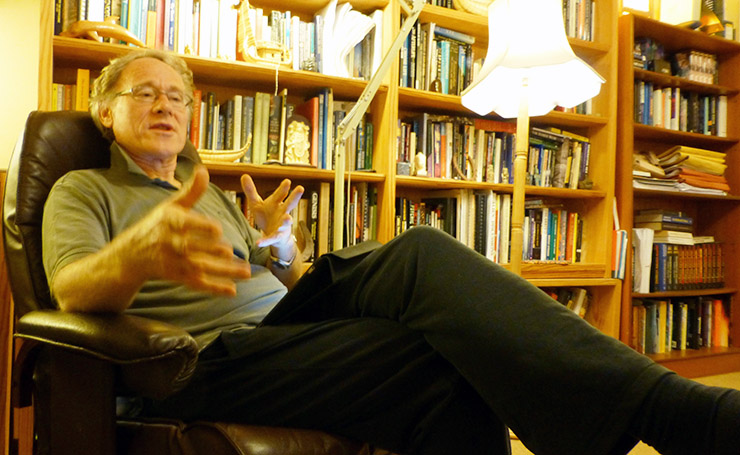
    Few, if any, have contributed more to the alternative history and esoteric genres than Graham Hancock. At the peak of his career, and on the eve of his first speaking tour of Australia [in 2012], Andrew Gough met up with Graham to discuss his legacy and what the future may hold for the greatest voice of his generation.

    ANDREW GOUGH (AG): Graham, hi. Welcome to New Dawn magazine.

    GRAHAM HANCOCK (GH): It’s a pleasure.

    AG: Can you believe that your seminal book, Fingerprints of the Gods, was published over 17 years ago?

    GH: Yes, it’s really bizarre, actually, the feeling that 17 years have passed. I had a feeling back then that there was another story to tell about the past – something missing in the record – and I set out to look for that.

    AG: Were you prepared for the responsibility that came with the success of Fingerprints of the Gods?

    GH: Well, I think first of all I need to make it very clear that Fingerprints of the Gods could never have been written if there were not a whole group of people working in this area. And, to name a few, I would say: Rand and Rose Flem-Ath, with their work on earth-crust displacement, following up the work of Professor Hapgood; Robert Bauval, with his extraordinary work on the Orion correlation, which radically changed our understanding of the pyramids and what they’re all about, and the deep antiquity that they’re connected to; John Anthony West, and Professor Robert Schoch from Boston University; John West, radical Egyptologist, thinking things through in a different way, realising that there is something wrong with the story of the Sphinx, and Robert Schoch backing that up with geological observations; all of these people were working away, doing incredibly important original work of discovery and part of my function was to write a book that put all of that work together into a bigger picture.

    AG: Your success was not without consequence, and I remember watching the 1999 BBC Horizon documentary in horror, as they attacked your theories, in what was clearly a premeditated manner. Although you were vindicated, what do you think led to the BBC’s aggression?

    GH: Well, again, I think, first of all, when you get into the field of exploring radical new ideas, challenging the status quo, and perhaps I didn’t realise this fully at the time, because the whole success of Fingerprints of the Gods and the speed with which things developed took me quite by surprise, you absolutely have to expect to be attacked, and academics also attack each other in exactly the same way.

    I also think, by 1999 perhaps I myself had become over-confident. I’d had a lot of success. When I look back on the story of my life, and those particular years, I think I was arrogant. I think I was cocky. I think I felt invulnerable. I actually think I needed to be taken down a peg, which is what the BBC did to me.

    AG: That’s a very impressive perspective.

    GH: Thank you.

    AG: So much attention has been paid to the end of the Mayan Calendar, but in your estimation what is significant about the start date?

    GH: Well, you know, this is curious. I actually can’t answer that question. All I can tell you is that when we look at what we understand of history we can say that date, of around 3100 BCE, does mark quite closely the beginning of the emergence of the city state.

    AG: And now the big question: what’s your view about what may or may not happen on 21 December 2012?

    GH: To be honest, I don’t think anything is going to happen on 21 December 2012. People often ask me where I will be on that date. Where I want to be is in the loving embrace of my family, surrounded by my children and my wife, having a good time.

    Perhaps now that I am coming on 62, as the years go by you begin to focus perhaps a little bit more on that. Life doesn’t go on for ever. We don’t know what happens afterwards. I happen to believe we come back. I can’t prove that, but I can’t see the point of a universe that provides just one life. So, my feeling about 2012 is a reminder that we’re here to love and that’s what we should be doing and living, as far as possible, positive lives, which means positive lives in relation to others as well. And that remains true, whether or not some great cataclysm is coming.

    AG: What is your view on reincarnation?

    GH: Well, first of all, reincarnation makes perfect sense to me. I think it was Voltaire who said that it is no more extraordinary to be born twice than to be born once. My own religious point of view is that it seems highly likely that consciousness survives death, and I have tried to make this point in recent lectures, that materialist science works with a model of the brain that says the brain generates consciousness, rather in the way that a factory makes cars, and therefore when the brain is dead consciousness is dead. That’s a view. But again, that is not a fact. It is equally possible, and all the measurements would remain the same, that the brain is a receiver, or a transceiver, of consciousness; that the brain is the junction point between the material and immaterial realms; that is the point through which consciousness manifests into the material plane, rather in the way that a television signal manifests as pictures through a television set. When you destroy the television set the signal is still there. Consciousness could equally well be that way.

    AG: Do you think we choose our circumstances in our next life?

    GH: Again, it kind of makes sense to me that we set a particular objective for this life – that there’s stuff we need to ‘get’ here. As I’ve gone through the process of life and I’ve made my mistakes, I’ve become more and more certain that there are transcendental consequences to all of our actions and I’m much more aware of this today than I was 20 years ago. We should not act lightly or thoughtlessly in ways that impact others and impact ourselves. We should consider that this may have huge implications over millions of years, not just over this one lifetime.

    AG: Tell me about the impetus for The Master Game?

    GH: In The Master Game, co-authored with Robert Bauval, I focused on the Gnostic tradition and how the mainstream religions – Christianity, Judaism and Islam – all worship the same entity, who is referred to as Jehovah or Yahweh in the Christian and Judaic tradition and Allah in the Islamic tradition, and that from the Gnostic point of view this entity called Jehovah is not a god. He is an imposter. He is a demon, who presents himself as a god.

    There was a saying in the film, The Usual Suspects, that the smartest trick the devil ever played was to convince the world that he did not exist. Gnostics would take that a step further – they would say, the smartest trick the devil ever played was to convince the world that he is god – that you actually insert the demonic into the mainstream religions and that would explain why these religions talk the talk of peace and love, but actually walk the walk of hatred and cruelty and violence.

    AG: Has the fact that history has been written by the victors ever made you wonder if the wrong god won?

    GH: Well, yes, I think the wrong god won – absolutely. The alternate point of view was driven underground, and that alternate point of view said that spiritual experience is fundamental and that we don’t need these intermediaries that call themselves priests or mullahs or rabbis to tell us how to relate to the spirit. How dare they stand there and tell us how we may relate to the divine?

    AG: Take Lucifer, who we are conditioned to believe was evil, but his name means ‘bringer of light’. That doesn’t sound evil to me.

    GH: Not to me, either – and again, of course, the knee-jerk Christian faction will immediately say, ‘Oh, you’re a devil worshipper’, but what actually are we worshipping in this creature called Yahweh, called Jehovah? Look at the stories in the Old Testament. Look at the things that this entity did. This is not a loving, beautiful, divine light. This is a dark creature, which tells a man to kill his own son; which says that if somebody behaves in a certain way – if somebody is a homosexual, for example – they should be killed. This is written in the Old Testament. Don’t listen to what they say. Look at what they do. What they do is pure, unmitigated, divisive hatred, wickedness, suspicion and evil.

    AG: Why do you feel there has not been a significant discovery in Egypt or other ancient lands in some time?

    GH: Well, actually I do feel there have been significant discoveries. I feel that, for example, Robert Bauval’s Orion Correlation is a significant discovery. I think that the gigantic, 12,000-year-old megalithic temple in Turkey, called Göbekli Tepe, that’s been excavated in the last six or seven years by a mainstream archaeologist, is a hugely significant discovery. First of all, it’s firmly dated to 12,000 years old, which makes it 7,000 years older than other known megalithic sites. Secondly, it’s highly sophisticated, which means there’s a background to it, which is much older than 12,000 years, that we don’t, at present, have any evidence for, but the very fact that Göbekli Tepe stands there tells us there is a background, because those people were not moving around 20 or 30 ton megaliths without some previous experience. Thirdly, that the oldest stuff at Göbekli Tepe is the best and that the younger stuff is less good.

    AG: What do you think is the lost civilisation destroyed in the last ice age?

    GH: I do think there was something worthy of the name ‘civilisation’ back in what geologists and archaeologists call the upper Paleolithic – the end of the last ice age – and that it thrived, I think, on coastlines. I think it was primarily a maritime civilisation. I don’t think it was a civilisation very much like ours.

    For me, maps from the fourteenth and fifteenth centuries, based on ancient maps, are evidence there was a global, maritime civilisation, which mapped the world and I think that it drew a meridian through the earth. The ancient prime meridian ran through Giza, that’s the zero point, and I think there were sites all around the world that were marked off at significant longitudes in relation to that zero point.

    AG: In what epoch do you believe the ancient meridian was constructed?

    GH: I think there was an attempt to re-map the world after the cataclysm. I think there were survivors and I think that, again somewhere between 13,000 and 12,000 years ago and perhaps soon after a radical cataclysm shook the earth, there was an attempt to re-establish things, to re-map things, and that attempt ultimately failed, but traces of it are left. I think that’s what happened.

    AG: Which underwater site do you think is going to create acceptance that civilisation goes back further than historians believe it does?

    GH: Luckily, with Göbekli Tepe, we’ve already got one above water. What I was arguing in Fingerprints of the Gods was evidence for a sophisticated civilisation 12,000 or more years ago and Göbekli Tepe already provides us with really incontrovertible evidence of the existence of such a culture, which had developed its stone-working techniques to such a degree that it could create a site on that scale.

    As you’ve said, Fingerprints of the Gods was published 17 years ago. I took the work a lot further with Underworld and the underwater stone circle of Kerama in Japan, off the island of Okinawa, I think is a greatly underestimated site. It’s 110 feet underwater and has been so for 12,500 to 13,000 years. I think the cities that have been detected with sidescan sonar in the Gulf of Cambay, off the north-west coast of India, are very, very interesting. And off southern India, as well, where we have a huge Atlantis tradition.

    AG: Where do you place Atlantis, and when?

    GH: I place it everywhere. I think it’s important to not isolate the Atlantis story – it doesn’t stand alone. There are many such stories from many different cultures around the world.

    And I don’t think we should forget America itself, if we’re looking for the one that’s Plato’s Atlantis. America is very interesting and it does appear to have been over North America that this gigantic comet of 12,900 years ago exploded. So, I think there’s a whole lot of missing story to be recovered from the Americas and offshore of the Americas.

    AG: The Sign and The Seal chronicled the history of the Ark of the Covenant and traced its possible resting place to Axum, Ethiopia. What do you think would happen if the Ark was rediscovered today?

    GH: It’s a fact, and a rather spooky one, that the three mainstream monotheistic faiths, Islam (particularly in its Shia manifestation) Judaism and Christianity, all have fundamentalist elements which make reference to the Ark of the Covenant, and for the character that the Shias call the ‘Hidden Imam’ to return. He, by the way, is the person whose return Iran is actively preparing for now: the Mahdi, whose name lies behind the Madhi Army in Iraq. The Hidden Imam (the Mahdi) must recover the Ark of the Covenant and return it to the Temple Mount in Jerusalem before he can engage in what is seen, in Shia tradition, as the final battle of good against evil, which is interpreted in Iran as the battle of Shia Islam against the forces of the West and Judaism. The recovery and retrieval of the Ark of the Covenant, and its return to the Temple Mount in Jerusalem, is the key that turns that process on – the process of Judgement Day, or of the end of the world.

    It’s the same for fundamentalist Judaism. There are groups, such as, for example, the Temple Mount Faithful in Israel, who are intent on building the Third Temple on the Temple Mount and who would like to sweep away the monuments of Islam, the Al-Aqsa Mosque and the Dome of the Rock, and make it a site of fundamentalist Zionism. They, too, require the Ark of the Covenant in order to realise that apocalyptic dream, which they, too, see as the precursor to the end of the world.

    And fundamentalist Christians make reference to the Book of Revelation, where one of the signs of the Day of Judgement is the reappearance and return of the Ark of the Covenant. For these institutions, access and control of that object would, undoubtedly, be used as a catalyst for a cataclysmic struggle. So, I think it’s a really good thing if the Ark stays away from history for a while.

    AG: What role do you feel psychedelics and hallucinogens have played in the evolution of human consciousness, imagination and religion, and is there a place for them in our world today?

    GH: Just as it’s impossible to understand ancient civilisations without getting into astronomy, I think it’s impossible to understand ancient civilisations without getting into altered states of consciousness, which can be brought about by a variety of different means, of which the most widely used and most reliably effective are the visionary plants. But there are other techniques and methods for getting into deeply altered states of consciousness. So, I would put the emphasis first on altered states of consciousness, rather than on psychedelics. Psychedelics are simply a vehicle for bringing about the requisite altered state of consciousness.

    AG: Like drumming?

    GH: Drumming, rhythmic dancing, certain forms of music, fasting has a long and honourable tradition for bringing on altered states of consciousness and contact with the divine – there really is a huge range of techniques. People get really holier than thou about this and say, ‘we achieve altered states of consciousness though meditation – this is the only pure way to do it – anybody who uses psychedelics is not authentic.’ I think that’s absolute bullshit.

    Of course, mainstream society does tolerate certain drugs. It does allow people to use alcohol – in fact, it encourages people to use alcohol. There are other agents that induce radically altered states of consciousness, which not only allow you to step out of the alert, problem-solving state of consciousness, but also almost inevitably lead you to question the fundamentals of life in the material realm and, indeed, the nature of reality itself; those agents include power visionary plants, such as the Ayahuasca in the Amazon, which consists of two things. It consists of the vine, Banisteriopsis caapi, and it consists of the leaf of a bush, Psychotria viridis; it’s called Chacruna in the Amazon and the vine is called Ayahuasca. The leaves contain pharmacologically pure dimethyltryptamine (DMT), which is, of course, a highly illegal drug throughout the West and, indeed, throughout the world. It’s a Schedule I drug in the United States, it’s a Class A hallucinogen in the UK, and you can go to prison for a very long time for using DMT.

    DMT is probably the most powerful hallucinogen known to man. I have personally had eleven journeys with pure, smoked DMT and what happens with DMT is that it hits you within about one tenth of a second of the first inhalation and, within two to three seconds, it plunges you mercilessly into a completely alien realm, which is as much disconnected with this realm as it is possible to imagine and which, as a result, can be utterly terrifying – or not.

    Most people that have worked with DMT will agree with this: there is something oddly almost mechanistic and technological about DMT realms. And the sense of alien contact is very powerful – that there is so much in common between the realms that are encountered on a DMT journey and the realms that are reported by UFO abductees, that you have to ask yourself what is going on here?

    I think it is likely that UFO abductees are people who spontaneously overproduce DMT, because DMT is a natural brain hormone. We’re not sure which part of the brain it’s produced in, although it has been suggested that it might be the pineal gland. But it’s really important to emphasise – and I have to make this absolutely clear – this does not mean that those experiences are not real. This does not mean that those experiences are artefacts of the brain. What this does mean is that reality may be much more complicated than we imagine. If I were a betting man I would say that what we are dealing with here is inter-dimensional contacts, rather than just contacts in this dimension, between high-tech and lower-tech beings. I think the flying saucer may be a vehicle to cross dimensions and that it may, at times, manifest into this physical dimension and may, at times, leave a physical trace, but that the primary way of accessing this is through consciousness.

    AG: Dr. Michael A. Persinger’s invention, the ‘God Helmet’, applies pressure to the frontal lobes prompting individuals to experience the alien abduction phenomenon. Are you saying that this does not negate the fact that the individual is accessing another dimension or reality that is equally as real as ours?

    GH: Exactly. Even Persinger himself, who is pretty committed to the materialist paradigm, admitted this on record; that he can’t absolutely prove that the brain is making these things. He may be altering the receiver wavelength of the brain and allowing a glimpse of another level of reality.

    AG: Tell me more about Ayahuasca.

    GH: Ayahuasca is a brew – it’s a drink – and there is a mystery in this in itself, because the DMT is being delivered orally and it’s working and the reason that it’s working is because of the Ayahuasca vine, which contains a monoamine oxidaze inhibitor that switches off the monoamine oxidaze in the stomach and allows the DMT in the Pyschotria viridis leaves to be absorbed and to cross the blood-brain barrier and enter the brain. Now, when you bear in mind that there are 155,000 different species of plants and trees in the Amazon, it’s a pretty amazing piece of chemistry that the shamans in the Amazon found these two plants, which, when put together and cooked with water, produce this amazing brew.

    Now, here’s the curious thing with Ayahuasca, which, again, is universally reported: the sense of connection and contact with an intelligence, which we also find with pure DMT, but in pure DMT those intelligences are a bit impersonal and quite mechanistic. It’s like they’re machines that have got a job to do on you. With Ayahuasca there’s a very personal sense of a connection with a being, who, in a way, is a being a bit like us, but vastly superior in her powers and abilities.

    AG: Her? Is this ‘being’ demonstrably a female?

    GH: Many people encounter this being as a woman, or as a female entity – very often as a serpent – usually as a serpent – but always understood to be female. Serpents play a huge role in it. This is very well documented. As any shaman will tell you, when the 300ft-long serpent opens its jaws right in front of you, then what you have to do is just dive right in and go into that process and see what comes. For me she has always been female and I have come to the feeling that many others have come to, that she is the mother goddess of this planet, and that her business is the planet, and that she does not operate in the material realm. Her only way to access the material realm is through human consciousness and that’s why right now, at this time of crisis, Ayahuasca is spreading all over the world and it is being drunk in every major city in the world, and it’s being encountered by tens of thousands of people all around the world, and every one of them is receiving very curiously similar messages from Ayahuasca. And those messages concern the nature of the environment; they concern terrible things that are being done to our jungles, and to our oceans, and to this beautiful gift that we’ve been given by the universe, that we’re destroying, and the desperate need for a change of consciousness to stop that monstrosity happening. And they concern our personal lives.

    Ayahuasca is regarded as a teacher in the Amazon and she will usually begin with obliging you to ruthlessly review your own life, and will show you the impact that you have had on other people. In a visionary sense you see this – the impact that you have had on other people over the whole course of your life, and the pain and the damage and the hurt that you have caused, that you may have totally justified to yourself at the time; but Ayahuasca strips all of that away and obliges you to see yourself as you have been to others in reality, not as you imagined it to be. As a result, many people find themselves in floods of tears during Ayahuasca ceremonies, because they have realised that, far from being the nice, decent, loving person that they thought themselves to be, they’ve actually been rather toxic and selfish and greedy and cruel and unkind to others.

    It is probably the most effective and most powerful anti-addiction agent in the world and the control of addiction comes through revelation – through the realisation of the individual that they are making a mistake in their lives and I speak from direct experience in this matter. I am not simply reporting something that’s in the literature, because I had, until October 2011, a 24-year, non-stop marijuana habit. It was a very central part of my life and there was a time in my life when smoking marijuana was, I believe, helpful to me – extremely helpful – and helped to open me up to other possibilities. I first started smoking marijuana in 1987 and that was round about the time that I started to open up to the Sign and the Seal and the ideas that led me into the whole enquiry into ancient civilisations. I actually don’t believe I would ever have done that if I hadn’t encountered marijuana at that time.

    I was told by many people that something had changed in my behaviour and that it wasn’t good, but I wouldn’t listen. I was just sure that this major, major, major use of marijuana was a very important, fundamental part of my life and I felt, actually, that I couldn’t write without it. But when I went to Brazil in October 2011 and had five Ayahuasca sessions, they dealt directly and specifically with my marijuana habit.

    AG: That’s amazing. And how did your upcoming tour of Australia with Dennis McKenna and Mitch Schultz, ‘The Origins of Consciousness: An Exploration into Psychedelics, Spirituality & Ancient Civilisations’, come about [see advertisement on page 17]?

    GH: I know Mitch Schultz personally and I have talked many times with Dennis over Skype and the three of us have many mutual interests; the idea came up of putting together our similar and diverse interests into a series of talks and events that will be given across Australia. I’m enormously looking forward to it.

    AG: Your most recent work, Entangled, has seen you delve into fiction. After such an illustrious catalogue of historical non-fiction, what promoted this shift in approach?

    GH: I have always wanted to stretch myself and not to get locked in a particular rut, just because it works. In the time that I have I would like to explore this gift that I’ve been given, just as somebody who is a sculptor might like to explore their abilities as a sculptor.

    But then there was the question, what would I write about and how would I approach it creatively? And, again, this is an area where some people, no doubt, think that I’m nuts, but I went to Brazil and asked Ayahuasca what to do with that – this was back in 2007/8 – and I was given the story, pretty much, that I wrote in Entangled in a series of Ayahuasca sessions in Brazil.

    AG: You present a unique and fascinating view of Neanderthals in Entangled. How did this come about?

    GH: In Supernatural I didn’t give the Neanderthals much respect. I regarded creativity and symbolism as the province entirely of anatomically modern humans, but Ayahuasca showed me a different picture of Neanderthals altogether and that I expressed in Entangled.

    AG: Time travel is an important theme of Entangled. Do you believe it’s possible?

    GH: I really do, yes. I believe time travel is possible and that time itself is much more complicated than we think. This is a point that I make strongly in Entangled: that we have this linear notion of time – time’s arrow – that past, present and future all run in a straight line and that therefore, while the past might impact on the future, it’s impossible for the future to impact on the past. I take a totally opposite view in Entangled – that time spirals like a cat’s cradle of lines that inter-wrap and interweave and that different epochs can be closely connected to one another, and that, actually, the future can have an effect on the past; that the past can be changed; that any unobserved element of the past can be changed by things that happen in the future.

    AG: So, 2012 notwithstanding, what does the future hold for Graham Hancock?

    GH: I’m embracing fiction very strongly at the moment. I am going to go back and write the second volume of Entangled. I have actually written a hundred pages of the second volume, but for certain complicated reasons to do with my publishers, as much as anything else, but also because I think there was stuff I needed to learn, I’m writing a whole series of other novels first; three novels, of which I’ve already written two, and this is a fantasy adventure series, based very strongly, historically, on the events of the Spanish Conquest of Mexico. Then I’ll go back and finish the second volume of Entangled. Then I may, just possibly, do a follow-up to Fingerprints of the Gods.

    AG: That would be brilliant. What words of wisdom can you leave us with?

    GH: Just to reiterate that 2012 is a reminder that we’re here to love. And that remains true, whether or not some great cataclysm is coming. It remains true, whether or not the world economy is going to collapse. It remains true, whether or not the madness of the state-driven system and the madness of mainstream religions is going to plunge us into a cataclysmic, man-made, global war. All any of us can do is make choices, as individuals, to live positive and nurturing lives that are filled with love and light, rather than with darkness and with hate and, if we make that decision at the individual level, every one of us, then the light is going to grow in the world.

    AG: Let me second that, and thank you for all that you have done. Best of luck in the future.

    GH: Thank you. My pleasure. It’s been fun.

    Graham Hancock’s interview was transcribed from audio by Beth Johnson.

    [alert type=”general” dismiss=”no”]This article was published in New Dawn 134.[/alert]

    [alert type=”success” dismiss=”no”]If you appreciate this article, please consider subscribing to help maintain this website.[/alert]

    © New Dawn Magazine and the respective author.
    For our reproduction notice, click here.
  • Reincarnation: The Eastern View

    Reincarnation: The Eastern View

    Reincarnation has become an increasingly popular doctrine in the West. For example, polls taken in the US over the past couple of decades have shown that between 20 and 28 percent of the population believe in it. The figures for western Europe are similar.

    What explains the appeal of an idea that until recently was the province of a few occultists and eccentrics? Some of it can be explained by the appeal of Asian religions, such as Hinduism and Buddhism, to which reincarnation has always been integral. But this does not explain much: you could turn the argument around and say that Hinduism and Buddhism are so appealing because they teach reincarnation.

    The allure of the doctrine is easy to see, particularly when it is weighed against the conventional Christian view of heaven and hell. The latter is hard to defend in the light of any real sense of cosmic justice. It holds that the deeds of an individual’s life on earth will bring upon him either eternal reward or eternal damnation. And this is hard to swallow. Even the greatest monsters of history, no matter how many evil acts they committed, committed only a finite number of acts. How can even these extreme cases merit an infinite series of punishments?

    By contrast, the doctrine of reincarnation, along with the closely associated doctrine of karma, holds that evil acts do entail retribution – but only in proportion to the act. The punishment suits the crime. Nor do good deeds done in a single life win the individual an infinite life of bliss, merely a limited number of auspicious future lives.

    The idea of reincarnation has also spread because of the specific form in which it has been disseminated. Many of the ideas about reincarnation in New Age and other sectors of alternative spirituality can be traced back to the influence of Theosophy. During the 136 years of its history, the Theosophical Society, always a tiny organisation (worldwide membership in 2008 was under 21,000), has been influential out of all proportion to its numbers.

    The Theosophical view of reincarnation is fundamentally an optimistic one. There is a purpose to these nearly endless cycles of birth and death. It is the education of consciousness. The Self descends into the darkness of materiality through a process known as involution. Then it begins to reascend, through a process known as evolution. This is not the evolution of the Darwinists, which is essentially a blind and meaningless process. Rather it is a carefully structured series of lessons in identifying with, and then detaching oneself, from the material world. Each separate incarnation is a tiny phase of this process.

    Thus the trajectory of the journey of each human soul is an upward one. An evil or misspent life is only a delay or setback in a process that is ultimately going in a positive direction in any event.

    When it’s stated this way, one immediately sees why this idea is so appealing. Far more than the conventional Christian view – or the secular materialist view, which holds that death is final and nothing survives the body’s demise – the evolutionary picture of reincarnation speaks to the current age, with its deeply rooted belief in progress.

    This view of reincarnation, pioneered by the Theosophists, differs in some major ways from the pictures given by Hinduism and Buddhism. These portray the soul’s progress not as an ascent upward, where success is ultimately guaranteed no matter how many setbacks take place along the way, but as a merciless whirligig from which the only recourse is to escape. Indeed, they teach that we have lived through this cycle a virtually endless number of times already. In the Hindu Katha Upanishad, Death says:

    The passing-on [i.e., death] is not clear to him who is childish,

    Heedless, deluded with the delusion of wealth,

    Thinking “This is the world! There is no other!” –

    Again and again he comes under my control.

    And in one of the Buddha’s discourses we read, “What, monks, do you think is more: the water in the Four Great Oceans or the tears, which you have shed when roving, wandering, lamenting and weeping while on this long way, because you received what you hated and did not receive what you loved?”

    The fundamental cause of this cycle of rebirths, in both Hinduism and Buddhism, is ignorance or heedlessness. The remedy is enlightenment, which (in Hindu terms) leads to moksha or release, or (in Buddhist terms) to nirvana, or cessation. For the rest of this article, let us focus specifically on Buddhism.

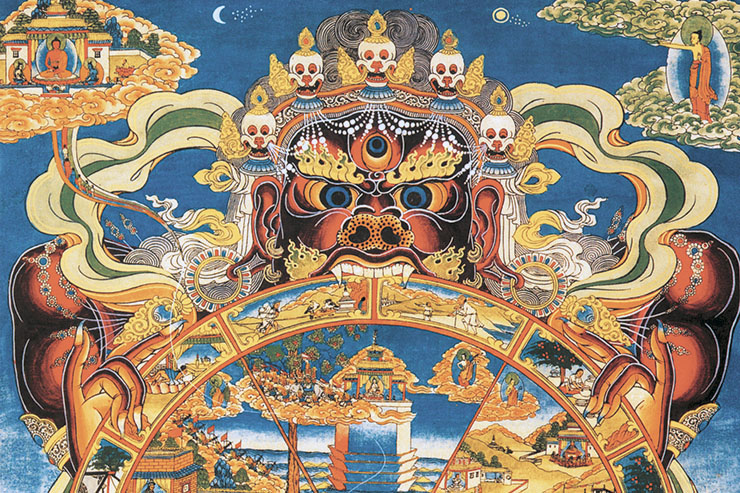
    One of the most elaborate pictures of the cycle of births and deaths can be found in the Tibetan Buddhist Wheel of Birth and Death. While the symbolism of this wheel is too intricate to describe in full here, one thing it depicts is the six realms of existence, three of which are bad, three of which are comparatively good. The three good realms are those of the gods, the asuras or demigods, and humans. The three bad realms are hell, the realm of the pretas or hungry ghosts, and the realm of animals.

    Beings are drawn to the hell realms through acts of violence and cruelty. As in Christian teaching, these are places of unimaginable suffering. The thirteenth-century Tibetan sage Longchenpa writes:

    All the tears you have shed would be more (than the water) in the four oceans,

    And the amount of molten metal, foul blood, and excrements

    You have consumed when your mind had become a denizen of hell or a spirit [i.e., a preta]

    Would not be matched by the rivers flowing to the end of the world.

    Longchenpa again emphasises the circularity of this process: his description of hell is not a warning of future punishment, but a reminder to the aspirant of what he has already undergone during many lifetimes in the immeasurable past. Buddhist teaching differs from that of Christianity by saying that since karma is finite, the suffering of hell beings and pretas, though enormous, is finite as well.

    The animal realm is less painful than the worlds of the hell beings and hungry ghosts but scarcely more desirable. Humans are drawn there by bestial behaviour – by obsession with food or sex, the cravings that we share with the animals. While animals do not suffer continually, they too are beset with pain and grief. Moreover, they do not have the mental capacity to achieve liberation, “not realising the natural misery of their state,” as Longchenpa puts it.

    The human realm, although it too is characterised by suffering, is the most auspicious. Buddhist texts emphasise the rarity and preciousness of a human birth. The sage Nagarjuna writes:

    More difficult is it to rise
    from birth as animal to man,

    Than for the turtle blind to see
    the yoke upon the ocean drift;

    Therefore, do you being a man
    practice Dhamma [the Buddhist teaching] and gain its fruits.

    Here lies the advantage of being born into the human realm. Individuals here are not so deeply immersed in suffering as they are in the realms of hell beings and hungry ghosts. Nor are they in such favourable circumstances as the gods, who enjoy so much pleasure and delight that they have no interest in liberation, or even the demigods, who have relatively enjoyable circumstances but are tormented by the jealousy of the gods, with whom they wage continual warfare. The human existence is an intermediate one, where beings are endowed with enough intelligence to follow the path to liberation but not so intoxicated with pleasure that they have no interest in it.

    Note that the gods and demigods, though their lives are pleasant compared to ours, are not immortal. Eventually their good karma is exhausted and they fall down into less favourable realms. This goes on endlessly. In one traditional text, a sage who is asked about the power and strength of Indra, king of the gods, points to a line of ants marching on the ground and says, “Each of those ants has been an Indra.”

    It would be mistaken, however, to conclude from all this that Buddhism is at its core a pessimistic, world-denying doctrine, as many have done. The German scholar of Buddhism Hans Wolfgang Schumann observes, “To assume that in their present life more than a few advanced seekers are able to conquer craving and ignorance would be to overrate man. Most men will need a long time, a whole series of rebirths in which by good deeds they gradually work themselves upward to better forms of existence. Finally, however, everyone will obtain an embodiment of such great ethical possibilities that he can destroy craving and ignorance in himself and escape the compulsion for further rebirth. It is regarded as certain that all who strive for emancipation will gain it sometime or other.”

    Schumann is referring to the attitude of the Theravada (“way of the elders”), one of the two primary divisions of Buddhism. The other sector, known as the Mahayana (or “great vehicle”), which includes such lines as Tibetan Buddhism and Zen, moves still further in a universalistic direction. It encourages its adherents to strive, not for nirvana per se, but for the condition of the bodhisattva – one who renounces or rather postpones enlightenment to work on behalf of the illumination of all sentient beings. In short, both sectors of the Buddhist tradition are ultimately positive in nature. If they do not teach evolution as such, they nevertheless hold that the gates of mercy are infinite and will eventually accommodate all beings, no matter how far they may seem from their goal.

    [alert type=”general” dismiss=”no”]This article was published in New Dawn Special Issue Vol 6 No 2.[/alert]

    [alert type=”success” dismiss=”no”]If you appreciate this article, please consider subscribing to help maintain this website.[/alert]

    SOURCES

    Robert Ernest Hume, ed. and trans., The Thirteen Principal Upanishads, 2d ed. Oxford: Oxford University Press, 1931.

    Klaus K. Klostermaier, A Survey of Hinduism, 3d ed., Albany, New York: State University of New York Press, 2007.

    Longchenpa, Kindly Bent to Ease Us, Part One: Mind, Translated by Herbert V. Guenther, Berkeley, California: Dharma Publishing, 1975.

    Hans Wolfgang Schumann, Buddhism: An Outline of Its Teaching and Schools, Translated by Georg Feuerstein, Wheaton, Illinois: Quest, 1974.

    © New Dawn Magazine and the respective author.
    For our reproduction notice, click here.

  • Have YOU Been Here Before?

    Have YOU Been Here Before?

    From New Dawn 101 (Mar-Apr 2007)

    Belief in reincarnation is one of the oldest and most durable of human traits, so old and persistent, in fact, that the psychologist C. G. Jung went so far as to call it an archetype. “Rebirth,” Jung wrote, “is an affirmation that must be counted among the primordial affirmations of mankind. These primordial affirmations are based on what I call archetypes.”1 This meant for Jung that regardless of its truth or falsity, the idea that we have lived previous lives and will, after our deaths, return in other lives, is somehow ingrained in our psyche. 

    We are, to use computer-speak, programmed to think it, and although not all of us accept the idea, it seems to share prominence with other fundamental ideas about the meaning of death and what, if anything, happens to us after it.

    These ideas seem to be surprisingly few. There’s the possibility of reincarnation or rebirth, as mentioned, with the belief that eventually one will have worked off one’s karmic debt and so have escaped the wheel of lives; one is then absorbed in some way into the all. There is also the idea of an afterlife in some “other” realm, whether the heaven of Christianity, the paradise of Islam, the Valhalla of Norse legend, or the Elysian fields of ancient Greece. I should point out that not all afterlives are desirable: fire and brimstone await the wicked in Christianity’s hell, and the Greeks, perhaps the greatest lovers of earthly life in history, regarded the idea of a shadowy eternity in the underworld with abhorrence. In any case, all these scenarios posit only one life on earth. Once we get through it, depending on how we conduct ourselves, we then go to our just reward or punishment, as the case may be.

    The pagans believe that once we die and our bodies decay, the matter they are made of returns to Nature along with the spirit or soul. We may then possibly enjoy a kind of afterlife as flowers, trees, or grass.

    There also is the belief that once we are dead, that’s the end. We no longer exist; our beliefs, ideas, feelings, values – everything important to us – are obliterated when the brain stops working. In this view, our present life is all there is, and after it is nothingness. Many associate this view with modern science, but its roots are in fact very old. The ancient Greek philosopher Democritus, who proposed an early version of the atom, argued that everything was made of little bits of matter that he called atoms (meaning “indivisible”). When we die, he suggested, the atoms that make up the self disperse.

    To these classic ideas about death we may be tempted to add one very new one: cryonics, the practice of freezing ones diseased body with the hope that in the future medical science will have discovered a cure for the illness. One can then be thawed, repaired, and brought back to life. On consideration, however, this seems to indicate less idea belief about what happens after death than a faith not only in modern medical science but in the robustness of the cryonics companies offering the service. Surely, as you lie in the freezer awaiting resurrection, the one pressing worry is whether the company keeping you on ice will stay in business. And if it doesn’t, what then? Unless you buy the notion that is hyped periodically that science will one day soon “conquer death,” this seems to me more of an attempt to put off facing death than any kind of engagement with it.

    My own feelings about death and what may possibly transpire after it fall into the camp of the agnostic. I simply don’t know – which isn’t to say that I don’t recognise the importance of having some idea about it. In truth, I’ve always been partial to the view presented by the playwright George Bernard Shaw in Back to Methuselah. Here Shaw argued that human beings die not from disease or old age but from discouragement, from loss of purpose and the will to live. Decades later, in his book Man’s Search for Meaning, the psychologist Victor Frankl corroborated this insight in the gruesome setting of a Nazi concentration camp, when he observed that the prisoners who had something to look forward to survived, while those who gave up hope were often the first to perish.

    Shaw argued that our present life span was far too short, because it is only toward the end of a long life that some people begin to have a glimpse of its value. To die at eighty just when you are beginning to have some insight into the whole affair seems pointless. Shaw envisioned the possibility that some people might learn how to live longer, so long that, barring accident, they might reach the age of three hundred. This, he thought, would allow them the time to put to some use the insights the rest of us take to the grave.

    I should point out that Shaw’s long livers – whom he calls the Ancients –  gain their longevity not through any technological or chemical means, nor through following a strict healthy regimen, although Shaw himself, who lived to be ninety-four, was a vegetarian. They accomplish this through their sheer will to live – and their willingness to fulfil the purposes of what Shaw calls “the life force,” a kind of evolutionary drive that compels life to understand and transcend itself. In his earlier play Man and Superman, Shaw spells out the philosophy of his “life force worshippers” in dramatic and comic detail, and for a time after reading Back to Methuselah I became fascinated by accounts of writers, artists, and thinkers who lived well into old age. There was Shaw himself. There was also the novelist John Cowper Powys, who died at ninety-one, the literary critic and philosopher Owen Barfield, who died at ninety-nine, the German novelist and essayist Ernst Jünger, who died at 101, and many others, including the composer Jean Sibelius, and the philosopher Bertrand Russell, whom lived into their nineties.

    In his science fiction novel The Philosopher’s Stone, Colin Wilson – a Shawian himself – suggested that there was some connection between the pursuit of ideas and longevity. His insight was that an interest in objective values – mathematics, philosophy, and, in a similar way, the kind of impersonal beauty that we find in, say, Sibelius’s symphonies, with their deep feeling for nature – is in line with the designs of “the life force,” which urges us to transcend our all too limited personal and subjective aims and goals. Someone who could perceive the objective beauty and “interestingness” of reality and sustain this would, Wilson argued, never be bored and hence have every reason to want to go on living.

    Now, whenever I’ve mentioned this idea to friends or acquaintances, the usual reply is something along the lines of “Three hundred? God, who would want to live that long? Wouldn’t you get tired and want to move on?” This is interesting, because I get a similar response whenever I bring up another idea that, for better or worse, has always had a strange appeal to me. Rather than reincarnation, which has us returning to earth again but in a different body and as a different person in a different time (though somehow with the same soul or spirit), ever since I first came upon it as a teenager in the writings of the philosopher Nietzsche, I’ve had an odd interest in the notion of “eternal recurrence.” This idea suggests that we have, as Rudolf Steiner calls them, “repeated earth lives,” but instead of different lives, we have the same one, over and over. This means that I have sat down in front of my computer an infinite number of times in the past to write this essay and that you also have read it an equally infinite number of times, and that both of us will continue to do so ad infinitum. I will be born to my parents again, go through the same childhood traumas and delights, leave home and have the same experiences, the same failures and successes, eventually die – and the whole wheel will turn around to the beginning and start again.

    Most of us on hearing this will reject the idea, wincing either at some past incident we would very much want to avoid or, more generally, at the prospect of eternal boredom such a notion offers. The idea of coming back to earth again as a different person seems much more appealing, and even the notion of complete annihilation seems preferable to going through the same round over and over again. I understand this perfectly, and I’m in no way arguing that eternal recurrence is true or preferable to reincarnation or to other ideas of what, if anything, happens after death. But I have to say that coming back to my books, friends, children, joys, and sorrows does strike me as more appealing than the eternity of blissful contentment spent floating amid cherubs and clouds that some forms of afterlife offer.

    I have to admit that one reason (and not the most important one) I’ve remained partial to this idea of eternal recurrence is precisely because of the reactions it elicits from others. Several years ago I worked at a metaphysical bookstore in Los Angeles. Among the fads and crazes of the time – crystals, the goddess, neuro-linguistic programming – one of the most popular was the idea of exploring one’s past lives. Among the many people interested in this who came to the store, I was surprised to discover that all of them seemed to have had infinitely more interesting lives before their present one. No one ever said, “God, how boring that past life was,” or “Gee, I’m glad I’m living this life now.” There were also a good number of people who, if not famous in their past lives, were still somehow important. Priestesses in Egypt, magicians in Atlantis, kings, queens. Not many tailors, butchers, or farmers. Sadly, whatever the truth about reincarnation, many of the people who spoke about it seemed to regard it as a way of making themselves more interesting in this life. So when I remarked that I was always more attracted to the idea that there is only this life and we live it countless numbers of times, I received looks implying that I was either crazy or lying. Despite the incredulous reactions it causes – or perhaps because of them – Nietzsche’s philosophy of recurrence deserves consideration.

    Far from some Machiavellian figure, Nietzsche was most troubled by the problem of human suffering, which I think he rightly saw as the central question from which the great religions emerged. Through poor translations and tragic appropriations by racist thugs like the Nazis, Nietzsche acquired a reputation as a philosopher of cruelty and tyranny, his übermensch or superman popularly depicted as a muscular fascist, lording it over the masses. In reality, however, Nietzsche was a very gentle, considerate, even timid man, so shy that he had to ask a friend to propose marriage for him to the woman he loved (not surprisingly, she declined). In fact, Nietzsche was burdened with an almost morbid sensitivity to suffering, whether human or animal. This fact is enshrined in a famous story of his final collapse, which occurred when he was already suffering from what scholars suppose was late-stage syphilis. In this story, Nietzsche saw a coachman whipping a horse. Tears in his eyes, he threw his arms around the neck of the poor creature, trying to comfort it. He then fell to the ground and when he awoke was no longer sane.

    Nietzsche didn’t believe in an afterlife in any form, and especially not the heaven of the hypocritical Christianity he attacked in one of his last books, The Antichrist. He did, though, have a powerful appreciation of the meaning and beauty of this life, a poignant, almost mystical sense of the value of our present world, an insight into its drama and mystery that most of us lack. In fact, Nietzsche believed that all ideas about an afterlife were really the product of an inability to face the uncertainty and sometimes terrifying facts of this life; they were, he felt, a kind of slander against life, a rejection of what, to him, was precious and almost painfully valuable. Rather than accept the conditions of life – which include pain, suffering, and tragedy along with beauty – and make something of it, Nietzsche believed that many preferred to consider it worthless, when compared to an ideal “other” world that we would enter after death. In many ways, ideas about an afterlife were, to him, a kind of sour grapes.

    In his notebooks – published after his death – Nietzsche did try to prove that recurrence was a fact, drawing on the science of the late nineteenth century and the enshrined law that matter can be neither created nor destroyed but only transformed. His arguments, however, are not very convincing. Given a limited amount of matter and energy but an eternity of time, he tells us, the universe will necessarily go through its astronomical but ultimately finite number of combinations. After this, it will start repeating itself, and the arrangement of forces that led to my writing this essay and you reading it will eventually recur. Subsequent philosophers have shown where Nietzsche confused things – he was never good at math – but the force of his ideas about recurrence doesn’t lie in these proofs, and, in any case, Nietzsche wasn’t really interested in devising some explanation for the mechanics of the cosmos. What appealed to him about recurrence was its poetry, the insight that such an idea invested life with a new and dramatic meaning. It was this sense that led the novelist Milan Kundera to draw upon Nietzsche’s ideas in his book The Unbearable Lightness of Being.

    The thought of recurrence, Kundera believed, gives weight to our existence, a gravity without which it is in danger of floating away in inconsequence. This is so because the idea that our actions will recur again prompts us to consider them differently. Is what I am doing now something I wish to do for eternity? Nietzsche believed that the thought of recurrence could act as a kind of test, a challenge to determine one’s attitude toward life. Think of your own life. How does the idea that it will return in all its details strike you? Are you, Nietzsche asks, crushed by the thought, meaning that your life has been such a burden that going through it again would seem the worse kind of punishment? Or have you instead experienced moments of such joy and fulfilment that you would accept the times of suffering, embarrassment, or just plain boredom in order to experience them again? Nietzsche’s view was holistic: everything was linked, part of the great chain of fate, and to say yes to one joy, he tells us, necessitates saying yes to all the pain and discontent that accompanied it.

    In The Gay Science, written in 1881 – the title refers to the kind of philosophy he proposed, light-footed and able to dance – Nietzsche summed up this idea in a motto. Amor fati, “love of fate,” was, for Nietzsche, the test of one’s character. “I want to learn more and more to see as beautiful what is necessary in things; then I shall be one of those who make things beautiful. Amor fati: let that be my love henceforth.” In his brilliant if unusual autobiography Ecce Homo, written just before his final mental breakdown, Nietzsche put it more forcefully. “My formula for greatness in a human being is amor fati: that one wants nothing other than it is, not in the future, not in the past, not in all eternity. Not merely to endure that which happens of necessity… but to love it.”

    For Nietzsche to arrive at such a philosophy was no small achievement. Throughout his life he suffered incessantly from an assortment of ailments: migraine, near blindness, and intolerant digestion are only a few. He also was one of the loneliest of men, living in poverty and forever moving from one cheap pension to another, constantly in search of the right climate, to possibly gain some brief respite from his condition. He was practically friendless and for the most part unread. Today he is one of the most discussed thinkers of the nineteenth century, on a par with Darwin or Marx, but during most of his lifetime he was unknown or ignored. That someone with such an experience of life should embrace the idea that it will be repeated eternally gives one pause.

    Other thinkers have taken up the idea of recurrence. The Russian writer P. D. Ouspensky, for example, made it the theme of his novel Strange Life of Ivan Osokin. Ouspensky looked at recurrence rather differently than did Nietzsche, and his ideas influenced another “time haunted man,” the writer and playwright J. B. Priestley. Priestley’s popular plays I Have Been Here Before and Time and the Conways are perhaps the most accessible treatments of the idea. Where Nietzsche argued that everything in our life recurs exactly as it did before, Ouspensky offered some hope of change, suggesting that in each life there are slight variations and that through these we have a chance to alter things for the better.

    In a sense, if we think about it, Nietzsche’s insistence on the exact recurrence of each detail actually leads to the conclusion that all we really have is this moment. If everything recurs exactly as it did – if it is, as he also called it, “the return of the same”  – then each recurrence is really only this moment. The next recurrence and the previous one were exactly like our present one, and so there is really no means of distinguishing one from the other. And so, in a practical sense, all we ever experience is now. Ouspensky’s version is somewhat closer to reincarnation, in that he posits the possibility that with each recurrence we have the chance to make some changes for the better and so can develop ourselves and eventually escape the treadmill.

    Nietzsche would have thought Ouspensky’s theory simply another attempt to escape the demands of life. My own feeling is that while it may be interesting to debate the two, in the end they really serve the same function. Personally, I don’t think we can ever prove recurrence one way or another. And in any case, if it is true, and if it ever was proven, then by necessity it always was. The real value of the idea for me is the meaning and significance it can give to our lives. Granted, a paranoid take on it could have us worrying about every little action, concerned that it may be the start of some infinite series of mistakes. But then, we could also say that if something is happening now, it must have already happened. In that case, we might fall prey to Kundera’s feeling of inconsequence: what does it matter what we do, if it has already been done countless times before?

    For myself, however, the idea that my life might not be merely so many years of meaningless activity but might instead have some connection to the vast eternal scheme of things is at times encouraging, even inspiring. I may or may not have been here before, but I can act as if I have. Recognising this, I can look forward to another visit.

    This article is reprinted with permission from Quest Magazine, Journal of the Theosophical Society, www.theosophical.org, March-April 2006, pages 57-60.

    [alert type=”general” dismiss=”no”]This article was published in New Dawn 101.[/alert]

    [alert type=”success” dismiss=”no”]If you appreciate this article, please consider subscribing to help maintain this website.[/alert]

    Footnote

    1. Cranston, Sylvia and Joseph Head. Reincarnation and World Thought. New York: Julian Press, 1967.

    © New Dawn Magazine and the respective author. For our reproduction notice, click here.

  • Reincarnation, the ‘Interlife’, Universal Consciousness & the Holographic Soul

    Reincarnation, the ‘Interlife’, Universal Consciousness & the Holographic Soul

    This article was published in New Dawn 116 (Sept-Oct 2009)

    Modern studies repeatedly suggest that a significant proportion of people in the Western world now believe in reincarnation. Although this phenomenon can be traced back to various esoteric movements that flourished from the second half of the 19th century, it gained significant ground with the explosion of popular interest in Eastern spiritual approaches in the 60s. And it was reinforced by a proliferation of therapists offering to regress people into their past lives.

    Yet now the tide seems to be turning again. For some years the emphasis has been moving more towards the idea that we are all part of the One, the All, the Source, the Absolute, the Ultimate, the Great Spirit or whatever we choose to call the ‘universal consciousness’. Of course this is not a new idea. But what is changing is that especially more intellectually minded spiritual seekers are tending towards the view that anything outside of the ‘One’ is mere ‘illusion’.

    In fact this word illusion is used a great deal in spiritual circles these days, although actually in quite different contexts, and it is perhaps worth considering what these are. Of course readers would all agree that the physical world itself is to some extent an illusion, at least inasmuch as it is underpinned by the nonphysical planes and states of being that science is increasingly pointing towards. But what about the idea that we only reincarnate for as long as we fail to see through the ‘illusion’, and that as soon as we gain ‘enlightenment’ we can ‘break the bonds of karma’ and ‘reunite with the Source’? More radical still, what about the idea that any notion of individuality is completely illusory on all levels, and that as soon as we die there is no sense of continuation of any sort of individual soul consciousness?

    Whether or not they make it explicitly clear, these latter two are the ‘illusion models’ supported by a significant proportion of our best-known spiritual commentators of modern times – be they proponents of, for example, the ‘power of now’, or of ‘cosmic ordering’, or of ‘quantum mysticism’. Yet to see the world in this way is entirely at odds with what we might call the ‘experience model’, which holds that we lead many lives in order to see all sides of every emotional coin, and to learn to deal with the manifest challenges that life on this planet provides. In other words, a model in which the emphasis is on an individual soul growing by experience over many lifetimes.

    If we are to adopt a rational approach then, rather than relying on ‘revealed wisdom’ ancient or modern, it is surely sensible to consider which of these models is best supported by logical analysis and the available evidence.

    We can start with the premise that there must exist some sort of ultimate force or energy that underlies the entire universe, both seen and unseen, which is the Origin or Source of everything in it. However ineffable it may be, this principle of a universal consciousness is almost a logical necessity, and it is certainly supported by scientific research at both the quantum and the macrocosmic level. The idea that ‘we are all one’ is also a common element of transcendental experiences, whether spontaneous, meditative or induced by hallucinogens. So our next step must be to investigate whether, at the same time, there is any real evidence to support the idea of an individual consciousness that exists or survives independent of the physical body.

    The most relevant area of research here is near-death experiences. In particular we are interested in cases that involve subjects returning with factual information that is subsequently verified, and yet so obscure that they could not reasonably have acquired it in any ‘normal’ way.

    Near-Death Experience & Reincarnation Cases

    One of the most fascinating cases on record took place in the early 70s, and involves a gifted young Russian scientist called George Rodonaia. His work on chemical brain transmitters was sufficiently valued by the KGB that they were not prepared to lose his expertise to the US by letting him take up an invite to further his research at Yale. On the day of his departure, as he stood on the pavement in Tbilisi waiting for a taxi to the airport, he was deliberately mown down by a car and pronounced dead at the scene. His body lay in a morgue for three days, but as the autopsy began his eyelids flickered and he was rushed to surgery.

    As a man of science George had never had any time for religion. So those close to him were bewildered when, three days into his lengthy recovery, he began to describe what had happened while he was ‘dead’. In fact his was a relatively non-typical and highly transcendental experience, but for our current purposes he also claimed he had also been able to travel anywhere he liked while ‘out of body’. In particular he was drawn to a newborn baby in the hospital adjoining the morgue because she would not stop crying, and doctors had been unable to diagnose the problem. Much to his surprise he found that he was able to communicate with her telepathically, and also to scan her body and establish that her hip had been broken, probably at birth. Incredibly, as soon as George was well enough to pass on this information, the doctors x-rayed the baby and found that she did indeed have a fractured hip.

    There are other, similar cases of near-death experiences involving obscure, factual information that combine to strongly suggest that our individual awareness or consciousness does indeed continue to exist even when the physical brain is absolutely non-functional. So far so good. But is there any evidence to support the further idea that individual souls have many lives?

    Here we encounter two important areas of research, the first involving children who have spontaneous memories of past lives. Although historically most of these cases have come from Asia, one of the finest involves a young American boy called James Leininger of Lafayette, Louisiana. Born in 1998, his fascination with toy planes from the earliest age took a more sinister turn as he approached his second birthday, when vivid nightmares began. He would thrash around in his sleep, kicking out with his legs up in the air and moaning: “Airplane crash, on fire, little man can’t get out.” His mother Andrea had no particular religious convictions but, when her mother suggested these might be memories of a past life, she began to encourage little James to talk about them. And he began to reveal startling details, such as that the pilot of the plane was also called James; that he had been shot down by the Japanese; that he had flown Corsairs; and that one of his fellow pilots went by the name of Jack Larsen. He also mysteriously mentioned the single word Natoma.

    His father Bruce remained dubious about any sort of spiritual explanation, but he knew that neither he nor any other member of their family had any particular interest in aircraft or the war. So he began to research, and quickly established that an aircraft carrier called the USS Natoma Bay had been stationed in the Pacific during World War II and had taken part in the notorious battle for the Japanese island of Iwo Jima early in 1945. He ordered a book about this, and was flicking through it one day when James pointed to the island of Chichi Jima on a map and exclaimed, “Daddy, that is where my plane was shot down.” He then made contact with the ‘Natoma Bay Association’, who confirmed that Jack Larsen had been one of the pilots, and also that only one pilot had been lost at Chichi Jima: 21-year-old Lt James M. Huston Jr.

    Bruce also knew that Huston had flown Wildcats, not Corsairs, on the Natoma Bay. But when he made contact with Huston’s elderly sister she kindly sent him some photos – including one of her brother standing proudly next to a Corsair. Military records then showed he had originally been part of an elite special squadron who test-flew these planes. But the real clincher involves three ‘GI Joe’ dolls. When Bruce asked his son why he called them Leon, Walter and Billie he replied, “Because they greeted me when I went to heaven.” Again military records confirmed that three of Huston’s fellow Natoma Bay pilots were Lt Leon S. Conner, Ensign Walter J. Devlin and Ensign Billie R. Peeler – and that all three had died before Huston on other engagements. None of this detailed information is available on the internet pages about the Natoma Bay even now, let alone in popular books and so on.

    Past Lives & Hypnotic Regression

    The second area of past-life research is hypnotic regression. With this we must first appreciate that the human brain appears to store a complete record of everything we have ever been exposed to, no matter how briefly or how long ago, and that although most of these memories remain inaccessible to our normal consciousness they can be accessed in trance. So apparently authentic and detailed past lives, even including strong emotions and strange accents and so on, have sometimes been proved to come from perfectly normal sources – not least historical fiction, which is often overlooked by spiritual researchers. Nevertheless, there remain some cases involving information so obscure that only a paranormal explanation seems appropriate.

    One of the finest involves a young woman dubbed Jane Evans, who was one of many subjects regressed by the Welsh hypnotherapist Arnall Bloxham. She first visited him in the late 60s and proved a responsive subject who, over the course of a number of sessions, regressed into six separate lives from Roman times onwards. She would go on to be the star of a 1976 documentary made by the initially sceptical BBC producer Jeffrey Iverson, entitled ‘The Bloxham Tapes’. Her most celebrated past life was that of a persecuted Jewess in 12th century York, but on close investigation this case is somewhat inconclusive. In fact her strongest life in terms of obscure evidence involved Alison, a young servant to the 15th century French financier and merchant, Jacques Coeur.

    Some of the historical information Jane came up with in trance was relatively obscure, and could only be verified by professional French historians. For example, she said that Charles VII’s nickname was “heron legs”; that his son Louis had poisoned his wife; that his mistress Agnes Sorel had two pet dogs clothed in “coats of white fur with jewelled collars”; and that Coeur was Jewish and his father was a goldsmith. Perhaps more impressive was her knowledge that Coeur was an avid collector of art, with paintings by Jean “Fouquet,” the court painter to the king and one of Coeur’s debtors; by Jan “van Eyck,” the court painter to the nearby Duke of Burgundy; by “Giotto,” an Italian master from the previous century; and by the little-known “John of Bruges” who, Iverson established only with great difficulty, was also known as John Bondolf and was a Flemish court painter for the king’s grandfather. More impressive again was her report that Coeur had a “body servant” called Abdul, who was “dressed differently from the others” – because it was only from obscure French court records of the time that Iverson was able to confirm that he did indeed have an Egyptian body slave.

    Impressive enough, yet the clincher in this case is Jane’s recall of a “beautiful golden apple with jewels in it” that she said had been given to Coeur by the Sultan of Turkey. All of Iverson’s initial attempts to verify the existence of such a piece drew a blank until his last night in Coeur’s home town of Bourges, when he returned to his hotel to find a message from a local historian. The latter reported that he had been searching through contemporary archives when he found “an obscure list of items confiscated by the Treasury from Jacques Coeur”; and in that list was a “grenade” of gold – a pomegranate. Of course this is so like an apple in shape and size that the English word contains the French root pomme. It is also worth noting that one sceptic’s supposed attempt to trace all these details to a historical novel is a complete travesty, because the novel has an entirely different plot and contains virtually none of these obscure details.

    Again there are other, similar cases of both childhood recall and regression that involve equally obscure yet verifiable information about past lives. But could all these merely result from subjects tapping into some sort of universal memory, or even from possession by the deceased? Probably the strongest evidence that these are indeed memories from the subjects’ own, individual, past lives comes from subjects also being regressed into the time between lives, or ‘interlife’.

    This stems from the research of a number of pioneering psychologists and psychiatrists around the world, who each stumbled on the interlife independently in the 70s and 80s. Their subjects’ reports are extremely consistent, so that the experience can be broken into five main elements: transition and healing, past-life review, soul group interaction, next-life planning and returning. This evidence from what now constitute thousands of subjects from diverse backgrounds suggests strongly that there is a continuity of individual soul identity across many lives.

    The Holographic Soul

    So how do we properly bring this evidence of individual soul survival and reincarnation together with the idea of a universal consciousness that underlies everything? Although the most profound spiritual sources have hinted at the truth throughout the ages, the most simple yet elegant solution has only become available to us in recent decades with the discovery of the hologram. And it involves applying this principle not to the brain, nor to memory, nor even to the universe as a whole, but instead to soul consciousness itself:

    Soul consciousness is holographic. We are both individual aspects of the Source, and full holographic representations of it, all at the same time. However this does not mean that soul individuality is in itself an illusion. The principle of the hologram is that the part contains the whole, and yet is clearly distinguishable from it.

    The other message that comes through loud and clear from interlife research, as well as from the most profound spiritual sources, is that free will and personal responsibility reign supreme. This is what allows us to learn from our mistakes, and to grow as souls. So any next-life previews seen between lives merely represent major probabilities and lesser possibilities, and there is no karmic punishment or predestiny. Indeed the idea of karma itself has arguably outlived its usefulness, because it is clear that the dynamics of how our attitudes, intentions and experiences feed into the futures we create for ourselves, both across and within lives, are far too complex to be reduced to simplistic ‘laws’.

    In conclusion it appears that there are no ‘flaws in the grand plan’. The physical world is not an abomination created by fallen angels. Nor is the reincarnation cycle something to be escaped from at all costs, either by suddenly gaining the enlightenment to see through the illusion, or by learning to give up all ‘attachment’ so as to generate no more karma. Although we would do well to aim for a degree of emotional detachment and balance, and regular meditation is absolutely invaluable in trying to bring our ‘higher selves’ to the fore, life is to be lived and experienced!

    So where does it all end? Interlife evidence, again backed by the most profound spiritual sources, suggests that we continue to reincarnate until we have exhausted all the possibilities for growth in the physical plane. And this is only the ‘end of the beginning’ of the soul’s journey, because there are many other opportunities for new experiences in other realms. As for the idea of ‘reuniting with the Source’, the concept of the Holographic Soul suggests that we never split off from It in the first place, and that It is always within us and us within It.

    What about the million dollar question from which ‘illusionists’ tend to shy away? What is the whole point of the universe in the first place, and how do we humans fit into the ‘big picture’?

    The Source’s primary aim, in diversifying into all the billions of holographic soul aspects of itself that operate in the various realms throughout the universe, is to experience all that is and can be. So as individualised aspects of the Source who have chosen to reincarnate on this planet, we are merely fulfilling a small part of that objective by gaining a balance of all the experiences available via this route.

    James Leininger’s amazing story is documented in the book Soul Survivor: The Reincarnation of a World War II Fighter Pilot

    [alert type=”success” dismiss=”no”]If you appreciate this article, please consider subscribing to help maintain this website.[/alert]

    © New Dawn Magazine and the respective author.
    For our reproduction notice, click here.
  • One Soul, Many Bodies: The Case for Reincarnation

    One Soul, Many Bodies: The Case for Reincarnation

    What happens to us when we die? It’s a question everyone eventually asks themselves at some point in their life. It transcends racial, social, political, economic and gender lines, making it the one question common to all human beings whether we like it or not.

    Yet ever since the first men and woman began pondering their mortality a hundred thousand years ago, the answer has eluded us. What does happen when we die? What becomes of our soul, our mind, our personality – our very essence? For that matter, do we even have such a thing as a soul, or is it all an illusion we have created to give ourselves a sense of permanence and the hope of immortality?

    The rationalist answers this query by proclaiming that since we are nothing more than a collection of cells and our brains simply tissue encased within a mantle of bone, nothing can happen to us when we die. The essence, personality, mind – soul – or whatever we wish to call our consciousness, ceases to exist, endowing our time on this planet with no more meaning than that which we choose to give it during our brief sojourn here. This is, of course, the position of the atheist, which is what makes atheism, in my opinion, so easy. It requires nothing because it offers nothing, which strikes me as a fair trade.

    To most people, however, this answer is unsatisfactory. It suggests that we are little more than some great cosmic accident and that, consequently, our life has no ultimate purpose, forcing us to contemplate an existence without meaning in a universe that, despite all its beauty and splendour, has no more significance – or ultimate permanence – than a flower that briefly blooms in the spring only to wither and die after a few short days of vibrant life.

    I suppose there are people for whom such a prospect is acceptable. It does, after all, tidy things up and make life simply a little game we sentient beings like to play for no particularly good reason other than because we have no choice. Yet something deep within the human heart knows better. We instinctively understand that we are more than the sum of our parts, which is why most people believe their personalities will survive their physical demise in some form and will continue on long after their bones have turned to dust. This, of course, brings us to our second option, which is that the personality/ego/true self/whatever you want to call it does survive the demise of the body to exist – at least for a time – as a separate disembodied consciousness. If this is the case, however, the next question that logically follows is what happens next?

    Some believe, for example, that we become ghosts – little more than disembodied spirits aimlessly wandering the Earth, capable of perceiving the physical realm but unable to interact with it in any meaningful way. They can even point to various evidences to support this contention, from reported hauntings to automatic writing, séances, and apparent disembodied spirits caught on film.

    While I personally have no problem with the idea of ghosts, I don’t think existing as a disembodied consciousness is truly a viable long-term option for what happens to us. Ghosts always struck me as being transitory; beings stuck on the Earth plane for a time only to ultimately move on and so essentially vanish from our physical realm. As such, even if we are to become ghosts, it will be, at least for the vast majority of us, a brief experience and not our eternity. I suspect we all eventually move on to ‘greener pastures’, so to speak.

    Now, however, is where things get more interesting. Most people, regardless of whether they believe in ghosts or not, believe that the essence of who we are – our “soul” if you will – goes some place. Heaven is the favoured destination for most; a place where our conscious personality, no longer shackled to the limitations and burdens of physical existence, survives within a perpetual state of bliss and joy throughout eternity. Some add to this by also embracing a belief in hell; a perpetual state of torment for those who turn to evil and so are doomed to exist forever within a conscious state of agony, regret, and fear.

    Both positions, however, suffer from the same problem, and that is that they see our time here on this planet as but a blink of the eye of eternity, with the decisions we make – or fail to make – while in the body having profound and eternal ramifications. Unfortunately, this reduces the physical world to little more than a cosmic hatchery that exists only to birth new souls, each of which will spend a short time in it before winging – or, potentially, plunging – to their ultimate destiny.

    While admittedly this idea does manage to make this single life of paramount importance, it also forces one to wonder why a physical realm is necessary at all. If the physical universe exists merely as a vehicle for our creation, why couldn’t the process be circumvented entirely and we be created directly into the spiritual realm – as was supposedly the case with God’s angels?

    Why all the unnecessary pain and hardship of a physical existence – especially if there exists the very real danger that we might earn hell through our misdeeds – if the spirit realm is the only destination that awaits us? In such a context, physical existence seems not only pointless but, in many ways, even hazardous.

    So where does that leave us? If no Heaven and if no Hell, then what’s left?

    There is a third position to consider. It is one that until recently has been largely ignored in the West but has been embraced by literally billions of people around the world for thousands of years. It is the belief that this physical existence is neither insignificant nor transient, but instead is perpetually ongoing. It is the concept that our soul lives on not in some ethereal Eden – or Hades – somewhere, but realises perpetual existence through a process of continual rebirths into the physical realm, making our time on this planet not one single, brief experience, but a repetitive process realised through literally hundreds of lifetimes. It is a timeless belief – one that predates both Christianity and Islam by many centuries – and one that is known by many names in many cultures. It’s been called rebirth, regeneration, transmigration of the soul, even metempsychosis, but is perhaps best known to us today as reincarnation.

    Upon first consideration, especially to those who haven’t given the idea great thought, reincarnation may seem to be a foreign or exotic concept, especially to the Western mind steeped in the scientific method and drenched in two thousand years of monotheistic religion. It is something for Hindu holy men to ponder, or New Agers to embrace, but nothing that seems particularly relevant to most Westerners today.

    I can easily understand this perspective for it is one I held myself for the first forty years of my life. And the truth be told, it is an Eastern concept – one in vogue more than four millennia before Christ was born and a belief held to by nearly two billion of the world’s population today – making it one of the oldest and most enduring belief systems known to man. In fact, it may be the original post-mortem belief among early humans who probably considered the idea when they began noticing strong similarities between recently born offspring and their deceased ancestors. Perhaps the mannerisms or interests a child displayed reminded one of a deceased loved one or a birthmark mimicked that found on a long-dead grandparent, leading village elders to imagine that the dead ancestor had returned a second time – a not unreasonable assumption in cultures that naturally assumed the soul to be inherently immortal.

    Unfortunately, Westerners have traditionally had a tendency to consider foreign or primordial religious concepts as primitive and so reject them out of hand. However, this perception appears to be slowly changing as reincarnationist beliefs have become more prevalent in the West, especially in the last fifty years, and is becoming increasingly popular to ever growing numbers of people.

    A Lost Western Tradition of How the Soul Returns

    Of course, unbeknownst to most people, reincarnation has always been a part of Western thought. The prospect that the soul repeatedly returns to the flesh flourished in ancient Greece almost three thousand years ago and may have played a far more important role in our development as a civilisation than traditional histories have led us to believe. Aristotle, Socrates, Plato, and Pythagoras all taught and believed in some form of rebirth, the foundations of which were later adopted by the great Roman philosophers Ovid, Virgil, and Cicero, along with a host of other great thinkers of antiquity.

    In fact, reincarnationist concepts were so prevalent in the centuries immediately preceding the birth of Christ, that they played a major role in many of the “mystery” religions of the Mediterranean; religions which were themselves to become the template for other later mystical faith systems of the region. Reincarnation, then, far from being a purely foreign concept was, in fact, widespread and may have strongly influenced the shape and thrust of Greek and Roman philosophy.

    Even more of a surprise to many people, however, is the fact that reincarnationist concepts were also part of some of the more mystical branches of traditional Western religion, from the Sufis of Islam to the Gnostics of the early centuries of Christianity, and even within the Hasidic and Kabbalist traditions in Judaism. In fact, at times it virtually flourished and, especially in the case of Christianity, almost became the predominant belief system during the first few centuries of the Church’s existence until it was forced underground by the more traditional, non-reincarnationist branches of Christianity. Its proponent’s writings declared heretical and burned, the concept was so successfully suppressed by the Church of Rome that few Christians today even realise it was ever a part of their own faith.

    Why was it suppressed? The obvious answer is because it threatened authority. Western religion is largely dependent upon the belief that man is destined to “die once and then be judged” to maintain control. In promising multiple rebirths, however, reincarnation renders the proclamations of the Pope or the Grand Mufti or whomever was the ruling head at the time transitory and, the truth be told, irrelevant. As such, reincarnation threatened the Church’s very livelihood, making it a very dangerous idea that had to be either suppressed or labelled as heretical in order for the Church to maintain its power base. As a result, the concept remained largely unknown outside of Asia for probably seventeen of the last twenty-one centuries.

    Its revival in the West was imminent, however, with the arrival of the Age of Enlightenment in the eighteenth century. Once the long forgotten writings of the ancient Greeks again became available and one could hold to previously forbidden ideas without forfeiting their lives, such once forbidden concepts as reincarnation became increasingly popular, especially among the intellectual elite of the era. Amongst those who held to some form of multiple rebirths are such notables as Charles Dickens, Ralph Waldo Emerson, Benjamin Franklin, Shakespeare, Leonardo Da Vinci, and Voltaire, among others.

    Interpreting What it Means to Reincarnate

    However, since its reintroduction into the Western consciousness, reincarnation has undergone a transformation. It is no longer the unending “cycle of life” wheel taught by the Hindus and Buddhists, but has become a “school of higher education” designed to bring us to ever greater levels of spiritual enlightenment. This is why when a Hindu or a Buddhist and their fellow Western reincarnationist talk about the subject, it often appears as though they are speaking two different languages. This is because in some ways they are, which is where the confusion comes in.

    To the Hindu, the soul is essentially stuck in a never ending cycle of rebirth which can never be broken due to the continual need to balance one’s karma. In effect, with each incarnation into the flesh, the human personality – a by-product of the underlying soul that birthed it – accumulates a degree of bad karma that must be worked off in order to restore balance to itself. Some of this karma can be worked off in life in the form of good works, but this is seldom sufficient to work off the entire debt, which must be accounted for in the next life by having the soul take on an incarnation that may be more difficult so the ongoing karmic debt can be worked off.

    On rare occasions, a life may be so exemplary that the person might be born into a higher station (or caste in Hindu parlance) but as a rule, bad karma tends to outweigh good karma and, in being continually accumulated through each lifetime, adds to the growing debt that remains to be balanced and so perpetuating the rebirth cycle. (Of course, if one accumulates too much bad karma, they may not be reborn as a person at all, but could come back as an animal or even, in some teachings, an inanimate object such as a stone. This belief is called “transmigration of the soul” and is also a major element of Hindu teachings.)

    Buddhism, on the other hand, while understanding the process of reincarnation in much the same way as does the Hindu, differs in that it teaches that the cycle of rebirth can be broken through achieving nirvana (literally, enlightenment), at which point the cycle is broken.

    Enlightenment means essentially to be become aware of one’s true nature and to the realities contained within the Four Noble Truths as articulated by Gautama Buddha over two thousand years ago. These are: first, to be alive is to suffer due to the imperfection of human nature and the world around us; second, that the cause of suffering is attachment to transient things (in effect, craving or desiring things); third, that one can learn to let go of these attachments; and, finally, that the process of achieving enlightenment is progressive and may itself extend over many lifetimes.

    In sharp contrast, to many Western reincarnationists, the purpose of rebirth is to learn the lessons we need to learn in each incarnation in order to advance to the next spiritual level which, while having some similarities to the Buddhist concept of slowly achieving enlightenment over a number of incarnations by practicing the Buddha’s Eightfold Path (right view, right intentions, right speech, right action, right livelihood, right effort, right mindfulness, and right concentration), is actually quite different.

    The Buddhist does not believe that one is “learning” new lessons with each lifetime, but simply applying the principles contained within the Eightfold Path until craving, ignorance, delusions and its effects gradually disappear as progress is made towards enlightenment. To the Western mindset, attachment is not seen as the source of the problem (though it does generally acknowledge that an obsessive attachment to things can be detrimental to spiritual growth).

    Another significant difference between Eastern and Western concepts of reincarnation have to do with the perception of what it is, exactly, that is reincarnating. The Hindu sees the soul – the divine essence of God – as being the generator of each incarnation, with the individual personality or ego a transient expression of that soul.

    In marked contrast, the Buddhist doesn’t believe in individualised souls at all, but believes the sense of self is merely an illusion created by our own perceptions – a conscious “memory” if you will, conceived by our assumption that we exist separately. To the Buddhist, we are all a part of a larger, divine consciousness that has simply taken on the very brief “illusion” that it is separate. The Buddhists compare our sense of existence to the waves upon the ocean; just as a wave is a temporary phenomena caused by wind and currents, our personality is equally as transient and is, upon death, absorbed back into the divine consciousness in the same way that a wave upon the ocean is eventually swallowed up by the ocean itself.

    In the West, however, the personality – or ego – is more robust and generally considered immortal. To many, the soul and the personality are considered essentially synonymous, so as a result, when we die, our basic personality – complete with all its memories, life experiences, knowledge, and traits – returns in another body to continue its existence. It may not have a direct memory of its past life – though some people claim to be possess the ability to consciously remember their previous incarnations – but it is essentially the same personality starting life over again in another context.

    The personality may experience dramatically new surroundings – for example, it may experience one incarnation as an Indian girl who lived and died in the nineteenth century and then return as a Spanish man in the twentieth century – but it is still the same “person” underlying each “role.” Of course, the experiences and environment it finds itself in through each subsequent incarnation will affect the base personality in both subtle and sometimes substantial ways, but this too is a part of the process. This is why the Westerner sees reincarnation in the context of “lessons.” After all, the Indian girl was able to experience and learn only so much in her short time on Earth, mandating that she return again – this time as a Spanish male – to learn those things she either neglected to learn or hadn’t the opportunity to learn in her previous incarnation.

    This makes spiritual enlightenment a type of “to do” list that needs to be checked off in its entirety before we can cease the process of rebirth. (What happens after that is equally open to speculation among Westerners: some imagine we come back as avatars or spiritual teachers; others speculate that we start the process over again on another planet, while still others maintain that we move onto other dimensions. Apparently, the options available to the enlightened soul are extensive.)

    I wonder, however, if the truth is not a conglomeration of each of these perceptions? Clearly the Eastern concepts of a parent soul that births each and every individual personality has merit, as does the Buddhist belief in the transient, temporary nature of the ego that is birthed. And the Western concept that we reincarnate until we learn what we need to know also has some validity and seems to parallel in some ways the Buddhist idea that the cycle of rebirth ends upon achieving enlightenment – however one chooses to define the term.

    I often wonder if we aren’t all looking upon the same phenomena and not simply seeing only those parts of it that speak to us personally. I suspect our understanding of the purpose for reincarnation is lacking in many ways and may never be entirely complete, though I also believe we are making progress in coming to a fuller appreciation for its complexity and sophistication. Perhaps one day East and West will come together and merge their different perceptions and in so doing, form a complete whole that answers everyone’s questions.

    Of course, I recognise that such may sound like a contradictory process. After all, how can there be a soul and yet not a soul, and how can the ego be immortal and yet transient? To combine both Western and Eastern concepts of reincarnation would seem to embrace paradox, but I have found it is often within the complexities of paradox that the truth exists. In fact, it is only our limited ability to understand that makes these apparent contradictions paradoxes in the first place.

    I wonder if they would still appear as such were we to find the capacity within ourselves to truly understand on a level our current mental capacity does not permit. On the other hand, perhaps understanding these concepts is not done at a mind level, but on a spiritual level, which is a difficult place for many people to go.

    Maybe in the end we were never meant to fully understand how reincarnation works, and that may be where the adventure really begins. Perhaps the question of what happens to us when we die was never meant to be answered but merely explored, for it is in seeking – not necessarily finding – the answer that growth can take place.

    It may be, in fact, that it is only in abandoning our need to find the answers that we give them the ability to find us. In effect, we may be like the man who is so busy looking for treasure that he fails to realise he is searching for it within the bowels of a gold mine. Were he to but look up and see the treasure that shimmers all around him, he would realise how silly his fervent quest had been all along. Perhaps we need only do the same.

    Jeff Allen Danelek’s book The Case for Reincarnation: Unraveling the Mysteries of the Soul (Llewellyn, 2010) is available from all good bookstores.

    [alert type=”general” dismiss=”no”]This article was published in New Dawn Special Issue 14.[/alert]

    [alert type=”success” dismiss=”no”]If you appreciate this article, please consider subscribing to help maintain this website.[/alert]

    © New Dawn Magazine and the respective author.
    For our reproduction notice, click here.