New Dawn – World's Most Unusual Magazine

Tag: Russia

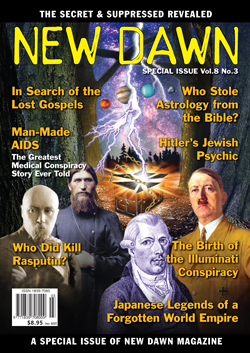
  • Who Did Kill Rasputin?

    Who Did Kill Rasputin?

    From New Dawn Special Issue Vol 8 No 3 (June 2014)

    Before the First World War the Russian royal family, the Romanovs, were heavily involved in occult activities. In the years between 1900 and 1905, the French occultist Dr. Gerard Encausse (Papus) made several visits to Russia for undisclosed reasons. In fact, he had been personally invited to the country by Tsar Nicholas II and was holding magical séances at the royal palace in St Petersburg for the tsar and his German-born wife, the Tsarina Alexandra. Both were interested in Spiritualism and the occult.

    Dr. Encausse was a member of a French magical society called the Kabbalistic Order of the Rosy Cross (CORC). This was founded in France in 1888, the same year as the famous Order of the Golden Dawn in England. Dr. Encausse claimed to have been initiated into a Golden Dawn lodge in Paris run by Samuel Liddell Macgregor Mathers and his wife Moina. The Marquis Stanilas de Guaita and Josephin Peladan, two prominent French occultists, had created the CORC. Peladan had been born into an eccentric and fanatical Roman Catholic family who were supporters of the restoration of the French monarchy. His brother, Adrien, practised as a homeopathic doctor and had many wealthy and titled patients. He claimed to have been initiated in 1858 into a secret Rosicrucian order in Toulouse which had survived since the Middle Ages.

    At the magical rituals held at the royal palace, Dr. Encausse attempted to conjure up the tsar’s dead father, Alexander III, who was also interested in Spiritualism. In fact, Alexander had invited the English medium D.D. Home to Russia to hold séances attended by aristocrats and members of the royal court.

    In the early 1900s Russia was on the brink of revolution. There were riots in the streets, strikes, and rumours of mutiny in the armed forces. Against this turbulent background of civil disorder, the weak Tsar Nicholas II sought advice from the ‘Other Side’ on how to handle the situation. The message that came back from the spirits advised the tsar to resist the subversive and revolutionary forces threatening his throne, or he would lose control of Russia and topple from power. If the tsar did not take immediate action to deal with the deteriorating situation, then his authority and rule would be seriously undermined.

    Despite this warning, Nicholas refused to act decisively and with the outbreak of the First World War in August 1914, the situation spiralled out of control as the spirits had predicted. This led to Nicholas losing his throne and eventually his life at the hands of Bolshevik revolutionaries. The vengeful Bolsheviks massacred his family and seized power from the democratic government set up after the tsar abdicated.

    After his last visit to St Petersburg in 1905, Dr. Encausse stayed in contact with the tsar, and the occultist and the monarch exchanged letters at regular intervals. In this correspondence, they discussed various esoteric matters of mutual interest. However, Dr. Encausse confided to his fellow occultists that in his opinion Nicholas was a weak and easily influenced person who relied too much on his spiritual sources. The French magician believed that the tsar should instead listen more to his ministers and take their advice on the day-to-day running of the country.

    The ‘Mad Monk’

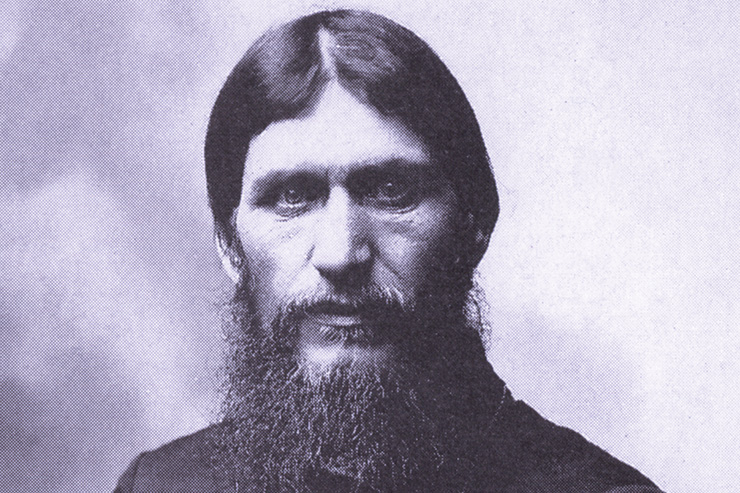
    The French occultist became particularly worried about how the tsar and tsarina had fallen under what he regarded as the malefic influence of a charismatic wandering ‘holy man’ called Grigory Yefimovich Rasputin. Rumoured to have been involved with the unorthodox religious sect known as the Khlysty or ‘People of God’, Rasputin managed to be invited to the royal court. As a result, he became the spiritual advisor, friend and confidante of the Tsarina Alexandra and also forged relationships with other Russian aristocrats.

    The Khlysty were a neo-Gnostic sect condemned by the Russian Orthodox Church because of their practices of flagellation and sexual indulgence to make contact with God and achieve spiritual enlightenment. At this time there were many quasi-religious sects in Russia and numerous wandering holy men and healers such as Rasputin.

    How much the tsarina knew of Rasputin’s background is not known, but she must have been aware he was using his personal charm and hypnotic powers to seduce many of her female courtiers. Although there is no evidence they had a sexual affair, Alexandra seems to have been infatuated with the unkempt ‘holy man’. She was in awe of his magical powers after he used his healing abilities to save the life of her haemophiliac son, the heir to the imperial throne. From then on, she would not allow anyone to say a bad word against him.

    Despite his wild physical appearance, Rasputin exerted a strange power over women, especially wealthy ones. It was said this was due to his ability to withhold orgasm for long periods. One aristocratic lady said the experience of making love with Rasputin was so pleasurable that she actually fainted during it. Such comments have led some writers to suggest the ‘Mad Monk’, as his enemies dubbed him, was a skilled adept in Tantric techniques from Eastern occultism and a practitioner of sex magic.

    Many friends of the Romanov royal family and members of the Russian government warned the tsar that Rasputin’s influence over his wife was sinister and evil. Dr. Encausse also wrote to Nicholas and warned him that in Kabbalistic terms the holy man was an unholy vessel like Pandora’s famous box of misfortune. As such, he contained all the “vices, crimes and filth of the common Russian people.” Prophetically, the French occultist said if the vessel was ever broken (i.e. Rasputin was killed) all its “dreadful contents will spill across Russia” destroying everything they touch.

    [alert type=”info” dismiss=”no”]If you appreciate this article, please consider a subscription to New Dawn magazine.[/alert]

    Prelude to The Great War

    In the 1900s it was widely expected there would soon be a war involving the major European powers. It was alleged that at a secret conference in Brussels, attended by leading Freemasons and members of secret societies as early as 1905, a plot had been hatched to bring down the Romanovs along with the other crowned heads of Europe. As the Great War approached, it was believed Rasputin was their secret weapon in achieving this aim.

    The First World War broke out in August 1914 following the assassination of Archduke Franz Ferdinand and his wife the Archduchess Sophia of the Austro-Hungarian Empire. When they were killed in Sarajevo, Bosnia by members of a secret society of Serbian nationalists known as the Order of the Black Hand, Rasputin warned the tsar not to let Russia get involved in a war with Germany. The monk predicted that if the Russian armed forces joined with those of Britain and France against Germany and their Ottoman and Austro-Hungarian allies, the country would suffer “a terrible defeat.” In the violent civil disorder to follow, the monarchy would fall from power. For once, the tsar ignored the advice of his ‘spiritual sources’ and committed the imperial Russian army and navy to the allied cause against Germany.

    Following the assassinations in Sarajevo, Tsarina Alexandra sent Rasputin several urgent telegrams asking for his advice about the international situation. Rasputin replied that on no account should Mother Russia get involved if, as was widely expected, war broke out among the major European powers. If she did, “It will be the finish of all things.” It is presumed Rasputin was not aware Russian secret agents had been implicated in the assassination plot. Allegedly, the Russian military attaché in Belgrade had paid 8,000 roubles to the leaders of the Order of the Black Hand. The attaché had also told them that Tsar Nicholas II would support the cause of Serbian nationalism if war broke out between Russia and the Austro-Hungarian-German alliance.

    It was also rumoured that in early 1914 representatives of the Black Hand had secretly met with members of the politically subversive French Masonic lodge of the Grand Orient at the Hotel St Jerome in Toulouse, France. At this meeting the assassination of Austro-Hungarian Emperor Franz Joseph and Archduke Ferdinand had been discussed. The plot was organised by the Black Hand with renegade elements of French Masonry and allegedly had the tacit support of the Russian tsar. The idea was to create the right conditions for a war between the European monarchies leading to their destruction, although why Nicholas II would support the anti-royalist plan remains unclear as he had all to lose from it.

    Following the murder of Franz Ferdinand and his wife, Kaiser Wilhelm told the Austro-Hungarian ambassador in Berlin that military force had to be used to neutralise Serbian nationalism and he offered his country’s support in any action the empire decided to take. The Kaiser quoted intelligence reports that suggested Russia would not intervene. On 28 July 1914, four weeks after the assassinations, the Austro-Hungarian Empire declared war on Serbia. In response to this, Tsar Nicholas ordered the Russian army to mobilise. The Kaiser warned the tsar that unless his forces stood down he would mobilise German troops. Five days later, when this ultimatum had been ignored, Germany declared war on Russia and the First World War began.

    When war was declared, Rasputin said if he had not been ill he would have travelled to St Petersburg to see the tsar personally. If this had happened, he boasted, Russia would never have entered the war and he would have single-handedly changed the course of world history. The pro-war elements claimed Rasputin was a pacifist and a pro-German traitor. It was even said the holy man was a secret agent working for the German intelligence service. The Germans had allegedly planted him in the royal palace to give the tsar and tsarina false advice and counsel.

    As the war dragged on, the rising casualties at the front and food shortages at home led to strikes and riots, and open hostility to the Romanovs surfaced among the population. This unrest was aided and abetted by the subversive activities of left-wing socialist and revolutionary agitators who wanted to replace the existing regime with a worker’s republic. Rasputin meanwhile had received a psychic premonition of impending doom and believed his life was under threat. In 1916 he wrote to the tsar spelling out the consequences to Russia and the Romanov dynasty if he was killed. He said should he be murdered by common assassins who were Russian peasants, whom he described as his “brothers,” the royal family would have nothing to fear. If, however, his killers were aristocrats, then “brother will kill brother” and no nobles would be left in the country.

    Several political factions in Russia had previously attempted to stop Rasputin’s influence on the royal family by violent means. In 1913 a conspiracy was revealed to kidnap the mystic monk, castrate him because of his sexual activities, and then kill him. Rasputin, however, was tipped off about the plot and managed to evade capture.

    A year later, on 19 July, a prostitute attacked Rasputin while he was holidaying at the Black Sea resort of Yalta, later to be the meeting place of the Allied wartime leaders towards the end of the Second World War. The prostitute stabbed Rasputin in the stomach, but despite losing a considerable amount of blood, he managed to survive the attack. When questioned by police, the woman said she had tried to murder the so-called ‘holy man’ because he was a heretic and ‘fornicator’ who had seduced a nun. She was diagnosed as unfit to stand trial due to insanity and was committed to a mental hospital. This appears to be an official cover-up.

    Significantly perhaps, the assassination attempt on Rasputin occurred only weeks after the murder in Sarajevo of Archduke Franz Ferdinand and his wife by members of the Black Hand secret society.
    Enter the SIS

    Rasputin’s prediction of his own death came eerily true in December 1916, when a group of right-wing aristocrats conspired with the British Secret Intelligence Service (MI6 or Military Intelligence Department Six) to kill him. The SIS was a branch of the Foreign Office set up in 1909. According to Michael Smith’s book Six: A History of Britain’s Secret Intelligence Service: Part 1: Murder and Mayhem 1909-1939, at the beginning of the First World War the head of SIS in London, known by the code letter ‘C’, made overtures to the Russian intelligence service. This was because of serious British concerns about the commitment of Tsar Nicholas II to the war effort. In September 1914, ‘C’ was granted permission by the Foreign Office in London and the Russian government to send several military officers to set up a SIS bureau in Petrograd, the new name for St Petersburg. Its name had been changed because the original sounded too German.

    One of the SIS officers, Lieutenant Stephen Alley, was a fluent Russian speaker who had been born in a village near Moscow. Before the war he worked in Russia for the Maikop & General Petroleum Trust, an American oil company owned by the future US president Herbert Hoover. The company was building a new oil pipeline across southern Russia to a port on the Black Sea. When war broke out, Lt Alley left the company and joined the British Army. He was then recruited by military intelligence, joining the SIS. Because of his Russian background, Lt Alley was sent to Petrograd posing as a military attaché to the British Embassy.

    The British intelligence officer soon discovered there were members of the Russian government, especially in the Ministry of Foreign Affairs, who were worried about the way the war was going. Some went so far as to support a separate peace treaty with Germany. Apparently there had been several clandestine meetings between officials of the two countries at the Russian and German embassies in Rome. It was said the Grand Duke of Hesse in Germany had even been in personal touch with the German-born tsarina. He had urged her to use her influence with her husband and members of the Russian government to seek a peace agreement.

    In November 1915, Lt Alley was in charge of what the SIS Russian bureau termed ‘background intelligence operations’. Two other officers, who had been recently sent out from SIS’s London headquarters, assisted him. One of them, Lt Oswald Rayner, was originally given the task of secretly opening and examining telegrams and letters. The SIS was particularly interested in the activities of neutral Swedish shipping companies believed to be supplying goods to Germany in defiance of the Royal Navy’s blockade.

    Before joining the Secret Service, Rayner had worked in Finland, then a Grand Duchy of the Russian Empire. He taught English and befriended a wealthy local couple who funded his further education at Oxford University, where he studied modern languages. At Oxford, he became friendly with Prince Feliks (Felix) Yusupov, a member of one of the wealthiest and most influential aristocratic families in Russia. Rayner then worked as a correspondent for The Times newspaper in London and later joined the civil service where he became a friend of the future wartime prime minister, David Lloyd George. When war broke out in 1914, Rayner joined the British Army. He was commissioned as an officer and assigned to ‘special duties’ with the SIS. Like Lt Alley, his fluency in Russian had him sent to Petrograd to join the British Secret Service unit operating in the city.

    With persistent rumours circulating that the Russian government was keen to make peace with Germany, the SIS began to focus on the specific stories about Grigory Rasputin, his alleged involvement in a pro-German anti-war peace movement and his peculiar influence over the tsarina. Their intelligence suggested the holy man was either the leader or at the very least a leading mover in a so-called ‘peace party’ made up of politically prominent Russians.

    As a result, several right-wing pro-war elements within the Russian aristocracy were counter-plotting to remove Rasputin permanently so he could not influence the tsar and tsarina with his views. One of these conspirators, a member of the Duma or Russian parliament, Vladimir Purishkevich, approached a SIS officer offering information on the plot. He told the officer a plan had been drawn up to “liquidate Rasputin.” At the time, the officer was unaware that three of his SIS colleagues, Alley, Rayner and an ex-Indian Army officer Captain John Dymoke Scale, were in fact closely involved in the plot to kill Rasputin.

    Lt Alley and Capt Scale had become suspicious of the tsarina’s close relationship with her spiritual advisor. Knowledge of Rasputin’s pro-German sentiments was common knowledge by 1916. Even The Times accused him of being a Germanophile whose influence at the Russian royal court was described as both “potent” and “baleful.” Capt Scale described Rasputin as a “drunken debaucher” who was adversely influencing Russian government policy and “clogging the war machine.” It was becoming evident the Mad Monk had to be neutralised, and this could only be achieved by his death.

    The Plot to Kill Rasputin

    The key figure in any British Secret Service involvement in a plot to terminate Rasputin with ‘extreme prejudice’ would be Lt Oswald Rayner. This was because of his long friendship with Prince Yusupov who was the leader of the conspirators. The prince invited the holy man to a ‘party’ at his family’s palace on the banks of the River Neva in Petrograd. Yusupov persuaded his wife, Princess Irina, the niece of Tsar Nicholas, to lure the monk to the party, although she was not actually going to be present. It was a typical British Secret Service ‘honey-trap’ operation that has been carried out many times since. Also present at the party was a prominent aristocrat, the Grand Duke Dimitry Pavlovich, the tsar’s second cousin; an army officer, Lieutenant Syukhotin, who was a close friend of the prince; Vladimir Purishkevich; an army medic Dr. Stanilaus de Lazoret – and the SIS officer Lt Oswald Rayner.

    The usual version of events is that Rasputin was first given some small chocolate cakes and wine laced with cyanide. When these had no apparent effect, he was shot in the chest at close range with a revolver. The holy man apparently survived this, attacked his would-be killers and managed to escape from the house. The assassins pursued him and he was shot three more times. His body was then bundled into a car and driven to the Petrovsky Bridge over the River Neva, where it was thrown into the icy waters. Despite the poison and several gunshot wounds, Rasputin was still alive, if barely, when he was tossed into the river and drowned.

    In reality, when Rasputin arrived at the prince’s home he was given copious amounts of alcohol until he was drunk. He was then tortured, beaten with a leather cosh on the testicles. There may have been a sexual element to this, but the aim was to get Rasputin to confess to his anti-war activities and name the other pro-German conspirators involved. Finally, he was shot several times using at least three different weapons. It is alleged that Rayner used his standard Secret Service issue Webley revolver to fire the last shot that finally finished off Rasputin. His body was then disposed through a hole in the ice of the frozen river.

    It is not clear if the senior officer running the SIS Russian bureau in Petrograd was fully aware of the involvement of Rayner and the other British officers in Rasputin’s murder. He expressed total surprise at the news when relaying it to ‘C’ in London. There is indication the three SIS officers had not received official sanction for the operation. They acted without London’s approval because they feared that the plan for a Russian peace treaty with Germany was well advanced. In fact, under torture Rasputin had even named a date in January 1917 when it would be signed.

    Two of the three SIS officers seemed to have been quickly posted elsewhere. Capt Scale was not even in Russia when the operation was carried out. He had already been sent to Romania to assist in a SIS operation to prevent the invading German army from capturing and using the oilfields and grain stores in the country by sabotaging them. He was later to return to Petrograd where rumours were still rife that the British Secret Service had somehow been involved in Rasputin’s death.

    Lt Oswald Rayner was transferred to SIS’s Stockholm office, but Lt Alley stayed in Russia and took over as head of the bureau. He eventually was given the role of liaison officer with the new provisional government and had the task of persuading them to keep the faith by pursuing the war with Germany. He was later sacked from SIS for allegedly refusing to carry out an order to assassinate one of the Bolshevik revolutionary leaders – Josef Stalin. The real reason was said to be that ‘C’ in London wanted to get rid of Lt Alley. It is possible this was because of the lieutenant’s alleged involvement in the plot to torture and murder Rasputin.

    The reaction to and consequences of the death of the Mad Monk were immediate, confirming the holy man’s own predictions about the event at the hands of the aristocracy. The Russian peasantry held him in great regard and reverence. When the news of his violent death spread, he was treated like a religious martyr and the finger of suspicion was pointed at the royal palace. Following the murder, rumours began to circulate of a right-wing coup by army officers to oust Tsar Nicholas II because he was a weak leader who was losing the war for Russia. The secret police investigated these stories, but in fact the real threat to the tsar’s continued rule and precarious position came from extreme left-wingers and, ironically, the supporters of a liberal democratic form of government.

    Fall of the Monarchy

    In March (or February by the Old Calendar still used in Russia) 1917, food riots broke out in Petrograd and other major Russian cities. Troops sent to put them down instead sided with the hungry demonstrators and joined them in their protest. As law and order broke down, a new liberal democratic provisional government was appointed to run the country. Faced with widespread and mounting criticism and a violent reaction to his policies, Nicholas decided the best thing for the country was to abdicate in favour of his younger brother, Grand Duke Michael. Unfortunately, the new tsar did not have the support or confidence of the peasants and, more importantly, the police and armed forces. In turn, Michael was forced to abdicate and he passed his executive powers to the provisional government. This move was widely applauded in Western capitals, as it was mistakenly believed that Russia was entering a new era of democracy replacing the autocratic rule of the tsars.

    Unfortunately, divided by internal disputes and trying to fight an increasingly unpopular war, the provisional government ruled for only eight months until November (or October) 1917. During this short period of democratic rule, it did manage to promote freedom of speech, religious worship and assembly and ended the censorship of the press. This freedom was short lived as in July 1917 a group of soldiers, sailors and Bolsheviks attempted to seize Petrograd. They were only prevented from doing so by the intervention of regular army units who were still loyal to the provisional government.

    Kaiser Wilhelm, himself interested in Spiritualism with an extensive private library of occult books, also decided to interfere in Russia’s internal affairs. He allowed the Bolshevik revolutionary leader Vladimir Illyich Lenin to return to Russia from Switzerland via Germany with his followers in a sealed train. Lenin promised Kaiser Wilhelm that if he managed to seize power by overthrowing the provisional government the war would be ended. On his arrival in Russia, Lenin was greeted by jubilant crowds and finally on 7 November (October) 1917, the Bolsheviks seized power. Troops from the garrison in Petrograd mutinied and, assisted by sailors and an armed workers’ militia called the Red Guard, they stormed the Winter Palace.

    Russia’s New Government

    The Bolshevik revolution was not bloodless by any means as in 1918 fighting broke out between the new Soviet government and the so-called ‘White Russians’ led by aristocrats still loyal to the monarchy. The Allies intervened and American, British, French and Italian troops landed on Russian soil. Their mission was to help the White Russians in the civil war and to seize materials stored in the ports of Archangel and Murmansk so they would not fall into the hands of the Germans. From October 1919 until January 1920, Allied forces blockaded the Russian coast and supplied the White Russians with military equipment.

    Despite their intervention, the Allies failed to prevent the ultimate defeat of the White Russian forces and the eventual establishment of the Soviet Union. In 1918, Tsar Nicholas, his wife and their children were brutally murdered by the Bolsheviks in the cellar of a house in Ekaterinburg, where they had been held captive. Rasputin’s prediction had come true. Nicholas had tried to seek asylum in Britain, but his cousin King George V, persuaded by his government, refused him and his family refuge. The king never fully recovered from the guilt he felt over the matter. Ironically, one of the first acts of the new Bolshevik regime was to ban all religious sects, occult groups and secret societies that had flourished in imperial Russia under the rule of the Romanov dynasty.

    [alert type=”general” dismiss=”no”]This article was published in New Dawn Special Issue Vol 8 No 3.[/alert]

    [alert type=”success” dismiss=”no”]If you appreciate this article, please consider subscribing to help maintain this website.[/alert]

    © New Dawn Magazine and the respective author.
    For our reproduction notice, click here.
  • The Changing Face of Russian Psi Research

    The Changing Face of Russian Psi Research

    From New Dawn 104 (Sept-Oct 2007)

    Were the Soviets really experts in paranormal research? Were they, as some researchers claimed during the Cold War, light years ahead of the rest of the world in the field of parapsychology? If so, what kind of work are the Russians up to today?

    The mysterious case of Robert Toth may shed some light on the matter.

    The Toth Incident

    Robert C. Toth, a Los Angeles Times correspondent, was arrested and detained in Moscow on June 11, 1977. He had been given papers by a Soviet scientist named Valery G. Petukhov, who claimed to be Chief of the Laboratory of Bio-Physics at the State Control Institute of Medical and Biological Research. The papers supposedly disclosed ‘state secrets’ and Toth, of course, had obtained them illegally. He was arrested before he had a chance to examine them properly.

    The papers were supposed to offer proof of Petukhov’s grounding breaking scientific research in the field of parapsychology. When living cell undergo division, Toth had been told, they emit certain particles that can be “detected and measured.” These particles can “carry information,” and their function could “explain the basis for telepathy” and other phenomena of this nature.

    Toth claimed that seconds after he had been given the papers, a small car pulled up beside him, from out of which emerged five men, dressed as civilians. They threw him inside the vehicle, which then sped off. “Our car drove through red lights and down one-way streets the wrong way to a militia [police] station,” writes Toth. “My captors were firm and polite, offering me cigarettes… I was ushered into a room with an inspector who declined my requests to phone the US Embassy but said a Soviet Foreign Ministry official would be called.”

    Toth was detained for a period of several days. He was interrogated by police officers and KGB officials. A senior researcher of the USSR Academy of Sciences, Professor I.M. Mikhailov, was asked to provide expert testimony on the information Toth had been given by Petukhov. “This material is secret and shows the kind of work done in some scientific institutes of our state,” he declared.

    Suddenly told he was free to go, Toth caught the next flight back to America. The Toth incident hit newspapers all over the world, including The Washington Post and The New York Times. The story was quickly forgotten, however – at least by the public. “But,” writes the late Martin Ebon, “intelligence analysts understood that Toth had gotten into his hand, if only for a few moments, one of the tips of the enormous iceberg of top secret Soviet research into psychic powers of the human mind.”

    The Psi Warfare Gap

    Another possibility is that the Toth incident was a Soviet orchestrated conspiracy – a set up, in other words. Between 1969 and 1971, during the height of the Cold War, American intelligence sources discovered the Soviets had a deep interest in parapsychology, were researching the subject extensively, and that this research was being well-funded by the Soviet military and the KGB.

    In 1967, it was learned, the Soviets were spending an estimated US$500 million a year on parapsychological related research. The money was being used to fund fourteen separate research institutes. This naturally worried the Americans, who deduced a hostile intent behind the Soviet’s actions.

    As to why the Soviets were spending so much money on psi research, a brief explanation needs to be given. In the aftermath of World War II, Soviet authorities feared the prospect of becoming involved in yet another war – this time with the West – much in the same way that the US authorities were greatly concerned about a possible ‘communist takeover’ and nuclear war with the Soviet Union.

    Acting as an important catalyst for the Soviet ‘psychic boom’ was a story that appeared in the French periodical Constellation, entitled ‘Thought Transmission – Weapon of War’. The article, published in 1959, told of supposed telepathy experiments that were being conducted by the US military. The article claimed that the ‘receivers’ in the experiment, located onboard the submerged nuclear submarine Nautilus, had successfully managed to pick up telepathic transmissions from the ‘senders’ back on land.

    When the US Navy denied the story, the Soviets assumed they were lying, deciding to take it seriously. Not wanting to be left behind in the field of psi research, the Soviets took immediate action. The father of Soviet parapsychology, the physiologist Leonid L. Vasiliev, who, in 1923, had been ordered by Joseph Stalin to investigate telepathy, made the following remark in April 1960, while addressing a group of top Soviet scientists: “Today the American Navy is testing telepathy on their atomic submarines. Soviet scientists conducted a great many successful telepathy tests over a quarter of a century ago. It’s urgent that we throw off our prejudices. We must again plunge into the exploration of this vital field.”

    One theory is that the Nautilus story was a clever piece of American disinformation, aimed to lead the Soviets astray, so that they would start to invest money and energy into a decided waste of time. “Whether telepathic communication experiments were ever carried out aboard the USS Nautilus is a topic that generates much doubt and dispute among paranormal enthusiasts,” explains W. Adam Mandelbaum in his book The Psychic Battlefield.

    Regarding the Toth incident, the parapsychologist Elmar R. Gruber has some interesting comments to offer: “The feeling remains that the Soviets were attempting to impart deliberate disinformation in their power game with the Americans… Did they intend to create the impression that they were far more advanced in this field than the Americans?”

    Intentional or not, the impression was certainly there, as proven by a now declassified 1972 Defence Intelligence Agency (DIA) report, entitled ‘Controlled Offensive Techniques’. The report begins by stating that parapsychology in the Soviet Union is very different to that in West, the former being a “multi-disciplinary field consisting of the sciences of bionics, biophysics, psychophysics, psychology, physiology and neuropsychology.” The Soviets had named this field ‘psychotronics’. The nearest English equivalent to the word is mind (psycho) energy applications (-tronics).

    The report mentions that Soviet scientists had explored “detrimental effects of subliminal perception techniques,” which, using “telepathic means,” might be “targeted against the US or allied personnel in nuclear missile silos.” The report continues: “The potential applications of focusing mental influences on an enemy through hypnotic telepathy have surely occurred to the Soviets… Control and manipulation of the human consciousness must be considered a primary goal. Soviet knowledge in this field is superior to that of the United States.”

    Psychic Discoveries Behind The Iron Curtain

    The year 1970 marked the publication of a now classic book on Soviet psychic research. Called Psychic Discoveries Behind the Iron Curtain, it was written by two Western journalists, Sheila Ostrander and Lynn Schroeder. During their stay in what was then the Soviet Union, Ostrander and Schroeder travelled far and wide, interviewing numerous scientists who were conducting groundbreaking research in the field of parapsychology.

    When Psychic Discoveries was first released, it caused quite a stir, sparking both public and government interest in ‘psychic warfare’. Had it never been written, the US government’s fear of ‘Soviet psychic mind control’ would probably not have reached the extreme that it did.

    Kirlian photography, dowsing, telepathy, eyeless sight, telekinesis, hypnosis – these are just some of the subjects that Ostrander and Schroeder investigated and wrote about. Their book showed that Soviet scientists had already managed to gain a practical understanding of how these types of phenomena were possible, while the rest of the world was lagging far behind.

    So what had the Soviets discovered about the unknown powers of the human mind? And how did they approach the study of this enigmatic subject?

    Experiments In Distance Influence

    Existing in the Soviet Union were two different types of parapsychology – one official, the other secret. The former was allowed to exist in public, while the latter was taking place at well-funded, top secret state-controlled research institutes, and was largely military-based. Parapsychologists who wanted to do research in non-military areas often had difficulty obtaining funding.

    To divert attention away from the real research they were doing, the Soviets had established, in Moscow, a military-based parapsychology centre called the Institute of Problems of Information Transmission. To help it look authentic, the Soviets made sure it was well-guarded at all times. As for the real research, that was being conducted in a remote region of western Siberia, near the pioneer town of Novosibirsk, in a massive research facility named Akademgorodok, ‘Science City’.

    Built after World War II, Science City was composed of around 40 scientific centres, and housed tens of thousands of scientists and their families. It was developed, says Martin Ebon, “with such single-mindedness that even the names of the streets and city squares reflect its nature. For example, one could take a bus down Thermophysics Street, get off at the corner of Calculators Street, and walk across the Institute of Hydrodynamics Square.”

    One of its scientific centres was called the Institute for Automation and Electrometry. Located here was the mysterious Special Department 8, where entry was not permitted unless one had access to a special code. Security was such that the code was changed on a weekly basis. For the sixty or so scientists employed at No. 8, their job was to investigate telepathy and distant influence, otherwise called ‘biocommunication’.

    For psi to be possible, thought Soviet scientists, there had to be an exchange of energy taking place. At No. 8, writes Ebon, “physicists sought to discover the nature of ‘psi particles’, the elusive elements that some Soviet scientists regarded as essential to the function of such psychic techniques as biocommunication and bioenergetics.”

    In one series of experiments, telepathic communication was tested among people. Experiments in telekinesis were also conducted. Some of the subjects used were Tibetan monks and Siberian shamans, who had been carefully selected by the KGB for their remarkable psychic abilities. The American journalist Jim Marrs says the KGB “laboriously screened more than a million people in an effort to locate ‘super naturals’, persons with the greatest amount of psychic power.”

    In another series of experiments – which were conducted at No. 8 before it was closed down in 1969 – August Stern, one of the scientists who worked there, and his colleagues tested the properties of biophotons, to see if they could account “for some inexplicable forms of communication.” Photons, by the way, are the smallest physical units of light, the quanta of electromagnetic radiation. Biophotons are a type of photon that radiate from living cells. In this experiment, bacteria was placed on two sides of a glass plate, “to see whether a fatal disease could be transmitted through the glass” with the help of biophotons. “There were also experiments with photon waves, in which frogs’ eyes were used as a more sensitive measuring instrument than a machine,” recalls Stern, who migrated to France in 1977.

    Due to the shutting down of No. 8, the photon communication experiments conducted by Stern and his colleagues were not fully realised. Several years later, however, three Soviet scientists attempted the same problem, achieving impressive results. Their names were Vlail Kanachevy, Simon Shchurin and Ludmilla Mikhailova. In their experiments, two groups of cells were used, one of which was contaminated with a virus, the other of which was not. They were placed adjacent to each other, but remained physically separate. When the two groups were isolated by quartz glass, which ultra-violet waves are able to penetrate, the non-contaminated cells suddenly became contaminated; they ‘caught the disease’, in other words. When regular glass was used, which ultra-violet waves cannot penetrate, this did not occur; the non-contaminated cells remained healthy.

    These results confirmed what many Soviet scientists in the field of bioenergetics had previously theorised – that living cells can ‘communicate’ with each other over distances, and in a non-chemical way. When the affected cells were attacked by the virus, says Shchurin, they “virtually cried out loud about the danger” and “their cry freely penetrated the barrier of quartz glass… Something highly improbable happened. These waves were not only perceived by the neighbouring cells, they also conveyed the sickness to the neighbouring cells.”

    The KGB Takes Control

    No later than 1970, the KGB had taken control of the country’s research in parapsychology. It should be mentioned, however, that the KGB was an integral part of everyday life in the Soviet Union, permeating society on all levels, so their influence on psi research was not exactly sinister.

    During the 1970s, more and more KGB-controlled parapsychology research institutes were established. Because the nature of Soviet psi research was becoming increasingly secret, many Western parapsychologists lost contact with their colleagues ‘behind the iron curtain’. In addition, rumours began to circulate about sinister ‘mind control’ experiments being conducted in clandestine Soviet labs, as well as the development of dangerous ‘psi weapons’ to be used against the West. As mentioned in Psychic Discoveries, a Czech engineer named Robert Pavlita claimed to have invented a ‘psychotronic generator’, which could apparently store, enhance and radiate ‘psychotronic’ energy.

    Also known as ‘bioplasmic’ energy, Soviet scientists claimed that this energy was behind all manner of psychic phenomena, that it filled and animated all living things, and could also be harnessed for healing purposes. Using a process called Kirlian photography, the ‘bioplasmic body’ – or aura – could allegedly be photographed. The Austrian-American scientist Dr. Wilhelm Reich called this energy ‘orgone’. He invented a device called an ‘orgone energy accumulator’, consisting of a box lined with alternating layers of organic and inorganic materials, which was apparently able to trap this energy.

    “A psychotronic generator can influence an individual or a whole crowd of people. It can affect a person’s psyche mentally and emotionally. It can affect memory and attention span. A psychotronic device can cause physical fatigue, disorientation, and alter a person’s behaviour,” asserts the Soviet biologist Edward Naumov. According to Ostrander and Schroeder, “certain generators can arouse fear, anxiety, anger, insomnia, depressions and suicidal thoughts and even lead to cerebral thrombosis.” The KGB, says Naumov, spent more than half a billion roubles on developing psychotronic technology.

    When it comes to alleged Soviet mind control technology, nothing can compare to the immensity of project ‘Woodpecker’. Apparently, using an array of giant transmitters, the Soviets began to beam extremely low frequency (ELF) modulated signals all over Western Europe, Australia, North America and the Middle East. These transmissions, claims Tim Rifat, were designed to “permanently rewire the neural networks in the brains of the entire Western population, thereby destroying their social cohesiveness…” The KGB, it is said, had copied the brain frequencies of pathological criminals, mental patients, clinically depressed people and socio-psychopaths, whose brain wave maps they had studied. It is these negative frequencies that were beamed down on the West – from the early 1980s until the collapse of the Soviet Union in 1991. Assuming it was real, project Woodpecker appears to have been a tremendous success!

    Apparently, the Soviets were not the only ones who managed to create advanced ‘psi weapons’ and large scale ‘mind control’ devices; so had countries in the West – most notably the US. This technology was allegedly used against the Soviet Union, in an attempt to bring about its destruction.

    Soviet journalist Emil Bachurin claimed in Young Guard magazine that Yuri Andropov, the head of the KGB, spoke of several “psi weapons centres” in Canada, adding that “Canadian research must be surpassed.” The information was given to Bachurin by a KGB general. Other members of the Soviet intelligence community have mentioned the existence of advanced ‘psi weapons’ created by the West, even claiming that such devices have been used many times against civilian populations in the Soviet Union.

    Comments made by the late Aleksander Lebed, a distinguished General and popular politician, seem to support such charges. As mentioned in New Dawn No. 43, Lebed insisted that Western secret services had carried out a series of psychological operations (or PSYOPS) against the Soviet Union, involving “tech­nologies of psycho-semantic pro­gramming,” brainwashing and hypnosis. One such psychological operation, claimed Lebed, was the collapse of the Soviet Union itself, which had been artificially organised by the West.

    Modern Psi Research

    Since the collapse of the Soviet Union, some interesting psi experiments have been conducted in Russia, many of which involved animals and other living things. The Russians have long tried to develop biological ‘psi detectors’ – and so far they’ve been partially successful. Their theory is that psi is primarily a biological process, and that living systems react far more strongly to mental influence than do material systems. Researchers in the US have also attempted to develop psi detectors, or ‘thought switches’ – electronic devices that respond to mental intention.

    The eminent American parapsychologist Dean Radin has already managed to construct a prototype of such a device, which, he says, “incorporated a new type of physical detector, involving a matrix of random-number generators, and some advanced statistical and signal-processing techniques to detect the predicted psi-influence.” As Radin explains in his book The Conscious Universe, countless laboratory experiments have shown that random number generators – devices that produce a stream of random digits – can be influenced by a focused mind. These ‘electronic coin flippers’ are designed to operate in a truly random fashion, producing an equal number of ‘heads’ and ‘tails’. Due to the influence of consciousness, however, these devices begin to function in a more ordered way, producing statistically less probable results, such as more heads than tails, for instance.

    Georgi Gurtovoy, head of the Laboratory on Applying Isotopes in Ophthalmology in Moscow, and Alexander Parkhamov, a physicist, have done some interesting research on the distant influence of living systems that produce random fluctuations. Some of their instruments have been able to register micro-PK effects. They have also carried out anomalous distant influence experiments involving a species of fish called Gnathonemus petersii. These fish are known for their ability to emit pulsed electric signals, which they use to assist navigation in the darkness. Psychics were asked to slow down the rate of the fishes’ pulses – allegedly with much success.

    Also compelling are the experiments of Sergei Speransky, a toxicologist at the Institute of Hygiene in Novosibirsk. His findings seem to confirm the existence of ‘morphogenetic fields’, as proposed by the controversial British biologist Dr. Rupert Sheldrake. In one experiment, a population of mice that had grown up together in the same cage were split into two groups. The mice in one group were fed as usual, while the mice in the other group were made to starve. Almost instantly, noticed Speransky, the non-starving mice began to consume much more food than before, as though trying to compensate for their ‘friends’. There appeared to be a telepathic link between the two groups. Had the non-starving mice picked up a signal from the starving mice, warning them that food was scarce and that they needed to increase food consumption and storage within their bodies?

    Out of the thirty experiments conducted, twenty-seven had a positive outcome. Speransky then carried out an additional series of experiments, so as to refine his methodology, varying weight, sex and other variables. Once again, the results were nothing less than astonishing. Speransky concluded that the “biological significance of the rapid increase in weight in mice which received signals about starvation from their ‘friends’ is clear: a danger of starvation has to give them an additional stimulus to be sated.”

    It’s interesting to note that the famous British biologist Sir Alister Hardy had formulated a similar theory to Speransky’s, stating that telepathic communication between animals might play a role in evolution and adaptation. Animal habits, he suggested, might be spread by “telepathic-like means.” He further suggested that a “psychic pool of existence” might operate among members of a species.

    This brings us back to the work of Sheldrake. He believes morphogenetic fields contain the information that is required to shape the form of living things, much in the same way that certain frequencies of sound ‘contain the information’ to create complex geometric patterns in sand. We are reminded here of the bioplasmic body, which, as mentioned in Psychic Discoveries, was thought by Soviet scientists to be “some kind of matrix, some kind of invisible organising pattern inherent in living things.” Morphogenetic fields also serve a social function, shaping behaviour on both an individual and group level.

    Furthermore, due to a process called ‘morphic resonance’, remarkable forms of ‘communication’ – not limited by space or time – are able to occur within a species. “The fields organising the activity of the nervous system are likewise inherited through morphic resonance, conveying a collective, instinctive memory,” writes Sheldrake. “Each individual both draws upon and contributes to the collective memory of the species. This means that new patterns of behaviour can spread more rapidly than would otherwise be possible.”

    A Revolutionary New Approach

    When, in the 1920s, parapsychology was beginning to establish itself as a legitimate scientific field in the Soviet Union, Leonid Vasiliev greatly influenced the course of its development – more so, by far, than anyone else. In his highly influential books, articles and presentations, he continued to assert that the study of psi phenomena should be approached in a purely physiological manner, as he feared it would be exploited by proponents of “religious superstition.”

    Nowadays, parapsychology in Russia is undergoing a gradual yet fundamental transformation, thanks partly to a growing interest in transpersonal psychology. New approaches to psi research are being sought out, with an emphasis on Asian religious concepts. Scientists, moreover, are no longer so averse to ‘spiritual’ ideas. Ever since the end of the totalitarian communist regime, explains Gruber, “spirituality and religion, the pre-eminent features of the Russian soul, which were forced underground for so many decades, are again raising their claims to be the guiding principles in the understanding of man and his position in the world.”

    Russia’s leading expert on parapsychology, Alexander Dubrov, who is regarded as the spokesman for the modern approach to psi research, believes there is more to psychic phenomena than biology and neurophysiology. Psi phenomena, he says, is a quantum-mechanical process, and man is a ‘quantum subject’. Be that as it may, says Dubrov, the physical side of psi and the psychophysics of altered states of consciousness should also be taken into account, so as to gain a complete understanding of the matter.

    [alert type=”general” dismiss=”no”]This article was published in New Dawn 104.[/alert]

    [alert type=”success” dismiss=”no”]If you appreciate this article, please consider subscribing to help maintain this website.[/alert]

    References

    Lucid Viewing – The Way Forward in Remote Viewing, How it all Started – In Russia, www.bibliotecapleyades.net/vision_remota/esp_visionremota_9a.htm

    Compare Martin Ebon, Amplified Mind Power Research in the Former Soviet Union, 1996-7, www.biomindsuperpowers.com/Pages/Ebon1.html

    Deep Black Magic: Government Research into ESP and Mind Control, Ingo Swann on CIA/ESP Connection, 1995, www.mindspring.com/~txporter/iswann.htm

    Rupert Sheldrake, Biologist and Author, Morphic Fields and Morphic Resonance – an Introduction, 2005, www.sheldrake.org/Articles&Papers/papers/morphic/morphic_intro.html

    Elmar R. Gruber, Psychic Wars: Parapsychology in Espionage – and Beyond (Blandford, UK, 1999)

    Jim Marrs, Psi Spies (AlienZoo Publishing, US, 2000)

    Sheila Ostrander and Lynn Schroeder, Psychic Discoveries (Marlowe & Company, USA, 1970

    Adam Mandelbaum, The Psychic Battlefield: A History of the Military-Occult Complex (St. Martin’s Press, USA, 2000)

    Dean Radin, The Conscious Universe: The Scientific Truth of Psychic Phenomena (HarperCollins, USA, 1997)

    Tim Rifat, Remote Viewing – What is it, Who uses it and How to do it (Vision Paperbacks, UK, 2001)

    Holly DeNio Stephens, The Occult in Russian and Soviet Culture (Cornell University Press, 1997)

    © New Dawn Magazine and the respective author.
    For our reproduction notice, click here.

  • Russian President Steers a Straight Course

    Russian President Steers a Straight Course

    From New Dawn Special Issue Vol 7 No 6 (Dec 2013)

    Today we need new strategies to preserve our identity in a rapidly changing world, a world that has become more open, transparent and interdependent. This fact confronts virtually all countries and all peoples in one form or another: Russian, European, Chinese and American – the societies of virtually all countries.
    – V. V. Putin, Valdai Club, 19 September 2013

    Vladimir V. Putin has maintained his ideological position, and reiterated Russia’s determination to maintain her sovereignty and identity in the face of globalisation. Putin’s course for Russia was unequivocally stated in a September 2013 speech at a plenary session of the Valdai Club, which included foreign dignitaries and Russian luminaries from politics, academia and media. (https://valdaiclub.com/a/highlights/vladimir_putin_meets_with_members_the_valdai_international_discussion_club_transcript_of_the_speech_/)

    Putin stated that while every nation needs its technical strength, at the basis of all is “spiritual, cultural and national self-determination” without which “it is impossible to move forward.” “[T]he main thing that will determine success is the quality of citizens, the quality of society: their intellectual, spiritual and moral strength.” Putin rejects the economic determinism of the modern era, stating:

    After all, in the end economic growth, prosperity and geopolitical influence are all derived from societal conditions. They depend on whether the citizens of a given country consider themselves a nation, to what extent they identify with their own history, values and traditions, and whether they are united by common goals and responsibilities. In this sense, the question of finding and strengthening national identity really is fundamental for Russia.

    Putin pointed to the threat posed to Russian identity by “objective pressures stemming from globalisation,” as well as the blows to Russia inflicted by the attempts to erect a market economy, which it might be added, was sought by internal oligarchs and outside plutocrats; attempts that are ongoing. Putin moreover points to the lack of national identity serving these interests:

    In addition, the lack of a national idea stemming from a national identity profited the quasi-colonial element of the elite – those determined to steal and remove capital, and who did not link their future to that of the country, the place where they earned their money.

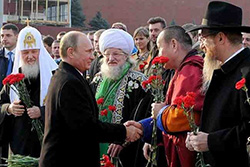
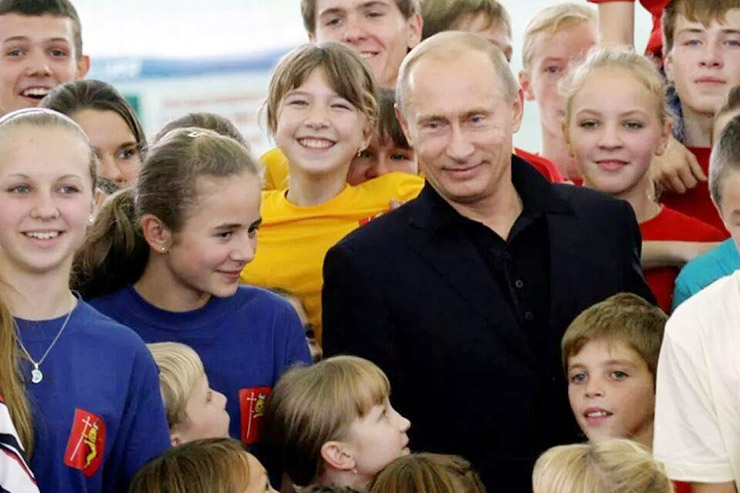
    President Putin meets Russia's religious leaders
    President Putin meets Russia’s religious leaders

    What the globalists and oligarchs wish to impose on Russia from the outside cannot form an identity, which must arise from Russian roots, and not as a foreign import in the interests of commerce:

    Practice has shown that a new national idea does not simply appear, nor does it develop according to market rules. A spontaneously constructed state and society does not work, and neither does mechanically copying other countries’ experiences. Such primitive borrowing and attempts to civilise Russia from abroad were not accepted by an absolute majority of our people. This is because the desire for independence and sovereignty in spiritual, ideological and foreign policy spheres is an integral part of our national character. Incidentally, such approaches have often failed in other nations too. The time when ready-made lifestyle models could be installed in foreign states like computer programmes has passed.

    “Russia’s sovereignty, independence and territorial integrity are unconditional,” states Putin. He has called for unity among all factions, above ethnic separatism and urges an ideological dialogue among political factions.

    Putin also recognises that what is today called the “West,” with the USA as the “leader of the Western world,” as the media and US State Department constantly remind us, shows little evidence of any vestige of its traditional foundations:

    Another serious challenge to Russia’s identity is linked to events taking place in the world. Here there are both foreign policy and moral aspects. We can see how many of the Euro-Atlantic countries are actually rejecting their roots, including the Christian values that constitute the basis of Western civilisation. They are denying moral principles and all traditional identities: national, cultural, religious and even sexual.

    In this demise of Western values, Putin attacks “political correctness,” where religion has become an embarrassment, and Christian holidays are, for example, changed or eliminated. This nihilism is being exported over the world and will result in a “profound demographic and moral crisis,” resulting in the “degradation” of humanity. While multiculturalism is problematic for many states in Europe, Russia has always been multiethnic and this diversity should be encouraged in forging local identities, but within the context of a Russian state-civilisation.

    Simultaneous with the moral and religious decline is the attempt to impose a “standardised, unipolar world” where nations become defunct, rejecting the “God-given diversity” of the world in favour of “vassals.” Above this, Putin is promoting a “Eurasian Union,” a geopolitical bloc that will enable the states of the region to withstand globalisation.

    Putin’s Valdai speech shows that he has a fully developed world-view on which to base Russia’s future course. It also indicates that while Putin might have his faults (and I can’t think of what they might be offhand) he is the only actual statesman in the world today, and has established Russia as the most likely axis of a new civilisation and a new era.

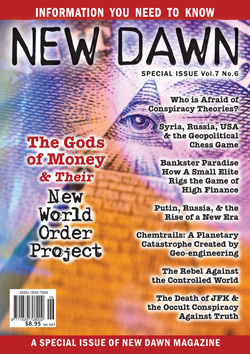
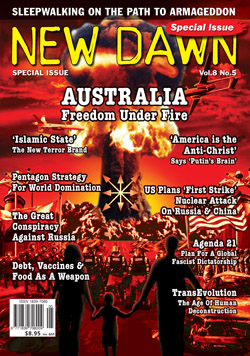
    Gain a deeper understanding of the conflict between Putin's Russia and the West. Check out New Dawn Special Issue Vol 8 No 5, with an article by KR Bolton entitled "The Great Conspiracy Against Russia: What is Really Behind the Campaign Against Putin". 

    [alert type=”general” dismiss=”no”]This article was published in New Dawn Special Issue Vol 7 No 6.[/alert]

    [alert type=”success” dismiss=”no”]If you appreciate this article, please consider subscribing to help maintain this website.[/alert]

    © New Dawn Magazine and the respective author.
    For our reproduction notice, click here.
  • The Great Conspiracy Against Russia: What is Really Behind the Campaign Against Putin?

    The Great Conspiracy Against Russia: What is Really Behind the Campaign Against Putin?

    From New Dawn Special Issue Vol 8 No 5 (Oct 2014)

    When the war-drums start beating in Washington against a state or statesman, one is entitled to wonder what transgression might have been made against the ‘New World Order’. Over the past few decades we have seen one nation after another succumb to either financial blandishments, or when those fail, long-planned, well-funded ‘spontaneous’ colour revolutions, and as a last resort bombs. The states of the ex-Soviet bloc largely succumbed to ‘colour revolutions’ orchestrated by the Soros network, aligned with the National Endowment for Democracy (NED), USAID and a host of other funds and NGOs.

    Milosevic’s Serbia, Qadhafi’s Libya and Saddam’s Iraq were bombed into submission, with ground support for jihadists. The globalists have no objection to jihadists when they serve to keep the world in a state of ‘constant conflict’, in accordance with globalist aims. The USA will use ‘Islamists’ where they can, both as dupes and bogeymen.

    There is one major spanner in the world: Russia – again. Russian President Vladimir Putin has been vilified relentlessly from the start of his leadership of Russia. A second ‘Cold War’ followed so soon in the aftermath of the first that the two can be regarded as one.

    Russia Stymied World State

    There was a fleeting interregnum when it looked as though Russia would finally succumb to globalisation. This encompassed the Yeltsin years, however it was prepared while the Communist Party still held power, during the Gorbachev era. The sudden implosion of the mighty Soviet edifice, seemingly overnight, was long prepared by a combination of US-based subversion, backing ‘dissidents’ such as Solidarity in Poland, coupled with a planned scuttle by Gorbachev, who envisioned himself as an internationally-feted globalist celebrity.

    Russia had succumbed to the nexus of money and revolution in 1917. The revolutionary movement had been well funded since 1905 when the anti-Tsarist journalist George Kennan was sent over to Japan to propagandise Russian POWs, with funds from Jacob Schiff of Kuhn, Loeb & Co., Wall Street. Kennan remarked that 50,000 revolutionary cadres were sent back to Tsarist Russia. Schiff’s contribution to the overthrow of the Tsar was lauded in New York in March 1917.1 There quickly followed the Bolshevik coup led by Lenin and Trotsky. Lenin was backed by the Germans to get Russia out of the war, and Trotsky was backed by the Americans and British to keep Russia in the war. Trotsky was in close association with R. H. Bruce Lockhart, British War Cabinet special agent in Russia, to such an extent that Lockhart’s wife commented that many of his colleagues quipped he was turning Bolshevik. The lines were drawn when Trotsky resigned as minister of foreign affairs because of Lenin’s insistence that Russia sign an armistice with Germany.2

    After the war, there was a scramble by international finance to get concessions from the Soviets, at a time when their existence was very precarious at best, and the American ‘intervention’ under General Graves was doing its best to backstab the White Armies in favour of the Reds.3 H. Wickham Steed, editor of The London Times, observed at the Paris Peace Conference that it was the international financiers such as Schiff who were pushing for worldwide recognition of the Bolsheviks.4 Matters proceeded well for international capitalism under the regime of Lenin and Trotsky. Russia opened up to foreign capital and technology. With Lenin’s death and the resulting power struggle, Stalin eliminated the influence of Trotsky and his coterie in 1928.

    The common fight against the Axis in the Second World War opened up a further opportunity for the USSR to be brought into a world order. The USA proposed such a world state via the United Nations General Assembly as a world parliament. The USSR recognised that the USA would control any such parliamentary vote, and insisted that authority be vested in the Security Council with the right of veto for permanent members. The second premise for a post-war new world order rested with the US proposal to ‘internationalise’ atomic energy under United Nations aegis, outlined in the ‘Baruch Plan’, named after Bernard M. Baruch, so-called ‘elder statesman’ of the USA. Again, the USSR said no.5

    The USSR alone prevented the creation of a world state. The conservative Right remains confused about Russia till today, and much of it continues the old Cold War anti-Russia line against Putin who, to them, is the new Stalin.

    How the Soviet Bloc Imploded

    While the globalists opportunity to erect a world state in the name of ‘world peace’ after the defeat of the Axis was scuttled by the USSR, the implosion of the Soviet bloc provided another opportunity. The oligarchs in the West are so conceited that they assume the whole world yearns for the ‘freedom’ of their ‘Brave New World’, in a narcosis of production and consumption. They assumed that with the demise of the Soviet Union they would be linking with their counterparts in Russia to form an international exploitative regime. Mikhail Gorbachev was their man, as Lenin and Trotsky had been.

    Gorbachev has indeed become part of the globalist elite, as indicated by the 2011 celebration of his 80th birthday at the Royal Albert Hall, London, where “movie stars, singers and politicians showed up, underlining the celebrity status Mr Gorbachev enjoys in the West where he is widely perceived as the man who freed Eastern European from Soviet rule and ended the Cold War.”6 Guests included Lech Walesa, father of post-Soviet Poland, whose Solidarity movement received largesse from the National Endowment for Democracy (NED), CNN founders Ted Turner, Israeli President Shimon Peres, and unnamed “oligarchs.”

    On his birthday, Gorbachev warned Putin not to seek a third presidential term and menacingly referred to the revolts in the Arab world.

    Back in 1988 Gorbachev openly invited revolt in the Soviet states by declaring before the United Nations that the USSR would not defend their Eastern bloc colleagues. This was the year that the Soviets pulled out of Afghanistan, ‘Russia’s Vietnam’. He also announced there would be a massive reduction of Soviet armed forces from the Eastern bloc states.7 Gorbachev stated to his advisors his commitment to a “new world” under the auspices of the United Nations Organisation.8 The groundwork had been laid previously, with the sponsoring of Solidarity in Poland, which Carl Gershman, head of the National Endowment for Democracy (NED), stated set in motion the “velvet revolutions” that toppled the Warsaw Pact bloc.9 The NED contrived Polish-Czech-Slovak Solidarity Foundation supported dissident publishing in the Czech Republic, Slovakia, the Ukraine, Belarus, Russia, Moldova, the Caucasus and Central Asia. The Foundation for Education for Democracy, an outgrowth of the Solidarity Teachers Union, trained teachers and NGO leaders throughout the former Soviet Union, and the East European Democratic Center created dissident media in the Ukraine and Central Asia.10 The destruction of the Soviet bloc was orchestrated by a combination of Gorbachev’s treachery, globalist funded subversion, and the US sponsored Afghanistan imbroglio.

    In 1991 Gorbachev established the International Foundation for Socio-Economic and Political Studies to add his input to the dazzling array of interconnected globalist NGOs, foundations and think tanks. The North American branch founded in 1997 states the purpose is to spread “economic liberalisation.”11

    “Wrong Direction”

    Throughout the 1990s things seemed to be going well for the globalists. Russia had at last been deconstructed, and was ready for bringing into the ‘New World Order’. Gorbachev gave the green light for the dismantling of the Eastern bloc, and paved the way for idiot democracies of the Westminster style. Appropriately a drunken buffoon, Boris Yeltsin, who started his climb to power under Gorbachev in 1985 as a member of the Politburo, Mayor of Moscow and other senior posts, was offered up to usher in the new democratic Russia that could take her place in the world as another colony of finance-capitalism. He had earned his credentials as a liberal when criticising the lack of haste in reform in 1987. The first democratically elected president of Russia, he lasted from 1991-1999. Under Yeltsin Russian assets were sold off at knock down prices to oligarchs in the name of economic liberalisation. From the start of his presidency Yeltsin brought in advisors from the IMF, World Bank and US Treasury. His 1996 presidential campaign was funded by the oligarchy and promoted by their controlled media. Boris Berezovsky was described by a Council on Foreign Relations (CFR) analyst, Daniel Treisman (who served in a 1997 US team in Russia on tax reform), as the “godfather of godfathers,” the oligarch who sat at the top of the dung-heap.12

    Having devastated Russia, Yeltsin resigned, begging Russians for forgiveness for the ruin he had brought. The presidency was assumed by Prime Minister Vladimir Putin in December 1999. It was anticipated that Putin would continue to allow Russia to be vampirised, but he took what the globalists have ever since been calling a “wrong direction,” the title of a Council on Foreign Relations position paper “Russia’s wrong direction.” Written in 2006, the CFR paper recommended increased funding for the Freedom Support Act, in this instance referring specifically to the 2007-2008 presidential elections. Authors of the CFR report included Jack Kemp, Republican Party politico; Mark F. Brzezinski, who served on the National Security Council as an advisor on Russian and Eurasian affairs under President Clinton, as his father Zbigniew had served in the Carter Administration; Antonia W. Bouis, founding executive director of the Soros Foundations; James A. Harmon, senior advisor to the Rothschild Group, et al.13

    President Putin relaxing
    President Putin relaxing

    While Putin has been criticised for associating with a coterie of oligarchs of his own, these businessmen have been incorporated into the strengthening of the Russian state, not its undermining for globalist interests. Those who acted otherwise have been purged, and are celebrated as ‘dissidents’ and champions of ‘human rights’ by anti-Russia interests. These include the ‘godfather of oligarchy’ Berezovsky, who was living in exile in England where he was found hung,14 and Mikhail Khodorkovsky (hailed as a hero in the West), onetime owner of Yukos, jailed for ten years, while his oil empire was taken back for Russia. His son Pavel heads the Institute of Modern Russia to continue the work of his father’s Open Russia Foundation to promote “Russia’s integration into the community of democracies,”15 which is to say, Russia’s subordination to international finance.

    In particular, Putin has challenged the notion of “the New American Century” as one prominent think tank optimistically termed the 21st century. Putin has moved to limit the influence of the same subversive networks that undermined the Eastern bloc via ‘velvet revolutions’ by obliging employees of NGOs to register as ‘foreign agents’, and the state started an investigation of these subversives in March 2013. In that year NED provided $8,226,487 to NGOs, programmes and seminars in Russia for the undermining of the state in the name of “human rights.”16 NED receives funding from US Congress. Imagine the outrage of ‘world opinion’ if Russia funded groups to undermine the US government. Added to this are the millions that have poured in to undermine Russia by the George Soros network, USAID, and a host of others. In 2012 Putin expelled USAID, a governmental agency, stating that it was undermining Russia’s sovereignty.

    IMG_1047

    Geopolitically, the globalists aim to encircle Russia. The alliances created by Putin in central Asia and further afield have meant this has not entirely succeeded, with the Shanghai Cooperation Organisation including China, Kazakhstan, Kyrgyzstan, Tajikistan and Uzbekistan; and with India, Iran, Mongolia and Pakistan having observer status. Belarus and Sri Lanka are dialogue partners, and Turkmenistan has guest attendance.

    However, states such as Georgia and the Ukraine are targeted for takeover as important elements in this strategy. NED avidly sponsored young cadres in various sectors of Ukrainian society, including ‘educating’ electorates on how to vote in the October 2012 elections. The 2012 NED financial report lists the NGOs in the Ukraine that received $3,380,834 during that year.17 The amount represents the upper end of funds sent by NED throughout the world.

    Pro-Moscow separatists in eastern Ukraine who would in other circumstances be lauded by the world media and politicians as ‘freedom fighters’, have been characterised as ‘terrorists’. The enemies of Russia have through the most illogical of rhetoric charged the Russian president with being personally responsible for the downing of a Malaysian airliner. The only thing known for sure as this is written is that Russian interests were in no way served by the targeting of the airliner, but it serves as grist for the anti-Russian agenda. Russia in turn is being pushed further from Europe, and into the embrace of China.

    The Russians remain one of the few residues of a tough people still relatively uncorrupted by the moral, cultural and spiritual rot of a West in its epoch of death. With Russia there are still at least possibilities. “The Russian people are the people of the future,” wrote the philosopher Nikolai Berdyaev. “They will decide questions which the people of the West has not yet the strength to decide, which it does not even pose in their full depth.”18 

    Gain a deeper understanding of the conflict between Putin’s Russia and the West. Check out all the articles in New Dawn Special Issue Vol 8 No 5.

    [alert type=”general” dismiss=”no”]This article was published in New Dawn Special Issue Vol 8 No 5.[/alert]

    [alert type=”success” dismiss=”no”]If you appreciate this article, please consider subscribing to help maintain this website.[/alert]

    FOOTNOTES

    1. K. R. Bolton, Revolution from Above, Arktos Media Ltd., 2011, 57-58

    2, K. R. Bolton, Stalin: The Enduring Legacy, Black House Publishing, 2012, 104-106

    3. K. R. Bolton, Revolution from Above, op. cit., 66-97

    4. Ibid., 61-62

    5. K. R. Bolton, Stalin, op. cit., 125-134

    6. Reuters, ABC News, ‘Stars honour Gorbachev at gala birthday bash’, 31 March 2011, www.abc.net.au/news/stories/2011/03/31/3178823.htm

    7. Dr. Svetlana Savranskaya and Thomas Blanton (ed.), ‘Previously Secret Documents from Soviet and U.S. Files n the 1988 Summit in New York, 20 Years Later’, National Security Archive Electronic Briefing Book No. 261, 8 December 2008

    8. M. Gorbachev, ‘What are we going to take to the United Nations?’, Conference with advisors, 31 October 1988, Attended: Shevardnadze, Yakovlev, Dobrynin, Falin, Chernyaev, Archive of the Gorbachev Foundation. Fond 2. Notes of A.S. Chernyaev. On file at the National Security Archive. Translated by Svetlana Savranskaya. www.gwu.edu/~nsarchiv/NSAEBB/NSAEBB261/sov03.pdf

    9. C. Gershman, ‘Giving Solidarity to the world’, Georgetown University, 19 May 2009, www.ned.org/about/board/meet-our-president/archived-remarks-and-presentations/051909

    10. C. Gershman, ‘Giving Solidarity to the world’, Ibid

    11. The Gorbachev Foundation of North America, ‘Mission’, www.gfna.net/staff.php

    12. Daniel Treisman, ‘Blaming Russia First’, Foreign Affairs, Council on Foreign Relations, November/December 2000, www.foreignaffairs.com/articles/56649/daniel-treisman/blaming-russia-first

    13. Jack Kemp, et al, ‘Russia’s Wrong Direction: What the United States Can and Should Do’, Independent Task Force Report no. 57, Council on Foreign Relations, 2006, xi. The entire publication can be downloaded at: www.cfr.org/publication/9997/

    14. Ian Cobain, ‘Boris Berezovsky inquest returns open verdict on death’, The Guardian, 27 March 2014, www.theguardian.com/world/2014/mar/27/boris-berezovsky-inquest-open-verdict-death

    15. ‘Russia : A Postmodern Dictatorship?’, NED forum, 2013, www.ned.org/events/russia-a-postmodern-dictatorship

    16. ‘Russia’, 2013 NED Annual Report, www.ned.org/where-we-work/eurasia/russia

    17. National Endowment for Democracy, NED 2012 Annual report, www.ned.org/where-we-work/eurasia/ukraine

    18. Nikolai Berdyaev, The Russian Idea, Macmillan, 1948, 70

    © New Dawn Magazine and the respective author.
    For our reproduction notice, click here.
  • V. V. Putin & Eastern Wisdom

    V. V. Putin & Eastern Wisdom

    From New Dawn Special Issue Vol 7 No 6 (Dec 2013)

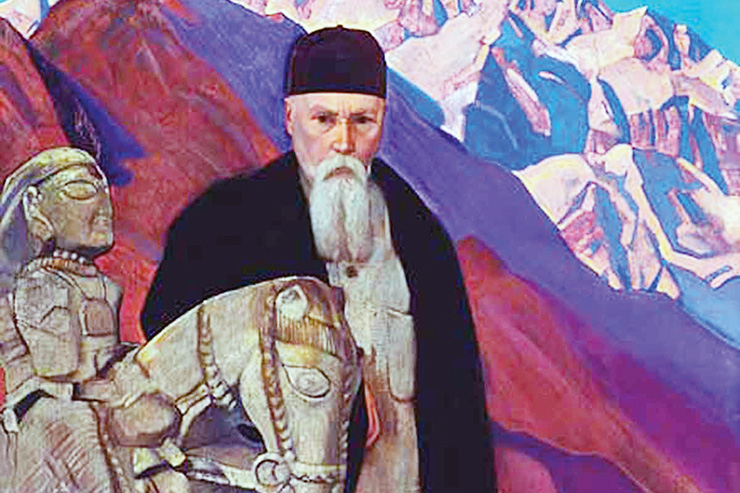
    Back in October 2000, the newly elected President of the Russian Federation, Vladimir V. Putin, granted a revealing interview to the editors of India Today and The Russian Journal. President Putin paid special tribute to Nicholas Roerich, the Russian artist, explorer and mystic, stating:

    “Roerich’s life was an amazing life, a marvel of creativity and astonishing example of spiritual closeness that, perhaps doesn’t lie on the surface, but is nevertheless the spiritual closeness that binds all peoples.”

    In December 2002, President Putin’s wife Lyudmila opened an exhibition of Nicholas Roerich’s work at the National Museum of India in Delhi.

    Nicholas Roerich (1874-1947) is remembered today as a celebrated Russian painter and occultist, whose intrepid journeys through Central Asia captured the attention of the Western public in the 1920s and 1930s. But Nicholas Roerich was also a master of ‘spiritual geopolitics’ who sought to establish a pan-Buddhist, transnational ‘New Country’ stretching from Tibet to southern Siberia, including territory that was governed by China, Mongolia, Tibet, and the Soviet Union. This ‘New Country’ was conceived by Roerich as the manifest, earthly expression of the invisible Kingdom of Shambhala, “the Holy Place, where the earthly world links with the highest states of consciousness.”1 This Shambhala Project was to establish the Sacred Union of the East.

    The American scholar John McCannon, who is writing a biography of Roerich, points out that in today’s Russia Roerich’s ideas are discussed at the highest echelons:

    Roerich’s name has appeared with surprising frequency in civic and academic discussion of international relations and new directions in foreign policy. Mainly, he has been cited by political scientists and strategic thinkers in Russia looking for models of ‘multipolarity’ and ‘global pluralism’ to counter U.S. hegemony and seemingly triumphalist or confrontational political theories from the West…2

    Since the earliest days of his first presidency, Vladimir Putin has worked tirelessly to lay the foundations of a Eurasian alliance. Just weeks after paying tribute to Nicholas Roerich, Putin told an international forum that “Russia has always perceived of itself as a Eurasian country.” Then in 2001, Russia and China, along with the states of Central Asia, founded the Eurasian political, economic and military organisation known today as the Shanghai Cooperation Organisation. Mongolia, Pakistan, Iran and India, have all expressed interest in joining the group.

    In the lead up to his election for a third term as Russian president, Putin set out his grand Eurasian vision in a series of widely published articles.

    Nicholas Roerich was introduced to the Buddhist legend of Shambhala while working on the first Buddhist temple ever constructed in Europe, in St. Petersburg the imperial capital of the vast Russian Empire. The Russian Tsar Nicholas II, although a devout Orthodox Christian and head of the Russian Church, had a deep interest in mysticism and Eastern wisdom. On several occasions the Tsar received the Buddhist monk Dorzhiev, assuring him that, “Buddhists in Russia may feel as if under the wing of a mighty eagle.” Construction of the St Petersburg Buddhist temple commenced in 1913 to coincide with the 300th anniversary of the Romanov dynasty. That same year Lama Dorzhiev, a friend of Nicholas Roerich and George Gurdjieff, wrote that Russia was about to fulfil the old Buddhist messianic myth of Shambhala by founding a great Buddhist empire in the East.

    One hundred years later in 2013, President Putin, himself a native of St. Petersburg, promised “100-percent support” for Russia’s Buddhists. Speaking during a visit to Russia’s Buryatia republic, Putin said he was proud that Russia is the only country in Europe where Buddhism is officially recognised as a traditional religion. The Russian President emphasised that “Buddhism plays a significant role in Russia… It has always been that way. It is well known that the Buddhists helped during both world wars.” Putin described Buddhism as a “kind, humanist learning based on love for others and love for one’s country,” and said he, the federal government and regional authorities were “always at [the Buddhists’] disposal and ready to support them.”3

    Like Tsar Nicholas II, President Vladimir Putin is known to be a devout Russian Orthodox believer with a strong interest in Eastern wisdom. A master of both sambo and judo, Putin has often spoken of how the martial arts – imbued with Asian philosophy – are intended to train the body and the mind. Though an Orthodox Christian, he is conscious of the spiritual authenticity of other traditional religions. And like Nicholas Roerich, who was born Orthodox Christian but later became steeped in Buddhism, Vladimir Putin may well sympathise with the view that the highest forms of all the world’s religions point to the same ultimate reality.

    For more about Russian President Putin, check out New Dawn Special Issue Vol 8 No 5. 

    [alert type=”general” dismiss=”no”]This article was published in New Dawn Special Issue Vol 7 No 6.[/alert]

    [alert type=”success” dismiss=”no”]If you appreciate this article, please consider subscribing to help maintain this website.[/alert]

    Footnotes

    1. See ‘From Synarchy to Shambhala, The Role of Political Occultism and Social Messianism in the Activities of Nicholas Roerich’ by Markus Osterrieder, www.scribd.com/doc/119329670/From-Synarchy-to-Shambhala

    2. ‘By the shores of white waters: the Altai and its place in the spiritual geopolitics of Nicholas Roerich’ by John McCannon, www.roerichmongolia.org/files/sibirica%20full%20text%20article.pdf

    3. ‘Putin Promises 100% Support for Buddhists’, RIA Novosti, 11 April 2013, http://en.ria.ru/russia/20130411/180578136.html

    © New Dawn Magazine and the respective author.
    For our reproduction notice, click here.