Sois sage dear heart & set my teachings down
If you do not your world will be undone
& heaven itself turn to one grinning skull.1
These lines appear in the poem “The Will,” by James Merrill (1926-1995), arguably the greatest American poet of the latter half of the twentieth century. Critics rarely mention that for most of his life Merrill was deeply involved with discarnate entities on a Ouija board, and that the poet’s 550-page masterpiece, The Changing Light at Sandover (Knopf, 1982), is based entirely on his conversations with those spirit guides. Fully one-third of the book consists of direct quotes from the numerous spirits with whom, with varying degrees of belief, ambivalence, and denial, Merrill hammered out the problems of the universe.
The lines quoted above are channeled from “Ephraim,” the first spirit guide with whom Merrill communicated on the Ouija board. Ephraim’s words place a crushing burden on the poet’s shoulders. The spirit is telling Merrill that if he doesn’t tell the world everything the spirits have told him, the world will be “undone,” i.e., destroyed. And that isn’t all: “heaven” (the “afterworld,” the “divine”) will be destroyed as well.
Ephraim seems to be implying (this is borne out by other quotes in The Changing Light at Sandover) that the afterworld exists, but that it needs man to give it definition, to give it shape and purpose. Behind this outlandish assertion lies the strange assumption that the spirits come to us, via the Ouija board or by whatever means, not because we need acknowledgement and answers, but because they need acknowledgement and answers. The German phenomenological philosopher Martin Heidegger has said, “God needs Being;”2 Ephraim’s statement seems to bear this out.
Over the past 160 years, the West has seen a great flowering of interest in, and practice of, channeling, i.e., receiving messages ostensibly from the spirit world. During this period, four literary/philosophical figures of stature have, by dint of lengthy encounters with the spirit world and the records they’ve kept of those encounters, provided us with valuable information concerning the nature of channeling. James Merrill is the most recent of these four.
The first was Victor Hugo (1802-1885), author of The Hunchback of Notre Dame and Les Misérables. Hugo’s feverish conversations with a hundred and twenty discarnate entities on Jersey island in 1853-1855 were at the centre of a sudden, ecstatic, upsurge of interest in channeling in England and France beginning in 1852. Instances of Ouija board-type channeling already went back a long way: In Rome, in 371 CE, a group of noblemen used an olive wood tripod supporting a circular metal dish with the alphabet engraved on the rim (a ring on a thread was suspended overhead) to obtain a message whose content led to all of the participants’ being executed for treason.3But from the time of the consolidation of Christianity up till the early nineteenth century, there are few records of such séances, no doubt because such activity usually led to a burning at the stake. By 1848, the grip of religion had relaxed sufficiently to allow the Fox sisters, of Hydesville, New York, who were channeling raps from the afterworld, to capture the attention of the world and bring about the birth of Spiritualism in the US and England and Spiritism in France.
The Irish poet W.B. Yeats (1865-1939) was a third dominating literary influence to become immersed in channeling. In 1925, Yeats published A Vision, a summary of his three years of talks with the spirit world through the agency of his wife Georgie’s automatic writing. Nobody was much interested; by this time the anti-mystical influence of Freud and a growing disillusionment stemming from World War One had dampened interest in channeling. (In 1992, the University of Florida published all 4,000 pages of the transcripts of Yeats’s talks with the spirit world.) In 1916, the Swiss philosopher-psychiatrist Carl G. Jung (1875-1961), who had broken with Freud and was already exploring other dimensions of reality, had a frightening encounter with the spirit world whose full details became known only in 2008 with the publication of Jung’s personal diary, The Red Book. (There had been some mention of the encounter in Jung’s 1962 autobiography.) Carl Jung was the fourth towering figure of our times to take the phenomenon of channeling seriously.
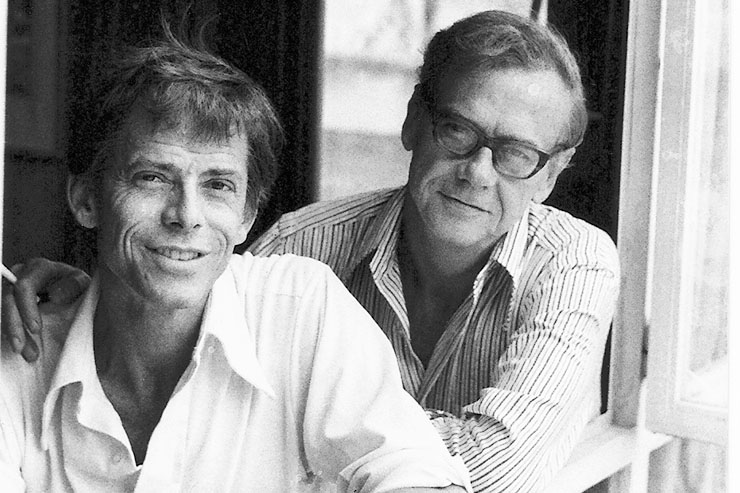
James Merrill and his lifetime companion David Jackson first used a Ouija board in 1955. (The planchette, a three-legged marker sliding over the letters of the board, had by now replaced the three-legged table, tapping with one leg, that Victor Hugo used.) By this time the influence of Jung, with its focus on transpersonal realms of archetype and collective unconscious, had superseded that of Freud. The wisdom of the East was opening up to seekers in the US and Europe. The stage was set for a second great upsurge of interest in channeling, one that reached its peak in the early 1980s and has only recently begun to wane.
People tend to either dismiss channeling completely or hang on the spirits’ every word. This is too bad, since the truth of channeling is not only complex, but may be far different from anything we have imagined so far. Carl Jung found this out in the summer of 1916. One day, a huge host of unhappy spirits of the dead seemed to stream in and occupy his living room. Before he could ask them anything, they hurled questions at him: “What is the nature of man?” “What is the nature of the universe?” “Who is God?” “Is God dead?” They told Jung that the dead know nothing beyond what they know at the moment of death.4
Was this an isolated incident? To say that the spirits come to us because they need help, and not the other way round, seems like a preposterous assertion. Yet there are hints here and there, especially in the writings of Hugo, Jung, Yeats and Merrill, that to pose such a question is at least to embark on a fruitful inquiry. This writer can’t hope to do anything more than point the reader in a few directions. To explore in depth what the spirits told James Merrill seems like a good way to start.
James Merrill
The future author of The Changing Light at Sandover was born in New York City on March 3, 1926, the second son of Charles Edward Merrill, co-founder and senior partner of the investment brokerage firm of Merrill-Lynch. The younger Merrill grew up in a milieu of wealth and privilege. He attended the best schools in New York and New Jersey and graduated from Amherst College with highest honors after having taken a leave of absence to serve in World War Two.
At 28, Merrill, with several volumes of poetry under his belt and a well-received off-Broadway play, had established himself as a talent to be watched. That was when he and David Jackson, living in Stonington, Connecticut, came across a Ouija board, began playing with it, and watched with bewildered amusement as the heart-shaped marker moved rapidly from letter to letter of the alphabet laid out in two curving rows on the brown, placemat-sized, board. Ephraim had arrived; he claimed to be a bisexual Greek Jew strangled to death at age 32 in 36 CE at the court of the Emperor Tiberius;5and he was charming and witty enough to hold the attention of the ultra-sophisticated, very intelligent, very well-read, and very skeptical Merrill and Jackson. Their attention rarely wandered as, over the ensuing months, years, and decades, a steady stream of equally captivating spirits came gliding across the Ouija board to beguile them with enchanting tales of our multidimensional reality.
By 1975, the hard-working Merrill had garnered a reputation as America’s leading poet. In that year, he put together his first volume of poetry devoted almost exclusively to his Ouija board adventures. Published in 1976 as Divine Comedies, it earned him a Pulitzer Prize. In 1978, Merrill published Mirabell: Books of Number, a continuation of the Ouija board saga; and in 1980 the final volume, Scripts for the Pageant, for which he earned a National Book Award. All three books were published together in 1982 as a single, 550-page poetic epic, The Changing Light at Sandover. James Merrill died suddenly of an AIDS-related heart attack on February 6, 1995. He was not quite sixty-nine.
The Spirits on Ancient History
Over more than thirty years, the spirits communicated to the two men a dazzling vision of our world as one set in motion by a God who is only one of a pantheon of gods, and who, like the deity of the Gnostics, has all but withdrawn from His creation. Our world, the spirits told them, was shaped and is controlled in its human and non-human dimensions by four archangels who are aided in their task by the discarnate spirits of a sentient species, long extinct, that preceded ours on earth. Reincarnation is a definitive, abiding principle of our world and the other levels of reality to which it is linked. But our universe is a troubled one; the gods are at war with one another, and our own God is failing for reasons that have entirely to do with us, his human creation. Only Merrill and Jackson – and all of us together – can help Him survive.
The spirits call this God “God B,” or “God Biology.” The “youngest brother” of many gods, He was, eons ago, made custodian of the Milky Way galaxy and charged with the task of seeding our planet with sentient life.
Four archangels, Michael, Gabriel, Emmanuel, and Raphael, work at his side. It was they who moulded our world, bringing it through geological age after geological age until it had been properly prepared for habitation.
Two “root races” preceded our own, although that term – familiar to students of Madame Blavatsky, Rudolph Steiner, Edgar Cayce and their depictions of the Lemurians and the Atlanteans – is not used by Merrill’s spirit guides.
The first sentient species God placed on earth was a race of intelligent, immortal, winged humanoids living in what is now China. The spirits allude to this species’ central city… a vast obsidian pile gleaming on the plain rutted by his machines. The winged humanoids destroyed themselves in an atomic war of such violence that God had to throw up a shield of positive matter6 – the Himalayas – to protect our planet from radioactive fallout.
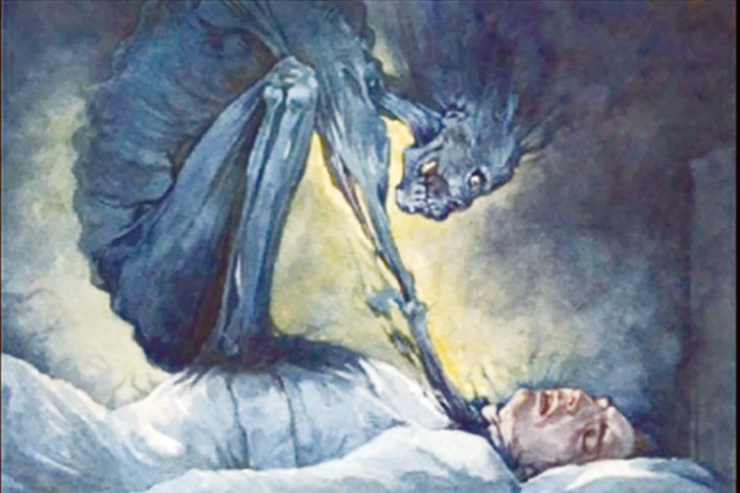
The second species, whom the spirit guides call the Atlanteans, was a race of unusually intelligent half-men/half-horses, resembling the centaurs of mythology. On the one hand these centaurs, in the beginning a grazing, pastoral breed, were limited in their ability to manipulate the environment because they had forelegs with hooves, not hands with opposable thumbs. On the other hand, this didn’t seem to hinder them from breeding a species of winged feathered servants by feeding uranium into the eggs of green grass flies. The centuries flashed by. The centaurs’ forehooves evolved into stubby fingers and they were able to store their grain in silos, using refracted sunlight to control the temperature. They continued to breed their winged servants in incubators, speeding them through 6,000 generations a year. When the servants emerged from their incubators, they were as tall as their masters, humanoid in shape, pitch-black in colour, and with burning red eyes. They resembled giant upright bats – and (coincidentally, or not) the “mothmen” described by John Keel in The Mothmen Prophecies.
These bat-creatures became the centaurs’ engineers, constructing their masters’ arenas and cities and running their heating and lighting plants.
There was a problem. The centaurs were immortal, and the Atlantean continents had become crowded with fenced-off areas containing all of the older generations of the centaurs down to the most primitive and ancient. The young, “witty” centaurs had taken to tormenting the very old trapt in their primitive form.7 The centaurs came up with a solution: They would annihilate the previous generations using atomic bombs. And they would get their servants, the bat-creatures, to do it for them.
The servants faithfully carried out their duty. But now the bat-creatures, being themselves immortal, and proliferating quickly, began to fear that their masters would do the same thing to them. They rose up against the centaurs and, using atomic bombs, slaughtered all but a few.
The bat-creatures now set out create an empire in the air. They forced the surviving centaurs to build landing strips and antigravitational skeins – continent-wide “crusts” sculpted with latticed cities and smooth plains. They forced the centaurs to man “anchor points,” huge stones glowing with radiation. This radiation, beamed up, would hold the floating continents in place in the ozone layer.
The bat-creatures enjoyed their empire in the air for a thousand years. But earthly vegetation had encroached more and more thickly on the anchor points, which could no longer be manned by the centaurs since they had evolved into ravenous longnecked creatures / reptilian heads [ripping at] greenery – dinosaurs.8
The radiation moorings frayed; the bat-creatures, arrogant and complacent, ignored this. Then one beam tore, then another; there was a sudden cataclysmic unravelling of the moorings; and the bat-creatures’ latticed cities shimmered, shred, and plunged to earth. All died; and all were damned, first for killing the centaurs, then for neglecting the mooring points. The bat-creatures, now a useless squeaking thinking cloud shunning light,9 were condemned by the four archangels never to take life again but to labour constantly in the service of mankind.
God B took the fate of his first two creations (and of the bat-creatures) very seriously. He decided that what had brought about the downfall of these species was their immortality. Being immortal, they could kill each other only with nuclear weapons. And, being immortal, they had not overcome the need to fight because they had not been able to learn properly – because immortality had provided them with no deadlines.
And so God brought homo sapiens, ourselves, into the world, and gave us mortality and a cycle of reincarnations.
The Spirits on Reincarnation
In The Changing Light at Sandover, the spirits have a great deal to say about reincarnation. They explain that all nature is suffused with soul; that “Mother Nature” is the resting place of soul,10 and that the reincarnational cycle of which humankind is a part demands that we live lives as animals, plants, and even rocks, as well as men and women. Merrill is told he is now living his 268th and last incarnation. Jackson is told that he has lived 289 lifetimes and must live several more. He is understandably dismayed, since this means he will be separated from Merrill.11
The spirits explain that, “Soul falls into two / Broad categories: run-of-the-mill / souls who / Life by life, under domed thicknesses, / Plod the slow road of Earth – billions of these / Whom nothing quickens, whom no powers indwell / …The other soul belongs to an elite: / At most two million relatively fleet / Achievers…”12
The souls of the two million elite, whom the spirits call the movers and shakers of mankind, enjoy a privilege not available to the other souls on earth: they spend time between lifetimes being recalibrated. This process, called cloning, takes place in the “Research Lab” and is carried out by the shades of multitudes of bat-creatures who labour without rest. Merrill is told that, between this lifetime and his last, these workers
wafted him hither, added the humus of / the Jew plus the gene of a chemist (& failed musician)
with the result that
et voilà U are not JM [James Merrill] what u might want to be / but a productive 5.5.13
“5.5” is Merrill’s talent rating, so to speak, a component of his Basic Formula. A talent rating quantifies the soul’s aptitude for serving mankind; Merrill, a partial 5,14 is very high on the scale.
Esoteric essences, called soul densities, may be injected into souls between lifetimes; one such is shooting, a special quality found only in plants. It is a cool upward thrust of / carbons. An intensity that might translate as pride; its insertion gives the soul, when reborn, spectacular vitality but a short lifespan. The poet Edwin Muir, the novelist Yukio Mishima, and the horticulturist Luther Burbank, all benefited from this lively brand of Lab cloning.15
In some schools of thought, such as Hinduism, and some channeling experiences, such as that of Victor Hugo, the rebirth of human being into animals, plants, and especially rocks, is seen as a punishment; according to Merrill’s guides, it’s a gift, an opportunity for enlightenment and exploration – a saintly elevation.16 The poet W.H. Auden (1907-1973), eventually one of the spirit guides on Merrill’s Ouija board, has been reborn as a soul romping through the mineral world; the spirits report one night that, Our witty poet surfacing off Alaska as a vein of pure / radium has havocked a nosy radio ship. 58 in lifeboats!
Most of the world’s population – the “run-of-the-mill / souls who/ Life by life, under domed thicknesses / Plod the slow road of Earth”17 – spend no time in the Research Lab but instead “get a short pep-talk, then rejoin the race.”18It seems that Earth’s population explosion beginning in the nineteenth century has stretched the amount of available soul matter thin. The spirits tell Merrill that to rectify the situation,
We have in the past century had to resort to / souls of domestic animals, most recently the rat./ By 2050 these too will be exhausted, & then?/ Wilder strains, mountain cats & forest monkeys. So / now u / Begin to see how without visibly interfering / We of the Lab must go about our work.19
Only the souls of the elite two million are eventually able to graduate from the cycle of reincarnation. Then they move upward through nine levels of afterworld purity. Those that reach the top are the best that humanity is capable of. They are incorporated into a kind of celestial blood bank from which transfusions of their soul-matter are made available on the basis of need to earth’s most talented mortals, especially its geniuses. The spirits explain that,
Since mid 19th cent. souls of the great scribes / Have been used 1/9 on earth reincarnated, 8/9 / as let us say safety deposits. We mine them… Proust / is deservedly enshrined. Tap him & as a statesman / at a dull banquet he converses, seems to be himself / But part of his mind literally wanders: Out on loan!20
(Victor Hugo’s spirit guides describe a roughly analogous procedure to the French poet.)
Merrill and Jackson are told that the shade of the French poet Arthur Rimbaud shared its soul matter with that of the living British-American poet T.S. Eliot; this afterworld-to-earth Vulcan mind meld gave birth to Eliot’s famous poem The Wasteland. W.H. Auden’s shade, often present at the séances, is connected to the living Merrill in the same way, while the largely silent presence of the shade of W.B. Yeats has the same kind of relationship with the mortal David Jackson.21
The V Group of Gifted Souls
A group of spectacularly gifted souls, numbering five and called “the Five” (or, “the V”), play a very particular role in the advancement of humanity. When we’re born, we have no memory of our past lives – except for the V. These five souls reincarnate again and again remembering every detail of all their previous lives. They are the spiritual leaders of mankind, whose “immortal” names are Laduman, Soriva, Rachel, Torro and Von.22 They take life again and again as athletes, artists, scientists, politicians and religious leaders.
The spirits explain:
These have lived centuries & live today heldover lives / Not in the scheme you know of the 9 stages. Remaining / Aware of it all, knowing the fruitlessness of speaking / Of their knowledge, they return to earth charged with / Energy / Beyond the norm.23
The Five began as “reincarnations” of the archangels Michael, Raphael, Emmanuel and Gabriel, each of these archangels representing one of man’s five (“V”) senses. Michael is “God’s seeing on earth;” his earthly incarnations include Akhnaton, Madame Curie, and Galileo. The Archangel Raphael is God’s hearing on earth, and has been reborn as Homer, Mohammed, Mozart, and an East German astrophysicist (alive today, but anonymous), inter alia. The archangel Emmanuel, God’s touching on earth, has spent time among us as Montezuma, Noah, and George Cotzias. (Cotzias is a scientist/friend of Merrill who had been engaged in unlocking the genome governing aging and now speaks to Merrill from the afterworld.)24 Sometimes these supercharged beings return to earth to live completely anonymous lives. (These often our choicest agents, declare the spirits).25
The Spirits on a Curious Period in Ancient Egypt’s History
The first two representatives of God B’s V were the twinned souls of Akhnaton and Nefertiti. The lifetime in ancient Egypt of this strange twinned soul is of particular importance, and the spirits spend some time explaining it to Merrill. His account in The Changing Light at Sandover reads like ancient Egyptian history seen through hallucinogenic glasses, or the acid trip of a genius.
Akhnaton/Nefertiti were married at age thirteen and ruled for eighteen years, according to Merrill’s spirit guides. The royals oversaw a switch in religious belief and a leap forward of all the sciences. Polytheism was abolished; the temple priests were strangled; the slaves were freed; and the worship of a single god was introduced. A surge of creativity sweep across Egypt: Physicians found great cures; there were no fevers / A generation was born a hand taller than its parents / Light storage much like the battery was invented / both palaces and humble homes were lit and heated by the sun.26 Harnessing the power of the sun, the Egyptians controlled the tides up and down the Nile and closed the Straits of Gibraltar, allowing just enough water in to turn the Mediterranean into a tranquil lake.
The crowning achievement of this epoch was the erection of a fifteen-metre-high rock crystal pyramid with dimensions sculpted in such a way as to harness every ray of the sun and enable Akhnaton to rule the world. For one year, 1,500 workers polished the capstone to perfection. On the night before it was to be lowered onto the top of pyramid, Akhnaton, watching with Nefertiti on a barge decorated with diamond pyramids, was so intensely thrilled his physicians fed him opium each hour.27
The setting-in-place of the capstone, attempted at the first moment of dawn, was a cataclysmic failure. The proportions of the pyramid were a fractional millimetre wrong;28 there was a violent, fiery explosion, and the crystal pyramid rose, fell, then melted into a lake of molten crystal (which, the spirits tell Merrill, is still there, solidified beneath Thebes). Far away on the island of Crete, the volcano Thera erupted, destroying the city of Minoa. Akhnaton and Nefertiti, their twinned soul unutterably harrowed, cut their wrists, held their arms over the side of the barge, and bled to death into the Nile. The devastation was such as to render the surrounding deserts infertile for 1,200 years.
This fiery ending to monotheistic Egypt (provoked by no less than His beloved, first two, “twinned,” V souls) devastated God B and made him rethink his plans.
God B & the “No Accident Clause”
Up until this time, it seems, mankind had complete free will; “Chance” prevailed upon the earth. God B now decided to invoke the “No Accident Clause,” that is, to remove an element of free will from the souls of the elite two million who guide the destinies of man. Hitherto, these movers and shakers were free to do whatever they liked – to remain open to the randomness of the universe. But God B now moved from a policy of, so to speak, total deregulation, to one of some regulation, commanding his archangels to clone certain controls into his ruling elite. As scholar Judith Moffett tries to explain, “Apparently the No Accident clause means that what happens to [God’s chosen] souls is planned and purposeful to the minutest detail.”29
From the 14th century BCE to the 20th century, then, mankind has not had complete free will; through the movers and shakers of humankind, God B has exercised a high degree of control over our lives. But now the No Accident Clause is unravelling. This is because religious and moral standards are eroding quickly in our time, and also because human beings not belonging to the elite are increasingly acquiring the money, the power and the leisure time to do great damage, e.g., to buy and sell atomic bombs. Accidents have begun, the spirits tell Merrill. Like the first faint twirls of smoke / We see all the old signals.30
The spirits hint that God B fears that mankind, his third sentient species upon earth, may also be about to destroy itself with atomic bombs. He has prepared for this contingency. A fourth sentient species, which God calls Alpha Man, waits in the wings. This race will be immortal (after a little time), winged, and without genius. The divine spark of genius is responsible for mankind’s greatest achievements, and also for his most hideous disasters; if homo sapiens fails, there will be no more genius. The new race of Alpha Man will – if it is needed – Swim & glide, / A simpler, less willful being. Duller too? / If so, is that sharp edge not well lost / Which has so variously cut and cost?31
James Merrill on the Spirits
What did James Merrill think about all this? Did he think the spirits really existed, and that the stories they told were really true?
In an interview with this writer, the poet claimed to have “maintained an attitude of perfect ambivalence toward the spirits for twenty-five years,”32 never being quite able to accept them, and never being quite able to reject them. Either these “communicators,” as he called them, using Yeats’s terminology, were outside us working on our minds, which was fantastic, or they were inside us working through our total consciousness, which was also fantastic. We were all far more than we knew.
What was the reality of these spirits? The poet said they often seemed to him to be metaphor and reality – subatomic reality – both at the same time. They were literally who they said they were – and they were also powers, energies, manifesting from “within the atom,” the elemental forces of nature itself. The bat-creatures’ story of building cities into the sky was exactly that. But it was also, somehow, the story of a fatal destabilising of the atom – or an account of the extension of man’s brain, in an earlier phase of our evolution, through the addition of a cortex.33
Merrill insisted all his life that the spirit guides, if they possessed a measure of objective reality (and he tended to believe they did), were dependent for the expression of that reality on pictures and ideas created by the mind of man. These powers/energies would be “invisible, inconceivable,” he said, “if they’d never passed through our heads and clothed themselves out of the costume box they’d found there.” It followed from this that the spirits would manifest themselves differently from culture to culture, from epoch to epoch, from person to person. “A process that Einstein could entertain as a formula might be described by an African witch doctor as a crocodile,” said Merrill, adding that, “what’s tiresome is when people exclusively insist on the forms they’d imagined. Those powers don’t need churches in order to be sacred. What they do need are fresh ways of being seen.”34
He wasn’t just “making it all up,” Merrill insisted. “I worked very hard,” he said, “in putting the poem together, to try to persuade the reader that these things actually happened… What does rather sadden me are the critics who think that we were pretending – that we didn’t have the experience.”35
It seems that the disasters attended man on earth have also attended God B; that God’s welfare is intimately bound up with that of his creations.
Towards the end of The Changing Light at Sandover, Merrill and Jackson are brought into the presence of God. The spirits empower them to use the Ouija board to “listen” to His “song.” What the Ouija board spells out is:
Ive brothers hear me brothers signal me
alone in my night brothers do you well
I and mine hold it back brothers I and
mine survive brothers hear me signal me
do you well I and mine hold it back I
alone in my night brothers I and mine
survive brothers do you well I alone
in my night I hold it back I and mine
survive brothers signal me in my night
I and mine hold it back and we survive 36
The shade of W.H. Auden, listening in from the Other Side, tells them the Deity is like a shipwrecked sailor, alone / keeping up his nerve on a life raft.37
Even such urbane and skeptical Ouija board adventurers as Merrill and Jackson are shocked and saddened by this encounter. It sets them to thinking; and, in this brief discussion, we can take up only one thread of that thinking.
In the beginning, Merrill had thought the spirits were himself and David Jackson. Then he thought they were a kind of amalgam, some otherworldly energy necessarily filtered and distorted through his mind and sense organs.
He had become increasingly aware that the spirits shifted and changed the more he got to know them, as if he were in some sense the author of this drama – and as if they too were the authors.
Merrill now recalled the time when the spirit guide who spoke to them most often revealed that, when he began to serve them through the Ouija board, his form on the Other Side was as a black-and-white centaur. But, he says, as he had grown to love them, and they had grown to love him, he suddenly found himself transformed into a Technicolour peacock. He tells them:
B4 [before] our meetings I was nothing no time passd but now / yr touch like a lamp has shown me to myself & I am / me! [the peacock].38
The mortals’ “touch like a lamp” has been sorely lacking in mankind’s relations with God. There has been a reverse transformation: Over the past few centuries, our increasing indifference to God has drained Him of His power. Earlier “Great Scribes” (to whose number, the spirits tell Merrill, he belongs) have described, in function of the fullness of their faith, a God very different from what Merrill and Jackson have seen. The spirits tell Merrill this when, speaking directly in the afterworld to two deceased friends of the Ouija board adventurers, Maria and Wystan, while Merrill and Jackson listen in through the Ouija board, they say:
Dante heard that song [God B’s desperate “shipwrecked sailor” plea] / The lyrics may be changing / Dante saw the rose in fullest bloom / Blake saw it sick / You and Maria [deceased friends of JM and DJ, observing from the other side] who have seen / The bleak unpetalled knob / Must wonder, can it last till spring? / Is it still rooted in the sun?39
How the Spirit World Relies on the Living
At séances, in some religious philosophies, in accounts of experiences in other aspects of multidimensional reality, other hints peek through that the paranormal beings with whom we speak need us as much as we need them. At a séance conducted by prominent South Florida medium Marilyn Raphael, one of the more forceful spirits, a frequent visitor at these séances, stated:
We as inhabitants of the spirit world no longer have what you call a light around us. You are our light. The light is created by the living. The disembodied soul has no energy to create light. When we come into your room, we feed on your light and your energy. Now once we feed on your energy, we feel your thought patterns. You create the vision for us to see ourselves. Your energy is what we here live from. We become the apparition, we become the dialogue, we become the writer of ourselves when we can have your energy. But we do not take your energy unless we are invited.40
It is as if humankind were the sense organ of God; as if it were only through the human imagination, functioning in the incarnate mode, that the spirit world can sense and see itself. And, if that is so, then the exhortations of these beings to humankind to survive and expand are in a sense cries for help; they, too, are fighting to survive.
Dannion Brinkley writes in Saved by the Light his classic account of a near-death experience, that, while communicating with a group of Light Beings, he was seized by “the amazing realisation that the Beings were desperately trying to help us, not because we were such good guys, but because without us advancing spiritually here on earth, they could not become successful in their world.”41
In Abduction: Human Encounters with Aliens, Harvard Medical School Professor of Psychiatry and Pulitzer Prize-winning author John E. Mack wonders if the alien abductors aren’t extensions of ourselves seeking redemption through reintegration with us. “The alien identity seems to be connected in some way with the soul of the human self,” he writes, “and one of the tasks the abductee then confronts is the integration of their human and alien selves, which takes on the character of reensoulment of their humanity.”42
Even astral-traveller Robert A. Monroe, in his three autobiographical volumes, hints at the importance of man to other dimensions of the universe when he says that we secrete an astral substance, called Loosh – that only we secrete – that is essential to beings in many levels of the universe, who periodically, and surreptitiously, come and “harvest” us.
On a more conventional note: the importance of man to God was understood very well by the Kabbalistic scholars of long ago. Gershom Scholem, world authority on Jewish mysticism, sums it up:
“Opposite poles, both man and God encompass within their being the entire cosmos. However, whereas God contains all by virtue of being its Creator and Initiator in whom everything is rooted and all potency is hidden, man’s role is to complete this process by being the agent through whom all the powers of creation are fully activated and made manifest. What exists seminally in God unfolds and develops in man… Man is the perfecting agent in the structure of the cosmos… He is also the ‘transformer’ who through his own life and deeds amplifies these forces to their highest level of manifestation and redirects them to their original source.”43
James Merrill’s spirit guides might have been dictating this.
[alert type=”general” dismiss=”no”]This article was published in New Dawn Special Issue Vol 6 No 2.[/alert]
[alert type=”success” dismiss=”no”]If you appreciate this article, please consider subscribing to help maintain this website.[/alert]
Footnotes
1. Merrill, Divine Comedies, 41; 2. Heidegger, 291; 3. Dodds, 222; 4. Chambers, Secret Life of Genius, 215-217; 5. Merrill, Sandover, 8; 6. Ibid., 459; 7. Ibid., 168; 8. Ibid; 9. Ibid., 122; 10. Ibid., 389; 11. Ibid., 143; 12. Ibid., 139; 13. Ibid., 145; 14. Ibid., 143; 15. Ibid., 151; 16. Ibid., 309; 17. Ibid., 511; 18. Ibid., 139; 19. Ibid., 145-146; 20. Ibid., 189; 21. Ibid., 217, 219; 22. Ibid., 131; 23. Ibid; 24. Ibid., 142-143; 25. Ibid; 26. Ibid., 227; 27. Ibid., 126; 28. Ibid., 127; 29. Moffett, 198; 30. Ibid., 476; 31. Ibid., 512; 32. Personal Communication, January 1978; 33. Moffett, 191-192; 34. Merrill, Recitative, 68; 35. Radio Interview, “Voices and Visions,” 1985; 36. Merrill, Sandover, 360; 37. Ibid., 362; 38. Ibid., 155; 39. Ibid., 363; 40. Unpublished manuscript: Night Out on the Earth Plane; 41. Brinkley, 46; 42. Mack, 49; 43. Scholem, qtd. in Reincarnation, 191-192.
Works Consulted
Dannion Brinkley, Saved by the Light: The True Story of a Man Who Died Twice and the Profound Revelations He Received, New York: Harper Collins, 2008.
E.R. Dodds, Professor, “Supernormal Phenomena in Classical Antiquity,” Proceedings of the Society for Psychical Research, Vol. 55, Part 203 (March 1971): 189-237.
C.A. Buckley, “Quantum Physics and the Ouija-Board: James Merrill’s Holistic World View,” Mosaic: A Journal for the Interdisciplinary Study of Literature 26 (2) (Spring 1993): 39-61.
John Chambers, “The Channeled Myths of James Merrill,” The Anomalist 5 (Summer 1997): 41-58.
John Chambers, The Secret Life of Genius: How Twenty-Four Great Men and Women Were Touched by Spiritual Worlds, Rochester, VA: Destiny Books/Inner Traditions, 2009.
John Chambers, Night Out on the Earth Plane, Unpublished Manuscript.
John Chambers, Victor Hugo’s Conversations with the Spirit World: A Literary Genius’s Hidden Life, Rochester, VA: Destiny Books/Inner Traditions, 2008.
Martin Heidegger, Contributions to Philosophy (From Eknowning), [Beiträge zur Philosophie: Vom Ereignis], Bloomington: Indiana University Press, 1999.
John E. Mack, Abduction: Human Encounters with Aliens, New York: Scribners, 1994.
J.D. McClatchy, ed., Recitative, San Francisco: North Point Press, 1986.
James Merrill, “The Art of Poetry, 31: James Merrill,” The Paris Review 84 (Summer 1982): 184-219.
James Merrill, The Changing Light at Sandover, New York: Alfred A. Knopf, 1996.
James Merrill, James Merrill: Voices from Sandover, Princeton, NJ: Films for the Humanities and Sciences, FFH 4182, VHS, 1990.
James Merrill, Radio Interview, “Voices and Visions”: A Guided Tour of Revelations,” Documentary, Canadian Broadcasting Corporation, 1985.
James Merrill, “The Will,” Divine Comedies, New York: Atheneum, 1976, 41.
Judith Moffett, James Merrill: An Introduction to the Poetry, New York: Columbia University Press, 1984.
Gershom Scholem, qtd. in Reincarnation: A New Horizon in Science, Religion, and Society. Sylvia Cranston and Carey Williams, New York: Julian Press/Crown Publishers, 1984.
© New Dawn Magazine and the respective author.
For our reproduction notice, click here.