New Dawn – World's Most Unusual Magazine

Tag: telepathy

  • The Soul in the Sea: Re-Uniting with the Dolphins

    The Soul in the Sea: Re-Uniting with the Dolphins

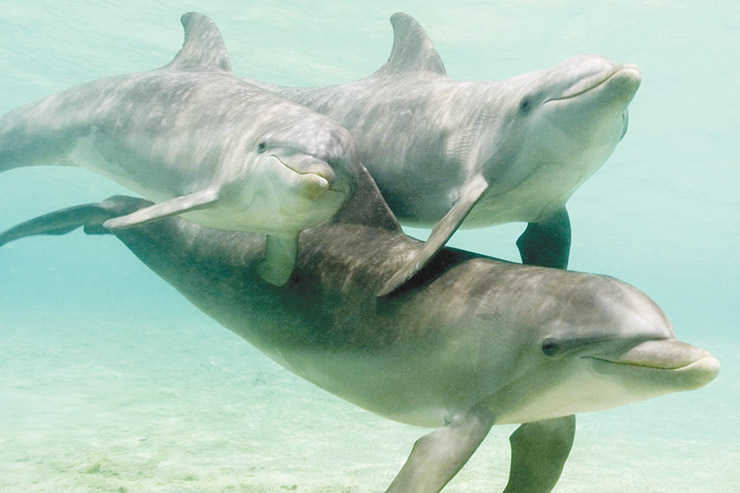
    “What mystery is the sea,” exclaimed Herman Melville, “whose stirrings speak of a hidden soul beneath!”1 I only understood what the great American meant for the first time two years ago, while visiting the Roatán Institute for Marine Sciences in Honduras. It was located at an otherwise uninhabited islet just off the mainland, where a shallow barrier corralled more than thirty dolphins within some six square acres. The top of the fence stood so low above the water, all but the most arthritic dolphin could easily hop over it. In fact, several have made good their escape in this manner, I was told, only to jump back inside a few days later.

    As part of their daily routine, all the resident dolphins are herded together and taken out to sea, where they often frolic with their friends and relations in the wild for an hour or so – much like walking one’s pet dogs – before returning to the fenced-in islet. Perhaps they regard it as a sanctuary from sharks, enjoy its largesse of flattering attention from scientists and tourists, are bribed by free squid and herring – among their favourite delicacies – or all these amenities and more no human can guess.

    Together with fellow tourists guided by a local handler, we waded into shallow depths and were immediately met by a female dolphin, which allowed us to come quite close, even touch her. Expecting to feel a hard or at least tough, scaly exterior, I was surprised by her supple, smooth, warm skin, so human-like.

    “No one who has ever touched the skin of a dolphin,” wrote famed oceanographer, Jacques-Yves Cousteau, “is likely to forget the silken, elastic, soft feel of it.”2 But a deeper impression was made by her light brown eyes. Behind the anticipated high intelligence and complex awareness, there was something even more compelling lurking deeper inside. If, as the old French saying has it, “the eyes are the mirror of the soul,” then her gaze betrayed a core mystery comparable only to a kindred connection.3

    The feeling is not uncommon. Cetacean researcher Ann Spurgeon spoke for many, when she observed, “We looked often into the dolphins’ eyes, and the quality of the look they returned was unlike that of any animal we have known.”4

    According to no less an authority on the sea than Cousteau himself, “it is obvious that dolphins are often motivated by curiosity, and especially by curiosity about man. One literally can see it in their eyes. This is a fact that can be doubted only by someone who has never really looked a dolphin in the eye. The brilliance of that organ, the spark that is so evident there, seems to come from another world. The look which the dolphin gives – a keen look, slightly melancholy and mischievous, but less insolent, conniving and cynical than that of monkeys – seems full of indulgence for the uncertainties of the human condition.”5

    Belgium’s pioneering underwater archaeologist and the world’s first aquanaut went further: “The glimmer of interest which sparkled in their eyes seemed to be a human glimmer.”6 Robert Sténuit’s radical suggestion articulated my, as yet, unformulated suspicion – a wordless knowing beyond understanding, much less expression, as though my own mind had been somehow confronted with or partially overtaken by a significant truth too grand or potent for me to really comprehend or to put into words.

    Richard Wagner’s Hans Sachs articulated my perplexity in The Mastersingers of Nuremberg: “I feel it, but cannot understand it; cannot completely recall it, but can never forget it. I can grasp it entirely, ’though cannot measure it. But how can I grasp that which seems immeasurable? … It seemed so old, and yet was so new.”7

    Cousteau was no less taken by his first, personal contact with a wild dolphin. “It was an extraordinary situation,” he confessed, “as though the barrier between man and animal no longer existed. There was some sort of strange understanding between us. It would be very difficult for me to say exactly what our feelings were for one another, but there was undoubtedly something.”8

    Such an inexpressibly profound impression is not unknown to other persons touched by the creature’s singular energy field. “Those who have come very close to dolphins feel it inside themselves,” stated Dr. Horace Dobbs, a leading delphinologist, “yet cannot explain it. Exactly what it is remains a mystery. For want of a better word, let us call it spirit of the dolphin.”9

    Dolphin Meets Humans

    From the moment the Roatán dolphin first approached our gaggle of tourists, I could not escape the strong impression – realisation, perhaps – that it was very rapidly probing us with the powerful energy of some unseen and inconceivable instrument; scanning each one of us individually; psychically scoping us out down to the absolute bottom of our souls; reading everything in our conscious and subconscious minds; assessing the totality of our identity; determining our threat or friendly potential; yes, judging us – completely and thoroughly within the matter of a few seconds.

    Being in the ocean with a living, breathing dolphin close enough to touch it was nothing like seeing one perform at Sea World, watching it on television, or reading about cetaceans in a library. No “virtual reality” approximates sharing the same water with such a singular creature. Although common enough these days, and similarly enjoyed by many thousands of tourists around the world, my dolphin encounter near Roatán was nevertheless a memorable, if ineffably real occurrence.

    I approached it with no expectations, no preconceived ideas, but left myself open to whatever might or might not happen. I did not endeavour to “mind meld” with the creature, nor force any such boorish impertinence upon it, and instead hoped to learn something not otherwise available in less personal circumstances. To be honest, the experience was somewhat tinged with fear, not for what the dolphin would do, but what it could do. However amiable it outwardly appeared, being at the mercy of a nine-foot-long, three-hundred-ten-pound, mentally sharp beast moving through the water seven times faster than the best human swimmer and with the agility of a bull-whip in an environment where bodily inferior men are sluggish and clumsy, gave me pause. Aristotle and his 4th century BCE colleagues believed the dolphin was the fastest creature in the sea, and they may have been right.

    In 1975, Jacques Cousteau wrote of his personal experience aboard a French Navy cruiser “in the waters of the Far East… I realised that the school of dolphins, in catching up to and then passing the Primauguet, as it moved at full power, must have been swimming at a speed of no less than fifty miles per hour!” Later, he calculated that a dolphin needed to beat its tail one hundred twenty times per minute, or two strokes every second, to reach a speed of just ten knots, or 11.5 miles per hour.10

    Professor Paul Budker, director of the National Museum of Natural History and the Laboratory of Colonial Fisheries in Paris, found that dolphins “move as though by magic, and are capable of producing more power per pound of muscle than any other animal.”11

    Cambridge University’s Sir James Gray observed that “the form given by Nature to the dolphin is more effective than that of any submarine or torpedo conceived by man.”12

    Dolphin Aggression Rare

    While friendly toward humans, dolphins do have a temper and occasionally show aggressive behaviour, not always for obvious reasons. “A dolphin could kill a man with a blow of its snout,” writes Sténuit. “It could dismember him with a snap of its jaws, because it possesses a double row of strong, conical teeth, eighty-eight in all, which sink in with precision. But never, absolutely never, has a dolphin or a porpoise attacked a man, even in legitimate defence, with a harpoon in its side, or when, with electrodes in its skull, it has been massacred in the name of science.”13

    Since Sténuit made this statement in 1968, three humans have, in fact, been killed by Orcas, the first on 21 February 1991, at Canada’s Sealand of the Pacific, in British Columbia, which thereafter closed its doors for good; again in 1999, but most recently and famously, eleven years later in Shamu Stadium at San Diego, California’s Sea World, by the largest Orca in captivity, weighing six-and-a-quarter tons and measuring over twenty-two feet long.

    In spring 1985, author Timothy Wyllie was brutally attacked at Key Largo, Florida by a sexually aggressive male dolphin intent on raping him. All these incidents and similarly negative encounters occurred with captive dolphins, whose naturally amiable dispositions were perverted by the unnatural conditions imposed on them

    For example, the “Seaworld of Hurt” web site reports that an Orca called “Tilikum” was “held captive against his will; all he could do was swim in small circles and float aimlessly at the surface of the water, far away from the expansive ocean in which he had swum a hundred miles a day alongside his family members.” His artificial environment was a “barren one-hundred-foot-by-fifty-foot pool – just thirty-five feet deep… He was forced to perform every hour, on the hour, eight times a day, seven days a week. When ‘Tilikum’ did not perform a trick correctly, food was withheld from both him and his tank-mates, which caused a great deal of tension, and as a result, ‘Haida’ and ‘Nootka’ would bite ‘Tilikum’ and rake the entire length of his body with their teeth. The constant stress and exhaustion gave him stomach ulcers.

    “When the park closed its doors at the end of each day, the three incompatible Orcas were crammed into a tiny, round, metal-sided module for more than fourteen hours until the park reopened the next morning. Over the course of twenty-one years at SeaWorld, where he is confined to a tank containing 0.0001 percent of the quantity of water that he would traverse in a single day in nature, ‘Tilikum’ has been involved in multiple incidents of aggression. The stress of captivity drives ‘Tilikum’ to exhibit abnormal repetitive behaviour, including chewing on metal gates and the concrete sides of his tank – so much so that most of his teeth are completely worn down.”14

    These typical seaquarium conditions – less hideous than those in so-called “Third World” countries – are on a par with the worst penitentiaries, which similarly bring out the worst in human behaviour. “No aquarium, no tank in a marine land, however spacious it may be,” Jacques Cousteau pointed out, “can begin to duplicate the conditions of the sea. And no dolphin who inhabits one of those aquariums or one of those marine lands can be considered normal… There is no doubt that a dolphin who lives among humans for any length of time undergoes a deep psychological modification.”15

    Aggressive confrontations between dolphins and ourselves take place mostly under captive environments. Free dolphins in the wild are not known to have ever deliberately killed or injured anyone. That said, there are accounts, however rare, of their overt sexual interest. Wyllie writes that the only man he ever knew who truly hated dolphins was a father who claimed that his son was raped by one, although under what circumstances, he did not specify.16

    If real enough, the isolated and extreme rarity of these incidents must nevertheless be stressed to put them into balanced perspective. Guilt for negative encounters with dolphins, however, has been and continues to be virtually entirely on the human side. They are, after all, our fellow mammals, still imperfect, for all their admirable qualities, and far more typically dedicated to refraining from killing us, for which, in view of our past and present atrocities committed against all cetaceans, they have abundant justification.

    “When we work to save them,” stated Frank Robson, New Zealand’s leading cetologist of the last century, “we are, in a sense, acting to save ourselves.”17 In spite of the horrific abuses we continue to heap upon them, wild dolphins continue, as they always have, to seek out and enjoy our company, even volunteering to rescue unknown numbers of us from otherwise certain death at sea. In this, they are either abysmally naive or angelically high-minded. Given their prodigious brain, however, the former alternative is less likely. It is as though they remember how, more than twenty-five centuries ago, Greeks made killing dolphins a capital offense, and enacted their own form of reciprocal legislation against taking human life. However rarely observed, Pacific killer whales occasionally encircle a pod, individually seizing and devouring a victim, until all the dolphins have been devoured, behaviour from which the species’ original term derived: Orca gladiator.

    No less appropriately, the genus name Orcinus means “of the kingdom of the dead,” from the original Etruscan and later Roman god, Orcus, punisher of evil souls in the Afterlife. Among themselves, killer whales, as well as dolphins, commit infanticide, similarly practiced by raptors, most notably eagles, as well as elite human societies, such as those made famous by the Spartans and Vikings. Alpha males of our own, pre-modern, militaristic ancestors routinely inspected newborns for the slightest indication of physical deformity or any other inherent anomaly, as predatory birds still do. If discovered, the baby or hatching was, or is, discarded to safeguard the species’ genetic integrity.

    Such behaviour may contrast with but cannot detract from the dolphins’ over-riding amiability toward fellow mammals, us included. Even the dolphin I met off the coast of Honduras, while certainly congenial, pointedly refused to obey some of its human handler’s instructions. As Robson discovered, “there is absolutely no way a wild dolphin can be forced to comply with the wishes of a human. If it suits him, he’ll comply. If he doesn’t feel like it, he won’t.”18
    [alert type=”success” dismiss=”no”]If you appreciate this article, please consider subscribing to help maintain this website.[/alert]

    Dolphin Conference

    Of all the enigmas Jacques Cousteau observed during almost seven decades of underwater exploration, perhaps his most bizarre encounter took place sixty years ago, off a reef in the middle of the Indian Ocean. In the process of gathering material for his now-classic film, The Silent World, he “saw a dolphin rise to the surface to breathe, and then let himself sink down into the water again, without swimming.” This sighting followed several days of other, unusual delphine behaviour, when, “every morning at about ten o’clock,” a small pod of dolphins swam by his anchored research vessel. Intrigued, Cousteau and a fellow diver slipped into the sea.

    “To this day, I have not forgiven myself for not taking a camera,” he recalled. “The sight that greeted us was one that we have never seen again. There were about fifteen dolphins – probably the school that we had seen going past Calypso every morning – in the crystal-clear water, on the side of the reef. They were sitting on the bottom, in a group, as though they were holding a conference. I say ‘sitting;’ I mean that they were literally poised on their tails.

    “They remained where they were, stirring a bit and looking at one another. Then they continued with their meeting. But when we tried to move in closer to them, they swam away immediately. It was a unique and extraordinarily impressive sight. The truth is that I still have no idea what they were doing.” Telepathically communicating with each other, most likely. Cousteau himself wrote that their “meeting” suggested “an underwater congress.”19

    More intriguing still, about what did they confer? Given their proximity to Calypso, they were probably discussing the untypical presence of anthropomorphic divers in an otherwise unvisited area of the vast Indian Ocean; what could have brought the strangers here, how should the pod regard them, and related issues of the moment. The dolphins sat together, as humans do, yet another comparison between both species – like eye similarity, the soft spot at the top of our head corresponding to the dolphin’s blow hole, human-like fingers, hands, thighs, knees, feet and toes in the dolphin embryo, etc., etc. – indicating a shared evolution of some kind.

    Can all this mean that we were once dolphins before our ancestors returned to dry land, where primate attributes are more useful? If so, do the dolphins still preserve a cultural or collective memory of our aquatic past, and regard us on account of it as their mammalian relatives? Is that the real basis for their demonstrable love of humankind? Given their immense intellect, they may know much more; everything, in fact, there is to understand concerning the illimitable bounty of the sea. What they might teach us about it could mean the difference between our annihilation or survival in an age of extinction.

    Poisoning of the Oceans

    The animals’ wholesale slaughter by Japan has assumed international notoriety, but even more devastating is progressive poisoning of the planet’s water resources. Just how far rising levels of toxicity have already gone to reduce dolphin world population is difficult to determine. But cetologists do know that the first birth given by a dolphin mother dies from all the human toxins it ingests, while a second birth usually survives, because its immediate predecessor absorbed most of the toxins. This process, even if it continues at present levels – which, of course, it won’t – must result in at least cutting dolphin populations in half.

    “The growing presence of toxic chemicals in the marine environment presents a crisis unlike any ever faced on this planet,” warns Blue Voice, an ocean conservation organisation founded in 2000. “Vast quantities of toxic chemicals enter the waterways and oceans of the world each day and accumulate, then bio-magnify in the marine food chain. In a time when we have reduced the number of large pelagic fish by ninety percent and the bio-mass of the oceans by seventy percent, we are poisoning much of the living marine resources that remain. This has staggering global implications for ocean life and human health. A level of one hundred parts per million of mercury has been found in a bottlenose dolphin killed for food in Japan – a level more than one hundred times that accepted by Japanese health authorities… Dolphins, toothed whales, large tuna and swordfish are among the marine creatures with highest levels of contamination, because they feed at the apex of the food chain.”20

    Whenever greed and self-interest are at issue, Man’s indifference to the suffering and extermination of his fellow creatures – even if their plight endangers himself – is human nature. As such, it cannot be eradicated by education or legislation, but will only disappear with himself. This was what Cousteau and other scientists realised and advocated in the last century.

    “Redemption will come only when we return to the water, as sea mammals did in the past,” Cousteau repeatedly declared; “gravity is the original sin… The sea, the great unifier, is man’s only hope… We must plant the sea and herd its animals using the sea as farmers instead of hunters. That is what civilisation is all about – farming replacing hunting… If we go on the way we have, the fault is our greed, and if we are not willing to change, we will disappear from the face of the globe, to be replaced by the insect. If we were logical, the future would be bleak, indeed. But we are more than logical. We are human beings, and we have faith, and we have hope, and we can work.”21

    That work, as he envisioned it, was gradually returning us to our aquatic origins in the baptism of a new species to wash away the original sin of our human-all-too-human nature. Nor is the prospect as fantastic as it may seem. Some human populations living in an intimate relationship with the sea are already developing marine mammal characteristics.

    Projecting what we have learned or suspect about such transformational potentials and our own aquatic origins into some inconceivably distant future, we can imagine an Earth entirely restored to its original, pristine condition. All its creatures roam free – unhunted, unexploited, and unharmed, save by natural predators, as part of the eternal balance of life – through an unpolluted environment of worldwide fresh air and water.

    The wheel of organic existence runs on undisturbed, because no trace may be found of the viral species that formerly dominated this exquisitely beautiful planet, save among the last vestiges of its overgrown and crumbling cities. Their former inhabitants are gone, for the good of the world and themselves. Nor can the descendants of this lost race be found among the deserted, disintegrating ruins, because they have – all of them – reunited with their brother and sister dolphins in the sea.

    [alert type=”general” dismiss=”no”]This article was published in New Dawn 153.[/alert]

    [alert type=”success” dismiss=”no”]If you appreciate this article, please consider subscribing to help maintain this website.[/alert]

    Footnotes

    1. Herman Melville, Typee: A Peep at Polynesian Life, Penguin Classics, 1996
    2. Jacques-Yves Cousteau, Dolphins, Doubleday & Company, 1975
    3. Gregory Y. Titelman, “Les yeux sont le miroir de l’dme,” Dictionary of Popular Proverbs and Sayings, Random House, 1996
    4. Splurgein cited by Amada Cochrane & Karena Callen, Dolphins and Their Power to Heal, Healing Arts Press, 1992
    5. Cousteau, op. cit.
    6. Robert Stenuit, The Dolphin, Cousin to Man, Sterling Publishing Co., Inc., 1968
    7. Richard Wagner, The Mastersingers of Nuremberg, G. Schirmer, Inc., 1932
    8. Cousteau, op. cit.
    9. Horace Dobbs, Dolphin Healing, Judy Piatkus Publishers, 2000
    10. Cousteau, op. cit.
    11. John C. Lilly, Lilly on Dolphins, Anchor Press, 1975
    12. Eleanor Devine & Martha Clark, The Dolphin Smile, The Macmillan Company, 1967
    13. Stenuit, op. cit.
    14. Seaworld of Hurt, www.seaworldofhurt.com/features/30-years-three-deaths-tilikums-tragic-story/
    15. Cousteau, op. cit.
    16. Timothy Wyllie, Dolphins, Telepathy and Underwater Birthing, Bear and Company, 1993
    17. Frank Robson, Pictures in the Dolphin Mind, Sheridan House, 1988
    18. Ibid.
    19. Cousteau, op. cit.
    20. www.bluevoice.org/news_sharedfate.php
    21. Cousteau, op. cit.

    © New Dawn Magazine and the respective author.
    For our reproduction notice, click here.
  • Psychic Pets? The Cat: Walker Between Worlds

    Psychic Pets? The Cat: Walker Between Worlds

    From New Dawn 154 (Jan-Feb 2016)

    Following publication of my Nexus article, “The Shared Evolution of Dolphins and Humans,”1 reader response, as much as my own growing interest in the subject, urged me to pursue it much further by writing a book-length investigation slated for release by Bear and Company in March. But my quest for answers about interspecies’ relationships with a creature apparently so much different than us opened up even stranger digressions mostly left out of my book Our Dolphin Ancestors. These bizarre accounts and insights are instead presented here, in the same venue where my inquiry began, because they merit, I believe, further consideration.

    Among them is a one-minute, forty-nine-second home movie taken at the Theater of the Sea, a marine animal park in Islamorada, Florida, USA.2 Since it was posted in May 2012, the film clip has attracted an audience of some seven million viewers (see video image above, more images are in the magazine). It shows two bottlenose dolphins, named Shiloh and Thunder, engaging Arthur, a common domestic cat, which, to all appearances, is thoroughly enchanted with them. There is much chummy inter-play between feline and cetaceans, as the former continuously paws and nuzzles the latters’ snouts. Shiloh and Thunder respond by repeatedly offering their sensitive rostrums for affection, and gently tap the cat on the top of its head – remarkably, given physical disparities between a thirty-three-centimeter-long, four-kilogram, water-hating cat and aquatic, four-meter, one hundred eighty-two-kilogram dolphins.

    One might expect Arthur to have been utterly horrified by mere sight of such beasts, while the dolphins, for their part, should have little or no interest in the tiny landlubber. Their gentle care in petting the cat’s head – something most cats do not tolerate by anyone – is astonishing. When they suddenly vanish, Arthur nervously paces back and forth, attentively searching the surface of the water for his absent friends. When they reappear, he rushes back across the gangplank to greet them again with undiminished affection.

    Yet, the animals were less curious about exploring two different species, than interested in greeting each other, as though resuming a former acquaintance. They seemed to recognise each other from the start. The cat knew at once that the dolphins were not only harmless, but exceptionally desirable companions, while Shiloh and Thunder quite obviously loved Arthur. It is inexplicable that these wildly divergent species should find the least commonality between themselves, much less such intimate rapport. Throughout their extraordinary encounter, eye contact was virtually unbroken. Given dolphins’ renowned telepathic abilities, as discussed in my forthcoming book – many cat-owners experience telepathic connections with their pets – thought transference appears to have been the medium that fashioned their instantly amiable relationship.

    But what kind of information passed between them? Certainly, not words, but perhaps some form of emotional knowing illustrated by mental imagery. Nor was the video-recorded meeting between house-cat and wild dolphins a freak incident. Such unlikely get-togethers have been observed by sailors over thousands of years of sea-faring, whenever their feline shipmates were visited by dolphins. Fundamentally different from each other as these animals might seem, both are notable for their curiosity, acute perception and quick awareness, which may comprise at least the basis for their anomalous commonality. In any case, Arthur’s loving relationship with Shiloh and Thunder suggests an empathic bond between these widely divergent species.

    PET Telepathy

    Such enigmatic connections are more commonly observed between felines and humans. A 2012 Anglo-American study of households in England and the United States found that “a third of cat owners claim that their pets respond to their thoughts and silent commands.” The sample study additionally showed that, on average, thirty percent of pet owners claimed their cats usually wait at a door or window a few minutes before their loved ones come home, even when arrival times vary or are never the same. Many cats are reported to know the identity of particular callers before the telephone rings. The wife of a University of California professor at Berkeley told how she always knows when he is calling, because their cat interrupts its sleep or whatever activity in which it is engaged, and rushes to the telephone: “When I pick it up,” she says, “the cat meows. If someone else calls, the cat does not react. It meowed even when my husband called home from Africa or South America.”3

    The About.com website relates that an American housewife and her friend “were standing in the bathroom, talking, and the cat was there, too. I happened to mention a recent story I heard from another lady friend about her cat – that her cat always drank from her bathtub’s dripping faucet. Up until then, my friend never saw her kitty drink from anything other than her bowl. The next day, her cat was found in the tub, drinking from the faucet!”4

    Sammy, the Norwegian Forest Cat

    It is quite one thing to read about the personal experiences of strangers and another to have one yourself. When he was younger, Sammy, our Norwegian Forest cat, sometimes amused my wife and me by leaping on a tree, scooting straight up, fifteen feet or more above the ground. When he got as high as he wanted to go, he looked around from his lofty vantage point, then descended like a lumberjack, tail-first, in spurts. But as he grew older, he withdrew these athletic performances from his normal routine. During one of our strolls across the yard on some spring afternoon, I recalled his tree-climbing days of the past, and wished he would attempt at least one more demonstration. The thought had no sooner crossed my mind than Sammy sprang from my side to a nearby walnut tree, scampering up the first three-quarters of its height, before executing his lumberjack descent.

    His unbidden, wholly appropriate response seemed a clear example of telepathy, although it was entirely one-sided. Henceforward, all my attempts at mentally commanding him to jump on another tree failed. He had other paranormal tricks up his sleeve, however. On a single occasion only, after sundown one summer evening, he suddenly and excitedly demanded that the front door be opened. He flew outside without pausing, as usual, at the threshold, dashed down the front steps, and shot around the eastern side of the house. By the time I caught up with him, he was staring fixedly at something on the sidewalk. In the shadows, I could make out what appeared to be a small pile of writhing humps.

    On closer inspection, they belonged to a little snake never seen there before or since. Previously, back in the house, all his normal, physical senses had been cut off from the outside world. He could have neither seen nor smelled the creature, and even his superb hearing ability would not have likely detected the smooth motion of a serpent gliding slowly across the sidewalk. Sceptics may dismiss such anecdotal episodes as unrevealing, but anyone who lives on intimate terms with an animal for an extended period can integrate such events into the broader context of the pet’s personality. While these incidents do not pass muster for strict up-holders of the scientific method, it nevertheless depends upon accurate observations. I can only conclude, therefore, that Sammy accessed a form of extrasensory perception to determine the presence and whereabouts of the snake, which was otherwise unknown to him.

    Can a Cat Know the Time?

    More remarkable than Sammy’s talents at remote viewing is his concept of time, as demonstrated during our outdoor excursions. He is very sensible about them, does not run off, stays fairly close to me and mostly out of mischief, so does not require a leash. If I take along some writing that needs work, listen to music on my ‘walkman’, or read, we could spend hours together ‘outside’, a word he certainly knows. More often, my time is limited, and our walks may go on for ten or twenty minutes, though we usually take several each day.

    It was at the outset of one of our first outdoor jaunts that I glanced at my watch, and made a mental note to myself: “We’ll go back inside the house at 2:30.” For the next half hour, Sammy went about his usual business of sniffing the air, chomping grass, urinating on a territorial bush, exploring a suspicious hole in the yard, making his customary inspection of the back patio, chasing a squirrel, stalking a mole, or observing bugs and birds from a favourite vantage-point. In the midst of these commonplace feline pursuits, he paused for a moment, while a puzzled expression came over his face, as though he were trying to remember something, then bolted up the front steps and demanded to be let in the door. My watch read precisely 2:30.

    What first seemed a trifling coincidence progressively grew into something more significant. Over the subsequent years of our friendship, we shared and continue to share – weather permitting – daily kitty walks, which may take place from early morning to dusk, but never at the same hour. Usually, I do not think of a definite minute when we should go back inside, and either of us concludes our walk in a normal fashion. Any potential visual clues from me – conscious or not – Sammy may pick up seem unlikely, due to the entirely random nature of these outings. Yet, he abruptly terminates about sixty-five per cent of his walks at the explicit instant I mentally programmed before we set out. For example, in three, consecutive walks I counted, he concluded each one at the appointed minute.

    Engaged as I am in my own activity during our walks, I usually forget about the specific time I predetermined for their conclusion. Even so, Sammy still returns to the house at that preordained moment, often to the exact second. Moreover, whenever I mentally willed him to come in from the outdoors, without having scheduled any prior cut-off, he never responded. What could a cat possibly know about time? Even if Sammy does indeed read my mind, the hour or minute I set inside my head to end our walk is surely far beyond the limits of his feline intellect to grasp. Yet, the timeliness of his behaviour is repeatedly – if not invariably – demonstrable. What it suggests is just as certainly outside our current ability to understand inter-species communication.

    [alert type=”info” dismiss=”no”]If you appreciate this article, please consider a subscription to New Dawn magazine.[/alert]

    Morphic Resonance

    The famous British biologist, Rupert Sheldrake, proposes a broader basis than explanations for telepathy, although inclusive of extrasensory perception: “Natural systems, or morphic units, at all levels of complexity, are animated, organised, and coordinated by morphic fields, which contain an inherent memory. Natural systems inherit this collective memory from all previous things of their kind by a process called morphic resonance, with the result that patterns of development and behaviour become increasingly habitual through repetition.”5

    In other words, members of a particular group are linked by self-organising energy fields that contain a collective memory unique to themselves, and shape certain patterns of behaviour or adaptation. Applying his hypothesis to the animal kingdom, Sheldrake maintains that animals communicate telepathically among themselves and with us through emotional bonding. Hence, morphic fields are channels for extrasensory perception. But theoretical proposals are less capable of explaining how a common house cat born in the United States ten years ago is capable of regularly predicting the imminent death of his human companions with perfect accuracy.

    The Cat That Knows When Death Approaches

    While a kitten, Oscar was adopted from a local animal shelter to serve as a so-called ‘therapy cat’ at Providence, Rhode Island’s Steere House Nursing and Rehabilitation Center. He spends most his time in the facility’s third-floor, end-stage dementia section, a forty-one-bed unit for treating sufferers with Alzheimer’s, Parkinson’s disease and other illnesses. Most of the residents are terminally ill and generally unaware of their surroundings. Some months after Oscar settled in, staff members noticed that, like the doctors or nurses, he began making his own customary rounds, sniffing and observing patients, then curling up to sleep with certain convalescents. Those he slept with died within two hours of his arrival. He remains with an invalid until he or she passes away, then, post mortem, quietly leaves the room.

    “He seems to understand when patients are about to die,” observes David Dosa, a geriatrician, assistant professor at Rhode Island’s Brown University, and affiliate of Warren Alpert Medical School, both in Providence.6

    “It’s not that the cat is consistently there first,” says Dr. Joan Teno, who cares for Steere House residents and sees Oscar on a regular basis. “But the cat always does manage to make an appearance.”7

    Also, he is “not a cat that’s friendly to [living] people,” states Dr. Dosa. When, for example, an elderly woman with a walker passed him by during his rounds, Oscar “[let] out a gentle hiss, a rattlesnake-like warning that [said] ‘leave me alone’.”8

    He only shows consistent affection to terminally ill persons. In an early, typical instance, Oscar wrapped his body around the ice-cold calf of an old woman who had a serious blood clot in her leg, and stayed with her until she died. By the time Steere House staff members counted twelve persons in succession he had accurately prognosticated with impending death, his powers seemed to fail him. Having determined that another woman was about to die, an attending physician noticed that Oscar took no interest in the situation, and casually walked away. But the cat proved the doctor wrong, because she survived for another ten hours. Oscar dutifully returned to the patient, curling up in her lap and purring, until she died two hours later.

    According to Dr. Teno, “it always seems to be in the last two hours” that he makes his farewell visits.9 Since Oscar began his ministrations, he has correctly predicted an average of ten deaths per year, bringing his total number to more than one hundred. His accuracy persuaded Steere House directors to institute a unique protocol: when discovered sleeping with a patient, family members are notified of their loved one’s momentarily expected passing. Most of them do not object to a cat’s presence at the time of death, but on those rare occasions when relatives request Oscar’s removal from the room, he invariably shows his annoyance by pacing back and forth in front of the closed door and loudly meowing in protest.

    Dr. Dosa speculates that, “the cat might be picking up on specific odours surrounding death.”10 He is supported by Dr. Teno: “I think there are certain chemicals released when someone is dying, and he is smelling and sensing those.”11 Margie Scherk, a Vancouver, British Columbia veterinarian and president of the American Association of Feline Practitioners, suspects “he is smelling some chemical released just before dying” – ketones, bio-chemicals produced by decaying cells. “Cats can smell a lot of things we can’t.”12 While no one could disagree with her last statement, Scherk’s and her colleagues’ conclusions are not convincing.

    Although Oscar was one of six cats simultaneously delivered to Steere House in 2005, he alone comforts the dying in their last moments. Also, no other cat, anywhere, evidences such regularly attentive behaviour, so far as I have been able to determine. However, cats have long been known to ‘knead’ ailing or dying animals – feline and human – by slowly, rhythmically, gently pumping their front paws, back and forth, on a suffering creature, while purring with half-closed eyes in an apparent state of altered consciousness, an apparent effort at healing, somewhat like “the laying on of hands” practiced by spiritual healers. Since ketones are emitted by someone twenty-four hours, more or less, before expiring, they cannot be responsible for prompting Oscar, because he only visits the dying no sooner than one hundred twenty minutes prior to their deaths. More importantly, Scherk, et al, ignore the most important question posed by his actions: why does he perform them?

    The answer is obvious to observers unencumbered by materialism; namely, Oscar feels compassion for humans experiencing the last and probably greatest trauma of their lives, and voluntarily assists them in an otherwise lonely, difficult transition. He recognises a resident’s forthcoming demise in his or her diminishing aura, that metaphysical light source all living things emit until it declines with terminally ill health and is ultimately extinguished when the physical body ceases to function. While the accompanying release of ketones cannot account for Oscar’s fortuitous bedside manners, another set of bio-chemicals produced by a woman during pregnancy may at least partially explain why cats commonly become especially attentive and affectionate toward an expectant mother. They detect human female pheromones, which are similar to feline versions.

    Reverence for Cats in Ancient Egypt

    Ancient Egyptians knew less about pheromones but they observed the particular concern and care cats show human mothers-to-be. Bast, among the oldest-known deities in the Nile Valley, was venerated as the divine patroness of pregnant women. Worship of Bast dates as early as the Second Dynasty (circa 2890 BCE), although her cultic origins undoubtedly preceded Dynastic Civilisation in the mid-4th Millennium BCE. Translated as “She of the Ointment Jar,” her name was written with the hieroglyph for a container of protective ointments associated with the goddess. These receptacles, as well as her image, were usually made of a local stone Greek followers referred to, after Bast, as alabaster, a word that passed into our own language. An entire city – Busbastis – was founded in her honour.

    Busbastis, originally known in ancient Egypt as Per-Bast – “House of Bast” – was located on the Lower Nile. 20th century excavation of Bast’s temple there yielded in excess of three hundred thousand mummified cats. Previously, during 1888, a farmer accidentally uncovered seven hundred thousand in Beni Hasan, Middle Egypt. These million feline mummies testify to the high veneration with which the ancient Egyptians accorded the creature, which they protected with animal rights legislation. Killing a cat was a capital offense, punishable by death. Whenever a household cat passed away, mourning residents traditionally shaved their hair and eyebrows, as expressions of respect and grief. Not without cause. Nile Valley Civilisation owed its existence to cats, which saved storage granaries from rat infestation. Beyond any obvious, mundane boon they granted, however essential, cats – in the sacred personification of Bast – were regarded as walkers between worlds, this one and the next, natural emissaries to and from the Afterlife.

    Get the issue this article appears in

    Cats & Otherworldly Encounters

    Something of that ancient conception is borne out in modern accounts around the world describing feline behaviour, as exampled in Oscar, that feline Angel of Death, described above. An American woman recounted how a cat joined her family in reacting to a spectral appearance: “This incident occurred during my junior year of high school, in 1972. During a particularly hot and muggy July evening, my parents, sister and I were seated in the living room watching television. The house was unbearably hot and the windows were open with screens in them. All of this was to no avail that evening. There was no air moving, and I was wearing a light t-shirt and shorts, trying to keep cool. The chair I was sitting in was next to the doorway and the upstairs hallway. The hallway in the house divided the living room from the kitchen and was enclosed on both sides with a large curtain at the bottom of the steps. I looked to my left toward the stairway, just as our cat started up. The cat was a calico and was very even tempered.

    “Just as the cat climbed the first step, an icy blast of air rushed down the stairs. The cat hissed loudly and froze. The hair on its back and tail stood straight out, and in its frozen position it resembled a pointer. Simultaneously with the cat’s behaviour, the cold breeze continued to build to the extent that the curtains were almost blowing straight out. In 1972, we had no air conditioning or any other device in the house that could have created the icy air that we now felt. None of us said anything. I felt goose bumps form on my arms and back, and the temperature in the living room perceptibly cooled. Fifteen to twenty seconds had passed with no diminishment of the icy air or relief for our poor cat.

    “I got up from the chair and cautiously peered up the stairway. The light at the top of the steps was on and nothing was visible. The cat was still frozen in mid-stride, and the breeze was almost heavy and very cool on the face. Out of the corner of my eye, it appeared that a very faint, gold-tinted light could be seen shimmering. Yet, when I looked directly at the light, nothing could be seen. I continued to look up the stairs for the next few seconds, but could not discern any apparent reason for the arctic air. I sensed something, but could not see it. Suddenly, as quickly as it had occurred, the breeze stopped. The cat shook itself as if it had just recovered from an injury. Her fur relaxed and she proceeded up the stairs and went into the left bedroom.

    “The topic of discussion the rest of the evening concerned what had just happened. My father revealed to me that when he was less than three years old, two of his older brothers had been playing cowboys and Indians between the kitchen and the living room of this house. The brothers in question were Buell and Boyd. Boyd, who was a year senior to Buell, was playing the Indian. Buell, in the kitchen, was playing as the cowboy. An old, .22 calibre tube rifle was being used by Buell. Boyd was using an old toy bow. The rifle in question had no firing pin and had been used in this game for years.

    “Horribly, unknown to anyone, their older brother Joe had been working on the rifle and had replaced the firing pin. He had loaded and fired the rifle the previous day. One lone shell had been left in the tube. My grandmother, Hazel, had been sitting in the living room forty-one years earlier in approximately the same place I had been. Boyd jumped out from hiding beside his mother. Buell dodged and brought the rifle to bear. He squeezed the trigger and a loud bang echoed in the house. Boyd took the round in his heart. He turned to his mother and said, ‘Mom, I’m shot’. With those words, he collapsed into her arms and died.

    “Could what I witnessed twenty-nine years ago have been the spirit of that small boy, my uncle, who died in that same house forty-one years prior? I never felt fear, as I gazed up those stairs, but am absolutely certain that what happened was outside of our normal world. And our cat sensed it, too.”13

    Petadviser, an authoritative website consulted by ailurophiles everywhere, carried the following subscriber’s report: “Once upon a time, very long ago, I was visiting my parents’ home, and they had gone out for the evening. I was alone in their very large house, and, sitting with me, was my wonderful great big ginger cat, Gatito. After a while, I felt I could hear the footsteps and voice of my grandmother, who lived about fifty miles from us. It sounded like she was walking all over the place and calling the name, ‘Bill… Bill’. Bill was my father, her son. Ordinarily, I would have felt I was hearing things, but Gatito’s fur puffed up all over the place, and he got into a stalking position, and became uneasy in the house.

    “Later, my mother came home, and, while I didn’t tell her I thought I heard Grandma (because she [the mother] was never a believer), I did say I thought I heard noises in parts of the house. She opened doors and walked around to see if everything was in place, and as she did that, Gatito crept along with her – belly to the ground and fur still puffed up all over. The following morning, we heard the news that Grandma had died. It never occurred to mother that I truly had heard Grandma, but my father was always sensitive, and when I told him the story, he truly did believe me, and was very much comforted.”14

    On The Catsite, a pet owner recounted how she and her cat, “Toes,” both simultaneously observed the apparition of Penny, an older cat that had recently died: “I was in the kitchen and saw Penny cross the living room and go down the hall to the back of the house. Toes watched her walk by and then took off after her. He came back and looked all over before complaining to me. All I could do was say, ‘I know. I saw her, too’.”15

    These accounts are more than anecdotal, since at least one of them was captured on video in 1999.16 A simple laptop with webcam had been set up on the floor of a hallway at the Norton Hall Care Home, in Worchester, England, after repeated complaints from residents and staff about an unknown cat. No one had ever observed the animal, which nonetheless made its presence known by repeatedly meowing late at night. After several weeks of unsuccessful attempts to lure the elusive creature by laying out food and catnip over night, the caretaker positioned his computer camera where the feline fugitive was most often heard, in an effort to at least identify it. The resulting video showed the transparent, ghostly image of an otherwise ordinary, black-and-white cat materialise in a doorway, then saunter down the hall, beyond the webcam.

    Among the elderly residents was Mrs. Martha Mildred Jones, a devoted ailurophile, who, earlier in life, ran a stray cat shelter for many years. In an instance of remarkable synchronicity, she died at the Care Home in her ninety-ninth year on the ninth day of September – the ninth month – in 1999. Traditionally, cats are supposed to have nine lives. In any case, the ghost cat of Norton Hall was neither seen nor heard again after Mrs. Jones passed away.

    [alert type=”general” dismiss=”no”]This article was published in New Dawn 154.[/alert]

    [alert type=”success” dismiss=”no”]If you appreciate this article, please consider subscribing to help maintain this website.[/alert]

    Footnotes

    1. Nexus, Vol. 21, No. 3, April-May 2014
    2. “Cat and Dolphins playing together,” www.youtube.com/watch?v=rynvewVe21Y
    3. Anna Lemind, www.learning-mind.com/do-animals-have-telepathic-abilities
    4. http://paranormal.about.com/library/weekly/aa021201a.htm
    5. David Pratt, “Rupert Sheldrake: A Theosofical Appraisal,”
    www.bibliotecapleyades.net/esp_sheldrake_3.htm
    7-11. Ibid.
    12. www.inquisitr.com/1967618/psychic-cat-patrols-nursing-home-
    offering-comfort-to-patients-in-their-dying-days/
    13. Anna Lemind, op. cit.
    14. www.petsadviser.com/behaviors/can-cats-see-ghosts/
    15. www.thecatsite.com/a/can-cats-see-ghosts
    16. “Ghost Cat,” www.youtube.com/watch?v=i3gvHfD6ojA

    © New Dawn Magazine and the respective author.
    For our reproduction notice, click here.

  • Does Telepathy Conflict With Science? Many are Starting to Think Not

    Does Telepathy Conflict With Science? Many are Starting to Think Not

    From New Dawn Special Issue Vol 6 No 4 (Aug 2012)

    Recently, journalist Steven Volk was surprised to discover that leading skeptical psychologist Richard Wiseman has admitted that the evidence for telepathy is so good that “by the standards of any other area of science, [telepathy] is proven.” Mr Volk goes on to write, “Even more incredibly, as I report in Fringe-ology, another leading skeptic, Chris French, agrees with him.”

    Mr Volk might even be more surprised to learn that back in 1951 psychologist Donald Hebb wrote this:

    Why do we not accept ESP as a psychological fact? [J.B.] Rhine has offered enough evidence to have convinced us on almost any other issue… Personally, I do not accept ESP for a moment, because it does not make sense. My external criteria, both of physics and of physiology, say that ESP is not a fact despite the behavioural evidence that has been reported. I cannot see what other basis my colleagues have for rejecting it… Rhine may still turn out to be right, improbable as I think that is, and my own rejection of his view is – in the literal sense – prejudice. (emphasis added.)

    Four years later, George Price, then a research associate at the Department of Medicine at the University of Minnesota, published an article in the prestigious journal Science that began:

    Believers in psychic phenomena… appear to have won a decisive victory and virtually silenced opposition.… This victory is the result of careful experimentation and intelligent argumentation. Dozens of experimenters have obtained positive results in ESP experiments, and the mathematical procedures have been approved by leading statisticians…. Against all this evidence, almost the only defense remaining to the skeptical scientist is ignorance.

    But Price then argued, “ESP is incompatible with current scientific theory,” and asked:

    If, then, parapsychology and modern science are incompatible, why not reject parapsychology? …The choice is between believing in something “truly revolutionary” and “radically contradictory to contemporary thought” and believing in the occurrence of fraud and self-delusion. Which is more reasonable?

    So, here we have two skeptics in effect admitting that if this were any other field of inquiry then the experimental data would have carried the day by 1950.

    Like Price and Hebb before them, both Wiseman and French hold that the claim of telepathy is so extraordinary that we need a greater level of evidence than we normally demand. Why should this be so? Most people believe in the reality of telepathy based on their own experiences, and are puzzled by the description of telepathy as “extraordinary.”

    It is even more puzzling when surveys show that a large proportion of scientists accept the possibility telepathy exists. Two surveys of over 500 scientists in one case and over 1,000 in another found that the majority of respondents considered ESP “an established fact” or “a likely possibility”: 56 percent in one and 67 percent in the other.

    Polls such as this suggest that most scientists are curious and open-minded about psi. This, however, does not seem to be the case in one field: psychology. In the former study only 3 percent of natural scientists considered ESP “an impossibility,” compared to 34 percent of psychologists. In fact, the most prominent skeptics of psychic abilities today – such as Wiseman, French, James Alcock, Susan Blackmore, and Ray Hyman – are psychologists. An exception is biologist Richard Dawkins, but like Wiseman and French, he is also on record as saying the existence of telepathy would “turn the laws of physics upside down.”

    Psychologist James Alcock recently wrote that the claims of parapsychology “stand in defiance of the modern scientific worldview. That by itself does not mean that parapsychology is in error, but as the eminent neuropsychologist Donald Hebb pointed out, if the claims of parapsychology prove to be true, then physics and biology and neuroscience are horribly wrong in some fundamental respects.”

    But neither Alcock, Hebb, Wiseman nor French ever bother to explain how the claims of parapsychology “stand in defiance” of science, or how “physics and physiology say that ESP is not a fact.” Indeed, it is rare for a skeptic to ever back up this claim with specific examples. As I show in my book Science and Psychic Phenomena, on those rare occasions they do, they invariably invoke the principles of classical physics, which have been known to be fundamentally incorrect for more than three quarters of a century.

    However, a number of leading physicists such as Henry Margenau, David Bohm, Brian Josephson, and Olivier Costra de Beauregard have repeatedly pointed out that nothing in quantum mechanics forbids psi phenomena. Costra de Beauregard even maintains that the theory of quantum physics virtually demands psi phenomena exist. And physicist Evan Harris Walker has developed a theoretical model of psi based upon von Neumann’s formulation of quantum mechanics.

    Ray Hyman’s 1996 argument (in the Skeptical Inquirer) that the acceptance of psi would require we “abandon relativity and quantum mechanics in their current formulations” is thereby shown to be nonsense. Contrast Hyman’s statement with that of theoretical physicist Costa de Beauregard, who has written “relativistic quantum mechanics is a conceptual scheme where phenomena such as psychokinesis or telepathy, far from being irrational, should, on the contrary, be expected as very rational.”

    As mentioned earlier, adherence to an outmoded metaphysics of science seems much more prevalent among psychologists than physicists. Skeptics such as psychologist Susan Blackmore are fond of saying that the existence of psi is incompatible “with our scientific worldview” – but with which scientific worldview? Psi is certainly incompatible with the old scientific worldview, based on Newtonian mechanics and behaviourist psychology. It is not incompatible with the emerging scientific worldview based upon quantum mechanics, the neurosciences, and cognitive psychology.

    Even before quantum mechanics began to supersede classical mechanics in the 1920s, many physicists were much more open to investigating psi phenomena than most psychologists seem today. An astonishing number of the most prominent physicists of the 19th century expressed interest in psychic research, including: William Crookes, inventor of the cathode ray tube, used today in televisions and computer monitors; J.J. Thomson, who won the Nobel Prize in 1906 for the discovery of the electron; and Lord Rayleigh, considered one of the greatest physicists of the late 19th century, and winner of the Nobel Prize in physics in 1904.

    Of course, for their efforts in investigating these and other unusual phenomena, these men were often criticised and ridiculed mercilessly by their colleagues.

    But modern physics is very different from the classical physics of the 19th century, and it is time the skeptical psychologists realised this. The great psychologist Gardner Murphy, president of the American Psychological Association, and later of the American Society for Psychical Research, urged his fellow psychologists to become better acquainted with modern physics:

    …the difficulty is at the level of physics, not at the level of psychology. Psychologists may be a little bewildered when they encounter modern physicists who take these phenomena in stride, in fact, take them much more seriously than psychologists do, saying, as physicists, that they are no longer bound by the types of Newtonian energy distribution, inverse square laws, etc., with which scientists used to regard themselves as tightly bound…. psychologists probably will witness a period of slow, but definite, erosion of the blandly exclusive attitude that has offered itself as the only appropriate scientific attitude in this field. The data from parapsychology will be almost certainly in harmony with general psychological principles and will be assimilated rather easily within the systematic framework of psychology as a science when once the imagined appropriateness of Newtonian physics is put aside, and modern physics replaces it.

    [alert type=”general” dismiss=”no”]This article was published in New Dawn Special Issue Vol 6 No 4.[/alert]

    [alert type=”success” dismiss=”no”]If you appreciate this article, please consider subscribing to help maintain this website.[/alert]

    Sources

    J.E. Alcock, Parapsychology: Science or Magic?, New York: Pergamon, 1981
    J.E. Alcock, “Parapsychology: the Spiritual Science”, Free Inquiry, 5 (2), 1985, 25-35
    Olivier Costa de Beauregard, “Quantum Paradoxes and Aristotle’s Twofold Information Concept,” in Laura Oteri, editor, Quantum Physics and Parapsychology (New York: Parapsychology Foundation, 1975), 91-102
    Olivier Costa de Beauregard, “The Expanding Paradigm of the Einstein Theory”, in A. Puharich, editor, The Iceland Papers (Amherst: Essentia Research Associates, 1979), 161-191
    Christopher Evans, “Parapsychology – what the questionnaire revealed”, New Scientist, 25, January 1973, 209
    Hyman, The Evidence for Psychic Functioning: Claims vs. Reality, Skeptical Inquirer, March/April 1996, 24-26
    George R. Price, “Science and the Supernatural”, Science, Volume 122, number 3165, August 1955, 359-367
    Mahlon Wagner & Mary Monet, “Attitudes of College Professors Toward Extra-Sensory Perception,” Zetetic Scholar, 1979, 5, 7-16
    E.H. Walker, “The Quantum Theory of Psi Phenomena”, Psychoenergetic Systems, Vol. 3, 1979, 259-299

    © New Dawn Magazine and the respective author.
    For our reproduction notice, click here.
  • Twin Telepathy: Is there a ‘Special Connection’?

    Twin Telepathy: Is there a ‘Special Connection’?

    From New Dawn Special Issue Vol 7 No 2 (May 2013)

    Is there a special bond between twins? Can they read each other’s minds? Are they telepathic? If you have been hearing questions like these being asked regularly but have never found an answer, look no further. The short answer is – yes, and no. Let me explain.

    As Orwell famously observed in Animal Farm, “All animals are equal, but some animals are more equal than others.” So it is with twins – some them are indeed more identical than others. In fact, the term ‘identical’ is misleading. The medical word is ‘monozygotic’ (MZ) for twins originating from a single zygote or fertilised egg which then splits into two (or more), those originating from separate zygotes being termed dizygotic (DZ) or fraternal (non-identical). Yet although MZ twins are commonly referred to as identical, there can be wide differences among them. Probably the most important one has to do with just when that original egg divides. Usually this takes place a day or two after fertilisation, but division can take place up to twelve days later, or in the rare case of conjoined (‘Siamese’) twins, not at all.

    Although the study of twin telepathy must be one of the most under-researched subjects in the whole of science, it now seems likely that the later the division, the closer the bond. Researchers at the University of Indiana have studied thousands of twins and have noticed that the later they divided, the closer they become after birth. So it seems likely that this is the group most likely to experience telepathy.

    There are twins who have never had any experience of it, as described by ‘Alex’ on the multiples.about.com web site: “As an identical twin who knows many other twins I can tell you for a fact that twins don’t have telepathy. Any that say they do are either pulling your leg or attention seeking. I’d appreciate it as a twin and a human being if you stopped spreading lies.” As many other messages on this interesting site show, not all twins would agree with that and might well accuse him of spreading lies.

    True, I have met twins who are not particularly close, and are not at all telepathy-prone. One told me that he sends his brother a Christmas card, but that’s about the only communication they ever have. Another admits that she is not even on speaking terms with her sister and has no contact with her, telepathic or otherwise. Yet I have also met the father of twenty-something-year-old daughters who, he assured me, had never been apart for more than two hours throughout their lives. And an item in a London newspaper not so long ago described the lives of a pair of twins in their forties who still sleep in the same bed. Clearly we have a very broad spectrum here.

    Interviewed in 2002, one of the Californian supermodel Barbi twins commented: “We have that twin thing going on. Wherever we are in the world, we kind of know what the other one’s doing.”

    “That’s right,” her sister chimed in. “It’s instinctive. It’s a twin thing.”1

    I have not yet been able to interview the Barbis, alas, but I have met and interviewed dozens of twins of all ages, also mothers of twins as young as three days, and the evidence that there is indeed a twin thing is voluminous, although I seem to have been the first to produce a volume devoted to it, first published in 2002 and now reissued in a much enlarged and updated third edition.2 How this came about is quite a story in itself.

    When Telepathy was Taboo

    It began in 1975 when Ross McWhirter, editor of The Guinness Book of Records, political activist and one of the highest-profile twins in Britain, was shot dead on his doorstep by IRA terrorists. When I heard the news on the radio I immediately thought that if twins really were telepathic, Ross’s brother Norris should have reacted in some way to this tragic event. I knew that telepathy seemed to work best when the message was some kind of bad news – pain, depression, sickness, death – and what could be worse for a twin than the murder of his brother?

    A few years later I met a man who worked for Norris and knew him well enough to ask if he had reacted. The answer was no – he hadn’t. So that seemed to be that. However, I kept noticing items in the press about what looked very much like twin telepathy in action, and luckily I kept them in what soon became quite a thick file. This prompted me to give a short talk at the 1998 conference of the Society for Psychical Research in which I appealed to members to do some research into this long neglected subject. Later, one member – and only one – said he would be glad to do some experiments with twins if he could raise the funds. That was Adrian Parker, now professor of psychology at the University of Gothenburg, Sweden. More about him later.

    The previous year I had been hired as consultant for a TV series hosted by hypnotist Paul McKenna and asked to come up with suggestions for material to be included in it. My first suggestion was for a live demonstration of twin telepathy in the studio. I had no idea how this could be done, but luckily Paul liked the idea and just said “Yes, we’ll do it.” Thanks to his producer Mike Johnstone, an Oxford science graduate who wanted things done properly, we did it and were able to show what I believe is the first live demonstration of telepathy of any kind as it happened, and with a polygraph chart to prove it.3

    At about the same time, I happened to meet Norris McWhirter’s son Alasdair, and was very intrigued to hear that he had been with his father at the moment Ross was killed, and yes, Norris had indeed reacted, and quite dramatically, but had wiped the incident from his mind and genuinely could no longer remember it. I immediately wrote down his account and asked him to approve it, which he kindly did, and I duly published it with his consent. It was then that I decided that this subject needed thorough investigation. Nobody seemed to have done it before.

    I began in the draughty basement of the Royal Society of Medicine beneath their library, where they have a whole shelf of books about twins, at least a hundred of them. I spent the best part of a day looking at all of them and finding that almost none of them even mentioned telepathy, while those that did either dismissed it out of hand or pointed out, quite reasonably, that while anecdotal reports of seemingly telepathic experiences were quite common, there had never been any proper research into the subject, so it was too early to draw any conclusions. None of the authors concerned seemed interested in actually doing any research themselves. It soon became clear to me that telepathy was taboo, something you just don’t talk about in scientific circles. Sadly, it still is.

    To give just one recent example, in 2000 the Nobel prizewinner (physics, 1973) Brian Josephson attracted a storm of protest from his fellow scientists when he declared that there might be a connection between quantum theory and telepathy. Then in 2010 he was invited to speak at a workshop in Italy on ‘Foundations of Physics’. At least he thought he was, until he got a message from organiser Anthony Valentini informing him that: “It has come to my attention that one of your principal research interests is the paranormal. In my view it would not be appropriate for someone with such research interests to attend a scientific conference.”

    What can one say?

    Experiments and Studies Involving Twins

    In 1979, a major twin research programme got under way at the University of Minnesota, aimed at studying twins who had been separated at birth and reunited later – sometimes much later. This made it possible to assess the differences between genetics and upbringing, or ‘nature and nurture’ as it is often known. What the researchers found was that there were often remarkable similarities between the twins’ personalities, likes and dislikes, skills, hobbies, etc. – indications of what is known as concordance. They never found any evidence of telepathy, however.

    There were two reasons for this. One is that they never asked for it. I have interviewed a British twin who spent a couple of weeks at the university being questioned by a battery of psychologists and studied from head to toenail. The only thing they never asked her about, she told me, was telepathy. One member of the original Minnesota team, Dr. Nancy Segal, has repeatedly and publicly proclaimed that there just isn’t any convincing scientific evidence for it, which may have been true in 1979 but as we shall see is no longer true today.

    The other reason is that her opinion was of course based on her study of separated twins, whom I would not expect to have much experience of it, if any, because telepathy seems closely related to strength of bond, as between mothers and babies or dogs and their owners. You can hardly develop a bond with your twin if you are separated at birth, and sometimes do not even know that you have one.

    The Minnesota programme received wide publicity, and somehow Dr. Segal’s repeated denials of the existence of telepathy have given the general public the impression that it doesn’t exist. I had a taste of this taboo response myself when I went along to King’s College, London, to visit their twin research unit, one of the largest in the world with about 10,000 twins on their register. I wondered if I could get access to their mailing list and send out a questionnaire?

    “What about?,” the lady at the desk wanted to know. I muttered something about “biological correlates of empathy,” knowing what to expect if I mentioned the taboo T word.

    “What’s that, then?” she asked. I explained that it was what some people call telepathy, to which she immediately replied that the unit was not interested in “spooky stuff.”

    Luckily, she was wrong. A couple of years later, in 2004, the unit polled all its twins in its annual newsletter and asked them if they had ever felt “the ability to know what was happening to your twin?”

    The results were surprising. Nine thousand twins were polled, and the unit received 5,513 replies. Of these, a minority of 45 percent said no, but 15 percent said yes, and a further 39 percent thought it was at least a possibility. This was probably the largest survey of its kind ever, and it was encouraging, although clearly a more detailed questionnaire was needed. I only heard about it five years later, and in 2009 suddenly everything seemed to happen all at once.

    It began with a story in the Manchester Evening News on 23 March which described how a fifteen-year old twin was having a bath when her sister, downstairs listening to music, suddenly had the feeling that, as she put it, “it was like a voice telling me that your sister needs you.” She did indeed, because she was having an epileptic attack and was in the process of drowning. According to the paramedic who arrived just in time to save her, if her sister had not rushed upstairs to her aid, she would have died.

    The story was picked up a couple of days later by The Times, which included a quote from Dr. Lynn Cherkas from the King’s College unit, who had been responsible for the survey mentioned above. She proved to be quite open to the idea of ‘spooky stuff’ and had already come across instances of apparent telepathy. I managed to get her in touch with Adrian Parker, who was promptly granted visiting scientist status and given access to the unit’s material. He was also invited to its annual garden party, where he was able to do some informal testing and undertake a more detailed questionnaire with many of the 200 or so twins who attended. Suddenly, twin telepathy research had become academically acceptable. Yet sympathetic as they were, the King’s people didn’t have any spare funds. Parker was welcome to use their premises and their twins, but he would have find his own financing.

    More good luck just when it was needed – Parker was able to find it from a Danish TV company and arrange a controlled experiment at the University of Copenhagen, again using a polygraph to record the reactions, if any, of a twin in another room who was subjected to various surprises such as an electric shock, a pile of plates being dropped behind their chairs, or best of all, being asked to plunge an arm into a bucket of ice-cold water. The polygrapher, who had no idea what was going on in the other room was then asked to mark his chart at the times when there was what looked like an unusual fluctuation. A second polygrapher, who was not present at the time and had no idea what the experiment was all about, was asked to do the same. Both picked the right spots twice as often as they could have been expected to do by chance or guesswork.

    The experiment was repeated, this time in London at the King’s unit, funded by the ABC News Nightline programme, and results were similar. Parker and his Danish colleague Christian Jensen duly wrote up their two experiments and submitted them to the journal Explore, which published them in 2012 and 2013. They were the first of their kind ever to appear in a peer-reviewed scientific journal.4

    Twin Telepathy: The Evidence Mounts

    This was more than 230 years after the publication of the first reference that I have been able to find to twin telepathy, when John Wesley, the founder of Methodism, wrote in his Journal for 2 April 1781 about a woman who had a twin sister “between whom and her there is so strange a sympathy that if either of them is ill, or particularly affected at any time, the other is so likewise.” Yet although there were occasional references to this strange sympathy over the following century, most notably in Alexandre Dumas’ novel The Corsican Brothers (1844) and by scientist Francis Galton, who made a rather half-hearted attempt to study twins in the 1870s, it was not until the publication in 1886 of Phantasms of the Living, a massive tome by three founder members of the Society for Psychical Research, Edmund Gurney, Frederic Myers and Frank Podmore, that any case histories were written up in detail and checked for accuracy.

    Even so, it was to be several more decades before any psychologist found the subject of twin telepathy worthy of attention, with the exception of Chicago zoologist (and twin) Horatio H. Newman, who included a chapter on it, believed to be based on his own experience, in his Twins and Super-Twins (1942). From that day to this I have only been to track down sixteen papers on twin telepathy from peer-reviewed journals, nearly half of which were by Adrian Parker and his colleagues. Of the rest, only three were of any lasting value.

    The first (1961) by three psychologists based in Toronto was useful although for various personal reasons they never actually got down to doing any experiments. They did however do some original research, questioning a total of 35 twins on their experience of telepathy and finding that twelve had had some.5 This figure of around 30-35 percent has shown up in all surveys of this kind to date, including those done recently at King’s College by Parker.

    The second (1963), by a pair of ophthalmologists from Philadelphia was very short, but attracted some attention since it appeared in Science, one of the world’s leading scientific journals. They claimed that when alpha brain rhythm was artificially induced in one twin, the brainwave chart (EEG) of the other one showed the same rhythm at exactly the same time.6 Despite their plea for further research in this area, the only people who seemed to hear it were a team from Rockland State Hospital in Orangeburg, NY who reported successful results in 1967 using a plethysmograph to measure blood volume, and were able to conclude that “in a physically isolated subject, we have observed physiological reactions at the precise moment at which another [twin] was stimulated.”7

    Both of these teams published print-outs of their chart recordings that, as one of them put it, “show how obvious the reactions are,” yet once again research ground to a halt, and more than forty years later we find the serial psi-debunker Professor Richard Wiseman declaring glibly that “twin telepathy is due to the highly similar ways in which they think and behave, and not to extra-sensory perception.”8He was confusing, perhaps deliberately, telepathy with concordance.

    An example of this was given me by a mother who noted that her twins’ baby teeth both fell out at the same time, which she thought was amazing proof of telepathy. I assured her it wasn’t. They were both eating the same food at the time, and since they were genetically identical, it was quite natural and predictable that this would happen.

    Get the issue this article appears in

    A very different incident that was not predictable was described to me by another twin-mother in which one of her girls was bouncing around on a trampoline when another child landed on top of her and bashed her in the eye, raising a large dark bruise. At the same time her sister, who was not on the trampoline, suddenly developed a bruise in exactly the same place. It was slightly smaller and lighter, but it was unmistakably there. The mother had the presence of mind to take photos of the two together right after the incident, which she kindly sent me. They were later shown on ABC’s Nightline programme, on which the second twin clearly stated that she hadn’t felt anything at the time of her sister’s accident. I could give many more examples of incidents like this for which concordance is no explanation. This is the kind of evidence that critics such as Nancy Segal and Richard Wiseman simply ignore.

    It is also a particularly well witnessed and recorded example of what makes twin telepathy different from ordinary telepathy, which is sometimes referred to as ‘mental’ telepathy, since it only involves impressions, images or perhaps words in the ear. Twins go further – they receive physical sensations such as pain, which can even leave visible marks on the body, as in the case mentioned above.

    It can get even more mysterious, as when one twin has the pain but it is the other one who has the medical problem or has had the accident. A mother has told me how one of her boys complained of a severe pain in his kidney, yet after an x-ray doctors could see no sign of anything wrong with it. Fortunately she took his brother along although he had not mentioned having any pain, and it was found that he did have quite a serious kidney problem that needed immediate treatment. It was, she told me, not the first time something like this had happened.

    Clearly, we have a lot to learn from twins. I have collected quite enough evidence, much of it at first hand, to show that communication at a distance can take place and can be seen to take place under controlled laboratory conditions. Yet, as I said earlier, this remains one of the most under-researched subjects in all of science. The reason I usually hear is that telepathy is obviously impossible since there is no known mechanism that could explain it.

    There was a time when the idea of the earth orbiting the sun was out of the question, as were claims that meteorites fell from the sky or continents drifted apart. Such attitudes are still with us – it is barely twenty years since the heroic Australian doctor Barry Marshall disproved the dogma that stomach ulcers were caused by ‘stress’ and showed, after infecting himself with Helicobacter pylori germs, that this is what caused most of them, and that they could be cured with a week or so of antibiotics. No Nobel prize has ever been better deserved.

    “The concept of a germ causing ulcers was like saying the earth is flat,” Marshall recalled later. So, to some, is the idea of thoughts, let alone actual physical symptoms, travelling across space. And with attitudes such as were shown in Brian Josephson’s notorious ‘disinvitation’ still prevalent in the world of scientific research funding, it may take some time to prove that they do, and to force us to rethink what we know of biology, psychology and physics. Whoever manages to do that, as now seems quite possible, will also deserve a Nobel prize.

    Are you a twin that has a telepathic connection to your twin sister or brother? Then author Guy L. Playfair would like to hear from you. He can be contacted via email at guylyonplayfair@o2.co.uk.

    Guy L. Playfair’s classic book Twin Telepathy was first published in 2002. It was enlarged and updated into a 3rd edition in 2012, and can be purchased in paperback or ebook via www.amazon.com or www.amazon.co.uk.

    [alert type=”general” dismiss=”no”]This article was published in New Dawn Special Issue Vol 7 No 2.[/alert]

    [alert type=”success” dismiss=”no”]If you appreciate this article, please consider subscribing to help maintain this website.[/alert]

    Footnotes

    1. Sunday Telegraph Magazine, 9 June 2002, 25

    2. G.L. Playfair, Twin Telepathy, 3rd ed. White Crow Books, 2012

    3. The Paranormal World of Paul McKenna, Carlton TV, 24 June 1997

    4. Explore 8 (6) 2012, 339-47; 9 (1) 2013, 26-31

    5. International Journal of Parapsychology 3 (4) 1961, 55-73

    6. Science, 15 October 1965, 367

    7. International Journal of Parapsychology 9 (1) 1967, 53-6

    8. R. Wiseman, Paranormality, Macmillan, 2011, 84

    © New Dawn Magazine and the respective author.
    For our reproduction notice, click here.
  • Thoughts Have Wings

    Thoughts Have Wings

    From New Dawn 124 (Jan-Feb 2011)

    Telepathy is real. Thoughts have wings. Of this I am certain. It is a shame that telepathy, direct mind-to-mind interaction independent of the known senses (vision, hearing, smell, taste, touch, balance, and so on), is still shunned and mocked by many people. This despite the extensive studies of telepathy, precognition, and similar mental phenomena, carried out for more than a century by some of the best minds, including Ph.D. scientists and Nobel laureates.1

    The basic phenomena of telepathy have been demonstrated over and over again, and even put to practical use. A vast scientific literature on parapsychology (which encompasses the study of telepathy) exists, with specialised journals and societies.2

    There is strong laboratory evidence for telepathy, from classic card-calling studies to controlled experiments where an agent inserts material telepathically into a subject’s dreams, through more sophisticated tests for telepathic information transfer in the fully conscious state or at the threshold of consciousness between sleep and waking (hypnagogia).

    A large and compelling body of evidence from spontaneous cases supports the reality of telepathy, such as crisis events when a person has telepathic awareness, or even “sees” an apparition, of a loved one experiencing emotional turmoil, pain, suffering, or death. Telepathy and related parapsychological phenomena have been successfully applied to intelligence gathering. Jimmy Carter, 39th President of the United States (1977-1981), testified to their efficacy.

    The proven results of these exchanges between our intelligence services and parapsychologists raise some of the most intriguing and unanswerable questions of my presidency… They defy logic, but the facts are undeniable.3

    Recently Dr. Daryl J. Bem of Cornell University released the results of nine experiments, involving over a thousand participants, documenting consistently significant positive results for precognition and retroactive influences, important components of parapsychology.4 Despite the overwhelming evidence for telepathy and related phenomena, many scientists do not consider parapsychology a science and, knowing nothing about the subject, feel free to make disparaging statements concerning the field and its practitioners.

    At this point I believe it is time to move beyond assuaging the debunkers and scoffers, for no amount of evidence will ever convince some that telepathy is genuine. Let us concentrate on studying the phenomena and unravelling the secrets of telepathy. Thoughts may have wings, but how far can they fly?

    Telepathy is often considered independent of distance; that is, thoughts are free to fly as far as they desire. But, is this really the case? There are well-attested instances of telepathy occurring over thousands of kilometres, but to conclude that all telepathy is literally independent of distance is premature. It is extremely difficult to measure the strength of a telepathic signal apart from the delivery of the message (in analogy, an audible message may be received across a room whether yelled or whispered).

    A few controlled studies indicate that at least sometimes telepathy may attenuate with distance.5 Attenuation might be expected unless perhaps telepathy is a nonlocal quantum mechanical phenomenon. Possibly there are multiple forms of telepathy: information carried on extremely low frequency electromagnetic waves, information transferred by quantum mechanical means, and information propagated via some other mechanism.

    We must also consider the psychological aspects of telepathy. A person may preferentially focus telepathically on the thoughts and emotions of someone who is psychologically “near,” even if far removed in physical space.

    There is another, most curious, aspect of telepathy. Telepathic-type phenomena are not limited to the present, but transcend the boundaries of time. Telepathic information can be received from the future and the past, with the proviso that telepathic experiences drop off dramatically as one moves temporally further away from the present.6 Various forms of precognition, such as those confirmed by Dr. Bem, can be explained in terms of telepathic information received from the future, the future agent in some cases being the same person as the receiver (the percipient) in the present. You can receive telepathic information from your future self! Perhaps this sounds strange, but it may just be the way the world is. Indeed, if you think about it, who is closer emotionally and psychologically to you than yourself?

    [alert type=”general” dismiss=”no”]This article was published in New Dawn 124.[/alert]

    [alert type=”success” dismiss=”no”]If you appreciate this article, please consider subscribing to help maintain this website.[/alert]

    Footnotes

    1. For example, Charles Richet, Nobel Prize in Physiology/Medicine, 1913, and Brian Josephson, Nobel Prize in Physics, 1973.
    2. See articles reprinted in, and references cited in, Robert M. Schoch and Logan Yonavjak, compilers and commentators, The Parapsychology Revolution: A Concise Anthology of Paranormal and Psychical Research, New York: Jeremy P. Tarcher/Penguin, 2008.
    3. Jimmy Carter quoted in a Politico article, “Carter’s weird science” by Patrick Gavin, posted on the Internet 20 October 2010 at:  www.politico.com/click/stories/1010/carters_weird_science.html  (Accessed 20 October 2010).
    4. Daryl J Bem, “Feeling the Future: Experimental Evidence for Anomalous Retroactive Influences on Cognition and Affect”, Journal of Personality and Social Psychology, in press. Manuscript posted at: http://dbem.ws/FeelingFuture.pdf (Accessed 11 November 2010).
    5. See discussion in Schoch and Yonavjak (note 2), 346-347; William Braud, “Psi and Distance: Is a Conclusion of Distance Independence Premature?”, 2010, article posted at: http://inclusivepsychology.com/uploads/Psi_and_Distance_-_A_Premature_Conclusion.pdf (Accessed 20 November 2010).
    6.  See discussion in Schoch and Yonavjak (note 2), 345-346 & 347-349..

    © New Dawn Magazine and the respective author.
    For our reproduction notice, click here.