From New Dawn 140 (Sept-Oct 2013)
What country is the most occult in the world? Lying smack dab in the heart of Southeast Asia, Thailand arguably fits the bill. This is a country that truly believes in spirits and supernatural power. Thailand has it all. With sorcerers who collect oil from the chin of corpses to perform black magic, spirit mediums who channel Hindu deities, a festival to the gods involving possessed devotees sticking sharp objects through their bodies, and monks who use their supernatural powers to charge amulets, this country is about as occult as it gets.
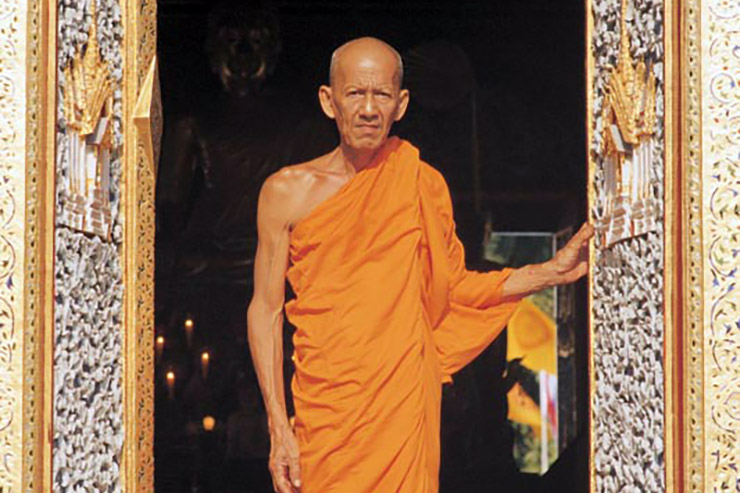
Buddhism is the main religion in Thailand and much of Asia, although in Thailand there is a syncretistic mix of Buddhism, Hinduism, and Animism. Therefore, the people worship and pay homage to a number of Hindu deities and local animistic spirits right alongside the Buddha and famous monks. Thailand is a melting pot of many different religious beliefs. However, Buddha and the community of monks (Sangha) are elevated above the rest. Buddha is always at the top of peoples’ spirit altars and famous monks are revered as much or more than Hindu deities.1 In Thailand, monks are revered for possessing supernatural power and for their high standing in the spiritual hierarchy. It is for these reasons that Buddhist monasteries (Wats) are considered sacred ground where no evil spirit would dare step foot. Due to their exalted status, monks are also protected from harm by evil spirits.
Karma, Heaven & Hell
Buddhists believe in the concept of karma, whereby any good action leads to merit (beneficial karma) and any bad action leads to demerit (negative karma). This concept is very important in the minds of the Thai people because your store of karma, positive or otherwise, determines not only your success and happiness in this and future lives, but also determines your place in the afterlife.
Indeed, there are supposedly 136 levels of hell in the Buddhist cosmology, none of which are very pleasant. Based on the kind of sinning you did when alive, a judge in the afterlife will send you to one of these hells. For instance, adulterers in this life, it is said, will climb a thorn tree continually in the afterlife. The adulterer tries to reach his/her lover at the top of the tree but upon reaching the top the adulterer is taken away and placed back at the bottom to begin the arduous journey once more. Those who were greedy or stole will become hungry ghosts (Phii Pret) who are continually hungry but unable to satisfy their hunger. Others may have their heads turned into animal heads and undergo disembowelment or other such horrors.2
Conversely, if your store of good karma is high, you may end up spending time in the company of deities in one of the many magnificent heavens. There you can enjoy hours of bliss and pleasure until your store of good karma has run out and it’s time to be reborn. If your karma is good enough, you may even be exalted to the status of a deity yourself in the afterlife.3 With what’s at stake, you can imagine that acquiring good karma is important to the Thai. Mostly though, it’s not the afterlife they are worried about, but success in this life.
This gives monks a prominent place in society and in peoples’ lives. For by giving alms (food or money) to monks, or by donating to a monastery, you can acquire beneficial karma. Helping monks in some way is thought to generate a great deal of merit. This not only helps you have a better afterlife and future life on Earth, but also gives you instantaneous protection and good luck in this life.4 Even just being in their presence as they meditate or chant is thought to be auspicious and beneficial for one’s karma.5
Beneficial Energy Radiated by Monks
Monks are thought to radiate a kind of beneficial, protective energy. Monks gain their power through a variety of means. One way is through meditation and chanting sacred Pali texts (which comprise the Buddhist scriptures). During the time they are engaged in one of these activities, monks generate a beneficial force/energy which radiates outwards, and nearby things can become charged with this energy.6
The entire lifestyle of monks emanates a kind of sacredness and austerity, if not holiness. A Buddhist monk lives a lifestyle whereby he eats his meals before noon, regularly chants holy texts based on the life of Buddha, meditates and studies. Monks also abide by an amazing 227 precepts, or rules, formulated on the teachings of the Buddha Gautama. Among these, four are critical: 1. Abstain from intercourse 2. Do not steal 3. Do not intentionally kill any human creature and 4. Do not lie about your magical power.7 Surely, some of their holy power in the eyes of commoners stems from their obedience to these and a great number of other rules they adhere to. As scholar and specialist in the social and cultural history of Thailand, Barend Jan Terwiel, says:
Many of these rules of behaviour are closely related to the ideas on the monks’ sanctity current among the rural population. The traditional knowledge of the rules can in general be described under two rubrics: activities that are prescribed and those that are forbidden. In the view of the Wat Sanchao people [the area studied by Terwiel] the monks’ prescriptions are intended to increase their beneficial power, while the prohibitions are there to prevent the loss of this sacred protective force.8
It is interesting to note that part of a monk’s magical power is thought to stem from their celibacy.9 Professor of Religious Studies at Rice University, Jeffrey Kripal, shares an interesting observation related to comic book superheroes in his landmark book Mutants and Mystics. He writes that “the superpowers of a comic book hero and the sexual powers of its creator (or most devoted readers) are inversely related: the more superpowers, the less sex; the less superpowers, the more sex.” In other words, the powers of sexuality and of supernatural power “are the same power on some deeper metaphysical level.” The same energy that manifests outwardly in sexual desire and orgasm can also be internally “transformed into a kind of radiation” which transforms the body and leads to supernatural power.10
Although not a specifically Thai belief, it is widely believed that a serpent power, or kundalini energy, is located at the base of the spine (also the position of the sex organs) ready to be activated through meditation or other spiritual practice. Once activated, this supernatural energy winds its way up through the chakras and explodes out of the crown chakra to produce enlightenment. This power is said to transform the body and may lead to psychic or other spiritual power.11 It seems the sexual organs and sexual energy can be powerfully expressed internally. This could be a key reason why celibacy is seen as important in many religious traditions, including Thai Buddhism, as a way to increase spiritual sanctity and power.
The late Professor of Anthropology, Buddhism and Thai Studies at the National University of Singapore, Pattana Kitiarsa, focused on a different factor. He said that monks acquire their perceived supernatural power “during extended periods of wandering in the forest and dwelling away from the mundane.”12 These forest dwelling monks are relatively isolated from the outside world and have the ability to focus on meditation and improving themselves spiritually. Furthermore, many learn and practice magical incantations from a Master Teacher. They use this knowledge and power to help others.
Blessings, Offerings & Spirit Shrines
Monks, due to their powers, are called upon regularly to perform services. When moving to a new house, or having built a new house, it is customary to invite monks over to bless the establishment. The same goes for the erection of a new spirit shrine. A common sight in Thailand, spirit shrines are small houses erected on a post or platform, and always near the main house. They provide a shelter for the spirit of the land, known as Phra Phum, meaning ‘lord of the land’. This spirit is said to protect the house and land and bring prosperity to it.13 A picture or figurine of the Phra Phum is placed inside this miniature home and offerings are regularly made to it.14
The wife of a department store president in Bangkok explained why a spirit house to Phra Phum was erected outside the department store:
We have to do it for our fortune. Most of the Thai people believe in Buddha… and they believe in the spirits. So (the spirit houses) are for our staff, for their families and for our customers too. When they come here, they can have peace. They are safe. They are protected.15
The owners consider the store’s success to be in large part due to the careful tending of the spirit house and the regular offerings they make there. Every year Buddhist monks are called in to bless the spirit house. This blessing is the same for a household who erects a shrine to the venerable Phra Phum. During the ceremony, a candle and incense is lit and placed on a table in front of the shrine. At the same time the Phra Phum spirit is informed of the ceremony. Then, a sacred cotton thread (sai sin) is attached to the top of the shrine and unwound towards the house making sure it doesn’t touch the ground. The thread is unwound in a clockwise direction around the house and then is taken through a window and wound around the Buddha image which has been placed on a pedestal for the ceremony. The monks hold the string which is also wound around a vessel of water. While holding the string the monks chant auspicious texts from the Pali Canon.16 As Barend Terwiel explains:
It is believed that beneficial, protective power is emitted by the monks as they chant the Pali texts and that this travels through the cotton thread. This power is reinforced by the Buddha image and causes the water to be charged.17
Foremost Thai scholar Phya Anuman Rajadhon describes the sai sin “as an electric wire, carrying the sacred words as recited by the monks at one and the same time to every place and corner where the sacred cord reaches.”18 The vessel of water around which this cord has been placed during the recitation of holy texts becomes charged with beneficial power and is sprinkled around the home. It is thought “capable of warding off illness, unhappiness and misfortune.”19
The entire area of the house and spirit house is consecrated via the monks’ chanting which emanates a beneficial force that travels through the cord to consecrate all areas and bring happiness and blessings upon the residence and people therein. Furthermore, this will ensure that the spirit of the land is happy and that no evil spirits intrude upon the residence.
[alert type=”info” dismiss=”no”]If you appreciate this article, please consider a subscription to New Dawn magazine.[/alert]
Unhappy Spirits
Journalist and author Tiziano Terzani had first-hand experience with the occult nature of Thai society. Travelling around Southeast Asia in search of fortune tellers, he settled for a while in a beautiful house in Bangkok that was built over a pond. The house had no spirit altar, but he was told that the protecting spirit of the house belonged to a huge meat-eating turtle who lived in the pond upon which the house was built. He was told by the previous residents to feed the turtle everyday to keep it happy. However, after moving in the turtle seemed disturbed by his presence and failed to show itself. The turtle hid itself, preventing Terzani from making offerings of food to it.
With the spirit unhappy, misfortune loomed in the air. Indeed, Terzani reports that the people who worked at the house “began complaining of one ailment after another: the gardener coughed non-stop, the cook could not stand on her feet, and my secretary had a constant headache. Some of their relatives had road accidents; two died.”20 Terzani didn’t waste any time, knowing that in the eyes of everyone these misfortunes were due to the wrath of the unhappy turtle spirit. He went to a famous Buddhist monastery to bow before the Buddha. He then had monks come to his house and consecrate it via chanting and the sacred thread which was wound around the house and pond. After the monks left, he reports, a swarm of wild bees came and made a honeycomb in a tree in the garden. This was a sign of great luck for the house, and sure enough the troubles ceased. The monks’ beneficial power consecrated the residence and protected it from misfortune.
We have to ask ourselves: Was the angry spirit of the turtle really causing the illnesses and misfortunes that affected the workers at the house? Or were they psychologically conditioned to believe that unhappy spirits cause illness, so when they saw the turtle was not coming around and being fed they manifested illness psychosomatically via a reverse placebo effect?
Another event where monks are called to is a death. Especially when someone dies a sudden or violent death, it is believed their spirit can remain on Earth and cause harm to others. Their life being unexpectedly and abruptly ended makes their spirit unwilling to leave this world due to unfinished business or a yearning for worldly things. Plus, they may be angry for not having a chance to finish their life. Also, during a funeral other evil spirits of the land (Phii) may be attracted to the ceremony. Thus, monks are called in to chant Buddhist scripture from the Pali Canon. The recitation by monks of these sacred texts is believed to keep the evil Phii at bay and protect everyone participating at the funeral from attack or possession by the angry spirit of the deceased or other lurking spirits.21
Why are Amulets Popular?
Monks are also tasked in Thailand with consecrating and imbuing amulets with power. These are usually worn around the neck and contain images of famous monks, deities, or kings and may also contain mystical designs (Yantra) or sacred mantras that are associated with the specific power of the amulet. The mantras and designs are different depending upon the intended purpose of the amulet (i.e. protection from danger, success in business, finding a lover, etc…) Amulets can be constructed of many different materials. Some are clay tablets imprinted with the image of the Buddha, or a famous monk, etc. Others are made of silver and gold. Still others are made from objects like a bullet or the tooth of a tiger. Sacred ingredients often go into making amulets, such as “ash obtained from burning the oldest handwritten sacred books of the monastery,”22 sacred powders, rare metals, wood from a temple, or even human flesh.23
You can buy these amulets online and prices range considerably. Just to give you an example, for $220 you can buy a locket which contains an image of a diva (a master of seduction). The locket contains sacred writing and powerful magical herbs and powders. Of course, it is empowered by a senior monk by chanting sacred words over it. You could say that in this way it is “charged” with power by a monk. Its suggested uses include Seduction, Personal & Corporate Spying, Gambling, and Love & Marriage. By wearing it, it is believed you can be successful in these endeavours!24
Most of the amulets on the market are for helping people gain success in business, increase their luck in gambling, love and marriage, and accrue wealth. Another common theme is protection. If you work in a dangerous job, you might want to consider an amulet that protects you. Some of the more powerful amulets made or empowered by the most esteemed monks are even said to protect one from bullets! Apart from the inherent powers of amulets’ ingredients and designs, all their different powers are endowed via the correct chants, or magical incantations spoken by a powerful monk.25
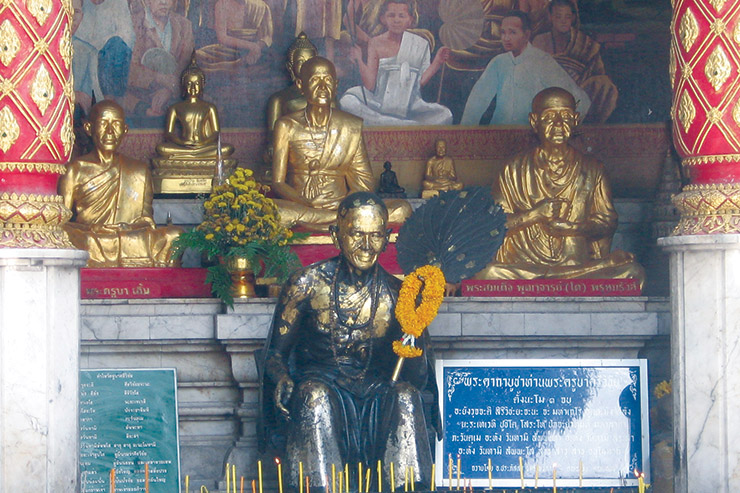
There are some amazing stories of people who were saved from death by protective amulets. One such story is of a man who had a kind of amulet known as a takrut placed under the skin of his arm by one of the most revered magic monks around, Luang Pho Khun, of Wat Baan Rai, Dan Khun Thot, Nakhon Ratchasima province. A takrut is a kind of amulet that is essentially a tiny scroll or sheet of paper on which is drawn a mystical design or some sacred mantra. Luang Pho Khun uses a thin sheet of gold and inserts it underneath the skin on the upper right arm for protection.
Professor Pattana Kitiarsa tells of a businessman who ran a competitive business and wanted protection from enemies who might wish to harm him and his business. Attacked one night by an unknown gunman, he found himself under fire from an M16 rifle. Bullets pelted his body and he fell to the ground unconscious. However, he later regained consciousness and found that none of the bullets had pierced his skin and he only suffered from minor pain. Amazed, he thought of Luang Pho Khun’s amulet inserted underneath the skin of his right arm and attributed it to his miraculous escape from death.26 Other such stories abound.27
Another remarkable story regarding Luang Pho Khun’s protective amulets involves the collapse of the Royal Plaza Hotel in downtown Korat, Thailand. In this disaster 137 people died and another 227 were injured. Subsequent media reports focused on those survivors who were wearing amulets blessed by Khun and his fame and reputation were enhanced.28 And so it is that the belief in the supernatural and the benefit of amulets is driven by the culture, and popular media in particular. Stories of the monks’ powers and miracles connected to them are presented on TV and in the popular press. Endorsements by politicians or military leaders also contribute to the thriving amulet industry in Thailand.29 Advertisements are key, too, in promoting amulets.
The BBC reported on one popular series of amulet that was advertised on the side of Bangkok’s tallest building – the Baiyoke Tower. Considering the Thai amulet business is estimated to be worth upwards of 22 billion baht ($650 million) a year, the aggressive advertising is not surprising.30 Buddhist temples, or monasteries, often sell amulets to pay for temple construction projects or to acquire money for charity. However, it’s just as much a commercial business with amulets being sold all over Thailand for profit. Thai amulets are even revered in other parts of Asia such as China and Hong Kong, where celebrities and others dish out loads of cash for them. One Hong Kong celebrity, Cecilia Chung, reportedly spent around 1 million baht (around $32,000) for one amulet.31
One wonders why the amulet business is so lucrative. A possible answer, already alluded to, is that the amulets work. Whether it’s protection from danger or winning money at a casino, success stories of wearing certain amulets abound. This leads more people to believe in their power. The media, which propagates such stories, feeds the craze. On a deeper level though, amulets serve a basic psychological purpose. Amulets provide “protective assurance” and peace of mind to people hoping to be successful in business, gain wealth, or avert danger.32 It gives them psychological comfort in a perilous and fraught world. The amulets, you could say, help them believe in something (like protection or the success of their business dealings), thus erasing doubts which might otherwise cause anxiety and depression.
Controversies
We see that monks are a key part of Thai society, in the main providing spiritual nourishment and advice. Other services they offer that I did not discuss include using magic to combat sorcery, enhancing one’s lifespan, forecasting the future, and providing tips for picking winning lottery numbers.33
Some of these other services have led to controversies and scandals. For instance, one of the rules Buddhist monks are supposed to abide is not handling money.34 Although this rule is routinely broken due to the necessities of modern life, every once in a while a scandal breaks out that reminds people of the danger of corruption that can come when a monk accrues a great deal of wealth through the provision of his services to the public.
A recent scandal involves a monk who accrued millions of dollars, regularly travelled in a private jet, did drugs, and had sex with teenage girls.35 In other words, he was living the life of a rock star. This invariably outrages Thai Buddhists who believe in the sanctity of the monks. With this in mind, some see the wealth acquired by some monks as blasphemy. Pravit Rojanaphruk, writing for The Nation, expresses this sentiment:
…look at how many temples in Thailand are needlessly and lavishly built in poor communities upcountry. This money could go to help build a hospital, school, library or even an agricultural cooperative – but it goes instead into building and maintaining grand, pricey and fancy temples and nothing is being done to condemn it…36
Again, he writes:
Next, there’s widespread belief in praying for health, wealth, and whatever you want from monks, Buddha statues, Hindu statues, Buddhist and Hindu amulets by those who are supposedly Buddhists. Never mind if the Buddha himself said one should depend of oneself and not on others. Such practice is not just un-Buddhist in its thinking, but also constitutes one of the roots of a culture of bribery as people invariably promise to give something in return if and when their wishes are granted.37
Monks are supposed to renounce all desire for the pleasures of this life and instead live a modest life filled with compassion for others, all the while focused on the goal of trying to obtain release from future worldly existence (nibbāna or nirvana). It’s sort of a catch 22 when you take into consideration that Thai people believe that the more they give to monks, the better their karma and future life. Monks – usually on behalf of the temples they reside – will in all probability continue to receive lots of money.
Although Buddhism dominates life in Thailand, the people still retain a strong animistic belief system. Buddhist monks aren’t the only ones Thai people turn to in times of need. The Thai people also believe in the power of spirits to protect, harm, or confer blessings. Shrines to these powerful spirits collect thousands of dollars in donations from Thai people who are eager to give offerings to the spirits in return for what they ask for. Who are these great and powerful spirits? Why do the Thais spend so much money placating them? And what do these spirits want in return for their services?
[alert type=”general” dismiss=”no”]This article was published in New Dawn 140.[/alert]
[alert type=”success” dismiss=”no”]If you appreciate this article, please consider subscribing to help maintain this website.[/alert]
Footnotes
- P. Kitiarsa, Mediums, Monks, & Amulets: Thai Popular Buddhism Today, University of Washington Press, 2012, 11
- M. Guelden, Thailand: Into the Spirit World, Times Editions Pte Ltd, 1995, 50-52, 71; C. Lamar, “Spend a lovely day with the kids at Thailand’s hell torture theme park.” IO9, 5 June 2012, http://io9.com/5915890/spend-a-lovely-day-with-the-kids-at-thailands-hell-torture-theme-park
- Barend J. Terwiel, Monks and Magic: Revisiting a Classic Study of Religious Ceremonies in Thailand, 4th ed. NIAS Press, 2012, 240
- Ibid., 127
- Thailand, 43-46
- Ibid., 43; Monks and Magic, 130
- Monks and Magic, 109-110
- Ibid., 112
- Ibid., 113
- Jeffrey J. Kripal, Mutants and Mystics: Science Fiction, Superhero Comics, and the Paranormal, University of Chicago Press, 2011, 168-171
- Gopi Krishna, The Evolutionary Energy in Man, Stuart & Watkins, 1970. (www.kundaliniawakeningsystems1.com/downloads/kundalini-the-evolutionary-energy-in-man_gopi-krishna_(89pg).pdf)
- Mediums, Monks, & Amulets, 37
- Thailand, 89; The Phra Phum is one of the many kinds of spirits (Phii). Although this will be the subject of a future article, it suffices to say that the Phii can grant protection, help someone in some way, or cause harm if angered.
- Phya A. Rajadhon, Popular Buddhism in Siam and Other Essays on Thai Studies, Thai Inter-Religious Commission for Development, 1986, 128-129
- Thailand, 83
- For more information about this ceremony, see: Monks and Magic, 211-213; Other places and things can also be blessed in this way, like a car or airplane.
- Monks and Magic, 212
- Popular Buddhism, 59
- Monks and Magic, 213
- T. Terzani, A Fortune-Teller Told Me, Three Rivers Press, 1997, 35
- J. Gorin, “Worship of Phii in Thailand: Spirit Cults and their Relationship to Buddhism,” ReliJournal 14 December, 2012. http://relijournal.com/buddhism/worship-of-phii-in-thailand-spirit-cults-and-their-relationship-to-buddhism/
- Monks and Magic, 70
- Mediums, Monks, & Amulets, 118
- Thailand Amulet, “Mae Nang Prai Pasanee (Ongk Kroo) – Civet Oil Phial, Hand Inscription, 2 Takrut Maha Sanaeh, Wan Dork Tong Powders – AC Perm Prai Dam.” SKU 02349, Retrieved June 24, 2013, from http://thailandamulet.net/#!/~/product/category=3848009&id=23875141
- Monks and Magic, 116-117
- Mediums, Monks, & Amulets, 89-90
- For other stories, see: Monks and Magic, 270 note 1; Thailand, 131
- Mediums, Monks, & Amulets, 90-92
- Ibid., 92-94
- J. Head, “Thailand’s frenzy for amulets,” BBC News, 3 September 2007, http://news.bbc.co.uk/2/hi/asia-pacific/6976705.stm
- W. Woo, “The Price of Faith?” Retrieved June 24, 2013, from http://waynedhamma.blogspot.kr/2013/05/the-price-of-faith.html
- Mediums, Monks, & Amulets, 109, 113
- Ibid., 39
- Monks and Magic, 126
- L. Intathep, “Pilot lifts lid on monk’s depravity,” Bangkok Post, 7 July 2013, www.bangkokpost.com/news/local/358796/monk-depraved-life-revealed
- P. Rojanaphruk, “Thai Buddhism: Much deeper things have gone wrong,” The Nation, 10 July 2013: www.nationmultimedia.com/politics/Thai-Buddhism-Much-deeper-things-have-gone-wrong-30210084.html
- Ibid.
© New Dawn Magazine and the respective author.
For our reproduction notice, click here.