New Dawn – World's Most Unusual Magazine

Tag: time

  • Time, Entanglement & Consciousness

    Time, Entanglement & Consciousness

    From New Dawn Special Issue Vol 6 No 4 (Aug 2012)

    Over the past year [2011-2012] a number of new, potentially momentous, discoveries have been made in the realms of quantum and particle physics. On the one hand, they stand to rock the very foundations of modern physics and the common-sense reality that most people live their everyday lives by. On the other hand, these same discoveries lend further support to the reality of both paranormal phenomena and the literal veracity of ancient wisdom. In particular, I am here referring to three recent announcements:

    1) In late April 2012 a research team from the US National Institute of Standards and Technology reported on an experiment involving the generation of light pulses travelling faster than the speed of light in a vacuum. This work involved forcing a wave peak on a pulse of light to move from back to front along the light beam as the light itself was travelling at the standard speed of light, such that the pulse travelled faster than the speed of light in a vacuum.1 If refined, such a technique could possibly allow information to be sent faster than the speed of light. This work follows on the heels of a major brouhaha over another alleged instance of faster than light speeds.

    A consortium of scientists reported in September and November 2011 that subatomic particles known as neutrinos had been measured travelling faster than the speed of light while passing through 730 kilometres of rock from the CERN (European Organization for Nuclear Research, formerly known as the Conseil Européen pour la Recherche Nucléaire) particle physics laboratory in Geneva, Switzerland, to the OPERA (Oscillation Project with Emulsion-tRacking Apparatus) particle detector in the Laboratori Nazionali del Gran Sasso, Italy.2

    Standard modern mainstream physics theories, many based in large part on Albert Einstein’s special theory of relativity (first proposed in 1905), have long assumed that the speed of light in a vacuum is the upper limit of how fast anything can travel, and therefore if these experimental results are correct, some of the most basic assumptions in modern physics will need to be reevaluated.

    For months the debate raged over whether the neutrinos really were travelling faster than the speed of light; the consensus view held that there was some flaw in the apparatus, calculations, and/or analysis. Ultimately, based on carrying out further experiments, including at other labs, it was announced that “the original OPERA measurement can be attributed to a faulty element of the experiment’s fibre optic timing system.”3 Still, given the apparently solid work on light pulses mentioned above, I personally wonder if, just perhaps, OPERA did indeed capture some superluminal (faster than the speed of light) neutrinos, even if not all neutrinos travel so fast.

    A major objection to the possibility of superluminal travel of any form is that it will upset cherished notions of time and temporal ordering (conventional thinking asserts that the past must occur before the present which must occur before the future). From our perspective, particles (including particles of light, or ‘particles’ of information) travelling faster than light might be viewed as travelling backwards in time (arriving one place before they depart from another place), or through other dimensions, and open the possibility of effects occurring before causes (although exactly what ‘before’ means in this new notion of time is open to debate). That is, the concept of retrocausality (the future influencing the present and the past), which many people (including many theoretical physicists) instinctively reject, would have to be taken seriously.

    2) In quantum mechanics the concept of entanglement occurs when particles interact and are then separated, but they are still somehow correlated (or more accurately, anti-correlated) in terms of their characteristics. Acting on one particle will result in an effect or outcome on the other particle, even if a considerable distance physically separates the particles and there is no direct conventional physical or energetic link between them. To use a crude analogy, if two different roulette wheels in two different casinos are entangled in a quantum mechanical sense, whenever one roulette wheel comes up red the other will come up black.

    Einstein referred to quantum entanglement as “spukhafte Fernwirkung” (spooky action at a distance), but it has been demonstrated experimentally numerous times, and the effects of entanglement seem to propagate either instantaneously or at a speed thousands of times faster than the speed of light (which is highly perplexing). Up until now quantum entanglement has generally been limited to very small microscopic objects, such as subatomic particles, atoms, isolated molecules, and microscopic crystalline structures. In December 2011 a group of physicists from the University of Oxford, the National Research Council of Canada, and the National University of Singapore announced the successful quantum entanglement of two macroscopic (approximately 3 mm in size) diamonds at room temperature and separated by a distance of about 15 cm.4

    3) The wave function in quantum mechanics can be viewed as a mathematical or statistical way to describe the probabilities that certain properties will occur in a system of quantum particles (and ultimately, one can argue, everything – all of the known universe – can be reduced to a system or systems of quantum particles). And ‘quantum collapse’ (collapse of the state vector) can be viewed as the ‘freezing’ of this set of probabilities into one possibility or outcome, the one observed or measured, in the ‘real world’. But is the wave function simply, or truly, just a mathematical and statistical convention describing our limited knowledge of reality (perhaps with some currently unknown ‘reality’ underlying it)? Is the wave function to be understood as a description of the state of our knowledge? Or is the wave function itself a ‘real’ entity, a distinct state of reality – that is, is there a tangible, physically real, wave? Is the quantum state a real physical property of a system and not just a statistical description of our knowledge, and does ‘quantum collapse’ correspond to a real physical process?

    In November 2011 researchers M. F. Pusey, J. Barrett, and T. Rudolph (MFP and TR are in the Department of Physics at the Imperial College London, and JB is in the Department of Mathematics at the University of London) presented a new analysis and theorem as to the meaning of the wave function in quantum mechanics.5 According to their analysis, given some basic assumptions, the wave function must have a physical reality. However, in my opinion, they have not ultimately ‘proven’ that the wave function is objectively real. Rather, they have logically limited the possible interpretations of the wave function. By my view, their analysis appears to demonstrate that unless all quantum particles (that is, in effect, all entities in the universe) are somehow related or connected to each other through both space and time, then the wave function must be a real physical object. They seem to reject the notion that everything in the universe could be connected in some manner, for it is generally assumed that although quantum entanglement occurs in some cases, not everything is entangled with everything else. Furthermore, it appears to me that one of the assumptions underlying the analysis of Pusey, Barrett, and Rudolph is that retrocausality (the possibility of the future affecting the past) is impossible.

    Each of these three developments in physics is important, and fundamentally paradigm shattering. The least controversial of the three is the quantum entanglement of the diamonds, for the experimental results are clear and definitive. But the entanglement of macroscopic diamonds at ordinary room temperature under ordinary conditions demonstrates, I believe, that those who have long argued that quantum entanglement (and other ‘mysterious’ quantum effects as well) is limited to the microscopic world and can have no real consequences in our everyday lives are wrong.

    Quantum Entanglement & Telepathy

    Indeed, in a general (and, I would add, rather unconvincing) way, there has long been talk in some circles that certain psychic or paranormal phenomena such as telepathy (direct mind-to-mind communication) could be due to quantum entanglement.6 Now the entangled diamonds appear to provide strong evidence that such entanglement and correlation of information is possible. In my experience telepathy tends to work best when one is in a mental state decoupled from the immediate surrounding environment, which allows the mind of one individual to couple or entangle with the mind of another individual (or individuals). Like minds in telepathic rapport, diamonds best maintain their quantum entanglement when they can be decoupled from ‘distractions’ or the entanglement is stronger than the ‘distractions’ (in the case of the diamonds, ‘distractions’ might include such phenomena as being ‘excited’ by environmental changes, like temperature or physical movement). Of course most hardcore physicists tend to dismiss telepathy as nonsense even though they accept the quantum entanglement of diamonds.

    Solid Support for Retrocausality

    The issue of anything with the ability to carry information travelling faster than the speed of light, be it particles or light pulses, is highly controversial. As the edifice of modern physics has been constructed, with so many fundamental equations dependent on the speed of light as a constant and upper limit for temporal relationships, superluminal transfer of information breaks down the conventional concept of time, the future and past become confused, and the spectre of retrocausality raises its ugly head (well, ugly for status quo thinkers!).

    Yet there is solid support for retrocausality on several fronts. A group centred in Vienna, Austria, headed by Anton Zeilinger, has experimentally demonstrated that the decision as to whether or not two particles at a quantum level are entangled or in separate quantum states can be made after the particles have been measured (and may no longer exist).7 This means that at a quantum level actions in the present or future can reach back into the past!

    However, actions reaching back into the past are not limited to a quantum level. There is now strong parapsychological support for retroactive influences on the human mind. As I briefly mentioned in a previous edition of New Dawn,8 Dr. Daryl J. Bem of Cornell University has carried out a successful series of “retroactive facilitation of recall” experiments demonstrating that the future can influence the present and the past (in the case of the studies by Dr. Bem, students studying for a test after the fact improved their performances on a test already taken – that is, classic retrocausality, or effects occurring before their causes, was demonstrated).9

    As in the case of the entangled diamonds, the experimental physical evidence – in this case light pulses travelling at superluminal speeds and actions at a quantum level reaching back into the past – helps supply a theoretical foundation for psychic or paranormal phenomena that, although well attested to by competent researchers, are generally dismissed by mainstream scientists.

    The theoretical work on the wave function of quantum mechanics dovetails, in my assessment, with that which many mystics and psychics have been espousing since ancient times: In a fundamental way we, the entire universe, all entities, are interconnected at some level (the level of interconnectedness differing among various entities) and time is not what it superficially appears to be. In my opinion the work of Pusey, Barrett, and Rudolph opens, at the level of quantum mechanics, the age-old argument between the ‘physicalists-materialists’ who fundamentally believe there is nothing more to reality than matter and energy, and those who believe ‘ultimate reality’ involves something more and beyond matter-like and energy-like entities as generally construed by classical physics.
    Consciousness is Fundamental

    But what could be beyond matter and energy? One possibility is consciousness, and I believe that consciousness can be equated with thought, mind, mental constructs, information, and ultimately knowledge. And rather than being a secondary phenomenon that arises from matter and energy, at the most fundamental level consciousness may be independent of matter and energy. Max Planck (1858-1947), the originator of quantum theory and winner of the 1918 Nobel Prize in Physics, stated in a 1931 interview:

    I regard consciousness as fundamental. I regard matter as derivative from consciousness. We cannot get behind consciousness. Everything that we talk about, everything that we regard as existing, postulates consciousness.10

    This is a very interesting, and powerful, statement. In these terms, the statistical or probabilistic interpretation of the quantum wave function can be viewed as a genuine description of a system in a ‘pre-matter’ and ‘pre-energy’ state that only takes on a physical reality when affected by consciousness (and simple observation will affect any quantum system).

    Returning to the analysis of Pusey, Barrett, and Rudolph, I believe they conclude that the quantum state and wave function are ‘real’ in a physical-material-energy sense based on several assumptions. They assume that a quantum system can be isolated from the rest of the universe, both spatially and temporally – and in particular they assume that the future will not influence the past, so an apparatus or system separated by “a sufficient time period” will not affect an earlier apparatus or system. They also assume that measuring devices respond only to the physical properties of the entities that they are measuring. If the assumptions of Pusey, Barrett, and Rudolph can be shown to be wrong, their work can then be interpreted to demonstrate that rather than the wave function and quantum state being physically real, there must be something more to the universe and cosmos beyond simple matter and energy.

    I interpret various lines of experimental evidence, ranging from modern physics (such as the work on faster-than-light particles and quantum effects that may be interpreted as going backwards in time) to parapsychological studies (demonstrating that the future can influence the past), as clearly falsifying the assumptions of Pusey, Barrett, and Rudolph. At a most fundamental level it appears there are connections throughout space and time. Just as diamonds can be entangled, nothing is truly isolated. Ultimate reality lies beyond the physical and material. What is this ultimate reality? Our best conception may be encoded in what we think of as consciousness. The mystics and sages of the ages, as well as Max Planck, were right. Consciousness is fundamental. Consciousness underlies and is the source of everything else, including all that we regard as the material universe.

    [alert type=”general” dismiss=”no”]This article was published in New Dawn Special Issue Vol 6 No 4.[/alert]

    [alert type=”success” dismiss=”no”]If you appreciate this article, please consider subscribing to help maintain this website.[/alert]

    Footnotes:

    1. Ryan T. Glasser, Ulrich Vogl, and Paul D. Lett, “Stimulated Generation of Superluminal Light Pulses via Four-Wave Mixing”, Physical Review Letters, PRL 108, 173902, 5 pages, 26 April 2012.
    2. T. Adam, N. Agafonova, A. Aleksandrov, O. Altinok, P. Alvarez Sanchez, A. Anokhina, S. Aoki, A. Ariga, et al, “Measurement of the neutrino velocity with the OPERA detector in the CNGS beam”, article dated 17 November 2011, available from http://arxiv.org/abs/1109.4897 and http://arxiv.org/ftp/arxiv/papers/1109/1109.4897.pdf (Accessed 18 November 2011). See also: Adrian Cho, “Where Does the Time Go? One experiment sees neutrinos traveling faster than light. If the result can’t be replicated, it may never be explained away”, Science, vol. 334, 1200-1201 (2 December 2011); Alex Knapp, “New Evidence Casts Doubt On Faster-Than-Light Neutrinos”, article dated 28 December 2011, available from www.forbes.com/sites/alexknapp/2011/12/28/new-evidence-casts-doubt-on-faster-than-light-neutrinos/ (Accessed 20 January 2012); Clara Moskowitz, “Warped Physics: 10 Effects of Faster-Than-Light Discovery”, article dated 24 September 2011, available from www.livescience.com/16214-implications-faster-light-neutrinos.html (Accessed 20 November 2011); Jason Palmer, “Light speed: Flying into fantasy”, article dated 23 September 2011, available from www.bbc.co.uk/news/science-environment-15034414 (Accessed 18 November 2011); Jason Palmer, “Neutrino experiment repeat at Cern finds same result”, article dated 18 November 2011, available from www.bbc.co.uk/news/science-environment-15791236 (Accessed 18 November 2011); Jason Palmer, “Speed-of-light results under scrutiny at Cern finds same result”, article dated 23 September 2011, available from www.bbc.co.uk/news/science-environment-15017484 (Accessed 18 November 2011); Natalie Wolchover, “What Would It Be Like to Travel Faster than the Speed of Light?”, article dated 23 September 2011, available from www.lifeslittlemysteries.com/neutrinos-faster-speed-light-2044/ (Accessed 20 November 2011).
    3. Sergio Bertolucci, “Neutrinos sent from CERN to Gran Sasso respect the cosmic speed limit”, article dated 8 June 2012, available from http://press.web.cern.ch/Press/PressReleases/Releases2011/PR19.11E.html (Accessed 19 June 2012).
    4. K. C. Lee, M. R. Sprague, B. J. Sussman, J. Nunn, N. K. Langford, X.-M. Jin, T. Champion, P. Michelberger, K. F. Reim, D. England, D. Jaksch, and I. A. Walmsley. “Entangling Macroscopic Diamonds at Room Temperature”, Science, vol. 334 no. 6060, 1253-1256 (2 December 2011).
    5. Matthew F. Pusey, Jonathan Barrett, and Terry Rudolph, “The quantum state cannot be interpreted statistically”, article dated 14 Nov 2011, available from http://arxiv.org/abs/1111.3328 and http://arxiv.org/PS_cache/arxiv/pdf/1111/1111.3328v1.pdf (Accessed 19 January 20120).
    6. Note that phenomena generally regarded as “telepathic” may include a mixture of phenomena due to different causal mechanisms; thus some forms of telepathy may be the result of quantum entanglement and other forms of telepathy may be due to electromagnetic radiation, particularly in the extremely long wavelength and extremely low frequency range.
    7. Xiao-song Ma, Stefan Zotter, Johannes Kofler, Rupert Ursin, Thomas Jennewein, Caslav Brukner, and Anton Zeilinger, “Experimental delayed-choice entanglement swapping”, Nature Physics, www.nature.com/naturephysics, DOI: 10.1038/NPHYS2294, 6 pages, published online 22 April 2012; Caslav Brukner, “Quantum physics mimics spooky action into the past”, press release date 23 April 2012, available from www.eurekalert.org/pub_releases/2012-04/uov-qpm042312.php (Accessed 8 May 2012).
    8. Robert M. Schoch, “Thoughts Have Wings”, New Dawn, January-February 2011, 11.
    9. Daryl J. Bem, “Feeling the Future: Experimental Evidence for Anomalous Retroactive Influences on Cognition and Affect”, Journal of Personality and Social Psychology, vol. 100, no. 3, 407-425 (March 2011); abstract available from http://psycnet.apa.org/journals/psp/100/3/407/ (Accessed 20 August 2011); author’s typescript version of the paper available from http://dbem.ws/FeelingFuture.pdf (Accessed 20 August 2011).
    10. Max Planck, [Interview comments] The Observer (London), 25 January 1931; quoted in Joseph H. Fussell, “Review and Comment” on the book Where is Science Going? by Max Planck (1933), The Theosophical Path, vol. 43, no. 2, 198-213 (October 1933).

    © New Dawn Magazine and the respective author.
    For our reproduction notice, click here.
  • A Life of Philip K. Dick: The Man Who Remembered the Future

    A Life of Philip K. Dick: The Man Who Remembered the Future

    From New Dawn 139 (Jul-Aug 2013)

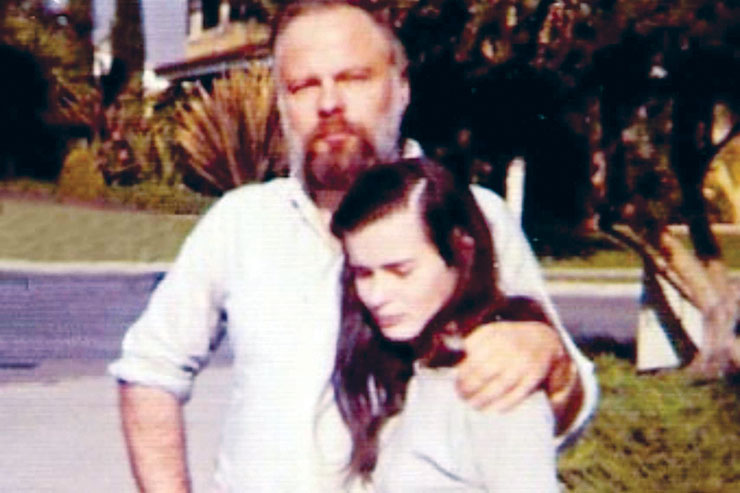
    This year [2013] saw the 30th anniversary of the death of one of the most influential writers of all time, the iconic Philip K. Dick. Although virtually unknown outside of science fiction circles, during his lifetime Dick’s intriguing philosophy on the nature of reality has become a staple of the modern Hollywood movie. Huge blockbusters such as Total Recall, Minority Report, The Adjustment Bureau, Blade Runner, A Scanner Darkly and Paycheck were loosely based directly on his novels or short stories, and movies such as The Eternal Sunshine of the Spotless Mind, Memento, The Matrix, The Truman Show and Inception all owe a huge debt to his vision.

    One of the most intriguing themes of Dick’s writing was the concept of the “precog,” a person who could “see” the future before it happened. In 1954 Phil introduced the concept of precognition in his novel The World Jones Made. In this novel the eponymous anti-hero Floyd Jones can see exactly one year into the future. From then on “precogs” occur regularly in his novels and short stories, most notably in his 1956 short story The Minority Report, his 1964 novel Martian Time-Slip, The Three Stigmata of Palmer Eldritch and many others.

    What was it that made Philip K. Dick interested in precognition? It had not been a particular theme within classical science fiction nor had it been part of the books that the young Philip read during his childhood years and early teens. The answer may lie in one simple fact: Philip K. Dick himself was a “precog.” He was not writing fiction but heavily disguised autobiography. Let us review the evidence.

    Like many of his schoolmates, Phil was expected to attend the University of California in his hometown of Berkeley. But in order to do so he needed to reach the entrance grades required. This possibility started to fade rapidly when, during a crucial physics test, Phil couldn’t remember the key principle behind the displacement of water. As eight of the ten questions involved this principle, he was clearly in trouble. And then it happened: a voice clearly and precisely explained to the surprised young man the scientific principles he so desperately needed to understand. All Phil had to do was write down the words in his head. Phil received an ‘A’ grade.

    Although this “voice” effectively disappeared for many years, Phil continued to sense there was a part of him that was alien in some way. Throughout the 1950s the voice remained silent and then, under somewhat prosaic circumstances, it re-appeared. In an interview with his friend Greg Rickman, recorded in October 1981, Phil described how he had been watching a TV programme about the Galapagos turtles. The fight for survival of one particular female turtle had really upset him. After laying her eggs she had turned in the wrong direction and instead of going towards the sea she crawled inland. Soon the heat had brought about extreme dehydration. She was dying. As she began to fade her legs were still seen to be moving. The film had been edited to give the impression that the dying turtle was imagining she was back in the ocean. He went to bed with this tragic image in his mind. He woke up in the night to hear a voice. In careful and deliberate terms the entity explained to Phil that the turtle actually believed she was in the water:

    I was just terribly amazed and dumbfounded to hear that voice again. It wasn’t my own voice because one of the sentences the voice said was “And she shall see the sea” and I would not use the two words “see” and “sea” in the same sentence. It tends to do that, use word choices I don’t use. One time it used the expression “a very poisonous poison” which I would not use.1

    It is clear Phil recognised the voice as being the same entity that had helped him in his physics exam all those years before. It was back. He was to continue hearing this entity for many years, but only as a faint background whisper. In another 1981 interview he stated:

    I only hear the voice of the spirit when I am falling asleep or waking up. I have to be very receptive to hear it. It’s extremely faint. It sounds as though it is coming from a million miles away.2

    The “Voice” Returns

    In February and March 1974 the voice was to reappear and stay with him. It all started quite innocently. Phil had been in considerable pain after having a wisdom tooth pulled out. His wife, Tessa, called the dentist who prescribed painkillers. As Tessa did not want to leave her husband alone in such a state of agitation she asked if somebody could deliver the prescription to their house in Fullerton. Half an hour later the doorbell rang and Phil dashed to the door. On opening it he saw a young woman clutching the much-needed painkillers. Phil stood back stunned. Around the young woman’s neck was a necklace with a fish pendant. Phil recognised this as a symbol of something deep within himself. He asked her what it was and she explained it was a sign used by the early Christians as a code to show their secret beliefs to fellow Christians.

    Dick later reported this was the first time he experienced the pink light, the same light so central to the Beatles incident (described below). He said a beam of this light shot out of the pendant and entered his brain. This light opened up a part of his brain that had long been asleep. He described it in this way:

    I suddenly experienced what I later learned is called anamnesis – a Greek word meaning, literally, “loss of forgetfulness.” I remembered who I was and where I was. In an instant, in the twinkling of an eye, it all came back to me.3

    As we have already mentioned, up until March 1974 what Dick had called “the voice” manifested itself on rare occasions such as the incident during the school exam. But after Phil’s “anamnesis” his hidden partner was to become very active in his life. It decided that Phil had become far too slovenly in his personal appearance. He was made to go out and buy a pair of nasal hair-clippers and it suggested he trim his beard. The entity even had Phil go shopping for new trendy clothes.

    It was also concerned about the health of the shared body. It had Phil go through his drugs cabinet and forced him to throw out those medications that were proving problematical to his health. It discovered that wine was too acidic for his sensitive stomach and suggested he change to drinking beer. This being had many skills that Phil sadly lacked, such as business acumen. It realised he had made quite a mess of his tax matters and within weeks the entity sorted this out. It also had Phil sack his agent after it read over his royalty statements and discovered massive irregularities.

    All of these were minor interventions compared to its apogee, the saving of Phil’s son’s life. Phil describes how one morning he was lying in a semi-sleep state when he heard the voice announce that his recently born son, Christopher, had a potentially fatal birth defect and that urgent medical attention was needed. Indeed the voice was quite precise when it stated: “Your son has an undiagnosed right inguinal hernia. The hydrocele has burst, and it has descended into the scrotal sac. He requires immediate attention, or will soon die.” Phil told various versions of this story, including one involving him listening to the Beatles and the lyrics of “Strawberry Fields” were changed to give the instruction. Tessa, acting on her husband’s frantic instructions, took Christopher to the family doctor and it was, indeed, confirmed that Christopher had exactly the problem the “voice” had described and surgery was needed.

    Dick’s “Homoplasmate”

    What was the source of this “voice” and how did it have information unknown to Phil? Phil was to conclude that it was an immortal part of himself, something he called a “plasmate.” He argued this entity had bonded with him and in doing so had taken human form, something Phil termed a “homoplasmate.” He was later to describe how his mind had been invaded by a “transcendentally rational mind, as if I had been insane all my life and had suddenly become sane.” He explained that:

    …mental anguish was simply removed from me as if by divine fiat… some transcendental divine power which was not evil, but benign intervened to restore my mind and heal my body and give me a sense of the beauty, the joy, the sanity of the world.

    This being, set free from its shackles by Phil’s “anamneses,” was able to use its powers to help Phil precognise the future. Indeed, Phil realised this being had been the source of a series of peculiar precognitive incidents that had taken place throughout his life.

    For example, in his 1974 novel Flow My Tears the Policeman Said, Phil has a sequence in which one of his characters, Felix Buckman, is distraught at the death of his twin sister, Alys. He finds himself in an all-night gas station and there he meets up with a black stranger. Buckman and the black man start up a conversation. In the summer of 1978 Phil, uncharacteristically, decided to go out late at night to post a letter. In the darkness he noticed a man loitering by a parked car. Phil posted his letter and on the way back the man was still there. In a second uncharacteristic impulse Phil walked over to the man and asked if anything was the matter. The man replied that he was out of gas and he had no money with him. Much to his surprise Phil found himself digging into his pocket and giving the man some cash. The man asked for Phil’s address and said that he would return later and pay him back. As Phil entered his apartment he realised that the money would be of no use to his new friend. There were no gas stations within walking distance. Phil went back out, found the man, and offered to drive him to the nearest all-night gas station. As he stood watching the man fill up his metal gas can he had an alarming sensation of a déjà vu-like recognition:

    Suddenly I realised that this was the scene in my novel – the novel written eight years before. The all-night gas station was exactly as I had envisioned it in my inner eye when I wrote the scene – the glaring white light, the pump jockey – and now I saw something which I had not seen before. The stranger who I was helping was black.4

    Phil drove the black man back to his car, they shook hands and Phil never saw him again. He finishes off his description of this event with a slightly chilling comment:

    I was terribly shaken up by this experience. I had literally lived out a scene completely as it had appeared in my novel…. What could explain all this?5

    Uncanny Precognition

    In early 1974 Phil started a long-term correspondence with a graduate student called Gloria Bush. As time went on Phil described to Gloria some of his deepest thoughts, including his fascination regarding his own precognitive abilities. In a letter dated 9 May of that year he described to Gloria a particularly strange recurring dream he experienced in November 1971. In the dreams he always saw what looked like a Mexican city with “square arrangements of streets and yellow cabs.” The yellow cabs suggested to Phil a location in the USA rather than Mexico or Latin America. At the time of these dreams he was living in Marin County, north of San Francisco. In 1974 he was living in Fullerton, a southern suburb of Los Angeles. Right next to Fullerton is a place called Placentia which is a strongly Hispanic area. Phil explains to Claudia that he was convinced this was the place he saw in these dreams.6

    But Phil’s dreams in 1975 took a turn to the macabre. On 25 February he wrote a letter to Bush that was very different from those he had sent before. In a fascinating postscript to an otherwise standard letter, he mentions “the entity” again. It had clearly been manifesting itself within his life at that time. How regularly and to what intensity we cannot say as we have no other source other than this letter. However, it is clear Phil wanted to bring things to a head. He told Claudia:

    I was up to 5 a.m. on this last night. I did something I never did before; I commanded the entity to show itself to me – the entity which has been guiding me internally since March. A sort of dream-like period passed, then, of hypnogogic images of underwater cities, very nice, and then a stark single horrifying scene, inert but not still; a man lay dead, on his face, in a living room between the coffee table and the couch.7

    On 9 May 1974 he wrote another typewritten letter to Claudia stating that he felt “scared.” He didn’t elaborate on this comment but at the bottom of the letter is a handwritten note that states the following: “p.s. What scares me most, Claudia, is that I can often recall the future.”

    Almost exactly seven years later Phil had failed to answer a series of phone calls to his condominium. A group of neighbours then found his front door open. One witness, Mary Wilson, entered the condo and described how she initially thought nobody was home, but then she spotted Phil’s feet sticking out from behind a coffee table. She immediately asked her mother to phone Phil’s close friend, science-fiction writer Tim Powers. Powers jumped on his motorcycle to see what he could do to help. In his introduction to The Selected Letters of Philip K Dick Volume Four Powers describes what happened next:

    As I was putting the key in the ignition of my motorcycle I heard the sirens of the paramedics howl past me down Main Street. When I got to Phil’s place the paramedics and Mary Wilson were already there and the paramedic had lifted him from between the coffee table and the couch and carried him to his bed, and Mary and I answered a few hasty medical questions about him before they got him into a stretcher and carried him downstairs to the ambulance.8

    Phil’s February 1975 dream had come true in stunning detail. He had seen the circumstances of his own death.

    Who, or what, was the “entity” that seemed to share Phil’s life and know his future? Surprisingly enough Phil believed this being to be a version of himself that existed outside of time; a being that could observe the whole of Phil’s life from a position of timelessness. Phil believed that during his dreams, in his semi-waking states and during certain times of heightened awareness, this timeless part of himself could communicate and use its foreknowledge to assist him.

    In October 1977 Phil made a very curious statement during a radio interview at the Berkeley radio station KPFA FM. He described an incident that took place in 1951:

    Back at the time I was starting to write science fiction, I was asleep one night and I woke up and there was a figure standing at the edge of the bed, looking down at me. I grunted in amazement and all of a sudden my wife woke up and started screaming because she could see it too. She started screaming, but I recognised it and I started reassuring her, saying that it was me that was there and not to be afraid. Within the last two years – let’s say that was in 1951 – I’ve dreamed almost every night that I was back in that house, and I have a strong feeling that back then in 1951 or ’52 that I saw my future self, who had somehow, in some way we don’t understand – I wouldn’t call it occult – passed backward during one of my dreams now of that house, going back there and seeing myself again. So there really are some strange things…9

    If the figure at the end of the bed was a future version of Phil then that version would have foreknowledge of all Phil’s life-experiences between 1951 and 1977. Indeed, if Phil’s interpretation can be taken at face value, we have here evidence that in some way his mind from the mid-1970s was manifesting itself back within its own past.

    Vertical Vs. “Orthogonal Time”

    But Phil was not simply happy with accepting this may be the case, he wanted to create a model to explain such a belief. Immediately after the strange events of February and March 1974, or simply 2-3-74 as he termed them, Phil started to keep a journal. Initially in hand-written form and later as page after page of typewritten sheets with diagrams and side notes, this became known as his Exegesis. In effect this was Phil’s attempt to understand the source and meaning of the visions and revelations that he continued to receive until his death in March 1983.

    We are fortunate that in November 2011 a single volume containing all the main sections of this huge work was published by Houghton Mifflin Harcourt. Running to 976 pages this is a fascinating read and in it one can discover Phil’s own understanding of how a part of him could see the future. His solution was a radical re-interpretation of time itself – something Phil called “orthogonal time.”

    He proposes there are two variations of time, both of which exist at right angles to each other. We are usually only aware of “Vertical Time,” but there is another which runs at right angles to our space-time. He calls this “Orthogonal Time.” If we could perceive both times simultaneously it would look cubical, hence his term cubic time. He proposed that events are actually located within this cubic time. As such the idea of cause and effect cannot be applied within this model. Causality can run in reverse or act simultaneously with an event in the past or the future. In other words within orthogonal time all past and future states exist at this moment. In the whole of the Exegesis Phil makes one passing reference to a physicist by the name of Herman Minkowski, the teacher of the much more famous Albert Einstein. With reference to his own precognitions, Phil wrote:

    This is a disturbing new view but oddly enough it coincides with my dream experiences, my precognition of events moving this way from the future; I feel them inexorably approaching, not generated from the present, but somehow already there but not yet visible. If they are somehow “there” already, and we encounter them successively (the Minkowski block universe; events are all already there but we have to encounter them successively), then this view might be a correct view of time and causality.10

    Phil suggested that the basic premise of his short story Adjustment Team – that there exists a way in which the past can be “adjusted” to change the present – may be another of his fictionalised accounts of something that really takes place.11 

    Phil believed that part of us exists within orthogonal time and this alternate-consciousness can, under certain circumstances, communicate with the every-day self that perceives only linear time. This was the source of “the voice” and VALIS (Vast Active Living Intelligence System, Dick’s gnostic vision of one aspect of God). This is how, in dreams, Phil found himself back in his own past observing an earlier version of himself. In this way “the voice” was his own voice speaking from his own future. This entity created his plot-lines using material from his own future. Was this how the meeting with the black man at the gas station ended up in Flow My Tears The Policeman Said? All information from all parts of our life is readily available to a mind open to receive it. Phil suggested in a letter to his friend Patricia Warrick, written in September 1981, that:

    The universe is an information retrieval system; which is to say, everything that has ever happened, ever been, each arrangement and detail – all are stored in the present moment as information; what we lack is the access or entry mechanism to this stored information… where the past of each object – all its prior manifestations along the Form axis – this is all stored in the present object and can be retrieved.12

    This is again astounding evidence that Phil seemed to be accessing information from some form of infinite data-field. It is very much in keeping with the work of modern-day researchers such as Ervin Laszlo and Bernard Haisch, both of whom suggest this “library” is, in fact, something known as the Zero-Point Field.13

    Is this the answer to the mystery of Phil’s precognitions? It certainly makes sense. The future and the past are simply illusions. Phillip K. Dick and every being that reads this article consist of two independent consciousnesses. One lives in linear time and the other in orthogonal time. And in this way we may all be immortal. After all, the transition between life and death takes place in linear, not orthogonal, time.

    In his novel Ubik Phil created a concept known as “Half Life.” This is a timeless place, hovering between life and death. Tibetan Buddhists call this the “Bardo State.” Is this from where Phil’s eternal mind communicated with him? To paraphrase the title of one of his most intriguing books, could it be we all exist in a place where “Time is Out of Joint”?

    For more on the above, read Anthony Peake’s book The Man Who Remembered the Future: A Life of Philip K. Dick.

    [alert type=”success” dismiss=”no”]If you appreciate this article, please consider subscribing to help maintain this website.[/alert]

    Footnotes

    1. Gregg Rickman, Philip K. Dick: The Last Testament, Fragments West, 1985, 23

    2. John Boonstra, Horselover Fat and The New Messiah, Hartford Advocate, 22 April 1981, reproduced in PKD Otako #06, 22

    3. ‘How to Build a Universe that Doesn’t Fall Apart Two Days Later’, published as an introduction to I Hope I Shall Arrive Soon, Doubleday, New York, 1985

    4. Lawrence Sutin (editor), The Shifting Realities of Philip K. Dick, Vintage, 1995, 268

    5. Ibid., 269

    6. The Selected Letters of Philip K Dick, 1974, Underwood-Miller, 1991, 101

    7. Philip K. Dick, Letter to Claudia Krenz, 25 February 1975

    8. The Selected Letters of Philip K Dick, 1975-76, Underwood-Miller, 1992, ix

    9. Richard A Lupoff,  A Conversation With Philip K Dick, Vol. 1, no. 2, August 1987, 45-54

    10. Philip K. Dick, The Exegesis of Philip K Dick, Hachette Littlehampton, Kindle Edition.

    11. Ibid.

    12. The Selected Letters of Philip K Dick, 1980-1982, Vol. 6, Underwood Books, 2009, 262

    13. Ervin Laszlo, Science and the Akashic Field: An Integral Theory of Everything, Inner Traditions, 2007

    © New Dawn Magazine and the respective author.
    For our reproduction notice, click here.
  • When Does the Kali Yuga End?

    When Does the Kali Yuga End?

    From New Dawn 138 (May-June 2013)

    The widespread belief that an age is ending and a new one dawning is part of a cyclical concept of time common to most philosophical cultures. The best known versions are the Four Ages of Greek mythology and the Hindu myth of the Four Yugas. The purpose of this article is to clarify some of the confusion that exists around them, to set out the actual figures as given by Eastern and Western authorities, and to discourage unthinking acceptance of a currently popular theory.1

    The earliest European source of the myth is Hesiod, a Greek poet of the eighth century BCE. In his Works and Days (lines 109-21) he describes the ages as a cycle of decline, from Golden to Silver, Bronze, and Iron. He adds the interesting idea that these ages do not only change the quality of life, but the after-death state of humans. The people of the Golden and Silver Ages, when they died, became spirits who watch over and benefit the human race. The people of the Bronze Age were not immortal in that sense, but went down to a twilight existence in Hades. Perhaps influenced by the Trojan War, Hesiod here inserts an “Age of Heroes” of whom a few crossed the ocean to enjoy a private Golden Age under its ruler Cronos (Saturn). But this did not stem the degeneration for the rest of mankind, which hurtled down to the nadir of the Iron Age. For Hesiod it was too soon to tell their after-death fate, but things were not looking good for them.

    Post-classical culture learned of the Four Ages mainly through Virgil and Ovid. In the first book of his Metamorphoses (I, 89-261) Ovid describes them and their races as declining in happiness and virtue until the universal Deluge. After that a new order of humans, animals, and plants was raised up from the earth. Christians saw a similarity with the biblical story of Noah’s Flood, but even more so in Virgil’s prophecy of a new Golden Age in his own time. It may have been intended to flatter the Emperor Augustus, who had brought peace after Rome’s civil war, but the mention of the Virgin made it applicable to Christ:

    Now comes the last age, sung by the Cumaean Sibyl:
    The great order of ages starts anew.
    The Virgin returns and Saturn’s reign resumes:
    A new race of men is sent from heaven.
    (Eclogue IV, 5-8)

    The Abrahamic religions (Judaism, Christianity, Islam) do not share the pagan concept of multiple cycles of creation and destruction. Monotheisms have room only for one cycle, with the Garden of Eden before the Fall as equivalent to the Golden Age. To continue the parallel, the Silver Age might be that of the biblical patriarchs who were still intimate with God; the Bronze Age that of the prophets and sacred kings; the Iron Age, from the Babylonian exile up to the present day. The cycle will end with Judgment, after which the Christian elect enter the New Jerusalem and Muslims the Garden of Paradise. Jews have their corresponding Messianic expectation. All three religions promise that in the end God will set things right, or in pagan language, that the reign of Cronos will return.

    Incidentally, one of the recurrent themes of the Golden Age is that during it, the earth’s axis was perpendicular to the ecliptic (a topic treated in my book Arktos2). If this were so there would be no seasons, but equal day and night throughout the year. Plants and trees would fruit continuously, and the years would pass uncounted. Eternity could well describe the human experience of time under such conditions, which ceased when the axis was knocked off kilter. It will be restored at the next Golden Age, when the earth resumes its proper axial position. Whether or not there is any scientific basis to this myth makes no difference to its power and the “thought experiment” that goes along with it.

    The Four Ages (Yugas) of Hinduism

    Hindu tradition has its own version of the Four Ages, and it was probably from there that it reached the Greeks and other Indo-European peoples. The Puranas and Laws of Manu agree that the four Yugas are in the proportion 4:3:2:1. Their names are Krita Yuga (fortunate age; also called Satya Yuga), Treta Yuga (age of three parts), Dwapara Yuga (age of two parts), and Kali Yuga (age of conflict), the four together constituting a Maha Yuga or Great Age.

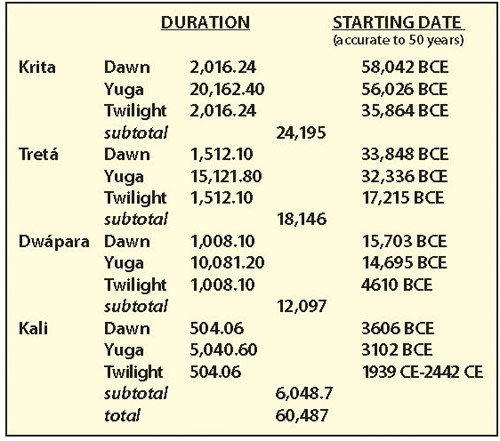
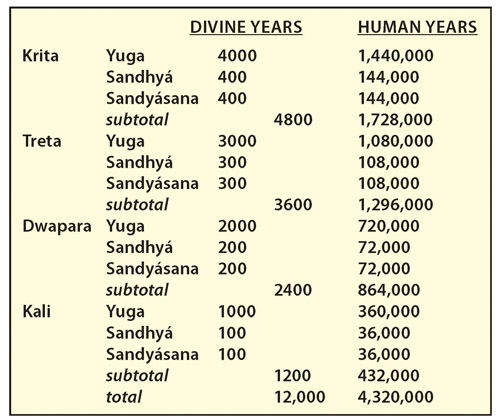
    Each Yuga has a dawn and a twilight period, each a tenth of its length, called respectively Sandhyá and Sandyásana. The Vishnu Purana gives their durations in divine years, each counting for 360 human years, as follows:3

    ndmain138 64

    To relate these durations to history we need an actual date, and this is supplied by the Hindu astronomers. They agree that the Kali Yuga began at midnight between February 17 and 18, 3102 BCE. From that we can calculate that the transition to the Golden Age will occur around 427,000 CE. It hardly seems worth bothering about something so far outside the time-scale of human experience. But before we dismiss these figures as pure fantasy, we should know that they are not peculiar to Hinduism. Some of them appear in very different contexts, with such precision that there is no question of chance coincidence.

    Berossus, who records the Babylonian chronology, was a priest of Bel and had a school of astronomy on the island of Kos in the third century BCE. He gives the figures for the reigns of the ten Assyrian kings who preceded the Flood: they total 420,000 years.4

    In China, according to the early missionary researcher Père Prémare, the early dynasties were respectively of 13 and 11 kings, each of whom ruled or lived 18,000 years. Prémare understandably doubted this, but if we do the arithmetic, (13 + 11) x 18,000 comes to 432,000 years.5

    The Icelandic saga called the Poetic Edda describes the preparations for the apocalyptic battle at the end of time, when Valhalla’s warriors issue forth against the Fenris Wolf:

    Five hundred doors | and forty there are,
    I ween, in Valhall’s walls;
    Eight hundred fighters | through one door fare
    When to war with the wolf they go.6

    800 fighters going through each of 540 doors totals 432,000. So the number of warriors gathered in Valhalla on the last day is again the number of years in the Kali Yuga, the last age of the Maha Yuga cycle.

    The authors of Hamlet’s Mill, Giorgio de Santillana and Hertha von Dechend, called this a “remarkable and disturbing coincidence.”7 This is because the theory of an archaic worldwide culture with cosmological knowledge is anathema to official prehistory. One breach in the conventional view is due to Ernest McClain, one of the most original and ingenious researchers of our time. He has uncovered evidence of a kind of multidisciplinary game played with these self-same numbers which hinges on musical tuning systems. Those in the know included the Babylonians, the Vedic poets, Plato, the compilers of the Hebrew scriptures, the earliest Christians and Gnostics, and whoever gave the Quran its present form. For example, McClain interprets the Arks of Babylonian and Hebrew legend as multi-story diagrams that enclose, or “save” from the flood all possible numbers, the ones needed for calculating the calendar and the musical scale. In the case of Noah’s Ark, the significant number is none other than 432,000.8

    McClain is a radical with regard to the history of ideas, but even more so are the Traditionalists, who take the numbers not as a philosophical game but as encoding precise knowledge of cosmic and historical time-cycles. René Guénon (1886-1951), one of the few great thinkers to have worked from this assumption, accepted that the four Yugas are in the proportion of 4:3:2:1, but questioned the Puranic figures. The zeros were put there simply to mislead, he says,9 and for good reason. If people knew the real dates, they would try to predict the future, which is unwise “because in practice, such knowledge brings many more problems than advantages.”10 The essential thing is the number 4320, which Guénon takes as representing the Maha Yuga: the set of four Yugas that embraces the entire history of present humanity. But 4320 years is obviously too short a period, just as the 4,320,000 years of the Puranas is too long. There were two basic problems: first, to find the correct multiplier of 4320 in order to arrive at the true length of the Maha Yuga, and second, to find the anchor in known chronology. Guénon seems to have worked backwards from knowledge of another cycle, that of the precession of the equinoxes which is traditionally given as 25,920 years (4320 x 6). Assuming that the Krita Yuga or the “timeless” Golden Age lasted for a whole precessional cycle, this gives the following durations for the four Yugas in human years, with a total of 64,800 years or 4320 x 15:

    Krita, 25,920
    Treta, 19,440
    Dwapara, 12,960
    Kali, 6480

    For all his warnings about attempts to predict the future, Guénon planted straightforward clues, mostly in footnotes, to show how he connected these durations to known chronology. Writing about Atlantis, he says:

    We think that the duration of the Atlantean civilisation must be equal to a “Great Year,” understood as half the period of the Precession of the Equinoxes. As for the cataclysm that brought it to an end, certain concordant data seem to indicate that it took place 7200 years before the year 720 of the Kali Yuga: a year which is itself the departure point of a familiar era, but one whose origin and significance are no longer known to those who currently use it.11

    Guénon typically does not reveal the “concordant data,” but his commentator Jean Robin explains:

    If one knows that the era in question is none other than the Jewish one, whose beginning is traditionally placed 3761 years before the Christian era, it is easy to deduce… the “theoretical” end-date of the cycle. The beginning of the Kali Yuga would thus be in the year 4481 BCE (3761 + 720), and its end would have to come 6480 years later, i.e. in the year 1999 (6480 – 4481).12

    We can now reconstruct Guénon’s chronology as follows:

    ndmain138 65

    Robin was writing in the early 1980s. He reminds us that 1999 is the one date specifically mentioned by Nostradamus as when “a great King of Terror will come from the sky.” But like every other world-ending date, it has come and gone.
    [alert type=”info” dismiss=”no”]If you appreciate this article, please consider a subscription to New Dawn magazine.[/alert]

    The orientalist and musicologist Alain Daniélou (1907-1994) knew the Hindu tradition from the inside and was a correspondent of Guénon’s. He too could not accept the extremely large figures given in the Puranas, and reduced them in a different way. There are some problems with his method (explained in my book Atlantis and the Cycles of Time), but it is enough here to give his figures for comparison. Daniélou’s historical peg is the traditional date for the beginning of the Kali Yuga, 3102 BCE, which he says “represents a cosmological reality linked with an alternation in influx from the planetary spheres; it is not an arbitrary date.”13

    ndmain138 66

    By these calculations, the Kali Yuga’s final phase began with World War II. Daniélou, although a much more cheerful type than the saturnine Guénon, was a complete cultural pessimist. He writes that, “the final catastrophe will take place during this twilight. The last traces of this present humanity will have disappeared in 2442.”14 I can imagine him adding, with a smile, “et bon débarras!” [and good riddance!].

    Guénon also corresponded with Gaston Georgel (1899-?), an independent scholar of whom almost nothing is known. He had found that historical events tend to replicate each other at certain rhythmical intervals. Some of his parallels are impressive, such as that of the medieval kings of France with Louis XIV-XVI, at an interval of 539 years (77 × 7), or that of the English and French revolutions, 144 years apart. Georgel first published his cyclical theories in 1937 as Les rythmes dans l’histoire (Rhythms in history).15 He was as yet unaware of Hindu traditions, and his large-scale cycle was one of 2160 years. This is the traditional duration of an astrological age, twelve of which make up the precessional cycle of 25,920 years. Georgel renames the Age of Aries the “Cycle of Abraham,” and the Age of Pisces the “Cycle of Caesar,” which he dates from 130 BCE. He arrived at that date, he says, from “a deep study of the Christic cycle” and the fact that “according to Virgil’s Fourth Eclogue, the sun at autumn equinox then entered the sign of Virgo.”16 That sounds authoritative, but as anyone who has studied the astrological ages should know, the borders of the constellations are not fixed (unlike the regular, fictive constellations counting from the spring point as 0° Aries). Consequently the time when the equinoctial sun moves from one to the next is debatable. For instance, the dates given by various authorities for the beginning of the Aquarian Age range from 1760 (Godfrey Higgins) to 2160 (Paul Le Cour).17 

    Guénon agreed that many of Georgel’s coincidences were extraordinary. The next year he wrote his own contribution to the subject, “Some Remarks on the Doctrine of Cosmic Cycles” (1938), in which he interpreted the Puranic numbers as given above. After World War II their correspondence resumed. Georgel returned the compliment by adopting Guénon’s Yuga chronology but stuck to his own dating, saying that “to facilitate our research, we will here adopt the date of AD 2030 that was proposed as a working hypothesis in our first book, for the end of the Manvantara” (i.e. the Maha Yuga of 64,800 years).18

    Georgel found corroboration of the 2030 end-date in a book to which Guénon himself lent much credence: Beasts, Men and Gods by Ferdinand Ossendowski. This best-selling book published in 1922 plays a large role in the myth of Agarttha, which I have treated elsewhere.19 It culminated with a prophecy that the King of the World is supposed to have made in Mongolia in 1891:

    In the fiftieth year only three great kingdoms will appear, which will exist happily seventy-one years. Afterwards there will be eighteen years of war and destruction. Then the peoples of Agharti will come up from their subterranean caverns to the surface of the earth.20

    The fiftieth year from 1891 is 1941. The happy period of 71 years under three great kingdoms lasts from 1941 till 2012. Then 18 more years bring us exactly to 2030.21

    We now have four suggested dates for the end of the Kali Yuga, and with it the end of the present set of four ages. The Puranic figures, taken literally, place it about 427,000 years in the future. Jean Robin, following Guénon, reckoned that it would end in 1999. Daniélou calculated that the Kali Yuga entered twilight phase in 1939 and will end completely in 2442. Georgel’s multiple cycles converge on the year 2030. After that a new Krita/Satya Yuga initiates the next cycle.

    Sri Yukteswar’s Hindu Yuga system

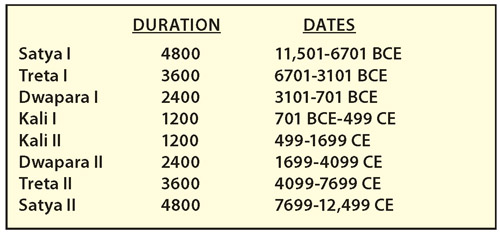
    Many readers will be familiar with the system proposed by Sri Yukteswar Giri (1855-1936). It has had such favourable publicity in recent years that it is widely believed to be the authoritative Hindu Yuga system.22 Sri Yukteswar adopts as his Maha Yuga a 24,000 year period, supposedly that of the precession of the equinoxes. He assigns half these years to a set of descending Yugas in the traditional proportion 4:3:2:1. By taking the “divine years” of the Puranas (see the first table, page 64) as human ones, they total 12,000 years. Then comes his real innovation: the cycle does not repeat, but starts a new set of four Yugas in reverse order. The link to historical chronology seems to be the traditional Kali Yuga starting-date of 3102 BCE, but moved to 3101 and to a different place in the Yuga sequence. From this it is easy to construct a table of Yuketeswar’s system:

    ndmain138 67

    As in the Puranic system, each age is framed by sandhis or periods of mutation at its beginning and end, each worth 1/10 of the Yuga. Thus a Kali Yuga proper lasts 1000 years, with periods of 200 years preceding and following it. In 1894 Yukteswar wrote:

    In 1899, on completion of the period of 200 years of Dwapara Sandhi, the time of mutation, the True Dwapara Yuga of 2000 years will commence and will give to mankind in general a thorough understanding of the electricities and their attributes.23

    The essence of Yukteswar’s system is that it places present-day humanity in an ascending, rather than a descending curve. This is so contrary to all traditions that we must look for its source elsewhere. Upper-caste Indians like Yukteswar may have resented being colonised by the British, but they had bought into the European myth of progress through science. Yukteswar believed that around 1700 the world had entered an “electrical” age. The discovery of electricity and its uses signified to him that man was attaining a finer perception than in the purely materialistic age that had preceded it. Before that, in the dual Kali Yuga, “the intellectual part of man was so much diminished that it could no longer comprehend anything beyond the gross material of creation.”24

    Only historical ignorance can excuse such a statement. The period in question, from 701 BCE to 1699 CE, saw the birth of Buddhism, Zoroastrianism, Taoism, Jainism, and Vedanta; of the Orphic and Pythagorean movements, the mysteries of Isis, Serapis, and Mithras, the birth of post-exilic Judaism, Druidry, Christianity, Manicheanism, Gnosticism, Catharism, and Islam. On the esoteric side it witnessed Zen and Vajrayana Buddhism, Sankhya philosophy, Kabbalah, Sufism, theosophy both Neoplatonic and Christian, Rosicrucianism, and the arts of magic, alchemy, and astrology. Reports of miracles were commonplace, and belief in non-material realities such as oracles, curses, the Will of God, the Devil, transubstantiation, or witchcraft was so intense as to cause major wars and persecutions. Finally around 1700, with the scientific revolution and the Enlightenment, came a rising tide of disbelief in anything spiritual, leading to the atheism and scientific materialism of today’s elites.

    The Jains and some Buddhist sects also had an up-and down cyclical system, which may have been one of Sri Yukteswar’s inspirations, though their time-scale far exceeds his. His other ingredient was a rough approximation of the precessional cycle to 24,000 years instead of the astronomers’ 25,770 or the traditional 25,920. He anchored it in historical chronology with a clearly political motive, for, along with another future guru, Sri Aurobindo Ghose, he belonged to a secret anti-colonial movement called precisely Yugantar, meaning “New Age” or “Transition of an Epoch.”25 There was a strategic purpose behind the announcement in 1894 that the Kali Yuga was over and the Dwapara Yuga, a better age, already in progress; also behind the emphasis on 1899, only five years away, as the year that the new epoch would come into its own. In the early years of the twentieth century, the movement’s propaganda announced that the “sinful Iron Age was over” and urged insurrection. This is not an attack on Sri Yukteswar and those who respect him and his disciple Yogananda, but simply a reminder that even sages have their agendas. Guénon said as much about the authors of the Puranas!

    What is at stake here is more than allegiance to one authority or another. It is whether one’s world-view allows (1) that humanity as a whole passes through predetermined cycles, and (2) that these are fixed chronologically, hence predictable if one can find the key. For what it is worth, I lean towards the first but not the second, because I trust the microcosm as a guide to understanding the macrocosm, and vice versa. Every one of us is passing through a predetermined cycle whose dates are unpredictable. Barring accidents, we are making our way from the Golden Age of childhood, through the bitter-sweet Silver Age of adolescence and the combative Bronze Age of maturity, to the Iron Age of decline and death. Then we may start afresh, but we certainly don’t repeat the process in reverse! Just as one can estimate someone’s life expectancy by their age, state of health, habits, etc., so one can make a guess at that of civilisations and maybe the entire human race.

    The traditional descriptions of the Kali Yuga, and especially of what Guénon in 1944 called the “Reign of Quantity,” fit the modern world perfectly, and that may give us an idea of our position in the cycle. But like an old person recovering from one close call after another, we seem to be holding on and must be grateful for each new day.

    More information and extensive research on this subject matter can be found in Joselyn Godwin’s book Atlantis and the Cycles of Time (Inner Traditions, 2011).

    [alert type=”general” dismiss=”no”]This article was published in New Dawn 138.[/alert]

    [alert type=”success” dismiss=”no”]If you appreciate this article, please consider subscribing to help maintain this website.[/alert]

    Footnotes

    1. This article quotes and adapts material explained more fully in my book Atlantis and the Cycles of Time (Rochester, Vt.: Inner Traditions, 2011).

    2. J. Godwin, Arktos, The Polar Myth in Science, Symbolism, and Nazi Survival (Kempton: Adventures Unlimited, 1996), 13-18.

    3. Compiled from Vishnu Purana, 1:3; see also Linga Purana, 4:24-35; Laws of Manu, 1:68-82.

    4. Eusebius, Chaldaean Chronicle, 1:8.

    5. Joseph Henri Marie de Prémare, Discours préliminaire, in Joseph de Guignes, ed., Le Chou-King, un des livres sacrés des Chinois (Paris: Tilliard, 1770), li.

    6. The Poetic Edda, Grimnismol, 23, trans. Henry Adams Bellows.

    7. Giorgio de Santillana and Hertha von Dechend, Hamlet’s Mill: An Essay on Myth and the Frame of Time (Boston: Gambit, 1969), 162.

    8. Ernest G. McClain, The Myth of Invariance: The Origin of the Gods, Mathematics and Music from the Rig Veda to Plato (New York: Nicolas Hays, 1976), 149.

    9. What follows is summarised from René Guénon, “Quelques remarques sur la doctrine des cycles cosmiques,” in Formes traditionnelles et cycles cosmiques (Paris: Gallimard, 1970), 22-24.

    10. Ibid., 21.

    11. Ibid., 48n.

    12. Jean Robin, Les sociétés secrètes au rendez-vous de l’apocalypse (Paris: Guy Trédaniel, 1985), 67.

    13. Alain Daniélou, While the Gods Play: Shaiva Oracles and Predictions on the Cycles of History and the Destiny of Mankind, trans. Barbara Bailey et al. (Rochester, Vt.: Inner Traditions, 1987), 193.

    14. Daniélou, While the Gods Play, 197.

    15. Gaston Georgel, Les rythmes dans l’histoire, 3rd ed. (Milan: Archè, 1981; 1st ed. 1937).

    16. Ibid., 164.

    17. See Atlantis and the Cycles of Time, 346-48.

    18. Gaston Georgel, Les quatre âges de l’humanité (Exposé de la doctrine traditionnelle des cycles cosmiques) (Milan: Archè, 1976; 1st ed. 1949), 87.

    19. See J. Godwin, “Agarttha: Taking the Lid Off the Underground Kingdom,” New Dawn 109 (2008), 59-62; also the investigations by Marco Baistrocchi, “Agarttha: A Guénonian Manipulation?” trans. J. Godwin (Fullerton, Ca.: Theosophical History, 2011) and Louis de Maistre, Dans les coulisses de l’Agartha l’extraordinaire mission de Ferdinand Anton Ossendowski en Mongolie. (Paris: Arché, 2010).

    20. Ferdinand Ossendowski, Beasts, Men and Gods (New York: Dutton, 1922), 314.

    21. Gaston Georgel, Le cycle Judéo-Chrétien, sceau et couronnement de l’histoire humaine (Milan: Archè, 1983), 34.

    22. This system is explained in Jnanavatar Swami Sri Yukteswar Giri, The Holy Science (Los Angeles: Self-Realization Fellowship, 1990; 1st ed. 1949), 7-18.

    23. Ibid., 15.

    24. Ibid., 13.

    25. See Terrorism in Bengal: A Collection of Documents on Terrorist Activities from 1905 to 1939, ed. Amiya K. Samanta (Calcutta: Government of West Bengal, 1995), 1:155. Accessed through Wikipedia article “Mokshadacharan Samadhyayi.”

    © New Dawn Magazine and the respective author.
    For our reproduction notice, click here.
  • The Speed of Life: Why Time Seems to Speed Up and How to Slow it Down

    The Speed of Life: Why Time Seems to Speed Up and How to Slow it Down

    From New Dawn 104 (Sept-Oct 2007)

    I’m six years old, in the car with my parents and brother, travelling back from our annual two week holiday in Conwy, North Wales. It’s dark and the journey seems to take forever. I lie in the back seat, watching the orange streetlights and the houses pass by, and wonder if we’re ever going to get home.

    “Are we nearly there yet?” I ask my father.

    “Don’t be silly,” he says. “We only set off half an hour ago.”

    My mum plays the ‘Yes/No’ game and ‘Twenty questions’ with us to make the time pass faster. We listen to the radio for a while. Then I fall asleep. When I wake up it seems like I’ve been in the car for an eternity and I can’t believe we’re still not home.

    “Are we nearly there yet?” I ask again.

    “Not far now,” says my father.

    We play some more games and finally I recognise the streets of our suburb of Manchester. I feel bored and miserable and tell myself that I’m never going to spend as long in a car ever again.

    The journey from Conwy to Manchester took two hours when I was a child and still takes roughly two hours now (although slightly less due to improvements in roads). I made the journey again a few years ago and couldn’t believe how short it seemed now, from my adult perspective. Those two hours – which seemed like an eternity when I was 6 – were nothing. My girlfriend was driving, and we chatted, listened to tapes, watched the Welsh countryside give way to the urban sprawl of north-west England, and we were back in Manchester almost before we knew it. It was a little frightening – what had happened to all the time that two hours contained when I was six years old?

    A year or so ago I made another journey which gave me an indication of how much more quickly time is passing to me now. This was a 15 hour plane journey, from Singapore to Manchester, which also seemed to last forever. I’m not a very good flyer and it wasn’t a very good flight: we flew into two typhoons over India and it was rocky almost all the way. I hoped I’d be able to ‘kill’ some of the time by sleeping but it was impossible. Every time I drifted off my anxiety woke me up again. Failing that, I hoped I’d at least be able to make the time pass quickly by distracting myself with the in-flight entertainment or with books and magazines, but my mind stubbornly refused to move from the moment to moment reality of the situation. I was aware of every minute passing, and as a result time seemed to drag horribly. Every time I checked the clock – which was every few minutes or so – less time had gone by than I expected.

    My subjective sense of how long that journey took is, I realised recently, very similar to my sense of how long my childhood journey to Conwy took. To me they seemed to involve roughly the same amount of boredom and impatience and to last for roughly the same amount of time. This suggests that what was two hours to me as a child is equivalent to 15 hours to me as an adult – which means, rather frighteningly, that time is now passing around seven times faster than when I was a child.

    This story appears to fit with most people’s experience. Most of us feel that time moved very slowly when we were children and is gradually speeding up as we grow older. We’ve all remarked on it: how Christmas seems to come round quicker every year; how you’re just getting used to writing the date of the new year on your cheques and you realise that it’s almost over; how your children are about to finish school when it doesn’t seem long since you were changing their nappies…

    Questionnaires by psychologists have shown that almost everyone – including college students – feels that time is passing faster now compared to when they were half or a quarter as old as now. And perhaps most strikingly, a number of experiments have shown that, when older people are asked to guess how long intervals of time are, or to ‘reproduce’ the length of periods of time, they guess a shorter amount than younger people.

    We usually become conscious of this speeding up around our late twenties, when most of us have ‘settled down.’ We have steady jobs and marriages and homes and our lives become ordered into routines – the daily routine of working, coming home, having dinner and watching TV; the weekly routine of (for example) going to the gym on Monday night, going to the cinema on Wednesday night, going for a drink with friends on Friday night etc.; and the yearly routine of birthdays, bank holidays and two weeks’ holiday in the summer. After a few years we start to realise that the time it takes us to run through these routines seems to be decreasing, as if we’re on a turntable which is picking up speed with every rotation. As the French philosopher Paul Janet noted more than a hundred years ago:

    Whoever counts many lustra in his memory need only question himself to find that the last of these, the past five years, have sped much more quickly than the preceding periods of equal amount. Let any one remember his last eight or ten school years: it is the space of a century. Compare with them the last eight or ten years of life: it is the space of an hour.1

    This speeding up is probably responsible for the phenomenon which psychologists call ‘forward telescoping’: our tendency to think that past events have happened more recently than they actually have. Marriages, deaths, the birth of children – when we look back at these and other significant events, we’re often surprised that they happened so long ago, shocked to find that it’s already four years since a friend died when we thought it was only a couple of years, or that a niece or nephew is already ten years old when it only seems like three or four years since they were born.

    As one 83 year old man told me, “I can never guess how long ago things happened. People ask me things like ‘When did so and so get married?’ or ‘When did so and so die?’ and I’m always way out. If I say it was two years it turns out to be 5 years. If I say six months, it’s two years.” The same holds true for national and international events, like the deaths of famous people, natural disasters and wars: studies have shown that people usually date these too recently as well. And perhaps this is because time is speeding up as we get older. Time is moving more quickly than we think. It doesn’t seem like four years since a friend died or a baby was born, or since a famous person died, because during those four years time has been speeding up without you realising, making every month and year shorter than the one before.

    The Proportional and Biological Theories

    So why do we experience this speeding up of time?

    One popular answer is the ‘proportional’ theory, which suggests that the important factor is that, as you get older, each time period constitutes a smaller fraction of your life as a whole. This theory seems to have been first put forward in 1877 by Paul Janet, who suggested the law that, as William James describes it, “the apparent length of an interval at a given epoch of a man’s life is proportional to the total length of the life itself. A child of 10 feels a year as 1/10 of his whole life – a man of 50 as 1/50, the whole life meanwhile apparently preserving a constant length.”2 At the age of one month, a week is a quarter of your whole life, so it’s inevitable that it seems to last forever. At the age of 14, one year constitutes around 7% of your life, so that seems to be a large amount of time too. But at the age of 30 a week is only a tiny percentage of your life, and at 50 a year is only 2% of your life, and so your subjective sense is that these are insignificant periods of time which pass very quickly.

    There is some sense to this theory – it does offer an explanation for why the speed of time seems to increase so gradually and evenly, with almost mathematical consistency. One problem with it, however, is that it tries to explain present time purely in terms of past time. The assumption behind it is that we continually experience our lives as a whole, and perceive each day, week, month or year becoming more insignificant in relation to the whole. But we don’t live our lives like this. We live in terms of much smaller periods of time, from hour to hour and day to day, dealing with each time period on its own merits, independently of all that has gone before.

    There are also biological theories. One of these is that the speeding up of time is linked to how our metabolism gradually slows down as we grow older. Because children’s hearts beat faster than ours, because they breathe more quickly and their blood flows more quickly etc., their body clocks ‘cover’ more time within the space of 24 hours than ours do as adults. Children live through more time simply because they’re moving through time faster. Think of a clock which is set to run 25% faster than normal time – after 12 hours of normal time it has covered 15 hours, after 24 hours of normal time it has covered 30, which means that, from that clock’s point of view, a day has contained more time than usual. On the other hand old people are like clocks which run slower than normal, so that they lag behind, and cover less than 24 hours’ time against a normal clock.

    Also from a biological perspective, there is the ‘body temperature’ theory. In the 1930s the psychologist Hudson Hoagland conducted a series of experiments which showed that body temperature causes different perceptions of time. Once, when his wife was ill with the flu and he was looking after her, he noticed that she complained that he’d been away for a long time even if he was only away for a few moments. With admirable scientific detachment, Hoagland tested her perception of time at different temperatures, and found that the higher her temperature, the more time seemed to slow down for her, and the longer she experienced each time period. Hoagland followed this up with several semi-sadistic experiments with students, which involved them enduring temperatures of up to 65C, and wearing heated helmets. These showed that raising a person’s body temperature can slow down their sense of time passing by up to 20%. And the important point here may be that children have a higher body temperature than adults, which may mean that time is ‘expanded’ to them. And in a similar way, our body temperature becomes gradually lower as we grow older, which could explain a gradual ‘constriction’ of time.

    The Perceptual Theory

    However, in my view, the speeding up of time we experience is mainly related to our perception of the world around us and of our experiences, and how this perception changes as we grow older.

    The speed of time seems to be largely determined by how much information our minds absorb and process – the more information there is, the slower time goes. This connection was verified by the psychologist Robert Ornstein in the 1960s. In a series of experiments, Ornstein played tapes to volunteers with various kinds of sound information on them, such as simple clicking sounds and household noises. At the end he asked them to estimate how long they had listened to the tape for, and found that when there was more information on the tape (e.g. when there were double the number of clicking noises), the volunteers estimated the time period to be longer. He found that this applied to the complexity of the information too. When they were asked to examine different drawings and paintings, the participants with the most complex images estimated the time period to be longest.

    I have tested this myself with a simple experiment with music. During a course, I asked the participants to listen to two pieces of music. One was a mad, frenetic piano concerto by Rachmaninov, with notes cascading at a rate of about 10 per second. The other was a piece of ambient music by Brian Eno, which floated gently and sedately across the room. We listened to the pieces for different periods of time and I asked the participants to estimate how much time had passed. If time perception is related to information, they should have experienced more time for the Rachmaninov piece. It contains a lot more information than the Brian Eno piece – many times more notes, tones and different instruments. All of this extra information should have stretched time.

    And this is what the results showed. We listened to the Rachmaninov piece for 2 mins 20 secs, and the average estimate was 3 mins 25 secs. We listened to the Brian Eno piece for 2 minutes, while the average estimate was 2 mins 32 secs – still an over-estimate, but a lower one.

    And if more information slows down time, perhaps part of the reason why time goes so slowly for children is because of the massive amount of ‘perceptual information’ that they take in from the world around them. Young children appear to live in a completely different world to adults – a much more intense, more real and more fascinating and beautiful one. As the psychologist Ernest Becker writes, in childhood we experience a “vision of the primary miraculousness of creation,” and our perceptions of the world are “suffused… in emotion and wonder.” This is one of the reasons why we often recall childhood as a time of bliss – because the world was a much more exciting and beautiful place to us then, and all our experiences were so intense. Children’s heightened perception means that they’re constantly taking in all kinds of details which pass us adults by – tiny cracks in windows, tiny insects crawling across the floor, patterns of sunlight on the carpet etc. And even the larger scale things which we can see as well seem to be more real to them, to be brighter, with more presence and is-ness. All of this information stretches out time for children.

    However, as we get older, we lose this intensity of perception, and the world becomes a dreary and familiar place – so dreary and familiar that we stop paying attention to it. After all, why should you pay attention to the buildings or streets you pass on the way to work? You’ve seen these things thousands of times before, and they’re not beautiful or fascinating, they’re just… ordinary. As Becker describes it, we “repress” this intensity of vision. “By the time we leave childhood,” he writes, “we have closed it off, changed it, and no longer perceive the world as it is to raw experience.”3 Or as Wordsworth puts it in his famous poem ‘Intimations of Immortality’, the childhood vision which enabled to all things “apparelled in celestial light,” begins to “fade into the light of common day.”4 And this is why time speeds up for us. As we become adults, we begin to ‘switch off’ to the wonder and is-ness of the world, gradually stop paying conscious attention to our surroundings and experience. As a result we take in less information, which means that time passes more quickly. Time is less ‘stretched’ with information.

    Old and New Experience

    And once we become adults, there is a process of progressive ‘familiarisation’ which continues throughout our lives. The longer we’re alive, the more familiar the world becomes, so that the amount of perceptual information we absorb decreases with every year, and time seems to pass faster every year.

    There are two basic reasons why this happens. On the one hand, as we grow older there is progressively less newness in our lives. The life of a 20 year old woman is still full of new experiences. She’s still discovering new kinds of music, food, literature and other new hobbies and interests. She might be experiencing her first serious romantic relationship, learning to drive, flying and going abroad for the first time, discovering new towns or the countryside close to where she lives and so on. When she has these new experiences she is free of the de-sensitising mechanism; she perceives the ‘raw experience’ of the world and processes a large amount of perceptual information.

    The same person at the age of 30 might still be having a few new experiences. She might be having a baby, going abroad to another country she’s never been to before, learning a new language, or starting a new job. But by the time she reaches 40 the world contains much less unfamiliarity. Her life probably consists mainly of the repetition of experiences which she’s had hundreds or thousands of times before. She works at the job she’s had for the last 20 years, goes home to the same house she’s had for the last ten, devotes her free time to the same hobbies and interests she discovered when she was 20, goes away at weekends to the same countryside, to the same foreign country every year, and so on. Because of this the de-sensitising mechanism has a greater hold over her. She’s hardly ever free of it, which means that she absorbs much less perceptual information.

    But if this was the only reason why our perceptions become less fresh – and why time speeds up – as we get older, there wouldn’t be much difference between the time perceptions of a 40 and a 60 year old person. Most of us use up almost all of our ‘stock’ of new experience by the time we reach middle-age, and so there would be no real reason why time should appear to move faster for a person at these different ages. However, the second reason why our perceptions become less fresh is probably that as we get older all the experiences we’ve already had become more familiar to us. Not only do we have fewer new experiences, but the experiences which are already familiar to us become progressively less real. In William James’ words, “each passing year converts some of this experience into automatic routine.”5 As well as experiencing lots of new things, a woman at the age of 20 is still quite ‘fresh’ to the phenomenal world around her – but over the next 20 years, she’ll look at the same street scenes and the same sky and the same trees thousands of times, so that more and more of their realness will fade away.

    Incidentally, this link between time and information can explain other aspects of time too. One of the ‘laws’ of psychological time which I set out in my book Making Time is that “time seems to slow down when we’re exposed to new environments and experiences.” This is because the unfamiliarity of new experiences allows us to take in much more information. Another of the laws is that “time goes quickly in states of absorption.” This is because in states of absorption our attention narrows to one small focus and we block out information from our surroundings. At the same time there is very little ‘cognitive information’ in our minds, since the concentration has quietened the normal ‘thought chatter’ of the mind. On the other hand, time goes slowly in states of boredom and discomfort because in these situations our attention isn’t occupied and a massive amount of thought-chatter flows through our minds, bringing a massive amount of cognitive information.

    Get the issue this article appears in

    Slowing Down Time

    On the positive side though, if we know why time speeds up as we get older we aren’t powerless against it. If we know that this is caused by familiarity, then we make an effort to expose ourselves to as much newness in our lives as possible – not just new environments through travel (although this is very important), but new challenges, new situations, new information, ideas, hobbies and skills. As the expansion of time which we often experience when we go to foreign countries shows, newness and unfamiliarity stretch time. If we regularly expose ourselves to unfamiliarity, we can experience more time in our lives, and so effectively live for ‘longer.’

    If you spend all the years of your adult life doing the same job, living in the same house in the same area, doing the same things with the same people in your free time, then it’s inevitable that you experience a swift passage of time. But if you change jobs regularly, regularly travel to new places, keep investigating new ideas and giving yourself new challenges, time will pass more slowly to you. In this way, it’s possible for a person who dies before the age of 40 (like the French poet and explorer Arthur Rimbaud, who I wrote about recently in New Dawn) to live for ‘longer’ than a person who dies at the age of 80.

    A second way in which we can slow down time is by making a conscious effort to be ‘mindful’ of our experience. There are some people who seem to be as affected by familiarity than others, and see the world with something of the fresh, first-time vision of children all through their lives. These are the kind of people – sometimes seen as eccentrics by those around them – who often begin sentences with phrases like ‘Isn’t it strange that…?’ or ‘Have you ever wondered…?’ They’re the kind of people who might stop in the street to gaze up at a beautiful scene of the sun breaking through clouds or a silver moon above the rooftops; or they might stare intently at the sea, at flowers or at animals, as if they’ve never seen them before. Poets and artists often have this kind of ‘child-like’ vision – in fact it’s this that usually provides the inspiration for their work. They often have a sense of strangeness and wonder about things which most of us take for granted, and feel a need to capture and frame their more intense perceptions. These people will be less affected by the first time law of psychological time than others; time may well speed up for them, but perhaps not to the same degree.

    And in a sense, we can cultivate this attitude simply by making a conscious effort to be ‘mindful.’ Instead of focusing our attention on the ‘thought-chatter’ in our heads or on tasks or distractions like TV or computer games, we should try to live in the present, to give our attention to the experiences we’re having and to our surroundings. When you’re having a shower in the morning, for example – instead of letting your mind chatter away about the things you’ve got to do today or the things you did last night, try to bring your attention to the here and now, to really be aware of the sensation of the water splashing against and running down your body and the sense of warmth and cleanness you feel. Or on the way home from work on the bus or the train – instead of mulling over all the problems you’ve had to deal with at work or daydreaming about the attractive girl you met last night, focus your attention outside you; look at the sky, at the houses and buildings you pass, and be aware of yourself here, walking amongst them.

    Mindfulness means stopping thinking and starting to be aware, to live in the here and now of your experience instead of the ‘there and then’ of your thoughts. It stretches time in exactly the same way that new experience does: because we give more attention to our experience, we take in more information from it.

    In other words, to some extent we can control time. It doesn’t have to speed up as get older. Some of us try to extend our lives by keeping fit and eating healthy food, which is completely sensible. But it’s also possible for us to expand time from the inside, by changing the way we experience the moment to moment reality of our lives. We can live for longer not just in terms of years, but also in terms of perception.

    [alert type=”general” dismiss=”no”]This article was published in New Dawn 104.[/alert]

    [alert type=”success” dismiss=”no”]If you appreciate this article, please consider subscribing to help maintain this website.[/alert]

    Footnotes:

    1. Quoted in W. James, The Principles of Psychology, (New York: Dover Press, 1950) Chapter XV.
    2. Ibid.
    3. E. Becker, The Denial of Death, (New York: Free Press, 1973), p.50.
    4. W. Wordsworth, Poems, (London: Penguin, 1950), p.71.
    5. James, op.cit.

    © New Dawn Magazine and the respective author.
    For our reproduction notice, click here.
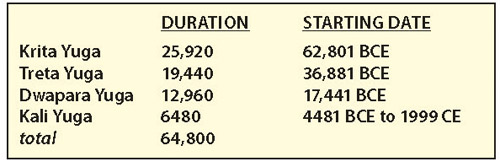
  • The Alchemy of Time: Understanding the Great Year & the Cycles of Existence

    The Alchemy of Time: Understanding the Great Year & the Cycles of Existence

    From New Dawn 92 (Sept-Oct 2005)

    The age of iron has no other seal than that of Death. Its hieroglyph is the skeleton, bearing the attributes of Saturn: the empty hourglass, symbol of time run out…
    – Fulcanelli

    The inspiration for this article comes from my almost nineteen years of research into the Great Cross of Hendaye and the French alchemist Fulcanelli. The unknown, anonymous, alchemist Fulcanelli in his masterpieceThe Mysteries of the Cathedrals first brought the cross at Hendaye, France to the world’s attention.

    While the details of this research can be found in other articles written by myself and in the two books I co-authored,1 it can be stated that the Great Cross at Hendaye appears to be describing not only the end of the great four ages of the Hindu Yuga system but also the four ages of alchemical chronological time keeping. According to the cross at Hendaye, the Iron Age, or the Kali Yuga, will be coming to an end with the galactic alignment on the winter solstice of December 21st, 2012.

    According to the mythology of the Yuga system, there are four ages of life and time on our planet. It is important to remember there are many cycles within cycles in the Hindu Yuga system so the years mentioned next may have to do with a larger cycle than the one addressed in this article. Perhaps the huge number of years referred to below is the cycle of the solar system as it circles another star, or perhaps it is a portion of the great cycle of one revolution around the galactic centre.

    The first age is the Satya Yuga or the Golden Age, according to Fulcanelli. The Hindu texts tell us that this age lasts 1,728,000 years. This is an age of extreme splendour when the beings on our planet appear to live much longer than they do now. In this age there are no wars, famines, strife or evil.

    The second age is called the Treta Yuga, or the Silver Age. As in the second law of thermodynamics, or entropy, things begin to slip in this age and the beings on Earth begin to deteriorate. This slippage, at least during this second age, is the beginning of corruption, and evil is introduced into the planetary sphere. This age lasts 1,296,000 years according to the Vedic texts of India.

    The third age of this cycle is called the Dvapara Age, or the Bronze Age. This is the beginning of the ‘fall’ of humanity. In this age corruption comes on more fully, evil begins to spread, and things start to fall into disharmony. This age lasts 864,000 years.

    The last age is called the Kali Yuga, or the Iron Age. This age is the age we are in right now. Evil and corruption become the driving force as greed, wars, famine and disease spread across the planet like a tidal wave of death and destruction. This age lasts, according to the Hindu texts for 432,000 years.2

    What is important to understand while discussing these huge numbers found in the Hindu texts is they are describing the four ages within a context of understanding that each successive age is shorter than the previous age. The Satya Yuga, or the Golden Age, is one quarter longer than the Treta Yuga, or the Silver Age. The Treta Yuga is one quarter longer than the Dvapara Yuga, or the Bronze Age. Understanding these differences in the lengths of the ages becomes important to the following discussion.

    According to Fulcanelli and the cross at Hendaye, the alchemical Four Ages comprise the four quadrants of a 25,920 year-long cycle called the precession of the equinoxes. Essentially, the precession of the equinoxes can be explained by the fact that our Earth has a wobble. Like a top spinning on the floor, as it begins to lose momentum this wobble of the Earth takes nearly 26,000 years to unfold. The strange engraving of the four ‘A’s’ (see Figure 5) on the cross of Hendaye is a “hieroglyph of the universe”, according to Fulcanelli. It is “comprised of the conventional signs of heaven and earth, the spiritual and the temporal, the macrocosm and the microcosm, in which major emblems of the redemption (cross) and the world (circle) are found in association.”

    The Precession of the Equinoxes

    What Fulcanelli appears to be saying here is that the precession of the equinoxes is to be divided into four distinct ages of 6,480 years each (4 divided into 25,920) or, to round off the figures to approximately 6,500 years each. This is also interesting because the zodiacal cycle, which lasts 25,920 years, has four fixed signs. These are the signs of Aquarius, Taurus, Leo and Scorpio. These four signs are separated by 6,500 years each. Also in the Book of Ezekiel and in the Book of Revelation we are told of the angel with four faces. This angel has the face of a Lion (Leo), a Bull (Taurus), a Man (the angel) and an Eagle (in older times Scorpio was represented by an eagle instead of a scorpion). Apparently, according to Fulcanelli, both of these books in the Bible are warnings and messages about the four quadrants of the precession of the equinoxes and appear to be telling us that there is some kind of great change whenever we arrive at one of these four signs.

    Of course it is well known that we are currently entering the Age of Aquarius. The Cross at Hendaye and Fulcanelli are telling us there are tremendous changes to be found here on Earth when we enter into one of the four fixed signs. Apparently these changes can be cataclysmic.

    Obviously this 6,500 year long dating of the four alchemical ages disagrees with the Hindu Yuga system, which insists that each Yuga is of varying time lengths. It is in trying to iron out the dissimilarities in these two time periods that the hyperdimensional aspects of time can be best revealed.

    It is well known in modern physics that four dimensional space, of which time is an aspect, is in the shape of a hypersphere (see Figure 3). This hypersphere appears similar to the shape of a donut, or a bagel. The energy, or the flow of the energy stream, within this hypersphere works like this: As shown in the illustration, the flow comes out of the bottom of the sphere, winds its way up around the outside edge, crosses the outside equator of the torus sphere and moves towards the hole in the top of this torus. The energy flow then begins to fall through the top of the hole and begins to spin in a vortex. This energy flow continues until it comes out of the bottom side of the torus where the energy flow begins its outward expansion again. This flow is continuous and, in a sense, infinite.

    The Four Dimensional Hypersphere torus is also represented by the hypercube. A hypercube is a cube within a cube according to physicists. Essentially this cube, also called ‘The Cube of Space’ or the ‘Tetragrammatron’ by the alchemists, is a straight edged version of the donut shaped hypersphere (see Figure 2).

    Scientists love to be able to construct objects using straight lines, so they have created the hypercube to help them better understand the hyperdimensional universe that surrounds us. Alchemists, however, like to use the curved lines of nature, so the donut shaped torus or hypersphere, is a better, more natural visual description of hyperdimensional space and will be the one I use in this article.

    The alchemists believe there is a hyperdimensional ‘body’ around every living thing on Earth. This hyperdimensional ‘body’ or sphere known to mystics as the luminous energy body, also surrounds every planet and star as well. Each object in the three dimensional world is an affectation of four-dimensional space. Humans, animals, plants, planets and stars are the solid inside of the fourth dimensional energy flow. As you will see, time also travels in this fashion.3

    In order to begin to comprehend the topographical nature of time, it is very important to understand the guts of this hyperdimensional sphere. By the ‘guts’ I am referring to the vortexes that make up the energy flow running through the centre of the hypersphere. As the energy flow begins to fall into the vortex that runs through the centre of the sphere, it takes on the shape of a tetrahedron.

    A tetrahedron, as shown in Figure 4, is the building block of three-dimensional space and is the founding member of the Platonic Solids. The tetrahedron is the simplest object that can be created in three dimensions. The only object with just four sides, the tetrahedron is also shaped like a vortex.

    Let us digress for a moment and discuss vortexes. Back in the Midwest of the United States, where I come from, there is a place called Tornado Alley. This is the flat Great Plains that stretches from Texas to the Dakotas. Each year this area is visited by numerous tornados, which wreak havoc on the farms and towns of this area. These tornados usually start in May and last until early August. Having witnessed several tornados in my early years I became fascinated by them and was once even a ‘storm chaser’. In my young and foolish days I used to chase after tornados with my Bolex 16mm camera in order to capture them on film. I became very familiar with these lethal vortexes.

    But understanding tornados also helps us understand vortexes and the density of forces in the hypersphere. Tornados (and also hurricanes) are made up of air like that which surrounds us all the time. But as the air begins spinning it takes on a strange solidity. While the swirling air at the top of a tornado is somewhat dangerous, it is the spinning air near the surface of the ground that is really dangerous. Near the tip of a tornado, where it is in contact with the ground, the air takes on the quality of solid iron. The tips of tornados can rip buildings apart, throw cars and trucks thousands of feet, and punch chaffs of wheat into the very centre of trees like a bullet. As the air spins more violently, the tip of the tornado vortex becomes as strong as 50 locomotives engines and possesses the density of the hardest of metals. Yet it is just comprised of air molecules. But these molecules are spinning so quickly they create a mass that is extremely powerful. It is the spin of the air that causes it to densify and take on the solidity of metals.

    Getting back to the central core of our hyperdimensional torus, we can understand the vortexes inside this sphere and how time unfolds by using the tornado analogy. As the energy flow begins to dip down into the top of the tetrahedral shaped vortex, it begins to spin. As the energy flow descends, its spin becomes more rapid and compressed. Like a tornado, as it reaches further down, the tip of the vortex ‘hardens’. It could be said that his hardening of vorticular forces is what makes up the solidity of our three dimensional space. Each human, plant, animal and indeed every planet and star alike are the hardened tips of hyperdimensional vortexes, which are flowing all around us constantly.

    Like air, these hyperdimensional forces are pretty much invisible to us. It is only when these forces coagulate into a spinning vortex that they can be seen and felt. It is through the rapid spinning of four-dimensional space that the solidity of the third dimension is actually created. The mystics from all great traditions know this and they realised these inner dynamics of the fourth dimension as it interacts with the third dimension. The fourth dimension is the surrounding sphere and the third dimension are the tetrahedral vortexes that make up the central core of the sphere. To the ancients, four-dimensional space was called ‘spirit’ and three-dimensional space was called ‘matter’.

    So what does this have to do with time and the topography of time? Remember the dilemma we face in trying to make the four ages of the precession match up with the Ages or Yugas from the Hindu system? By attempting to make the two into one we can not only understand the topology of time, but also we can map time like the ancients and we can know where we are in the river of time.

    As shown in illustration Figure 3, imagine that we are coming through the very centre of where the two tetrahedral tornado vortexes intersect at the very centre of the inner hyperdimensional sphere. Moving down the bottom vortex towards the outside surface of the sphere, each spin in the vortex takes longer and is wider and slower than the previous spin in the vortex. In other words, the energy flow expands after it passes the ‘null’ point in the very centre of the hyperdimensional sphere, or torus, where the tips of the two tetrahedral vortexes touch.

    This energy flow continues its expansion as it climbs over the lip of the bottom edge of the sphere where the vortex meets the outside edge of the sphere. The energy flow continues to expand until it reaches the outside equator area of the sphere. Once it gets past the equator, the energy flow begins to condense, the flow begins to move faster and the spin density increases. This flow continues until the energy flow reaches the upper lip of the outside of the hyperdimensional sphere where it begins to ‘fall’ into the top of the tornado tetrahedral vortex.

    Now as the flow of energy falls down the vortex towards the null point at the very centre of the sphere it begins to harden as it spins faster and faster. This goes on and on until the vortex is so hard it is like iron. This is how the fourth dimensional forces create three-dimensional reality. As the vortex spins faster and faster eventually it compresses down to the point where it has nowhere to go but outwards again. This occurs at the null point in the centre of the sphere and the energy flow now begins to once again expand.

    The Golden Age is the time period that starts at the null point in the centre of the sphere and continues through the bottom vortex. As the energy flow expands outwards time appears to slow down. The entire period of the Satya Yuga, or the Golden Age, continues as the energy flow goes down the bottom vortex and rounds across the top of the sphere. It continues expanding until it arrives at the equator.

    The equator of the outside of the hyperdimensional sphere is the borderline between the Satya Yuga and Treta Yuga, or the Golden Age and the Silver Age. Now the energy flow begins to contract as it flows upwards towards the north pole of the hypersphere.

    The Silver Age, or the Treta Yuga, continues until the energy flow rounds the top lip of the hyperdimensional sphere and begins to fall into the upper tetrahedral vortex. This then is the borderline between the Treta Yuga and the Dvapara Yuga, or the border between the Silver Age and the Bronze Age.

    About two thirds down in the upper vortex, where the energy flow is spinning so fast that it becomes as solid as iron, is the beginning of the last Age, the Kali Yuga, or the Iron Age. This spinning continues to gain density, compression and speed as it races towards the central null point in the very centre of the sphere. As it approaches this null point the forces become unbelievably fast, violent and dense. It is only when these forces achieve maximum density and they can no longer compress any further that they begin to suddenly flip and begin the expansion of the flow. This happens in an instant. This is the shift from the Iron Age, or the Kali Yuga to the Golden Age, or the Satya Yuga. The borderline between the Iron Age and the Golden Age is the most distinct border in this topographical illustration of hyperdimensional time. It is the most jarring and is instantaneous.

    Take notice of the hourglass shape of the two tetrahedral vortexes inside the hyperdimensional sphere. Is this why Fulcanelli tells us about the hourglass in the quote at the beginning of this article? In Hindu mythology the God Shiva dances the world into and out of existence playing his dhamaru which is a two sided drum shaped like an hourglass.

    Notice that, like the number of years in the Hindu Yuga system, the distance travelled through our ages in the hypersphere is similar; the Golden Age, which is the distance between the null point in the centre and the outside equator is twice the distance as that travelled through the Silver Age which is the distance from the equator to the top of the lip of the upper vortex. Equally, the distance travelled from the top of the vortex to two thirds down, which is the Bronze Age, is half the length of the Silver Age. Finally, the tip of the vortex is half the length of the Bronze Age.

    This part, called the Iron Age, is the Age in which we live. This is also why, in the Iron Age, each second feels shorter than the second before. This is why each day, each month and year appear to be going faster than they did previously. In the topology of time this effect can be easily understood and explained.

    Also remember, even though the distance travelled is much further in the Golden Age than it is in the Iron Age, the number of years it takes is the same. It takes 6,480 years to go through the Golden Age just as it takes 6,480 years to go through the Iron Age, but it feels much different. In the Golden Age each second, each day, each month and year appear to be longer than the previous day, month and year. Time is expanding in the Golden Age and with that expansion the anxiety and tension of the Iron Age disappears. It is a paradise, especially to those who may have survived the passing through the wormhole, or the null point at the centre of the hyperdimensional sphere.

    Therefore, the years listed within the Yuga system are actually symbolic times that explain the lengths of time as it is felt not as it is lived. So the Golden Age or the Satya Yuga feels like it is much longer than the Kali Yuga, or the Iron Age.

    The shamans in Peru tell us that we are approaching the Pacha Cuti, which means literally ‘the world turned upside down’. They say that it will arrive in the year 2012. This is also the year when the great Mayan calendar reaches its end point. The cross of Hendaye is quite explicit in saying we are reaching the very end of the Iron Age. I would suggest that the null point, or the wormhole at the very centre of the hypersphere, is very likely the 2012 date. Our hypersphere appears to be regulated by the periodic alignment of the galactic centre with the Sun. This also matches the four fixed signs of the zodiac and explains why the Christian tradition is preparing for the endtimes.

    Oddly enough, it also appears that Stanley Kubrick is trying to tell us about the end of our Age in his masterpiece film 2001: A Space Odyssey. The Starchild at the end of the film has passed through the Star Gate of the black monolith and is returning to Earth to create a new world or a new Age.4

    It is through our understanding of the Four Ages, the fixed signs of the zodiac, and the Yuga system that we can finally appreciate the message our ancestors have handed down to us. We are about to pass through the Star Gate, the wormhole, and the null point of hyperdimensional space.

    The Cross of Hendaye reveals the most important knowledge of all, which is the end of time and the beginning of the Golden Age. Awareness of this knowledge helps us all to more fully comprehend the nature of the times in which we reside and the destiny of the human race.

    The Quality of Time

    At the very core of all the great spiritual traditions to be found across the planet from the ancient Egyptian to the Incan and Mayan, Indo-Tibetan, Alchemical Europe and even the Hebrew Kabbalah lies the knowledge of the secret of the alchemy of time. Unencumbered by the excessive demands, stresses and speed of the modern age, our ancestors spent lifetimes in contemplation of the essential mysteries of our world.

    One of the great mysteries they discovered was that time is not stagnant or linear but flows in great transformative cycles. In fact, it is only recently modern historians have begun arguing that time travels in a straight line. Within the limited period of historical examination these modern historians are viewing a snap shot of history and believe this snapshot represents the entire picture. But does it?

    The alchemists of Egypt and Medieval Europe knew that time moved in great elongated cycles, and that each part of the cycle had a ‘quality’. This quality shaped and reformed the world. Just as sunrise has a different quality from midnight, so too does each aspect of the great cycle possess a quality that distinguishes it from other parts of the cycle. When the cycle of time changes, so too do events change here on Earth.

    These sacred scientists and alchemists of our past used various devices and practices to mark the changes in the quality of time. Astrology, divination and prophecy are some of the more obvious processes that our ancestors used to understand the mysterious process of time.

    At the heart of the secrets traditions of the Egyptian and Greek mystery schools they knew that a process, which they called the precession of the equinoxes, measured the Great Cycle or the Great Year. What they understood was that the stars in the night sky are not fixed. Through their long observation and meditation upon the heavens they came to realise that the stars and the constellations were slowly changing their place in the sky above us. Creating the zodiac to assist them in these huge measurements of time they used the twelve signs to act as a giant time clock. Through this they began to understand the Great Cycle. They realised that it took 2,160 years to move through each sign of the zodiac and that it took 25,920 years for the equinoxes to move through all 12 signs. The creation of the Great Year of nearly 26,000 years gave them a clock that allowed them to measure time.

    They then came to understand that each of the signs, or places on the clock appeared to bring forth changes in the quality of life here on Earth. So they came to realise that every 2,160 years the quality of time changed. They also began to understand that the four quadrants of this great chronological clock appeared to bring forth even sharper changes in the quality of time. The four signs associated with these four quadrants are the signs of Aquarius, Taurus, Leo and Scorpio. There does seem to be some historical linkage between this idea that passing through the edges of these four signs brings great changes here on Earth. About 6,500 years ago we passed through the sign of Taurus. Coincidentally, the human race began domesticating cattle, building walled cities, developing agriculture, fighting wars and beginning the city-states that would evolve into governments and monarchies. Thirteen thousand years ago, as we passed through the Age of Leo, great changes occurred including a dramatic climate shift as the ice ages began to end. The extinction of many animals including the Woolly Mammoth, the Saber Tooth Tiger, the Giant Tree Sloth, and many other species happened at about this time. Interestingly, according to anthropologists, the emergence of Cro-Magnon Man appears to have occurred about 26,000 years ago, the last time we passed through Aquarius.

    The Great Cross at Hendaye is a 350-year-old alchemical monument to the end of time. It sits in a churchyard in Hendaye, France. The Great Cross at Hendaye appears to be a symbolical construct that explains this science of the cycles of time. The Cross at Hendaye describes the extraordinary changes that are about to occur in our present era. It speaks of the end of our current Age of Iron and the creation of a coming Golden Age.

    The great cosmic time clock in the sky is changing. We are now entering the quadrant of Aquarius. From what the alchemical Cross at Hendaye is saying, this change is sure to have a dramatic effect on our species and on our planet.

    What these changes are, or will be, is anybody’s guess. But they are sure to be spectacular and remarkable. The end of time, the end of this age and the great transformation of humanity is at hand. This change in the quality of time will govern and dictate the changes here on our fragile planet. The changes in the quality of time cannot be forestalled. The fundamentalist revival taking place all over the world reveals more about the quality of time from which we are emerging than it does reveal anything about the quality of time for that which is coming.

    The Peruvian shamans living high up in the Andes Mountains have come down to tell us that a new species of human being is about to appear. They call this being ‘Homo Luminous’. They tell us that forerunners of Homo Luminous are already among us right now. Like Cro-Magnon Man of 26,000 years ago, the last time we passed through the cusp of Aquarius, so too now a new human is emerging.

    This new human will possess entirely new qualities that we do not have. The great Avatars, Jesus Christ, Krishna and many others may have been early arrivals for this newly emerging species. Aquarius is the only one of the four quadrant signs that is symbolically represented by a human, and this human carries a container of water. This symbology is interesting as DNA can only be activated in water. So even the symbolic nature of the sign of Aquarius seems to suggest a change in the genetic structure of the human race.

    Our spiritual existence is really a unique combination of free will and predestination. While we possess the ability to act freely within the moment, there is little we can do about the larger cycles of time and the qualities that emerge at the cusp of each of the four great signs. So as the hand on the great cosmic time clock passes into Aquarius one can expect massive changes to occur. While the ancient art of alchemy is concerned with many aspects of our existence including the extraction of light from plants and minerals, the transformation of the dark lead of our physical being into the pure gold of enlightenment and much more, alchemy also is a symbolic ontology concerned with the observation in the changes of the ‘quality’ of time through the 25,920 years-long duration of the Great Year.

    The world is changing. The past will disappear and history will become legend and finally myth. Our destination is unknown. The only thing we know for sure is that it will change.

    [alert type=”general” dismiss=”no”]This article was published in New Dawn 92.[/alert]

    [alert type=”success” dismiss=”no”]If you appreciate this article, please consider subscribing to help maintain this website.[/alert]

    Footnotes:

    1.  See www.jayweidner.com; The books A Monument to the End of Time: Alchemy, Fulcanelli and the Great Cross and Mysteries of the Great Cross of Hendaye: Alchemy at the End of Time are authored by Jay Weidner and Vincent Bridges.
    2. For more information, see ‘Tolkien at the End of Time: Alchemical Secrets of the Lord of the Rings’ by Jay Weidner and Sharron Rose in New Dawn No. 82 (January-February 2004), and ‘Reflections on the Cycle of the Great Yuga’ by Sharron Rose at www.sharronrose.com.
    3. For more information on the luminous energy body, see my films Healing the Luminous Bodywith Dr. Alberto Villoldo, ArtMind with Alex Grey and Yoga of Light with Sharron Rose.
    4. See ‘Alchemical Kubrick: 2001: The Great Work on Film’at www.jayweidner.com.

    © New Dawn Magazine and the respective author.
    For our reproduction notice, click here.