New Dawn – World's Most Unusual Magazine

Tag: time travel

  • The Evidence for Time Travel

    The Evidence for Time Travel

    This article was published in New Dawn 98 (Sept-Oct 2006)

    My first non-fiction book on time travel came about wholly by accident. I was interested in trying to discover whether or not there was much hard evidence for the sort of Ice Age civilisation mentioned by Plato in his account of Atlantis and also what level of technology such a civilisation might have achieved. I thought if there was something positive in this, it might make an interesting book.

    Since the postulate of an Ice Age civilisation is obviously linked to the evolutionary pattern of humanity, I began my research there – specifically attempting to find evidence of civilised activity prior to the establishment of the Sumarian state widely accepted as the starting point of modern culture. As civilisations take time to develop, I was also searching for evidence that humanity’s appearance on the planet might have been earlier than generally supposed.

    While conducting this research, I did indeed find archaeological evidence which suggested that Homo sapiens evolved earlier than the orthodox text books claim. At first these finds were manageable – they pushed back the appearance of humanity some tens of thousands of years. But then came the shock. There was a record of a find that suggested humanity was on the planet not thousands, but millions of years earlier than the time established by the orthodox scientific consensus.

    At first I thought this find might be a fake, or a misinterpretation. But as my research continued, it became clear the find was not unique. There were many, many archaeological discoveries that pointed to an early evolution of humanity. Individually, these seem to have been dismissed as oddities, or simply ignored, by the scientific establishment, but the sheer weight of evidence seemed to me to suggest the finds needed an explanation.

    At this point, I still thought I was looking at evidence for the early emergence of humanity. Then I came across records of discoveries that pointed to the appearance of humans at a ridiculously early period – contemporary with and even earlier than the dinosaurs. Since this was manifestly impossible (the mammalian line itself hadn’t evolved at this time) I suddenly realised the evidence had to point somewhere else. I considered the alternatives and the only half sensible explanation I could come up with was that the finds were litter left by time travellers.

    On the face of it, this seemed highly unlikely, but I was curious enough to want to know what modern physics said about the theoretical possibility of time travel. So I started research there and discovered that while Newtonian physics neither supported nor denied the possibility of time travel, both Relativity Theory and Quantum Mechanics seemed to say it was possible. One respected physicist had actually published plans for a (theoretical) time machine!

    At that point, I (temporarily) abandoned my book on the Ice Age civilisation and started seriously to move in a wholly different direction. Time Travel: A New Perspective was the result, a thorough study of the theme, published by Llewellyn in the United States. I returned to the theme in a second book aimed at a young adult audience and entitled simply Time Travel which has now been published in the UK by Faber and Faber as part of my Herbie Brennan’s Forbidden Truths series.

    So what was the evidence that started all this?

    The find that originally sparked my interest was the Transvaal spheres. Several hundred metal balls – some of them spookily like cricket balls – have been found by miners in the Western Transvaal, near the town of Ottosdal. They look manufactured and the metal seems to be toughened steel. But they’re still being unearthed from a Pre-Cambrian sediment, which means they have to be 2,800 million years old.

    Who dropped them? Not contemporary humans, that’s for sure. The earliest dinosaur hadn’t even appeared at that time. Manufactured objects in the Pre-Cambrian era are a glaring anachronism. And not the only one I came across.

    There was a polished concrete block wall found in the depths of an Oklahoma coal mine and estimated to be 286 million years old, a delicate gold chain of similar vintage found in Illinois, a carved stone found in Iowa that was dropped some 260 million years before humanity evolved on the planet, and many more, including a decorated metal vase from Massachusetts more than 600 million years old.

    There are very few possible explanations for finds of this type. One is that they are simply misdated – the dismissive ‘explanation’ put forward by orthodox archaeologists. But it’s difficult to see how you can misdate something like the Massachusetts vase that was actually discovered encased in solid rock.

    Another possibility is that the artifacts were dropped by visitors from space. The Ancient Astronauts Theory is no longer as popular as it once was, killed off by sensationalist claims and some blatant tweaking of the ‘evidence.’ All the same, most scientists are agreed that life must exist elsewhere in the universe and some of it may be intelligent. Which means that, long shot though it might be, the transport of some alien civilisation might have docked on Earth at the dawn of time and discharged metallic ballast in an area that eventually became the Transvaal.

    But even if the South African spheres turn out to be of alien manufacture (or some sort of weird natural phenomena, for that matter) several other anachronistic artifacts are undoubted human in origin. The carved stone from Iowa, for example, features multiple representations of an old man’s face. There was a fossilised human shoe print found in Utah shale some 500 million years old. A human footprint was discovered in Turkmenistan in Central Asia, next to that of a three-toed dinosaur.

    The dinosaurs disappeared from our planet, quite suddenly, some 65 million years ago. Until that happened, the most advanced mammal on the face of the globe was a little tree-dweller the size of a mouse. Humanity is supposed to have evolved in Africa some 100,000 years ago – and while there may be a case for adjusting this date backwards, nobody suggests we could have walked the Earth in the days of the dinosaurs.

    Finds like these got me thinking along the lines of time travel, but failed to convince me. At the time, I assumed modern scientific thought dismissed the possibility as nonsense. This assumption, however, turned out to be wrong.

    Surprisingly, Newtonian physics – the practical stuff that underlies almost every example of modern technology – doesn’t deny the possibility of time travel. Newton’s Second Law of motion states that ‘the time rate of change of the velocity or acceleration of a body is directly proportional to the force applied and inversely proportional to the mass of the body.’ In the mathematical expression of this Law, the value for time is squared. As you learned at school, if you multiply a negative number by another negative number, the result is always positive. This means that should you change ordinary time to negative time in Newton’s Second Law, it makes no difference to the outcome. In other words, time can flow backwards or forwards without influencing the outcome of the equations.

    Of course this only shows that, theoretically speaking, time travel does not contradict Newtonian physics. It gives no real clue as to whether time travel might actually happen. But Einstein’s Relativity Theory, on the other hand, clearly shows there are circumstances in which time travel can – indeed must – occur. Einstein spelled it out in his famous Twins Paradox.

    You begin with identical twins, one of whom joins the crew of a spaceship travelling close to the speed of light. The other twin stays home.

    Assume both twins were thirty years of age when they separated. Imagine the space voyage lasted five years. On the ship, the astronaut twin ages five years according to every measure he can apply.

    But if the spaceship is travelling at 99% the speed of light, Einstein’s Theory of Relativity shows that time is moving seven times slower on board than it is on the ground. That means the twin who stayed home has aged thirty-five years – he is now sixty-five years old.

    In other words, just because the astronaut raced at breakneck speed around the galaxy, he’s now thirty years younger than his twin brother. Or put another way, when he lands again, he discovers he has voyaged thirty years into the future so far as life on Earth is concerned. And that, by any reasonable criterion, is time travel.

    But it’s strictly a one-way trip.

    That was about as far as Einstein went with time travel, but the maverick American physicist Frank Tipler showed in 1974 that Relativity Theory allowed two-way time travel, back to the past and forward to the future. In fact he even published plans for a (theoretical) time machine in the prestigious Physical Review. They were contained in an article entitled ‘Rotating Cylinders and the Possibility of Global Causality Violation.’ Global causality violation was a weird a piece of geometry: a path that winds through space and turns around in time – something called a closed timelike line.

    Nobody is entirely sure whether closed timelike lines actually exist in nature, but Dr. Tipler’s basic idea was to create one by building a machine that would distort space and time. All that was needed, according to Relativity Theory, was a big enough rotating cylinder.

    But by big he meant really big– something far too large to build on Earth. It would also have to be very heavy, far more heavy than lead, for example, or any other substance used in current technology.

    What was needed was a super-dense material, the sort that has enormous mass, but takes up very little room. But this sort of matter actually exists – in neutron stars.

    Neutron stars are stars that collapse under their own weight, but don’t go all the way to becoming a Black Hole. The electrons inside their atoms are plunged into the nucleus where they fuse with protons to become neutrons (hence the name). The atoms themselves are fused together so that the whole star becomes one great atomic nucleus. It’s the densest substance in the universe. If you could extract enough to fill a teaspoon, it would weigh more than 1,000,000,000 tons.

    But even at that weight, a teaspoonful would be nothing like enough to create a Tipler cylinder. Physicist Fred Alan Wolf has estimated that such a cylinder would have to be about 40 kilometres across and more than 4,000 kilometres long. To make something that size, you would need about a hundred neutron stars.

    It’s clear that building a Tipler cylinder would be far beyond our present technology. But most scientists agree that if something is theoretically possible – which a Tipler Cylinder certainly is – technology will learn how to do it sooner or later.

    In the case of the Tipler Cylinder, we have only to imagine that some form of advanced technology will eventually be found, in a thousand years or ten thousand years, that will allow us to push a hundred neutron stars together. To work as planned, the cylinder needs to spin at about 10,000 revs per second. Fortunately most neutron stars are revolving in that range anyway. Put them together and you have a cylinder that, on its surface, is spinning at about three quarters the speed of light.

    Once the stars are in place, space and time will distort around them, in clearly defined zones. Immediately surrounding the cylinder would be a 20 kilometre wide zone where the fabric of space-time is changed in an almost unimaginable way. Physicists call this the ‘Deadly Zone’. There’s no way you could exist in such a zone. In fact, you probably couldn’t get into it in the first place – you would be repelled by the very nature of spacetime at its outer boundary.

    Surrounding the Deadly Zone is the Zone Of Time Reversal. This is the area of space in which time runs backwards. Get yourself into that zone and you’re a time traveller.

    The time travel zone is surrounded by a Null Time Zone where time stands still. This zone is surrounded by a Positive Time Zone – one, that is, where time runs in the familiar past-to-future direction. Get yourself a nice little space ship, head it for the zone of your choice, and you’re on your way through time.

    This sort of scientific speculation is fascinating, but it still falls short of hard evidence for time travel. Far more immediately exciting were the case studies that suggested time travel has actually happened, is actually happening now and might, potentially actually happen to you. I came across several cases of this type, of which the Kersey incident is a striking example.

    Kersey is a charming little English village, nestling in the Suffolk countryside. You can see the church tower for miles and the church itself – first built in Saxon times – is visible from just about everywhere in the village.

    When I visited the place, I found a well-made tarmacadam road running through the village and admired its picturesque stream – locals call it the Water-Splash – spanned by an ornamental footbridge (see photo on previous page). Several of the houses have been painted pink and, like so many English villages, many have well-kept gardens. There is a scattering of thatched cottages, a couple of pleasant pubs – the Bell and the White Horse – a pottery, a restaurant, a general store and a post office. It’s one of those places that changes very slowly and the way it looks today isn’t all that different to the way it looked in 1957 when three teenage cadets with HMS Ganges, a Royal Navy shore training establishment at Shotley, were sent off to survey it as part of an orienteering exercise.
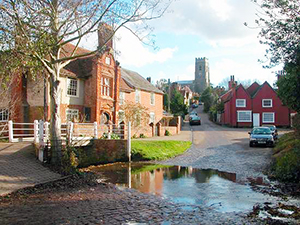
    Kersey, an English village nestling in the Suffolk countryside, is the site of what was possibly a time-slip incident in 1957. In the photo’s foreground is the Water-Splash, and in the background the Church can be seen.

    But what I saw in Kersey was a far cry from what the boys experienced.

    The survival exercise was carried out over a cold weekend in October. The boys, Cadets William Lang, Michael Crowley and Ray Baker (all 15 years old) were assigned to find the village and report back on everything they saw.

    They followed a road for a time, then cut across some fields. Shortly afterwards, they came across a grey stone cottage surrounded by large oak trees. A farm labourer pointed them in the direction of Kersey. Ten minutes later, they came in sight of the village. From their vantage point, they could see the roofs of the houses and the high tower of Kersey Church. They also clearly heard the sound of church bells as they left the fields to take the laneway down into the village. But as they approached within a hundred yards of the church itself, the bells abruptly stopped.

    The church, which had been visible from the fields above the village, was now hidden behind trees growing on the mound on which the building stands. The boys walked in an eerie silence until, turning a corner of their laneway, they had their first sight of the village itself. What they saw was quite different to the Kersey of modern times.

    The stream was still there, running down the centre of the village, but the tarmacadam road was gone, as were most of the houses. In their place was a dirt track with two or three miserable-looking dwellings widely scattered on its left hand side. There were no houses or cottages at all on the right, just tall forest trees.

    The track ran down to the stream, then rose beyond it to the northern end of the village where there were a few more houses, all of them dirty, small and old. The stream was crossed by a bridge, but nothing like the bridge that’s there today: it was no more than two wooden planks with four posts and a handrail. The only living things in the place were some motionless ducks on the waters of the stream. There were no parked cars, no telephone lines, no radio aerials – nothing at all, in fact, to suggest a modern lifestyle.

    The boys felt uneasy and curiously depressed. The whole place had a horribly unpleasant feel about it, without wind, sounds or even shadows. But the flat and lifeless look wasn’t the only problem. The boys grew increasingly uneasy when they examined the trees. They were green with spring buds. Yet this was October – well into autumn.

    Both village pubs and all but one of Kersey’s shops had disappeared. The boys jumped the stream and went to examine the one shop remaining, a butcher’s in which skinned ox carcases were hanging. But the meat was green with age and the whole place covered in filthy cobwebs as if it had been left derelict for months. Other buildings were equally strange. Not one seemed to have furniture, or even curtains.

    The boys had the eerie feeling of being watched, although there was not so much as a dog on the street, and their unease increased. Their slow progress up the village street got faster and faster until suddenly they were running for their lives. They turned a corner at the top of the street and stopped, breathless, to look back. Suddenly the church bells chimed, the church itself was clearly visible, the village was repopulated. Normality had returned.

    The boys’ story was thoroughly investigated by the Vice President of the Society for Psychical Research, London, Andrew MacKenzie. He concluded that the three boys had somehow travelled back to medieval times when Kersey was hurriedly abandoned after an outbreak of the Black Death.

    Strange though it might seem, this was no isolated incident. There is sound evidence to suggest that many more people, including one scientist and a world-famous historian, have experienced time-slips of this type that took them physically into a distant past.

    [alert type=”success” dismiss=”no”]If you appreciate this article, please consider subscribing to help maintain this website.[/alert]

    © New Dawn Magazine and the respective author.
    For our reproduction notice, click here.
  • Time Travel & The Multiverse – Many Worlds: Many Timelines

    Time Travel & The Multiverse – Many Worlds: Many Timelines

    From New Dawn Special Issue Vol 6 No 4 (Aug 2012)

    Time travel has enchanted and intrigued us since the earliest days of fiction, when authors such as H.G. Wells, Samuel Madden, Charles Dickens and Enrique Gaspar y Rimbau stretched and challenged our imaginations with images and tales of men and women who invented amazing machines and devices that could take them back in time, or forward into the future. Because of the restrictions of light speed, and the paradoxes of going back to the past without damaging the future timeline, and a host of other obstacles and challenges, we, in fact, have remained stuck in the present.

    Our scientific knowledge and technological achievement has yet to catch up to the limitless dreams of our imaginations. But perhaps just because we have yet to achieve time travel in our universe, in our particular point along the cosmic arrow of time, doesn’t mean it isn’t achievable… and maybe the key is the universe itself. Are we limiting ourselves to our understanding only of the laws and possibilities of our universe, and leaving out of the equation other realities, other universes, with other laws and forces, paradoxes and limitation, possibilities and potentialities, far beyond our own?

    In 2011, quantum physicists at the University of California at Santa Barbara, led by Andrew Cleland and John Martinis, designed a “quantum machine,” as they call it, that might one day lead to proof of time travel and parallel universes. Their machine, a tiny little teleporter barely visible to the naked eye, involves making a tiny metal paddle cool to its ground state, the lowest energy state permissible by the laws of quantum mechanics, and then raising its energy slowly by a single quantum to produce a purely quantum state of motion. They even were able to put the device in both states at once, so it vibrated both slowly and quickly at the same time, in another sort of Schrodinger’s Cat state of superposition. They posited that we can only see one of these potential states at once, and upon the act of observation, the state then splits into additional universes.

    Perhaps there is a plethora of multiple or parallel universes all around us, but we cannot see them.

    Wormholes could also be another possibility for teleportation, as physicist Max Tegmark suggested while attending a panel in January of 2008 at MIT to discuss the science behind the movie Jumper starring Hayden Christiansen, about a man who can teleport all over the world at will. Tegmark, asked about the science behind the science fiction, remarked that a wormhole was one possible way of getting something quickly across space-time. However, after admitting that wormholes do appear to be theoretically possible, Tegmark commented that the actual trip would be rather gruelling because of the instability of the wormhole. “It could collapse into a black hole, which would be kind of a bummer.”

    Many scientists look to the possible existence of other levels of reality, or other universes, as a way to make time travel work outside of the restrictions of light speed and paradoxes. Imagine another universe alongside our own where the laws of physics are so completely different, that what is impossible here is mundane and trivial there. Multiple worlds, even, where each is different from the other, or perhaps an infinite number of universes where many would be exactly like our own. Hey, you might even exist in some of them just the way you are right now. In others, you might be rich, famous, handsome or even a cockroach! In fact, perhaps you might even be invisible in one of them!

    But we are getting away with ourselves here. When talk turns to the multiverse and other similar concepts, it’s easy to start dreaming of science fiction worlds with every possible kind of life and all sorts of amazing machines and devices… and time travellers passing effortlessly back and forth between the past, present and future as if it were nothing more than a visit to a few Saturday morning garage sales.

    Parallel Universes

    Parallel universes have long been a mainstay of science fiction films and stories. Parallel universes can exist individually, or grouped together as the “multiverse,” and offer the possibility of a totally different reality in which someone, or something, can exist, or hop back and forth between. The laws of nature may be different in one parallel universe as they are in another, and in respect to time travel, would provide multiple versions of the future in which someone could exist, or not exist at all. Light speed limitations may not exist in a parallel universe, and the paradoxes that keep us from travelling back in time would be null and void if we could jump into a different historical timeline.

    Two great fictional examples of a parallel universe would be “Alice’s Adventures in Wonderland,” written by English author Charles Lutwidge Dodgson under the pseudonym Lewis Carroll, and C.S. Lewis’s “The Chronicles of Narnia,” both of which involve some sort of portal or wormhole, such as a rabbit hole or a large piece of furniture, through which a person can enter into another realm.

    Theoretically, parallel universes may be the result of a single random quantum event that branches off into an alternative universe. This is the “Many Worlds Interpretation” or MWI, of quantum mechanics, originally formulated by physicist Hugh Everett in 1957. It posits that each time a different choice is made at the quantum scale, a universe arises to accommodate that choice, thus creating infinite new worlds popping up all the time.

    These new worlds are being constantly created and could cause problems for a potential time traveller. Physicist David Deutsch wrote in “Quantum mechanics near closed timelike curves” for the 1991 Physical Review, that if time travel to the past were indeed possible, the many worlds scenario would result in a time traveller ending up in a different branch of history than the one he departed from. Deutsch, of Oxford University, is a highly respected proponent of quantum theory, and suggests quantum theory does not forbid time travel, but rather sidesteps it, referring to the traveller’s ability to go into another universe, a parallel universe, and avoid the paradox limitations.

    Deutsch’s idea of parallel universes, the multiverse, or “shadow universes” was described in his interview with the Guardian UK in June 2010 (“David Deutsch’s Multiverse Carries Us Beyond the Realm of Imagination”) as being “co-incident with, somehow contiguous with, and weakly interacting with, this one. It is a composite, a layer cake, a palimpsest of universes very similar but not quite identical to each other.”

    The number of these shadow universes could be enormous, and Deutsch points to photon experiments that suggest possibly a trillion of them or more. He also suggests that future-directed time travel will essentially only require efficient rockets, and is on the “moderately distant but confidently foreseeable technological horizon.” When it comes to past travel, the multiverse might save a time traveller from the pesky Grandfather paradox. He uses an example of a writer who wants to go back in time with a copy of Shakespeare’s Complete Works and help the bard complete Hamlet. It can happen, but in the multiverse view, “the traveller has not come from the future of that copy of Shakespeare.”

    Another off shoot of the MWI is the Many-Minds Interpretation, which extends the MWI by positing that the branching off of worlds occurs in the mind of the individual observer, introduced in 1995 by theoretical physicist H. Dieter Zeh, Professor Emeritus of the University of Heidelberg and the discoverer of decoherence.

    The Many-Minds Interpretation was widely criticised and somewhat ignored, mainly because of issues involving the theory that the mind can supervene on the physical as the mind has its own “trans-temporal identity.” The mind may select one identity as its own non-random “reality,” yet the universe as a whole remains unaffected, which presents additional problems when dealing with different observers ending up with the same measured realities. The actual process by which the mind of the observer would select the single, measured state is not explained by the MMI.

    Alternate timelines, each with their own forward arrow of time and their own history, may exist then, allowing time travellers to jump into another version of history and override those pesky paradoxes. Imagine being able to jump into a timeline where you do get your dream of marrying your high school sweetheart, but, finding out she’s an evil tramp as soon as you say “I do,” you could jump back into your original historical timeline, where you didn’t marry her and instead ended up three years later marrying her sister, your true soul mate, and lived happily ever after.

    Kaku’s Three Ways to Defeat the Paradoxes of Time Travel

    Noted theoretical physicist Michio Kaku (pictured below), author of Parallel Worlds and Hyperspace, writes in his newest book, Physics of the Impossible: A Scientific Exploration Into the World of Phasers, Force Fields, Teleportation and Time Travel, of three ways around the paradoxes of time travel. The first is that you simply repeat past history and fulfil the past, and that everything you do once you are back in time was meant to happen anyway, a sort of destiny.

    This opinion is also mirrored in the views of famed physicist and superstring theory proponent Brian Greene, author of The Fabric of the Cosmos: Space, Time and the Texture of Reality and The Elegant Universe: Superstrings, Hidden Dimensions and the Quest for the Ultimate Theory. Greene writes that outside of the quantum world, in the classical science of the grander scale, we exist static and unchanging at various locations in what he calls the “space-time loaf” of block we call space-time. These moments are unchangeable and fixed. Using a wormhole, if one were to indeed go back in time to a certain point, or date, one would find there is only one version of that date, and that your presence back in time would simply be a part of the original version of that moment. That moment has one incarnation, though. “By passing through the wormhole today and going back to that earlier time you would be fulfilling your ironclad destiny to appear at that earlier moment.” He points to the wormhole time machine itself as the culprit, with one opening or the other passing through time more slowly than the other end, but each opening is still going forward in time. Thus, there will also be a limit as to how far back in time you could travel in the first place.

    The second of Kaku’s paths around the paradoxes involves having some free will to change the past, but within limits, so that you could go back and try to kill your grandfather, but something would prevent you from doing so. The gun might lock up, or you might drop it and shoot your foot instead and end up in the hospital. No matter what, you would somehow be prevented from knocking off your Grandpappy.

    The third involves the universe splitting into two universes to accommodate the time traveller. His example offers someone going back in time to kill their parents, and in one timeline the people look like your parents, but are different because you exist in a different timeline.

    The many worlds approach could solve all the paradoxes in two ways. First, if we imagine the timeline of our universe as a line drawn on a board, then we can draw another line to represent the universe that branches off from the first. When you go back into the river of time, the river forks into two rivers, and one timeline becomes two timelines, and so on, and so on. Say you planned to kill your own father. You go back in time and you do the dirty deed. If the river of time does indeed have many forks, this would not be a problem. “You’ve just killed somebody else’s father. In that timeline, you don’t exist, but you exist because you jumped the stream,” Kaku writes.

    This idea would also solve another thorn in the side of physicists when discussing time travel: the radiation effects of entering a wormhole, which would no doubt destroy any time traveller, and also end up in a loop, the feedback becoming so strong it destroys the wormhole. “If the radiation goes into the time machine, and is sent into the past, it then enters a new universe; it cannot reenter the time machine again, and again, and again.”

    Kaku points out that the main problems involving time travel and wormholes specifically centre on the issues of the physics of the event horizon, as in the stability of the wormhole, the deadly radiation and the wormhole closing once it was entered. Solve those issues and time travel might be a piece of cake!

    Well, not a piece of cake… All physicists agree that once they come up with a Theory of Everything that unites the four universal forces of electromagnetism, gravity and the strong and weak nuclear forces, and formulate a complete theory of gravity and space-time, then time travel might be as close as finding a wormhole big enough, stable enough and open enough to get a time machine through. Not to mention the sheer amount of energy necessary to do this, which might require harnessing the power and energy of a neutron star, or finding that elusive exotic matter scientists are looking for, or a good source of negative energy, and we are far from doing any of these things.

    Oh, then there is the problem of creating the machine. And let’s not forget finding or creating a wormhole that could handle it! An interesting problem was brought up by physicist and cosmologist Paul Davies, author of About Time: Einstein’s Unfinished Revolution and other books. In an interview with Discovery.com called “Is Time Travel Possible?” he discussed wormholes as time machines and potential time travel tourists from the future, but with the caveat that “theoretically, it would take more than 100 years to create a 100-year time difference between the two ends of a wormhole, so there’s no way that our descendants could come back and tell us we’re wrong about this.” So, it’s all about timing, then… pun intended.

    [alert type=”info” dismiss=”no”]If you appreciate this article, please consider a subscription to New Dawn magazine.[/alert]

    The Multiverse Theory

    The multiverse is the most widely mentioned theoretical “time travel paradox killer,” because it involves more than just one parallel universe, thus allowing for an increasingly possible world where the laws of physics are just right for time travel. If we can get from here to there, that is.

    There may be a massive number of other universes out there, possibly even an infinite number, or maybe just twenty or seventy. While our astronomical observations cannot at this time detect them, it is most definitely a theoretical possibility that many cosmologists and physicists are considering. These universes may or may not be like ours. In fact, they may or may not even have the same laws of physics or distribution of matter, or even number of spatial and temporal dimensions. Some will undoubtedly be “dead” and others will have life forms that we cannot recognise or even imagine. Others still may have duplicates of us living their own separate lives and timelines. Maybe, Big Bangs are going on constantly, 24/7/365 all the while creating new universes.

    The multiverse theory is not new, especially for readers of science fiction and fantasy, where other worlds beyond ours is a given. The actual term was coined in the year 1895 by psychologist and philosopher William James, and is now a mainstay of theoretical and quantum physics, as well as a part of our religious beliefs, mythological stories, and spiritual/New Age thought. The multiverse has been equated with everything from the Kingdom of Heaven of the Judeo-Christian Bible to the Akashic Field or Hall of Records or various planes of existence of more metaphysical and spiritual thought, to the multiple timelines and dimensions of paranormal and anomalous concepts.

    Cosmologist Max Tegmark took the multiverse theory to the next level by creating a classification level for potential other worlds:

    LEVEL ONE: Domains beyond our cosmological horizon – the least controversial type, what lies beyond the vantage point, yet likely has the same laws/constants, just with possibly different initial conditions than our own.

    LEVEL TWO: Universes with different physical laws/constants, other post inflation bubbles, far more diverse than Level Ones, these bubbles also vary in initial conditions as well as other seemingly immutable aspects of nature.

    LEVEL THREE: Quantum universes/Many Worlds Interpretation – exist alongside us on the quantum level where the random quantum processes cause the universe to branch into multiple copies, one copy for each possible outcome.

    LEVEL FOUR: Ultimate Ensemble – Other mathematical structures, where ALL potential alternate realities can exist, anything and everything is possible in terms of location, cosmological properties, quantum states, and physical laws and constants. These exist outside of space-time.

    Each level of multiverse has its own characteristics that separate it from the other levels, and for our purposes, the focus for time travel would be on those we humans could exist in, and possible travel between. One of the ways Tegmark differentiated the levels was by stating that in Level One our doppelgängers could live somewhere else in three-dimensional space, but in Level Three they would live on another quantum branch in an infinite-dimensional Hilbert space. Yet, as the Many Worlds Interpretation states, likely not be able to interact once the split into another branch occurs. Those found in Level Two might be like “bubble universes” that have different physical laws and constants, and each new bubble is created by splits that occur when spontaneous symmetry breaks occur in Level Three.

    Tegmark describes these levels in detail in his book Universe or Multiverse, and states that the key question isn’t so much whether there is a multiverse, but rather how many levels it has. He admits that nature may have tricked us into thinking our vantage point was the extent of reality, a fixed view of the world around us. “Einstein taught us that space is not merely a boring static void, but a dynamic entity that can stretch (the expanding universe), vibrate (gravitational waves), and curve (gravity).”

    Many scientists refer to the multiverse as more of a “pocket universe” concept, indicating different regions in space-time that are unobservable, but still a part of our one Universe. Inflationary cosmology does state these pocket universes can be self-contained, with different laws of physics, different particles and forces and possibly even different dimensions.

    Even the popular string theory allows for potentially trillions of possible universes, each one compatible with relativity and quantum theory. Michio Kaku states in Physics of the Impossible that, “Normally communication between these universes is impossible. The atoms of our body are like flies trapped on flypaper. We can move freely about in three dimensions along our membrane universe, but we cannot leap off the universe into hyperspace, because we are glued onto our universe.” Gravity, however, can freely float into the spaces between universes. Kaku also points to one theory where dark matter, which is an invisible form of matter surrounding our galaxy, might actually be “normal” matter in another universe.

    But the question remains, can we travel back and forth between these different worlds with different laws and arrows of time? Again, theoretically, it would require a shortcut through space and time… like a wormhole… and a means of safely getting through that wormhole should it be stable and traversable. So even though the multiverse theory takes care of some of the paradoxes by offering up alternate timelines and histories in which one can both go back to the past and kill their grandfather (while not killing him at the same time), it appears as though there is still no realistic way of actually doing that.

    The multiverse also allows for alternate futures as well, and for multiple, alternate versions of “you” to exist in any number of historical timelines with different outcomes depending on the choices you make in each baby bubble universe.

    In an article titled “Riddles of the Multiverse” for PBS.org’s August 2011 Nova series, University of Southern California Professor of Physics and Astronomy Clifford Johnson was asked straight out about whether or not the multiverse could ever be “visited” by humans. His response was that we must first work out the physics of these other universes, in order to determine when and whether it makes sense to “cross over from one to the other.” He did admit it is possible the stuff we are made of, the matter and forces that make us and hold us together, may not allow us to ever leave our four-dimensional universe and go to another. Imagine doing so and well, coming undone!

    For now it seems we just don’t yet have the brainpower and technology to leap and jump between worlds, to cross timelines and experience as many pasts, presents and futures as we would like. That knowledge and technology may exist, though… out there… somewhere in time.

    Reprinted, with permission of the publisher, from This Book Is From the Future: A Journey Through Portals, Relativity, Wormholes and Other Adventures in Time Travel, © 2012 Marie D. Jones & Larry Flaxman. Published by New Page Books a division of Career Press, Pompton Plains, NJ 800-227-3371, USA.

    [alert type=”general” dismiss=”no”]This article was published in New Dawn Special Issue Vol 6 No 4.[/alert]

    [alert type=”success” dismiss=”no”]If you appreciate this article, please consider subscribing to help maintain this website.[/alert]

    © New Dawn Magazine and the respective author.
    For our reproduction notice, click here.