New Dawn – World's Most Unusual Magazine

Tag: Tradition

  • Understanding the Traditionalists

    Understanding the Traditionalists

    From New Dawn 147 (Nov-Dec 2014)

    Traditionalists, for present purposes, means the loosely-constituted group inspired by René Guénon (1886-1951). Many of them also revere Ananda K. Coomaraswamy (1877-1947). Later Frithjof Schuon (1907-1998) became central to the group, while the work of Julius Evola (1898-1974) partly overlapped with the others. Any one of these four can serve as a gateway to the movement and its quest for the esoteric truth that transcends religious differences. That is their first mission. Secondarily, they invite one to realise this truth in oneself, and thirdly, they identify what furthers the process and what hinders it.

    The Traditionalist mission rests on the belief that in some prehistoric time, a “primordial tradition” was revealed to mankind. It taught in symbols the nature of the universe and of the human being, and the way to realise our divine potential. The different religious traditions sprung like branches from the primordial trunk, each one revealed at the appropriate time and place for a certain people or region. Each one contains a facet of the “perennial philosophy,” accommodating both simple believers and those who pursue an esoteric and initiatic path. However, owing to spiritual degeneration over time, some traditions have been lost, others polluted, and false religions have sprung up in their place. The third object is to discriminate between the true and the false.

    Given these principles, Guénon could write with equal authority on Hinduism, Taoism, Judaism, Christianity, Islam, Hermeticism, Druidism, and even Freemasonry, “believing” in all of them because he was able to discern their transcendent unity. He demonstrated this through what he called metaphysics, meaning the study of ultimate realities, beyond cosmology and beyond theology. Theologies differ (are there many gods, as in Hinduism, or only one, as in the Abrahamic religions?), but metaphysical principles do not. Eventually one hopes to know these principles directly, because we are microcosms and they are our own ultimate realities. Mystical experience and religious devotion may be intrinsic to the spiritual path, but the quest begins and ends with knowledge. Those who wish to follow Guénon into these rarefied realms will read Man and His Becoming According to the Vedanta, The Symbolism of the Cross, and The Multiple States of the Being.1

    Guénon cleared the way for his doctrinal work with two polemical books. Theosophy: History of a Pseudo-Religion (first published 1921), whose title says it all, and The Spiritist Fallacy (1923), which shows that whatever is contacted in séances, it is not the spirits of the dead. After settling in Egypt in 1930, Guénon made a scanty living by writing hundreds of articles and book reviews for his French publishers. Now collected by themes such as Freemasonry, initiation, Christianity, time cycles, symbolism, etc., they make excellent reading for their insights, their curious facts, and global purview. Guénon may pontificate and annoy, but he is never a pious bore. However, it is his books that remain the core of his work, for they set out the metaphysical and cosmological framework that needs to be kept in mind through all his digressions.

    One assumption, which goes entirely against modernist and scientific opinion, is a cyclical view of history. The cycle starts with the long Golden Age (Satya Yuga) and thence degrades in the quality of life and spirituality of mankind. Even the earth becomes more densely materialised until the low point of the Iron Age (Kali Yuga) is reached. Then the cycle ends in cataclysm, and above its ruins a new golden age dawns.2 Surveying the post-medieval period, Guénon sees the sacred giving way to the secular on every front: in religion, with the fragmentation of the Christian tradition, the driving of esoteric knowledge underground and its replacement by pseudo-traditions; in philosophy, with its denial of true metaphysics; in society, with the lower elements usurping the priestly and noble castes; and in the arts, a sure barometer of a civilisation’s soul. Ever since the Greeks, the West has been the leader in this process, but by now it has infected the entire earth.

    Guénon’s The Crisis of the Modern World and The Reign of Quantity and the Signs of the Times are the testament of his devolutionary theory and probably the best entry-point to his work. The latter title is his description of the tail-end of the cycle, in which quantity usurps quality in every walk of life. After a metaphysical introduction (better skipped and read later), he offers memorable examples and images such as the “Degeneration of the Coinage” and the “Cracks in the Great Wall.” Overshadowing the whole work is the notion of a “Counter-initiation,” a conspiracy of false or inverted spirituality whose goal is to block humanity’s path to authentic initiation.

    Some find Guénon’s approach too intellectual and even inhuman, but they cannot deny that it cuts like a razor through the sloppy thinking and sentimentality prevalent in religious and New Age types alike. It sets standards of integrity against which other spiritual teachings either stand or fall. It assumes that truth has always been there for the finding, so it has no use for the language-games of Western philosophy, nor for a science that thinks it is on track to discover the “God particle.” It also rejects cherished notions such as individualism, equality, and evolution. Instead, it teaches the impersonal Self, the hierarchy of beings (including humans), and the cyclic nature of time. In short, it turns the received world-view upside-down.

    [alert type=”info” dismiss=”no”]If you appreciate this article, please consider a subscription to New Dawn magazine.[/alert]

    Beyond Guénon: Traditionalism’s Founding Fathers

    Such was evidently the experience of those who were later grouped under the Traditionalist banner. Ananda Kentish Coomaraswamy (1877-1947) was an art historian whose writings on comparative religion, symbolism, and the critique of modernity paralleled Guénon’s own, though in a more scholarly style. Frithjof Schuon (1907-1998), a German convert to Sufism, made a stir with his first book, The Transcendent Unity of Religions,3 its English translation helped by a promotional blurb by T.S. Eliot – himself a Christian Traditionalist of sorts. In 1962 Schuon’s English friends took over a parapsychology magazine called Tomorrow and later retitled it Studies in Comparative Religion.4 The collaborators included Titus Burckhardt (1908-1984), a Swiss publisher; Marco Pallis (1895-1989), a musician and traveller to Tibet; Martin Lings (1909-2005), an English scholar who assisted Guénon in his last years; Whitall Perry (1920-2005), a Bostonian who compiled a global bible of traditional sources;5 and many others who are now easy to find and research.6 Schuon settled in Bloomington, Indiana, heading a community that combined his personal devotion to “Maryam” (the Virgin Mary, as revered in Islam) with Native American traditions. His most eminent admirer was Seyyed Hossein Nasr (1933-), a highly-placed Iranian academic forced out by Khomeini’s revolution. Nasr became the movement’s most visible representative in the US and, beside his authority on all things Islamic, tried to give a more spiritual direction to the environmental movement.7

    In order to put Guénon’s principles into practice, most of the Traditionalists joined one of the recognised religions, interpreting his critique as requiring an orthodox exoteric practice. Only that, they say, can provide a firm foundation for the higher flights of esotericism that many desire, but for which few are qualified. According to Federico González, the most faithful interpreter of Guénon in the Spanish language, Schuon’s influence betrayed the Perennial Philosophy by turning it into a Perennial Religion.8 Be that as it may, Schuon, Burckhardt, and Lings followed Guénon’s example by becoming Muslims. Those who remained within Christianity chose the Russian or Greek Orthodox churches, or isolated themselves on the extreme wing of traditional Catholicism. Protestantism was not an option, being by definition anti-traditional, though with the example of Eliot’s high-church Anglicanism, a chance was missed there. Orthodox Judaism would seem the obvious choice for Jews, but Leo Schaya, the only identifiable Jew in the group and author of a superb work on Kabbalah, converted to Islam.9 A fourth and last possibility was Buddhism, though Guénon considered it more as a heresy within Hinduism. Hinduism was excluded for Westerners on the grounds that one cannot be a traditional Hindu unless one was born into one of the castes and can follow its prescriptions. The traditions of Native Americans, Africa, and the Far East (Taoism, Shinto), though respected, were impracticable since living esoteric masters are almost impossible to find there. Moreover, in all cases only the most ancient and integral streams were acceptable: not the Sufism of Hazrat Inayat Khan, or the Hinduism of Vivekananda or Aurobindo. So the choice of an exoteric tradition was extremely limited.

    There are of course degrees of leniency among Traditionalists, but to the stricter variety, the vast majority of Christians are schismatics and heretics, cut off – maybe for no fault of their own – from any authentic tradition. Some, like Rama Coomaraswamy (son of Ananda) accuse the Catholic Church of having disqualified itself through the innovations of the Second Vatican Council. Consequently the current pope is an impostor, priestly ordinations invalid, and the sacraments ineffectual. I find this a strange and constrictive view. It is generous enough in allowing that God has revealed himself through different religions, yet it imagines him as only willing to funnel his grace through a very narrow channel in each case.

    Can one have the Traditionalist cake, as it were, without eating it? To judge by the careers of the founding fathers, the answer is yes. Not one of them practiced what the orthodox now preach. Guénon was supposedly initiated by Hindus, entered Islam secretly as a young man, and married a Catholic wife, but was not known as a devout practitioner of any religion until he moved to Cairo in middle age. Coomaraswamy, as the child of a Hindu (Tamil) father and an English mother was strictly speaking an “untouchable” within the Hindu tradition, which of course bothered no one during his life in England and the United States. Buddhism and Neoplatonism seem to have been closest to his heart, but if he had any orthodox practice, no one remarked on it. Schuon, nominally a Muslim, made up his own syncretic rituals, which greatly embarrassed his more orthodox admirers when they were made known.10 In short, they all enjoyed the latitude that Traditionalism allows to independent geniuses, but not to the rest of us.

    A broader concept of Traditionalism would recognise the value of some outsiders to the club. They include Alain Daniélou (1907-1994), who did convert to Hinduism (he was a Shaivite initiate) and lived for many years in Calcutta, corresponding with Guénon and writing fundamental works on Hindu polytheism and music. He also foresaw, and calculated, the inevitable end of the age.11 But this brilliant and charming scholar despised the monotheistic religions and was openly homosexual, so he does not figure on the approved roster. The absence of Henry Corbin (1903-1978) is more surprising, since he alerted the West to the richness of the Iranian philosophic tradition and its concept of the “imaginal world” as the locus of mysticism, symbolism, and art.12 Nasr recognised him as a great scholar and edited his Festschrift,13 but Corbin was a Protestant. Whether Julius Evola (1898-1974) should be included is a matter of dispute. He had a friendly correspondence with Guénon (though they never met), and wrote from a Traditionalist point of view on Taoism, Buddhism, Hermeticism, the Grail, paganism, esoteric sexology, metahistory, mountaineering, and to his lasting detriment, politics. But he rated the Kshatriya (warrior) caste superior to the priestly Brahmins, and had no time for exoteric religion. His work probably finds a wider readership than any other Traditionalist.14 To many he is the intellectual equal of Guénon and Coomaraswamy, and much more helpful with his practical advice on self-realisation in a hostile world.

    In the 1980s the poet and Blake scholar Kathleen Raine (1908-2003) set an example of “broad-church” Traditionalism with her London-based Temenos Academy. It presented lectures, concerts, occasional conferences, and published a journal, benefiting from the patronage of the Prince of Wales – another liberal Traditionalist. Raine had been a member of an occultist order descended from the Golden Dawn. She loved the Neoplatonists, the Renaissance, and Romanticism, was not averse to Theosophy, and greatly admired Corbin. Her mission was to promote the “arts of the Imagination” as against the ugliness, soullessness, and commercialism of modern life and art. I believe she was the only woman to have contributed to Studies in Comparative Religion, and that, too is telling. Women are conspicuously absent from Traditionalism, no doubt because they know how badly the orthodox religions have treated their sex.

    Traditionalism & Post-Modernity

    After the death of Schuon, widely revered as an enlightened master, the movement lost its magnetic pole. Its chief enemy, modernity, was also moribund. But instead of a return to Tradition, the post-modern wave, beginning in France and flooding the whole intellectual world, had extinguished any presumption of metaphysical certainty. Guénon and Evola were less newsworthy than the right-wing extremists reputedly inspired by reading them. The spread of Islamic fundamentalism cast Muslim conversion in an unfavourable light. Most of those who sought a spiritual path outside their Christian, Jewish, or agnostic heritage preferred Zen or Tibetan Buddhism. And the New Age was the exoteric haven for all the rest.

    As the post-Guénonian generation passed away, Traditionalism became ripe for the historians. The academic study of Western Esotericism, a relatively new discipline, took notice of it, though only as one current among many others. Mark Sedgwick’s Against the Modern World was the first attempt to encompass the whole Traditionalist phenomenon, and the first many academics had heard of it.15 Another is Setareh Houman’s From Philosophia Perennis to American Perennialism.16 (In the United States, home of the political euphemism, Traditionalists became “Perennialists.”) Houman explains how Guénon and his successors adapted the Renaissance concept of a perennial philosophy and a prisca theologia (primordial theology) as old as the human race, and supplies a wealth of historical details found nowhere else. Both books are essential to the dispassionate student of the movement.

    Needless to say, the blogosphere swarms with passionate opinions on both sides. It is much less demanding to hang out there, or shoot one’s mouth off, than to read Guénon’s or Coomaraswamy’s books from cover to cover. At the serious end of the spectrum, Mark Sedgwick maintains a website (www.traditionalists.org) with a moderated discussion board. So does James Wetmore (www.sophiaperennis.com), the heroic publisher of Guénon’s Collected Works. James Cutsinger is gradually doing the same for Schuon’s works (www.cutsinger.net). Charles Upton, an ex-beat poet turned Sufi, brings the Traditionalists’ critique up to date with a series of books on the Reign of Quantity’s further products, such as UFO cults, drug mysticism, postmodernism, neopaganism, and the New Age.

    Since the world failed to end or transmogrify in December 2012, the New Age dragons are hardly worth slaying, but Traditionalists are drawing on some of the apocalyptic energies that still hang in the air. One who claims, or is claimed, to be a Traditionalist is the Russian philosopher Alexander Dugin (b.1962). Is he the secret link through whom Guénon is influencing the political chess-game of Vladimir Putin?17 Some think so. Duginian geopolitics sees the Atlanticist hegemony as the tool of the Counter-initiation, and a united Eurasia under Holy Russia as the great hope of the future. Others, such as the Islamic eschatologist Imran Hosein, view the world situation through the myth of the Antichrist, whether they assign that role to the current pope, the US President, the State of Israel, radical Islam, or “Dajjal.” Like Jean Robin, author of “René Guénon, the Last Chance of the West”18 and many other books of occult history, they may actually cheer on the Counter-initiation for speeding the arrival of a post-apocalyptic golden age. Another French writer of Romanian origin, Jean Parvulesco (1929-2010), was apparently Dugin’s inspiration. Parvulesco’s books are like something imagined by Umberto Eco: convoluted, learned, hysterical, and infatuated with Guénon, necromancy, fascism, the cosmic destiny of France, and a collective death-wish.19

    Lastly I must mention the longest book yet written about Guénon.20 The author, who goes by the name of Louis de Maistre, admires him tremendously but suspects that he was partly under Counter-initiation control. That movement, in de Maistre’s view, stemmed from the Manichean heresy that gave an independent and equal existence to the evil power, and the temptation to ally oneself with it. Its main agents in the modern world were the Sabbatian and Frankist movements, to whose infiltrations Guénon himself was not immune. Hence his early involvement with mediumship and his embrace of the sinister myth of Agarttha. In the view of this earnest and erudite author, even Guénon needs to be purified from anti-traditional tendencies.
    Traditionalism for Seekers

    Apart from these extremes, what does Traditionalism have to offer? First, it puts our spiritual destiny first and foremost. We are on earth to fulfil it, though we may do so in very earthly ways (Traditionalists love the crafts!). In looking for guidance, we have the option of joining one of the authentic traditions and regulating our lives through it. For the esoterically-inclined, each tradition has symbols that give access to a metaphysical teaching. Lacking effective mystery-schools, to penetrate to this level is the best initiation we can hope for. To take examples from the Abrahamic traditions, one can recite the Nicene Creed, read the Quran or the Torah, and understand them in an esoteric sense that would be incomprehensible to one’s fellow believers. This is of course what Kabbalists and Sufis do, though Christianity has lost the structures that once facilitated it.

    But what if one has no attraction to religions which have so often brought out the worst in people, and continue to do so? There are, after all, other paths open. One might become a Bahai or a Mormon; join the A.M.O.R.C. or another Rosicrucian order; take up yoga and meditation, “transcendental” or otherwise; join an Anthroposophical (Rudolf Steiner) community or a Gurdjieff group; assert one’s ethnic roots in neopaganism; find a temple of the Hermetic Order of the Golden Dawn, or become a wiccan; join the OTO or some other group under Aleister Crowley’s influence; practice alchemy, physical or spiritual; try Chaos Magick; take an Ayahuasca vacation. The spiritual smorgasbord becomes so long that it is hard to choose from it.

    Traditionalism rejects the lot. One of the characteristics of the Kali Yuga is the psychic influences which, in Guénon’s picturesque image, sneak through the cracks in the Great Wall that once protected traditional civilisations. Hence the proliferation of phony sects, channelled teachings, exploitative cults, and other spiritual dead ends. These include fundamentalism, a modern phenomenon distinct from regular exoterism because its agenda, hidden or overt, is always political. One does well to ask: (1) Do these purported spiritual paths have any roots in an authentic revelation, or are they personal inventions? (2) Do they give access to metaphysical realisation? (3) Are claims of filiation from some extinct tradition, such as Egyptian or Celtic, believable? (4) Do they exist to benefit their members, or to benefit themselves and their leaders? I am not saying that this disqualifies all the offerings mentioned above, but it certainly shortens the list.

    After taking due notice of this negative and purgative side of Traditionalism, there remains the greater, positive side. It is the realisation through knowledge, which can come about without any institutional support, simply through reading and meditation. The Traditionalists’ books are themselves initiatic. If you are ripe for them, they hit like a bombshell. Part of you is blown out of the normal world, though other parts still have human feelings, desires, and faults. You pick up the newspaper the next day, and see everything in a different light, realising that a collective insanity has grasped the human race. Yet you are no longer entirely in its clutches, and there are allies across the centuries in those who have resisted the current. Art, poetry, literature, and music take on new meanings as gifts from an unpolluted source, and they may mean more to you than any religion. As you read on, you may discover the Hermetic, Gnostic, and Neoplatonic treasures hidden in the Abrahamic religions, and the philosophic teachings of the Far East (Vedanta, Taoism, Buddhism), interpreted with unprecedented clarity. If you are temperamentally suited to them, they bring an ineffable joy. In short, this is an adventure second to none, and also, as Plato promised, the ultimate love affair, for philosophy means the “love of wisdom.”

    Minor parts of this article appeared in “Facing the Traditionalists” in Gnosis Magazine no. 7 (Spring 1988), 23-28, reprinted in Jay Kinney, ed., The Inner West (New York: Tarcher/Penguin, 2004), 292-302.

    [alert type=”general” dismiss=”no”]This article was published in New Dawn 147.[/alert]

    [alert type=”success” dismiss=”no”]If you appreciate this article, please consider subscribing to help maintain this website.[/alert]

    Footnotes

    1. These and the rest of Guénon’s Collected Works are published in English translation by Sophia Perennis. See www.sophiaperennis.com
    2. See Joscelyn Godwin, “When Does the Kali Yuga End?” New Dawn 138 (May-June 2013).
    3. Frithjof Schuon, The Transcendent Unity of Religions, Faber & Faber, 1953.
    4. Just as Guénon had taken over an occultist journal, Le Voile d’Isis, and given it an academic-sounding title, Études traditionnelles.
    5. Whitall N. Perry, ed., A Treasury of Traditional Wisdom, George Allen & Unwin, 1971.
    6. Studies in Comparative Religion is now online at www.studiesincomparativereligion.com. A select anthology of articles from the journal, out of print but well worth finding, is Jacob Needleman, ed., The Sword of Gnosis, Penguin, 1974.
    7. See Seyyed Hossein Nasr, Religion and the Order of Nature, Oxford University Press, 1996.
    8. See Federico González Frías, Diccionario Simbólico-Iniciático y de Temas Misteriosos, Thot, 2013, and the special Guénon number of Symbolos: Revista Internacional de Arte, Cultura, Gnosis, nos. 9-10 (1995).
    9. See Leo Schaya, The Universal Meaning of the Kabbalah, tr. Nancy Pearson, George Allen & Unwin, 1971. Information on Schaya’s conversion is from www.sophiaperennis.com/frequently-asked-questions/.
    10. See Mark Sedgwick, Against the Modern World. Traditionalism and the Secret Intellectual History of the Twentieth Century, Oxford University Press, 2004, 170-77.
    11. See Alain Daniélou, While the Gods Play: Shiva Oracles and Predictions on the Cycles of History and the Destiny of Mankind, tr. Barbara Baker, Michael Baker, and Deborah Lawlor, Inner Traditions, 1987.
    12. See especially Henry Corbin, Spiritual Body and Celestial Earth from Mazdean Iran to Shi’ite Iran, tr. Nancy Pearson, Princeton University Press, 1977.
    13. S.H. Nasr, ed. Mélanges offerts à Henry Corbin, Teheran, Institute of Islamic Studies/Montreal: McGill University, 1977.
    14. See especially Julius Evola, Revolt against the Modern World, tr. Guido Stucco, Inner Traditions, 1995, and many other works from the same publisher.
    15. See note 11.
    16. Setareh Houman, From the Philosophia Perennis to American Perennialism, tr. Edin Lohja, Kazi, 2014
    17. See several articles in New Dawn 111 (Sep-Oct 2008).
    18. Jean Robin, René Guénon, la dernière chance de l’occident, Trédaniel, 1983. Also René Guénon, témoin de la Tradition, Trédaniel, 1986.
    19. See Jean Parvulesco, La spirale prophétique (Trédaniel, 1986), which was dedicated to Jean Robin. Also L’Étoile de l’empire invisible, Trédaniel, 1993.
    20. Louis de Maistre, René Guénon et les “Supérieurs Inconnus”: Contribution à l’étude de l’histoire mondiale “souterraine”, Arché, 2004. See my forthcoming review in Theosophical History.

    © New Dawn Magazine and the respective author.
    For our reproduction notice, click here.
  • The New World Order Vs. The New Age: Separating Truth from Falsehood

    The New World Order Vs. The New Age: Separating Truth from Falsehood

    From New Dawn Special Issue Vol 6 No 6 (Dec 2012)

    There are numerous difficulties in trying to discern what among the proliferation of new or revived faiths might be regarded as working to usher forth a New Age based on eternal values, and those that work to establish the rule of malignant, matter-bound forces. The problem is that there are often superficial resemblances that occur between them. Even within the same occult orders, such as Freemasonry, there are a range of views that might be in opposition but are mistaken as being part of a single, all-embracing conspiracy. There is a tangle of terminology, groups, personalities, ‘Hidden Masters’, accusations and counter-accusations of black magic, and so forth. This article considers ways in which the positive and negative currents within the ‘New Age’ might be identified.

    The Cycles of Rise and Fall

    The school of Perennial Tradition regards traditional cultures, religions and spiritualities as sharing core beliefs, values of an eternal nature, on which are founded Civilisations and societies in their cycles of health. Hence, in the analogous cycles of cultures as far removed geographically and ethnically as the Japanese, Hindu, Norse, and Arabian, all will possess analogous beliefs in regard to social hierarchy, chivalric ethos, and a nexus that exists between the Divine and the temporal. In such a society one’s highest calling, whether as peasant or prince, is to work in accord with one’s cosmic duty, or what the Hindus call dharma. In such a society castes reflect the Divine order on earth: ‘as above, so below’, and degenerate into contending economic classes in the cycle of decline.1

    This cyclical view of history2 is another shared featured of various Traditional cultures, expressed in the Norse,3 Hindu,4 Hopi oral lore,5 and many others. In our own era the German historian-philosopher Oswald Spengler provided empirical evidence for the cyclicity of cultures.6 The two primary Traditionalist exponents of cultural cyclicity in our era are Rene Guenon7 and Julius Evola.8 Esoterically, it is the cycle of life expressed in ‘The Wheel’ of the ‘Major Arcana’ of the Tarot, which is derived from the Medieval ‘Wheel of Fortune’ or Rota Fortuna depicted in Gothic Churches.9 

    Tradition, Anti-Tradition & Counter-Tradition

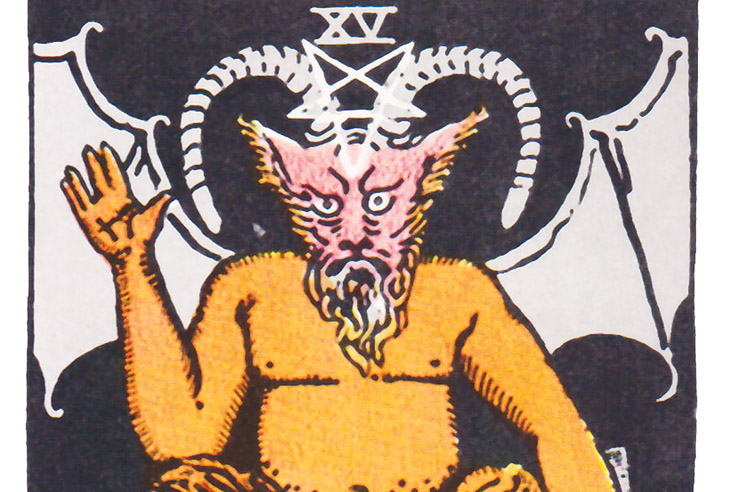
    A glance at cultural cycles is necessary to identify the occult forces that work in the context of Tradition for a return to eternal values based on a reconnection with the Divine, and those that want to enslave humanity to matter. Again, recourse to Tarot symbolism is instructive. Here we see that the Counter-Tradition that stands behind Anti-Tradition, is in the esoteric sense, literally satanic. Paul Foster Case10 provides a meaning for ‘The Devil’ trump that is particularly relevant:

    In its most general meanings, it signifies Mammon and thus big business, the conventions of society, the injustice and cruelty of a social order in which money takes the place of God, in which humanity is bestialised, in which war is engineered by greed masquerading as patriotism, in which fear is dominant. Students of astrology will have no difficulty in seeing how this corresponds to Capricorn, the sign of big business, and the sign of world fame.11

    In this one paragraph Case says much. He cogently differentiates the Traditionalist from the Anti-Traditionalist in what is an occult war. Case identifies the Counter-Tradition that controls Anti-Tradition as ‘Mammon’. Mammon infers something more than simply plutocracy; it is the spirit behind plutocracy. Plutocracy controls the present era. Oswald Spengler pointed out that Money rules in the epoch of decline of a Civilisation. It is not merely the temporal influence of Money which Spengler is referring to, but the spirit behind Money, or what Case calls Mammon. “The dictature of money marches on, tending to its material peak in the Faustian [Western] Civilisation as in every other.”12 

    The other significant point raised by Case is the ‘bestialisation’ of humanity. In this trump ‘The Devil’ is depicted enchaining the human pair to matter. Like the ‘Devil’, the human pair is depicted with tail and horns. This is suggestive of the esoteric belief in cyclic regression rather than lineal progression, when humanity regresses from a higher state of Being, of a spiritual mode, descending ever more into a baser, material existence. Anti-Tradition is the agency for this decline and enslavement. The modern world is therefore, according to the Traditionalist perspective, not ascending upward toward the Godhead, nor toward manifesting the God within; but is in a downward spiral towards – metaphorically – ‘The Devil’ – the master of our base drives.

    A problem of identifying who belongs to what arises because forces work behind the guise of Tradition, while they are in reality the initiates of Anti-Tradition and Counter Tradition, or what Aleister Crowley called the ‘Black Magick School’. The purpose of Anti-Tradition is that of subversion and the sowing of confusion to pave the way for Counter-Tradition. ‘Anti-Tradition’ was stated by Perennial Traditionalist scholar and initiate Rene Guenon to be “pure negation and nothing more.”13 In regard to Counter-Tradition there is a “counter-initiation,”14 representing a satanic current of those who seek the severing of the nexus between the terrestrial and the divine. Guenon wrote of this:

    After having worked always in the shadows, to inspire and to direct invisibly all modern movements, it will in the end contrive to ‘exteriorise’, if that is the right word, something that will be as it were, the counterpart of a true tradition, at least as completely and as exactly as it can be so within the limitations necessarily inherent in all possible counterfeits as such.15

    To Guenon the Counter-Traditionalist movements are void of spiritual content. This can be seen in the many movements and ‘orders’ professing a ‘tradition’ and having a mystical or spiritual façade, yet who expound a materialistic universal republic. This is why various esoteric orders can be seen to be promoting materialistic doctrines such as Marxism, and such Anti-Traditional dogmas as those expressed in slogans like “liberty, equality, fraternity,” to usher in the “reign of quantity.”16 Anti-Traditionalist movements and ideologies are only a means, and not the end. Guenon aptly uses the term “satanic”17 to describe these currents.

    Of these Counter-Traditions, Guenon states that they can never be anything other that a “parody,” an “inverted spirituality” involving organisations of “counter-initiation.”18 Guenon regarded these movements as being of supernatural origin, as satanic and believed that a figure analogous to the “The Anti-Christ” will manifest at the head of a world order.19

    Guenon described the order which Counter-Tradition tries to impose by at first using the doctrine of “egalitarianism” as a means of overthrowing the remnants of Tradition and spirituality, after which will be erected in place of the divine hierarchies a “counter-hierarchy,” atop which sits an individual that seems analogous to “The Anti-Christ,” Guenon describing him as “nearest to the very bottom of the ‘pit of hell’.”20

    Of the numerous orders that were emerging, especially in France during the 19th century, Guenon referred to them, regardless of their pretensions, as “anti-tradition.” One might say that they reflect the zeitgeist21 of the present epoch of Western decline. Guenon refers to the numerous orders that claimed to be “Rosicrucian.”22 Of these, the primary order is that of Freemasonry, from which much of the current “occult revival” derives, including cults purporting to represent a “New Age.” They are, in Guenon’s term, “counterfeits,” and as counterfeits are intended to be, often difficult to detect.

    Profanation of Tradition

    Eliphas Levi23 was one of the primary theoreticians of the modern occult revival. Among Levi’s books, The History of Magic provides insights into the history, nature and influence of Anti-Traditional, Counter-Traditional and counter-initiatory currents. Levi was well-placed to offer informed opinion. He had been a prominent socialist propagandist, having been jailed for his views24 and seems to have been a highly initiated Freemason.25 However, Levi rejected socialism in favour of a conservative, monarchical position, and came to see Freemasonry as having had a noble tradition that had been “profaned” by Anti-Tradition. Having defended what he regarded as the genuine traditional and spiritual legacy of Masonry, Levi then posed and answered the question:

    Now if Masonry is thus holy and thus sublime, we may be asked how it came to be proscribed and condemned so often by the Church?… Masonry is the Gnosis and the false Gnostics caused the condemnation of the true.26

    Levi contends that the Traditionalists were driven underground for fear of being associated with the “sacrilege” of the “false interpreters… the enemies of all belief and all morality”:

    Masonry has not merely been profaned but has served as the veil and pretext of anarchic conspiracies descending from the secret influence of the vindicators of Jacques de Molay,27 and of those who continued the schismatic work of the Temple. In place of avenging the death of Hiram28 they have that of his assassins. The anarchists have resumed the rule, square and mallet, writing upon them the words Liberty, Equality, Fraternity – Liberty, that is to say, for all the lusts, Equality in degradation and Fraternity in the work of destruction. Such are the men whom the Church has condemned justly and will condemn forever.29

    Levi states that during the 18th century,

    A schism took place in illuminism:30 on the one hand, the wardens of the traditions concerning Nature and science wished to restore the hierarchy; there were others, on the contrary, who desired to level all things by disclosing the Great Arcanum, thus rendering the royalty and priesthood alike impossible in the world. Among the latter, some were ambitious and unscrupulous, seeking to erect a throne for themselves over the ruins of the world. Others were dupes and zanies. The true initiates held with dismay the launching of society toward the abyss, and they foresaw all the terrors of anarchy.31

    Levi is here referring to the Order of the Illuminati, founded in Bavaria in 1776 by Adam Weishaupt, with the purpose of inaugurating a communistic universal republic; and similar cabals generally emanating from Freemasonry, including the French revolutionary Jacobin Club and Lodges that formed after the French revolutionary tumult from whence came the subversive creeds, including that of Karl Marx.

    The revolutionary atheists, rationalists and humanists flocked to the Lodges during the 18th and 19th centuries, where they “worked the degrees” of the ancient Mysteries for their own counter-initiatory purposes. Of the type of profanation Levi referred to, we can state the following.

    Philippe Buonarroti, the Italian exponent of the French Revolution, was initiated into Masonry in 1786. In 1808 he formed Les Sublimes Maîtres Parfaits. Buonarroti had a major influence on revolutionist Auguste Blanqui, and through his book Conspiration pour l’Egalité dite de Babeuf, suivie du procès auquel elle donna lieu he was also a seminal influence on the revolutions that erupted throughout Europe in 1848. Buonarroti also advised Mazzini and other revolutionaries in Italy.32

    Buonarroti had co-founded with Francois Babeuf, another significant revolutionist, the Society of the Pantheon, one of the first of the revolutionary secret societies to emerge from the French Revolution, believing the Revolution had failed; and he organised a group of ‘Philadelphe’ Masonry within the Lodge ‘Amis Sincères’. Dr. J M Roberts states:

    What may be termed the first international political secret society, the Sublimes Maîtres Parfaits, was founded by Buonarroti, perhaps in 1808. Only freemasons were admitted to it. The Elect were aware that they were to work for a republican form of government; only the Areopagites knew that the final aim of the society was social egalitarianism, and the means to it the abolition of private property.33

    Marxism was the 19th century culmination of this Anti-Traditional current of a long line of secret societies. Although numerous conspiratologists have written of the alleged role of the Illuminati in ‘hiring’ Marx to write the Communist Manifesto, via the League of the Just, reliable documentation is infrequent. However, there is scholarly evidence that Marx was part of the Anti-Traditionalist current. Blanqui organised the League of the Just, which was called the League of Outlaws by German exiles in Paris. This became the Communist League, and in 1847 this cabal asked Marx to write the Communist Manifesto. It is from Blanqui that the dictum now credited to Marx, the “dictatorship of the proletariat,” originated.34 Marx was initiated into the Mysteries of Memphis-Mizraim Masonry. Prof. Mark Lause, a scholar of labour history,35 writes:

    …Certainly, the tangled history of freemasonry has largely mirrored the political and social views of those drawn to the craft, and some of those drawn to the more peculiar pseudo-Egyptian forms of the order reflected views that were accordingly distinctive.36

    The 18th century Cabalistic mystic Cagliostro founded the Rite of Memphis in 1779. He insinuated himself into the French Court, like Philippe de Lyon insinuated his way into the Court of the ill-fated Czar Nicholas II.37

    Lause cites I Nicolaevsky38 as an authoritative source in stating “that the nineteenth century Order of Memphis actually did mask the ongoing revolutionary activism of French radicals both at home and abroad, strikingly so in the case of émigré circles at London.”39 This confirms the statement by occult historian Lewis Spence, who in a laudatory entry on Cagliostro writes that the Mizraim Rite included the communistic doctrines of the Illuminati.

    In 1785 Cagliostro was implicated in a scandal in the French Royal Court and exiled himself to England where he wrote revolutionary propaganda against the monarchy and declared that the French Throne would be overthrown. His 1786 ‘Letter to the French People’ declared prophetically that the Bastille would be stormed and the governor killed.40 

    Spence states that Mizraim had been set up to subvert the traditional society of Europe and, significantly, received large financial backing:

    There is a small question that the various Masonic lodges which he [Cagliostro] founded and which were patronised by persons of ample means, provided him with extensive funds, and it is a known fact that he was subsidised by several extremely wealthy men, who, themselves dissatisfied with the state of affairs in Europe, did not hesitate to place their riches at his disposal for the purpose of undermining the tyrannic powers which then wielded sway.41

    London was the centre of revolutionary intrigue where political refugees from throughout Europe sought refuge and, with the help of English Masons, founded the Internationale.42 Masonry provided acceptance for diverse and radical views, and a model for a secret revolutionary structure. Lause writes of this:

    In any event, if your declared purpose was something as radical as that of the Philalethes, the perfection of the human race, it helped legitimise the goal by describing oneself as an “Ancient and Primitive Rite of Masonry.”43

    Lodges were established in England and elsewhere, the most important being La Grand Loge des Philadelphes at London in 1851. Lause states that the Order of Memphis “fostered what became the International Association in March 1855 [and] provided almost all of the French members of the General Council of the later International Workingmen’s Association.”44 Another prominent socialist historian, Dr. Bob James, identifies as Masons Garibaldi, Mazzini,45 Charles Bradlaugh46 and Karl Marx, stating this was “neither an accident nor an aberration.”47

    Crowley on the Schools of Black and White Magick

    Aleister Crowley is perhaps the best example of how unclear can be the identification of Traditional, Anti-Traditional and Counter-Traditional currents.48 Crowley claimed Adam Weishaupt, the founder of the Illuminati, among the “saints” of his religion, Thelema.49 However, the doctrines of Thelema and the Illuminati are polar opposites. Crowley, in contrast to the communistic doctrines of Illuminism, sought the establishment of a neo-aristocratic society: the revival of hierarchy.50 It is notable that the German philosopher Friedrich Nietzsche, the antithesis of communistic and liberalistic doctrines, is also a “Saint” of Thelema.51

    Evola acknowledged Crowley as a genuine initiate of Tradition. Evola also regarded the Hermetic Order of the Golden Dawn, under which Crowley served his magickal apprenticeship and which was a seminal influence on the modern occult revival as, “to some extent,” a successor “to those of an initiatic character.”52 Evola granted that Crowley’s system of Magick was drawn from Traditional initiatic practices: “It is certain that in Crowleyism the inoculation of magico-initiatic applications is precise, and the references or orientations of ancient traditions are evident.”53

    Why then did Crowley identify with Adam Weishaupt and the Illuminati, whose doctrines are antithetical to Thelema? Perhaps the reason is that Crowley took on a certain role when assuming the mantle of leadership of the Ordo Templi Orientis (OTO) founded by Theodor Reuss, who was in the employ of the German secret service. Reuss is said to have revived the Order of the Illuminati by virtue of what he claimed to be family connections with the 18th century cabal.54 He was an initiate of Martinist and Mizraim Masonry headed by ‘Papus’.55 He was also in contact in 1902 with Dr. William Wynn Westcott, a high initiate of Grand Lodge Masonry, head of the Societas Rosicrucia in Anglia and founder of the Golden Dawn.56 Reuss had influential international connections.57 As Dr. Richard Spence of the University of Idaho has shown, Crowley was involved with the British secret service at least from 1913, when he was acting for British interests in Moscow,58 and was called on during both World Wars.59 Reuss was obviously a valuable asset to the Germans, and Crowley was ideally placed to track him.60 

    At any rate, Crowley’s identification of the White, Yellow and Black Schools of Magick show that the Illuminati and Freemasonry can be identified with the Black School or what Guenon called the Counter-Tradition and Anti-Tradition. Crowley explained that each School has its own “Hidden Masters.” While the Yellow School “stands aloof,” “the Black School and the White are always more or less in active conflict.”61 The Yellow School regards the universe as “neutral.” The Black regards it as a curse and a sorrow.62 Hence we might summarise the three Schools of Magick in regard to their philosophy of life as being: Yellow: Neutral, Black: Negative, White: Positive.

    Crowley, like Eliphas Levi and Guenon, saw Masonry as having been subverted by the ‘Black School’ and referred to English Masons as being “in official relationship with certain masonic bodies whose sole raison d’etre is anti-clericalism, political intrigue and trade benefit,” despite English Masonry supposedly eschewing such motives.63 These critical sentiments towards the subversion of English Masonry are not consistent with anyone who would be an adherent of Weishaupt and Illuminism, whose raison d’etre was anti-clericalism and political intrigue.

    Crowley saw anarchism sweeping the world of the type that had been initiated by the Illuminati and other forms of Masonry during the 18th and 19th centuries. Again, it can be seen that Crowley’s attitude was anything but Illuminist. “The last quarter of a century had swamped”64 the monarchies, and for Crowley the world was poorer for it:

    The world is seething from the dissatisfaction that springs from insecurity. Men can adapt themselves to pretty well any conditions, but when they do not know from one day to another where some fundamental principle may not be abolished in the interests of progress, they no longer know where they are. They tend to adopt the principles of the man who flits from one place to another… Civilisation has become a hysterical scramble for momentary material advantage…65

    Syncretic Religion and the Perennial Tradition

    The centuries of subversion of Tradition by Black adepts and their dupes has caused a confusion of cults, religions, and spiritualities, most of which claim to offer humanity the path to peace and happiness, and even to Godhood. As has been indicated throughout this article, it is not an easy matter to determine the real motives of many claiming the mantle of the Ageless Wisdom.

    There is an abysmic gulf between adherents of the Perennial Tradition and the Anti- and Counter-Traditions, yet they will often appear similar, because of the ‘counterfeit’ nature of the latter. The Perennial Traditionalist sees a commonality between faiths over expanses of time and space, the assumption generally being that they all derived from a primordial source and differ in so far as they reflect differences of ethnos, geography and historical circumstances. The Perennial Traditionalist will seek to maintain the distinctiveness of these faiths.

    The Black adept, while masquerading as a Traditionalist, aims to amalgamate the world’s faiths into one new syncretic faith, the altar to which all humanity will be chained under the guise of ‘universal brotherhood’, preludes of which were the bloody Reigns of Terror in Jacobin France and Bolshevik Russia. Therefore, when a State’s secular politicians, who also happen to be adherents of the aim of a ‘new world order’, start talking about ‘inter-faith dialogue’, under the guise of ‘representing all religions’, and of ‘tolerance’, one should be suspicious.

    Those who adhere to the Ageless Wisdom of many faiths eschew materialistic agendas. The World Forum of Spiritual Culture, formed on the initiative of the President of Kazakhstan, Nursultan Nazarbayev, brings together those who seek a new civilisation, in the aftermath of what they regard as a technical civilisation that is “anti-cultural.”66 Significantly, Nazarbayev is also a champion of a Eurasian geopolitical bloc67 that would challenge the very possibility of a ‘New World Order’. Such a bloc could serve as the axis for a New Age founded on spiritual and cultural principles, and freed from the bonds of matter.

    [alert type=”general” dismiss=”no”]This article was published in New Dawn Special Issue Vol 6 No 6.[/alert]

    [alert type=”success” dismiss=”no”]If you appreciate this article, please consider subscribing to help maintain this website.[/alert]

    Footnotes

    1. J Evola, Revolt Against the Modern World, Inner Traditions International, 1995.

    2. In contrast to the progressive-lineal, darwinistic view of history as a straight line running from primitive to modern.

    3. Voluspa, reprinted in The Masks of Odin: Wisdom of the Ancient Norse, Elsa-Brita Titchenell, Theosophical University Press, 1985.

    4. Bhagavad-Gita, Ch.9:8.

    5. G Hancock, Fingerprints of the Gods: A Quest for the Beginning and the End, Mandarin, 1996, 532-533.

    6. Oswald Spengler, The Decline of The West, George Allen & Unwin, 1971.

    7. Rene Guenon, The Reign of Quantity and the Signs of the Times, Sophia Perennis, 2001.

    8. J Evola, Revolt Against the Modern World, op. cit.

    9. D Phillips, ‘Wheel’, Man, Myth & Magic, Purnell, 1970, Vol. 7, 3014-3015.

    10. Case can be regarded as an adept of Tradition. He was initiated into the Golden Dawn, Crowley’s OTO, and in 1926 into 3º Masonry, and founded the Builders of the Adytum. His adherence was to the ‘Ageless Wisdom’. Lee Moffitt, Case Timeline, 26 September 1997, http://kcbventures.com/pfc/documents/timeline.pdf

    11. John Foster Case, Oracle of The Tarot: A Course on Tarot Divination, Chapter 6, ‘The Major Trumps: 15. Le Diable’, http://tarotinstitute.com/free/Oracle2.pdf

    12. However, Spengler also points out that at the cycle of decline – Kali Yuga, etc. – Money exhausts its possibilities and is met by a Traditional resurgence which he called “blood”: “the conflict between money and blood.” Oswald Spengler, op. cit., Vol. II, 506.

    13. Rene Guenon, The Reign of Quantity and the Signs of the Times, Sophia Perennis, 2001, 260.

    14. Ibid., 261.

    15. Ibid., 261.

    16. Ibid., 271.

    17. Ibid., 261.

    18. Ibid., 267.

    19. Ibid., 271-273. Guenon draws on both Islamic and Christian traditions here.

    20. Ibid., 271.

    21. ‘Spirit of the Age’ which, as Spengler, Evola and Guenon showed is, in the epoch of Western decline, materialism and the rule of money. This ‘spirit’ will be reflected even in movements intended to be in opposition to it. Hence as Oswald Spengler pointed out, Marxism is the mirror image of capitalism, both being doctrines of the materialistic zeitgeist. Oswald Spengler, op. cit. Vol. 2, 402, 464.

    22. Rene Guenon, op. cit., 251.

    23. The pseudonym of Alphonse Louis Constant (1810-1875).

    24. J W Revak, ‘Eliphas Levi: Clergyman, Radical, Magus’, www.villarevak.org/bio/levi_1.html

    25. Levi’s Masonic initiation can be construed from a comment he makes in The History of Magic (1860), indicating that he was an initiate of the 18º of Knight of the Pelican & Eagle & Sovereign Prince Rose Croix of Heredom. Levi writing: “Having attained by our efforts to a grade of knowledge which imposes silence, we regard ourselves as pledged by our convictions even more than by an oath… and we shall in no wise fail to deserve the princely crown of the Rosy Cross….” The History of Magic, Rider, 1982, 286.

    26. Eliphas Levi, Ibid., 286.

    27. Last Grand Master of the Knights Templar, executed for heresy.

    28. Hiram Abif, one of mythical architects of the Temple of Solomon whose murder Masons are sworn to avenge; a central motif of Masonic ritual.

    29. Eliphas Levi, op. cit., 286.

    30. By which Levi here means adepts of Gnosis; not the Order of Illuminati, the ‘schism’ among the adepts resulting in the formation of the Illuminati by “the ambitious and unscrupulous.”

    31. Eliphas Levi, op. cit., 305.

    32. Dr. John M Roberts, The Mythology of the Secret Societies, Secker & Warburg, 1972, 230.

    33. Ibid., 266.

    34. D Conway, A Farewell to Marx, Penguin Books, 1987, 146.

    35. Lause specialises in the history of the labour movement. An associate professor of history at McMicken College of Arts & Sciences, University of Cincinnati, his faculty biography states that he “teaches specialised courses in American Labor History, Comparative Labor History, and the Age of Jackson… For years, he has presented his work or participated in panels at the Annual North American Labor History Conference at Detroit… and the centennial conferences on Eugene V. Debs and Henry George.”

    36. M A Lause, ‘Walking Like an Egyptian: The American Destinies of a Revolutionary French Secret Society’; http://archives.econ.utah.edu/archives/marxism/2004w23/msg00109.html

    37. Philippe de Lyon was the protégé of Gerard Encausse, alias Papus, 33º Mason, who became Grand Master of Memphis-Mizraim, and the Grand Master of the Supreme Council of Martinist Masonry. Martinism had been founded in 1754 by Martinez de Pasquales who was, according to Bernard Lazare, an Illuminist who established Lodges of the Order in France. B Lazare (1894) Antisemitism: Its History & Causes, Britons, 1967, 153. Hence, there is a line of descent from the Illuminati to Memphis-Mizraim and Martinist Masonry. It is from this milieu, incidentally, that the Protocols of Zion might have emerged, rather than either as ‘Zionist’ records or a Czarist forgery.

    38. According to Lause, I Nicolaevsky based his work on the origins of the Internationale on the records of the organisation: “Clearly, when Nicolaevsky found the manuscript records on this society a century later, he opened a window into a genuine revolutionary conspiracy with far-reaching influences.”

    39. I Nicolaevsky, Secret Societies and the First International, The Revolutionary Internationals, 1864-1943, ed. Milorad M. Drachkovitch, Stanford University Press for the Hoover Institution on War, Revolution, and Peace, 1966, 37.

    40. L Spence (1920), An Encyclopaedia of Occultism, Citadel Press, 1960, ‘Cagliostro’, 90.

    41. Ibid., 92.

    42. International Workingmen’s Association, which included the rival followers of Karl Marx and of the anarchist Bakunin.

    43. M A Lause, op. cit.

    44. Ibid.

    45. The Italian revolutionaries.

    46. With Charles Braudlaugh there is another intriguing example of England’s leading atheist professing the arcane Mysteries as a Freemason. Annie Besant, who assumed the presidency of the Theosophical Society and leadership of Co-Masonry, was a close colleague. J J Lewis, ‘Annie Besant – Heretic’, http://womenshistory.about.com/od/freethought/a/annie_besant.htm

    47. Dr. Bob James is the Convenor and Co-ordinator of the Australian Centre for Fraternal Studies. He states of himself: “I make these claims on the basis of 25 years of research, of ten years or so as Secretary of the Hunter Labor History Society, and as organiser of a National Labor History Conference.”

    48. Nicholas Roerich, the Russian mystic, is another significant example of a Traditionalist initiate with anti-Traditionalist connections, which included US President F D Roosevelt and Vice President Henry Wallace and Soviet luminaries Maxim Gorky, Education Minister Lunarchsky, and Foreign Minister Chicherin. Roerich aimed to create a pan-Buddhist geopolitical and spiritual bloc that would embrace parts of the USSR. He seems to have been a genuine initiate of the Perennial Tradition trying to resist those of the Counter-Tradition through his own high level diplomacy. See: M Pashkovsky, ‘Nicholas Roerich: Secret Agent of Hidden Masters’, New Dawn Special Issue No. 3, Winter 2007, 9-14.

    49. A Crowley (1911), ‘Liber XV OTO Ecclesiae Gnosticae Catholicae Canon Missae’, Magick, Samuel Weiser, 1984, 430. Appendix VI, ‘The Saints’.

    50. K R Bolton, ‘Aleister Crowley as Political Theorist’, Crowley: Thoughts & Perspectives Vol. II, ed. T Southgate, Black Front Press, 2011, 5-28. Also: K Preston, ‘The Whole of the Law: The Political Dimensions of Crowley’s Thought’, ibid., 68-85.

    51. A Crowley (1911), op. cit.

    52. J Evola, ‘Aleister Crowley’, Crowley: Thoughts & Perspectives Volume 2, op. cit., 208.

    53. Ibid., 212.

    54. Reuss claimed in 1914 in his magazine Oriflamme to have ‘revived’ the Illuminati in 1880. It had been founded in Munich and called the Ludwig Lodge. It was from these origins that the OTO emerged.

    55. Lady Queenborough, Edith Starr Miller (1933), Occult Theocracy, California: 1980, Appendix IV, 42-43.

    56. Letters between Reuss and Westcott reproduced in: Lady Queenborough, ibid., Appendix IV, 8-35.

    57. According to testimonials for Reuss reproduced by Lady Queenborough, he was commended by the Military attaché to the US Embassy in Germany, and in 1896 was recommend by the First Secretary of the Embassy in Berlin to be Berlin correspondent for the NY Herald. Central News Ltd. (London), United Press and many others accredited him as a journalist. Lady Queenborough, ibid., Appendix IV, 2-5.

    58. Dr. R Spence, ‘The Magus Was A Spy: Aleister Crowley & the Curious Connections Between Intelligence and the Occult’, New Dawn 105, November-December 2007, 26.

    59. Crowley, masquerading as an Irish republican, served British Intelligence during World War I by infiltrating a German propaganda coterie in the USA. That the OTO under Crowley’s leadership served as a means of keeping tabs on esoterically inclined German agents is indicated by the involvement of Hanns Heinz Ewers, a German agent in New York. R Spence, ibid., 27. As for Reuss, Spence states that this association may have enhanced Crowley’s credibility among German agents. Reuss had worked for the German secret service since the 1880s, when he infiltrated the Socialist League in London. Crowley maintained contact with Ruess during World War I. Interestingly Reuss went to Switzerland where he attempted to recruit exiled radicals via another occult order, the Anational Lodge and Mystic Temple, where Crowley’s Gnostic Mass was among the ceremonies (Spence, ibid., 28). Again we see an example of a crypto-Masonic order being used for political purposes. Crowley meanwhile denounced Reuss to New York authorities as a German agent.

    60. Dr. Spence replies in this regard: “Basically, yes, I think your supposition about Crowley and Reuss is correct though the spying went both ways. The nagging question to me is Reuss’s exact connection to German Intelligence. He fits the profile of a spotter/recruiter and Crowley, with his connections… would have been a useful asset. From that vantage, Crowley could then funnel information back to his British handlers. The man who likely held the strings in all this was the eminence grise of pre-war British Intelligence, William Melville. In the 1880s and 90s, Melville had led Scotland Yard’s efforts against the anarchists, many of whom were German. He had informants among the German anarchists and it’s not inconceivable that Reuss was one of them. German and British Intelligence were generally very cooperative prior to 1900.” R Spence to K R Bolton, e-mail 10 September 2011. It could therefore be that both Reuss and Crowley were working against the anti-Traditional current, and that the crypto-masonic societies founded by Reuss were a means of subverting the subverters.

    61. A Crowley, Magic Without Tears, Falcon Press, 1983, 66.

    62. Ibid., 72-73.

    63. A Crowley, The Confessions of Aleister Crowley, Routledge and Kegan Paul, 1986, 697.

    64. Ibid., 284

    65. Ibid.

    66. ‘World Forum of Spiritual Cultures’, New Dawn 126, May-June 2011, 7-8.

    67. Régis Genté, ‘Kazakhstan or Eurasian geopolitics’, Le Monde Diplomatique, 18 November 2010, http://mondediplo.com/2010/11/18osce

    © New Dawn Magazine and the respective author.
    For our reproduction notice, click here.
  • Mercury Rising: The Life & Writings of Julius Evola

    Mercury Rising: The Life & Writings of Julius Evola

    This article was published in New Dawn 111 (Nov-Dec 2008)

    If the industrious man, through taking action,
    Does not succeed, he should not be blamed for that –
    He still perceives the truth.
    – The Sauptikaparvan of the Mahabharata (2,16)

    If we select a single aspect by which to define Julius Evola, it would have been his desire to transcend the ordinary and the world of the profane. It was characterised by a thirst for the Absolute, which the Germans call mehr als leben – ‘more than living’. This idea of transcending worldly existence colours not only his ideas and philosophy, it is also evident throughout his life which reads like a litany of successes.

    During the earlier years Evola excelled at whatever he applied himself to: his talents are evident in the field of literature, for which he is best remembered, and also in the arts and occult circles.

    Born in Rome on the 19th of May 1898, Giulio Cesare Andrea Evola was the son of an aristocratic Sicilian family, and like many children born in Sicily, he received a stringent Catholic upbringing. As he recalls in his intellectual autobiography, Il cammino del cinabro (1963, 1972, The Cinnabar’s Journey), his favourite pastimes consisted of painting, one of his natural talents, and of visiting the library as often as he could in order to read works by Oscar Wilde, Friedrich Nietzsche, and Otto Weininger.1

    During his youth he also studied engineering, receiving excellent grades, but chose to discontinue his studies prior to the completion of his doctorate, because he “did not wish to be bourgeois, like his fellow students.” At the age of nineteen Evola joined the army and participated in World War I as a mountain artillery officer. This experience served as an inspiration for his use of mountains as metaphors for solitude and ascension above the chthonic forces of the earth.

    Evola was also a friend of Mircea Eliade, who kept in correspondence with Evola from 1927 until his death. He was also an associate of the Tibetologist Giuseppe Tucci and the Tantric scholar Sir John Woodroffe (Arthur Avalon).

    During his younger years Evola was briefly involved in art circles, and despite this being only a short lived affair, it was also a time that brought him great rewards. Though he would later denounce Dada as a decadent form of art, it was within the field of modern art that Evola first made his name, taking a particular interest in Filippo Tommaso Marinetti and Futurism.

    His oil painting, ‘Inner Landscape, 10:30 a.m.’, today hangs on a wall of the National Gallery of Modern Art in Rome.2 He also composed ‘Arte Astratta (Abstract Art)’ but later, after experiencing a personal crisis, turned to the study of Nietzsche, from which sprang his ‘Teoria dell, individuo assoluto’ (Theory of the Absolute Individual) in 1925.

    By 1921 Evola had abandoned the pursuit of art as the means to place his unique mark on the world. The revolutionary attitudes of Marinetti, the Futurist movement and the so-called avant-garde which had once fascinated him, no longer appeared worthwhile to Evola with their juvenile emphasis on shocking the bourgeois. Likewise, despite being a talented poet, Evola (much like another of his inspirations – Arthur Rimbaud) abandoned poetry at the age of twenty four. Evola did not write another poem nor paint another picture for over forty years. Thus, being no longer enamoured of the arts, Evola chose instead to pursue another field entirely that would one day award him even greater acclaim.

    Evola & The Ur Group

    To this day, the magical workings of the Ur Group and its successor Krur remain some of the most sophisticated techniques for the practice of esoteric knowledge laid down in the modern Western era. Based on a variety of primary sources, ranging from Hermetic texts to advanced Yogic techniques, Evola occupied a prominent role in both of these groups. He wrote a number of articles for the esoteric journal Ur and edited many of the others. These articles were collected in the book Introduction to Magic: Rituals and Practical Techniques for the Magus, which alongside Evola’s articles, include the works of Arturo Reghini, Giulio Parese, Ercole Quadrelli and Gustave Meyrink. The original title of this work in Italian, Introduzione alla Magia quale scienza dell’lo, literally translates as Introduction to Magic as a Science of the “I”.3 In this sense, the ‘I’ is best interpreted as the ego, or the manipulation of the will – an idea also found in the work of that other famous magician, Aleister Crowley, and his notion of Thelema. Ur started out as a monthly publication, with the first issue released in January 1927.4

    Contributors to this publication included Count Giovanni di Caesaro, Emilio Servadio, a distinguished psychoanalyst, and Guido de Giorgio, a well-known adherent of Rudolf Steiner and an author of works on the Hermetic tradition. It was during this period that Evola was introduced to Arturo Reghini (1878-1946), who subsequently invited him to join the Ur group. Arturo Reghini was interested in speculative Masonry and the anthroposophy of Rudolf Steiner, introducing Evola to French author and intellectual René Guénon’s writings. Ur and its successor Krur gathered together a number of people interested in Guénon’s exposition of the Hermetic tradition and Vedanta, Taoism, Buddhism, Tantra, and magic.

    Arturo Reghini was to be a major influence on Evola, being himself a representative of the so-called Italian School (Scuola Italica), a secret order that claimed to have survived the downfall of the Roman Empire. It is said to have re-emerged with Emperor Frederic II, inspiring the Florentine poets of the thirteenth and fourteenth centuries, up to Petrarch. Like Evola, Reghini also wrote articles, one of which was entitled ‘Pagan Imperialism’. Appearing in Salamandra in 1914, Reghini summed up his anti-Catholic program for a return to a glorious pagan past. This piece profoundly impacted Evola, and served as the inspiration for his similarly titled ‘Imperialismo pagano’.

    Appearing in 1928, ‘Imperialismo pagano’ chronicled the negative effects of Christianity on the world. In the context of this work, Evola advocated an anti-Roman Catholic pagan imperialism. According to Evola, Christianity has destroyed the imperial universality of the Roman Empire by insisting on the separation of the secular and the spiritual. It is from this separation that arose the inherent decadence and inward decay of the modern era. Out of Christianity’s implacable opposition to the healthy paganism of the Mediterranean world arose the secularism, democracy, materialism, scientism, socialism, and the “subtle Bolshevism” that heralded the final age of the current cosmic cycle: the age of “obscurity,” the Kali-Yuga.5

    ‘Imperialismo pagano’ was later revised in a German edition as ‘Heidnischer Imperialismus’. The changes that occurred in the text in its German translation five years later were not entirely inconsequential. Although the fundamental concepts that comprised the substance of Evola’s thought remained similar, a number of critical elements were altered that transformed a central point in Evola’s thinking. The “Mediterranean tradition” of the earlier text is consistently replaced with the “Nordic-solar tradition” in this translation.6 In 1930 Evola founded his own periodical, La Torre (The Tower). La Torre, the heir to Krur, differed from the two earlier publications Ur and Krur in the following way, as announced in an editorial insert:

    Our Activity in 1930 – To the Readers: “Krur is transforming. Having fulfilled the tasks relative to the technical mastery of esotericism we proposed for ourselves three years ago, we have accepted the invitation to transfer our action to a vaster, more visible, more immediate field: the very plane of Western ‘culture’ and the problems that, in this moment of crisis, afflict both individual and mass consciousness […] for all these reasons Krur will be changed to the title La Torre [The Tower], ‘a work of diverse expressions and one Tradition.’”7

    La Torre was attacked in official fascist journals such as L’Impero and Anti-Europa, and publication of La Torre ceased after only ten issues. Evola also contributed an article entitled ‘Fascism as Will to Imperium and Christianity’ to the review Critica Fascista, edited by Evola’s old friend Giuseppi Bottai. Here again he launches vociferous opposition to Christianity and attests to its negative effects, evident in the rise of a pious, hypocritical, and greedy middle class lacking in all superior solar virtues that Evola attributed to ancient Rome. The article did not pass unnoticed and was vigorously attacked in many Italian periodicals. It was also the subject of a long article in the prestigious Revue Internationale des Sociétés Secrètes (Partie Occultiste) for April 1928, under the title ‘Un Sataniste Italien: Jules Evola’.

    Coupled with the notoriety of Evola’s La Torre was also another, more bizarre, incident involving the Ur Group’s reputation, and their attempts to form a “magical chain.” Although these attempts to exert supernatural influence on others were soon abandoned, a rumour quickly developed that the group wished to kill Mussolini by these means. Evola describes this event in his autobiography Il Cammino del Cinabro.

    Someone reported this argument [that the death of a head of state might be brought about by magic] and some yarn about our already dissolved “chain of Ur” may also have been added, all of which led the Duce to think that there was a plot to use magic against him. But when he heard the true facts of the matter, Mussolini ceased all action against us. In reality Mussolini was very open to suggestion and also somewhat superstitious (the reaction of a mentality fundamentally incapable of true spirituality). For example, he had a genuine fear of fortune-tellers and any mention of them was forbidden in his presence.

    Evola’s Works

    It was also during this period that Evola also discovered something that profoundly influenced many of his ideas: the lost science of Hermeticism. Though he undoubtedly came into contact with this branch of ancient philosophy through Reghini and fellow members of Ur, it seems Evola’s extraordinary knowledge of Hermeticism actually arose from another source. Jacopo da Coreglia writes that it was a priest, Father Francesco Olivia, who made the most far-reaching progress in Hermetic science and sensing a prodigious student, granted Evola access to documents that were usually strictly reserved for adepts of the inner circle. These were concerned primarily with the teachings of the Fraternity of Myriam (Fratellanza Terapeutica Magica di Myriam), founded by Doctor Giuliano Kremmerz, pseudonym of Ciro Formisano (1861-1930). Evola mentions in his The Hermetic Tradition that the Myriam’s ‘Pamphlet D’ laid the groundwork for his understanding of the four elements.8 Evola’s knowledge of Hermeticism and the alchemical arts was not limited to Western sources either, for he also knew an Indian alchemist by the name of C.S. Narayana Swami Aiyar of Chingleput.9 During this era of history, Indian alchemy was almost completely unknown to the Western world, and it is only in modern times that it has been studied in relation to occidental texts.

    In 1926 Evola published an article in Ultra (the newspaper of the Theosophical Lodge in Rome) on the cult of Mithras in which he placed major emphasis on the similarities of these mysteries with Hermeticism.10 During this period he also wrote the book Saggi sull’idealismo Magico (1925; Essays on Magic Idealism), and ‘L’individuo ed il divenire del mondo’ (1926; ‘The Individual and the Becoming of the World’). This article was to be followed by the publication of his treatise on alchemy, La Tradizione ermetica (The Hermetic Tradition). Such was the scope and depth of this work that Carl Jung even quoted Evola to support his own contention that, “the alchemical opus deals in the main not just with chemical experiments as such, but also with something resembling psychic processes expressed in pseudo-chemical language.”11 Unfortunately, the support expressed by Jung was not mutual, for Evola did not accept Jung’s hypothesis that alchemy was merely a psychic process.

    Taking issue with René Guénon’s (1886-1951) view that spiritual authority ranks higher than royal power, Evola wrote L’uomo come potenza (Man as Power); in the third revised edition (1949) the title was changed to Lo yoga della potenza (The Yoga of Power).12This was Evola’s treatise on Hindu Tantra, for which he consulted primary sources on Kaula Tantra, which at the time were largely unknown in the Western world. Decio Calvari, president of the Italian Independent Theosophical League, introduced Evola to the study of Tantrism.13Evola was also granted access to authentic Tantric texts directly from the Kaula school of Tantrism via his association with Sir John Woodroffe, who was not only a respected scholar, but also a Tantric practitioner himself, under the famous pseudonym Arthur Avalon. A substantial proportion of The Yoga of Power is derived from Sir John Woodroffe’s personal notes on Kaula Tantrism. Even today Woodroffe is regarded as a leading pioneer in the early research of Tantrism.

    In the words of Evola himself:

    During the last years of the 1930s I devoted myself to working on two of my most important books on Eastern wisdom: I completely revised L’uomo come potenza [Man As Power], which was given a new title, Lo yoga della potenza [The Yoga of Power], and wrote a systematic work concerning primitive Buddhism entitled La dottrina del risveglio [The Doctrine of Awakening].14

    Evola’s opinion that the royal or Ksatriya path in Tantrism outranks that of the Brahmanic or priestly path is readily supported by the Tantric texts themselves, in which the Vira or active mode of practice is exalted above that of the priestly mode in Kaula Tantrism. In this regard, the heroic or solar path of Tantrism represented by Evola is a system based not on theory, but on practice. An active path appropriate to be taught in the degenerate epoch of the Hindu Kali Yuga or ‘Dark Age’, in which purely intellectual or contemplative paths to divinity have suffered a great decrease in their effectiveness.

    Evola’s work on the early history of Buddhism was published in 1943. The central theme of this work is not the common view of Buddhism as a path of renunciation. Instead it focuses on the Buddha’s role as a Ksatriya ascetic, for it was this caste that he belonged, as found in early Buddhist records.

    The historical Siddharta was a prince of the sakya, a ksatriya (belonging to the warrior caste), an “ascetic fighter” who opened a path by himself with his own strength. Thus Evola emphasises the “aristocratic” character of primitive Buddhism, which he defines as having the “presence in it of a virile and warrior strength (the lion’s roar is a designation of Buddha’s proclamation) that is applied to a nonmaterial and atemporal plane… since it transcends such a plane, leaving it behind.”15

    The book considered by many to be Evola’s masterpiece, Rivolta contra il mondo moderno (Revolt Against the Modern World), was published in 1934. This book was influenced by Oswald Spengler’s Decline of the West (1918) and René Guénon’s The Crisis of the Modern World (1927), both of which had been previously translated into Italian by Evola. Spengler’s contribution in this regard was the plurality of civilisations, which then fell into patterns of birth, growth and decline. This was combined with Guénon’s ideas on the ‘Dark Age’ or Hindu Kali Yuga, which similarly portrays a bleak image of civilisations in decline. The work also draws upon the writings of Bachofen in regard to the construction of a mythological grounding for the history of civilisations.

    The original version of Julius Evola’s The Mystery of the Grail formed an appendix to the first edition of Rivolta contra il mondo moderno, and as such is closely related to this work.16 Three years later he reworked that appendix into the present book, which first appeared as part of a series of religious and esoteric studies published by the renowned Laterza Publishers in Italy, whose list included works by Sigmund Freud, Richard Wilhelm, and Carl Jung, among others. In this book Evola poses three main premises concerning the Grail myths: That the Grail is not a Christian Mystery, but a Hyperborean one; that it is a mystery tradition; and that it deals with a restoration of sacred regality. Evola describes his work on the Grail in the epilogue to the first edition (1937):

    To live and understand the symbol of the Grail in its purity would mean today the awakening of powers that could supply a transcendental point of reference for it, an awakening that could show itself tomorrow, after a great crisis, in the form of an “epoch that goes beyond nations.” It would also mean the release of the so-called world revolution from the false myths that poison it and that make possible its subjugation through dark, collectivistic, and irrational powers. In addition, it would mean understanding the way to a true unity that would be genuinely capable of going beyond not only the materialistic – we could say Luciferian and Titanic – forms of power and control but also the lunar forms of the remnants of religious humility and the current neospiritualistic dissipation.17

    Another of Evola’s books, Eros and the Mysteries of Love, could almost be seen as a continuation of his experimentation with Tantrism. Indeed, the book does not deal with the erotic principle in the normal sense of the word, but rather approaches the topic as a highly conceptualised interplay of polarities, adopted from the traditional use of erotic elements in Eastern and Western mysticism and philosophy. Thus what is described here is the path to sacred sexuality, and the use of the erotic principle to transcend the normal limitations of consciousness. Evola describes his book in the following passage:

    But in this study, metaphysics will also have a second meaning, one that is not unrelated to the world’s origin since “metaphysics” literally means the science of that which goes beyond the physical. In our research, this “beyond the physical” will not cover abstract concepts or philosophical ideas, but rather that which may evolve from an experience that is not merely physical, but transpsychological and transphysiological. We shall achieve this through the doctrine of the manifold states of being and through an anthropology that is not restricted to the simple soul-body dichotomy, but is aware of “subtle” and even transcendental modalities of human consciousness. Although foreign to contemporary thought, knowledge of this kind formed an integral part of ancient learning and of the traditions of varied peoples.18

    Another of Evola’s major works is Meditations Among the Peaks, wherein mountaineering is equated to ascension. This idea is found frequently in a number of Traditions where mountains are often revered as an intermediary between the forces of heaven and earth. Evola was an accomplished mountaineer and completed some difficult climbs such as the north wall of the Eastern Lyskam in 1927. He also requested in his will that after his death the urn containing his ashes be deposited in a glacial crevasse on Mount Rosa.

    Evola’s main political work was Men Among the Ruins, the ninth of Evola’s books published in English. Written at the same time as Men Among the Ruins, Evola composed Ride the Tiger which is complementary to this work, even though it was not published until 1961. These books belong together and cannot really be judged separately. Men Among the Ruins shows the universal standpoint of ideal politics; Ride the Tiger deals with the practical “existential” perspective for the individual who wants to preserve his “hegomonikon” or inner sovereignty.19

    Ride the Tiger is essentially a philosophical set of guidelines entwining various strands of his earlier thought into a single work. Underlying the more obvious sources that Evola cites within the text, such as Nietzsche, Sartre and Heidegger, there are also connections with Hindu thoughts on the collapse of civilisation and the Kali Yuga. In many ways, this work is the culmination of Evola’s thought on the role of Tradition in the Age of Darkness – that the Traditional approach advocated in the East is to harness the power of the Kali Yuga by ‘Riding the Tiger’ – which is also a popular Tantric saying. To this extent, it is not an approach of withdrawal from the modern world which Evola advocates, but an asceticism of contemplation in which we are advised to act in the modern world, while remaining intellectually and spiritually detached from and above it. Similarly, his attitude to politics alters here from that expressed in Men Among the Ruins, calling instead for a type of individual that is apoliteia.

    […] this type can only feel disinterested and detached from everything that is “politics” today. His principle will become apoliteia, as it was called in ancient times. […] Apoliteia is the distance unassailable by this society and its “values”; it does not accept being bound by anything spiritual or moral.20

    In addition to Evola’s main corpus of texts mentioned previously, he also published numerous other works such as The Way of the Samurai, The Path of Enlightenment According to the Mithraic Mysteries, Il Cammino del Cinabro, Taoism: The Magic, The Mysticism and The Bow and the Club. He also translated Oswald Spengler’s Decline of the West, as well as the principle works of Bachofen, Guénon, Otto Weininger and Gabriel Marcel.

    In 1945 Evola was hit by a stray bomb and paralysed from the waist downwards. He died on June 11, 1974 in Rome. He had asked to be led from his desk to the window from which one could see the Janiculum (the holy hill sacred to Janus, the two-faced god who gazes into this and the other world), to die in an upright position. After his death the body was cremated and his ashes were scattered in a glacier atop Mount Rosa, in accordance with his wishes.
    [alert type=”general” dismiss=”no”]This article was published in New Dawn 111.[/alert]

    [alert type=”success” dismiss=”no”]If you appreciate this article, please consider subscribing to help maintain this website.[/alert]

    Footnotes

    1. Julius Evola, The Yoga of Power: Tantra, Shakti, and the Secret Way, (Vermont: Inner Traditions, 1992), ix

    2. Ibid., x

    3. Julius Evola, Introduction to Magic: Rituals and Practical Techniques for the Magus, (Vermont: Inner Traditions, 2001), ix

    4. Ibid., xvii

    5. A. James Gregor, Mussolini’s Intellectuals (New Jersey: Princeton University Press, 2005), p.198

    6. Ibid., p.201

    7. Julius Evola, Introduction to Magic: Rituals and Practical Techniques for the Magus, xxi

    8. Julius Evola, The Hermetic Tradition: Symbols & Teachings of the Royal Art, (Vermont: Inner Traditions, 1992), ix

    9. Ibid., ix

    10. Ibid., viii

    11. Julius Evola, The Yoga of Power: Tantra, Shakti, and the Secret Way, xii

    12. Ibid., xiv

    13. Ibid., xiii

    14. Julius Evola, The Doctrine of Awakening: The Attainment of Self-Mastery According to the Earliest Buddhist Texts, (Vermont: Inner Traditions, 1996), xi

    15. Ibid., xv

    16. Julius Evola, The Mystery of the Grail: Initiation and Magic in the Quest for the Spirit, (Vermont: Inner Traditions, 1997), vii

    17. Ibid., ix

    18. Julius Evola, Eros and the Mysteries of Love: The Metaphysics of Sex, (Vermont: Inner Traditions, 1991), p.2

    19. Julius Evola, Men Among the Ruins: Post-War Reflections of a Radical Traditionalist, (Vermont: Inner Traditions, 2003), p.89

    20. Julius Evola, Ride the Tiger: A Survival Manual for the Aristocrats of the Soul, (Vermont: Inner Traditions, 2003), pp.174-175

    © New Dawn Magazine and the respective author.
    For our reproduction notice, click here.