New Dawn – World's Most Unusual Magazine

Author: David Thrussell

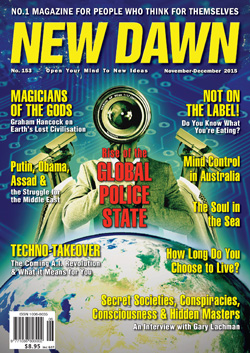
  • Mind Control in Australia

    Mind Control in Australia

    This article was published in New Dawn 153 (Nov-Dec 2015)

    Philosophers and pundits have long discussed the nature of ‘reality’ itself. For convenience and simplicity we might consider two parallel ‘realities’: one a ‘physical reality’ (the limitations of the body, the physical environment, the mechanical activities and necessities of day-to-day survival) and another ‘mental’ or ‘psychic reality’: the lens through which your mind organises, filters and constructs both an internal and external landscape – a worldview (or supposition of ‘how things are’) both tactile and emotional.

    It seems reasonable to suggest that while ‘physical reality’ (the acquisition of food, shelter, relationships, physical movement etc.) is doubtlessly of primal immediacy, the role of ‘psychic reality’ cannot be overstated in the human experience. We act (alone or in concert with others) according to our interpretation of events, information and stimuli: we move or react in concordance with a framework subtly (or overtly) instilled (or reinforced) by peers, family, media, social mores and the fabric of ‘history’ (as transmitted to us) – a collection of instincts, prejudices, short-cuts and assumptions navigating the approximation of a world our senses deliver to us each waking moment.

    Though somewhat falsely lionised as ‘individuals’ (through a century of aggressive marketing and social engineering), we are actually in essence herd animals – guided by the pack, we take verbal, non-verbal and visual cues from those around us – tribalised into class, socio-economic and other strata through myriad signals, feedback loops and pervasive (yet somehow ostensibly invisible) patterns.

    The herd instinct (in humans as in other creatures) is an invaluable tool for the study and organisation of large populations.

    Positioned in distant southern climes, far from the perceived centres of human civilisation – the thin coastal belt, broad plains and scorched deserts of Australia offer an enticing laboratory for the sciences of experimentation and herd manipulation.

    Wrenched from the hands of its native population through a bloody series of wars and oppression, the modern nation of Australia was established as a British penal colony in 1788. Doubtlessly much has changed and developed since then, but still it’s difficult to shake the image of Australia as contiguous and eternal penal colony.

    Since federation in 1901, examples of Australia as anything but felicitous imperial servant are few and far between. The nation cheerfully delivered its young to be blood sacrifices in the imperial territorial jousts of the twentieth century and various Anglo-American imperial intrigues throughout the latter twentieth century and early twenty-first.

    Beginning in the 1950s, Australia had the dubious pleasure of being Great Britain’s nuclear sandpit. All manner of outrageous and unforgivable atomic ‘experiments’ were conducted across West and South Australia, as unrelenting clouds of nuclear fallout drifted over the largest populations centres on the eastern Australian seaboard (the effects of which were covertly studied by the ‘mother country’ for decades thereafter). Like a serially abused child, this nation of ‘Larrikins’ and ‘Eureka Rebels’ barely raised a mute whimper.

    Among a mere handful of momentary blips (on an otherwise placid radar), one may have been the 1972 Whitlam government’s tepid resistance to the enormous, malevolent and largely secret US military base network that speckles the Australian landscape (like the first signs of approaching disease). Whitlam and his unruly gang were swiftly dispatched in a bloodless coup, and no Australian politician of note has dared rock the boat since.

    Another lonely blip may have been the 1985 ‘Australia Card’ – a national identity card that would have linked and collated personal information and mandatory identifying biometrics. A brazen totalitarian gesture (with a patriotic ‘green and gold’ branding and dazzling press launch), the confused populace felt a bovine unease around the proposal and, lest it spook the cattle, the card stumbled onto a slow oblivion two years later. Interestingly, every salient objective of the ‘Australia Card’ has since come to pass through one gladly received ‘initiative/convenience’ or another (many subsumed by the Medicare Card and Centrelink).

    While certainly queasily deferential to authority, perhaps the most instructional recent historical trait in the Australian experience has been that half-hearted rejection of the ‘Australia Card’ – a proposal so clumsily introduced as to resemble a deliberate provocation, designed to test the waters (and ultimately perhaps to fail – so as to set a line in the sand, demarcating exactly how far the gullible can ultimately be stretched).

    Australia is also a popular testing ground for corporate and consumer technologies. Politely referred to in marketing literature as “early adopters,” most Australians are guileless and enthusiastic proponents of convenient (but potentially sinister) technological innovations. From ATMs, EFTPOS payment systems and microchipped credit cards to mobile phones and wireless networks, Australia has reliably led the world in trialling and adopting these peerless developments in consumer profiling and data capture. Mastercard, Visa, Vodaphone and numerous other corporate behemoths consistently utilise Australia to trial new technologies and techniques.

    Unsurprisingly, Australia was an early and enthusiastic member of the Five-Eyes-Network, a globe-straddling post-WWII domestic and international surveillance co-operative that deployed nascent technologies (like ‘Echelon’) to monitor all electronic communications while ostensibly outsourcing the bulk of domestic spying to international partners (thus lending a [largely unnecessary] air of plausible deniability lest accidental public or journalistic exposure occur).

    Unmistakably fashioned around the twin primary aims of curbing domestic dissent and international commercial espionage, the Five-Eyes-Network would haughtily justify its existence – on the exceedingly rare occasion it had to – with a casual application of Bogey-Man-Of-The-Week™ lotion (Communism®, Terrorism® or whatnot).

    As befits a ‘former’ penal colony, Australia is over-governed and over-regulated (ironically, even a recent government audit decried the overwhelming saturation of legislation and registration). Australian adults are infantilised to the point where they are apparently untrustworthy enough to drink in public places, are sanctioned for riding pushbikes through public parks and must be locked into nightclubs during prescribed ‘volatile’ hours. Supposed private property is regulated behind a wall of incomprehensible bureaucracy, and membership of perfectly legal (but government proscribed) organisations becomes instantly and unquestionably illegal. Physical space in Australia is entirely over-regulated and captured, a timid populace cowered by an unrestrained police force (now empowered to force random fingerprinting), an unchallenged legislature (the Northern Territory has begun ‘paperless’ and therefore incontestable arrests), invincible intelligence agencies (endowed with gargantuan budgets and unaccountable powers) and unassailable rampant corporations.

    When it comes to the mental, political, philosophical and psychic landscape – things are even worse.

    Public discourse in Australia is incredibly narrow, bewilderingly staid, tediously predictable and heavily media-sedated. It’s essentially impossible to hear a publicly expressed homegrown opinion outside of the stultifying confines of mainstream ‘debate’. Some cleave to the ersatz alternatives of the ABC and SBS (both government funded) where a rigidly controlled and astoundingly toothless ‘opposition’ simply refines the mainstream dialogue through the lens of bourgeois political correctness.

    Examples are innumerable, but developments in recent memory will suffice.

    Tabloid flagship of the Police State, Melbourne’s Herald Sun, has for many years been a hysterical advocate for the Western imperial adventure branded as the ‘War On Terror’. Megaphoning a procession of serially unsubstantiated jingoisms (probably directly minted from Australia’s historically sinister intelligence agencies), headlines like “Beheading Plot Smashed,” “Evil Within,” “Thirty Jihadis Return Home” and “Lessons In How To Spot A Jihadi” are loud on volume, long on anonymous ‘official sources’ and forever short on facts.

    A massive police and security agency ‘anti-terror’ operation on 17 September 2014 (involving over 800 police officers, helicopters, bomb sniffing dogs etc. etc.) produced exactly two charges (both of tenuous value) and a firestorm of unquestioning, fevered media coverage (all photos, video and information helpfully supplied by the Australian Federal Police Media Liaison Unit). In Australia, ‘reporters’ no longer ‘report’, they simply cut and paste official media releases.

    With a handful of further ‘terrorist threats’, ‘incidents’ and ‘sieges’ successfully completed, and the herd now appropriately fearful, the then Abbott government introduced a raft of outrageous ‘national security’ laws – each a mortal assault on the limited range of ‘freedoms’ Australians already ‘enjoyed’. Perhaps the most onerous of the morbid bunch was a series of laws known as the ‘mandatory data retention laws’. These provisions stealthily legalised and normalised mass surveillance of the entire (and entirely) clueless Australian population. Not one officially sanctioned pundit bothered to mention that the laws are possibly in breach of at least three articles of the Universal Declaration Of Human Rights and commit Australia to being an official Police State.

    So Machiavellian is the sunburnt landscape, that droves of Australians casually promulgate and disseminate unhinged anti-Islamic diatribes and disinformation – fearful of a chimeric yet apparently approaching ‘Sharia Law’ and ‘Halal’ dictatorship. Egged on by shock-jocks and other media Svengali, the herd quiver at the sight of Mosques, hoax pederastic ‘mass-weddings’ and ‘alien’ attire.

    It would be laughable were it not so ugly.

    Manipulated, like so many head of cattle, by their media, corporate and government masters, Australians have allowed Islam to become the lightning rod for all their fears, prejudices and hatreds – a hoary old trick of tyrants – but forever a successful one to legitimise wars and domestic control.

    Philosophically and psychically manipulated against all their own best interests, Australians are simply unable to think, express themselves or even comprehend outside of the narrow officially designated allowable thought corridor.

    Recently returned from the US, tech entrepreneur Nick Holmes à Court derided Australians as gullible and apathetic, noting that “we as the people, have sat back and snoozed whilst the government passed Orwellian internet censorship laws.” Holmes à Court continued that “no one in Australia gives a f*ck. The lucky country? More like the lazy country.”

    If ever Australians needed a reminder that they labour under government by goon squad, they surely received it on 28 August 2015 when the ‘Australian Border Force’ warned they would be randomly checking people’s papers on the streets of Melbourne. The action was eventually cancelled in a snowstorm of farce, but the fact that it was even considered (and announced) speaks troubling volumes to the decayed corpse of Australian ‘freedom’.

    Docile, compliant and forever fawningly agreeable to its imperial and domestic ‘betters’, the Australian population is often incapable of even the most feeble acts of mental self-defence. Unconscious to the point of comatose, the ‘body politic’ knows nothing, couldn’t care less and drives blind – headlong into an unforgiving future. A slave-nation of idiot infants bewitched by shock-jock tirades and pop-culture baubles, unable to discern the psychic plantation walls that dwarf and surround it.

    Twenty-four million lost souls trapped in the penal mind, prisoners of push-polling, perfidious punditry and permanent war-footing propaganda.

    [alert type=”general” dismiss=”no”]This article was published in New Dawn 153.[/alert]

    [alert type=”success” dismiss=”no”]If you appreciate this article, please consider subscribing to help maintain this website.[/alert]

    © New Dawn Magazine and the respective author.
    For our reproduction notice, click here.

  • [Trapped] in The Net: What They Don’t Tell You About  the Internet & Social Media

    [Trapped] in The Net: What They Don’t Tell You About the Internet & Social Media

    This article was published in New Dawn 158 (Sept-Oct 2016)

    “Technological progress is carrying us to inevitable disaster.”
    – Theodore J. Kaczynski (a.k.a. ‘The Unabomber’)

    Flawed, to a depth unlike any other beast in the animal kingdom, human beings rapaciously despoil their own environment and continue to conduct activities that appear to threaten the very existence of the biosphere – our home, planet Earth.

    Through the latter half of the 20th century an insatiable technological race to develop weapons of mass annihilation resulted in nuclear standoff among a handful of belligerent nations and an incongruous co-operative policy of Mutually Assured Destruction (M.A.D.). That dire policy still stands today, a shadow cast unthinkingly over all human endeavour and indeed life itself.

    The very idea that humanity willingly chose to pursue a scientific course that delivered the capacity to destroy the world many times over should be breathtakingly troubling, yet inspires relatively little comment. From the very same tumultuous technological crucible that produced the enduring madness of nuclear weaponry came a more recent development – the Internet. The online world promises an ‘abundance of riches’ (as its techno-evangelists constantly assure) but it also has a profound (and profoundly under acknowledged) dark side.

    Birthed from the Pentagon’s desire to be able to maintain communications through the early stages of a nuclear assault (by spreading the electronic and telephonic communications load over a labyrinth of interconnected routes and servers), what we today call the Internet (which at one point was called ARPANET) was shepherded into existence by D.A.R.P.A. (the Pentagon’s Defense Advanced Research Projects Agency) in partnership with the scientific, academic and corporate communities.

    In these times of giddy techno-utopianism (sleekly designed Apple products are fetishized throughout our entire culture, social media is worshipped as the new frontier in community ‘cohesion’ and ‘inclusive’ communication – to name just a few examples) it would seem important to remember that the architecture of the Internet (and all the associated soft and hard-ware) was parented by a nexus of the Military Industrial Complex, the Secret State, the Corporate Leviathan and deliriously utopian elements of the scientific and academic worlds.

    Many have noted the deleterious relationship between humankind and technological development, where humanity acts as virtual slave to a misdirected and essentially unstoppable scientific progression.

    Though now used as a term of derision, the original Luddites rightly feared the impact of encroaching technology on their livelihoods and sought means to disable it. Thinkers from Karl Marx to Marshall McLuhan also addressed and questioned mankind’s enthralled relationship with technological innovation. For whom shall be the servant and whom shall be the master?

    The New Dark Age of Mediocrity & Narcissism

    Since the invention of Gutenberg’s printing press five centuries ago, the linear/literary mind has evolved and shaped prodigious developments in art, science and culture. We may now have entered an era of far more seismic – though not necessarily positive – changes. Acclaimed neuroscientists like Michael Merzenich and Eric Kandel suggest that the Digital Revolution’s hyper-stimulating and overtly transient landscape may be responsible for ‘re-wiring’ our neural circuitry to a more ‘efficient’ and industrialised state (producing more, more quickly) that also downgrades our capacity for concentration (the locus of education) and even wisdom.

    Writer Nicholas Carr warns in The Shallows: What The Internet Is Doing To Our Brains that “the seductions of technology are hard to resist” but, as German philosopher Martin Heidegger put it, the advance of technology dictates that a new, superficial “calculative thinking may someday come to be accepted and practised as the only way of thinking.”

    Carr also notes that a raft of recent research indicates that the “more distracted we become, the less able we are to experience the subtlest, most distinctively human forms of empathy, compassion and other emotions.” Bombarded by endless linked options and stimuli, we reduce our human qualities and become more machinelike – simply fleshy automata.

    Most online experiences are mediated by algorithms that expedite efficiency in searching the web, comparing products and offering connections to calculated similar content. They advance easy options, rarely subjecting us to the discomfort of a differing opinion or intellectual challenges (as may happen in the real world). If the World Wide Web is an infinite digital library, search algorithms are most likely to fill that library only with volumes chosen to please us. An endless feedback loop of gratifying, self-serving opinions and subtle reinforcement – a mirrored cubicle of refracting self-reflection, an echo-chamber of recycled automatic sound bites. An apocalypse for the enquiring soul.

    A cursory scan of Facebook, Instagram or Tumblr will produce mountainous evidence that we are enduring The Age Of The Ego. Current digital technologies have been designed by fevered armies of psychologists to appeal to the very weakest flaws in human nature – self-obsession and flagrant narcissism. Can there be a sadder, more alienating device than the ubiquitous ‘selfie-stick’? Surely the end is nigh.

    Another question posed by Carr was, “Is Google making us stupid?” Forever distracted by the digital avalanche, research and voluminous anecdotal evidence suggests that we are already drowning under the online tsunami – vast amounts of information at our fingertips, yet unable (or unwilling) to analyse, prioritise, sift and evaluate – we simply consume and regurgitate.

    Obesity of the Mind

    Richmond, Virginia author Matthew Crawford proposed in his book The World Beyond Your Head that we are seeing a social crisis as more and more people lose touch with physical reality and escape into the online matrix.

    According to Crawford: “Figuring out ways to capture and hold people’s attention is the centre of contemporary capitalism. There is this invisible and ubiquitous grabbing at something that’s the most intimate thing you have, because it determines what’s present to your consciousness.” In the clamour to advertise in every mental space (and monetise every social interaction), we are fast losing the room to think, be creative, be playful – to ponder. “Attention is a resource, convertible into actual money,” and we need to reclaim our own senses and resources, “because when you talk about attention, you’re talking about the faculty by which you encounter the world.”

    Crawford continues… “the media has become expert at making irresistible mental stimuli” and systems are designed to encourage “playing till extinction,” a cognitive science and “social engineering project” facilitated by “mind-bogglingly wealthy corporations.”

    Crawford has found respite, peace and fulfilment in discovering working with his hands again – between writing projects he restores vintage motorbikes in a local repair shop and eschews the seductive online experience.

    The Creeping Tide

    A creeping tide of evidence now suggests that the online experience itself (aside from the content) may also affect direct cognitive damage.

    Research conducted in 2012 at the Chinese Academy of Sciences (in Wulan, China) scanned the brains of 35 men and women (between the ages of 14 and 21). Those classed as suffering from Internet Addiction Disorder (IAD) were shown to have notable changes to the white matter of the brain (the nerve fibres/connections) compared to those that did not suffer from IAD. The researchers noted “abnormal white matter integrity in brain regions involving emotional generation and processing, executive attention, decision making and cognitive control.” The neurological damage observed shared “psychological and neural mechanisms with other types of substance addiction and impulse control disorders” and was comparable to the effects seen in alcoholics, drug addicts, video game addicts and those with other behavioural afflictions.

    As a multitude of libraries close (or partially divest their collections to make room for the ubiquitous computer terminals and Wi-Fi routers) scholars from University College London conducted a five-year research programme examining evolving reading and research habits. They logged the activity of visitors to two popular research sites (one a British Library site and one the portal of a UK educational group) that offered journal articles, e-books, and other information. The study found a notable “form of skimming activity” as students and researchers bounced from one source to another, rarely reading more than a page or two and almost never returning to an earlier source. As the study concluded: “It is clear that users are not reading online in the traditional sense; indeed there are signs that new forms of ‘reading’ are emerging as users ‘power browse’ horizontally through titles, contents pages and abstracts going for quick wins. It almost seems that they go online to avoid reading in the traditional sense.”

    What is suggested here is a ‘pancaking’ of intelligence, as cognition is spread wider, but also thinner, with a more superficial comprehension and understanding.

    The deluge of multitasking and ‘multi-screening’ (having numerous windows or devices open and active at once) is, according to scientists, shattering focus and rewiring our brains. Eyal Ophir, after stints in Israeli intelligence and the airforce, joined Stanford University in 2004. He sought to challenge (through research) the traditional view that the human brain can only competently process a single stream of information at any given moment. Devising tests involving the timed comprehension and filtering of patterns of red rectangles from patterns of blue rectangles, what Ophir and his colleagues found shocked them. Those who identified in the study as ‘multitaskers’ were significantly worse at sorting the shapes and thus filtering out what was deemed as irrelevant information. Also multitaskers were shown to be less efficient at juggling problems, taking longer to switch between simple tasks. It’s possible that technological overload may be confusing the brain’s systems for determining priorities, marking every form of digital stimulation as urgent, creating a haze of constant, buzzing panic and distraction.

    A study conducted at the University of California indicated that constant interruptions from email alerts and pinging phones contributed significantly to stress levels. Gary Small, a psychiatrist at the University, noted that stress hormones can affect short-term memory loss and promote debilitating mental ‘fog’. According to studies conducted at the University of Utah, only a fraction of people (possibly around 3%) are capable of operating calmly with regular digital disruption.

    Numerous studies by psychologists, neurobiologists, and educators now show that ‘hyper-texting’ (the ability to click highlighted sections of text linked to sources or further information) actually decreases comprehension significantly. Interestingly, even the appearance of a hypertext (whether clicked or not) erodes understanding by offering the disorientating opportunity for distraction. A 2001 Canadian study tasked subjects with reading the Elizabeth Bowden short story ‘The Demon Lover’. The control group read the story in traditional linear text, the test group read a version dotted with hyperlinks. It took the test group longer to read the story and they were an extraordinary seven times more likely to report ‘confusion’ in their comprehension of it. A further 2007 academic review of related experiments concluded that bouncing between digital documents and linked pages seriously undermined understanding. Today’s Internet landscape of pop-up ads, competing videos and flashing, bouncing images can only yield to more mental maelstrom.

    As pointed out by Nicholas Carr: “When we go online, we enter an environment that promotes cursory reading, hurried and distracted thinking, and superficial learning. Even as the Internet grants us easy access to vast amounts of information, it is turning us into shallower thinkers, literally changing the structure of our brain.”

    The available pool of information entering our working memory is referred to by psychologists as the ‘cognitive load’. The Internet turns this steady ‘drip’ of ideas into a ‘blast’, overwhelming our limited cognitive abilities and thence disabling vital components of them. As Carr noted, “The Internet is an interruption system. It seizes our attention only to scramble it.”

    The Long Shadow of the Surveillance State

    In June of 2013 the revelations of former NSA contractor Edward Snowden seized headlines around the world. Snowden confirmed what many have long suspected: built over decades, we now exist under a vast and omniscient surveillance infrastructure. Ostensibly constructed under the rubric of combatting ‘terrorism’, it doesn’t take much imagination to see that the real target is domestic dissent and any and all threats to capital and authority.

    Much like Jeremy Bentham’s 19th century design of the guard-less prison (the Panopticon), today’s admitted (and much publicised) Surveillance State leads directly and unequivocally to mass self-censorship and reflexive self-regulation.

    An Oxford University study conducted by Jonathon Penney reported a notable ‘chilling effect’ on the Internet habits of American adults directly related to the Snowden revelations. Monitoring Wikipedia searches after June of 2013 (the date Snowden surfaced) Penney noted “a 20 percent decline in page views on Wikipedia articles related to terrorism, including those that mentioned ‘al-Qaeda’, ‘car bomb’ or ‘Taliban’,” as compared to prior to that date. Page views continued to decline over a year, suggesting a “longer-term impact from the revelations.”

    “This is measuring regular people who are being spooked by the idea of government surveillance online,” Penney opined. “You want to have informed citizens. If people are spooked or deterred from learning about important policy matters like terrorism and national security, this is a real threat to proper democratic debate.”

    Other research from MIT indicated that “users were less likely to search using search terms that they believed might get them in trouble with the US government,” and a recent study conducted for the US Department of Congress noted that respondents reported that “29 percent of households concerned about government data collection said they did not express controversial or political opinions online due to privacy or security concerns.”

    The ‘chilling effect’ has also spread to the legal profession and substantially impinged on press freedoms. A 2014 report from the ACLU and Human Rights Watch was based on interviews with lawyers and journalists “covering intelligence, national security, and law enforcement for outlets including the New York Times, the Associated Press, ABC, and NPR.” According to the report, it has become apparent that lawyers, journalists and their sources are now considerably more fearful of surveillance and their ability to protect sources and attorney/client privilege. Examples cited include:

    “[Journalists’] techniques ranged from using encryption and air-gapped computers (which stay completely isolated from unsecured networks, including the Internet), to communicating with sources through disposable ‘burner’ phones, to abandoning electronic communications altogether… As with the journalists, lawyers increasingly feel pressure to adopt strategies to avoid leaving a digital trail that could be monitored. Some use burner phones, others seek out technologies designed to provide security, and still others reported travelling more for in-person meetings. Like journalists, some feel frustrated, and even offended, that they are in this situation. ‘I’ll be damned if I have to start acting like a drug dealer in order to protect my client’s confidentiality’, said one.”

    If the Snowden revelations were, perchance, designed to stun, cower and silence the general population (and perhaps even potentially problematic professions) for the advantage of the Security State, then one can only marvel at their resounding success.

    In April of 2014, speaking at a St. Petersburg media conference, Russian President Vladimir Putin described the Internet dubiously as a “CIA Project.” Despite the expected howls of denial from the dutiful Western press, it should be noted that Putin is a former KGB official and probably has some inkling of what he speaks.

    In a remarkable (and remarkably overlooked) piece for The Medium (entitled ‘How The CIA Made Google’) journalist Nafeez Ahmed charted the labyrinthine connections between the entire functional architecture of the Internet and the National Security State. Not only entwined through injections of start-up capital and seed funding, the ostensibly ‘private’ mega-corporations of the online experience (Google, Microsoft, Yahoo et. al.) boast an extraordinary overlap of board and executive personnel with the Security State (NSA, CIA, DIA, DoD etc.) but also a co-operative and synergistic culture that appears more like a corporate family structure than an adversarial private/public relationship. Likewise, the CIA’s capital investment arm (In-Q-Tel) has been there since the beginning for Facebook (a fact curiously absent from the Hollywood version) and the entire spectrum of social media appear to be nothing less than an extraordinarily enthusiastic data harvesting and social engineering project (data being delivered willingly and on an incredible, in fact, unimaginable scale).

    Theodore Kaczynski (the notorious ‘Unabomber’) wrote a remarkably prescient document circa 1995 called ‘Industrial Society and Its Future’. In it, the author (‘F.C’ – assumed to be the convict Kaczynski) decried the apparently endless march of scientific technology to dehumanise and demean humankind and separate us from the ‘power process’ and the fulfilling fundamentals of human survival.

    Kaczynski may have been a terrorist or murderer – but he was certainly no armchair hypocrite – calling in his manifesto for “a new revolutionary movement, dedicated to the elimination of technological society.” And he had admirers in unlikely places, famed Silicon Valley alumni Bill Joy allowing that, “As difficult as it is for me to acknowledge, I saw merit in the reasoning in (Kaczynski’s writing).”

    Indeed, perhaps it is time to turn our backs on giddy techno-utopianism and revolt against our fevered technological servitude (before we become too stupid, disempowered or lethargic to do so).

    Time to wind back, or even destroy, our Internet addictions, turn off the candy-coated Information Superhighway and reclaim some vestige of our flawed but fleshy independence before we are subsumed in a deluge of mediocrity and totalitarianism. Before we are Pokémon Go-ed into a virtual net of moribund surveillance capitalism.

    But who, dear friends, has the courage for that?

    [alert type=”general” dismiss=”no”]This article was published in New Dawn 158.[/alert]

    [alert type=”success” dismiss=”no”]If you appreciate this article, please consider subscribing to help maintain this website.[/alert]

    Sources/Recommended Reading

    Ted Kaczynski, Technological Slavery: The Collected Writings of Theodore J. Kaczynski, Feral House 2010

    Nicholas Carr, The Shallows: What The Internet Is Doing To Our Brains, Norton 2010

    A. Keen, The Internet Is Not The Answer, Atlantic Books 2015

    © New Dawn Magazine and the respective author.
    For our reproduction notice, click here.

  • Magicians of the Gods: An Interview with Graham Hancock

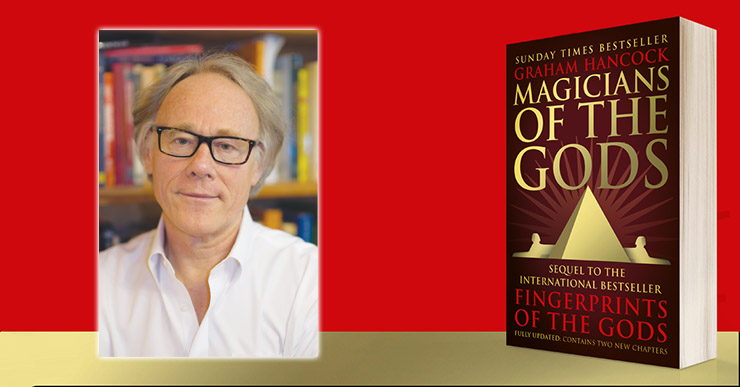
    Magicians of the Gods: An Interview with Graham Hancock

    From New Dawn 153 (Nov-Dec 2015)

    Author and theorist Graham Hancock has had a sizeable impact upon the popular understanding of humanity’s ancient past. His global 1995 bestseller Fingerprints of the Gods contended that some previously ancient but highly advanced civilisation existed in prehistory, one which served as the common progenitor civilisation to all subsequent known historical ones. Further books such as Keeper of Genesis (with Robert Bauval), Underworld (studying underwater ruins as evidence of lost civilisations) and others propose bold new theories that challenge mainstream dogma.

    Hancock’s new book Magicians of the Gods: The Forgotten Wisdom of Earth’s Lost Civilization – a sequel of sorts to Fingerprints – gathers compelling evidence pointing to an ancient global cataclysm, caused by devastating meteor impacts, that may have all but erased a highly advanced human society and forced the survivors to, in essence, start again. Hancock also presents evidence the Earth may soon face this potentially species threatening meteor stream again.

    David Thrussell spoke to Graham Hancock in this exclusive interview for New Dawn.

    DAVID THRUSSELL (DT): From a distance, you appear to have what could be described as an ideal life Graham, travelling around exotic and interesting places, exploring the edges of history and knowledge. Are there any downsides, disappointments or frustrations in your work?

    GRAHAM HANCOCK (GH): I feel glad that I’ve had the opportunity in this life to explore and spend time in so many incredible, mysterious, profoundly moving ancient sites, all around the world. It’s been a great privilege to have the opportunity to do this, and I have no complaints whatsoever. I’m grateful for my life. I have a lot of freedom and I’ve worked from home since I was 29 as a matter of fact – that’s when I decided I couldn’t work in a large organisation anymore, and struck out on my own. For a very long time I was completely broke. Eventually I started to manage to make a living from it. But I have no complaints. I think I’ve been very fortunate and I’m grateful for the life I’ve had the opportunity to lead.

    DT: How long have you been working, brewing away on the new book [Magicians of the Gods]?

    GH: Well in a sense, 25 years. As a focused project, about 3½ years, but this book draws on my interests and enquiries into this field going back to the end of the 1980s.

    DT: Now, if you had to advance a single most compelling piece of evidence to support your theory, what would it be and why would it be that?

    GH: Well, it’s more complicated than that. This is not a problem that can be solved by a magic bullet. This is a problem that requires co-ordination of evidence from many different sources. I would offer you three pieces of evidence that are all in a sense joined together, and one of those pieces of evidence, a very important piece of evidence, is something we have now, but I didn’t have when I wrote Fingerprints of the Gods in 1995. It’s effectively a smoking gun, globally. Scientific evidence for a global cataclysm between 13,000 and 12,000 years ago. That was essentially the hypothesis I put forward in Fingerprints of the Gods, that there had been a global cataclysm between 13,000 and 12,000 years ago, and it wiped out an advanced civilisation, and I speculated on many possible causes of that cataclysm – notably pole shift and Earth crust displacement.

    What happened since 1995, and particularly since 2007, is that a group of scientists have put before the scientific community – very little of this has yet leaked out to the public – absolutely compelling evidence Earth suffered a series of impacts from fragments of a giant comet, and these impacts happened 12,800 years ago when several fragments hit the North American ice cap, causing global flooding and radical climate change. It happened again 11,600 years ago when more fragments from the same comet came out of orbit and smacked down into an ocean – almost certainly the Pacific – sending up a huge plume of water vapour into the upper atmosphere and causing very sudden global warming. So the interval between those two periods, the 1,200 years between 12,800 years ago and 11,600 years ago, is an episode of almost unparalleled global cataclysm, coupled by massive extinction of animal species, the mega mammals, the mammoth, the woolly rhino, and so on. And this is the event that I believe lost us a whole civilisation of pre-history that previously has not entered the archaeological records.

    Now, let’s co-ordinate this with the latest discoveries in archaeology. Remember that one of the two dates for that cataclysm is 11,600 years ago. This was a sustained event that involved two separate bombardments from fragments of a comet. On both occasions there were massive sea level rises and a global cataclysm unfolded. The first occasion 12,800 years ago, the second occasion 11,600 years ago, were also accompanied by global flooding and massive sea level rises. It’s therefore intriguing that the archaeological site in south eastern Turkey, known as Göbekli Tepe – which means ‘pot-bellied hill’ in the Turkish language – was created 11,600 years ago by people who already knew how to work with giant megaliths. Göbekli Tepe is an anomaly, because it’s 7,000 years older than other megalithic sites around the world, and yet it demonstrates advanced techniques of stonework and stone cutting, organisation of labour, planning, site design and alignment to the heavens. This is not the work of a group of hunter-gatherers who woke up one morning and felt suddenly inspired to create the world’s first megalithic architecture. In my view, what we’re looking at is a transfer of technology, the knowledge brought by the survivors of the lost civilisation, including the knowledge of how to create large-scale megalithic structures – and at exactly the same moment 11,600 years ago we get this sudden and unexplained appearance of a sophisticated megalithic site in south eastern Turkey.

    We also get the dissemination and uptake of agriculture in exactly the same region, whereas previously the inhabitants had been entirely hunter-gatherers. I say again, what we’re looking at is a transfer of technology, the fingerprint of the survivors of a civilisation that was lost in the cataclysmic events between 12,800 and 11,600 years ago.

    And I mention a third point, the age-old myth of Atlantis, which isn’t actually that old because the version of it that comes down to us – the only version that comes down to us – is in the works of the Greek philosopher Plato. Plato said he got the story of the submergence and destruction of the advanced civilisation of Atlantis through his ancestor Solon, the Greek law-maker who visited Egypt in 600 BCE, and there was told, by Egyptian priests, the story of Atlantis. And they said Atlantis had been destroyed and submerged, having incurred the anger of the gods, 9,000 years before the time of Solon. We know that Solon was in Egypt around 600 BCE, therefore they are talking about 9,600 BCE in our calendar, 11,600 years ago, which is the date precisely for the appearance of these hitherto unheralded techniques of megalithic architecture and agriculture in the region of south eastern Turkey.

    DT: The cataclysm you’re talking about has been staring us in the face really, hasn’t it?

    GH: It has been staring us in the face, but I don’t blame historians and archaeologists for failing to get to grips with it sooner than this. Because the leading scientists in the field have only really been compiling and presenting evidence on what is now referred to as the Younger Dryas comet for the last seven or eight years. It’s a very recent discovery and the reason it’s a recent discovery is that the major impacts of this comet 12,800 years ago were on the North American ice cap. This was still the Ice Age. North America, as far south as New York, was covered with ice, two miles deep, and at least four fragments of the comet hit the ice cap. But they did not leave prominent craters on the ground because the craters were in the ice itself and the vast heat and kinetic energy of the comet melted away that ice, so the craters were transitory and what we have is shock effect on the ground underneath. Recently, a number of craters have been found. The kind of craters that would be left when an object hit a two mile deep ice cap and transferred its shock to the bedrock underneath.

    Much more important is the evidence of the Younger Dryas scientific team – more than 30 scientists are working on the Younger Dryas comet. That evidence is based on what I call “impact proxies.” When you get an object coming in at 60 or 70 thousand miles an hour, and that object is a kilometre or two in diameter, it has unbelievable quantities of kinetic energy, and then you’re looking at an explosive power in the range of the entire nuclear arsenal of planet Earth, going up at once, with any single one of these objects. And there are certain, very recognisable outcomes of this. One is melt glass. You have heat unleashed in excess of the boiling point of quartz. Temperatures in excess of 2,200 degrees centigrade. This produces melt glass which is indistinguishable from the melt glass we find as a by-product of nuclear explosions. You also get carbon micro-spherules and very distinct nano-diamonds that are caused by the shock and heat. These nano-diamonds are only visible under a microscope, and they are combined with the melt glass, the carbon micro-spherules, and other evidence all around the world. They are compelling evidence for a gigantic cosmic impact 12,800 years ago.

    And, by the way, it’s exactly this kind of evidence that was initially put forward to prove the asteroid that wiped out the dinosaurs 65 million years ago. There’s only two occasions in Earth’s history, in the last 100 million years, that we get precisely the same impact proxies spread around the world. One of them is the so-called KT event 65 million years ago that wiped out the dinosaurs. And the other is the hitherto unrecognised, but now very obvious extinction level event that happened 12,800 years ago, and was caused by the Younger Dryas comet. I say “Younger Dryas” because that is the geological name for the period between 12,800 years ago and 11,600 years ago when the Earth’s climate fell into a sudden and hitherto unexplained deep freeze. We now know the cause of this. It was our interaction with the fragments of a giant comet, and the effects were truly cataclysmic.

    [alert type=”info” dismiss=”no”]If you appreciate this article, please consider a subscription to New Dawn magazine.[/alert]

    DT: Is it reasonable to suggest that mainstream academia, media and science are wedded to a particular view of history?

    GH: Yes. It is reasonable to suggest that, and it’s not surprising either. It’s just always the case – when you have any area of study, any discipline, whether it’s geology or whether it’s archaeology for that matter – that a body of knowledge is built up. And respected elders have contributed to that body of knowledge, and the new generation obviously respects the work of their elders. And gradually what builds up is a reference frame, a picture for how that area of study should be. In the case of archaeology, the picture that built up over the last 100 years of work is of a slow evolution of civilisation – that our ancestors were hunter-gatherers and nothing more until perhaps 8 or 9 thousand years ago. Then we begin to see the gradual movement towards more permanent settlement and about 5,000 years ago we get the first big cities and the first great megalithic architecture. This is the picture of civilisation taught to us by mainstream academic historians and archaeologists. It’s taught in the schools, it’s by and large conveyed through the media, but it is not a fact, it is a reference frame. It is a reference frame built up by 100 years of archaeological study. And this is, I think, the problem with archaeology and other scientific disciplines that get locked in a particular reference frame. When new facts emerge that don’t fit the reference frame, they find it difficult to adjust to them, and the first step is the attempt to discredit those facts. When more and more evidence comes in that the existing paradigm can’t explain, eventually the paradigm gets overthrown. A lot of good people who’ve done a lot of good work, who are convinced they’re right, who respect the work of their elders, and who don’t want to rock the boat – I think that’s the central problem. It always happens in science. No ideas change suddenly overnight without overwhelming new evidence that the previous paradigm cannot explain. That’s what we’re finding in the field of history and archaeology now – more and more new evidence coming in that simply can’t be explained by the existing reference frame of history.

    DT: Would you care to speculate – if the theory that you’re advancing is indeed correct – what pre-history looked like? What would history on Earth look like before this comet struck the planet?

    GH: A much more complicated world than the world portrayed to us by mainstream historians and archaeologists. Not a world populated entirely by hunter-gatherers as they suggest, but a world in which hunter-gatherers, and a more advanced civilisation, co-existed. This, in a way, is not odd. If you think about it, we are a very advanced technological civilisation today – Western technology, the industrial-technological-complex that has spread around the world, but we are not alone. We share the world with hunter-gatherer people – hunter-gatherers in the Kalahari Desert, for example, and in Southern Africa. Hunter-gatherers in the Amazon Basin. There are even tribes in the Amazon Basin who are completely un-contacted, who don’t even know that we exist; an advanced technological culture has not even impinged on their worldview yet. So the co-existence of advanced technology with hunter-gatherers that we see today, I would project that back into the past, and I would say more than 13,000 years ago during the Ice Age there was a much more advanced civilisation on this planet, than is given credit for by historians and archaeologists. It is remembered in myth and tradition all around the world, and it’s increasingly supported by recent striking archaeological discoveries such as Göbekli Tepe.

    DT: You mentioned two obvious cataclysmic events – the dinosaur extinction and the Younger Dryas events. Is it possible there have been other cataclysmic events that we have no inkling of?

    GH: Certainly there have been other cataclysmic events, and we do have inklings of them. The only question is, whether they affected the human species, and this becomes a matter for further enquiry. I hold, for the moment, the view that anatomically modern humans – people who look just like you and I – have only existed on Earth for about 200,000 years. It may well be that further discoveries will produce evidence of earlier anatomically modern humans. I don’t rule that out. But at the moment the evidence points to the emergence of our anatomically modern line about 200,000 years ago. We have, for example, a skeleton from Ethiopia, 196,000 years old, which is indistinguishable from an anatomically modern human being. So for these cataclysms to involve humanity and to impact the human story, they need to have happened within a human timeframe. This is why the Younger Dryas event is so intriguing because not only is it within the human timeframe, it’s right on the edge, on the border of a period when historians and archaeologists think civilisation began. Yet they had not yet taken into account this extinction level cataclysm, right in the backyard of history, and I would say that until they do take it into account, all their notions about the origins of civilisation are up for grabs.

    There have been multiple other global cataclysms of an extinction level going back hundreds of millions, even billions of years in the past. These things happen from time to time, and every time they happen they reset the clock on this planet, and life changes due to these dramatic and radical events. I think it’s only the most recent one, the one that happened 12,800 years ago, that directly impacted the human story – and this recent global cataclysm has not yet been taken into account in the model building of our past by historians and archaeologists.

    DT: Is it possible that mainstream science, the media, or even the general population in a sense, don’t want to know about our own history as a species?

    GH: There appears to be a kind of directive operating at governmental level, not to say things too alarming. It particularly applies to issues that involve global cataclysms. Anybody who’s worked in the field of geology will know that proposing a cataclysmic agent results in furious criticism. There was a great geologist called J. Harlan Bretz – whose work I write about in Magicians of the Gods – who provided the first evidence of cataclysmic flooding in North America, particularly in the Pacific north-west, in the channelled scablands, an area I researched quite intensively for Magicians of the Gods. J. Harlan Bretz was absolutely 100% right, but it took from the 1920s, almost to the 1970s, before he was accepted as being right. Prior to that he had been subjected to the most grievous and unpleasant abuse, which a weaker man might not have borne. In the end he turned out to be correct and he lived until the age of 99. And when he was awarded America’s highest honour for a geologist, he said: “My only regret is that all my enemies are now dead, and I have no-one to gloat over.”

    DT: If there is an active effort to forget or obscure history, why would that be?

    GH: I’m not sure. I don’t want to go in the direction of a conspiracy. I think it’s just the way people’s minds work. We find it difficult to conceive of certain things, or apply them to ourselves. There may be a conspiracy. I have to contemplate this possibility a little bit in the book. I don’t like conspiracy theories – it’s an area of enquiry where facts get thin on the ground and speculation gets very thick and long. When I look at the way the catastrophists’ ideas have been systematically rubbished, sometimes for decades until proved correct – the same was true, by the way, about the dinosaur impact. Initially no scientists believed that either. Luis and Walter Alvarez, who initially proposed the idea of a cosmic impact 65 million years ago, were subjected to abuse and persecution, and they too were eventually vindicated.

    DT: Are you aware of the work of Steven and Evan Strong in Australia?

    GH: I know Steven and Evan Strong. They were kind enough to show me a number of interesting sites in Australia last year. I’ve got a lot of respect for their leg work and they’ve opened my eyes to mysteries in Australia which I do intend to look at in the future. Australia has not been a big focus of my work up till now.

    DT: Do you ever suffer from ‘apocalypse fatigue’? It seems to be a staple of human endeavour, doesn’t it, thinking that a cataclysm is around the corner?

    GH: No, I don’t suffer from ‘apocalypse fatigue’, and I don’t go around thinking that the end of the world is nigh, either. I do think we should be paying much more attention to our cosmic environment. At the moment the human race has its priorities all screwed up. We’re capable of spending trillions of dollars a year on weapons of mass destruction, quite ready to wipe each other out and destroy this beautiful and precious habitat, the Earth, that the universe has given us. Humanity shows every sign of being an insane species at the moment, an insane and unconscious species, totally devoted to material production and consumption, uninterested in matters of spirit. Negligent of this beautiful garden in which we find ourselves.

    If we were to take the responsibility of human life seriously, we would closely and carefully inspect our immediate cosmic environment. I have drawn attention in the book to the fact that the debris stream of the giant comet that caused the cataclysm 12,800 to 11,600 years ago is still in orbit. It’s called the Taurid meteor stream. We pass it twice a year. If we were smart we’d pay a great deal of attention to the objects that orbit in the Taurid meteor stream. And if, as seems likely, some of them threaten Earth in the future, we have the technology, we have the ability to avert that danger. I’m only interested in the issue of future cataclysms to the extent that we can avoid them, and that foreknowledge of them would help us avoid them, and I believe that is the case with the cosmic threat. There is a threat, there is an ongoing danger. Most responsible and serious astronomers would absolutely agree with that.

    We mark World Asteroid Day on 30 June, which is an attempt to draw attention to the dangers of our immediate cosmic environment, and to do something about it. We’re probably the first civilisation in the history of Earth that has the capacity to intervene in our cosmic environment and to deflect or divert objects that might threaten life. I think we’d be doing a lot better if we directed our resources more responsibly – a lot of the money we spend on useless military pursuits at the moment – and channelled it instead to a thoroughly worked out space-watch project to ensure Earth never again suffers the kind of disasters it suffered between 12,800 and 11,600 years ago. We are going down the path of insanity and madness with our military spending. With all the fear and hatred and suspicion circulating in the world at the moment, we need to recognise that we’re all brothers and sisters, we’re one human family, and perhaps the prospect of dealing with a shared common threat would be the very thing to bring us together.

    DT: Ironic, isn’t it, there may be a weapon of mass destruction bearing down upon us all right now.

    GH: Yes, exactly. This is possible. A number of astronomers (including Bill Napier) and the mathematician Emilio Spedicato at the University of Bergamo, are all deeply concerned about the Taurid meteor stream. They believe it has a number of very large objects, including one that may be 30km wide, and the Earth crosses this stream twice a year. Some calculations indicate we may be crossing particularly lumpy and dangerous parts of the stream within the next 30 years or so. Nothing really could be more urgent. We need to pay attention to this problem. We need to identify objects that endanger Earth, and we need to move them. All of that we can do, it just takes the will. We already have the technology. But while we go around fearing and hating and suspecting one another, our eye’s not on the ball. Our eyes are on totally the wrong place.

    DT: I couldn’t agree more with you.

    Magicians of the Gods: The Forgotten Wisdom of Earth’s Lost Civilization by Graham Hancock is available from all good bookstores. Graham Hancock’s website is www.grahamhancock.com.

    [alert type=”general” dismiss=”no”]This article was published in New Dawn 153.[/alert]

    [alert type=”success” dismiss=”no”]If you appreciate this article, please consider subscribing to help maintain this website.[/alert]

    © New Dawn Magazine and the respective author.
    For our reproduction notice, click here.

  • Poisoned Mind: Social Media in the 21st Century

    Poisoned Mind: Social Media in the 21st Century

    From New Dawn 150 (May-June 2015)

    According to an article on the website of ‘Radio Free Europe’, a nondescript modern 4-storey building on Savushkina Street, St. Petersburg, houses the innocuously titled ‘Internet Research Centre’.

    Inside the building operate government controlled and tasked teams of professional ‘trolls’. Spread across approximately 40 rooms, the trolls prowl the Internet in 12 hour shifts, generating pro-Kremlin comments and ‘gaming’ Internet forums and online conversations.

    St. Petersburg blogger Marat Burkhard recently came forward to describe the apparent covert activities in detail. Burkhard describes his co-workers as “politically illiterate young people” who must be briefed on current topics at the beginning of each shift and continually supervised.

    At this point it would be pertinent to note the source of the article – Radio Free Europe – notoriously a CIA funded propaganda outlet for decades (now financed, more obtrusively, through the State Department and ‘private donors’). While only the congenitally naive would doubt the veracity of the article’s basic claims, what is (unsurprisingly) lacking is context. Whether financed and operated by Russia’s intelligence agency FSB, or some other shadowy enclave, it is estimated that the entire Russian security establishment currently operates with just one twentieth (1/20) of the US equivalent (not even including the UK and other close Western allies).

    What that means, in a nutshell, is that for every Internet Research Centre in Russia, the CIA/NSA/GCHQ/private contractor nexus would be operating the equivalent of (at least) 20 such centres. Flooding the social media networks, news and other sites of their domestic populations with thousands upon thousands of comments, posts, disruption, disinformation and propaganda bullets every day. Salvos in an escalating, but largely unseen, ‘Information War’.

    Furthermore, recent reports cite the development of software that actually scours the web, automatically switching between user names/identities and generating propaganda, provocations and automated comments as it goes. Coupled with Google’s recent announcement of A.I. software that can discern (Google’s version of) ‘the truth’, it doesn’t take much imagination to envisage any online expression of ‘untruth’, ‘heresy’ or ‘dissent’ being automatically swamped beneath a torrent of managed obscurity, cyber-troll bile, distraction and chicanery.

    Seismically underreported, similar allegations about the ‘troll farms’ or ‘web brigades’ of the West (such as GCHQ’s ‘77th Brigade’) have barely surfaced in the blinding mass of ‘Snowden Revelations’. Chilling images (reportedly leaked from internal GCHQ presentations) document operations in ‘virtual communities’, ‘social identity theory’, ‘herding’, ‘mimicry’ and the ‘psychology of deception’. Much of the language used seems best suited to neutralising dissent and activism in the ‘target’ (domestic) populations (and not the lame-duck excuse of ‘fighting terrorism’).

    As an astounding amount of human activity and intercourse migrates online, public spaces empty and forums/social media fill with a new species – homo digitalis – a being safely cubicled and shepherded into approved opinions, paradigms and navel gazing.

    Accordingly, corporations now view social media and online social networks as their plaything and happy-hunting-ground – each ‘like’, ‘trend’, ‘tweet’ and online action the precious raw material to map, direct and monetise consumer behaviour. Edward Bernays (pioneer marketeer, nephew of Sigmund Freud and author of the seminal text Propaganda) could hardly have dreamed of the marketing, perception management and social engineering possibilities now available at the press of a few attractive and endorphin-stimulating keystrokes. Today’s brave new keyboard-warrior looks an awful lot like yesterday’s plantation indentured servant or herd of cattle (in sleek, Apple designed ergonomic garb).

    A plethora of research (let alone common sense) suggests that our reliance/addiction to social media and its associated devices is already having a profoundly deleterious effect on basic cognitive skills, human interaction, attention spans and functional intelligence. Factor in a cocktail of narcissistic personality disorders and body dysmorphic disorders (with a chaser of smartphones and other hand-held devices) and humankind looks at last set to plunge over the precipice of unfathomable stupidity.

    Doubtlessly technologists (and the teams of psychologists who work for them), minutely design every latest gadget to further exploit the very human weaknesses of vanity and the desperate need to be endlessly and pointlessly distracted. A chronically self-obsessed, trivialised generation (like no other generation before it) of ‘selfie’ snappers and banal ‘tweeters’ is the technocrat’s utopia.

    Disinterested, disenfranchised and disengaged from the outside world, ‘Generation Now’ (the iGeneration) have become tyranny’s best enablers – politically, philosophically and spiritually ineffective – vapid consumers and mindless infants. Delivering themselves up ‘freely’ to the corporate-military-complex – their every mood, ‘status’, location, relationship and conversation accessible in real time or stored in vast information vaults secreted away in distant desert bunkers.

    The very architecture of social media seems intrinsically designed to be nothing more than a gargantuan electronic trap to collect as much data, biometric and psychological information as possible about the population.

    Facebook’s notorious ‘experiments’ in ‘emotional contagion’ and political herding become even more sinister when placed in their rightful context. Despite Facebook’s chummy image and branding, ostensible founder Mark Zuckerberg has made it clear in numerous interviews his desire to mould a future of what can only be described as pure techno-totalitarianism. A consumer’s/user’s every action and thought mediated through the ‘safe’ interface of Facebook – always surveilled, always stalked and tabulated – available to corporations and intelligence agencies at all times. ‘Dangerous’ physical interactions minimised and discouraged.

    Whilst Facebook may have a hidden nativity story, its birth secretly shepherded by funds channelled through In-Q-Tel (the CIA’s venture capital arm), the same in fact may also apply to the very foundational platforms of the Internet itself. Recent research by journalist Nafeez Ahmed has revealed the cosy (symbiotic even) relationship between (‘Don’t Be Evil’) Google and the entire American intelligence apparatus. Mediated through a decades-old shadowy group known as the ‘Highlands Forum’ – leading technologists, corporate heads and intelligence chiefs have met privately innumerable times to cross-pollinate innovations, strategies and policy.

    Ahmed makes it clear that the entire contemporary surveillance landscape may well have been seeded through the Highlands Forum, as business and the secret state pursue their (remarkably similar) aims. Much like the unspoken ‘revolving door’ that operates between the Pentagon and the armaments industries – the board members and senior officials of Google, Facebook and alike have the striking habit of being familiar faces from the recesses of the Pentagon, CIA, NSA and so on. So ubiquitous is this limited personnel pool, that ultimately the question must be asked whether Google and Facebook are simply not just clandestine arms of the national security state.

    No matter how earnestly we may choose to look the other way, even the bedrock technology of the Internet itself (developed apparently to protect communications in case of a devastating nuclear conflict at the height of the Cold War) are naturally products of ARPA (the predecessor of today’s DARPA) the research and development arm of the Pentagon.

    Does it take the mind of a paranoiac to wonder whether decades of social engineering research, think-tank profiling and Rand Corporation policy directives, coupled with the natural desires of bureaucrats, tyrants and salesmen (control of a captive market), has finally produced the perfect homogenised and pasteurised Panopticon Supermarket? An online, and global, Stepford village.

    The only rational reaction to such a possibility is disconnection. To remove oneself from the insidious web of trivia, celebrity inanities, prefabricated media events and puerile conversation. Escape from the moronic matrix. But who has the courage to do that?

    And anyway, I’ve got to check on the status update of my friend’s friend’s friend of a friend’s friend…

    [alert type=”general” dismiss=”no”]This article was published in New Dawn 150.[/alert]

    [alert type=”success” dismiss=”no”]If you appreciate this article, please consider subscribing to help maintain this website.[/alert]

    © New Dawn Magazine and the respective author.
    For our reproduction notice, click here.