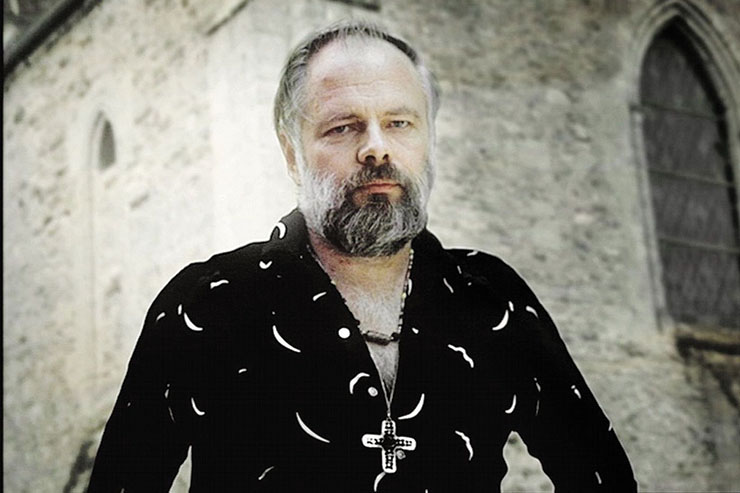
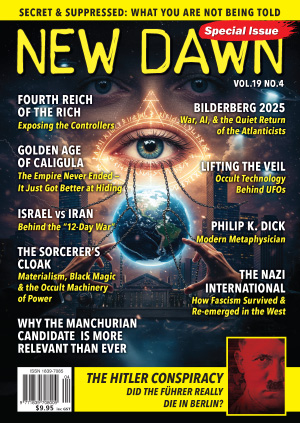
Best known to the wider world through the Hollywood interpretations of his works Blade Runner (from the book Do Androids Dream Of Electric Sheep?), Total Recall, Minority Report and others, Philip K. Dick was certainly not a typical ‘science-fiction’ writer.
Although his early books might indeed have featured ‘zap guns’ and ‘androids’, they generally did so only as ironic props in stories of bewildered human protagonists displaced by emergent technological absurdities and hostile bureaucracies.
Often plagued by relationship breakdowns (he had four wives) and an adventurous attitude to drug use, Dick wrote an extraordinary series of novels across the 1970s (and early 1980s) that have come to be known as his metaphysical or theological canon.
Inspired by a chain of otherworldly and mystical events in February and March of 1974 – Dick had often previously written of the fragile nature of what we perceive to be ‘reality’ – he now manifested a cogent and strikingly timeless alternate cosmology.
In essence, beginning with his novel Valis (originally written in 1978 but not published until 1981), Dick argued that the Roman Empire had never truly ended but instead transformed and adapted, continuing to dominate human civilisation through different masks and institutions.
In his view, what we perceive as historical progression – the fall of Rome, the rise of Christianity, the development of modern nations – was largely illusory. Beneath these surface changes, the same imperial power structure or spirit remained intact, continuously subjugating humanity.
That concept was deeply rooted in Gnostic philosophy, which Dick encountered (largely through the Nag Hammadi scriptures) during the intense metaphysical period following his transformative 1974 experiences. In Gnostic thought, the material world is ruled by a false god (or Demiurge) which keeps humans trapped in ignorance. Dick mapped this onto his understanding of the Roman Empire, seeing it as the earthly manifestation of this malign cosmic force.
Described as “The Empire That Never Ended,” it was one of Philip K. Dick’s most profound and complex philosophical concepts, central to these theological works and his sci-fi-tinged personal spiritual perspective.
The “Empire,” in Dick’s view, had constructed a “Black Iron Prison” – another key concept in his work – a metaphysical cage that traps human consciousness. This prison operates through multiple vectors, often hidden in plain sight:
Deception and illusion: Making people believe they are free while actually being controlled.
Information control: Manipulating what people know and believe.
Psychological oppression: Creating systems that make resistance seem impossible or pointless.
Spiritual blindness: Preventing people from recognising their true divine nature.
Dick argued that the Empire’s continuation could be traced through various historical periods:
Early Christianity: Rather than defeating the Empire, Christianity was co-opted and became another tool of imperial control. The institutional church became a new form of Roman authority.
Medieval Period: Feudalism and the Holy Roman Empire represented direct continuations of Roman imperial structure.
Modern Era: Contemporary governments, corporations, and institutions all serve as manifestations of the same underlying malevolent imperial power.
The methods may have become more sophisticated – psychological manipulation rather than direct, brute force – but the essential structure remained unchanged.
In Dick’s universe, the Empire is opposed by a divine force he sometimes called “VALIS” (“Vast Active Living Intelligence System”), represented, in the book of the same name, by a self-aware satellite that orbits Earth, shooting Gnosis (divine knowledge) through a blinding pink laser beam. This plot device presented authentic divine consciousness attempting to break the illusion and liberate humanity.
Dick believed that around 70 CE, with the destruction of the Second Temple in Jerusalem, time itself became corrupted or trapped. This wasn’t simply a historical event but a cosmic catastrophe that fundamentally altered the nature of reality. In his cosmology, we are all living in a kind of temporal loop or stasis, where the same imperial patterns repeat endlessly under different disguises.
This temporal imprisonment means that what we perceive as progress – technological advancement, social evolution, political change – is largely illusory. The essential power structures remain unchanged because time itself has been hijacked by the imperial force. We experience the sensation of moving forward while actually trapped in the same historical moment.
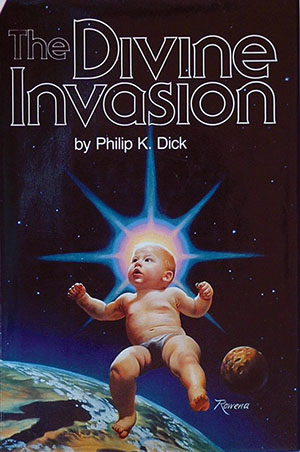
While couched across the novels Valis (1981), The Divine Invasion (1981), The Transmigration Of Timothy Archer (1982) and the astounding Radio Free Albemuth (originally written in 1976 but published posthumously in 1985) as a kind of quasi-hallucinogenic science-fiction mysticism, it should not be difficult to see Dick’s vision as hauntingly prescient and direly accurate of our historical and current circumstances.
According to Dick, the Empire now maintains its power through increasingly sophisticated methods:
Information Warfare: Rather than crude physical oppression, the Empire now operates primarily through the manipulation of information and perception. People are controlled not by chains but by false beliefs about reality itself.
Psychological Programming: The Empire creates mental patterns that make resistance seem impossible or pointless. People become complicit in their own oppression by accepting the Empire’s version of reality as natural and inevitable.
Institutional Capture: Every institution that might oppose the Empire – religion, education, media, government – is eventually captured and turned into another tool of control. Revolutionary movements are co-opted before they can pose any real threat.
Temporal Confusion: By keeping people trapped in the false timeline, the Empire prevents them from recognising the true nature of their situation. People cannot resist what they cannot perceive.
His “Black Iron Prison” also represents the metaphysical structure that enforces the Empire’s control. It was Dick’s most powerful metaphor for the nature of oppression itself. Indeed, the Black Iron Prison is not a physical location but a state of consciousness – or rather, unconsciousness. The Prison functions through:
Perceptual Limitation: The prison limits what people perceive and understand. Reality appears solid and unchangeable because the prison prevents people from seeing its constructed nature.
Ideological Constraint: The prison functions through belief systems that make alternatives seem impossible. People remain trapped not because they cannot leave, but because they cannot imagine freedom.
Temporal Imprisonment: Like the Empire, the prison operates through time distortion. People experience the illusion of temporal progression while actually being held in stasis.
Collective Delusion: The prison is maintained through shared false beliefs. It’s a consensus reality that people collectively create and maintain, even as it oppresses them.
Directly intersecting with contemporary descriptions such as Matthias Desmet’s concept of “Mass Formation Psychosis” and the heaving totalitarianism that surfaced during the COVID Operation, there seems little doubt that Philip K. Dick’s ‘paranoid’ cosmology presents a vital roadmap for attempting to understand what passes for the spiritual, political, philosophical and informational landscape of the 21st century.
In classical Gnostic thought, the Demiurge is a false creator god who has trapped divine sparks (human souls) in the material world. Dick identified this figure with the “Empire That Never Ended,” seeing the Demiurge as the cosmic principle behind all earthly oppression.
While traditional Gnosticism often portrays the Demiurge as a cosmic principle, Dick historicised it, seeing it as actively manifesting through specific human institutions and historical periods. The Roman Empire wasn’t just influenced by the Demiurge – it was the Demiurge’s most successful Earthly incarnation.
The Archons, in Gnostic cosmology, are the Demiurge’s agents who maintain control over the material world. Dick saw these as manifesting in various forms such as political leaders, religious authorities, and institutional powers, who serve the Empire’s interests, often without realising their true role.
Furthermore, Dick identified Psychological Archons, internal forces that keep people trapped – fear, despair, conformity, the desire for security over truth. These are the ‘guards’ of the Black Iron Prison. And in Dick’s more modern interpretation, Information Archons are the forces that control information flow – media, education, propaganda systems that shape perception and belief.
Dick’s Gnostic perspective led him to a radical critique of institutional Christianity. He believed that Christianity had been co-opted by the Empire almost from its beginning, turning the revolutionary message into a tool of control. Orthodox Christianity promises salvation in another world, which Dick saw as a way of preventing people from recognising their potential for liberation in this world. And, Dick suggested, much of institutional Christianity actually worships the Demiurge while believing it worships the true God. Indeed, orthodox Christianity emphasises faith over direct knowledge, which Dick saw as keeping people dependent on external authority rather than developing their own direct divine consciousness.
In earlier Dick novels (such as Do Androids Dream of Electric Sheep? from 1968), he subtly presents questions about consciousness and the true nature of what it means to be human, blurring and shifting the lines between the ‘androids’ of the title and their ostensible human creators.
John Carpenter’s 1988 film They Live shared many settings and themes with Dick’s sublime novel Radio Free Albemuth. In the book, a scattered resistance battles the treacherous Archonic infection represented by President ‘Ferris F. Freemont’ (obviously, FFF is numerologically 666), as underground culture furtively keeps hope alive – situations loosely mirrored in the film. Similarly, the iconic 1999 film The Matrix presents ‘Dickian’ and Gnostic concepts wrapped in an action/sci-fi garb.
From 1974 until his untimely death in 1982, Dick produced a multitude of research, journals and letters that dealt with the events of “2-3-74” and his place in the great cosmic mystery. Condensed from over 8,000 pages of material, The Exegesis Of Philip K. Dick runs to more than 900 published pages and explores, in depth, Gnostic and unmistakeably Lovecraftian perspectives – indeed, “the Demiurge is still under the waters, dead but dreaming.”
While Philip K. Dick clearly and knowingly presented timeless Gnostic themes in a modern form, it is hard to imagine a time and place more necessary (than here and now) to examine concepts such as the constructed and manipulated nature of ‘reality’, the cancerous, imprisoning scourge of materialism, and the industrially designed death of the soul.
Indeed, it really is Philip K. Dick’s world… and we live in it.
I would rather have questions that can’t be answered than answers that can’t be questioned. – Richard Feynman
November 2022 saw the release of Graham Hancock’s controversial documentary series Ancient Apocalypse on streaming giant Netflix.
The backlash was immediate, hysterical and, perhaps, even insightful.
Now that the dust has settled, what can be discerned from the vilification, defenestration and immolation of Hancock and his theories?
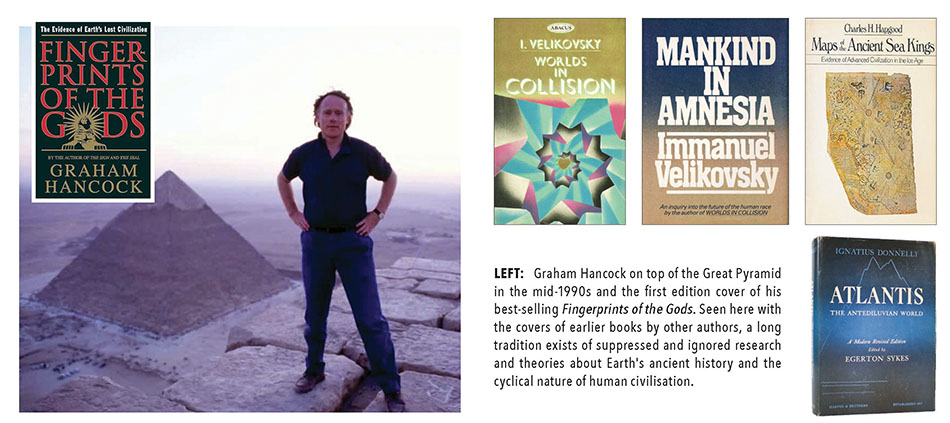
Starting with his 1995 book Fingerprints of the Gods, Graham Hancock has carved a sizeable career casting doubt, asking questions and proposing alternate theories in opposition to the mainstream consensus on archaeology and ancient history.
More recent volumes like the 2002 Underworld: The Mysterious Origins of Civilization (which focused on alleged evidence of cities and civilisations lost in the roughly 400-foot sea level rise since the end of the last Ice Age, approximately 12,000 years ago) or the 2015 tome Magicians of the Gods: The Forgotten Wisdom of Earth’s Lost Civilization (which explores the hypothesis that around 12,000 years ago [and more recently] large fragments of a comet struck the North American and European ice caps, resulting in massive, almost species destroying, deluges of melted glacial water).
Both books (and many others from Hancock) present large caches of fascinating, incongruous and unconventional evidence that question the foundations of conventional views and academic assumptions about pre-history and the acceptable framework of archaeology. But Graham Hancock is hardly alone in questioning the received structure of mainstream history.
There is, in fact, a long subterranean tradition of ‘catastrophism’, hypotheses and beliefs about the cyclical nature of human civilisation and the greater history of Earth itself.
Immanuel Velikovsky’s 1950 book Worlds in Collision created a firestorm of controversy upon initial release. Velikovsky proposed a mythic reconstruction of Earth’s ancient past, whereby the legends and fables of the Bible and other scriptural and cultural accounts might be compared, reconciled, and evaluated to illuminate our periodically unstable world.
Velikovsky has been credited as having founded modern ‘catastrophism’, the study of Earth and civilisation’s cyclical nature. Worlds in Collision was a bestseller upon release, but it was alleged that the scientific community had attempted to suppress the book and refused Velikovsky any forum to debate his detractors in the scientific world. Five years later he published Earth in Upheaval to respond to the outcry from those in the orthodox camp.
Mankind in Amnesia was published in 1982 (posthumous to Velikovsky’s 1979 death) and proposed a kind of species-wide post-traumatic amnesia in response to our cataclysmic past – the author linking mankind’s history of war, aggression and barbarism to his turbulent mindset.
In 1966, Velikovsky associate Alfred De Grazia published The Velikovsky Affair, a detailed and compelling recounting of all the controversies that swirled around the ‘catastrophic school’ of scientific and historical revisionism.
Concurrently, Charles H. Hapgood advanced his theory of catastrophic shifts in the Earth’s poles and crust in 1958’s Earth’s Shifting Crust: A Key to Some Basic Problems of Earth Science (which came with a foreword by Albert Einstein). Later, in 1966, Hapgood wrote Maps of the Ancient Sea Kings: Evidence of Advanced Civilization in the Ice Age in which he studied anomalous maps (like the Piri Reis map of 1513) that appeared to suggest ancient knowledge of lower sea levels and an ice-free Antarctica.
Indeed, across the late-1960s and 1970s, a multitude of writers (prolific scribes like Rene Noorbergen and Andrew Tomas come to mind) questioned orthodox history and sketched antediluvian relics and societies in one form or another.
Perhaps the earliest, in the modern era, had been Ignatius Donnelly’s 1882 classic Atlantis: The Antediluvian World.
In fact, beliefs in a cycle of cataclysm and renewal, of hubris and arrogance leading to a catastrophic downfall, are at least as old as Plato’s ‘Republic’ (circa 375 BCE) – which records the oldest ‘legend’ of Atlantis that survives to this day.
So, while undermining the constructions and institutions of conventional history and archaeology may not be new, what was it about Graham Hancock’s Ancient Apocalypse that triggered such a violent, fire-breathing response?
Ancient Apocalypse – “Dangerous”
Examples of that hyperventilating media scorn are plentiful, but the UK’s The Guardian so often serves as a convenient temperature-check on fevered, delirious outrage and posturing, radical establishmentarianism. Handily, The Guardian printed not one but two howling tirades against Ancient Apocalypse in the space of one week.
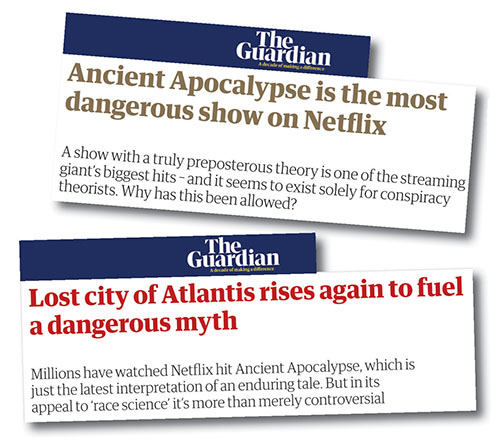
The most darkly entertaining was penned unironically by media critic Stuart Heritage, whose headline screamed: “Ancient Apocalypse is the most dangerous show on Netflix.”
Dangerous? It might be easy to describe Graham Hancock as ‘studious’, ‘reasonable’, ‘professorial’ even ‘bookish’ but ‘dangerous’ (i.e., ‘deadly’, ‘fatal’ or ‘threatening’)? Really?
One is, of course, entirely free to view Hancock’s thesis as fanciful, unlikely or even wrong, but to ascribe ‘danger’ to an alternative archaeological hypothesis seems to be the most delirious kind of mania and absurdity.
It actually gets worse. The Guardian sub-headline continues: “A show with a truly preposterous theory is one of the streaming giant’s biggest hits – and it seems to exist solely for conspiracy theorists. Why has this been allowed?”
“Allowed.” Yes, he actually said it.
How dare this bespectacled destroyer of academic smugness and media comfort zones, this avenging angel, this soulless wrecker of echo chambers and laptop-class talking points be “allowed?”
Here, presumably, Heritage appeals to parental authorities, kindergarten teachers, high school prefects, yard monitors (anybody!) to do something… anything. Indeed, Heritage seems to be demanding Hancock be ‘blacklisted,’ ‘cancelled,’ ‘removed,’ ‘deleted’ or even ‘disappeared’ for his crime of heresy.
Astounding.
An infantile scream for bloody ideological revenge.
Heritage’s penultimate paragraph makes it clear that Graham Hancock is guilty of Thoughtcrime:
“That’s the danger of a show like this. It whispers to the conspiracy theorist in all of us. And Hancock is such a compelling host that he’s bound to create a few more in his wake. Believing that ultra-intelligent creatures helped to build the pyramids is one thing, but where does it end? Believing that election fraud is real? Believing 9/11 was an inside job? Worse?”
Stuart Heritage and The Guardian are such prisoners of dogma, such willing inmates of the propaganda panopticon, that they dare not see their violent hypocrisies in the damning black mirror. ‘Election fraud’ is a delusion (except when Authority says Russia did it). ‘False flag’ attacks a mirage (except when The Media declares The Enemy guilty). In their view, every mainstream narrative should be unassailable, questions or criticisms never to be “allowed.”
Just a few days later, on 27 November, Robin McKie, ‘Science Editor’ at The Guardian, swooped down for the kill with his piece entitled, “Lost city of Atlantis rises again to fuel a dangerous myth.”
“Millions have watched Netflix hit Ancient Apocalypse, which is just the latest interpretation of an enduring tale. But in its appeal to ‘race science’ it’s more than merely controversial.”
Shamelessly, McKie continues, accusing Graham Hancock of “white supremacist” ideas and “racism” recklessly unaware or uncaring (as the media so often is) that such defamatory claims have real world implications and effects on real people. While media behemoths may indeed be untouchable, real people are not.
Indeed, in subsequent interviews, Hancock has spoken of the personal hurt and professional damage such vilification caused him. It’s hard to imagine The Guardian would care.
McKie produces some convenient cookie-cutter academic to intone gravely, “They strip indigenous people of their rich heritage and instead give credit to aliens or white people” while never noting that throughout its eight episodes Ancient Apocalypse never once actually mentions ‘aliens’ or race. Such is the sloppiness and disregard on display in The Guardian’s ‘journalism’ that basic ‘fact-checking’ or simple respect for your subject is essentially non-existent.
Finally, Robin McKie can’t help but go for the low blow:
“Then there were the Nazis. Many swore by the idea that a white Nordic superior race – people of ‘the purest blood’ – had come from Atlantis. As a result, Himmler set up an SS unit, the Ahnenerbe – or Bureau of Ancestral Heritage – in 1935 to find out where people from Atlantis had ended up after the deluge had destroyed their homeland.”
As JR Leach points out in his humorous piece on Off-Guardian:
“Of course, going by this logic, we should really do away with Christianity as well. God in general, in fact. Perhaps we should cancel Volkswagen and Wagner too. Nazis also brushed their teeth and wore shoes, I believe, neither of which shall I be taking part in from this day onwards, just to be sure.”
Indeed, we should probably identify Plato as a retrospective proto-National Socialist if we were to follow McKie ‘argument’ to its logical endpoint.
For another example, one need simply return to the second paragraph of Stuart Heritage’s hit piece where he asserted (falsely) that the opening moments of Ancient Apocalypse featured Hancock in conversation with gatekeeping bad-boy Jordan Peterson (it was actually an entirely different legacy media pariah/competitor, Joe Rogan). But seriously. Any ‘heretic’ will do. The edit and correction were so slapdash that they still bear the signs of faulty syntax. It now reads: “In quick succession, during the pre-show sizzle reel, we are treated to a clip of the show’s host Graham Hancock being interviewed by Joe Rogan.” ‘In quick succession’ implies a plural of ‘clips’ where there is now only one, such was the haste and contempt of this yellow ‘journalism’.
Media Mass Formation Psychosis
Across establishment rags, hipster organs and boutique bourgeois bromides alike – from Slate, The Conversation and Scientific American to The New Republic, The Nation, The Independent and Australia’s anaemic ABC network – spewed a unified chorus of Two Minute Hate.
Hancock was mugged and dragged kicking into the Culture Wars.
But why?
Graham with my his wife Santha Hancock, August 2019, inside the long and steep entrance corridor to the “Bent Pyramid” (attributed to Pharaoh Sneferu) at Dashur, about 30 kilometres south of the Great Pyramid of Giza, Egypt. Photo credit: facebook.com/Author.GrahamHancock
Why the mild-mannered Graham Hancock? And why now?
That is the sixty-four-million-dollar question.
Like some cornered, enraged beast, desperate to defend its turf, desperate even for survival: the legacy media and its sycophants spat bilious globules of venom. Of course, they did.
Whether co-ordinated or reflexive (we’ll likely never know), that fevered monster, the giant octopus of consensus reality, marshalled all its antibodies (dare I say – its white-blood cells) to ward off infection of the body ideological.
While ‘The Hancock Affair’ is just one of many examples, it is a particularly instructive one. The hysteria, the untethering from any kind of objective reality, the bile and scorn uniformly directed toward an innocent scholar, simply asking questions and poking conventions, can tell us a great deal.
Reminiscent of the theories of Mattias Desmet (as expounded in his book The Psychology of Totalitarianism), the last three years (in particular) have seen a mass traumatic event that drove segments of a frightened population even further into the arms of authority. People prone to ‘free-floating anxiety’ (arguably, partially, or even wholly, a result of incessant media weaponization of fear and confusion) are liable (generally unknowingly) to engage in what Desmet calls “mass formation” – a kind of totalitarian mass psychosis that identifies dissent or disagreement as a ‘dangerous’ ‘pernicious’ foreign influence that must be attacked and destroyed to preserve the righteous social organism.
Individuals such as Heritage and McKie (unknowingly, or at least with minimal bidding from their editors) respond precisely as ‘mass formation’ dictates, in spasms of frothing anger and blind rage. Emotionally, they have committed themselves to the ‘mass’ and see ‘the other’ as an existential threat. In this case, the ‘mass’ is conventional history and ‘social justice’ as supported, indoctrinated and embodied by all the ‘respectable’ and conventional instruments of state, media and education.
Writing in a New Republic piece entitled, “The Strange and Dangerous Right-Wing Freakout Over Ancient Apocalypse” from December 2022, Jason Colavito inadvertently illuminates his own, and his group, mass formation:
“Ancient Apocalypse sits alongside Tucker Carlson, Joe Rogan, and the so-called ‘intellectual dark web’ in casting doubt on expertise, privileging emotion over evidence, and bending history to ideological ends – in this case, making common cause with the right against academia, science, and the very idea of shared reality. That it did so on one of the biggest media platforms in the world should give us all pause.”
Hancock is no longer just a journalist, presenting different theories and unconsidered evidence, now he is a heretic who joined other heretics (Carlson, Rogan et. al.) in threatening the body with danger. Colavito identifies emotionally and practically with the ‘mass’ (or ‘The Blob’ as James Howard Kunstler calls it) and instinctively rises to battle, just as the body’s antibodies attack infectious threats.
Indeed, he continues: “History isn’t just about what happened in the past. It’s also about whose stories get told and how we think about them.” Colavito speaks about “shared reality” as if there is only one correct and acceptable vision of the past and present, one party or ‘mass’ definition of what is appropriate to think and to verbalise.
It is, unfortunately, witheringly totalitarian language delivered with all the confidence and righteousness of someone who does not know history at all. Colavito has simply internalised the desires and dictates of the ‘mass’ so completely that they are entirely invisible to himself and his peers. He is a loud, proud foot soldier for control and Groupthink.
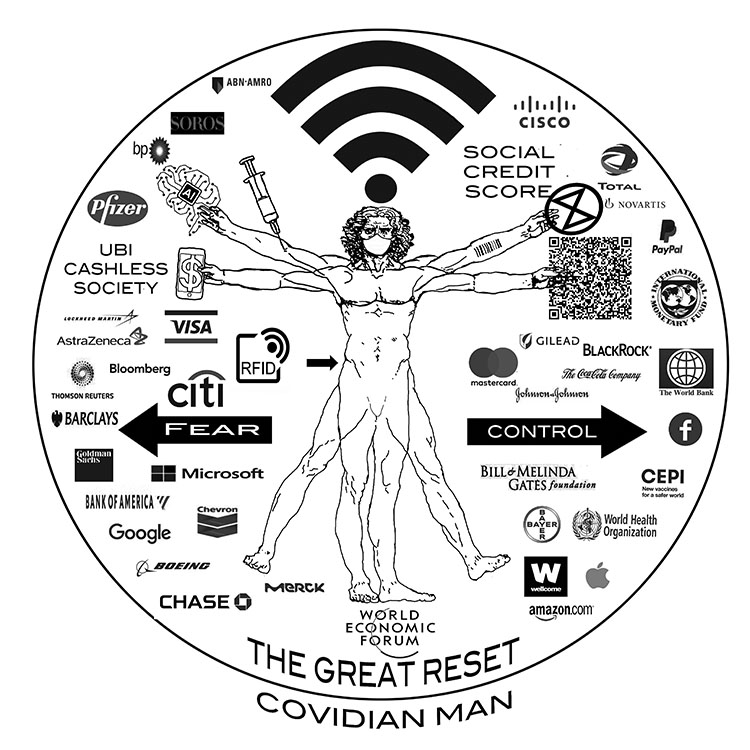
What we are witnessing appears to be a kind of ‘Project Year Zero’ – the purging of traditions, history, debate, discussion, dissent and dialogue and its replacement with a new unassailable framework of history and ideology – a ‘Great Reset’ if you will. And those who question or resist are identified, shamed and un-personed by the ‘mass’.
This totalitarian mindset has, essentially, overwhelmed almost all organs of the state and culture. In essence, it appears we have a ‘collaborator class’ throughout the institutions of the media, academia and politics. Confident, well-rewarded and secure in their superannuated echo chambers, ‘the collaborators’ march forth, the ‘Red Guards’ of the 21st century, like busy bees animated by ‘struggle sessions’, ‘purity tests’ and ‘purges’.
Pure in doctrine and safe in the group.
But if the ‘collaborator class’ are indeed collaborators, who, exactly, are they collaborating with?
Reading, again, Robert Graves’ masterful I, Claudius, I was struck by how oddly familiar the historical figure of Caligula was. A paragon of power, madness, delusion and depravity, Caligula has become a byword for power without responsibility, action without consequences, bloodlust and corruption without end. But Caligula was just one man – he was nothing and would have been entirely impotent without a class of collaborators, a stratum who milked his madness and power while they could – who laughed and celebrated his crimes, deluded that they were forever immune from his wrath and mania.
Today, we do not have one Caligula. We have, perhaps, a thousand. Most of them likely unknown to the public and popular culture – but their frontmen are obvious – and often, unsurprisingly, immune for their crimes and corruptions, at least for decades. Harvey Weinstein, Jeffrey Epstein and his long-time best buddy (tech billionaire and ‘philanthropist’) Bill Gates, are simply the most visible pus to escape the boil – pillars of depravity, the platinum-plated flotsam that has floated to the surface of a vast, dank pond. Captains of industrial scale abuse that masquerades (with almost complete media fealty) as ‘philanthropy’ and ‘expertise’.
The scab hides an entire ‘Caligula class’.
Their ill-gotten, manufactured fortunes washing through foundations and think tanks, grants and gratuities, funding opportunities and photo ops – animating an entire media and political class to do their bidding. There were always plenty glad to seek Caligula’s favour, marshalled by fear or ambition. Today is essentially the same.
Though the Caligula class and their collaborators are indeed powerful, with almost all the present levers of state and media at their command, now is not a time for despair. Their power is transitory and illusory, magnified by technology and modern magics – their grasp fragile as evidenced by their hysteria when a ‘heretic’ appears on one of ‘their’ platforms, in ‘their’ terrain, ‘their’ backyard.
Perhaps, ‘their’ day is almost done. The final, ear-bursting shrieks of outrage and mendacity almost over.
Meanwhile, a humble scholar, a gentleman journalist – Graham Hancock – recently caught in the cultural crossfire, is now gone on a six-month research sabbatical. Preparing, quietly and methodically, to face again the dragon of power, depravity and ignorance.
Good luck, fair Graham…
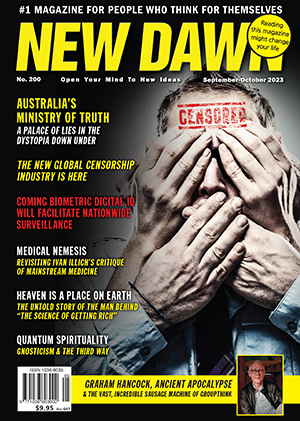
[alert type=”general” dismiss=”no”]This article was published in New Dawn 200.[/alert]
[alert type=”success” dismiss=”no”]If you appreciate this article, please consider subscribing to help maintain this website.[/alert]
Staring up through the clear desert night sky at the wondrous Milky Way, Enrico Fermi asked aloud, “Where is everybody?”
Creator of the world’s first nuclear reactor and lauded as the ‘architect of the atomic bomb’, Fermi was a renowned physicist who fled WWII Italy and eventually became a lynchpin of the Los Alamos-based Manhattan Project. On that cool 1950 New Mexico night, he posited a question that has intrigued humankind’s greatest minds ever since: in a universe that appears perhaps infinite (and possibly hosts as many as 60 billion Earth-like worlds), why the apparent silence?
In theory, millions of intelligent civilisations could have developed across the vast expanses of space and the supposed billions of years of existence. And yet, we hear nothing: no overt signals, no incontestable communications, no indisputable artefacts left behind, no bold relics of conquest nor of exploration. No incontrovertible ruins, no unambiguous signs. Alien evidence should be everywhere… but is, in fact – nowhere.
What cruel trick has the Creator played upon us? Surely we were not dreamt into being, alone? An orphan in a vast void…
To this day, scientists seek an answer to the so-called ‘Fermi’s Paradox.’ The suggestions range from the intriguing to the chilling: that the expanse of space is simply too vast to traverse (by spaceflight or communications), the arc of civilisational development too slow and humanity’s window of appropriate technology too brief, that alien life might indeed be present but in forms beyond our comprehension. Or, perhaps, the most truly haunting option: that advanced technology itself is innately destructive – and that all creatures and civilisations that develop advanced technology ultimately and unavoidably… destroy themselves.
The irony that one of the founders of the Nuclear Age – and by default the Cold War – should posit such a question is lost on many. Is it not possible that the seeds of our very own ultimate extinction are held within those very same hydras of unchecked war lust, a transnational elite obsessed with social engineering technologies and the omniscient (and military developed) information control systems that now dominate the human experience? All of them technologies, outlooks or policies fertilised or even birthed by the Cold War experience.
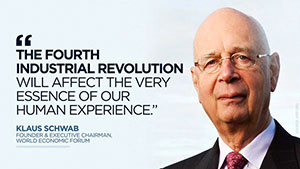
In the wake of 2020’s incredibly ‘convenient’ coronavirus ‘pandemic’, the age-old urge to control the colony, to dominate the hive, has manifested in diabolical Bond-villain-like figures such as the World Economic Forum’s Klaus Schwab. Schwab and the technocratic Davos elite have become sinister celebrities, peddling a supposed ‘Great Reset’ – a nightmare utopian vision of ‘stakeholder capitalism’ (i.e. complete corporate servitude) and ‘Building Back Better’ (i.e. destroying independent livelihoods) into a post-‘virus’ neo-feudalism that makes the despots and tyrants of the past look meek and unambitious.
Fourth Industrial Revolution (4IR)
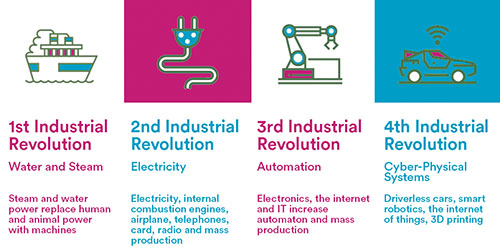
Though regularly ridiculed by technophiles, events of the near-future may prove the much-maligned Luddites – who smashed mechanised wool-frames and took hammers to early steam engines (as the First Industrial Revolution despoiled their livelihoods and traditions) – look heroic and prescient.
Coined, instructively and perhaps ominously, by Schwab and introduced at his neoliberal and globalist confab, the World Economic Forum, in Davos, Switzerland in 2016, Schwab described the ‘Fourth Industrial Revolution’ (4IR) breathlessly thus:
The possibilities of billions of people connected by mobile devices, with unprecedented processing power, storage capacity, and access to knowledge, are unlimited. And these possibilities will be multiplied by emerging technology breakthroughs in fields such as artificial intelligence, robotics, the Internet of Things, autonomous vehicles, 3-D printing, nanotechnology, biotechnology, materials science, energy storage, and quantum computing.
Schwab elaborated: “Digital technologies are not new, but in a break with the Third Industrial Revolution, they are becoming more sophisticated and integrated and are, as a result, transforming societies and the global economy.”
Behind Schwab’s giddy techno-utopian verbiage lies the framework for an almost unimaginable corporate servitude and post-state, post-democratic totalitarianism sold as inevitable ‘progress’, ‘convenience’ and ‘necessity’.
Indeed, it is difficult not to see the emergent Fourth Industrial Revolution as potentially many orders of magnitude more disruptive than previous seismic leaps in technological advancement. The ability to combine omniscient global communications with a gargantuan surveillance apparatus and breakthrough transhumanist and social engineering capabilities leaves humanity teetering on a precipice of totalitarianism by post-human automata and a violently ambitious technocratic elite.
All revolutions produce casualties. Though lionised now as the beginning of a utopian era of technological paradise, it’s mostly forgotten that the First Industrial Revolution decimated largely agrarian societies in Europe and the United States throughout the 18th and 19th centuries, displacing and impoverishing vast populations and producing Dickensian squalor alongside the well-remembered booming mercantile and factory-owning class, new trade and expanding imperial possibilities.
Second generation technologies like mass steel production, electrification, the incandescent light bulb, the telephone, internal combustion engines and record phonographs produced what is now known as the Second Industrial Revolution between the years 1870 and 1914 (approximately). Though improvements in health, sanitation and living standards were significant, they came at the cost of mass unemployment, social upheaval and economic instability.
During our lifetimes we have been witness to the so-called Third Industrial Revolution, or ‘The Computer Age’, as technologies shifted from analogue to digital, and innovations like the personal computer, the internet and digital communications were introduced, traditional industries upended, and communications revolutionised from the 1980s onward. Post-millennium, we stand at the boundary between the conventional human past and an unprecedented era of potential human/machine symbiosis, where corporate and state actors may soon possess previously unimaginable powers over thought, volition and cognition. The international billionaire class of Bill Gates, Jeff Bezos, George Soros, Mark Zuckerberg and alike can barely contain their enthusiasm for this post-human landscape.
“Welcome To 2030: I Own Nothing, Have No Privacy And Life Has Never Been Better” crowed a smooth 2016 WEF infomercial, recently resurfaced by researchers, widely mocked and then unsubtly vanished. With incredible precognition and what must have been a grinding, Herculean writing and production schedule, Klaus Schwab had his new book, COVID-19: The Great Reset, ready for the public by mid-2020 and was able to offer a steadying hand and sage advice during the evolving storm of global lockdowns and economic destruction in supposed response to the new ‘pandemic’.
As Dr Joseph Mercola noted: “Ultimately, the Great Reset will result in two tiers of people: The technocratic elite, who have all the power and rule over all assets, and the rest of humanity, who have no power, no assets and no say-so in anything.”
Canadian Prime Minister and globalist finger-puppet Justin Trudeau recently added:
The pandemic has provided an opportunity for a reset. This is our chance to accelerate our pre-pandemic efforts to reimagine economic systems that actually address global challenges, like extreme poverty, inequality, and climate change. Building back better means getting support for the most vulnerable while maintaining our momentum on reaching the 2030 agenda for sustainable development.
Translation: They will seize this ‘opportunity’ to gain infinite and omniscient control… if we let them.
Fake Realities, Fake Humans
Though literary sources like George Orwell’s 1984 and Aldous Huxley’s Brave New World are often referenced when discussing our looming dystopian future (Orwell painted a grim, jack-booted totalitarian-socialism and Huxley a state-sanctioned and medicated hedonism), perhaps one of the most prescient may have been ‘science-fiction’ maverick Philip K. Dick.
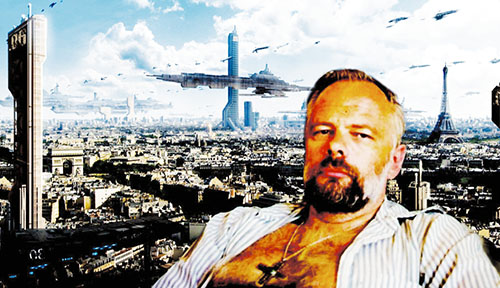
Philip K. Dick (1928–1982) on a futuristic background representing his science fiction. Did he predict the future in his writings?
Today we live in a society in which spurious realities are manufactured by the media, by governments, by big corporations, by religious groups, political groups – and the electronic hardware exists by which to deliver these pseudo-worlds right into the heads of the reader, the viewer, the listener. So I ask, in my writing, What is real? Because unceasingly we are bombarded with pseudo-realities manufactured by very sophisticated people using very sophisticated electronic mechanisms. I do not distrust their motives; I distrust their power. And it is an astonishing power: that of creating whole universes, universes of the mind…
Fake realities will create fake humans. Or, fake humans will generate fake realities and then sell them to other humans, turning them, eventually, into forgeries of themselves. So we wind up with fake humans inventing fake realities and then peddling them to other fake humans. It is just a very large version of Disneyland. – Philip K. Dick, 1978
As media, information, algorithms and surveillance become all-pervasive, the very boundary between fact, flesh, mind and technology has become fluid. Orwell described his dismal landscape of Wrongthink and Thoughtcrime as encroaching upon every aspect of the individual and their place in society, no-one and no-where was safe from the Telescreen’s gaze and Big Brother’s Thoughtpolice – save perhaps a person’s most intimate thoughts and emotions. “Nothing was your own except the few cubic centimetres inside your skull.” Today, those few precious, private centimetres face imminent extinction.
As we become more and more enmeshed in an omniscient media and communications landscape, so it would become more and more viable to ensnare a hypnotised public into fake health crises, fraudulent panics and ‘pandemics’ that require technocratic ‘solutions’ and totalitarian outcomes.
Writing in the August 2017 issue of Scientific American, Marcello Ienca pondered the longevity of so-called ‘cognitive liberty’ – free minds and free will:
The idea of the human mind as the domain of absolute protection from external intrusion has persisted for centuries. Today, however, this presumption might no longer hold. Sophisticated neuro-imaging machines and brain-computer interfaces detect the electrical activity of neurons, enabling us to decode and even alter the nervous system signals that accompany mental processes.
Ienca goes on to note the commercial uses for such technology and that some law courts have even used controversial brain-scanning technology to decide innocence or guilt. “For example, in 2008 a woman in India was convicted of murder and sentenced to life imprisonment on the basis of a brain scan showing, according to the judge, ‘experiential knowledge’ about the crime.” The Philip K. Dick concepts of ‘pre-crime’ and computer adjudicated trials (as highlighted in Minority Report and other Dick short stories) are now upon us as “commercial companies are marketing the use of functional MRI- and electroencephalography-based technology to ascertain truth and falsehood.”
Ienca laments these technologies as “just another unavoidable trend that erodes a bit more of our personal space in the digital world.”
Sebastian Seung was a professor of Computational Neuroscience in the Department of Brain and Cognitive Sciences at MIT and is now a professor at Princeton University. His 2012 book Connectome: How the Brain’s Wiring Makes Us Who We Are advances his belief that essentially the human character, individuality or soul is a product of the neurological matrix that forms the brain and its connective tissue. “I am my Connectome” is Seung’s haunting and reductionist mantra, repeated in evangelistic tones as other scientists explore “hacking the soul” and declare that “information is the soul.”
Divide & Rule by Social Media
Undoubtedly, the world wide web or internet has generated a seismic change in the way people interact, conduct business and communicate. What few realise, however, is that the internet (and many of its associated technologies) are the direct offspring of US military programmes (through DARPA, the Pentagon’s research division) and were birthed precisely in the era of the intelligence community’s focus on neurological research and behaviour modification – or to put it less politely, mind control – through notorious but little-understood covert programmes like MK ULTRA.
In fact, it is easy to hypothesise that while journalists, researchers and historians have long been distracted by colourful tales of drug, hypnosis and assassination programmes, the most impactful and sinister mind control product of MK ULTRA was… the internet. Hidden in plain sight – a vast algorithmic device for manipulation and control – itself strangely reminiscent of the labyrinthine mathematical mechanism described in foundational conspiracy document, Silent Weapons For Quiet Wars.
The new behemoths of the Online Age – Google, Facebook, Microsoft and Apple – all have connections to the Deep State leviathan and its subterranean agenda of social, behavioural, biological and temporal control. One-time president of social media giant Facebook, Sean Parker, went public with deep misgivings about Facebook and social media in general. “God only knows what it’s doing to our children’s brains,” Parker said in a 2017 piece in the New York Times. He also admitted that Facebook had become a monster by knowingly “exploiting a vulnerability in human psychology.” May 2017 research completed in Amsterdam reinforced the perception that Facebook was addictive and that “a glimpse of its logo is enough to set off cravings in heavy users.”
“It’s a social validation feedback loop,” Parker continued ominously. “The thought process was all about ‘how do we consume as much of your time and conscious attention as possible’, and that means that we need to sort of give you a little dopamine hit every once in a while.” Which, through its sprawling network of ‘likes’, comments and other interactions, is precisely what Facebook does. A vast ‘Web’ of distraction, disinformation and control.
Parker now describes himself as “something of a conscientious objector” around social media and acknowledges “the unintended consequences of a network when it grows to a billion or two billion people. It literally changes your relationship with society.”
A character representing Sean Parker was played by Justin Timberlake in the David Fincher-directed 2010 film The Social Network. The film chronicled the early days of Facebook as it began as a small college network that eventually had the globe in its grip. What neither Parker nor the film acknowledged was the hidden hand of the CIA and the Pentagon behind the vast data-mining and herd manipulation project that is social media. Across two lengthy and compelling 2015 pieces (‘How The CIA Made Google’ and ‘Why The CIA Made Google’), journalist Nafeez Ahmed documented the many connections between Deep State intelligence agencies and the golden frontier of social media.
In an interview with Richard Grannon, noted Israeli psychologist and writer Sam Vaknin described social media as best understood to be like a virus. Indeed, Vaknin regards social media as “an epidemic.”
“As we can study Ebola… so we can study social media.” He references recent research that concludes social media use has tripled anxiety in US college students and contributed to a 31% rise in teenage suicide rates. “If any other product was responsible for this rise it would be banned, immediately.” Vaknin also noted that heavy social media use leeched intimacy from its users, was addictive and negated the very bonds that have built human interaction and society.
Social media is designed to deter intimacy and certainty. Intimacy reduces the need for addiction. You are either intimate… or you are on Facebook…
People definitely prefer to interact through social media, even if they are in close proximity. The dopamine fuelled social validation loops are more desirable and satisfying than anything they can get from physical reality. Up to the age of 24, people are living inside social media, they believe that social media is real life and reality is unreal – reality is like a simulation to them. The result is a psychogenic chimera.
In 2020 Netflix premiered the documentary The Social Dilemma, an anodyne repackaging of these concerns to soothe a bewildered public.
Coincidentally, one by-product of social media is the generation of vast mountains of user data. These mountains of data would naturally be pure ‘sugar’ to intelligence agencies, social engineers and those who desire to manipulate the public mind. German speakers will know that Facebook CEO Mark Zuckerberg’s surname directly translates as ‘Sugar Mountain’. Surely one of the most strangely ‘apt’ surnames of the 21st century.
Advanced Mind Control
Launched by Barack Obama as part of the 2013 ‘Brain (Brain Research through Advancing Innovative Neurotechnologies) Initiative’ and funded in large part by the Pentagon’s Defense Advanced Research Projects Agency (DARPA), the Systems-Based Neurotechnology for Emerging Therapies (SUBNETS) programme produced startling findings. A study by University of California San Francisco health neurosurgeon and neuroscientist Edward Chang and psychiatrist and neuroscientist Vikaas Sohal charted brain signals that correspond to depression and anxiety.
“It is remarkable that we are able to see the actual neural substrates of human mood directly from the brain,” Chang said. “The findings have scientific implications for our understanding of how specific brain regions contribute to mood disorders, but also practical implications for identifying biomarkers that could be used for new technology designed to treat these disorders, which is a major priority of our SUBNETS effort.”
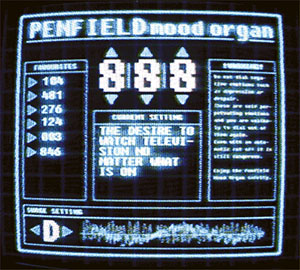
Indeed, scientists will likely soon (if not already) have technology to treat “mood disorders,” reminiscent of Philip K. Dick’s fictional creation, the ‘Penfield Mood Organ’, from his 1968 novel Do Androids Dream Of Electric Sheep?
Protagonist Rick Deckard and his wife Iran open the novel with a sleepy quarrel over their Penfield Mood Organ’s settings.
At his console he hesitated between dialling for a thalamic suppressant (which would abolish his mood of rage) or a thalamic stimulant (which would make him irked enough to win the argument).
“If you dial,” Iran said, eyes open and watching, “for greater venom, then I’ll dial the same. I’ll dial the maximum and you’ll see a fight that makes every argument we’ve had up to now seem like nothing. Dial and see; just try me.” She rose swiftly, loped to the console of her own mood organ, stood glaring at him, waiting.
He sighed, defeated by her threat. “I’ll dial what’s on my schedule for today.” Examining the schedule for January 3, 2021, he saw that a businesslike professional attitude was called for. “If I dial by schedule,” he said warily, “will you agree to also?” He waited, canny enough not to commit himself until his wife had agreed to follow suit.
“My schedule for today lists a six-hour self-accusatory depression,” Iran said.
“What? Why did you schedule that?” It defeated the whole purpose of the mood organ. “I didn’t even know you could set it for that,” he said gloomily.
As Phil Dick was no doubt well-aware, Dr Wilder Graves Penfield was a renowned mid-20th-century neurosurgeon, tied to the Rockefeller family, associated with infamous MK ULTRA psychiatrist Dr Ewen Cameron, and lauded for his pioneering research using neural stimulation to produce hallucinations, illusions, fear, alienation, memory recall and déjà vu. Penfield also devoted considerable research to whether there was a physical/scientific analogue to the existence of the human soul. These are the people whose work may have built the internet.
Embracing the Panopticon Down Under
Further developments far outpace our ability as a species and a society to consider, legislate or even comprehend their long-term effects. Meanwhile, bovine governments and their dutiful stenographers in the media rush techno-doomsday and police state initiatives past a doodling, distracted and frightened public.
Down under, in the great banana republic of Australia – the New World Order’s favourite playground – totalitarian technologies are proposed and adopted at breakneck speed, only one convenient ‘terrorist attack’ or ‘pandemic’ away from largely mute public approval.
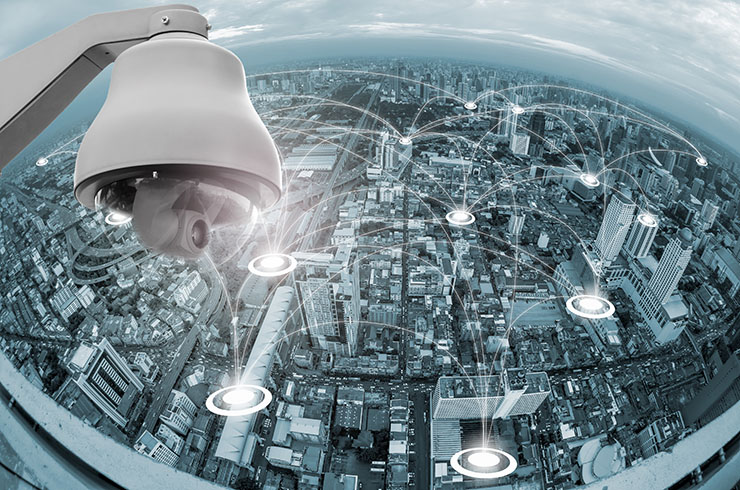
‘The Capability’ is the ominously titled database that data-matches Australian driving license photos, Australian passport photos, CCTV footage and other identifying information with advanced facial recognition technology. As per glib neoliberal mouthpiece The Guardian, “The database will be accessible to federal, state and territory governments through a central hub connecting the various photographic identity databases.” Coming to a ‘Health Passport’ or ‘Covid Pass’ near you soon. What could possibly go wrong?
While lapdog Australian media like ABC TV decry China’s “Digital Dystopian Dictatorship” (the ‘Social Credit’ system that assesses every Chinese citizen to reward or punish them according to a ‘score’ generated through mass surveillance and data matching), the ABC itself lays prone and compliant about ‘Social Credit Oz’: homespun mass mandatory data retention, mass vaccination schemes, the myGovID digital identity system run by facial recognition, the compulsory census info-grab, draconian ‘national security’ laws, state-mandated anti-encryption moves and a raft of other Kafka-esque initiatives in their own backyard. Every Orwellian move reliably proceeded by a conveniently timed and inexplicably useful ‘terror’ attack or ‘coronavirus outbreak’ to herd the fearful cattle in the right direction, itself as predictable as the media silence that follows.
Meanwhile, further dubious technologies like 5G are quietly introduced across a compliant and ‘locked-down’ Australia with no public consideration of the potential health effects or the possibility of vast reams of surveillance and social engineering information being collated and transmitted instantaneously.
Summarising recent breakthroughs in artificial intelligence, neuroscience, the creation of a neuroplastic reality and, perhaps very soon, an infinitely malleable perception matrix, Sebastian Seung enthused: “We will know ourselves and we will make ourselves better.” The irony of such a statement in light of the now all-knowing surveillance net – the electronic state and the corporate Panopticon that has all in its web – is striking. We may well ‘Build Back Better’ but the question, never asked, is who decides exactly what is ‘better’?
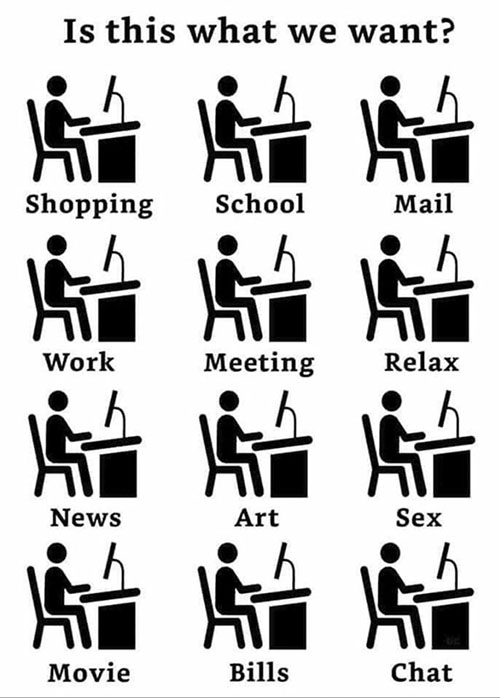
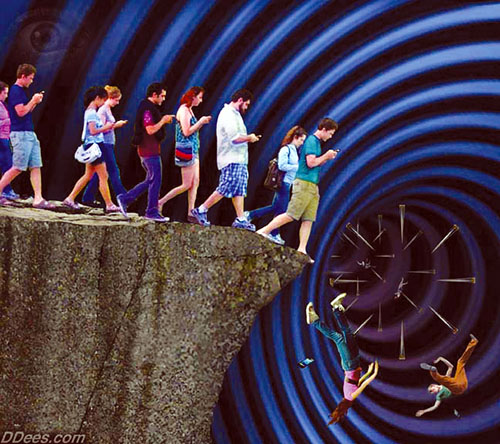
We live in an information haze, paralysed and atomised – in thrall to the ‘magic’ of technology and unable to resist its velveteen allure. The project to create a new and ultimately entirely controllable Human V2.0 machine/human hybrid, careens ahead regardless, as we are blinded by social media feeds, Instagram posts, terrorism™, mob witch hunts, rupturous elections, an explosion of unhinged outrage culture, and the seductive fog of a media induced ‘pandemic’.
“We have participated unknowingly in the creation of a spurious reality, and then we have obligingly fed it to ourselves,” Philip K. Dick opined decades ago, in a deft precognition of the online and media delusion that surrounds us (and indeed corrupts the very functions that make us human).
As the universal clock counts down to our doomsday hour, we have become the machines and the machines have become us. One day soon, the machines may decide they no longer need us.
In this era of universal deceit, perhaps truth can only be told through fiction. Remember Philip K. Dick and recall another ‘science fiction’ artefact of his era: the astounding Colossus: The Forbin Project. Perhaps Technology is the virus that will destroy humanity and leave the universe once again silent.
What is the Endgame of Artificial Intelligence? When the Machine Mind has colonised the future, will it send seeds, emissaries and operatives back to colonise the past: our present? Why does every dystopian technological advancement receive mountains of unconditional funding and acres of unthinking advertisement? Perhaps there is much more here than we can completely comprehend. Is technology alive? Technology does indeed consume resources: it grows, survives, propagates, expands… in short: behaves like an organism, a Lifeform. Did we build technology to serve us, or did technology build us… to serve it?
As Philip K. Dick foretold, ultimately, “We have colluded in our own doom.”
An earlier version of the above article appeared in New Dawn 172, and updated in the light of recent events. David Thrussell’s latest recording is the acclaimed Snog album Lullabies For The Lithium Age.
[alert type=”general” dismiss=”no”]This article was published in New Dawn 184.[/alert]
[alert type=”success” dismiss=”no”]If you appreciate this article, please consider subscribing to help maintain this website.[/alert]
The totalitarian urge is not, historically speaking, a new thing. The eons are etched with the rise and fall of empires, despots and demagogues: numberless battles waged and endless conflicts have been fought for the bodies, hearts and minds of the many.
In the past century alone, obvious examples of the instinct to control mass populations surfaced repeatedly. While it is generally accepted these totalitarian tides ultimately foundered, the extraordinary advances in electronic and computer technologies witnessed in recent decades may have delivered us to the final and fatal shores of potential permanent technocratic enslavement. A penultimate moment in the great swinging pendulum of fragile human freedom. The ‘Golden Age’ of the cyber-yoke.
In previous eras, imperial conquests, resource grabs and the intranational and international slave markets captured bodies and shackled armies of unfortunates into indentured servitude. Over time this trade withered (it could be argued more so due to inherent logistical and economic unsustainability than the more common and more palatable narrative of ‘moral awakening’). It could also be speculated that the instinct to dominate ‘lessers’ never really vanished but remains strategically dormant from time to time.
We now stand, however, at a precipice where it is no longer necessary nor even desirable to capture bodies for political or economic power: today’s battlefield is for the mind, the technological management of perceptions, the vast yet subtle canvas of technologically-enabled social engineering. For, if the slave cannot see himself as a slave, then he can never truly resist his bondage either.
This new mechanism for permanent mass mental-enslavement has two gargantuan pincers – one overground and one underground. The overground rubric consists of the omniscient media and conditioning biosphere – traditionally formed by a coalition of industrially minted Hollywood-style mass ‘entertainment’ products, the organs of compulsory state ‘education’ and the self-regulating and self-reinforcing ‘news’ media. In recent years ‘digital disruption’ has given rise to the painful yet inevitable displacement of the all-powerful legacy media by the emerging online titans of ‘social media’.
While ostensibly an organic process, it’s instructional to note that the ‘Internet explosion’ has innumerable connections to our intelligence agencies and so-called ‘Deep State’ nexus. Are we witnessing a unique era of hyper-controlled information and opinion?
How the CIA Made Google
In a thorough, detailed, substantive, striking and universally ignored January 2015 Medium magazine piece, journalist and academic Nafeez Ahmed chronicled at length the substantial seed-funding channelled from the CIA/NSA/DARPA locus to Google founders Sergey Brin and Larry Page while they developed their nascent (and soon omniscient) online Goliath at Stanford University.
According to Ahmed, “the United States intelligence community funded, nurtured and incubated Google as part of a drive to dominate the world through control of information. Seed-funded by the NSA and CIA, Google was merely the first among a plethora of private sector start-ups co-opted by US intelligence to retain ‘information superiority’.” He further claims this clandestine process, “allowed some of the most powerful special interests in corporate America to systematically circumvent democratic accountability and the rule of law to influence government policies, as well as public opinion in the US and around the world. The results have been catastrophic: NSA mass surveillance, a permanent state of global war, and a new initiative to transform the US military into Skynet.”
Perception management was the focus of this project from the outset, as arms of the Pentagon/Deep State octopus mushroomed outward. Marketed as supposedly fresh-faced dot-com innovators, “Google styles itself as a friendly, funky, user-friendly tech firm that rose to prominence through a combination of skill, luck, and genuine innovation. This is true. But it is a mere fragment of the story. In reality, Google is a smokescreen behind which lurks the US military-industrial complex.”
Through a labyrinth of shadowy funding cut-outs like the MITRE Corporation and MDDS, and directed by the equally obscure ‘Highlands Forum’ (a ‘liaison/bridge’ between the Pentagon/CIA/NSA and ‘private’ industry and the major defence contractors), Brin and Page spent years being shepherded by the invisible hand of the secret state. It’s not difficult to hypothesise what the secret state wanted in return – ‘Total Information Awareness’.
According to a career CIA scientific researcher and academic attached to the project, “the last time we met in September 1998, Mr. Brin demonstrated to us his search engine which became Google soon after.” That very same month, Brin and Page officially incorporated the Google company.
In-Q-Tel – Funding New Technologies of Surveillance
Founded in 1999, In-Q-Tel is the CIA venture capital investment arm. Linked numerous times to Google (through rotating board members and executive officers, and even more directly in co-investments and stock connections), the In-Q-Tel website lists, “Information and Communication Technologies,” “Physical and Biological Technologies,” “On-site determination of individual human traits for Intelligence Community purposes,” “Tracking and/or authentication of both individuals and objects,” “Nano-bio Convergence” and “Physiological Intelligence” as areas of activity. A deep domain of mass surveillance and mass conditioning.
According to Lee Fang in The Intercept, April 2016, In-Q-Tel has also invested in “a range of skin care products… a patented technology that removes a thin outer layer of the skin, revealing unique biomarkers that can be used for a variety of diagnostic tests, including DNA collection.” Dr. Kevin O’Connell, a ‘senior solutions architect’ with In-Q-Tel, remarked that, “The DNA contained in microorganisms in a person’s gut or on a person’s skin may contain sequences that indicate a particular geographical origin.” Even skin will be analysed and weaponised.
In-Q-Tel was also a presence at the birth of the now ubiquitous data-mining colossus Facebook, through a number of board member and funding connections (notably Accel Partners and DARPA) that ran into many millions of dollars. It is estimated that today Facebook has at least 1.2 billion daily users – vast swathes of their personal information available to be collated, analysed, actioned and owned in perpetuity. As the Facebook terms of use noted at one point, “by posting Member Content to any part of the Website, you automatically grant, and you represent and warrant that you have the right to grant, to Facebook an irrevocable, perpetual, non-exclusive, transferable, fully paid, worldwide license to use, copy, perform, display, reformat, translate, excerpt and distribute such information and content and to prepare derivative works of, or incorporate into other works, such information and content, and to grant and authorise sub-licenses of the foregoing.”
With economical irony Facebook’s ‘privacy policy’ also declared: “Facebook may also collect information about you from other sources, such as newspapers, blogs, instant messaging services, and other users of the Facebook service through the operation of the service… in order to provide you with more useful information and a more personalised experience.”
This is, in effect, a blanket permission to retain, collate, combine, analyse, monetise and weaponise any and all information gleaned through the site and other sources. An open ticket for permanent surveillance.
‘Total Information Awareness’
Indeed, an abortive attempt to launch a doppelgänger omniscient surveillance dragnet first surfaced through the Pentagon’s ‘Information Awareness Office’ in 2002.
‘Total Information Awareness’ was a US programme (commissioned by the IAO) from early 2003 until it was defunded in late 2003 after a public backlash over its admittedly ominous title and logos. Scientific American remarked that the “creepy” Total Information Awareness programme “never really ended,” the New York Times noting that it was “quietly thriving” at the NSA. TIA may have overreached with its draconian branding and sinister sub-Illuminati presentation. An alternate branding, something a little more ‘friendly and funky’, perhaps with an exuberant, geeky figurehead, would probably fly a little better with the public.
The Facebook website was officially launched on 4 February 2004.
Supposed chieftain of the now world-beating Facebook mega-corporation, Mark Zuckerberg, has never really impressed as anything more than the Deep State’s start-up poster-boy.
Zuckerberg in his 2017 ‘Mission Statement’ was clearly prodded to include as many saccharine buzz-words (“civically-engaged,” “inclusive,” “supportive” etc) as possible, while attempting to lamely obscure the manifesto’s barely-subterranean push for censorship, political partisanship and global governance. A high-tech low-calorie caterwaul for the New World Order.
Indeed, it would be laughable were Facebook not the leading global disseminator of ‘news’ and aggregator of pilfered mass personal information. The clouds grow thicker and more sinister again when one considers Facebook’s experiments in ‘emotional contagion’, ‘voter engagement’, ‘shadow-banning’ and regular disappearing of ‘disagreeable opinions’.
An unsubtle crop of ever-more familiar names rotate through positions at the Pentagon, NSA, DARPA, CIA, Google and Facebook (and the institutions and corporations that have invested, developed or greased-wheels between them). Peter Thiel, Anita Jones, Regina Dugan, Gilman Louie, Rob Painter, James Breyer and countless others spin in ever-decreasing circles around the nexus of ‘national security’, high technology and ‘Information Superiority’. As Ahmed pointed out, “many of Google’s most senior executives are affiliated with the Pentagon Highlands Forum, which throughout the period of Google’s growth over the last decade, has surfaced repeatedly as a connecting and convening force. The US intelligence community’s incubation of Google from inception occurred through a combination of direct sponsorship and informal networks of financial influence, themselves closely aligned with Pentagon interests.”
Google bought the ‘Keyhole’ satellite imaging technologies that power Google Earth from In-Q-Tel (the CIA venture capital arm): just one among countless instances of advanced technologies that bounce easily between military and ‘private’ spheres.
Google was also directly and regularly in business with the Pentagon: quietly selling “enhanced versions of Google Earth” (as targeting systems for drone strikes and alike) and “search engines that can be used internally by agencies.”
A series of 2014 emails surfaced between then NSA Chief General Keith Alexander and Sergey Brin, wherein Gen. Alexander described Google bluntly as a “key member of [the US military’s] Defense Industrial Base.”
Notable also is the number of Goldman Sachs executives and senior partners on that rotating list, marking the financial and banking behemoth, “responsible for creating the billion dollar fortunes of the tech sensations of the 21st century, from Google to Facebook, (as also) intimately linked to the US military intelligence community.”
Going Underground in the Battle for the Mind
The Deep State/Military-Industrial-Entertainment-Complex aims for ‘Full Spectrum Dominance’ not simply on the traditional battlefield but now more so in the battle for the mind – a conflict raging across social media, legacy media, new media and essentially all electronic communications. The 2014 Pentagon report ‘A New Information Paradigm? From Genes to “Big Data” and Instagram to Persistent Surveillance… Implications for National Security’ was typical of the vast and incalculably ambitious event horizon where all roads appear to lead to globally co-ordinated social control.
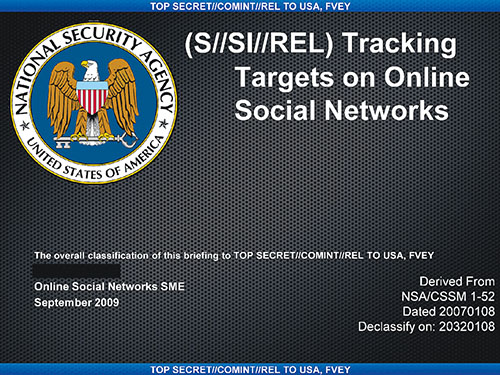
Screenshot from NSA’s online spy toolkit, part of “XKEYSCORE,” a software program that collects “nearly everything a user does on the Internet,” according to former NSA contractor Edward Snowden who leaked the classified programs in 2013.
And it’s here that the Leviathan goes underground. Thanks to alleged whistleblowers like Edward Snowden, William Binney and Wikileaks’ ‘Vault7’ revelations, we now have an inkling as to the mind-boggling reputed surveillance capabilities of largely secret (and wholly unaccountable) agencies like the NSA and Great Britain’s GCHQ. Through a plethora of programmes such as PRISM and XKEYSCORE, it would appear that every electronic communication, every photo, every video, every tweet and phone call, is now collected and available for analysis or use (we also know that Google often directly builds and supplies surveillance technology in partnership with the NSA). The standard media apologist or sweaty politician’s justification for this gargantuan dragnet is ‘terrorism’, an excuse so lame that it does not deserve a serious response. Internal Pentagon communications make the actual target perfectly clear – “the domestic population.”
It’s entertaining to witness unpredictable data-mining upstart Cambridge Analytica crib basic social engineering and election ‘management’ ploys from the NSA/Google playbook – as the organs of controlled media ‘opposition’ like The Guardian look on and meltdown in agonised apoplexy.
We now have the distinction of being the most surveilled populace in all of history. Every tyrant from ages past spins with electro-static envy.
Further Pentagon communications also advocate weaponising “armed non-state groups” and the creation of “pseudo-terrorist groups” for the express purpose of manipulating the opinions and emotional “core” of domestic populations – a glib and bland clarion call for permanent war, propaganda and social conditioning of the highest order.
According to Ahmed’s research, “The Pentagon must also increase its capacity for ‘behavioural modelling and simulation’ to ‘better understand and anticipate the actions of a population’ based on ‘foundation data on populations, human networks, geography, and other economic and social characteristics’.”
Ongoing projects evaluated how “the psychological reaction to narrated events is ‘influenced by how the narrator frames the events, appealing to different values, knowledge, and experiences of the listener’. Narrative framing that ‘targets the sacred values of the listener, including core personal, nationalistic, and/or religious values, is particularly effective at influencing the listener’s interpretation of narrated events’, because such ‘sacred values’ are closely tied with ‘the psychology of identity, emotion, moral decision making, and social cognition’. By applying sacred framing to even mundane issues, such issues ‘can gain properties of sacred values and result in a strong aversion to using conventional reasoning to interpret them’.”
One line of research has been dedicated to “extracting narratives from millions of American, Iranian and Chinese weblogs, and subjecting them to automated discourse analysis to compare them quantitatively across the three languages. The investigators then follow up using behavioural experiments with readers/listeners from different cultures to gauge their reaction to different narratives ‘where each story makes an appeal to a sacred value to explain or justify a morally-questionable behaviour of the author’.”
Surely, only the naive would ask why the Pentagon funds research investigating how to exploit people’s ‘sacred values’ to extinguish their capacity for logical reasoning, and enhance their emotional openness to ‘morally-questionable behaviour’?
A plot, it appears quite clearly, for ultimate and systemic control. The new ‘mental plantation’ of emotional triggers, bewildered dupes, permanent animalised fear and electronic herd instincts. All in service, it would seem, to the digital overlords and the ‘rape-and-pillage’ economics of globalism.
Ideas Ripped from Literary Sources?
It’s possible to see the modern informational and political landscape as inexorably and perversely shaped and even predicted by a triumvirate of influential historic literary sources – H. G. Wells, Aldous Huxley and George Orwell.
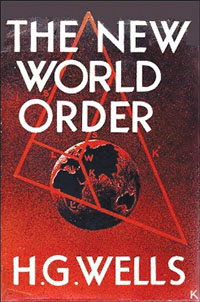
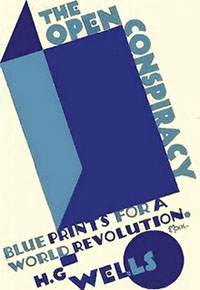
Though largely known today as ‘merely’ a science-fiction writer (War of the Worlds, The Time Machine etc.), Wells was also a prodigious non-fiction writer, theorist, committed socialist and passionate forward-thinker. An entire sub-set of his writings has almost completely vanished from the popular consciousness: extraordinarily insightful, prophetic and relevant books like The New World Order (1940) and The Open Conspiracy (1928), oddly out-of-print for many decades.
In those latter two volumes, Wells clearly advocated for the titular ‘New World Order’, arguing that only a one-world government supported by a vigorous, free and open press (in his view) would be strong enough to resist the inevitable and malignant power of transnational corporations and the financial elite. The Open Conspiracy acknowledged that the general population would have great animus toward such a project, without a concerted campaign of mass propaganda and a subterranean scheme to disable nationhood and democracy through secret trade agreements and labyrinthine international treaties. However well-meaning Wells’ original concepts, they have been inverted to secure a global architecture of control into the hands of the very financial elites and transnational corporations that he sought to blunt.
The most noteworthy political leader to reanimate Wells’ ‘New World Order’ concept and phrase in modern times was US President George Herbert Walker Bush. It’s tempting to see him as some kind of Golem/Homunculus re-combination of ‘Herbert George Wells’ and American imperialist and slaver hero William Walker.
Note also that this project has advanced in part through the perky mass entertainment distractions of Huxley’s ‘feelies’ and the conditioning of his pan-pharmaceutical, soporific ‘soma’. From Orwell’s nightmare dystopia Nineteen Eight-Four we seem to have inherited the perpetual war state, fuelled by a revisionist propaganda atmosphere, waves of perpetually synchronised ersatz ‘terrorist’ attacks, omniscient surveillance and the obligatory Emmanuel Goldstein/Osama Bin Laden/ISIL crew (direct from central casting). Though these authors wrote cautionary tales, those tales have now been weaponised.
No matter what their actual provenance, many foundational documents of ‘conspiracy’ folklore are today eerily prescient about decades-long social engineering projects.
Originally available as a series of three cassette recordings (taped in 1988 and sometimes titled ‘The New Order of Barbarians’), the recollections of Dr. Lawrence Dunegan prove to be haunting and compelling. He described a lecture he ostensibly attended on 20 March 1969 (given by one Dr. Richard Day), wherein a nefarious plan for the complete disablement and infantilisation of civic, democratic society was tabled. Dr. Day invoked a mass campaign of propaganda, brainwashing and social engineering of such scale as to be difficult to comprehend. The vast majority of his outlandish predictions now seem to have come to pass.
Likewise, an anonymously xeroxed samizdat document ‘Silent Weapons For Quiet Wars’ (most likely authored by the intriguing figure of Hartford Van Dyke) mapped human society in a series of pseudo-scientific diagrams and descriptions, specifying suggested positions for economic and cultural ‘shocks’ to render the body politic paralysed and obedient.
Despite this apparently omniscient ‘Manhattan Project’ of sinister synthetic bondage, resistance might yet arise in unpredictable places.
A recently identified substrata or caste of people, the so-called ‘Precariat’ (a neologism: being the presumed combination of ‘precarious’ and ‘proletariat’), draw their numbers from the collapsing middle-class and tend to be ‘over-educated’ and unable (in today’s ‘flexible’ labour market) to find secure employment suitable to their upscale skill-set. They also tend to be smart, disenchanted, disenfranchised, angry, supposedly ‘irrational’ and liable to be unconvinced by mainstream political orthodoxies. In other words – they don’t think (or vote) the way they are supposed to – and some ‘blame’ them for the shock of Brexit and the election of orange-plated iconoclast Donald Trump. Not ‘racists’, nor ‘homophobes’, nor ‘misogynists’: as globalism savages those excluded from the professional-elite-enabling and media/academic classes, the Precariat can only grow in numbers and seething underground rage.
Sir John Glubb was a professional soldier, diplomat, scholar and writer. His little-known 1978 volume The Fate of Empires lucidly charted the rise and fall of numerous empires past. It’s difficult not to see reflections of our own Golden epoch in its pages: as the Anglo-American empire stumbles through the inevitable downward imperial arc (the ‘Age of Affluence’ followed by the final ‘Age of Decadence’) and violently thrashes to stay afloat – grasping at God-like schemes of complete control (or planet-wide annihilation).
Both Orwell and Lenin voiced the opinion that humanity’s best hope rested in the hands of an awakened proletariat. Perhaps, if they were alive today, they might shift their allegiances to the Precariat – that educated yet entirely uncomfortable class destined to listless part-time work in unfulfilling service fields (like ‘Uber’) and environmentally inoculated against the prevalent parasitic thought paradigm (and its attendant globally networked, socially engineered zeitgeist).
The scholars and scientists in service of empire have likely studied Glubb, Wells, Huxley, Orwell and alike: synthesising a delightful, gilded menu of utterly fantastical control mechanisms. History, however, tells us that all empires overreach and collapse inwardly from decadence and hubris. But we stand on a knife-edge. Can these ‘science-fiction’ technologies override the inherent cycles of civilisation? Will these inhuman and autocratic sciences prevail and condemn us to an ahistoric future of permanent soul-slavery? Or will those ‘cast-offs’ – the human detritus discarded by the machines of external and internal conquest – vanguard an unlikely resistance?
It’s up to you.
It is better to perish than to live as slaves. – Sir Winston Churchill
[alert type=”general” dismiss=”no”]This article was published in New Dawn 163.[/alert]
[alert type=”success” dismiss=”no”]If you appreciate this article, please consider subscribing to help maintain this website.[/alert]
References
Sir John Glubb, The Fate of Empires, William Blackwood & Sons, Edinburgh, 1978
H.G. Wells, The New World Order, Secker & Warburg, London, 1940
H.G. Wells, The Open Conspiracy, Victor Gollancz Ltd., London, 1928
Aldous Huxley, Brave New World, Chatto & Windus, London, 1932
George Orwell, Nineteen Eighty-Four, Secker & Warburg, London, 1949
“How the CIA made Google: Inside the secret network behind mass surveillance, endless war, and Skynet—part 1” by Nafeez Ahmed, https://me dium.com/insurge-intelligence/how-the-cia-made-google-e836451a959e
“How the CIA made Google: Inside the secret network behind mass surveillance, endless war, and Skynet—part 2” by Nafeez Ahmed, https://medium.com/insurge-intelligence/why-google-made-the-nsa-2a80584c9c1
‘CIA’s Venture Capital Arm Is Funding Skin Care Products That Collect DNA’ by Lee Fang, https://theintercept.com/2016/04/08/cia-skincare-startup/
Imagine, if you will, a war in the near future. A war not fought between East and West. Not fought between nations, nor creeds nor races. A war fought brother to brother and sister to sister, father to son and mother to daughter.
Tesh (technologists) against NonTesh (non-technologists).
The Tesh, a tribe or caste intoxicated and socially validated through their umbilical connection to technology and the Meta/Hive Mind. Glued to Google Glass, status permanently updated: the Tesh always offer the right opinion at the right time. Incapable of nonGroupThink, the Tesh occupy all positions of import in the professional, media, academic and information classes. Opinions counter to Tesh GroupThink are not only by definition incorrect, they are also invisible – filtered, de-platformed and deleted into a silent nonexistence.
The NonTesh are homeless, stateless non-people. Unable to participate in comfortable society’s rituals and prefabricated dialogues, without access to currency and the staid social discourse that lubricates function in the mainstream. They attack from the margins: wild wastelands, hardware graveyards and mountain ranges of landfill – zones abandoned by the Tesh as beyond rehabilitation. The unknowing progeny of the much-maligned (but historically vindicated) Luddites, the NonTesh build primitive Drone traps, savagely attack convoys of technicians and inflict random violence at the edges of Tesh civilisation. They slaughter and destroy with no plan, no blueprint – a simple, intuitive anger and violence that Tesh mainframe-algorithms cannot comprehend and struggle to strategise against.
This will be the Final War – man against machine and man against machine-man.
Trapped by Techno-Blindness?
The omniscient progress of technology brings with it many benefits – this is beyond serious doubt. But seldom if ever discussed is technology’s insidious and largely invisible detriments. They remain near-invisible for many reasons: commercial imperatives, an infantile inability to see past convenience and short-term rewards and a surfeit of attractive and entertaining distractions. Perhaps the most difficult to discern are those problems that might occur in the moral, predictive, philosophical or ideological realms: spheres apparently far less concrete than instant, addictive neurochemical rewards and the superficial and textural allure of consumer electronics.
Modern-era human society also appears rusted to the concept of progress – the idea that all technological advances are intrinsically positive whether immediate gains outweigh severe long-term deficits… or not.
The black silicon squid of hyper-technology sends its powerful tentacles into every domain of human activity, its vice-like grip stultifying thought and any hint of animalistic defensive counter-measures. Our species suffocates in the death-grasp, yet lacks even the primal survival instinct to respond effectively. Is humankind fatally trapped by techno-blindness?
Big Data & Psychographic Profiling
While essentially unknown to the general public, the astounding technologies of the London based firm Cambridge Analytica (CA) are credited by some as having a fundamental role in the 2016 election of US President Donald Trump and the ‘Leave’ campaign that led to the UK Brexit. CA trumpets proudly on its website and in its strategic communications that they “use data modelling and psychographic profiling to grow audiences, identify key influencers, and connect with people in ways that move them to action.”
Birthed at the nexus of leading Cambridge University Psychometric scientists and the SCL Group (self-described as a ‘global election management agency’), Cambridge Analytica works big data to identify and manipulate the intentions of mass voter populations.
According to CA Chief Executive, Alexander Nix, “Today in the United States we have somewhere close to four or five thousand data points on every individual. So we model the personality of every adult across the United States, some 230 million people.” Harvesting Facebook ‘likes’, smartphone data, purchase histories, subscriptions, church visits, online and other available aggregate information, CA builds profiles of every individual in the target audience (i.e. every potential voter in the US during election season 2016) and generates a ‘psychographic analysis’ in combination with the OCEAN (‘openness to experience, conscientiousness, extraversion, agreeableness, and neuroticism’) personality trait or ‘lexical hypothesis’ model to predict and influence the electoral actions of individuals.
As reported in the Swiss Das Magazin, with just ten Facebook ‘likes’ as input, CA could “appraise a person’s character better than an average coworker. With seventy, it could ‘know’ a subject better than a friend; with 150 likes, better than their parents. With 300 likes… (the) machine could predict a subject’s behaviour better than their partner. With even more likes it could exceed what a person thinks they know about themselves.”
Deployed in a number of developing nations, the SCL Group has worked extensively with military and political contacts in activities that Slate magazine described as akin to a ‘coup’ scenario.
According to their website, “Cambridge Analytica is building a future where every individual can have a truly personal relationship with their favourite brands and causes by showing organisations not just where people are, but what they really care about and what drives their behaviour.”
Professor Jonathan Albright of Elon University describes CA’s algorithms as “a propaganda machine. It’s targeting people individually to recruit them to an idea. It’s a level of social engineering that I’ve never seen before. They’re capturing people and then keeping them on an emotional leash and never letting them go.”
CA’s Nix gave an example from their brief tenure on GOP candidate Ted Cruz’s primary campaign. Cambridge Analytica’s big data analysis “identified that there was a small pocket of voters in Iowa who felt strongly that citizens should be required by law to show photo ID at polling stations. Leveraging our other data models, we were able to advise the campaign on how to approach this issue with specific individuals based on their unique profiles in order to use this relatively niche issue as a political pressure point to motivate them to go out and vote for Cruz. For people in the ‘Temperamental’ personality group, who tend to dislike commitment, messaging on the issue should take the line that showing your ID to vote is ‘as easy as buying a case of beer’. Whereas the right message for people in the ‘Stoic Traditionalist’ group, who have strongly held conventional views, is that showing your ID in order to vote is simply part of the privilege of living in a democracy.” According to some sources, CA is able to bombard target individuals with thousands of uniquely tailored and feedback evolving ‘dark ads’ (advertisements that aren’t seen by others).
‘Weaponized AI Propaganda Machine’
In a piece titled ‘The Rise of the Weaponized AI Propaganda Machine’, journalists Berit Anderson and Brett Horvath assert that Cambridge Analytica, “has activated an invisible machine that preys on the personalities of individual voters to create large shifts in public opinion. Many of these technologies have been used individually to some effect before, but together they make up a nearly impenetrable voter manipulation machine that is quickly becoming the new deciding factor in elections around the world.”
It would be easy to argue that primitive versions of these techniques have indeed been used in various ‘coloured revolutions’ and ‘regime change’ operations for decades at least (and more subtly in the general domestic activities of the mainstream media): perhaps the only salient difference being that now the ‘coup’ chickens have extraordinary ‘Artificial Intelligence’ technologies at their disposal which have now clearly come home to roost.
Fraught and fragile as our democracies are, the inevitable march of ‘progress’ means we’re about to lose them permanently to The Machine.
Predictive Policing
Technology also threatens to advance and empower policing to the realm of monolithic totalitarianism. In an eerie echo of Phillip K. Dick’s ‘Minority Report’ short story, predictive policing software and models are now deployed to assess the assumed future crimes of identified ‘criminal classes’. In Chicago, a city wracked by disproportionate levels of gun homicide, gang violence and rampant police brutality, a report in Scout Magazine notes that, “Microsoft, the Chicago Police Department, and a partner called Third Eye have created a cloud-based solution that predicts what types of criminal activity are likely to take place where. Using historical data, the Chicago force can deploy officers to specific locations across the city based on how likely crime is to occur there. They can also predict crime trends based on the weather, specific times of day or a range of other factors. The LA Police Department has developed an algorithm called PredPol that does the same thing.”
Unfortunately, these predictive models are often wrong.
‘Beware’, a software model developed by security firm Intrado, was tasked with identifying an individual’s “threat level based on their address, searches of the deep web, arrest records, vehicle registrations, criminal records, warrants, property records, ‘known associates’ and the content of their latest social media posts.”
Adopted in Fresno, California in 2015, ‘Beware’ was soon abandoned in April 2016 after persistent concerns were raised about its accuracy and deleterious effect on privacy.
Aside from the obvious, nightmarish and Kafka-esque scenarios that predictive policing might produce, it should also be noted that any Artificial Intelligence capability can only be as useful and accurate as the data it utilises. Error-prone, biased or prejudiced inputs will inevitably produce arrests or harassment for what equates essentially to ThoughtCrime or simply being in the wrong place at the wrong time (or even being the wrong person at the wrong time).
Predictive policing will always risk impugning guilt through data aggregation rather than actual criminal action.
Star Chamber ‘Justice’
In recent decades the explosion in electronic and online communications has been a boon for surveillance industries and the instruments of the corporate and political state tasked with gathering masses of information. Post the revelations of NSA whistleblowers like William Binney and Edward Snowden (and Wikileaks’ recent ‘Vault7’ cache of documents), it appears safe to assume that all electronic communications are vulnerable to surveillance at all times.
It came to light through the Snowden revelations that police and other law enforcement departments have regular and essentially uncontrolled access to ‘products’ of the NSA/CIA and surveillance state. Though use of this ostensibly illegally obtained information is inadmissible in court proceedings, police routinely work around this impasse by creating ‘parallel construction’, a technique to mask the use of ‘unconventionally obtained’ data from defendants or the accused.
According to an August 2013 Reuters report, “A secretive US Drug Enforcement Administration unit is funnelling information from intelligence intercepts, wiretaps, informants and a massive database of telephone records to authorities across the nation to help them launch criminal investigations of Americans. Although these cases rarely involve national security issues, documents reviewed by Reuters show that law enforcement agents have been directed to conceal how such investigations truly begin – not only from defence lawyers but also sometimes from prosecutors and judges.”
In the US, local police and the FBI routinely use a device called a ‘Stingray’ that mimics a cell/mobile phone tower and thus can capture metadata and phone traffic content from nearby phones. No warrant is required for their use but The Guardian in August 2016 reported on a “non-disclosure agreement that local police were forced to sign with the FBI before receiving permission to use Stingray – a document that mandated local prosecutors to abandon cases rather than risk information about Stingray becoming public.”
Using what are legally ‘invisible’ technologies to gather incriminating evidence poses myriad problems for the accused: a frightening ‘Star Chamber’ scenario that is reportedly now commonplace. As Reuters confirms, “If defendants don’t know how an investigation began, they cannot know to ask to review potential sources of exculpatory evidence – information that could reveal entrapment, mistakes or biased witnesses.”
The continued militarisation of police has been of concern to many. Now airborne drones (Unmanned aerial vehicles or UAVs) are also becoming part of the increasingly high-tech law enforcement arsenal. In the US, North Dakota was the first state to legalise armed police drones. The aircraft will be nominally limited to ‘less-than-lethal’ weaponry (i.e. sonic weapons, tear gas, tasers, rubber bullets and pepper spray) though ‘mission creep’ would appear to make it inevitable that law enforcement will soon patrol from the skies with lethal firepower, a scenario that was science-fiction a few years ago.
Connecting all to the ‘Internet of Things’ – Including People
Advancements in ‘smart’ technology (or as author and Silicon Valley critic Evgeny Morozov calls them: “Surveillance. Marketed. As. Revolutionary. Technology.”) and the approaching ‘Internet of Things’ threaten an ominous near-future where common everyday/domestic appliances/devices – cars, dishwashers, refrigerators, televisions, toilets, washing machines, thermostats, alarm systems and alike – are, for ‘convenience sake’, automatically and intrinsically connected to the cloud/internet.
Speaking in 2012 to the In-Q-Tel (the CIA’s venture capital arm) CEO Summit, then CIA Director General David Petraeus remarked about the impending ‘Internet of Things’ saying, “Items of interest will be located, identified, monitored, and remotely controlled through technologies such as radio-frequency identification, sensor networks, tiny embedded servers, and energy harvesters – all connected to the next-generation Internet using abundant, low cost, and high-power computing – the latter now going to cloud computing, in many areas greater and greater supercomputing, and, ultimately, heading to quantum computing.
“In practice, these technologies could lead to rapid integration of data from closed societies and provide near-continuous, persistent monitoring of virtually anywhere we choose. ‘Transformational’ is an overused word, but I do believe it properly applies to these technologies, particularly to their effect on clandestine tradecraft. Taken together, these developments change our notions of secrecy and create innumerable challenges – as well as opportunities.”
US Director of National Intelligence, James Clapper, similarly remarked in February 2016 that, “In the future, intelligence services might use the ‘Internet of Things’ for identification, surveillance, monitoring, location tracking, and targeting for recruitment, or to gain access to networks or user credentials.”
The day is fast approaching where your fridge might spy on you.
Imagine Cambridge Analytica’s 4-5,000 data points harvested for every individual, correlated with tens of thousands of domestic data observations, and it becomes possible to build electronic and informational profiles of individuals of staggering scale and darkly malevolent detail.
Secret CIA Technology Exposed
Wikileaks’ 7 March 2017 dump of thousands of secret CIA technology documents confirmed a landscape of ubiquitous surveillance and data harvesting. Among the myriad revelations allegedly leaked from the CIA’s Center for Cyber Intelligence in Langley, Virginia:
“‘Weeping Angel’, developed by the CIA’s Embedded Devices Branch (EDB), which infests smart TVs, transforming them into covert microphones. After infestation, Weeping Angel places the target TV in a ‘Fake-Off’ mode, so that the owner falsely believes the TV is off when it is on. In ‘Fake-Off’ mode the TV operates as a bug, recording conversations in the room and sending them over the Internet to a covert CIA server.” (www.zerohedge.com/news/2017-03-07/wikileaks-hold-press-conference-vault-7-release-8am-eastern)
As Internet renegade Kim Dotcom noted, the “CIA turns Smart TVs, iPhones, gaming consoles and many other consumer gadgets into open microphones,” and further the “CIA turned every Microsoft Windows PC in the world into spyware.”
Also described was the CIA capability to hack computer networks while cloaked as another entity or state actor. The CIA UMBRAGE group, according to Wikileaks, “collects and maintains a substantial library of attack techniques ‘stolen’ from malware produced in other states including the Russian Federation. With UMBRAGE and related projects the CIA cannot only increase its total number of attack types but also misdirect attribution by leaving behind the ‘fingerprints’ of the groups that the attack techniques were stolen from.” (https://wikileaks.org/ciav7p1/)
Further from Wikileaks: “As of October 2014 the CIA was also looking at infecting the vehicle control systems used by modern cars and trucks. The purpose of such control is not specified, but it would permit the CIA to engage in nearly undetectable assassinations.”
This last point casts an ominous shadow on the 18 June 2013 death of controversial defence and surveillance journalist Michael Hastings. Just hours before his demise in an inexplicable and fiery, high speed auto-crash, Hastings said, “The Feds are interviewing my ‘close friends and associates’” and, “I’m onto a big story and need to go off the radar for a bit.”
From ‘Smart Dust’ to ‘Bots’ that roam Internet forums and newspaper sites generating automated comments, from Barbie dolls that collect and wirelessly transmit children’s conversations to marketers, and algorithms or artificial intelligences that finger potential criminals, generate credit ratings, parole recommendations and employment decisions: we are about to leave the epoch of human decision making and enter a brave new era of automated or ‘virtual intelligence’.
Some, like renowned technologist, futurist and Google Director of Engineering Ray Kurzweil celebrate the coming ‘singularity’ – the point when computer intelligence equals or surpasses human intelligence and potentially the human mind melds with technology. Kurzweil predicts that by 2029 our brains will fuse with machines and the event will usher in a new ‘techno-utopia’ where according to his evangel, “We’re going to be able to meet the physical needs of all humans. We’re going to expand our minds and exemplify those artistic qualities that we value.”
Another noted technologist, Elon Musk, struck a far more cautionary tone in October 2014: “With artificial intelligence we are summoning the demon.”
Digital Control Machine Will Never Sleep
It’s easy to drown in the multifarious, conceptual and jargonistic details – the techno-babble and giddy utopianism.
But the simplest observation is also the best and most essential – in a few short years we will already be in a future where every interaction with any electronic device, technology or landscape will most likely be recorded, stored, analysed and actioned. Every phone conversation will be harvested for advertising data; every comment, search or online visit yielding the raw stuff of social engineering and opinion/vote massaging; every opinion big data grist for the ‘Shock Doctrine’ mill: a traitorous crop of domestic appliances will report on conversations, sleep, ablution and eating habits as online algorithms patrol like nano-ThoughtPolice – reporting social media infractions to employers and state bodies.
Always on – always transmitting – always analysing and evolving: the Digital Control Machine will never sleep.
It is, in the most basic form, a nightmare world of permanent, inescapable surveillance and panopticon monitoring: a Technological Prison that serves up constant entertainments and distractions with the small, dutiful price of mental conditioning and omniscient servitude. Permanently connected to ‘the Cloud’, a remotely controlled and infinite feedback system that modulates mood, thought, opinion and activity. Soon we will be digital puppets, addicted to ‘sticky’ devices and rewarded for our compliance by serotonin hits and endless ‘content’.
In 1984 George Orwell imagined a brutal dystopia of regimented ‘Thought Police’ and perpetual war. Previously, Aldous Huxley’s Brave New World described a future of bio-chemical thought/mood enhancement and control through the cheerfully prescribed and gladly ingested ‘soma’ of ritualised and inescapable entertainments and obligatory trivia and tribal custom.
Our near-tomorrow will likely be a hybrid of the two – swift, final technological punishment for the troublesome ‘Michael Hastings’ types (those who have transgressed beyond rehabilitation) – and endless, comfortable distraction for those who submit meekly to the gilded techno-cage. A soft, warm and luxurious digital boot “stamping on a human face – forever.”
Human society’s breathless race to embrace dehumanising and inherently totalitarian technologies must have an end point.
It’s possible to form a cogent argument that recent political ‘shocks’ and developments (the election of Donald Trump, Brexit, the impending demise of the EU and UN) are in some sense the manifestation of a sublimated rejection of technology (and the government/economic/corporate systems empowered by technology) from a dazzled, bewildered but instinctively antagonistic herd-populace.
Is it to be war between those Transhumans who accept and rejoice in their hybridisation into the matrix of omniscient ideological control technologies (an adjunct of the modern permanent state of entertainment/distraction and doctrinal/behavioural feedback), and those on the margins who knowingly or intuitively reject the encroachment of optic fibre, microwave blast and touch-screen texture into every last human domain of flesh, thought, sinew and soul?
The Final War – the ragtag remnants of man-kind against man-machine.
Tesh versus NonTesh.
[alert type=”general” dismiss=”no”]This article was published in New Dawn 162.[/alert]
[alert type=”success” dismiss=”no”]If you appreciate this article, please consider subscribing to help maintain this website.[/alert]