New Dawn – World's Most Unusual Magazine

Author: John Michael Greer

  • Awakening the God Within: Secret Teachings of Richard, Duc de Palatine & The Brotherhood & Order of the Pleroma

    Awakening the God Within: Secret Teachings of Richard, Duc de Palatine & The Brotherhood & Order of the Pleroma

    From New Dawn Special Issue Vol 18 No 2 (Apr 2024)

    One of the most remarkable spiritual teachers of modern times, Richard, Duc de Palatine (1916-1977), is little known today outside of a handful of modern Gnostic churches and initiatory orders.

    His biography was capably summarised by Mehmet Sabeheddin in an earlier article in New Dawn, which was the first introduction many people have had to de Palatine’s work.1 The teachings he handed down are even less well-known than the man himself. Yet the spiritual path de Palatine taught in his public writings and the private lessons passed on to his students is as relevant now as it was in his own time. It shows a way past the corrupt hierarchies of politicised religion to a spirituality founded squarely on individual human freedom.

    Many of those who knew de Palatine personally were profoundly impressed by the authority and the sense of “knowingness” that shaped his public presence even when he was a young man. His own writings confirm the impression of a man guided by inner certainties rooted in spiritual experience. Though his core insights were always his own, those insights were shaped in important ways by the esoteric traditions he studied and the initiatory lineages that were communicated to him. A brief survey of de Palatine’s own spiritual journey will therefore help set the stage for an outline of the teachings themselves.
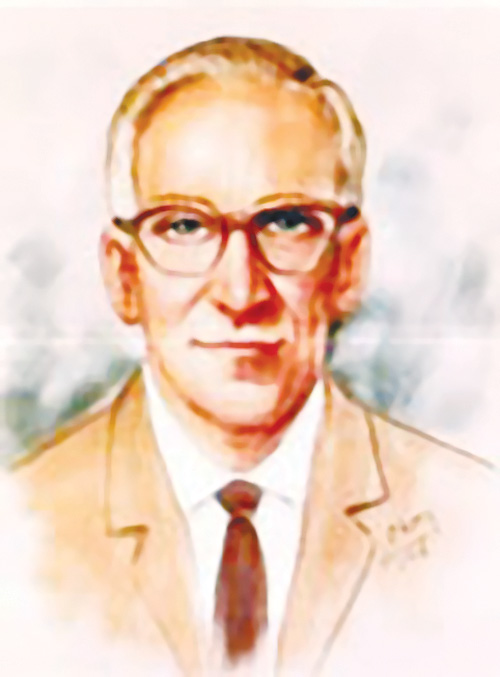

    Richard, Duc De Palatine was born on 4 July 1916 as Roland (Ronald) John Powell in the Melbourne (Australia) suburb of North Fitzroy, the son of William John Powell and Annie Powell (Hancock). He studied at Melbourne University, serving with Australian military intelligence in WWII. He legally changed his name to Richard John Duc de Palatine after relocating to England from Australia in the late 1940s.

    A Quest For The Light

    His birth name was Ronald Powell, and he was born in Melbourne in 1916. From earliest childhood, he had a sense that some unseen power guided and protected him. Raised as a Christian, he dabbled briefly in rationalism, then entered the Catholic Church and attended Mass regularly for some years. By 1935, however, his disagreements with Catholic doctrine had become impossible to ignore, and he left the Church and began a period of spiritual seeking.

    In 1938 he joined the Theosophical Society, then an influential presence in the alternative spirituality scene in Australia and elsewhere. Theosophical teachers Geoffrey Hodson and John A. Farquharson guided Powell through the Society’s teachings. At least as influential was the Melbourne Theosophical Lodge’s library, which included G.R.S. Mead’s groundbreaking translations of surviving Gnostic literature and a wealth of works on the Essenes and the ancient Mysteries – subjects that would be central to Powell’s teachings later in life. The evidence of his later writings shows that he studied books by all the important Theosophical authors as well as the works of two American Rosicrucian teachers, Max Heindel and George Winslow Plummer.
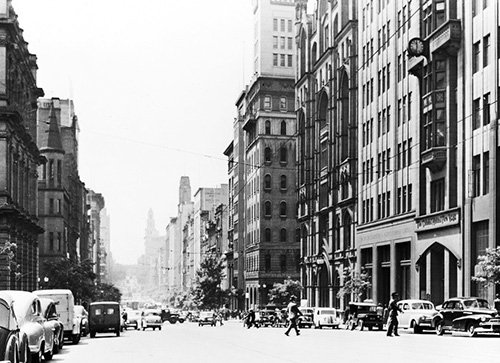
    Collins St, Melbourne, in the 1930s.

    Probably by way of the Melbourne Theosophical library he also encountered the works of another extraordinary teacher, George Washington Carey. Born in 1845, Carey was an American mystic and healer whose work focused on the twelve biochemic tissue salts, a form of homeopathic medicine that uses the mineral salts found in the human body. Carey’s handbook of the tissue salts was for many years a standard text in this branch of alternative medicine. However, his interest in the tissue salts was not limited to their healing powers. Later in his life, he came to focus on one of the inner secrets of esoteric spirituality: the role played by hidden aspects of human biology in the quest for transcendence.
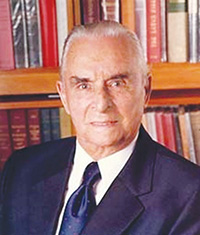
    For over 70 years, Geoffrey Hodson (1886–1983) was a leading light in the Theosophical Society.

    Carey’s work also drew on Christian tradition in a fascinating way. Having studied the work of many earlier writers, Carey came to understand that the Christian Gospels were not historical documents meant to be taken literally but skilfully crafted parables based on a deep understanding of the subtle anatomy of the human body. Through the myth of the birth, life, death, and resurrection of Jesus, they communicated a powerful system of personal spiritual transformation. Carey’s works, especially his last book God-Man: The Word Made Flesh, had a profound impact on Powell, who quoted Carey at length in his own writings and included material on the biochemic cell salts in his private lessons for students.
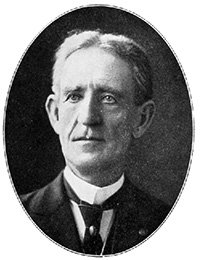
    George Washington Carey

    By 1948 Powell had become a teacher in his own right in the Melbourne area, with a circle of committed students. However, the “invisible presence” that guided him had other plans for him, and he travelled to London that year, settling in Kensington. Frequent visits to France brought him into contact with a wide range of European esoteric orders, and he received initiation into a series of potent spiritual lineages.

    The sources of some of these lineages may raise hackles in today’s alternative culture, as they were preserved in European royal and aristocratic families. It needs to be remembered, however, that the old aristocracies of Europe were never monolithic. To borrow a metaphor from Dune, there were plenty of Harkonnens amid European nobility but there were also equivalents of the Atreides. Over the centuries, it was by and large the Harkonnen-equivalents that triumphed, but some of the others survived in relative obscurity.

    It was from certain of these latter lineages that Powell received a series of initiations passed down for centuries from the Knights Templar and other initiatory bodies that preserved the ancient wisdom. In the course of these initiations, he was ennobled, taking the new name Richard Jean Chretien, Duc de Palatine. He was also consecrated as a bishop in 1953 by Mar Georgius (Hugh de Willmott Newman), Patriarch of Glastonbury, one of the most influential figures in the movement of free bishops, then evolving a sacramental Christianity independent of established religious hierarchies.

    All these influences came together in 1953. Late in that year, Bishop Richard, Duc de Palatine founded the Pre-Nicene Gnosto-Catholic Church to restore the Gnosis of the Soul – the secret teachings of the Gnostics and their heirs – to the Christian Churches. He also received a charter from the Fratres Lucis (Brothers of Light), an esoteric order that traces its origins to the fifteenth century, authorising him to establish an initiatory order alongside the church. Thereafter he devoted his time to teaching and writing, publishing a monthly magazine and a series of booklets on the Gnosis of the Soul through his Pre-Nicene Publishing House, and writing and circulating correspondence lessons to students throughout the world. In 1971, he relocated to the United States and remained there, always busy, until his death in 1977.

    The Gnosis of the Soul

    In the course of his work, de Palatine wrote more than two dozen essays of various lengths, as well as two correspondence courses for his students. These still survive and are available to students of the Gnostic churches and initiatory lineages he set in motion. As with most of the old traditions of initiation, some aspects of the work are kept private by their current custodians, just as they were by de Palatine himself. The first steps in the teachings can be outlined readily enough.
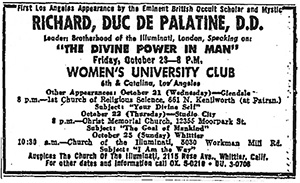
    In October 1959 – on the eve of the 1960s ‘occult explosion’ in the US – Richard, Duc de Palatine commenced his historic lecture tour of North America, as announced in the Los Angeles Times (from the archives of the Brotherhood & Order of the Pleroma – Australia). 

    The first and in many ways the most crucial point about de Palatine’s teachings is that he never claimed that they were original. In his view, one Wisdom Religion has been passed on by enlightened saints and sages since human beings first incarnated on this planet. That tradition has never died, though it has been obscured in some ages by corrupt priesthoods and tyrannical governments, and it is endlessly renewed by emissaries from the inner realms of being – human souls who have passed beyond the need for incarnation but return to material existence to help their fellow humans find their way to the path of the spirit.

    Central to the Wisdom Religion that de Palatine taught is a clear sense that God is not “out there” somewhere, an external presence exercising an arbitrary despotism over all things. “The Kingdom of God is within you,” said Jesus. Turn within and you will find that behind your personality, or Personal Soul, is the individuality or Higher Ego, the self that passes from life to life in the course of reincarnation. Behind the Higher Ego, in turn, is the Higher Self or Christos Body, an inseparable ray of the One Life which is God. Thus the spiritual quest always leads within, and seeks to awaken that inner knowing that brings the Personal Soul into harmony with the Higher Ego and the Higher Ego into harmony with the Higher Self.
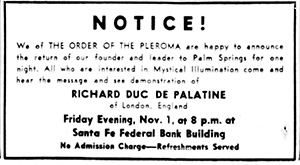
    Richard, Duc de Palatine regularly lectured across the United States in the 1960s, before relocating to California in 1971. 

    The Christos Body, in turn, is the Christ that matters in terms of personal salvation. In his book Christ or Jesus? de Palatine argued that the life of Christ in the four canonical Gospels is an invented narrative meant to communicate a path of spiritual transformation. It was based to some extent on the life of the Jewish spiritual teacher Jeshu ben Pandira, who lived and died around 100 BC. But the “Jesus Christ” of the canonical Gospels never actually existed as a living person, and the cult of Jesus as a historical person promulgated by the mainstream Christian churches is based on a cascade of misunderstandings circulated by early Christian teachers too literal-minded to grasp the profound metaphors of the Gospel myth.

    The life of Christ, in de Palatine’s teachings, thus has to be understood not as the story of one divine person but as a guide to the transformation of each individual soul. Just as there are five traditional stages in the Gospel narrative, there are five stages along the path to complete enlightenment. We can examine them one at a time.

    1. Birth. This is not the physical birth of the individual but the birth of the Christos, the radiant presence of divinity in the self, within the individual heart. This is the beginning of genuine spirituality, the replacement of outward forms with inward transformation. Inevitably the lower or animal self pushes back. Its instruments are the “images of menace,” parasitic forms created by unbalanced thoughts, feelings, and cravings, which reside in the subconscious and are stirred up by any effort at spiritual growth. These parasitic forms try to suppress the newborn spiritual potential of the individual; this is the real meaning of King Herod’s attempt to slaughter the infant Christ.

    2. Baptism. In the myth of the Christos, the baptism of Jesus by John the Baptist was the beginning of Christ’s earthly ministry. In the Gnosis of the Soul, it is the awakening of the power to perceive the inner regions. Psychic potentials such as telepathy begin to manifest themselves, and these powers unfold step by step until the individual becomes a risen Son of God emerging from the sepulchre of his own material body.

    3. Transfiguration. The narrative of Christ’s transfiguration is enacted by the individual seeker when the light of the higher self begins to illuminate the vestures or subtle bodies that surround it. In order to achieve this stage, the last vestiges of egoistic desire must be released. Once that has been accomplished, the individual becomes aware of his unity with the Supreme Soul, and he begins to function on the abstract planes of being where all things are perceived as one.

    4. Crucifixion. The animal self has not yet been wholly defeated, however, and the final battle between it and the awakening soul remains to be fought. This is the equivalent, in the path of the individual, of the crucifixion in the mythic narrative of the Christos. This final struggle completes the soul’s earthly pilgrimage; after this, there is no need to reincarnate further in a body of flesh, for the soul has learned everything this planet can teach it.

    5. Ascension. Having completed the journey set out symbolically in the Gospel narratives, the soul then ascends to become one with its own Divine Soul in those higher realms of being that traditional Christian mythology calls “heaven.” Having become an adept of the Gnosis and a member of the communion of saints, the fully awakened soul may then choose either to descend again to earth to help other souls complete the great journey or labour in other, subtler spheres of existence for the betterment of all.
    Get the issue this article appears in

    Beginning the Path

    The system of spiritual development passed on by the ancient Gnostic Christian churches, before they were driven into hiding by the political religion of Constantine and his successors, was called the Disciplina Arcani or the Arcane Discipline. This was the name de Palatine used for the system of training he passed on to his students.

    In de Palatine’s vision, religion was always a way of life and not just a set of beliefs. Students of the Arcane Discipline are given a set of ideals to embody in their lives. The hard work necessary to enact these ideals develops the inner capacities needed to proceed on the path. What are these ideals? First and most essential, control of thought; next, purity of mind, emotions, and body; third, compassion toward all beings. As these three qualities become habitual, the aspirant begins to receive attention from his or her inner Teacher, the spiritual being who will supervise that person’s training. Much of this training will take the form of trials and tests in everyday life. According to the aspirant’s response to these trials and tests, new lessons will be forthcoming.

    The ideals just listed are the most important capacities to develop in the early stages of the path, but certain others can also be pursued at the same time. The lessons de Palatine wrote for his students specify the ideals needed for the path as discrimination; indifference to worldly objects; control of the mind, the body, and the senses; tolerance; endurance; faith; equilibrium; and the desire for liberation. In addition, training in concentration and meditation also plays an important part in the practical work. One basic meditation from de Palatine’s writings is included here (see page 37). There are many others the aspiring student receives as the lessons proceed.

    At present, the teachings passed on by Richard, Duc de Palatine are still preserved by a handful of small organisations, as noted earlier, and interested students must make an effort to find them. He liked to point out that truth ever reveals itself to the sincere seeker. The basic elements of training summarised here are suitable for beginners. Those who practice them and set out in quest of more light are unlikely to be left in darkness for long.

    To read a Meditation Exercise by Richard, Duc de Palatine and see the additional informational graphics of this article, purchase a paper or digital copy of this magazine by clicking here.

    Recommended reading: “Meeting with a Magus: The Untold Story of Richard, Duc de Palatine & The Brotherhood and Order of the Pleroma” by Mehmet Sabeheddin in New Dawn Special Issue Vol. 13 No. 2, available as a digital download at www.newdawnmagazine.com/product/new-dawn-special-issue-vol-13-no-2.

    [alert type=”general” dismiss=”no”]This article was published in New Dawn Special Issue Vol 18 No 2.[/alert]

    [alert type=”success” dismiss=”no”]If you appreciate this article, please consider subscribing to help maintain this website.[/alert]

    Footnote

    1. Mehmet Sabeheddin, “Meeting with a Magus: The Untold Story of Richard, Duc de Palatine & The Brotherhood and Order of the Pleroma,” New Dawn Special Issue Vol. 13 No. 2, 65-70.

    © New Dawn Magazine and the respective author.
    For our reproduction notice, click here.
  • Joséphin Péladan: How to Become a Mage

    Joséphin Péladan: How to Become a Mage

    From New Dawn Special Issue Vol 16 No 5 (Oct 2022)

    We do not believe in progress or in salvation. For the Latin race, which goes to its death, we prepare a final splendour, to dazzle and gentle the barbarians who are to come.” These words, published in Le Figaro on 2 September 1891 as part of an essay titled “Manifesto of the Rose+Cross,” heralded the major work of one of the most astonishing figures in the history of Western occultism – a teacher and visionary with a message that still resonates today.

    Joséphin Péladan was born in 1858 in Lyon, that perennial hotbed of French occultism, in a devout but eccentric Catholic family with occult connections: his father was a member of a Templar order and his older brother Adrien, a homeopathic doctor, studied alchemy and occultism.

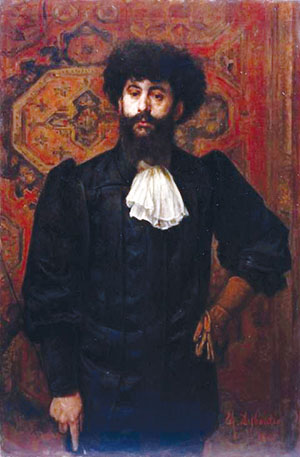
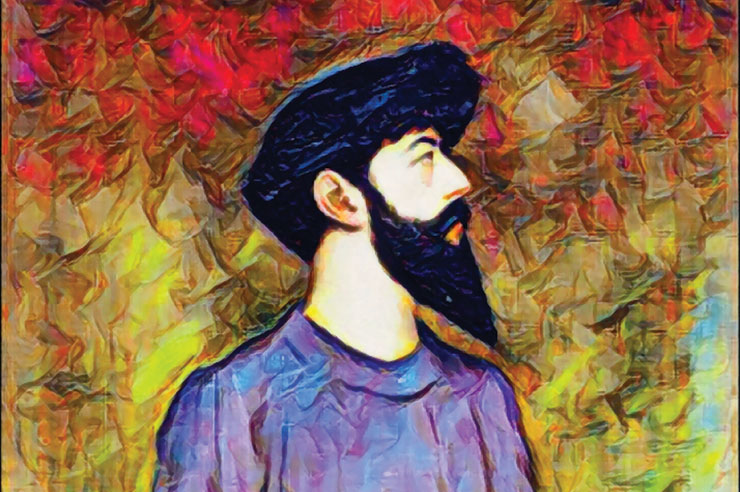
    Portrait of Péladan by Marcellin Desboutin (1891).

    In 1882 Joséphin came to Paris. After a brief period of couch-surfing with friends, he found a job working for the magazine L’Artiste. Jules Bois, a friend of his, reminisced: “He shook his opulent hair above twenty-centime plates of beans at the corner wine merchant. When the cuisine of Paris tired him, he went to decimate the hearts of sentimental provincials. One saw him in a medieval doublet going through the cafés of Marseilles, and he would hide a walking stick beneath his opera cloak so that it looked, under the folds, like a sword.”

    His art criticism, which lambasted the stereotyped Academic style of the period, won him an immediate following, and he added to it by playing the part of a Parisian eccentric. “Do you know what is meant by the expression ‘That man is a character’? Well, a mage is that above all,” Peladan wrote, and he certainly was.

    He’s the man Oscar Wilde was imitating when Wilde went strolling through London in velvet clothes with a drooping lily in his hand. He claimed descent from the kings of ancient Babylon, grew a long square beard in the Babylonian style, and took the Babylonian title Sâr, “prince.” These extravagances aside, his real fame began in 1884 with the publication of his first novel, Le vice suprême (The Supreme Vice).

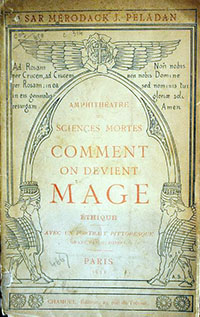
    Lush, erotic, vivid, and bold, The Supreme Vice became an overnight sensation and helped feed the passion for occultism that made fin-de-siècle Paris one of the wellsprings of modern magic. Its main characters, Princess Leonora d’Este and the magus Merodack, act out a process of initiation that Péladan explored in more detail in many other novels and in a valuable instructional text, Comment devient un mage (How To Become A Mage), published in 1891.

    Become an Individual

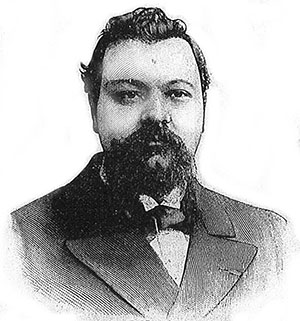
    Gérard Encausse (Papus).

    To Péladan, the point of magic was the creation of the free individual. We are not born individuals, Péladan taught, and our education and upbringing are designed to keep us from achieving individuality. “Society,” he wrote, “is an anonymous enterprise for living a life of secondhand emotions.”

    To become an individual, it is necessary to break free from the mental grip of your culture, and that requires sustained effort guided by a clear awareness that a great deal of what you consider “your thoughts” and “your feelings” belong to society, not to you. That was Péladan’s magic, and it is just as possible and just as important now as it was in his day.

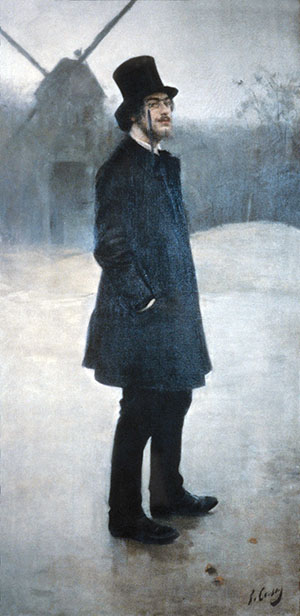
    Erik Satie by Ramon Casas (1891).

    Paris in the late nineteenth century was awash with magical orders and secret societies, and it was inevitable that Péladan would try to bring this vision of magic into one of them sooner or later. In 1888 he joined together with Stanislaus de Guaita, Gérard Encausse (who wrote important occult works under the name Papus), and a circle of other leading occultists to found L’Ordre Kabbalistique de la Rose+Croix (the Cabalistic Order of the Rose+Cross). Differences in opinion, particularly over Péladan’s Catholic loyalties, eventually drove Péladan to break with the others. In 1890 he founded an order of his own, L’Ordre Catholique du Rose+Croix, du Temple, et du Graal (the Catholic Order of the Rose+Cross, the Temple, and the Grail).

    Salons de la Rose+Croix

    With the help of a wealthy patron, Count Antoine de la Rochefoucauld, and a circle of enthusiastic followers, Péladan set out to make as big a splash for his new organisation as he could. Erik Satie, then a rising star in the Paris music scene, became the order’s official composer and wrote three Sonneries de la Rose+Croix (Fanfares of the Rose+Cross) for its meetings. 1891 saw the publication of How to Become a Mage and the “Manifesto of the Rose+Cross.” 1892 brought Péladan’s greatest triumph – the first of the Salons de la Rose+Croix.

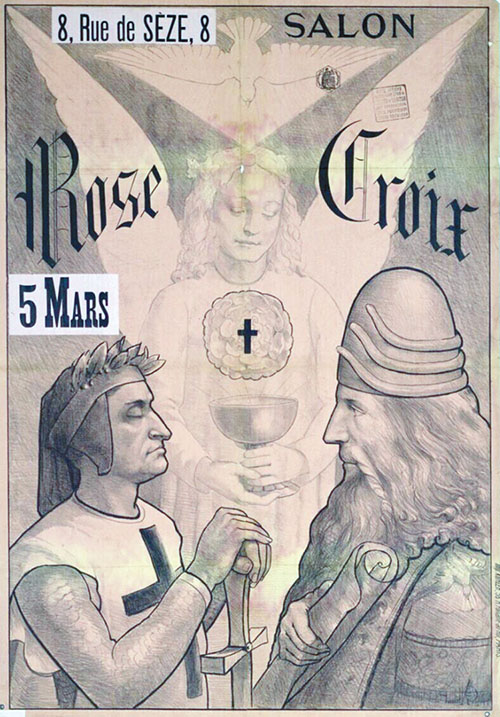
    Lithographed poster by Gabriel Albinet for the 3rd Salon Rose-Croix (1894). 

    At that time, the official Salon, held annually in Paris, was the bastion of Academic art in France. Péladan conceived the plan of sponsoring an alternative Salon under the aegis of his order, providing a venue for the more innovative and esoterically inclined art of the Symbolist movement, which he favoured but which was strictly excluded from the official Salon. His alternative show opened on 9 March 1892 in the Galeries Durand-Ruel, 11 rue le Peletier, Paris. It was a roaring success, proving once and for all that the art being created outside the official salon was far superior to the art produced inside it.

    Anticlimax followed. Péladan’s order sponsored five more Salons de la Rose+Croix, but none of them succeeded as brilliantly as the first. The occult movement in France crested and began to ebb as the political pressures that eventually resulted in the First World War seized the public imagination. Through it all, Péladan kept writing and teaching, turning out novels, plays, essays, instructional works, and pamphlets for an audience that gradually dwindled over time. When he died in 1918, he was nearly forgotten.

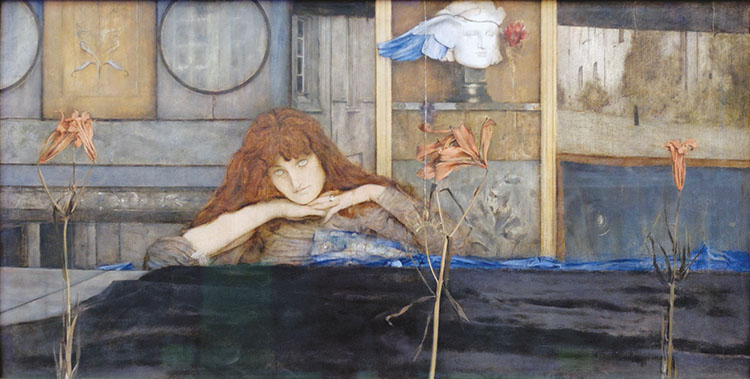
    I lock my door upon myself by Fernand Khnopff (1891). Exhibited at the 2nd Salon Rose-Croix (1893).

    Magic in a Dying Civilisation’s Twilight Years

    All this labour was in the service of an utterly serious purpose. Péladan belonged to that large minority of nineteenth-century thinkers who recognised that the European societies of their day were headed for disaster. What set him apart from the sentimental conservatives of his time and ours is that he recognised that the heritage of old Europe was already past saving and that he worked his magic in the twilight years of a dying civilisation.

    Of course, he was quite correct. The great cultures of Europe, in every sense Péladan would have recognised, died in the trenches of the First World War. The forty years from Sarajevo in 1914 to Dien Bien Phu in 1954 saw Europe’s nations flattened to the ground by two catastrophic wars, overwhelmed by cultural change, and reduced from the status of masters of the planet to pawns in a game of bare-knuckle politics played with gusto by the United States and the Soviet Union. All this made Péladan’s lessons more than usually relevant because the catastrophe he foresaw had a clear magical dimension.

    Read contemporary accounts of the way that Europe stumbled into war in 1914 and it’s hard to miss the weirdly trancelike state of mind in the warring nations, as vast crowds cheered the coming of hostilities that would cost millions of them their lives, and left-wing parties that had pledged themselves to nonviolent resistance in the event of war forgot all about their pledges and swung into step behind the patriotic drumbeats.

    The collective consciousness of the age was primed for an explosion, partly by the sorcery of competing political and economic interests, and partly by the rising pressures of intolerable inner conflicts that were prevented by the limits of the mass mind from finding a less catastrophic form of expression.

    It took an extraordinary degree of mental independence to stay clear of the trance state and its appalling consequences, but that was one of the things the magical training available in those days was intended to do.

    How To Become A Mage

    How To Become A Mage, originally published in 1891

    Péladan was inevitably the most outspoken of the period’s occult writers on this subject, as on so many others, and filled a good many of the twenty-two chapters of How To Become A Mage and long passages in his novels with advice on how to open up an insulating space between the individual mind and the pressures that surround it. Many of the same points, though, are made in quieter ways by other writers of the time, and in the instructional papers of magical lodges of the same period. All this advice is aimed at the social habits of another time and has not necessarily aged well, but the basic principles still stand.

    The first of those principles is to limit and control the channels by which the mass media and their wholly owned subsidiary, public opinion, get into your nervous system. Now, of course, that raises the hackles of quite a few people nowadays, but it’s essential. Mass-produced popular culture exists solely for the purpose of emptying your wallet and your brain, not necessarily in that order. Popular culture is a vehicle for the mass mind; it works, as negative magic always works, by inducing you to think less and react more. Thus, in the strictest sense of the word, it makes you more stupid. That’s not a useful habit to cultivate.

    One point Péladan made that remains valid today is that spending time among a crowd of people whose minds and conversation are utterly conditioned by popular culture is not noticeably different from getting your popular culture firsthand from the media. If anything, this is even more of an issue these days than it was in his; I suspect most of us have had the experience of hearing a conversation between two people in which every single word spoken was a sound bite from some media source or other. There’s no need to become a hermit, but it’s a good idea to choose your crowds with some care.

    Steps such as these will cut down on the influence that the pop culture of our time has over your thoughts, feelings, and decisions. Still, the empty space has to be filled with something better, or there won’t be much of an improvement; this is the second of Péladan’s principles. It avoids the perennial mistake of Romanticism, the notion that all you have to do is fling aside the fetters of social expectations and do what comes naturally. The problem here, of course, is that “what comes naturally” to every one of us is the product of a lifetime spent absorbing social cues from people around us and from the media, all of which triggers unthinking and unconscious reactions we share with our nonhuman relatives: social primate see, social primate do.

    Being who he was and living when he did, Péladan phrased that dimension of the work in terms of art, music and literature, and those are certainly among the available options. If you happen to be a dandy and an aesthete and live in a city with good art galleries, concert venues, and the like, you could do worse than to follow his recommendations – he was particularly partial to Renaissance paintings, German classical and romantic music from Bach through to Wagner, and Shakespeare’s plays – but I don’t recommend copying him and Oscar Wilde and strolling down the streets with a lily in your hand. Their wives clearly had to put up with a lot. (You didn’t know that Wilde was married, did you? Her name was Constance; she was an initiate of the Hermetic Order of the Golden Dawn, the most influential magical order in late nineteenth century Britain; and yes, she did have to put up with a lot.)

    Still, that’s only one option, and the last thing you should do in this sort of practice is rely on someone else’s notions of what ought to feed your mind. “‘Fear the example of another, think for yourself’,” wrote Péladan; “this precept of Pythagoras contains all of magic, which is nothing other than the power of selfhood.” The important thing is simply to choose things to read, watch, hear, and do that you consider worthwhile instead of passively taking in whatever the sorcerers-for-hire of the media and marketing industries push at you. What falls in the former category will vary from person to person, as it should.

    All this seems relatively straightforward, and indeed it’s quite possible to get to the same decision by plain reasoning starting, say, from the shoddy vulgarity of mass-produced entertainment and going from there to the realisation that there’s much more interesting mind food to feast upon. That making such choices also makes it easier to think clearly would, in that case, be merely a pleasant side effect of good taste. The operative mage in training does the same thing deliberately, not just to think clearly but to feel and will clearly as well. As the training proceeds, however, those effects begin to reveal another side, which is their effect on other people.

    Péladan hinted at this effect in How To Become A Mage, though custom in the occult scene back in his time didn’t favour spelling out the details. “Do not look for another measure of magical power than that power within you, nor for another way to judge a being than by the light that he sheds to perfect yourself by becoming luminous, and like the sun, to excite the ideal life latent around you – there you behold all the mysteries of the highest initiation.” What he did not quite say is that “the ideal life latent around you” is in other human beings. Especially in times of cultural crisis, stepping outside the lowest common denominator of the mass mind has an effect rather like induction in electrical circuits. Put another way, it can be as catchy as a lively new tune.

    Get the issue this article appears in

    You can catch that tune, so to speak, from a person; you can catch it from a book, which is why Péladan wrote his twenty-two novels, each of them exploring some aspect of the relation between the initiate and a corrupt society; you can catch it from other sources, the way Rainier Maria Rilke did from a statue of Apollo; you can also catch it all by yourself, by climbing out of collective consciousness for some other reason and discovering that you like the view.

    Far more often than not, those who step out of the collective consciousness of their society promptly jump back into the collective consciousness of a congenial subculture, which from a magical perspective is no better – thinking the same thoughts as all your radical friends is just as much secondhand living as is thinking the same thoughts as the vacuous faces on the evening news – but there’s always the chance of getting beyond that.

    To get beyond that is the central theme of Péladan’s work. His books are readily available on the internet at present, though only a few of them have been translated into any language but French; his ideas remain vital and important. To take up the challenge he offered is to begin working the most powerful magic of all – the creation of yourself as a free individual.

    John Michael Greer wrote the foreword to the first English translation of Péladan’s How to Become a Mage (subtitled A Fin-De-Siecle French Occult Manifesto), published in 2019 by Llewellyn.

    [alert type=”general” dismiss=”no”]This article was published in New Dawn Special Issue Vol 16 No 5.[/alert]

    [alert type=”success” dismiss=”no”]If you appreciate this article, please consider subscribing to help maintain this website.[/alert]

    © New Dawn Magazine and the respective author.
    For our reproduction notice, click here.