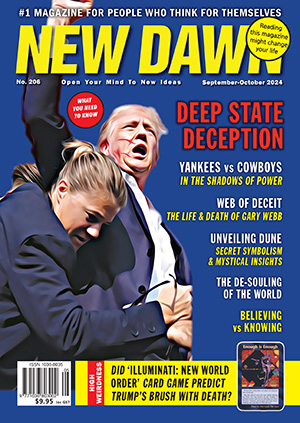
New Dawn – World's Most Unusual Magazine

Author: John Michael Greer

  • Reconstructing the Lost Secrets of Temple Technology: The Word that Made the Fields Flourish

    Reconstructing the Lost Secrets of Temple Technology: The Word that Made the Fields Flourish

    From New Dawn Special Issue Vol 18 No 5 (Oct 2024)

    When we talk about the ancient wisdom, at least in Western cultures, what we’re discussing is a vast heap of wreckage left behind by three savage campaigns of destruction.

    The first of these hit in the twilight years of the ancient world, carried out by religious fanatics after Christianity was hijacked by the Roman elite and turned into an instrument of social control. The second came in the late Middle Ages when the Church hierarchy panicked at the rising tide of independent thought and created the Inquisition to stop free inquiry in its tracks. The third and most recent arrived with the Scientific Revolution when the rising mercantile-capitalist class embraced scientific materialism as its ideology of choice and used its power and wealth to crush alternative viewpoints. It’s a long and bitter story.

    There’s another side to the tale, however. During each of these orgies of violence and oppression, there were people who risked everything to preserve what they could for the future. Afterwards, in turn, small groups of independent thinkers rejected the orthodoxies of their time and set out to recover some of what was lost. In the teeth of outraged resistance from the established institutions of the day and blind hostility from the masses, these succeeded in preserving some of the core teachings and practices of the old mystery traditions and reassembling others from the surviving fragments.

    Imagine for a moment that some immense machine of glass and bronze was battered to pieces by a furious mob and the fragments trampled underfoot so that all that remained were fragments scattered through the gutters of a great city. Imagine that every record of the machine’s structure and function had been destroyed to keep anyone from figuring out how to rebuild it. Now imagine that many years later, you learn of the machine. Inspired by the old stories, you prowl the streets of the city, and when you find something that might once have been a piece of it, you pick it up, take it back home with you, clean off the grime, and then try to figure out how it might fit together with the other pieces you’ve already gathered, and what the shape of the whole machine might have been. This metaphor, taken from John Crowley’s visionary novel Aegypt, may give you some sense of the labour involved.

    That work is still ongoing. Some parts of the ancient wisdom – some pieces of the machine, in terms of the metaphor – have been restored to full working order. Astrology and ceremonial magic, for example, were brought back into use in the nineteenth century, the former pioneered by Alan Leo and the latter by Eliphas Lévi; both can now be learned from many books and teachers, and practised with good results. Other elements of the tradition, such as alchemy and sacred geometry, are still only half-understood. Then there are fragments of the ancient lore that were destroyed so completely and lost for so long that they survive only as hints and whispers or as gaps where something once existed.

    The Lost Word

    One of those gaps lies at the centre of modern Freemasonry. Down through the years, there has been a vast amount of chatter about the secrets of Freemasonry, but there’s a detail that generally gets left out, though it can be found in plenty of publicly available sources: the Freemasons don’t have their original secrets any more. When a member is raised to the sublime degree of a Master Mason, he is told that the words and signs he is given are substitute secrets because the real secrets have been lost. To this day, every Master Mason is, at least in theory, pledged to the quest for the Lost Word.

    What is this Lost Word? Nobody knows – not even the Masons. Of course, there’s no shortage of speculation. Devil worship, political conspiracy, kinky sex, the relics of a prehistoric civilisation on Mars, you name it, no matter how lurid or absurd, somebody has identified it as the Lost Word. Some of the other Masonic degrees pass on words that are supposed to be the Lost Word, but none agree on what it is or why it is so important.
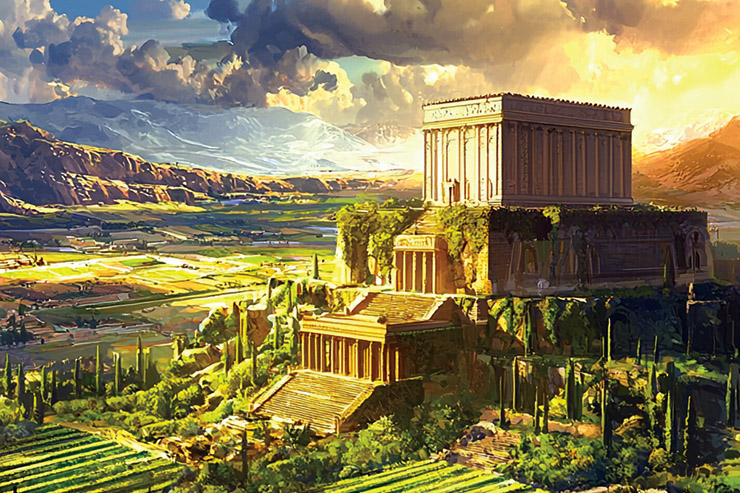
    Let’s go deeper. The Master Mason degree ritual used in regular Masonic jurisdictions today derives from an original that appeared around 1720, three years after the founding of the first Grand Lodge in London. There is no record of who introduced it or where it came from; it simply shows up. It tells a story about the building of the Temple of Solomon, and that story includes – indeed, centres on – the disappearance of the Lost Word and the invention of the substitute secrets, which are to be kept until the real secrets are recovered.

    Thus, it is clear that in 1720, three linked ideas were so important to the most influential Masons of the time that they put them into the Craft’s most important ritual. The first of these ideas was that Masons of some earlier period had known some important secret; the second was that the Masons of 1720 no longer knew what the secret was but thought they had some hope of recovering it; and the third is that it had something to do with the Temple of Solomon in Jerusalem, one of the most famous buildings of the ancient world.

    Power of the Temple

    There’s plenty of information about the Temple of Solomon in ancient Greek, Roman, and Jewish sources, as well as a vast modern scholarly literature on the subject. Most of it is fairly straightforward, but one very odd detail runs through the old sources. This is the claim that while the Temple stood, it caused a remarkable increase in agricultural fertility in the land around it. The Jewish sources go into quite a bit of detail about this: from the time when Solomon built the Temple to its destruction by the Babylonians, the weather and the soil fertility of the region were different. After the destruction of the first Temple, that stopped, but when the second Temple was built by Jewish refugees returning from Babylonia, the effect returned and stayed in place until the Romans destroyed the second Temple in 70 CE.

    The Temple of Solomon isn’t the only ancient temple about which that same claim was made. You can find it in legends surrounding temples over much of the ancient world. Where it occurs, you find certain other things reliably associated with it. The temples are built above underground water sources and their sites have to be chosen by special means. A flurry of odd taboos govern who can or cannot enter and under what conditions. Usually, though not always, they are surrounded by at least a narrow green belt of natural vegetation. Above all, certain rules of alignment and sacred geometry govern their placement and design.

    Geographically, this is a weirdly selective tradition. It doesn’t appear in Africa outside of Egypt, except in a few northeastern African countries that absorbed a great deal of ancient Egyptian culture. It is found all over the ancient Mediterranean and extends east to India and some, but not all, of the island chains further east. Then, it appears in Japan, where it plays a central role in Shinto shrines but not Buddhist temples. Finally, it crops up in the Christian churches of medieval western Europe but is absent from Orthodox Christianity, Islam, and post-temple Judaism.
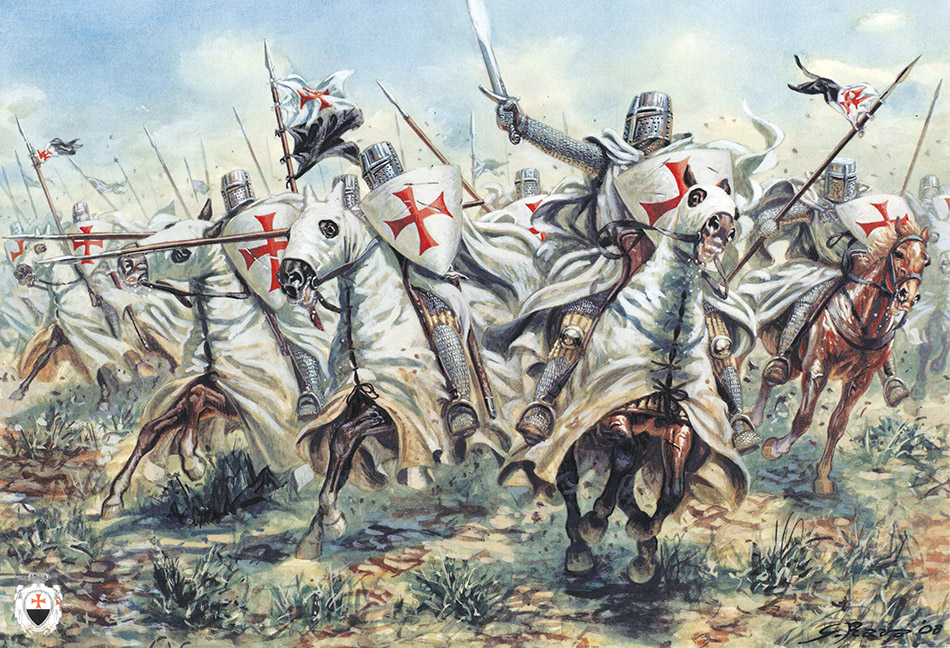
    Painting depicts the Knights Templar in full battle mode.

    Knights Templar

    Western Europe in the Middle Ages apparently knew nothing about it until the time of the Crusades, where the tradition shows up first in churches built by the Knights Templar and spread from there. That turned out to be a clue of immense importance. The Templars – the Poor Fellow-Soldiers of Christ and the Temple of Solomon, to give them their original name – were founded in 1118 by nine French knights who had gone to Jerusalem with the First Crusade. They were dissolved by Pope Clement V in 1311 amid a flurry of charges of heresy and sorcery.

    The Templars got their name because the original nine knights were housed on the Temple Mount in Jerusalem, atop the ruins of Solomon’s Temple; by the time of their abolition, they had landholdings in most of the countries of Europe. When the Order was destroyed, some of the members were burned at the stake and others were transferred to monasteries of less militant orders where they lived out their lives as ordinary monks.
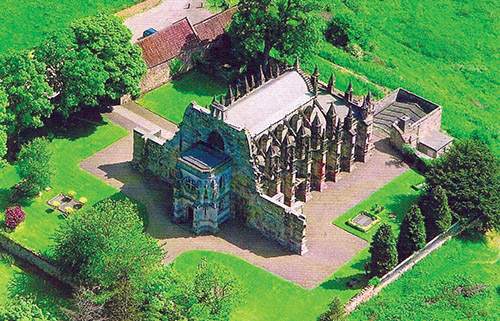
    Aerial view of Rosslyn Chapel in Scotland. 

    There were two exceptions to this. In Portugal, King Dinis created a new order, the Knights of Christ, and had all the Templars in Portugal transfer into it; the Knights of Christ proceeded to play a remarkably active role in the great age of Portuguese navigation, sailing straight to islands in the Atlantic that (in theory) nobody in Europe knew about. Then there was Scotland, where the Pope’s rulings had no force because the whole country just then was under an interdict, and where Robert the Bruce was leading a war of independence against the English and needed every competent soldier he could get.

    The Knights Templar had a significant presence in Scotland at that time; the village now called Temple, located next to the mysterious Roslyn Chapel, was their headquarters in the kingdom, but they also had many other properties and plenty of knights and officials to supervise them. Masonic tradition insists that the Scottish Templars promptly made a deal with Robert the Bruce. They fought for him at Bannockburn and elsewhere, and in return, he protected them from the Church and let them go quietly to ground.
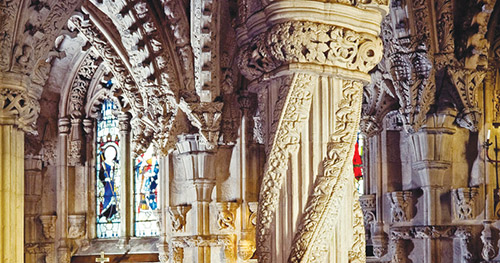
    The Apprentice Pillar with its masonic connotations is the central focus in this photo of the chapel’s interior.

    The tradition proceeds to claim that since the Templars had their own master builders and stonemasons – they had to since they themselves built the castles, churches, and other structures on their landholdings – some of these Scottish Templars ended up supporting themselves as master masons in the original sense of that term, and from that source, certain Templar legacies found their way into Freemasonry. It’s a matter of historical record, finally, that Freemasonry as we now know it, was in existence in Scotland most of a century before it appeared anywhere else.

    All of this is familiar ground to most people aware of alternative history. What deserves attention here are the charges levelled against the Templars when the order was dissolved. Much of it was the same sort of canned libels that would be used later in the witch trials; some of it had intriguing parallels to the actual practice of heretical Christian sects in ancient and medieval times, which deserve more attention than they’ve gotten in the historical literature to date; but then there was the claim that they worshipped a mysterious idol named Baphomet, which made the crops grow. There was the issue of agricultural fertility again.

    Holy Grail

    That issue pops up again in another place at precisely the same time. The oldest known version of the story of the Holy Grail was written around 1190 by Chretien de Troyes, who claimed he’d gotten the story from Count Philip of Flanders, a Crusader who had close connections with the Knights Templar and the royal house of Jerusalem. Between 1190 and 1250 – that is, during the golden age of the Templars – the Grail got massive play in popular literature. They were strange stories, these legends of the Grail; they spoke of a secret passed down through the centuries by hidden guardians, which could only be revealed to those who asked the right question.

    What is the Grail? That was one of the questions those who sought the Grail had to ask. A later generation of authors, heavily invested in mainstream Christianity, insisted that the Grail was the cup Jesus of Nazareth used at the Last Supper and redefined the secrets of the Grail as those of ordinary Christian theology. Go back to the earliest surviving Grail stories, those by Chretien de Troyes or Wolfram von Eschenbach, and you land in a far stranger world where the Grail could take many forms, and its ultimate secret was the power to make the fields flourish. That was why King Arthur’s knights went out in search of the Grail: it alone could restore the barren wasteland to fertility.

    All this happened as sacred geometries and other traditions that were part of the temple tradition elsewhere in the world found their way into medieval European religious architecture. In its wake, monasteries were founded all over western Europe in desolate areas, which promptly became burgeoning agricultural regions capable of supporting not only monks but thriving villages. To this day, all across Europe, you can visit the ruins of long-abandoned settlements from the Middle Ages in barren upland regions that nowadays barely produce enough grass for sheep; old records and archaeological remains alike show that these villages once had thriving fields of grain and other crops – and in the centre of each is a church laid out according to the sacred geometries of the temple tradition.
    Get the issue this article appears in

    Temple technology

    Up out of the darkness of the centuries, like a shape in the mist, rises the dim shape of a forgotten technology – the temple technology, as I came to call it – that was once used by priests and priestesses across much of the Old World to make the fields flourish. Long before the beginning of recorded history, perhaps by sheer chance, perhaps through other means, people in certain parts of the world noticed that buildings of specific shapes built and aligned in particular ways affected the crops grown in nearby fields. Over millennia of trial and error, that original insight gave rise to two kinds of structures.

    One of them uses structures shaped more or less like a stair-step pyramid: large ones, like the ziggurats of Babylon or the pyramids of the Mayas, or small ones, like the earth-deity altars that used to be found in every village in China before the 1949 revolution. The other uses square or rectangular buildings, usually oriented to the rising sun, which seems to have functioned as a resonance chamber. Both kinds of structures were built over certain specific geological features that create electrical discontinuities in the ground.
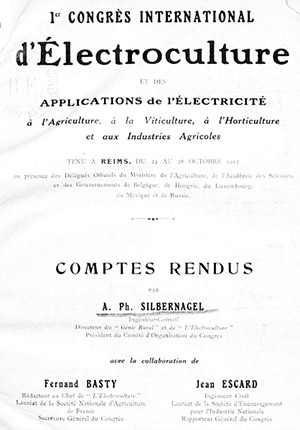
    Early last century, “electroculture” was popular as seen in this literature from the period (see thegardenstrust.blog/2021/09/04/electroculture).

    This matters because there are currents of electricity and lines of magnetic force, closely associated with one another, moving through the body of the Earth. Back in the 1920s, before the chemical industry got a stranglehold on corporate agriculture with their toxic fertilisers and pesticides, experimenters working with these earth currents developed a system called “electroculture” which sent a slight electrical charge through the soil; this resulted in sharply improved harvests. A building properly sited atop an electrical discontinuity in the earth, as it turns out, can build up a substantial charge of telluric electricity, which then streams outward through conductive areas in the soil.

    This was one of the secrets of the Templars, one of the reasons that their landholdings in Europe produced bumper crops year after year to help pay for the Order’s castles in the Holy Land. In past ages, it had been a secret kept by many priesthoods and played a role in many ancient mystery initiations. (The Eleusinian mysteries, to cite only one example, centred on the fertility goddesses Demeter and Persephone, and at the climactic moment of the initiation ceremony, the new initiates were shown a newly reaped ear of grain.) It is one of the secrets of the Grail, and it – or more precisely, a word or phrase passed down from the Templars, probably in garbled form, that once communicated it – is the original Lost Word of the Freemasons. That, at least, is the most likely explanation for the tangled web of evidence that surrounds the old temple technology.

    Like so many of the legacies of the ancient wisdom, the temple technology has been lost. The monasteries that once preserved it in Europe were destroyed in Protestant countries and subjected to the rigid ideological discipline of the Counter-Reformation in Catholic countries, breaking the links by which the knowledge was once transmitted from generation to generation. Elsewhere in the world, three centuries of colonialism, breakneck modernisation, and global warfare have left little intact, though it’s possible that even today, oral traditions at some isolated Indian temple or documents in a remote Shinto shrine might record some of the secrets of the lost temple technology.

    One way or another, however, it is still possible for the Lost Word to be restored and the Holy Grail found. There are plenty of reasons why the global corporate monoculture might want to hide every surviving trace of a simple and scalable technology that uses natural energies and practices linked to traditional spirituality to make gardens thrive and fields bear bumper crops. Every one of those is also a reason why independent thinkers and researchers in today’s rising alternative culture might be interested in finding those traces and following them.

    In terms of the metaphor introduced earlier, this is an important part of the lost machine and one that might be rebuilt and put to work. I can only hope that others will hear the call and join the quest for the Word that once made the fields flourish. 

    [alert type=”general” dismiss=”no”]This article was published in New Dawn Special Issue Vol 18 No 5.[/alert]

    [alert type=”success” dismiss=”no”]If you appreciate this article, please consider subscribing to help maintain this website.[/alert]

    © New Dawn Magazine and the respective author.
    For our reproduction notice, click here.
  • Yankees vs Cowboys

    Yankees vs Cowboys

    From New Dawn 206 (Sept-Oct 2024)

    Most talk you hear these days about the deep state – the interlocking network of multinational corporations, government bureaucracies, and nongovernmental institutions that holds the reins of political and economic power in today’s industrial societies – treats it as a monolithic presence with the discipline of a Nazi division goosestepping past the review stand at a Nuremberg rally. Most of that talk also treats the deep state as omniscient and omnipotent, possessed of knowledge and power so all-encompassing that all its opponents can do is grumble on online forums. 

    There are plenty of reasons why the deep state wants to project these images of itself into the collective conversation of our time. I trust nobody is naïve enough to think, however, that an interest in factual accuracy has any place among those reasons. No ruling class in all human history has ever been that unified, that well-informed, or that powerful – though every ruling class in all human history has tried to make its opponents think that all these things are true. 

    Let’s begin with the obvious. The people who make up the interwoven hierarchies of the deep state aren’t robots or mindless minions. Nor are they nice people. They have clawed their way to their current positions of power in the savagely Darwinian environment of a modern bureaucratic state, in which backstabbing and betrayal are a way of life and a moment’s weakness or kindness is usually fatal. They have climbed a ladder in which each rung is reached by trampling on the faces of less successful rivals. 

    Those at the summit of the deep state are constantly intriguing against each other while fending off attempts by those immediately below them to unseat them and take their place. Those below them face the same struggle with peers and subordinates while simultaneously trying to climb the ladder to the next level. Will they set aside their rivalries to defend the system against its enemies? Yes, but only when this works out to their personal advantage. Give them a chance to better their position at the expense of their superiors or the system as a whole, and they’ll take it. This is one of the reasons that systems like theirs always eventually fall. 

    They face another lethal vulnerability, one that counterculture philosopher Robert Anton Wilson traced out mordantly in his writings: communication is only possible between equals. It’s worth taking a moment to see how this works. Imagine a hierarchy, like any of those that make up the deep state. At every level, you have a superior who lords it over a number of subordinates and whose job tenure and prospects for promotion depend on pleasing his own superiors and keeping his subordinates in line. 

    Now suppose that a piece of information has to make its way up the hierarchy from the people at the bottom, who have direct experience of what is happening, to the people at the top, who have the power to make decisions. At every level, the subordinates have a strong incentive to tell the superior what the superior wants to hear, whether or not it happens to be true. If one subordinate suffers from a sudden lapse of self-interest and tries to pass on an unpalatable truth, the others can be counted on to treat this mistake as a vulnerability to exploit, tell the superior what he wants to hear, and undercut the erring subordinate. Repeat this same process ten or twenty times as the piece of information makes its way from the bottom to the top, and the chance of any of it coming through intact is minimal at best. 

    Now imagine what happens when a piece of information has to go in the other direction, from the top to the bottom. At every level, a similar dynamic applies because the superior has a strong incentive to tell the subordinates what the superior wants the subordinates to believe, whether or not it happens to be true. Apply both these processes at the same time – and they’re both constantly in operation in every hierarchy – and you end up with a situation in which the upper levels of the hierarchy are serenely detached from the actual state of affairs and the orders that come down from above display a more than schizophrenic detachment from reality. 

    If this reminds you of life in today’s Western industrial societies, that’s no accident. The weird disconnect between the pronouncements of politicians and business leaders and the realities that the rest of us encounter is not just a matter of dishonesty on the part of the ruling class. (Of course, they’re lying through their teeth, but it’s more than that.) The people at the summit of the deep state have no clue what’s happening in the world. All they know is what they’re told in their elaborate daily or weekly briefings, which are massaged by whole armies of subordinates who have every incentive to tell them nothing except what they want to hear. 

    These two factors – the constant struggles for power within the ruling classes and the toxic effect of power relationships on communication – form the realities of life in any hierarchical society. They are among the core reasons why empires fall and civilisations crumble, and they explain the explosive political realities surrounding the rise of Donald Trump in today’s America. 

    The Yankee-Cowboy War

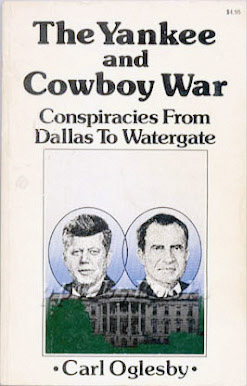
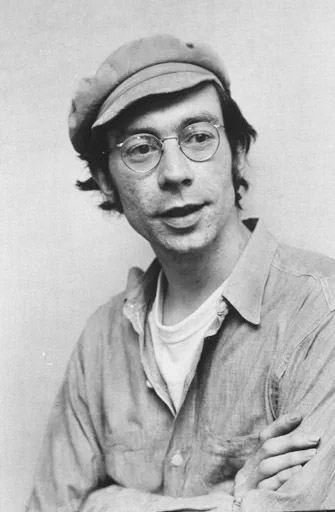
    The crucial role of conflict within the deep state was the central thesis of one of the forgotten classics of alternative politics, The Yankee and Cowboy War: Conspiracies from Dallas to Watergate (1976) by Carl Oglesby. The first president of Students for a Democratic Society (SDS), the most influential American radical group in the mid-1960s, Oglesby was forced out of the group because he rejected Marxism and argued instead for an alliance between radical youth and democratic populists. After his expulsion, he devoted time to researching the assassination of John F. Kennedy (JFK) and the deep structure of political and economic power in the United States. 

    In The Yankee and Cowboy War, Oglesby mapped out the hidden terrain of American power from the Second World War to the election of Jimmy Carter. He showed that beneath the apparent unity of the deep state in those years, a bitter conflict raged between two factions of the ruling class – the old east coast establishment (“Yankees”), oriented toward Europe and drawing their power and wealth from control over international finance, and the new rich of the Florida-Texas-California corridor (“Cowboys”), more interested in Asia than in Europe, and drawing their power and wealth from fossil fuels and the military-industrial complex. 

    Carl Oglesby (1935-2011)

    Oglesby argued that the war in Vietnam was a Cowboy project. When Yankee scion JFK edged out Californian Richard Nixon in the 1960 election and began to move against Cowboy interests, reorienting US foreign policy away from the Pacific Basin, the Cowboy faction treated this as an existential threat. JFK’s assassination, which put the Texan Lyndon Johnson in power, was their response: a coup d’etat against the Yankee faction that handed the levers of power to the Cowboys and signalled full speed ahead for the Vietnam adventure. Yet the Cowboys had no realistic grasp of conditions on the ground in Vietnam. Meanwhile, the Yankee faction responded by fostering antiwar activism on college campuses and using the mainstream media to trip up the Cowboys at every turn. The turmoil of the Sixties was one inevitable result. Another was the coup against Richard Nixon.

    That was the story as far as Oglesby traced it in his book. The rest of the tale is easy enough to outline. Ronald Reagan’s two terms as president marked the triumph of the Cowboys. From that point until the rise of Donald Trump, every US president had a close connection to the Cowboy faction. Notice, however, that the Bush family was an old Yankee family which had relocated to Texas and made connections with the Cowboy elite. This same pattern was underway across the Yankee faction as the old aristocracy cut deals with the new. Meanwhile, the fossil fuel and defence industries became fully integrated with international finance as Cowboy families made their own journeys in the other direction. 

    Frontispiece of the 1977 edition of Carl Oglesby’s book The Yankee and Cowboy War, which dissects a clandestine struggle within America’s power elite, spotlighting the rivalry between the “Yankees” and the “Cowboys.” Written with a particular focus on the role of intelligence agencies, Oglesby’s work connected the JFK assassination and Watergate, framing them as part of this broader elite conflict. His concept of “clandestinism” suggests that conspiracy is an intrinsic part of political power. Oglesby’s theories remain relevant today, reflecting the ongoing tensions between globalism and nationalism in US politics.

    Hillary Clinton was one more interchangeable part from the same bin, raised in an east coast political family but married to a rising Sun Belt politician. Her two terms in the White House were expected to continue policies that had been welded in place for forty years. What neither she nor anyone else in the ruling class had noticed, however, was that the United States was lurching toward an explosion. 

    A Time For Caesars

    Writing more than a century ago, German historian Oswald Spengler anatomised the way that this crisis is playing out. In the history of every high culture, there comes a point at which the ruling class sinks into a kleptocratic stupor in which the last traces of effective leadership give way to a blind pursuit of personal enrichment while the hierarchies through which the ruling class enforces its will become so baroquely complex that no meaningful information can make its way to the top at all. Even if the society is swarming with secret police, that does little since the information gathered by the ordinary working Joes who staff the secret police has less than a tossed coin’s chance of getting to decision-makers. 

    A society in this condition can no longer cope with the challenges that it faces. This is what drives the process that Spengler called Caesarism. Julius Caesar was a high-ranking member of the Roman Republic’s deep state, as insanely rich, financially corrupt, and morally depraved as any of his peers – it was a running joke in Rome during his time that he was every woman’s husband and every man’s wife. Unlike the other members of the senatorial class, however, he realised four things. The first was that the entire Roman system faced disaster if its ruling class continued its kleptocratic feeding frenzy; the second was that ordinary Romans would rally around anyone who took the levers of power away from the ruling class; the third was that some elements of the ruling class would do the same; and the last was that if he took advantage of these things, he could seize unparalleled power. 

    As history shows, he was right. This is why after a cabal of senators assassinated Caesar, the Roman people rose up and drove the assassins and their allies out of Rome. It is why Caesar’s nephew Octavian and his close ally Mark Antony crushed the senatorial party in the war that followed. It is also why, once Octavian and Mark Antony turned on each other and Octavian won, he had himself installed as Augustus, first emperor of Rome, to the wild cheering of Roman crowds. 

    Donald Trump is not Julius Caesar. Nevertheless, the same pattern that put Caesar in power gave Trump his first term in the White House and seems likely to give him a second. The American ruling class, Yankee and Cowboy factions alike, long ago forfeited the trust and respect of the American people. More recently, they have become hated, and in the last few years, they have come to be despised. That opens the way for the same overturning of the political establishment that Caesar began and Augustus completed. 

    A very large number of Americans – quite possibly a majority at this point – are sufficiently disgusted by the antics of their self-anointed leaders that anyone who takes the levers of power away from them can count on robust public support. Significant figures among the rich and influential can be expected to rally around any such project. If Trump did not exist, in other words, someone else would have done the same thing he did – and if he is removed, there’s no shortage of others ready to take his place. 

    The End of Empire

    The revolution from within that Julius Caesar and Augustus carried out in ancient Rome is even more likely in today’s America because the American empire that emerged out of the Second World War is running on fumes. Dependent on distant countries for essential resources, burdened with a vast bureaucratic sector and an economy so riddled with graft and incompetence that it can no longer accomplish such basic tasks as providing munitions for its proxy wars, the United States is stumbling toward terminal crisis. 

    The ongoing war in Ukraine is a glaring example. When that began in February 2022, the United States and its allies placed their trust in punitive economic sanctions, which were expected to cripple the Russian economy and force Russia to its knees. Apparently, nobody in Washington DC considered the possibility that other nations interested in undercutting the US empire might have something to say about that. Of course, that was what happened. China, which has the largest economy on Earth in terms of purchasing power, extended a middle finger in the direction of Washington DC and upped its imports of Russian oil, gas, grain, and other products. So did India, currently the third largest economy on Earth, as well as more than a hundred other countries. 

    For many decades, the threat of being cut out of international trade by US sanctions was the big stick Washington DC used to threaten unruly nations that weren’t small enough for a US invasion or fragile enough for a CIA-backed regime change operation. Two years ago, that big stick turned out to be made of balsa wood and snapped off in Joe Biden’s hand. The result is the first shockwave of a massive rebalancing of global wealth that is already transforming the world. 

    Until the era of the European global empire, the economic heart of the world was in East and South Asia. India and China were the richest countries on the planet, and half a dozen other nations, from Japan to Iran, were also major economic powers. The great age of European conquest temporarily diverted much of that wealth to Europe, impoverishing Asia in the process. That began to break down with the collapse of European colonial empires after the Second World War, but some of the same arrangements were propped up by the United States thereafter. Now, those are coming apart, and Asia is rising in response. By next year, in terms of purchasing power, four of the five largest economies on the planet will be Asian. The fifth is the United States, and it may not be on that list for much longer. 

    The consequences will reshape the lives of everyone on the planet, but their impact will be especially harsh here in the United States. Roughly five per cent of the human race currently live in the United States of America. That very small fraction of humanity, until quite recently, got to enjoy about a third of the world’s energy resources and manufactured products and about a quarter of its raw materials. That didn’t happen because nobody else wanted these things. It happened because America’s global empire funnelled a disproportionate share of the planet’s wealth to one nation. 

    As those arrangements break down, the five per cent of us in the United States will have to go back to living on about five per cent of the planet’s wealth, as we did before 1945. If we still had the factories, the trained workforce, the abundant natural resources, and the thrifty habits we had back then, that would have been a wrenching transition but not a debacle. The difficulty, of course, is that we no longer have those things. The factories were shut down in the offshoring craze of the 1970s and 1980s, when the imperial economy slammed into overdrive, and the trained workforce was handed over to malign neglect after that. 

    Get the issue this article appears in

    We still have some natural resources, but nothing like what we once had. The thrifty habits? Those went whistling down the wind a long time ago. In the late stages of an empire, exploiting flows of wealth from abroad is much more profitable than trying to produce wealth at home, and most people direct their efforts accordingly. The result is the typical late imperial economy, with a governing class that flaunts absurd levels of paper wealth, a parasite class of hangers-on that thrive by catering to the very rich or staffing the bureaucracies of the deep state, and the vast majority of the population impoverished, sullen, and unwilling to lift a finger to save their so-called leaders from the consequences of their own actions. 

    It is still possible for the United States to pull out of its current power dive. “Possible,” however, is not the same thing as “easy.” Our government, most of our corporations, and a great many of our wealthier citizens have run up debts so gargantuan that they can never be paid off. A federal debt default is a certainty sooner or later. So is the bankruptcy of most large American corporations, especially in the FIRE (finance, insurance, and real estate) sector. US troops will have to come home from the hundreds of overseas bases where they currently prop up proxy regimes of various kinds. US allies in Europe and the island fringes of East Asia will have to make their own arrangements for defence. Very little in global affairs will remain unchanged. 

    There is no evidence that Donald Trump, the circle of upper-class dissidents that surrounds him, or the cheering crowds that attend his rallies understand all this. Trump seems to realise, however, that the United States can no longer afford its global military footprint, its gargantuan government bureaucracies, or the attitudes that justify these and cater to the vast lumbering dinosaur of the deep state. Such policies are inevitable sooner or later – and the sooner they take place, the more it will be possible to salvage from the smoking rubble of the American experiment. 

    [alert type=”general” dismiss=”no”]This article was published in New Dawn 206.[/alert]

    [alert type=”success” dismiss=”no”]If you appreciate this article, please consider subscribing to help maintain this website.[/alert]

    © New Dawn Magazine and the respective author.
    For our reproduction notice, click here.
  • Suppressed Economic Systems

    Suppressed Economic Systems

    From New Dawn Special Issue Vol 17 No 4 (Aug 2023)

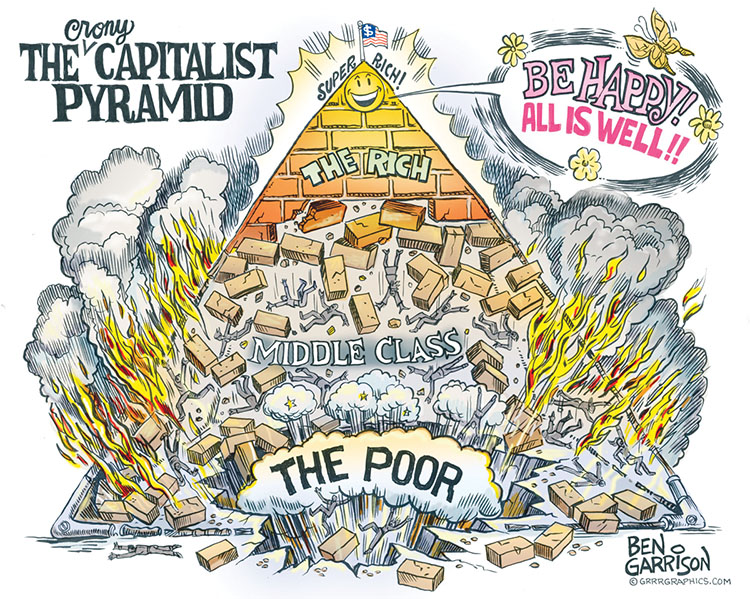
    Listen to debates about economic systems in today’s corporate media and you can count on hearing that the only possible options are capitalism, socialism, or some ungainly hybrid of the two.

    You have to pay close attention to figure out that by “capitalism” and “socialism,” the media’s talking heads mean something much more specific than the dictionary definition of these words. There are many kinds of capitalism and many kinds of socialism, but you won’t hear that mentioned these days. Nor will any of the approved voices in schools or the media admit for a moment that there might be other choices outside the two officially approved options.

    Gimmicks like this are standard practice in today’s disinformation-rich mental environment. The strategy is always the same. From an entire alphabet of options, the talking heads insist that L and M are the only two that matter and then tell half the population about all the problems with L while the other half hears all about how bad M is. Before long, the people who are afraid of L will rally around M, the people who are afraid of M will rally around L, and nobody will notice there’s a whole world of options from A to Z that they could choose instead. Meanwhile, the people who profit just as easily from L as from M are laughing all the way to the bank.

    That’s the delusion that has our economic life in its grip. The only kind of capitalism that gets talked about in the media, the schools and the conventional wisdom is corporate capitalism – a system in which vast corporate bureaucracies control the economy. The only kind of socialism you can expect to hear about, in turn, is state socialism – a system in which vast government bureaucracies control the economy. Since elite insiders circulate freely from corporate to government bureaucracies and back again, it’s a distinction without a difference.

    Genuine alternatives would take economic activity out of the hands of both sets of bureaucrats and put it back into the hands of individuals where it belongs. Does that seem hopelessly utopian? For most of human history, that’s how economic affairs were managed. The Tweedledum and Tweedledee of corporate capitalism and state socialism is a very recent creation. Less than a hundred years ago, most people knew there were other possibilities. It’s past time for a reminder that things can be different.

    In the paragraphs below I’ll discuss a few of the alternatives.

    Three Alternative Systems

    Cooperativism. This approach has already been put to work over much of the world with excellent results. The only reason you haven’t heard about it is that the people who profit from society as it is don’t want you to. As the name suggests, cooperativism is a system in which cooperatives – voluntary associations of individuals – own and control the mainsprings of economic life. There are two categories of cooperatives in a cooperativist system, worker cooperatives and consumer cooperatives, and they each deserve a few words of explanation.

    Worker cooperatives are already found all through the world’s industrial nations; most worker-owned companies (and there are a lot of those) are run this way. In a worker cooperative, the employees own the business and elect a board of directors that hires and fires the people who fill corner-office roles. There are many ways to run a worker cooperative, each with its own strong and weak points. If you look into the print and online literature on cooperative organisation you can find ample information on the options, and many countries have associations of cooperatives that are eager to help new co-ops get started.

    Consumer cooperatives are less common than they used to be, but you can still find them, and you can also start them. The simplest form of consumer cooperative is a buyers club, in which a group of people buy groceries and other wholesale products and split the cost, cutting out as many middlemen as possible. Once a consumer co-op gets going, if its members want it to expand, it can add members, raise the money to open a storefront and mutate into a consumer-owned store. Again, the members elect the board of directors, which does the hiring and firing.

    A cooperativist system would look almost identical to what we see in the industrial world today, except that it would be run for the benefit of everybody. There would still be factories, stores, and the rest of it – but the profits would go to the people who work in the factories and shop in the stores, not to a kleptocratic elite, and management would be answerable to the workers and shoppers, not to the same elite class. The result? Economic democracy.

    Distributism. This system was created by Christian thinkers who paid attention to the way that centralisation of the means of production leads to economic problems. Distributists recognised that Marx was right to criticise the idea of putting ownership of the economy in the hands of a tiny minority of rich people but wrong in thinking that things would improve by handing control of economic assets to a tiny minority of well-connected government officials. The distributist idea is that the best way to get the engines of economic activity into the hands of workers is to see to it that each worker owns his or her own means of production.

    The main focus of distributism is using public policy to maximise the number of small businesses in the economy. In a distributist system, farming is in the hand of small-scale family farms, and most businesses are sole proprietorships or small partnerships. That spares businesses the need to pay for the corporate bureaucracies that eat up so much value these days, and it also maximises job creation – small businesses on average are far better engines of job creation than big ones. All this may sound thoroughly retro, but these days there’s a movement of technodistributists who argue that modern technology makes factories an anachronism and propose a radical decentralisation of work empowered by the latest technology.

    How best to encourage the distribution of the means of production is a topic that’s generated a great deal of debate in distributist circles. E.F. Schumacher, the dissident economist whose book Small is Beautiful was a central guide to economic alternatives before it got memory-holed by the system, pointed out that much of the problem lies in the deliberate production of excess complexity, which keeps small businesses from competing with the big corporate players. A focus on simpler technologies, less bureaucratic regulation (which always favours big firms over small ones), and an end to government subsidies for big firms – these steps can tilt the playing field in favour of small firms and distribute the means of production to the producers.

    Social Credit. This has nothing to do with the Chinese “social credit” system, and it wouldn’t surprise me if the Chinese system was given its English name to keep people from looking into the original. A century ago, everyone knew about social credit. It was the most promising alternative economic system being discussed at the time, and its fans ranged across the political spectrum from Catholic socialist Dorothy Day on the left to arch-conservative author J.R.R. Tolkien on the right.

    Social credit was worked out by a British economist and engineer, C.H. Douglas, who paid attention to the role of debt and credit in driving the wildly unbalanced distribution of wealth in capitalist societies. He showed that businesses under corporate capitalism inevitably pay out less in wages, salaries, and dividends than the value of the goods and services they produce. Add that up across the board, and it’s mathematically impossible for consumers to buy everything the economy produces without running up unpayable debt. That’s what drives economic crises and makes corporate capitalism hopelessly unstable.

    There’s a great deal more to the system, but a rough sketch of the practical consequences is that under social credit, banking is a public utility rather than a for-profit industry; banks are publicly owned, and they provide money the way public utilities provide water and electricity, without generating debt in the process. (Do we really want the government to pay rich people for the privilege of issuing currency? That’s what today’s system of money creation amounts to.) Under social credit, there’s also a national dividend paid out annually in equal shares to every citizen to make up for the imbalance in purchasing power so that consumers can afford to consume everything that producers produce.

    Are cooperativism, distributism, and social credit the only alternatives to the mess we have now? Not at all. There are many others. Put a little time into researching alternative economic systems and you’ll find plenty of options other than corporate capitalism and state socialism. The sooner that fact starts to filter through the crawlspaces of today’s society, the sooner the momentum for change will start to build.

    Worlds Beyond Money

    The systems we’ve discussed all assume a money-based economy like the one we have today. A more radical option starts with recognising that too much economic activity depends on money. At most other points in history, the majority of people produced much of what they consumed by their own labour, using resources and tools they owned and controlled, and so most economic activities went on without money being involved. The household economy is one good example of this. If you cook for yourself, grow your own vegetables, and do your own home repairs, for example, that contributes mightily to your welfare but it doesn’t involve money changing hands.

    That’s why industrial nations have done everything they can think of to convince people to abandon the household economy. If a transaction involves money, after all, the government can demand its share, and plenty of corporations have a chance to extract a profit from it as well. If you produce goods and services for your own use, by contrast, nobody profits from your labour but you. If you do the same thing for your family, again, government and corporate grifters are cut out of the loop. In most economically healthy societies, something like half of all value is produced in the household economy: that’s a lot of production freed from the grip of a corrupt and abusive bureaucratic system.

    We can take things further than this, however. In The Wealth of Nations, Adam Smith criticises the notion – as common in his time as in ours – that money is the same thing as wealth. He points out that a country’s wealth consists of the product of its natural resources and collective labour. In another place, though, he defines wealth as anything that can be valued in money. These definitions don’t conflict with one another; rather, they make the crucial point that money is not wealth. It’s the yardstick by which modern cultures measure wealth. This ought to be the first thing we teach children about money, though of course it isn’t.

    One major problem we face in today’s industrial economies is that the yardstick has been fiddled with to prop up the power of a bureaucratic elite. It may well be possible to come up with a yardstick less vulnerable to fiddling – that’s what the cryptocurrency movement is trying to do. It’s also possible, however, to carry on a great deal of economic activity without bringing money into the picture at all.

    This is something that every economic textbook in print tries to trick you out of realising. That’s what lies behind the explanation for why we use money, which appears in textbooks somewhere near page 6. It runs like this. There’s a plumber and a pig farmer who want to do business with one another, see, but the plumber’s Muslim and the pig farmer has nothing to trade but pork. Add money, and voila! The farmer sells his pork to other people and uses the proceeds to pay the plumber, who uses it to buy halal meat. Everyone’s happy – well, except for the pigs.

    It all seems very logical until you think about it for ten seconds. Notice how the explanation assumes that the plumber, the pig farmer, and everyone else only have a single economic function. The plumber doesn’t, as most people did a century ago, grow some of his own food in his own back garden. The pig farmer doesn’t, as most people did until even more recently, do most of his household repairs himself. Both of them are defined by a single function: the pig farmer can only produce pork, the plumber only plumbing. That’s why the pig farmer somehow never thinks of raising lambs in a spare pasture so that he has something to trade to the local Muslim community, and the plumber never thinks of having his share of pork sent to a non-Muslim doctor, say, to pay for his family’s medical care.

    All the textbook explanation proves, in other words, is that if you have a money economy, it probably does need some kind of money to make it work. It’s not surprising that this isn’t the explanation textbooks draw from it, of course. Whenever you use money, you pay rent for the privilege; some of the rent is called interest, some is called taxation, and there are plenty of other forms that the rent takes, but it all amounts to the elites and their bureaucracies taking an unearned cut of every economic transaction, and getting rich on the proceeds. Thus the schools and media have every reason to try to convince people that there are no alternatives.

    Get the issue this article appears in

    From Here to There

    Corporate capitalism, state socialism, and the uneasy mix of the two that’s standard in most industrial countries these days have a tight grip on most economic activity. Getting free of them won’t be a quick or easy process. However, most of us can take some steps away from the current system right now, and many of those have an immediate payoff.

    The first and most important of these is to pay attention to your own economic choices and notice how often you’re being tricked into spending money. Remember that when you do something for yourself, you get all the value produced by your labour; if you spend money for it instead, other people extract a cut. Put a few minutes into calculating how much time you spend working to earn a dollar, and then ask yourself – is what they’re trying to talk you into buying worth that many minutes or hours at your job? Most of the time, no, it’s not.

    It’s also worth finding out what skills your friends, family members, and other people you know have, and see if it’s possible to barter with them for goods and services. In healthy societies, a huge amount of economic activity takes place by exactly this sort of informal exchange – person A does garden work for person B in exchange for a haircut, person C cleans person D’s house once a week in exchange for bottles of homebrewed beer, and so on. While you’re at it, if you’re short on skills that will give you something to barter, learn one and get good at it.

    Many people are convinced they can’t do this sort of thing because they have so little free time outside of work. I’ll give you a hint: working for an employer isn’t your best bet since employers profit by giving you as tiny a share of the value of your labour as they can get away with. If you work for yourself, you’ve got a much better chance of keeping the value of your labour. During the Covid shutdowns, many people figured this out, which is why the authorities in so many countries are yelling about labour shortages right now. Contribute to the labour shortage by finding a way to make a living without being somebody’s employee, and you’ll also be contributing to a better world.

    You can also use your own choices to help support alternative economics. There are plenty of worker-owned cooperatives these days; you can buy from one instead of handing over your money to their corporate rivals. There are plenty of sole proprietorships and small businesses along the distributist model, too; support those instead of big corporations and everyone but the kleptocrats benefit. For that matter, a buyers club can enable you, your family, friends, and neighbours to get things at wholesale prices, cutting another batch of corporate grifters out of your life. Social credit isn’t scalable in the same way, but it and the other alternatives can be pursued in another way: by getting the word out.

    The most important step, after all, is to help other people find alternatives to the mindless drudgery and exploitation that the current economic system provides to its inmates. Corporate capitalism and state socialism aren’t the only possible economies; they’re the options that allow today’s elites to rake in the most unearned wealth, but that’s only an advantage to the elites. Look into other options, learn about them, and spread the word. That way lies a less abusive, more creative, and more humane form of economic life.

    [alert type=”general” dismiss=”no”]This article was published in New Dawn Special Issue Vol 17 No 4.[/alert]

    [alert type=”success” dismiss=”no”]If you appreciate this article, please consider subscribing to help maintain this website.[/alert]

    © New Dawn Magazine and the respective author.
    For our reproduction notice, click here.
  • America at the Crossroads: Trump’s High-Stakes Battle Against Systemic Collapse

    America at the Crossroads: Trump’s High-Stakes Battle Against Systemic Collapse

    From New Dawn Special Issue Vol 19 No 2 (April 2025)

    As I write these words, Donald Trump has been President of the United States for just over a month. Most of the voters who put him into office are delighted by what his administration has accomplished so far. The exceptions are those who don’t think he’s done enough to slash the permanent bureaucracy of Washington, D.C., or those who are disappointed that arrests and trials haven’t happened yet.

    His opponents in the bureaucracy, the corporate media, and the classes that support the former status quo in the United States are yelling in predictable outrage, but the sound and fury has so far signified very little. Trump’s quick action against USAID, which funded most of the protests and legal challenges that made his first term so difficult, seems to have dealt a body blow to the opposing side.

    Outside the circles of Trump’s supporters and opponents, however, a great many people seem to be baffled by the speed at which Trump’s administration is moving and the unexpected nature of some of his initial targets. Even among his supporters and opponents, not many people seem to have grasped the logic of his moves or the agenda that lies behind them. Now, of course, quite a bit of that lack of comprehension comes from the bad habit, common on all sides of today’s politics, of treating complex struggles as though they were third-rate Star Wars knockoffs.

    Most of us are wearily familiar with this habit. No matter who’s speaking and how much privilege they have, the side they favour is always supposed to be the heroic rebel alliance and the side they detest is just as inevitably the evil empire. Approaching anything from so simple-minded and cartoonish a perspective as this is a good way to be blindsided by the obvious.

    Donald Trump is no more the Emperor Palpatine than he is Luke Skywalker. Instead, he’s a smart and ambitious member of the American ruling elite who saw an opportunity, took advantage of it, and – like so many people in the last decade – was radicalised by the dysfunctional and abusive behaviour of a system in terminal crisis.

    Most people recognise that the industrial nations of the West are in trouble. Few have grasped just how deep that crisis goes, much less come to terms with the consequences. Donald Trump appears to be one of the exceptions. Whether he’s had the necessary insights or simply listens to people who have done so, he’s taking actions that only make sense if the predicament of our time is understood clearly. To grasp that, however, we’ll need to glance over some theory.

    The Threat of Catabolic Collapse

    As I explained two decades ago in my paper “How Civilizations Fall: A Theory of Catabolic Collapse,” the reason civilisations fall is a direct consequence of the process through which they rise. Societies of every kind grow by building up what economists call “capital.” This simple word embraces every product of economic activity that can be used to foster more economic activity. Obviously, a factory building is capital, and so are the tools inside it, whether hand tools on workbenches or industrial robots and the computer system that runs them. Roads are capital, so are the vehicles that drive on them, and so are the oil wells, refineries, pipelines, and petrol stations that keep those vehicles fuelled.

    Capital also takes less concrete forms. A trained workforce is capital, and so are the hospitals where children are born, the schools where they become productive members of society, and all the other things they need to reach adulthood and join the labour force. Scientific laboratories are capital, so is the knowledge that comes out of them, and so are the libraries, journals, and websites that make that knowledge available. Markets are forms of capital, and so are the practices and ways of thinking that make them work. So, it bears noting, are bureaucracies.

    Anything can be capital as long as it can be used directly or indirectly to produce more wealth. Of course, capital can be used efficiently or inefficiently. It can even fail to produce any wealth at all if it’s poorly managed. It remains capital as long as it can be used to produce wealth. Again, bureaucracies come to mind here.

    The downside of capital is that it has to be maintained, and maintaining it requires the same inputs as the production of new capital. In this way, the cost of maintaining existing capital competes with all the other requirements of economic life, from putting food on tables to research that might open up new possibilities for the future. When the burden of maintaining existing capital becomes heavy enough, societies face a stark choice between abandoning some of their existing capital and going under.

    This choice becomes even more difficult when economic activity depends on something other than capital: in the terms I used in my essay, resources. Like the word “capital,” the word “resources” here covers a lot of territory. It includes everything that comes into the economic process from outside. Fossil fuels and metal ores belong in this category, obviously enough. In addition, and crucially, the resource base for a society includes things produced by economic activity in other societies if those things are brought into the resource base by some means other than fair trade. The plunder seized by conquering armies becomes part of their nations’ resource base. So does wealth seized by less obvious means – for example, the transfer of wealth from client states to an imperial nation through the latter’s control of the global reserve currency.

    What makes resource dependence a trap is that most resources are unsustainable, and the more concentrated and valuable they are, the more unsustainable they tend to be. Conquering armies can only plunder a kingdom so many times before there’s nothing left to loot. An imperial nation that uses its currency to extract wealth from client states will find itself in the same predicament, though it takes a little longer. Fossil fuels and metal ores deplete as they are extracted, and the costs of continued extraction climb steadily while the output falls.

    Steady economic growth thus requires the replacement of resources with capital. Farmers found this out centuries ago when they discovered that they had to maintain their soil to keep it fertile; in terms of the model we’re using, they turned a resource into capital and got sustained yields in exchange for paying the maintenance costs of the soil. In exactly the same way, we provide tax credits for families with children rather than importing slaves from conquered nations; the workforce of a nation is a form of capital and has to be maintained.

    Relying on capital rather than resources is thus a strategy with a long shelf life, but it has costs. Relying on resources is cheaper in the short run, but once the resource base is depleted, the society that takes that route is in deep trouble. It can only maintain economic activity by treating its capital as resources, cannibalising it in order to keep the economy going a little longer. The result is catabolic collapse – the process by which falling societies consume their capital in the process of going under.

    That’s what the United States is facing today.

    On the Brink of Catabolic Collapse

    A society that has become dependent on extracting resources from outside itself rather than using its own carefully managed capital to drive economic activity has few options once the limits to resource extraction start to bite.

    The first thing almost every society tries in this situation is to find new resources to exploit. That attempt can be made through territorial expansion as when an empire that has drained all the portable wealth from its existing provinces conquers a neighbouring kingdom not yet stripped of wealth. It can be made through technological innovation, as when the invention of the steam engine turned coal from a mildly useful fuel to the essential energy source of an age.

    The quest for new resources can be pursued in other ways, but all of them have a fatal drawback: the law of diminishing returns. Sooner or later, the empire conquers and loots every kingdom within reach – which was what happened to the Roman Empire. Sooner or later, for that matter, the scientific thought of every civilisation runs up against its own limits and those of its environment, and it becomes harder and harder to replace natural resources as fast as they’re being used. This is an important part of what’s happening to industrial society today. Each of the other options has similar drawbacks.

    When the quest for new resources fails, catabolic collapse comes within sight. The next step failing societies take, once resource intake starts falling off, is to neglect to pay the maintenance costs for whatever existing capital is considered expendable. That frees up wealth for more crucial needs, but it always brings costs of its own. Nor is the leadership of a failing society necessarily a good judge of what capital is actually expendable.

    Crisis arrives when declining resource inputs and malign neglect of capital maintenance combine to send the economy into a crash dive. Facing disaster, few elites can resist the temptation to cannibalise existing capital as though it were a resource base. This simply postpones the inevitable for a little while at the cost of making the decline more severe.

    As crisis follows crisis, more and more of the society’s capital gets used up in the struggle for survival, leaving a dwindling capital stock to support all other economic activity. This is the process that turns thriving societies into small communities of shell-shocked survivors huddled in the ruins of an earlier age. It’s the process that turned the Roman Forum into a goat pasture and left the great Mayan cities to be overgrown by the jungle.

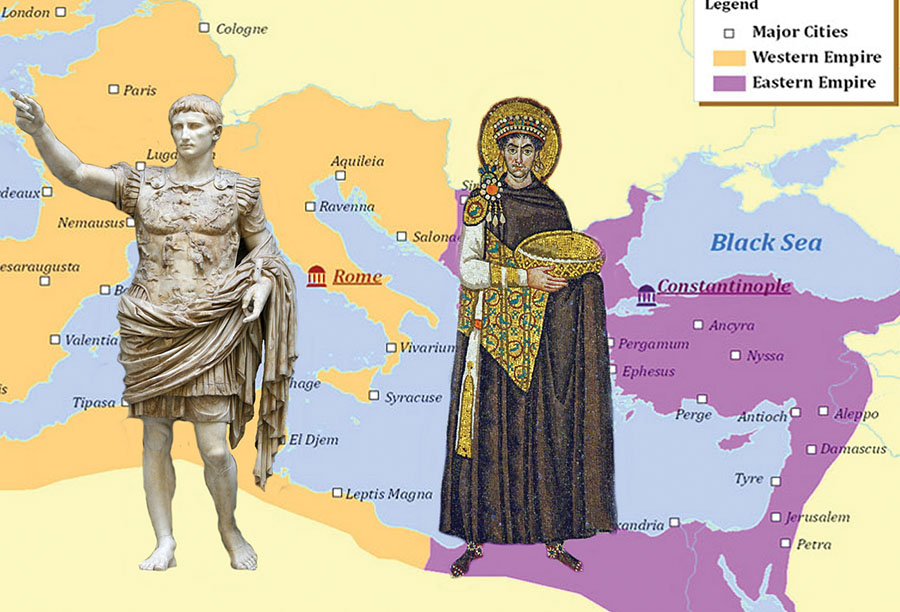
    The eastern half of the Roman Empire survived the crisis that overwhelmed its western half by cutting it loose, abandoning all the capital in that half of the empire, including the city of Rome itself. It survived for a thousand years after Rome fell.

    As a society approaches catabolic collapse, only one strategy works to pull out of the dive before it’s too late. A very large amount of capital has to be abandoned as quickly as possible, slashing maintenance costs and freeing up the remaining capital for productive uses. This is how the eastern half of the Roman Empire survived the crisis that overwhelmed the western half. By cutting loose the western Empire, which had most of Rome’s threatened borders, and abandoning all the capital in that half of the empire – including the city of Rome itself! – the eastern half, which accounted for most of the economic production, freed up enough of its own capital to survive for a thousand years after Rome fell.

    This, in turn, is what Donald Trump and his administration are trying to do in the last inglorious days of America’s imperial adventure.

    The End of American Empire

    The United States came out of the Second World War in a position of unique global power. Unlike any of the other major combatants, it had kept its homeland secure from bombing raids or outright invasion; its industries accordingly dominated the global economy, and its abundant natural resources gave it even more economic clout; in 1950, it bears remembering, the United States produced more crude oil than the rest of the world put together. That position of power made it easy for American elites to use the wartime Bretton Woods agreements to make the dollar central to global trade and impose a form of “stealth imperialism” on most of the rest of the planet. So vast was the flood of resources this brought into the American economy that for most of the second half of the 20th century, the 5% of the global population that lived in the United States consumed one-quarter of the world’s energy input and natural resources and one-third of its manufactured products.

    The history of the last fifty years has been shaped by the unravelling of those arrangements. The reasons for that unravelling would have been painfully familiar to any Roman statesman. Attempts to get more resources for the US by invading Iraq, for example, worked no better than the Roman attempt to get more resources by invading Parthia. Malign neglect accordingly spread through the American economy as maintenance costs of capital were neglected: the dismal state of US roads and bridges, the shameful condition of its educational system, and the ragged but ongoing declines in measures of public health are among the symptoms of this process.

    As the third decade of this century began, the only viable option for the long term was for the United States to get out of the empire business, jettison its imperial commitments overseas, cut the gargantuan bureaucracy that had grown up around its imperial project, and retool its economy to live within the means of its still bountiful territory. Unfortunately, this was not something the elite groups in control of the US political system were willing to consider. Even more unfortunately, they thought they had an alternative: the conquest of Russia.

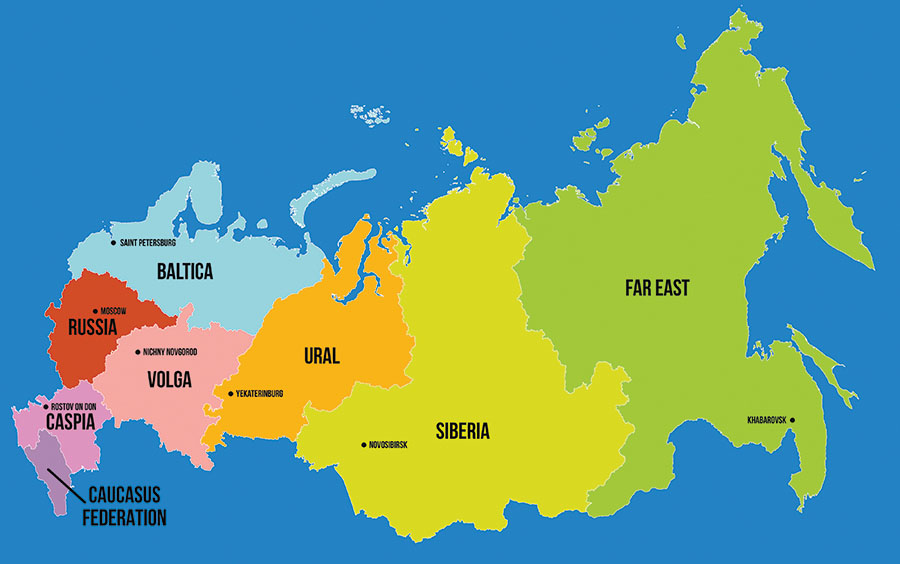
    That has been the subtext to American and European elite manoeuvrings in eastern Europe for decades, especially since 2014 when the US and its allies staged a coup in Ukraine, overthrew its elected government, and put in a new government hostile to Russia. Look at the publications of American and European defence think tanks and you find the plans for all this, complete with maps showing the weak and vulnerable successor states into which Russia was to be partitioned. Those successor states would then be absorbed one after another by the European Union so that Russia’s lavish natural resources could be plundered efficiently by Western multinational corporations and used to prop up the failing American imperium.

    Western defense think tanks envisioned the Ukraine war as a pathway to Russia’s collapse, with its territory fragmented into weak successor states. Instead, their miscalculation strengthened Russia, bringing it closer to victory. This geopolitical failure set the stage for Donald Trump’s inevitable triumph in the 2024 US election.

    The fatal weakness of the plan became clear in the months after the Russo-Ukrainian war broke out in 2022. Western elites assumed that they were still dealing with the brittle mess that Russia had become in the immediate wake of the Soviet Union’s fall. Their expectations were fatally past their pull date. After initial fumbles, the Russian military found its feet and settled into a war of attrition, the kind of conflict at which Russian forces have always excelled. Meanwhile, even with lavish subsidies from the West, the Ukrainian forces failed to mount strategically effective counteroffensives and were driven back across the Donbass by the Russian onslaught.

    That, more than anything else, made Donald Trump’s victory in the 2024 election inevitable. The policies set in motion by the Washington establishment under Obama and pursued with increasing desperation under Biden have failed. Accordingly, a substantial faction of American elites turned to the one remaining alternative and rallied around Trump. The changes now underway in Washington, D.C., and around the world are the first steps in the massive realignment that such a change, of course, requires.

    Get the issue this article appears in

    The Struggles Ahead

    The task facing the Trump administration in the months ahead is roughly twofold. The first and easiest half consists of trimming the US federal government to a size that can be sustained by the more limited budget of a post-imperial America. To some extent, this is made easy by the sheer scale of fraud, corruption, and misuse of funds in Washington, D.C., and also by the metastatic growth of administrative staff in federal bureaucracies, most of which can be cut without the least impact on the actual functions of government.

    What the political slang of an earlier time called by the endearing label of “pork” – that is, expenditures that benefit politicians and their cronies rather than serving any useful purpose – also make up a huge share of the federal budget. Eliminating pork from the budget altogether is almost certainly out of reach, but it can be trimmed substantially. All of this will free up wealth that can be used to maintain and rebuild the nation’s neglected capital.

    The more challenging half of the work consists of the retreat from overseas empire. The most obvious target for cutting here is out of reach for reasons rooted in domestic politics. The nation of Israel only survives because it is propped up by lavish US subsidies, but the United States has a larger Jewish population than any other country on earth, and the American Jewish community is well-organised enough to have an outsized effect on elections. Until and unless that changes, subsidies for Israel will remain sacrosanct in Washington, D.C.

    America’s other erstwhile allies lack that protection. Western Europe is especially vulnerable, partly because its nations no longer have large émigré communities in the United States that identify with the “old country,” partly because the elites of the western European nations remain overcommitted to the failed project in Ukraine, but also because of those same elites’ shrill hostility to Trump and his policies. At a time when the EU no longer has access to cheap Russian resources and is losing its neocolonial grip on sub-Saharan Africa, alienating the leadership of the US is not exactly a smart move for the EU, but no law of nature requires politicians to make good decisions.

    One way or another, the age of the US global empire is ending. If the Trump administration succeeds in its project, that end may be much less traumatic for American citizens than it would otherwise be. At the same time, that project faces robust opposition in the United States and abroad, and its success is not guaranteed. Therefore, the next few years are guaranteed to be a tumultuous time with an uncertain outcome for America and the world.

    [alert type=”general” dismiss=”no”]This article was published in New Dawn Special Issue Vol 19 No 2.[/alert]

    [alert type=”success” dismiss=”no”]If you appreciate this article, please consider subscribing to help maintain this website.[/alert]

    © New Dawn Magazine and the respective author.
    For our reproduction notice, click here.
  • The Crown and Ancient Rites of Kingship

    The Crown and Ancient Rites of Kingship

    From New Dawn 199 (Jul-Aug 2023)

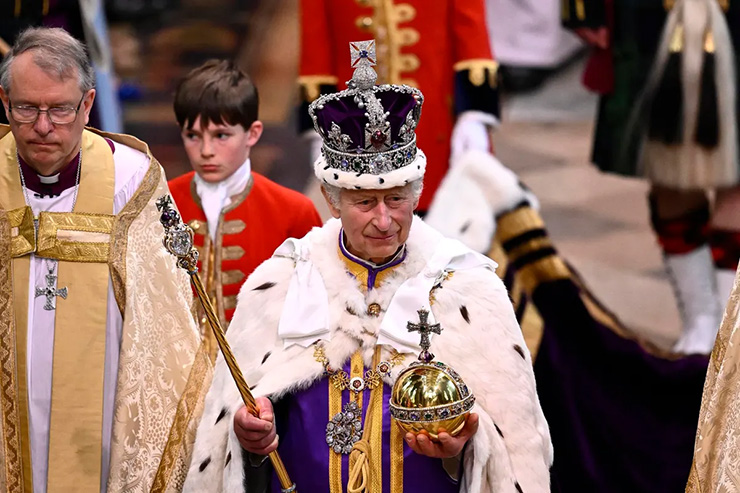
    “MAN IN HAT SITS IN CHAIR.” That was British satire magazine Private Eye’s mock-commemorative headline for the coronation of Charles III on May 6 of this year [2023]. That sarcastic phrasing expresses a common attitude in an era when most people in Western societies habitually think of symbolism and ceremony as a collection of irrelevancies. 

    A little attention to the writings of Carl Jung could have helped with that. So, on a grimmer plane, could a little attention to the way that Hitler and his inner circle deployed potent symbols to take control of the collective imagination of Germany and weaponise it in a quest for world power. 

    Symbols matter, and ceremonies – which are the active mode of symbolism – matter even more, if they’re crafted and performed by people who know what they’re doing.

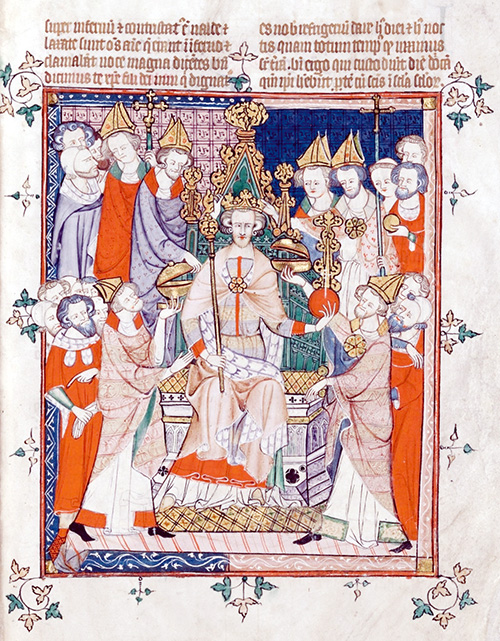
    Edward II enthroned at his Coronation, 1308.

    What makes the coronation of a British king particularly worth watching in this context is that its symbols and actions are not recent inventions. Of the remaining royal families of Europe, Britain is the only one that retains its ancient coronation ritual. All other European monarchies have discarded the old rites in favour of some more modern and less symbolically potent set of formalities. 

    The ceremony enacted in Westminster Abbey for King Charles and Queen Camilla, by contrast, was based on the text preserved in the Liber Regalis (Royal Book), a volume in the collection of Westminster Abbey which was prepared for the coronation of Edward II in 1308. That ritual in turn was a revision of the one drafted by Saint Dunstan for the coronation of Edgar, King of the West Saxons, in 973. Like the British monarchy itself, the coronation ceremony dates back to an era when the power of symbolism was much better understood than it is today. 

    Ancient Pagan Kingships

    To understand the rite enacted in Westminster Abbey on May 6 of this year it’s necessary to grasp the ancient nature of kingship itself. The Old English word cyning, the source of the word “king,” literally means “son of the kindred” or “kinsman.” The equivalent Old English word cwen, the source of our word “queen,” means simply “woman.” In ancient times the king was the kinsman, the queen the woman; their central task was to represent the men and women of their tribe in the presence of the gods. 

    Thus kingship was not originally a political office. Its central roles were spiritual and symbolic. In both the Celtic and the Germanic regions of old Europe, the king was seen as the husband of the land, typically portrayed as a goddess who had the power to give or withhold the harvest, and also the right to give or withhold the gift of sovereignty that created a king. The queen functioned as the representative of the goddess of the land in certain important rituals. 

    Like most of the old Pagan traditions, these deities had a profoundly local dimension, reflecting the small scale of local political structures. In old Europe, each tribe had its own king and queen, and the tribes in question were rarely large; kingships were thus common and widely distributed. When the Romans arrived, for example, Britain had dozens of kings, and Ireland in the early Dark Ages had more than a hundred. 

    Such political issues as might arise on so small a scale typically got settled by debate among a council of elders – the witenagemot, as it was called in Old English – or via the less orderly route but more decisive route of single combat and blood feud. 

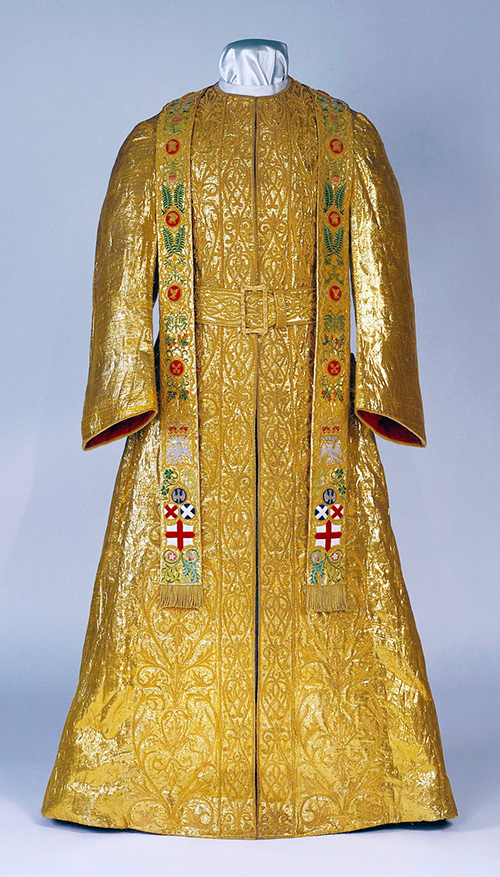
    King George V’s Coronation Supertunica, also worn by King George VI, Queen Elizabeth II and King Charles III.

    Far more important to the collective life of the tribe than such passing squabbles was the maintenance of good relations between the people and the land, and this was the king’s central task. He was subject to curious taboos: the kings of the Franks, for example, were forbidden from cutting their hair, and the Mabinogion tells of one Welsh king who was forbidden from setting his feet on the ground, and had to have them held above the floor on formal occasions by a virgin. Such magical rules were considered essential to the king’s religious duties, which allowed him to mediate between the gods, the land, and the members of his tribe. 

    All this shaped the ceremony by which the new king of a tribe received the kingship. That ceremony was divided into several distinct stages. First, the members of the tribe gathered together at the traditional place for king-making, which was very often a burial mound or some other place hallowed by the presence of the honoured dead. There the new king was brought out by the tribal elders and presented to the tribe’s members for acclamation. 

    In many of the old kingships, any healthy man who belonged to the royal family could become king if the elders and people agreed to support him, and there was often a great deal of jockeying among potential candidates and their supporters to win the support of influential families and communities. 

    It might also be necessary for the king-to-be to satisfy a ritual or magical requirement to prove his right to the kingship. In Ireland, for example, the high kings of Tara were expected to place their foot on a sacred stone, the Lia Fáil or Stone of Destiny, which traditionally shouted in joy when trodden by the rightful king. Other tribes and nations had their own traditions along these lines. An oath to the people of the tribe, swearing to carry out the duties of the kingship, was often a feature of this stage as well. 

    The second stage of the ceremony was a symbolic wedding between the new king and the local earth goddess. At the heart of that process was a ceremony in which the queen, as representative of the goddess, presented a cup of mead or some other sacred beverage to the king. Sharing a cup of mead, beer, or wine was also the central act in ordinary wedding ceremonies in those days, and it had many other functions in the societies of the time. Readers of the Anglo-Saxon epic Beowulf will recall the scene in which the hero is welcomed to the hall of King Hrothgar, and Queen Wealhtheow brings a cup of mead to the king, then takes it to the others present at the feast. It is over the cup that Wealhtheow brings to him that Beowulf swears to slay the monster Grendel or die in the attempt. 

    Once the new king was married to the goddess of the land, the next stage of the ceremony could begin. Here the new king was given a symbolic weapon, most often a spear, and also received whatever other insignia of kingship his tribe traditionally used. Crowns of the modern type were a medieval innovation, but special headgear for kings dates back to ancient Egyptian times, if not before, and other ritual items might be involved as well. Finally, all the members of the tribe pledged their loyalty to the new king, and a feast followed. 

    None of these ceremonies were empty formalities. Through them, the new king became the cyning, the representative of the kindred, through whom the all-important link between the tribe and the land was symbolised and reaffirmed. Through the ritual of king-making, the tribe refocused and strengthened its own identity and its relationship to the land that supported it. 

    Christian Ceremonies of Anointment

    The traditions of the ancient kingships thus had potent links to the Pagan faiths of old Europe. Once Christian missionaries succeeded in establishing themselves in the tribal kingdoms of western Europe, the religious dimension of kingship became a source of constant friction. For centuries, even in kingdoms that became nominally Christian, archaic Pagan rites and practices remained common under a thin veneer of the new religion, and the rituals of kingship were among the places where the legacy of the older faiths remained most deeply rooted. 

    To the tribal peoples of the time, the ceremonies that made a king out of an ordinary man were essential not only to political stability but to the all-important relationship between the people and the land. Centuries passed before the Church succeeded in inserting their own ritual practices into the coronation ceremonies. In the end, they could only do it by placing one of the most jealously guarded of all their holy rites into the hands of royalty. 

    This was the ceremony of anointment, a central part of the ancient sacramental traditions of the Christian church. Three kinds of sacred oil are used in traditional Christian ritual. One is the “oil of the infirm,” which is used to bless sick people and also has a central role in the sacrament of extreme unction for the dying. The second is the “oil of the catechumens,” which is used to bless infants and converts before baptism and is also used to anoint the palms of candidates for the priesthood during the ceremony of ordination. 

    The third and most sacred is chrism or holy oil. A drop of this is placed on the baptised person’s head after the cleansing with water, another drop is applied to the head during the confirmation ceremony. It is also used in the ceremony for consecrating bishops, the rite that passes on apostolic succession – the direct lineage and contact of power that connects every properly consecrated bishop with one of the twelve apostles of Jesus of Nazareth. In each case, the sacred oil sets the anointed person apart, charging them with spiritual power. 

    Beginning in the Dark Ages, Christian bishops set out to replace the ancient Pagan rites of king-making with an equivalent from their own tradition. Anointment was the only ceremony solemn and powerful enough to replace the Pagan marriage of the king to the local earth goddess. The Christian clerics who set out to get this change accepted gained considerable support from the Bible since the Old Testament describes the prophet Samuel anointing Saul and then David as kings of Israel. 

    To win the support of the kings and their half-Pagan peoples, however, they had to permit a form of anointment that went beyond anything that Christian clerics could expect for themselves. Where priests are anointed on the palms alone, and bishops are anointed on the crown of the head, kings are anointed on the hands, head, and heart. Where the Church had enough power, the oil of catechumens was used for this royal anointing, but the monarchies in England and France were strong enough – and sufficiently willing to challenge the Papacy – that they succeeded in winning the right to be anointed with sacred chrism. 

    The first European king known to have been raised to the kingship by anointment was the Visigoth King Wamba of Spain, who was anointed by the bishop of Toledo during his coronation in 672. In 751, when Pepin I seized the throne of France from the last of the Merovingian kings, he relied on the approval of the Pope and anointment with the sacred chrism to justify his coup d’etat and the overthrow of centuries-old Frankish tradition. The ritual that was used for Pepin and his successors was one of the texts Saint Dunstan drew on when he put together a Christian coronation ritual for the kings of England two centuries later. 

    Christian clerics had important allies in their quest to strip Pagan legacies from the kingships of Europe. Ambitious men in several European countries dreamed of displacing the old tradition of sacred monarchy in order to seize supreme political authority for themselves. That was what motivated Pepin I when he overthrew the sacred Merovingian kings and placed his own Carolingian family on the throne. Similar motives in those same years guided the efforts of the Uí Néill clan to press their claim to the high kingship of all Ireland. Over the course of the early Middle Ages, as a result of these machinations, the tradition of anointment gradually supplanted the older rites and became the spiritual heart of the coronation ceremony, while a Christian communion service was also inserted to replace the older Pagan rituals.

    Get the issue this article appears in

    A Twenty-first Century Coronation

    More than a thousand years have passed since Saint Dunstan drew up the English coronation ritual, but a surprisingly large share of the archaic rite of kingship could still be seen in the coronation of Charles III. It is interesting to note, to begin with, that the kings of Britain have gradually circled back to a status similar to the one their ancient equivalents held. Charles is not a political leader in any sense that matters. He no longer runs the government or leads the army into battle; instead, he is the titular head of the Church of England and the ceremonial head of the country. His role is symbolic and spiritual, not political. 

    The gathering of the tribe at the traditional site of coronation, the first stage of the old rituals of kingship, is still very much a part of the current ceremony. Westminster Abbey has been the place of English coronations since the time of William the Conqueror. In the usual way, the Abbey is a burial place of the honoured dead, though of course it is considerably more ornate than the grass-covered burial mounds that so often served the same function in ancient times. 

    The first stage of the ritual, the presentation of the new king to the members of the tribe, also followed the usual pattern. Charles walked from the west end of the Abbey to the site of the coronation in the east and was greeted by the traditional cries of “Vivat Rex!” (“Long live the King!”) from the scholars of Westminster School. He was then presented to the assembled people by the Archbishop of Canterbury, and the crowds responded with “God save the King!” The coronation oath came next, followed by the first half or so of the standard Anglican Communion service. 

    The coronation chair, the ancient throne of the kings of England, was then set in its place facing the altar. Beneath the seat is the Stone of Scone, on which Scottish kings were crowned; claims dating back to the Middle Ages have it that this is the Lia Fáil, the stone that was once used at the crowning of Irish kings on the Hill of Tara [for more on the Stone, see the article in New Dawn Special Issue Vol 17 No 3]. When Charles removed his crimson robe and sat on the coronation chair, the stone did not shout for joy. We can be sure from this that he is not the rightful king of Ireland – a detail that doubtless came as no surprise to the Irish. 

    There followed the anointment, the most solemn part of the entire ceremony. A screen held up by four Knights of the Garter concealed Charles from public view as the Archbishop of Canterbury anointed him on head, hands, and heart with blessed oil, the current Anglican substitute for the traditional Catholic sacred chrism. 

    Once the anointment was finished, the screen was taken down and Charles was clothed in robes made of cloth of gold. He sat again in the coronation chair and was given the regalia of his office. The spear that was once handed to kings in ancient times has been replaced by a pair of short ornate staffs, a sceptre and a rod topped with a dove. One item, however, still echoes the archaic ritual: a symbolic wedding ring by which Charles was married to Britain. Here, changed to reflect current wedding ceremonies, we see the ancient symbolism of the king as husband of the goddess of the land. The crown and other pieces of royal hardware followed, reaffirming Charles’s new status as cyning of Britain. 

    Once Charles was crowned, the next stage of the old ritual unfolded as he was seated on a new throne and received pledges of loyalty from the archbishops and bishops of the kingdom, followed by members of the royal family. Traditionally all the peers of the realm then pledged their loyalty to the new monarch. This step was omitted in Charles’s coronation, but British government media encouraged those of Charles’s subjects who were watching the proceedings on television to make such a pledge. Thereafter Camilla was anointed and crowned in a much briefer and less formal process. The rest of the Communion service then proceeded to its end, and the royal couple left to appear on the balcony at Windsor Palace in the traditional way, showing themselves to the assembled tribes of Britain. 

    From the common modern point of view mentioned earlier, all this is simply an atavistic throwback to the habits of a distant age. Here again, though, that attitude misses the importance of symbolism and the potent influences of the deep places of the mind that symbolism alone can influence. 

    By enacting once again the ancient rites of kingship, King Charles III, the British government, and the British people, all reaffirmed for good or ill the collective identity of Britain as a society with millennial roots and charged the symbols of British identity with the emotional energy and cognitive commitment that ceremonies so powerfully call forth. 

    The extraordinarily long reign of Elizabeth II meant that most people now living had never witnessed the rites of British kingship in action. It remains to be seen what impact the ancient ceremony will have on Britain and the nations of the British diaspora as the world stumbles forward into a new and challenging era. 

    [alert type=”general” dismiss=”no”]This article was published in New Dawn 199.[/alert]

    [alert type=”success” dismiss=”no”]If you appreciate this article, please consider subscribing to help maintain this website.[/alert]

    © New Dawn Magazine and the respective author.
    For our reproduction notice, click here.