From New Dawn 111 (Nov-Dec 2008)
Vast shadowy forces are moving in Central Asia – or rather in the greater region we call Eurasia – which may change the face of our global society and civilisation forever.
Even as the balance of geopolitical forces is shifting inexorably in favour of the Eurasian superpowers – principally Russia, China, the Central Asian states and India – a new spiritual wind is blowing out of Inner Asia and its many hidden mystical schools, promising to sweep the new entente into unprecedented heights of international power, politically and culturally. The immensity of the coming turbulence occasioned by this shift from West to East is incalculable, the outer symptom of a global revolution of consciousness.
Already the transformation of consciousness accompanying this hemispheric shift is creating both exaltation and unease in all people sensitive to evolutionary change. As the West moves through increasing economic and geopolitical tumult towards what many regard as a birthing into a new World Age, pressing questions are being asked. What are we mutating into and what kind of social realities will replace those we know? The mystery and the terror is not so much the speed of change as its unknown destination. Where are we heading? To what precipice sheer and awful, or to what blessed landfall?
Striving to answer such questions, many leading esotericists today have turned to certain very ancient traditions to throw light on the crisis of our times. Increasingly heeding the overwhelming evidence for their thesis, they suggest that the key to humanity’s future lies in its distant past, in the heritage of an unknown antediluvian race that lived in a time so remote that its existence has been erased from racial memory.1
A Forgotten Race
Perhaps 100,000 years ago or more, so the hypothesis runs, a great star-gazing Ice Age people lived in the Arctic region, at that time a temperate zone, before migrating south to Inner Asia as conditions changed and the great ice sheets melted. There, in a fertile, paradisaical land, these unknown sages became the core of a Ural-Altaic race that continued to evolve over the millennia, improving the stock of primitive humanity by intermarriage, developing cosmological sciences and political structures that sowed the seeds of our present civilised state, migrating across the earth and then disappearing, leaving immortal legends about itself behind.
The British author John Michell cites the massive evidence for such a civilisation, which he regards as essentially magical, and still faintly visible across the earth for those who care to look:
The entire surface of the earth is marked with the traces of a gigantic work of prehistoric engineering, the remains of a once universal system of natural magic, involving the use of polar magnetism together with another positive force related to solar energy. Of the various human and superhuman races that have occupied the earth in the past, we have only the dreamlike accounts of the earliest myths. All we can suppose is that some overwhelming disaster… destroyed a system whose maintenance depended upon its control of certain natural forces across the entire earth.2
Michell is one voice among many claiming that in the archives of prehistoric peoples a forgotten race has left traces of an advanced body of knowledge, seemingly both spiritual and technological, which can guide us, if we will, into a viable future.
Despite being ignored by mainstream historians and anthropologists, this theory is being ever more insistently put forward by highly accredited researchers as evidence for the enormous age of our species continues to be found not only in the legends of races in every part of the planet but also in the thousands of technological anomalies being unearthed in unlikely geological strata.
The ancient Greek historians had much to say on this subject, especially concerning the legends of Asia Minor which told of the descent thereto, in the depths of the Ice Ages, of the Hyperboreans, a mysterious race of superior beings from polar regions whose Pillar works on earth sought to mirror the starry heavens above. Yet it is Central and Inner Asia further to the east, a vast land of steppes, mountains and sandy deserts, whose people preserve the most significant memories of a time beyond telling when cities populated the deserts and an Elder race walked tall on the earth. And it is these Ural-Altaic regions that are now taking centre stage as the search continues for the roots of homo sapiens and the path into a viable future.
Arkaim: A Bronze Age Town in the Southern Urals
In 1987, in the middle of the Russian steppe, a team of Russian archaeologists unearthed the ruins of a fortified town called Arkaim, causing great excitement in scientific ranks and a surge of neo-pagan and nationalist enthusiasm among Russian intellectuals. The region was known to have preserved landmarks of the most diverse cultures, ranging from every epoch and every direction of the compass, but Arkaim was the first clear evidence of an ancient advanced culture flourishing on Russian soil.
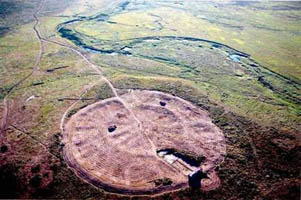
Constructed on a circular principle around a central square, with about sixty semi-dugout houses built within its ramparts, the settlement was situated in the southern Urals, near the Russian city of Chelyabinsk. It was defended by two concentric ramparts of clay and adobe blocks on a wooden frame, and could only be entered via four intricately constructed passageways that would have made the entrance of enemies extremely difficult. The inhabitants and the common central square were thus well protected by Arkaim’s defensive, inward-turned ground plan. The town was found to be closely aligned to several celestial reference points, and is therefore believed to have been an observatory as well as a fortress, an administrative and a religious centre.
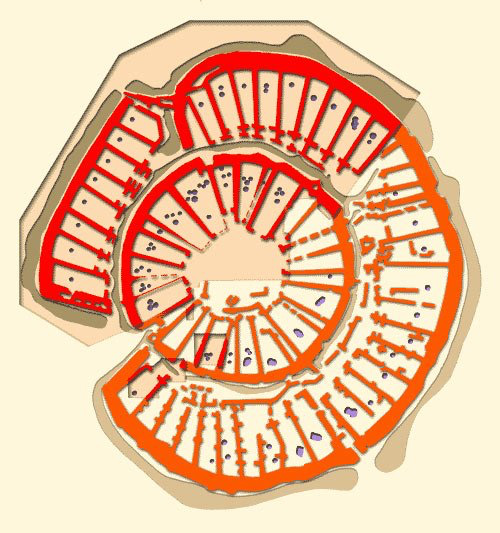
Dubbed “the Russian Stonehenge,” this Bronze age settlement was about 3,600 years old and was contemporaneous with the Cretan-Mycenaean civilisation, with the Egyptian Middle Kingdom and with the Mesopotamian and Indus valley civilisations, and older by several centuries than Homer’s fabled Troy, whose circular layout it so closely resembled. Arkaim was inhabited for 200 years and was then mysteriously burned down and deserted.
The Russian team’s explorations showed that Arkaim enjoyed an advanced technology for its time. It was equipped with a drainage gutter and storm sewage system and had actually been protected from fire: the timbered flooring of the houses and the houses themselves were imbued with a fireproof substance – a strong compound the remnants of which can still be found in the ruins. Each house gave onto an inner ring road paved with wooden blocks; and in each house there was a hearth, a well, cellars, an oven and provision for a cooled food storage system. The oven was such that it may have been possible to smelt bronze in it, as well as to fire pottery.
Subsequent to this exciting excavation, more than another twenty fortified settlements and necropolises were unearthed in the Arkaim Valley, some stone-built, larger and more impressive than Arkaim. With Arkaim possibly its capital, the complex came to be called the Land of Cities and presented scientists with many mysteries. It was the first concrete evidence of a lost neolithic civilisation in southern Russia, confirming what had long been believed, that the southern Urals and northern Kazakhstan, situated at the junction of Asia and Europe, was an important region in the formation of a complex Aryan society.
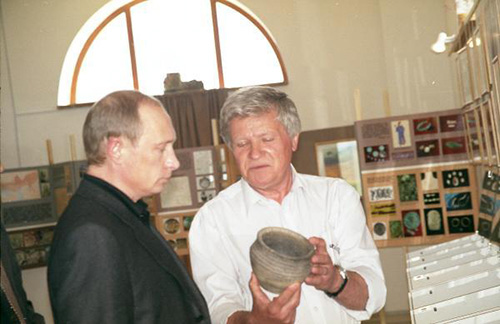
A possible light was thrown for the first time on the development, nature and wide migratory pattern of early Indo-European culture, and stimulated all sorts of theories in Russian circles about the Aryan roots of the Slavic people.3
This, however, has been only the beginning of the quest for a new ethnic, cultural and religious identity in a small but influential Russian minority since the demise of the Soviet Union. Increasingly rejecting the American and European vision of a global hegemony rooted in Western Christianity, Russians, besides their interest in their Indo-European roots, are turning eastwards to find a connection with the Turkic/Mongol ethnic strain. Many, especially among the young, are already embracing the mystique of a united Eurasian people and community cemented by spiritual bonds far older than those of Christianity or Islam. Arkaim has become a ready focus for these ideals, a symbol of the future basis for world peace.
Ar-ka means sky, and Im means earth, says Alex Sparkey, a Russian writer. He explains that this means Arkaim is a place where the Sky touches the Earth. Here the material and the spiritual are inseparable.
The East and the West are fused here. Today, in Russia, we feel that Mankind is faced by the necessity to choose Oneness. Western culture must come into unity with Eastern wisdom. If this can happen, the harmony that once reigned supreme in the Land of Cities will be restored.4
In fact, it is doubtful whether peace and harmony existed in the period of Arkaim, since it and the surrounding fortified settlements were obviously geared to warfare or at least to heavy defensive measures in a hostile environment. It is noteworthy that the cult of Tengri, the Mongol/Turkic Sky God who plays a prominent part in Central Asian religion, fosters a fierce competitive nationalism rather than peaceful relations with neighbours. However, Sparkey is right to emphasise the principle of harmonious accord implicit in the Arkaim ideology, pointing as it does to the settlement’s inheritance of a once more peaceful culture.
The head of the archaeological team observed:
A flight above Arkaim on board a helicopter gives you an incredible impression. The huge concentric circles on the valley are clearly visible. The town and its outskirts are all enclosed in the circles. We still do not know what point the gigantic circles have, whether they were made for defensive, scientific, educational or ritual purposes. Some researchers say that the circles were actually used as the runway for an ancient spaceport.5
The truth is that Arkaim was a troy town, so-called after the city in Asia Minor that the Greek king Agammenon destroyed during the Trojan Wars. Built on the same circular principle as Troy, as described in Homer’s Iliad, but at least six hundred years older, Arkaim finds its prototype in Plato’s Atlantis with its three concentric circles of canals; in legendary Electris, the Hyperborean city some said was built under the Pole Star by the sea-god Poseidon; and in Asgard, the sacred city dedicated to the Norse god Odin that is described in the Icelandic saga, the Edda. All these legendary troy towns have the same circular ground plan. They have gone down in history as neolithic Wisdom centres and the seats of ancient god-kings, and this undoubtedly throws light on the cultic function of Arkaim in its day, as we shall see.
In Russia’s more mystical quarters there is intense interest in the ancient town, seeing it as the city temple built by the legendary King Yama, ruler of the Aryans in the Golden Age, which will once again become the centre of the world.6 However, the discovery of the settlement has opened a historical aperture onto far more than the battles and conquests of an aggressive Indo-European people waged across Eurasia and south into the Mediterranean lands, where their war chariots shattered the peace of Old Europe. What the Land of Cities has revealed in its very structure and history is above all the still earlier past of the Ural-Altaic peoples – a past of such enormous antiquity that it presents more mysteries than it solves.
Built in the unique architectural mould of nordic Asgard, the most sacred shrine of the Aesir of which the Prose Edda relates that “men call it Troy,” Arkaim may have been a shrine dedicated to the Aryan Sun religion, yet the roots of its dedication would have lain ultimately in the far older cult of the Pole star. Essentially, this was the religion of the shaman, the wizard, the medicine-man and other wonder-workers in touch with the spirits of nature.
Thus the swastika, thought to be the exclusively Aryan symbol of sun-worship misappropriated by the Nazis,7 and found depicted on many of the clay pots unearthed in Arkaim, is an older religious and metaphysical symbol than that attached to the Aryan Sun God, its roots lying in totemic shamanism. René Guénon, the eminent French esotericist, points out that the swastika, symbolising eternal motion around a motionless centre, is a polar rather than a solar symbol, and as such was a symbol central to the Pole star cult, originally dedicated to a planetary deity connected to Ursa Major, the Great Bear. This centre, Guénon stresses, “constitutes the fixed point known symbolically to all traditions as the ‘pole’ or axis around which the world rotates…” The swastika is therefore known world-wide as the ‘sign of the pole.’8
In short, it would be a mistake for Russian ethnic pride to train too narrow a focus on Arkaim’s Aryan background, for the town was heir to a great civilising force that existed in the Eurasian corridor long before there were Indo-Europeans. One universal feature of troy towns is missing in Arkaim – presumably because it has been destroyed over the centuries – and that is the altar pillar in the central square. Undoubtedly, in Arkaim we see a late expression of a megalithic Pillar religion that once reigned universally in every corner of the globe, among nearly all peoples, whatever their ethnic type, and which became associated with troy towns. It is the oldest religion known to us and goes back to the most remote antiquity when men saw the heavens as revolving around the axis of the Pole Star.
Only later did the Sun, as the centre of the revolving stellar system, replace the Pole Star as the supreme deity of the Pillar cult and lead to the elevation of the Sun God of the Indo-European peoples. It led to their greater intellectual development, to complex civilisations, to advanced arts and sciences and the transcendence of nature.
Troy towns like Electris – and Arkaim – were built as stellar observatories. Their function was to unite earth to the starry cosmos above according to the principle of “as above so below” by means of a central axis symbolised by a stone pillar. Thus Diodorus Siculus of the first century BCE, quoting the historian Hecataeus, described the sanctuary of Electris as a troy town after the pattern of the spheres, by which he meant an astronomical design similar to that of Stonehenge and other ancient sun temples, in which the scheme of the heavenly spheres or astral shells surrounding the earth was represented diagrammatically by a series of concentric circles marked by walls, ditches or moats around a central pillar-stone.9
These enclosed and heavily guarded sanctuaries sacred to the gods of the greater cosmos were inhabited only by initiated priests and their families, and were forbidden to the wandering nomads beyond the ramparts. The mystery to archaeologists is how such an advanced astronomical science can have been pursued at a time when hunter-gatherers still roamed the land. Colin Wilson, a highly accredited investigator, in answer takes us back to the Sumerians of ancient Mesopotamia, a people who almost certainly had their origin in Central Asia, as the Bible states: “As men migrated from the east, they found a plain in the land of Shinar [Sumer] and settled there.” Sumer is regarded as the site of one of the first true civilisations in human history.
Wilson points out that the Sumerians were accomplished astronomers who had compiled tables of the motions of all the planets, including Uranus and Neptune, as early as five thousand years ago, long before the existence of Arkaim. He adds that according to the library of clay tablets compiled by the Assyrian King Assurbanipal (669 – 626 BCE) and unearthed during the nineteenth century, the Sumerians had also understood the precession of the equinoxes, and therefore knew about the zodiac.10
Further revelations of the Sumerians’ sophisticated astronomical science convinced Wilson that the Chaldaean astronomers understood our solar system as well as Isaac Newton did.11 Indeed Wilson came to believe that a scientific knowledge of the universe existed on earth as far back as 64,000 years ago, if not far longer.
Evidently Arkaim was a Wisdom Centre in a network of such Centres that once related all the prehistoric peoples of the earth to each other under the spiritual aegis of the Pillar religion and its priestly elites. The remains of countless similar stone circles, menhirs and troy towns are scattered throughout Europe, the Americas, Eurasia and the Pacific lands, memorials to great crisscrossing migrations of peoples, all loyal to the same axial principle that relates earth to the heavens.
As to the cradle of this great diaspora, the mystical Russian painter and explorer Nicholas Roerich saw thousands of such megalithic pillar-works in the highlands of Tibet and believed them to be older than any found elsewhere. He suggested they had strong links to the works of the Celts and the Scythian tribes, as also to the megaliths of Carnac in Brittany, and that they represented a Pillar cult that had its beginnings long ago in the Trans-Himalayas of Inner Asia.12
This proposed Eurasian cradle of the troy town phenomenon is reinforced by the researches of one Jacob Bryant in 1776. Bryant, a noted expert in Homeric Troy, published an encyclopaedia of ancient mythology in which he claimed the Trojans were descended from a very old “Atlantean” race that had long ago settled across the whole of Eurasia.13 If the first troy towns were built in Central Asia, could the universal Pillar religion also have had its beginning there?
As I have said, various versions of the cult of the World Pillar as it spread around the world were once known from the Americas to northern Africa, where the blond Tamahu worshipped the Magna Mater and her spouse the Heaven-Bearer, as did their cousins in Brittany and Spain. In Hindu India the World Axis, Mt. Meru, ascended into the revolving heavens above through the centre of the three worlds, and in the Canary Islands the Cro-Magnon Guanches, now extinct, worshipped with sacrifices the god of the World Pillar whom they called “the God who Holds the Heavens,” and who thus prevented the collapse of the foundations of the world.”14 A remnant of this belief-system survives in the legend of Jacob’s Ladder in the Hebrew Book of Exodus, in which we learn that on this Ladder angels ascend and descend between heaven and earth.
Each race has considered a certain tree as symbolic of the World Pillar and therefore sacred. In the Voluspa, the song of the Old Norse prophetess, the tree on which the god Odin hung in order to receive the sacred runes was called Yggdrasil, the heaven-pole or world axis. The World Ash Yggdrasil was declared to be the greatest of all trees and the best; its limbs spread over the world and above the heavens, its shaft the pivot of the ever-revolving sky. At the foot of that tree the laws were first brought into being by the Aesir, the Norse gods, and Yggdrasil was worshipped as the source of all higher knowledge.15
To the inhabitants of Sumer, whose language is unknown – being neither Indo-European nor Semitic – the Pillar was a dominant religious feature: thus Nippur, one of Sumer’s chief cities, as long ago as 3800 BCE had the meaning of “Bond of Heaven-Earth.” A prominent researcher on this subject says that in the text of the Sumerian ‘Enuma Elish’, “clues to the purpose of Nippur were found in references to a heavenward tall pillar reaching to the sky.”16 In ancient Egypt, the land of the Hamitic peoples, the city of An or Anu, which was renamed Heliopolis by the Greeks, originally meant Pillar City.17 As a commentator has pointed out, this fact may shed light on the mysterious djed pillar, the “backbone of Osiris,” often associated with Heliopolis.18
Like others of the Pillar fraternities, the totemic shaman too dedicated his life and calling to the vision of the marriage of heaven and earth achieved by means of a heaven-bearing Tree of Life. In ancient Crete he was a familiar adjunct to the temple rituals of the Great Mother Demeter; in Siberia, Mongolia and the Americas, he was the magician and wise man of his tribe. Beating his drum and climbing the central pole of his yurt, the symbolic pillar by which he communed with the sky spirits above, the shaman thus brought down healings, prophecies and advice from the ancestors to the people of his community. The Mongol-Turkic shamanic tradition with its Sky God Tengri and its World Tree still survives over a vast area of the planet, although its roots are lost far back in the mists of the palaeolithic age.
The mystery of Arkaim is indeed the mystery of the Pillar religion. Who brought to all the primitive peoples of earth this knowledge of the Polar Axis, uniting them for many thousands of years in a common planetary culture? Who taught them the astronomical secrets of the solar system, the zodiac and precession of the equinoxes at a time in prehistory when human intelligence was not supposed to be evolved enough to have developed that knowledge alone? And what part did Arkaim play in that dissemination?
[alert type=”info” dismiss=”no”]If you appreciate this article, please consider a subscription to New Dawn magazine.[/alert]
Tracing the Arctic Origins of Civilisation
The Babylonians believed in a mysterious paradise in “the far north” where a race of great sages lived; and the ancient Greeks too extolled a northern Elysium in which they believed the Hyperboreans, a wise, peaceful and long-lived race, lived in great splendour and prosperity. Even though Delphi was regarded as the centre of the Greek world, its god Apollo and his sister, the goddess Artemis, were acknowledged to be originally deities of this secret land far to the north, where stood the cosmic axle that the Greeks called Helice, “That Which Turns.” Many Greek historians as well as later scholars located this northern paradise in Scythia or the Altai, and as having its source in the shamanism that grew up around the semi-mythical magicians and pole-lords of Altai. But research and sacred tradition both suggest its origins go further back still to northeastern Asia within the Arctic Circle, to a society that flourished on the shores of the Siberian Sea.
How long ago, or for how long, this circumpolar culture may have existed no-one knows: possibly 200,000 years or more. In The Interpretation of Radium, the acclaimed physicist Frederick Soddy stated that some of the beliefs and legends which have come down to us from antiquity may be “evidence of a wholly unknown and unsuspected ancient civilisation of which all other relic has disappeared.”19 There may have been, he suggested, previous cycles in the unrecorded history of the world when civilised men lived “in a past possibly so remote that even the very atoms of civilisation literally have had time to disintegrate.”20
On the basis of years of investigation, Charles Hapgood, a New England professor of history, in 1982 declared that possibly as long ago as 100,000 years BCE the hub of a worldwide maritime civilisation with a highly developed level of scientific knowledge must have been in existence in the Arctic Circle.21 Until lately Hapgood’s finds, presented in Earth’s Shifting Crust (1958) and Maps of the Ancient Sea Kings (1966), have been largely ignored in scientific circles, even though they elicited support from the great physicist Albert Einstein; but today interest in them is mushrooming among a growing number of highly accredited investigators.
René Guénon appeals to the oldest and most authentic esoteric traditions in claiming that long before the Indo-European races arose, at a time when a hunter-gatherer humanity was still at a primitive stage of development, the tropics were differently distributed and a great Hyperborean culture flourished around the Arctic Circle, “in the Islands of the Blest on the shores of the Ocean where the great maelstrom whirls.”22
Only later, after a catastrophic change in geological conditions, did this senior race migrate southward, some to Central Asia, others, possibly crossing the Bering Strait, to Atlantis to the west. The latter has been located by some researchers in the Antilles, two large islands beyond the Gulf of Mexico widely regarded as the remains of what was once a great sunken landmass.23 (In support of this theory, the Caribs and the tribes of Hispaniola have long had a tradition that many of the islands of the Antilles, a well-known earthquake zone, were once connected by a single landmass, before a great cataclysm about 15,000 years ago submerged the connection and left only the known island fragments.)24
Leaving aside Guénon’s oblique reference to the two southern refuges of the Hyperboreans being in Russia and Central America, he suggests that in both cases the two groups brought with them advanced mathematical and astronomical knowledge and the seeds of arts and sciences that would eventually be passed on to our brute ancestors to become the basis, about eight thousand years ago, for our own civilisations.
Both Sumer in the Middle East and Central America have flood stories written down long before the biblical account of Noah’s flood, and in all these stories the salvific activity of the Elder race is pivotal. There is the Sumerian story of Utnapishtim and his wife, who, helped by the gods, survived a flood and were made immortal; and likewise early American accounts tell how the god Viracocha, who “came from the east,” destroyed the earth in a great flood. Later, after a man and a woman survived by taking refuge in a floating box, “Virachocha recreated the peoples of the earth, and gave each one his own language and songs.”25 Wilson cites many such instances in which flood stories about the Hyperboreans and their salvation of our race are to be found in both the Old World and the New.
Guénon is emphatic, however, that of the two primary locations, both of which have at times borne the name of Tula (known to the Greeks as Thule), that of Central Asia was the elder. The Atlantean Tula, says Guénon, must be distinguished from the Hyperborean Tula, the supreme Holy Land, which latter represents the first and supreme centre for the entire current Manvantara, and is the archetypal “sacred isle.”
All the other “sacred isles,” although everywhere bearing names of equivalent meaning, are still only images of the original. This even applies to the spiritual centre of Atlantean tradition, which only governed a secondary historical cycle, subordinate to the Manvantara.26
Plato himself notes this hierarchical distribution: the Atlantean empire, he said, was only one nexus established by the gods in a greater network of Centres whose capital was elsewhere “at the centre of the Universe.”27 Thus the Eurasian heartland, Guénon says in his brief but ground-breaking work, The Lord of the World, has indeed become that “centre of the Universe,” the authentic “supreme country” which,
According to certain Vedic and Avestan texts, was originally situated towards the North Pole, even in the literal sense of the word. Although it may change its localisation according to the different phases of human history, it still remains polar in a symbolic sense because essentially it represents the fixed axis around which everything revolves.28
However, this still does not tell us why the location in Central Asia was chosen as the Hyperboreans’ primary destination? Guénon’s response to this question is cryptic in the extreme. He admits he is dealing with proscripted material he is not permitted to divulge, but goes so far as to reveal that Mt. Meru, the “polar mountain” stands in the centre of the “supreme country” – and Mt. Meru, as is now generally understood, symbolises the mysterious World Axis or World Tree of esoteric tradition. In other words, Central Asia was chosen because the World Axis was there; that was the real goal of the migration. The World Axis was, and is, the “centre of the Universe”; it is the World Axis that renders its geographical location a Holy Land – a fact which is only now being elucidated in para-scientific circles.
As we shall see in the second part of this article, the earth’s esoteric structure is a subject that has been veiled in secrecy for thousands of years, and this applies especially to the mystic’s Mt. Meru or World Axis. John Major Jenkins, in his book Galactic Alignment, is one of the first modern researchers to throw light on the meaning of this and much other Hyperborean lore that Guénon was unwilling or unable to discuss. Beyond referring to the senior race as “the guardians of Earth’s sacred mysteries,” Guénon’s initiatory vows kept him silent.
Who, then, were these mysterious Hyperboreans – or as we might perhaps better call them, these Elders, these early Masters of Wisdom who understood the importance of the World Axis? The records of most of the Bronze age nations have a legend that an unknown race of Elders gave us kingship and civilisation and that they came from the gods and understood the most powerful secrets of our planet – secrets that have since been lost.
The Elders have been known as the Nephilim, the Sons of God, the Anunnaki, the Watchers and many other appellations; G.I. Gurdjieff spoke of them as agents of the divine Demiurge from a previous cycle of humanity. But beyond being credited with great wisdom and magical powers as well as having giant stature and extremely high craniums, little more is known about them. Did they really exist? All that can be said with certainty is that they remain a benign shadowy presence moving inscrutably in the background of virtually all the prehistoric traditions of our race.
These souls from Sirius, say the ancient texts, descended down the World Axis and incarnated on earth long ago in order to aid our fledgling species. When a great catastrophe towards the end of the Ice Age, around the twelfth millennium BCE, threatened us with extinction, these sons and daughters of the gods instituted the hieros gamos, a genetic science that mingled their genes with ours and so bred a superior human stock with a greater survival potential that spread gradually from the heart of Asia on one hand, and Atlantis on the other, to the rest of the world.29
The climate changed again around the ninth millennium BCE, which is widely regarded as the date of the demise of Atlantis and the enforced dispersal of its people both westward to Central America and eastwards to Europe. Bringing catastrophic earthquakes and coastal flooding to vast areas of the globe30 and a severe threat to the survival of our species, it was a racial crisis that brought another response from the senior race.
Although the Elders had gone, their dynastic descendants, a long line of neolithic priest-kings, began a new evolutionary programme. In their migrations from Central Asia, the Ural-Altaic race is credited with establishing in every corner of the earth its Pillar religion, which Plato’s Critias vividly describes as also the religion of the Atlanteans. Stone pillar altars have survived in Malta from c. 5000 BCE, also from Catal Huyuk, in Anatolia, c. 5800 BCE.31 The Pillar religion is the earliest known vehicle of a comprehensive body of wisdom originally centred on the Pole Star, in which the moon is the primary image of the mysteries of birth, generation and death. It is the fundamental root of all the religions and esoteric traditions we know today, as well as all our higher learning. Its spread heralded the dawn of peaceful, egalitarian, Goddess-loving societies clustered in neolithic towns and villages around the world wherein the feminine principle was dominant and strife little known.32
Arkaim and the Sun Gods
Modern historians have found that three great floods seem to have occurred in the known span of human history. According to Stephen Oppenheimer in Eden in the East, the third of these, around the fifth millennium BCE, corresponded to Noah’s Flood and was the greatest of the three, peaking during the fourth millennium.33 It caused catastrophic coastal flooding, tsunamis and severe earthquakes, and also desertification of the interior of the land masses, and civilisation disappeared. Once again the species was threatened with a reversion to savagery, and once again salvation appeared from Inner Asia.
In the third millennium BCE, so the Chinese Celestial records tell us, the Sons of the Sun – also known as the Sons of Heaven – fanned out across the world from their homeland in the Karakorum Range at the western end of the Trans-Himalayas, bearing with them the higher revelation of the Sun religion.34 It was a patriarchal and hierarchical belief-system that disclosed new depths of metaphysical and technological knowledge inducive to civilisation. Everywhere the stone circles whose central axis was dedicated to the Pole Star, like Stonehenge in ancient Britain, evolved over a further thousand years into more sophisticated observatories focused instead on the Sun and its circling planets, and human culture once more blossomed.
This innovation, however, was not without inter-faith warfare, since many ethnic groups, such as the Mongol/Turkic peoples of the eastern steppes, remained loyal to the Pole Star cult. At the same time, pyramids as well as defensive troy towns like Arkaim sprang up in dedication to the Sun Gods, whose mystique became more and more occulted as enmity grew for the powerful new faith. Indeed Arkaim may have been the seat of one of the Solar mystery religions of that period, and the fiery holocaust that destroyed the settlement after two hundred years of operation may well have been caused by that same internecine conflict between the old order and the new.
The pictorial evidence contained in the ‘Enuma Elish’ shows that the Sumerians understood full well that the Elders they revered so much were “from the gods” – not gods themselves but human beings, though far more advanced in consciousness. According to the murals they have left us, the early Egyptians too knew in some sense that their deities were really high shaman masters, each masked in the official headdress of his animal totem. But that understanding was to be occluded with the increasingly aggressive dominance of the Solar religion, when a kind of darkness of amnesia fell over the collective consciousness of our race. The Solar priesthoods withdrew behind barricades, and a spiritual division opened up in society that had never before existed.
As the historian Giorgio de Santillana has pointed out in Hamlet’s Mill, from then on the enlightened understanding of our forbears began to descend into mythology and superstition as small pockets of secret wisdom called temples shone out in a sea of darkness, and a mystique of gods replaced the cosmological knowledge of an earlier age.35 While bands of initiate culture-bearers spread out across the globe to sow the seeds of civilisation once more, a nucleus of the senior race withdrew deep into the mountain ranges of High Asia that surround the Takla Makan desert and severed all direct contact with the outside world.
Ever since, the whole Eurasian heartland, from the Urals to the Gobi and including southern Siberia, has borne the stamp of a special sanctity. High Asia in particular has been called by a succession of peoples and religions Paradesha, the Forbidden Land, the Land of the Living Gods, Thule, Djong, Uttarakuru, Olmolungring, Shambhala, the Holy Land and the Land of White Waters. Whatever its current name, almost all esoteric traditions in the Old World have related this vast, mysterious Inner Eurasian region, so rich in higher knowledge, to the legendary Elder race and revered it as the home of the Ancient Wisdom for the present World Age.
The legend of the Sons and Daughters of God has thus never died, though it has gone underground. Inner Asia, thought to be the immemorial cradle of shamanism as well as of all yogic and religious systems, is believed by many to be still spiritually efficacious, still a holy land which, under a single governing Hierarchy, nurtures without fear or favour arcane schools and brotherhoods persecuted elsewhere. Sufis, Buddhists, Nestorian Christians, Taoists, Zoroastrians, Jews, Neo-Platonists and others who have been hidden from the profane world by long chains of initiatic transmission have never failed to find sanctuary in that specially blessed protectorate, where everything began.
From being hidden in shadows for thousands of years, today the region is being illuminated by an intense spotlight from every possible angle. The discovery of Arkaim is only one such angle. The highly publicised row between China and Tibet is another; the ever-worsening struggle between the US and Russia for military dominance over the oil- and gas-rich provinces of Central Asia; the increasing commitment of Russia, China, Iran and India to a Eurasian geopolitical bloc, in tacit opposition to the Western powers; and at the same time the awakening of interest in the West to the mysterious spiritual wealth that can be glimpsed in the place, are yet other factors bringing the heart of Asia to the very centre of world attention. Yet the questions they pose remain unanswered.
What is the secret of the Holy Land? Who really were the Elders who gave us civilisation? Are they still guiding our evolution in discarnate form? What is the secret of the World Axis? Do we as yet understand the archetypal principles that shape our planet? And why are we only now beginning to ask such questions?
[alert type=”general” dismiss=”no”]This article was published in New Dawn 111.[/alert]
[alert type=”success” dismiss=”no”]If you appreciate this article, please consider subscribing to help maintain this website.[/alert]
Footnotes:
1. Colin Wilson, Atlantis and the Kingdom of the Neanderthals, Bear & Co., Vermont, 2006.
2. John Michell, The View Over Atlantis, Sphere Books, London, 1975, 117.
3. V.A. Shnirelman, Archaeology and Ethnic Politics: the Discovery of Arkaim, Unesco, 1998.
4. Alex Sparkey, The Ancient Land of Arkaim, from Spirit of Ma’at: Russia: Land of Living Mysticism, Vol. 3, No. 9, 3.
5. Pravda.Ru, An Ancient Aryan Civilisation, 16/07/2005.
6. Shnirelman, op. cit., 38.
7. Louis Pauwels & Jacques Bergier, The Morning of the Magicians, Souvenir Press, London, 1960, 188.
8. René Guénon, The Lord of the World, Octagon Press, U.K., 1983, 9.
9. Victoria LePage, Shambhala, Quest Books, Illinois, USA, 1996, 197, citing Diodorus Siculus, The Library of History, Loeb Classical Library, London, 1936 – 67.
10. Colin Wilson, op. cit., 32.
11. Ibid., 32.
12. Nicholas Roerich, Shambhala: In Search of the New Era, Inner Traditions International, 1930, 221.
13. Jacob Bryant, A New System or An Analysis of Ancient Mythology, T. Payne, P. Elmsly, B. White and J. Walter, publishers, London, 1776.
14. Jurgen Spanuth, Atlantis of the North, Sidgwick & Jackson, 1979, 123 – 24.
15. Joseph Campbell, The Masks of God, Vol. 1, Penguin, Harmondsworth, 1984, 121.
16. Alan F. Alford, Gods of the New Millennium, Hodder & Stoughton, London, 1996, 261.
17. Ibid., 261
18. Ibid., 261
19. Frederick Soddy, The Interpretation of Radium and the Structure of the Atom, Putnam, New York, 1922, quoted by Colin Wilson, op. cit., 292.
20. Ibid., 292.
21. Colin Wilson, op. cit., 2.
22. Hesiod [Works], R. Lattimore, trans., University of Michigan Press, Ann Arbor, 1959, 172 – 3.
23. Lewis Spence, The History of Atlantis, Rider, London, 1926; cited by Geoffrey Ashe, Atlantis, Thames & Hudson, London, 1992, 21.
24. Eberhard Zangger, The Flood from Heaven, Sidgwick & Jackson, London, 1992, 66.
25. Colin Wilson, op. cit., 91.
26. René Guénon, op. cit., 56.
27. Plato, Timaeus and Critius, Desmond Lee, trans., Penguin, Harmondsworth, 1983, 145.
28. René Guénon, op. cit., 50.
29. Ibid, 56.
30. Stephen Oppenheimer, Eden in the East, Weidenfeld & Nicolson, London, 1998, 30 – 41.
31. Anne Baring & Jules Cashford, The Myth of the Goddess, Penguin, 1993.
32. Ibid., 50 –56.
33. Oppenheimer, op. cit., 35.
34. Andrew Tomas, Shambhala: Oasis of Light, Sphere Books, London, 1976, 26.
35. G. Santillana & H. Von Deschend, Hamlet’s Mill, Gambit International, Boston, 1969.
© New Dawn Magazine and the respective author.
For our reproduction notice, click here.