New Dawn – World's Most Unusual Magazine

Author: Victoria LePage

  • Sufism & The Nine Unknowns

    Sufism & The Nine Unknowns

    The French diplomat Louis Jacolliot (1837 – 1890) first alerted the West to the legend of the Nine Unknowns. Jacolliot claimed these unknown adepts were still alive and that he was in touch with them. But another French mystic, Saint-Ives d’Alvedre (1824 – 1909), claimed that the legend was far older. He said that the Nine Unknowns were beings from the star Sirius who came originally to the Tarim Basin in Central Asia in 34,000 BCE and there established their Shambhalic headquarters. Their sojourn in Atlantis came much later.

    Sufis attribute great mystical significance to their tradition of the Nine Unknown Masters as it is expressed in the No-Koonja, the nine-pointed Sufi diagram also known as the Naqsh or Seal. They say that this metaphysical glyph “reaches for the innermost secrets of man”; and the Sufi writer Ernest Scott in his classic The People of the Secret implies that it stands for one of the highest and most authoritative echelons in the Sufi hierarchy.

    In Indonesia, which covers all the islands of the Sunda Strait, Sufic Islam has dominated the culture since the fourteenth century CE. For seven centuries – that is, until the twentieth century and the rise of Modernist Islam – the dominant religion has been a syncretic blend of Sufic Islam, Hindu-Buddhism, Tao and animism, with an increasing infusion of Christian and Theosophical elements. The Indonesians are a deeply spiritual people, and in the largest island, that of Java, the Nine Unknowns are a household word, an integral part of the rich mythological fare that sustains the whole society.

    A story circulates widely in Javanese esoteric schools that in the early part of the twentieth century the circle of Nine Unknown Sages met in Java to bring a new spiritual practice into the world. For this purpose they formed a closed meditative circuit that generated powerful cosmic energies. They knew that humanity was on the threshold of a higher stage in consciousness involving the awakening of the Spiritual Soul, an organ still relatively dormant in most people on earth today; and the Nine elected to become a spearhead into that future.

    There are three soul centres – animal, human and spiritual – in each individual, with the last-named, the Spiritual Soul, under the governance and direction of the divine Will. When awakened in the course of evolution, the Spiritual Soul profoundly energises and unifies the various lower instruments that normally compete and jostle within human consciousness. The animal and human souls then come under its dominance, and the union of the three under divine Command immeasurably elevates and spiritualises the individual’s state of being. To aid in this evolutionary process the Nine Masters sought to lay down a path capable of stimulating in men and women a greater consciousness and control of the love/wisdom powers of the Spiritual Soul.

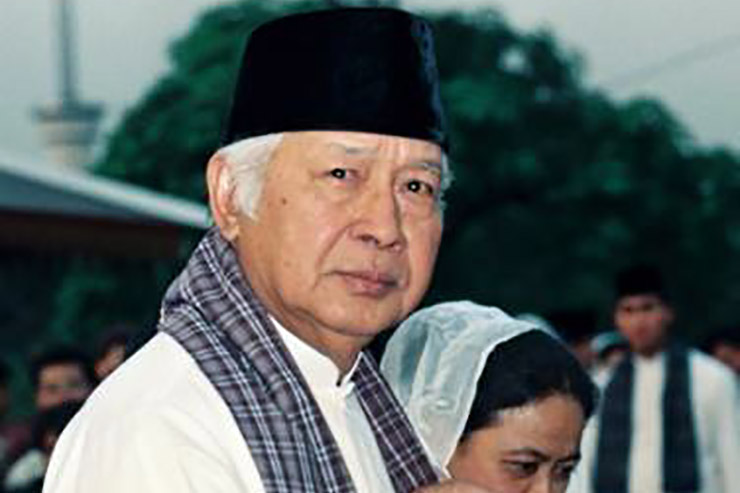
    The result of the Nine’s meditations was that one night a brilliant beam of light descended from the sky onto a young Javanese Muslim called Muhammad Subuh who was returning home from a Sufi Nachshbandi meeting. The beam of light “programmed” him, thus opening the way to a spiritual revelation. This seed-revelation developed into a new practice and teaching called Subud that would presently be taken to the West.

    One of the Javanese sects that indirectly emerged as a result of this event was Sumarah, “the Way of Surrender” – surrender being the essential meaning of the word Islam. Sumarah has become a large-scale movement in Indonesia. It teaches that all the world religions have their roots in the same esoteric source. The same truth underlies them all. All have germinated from a divine seed that lies deep in the Soul of humanity and share equally in its grace. Sumarah’s method therefore calls for universal peace between religions. It raises consciousness from the ordinary mind, whose dualistic and divisive nature breeds images of evil, warfare and religious conflict, to an intuitive state beyond divisions. In that unified state the enlightened mind pursues visions of inwardness, of oneness, of spiritual redemption, of a peaceful coexistence of the family of religions.

    Excerpted from ‘Sufism and The Nine Unknowns’ by Victoria LePage, http://vlepage.newteam.org.

    [alert type=”general” dismiss=”no”]This article was published in New Dawn Special Issue 10.[/alert]

    [alert type=”success” dismiss=”no”]If you appreciate this article, please consider a contribution to help maintain this website.[/alert]

    © New Dawn Magazine and the respective author.
    For our reproduction notice, click here.

  • The Return of the Elder Race & Opening the Gateway of the Fifth Kingdom

    The Return of the Elder Race & Opening the Gateway of the Fifth Kingdom

    René Guénon’s assertion, culled from ancient esoteric sources, that in the remote past humanity’s first civilisation arose in the ice-free Arctic zone is not without geological support. According to the well-known researcher J.S. Gordon, “there is no scientific doubt that the polar ice caps have melted and reformed many, many times over and that this has always affected human society (plus animal and plant species), often catastrophically.”1 

    He points out that the great Ice Age that lasted about two million years, ending about twelve thousand years ago, was made up of thirty or so minor Ice Ages, with warm intervals of polar deglaciation in between them, each creating periods of thousands of years of temperate conditions at the poles. Any one of these warm intervals would have been hospitable to a circumpolar civilisation.

    Charles Hapgood, who in the mid-sixties was the Professor of the History of Science at Keene University in New Hampshire, USA, became convinced that humanity did indeed enjoy a sophisticated civilisation a hundred thousand years or more ago, and that it must have been at least partly in a polar location. He derived his theory from cartographic research conducted on ancient portolans or seafaring maps, one of which had been in the possession of a l6th-century Turkish admiral, Piri Re’is.2

    “This map (and others also researched),” Gordon comments, summarising Hapgood’s conclusions, “clearly showed… that the polar regions had been cartographically surveyed when no ice cap existed,”3 and that in the case of the Antarctic Circle, rivers and mountains had been mapped in such detail that the land must have been inhabited – and by a people who understood spherical trigonometry.

    Other researchers, sifting and re-examining existing archaeological data from the past 150 years, have concluded from the evidence of human artefacts and fossil bones found under deep geological layers that anatomically modern humans with a modern intellectual capacity have existed from the beginning of the Quaternary period, some 1.65 million years ago – and that they were taller than modern man and with a brain capacity 15 – 20 per cent larger. Such findings reinforce the growing opinion of many people today that Hapgood’s theory, initially rejected by scientists of the day, has serious merit.

    In The Secret Doctrine, Helena Blavatsky said that in primeval times the earth had still not densified fully and was therefore larger than at present. All body forms would have been considerably lighter in weight and of a more plastic nature, the skeleton still not having hardened by then; and accordingly human beings could have been less affected by gravity and as much as sixty feet or more taller than they are today. She believed that over vast ages there have been several violent changes in earth’s climatic conditions, with corresponding diminutions of human stature, accompanied by many variations in human civilisation and culture.4

    Mainstream science has no real conception of how long modern homo sapiens has been in existence, or under what physical conditions, but certainly archaeologists are aware that homo sapiens skulls of an entirely modern type have been found that are over a hundred thousand years old. Swanscombe man from England is a quarter of a million years old, while Vertesszollos man from Hungary, equally modern in type, dates to an amazing four hundred thousand to seven hundred thousand years old.5 Such dates leave ample room in our human record for many modifications of climate and variations in the physical stature, cultural development and living conditions of human beings.

    The Hebrew Bible tells us:

    There were giants in the earth in those days; and also after that, when the Sons of God came in unto the daughters of men, and they bare children to them, the same became mighty men which were of old, men of renown. (Genesis 6:4)

    The information given in the Book of Genesis regarding the Sons of God, the giant-sized Elders who once lived on earth – “mighty men of old, men of renown” – was derived by Hebrew scribes from the scriptures of older surrounding races, such as the Indian Vedic texts, the Vedas and Puranas, and the Sumerian Epic of Gilgamesh.

    In the Sumerian illustrations of the doings of the gods it can readily be seen that the relative height of the Elders and ordinary humans was that of adult and child: in one such instance, a god is holding a human on his lap as though nursing an infant. The Egyptians also created statues of god-kings of enormous height juxtaposed to little figures of normal human stature; and while these statements in stone may have been intended symbolically, the alternative possibility exists that an entirely realistic rendition was intended, as more than one researcher has suggested.

    Helena Blavatsky, for example, contended that not only were the polar regions the cradle of humanity millions of years ago, but that due to a decrease of velocity in the Earth’s rotation conditions at the poles changed, and the size and weight of all the organisms living there was accordingly modified.

    The axle of the Wheel tilted… People [for the first time] knew snow, ice and frost, and men, plants and animals were dwarfed in their growth. Those that did not perish remained as half-grown babes in size and intellect. 6

    The other outstanding characteristic imputed to the Elders, whom Blavatsky called the Kumaras, was their huge skulls. Although there is less evidence in the ancient texts to support this legend, it is an astonishing fact that several such enormous skulls, relative to the size of the face, have been unearthed in Peru: one is on display in the museum in Lima.7 According to reports, others of similar immensity have been found in and around Egypt and Tibet, suggesting a correspondingly massive intelligence.8

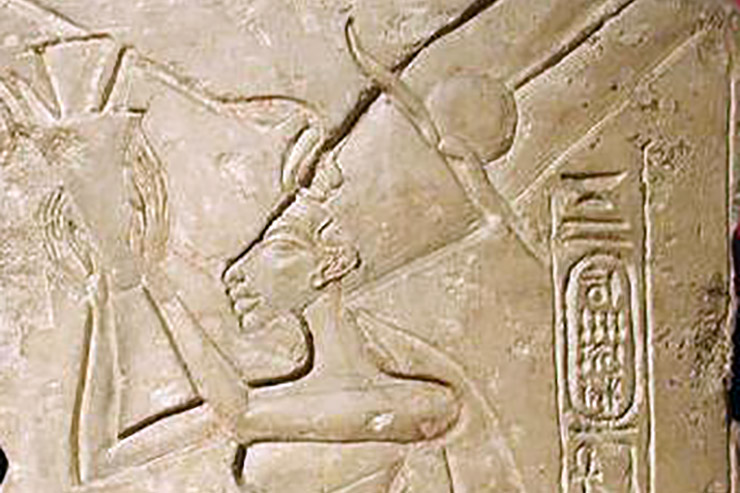
    Furthermore, carved busts of the family members belonging to the Egyptian pharaoh Akhenaton of the eighteenth dynasty demonstrate the same anomalous feature, including equally huge ears. Found in the underground desert ruins of Tel el Amarna in Egypt, little known statues of this strange family, which included Nefertiti, Akhenaton’s wife, and their daughters, exhibit other unusual features, including great body height. The body of a statue of Nefertiti is described below:

    She’s not wearing clothes because they didn’t believe in that at the time. She has a huge head, large ears, a long, skinny neck and a high waist. She also has a kind of bulging tummy. And… she has skinny legs and wide thighs.9

    This in fact is an equally good description of her husband’s famously strange appearance. The carved or painted likenesses of Nefertiti’s daughters, down to the youngest, a mere toddler, show exactly the same peculiar characteristics of enormous hairless skulls, high waists, skinny calves and huge ears.

    Could this Egyptian royal family, then, have been a throwback to the ancestral offspring of the Elders? And more pertinently, could its anomalous physical features support the idea of an intellectually advanced race alien to ours, either from another stellar system or a previous racial cycle?

    These Elders, also known as the beni ha-elohim, the Sons of God or Sons of the Fire Mist whom the Sumerians claimed had brought civilisation to humanity, are a perennial mystery. G.I. Gurdjieff regarded them as palaeolithic shaman adepts, men and women who in the remote past practised their mysteries in the underground caves along the Syr Darya, in Central Asia, and whose evolution due to their superior spiritual practices put them far in advance of their fellows.10

    But occult tradition goes a great deal further, contending the Elders were a wise and powerful race that came from the stars – possibly, say some, from the giant star Sirius. In the ancient Egyptian tradition they are called the “Watchers of Pe,” divine Intelligences who watch over and guide humanity, their progeny, from celestial heights. Alternatively, could they have been, as the noted Theosophist G. de Purucker suggests, the left-over remnant of an earlier human race that had incarnated on Earth but had originally come from the Pleiades system, and which had ended its racial cycle perhaps millions of years ago?

    Until recently such questions about the Elders could not profitably be asked except in the context of a closed initiatory society. Even stranger, until recently the rest of the world was not even aware that such questions entailed proscribed temple material that had been forbidden to the outside world for thousands of years. As already mentioned in the first part of this article (see New Dawn No. 112, January-February 2009), René Guénon, one of the foremost esotericists of the late nineteenth and early twentieth centuries, struggled as far as he dared against this occult embargo, believing that the time was fast approaching when humanity would be in need of a higher level of anthropological, cosmological and metaphysical understanding than was possible in his day.

    “This study,” he wrote, concerning the advanced Elder race that, according to Theosophical lore, had migrated from the Arctic zone to Central Asia many hundreds of thousands or perhaps millions of years ago, “has gone deeper than any preceding it, inviting reproach, perhaps, from some. We do, however, believe we have not said too much, nor anything that should not be disclosed…”11 Yet much knowledge regarded as too arcane or too dangerous for the profane populace would, Guénon was convinced, soon have to be released into the public domain. And it would seem he was right.

    A new order is dawning in this post-millennial era in which a great deal of the once proscribed sacred knowledge is being made available to all. Among many of yesterday’s underground secrets now freely emerging into the light of day are the secrets of human evolution and its tandem relationship to the evolution of earth and cosmos. These secrets have a direct relevance to the mysterious Elders, gods whom they suggest are actually human beings and members of a fifth kingdom in Nature.

    Thus the removal of the occult embargo, allied to an explosion of new scientific discoveries and hypotheses, is making it possible to approach the subject in an entirely new way.
    [alert type=”info” dismiss=”no”]If you appreciate this article, please consider a subscription to New Dawn magazine.[/alert]

    The Fifth Kingdom

    The medieval classification of Nature into four universal kingdoms, mineral, vegetable, animal and human, has been rendered obsolete by modern science, which has inductively evolved its own hierarchical system of subatomic particles, atoms and molecules before the mineral, and combined the animal and human in one category. Nevertheless, the old system of four kingdoms, based on an intuitive deductive vision of the truth and seen as an example of the Perennial Philosophy, is still entrenched in most of the Western esoteric schools that have emerged since medieval times: Theosophy, Anthroposophy, Rosicrucianism, modern Sufism, various New Age channellings, the Sri Aurobindo school and others.

    Four-kingdom proponents from these schools see the progression in Nature as a succession from inert mineral to the plant, that is alive but not apparently conscious, to the animal that has a limited reasoning power but is not self-aware, and to the human being who alone has self-awareness and conscious free will. To these four definitive classifications a fifth is occasionally added by medieval philosophers under variously named, rather obscure and even misleading headings; but whatever the designation, in esoteric circles any natural classification beyond the fourth is either nonexistent or only vaguely delineated, lacking the emphasis or clarity it requires.

    The ancient Egyptians made the matter a great deal clearer. They understood the goal of human evolution to be a transition or resurrection into a higher state, a higher natural kingdom, and illustrated the transition with admirable precision on the ceilings of certain very old tombs.12 In their depiction of the neters or gods undergoing spiritual resurrection, they show a row of animal-headed human figures marching along a horizontal base line, a red oval – the “egg of metamorphosis” – above each head, until suddenly the base line turns by 90 degrees to the vertical and one figure swings into ascension along it. Achieving what may be a rapid biological change into a new life form, he transforms into the royal fifth kingdom. Armed with what appears to be the staff of spiritual authority and lacking the oval over his head, which has presumably been absorbed into his being, he has metamorphosed into a king.13 In other words, from being a collective being of a lower order, he has become a royal singularity, a ruler of all kingdoms lower than the fifth.

    Ancient petroglyphs of sun-headed men found in various parts of the world, but especially in Central Asia, tell the same story.

    Because of the occult secrecy that has enshrouded the subject of the fifth kingdom over the past 2,000 years at least, we have failed to understand its crucial significance as our true evolutionary goal and our key to all those questions we have never been able to answer. The inclusion of a fifth kingdom in the natural order turns the fourth kingdom that we humans presently inhabit into a mere corridor of becoming, a transitional episode in which we are driven forward in a process of transformation from the animal state behind us to that of the true human ahead, as indeed Gautama Buddha recognised. Life, human life, he said, is never-ending change and the suffering of change – and indeed it is viewed as a journey of relentless development of intelligence and consciousness into the truly human kingdom, the fifth, wherein alone lies repose well earned.

    The idea of a potential fifth kingdom, a state of spiritual felicity and repose we may hope to enjoy some time in the future, is not new to us. But what the ancient mystery temples through to modern esoteric teachers like Guénon have been reluctant to disclose is that the fifth kingdom is not a future potential but a presently existing reality, a supremely enlightened human state coexisting with our own. Like the other four kingdoms of nature, it has extended and always will extend back into the illimitable past and forward into an equally illimitable future, with its own archetypal place in the cosmos.

    Indeed, it is esoterically acknowledged that beyond the fifth kingdom others also exist. Gordon speaks of the fourth, fifth, sixth and even the seventh kingdom of our planetary Nature. “All of these kingdoms exist together (even if we are unaware of the fact),” he says, “and all of them together comprise the evolving nature of Man. Hence humankind is but one partial expression of Man in general.”14 Given such a perspective, many possibilities open up that were not previously viable in our worldview.

    According to this perspective, the Elders of Akkadian-Sumerian legend and the gods of the Babylonians and the Assyrians were the higher-level final flowering of a previous human cycle many millions of years old, their privilege being to guide the evolution of the next cycle – our own. Freed by their advanced development from the limiting conditions of transitional fourth-level humanity, the universe was open to them, for fifth-kingdom space-time is said to possess multiple dimensions incomprehensible and inaccessible to the lower kingdoms. These so-called gods could travel between the stars on supramundane energy currents unknown to us, incarnating on other stellar bodies or on planet Earth as the need arose, and withdrawing as they chose into dimensions invisible to their charges on Earth.

    In the above scenario, not only is our past implicated in this new perspective; our future is equally involved. As we ascend with increasing rapidity into higher states of consciousness and hence into proximity with the fifth kingdom, we are finding the Elders in their various otherworld guises descending to meet us. As a part of the great human order, they are our future as well as our past. We shall find in fact that humanity is at home everywhere in the universe and its life has no beginning and no ending; it is co-eternal with the cosmos.

    Therefore, perhaps, it is time we gathered together all our ideas of aliens, extraterrestrials, Sirian cosmonauts and angelic visitors and categorise them all as members of our own human species who, along with their advanced technologies, have arrived in the fifth kingdom before us – our own kin already established in majesty and power; already, like the Egyptian priest-kings of old, free to traverse the cosmic pathways at will as the Sons of God – the lords of the universe.

    According to the Solar teachings of the ancient Pillar religion, the royal road to the fifth kingdom lies in an ascension up the World Tree, through its successive gateways, to the starry heavens. Kingly authority and the power to rule wisely rests on the royal initiate’s ability to ascend the axis mundi or World Tree to the divine centre of creation at the zenith of the heavens. There, and only there, he will find deification; there he will be able to access the heavenly powers from which all impulses of rulership, creativity and wisdom emanate; there he will find the freedom of the spiritual world.

    This idea of returning home to the stars is implicit in all the tribal totem systems found in early shamanic societies around the world, but was more fully realised in its religious form when the idea of kingship – of hierarchical rule from above – seized neolithic societies at the end of the last Ice Age. John Major Jenkins, a leading researcher of ancient cosmology, says:

    Sacred knowledge is won or achieved by undertaking visionary journeys up the World Axis to the cosmic centre. A ruler, having thus become fused with the divine source and emanating power of life and wisdom, constellates the beings and objects of lesser degrees.15

    Such a monarch stands as far more than an exemplary figurehead or an administrative symbol at the heart of his kingdom; he has become, by virtue of his conquest of the World Tree, a way-shower into a new order of being for the whole of his society. In the same way, so Jenkins believes, at certain critical junctures of the Earth’s history, this odyssey of transformation up the cosmic Pillar to the divine Centre at the zenith is possible for the race as a whole, which thereby advances further towards its next evolutionary goal – the supernal kingdom, the fifth.

    Revisiting the Pillar Religion

    The secret teachings of the very earliest sages of which we have cognisance claimed that all life, all wisdom and creative power is transmitted to the earth plane via a spiritual energy flowing down from the highest Source, and that it is by reascending the sacred current, symbolised as a Pillar or a World Tree connecting earth to heaven, that humanity comes to its most sublime perfection.

    A traditional symbol of this occult energy stream has been retained in the Qabalistic Tree of Life defined astrologically.The well-known British author Trevor Ravenscroft likens the Tree of Life to “the Yggdrasil tree of Norse mythology, the world-Ash which binds together heaven, earth and hell.” The crown of the tree, he says, “comprises the twelve constellations of the Zodiac, the spiralling branches symbolise the planets and the roots of the trunk dig deeply into the elements of the earth.”16 The Tree is thus a metaphor for the archetypal processes of the cosmos that are believed to underlie all evolutionary activity.

    From the earliest times, the World Tree was central to the shamanism of the nomadic tribes of the Central Asian steppes, as it was to the later Solar religion of the settled Aryan communities of that region. Indeed, if we are to believe Plato, in the days before the Great Flood and the sinking of Atlantis, the World Tree featured also in the primeval Atlantean religion with its monarchic system, its warlike bull cult and its concentric city planning; and according to Blavatsky, it was this Solar system that was eventually transplanted by great migrations into Central Asia.

    From west to east and from north to south, then, the Pillar religion in its various guises appears to have reigned universally as the earth’s primordial belief-system, the destiny of man being seen as the ultimate return of his soul via the World Tree to the power-realms of the stars.

    Where then on the planet is this World Tree that the Hebrews called Jacob’s Ladder? Although it would be natural to assume it is synonymous with the earth’s north-south axis of rotation, such is not the case. According to Guénon, there have been several successive locations of the World Axis on the surface of the globe that distinguish it from either the north-south axis of rotation or the magnetic axis. Opening up the secret metaphysical tradition, he asserts that basically nothing less than a new model of the world is needed if we are to understand the true nature of the World Axis.

    The esoteric reality, expressed long ago in the Pillar teachings, is that the earth incorporates a principle that connects it at all times to a greater spiritual world in the same way that a mirrored reflection is intrinsically connected to the reality. By virtue of this fact, the earth is multi-dimensional in structure – as indeed the physicist David Bohm has proposed in his theory of an implicate universal order lying behind the explicate physical order as its energetic template – and this radically modifies everything we can say about the planet, in the way we measure and describe it.

    The Pillar religion projected a worldview very different from our own. The planet was regarded as a living organism with its own hierarchy of elemental intelligences, plus a hierarchy of solar intelligences or devas, at work in the manifold organisation and running of the whole, and which we call today the work of Nature. The World Tree, in India known as Mt. Meru, was believed to be at the very heart of this great dynamic complex, a channel of evolutionary energy running through the centre of the planet, a path of psychospiritual transformation of the same order as the seven-fold spinal path of consciousness running through the human body.

    In fact, the name Meru is connected to the Sanskrit word merudanda, meaning a backbone, and hence the World Tree can be further qualified as the backbone of the planet, a chakric system analogous to that of the human spinal system, with seven or nine nodes of increasing psychospiritual awareness culminating in the Cosmic Centre at the summit. These nodes were clairvoyantly perceived as a succession of gateways up the trunk of the Tree leading into higher planes of existence, and the final entrance to the Cosmic Centre was therefore called the North Gate.

    Guénon’s Neoplatonic thesis contains the concept of a universal ether, renamed “the quantum fluid” by modern science, and states that behind the physical body of the earth lies its spiritual template, a permanent prephysical or etheric web of forces delineating the planetary structure in its essential form. In this inner light body – or, as Vedic cosmology calls it, the vajra body – is located the World Axis, the etheric source and intelligent regulator of all the energies of the planet. At the beginning of each great temporal cycle – and by that Guénon means at the very least one round of the Zodiac, one Sidereal Year of 25,920 years – the two bodies are in virtually perfect alignment, but as the cycle proceeds a separation occurs and the physical body falls increasingly out of alignment with its spiritual template.

    This non-alignment or tilting away of the planetary body from its inner template is the result of their differentiation from each other, which has the effect of creating all the earthly stresses and vicissitudes of time and change that we know so well, yet is the necessary precondition for evolutionary growth. From this circumstance comes all the suffering of becoming, all the so-called evils of our earthly existence.

    In such a spiritual cosmology the universe is the expression of a great Intelligence within which are the unchanging ideas or templates of form, the whole being in a state of ideal harmony and order. But although the spiritual world of pure Being is changeless, the natural state of its reflection, holographically projected onto a lower plane and thus an object of differentiation, is to become off-centre in relation to it and therefore in perpetual compensatory motion. This is the biblical “fall” of mankind without which there would be no evolutionary process. With the separating out of the physical plane, motion is created and the suffering of change begins; for the process of increasing differentiation of the physical body from its spiritual background inflicts on the planet and all its life-forms a local disturbance, the angst of movement, of disequilibrium, of continual adjustment to new conditions and new evolutionary demands – but also to the possibility of attaining a greater state of being.

    We can sum up this occult cosmology thus: At the beginning of the great precessional cycles, the north-south axis and the magnetic axis are in virtually perfect alignment with the World Axis and with each other. All three stand at that time apparently united at true North, so that the supreme spiritual centre is in a literally polar location; but as the cycles proceed, the poles fall progressively out of alignment with the World Axis and terrestrial changes develop. Today this mysterious noumenon known variously as the Sampo, the axis mundi and the Tree of Life has apparently shifted southward. Clairvoyantly visible, it has its locale in the Inner Asian region delineated by the Tarim Basin and its surrounding ring of great mountain ranges.

    Within the boundaries of this vast mountain encirclement, the World Axis is believed to have varied its location from time to time. But wherever it is found, it always remains functionally polar; it is always the central origin point – or as ancient peoples called it, the omphalos of the planet, the place of the first creation – from whence grand waves of acculturation have periodically issued.

    In Galactic Alignment Jenkins presents a similar cosmological picture. He calls the World Axis the evolutionary axis, by implication a third terrestrial axis presently unknown to science. Psychically accessible, this great current of psychospiritual conscious energy that runs through the centre of the earth is thought today to emerge somewhere north of Kashmir, soaring high into interstellar space above the Pamirs.17 It is in that vicinity, at the foot of the World Tree, that the peoples of Central Asia have traditionally located the hidden kingdom of the Elders known as Shambhala, an initiatory centre accessible on both a physical, an etheric and an astral plane.

    The North Gate, Jenkins contends, can be viewed as analogous at a cosmic level to the pineal gland in the human system, which is the most interior and creative centre in man and “the point from which spiritual gifts are given.”18 He sees the Cosmic Centre at the head of the World Axis as fulfilling the same function in a planetary context. However, while René Guénon has postulated a major polar-to-solar shift of the Cosmic Centre in man’s worship at some remote time in antiquity, Jenkins has argued that this shift would be better understood as a polar-to-galactic one.

    Thousands of years ago, he says, priest-astronomers realised that approximately every 6,450 years the North Gate was aligned with the galactic centre, and that such times offered a priceless evolutionary opportunity for the whole race. It is an astronomical fact, says Jenkins,

    that alignments of the solstices and equinoxes with the plane of our Milky Way galaxy occur periodically over the 26,000-year precession cycle. Such alignments, in fact, occur every 6,450 years. Joseph Campbell pointed out that knowledge of the precessional cycle is implied by the importance given the number 25,920 in Hindu, Nordic and Babylonian doctrines.19

    Jenkins equates the spiritual evolution of humanity with this periodic alignment of the Earth with the galactic plane and the Galactic Centre. The idea that the latter stimulates consciousness on this planet is, he says, “an intriguing and profound concept” that finds echoes in Mayan, Vedic and Egyptian cosmology. Gordon too observes that the earth is subject to celestial seasons of about 6,480 years, “which have a dramatic effect upon both the climate… and also upon the many and varied cultures and civilisations which exist at the time.”20

    The Tree is thus regarded as a planetary chakric system analogous to that of the individual tantrica in the practice of kundalini yoga. Even as the yogic consciousness ascends the spinal system, so activating a sequence of seven hierarchically ordered chakras or psychospiritual energy vortices which alter in subtle ways the entire spectrum of consciousness, so the ascension of the racial soul up the World Tree at certain precessional intervals of c.6,450 (or c.6,480) years corresponds with the opening up of a succession of celestial gateways for humanity as a whole.

    At each open gateway the flooding down of divine creative energies precipitates certain psychological and cultural modifications in society; the human body typology changes; new deities, new mores appear; the material technology advances or changes its base, a new world-civilisation is launched founded on newly imperative truths. It is a moment of supreme evolutionary importance, a collective initiation perhaps best conveyed by the teachings of the Mithraic mystery religion.

    This important Greco-Roman cult flourished until the fourth century CE, when it was extinguished by Christianity. Seven planetary spheres were opened up to the seeker through the seven grades of Mithraic initiation, allowing him ultimately to ascend to the highest, the Father (Saturn). However, beyond the seventh level was a secret teaching revealing an eighth and ninth level or “house” where the Hypercosmic Sun was located. This hypercosmic luminary, this “Star of Stars” as the first century philosopher Philo Judaeus of Alexandria called it, was identified with the Galactic Centre, to which access was gained only through the eighth and ninth celestial “doorway” above that of Saturn.21 This secret means of escape from Earth’s gravity into the freedom of the Universe has been closely guarded by occult tradition and is still not fully unveiled.

    The doctrine of the Hypercosmic Sun, according to Jenkins, is “fundamentally about the soul’s passage through the galactic gateways that open during eras of galactic alignment,” when the divine light of the Milky Way Centre pours down through the opened valves of the World Axis and irradiates the earth and all its inhabitants for a certain interval of time. It is in that critical interval that the great evolutionary mutations take place, civilisations are overthrown and reinstated in radically new forms and the potential exists for the fifth kingdom to be realised by at least some members of fourth-kingdom humanity.

    Jenkins is only one of countless observers who believe such a historic time has once again come around. Indeed, by now millions of people are watching and waiting for the end-of-the-world Mayan date of 2012 CE, believing it to be the beginning of a new World Age… a further stage in the journey towards the fifth kingdom.

    Eurasia Awakes

    In February of 1962 astrological pundits announced a major planetary conjunction that occurs only once in every c.6,500 (or 6,480) years – the previous one therefore having taken place in c.4500 BCE, and the one before that in c.11000 BCE, both of which occasions were prophetic of great earth changes.22 I remember well the report in the media, because immediately a cry of distress and foreboding went up right across India; for it was known by most Hindu astrologers that this rare stellar event, occurring only four times in the precessional cycle of 26,000 years, does indeed foreshadow great floods and catastrophic climatic changes.

    In response, the dawning New Age movement of the time predicted the return of the Elder race, the possibility of a pole shift, the birth of a new race of clairvoyants. To esotericists generally the conjunction signified a new World Age and an impending psychospiritual initiation of collective humanity, with all the social and ideological turmoil such an event implied. And confirming John Major Jenkins’ later theory to the hilt, the conjunction was seen by some star-gazers as the first sign of a coming revolution in geopolitical world affairs, with the rise of Asia and the decline of the western Anglo-American hegemony.

    At the time all these predictions were regarded as amazing and pretty farfetched. But nearly fifty years on, the events presaged in 1962 are now crystallising as post-millennial realities. Ominously, the ice caps and glaciers are melting, the seas rising, earth’s resources shrinking; the Anglo-American world order, built on predatory economic corporations, is unravelling, Asiatic power inexorably rising. A transformation in human consciousness is well underway; and there is increasing evidence that the vast natural, socio-political and consciousness changes we are seeing are now irreversible, for good or ill.

    Perhaps the most significant sign of the times is to be found in the growing vision of a unified Eurasia among the major Asian nations such as China, Mongolia, India, Iran (and also Brazil), as well as Kazakhstan and many other of the Central Asian Muslim states. Included in this growing Eastern bloc is Russia which, since the collapse of the Soviet regime, is increasingly turning away from Western Europe and towards Asia in its quest for identity. Geographically the largest nation on the earth, it extends right across northern Asia from Eastern Europe to the Bering Sea.

    Russia is rediscovering its Slavic roots; and especially since the discovery of Arkaim and the Land of Cities in the southern Urals, it is also exploring its Aryan past and its more recent connections to the Mongol Empire of Genghis Khan, who subjugated the whole of the Eurasian corridor as far as eastern Europe in the thirteenth century. Indeed, for many of Russia’s intellectuals the universal tolerance and freedom from dogma of the ancient Pillar religion of the Mongol/Turkic peoples has great valence and is displacing Christianity and Islam in the popular esteem. “Out of Russia,” says Alice Bailey, channelling the prophecies of her Tibetan guru, DK, “will emerge the new and magical religion about which I have so often told you.”23

    There have been a number of famous prophecies regarding Russia’s future pivotal role in world affairs generally, notably those of Rudolf Steiner and Edgar Cayce, as well as those of Gerard Encausse, the highly respected French occult master who went under the pseudonym of Papus (1865 – 1916). The author Mehmet Sabeheddin notes that “Papus knew of the key role to be played by Russia in unifying Eurasia and her occult destiny as the Empire of the End, the outward manifestation of the enigmatic power of ‘Northern Shambhala’.”24 Many others have seen Russia as destined to continue the work of Genghis Khan, who transformed the nomad tribal conglomerates of the Eurasian steppes into a unified and superbly organised political system that revolutionised international life for centuries to come.

    Across the steppes, where for countless centuries a melting pot of peoples, religions and empires from every quarter have traded and warred and sunk with their cities beneath the desert sands, a spirit of renaissance, of ecumenical reform, is undoubtedly taking hold. From the Far East to Moscow and from the Altai to Iran, a countervailing force, identifiable with the invisible spiritual powerhouse of Shambhala, is stirring throughout the region. Muslim, Buddhist, Zoroastrian, Christian, Jew, Taoist and shaman are finding common ground in a unitive vision of the future. Responding to the militaristic Anglo-American colonisation that has long dominated the Asian hemisphere, this new regional climate bodes well for the rebalancing of the globe’s spiritual, cultural and economic forces.

    The move to turn the tenuous Eurasian concept into a geopolitical reality composed of numerous independent but strongly affiliated nations committed to East-West amity must be regarded as a force for renewal, for the healing of the Atlantean/Hyperborean rupture that long ago shattered the primal unity of the life of the planet. The present thrust seeks instead to recapture the unity of the ancient Arctic accord and to set forth new terms for a viable future for humankind.

    What is truly remarkable is that we are witnessing all this happening in Central Asia at the very time of great astrological significance, when the stars again portend extreme danger and extreme opportunity for the life of Earth. Are we then seeing once again a mysterious intervention from the East, a salvific influence arising in the heart of Asia that seeks to sow the seeds of a new global order and a new type of civilisation in the face of apocalyptic geophysical change? Can the Elder race be coming to our aid yet again?
    [alert type=”general” dismiss=”no”]This article was published in New Dawn 113.[/alert]

    [alert type=”success” dismiss=”no”]If you appreciate this article, please consider subscribing to help maintain this website.[/alert]

    Footnotes:

    1. J.S. Gordon, The Rise and Fall of Atlantis, and the Mysterious Origins of Human Civilization, Watkins Publishing, London, 2008, 131.

    2. Charles Hapgood, Maps of the Ancient Sea Kings, Turnstone Press, London, 1979.

    3. Gordon, op. cit., 131.

    4. Ibid., 159.

    5. William Fix, Lake of Memory Rising, Council Oaks Books, LLC, San Francisco, 2000, 203.

    6. H.P. Blavatsky, The Secret Doctrine, Vol. 2., Theosophical Publishing House, Los Angeles, 1947, 324.

    7. Drunvalo Melchizedek, The Ancient Secret of the Flower of Life, Light Technology Publishing House, Flagstaff, AZ, 1990 – 8, 143.

    8. Ibid., 143.

    9. Ibid., 139.

    10. J.G. Bennett, Gurdjieff: Making a New World, Turnstone Books, London, 1976.

    11. René Guénon, The Lord of the World, Coombe Springs Press, U.K., 1983, 66.

    12. Melchizedek, op. cit., 43.

    13. Ibid., 43.

    14. J.S. Gordon, op. cit., 85.

    15. John Major Jenkins, Galactic Alignment, Bear & Co., Rochester, Vermont, 2002, 150.

    16. Trevor Ravenscroft & T. Wallace-Murphy, The Mark of the Beast, Vol. 3, Sphere Books, U.K., 1990, 67.

    17. Victoria LePage, Shambhala, Quest Books, Illinois, 1996, 180.

    18. Jenkins, op. cit., 140, citing Valentinia Straiton, The Celestial Ship of the North, 1927.

    19. Ibid., 42.

    20. J.S. Gordon, op. cit., 130.

    21. Jenkins, op. cit., 107.

    22. Sky and Telescope Magazine, December 1961, 320. On February 5, 1962, Mercury, Venus, Mars, Jupiter and Saturn were all within 13 degrees of the eclipsed Sun.

    23. Cited by Mehmet Sabeheddin, The Secret of Eurasia: The Key to Hidden History and World Events, New Dawn No. 68 (September-October 2001).

    24. Ibid. 

    © New Dawn Magazine and the respective author.
    For our reproduction notice, click here.
  • Nostradamus: Prophet of Hope

    Nostradamus: Prophet of Hope

    The jury is still out on the millennial prophecies of Michel Nostradamus, the French master physician, astrologer and Kabbalist of the sixteenth century. Many regard him as the greatest prophet in Western history, while others find his predictions, especially those concerned with our own era around the second millennium, irrelevant or simply too deep or too equivocal to interpret successfully.

    Did he predict war or peace for our time? Did he foresee a coming Utopia or a descent into a Dark Age? The end of the world or a Golden Age a thousand years long? The appearance of a great spiritual Teacher or an Anti-Christ? These are the confronting questions that inevitably arise when considering the work of this famous Renaissance seer.

    I believe the key to Nostradamus’ undoubted genius and equally undoubted capacity for paradox lies in the breadth of his religious affiliations, which, astonishingly, embraced all three Semitic religions: Judaism, Christianity and Islam. Without acknowledging this secret propensity for religious syncretism, regarded as heretical even in our own free thinking day, it is difficult to throw any light on the contradictions inherent in Nostradamus’ work. His religious beliefs simply cannot be left out of any in-depth evaluation of his prophetic legacy: they made him what he was, a mirror laid to the very heart of our polarised, suffering civilisation.

    A true child of medieval Provence, the home of chivalric poetry and mysticism, Nostradamus was born in 1503 in Saint-Rémy-en-Provence of Christianised Jewish parents, was brought up as a committed Christian and died as one in 1566 in the small town of Salon-en-Provence.

    At an early age his two grandfathers, who preserved in secret their Hebrew religious and cultural traditions, gave him a comprehensive classical education in literature, history, herbal medicines, Greek philosophy and a range of languages, as well as the ‘celestial science’ – astrology – in which he took a deep and abiding interest. As well, his two Jewish mentors clandestinely introduced the boy to the Judaic esoteric culture. He learned the occult arts and sciences forbidden by the Church, and acquired a knowledge of alchemy and the Jewish Kabbalah, the latter a mystical initiatic system of ten levels of consciousness akin to Hindu Kundalini Yoga. Yet he is believed to have remained at the same time a loyal son of the Christian Church.

    Later, for fear of the Inquisition, Nostradamus burned the old Jewish family books on Kabbalistic magic that he had acquired from his grandfathers, along with other occult texts on alchemy, hermeticism and Chaldaean and Assyrian magic. But his most secret religious affiliation linked him to a belief-system that at that time was virtually unknown in Europe and its presence in his life was therefore to remain safe from discovery for almost five hundred years.

    Not until the most recent decades has modern Western research discovered that this remarkable Jewish doctor and occultist, trained in Hebrew wisdom, was not only deeply committed to both Judaic and Christian principles but was also a member of a Sicilian Sufi brotherhood loyal to Islam. A true man of the Renaissance, Nostradamus secretly believed in the underlying unity of the three religions, and his prophecies yield their deepest meaning only on this basis.

    Nostradamus’ Prophetic Genius

    Nostradamus’ life has been chronicled from a variety of different perspectives by a great number of commentators. What emerges most clearly from these studies is confirmation that his prophetic genius owed much to this hidden background of wide-ranging religious connections. The principle of syncretism lies at the very heart of Sufism and was evidently espoused by the doctor. He was the very embodiment of a universal theosopher, a prophet without dogmatic or theological boundaries who would foreshadow and greatly influence the coming explosion of Renaissance universalist thinking. Nostradamus’ academic training was to reinforce this unusual spiritual breadth.

    In Europe at the end of the Middle Ages, plague, famine and superstition were rife, men of enlightenment few. Nostradamus was one of those few. He attended the prestigious universities of Avignon and Montpellier where he qualified with high honours as a doctor of medicine and philosophy, and became renowned as a ‘plague’ doctor who effected amazing cures in times of severe pestilence. He was also an adviser to royalty and a deeply learned writer of philosophical works, as well as writing a book on food and cosmetics.

    During his wanderings through Europe after the death of his wife and two children from the plague, Nostradamus came into contact with an underground network of ex-Jewish occultists practising Hermetic and Kabbalistic magic, and gained training from them. This, allied to natural clairvoyant abilities, led to his dedication to the prophetic art. His cryptic book of prognostications, Prophéties, has vied with the Bible for being continuously in print since it was first published in complete form by Benoit Rigaud in 1568.

    In the first part of the book, which was called Centuries and written in 1555, Nostradamus attempts to describe his method of divination. It is that of the fourth-century neo-Platonist Iamblichus, whose reprinted book was published in Lyons only a few years before Centuries was written, and had no doubt been perused by Nostradamus. A bowl of steaming water is laid on a tripod placed in the prophet’s study at the top of his house. He works at his magic practices while the household sleeps.

    Sitting alone at night in secret study, it rests solitary on the brass tripod. A slight flame comes out of the emptiness… (Century 1 Q1) The wand in the hand is placed in the middle of the legs of the tripod. He sprinkles with water both the hem of his garment and his foot. Fear, a voice runs trembling through the sleeves. Divine splendour; the God sits nearby. (Century 1 Q11).

    Nostradamus notes that fear, dread, accompanied the parting of the veil that revealed daemonic powers; but tells us that when the God came and sat invisibly beside him, fear departed. In this picture of divine collaboration in a herculaean human task there is something very moving. The God has often been interpreted as the magician’s own god-given gift, but it is more likely to have been the invisible presence of a higher being who accompanied him in order to give comfort, reassurance and guidance. For there is no doubt Nostradamus was treading a wild, uncharted path outside tradition, and an emissary from higher realms might well have been sent to companion him… as he himself apparently believed.

    20th Century a Key Period

    In the preface to Centuries, written in the form of rhymed quatrains grouped in hundreds, Nostradamus discusses his clairvoyant visions of the future in revolutionary terms. In them he foresees “great events, sad and prodigious and calamitous adventures approaching in due time,” events that would, however, precede, or perhaps accompany, a great transformation in humanity’s level of consciousness and spiritual understanding. His apocalyptic intimations clustered around the twentieth century, “the Century of the Sun,” and predicted the rise of new mystical teachings leading to radical changes in our traditional religious beliefs before 1999 – as indeed we are surely now seeing.

    Nostradamus saw the twentieth century as humanity’s rubicon, a pivotal moment in history yielding a unique crisis of choice, of decision – a century of paradox in which enlightenment would spring from the deepest tribulation. He is often accused of being a prophet of doom, but if his prophecies are contemplated from a spiritual perspective, Nostradamus brings us a message of sublime hope. In biblical times seers like the doom-laden prophet Jeremiah were often killed for their pains, their messages rejected; but today the essentially ethical and optimistic philosophy at the core of Nostradamus’ predictions can strike a deeply positive chord in his readers. Right choices bring blessings, he is saying, out of pain comes spiritual regeneration.

    After many wanderings after the death of his family, Nostradamus became a successful doctor of the plague in Marseilles and was rewarded with large sums of money by the government of the city. He then remarried and set up a medical practice in Salon, where he lived and worked for the rest of his life. When many of his published predictions came true, Nostradamus became famous in his own lifetime and won the patronage of France’s then Medici royal family, Henri II and his consort, Queen Catherine de Medicis. At the Queen’s behest the prophet travelled to Paris to cast the horoscopes of her six Valois children.

    Yet as an ex-Jew and a radical thinker suspected of dubious supernatural practices, he lived all his life as a stranger in society and in danger of the displeasure of the Church of Rome. Surviving by various stratagems in a violent and unforgiving century, he worked against a background of forbidden Jewish and Islamic mysticism and the threat of Inquisitorial persecution. It is in this context of religious tyranny and repression that Nostradamus’ enigmatic visions must be understood. At first he determined not to publish them for fear of a public backlash, but later understood that the Church’s hold on the minds and hearts of its people would one day give way to a new climate of religious freedom, and this gave him the heart to go public.

    Because of foreseeing the advent of the common people, I decided… [to declare] in dark and cryptic sentences the causes of the future changes of mankind.

    So the seer wrote in the preface to Centuries dedicated to his son César, in celebration of a coming age of democracy – an age of freedom from the tyranny of the Inquisition. His words were an expression of the longing Nostradamus felt for a future time of intellectual and moral liberty in which advanced views like his own would be vindicated.

    Because if the present kingdoms, sects and religions were to see the future kingdoms, sects and religions to come, and see how diametrically opposed they are to their pet fantasies, they would condemn that which future centuries will know to be true…

    Although the prophet was forced to mix up his verses and present them out of their proper order as a means of obscuring their message, so avoiding the attention of the Inquisition, they have nevertheless time and again been found to present uncannily accurate forecasts of historical events over the ensuing centuries, and never more so than in those of the climactic twentieth century that would usher in a new millennium.

    Interpreting Nostradamus’ Predictions

    Some of the Centuries have proved to be indecipherable as predictions, but Erica Cheetham, one of Nostradamus’ most respected modern translators and interpreters, notes how fascinating she found it to be, while reading the Prophéties for the first time, to come across so many familiar names and historical events. “Names such as Hitler, Napoleon, Franco, Pasteur sprang to the eye. There were many dates too…”1 The prophet accurately predicted that the city of London would be destroyed by fire in 1666, he foretold the violent end of the French monarchy and the assassination of the two Kennedy brothers in recent times, and many more famous historical events.

    Subscribing to the Chaldaean astrological tradition fashionable in his era, Nostradamus’ prophecies were concerned with a time frame of seven thousand years, spanning what he called the Age of Man. Jean-Charles de Fontbrune, a modern authority on the prophet, believes that by counting five thousand years from Adam to Christ, the seer arrived at 1999 as the end of the seventh millennium and the climax of a great evolutionary cycle.2 Actually, says Fontbrune, according to biblical chronology the prophecies end with the conclusion of the Piscean age, approximately CE 2000. And according to Cheetham, there are indeed many indications in the text that Nostradamus seemed to see the period around the second millennium as the possible date of Armageddon in the form of a Third World War, and perhaps the end of the world, although he sometimes contradicts this. In any case, projected throughout the prophecies in shadowy outline, Cheetham glimpses the idea of a great polarisation of good and evil at the beginning of the third millennium, and a stark choice for humanity.

    In common with the Book of Revelation and with the mystical ideas of the Renaissance then incubating in Europe, Nostradamus foresaw in the twentieth century the advent of democracy and the resultant transformation of consciousness that would bring in sweeping new religious reforms and a new, more enlightened dispensation for humanity. At the same time, the seer was not blind to the terrible downside of the twentieth century and acknowledged that it would be a most fateful and afflicted century in which to be born. The historian Barbara Tuchman notes its phenomenal parallels to the calamitous fourteenth century with its plagues and famines, which she qualifies as a “violent, tormented, bewildered, suffering and disintegrating age… when there was no sense of an assured future.”3 In the sixteenth century Nostradamus predicted of the twentieth “evil century” that its final quarter would be “filthy, pestilent and violent,” and would culminate in unprecedented catastrophes.

    Cheetham, like many other researchers, has exclusively focused on these negative aspects of the prophecies: our great plagues such as the AIDS epidemic, famines and floods, appallingly destructive wars, the decline of the Catholic church and the resurgence of militant Islam. She sees little light penetrating this gloomy picture of a civilisation on the edge of destruction, and links it to the coming of the series of Anti-Christs predicted by the seer. With the increasing incidence of earthquake activity, spreading deserts and political malfeasance, it will be a time of great calamity for humanity and even for the planet itself, a time of death – and yet, in the view of Fontbrune, of new life from the East. For according to his interpretation of the prophecies, many spiritual leaders would arise at the threshold of the second millennium to give warning of the disasters to come and would simultaneously bring hope to the world with their new religious teachings.

    Before these [apocalyptic] events, many rare birds will cry in the air, ‘Now! Now! And some time later will vanish.

    According to this prediction, then, a window of spiritual opportunity will open in the millennial era, but for a time only.

    Fontbrune notes that a full two-thirds of Nostradamus’ prophecies are devoted to this millennial theme of apocalypse and spiritual rebirth. In fact, he believes that the great French magus and doctor of medicine wrote his quatrains in the sixteenth century for the express purpose of depicting the twentieth, knowing that “his text would be expounded and understood only in the century which was the focus of his vision” – the century of the common people. Nostradamus shared the hopes rife in Renaissance circles of the time, of an end to feudalism and religious bigotry, hopes that were closely bound up with the spiritual Solar principles from the past which still dominated the worldview of Europe’s esoteric luminaries.

    In the symbology of the old Sun temples whose influence had once dominated the entire planet, the sun, birth, life and the brilliant energies of the daytime were identified with the East, while twilight, the moon, death and the shadows of the afterworld were identified with the West. In Minoan Crete new life was brought into the temples by the eastern gate, while the dead were carried out through a western portal and ferried across a stream to the necropolis built on the western side of the city; and these principles reigned throughout pagan times and passed in secret into Christendom, largely through Gnostic channels.

    The same esoteric symbolism played its part in the conviction held by Renaissance astrologers that, however dark the end of the millennium might be, a new and wondrous epoch surely shone on the eastern horizon, promising the rise of new nations, new democratic and utopian principles and a new spirit of religious liberty. It is significant therefore that in Nostradamus’ prognosticative scheme the Solar sign should have fallen precisely to that century that has seen the burgeoning in the Pacific region of new civilisations and ideologies, and that in some of these cultures we are witnessing the birth of the most creative concentration of clairvoyance and spirituality, of egalitarian idealism – however distorted in form – to be found at any time in history. The Pacific lands – China, eastern Siberia and Russia, North and South America, Japan, Indonesia, Malaysia, New Zealand, Australia – while by no means immune to geological disasters, may well represent the most viable cradles of new life, new acculturation, in the millennia to come.

    Nostradamus prophesied that the twentieth century would see developments in keeping with its Solar sign, which signifies material expansion and power but as well wisdom, the Christ as Logos, the Solar Word; the whole body of Hermetic-Kabbalistic knowledge inherited from the ancient world; inner harmony and integration. Another authority on Nostradamus, John Hogue, suggests in his first book on the subject that this spiritual knowledge foreseen by Nostradamus shows similarities to Hindu Tantra.

    [Nostradamus’] Hermetic mysticism… has many parallels with the Eastern school of Tantra or Shivaic Hinduism, which saw the universe as a divine play or dance of paradoxes.4

    The Teacher from the East

    Hogue notes further that in the midst of world cataclysms and wars, Nostradamus predicted that a great spiritual teacher, a man from the East, would be born who would become the scourge of outworn religions and the revelator of spiritual mysteries the world over. The quatrains dealing with the “long-awaited one,” the sage from the East mentioned in C10 Q 75, Hogue believed might possibly refer to the coming of Maitreya, the fifth Buddha.5 The quatrain says: “He will appear from Asia, [and be] at home in Europe, one who is issued from great Hermes.” “He will fly through the sky, the rains and the snows and strike everyone with his rod [of Hermes, of enlightenment]. (C10 Q 75, C2 Q29)

    As has been said, while at the same time professing Christian beliefs, Nostradamus’ Sufic initiation was one of the most important keys to his genius. Hogue tells us that, like so many of the Renaissance scholars and mystics who never disclosed the source of their exceptional talents, the Provencal prophet succeeded in keeping secret his membership in a Sufi brotherhood. Although he was familiar with all the occult systems of magic and self-transformation then known and with the writings of Iamblichus, the alchemists Paracelsus and Cornelius Agrippa, Pythagoras and the Kabbalistic Keys of Solomon, the main source of the seer’s grasp of Tantra and the trance techniques that underlay his prophetic visions was the Sufis he met during his travels in Sicily.

    The island of Sicily had been a strong centre of Islamic mystical activity since the thirteenth century, when the Templar Crusaders brought back to it much of the Saracens’ wisdom acquired in the East. It was in Sicily that Nostradamus would have learned the secrets of ‘magic and alchymia’ and the ‘ministry of angels’ on which his visions depended, and would have understood the correspondence between the sephirothic ‘rays’ of the Kabbalah and the human chakras. Proficient in Sufic alchemy, few would have been more familiar than he with the Sufi-inspired ‘Rose garden of the philosophers’, the alchemical-tantric work that gave symbolic instructions for the union and transformation of inner energies. By uniting the two opposing archetypes of the psyche, the Solar king and the Lunar queen (the mind and the heart), the practitioner, so it was said, was led to the ultimate goal, the birth of the ‘divine child’ of enlightenment.

    “The flame of a sect shall spread the world over…” So Nostradamus foresees in a letter to Henry II of France. He speaks of a new religious consciousness which culminates in a new religion during the final decade of the twentieth century, and of “the rose [appearing] upon the middle of the world… Then at the time of need the awaited one will come late.” (C5 Q96). Fontbrune has identified the rose symbol with socialism, a valid enough interpretation; but a mystical association for the rose is contextually also probable. As we shall see, in the Sufi terminology with which Nostradamus was familiar the rose is the symbol of Tantra and the fire of kundalini, of spiritual love. The rose was an important chivalric icon in the Sufi-inspired occult societies of the time, as it was later to be in Rosicrucianism.

    One of the most influential and widespread of the Sufi Orders was the Qadiri Order, probably a vital influence in Nostradamus’ life. Founded by the followers of the so-called Rose of Baghdad, an eleventh-century Sufi from Central Asia named Abdul Qadir el-Gilani, it taught a dervish technique leading to ecstatic trance states and specialised in the science of psychic states. It invested its initiates with extraordinary psychospiritual powers that were said to put them in touch with angels. In the Qadiri Order, as in Rosicrucianism, the rose symbol figured prominently.

    The rose, lily and lotus are traditional symbols of the chakras, and in the Qadiri Order the rose (ward in Arabic) was an emblem and symbol of the rhyming word wird, which referred to the ecstatogenic dervish method practised by its members to open the heart chakra.6 The rose symbol also had a sexual connotation much employed in the chivalric romances of the time, linking it with the love energy of the heart awakened by initiation, and many illustrations in Rosicrucian literature were to feature angels, roses and lions, the latter the Solar animal of the zodiac.

    The rose symbol entered the Christian mystical stream with the cult of chivalry, whose secret message of initiation, dedication and metamorphosis informed every aspect of medieval culture. It would appear in England in the red cross of St. George, in the Order of the Garter, in the rose windows of European cathedrals and in a certain grade or set of Masonic rituals. In alchemical parlance it symbolised the fiery spiritual energy released during the transmutations of the magus’s laboratory. The symbol of the rose may therefore be seen as virtually synonymous with Sufism, as with Rosicrucianism also. And so when Nostradamus refers to the rose taking the centre of the world stage, he may well be making a highly significant statement about the new role of Sufism in modern times as the bearer of a specifically mystical and esoteric type of spiritual awakening.

    Not all researchers agree on this point, however.

    The Riddle of the Three Anti-Christs

    Nostradamus mentions three negative influences or Anti-Christs in the course of his work, the third to be expected before the millennium (C8 Q77); and some writers, Erica Cheetham among them, identify this definitive figure of evil with the man from the East, “the long-awaited one” who will visit the Western nations by air. For Hogue the man from the East is a spiritual avatar, whereas for Cheetham he is the third Anti-Christ, bearing with him to the West what she sees as “dangerous” and “pernicious” cults that have broken away from the mainstream religious traditions. Coupling this evil guru figure with the current rise of occultism and the spread of esoteric New Age cults, she regards many of “these so-called covens… as worshipping Satan as their God.”7

    Cheetham is not the only scholar to take a negative view of the New Age counter-culture that deviates from traditional religious teachings, whatever their hue. Frithjof Schuon, a Sufi metaphysician who belongs to the austere modern school of Neo-Traditionalists, gives little comfort to those looking forward to a new spiritual paradigm as part of the reforming agenda of the future. Sacred tradition, Schuon insists, belongs to an immutable, everlasting, incorruptible and unchanging order. If it is abandoned today in the hope of better things to come, it is not because it has outlived its usefulness or because people no longer understand its language, but because they don’t wish to understand.8

    Cheetham would agree with this traditionalist viewpoint. There is, she contends, a demonic aspect to our present era, “a malevolent side to all these [psychic] happenings, very often desired by those who dabble in them.”9 Unlike Hogue, she therefore interprets Nostradamus’ twentieth-century predictions as giving biblical warning that many evil cults, offspring of the Anti-Christ, will undermine civilisation and its traditional religions around the time of the millennium.

    Here we encounter once again the extreme polarisation that seems to accompany everything to do with Nostradamus’ forecasts centring on the second millennium – yet another instance of the many symptoms of terminal social crisis and transformation that are today clustering around the Mayan calendar end date in 2012. The Quechua shamans of Peru refer to the time period between 2002 and 2012 as “Pachacuti,” “the time when everything is turned upside down and reality is restructured.”10 At such a time, and it is now upon us, humanity is confronted with the paradox that “the path toward extinction is very likely also the path toward a more enlightened state.” Nostradamus seemed to be well aware of this paradox.

    Yet neither the text of his Renaissance prophecies with their emphasis on Hermes, the Greek god of wisdom, nor his reverence for his family’s magical and occult background which furnishes the basis for his prophetic gifts, offer likely grounds for Cheetham’s interpretation of C10 Q75 as a warning about the satanic nature of the cults arising in the Century of the Sun and beyond. Indeed, as a closet Sufi Nostradamus was the least likely of all the occultists of his day to denigrate in his prophetic writings the very sects he was helping to bring into being. Rather, there is much in the Centuries to suggest that he may have had access to the ancient star charts preserved by the Arab scholars of Cairo and known to the medieval poet Dante, and that as a Sufi astrologer as well as a Judaic and Christian philosopher he was aware of the very positive spiritual trends that would flower in our epoch.

    Alberto Villoldo, a long-time student of Quechuan shamanism, speaks of another Quechuan belief, one that may throw light on the strange paradoxes of the present time. The shamans say that at the time of Pachacuti there may be a break between Homo sapiens and what Villoldo refers to as an emerging new species, Homo luminous. We are reminded here of today’s ‘Indigo Children’. 

    As a species begins to collectively realise that it is dying out, an inner mechanism, possibly built into the blueprint of the DNA, begins to create the next level of being, a new species.11

    Are we, then, undergoing, or about to undergo, a mutation of the race? And was Nostradamus aware of this possibility nearly five hundred years ago? If so, it would explain why his more enigmatic utterances clustered around the second millennium continue to baffle commentators with their profoundly prescient and yet ultimately elusive significance. Was the prophet unwilling to reveal the full extent of the transformation that may await our species?
    [alert type=”general” dismiss=”no”]This article was published in New Dawn Special Issue 4.[/alert]

    [alert type=”success” dismiss=”no”]If you appreciate this article, please consider subscribing to help maintain this website.[/alert]

    Footnotes:

    1. Erica Cheetham, The Final Prophecies of Nostradamus, Macdonald & Co., London, 1989, p.7.

    2. Jean-Charles de Fontbrune, Nostradamus: Countdown to Apocalypse, Pan Books, London, 1983.

    3. Barbara Tuchman, A Distant Mirror, Macmillan, London, 1979.

    4. John Hogue, Nostradamus and the Millennium, Bloomsbury, London, 1987.

    5. John Hogue, Nostradamus: New Revelations, Element, Shaftesbury, Dorset, 1993.

    6. Ernest Scott, The People of the Secret, Octagon Press, London, 1983, p.257.

    7. Cheetham, op. cit., p.38.

    8. Frithjof Schuon, “No Activity Without Truth” from The Sword of Gnosis, ed. Jacob Needleman, Routledge & Kegan Paul, London, 1986.

    9. Cheetham, op. cit., p.38.

    10. Jay Weidner and Vincent Bridges, The Mysteries of the Great Cross of Hendaye, Destiny Books, Rochester, 1999, 2003, p.392.

    11. Ibid., p.392.

    © New Dawn Magazine and the respective author.
    For our reproduction notice, click here.
  • In a Darkened World, is the Sun Rising Over Central Asia?

    In a Darkened World, is the Sun Rising Over Central Asia?

    From New Dawn Special Issue Vol 6 No 1 (Feb 2012)

    In the light of the political upheavals and mass rebellions taking place almost everywhere in the world – in the north African and Near Eastern Muslim states, in Afghanistan and Pakistan, in Europe and America – all the international talk at present is on the clash of global geopolitical forces and how to resolve them. Can we ever expect world peace to materialise out of what amounts to a worldwide battlefield?

    Some observers believe not. They contend that competitive and warlike tensions are endemic to the geopolitical/economic level of the human enterprise, and that the resolution of the present state of chronic international conflict can come about only from above, from the cultural/religious sphere. Commenting on the great natural catastrophes of 2011, as well as the escalating rebel activities in north Africa, Wilhelm Augustat, Austrian president of the European office of the Peace Through Spiritual Culture Association International, said: “It has once again become obvious that solutions for problems of this size and type cannot be derived from the technical and sociopolitical levels of our civilisation, by excluding the spiritual-cultural sphere of human life.”1

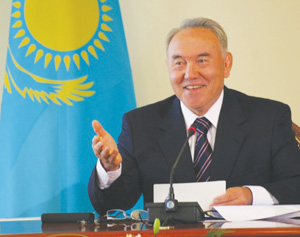
    Those who hold to Augustat’s view and see the building of a peaceful worldwide commonwealth of nations as a possibility that must begin at the highest cultural and spiritual level, are turning their attention to Kazakhstan in Central Asia, whose new capital, Astana, hosted the above-mentioned World Forum of Peace through Spiritual Culture in October, 2010. In Kazakhstan they glimpse something immensely hopeful for the rest of the world taking place: the rebirth of principles of civilisation once considered essential for peace and mutual understanding between nations, but now long lost to the world, their very existence forgotten.

    Central Asia ceased to be a part of the Soviet Union in 1991, a large part of it becoming instead the independent nation of Kazakhstan. Now one of the largest countries in the world, this vast new state spreads across the heart of the Eurasian landmass from the shores of the Caspian sea to the Tien Shan mountains and the Altai, uniting East to West. Crisscrossed by ancient trade routes and revealing to archaeologists the ruins of long-buried civilisations, the whole region is now striving to reconstitute its shattered identity as guardian of the world’s oldest traditions of sacred knowledge.

    Tiberio Graziahni, president of the Institute of Advanced Studies in Geopolitics and Auxiliary Sciences, refers to the region that traverses central Asia from the Gobi to the Mediterranean basin as “the hinge of the whole Afro-Eurasian landmass” and as critical to its integration – and to world peace. Widely regarded as the crucible of civilisation, Central Asia is even more than that: it is the generative heart of the planet, a place of evolutionary birthing that has become active again and again throughout history, spawning religions, sciences and civilisations that have fanned out across the world. Here where the ancient Silk Road ran and invading hordes and new religious movements swept to and fro remaking civilisations, history reveals that the influence of a single powerful spiritual source has been radiating out under various names, promoting peace and righteousness to the ends of the Earth for countless millennia.

    From the Karakorum mountains at the western end of the Trans-Himalayas this same spiritual hierarchy gave birth to the Sun religion around five thousand years ago. It sent forth the Sons of the Sun or Sons of Heaven, sometimes known as the Sons of Light, to build a network of temples around the globe that brought knowledge both scientific and spiritual to the people and civilisation to the whole planet. Supplanting Ice age shamanism and the earlier worship of the Pole star in the constellation Draco for that of the Sun, the new faith nevertheless preserved a great deal of reverence for the lofty principles of its predecessor, as indeed is testified by the totemic masks of birds, animals and fish still worn by the neter gods in ancient Egyptian art. This mysterious hierarchy also lay behind the Sun religion of the Shang dynasty in China and the Kibieri of the Celts, and behind the Solar religion of the Egyptian kings of Heliopolis who, as Sons of the Sun, were closely allied to the original Asiatic order.

    Although still culturally devastated by the destructive materialism imposed on them by communist Russia, Kazakhstan’s people preserve the memory of their illustrious past and long for its return. Travellers say that the whole of Central Asia still rings with stories of Shambhala, a place of enlightenment and peace hidden among the most remote mountain valleys, and once known also as the Land of the Living Gods, the Forbidden Land and the Land of White Waters where the culture-bearing Sons of the Sun originated. Faced by the devastation of their ancient culture, the hopes of many of the Central Asian peoples are still high that soon this will be rectified; the king of Shambhala will lead his great band of warriors out to destroy his enemies and reclaim the kingdom as his own, as a Buddhist prophecy has long declared.

    Legend foretold the day when Rigden Jyepo, the king of Shambhala, would come with a great army to destroy the forces of evil and usher in a golden age: the Age of Maitreya. Shambhala, therefore, symbolised the great future, when the Panchen Lama would be reborn as Rigden Jyepo and the reign of Maitreya, the Coming One, would begin.2

    Provocatively, however, the former Library Congress historian and Professor Andrei Znamensky has a somewhat different and less spiritual take on the prophesied Buddhist war of Shambhala. Obviously, he says in his book Red Shambhala, the prophesy is actually directed against Islam and the mlecca – the Mecca people – who have invaded the land.3 However that may be, today there are signs in Kazakhstan of the birth of a Muslim reforming programme that owes nothing to the more combative Buddhist scenario, yet fulfils in every essential way the Shambhala prophecy, promising to usher in a new era and a new sacred society based on culturally enlightened principles.

    The young oil- and gas-rich nation of Kazakhstan, whose geography takes in a majestic panorama of seas, alpine forests, steppes, deserts and snowfields, is home to something like 140 ethnic groups of every possible cultural background and religious persuasion. As well as the indigenous Kazakhs, here are established Nestorian Christian and Sufi communities, indigenous Buddhist groups and shamanic nomads still roaming the steppes, as well as a large population of Jews who fled here after the Romans sacked Jerusalem in the second century CE; besides which there are Jewish converts known as Khazars who have migrated eastward and settled in their thousands in this foreign land.

    An ex-Communist with visionary ideals, the President of Kazakhstan Nursultan Nazarbayev seems determined to democratise Islam, although not perhaps in the western style. Breaking the traditional Muslim mould of power-driven dynastic autocracy that featured until very recently in all the Muslim caliphates, he recently rejected a referendum that would give him a further ten years in office, and showed readiness to actually shorten the term of presidential office. He has initiated the People’s Assembly of Kazakhstan, which gives every ethnic group the right to take part in the decision-making congresses associated with the political, cultural and social activities of the country. And his attitude to women is also modern. Schools for girls are a priority, with attention given to getting girls into science and technology.

    The main thrust of Nazarbayev’s initiatives is clearly to bring into international dialogue the various divisive issues that press most heavily on the global community at present. Astana hosts a number of world congresses, including the World Federation of Neurosurgical Societies and a World Conference on Disarmament, while the First Almaty Economic Business Forum may be held in Astana in 2012. But the President’s chief initiative remains one that first materialised in 1992, soon after Kazakhstan’s independence from the Soviet Union. In 2003 the Congress of the Leaders of World and Traditional Religions was held with great success in Astana, and again in 2006 and 2009. Emphasis was laid on the principles that bind religions together rather than those that separate them.

    In October 2010 the World Forum for Spiritual Culture, intended for a more general interdisciplinary gathering, was held in Astana, again chaired by the Kazakhstan President and imbued with the religious tolerance for which the ancient shamanic races of this region, such as the Mongols and also the Sufi orders, have long been famous.4 As the British scholar and philosopher Peter Kingsley notes, “It was no small practical achievement for the Mongol Khans to transform into a major institution the long-standing Central Asian custom of convening formal gatherings made up of representatives from different religions so they could openly discuss their beliefs on an equal footing instead of just killing each other.”5

    According to the same open principle, high-level representatives from about seventy-five countries, “from all cultures, ‘cults’ and worldviews,” attended the historic gathering in Astana. In his Conference report on the International Forum for Peace through Culture, Augustat stated that the world initiative launched by Kazakhstan’s President is based on non-violence, harmony and cooperation between nations. “The core problem of our present time is formed of lethargy, extreme egoism, greed, corruption, purely materialist thinking and so forth – all of which have to be exchanged for real human values.”6

    Similar world gatherings to those in Kazakhstan are of course being held elsewhere, for example in Turkey and Australia very recently. But the key objective of the Executive Committee of Spiritual Culture as proposed by President Nazarbayev strikes another new and even more revolutionary note. It aims at nothing less than the furtherance of an integration of science, socio-politics and religion in one overarching transcendental order. As Kingsley notes, from the very earliest times but now long lost, this idea of a comprehensive divine whole uniting all that exists was also a core principle of the philosophy of central Asian shamanism from which the Sun religion directly emerged, and in which there was a constant overlapping of “spirituality and science, mechanical ingenuity and philosophy, mysticism and military expertise,”7 as well as poetry, gnosis and politics.

    Consequently, one of the most important highlights that came out of the Kazakhstan World Forum, notes Augustat, is the awareness of the necessity of a synthesis of the political and spiritual-cultural as well as scientific spheres in society, and the gradual overcoming of their present entrenched separation. This very postmodern approach, which even today is entertained by only a minority of western thinkers as the necessary basis for a more enlightened world civilisation, characterises the Kazakhstan Executive and raises the interesting question: where is this intellectual initiative coming from? What hidden metaphysical influence is at work here?

    The Sacred Union of the East

    As we shall shortly see, President Nazarbayev’s is not the first attempt in modern times to reestablish in the Eurasian heartland a nation based on enlightened spiritual principles. Seventy years before the birth of the Kazakhstan nation a similar Buddhist attempt was essayed in the Altai in southern Siberia. Nazarbayev’s has been guided, it would seem, by a different star, a gnostic vision from a far more distant time; but nevertheless, the earlier attempt to establish a Buddhist New Country of New Russia in the Altai may well be seen as a rehearsal for Kazakhstan’s more ambitious Muslim experiment.

    After the 1917 Revolution in Russia, says Znamensky, Communism took on a religious quality “typical of religious revitalisation movements in tribal societies.”8 In his book Red Shambhala, he reveals the underground occult agenda of a visionary Russian clique working within the very core of the new Bolshevik State to bring about a political condition impregnated with the Buddhist wisdom of Shambhala. Inspired by Buddhist prophesies, this clandestine group active within the Soviet Secret Police believed that the social ideals of Communism were compatible with those foretold of the Buddha Maitreya, the One to Come, and that with the amalgamation of the two a glorious mystical era of Communism would result that would benefit the whole world. So persuasive was this vision that for a while the movement gathered many Communist adherents, and indeed was to be destroyed only by the later Stalinist purges. But not before a number of expeditions were either planned or actually sent forth from Russia and elsewhere in eastern Europe, with the intention of finding the fabled kingdom and embracing its immortal teachings.

    One of these expeditions – and the most celebrated – was launched from New York by the painter Nicholas Roerich and his wife Helena, White Russian emigres to America and passionate converts to the new Theosophical teachings promulgated by another Russian, Helena Blavatsky. Nicholas established a Master art school in New York and Helena, a mystical clairvoyant, channelled guidance from Masters Morya and Koot Hoomi, the same Mahatmas whom Blavatsky had claimed as her unseen Adepts and spiritual mentors a few decades earlier. (According to recent research, these two Masters were most probably Hindu and Sikh Indians, presumably high initiates in their respective religions.)9 The Roerichs were also strongly influenced by the shamanic teachings and legends of Shambhala that had been trickling into Russia from Russian expatriates in southern Siberia for the past hundred or so years; and in 1923, at the behest of the Master Morya and under his continual guidance, the Roerichs set out for central Asia on an arduous odyssey to find the wondrous kingdom.

    Behind the ostensible reason for the expedition was a hidden agenda of the greatest import, which Master Morya impressed on them was the additional meaning of the prophesy of Shambhala. Shambhala, he said, was “not only the abode of mystical Buddhist learning, it was the guiding principle of the coming cosmic age.”10 Its further meaning would unfold in the establishment of a sacred New Country, a New Russia in the Altai, a mountainous country in southern Siberia lying at the intersection of Mongolia, Kazakhstan and Tibet. There the Roerichs were to found the New Country on the highest Buddhist principles. It was to be governed at a spiritual level by the exiled Tibetan Panchen Lama – whom they were commissioned to find somewhere in Mongolia and bring back to the Altai – and on an administrative level by Nicholas himself, who sometimes wore the robes of the Tibetan Dalai Lama.

    According to Znamensky, the Roerichs envisaged in the Altai a utopian theocracy composed of “a commonwealth of people who would live a highly spiritual life and work as a cooperative – the economic foundation of this new state.”11 In fact the New Country was to be nothing less than a unification of all Inner Asian peoples into a spiritual kingdom. Thus would be established the Sacred Union of the East.

    The project failed. It was naïve, ill-conceived and geopolitically ignorant. The Panchen lama, at that time enjoying a profligate lifestyle in Mongolia, was not interested in the New Country. And visiting Soviet Russia to elicit support for their Great Plan, the Roerichs received only a cautious and limited response from the government while antagonising all the other great powers – Japan, America, Britain and China – at that time mutually competing to gain access to the riches of central Asia. Nicholas and his son George made a further attempt to materialise the Masters’ plans in 1937, but this attempt too failed, and having earned the fury of Franklin D. Roosevelt, the then president of the US who saw their endeavours as a betrayal of US interests, the Roerichs were obliged to retire to India for the rest of their lives.

    Nevertheless, we can glimpse in the Roerichs’ Altaic project a foreshadowing, a rehearsal or preliminary model of what is presently happening in neighbouring Kazakhstan. But there are significant differences. For one thing, and an important one, in the Buddhist venture Nicholas Roerich laid no discernible emphasis on interdisciplinary unification, a reform of the utmost importance to Kazakhstan’s President. Nor is there any indication that Nazarbayev draws to any degree on the mythology of Shambhala. Indeed the warlike outlook that lurks behind the Altaic venture and plays such a large part in the Buddhist prophecies of Shambhala – leading Nicholas and Helena to regard themselves as “Shambhala warriors” – is entirely absent from Nazarbayev’s idealistic programme. To trace the bond that does undoubtedly seem to exist between these two regional ventures seventy years apart, we must delve more deeply into the nature of the ancient spiritual hierarchy that lies at an even more hidden level beneath Shambhala’s folk mythology.

    The Rising Sun in Asian History

    What then is the source of Kazakhstan’s unusual and potentially revolutionary geopolitical objectives? To find a precedent for them we have only to turn back to the great days of the Sun religion that peaked during the third millennium BCE.

    As the Solar impulse spread globally into a honeycomb of separate national cults, each with its own sacerdotal hierarchy, the priesthoods of low rank, concerned mainly with ritual and dogma, separated out, everywhere dissolving into polycentric and insular attitudes towards each other, very much in the modern divisive manner. But in the higher prophetic ranks we find a counterbalancing trend of a quasi-clandestine nature that preserved the original unicentric Solar policy, even to maintaining an overseeing brotherhood with its headquarters remaining in Central Asia.

    In this way, by preserving their cohesion the prophets contributed an underlying unity and strength to society that universally balanced the equally divisive tendencies of popular religion. A hierarchic philosophy in the higher Solar echelons balanced a democratic one in the lower, leading to a spirit of accord and international harmony unprecedented to this day, yet at the same time allowing ideological differences to flourish creatively in the lower levels of the religion.

    Furthermore, these higher-ranking adepts were men and women of learning as well as spirituality; sages, but also astronomers, engineers, scientists, doctors and architects, who combined the various secular disciplines at all times with their metaphysical interests. Even as the Earth and the stars of the firmament were seen as related elements of one transcendental order, so that divine Whole was believed to be inclusive of, and to bring into relationship all areas of human knowledge, whether they be religious, psychosocial or physical. Two famous historical figures who fall into this category are Visvakarma of the Arunachala temple in India, a renowned expert in geometry and number, and Imhotep, ancient high priest of Heliopolis in Egypt, an engineer and architect who famously built the step pyramid at Saqqara. By means of this policy of multidisciplinary integration which brought together at all levels the opposite poles of human knowledge, those of the spiritual and natural orders, societies were unified at a high overall level, but without stifling the creative potential that lies in the challenges of diversity and opposition.

    Thus it was the operation of the two key principles of religious tolerance and multidisciplinary unity maintained in a high state of ideological tension that, while they lasted, rendered the Sun religion the greatest civilising force the world has ever known. But in time, as the initial impulse spread ever more widely throughout the Old and the New Worlds and discord inevitably increased, the religion increasingly found expression in various more esoteric orders bearing different names but inherently the same liberal principles. One of these orders was the international Order of Melchizedek, widely believed to be involved in the beginning of all three Semitic religions, Judaism and Christianity as well as Islam.

    Melchizedek, king of Righteousness, is a mysterious figure who threads his way through the Hebrew Bible as high priest in perpetuity of the Canaanite Sun God El-Elion. He is said within occult circles to head a Righteousness Order whose secret headquarters, even to the present day, preserve in the mountains of central Asia an organisation of great antiquity and influence in religious affairs with branches in many countries and throughout many epochs. Superior to any local cult or priesthood and steeped in the wisdom of shamanic gnosis, the order claims to be, like the Sun religion, an underground spiritual stream, itself invisible and timeless, from which all our disparate belief systems ultimately stem.

    In Genesis (14-18) Melchizedek initiates the prophet Abraham, the ancient ancestor of all the Semitic tribes, into the Solar worship of God Most High after Abraham had defeated a coalition of kings. “And Melchizedek, king of Salem, caused bread and wine to be brought; and he was priest of God Most High (El Elion). And he blessed Abram, saying: ‘Blessed be Abram, he of God Most High, possessor of Heaven and Earth; and blessed be God Most High who has delivered your enemies into your hands’. And Abram gave him the tithe of all he had taken.” As the esotericist René Guénon notes, “the whole episode enacts a true ‘investiture’, almost in the feudal sense of the word, but with the difference that it is a spiritual investiture, wherein is found the exact point of union between the Hebraic and the great primordial tradition.”12 As a consequence of the rite Abram acquired the new name of Abraham.

    Andrew Welburn, a Fellow of New College, Oxford, suggests a continuity throughout history of the rites of the Israelite kings and the older Mystery practices connected with the ancestral king and high priest of the Sun God El.13 Thus, Welburn says, since Judaism was primarily a lunar religion, these Solar initiations would have been strictly esoteric Mystery events. The Letter to the Hebrews (5-6) in the New Testament implies a similar distinction in Christianity, for the writer, Apollonius of Alexandria, declares that Jesus Christ too has been given the office of high priest of God Most High. Here, says Welburn, we meet again the old Canaanite priest-king Melchizedek, who was so central to Essene and Gnostic teachings and whose name is linked to the hidden Solar symbolism that runs through the lunar religion of Judaism.14

    In the case of Islam, although Muhammad’s Arabic Qraiysh clan was the only one to have abstained from polytheism and remain loyal to El, the traditional High God of the Arabs whom Muhammad called Allah,15 the connection with the Melchizedek Order is not as direct as in Judaism and Christianity: yet it is there. Although nowhere stated in the Koran, not only would Muhammad therefore have come automatically under the tutelage of El’s high priest Melchizedek, but also it is an Arabic tradition that Abraham, as the first of Islam’s prophetic lineage passed the wisdom he had received from Melchizedek down the line to the prophet Muhammad and his Islamic reformation. And there in Islam it was preserved by the Sufis, a spiritual order that had existed long before Islam.

    In The People of the Secret, the Sufi author Ernest Scott elaborates the idea that Sufism, which he says originated in northern Afghanistan, shares a common origin with other ancient religious forms.16 Like the Sons of the Sun and the Righteousness adepts, the Sufis were direct heirs of neolithic shamanism and more than any other religious system of the day carried forward the two key principles of the Sun religion. For a time Sufism became a powerful democratic influence wherever Islam spread, constellating especially along the Afro-Eurasian “hinge” referred to by Tiberio Grazianhi.

    As a consequence, by the eleventh century CE the Sufis had welded Islam into the greatest force for civilisation at that time known. Active behind the various national caliphates, they resurrected Greek knowledge at a time of calamitous cultural decline in the West and extended to western powers friendship and learning in equal measure. For centuries the Sufis ensured that Jews, Christians and Muslims lived at peace with each other, extending the boundaries of knowledge and together rebuilding the cultural wealth that had been lost after the demise of the Roman empire. And Sufism also ensured that in the Fatimid caliphate of the eleventh century a mosque became the first university in Islam in which theological expertise united with that of chemistry, astronomy and medicine, mathematics and geometry in an overall metaphysic of great intellectual force.

    There can be no doubt whatever that this underground Sufi input, even in a time of greatest Muslim intolerance towards it, still operates clandestinely along the Afro-Eurasian “hinge.” But it is in Kazakhstan that it is arguably causing what may well become a fully flowering Muslim cultural renaissance of the highest order, a rising of the Sun of gnosis which will affect the whole of Islam.

    In President Nazarbayev’s gatherings of eminent representatives of all the religions on Earth, and in his insistence on bringing together the various spiritual and scientific disciplines in one comprehensive embrace, something quite unique may be happening in Central Asia that will have important consequences for the peace and harmony not only of Islam but of the rest of the world.. This is a time of critical challenges and perhaps only time will tell.

    [alert type=”general” dismiss=”no”]This article was published in New Dawn Special Issue Vol 6 No 1.[/alert]

    [alert type=”success” dismiss=”no”]If you appreciate this article, please consider subscribing to help maintain this website.[/alert]

    Footnotes

    1. From Wilhelm Augustat’s Report on Astana World Forum of Spiritual Culture International for New Dawn 126, May-June 2011, 4.

    2. Ruth A. Drayer, Nicholas and Helena Roerich, Quest Books, Illinois, 2005, 84.

    3. A. Znamensky, Red Shambhala, Quest Books, Illinois, 2011, xii.

    4. Peter Kingsley, A Story Waiting to Pierce You, The Golden Sufi Center, California, 2010, Note 29, 162.; also J.G. Bennett, The Masters of Wisdom, London, 1977, 145, 150.

    5. Ibid., 163.

    6. Wilhelm Augustat, op. cit., 4.

    7. Kingsley, op. cit., 155.

    8. Ibid., 104.

    9. K. Paul Johnson, The Masters Revealed, State University of New York Press, 1994, 5-6.

    10. Drayer, op.cit., 84.

    11. Znamensky, op. cit., 166.

    12. René Guénon, The Lord of the World, Coombe Springs Press, London, 1983, 33.

    13. Ibid., 127.

    14. Ibid., 124.

    15. Jay Weidner & Vincent Bridges, The Mysteries of the Great Cross of Hendaye, Destiny Books, Vermont, USA, 2003, 102.

    16. Ernest Scott, The People of the Secret, Octogon Press, London, 1983, 191.

    © New Dawn Magazine and the respective author.
    For our reproduction notice, click here.
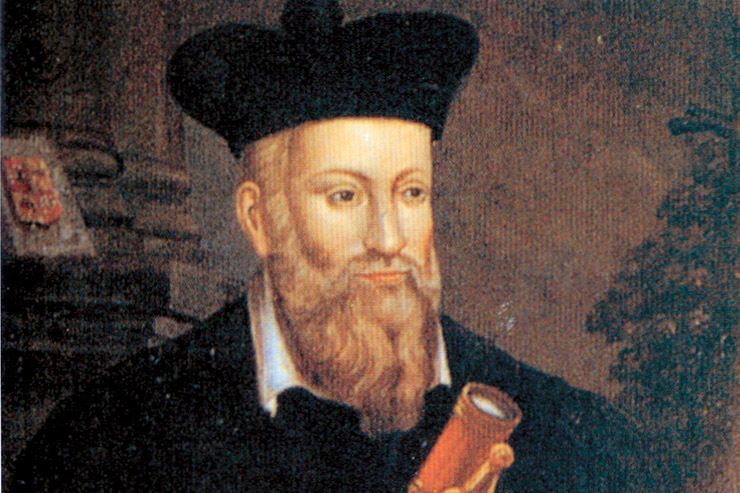
  • Magic & Mysticism in Java

    Magic & Mysticism in Java

    From New Dawn Special Issue 5 (May 2008)

    The death of ex-President Soeharto of Indonesia at the age of 86 [in 2008]  reminded me that I was present in Jakarta in 1967 during the bloodbath in which the Communist Party was decimated and General Soeharto rose to political power, along with the minority modernist Muslim party that supported him.

    At that time Indonesia was only nominally Muslim: under the charismatic President Soekarno it was animistic, feudal, steeped in an other-worldly mysticism, and was infested with starving beggars, superstition and black magic practices. General Soeharto, of humble village origin, had risen high in the military apparatus and married into a family of the minor nobility in Solo. His marriage gave his political aspirations legitimacy in the eyes of Indonesians, who believed in the ancient tradition that links royal status to the right to rule.

    The General was well known to have a close affiliation with a Javanese magico-mystical school believed to give him great occult powers, yet from the time of his ascension to the presidency he appeared, unlike ex-President Soekarno, to deny the affiliation, at least publicly. The new pro-Western president donned the Islamist black pitje and publicly espoused and supported the political arm of orthodox Islam, which in the main was vehemently opposed to any and all occult practices. It proved to be the best thing that could have happened to the country.

    Whatever President Soeharto’s questionable legacy in other areas, in this respect he dragged Indonesia from the dreaming Middle Ages into the modern world. Today, Indonesia is officially a member of the great Muslim international fraternity, and Islam’s austere religious mores have increasingly infiltrated the national culture, modifying its more primitive animistic traits and greatly strengthening its influence in Asia-Pacific politics.

    Nevertheless, Pak Soeharto retained to the end of his life his private allegiance to Javanese mysticism. Doctors who attended him in the last weeks of his illness, during which he rallied more than once from heart, lungs and kidney failure, said they were amazed and baffled by his recuperative powers. It was commonly believed, however, that the power of spirits and the implantation of many lucky charms inside his body was the factor keeping him alive. Indeed, those who were close to Soeharto in his home town of Solo, the heartland of the Javanese culture, have attributed his resistance to death to his devotion to the powerful occult forces that resided in him throughout his life.

    According to a recent article in the New York Times, all six presidents of Indonesia “paid respects to the spirit world, visiting sites said to hold mystical powers, consulting with seers and collecting tokens of magic like the Indonesian dagger called a kris.”1 Among these leaders, Soeharto was outstanding as a devotee of the occult. He studied as a boy with a spiritual teacher and performed ritual acts throughout his presidency, continuing to do so even after a popular uprising deposed him in May 1998.

    According to his aides, over the years he made frequent visits to sacred places, including mountains, caves, tombs and ruins, and took ritual baths in oceans and rivers sacred to Nyai Loro Kidul, the mighty Queen of the South Seas. He also collected hundreds of sacred objects in order to absorb their magical power.

    The Javanese Science

    Despite the ascendancy of modernist Islam throughout the nation, Soeharto’s private loyalty to Java’s spiritual past is mirrored in Javanese society in general, though its allegiance now tends to run underground in the face of Islamic disapproval, especially that of the strict Wahhabi sect, which over the years has become extremely influential. To the outsider today all Indonesians are strict Muslims, but under the pitje or the headscarf there is likely to be concealed a mystic of quite a different stripe. The people of the island of Java in particular are very proud of their indigenous pre-Islamic spiritual tradition, which they refer to as the Javanese Science, and while few may actually practice it now in its pure occult form, most have a proprietorial understanding of at least some of its sacred principles. They are evasive about discussing this hidden dimension of their society, especially with Western foreigners, but one would be mistaken in not taking the Science very seriously indeed as the essence of the Javanese culture even to the present day.

    The Javanese Science is a syncretic blend of Hindu-Buddhist, Sufi, Taoist and ancient animist strands, and evolved in the royal courts of Solo and nearby Jogjakarta in Central Java as a system of self-transformation confined solely to the aristocracy. But since the Revolution that ejected the Dutch rulers from the country after the Second World War, the Science emerged into the popular culture in the form of hundreds of kebatinan (or inner-being) sects, each one of which celebrates some aspect of the royal mother tradition. These esoteric sects have drawn a very large minority of the Indonesian population into their sphere, forming an immensely creative and diverse subculture at the leading edge of national life, very much as happened in Japan after the Second World War.

    The Kebatinan movement has in many respects evolved into an inherently new form of mysticism. Syncretism raised to a religious principle is its dominant keynote, a drive towards pluralistic unity that echoes a prominent feature of the New Age spirituality appearing elsewhere in the world. But the Javanese approach to the universe and the human situation generally, though at its best of a high metaphysical order, is in many respects quite different from that of the West. It doesn’t involve religious theories and dogmas so much as a science of inner energies perceived directly with a highly sensitised intuition – one might say, clairvoyantly – and manipulated directly by the will.

    This shamanistic approach can lend a disconcerting ambiguity to those moral categories that the Western mind likes to regard as eternally fixed: Justice, Compassion, Truth, Altruism, Duty and so on. To the Javanese, mystic things in the moral sphere are not good or bad according to what we in the West would regard as an ethical judgment, but according to whether the personal energies concerned balance out in a manner beneficial to the whole. Do they bring harmony to the individual, do they stabilise him or her? For the Science all is dynamic, all is in ever-transformative and purposive flux: good is what works in the present moment to the spiritual benefit of the whole; bad is what fails to do so. This stance contributes a relativistic and unpredictable note to the Javanese outlook that Western diplomats and others have famously found difficult to deal with, yet its creative power is undeniable.

    Javanese adepts with access to this underlying realm of subtle forces are reputed to have diagnostic powers and techniques of psychic healing of extraordinary efficacy, and are believed to understand the dynamics of spiritual physiology better than any other race on earth. The Javanese Science has much in common with other shamanistic Eastern paths such as have been found in Tibet and Japan, where syncretism has similarly been raised almost to a spiritual principle. These too have dealt in patterns of shifting subtle energies rather than fixed doctrinal systems. But there is something different and mysterious about the Javanese Science, a depth, a quality of purity that most researchers are agreed sets it apart from any other form of mysticism. What makes it unique?

    The Invisible People

    In a visit to Indonesia some years later, I was able to put this question to Pak Joyo, at one time the Director of a Christian Theological College in Central Java and the pastor of one of the largest charismatic Lutheran churches in the Reformed Dutch Church of Indonesia. Pak Joyo was a fourth-generation Christian whose great-grandfather was converted to Christianity at the point of his Sultan’s kris (the Sultan himself having been similarly converted by Dutch missionaries), and Pak Joyo followed in his family’s footsteps in deciding to train for the ministry. But halfway through his theological training, he decided to quit the church and give all his allegiance to a contemporary mystical sect called Hardopusoro which interested him a great deal more.

    However, he told me that in a vision Christ asked him to remain in the church, where he could be more useful than anywhere else; and after an internal struggle he obeyed. Pak Joyo went on to become a multilingual international emissary for Christian ecumenicalism – but, with the blessing of his bishop, privately continued in Hardopusoro, in which he became a high initiate. Such dual religious allegiances are entirely natural to the Indonesian temperament.

    Pak Joyo’s answer to my question surprised me. The source of his country’s spirituality, he said, was not familiar to other races. It was unique because it stemmed from the Invisible People, the Badui, who grew no bigger than a ten-year-old child and who lived in an inaccessible part of the mountainous jungle in South Bantam, about a hundred miles west of Jakarta. The Badui were “closer to the soul” than other people, said Pak Joyo, and were the X factor in the background of the Javanese Science. Invisibly they had instructed the Javanese people for nearly three thousand years, helping to guide them from their original primitive state to their present civilisation.

    The Badui were not Indonesian and had no part in the country’s laws or economy, but lived apart in forest territory forbidden to outsiders and had great spiritual knowledge and strange magical powers. Although rarely seen by outsiders, they were held in awe in the marketplaces throughout Indonesia. When Indonesian spiritual and political leaders needed advice, said Pak Joyo, even the most illustrious of them went into the jungle alone to consult the Badui seers, for the understanding of the Invisible People on spiritual matters was a universal one that embodied a primordial tradition beyond factions or institutions.

    President Soeharto would undoubtedly have been one of those top leaders who was not too proud to seek enlightenment, possibly of a political as well as a spiritual kind, from these strange priestly people of the jungle. Leaving behind his aides, bodyguard and driver, he would have had to ascend alone the jungle forest track that led to the Badui colony, there to consult with its leading prophets.

    Inexplicably, although remote from the teeming civilisation surrounding them, the Badui knew everything that happened in it long before the news was heard on television. They had prophesied the Second World War and that the Dutch would leave the country soon after peace was declared. They knew the destiny of peoples worldwide. The Badui, it was said, planted sacred trees – living trees, as they called them – representing their tribal leaders in a hallowed grove called the Artjas Domas, which was visited once a year by the highest-ranking Badui priests. By studying the growth on the trees clairvoyantly, they were able to read the fortunes and destiny not only of people, but of nations and the world. From this yearly examination everything of value to their leading families was recorded in a script known only to them. The Badui were said to have telepathic powers and a magical way of keeping others away from their settlements, especially from the Artjas Domas.

    I have recently learned that the Badui people have now inexplicably disbanded and their old territory has been settled by Indonesian farmers. But when I revisited Java in 1980, their colony was still a great focus of mystery and unanswered questions. Why were these strange forest-dwellers so influential? What kind of special wisdom did they possess? Where had they come from? And why did they live apart, alien, feared, invisible – and yet, according to Pak Joyo, all-seeing? Sir Stamford Raffles referred to them in his eighteenth-century History of Java, yet since then no traveller from the West had succeeded any better than the Indonesians themselves in setting foot on the Badui’s inner territory or penetrating their secrets.

    Eventually I learned more about this remarkable people from Dr. Paul Stange, an American lecturer in Asian Studies who grew up in Indonesia and who obtained a doctorate from the Michigan University in the US for his study of Sumarah, an akebatinan sect that has become influential in Indonesia since the Revolution.2 In his thesis, Dr. Stange was able to relate the Badui indirectly to the growth of kebatinan sects such as Subud and Sumarah as constituting a cutting edge phenomenon in the evolution of mystical consciousness.

    Custodians of the Soul World

    It seems that the Badui are of the dark-skinned Tamil race that is believed to have spread from Africa long ago into southern India, and from thence into Southeast Asia and the Pacific Islands, where they lived unmolested for thousands of years. But about eight thousand years ago the Malays, at that time a mainly Caucasian race from the north, crossed the Sunda Strait and displaced the Badui culture in the Sunda Islands, with the consequence that most of the indigenous race withdrew into the mountainous interior of Java, far from the spreading communities of the newcomers, while a remainder migrated further east.

    Some time in the first millennium BCE the remnant of the aboriginal Tamil people in Java was joined by a large group of Indian initiates – probably, some authorities think, refugees from the defunct Indus valley culture in which holy trees also played an important part – and the two groups, each with its heritage of ancient racial wisdom, together formed the Badui priesthood.

    Forty Indian Hindu-Buddhist families, constituting a sacred nucleus, inhabited a central group of three villages served by an outer ring of vassal Badui communities: together the two clans built a spiritual power-centre in Java which, isolated though it was for nearly three thousand years and finally greatly diminished in numbers, preserved unchanged its sacerdotal structure and identity and its pivotal place in Javanese religious life. Those in the inner esoteric circle wore white sarongs and turbans, were called the White Ones, had strict rules of conduct and were forbidden by their laws to have any communication whatever with the outside world, while those in the outer villages wore blue sarongs and turbans and were called the Blue Ones. There was no intermarriage between the two clans.

    Although the use of money or of weapons was forbidden to all in the colony, the ascetic laws of the Blue Ones were less severe than those of the others, and enabled them occasionally to visit an Indonesian village to obtain by barter the very few items the farming colony needed (mainly smoked fish and salt), and to serve where necessary as liaison officers and spokespersons for the White Ones.

    Despite their harshly primitive way of life, it would be a mistake to suppose these jungle people were not, in their own way, highly civilised. Nina Epton, a British journalist who is the only known Westerner to have met the Blue Ones and a few of their holy White Ones (although many Dutch researchers tried before her), speaks in her book The Palace and the Jungle of their aloof dignity, their air of having “a destiny apart from other mortals,” and above all, of what she calls “the Tibetan look.” This was a wide-eyed all-seeing look common to many of the Badui, which she describes as staring beyond this world into the spiritual realm. It was a look she associates especially with pictures of seers like Guru Padma Sambhava, the great Indian initiate who brought Buddhism to Tibet.3

    Ms. Epton has described the Badui physiognomy as varied and clearly of an older ethnicity than that of the Indonesians. But the elderly leader of the White Ones, reputed to have been a saint and a sage and obviously of a superior caste to the others, was plainly more ethnically advanced. She noted in particular that he had a worn, patient and ascetic face which reminded her of that of a well-mannered European intellectual. In other clothes he would have passed unnoticed in an English crowd, for he had a very light complexion, a narrow face and the gentle bearing of a civilised person. Altogether, Epton says, the Badui were not what one expects from the jungle.

    This assertion is borne out by the personal history of a young runaway, the son of a pu’un or chief of the White Ones, who in the seventeenth century escaped the colony to become a stable boy in the then Sultan’s palace. Soon he became the Sultan’s counsellor and then his son-in-law, and today his descendants are the Jajadiningrat family, one of the most aristocratic and politically influential families surrounding the Indonesian presidency. Throughout the intervening three hundred years, the Badui continued to “read” the sacred tree of the stable boy’s line, to visit his Jajadiningrat descendants once a year with predictions and advice for the coming year, and where necessary protect the members of the family from danger.

    In fact, the sole reason for Nina Epton’s unprecedented interview with the leader of the White Ones was that, through the Sultan, she obtained an introduction to the Jajadiningrat family, who asked the White Ones as a special favour to grant her an interview. In no other way would the meeting have been possible.

    The Badui priests continued to follow the destiny of the Jajadiningrats, says Epton, because for the Invisible People once a holy lineage is laid down it is laid down forever, it belongs to the timeless realm of the soul world. The Badui in fact denied the reality of time. Their sages believed that the rules of life were laid down once and for all at the Beginning of things by an ancestral divinity called Batarratunggal, who will one day return to govern the Badui and the world. In the meantime, it was their sacred obligation to maintain everything exactly as it was at the beginning, without change, without innovation. Nothing concerning their customs or belief system must be disturbed from their state of primordial perfection: hence the necessity of isolation.

    To the modern Javanese mystic this Badui belief is merely the folk expression of a deeper spiritual reality. He sees the concept of a Beginning-time or Dreamtime to which so many early races look back with longing, believing it to be a cosmic paradise that must be ritually preserved for the future, as simply a metaphor for the inner soul plane, which is both cosmic and interior at one and the same time. That inner place, eternally omnipresent within each human being, is really the cornucopia from which all spiritual paths and religions flow forth in their season. As a race we have long ago lost contact with such a high level of soul-consciousness, and so it is called by other names: the Garden of Eden, the Dreamtime, Paradise, the Kingdom of Heaven. But according to the Javanese view, it is in truth a soul-world present in each one of us, a celestial headwaters from which the river of the spirit flows continually into our bodily spacetime. This higher/inner world must be kept purified, as it once was and will be again in the future, and it was the task of the Badui to help do this, since we as a race cannot.

    No one knows for certain why the Badui people have now dispersed. But it is evident that deep changes reflected in its politics have overtaken Indonesia within the last few decades. The erratic occult climate that pervaded the early years of independence has yielded not only to a stricter Islamist discipline but also to the growing apparatus of democratic government, a maturing judicial system and economic reform, all of which has brought stability and prosperity to the people. The nation has come of age. According to Dr. Stange, who received a wealth of Javanese lore from the Sumarah cognoscenti, there is a school of thought that believes the Badui have now fulfilled their mission in the South Pacific, and that is why they have at last dispersed into the Indonesian population.

    The reign of animism in this region under the sovereignty of Nyai Loro Kidul had long been prophesied to end during the twentieth century, giving way to a new and higher religious and cultural dispensation for the Pacific races – one perhaps best represented by the modern Kebatinan movement in Java. It is thought that the Badui understood well that this prophesy has now been fulfilled. They understood that their reign is no longer needed – or indeed tolerable under the new conditions. Having played a custodial role by preserving in secret the pure and unsullied soul-conditions necessary for such a surge of higher consciousness, they have now been able to die out as a separate society.

    Whether or not there is any truth in this theory, it is undoubtedly the case that around the Pacific Rim a new religious spirit is rising. Akin to kebatinan and to the Javanese Science in general, it is based on principles of high shamanism known to the Badui many thousands of years ago, but forgotten by modern humanity. Recognising that enormous healing powers are locked in the ancient soul-ways, seekers visiting Indonesia today find common ground with the synthesising mysticism of the new kebatinan sects and are forming part of a spiritual network that stretches from Findhorn in Scotland to the esoteric centres of California. This development in the Pacific zone has in it the potential for creating a new religious paradigm of global significance. But how much of it is indebted to the heroic patience of the Invisible People of the Javanese jungle, as mystics like Pak Joyo believe, we shall probably never know.

    [alert type=”general” dismiss=”no”]This article was published in New Dawn Special Issue 5.[/alert]

    [alert type=”success” dismiss=”no”]If you appreciate this article, please consider subscribing to help maintain this website.[/alert]

    Footnotes:

    1. ‘As Suharto Clings to Life, Mystics See Spirits’ Power’, Seth Mydans, The New York Times, Jan. 27, 2008.
    2. Paul D. Stange, The Sumarah Movement in Javanese Mysticism, UMI Dissertation Information Service, Ann Arbor, Michigan, 1980.
    3. Nina Epton, The Palace and the Jungle, Oldbourne Press, London, n.d., 55.

    © New Dawn Magazine and the respective author.
    For our reproduction notice, click here.