New Dawn – World's Most Unusual Magazine

Author: Marie Jones

  • Time Travel & The Multiverse – Many Worlds: Many Timelines

    Time Travel & The Multiverse – Many Worlds: Many Timelines

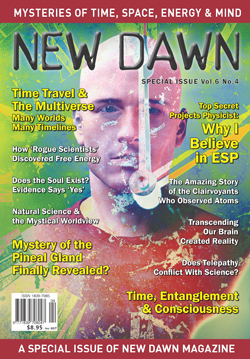
    From New Dawn Special Issue Vol 6 No 4 (Aug 2012)

    Time travel has enchanted and intrigued us since the earliest days of fiction, when authors such as H.G. Wells, Samuel Madden, Charles Dickens and Enrique Gaspar y Rimbau stretched and challenged our imaginations with images and tales of men and women who invented amazing machines and devices that could take them back in time, or forward into the future. Because of the restrictions of light speed, and the paradoxes of going back to the past without damaging the future timeline, and a host of other obstacles and challenges, we, in fact, have remained stuck in the present.

    Our scientific knowledge and technological achievement has yet to catch up to the limitless dreams of our imaginations. But perhaps just because we have yet to achieve time travel in our universe, in our particular point along the cosmic arrow of time, doesn’t mean it isn’t achievable… and maybe the key is the universe itself. Are we limiting ourselves to our understanding only of the laws and possibilities of our universe, and leaving out of the equation other realities, other universes, with other laws and forces, paradoxes and limitation, possibilities and potentialities, far beyond our own?

    In 2011, quantum physicists at the University of California at Santa Barbara, led by Andrew Cleland and John Martinis, designed a “quantum machine,” as they call it, that might one day lead to proof of time travel and parallel universes. Their machine, a tiny little teleporter barely visible to the naked eye, involves making a tiny metal paddle cool to its ground state, the lowest energy state permissible by the laws of quantum mechanics, and then raising its energy slowly by a single quantum to produce a purely quantum state of motion. They even were able to put the device in both states at once, so it vibrated both slowly and quickly at the same time, in another sort of Schrodinger’s Cat state of superposition. They posited that we can only see one of these potential states at once, and upon the act of observation, the state then splits into additional universes.

    Perhaps there is a plethora of multiple or parallel universes all around us, but we cannot see them.

    Wormholes could also be another possibility for teleportation, as physicist Max Tegmark suggested while attending a panel in January of 2008 at MIT to discuss the science behind the movie Jumper starring Hayden Christiansen, about a man who can teleport all over the world at will. Tegmark, asked about the science behind the science fiction, remarked that a wormhole was one possible way of getting something quickly across space-time. However, after admitting that wormholes do appear to be theoretically possible, Tegmark commented that the actual trip would be rather gruelling because of the instability of the wormhole. “It could collapse into a black hole, which would be kind of a bummer.”

    Many scientists look to the possible existence of other levels of reality, or other universes, as a way to make time travel work outside of the restrictions of light speed and paradoxes. Imagine another universe alongside our own where the laws of physics are so completely different, that what is impossible here is mundane and trivial there. Multiple worlds, even, where each is different from the other, or perhaps an infinite number of universes where many would be exactly like our own. Hey, you might even exist in some of them just the way you are right now. In others, you might be rich, famous, handsome or even a cockroach! In fact, perhaps you might even be invisible in one of them!

    But we are getting away with ourselves here. When talk turns to the multiverse and other similar concepts, it’s easy to start dreaming of science fiction worlds with every possible kind of life and all sorts of amazing machines and devices… and time travellers passing effortlessly back and forth between the past, present and future as if it were nothing more than a visit to a few Saturday morning garage sales.
    Parallel Universes

    Parallel universes have long been a mainstay of science fiction films and stories. Parallel universes can exist individually, or grouped together as the “multiverse,” and offer the possibility of a totally different reality in which someone, or something, can exist, or hop back and forth between. The laws of nature may be different in one parallel universe as they are in another, and in respect to time travel, would provide multiple versions of the future in which someone could exist, or not exist at all. Light speed limitations may not exist in a parallel universe, and the paradoxes that keep us from travelling back in time would be null and void if we could jump into a different historical timeline.

    Two great fictional examples of a parallel universe would be “Alice’s Adventures in Wonderland,” written by English author Charles Lutwidge Dodgson under the pseudonym Lewis Carroll, and C.S. Lewis’s “The Chronicles of Narnia,” both of which involve some sort of portal or wormhole, such as a rabbit hole or a large piece of furniture, through which a person can enter into another realm.

    Theoretically, parallel universes may be the result of a single random quantum event that branches off into an alternative universe. This is the “Many Worlds Interpretation” or MWI, of quantum mechanics, originally formulated by physicist Hugh Everett in 1957. It posits that each time a different choice is made at the quantum scale, a universe arises to accommodate that choice, thus creating infinite new worlds popping up all the time.

    These new worlds are being constantly created and could cause problems for a potential time traveller. Physicist David Deutsch wrote in “Quantum mechanics near closed timelike curves” for the 1991 Physical Review, that if time travel to the past were indeed possible, the many worlds scenario would result in a time traveller ending up in a different branch of history than the one he departed from. Deutsch, of Oxford University, is a highly respected proponent of quantum theory, and suggests quantum theory does not forbid time travel, but rather sidesteps it, referring to the traveller’s ability to go into another universe, a parallel universe, and avoid the paradox limitations.

    Deutsch’s idea of parallel universes, the multiverse, or “shadow universes” was described in his interview with the Guardian UK in June 2010 (“David Deutsch’s Multiverse Carries Us Beyond the Realm of Imagination”) as being “co-incident with, somehow contiguous with, and weakly interacting with, this one. It is a composite, a layer cake, a palimpsest of universes very similar but not quite identical to each other.”

    The number of these shadow universes could be enormous, and Deutsch points to photon experiments that suggest possibly a trillion of them or more. He also suggests that future-directed time travel will essentially only require efficient rockets, and is on the “moderately distant but confidently foreseeable technological horizon.” When it comes to past travel, the multiverse might save a time traveller from the pesky Grandfather paradox. He uses an example of a writer who wants to go back in time with a copy of Shakespeare’s Complete Works and help the bard complete Hamlet. It can happen, but in the multiverse view, “the traveller has not come from the future of that copy of Shakespeare.”

    Another off shoot of the MWI is the Many-Minds Interpretation, which extends the MWI by positing that the branching off of worlds occurs in the mind of the individual observer, introduced in 1995 by theoretical physicist H. Dieter Zeh, Professor Emeritus of the University of Heidelberg and the discoverer of decoherence.

    The Many-Minds Interpretation was widely criticised and somewhat ignored, mainly because of issues involving the theory that the mind can supervene on the physical as the mind has its own “trans-temporal identity.” The mind may select one identity as its own non-random “reality,” yet the universe as a whole remains unaffected, which presents additional problems when dealing with different observers ending up with the same measured realities. The actual process by which the mind of the observer would select the single, measured state is not explained by the MMI.

    Alternate timelines, each with their own forward arrow of time and their own history, may exist then, allowing time travellers to jump into another version of history and override those pesky paradoxes. Imagine being able to jump into a timeline where you do get your dream of marrying your high school sweetheart, but, finding out she’s an evil tramp as soon as you say “I do,” you could jump back into your original historical timeline, where you didn’t marry her and instead ended up three years later marrying her sister, your true soul mate, and lived happily ever after.

    Kaku’s Three Ways to Defeat the Paradoxes of Time Travel

    Noted theoretical physicist Michio Kaku (pictured below), author of Parallel Worlds and Hyperspace, writes in his newest book, Physics of the Impossible: A Scientific Exploration Into the World of Phasers, Force Fields, Teleportation and Time Travel, of three ways around the paradoxes of time travel. The first is that you simply repeat past history and fulfil the past, and that everything you do once you are back in time was meant to happen anyway, a sort of destiny.

    This opinion is also mirrored in the views of famed physicist and superstring theory proponent Brian Greene, author of The Fabric of the Cosmos: Space, Time and the Texture of Reality and The Elegant Universe: Superstrings, Hidden Dimensions and the Quest for the Ultimate Theory. Greene writes that outside of the quantum world, in the classical science of the grander scale, we exist static and unchanging at various locations in what he calls the “space-time loaf” of block we call space-time. These moments are unchangeable and fixed. Using a wormhole, if one were to indeed go back in time to a certain point, or date, one would find there is only one version of that date, and that your presence back in time would simply be a part of the original version of that moment. That moment has one incarnation, though. “By passing through the wormhole today and going back to that earlier time you would be fulfilling your ironclad destiny to appear at that earlier moment.” He points to the wormhole time machine itself as the culprit, with one opening or the other passing through time more slowly than the other end, but each opening is still going forward in time. Thus, there will also be a limit as to how far back in time you could travel in the first place.

    The second of Kaku’s paths around the paradoxes involves having some free will to change the past, but within limits, so that you could go back and try to kill your grandfather, but something would prevent you from doing so. The gun might lock up, or you might drop it and shoot your foot instead and end up in the hospital. No matter what, you would somehow be prevented from knocking off your Grandpappy.

    The third involves the universe splitting into two universes to accommodate the time traveller. His example offers someone going back in time to kill their parents, and in one timeline the people look like your parents, but are different because you exist in a different timeline.

    The many worlds approach could solve all the paradoxes in two ways. First, if we imagine the timeline of our universe as a line drawn on a board, then we can draw another line to represent the universe that branches off from the first. When you go back into the river of time, the river forks into two rivers, and one timeline becomes two timelines, and so on, and so on. Say you planned to kill your own father. You go back in time and you do the dirty deed. If the river of time does indeed have many forks, this would not be a problem. “You’ve just killed somebody else’s father. In that timeline, you don’t exist, but you exist because you jumped the stream,” Kaku writes.

    This idea would also solve another thorn in the side of physicists when discussing time travel: the radiation effects of entering a wormhole, which would no doubt destroy any time traveller, and also end up in a loop, the feedback becoming so strong it destroys the wormhole. “If the radiation goes into the time machine, and is sent into the past, it then enters a new universe; it cannot reenter the time machine again, and again, and again.”

    Kaku points out that the main problems involving time travel and wormholes specifically centre on the issues of the physics of the event horizon, as in the stability of the wormhole, the deadly radiation and the wormhole closing once it was entered. Solve those issues and time travel might be a piece of cake!

    Well, not a piece of cake… All physicists agree that once they come up with a Theory of Everything that unites the four universal forces of electromagnetism, gravity and the strong and weak nuclear forces, and formulate a complete theory of gravity and space-time, then time travel might be as close as finding a wormhole big enough, stable enough and open enough to get a time machine through. Not to mention the sheer amount of energy necessary to do this, which might require harnessing the power and energy of a neutron star, or finding that elusive exotic matter scientists are looking for, or a good source of negative energy, and we are far from doing any of these things.

    Oh, then there is the problem of creating the machine. And let’s not forget finding or creating a wormhole that could handle it! An interesting problem was brought up by physicist and cosmologist Paul Davies, author of About Time: Einstein’s Unfinished Revolution and other books. In an interview with Discovery.com called “Is Time Travel Possible?” he discussed wormholes as time machines and potential time travel tourists from the future, but with the caveat that “theoretically, it would take more than 100 years to create a 100-year time difference between the two ends of a wormhole, so there’s no way that our descendants could come back and tell us we’re wrong about this.” So, it’s all about timing, then… pun intended.

    [alert type=”info” dismiss=”no”]If you appreciate this article, please consider a subscription to New Dawn magazine.[/alert]

    The Multiverse Theory

    The multiverse is the most widely mentioned theoretical “time travel paradox killer,” because it involves more than just one parallel universe, thus allowing for an increasingly possible world where the laws of physics are just right for time travel. If we can get from here to there, that is.

    There may be a massive number of other universes out there, possibly even an infinite number, or maybe just twenty or seventy. While our astronomical observations cannot at this time detect them, it is most definitely a theoretical possibility that many cosmologists and physicists are considering. These universes may or may not be like ours. In fact, they may or may not even have the same laws of physics or distribution of matter, or even number of spatial and temporal dimensions. Some will undoubtedly be “dead” and others will have life forms that we cannot recognise or even imagine. Others still may have duplicates of us living their own separate lives and timelines. Maybe, Big Bangs are going on constantly, 24/7/365 all the while creating new universes.

    The multiverse theory is not new, especially for readers of science fiction and fantasy, where other worlds beyond ours is a given. The actual term was coined in the year 1895 by psychologist and philosopher William James, and is now a mainstay of theoretical and quantum physics, as well as a part of our religious beliefs, mythological stories, and spiritual/New Age thought. The multiverse has been equated with everything from the Kingdom of Heaven of the Judeo-Christian Bible to the Akashic Field or Hall of Records or various planes of existence of more metaphysical and spiritual thought, to the multiple timelines and dimensions of paranormal and anomalous concepts.

    Cosmologist Max Tegmark took the multiverse theory to the next level by creating a classification level for potential other worlds:

    LEVEL ONE: Domains beyond our cosmological horizon – the least controversial type, what lies beyond the vantage point, yet likely has the same laws/constants, just with possibly different initial conditions than our own.

    LEVEL TWO: Universes with different physical laws/constants, other post inflation bubbles, far more diverse than Level Ones, these bubbles also vary in initial conditions as well as other seemingly immutable aspects of nature.

    LEVEL THREE: Quantum universes/Many Worlds Interpretation – exist alongside us on the quantum level where the random quantum processes cause the universe to branch into multiple copies, one copy for each possible outcome.

    LEVEL FOUR: Ultimate Ensemble – Other mathematical structures, where ALL potential alternate realities can exist, anything and everything is possible in terms of location, cosmological properties, quantum states, and physical laws and constants. These exist outside of space-time.

    Each level of multiverse has its own characteristics that separate it from the other levels, and for our purposes, the focus for time travel would be on those we humans could exist in, and possible travel between. One of the ways Tegmark differentiated the levels was by stating that in Level One our doppelgängers could live somewhere else in three-dimensional space, but in Level Three they would live on another quantum branch in an infinite-dimensional Hilbert space. Yet, as the Many Worlds Interpretation states, likely not be able to interact once the split into another branch occurs. Those found in Level Two might be like “bubble universes” that have different physical laws and constants, and each new bubble is created by splits that occur when spontaneous symmetry breaks occur in Level Three.

    Tegmark describes these levels in detail in his book Universe or Multiverse, and states that the key question isn’t so much whether there is a multiverse, but rather how many levels it has. He admits that nature may have tricked us into thinking our vantage point was the extent of reality, a fixed view of the world around us. “Einstein taught us that space is not merely a boring static void, but a dynamic entity that can stretch (the expanding universe), vibrate (gravitational waves), and curve (gravity).”

    Many scientists refer to the multiverse as more of a “pocket universe” concept, indicating different regions in space-time that are unobservable, but still a part of our one Universe. Inflationary cosmology does state these pocket universes can be self-contained, with different laws of physics, different particles and forces and possibly even different dimensions.

    Even the popular string theory allows for potentially trillions of possible universes, each one compatible with relativity and quantum theory. Michio Kaku states in Physics of the Impossible that, “Normally communication between these universes is impossible. The atoms of our body are like flies trapped on flypaper. We can move freely about in three dimensions along our membrane universe, but we cannot leap off the universe into hyperspace, because we are glued onto our universe.” Gravity, however, can freely float into the spaces between universes. Kaku also points to one theory where dark matter, which is an invisible form of matter surrounding our galaxy, might actually be “normal” matter in another universe.

    But the question remains, can we travel back and forth between these different worlds with different laws and arrows of time? Again, theoretically, it would require a shortcut through space and time… like a wormhole… and a means of safely getting through that wormhole should it be stable and traversable. So even though the multiverse theory takes care of some of the paradoxes by offering up alternate timelines and histories in which one can both go back to the past and kill their grandfather (while not killing him at the same time), it appears as though there is still no realistic way of actually doing that.

    The multiverse also allows for alternate futures as well, and for multiple, alternate versions of “you” to exist in any number of historical timelines with different outcomes depending on the choices you make in each baby bubble universe.

    In an article titled “Riddles of the Multiverse” for PBS.org’s August 2011 Nova series, University of Southern California Professor of Physics and Astronomy Clifford Johnson was asked straight out about whether or not the multiverse could ever be “visited” by humans. His response was that we must first work out the physics of these other universes, in order to determine when and whether it makes sense to “cross over from one to the other.” He did admit it is possible the stuff we are made of, the matter and forces that make us and hold us together, may not allow us to ever leave our four-dimensional universe and go to another. Imagine doing so and well, coming undone!

    For now it seems we just don’t yet have the brainpower and technology to leap and jump between worlds, to cross timelines and experience as many pasts, presents and futures as we would like. That knowledge and technology may exist, though… out there… somewhere in time.

    Reprinted, with permission of the publisher, from This Book Is From the Future: A Journey Through Portals, Relativity, Wormholes and Other Adventures in Time Travel, © 2012 Marie D. Jones & Larry Flaxman. Published by New Page Books a division of Career Press, Pompton Plains, NJ 800-227-3371, USA.

    [alert type=”general” dismiss=”no”]This article was published in New Dawn Special Issue Vol 6 No 4.[/alert]

    [alert type=”success” dismiss=”no”]If you appreciate this article, please consider subscribing to help maintain this website.[/alert]

    © New Dawn Magazine and the respective author.
    For our reproduction notice, click here.
  • Consciousness, Resonance & the Paranormal: Synchronised Swimming in the Quantum Sea

    Consciousness, Resonance & the Paranormal: Synchronised Swimming in the Quantum Sea

    As a kid, watching the synchronised swimming competition of the summer Olympic games, I was always struck by how silly the sport seemed. Not to mention how it looked! Later, as a wise adult, I came to understand and appreciate both the degree of difficulty of getting human bodies to move in perfect unison, and the beauty that results when they do.

    Humans often operate in synch with others. I am reminded of groups of women who work or live together menstruating at the same times, as if their hormonal systems sought a certain resonance of unity and harmony, and adjusted the individual bodies accordingly.

    But bodies are not the only things that resonate. Quantum physics has taught us that there is no such thing as empty space, and that the so-called vacuum of space often called the Zero Point Field (ZPF), is teeming with quantum fluctuations that display a resonance, a vibration. Nothing does not vibrate. There is no such thing as zero, dead, still. Everything that exists gives off some vibration of a certain frequency.

    Every planet, every person, every particle.

    Musicians know that when a guitar string is plucked on one instrument in a music store, all the other guitars in the same room will vibrate to that tone. Healers refer to this as “entrainment,” when two objects (or people!) in close proximity, vibrating on different frequencies, begin altering their vibrations until they are vibrating at the same, or nearly the same, frequency. The Zero Point Field could act as a field of “entrainment” or resonance, where the vibrations of particles tune to specific frequencies, creating different forms of matter, energy and interactions. Other scientists believe this field has different names.

    In 1998, physicist Paul Steinhardt and his colleagues coined a term that would describe a mysterious field of what they believed to be dark energy, or a “fifth essence.” They called it “quintessence.” Based upon an earlier idea proposed by Fermilab physicist Chris Hill and colleague Josh Freeman, quintessence suggested that, like the cosmological constant of Einstein’s vision, this essence fills all of “empty” space with a form of matter-energy that is changeable in strength. Some parts of space might have a thicker quintessence, others a thin “layer,” creating a field of invisible essence that has no direction, like a vector field, only magnitude, like a scalar field.

    Described as kinetic energy by Tom Siegfried in Strange Matters, the strength of this field would be measured by how quickly it approaches the zero point. Because quintessence is believed to exert negative pressure, it is said to be a slow rolling scalar field, one that does not change too quickly over a period of time. Whether or not quintessence is the dark energy so eagerly sought by physicists will decide the fate of the universe itself, because of its relationship to expansion. The presence of a negative energy in space would possibly stop the expansion.

    Aside from the role quintessence plays in the outcome of our universe’s destiny, it may also play a role in the way matter and energy interacts, or resonates. Nature is filled with signs of the importance of resonance and the beauty of synchronicity. From the physical foundation of all musical composition to the intricate mathematical ratios of the natural world, there seems to be an element of “arrangement” that results in a visible pattern.

    Physicist David Bohm believed that underlying the physical, tangible world, there was a far more mysterious, deeper order of “undivided wholeness.” He called the visible world the explicate order, and that deeper world the implicate order, and used the analogy of a flowing stream to describe his realisation of unbroken unity.

    “On this stream, one may see an ever-changing pattern of vortices, ripples, waves, splashes, etc., which evidently have no independent existence as such. Rather, they are abstracted from the flowing movement, arising and vanishing in the total process of the flow. Such transitory subsistence as may be possessed by these abstracted forms implies only a relative independence or autonomy of behaviour, rather than absolutely independent existence as ultimate substances.”

    Those rather philosophical words came from Bohm’s Wholeness and the Implicate Order, which he wrote in 1980, and suggested the world of the implicate order was similar to a hologram, where the complex interference patterns appear to be chaotic and disordered to the naked eye, yet on a deeper level possess a pattern that is hidden or “enfolded” into the whole object. Bohm even suggested the universe itself was like a flowing hologram, or “holomovement,” that contained order on an implicate level. The explicate order would be the projection from higher dimensions of reality, and any apparent stability of objects and entities are really a sustained process of enfoldment and unfoldment. Nothing solid is really solid at the implicate level.

    Bohm also believed there was a superquantum potential, or a higher “superimplicate” order operating in the universe, and that life and consciousness were enfolded within, with matter appearing in varying degrees of “unfoldment.” He even stated that the separation of matter and spirit is nothing but an abstraction, that the “ground is always one.”

    All is Vibration

    The study of music (and the patterns of sacred geometry) suggests an invisible, “implicate” vibratory nature. Sympathetic Vibratory Physics is a term assigned to a “musical universe,” an interesting alternative theory of reality proposed by Walter Russell in A New Concept of the Universe. Russell believes that there exists nothing in nature other than vibration. He attempts to create a paradigm of reality using wave and vibration theory based upon the work of John W. Keely’s concepts of a sympathetic vibration that connects all things and energies, and that the harmony of these vibrations creates what we see.

    Russell and Keely suggest that music can be thought of as a model of the order found in the universe, with organised vibration or sound following principles of structure and behaviour that make sound into harmonies. These principles mimic those governing other vibratory patterns in the universe.

    Take the idea that everything is the result of a vibration, and even Zero Point Energy in the quantum vacuum has been shown to “jiggle” or vibrate. Everything has its “jiggle.” We can go on to say that different things have different “chords” or “vibration signatures,” and that is what makes one thing discernible from the next. Sounds a lot like superstring theory, with tiny, vibrating cosmic strings at the very heart of existence.

    Vibrations are dynamic, interacting with one another and their environment, creating different tones and chords and harmonics. In a sense, vibrations are more fundamental to reality than the tiniest subatomic particle, because in a sense, that is what the tiniest particle is… a vibration.

    The most exciting thing about this invisible vibratory field, no matter what form it might take, is the potentiality it contains. Potential as a source of all other sources. Potential as a pure energy field upon which all matter is created and thrown out into the explicate order. Potential even is a doorway to other dimensions or levels of reality, where things like ghosts, UFOs and psychic abilities are the norm.

    “Subquantum Kinetics” & “Morphogenetic Fields”

    Physicist Paul LaViolette writes extensively about “transmuting ether” in his book, Genesis of the Cosmos: The Ancient Science of Continuous Creation. This ether, which is the basis of LaViolette’s theory of “subquantum kinetics,” is described as an active substrate that differs from the mechanical ethers once considered in previous centuries. LaViolette states, “The concentrations of the substrate composing this ether are the energy potential fields that form the basis of all matter and energy in our universe.” The ether reactions cause wave-like field gradients that emerge and form the “observable quantum level structures and physical phenomena,” including the various particles, forces, fields and electromagnetic waves.

    Subquantum kinetics, which LaViolette proposes as a unified field theory that fills in the gaps conventional physics cannot, rests on the existence of this “primordial” transmuting ether present throughout space. “The transmuting ether is the wellspring of Creation,” he states, adding that were its activity to diminish, everything physical would cease to exist, coming to a state of “multi-dimensional consciousness” from which the physical universe is generated. A ground state, or Source of all Sources.

    Rupert Sheldrake, biologist and co-author of The Evolutionary Mind: Conversations on Science, Imagination and Spirit refers to this vibratory field as the “morphogenetic field.” This “M-field” (and there can be many M-fields) is an underlying energy field that acts as an organising principle to give form to various levels of reality. He also suggests there is “morphic resonance,” or the resonance of memories sort of like Edgar Cayce’s “Akashic field” or the “collective unconscious” of Carl Jung. These memories shape our minds today, but subconsciously. Sheldrake, who has experimented with psychic pets and animals, theorises that the existence of an invisible field of influence, although unproven, could be the link between humans and their pets. “Morphic fields also contain attractors, which draw organisms towards future states.” This could explain how a dog might pick up a change in the morphic field that lets it know its owner is only a half block away.”

    The morphogenetic field itself could be made up of “morphic wavelets” of resonating, vibratory energy that differ in scale and frequency. The wave could have a resonance that synchs up with the resonance of a pet, or a human, who then displays some “psychic” ability to predict a coming earthquake or disaster. And if they are tapping into a field that contains memories of past, present and future, a time landscape so to speak, they could access any event throughout the space/time continuum.

    Obviously, it’s not that simple, or we would all be seeing ghosts, aliens, strange creatures, having precognitive dreams, major déjà vu episodes, and reading each other’s minds. But if even one small percentage of the claims of the paranormal is true, someone somehow is figuring out just how to do it.

    Terence McKenna, psychedelic visionary and co-author of The Evolutionary Mind, points out: “Once non-locality is accepted, some of the things we’re interested in are permitted – telepathy, information from other worlds arriving by the morphogenetic field, and so on.” We know that experiments have proven non-locality to be a reality on the quantum level. Two particles continue to affect one another at extreme distances. The same actually happens on a macrocosmic level all the time.

    The Synchronised Universe

    Advanced physics tells us that an event at Point A in the universe does not cause an event in Point B to occur a little later. Actually, both events occur at the same time. Carl Jung used the term “synchronicity” to describe this same phenomenon on a human level. In his amazing book Power Vs. Force, Dr. David R. Hawkins states that a “question can’t be asked unless there’s already the potentiality of the answer… there can be no ‘up’ without an already existent ‘down’.” Synchronicities are evidence of an all-inclusive field that goes against the normal cause-and-effect rationale for events that occur that challenge our illusion of the line between subjective and objective reality.

    Perhaps, the universe itself is based upon principles of synchronisation. Physicist Claude Swanson, educated at M.I.T. and Princeton, believes it is. He even believes his “synchronised universe” theory leaves the door wide open for a variety of paranormal phenomena to exist in a reality where our own matter operates in synchronised fashion with everything else.

    In his book, The Synchronized Universe, Swanson points out that parallel universes superimposed upon our own can differ in phase or frequency of their synchronisation. Basically, people can only access their own universal “sheet” of existence, and thus believe that is the only one that exists. Same goes for anything moving around on all the other parallel “sheet” universes.

    But alter the phase or frequency just so, and an object can disappear from one reality, and appear in another. Like a ghost.

    The synchronised universe theory could explain how UFOs can appear and vanish instantly, as reported in hundreds of sightings, and how teleportation might be achieved. It could also explain the existence of “subtle energy,” which, Swanson theorises, arises from the motions coupled across the layers of parallel universes. Subtle energies, Swanson states, are the “coherent structure which crosses several of these parallel realities, and therefore is ‘higher dimensional’.”

    The interesting thing about synchronisation is that it allows every particle a fundamental frequency proportional to its mass, and also explains how particles can become synchronised, like those Olympic swimmers, at small scales. This “synchronising” of matter and energy would indeed allow for paranormal events to occur, and would no doubt explain why they might occur in transient, unpredictable ways. Ghosts, out-of-body experiences, remote viewing, psychokinesis and poltergeist activity all may be the result of the synching of particles and matter between various levels of existence, creating a literal means for moving between dimensions of reality.

    Swanson states, “Paranormal effects and ‘subtle energy’ cause a synchronisation across adjacent parallel universes. When this occurs, these adjacent universes become to a degree synchronised with ours. The interaction becomes more coherent, more in phase.”

    When there is no synchronisation, we experience the other universe or dimension as “random noise.”

    Even teleportation fits into the synchronised universe theory. Swanson points out, “The behaviour and position of matter is dependent on its radiation field, which keeps it in place, gives it inertia and allows it to interact with other matter in the universe. If we shift the phases of radiation coming into the particle and coming out of it from the past and the future, we may be able to shift its position.” This may be the key to a form of “hyperdrive” that causes teleportation.

    An Explanation for Ghosts?

    Physicist F. David Peat suggests that synchronicities are “flaws” in the fabric of reality, momentary fissures that offer those sensitive to them a brief peek into the implicate, underlying order of nature.

    We know from the Law of the Conservation of Energy that the total inflow of energy into a system must equal the total outflow of energy from the system, plus the change in the energy contained within the system. In other words, energy never dies. It is converted into another form. Ghosts, if they represent trapped energy, may move between parallel dimensions or universes by this process of synchronisation (possibly using the ZPF as a vehicle for moving between the dimensions) and become visible in our world because they are still energy. Many ghost sightings involve balls of plasma and changes in electromagnetic field measurements, as well as visible signs of energy manipulations. Lights flicker or pop, static appears on radios and televisions, and people report the feeling of their hair rising on their skin or the back of their head. These are also widely reported elements of UFO sightings (stalled car engines, black-outs, phone interference…). Obviously, energy is present, and affecting its environment.

    Again, one is reminded of music. When two or more notes are played together, they either create a beautiful harmony, or a noisy discord. The notes that work well together create a resonance. Those that don’t “make sweet music” together create a dissonance.

    If paranormal events can only occur when the “right two notes are struck,” then something in the brain, or the body, is responding to those notes and “tuning in” to the phenomena that is otherwise beyond perception. All of these frequencies exist in the field, and… even our brains seem to have access to this field of all possibility.

    The Brain Works Like a Hologram

    Neurosurgeon Karl Pribram spent decades pondering the secrets of the human brain and memory, and eventually discovered that the brain worked somewhat like a hologram, and that when you first see something, specific frequencies resonate in the brain’s neurons, which then send information about the frequencies to other sets of neurons, and the process continues until your neurons construct an image of what you are looking at. That the brain seems to process information in wave-frequency patterns suggested that human memory could hold amazing amounts of information “in storage,” and, using the same holographic model, be able to access and recall a memory as a three-dimensional image.

    The holographic model of the brain could allow for ESP and telepathy, then, by the same process, according to Swanson. “If the sender can cause energy or information to refocus at some other point in space-time using the 4-D holographic principle, then it can be received if a person is there to sense the thought-form.”

    Pribram’s brain research didn’t stop with the holographic model and its implications for a variety of interesting abilities. He also showed that the brain acted like a frequency analyser that literally filters out unlimited wave information from the Zero Point Field, where all the information possible existed. This allows the mind to take and use only what it needs, and not be overwhelmed with a bombardment of unnecessary frequencies trying to compete for some “brain time.”

    Think about the simple experience of déjà vu, which may be our ability to access, albeit in very small doses, glimpses of ourselves in a parallel universe or dimension, or even the ZPF. When you have déjà vu, you are remembering what is happening to you in the present moment. That doesn’t make sense. If it is happening in the present moment, how can you yet have a memory of it? But if there exist parallel universes that have “branched off” each time we made a different choice, then it makes sense that we would, in many of those universes, be doing the same exact things at the same exact time. Déjà vu may then be our successful attempts to find and synch up with another reality, even just for a minute or two. Or perhaps we are accessing the Zero Point Field, which, like Edgar Cayce’s Akashic Record, supposedly contains the memories of every thought, action or event that ever happened or will ever happen in the universe.

    If déjà vu, dreams and out of body experiences, including near death experiences, allow us to wander for a while in other realities, it begs the question – why can’t we easily access these other realities all the time, any time we please? I might suggest that it is because if we could, we would go insane. Information overload. Our brains operate as information sorting machines, only bringing into our perceptive fields what we need to see, hear and know to survive, and hopefully thrive.

    That does not prevent us from being able to, when we meditate or go into a trance or zone out at our computer, have a peek into other dimensions of existence.

    People do this all the time when they dream, when they know who is on the phone after only one ring, when they get a “bad vibe” about a person they’ve just met. Remote viewers may be tuning into a frequency upon which the information they are either sending or receiving is naturally “broadcasting,” as a psychic might pick up on similar frequencies when doing a reading or having their own clairvoyant episode.

    If paranormal elements operate on a different frequency, again we must think of the dog that hears a high-pitched whistle that is soundless to us. Many species of snake have organs that allow them to perceive the infrared range of the electromagnetic spectrum and “see” the heat of another living thing. Sharks and eels are ultra-sensitive to changes in electrical fields, and some insects can see ultraviolet light. These creatures are obviously observing things we humans simply aren’t built to observe.

    Yet somewhere there are humans who can hear these whistles, and sense EMF alterations, just as there are humans that can see auras and other forms of light energy the rest of us cannot. It could just be a matter, then, of the level of one’s consciousness or perception.

    Whether energy is synching up, or emerging in a coherent pattern from the ZPF, or moving along a morphogenetic field, or even floating in a sea of quintessence, there is definitely fertile, dynamic ground for the movement of that energy between our world and the world of the paranormal (which could in fact be our own world, or one parallel to ours).

    We are limited to our five senses: sight, smell, sound, touch and taste. But what about this sixth sense? Perhaps that is the sense, underdeveloped in most, yet present in all, which allows us to turn on and tune in to the frequencies that reveal the other layers of existence.

    I think of years ago, long before cell phones, when I owned a CB radio and loved to listen to motorists and truckers chatter. Occasionally, there would be some bandwidth cross talk from a nearby Ham radio operator. Ghosts, UFOs, and other paranormal events may be cross-talk cutting into our normal bandwidth; chatter from another dimension, or universe, or somewhere in between. We don’t normally hear it because it is usually operating on another frequency altogether, but sometimes signals get crossed. Consciousness may be the key to knowing exactly which frequency to tune into to perceive paranormal phenomena. Think about that the next time you listen to the radio.

    Tune into the right frequency and you may find yourself face to face with a ghost.

    Reprinted, with permission of the publisher, from Psience: How New Discoveries In Quantum Physics And New Science May Explain The Existence Of Paranormal Phenomena © 2007 Marie D. Jones. Published by New Page Books a division of Career Press, Pompton Plains, NJ, USA. 800-227-3371. All rights reserved.
    [alert type=”general” dismiss=”no”]This article was published in New Dawn Special Issue 15.[/alert]

    [alert type=”success” dismiss=”no”]If you appreciate this article, please consider a contribution to help maintain this website.[/alert]

    © New Dawn Magazine and the respective author.
    For our reproduction notice, click here.